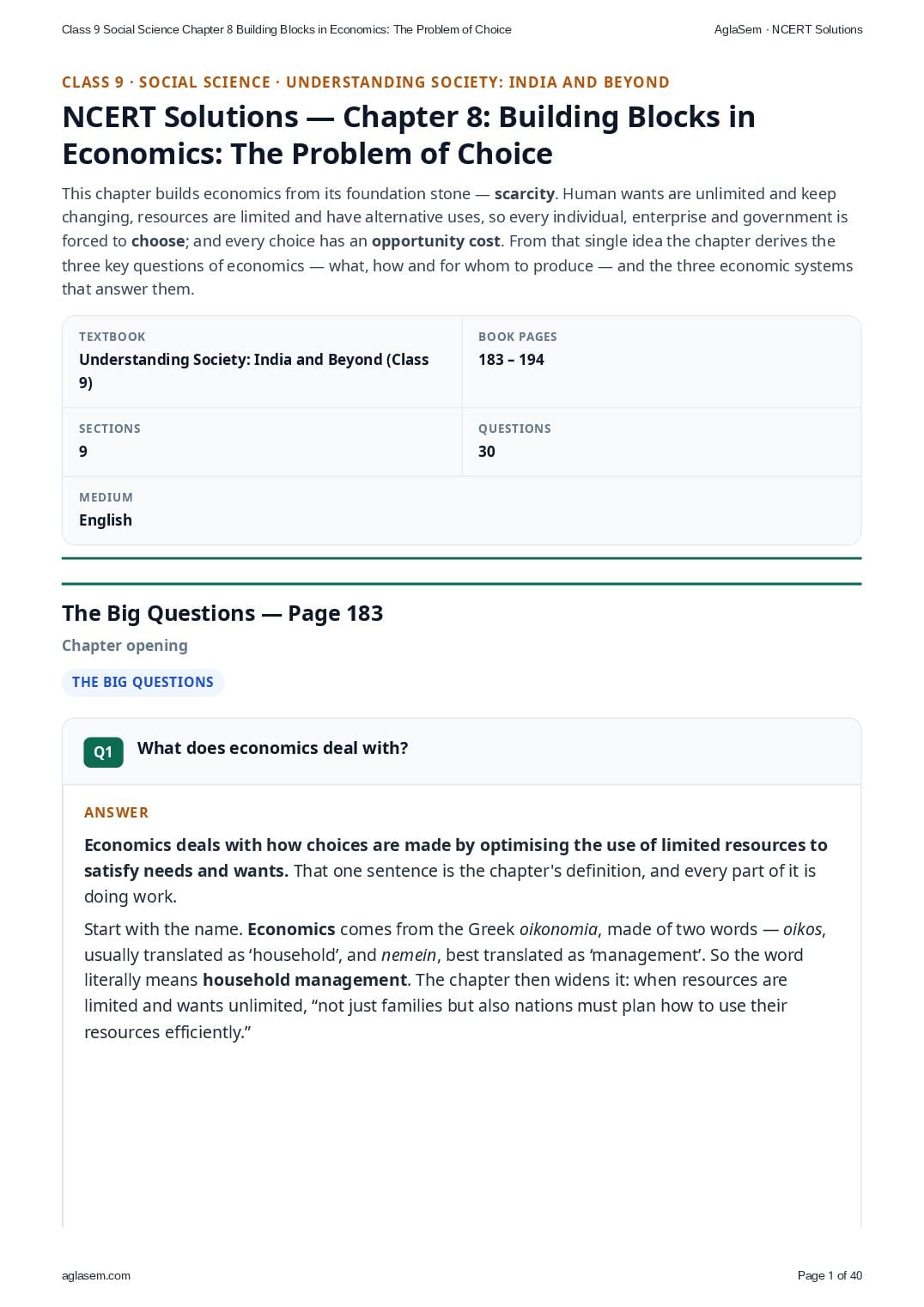
NCERT Solutions for Class 9 Social Science Chapter 8 Building Blocks in Economics the Problem of Choice provide clear, step-by-step answers to every exercise and in-text question from the chapter Building Blocks in Economics the Problem of Choice of the NCERT textbook Understanding Society: India and Beyond. Prepared by subject experts as per the latest NCERT (CBSE) syllabus for 2026-27, these NCERT Solutions for Class 9 Social Science help you understand each concept, write exam-ready answers, and check your own solutions. You can read them online below or download the free Class 9 Social Science Chapter 8 question-answer PDF.
NCERT Solutions for Class 9 Social Science Chapter 8 Building Blocks in Economics the Problem of Choice
- Class: Class 9
- Subject: Social Science
- Chapter: Chapter 8 – Building Blocks in Economics the Problem of Choice
- Textbook: Understanding Society: India and Beyond (NCERT)
- Study material: NCERT Solutions – questions with answers, free PDF
These solutions answer all the exercise questions of Chapter 8 Building Blocks in Economics the Problem of Choice — including the in-text questions, short-answer and long-answer questions, and activities — with complete explanations so you can follow the method, not just the final answer. Read the full solutions below.
NCERT Solutions Class 9 Social Science Chapter 8 Building Blocks in Economics the Problem of Choice View Download
NCERT Solutions for Class 9 Social Science Chapter 8 PDF Download
You can read the NCERT Solutions for Class 9 Social Science Chapter 8 online above, or download the complete question-answer PDF to study Building Blocks in Economics the Problem of Choice offline at any time.
NCERT Solutions for Class 9 Social Science Chapter 8 PDF Download Link – Click Here to Download Solutions PDF
Questions Covered in This Chapter
These NCERT Solutions answer all 30 questions of this chapter. The questions solved are:
- What does economics deal with?
- What are the key questions in economics?
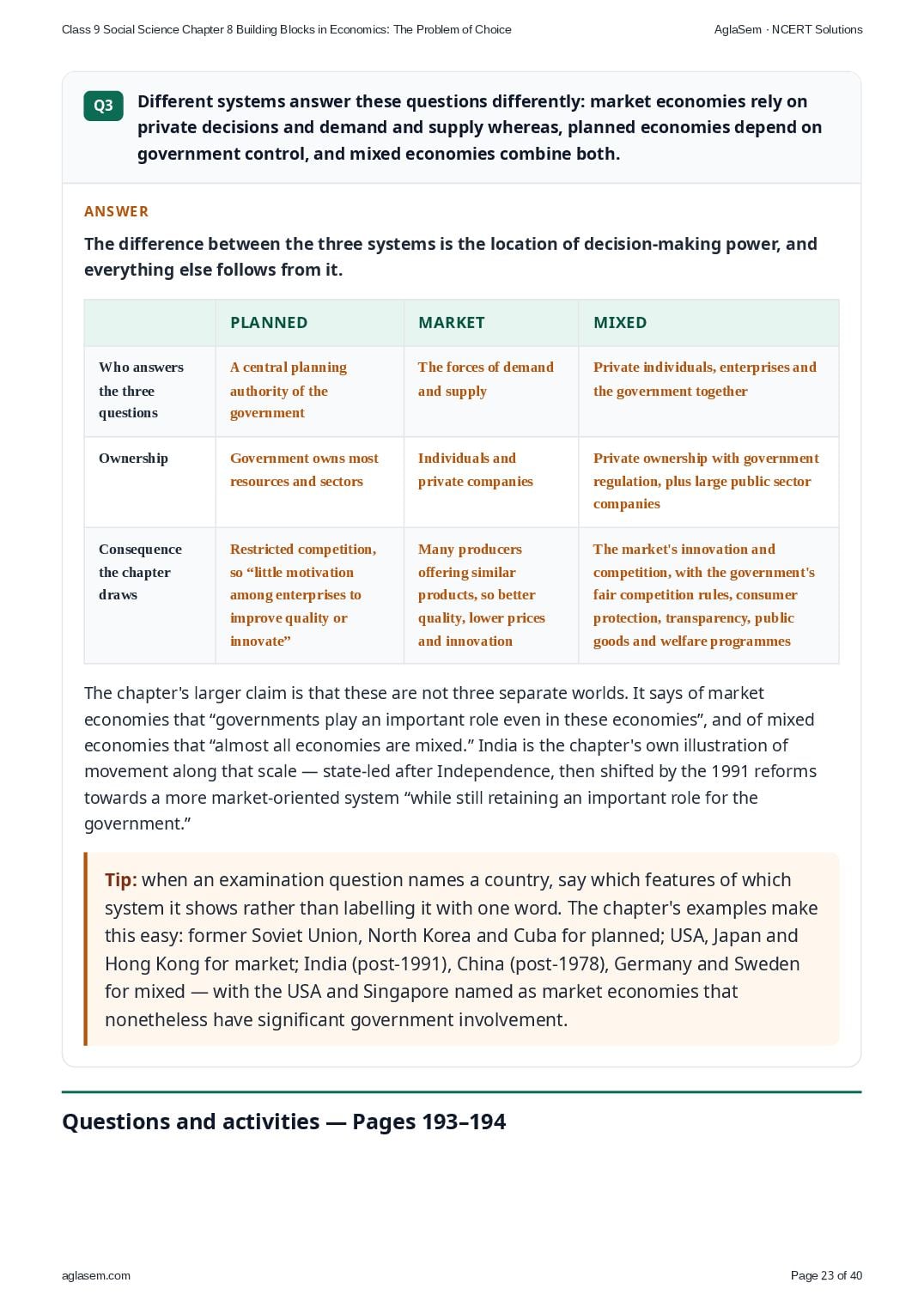
- How do different economic systems address these questions?
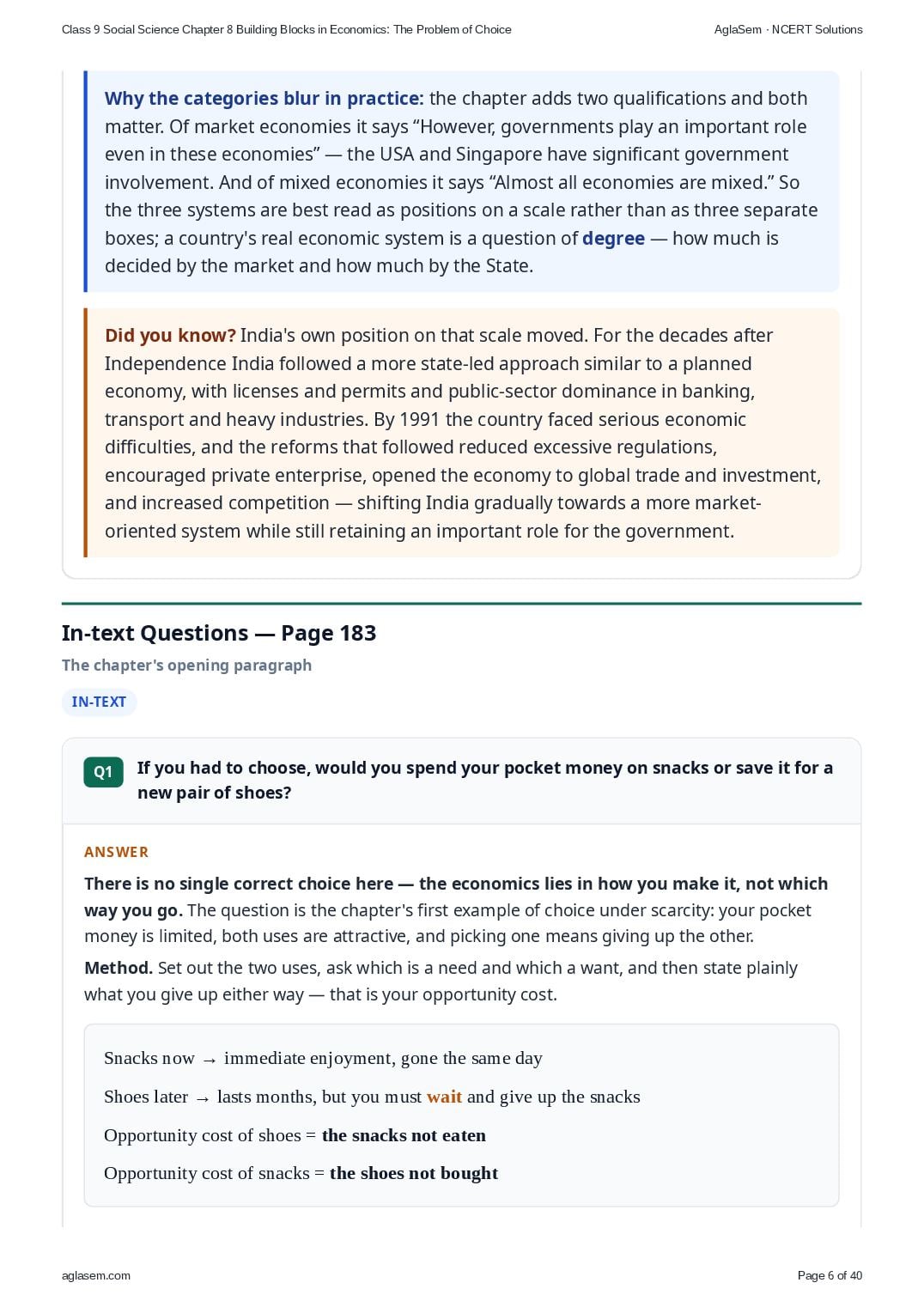
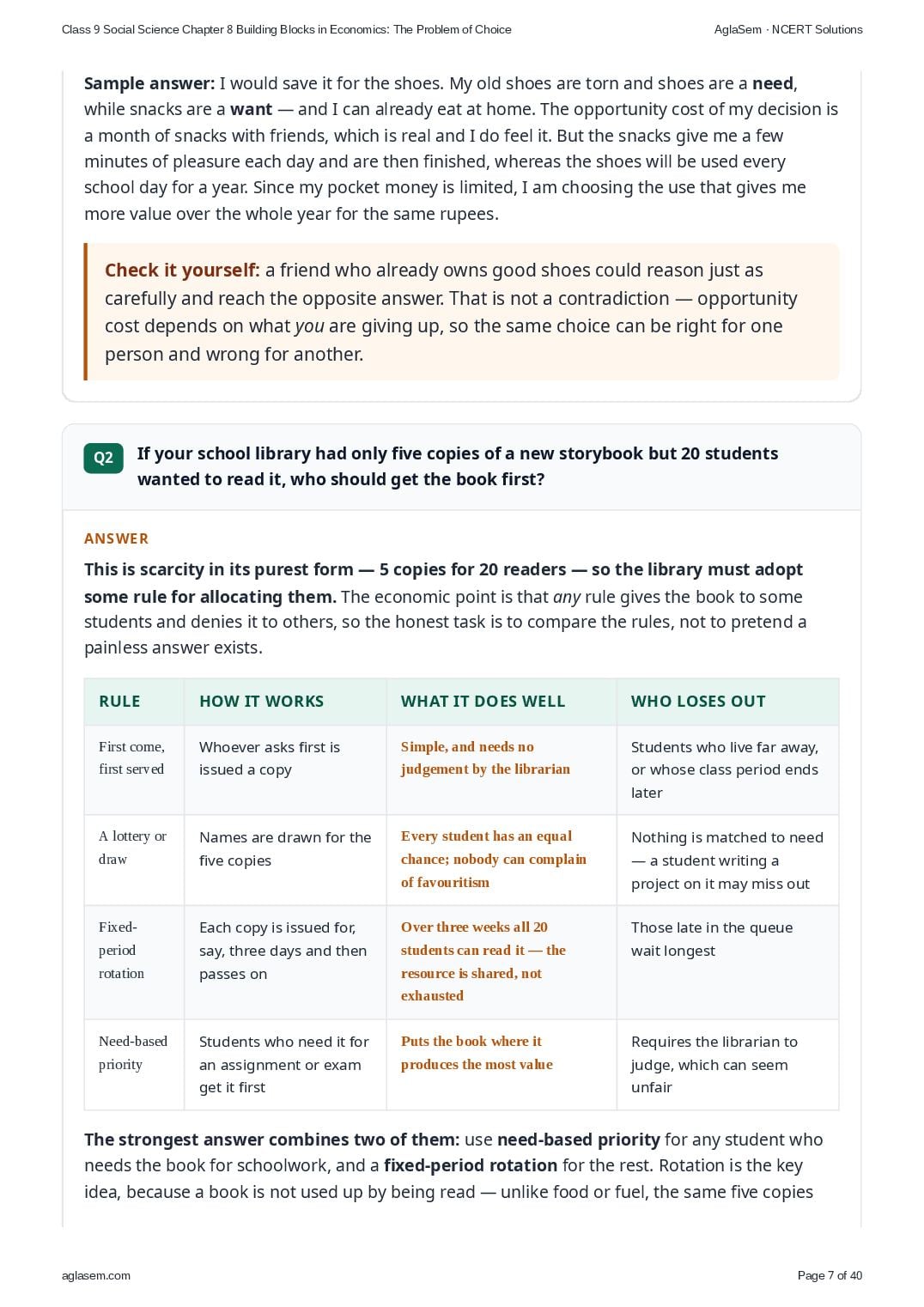
- If you had to choose, would you spend your pocket money on snacks or save it for a new pair of shoes?
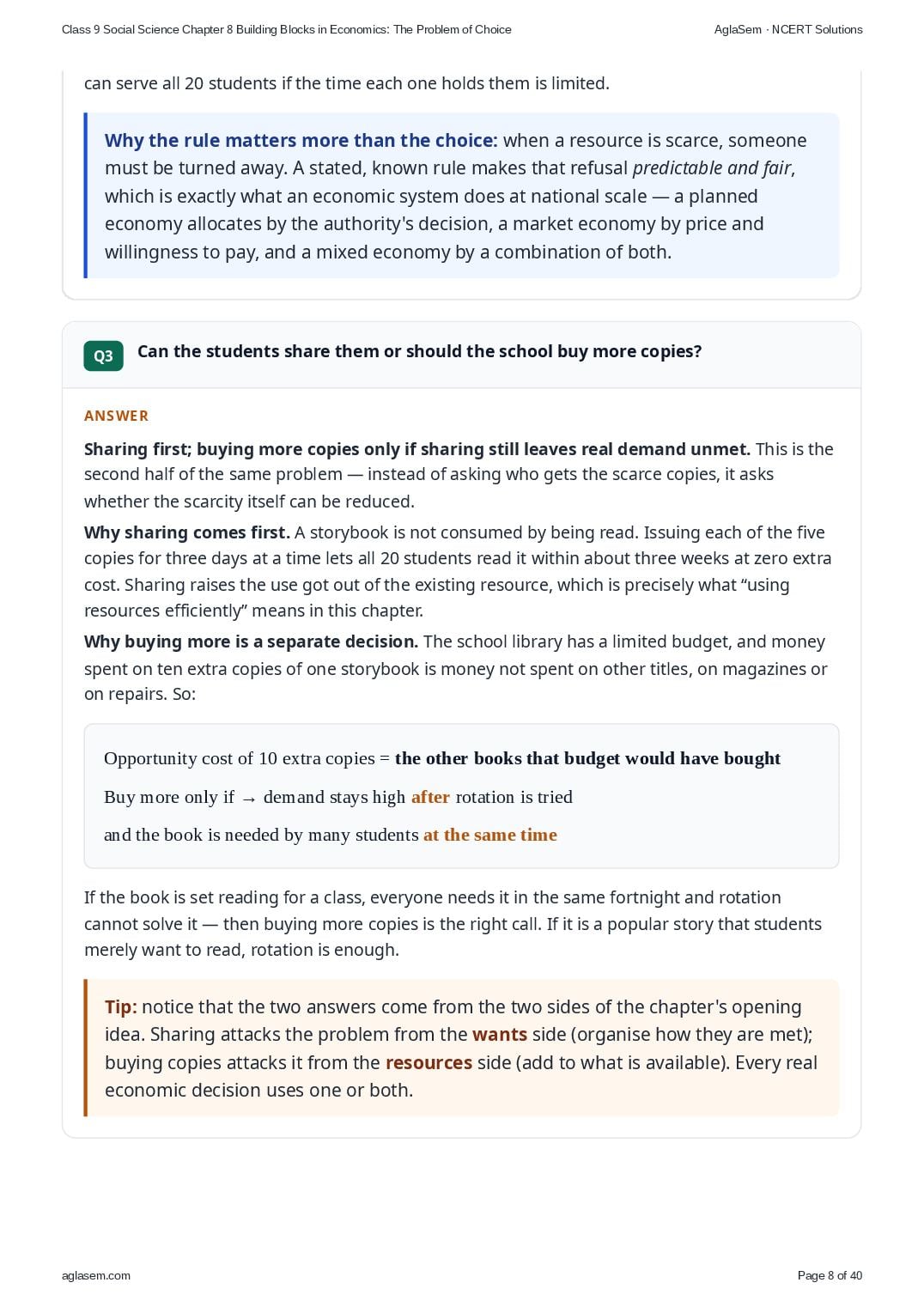
- If your school library had only five copies of a new storybook but 20 students wanted to read it, who should get the book first?
- Can the students share them or should the school buy more copies?
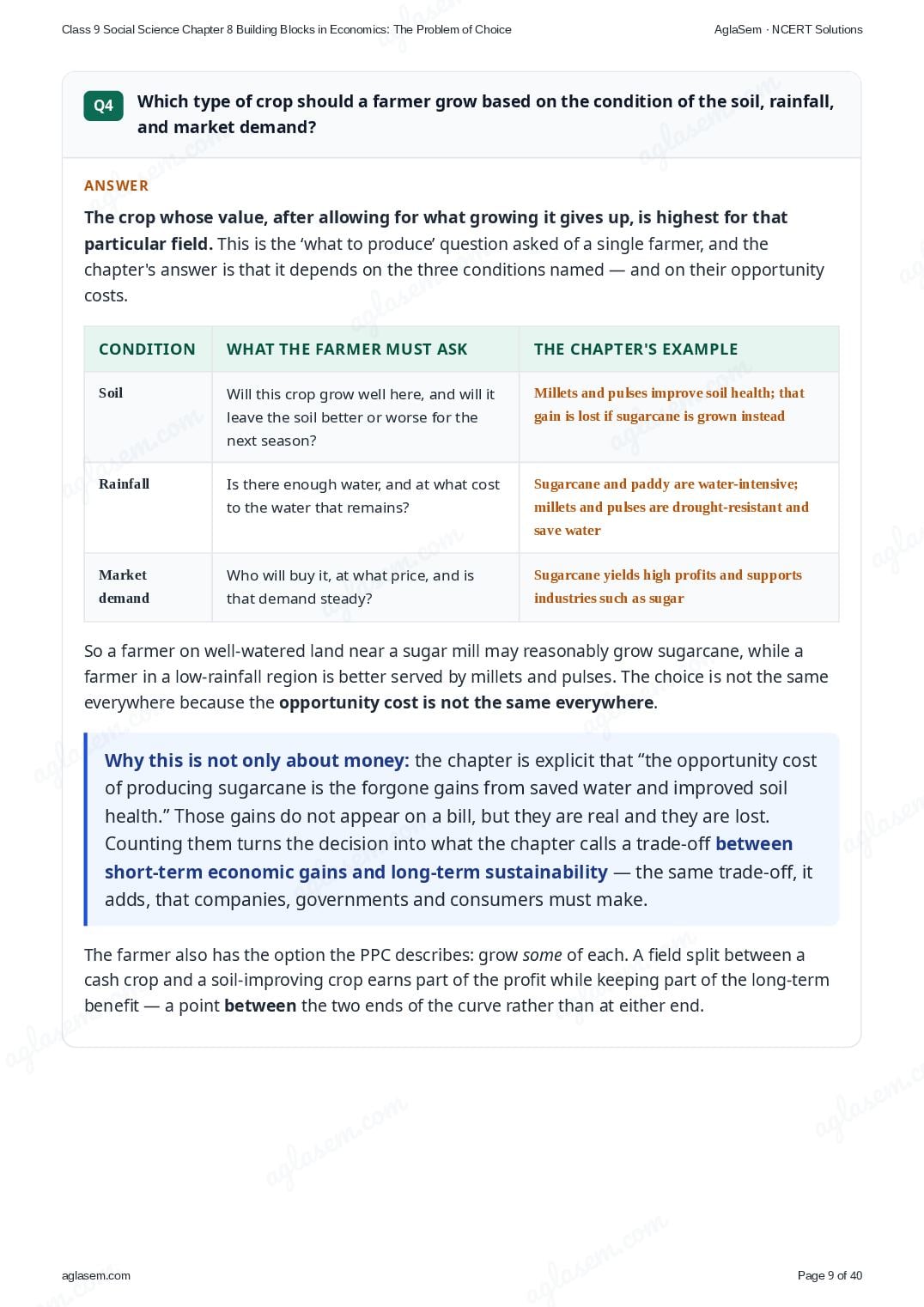
- Which type of crop should a farmer grow based on the condition of the soil, rainfall, and market demand?
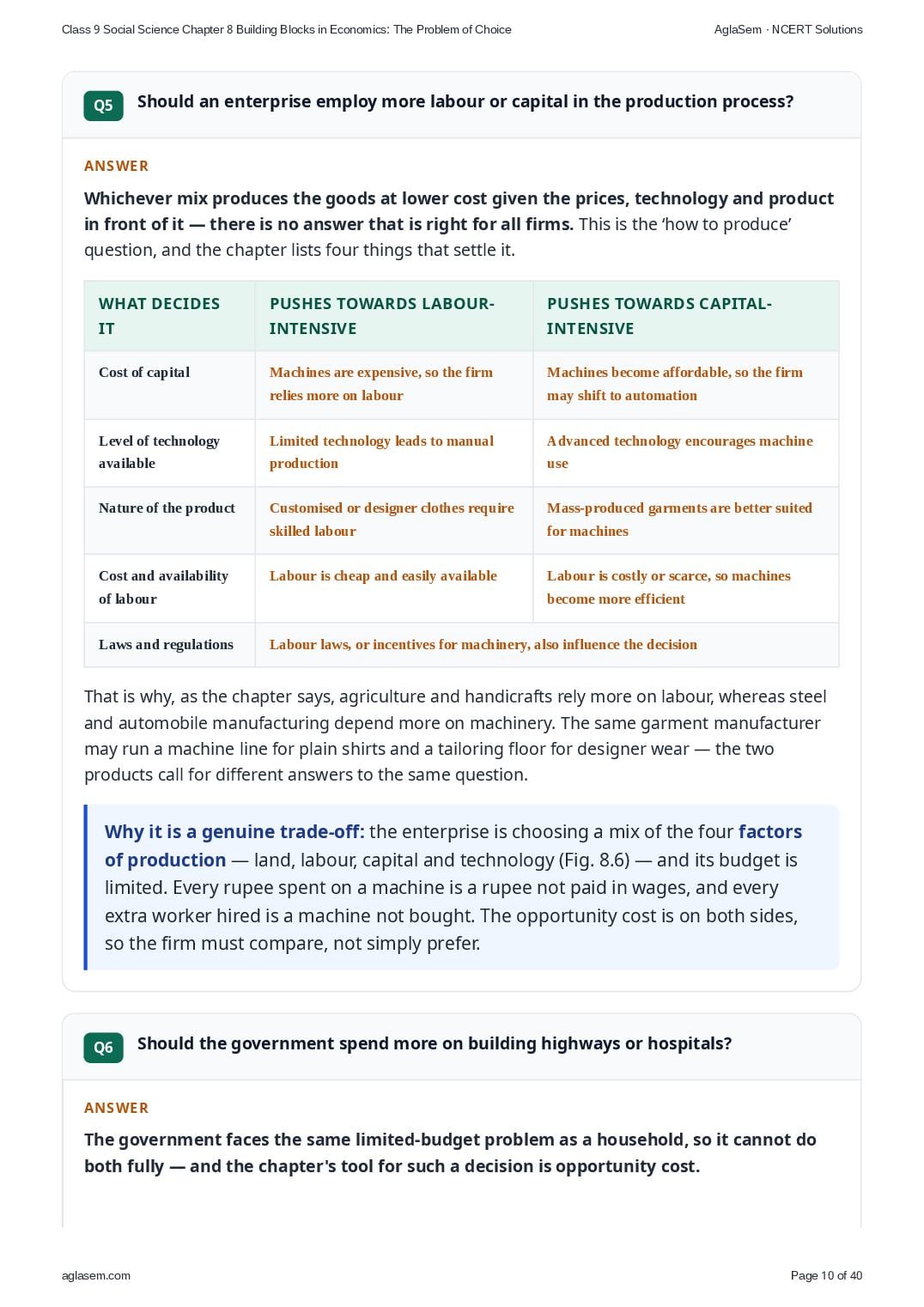
- Should an enterprise employ more labour or capital in the production process?
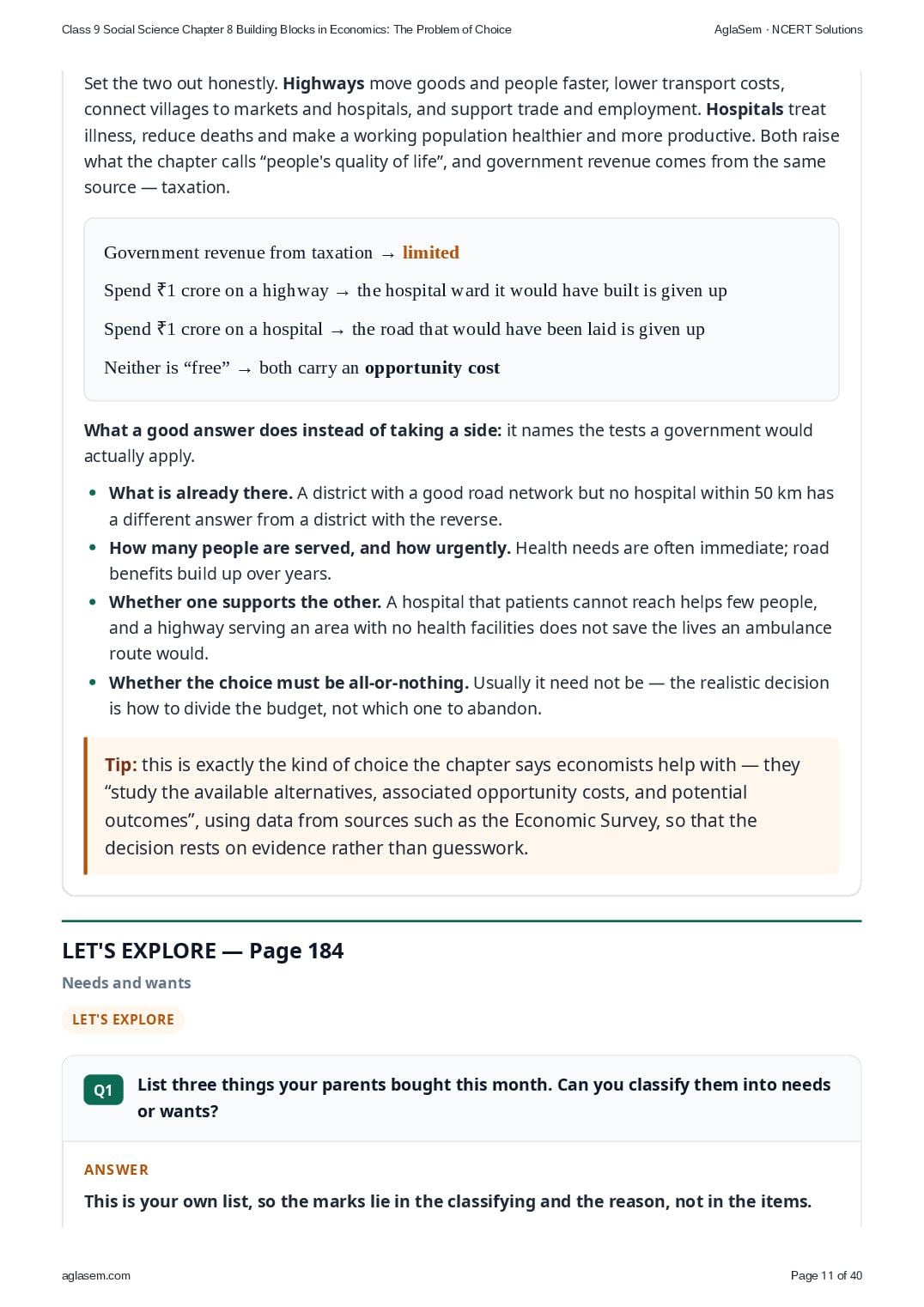
- Should the government spend more on building highways or hospitals?
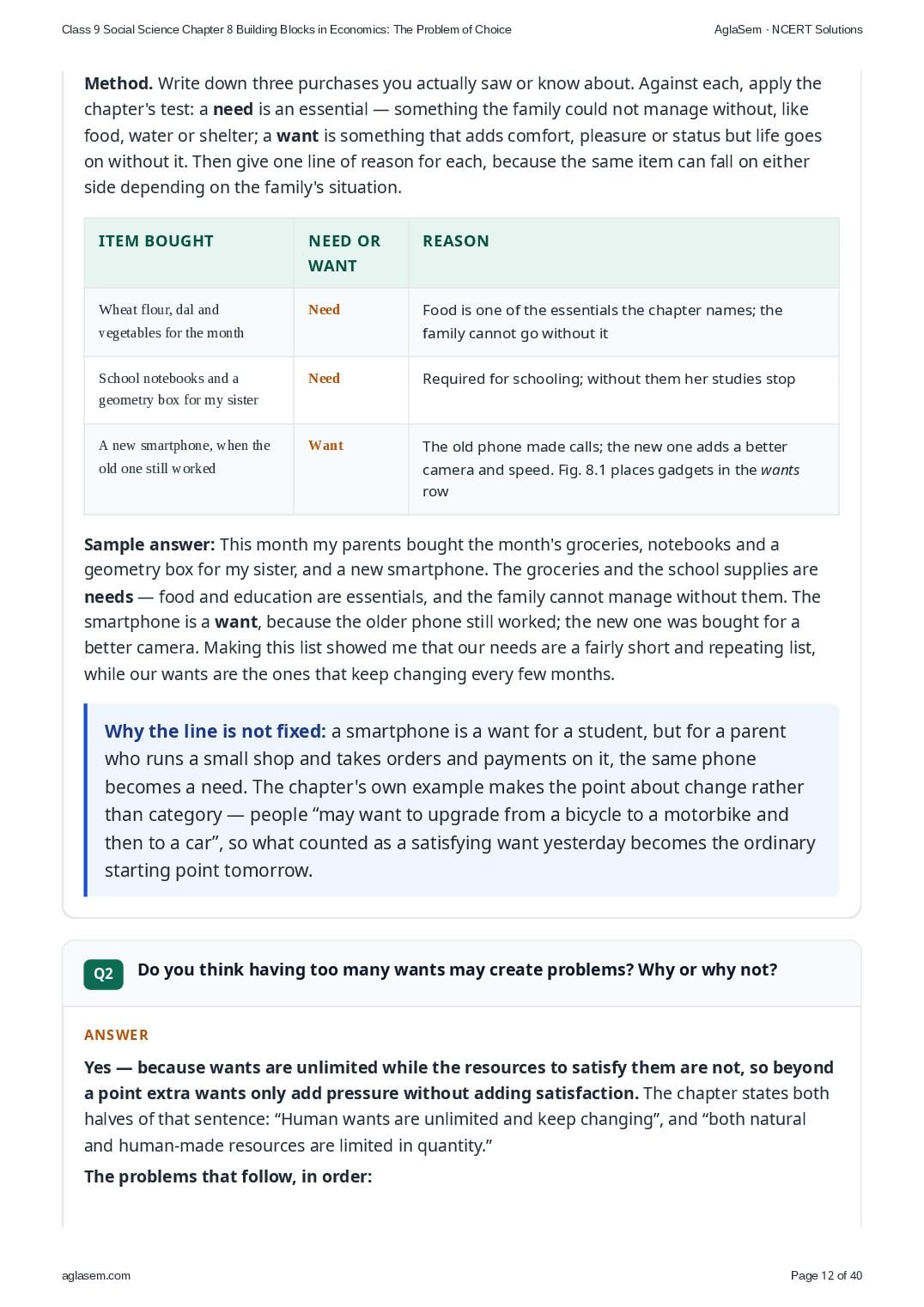
- List three things your parents bought this month. Can you classify them into needs or wants?
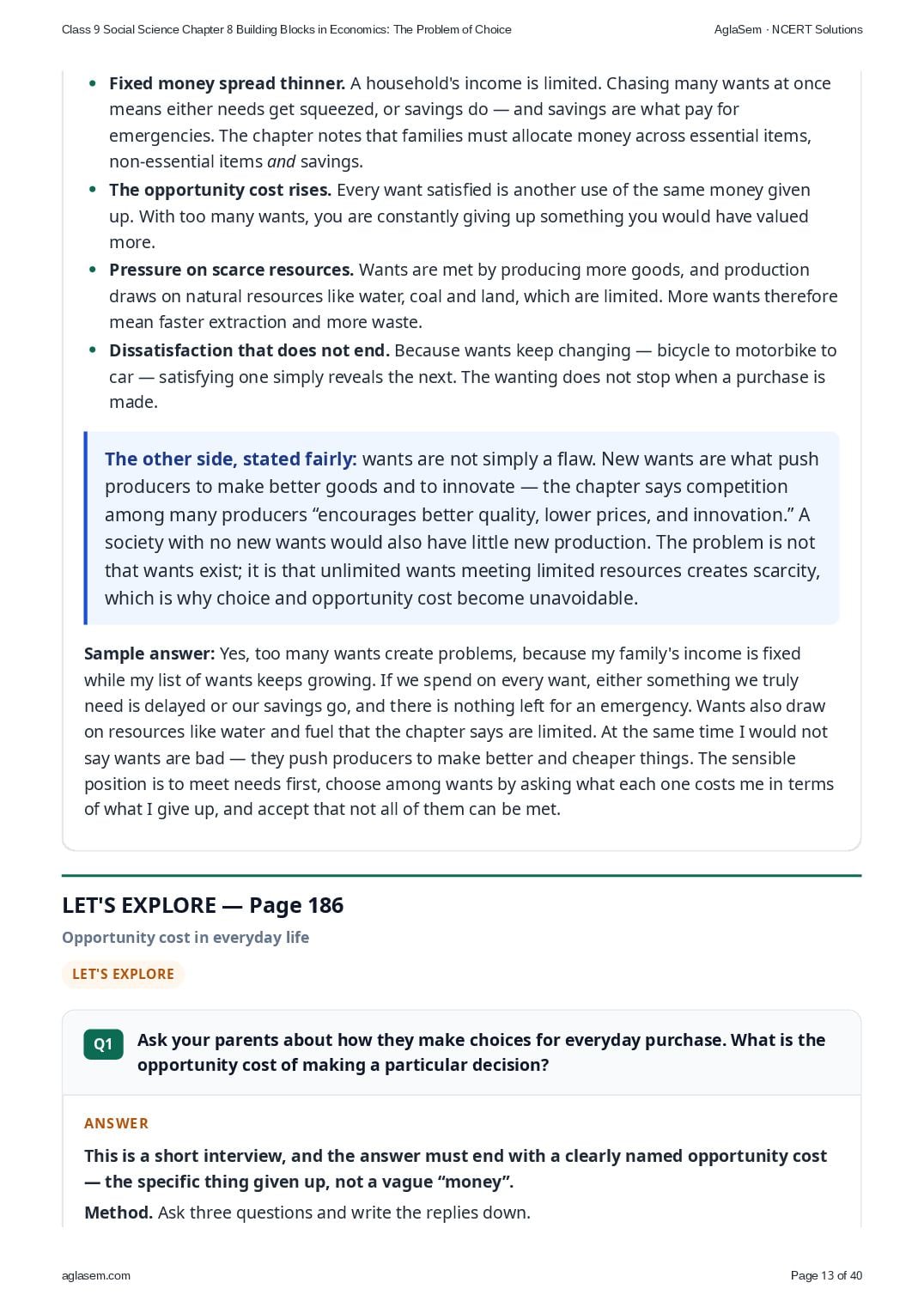
- Do you think having too many wants may create problems? Why or why not?
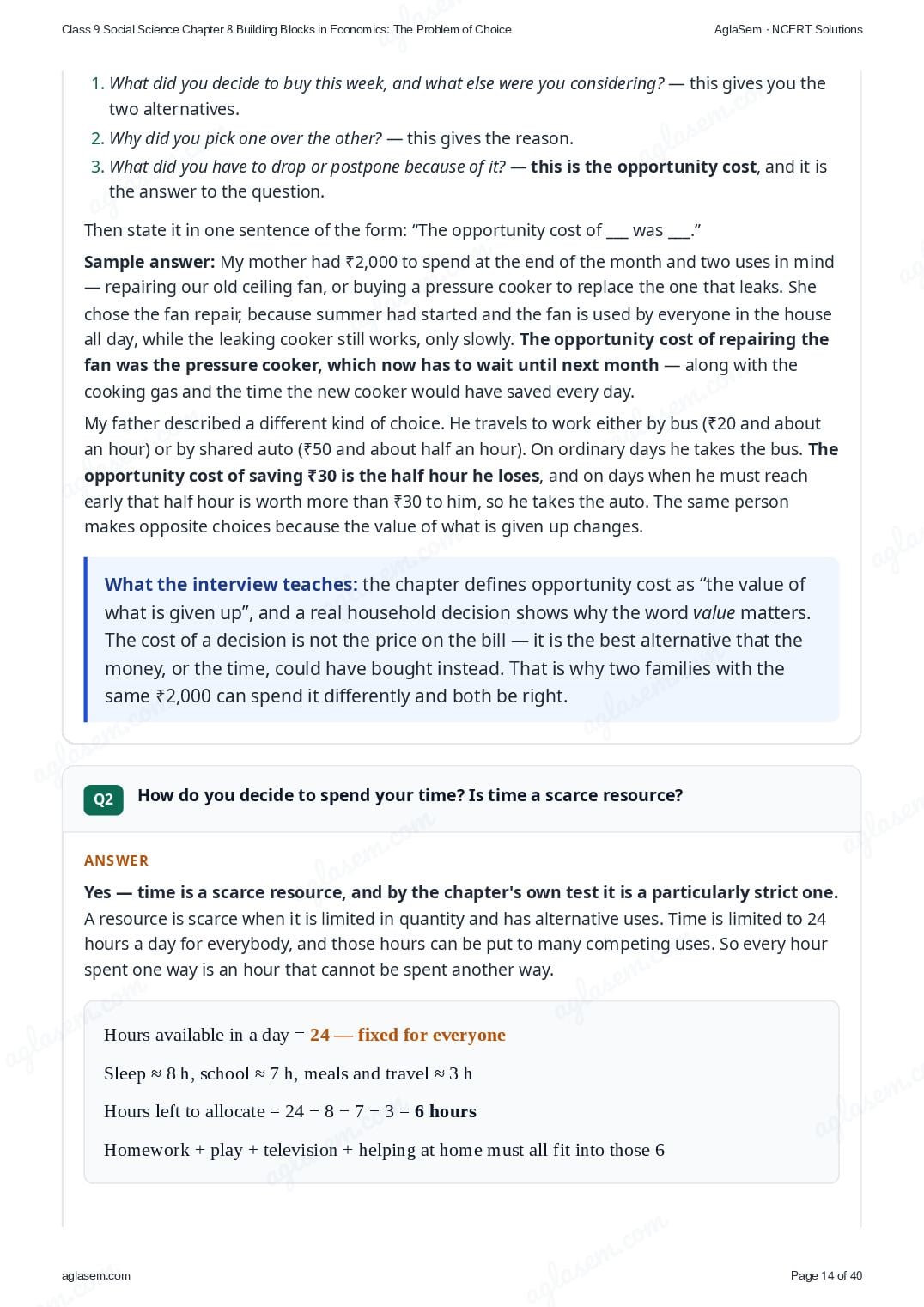
- Ask your parents about how they make choices for everyday purchase. What is the opportunity cost of making a particular decision?
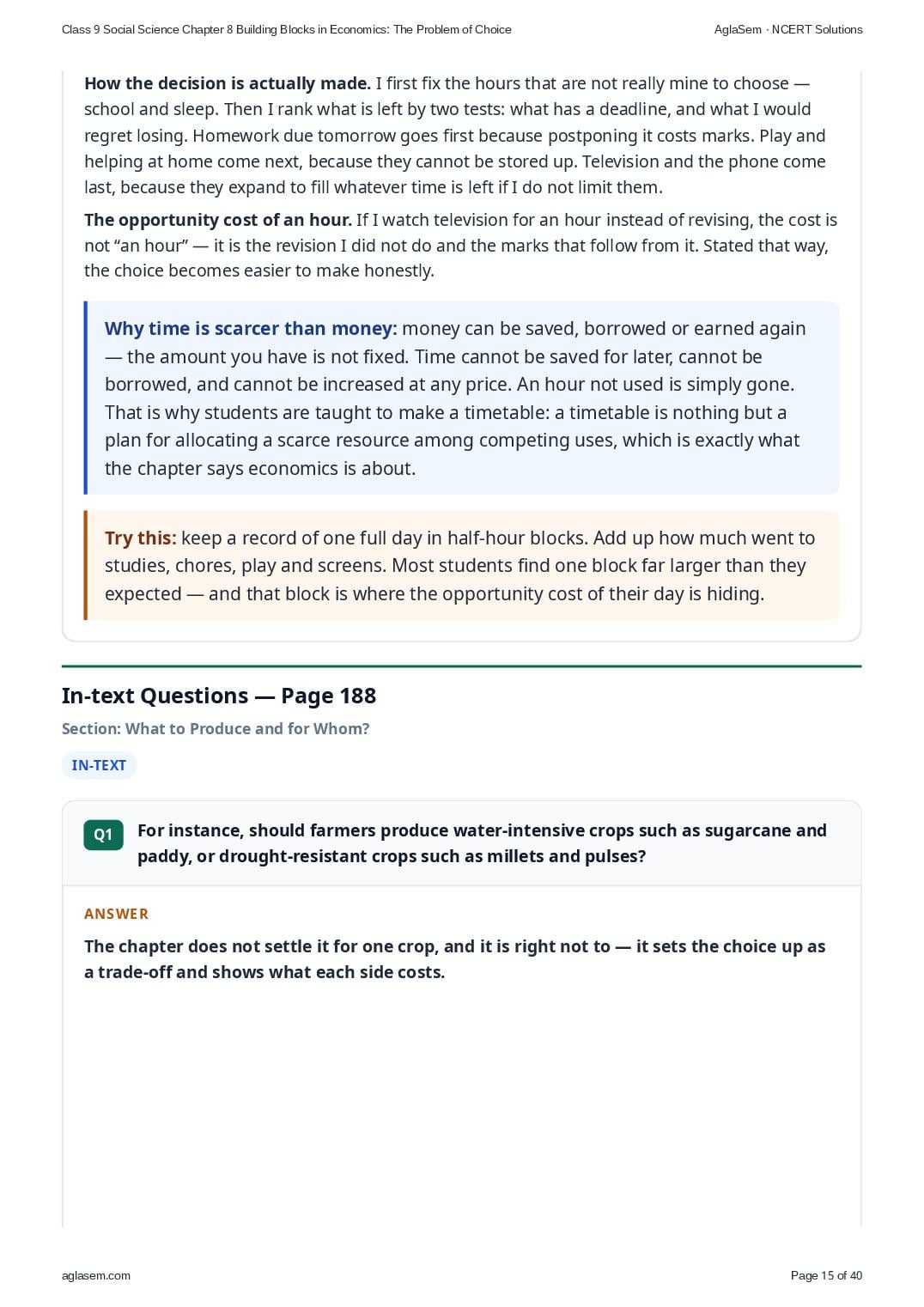
- How do you decide to spend your time? Is time a scarce resource?
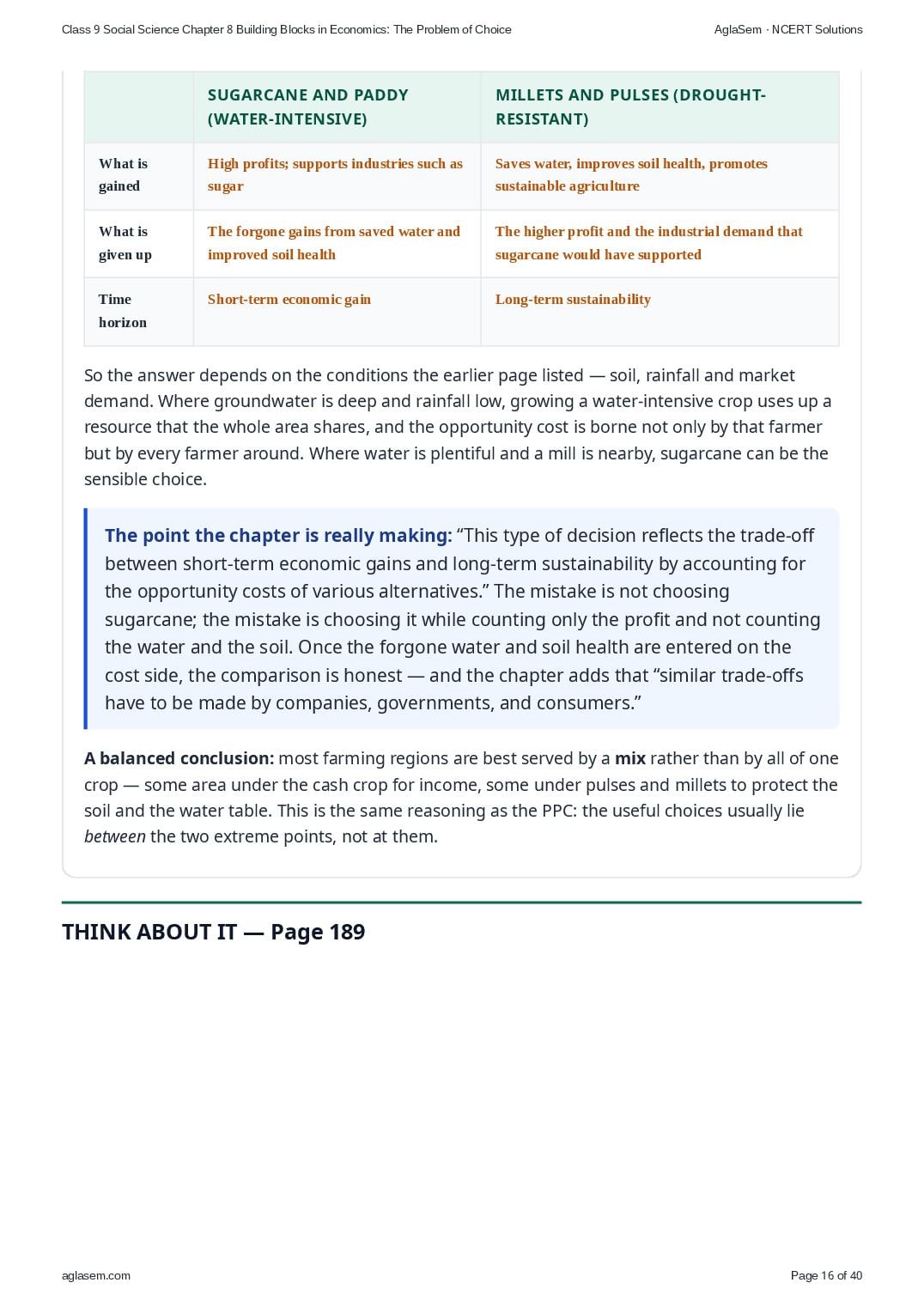
- For instance, should farmers produce water-intensive crops such as sugarcane and paddy, or drought-resistant crops such as millets and pulses?
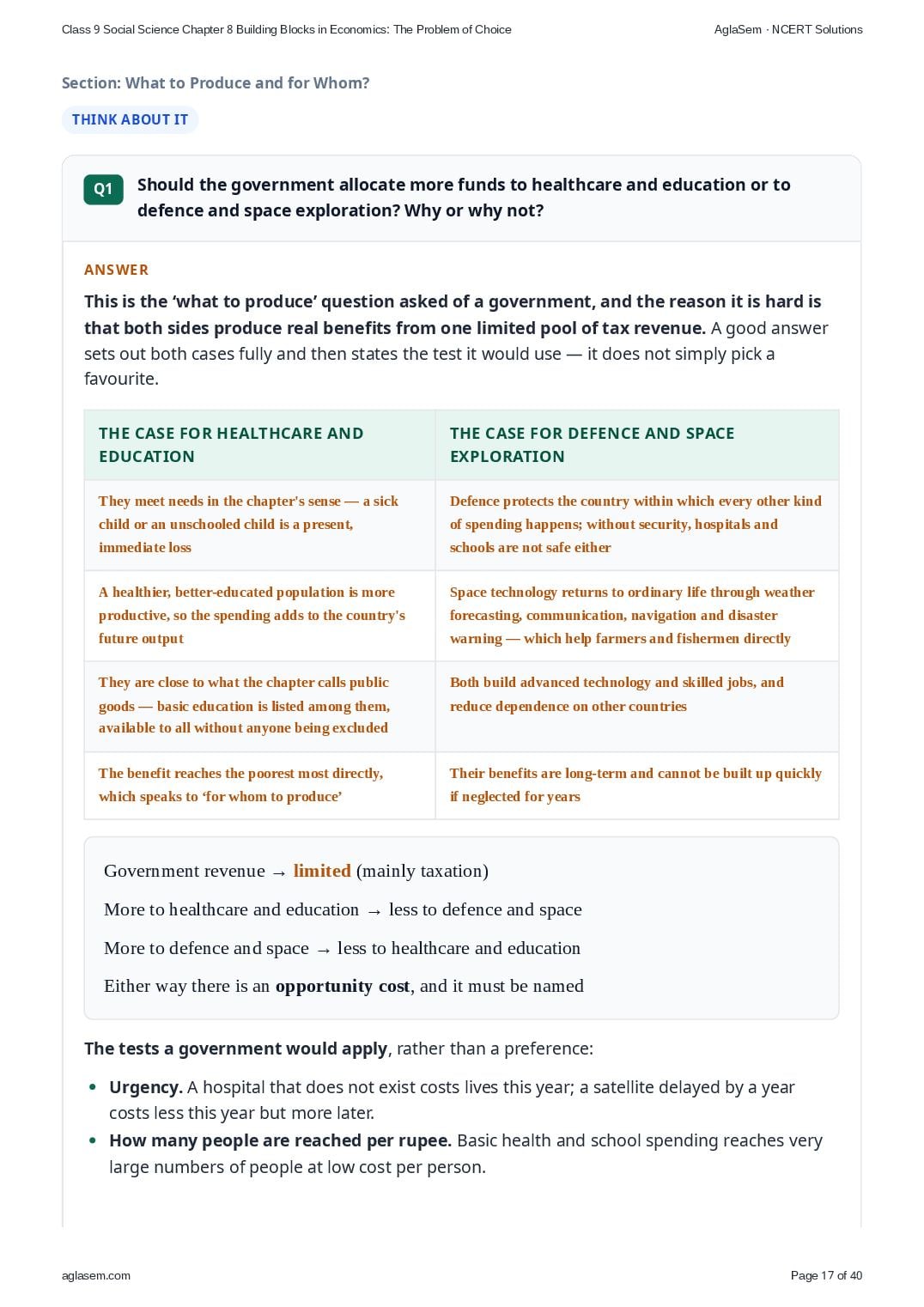
- Should the government allocate more funds to healthcare and education or to defence and space exploration? Why or why not?
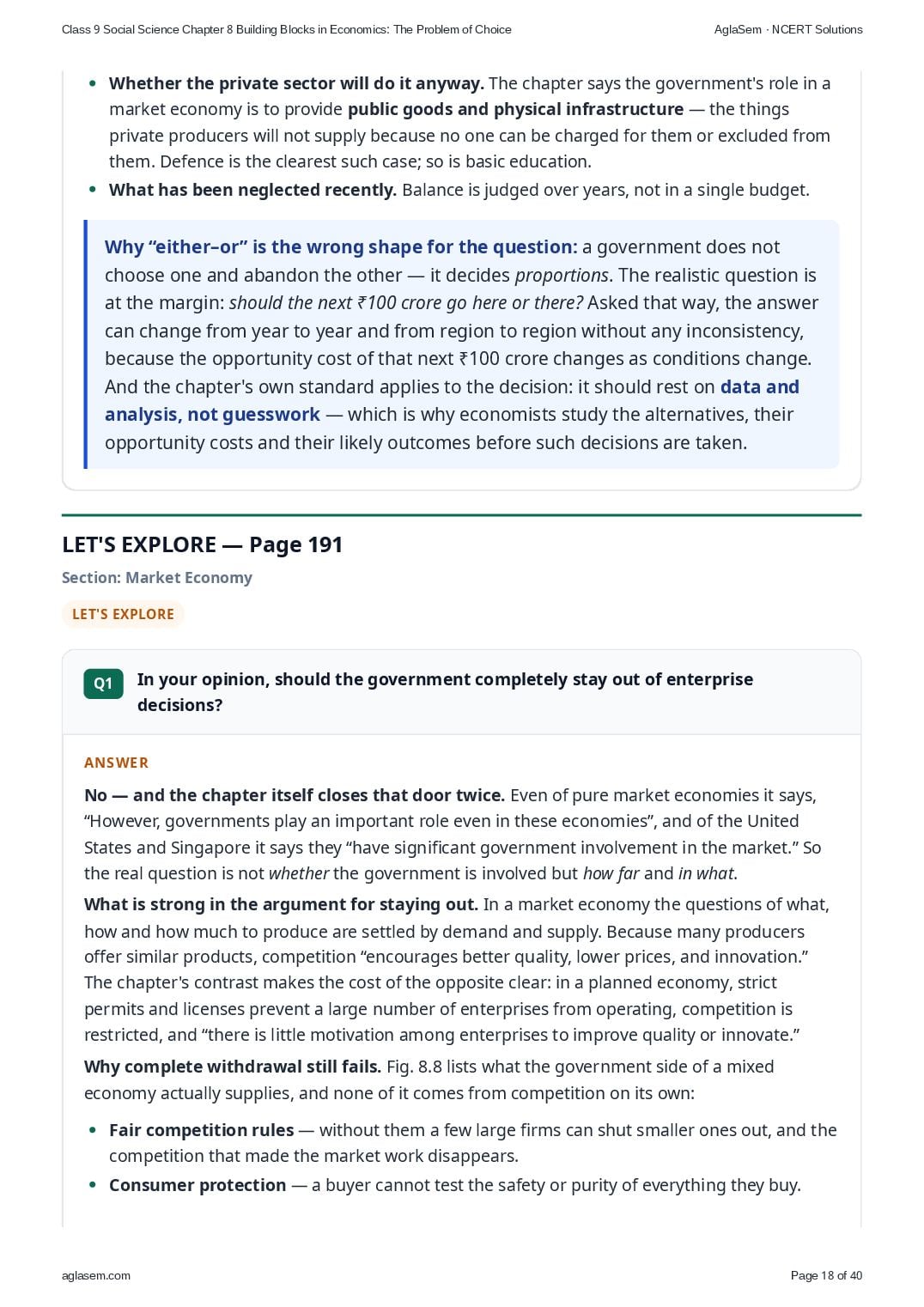
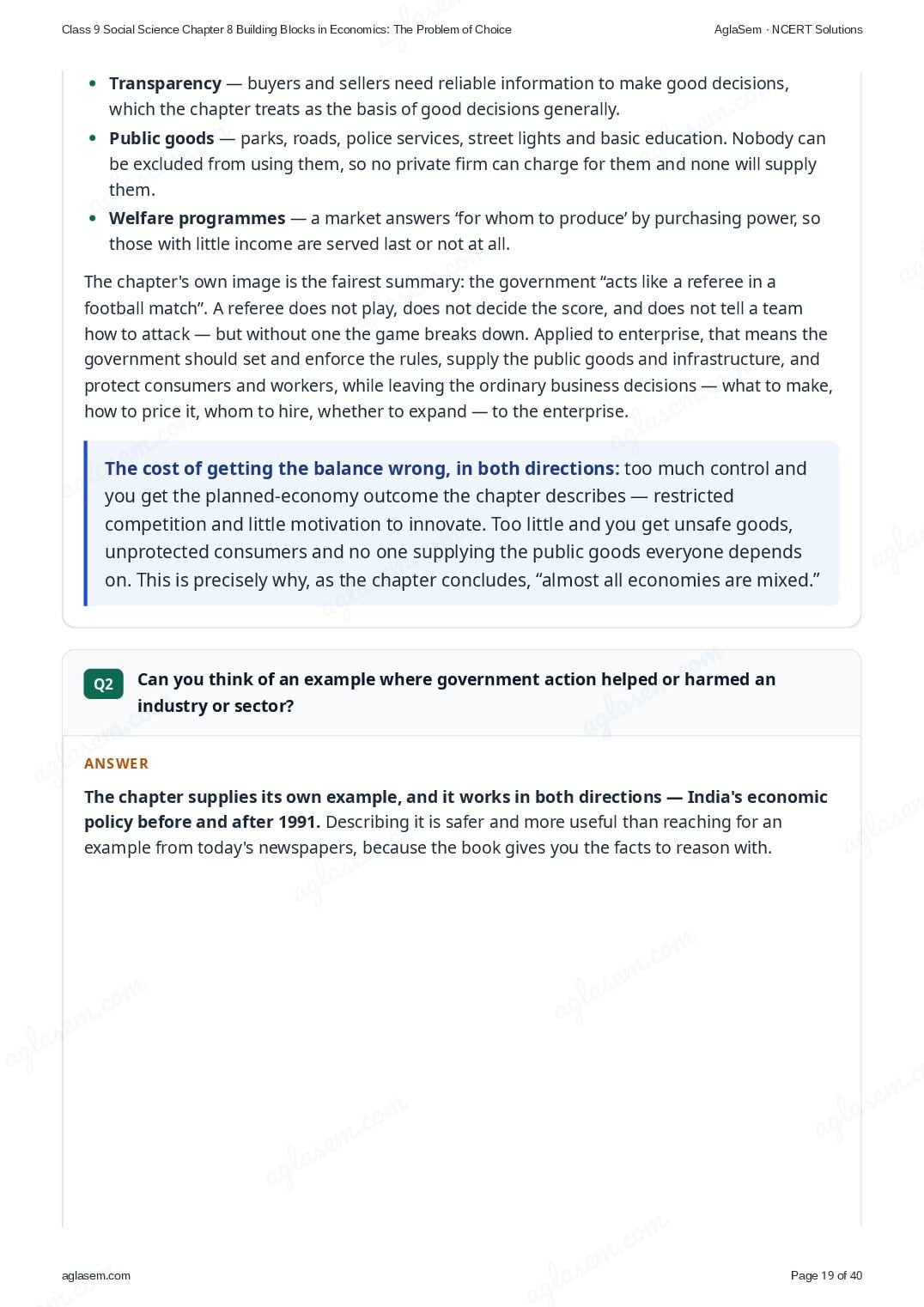
- In your opinion, should the government completely stay out of enterprise decisions?
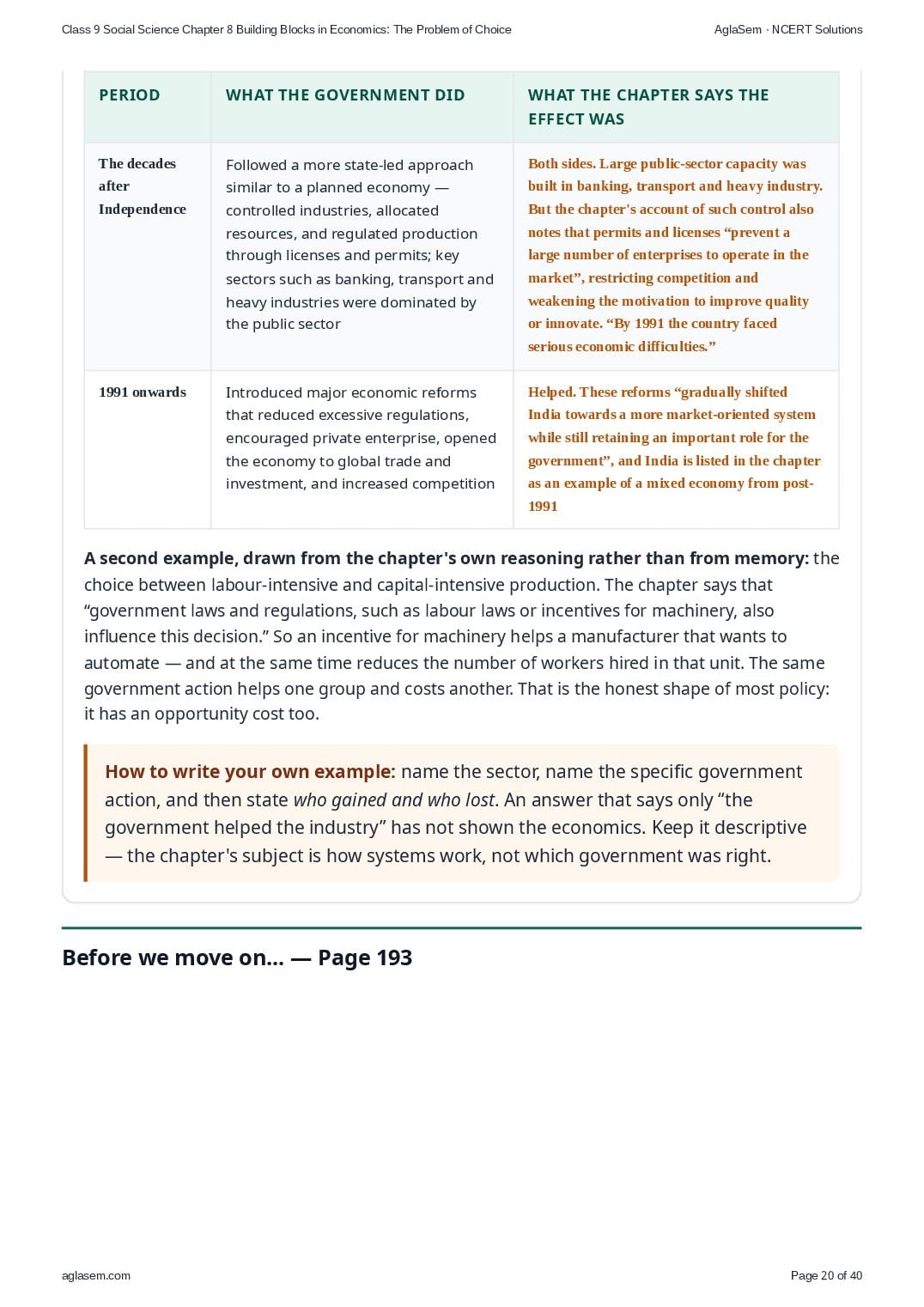
- Can you think of an example where government action helped or harmed an industry or sector?
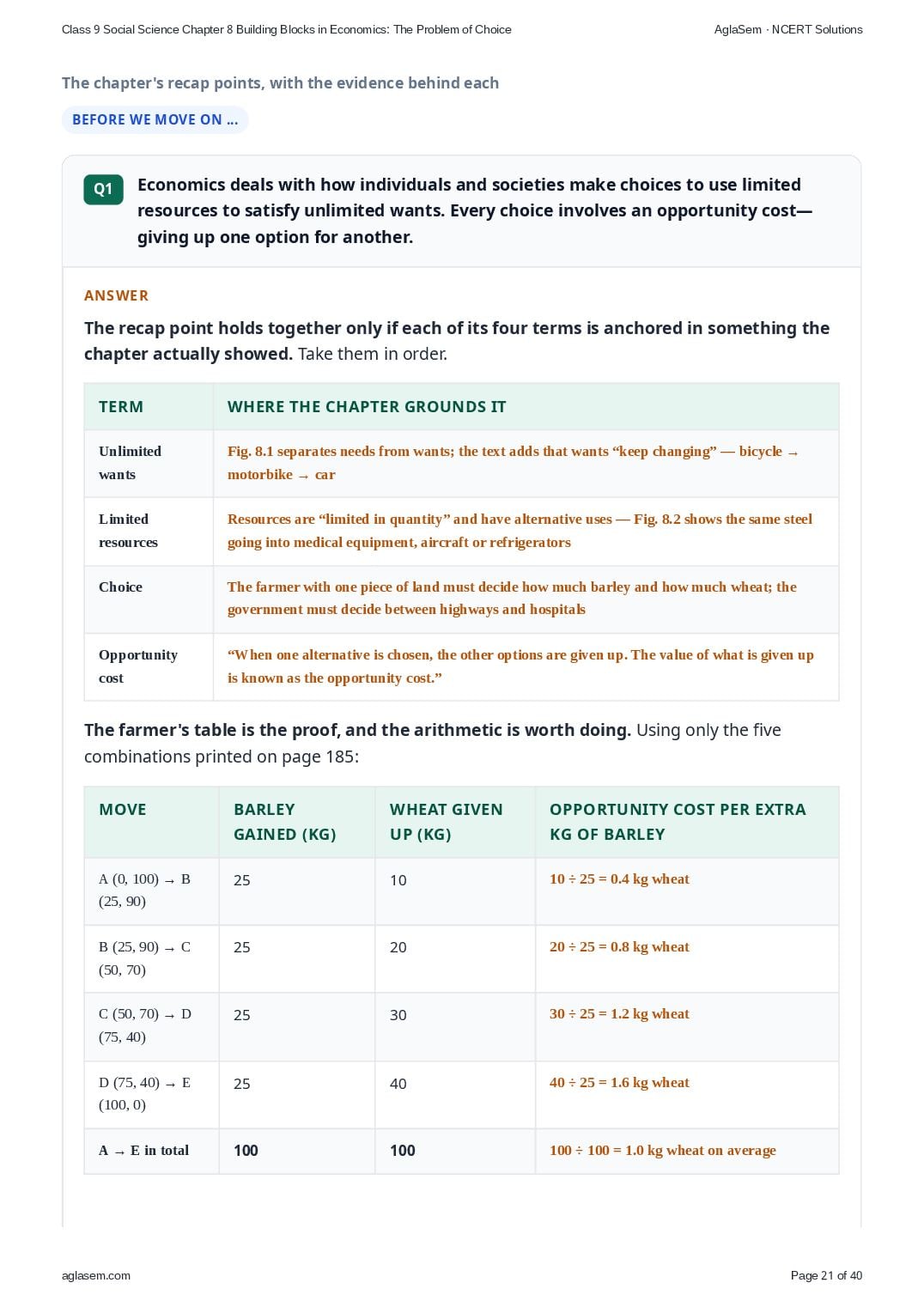
- Economics deals with how individuals and societies make choices to use limited resources to satisfy unlimited wants. Every choice involves an opportunity cost—giving up one option for another.
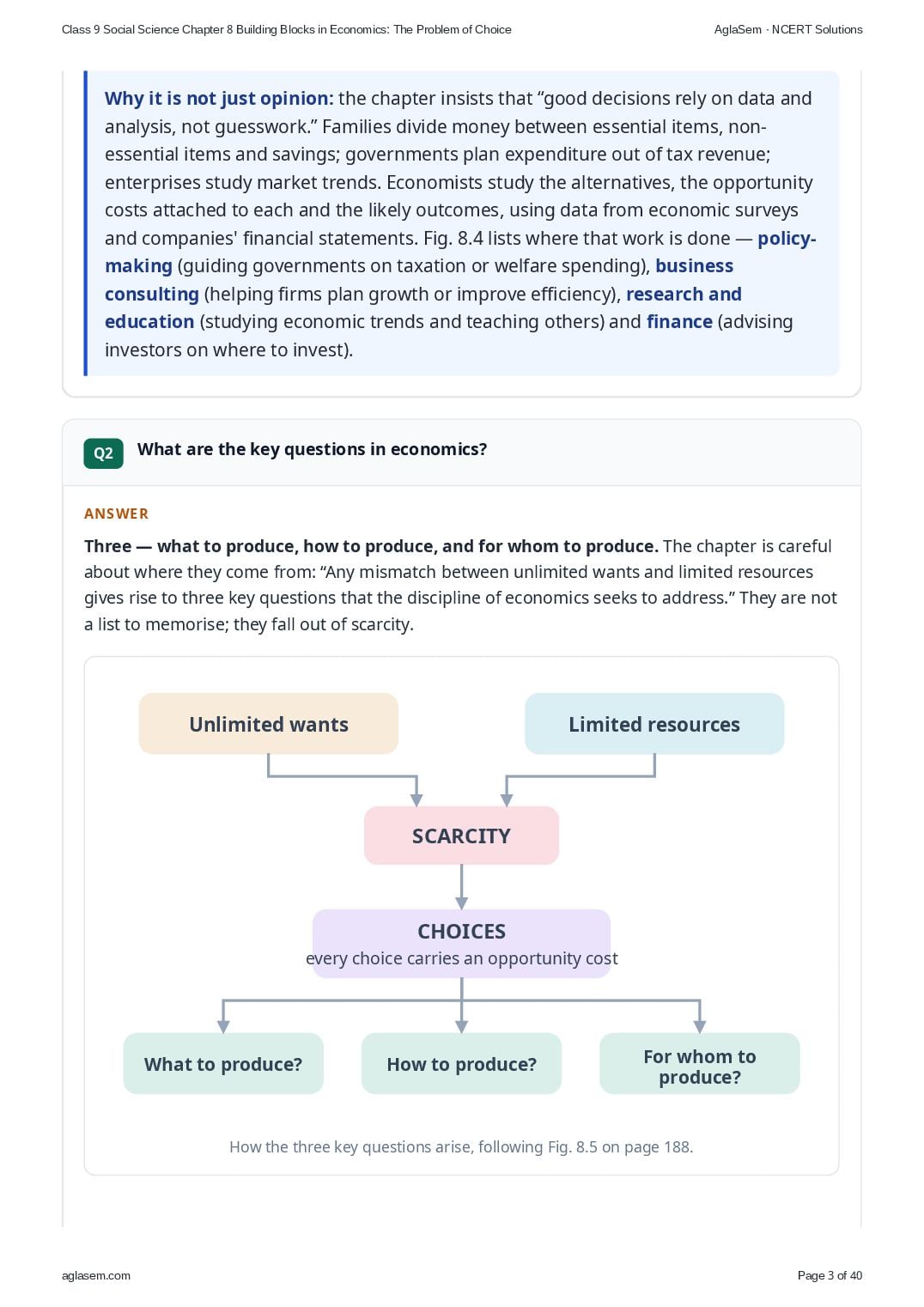
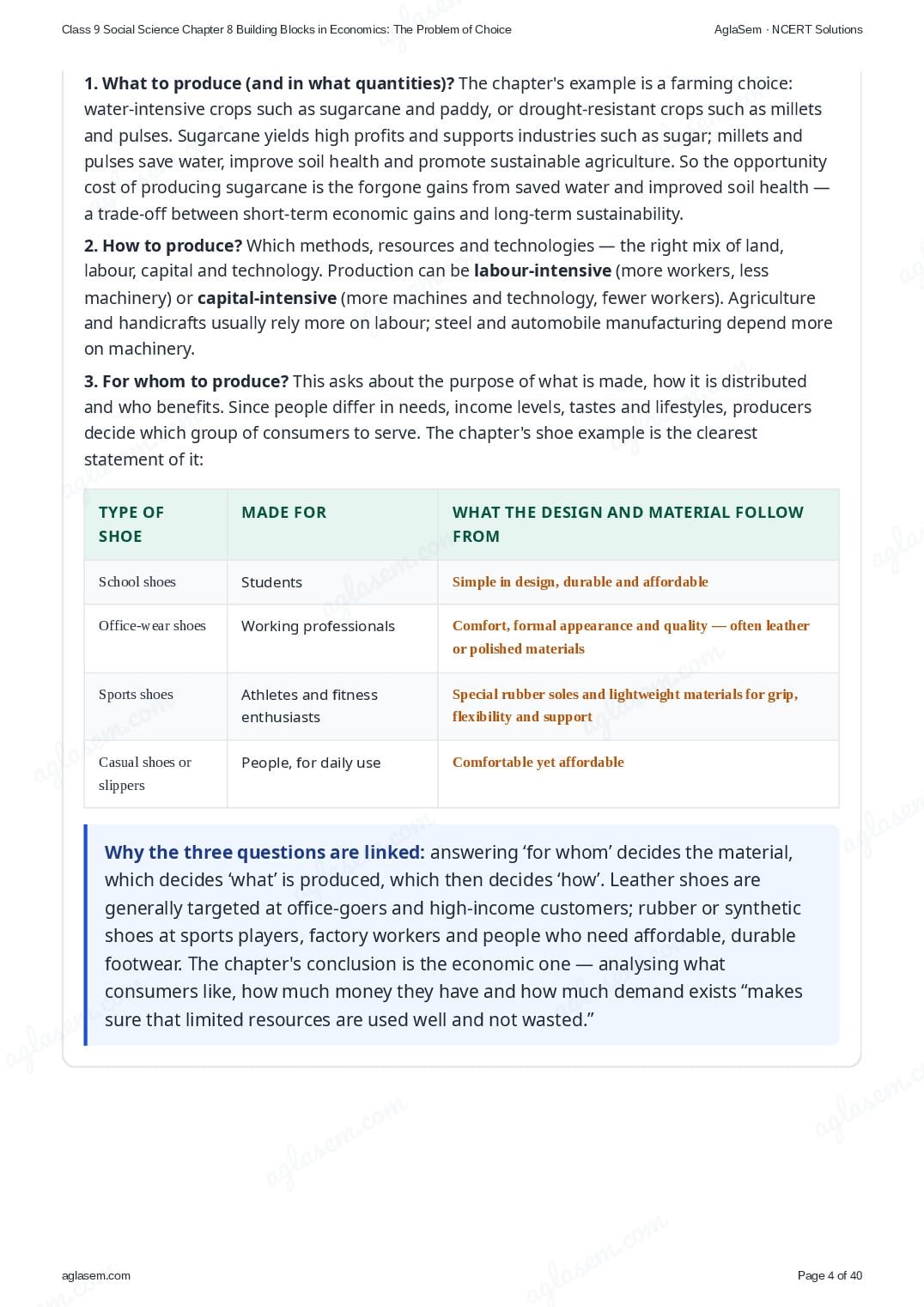
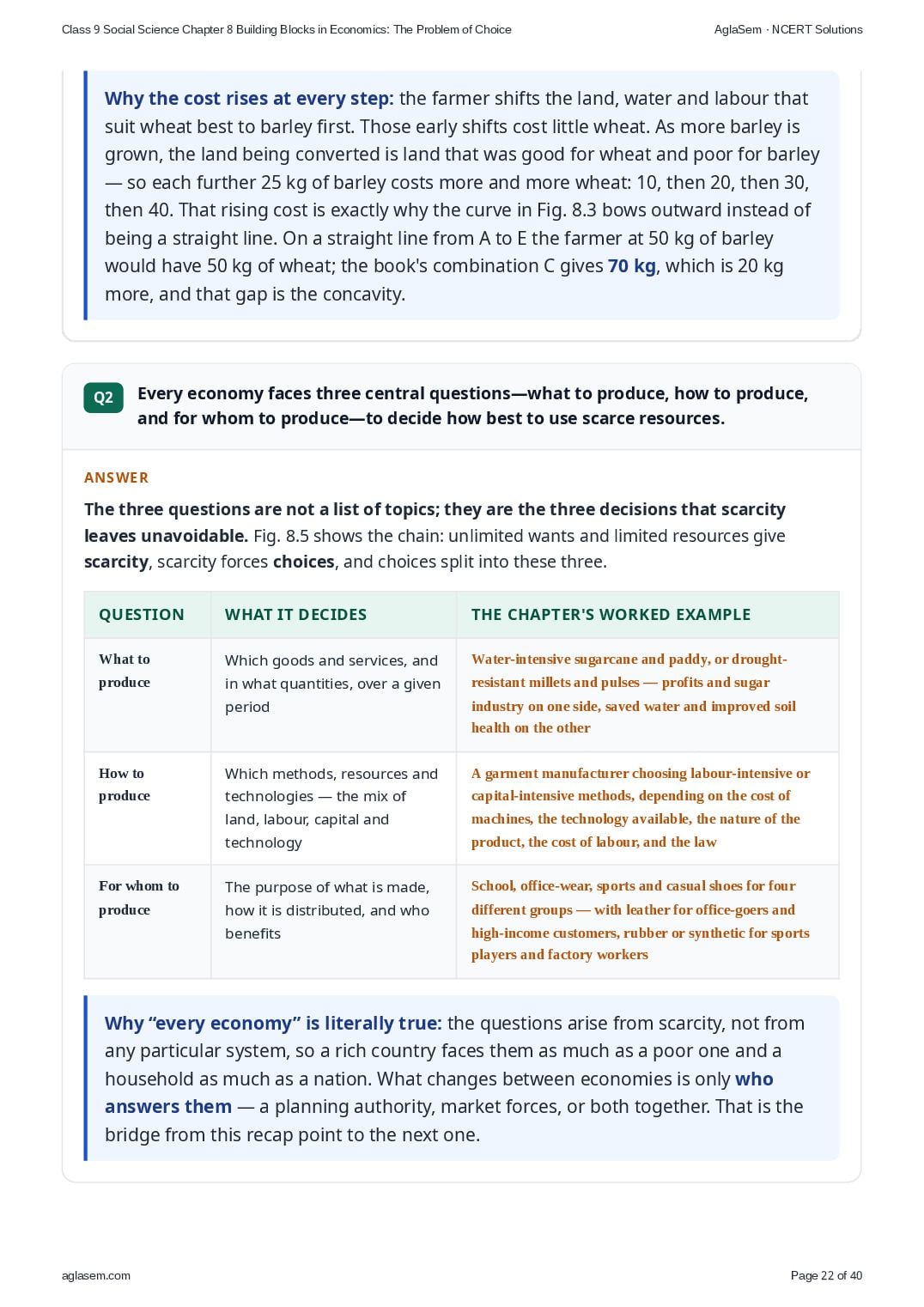
- Every economy faces three central questions—what to produce, how to produce, and for whom to produce—to decide how best to use scarce resources.
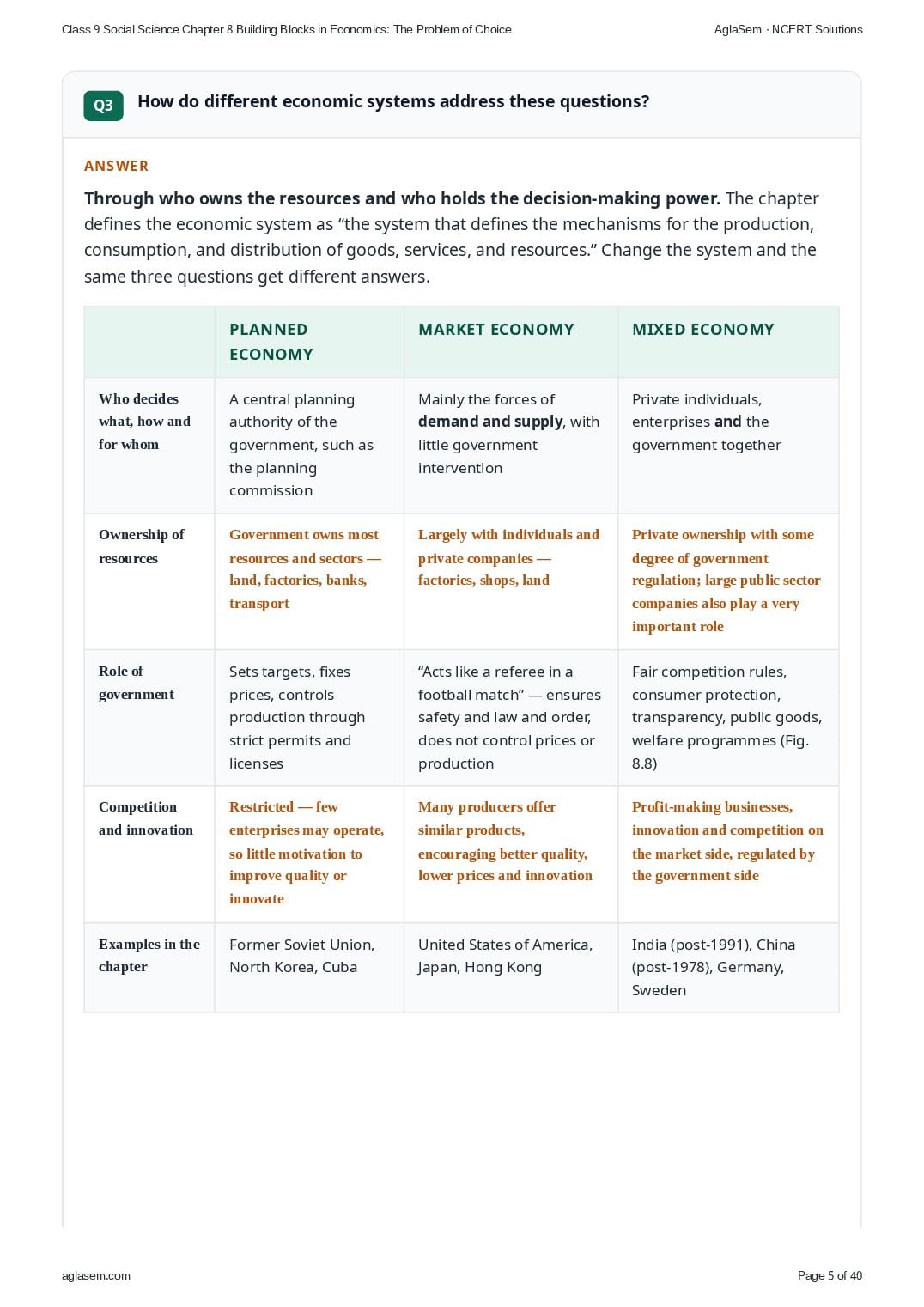
- Different systems answer these questions differently: market economies rely on private decisions and demand and supply whereas, planned economies depend on government control, and mixed economies combine both.
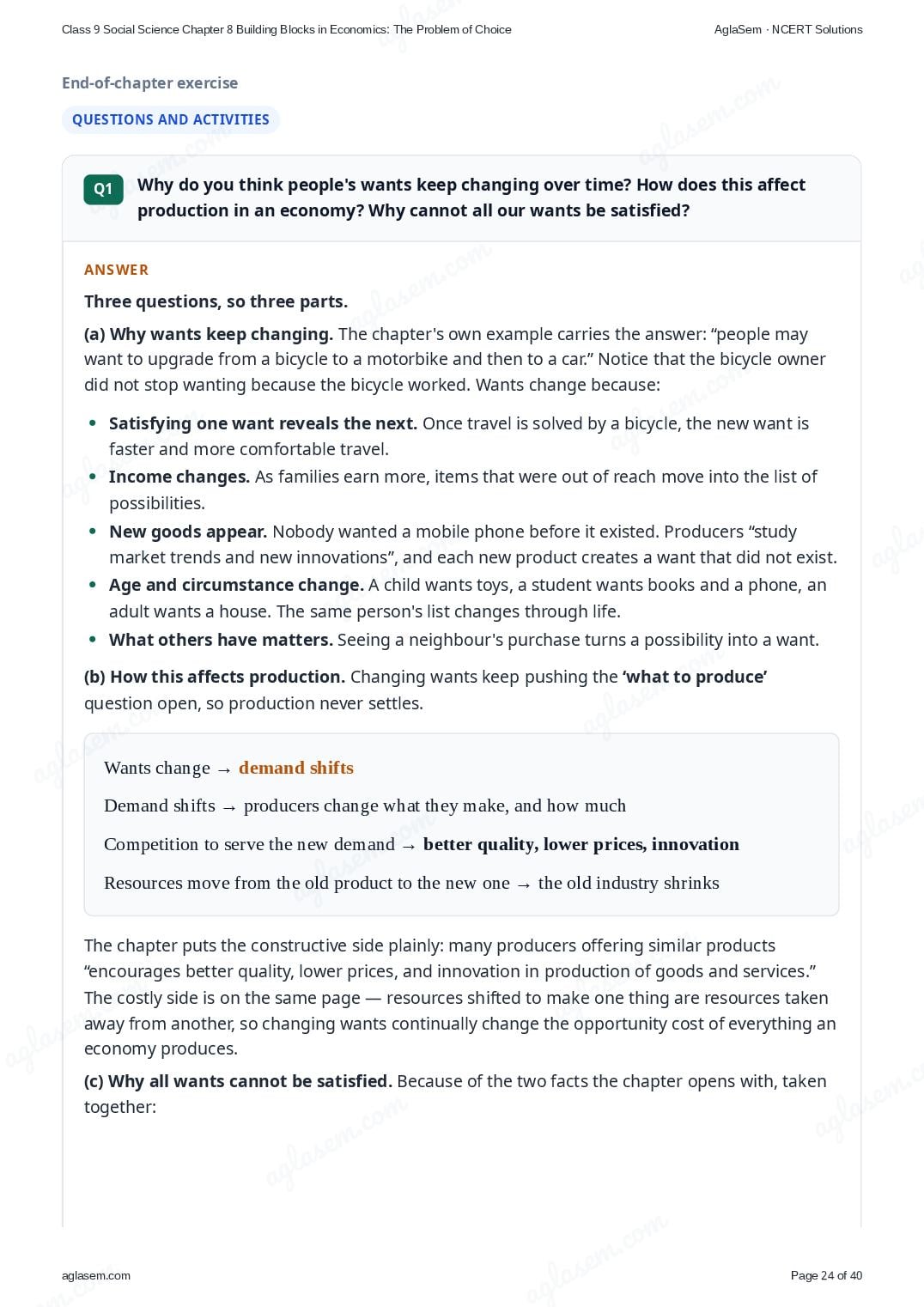
- Why do you think people's wants keep changing over time? How does this affect production in an economy? Why cannot all our wants be satisfied?
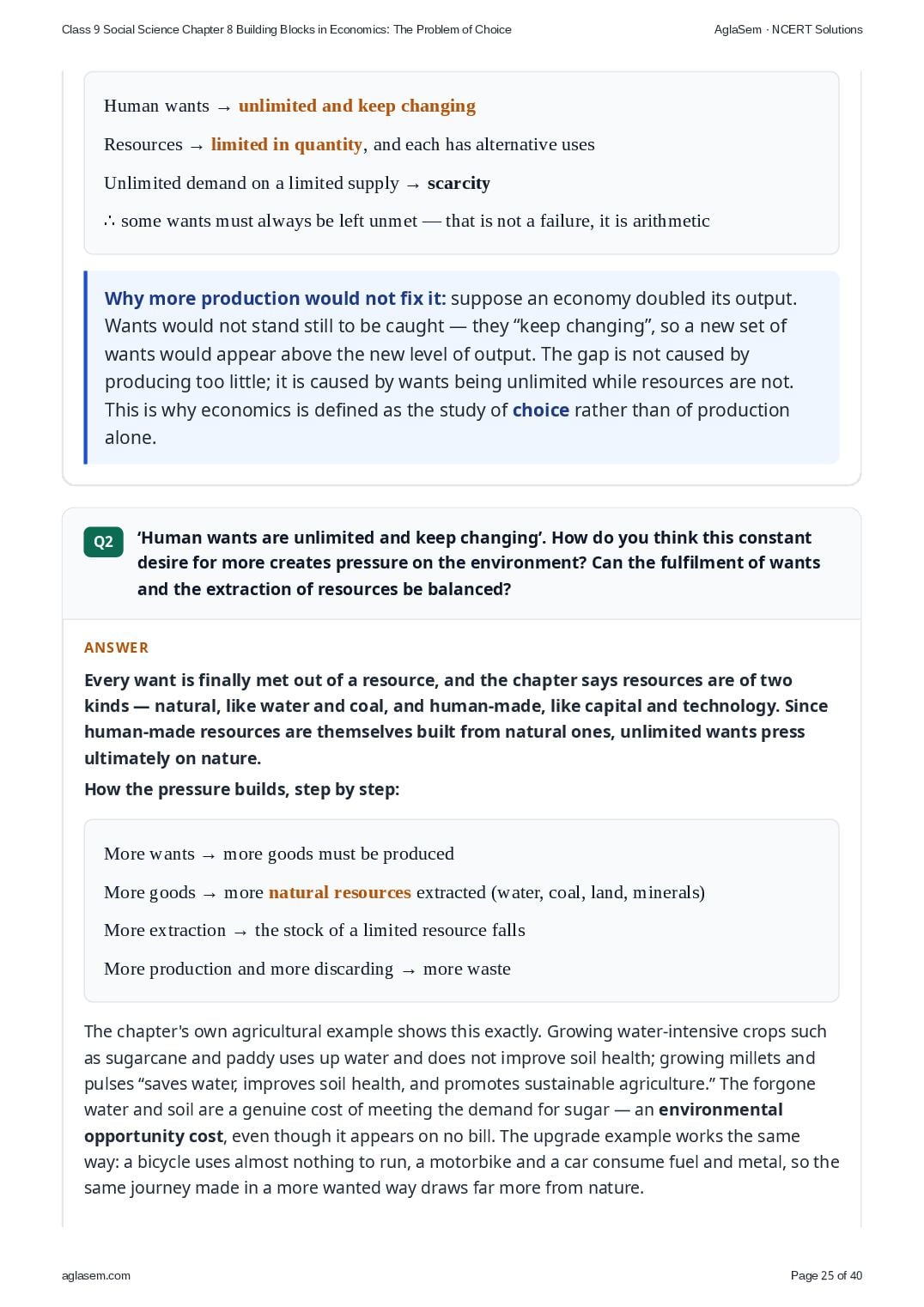
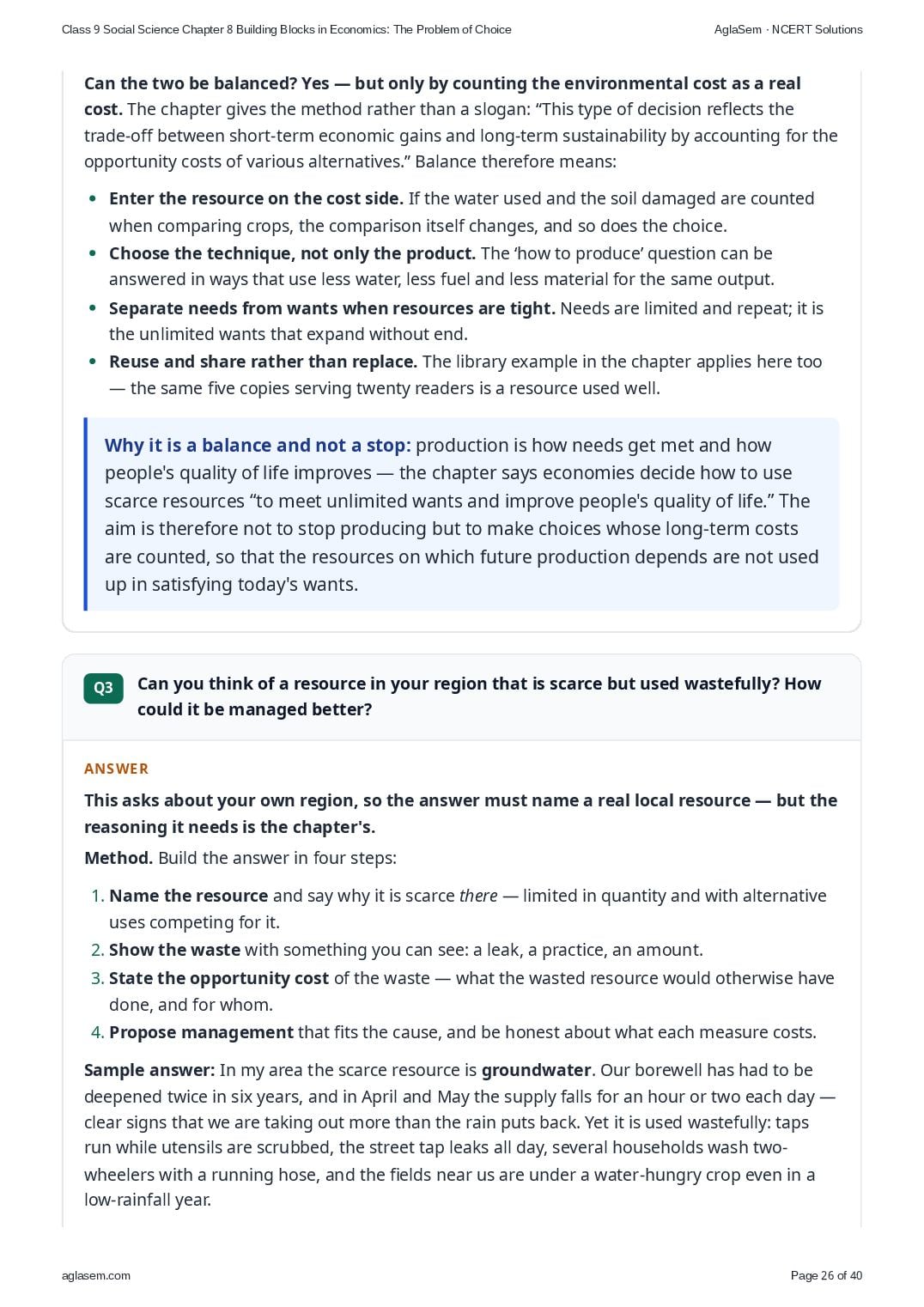
- ‘Human wants are unlimited and keep changing’. How do you think this constant desire for more creates pressure on the environment? Can the fulfilment of wants and the extraction of resources be balanced?
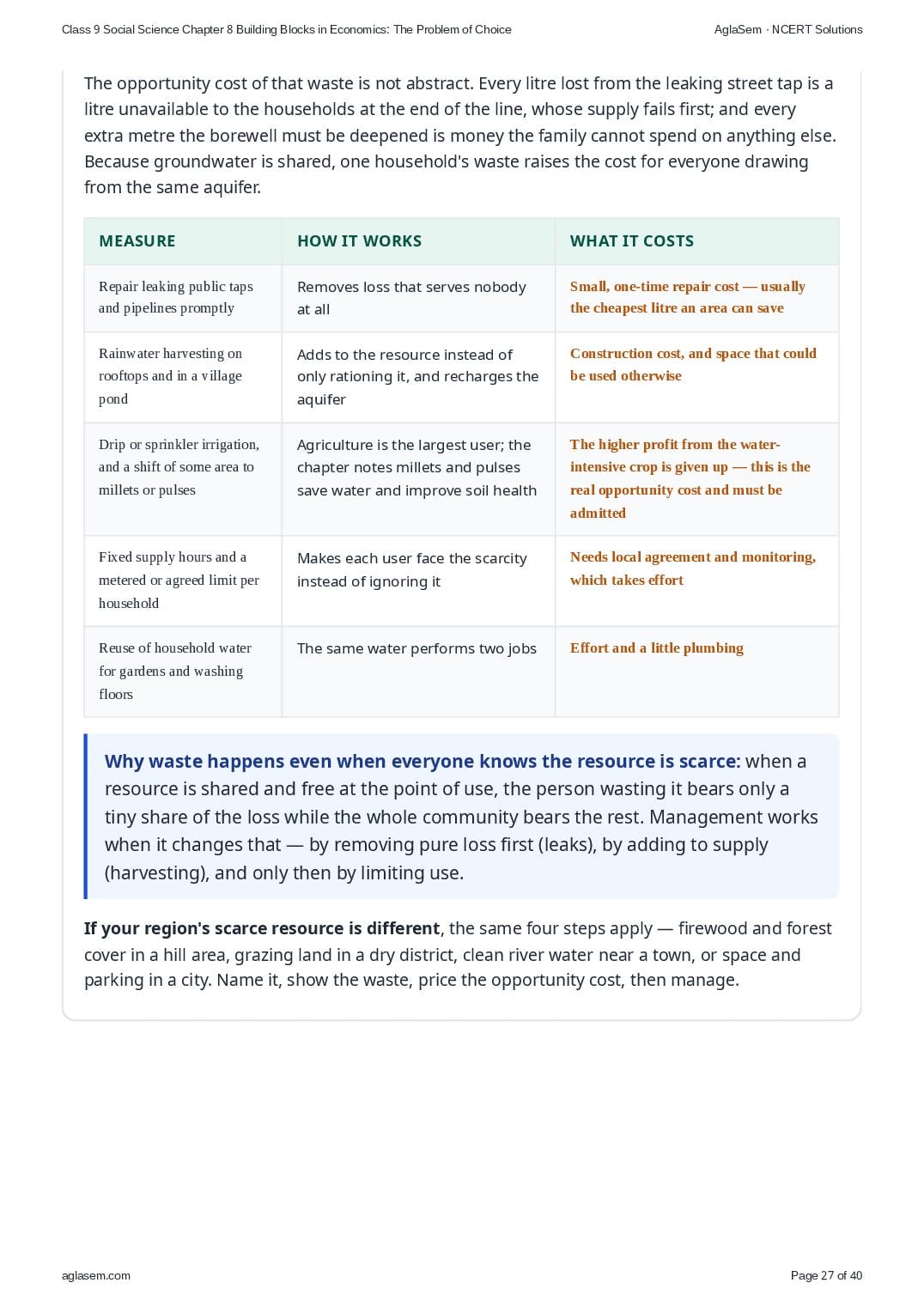
- Can you think of a resource in your region that is scarce but used wastefully? How could it be managed better?
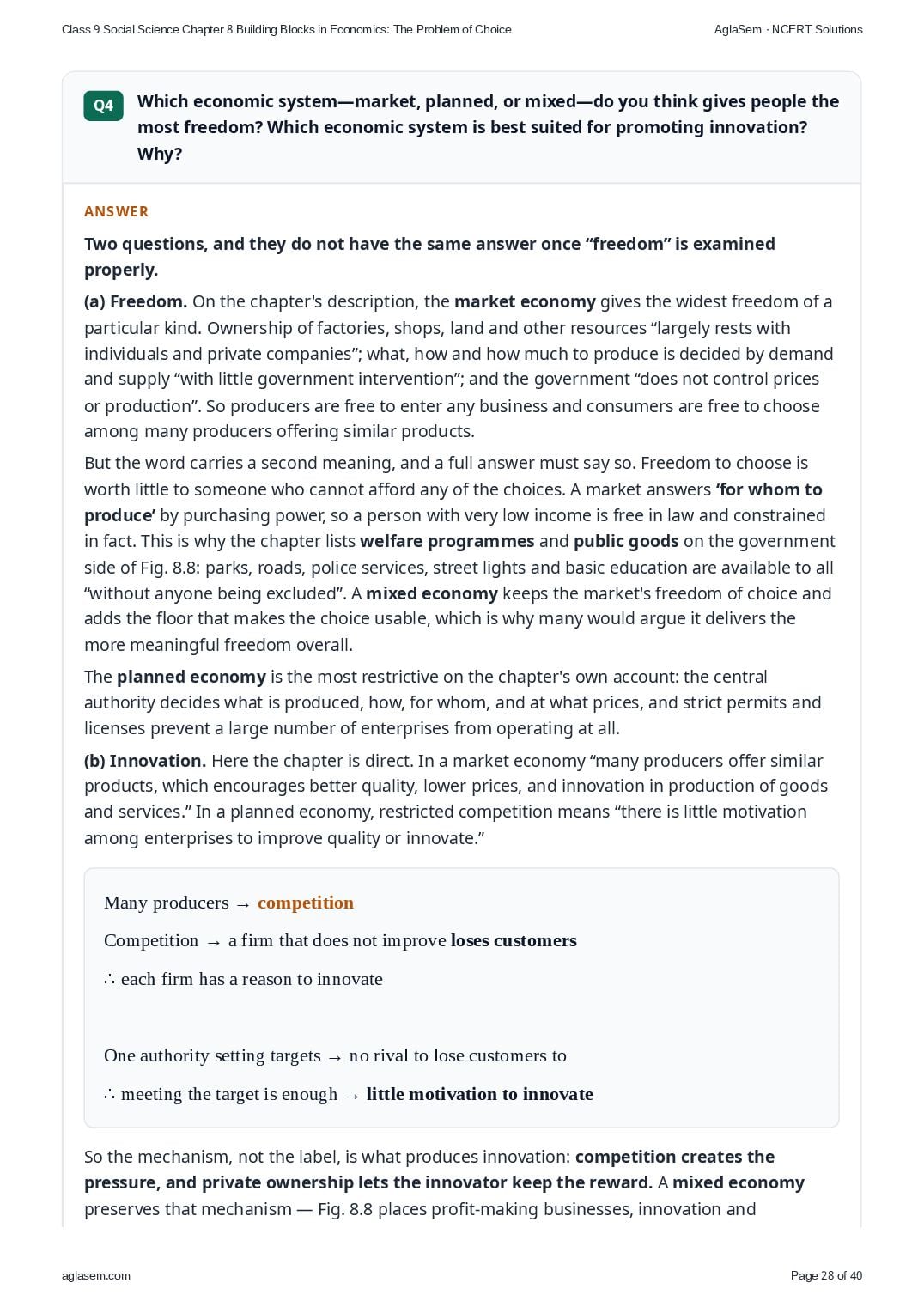
- Which economic system—market, planned, or mixed—do you think gives people the most freedom? Which economic system is best suited for promoting innovation? Why?
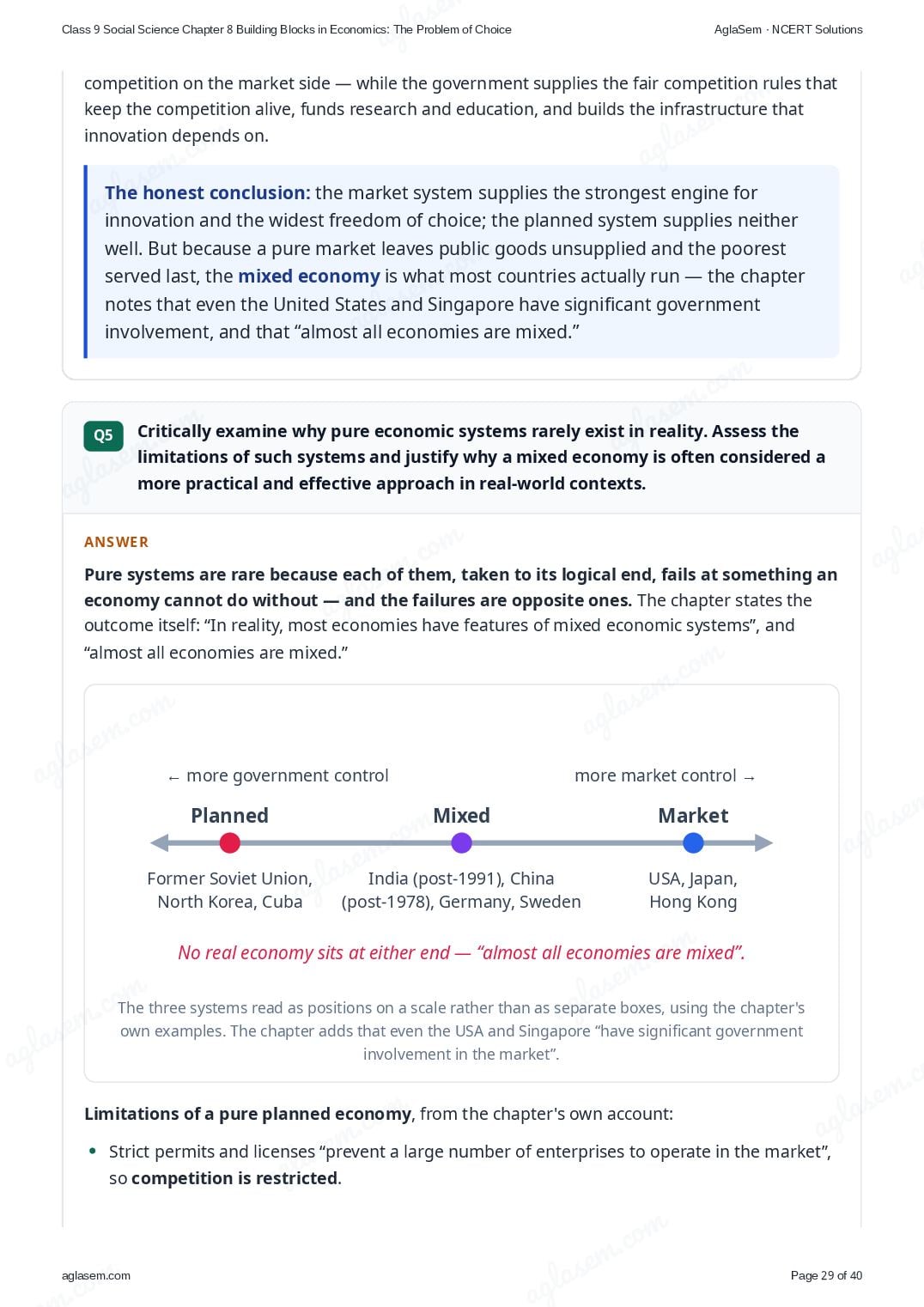
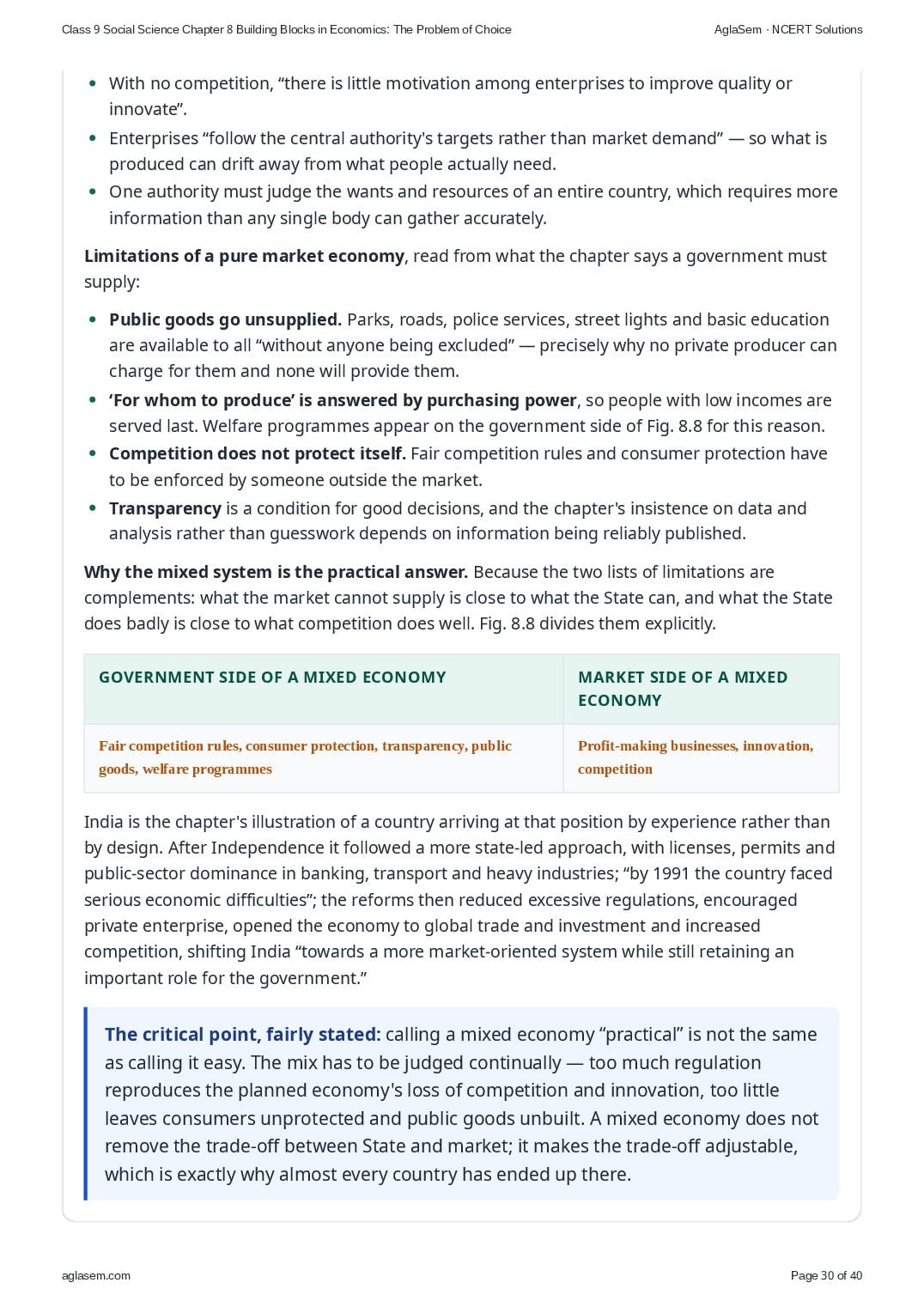
- Critically examine why pure economic systems rarely exist in reality. Assess the limitations of such systems and justify why a mixed economy is often considered a more practical and effective approach in real-world contexts.
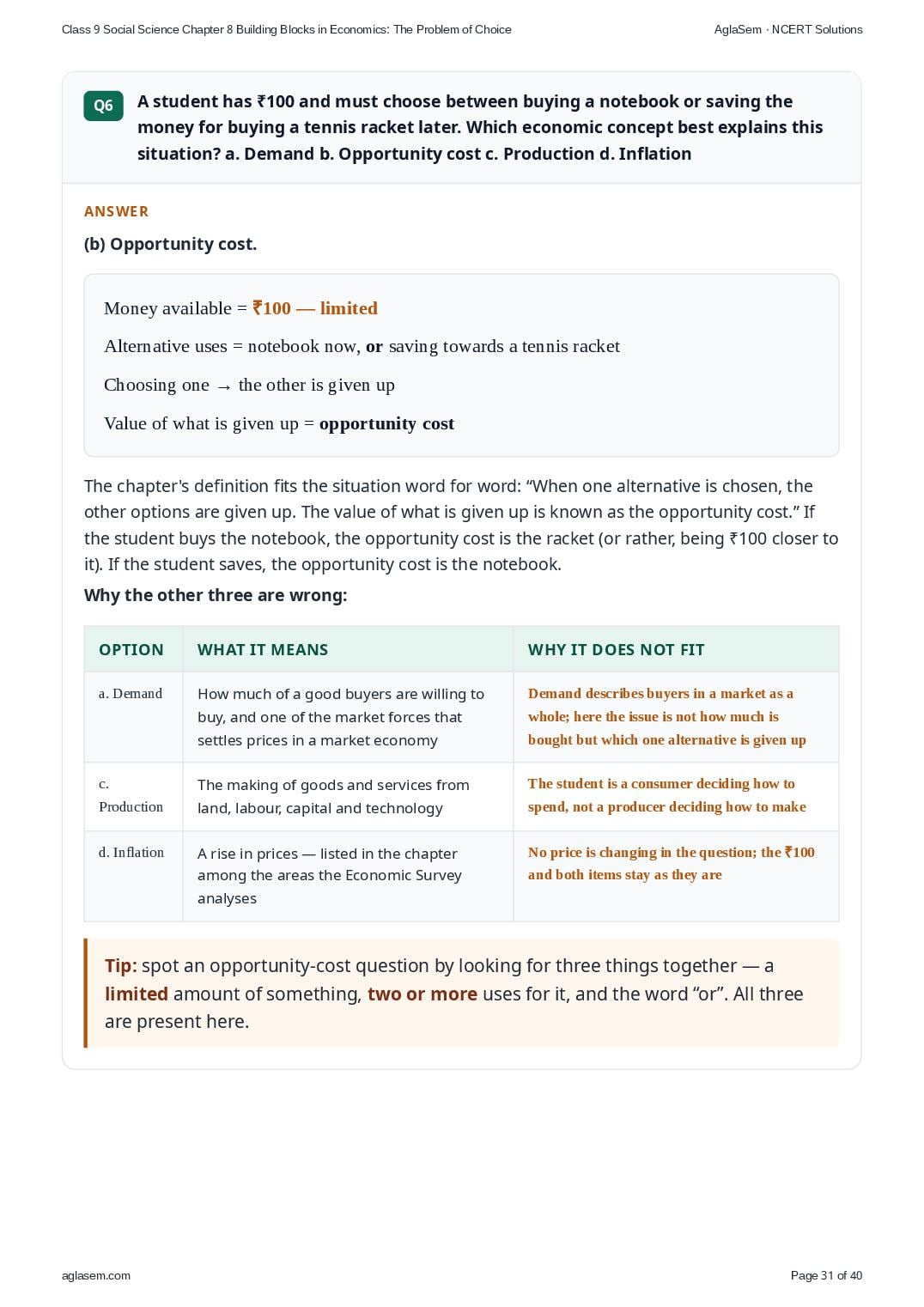
- A student has ₹100 and must choose between buying a notebook or saving the money for buying a tennis racket later. Which economic concept best explains this situation? a. Demand b. Opportunity cost c. Production d. Inflation
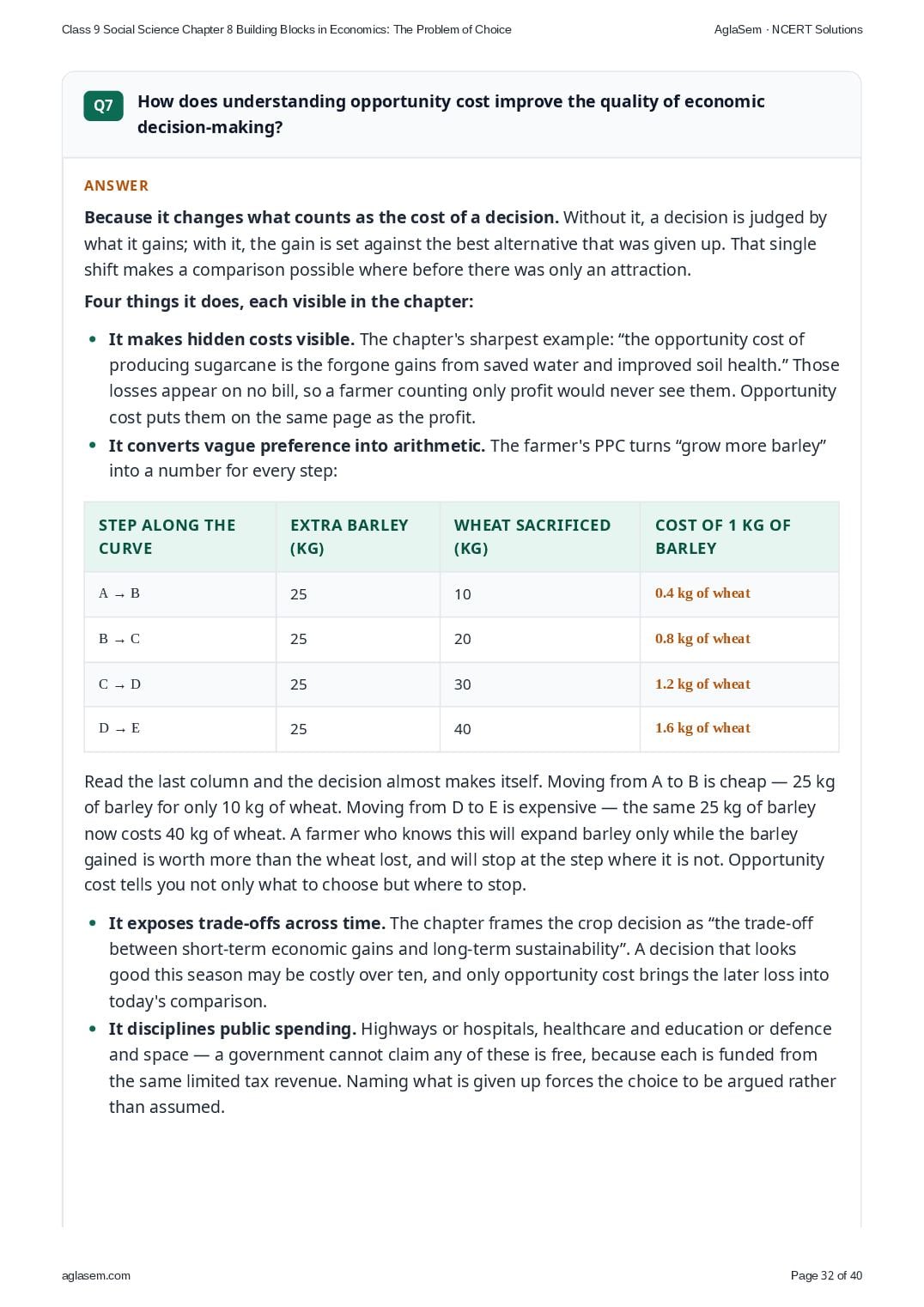
- How does understanding opportunity cost improve the quality of economic decision-making?
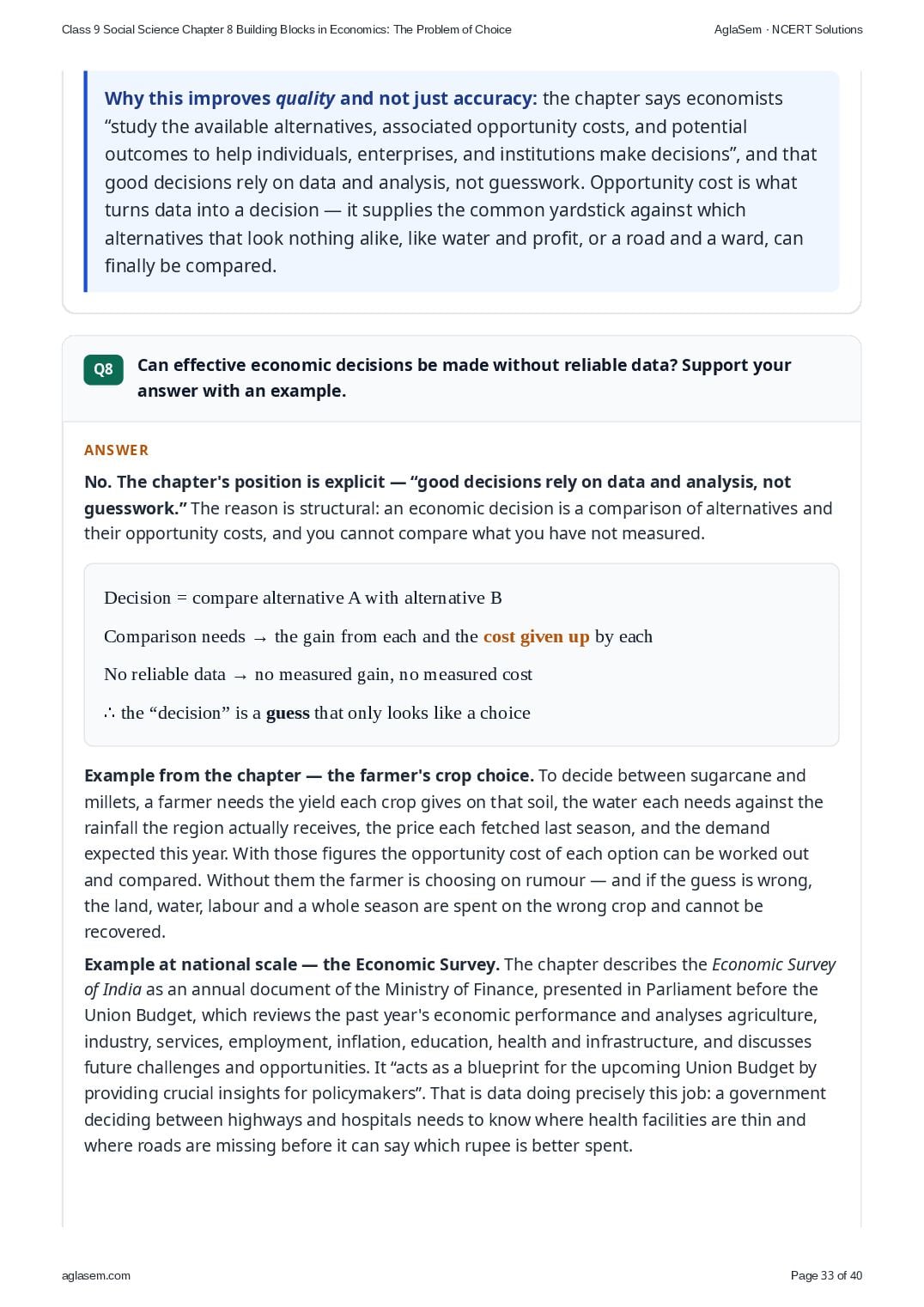
- Can effective economic decisions be made without reliable data? Support your answer with an example.
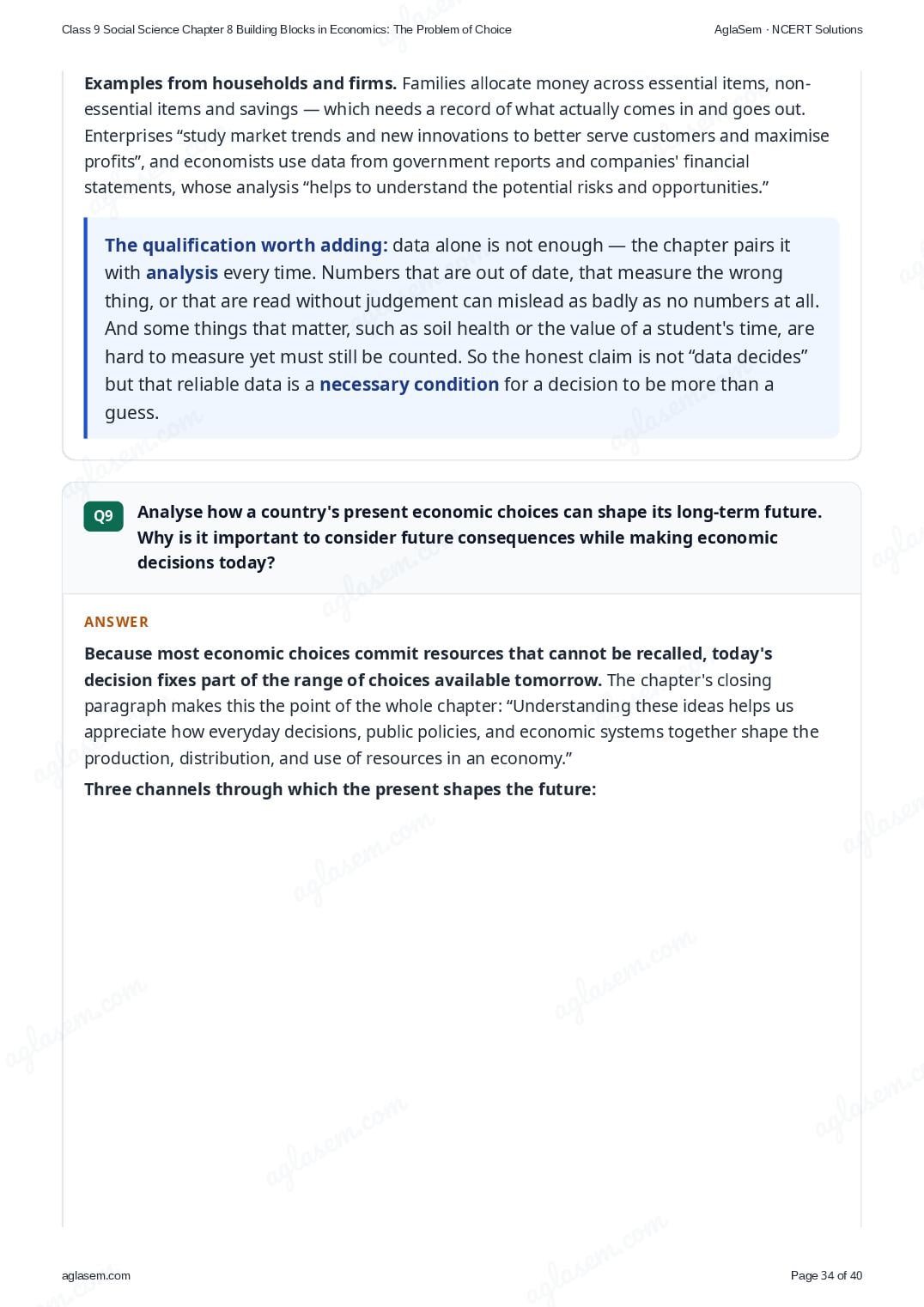
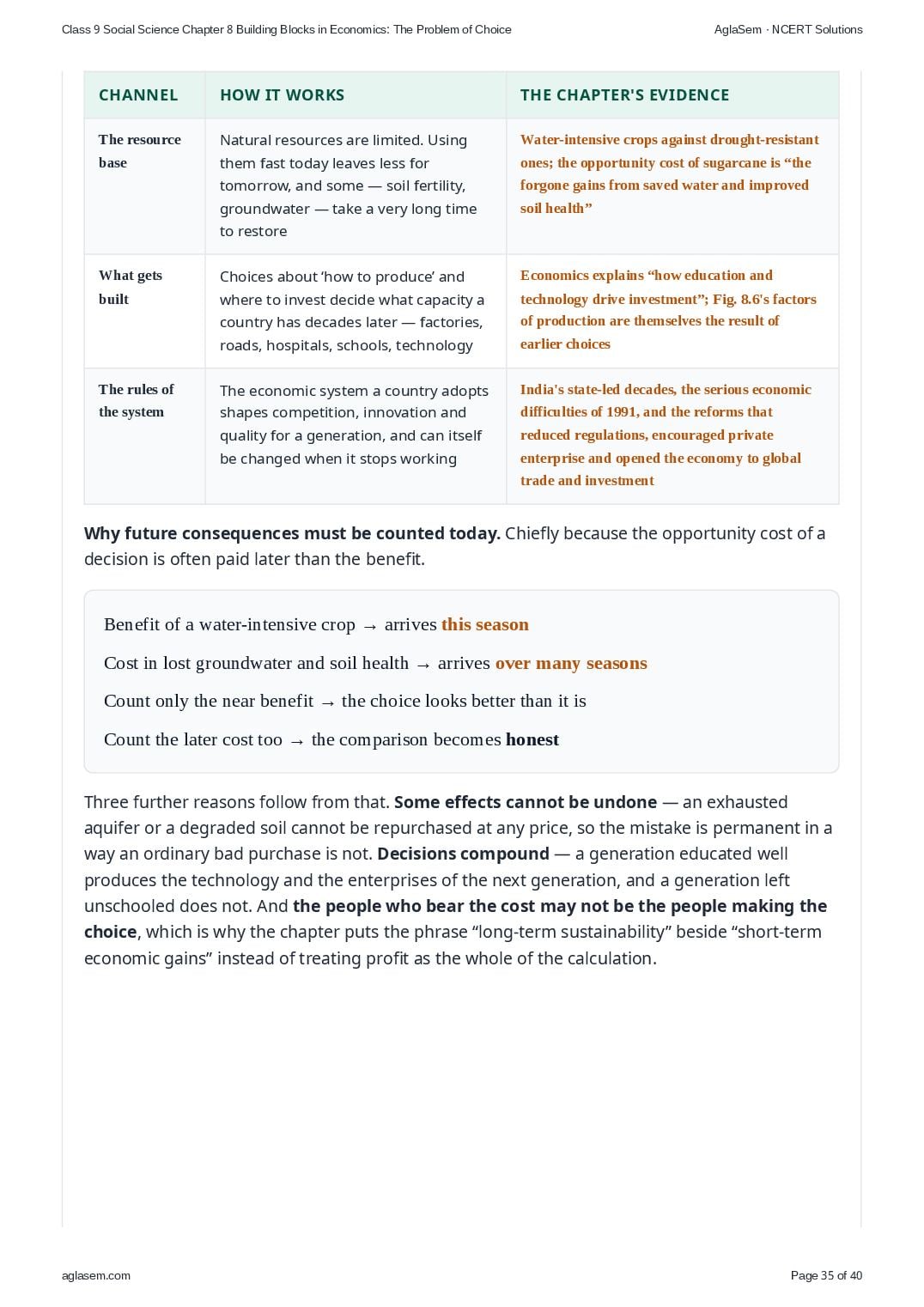
- Analyse how a country's present economic choices can shape its long-term future. Why is it important to consider future consequences while making economic decisions today?
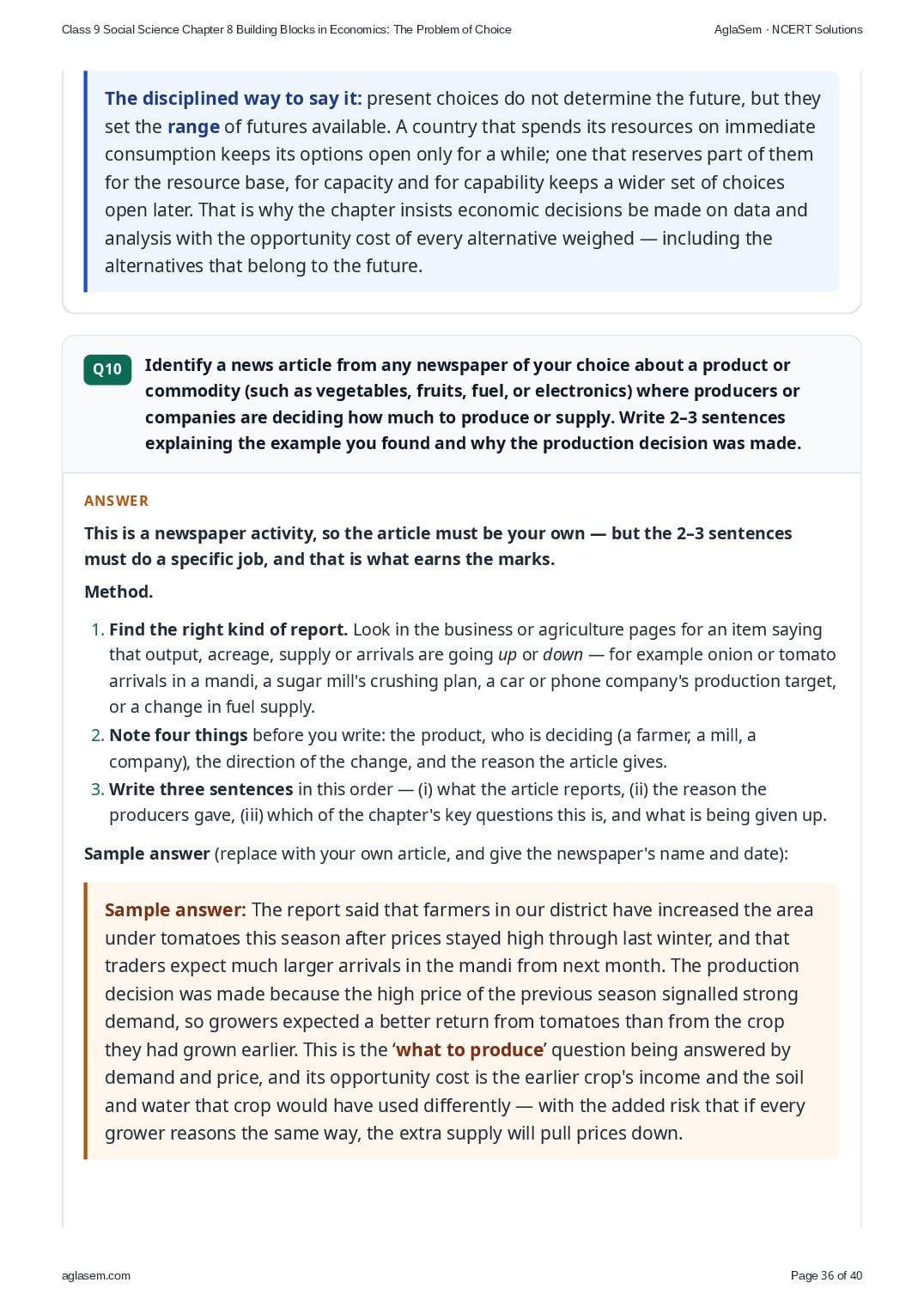
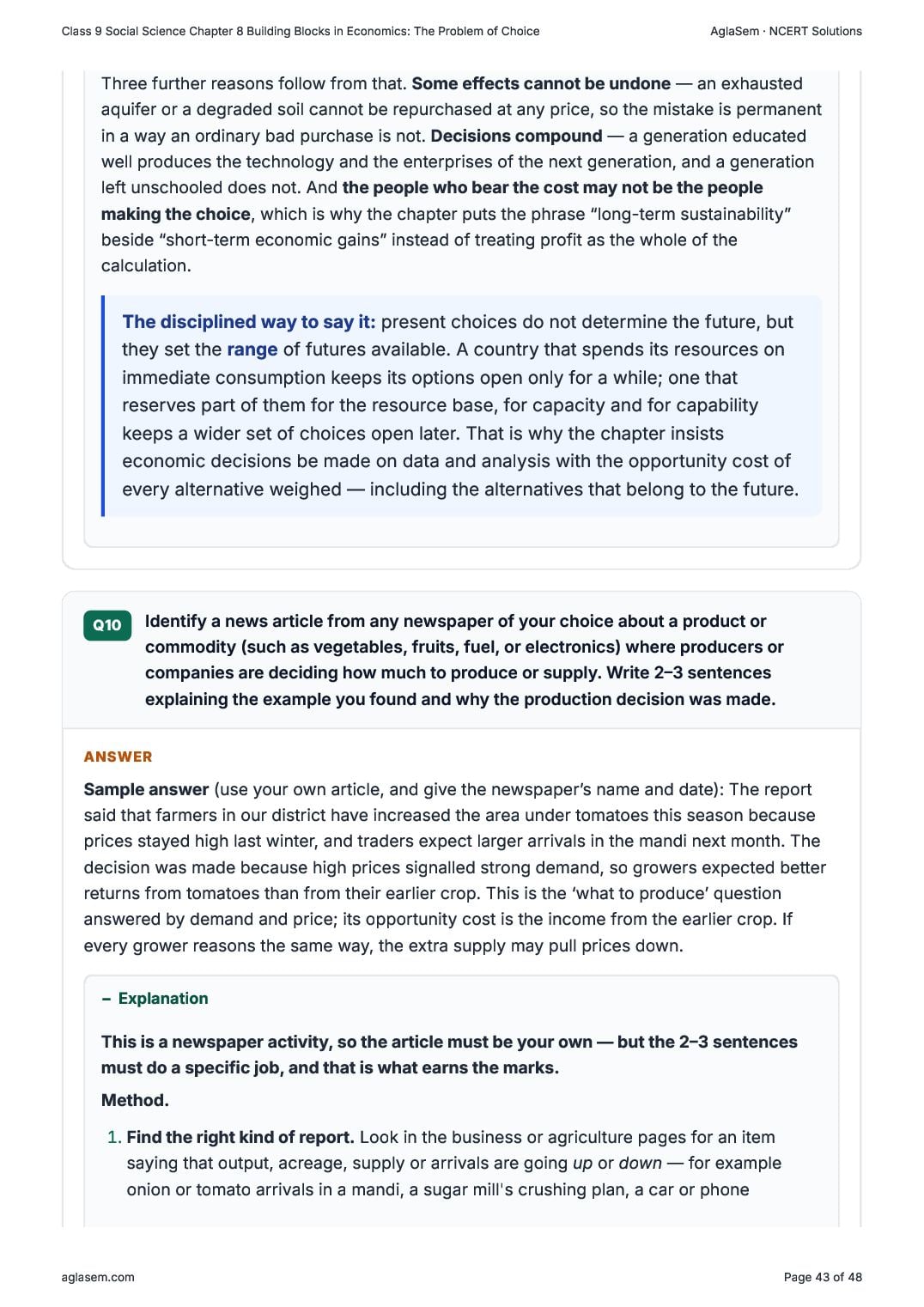
- Identify a news article from any newspaper of your choice about a product or commodity (such as vegetables, fruits, fuel, or electronics) where producers or companies are deciding how much to produce or supply. Write 2–3 sentences explaining the example you found and why the production decision was made.
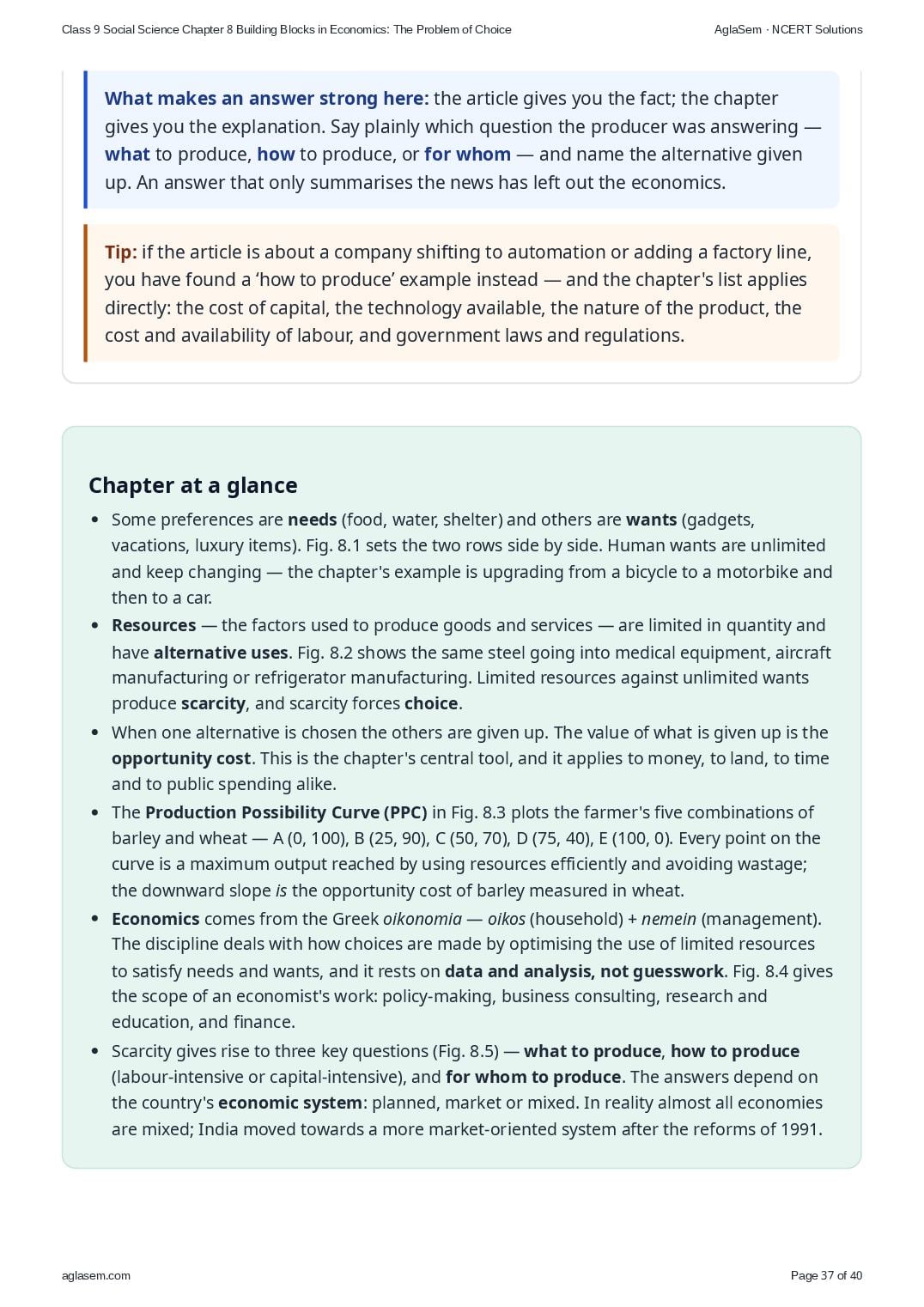
Chapter at a Glance
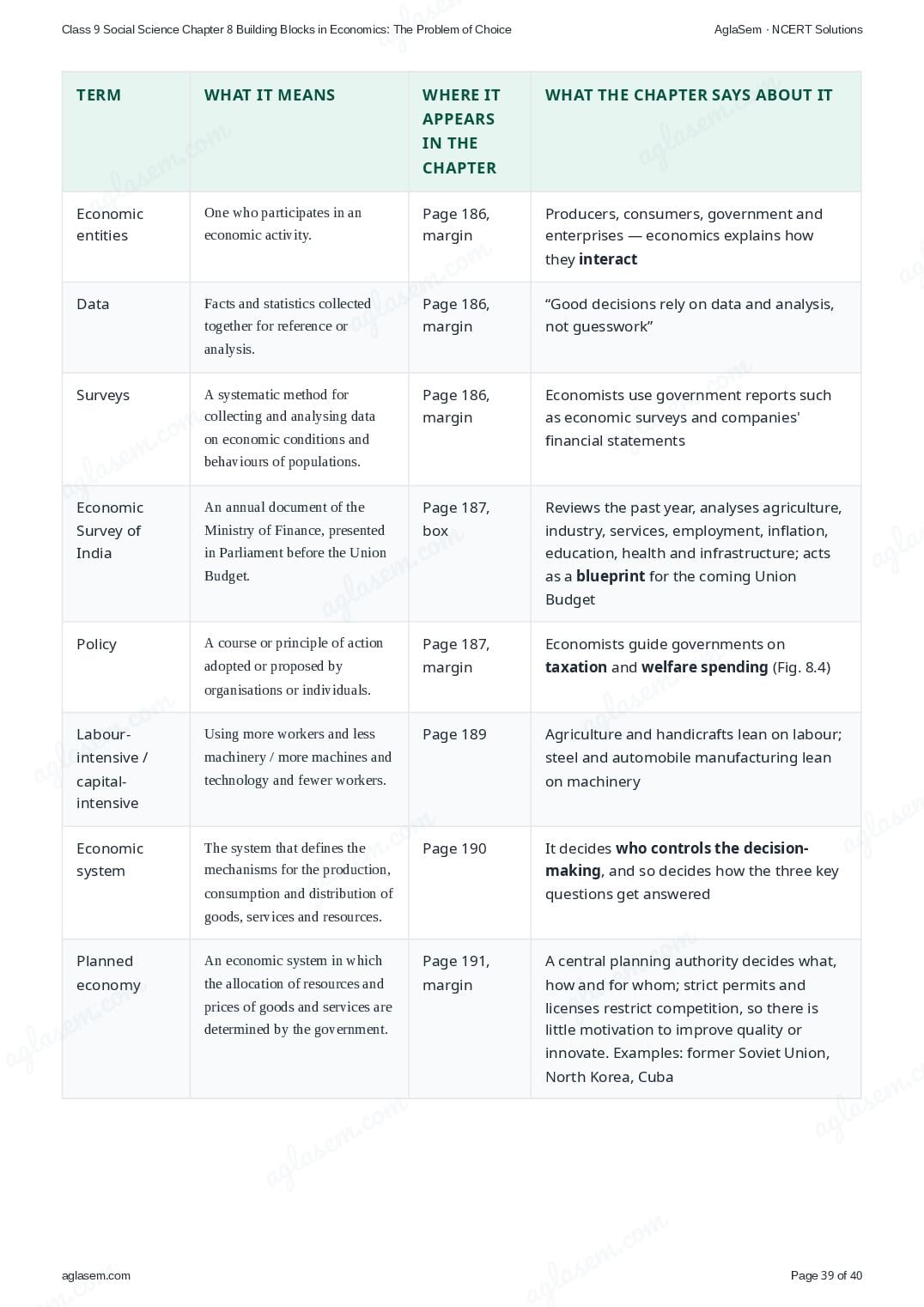
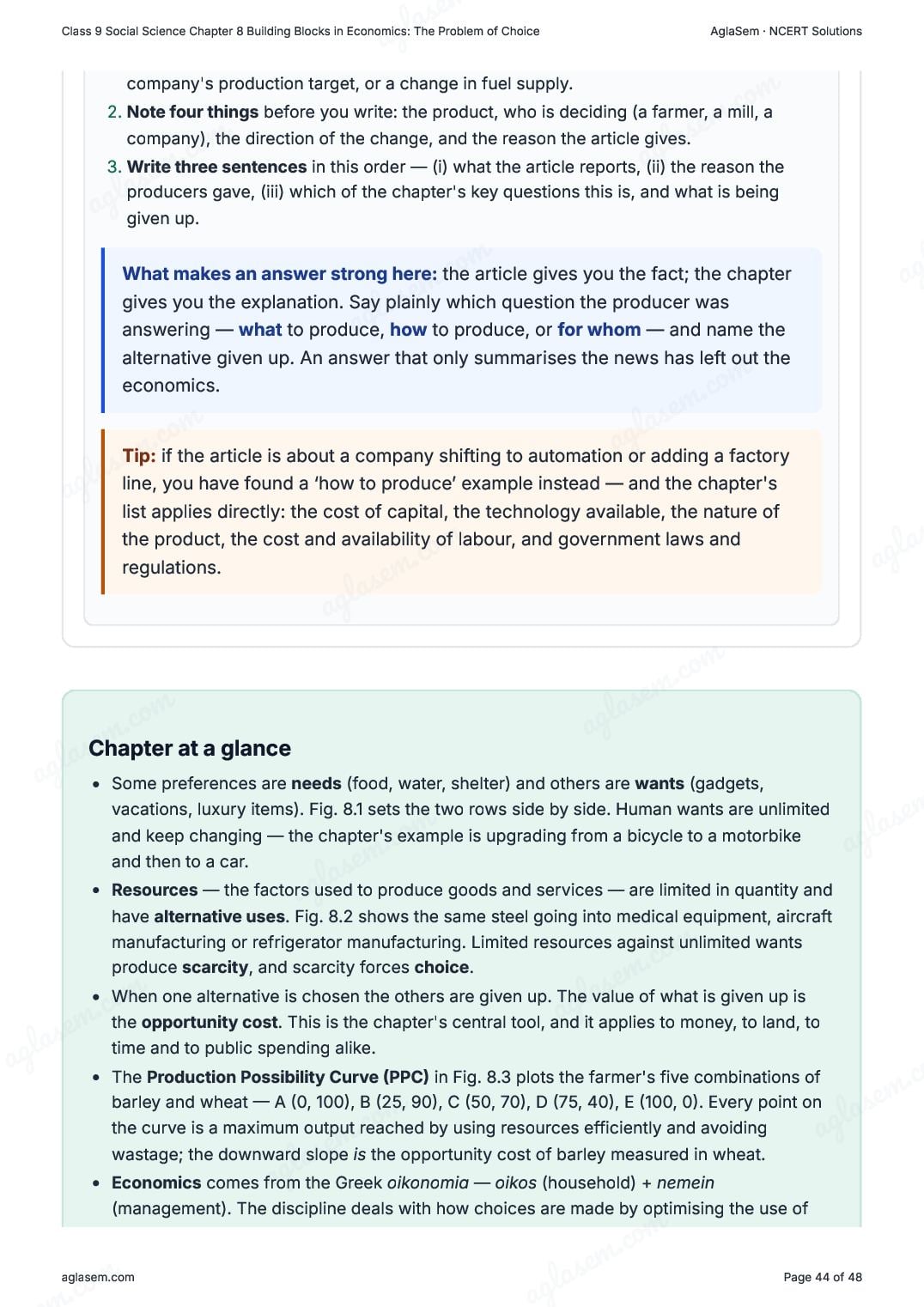
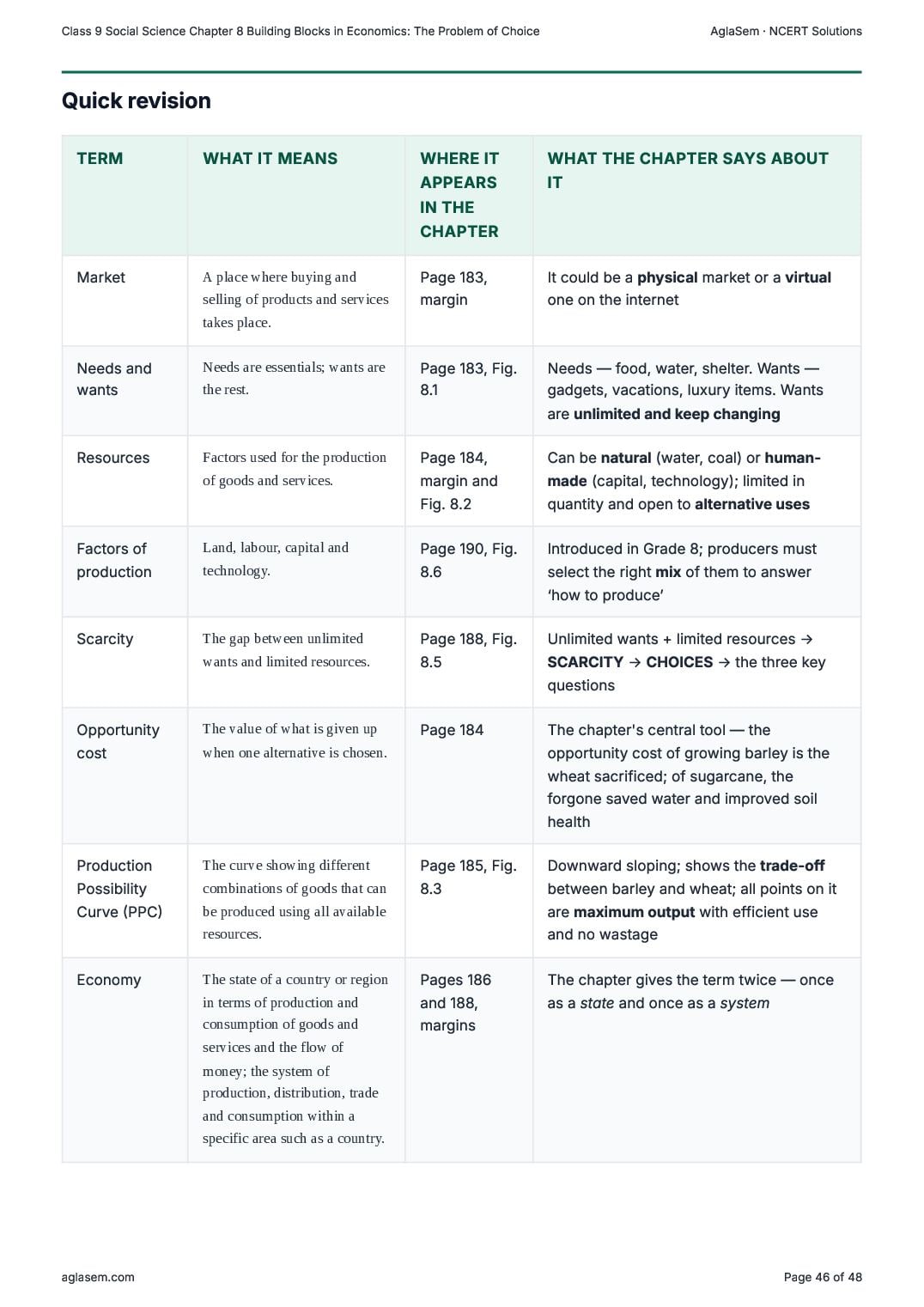
- Some preferences are needs (food, water, shelter) and others are wants (gadgets, vacations, luxury items). Fig. 8.1 sets the two rows side by side. Human wants are unlimited and keep changing — the chapter's example is upgrading from a bicycle to a motorbike and then to a car.
- Resources — the factors used to produce goods and services — are limited in quantity and have alternative uses . Fig. 8.2 shows the same steel going into medical equipment, aircraft manufacturing or refrigerator manufacturing. Limited resources against unlimited wants produce scarcity , and scarcity forces choice .
- When one alternative is chosen the others are given up. The value of what is given up is the opportunity cost . This is the chapter's central tool, and it applies to money, to land, to time and to public spending alike.
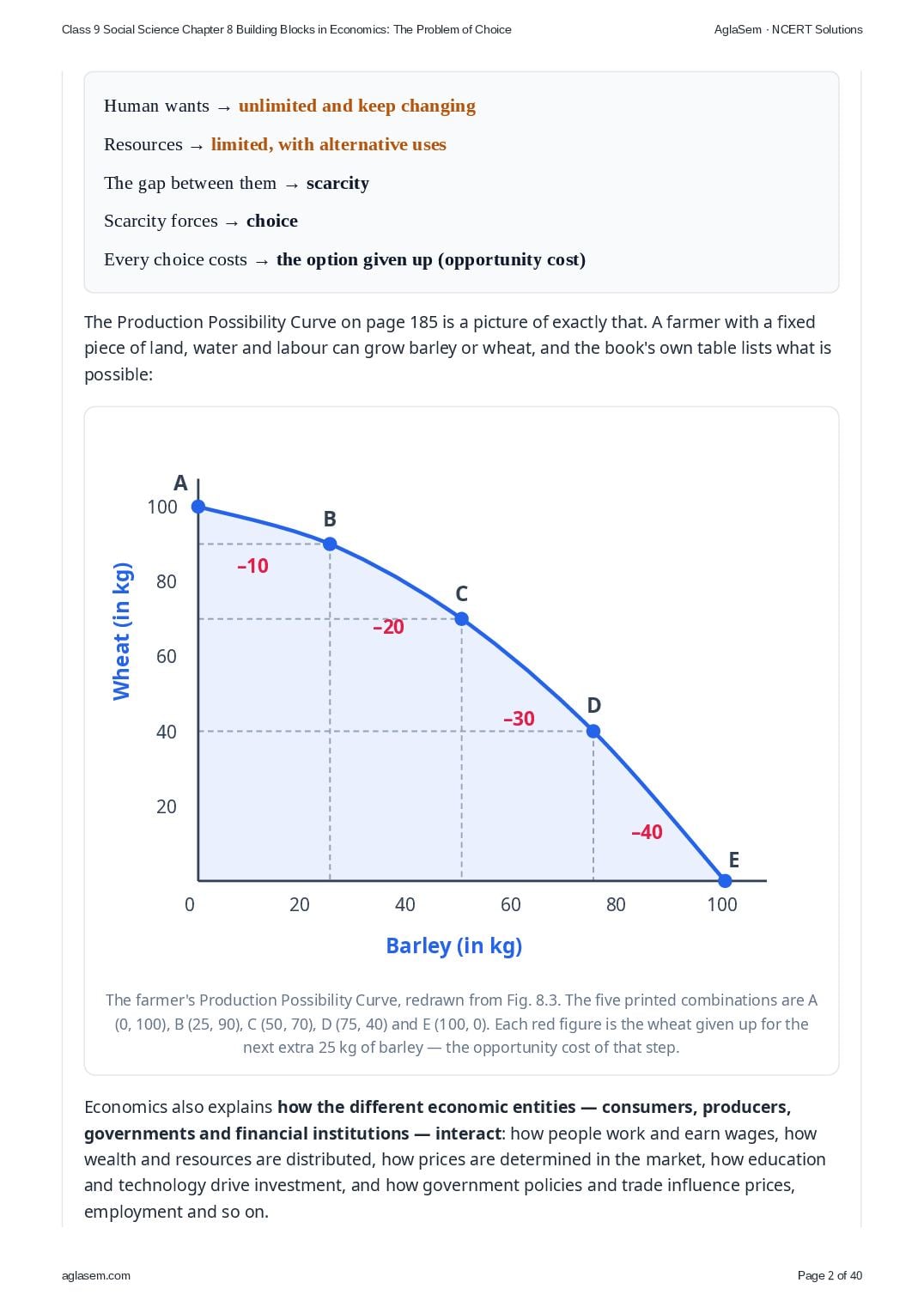
- The Production Possibility Curve (PPC) in Fig. 8.3 plots the farmer's five combinations of barley and wheat — A (0, 100), B (25, 90), C (50, 70), D (75, 40), E (100, 0). Every point on the curve is a maximum output reached by using resources efficiently and avoiding wastage; the downward slope is the opportunity cost of barley measured in wheat.
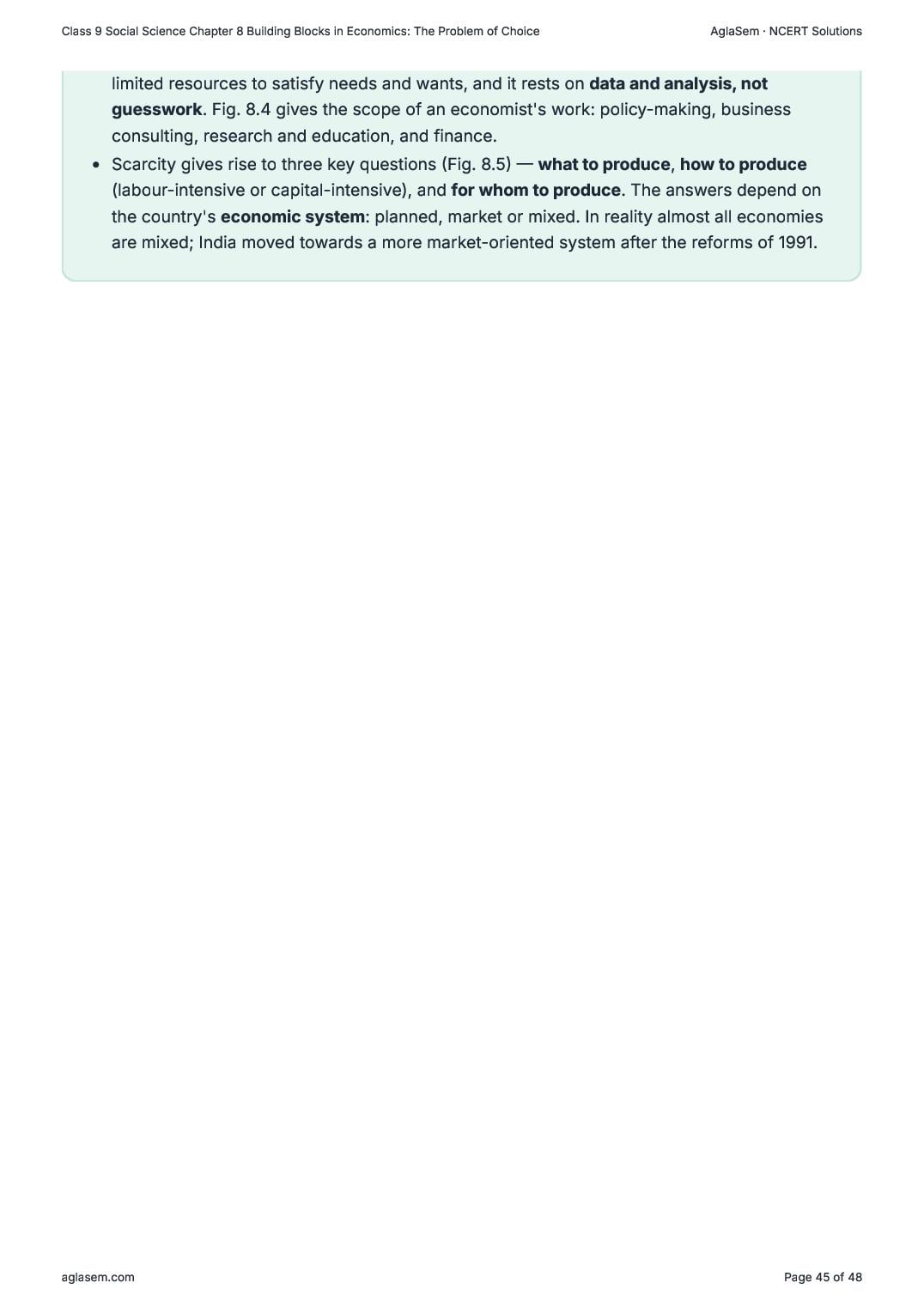
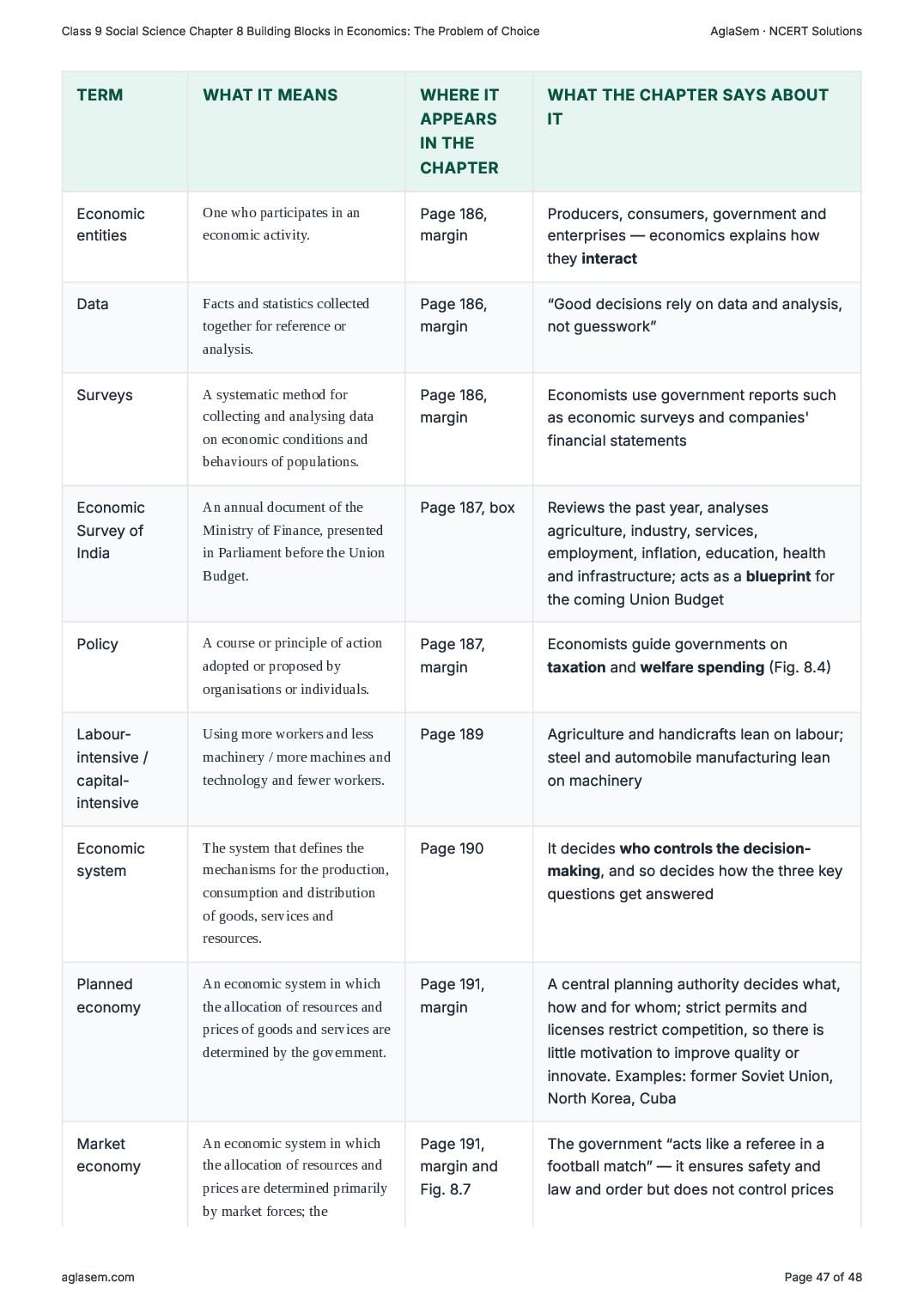
- Economics comes from the Greek oikonomia — oikos (household) + nemein (management). The discipline deals with how choices are made by optimising the use of limited resources to satisfy needs and wants, and it rests on data and analysis, not guesswork . Fig. 8.4 gives the scope of an economist's work: policy-making, business consulting, research and education, and finance.
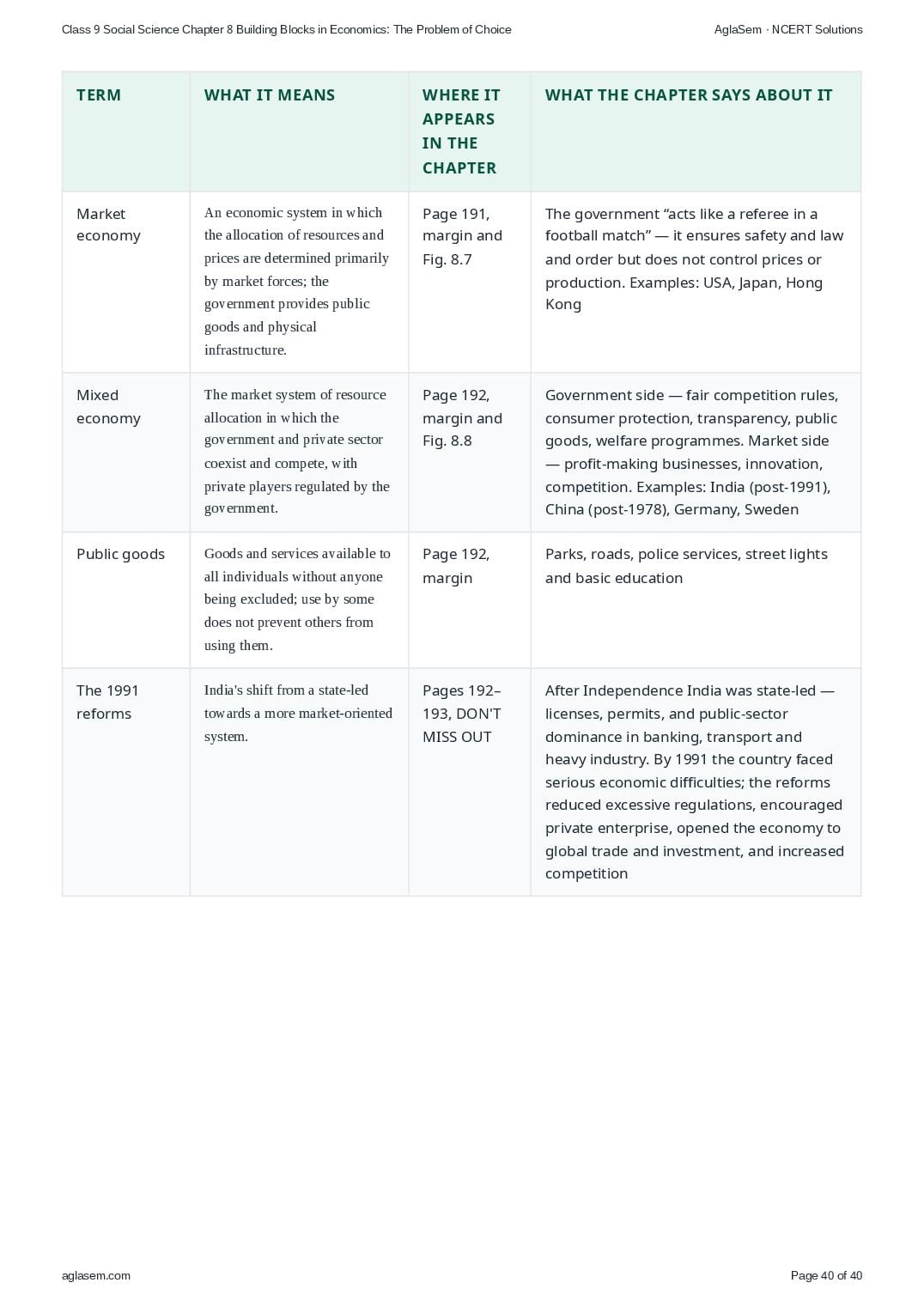
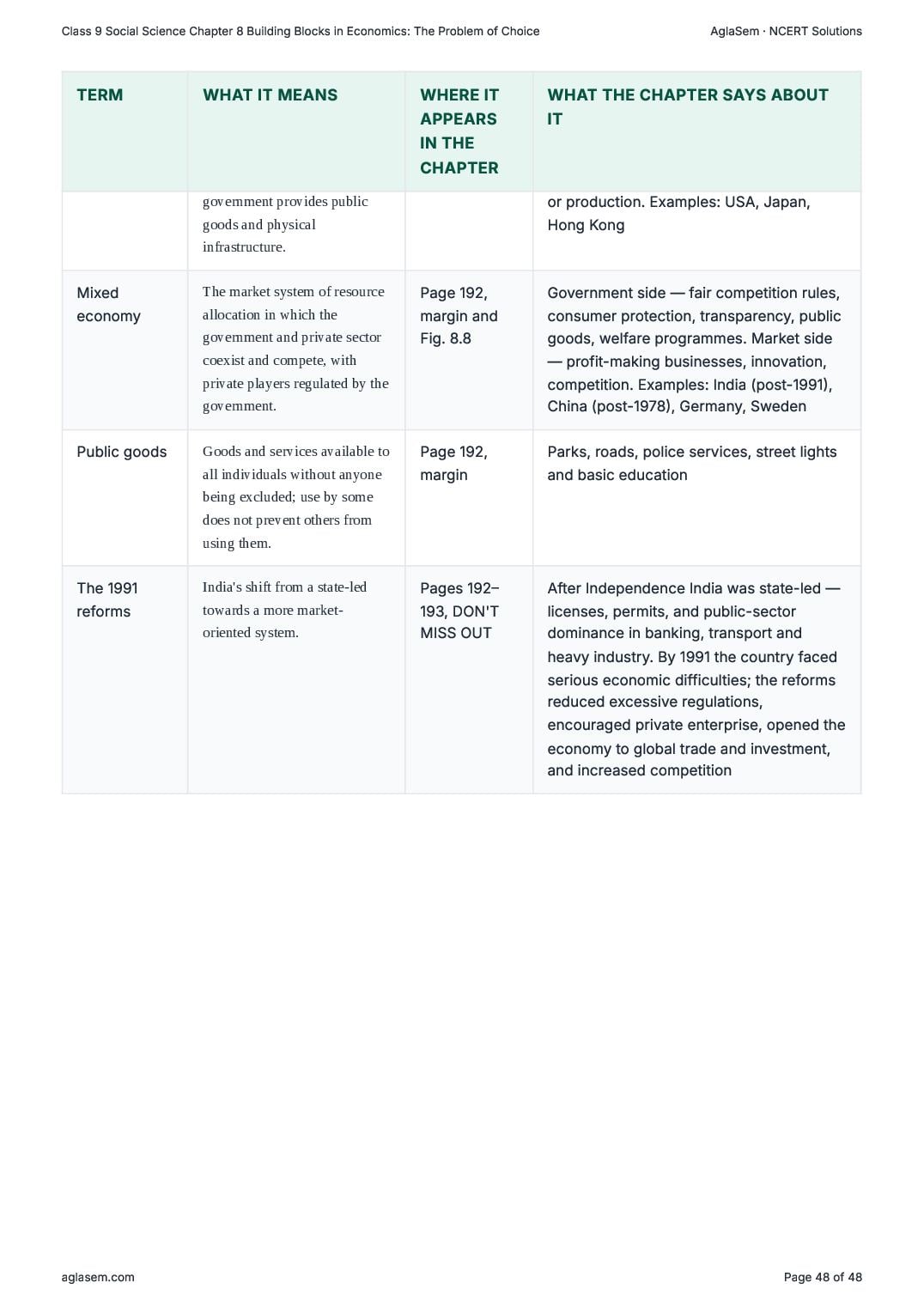
- Scarcity gives rise to three key questions (Fig. 8.5) — what to produce , how to produce (labour-intensive or capital-intensive), and for whom to produce . The answers depend on the country's economic system : planned, market or mixed. In reality almost all economies are mixed; India moved towards a more market-oriented system after the reforms of 1991.
How to Download NCERT Solutions for Class 9 Social Science Chapter 8 PDF
Follow these simple steps to get the Building Blocks in Economics the Problem of Choice questions-and-answers PDF from Understanding Society: India and Beyond.
- Search NCERT Solutions for Class 9 Social Science Chapter 8 aglasem and open this page.
- Read the exercise questions with answers for Building Blocks in Economics the Problem of Choice shown above.
- Click the Download PDF link to save the Building Blocks in Economics the Problem of Choice solutions to your device.
NCERT Solutions for Class 9 Social Science – All Chapters
There are more chapters to study besides Building Blocks in Economics the Problem of Choice in Social Science. Here are the NCERT Solutions for all chapters of Class 9 Social Science.
- Chapter 1 Understanding Social Science
- Chapter 2 Shaping of the Earth’s Surface
- Chapter 3 Atmosphere and Climate
- Chapter 4 Early Humans and Beginning of Civilisation
- Chapter 5 State and Society Up to 1000 Ce
- Chapter 6 Democracy
- Chapter 7 Elections
- Chapter 8 Building Blocks in Economics the Problem of Choice
- Chapter 9 The Price Puzzle What Drives the Market
NCERT Solutions for Class 9 – All Subjects
Just like Chapter 8 of Social Science, you can get the exercise questions with answers for every other subject of Class 9. Here are the NCERT Solutions for all subjects of Class 9.
NCERT Solutions for Class 9 Social Science Chapter 8 – An Overview
The key highlights of this study material are as follows.
| Aspects | Details |
|---|---|
| Class | Class 9 |
| Subject | Social Science |
| Chapter Number | Chapter 8 |
| Chapter Name | Building Blocks in Economics the Problem of Choice |
| Book Name | Understanding Society: India and Beyond |
| Book By | NCERT (National Council of Educational Research and Training) |
| Educational Resource Here | NCERT Solutions of Class 9 Social Science Chapter 8 for all exercises |
| More Questions Answers of This Subject | NCERT Solutions for Class 9 Social Science |
| Download Book Chapter | NCERT Book Class 9 Social Science |
| All Questions Answers For This Class | NCERT Solutions for Class 9 |
| Complete Solutions | NCERT Solutions |
NCERT Solutions for Class 9 Social Science Chapter 8 Building Blocks in Economics the Problem of Choice – FAQs
What are the NCERT Solutions for Class 9 Social Science Chapter 8 Building Blocks in Economics the Problem of Choice?
They are the complete, step-by-step answers to all the exercise and in-text questions of Chapter 8 Building Blocks in Economics the Problem of Choice from the NCERT Class 9 Social Science textbook Understanding Society: India and Beyond, written by experts as per the latest NCERT syllabus.
How can I download the Class 9 Social Science Chapter 8 solutions PDF for free?
Open this page on aglasem, read the Building Blocks in Economics the Problem of Choice questions with answers, and click the “Download Solutions PDF” link. The Class 9 Social Science Chapter 8 NCERT Solutions PDF is completely free to download.
Are these NCERT Solutions as per the latest 2026-27 syllabus?
Yes. The NCERT Solutions for Class 9 Social Science Chapter 8 are based on the latest NCERT textbook Understanding Society: India and Beyond and the current 2026-27 CBSE syllabus, so the questions and answers match what you study in class.
Where can I get NCERT Solutions for the other chapters of Class 9 Social Science?
You can find the answers to every chapter on the NCERT Solutions for Class 9 Social Science page, and solutions for every subject on the NCERT Solutions for Class 9 page.
How do NCERT Solutions help in exam preparation?
They show the correct method to solve each question, help you write answers the way they are expected in exams, let you check and correct your own work, and save revision time — which together improve your marks in Class 9 Social Science.
If you have any queries on NCERT Solutions for Class 9 Social Science Chapter 8 Building Blocks in Economics the Problem of Choice, then please ask in the comments below.