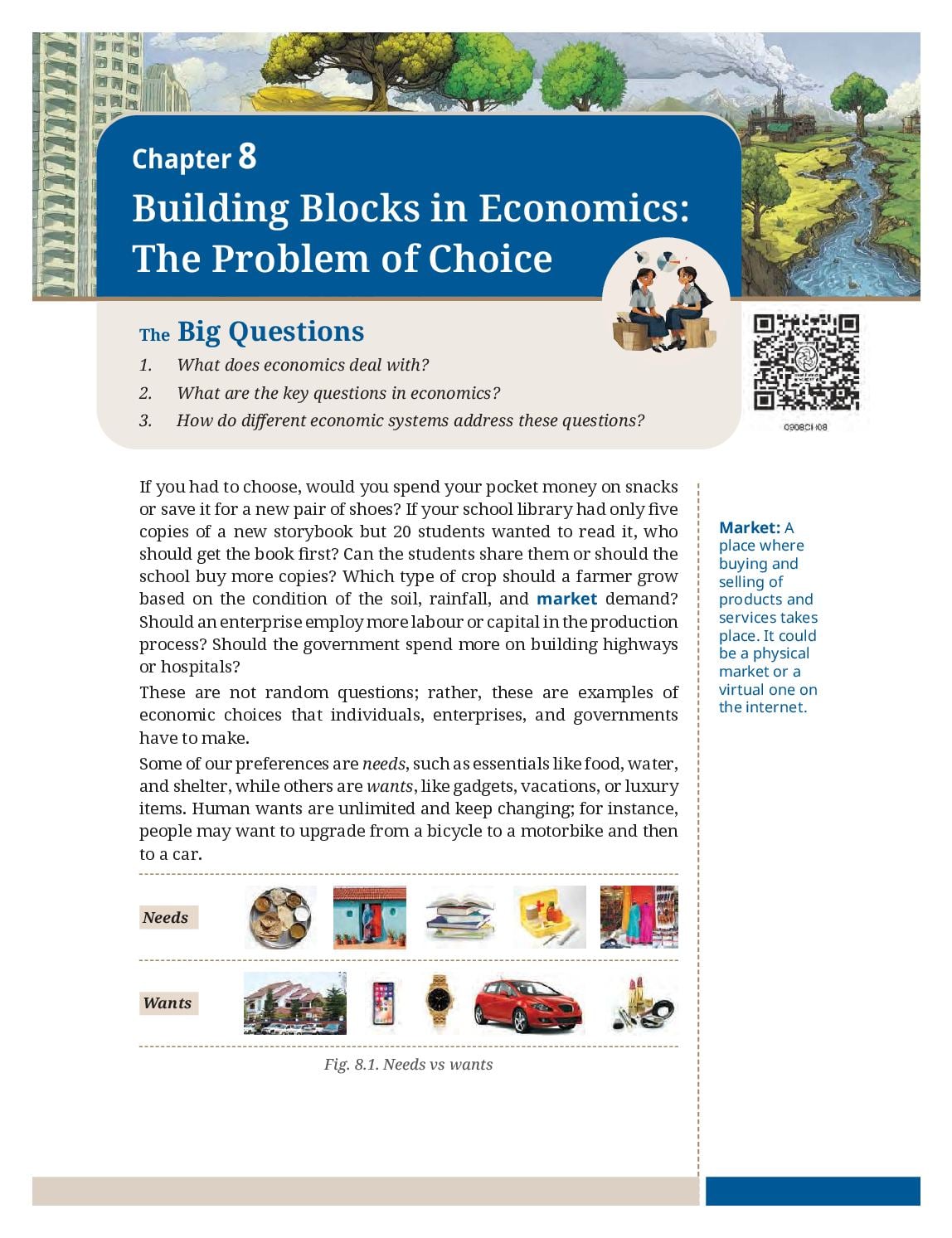
Download Building Blocks in Economics: The Problem of Choice – NCERT Class 9 Social Science Chapter 8 PDF from the new NCERT Class 9 Social Science book Understanding Society: India and Beyond (2026-27). Read the chapter online or download the free PDF. Some preferences are needs (food, water, shelter) and others are wants (gadgets, vacations, luxury items). Fig. 8.1 sets the two rows side by side. Human wants are unlimited and keep changing — the chapter’s example is upgrading from a bicycle to a…
Building Blocks in Economics: The Problem of Choice PDF – Chapter 8 of Understanding Society: India and Beyond (Part I)
Read the chapter online or download the PDF.
| Chapter | Download | |
|---|---|---|
| Chapter 8 PDF | Building Blocks in Economics: The Problem of Choice | View PDF |
| Full book | NCERT Class 9 Social Science – Understanding Society: India and Beyond | View Book |
Read Online
What Is in Building Blocks in Economics: The Problem of Choice? (Class 9 Social Science Chapter 8)
- Some preferences are needs (food, water, shelter) and others are wants (gadgets, vacations, luxury items). Fig. 8.1 sets the two rows side by side. Human wants are unlimited and keep changing — the chapter’s example is upgrading from a bicycle to a motorbike and then to a car.
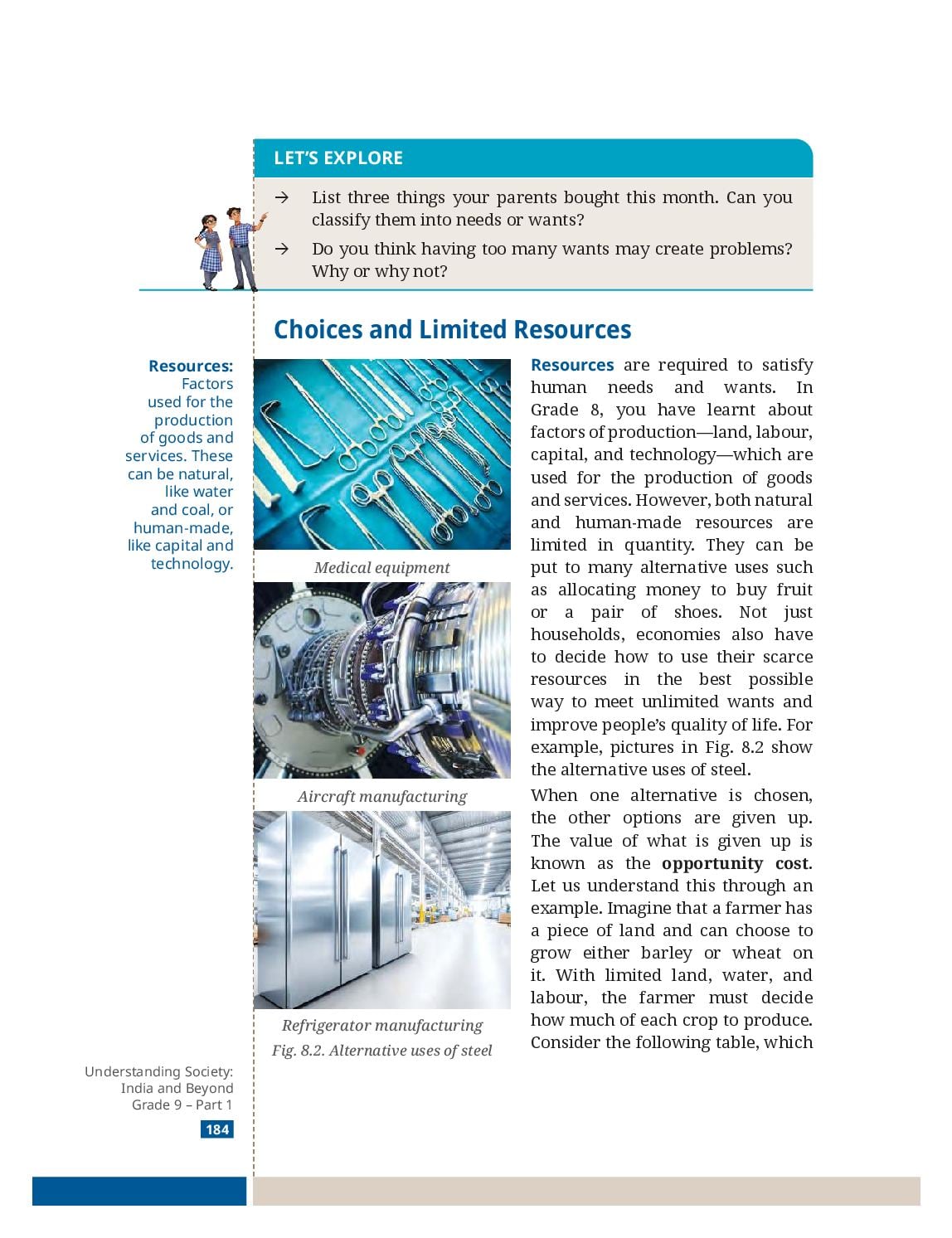
- Resources — the factors used to produce goods and services — are limited in quantity and have alternative uses. Fig. 8.2 shows the same steel going into medical equipment, aircraft manufacturing or refrigerator manufacturing. Limited resources against unlimited wants produce scarcity, and scarcity forces choice.
- When one alternative is chosen the others are given up. The value of what is given up is the opportunity cost. This is the chapter’s central tool, and it applies to money, to land, to time and to public spending alike.
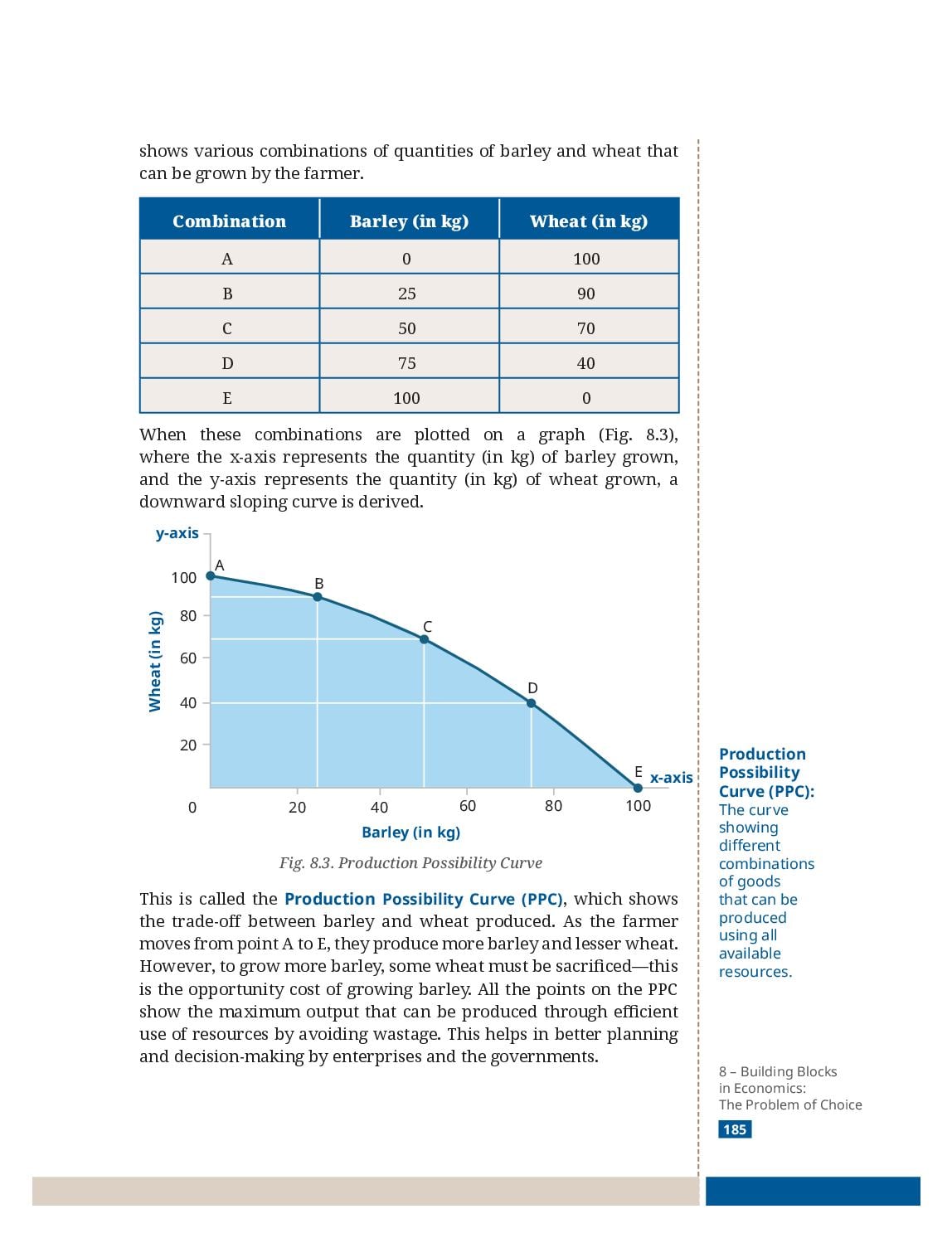
- The Production Possibility Curve (PPC) in Fig. 8.3 plots the farmer’s five combinations of barley and wheat — A (0, 100), B (25, 90), C (50, 70), D (75, 40), E (100, 0). Every point on the curve is a maximum output reached by using resources efficiently and avoiding wastage; the downward slope is the opportunity cost of barley measured in wheat.
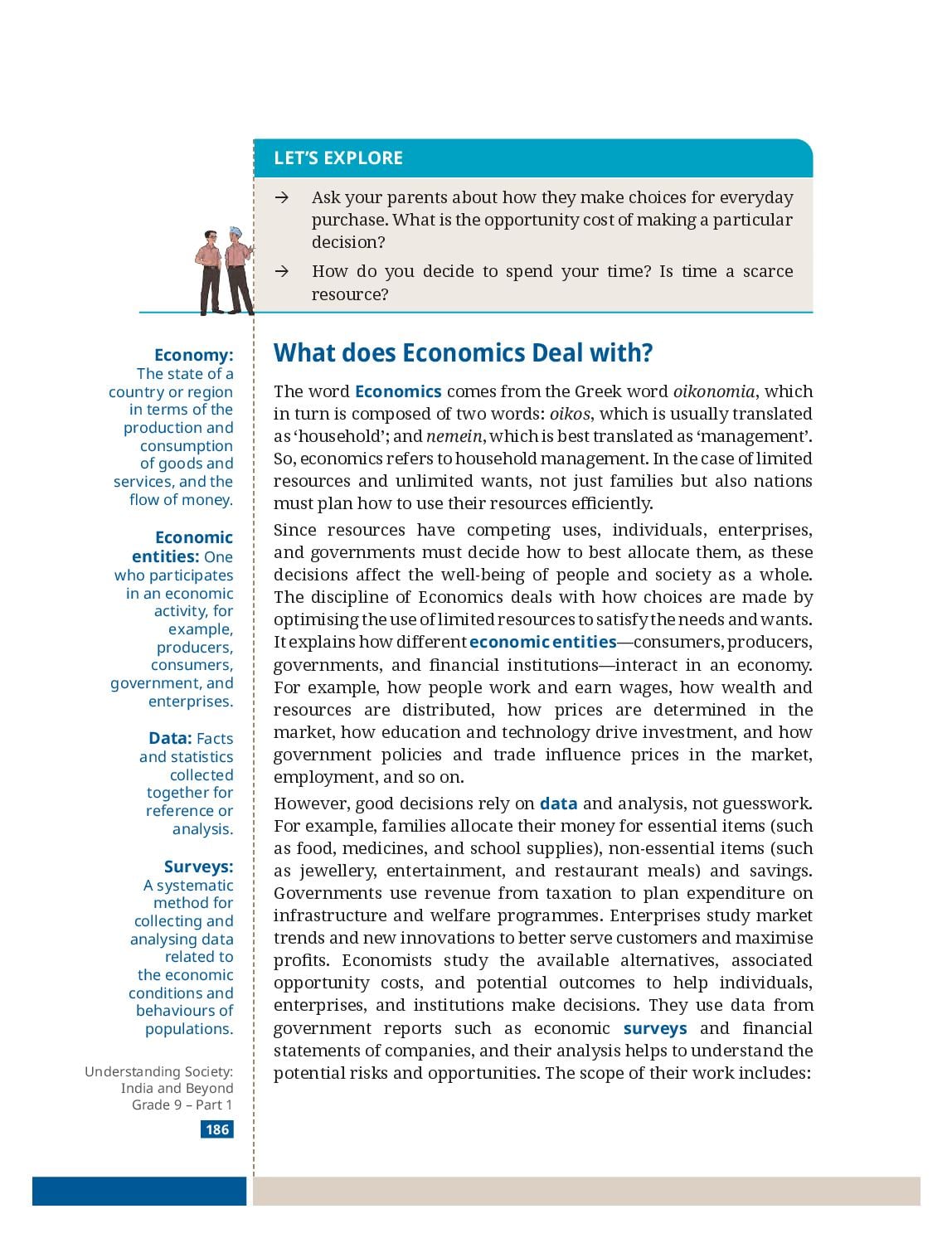
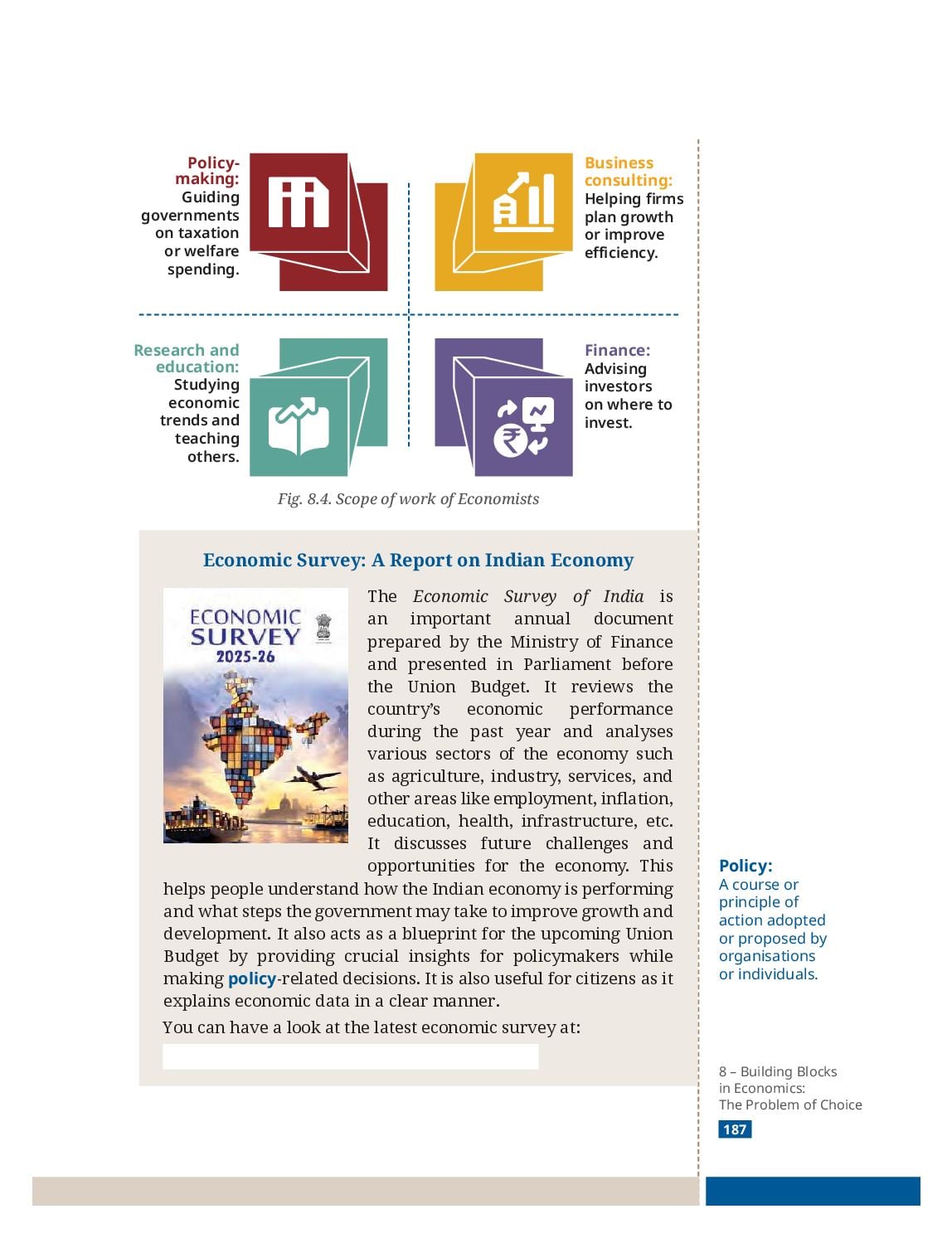
- Economics comes from the Greek oikonomia — oikos (household) + nemein (management). The discipline deals with how choices are made by optimising the use of limited resources to satisfy needs and wants, and it rests on data and analysis, not guesswork. Fig. 8.4 gives the scope of an economist’s work: policy-making, business consulting, research and education, and finance.
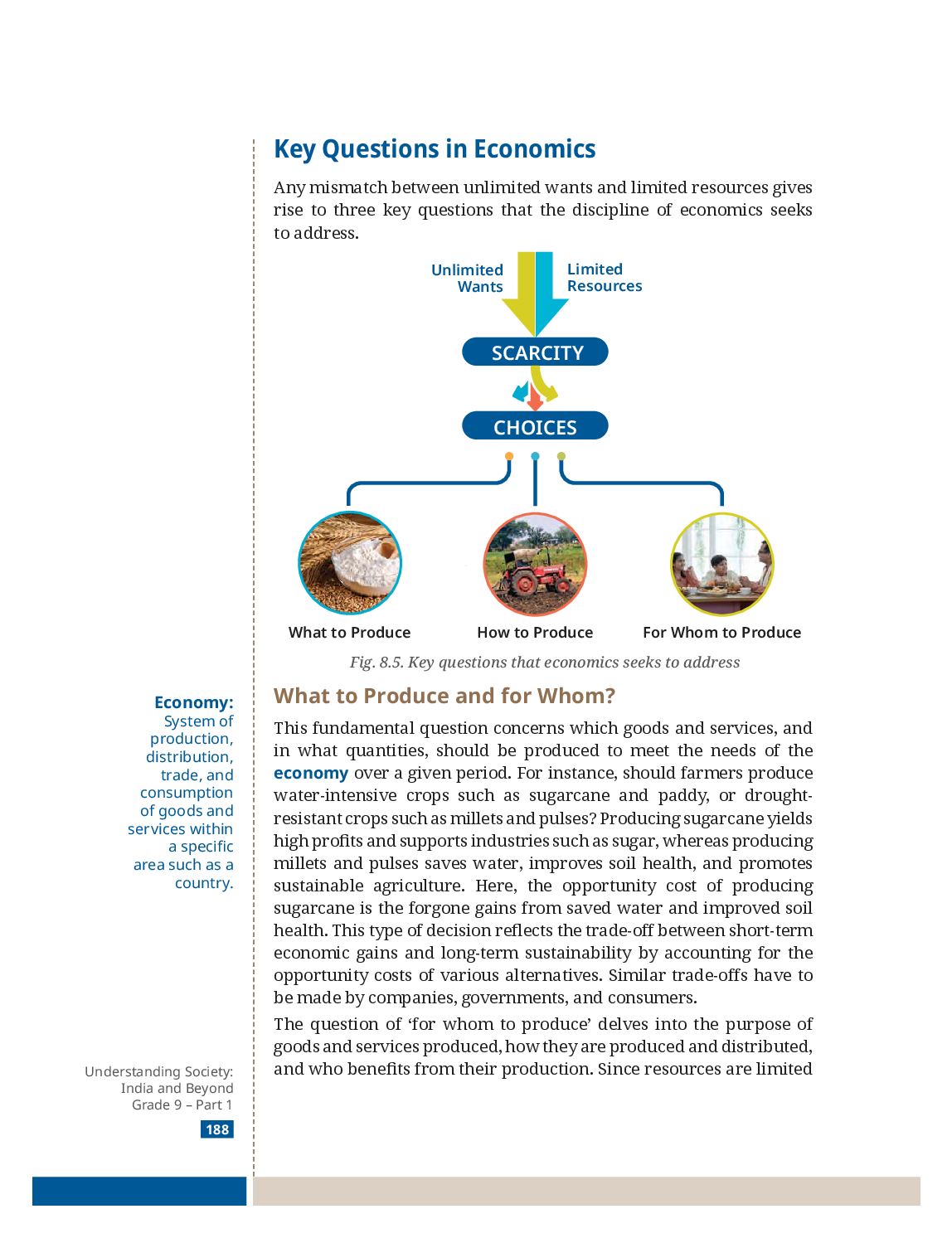
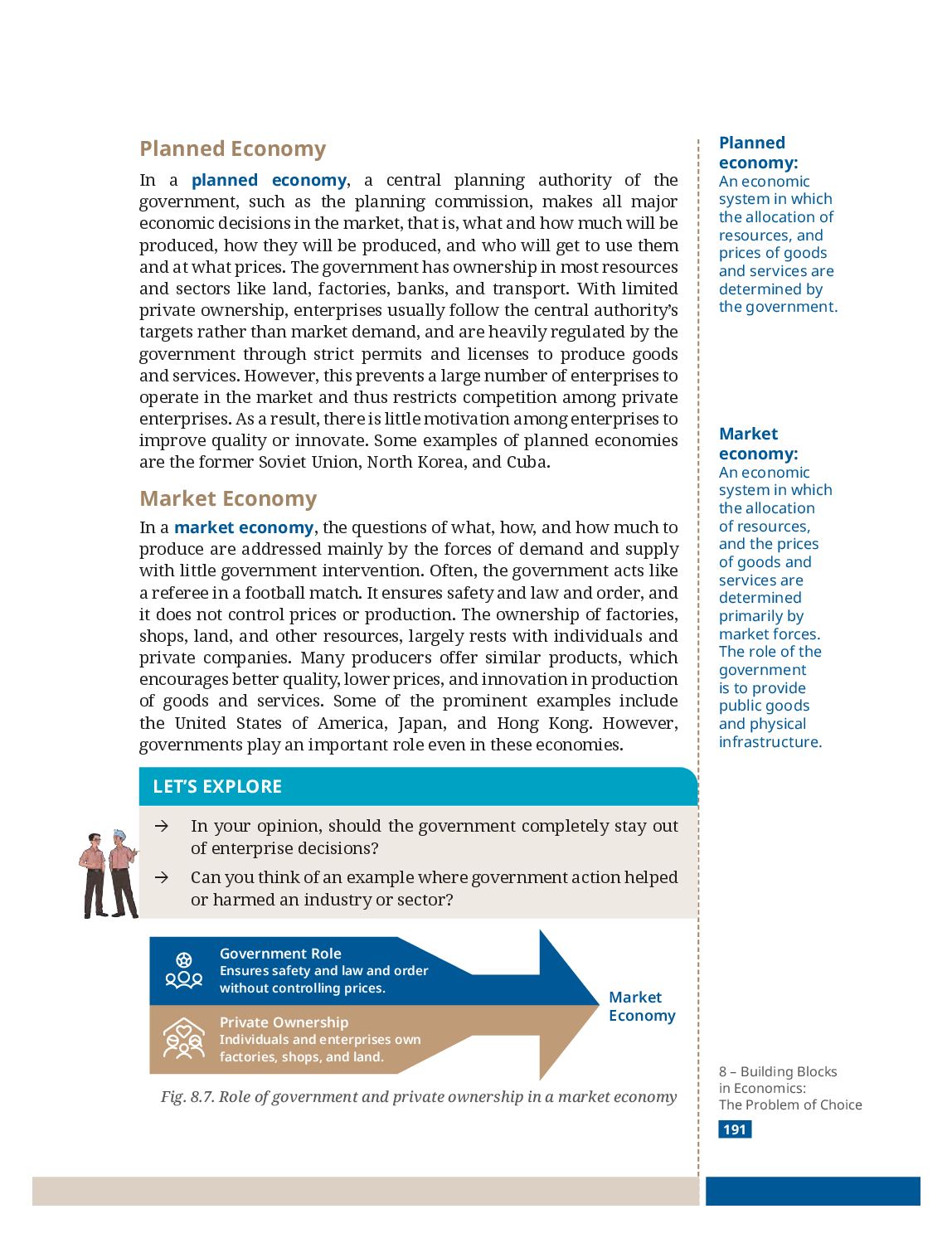
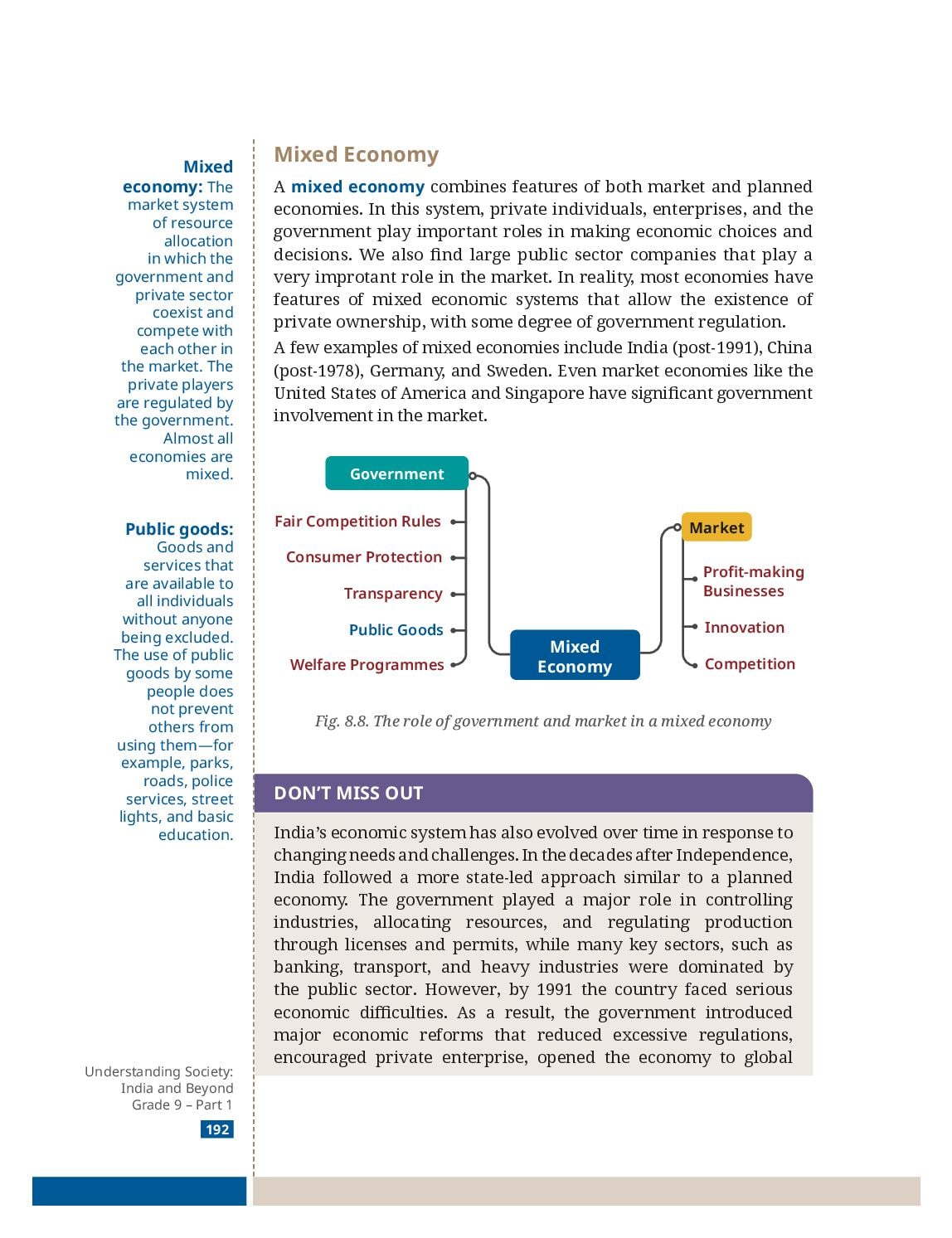
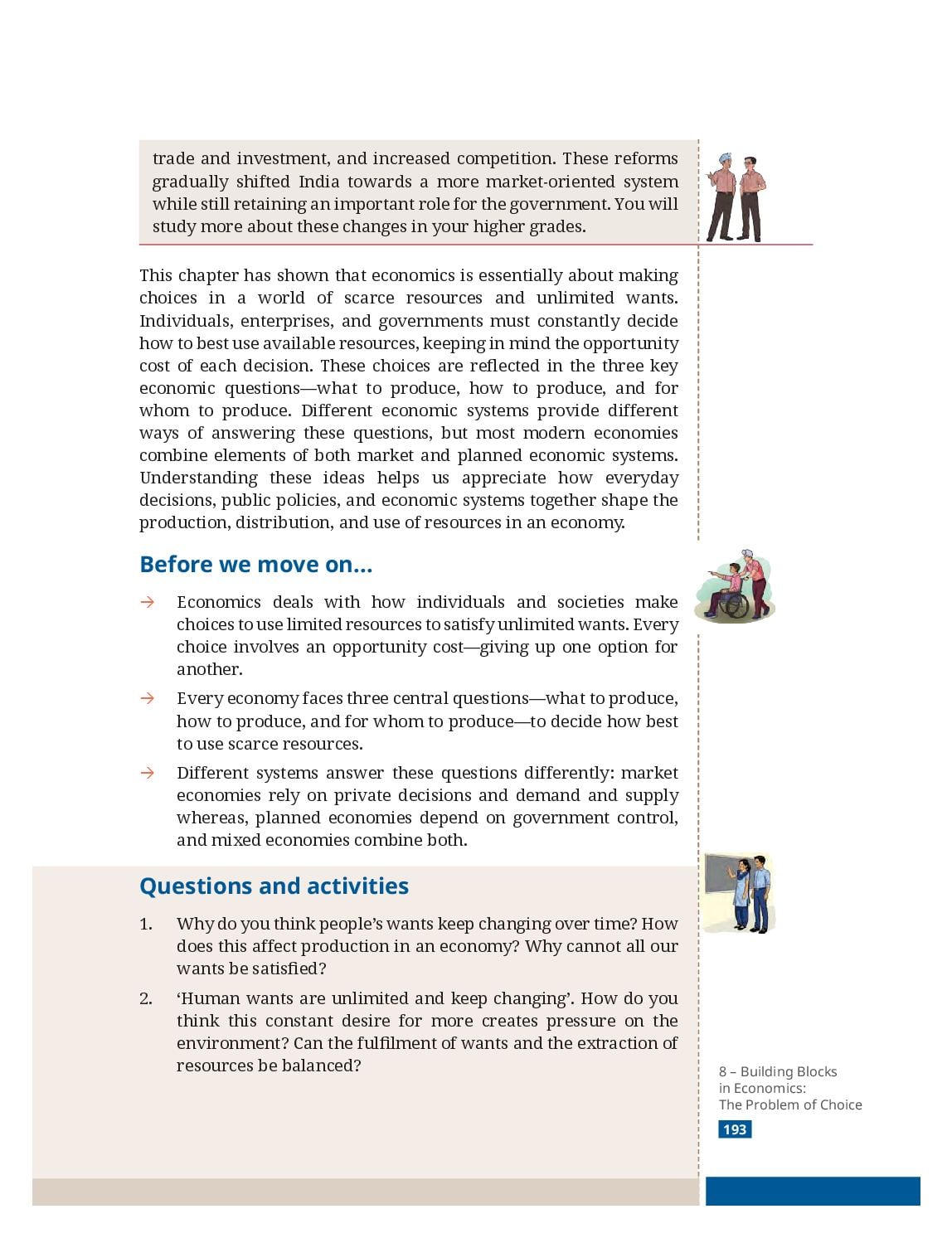
- Scarcity gives rise to three key questions (Fig. 8.5) — what to produce, how to produce (labour-intensive or capital-intensive), and for whom to produce. The answers depend on the country’s economic system: planned, market or mixed. In reality almost all economies are mixed; India moved towards a more market-oriented system after the reforms of 1991.
Quick revision – Building Blocks in Economics: The Problem of Choice
| Term | What it means | Where it appears in the chapter | What the chapter says about it |
|---|---|---|---|
| Market | A place where buying and selling of products and services takes place. | Page 183, margin | It could be a physical market or a virtual one on the internet |
| Needs and wants | Needs are essentials; wants are the rest. | Page 183, Fig. 8.1 | Needs — food, water, shelter. Wants — gadgets, vacations, luxury items. Wants are unlimited and keep changing |
| Resources | Factors used for the production of goods and services. | Page 184, margin and Fig. 8.2 | Can be natural (water, coal) or human-made (capital, technology); limited in quantity and open to alternative uses |
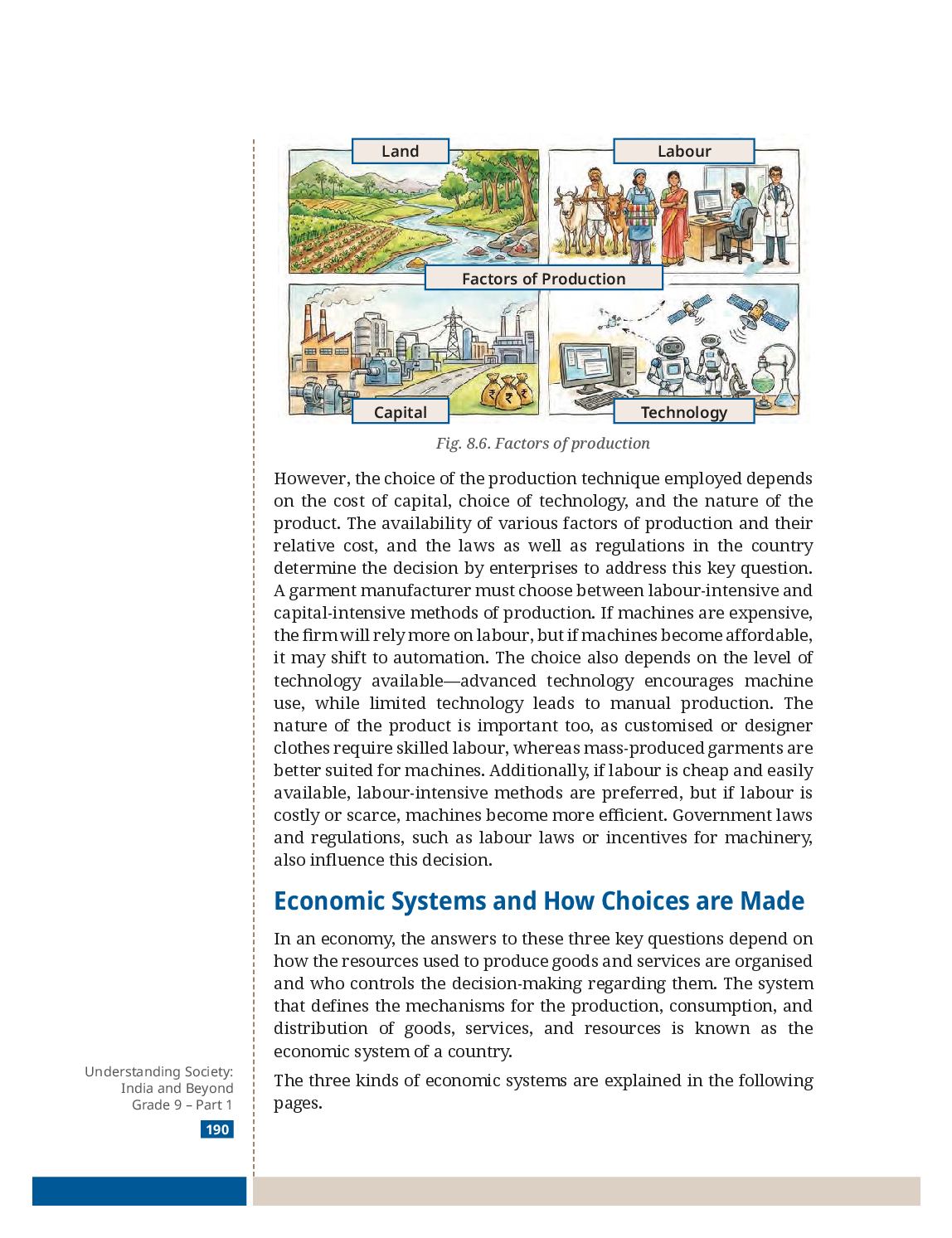
| Factors of production | Land, labour, capital and technology. | Page 190, Fig. 8.6 | Introduced in Grade 8; producers must select the right mix of them to answer ‘how to produce’ |
| Scarcity | The gap between unlimited wants and limited resources. | Page 188, Fig. 8.5 | Unlimited wants + limited resources → SCARCITY → CHOICES → the three key questions |
| Opportunity cost | The value of what is given up when one alternative is chosen. | Page 184 | The chapter’s central tool — the opportunity cost of growing barley is the wheat sacrificed; of sugarcane, the forgone saved water and improved soil health |
| Production Possibility Curve (PPC) | The curve showing different combinations of goods that can be produced using all available resources. | Page 185, Fig. 8.3 | Downward sloping; shows the trade-off between barley and wheat; all points on it are maximum output with efficient use and no wastage |
| Economy | The state of a country or region in terms of production and consumption of goods and services and the flow of money; the system of production, distribution, trade and consumption within a specific area such as a country. | Pages 186 and 188, margins | The chapter gives the term twice — once as a state and once as a system |
| Economic entities | One who participates in an economic activity. | Page 186, margin | Producers, consumers, government and enterprises — economics explains how they interact |
| Data | Facts and statistics collected together for reference or analysis. | Page 186, margin | “Good decisions rely on data and analysis, not guesswork” |
| Surveys | A systematic method for collecting and analysing data on economic conditions and behaviours of populations. | Page 186, margin | Economists use government reports such as economic surveys and companies’ financial statements |
| Economic Survey of India | An annual document of the Ministry of Finance, presented in Parliament before the Union Budget. | Page 187, box | Reviews the past year, analyses agriculture, industry, services, employment, inflation, education, health and infrastructure; acts as a blueprint for the coming Union Budget |
| Policy | A course or principle of action adopted or proposed by organisations or individuals. | Page 187, margin | Economists guide governments on taxation and welfare spending (Fig. 8.4) |
| Labour-intensive / capital-intensive | Using more workers and less machinery / more machines and technology and fewer workers. | Page 189 | Agriculture and handicrafts lean on labour; steel and automobile manufacturing lean on machinery |
Old NCERT vs New – Class 9 Social Science
This chapter is from Understanding Society: India and Beyond, the new NCERT Class 9 Social Science book (NCF-SE 2023, used from 2026-27). It replaced the old book “India and the Contemporary World, Contemporary India, Democratic Politics and Economics”, so chapter numbers and names differ from older PDFs.
Solutions and All Chapters
Answers to the exercises and the full chapter list of Understanding Society: India and Beyond:
Building Blocks in Economics: The Problem of Choice – Overview
| Class | Class 9 |
| Subject | Social Science |
| Book | Understanding Society: India and Beyond – new NCERT book |
| Part | Part I |
| Chapter | 8 of 15 – Building Blocks in Economics: The Problem of Choice |
| Book pages | 183 – 194 |
| Edition | Latest NCERT edition (2026-27) |
| Session | 2026-27 |
| Free – read online or download |
Class 9 Social Science Chapter 8 – FAQs
Where can I download Building Blocks in Economics: The Problem of Choice Class 9 PDF?
From the download table on this page – the chapter PDF is free, and the full book is linked too.
What is Class 9 Social Science Chapter 8 about?
Some preferences are needs (food, water, shelter) and others are wants (gadgets, vacations, luxury items). Fig. 8.1 sets the two rows side by side. Human wants are unlimited and keep changing — the chapter’s example is upgrading from a bicycle to a motorbike and then to a car.
Is Building Blocks in Economics: The Problem of Choice from the new NCERT Class 9 Social Science book?
Yes. It is chapter 8 of understanding society: india and beyond (part i), the new NCERT Class 9 Social Science book for 2026-27.
Is this the latest NCERT edition for 2026-27?
Yes – the PDF is NCERT’s latest edition for the 2026-27 session.
Where are the NCERT Solutions for Class 9 Social Science Chapter 8?
Open the NCERT Solutions link above for answers to the exercise questions.