Download Democracy – NCERT Class 9 Social Science Chapter 6 PDF from the new NCERT Class 9 Social Science book Understanding Society: India and Beyond (2026-27). Read the chapter online or download the free PDF. Democracy is a form of government in which the source of power and authority lies with the citizens, who elect their representatives through free and fair elections. The chapter’s larger point is that it is not merely a system of government but a…
Democracy PDF – Chapter 6 of Understanding Society: India and Beyond (Part I)
Read the chapter online or download the PDF.
| Chapter | Download | |
|---|---|---|
| Chapter 6 PDF | Democracy | View PDF |
| Full book | NCERT Class 9 Social Science – Understanding Society: India and Beyond | View Book |
Read Online
What Is in Democracy? (Class 9 Social Science Chapter 6)
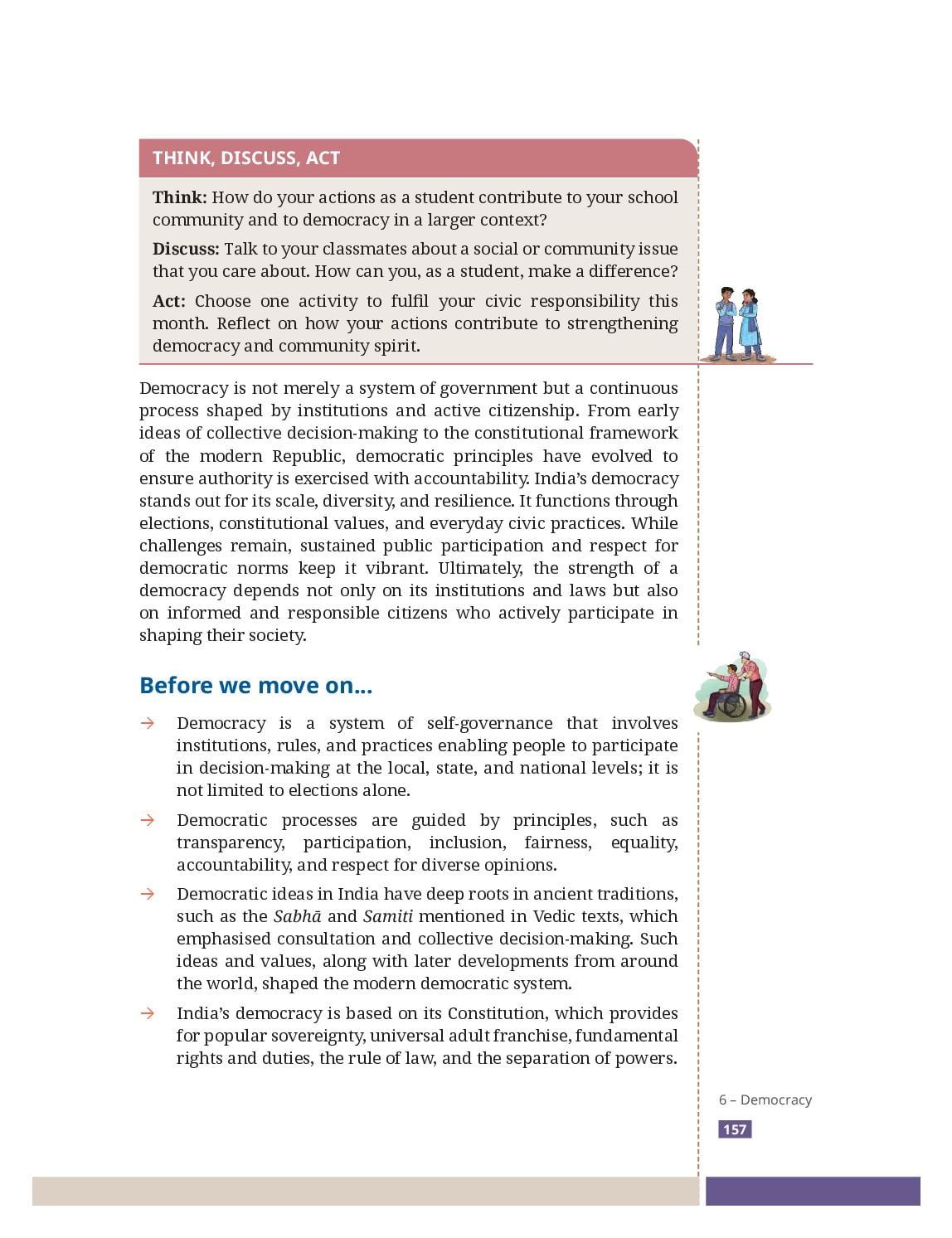
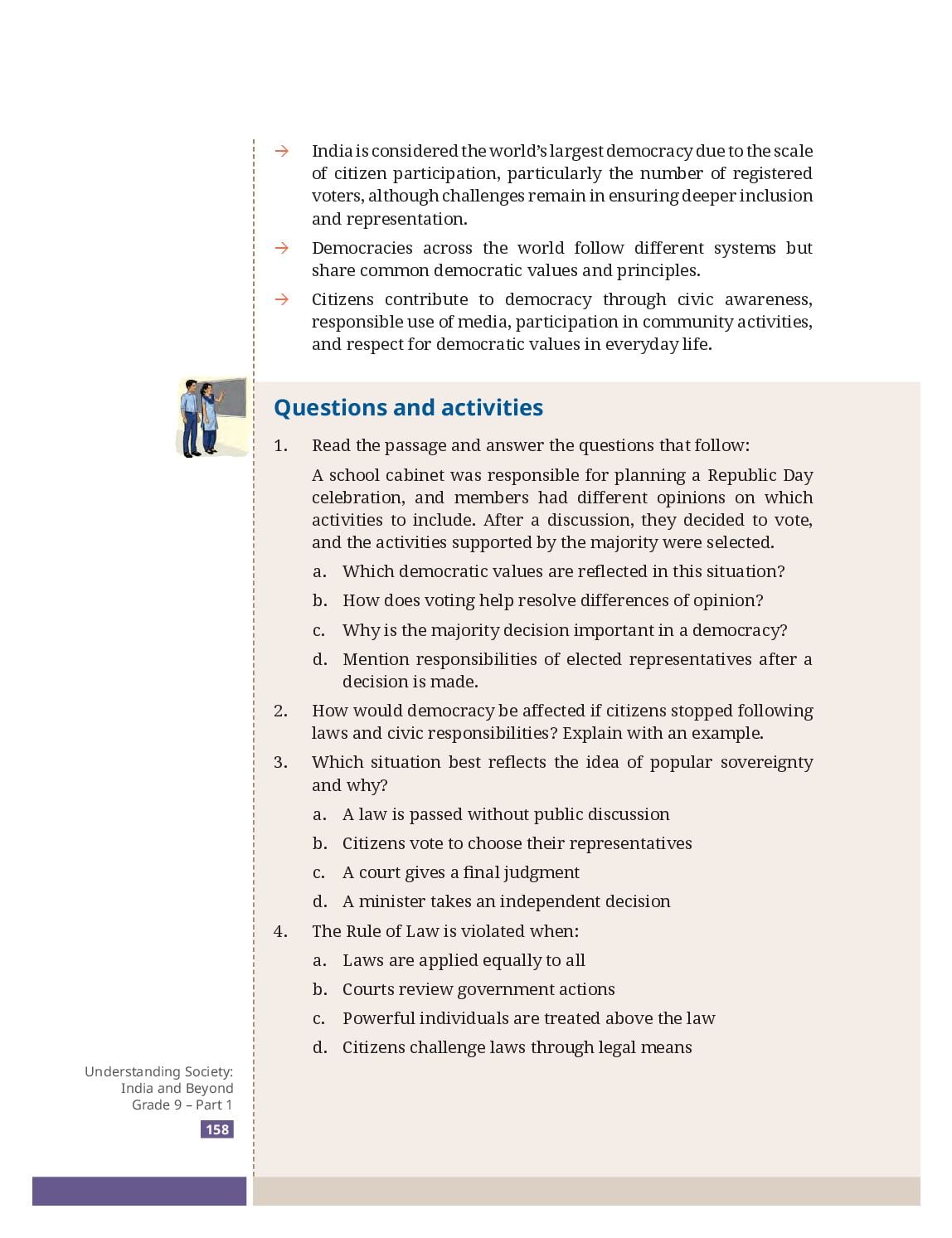
- Democracy is a form of government in which the source of power and authority lies with the citizens, who elect their representatives through free and fair elections. The chapter’s larger point is that it is not merely a system of government but a continuous process shaped by institutions and by active citizenship, and that it is not limited to elections alone.
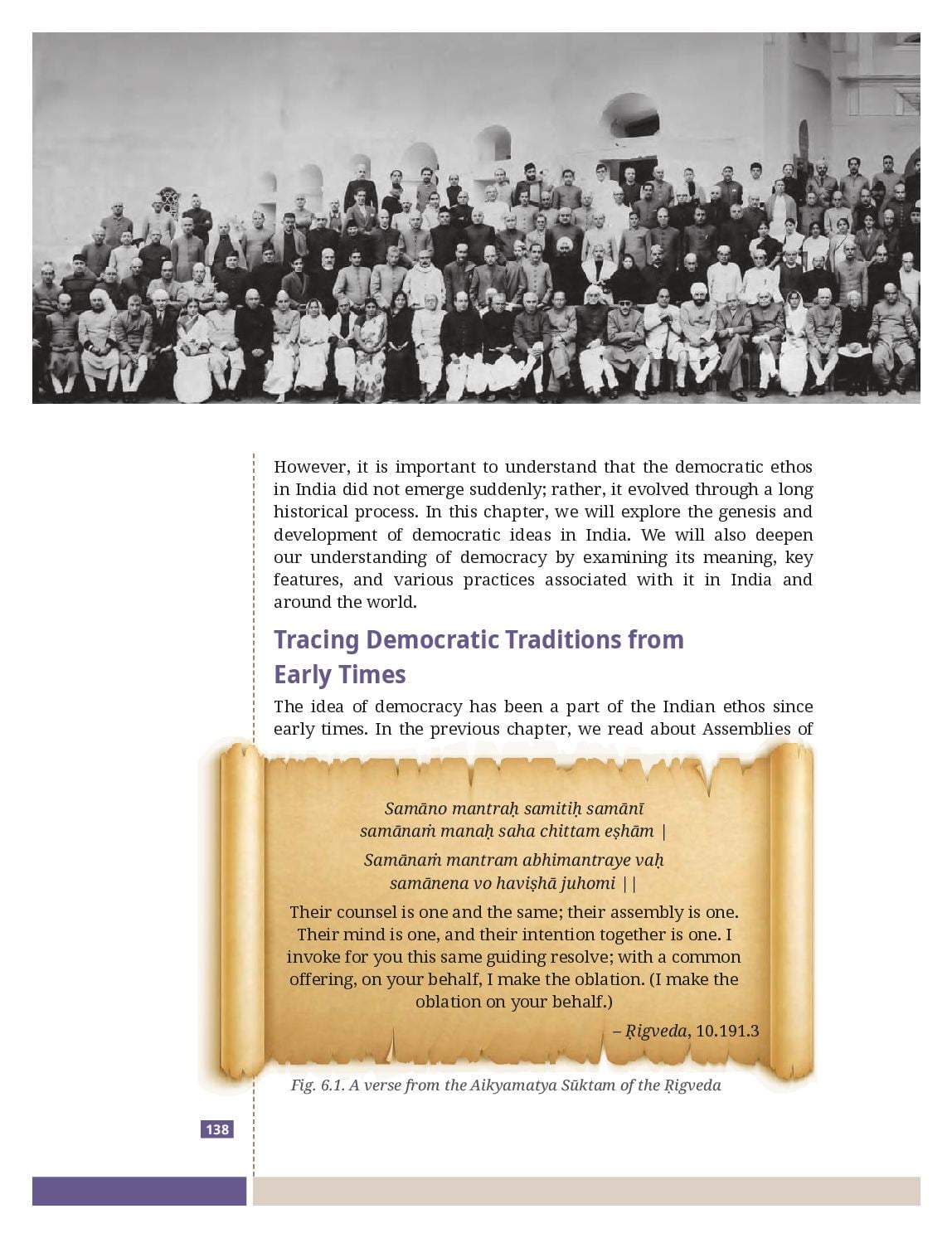
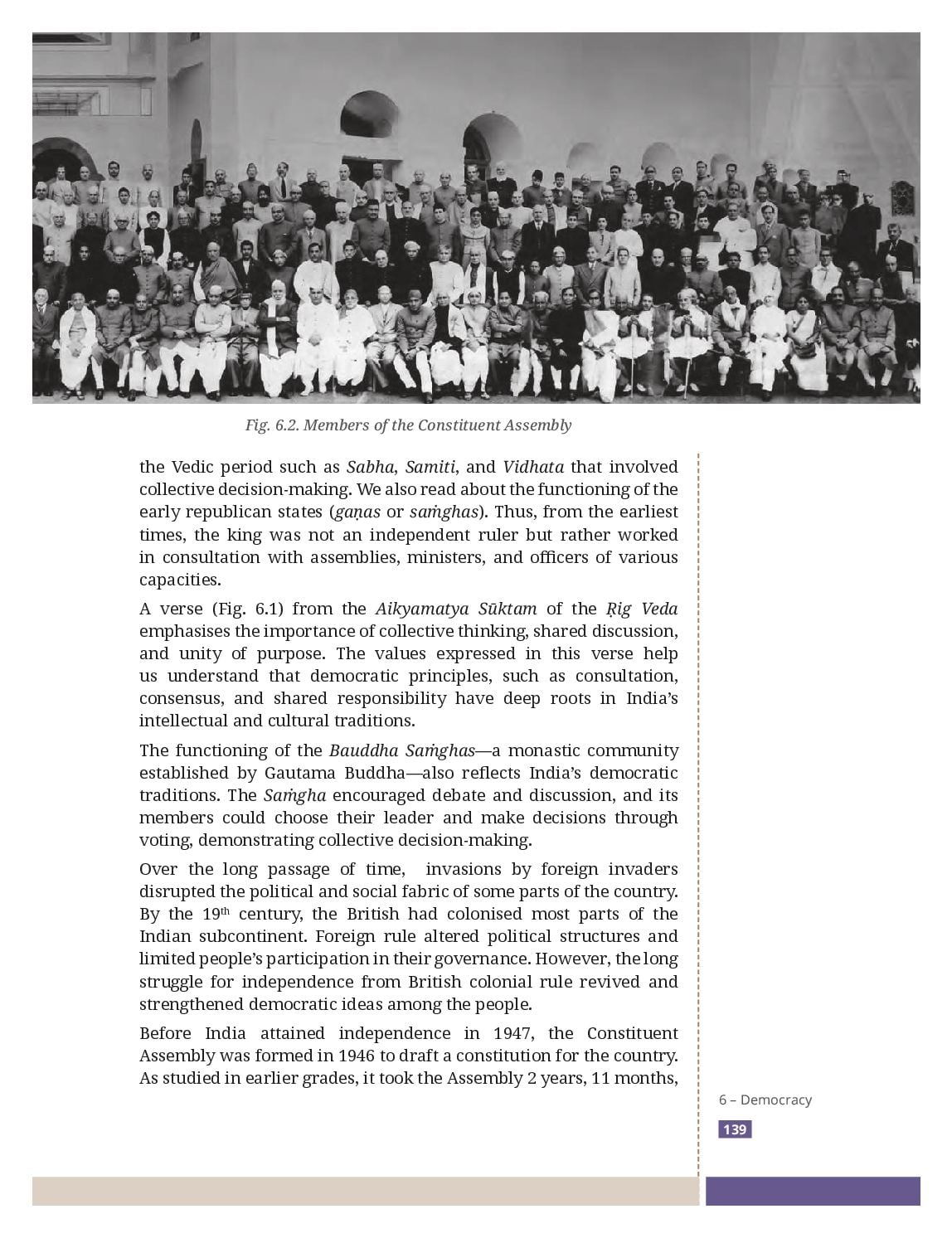
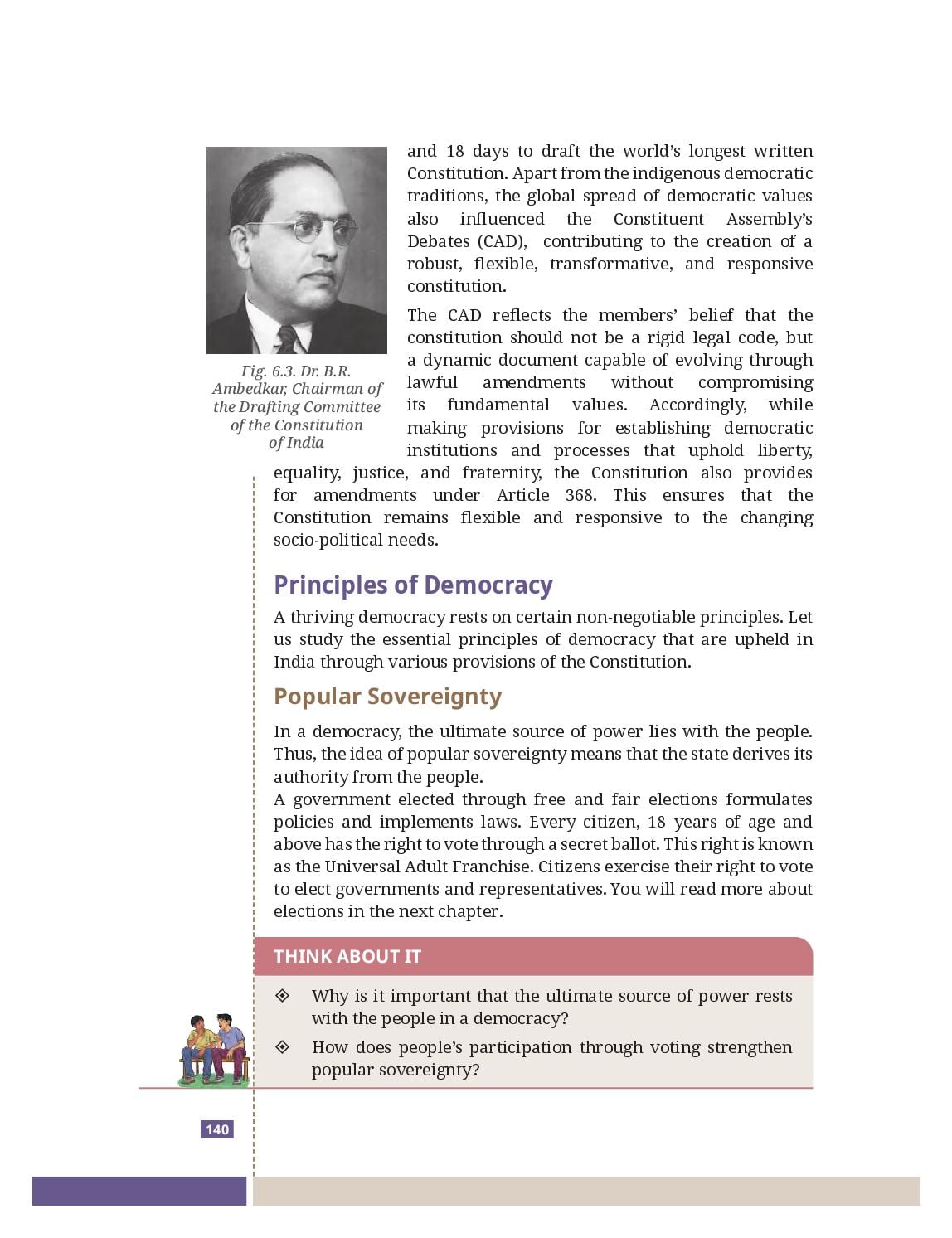
- The chapter traces democratic ideas in India from early times: the Vedic assemblies Sabha, Samiti and Vidhata; the early republican states (gaṇas or saṁghas); the verse from the Aikyamatya Sūktam of the Ṛigveda (10.191.3) on shared counsel and shared mind; and the Bauddha Saṁgha, where members debated, chose their leader and decided by voting. Foreign rule limited participation, the freedom struggle revived democratic ideas, and the Constituent Assembly (formed 1946) took 2 years, 11 months and 18 days to draft the world’s longest written Constitution — adopted 26 November 1949, in force 26 January 1950, and kept flexible by the amendment power in Article 368.
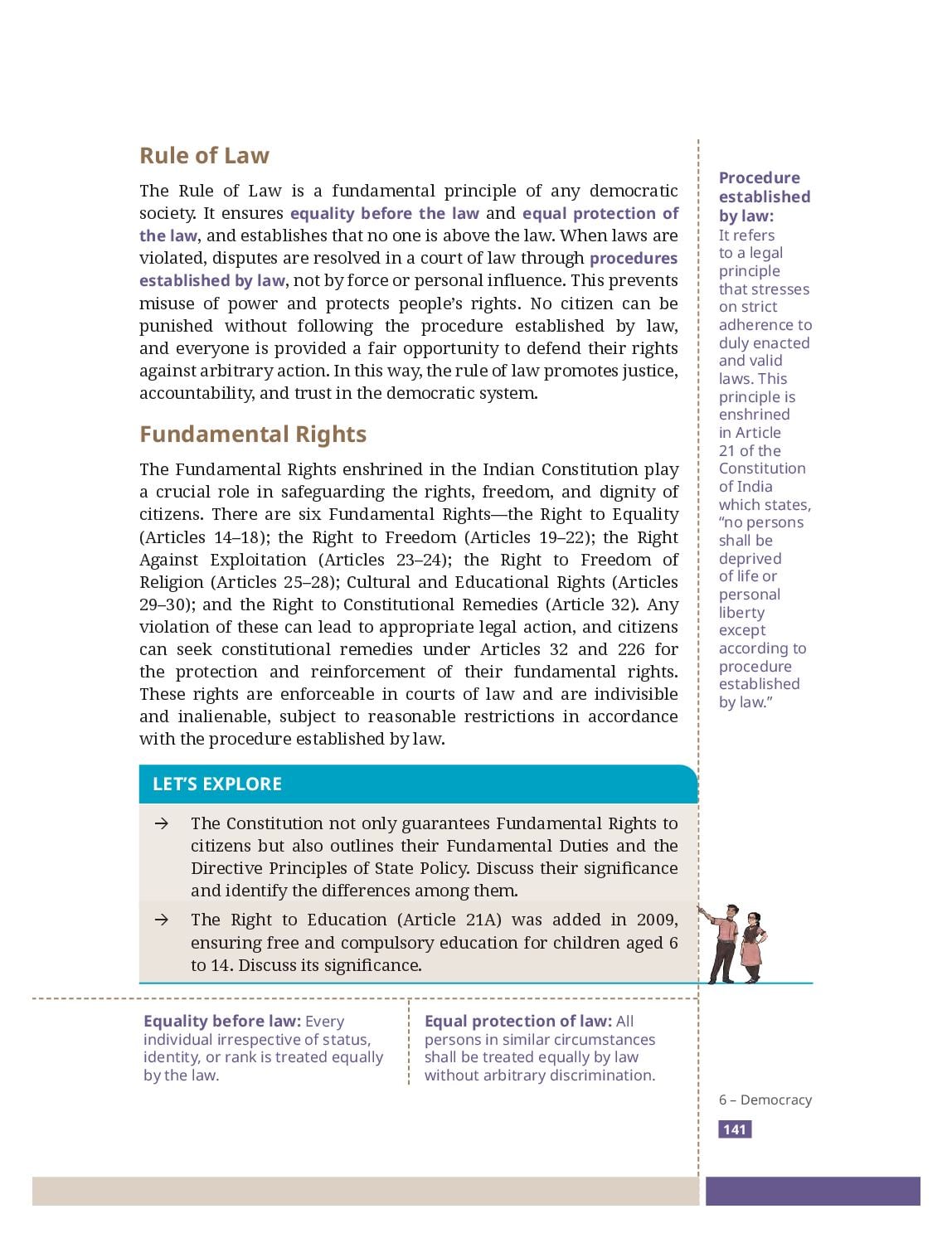
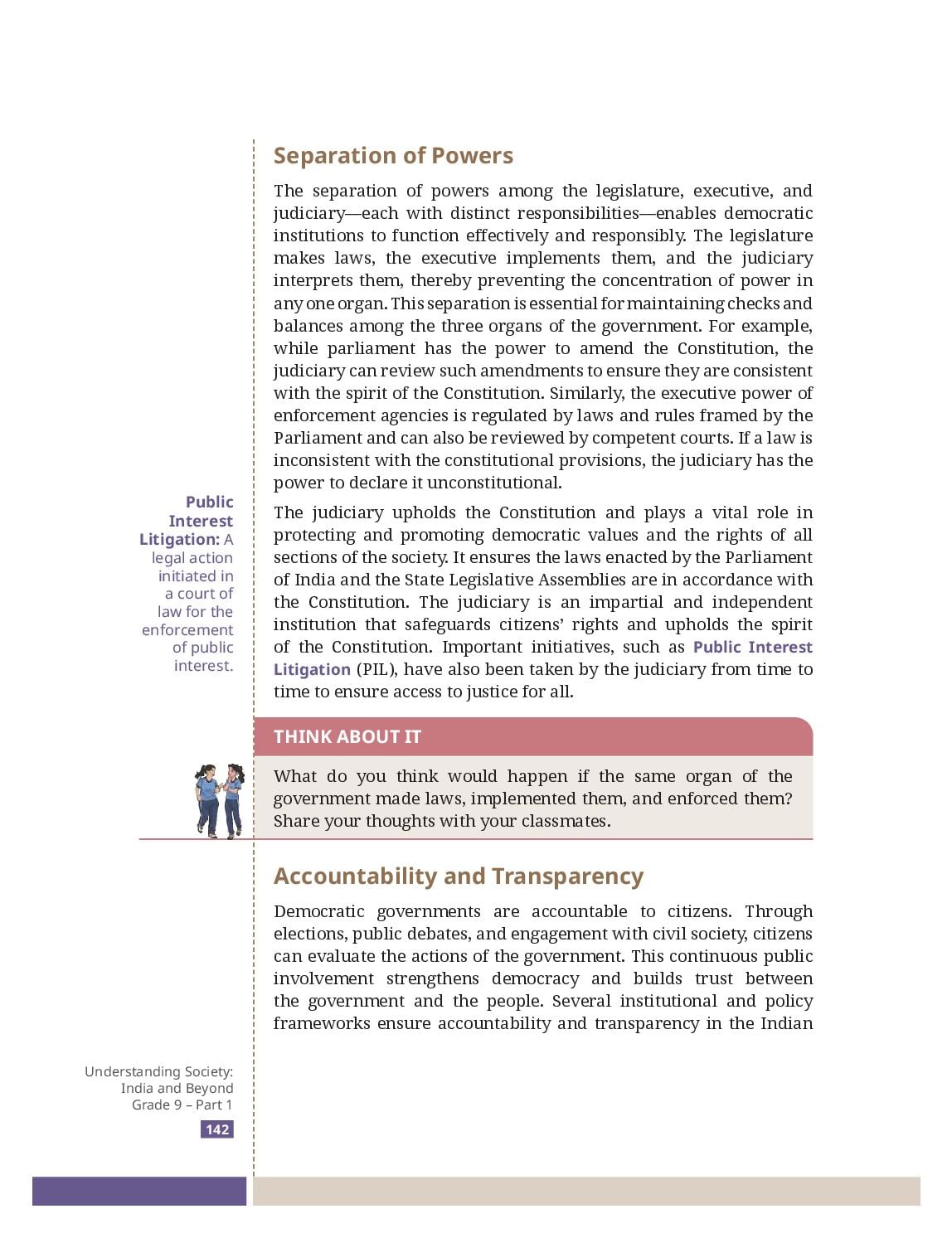
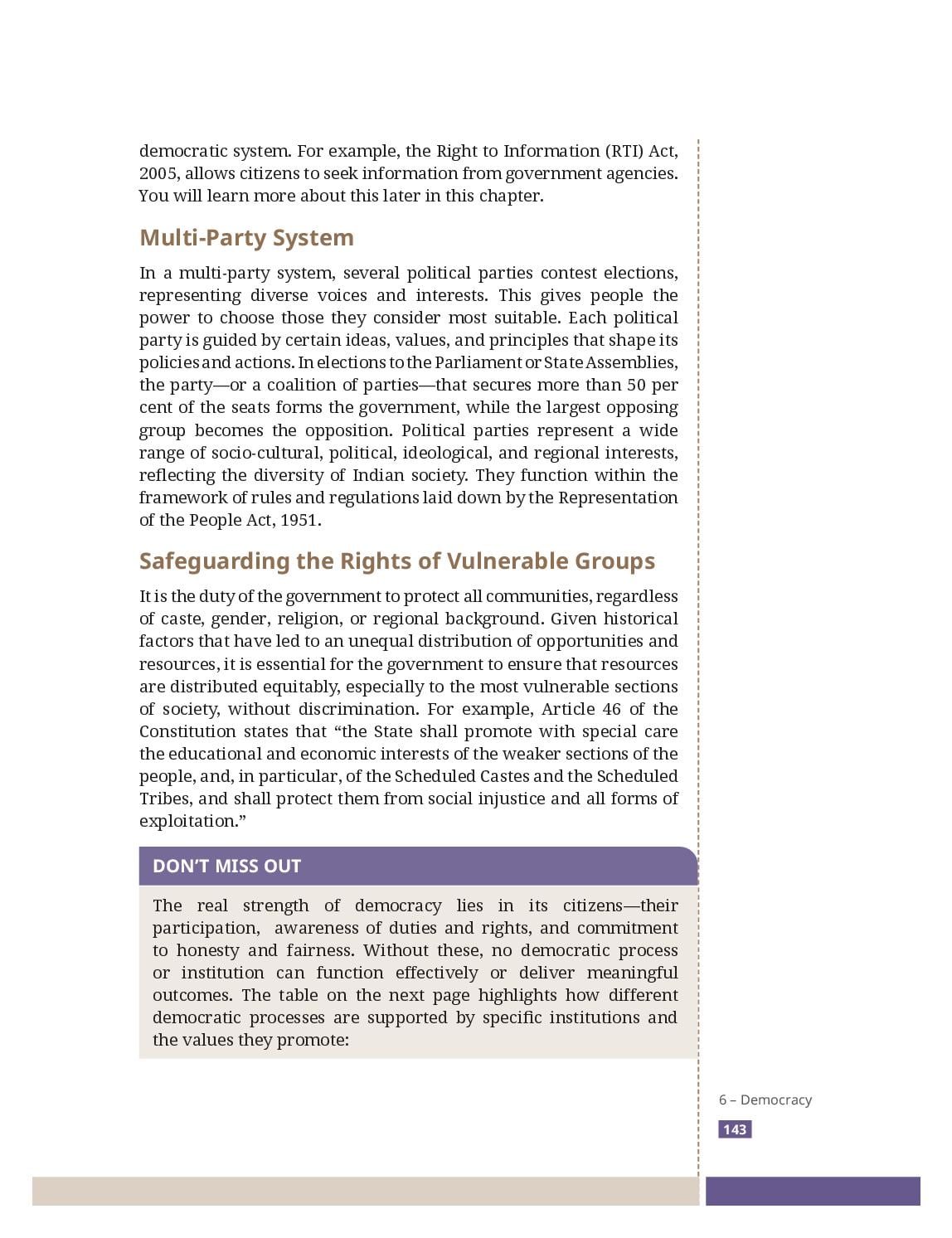
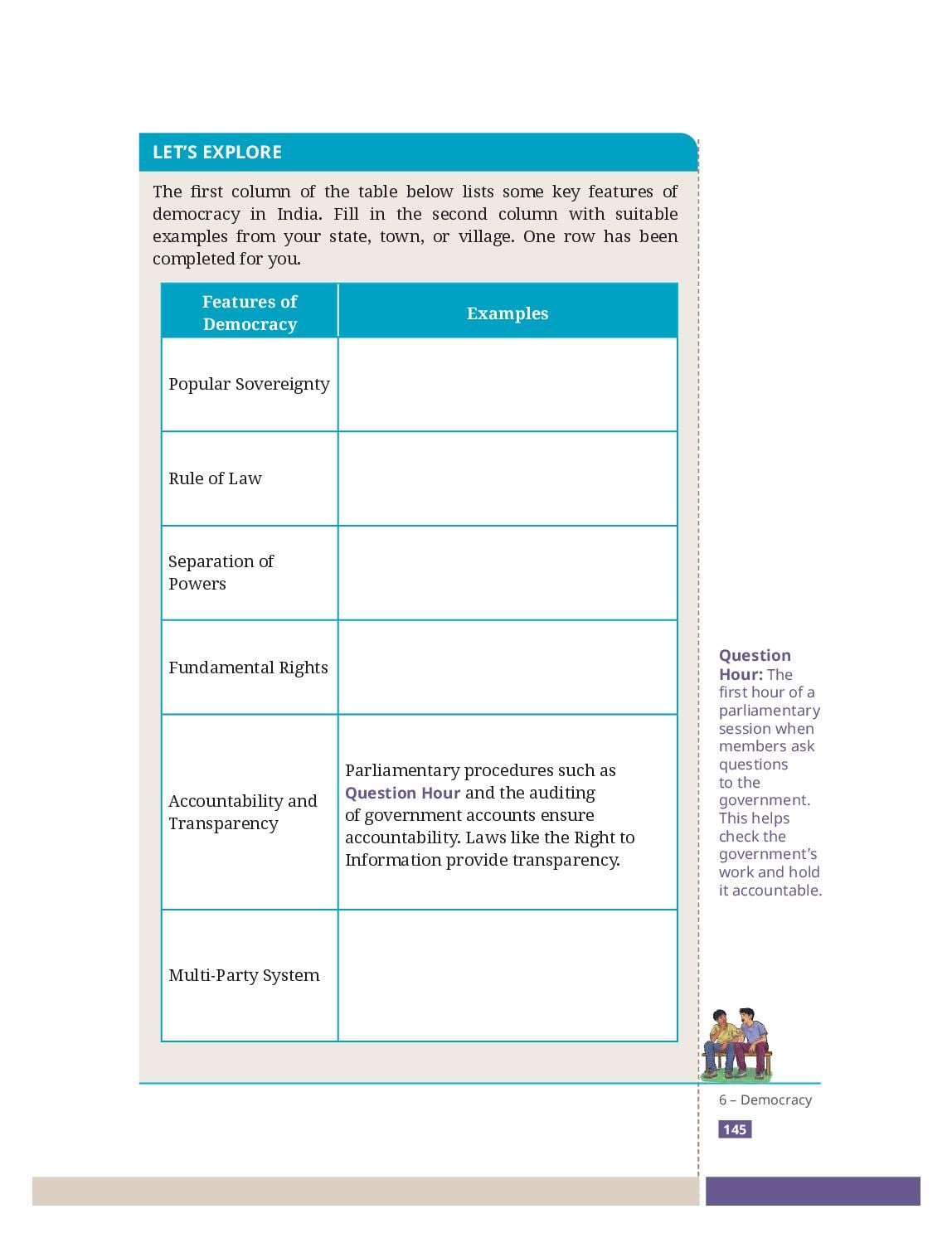
- Seven principles hold a democracy up, and the chapter names each one: popular sovereignty (Universal Adult Franchise at 18, by secret ballot), rule of law (equality before the law, equal protection of the law, procedure established by law under Article 21), Fundamental Rights (six of them, Articles 14–32, enforceable under Articles 32 and 226), separation of powers (legislature makes, executive implements, judiciary interprets), accountability and transparency (the RTI Act, 2005), a multi-party system (governed by the Representation of the People Act, 1951), and the safeguarding of vulnerable groups (Article 46).
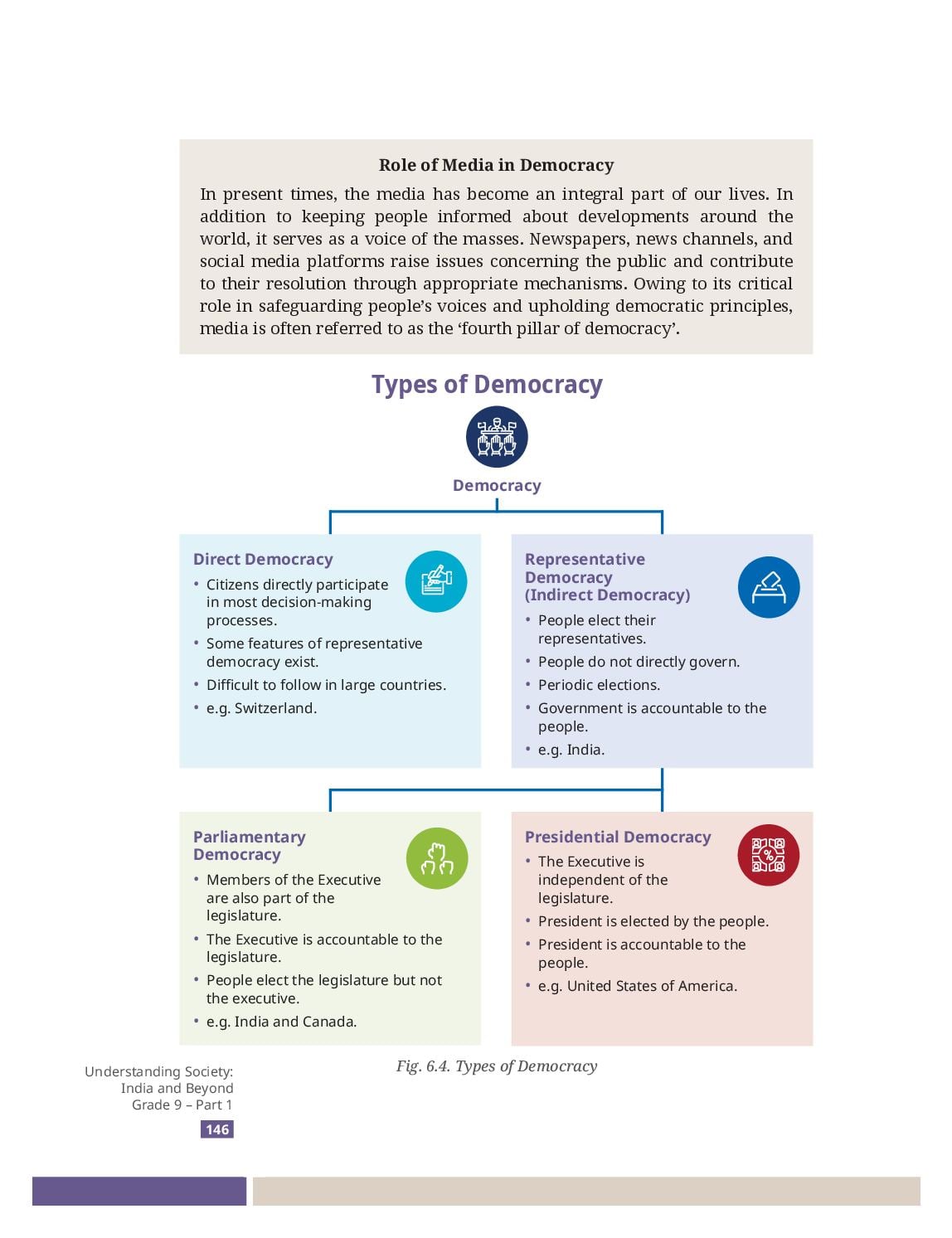
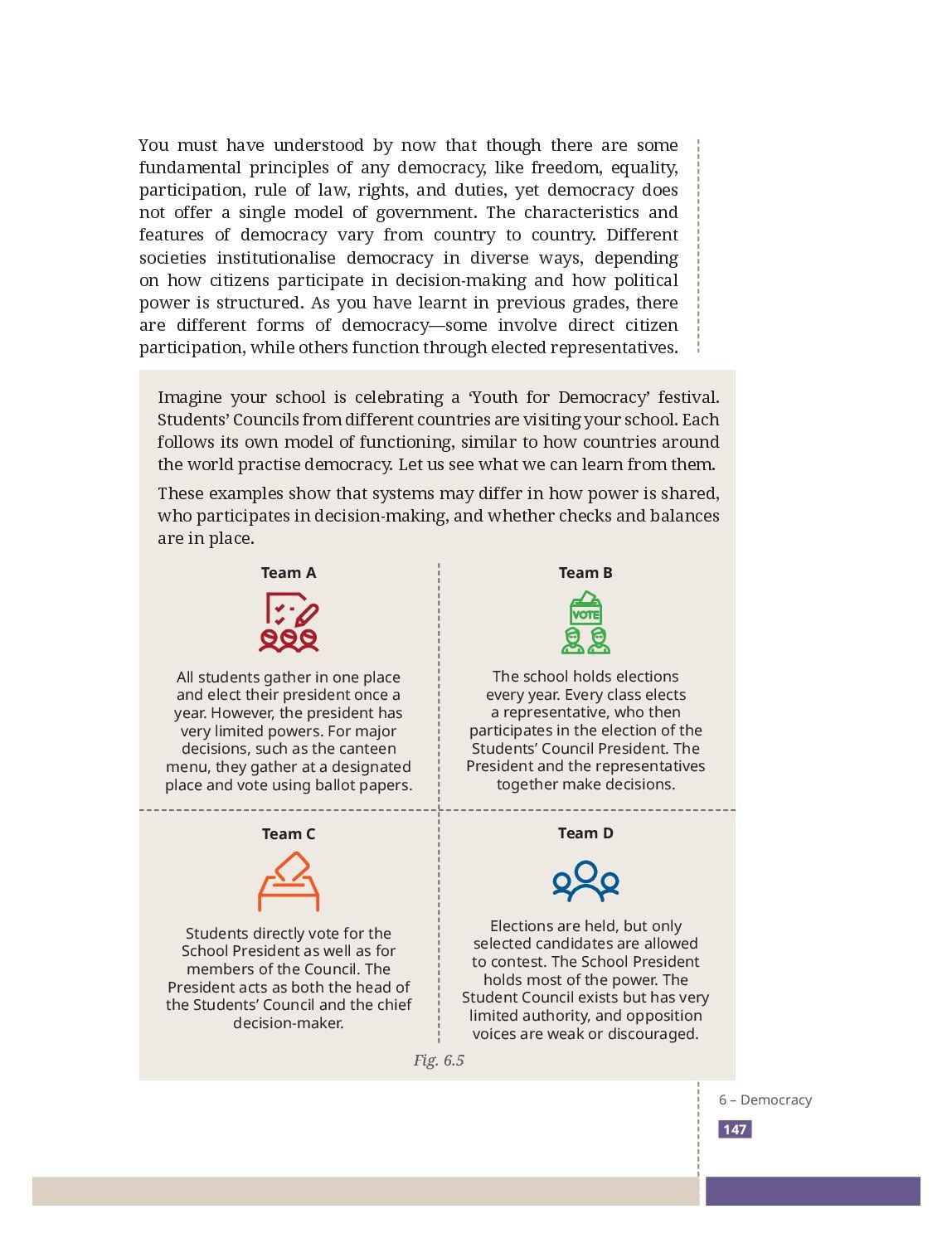
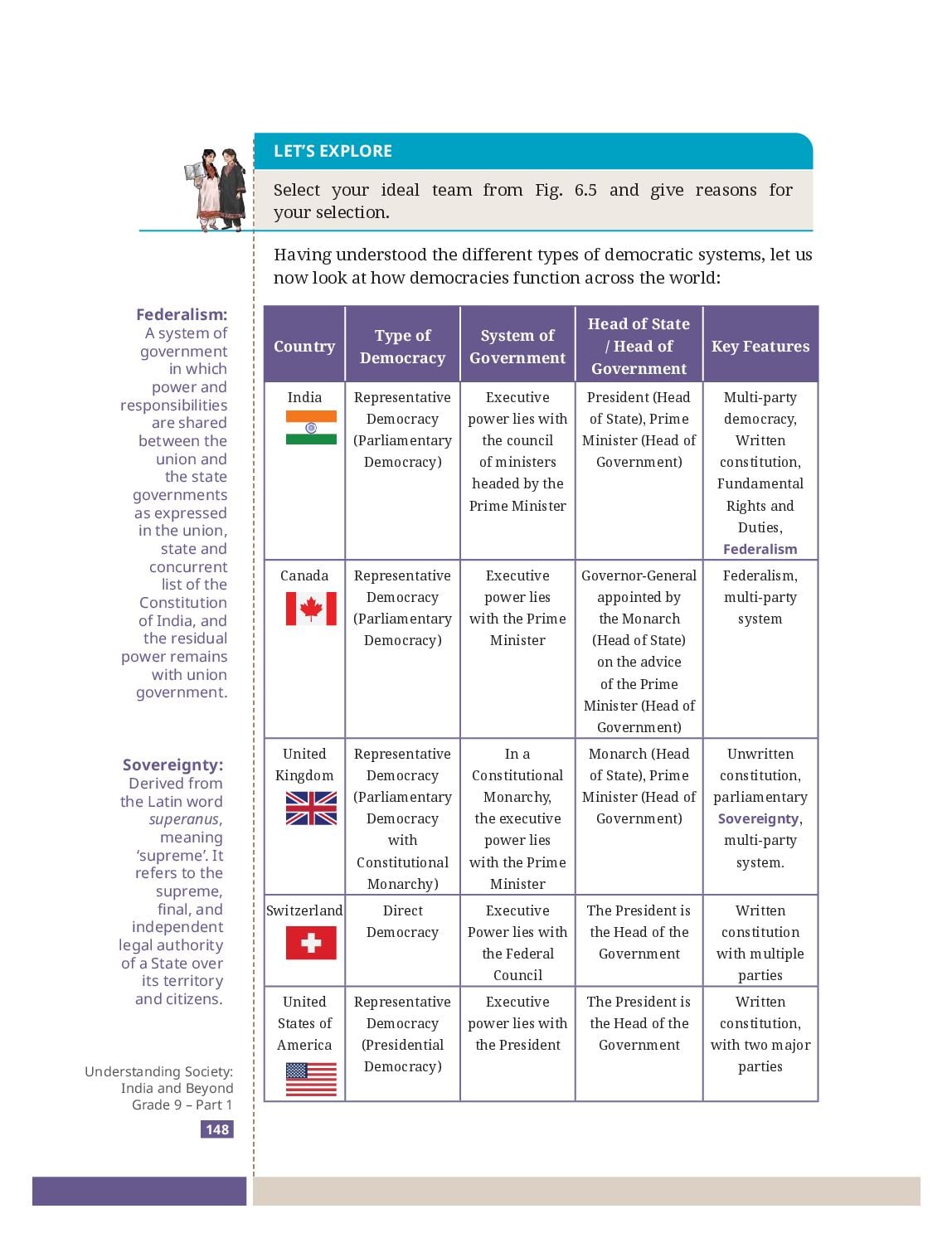
- Democracy takes different forms. Fig. 6.4 divides it into Direct Democracy (Switzerland) and Representative or Indirect Democracy (India), and then divides the representative kind into Parliamentary Democracy (India, Canada — the executive sits inside the legislature and is answerable to it) and Presidential Democracy (USA — the executive is independent of the legislature and the President is elected by the people). The table on page 148 compares India, Canada, the United Kingdom, Switzerland and the United States of America.
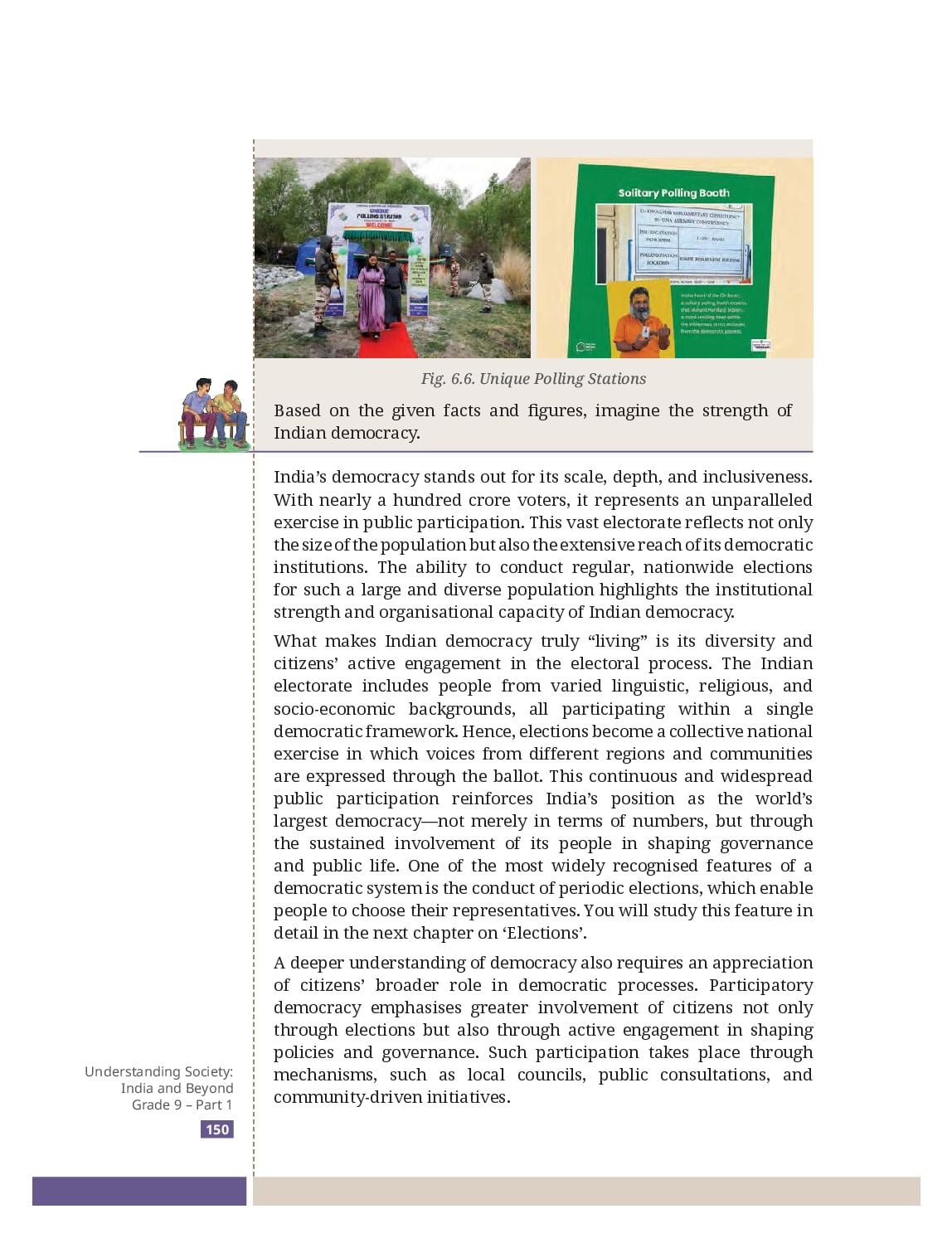
- India’s democracy is described through its scale and reach: a population of over 140 crore, over 96.8 crore registered voters (2024), an average of about 25 lakh people per Member of Parliament (2019), elections conducted in 22 scheduled languages with election symbols so that people who cannot read can still vote independently, over one million polling stations — some created for a single voter — and over 2,800 registered political parties.
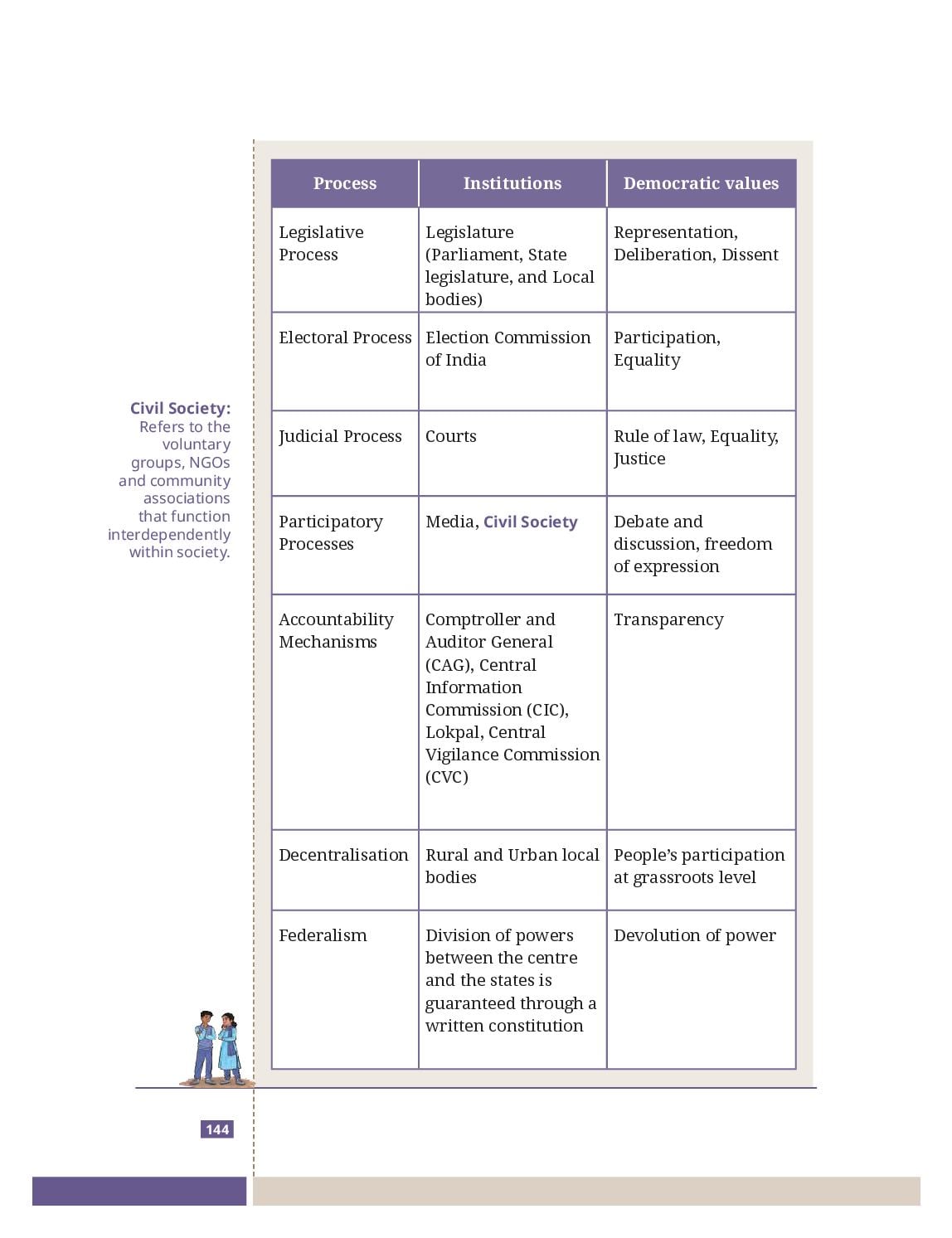
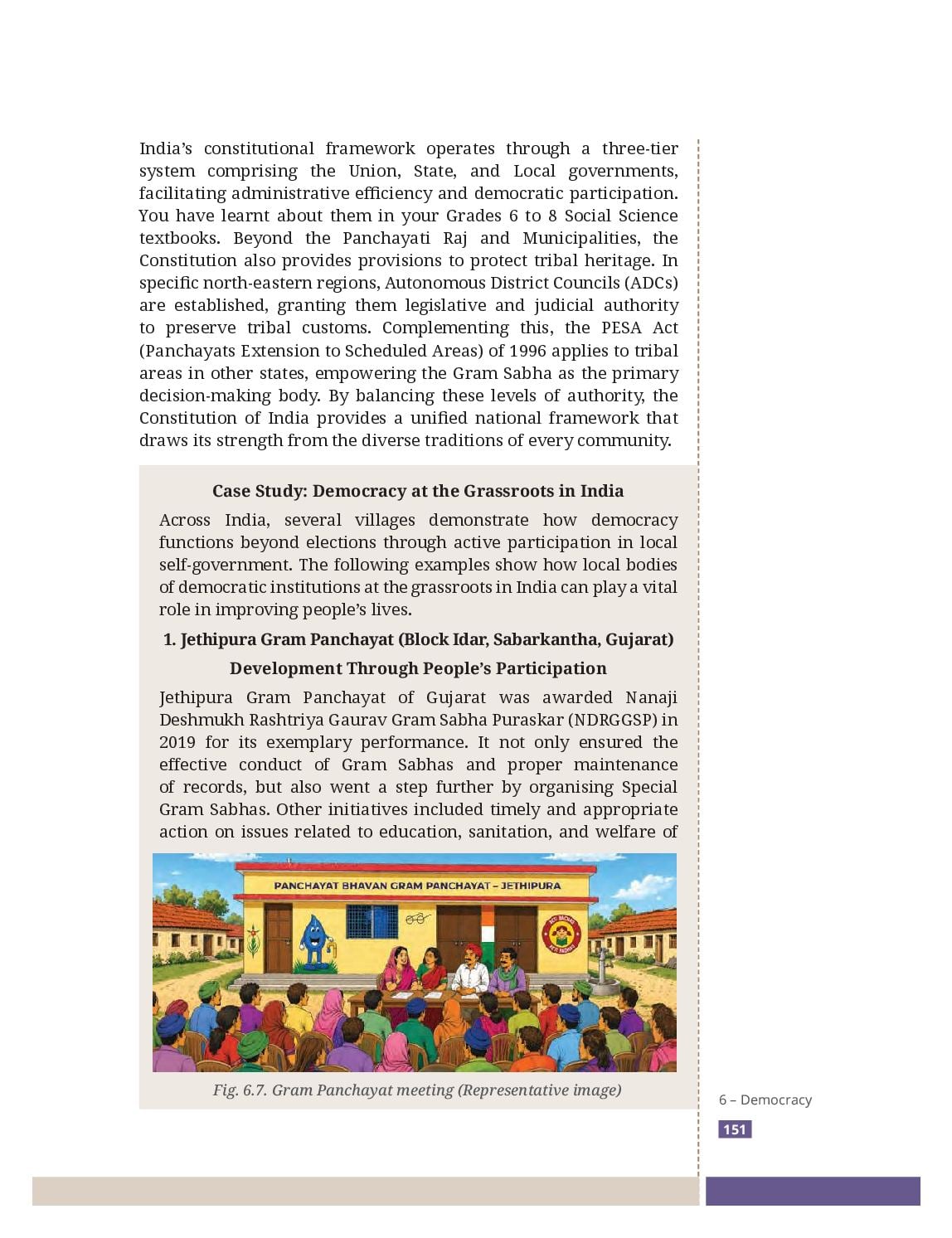
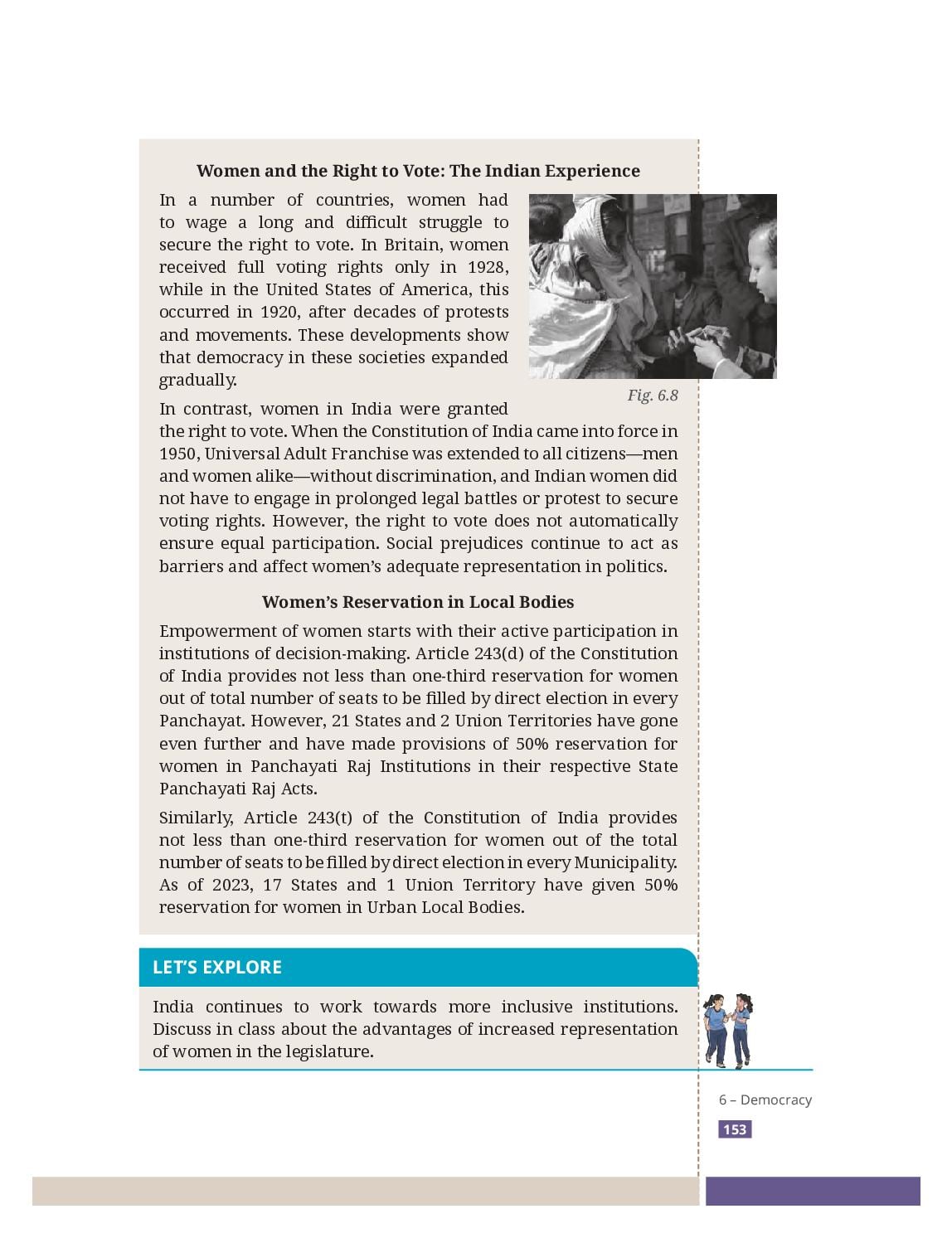
- Democracy also runs below and beyond government. The three-tier system of Union, State and Local government is extended by Autonomous District Councils in specific north-eastern regions and by the PESA Act, 1996, which makes the Gram Sabha the primary decision-making body in Scheduled Areas. Article 243D (printed in the book as 243(d)) reserves not less than one-third of directly elected Panchayat seats for women (21 States and 2 UTs have gone to 50%) and Article 243T does the same for Municipalities (17 States and 1 UT at 50% as of 2023). Media is called the ‘fourth pillar of democracy’, and civil society, cooperatives and trade unions use democratic methods too.
- The chapter is honest about strain. It names illiteracy, misinformation and fake news, inequality, poverty, regionalism, gender inequality, social discrimination and gaps in the implementation of laws and policies as challenges, and it records the Emergency of 1975–77, when a majority of Fundamental Rights were suspended and the press was censored — followed by the 1977 general elections, in which the defeat of the ruling government showed both the vulnerability and the resilience of democratic institutions.
Quick revision – Democracy
| Term | What it means | Where it appears in the chapter | What the chapter says about it |
|---|---|---|---|
| Democracy | A form of government in which the source of power and authority lies with the citizens of the country, who elect their representatives through free and fair elections. | Page 137, LET’S RECALL | Founded on the principles of freedom, equality, justice, rights and duties; citizens have the right to vote, to express their opinions and to participate in decision-making |
| Popular sovereignty | The idea that the ultimate source of power lies with the people, so the State derives its authority from the people. | Page 140 | Given effect through Universal Adult Franchise — every citizen 18 years of age and above has the right to vote by secret ballot |
| Universal Adult Franchise | The right of every citizen aged 18 and above to vote, without discrimination. | Pages 140, 153 | Extended to all citizens — men and women alike — when the Constitution came into force in 1950 |
| Rule of Law | The principle that everyone is equal before the law, that no one is above the law, and that disputes are settled in a court of law by procedures established by law, not by force or personal influence. | Page 141 | Prevents misuse of power, protects rights, and promotes justice, accountability and trust in the democratic system |
| Equality before law | Every individual, irrespective of status, identity or rank, is treated equally by the law. | Page 141 margin | One of the two halves of the rule of law in the chapter |
| Equal protection of law | All persons in similar circumstances shall be treated equally by law without arbitrary discrimination. | Page 141 margin | The other half — equality is not only formal, it applies to people in like situations |
| Procedure established by law | A legal principle that stresses strict adherence to duly enacted and valid laws. | Page 141 margin | Enshrined in Article 21: “no persons shall be deprived of life or personal liberty except according to procedure established by law” |
| Fundamental Rights | The six rights the Constitution guarantees, enforceable in courts of law, indivisible and inalienable, subject to reasonable restrictions. | Page 141 | Right to Equality (Arts 14–18); Right to Freedom (19–22); Right Against Exploitation (23–24); Right to Freedom of Religion (25–28); Cultural and Educational Rights (29–30); Right to Constitutional Remedies (Art 32). Remedies lie under Articles 32 and 226 |
| Article 21A | The Right to Education. Inserted by the 86th Constitutional Amendment Act, 2002; given effect by the RTE Act, 2009; in force from 1 April 2010. (The book says “added in 2009”.) | Page 141, LET’S EXPLORE | Ensures free and compulsory education for children aged 6 to 14 |
| Article 368 | The Constitution’s own provision for amendment. | Page 140 | Keeps the Constitution flexible and responsive to changing socio-political needs — a dynamic document, not a rigid legal code |
| Separation of powers | The division of work among legislature, executive and judiciary, each with distinct responsibilities. | Page 142 | The legislature makes laws, the executive implements them, the judiciary interprets them — preventing the concentration of power and maintaining checks and balances |
| Public Interest Litigation (PIL) | A legal action initiated in a court of law for the enforcement of public interest. | Page 142 margin | An initiative taken by the judiciary to ensure access to justice for all |
| Right to Information (RTI) Act, 2005 | A law that allows citizens to seek information from government agencies. | Pages 143, 154 | Enacted through democratic processes — reviewed by expert groups, debated in Parliament, refined through consultation, with safeguards for national security and administrative efficiency |
| Question Hour | The first hour of a parliamentary session when members ask questions to the government. | Page 145 margin | Helps check the government’s work and hold it accountable |
Old NCERT vs New – Class 9 Social Science
This chapter is from Understanding Society: India and Beyond, the new NCERT Class 9 Social Science book (NCF-SE 2023, used from 2026-27). It replaced the old book “India and the Contemporary World, Contemporary India, Democratic Politics and Economics”, so chapter numbers and names differ from older PDFs.
Solutions and All Chapters
Answers to the exercises and the full chapter list of Understanding Society: India and Beyond:
Democracy – Overview
| Class | Class 9 |
| Subject | Social Science |
| Book | Understanding Society: India and Beyond – new NCERT book |
| Part | Part I |
| Chapter | 6 of 15 – Democracy |
| Book pages | 137 – 159 |
| Edition | Latest NCERT edition (2026-27) |
| Session | 2026-27 |
| Free – read online or download |
Class 9 Social Science Chapter 6 – FAQs
Where can I download Democracy Class 9 PDF?
From the download table on this page – the chapter PDF is free, and the full book is linked too.
What is Class 9 Social Science Chapter 6 about?
Democracy is a form of government in which the source of power and authority lies with the citizens, who elect their representatives through free and fair elections. The chapter’s larger point is that it is not merely a system of government but a continuous process shaped by institutions and by active citizenship, and that it is not limited to elections alone.
Is Democracy from the new NCERT Class 9 Social Science book?
Yes. It is chapter 6 of understanding society: india and beyond (part i), the new NCERT Class 9 Social Science book for 2026-27.
Is this the latest NCERT edition for 2026-27?
Yes – the PDF is NCERT’s latest edition for the 2026-27 session.
Where are the NCERT Solutions for Class 9 Social Science Chapter 6?
Open the NCERT Solutions link above for answers to the exercise questions.