Download Early Humans and Beginning of Civilisation – NCERT Class 9 Social Science Chapter 4 PDF from the new NCERT Class 9 Social Science book Understanding Society: India and Beyond (2026-27). Read the chapter online or download the free PDF. Almost all of human history has no writing in it. Fig. 4.3 puts the split exactly: more than 99 per cent of human history falls before writing (about 3 million years ago to 5000 years ago) and less than 1 per cent after it. For the 99 per cent the…
Early Humans and Beginning of Civilisation PDF – Chapter 4 of Understanding Society: India and Beyond (Part I)
Read the chapter online or download the PDF.
| Chapter | Download | |
|---|---|---|
| Chapter 4 PDF | Early Humans and Beginning of Civilisation | View PDF |
| Full book | NCERT Class 9 Social Science – Understanding Society: India and Beyond | View Book |
Read Online

What Is in Early Humans and Beginning of Civilisation? (Class 9 Social Science Chapter 4)
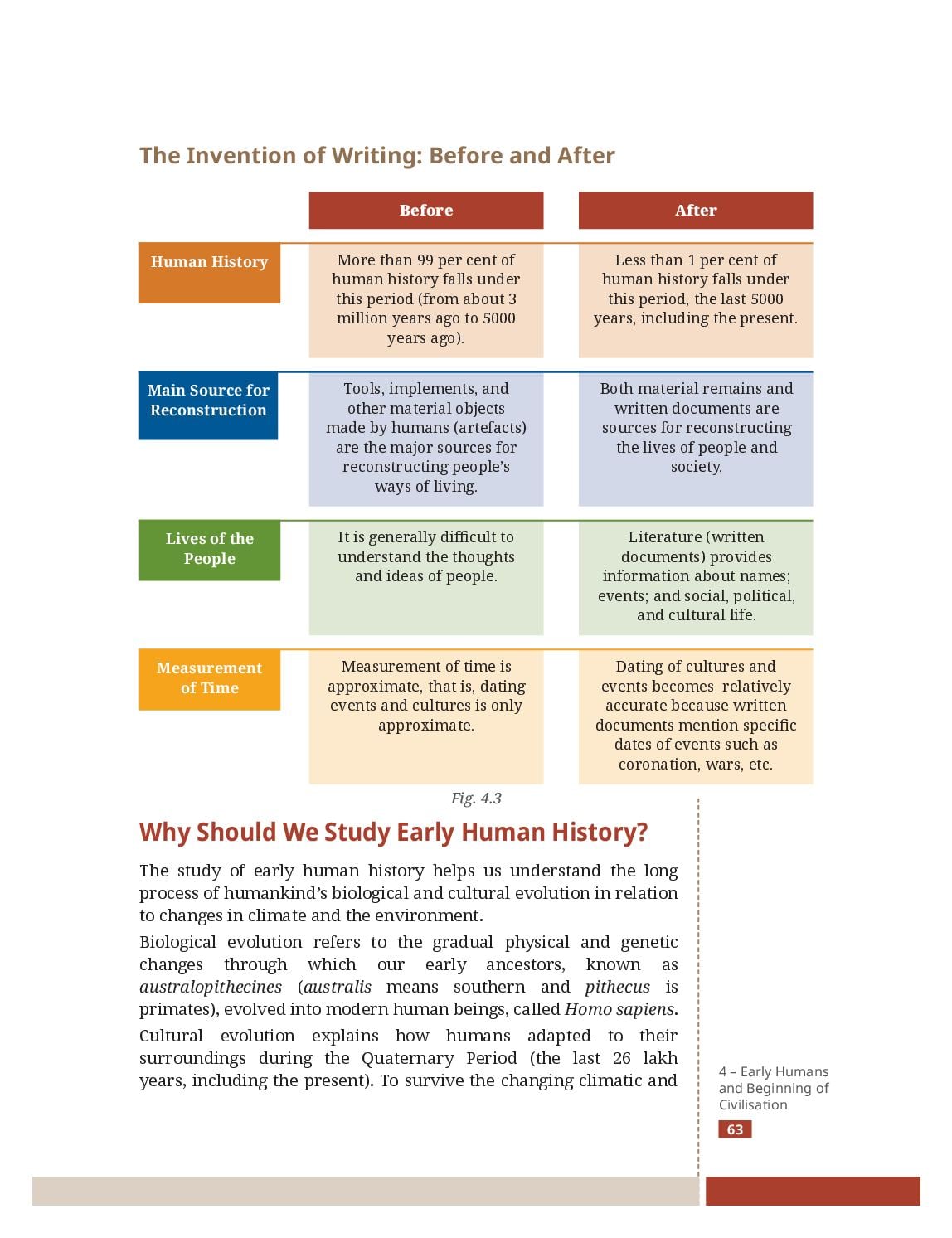
- Almost all of human history has no writing in it. Fig. 4.3 puts the split exactly: more than 99 per cent of human history falls before writing (about 3 million years ago to 5000 years ago) and less than 1 per cent after it. For the 99 per cent the only witnesses are artefacts — tools, bones, pottery, hearths — so dating is approximate; after writing, documents name people and give specific dates, so dating becomes relatively accurate.
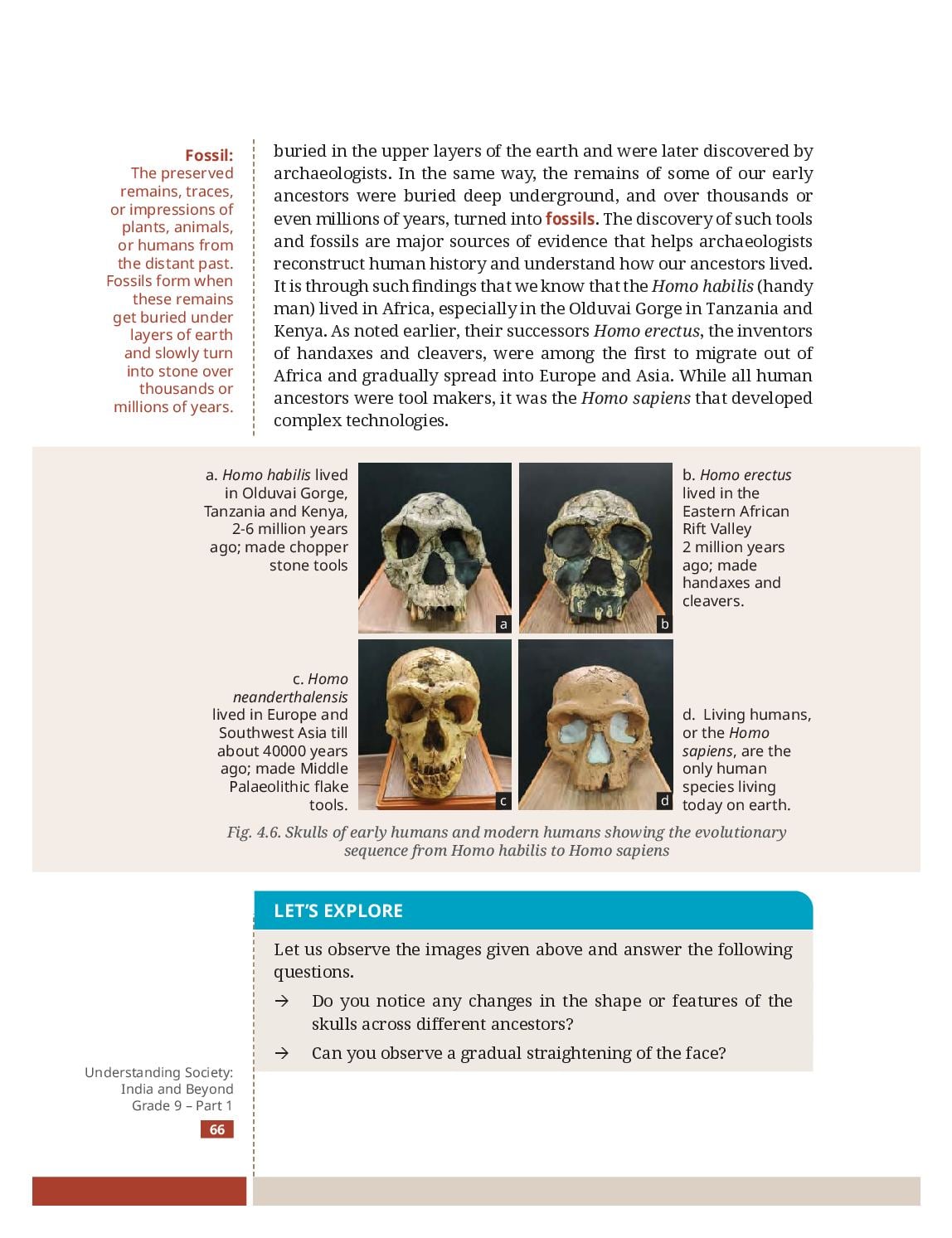
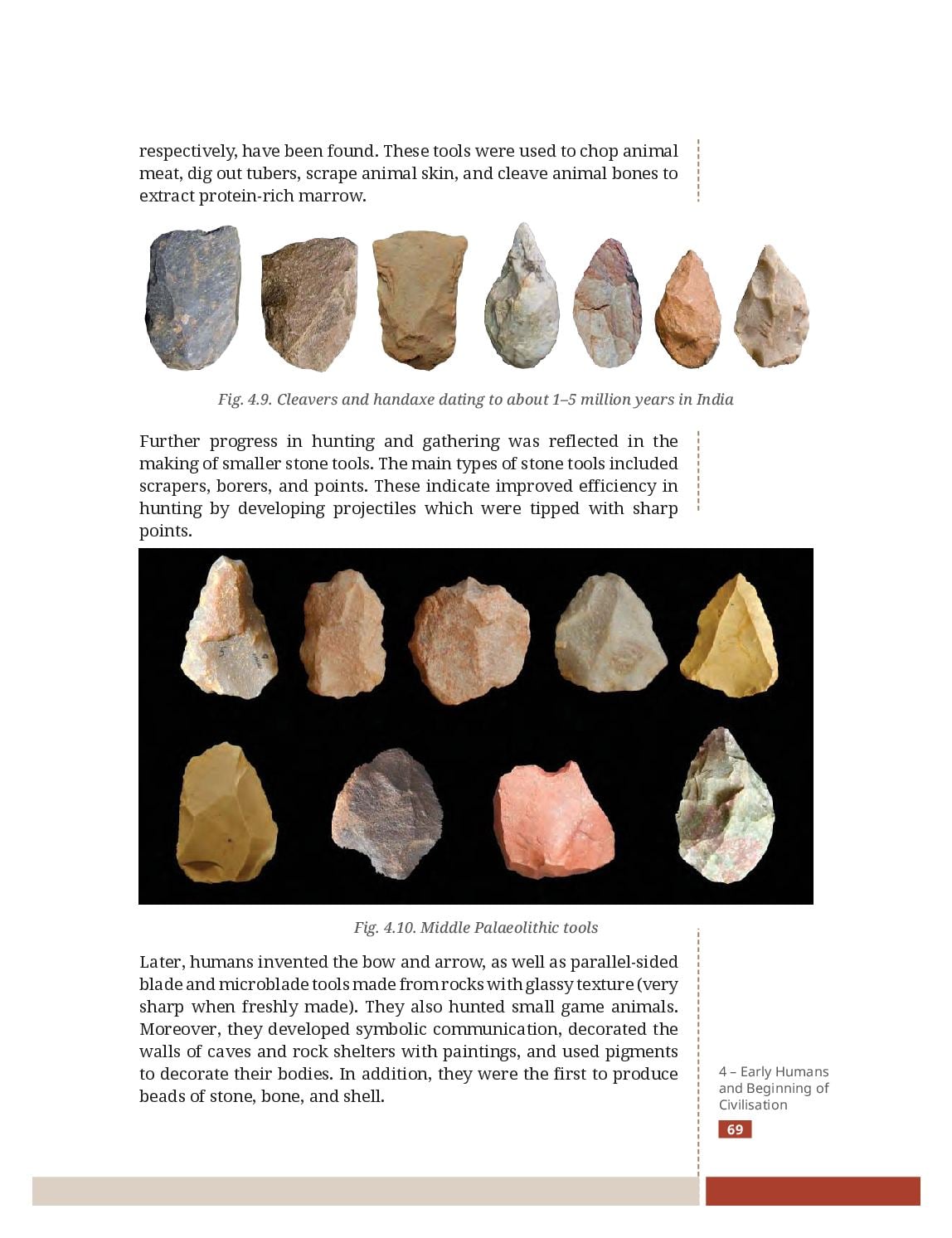
- The chapter’s account of our ancestry is built on two kinds of find: stone tools and fossils. The earliest stone tools are dated to about 3.3 million years ago — the moment the chapter treats as the start of ‘human behaviour’, because animals lack the cognitive ability to make such tools. Fig. 4.6 gives the sequence: Homo habilis (Olduvai Gorge, Tanzania and Kenya, ‘2-6 million years ago’ as printed — very probably a misprint — chopper tools) → Homo erectus (East African Rift Valley, 2 million years ago, handaxes and cleavers) → Homo neanderthalensis (Europe and Southwest Asia, till about 40000 years ago, Middle Palaeolithic flake tools) → Homo sapiens, who evolved in Africa around 300,000 years ago and are the only human species alive today.
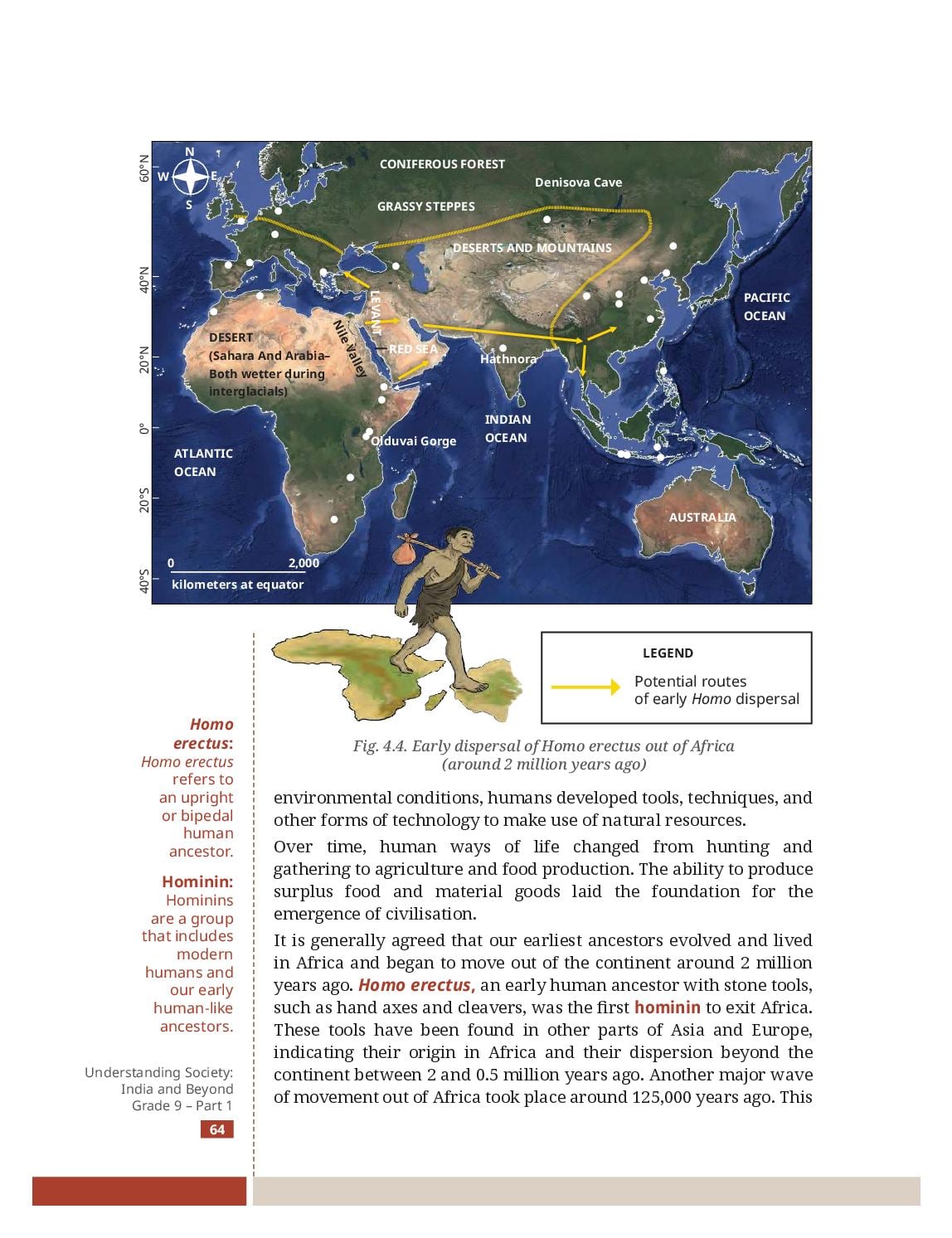
- Humans came out of Africa in waves, and the evidence is the tools themselves. Homo erectus was the first hominin to leave, from about 2 million years ago; its handaxes and cleavers turn up across Asia and Europe, which is how we know the dispersal happened between 2 and 0.5 million years ago. A second major wave, of early Homo sapiens, left around 125,000 years ago; our species reached Australia and the Americas between 50000 and 12000 years ago.
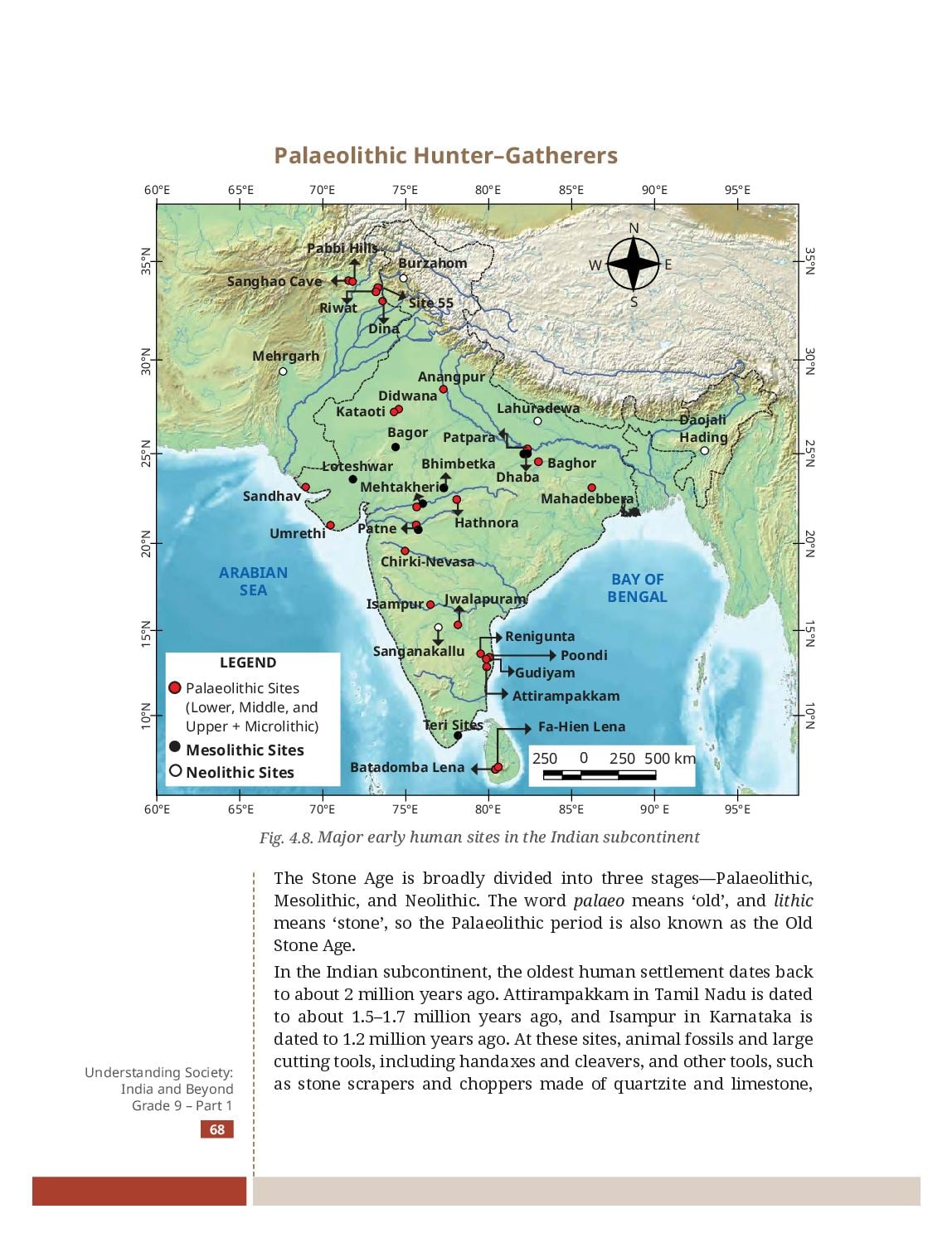
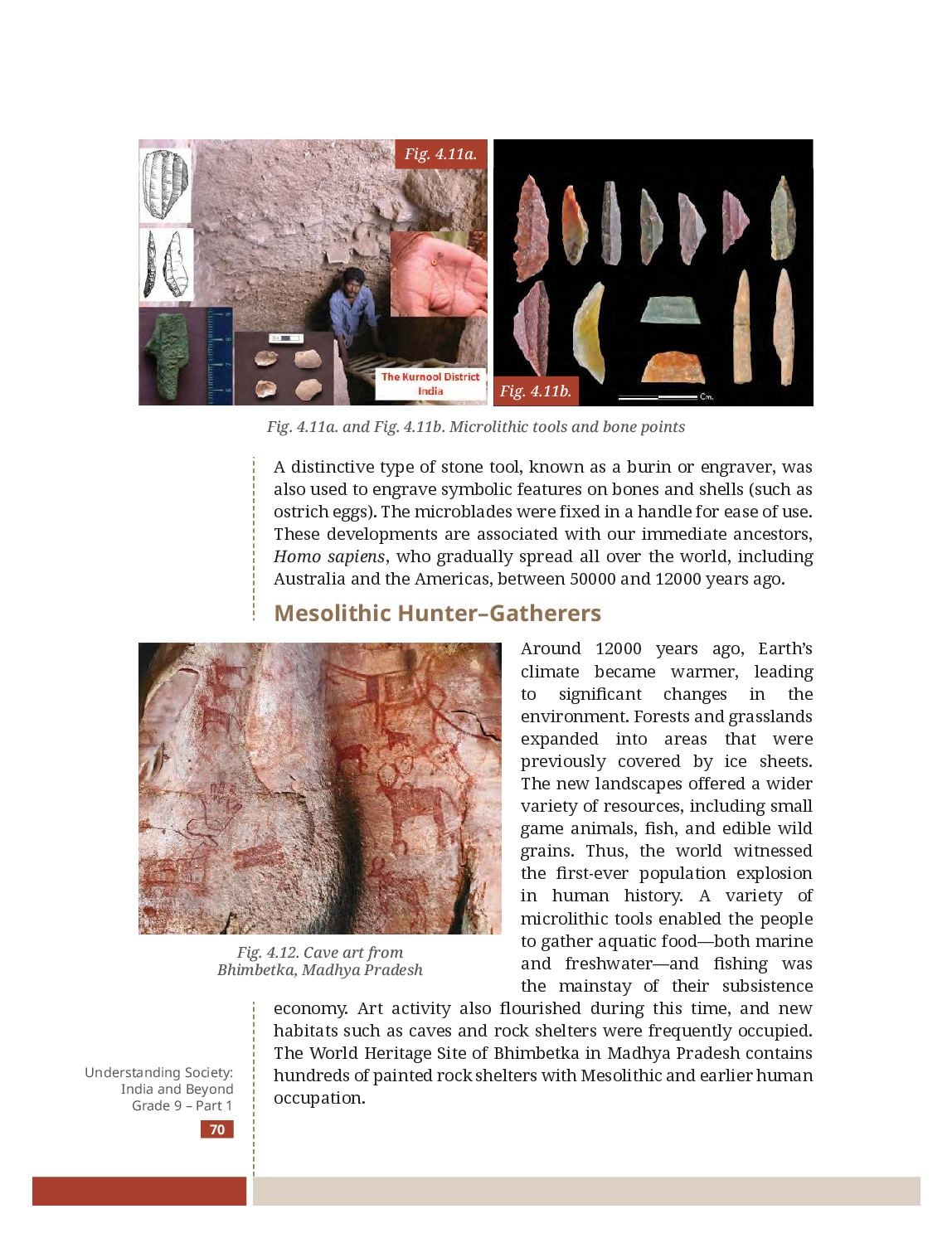
- India’s record is long. The oldest human settlement in the subcontinent dates back about 2 million years; Attirampakkam (Tamil Nadu) is dated to 1.5–1.7 million years ago and Isampur (Karnataka) to 1.2 million years ago, with animal fossils, handaxes, cleavers, scrapers and choppers of quartzite and limestone. Around 12000 years ago the climate warmed, forests and grasslands spread, microlithic tools and fishing supported the first population explosion in human history, and painted rock shelters such as Bhimbetka (a World Heritage Site in Madhya Pradesh) were occupied.
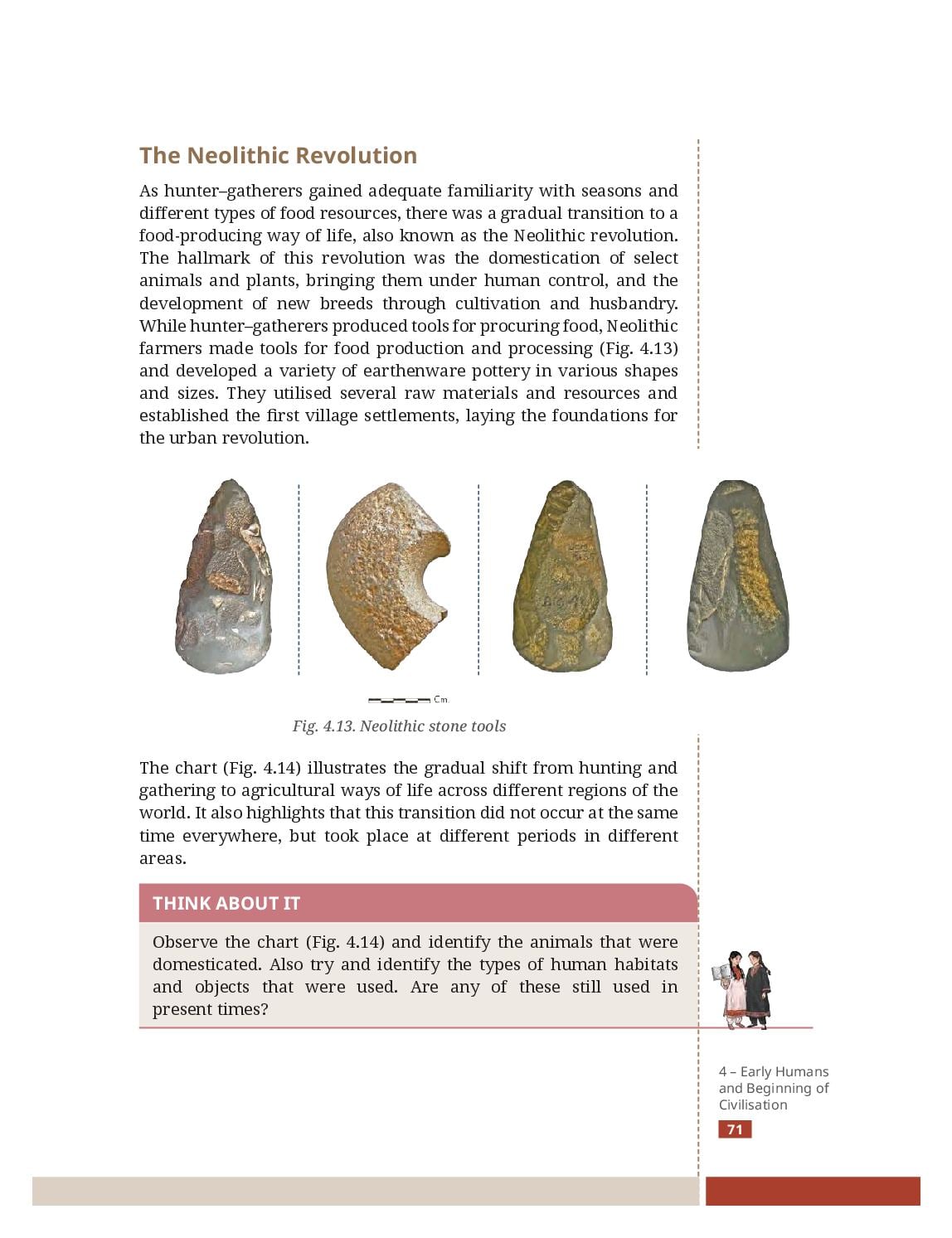
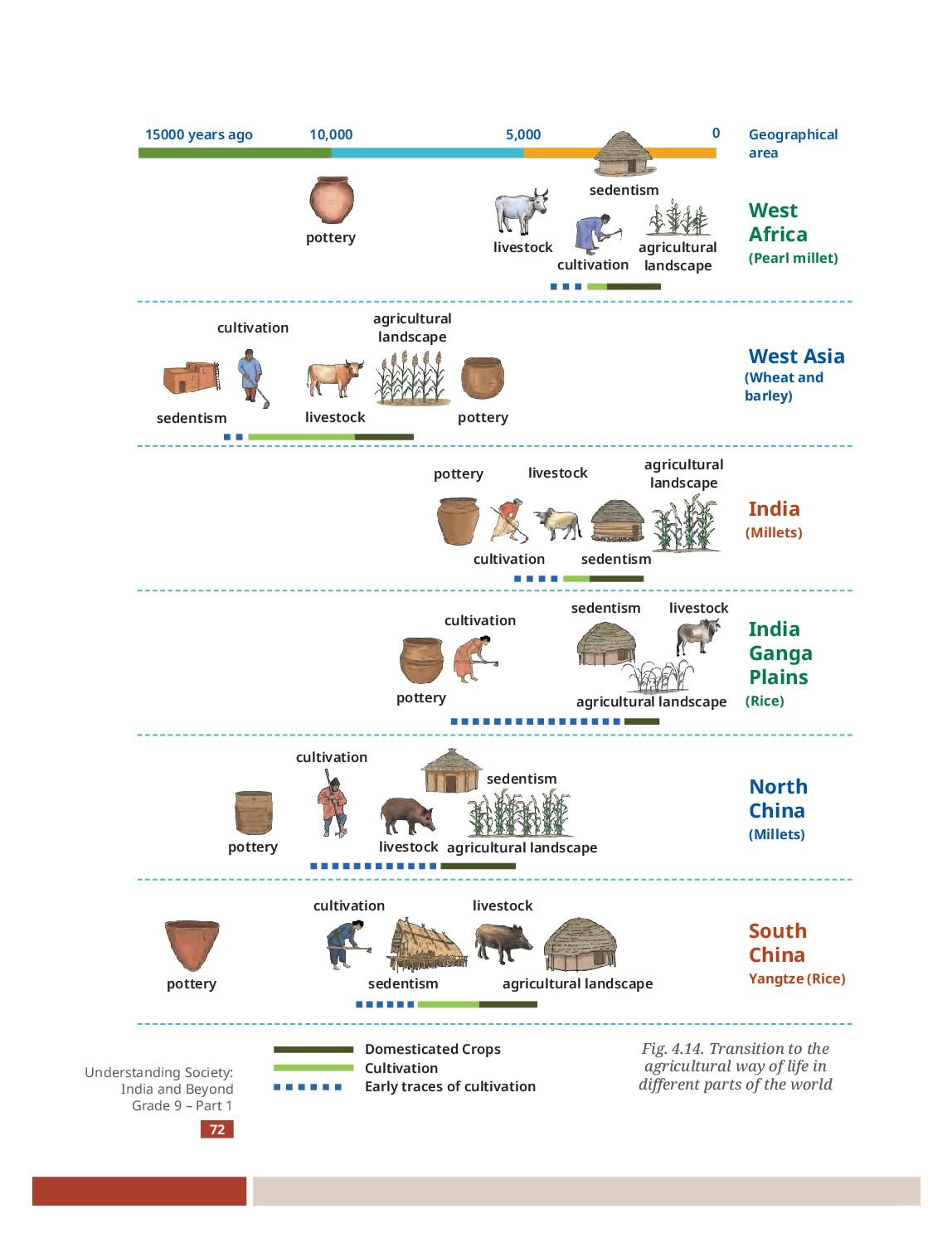
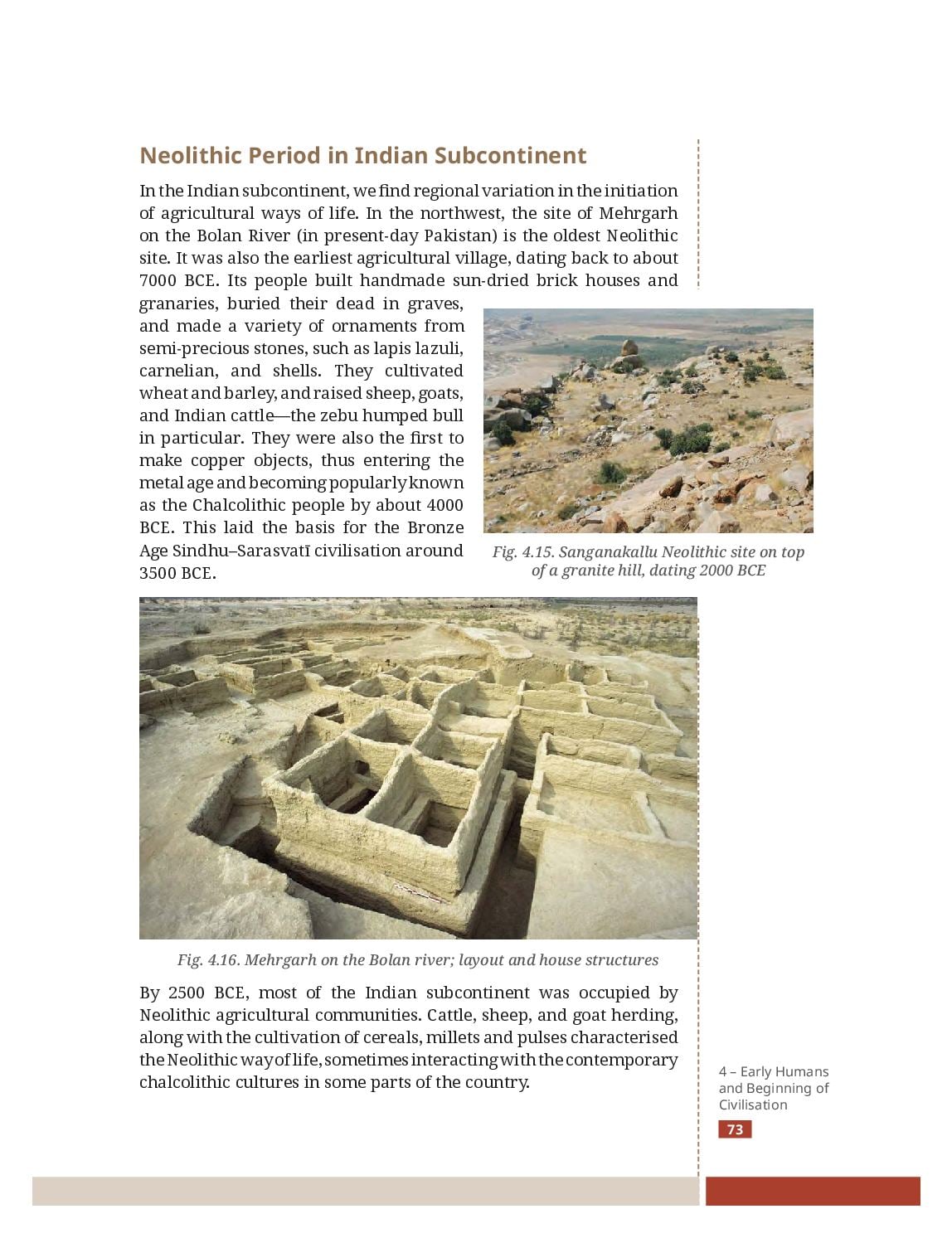
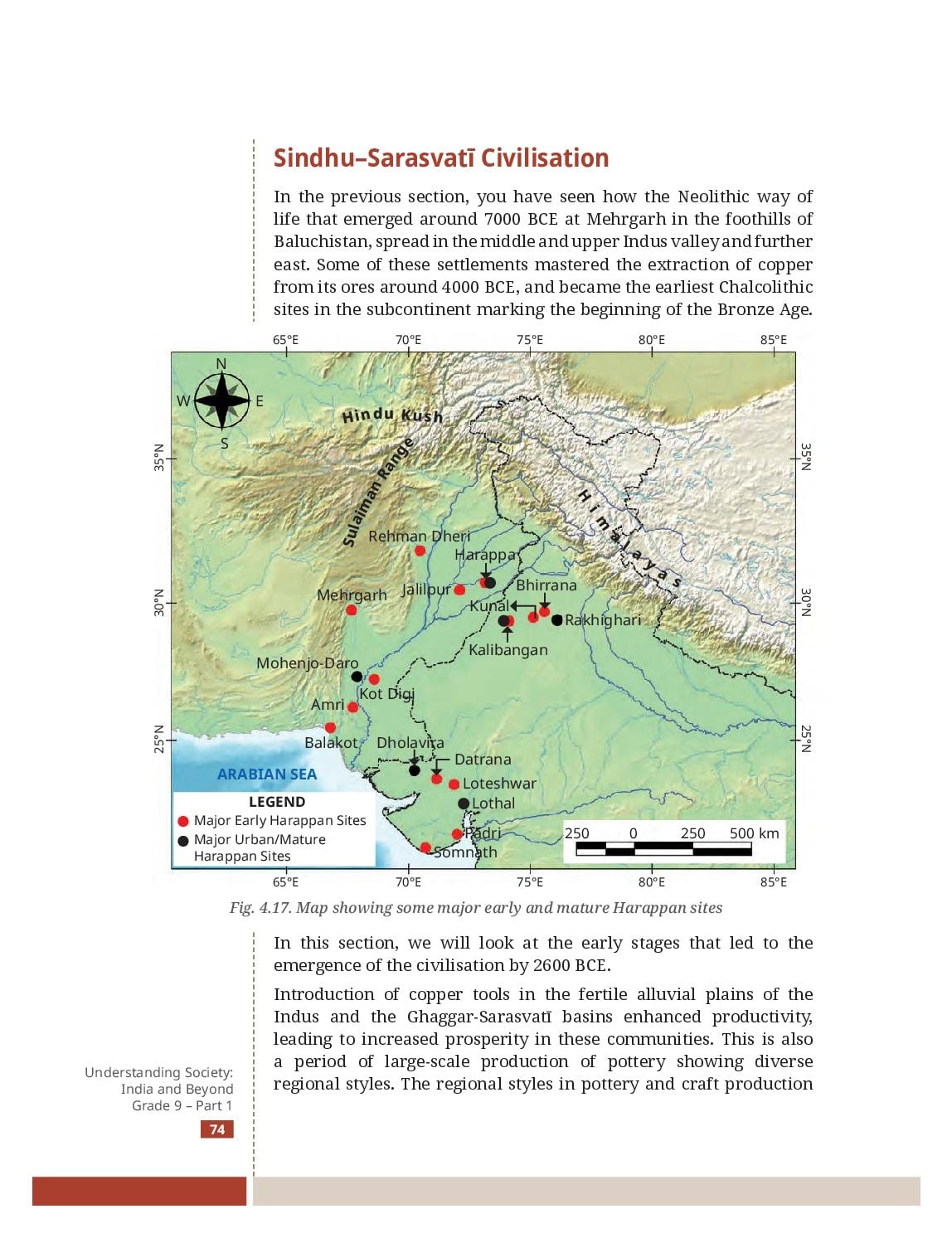
- The Neolithic revolution is domestication — bringing selected plants and animals under human control and breeding them. Fig. 4.14 shows it happening at different times in different places. In India, Mehrgarh on the Bolan river is the oldest Neolithic site and earliest farming village, about 7000 BCE: sun-dried brick houses and granaries, burials, ornaments of lapis lazuli, carnelian and shell, wheat and barley, sheep, goats and the zebu humped bull — and the first copper objects, making its people Chalcolithic by about 4000 BCE. By 2500 BCE most of the subcontinent was farming.
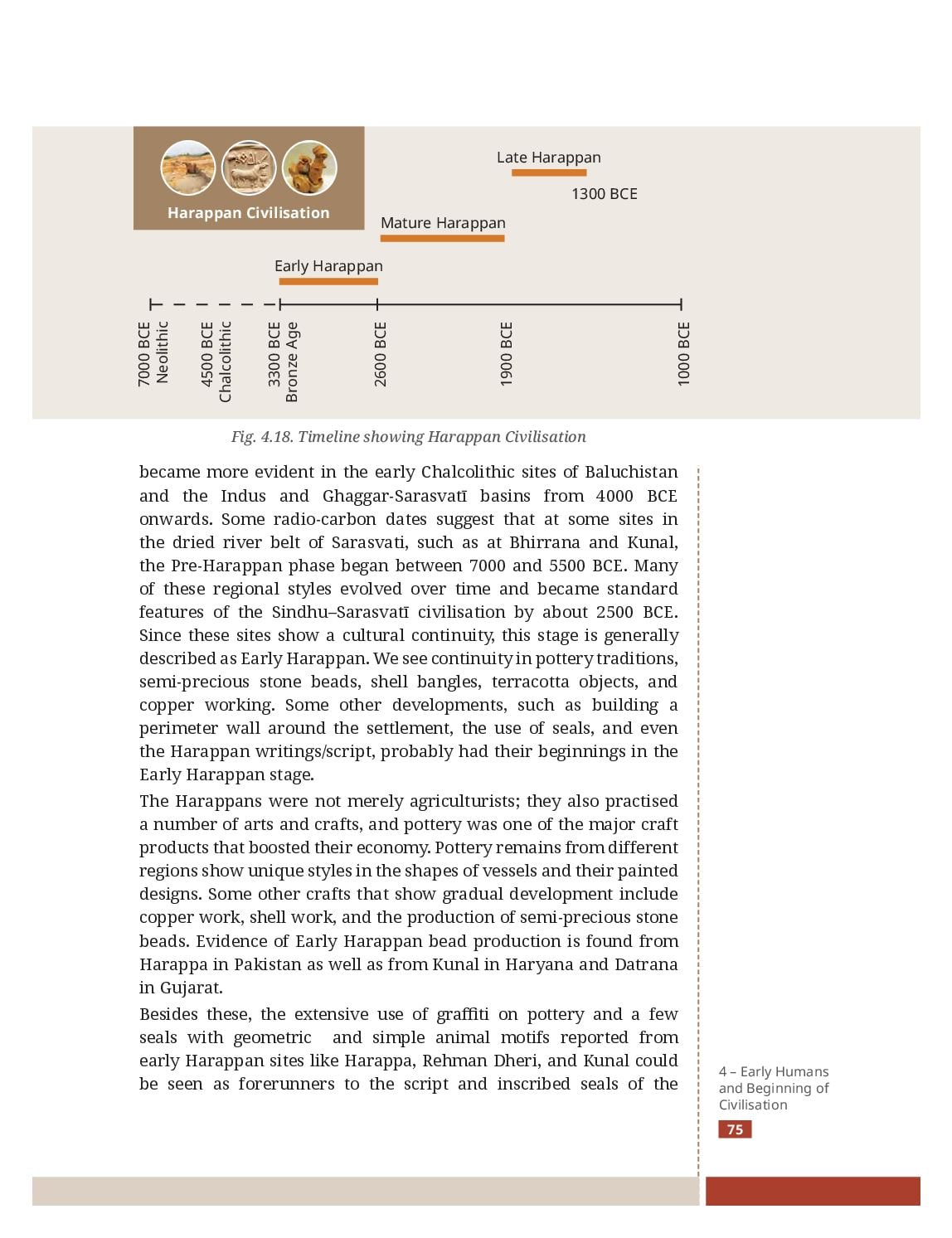
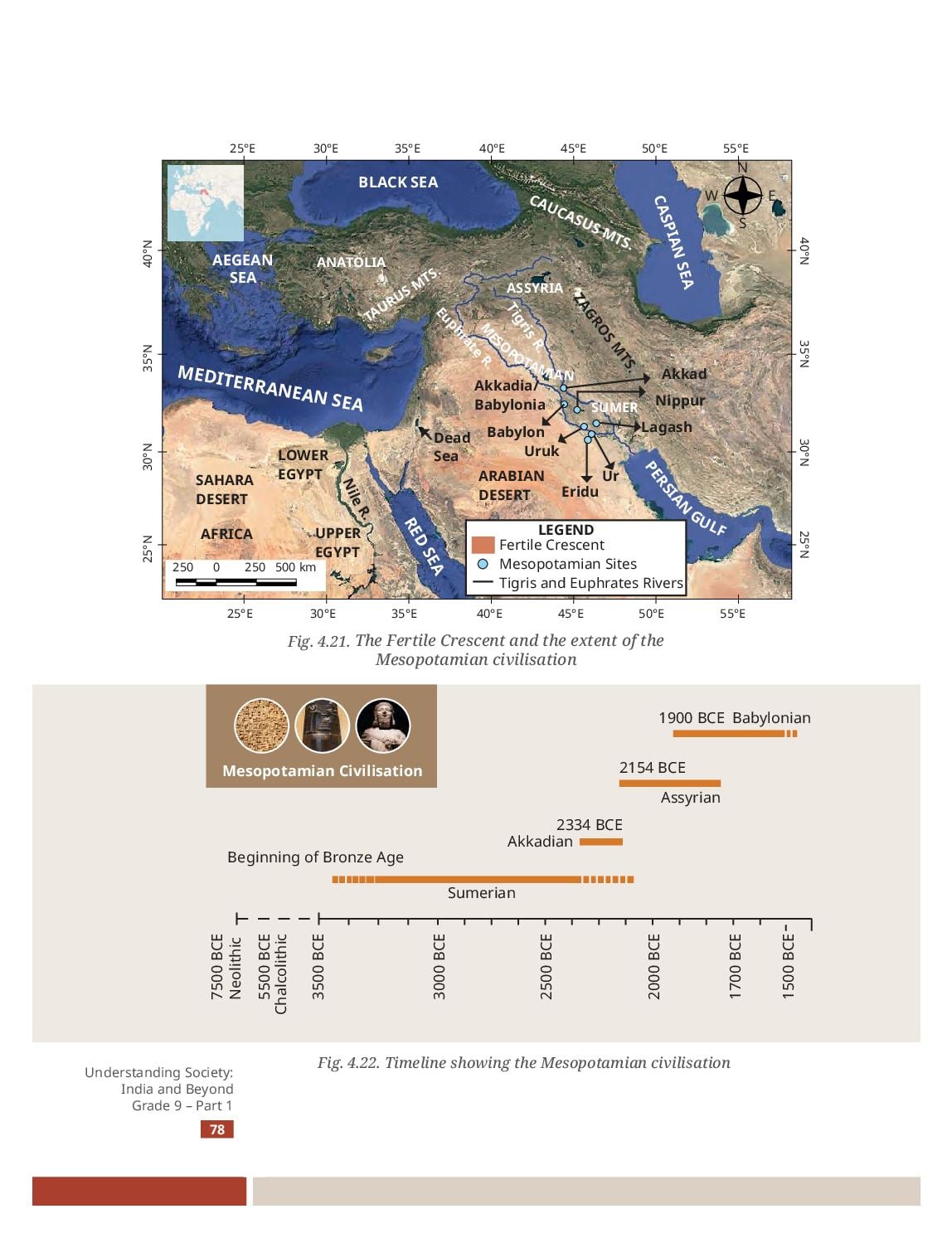
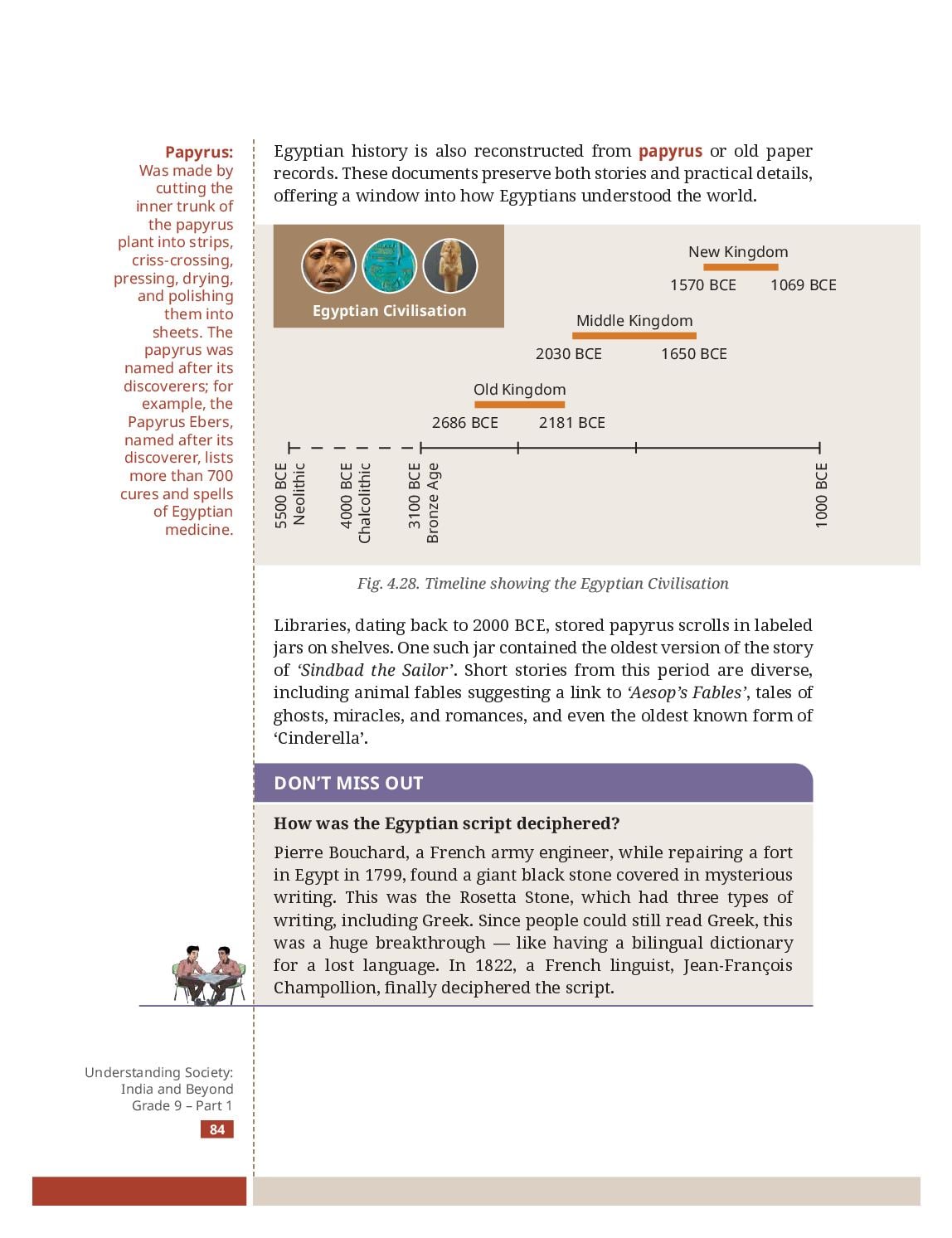
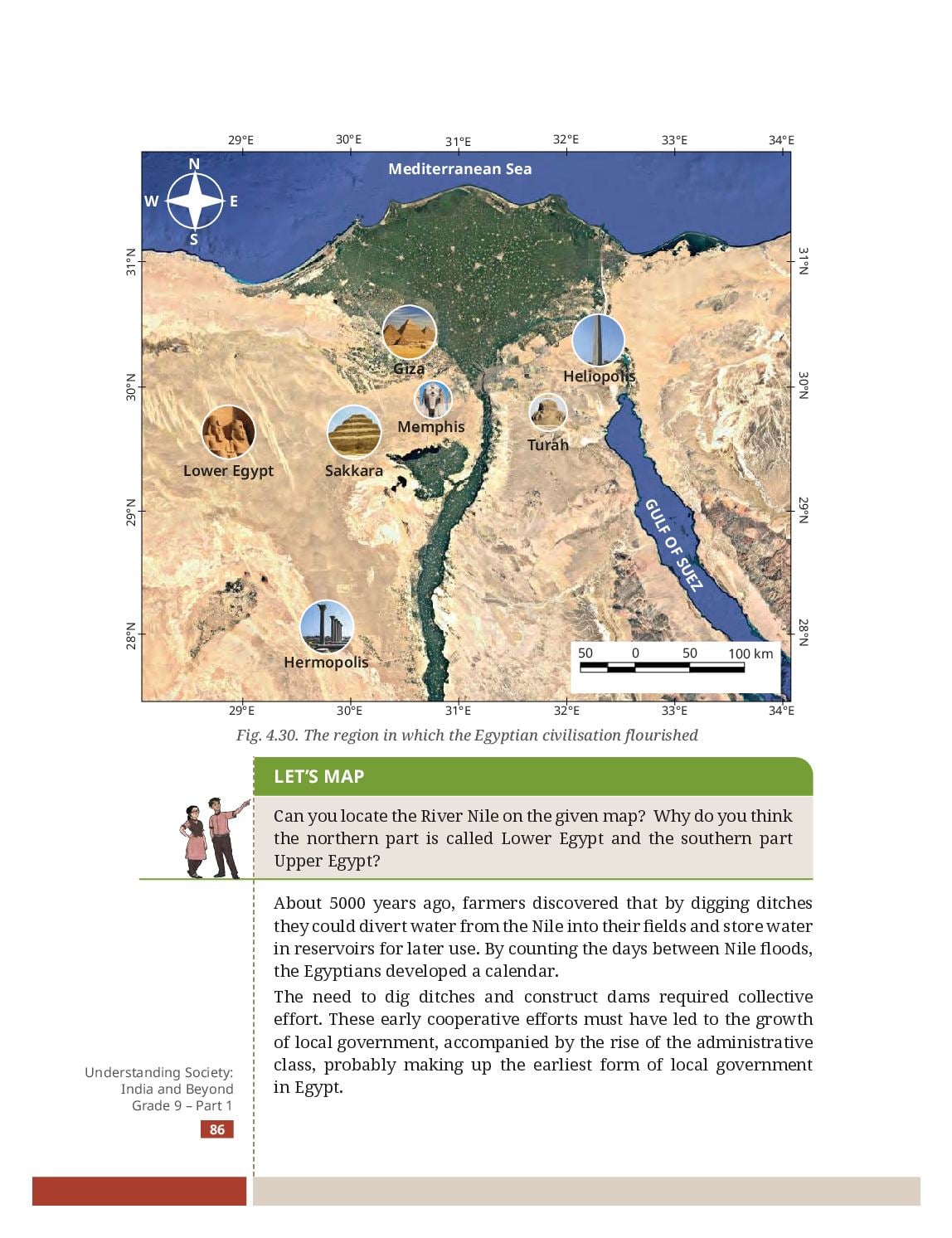
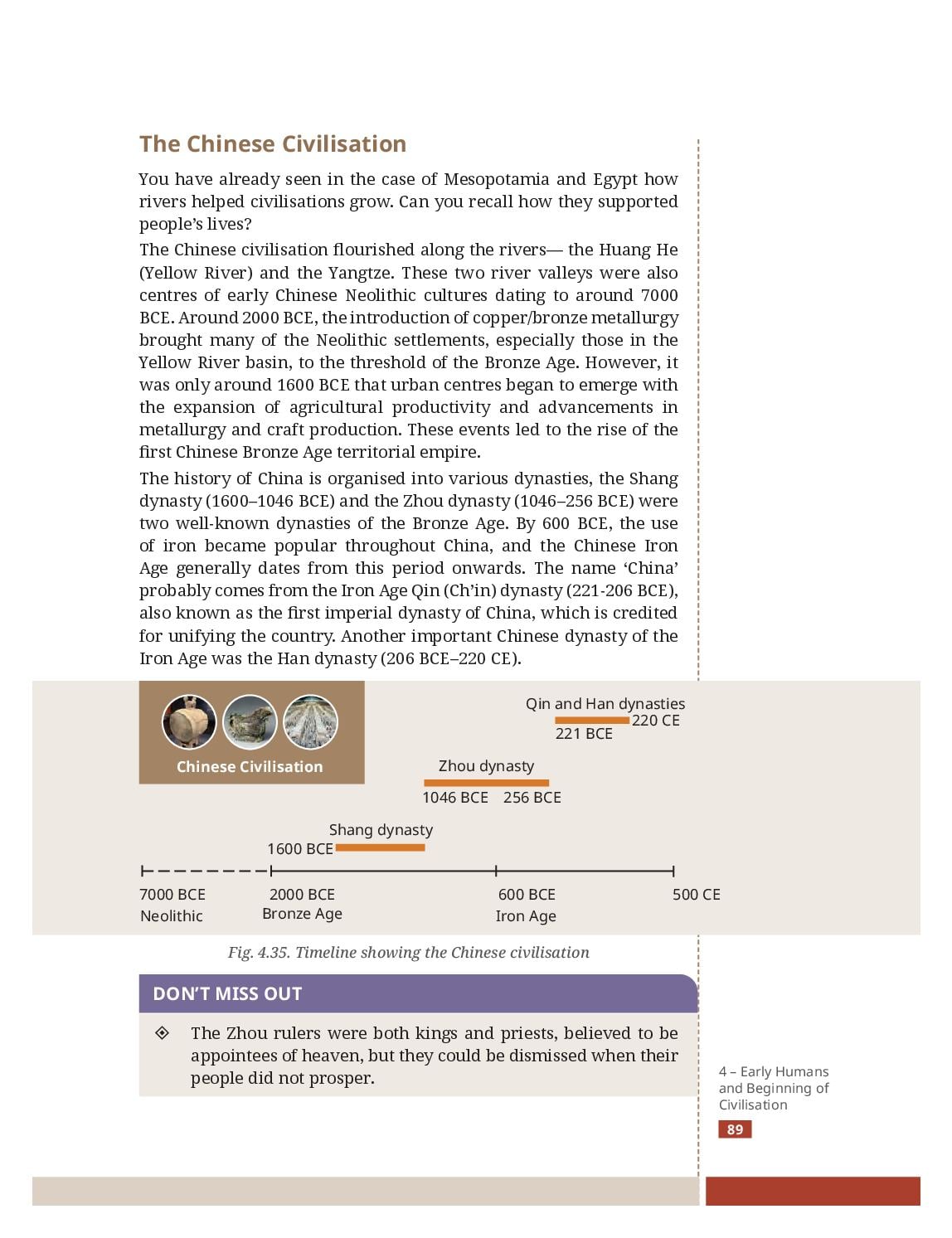
- Four Bronze Age civilisations grew independently in river plains: Sindhu–Sarasvatī (Indus and Sarasvatī), Mesopotamian (Euphrates and Tigris), Egyptian (Nile) and Chinese (Huang He). Fig. 4.18 dates the Harappan phases — Early 3300–2600 BCE, Mature 2600–1900 BCE, Late 1900–1300 BCE. Fig. 4.22 dates the Mesopotamian city-states — Sumerian from 3500 BCE, Akkadian 2334 BCE, Assyrian 2154 BCE, Babylonian 1900 BCE. Fig. 4.28 dates Egypt’s kingdoms — Old 2686–2181, Middle 2030–1650, New 1570–1069 BCE. Fig. 4.35 dates China’s dynasties — Shang 1600–1046, Zhou 1046–256, Qin 221–206 BCE, Han 206 BCE–220 CE.
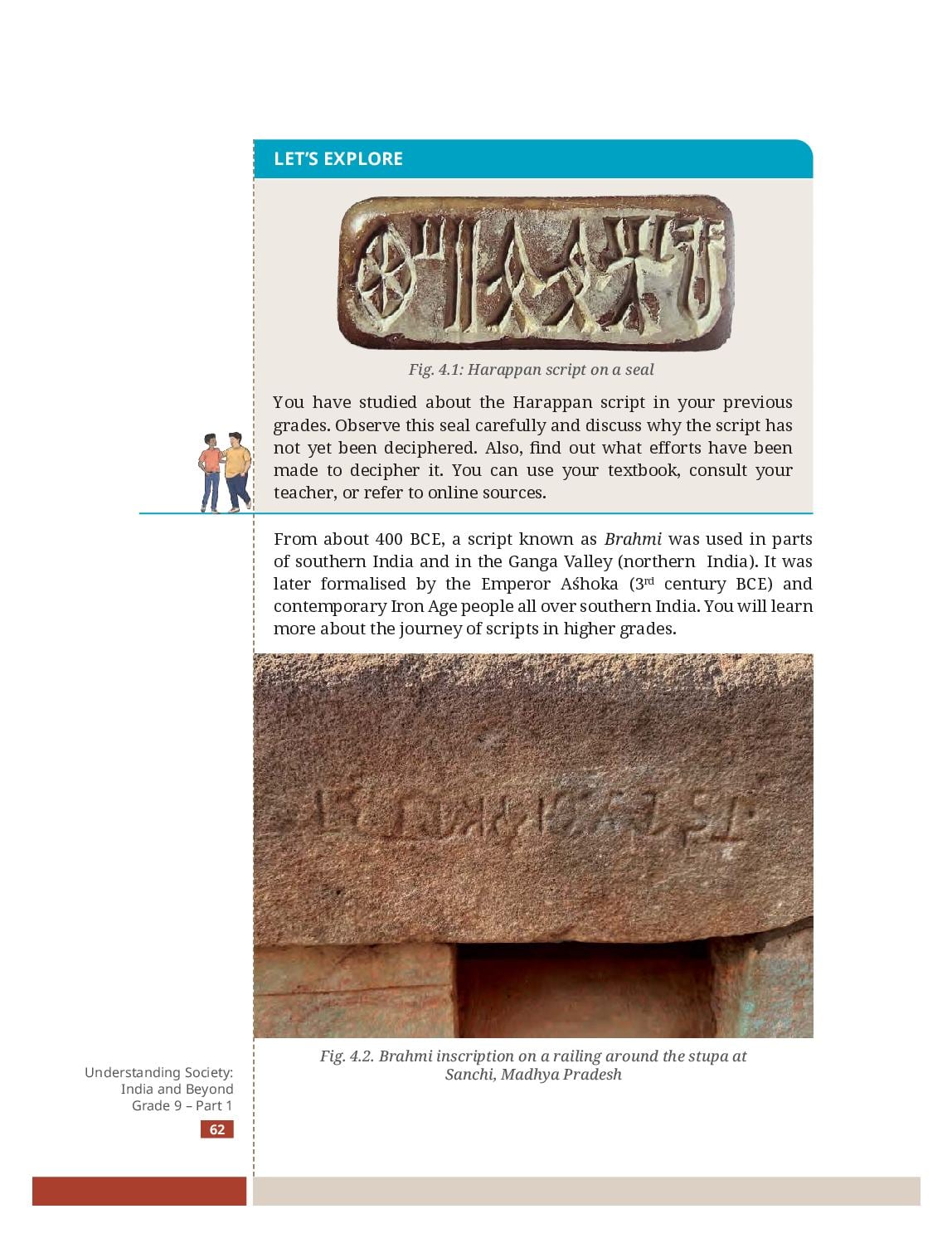
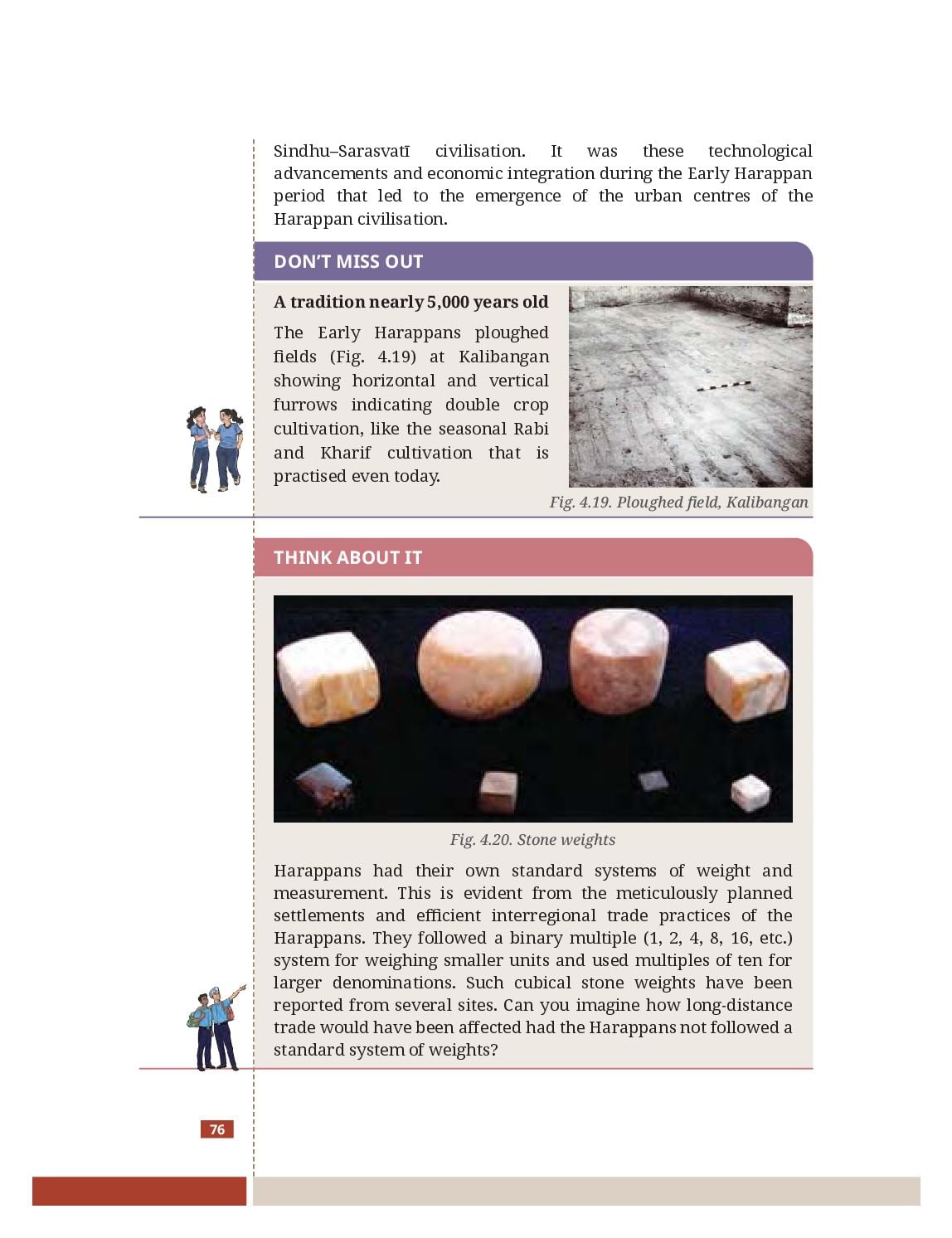
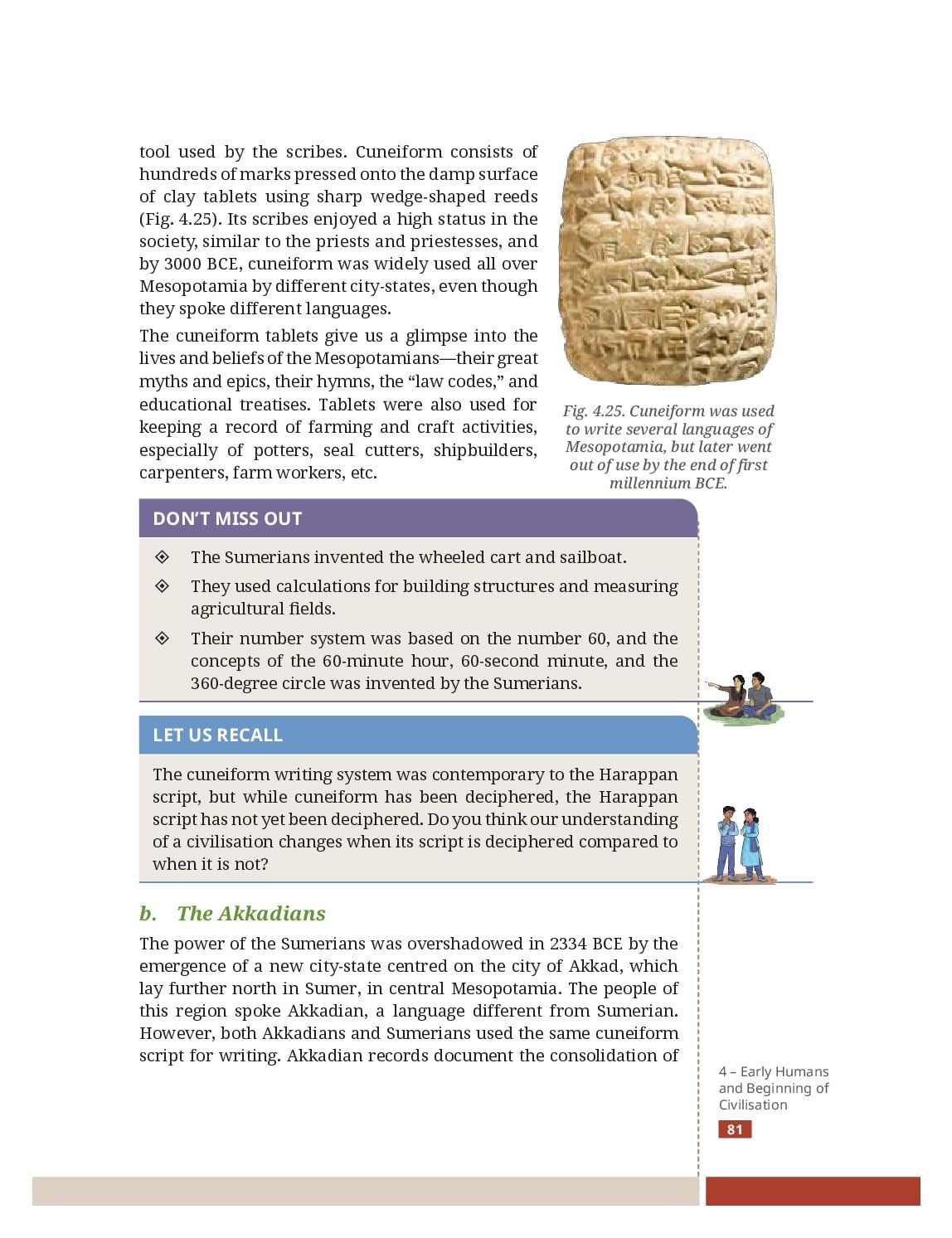
- Writing is what ends prehistory. The Sumerians began cuneiform around 3200 BCE and it was in use across Mesopotamia by 3000 BCE; Egyptian hieroglyphs were deciphered in 1822 by Champollion using the Rosetta Stone (found 1799). The Harappan script, on seals and pottery, remains undeciphered — which is why we can measure Harappan weights but cannot read a single Harappan sentence.
Quick revision – Early Humans and Beginning of Civilisation
| Term | What it means | Where it appears in the chapter | The evidence or figure the book gives |
|---|---|---|---|
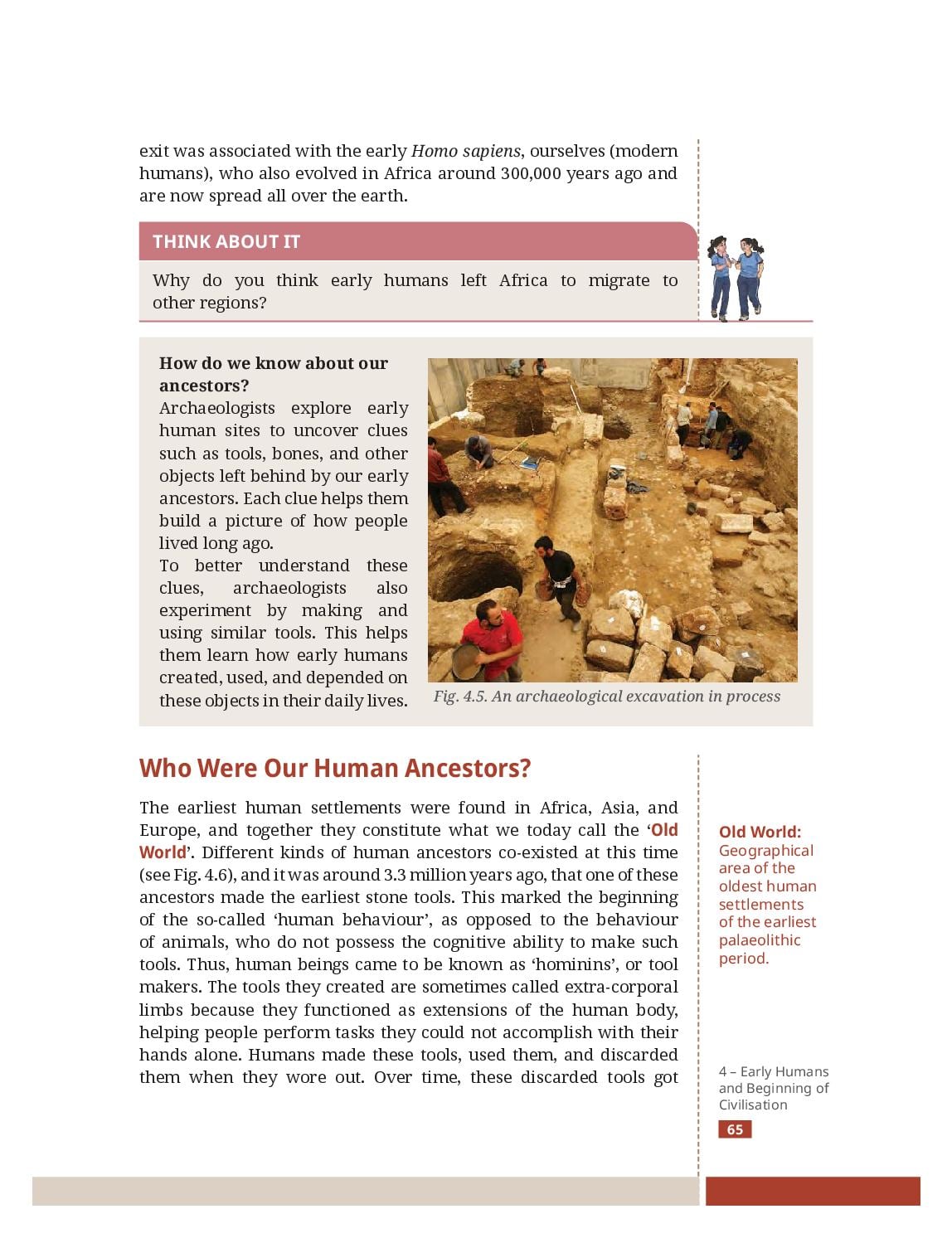
| Archaeology | The study of the human past through material remains — tools, bones, pottery, buildings — recovered by excavation. | Page 65 box; Fig. 4.5 | Archaeologists also replicate tools: they make and use copies to learn how early humans made and depended on them |
| Artefact | Any object made by humans — tool, implement, ornament, pot. | Fig. 4.3, page 63 | For the 99 per cent of history before writing, artefacts are the major source for reconstructing ways of living |
| Fossil | Preserved remains, traces or impressions of plants, animals or humans from the distant past, formed when remains are buried under layers of earth and slowly turn to stone. | Page 66 margin | The Fig. 4.6 skulls are fossils; they are why we can say Homo habilis lived at Olduvai Gorge |
| Hominin | The group that includes modern humans and our early human-like ancestors — that is, the tool makers. | Page 64 margin; page 65 | Defined by tool-making: the earliest stone tools are about 3.3 million years old |
| Homo erectus | An upright or bipedal human ancestor; inventor of handaxes and cleavers; the first hominin to leave Africa. | Page 64 margin; Fig. 4.6b | Lived in the Eastern African Rift Valley 2 million years ago; its tools found across Asia and Europe date the exit to 2–0.5 million years ago |
| Homo sapiens | Modern humans — the only human species living on earth today. | Pages 65–66, 70; Fig. 4.6d | Evolved in Africa about 300,000 years ago; spread to Australia and the Americas between 50000 and 12000 years ago |
| Old World | The geographical area of the oldest human settlements of the earliest palaeolithic period — Africa, Asia and Europe together. | Page 65 margin | |
| Extra-corporal limbs | The chapter’s phrase for stone tools — extensions of the body that let people do what bare hands cannot. | Page 65 | Tools were made, used, discarded, buried in upper layers of earth, and later excavated |
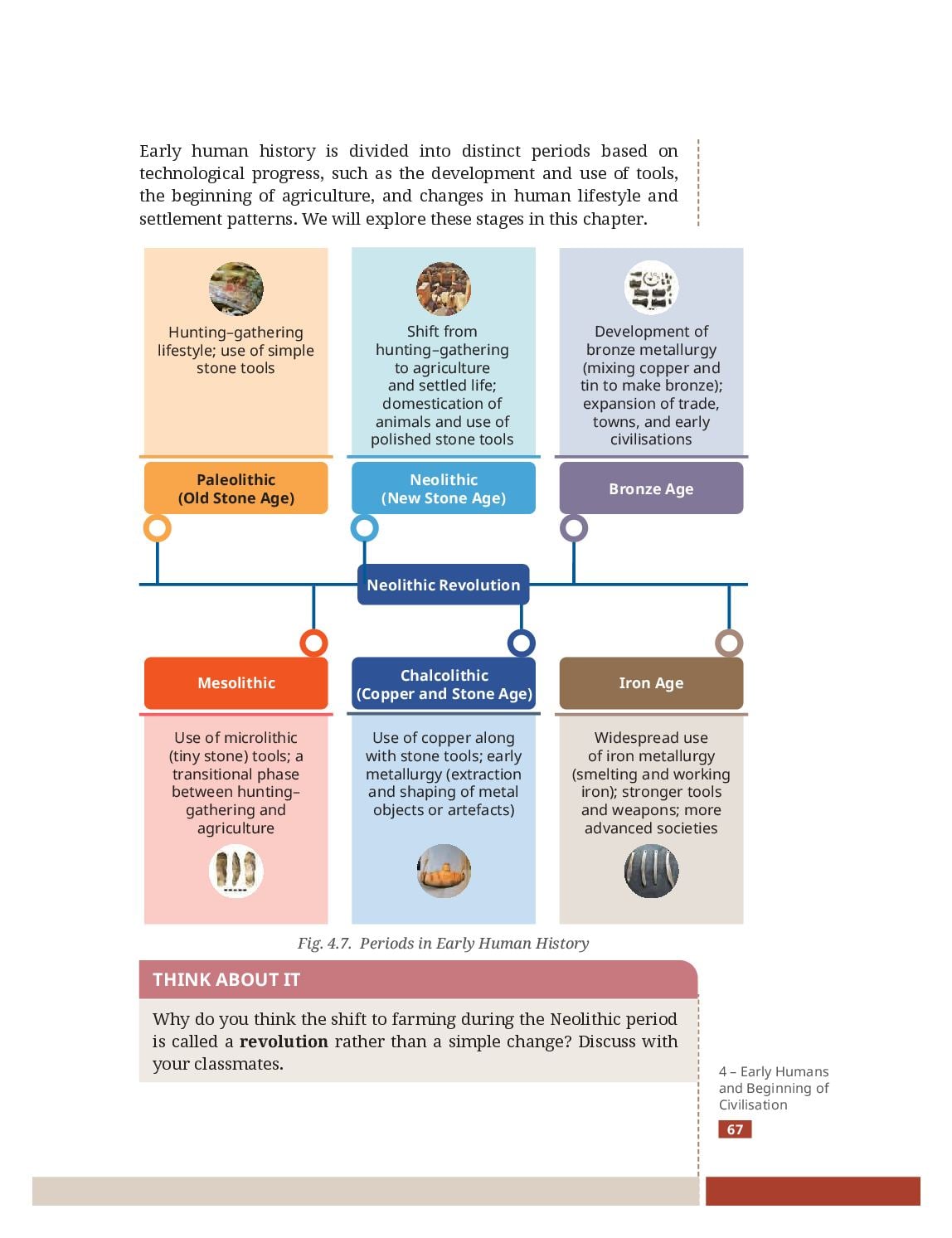
| Palaeolithic | Old Stone Age (palaeo = old, lithic = stone). Hunting–gathering with simple stone tools. | Pages 67–70; Figs. 4.7, 4.8 | Attirampakkam 1.5–1.7 million years; Isampur 1.2 million years; handaxes, cleavers, scrapers, choppers of quartzite and limestone |
| Mesolithic | The transitional phase between hunting–gathering and agriculture, marked by microlithic (tiny stone) tools. | Pages 67, 70; Fig. 4.7 | From about 12000 years ago, after the climate warmed; fishing became the mainstay; first population explosion; Bhimbetka rock art |
| Neolithic | New Stone Age: shift to agriculture and settled life, domestication of animals, polished stone tools. | Pages 67, 71–73; Figs. 4.7, 4.13 | Mehrgarh 7000 BCE; Sanganakallu 2000 BCE; most of the subcontinent farming by 2500 BCE |
| Chalcolithic | Copper and Stone Age — copper used alongside stone tools; early metallurgy. | Pages 67, 73–74; Fig. 4.7 | Mehrgarh people made the first copper objects, Chalcolithic by about 4000 BCE; Fig. 4.18 marks Chalcolithic at 4500 BCE |
| Bronze Age | Development of bronze metallurgy — copper mixed with tin — with expanded trade, towns and the first civilisations. | Page 67; Figs. 4.7, 4.18 | Fig. 4.18 begins the Indian Bronze Age at 3300 BCE; the running text on page 73 says about 3500 BCE |
| Iron Age | Widespread iron metallurgy (smelting and working iron); stronger tools and weapons. | Page 67; page 89 | In China, iron becomes common by 600 BCE; in India, the Brahmi script (from about 400 BCE) was used by Iron Age people of southern India |
Old NCERT vs New – Class 9 Social Science
This chapter is from Understanding Society: India and Beyond, the new NCERT Class 9 Social Science book (NCF-SE 2023, used from 2026-27). It replaced the old book “India and the Contemporary World, Contemporary India, Democratic Politics and Economics”, so chapter numbers and names differ from older PDFs.
Solutions and All Chapters
Answers to the exercises and the full chapter list of Understanding Society: India and Beyond:
Early Humans and Beginning of Civilisation – Overview
| Class | Class 9 |
| Subject | Social Science |
| Book | Understanding Society: India and Beyond – new NCERT book |
| Part | Part I |
| Chapter | 4 of 15 – Early Humans and Beginning of Civilisation |
| Book pages | 61 – 94 |
| Edition | Latest NCERT edition (2026-27) |
| Session | 2026-27 |
| Free – read online or download |
Class 9 Social Science Chapter 4 – FAQs
Where can I download Early Humans and Beginning of Civilisation Class 9 PDF?
From the download table on this page – the chapter PDF is free, and the full book is linked too.
What is Class 9 Social Science Chapter 4 about?
Almost all of human history has no writing in it. Fig. 4.3 puts the split exactly: more than 99 per cent of human history falls before writing (about 3 million years ago to 5000 years ago) and less than 1 per cent after it. For the 99 per cent the only witnesses are artefacts — tools, bones, pottery, hearths — so dating is approximate; after writing, documents name people and give specific dates, so dating becomes relatively accurate.
Is Early Humans and Beginning of Civilisation from the new NCERT Class 9 Social Science book?
Yes. It is chapter 4 of understanding society: india and beyond (part i), the new NCERT Class 9 Social Science book for 2026-27.
Is this the latest NCERT edition for 2026-27?
Yes – the PDF is NCERT’s latest edition for the 2026-27 session.
Where are the NCERT Solutions for Class 9 Social Science Chapter 4?
Open the NCERT Solutions link above for answers to the exercise questions.