Download Understanding Social Science – NCERT Class 9 Social Science Chapter 1 PDF from the new NCERT Class 9 Social Science book Understanding Society: India and Beyond (2026-27). Read the chapter online or download the free PDF. Social Science is the systematic study of human society. It does not stop at what happened or where a place is; it asks why events occur, how people live together, how environments shape life, how governments function and how economies operate.…
Understanding Social Science PDF – Chapter 1 of Understanding Society: India and Beyond (Part I)
Read the chapter online or download the PDF.
| Chapter | Download | |
|---|---|---|
| Chapter 1 PDF | Understanding Social Science | View PDF |
| Full book | NCERT Class 9 Social Science – Understanding Society: India and Beyond | View Book |
Read Online
What Is in Understanding Social Science? (Class 9 Social Science Chapter 1)
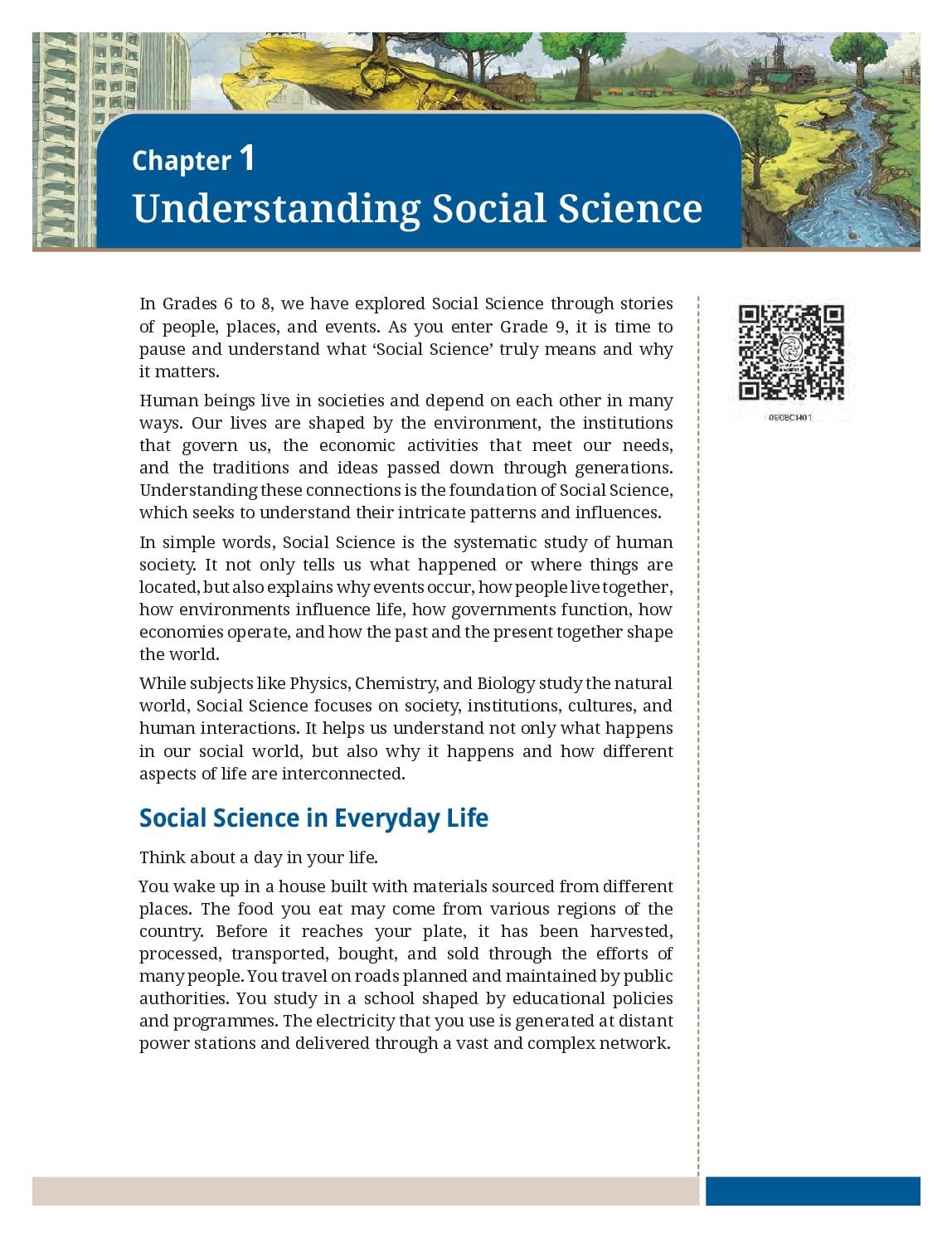
- Social Science is the systematic study of human society. It does not stop at what happened or where a place is; it asks why events occur, how people live together, how environments shape life, how governments function and how economies operate. Physics, Chemistry and Biology study the natural world; Social Science studies society, institutions, cultures and human interactions.
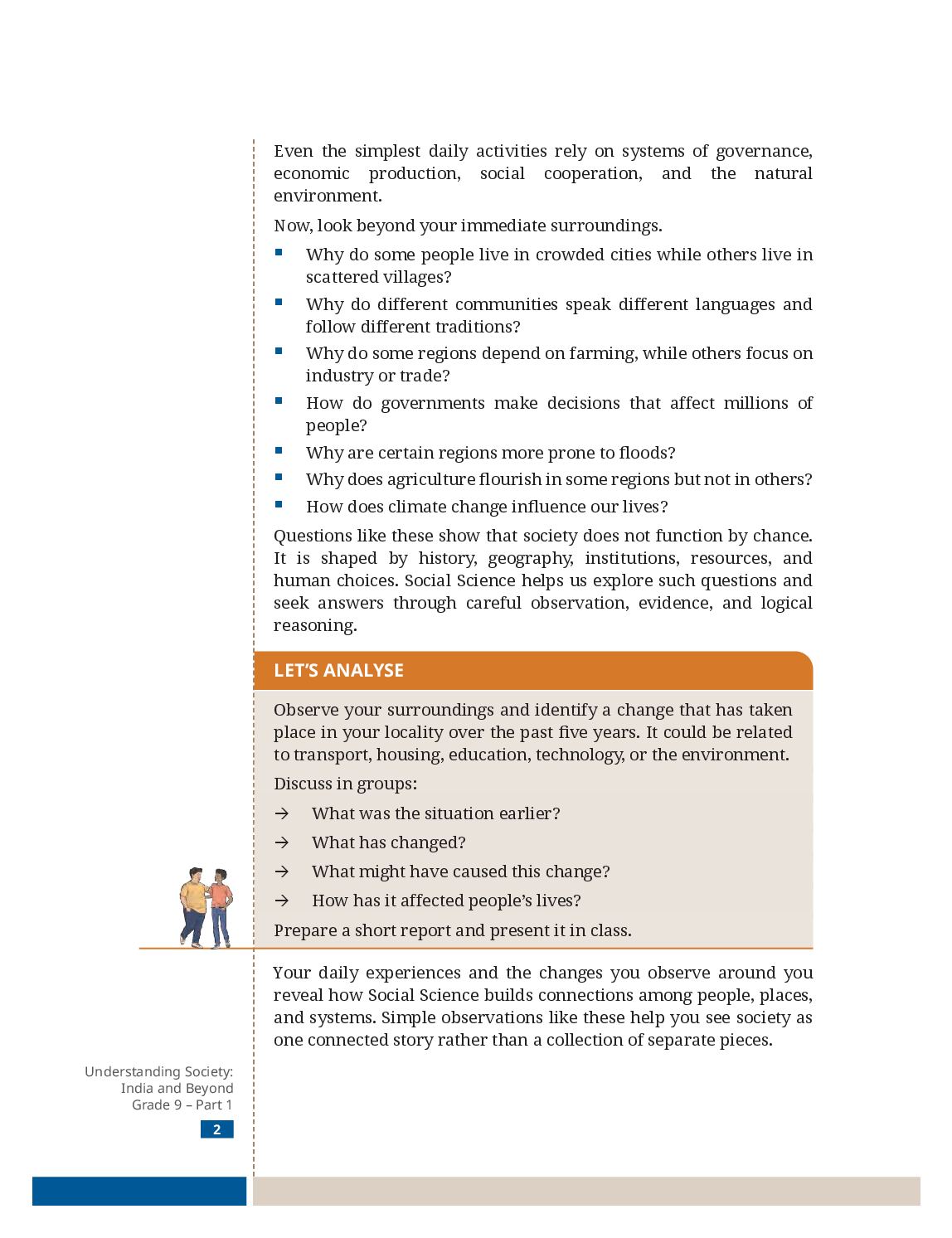
- Everyday life is the easiest proof of this. The house you live in, the food on your plate, the road you travel, the school you attend and the electricity you use all rest on systems of governance, economic production, social cooperation and the natural environment. Society, the chapter insists, does not function by chance — it is shaped by history, geography, institutions, resources and human choices.
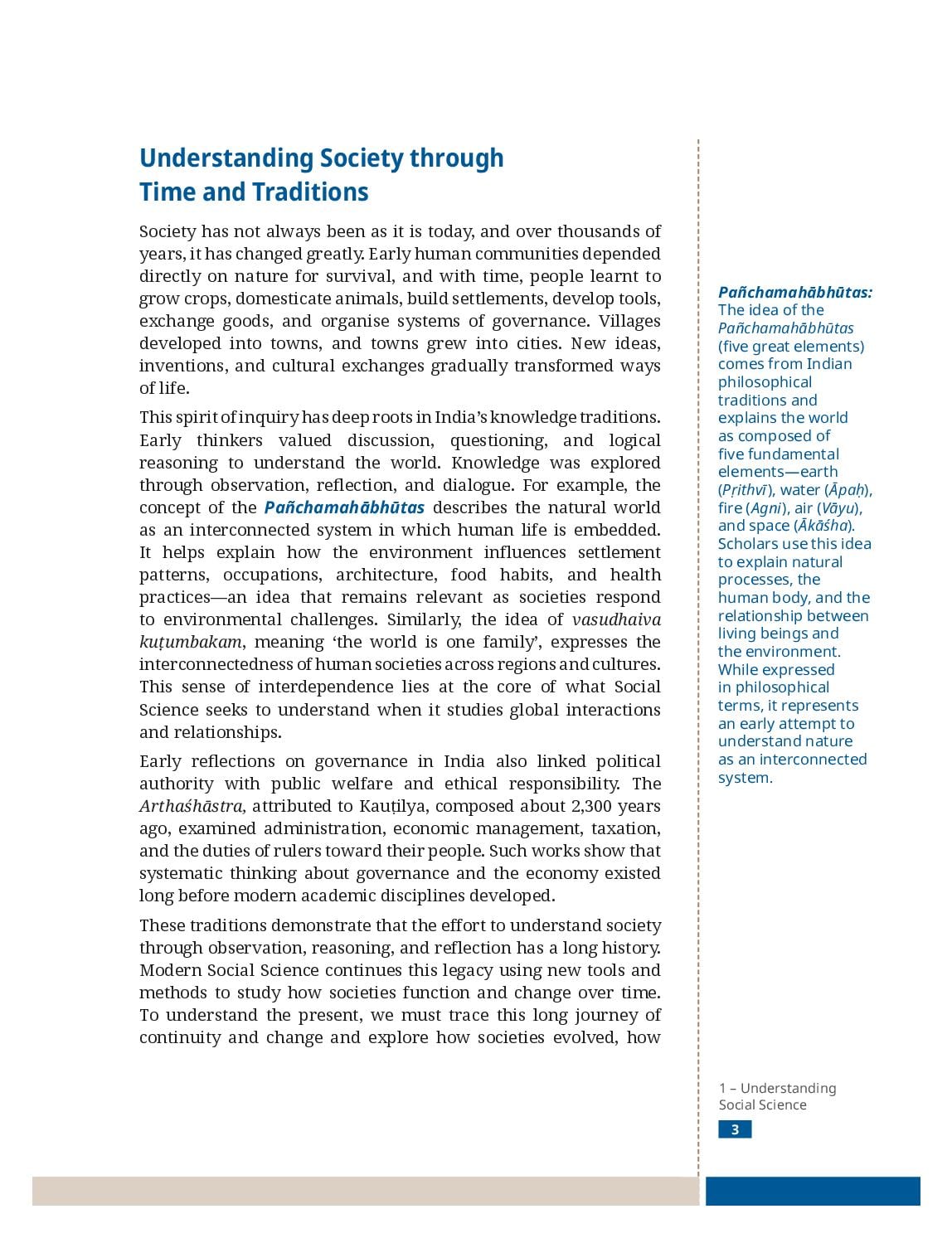
- India’s own knowledge traditions valued discussion, questioning and logical reasoning. The Pañchamahābhūtas — earth, water, fire, air and space — describe nature as one interconnected system; vasudhaiva kuṭumbakam (‘the world is one family’) expresses the interconnectedness of societies; and the Arthaśhāstra, attributed to Kauṭilya and composed about 2,300 years ago, examined administration, economic management, taxation and the duties of rulers.
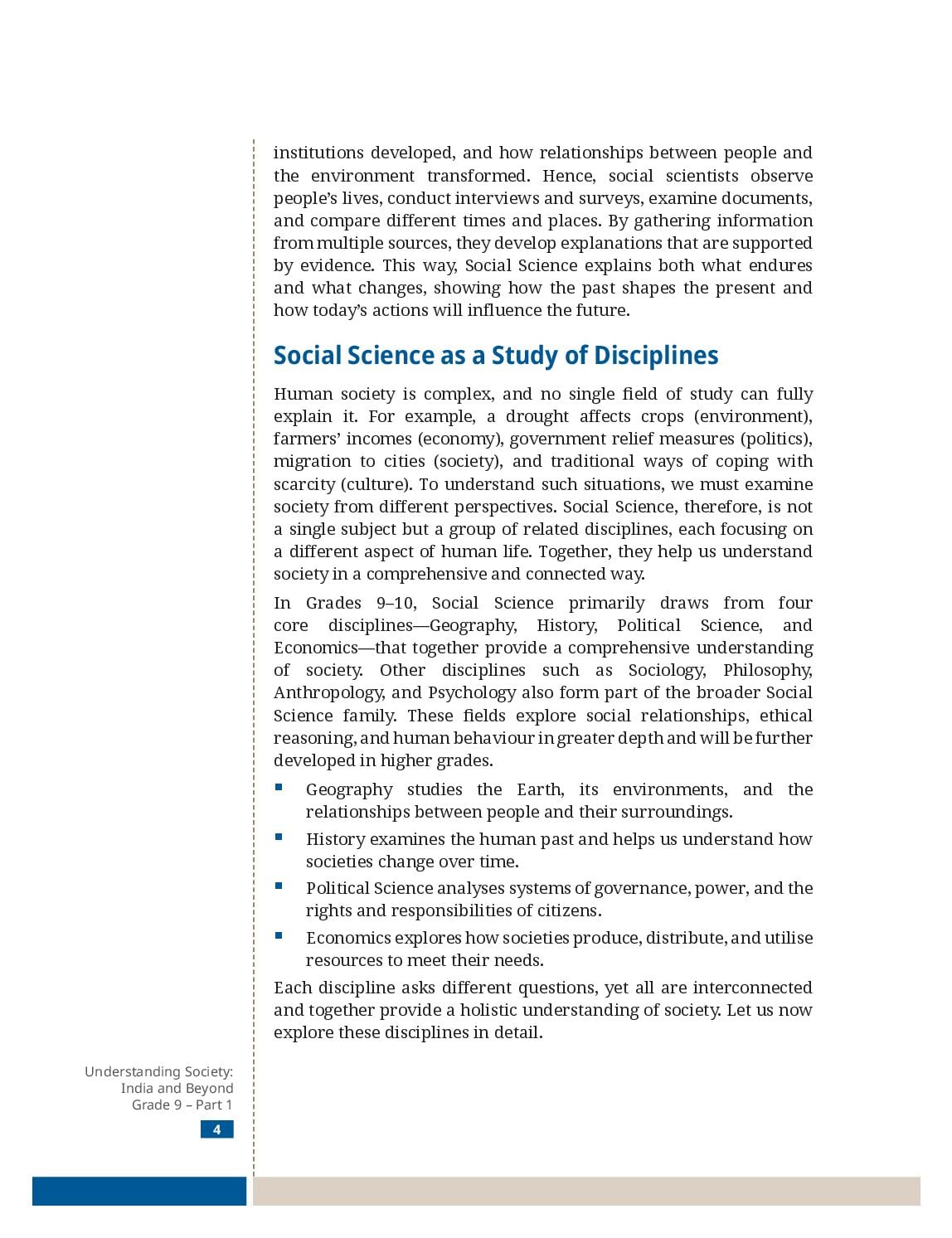
- In Grades 9–10 Social Science draws mainly on four disciplines — Geography (the Earth, environments and people–place relationships), History (the human past and how societies change), Political Science (governance, power, rights and responsibilities) and Economics (how societies produce, distribute and use resources). Sociology, Philosophy, Anthropology and Psychology belong to the wider Social Science family.
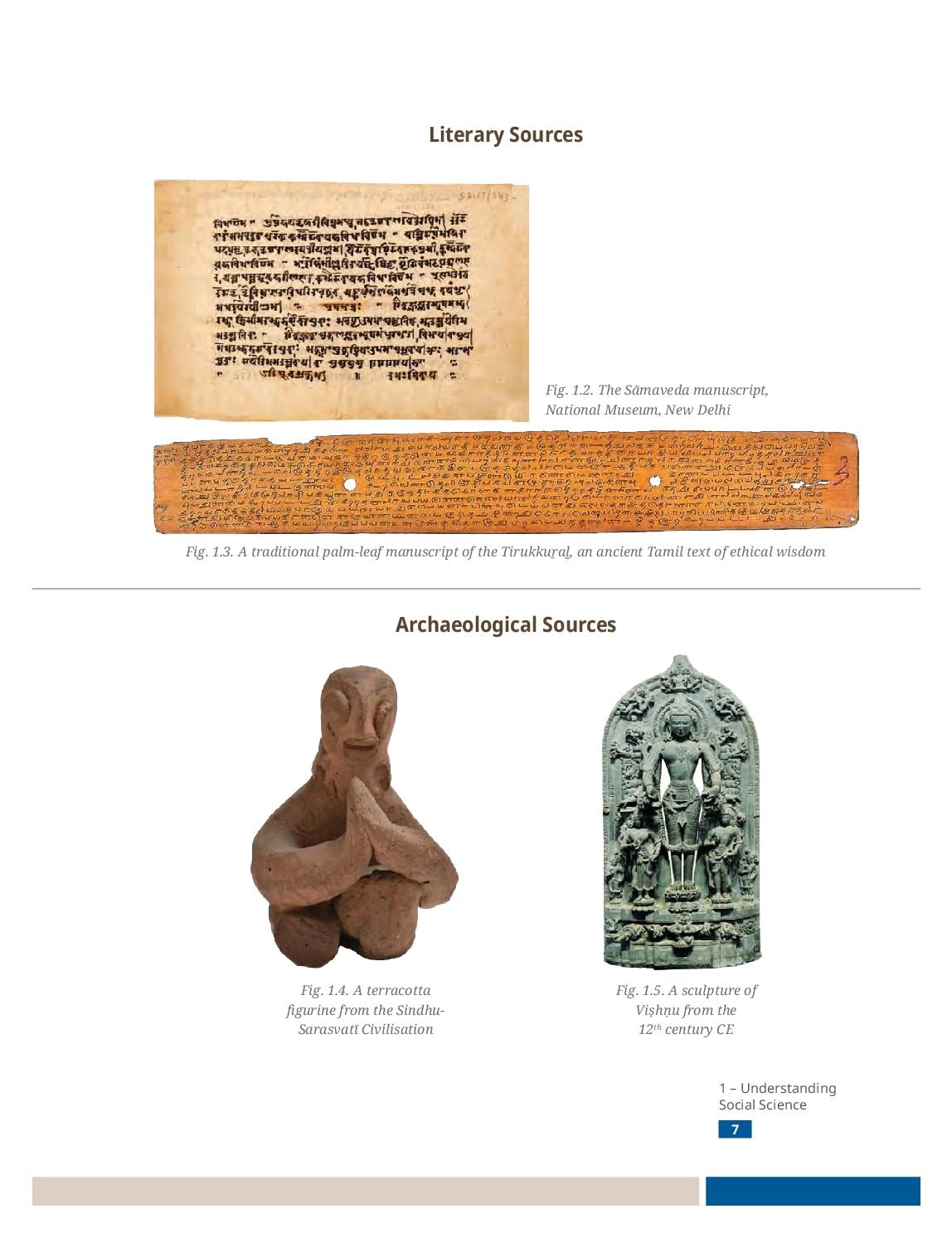
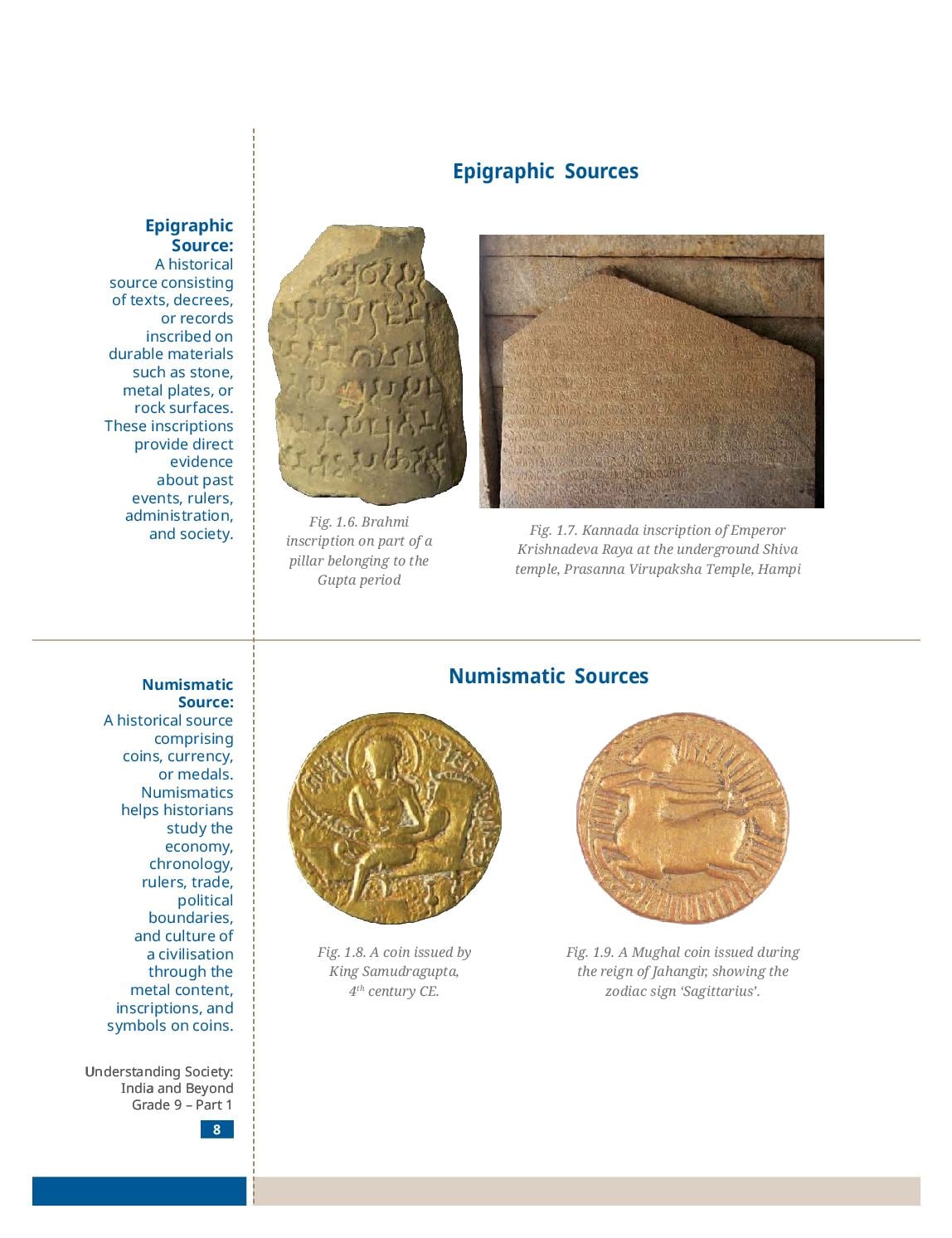
- History rests on sources. The chapter shows four kinds: literary (Fig. 1.2 the Sāmaveda manuscript; Fig. 1.3 a palm-leaf Tirukkuṟaḷ), archaeological (Fig. 1.4 a terracotta figurine of the Sindhu-Sarasvatī Civilisation; Fig. 1.5 a 12th-century CE Viṣhṇu sculpture), epigraphic (Fig. 1.6 a Gupta-period Brahmi inscription; Fig. 1.7 Krishnadeva Raya’s Kannada inscription at Hampi) and numismatic (Fig. 1.8 a coin of Samudragupta, 4th century CE; Fig. 1.9 a Mughal coin of Jahangir’s reign showing ‘Sagittarius’).
- The method matters as much as the subject. Social scientists observe people’s lives, conduct interviews and surveys, examine documents, and compare different times and places; by gathering information from multiple sources they build explanations that are supported by evidence. A source is what survives; an interpretation is what a scholar argues from it — and an interpretation can be revised when better evidence appears.
Quick revision – Understanding Social Science
| Term | What it means | Where it appears in the chapter | Example from the book |
|---|---|---|---|
| Social Science | The systematic study of human society — it explains not only what happened or where things are located, but why events occur and how different aspects of life are interconnected. | Page 1 | Contrasted with Physics, Chemistry and Biology, which study the natural world |
| Pañchamahābhūtas | The ‘five great elements’ of Indian philosophical traditions — earth (Pṛithvī), water (Āpaḥ), fire (Agni), air (Vāyu) and space (Ākāśha). An early attempt to understand nature as one interconnected system. | Page 3, side note | Used to explain settlement patterns, occupations, architecture, food habits and health practices |
| Vasudhaiva kuṭumbakam | ‘The world is one family’ — the idea that human societies across regions and cultures are interconnected. | Page 3 | The sense of interdependence behind the study of global interactions |
| Arthaśhāstra | A text attributed to Kauṭilya, composed about 2,300 years ago, on administration, economic management, taxation and the duties of rulers toward their people. | Pages 3 and 9 | Evidence that systematic thinking about governance and the economy existed long before modern disciplines |
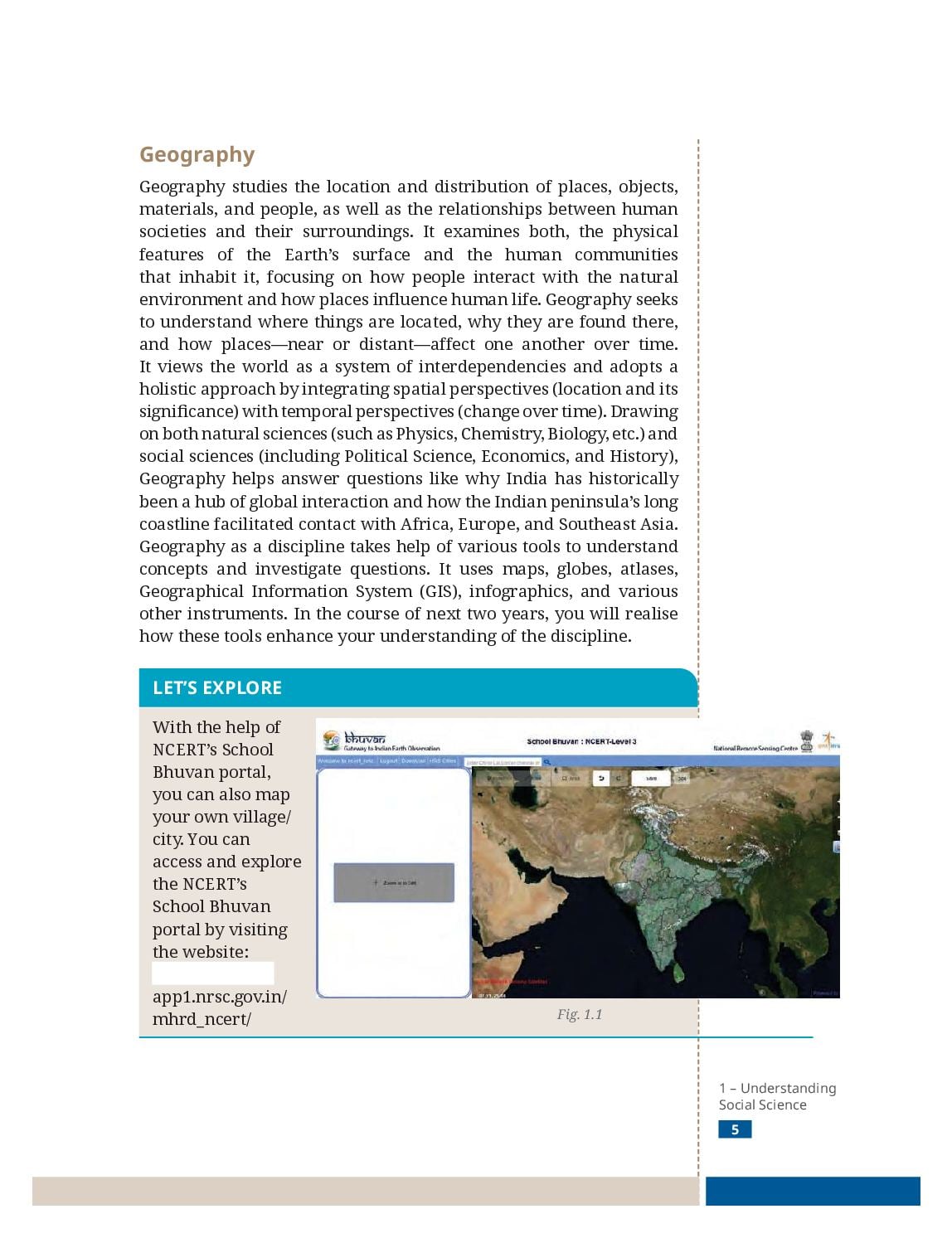
| Geography | Studies the location and distribution of places, objects, materials and people, and the relationships between societies and their surroundings. | Pages 4–6 | Tools: maps, globes, atlases, GIS, infographics — Fig. 1.1 shows NCERT’s School Bhuvan portal |
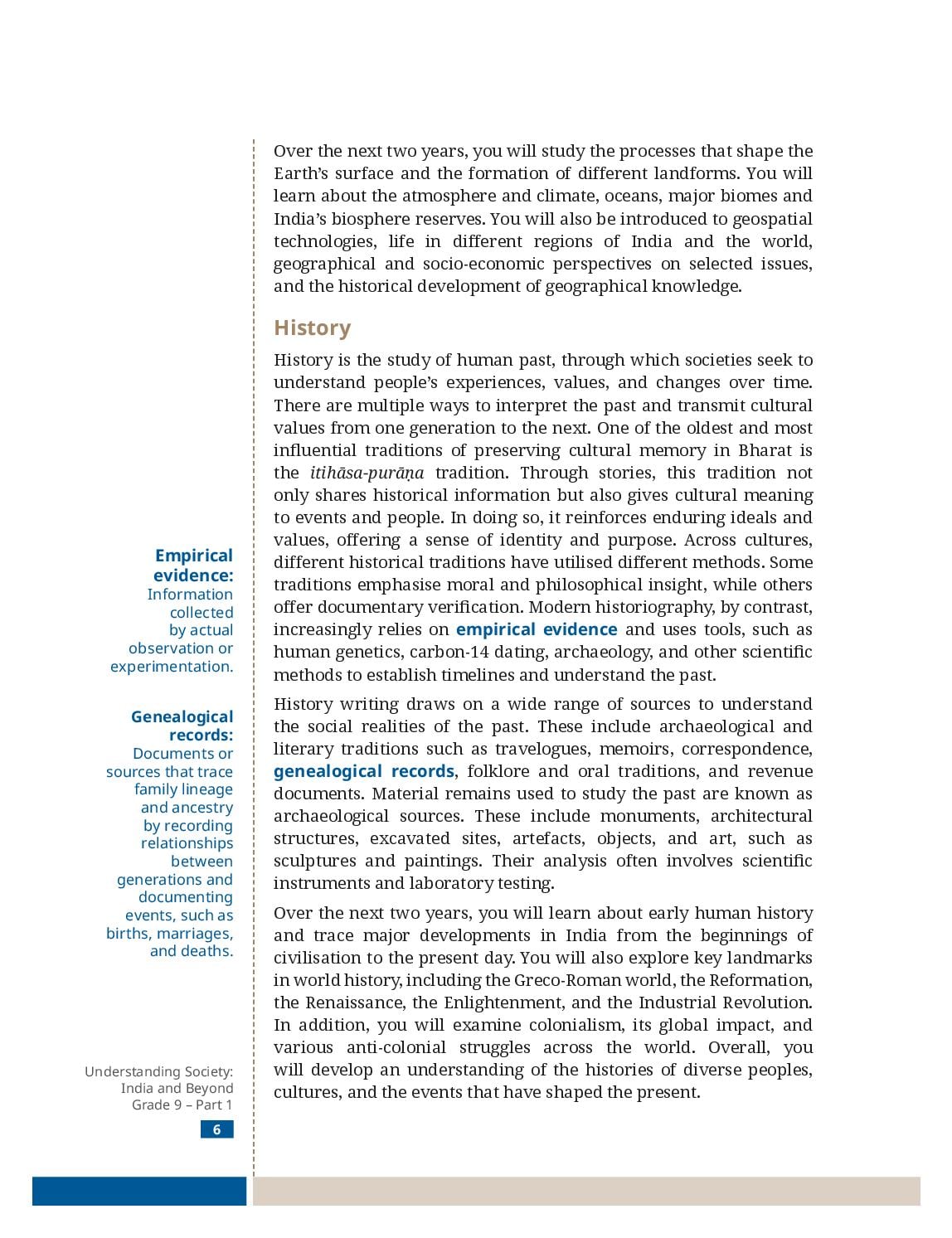
| History | The study of the human past, through which societies understand people’s experiences, values and changes over time. | Pages 6–8 | The itihāsa-purāṇa tradition of Bharat; modern tools such as human genetics and carbon-14 dating |
| Political Science | The study of governance — how and why power is distributed, decisions are made and policies are implemented. | Page 9 | The Panchayati Raj system as grassroots democracy in India’s villages |
| Economics | Studies how individuals and societies decide to use limited resources to meet their needs, and how goods and services are produced, exchanged and distributed. | Page 10 | Consumers decide what to buy, producers what to produce, governments what policies to frame |
| Empirical evidence | Information collected by actual observation or experimentation. | Page 6, side note | Modern historiography increasingly relies on it, unlike traditions that emphasise moral or philosophical insight |
| Archaeological source | Material remains used to study the past — monuments, architectural structures, excavated sites, artefacts, objects and art such as sculptures and paintings. | Pages 6–7 | Fig. 1.4, a terracotta figurine from the Sindhu-Sarasvatī Civilisation; Fig. 1.5, a Viṣhṇu sculpture of the 12th century CE |
| Epigraphic source | Texts, decrees or records inscribed on durable materials such as stone, metal plates or rock surfaces; they give direct evidence about past events, rulers, administration and society. | Page 8, side note | Fig. 1.6, a Brahmi inscription of the Gupta period; Fig. 1.7, Krishnadeva Raya’s Kannada inscription at Hampi |
| Numismatic source | Coins, currency or medals. Their metal content, inscriptions and symbols help historians study economy, chronology, rulers, trade, political boundaries and culture. | Page 8, side note | Fig. 1.8, a coin issued by Samudragupta, 4th century CE; Fig. 1.9, a Mughal coin of Jahangir’s reign showing ‘Sagittarius’ |
Old NCERT vs New – Class 9 Social Science
This chapter is from Understanding Society: India and Beyond, the new NCERT Class 9 Social Science book (NCF-SE 2023, used from 2026-27). It replaced the old book “India and the Contemporary World, Contemporary India, Democratic Politics and Economics”, so chapter numbers and names differ from older PDFs.
Solutions and All Chapters
Answers to the exercises and the full chapter list of Understanding Society: India and Beyond:
Understanding Social Science – Overview
| Class | Class 9 |
| Subject | Social Science |
| Book | Understanding Society: India and Beyond – new NCERT book |
| Part | Part I |
| Chapter | 1 of 15 – Understanding Social Science |
| Book pages | 1 – 12 |
| Edition | Latest NCERT edition (2026-27) |
| Session | 2026-27 |
| Free – read online or download |
Class 9 Social Science Chapter 1 – FAQs
Where can I download Understanding Social Science Class 9 PDF?
From the download table on this page – the chapter PDF is free, and the full book is linked too.
What is Class 9 Social Science Chapter 1 about?
Social Science is the systematic study of human society. It does not stop at what happened or where a place is; it asks why events occur, how people live together, how environments shape life, how governments function and how economies operate. Physics, Chemistry and Biology study the natural world; Social Science studies society, institutions, cultures and human interactions.
Is Understanding Social Science from the new NCERT Class 9 Social Science book?
Yes. It is chapter 1 of understanding society: india and beyond (part i), the new NCERT Class 9 Social Science book for 2026-27.
Is this the latest NCERT edition for 2026-27?
Yes – the PDF is NCERT’s latest edition for the 2026-27 session.
Where are the NCERT Solutions for Class 9 Social Science Chapter 1?
Open the NCERT Solutions link above for answers to the exercise questions.