NCERT Solutions for Class 9 Social Science Chapter 1 Understanding Social Science provide clear, step-by-step answers to every exercise and in-text question from the chapter Understanding Social Science of the NCERT textbook Understanding Society: India and Beyond. Prepared by subject experts as per the latest NCERT (CBSE) syllabus for 2026-27, these NCERT Solutions for Class 9 Social Science help you understand each concept, write exam-ready answers, and check your own solutions. You can read them online below or download the free Class 9 Social Science Chapter 1 question-answer PDF.
NCERT Solutions for Class 9 Social Science Chapter 1 Understanding Social Science
- Class: Class 9
- Subject: Social Science
- Chapter: Chapter 1 – Understanding Social Science
- Textbook: Understanding Society: India and Beyond (NCERT)
- Study material: NCERT Solutions – questions with answers, free PDF
These solutions answer all the exercise questions of Chapter 1 Understanding Social Science — including the in-text questions, short-answer and long-answer questions, and activities — with complete explanations so you can follow the method, not just the final answer. Read the full solutions below.
NCERT Solutions Class 9 Social Science Chapter 1 Understanding Social Science View Download


NCERT Solutions for Class 9 Social Science Chapter 1 PDF Download
You can read the NCERT Solutions for Class 9 Social Science Chapter 1 online above, or download the complete question-answer PDF to study Understanding Social Science offline at any time.
NCERT Solutions for Class 9 Social Science Chapter 1 PDF Download Link – Click Here to Download Solutions PDF
Questions Covered in This Chapter
These NCERT Solutions answer all 18 questions of this chapter. The questions solved are:
- Why do some people live in crowded cities while others live in scattered villages?
- Why do different communities speak different languages and follow different traditions?
- Why do some regions depend on farming, while others focus on industry or trade?
- How do governments make decisions that affect millions of people?
- Why are certain regions more prone to floods?
- Why does agriculture flourish in some regions but not in others?
- How does climate change influence our lives?
- Observe your surroundings and identify a change that has taken place in your locality over the past five years. It could be related to transport, housing, education, technology, or the environment.
- What was the situation earlier?
- What has changed?
- What might have caused this change?
- How has it affected people’s lives?
- Prepare a short report and present it in class.
- Why has India historically been a hub of global interaction, and how did the Indian peninsula's long coastline facilitate contact with Africa, Europe, and Southeast Asia? (The chapter poses this on page 5 as an example of a question Geography helps answer.)
- With the help of NCERT’s School Bhuvan portal, you can also map your own village/city. You can access and explore the NCERT’s School Bhuvan portal by visiting the website: app1.nrsc.gov.in/mhrd_ncert/
- After exploring how Social Science helps us observe events, ask questions, and examine evidence, an important question arises: how does this knowledge help us in our lives?
- Why do such differences exist within the same country?
- How do they continue over time?
Chapter at a Glance
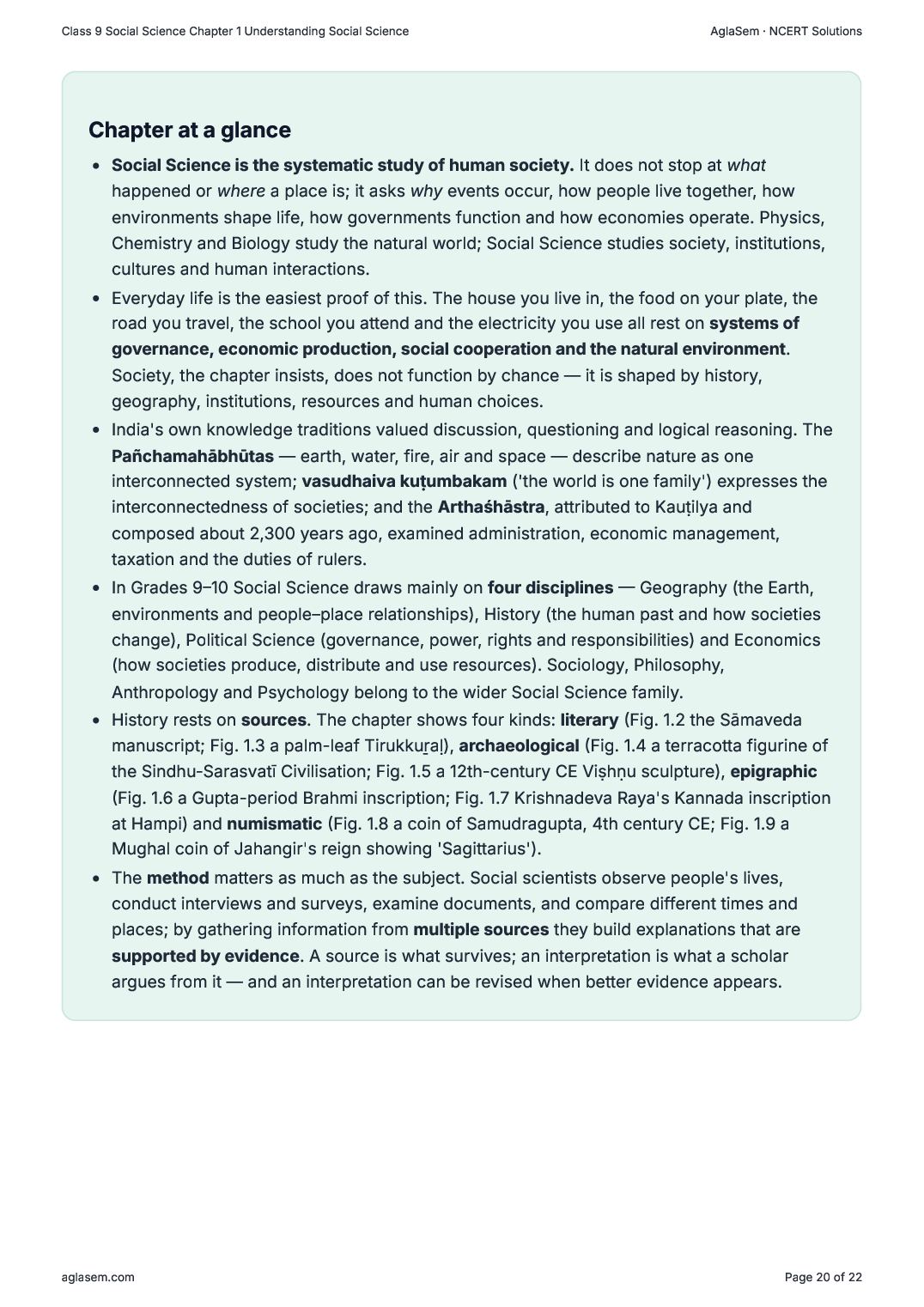
- Social Science is the systematic study of human society. It does not stop at what happened or where a place is; it asks why events occur, how people live together, how environments shape life, how governments function and how economies operate. Physics, Chemistry and Biology study the natural world; Social Science studies society, institutions, cultures and human interactions.
- Everyday life is the easiest proof of this. The house you live in, the food on your plate, the road you travel, the school you attend and the electricity you use all rest on systems of governance, economic production, social cooperation and the natural environment . Society, the chapter insists, does not function by chance — it is shaped by history, geography, institutions, resources and human choices.
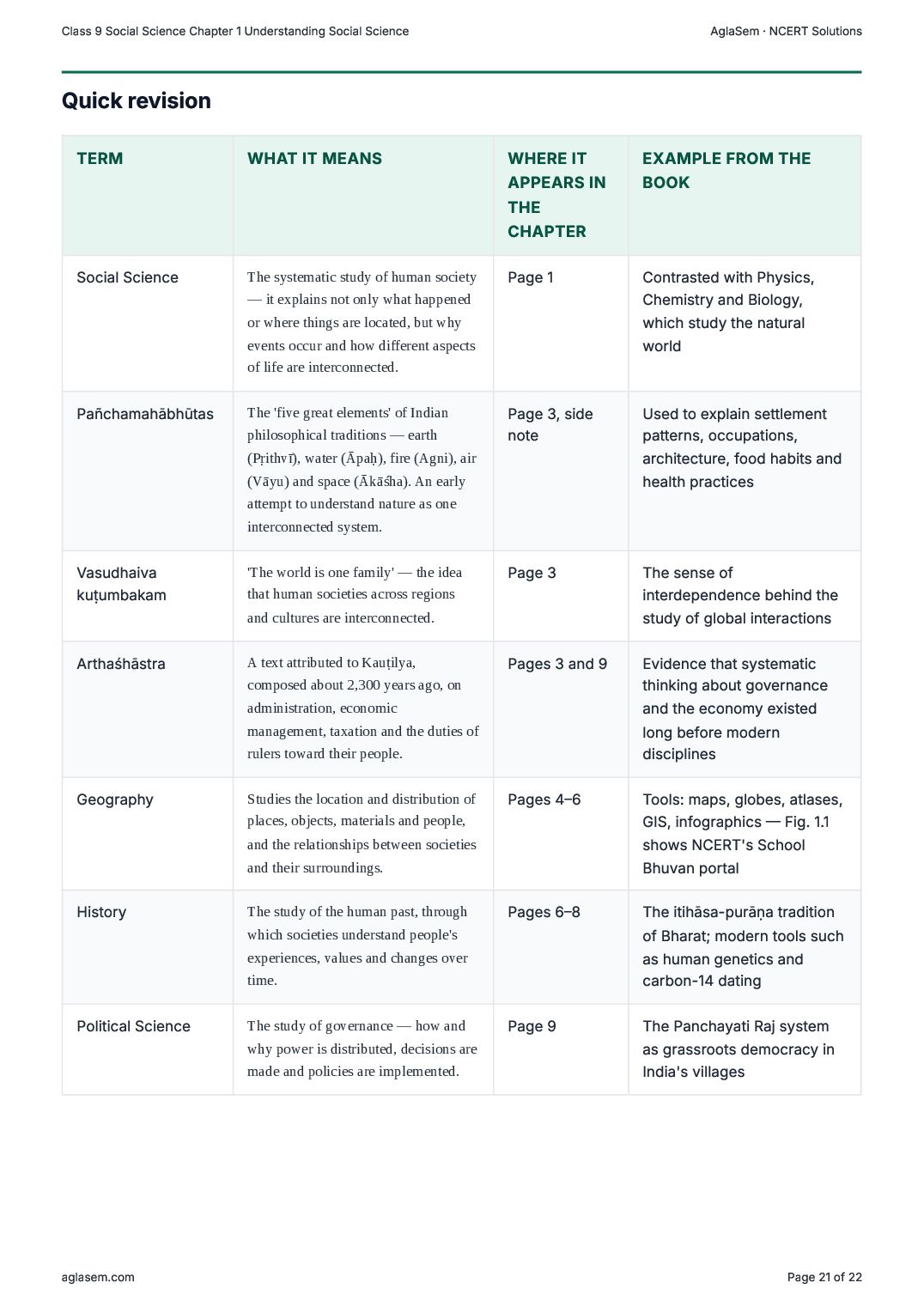
- India's own knowledge traditions valued discussion, questioning and logical reasoning. The Pañchamahābhūtas — earth, water, fire, air and space — describe nature as one interconnected system; vasudhaiva kuṭumbakam ('the world is one family') expresses the interconnectedness of societies; and the Arthaśhāstra , attributed to Kauṭilya and composed about 2,300 years ago, examined administration, economic management, taxation and the duties of rulers.
- In Grades 9–10 Social Science draws mainly on four disciplines — Geography (the Earth, environments and people–place relationships), History (the human past and how societies change), Political Science (governance, power, rights and responsibilities) and Economics (how societies produce, distribute and use resources). Sociology, Philosophy, Anthropology and Psychology belong to the wider Social Science family.
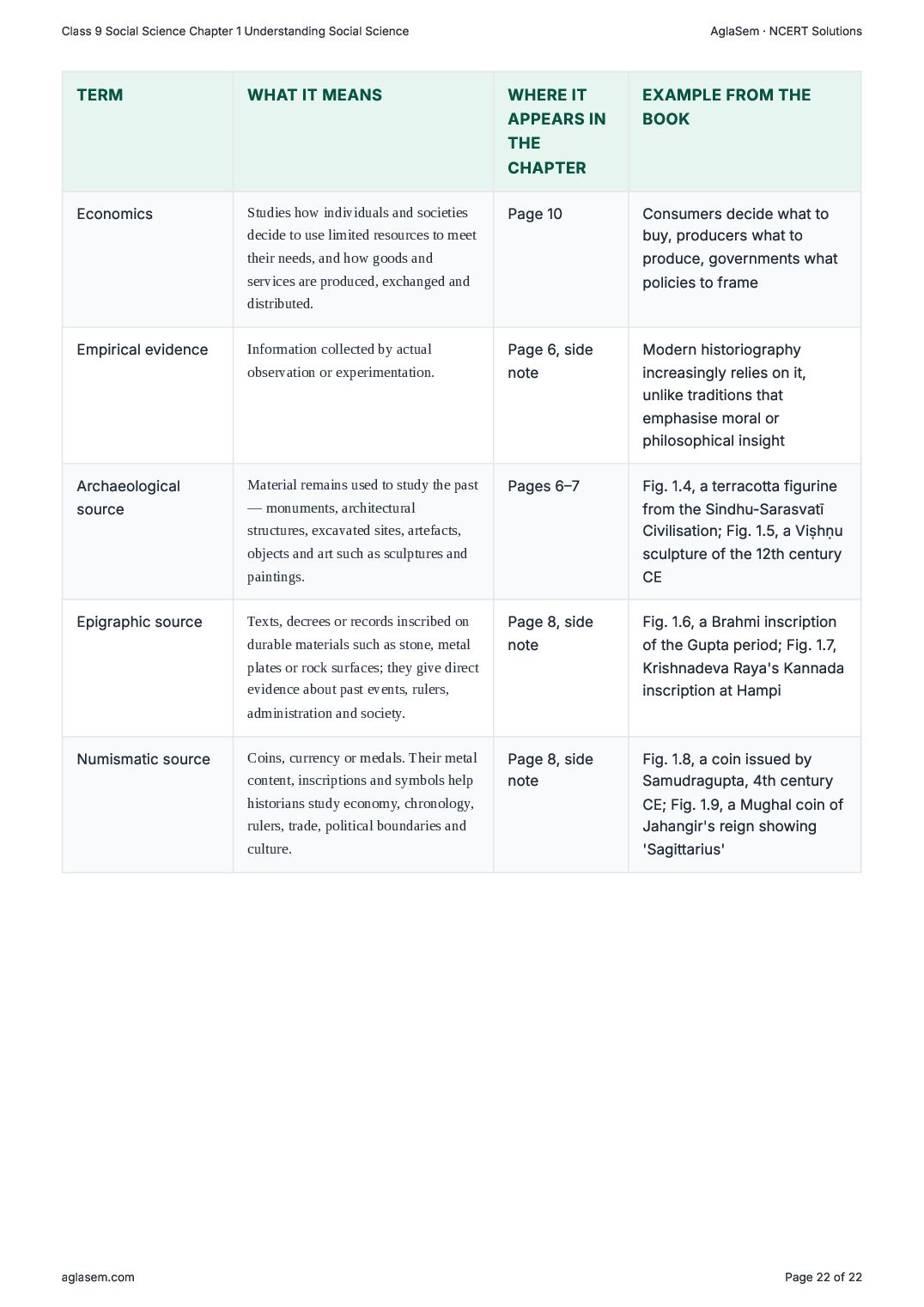
- History rests on sources . The chapter shows four kinds: literary (Fig. 1.2 the Sāmaveda manuscript; Fig. 1.3 a palm-leaf Tirukkuṟaḷ), archaeological (Fig. 1.4 a terracotta figurine of the Sindhu-Sarasvatī Civilisation; Fig. 1.5 a 12th-century CE Viṣhṇu sculpture), epigraphic (Fig. 1.6 a Gupta-period Brahmi inscription; Fig. 1.7 Krishnadeva Raya's Kannada inscription at Hampi) and numismatic (Fig. 1.8 a coin of Samudragupta, 4th century CE; Fig. 1.9 a Mughal coin of Jahangir's reign showing 'Sagittarius').
- The method matters as much as the subject. Social scientists observe people's lives, conduct interviews and surveys, examine documents, and compare different times and places; by gathering information from multiple sources they build explanations that are supported by evidence . A source is what survives; an interpretation is what a scholar argues from it — and an interpretation can be revised when better evidence appears.
How to Download NCERT Solutions for Class 9 Social Science Chapter 1 PDF
Follow these simple steps to get the Understanding Social Science questions-and-answers PDF from Understanding Society: India and Beyond.
- Search NCERT Solutions for Class 9 Social Science Chapter 1 aglasem and open this page.
- Read the exercise questions with answers for Understanding Social Science shown above.
- Click the Download PDF link to save the Understanding Social Science solutions to your device.
NCERT Solutions for Class 9 Social Science – All Chapters
There are more chapters to study besides Understanding Social Science in Social Science. Here are the NCERT Solutions for all chapters of Class 9 Social Science.
- Chapter 1 Understanding Social Science
- Chapter 2 Shaping of the Earth’s Surface
- Chapter 3 Atmosphere and Climate
- Chapter 4 Early Humans and Beginning of Civilisation
- Chapter 5 State and Society Up to 1000 Ce
- Chapter 6 Democracy
- Chapter 7 Elections
- Chapter 8 Building Blocks in Economics the Problem of Choice
- Chapter 9 The Price Puzzle What Drives the Market
NCERT Solutions for Class 9 – All Subjects
Just like Chapter 1 of Social Science, you can get the exercise questions with answers for every other subject of Class 9. Here are the NCERT Solutions for all subjects of Class 9.
NCERT Solutions for Class 9 Social Science Chapter 1 – An Overview
The key highlights of this study material are as follows.
| Aspects | Details |
|---|---|
| Class | Class 9 |
| Subject | Social Science |
| Chapter Number | Chapter 1 |
| Chapter Name | Understanding Social Science |
| Book Name | Understanding Society: India and Beyond |
| Book By | NCERT (National Council of Educational Research and Training) |
| Educational Resource Here | NCERT Solutions of Class 9 Social Science Chapter 1 for all exercises |
| More Questions Answers of This Subject | NCERT Solutions for Class 9 Social Science |
| Download Book Chapter | NCERT Book Class 9 Social Science |
| All Questions Answers For This Class | NCERT Solutions for Class 9 |
| Complete Solutions | NCERT Solutions |
NCERT Solutions for Class 9 Social Science Chapter 1 Understanding Social Science – FAQs
What are the NCERT Solutions for Class 9 Social Science Chapter 1 Understanding Social Science?
They are the complete, step-by-step answers to all the exercise and in-text questions of Chapter 1 Understanding Social Science from the NCERT Class 9 Social Science textbook Understanding Society: India and Beyond, written by experts as per the latest NCERT syllabus.
How can I download the Class 9 Social Science Chapter 1 solutions PDF for free?
Open this page on aglasem, read the Understanding Social Science questions with answers, and click the “Download Solutions PDF” link. The Class 9 Social Science Chapter 1 NCERT Solutions PDF is completely free to download.
Are these NCERT Solutions as per the latest 2026-27 syllabus?
Yes. The NCERT Solutions for Class 9 Social Science Chapter 1 are based on the latest NCERT textbook Understanding Society: India and Beyond and the current 2026-27 CBSE syllabus, so the questions and answers match what you study in class.
Where can I get NCERT Solutions for the other chapters of Class 9 Social Science?
You can find the answers to every chapter on the NCERT Solutions for Class 9 Social Science page, and solutions for every subject on the NCERT Solutions for Class 9 page.
How do NCERT Solutions help in exam preparation?
They show the correct method to solve each question, help you write answers the way they are expected in exams, let you check and correct your own work, and save revision time — which together improve your marks in Class 9 Social Science.
If you have any queries on NCERT Solutions for Class 9 Social Science Chapter 1 Understanding Social Science, then please ask in the comments below.