NCERT Solutions for Class 9 Social Science Chapter 2 Shaping of the Earth’s Surface provide clear, step-by-step answers to every exercise and in-text question from the chapter Shaping of the Earth’s Surface of the NCERT textbook Understanding Society: India and Beyond. Prepared by subject experts as per the latest NCERT (CBSE) syllabus for 2026-27, these NCERT Solutions for Class 9 Social Science help you understand each concept, write exam-ready answers, and check your own solutions. You can read them online below or download the free Class 9 Social Science Chapter 2 question-answer PDF.
NCERT Solutions for Class 9 Social Science Chapter 2 Shaping of the Earth’s Surface
- Class: Class 9
- Subject: Social Science
- Chapter: Chapter 2 – Shaping of the Earth’s Surface
- Textbook: Understanding Society: India and Beyond (NCERT)
- Study material: NCERT Solutions – questions with answers, free PDF
These solutions answer all the exercise questions of Chapter 2 Shaping of the Earth’s Surface — including the in-text questions, short-answer and long-answer questions, and activities — with complete explanations so you can follow the method, not just the final answer. Read the full solutions below.
NCERT Solutions Class 9 Social Science Chapter 2 Shaping of the Earth s Surface View Download





NCERT Solutions for Class 9 Social Science Chapter 2 PDF Download
You can read the NCERT Solutions for Class 9 Social Science Chapter 2 online above, or download the complete question-answer PDF to study Shaping of the Earth’s Surface offline at any time.
NCERT Solutions for Class 9 Social Science Chapter 2 PDF Download Link – Click Here to Download Solutions PDF
Questions Covered in This Chapter
These NCERT Solutions answer all 38 questions of this chapter. The questions solved are:
- What shapes the Earth's surface?
- What is plate tectonics? What are the effects of plate movement?
- How are landforms formed and how are they classified?
- How are humans and other living beings connected to these landforms?
- How do disasters associated with different landforms impact human lives?
- Pick any two plates from the map above and complete the table given below. (Name of the plate | Continents | Ocean)
- Examine the plate map (Fig. 2.3) with the earthquake and volcano map (Fig. 2.4). What correlation do you observe?
- Observe the map showing the distribution of earthquakes and volcanoes (Fig. 2.4). Can you identify which continents and countries are located around the Ring of Fire with the help of an atlas or a globe?
- Can you find out which region is more vulnerable to earthquakes?
- Why do you think human lives are at risk?
- What do you think caused this situation?
- What could that grey powder be?
- What does it tell us about the Earth's internal forces?
- Observe the photographs (Fig. 2.9) and also note the types of erosion. How are farmers affected by erosion due to water and wind?
- Have you heard about the Sundarbans delta? Try and explore its uniqueness and find out why it is popular with tourists.
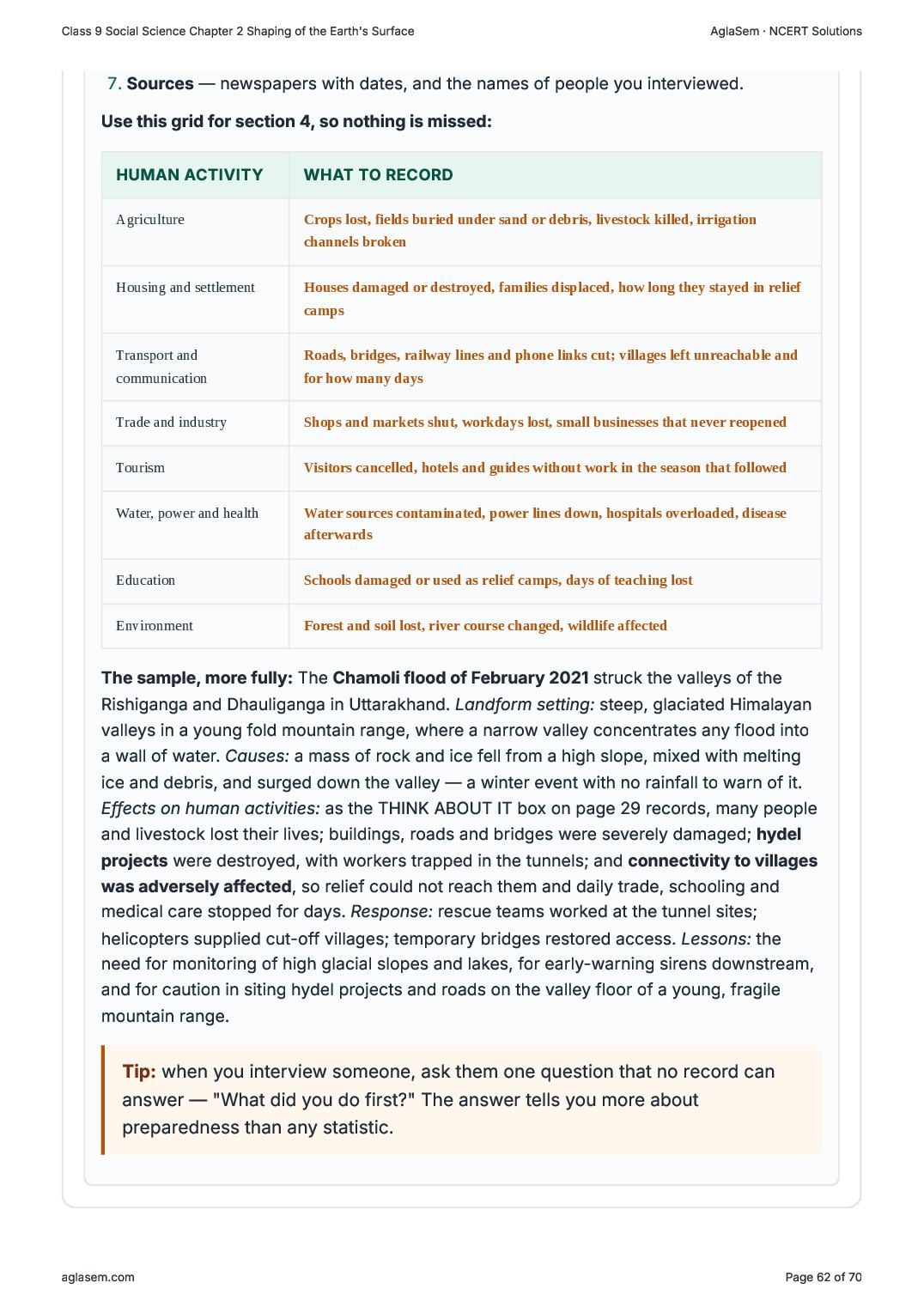
- A devastating flood struck the Chamoli district in Uttarakhand in February 2021 in which many people and livestock lost their lives. There was severe damage to buildings, roads, bridges, and hydel projects, and connectivity to villages was adversely affected. Can you find out the reasons that led to the sudden and unexpected flood?
- Observe the landforms around your school or residence and try to identify which agent may have created them.
- Complete the exercises given at the end of each type of disaster with the help of newspapers, atlases, and books. Make a list of disaster-prone areas from India and the world and enlist mitigation measures quoting recent examples.
- The Earth is made up of layers, namely, the crust, mantle, and core.
- Interior forces of the Earth (earthquakes, volcanoes, folding, and faulting) are responsible for the movement of the crust.
- External forces like weathering and erosion carve smaller landforms over the Earth's surface which affect human life in multiple ways.
- The surface of the Earth is carved by agents of gradation like running water, waves and tides, glaciers, wind, and underground water.
- Disasters like landslides, avalanches, glacial lake outflows, and sandstorms are associated with specific landforms.
- What are the sources of energy that are required to cause movements associated with the internal forces of the Earth?
- Relate various physiographic divisions you have studied in the earlier grades with various endogenic forces responsible for their origin.
- Why and where do earthquakes occur frequently? Is it possible to predict earthquakes?
- “Plate movements are responsible for the distribution of earthquakes and volcanoes.” Explain.
- Draw and label a diagram of a meander and a delta.
- How are deforestation and erosion associated with each other? Explain.
- Develop a plan to protect the land in your local area from erosion.
- Which disasters do you think you might experience in your region? Discuss a mitigation plan in your classroom.
- Prepare a model of landforms created by underground water.
- What precautionary measures will you take if you are staying in an earthquake-prone region?
- Prepare a map showing landform-associated disasters that happened in the current calendar year.
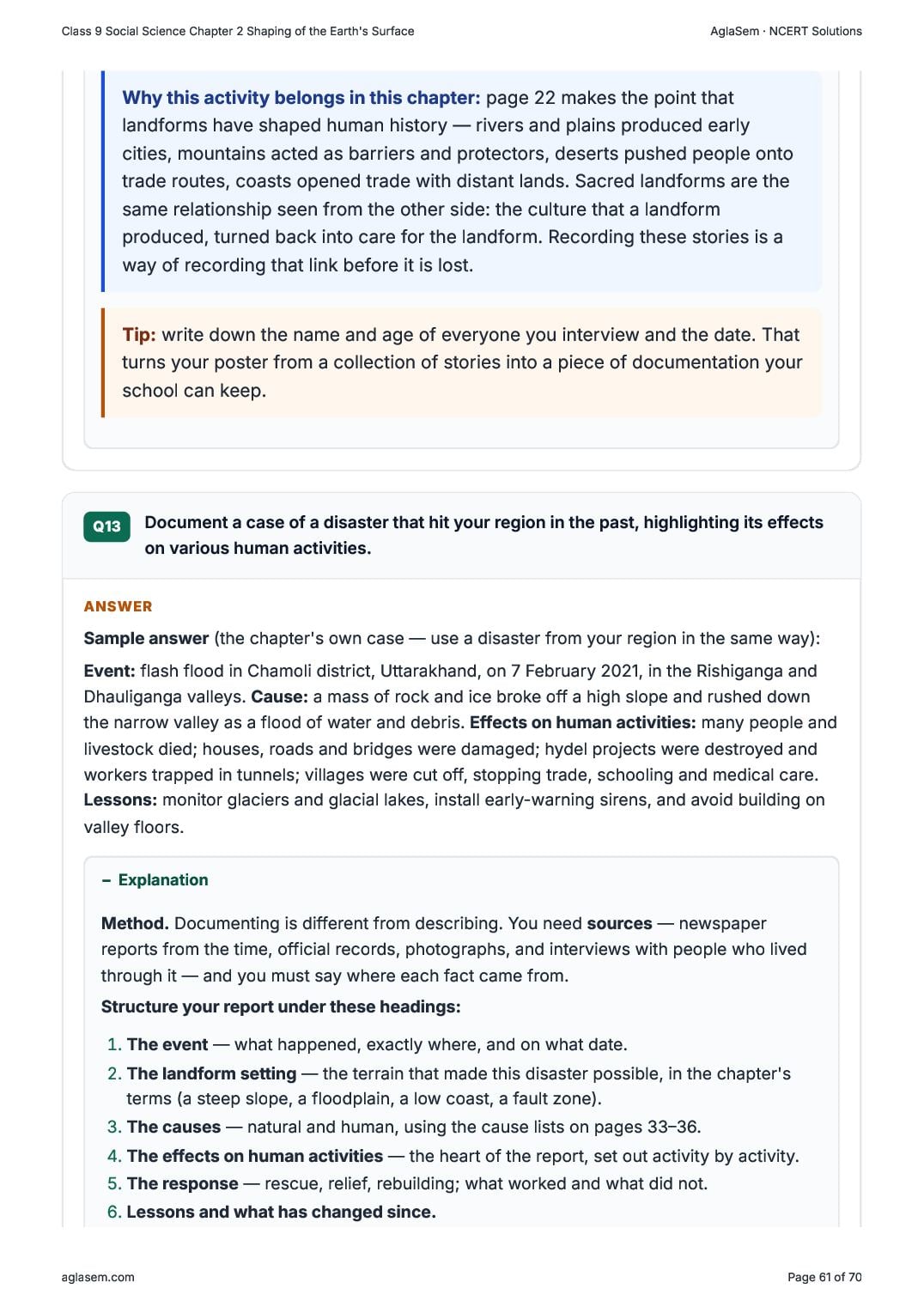
- Create a poster showing landforms that are considered to be sacred or important in your region, and add the folk stories associated with them.
- Document a case of a disaster that hit your region in the past, highlighting its effects on various human activities.
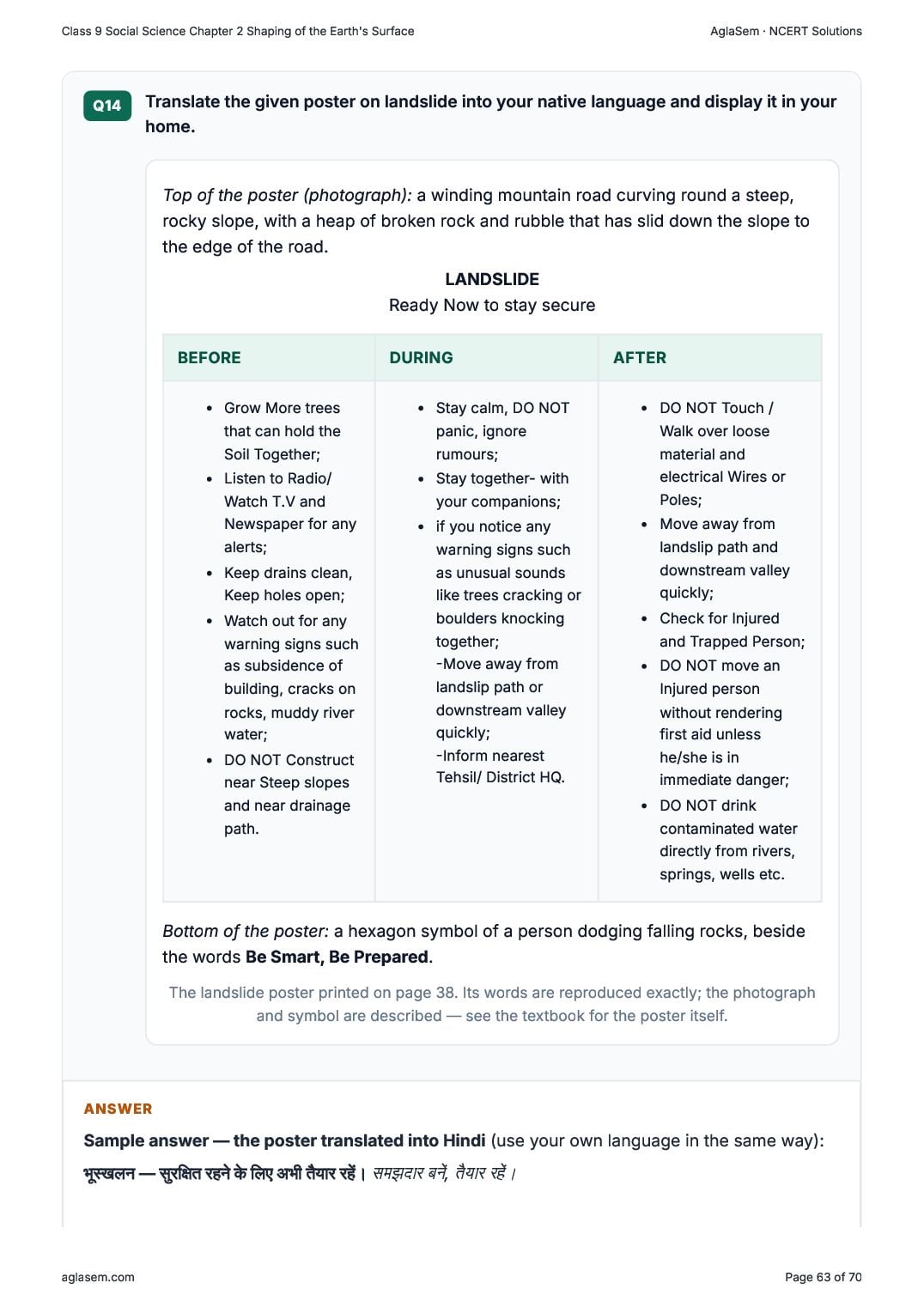
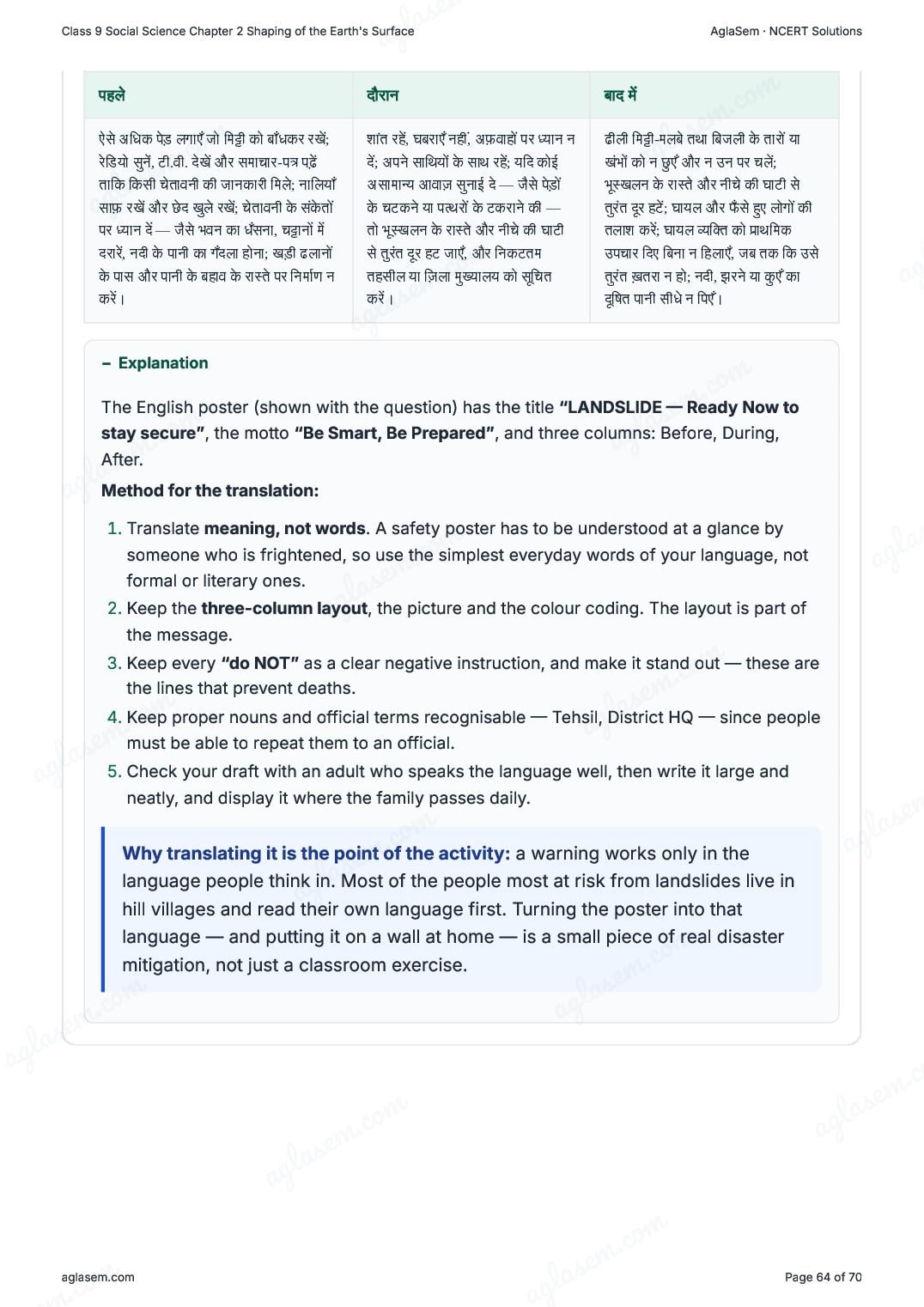
- Translate the given poster on landslide into your native language and display it in your home.
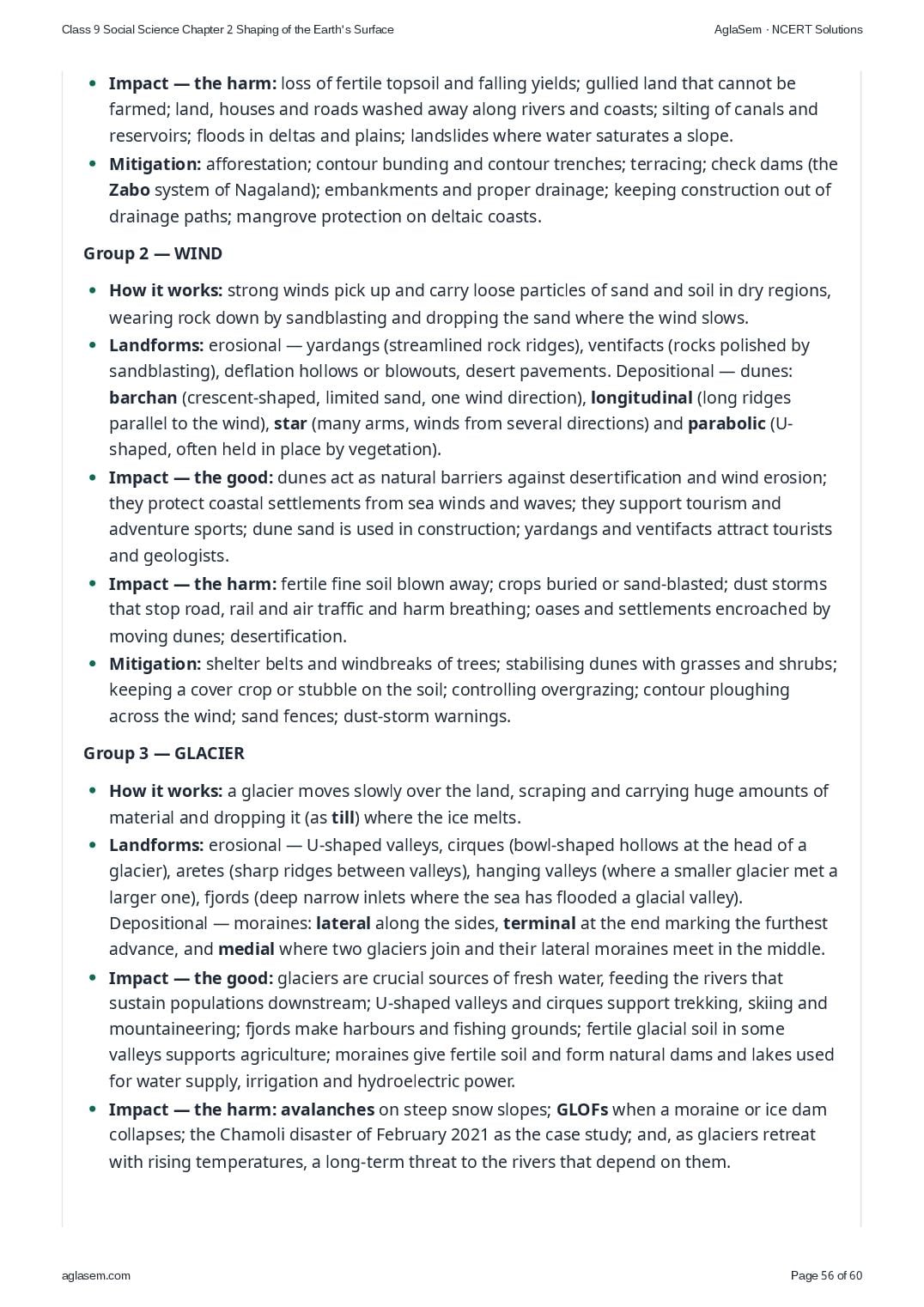
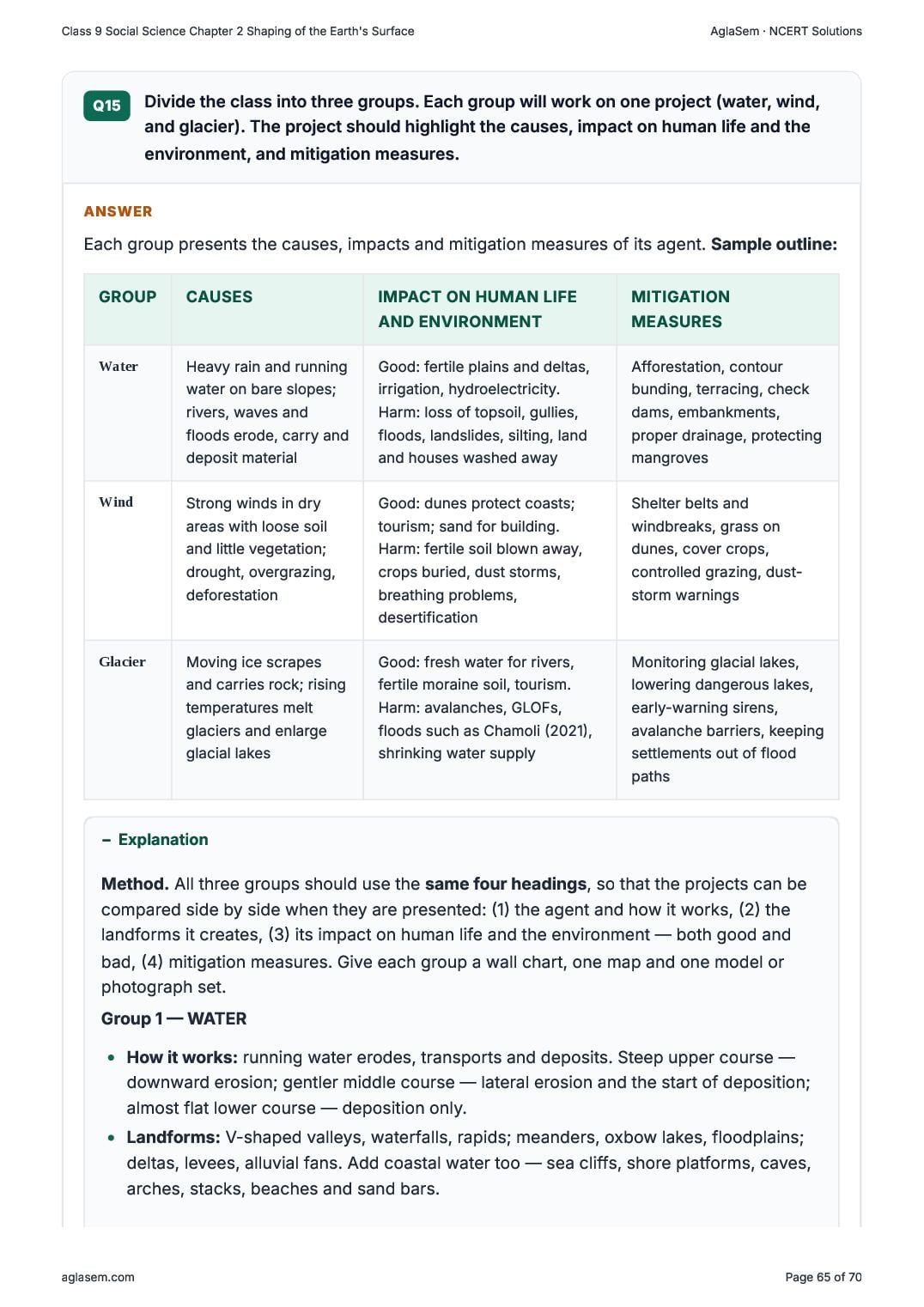
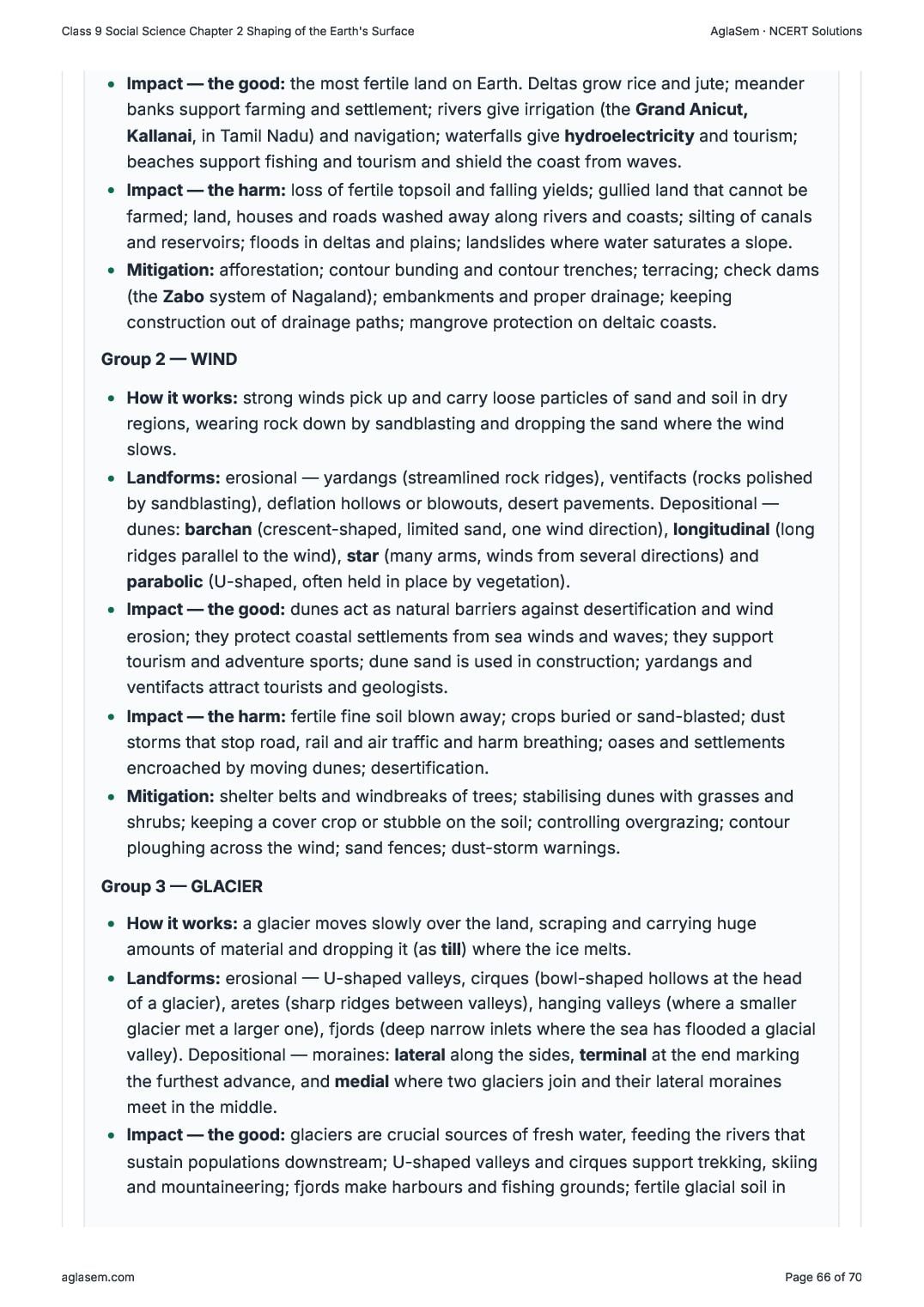
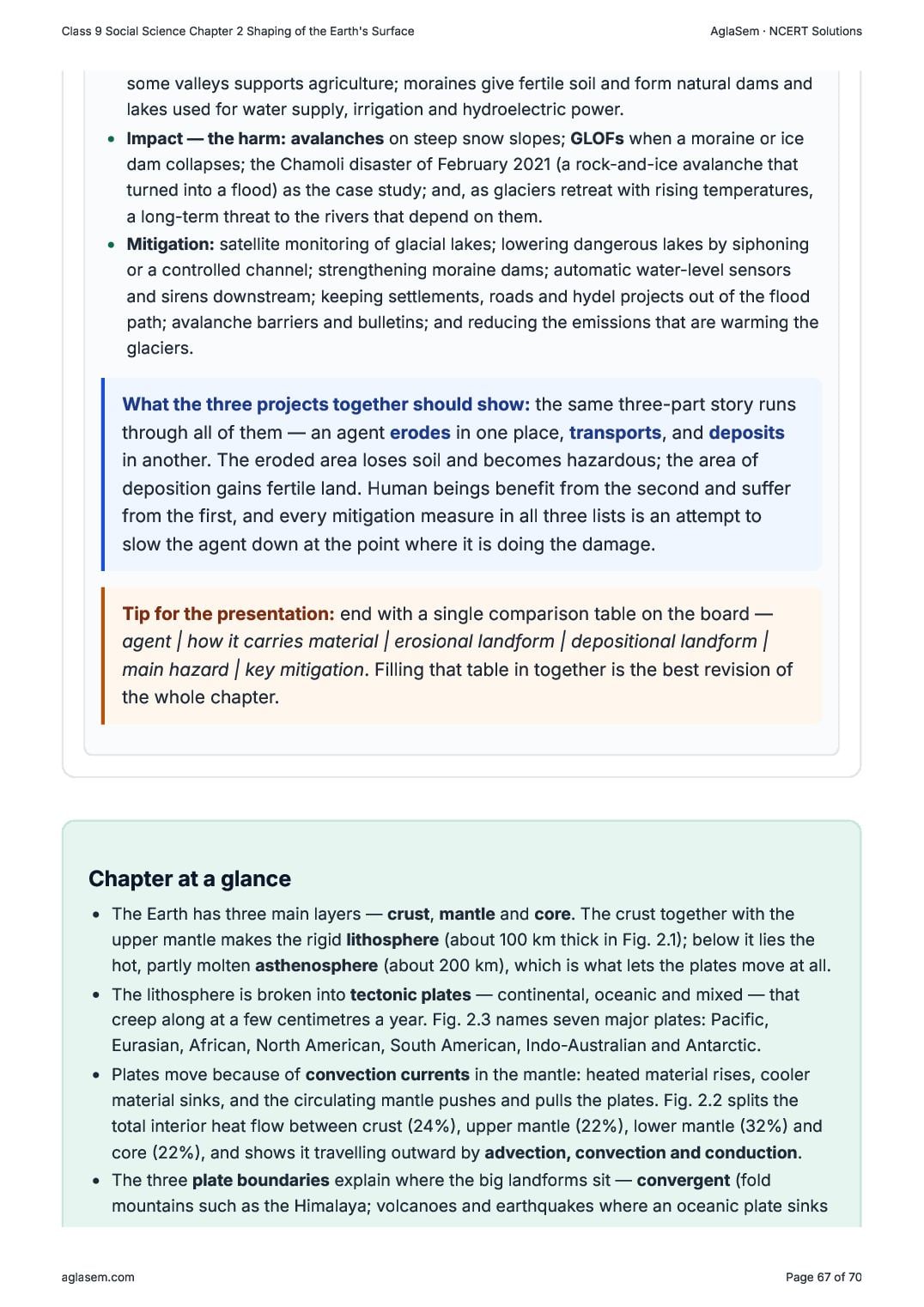
- Divide the class into three groups. Each group will work on one project (water, wind, and glacier). The project should highlight the causes, impact on human life and the environment, and mitigation measures.
Chapter at a Glance
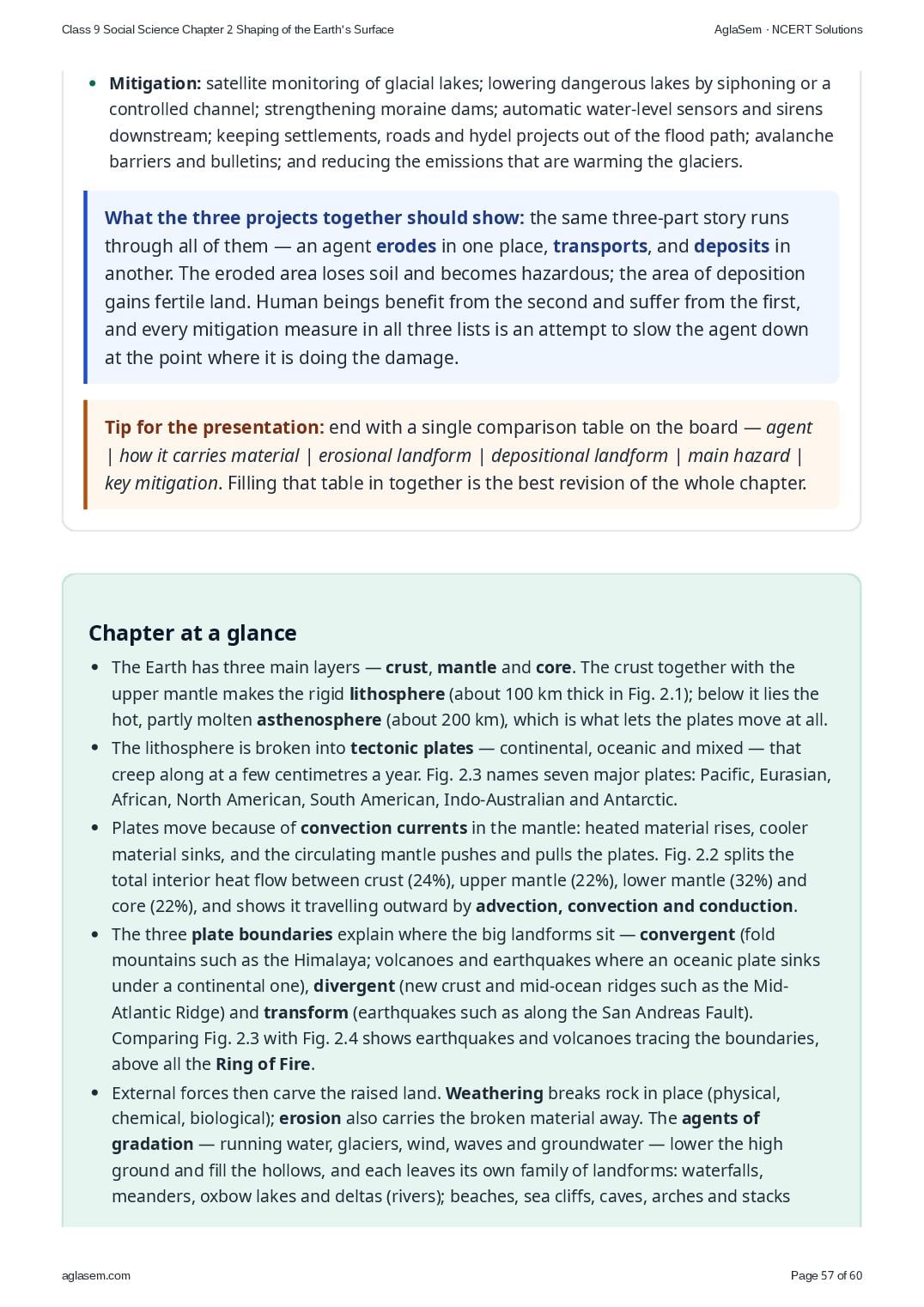
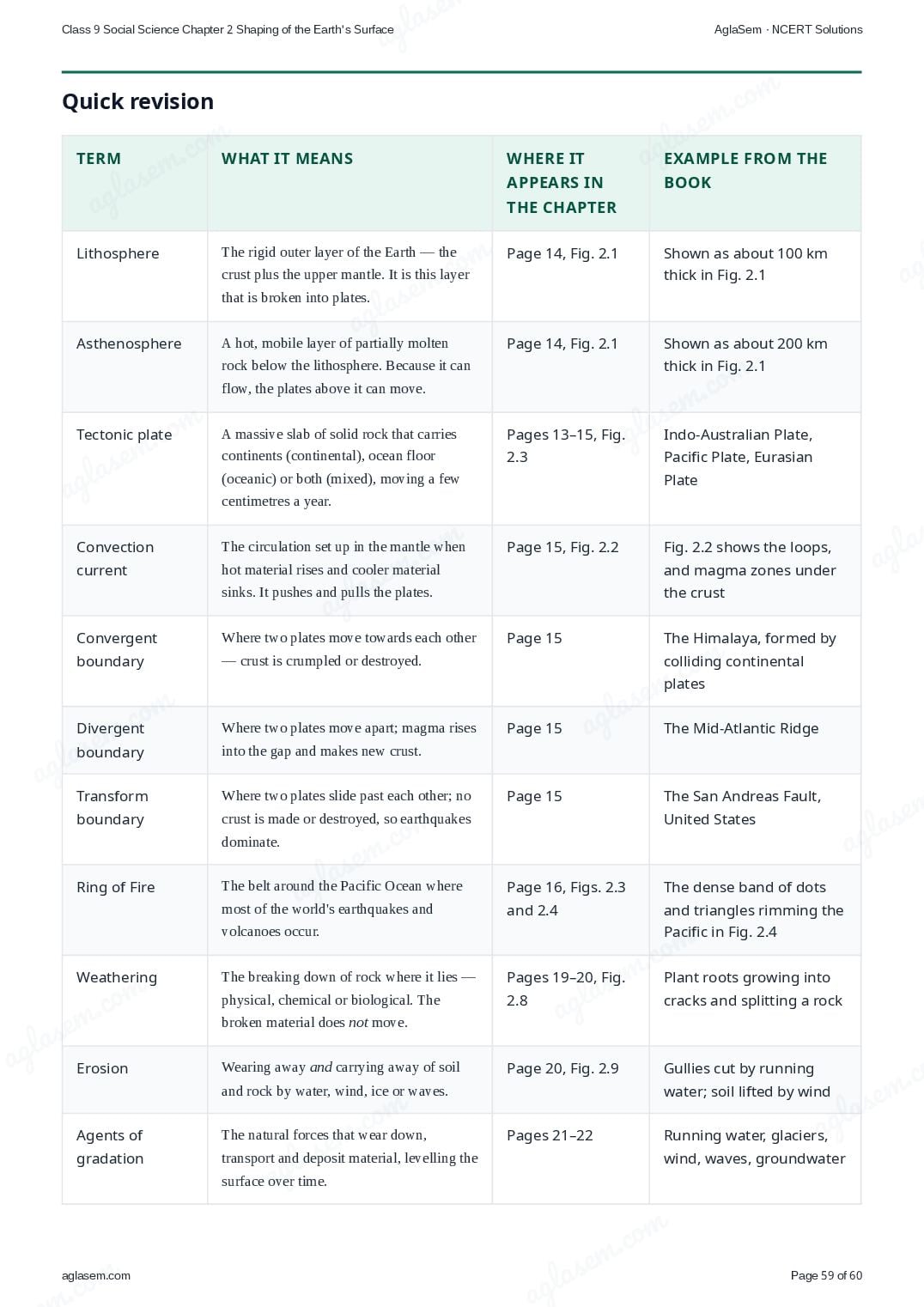
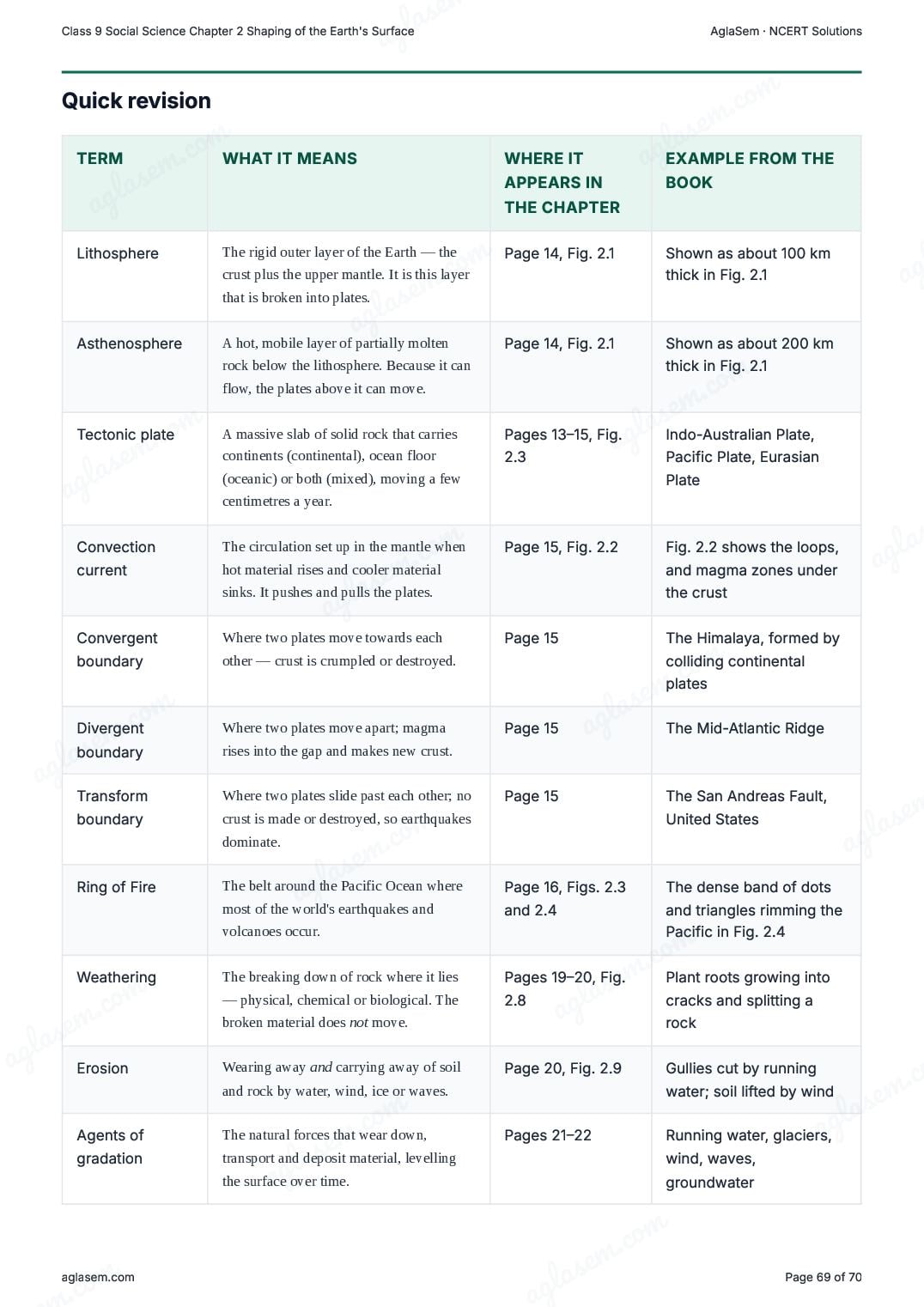
- The Earth has three main layers — crust , mantle and core . The crust together with the upper mantle makes the rigid lithosphere (about 100 km thick in Fig. 2.1); below it lies the hot, partly molten asthenosphere (about 200 km), which is what lets the plates move at all.
- The lithosphere is broken into tectonic plates — continental, oceanic and mixed — that creep along at a few centimetres a year. Fig. 2.3 names seven major plates: Pacific, Eurasian, African, North American, South American, Indo-Australian and Antarctic.
- Plates move because of convection currents in the mantle: heated material rises, cooler material sinks, and the circulating mantle pushes and pulls the plates. Fig. 2.2 splits the total interior heat flow between crust (24%), upper mantle (22%), lower mantle (32%) and core (22%), and shows it travelling outward by advection, convection and conduction .
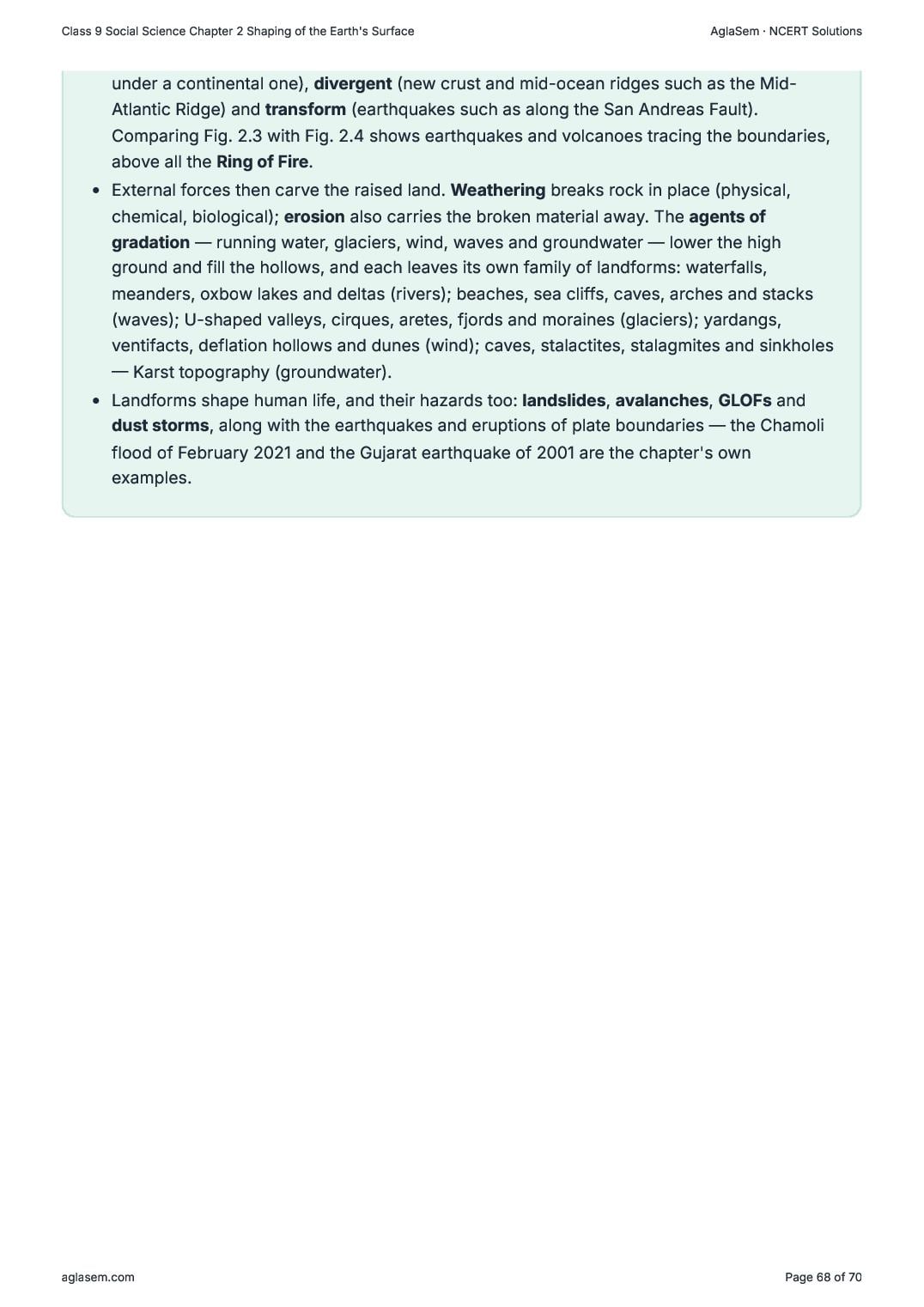
- The three plate boundaries explain where the big landforms sit — convergent (fold mountains such as the Himalaya; volcanoes and earthquakes where an oceanic plate sinks under a continental one), divergent (new crust and mid-ocean ridges such as the Mid-Atlantic Ridge) and transform (earthquakes such as along the San Andreas Fault). Comparing Fig. 2.3 with Fig. 2.4 shows earthquakes and volcanoes tracing the boundaries, above all the Ring of Fire .
- External forces then carve the raised land. Weathering breaks rock in place (physical, chemical, biological); erosion also carries the broken material away. The agents of gradation — running water, glaciers, wind, waves and groundwater — lower the high ground and fill the hollows, and each leaves its own family of landforms: waterfalls, meanders, oxbow lakes and deltas (rivers); beaches, sea cliffs, caves, arches and stacks (waves); U-shaped valleys, cirques, aretes, fjords and moraines (glaciers); yardangs, ventifacts, deflation hollows and dunes (wind); caves, stalactites, stalagmites and sinkholes — Karst topography (groundwater).
- Landforms shape human life, and their hazards too: landslides , avalanches , GLOFs and dust storms , along with the earthquakes and eruptions of plate boundaries — the Chamoli flood of February 2021 and the Gujarat earthquake of 2001 are the chapter's own examples.
How to Download NCERT Solutions for Class 9 Social Science Chapter 2 PDF
Follow these simple steps to get the Shaping of the Earth’s Surface questions-and-answers PDF from Understanding Society: India and Beyond.
- Search NCERT Solutions for Class 9 Social Science Chapter 2 aglasem and open this page.
- Read the exercise questions with answers for Shaping of the Earth’s Surface shown above.
- Click the Download PDF link to save the Shaping of the Earth’s Surface solutions to your device.
NCERT Solutions for Class 9 Social Science – All Chapters
There are more chapters to study besides Shaping of the Earth’s Surface in Social Science. Here are the NCERT Solutions for all chapters of Class 9 Social Science.
- Chapter 1 Understanding Social Science
- Chapter 2 Shaping of the Earth’s Surface
- Chapter 3 Atmosphere and Climate
- Chapter 4 Early Humans and Beginning of Civilisation
- Chapter 5 State and Society Up to 1000 Ce
- Chapter 6 Democracy
- Chapter 7 Elections
- Chapter 8 Building Blocks in Economics the Problem of Choice
- Chapter 9 The Price Puzzle What Drives the Market
NCERT Solutions for Class 9 – All Subjects
Just like Chapter 2 of Social Science, you can get the exercise questions with answers for every other subject of Class 9. Here are the NCERT Solutions for all subjects of Class 9.
NCERT Solutions for Class 9 Social Science Chapter 2 – An Overview
The key highlights of this study material are as follows.
| Aspects | Details |
|---|---|
| Class | Class 9 |
| Subject | Social Science |
| Chapter Number | Chapter 2 |
| Chapter Name | Shaping of the Earth’s Surface |
| Book Name | Understanding Society: India and Beyond |
| Book By | NCERT (National Council of Educational Research and Training) |
| Educational Resource Here | NCERT Solutions of Class 9 Social Science Chapter 2 for all exercises |
| More Questions Answers of This Subject | NCERT Solutions for Class 9 Social Science |
| Download Book Chapter | NCERT Book Class 9 Social Science |
| All Questions Answers For This Class | NCERT Solutions for Class 9 |
| Complete Solutions | NCERT Solutions |
NCERT Solutions for Class 9 Social Science Chapter 2 Shaping of the Earth’s Surface – FAQs
What are the NCERT Solutions for Class 9 Social Science Chapter 2 Shaping of the Earth’s Surface?
They are the complete, step-by-step answers to all the exercise and in-text questions of Chapter 2 Shaping of the Earth’s Surface from the NCERT Class 9 Social Science textbook Understanding Society: India and Beyond, written by experts as per the latest NCERT syllabus.
How can I download the Class 9 Social Science Chapter 2 solutions PDF for free?
Open this page on aglasem, read the Shaping of the Earth’s Surface questions with answers, and click the “Download Solutions PDF” link. The Class 9 Social Science Chapter 2 NCERT Solutions PDF is completely free to download.
Are these NCERT Solutions as per the latest 2026-27 syllabus?
Yes. The NCERT Solutions for Class 9 Social Science Chapter 2 are based on the latest NCERT textbook Understanding Society: India and Beyond and the current 2026-27 CBSE syllabus, so the questions and answers match what you study in class.
Where can I get NCERT Solutions for the other chapters of Class 9 Social Science?
You can find the answers to every chapter on the NCERT Solutions for Class 9 Social Science page, and solutions for every subject on the NCERT Solutions for Class 9 page.
How do NCERT Solutions help in exam preparation?
They show the correct method to solve each question, help you write answers the way they are expected in exams, let you check and correct your own work, and save revision time — which together improve your marks in Class 9 Social Science.
If you have any queries on NCERT Solutions for Class 9 Social Science Chapter 2 Shaping of the Earth’s Surface, then please ask in the comments below.