NCERT Solutions for Class 9 Social Science Chapter 5 State and Society Up to 1000 Ce provide clear, step-by-step answers to every exercise and in-text question from the chapter State and Society Up to 1000 Ce of the NCERT textbook Understanding Society: India and Beyond. Prepared by subject experts as per the latest NCERT (CBSE) syllabus for 2026-27, these NCERT Solutions for Class 9 Social Science help you understand each concept, write exam-ready answers, and check your own solutions. You can read them online below or download the free Class 9 Social Science Chapter 5 question-answer PDF.
NCERT Solutions for Class 9 Social Science Chapter 5 State and Society Up to 1000 Ce
- Class: Class 9
- Subject: Social Science
- Chapter: Chapter 5 – State and Society Up to 1000 Ce
- Textbook: Understanding Society: India and Beyond (NCERT)
- Study material: NCERT Solutions – questions with answers, free PDF
These solutions answer all the exercise questions of Chapter 5 State and Society Up to 1000 Ce — including the in-text questions, short-answer and long-answer questions, and activities — with complete explanations so you can follow the method, not just the final answer. Read the full solutions below.
NCERT Solutions Class 9 Social Science Chapter 5 State and Society Up to 1000 Ce View Download

NCERT Solutions for Class 9 Social Science Chapter 5 PDF Download
You can read the NCERT Solutions for Class 9 Social Science Chapter 5 online above, or download the complete question-answer PDF to study State and Society Up to 1000 Ce offline at any time.
NCERT Solutions for Class 9 Social Science Chapter 5 PDF Download Link – Click Here to Download Solutions PDF
Questions Covered in This Chapter
These NCERT Solutions answer all 46 questions of this chapter. The questions solved are:
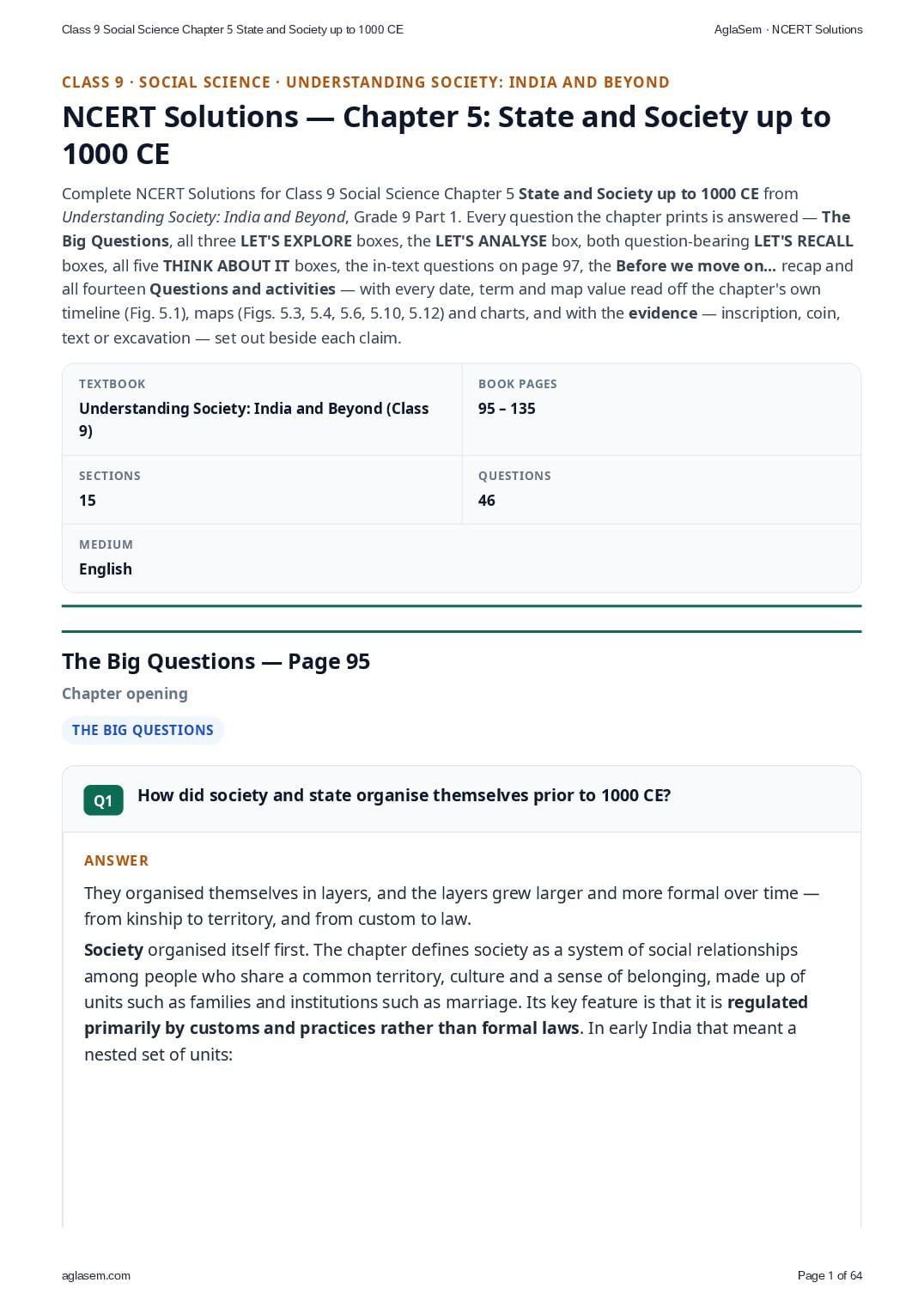
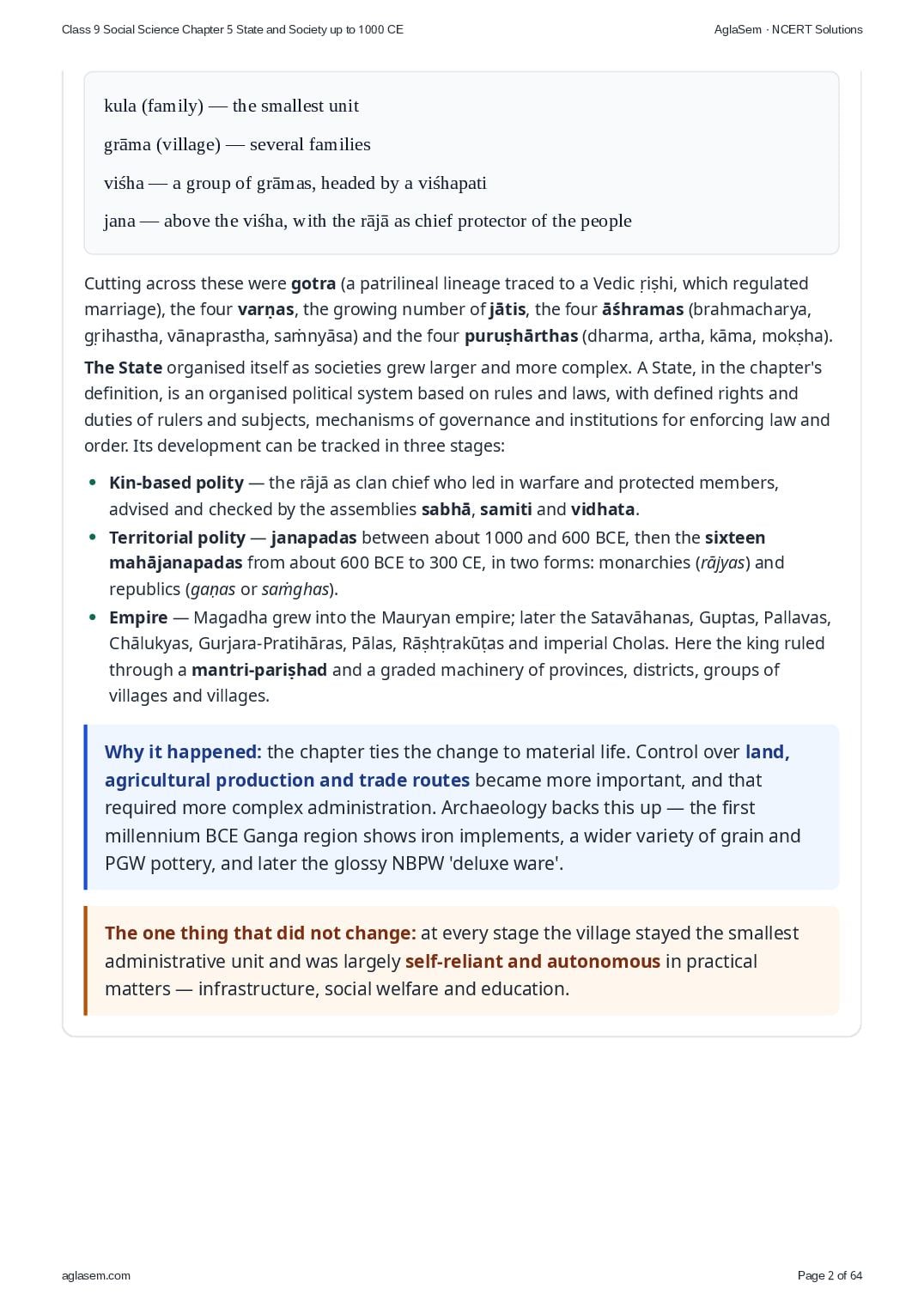
- How did society and state organise themselves prior to 1000 CE?
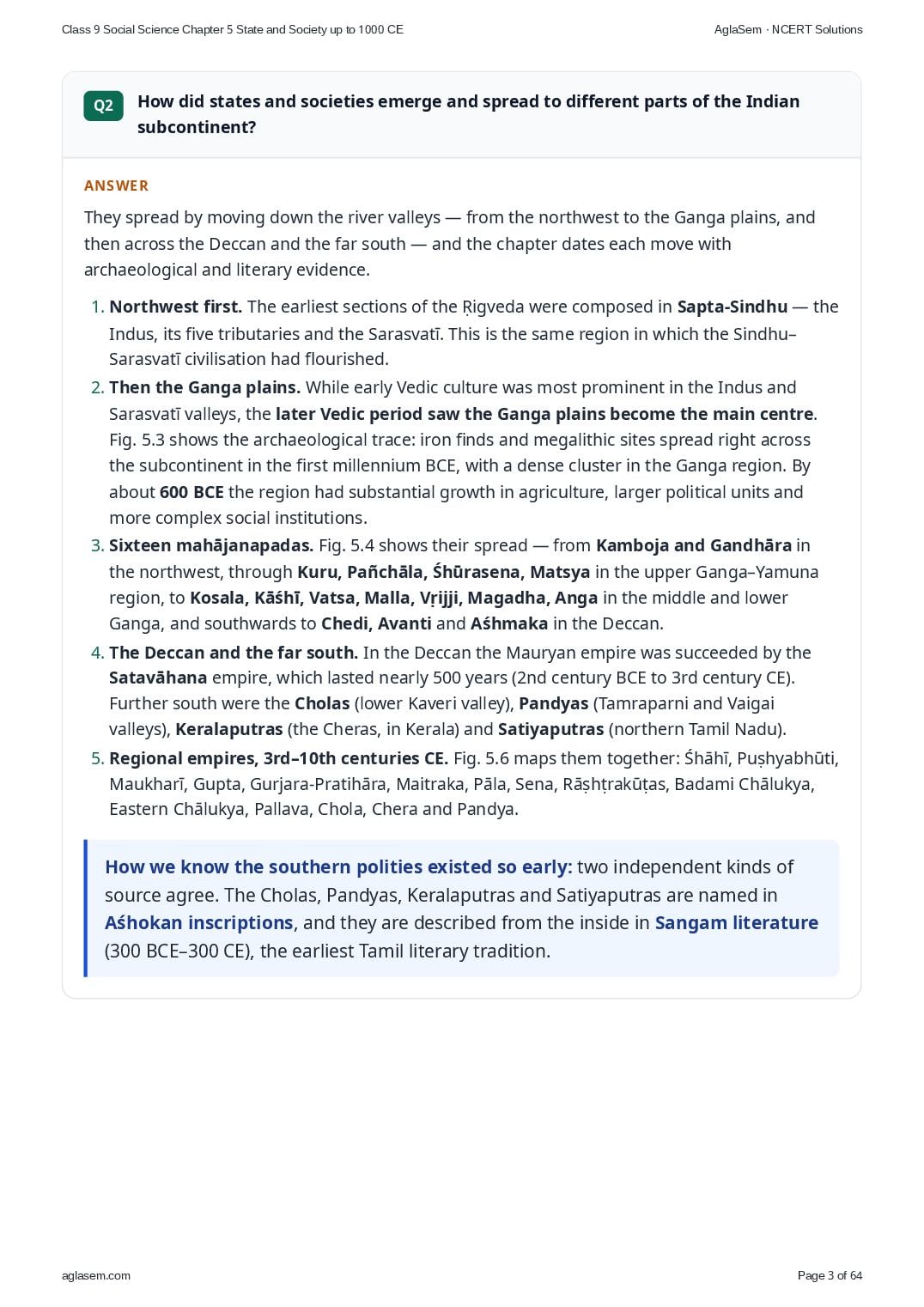
- How did states and societies emerge and spread to different parts of the Indian subcontinent?
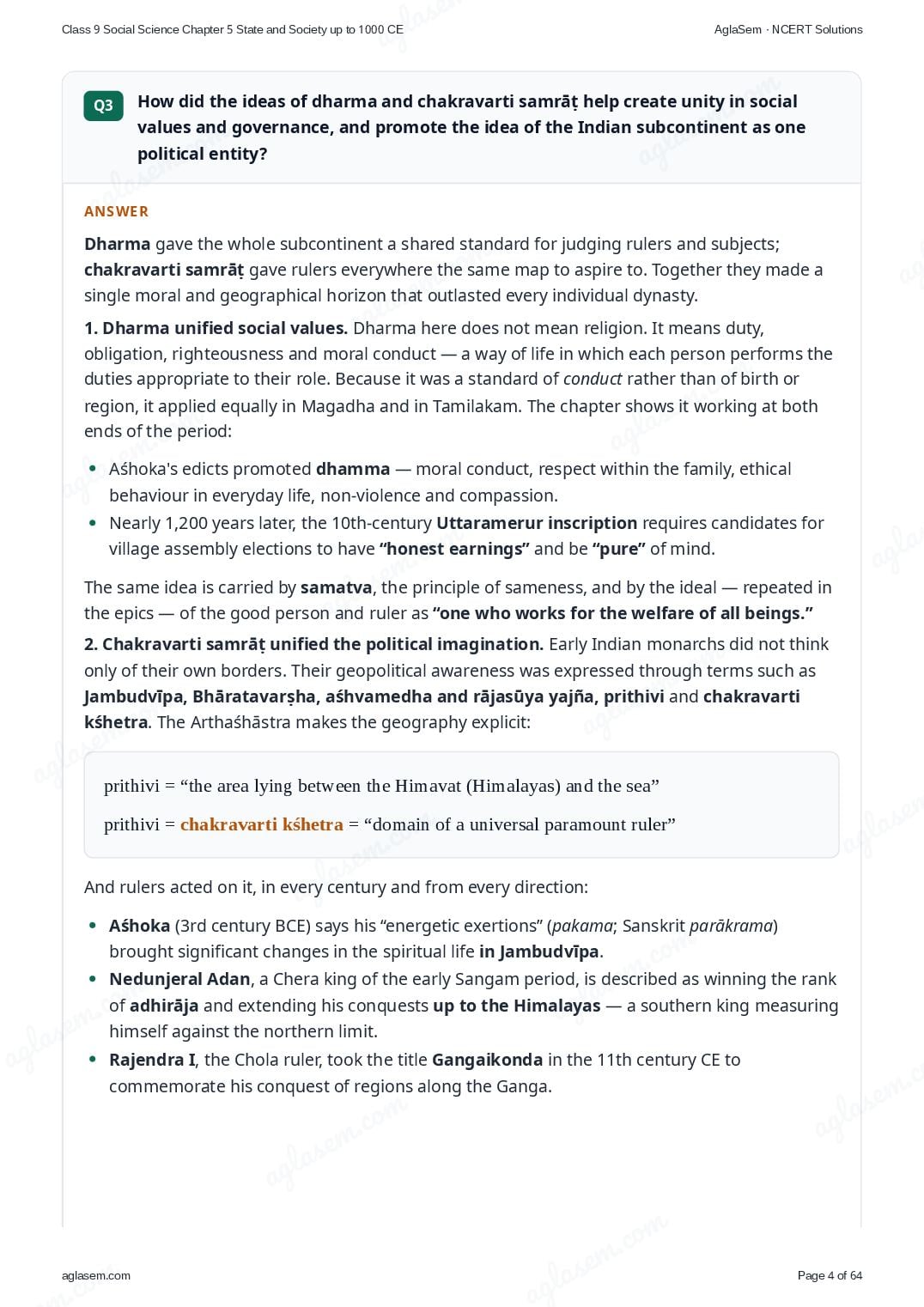
- How did the ideas of dharma and chakravarti samrāṭ help create unity in social values and governance, and promote the idea of the Indian subcontinent as one political entity?
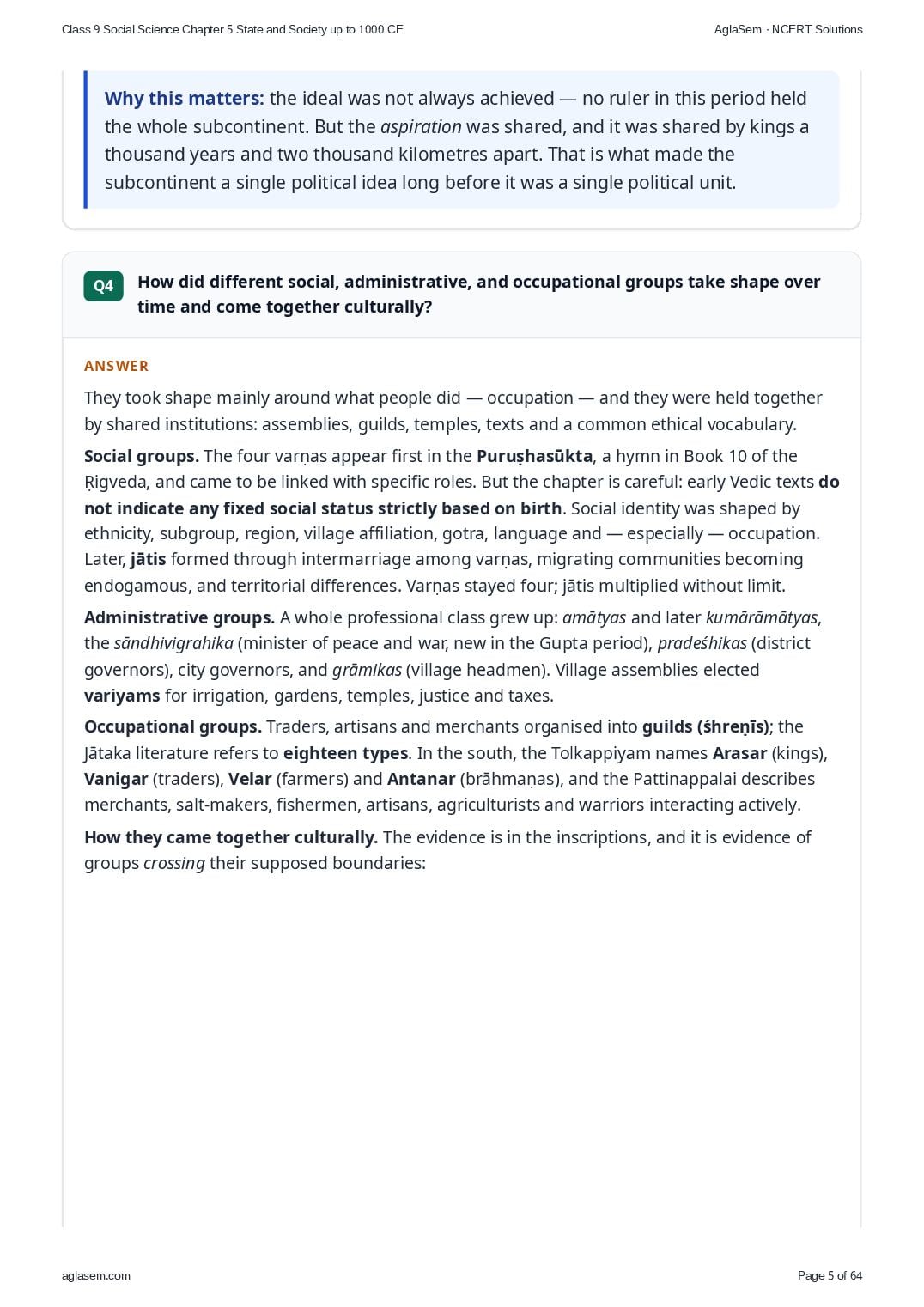
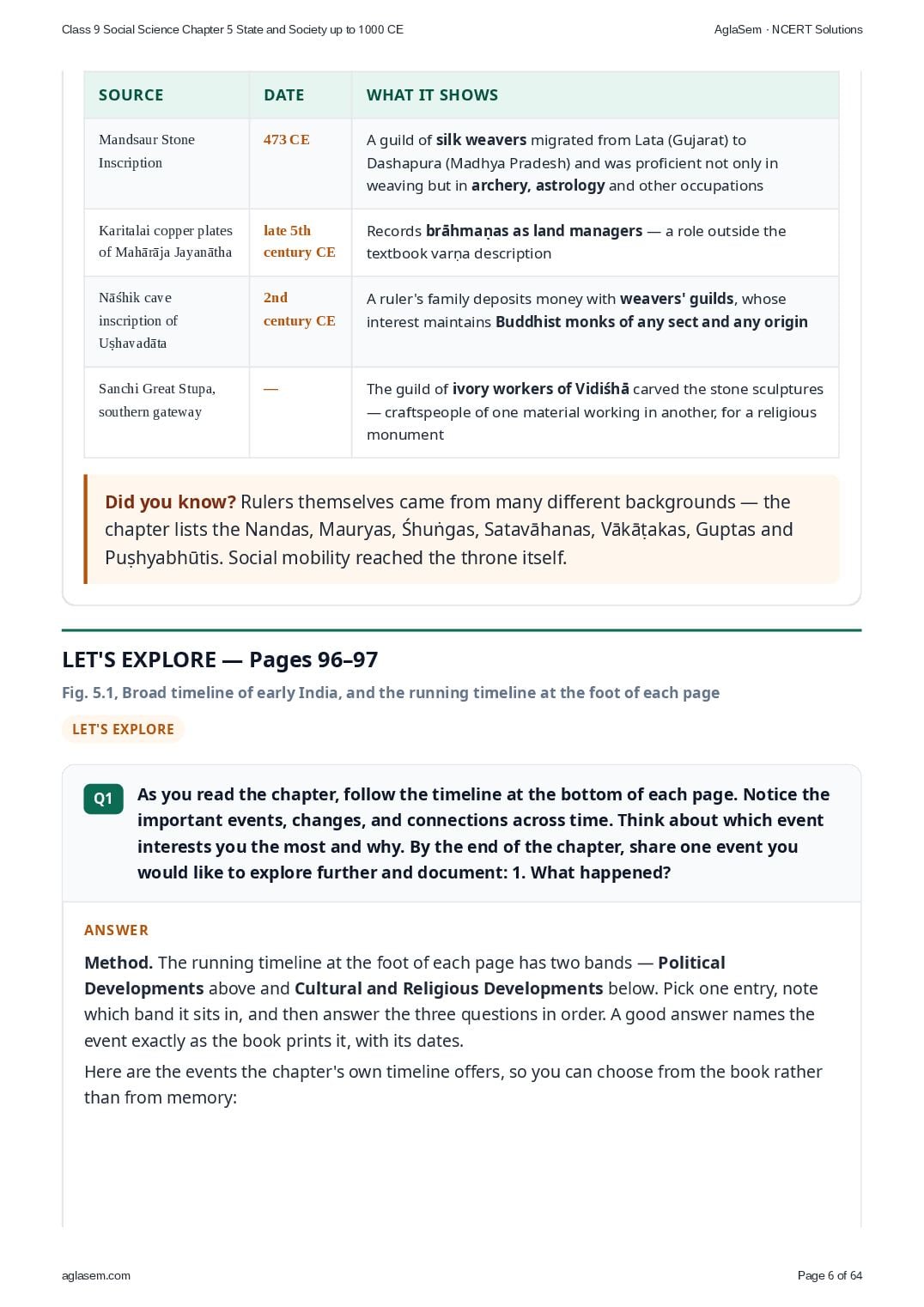
- How did different social, administrative, and occupational groups take shape over time and come together culturally?
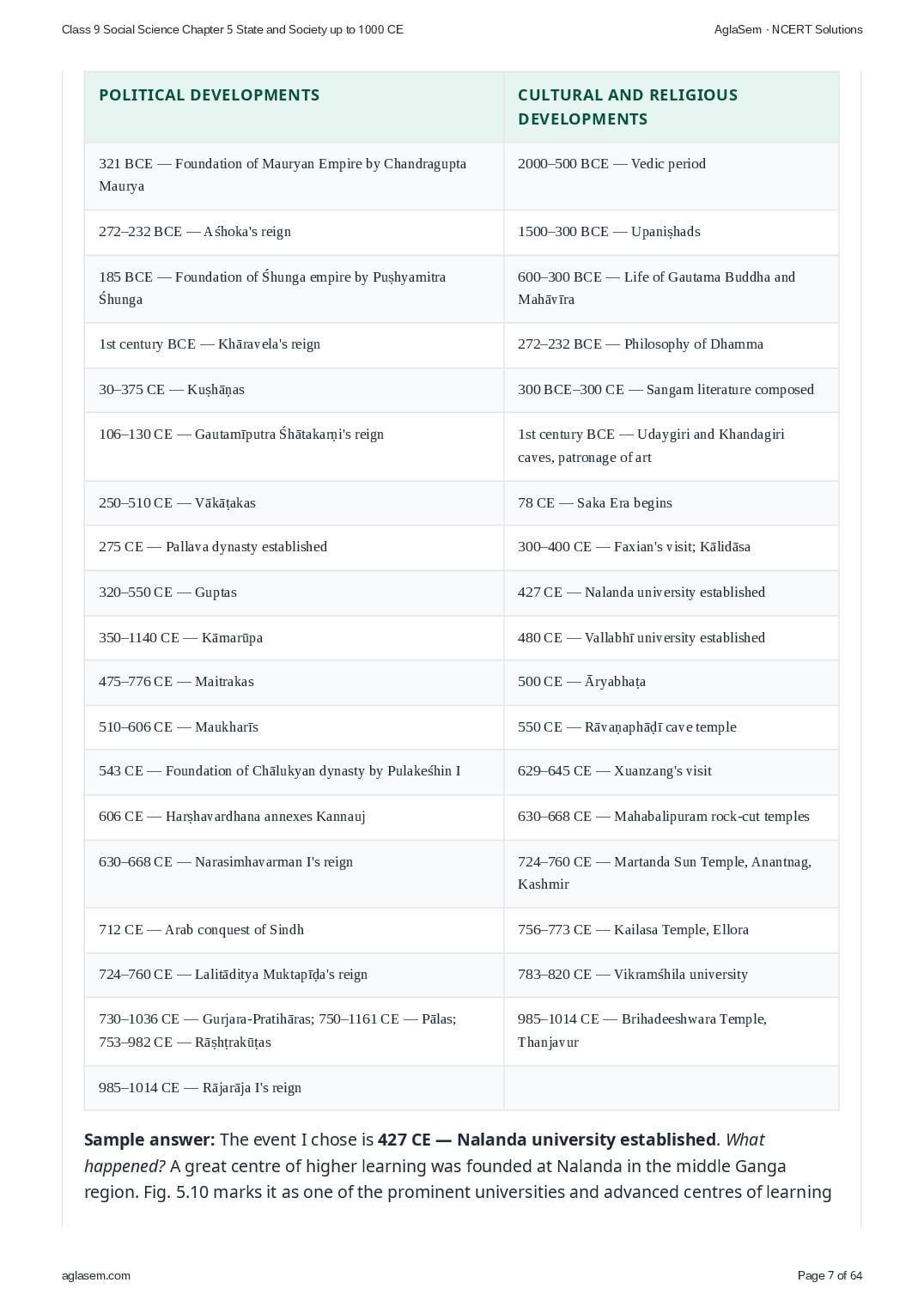
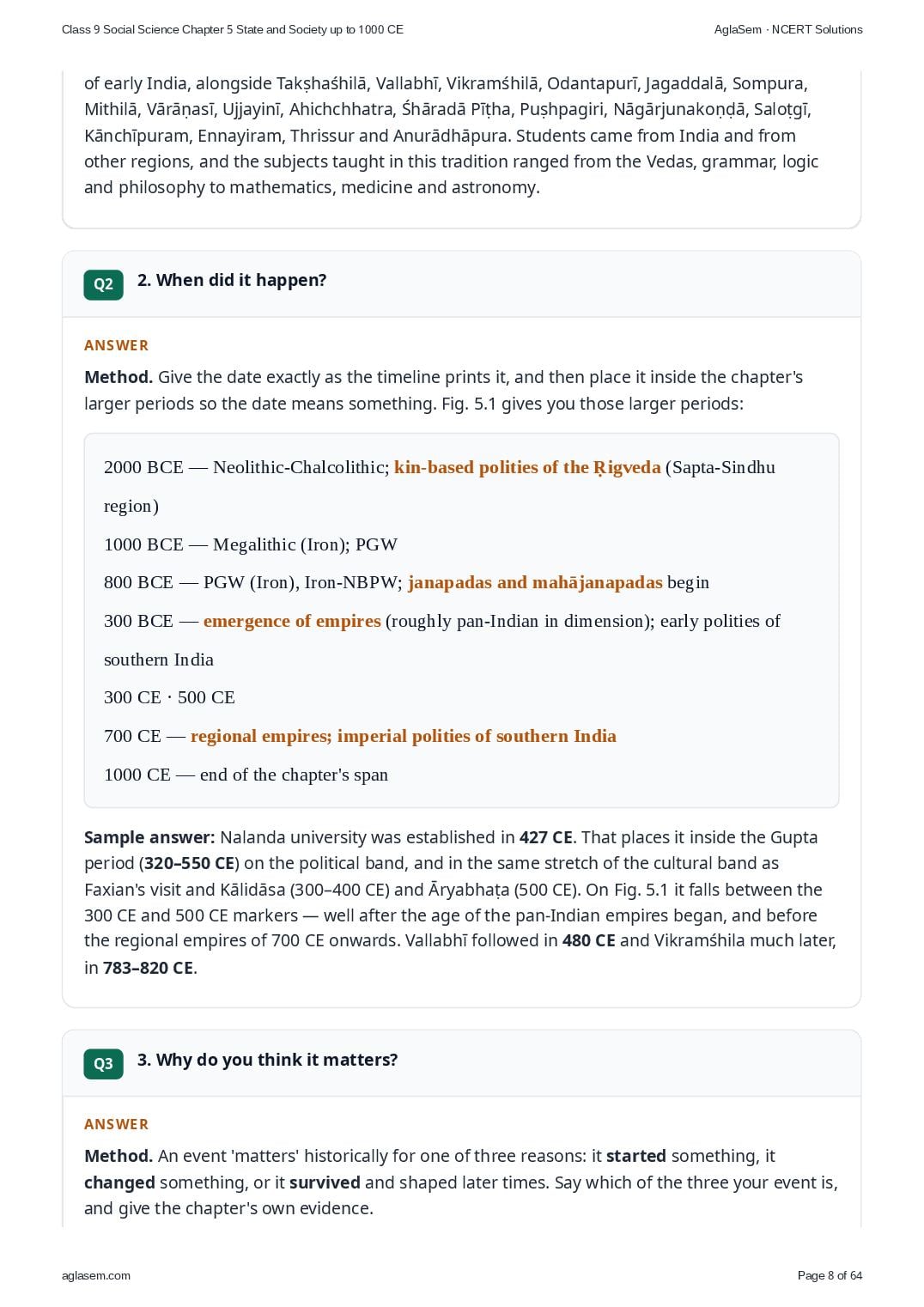
- As you read the chapter, follow the timeline at the bottom of each page. Notice the important events, changes, and connections across time. Think about which event interests you the most and why. By the end of the chapter, share one event you would like to explore further and document: 1. What happened?
- 2. When did it happen?
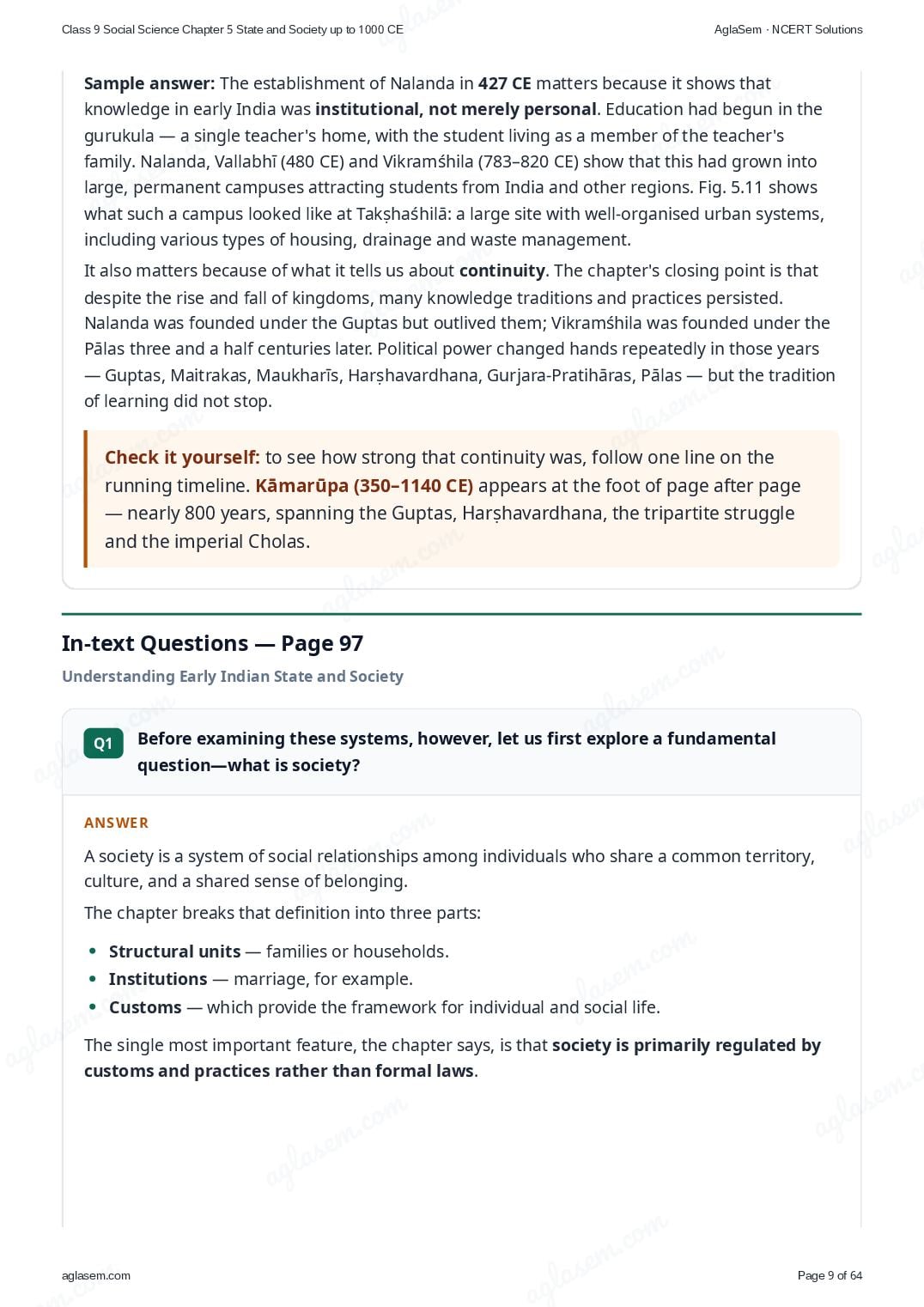
- 3. Why do you think it matters?
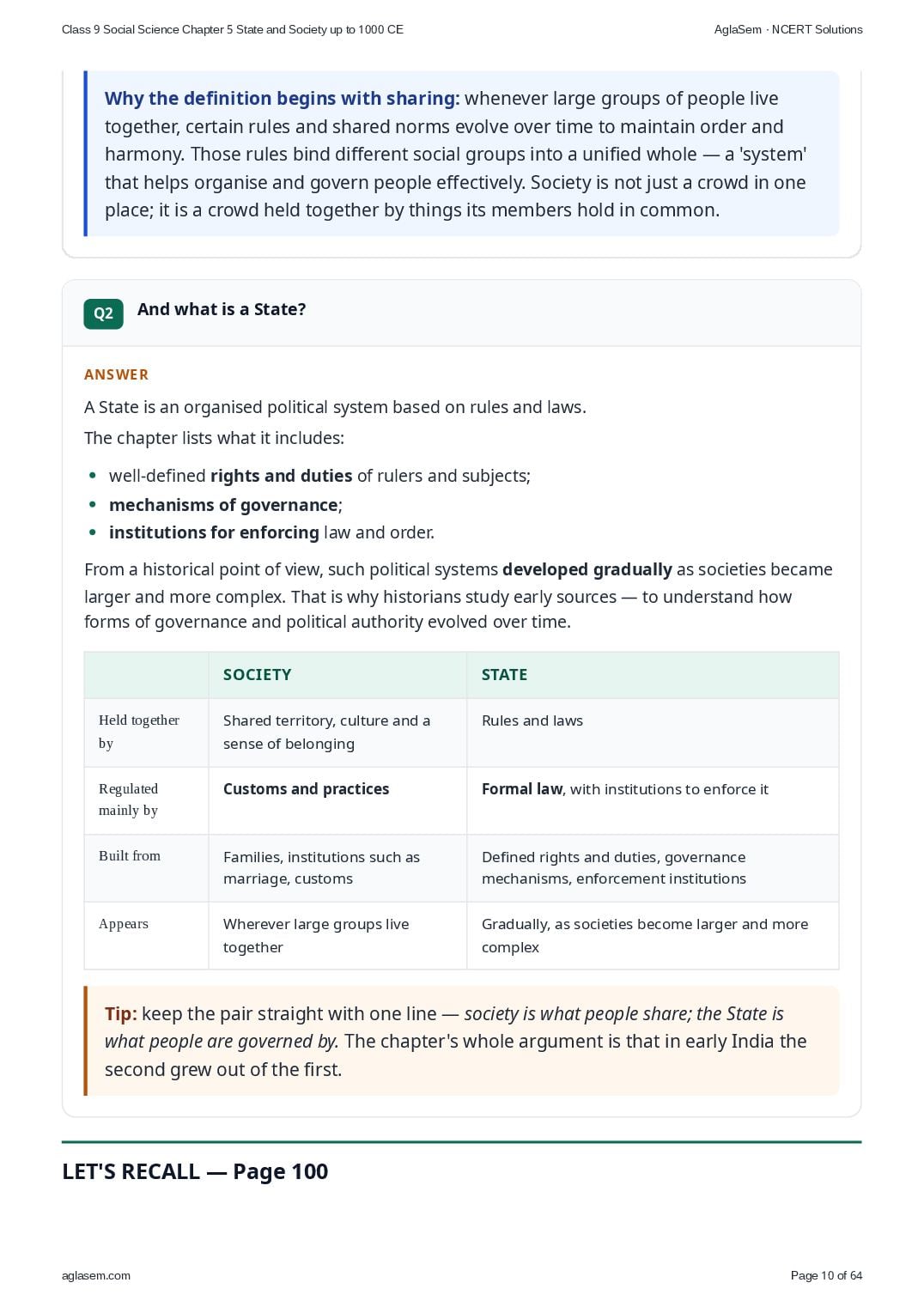
- Before examining these systems, however, let us first explore a fundamental question—what is society?
- And what is a State?
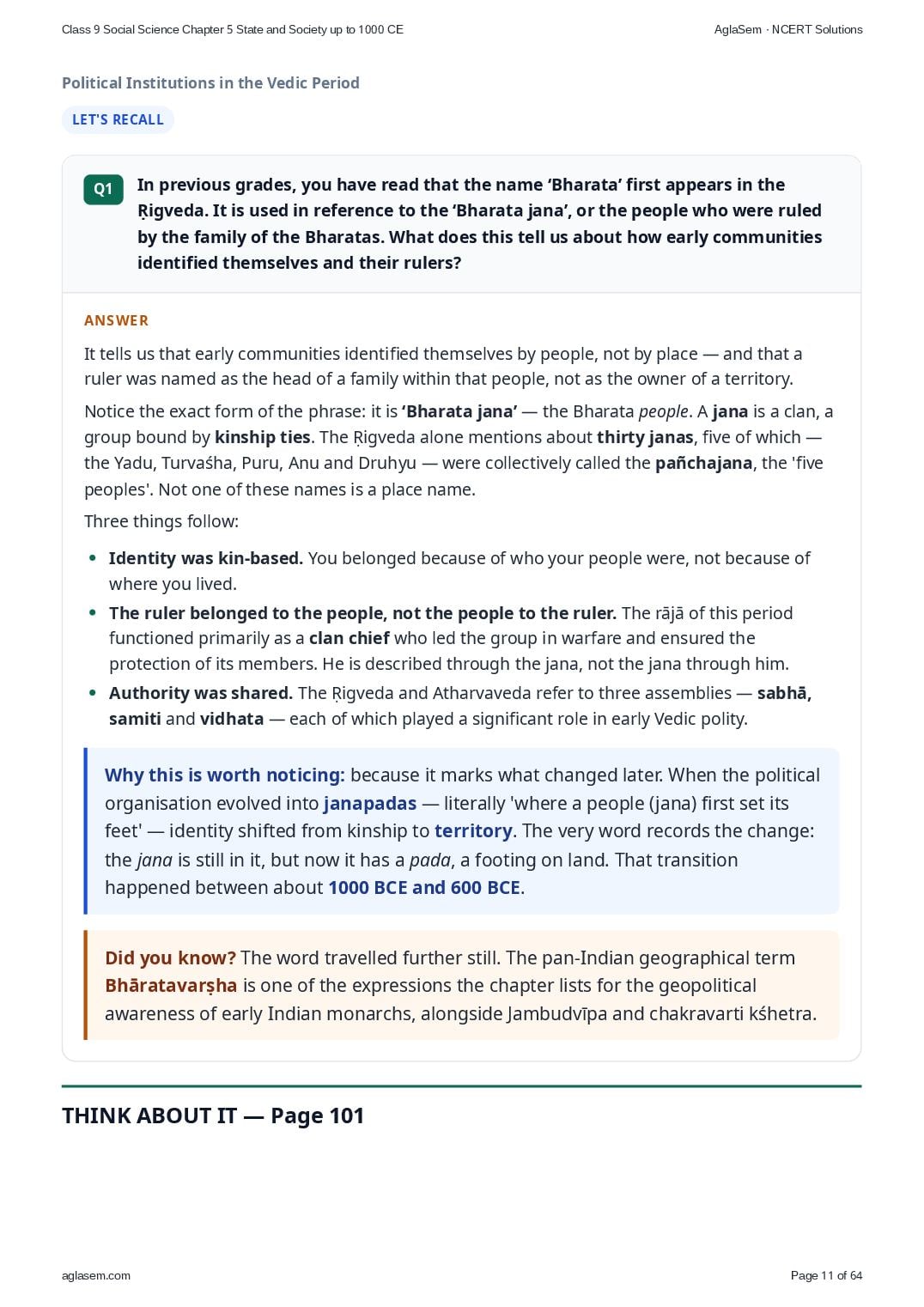
- In previous grades, you have read that the name ‘Bharata’ first appears in the Ṛigveda. It is used in reference to the ‘Bharata jana’, or the people who were ruled by the family of the Bharatas. What does this tell us about how early communities identified themselves and their rulers?
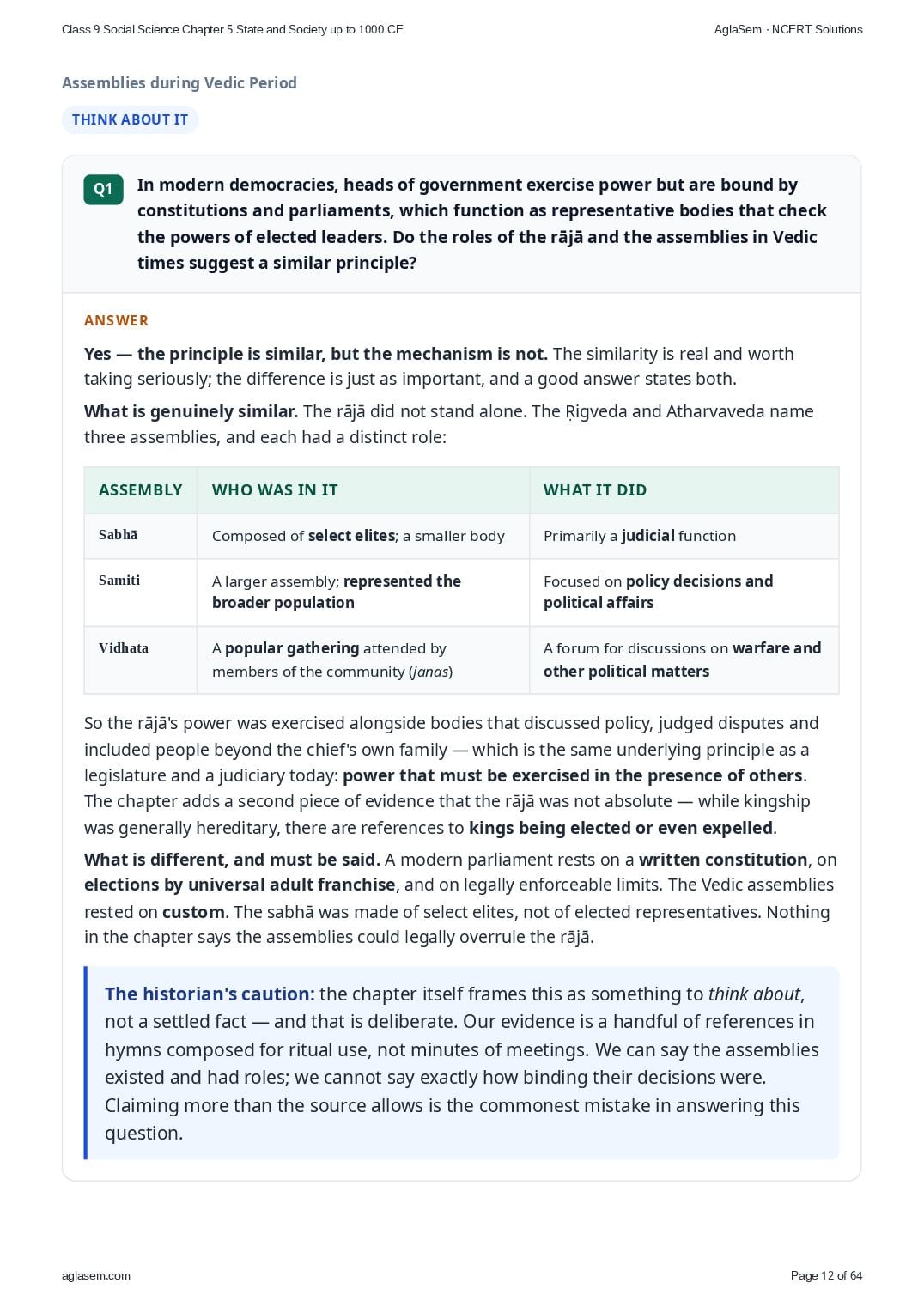
- In modern democracies, heads of government exercise power but are bound by constitutions and parliaments, which function as representative bodies that check the powers of elected leaders. Do the roles of the rājā and the assemblies in Vedic times suggest a similar principle?
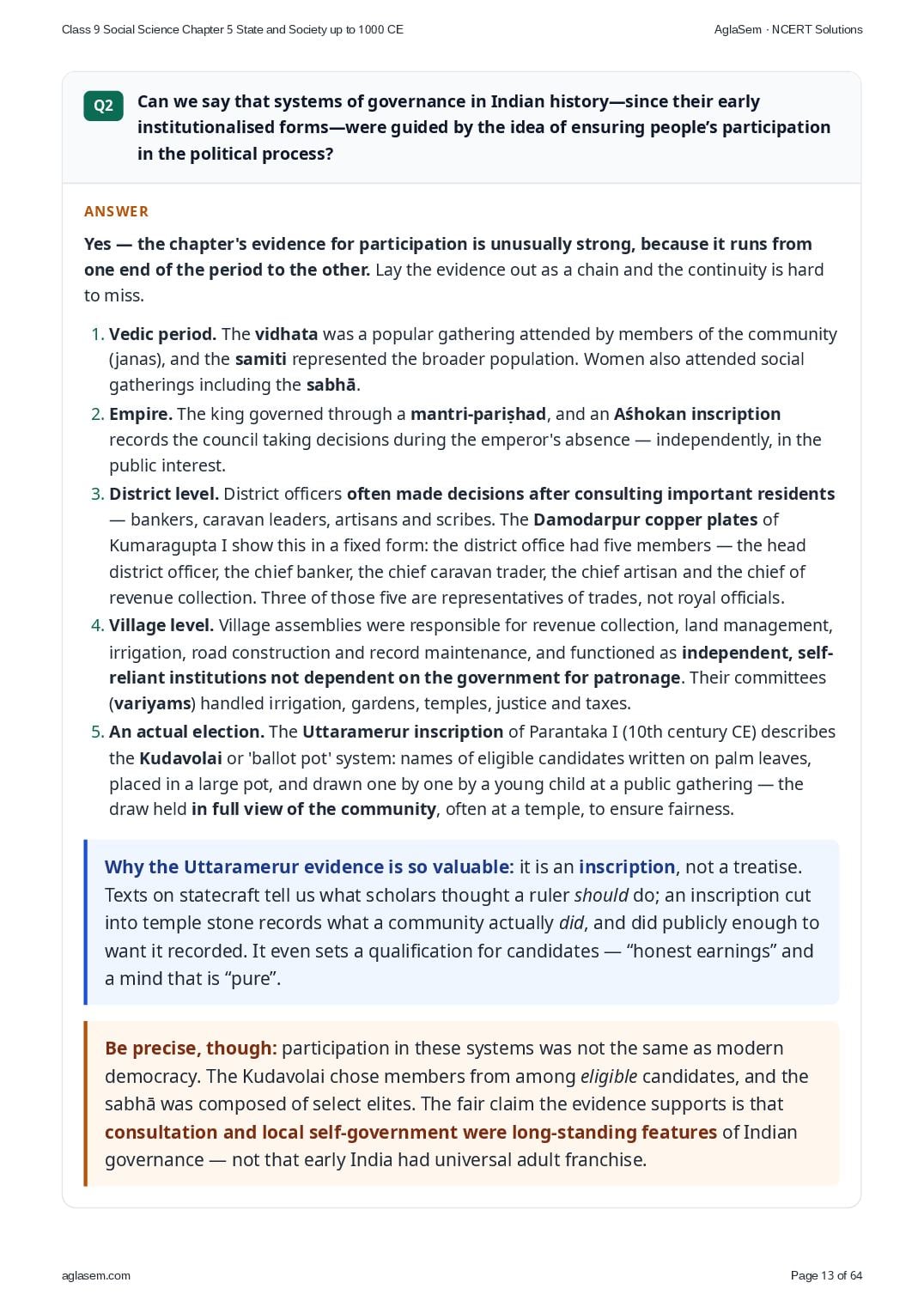
- Can we say that systems of governance in Indian history—since their early institutionalised forms—were guided by the idea of ensuring people’s participation in the political process?
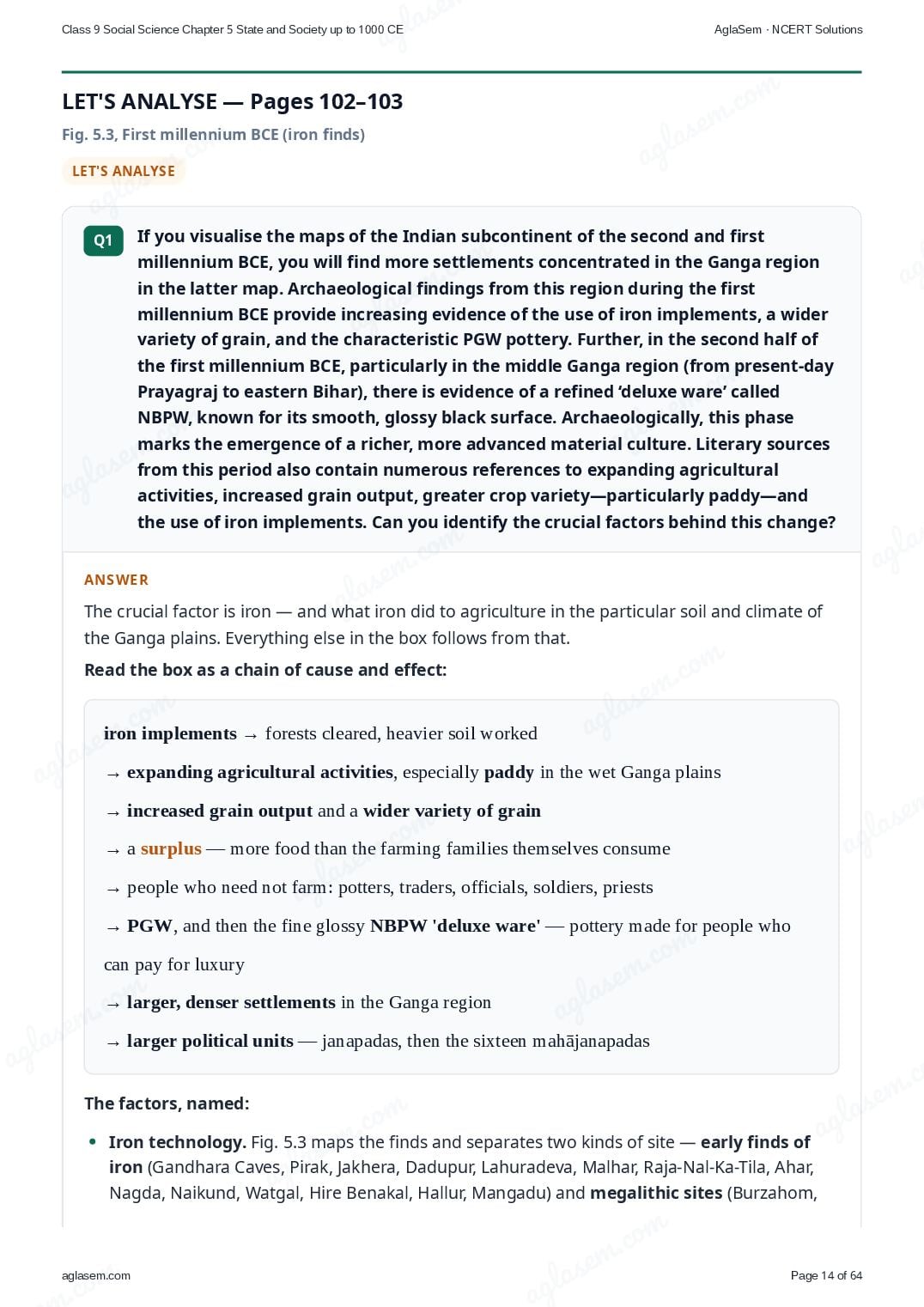
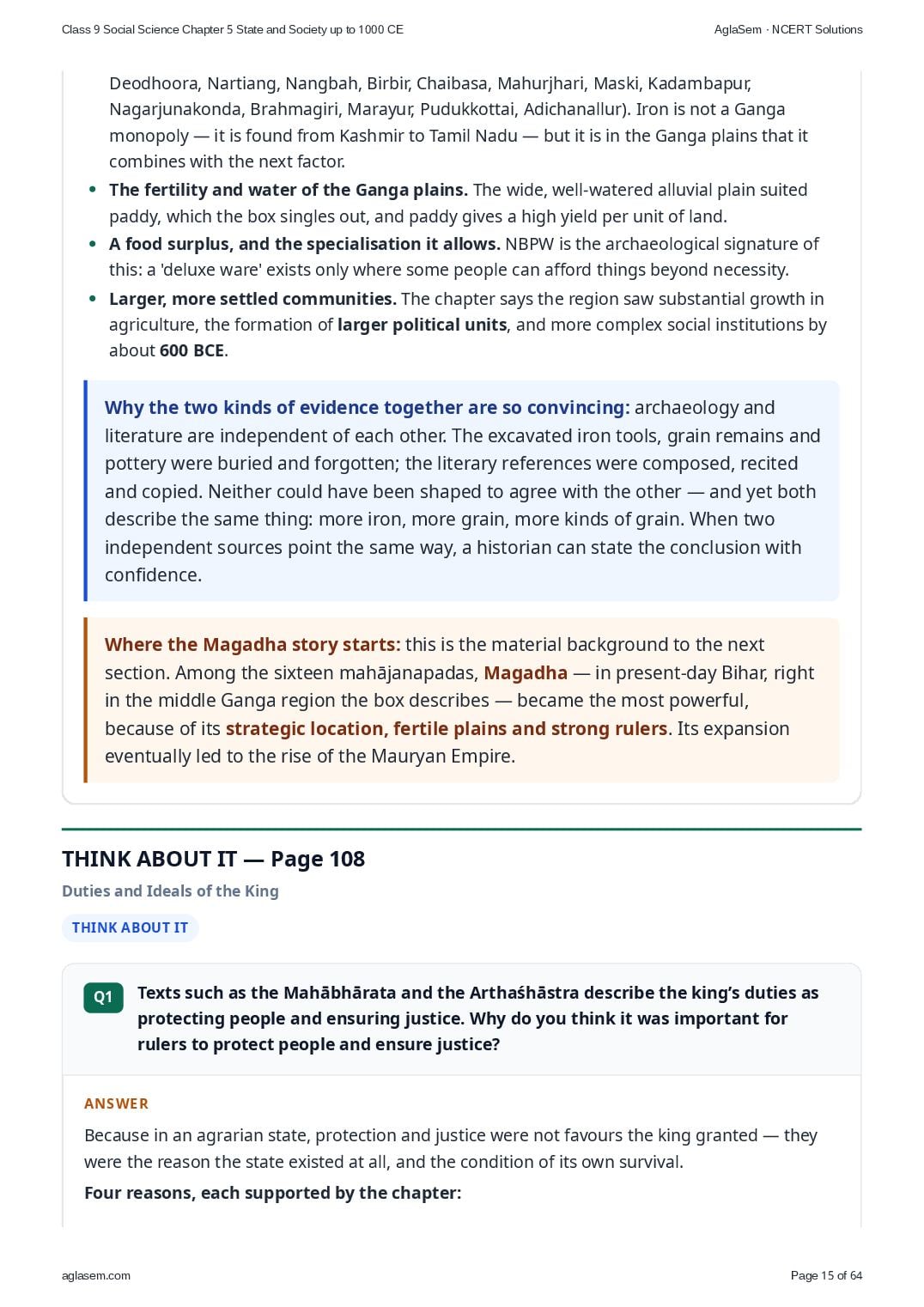
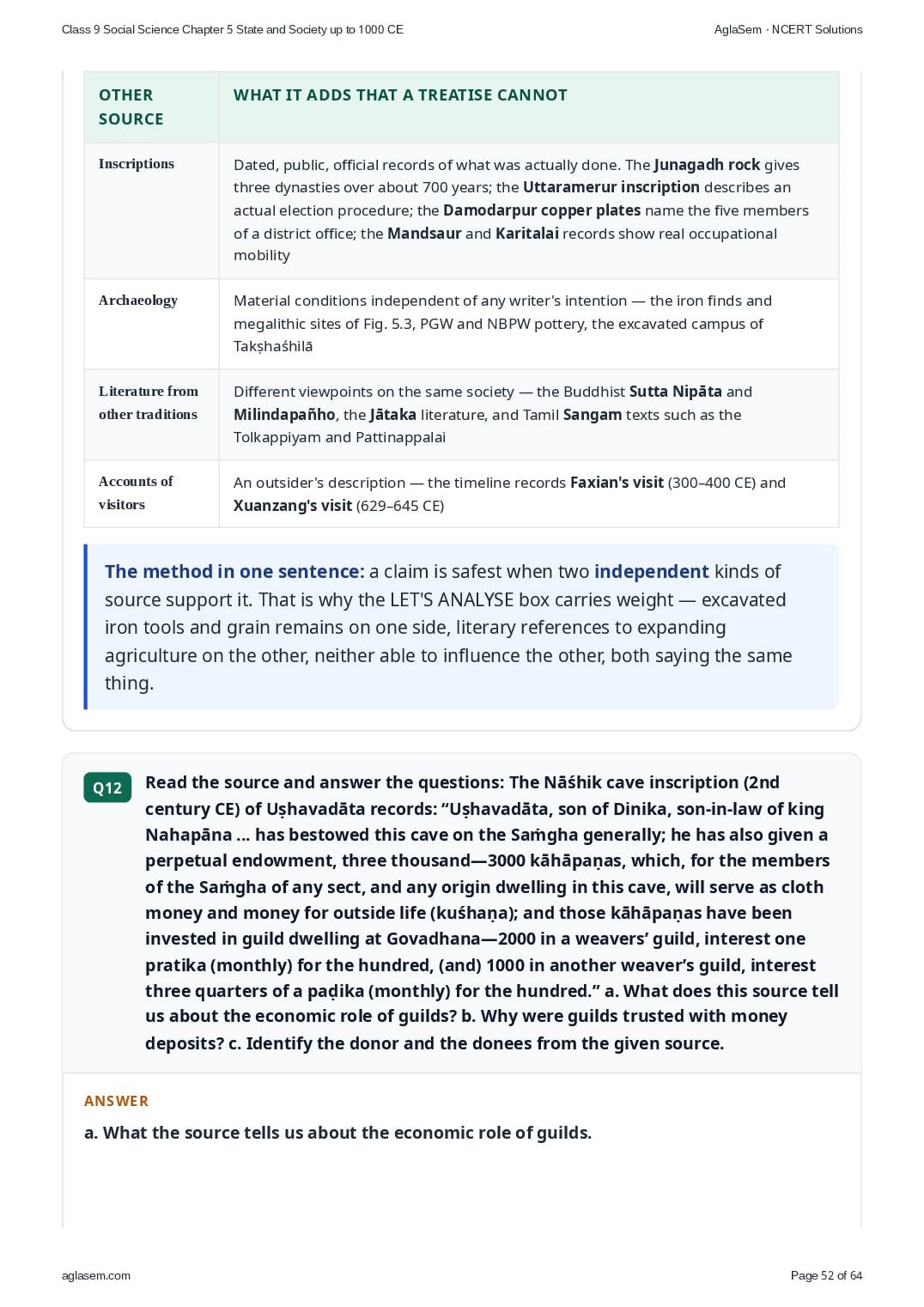
- If you visualise the maps of the Indian subcontinent of the second and first millennium BCE, you will find more settlements concentrated in the Ganga region in the latter map. Archaeological findings from this region during the first millennium BCE provide increasing evidence of the use of iron implements, a wider variety of grain, and the characteristic PGW pottery. Further, in the second half of the first millennium BCE, particularly in the middle Ganga region (from present-day Prayagraj to eastern Bihar), there is evidence of a refined ‘deluxe ware’ called NBPW, known for its smooth, glossy black surface. Archaeologically, this phase marks the emergence of a richer, more advanced material culture. Literary sources from this period also contain numerous references to expanding agricultural activities, increased grain output, greater crop variety—particularly paddy—and the use of iron implements. Can you identify the crucial factors behind this change?
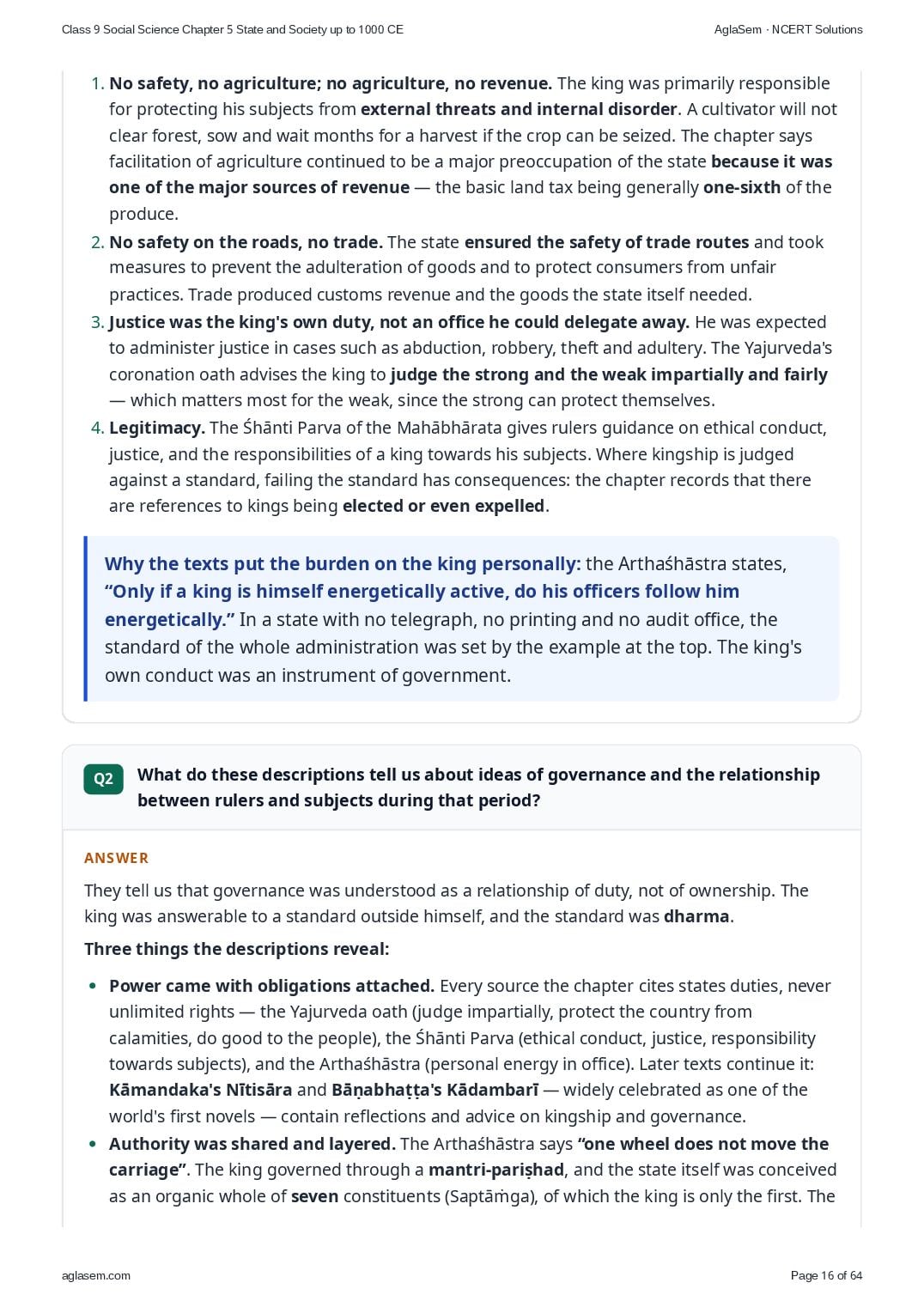
- Texts such as the Mahābhārata and the Arthaśhāstra describe the king’s duties as protecting people and ensuring justice. Why do you think it was important for rulers to protect people and ensure justice?
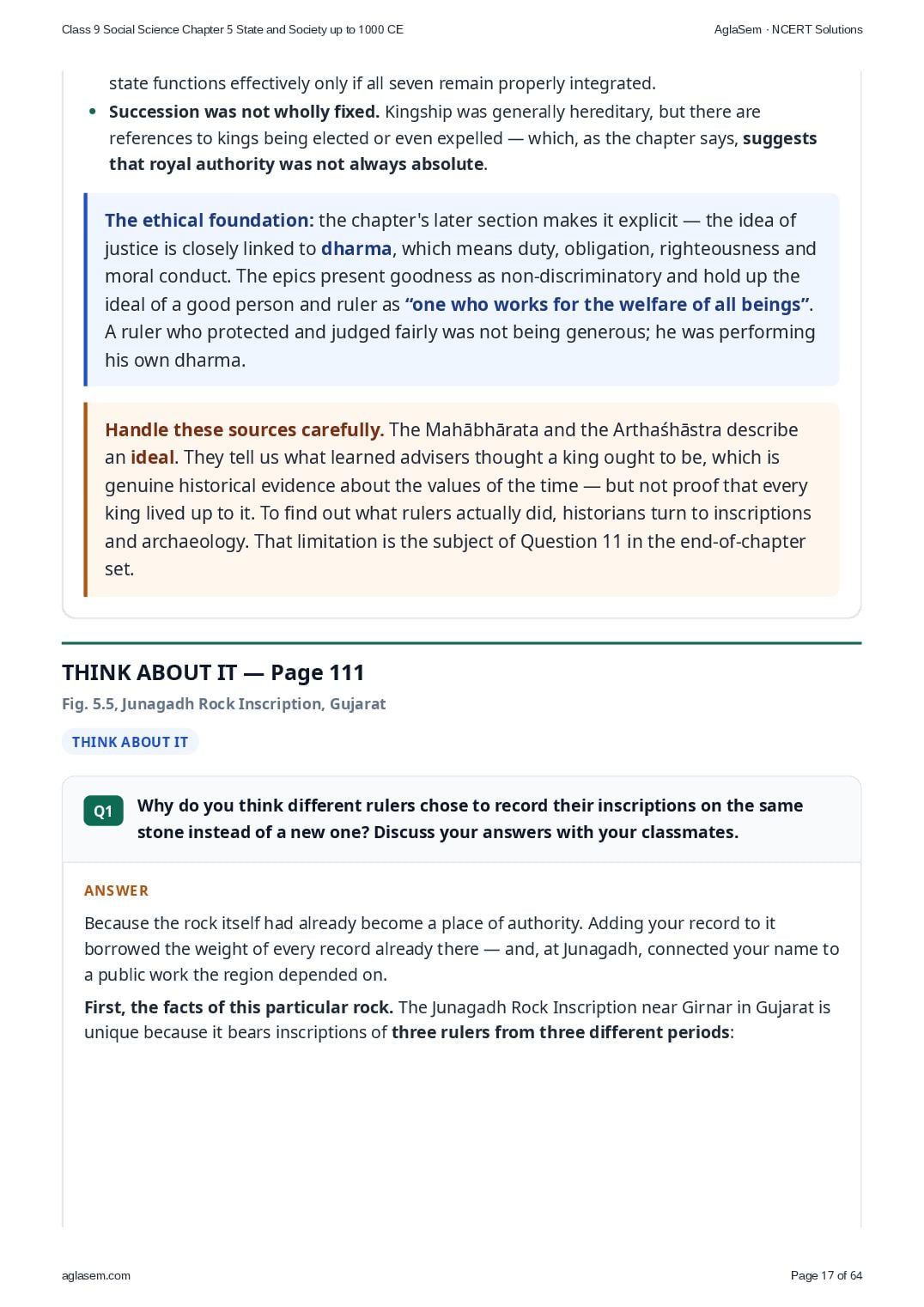
- What do these descriptions tell us about ideas of governance and the relationship between rulers and subjects during that period?
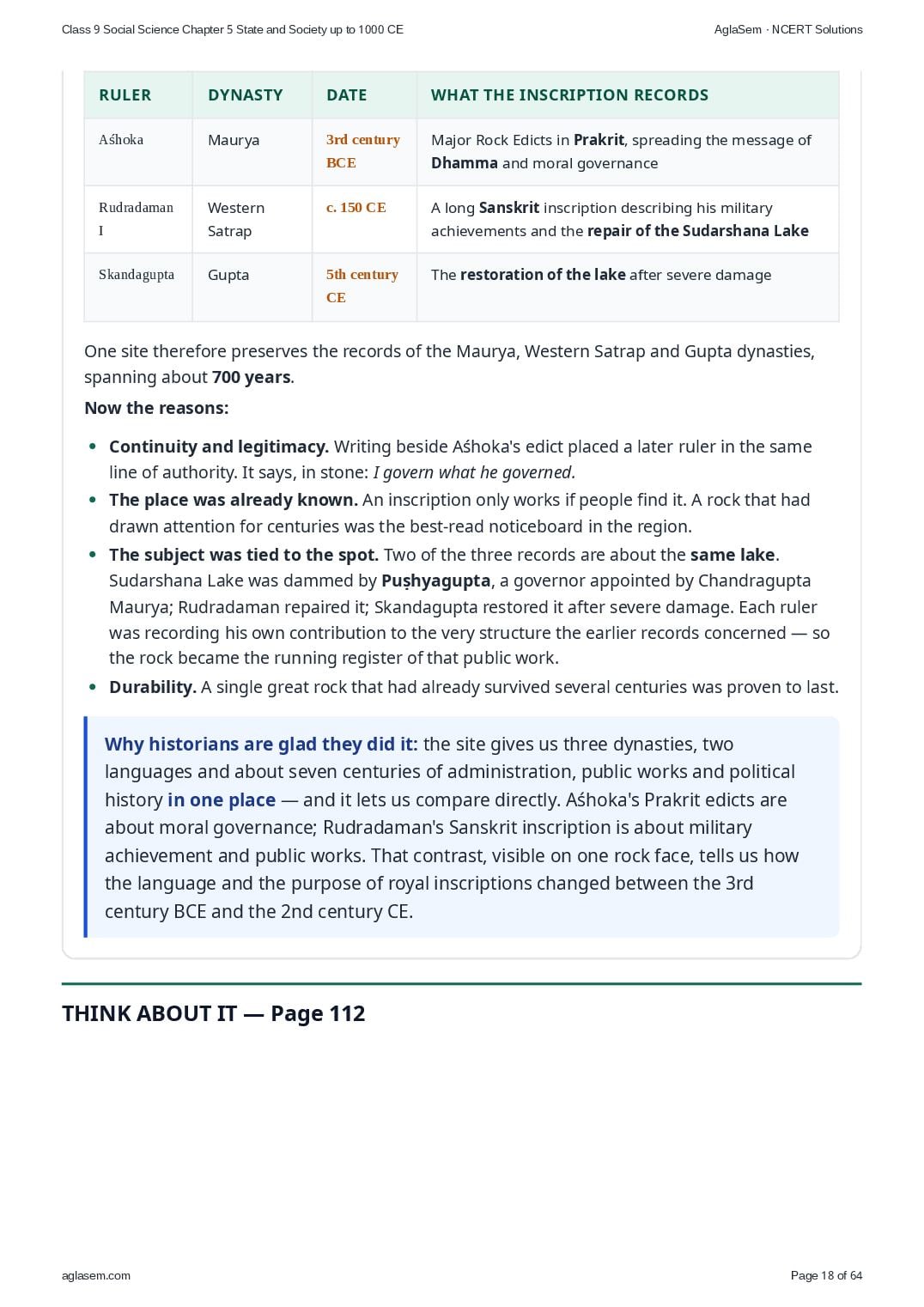
- Why do you think different rulers chose to record their inscriptions on the same stone instead of a new one? Discuss your answers with your classmates.
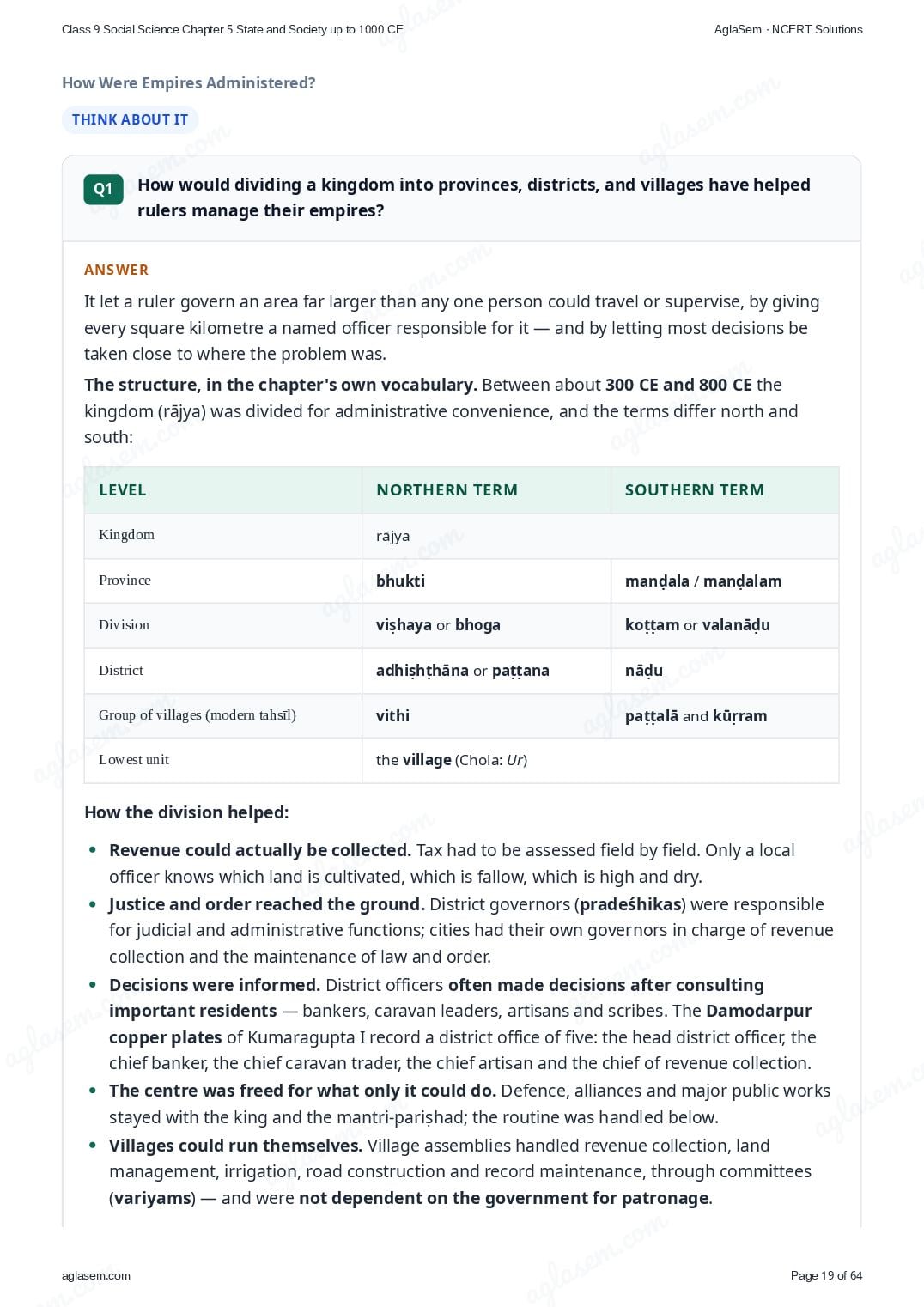
- How would dividing a kingdom into provinces, districts, and villages have helped rulers manage their empires?
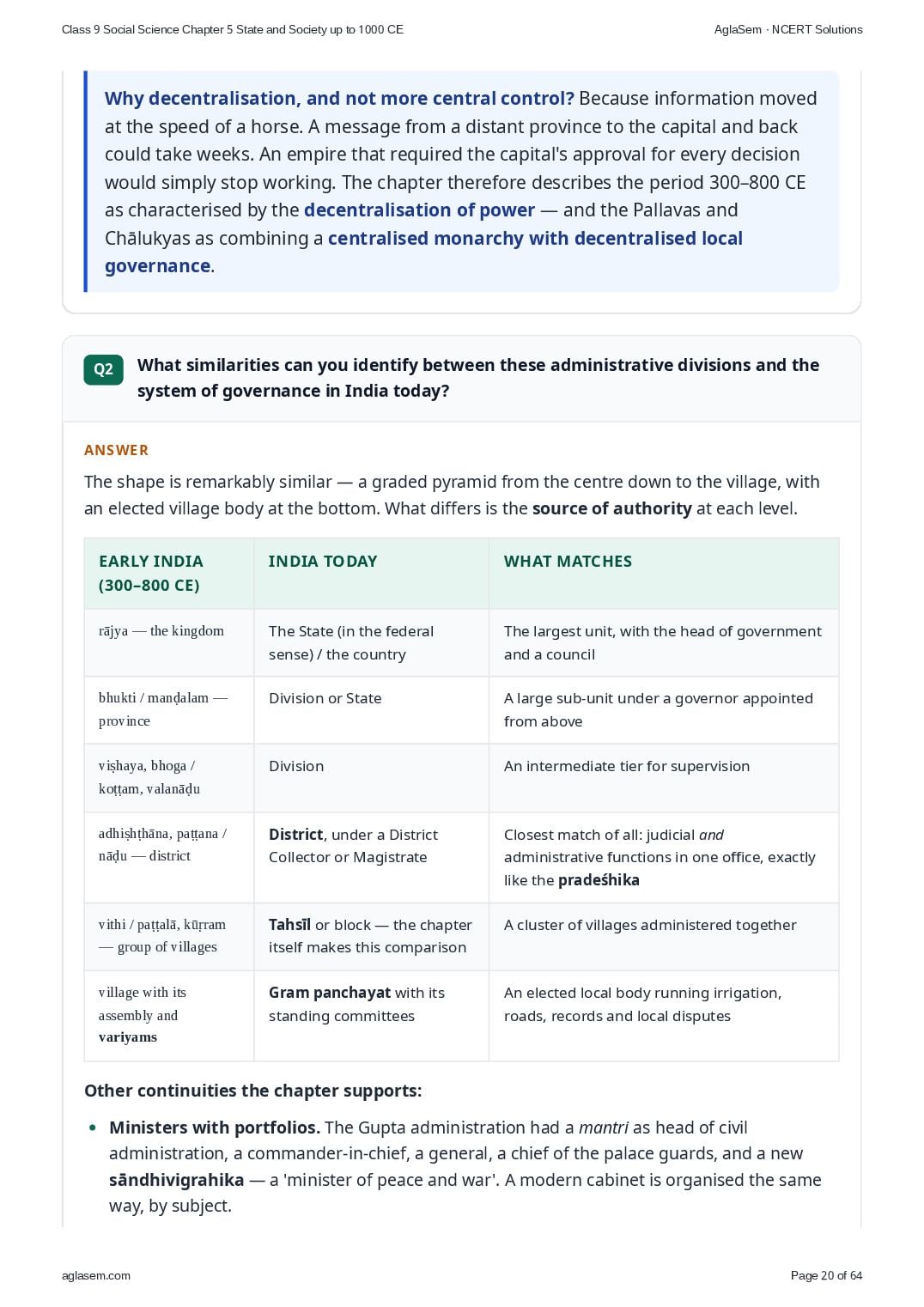
- What similarities can you identify between these administrative divisions and the system of governance in India today?
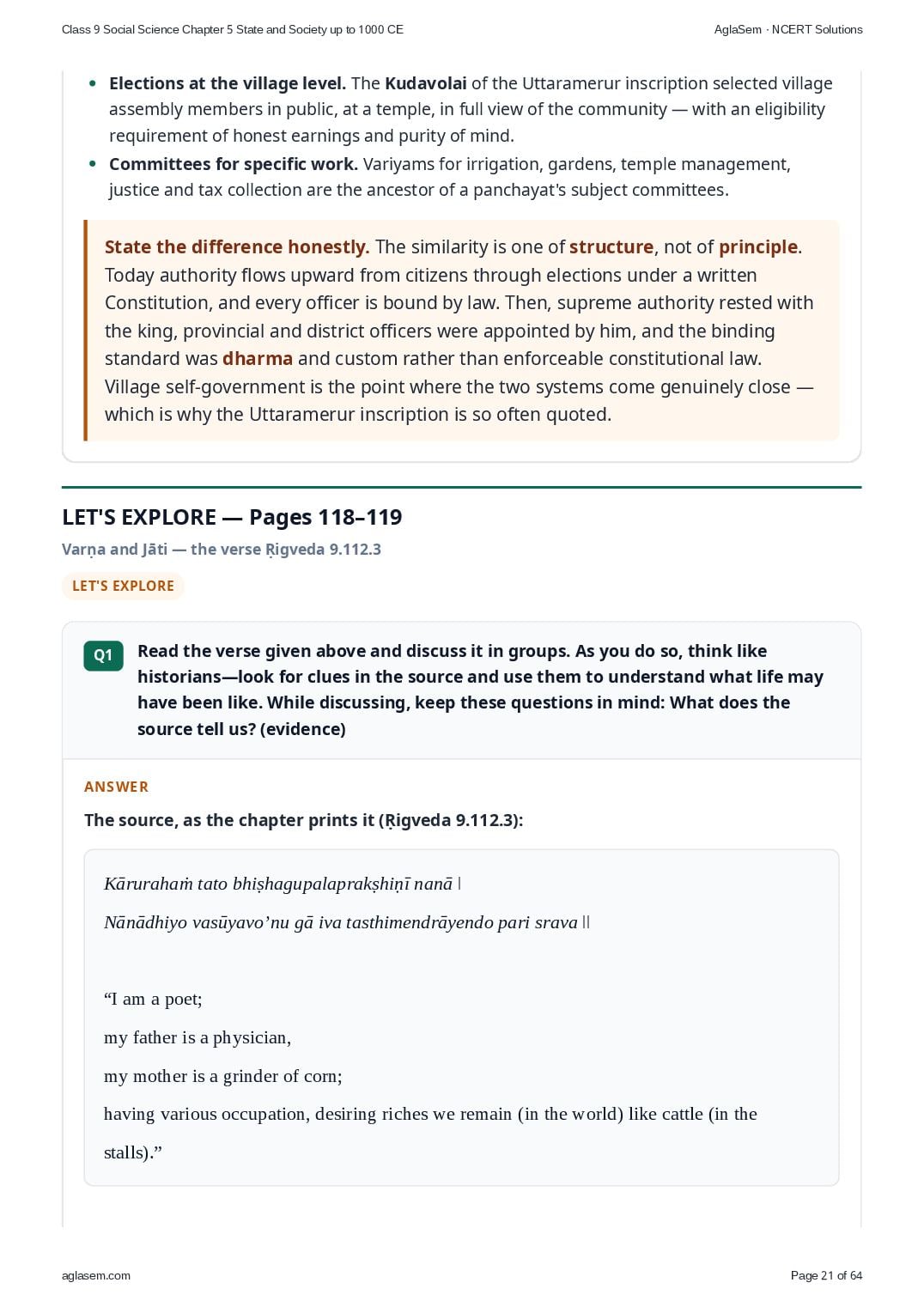
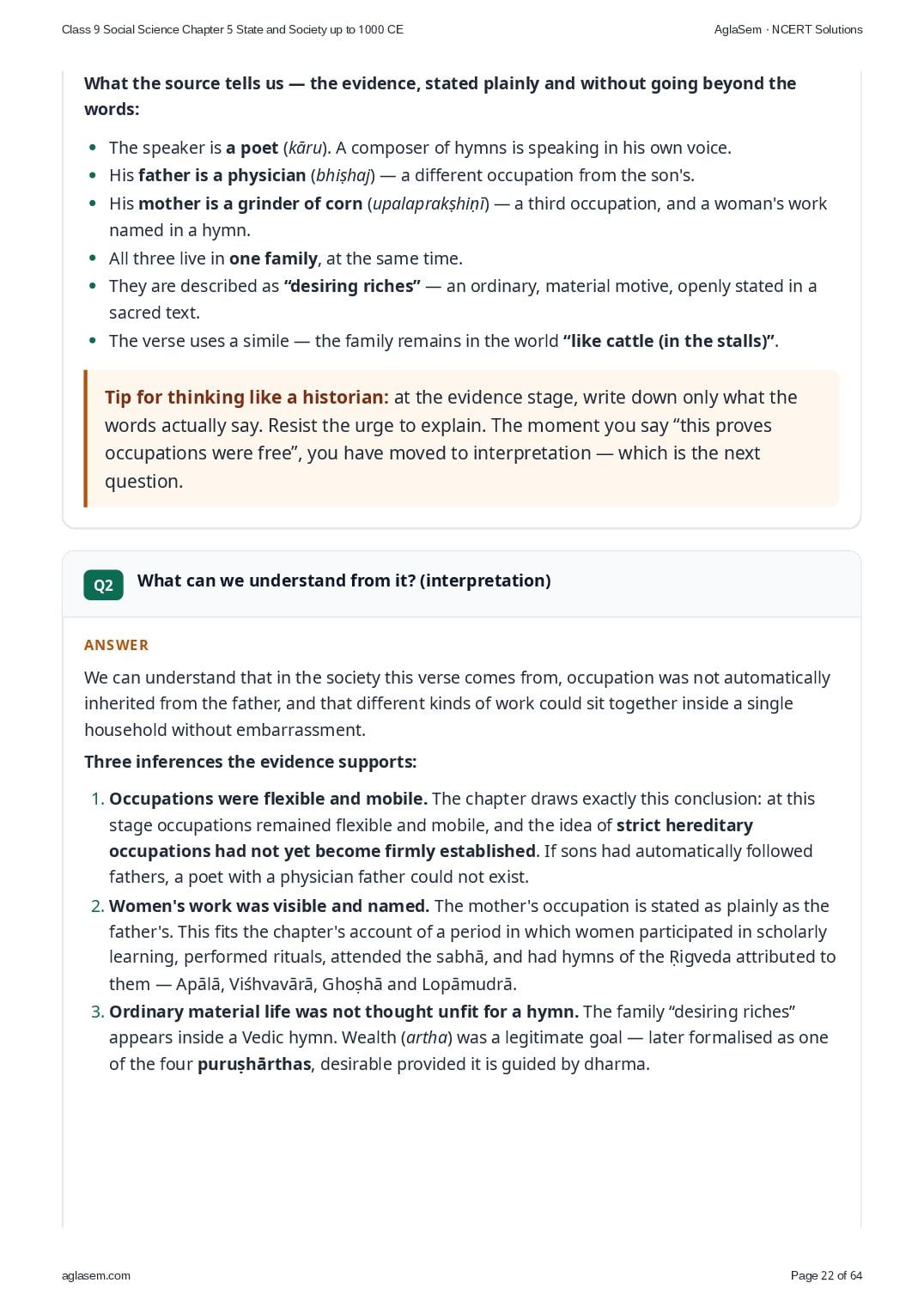
- Read the verse given above and discuss it in groups. As you do so, think like historians—look for clues in the source and use them to understand what life may have been like. While discussing, keep these questions in mind: What does the source tell us? (evidence)
- What can we understand from it? (interpretation)
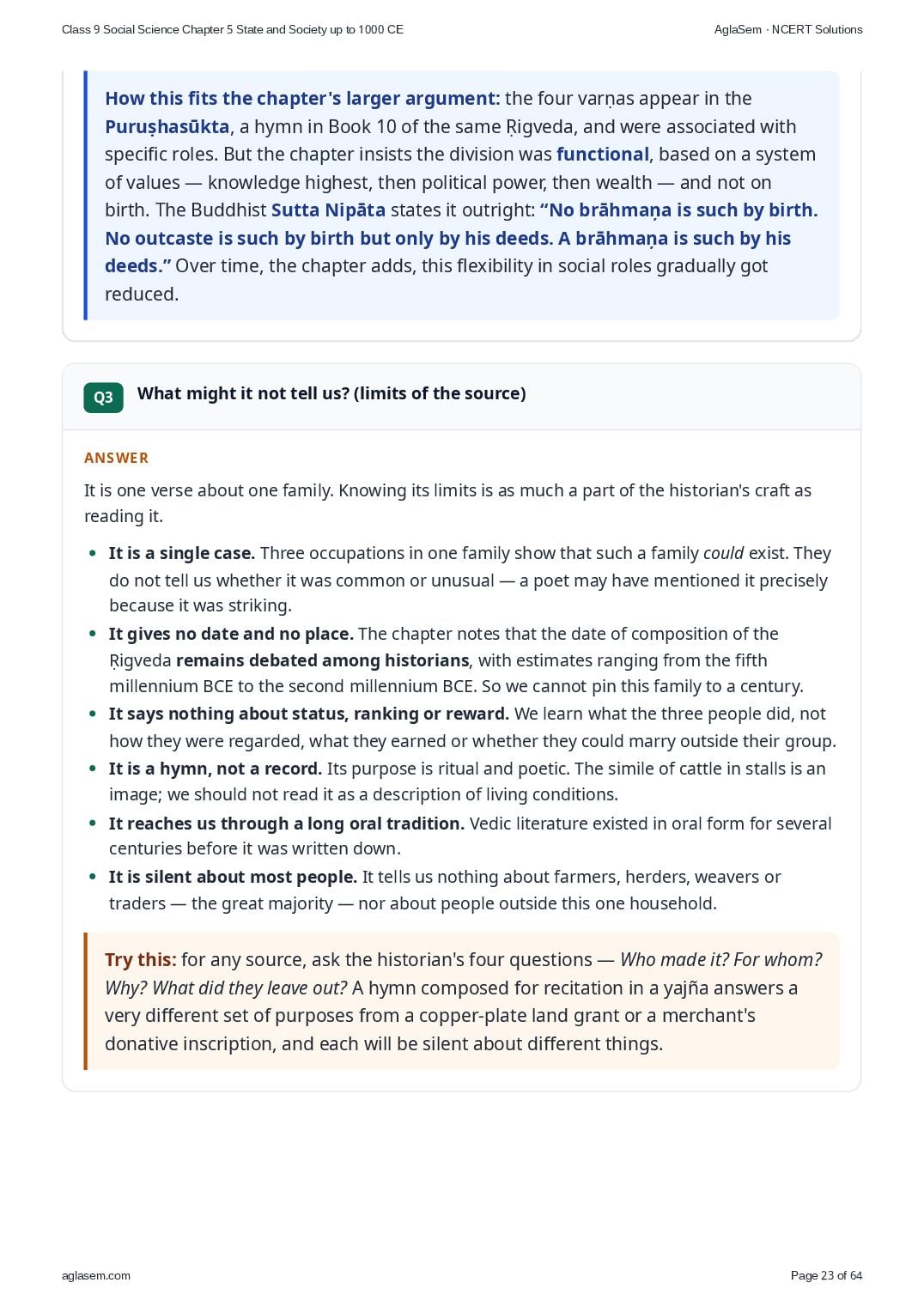
- What might it not tell us? (limits of the source)
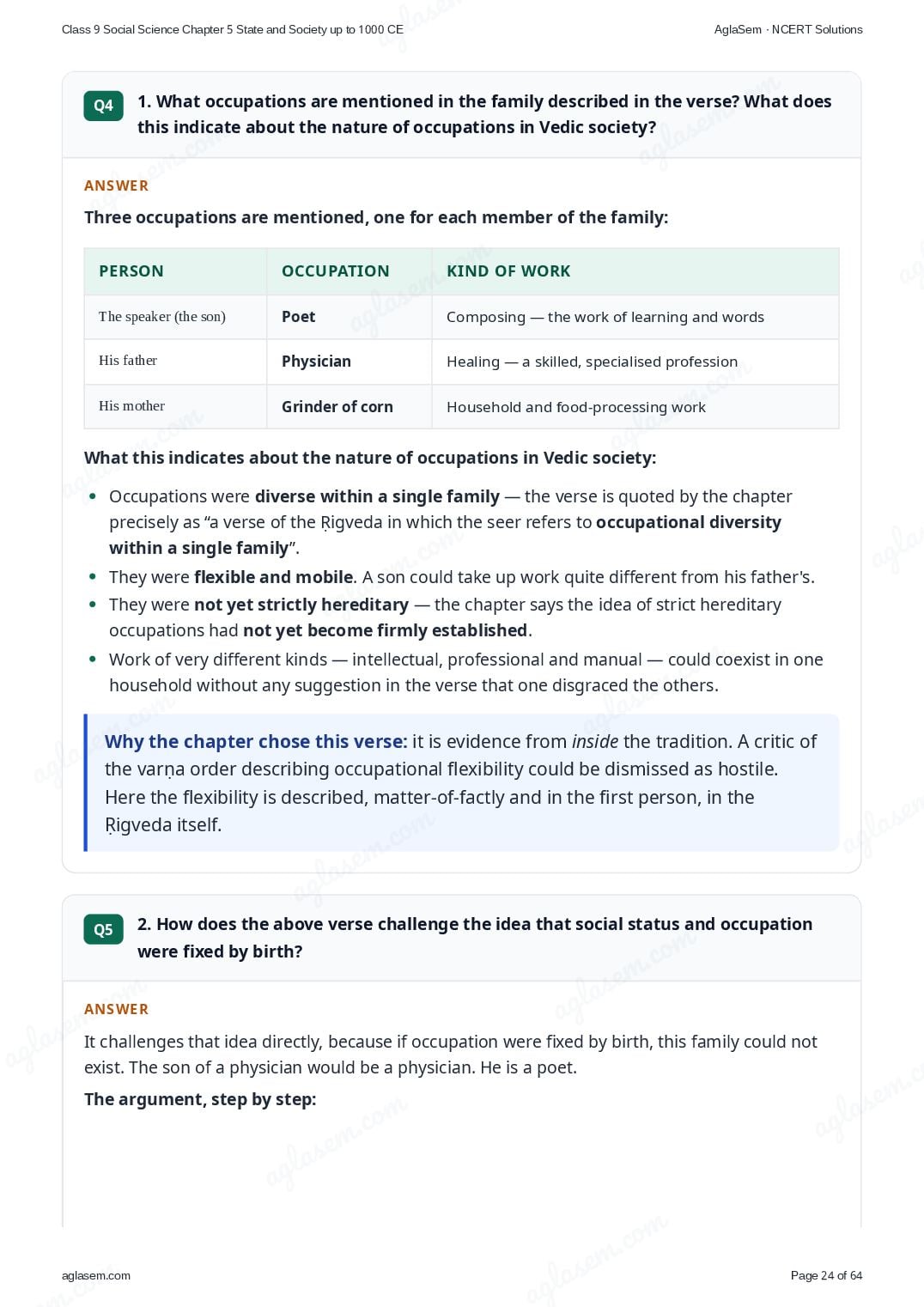
- 1. What occupations are mentioned in the family described in the verse? What does this indicate about the nature of occupations in Vedic society?
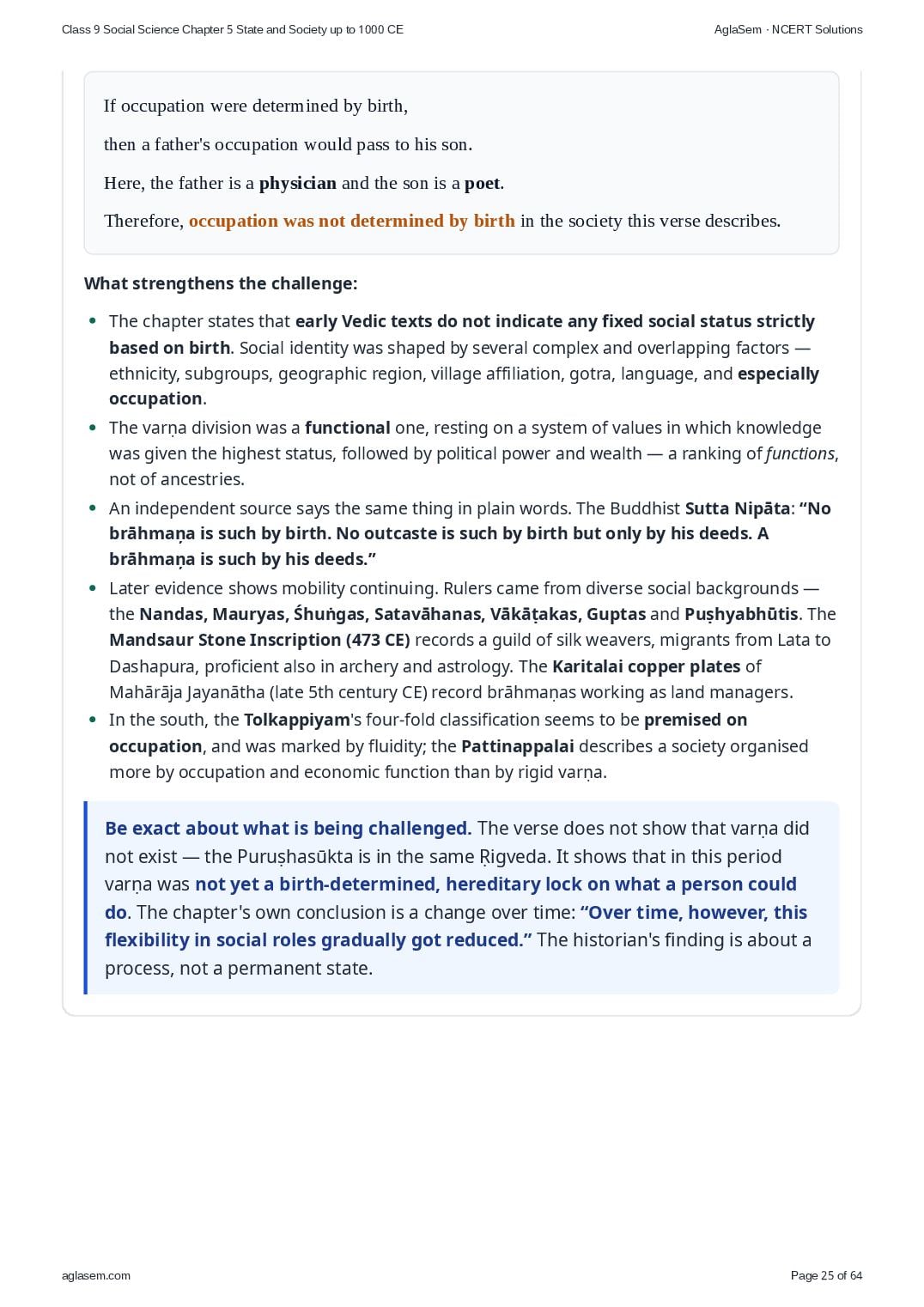
- 2. How does the above verse challenge the idea that social status and occupation were fixed by birth?
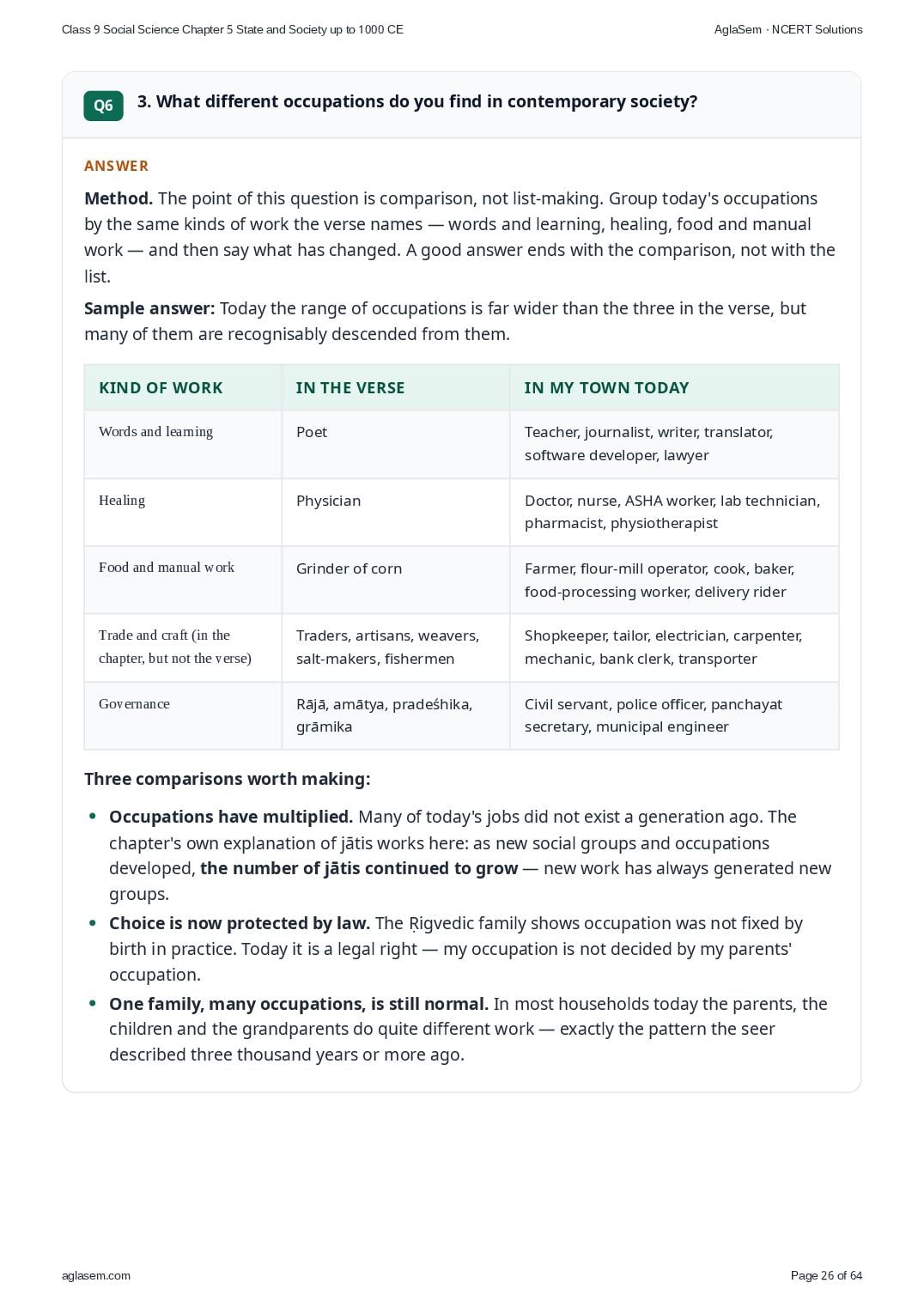
- 3. What different occupations do you find in contemporary society?
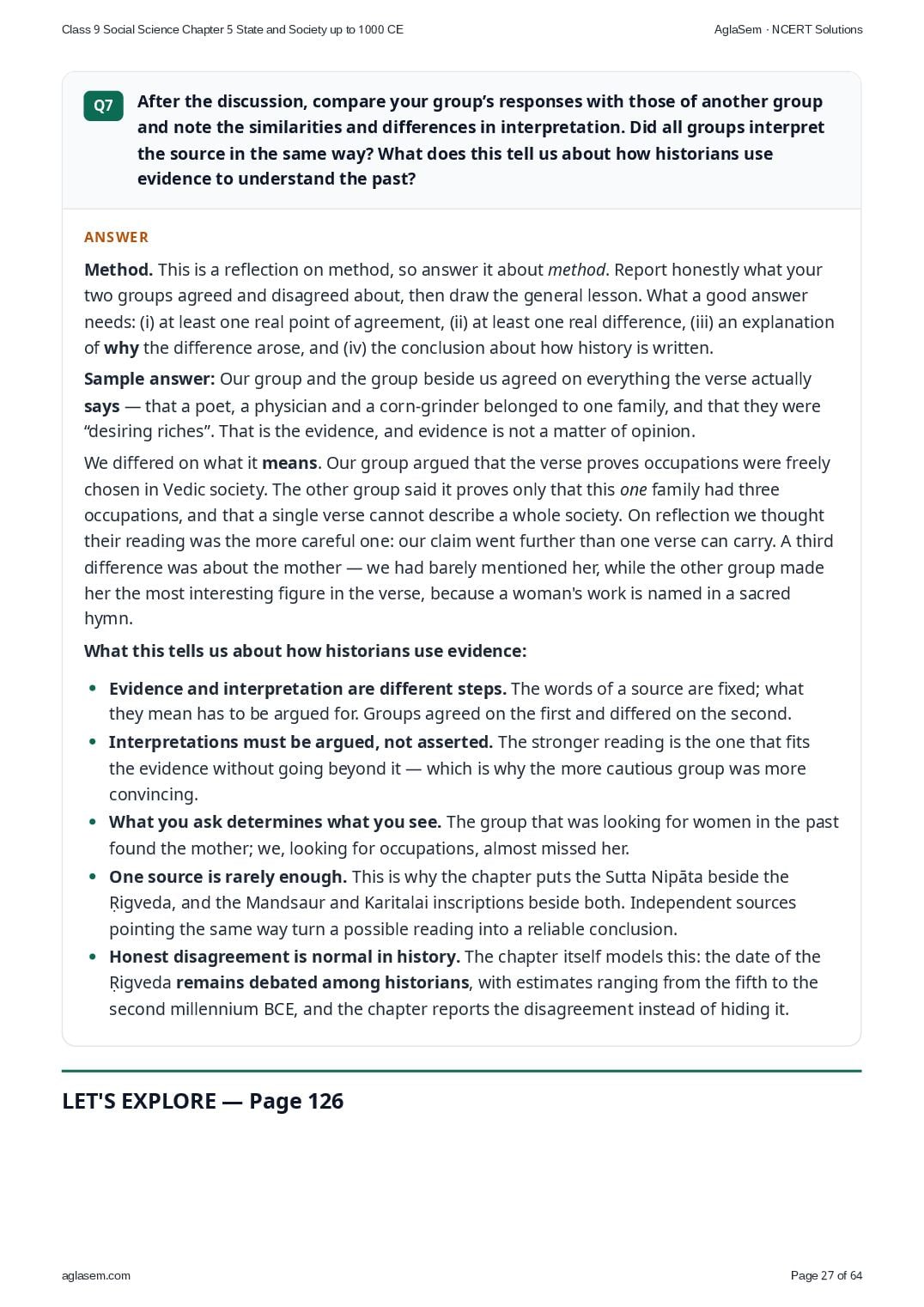
- After the discussion, compare your group’s responses with those of another group and note the similarities and differences in interpretation. Did all groups interpret the source in the same way? What does this tell us about how historians use evidence to understand the past?
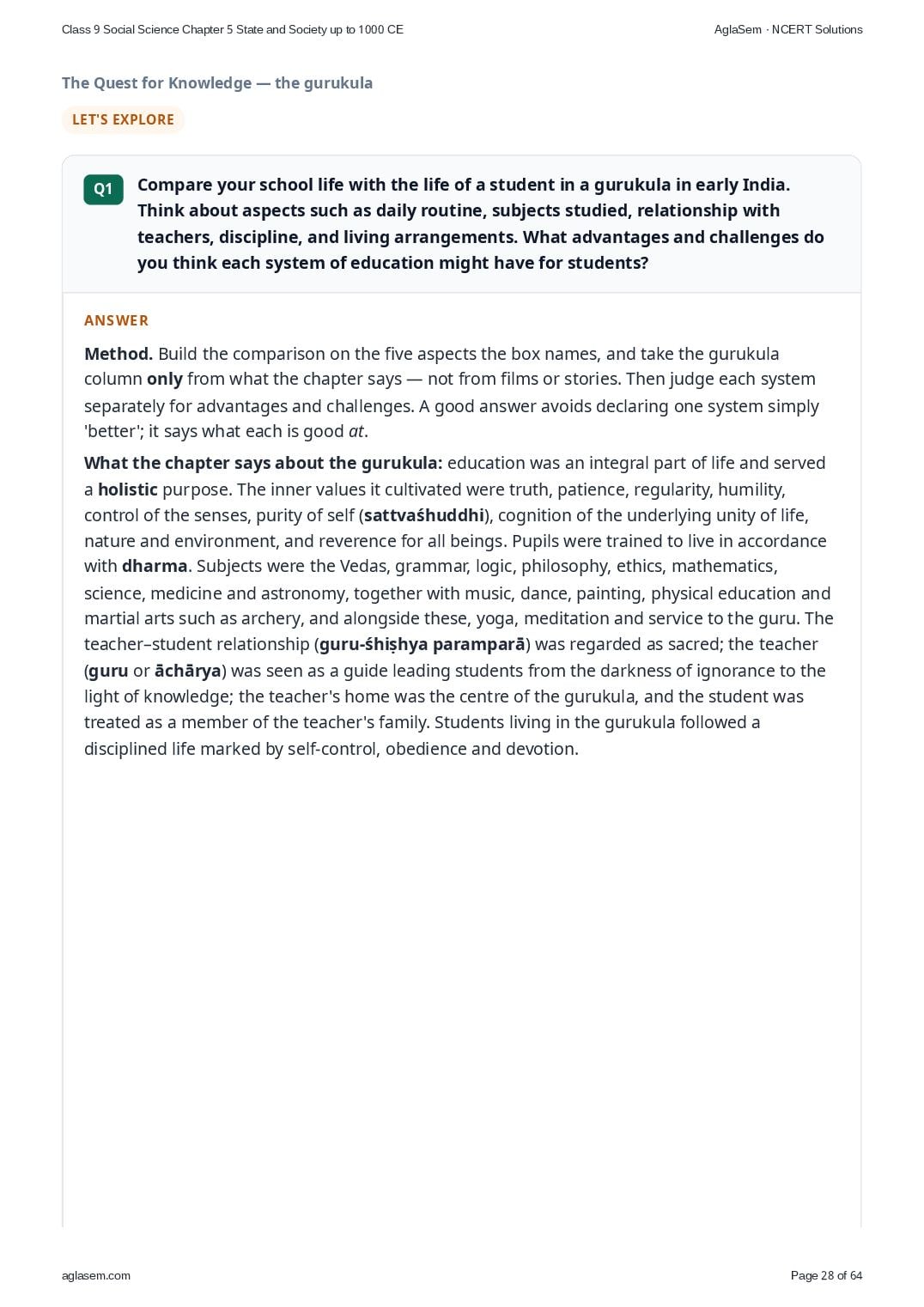
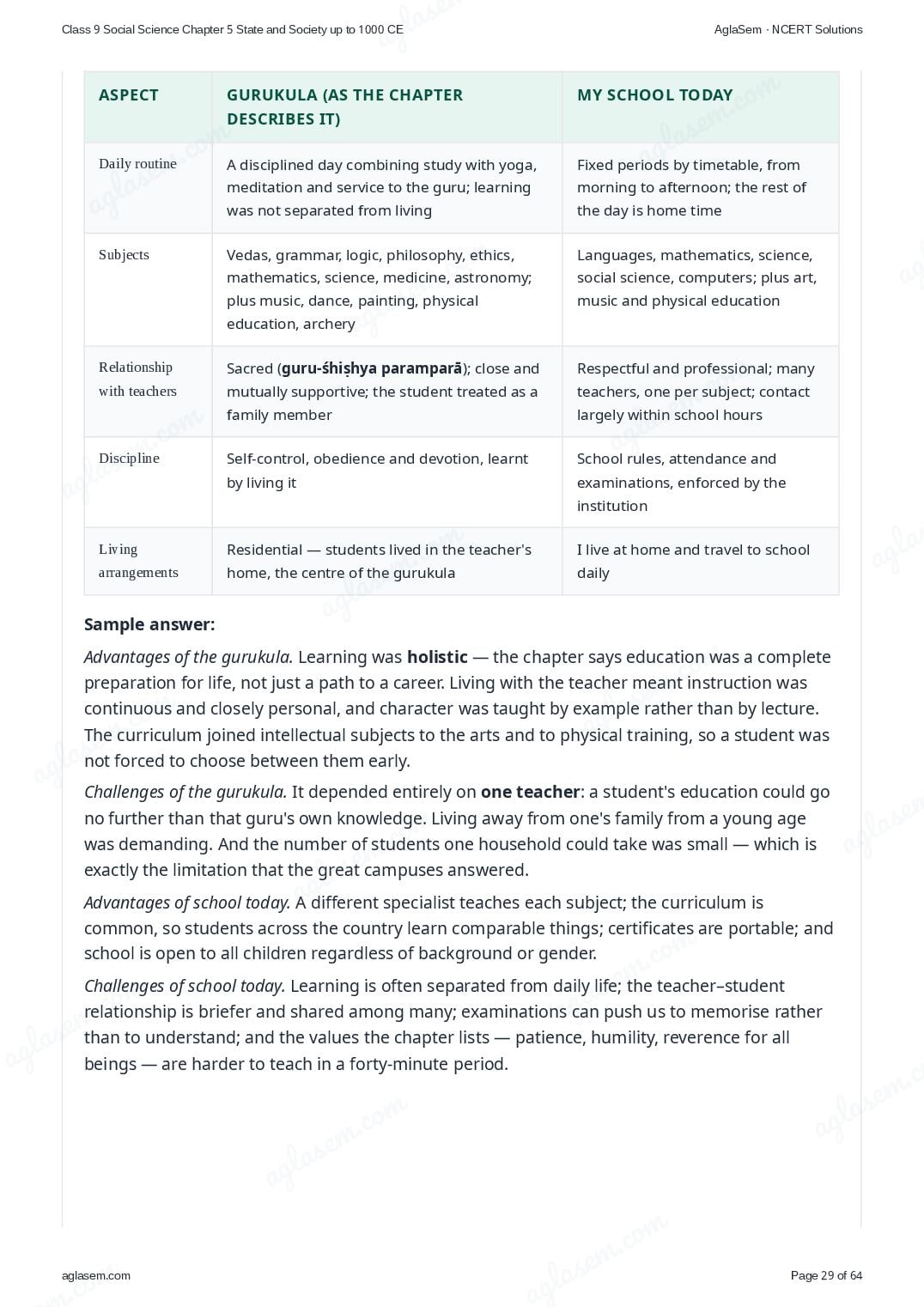
- Compare your school life with the life of a student in a gurukula in early India. Think about aspects such as daily routine, subjects studied, relationship with teachers, discipline, and living arrangements. What advantages and challenges do you think each system of education might have for students?
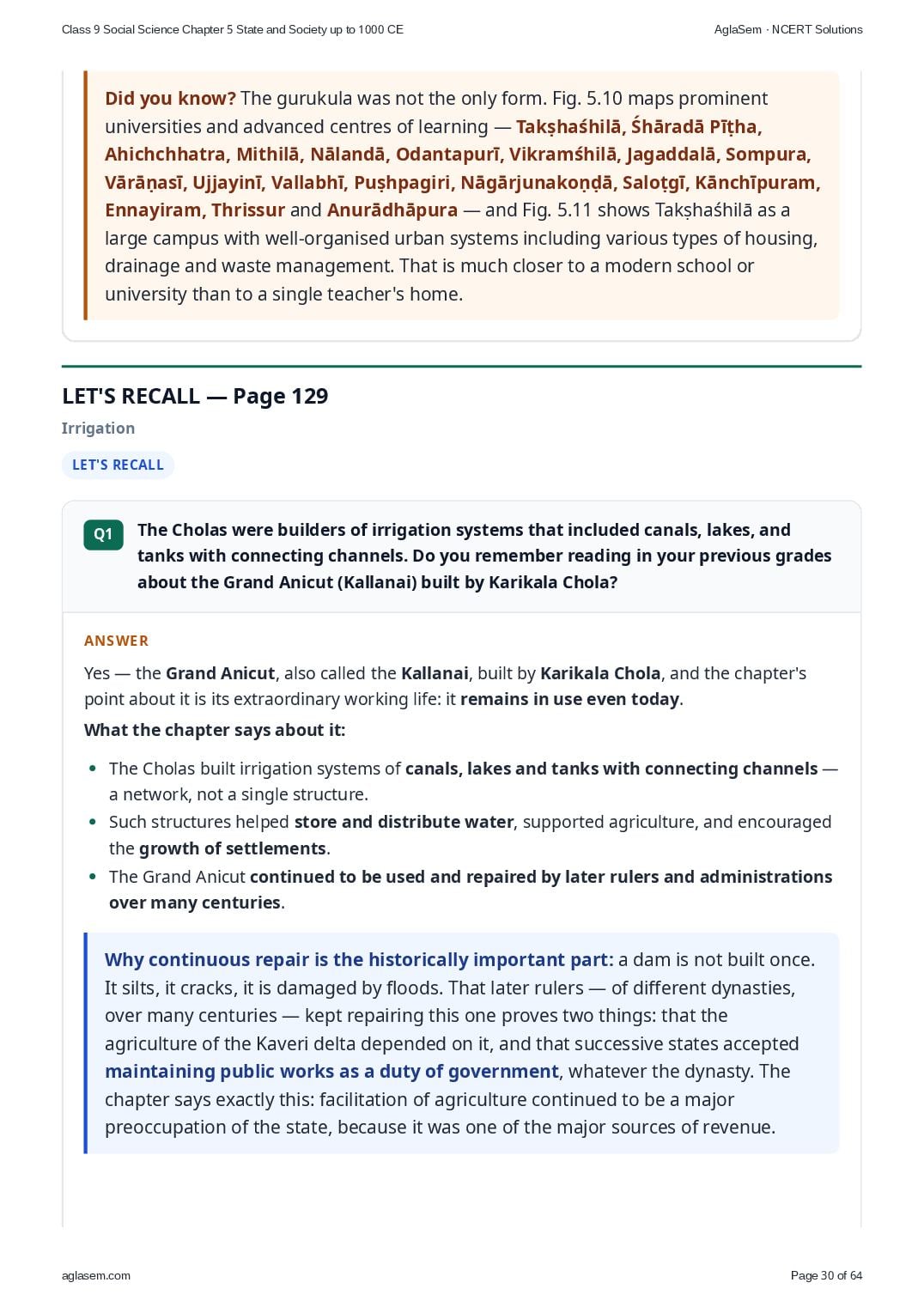
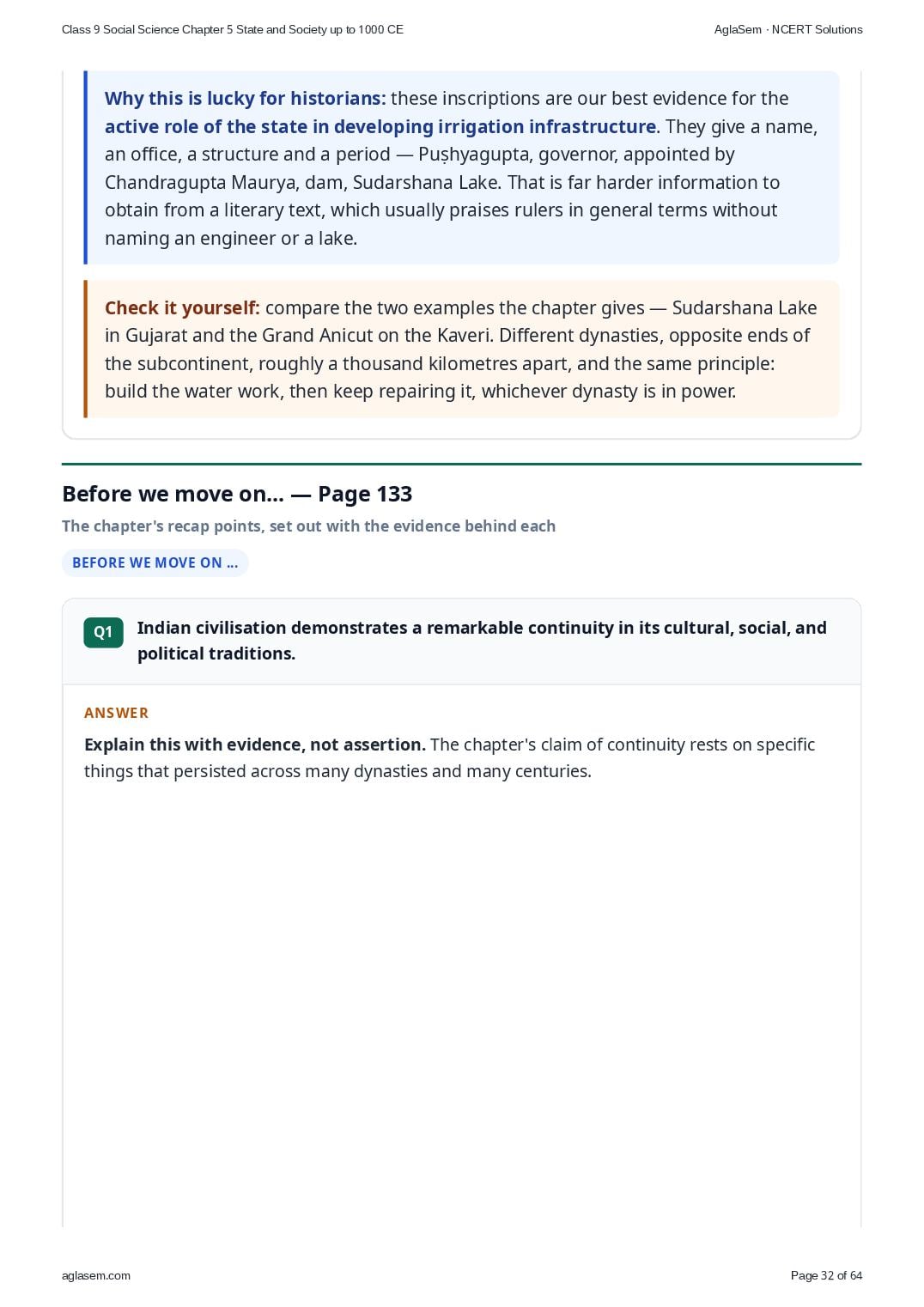
- The Cholas were builders of irrigation systems that included canals, lakes, and tanks with connecting channels. Do you remember reading in your previous grades about the Grand Anicut (Kallanai) built by Karikala Chola?
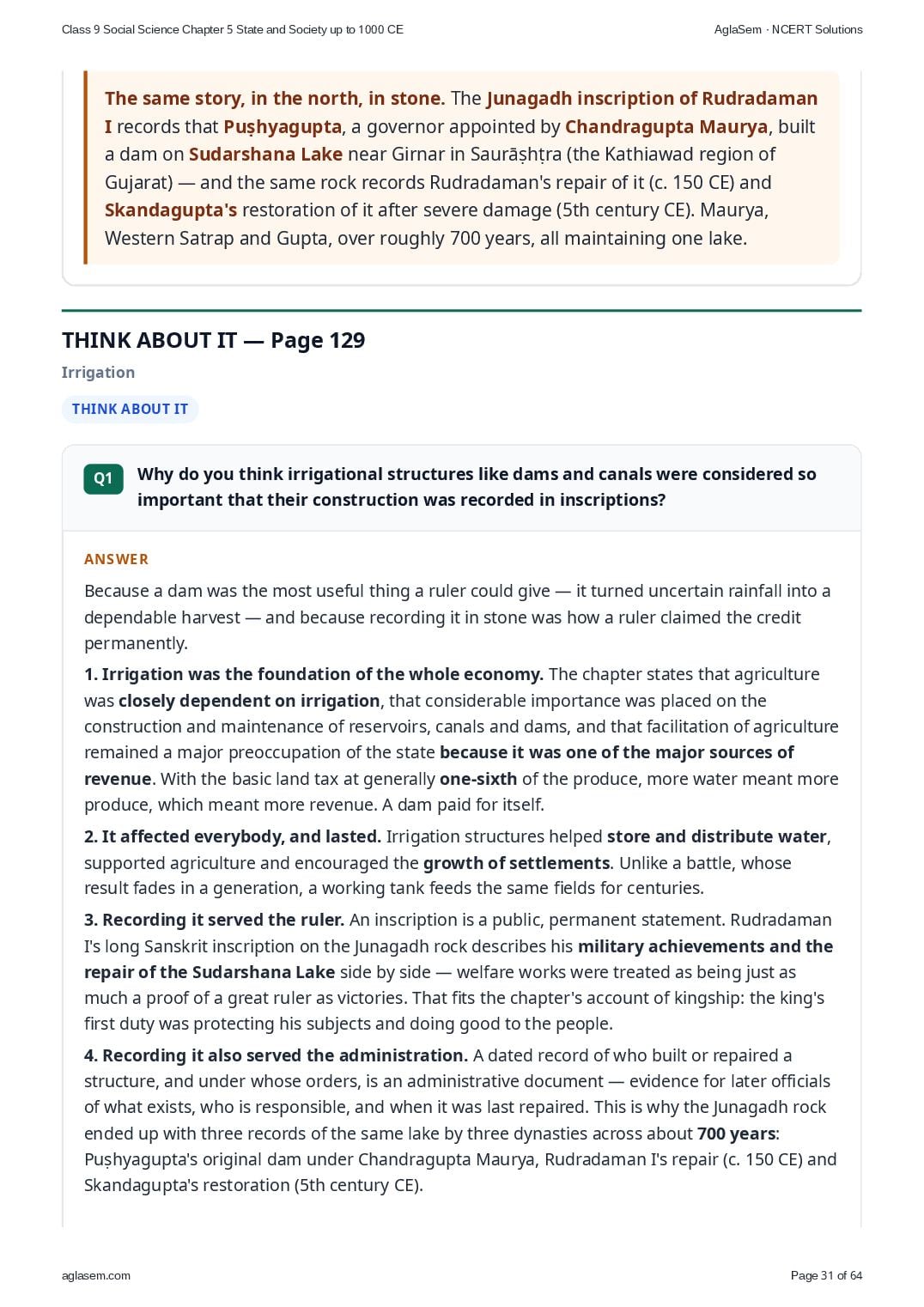
- Why do you think irrigational structures like dams and canals were considered so important that their construction was recorded in inscriptions?
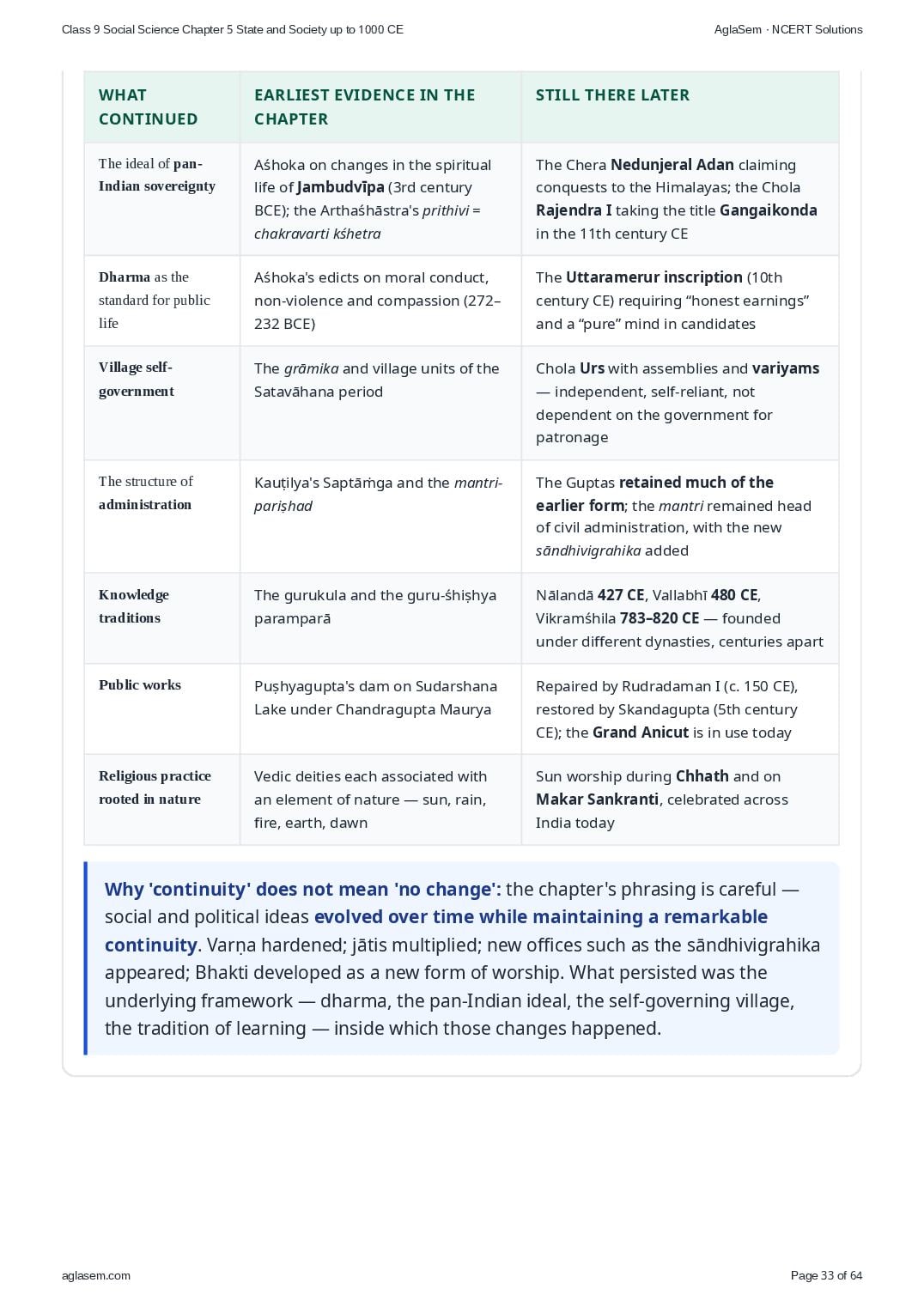
- Indian civilisation demonstrates a remarkable continuity in its cultural, social, and political traditions.
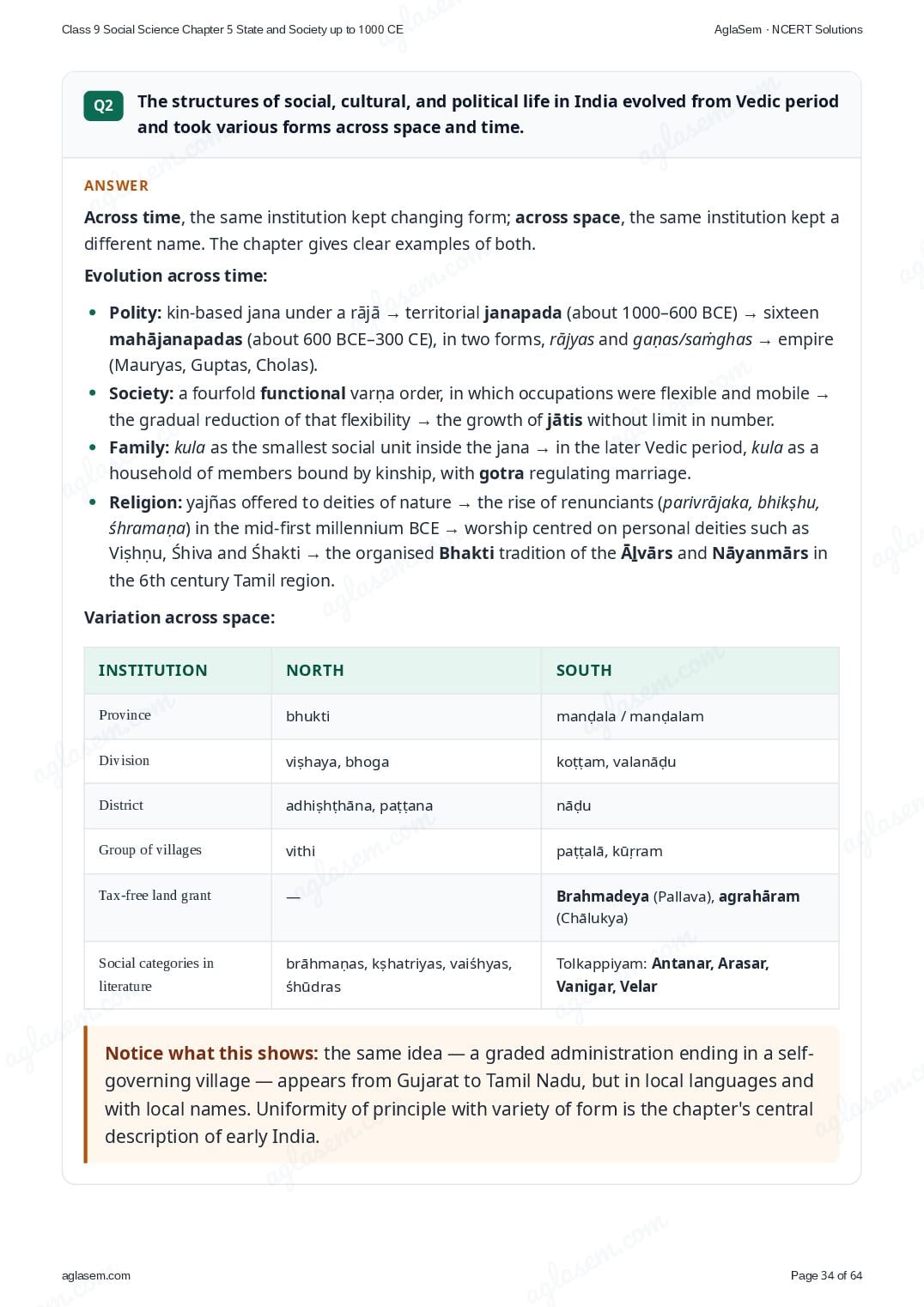
- The structures of social, cultural, and political life in India evolved from Vedic period and took various forms across space and time.
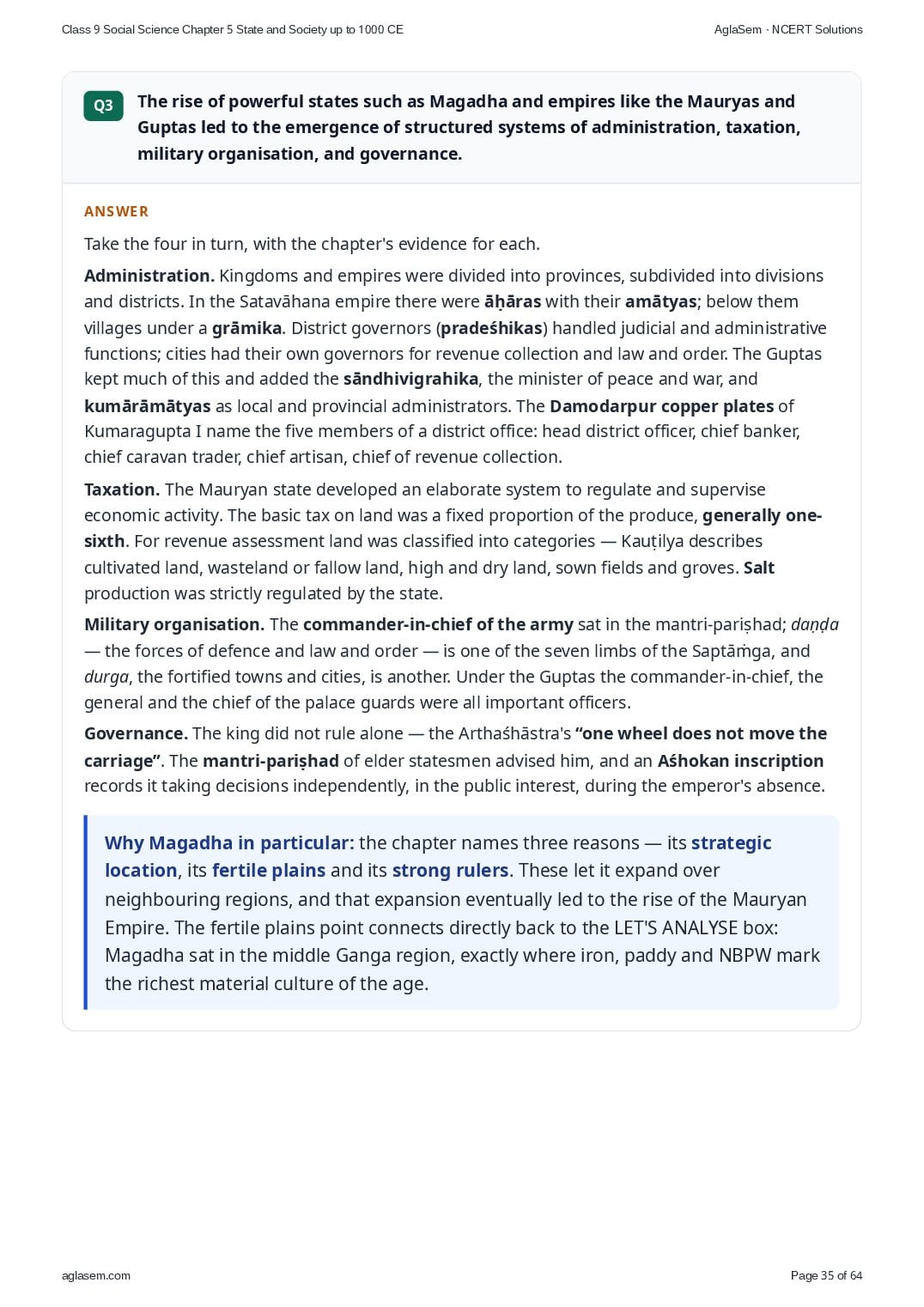
- The rise of powerful states such as Magadha and empires like the Mauryas and Guptas led to the emergence of structured systems of administration, taxation, military organisation, and governance.
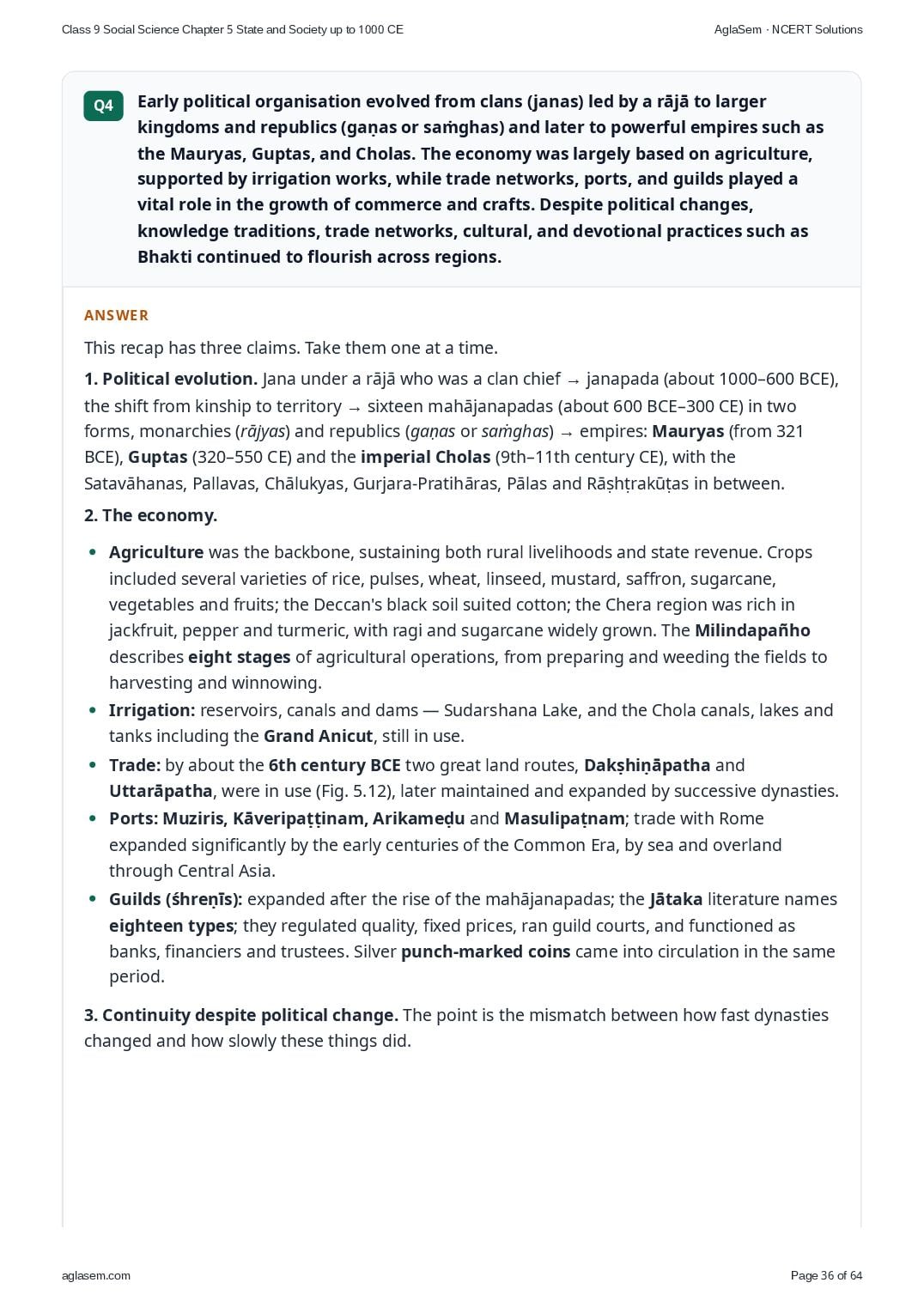
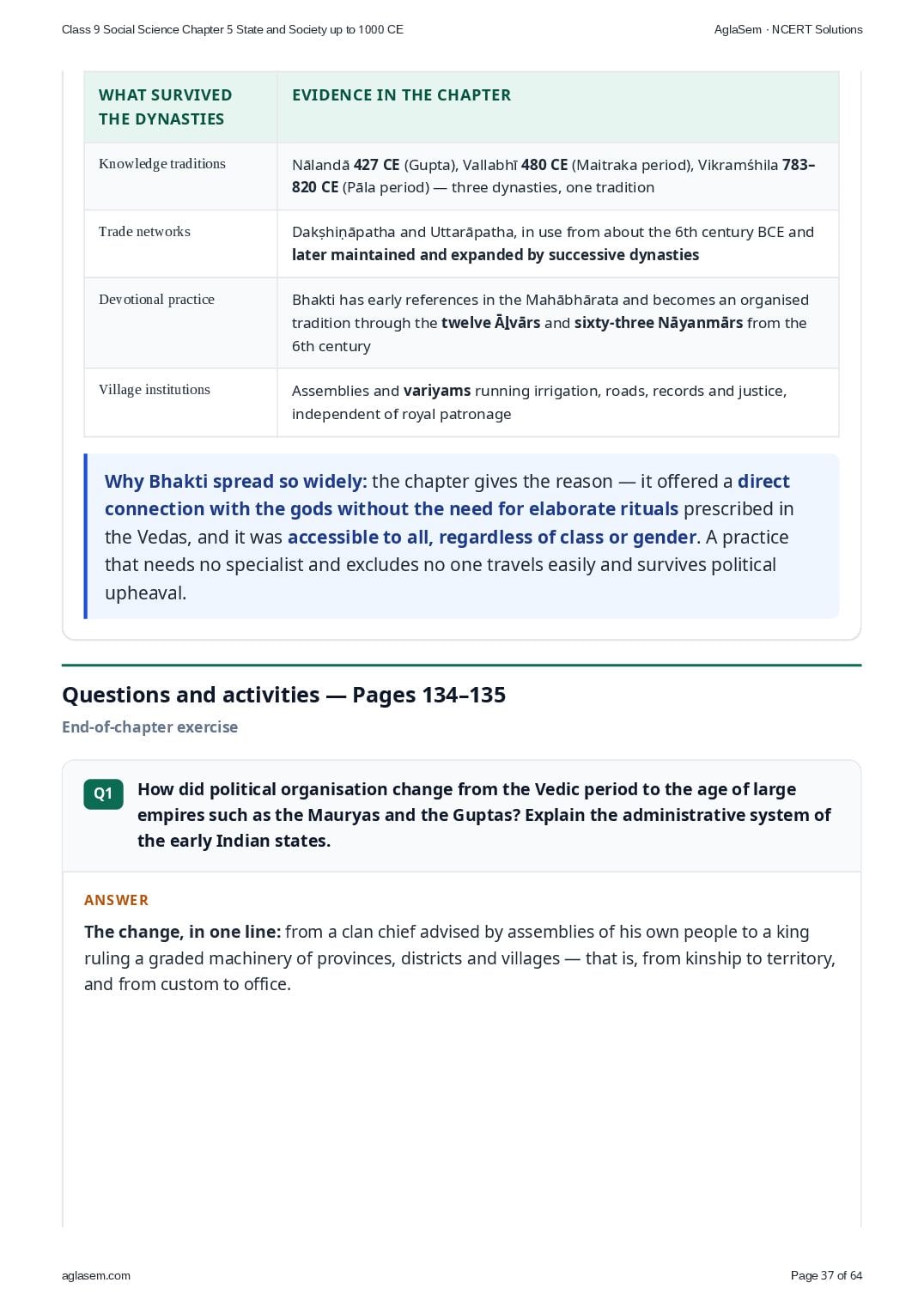
- Early political organisation evolved from clans (janas) led by a rājā to larger kingdoms and republics (gaṇas or saṁghas) and later to powerful empires such as the Mauryas, Guptas, and Cholas. The economy was largely based on agriculture, supported by irrigation works, while trade networks, ports, and guilds played a vital role in the growth of commerce and crafts. Despite political changes, knowledge traditions, trade networks, cultural, and devotional practices such as Bhakti continued to flourish across regions.
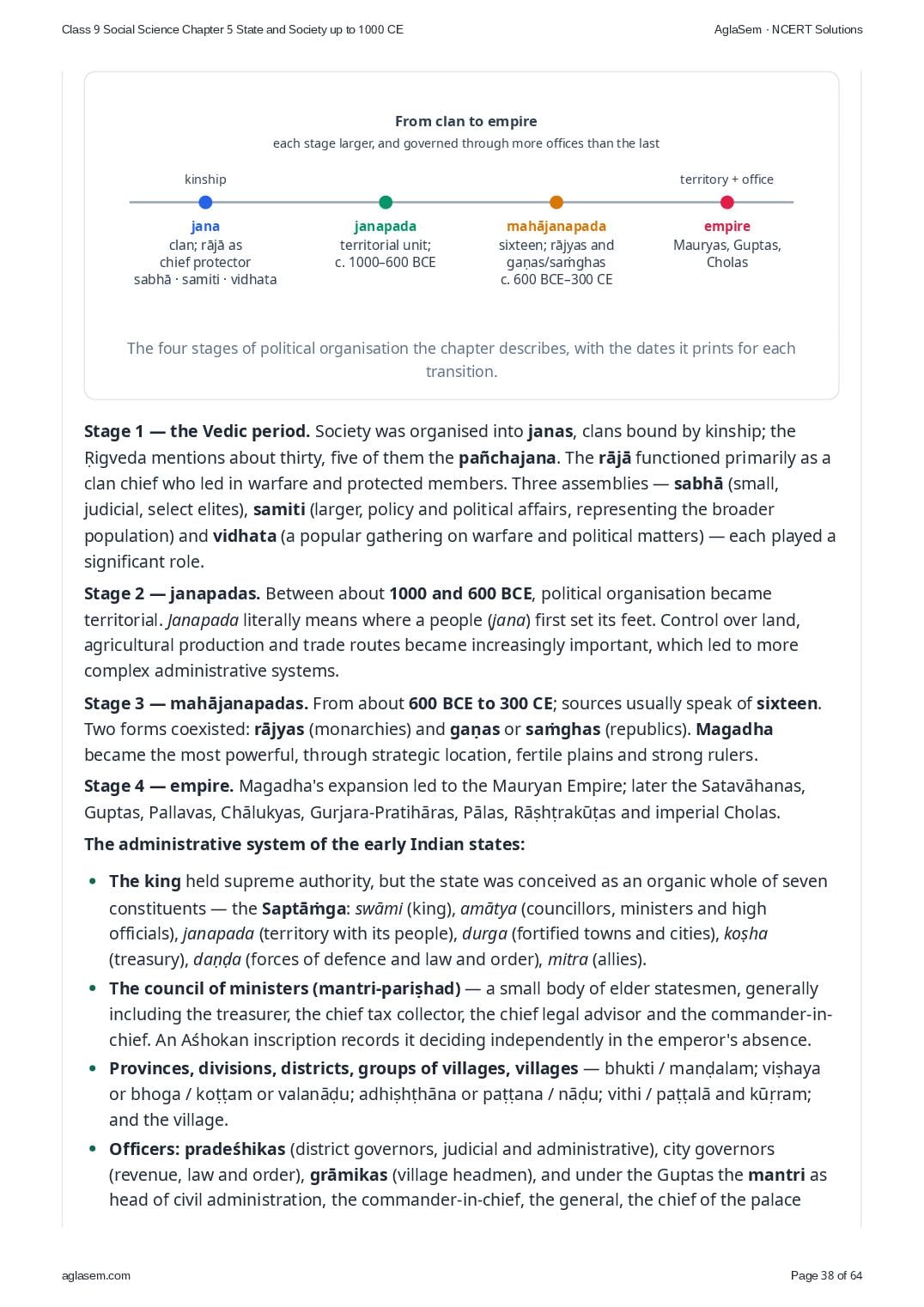
- How did political organisation change from the Vedic period to the age of large empires such as the Mauryas and the Guptas? Explain the administrative system of the early Indian states.
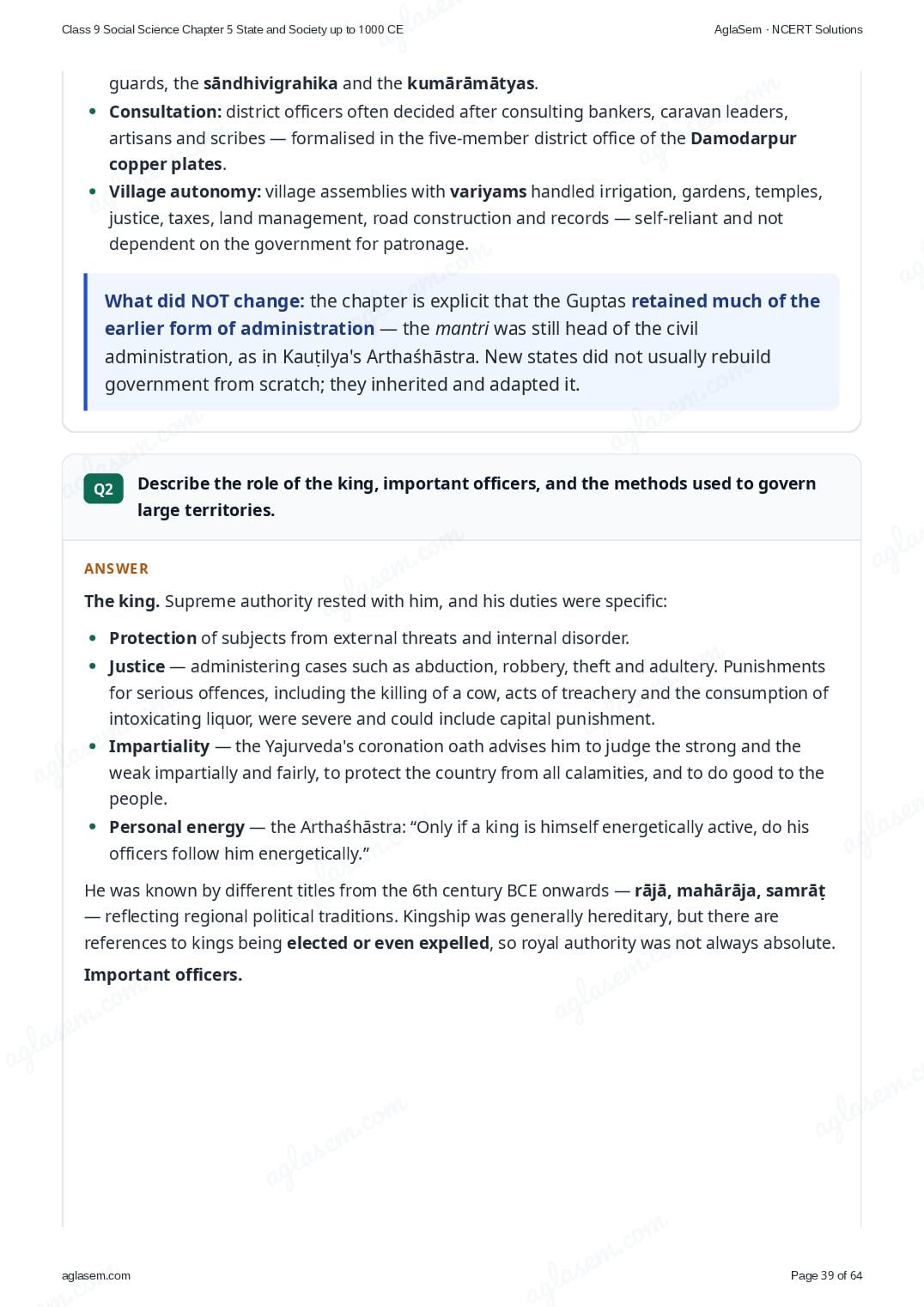
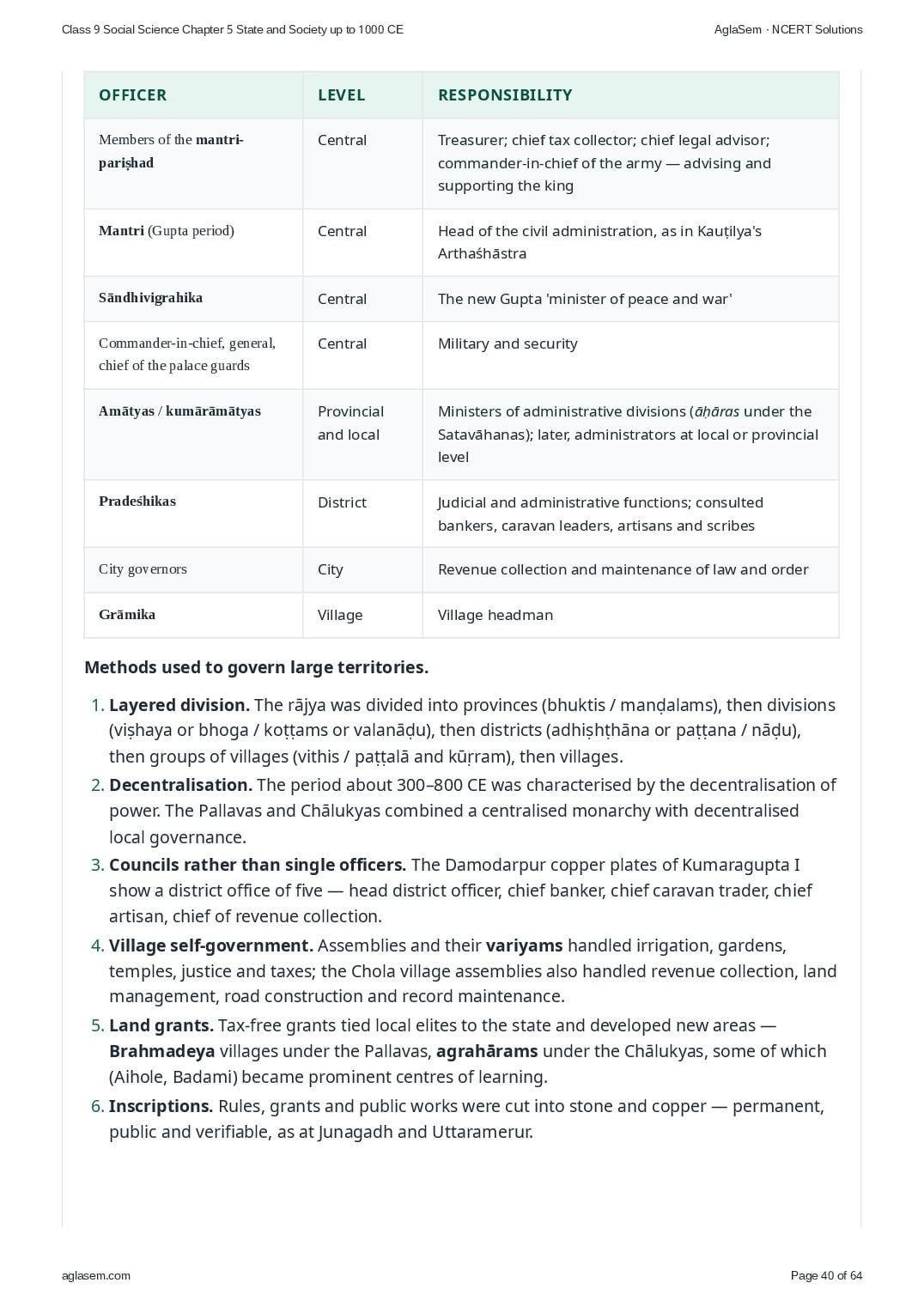
- Describe the role of the king, important officers, and the methods used to govern large territories.
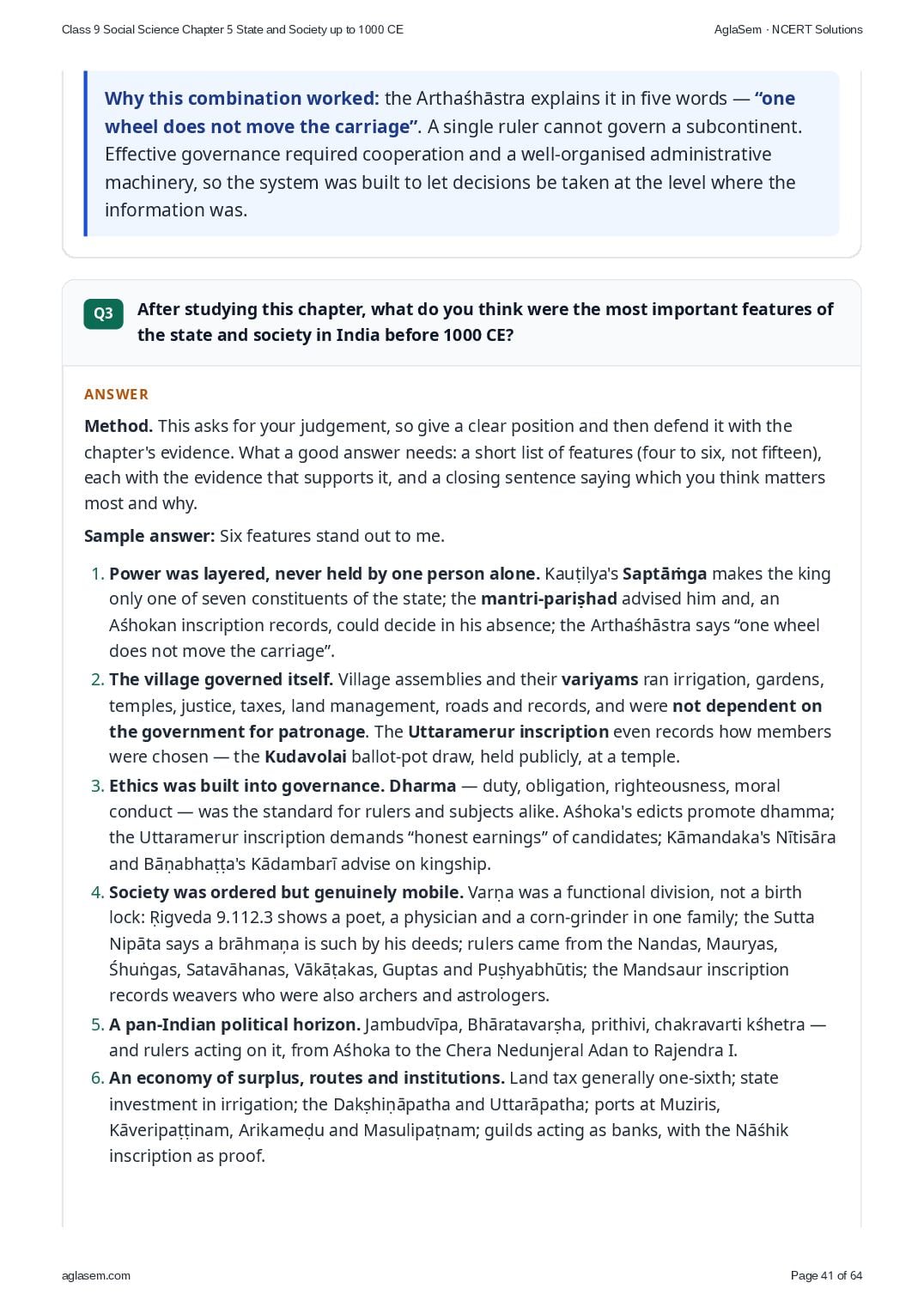
- After studying this chapter, what do you think were the most important features of the state and society in India before 1000 CE?
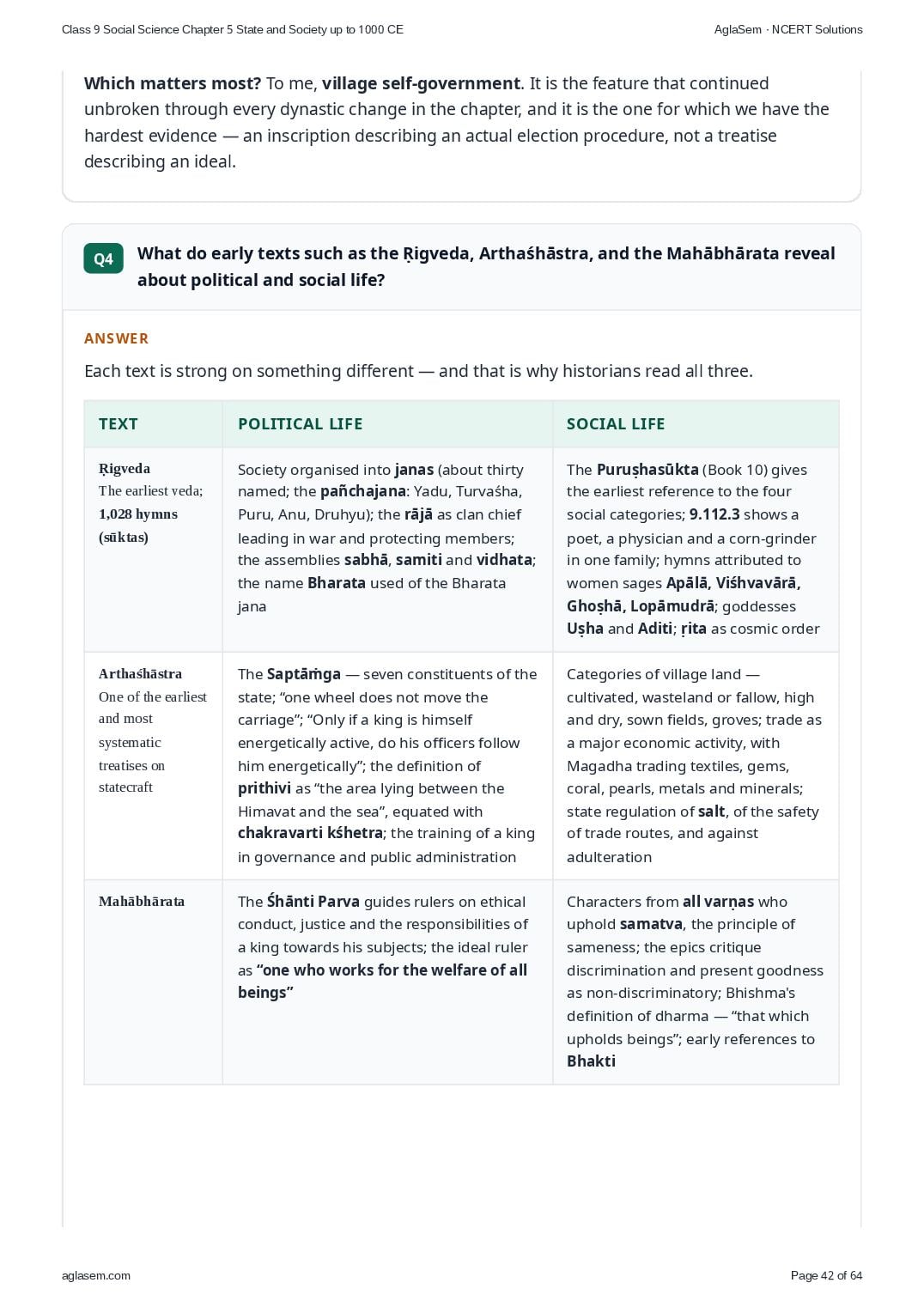
- What do early texts such as the Ṛigveda, Arthaśhāstra, and the Mahābhārata reveal about political and social life?
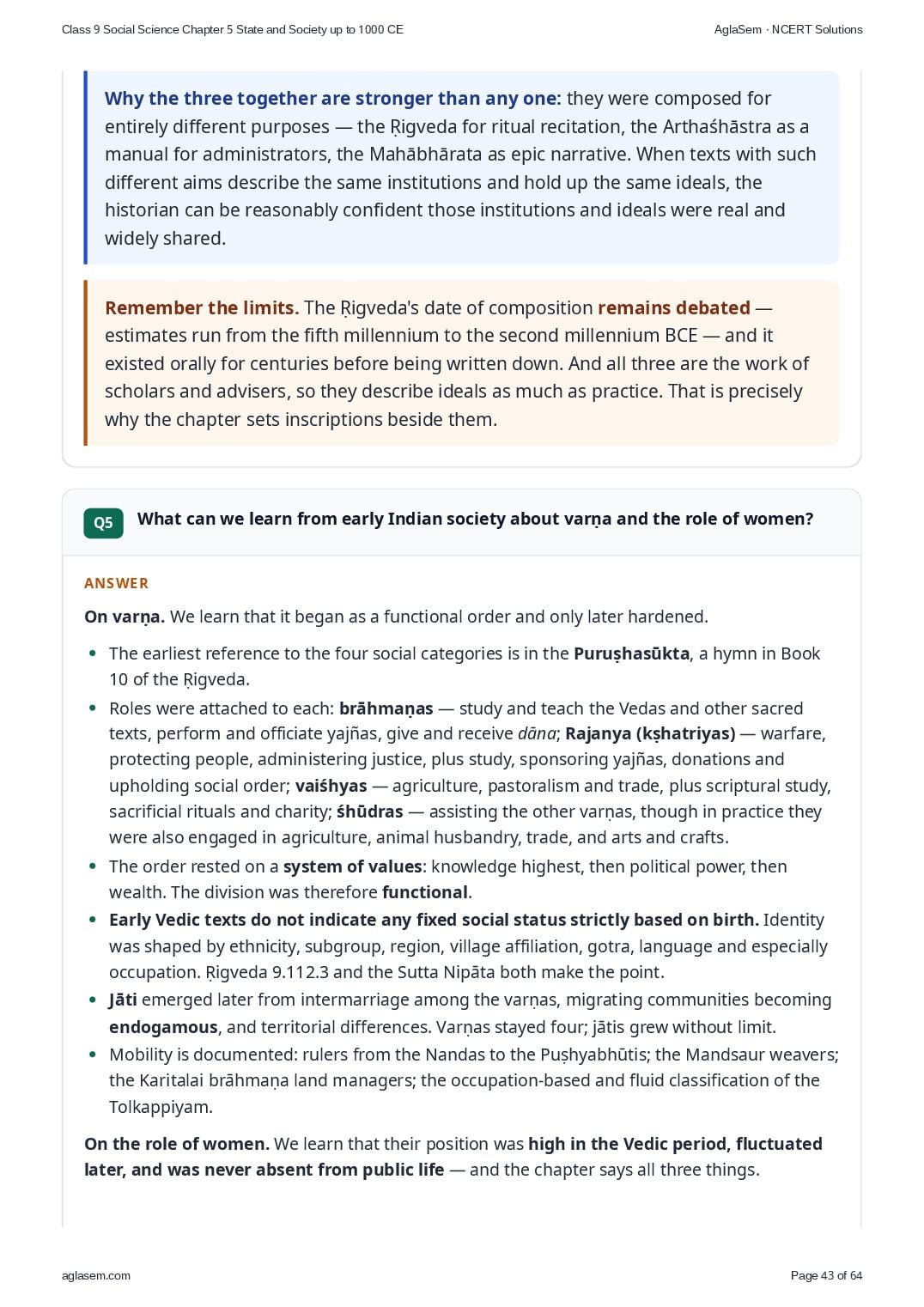
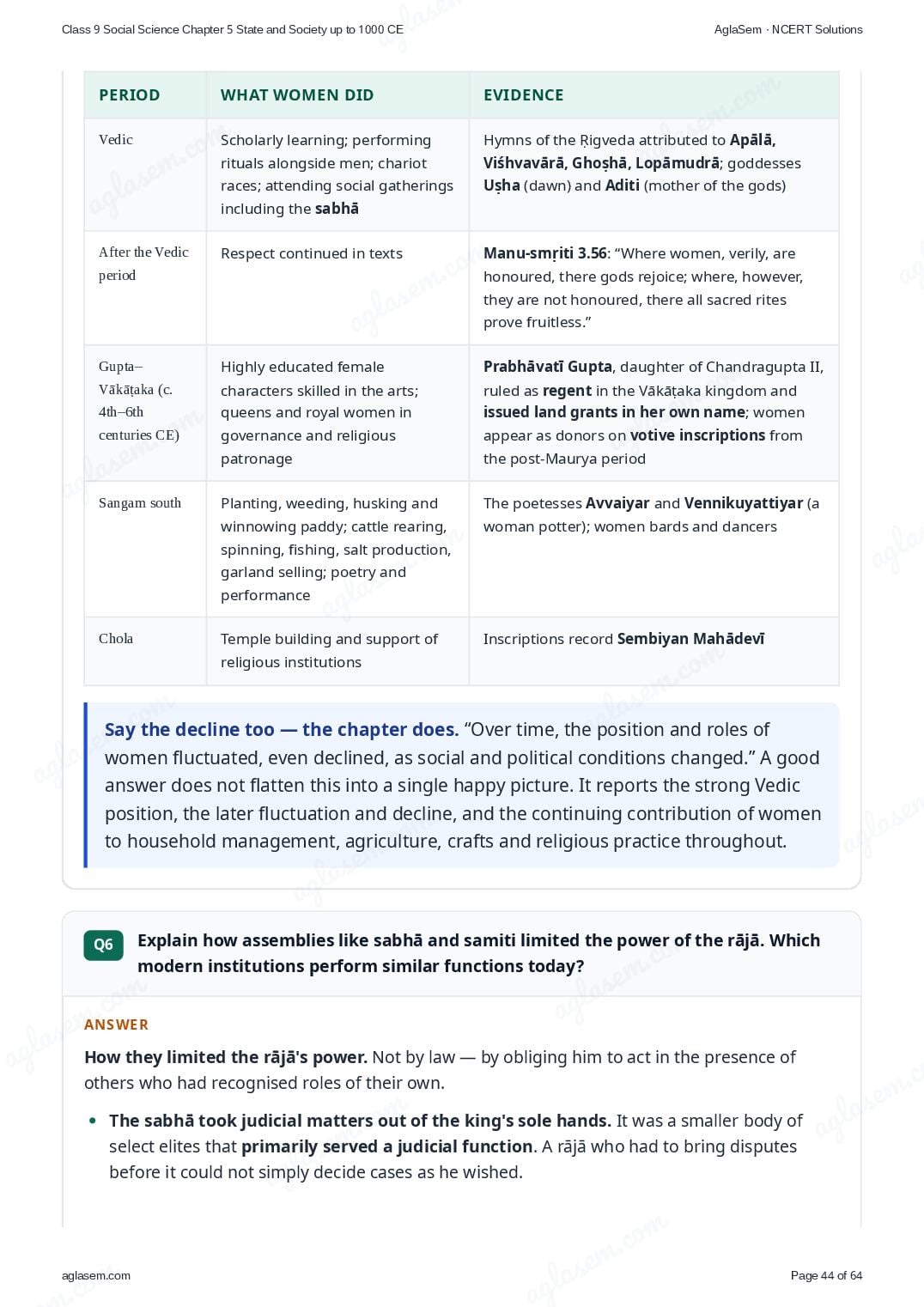
- What can we learn from early Indian society about varṇa and the role of women?
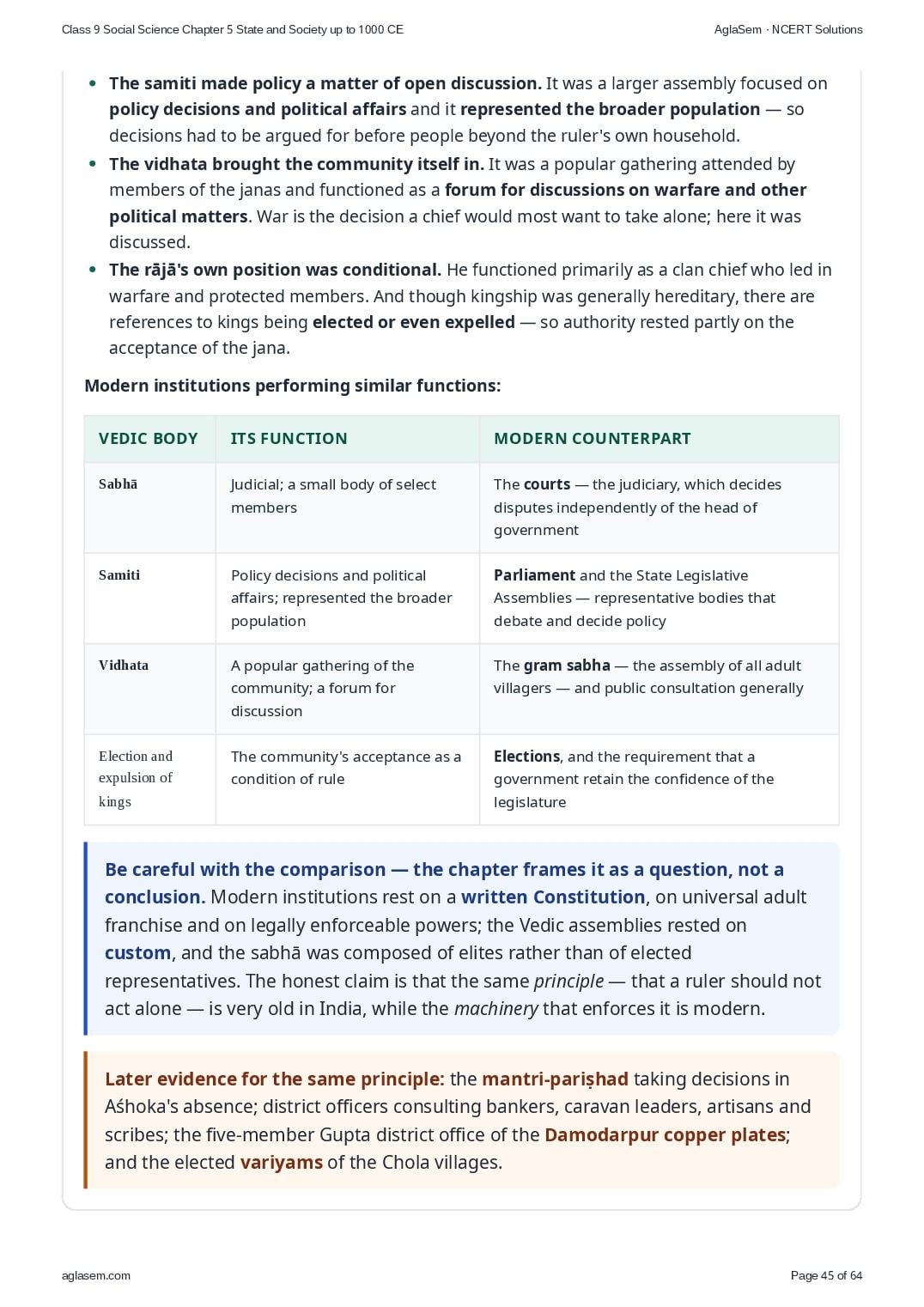
- Explain how assemblies like sabhā and samiti limited the power of the rājā. Which modern institutions perform similar functions today?
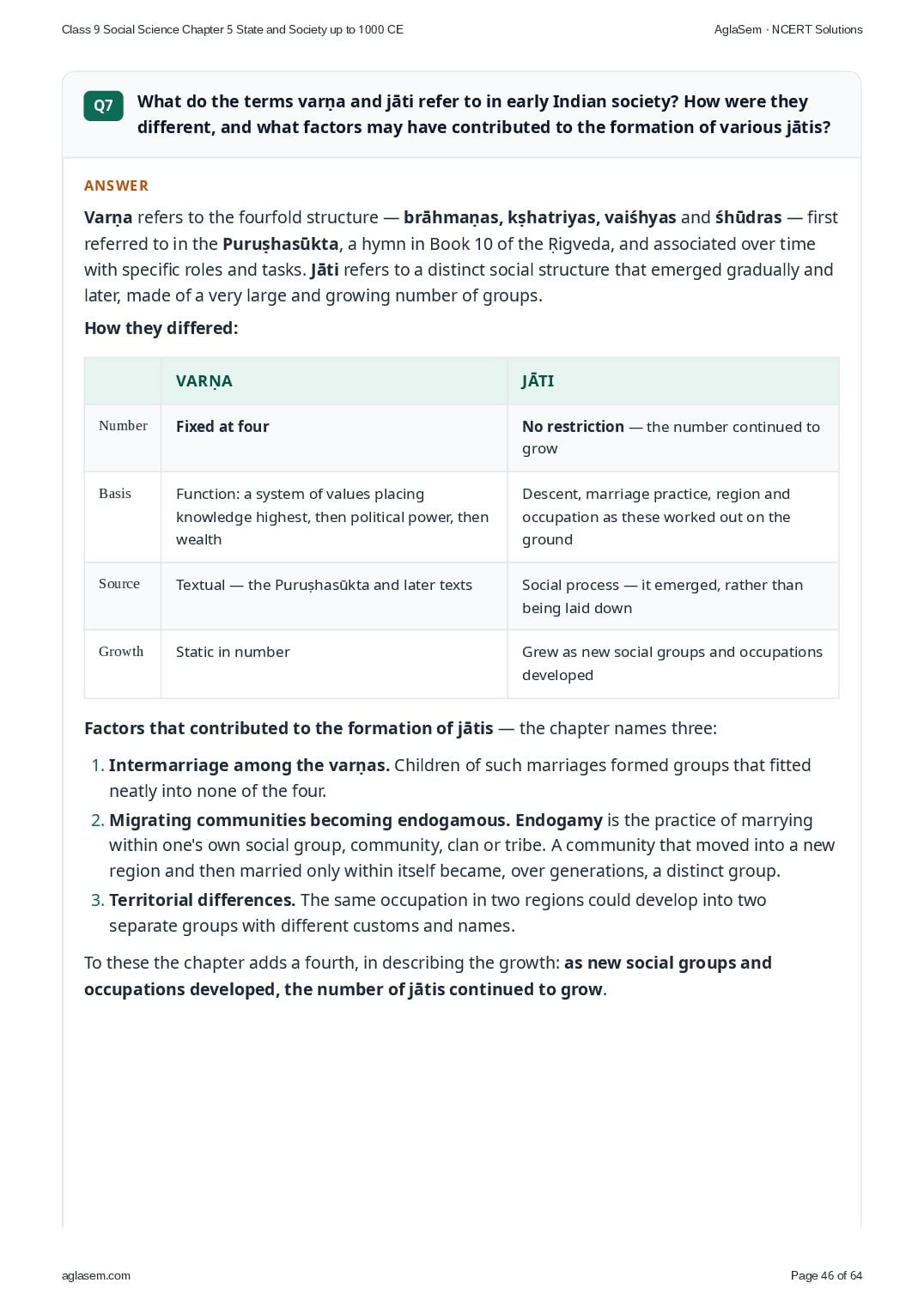
- What do the terms varṇa and jāti refer to in early Indian society? How were they different, and what factors may have contributed to the formation of various jātis?
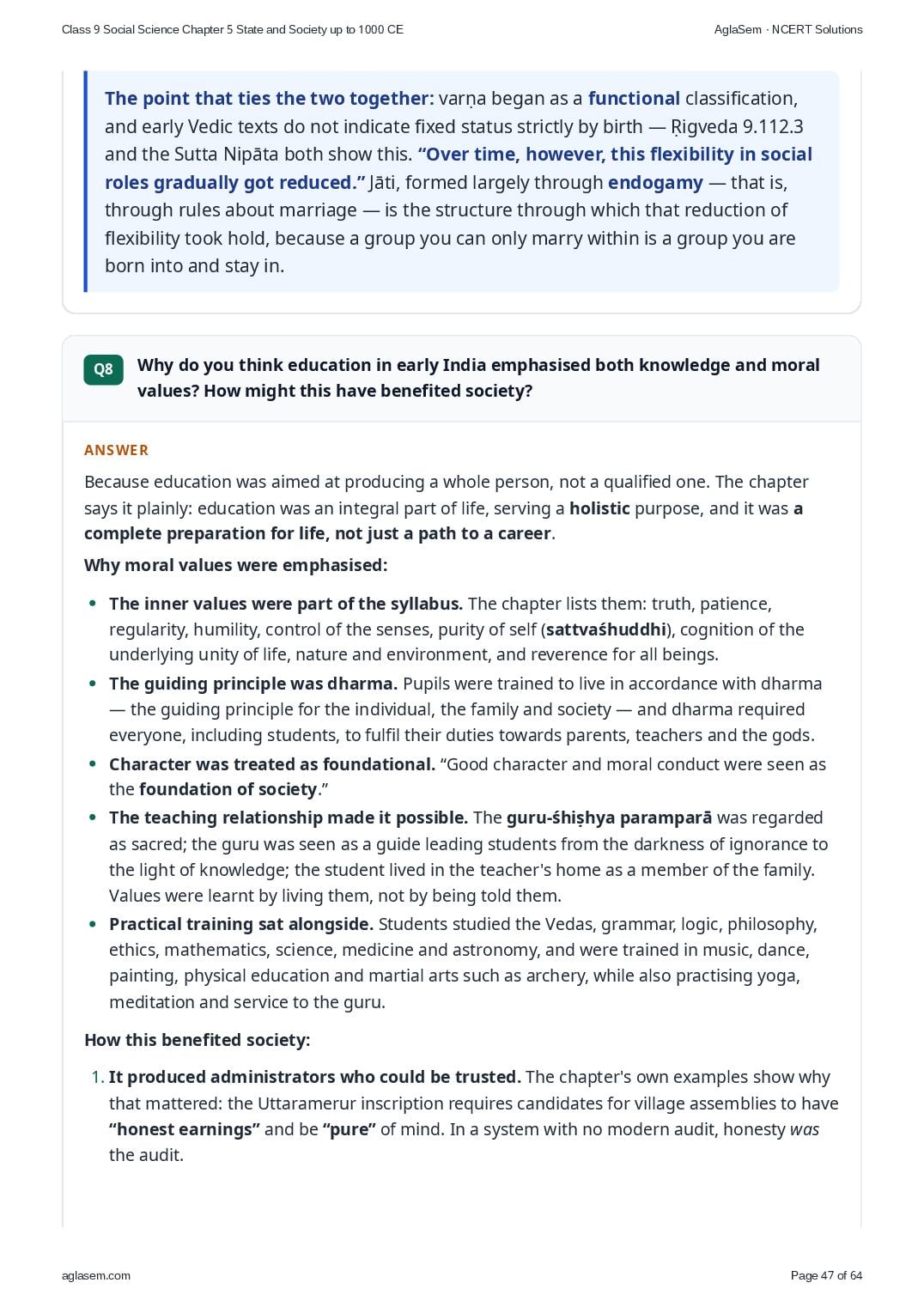
- Why do you think education in early India emphasised both knowledge and moral values? How might this have benefited society?
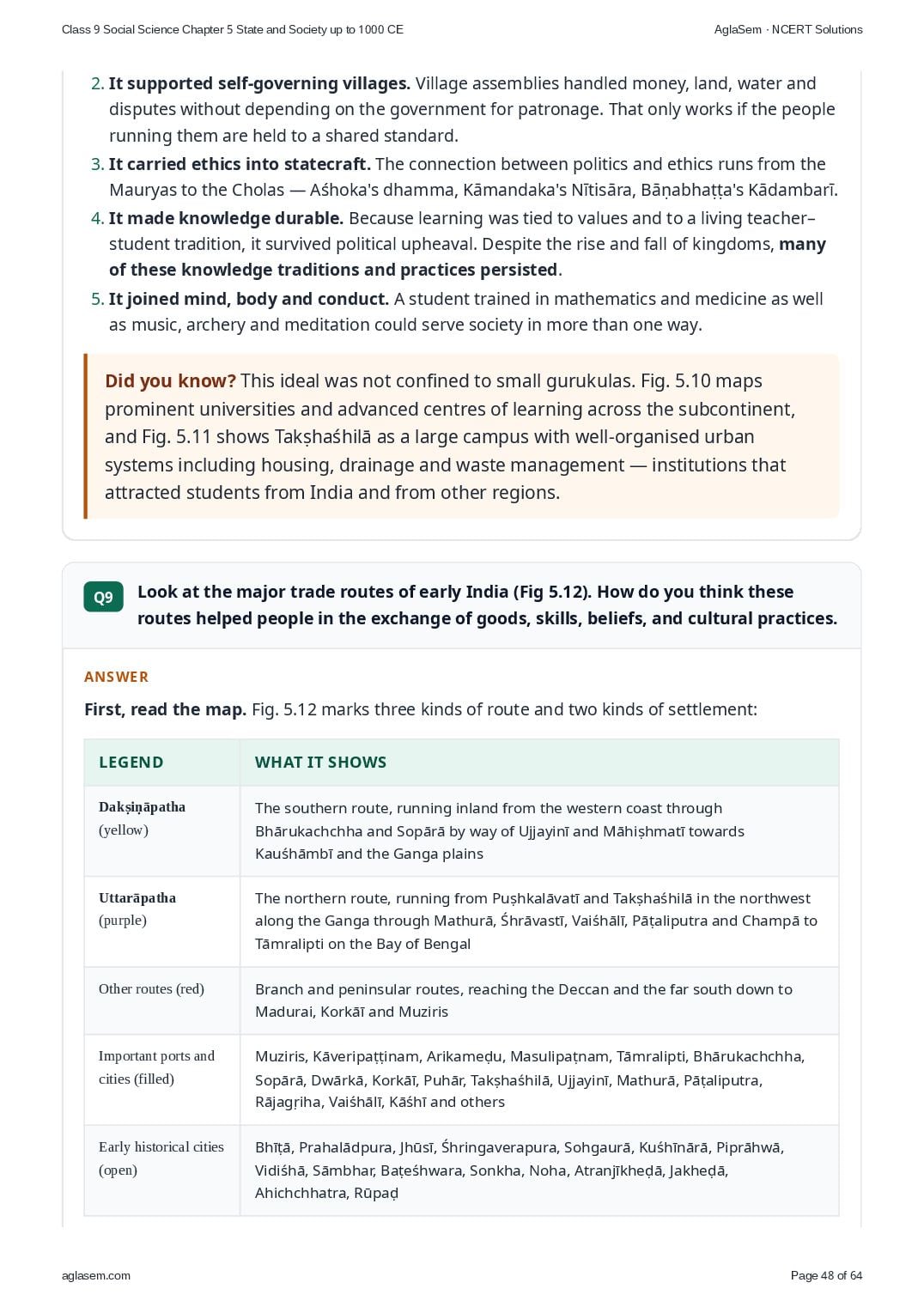
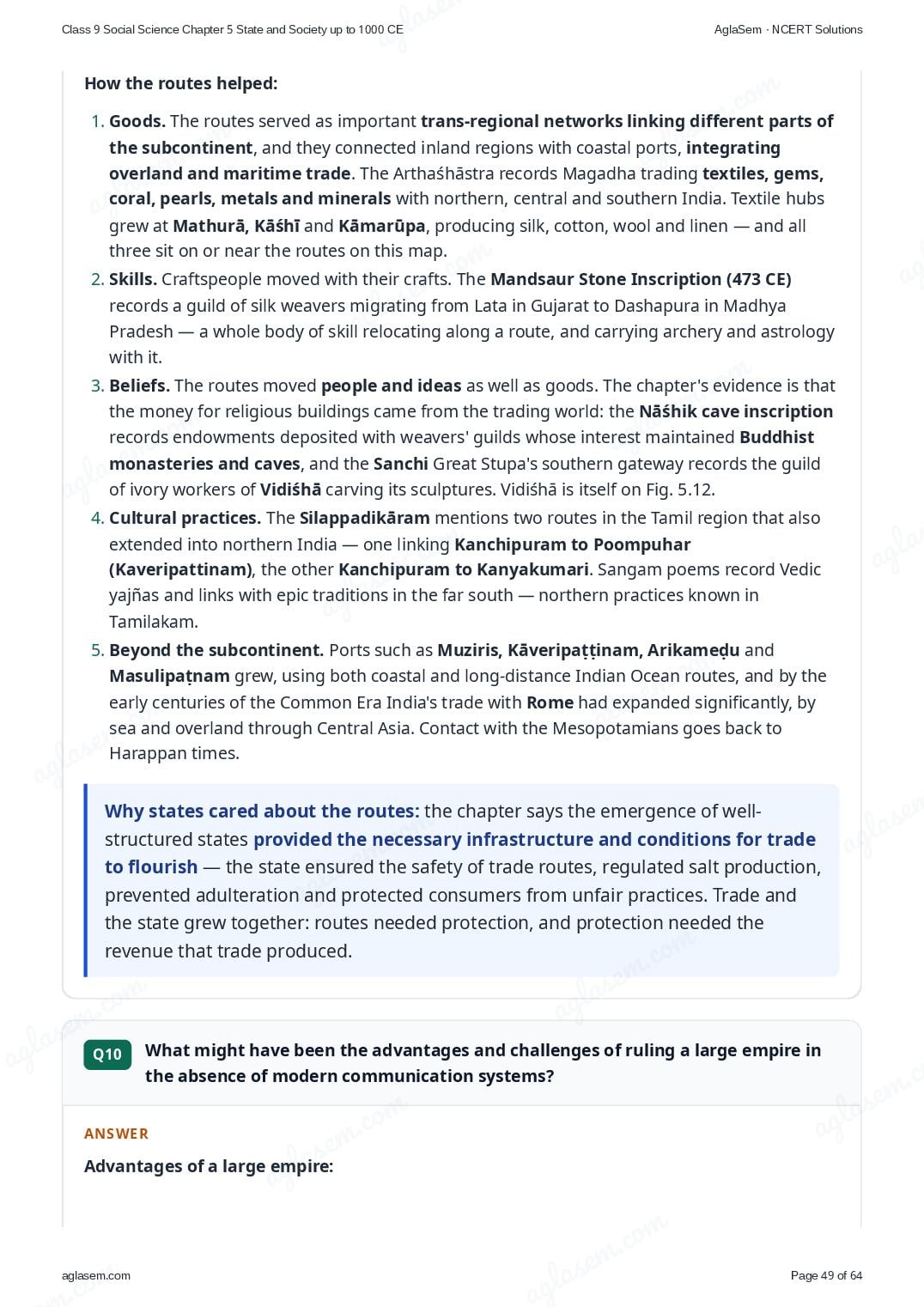
- Look at the major trade routes of early India (Fig 5.12). How do you think these routes helped people in the exchange of goods, skills, beliefs, and cultural practices.
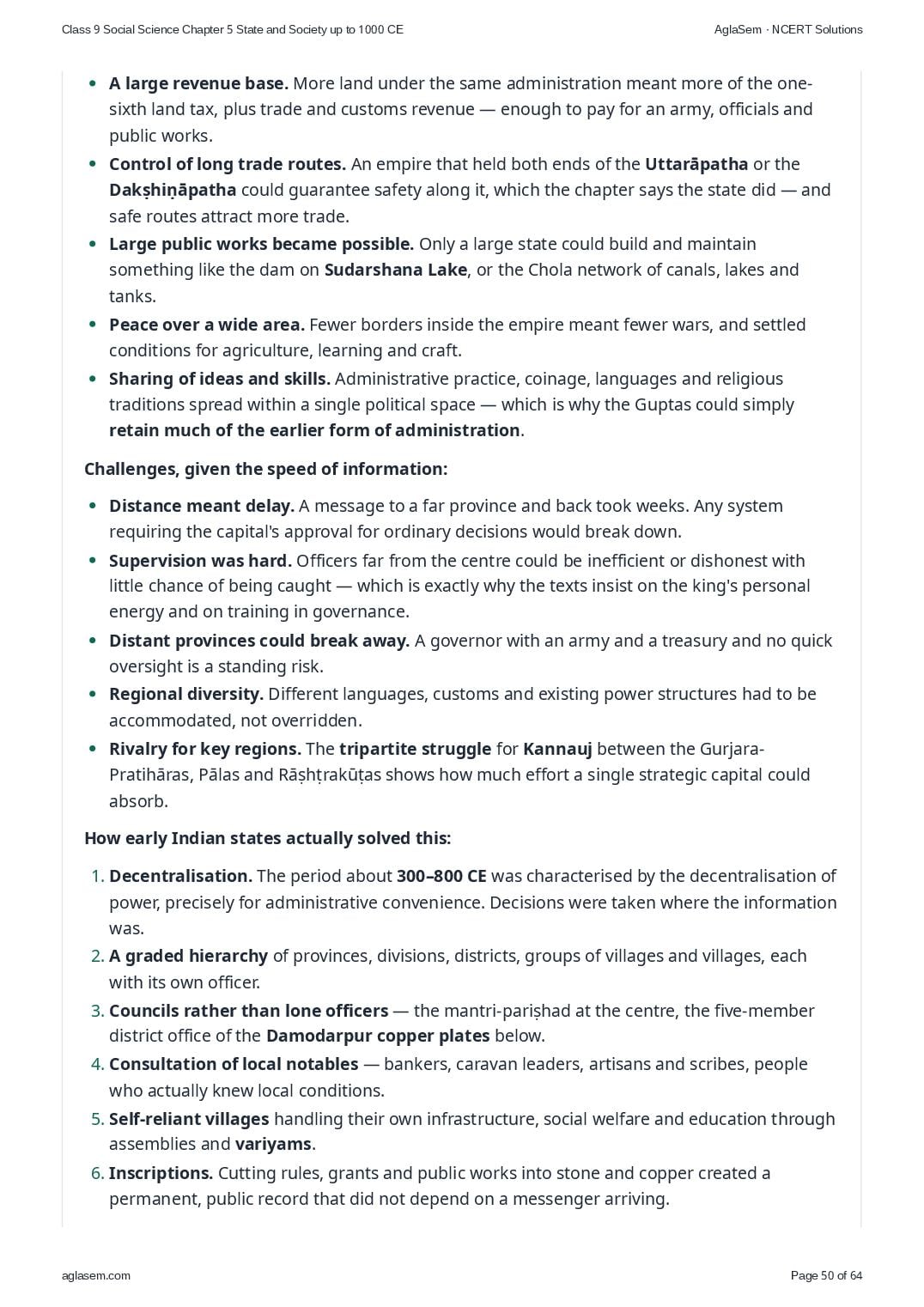
- What might have been the advantages and challenges of ruling a large empire in the absence of modern communication systems?
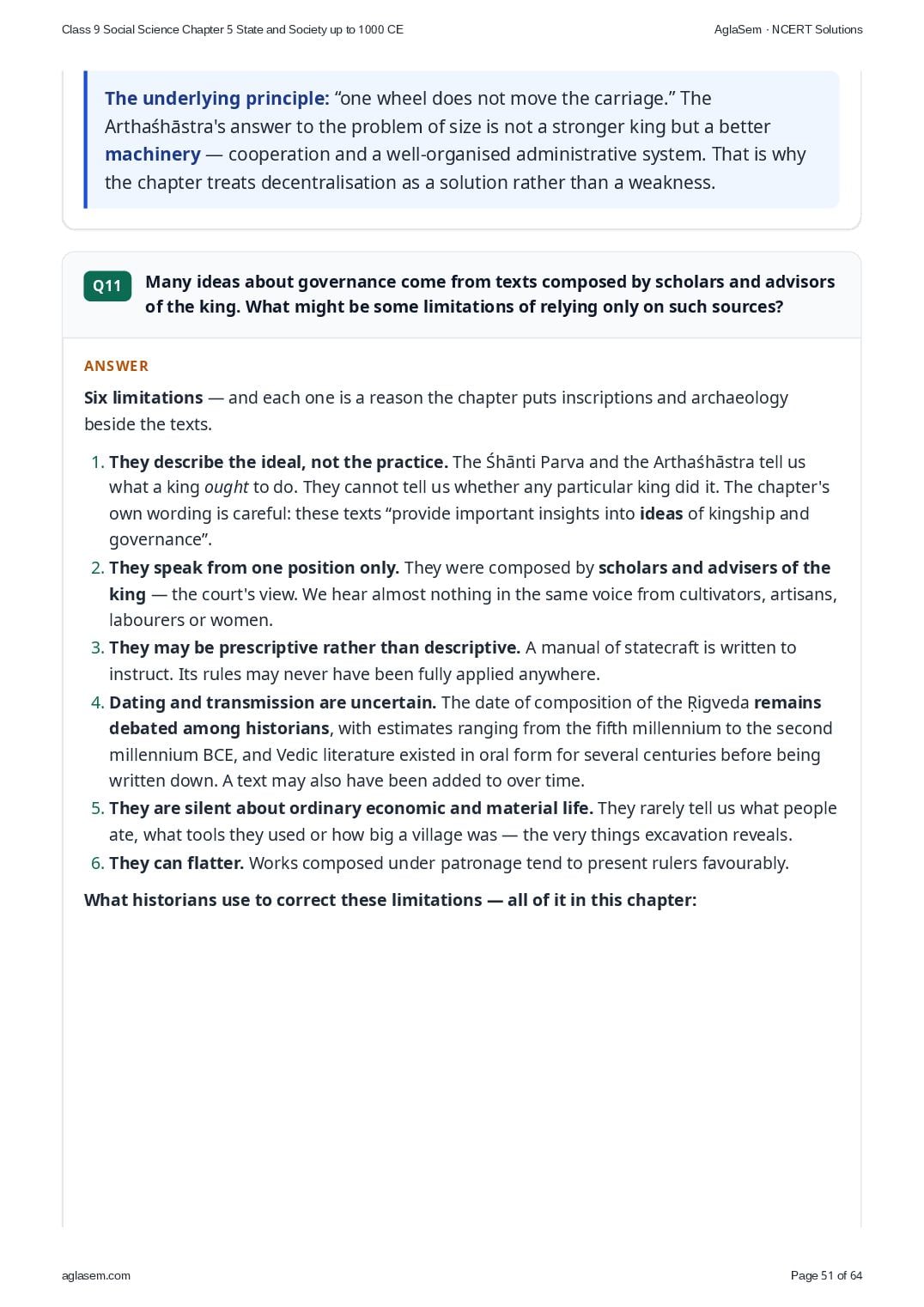
- Many ideas about governance come from texts composed by scholars and advisors of the king. What might be some limitations of relying only on such sources?
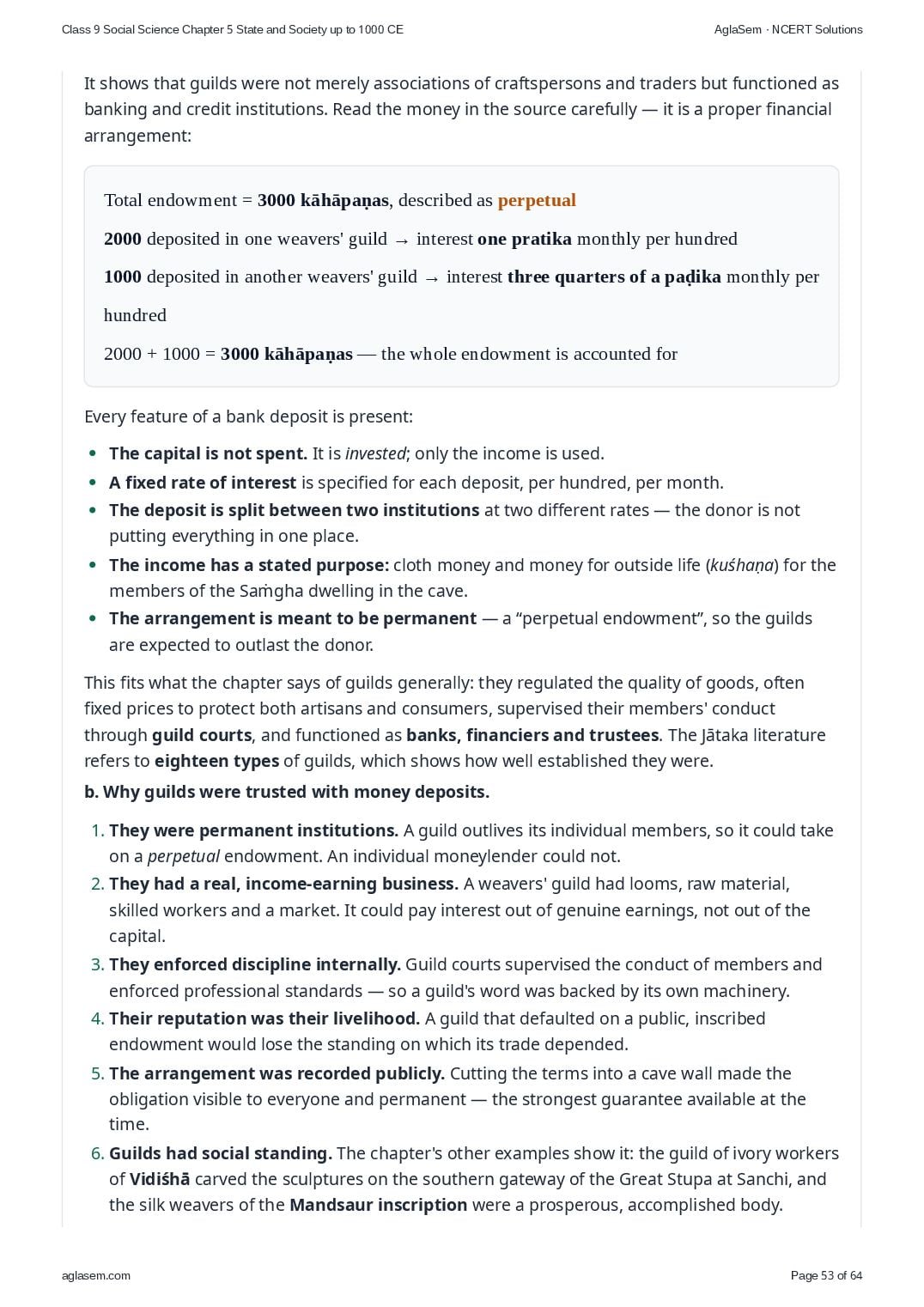
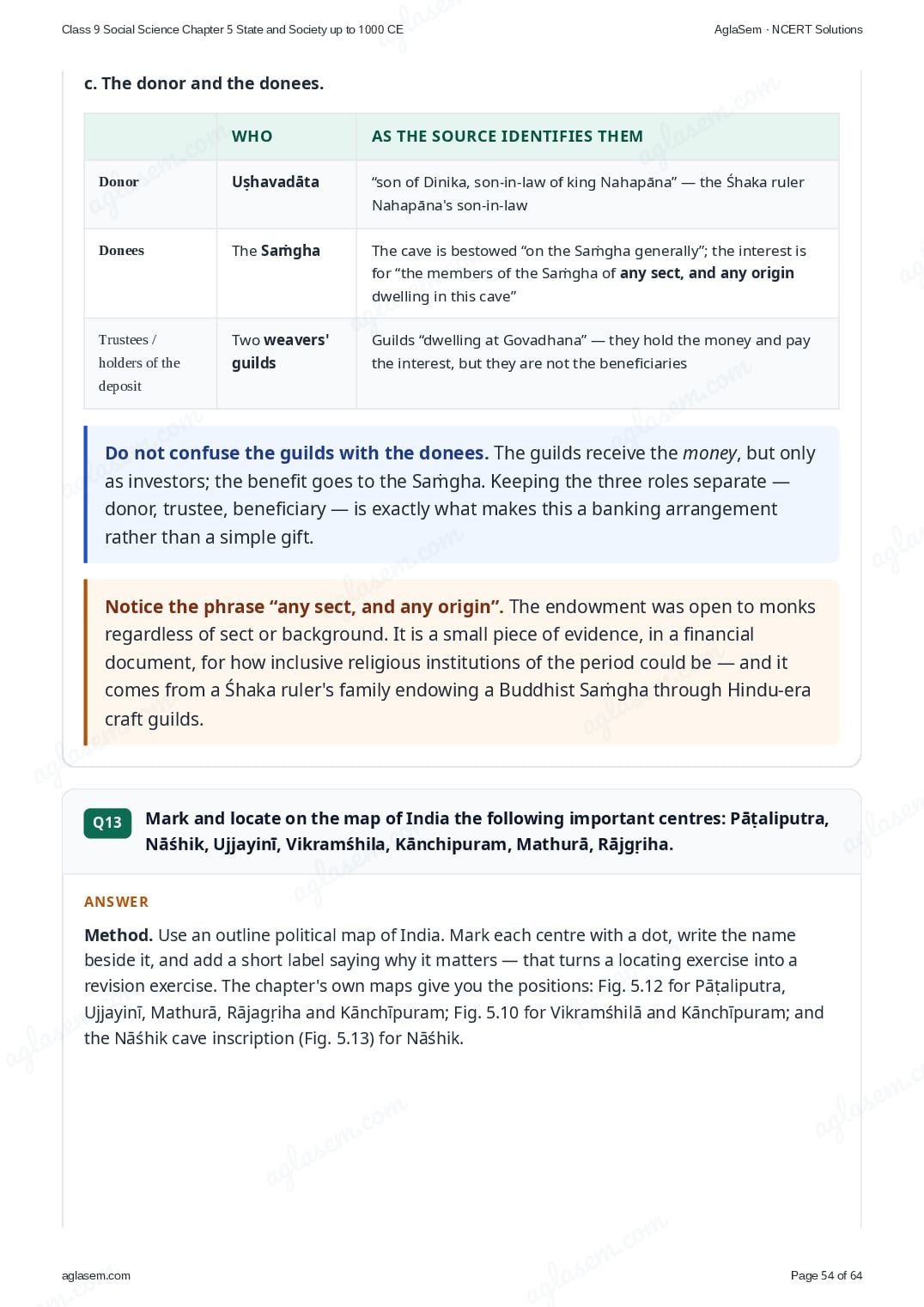
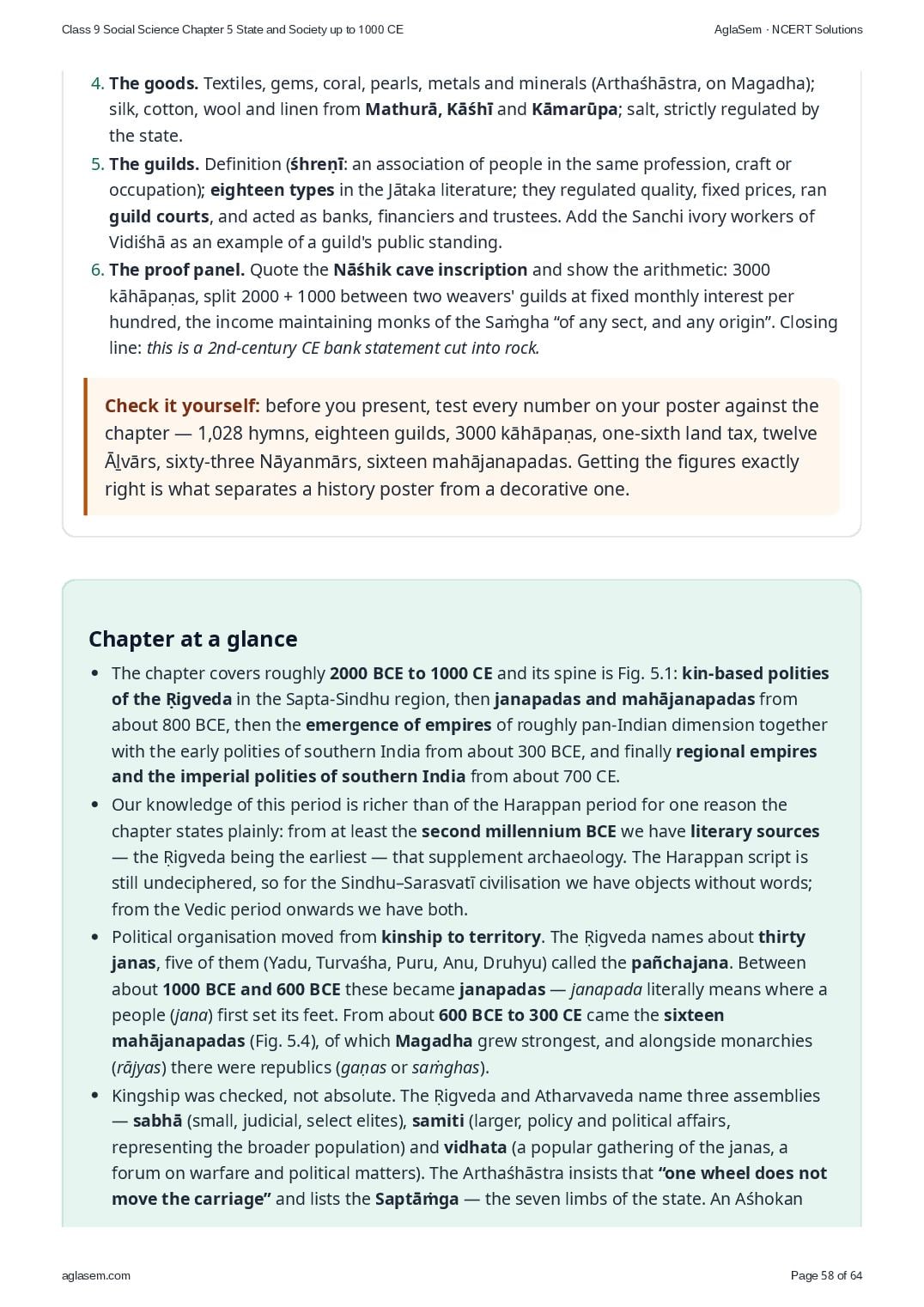
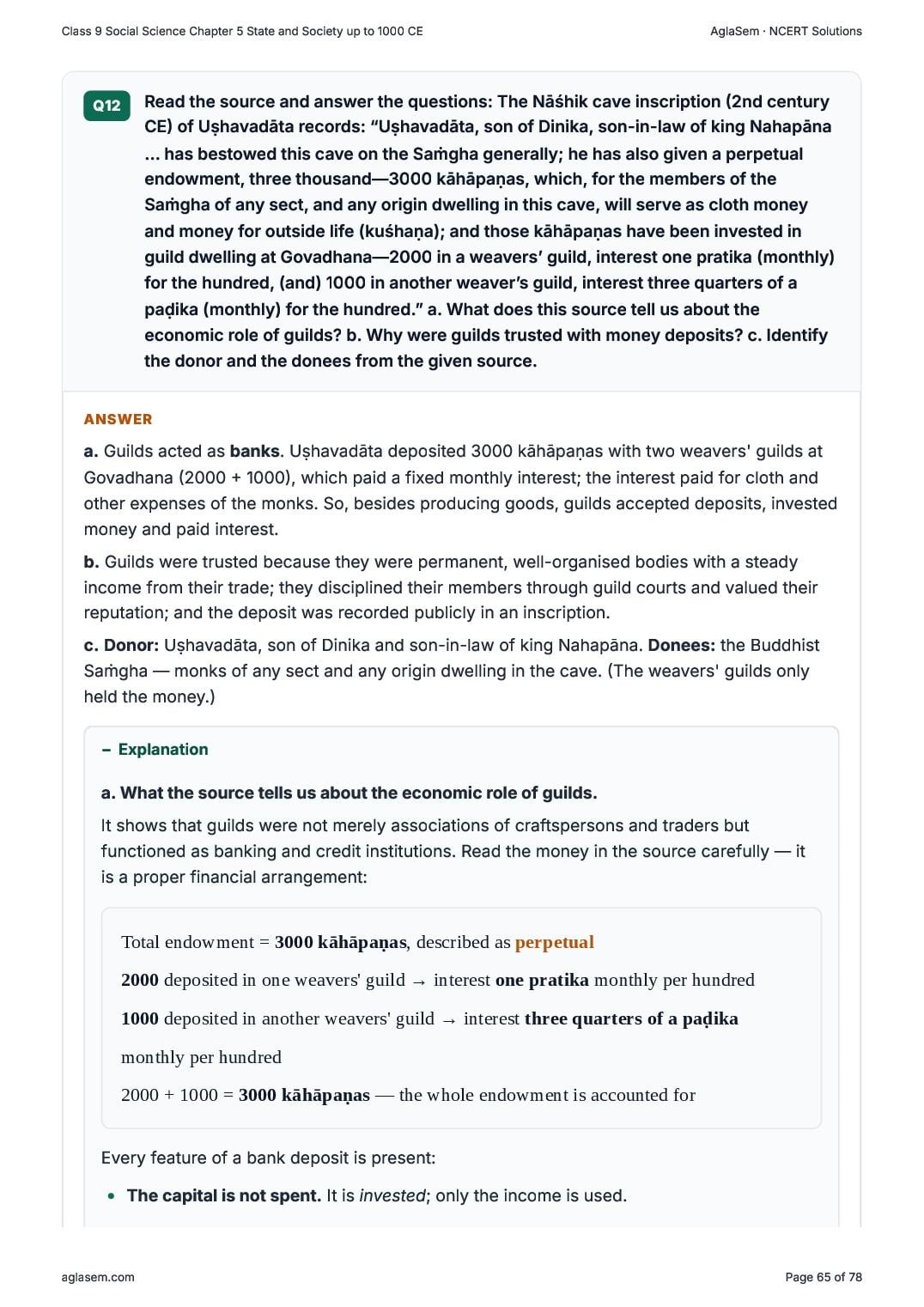
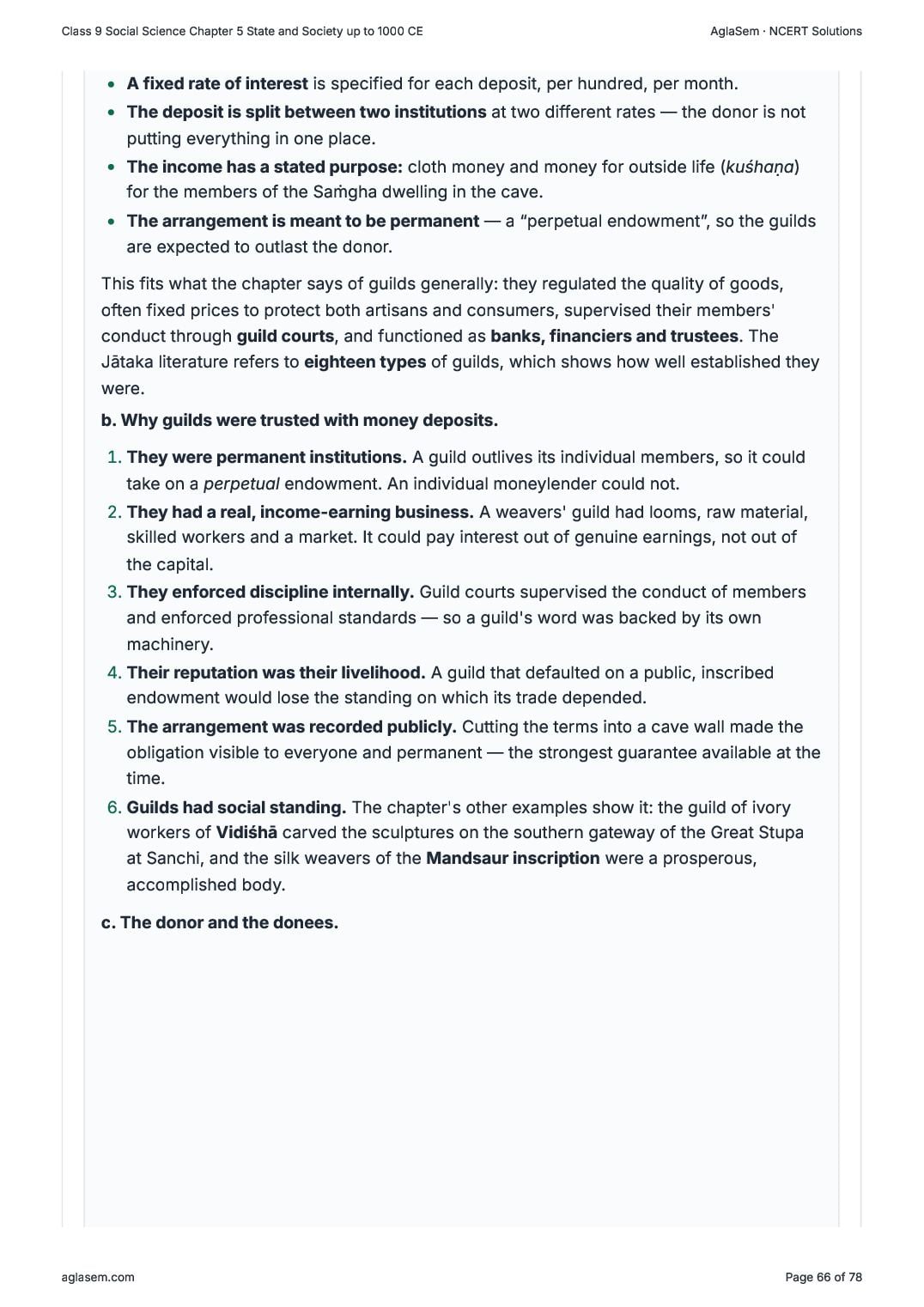
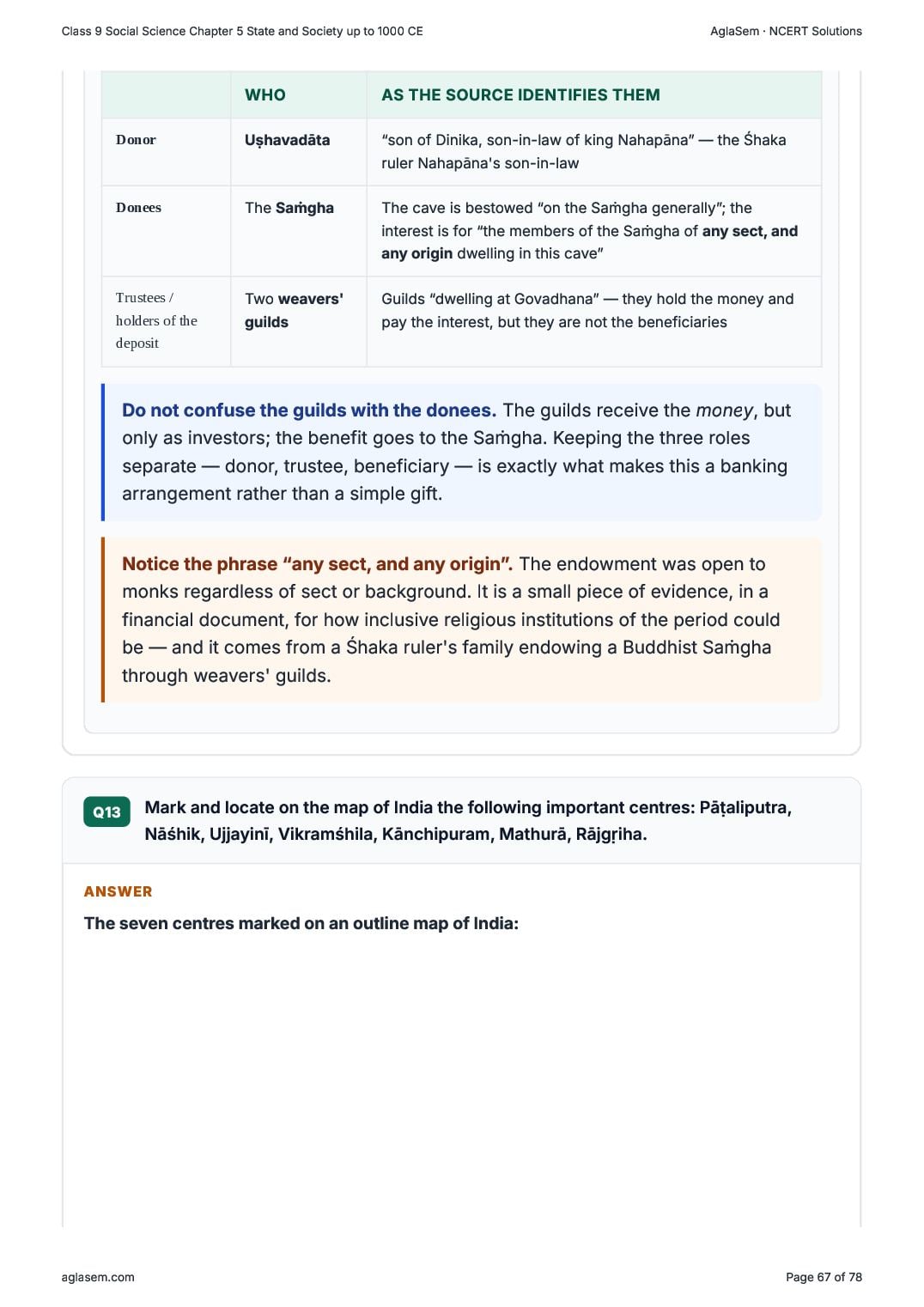
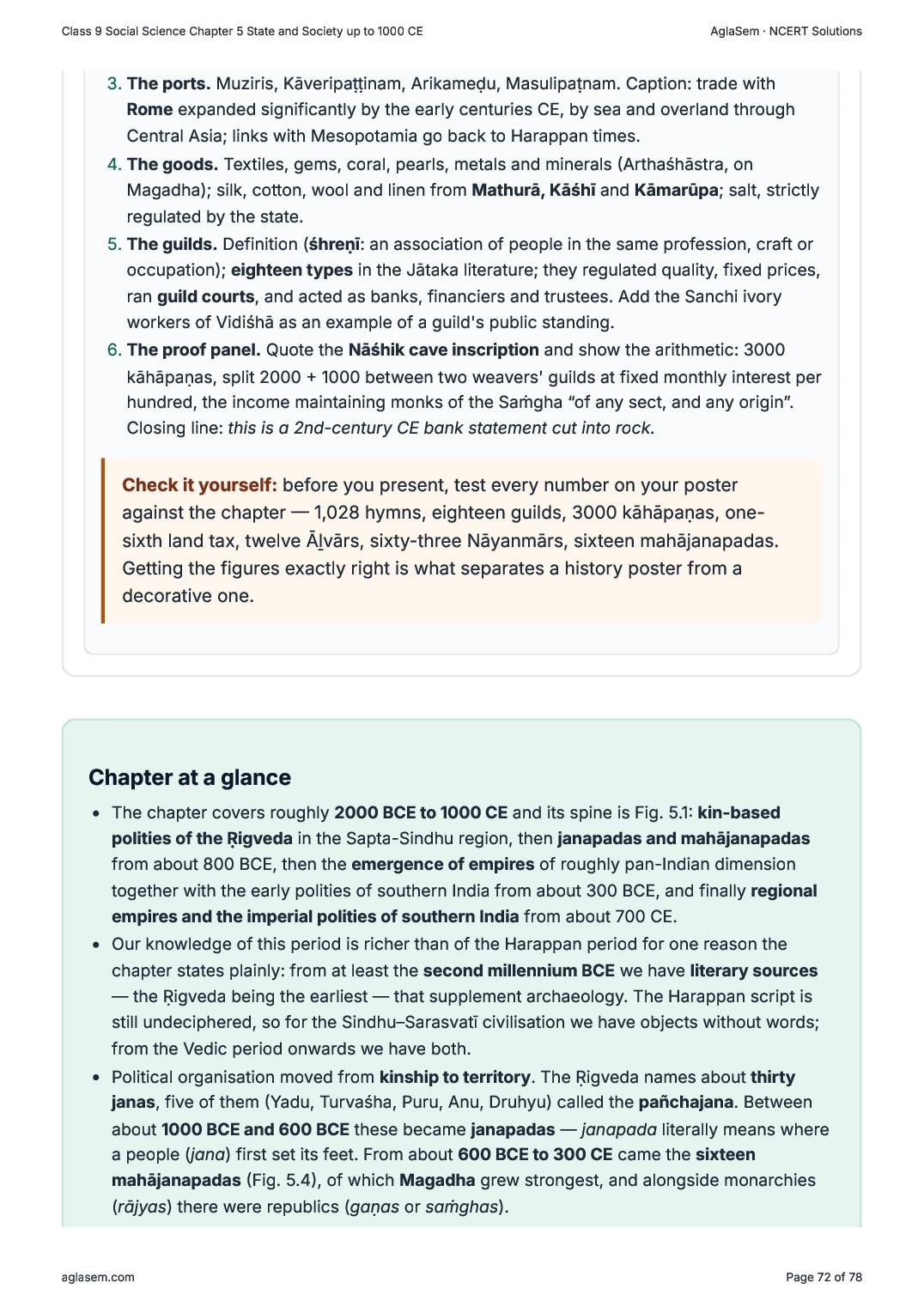
- Read the source and answer the questions: The Nāśhik cave inscription (2nd century CE) of Uṣhavadāta records: “Uṣhavadāta, son of Dinika, son-in-law of king Nahapāna … has bestowed this cave on the Saṁgha generally; he has also given a perpetual endowment, three thousand—3000 kāhāpaṇas, which, for the members of the Saṁgha of any sect, and any origin dwelling in this cave, will serve as cloth money and money for outside life (kuśhaṇa); and those kāhāpaṇas have been invested in guild dwelling at Govadhana—2000 in a weavers’ guild, interest one pratika (monthly) for the hundred, (and) 1000 in another weaver’s guild, interest three quarters of a paḍika (monthly) for the hundred.” a. What does this source tell us about the economic role of guilds? b. Why were guilds trusted with money deposits? c. Identify the donor and the donees from the given source.
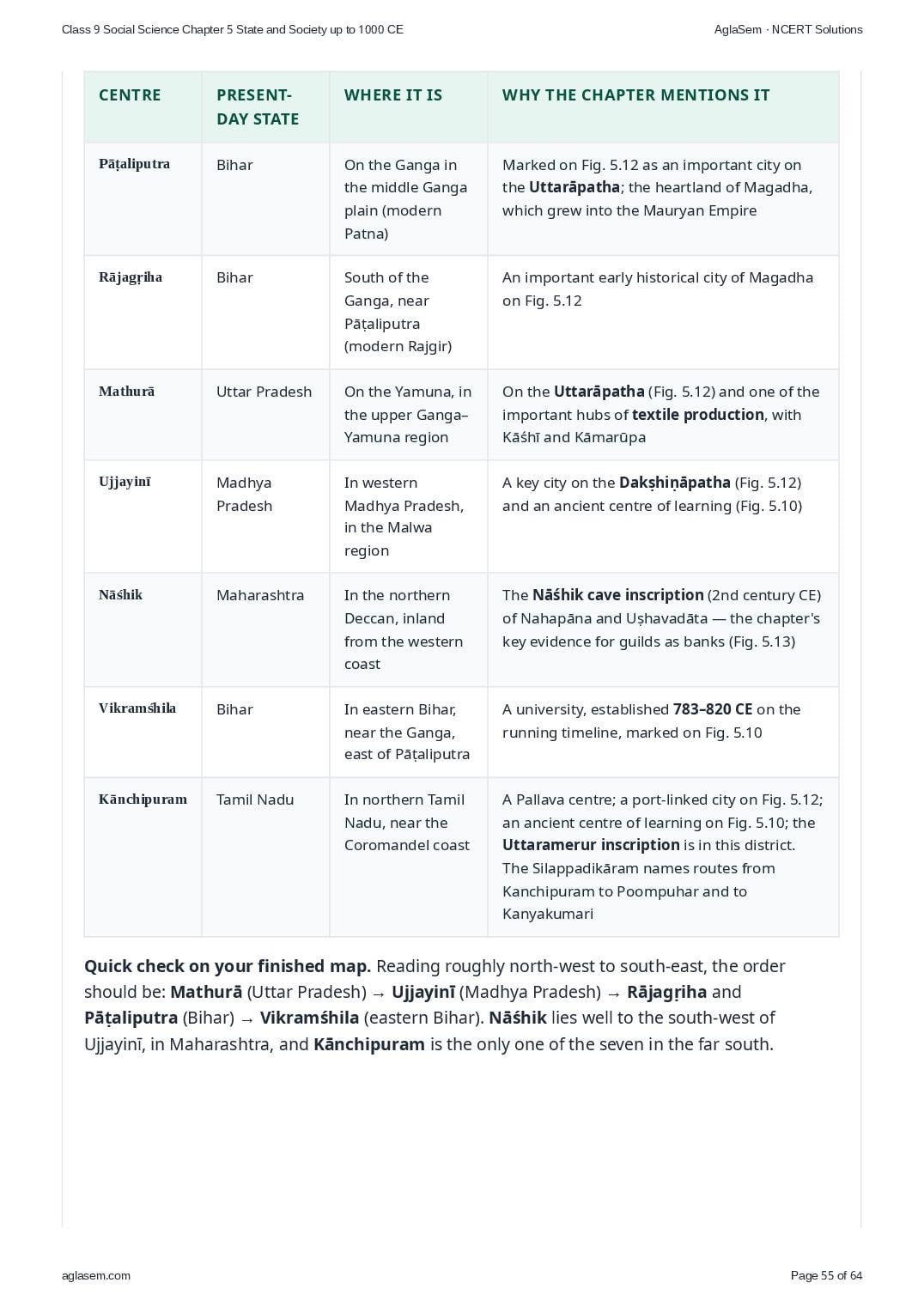
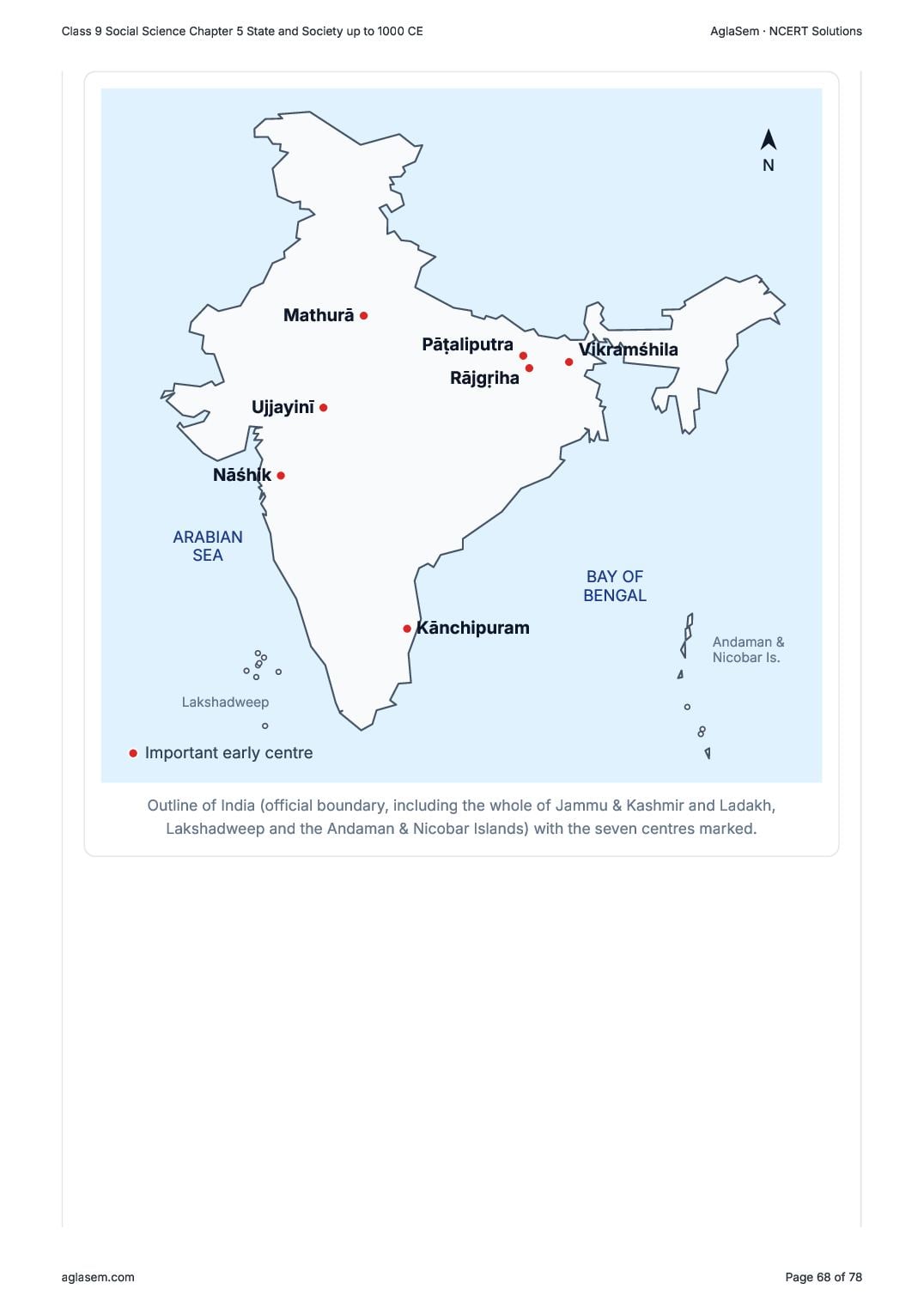
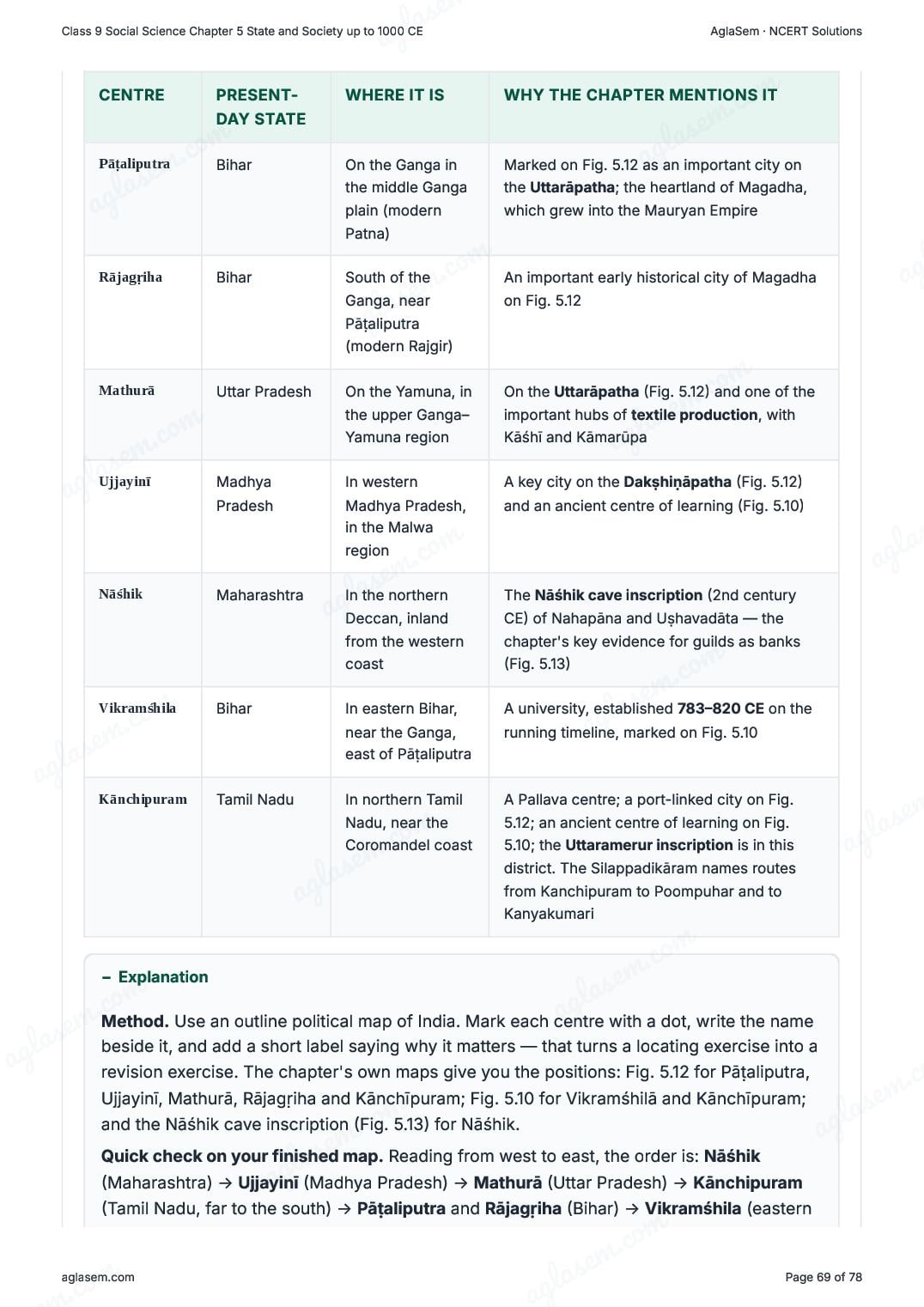
- Mark and locate on the map of India the following important centres: Pāṭaliputra, Nāśhik, Ujjayinī, Vikramśhila, Kānchipuram, Mathurā, Rājgṛiha.
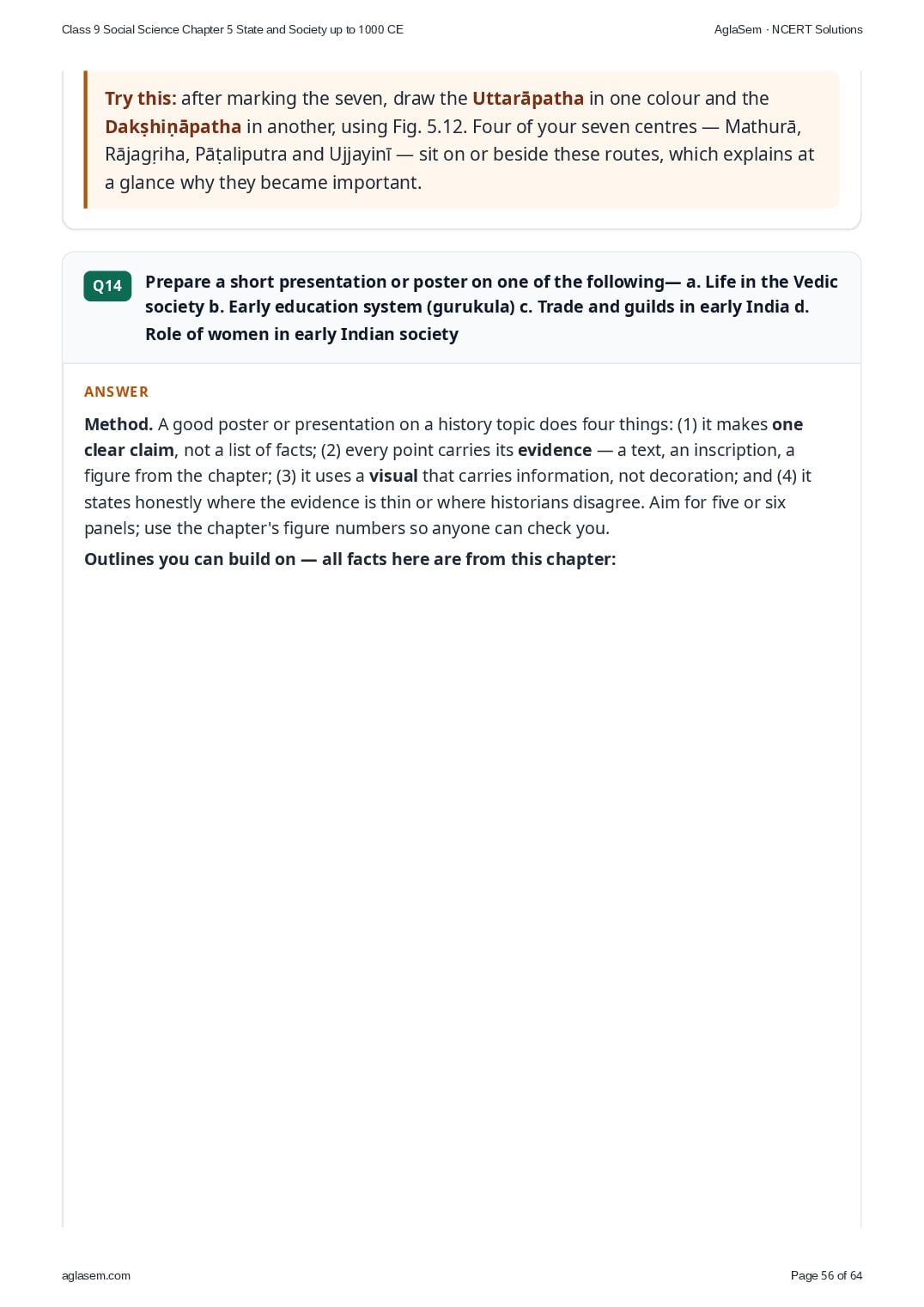
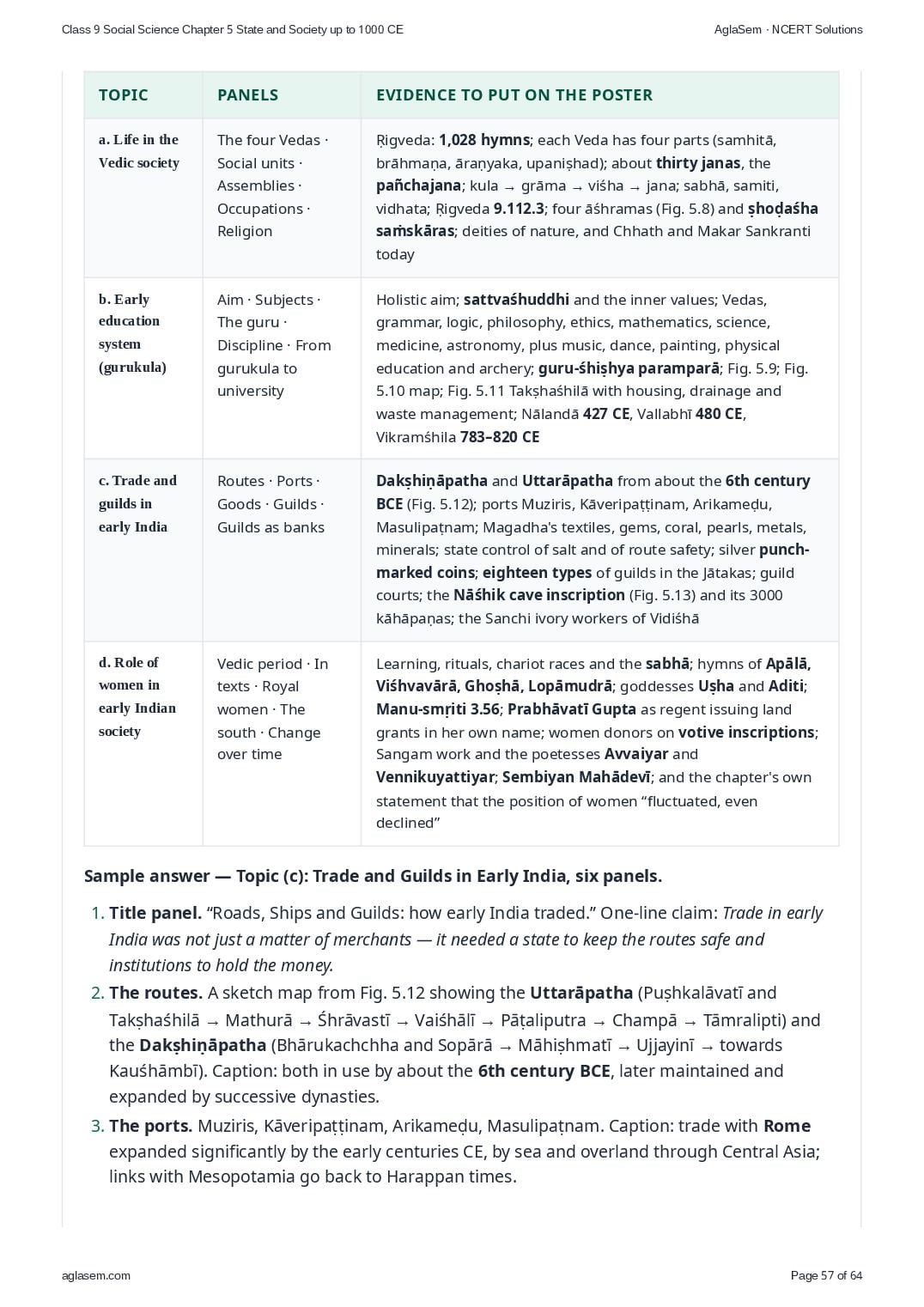
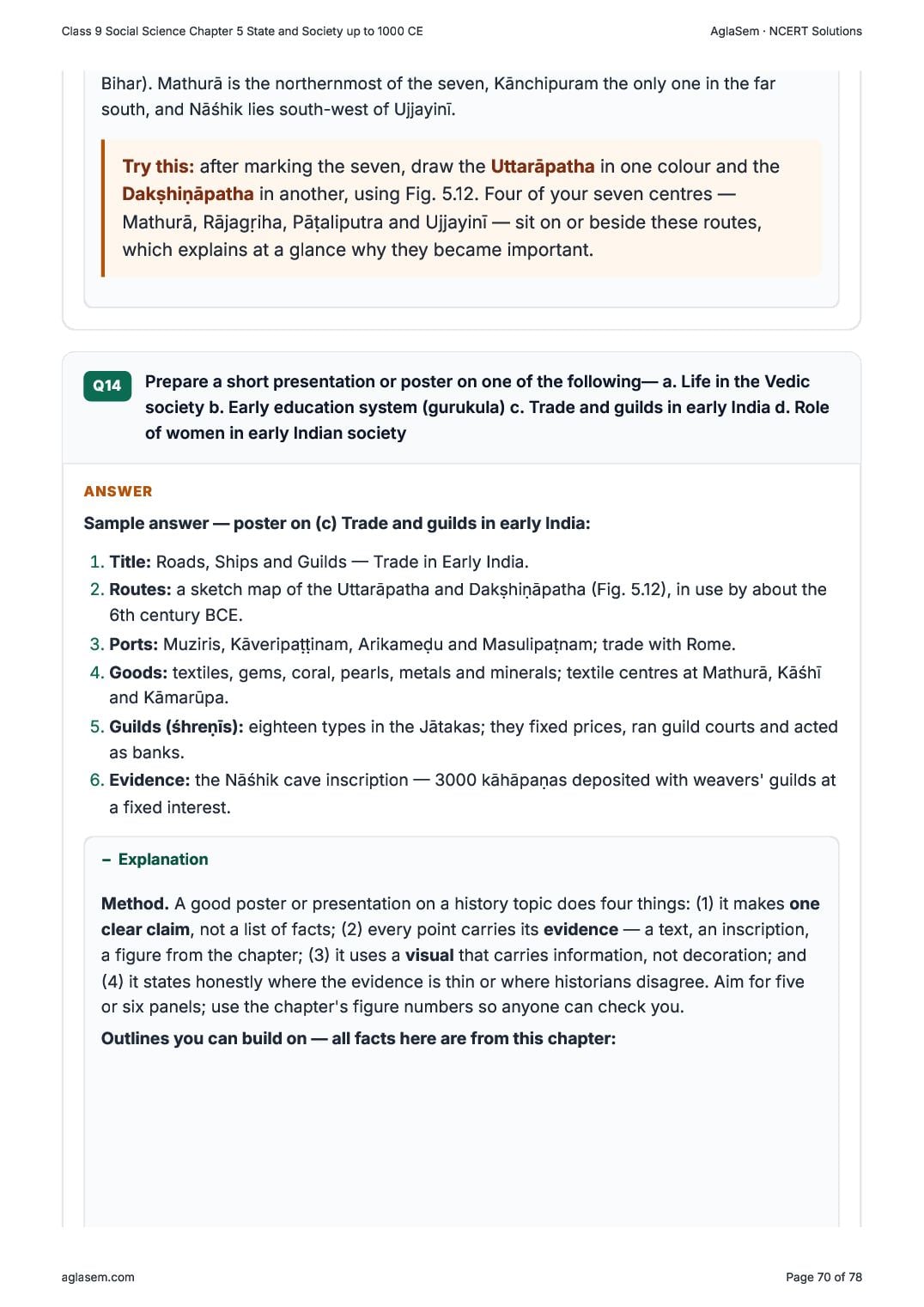
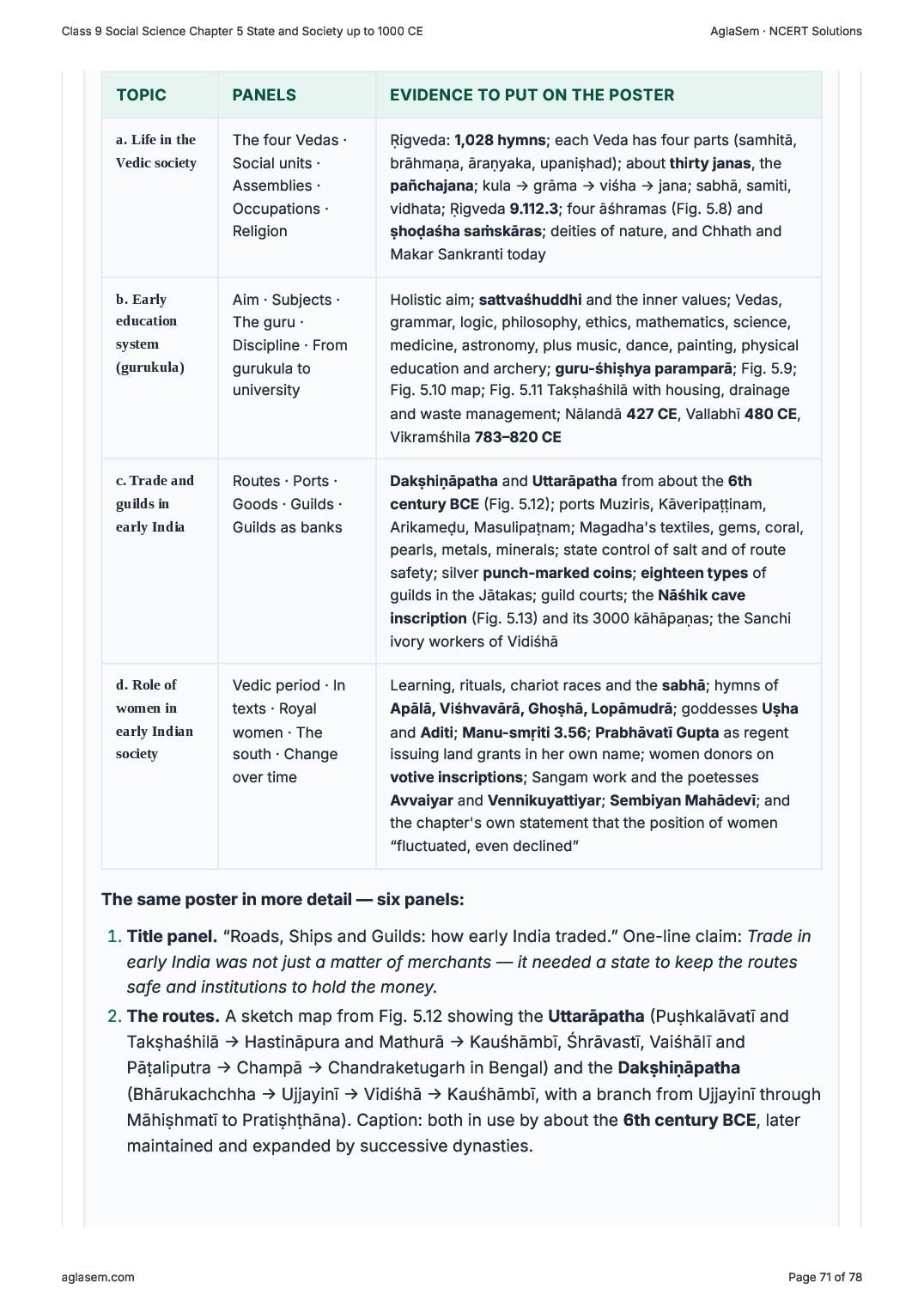
- Prepare a short presentation or poster on one of the following— a. Life in the Vedic society b. Early education system (gurukula) c. Trade and guilds in early India d. Role of women in early Indian society
Chapter at a Glance
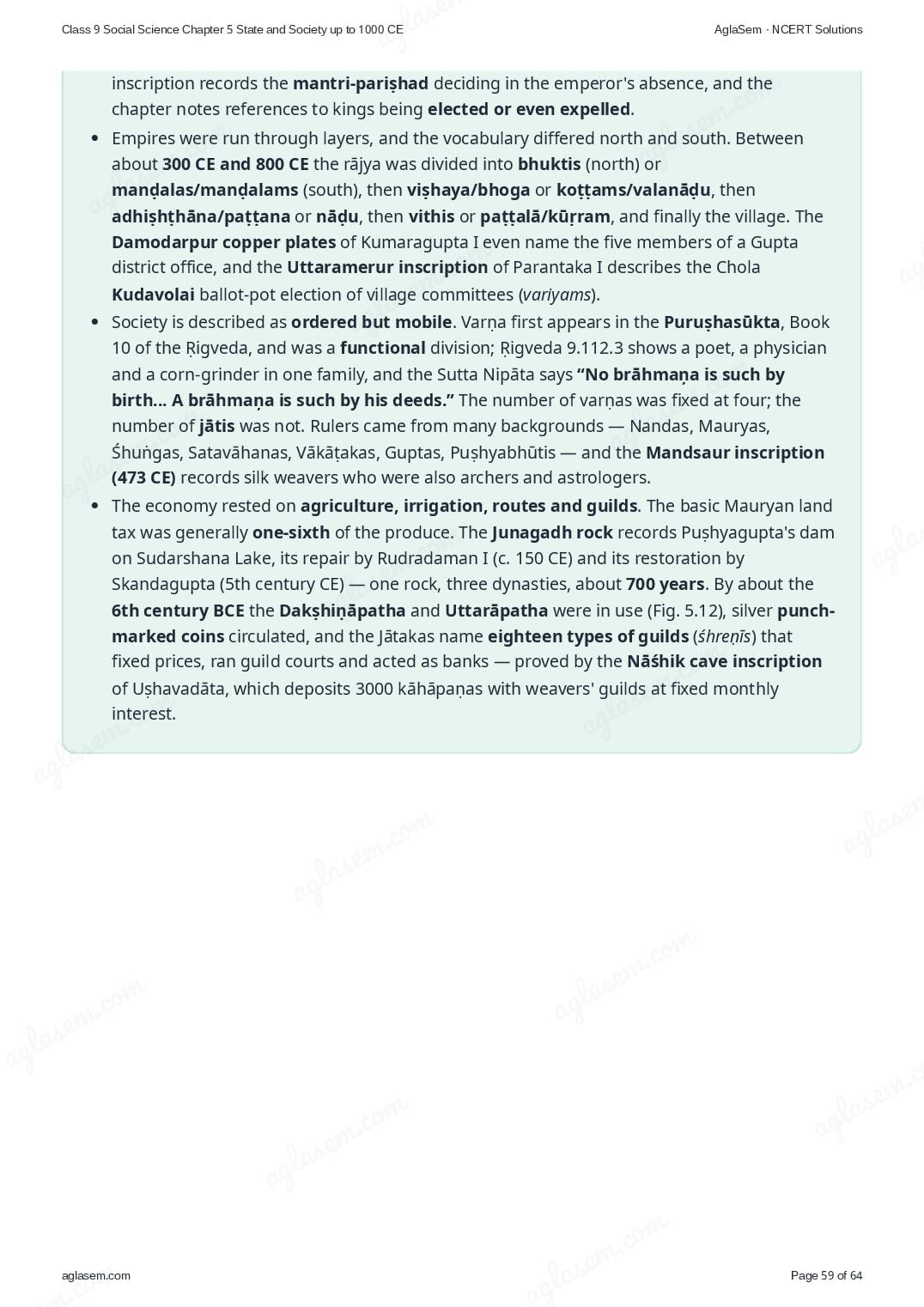
- The chapter covers roughly 2000 BCE to 1000 CE and its spine is Fig. 5.1: kin-based polities of the Ṛigveda in the Sapta-Sindhu region, then janapadas and mahājanapadas from about 800 BCE, then the emergence of empires of roughly pan-Indian dimension together with the early polities of southern India from about 300 BCE, and finally regional empires and the imperial polities of southern India from about 700 CE.
- Our knowledge of this period is richer than of the Harappan period for one reason the chapter states plainly: from at least the second millennium BCE we have literary sources — the Ṛigveda being the earliest — that supplement archaeology. The Harappan script is still undeciphered, so for the Sindhu–Sarasvatī civilisation we have objects without words; from the Vedic period onwards we have both.
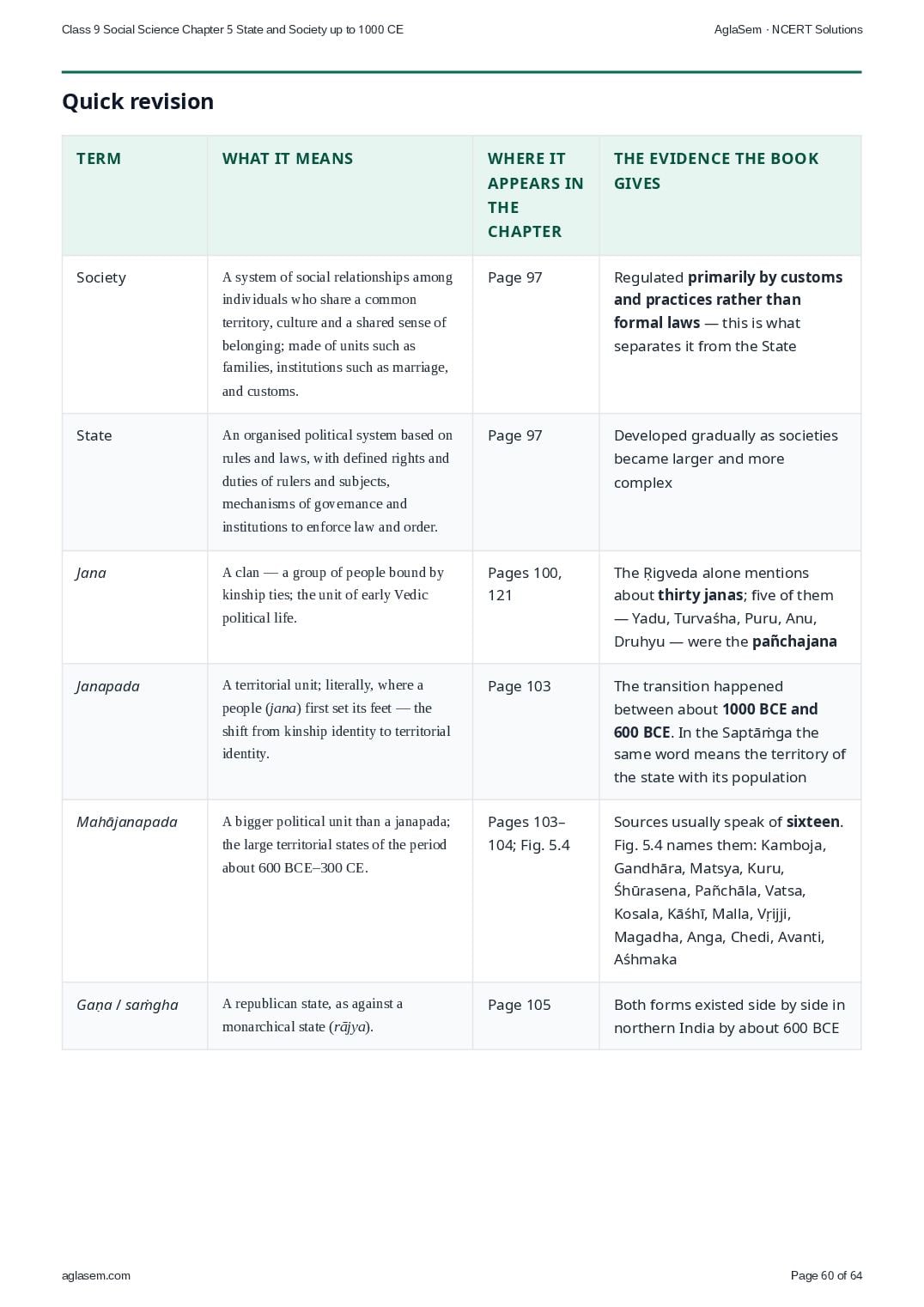
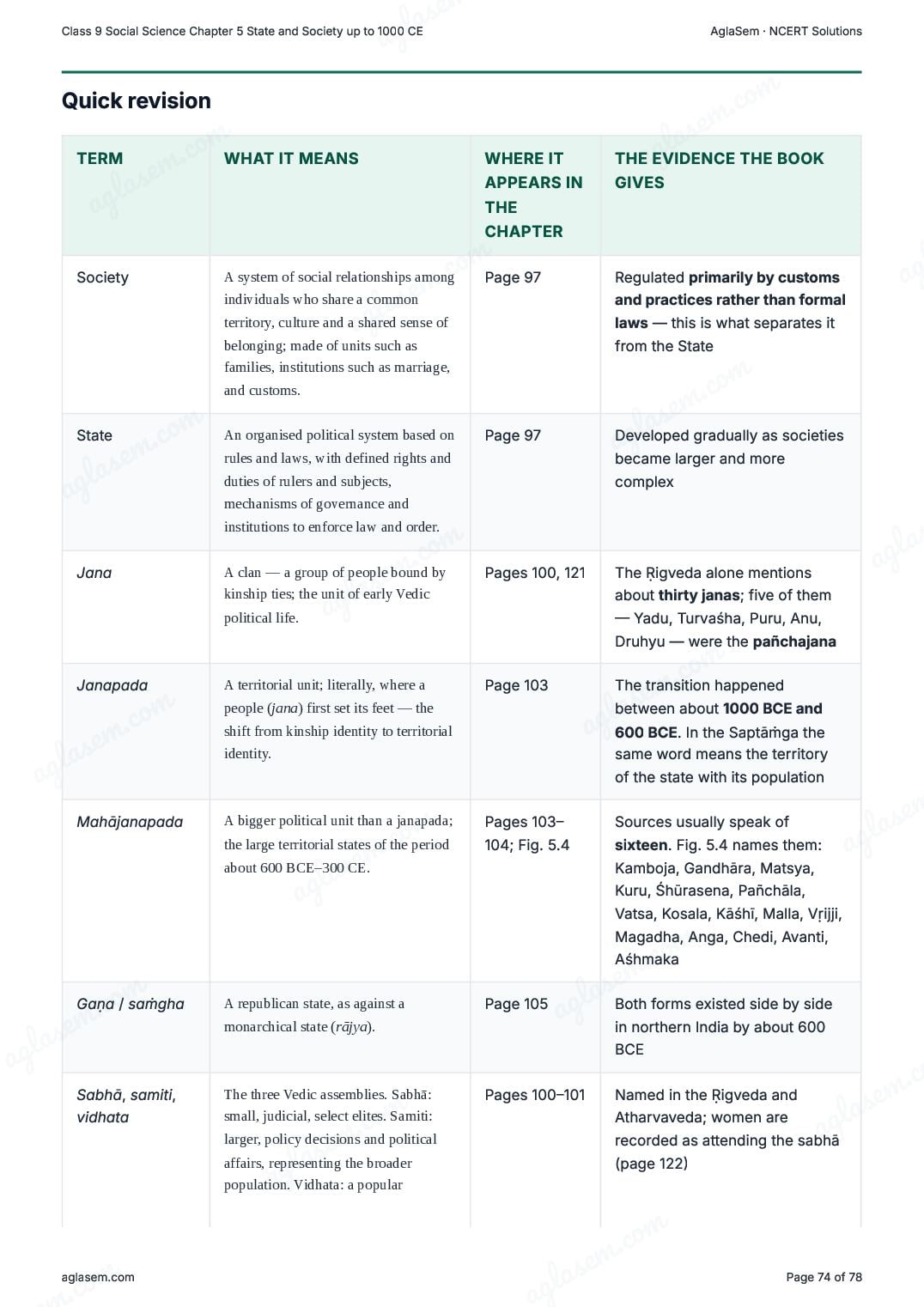
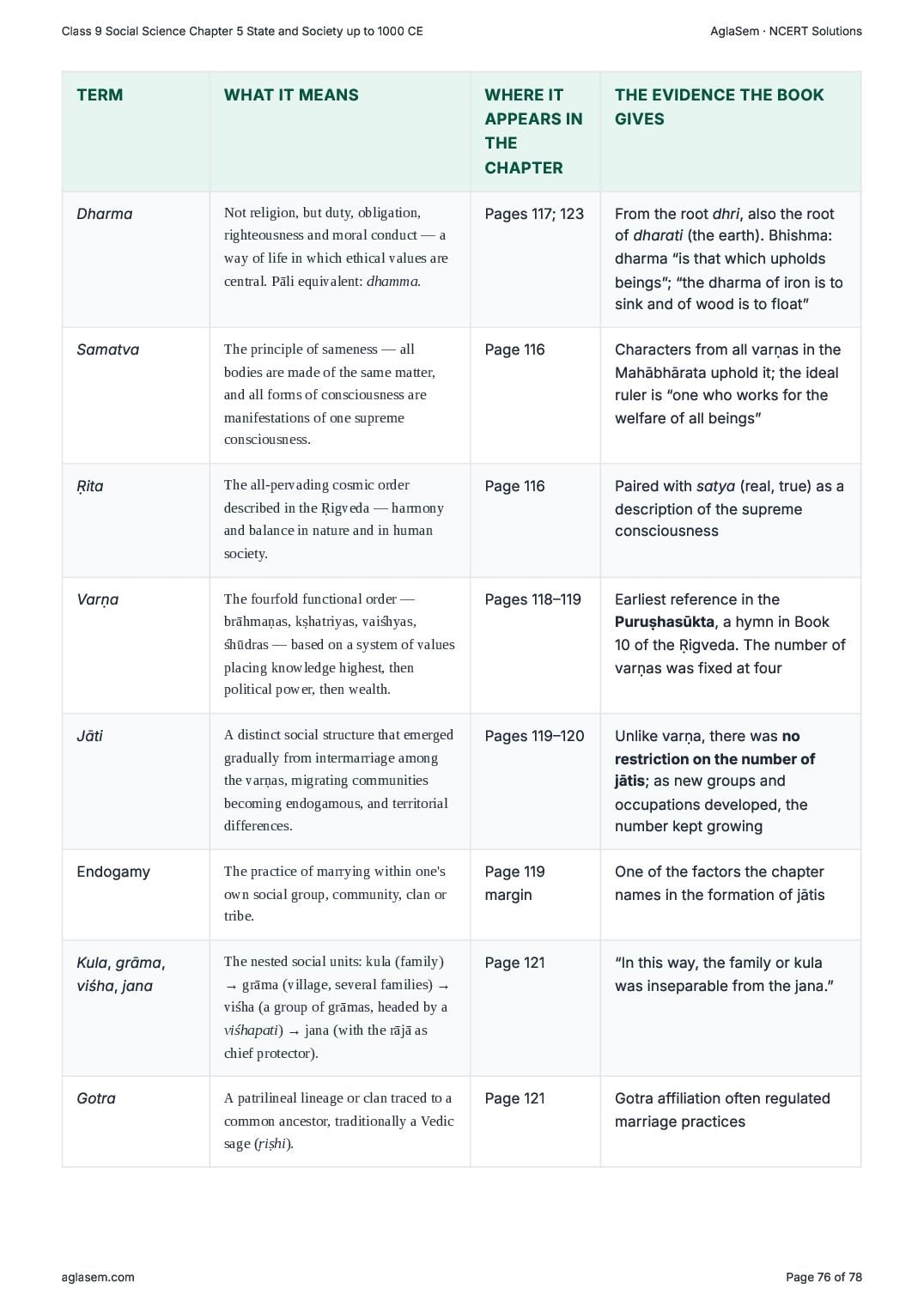
- Political organisation moved from kinship to territory . The Ṛigveda names about thirty janas , five of them (Yadu, Turvaśha, Puru, Anu, Druhyu) called the pañchajana . Between about 1000 BCE and 600 BCE these became janapadas — janapada literally means where a people ( jana ) first set its feet. From about 600 BCE to 300 CE came the sixteen mahājanapadas (Fig. 5.4), of which Magadha grew strongest, and alongside monarchies ( rājyas ) there were republics ( gaṇas or saṁghas ).
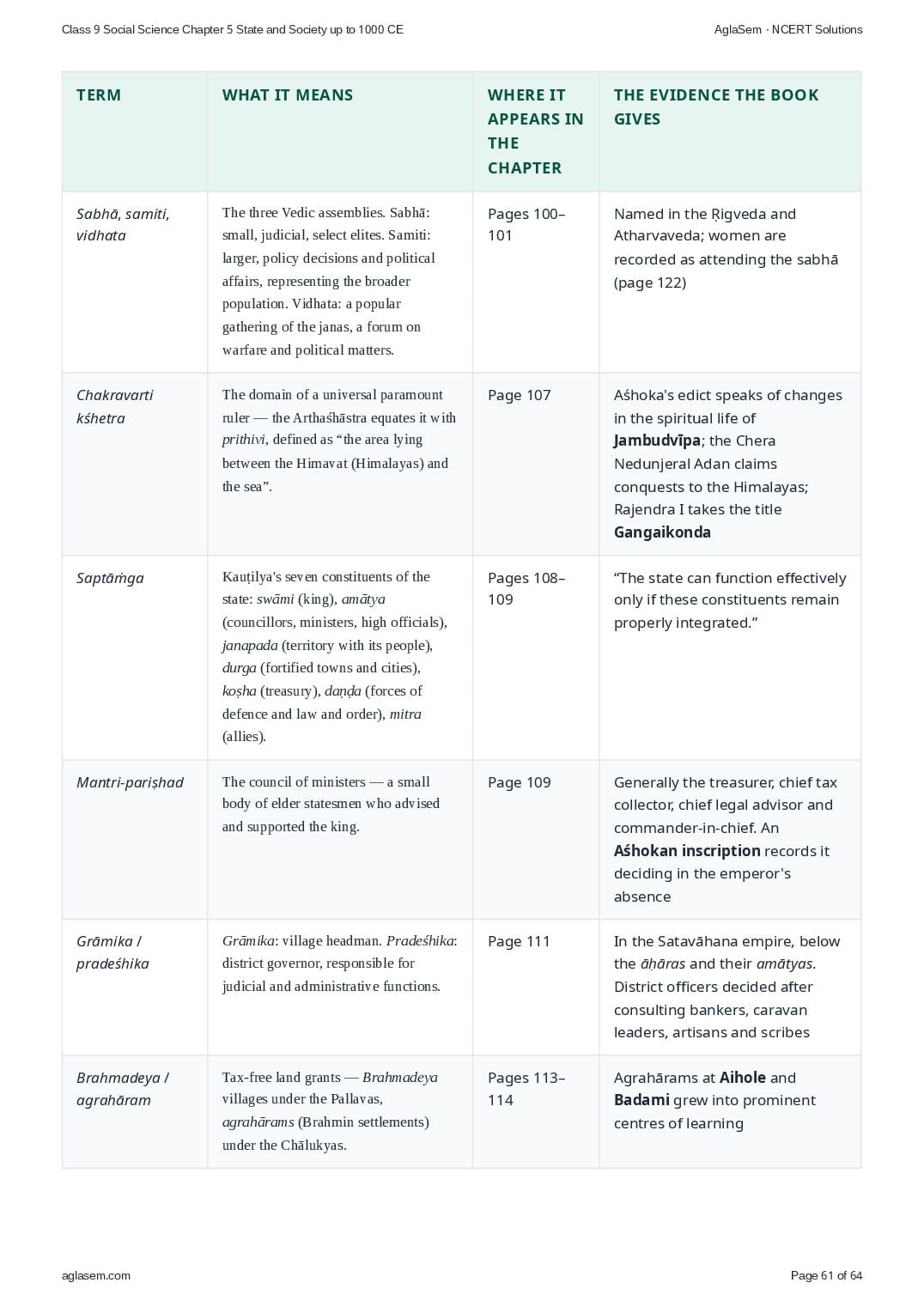
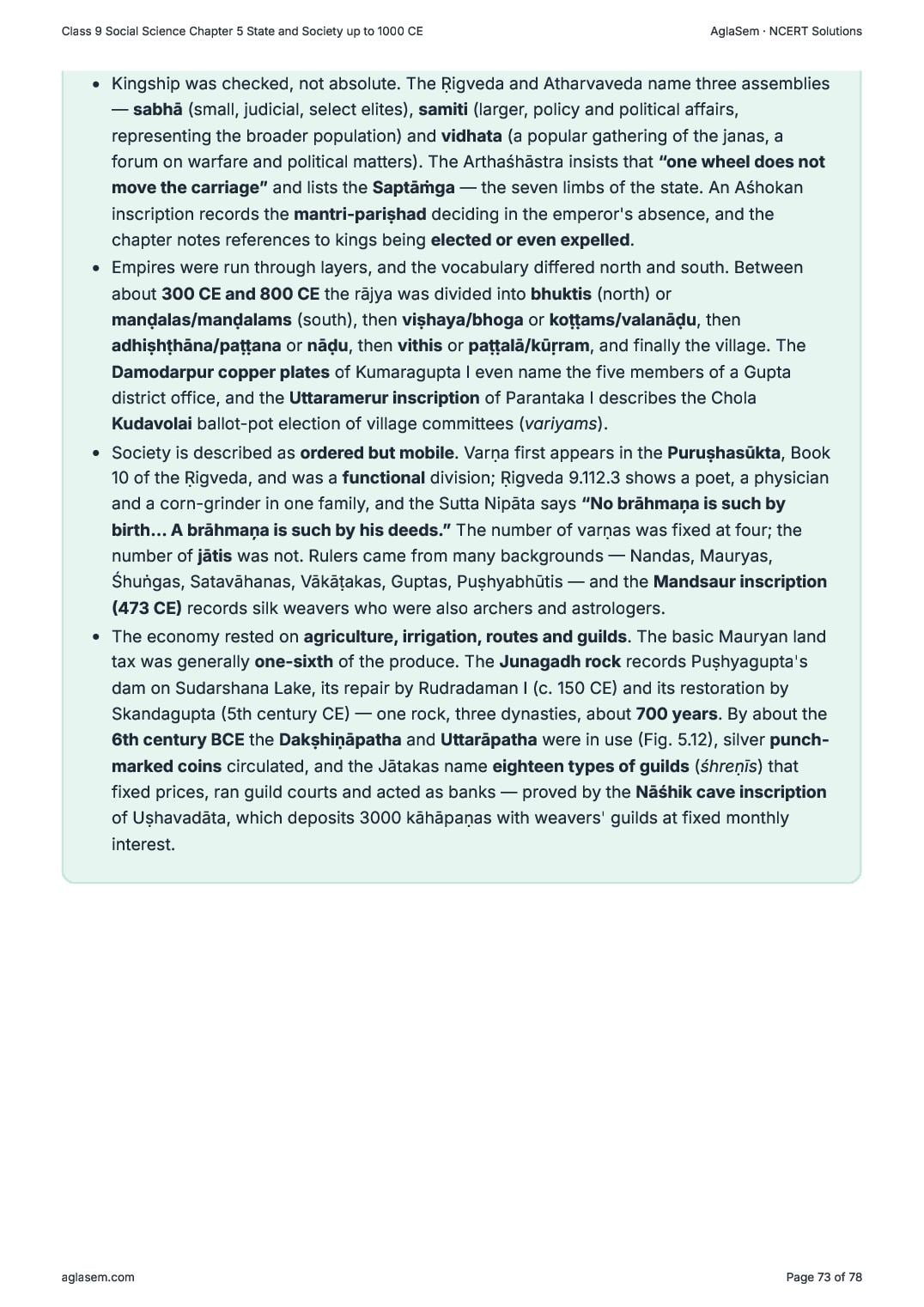
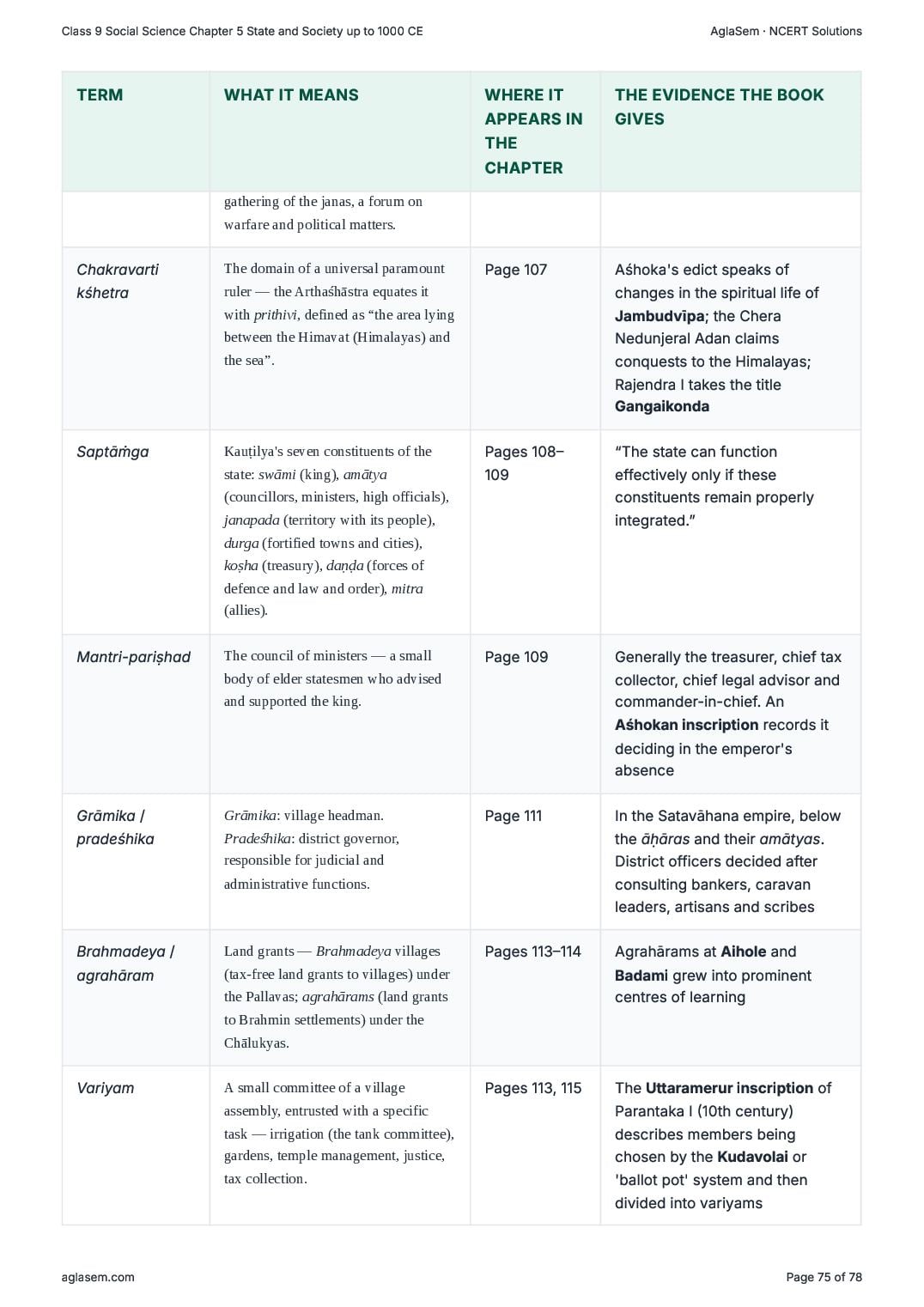
- Kingship was checked, not absolute. The Ṛigveda and Atharvaveda name three assemblies — sabhā (small, judicial, select elites), samiti (larger, policy and political affairs, representing the broader population) and vidhata (a popular gathering of the janas, a forum on warfare and political matters). The Arthaśhāstra insists that “one wheel does not move the carriage” and lists the Saptāṁga — the seven limbs of the state. An Aśhokan inscription records the mantri-pariṣhad deciding in the emperor's absence, and the chapter notes references to kings being elected or even expelled .
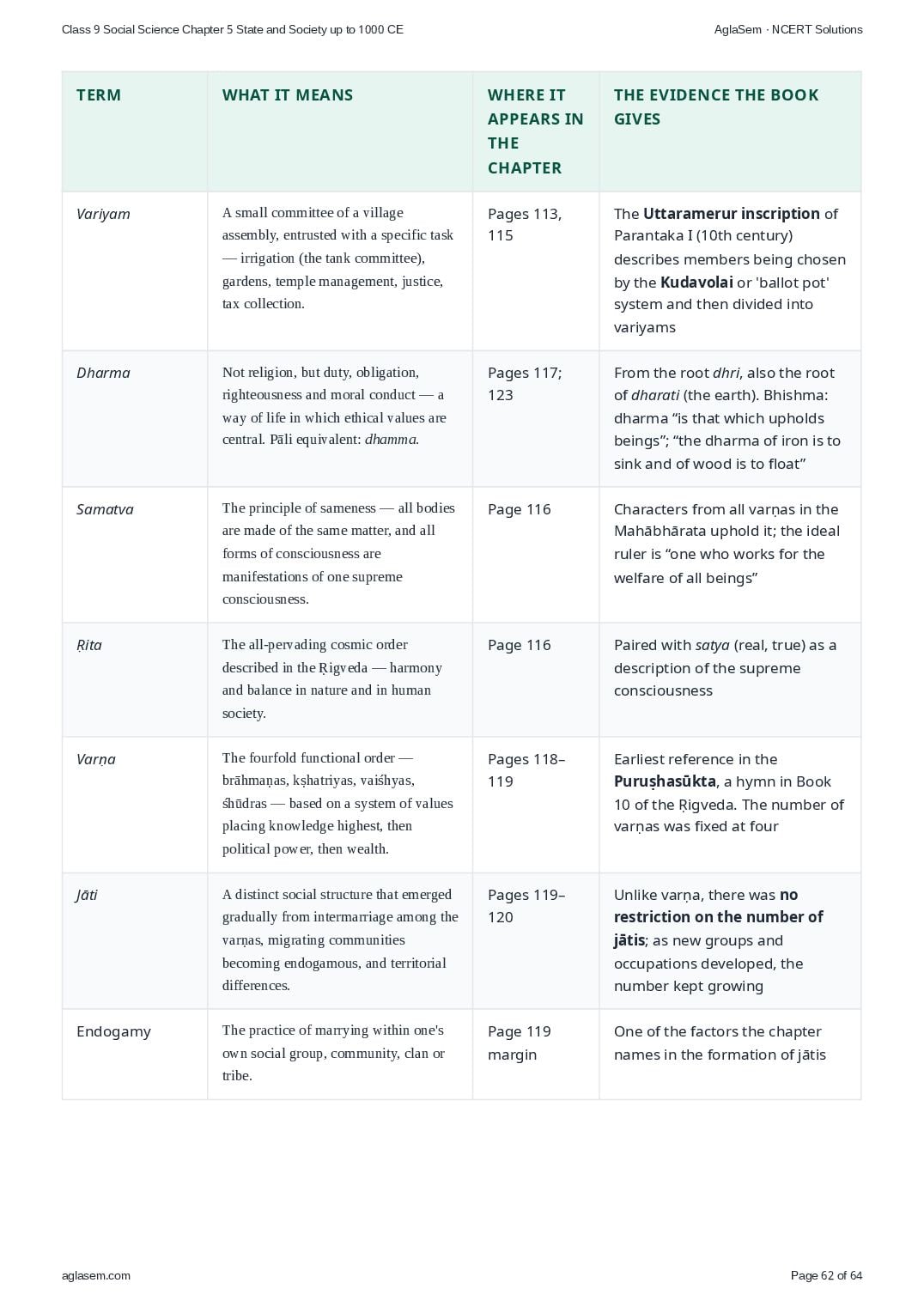
- Empires were run through layers, and the vocabulary differed north and south. Between about 300 CE and 800 CE the rājya was divided into bhuktis (north) or manḍalas/manḍalams (south), then viṣhaya/bhoga or koṭṭams/valanāḍu , then adhiṣhṭhāna/paṭṭana or nāḍu , then vithis or paṭṭalā/kūṛram , and finally the village. The Damodarpur copper plates of Kumaragupta I even name the five members of a Gupta district office, and the Uttaramerur inscription of Parantaka I describes the Chola Kudavolai ballot-pot election of village committees ( variyams ).
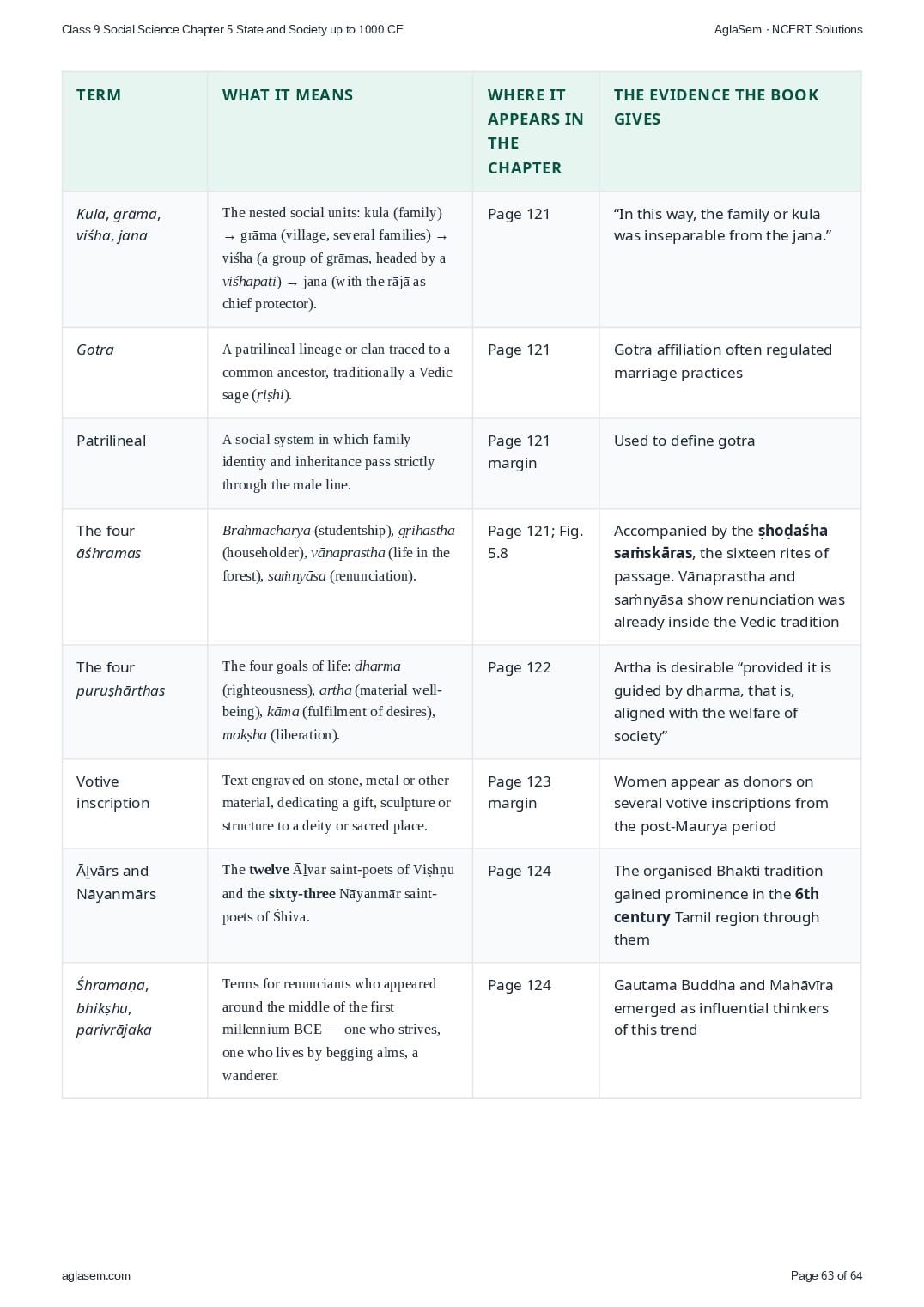
- Society is described as ordered but mobile . Varṇa first appears in the Puruṣhasūkta , Book 10 of the Ṛigveda, and was a functional division; Ṛigveda 9.112.3 shows a poet, a physician and a corn-grinder in one family, and the Sutta Nipāta says “No brāhmaņa is such by birth… A brāhmaņa is such by his deeds.” The number of varṇas was fixed at four; the number of jātis was not. Rulers came from many backgrounds — Nandas, Mauryas, Śhuṅgas, Satavāhanas, Vākāṭakas, Guptas, Puṣhyabhūtis — and the Mandsaur inscription (473 CE) records silk weavers who were also archers and astrologers.
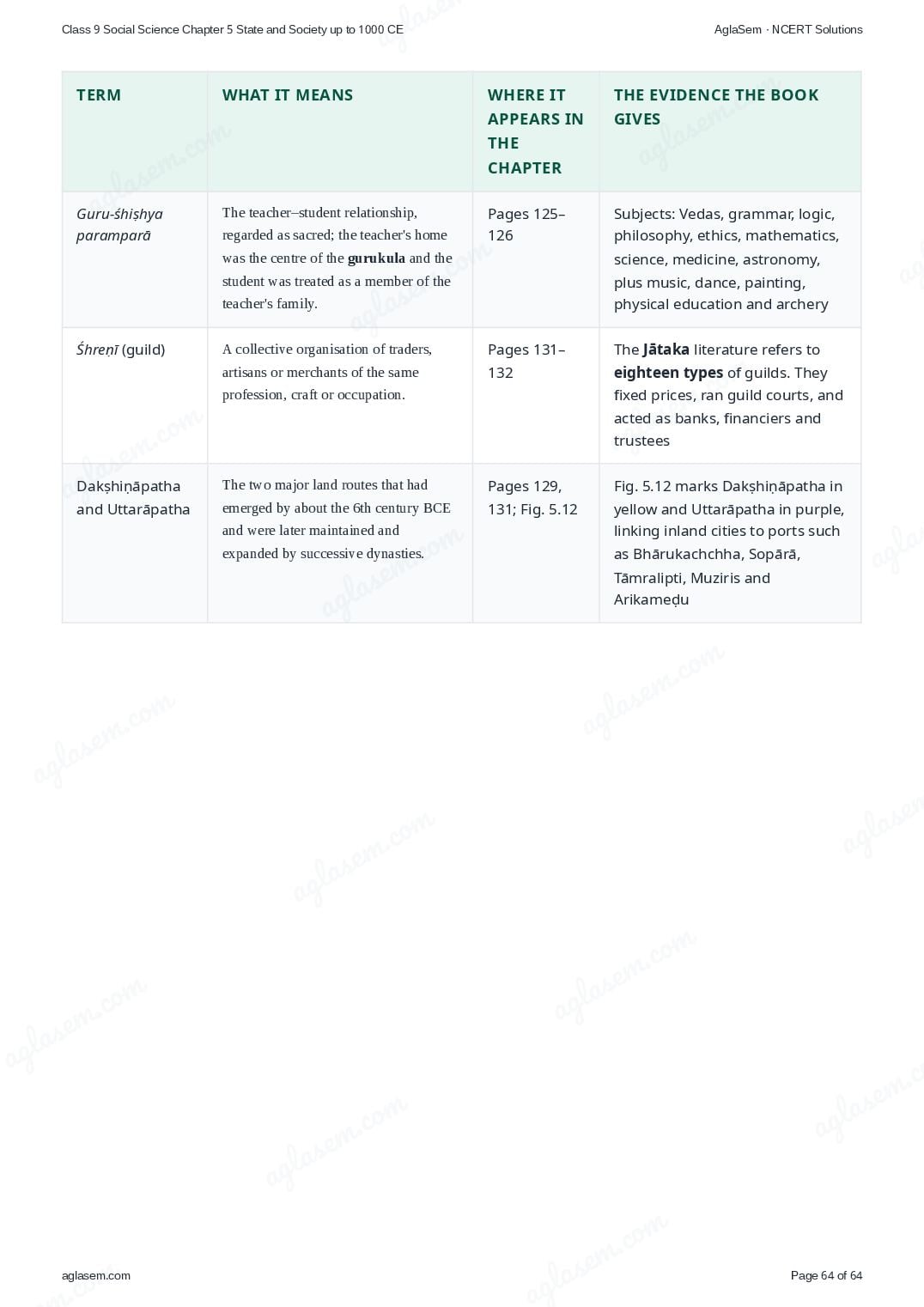
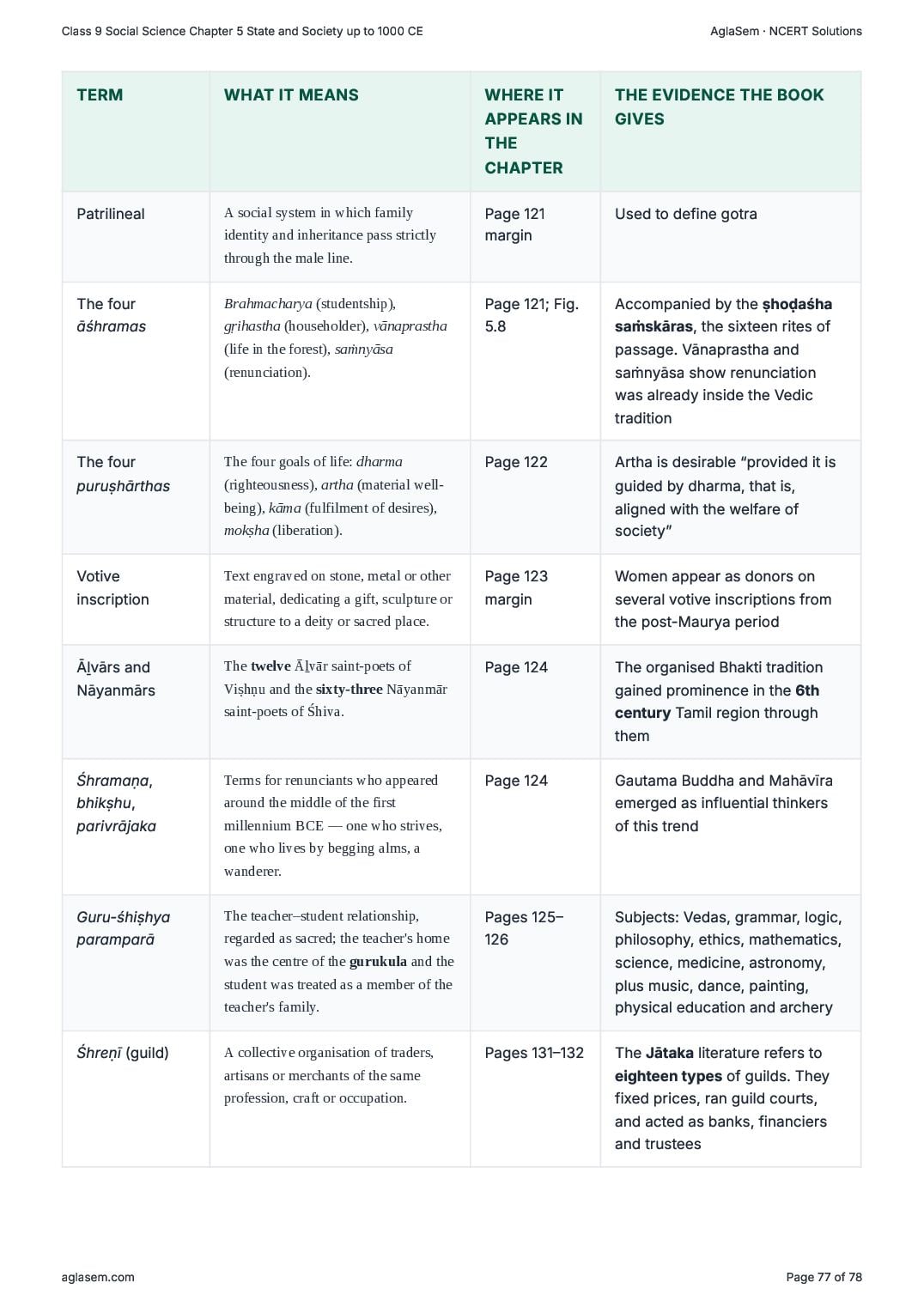
- The economy rested on agriculture, irrigation, routes and guilds . The basic Mauryan land tax was generally one-sixth of the produce. The Junagadh rock records Puṣhyagupta's dam on Sudarshana Lake, its repair by Rudradaman I (c. 150 CE) and its restoration by Skandagupta (5th century CE) — one rock, three dynasties, about 700 years . By about the 6th century BCE the Dakṣhiṇāpatha and Uttarāpatha were in use (Fig. 5.12), silver punch-marked coins circulated, and the Jātakas name eighteen types of guilds ( śhreṇīs ) that fixed prices, ran guild courts and acted as banks — proved by the Nāśhik cave inscription of Uṣhavadāta, which deposits 3000 kāhāpaṇas with weavers' guilds at fixed monthly interest.
How to Download NCERT Solutions for Class 9 Social Science Chapter 5 PDF
Follow these simple steps to get the State and Society Up to 1000 Ce questions-and-answers PDF from Understanding Society: India and Beyond.
- Search NCERT Solutions for Class 9 Social Science Chapter 5 aglasem and open this page.
- Read the exercise questions with answers for State and Society Up to 1000 Ce shown above.
- Click the Download PDF link to save the State and Society Up to 1000 Ce solutions to your device.
NCERT Solutions for Class 9 Social Science – All Chapters
There are more chapters to study besides State and Society Up to 1000 Ce in Social Science. Here are the NCERT Solutions for all chapters of Class 9 Social Science.
- Chapter 1 Understanding Social Science
- Chapter 2 Shaping of the Earth’s Surface
- Chapter 3 Atmosphere and Climate
- Chapter 4 Early Humans and Beginning of Civilisation
- Chapter 5 State and Society Up to 1000 Ce
- Chapter 6 Democracy
- Chapter 7 Elections
- Chapter 8 Building Blocks in Economics the Problem of Choice
- Chapter 9 The Price Puzzle What Drives the Market
NCERT Solutions for Class 9 – All Subjects
Just like Chapter 5 of Social Science, you can get the exercise questions with answers for every other subject of Class 9. Here are the NCERT Solutions for all subjects of Class 9.
NCERT Solutions for Class 9 Social Science Chapter 5 – An Overview
The key highlights of this study material are as follows.
| Aspects | Details |
|---|---|
| Class | Class 9 |
| Subject | Social Science |
| Chapter Number | Chapter 5 |
| Chapter Name | State and Society Up to 1000 Ce |
| Book Name | Understanding Society: India and Beyond |
| Book By | NCERT (National Council of Educational Research and Training) |
| Educational Resource Here | NCERT Solutions of Class 9 Social Science Chapter 5 for all exercises |
| More Questions Answers of This Subject | NCERT Solutions for Class 9 Social Science |
| Download Book Chapter | NCERT Book Class 9 Social Science |
| All Questions Answers For This Class | NCERT Solutions for Class 9 |
| Complete Solutions | NCERT Solutions |
NCERT Solutions for Class 9 Social Science Chapter 5 State and Society Up to 1000 Ce – FAQs
What are the NCERT Solutions for Class 9 Social Science Chapter 5 State and Society Up to 1000 Ce?
They are the complete, step-by-step answers to all the exercise and in-text questions of Chapter 5 State and Society Up to 1000 Ce from the NCERT Class 9 Social Science textbook Understanding Society: India and Beyond, written by experts as per the latest NCERT syllabus.
How can I download the Class 9 Social Science Chapter 5 solutions PDF for free?
Open this page on aglasem, read the State and Society Up to 1000 Ce questions with answers, and click the “Download Solutions PDF” link. The Class 9 Social Science Chapter 5 NCERT Solutions PDF is completely free to download.
Are these NCERT Solutions as per the latest 2026-27 syllabus?
Yes. The NCERT Solutions for Class 9 Social Science Chapter 5 are based on the latest NCERT textbook Understanding Society: India and Beyond and the current 2026-27 CBSE syllabus, so the questions and answers match what you study in class.
Where can I get NCERT Solutions for the other chapters of Class 9 Social Science?
You can find the answers to every chapter on the NCERT Solutions for Class 9 Social Science page, and solutions for every subject on the NCERT Solutions for Class 9 page.
How do NCERT Solutions help in exam preparation?
They show the correct method to solve each question, help you write answers the way they are expected in exams, let you check and correct your own work, and save revision time — which together improve your marks in Class 9 Social Science.
If you have any queries on NCERT Solutions for Class 9 Social Science Chapter 5 State and Society Up to 1000 Ce, then please ask in the comments below.