Download We the Travellers-II – NCERT Class 5 Maths Chapter 4 PDF from the new NCERT Class 5 Maths book Maths Mela (2026-27). Read the chapter online or download the free PDF. Adding with place value. Write ones under ones, tens under tens, hundreds under hundreds. Add one column at a time, starting from the ones. If a column gives 10 or more, keep the ones digit there and carry the ten to the next column. Example: 28 +…
We the Travellers-II PDF – Chapter 4 of Maths Mela
Read the chapter online or download the PDF.
| Chapter | Download | |
|---|---|---|
| Chapter 4 PDF | We the Travellers-II | View PDF |
| Full book | NCERT Class 5 Maths – Maths Mela | View Book |
Read Online
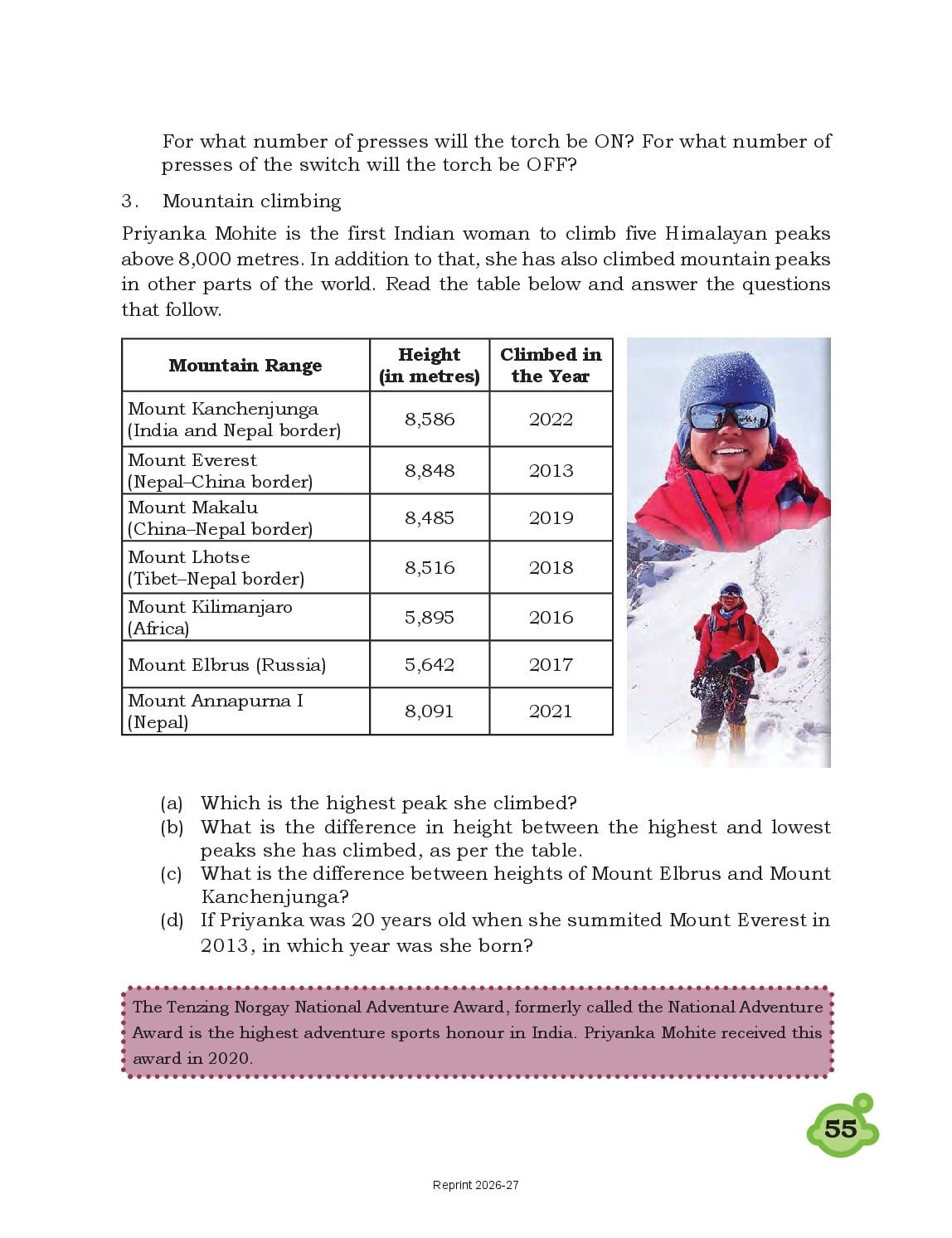
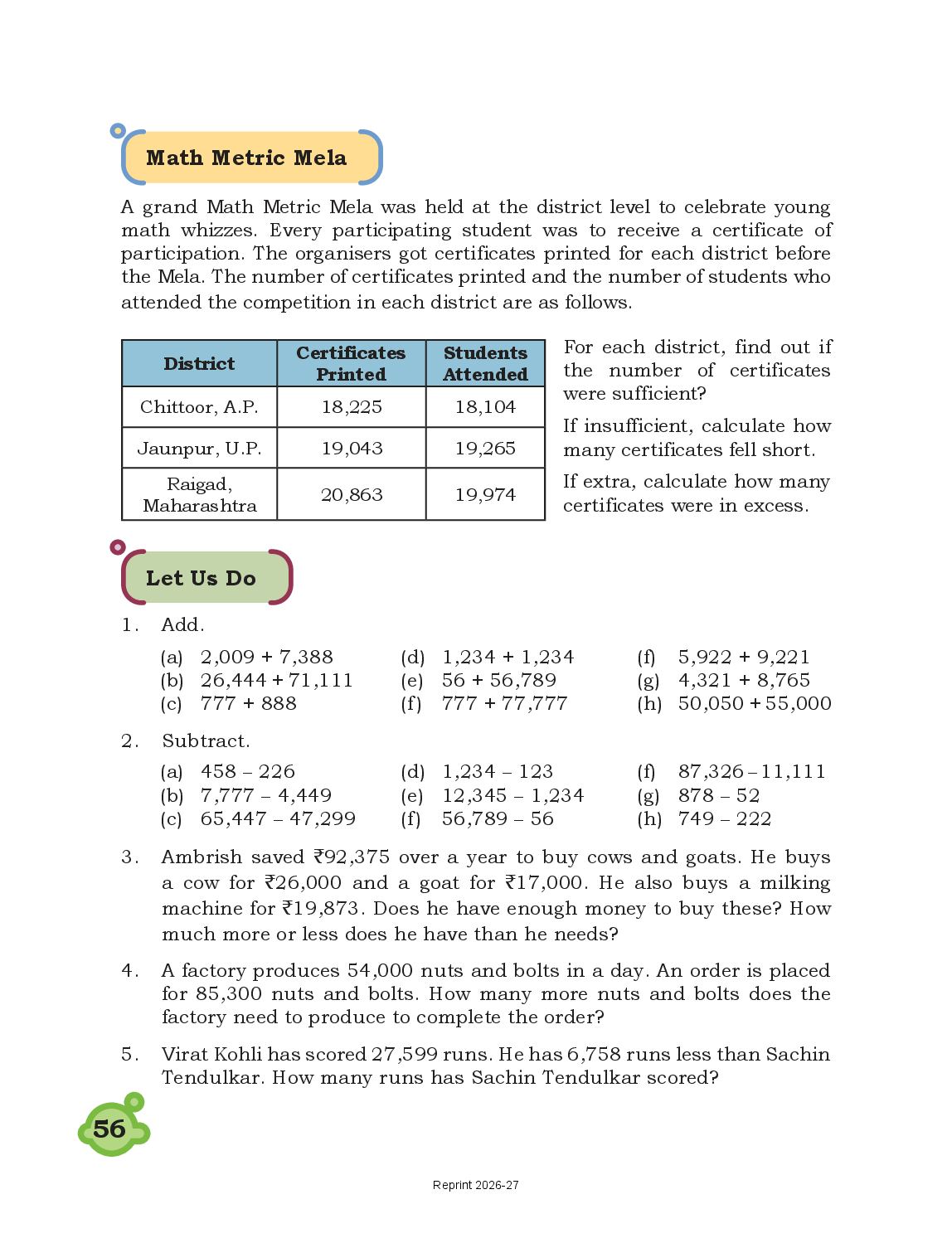
What Is in We the Travellers-II? (Class 5 Maths Chapter 4)
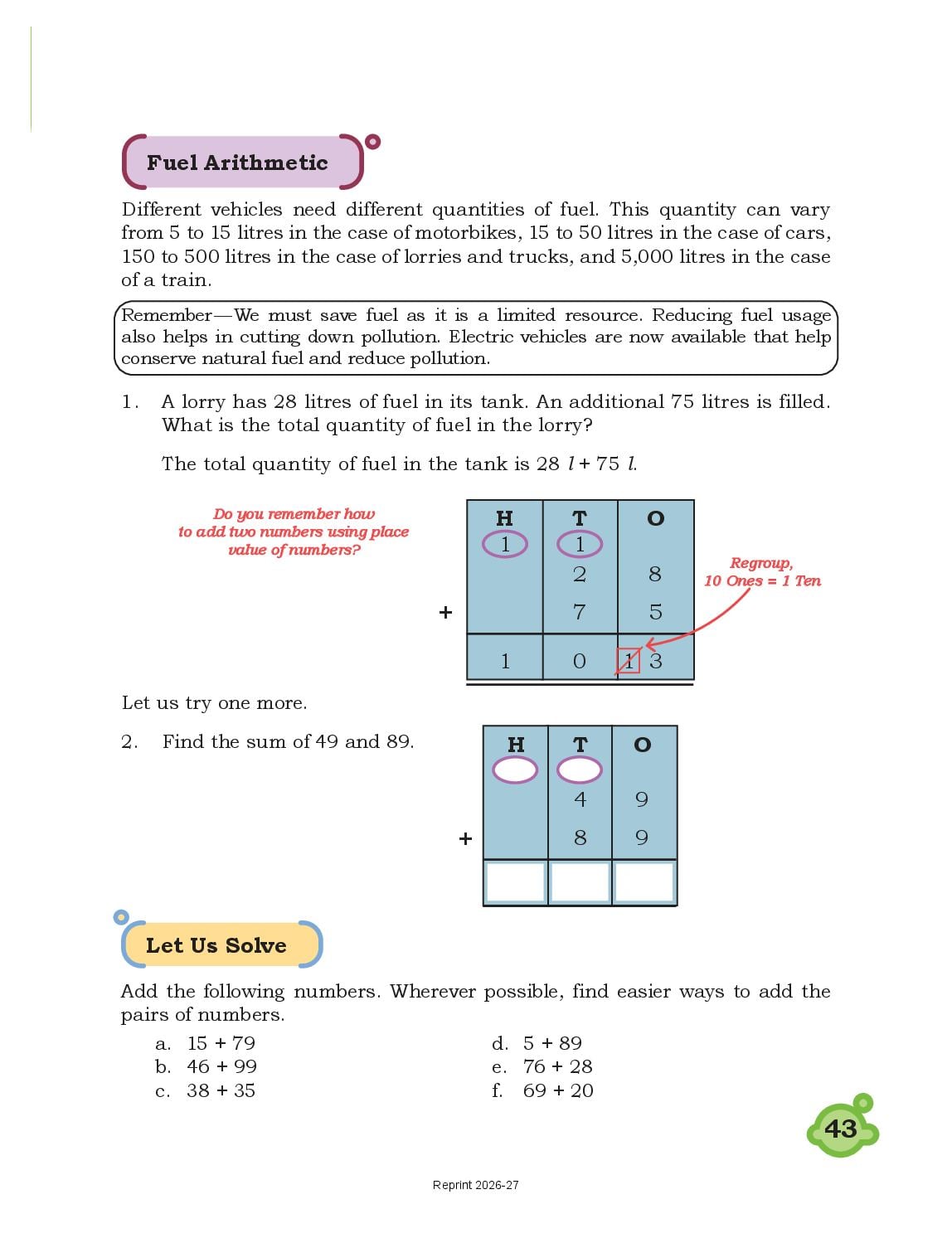
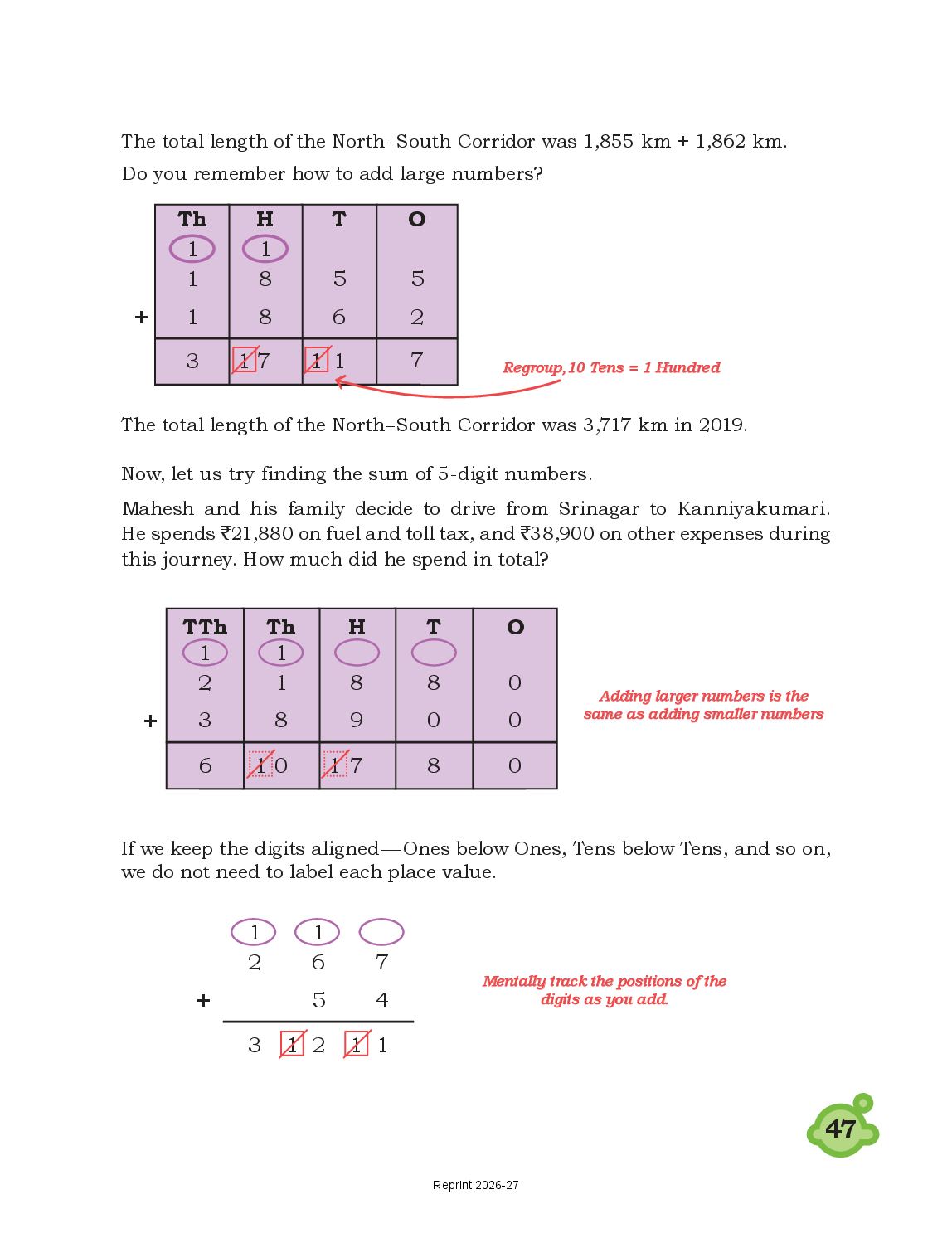
- Adding with place value. Write ones under ones, tens under tens, hundreds under hundreds. Add one column at a time, starting from the ones. If a column gives 10 or more, keep the ones digit there and carry the ten to the next column. Example: 28 + 75. Ones: 8 + 5 = 13, so write 3 and carry 1. Tens: 2 + 7 + 1 = 10, so write 0 and carry 1. Hundreds: 1. Answer 103.
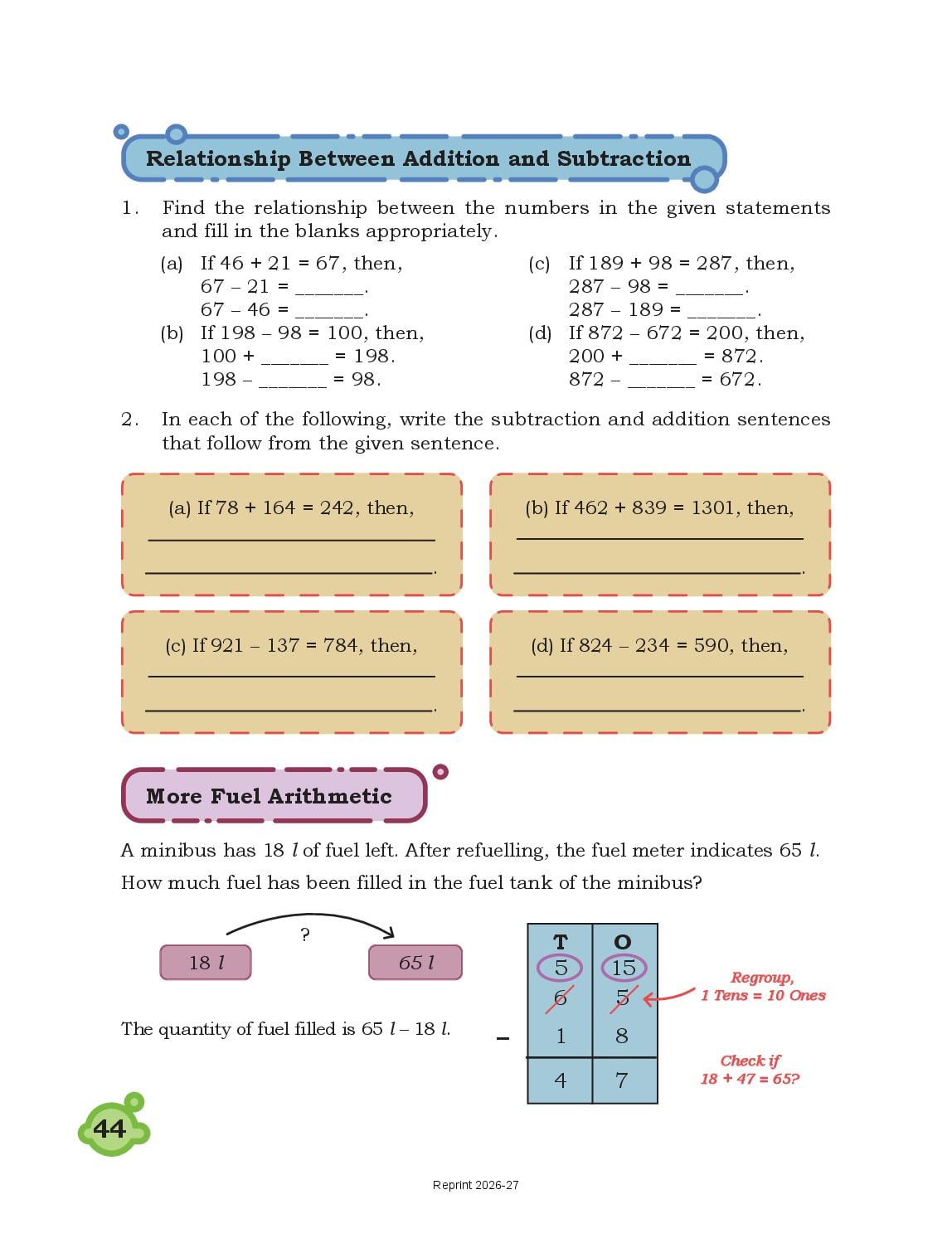
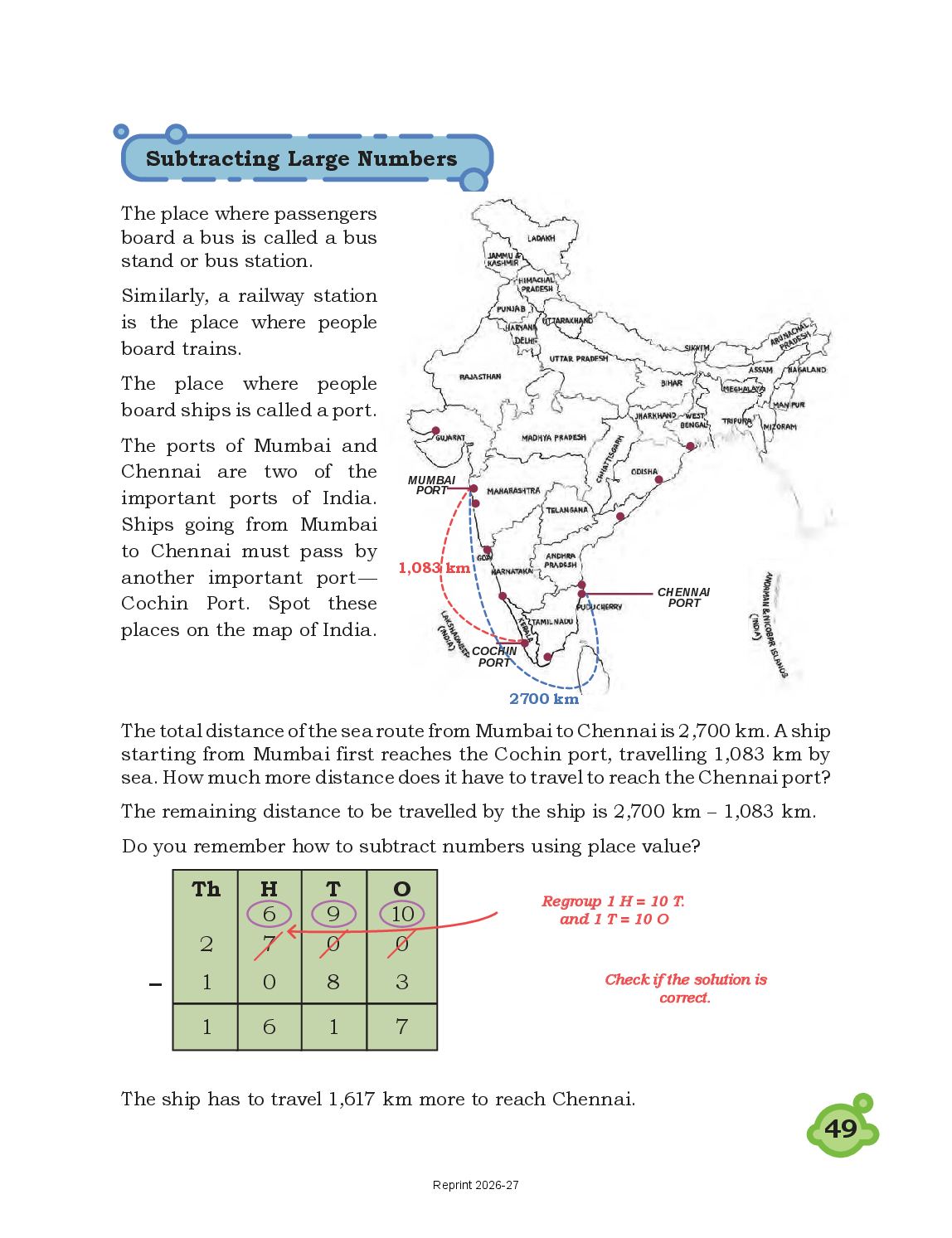
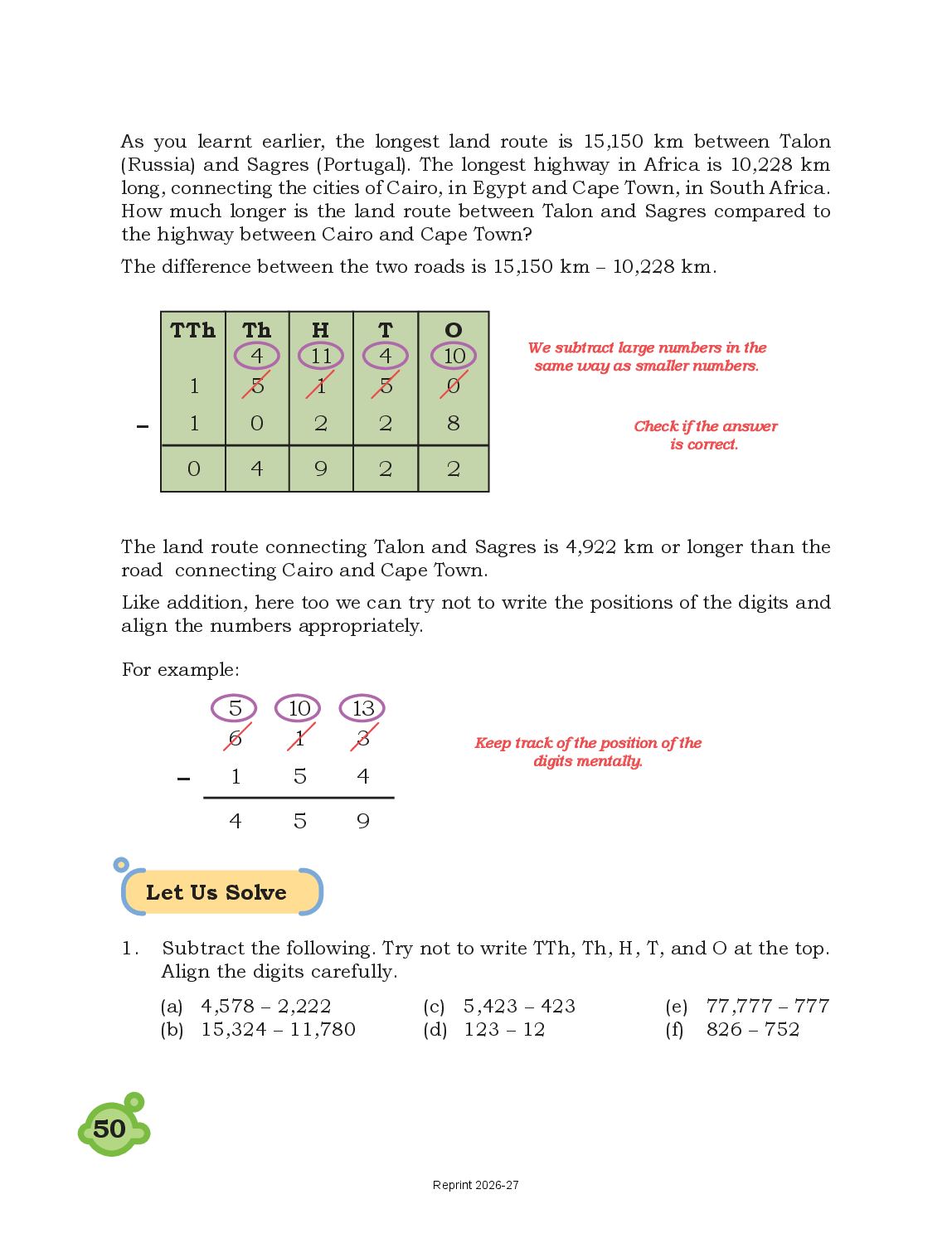
- Subtracting with place value. Same columns, but now you may have to regroup — break 1 ten into 10 ones, or 1 hundred into 10 tens. Example: 65 − 18. Ones: 5 is smaller than 8, so take 1 ten from 6 tens. Now the ones are 15 and the tens are 5. 15 − 8 = 7. Tens: 5 − 1 = 4. Answer 47.
- Addition and subtraction are two sides of one fact. If 46 + 21 = 67, then 67 − 21 = 46 and 67 − 46 = 21. This is why you can always check a subtraction by adding: 65 − 18 = 47, and 18 + 47 = 65. Getting the number you started with means your answer is right.
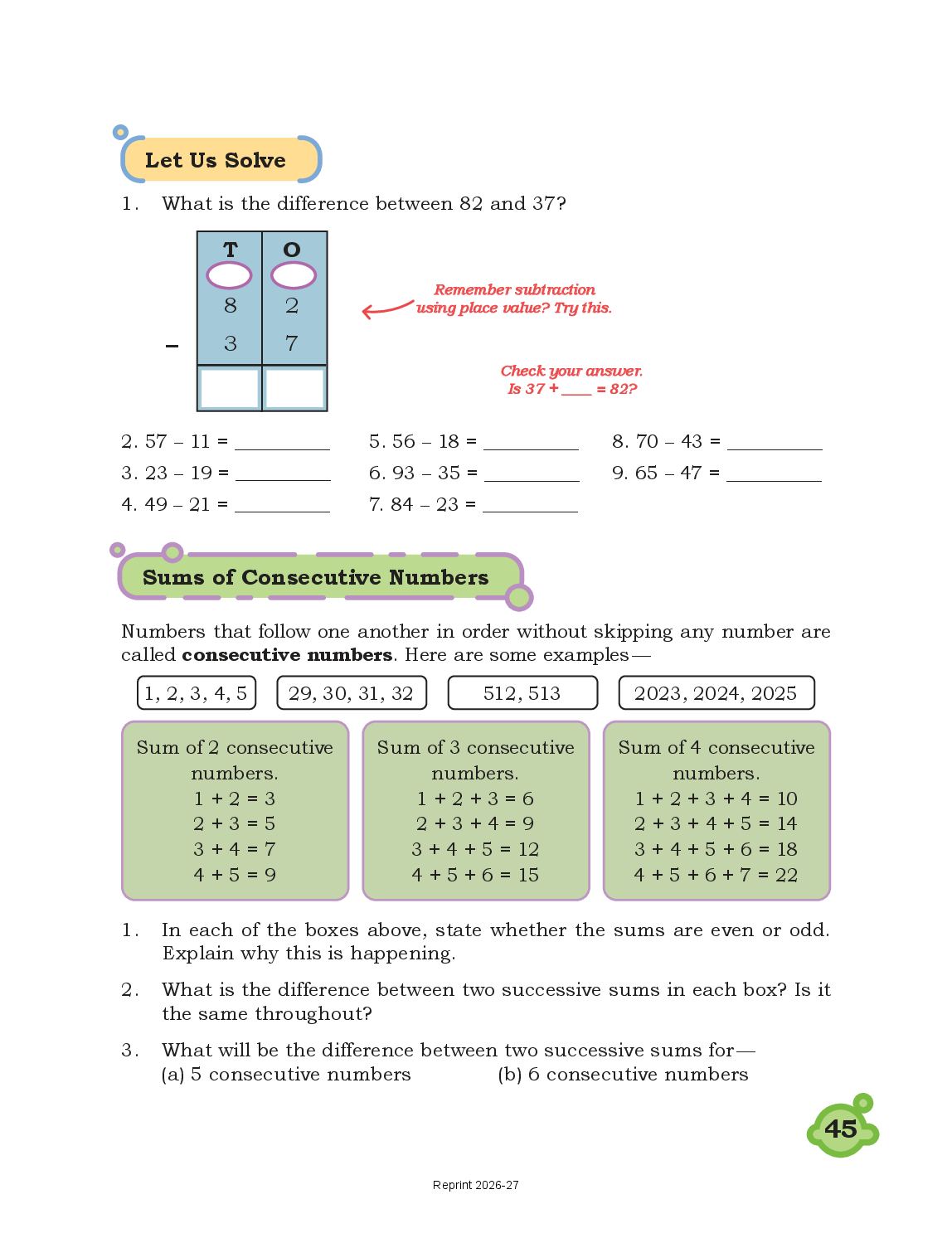
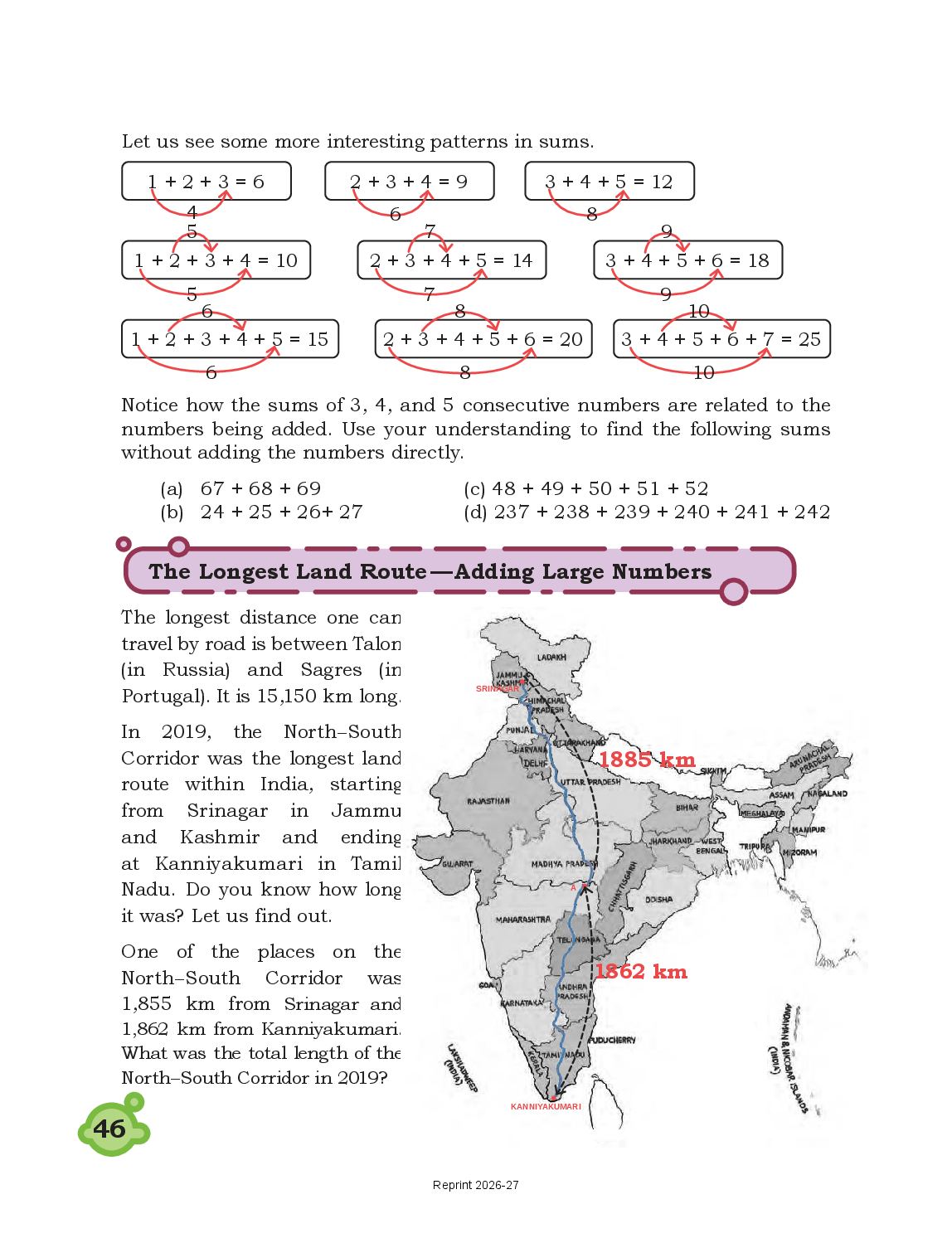
- Consecutive numbers are numbers that follow one another with no gaps — 5, 6, 7, 8. Their sums make neat patterns. Add 3 of them and the answer is 3 times the middle number: 67 + 68 + 69 = 3 × 68 = 204. Add 4 of them and the answer is 2 times (first + last): 24 + 25 + 26 + 27 = 2 × 51 = 102.
- Slide the run up by 1 and the sum grows by the count. 1 + 2 + 3 = 6 and 2 + 3 + 4 = 9 — a jump of 3, because there are 3 numbers and each one grew by 1. For 5 consecutive numbers the jump is 5; for 6 it is 6.
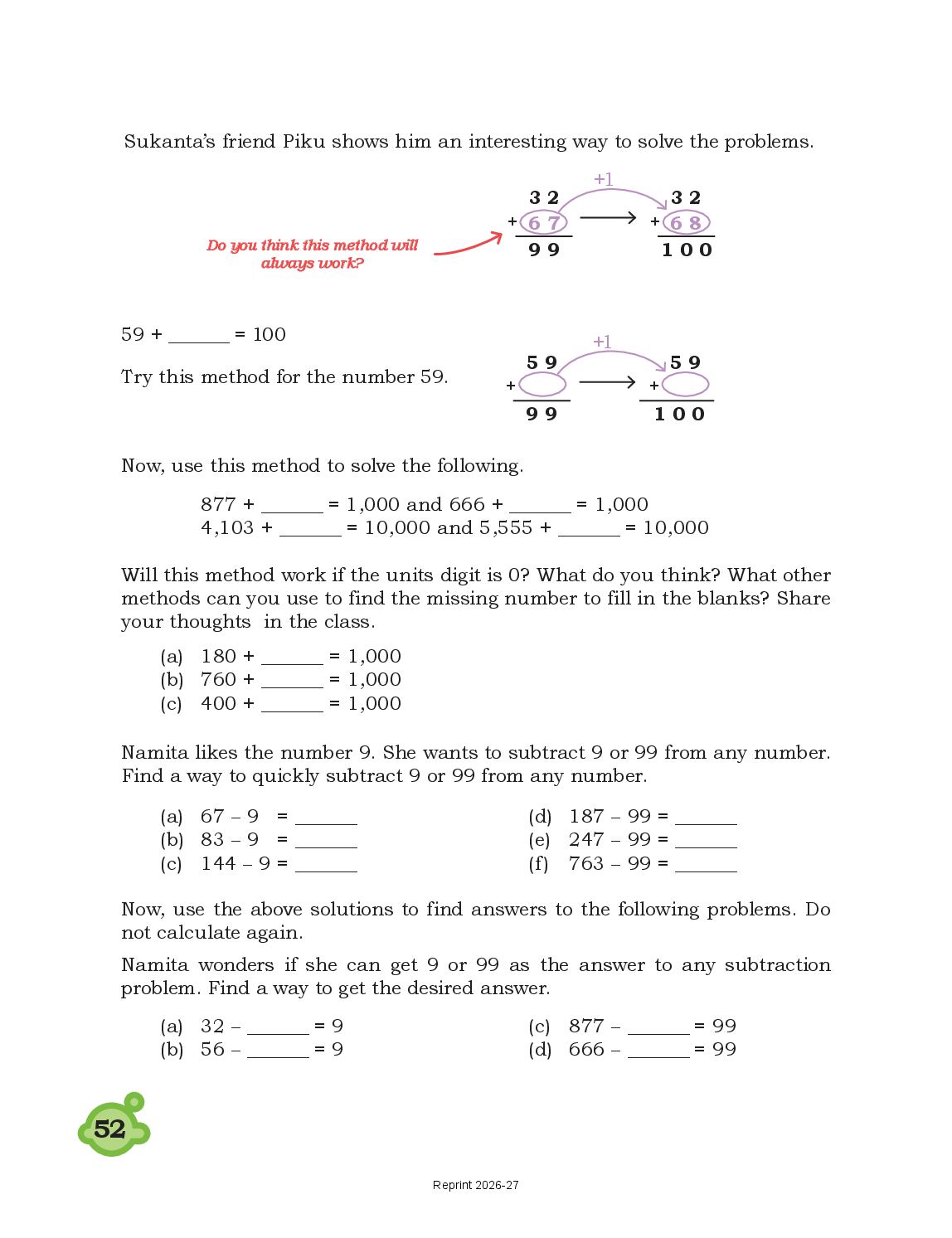
- Quick sums. To find what adds to 100, first find what adds to 99 — take each digit away from 9, with no borrowing — then add 1. For 32: 99 − 32 = 67, and 67 + 1 = 68. So 32 + 68 = 100. The same trick works for 1,000 (use 999) and for 10,000 (use 9,999).
- Quick differences. To subtract 9, subtract 10 and put 1 back: 67 − 9 = 67 − 10 + 1 = 58. To subtract 99, subtract 100 and put 1 back: 187 − 99 = 187 − 100 + 1 = 88.
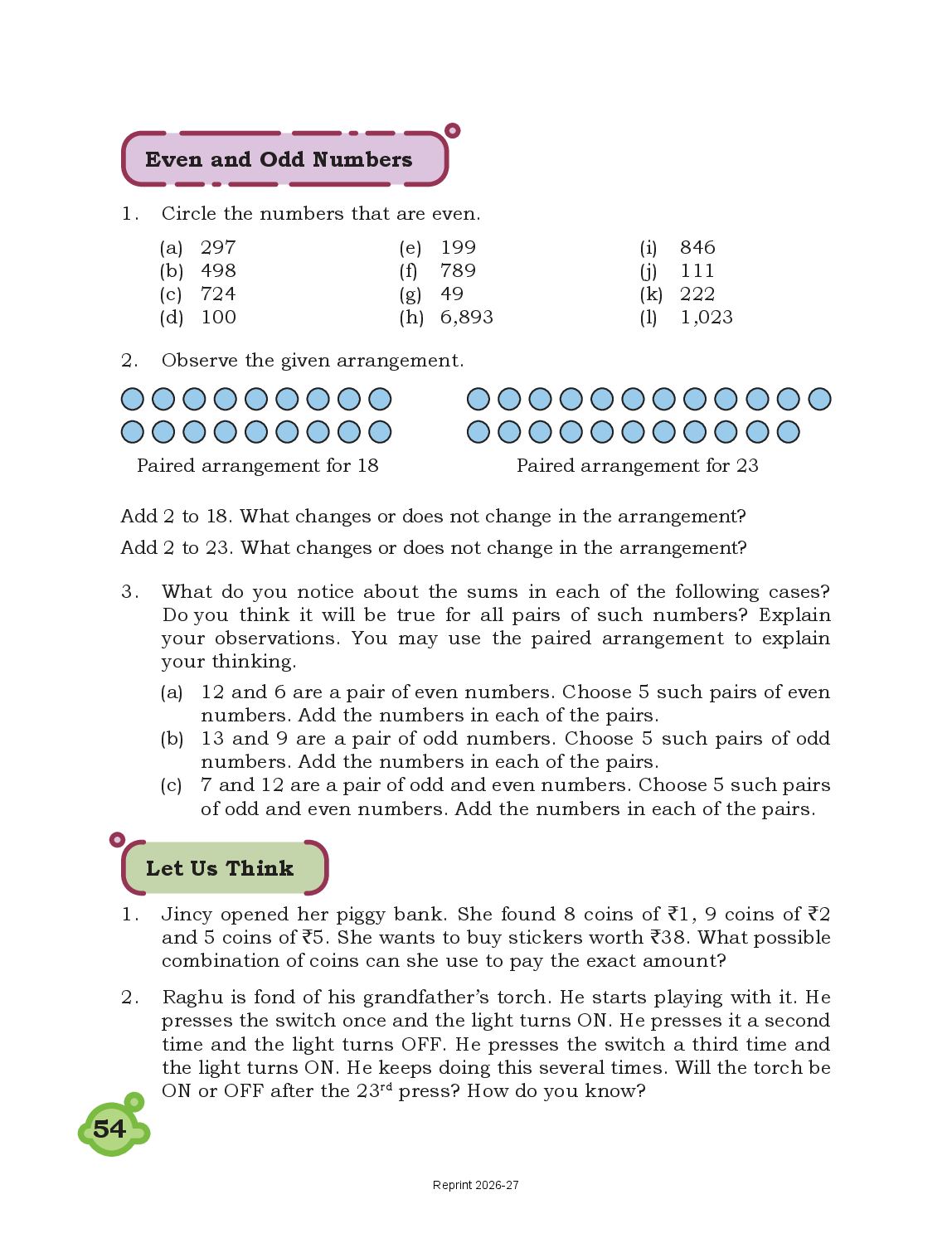
- Even and odd. Line the counters up in pairs. An even number pairs off completely; an odd number always leaves one counter alone. So even + even = even, odd + odd = even (the two lonely counters join up), and odd + even = odd (one counter is still alone).
Quick revision – We the Travellers-II
| Word or idea | What it means | Where it appears | Example |
|---|---|---|---|
| Place value | The value a digit has because of its position — ones, tens, hundreds, thousands | Fuel Arithmetic, p. 43 | In 3,717 the 7 on the left stands for 700 |
| Regroup (carry) | Change 10 ones into 1 ten, or 10 tens into 1 hundred, and move it to the next column | Fuel Arithmetic, p. 43 | 8 + 5 = 13 → write 3, carry 1 ten |
| Regroup (borrow) | Break 1 ten into 10 ones, or 1 hundred into 10 tens, so you can subtract | More Fuel Arithmetic, p. 44 | 65 − 18: 6 tens 5 ones → 5 tens 15 ones |
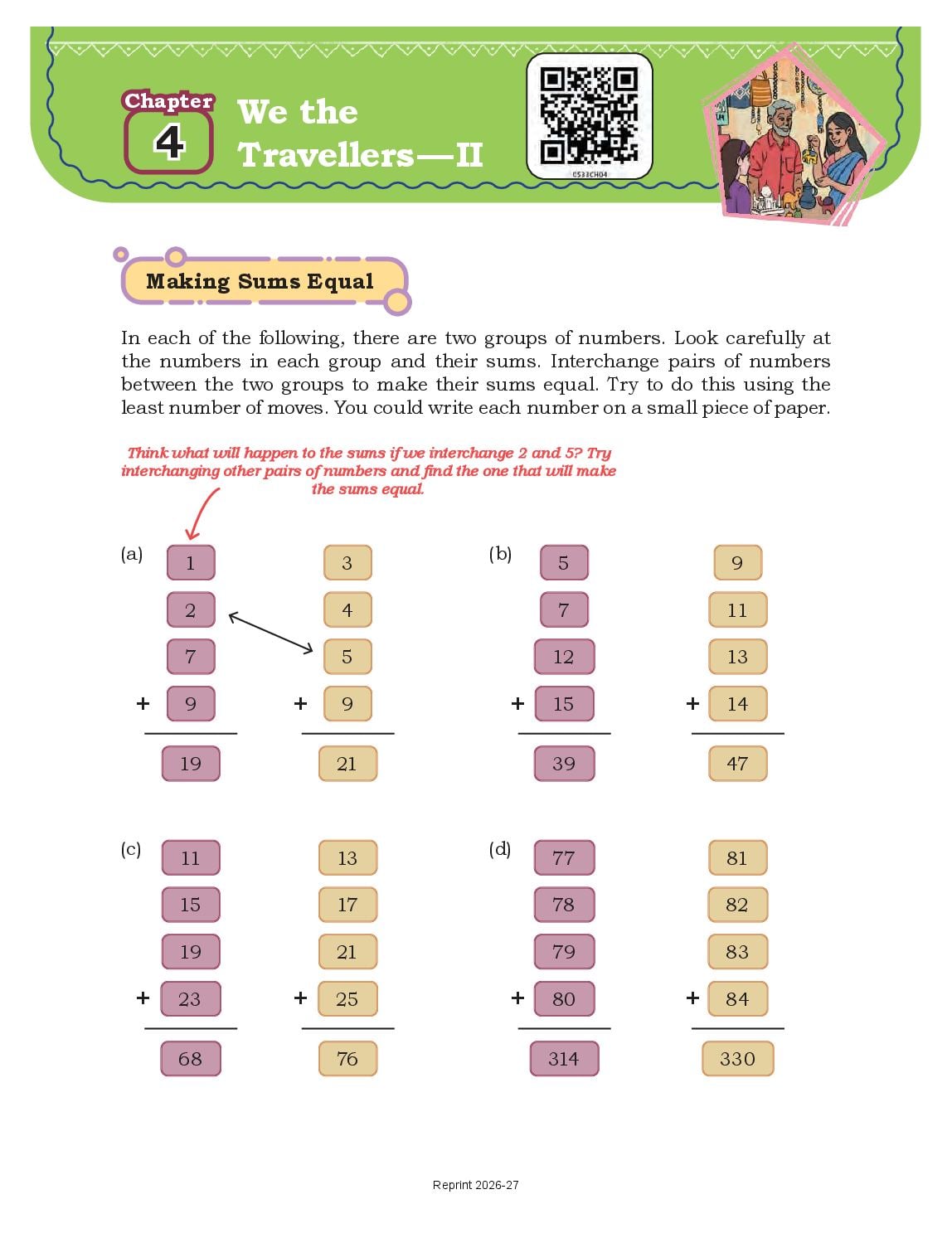
| Sum | The answer you get after adding | Making Sums Equal, p. 42 | 1 + 2 + 7 + 9 = 19 |
| Difference | The answer you get after subtracting | Let Us Solve, p. 45 | 82 − 37 = 45 |
| Checking by the other operation | Add your answer back to see if you return to the start | More Fuel Arithmetic, p. 44 | 65 − 18 = 47, and 18 + 47 = 65 |
| Consecutive numbers | Numbers that follow one after another with nothing skipped | Sums of Consecutive Numbers, p. 45 | 29, 30, 31, 32 |
| Successive sums | Sums that come one after the other in the same box | Sums of Consecutive Numbers, p. 45 | 6, 9, 12, 15 — each 3 more than the one before |
| Even number | A number that splits into pairs with nothing left over | Even and Odd Numbers, p. 54 | 18 = 9 pairs |
| Odd number | A number that leaves one counter alone when you make pairs | Even and Odd Numbers, p. 54 | 23 = 11 pairs and 1 left over |
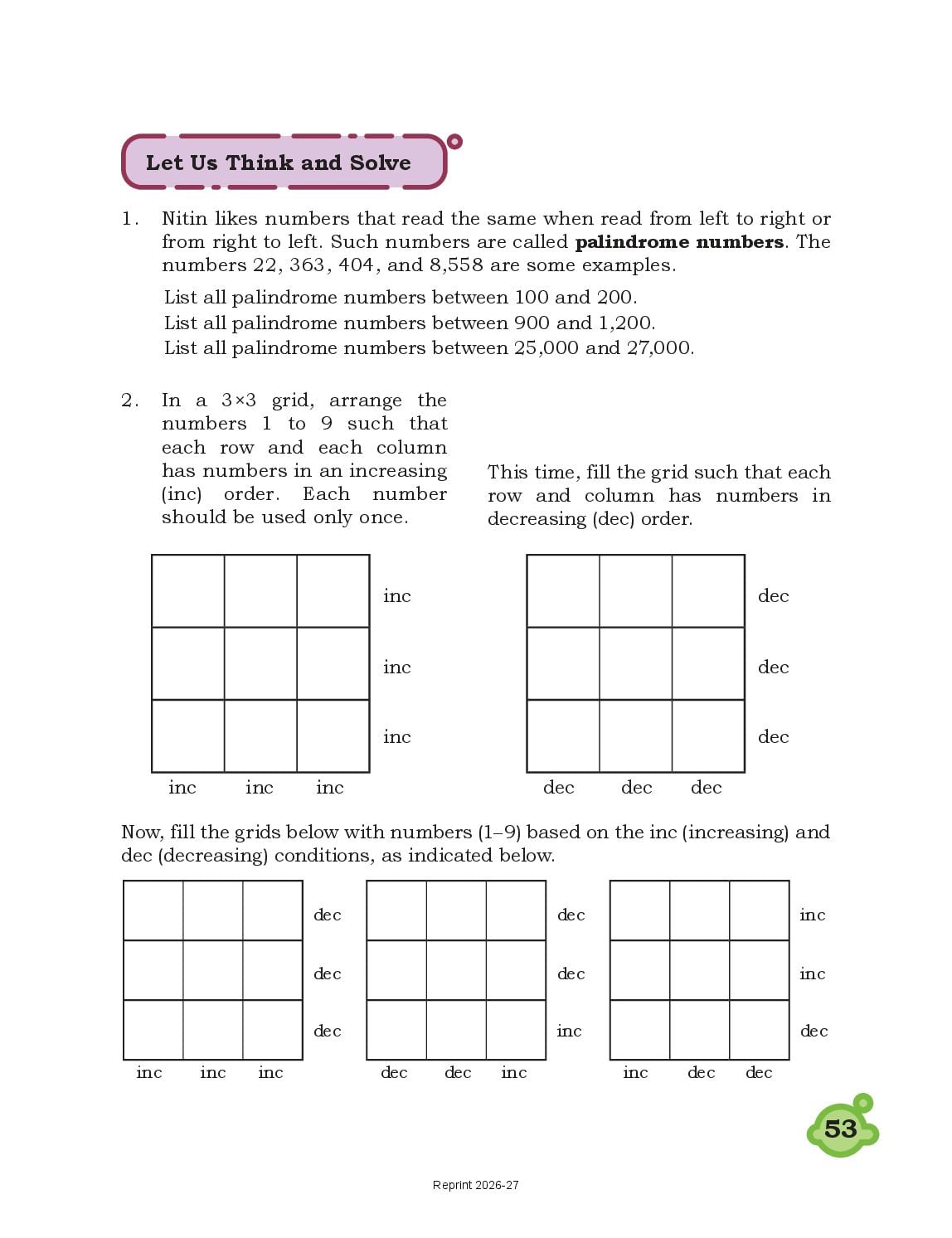
| Palindrome number | A number that reads the same from left to right and right to left | Let Us Think and Solve, p. 53 | 8,558 and 121 |
| Increasing / decreasing order | Going up (small to big) / going down (big to small) | Let Us Think and Solve, p. 53 | 1, 2, 3 is increasing; 9, 8, 7 is decreasing |
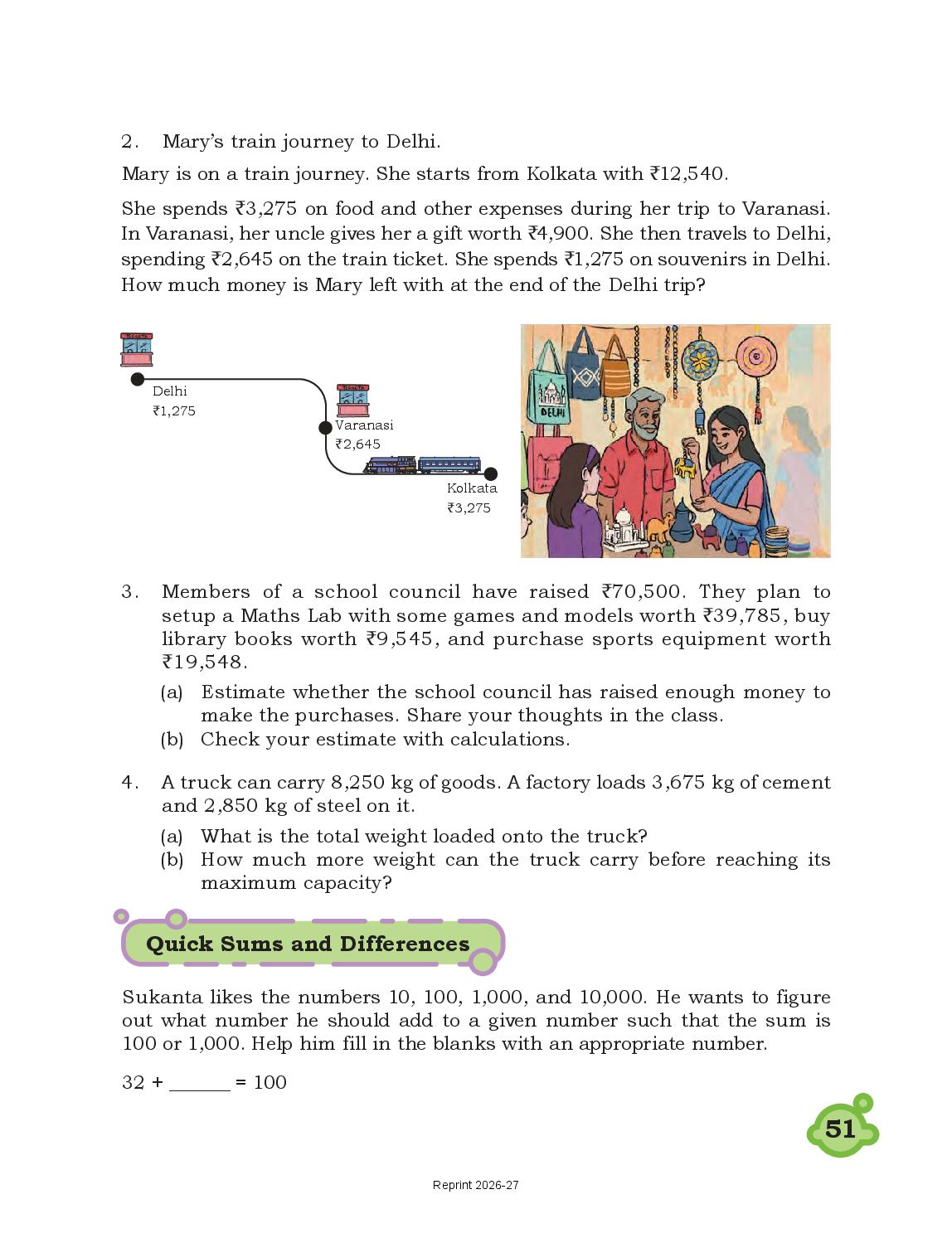
| Estimate | A quick, near-enough answer found with rounded numbers | Let Us Solve, p. 51 | 39,785 + 9,545 + 19,548 is about 70,000 |
Old NCERT vs New – Class 5 Maths
This chapter is from Maths Mela, the new NCERT Class 5 Maths book (NCF-SE 2023, used from 2025-26). It replaced the old book “Math-Magic”, so chapter numbers and names differ from older PDFs.
Solutions and All Chapters
Answers to the exercises and the full chapter list of Maths Mela:
We the Travellers-II – Overview
| Class | Class 5 |
| Subject | Maths |
| Book | Maths Mela – new NCERT book |
| Chapter | 4 of 15 – We the Travellers-II |
| Book pages | 42 – 56 |
| Edition | NCERT Reprint 2026-27 |
| Session | 2026-27 |
| Free – read online or download |
Class 5 Maths Chapter 4 – FAQs
Where can I download We the Travellers-II Class 5 PDF?
From the download table on this page – the chapter PDF is free, and the full book is linked too.
What is Class 5 Maths Chapter 4 about?
Adding with place value. Write ones under ones, tens under tens, hundreds under hundreds. Add one column at a time, starting from the ones. If a column gives 10 or more, keep the ones digit there and carry the ten to the next column. Example: 28 + 75. Ones: 8 + 5 = 13, so write 3 and carry 1. Tens: 2 + 7 + 1 = 10, so write 0 and carry 1. Hundreds: 1. Answer 103.
Is We the Travellers-II from the new NCERT Class 5 Maths book?
Yes. It is chapter 4 of maths mela, the new NCERT Class 5 Maths book for 2026-27.
Is this the latest NCERT edition for 2026-27?
Yes – the PDF is NCERT’s latest edition for the 2026-27 session.
Where are the NCERT Solutions for Class 5 Maths Chapter 4?
Open the NCERT Solutions link above for answers to the exercise questions.