Skip to content

NCERT Solutions for Class 3 Maths Chapter 7 Raksha Bandhan (PDF) – 2027

NCERT Solutions for Class 3 Maths Maths Mela Chapter 7 Raksha Bandhan – step-by-step answers to every exercise and in-text question of the chapter, as per the latest NCERT syllabus for 2027. Read them online or download the free question-answer PDF.

Raksha Bandhan brings Gopal, Dhara and their Atya together. As they make rakhis, buy laddoos and share sweets, we learn multiplication as repeated addition and division as equal sharing.

NCERT Solutions for Class 3 Maths Maths Mela Chapter 7 Raksha Bandhan PDF

All the answers are on this page below. The PDF also explains every answer – why it is right and how to check it – so download it for revision.

PDFChapterDownload
Solutions PDF (English medium)Raksha BandhanView PDF
Solutions PDF (Hindi medium)रक्षाबंधनView PDF

NCERT Solutions for Class 3 Maths Maths Mela Chapter 7 Raksha Bandhan – Questions and Answers

All 95 questions of the chapter (textbook pages 82 – 106) are answered below, in the order of the book – in-text questions, activities and the end-of-chapter exercises. Each answer is written the way you would write it in the exam.

In-text Questions — Page 82Chapter opener — Gopal’s house
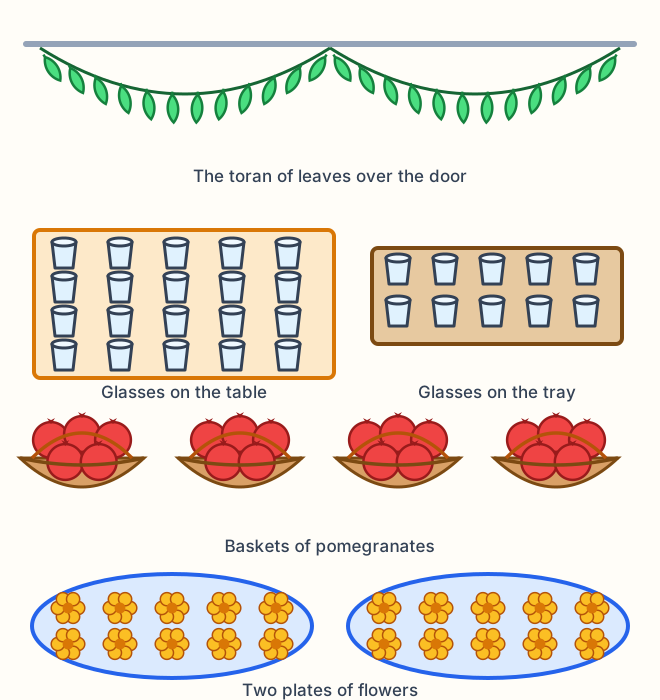
Q1Carefully observe Gopal’s house. What do you find interesting here?
Figure
Gopal’s house drawn again, with the leaves, glasses, baskets and flower plates.
Answer

The house is ready for the festival. Here are three things I found interesting.

  1. A green toran of leaves hangs over the door.
  2. The same things are kept in equal groups — 5 pomegranates in every basket.
  3. The glasses stand in neat rows, so they are easy to count.
Q2Find and count the number of each of these objects and write. Leaves ______   Glasses ______   Pomegranate ______   Flowers ______
Figure
Gopal’s house drawn again, with the leaves, glasses, baskets and flower plates.
Answer

Count each set in groups. Do not count one by one.

ObjectHow to countNumber
Leaves12 on one side, 12 on the other24
Glasses20 on the table and 10 on the tray30
Pomegranate4 baskets, 5 in each basket20
Flowers2 plates, 10 in each plate20

Celebration Begins! / Let’s Make Rakhis — Page 83Guessing the festival and planning the rakhis

Q1Dhara’s mother has bought some material for the festival. Guess the festival they are preparing for.
The festival material on the table; described here, see the textbook for the painting.
Answer

They are getting ready for Raksha Bandhan.

  • On the table are coloured threads, beads and flowers. These are used to make rakhis.
  • There are sweets and a gift too.
  • Dhara herself says, “Raksha bandhan!”
Q2For each Rakhi, we need one flower, ………. threads and ………. beads.
One rakhi
One rakhi with its flower, threads and beads.
Answer

Look at one rakhi in the picture and count its parts.

For each rakhi we need
1 flower
2 threads
4 beads
Q3We need to make 5 Rakhis. How many threads, flowers and beads do they need?
one flower for each rakhitwo threads for each rakhifour beads for each rakhi
The flowers, the threads and the beads laid out for five rakhis.
Answer

One rakhi takes 1 flower, 2 threads and 4 beads. Take that 5 times.

Flowers: 5 × 1 = 5
Threads: 5 × 2 = 10
Beads: 5 × 4 = 20

In-text Questions — Page 84Making 5 rakhis

Q1Each Rakhi uses 1 flower. We need to make 5 Rakhis. 1 + 1 + 1 + 1 + 1 = …… This can also be said as 5 times 1 or 5 × 1 = 5. For 5 Rakhis, we need ……… flowers.
one flower for each rakhitwo threads for each rakhifour beads for each rakhi
The flowers, the threads and the beads laid out for five rakhis.
Answer

Five rakhis need 5 flowers.

1 + 1 + 1 + 1 + 1 = 5
5 times 1
5 × 1 = 5
Q2Each Rakhi uses 2 threads. We need to make 5 Rakhis. 2 + 2 + 2 + 2 + 2 = …… or 5 times 2 or 5 × 2 = …… For 5 Rakhis, we need ………….. threads.
one flower for each rakhitwo threads for each rakhifour beads for each rakhi
The flowers, the threads and the beads laid out for five rakhis.
Answer

Five rakhis need 10 threads.

2 + 2 + 2 + 2 + 2 = 10
5 times 2
5 × 2 = 10
Q3Each Rakhi uses 4 beads. We need to make 5 Rakhis. 4 + 4 + 4 + 4 + 4 = …… or 5 times 4 or 5 × 4 = …… For 5 Rakhis, we need ………….. beads.
one flower for each rakhitwo threads for each rakhifour beads for each rakhi
The flowers, the threads and the beads laid out for five rakhis.
Answer

Five rakhis need 20 beads.

4 + 4 + 4 + 4 + 4 = 20
5 times 4
5 × 4 = 20

Try it Out! — Page 85Rakhis for more people

Try This
Q1For making 10 such Rakhis, we need ……… flowers, ……… threads and ……… beads.
One rakhi
One rakhi with its flower, threads and beads.
Answer

For 10 rakhis, take each part 10 times.

Flowers: 10 × 1 = 10
Threads: 10 × 2 = 20
Beads: 10 × 4 = 40
Q2There are 30 flowers, 30 threads and 30 beads. How many Rakhis can you make with this material? Use drawings if needed to find out the answer.
One rakhi
One rakhi with its flower, threads and beads.
Answer

We can make 7 rakhis.

Each rakhi needs 4 beads.
7 × 4 = 28 beads. 2 beads are left.
8 rakhis would need 32 beads. We have only 30.

Threads (14) and flowers (7) are enough for 7 rakhis.

Q3FUN ACTIVITY: Try making a colourful Rakhi at your home. Show it in class.
Answer

I made a rakhi with 1 paper flower, 2 threads and 4 beads. I showed it in class.

In-text Questions — Page 86Jagannath Sweet Shop

Q1How would we count the laddoos in this box? 3 + 3 + 3 = …… or, three times three equals 9 or, 3 × 3 = …… There are …… laddoos in this box.
A box of laddoos
The box of laddoos from the sweet shop.
Answer

Count the laddoos row by row. There are 3 rows of 3.

3 + 3 + 3 = 9
three times three equals 9
3 × 3 = 9

There are 9 laddoos in this box.

Q2Please give me 2 boxes of laddoos. 9 + 9 = 18, 2 × 9 = 18. Also, 3 + 3 + 3 + 3 + 3 + 3 = ……. Or, 6 times 3 equals 18. Or, 6 × 3 = 18.
Two boxes of laddoos
The two boxes of laddoos Dhara asked for.
Answer

Two boxes hold 18 laddoos.

3 + 3 + 3 + 3 + 3 + 3 = 18
6 times 3 = 18
9 + 9 = 18, so 2 × 9 = 18

In-text Questions — Page 87Sharing 18 laddoos

Q1After Atya and children come, we will be 9 people in the house. When we distribute 18 laddoos equally to all, how many will each of us get?
The box of laddoos
The laddoos that are to be shared at home.
Answer

Each person gets 2 laddoos.

18 shared equally by 9
18 ÷ 9 = 2 laddoos
Q2Imagine yourself to be Dhara. Distribute 18 laddoos equally among nine of your friends. Items left: ……..   Items left: ……..   When 18 laddoos are shared equally among nine people, each of them gets ………… laddoos.
The 18 laddoos and the nine empty plates.
Answer

Put one laddoo in each plate, then go round again.

RoundLaddoos givenItems left
First1 to each of 918 – 9 = 9
Second1 more to each of 99 – 9 = 0

Each of them gets 2 laddoos. 18 ÷ 9 = 2.

Nine plates after sharing

Try it Out! — Pages 88–89Sharing kaju katlis among 5 people

Try This
Q1Look at the figure carefully. Estimate the number of kaju katlis. Count and write the number of kaju katlis. Total number of kaju katlis = ………
The kaju katlis lying in the tray.
Answer

First guess, then count in rows.

  1. My estimate: about 20.
  2. There are 4 rows with 5 kaju katlis in each row.
  3. 5 + 5 + 5 + 5 = 20.

Total number of kaju katlis = 20.

Q2Distribute all kaju katlis equally among 5 people. You can do it by drawing kaju katlis on the plates. How many will each get?
The tray of kaju katlis and the five empty plates.
Answer

Each person gets 4 kaju katlis.

  1. Put 1 in each plate. 15 are left.
  2. Put 1 more in each. 10 are left.
  3. Put 1 more in each. 5 are left.
  4. Put 1 more in each. None is left.
20 equally shared by 5 is 4 each.
20 ÷ 5 = 4
Q3Compare your work with Dhara’s work. Items left: ……..   Items left: ……..   Items left: ……..   Items left: ……..
RoundTaken awayItems left
Start 20
1– 5 
2– 5 
3– 5 
4– 5 
Answer

Dhara takes away 5 each time and writes what is left.

20 – 5 = 15
15 – 5 = 10
10 – 5 = 5
5 – 5 = 0

She subtracted 5 four times, so each person got 4.

Let us Do — Pages 90–91Sharing sweets equally

Q1Distribute all the kaju katlis equally among 4 people. How many kaju katlis will each get? Let us do this in the picture given below. Strike out the kaju katlis from the tray and draw them in the plates. Each will get …….. kaju katlis. 16 ÷ 4 = ……..
The tray of kaju katlis and the four empty plates.
Answer

Each will get 4 kaju katlis.

16 – 4 = 12 left
12 – 4 = 8 left
8 – 4 = 4 left
4 – 4 = 0 left

16 ÷ 4 = 4.

Q2Distribute 15 pedas in plates equally among 5 people. How many pedas will each get? 15 equally shared by 5 is …….. each. 15 ÷ 5 = …….. .
15 pedas and five plates
The pedas and the five plates they go into.
Answer

Each person gets 3 pedas.

15 – 5 = 10 left
10 – 5 = 5 left
5 – 5 = 0 left

15 equally shared by 5 is 3 each. 15 ÷ 5 = 3.

Let us Think — Pages 91–92Cycle wheels and jalebis

Math Talk
Q1Each cycle needs 2 wheels. How many cycles can be fitted with 12 wheels? 12 equally divided by 2 is …….. . 12 ÷ 2 = …….. .
Cycle frames with no wheelsThe wheels lying ready
The cycle frames and the wheels lying beside them.
Answer

6 cycles can be fitted.

  1. Put the wheels in pairs: 2, 2, 2, 2, 2, 2.
  2. Count the pairs — there are 6.
12 equally divided by 2 is 6.
12 ÷ 2 = 6
Q2Look at the picture carefully. Count the number of jalebis. There are …….. jalebis. How did you count? Discuss with your friends.
The plates of jalebis
The plates of jalebis Gopal bought.
Answer

There are 24 jalebis.

  1. Every plate has 4 jalebis.
  2. There are 6 plates.
  3. Skip count by 4 — 4, 8, 12, 16, 20, 24.
Q3Counting in groups, we see there are six groups of four jalebis each, or, 4 + 4 + 4 + 4 + 4 + 4 = ……. or …….. × 4 = …….. jalebis.
The plates of jalebis
The plates of jalebis Gopal bought.
Answer

Six groups of four make 24.

4 + 4 + 4 + 4 + 4 + 4 = 24
6 × 4 = 24 jalebis
Q4Are there enough jalebis for everyone in Dhara’s family to have four each? Share your thoughts in the class.
The plates of jalebis
The plates of jalebis Gopal bought.
Answer

No, there are not enough jalebis.

9 members, 4 jalebis each
9 × 4 = 36 jalebis needed
They have only 24.
Q5How many jalebis should Dhara buy so that everyone can get four each?
The plates of jalebis
The plates of jalebis Gopal bought.
Answer

She should buy 12 more jalebis.

Needed: 9 × 4 = 36
Already bought: 24
36 – 24 = 12 more

Plants in the Garden — Page 93Dhara and Gopal count the plants

Math Talk
Q1Dhara: The number of plants is 6 + 6 + 6 + 6 + 6 + 6 + 6 + 6 = ….. , 8 times 6 = , 8 × 6 =
The flower bed
The flower bed Dhara and Gopal saw on the way home.
Answer

Dhara counts the plants column by column.

6 + 6 + 6 + 6 + 6 + 6 + 6 + 6 = 48
8 times 6 = 48
8 × 6 = 48
Q2Gopal: No, it is 8 + 8 + 8 + 8 + 8 + 8 = 6 × 8. Who do you think is correct?
The flower bed
The flower bed Dhara and Gopal saw on the way home.
Answer

Both are correct. Both get 48 plants.

Dhara: 8 × 6 = 48
Gopal: 8 + 8 + 8 + 8 + 8 + 8 = 48, so 6 × 8 = 48
Q3Can you complete this equal grouping and write it as multiplication?
The same dots with the first two groups already ringed.
Answer

Ring the dots in groups of 4 — two dots across and two down.

  1. Each ring holds 4 dots.
  2. There are 12 such rings in all.
12 × 4 = 48
Q4Can you find more equal groups of different sizes? Draw them and write as multiplication.
The dots printed in the book, drawn again.
Answer

Yes. The same 48 dots can be grouped in many ways.

Group sizeNumber of groupsMultiplication
22424 × 2 = 48
31616 × 3 = 48
688 × 6 = 48
866 × 8 = 48

Visit to a Farm — Page 94Counting the chickens in twos
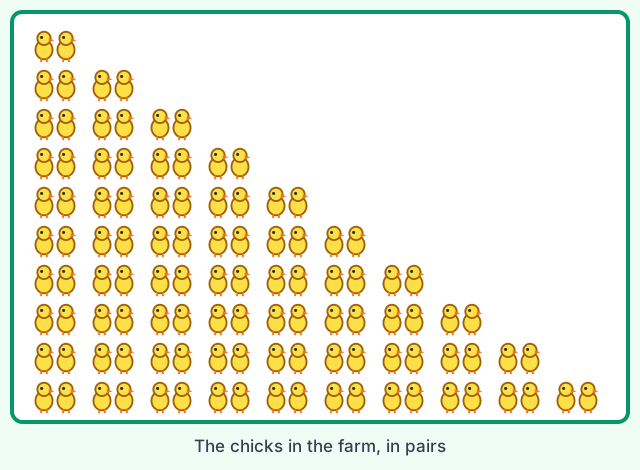
Q1Let us count chickens in the farm! 4 times 2 is ……. or, 4 × 2 = ……. ; 5 times 2 is ……. or, 5 × 2 = ……. ; 6 times 2 is ……. or, 6 × 2 = ……. ; ……. times 2 is ……. or, ……. × 2 = ……. ; ……. times ……. is ……. or, 8 × 2 = ……. ; ……. times ……. is ……. or, 9 × 2 = ……. ; ……. times ……. is ……. or, 10 × 2 = …….
Figure
The chicks in the farm, standing in pairs.
Answer

The chicks stand in pairs. Each new row has one pair more.

In wordsIsMultiplication
4 times 284 × 2 = 8
5 times 2105 × 2 = 10
6 times 2126 × 2 = 12
7 times 2147 × 2 = 14
8 times 2168 × 2 = 16
9 times 2189 × 2 = 18
10 times 22010 × 2 = 20

Skip Jumping Game — Page 95Dhara skip jumps by 3

Try This
Q1Starting from 0, Dhara jumps to 3. From 3 she goes to 6. From 6 she goes to 9. Now, continue to see how Dhara jumps after 9.
01234567891011121314151617181920
The number track with Dhara’s first three jumps drawn on it.
Answer

After 9 she lands on 12, then 15, then 18.

9 + 3 = 12
12 + 3 = 15
15 + 3 = 18
Q2DHARA IS SKIP JUMPING BY 3. Number of jumps → Number reached. 4 jumps → ……… , 5 jumps → ……… , 6 jumps → ……… , 7 jumps → ……… , 8 jumps → ……… , 9 jumps → ……… , 10 jumps → ………
01234567891011121314151617181920
The number track with Dhara’s first three jumps drawn on it.
Answer

Each jump adds one more 3.

JumpsAdditionNumber reached
43 + 3 + 3 + 3 = 4 × 312
55 × 315
66 × 318
77 × 321
88 × 324
99 × 327
1010 × 330

Let us Do — Pages 96–97Skip jumping and times tables

Q1Guess and write the next number she will jump onto.
01234567891011121314151617181920
The number track with Dhara’s first three jumps drawn on it.
Answer

She has reached 9. The next number is 12.

9 + 3 = 12
Q2Is there a pattern in these numbers: 3, 6, 9, …?
01234567891011121314151617181920
The number track with Dhara’s first three jumps drawn on it.
Answer

Yes, there is a pattern.

  • Each number is 3 more than the one before it.
  • 3, 6, 9, 12, 15, 18, 21, 24, 27, 30.
  • These are exactly the numbers of the times-3 table.
Q3How many steps forward is Dhara jumping each time?
01234567891011121314151617181920
The number track with Dhara’s first three jumps drawn on it.
Answer

Dhara jumps 3 steps each time.

0 → 3 → 6 → 9
3 – 0 = 3, 6 – 3 = 3, 9 – 6 = 3
Q4Continue skip jumping by 6, by drawing the jumps on the number track.
012345678910111213141516171819202122232425
The number track from 0 to 25, with the first two jumps of 6 drawn on it.
Answer

Start at 0 and add 6 each time.

0 → 6 → 12 → 18 → 24

Draw two more jumps: 12 to 18 and 18 to 24. The track ends at 25, so stop at 24.

012345678910111213141516171819202122232425
The jumps of 6 drawn up to 24 (new jumps in green).
Q5Can this skip jumping be used to form times-6 table? Write times-6 table in your notebook.
012345678910111213141516171819202122232425
The number track from 0 to 25, with the first two jumps of 6 drawn on it.
Answer

Yes. The landing numbers make the times-6 table.

1 × 6 = 66 × 6 = 36
2 × 6 = 127 × 6 = 42
3 × 6 = 188 × 6 = 48
4 × 6 = 249 × 6 = 54
5 × 6 = 3010 × 6 = 60
Q6Is there repeated addition happening? Make times-4 table using repeated addition in the picture given below.
01234567891011121314151617181920212223242544 + 41 × 42 × 4
The number track with the first two jumps of 4 drawn on it.
Answer

Yes, 4 is being added again and again.

JumpsRepeated additionNumber reached
144
24 + 48
34 + 4 + 412
44 + 4 + 4 + 416
55 × 420
66 × 424
77 × 428
88 × 432
99 × 436
1010 × 440
Q7Gopal is doing skip jumping of …………. steps. After 27 he will jump on …………., …………..
0591015182025273035404550
The number track with Gopal’s jumps drawn on it.
Answer

Gopal is skip jumping of 9 steps.

0 → 9 → 18 → 27
9 – 0 = 9, 18 – 9 = 9, 27 – 18 = 9

After 27 he will jump on 36, then 45.

Q8What times table can you construct from Gopal’s jumps? Make it in your notebook.
0591015182025273035404550
The number track with Gopal’s jumps drawn on it.
Answer

We get the times-9 table.

1 × 9 = 96 × 9 = 54
2 × 9 = 187 × 9 = 63
3 × 9 = 278 × 9 = 72
4 × 9 = 369 × 9 = 81
5 × 9 = 4510 × 9 = 90
Q9Dhara also skip jumps. Gopal notes down the jumps but he misses the first few numbers.
32, 40, 48, 56
The numbers Gopal wrote down. The first three boxes are empty.
By what numbers was Dhara skip jumping? Construct the times table of this number in your notebook.
Answer

Dhara was skip jumping by 8.

40 – 32 = 8
48 – 40 = 8
56 – 48 = 8

The missed numbers are 8, 16 and 24. The table is:

1 × 8 = 86 × 8 = 48
2 × 8 = 167 × 8 = 56
3 × 8 = 248 × 8 = 64
4 × 8 = 329 × 8 = 72
5 × 8 = 4010 × 8 = 80

Let us Play — Page 97Reaching the flower on 12

Try This
Q1Atya places a flower on 12. Skip jump with equal steps to reach the flower. No direct jumping to the flower is allowed. The one who reaches the flower in the smallest number of jumps wins. What skip jumping number will you choose? ……….
12Atya’s flower stands on 12
The playing track with Atya’s flower placed on it.
Answer

I will choose 6. I reach 12 in only 2 jumps.

Jump sizeLanding numbersJumps needed
22, 4, 6, 8, 10, 126
33, 6, 9, 124
44, 8, 123
66, 122
Q2Are there numbers that can be reached only through skip jumping by 1? Find 3 such numbers.
05101520253035404550
The number track from 0 to 50.
Answer

Yes. Three such numbers are 7, 11 and 13.

  • 7 — jumps of 2, 3, 4, 5 or 6 all miss it.
  • 11 — no equal jump lands on it except 1.
  • 13 — the same thing happens.
Q3Play this game with your friends by putting the flower on different numbers on the track. See who is able to reach in the minimum number of jumps.
Answer

Choose the biggest jump that lands on the flower but is smaller than the flower’s number.

Flower onBest jumpJumps needed
1052
1553
1892
20102

Fun Way of Writing Tables — Page 98Mithu’s sticks

Try This
Q1Mithu figures out another way of writing multiplication tables by drawing sticks! Do you see repeated addition in this?
Mithu’s sticks
The sticks Mithu arranged, with a red dot at every crossing.
Answer

Yes. Each new standing stick adds 5 more red dots.

  1. Mithu has 5 lying sticks and 4 standing sticks.
  2. Each standing stick crosses all 5 lying sticks and makes 5 dots.
5 + 5 + 5 + 5 = 20 dots
4 × 5 = 20
Q2Complete the times-5 table using sticks. 1 × 5 = 5, 2 × 5 = 10, 3 × 5 = 15, 4 × 5 = , 5 × 5 = , 6 × 5 = , 7 × 5 = , 8 × 5 = , 9 × 5 =
1 times 52 times 53 times 5
The first three rows of the times-5 table made with sticks.
Answer

Add one more standing stick each time. It crosses the 5 lying sticks and makes 5 more red dots.

4 × 5 = 20
5 × 5 = 25
6 × 5 = 30
7 × 5 = 35
8 × 5 = 40
9 × 5 = 45
Q3Make times-6 to times-10 tables using the sticks method shown above.
Mithu’s sticks
The sticks Mithu arranged, with a red dot at every crossing.
Answer

For the times-6 table keep 6 lying sticks, for times-7 keep 7, and so on. Add standing sticks one by one and count the red dots.

Standing sticks× 6× 7× 8× 9× 10
1678910
21214161820
31821242730
42428323640
53035404550
63642485460
74249566370
84856647280
95463728190
1060708090100

Seeing Patterns in Multiplication Tables — Page 99The times-5 table

Math Talk
Q1Look at the times-5 table. What patterns do you see?
RowAnswer
1 × 55
2 × 510
3 × 515
4 × 520
5 × 525
6 × 530
7 × 535
8 × 540
9 × 545
10 × 550
Answer

The times-5 table has a clear pattern.

  • The answers end in 5, 0, 5, 0, 5, 0 …
  • Odd rows (1, 3, 5, 7, 9) end in 5.
  • Even rows (2, 4, 6, 8, 10) end in 0.
  • Each answer is 5 more than the one above it.
Q2Guess what will be the last digits of 11 × 5 and 12 × 5.
RowAnswer
1 × 55
2 × 510
3 × 515
4 × 520
5 × 525
6 × 530
7 × 535
8 × 540
9 × 545
10 × 550
Answer

The last digit of 11 × 5 is 5. The last digit of 12 × 5 is 0.

11 × 5 = 55
12 × 5 = 60
Q3Give 3 examples of numbers that when taken 5 times gives an answer ending with (a) 0 ……. ……. ……. (b) 5 ……. ……. …….
RowAnswer
1 × 55
2 × 510
3 × 515
4 × 520
5 × 525
6 × 530
7 × 535
8 × 540
9 × 545
10 × 550
Answer

Even numbers give an answer ending in 0. Odd numbers give an answer ending in 5.

Answer ends withNumbersCheck
(a) 02, 4, 62 × 5 = 10, 4 × 5 = 20, 6 × 5 = 30
(b) 51, 3, 71 × 5 = 5, 3 × 5 = 15, 7 × 5 = 35
Q4Without finding the answer, can you tell the last digits of 18 × 5, 23 × 5, 32 × 5, 50 × 5.
RowAnswer
1 × 55
2 × 510
3 × 515
4 × 520
5 × 525
6 × 530
7 × 535
8 × 540
9 × 545
10 × 550
Answer

Yes. Just look at whether the number is even or odd.

ProductEven or oddLast digit
18 × 518 is even0
23 × 523 is odd5
32 × 532 is even0
50 × 550 is even0

In-text Questions — Page 100How the tables of 2, 3 and 5 are joined

Math Talk
Q1Look at the times tables of 2, 3, 5. They have a relation between them. Can you see it?
1 × 2 = 22 × 2 = 43 × 2 = 64 × 2 = 81 × 3 = 32 × 3 = 63 × 3 = 94 × 3 = 121 × 5 = 52 × 5 = 103 × 5 = 154 × 5 = 20The first four rows of the times-2, times-3 and times-5 tables
The three table cards printed in the book.
Answer

Yes. The times-2 answer plus the times-3 answer gives the times-5 answer.

2 + 3 = 5
4 + 6 = 10
6 + 9 = 15
8 + 12 = 20
Q2Is there a relation between the two circled numbers and the boxed number? Does this happen for the next rows also?
1 × 2 = 22 × 2 = 43 × 2 = 64 × 2 = 81 × 3 = 32 × 3 = 63 × 3 = 94 × 3 = 121 × 5 = 52 × 5 = 103 × 5 = 154 × 5 = 20The first four rows of the times-2, times-3 and times-5 tables
The three table cards printed in the book.
Answer

Yes. The two circled numbers add up to the boxed number.

Circled: 2 and 3. Boxed: 5.
2 + 3 = 5

It happens in the next rows too: 4 + 6 = 10, 6 + 9 = 15, 8 + 12 = 20.

Q3Can you find other examples of two tables adding up to a third table?
1 × 2 = 22 × 2 = 43 × 2 = 64 × 2 = 81 × 3 = 32 × 3 = 63 × 3 = 94 × 3 = 121 × 5 = 52 × 5 = 103 × 5 = 154 × 5 = 20The first four rows of the times-2, times-3 and times-5 tables
The three table cards printed in the book.
Answer

Yes, there are many such pairs.

Two tablesThird tableExample
2 and 246 + 6 = 12, and 3 × 4 = 12
3 and 479 + 12 = 21, and 3 × 7 = 21
4 and 598 + 10 = 18, and 2 × 9 = 18
6 and 41018 + 12 = 30, and 3 × 10 = 30

Let us Do — Page 100Word problems on multiplication and division

Q1Draw pictures for each of the following problems in your notebook. Use counting, number line jumps or any other method to solve the problems. (a) There are 5 jars with 4 cookies in each jar. How many cookies are there?
Answer

There are 20 cookies.

4 + 4 + 4 + 4 + 4 = 20
5 × 4 = 20
Q2(b) An idli vessel contains 6 idli plates. In each plate we can make 4 idlis. How many idlis can be cooked in one go?
Answer

24 idlis can be cooked in one go.

4 + 4 + 4 + 4 + 4 + 4 = 24
6 × 4 = 24
Q3(c) 30 cookies are to be distributed among 5 children equally. How many cookies will each child get?
Answer

Each child gets 6 cookies.

30 – 5 = 25   25 – 5 = 20   20 – 5 = 15
15 – 5 = 10   10 – 5 = 5   5 – 5 = 0
We took 5 away 6 times, so 30 ÷ 5 = 6.
Q4(d) Roro starts from 0 and takes 6 jumps to reach 18. All his jumps are of the same size. What is the size of Roro’s jump?
Answer

Each jump is of 3 steps.

0 → 3 → 6 → 9 → 12 → 15 → 18
18 ÷ 6 = 3
Q5(e) Toto does not take jumps of the same size and still reaches 18 in 6 jumps. How did Toto jump?
Answer

Toto’s jumps were of different sizes, but they still add up to 18.

One way: 2 + 2 + 3 + 3 + 4 + 4 = 18
Another way: 1 + 2 + 3 + 4 + 5 + 3 = 18
Q6(f) Suma saves ₹ 8 every day. After how many days will she have ₹ 56?
Answer

After 7 days she will have ₹ 56.

8, 16, 24, 32, 40, 48, 56
7 × 8 = 56, so 56 ÷ 8 = 7
Q7(g) Mary has 63 sea-shells. She gives 7 sea-shells to each of her 5 friends. How many does she have left?
Answer

She has 28 sea-shells left.

Given away: 5 × 7 = 35
Left: 63 – 35 = 28
Q8Solve the following problems. Try constructing a word problem. (a) 4 × 9
Answer
4 × 9 = 36

My word problem: There are 4 rows of chairs. Each row has 9 chairs. How many chairs are there?

Q9(b) 32 ÷ 8
Answer
32 – 8 = 24   24 – 8 = 16
16 – 8 = 8   8 – 8 = 0
32 ÷ 8 = 4

My word problem: 32 mangoes are shared equally among 8 children. How many does each child get?

Q10(c) 6 × 7
Answer
7 + 7 + 7 + 7 + 7 + 7 = 42
6 × 7 = 42

My word problem: A week has 7 days. How many days are there in 6 weeks?

Q11(d) 45 ÷ 5
Answer
45, 40, 35, 30, 25, 20, 15, 10, 5, 0
We took 5 away 9 times.
45 ÷ 5 = 9

My word problem: 45 laddoos are put equally in 5 boxes. How many laddoos go in each box?

In-text Questions — Page 101Bhim’s cardboard rath

Q1Bappa, I am making a cardboard rath. I need to make spokes for 20 wheels of the rath. Each wheel needs 5 spokes. Help Bhim! Bhim will need …….. spokes.
Ten wheels, each with its spokes
Ten wheels of the rath, each with its spokes.
Answer

Bhim will need 100 spokes.

20 wheels × 5 spokes
10 wheels need 50 spokes
Another 10 wheels need 50 spokes
50 + 50 = 100 spokes
Q210 wheels will need: 5 + 5 + 5 + 5 + 5 + 5 + 5 + 5 + 5 + 5 = 10 × 5 = …….. spokes. Another 10 wheels will need …….. × …….. = …….. spokes. So, the total number of spokes needed is …….. + …….. = …….. spokes.
Ten wheels, each with its spokes
Ten wheels of the rath, each with its spokes.
Answer

Fill the blanks like this.

10 × 5 = 50 spokes
Another 10 wheels: 10 × 5 = 50 spokes
Total: 50 + 50 = 100 spokes

Try these — Page 101Multiplying tens by 5

Try This
Q130 × 5 = ………. (Hint: You can find this by counting the spokes in 30 wheels.) First 10 wheels will have …….. spokes. Second 10 wheels will have …….. spokes. Third 10 wheels will have …….. spokes. Total = …….. spokes. 30 × 5 = …….. spokes.
Ten wheels, each with its spokes
Ten wheels of the rath, each with its spokes.
Answer

Break 30 wheels into three groups of 10.

First 10 wheels: 50 spokes
Second 10 wheels: 50 spokes
Third 10 wheels: 50 spokes
Total = 50 + 50 + 50 = 150 spokes
30 × 5 = 150 spokes
Q2Describe the patterns you see here
QuestionAnswer
30 × 5 
40 × 5 
50 × 5 
60 × 5 
70 × 5 
80 × 5 
90 × 5 
100 × 5 
Answer

The answers make a neat pattern.

  • 10 × 5 = 50, 20 × 5 = 100, 30 × 5 = 150.
  • Every answer ends in 0.
  • Each answer is 50 more than the one before it.
Q3Complete the following: 40 × 5 = ……….   50 × 5 = ……….   60 × 5 = ……….   70 × 5 = ……….   80 × 5 = ……….   90 × 5 = ……….   100 × 5 = ……….
Answer

Keep adding 50 each time.

QuestionAnswerQuestionAnswer
40 × 520080 × 5400
50 × 525090 × 5450
60 × 5300100 × 5500
70 × 5350  

In-text Questions — Page 102Gopal’s spokes

Q1Gopal collected 45 spokes. How many wheels can he make?
Ten wheels, each with its spokes
Ten wheels of the rath, each with its spokes.
Answer

Gopal can make 9 wheels.

45 – 10 = 35 → 2 wheels
35 – 10 = 25 → 2 more
25 – 10 = 15 → 2 more
15 – 10 = 5 → 2 more
5 spokes → 1 more wheel
2 + 2 + 2 + 2 + 1 = 9 wheels
Q2Does Gopal have enough spokes to make 10 wheels?
Ten wheels, each with its spokes
Ten wheels of the rath, each with its spokes.
Answer

No, he does not have enough.

10 wheels need 10 × 5 = 50 spokes
Gopal has only 45 spokes
50 – 45 = 5 spokes short
Q3How many wheels can you make with 60 spokes?
Ten wheels, each with its spokes
Ten wheels of the rath, each with its spokes.
Answer

We can make 12 wheels.

10 spokes make 2 wheels.
60 spokes are six lots of 10 spokes.
2 + 2 + 2 + 2 + 2 + 2 = 12 wheels
60 ÷ 5 = 12

Let us Do — Pages 102–103Legs, wheels and horns

Q1A spider has 8 legs. 5 spiders will have …….. legs. 10 spiders will have …….. legs. 15 spiders will have …….. legs.
A spider
A spider, as shown in the book.
Answer

Count 8 legs for every spider.

5 spiders: 5 × 8 = 40 legs
10 spiders: 10 × 8 = 80 legs
15 spiders: 80 + 40 = 120 legs
Q223 spiders will have ……. legs.
A spider
A spider, as shown in the book.
Answer

23 spiders will have 184 legs.

10 spiders: 80 legs
Another 10 spiders: 80 legs
3 spiders: 3 × 8 = 24 legs
80 + 80 + 24 = 184 legs
Q3A group of spiders have 32 legs. How many spiders are there in the group?
A spider
A spider, as shown in the book.
Answer

There are 4 spiders in the group.

32 – 8 = 24   24 – 8 = 16
16 – 8 = 8   8 – 8 = 0
32 ÷ 8 = 4
Q4Here is a 3-wheeled auto rickshaw. How many wheels are there in: (a) 18 auto rickshaws? (b) 34 auto rickshaws?
An auto rickshaw
The three-wheeled auto rickshaw from the book.
Answer

Each auto rickshaw has 3 wheels.

(a) 18 autos: 10 autos have 30 wheels
8 autos have 24 wheels
30 + 24 = 54 wheels

(b) 34 autos: 30 autos have 90 wheels
4 autos have 12 wheels
90 + 12 = 102 wheels
Q5Auto rickshaws in a garage have a total of 36 wheels. How many auto rickshaws are there in the garage?
An auto rickshaw
The three-wheeled auto rickshaw from the book.
Answer

There are 12 auto rickshaws.

3, 6, 9, 12, 15, 18, 21, 24, 27, 30, 33, 36
That is 12 threes.
36 ÷ 3 = 12
Q6There is a line of 55 ants (one ant has 6 legs). What is the total number of legs in the line?
Answer

There are 330 legs in the line.

10 ants have 60 legs
50 ants have 60 + 60 + 60 + 60 + 60 = 300 legs
5 ants have 30 legs
300 + 30 = 330 legs
Q7Micky, the mouse, can see 48 legs of cows in the shed. How many cows are there in the shed?
Answer

There are 12 cows in the shed.

One cow has 4 legs.
4, 8, 12, 16, 20, 24, 28, 32, 36, 40, 44, 48
48 ÷ 4 = 12
Q8Karry, the crow, can see 24 horns of cows in the shed. What is the total number of legs in the shed?
Answer

There are 48 legs in the shed.

  1. One cow has 2 horns. So 24 ÷ 2 = 12 cows.
  2. One cow has 4 legs. So 12 × 4 = 48 legs.

Let us Think — Page 103The frog’s jumps of 7

Math Talk
Q1A frog is at 0. It takes jumps of only 7. What would be the largest number that the frog will reach before crossing 50?
05101520253035404550
The number track from 0 to 50.
Answer

The largest such number is 49.

0 → 7 → 14 → 21 → 28 → 35 → 42 → 49
49 + 7 = 56, which is past 50.
Q2A frog wants to jump backwards from 50. It continues to take jumps of 7. What is the number after which it is not possible for the frog to make a jump of 7?
05101520253035404550
The number track from 0 to 50.
Answer

The frog stops at 1.

50 → 43 → 36 → 29 → 22 → 15 → 8 → 1
From 1 it cannot take another jump of 7.
Q3What numbers should the frog start from to reach 0, taking jumps of 7 each time? What do you observe?
05101520253035404550
The number track from 0 to 50.
Answer

It should start from 7, 14, 21, 28, 35, 42 or 49.

49 → 42 → 35 → 28 → 21 → 14 → 7 → 0

What I observe: All these are numbers of the times-7 table.

Puri Beach — Page 104Shopping at the beach

Q1One wall-hanging costs ₹42. How much do two wall hangings cost? Two wall hangings cost ₹42 + ₹42 = 2 × ₹42. The cost of the two wall hangings: ……….
A wall hanging
A wall hanging from the Puri beach shop.
Answer

Two wall hangings cost ₹ 84.

₹ 42 + ₹ 42
40 + 40 = 80
2 + 2 = 4
80 + 4 = ₹ 84
Q2One rabdi cup costs ₹75. Preeti buys 5 cups of rabdi. She has her mother’s purse which has only ₹100 notes. How many ₹100 notes should she give to the shopkeeper? How much will the shopkeeper then return to Preeti? What is the total cost of 5 cups of rabdi?
A cup of rabdi
A cup of rabdi from the shop.
Answer

Total cost of 5 cups = ₹ 375.

75 + 75 = 150 (2 cups)
150 + 150 = 300 (4 cups)
300 + 75 = 375 (5 cups)

She should give 4 notes of ₹ 100 (₹ 400).
The shopkeeper returns ₹ 400 – ₹ 375 = ₹ 25.

Sea-Shells — Pages 104–105Dhruv makes necklaces from 112 shells

Q1I will make a necklace of 28 shells. Will these shells be enough to make necklaces for my three friends?
Dhruv and the shells he collected; described here, see the textbook for the painting.
Answer

Yes, 112 shells are enough for three necklaces.

112 – 28 = 84 (1st necklace)
84 – 28 = 56 (2nd necklace)
56 – 28 = 28 (3rd necklace)

He still has 28 shells left after three necklaces.

Q2He took 28 shells for one necklace. 112 – 28 = 84. Now, he was left with 84 shells. Again, he took 28 more shells for the second necklace. How many shells are left now?
Dhruv and the shells he collected; described here, see the textbook for the painting.
Answer

56 shells are left.

84 – 28
84 – 20 = 64
64 – 8 = 56
Q3Then, he took 28 shells for the third necklace. So, he was left with ……….. shells.
Dhruv and the shells he collected; described here, see the textbook for the painting.
Answer

He was left with 28 shells.

56 – 28
56 – 20 = 36
36 – 8 = 28
Q4Are the shells enough for making necklaces for all his friends? ………..
Dhruv and the shells he collected; described here, see the textbook for the painting.
Answer

Yes, the shells are enough.

Three friends need 3 × 28 = 84 shells
Dhruv has 112 shells
112 – 84 = 28 shells still left
Q5How many necklaces can Dhruv make from 112 shells? ………..
Dhruv and the shells he collected; described here, see the textbook for the painting.
Answer

Dhruv can make 4 necklaces.

112 – 28 = 84 (1)
84 – 28 = 56 (2)
56 – 28 = 28 (3)
28 – 28 = 0 (4)

Try these — Page 105Bigger sharing problems and notes

Try This
Q1Kannu makes a necklace of 17 sea-shells. How many such necklaces can be made using 100 sea-shells?
Answer

5 necklaces can be made.

100 – 17 = 83 (1)
83 – 17 = 66 (2)
66 – 17 = 49 (3)
49 – 17 = 32 (4)
32 – 17 = 15 (5)

15 shells are left, which is not enough for one more necklace.

Q2While searching for sea-shells, Dhruv also finds 127 shiny pebbles. He distributes them equally to his 3 friends. How many will each get?
Answer

Each friend gets 42 pebbles. 1 pebble is left over.

127 – 30 – 30 – 30 – 30 = 7 (10 each, four times)
7 – 3 – 3 = 1 (1 each, two times)
10 + 10 + 10 + 10 + 1 + 1 = 42
Q3Preeti has a ₹500 note and wants to exchange it for lower denomination notes. How many notes will she get if she wants— (a) All 50 rupees notes? (b) All 20 rupees notes? (c) All 10 rupees notes?
Answer

Skip count up to 500 with each note.

NoteSkip countingNumber of notes
₹ 5050, 100, 150 … 50010
₹ 205 notes make ₹ 100, so 5 × 525
₹ 1010 notes make ₹ 100, so 10 × 550

Let us Explore — Page 106The five sealed envelopes

Math Talk
Q1There are ten number cards from 1–10. There are five sealed envelopes. Each has two cards on the top of each envelope, the multiplication of the numbers contained in it is written. The fifth envelope contains the cards 5 and 9. The number 5 × 9 = 45 is written on the envelope. Identify the number cards inside each of the envelopes.
1234567891071832204559Ten number cards and the five envelopes
The ten number cards and the five envelopes.
Answer

Cards 5 and 9 are already used. Eight cards are left: 1, 2, 3, 4, 6, 7, 8, 10.

EnvelopeCards insideCheck
71 and 71 × 7 = 7
183 and 63 × 6 = 18
324 and 84 × 8 = 32
202 and 102 × 10 = 20
455 and 95 × 9 = 45

Chapter 7 of 14 – Maths Mela

Also for This Chapter

NCERT Solutions Class 3 Maths Maths Mela Chapter 7 Raksha Bandhan – Overview

ClassClass 3
SubjectMaths
BookMaths Mela
Chapter7 – Raksha Bandhan
Textbook pages82 – 106
Questions solved95
Session2027
FormatFull answers on this page + PDF

NCERT Solutions Class 3 Maths Chapter 7 – FAQs

Where can I download NCERT Solutions Class 3 Maths Maths Mela Chapter 7 Raksha Bandhan PDF?

Read every answer on this page, or download the free PDF from the table at the top.

Is this for the 2027 session?

Yes, it follows the latest NCERT Class 3 Maths book for 2027.

How many questions are solved in NCERT Class 3 Maths Chapter 7?

All 95 questions of the chapter (textbook pages 82 – 106) – the in-text questions, activities and the end-of-chapter exercises.

How should I use these solutions?

Read the chapter in the NCERT book first, attempt the questions yourself, then check your answers here.

Official website: ncert.nic.inNational Council of Educational Research and Training publishes date sheets, admit cards and results here
Visit

Ask a question

?

Loading comments…