Skip to content

NCERT Solutions for Class 3 Maths Chapter 5 Fun with Shapes (PDF) – 2027

NCERT Solutions for Class 3 Maths Maths Mela Chapter 5 Fun with Shapes – step-by-step answers to every exercise and in-text question of the chapter, as per the latest NCERT syllabus for 2027. Read them online or download the free question-answer PDF.

This chapter is full of shapes. You copy Amma’s rangoli on dots, open a box and trace its faces, and get to know the square, the rectangle, the triangle and the circle.

NCERT Solutions for Class 3 Maths Maths Mela Chapter 5 Fun with Shapes PDF

All the answers are on this page below. The PDF also explains every answer – why it is right and how to check it – so download it for revision.

PDFChapterDownload
Solutions PDF (English medium)Fun with ShapesView PDF
Solutions PDF (Hindi medium)आकृतियों के साथ आनंदView PDF

NCERT Solutions for Class 3 Maths Maths Mela Chapter 5 Fun with Shapes – Questions and Answers

All 82 questions of the chapter (textbook pages 44 – 63) are answered below, in the order of the book – in-text questions, activities and the end-of-chapter exercises. Each answer is written the way you would write it in the exam.

Let us Do — Pages 44–45Amma’s rangoli

Let us Do
Q1Make Amma’s rangoli on the dots given below.
Amma’s rangoliyour dots — draw here
Amma’s rangoli on the left and an empty grid of dots on the right.
Answer

Copy Amma’s rangoli dot by dot.

  1. An orange square at each corner.
  2. A green triangle in the middle of each side.
  3. Four blue circles in between.
  4. A big yellow square in the middle, standing on a corner.
  5. A small red square inside it.
Q2Name the shapes drawn in Amma’s rangoli: _____________, _____________, _____________
Amma’s rangoli, drawn on a grid of dots.
Answer

The three shapes are square, triangle and circle.

  • The orange shapes at the corners are squares.
  • The green shapes are triangles.
  • The blue shapes are circles.
Q3How many shapes are made with (a) Curved lines ______________ (b) Straight lines ______________
Amma’s rangoli, drawn on a grid of dots.
Answer

(a) Curved lines: 4 — the four blue circles.

(b) Straight lines: 10.

4 squares + 4 triangles + 1 big square + 1 small square = 10
Q4Use cut outs of shapes to make a rangoli design. Outline the object and colour.
Answer
  1. Cut squares, triangles and circles from coloured paper.
  2. Arrange them on a sheet as a pretty design.
  3. Draw around each cut-out with a pencil.
  4. Lift the cut-outs and colour inside the outlines.
Q5Try to make the following objects using shape cutouts.
boatbutterflyrocket
Three pictures made by joining cut-out shapes.
Answer

Match your cut-outs to the pictures.

  • Boat: 1 rectangle, 4 triangles, 3 small squares.
  • Butterfly: 2 triangles for wings, a circle and an oval for the body, 2 small circles.
  • Rocket: 1 rectangle, 3 triangles, 2 small circles and a half circle.

Let us Do — Page 46Boxes and an envelope

Let us Do
Q1Collect some cardboard boxes and open them up carefully. What shapes do you see in the flattened boxes?
Answer

You see rectangles (and sometimes squares).

box
A cardboard box cut open and pressed flat.

A box opens out into 6 flat faces. Each face is a rectangle or a square.

Q2Make an Envelope. Use a square piece of paper and fold it as shown in the picture.
1234
The four folding steps printed in the book, from a square sheet to an envelope.
Answer

Fold a square sheet in four steps.

  1. Keep the square standing on a corner.
  2. Fold the left and right corners in.
  3. Fold the bottom corner up.
  4. Fold the top corner down to close it.

Baking biscuits — Page 47Faces of boxes

Q1Observe the faces of these objects. What is common among them?
TV screenbox lidchocolate bar
A TV screen, a box lid and a bar of chocolate.
Answer

All of them have rectangular faces.

The TV screen, the lid of the box and the bar of chocolate are all rectangles.

Q2Why did the two children get different shapes? Discuss.
wooden box tracedmatchbox traced
The outlines the two children drew on their sheets.
Answer

Because they traced different faces.

  • The wooden box has a square face and a rectangle face. So one child got a square and a rectangle.
  • The matchbox has three faces of different sizes. So the other child got three different rectangles.
Q3Name any three objects that have rectangular faces. _________________, ________________, ____________________
Answer

Any three of these are correct:

  • a maths book
  • a duster
  • a brick
  • a soap box, a matchbox, a mobile phone, a door

Let us Do — Page 48Tracing the faces of a cuboid

Let us Do
Q1Trace all the faces of any cuboidal object. (example — sharpener or eraser)
an eraser (a cuboid)
An eraser. It is a cuboid, so it has six flat faces.
Answer

Take an eraser and trace every face.

  1. Put the eraser on the page and draw around it.
  2. Turn it on to the next face and draw again.
  3. Do this for every face.

You get 6 outlines.

Q2(a) How many different faces did you get? __________________
an eraser (a cuboid)
An eraser. It is a cuboid, so it has six flat faces.
Answer

You get 6 faces in all.

But only 3 of them are of different sizes. The faces come in pairs. The top matches the bottom, the front matches the back, and one side matches the other side.

Q3(b) What shapes are these faces? __________________
an eraser (a cuboid)
An eraser. It is a cuboid, so it has six flat faces.
Answer

They are rectangles.

If the object is a cube, like a dice, then every face is a square.

Q4(c) Did you get a square? __________________
an eraser (a cuboid)
An eraser. It is a cuboid, so it has six flat faces.
Answer

It depends on the object you chose.

  • An eraser usually gives only rectangles. Then write No.
  • A sharpener or a dice gives squares. Then write Yes.
Q5(d) Can you get six different rectangles by tracing a cuboid? __________________
an eraser (a cuboid)
An eraser. It is a cuboid, so it has six flat faces.
Answer

No.

Opposite faces of a cuboid are exactly the same. So the six outlines make only 3 different rectangles, each drawn twice.

Q6(e) Can a cuboid have a face like a triangle? __________________
an eraser (a cuboid)
An eraser. It is a cuboid, so it has six flat faces.
Answer

No.

Every face of a cuboid has 4 sides and 4 square corners. A triangle has only 3 sides.

Q7(f) The faces of a cuboid are __________________ or __________________ in shape.
an eraser (a cuboid)
An eraser. It is a cuboid, so it has six flat faces.
Answer

The faces of a cuboid are rectangular or square in shape.

Let us Do — Page 49Making rectangles on a dot grid

Let us Do
Q1Construct the rectangles using the sides given below:
Four sets of sides already drawn on the dot grid.
Answer

Add the missing sides to each drawing.

  1. Count the dots along the side that is drawn.
  2. Draw a side of the same length opposite it.
  3. Join the ends.
The red dashed lines complete each rectangle.
Q2Draw 3 bigger rectangles around the given rectangle.
One rectangle drawn on a grid of dots.
Answer

Draw each new rectangle one dot further out on every side.

Three bigger rectangles drawn around the given one.

Let us Do — Page 50Counting rectangles and looking at them

Let us Do
Q1Count and write the number of rectangles in the following picture. __________________
A big rectangle with lines drawn inside it.
Answer

There are 10 rectangles.

12345
The five small rectangles, numbered 1 to 5.
5 small ones
+ (1, 2) + (4, 5)
+ (1, 2, 3) + (3, 4, 5)
+ the whole picture
= 5 + 2 + 2 + 1 = 10
Q2(a) How many sides are there in a rectangle? ______________
Eleven rectangles of different sizes, lying at different angles.
Answer

A rectangle has 4 sides.

Pick any rectangle in the picture and run your finger round it. You touch four straight sides and come back to the start.

Q3(b) How many corners are there in a rectangle? ______________
Eleven rectangles of different sizes, lying at different angles.
Answer

A rectangle has 4 corners.

A corner is made where two sides meet. Four sides meet at four places.

Q4(c) Are there any sides in a rectangle that are equal in length to each other? ______________
Eleven rectangles of different sizes, lying at different angles.
Answer

Yes.

The two sides facing each other are equal. So a rectangle has two pairs of equal sides.

Q5(d) What do you notice in a rectangle? Describe it in your own words. _______________________________________________________
Eleven rectangles of different sizes, lying at different angles.
Answer
  • A rectangle has 4 straight sides and 4 corners.
  • The sides facing each other are equal.
  • All its corners are square corners.
  • It can be big or small, lying down or standing up.

Same to Same — Page 51A square and a rectangle

Q1I wonder what is the difference between a square and a rectangle?
squarerectangle
A square and a rectangle, side by side.
Answer

The difference is in the sides.

  • In a square, all four sides are equal.
  • In a rectangle, only the opposite sides need to be equal.
Q21. Both have _________ sides.
squarerectangle
A square and a rectangle, side by side.
Answer

Both have 4 sides.

Count the sides of the square: 1, 2, 3, 4. Count the sides of the rectangle: 1, 2, 3, 4.

Q32. Both have _________ corners.
squarerectangle
A square and a rectangle, side by side.
Answer

Both have 4 corners.

All eight of these corners are square corners.

Q4How many squares do you see in this drawing?
A square with more lines drawn inside it.
Answer

There are 6 squares.

123
The three small squares are numbered. The dashed lines show two middle-sized squares; the outside edge is the sixth square.
3 small squares
+ 2 middle-sized squares
+ 1 big square
= 6

Let us Do — Pages 52–53Making squares

Let us Do
Q1Here is a square. Draw 2 bigger squares around this square.
A square drawn on a grid of dots.
Answer

Draw each new square one dot further out on every side.

Two bigger squares drawn around the given square.
Q2Use matchsticks to make a square so that it has squares on all its sides. How many squares did you get?
Answer

You get 5 squares.

1 square in the middle + 4 squares around it = 5
Q3Complete the squares using the sides given below.
Four sets of sides already drawn on the dot grid.
Answer

Every side of a square must be the same length.

  1. Count the dots along the side that is drawn.
  2. Draw the other sides just as long.
  3. Join the ends.
The red dashed lines complete each square.
Q4Use the square cutouts from the book to do this activity. How many different shapes can you make by joining (a) 2 squares? Show them on a dot grid.
A small grid of dots to draw on.
Answer

Only 1 shape.

the same shape, just turned
Two squares joined edge to edge, shown lying down and standing up.

Two squares joined along a side make a rectangle. Standing it up does not make a new shape.

Q5How many different shapes can you make by joining (b) 3 squares
A small grid of dots to draw on.
Answer

You can make 2 different shapes.

a straight onean L-shaped one
The two shapes you can make with three squares.
  • All three squares in a straight line.
  • Two in a line and the third turning the corner, like the letter L.
Q6How many different shapes can you make by joining (c) 4 squares
A small grid of dots to draw on.
Answer

You can make 5 different shapes.

five different shapes in all
The five shapes you can make by joining four squares.

A straight line of four, a big square, an L, a T and a step shape.

Let us Explore — Page 53Which shapes are rectangles?

Let us Explore
Q1Tick ✓ the shapes that are rectangles. Which figures are not rectangles? Explain why.
A board with eleven paper shapes pinned on it.
Answer

5 shapes are rectangles (tick them). The other 6 are not.

✓✓✓✓✓
The five rectangles carry a tick.

The 6 shapes that are not rectangles have sloping sides, so their corners are not square corners.

Q2Can you fold all the corners of a square sheet in such a way that the number of corners remains the same?
Answer

Yes.

Fold all four corners in to the middle point. The folded sheet is a smaller square. It still has 4 corners.

Q3Make a square on a cardboard sheet and cut along the dotted lines marked on the square as shown to get 4 triangles. Make as many different shapes as possible by joining three triangles together. How many shapes can you make? Now, try with four triangles together.
A square with two dotted lines drawn corner to corner.
Answer

With three triangles you can make 4 different shapes.

shape 1shape 2
Two of the shapes you can build from three of the triangles.

With four triangles you can make many more (14). Draw each one you find.

Square Corners — Page 54Corners of squares and rectangles

Q1Which tile will fit in the corner of this table? Will the same tile fit in the corner of the math book?
corner of the tablesquare tiletriangle tile
The corner of a table, a square tile and a triangle tile.
Answer

The square tile will fit.

Yes, the same tile fits the corner of the maths book too.

Q2Are the corners of a square the same? How do you know? Pile up some squares over one another and see.
squarerectangle
A square and a rectangle, side by side.
Answer

Yes, all four corners of a square are the same.

Pile some same-size squares on one another. Every corner sits exactly on the corner below it.

Q3Are the corners of a rectangle the same? How do you know? Pile up some rectangles over one another and see.
squarerectangle
A square and a rectangle, side by side.
Answer

Yes, all four corners of a rectangle are the same.

Pile some same-size rectangles on one another. The corners match exactly.

Q4Are the corners of the square and a rectangle the same?
squarerectangle
A square and a rectangle, side by side.
Answer

Yes, they are the same.

Put the corner of a square on the corner of a rectangle. They fit on top of each other.

Q5Name some objects in your class that have only square corners. _____________________
Answer

Things in the class with only square corners:

  • the blackboard
  • the maths book and the notebook
  • the duster
  • the window, the door and the desk top
Q6Are the corners of this shape the same as that of a square and a rectangle?
squarerectangletriangle
A square, a rectangle and a triangle.
Answer

No. The corners of this triangle are not square corners.

Hold the corner of your book against each corner of the triangle. It does not fit any of them.

Let us Do — Page 55Paper strips and square corners

Let us Do
Q1Use the strips to show a square corner, more than a square corner and less than a square corner.
less than a square cornersquare cornermore than a square corner
Two paper strips joined at one end, opened by three different amounts.
Answer

Join two paper strips at one end, then open them.

  • Open like the corner of your book: square corner.
  • Open a little: less than a square corner.
  • Open wider: more than a square corner.
Q2Can you use the strip to check whether the corner of your table and the board are square corners?
less than a square cornersquare cornermore than a square corner
Two paper strips joined at one end, opened by three different amounts.
Answer

Yes.

Set the strips to a square corner and hold them on the corner of the table. If both strips lie along the edges, it is a square corner. The table and the board have square corners.

Q3Mark the square corners in these shapes.
Six shapes in a row.
Answer

Three shapes have square corners.

Red rings mark every square corner.
  • The green square: 4.
  • The blue square standing on its corner: 4.
  • The tall red rectangle: 4.

The other three shapes have none.

Q4Connect the dots to make some squares. How many different squares did you get? _____________________
Eight dots set out in a ring.
Answer

You get 2 squares.

Two squares of the same size, one standing straight and one turned.

Join every other dot. The top, bottom, left and right dots make one square. The other four dots make the second square.

Let us Do — Page 56The boat, and matchstick corners

Let us Do
Q1Look at the picture given below and answer the following. (a) Count and write the number of corners.
A boat built out of flat shapes.
Answer

The boat has 17 corners.

mast 4 + flag 3 + red sail 3 + blue sail 3 + boat 4
= 17
Q2(b) Circle the square corners.
A boat built out of flat shapes.
Answer

There are 6 square corners.

Green rings mark the square corners.
  • The mast (a rectangle): 4.
  • The red sail: 1, at the bottom next to the mast.
  • The blue sail: 1, at the bottom next to the mast.
Q3Use two matchsticks to make two square corners and then four square corners. Draw and show it in the space given below:
one square corner
Two matchsticks laid in an L. They make one square corner.
Answer

Cross one stick over the other.

  • A T shape gives 2 square corners.
  • A cross (+) gives 4 square corners.
a T — two square cornersa cross — four square corners
Two matchsticks in a T and two matchsticks in a cross. The red marks show the square corners.
Q4Murugan made three squares with 10 matchsticks. How many squares can you make with 12 matchsticks?
Three squares made with ten matchsticks.
Answer

You can make 4 small squares (5, if you count the big outside square).

Four squares made with twelve matchsticks.
big square: 8 sticks
middle lines: 4 sticks
8 + 4 = 12

Triangle — Triangle … So Many Triangles — Page 57Describe a Triangle; Let us Do

Let us Do
Q1What is common to all these things?
samosasandwichflagslice of cake
Four things with triangle faces.
Answer

All of them have triangular faces.

The samosa, the sandwich, the flag and the slice of cake all show a triangle.

Q2Describe a Triangle. Triangles have ____________ sides. They have ____________ corners.
A triangle.
Answer

Triangles have 3 sides. They have 3 corners.

Run your finger along the shape. You count three straight sides and three corners.

Q3Draw and name some triangular objects that you see around yourself, in your notebook.
Answer

Draw any of these in your notebook and write the name below each one:

  • a samosa
  • a slice of pizza
  • a flag on a stick
  • a set square, a hanger, a paper boat’s sail
Q4Count the number of triangles in the given rangoli. (a) ________________
Rangoli (a).
Answer

There are 16 triangles.

GGGGRRRRBBBBMMMM
G = green corner, R = red point, B = blue corner, M = middle piece. Each letter marks one triangle.
4 green + 4 red + 4 blue + 4 middle
= 16
Q5Count the number of triangles in the given rangoli. (b) ________________
Rangoli (b).
Answer

There are 16 triangles.

12 triangles round the edge4 in the middle
Twelve triangles make the border and four make the middle square.
12 round the border + 4 in the middle
= 16
Q6How many different triangles can be made using the dots on this circle?
A circle with four dots on it.
Answer

You can make 4 different triangles.

A triangle needs 3 dots. Leave out one of the 4 dots each time. There are 4 dots to leave out, so you get 4 triangles.

Two of the four triangles are shown. Leave out one dot each time.
Q7Move two matchsticks to turn the one triangle into two triangles.
One triangle made with six matchsticks.
Answer

Lift the two sticks at the bottom right corner and lay them inside.

After moving two matchsticks: two triangles that touch at one point.

Now there are 2 triangles that touch at one point.

Circus with Circles — Page 58Let us Discuss; Let us Do

Let us DiscussLet us Do
Q1Have you been to a circus?
Answer

Yes, I have been to a circus. I saw a clown with rings, a girl swinging on a ring and a seal with a ball.

Q2What does a circle look like? How is a circle different from a rectangle?
Answer

A circle is round, like a bangle or a wheel.

  • A circle has no straight side and no corner.
  • A rectangle has 4 straight sides and 4 corners.
Q3Name some objects that are like circles. ____________________________________________________________
Answer

Things that are like circles:

  • a bangle
  • a bottle cap
  • a coin and a chapati
  • a wheel, a plate, a clock face
Q4Draw colourful circles to complete the circus scene.
near the magicianunder the dogunder the clown
Three dotted rings in the circus picture, waiting to be drawn and coloured.
Answer

Draw over each dotted ring and colour it.

  1. Put a bangle or a bottle cap on the dotted ring.
  2. Draw around it with a pencil.
  3. Colour the ring with a bright colour.
Q5Draw circles by tracing bottle caps, bangles, and rings in your notebook.
Answer

Trace round things to make circles.

  1. Hold the bottle cap firmly on the page.
  2. Draw all round its edge.
  3. Do the same with a bangle and a ring.

You get circles of different sizes.

In-text Questions — Page 59Making a circle; folding a paper plate

Q1Have you played any game where you need to draw a circle? __________
Answer

Yes.

  • In marbles we draw a circle and keep the marbles inside it.
  • In ghera games all the children stand in a circle.
Q2Try to make a circle on the playground.
Answer

Use a rope and a stick.

  1. Push a peg into the ground. This is the centre.
  2. Tie one end of the rope to the peg.
  3. Hold a stick at the other end and keep the rope tight.
  4. Walk right round, drawing with the stick.
Q3Is that the center of the circle?
A paper plate opened out after two folds. The two straight lines meet at one point.
Answer

Yes. The point where the two fold lines meet is the centre of the circle.

Let us Do — Page 60Comparing two shapes

Let us Do
Q1Make some puppets using circular shapes and play with them.
Answer

A mouse puppet.

  1. Cut one big circle for the face and two small circles for the ears.
  2. Paste the ears on the face.
  3. Draw round eyes, a round nose and whiskers.
  4. Fix it on your finger and play.
Q2Look at these two shapes and discuss their similarities and differences. Tick ✓ the appropriate word. (a) Their corners are: same / different
A square and a triangle.
Answer

Tick different.

square → 4 corners
triangle → 3 corners

The square’s corners are square corners. The triangle’s corners are not.

Q3(b) Number of sides is: same / different
A square and a triangle.
Answer

Tick different.

square → 4 sides
triangle → 3 sides

But both are alike in one way — all their sides are straight.

Q4Choose any pair of shapes. Share the similarities and differences in these shapes with your friends.
Five shapes: a triangle, a pentagon, a hexagon, an eight-sided shape and a nine-sided shape.
Answer

the triangle and the five-sided shape.

  • Same: all their sides are straight.
  • Different: the triangle has 3 sides and 3 corners; the other has 5 sides and 5 corners.

Let us Do — Page 61Biggest rectangle, rows of triangles, torn rectangles
Let us Do
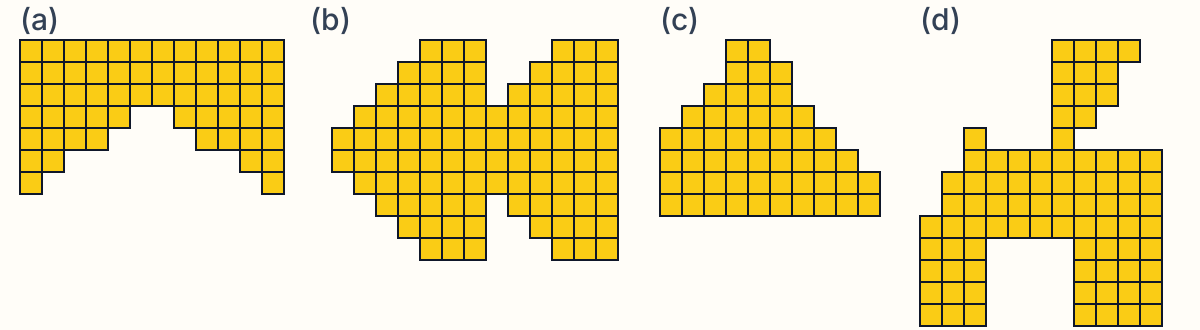
Q1Find the largest rectangle in these shapes.
Figure
Four shapes drawn on squared paper.
Answer

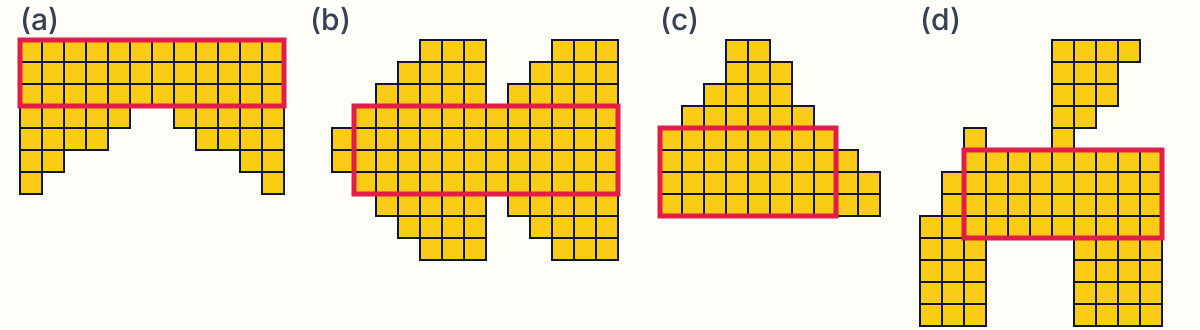
The red outline shows the largest rectangle in each shape.
Figure
The red outline shows the biggest rectangle in each shape.
  • (a) 12 squares across, 3 down
  • (b) 12 across, 4 down
  • (c) 8 across, 4 down
  • (d) 9 across, 4 down
Q2I made one triangle. Then I made another row of triangles. How many triangles are there in the second figure? _________________
first figuresecond figure
The first figure has one row of triangles; the second has two rows.
Answer

There are 3 triangles.

row 1 → 1
row 2 → 2
1 + 2 = 3
Q3If I make one more row, how many triangles will be there in the third figure? __________________
first figuresecond figure
The first figure has one row of triangles; the second has two rows.
Answer

There will be 6 triangles.

1 + 2 + 3 = 6
The third figure, with three rows of triangles.
Q4Here are some rectangles that are torn. How many square pieces have been torn from each shape? ___________________
(a)(b)(c)(d)(e)(f)
Six torn rectangles on squared paper.
Answer

Squares torn: (a) 3, (b) 8, (c) 9, (d) 3, (e) 9, (f) 8.

(a)(b)(c)(d)(e)(f)
The pink squares show the pieces that were torn away.
ShapeWhole rectangleSquares leftSquares torn
(a)15123
(b)24168
(c)30219
(d)15123
(e)32239
(f)30228

Let us Do — Page 62Odd one out, filling gaps, splitting shapes

Let us Do
Q1Each of these shapes can be the odd one out. How is each one odd? Discuss.
Four shapes: a red square with a white circle in it, a small orange square, a blue triangle and a green square.
Answer
  • Red square: only one with a circle cut out.
  • Orange square: only small one.
  • Blue triangle: only one with 3 sides.
  • Green square: only big plain square.
Q2To complete the rectangle, tick ✓ the appropriate shapes from the left side to fill the gaps in the shape on the right side.
shapes to choose fromthe shape with gaps
Twelve shapes to choose from, and the shape with six gaps in it.
Answer

Tick the 6 rectangles.

✓✓✓✓✓✓the six rectangles carry a tick
The six rectangles are ticked, and the gaps are filled with them.

Each gap is a rectangle, so only the rectangles fit. The triangles, round shapes, small square and diamond do not fit.

Q3Draw two lines to split the shape into three triangles.
A five-sided shape like a little house.
Answer

Draw both lines from the top corner: one to the bottom left corner and one to the bottom right corner.

Two lines from the top corner cut the shape into three triangles.

The shape is now cut into 3 triangles.

Q4Draw one line to split the shape into 3 triangles.
An L-shaped figure.
Answer

Draw one line from the top left corner to the bottom right corner, through the inside corner of the L.

One line drawn from corner to corner, passing through the inner corner.

You get 3 triangles: small at the top, small at the right, big below.

Q5Make the following shapes with different sizes and orientations (angular positions) in your notebook. (a) Triangle (b) Rectangle (c) Circle (d) Any other shape of your choice
Answer

Draw each shape small, big and turned.

  1. Triangle: standing up, lying on a side, upside down.
  2. Rectangle: long and flat, tall, standing on a corner.
  3. Circle: trace a coin, a bottle cap and a bangle.
  4. Your shape: a square, drawn in two sizes.

Doors-dots-lines — Page 63Borders, line patterns and the tangram

Q1Try to make your own border designs using both curved and straight lines.
A border made of curved lines, straight lines and triangles.
Answer
  1. Draw two straight lines across the page.
  2. Above them, draw a row of small arcs (half circles).
  3. Below them, draw a row of little triangles.
  4. Repeat to the end.
Q2Continue the following line pattern.
A line pattern drawn on squared paper, with room to carry on.
Answer

Draw the same shape again, starting where the black line stops.

The red line shows the same shape drawn once more.
Q3Tangram: Use the pieces from the tangram puzzle given in the end of the book. Can you create these shapes using some of the pieces?
the tangram square and its seven piecesshapes to build
A tangram square cut into seven pieces, and some shapes to build with them.
Answer

Yes, you can.

  1. Cut out the seven tangram pieces.
  2. Look at the outline of the shape.
  3. Lay the biggest piece first.
  4. Fill the rest with smaller pieces. Turn or flip them if needed.

Chapter 5 of 14 – Maths Mela

Also for This Chapter

NCERT Solutions Class 3 Maths Maths Mela Chapter 5 Fun with Shapes – Overview

ClassClass 3
SubjectMaths
BookMaths Mela
Chapter5 – Fun with Shapes
Textbook pages44 – 63
Questions solved82
Session2027
FormatFull answers on this page + PDF

NCERT Solutions Class 3 Maths Chapter 5 – FAQs

Where can I download NCERT Solutions Class 3 Maths Maths Mela Chapter 5 Fun with Shapes PDF?

Read every answer on this page, or download the free PDF from the table at the top.

Is this for the 2027 session?

Yes, it follows the latest NCERT Class 3 Maths book for 2027.

How many questions are solved in NCERT Class 3 Maths Chapter 5?

All 82 questions of the chapter (textbook pages 44 – 63) – the in-text questions, activities and the end-of-chapter exercises.

How should I use these solutions?

Read the chapter in the NCERT book first, attempt the questions yourself, then check your answers here.

Official website: ncert.nic.inNational Council of Educational Research and Training publishes date sheets, admit cards and results here
Visit

Ask a question

?

Loading comments…