Download We the Travellers-I – NCERT Class 5 Maths Chapter 1 PDF from the new NCERT Class 5 Maths book Maths Mela (2026-27). Read the chapter online or download the free PDF. Ten thousand. Keep adding a thousand: 1,000 · 2,000 · … · 9,000. Add one more thousand and you get 10,000, read as ten thousand. It needs a new column in the place value chart, called TTh (ten thousands). So the chart is now TTh · Th · H · T · O.
We the Travellers-I PDF – Chapter 1 of Maths Mela
Read the chapter online or download the PDF.
| Chapter | Download | |
|---|---|---|
| Chapter 1 PDF | We the Travellers-I | View PDF |
| Full book | NCERT Class 5 Maths – Maths Mela | View Book |
Read Online
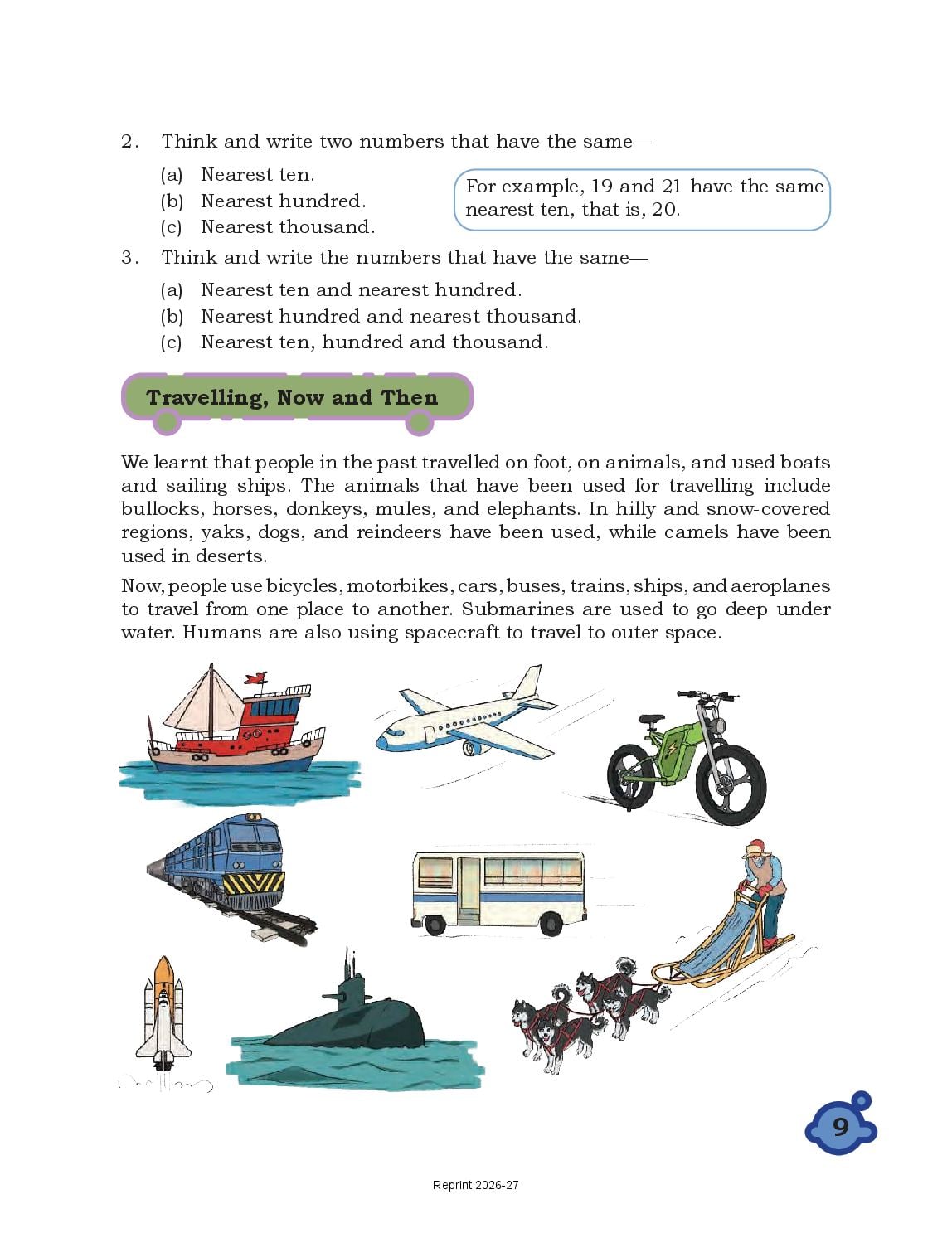
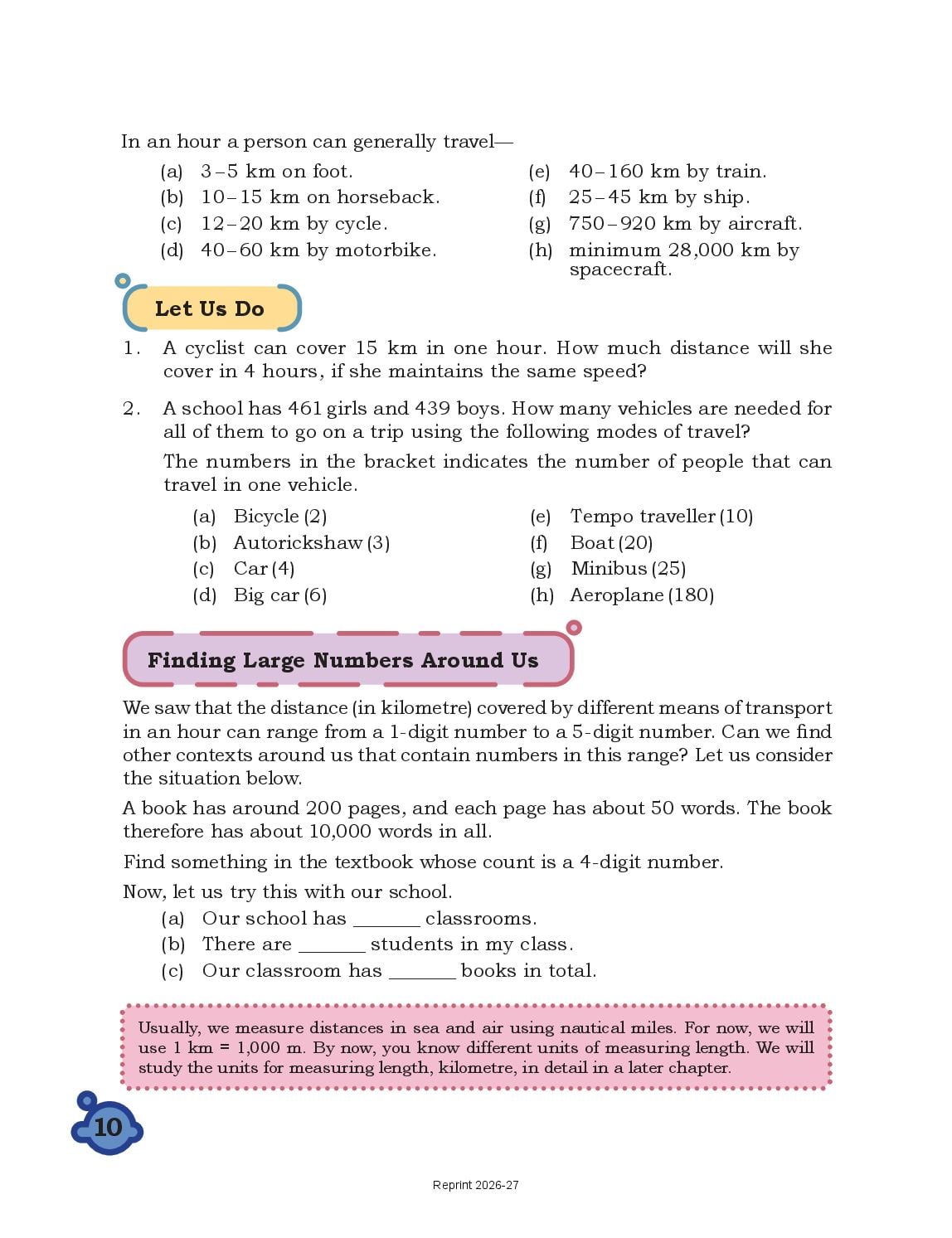
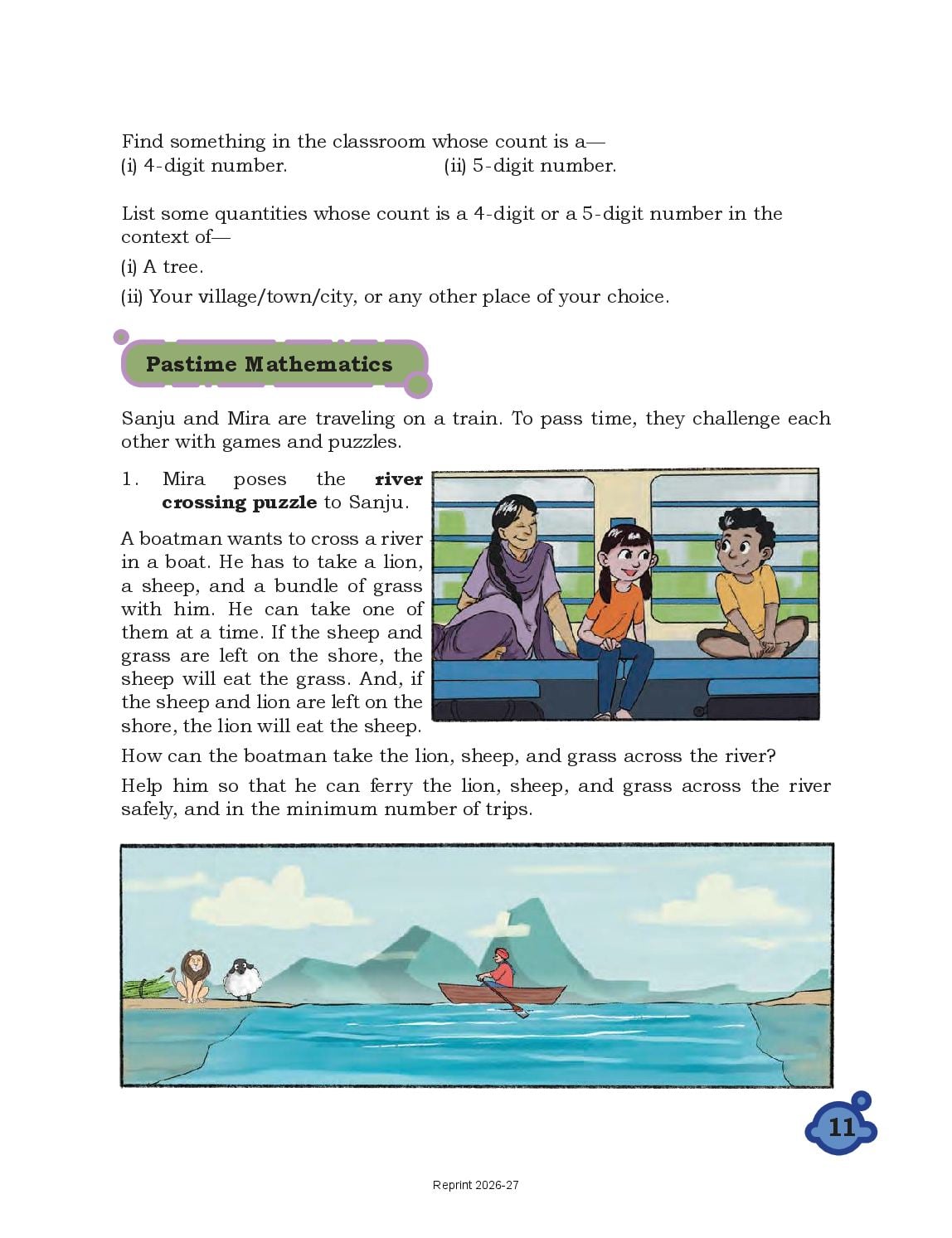
What Is in We the Travellers-I? (Class 5 Maths Chapter 1)
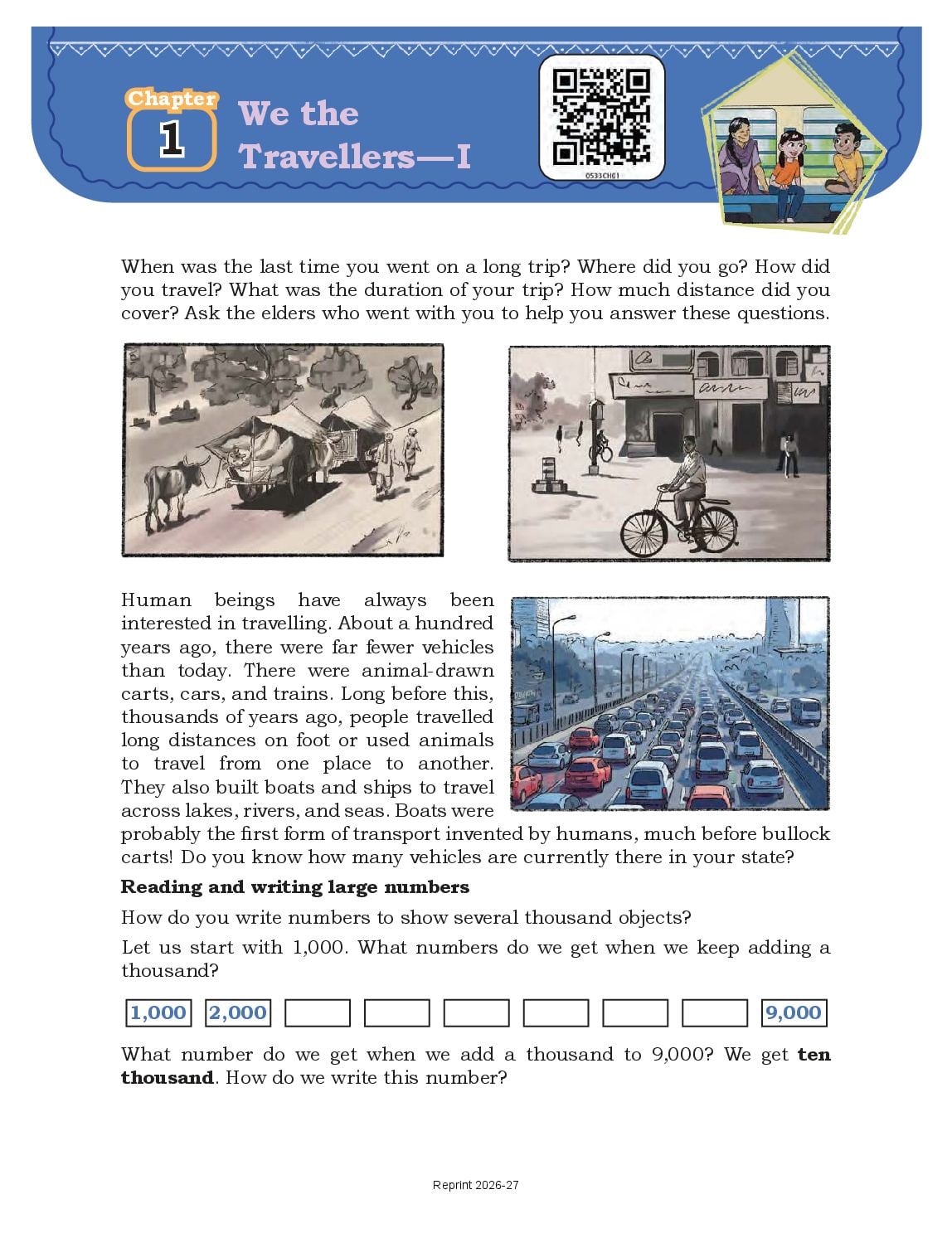
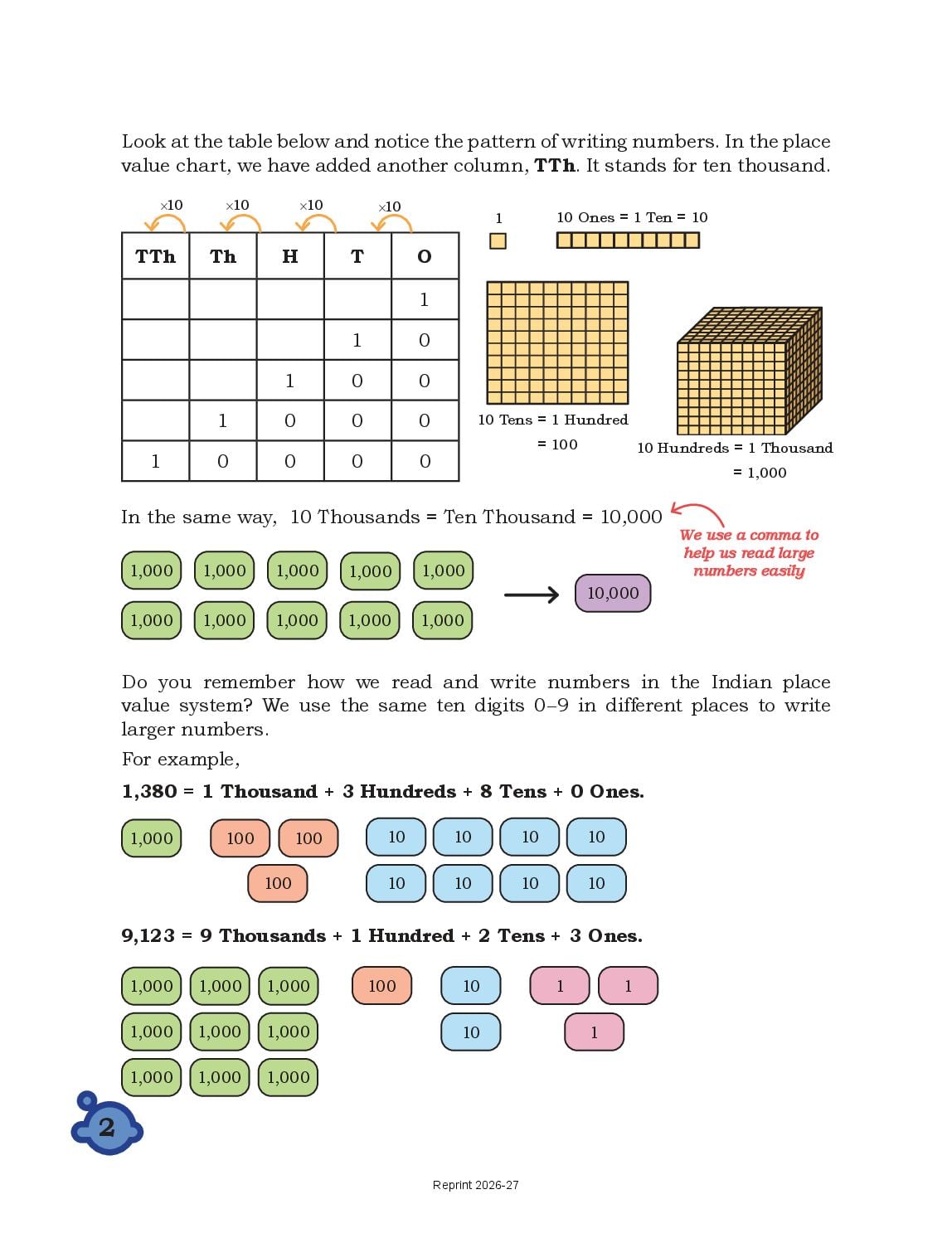
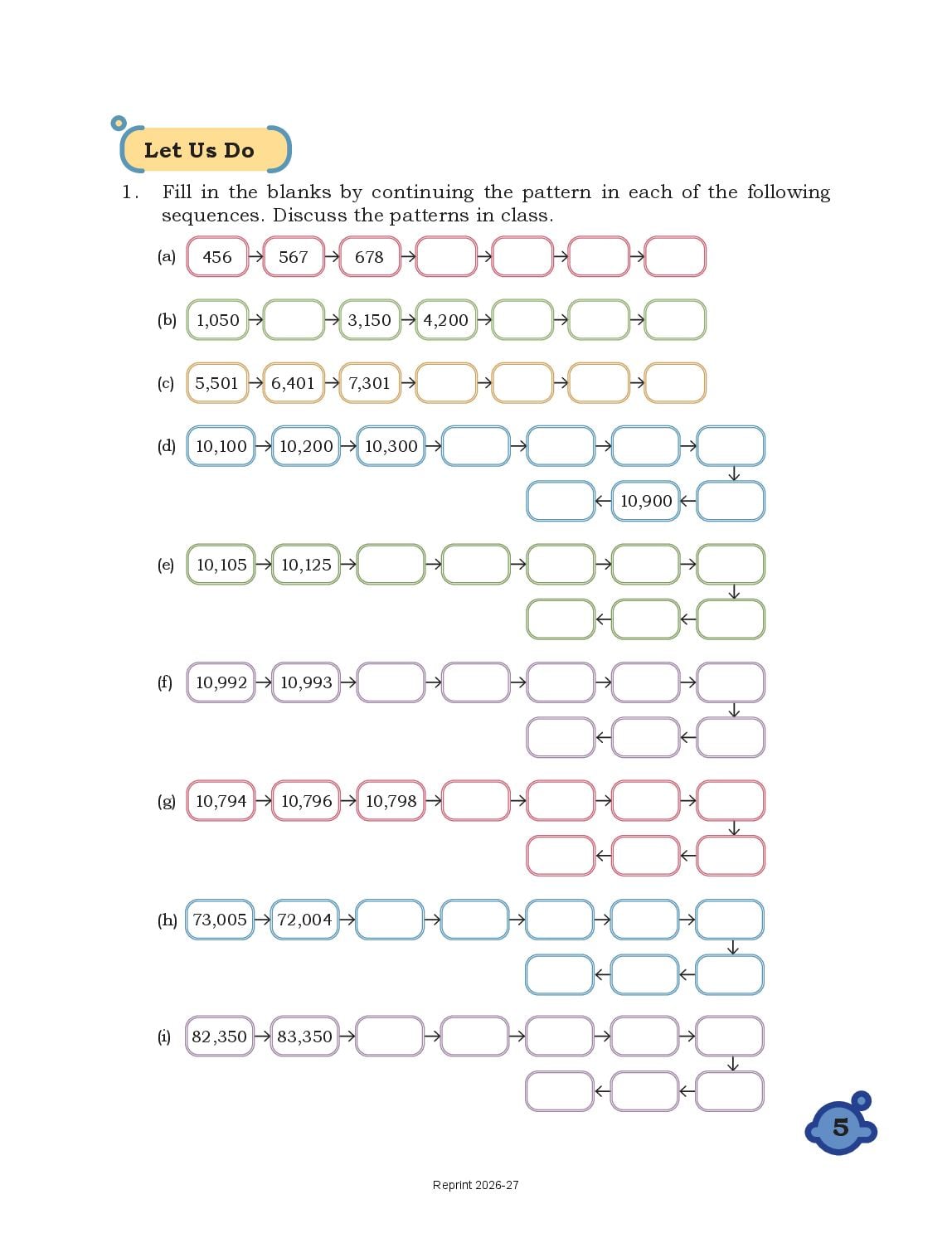
- Ten thousand. Keep adding a thousand: 1,000 · 2,000 · … · 9,000. Add one more thousand and you get 10,000, read as ten thousand. It needs a new column in the place value chart, called TTh (ten thousands). So the chart is now TTh · Th · H · T · O.
- Every column is ten times the one on its right. 10 ones make 1 ten, 10 tens make 1 hundred, 10 hundreds make 1 thousand, and 10 thousands make 1 ten thousand. This one rule builds the whole number system.
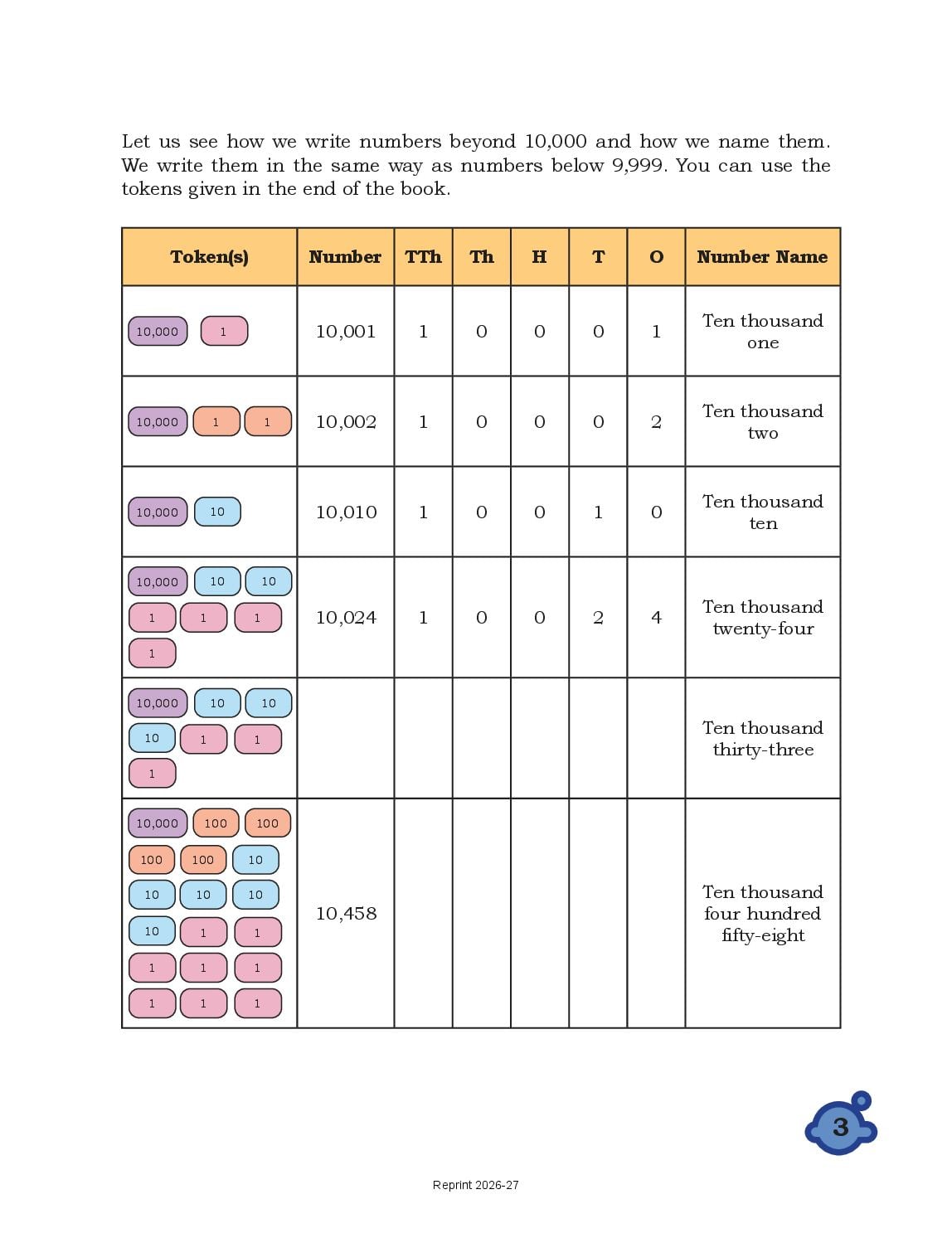
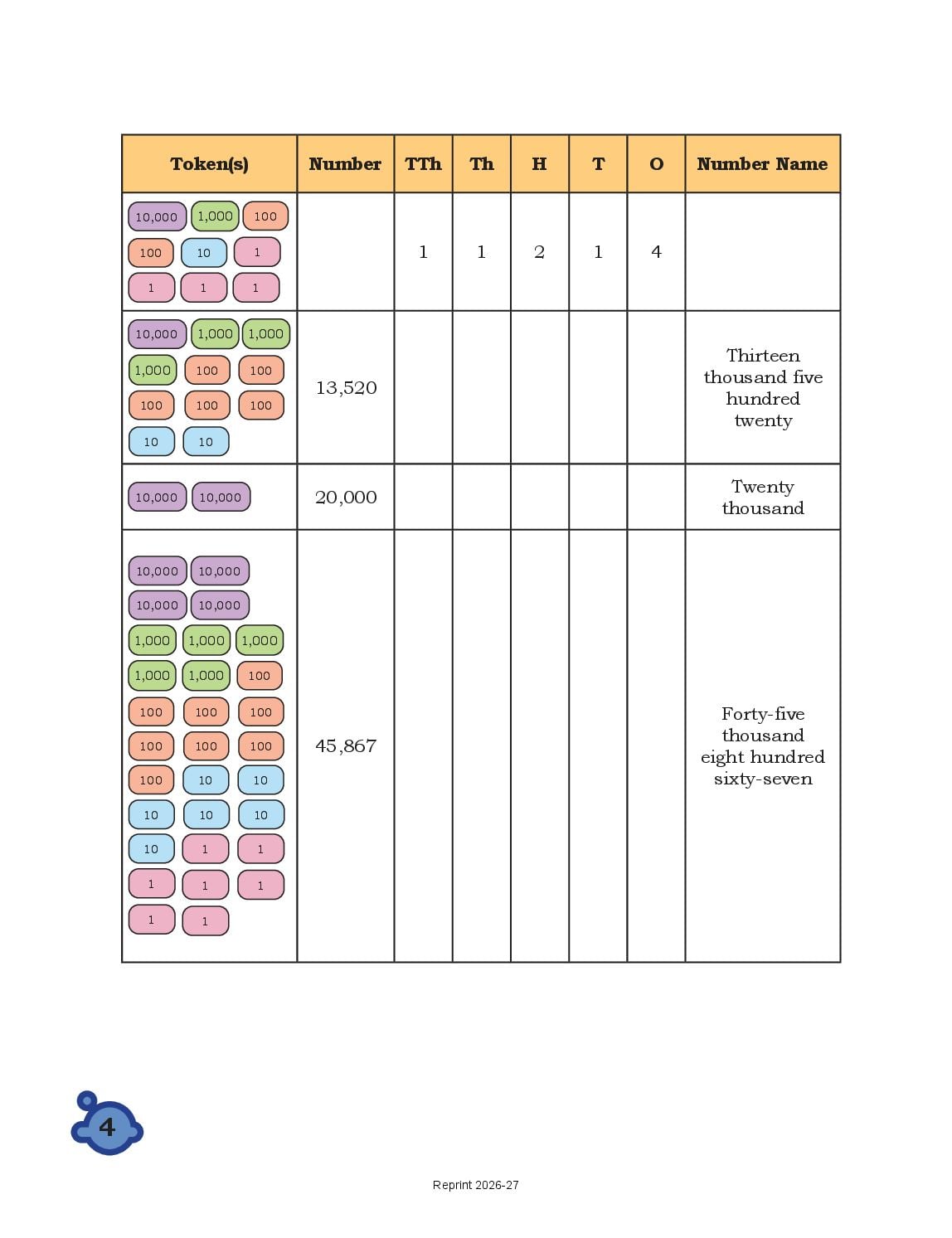
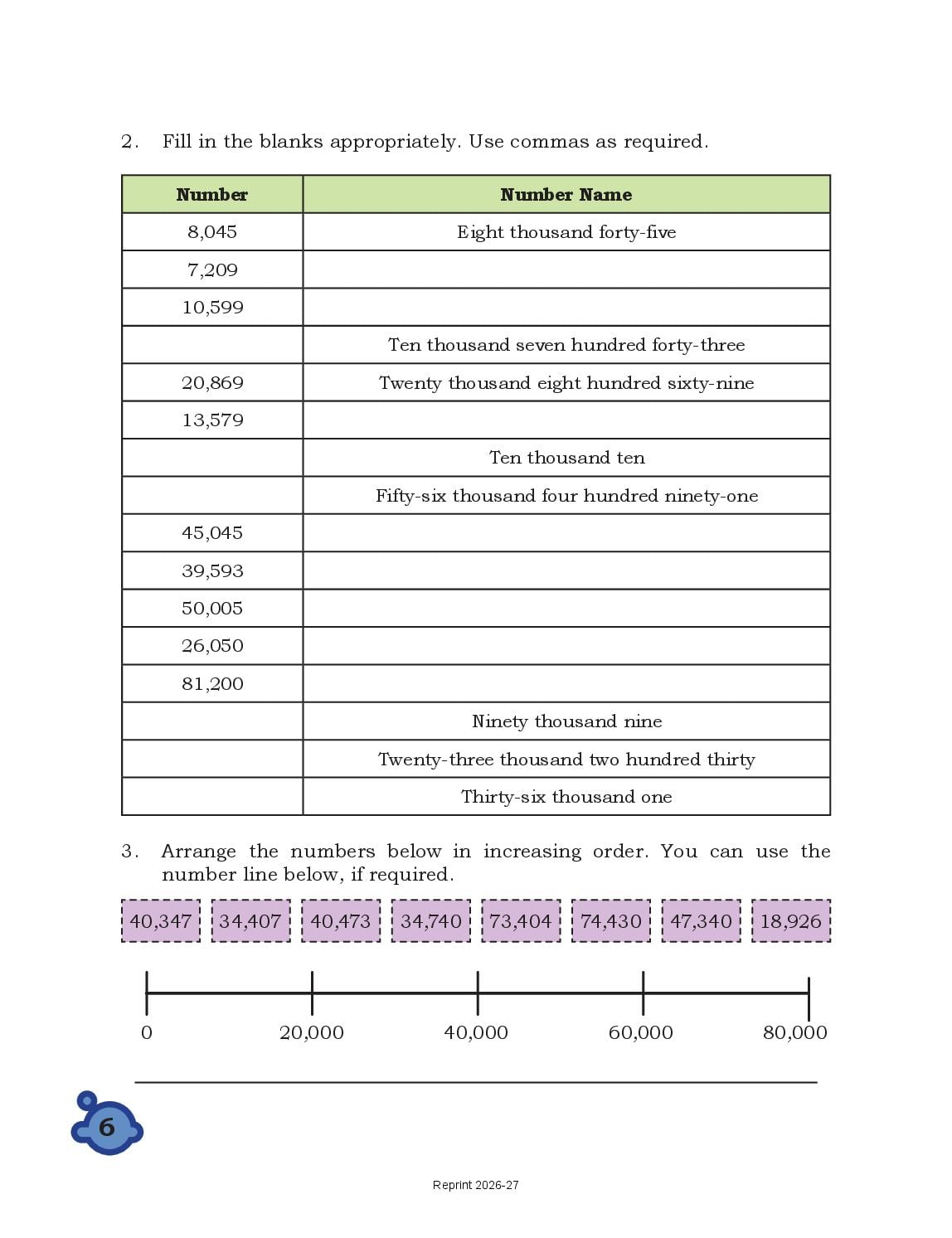
- Reading a 5-digit number. Put a comma after the thousands, like 45,867. Then read the part before the comma as a number of thousands, and the part after it as an ordinary 3-digit number: forty-five thousand, eight hundred sixty-seven.
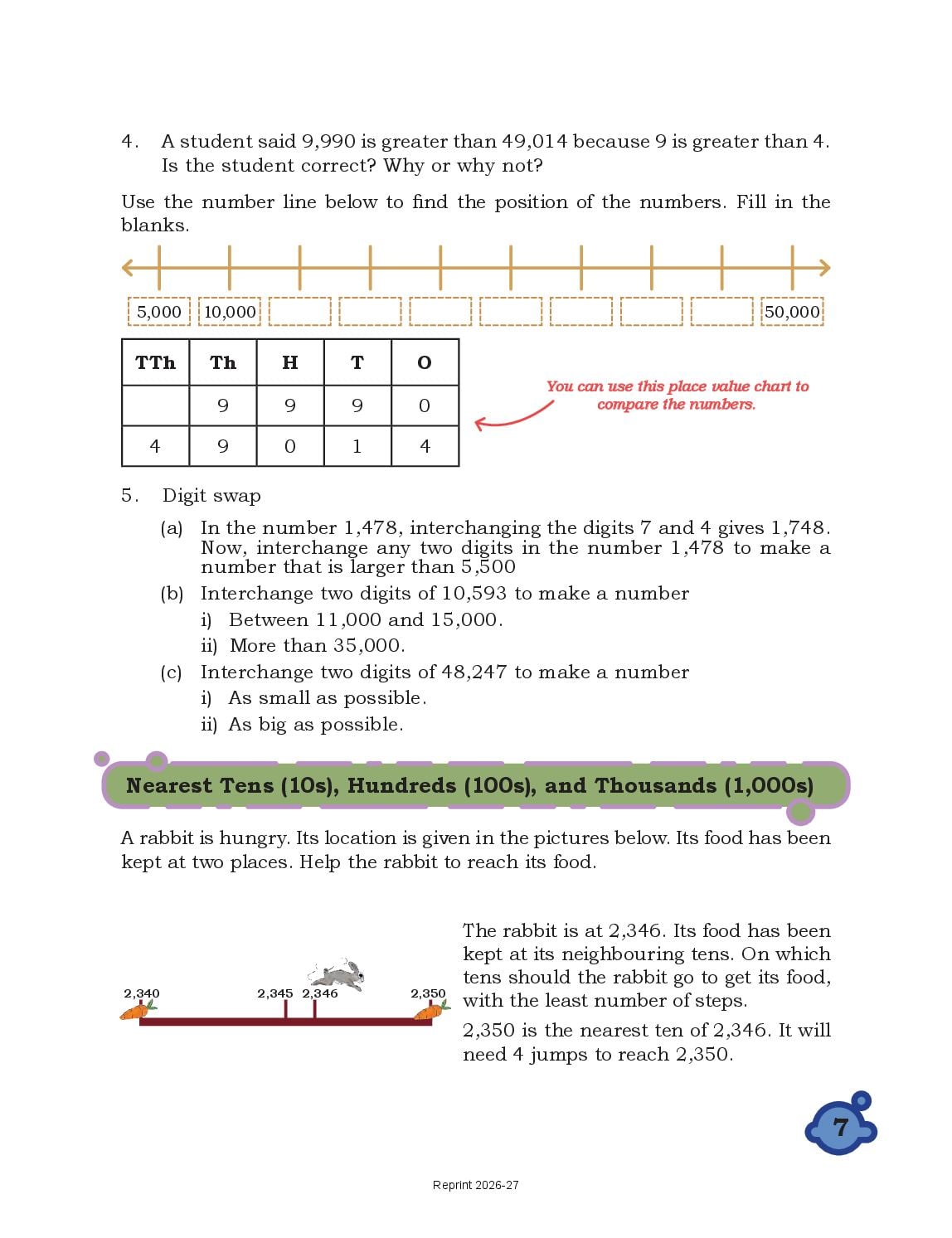
- Comparing numbers. First count the digits — a 5-digit number is always bigger than a 4-digit one. So 49,014 is bigger than 9,990, even though 9,990 starts with a 9. If both numbers have the same number of digits, compare from the left, one place at a time.
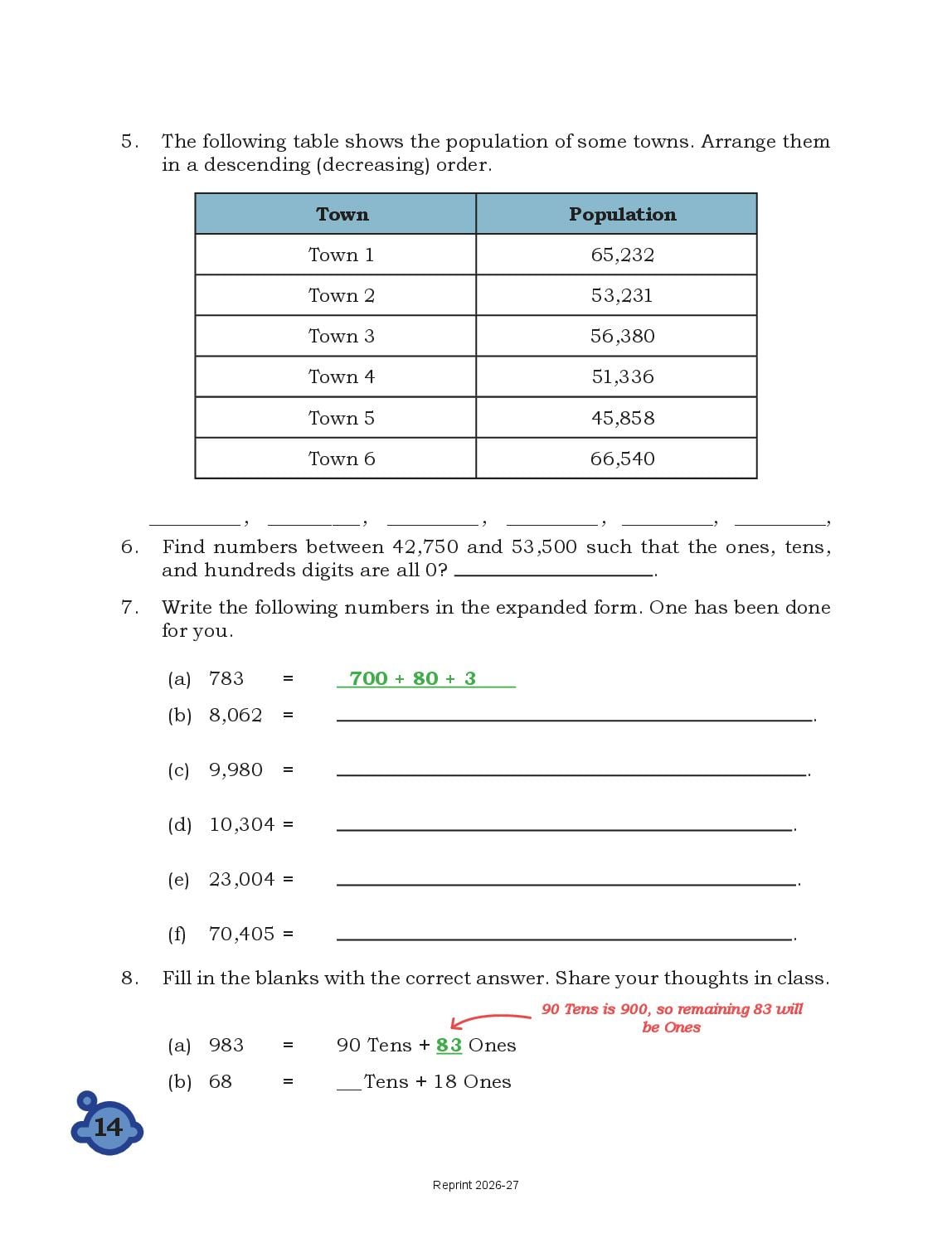
- Expanded form. 23,004 = 20,000 + 3,000 + 4. Each digit is written with its place value, and a 0 simply contributes nothing.
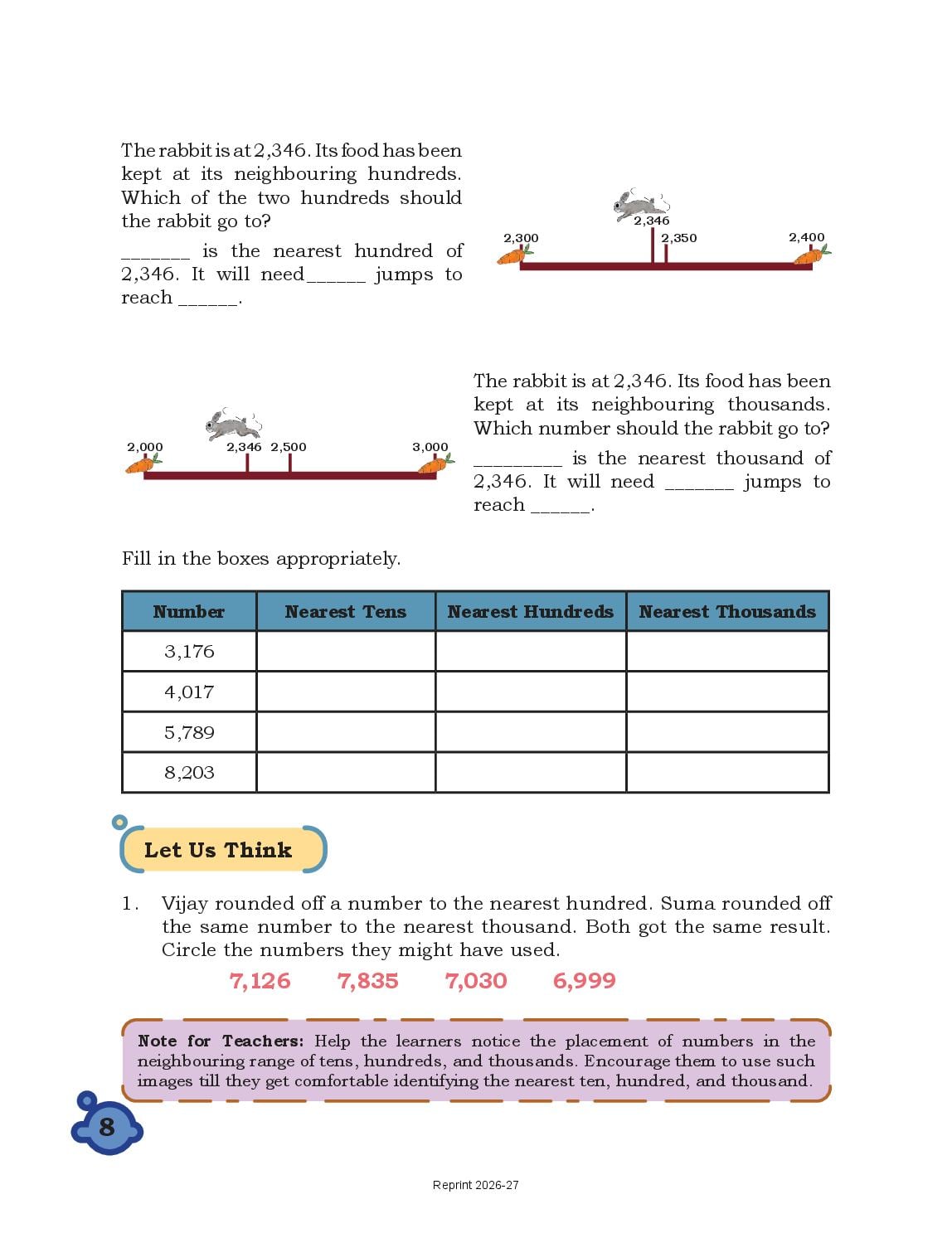
- Nearest ten, hundred, thousand. Picture the number sitting between two neighbours on a number line and ask which one is closer. 2,346 sits between 2,340 and 2,350 — it is closer to 2,350. Between 2,300 and 2,400 it is closer to 2,300. Between 2,000 and 3,000 it is closer to 2,000.
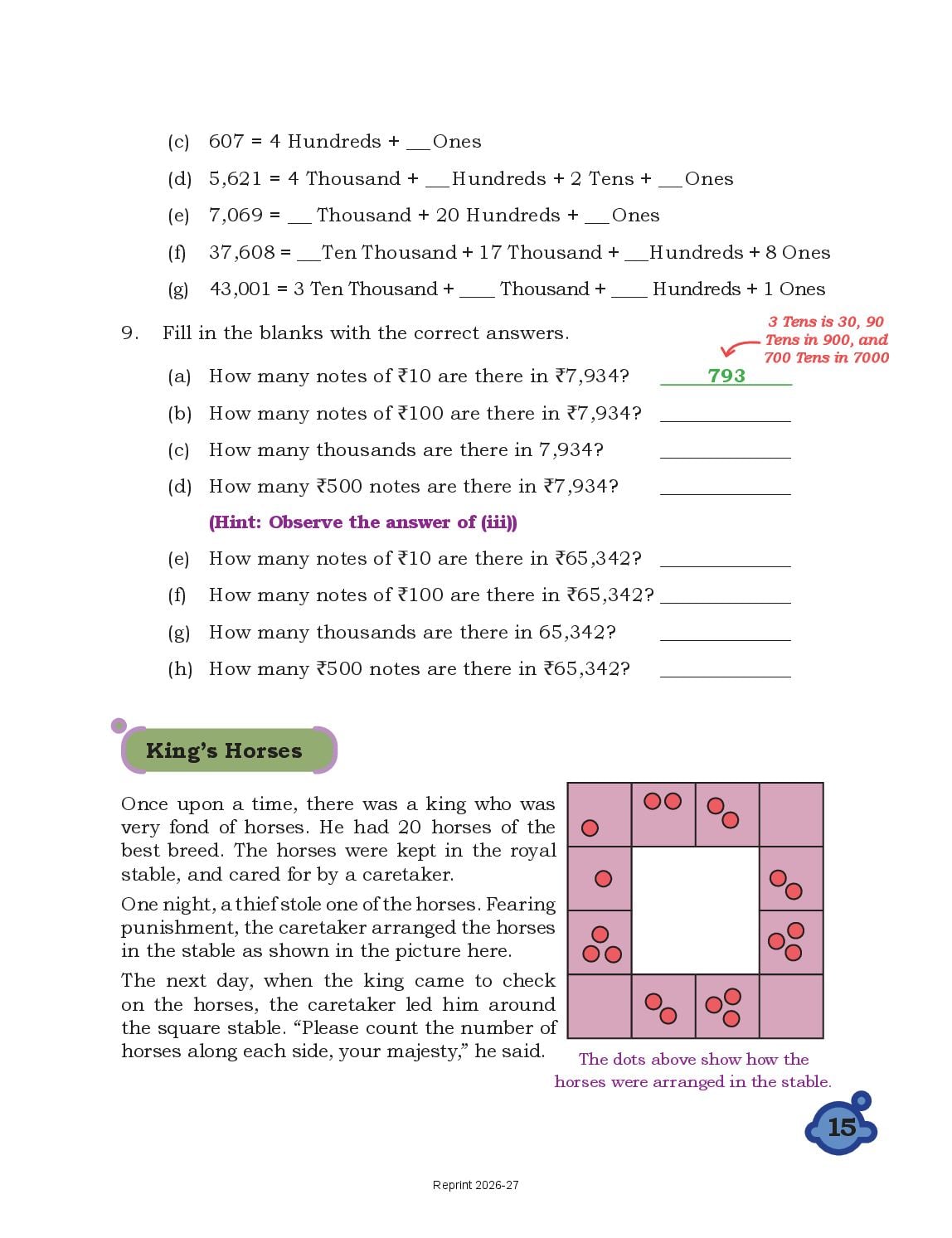
- Counting groups inside a number. ₹7,934 holds 793 notes of ₹10 (and ₹4 left over), 79 notes of ₹100, and 7 thousands. Dropping the last digit gives the number of tens; dropping the last two gives the number of hundreds.
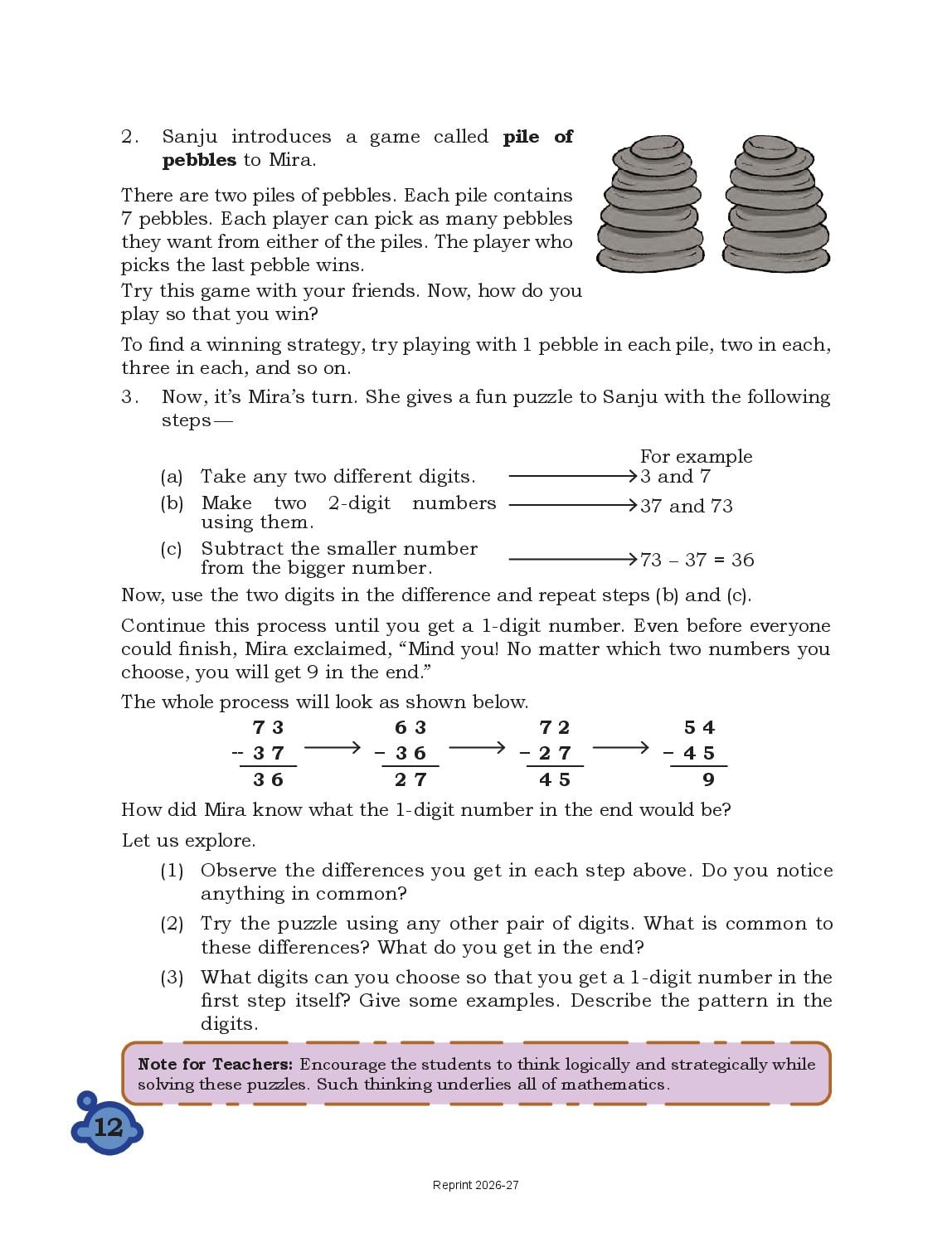
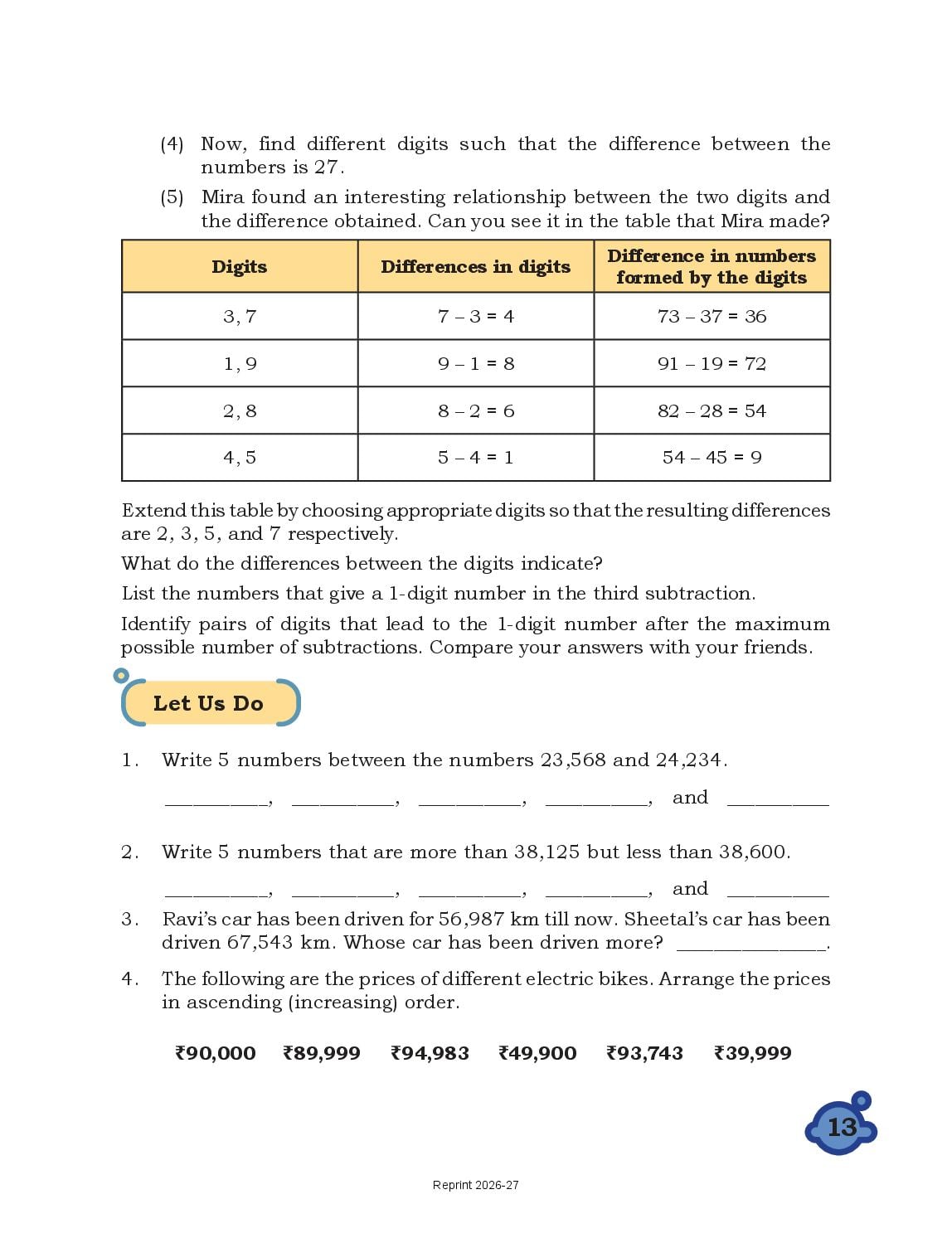
- Mira’s puzzle. Take two different digits, make the two 2-digit numbers, subtract. The answer is always a multiple of 9 — in fact it is 9 × (difference of the two digits). Repeat and you always end at 9.
Quick revision – We the Travellers-I
| Word | What it means | Where it appears | Example |
|---|---|---|---|
| Ten thousand | Ten bundles of one thousand; written 10,000 | Page 2, place value chart | 9,000 + 1,000 = 10,000 |
| TTh column | The new ten-thousands column in the place value chart | Page 2 | 45,867 has 4 in the TTh column |
| Comma | A mark put after the thousands so a big number is easy to read | Page 2 | 13520 is written 13,520 |
| Number name | The number written in words | Pages 3–4, 6 | 10,458 = ten thousand four hundred fifty-eight |
| Expanded form | The number written as the sum of its place values | Page 14, Q7 | 10,304 = 10,000 + 300 + 4 |
| Increasing (ascending) order | Smallest first, biggest last | Page 6, Q3 | 18,926 · 34,407 · 34,740 … |
| Decreasing (descending) order | Biggest first, smallest last | Page 14, Q5 | 66,540 · 65,232 · 56,380 … |
| Nearest ten | The multiple of 10 closest to the number | Page 7 banner | Nearest ten of 2,346 is 2,350 |
| Nearest hundred | The multiple of 100 closest to the number | Page 8 | Nearest hundred of 2,346 is 2,300 |
| Nearest thousand | The multiple of 1,000 closest to the number | Page 8 | Nearest thousand of 2,346 is 2,000 |
| Rounding off | Replacing a number by its nearest ten, hundred or thousand | Page 8, Let Us Think | 7,030 rounds to 7,000 both ways |
| Interchange (swap) | Exchange the places of two digits | Page 7, Q5 | 1,478 → 7,418 |
| Multiple of 9 | A number you get by counting in nines: 9, 18, 27, 36 … | Pages 12–13 | 73 – 37 = 36, a multiple of 9 |
Old NCERT vs New – Class 5 Maths
This chapter is from Maths Mela, the new NCERT Class 5 Maths book (NCF-SE 2023, used from 2025-26). It replaced the old book “Math-Magic”, so chapter numbers and names differ from older PDFs.
Solutions and All Chapters
Answers to the exercises and the full chapter list of Maths Mela:
We the Travellers-I – Overview
| Class | Class 5 |
| Subject | Maths |
| Book | Maths Mela – new NCERT book |
| Chapter | 1 of 15 – We the Travellers-I |
| Book pages | 1 – 16 |
| Edition | NCERT Reprint 2026-27 |
| Session | 2026-27 |
| Free – read online or download |
Class 5 Maths Chapter 1 – FAQs
Where can I download We the Travellers-I Class 5 PDF?
From the download table on this page – the chapter PDF is free, and the full book is linked too.
What is Class 5 Maths Chapter 1 about?
Ten thousand. Keep adding a thousand: 1,000 · 2,000 · … · 9,000. Add one more thousand and you get 10,000, read as ten thousand. It needs a new column in the place value chart, called TTh (ten thousands). So the chart is now TTh · Th · H · T · O.
Is We the Travellers-I from the new NCERT Class 5 Maths book?
Yes. It is chapter 1 of maths mela, the new NCERT Class 5 Maths book for 2026-27.
Is this the latest NCERT edition for 2026-27?
Yes – the PDF is NCERT’s latest edition for the 2026-27 session.
Where are the NCERT Solutions for Class 5 Maths Chapter 1?
Open the NCERT Solutions link above for answers to the exercise questions.