Download Timeline and Sources of History – NCERT Class 6 Social Science Chapter 4 PDF from the new NCERT Class 6 Social Science book Exploring Society: India and Beyond (2026-27). Read the chapter online or download the free PDF. History is the study of the human past. Many kinds of specialists dig it out: geologists (the physical Earth), palaeontologists (fossils), anthropologists (human societies and cultures) and archaeologists (remains left behind by people, plants and…
Timeline and Sources of History PDF – Chapter 4 of Exploring Society: India and Beyond
Read the chapter online or download the PDF.
| Chapter | Download | |
|---|---|---|
| Chapter 4 PDF | Timeline and Sources of History | View PDF |
| Full book | NCERT Class 6 Social Science – Exploring Society: India and Beyond | View Book |
Read Online
What Is in Timeline and Sources of History? (Class 6 Social Science Chapter 4)
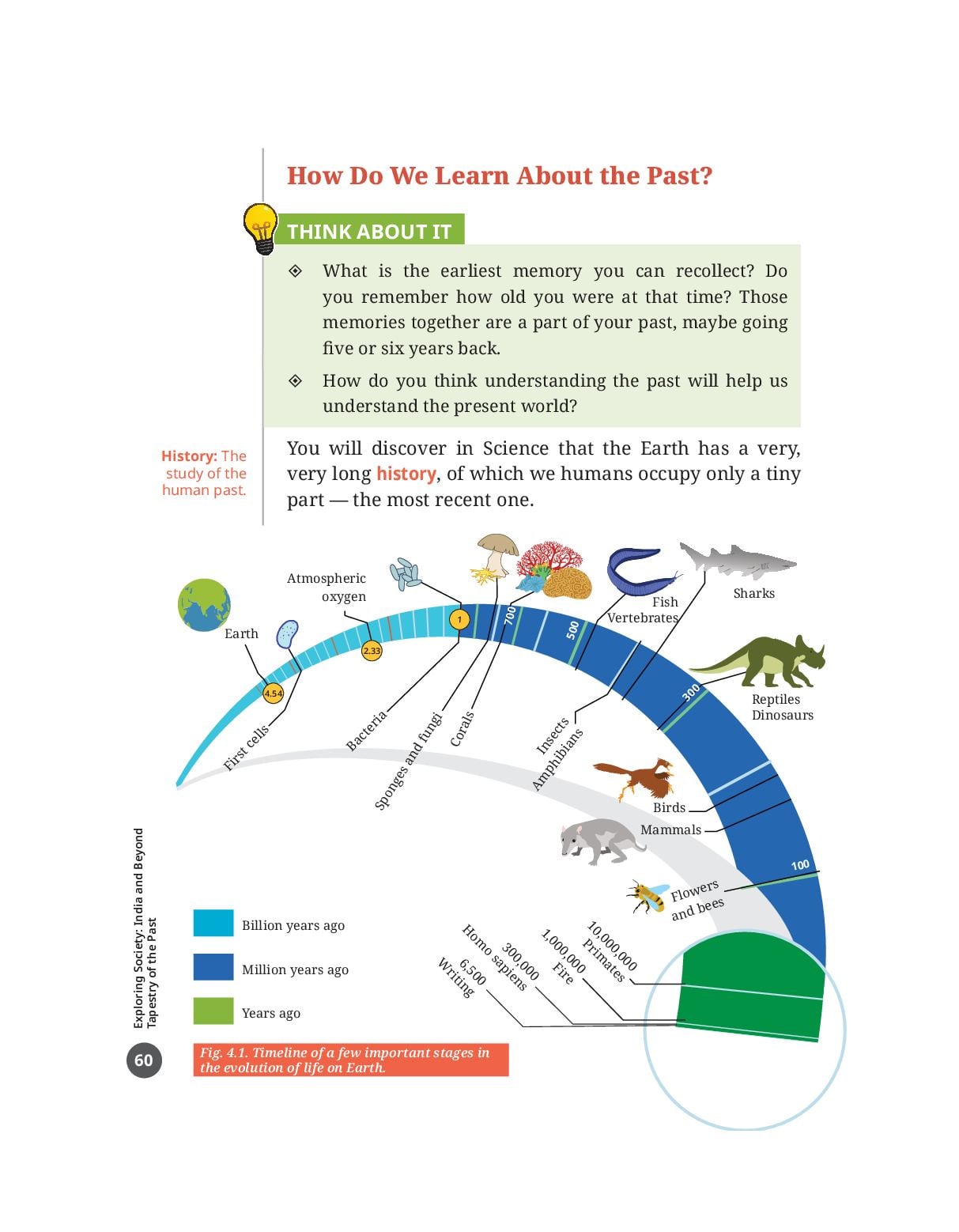
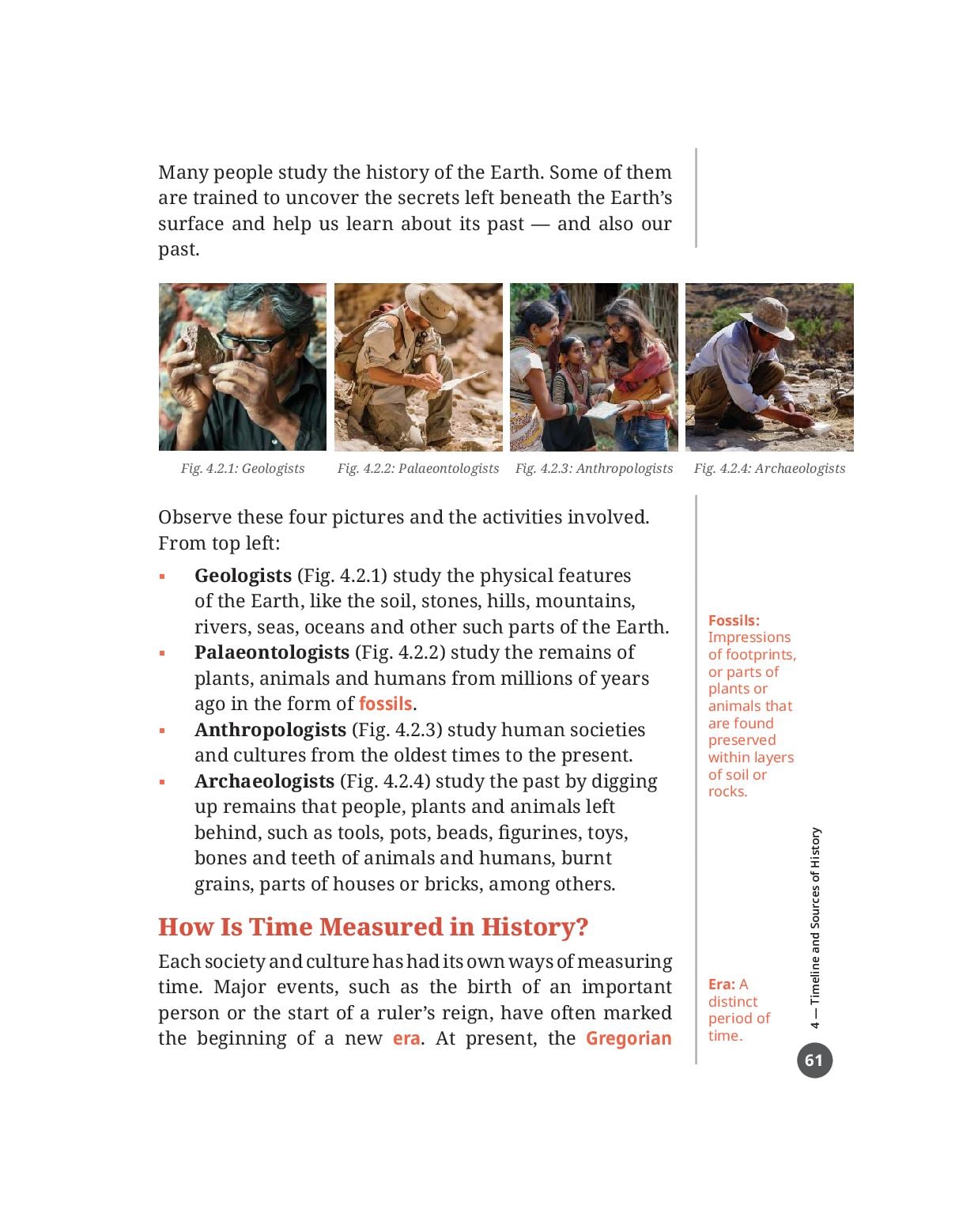
- History is the study of the human past. Many kinds of specialists dig it out: geologists (the physical Earth), palaeontologists (fossils), anthropologists (human societies and cultures) and archaeologists (remains left behind by people, plants and animals) — Fig. 4.2. Modern humans (Homo sapiens) have been here only about 300,000 years, a tiny sliver of the Earth’s 4.54-billion-year story (Fig. 4.1).
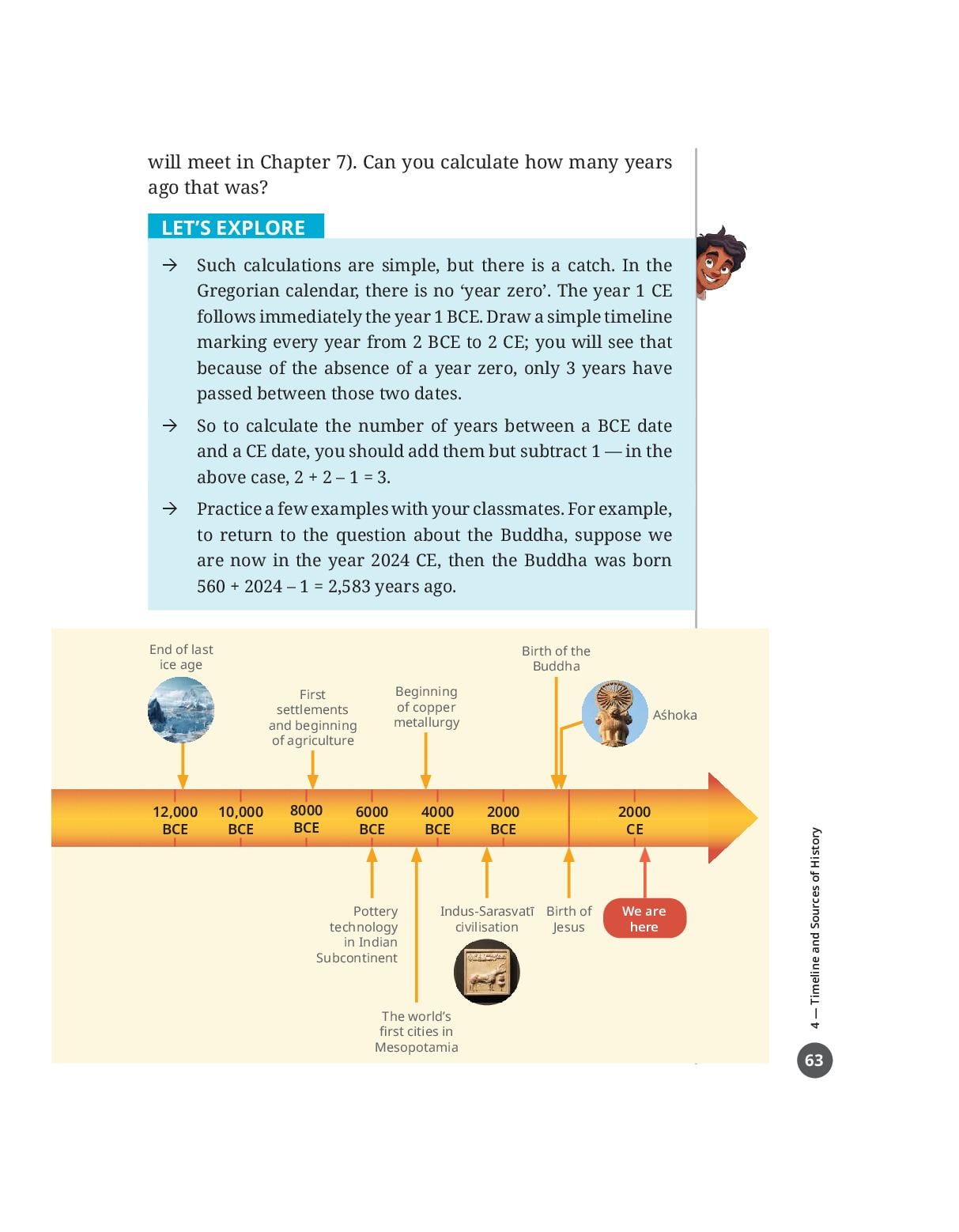
- Time is measured in eras. The Gregorian calendar is used worldwide, alongside Hindu, Muslim, Jewish, Chinese and other calendars for festivals and auspicious events. Years after the conventional date of Jesus’ birth were marked AD and are now called CE (Common Era); years before it were marked BC and are now BCE (Before Common Era). India became independent in 1947 CE; the Buddha was born about 560 BCE.
- There is no ‘year zero’. 1 CE follows immediately after 1 BCE. So to count the years between a BCE date and a CE date you add the two numbers and subtract 1. From 2 BCE to 2 CE is 2 + 2 – 1 = 3 years; the Buddha, born 560 BCE, was born 560 + 2024 – 1 = 2,583 years before 2024 CE.
- Longer stretches have names. A decade is 10 years, a century 100 years, a millennium 1,000 years. Centuries CE are counted from 1 CE — we are in the 21st century CE (2001–2100) and the 3rd millennium CE (2001–3000). Centuries and millenniums BCE are counted backwards from 1 BCE — the 3rd century BCE is 300–201 BCE and the 1st millennium BCE is 1000 BCE–1 BCE. India’s own pañchānga is a sun-and-moon calendar of astronomical tables.
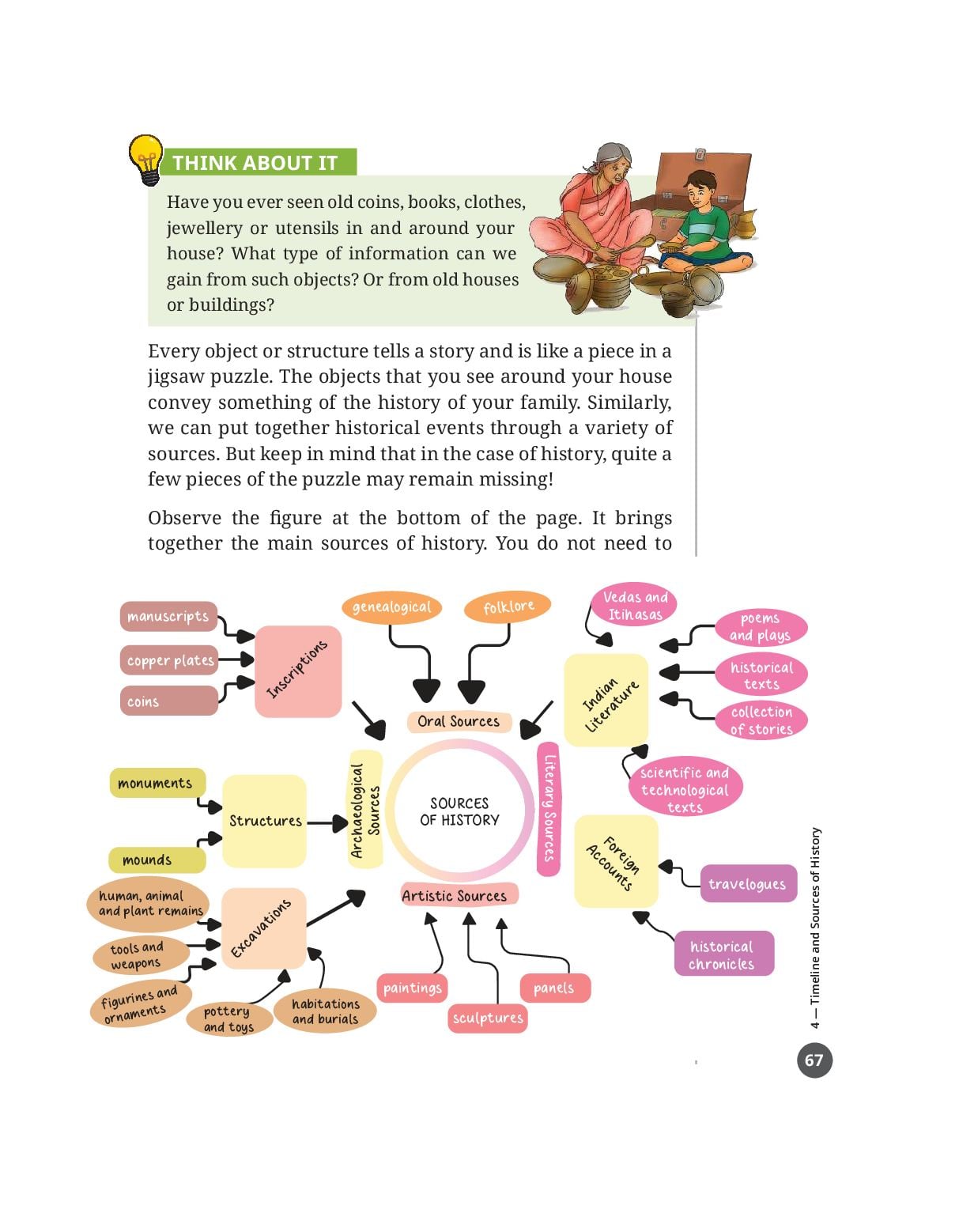
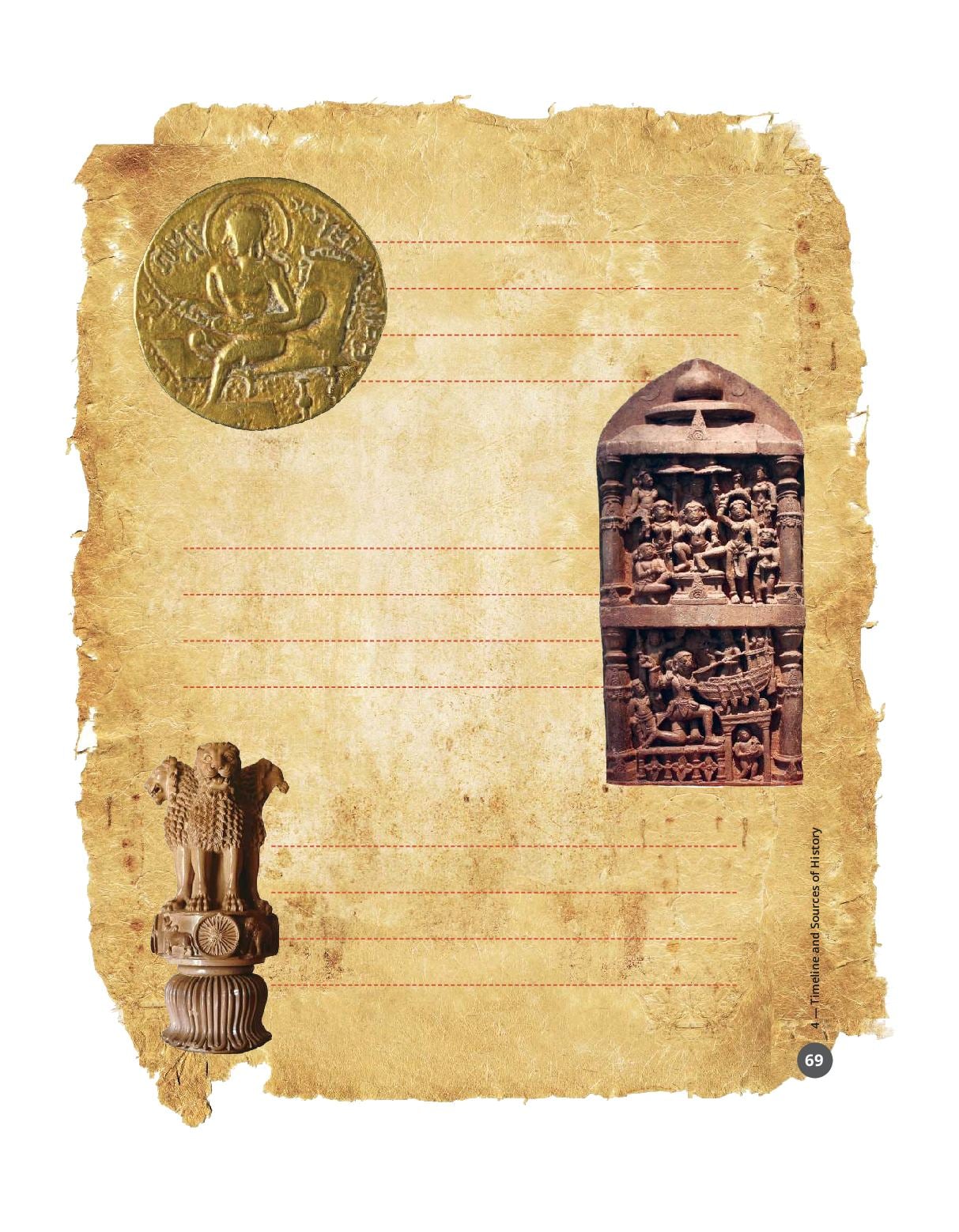
- Sources of history are grouped as archaeological (inscriptions, copper plates, coins, monuments, mounds, excavated tools, pottery, burials), literary (Vedas and Itihāsas, poems and plays, historical texts, scientific texts, foreign travelogues and chronicles), oral (folklore, genealogies) and artistic (paintings, sculptures, panels). Science now adds ancient climate study, chemical analysis and genetics; recent history also uses newspapers and electronic media. Historians cross-check sources like pieces of a jigsaw puzzle — and some pieces stay missing.
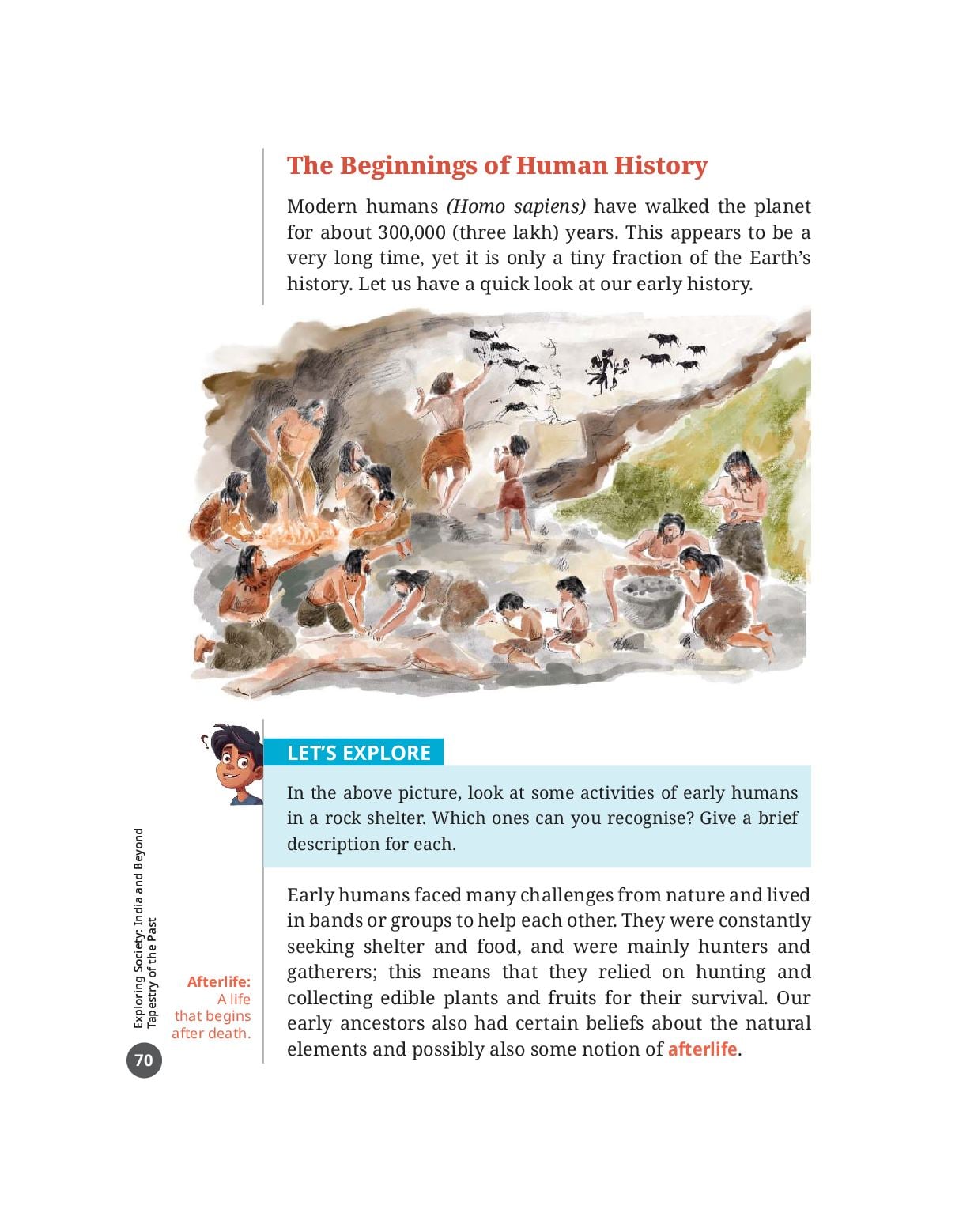
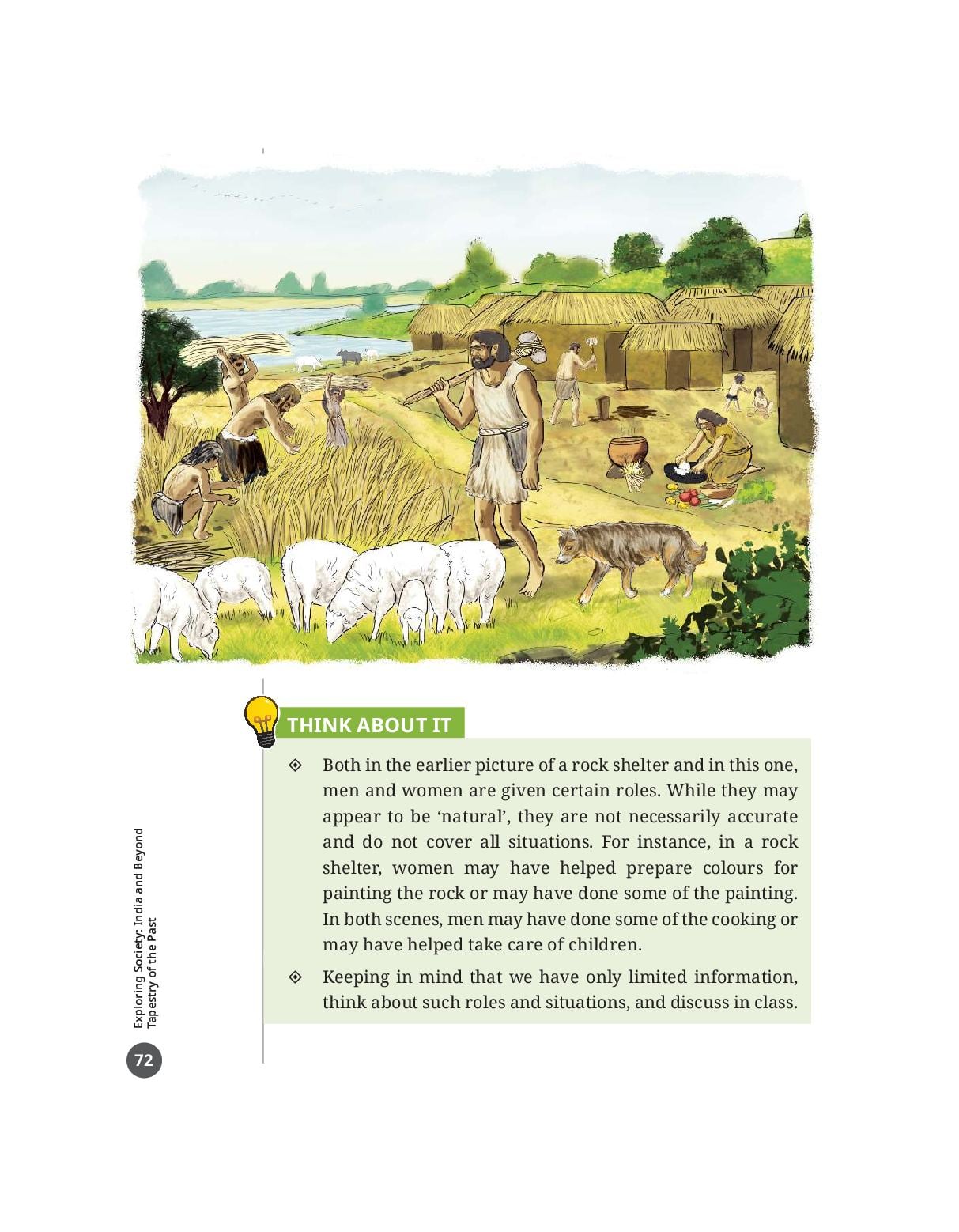
- Early humans lived in bands, in temporary camps, rock shelters and caves; they were hunters and gatherers, used fire, made stone axes, blades and arrowheads, painted hundreds of caves and made bead and tooth ornaments. The last Ice Age ran from over 100,000 to about 12,000 years ago. Afterwards people began farming and domesticating animals, settled near rivers for water and fertile soil, had chieftains responsible for their welfare, farmed land collectively, and grew from hamlets into villages and small towns with pottery and metal — copper first, iron later.
Quick revision – Timeline and Sources of History
| Term | What it means | Where it appears in the chapter | Example from the book |
|---|---|---|---|
| History | The study of the human past | Margin note, page 60 | E.H. Carr: “an unending dialogue between the present and the past” |
| Fossils | Impressions of footprints, or parts of plants or animals, preserved within layers of soil or rocks | Margin note, page 61 | Studied by palaeontologists (Fig. 4.2.2) |
| Archaeologist | A person who studies the past by digging up remains that people, plants and animals left behind | Page 61, Fig. 4.2.4 | Tools, pots, beads, figurines, toys, bones, burnt grains, bricks |
| Era | A distinct period of time | Margin note, page 61 | The Common Era, which begins at 1 CE |
| Gregorian calendar | The calendar now used the world over; 12 months adding up to 365 days, and a leap year every four years | Margin note, page 62 | 1800 and 1900 are not leap years; 2000 is |
| CE — Common Era | Years counted forward from the conventional year of Jesus’ birth; earlier written AD | Page 62 | 1947 CE — the year India gained independence |
| BCE — Before Common Era | Years counted backward from that same point; earlier written BC | Page 62 | 560 BCE — approximate year of the Buddha’s birth |
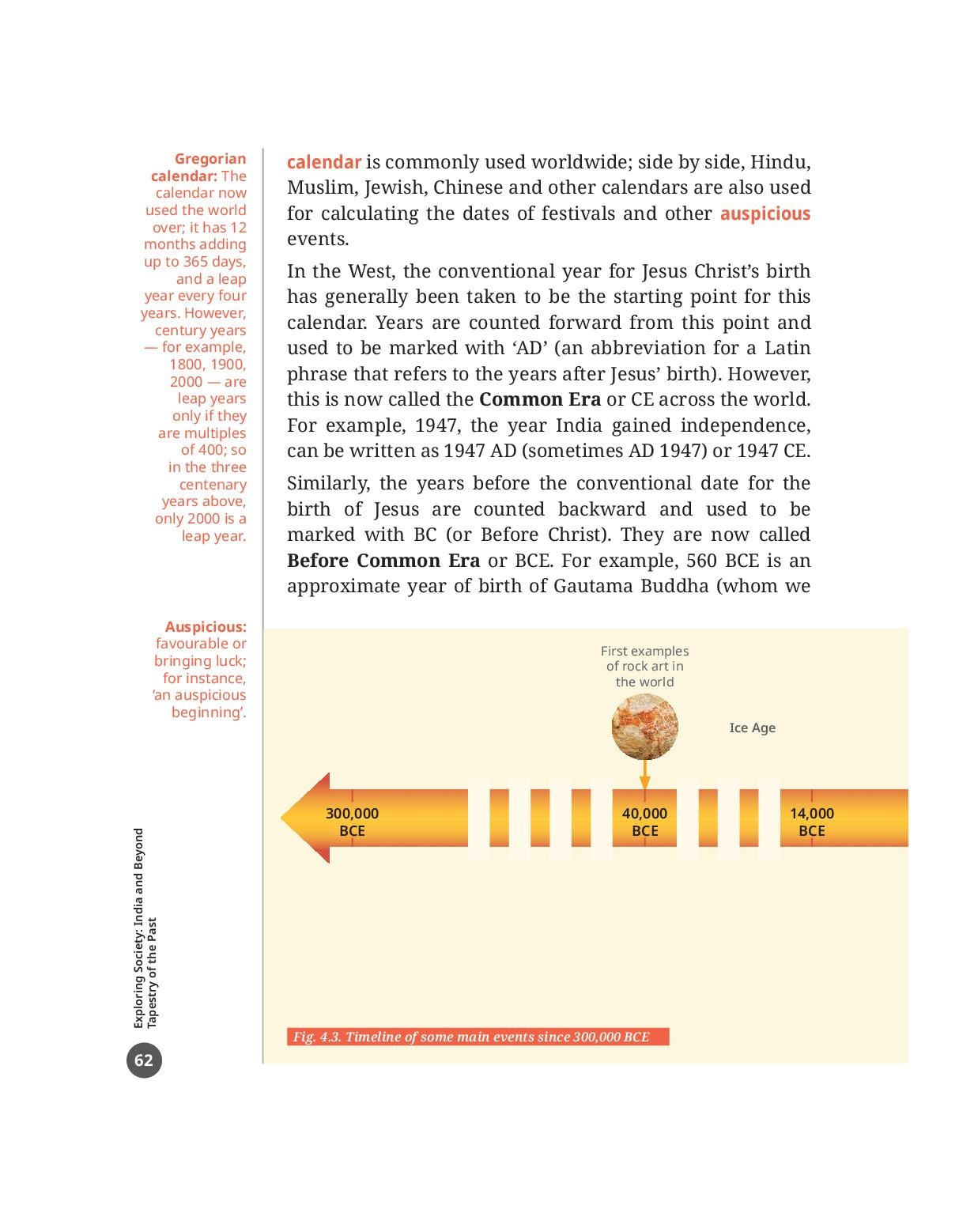
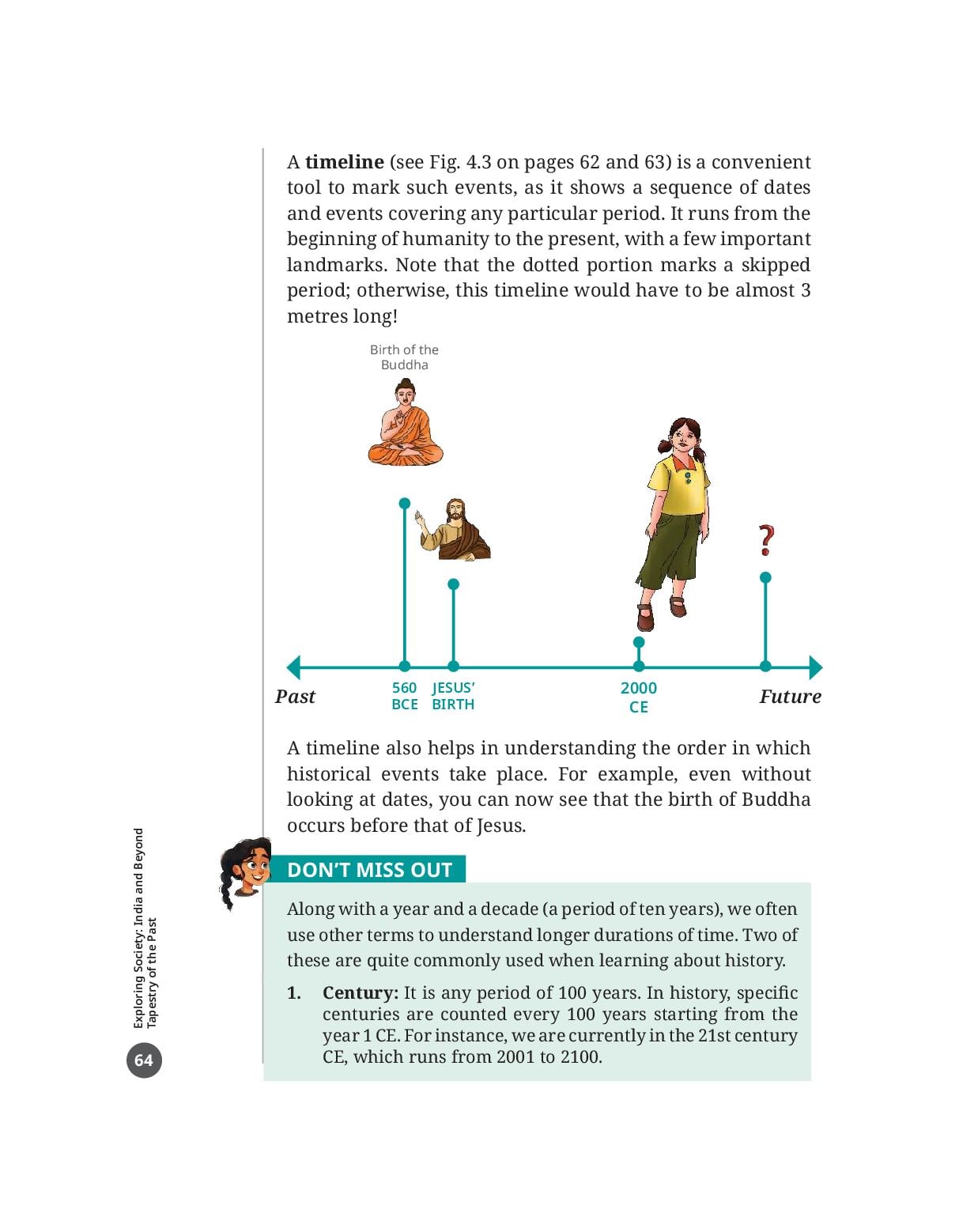
| Timeline | A tool that shows a sequence of dates and events covering a particular period | Pages 62–64, Fig. 4.3 | Fig. 4.3 runs from 300,000 BCE to 2000 CE; the dotted part is a skipped period |
| Century / Millennium | Any period of 100 years / any period of 1,000 years | Don’t Miss Out, pages 64–65 | 21st century CE = 2001–2100; 3rd millennium CE = 2001–3000 |
| Pañchānga | An Indian book of tables listing the days of each month with related astronomical data | Don’t Miss Out, page 65 | Predicts eclipses, sunrise and sunset, festival dates, weather |
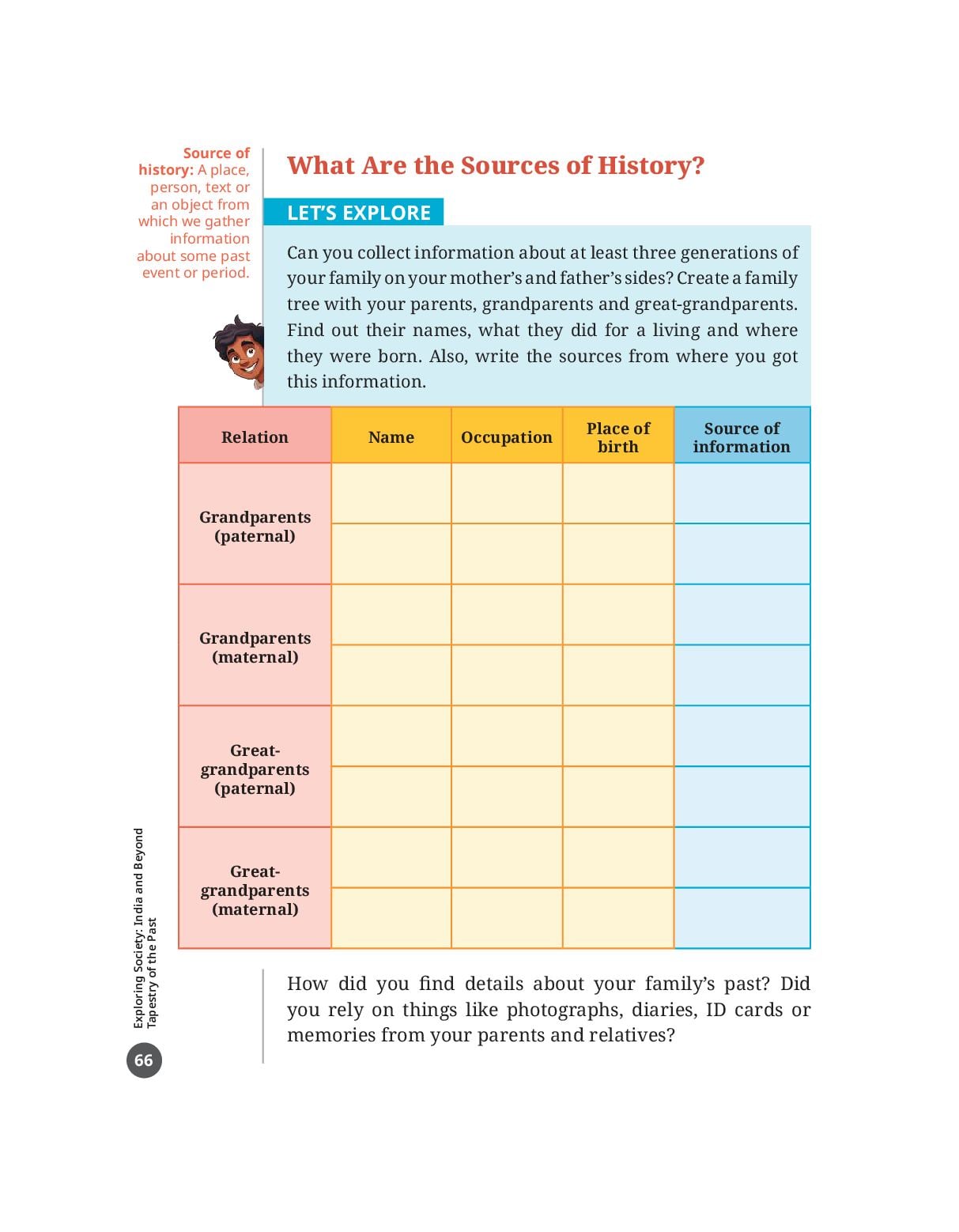
| Source of history | A place, person, text or object from which we gather information about some past event or period | Margin note, page 66 | Inscriptions, coins, monuments, manuscripts, folklore |
| Historian | A person who studies and writes about the past | Margin note, page 68 | Gathers as many sources as possible and decides which to trust |
| Genetics | The branch of biology that studies how features and characteristics pass from one generation to the next | Margin note, page 68 | Genetic studies of ancient people give fresh insights |
| Afterlife | A life that begins after death | Margin note, page 70 | Early humans possibly had some notion of it |
Old NCERT vs New – Class 6 Social Science
This chapter is from Exploring Society: India and Beyond, the new NCERT Class 6 Social Science book (NCF-SE 2023, used from 2024-25). It replaced the old book “Our Pasts, The Earth Our Habitat and Social and Political Life”, so chapter numbers and names differ from older PDFs.
Solutions and All Chapters
Answers to the exercises and the full chapter list of Exploring Society: India and Beyond:
Timeline and Sources of History – Overview
| Class | Class 6 |
| Subject | Social Science |
| Book | Exploring Society: India and Beyond – new NCERT book |
| Chapter | 4 of 14 – Timeline and Sources of History |
| Book pages | 59 – 74 |
| Edition | NCERT Reprint 2026-27 |
| Session | 2026-27 |
| Free – read online or download |
Class 6 Social Science Chapter 4 – FAQs
Where can I download Timeline and Sources of History Class 6 PDF?
From the download table on this page – the chapter PDF is free, and the full book is linked too.
What is Class 6 Social Science Chapter 4 about?
History is the study of the human past. Many kinds of specialists dig it out: geologists (the physical Earth), palaeontologists (fossils), anthropologists (human societies and cultures) and archaeologists (remains left behind by people, plants and animals) — Fig. 4.2. Modern humans (Homo sapiens) have been here only about 300,000 years, a tiny sliver of the Earth’s 4.54-billion-year story (Fig. 4.1).
Is Timeline and Sources of History from the new NCERT Class 6 Social Science book?
Yes. It is chapter 4 of exploring society: india and beyond, the new NCERT Class 6 Social Science book for 2026-27.
Is this the latest NCERT edition for 2026-27?
Yes – the PDF is NCERT’s latest edition for the 2026-27 session.
Where are the NCERT Solutions for Class 6 Social Science Chapter 4?
Open the NCERT Solutions link above for answers to the exercise questions.