Download Grassroots Democracy – Part 1: Governance – NCERT Class 6 Social Science Chapter 10 PDF from the new NCERT Class 6 Social Science book Exploring Society: India and Beyond (2026-27). Read the chapter online or download the free PDF. The chapter’s one idea: people living together need rules, and rules need someone to make them and someone to see that they are followed. When many people live together “there can be disagreements and disorder, and rules become necessary to maintain…
Grassroots Democracy – Part 1: Governance PDF – Chapter 10 of Exploring Society: India and Beyond
Read the chapter online or download the PDF.
| Chapter | Download | |
|---|---|---|
| Chapter 10 PDF | Grassroots Democracy – Part 1: Governance | View PDF |
| Full book | NCERT Class 6 Social Science – Exploring Society: India and Beyond | View Book |
Read Online
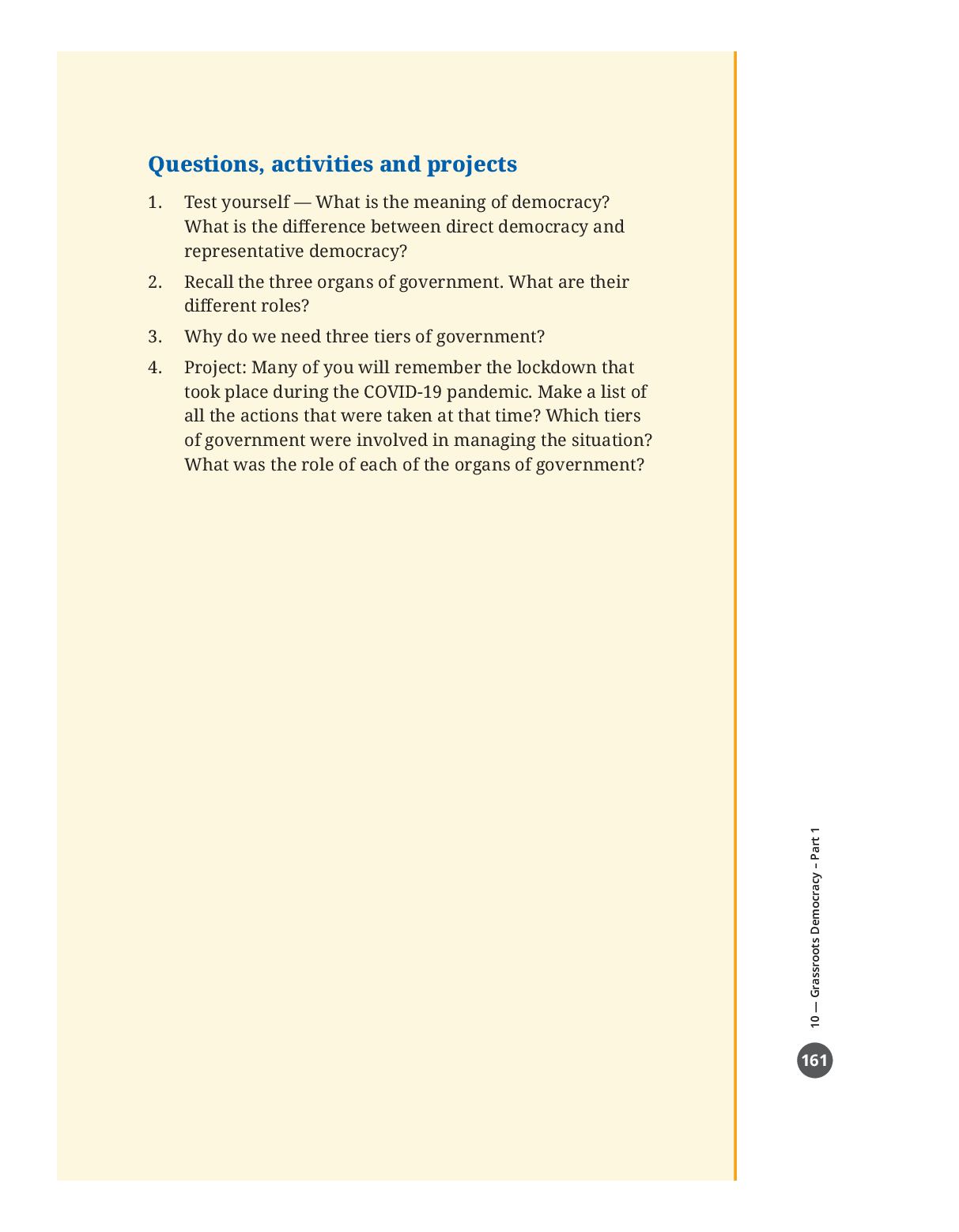
What Is in Grassroots Democracy – Part 1: Governance? (Class 6 Social Science Chapter 10)
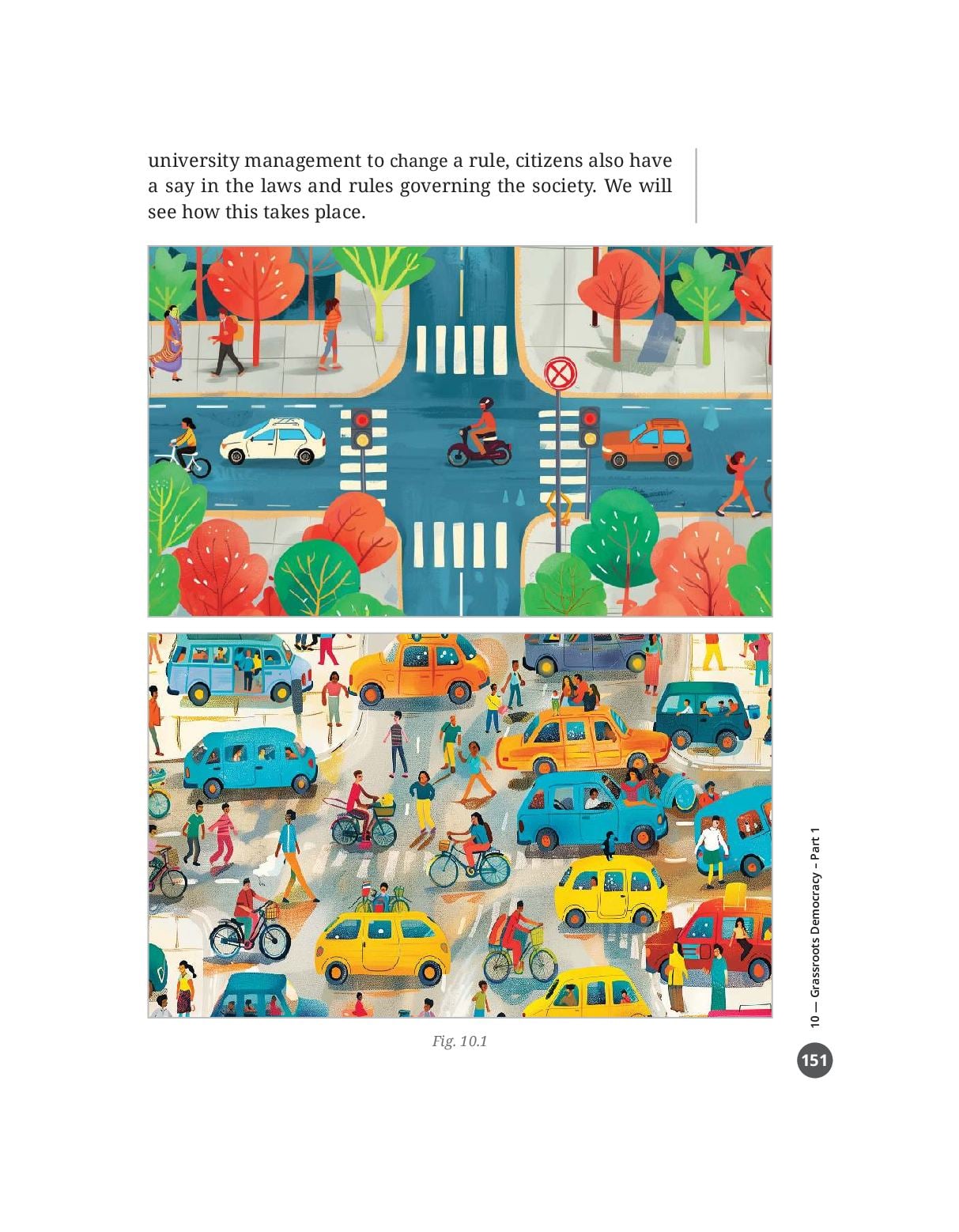
- The chapter’s one idea: people living together need rules, and rules need someone to make them and someone to see that they are followed. When many people live together “there can be disagreements and disorder, and rules become necessary to maintain order and harmony in the society”. The book then gives three exact words: governance is the process, government is the group or system that does it, and laws are “some of the more important rules”.
- Rules are not fixed for ever. Just as you can discuss a rule at home with your parents, or a student body can ask the school management to change a rule, “citizens also have a say in the laws and rules governing the society”. This single sentence is the seed of the whole chapter — it is why democracy comes later in the same chapter.
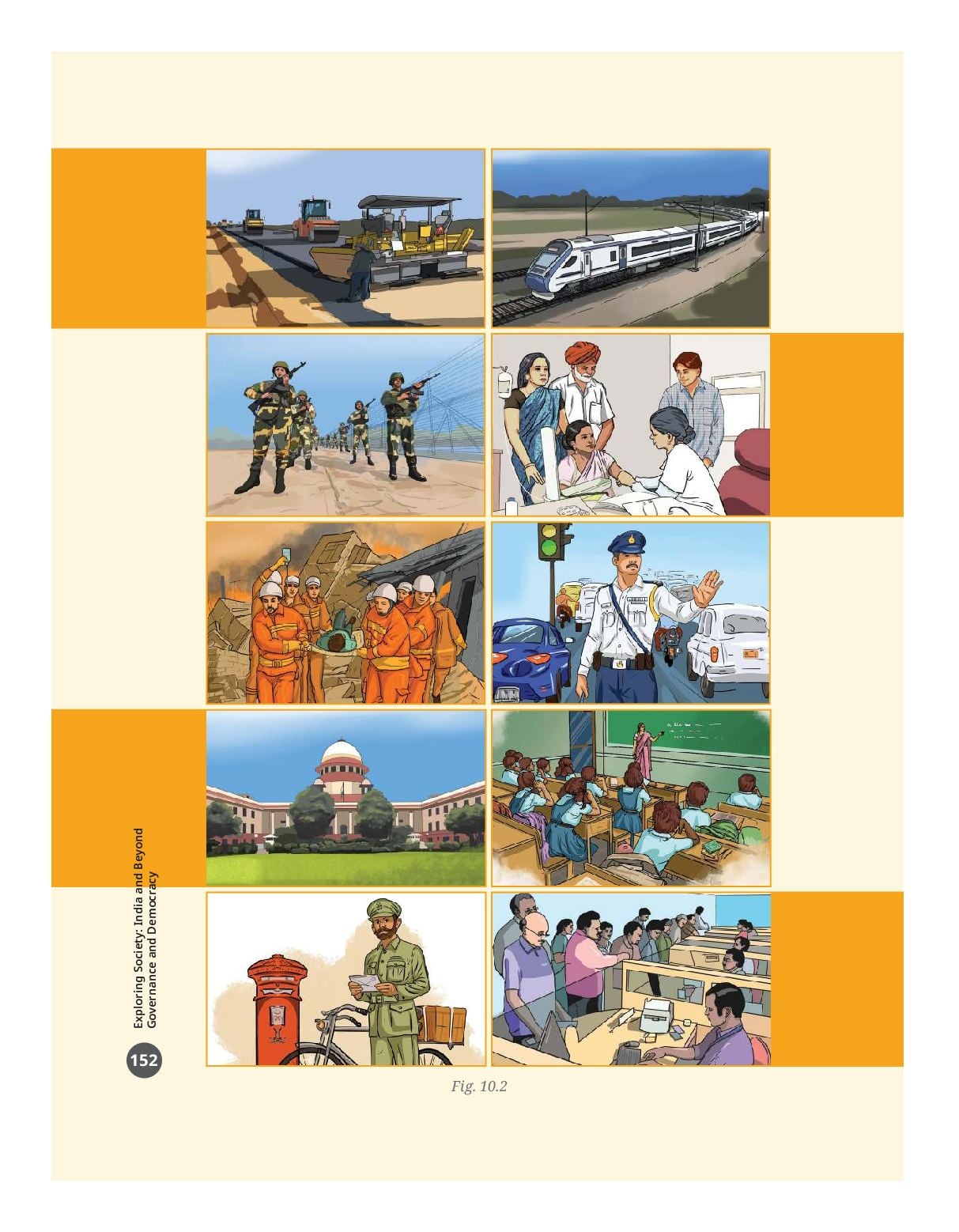
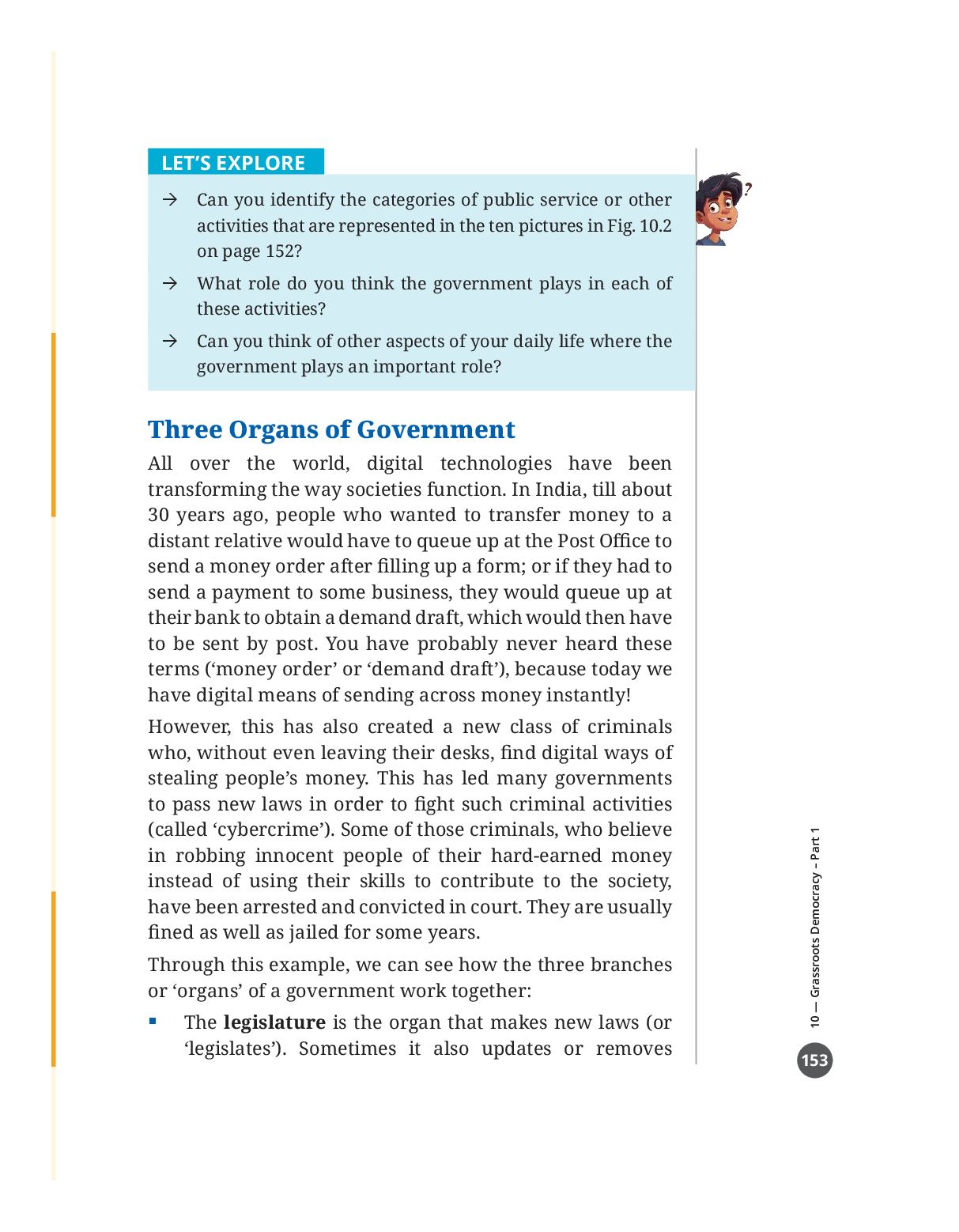
- A government works through three organs. The legislature makes, updates or removes laws, through an assembly of representatives of the people; the executive implements them — the head of state, the ministers, and agencies such as the police; the judiciary is the system of courts that decides whether a law was broken and what should be done, and sometimes examines whether an executive decision is right or whether a law is fair to all. The chapter proves all three with one example: cybercrime.
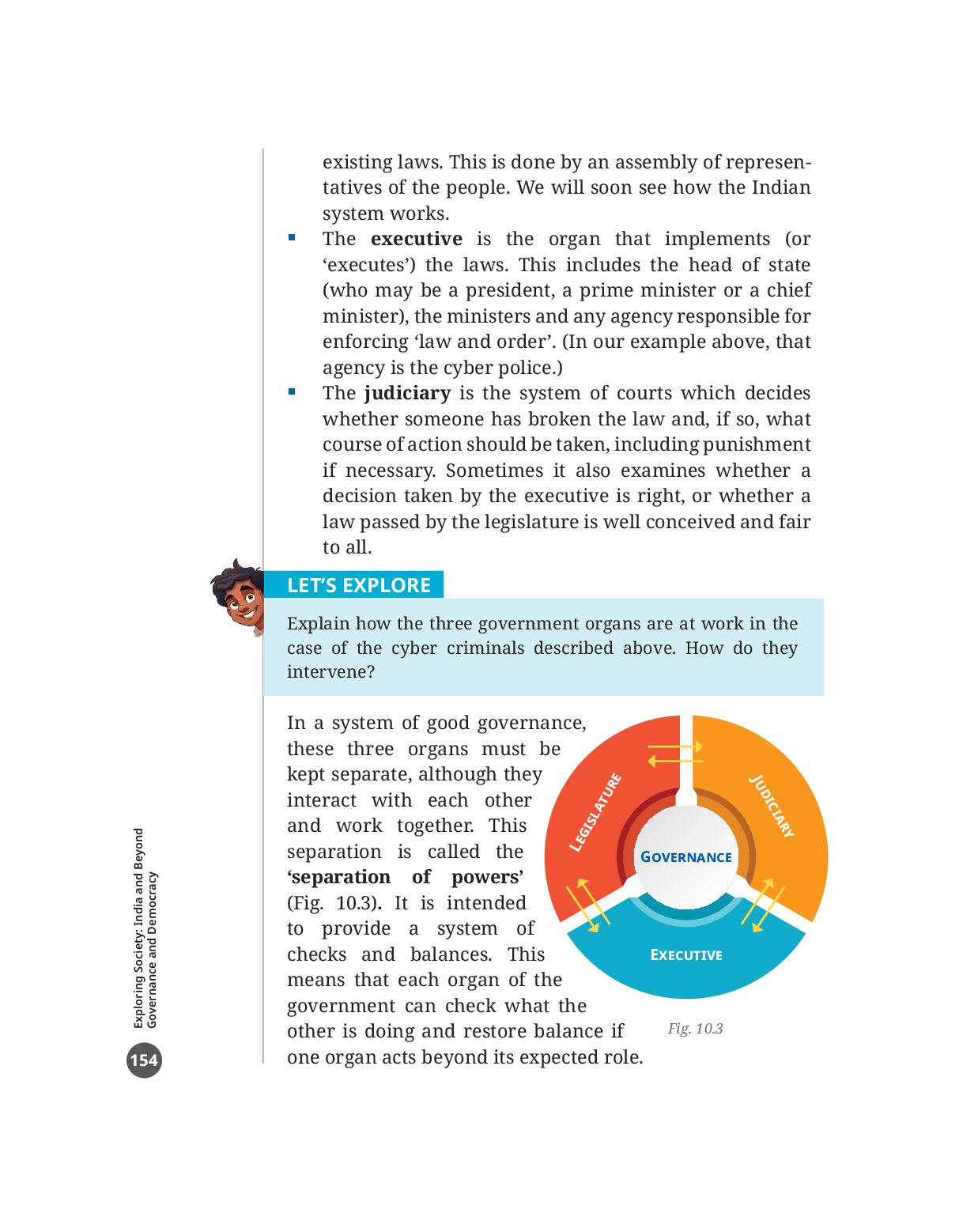
- The three organs must be kept separate — that is the ‘separation of powers’. Fig. 10.3 draws them as three arcs of one circle with Governance at the centre and arrows running between them: separate, but interacting and working together. The purpose is a system of checks and balances, so that “each organ of the government can check what the other is doing and restore balance if one organ acts beyond its expected role”.
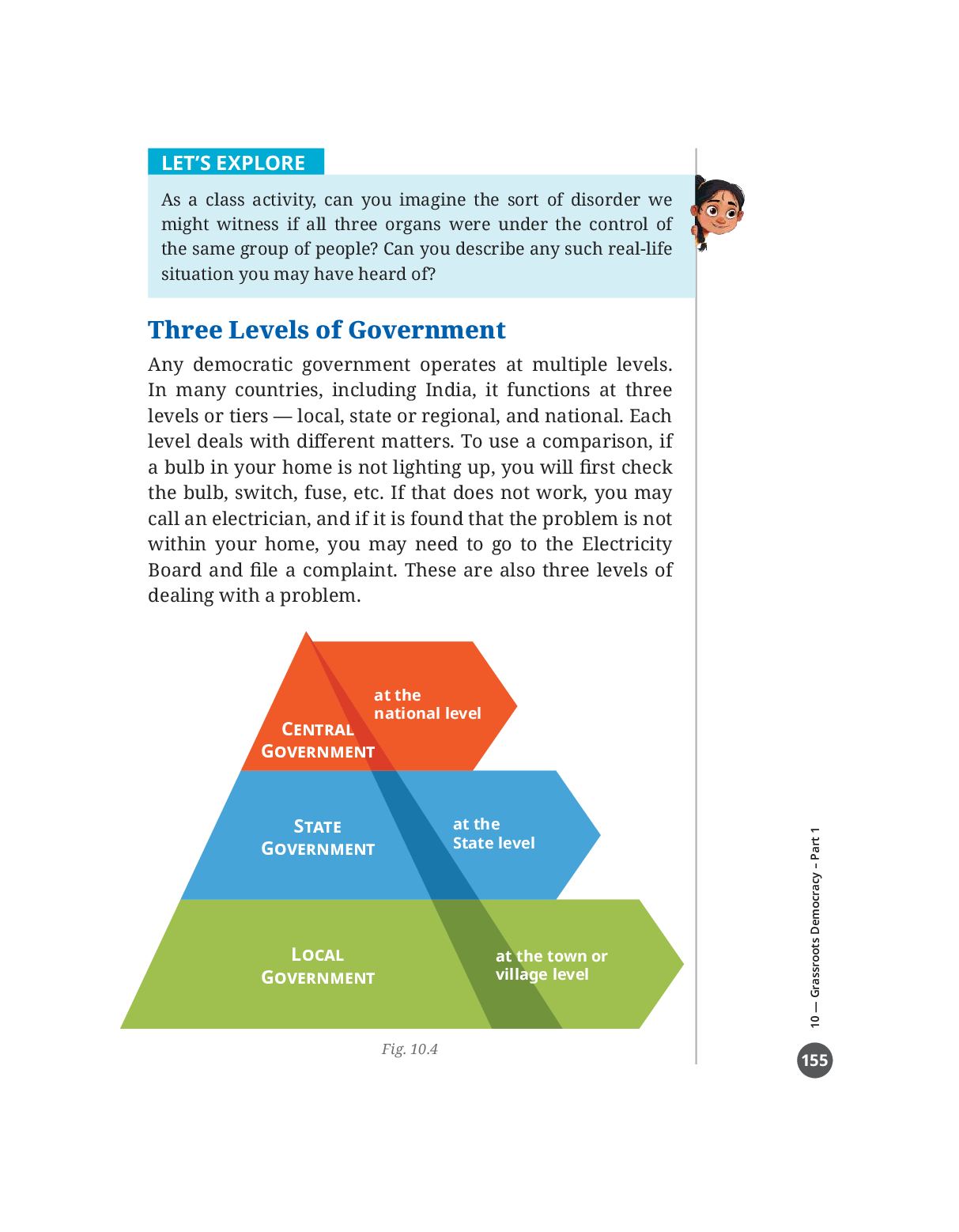
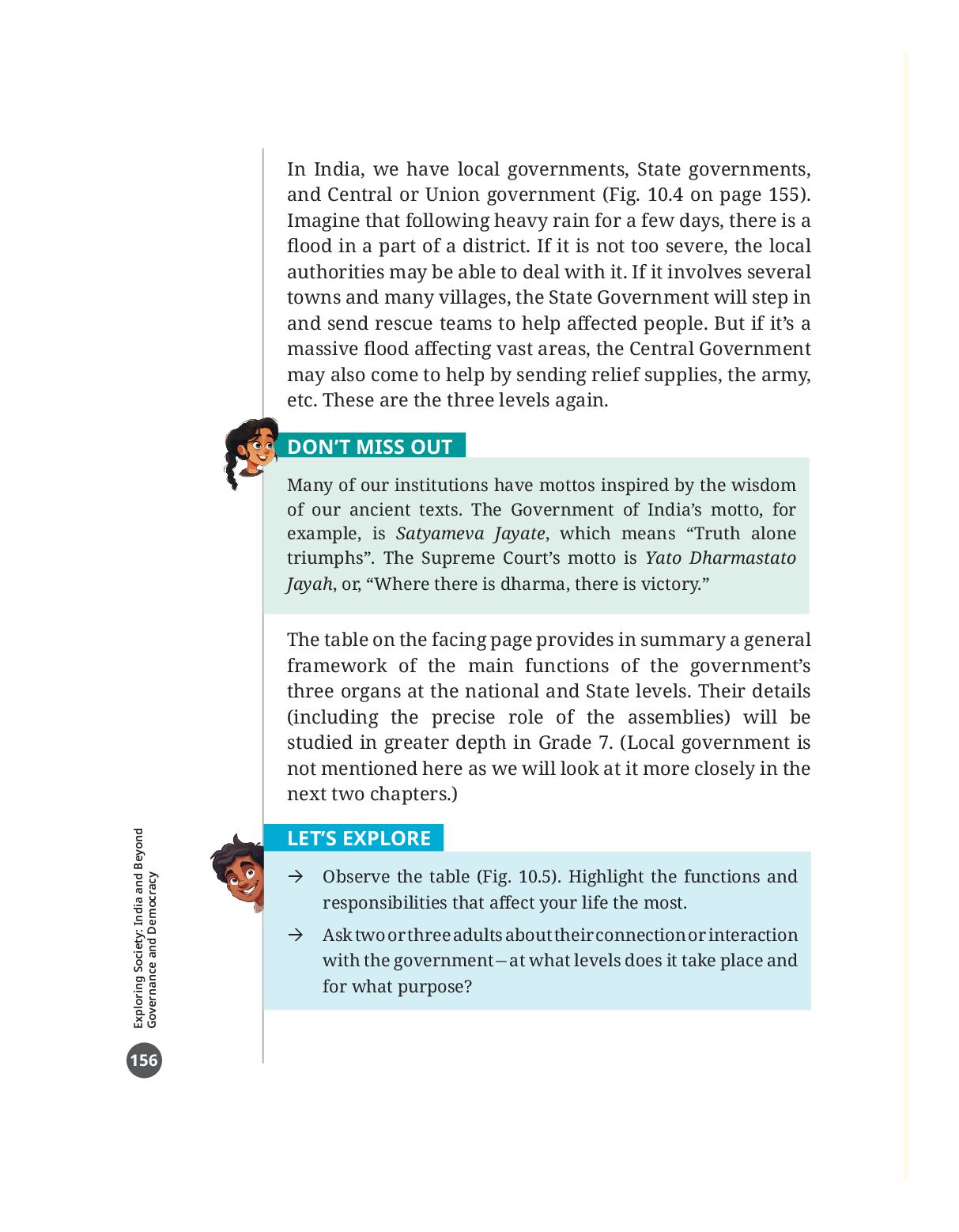
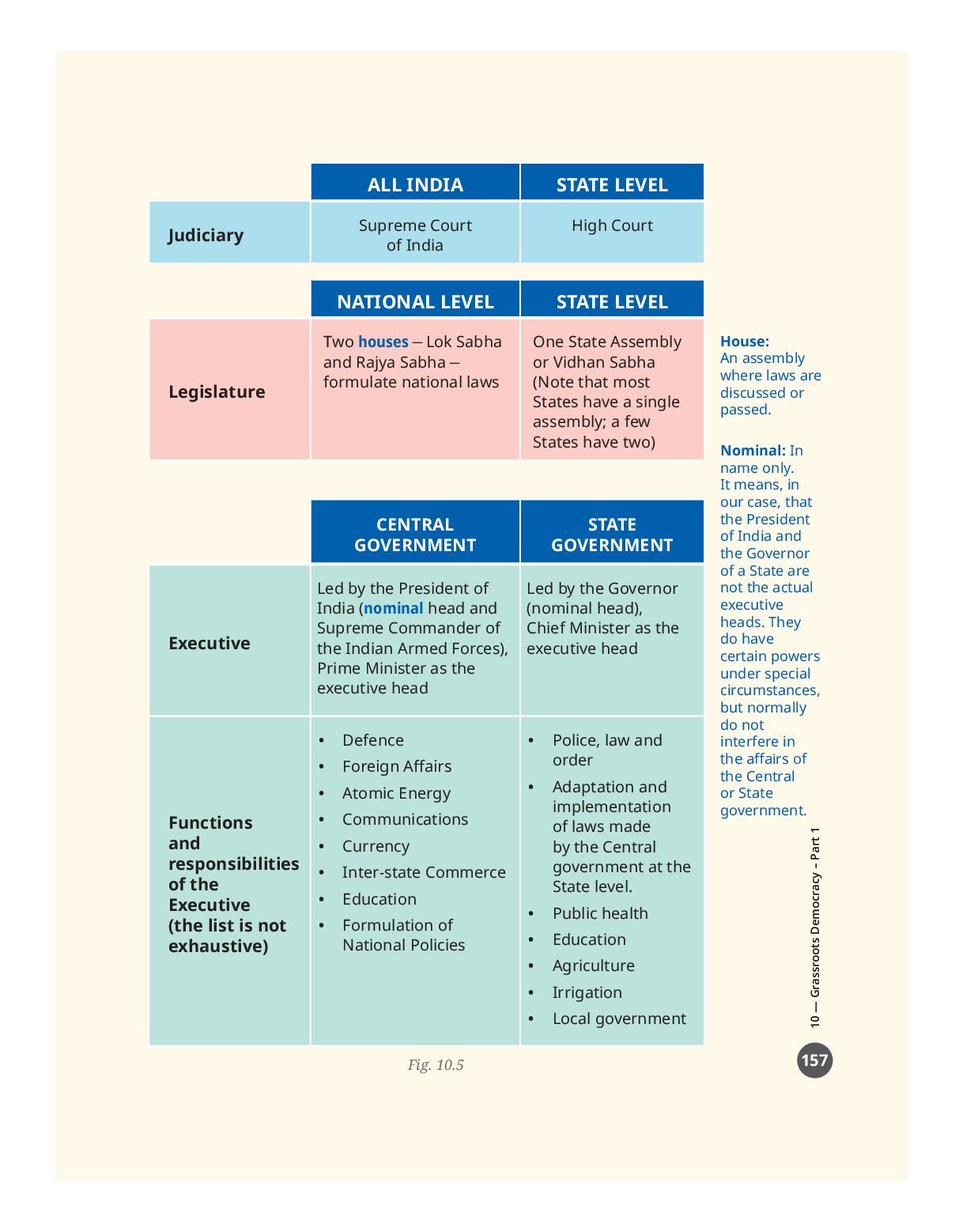
- Government also works at three levels or tiers. In India these are local, State and Central (Union) — the pyramid of Fig. 10.4. Each level deals with different matters, like the bulb–electrician–Electricity Board comparison, or a flood that a district can handle, or a State, or that needs the Centre. Fig. 10.5 sets out the national and State level side by side: Supreme Court and High Court; Lok Sabha and Rajya Sabha and the Vidhan Sabha; President and Prime Minister, Governor and Chief Minister.
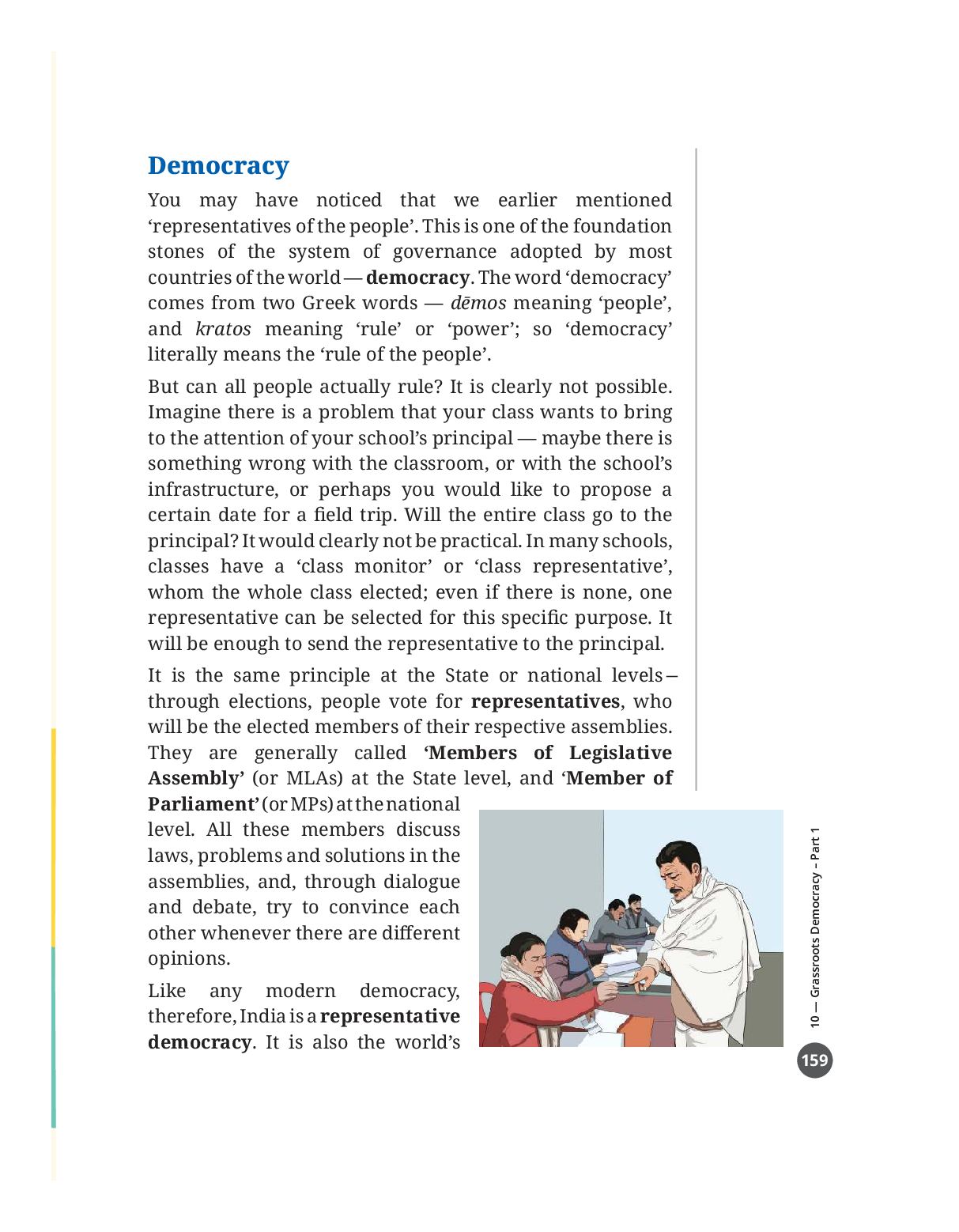
- Democracy — ‘rule of the people’ — is the framework for all of this. From Greek dēmos (people) and kratos (rule or power). Since all people cannot literally rule, India, “like any modern democracy”, is a representative democracy: people elect MLAs at the State level and MPs at the national level, who settle matters “through dialogue and debate”. It is the world’s largest democracy, with some 970 million voters in 2024, and every citizen aged 18 or above may vote. Direct democracy — everyone deciding, as in a class vote — works only in small groups, and grassroots democracy means a system that lets ordinary citizens, the base of the pyramid, have a say in the decisions that affect them.
Quick revision – Grassroots Democracy – Part 1: Governance
| Term | What it means | Where it appears in the chapter | Worth remembering |
|---|---|---|---|
| Governance | “The process of taking decisions, organising the society’s life with different sets of rules, and ensuring that they are followed” | Page 150, Introduction | It is a process, not a group of people |
| Government | “The group of individuals or the system that makes the rules and ensures that they are followed” | Page 150 | Governance is the work; government is who does it |
| Law | “Some of the more important rules are called laws” | Page 150 | Every law is a rule; not every rule is a law |
| Legislature | The organ that makes new laws, and sometimes updates or removes existing ones — “an assembly of representatives of the people” | Page 153 | Lok Sabha and Rajya Sabha at the national level; the Vidhan Sabha in a State |
| Executive | The organ that implements the laws — head of state, ministers and any agency responsible for law and order | Page 154 | In the cybercrime example, the agency is the cyber police |
| Judiciary | The system of courts that decides whether someone has broken the law and what should follow — and sometimes examines executive decisions and laws | Page 154 | Supreme Court of India for all India, High Court at the State level (Fig. 10.5) |
| Separation of powers | Keeping the three organs separate, though they interact and work together | Page 154, Fig. 10.3 | Its purpose is a system of checks and balances |
| Three levels (tiers) | Local, State or regional, and national — “each level deals with different matters” | Page 155, Fig. 10.4 | The bulb, the electrician, the Electricity Board — three levels of dealing with one problem |
| Nominal head | “In name only” — the President of India and the Governor of a State are not the actual executive heads | Page 157, Fig. 10.5 | They have certain powers under special circumstances but normally do not interfere |
| Democracy | From Greek dēmos (people) and kratos (rule or power) — literally the ‘rule of the people’ | Page 159 | “no democracy without respect to the identity and dignity of cultures and peoples” — Rigoberta Menchú Tum |
| Representative democracy | People vote for representatives, who become elected members of the assemblies | Pages 159–160 | MLAs at the State level, MPs at the national level |
| Direct democracy | Every person’s opinion is taken directly, as in the class vote for a picnic place | Page 160 | Practical only for a small group |
| Grassroots democracy | “A system that enables and encourages the participation of ordinary citizens” — the base of the pyramid | Page 160 | The title of the chapter, and of the two chapters that follow |
Old NCERT vs New – Class 6 Social Science
This chapter is from Exploring Society: India and Beyond, the new NCERT Class 6 Social Science book (NCF-SE 2023, used from 2024-25). It replaced the old book “Our Pasts, The Earth Our Habitat and Social and Political Life”, so chapter numbers and names differ from older PDFs.
Solutions and All Chapters
Answers to the exercises and the full chapter list of Exploring Society: India and Beyond:
Grassroots Democracy – Part 1: Governance – Overview
| Class | Class 6 |
| Subject | Social Science |
| Book | Exploring Society: India and Beyond – new NCERT book |
| Chapter | 10 of 14 – Grassroots Democracy – Part 1: Governance |
| Book pages | 149 – 162 |
| Edition | NCERT Reprint 2026-27 |
| Session | 2026-27 |
| Free – read online or download |
Class 6 Social Science Chapter 10 – FAQs
Where can I download Grassroots Democracy – Part 1: Governance Class 6 PDF?
From the download table on this page – the chapter PDF is free, and the full book is linked too.
What is Class 6 Social Science Chapter 10 about?
The chapter’s one idea: people living together need rules, and rules need someone to make them and someone to see that they are followed. When many people live together “there can be disagreements and disorder, and rules become necessary to maintain order and harmony in the society”. The book then gives three exact words: governance is the process, government is the group or system that does it, and laws are “some of the more important rules”.
Is Grassroots Democracy – Part 1: Governance from the new NCERT Class 6 Social Science book?
Yes. It is chapter 10 of exploring society: india and beyond, the new NCERT Class 6 Social Science book for 2026-27.
Is this the latest NCERT edition for 2026-27?
Yes – the PDF is NCERT’s latest edition for the 2026-27 session.
Where are the NCERT Solutions for Class 6 Social Science Chapter 10?
Open the NCERT Solutions link above for answers to the exercise questions.