Download Grassroots Democracy – Part 3 Local Government in Urban Areas – NCERT Class 6 Social Science Chapter 12 PDF from the new NCERT Class 6 Social Science book Exploring Society: India and Beyond (2026-27). Read the chapter online or download the free PDF. The chapter’s one idea: a city, like a village, should be run by the people who live in it. Chapter 11 looked at the rural side of local government; this chapter looks at the urban side. Cities are “generally more complex and diverse” than villages,…
Grassroots Democracy – Part 3 Local Government in Urban Areas PDF – Chapter 12 of Exploring Society: India and Beyond
Read the chapter online or download the PDF.
| Chapter | Download | |
|---|---|---|
| Chapter 12 PDF | Grassroots Democracy – Part 3 Local Government in Urban Areas | View PDF |
| Full book | NCERT Class 6 Social Science – Exploring Society: India and Beyond | View Book |
Read Online

What Is in Grassroots Democracy – Part 3 Local Government in Urban Areas? (Class 6 Social Science Chapter 12)
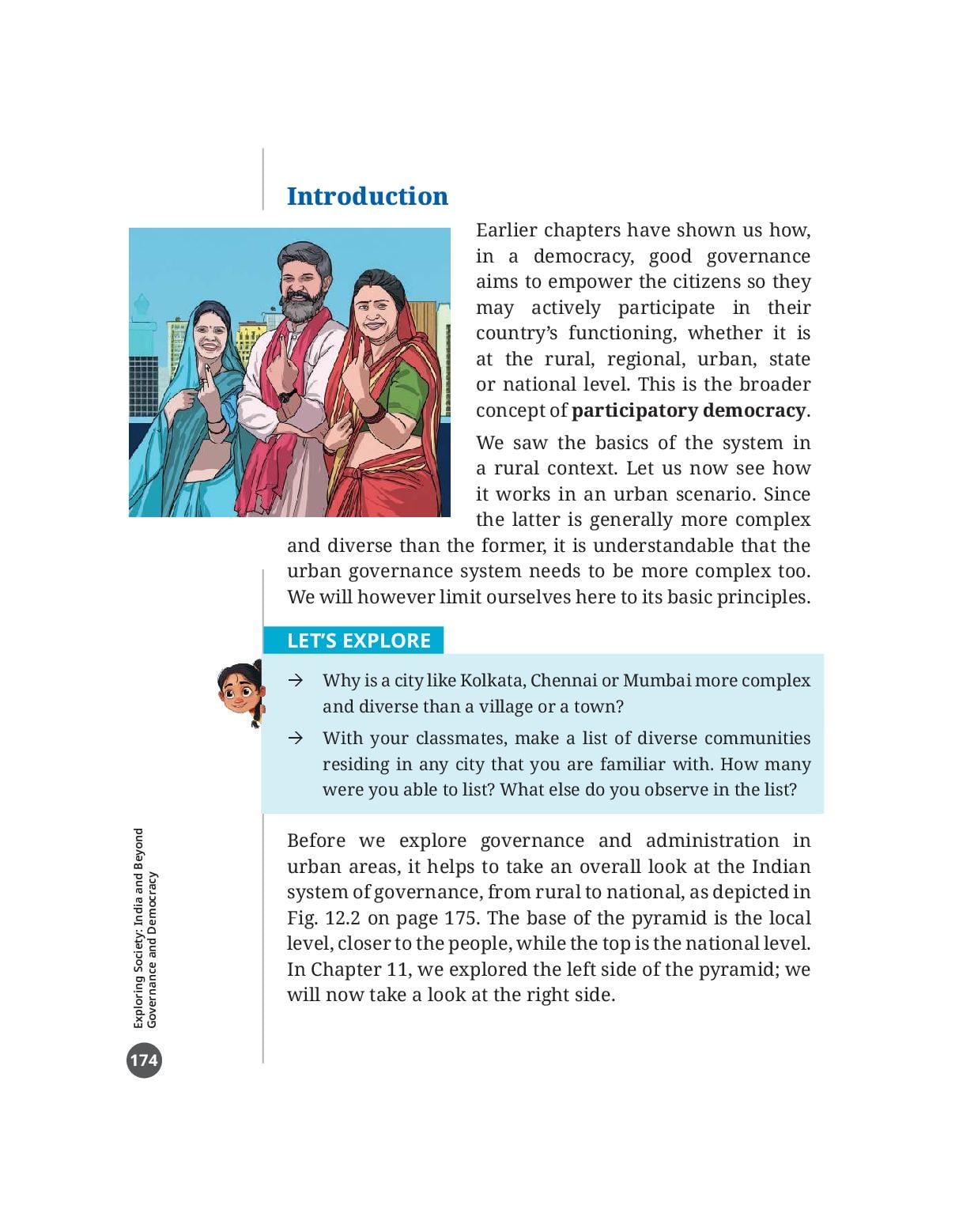
- The chapter’s one idea: a city, like a village, should be run by the people who live in it. Chapter 11 looked at the rural side of local government; this chapter looks at the urban side. Cities are “generally more complex and diverse” than villages, “so it is understandable that the urban governance system needs to be more complex too” — but the principle is unchanged. This is participatory democracy: good governance “aims to empower the citizens so they may actively participate in their country’s functioning”.
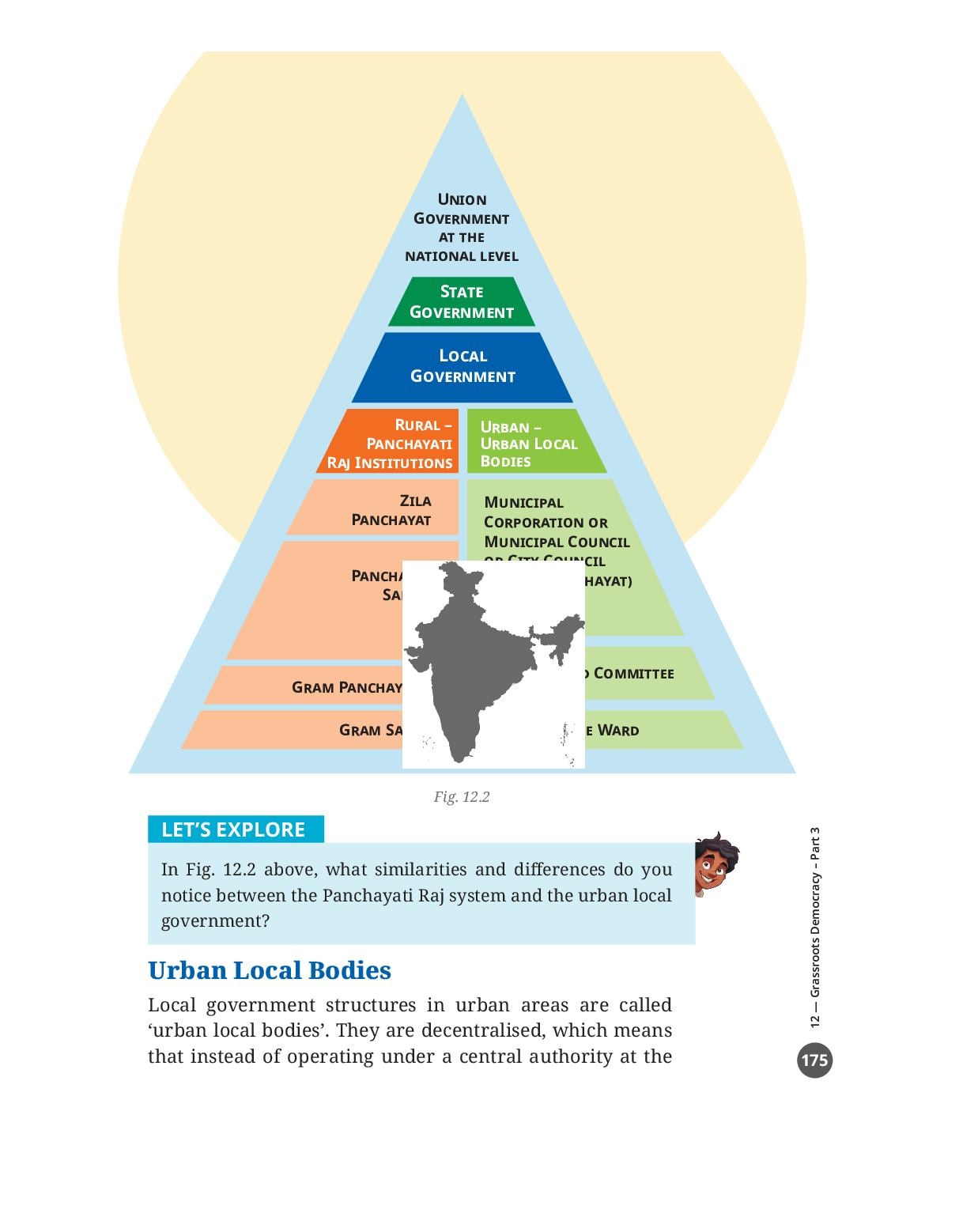
- The whole Indian system fits into one pyramid — Fig. 12.2 on page 175. From the top: Union Government at the national level → State Government → Local Government, which then splits into two branches — Rural: Panchayati Raj Institutions on the left (Zila Panchayat, Panchayat Samiti, Gram Panchayat, Gram Sabha) and Urban: Urban Local Bodies on the right (Municipal Corporation or Municipal Council or City Council / Nagar Panchayat, Ward Committee, People of the Ward). Chapter 11 explored the left side; Chapter 12 explores the right.
- Urban local bodies are decentralised. The chapter defines them on page 175: “Local government structures in urban areas are called ‘urban local bodies’. They are decentralised, which means that instead of operating under a central authority at the top, the local communities have a direct say on how their areas are managed or the issues they face.” It is “a mechanism for citizens living in an area to come together and take decisions about what is best for them”.
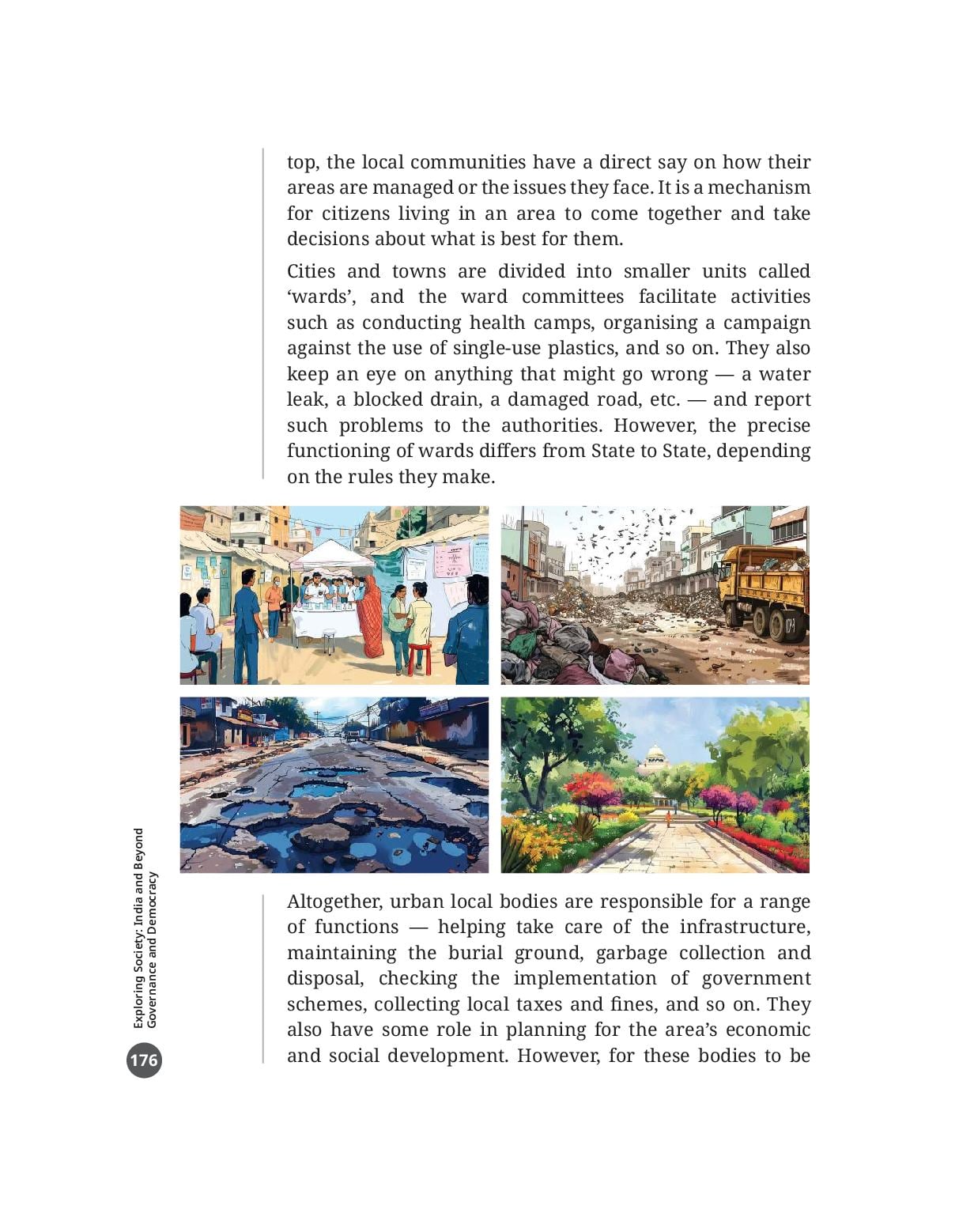
- The ward is the building block. “Cities and towns are divided into smaller units called ‘wards’”, and ward committees run health camps, campaign against single-use plastics, and keep watch on “a water leak, a blocked drain, a damaged road” and report such problems to the authorities. “However, the precise functioning of wards differs from State to State, depending on the rules they make.”
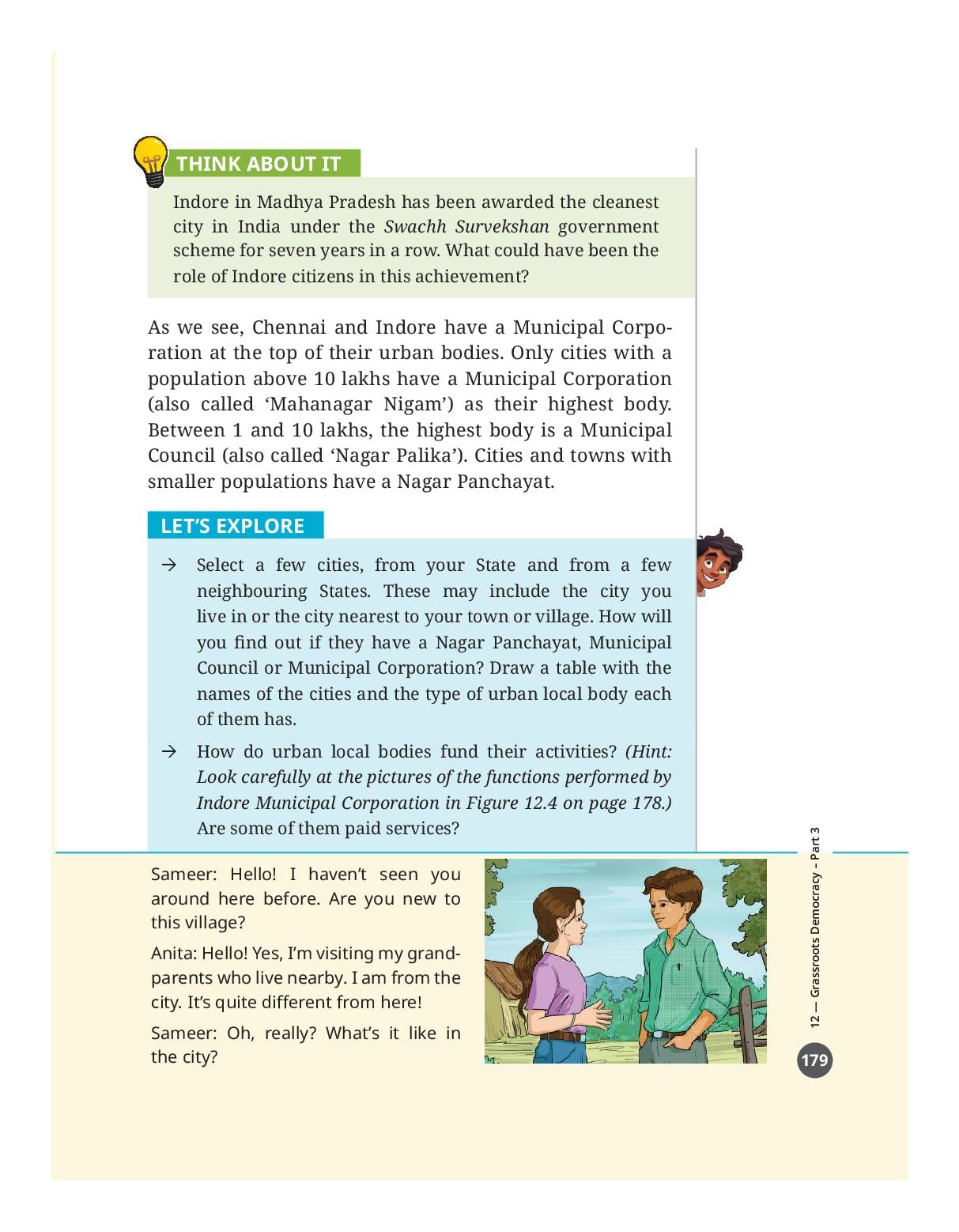
- Three kinds of urban local body, decided by population (page 179). Only cities with a population above 10 lakhs have a Municipal Corporation (also called ‘Mahanagar Nigam’). Between 1 and 10 lakhs, the highest body is a Municipal Council (also called ‘Nagar Palika’). “Cities and towns with smaller populations have a Nagar Panchayat.” Chennai and Indore, the two cities the chapter shows, both have a Municipal Corporation.
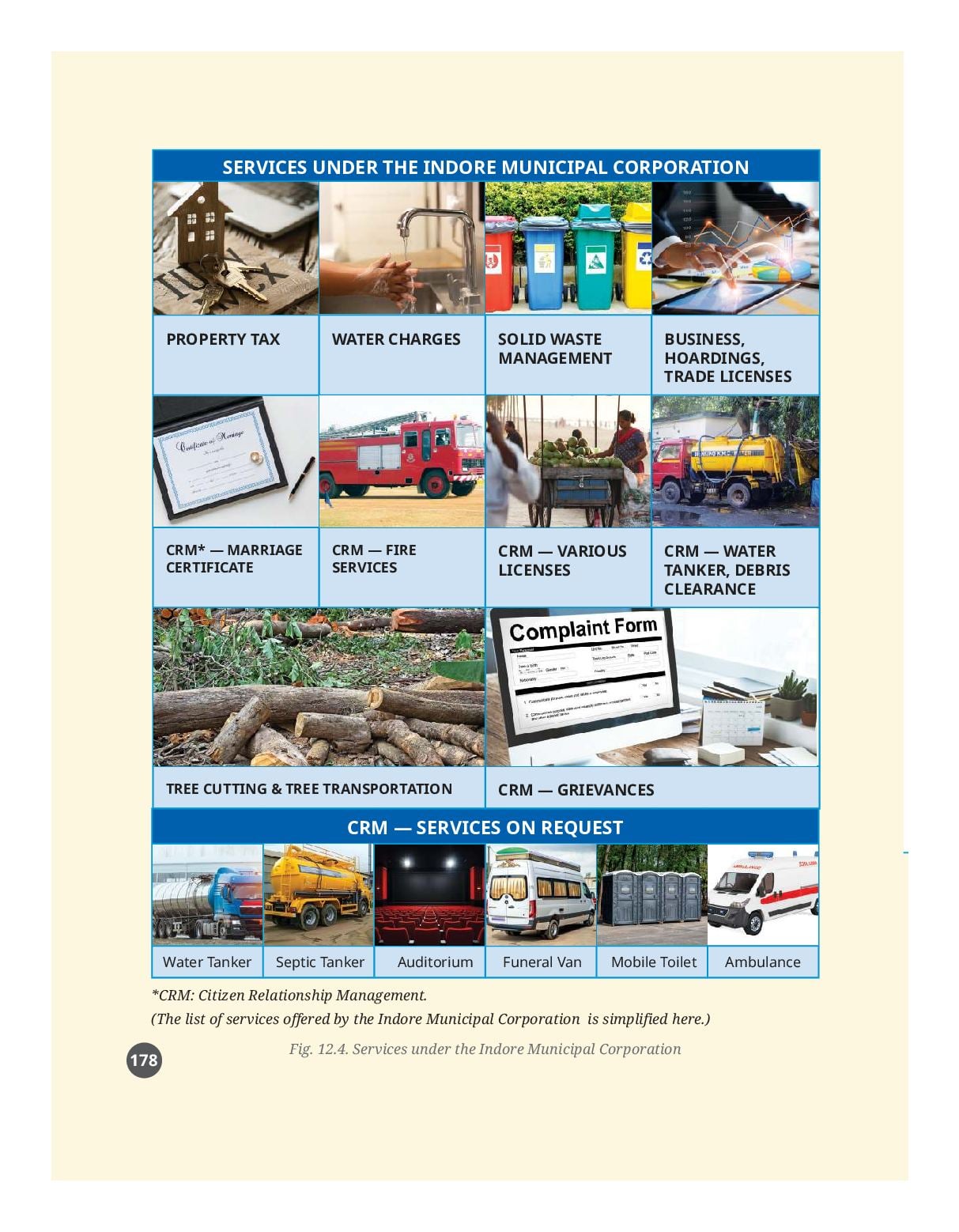
- What they do, and what citizens must do in return. Urban local bodies look after infrastructure, the burial ground, garbage collection and disposal, the implementation of government schemes, the collection of local taxes and fines, and they have “some role in planning for the area’s economic and social development”. Fig. 12.4 on page 178 shows the Indore Municipal Corporation’s services — property tax, water charges, solid waste management, trade licences, fire services, marriage certificates, grievances, and services on request like a water tanker or an ambulance. But “for these bodies to be able to perform their functions efficiently, people living in the city must also perform their duties” — segregating waste, reporting a leak promptly, caring for their own area.
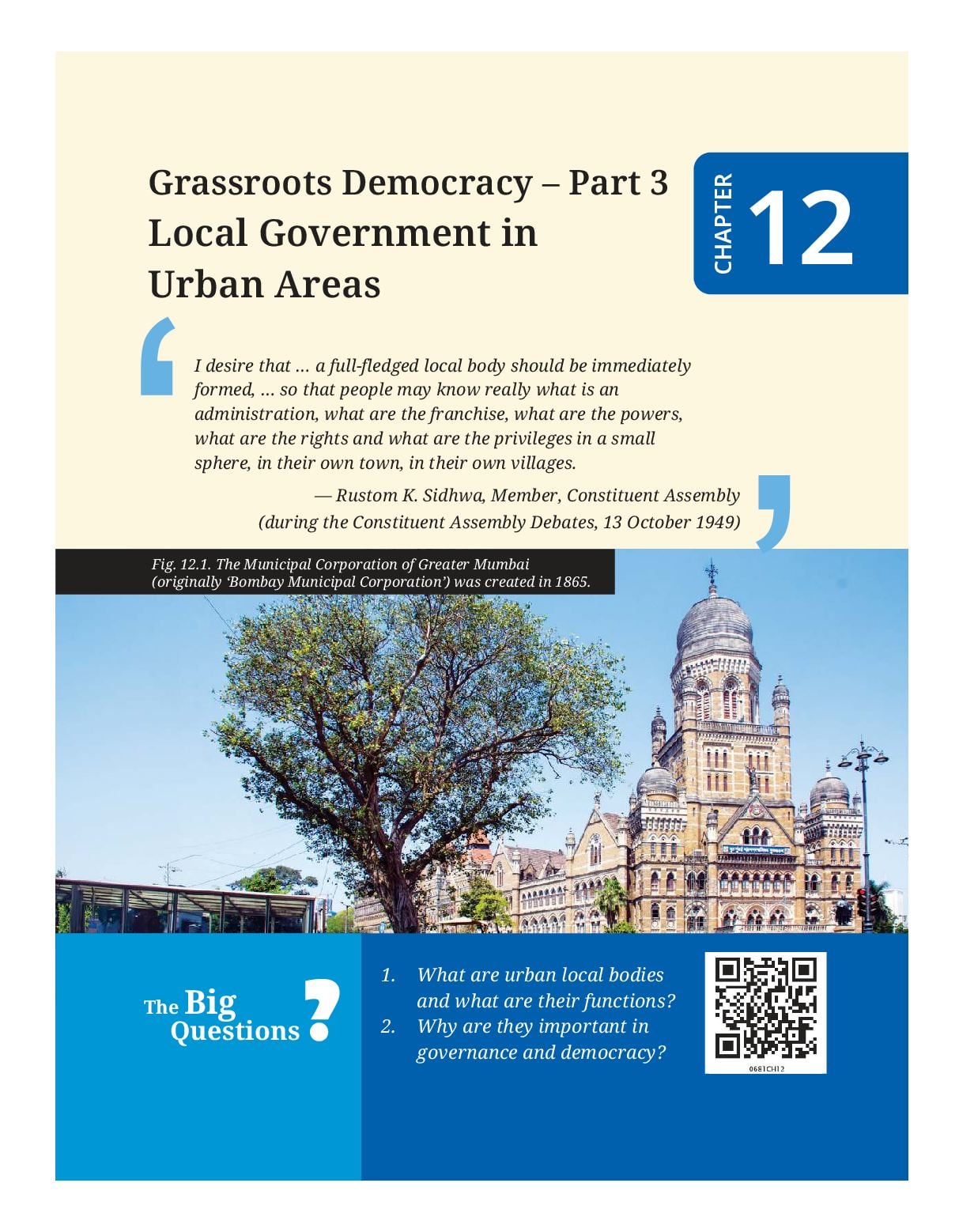
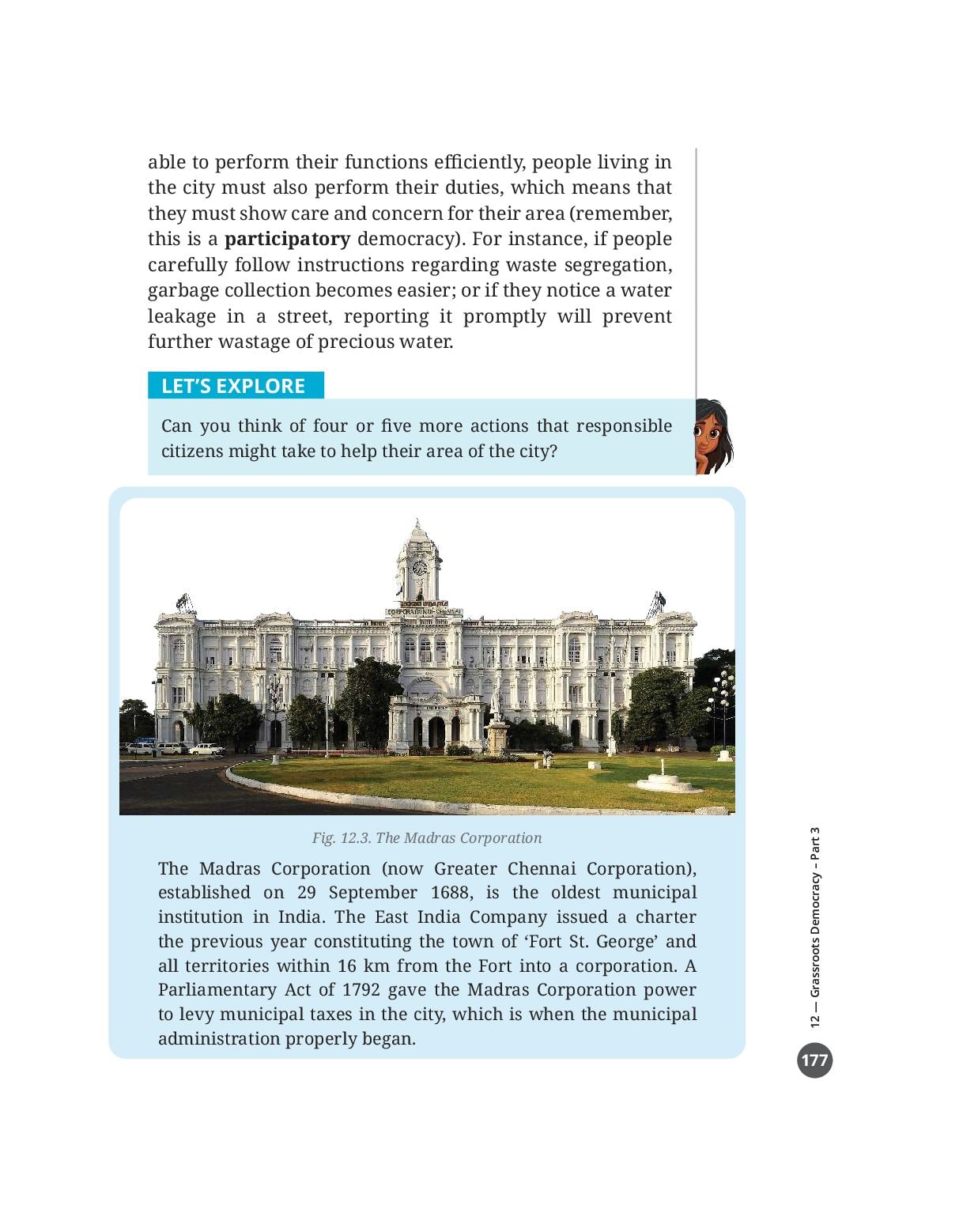
- Two old corporations frame the chapter. Fig. 12.1 on page 173: the Municipal Corporation of Greater Mumbai, originally the Bombay Municipal Corporation, created in 1865. Fig. 12.3 on page 177: the Madras Corporation (now Greater Chennai Corporation), established on 29 September 1688 — “the oldest municipal institution in India”, whose power to levy municipal taxes came from a Parliamentary Act of 1792, “which is when the municipal administration properly began”.
Quick revision – Grassroots Democracy – Part 3 Local Government in Urban Areas
| Term | What it means | Where it appears in the chapter | Worth remembering |
|---|---|---|---|
| Urban local body (ULB) | “Local government structures in urban areas” | Page 175 | The urban twin of a Panchayat — the right-hand branch of Fig. 12.2 |
| Decentralised | “Instead of operating under a central authority at the top, the local communities have a direct say on how their areas are managed” | Page 175 | Decisions move down to the people, not up to a distant office |
| Participatory democracy | Governance that “aims to empower the citizens so they may actively participate in their country’s functioning” | Page 174 | It gives citizens duties, not only rights |
| Ward | The “smaller units” into which “cities and towns are divided” | Page 176 | The smallest unit of a city’s government — you vote for the councillor of your own ward |
| Ward Committee | The body at the ward level in Fig. 12.2, which facilitates health camps, campaigns and the reporting of local problems | Pages 175–176 | “The precise functioning of wards differs from State to State” |
| Municipal Corporation | The highest urban body in cities with a population above 10 lakhs, “also called ‘Mahanagar Nigam’” | Page 179; Figs. 12.1, 12.3, 12.4 | Mumbai, Chennai and Indore all have one |
| Municipal Council | The highest body where the population is “between 1 and 10 lakhs”, “also called ‘Nagar Palika’” | Page 179; Fig. 12.2 (as ‘City Council’) | Its head is a Chairperson or President, not a Mayor |
| Nagar Panchayat | The body in “cities and towns with smaller populations” — below about 1 lakh | Page 179; Fig. 12.2 | Do not confuse it with a Gram Panchayat — a Nagar Panchayat is an urban body |
| Mayor | The elected head of a Municipal Corporation — chosen by the councillors in some States, directly by the voters in others | Not named in the chapter — general knowledge | Elected. The Municipal Commissioner, who runs the office, is appointed |
| Municipal Commissioner | The chief executive officer of a Municipal Corporation, appointed by the State Government | Not named in the chapter — general knowledge | Appointed, not elected — like the Panchayat Secretary in Chapter 11 |
| Property tax and user charges | The main money an urban local body raises itself — see “PROPERTY TAX” and “WATER CHARGES” in Fig. 12.4 | Page 178 | Urban bodies “collect local taxes and fines” (page 176) |
| Swachh Survekshan | The government cleanliness survey under which Indore was “awarded the cleanest city in India … for seven years in a row” | Page 179 | The award went to a city, but the work was done by its citizens |
| Madras Corporation | Established 29 September 1688, “the oldest municipal institution in India” | Page 177, Fig. 12.3 | Now the Greater Chennai Corporation |
Old NCERT vs New – Class 6 Social Science
This chapter is from Exploring Society: India and Beyond, the new NCERT Class 6 Social Science book (NCF-SE 2023, used from 2024-25). It replaced the old book “Our Pasts, The Earth Our Habitat and Social and Political Life”, so chapter numbers and names differ from older PDFs.
Solutions and All Chapters
Answers to the exercises and the full chapter list of Exploring Society: India and Beyond:
Grassroots Democracy – Part 3 Local Government in Urban Areas – Overview
| Class | Class 6 |
| Subject | Social Science |
| Book | Exploring Society: India and Beyond – new NCERT book |
| Chapter | 12 of 14 – Grassroots Democracy – Part 3 Local Government in Urban Areas |
| Book pages | 173 – 182 |
| Edition | NCERT Reprint 2026-27 |
| Session | 2026-27 |
| Free – read online or download |
Class 6 Social Science Chapter 12 – FAQs
Where can I download Grassroots Democracy – Part 3 Local Government in Urban Areas Class 6 PDF?
From the download table on this page – the chapter PDF is free, and the full book is linked too.
What is Class 6 Social Science Chapter 12 about?
The chapter’s one idea: a city, like a village, should be run by the people who live in it. Chapter 11 looked at the rural side of local government; this chapter looks at the urban side. Cities are “generally more complex and diverse” than villages, “so it is understandable that the urban governance system needs to be more complex too” — but the principle is unchanged. This is participatory democracy: good governance “aims to empower the citizens so they may actively participate in their country’s functioning”.
Is Grassroots Democracy – Part 3 Local Government in Urban Areas from the new NCERT Class 6 Social Science book?
Yes. It is chapter 12 of exploring society: india and beyond, the new NCERT Class 6 Social Science book for 2026-27.
Is this the latest NCERT edition for 2026-27?
Yes – the PDF is NCERT’s latest edition for the 2026-27 session.
Where are the NCERT Solutions for Class 6 Social Science Chapter 12?
Open the NCERT Solutions link above for answers to the exercise questions.