NCERT Solutions for Class 6 Social Science Chapter 12 Grassroots Democracy part 3 Local Government in Urban Areas provide clear, step-by-step answers to every exercise and in-text question from the chapter Grassroots Democracy part 3 Local Government in Urban Areas of the NCERT textbook Exploring Society India and Beyond. Prepared by subject experts as per the latest NCERT (CBSE) syllabus for 2026-27, these NCERT Solutions for Class 6 Social Science help you understand each concept, write exam-ready answers, and check your own solutions. You can read them online below or download the free Class 6 Social Science Chapter 12 question-answer PDF.
NCERT Solutions for Class 6 Social Science Chapter 12 Grassroots Democracy part 3 Local Government in Urban Areas
- Class: Class 6
- Subject: Social Science
- Chapter: Chapter 12 – Grassroots Democracy part 3 Local Government in Urban Areas
- Textbook: Exploring Society India and Beyond (NCERT)
- Study material: NCERT Solutions – questions with answers, free PDF
These solutions answer all the exercise questions of Chapter 12 Grassroots Democracy part 3 Local Government in Urban Areas — including the in-text questions, short-answer and long-answer questions, and activities — with complete explanations so you can follow the method, not just the final answer. Read the full solutions below.
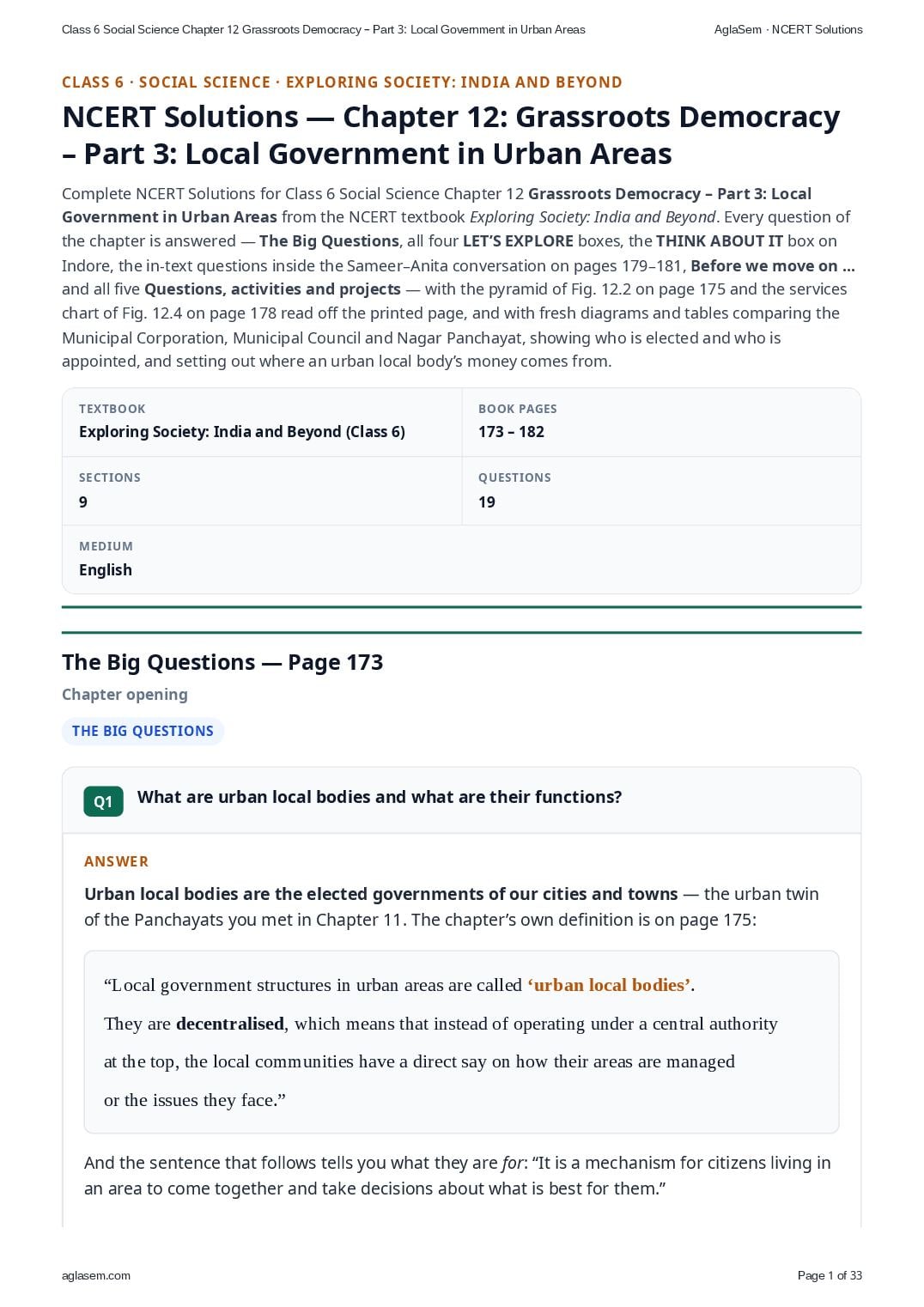
NCERT Solutions Class 6 Social Science Chapter 12 Grassroots Democracy part 3 Local Government in Urban Areas View Download
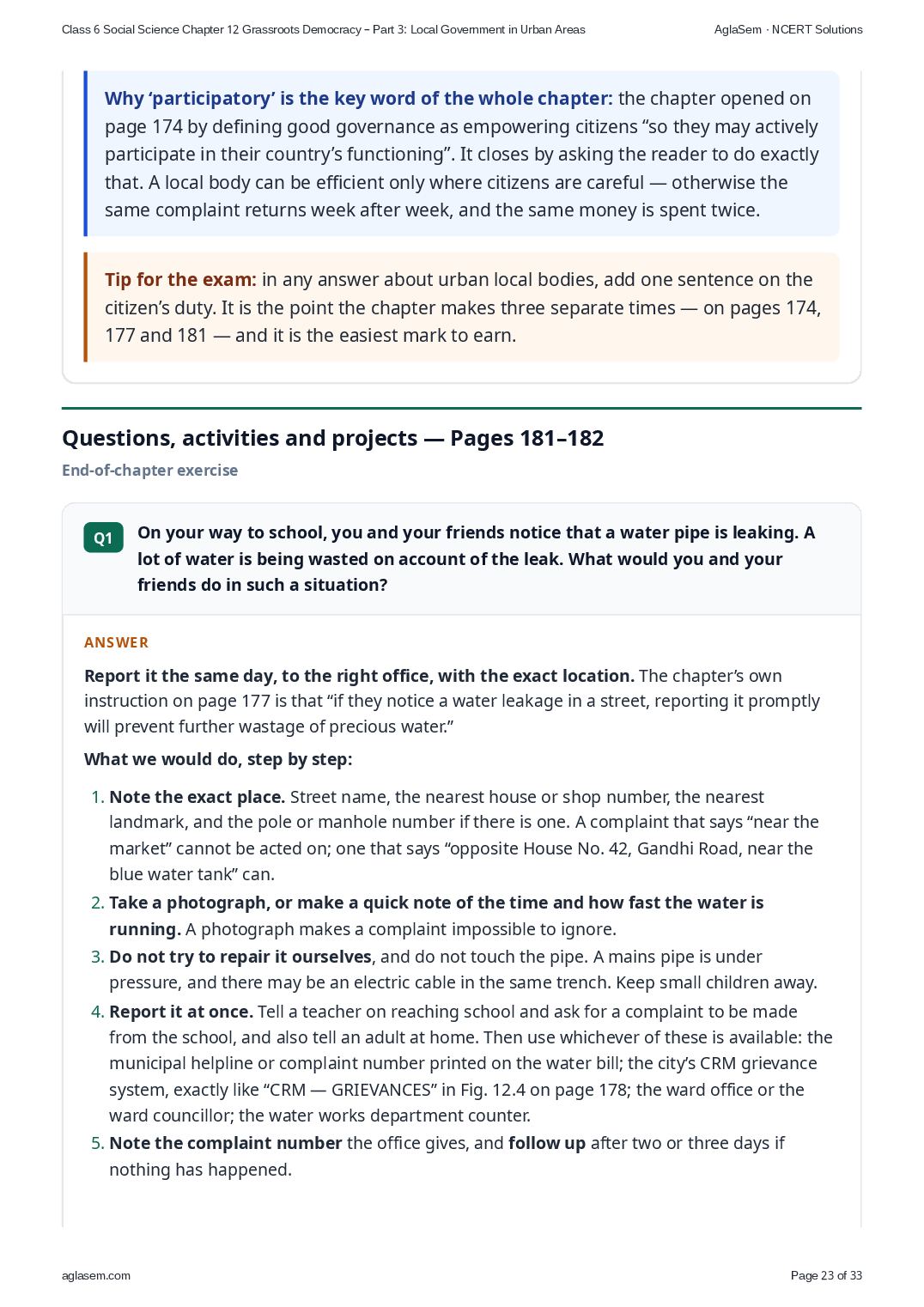
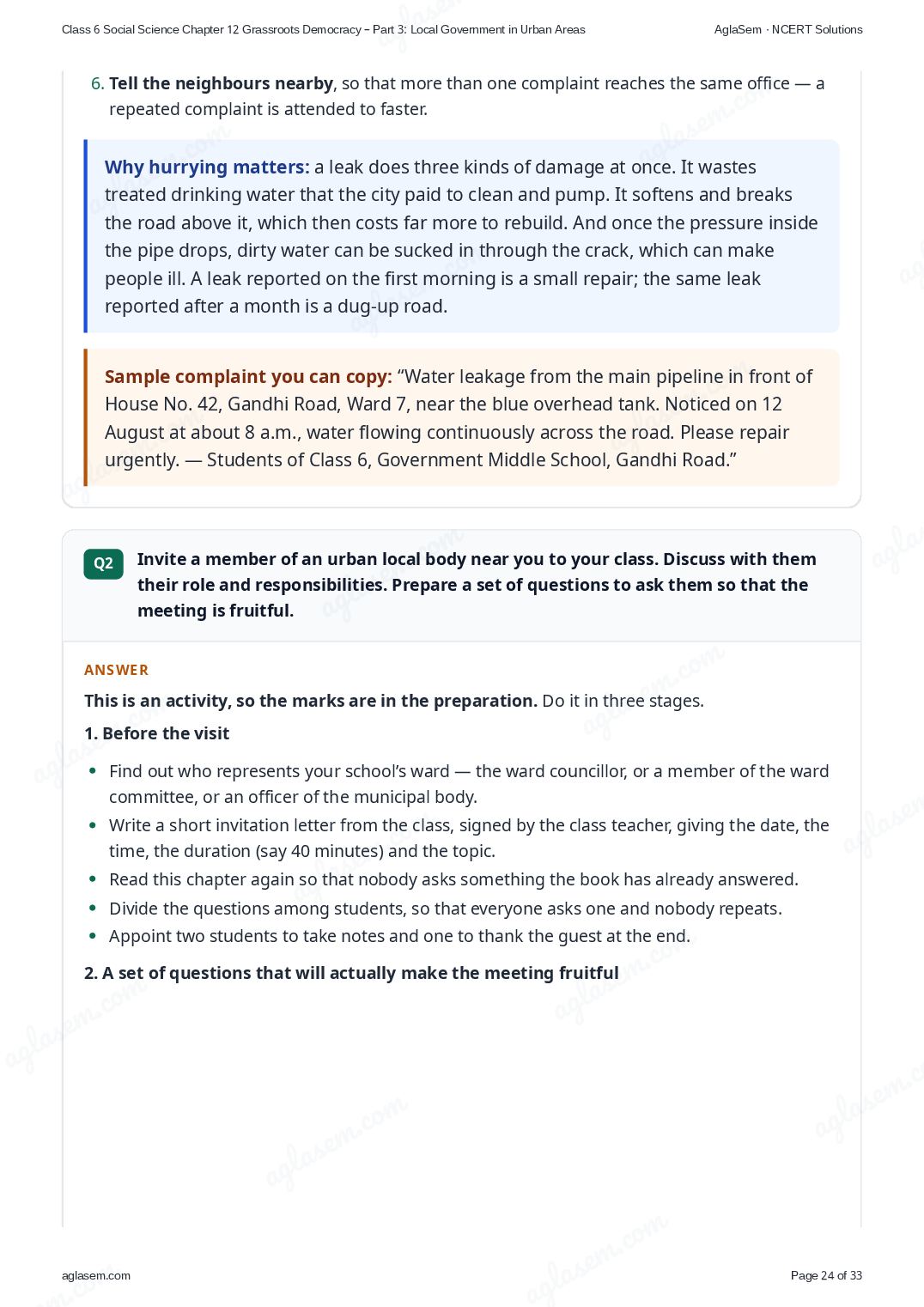
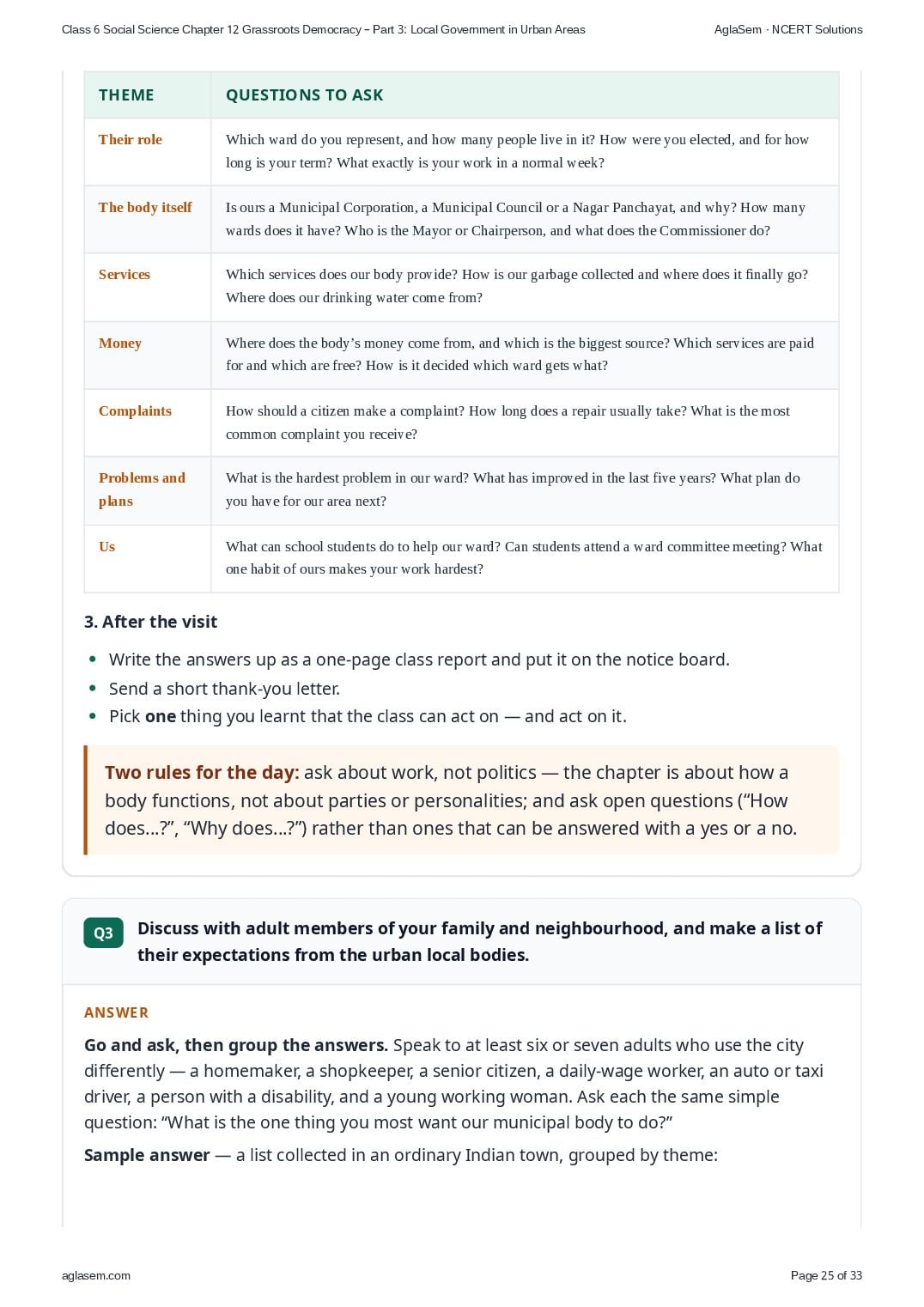
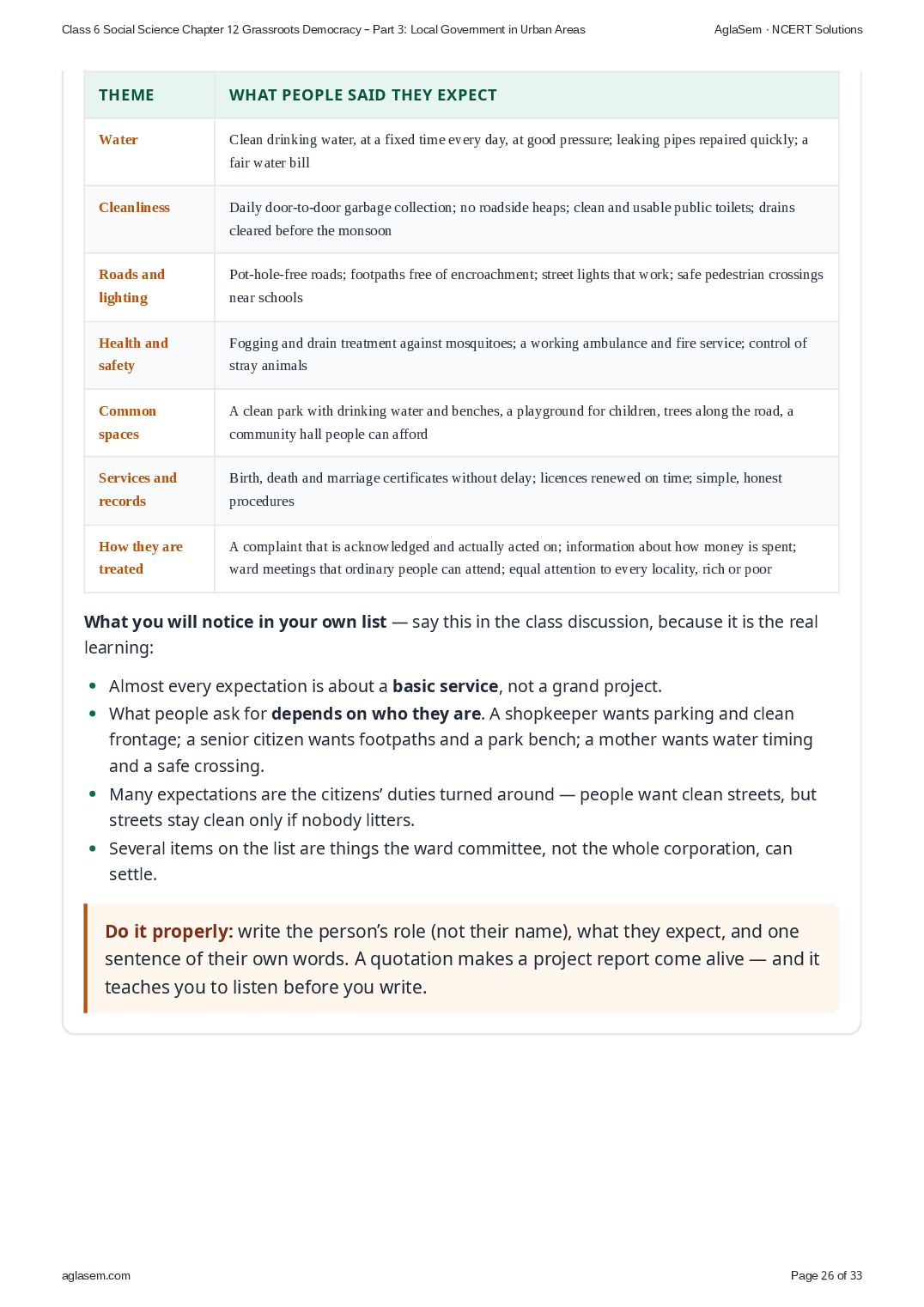

NCERT Solutions for Class 6 Social Science Chapter 12 PDF Download
You can read the NCERT Solutions for Class 6 Social Science Chapter 12 online above, or download the complete question-answer PDF to study Grassroots Democracy part 3 Local Government in Urban Areas offline at any time.
NCERT Solutions for Class 6 Social Science Chapter 12 PDF Download Link – Click Here to Download Solutions PDF
Questions Covered in This Chapter
These NCERT Solutions answer all 19 questions of this chapter. The questions solved are:
- What are urban local bodies and what are their functions?
- Why are they important in governance and democracy?
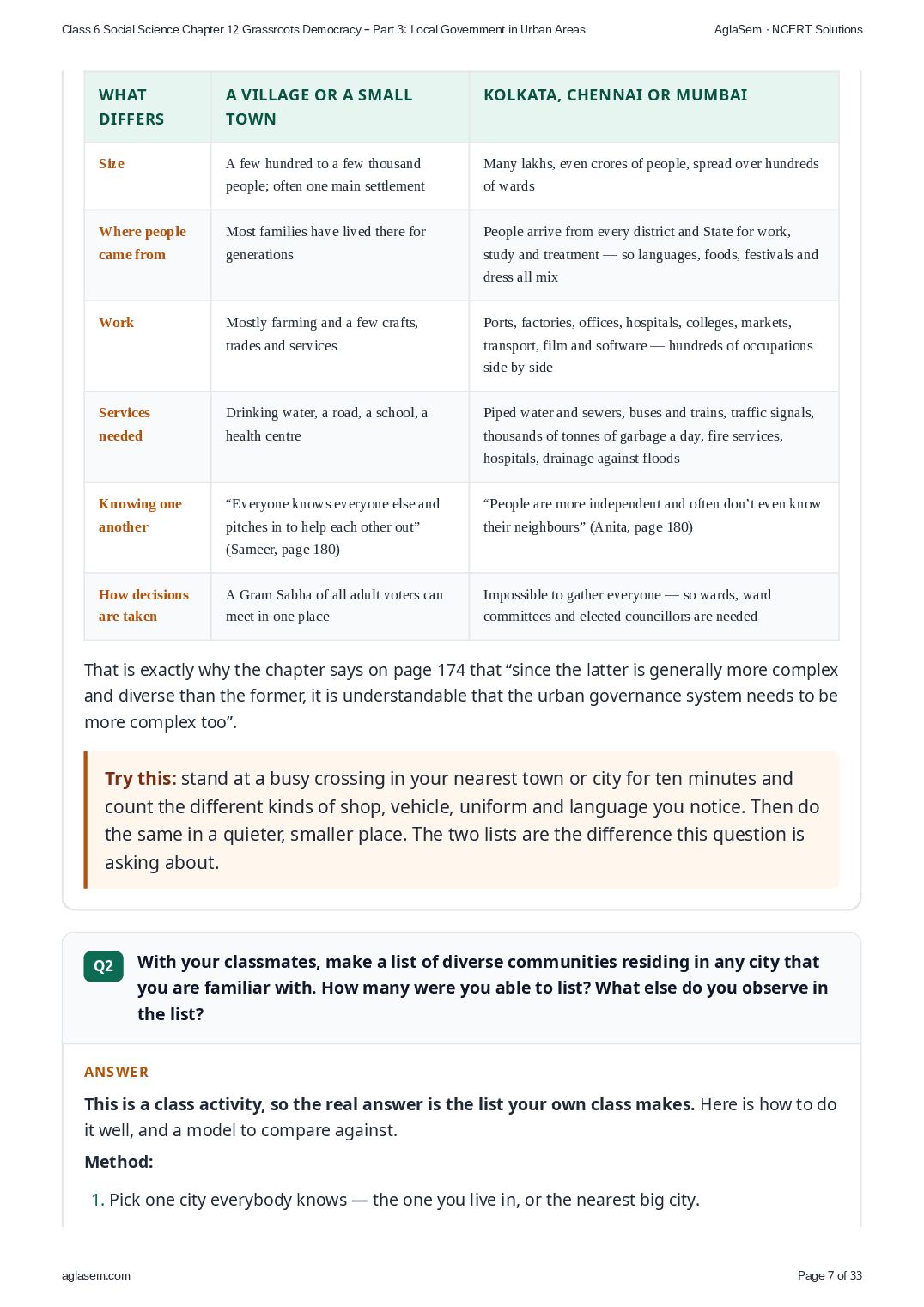
- Why is a city like Kolkata, Chennai or Mumbai more complex and diverse than a village or a town?
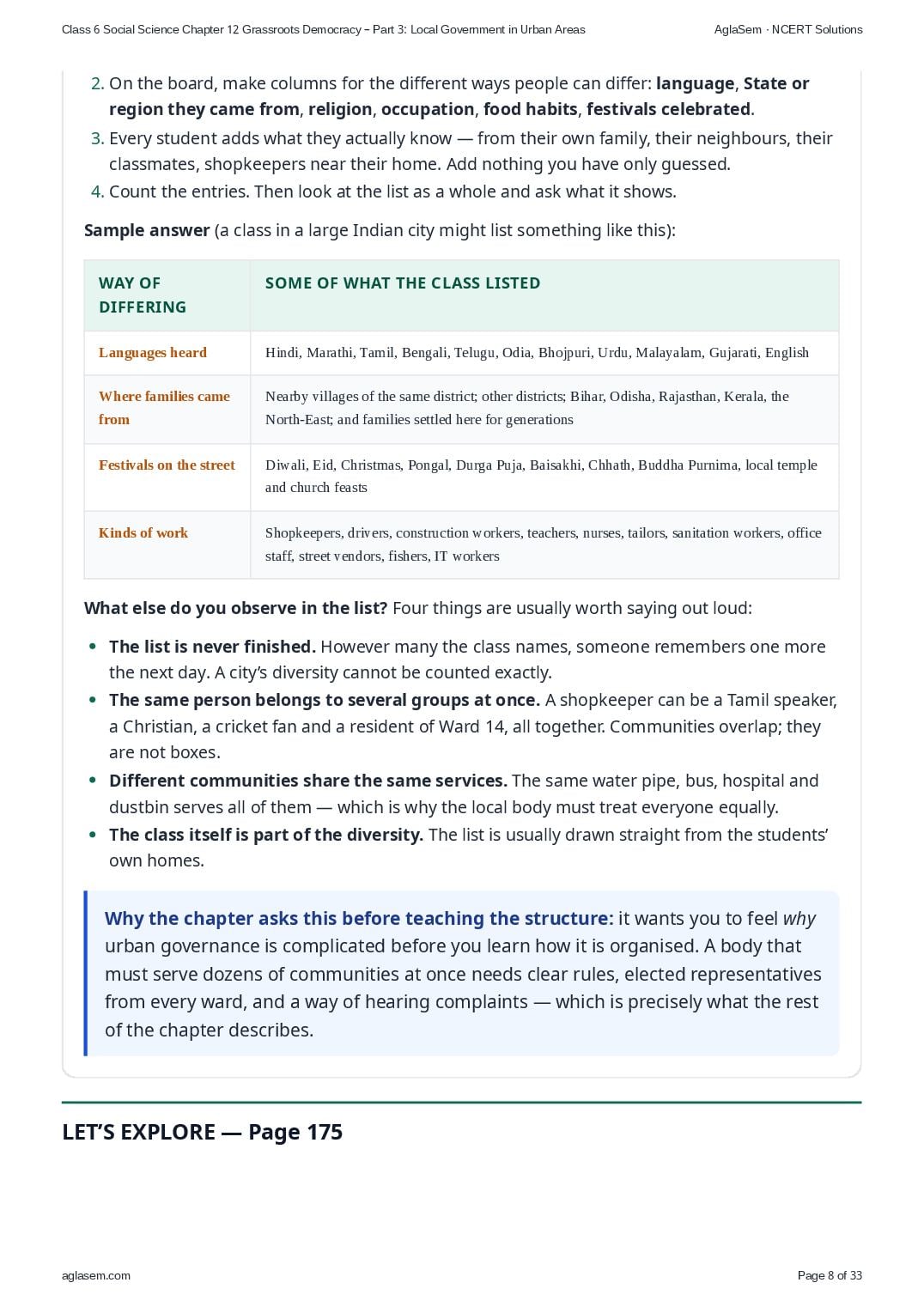
- With your classmates, make a list of diverse communities residing in any city that you are familiar with. How many were you able to list? What else do you observe in the list?
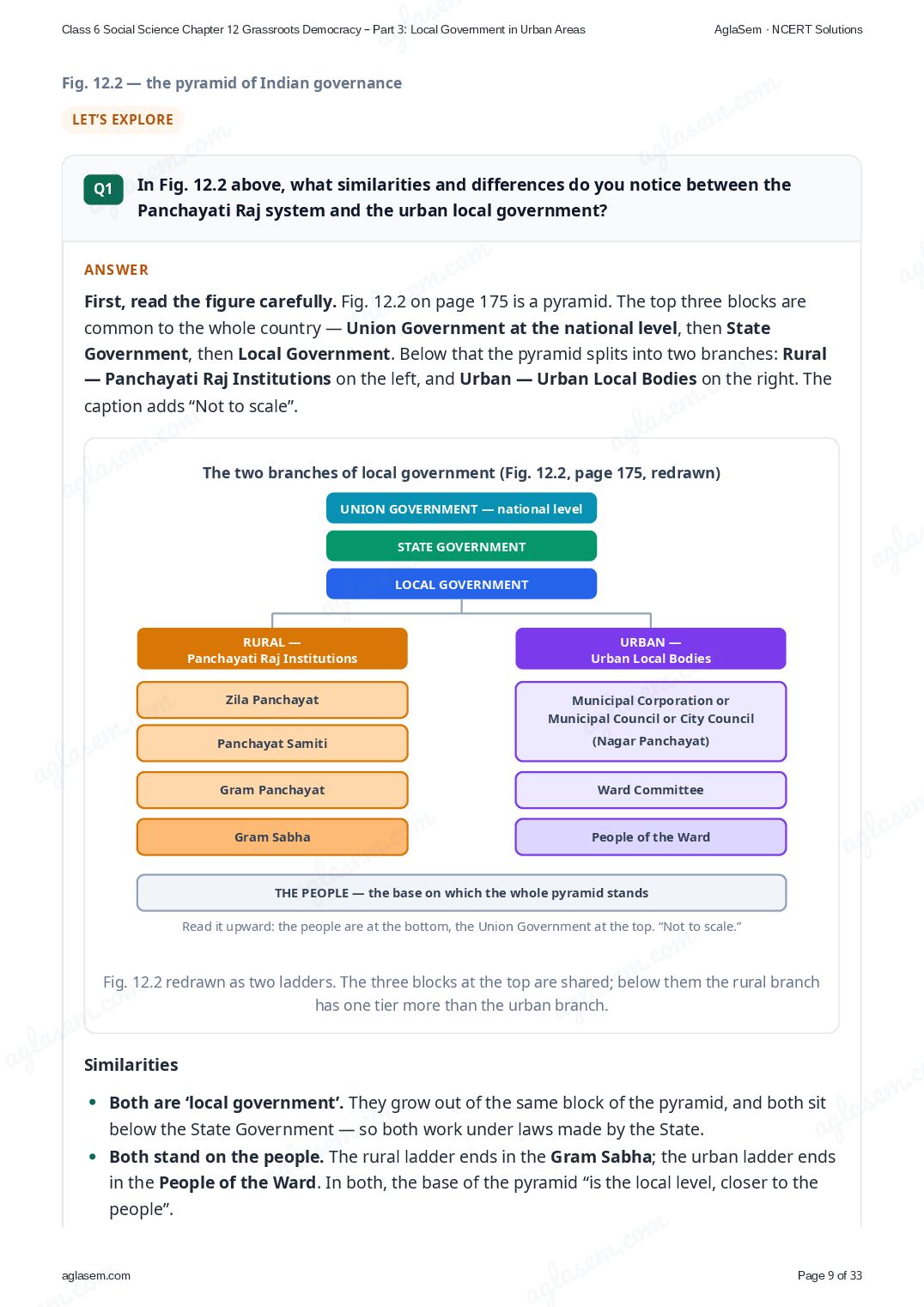
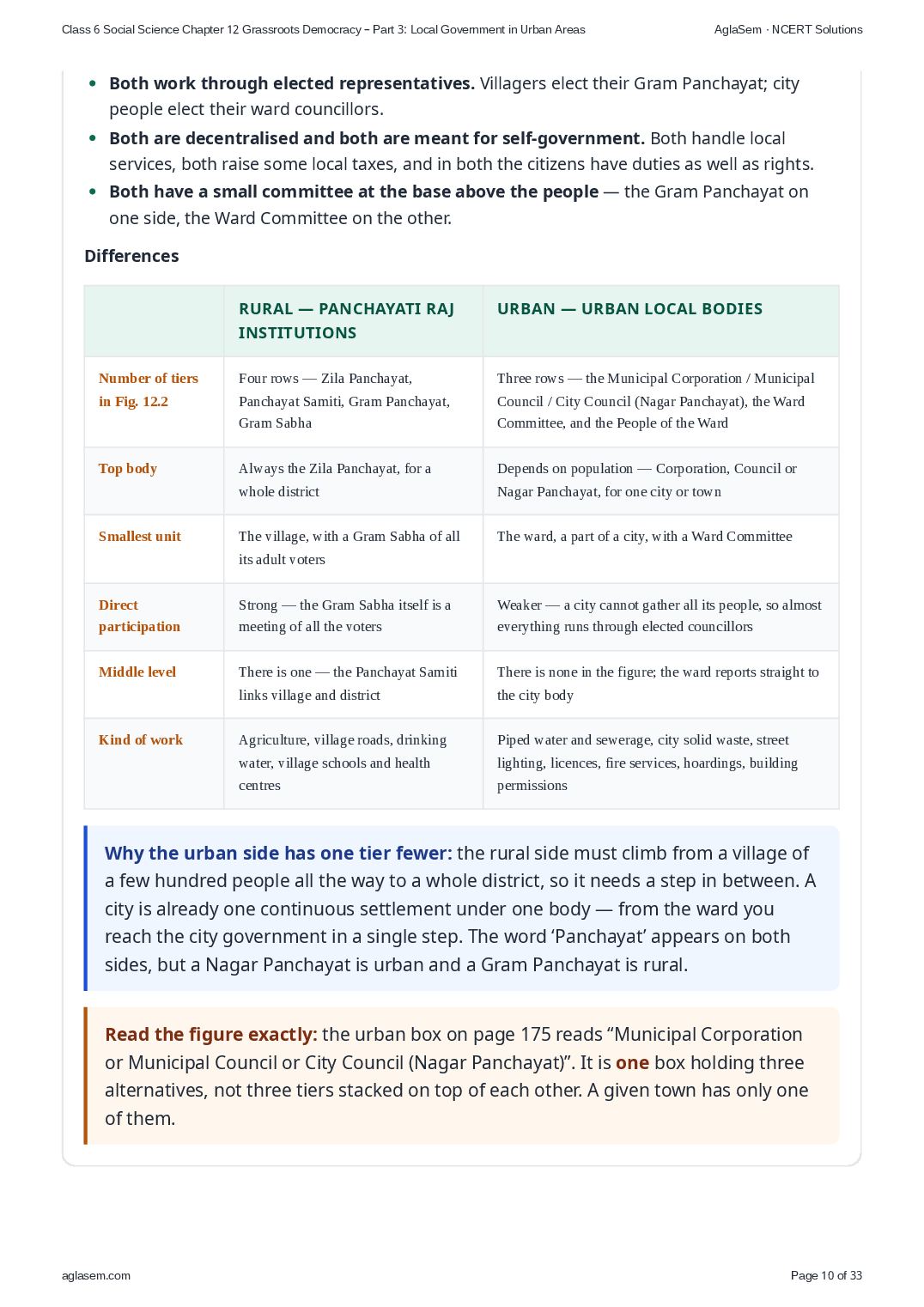
- In Fig. 12.2 above, what similarities and differences do you notice between the Panchayati Raj system and the urban local government?
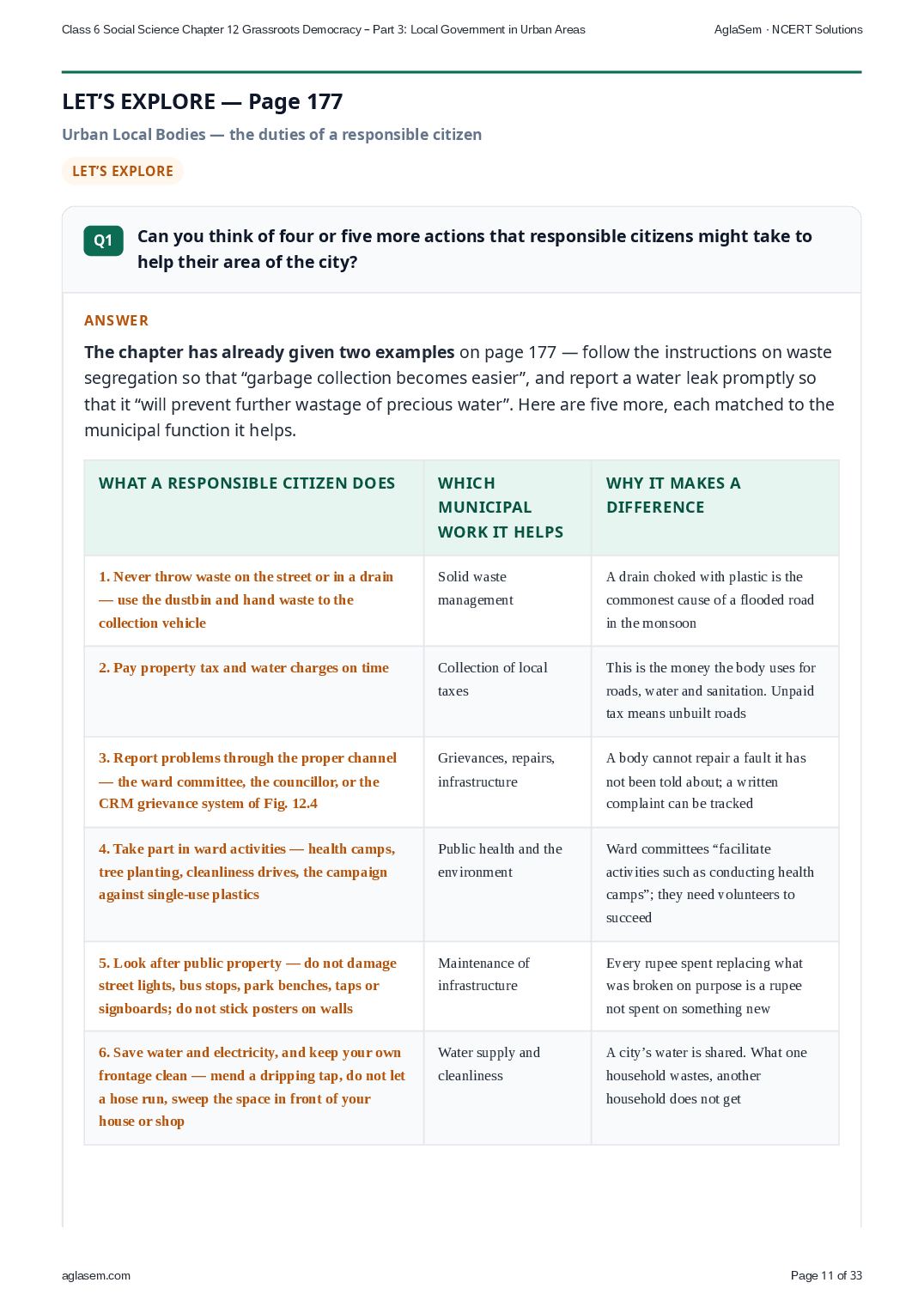
- Can you think of four or five more actions that responsible citizens might take to help their area of the city?
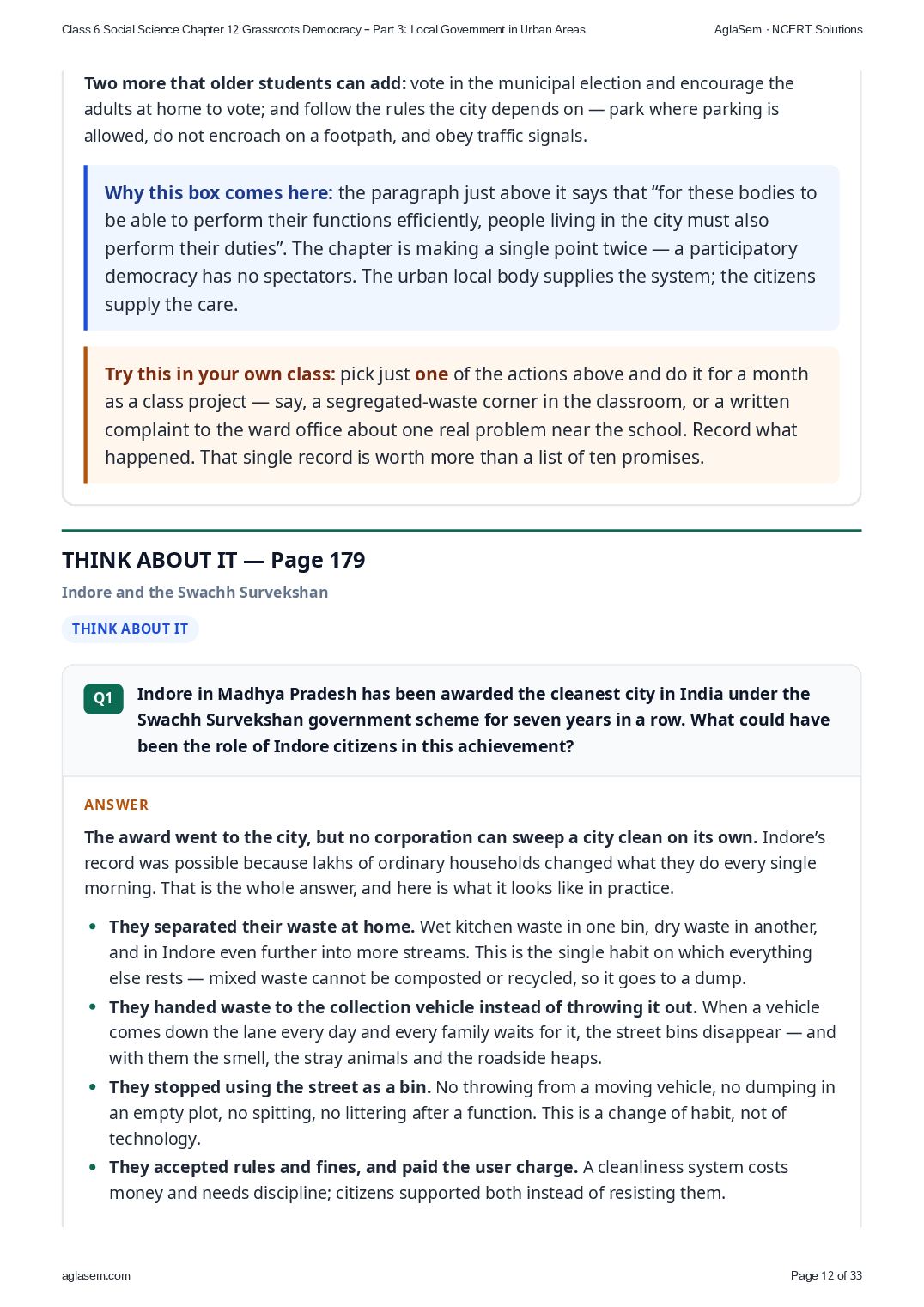
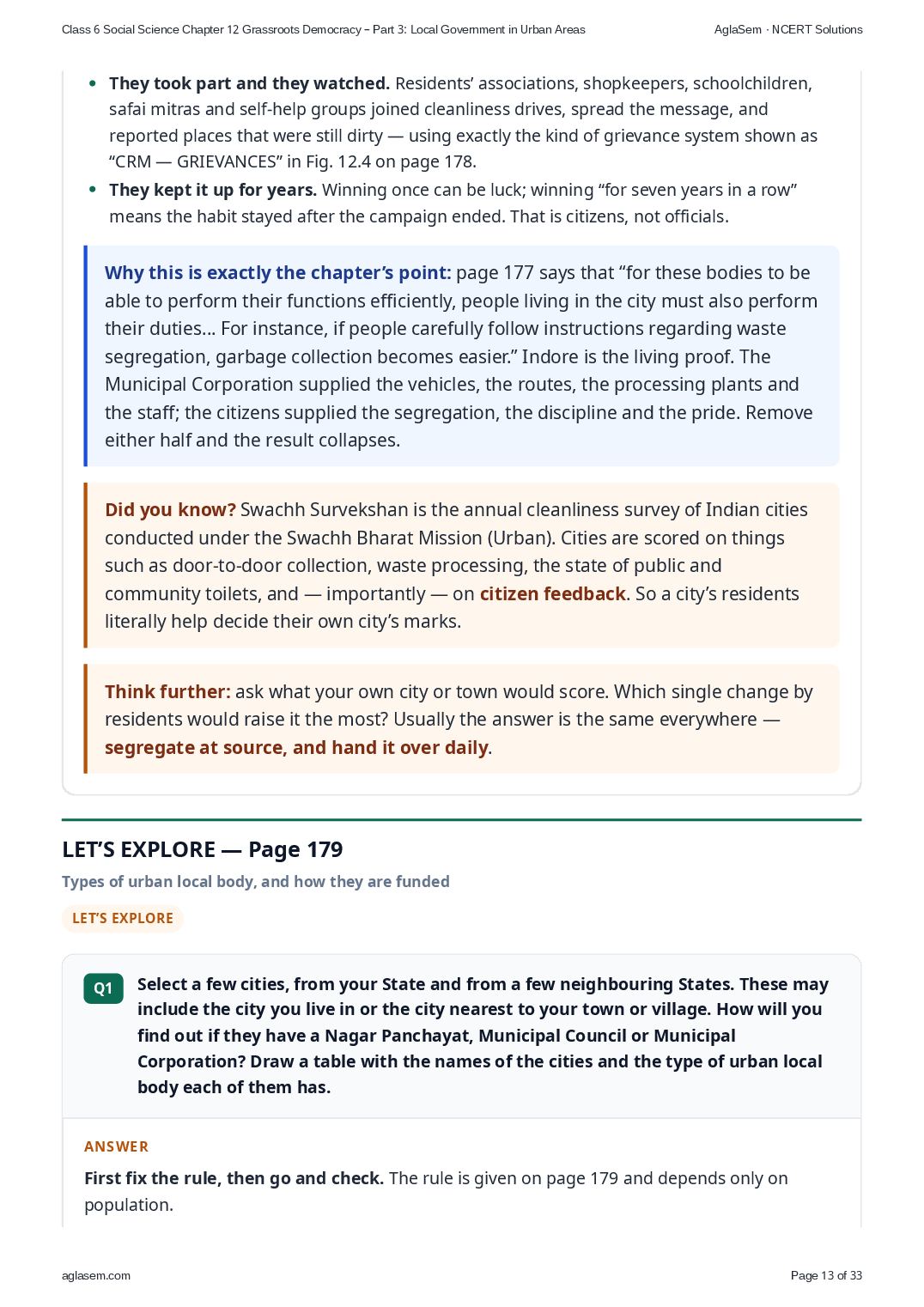
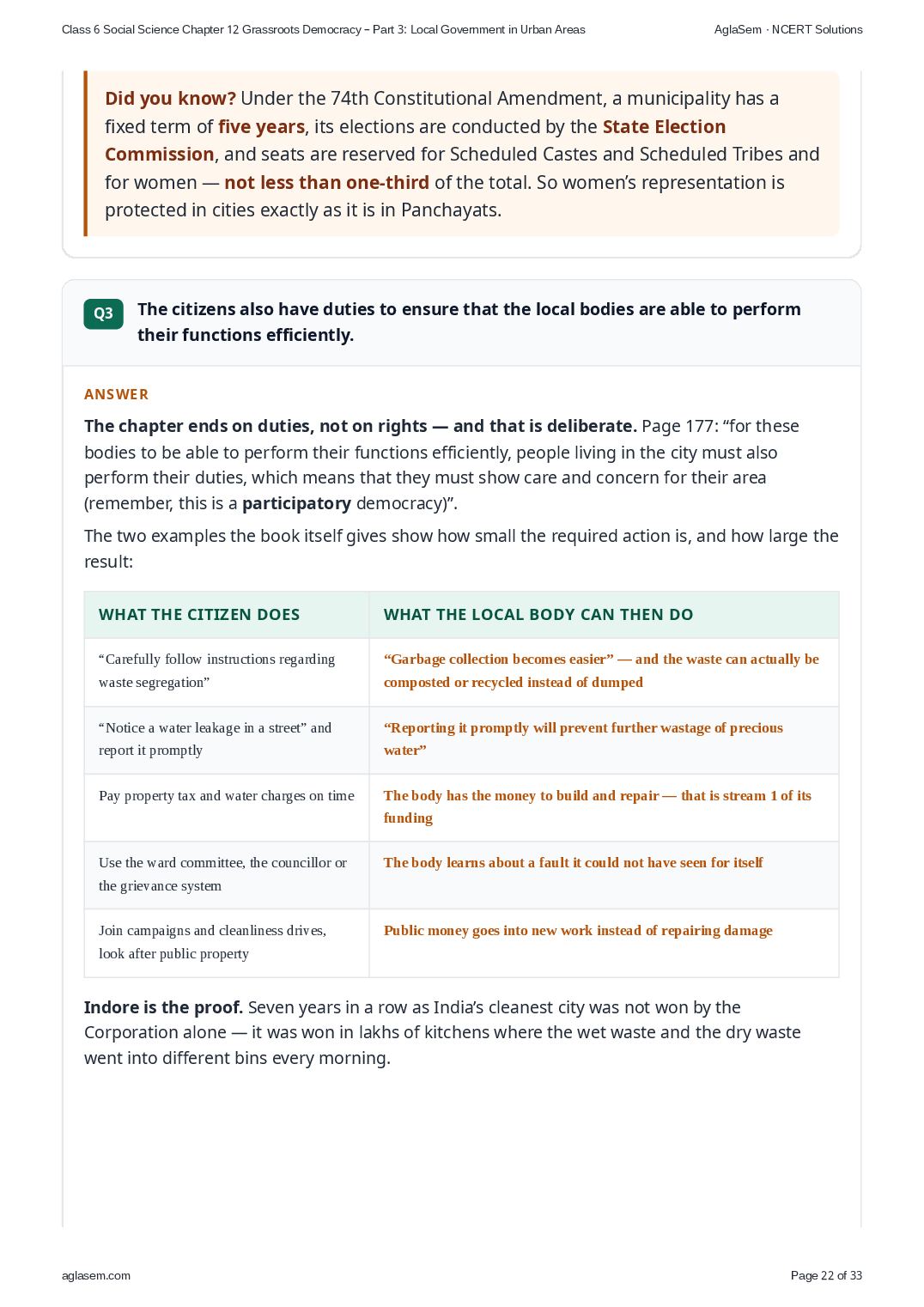
- Indore in Madhya Pradesh has been awarded the cleanest city in India under the Swachh Survekshan government scheme for seven years in a row. What could have been the role of Indore citizens in this achievement?
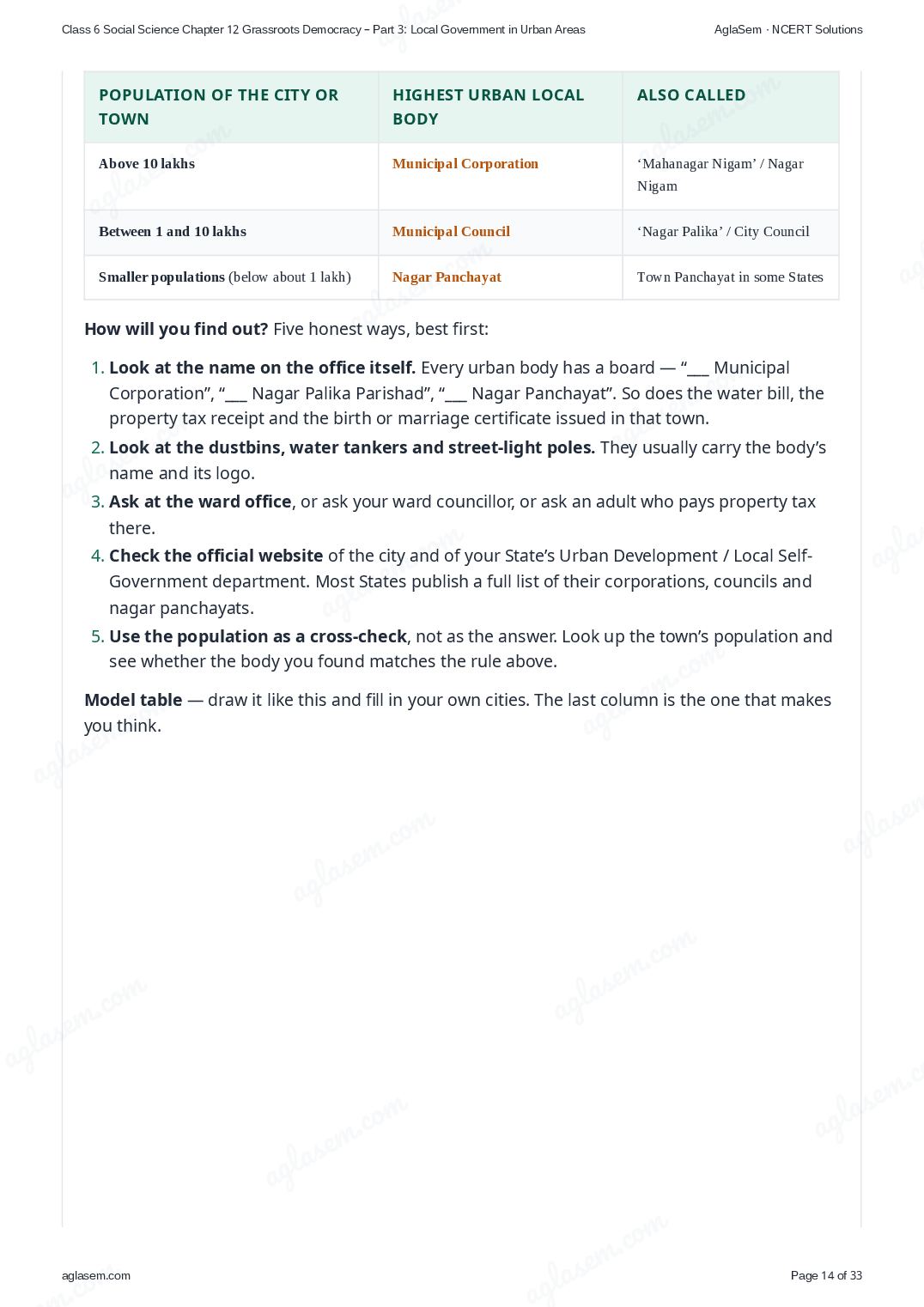
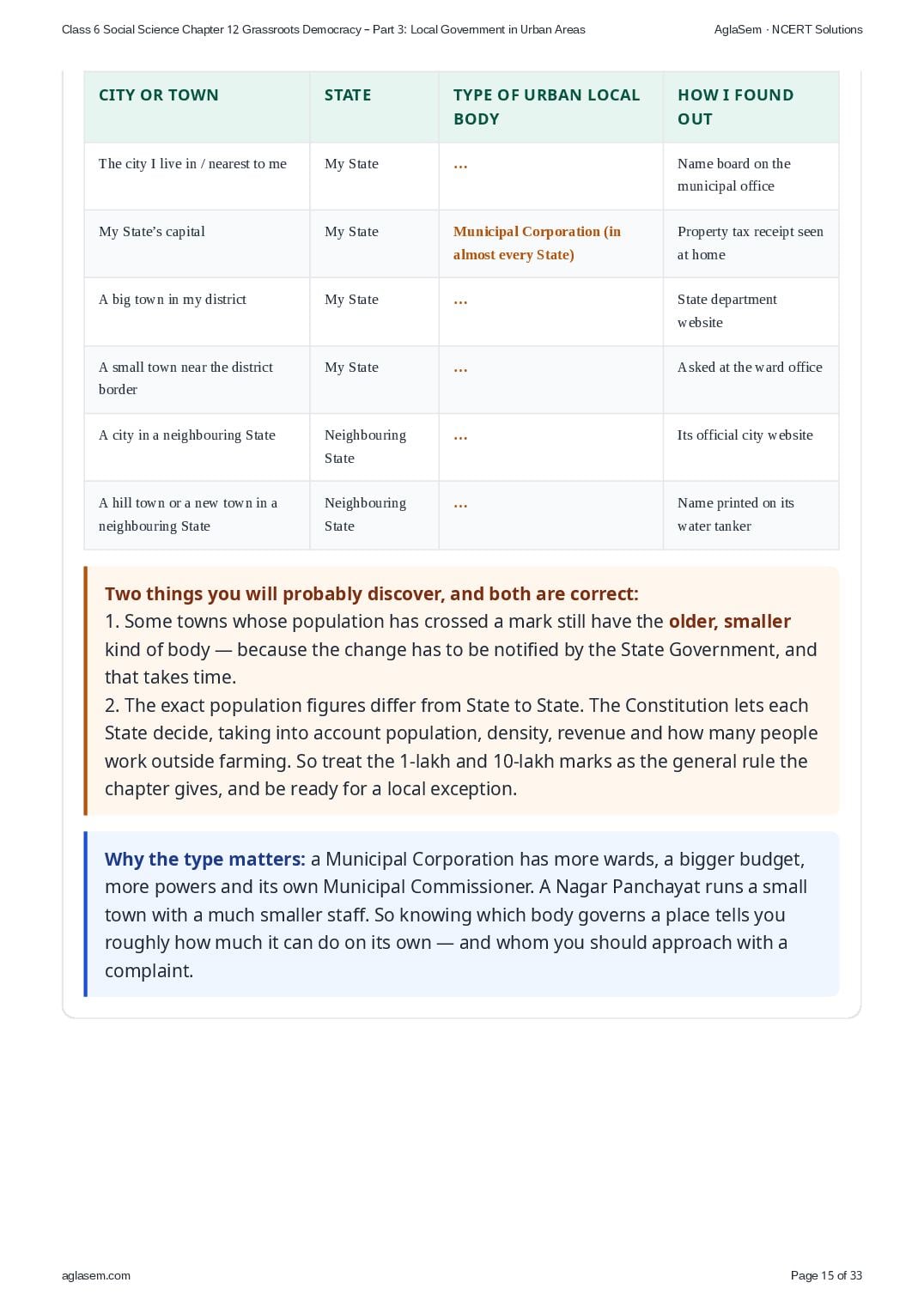
- Select a few cities, from your State and from a few neighbouring States. These may include the city you live in or the city nearest to your town or village. How will you find out if they have a Nagar Panchayat, Municipal Council or Municipal Corporation? Draw a table with the names of the cities and the type of urban local body each of them has.
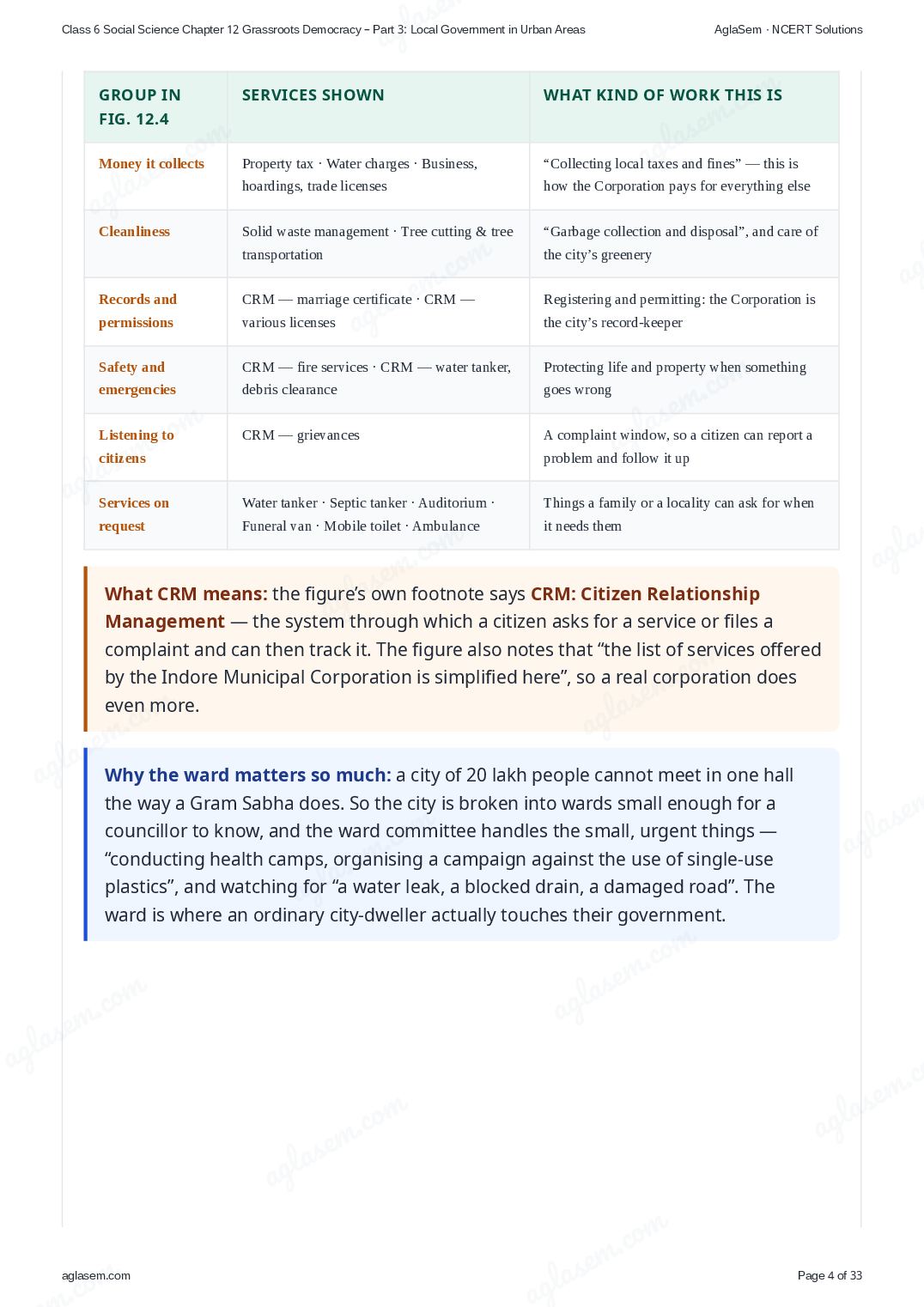
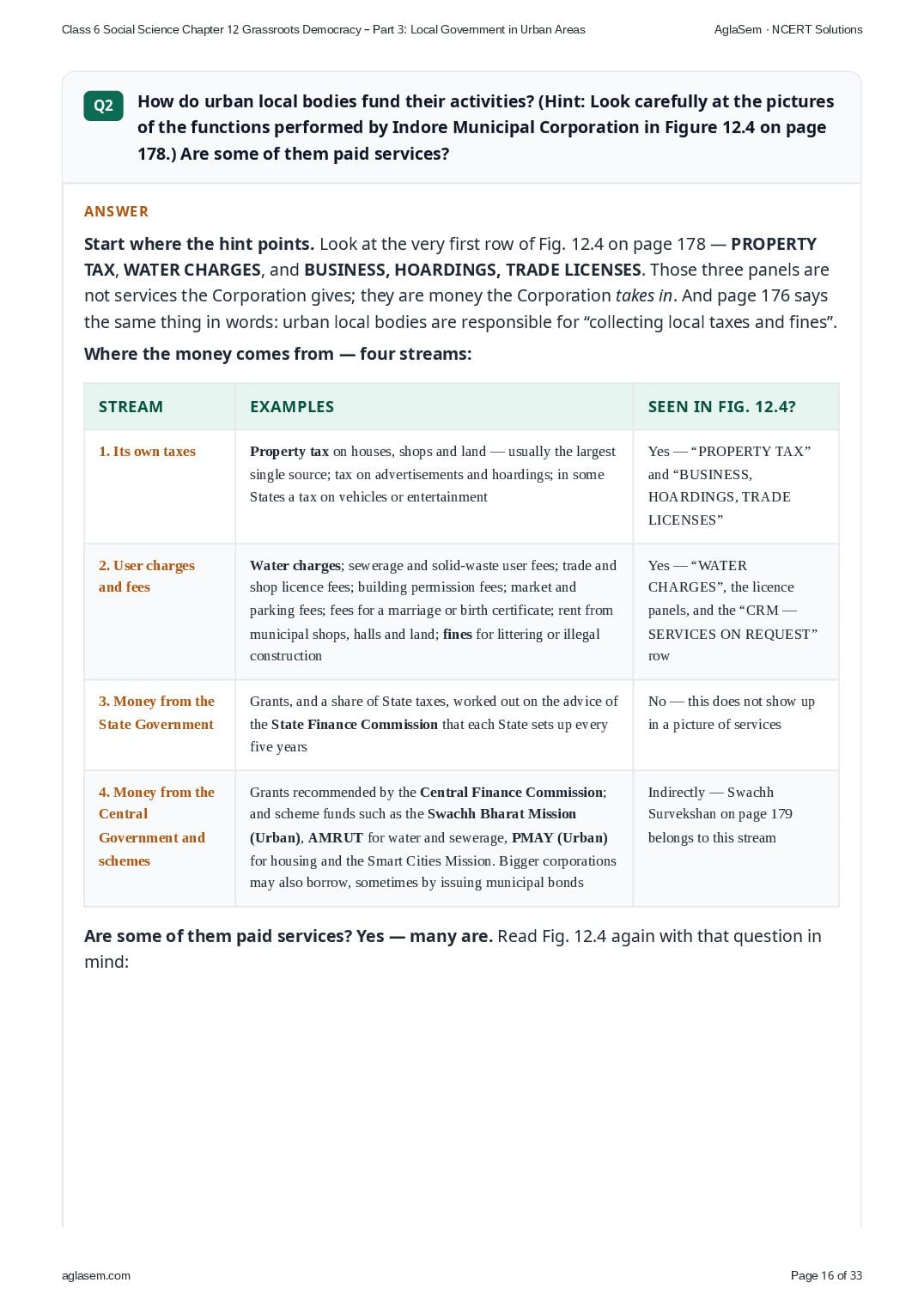
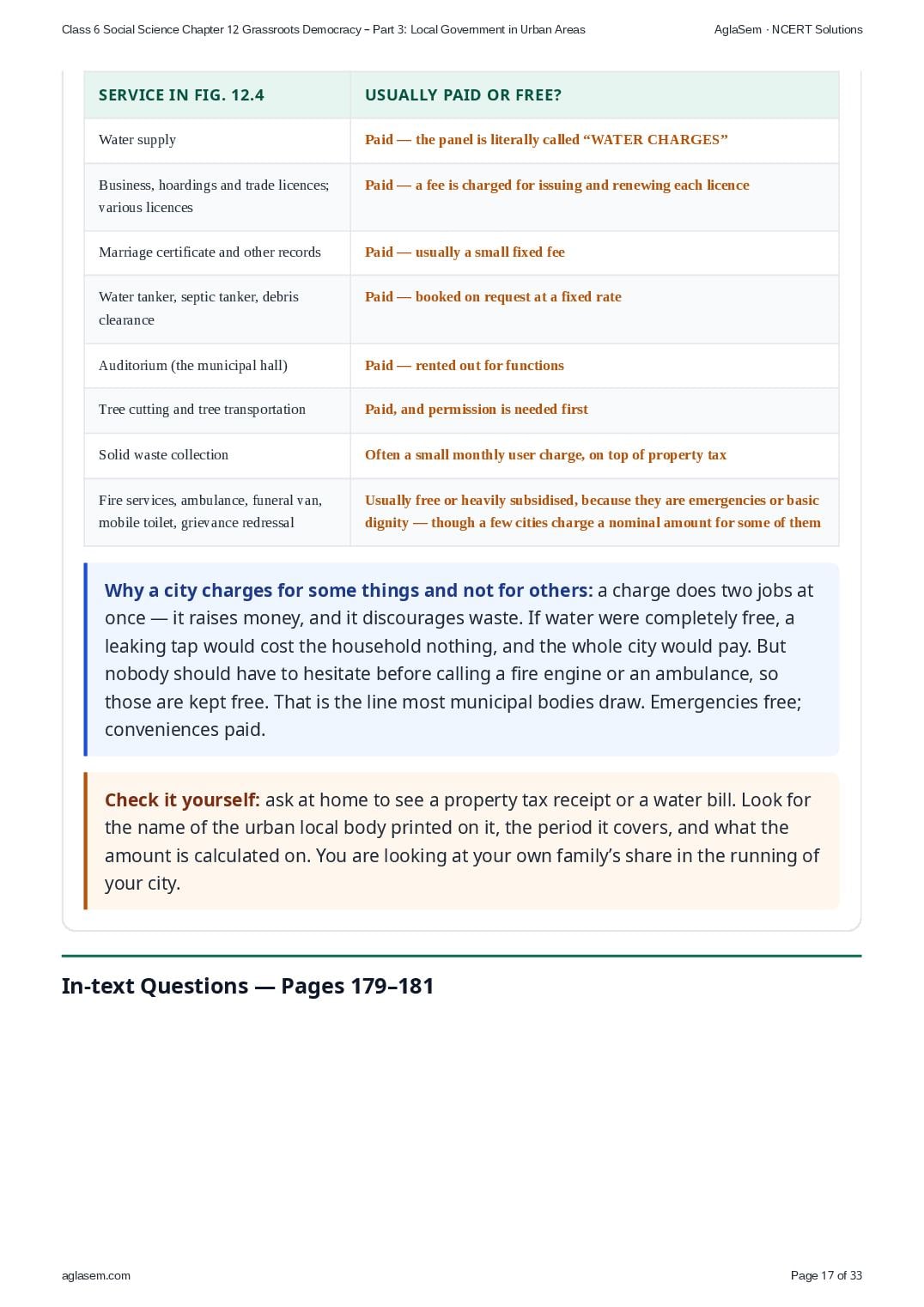
- How do urban local bodies fund their activities? (Hint: Look carefully at the pictures of the functions performed by Indore Municipal Corporation in Figure 12.4 on page 178.) Are some of them paid services?
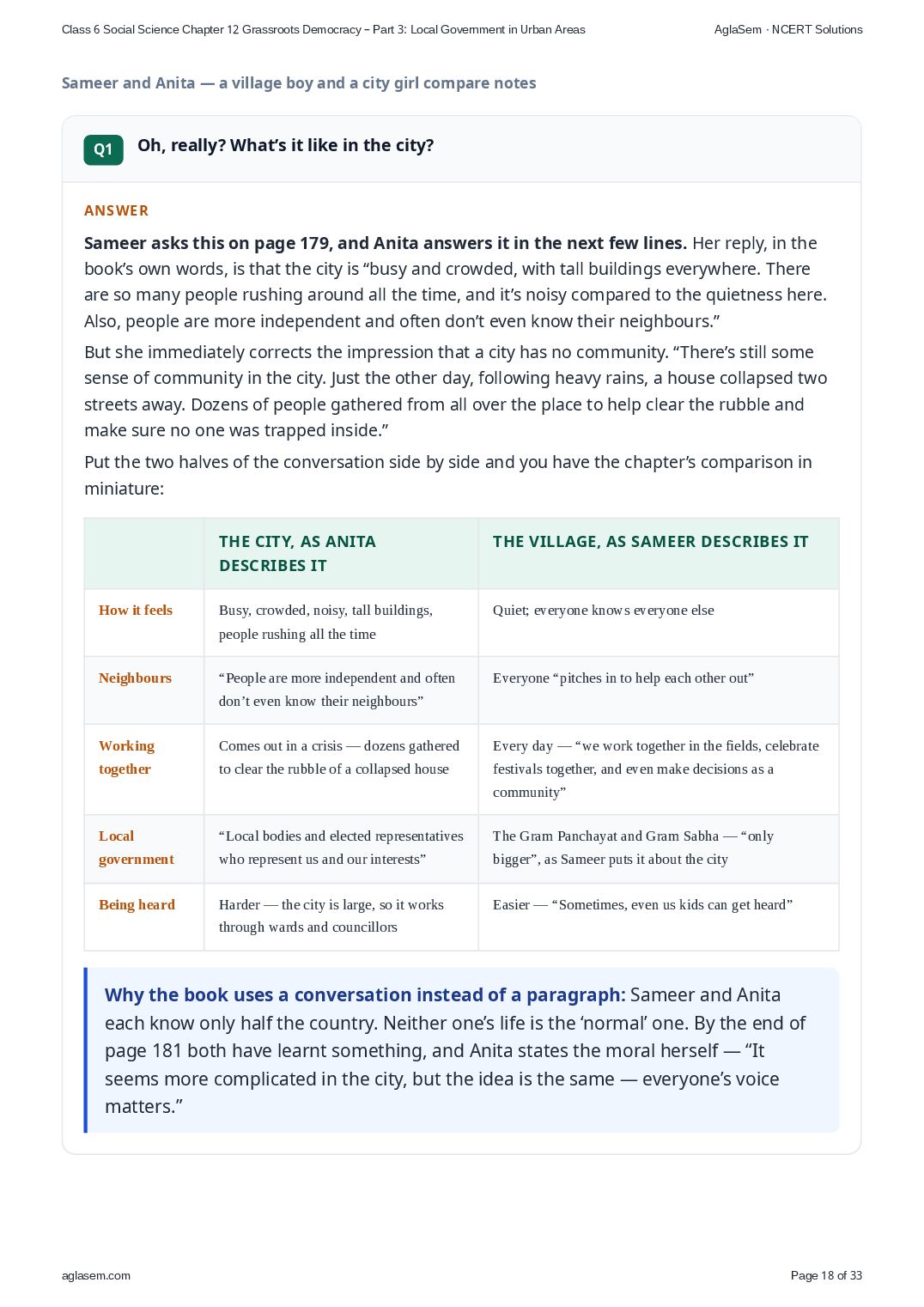
- Oh, really? What’s it like in the city?
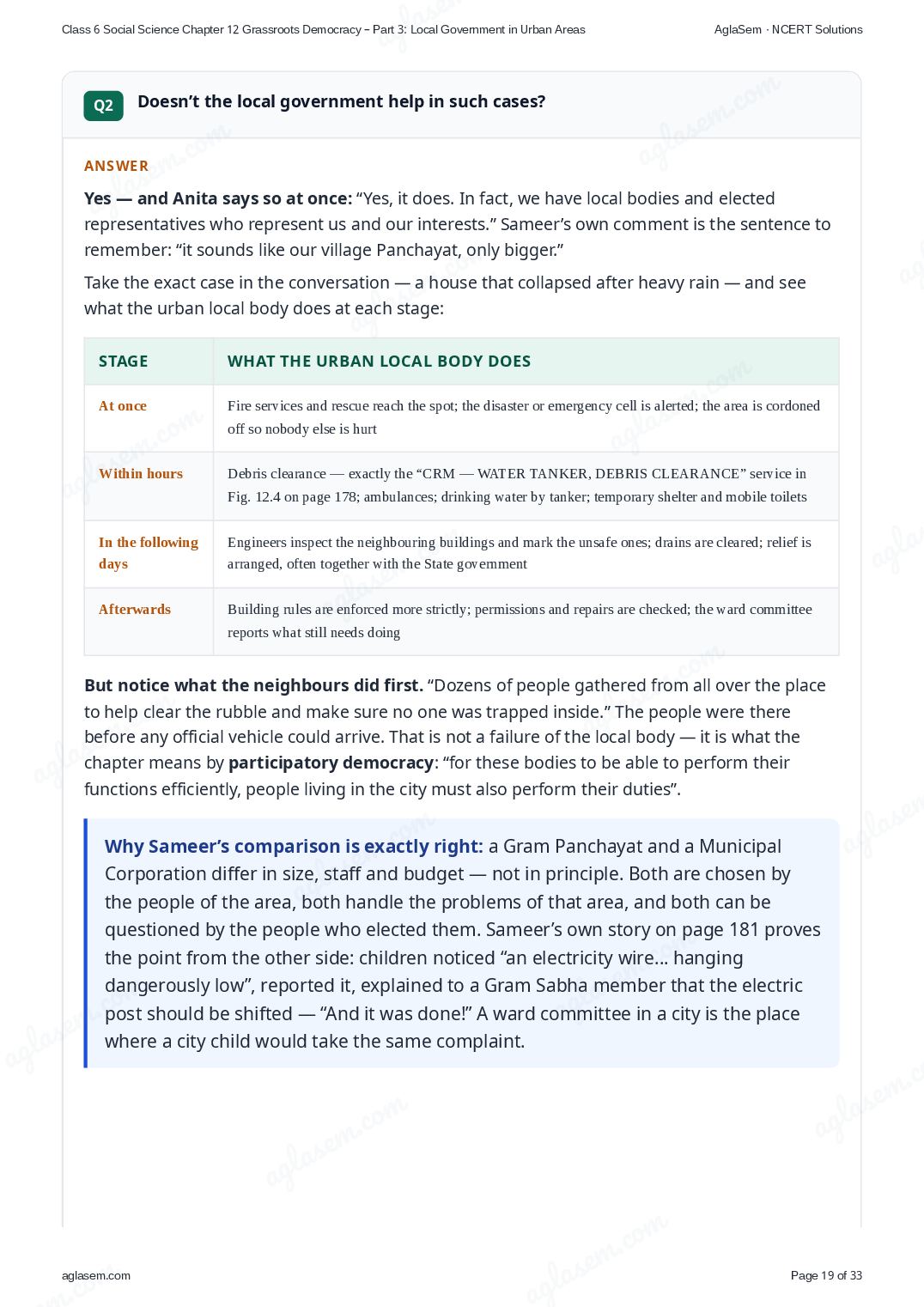
- Doesn’t the local government help in such cases?
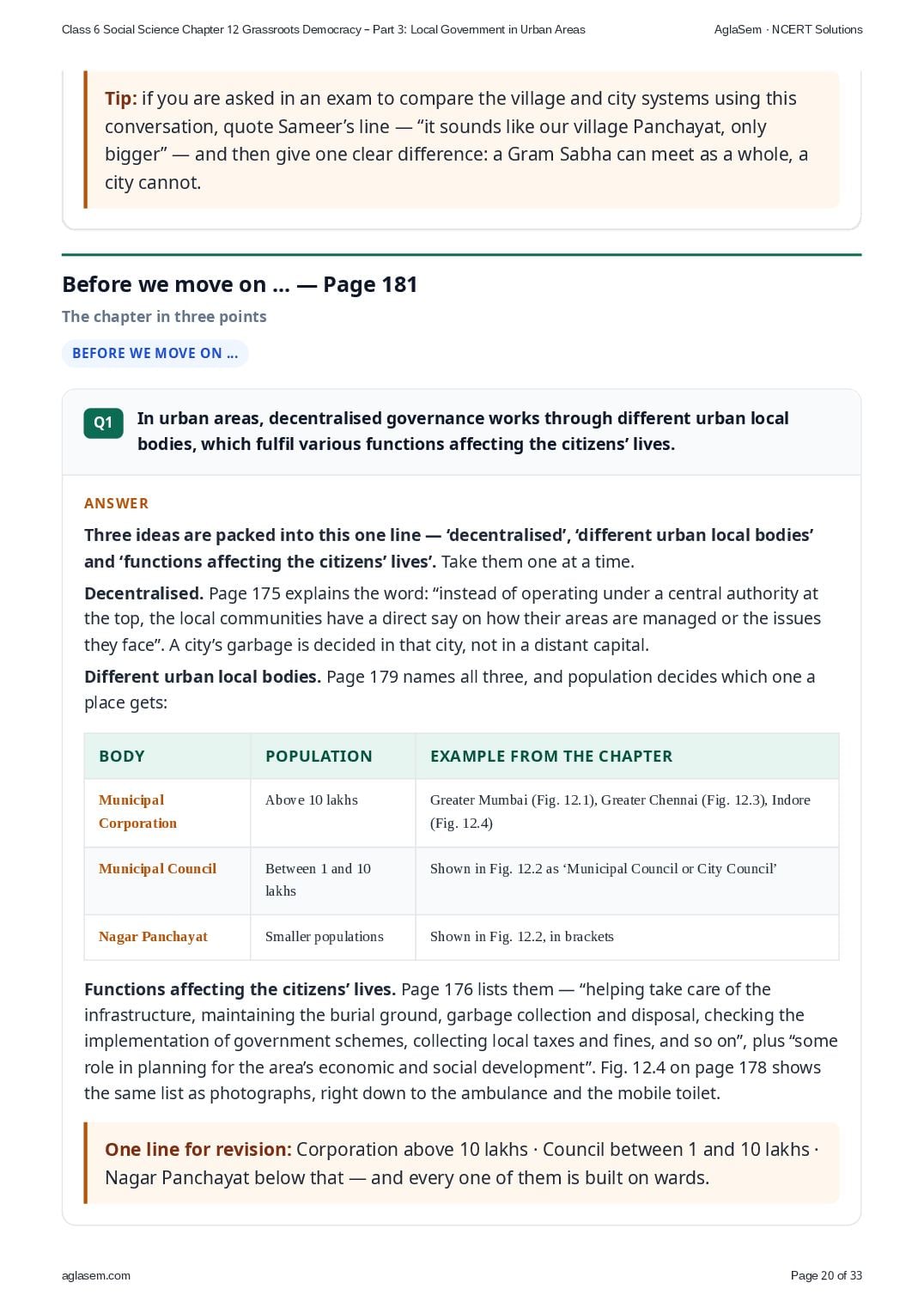
- In urban areas, decentralised governance works through different urban local bodies, which fulfil various functions affecting the citizens’ lives.
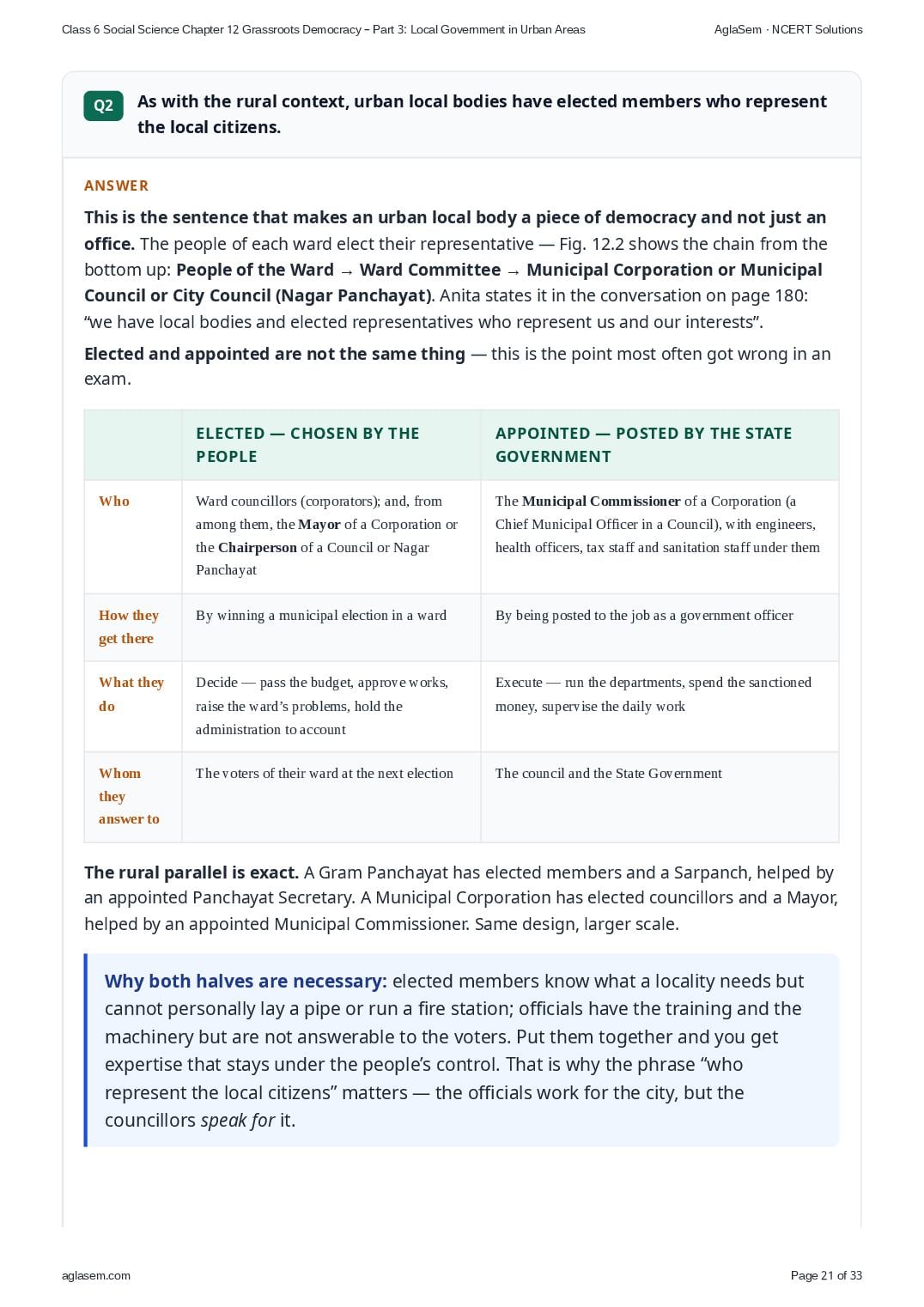
- As with the rural context, urban local bodies have elected members who represent the local citizens.
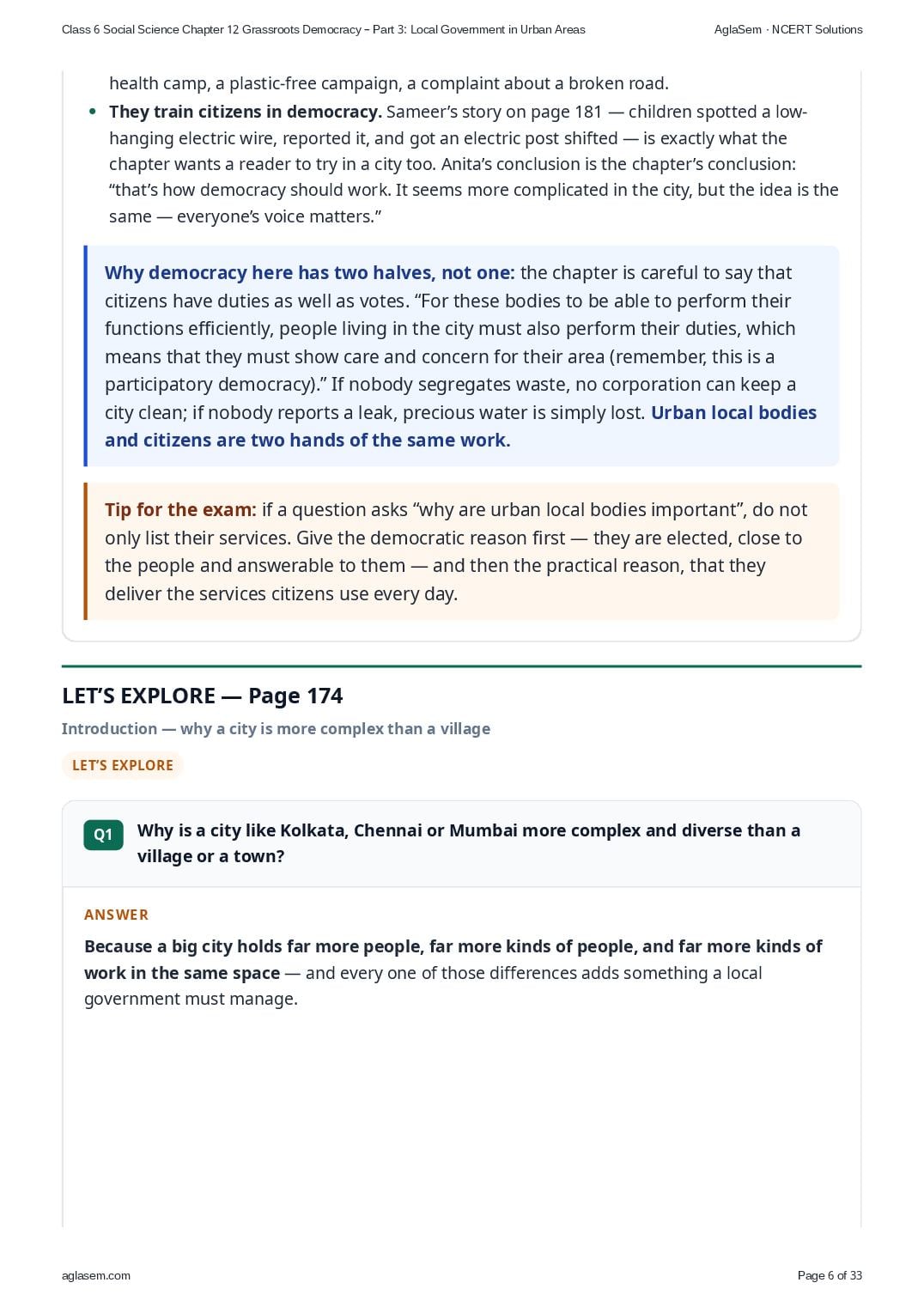
- The citizens also have duties to ensure that the local bodies are able to perform their functions efficiently.
- On your way to school, you and your friends notice that a water pipe is leaking. A lot of water is being wasted on account of the leak. What would you and your friends do in such a situation?
- Invite a member of an urban local body near you to your class. Discuss with them their role and responsibilities. Prepare a set of questions to ask them so that the meeting is fruitful.
- Discuss with adult members of your family and neighbourhood, and make a list of their expectations from the urban local bodies.
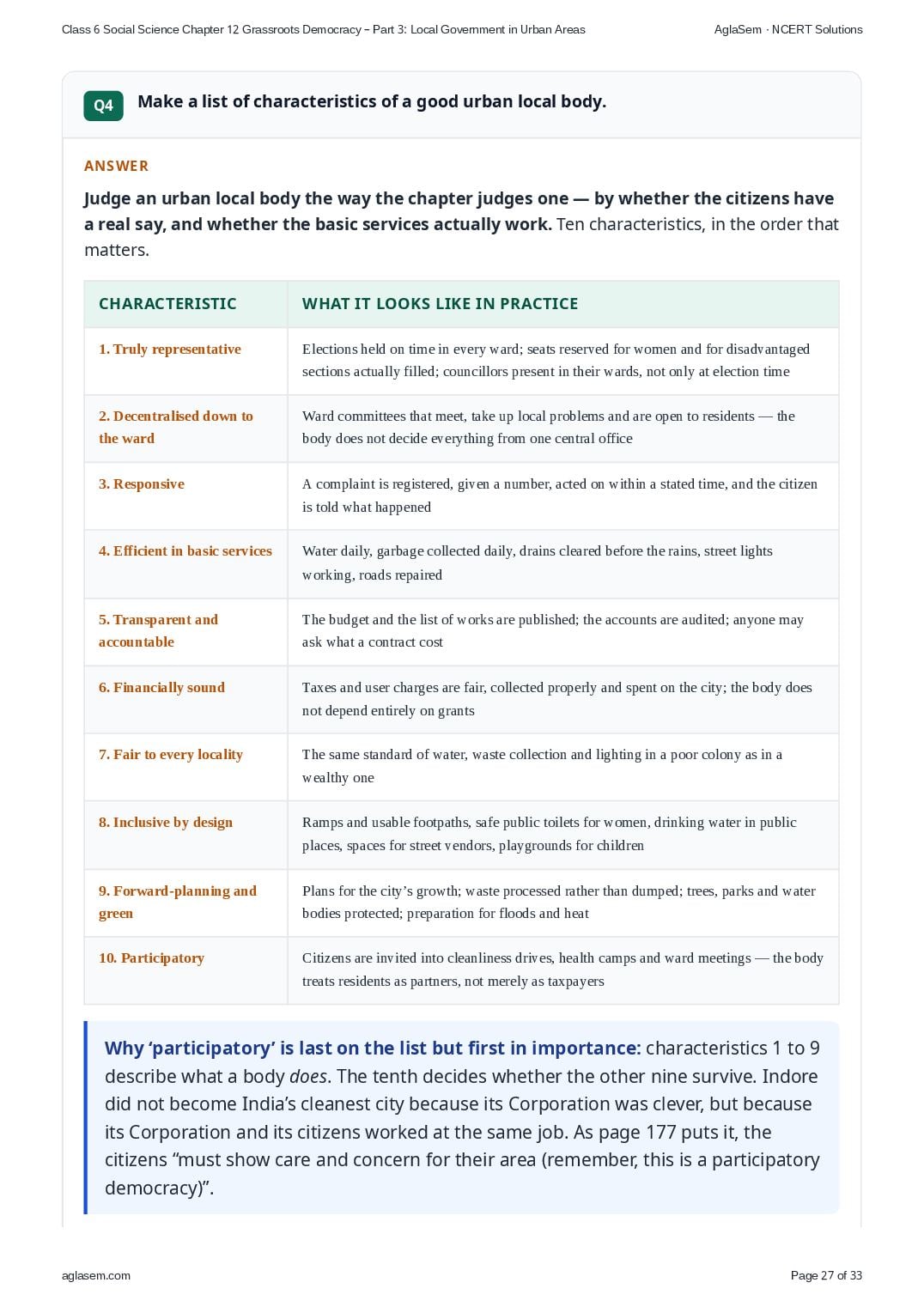
- Make a list of characteristics of a good urban local body.
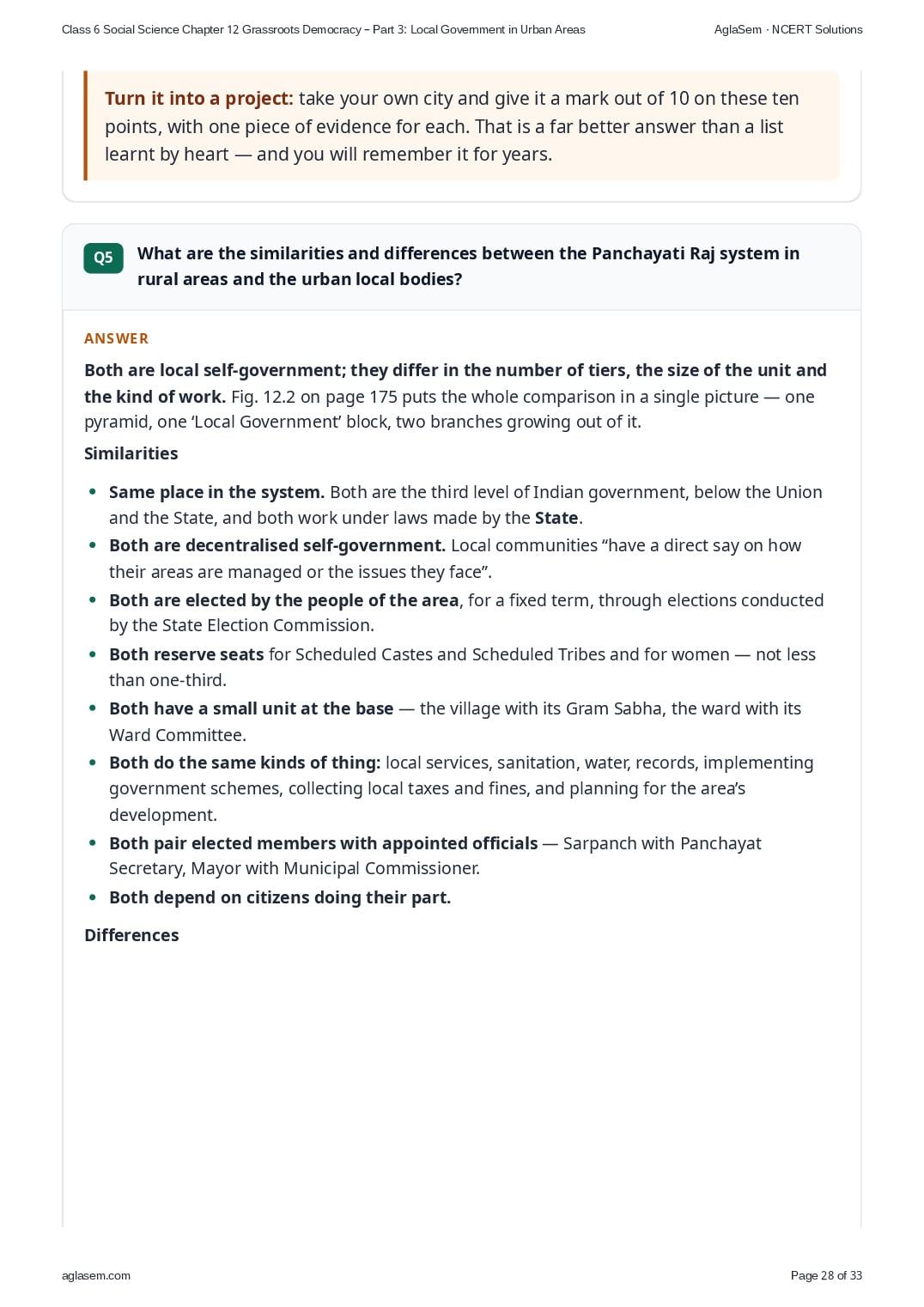
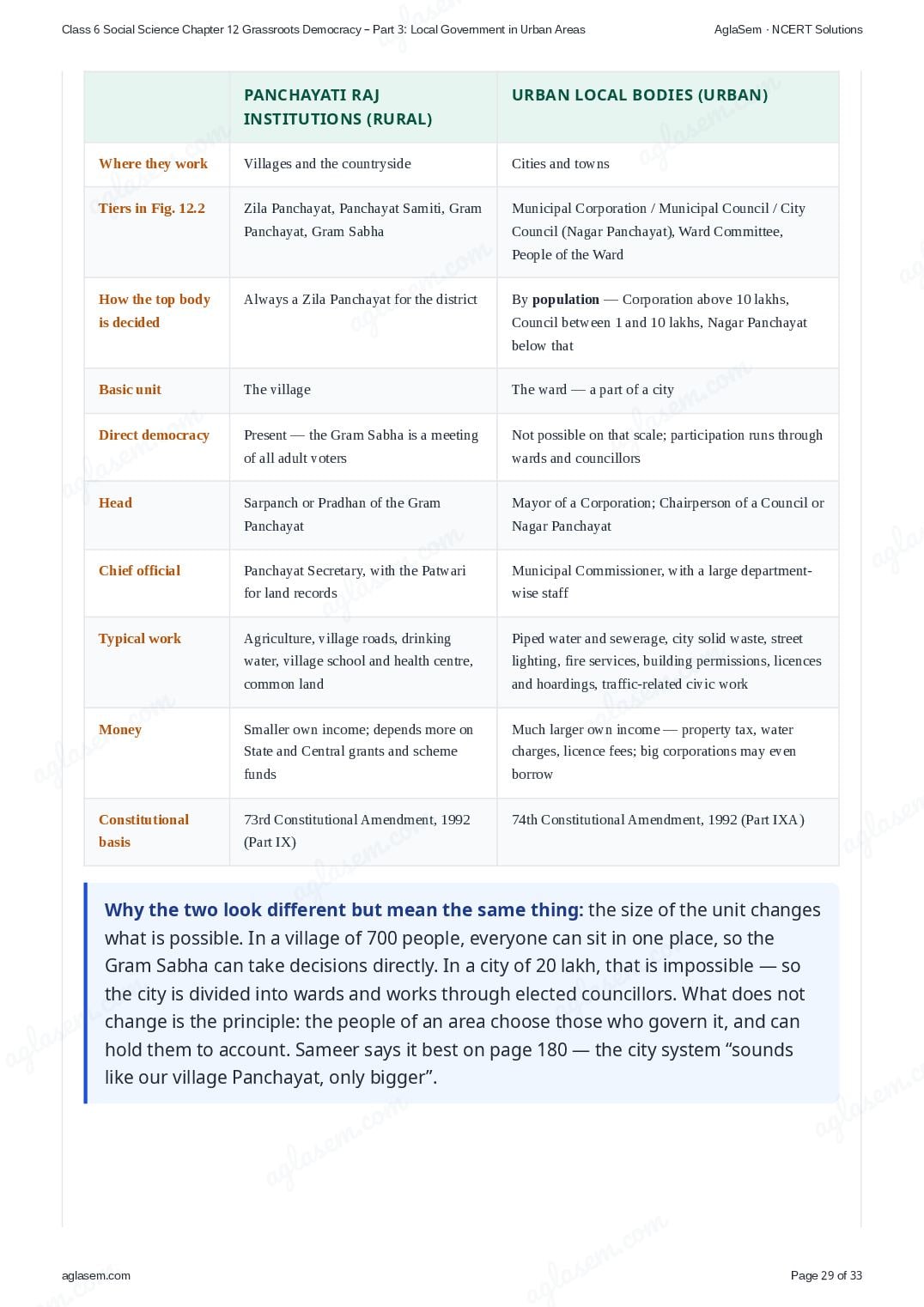
- What are the similarities and differences between the Panchayati Raj system in rural areas and the urban local bodies?
Chapter at a Glance
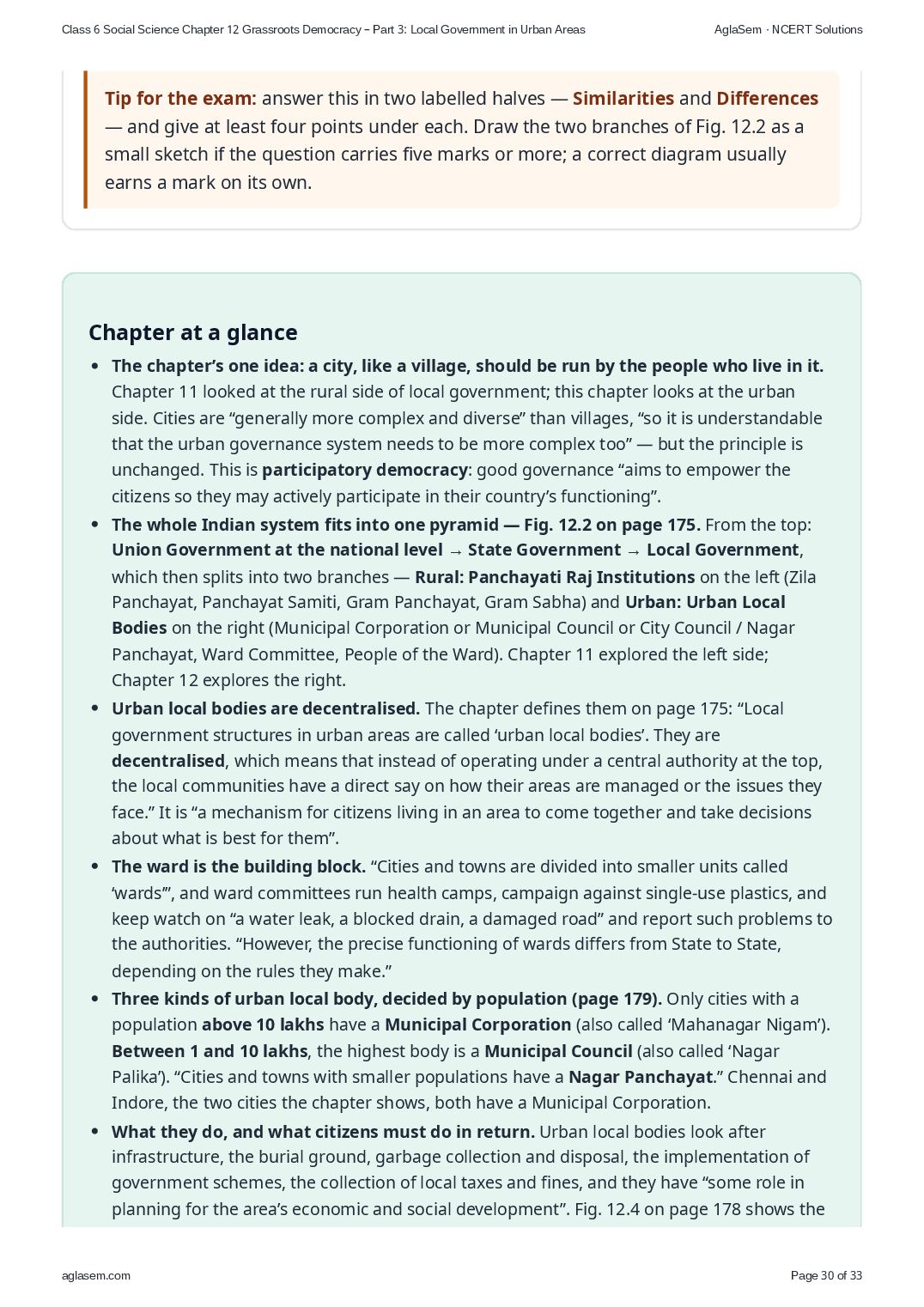
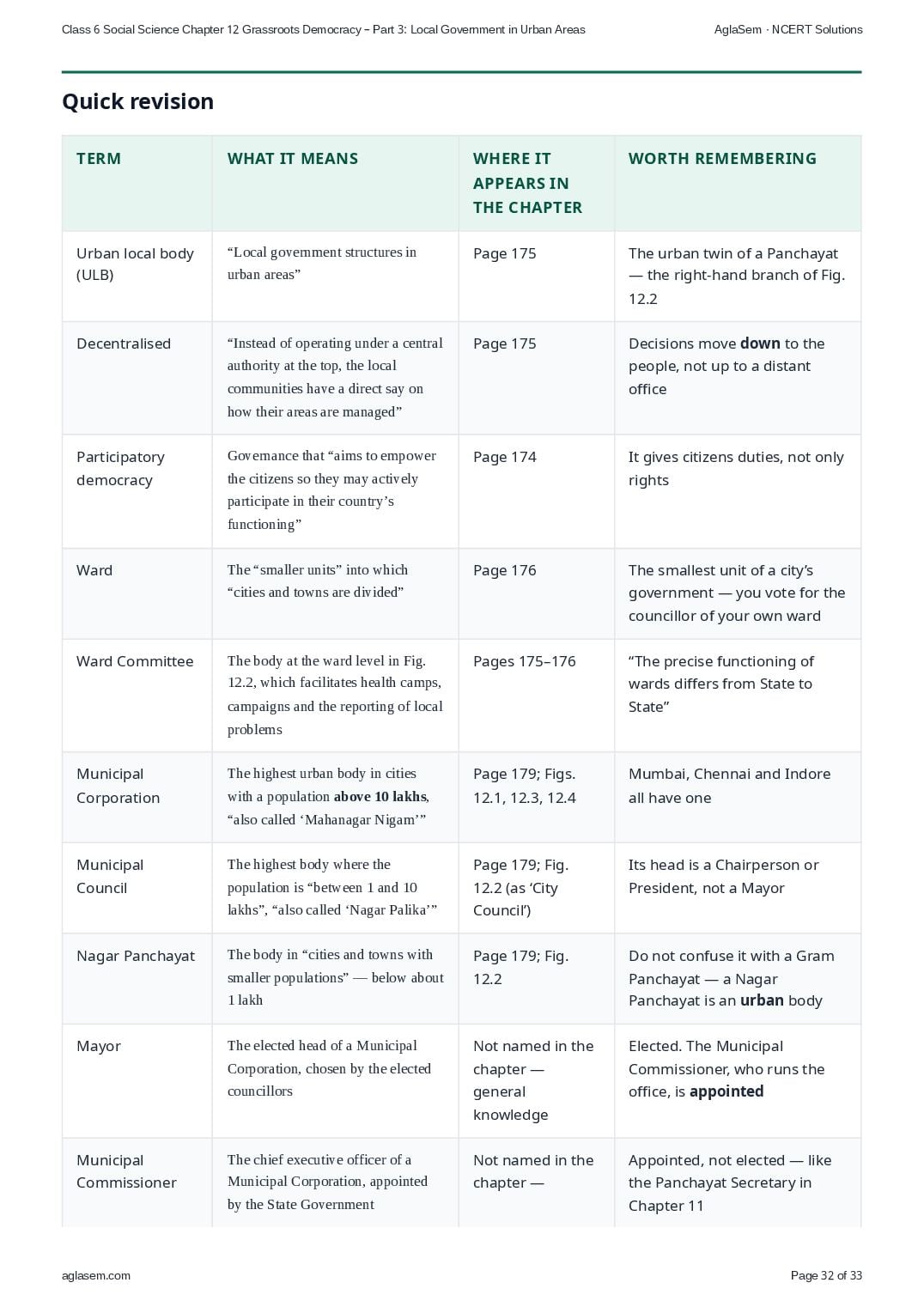
- The chapter’s one idea: a city, like a village, should be run by the people who live in it. Chapter 11 looked at the rural side of local government; this chapter looks at the urban side. Cities are “generally more complex and diverse” than villages, “so it is understandable that the urban governance system needs to be more complex too” — but the principle is unchanged. This is participatory democracy : good governance “aims to empower the citizens so they may actively participate in their country’s functioning”.
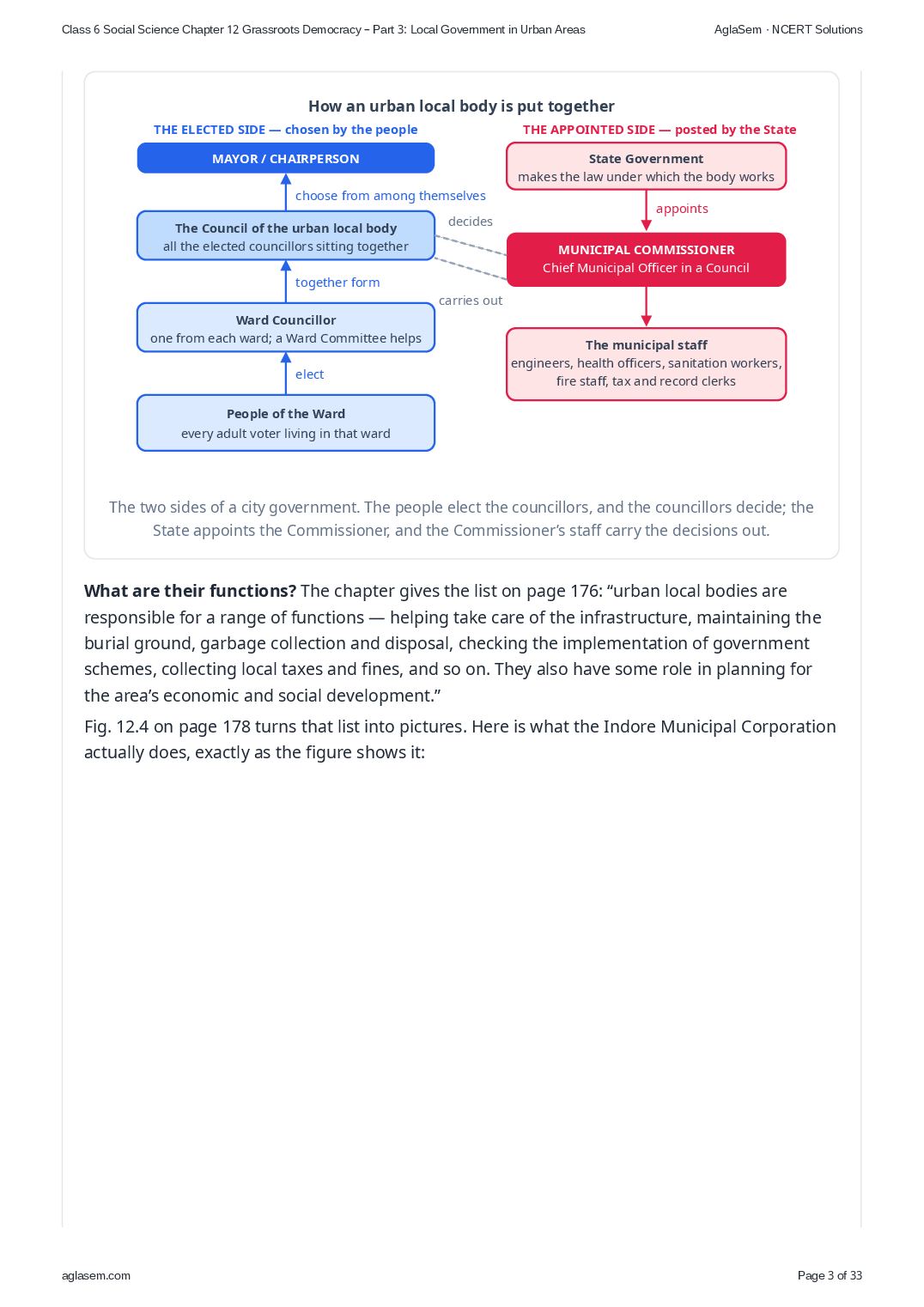
- The whole Indian system fits into one pyramid — Fig. 12.2 on page 175. From the top: Union Government at the national level → State Government → Local Government , which then splits into two branches — Rural: Panchayati Raj Institutions on the left (Zila Panchayat, Panchayat Samiti, Gram Panchayat, Gram Sabha) and Urban: Urban Local Bodies on the right (Municipal Corporation or Municipal Council or City Council / Nagar Panchayat, Ward Committee, People of the Ward). Chapter 11 explored the left side; Chapter 12 explores the right.
- Urban local bodies are decentralised. The chapter defines them on page 175: “Local government structures in urban areas are called ‘urban local bodies’. They are decentralised , which means that instead of operating under a central authority at the top, the local communities have a direct say on how their areas are managed or the issues they face.” It is “a mechanism for citizens living in an area to come together and take decisions about what is best for them”.
- The ward is the building block. “Cities and towns are divided into smaller units called ‘wards’”, and ward committees run health camps, campaign against single-use plastics, and keep watch on “a water leak, a blocked drain, a damaged road” and report such problems to the authorities. “However, the precise functioning of wards differs from State to State, depending on the rules they make.”
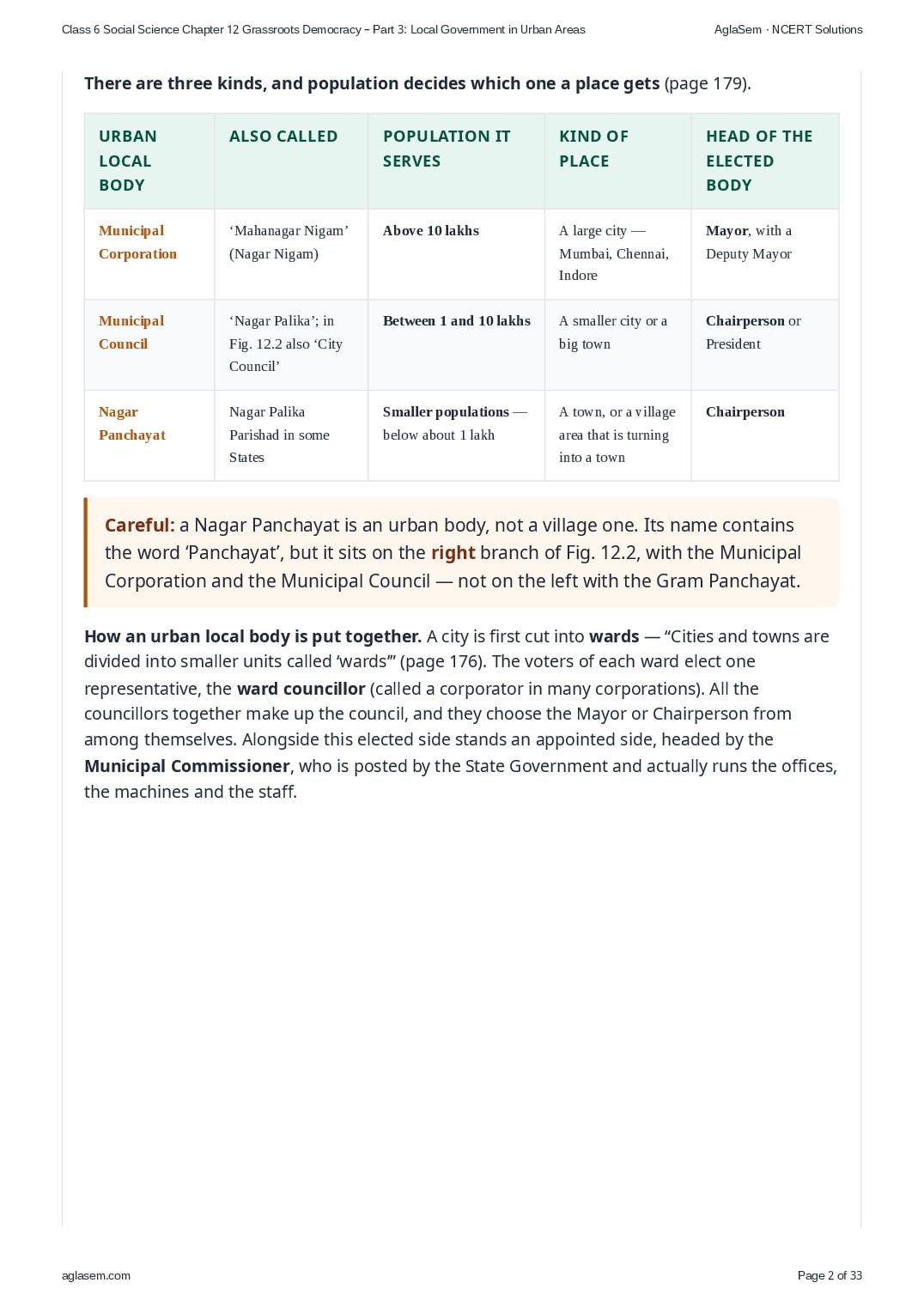
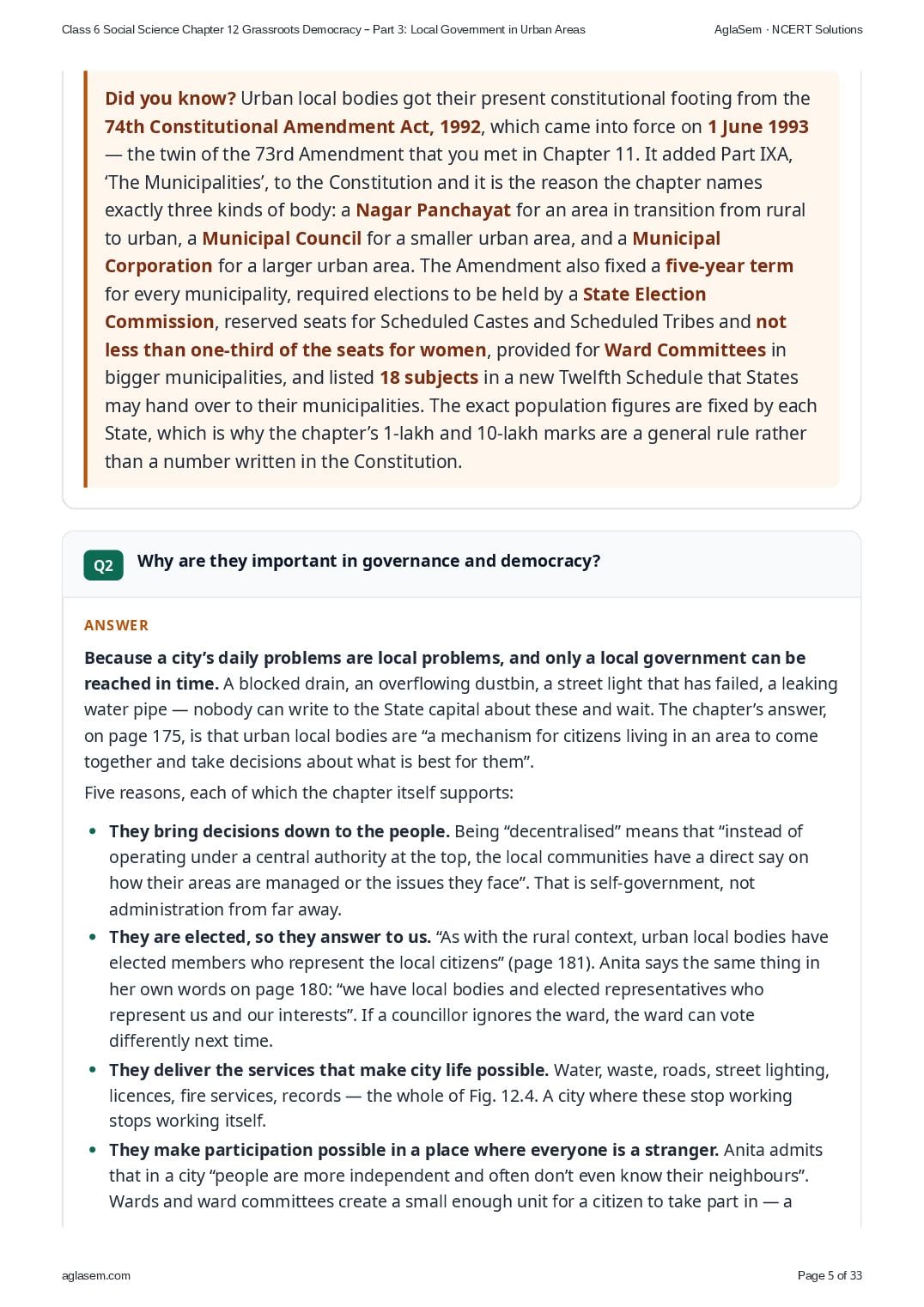
- Three kinds of urban local body, decided by population (page 179). Only cities with a population above 10 lakhs have a Municipal Corporation (also called ‘Mahanagar Nigam’). Between 1 and 10 lakhs , the highest body is a Municipal Council (also called ‘Nagar Palika’). “Cities and towns with smaller populations have a Nagar Panchayat .” Chennai and Indore, the two cities the chapter shows, both have a Municipal Corporation.
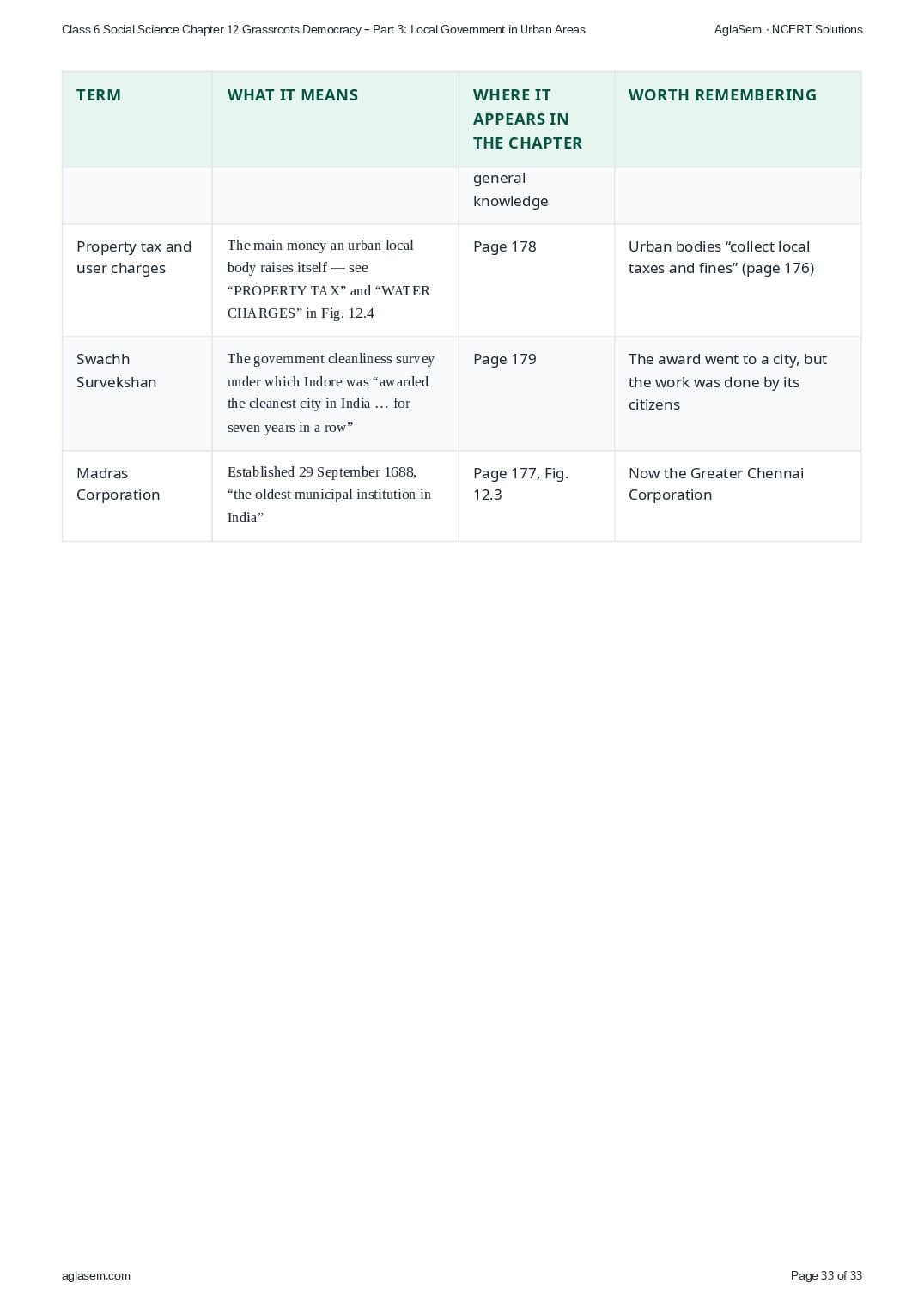
- What they do, and what citizens must do in return. Urban local bodies look after infrastructure, the burial ground, garbage collection and disposal, the implementation of government schemes, the collection of local taxes and fines, and they have “some role in planning for the area’s economic and social development”. Fig. 12.4 on page 178 shows the Indore Municipal Corporation’s services — property tax, water charges, solid waste management, trade licences, fire services, marriage certificates, grievances, and services on request like a water tanker or an ambulance. But “for these bodies to be able to perform their functions efficiently, people living in the city must also perform their duties” — segregating waste, reporting a leak promptly, caring for their own area.
- Two old corporations frame the chapter. Fig. 12.1 on page 173: the Municipal Corporation of Greater Mumbai , originally the Bombay Municipal Corporation, created in 1865 . Fig. 12.3 on page 177: the Madras Corporation (now Greater Chennai Corporation), established on 29 September 1688 — “the oldest municipal institution in India”, whose power to levy municipal taxes came from a Parliamentary Act of 1792 , “which is when the municipal administration properly began”.
How to Download NCERT Solutions for Class 6 Social Science Chapter 12 PDF
Follow these simple steps to get the Grassroots Democracy part 3 Local Government in Urban Areas questions-and-answers PDF from Exploring Society India and Beyond.
- Search NCERT Solutions for Class 6 Social Science Chapter 12 aglasem and open this page.
- Read the exercise questions with answers for Grassroots Democracy part 3 Local Government in Urban Areas shown above.
- Click the Download PDF link to save the Grassroots Democracy part 3 Local Government in Urban Areas solutions to your device.
NCERT Solutions for Class 6 Social Science – All Chapters
There are more chapters to study besides Grassroots Democracy part 3 Local Government in Urban Areas in Social Science. Here are the NCERT Solutions for all chapters of Class 6 Social Science.
- Chapter 1 Locating Places on the Earth
- Chapter 2 Oceans and Continents
- Chapter 3 Landforms and Life
- Chapter 4 Timeline and Sources of History
- Chapter 5 India That Is Bharat
- Chapter 6 the Beginnings of Indian Civilisation
- Chapter 7 India’s Cultural Roots
- Chapter 8 Unity in Diversity or Many in the One
- Chapter 9 Family and Community
- Chapter 10 Grassroots Democracy part 1 Governance
- Chapter 11 Grassroots Democracy part 2 Local Government in Rural Areas
- Chapter 12 Grassroots Democracy part 3 Local Government in Urban Areas
- Chapter 13 the Value of Work
- Chapter 14 Economic Activities Around Us
NCERT Solutions for Class 6 – All Subjects
Just like Chapter 12 of Social Science, you can get the exercise questions with answers for every other subject of Class 6. Here are the NCERT Solutions for all subjects of Class 6.
NCERT Solutions for Class 6 Social Science Chapter 12 – An Overview
The key highlights of this study material are as follows.
| Aspects | Details |
|---|---|
| Class | Class 6 |
| Subject | Social Science |
| Chapter Number | Chapter 12 |
| Chapter Name | Grassroots Democracy part 3 Local Government in Urban Areas |
| Book Name | Exploring Society India and Beyond |
| Book By | NCERT (National Council of Educational Research and Training) |
| Educational Resource Here | NCERT Solutions of Class 6 Social Science Chapter 12 for all exercises |
| More Questions Answers of This Subject | NCERT Solutions for Class 6 Social Science |
| Download Book Chapter | NCERT Book Class 6 Social Science |
| All Questions Answers For This Class | NCERT Solutions for Class 6 |
| Complete Solutions | NCERT Solutions |
NCERT Solutions for Class 6 Social Science Chapter 12 Grassroots Democracy part 3 Local Government in Urban Areas – FAQs
What are the NCERT Solutions for Class 6 Social Science Chapter 12 Grassroots Democracy part 3 Local Government in Urban Areas?
They are the complete, step-by-step answers to all the exercise and in-text questions of Chapter 12 Grassroots Democracy part 3 Local Government in Urban Areas from the NCERT Class 6 Social Science textbook Exploring Society India and Beyond, written by experts as per the latest NCERT syllabus.
How can I download the Class 6 Social Science Chapter 12 solutions PDF for free?
Open this page on aglasem, read the Grassroots Democracy part 3 Local Government in Urban Areas questions with answers, and click the “Download Solutions PDF” link. The Class 6 Social Science Chapter 12 NCERT Solutions PDF is completely free to download.
Are these NCERT Solutions as per the latest 2026-27 syllabus?
Yes. The NCERT Solutions for Class 6 Social Science Chapter 12 are based on the latest NCERT textbook Exploring Society India and Beyond and the current 2026-27 CBSE syllabus, so the questions and answers match what you study in class.
Where can I get NCERT Solutions for the other chapters of Class 6 Social Science?
You can find the answers to every chapter on the NCERT Solutions for Class 6 Social Science page, and solutions for every subject on the NCERT Solutions for Class 6 page.
How do NCERT Solutions help in exam preparation?
They show the correct method to solve each question, help you write answers the way they are expected in exams, let you check and correct your own work, and save revision time — which together improve your marks in Class 6 Social Science.
If you have any queries on NCERT Solutions for Class 6 Social Science Chapter 12 Grassroots Democracy part 3 Local Government in Urban Areas, then please ask in the comments below.