NCERT Solutions for Class 6 Social Science Chapter 11 Grassroots Democracy part 2 Local Government in Rural Areas provide clear, step-by-step answers to every exercise and in-text question from the chapter Grassroots Democracy part 2 Local Government in Rural Areas of the NCERT textbook Exploring Society India and Beyond. Prepared by subject experts as per the latest NCERT (CBSE) syllabus for 2026-27, these NCERT Solutions for Class 6 Social Science help you understand each concept, write exam-ready answers, and check your own solutions. You can read them online below or download the free Class 6 Social Science Chapter 11 question-answer PDF.
NCERT Solutions for Class 6 Social Science Chapter 11 Grassroots Democracy part 2 Local Government in Rural Areas
- Class: Class 6
- Subject: Social Science
- Chapter: Chapter 11 – Grassroots Democracy part 2 Local Government in Rural Areas
- Textbook: Exploring Society India and Beyond (NCERT)
- Study material: NCERT Solutions – questions with answers, free PDF
These solutions answer all the exercise questions of Chapter 11 Grassroots Democracy part 2 Local Government in Rural Areas — including the in-text questions, short-answer and long-answer questions, and activities — with complete explanations so you can follow the method, not just the final answer. Read the full solutions below.
NCERT Solutions Class 6 Social Science Chapter 11 Grassroots Democracy part 2 Local Government in Rural Areas View Download





NCERT Solutions for Class 6 Social Science Chapter 11 PDF Download
You can read the NCERT Solutions for Class 6 Social Science Chapter 11 online above, or download the complete question-answer PDF to study Grassroots Democracy part 2 Local Government in Rural Areas offline at any time.
NCERT Solutions for Class 6 Social Science Chapter 11 PDF Download Link – Click Here to Download Solutions PDF
Questions Covered in This Chapter
These NCERT Solutions answer all 22 questions of this chapter. The questions solved are:
- What are Panchayati Raj institutions?
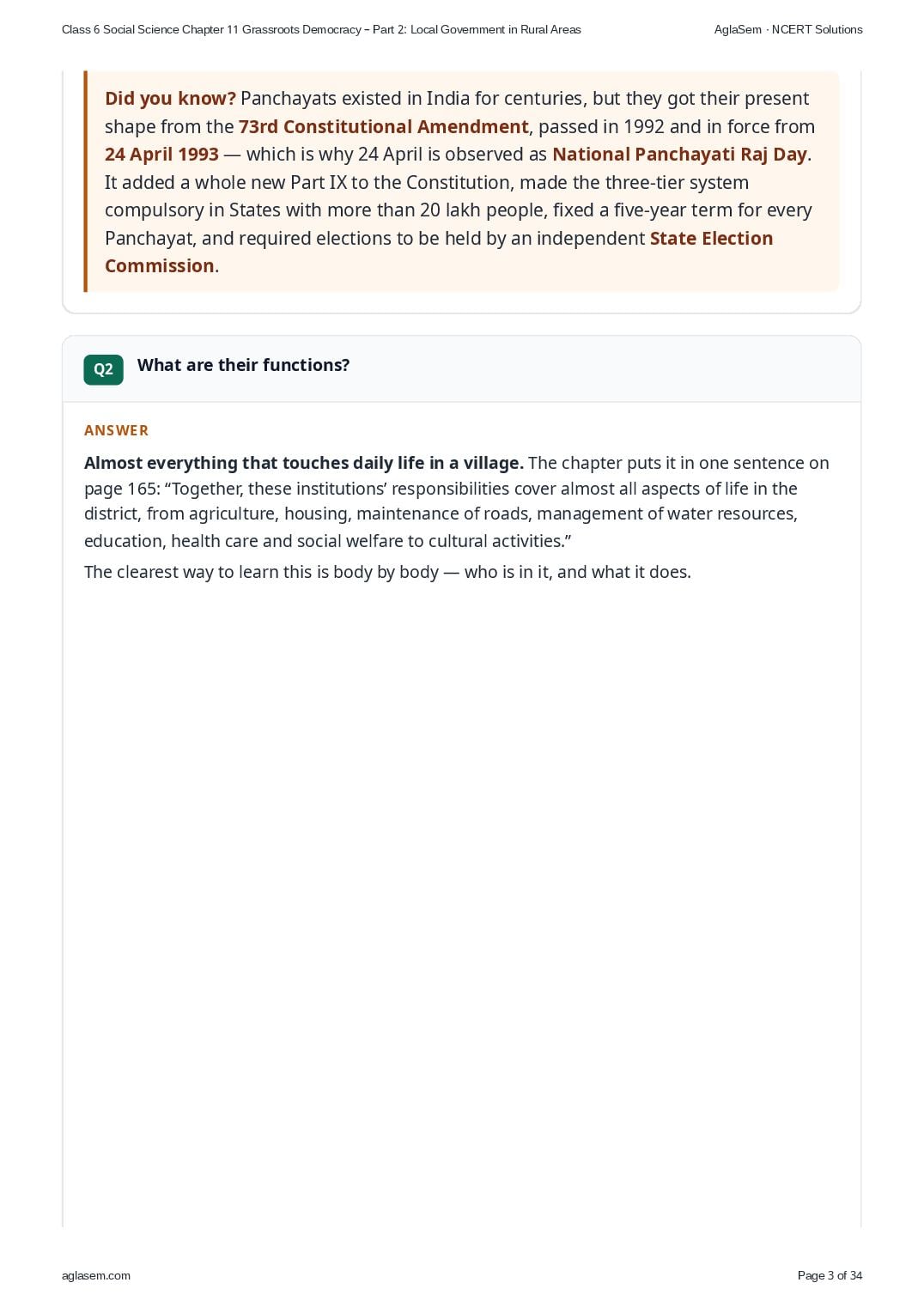
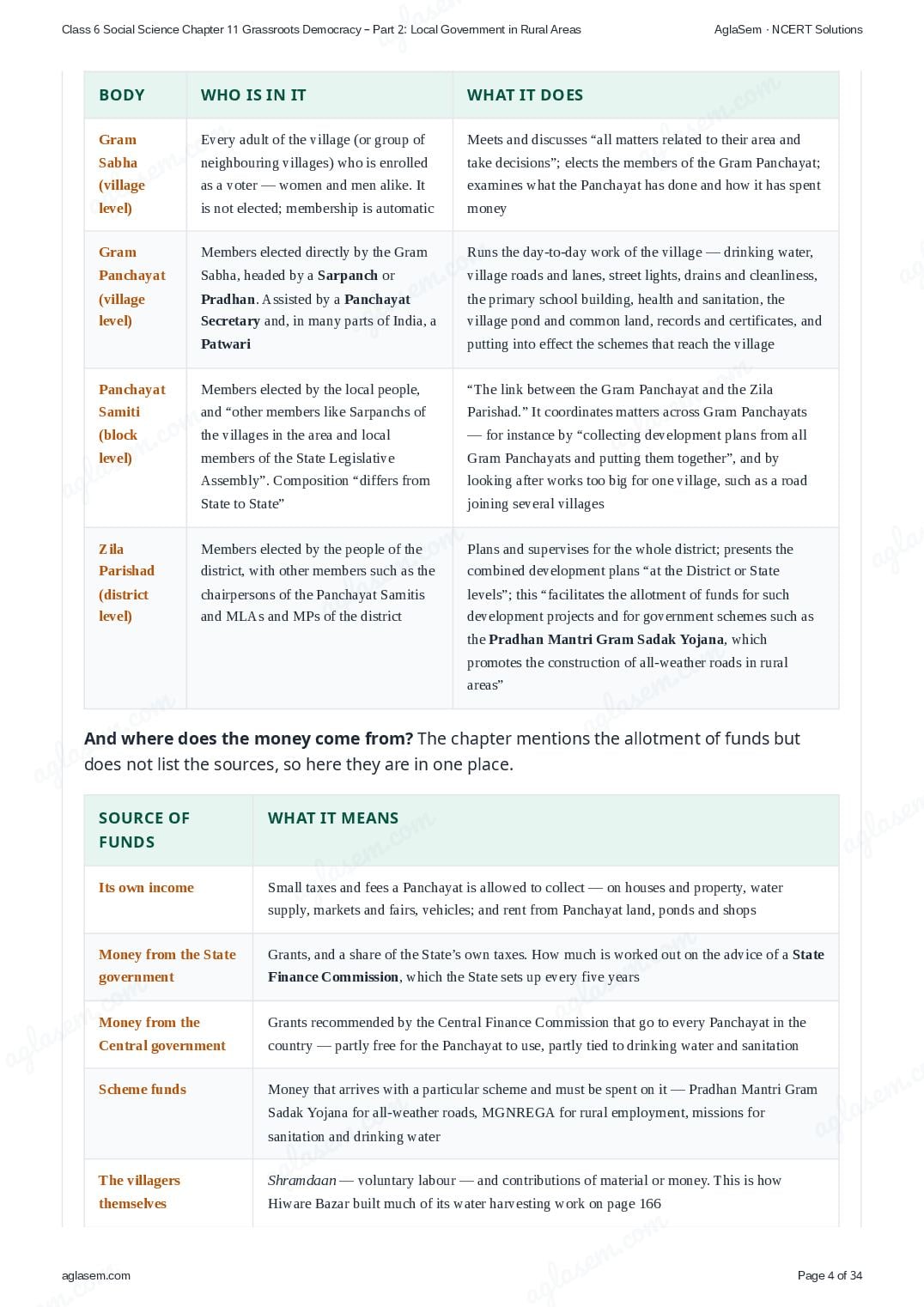
- What are their functions?
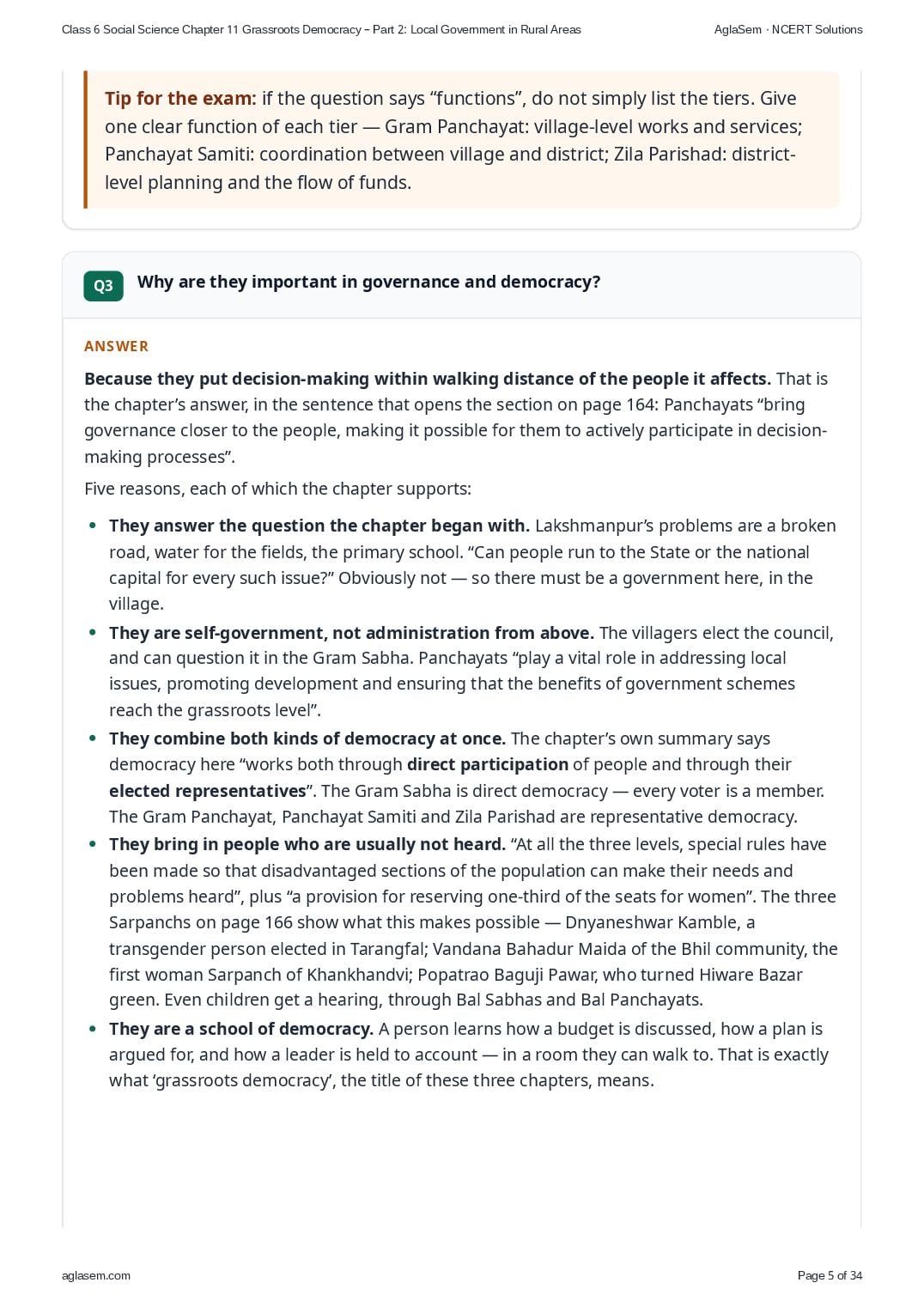
- Why are they important in governance and democracy?
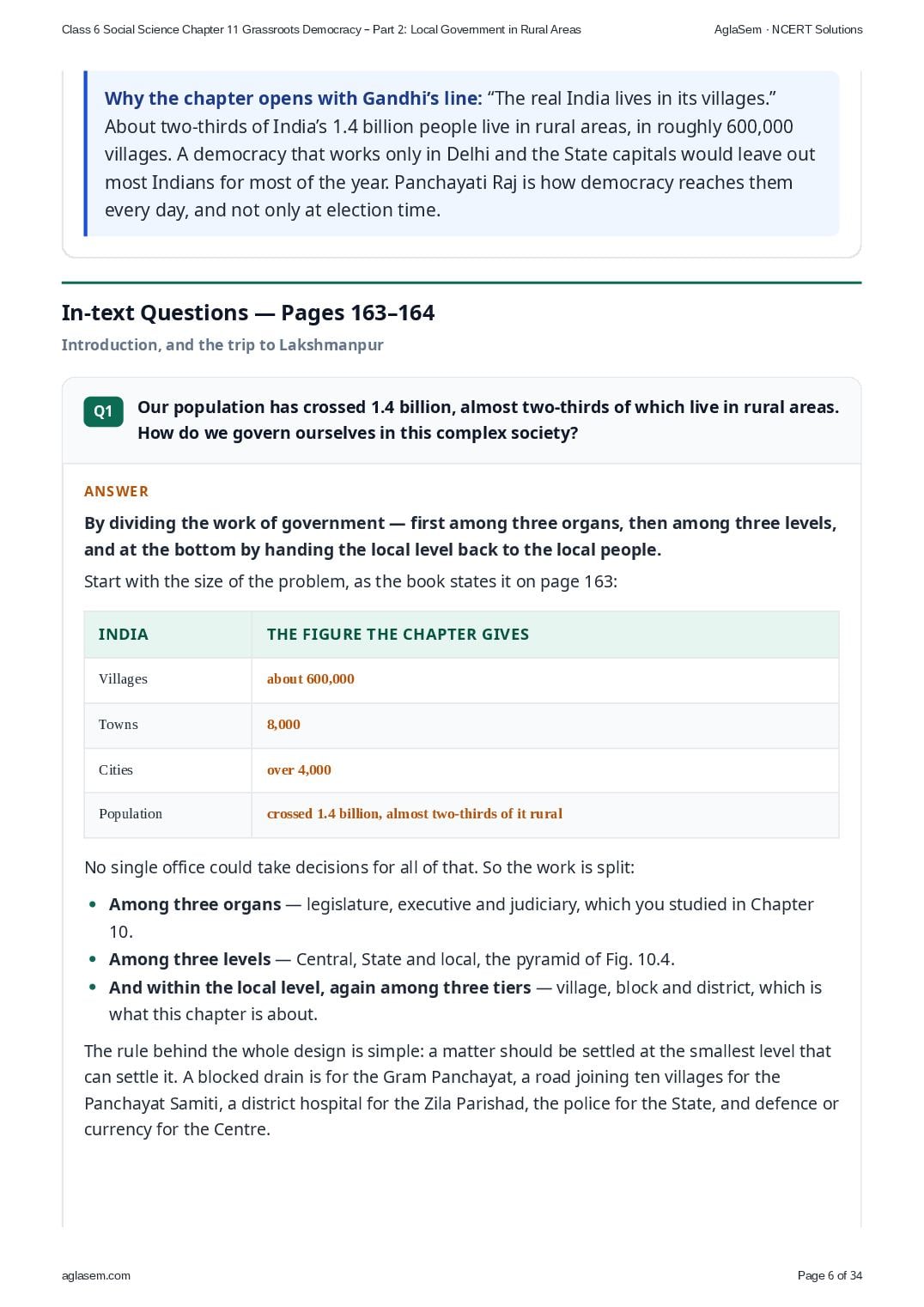
- Our population has crossed 1.4 billion, almost two-thirds of which live in rural areas. How do we govern ourselves in this complex society?
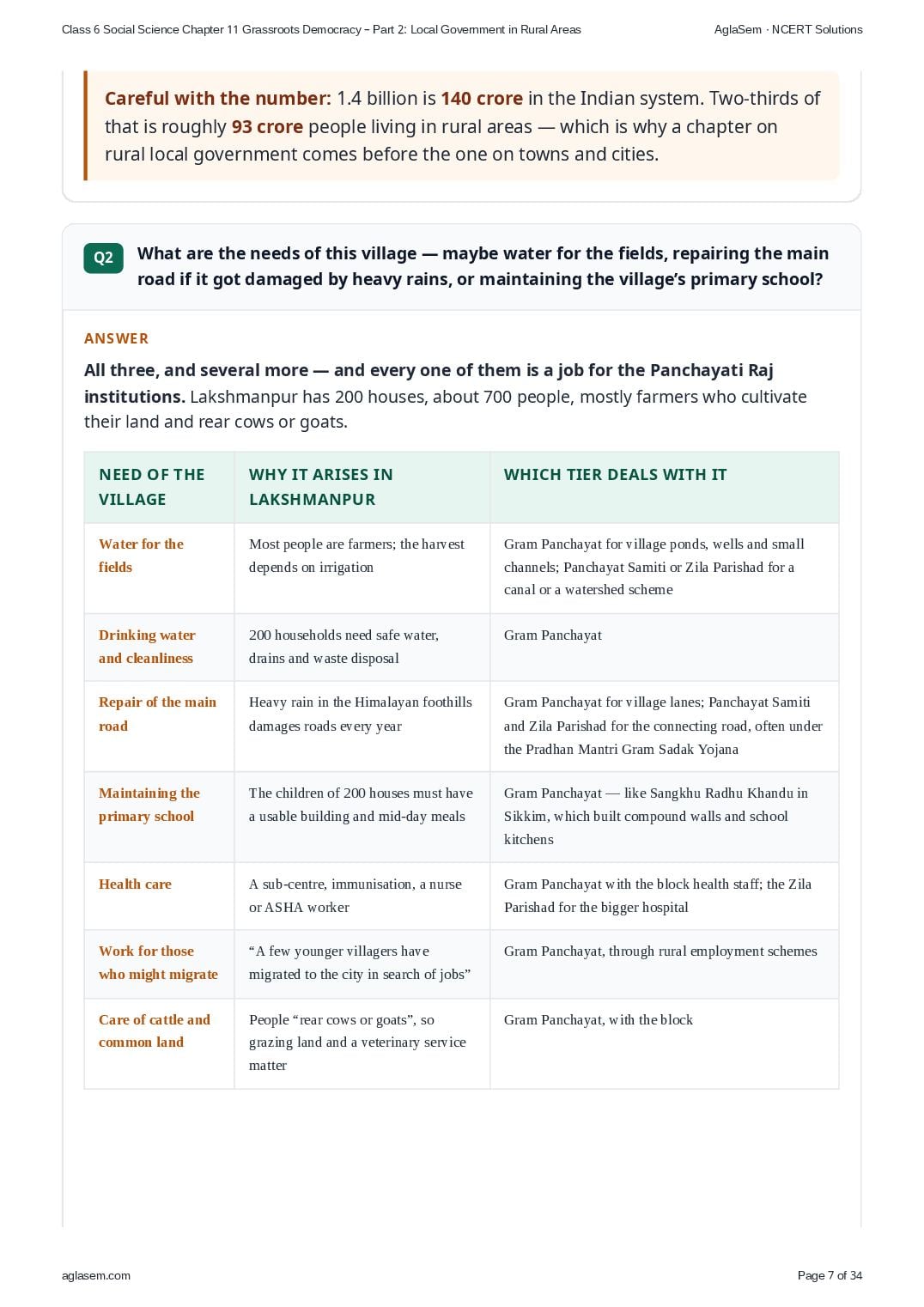
- What are the needs of this village — maybe water for the fields, repairing the main road if it got damaged by heavy rains, or maintaining the village’s primary school?
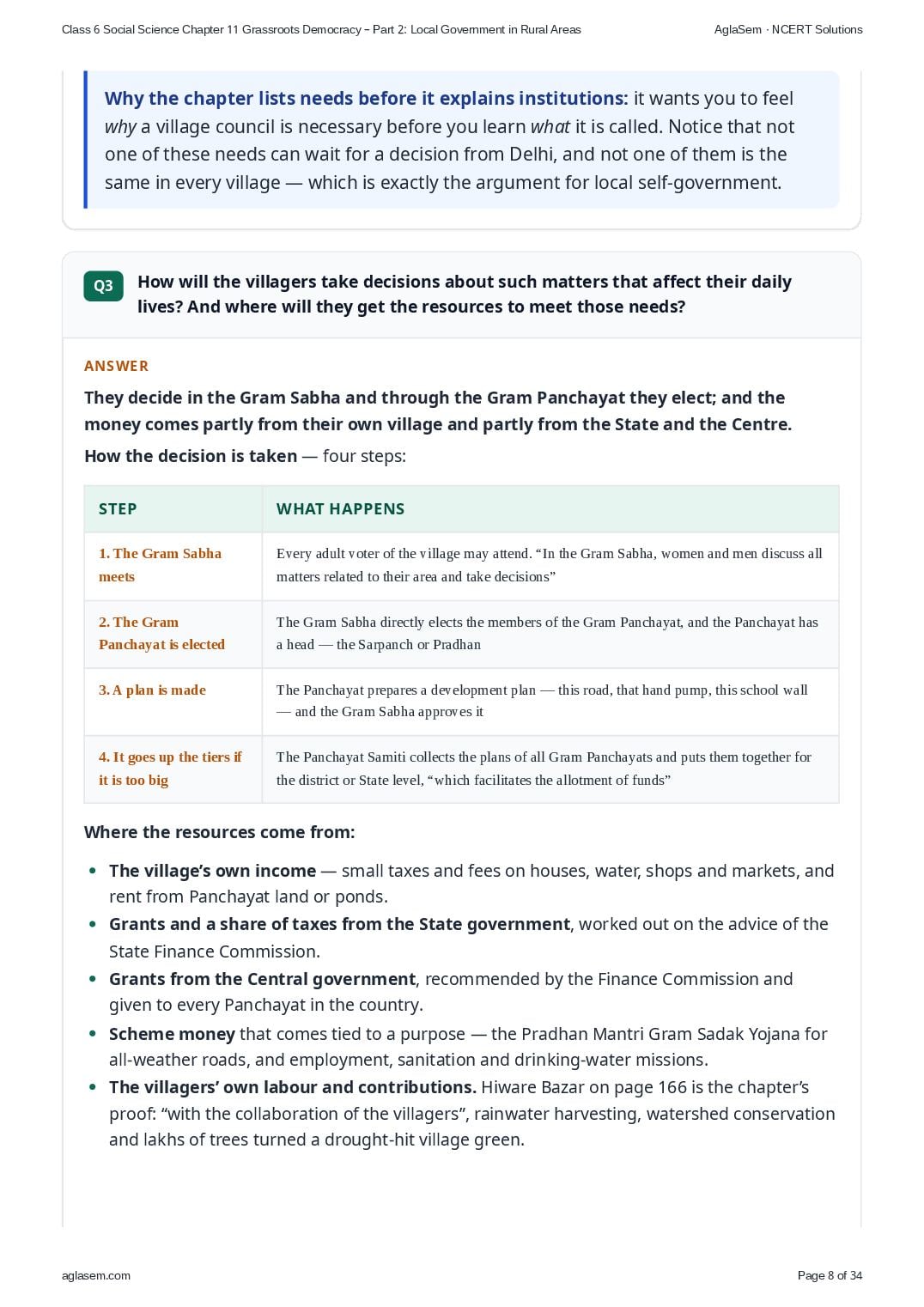
- How will the villagers take decisions about such matters that affect their daily lives? And where will they get the resources to meet those needs?
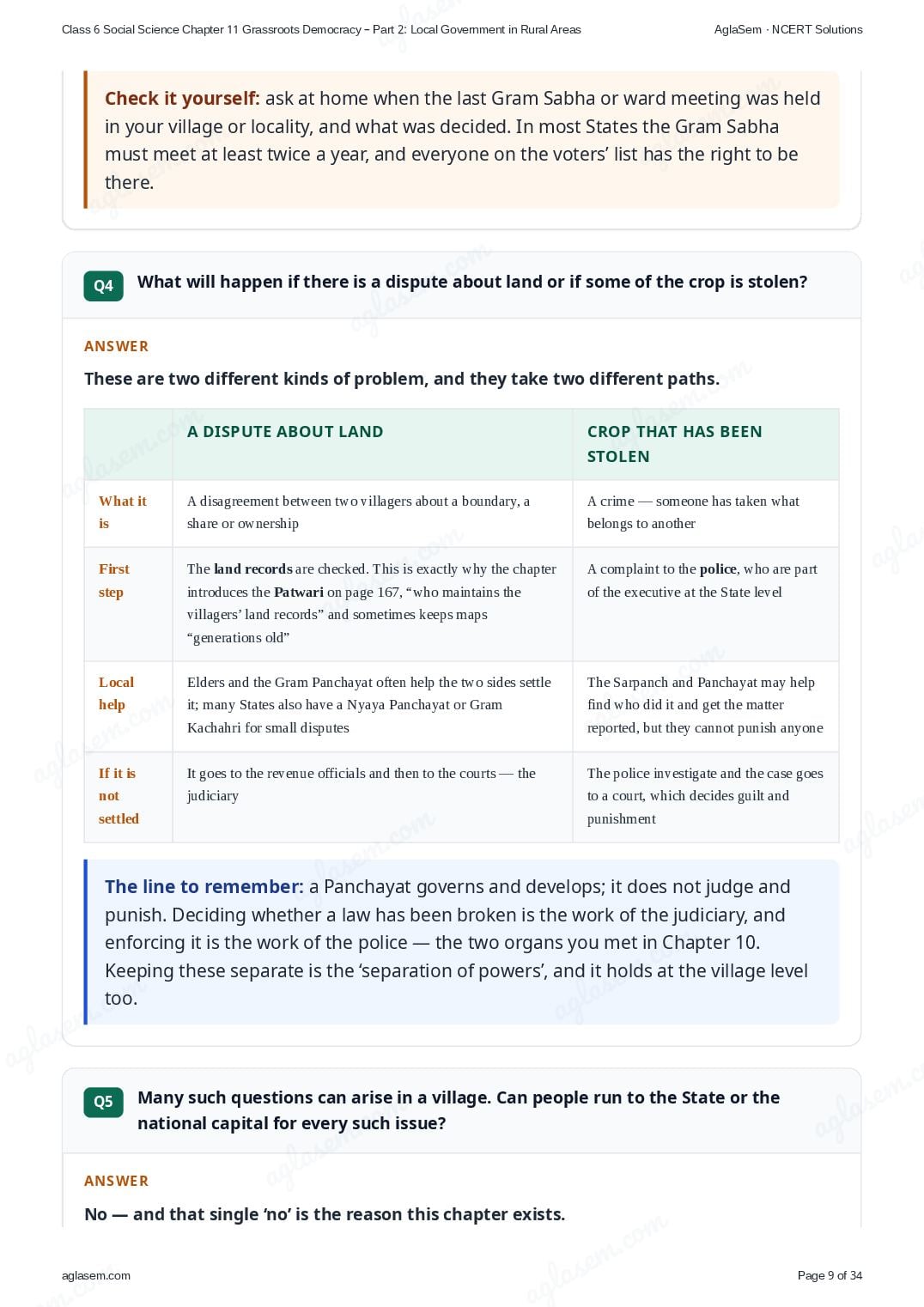
- What will happen if there is a dispute about land or if some of the crop is stolen?
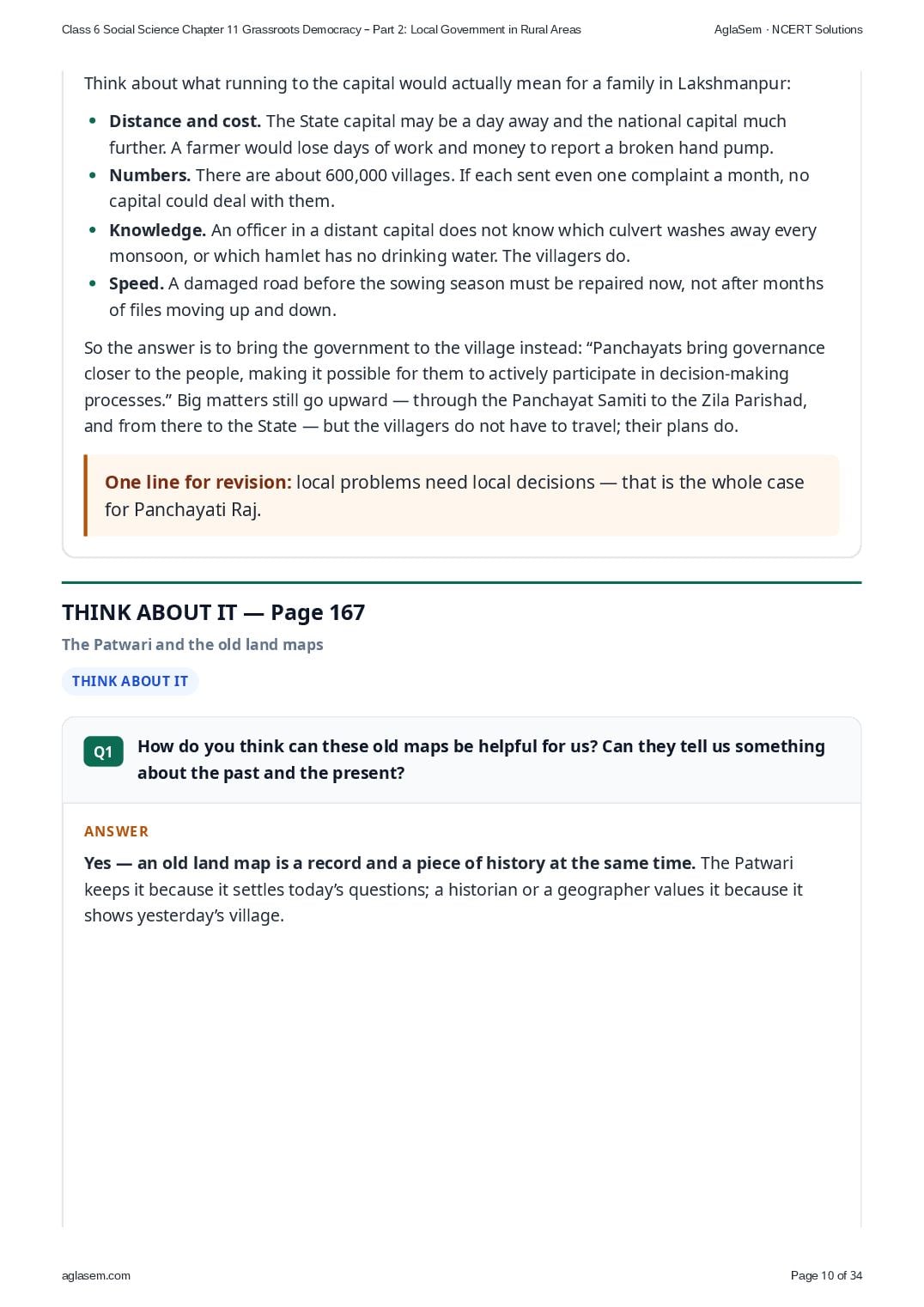
- Many such questions can arise in a village. Can people run to the State or the national capital for every such issue?
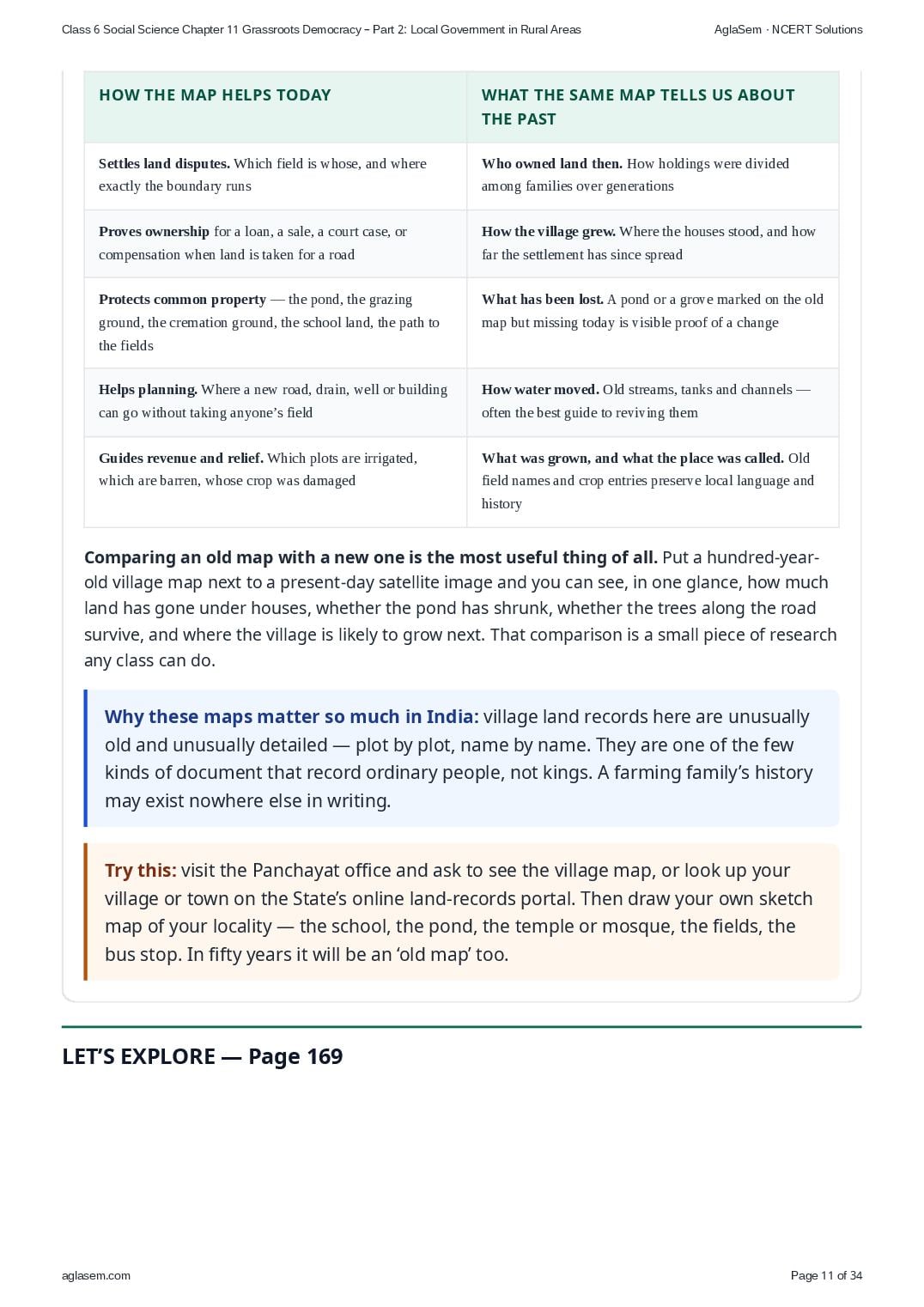
- How do you think can these old maps be helpful for us? Can they tell us something about the past and the present?
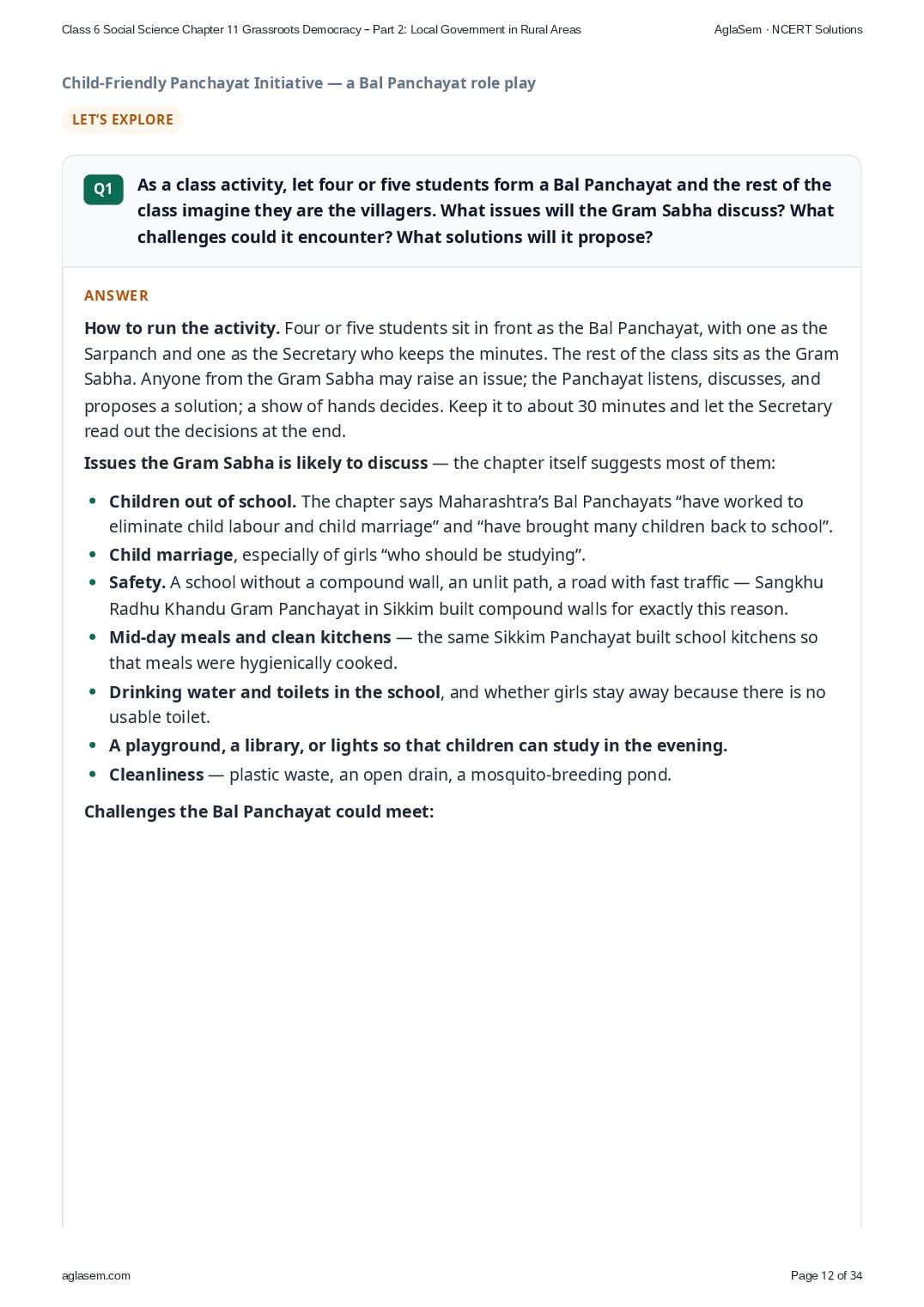
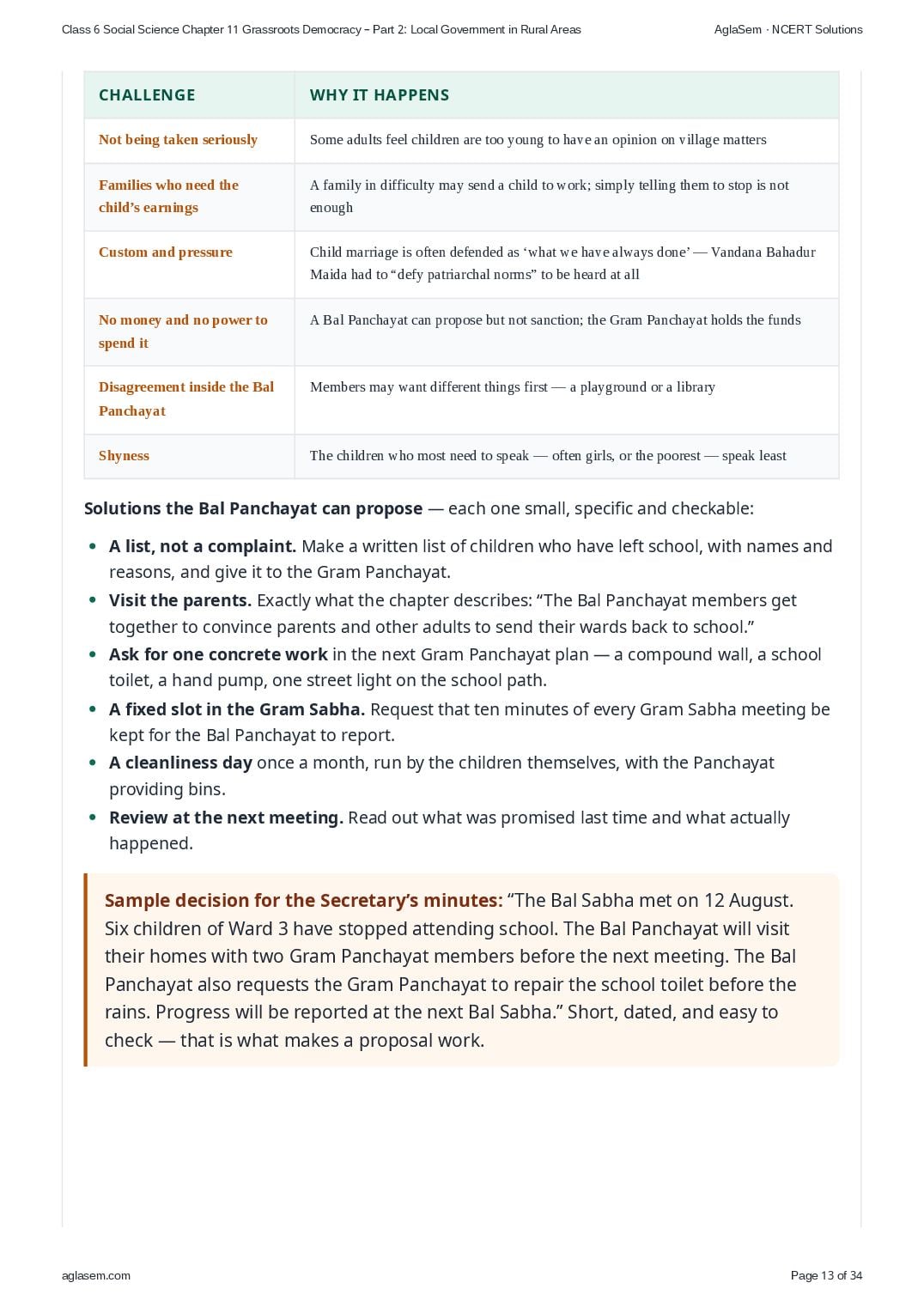
- As a class activity, let four or five students form a Bal Panchayat and the rest of the class imagine they are the villagers. What issues will the Gram Sabha discuss? What challenges could it encounter? What solutions will it propose?
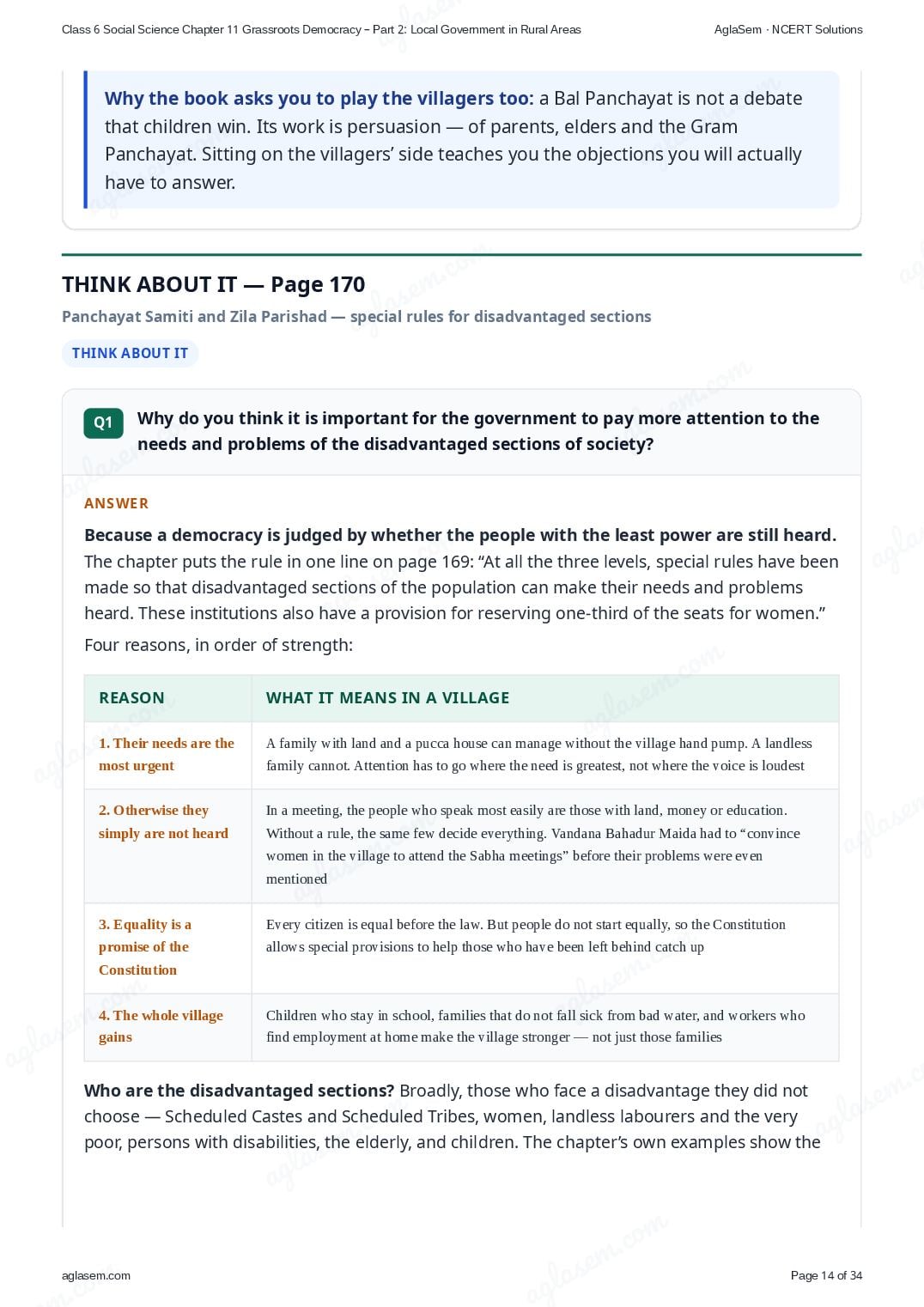
- Why do you think it is important for the government to pay more attention to the needs and problems of the disadvantaged sections of society?
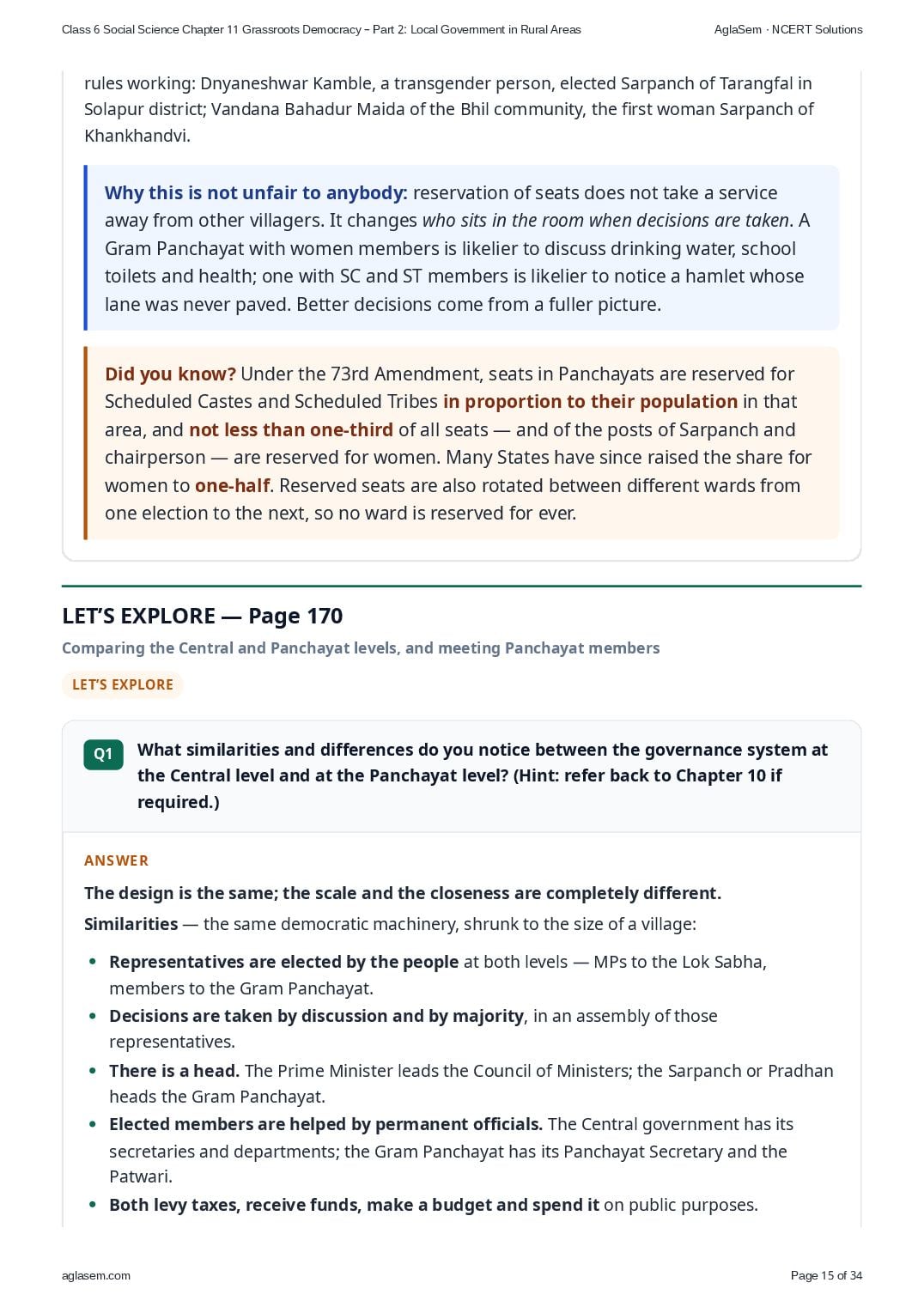
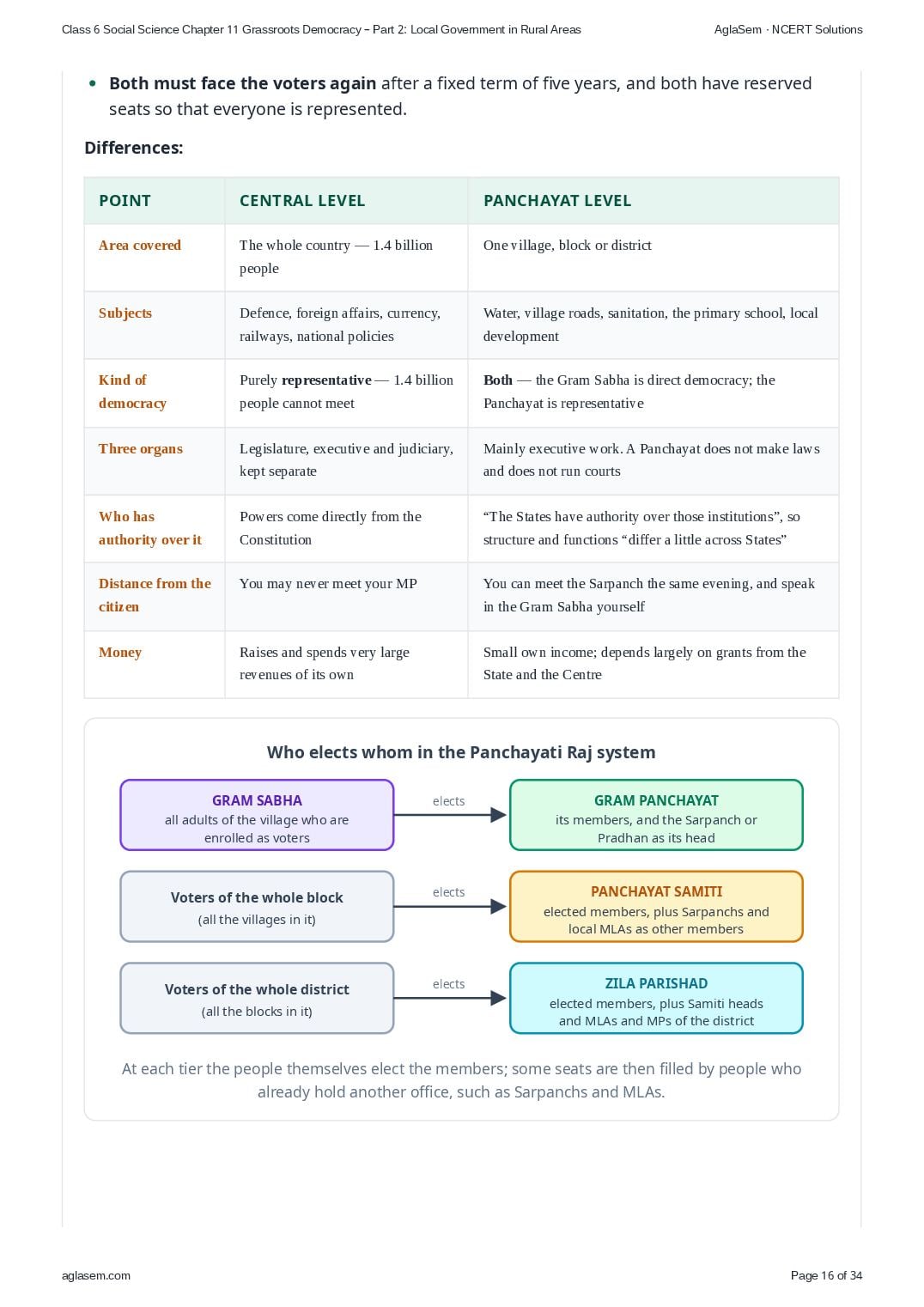
- What similarities and differences do you notice between the governance system at the Central level and at the Panchayat level? (Hint: refer back to Chapter 10 if required.)
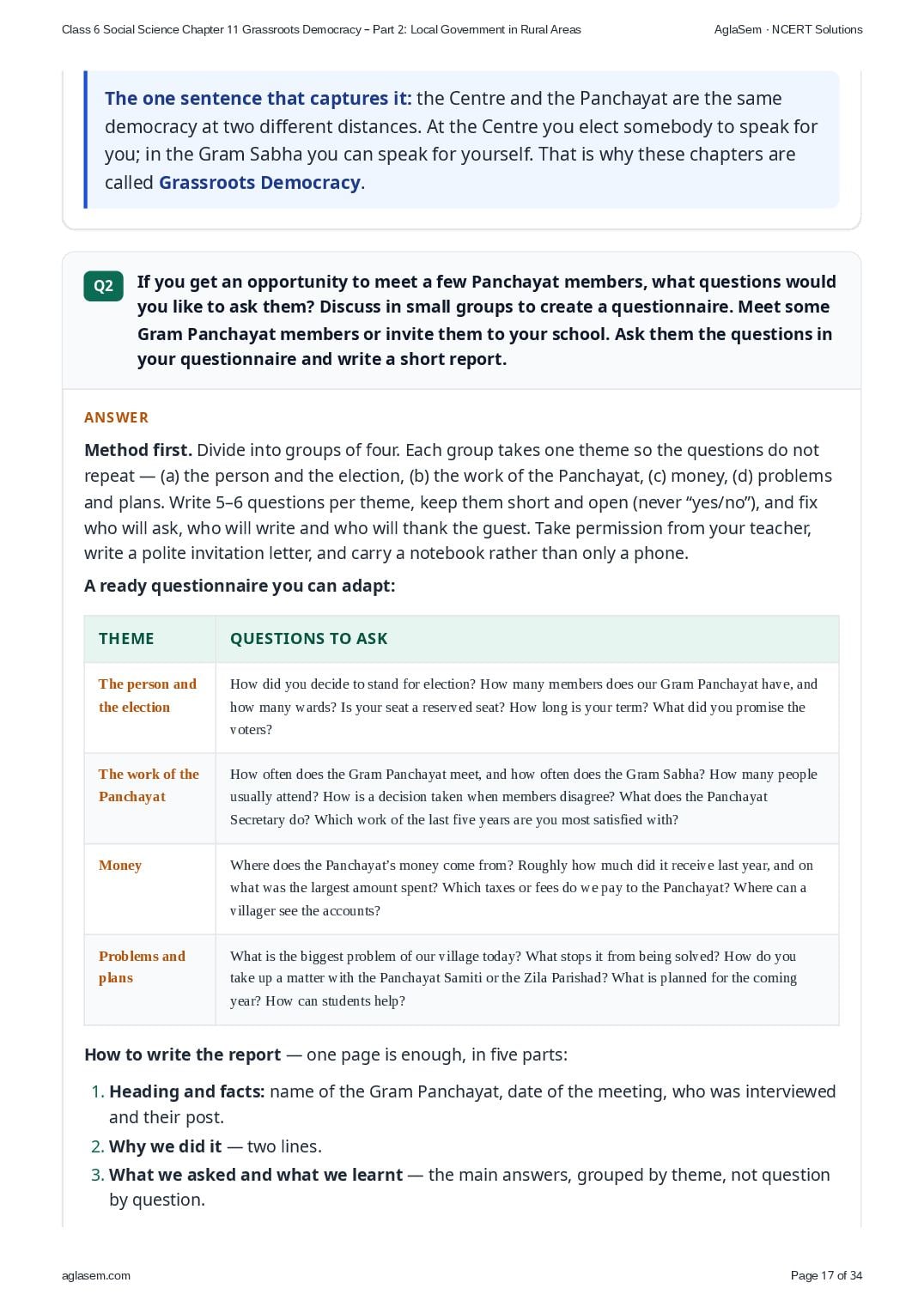
- If you get an opportunity to meet a few Panchayat members, what questions would you like to ask them? Discuss in small groups to create a questionnaire. Meet some Gram Panchayat members or invite them to your school. Ask them the questions in your questionnaire and write a short report.
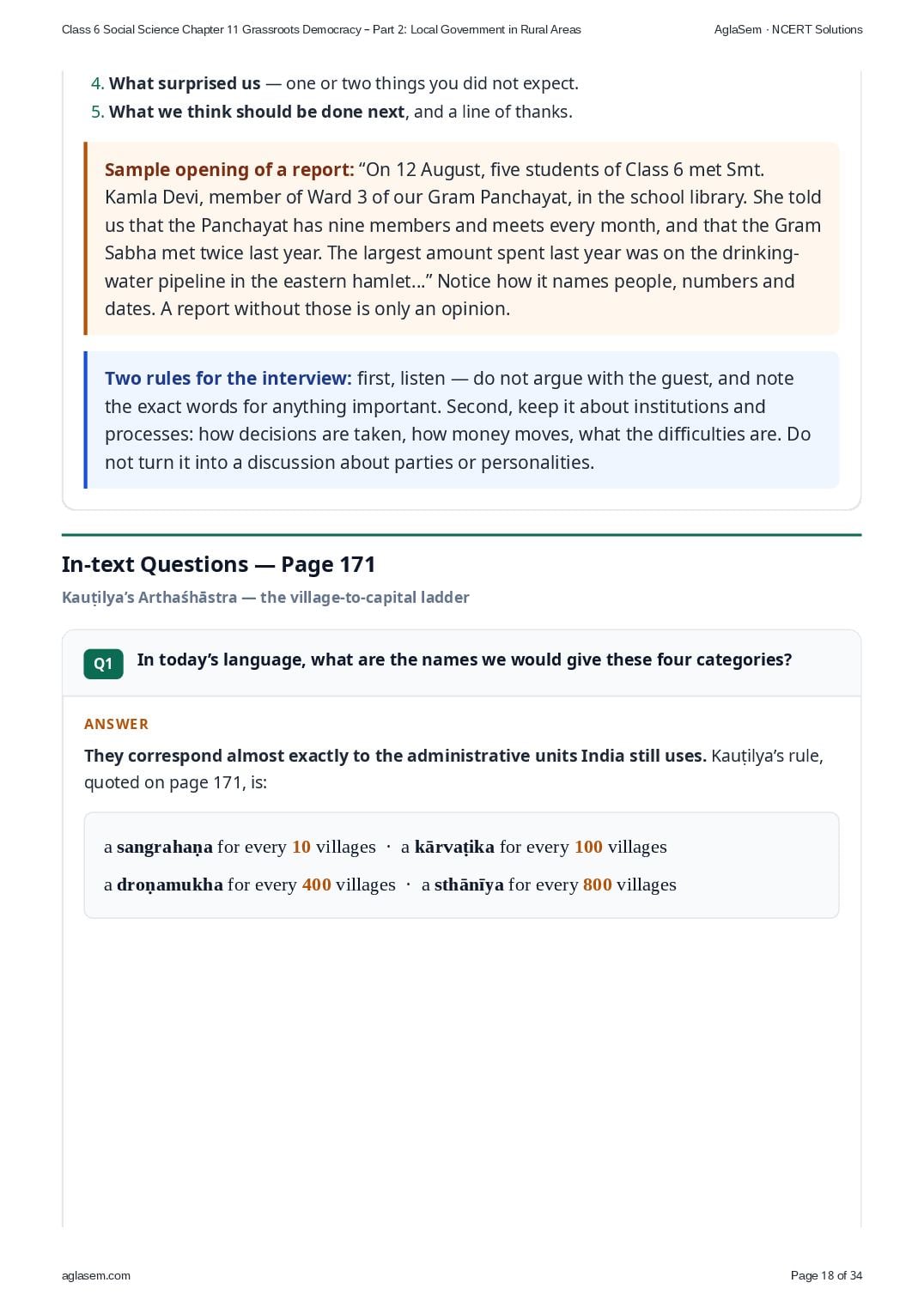
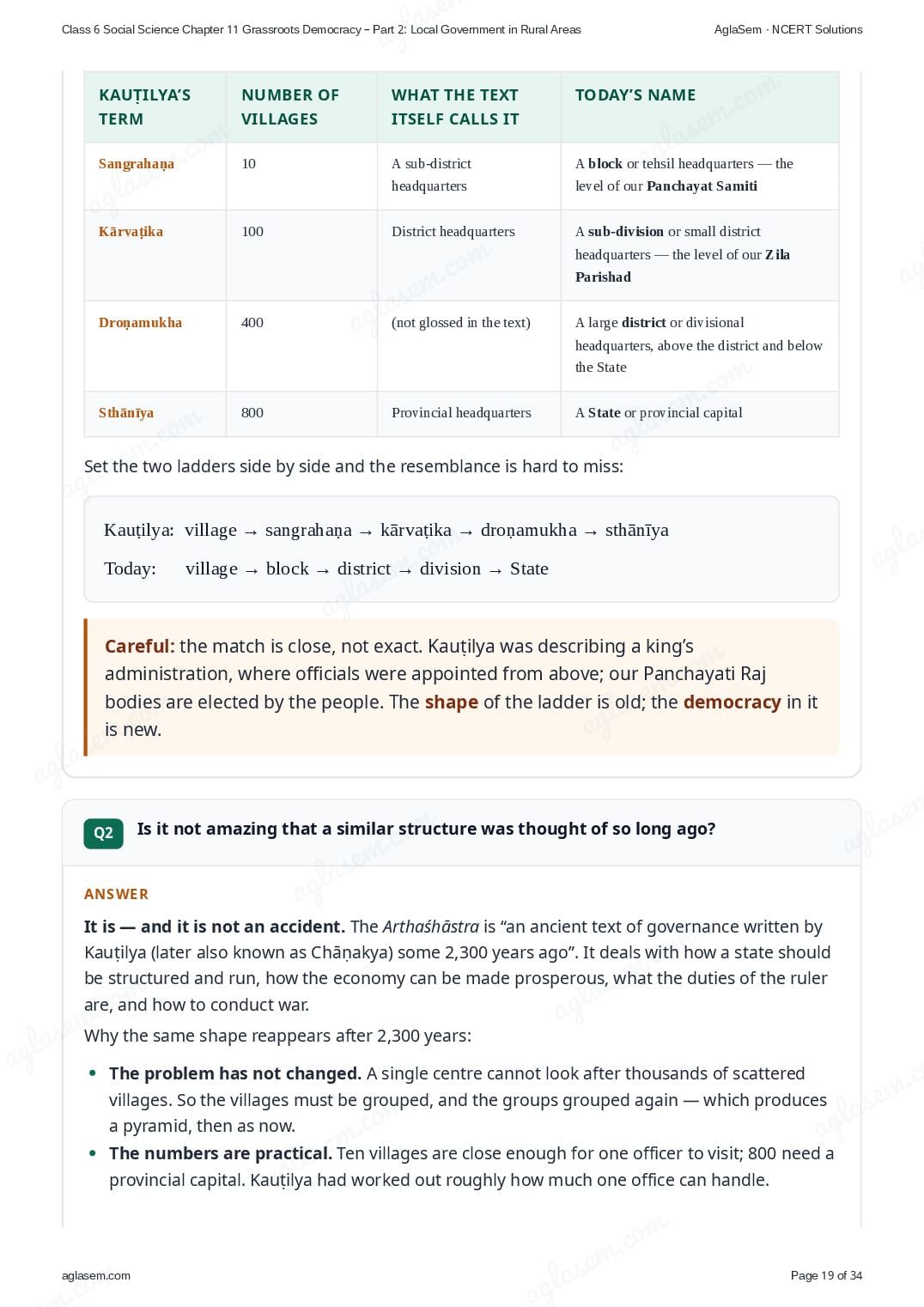
- In today’s language, what are the names we would give these four categories?
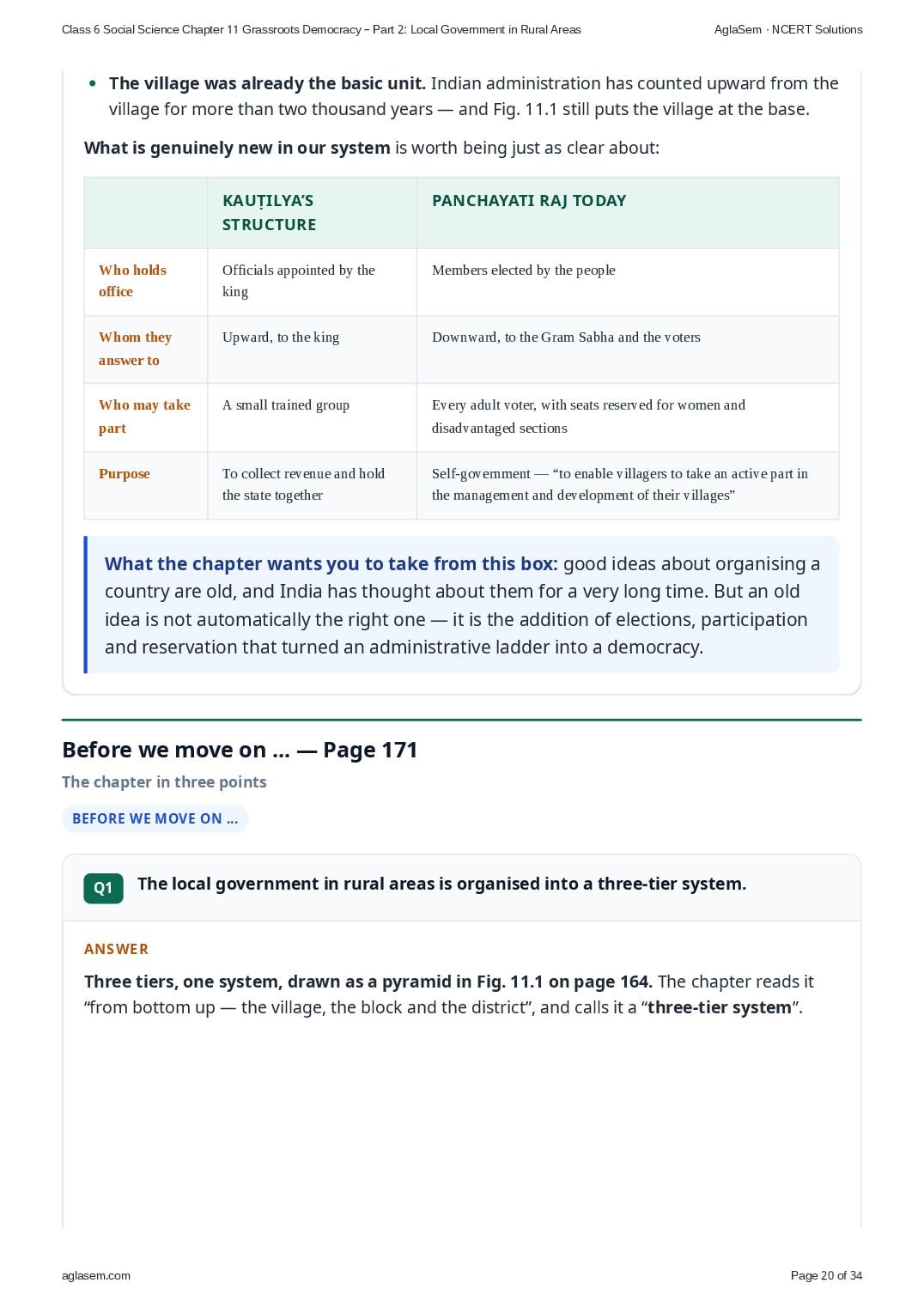
- Is it not amazing that a similar structure was thought of so long ago?
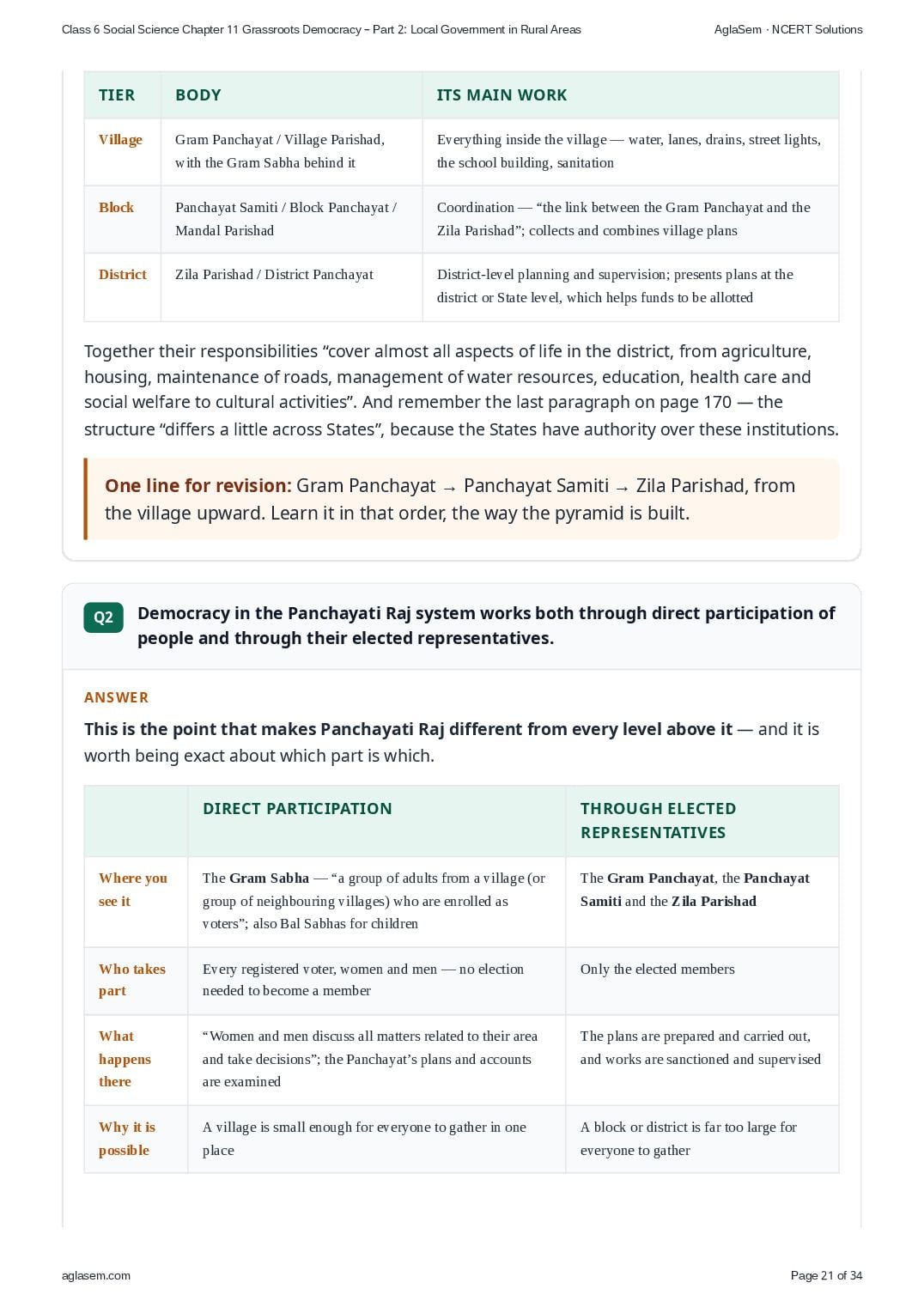
- The local government in rural areas is organised into a three-tier system.
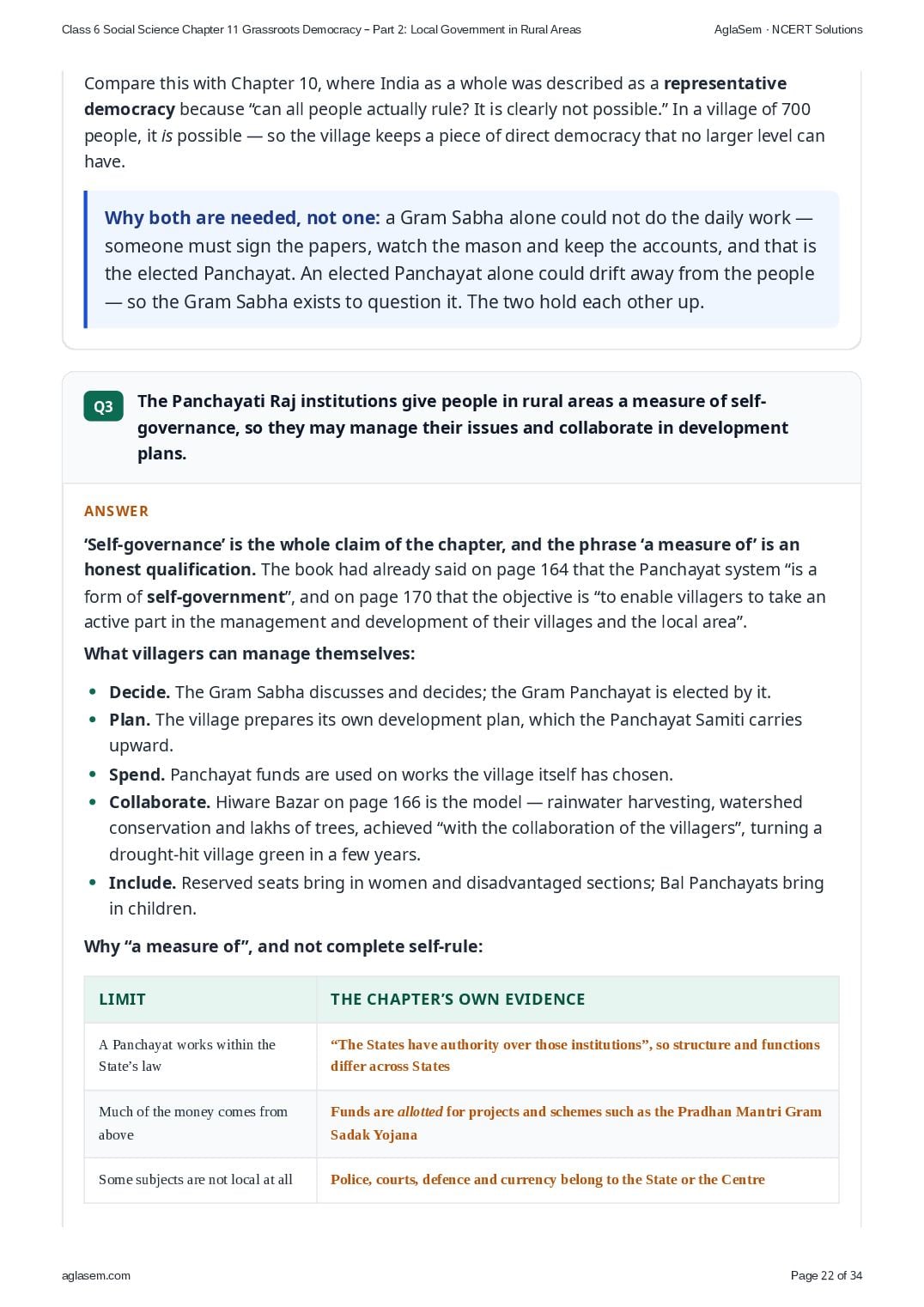
- Democracy in the Panchayati Raj system works both through direct participation of people and through their elected representatives.
- The Panchayati Raj institutions give people in rural areas a measure of self-governance, so they may manage their issues and collaborate in development plans.
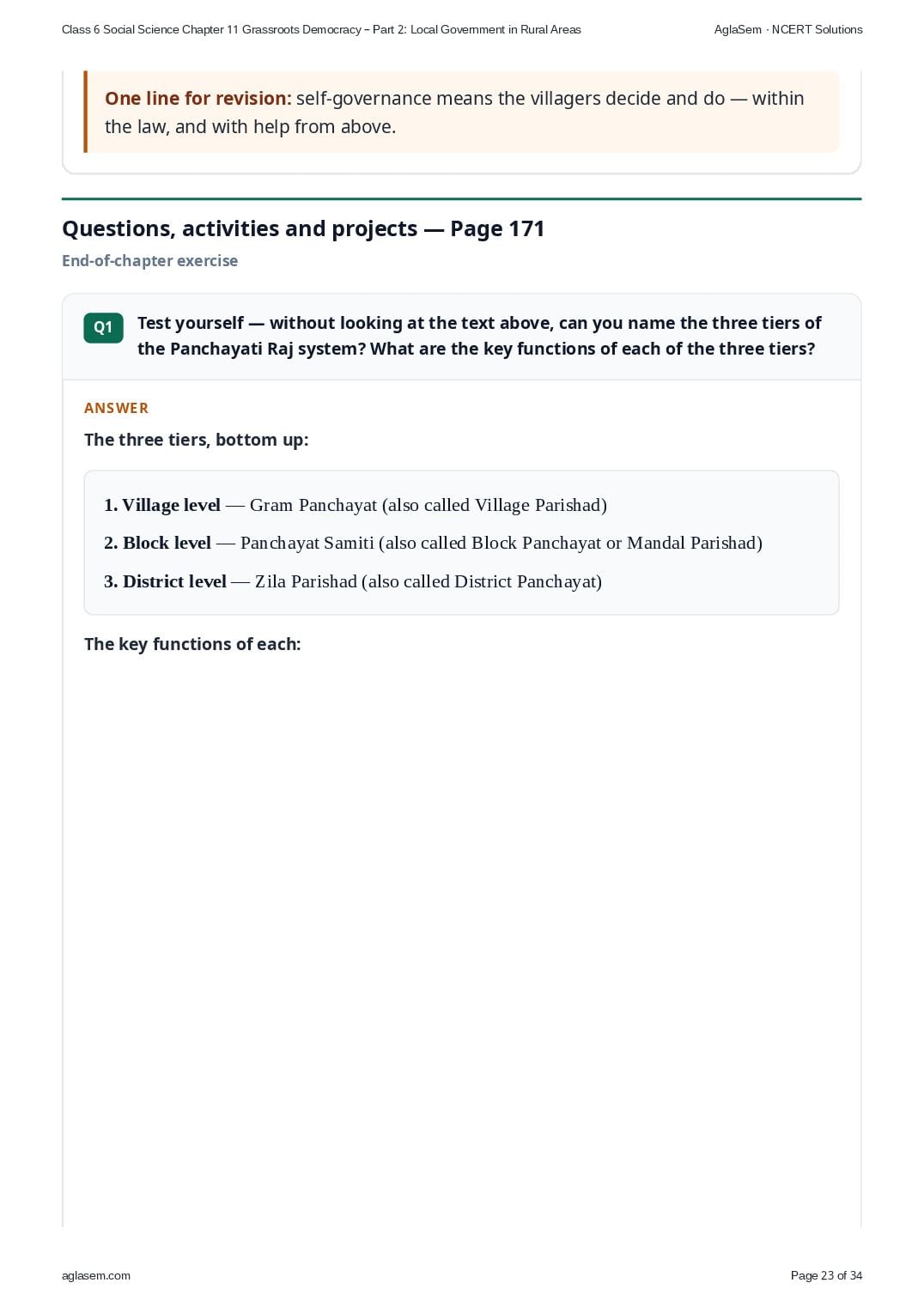
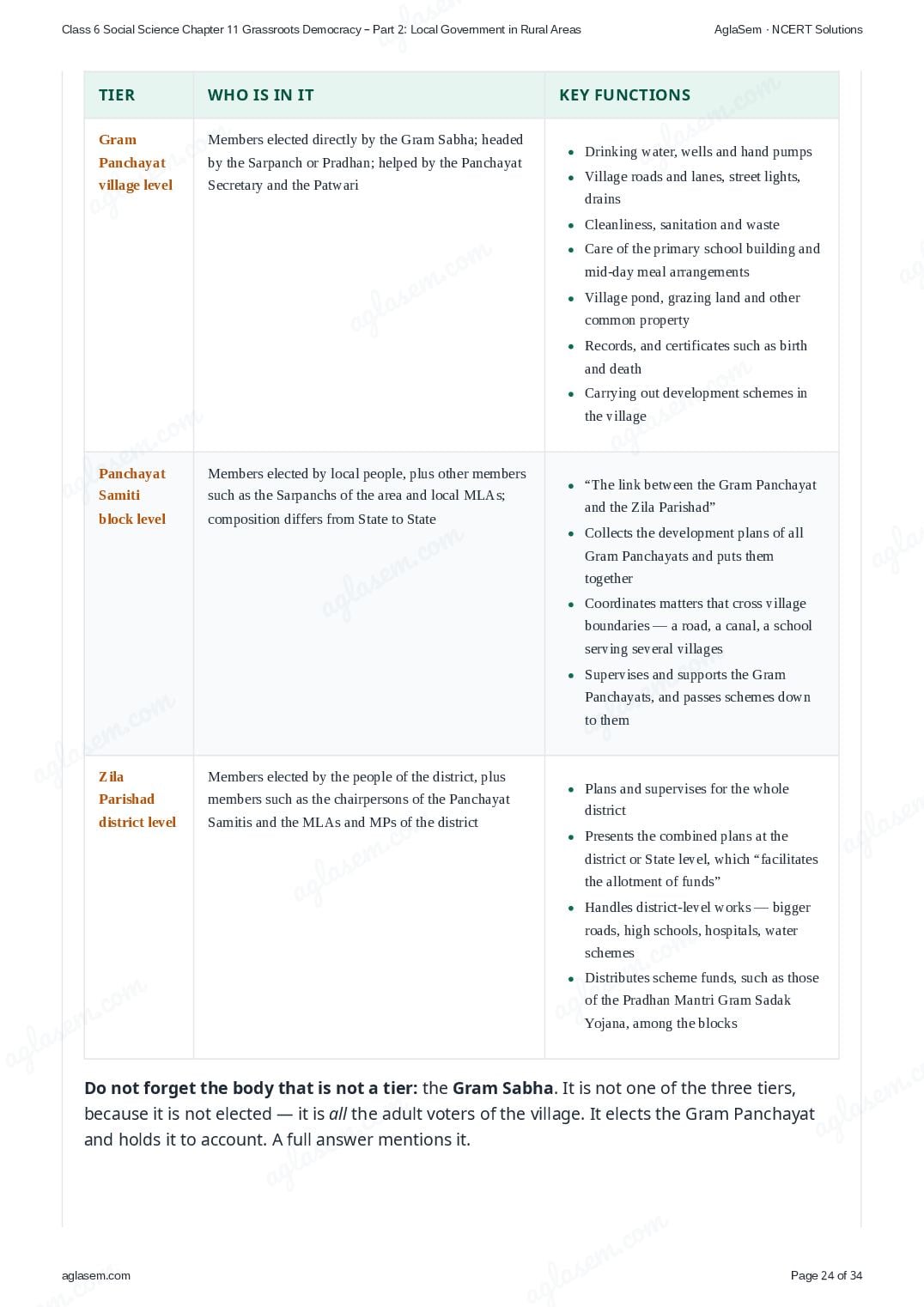
- Test yourself — without looking at the text above, can you name the three tiers of the Panchayati Raj system? What are the key functions of each of the three tiers?
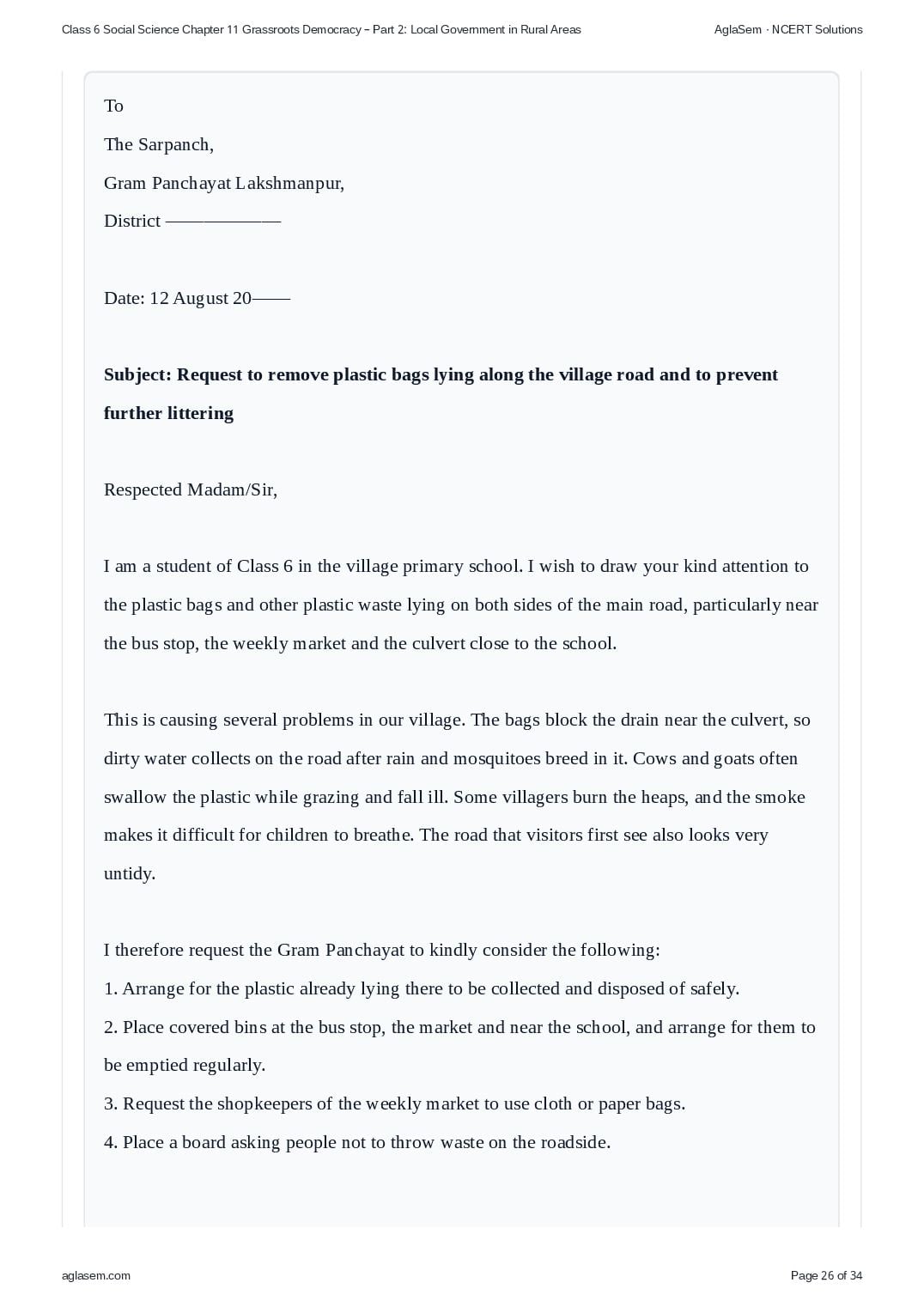
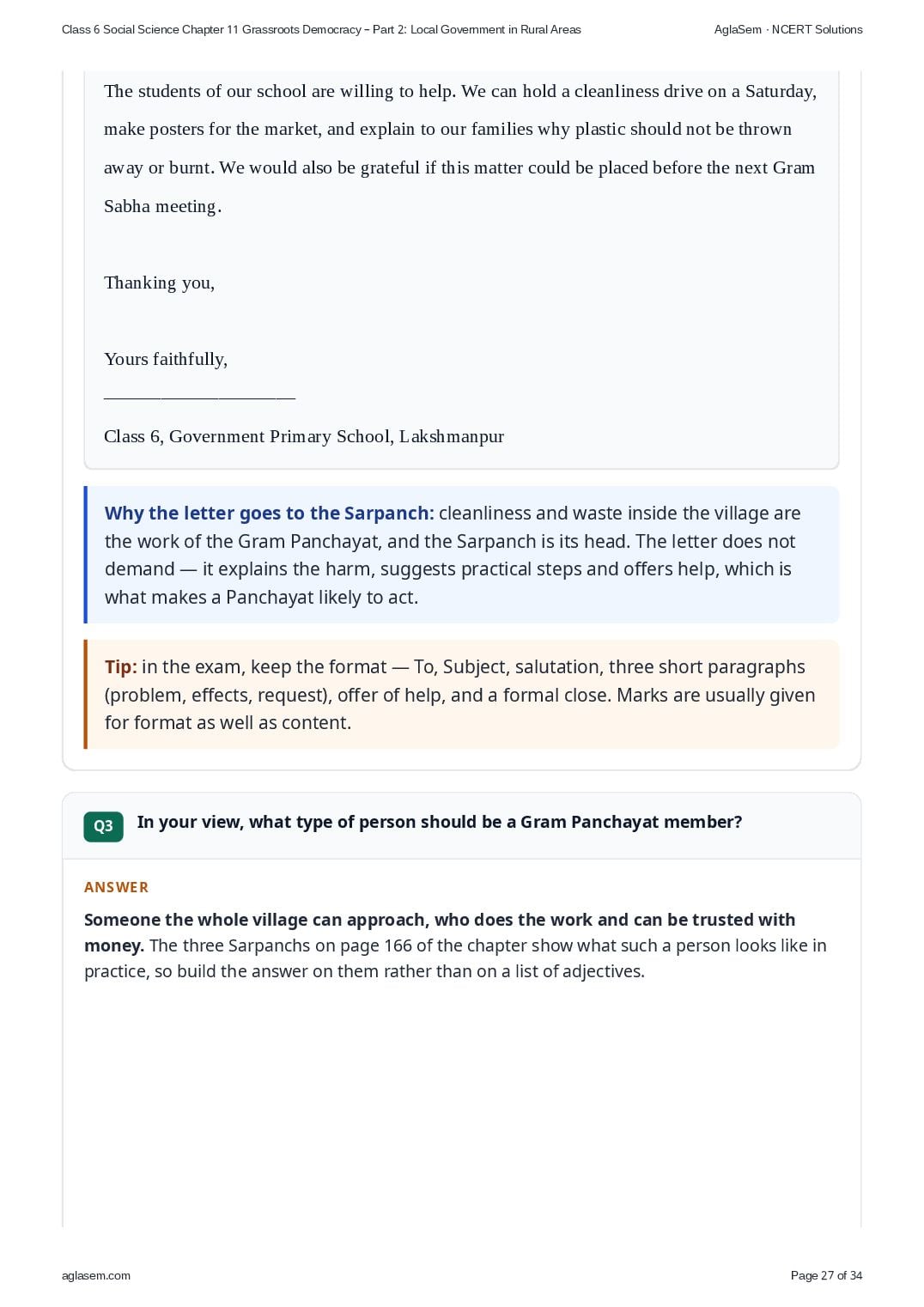
- Write a letter to the Sarpanch regarding the issue of plastic bags lying on the roadside in the village.
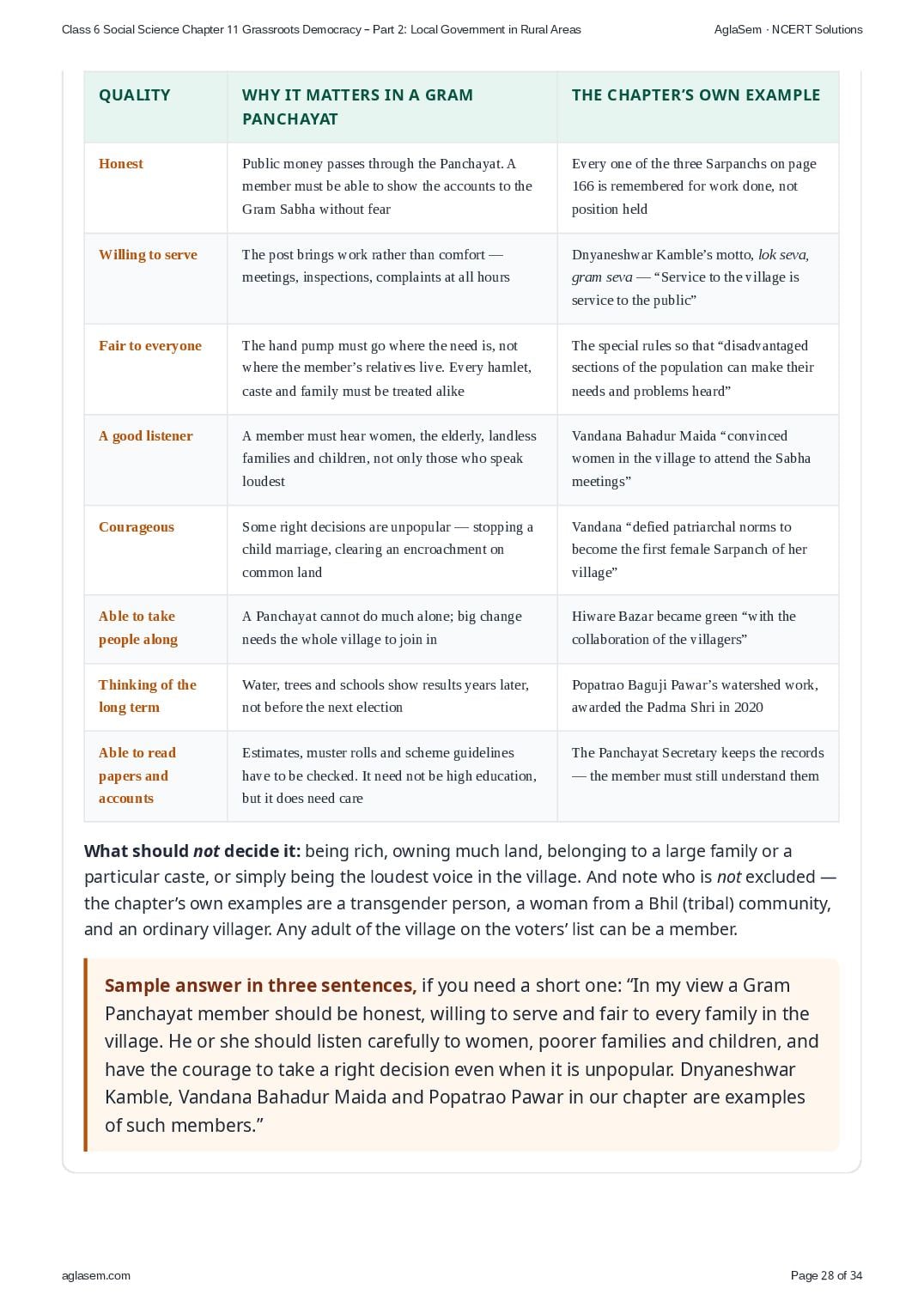
- In your view, what type of person should be a Gram Panchayat member?
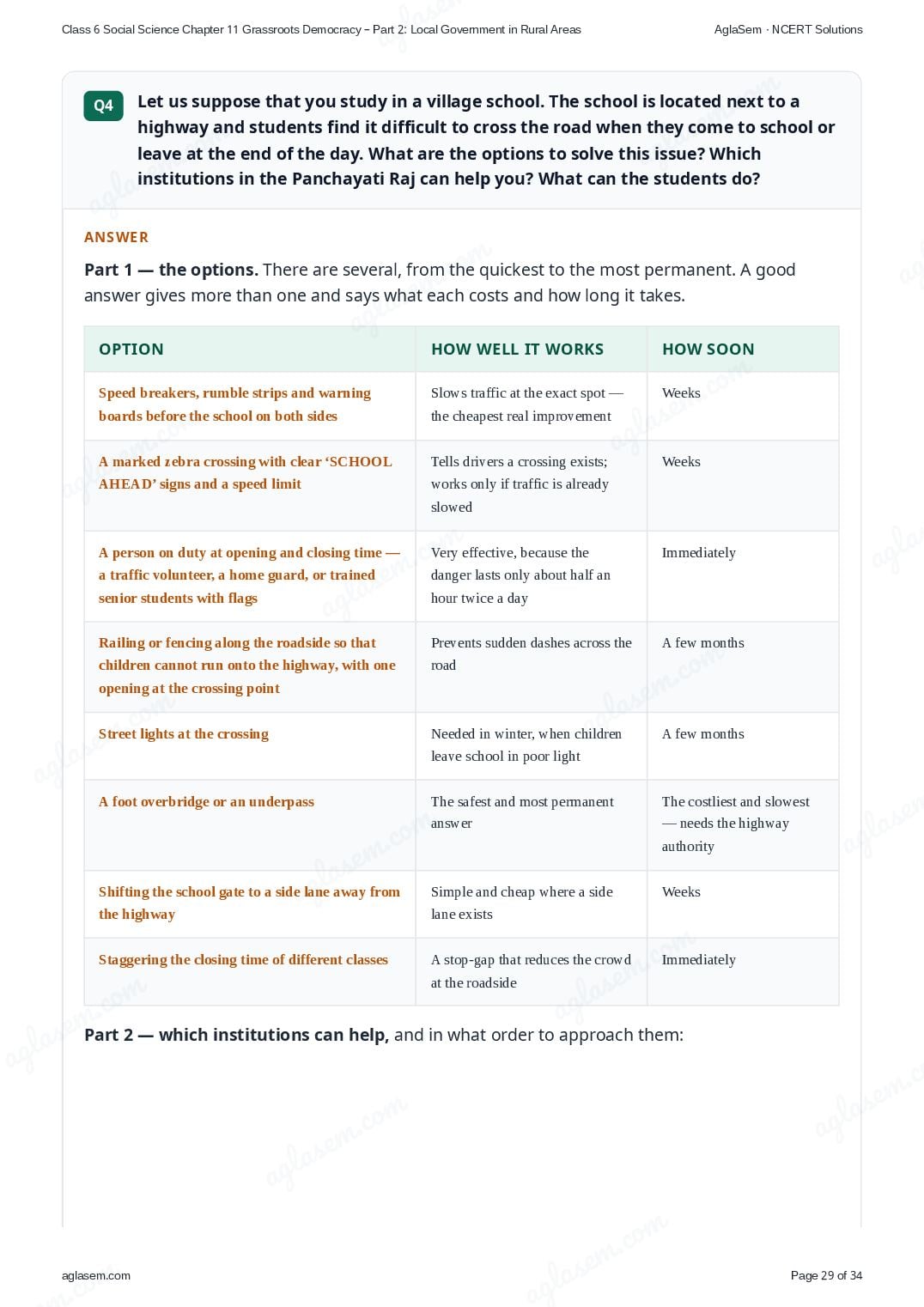
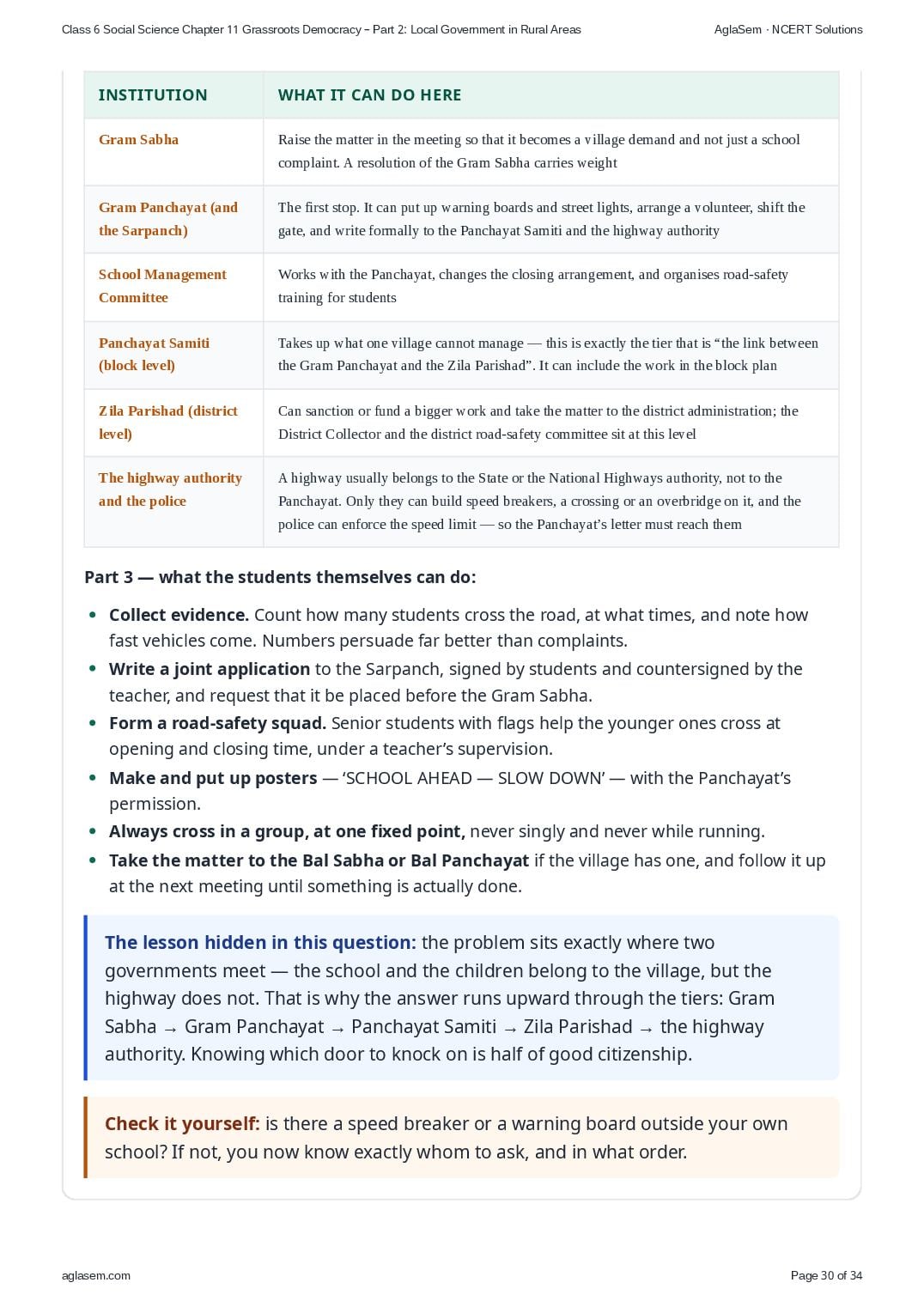
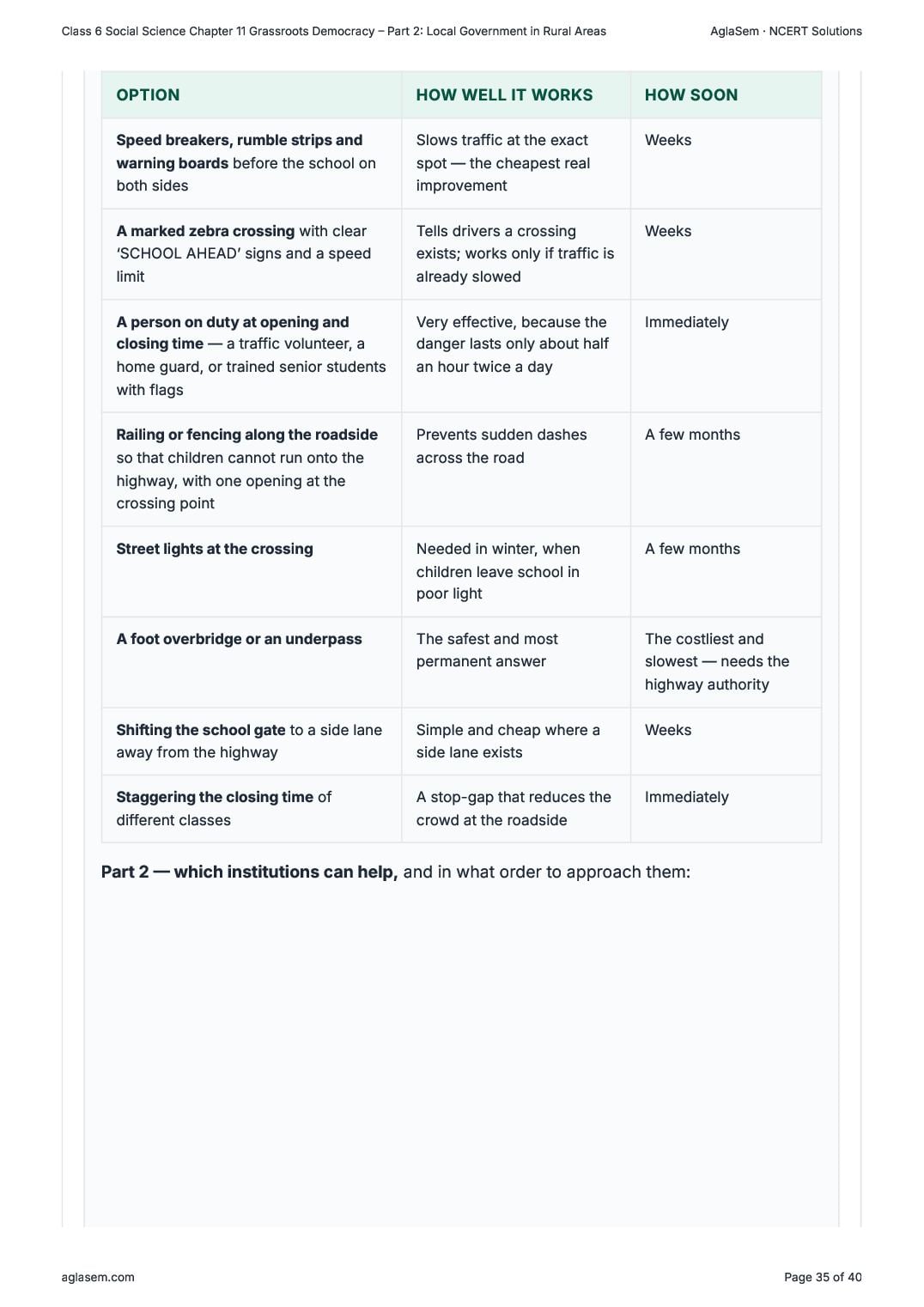
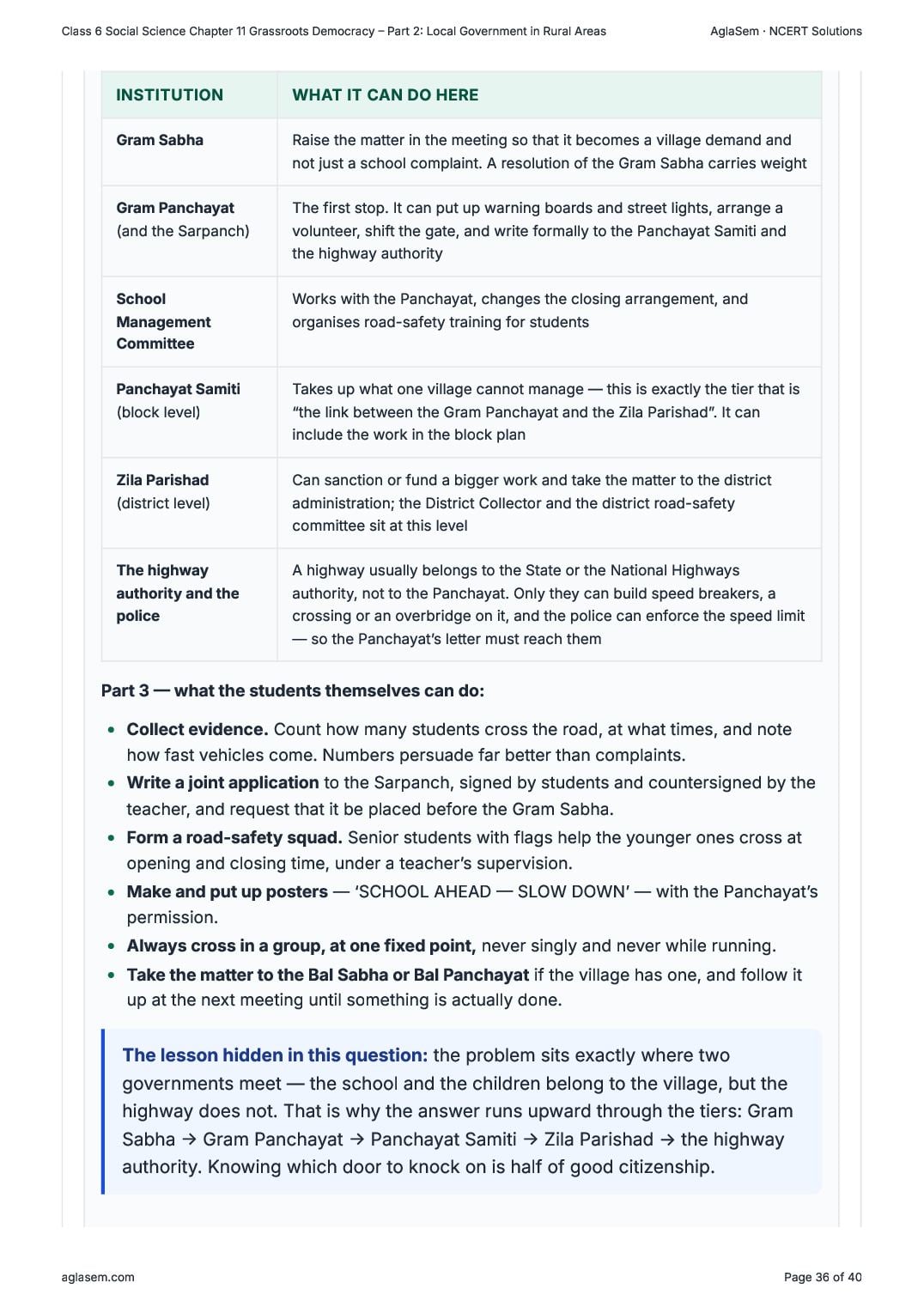
- Let us suppose that you study in a village school. The school is located next to a highway and students find it difficult to cross the road when they come to school or leave at the end of the day. What are the options to solve this issue? Which institutions in the Panchayati Raj can help you? What can the students do?
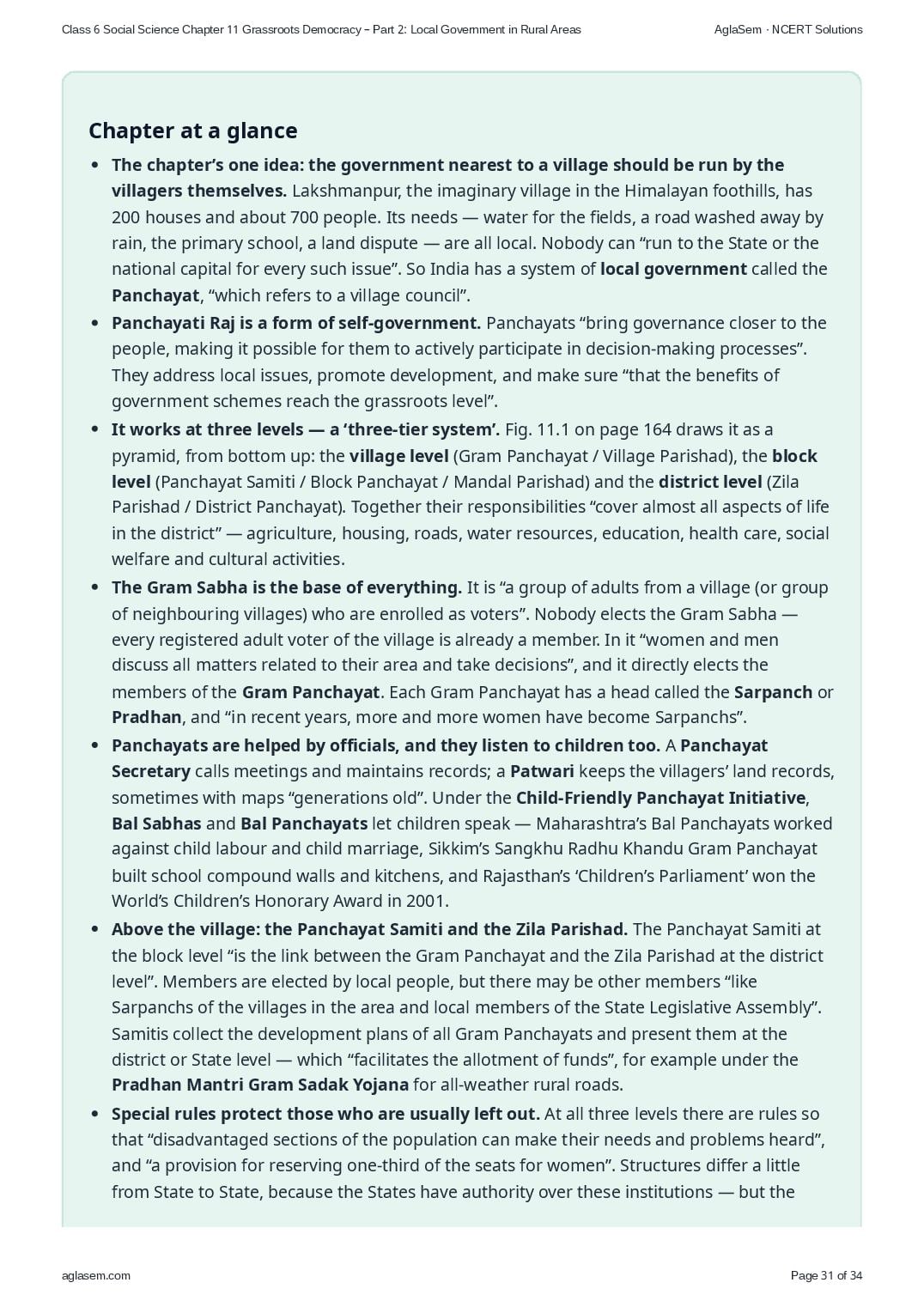
Chapter at a Glance
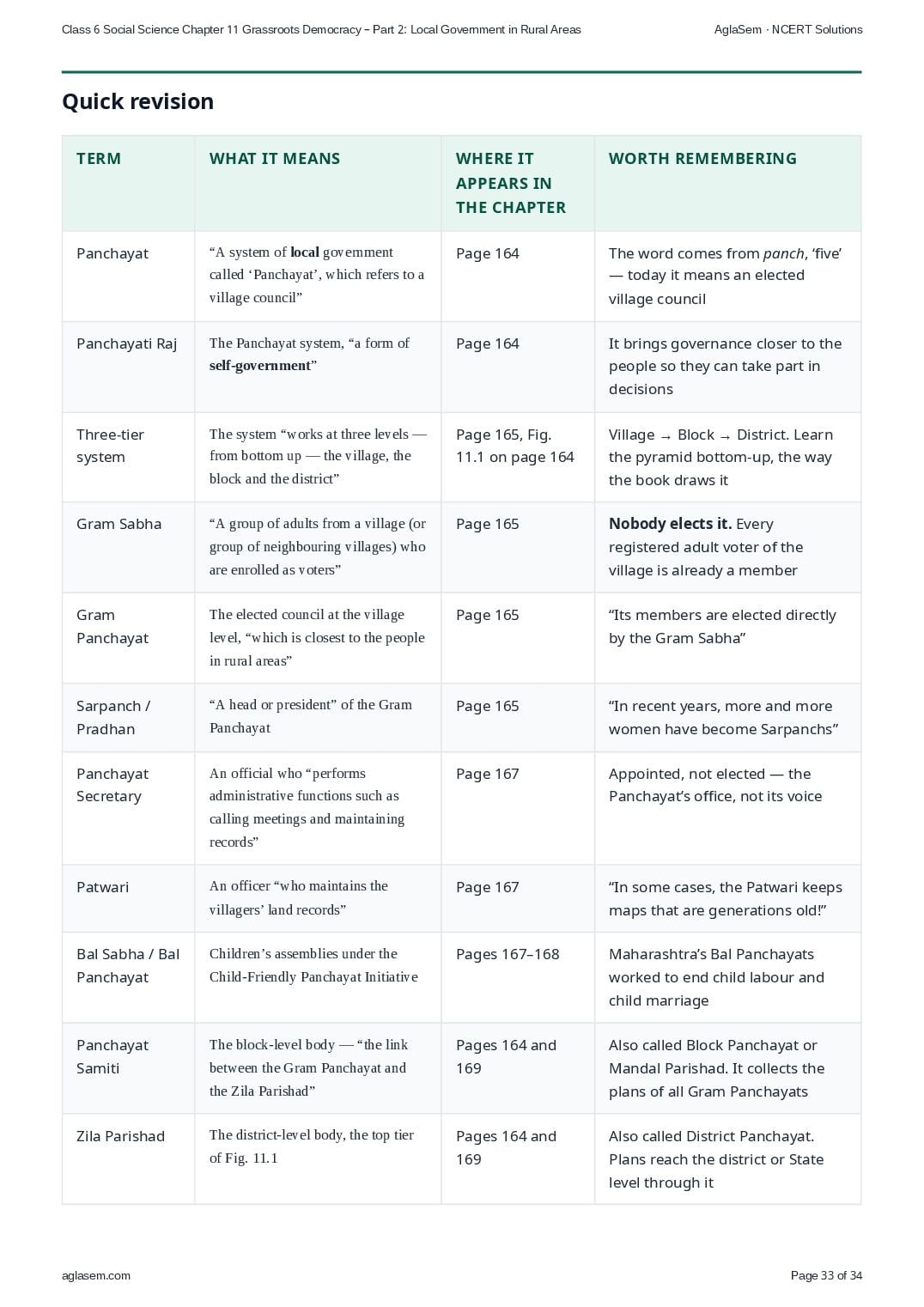
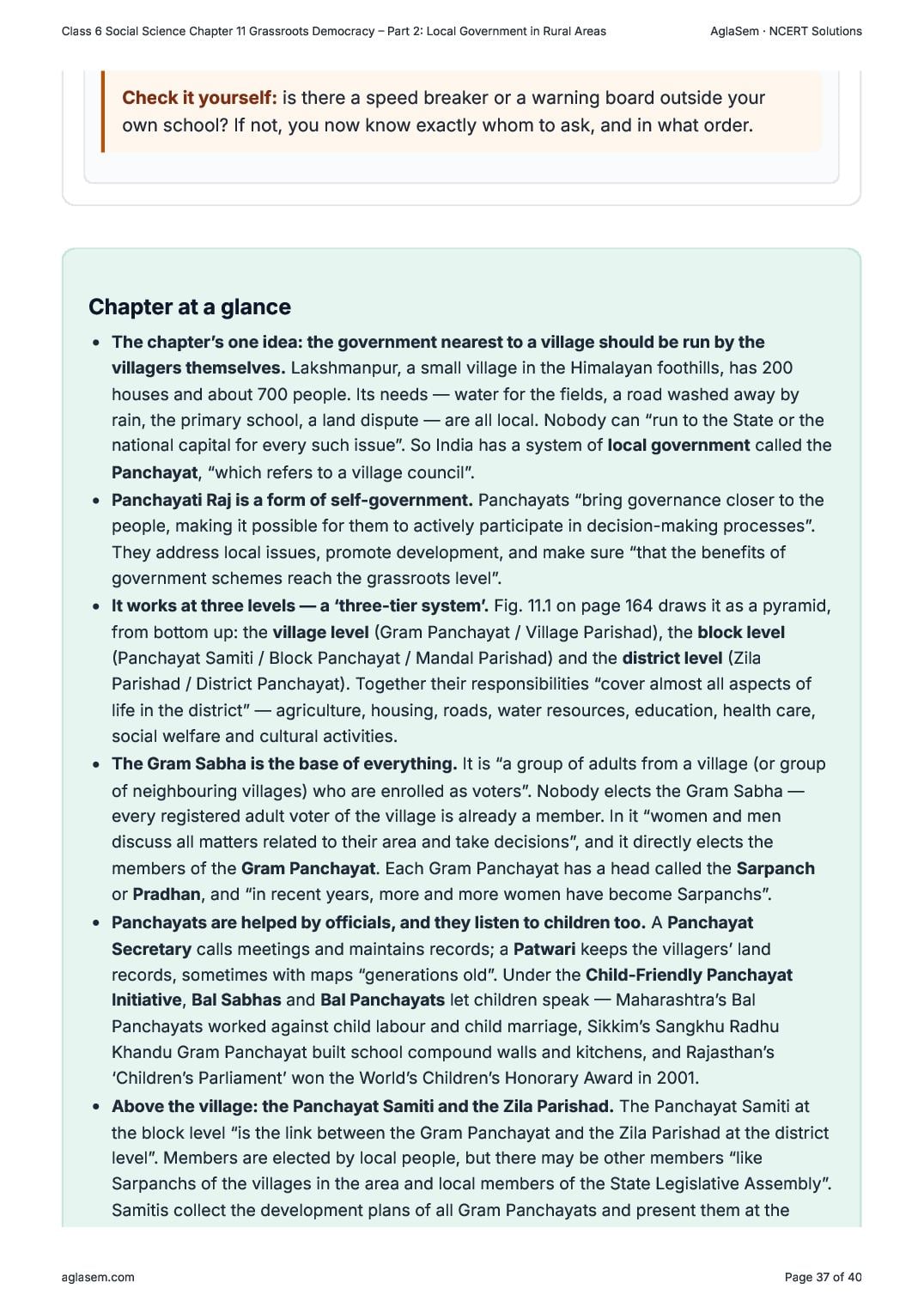
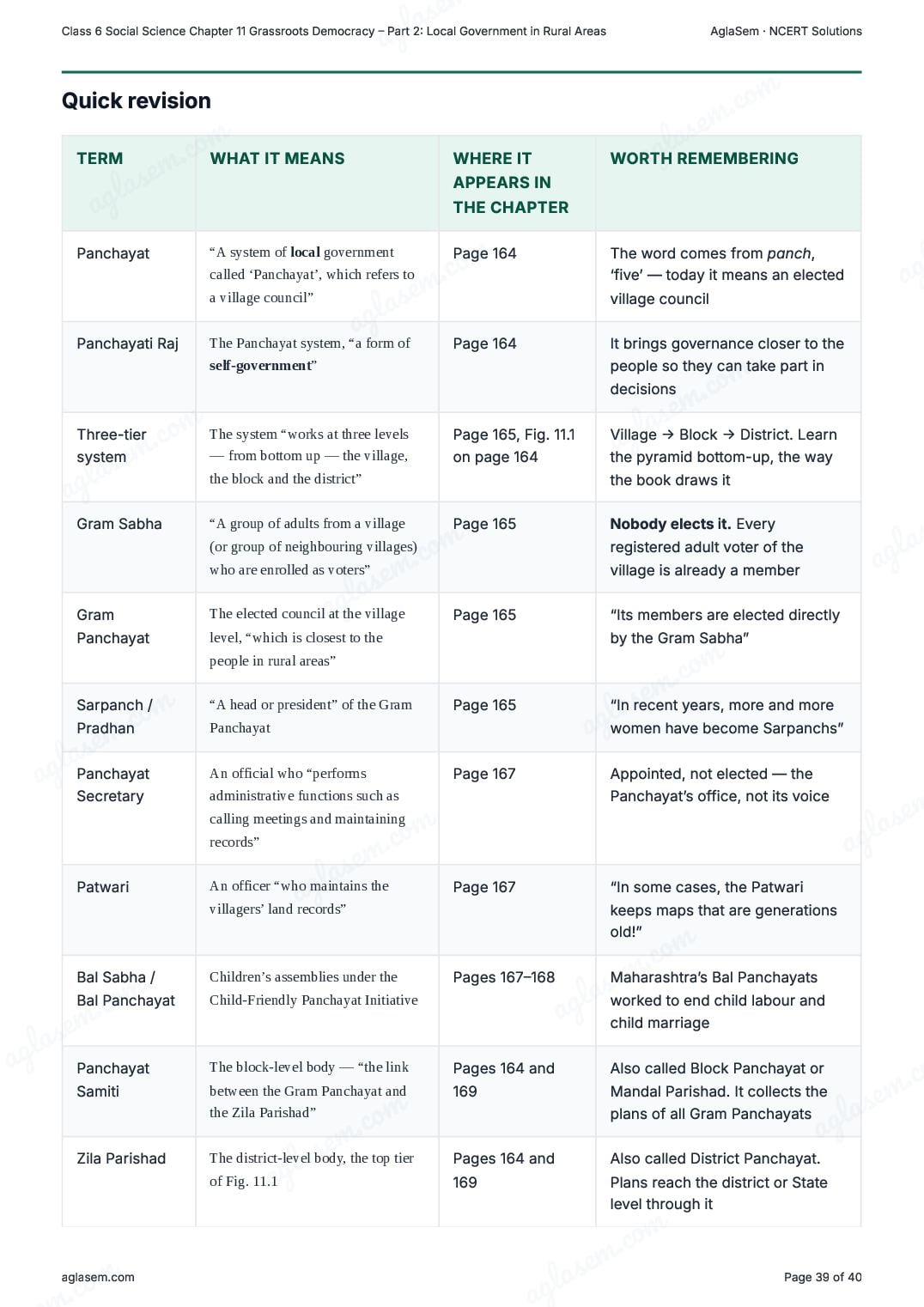
- The chapter’s one idea: the government nearest to a village should be run by the villagers themselves. Lakshmanpur, the imaginary village in the Himalayan foothills, has 200 houses and about 700 people. Its needs — water for the fields, a road washed away by rain, the primary school, a land dispute — are all local. Nobody can “run to the State or the national capital for every such issue”. So India has a system of local government called the Panchayat , “which refers to a village council”.
- Panchayati Raj is a form of self-government. Panchayats “bring governance closer to the people, making it possible for them to actively participate in decision-making processes”. They address local issues, promote development, and make sure “that the benefits of government schemes reach the grassroots level”.
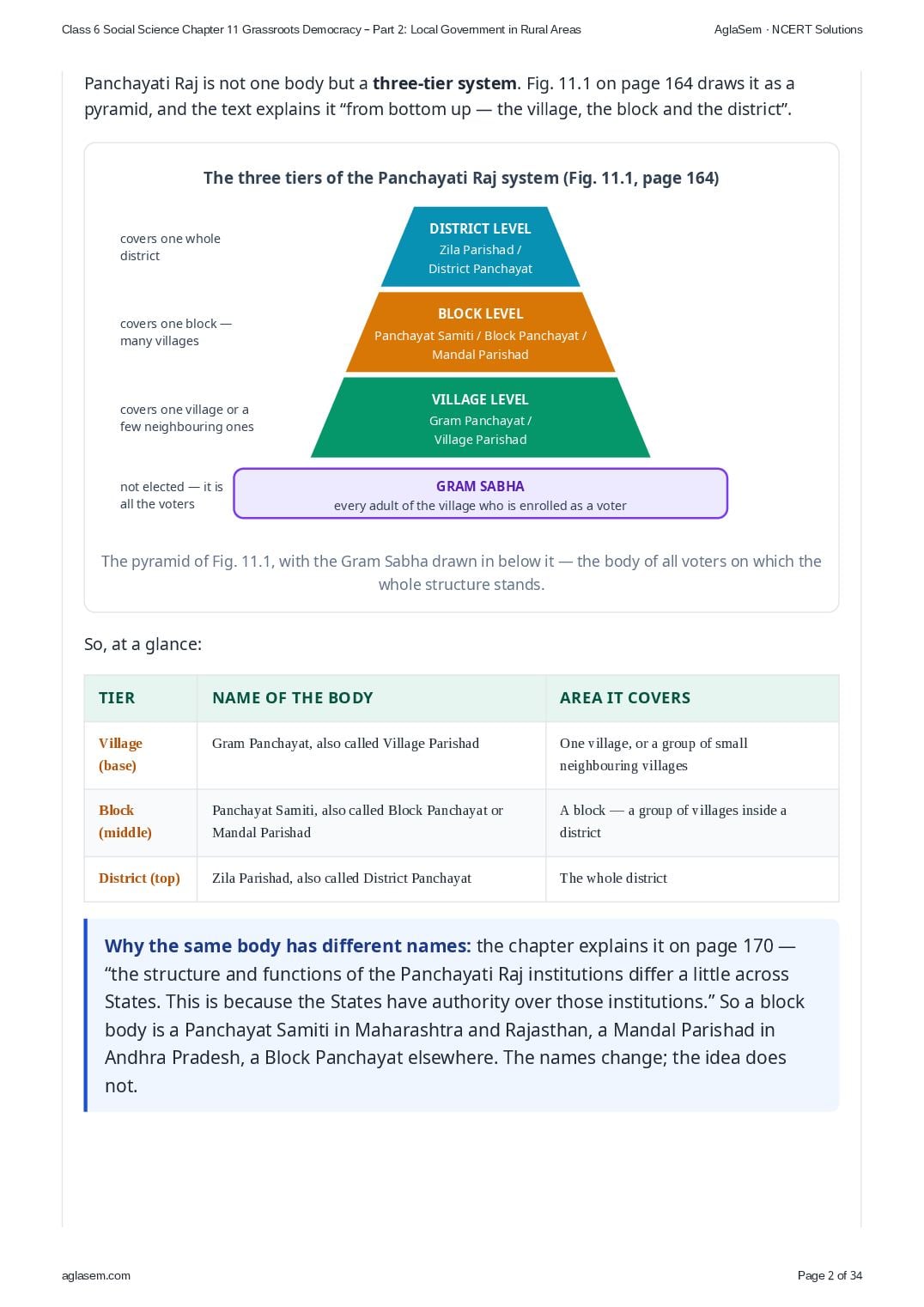
- It works at three levels — a ‘three-tier system’. Fig. 11.1 on page 164 draws it as a pyramid, from bottom up: the village level (Gram Panchayat / Village Parishad), the block level (Panchayat Samiti / Block Panchayat / Mandal Parishad) and the district level (Zila Parishad / District Panchayat). Together their responsibilities “cover almost all aspects of life in the district” — agriculture, housing, roads, water resources, education, health care, social welfare and cultural activities.
- The Gram Sabha is the base of everything. It is “a group of adults from a village (or group of neighbouring villages) who are enrolled as voters”. Nobody elects the Gram Sabha — every registered adult voter of the village is already a member. In it “women and men discuss all matters related to their area and take decisions”, and it directly elects the members of the Gram Panchayat . Each Gram Panchayat has a head called the Sarpanch or Pradhan , and “in recent years, more and more women have become Sarpanchs”.
- Panchayats are helped by officials, and they listen to children too. A Panchayat Secretary calls meetings and maintains records; a Patwari keeps the villagers’ land records, sometimes with maps “generations old”. Under the Child-Friendly Panchayat Initiative , Bal Sabhas and Bal Panchayats let children speak — Maharashtra’s Bal Panchayats worked against child labour and child marriage, Sikkim’s Sangkhu Radhu Khandu Gram Panchayat built school compound walls and kitchens, and Rajasthan’s ‘Children’s Parliament’ won the World’s Children’s Honorary Award in 2001.
- Above the village: the Panchayat Samiti and the Zila Parishad. The Panchayat Samiti at the block level “is the link between the Gram Panchayat and the Zila Parishad at the district level”. Members are elected by local people, but there may be other members “like Sarpanchs of the villages in the area and local members of the State Legislative Assembly”. Samitis collect the development plans of all Gram Panchayats and present them at the district or State level — which “facilitates the allotment of funds”, for example under the Pradhan Mantri Gram Sadak Yojana for all-weather rural roads.
- Special rules protect those who are usually left out. At all three levels there are rules so that “disadvantaged sections of the population can make their needs and problems heard”, and “a provision for reserving one-third of the seats for women”. Structures differ a little from State to State, because the States have authority over these institutions — but the objective is the same everywhere: to let villagers take an active part in managing and developing their own area. The chapter closes with Kauṭilya’s Arthaśhāstra , which planned a village-to-capital administrative ladder some 2,300 years ago.
How to Download NCERT Solutions for Class 6 Social Science Chapter 11 PDF
Follow these simple steps to get the Grassroots Democracy part 2 Local Government in Rural Areas questions-and-answers PDF from Exploring Society India and Beyond.
- Search NCERT Solutions for Class 6 Social Science Chapter 11 aglasem and open this page.
- Read the exercise questions with answers for Grassroots Democracy part 2 Local Government in Rural Areas shown above.
- Click the Download PDF link to save the Grassroots Democracy part 2 Local Government in Rural Areas solutions to your device.
NCERT Solutions for Class 6 Social Science – All Chapters
There are more chapters to study besides Grassroots Democracy part 2 Local Government in Rural Areas in Social Science. Here are the NCERT Solutions for all chapters of Class 6 Social Science.
- Chapter 1 Locating Places on the Earth
- Chapter 2 Oceans and Continents
- Chapter 3 Landforms and Life
- Chapter 4 Timeline and Sources of History
- Chapter 5 India That Is Bharat
- Chapter 6 the Beginnings of Indian Civilisation
- Chapter 7 India’s Cultural Roots
- Chapter 8 Unity in Diversity or Many in the One
- Chapter 9 Family and Community
- Chapter 10 Grassroots Democracy part 1 Governance
- Chapter 11 Grassroots Democracy part 2 Local Government in Rural Areas
- Chapter 12 Grassroots Democracy part 3 Local Government in Urban Areas
- Chapter 13 the Value of Work
- Chapter 14 Economic Activities Around Us
NCERT Solutions for Class 6 – All Subjects
Just like Chapter 11 of Social Science, you can get the exercise questions with answers for every other subject of Class 6. Here are the NCERT Solutions for all subjects of Class 6.
NCERT Solutions for Class 6 Social Science Chapter 11 – An Overview
The key highlights of this study material are as follows.
| Aspects | Details |
|---|---|
| Class | Class 6 |
| Subject | Social Science |
| Chapter Number | Chapter 11 |
| Chapter Name | Grassroots Democracy part 2 Local Government in Rural Areas |
| Book Name | Exploring Society India and Beyond |
| Book By | NCERT (National Council of Educational Research and Training) |
| Educational Resource Here | NCERT Solutions of Class 6 Social Science Chapter 11 for all exercises |
| More Questions Answers of This Subject | NCERT Solutions for Class 6 Social Science |
| Download Book Chapter | NCERT Book Class 6 Social Science |
| All Questions Answers For This Class | NCERT Solutions for Class 6 |
| Complete Solutions | NCERT Solutions |
NCERT Solutions for Class 6 Social Science Chapter 11 Grassroots Democracy part 2 Local Government in Rural Areas – FAQs
What are the NCERT Solutions for Class 6 Social Science Chapter 11 Grassroots Democracy part 2 Local Government in Rural Areas?
They are the complete, step-by-step answers to all the exercise and in-text questions of Chapter 11 Grassroots Democracy part 2 Local Government in Rural Areas from the NCERT Class 6 Social Science textbook Exploring Society India and Beyond, written by experts as per the latest NCERT syllabus.
How can I download the Class 6 Social Science Chapter 11 solutions PDF for free?
Open this page on aglasem, read the Grassroots Democracy part 2 Local Government in Rural Areas questions with answers, and click the “Download Solutions PDF” link. The Class 6 Social Science Chapter 11 NCERT Solutions PDF is completely free to download.
Are these NCERT Solutions as per the latest 2026-27 syllabus?
Yes. The NCERT Solutions for Class 6 Social Science Chapter 11 are based on the latest NCERT textbook Exploring Society India and Beyond and the current 2026-27 CBSE syllabus, so the questions and answers match what you study in class.
Where can I get NCERT Solutions for the other chapters of Class 6 Social Science?
You can find the answers to every chapter on the NCERT Solutions for Class 6 Social Science page, and solutions for every subject on the NCERT Solutions for Class 6 page.
How do NCERT Solutions help in exam preparation?
They show the correct method to solve each question, help you write answers the way they are expected in exams, let you check and correct your own work, and save revision time — which together improve your marks in Class 6 Social Science.
If you have any queries on NCERT Solutions for Class 6 Social Science Chapter 11 Grassroots Democracy part 2 Local Government in Rural Areas, then please ask in the comments below.