NCERT Solutions for Class 6 Social Science Chapter 6 the Beginnings of Indian Civilisation provide clear, step-by-step answers to every exercise and in-text question from the chapter the Beginnings of Indian Civilisation of the NCERT textbook Exploring Society India and Beyond. Prepared by subject experts as per the latest NCERT (CBSE) syllabus for 2026-27, these NCERT Solutions for Class 6 Social Science help you understand each concept, write exam-ready answers, and check your own solutions. You can read them online below or download the free Class 6 Social Science Chapter 6 question-answer PDF.
NCERT Solutions for Class 6 Social Science Chapter 6 the Beginnings of Indian Civilisation
- Class: Class 6
- Subject: Social Science
- Chapter: Chapter 6 – the Beginnings of Indian Civilisation
- Textbook: Exploring Society India and Beyond (NCERT)
- Study material: NCERT Solutions – questions with answers, free PDF
These solutions answer all the exercise questions of Chapter 6 the Beginnings of Indian Civilisation — including the in-text questions, short-answer and long-answer questions, and activities — with complete explanations so you can follow the method, not just the final answer. Read the full solutions below.
NCERT Solutions Class 6 Social Science Chapter 6 the Beginnings of Indian Civilisation View Download
NCERT Solutions for Class 6 Social Science Chapter 6 PDF Download
You can read the NCERT Solutions for Class 6 Social Science Chapter 6 online above, or download the complete question-answer PDF to study the Beginnings of Indian Civilisation offline at any time.
NCERT Solutions for Class 6 Social Science Chapter 6 PDF Download Link – Click Here to Download Solutions PDF
Questions Covered in This Chapter
These NCERT Solutions answer all 33 questions of this chapter. The questions solved are:
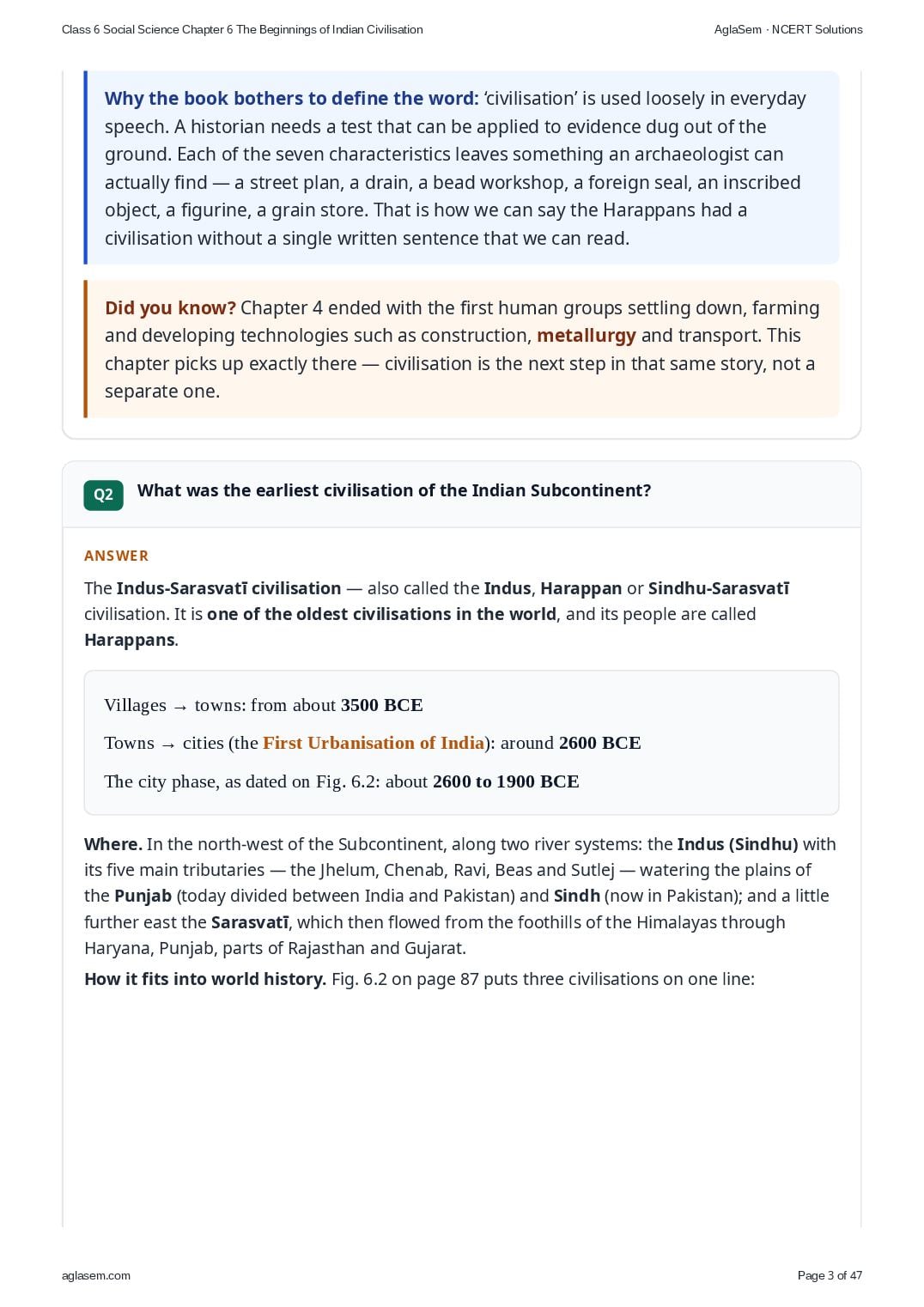
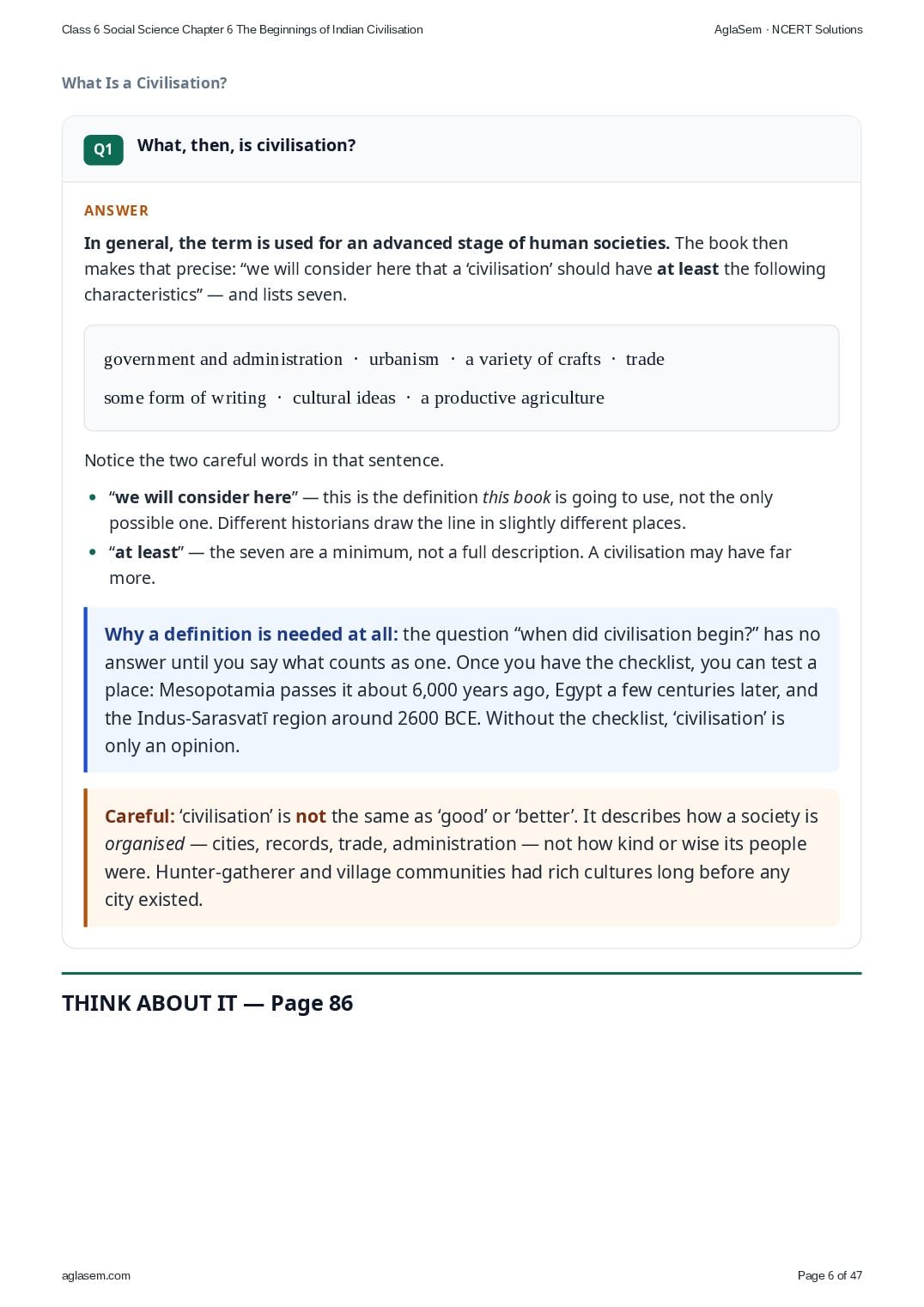
- What is a civilisation?
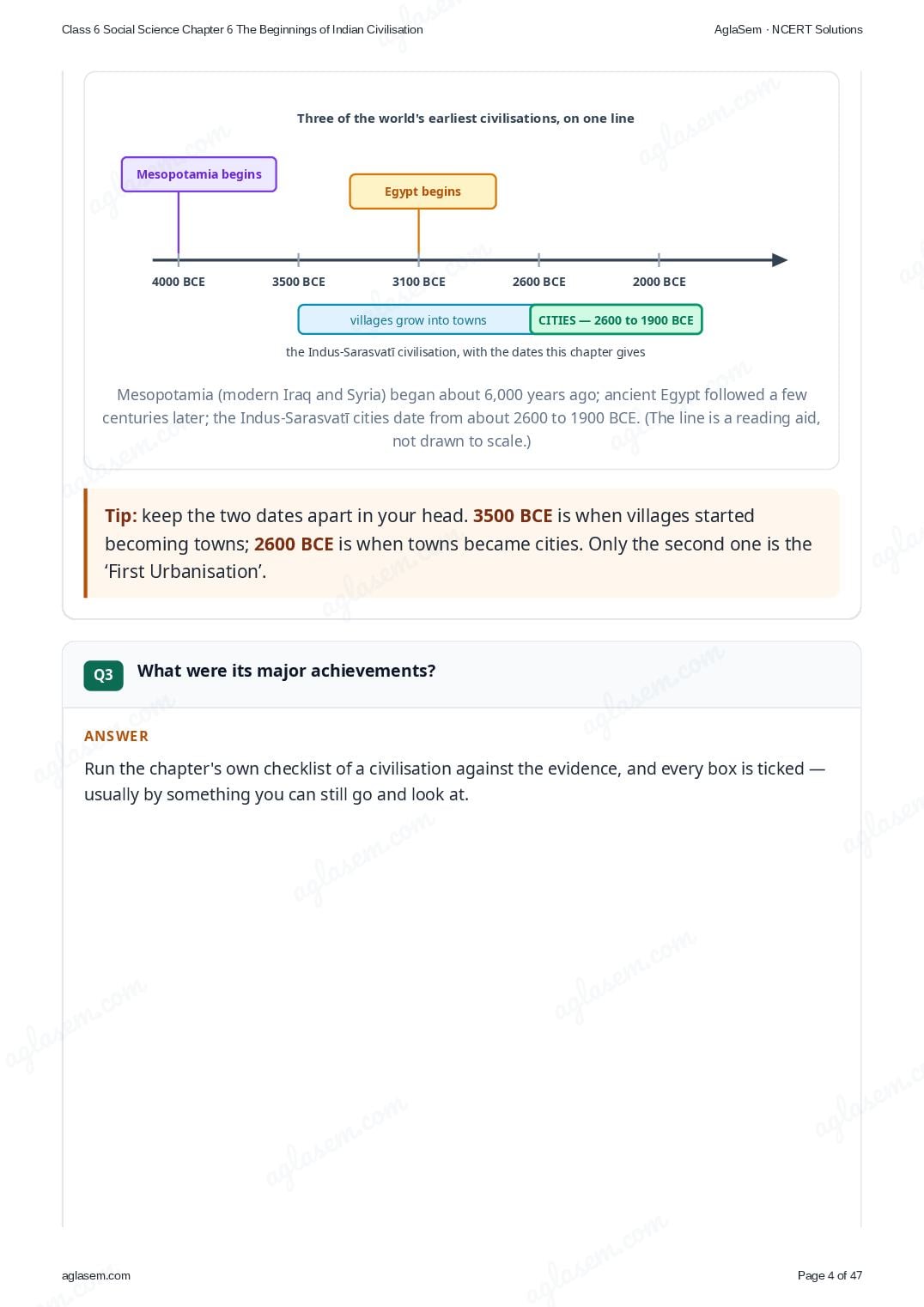
- What was the earliest civilisation of the Indian Subcontinent?
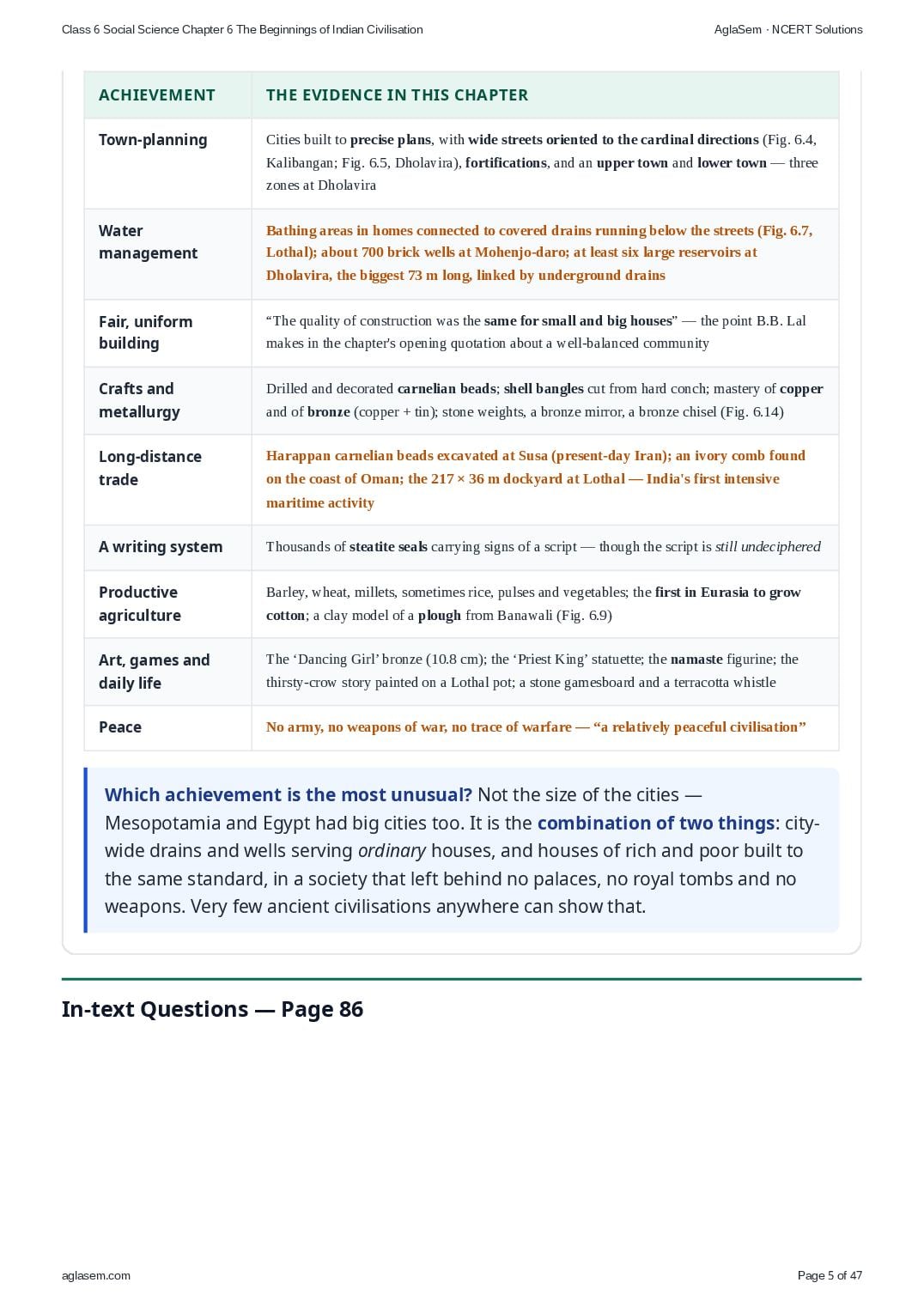
- What were its major achievements?
- What, then, is civilisation?
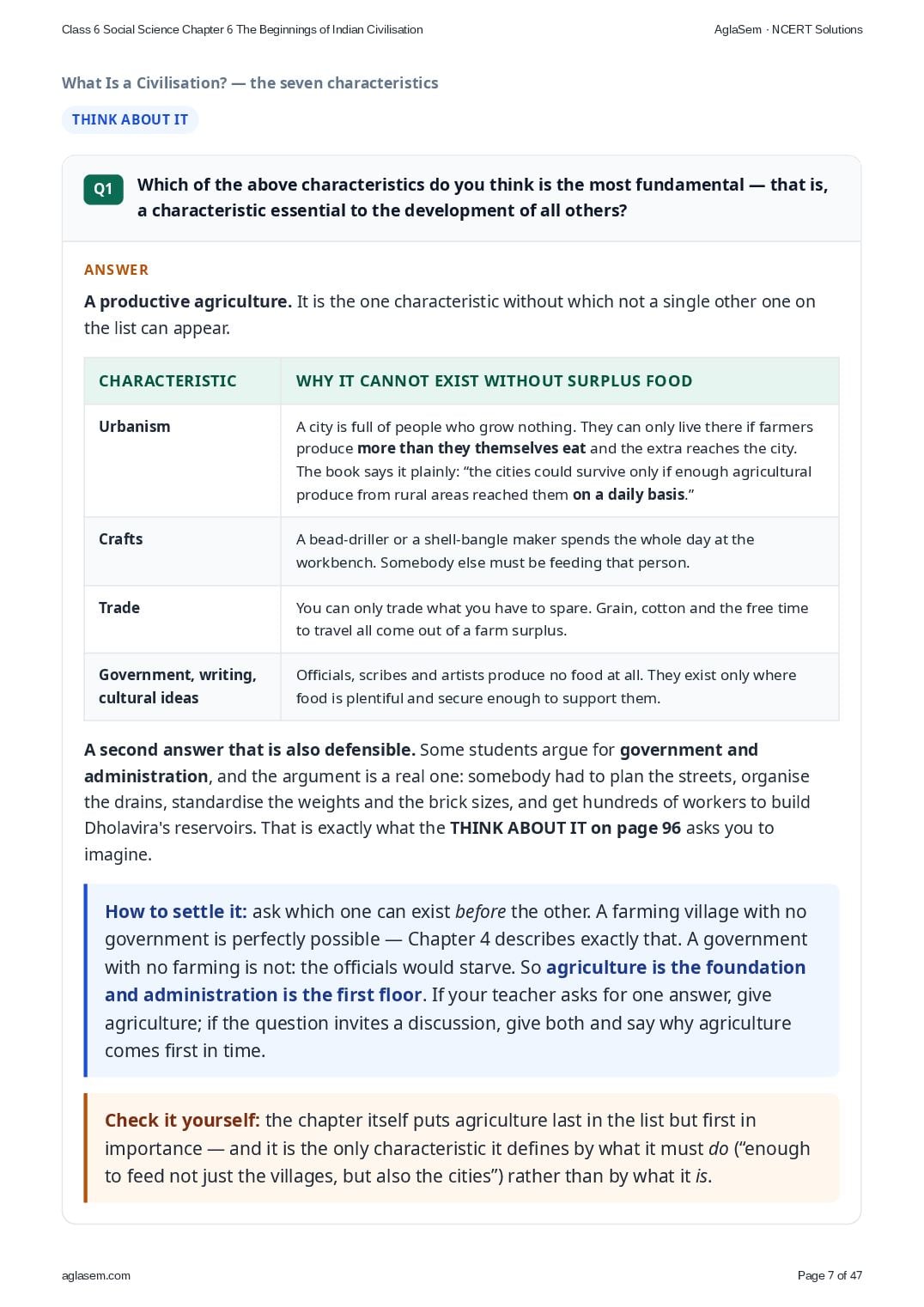
- Which of the above characteristics do you think is the most fundamental — that is, a characteristic essential to the development of all others?
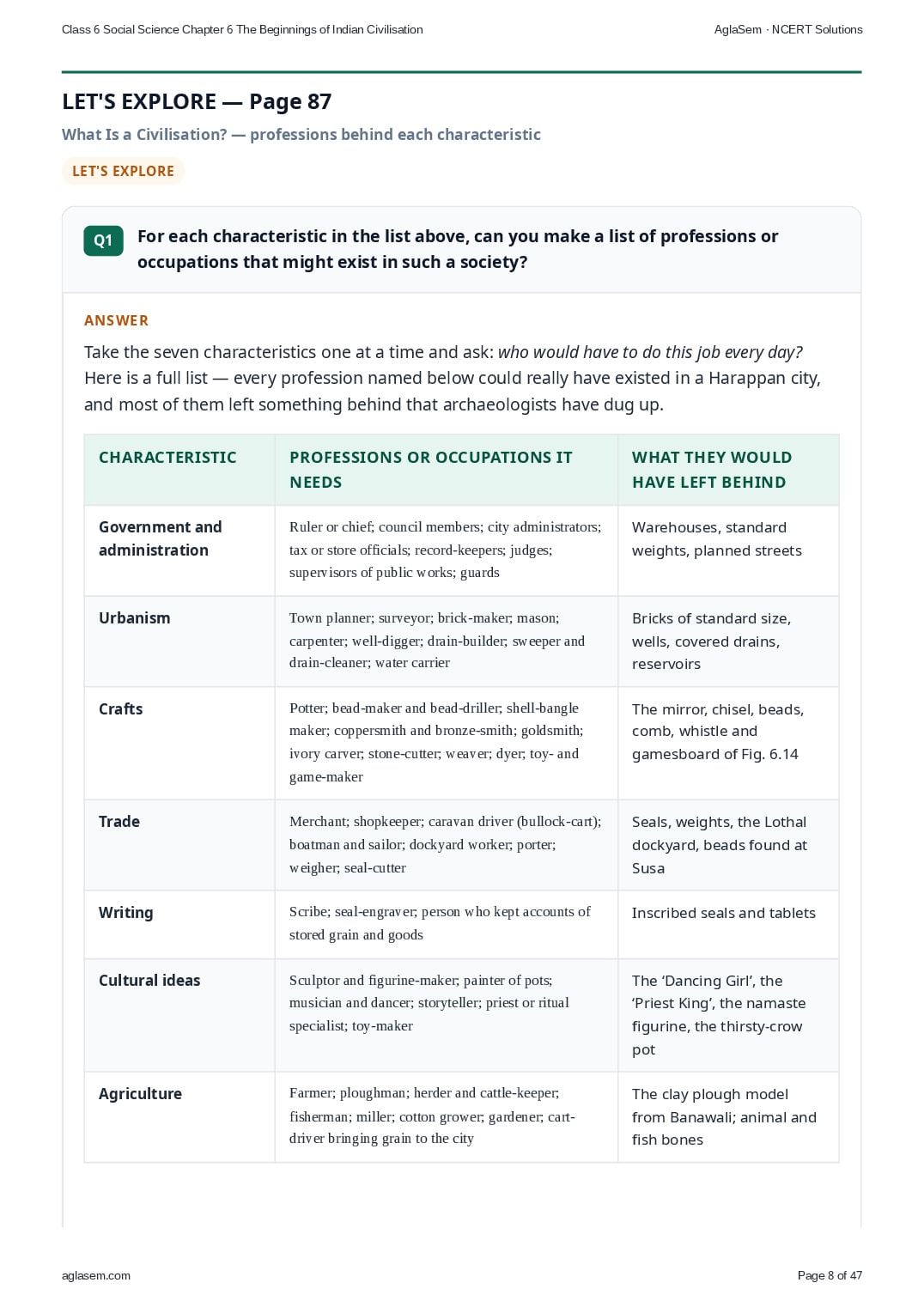
- For each characteristic in the list above, can you make a list of professions or occupations that might exist in such a society?
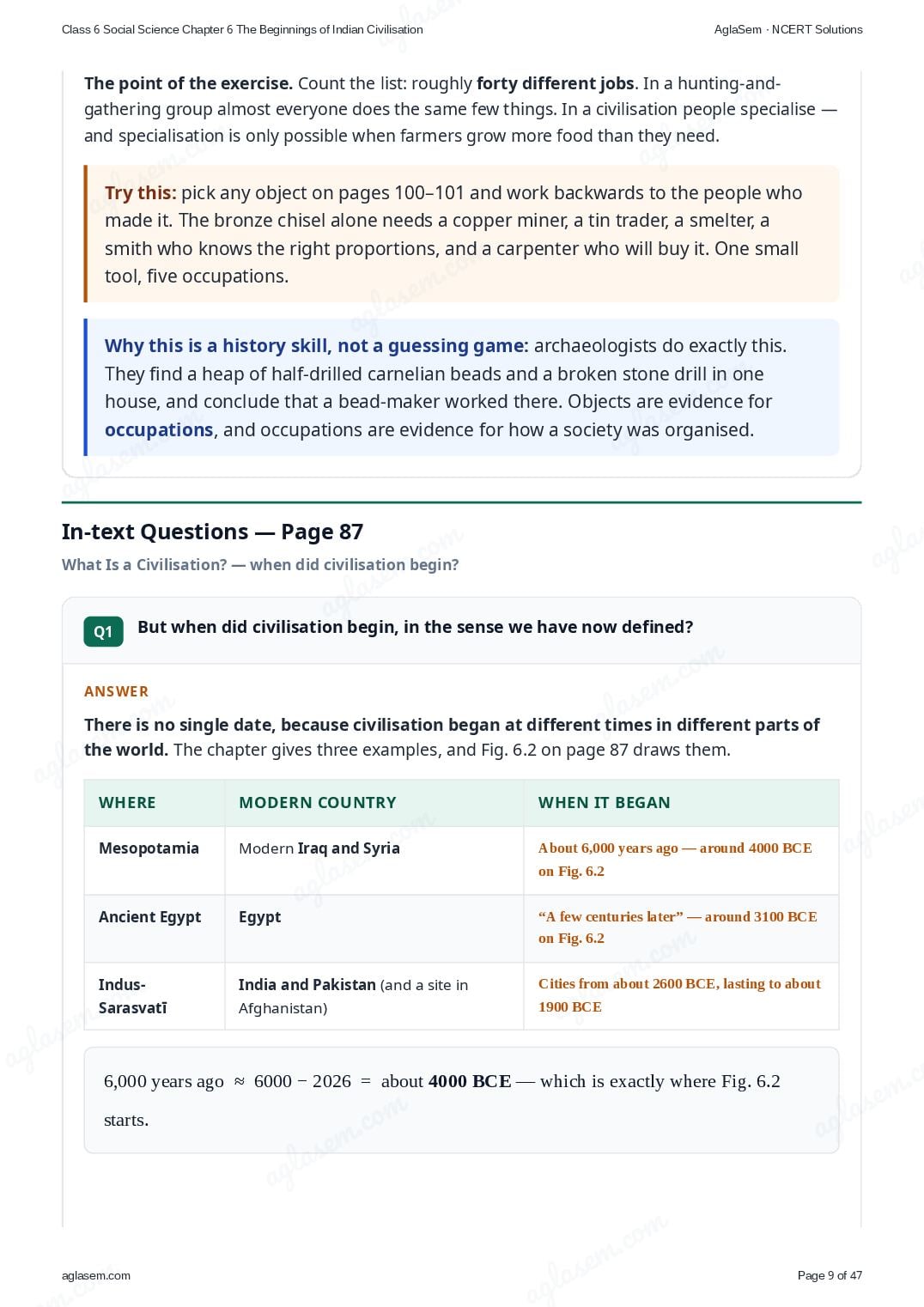
- But when did civilisation begin, in the sense we have now defined?
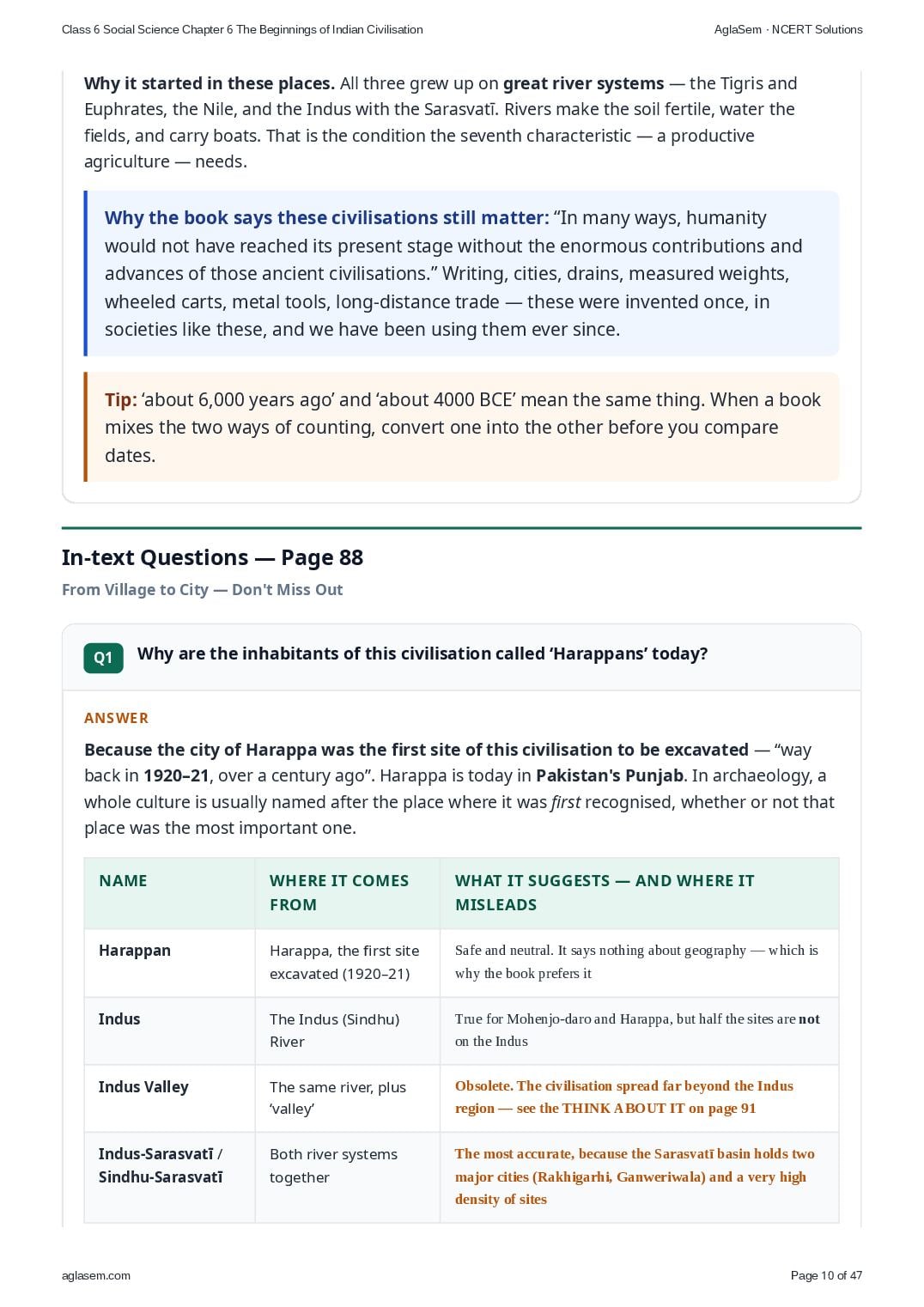
- Why are the inhabitants of this civilisation called ‘Harappans’ today?
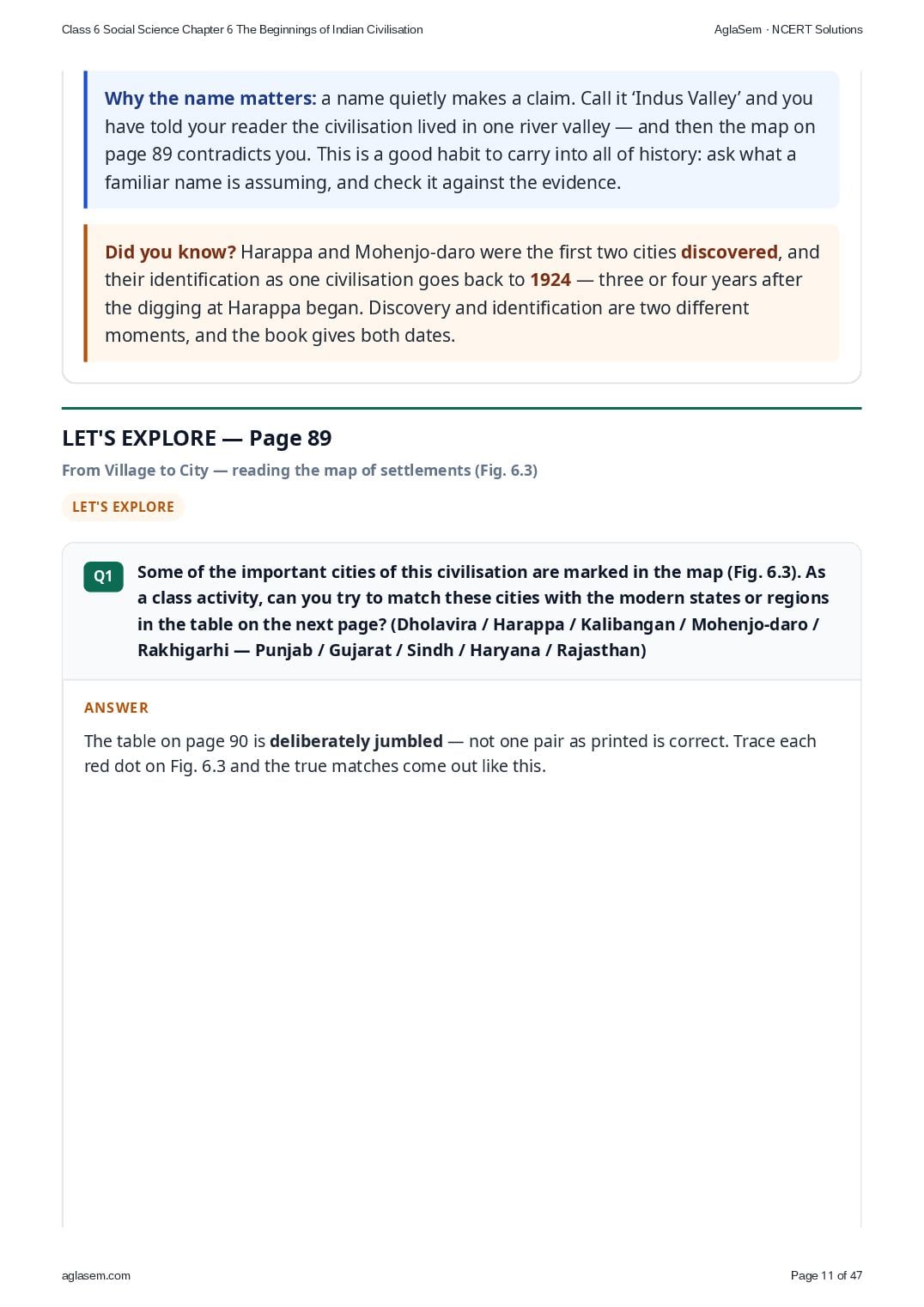
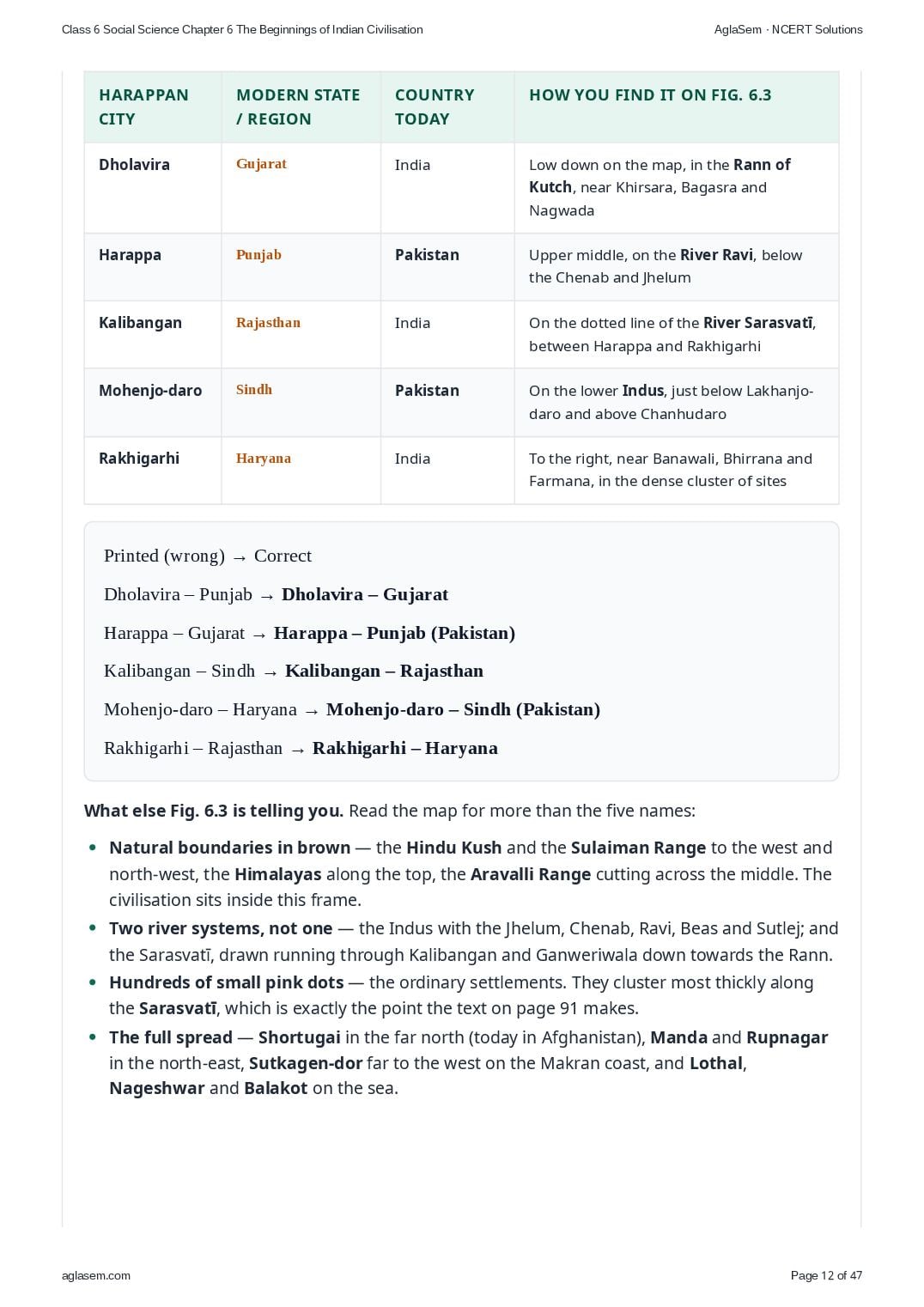
- Some of the important cities of this civilisation are marked in the map (Fig. 6.3). As a class activity, can you try to match these cities with the modern states or regions in the table on the next page? (Dholavira / Harappa / Kalibangan / Mohenjo-daro / Rakhigarhi — Punjab / Gujarat / Sindh / Haryana / Rajasthan)
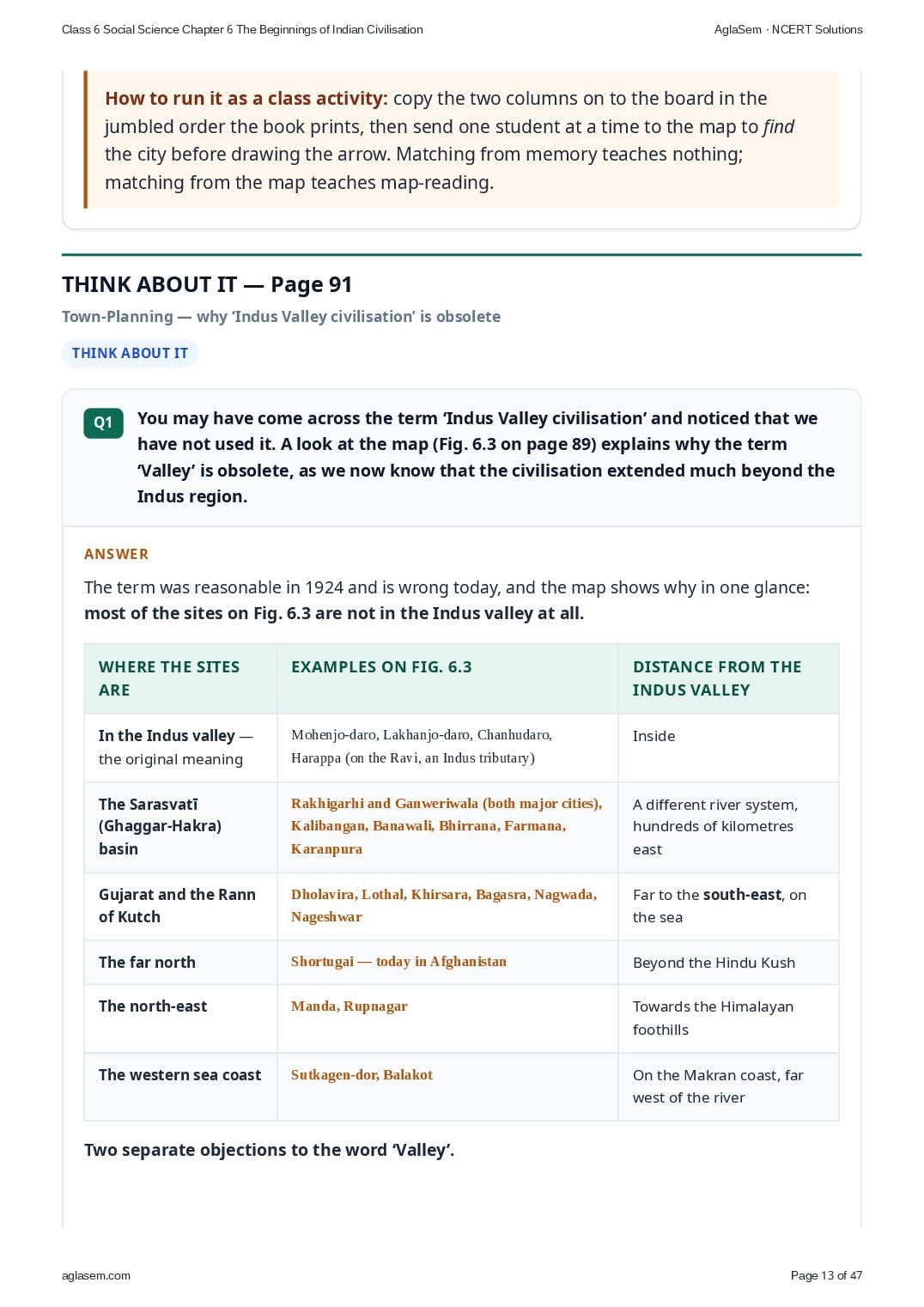
- You may have come across the term ‘Indus Valley civilisation’ and noticed that we have not used it. A look at the map (Fig. 6.3 on page 89) explains why the term ‘Valley’ is obsolete, as we now know that the civilisation extended much beyond the Indus region.
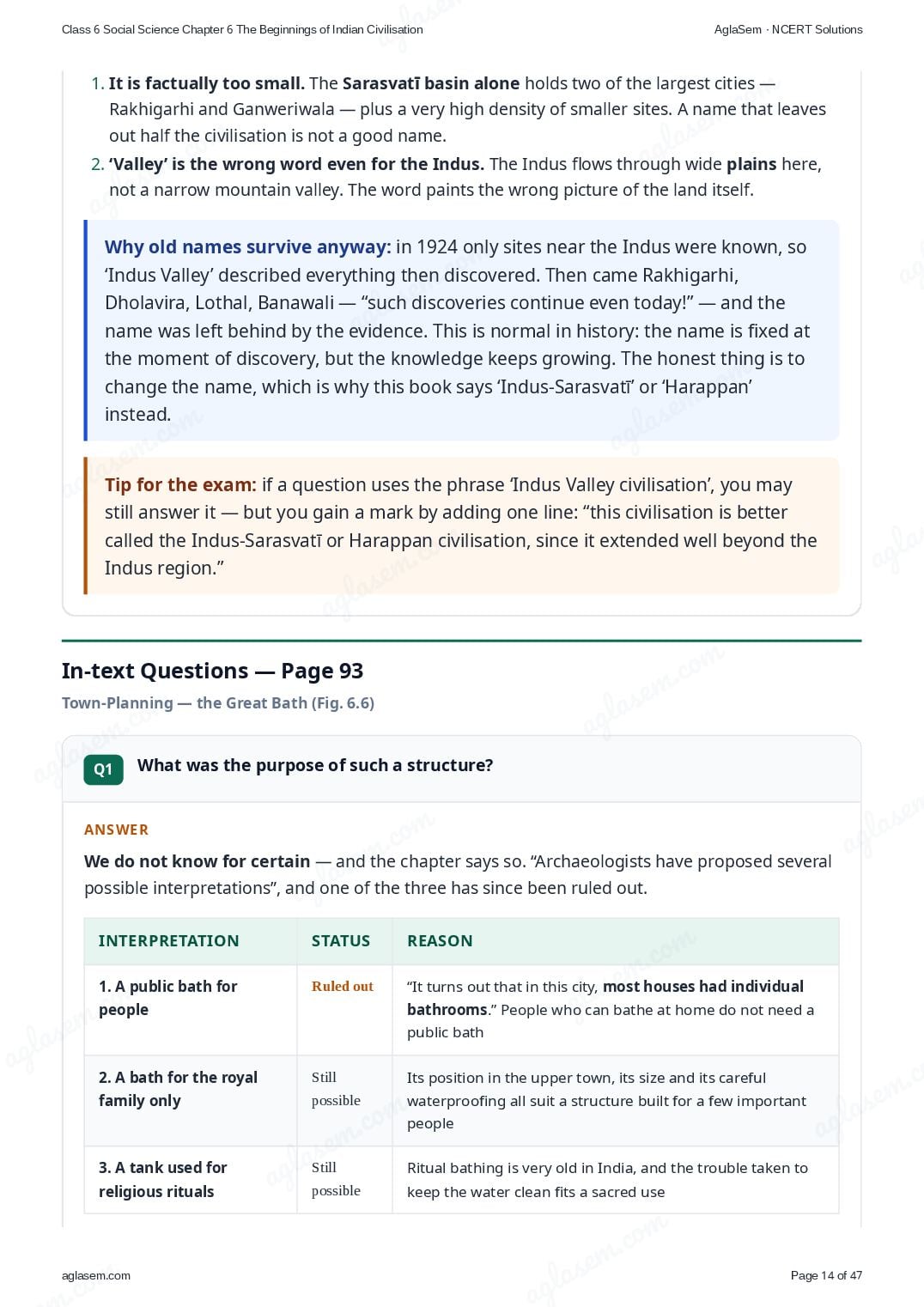
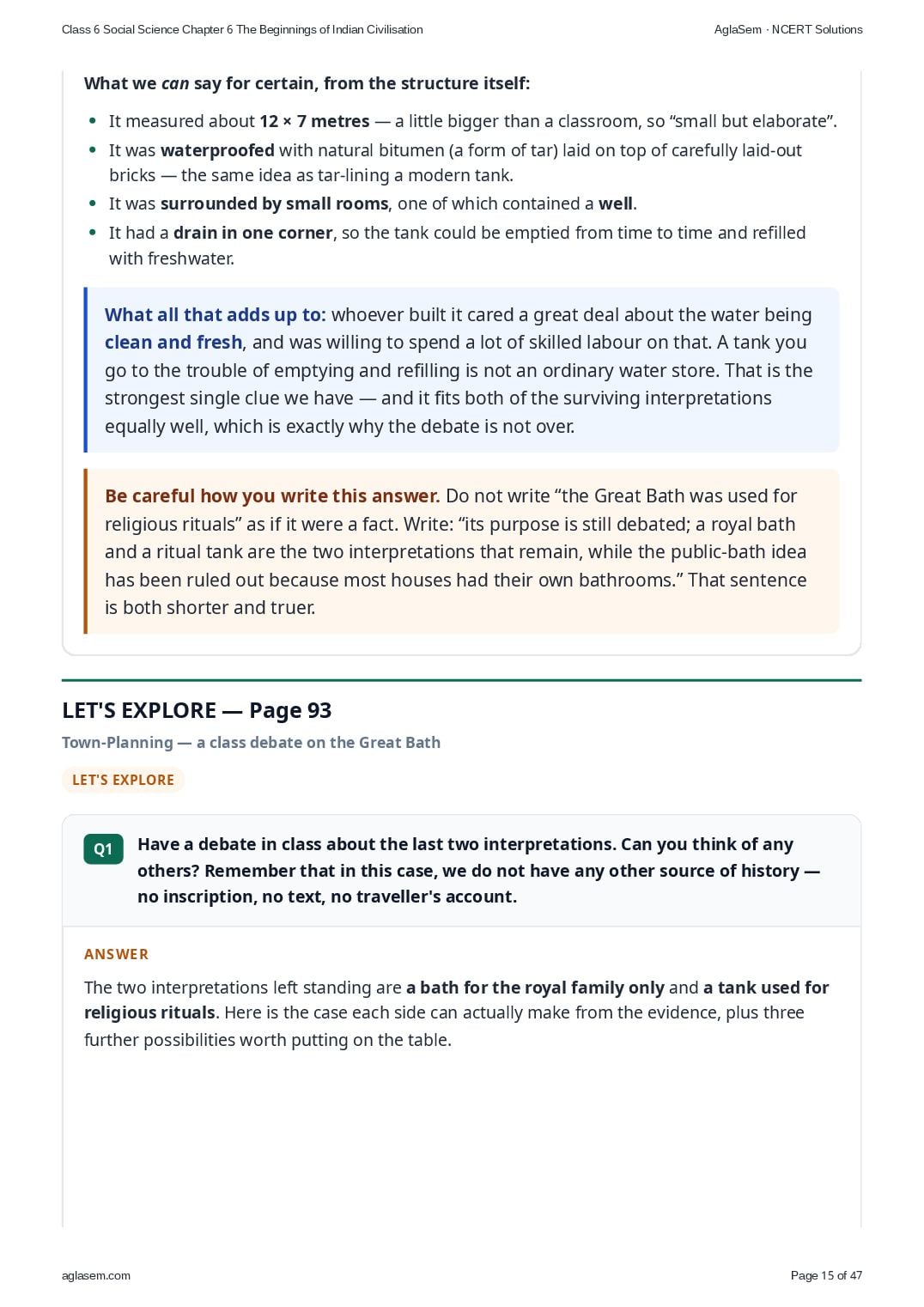
- What was the purpose of such a structure?
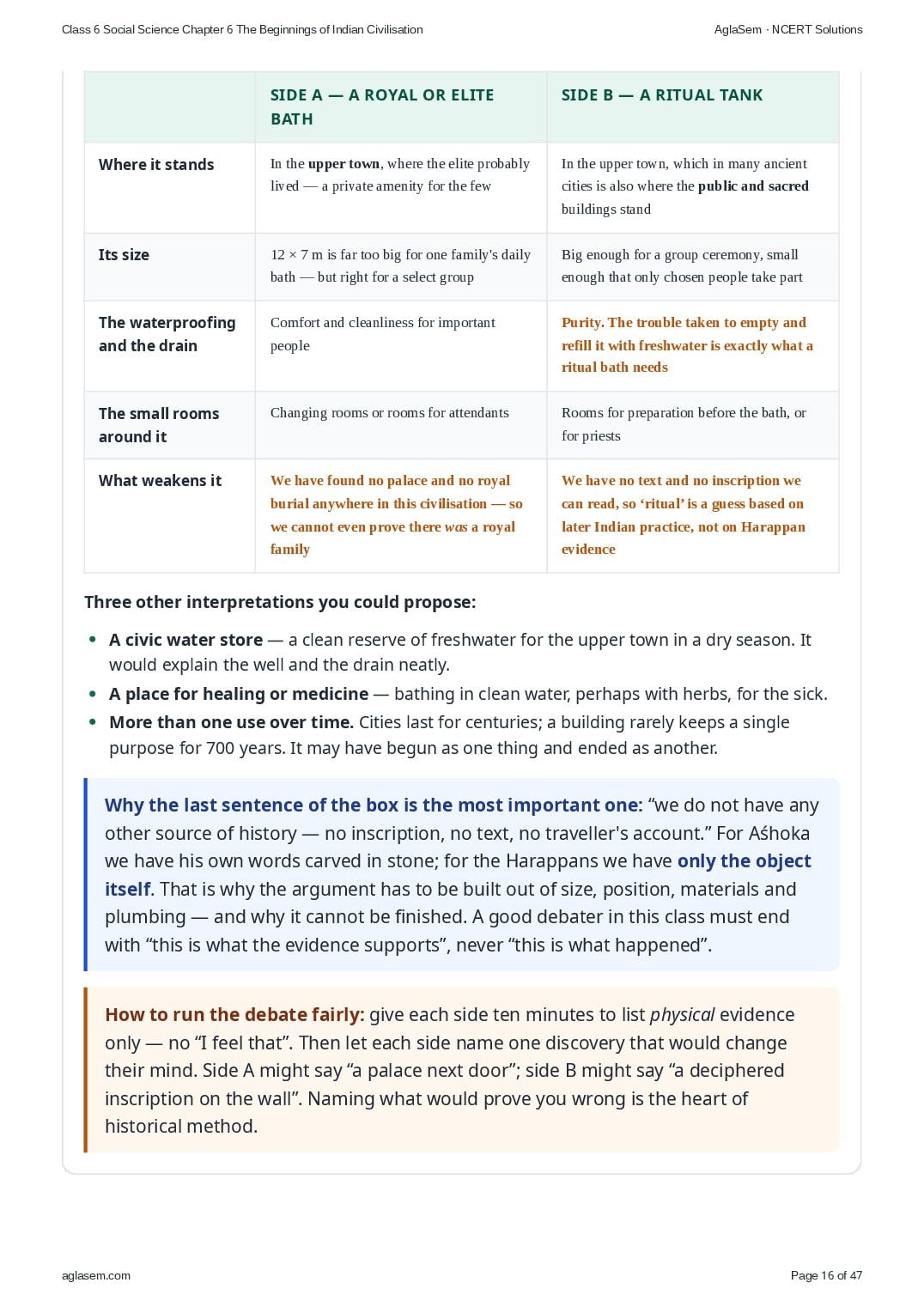
- Have a debate in class about the last two interpretations. Can you think of any others? Remember that in this case, we do not have any other source of history — no inscription, no text, no traveller's account.
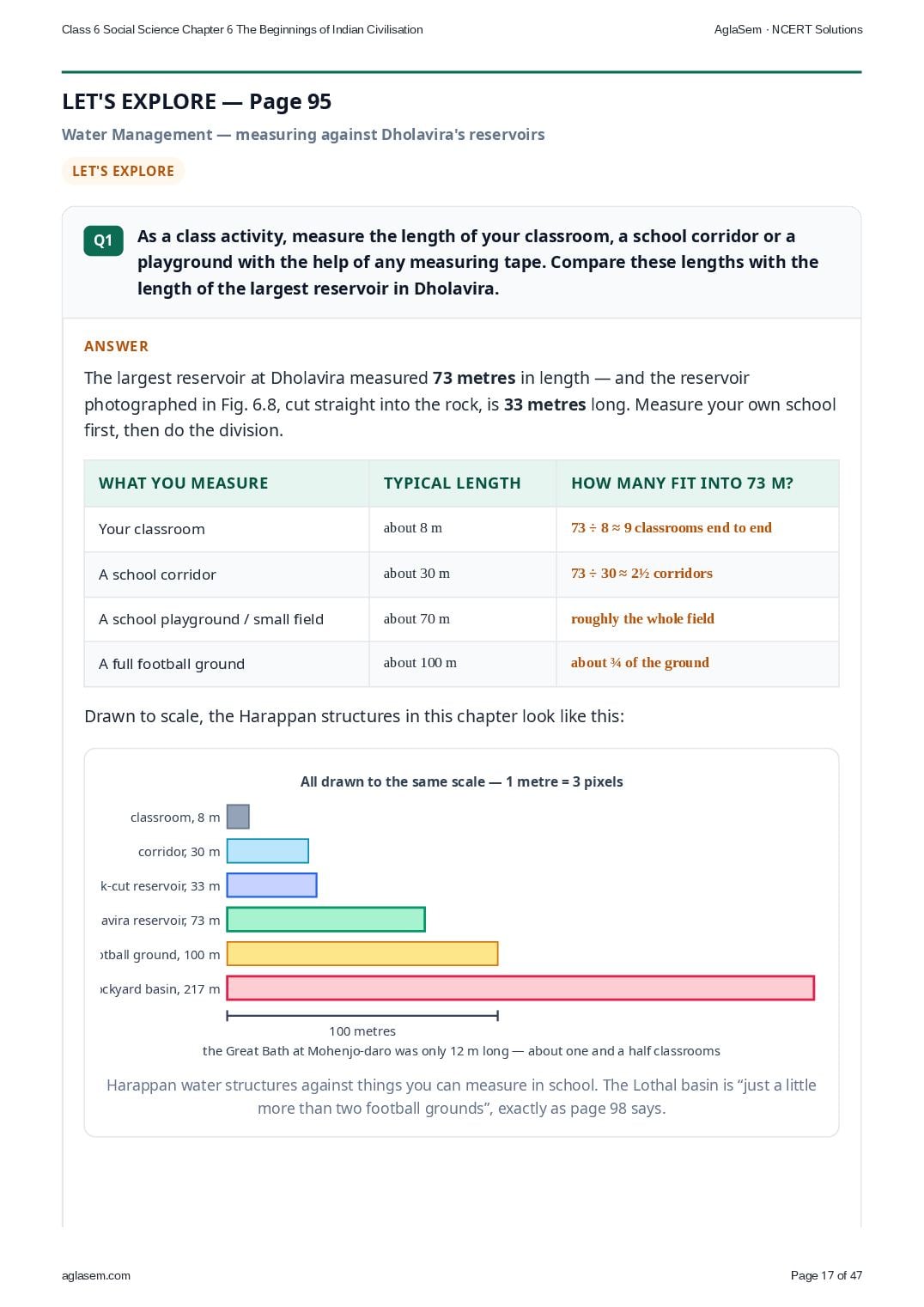
- As a class activity, measure the length of your classroom, a school corridor or a playground with the help of any measuring tape. Compare these lengths with the length of the largest reservoir in Dholavira.
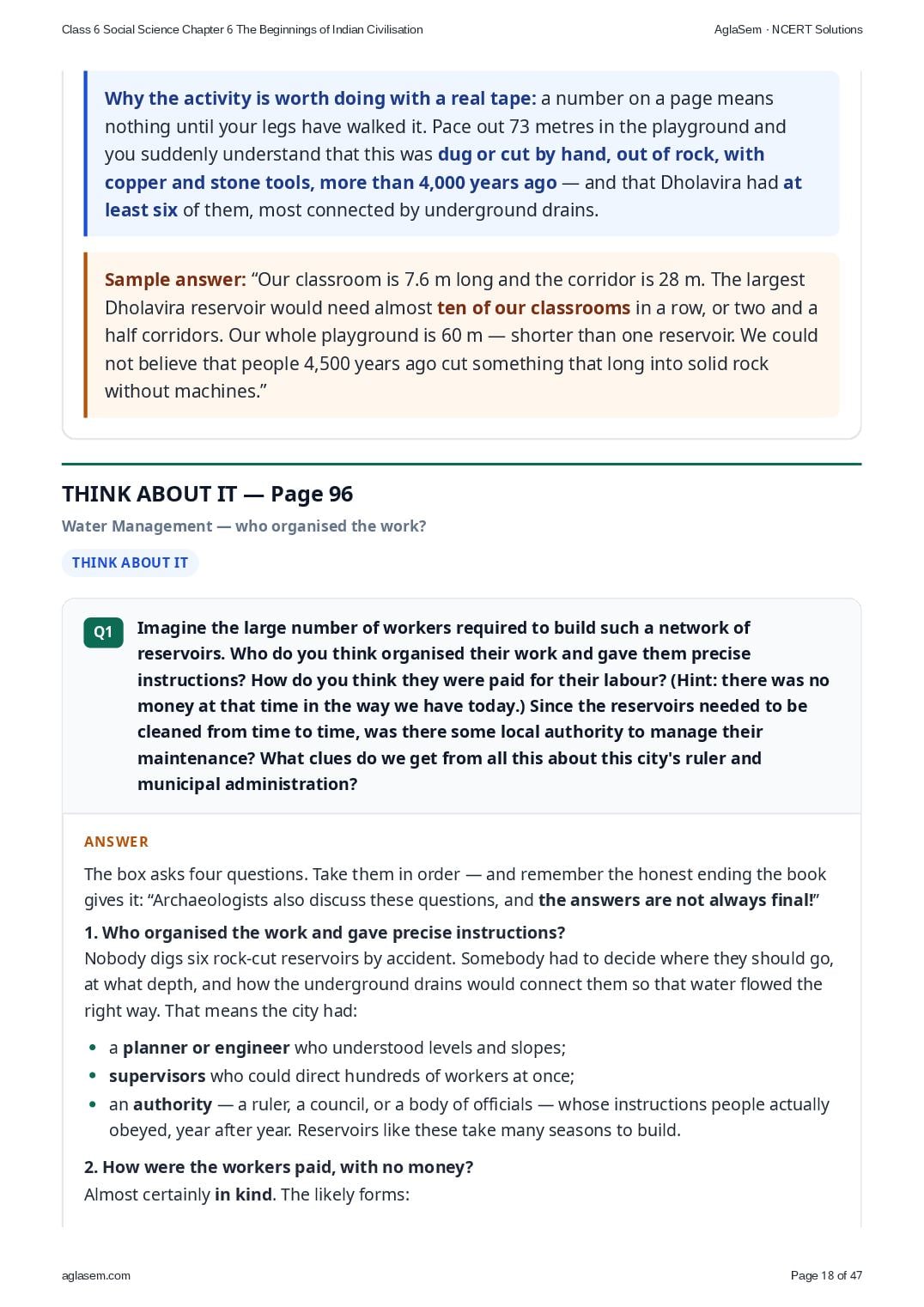
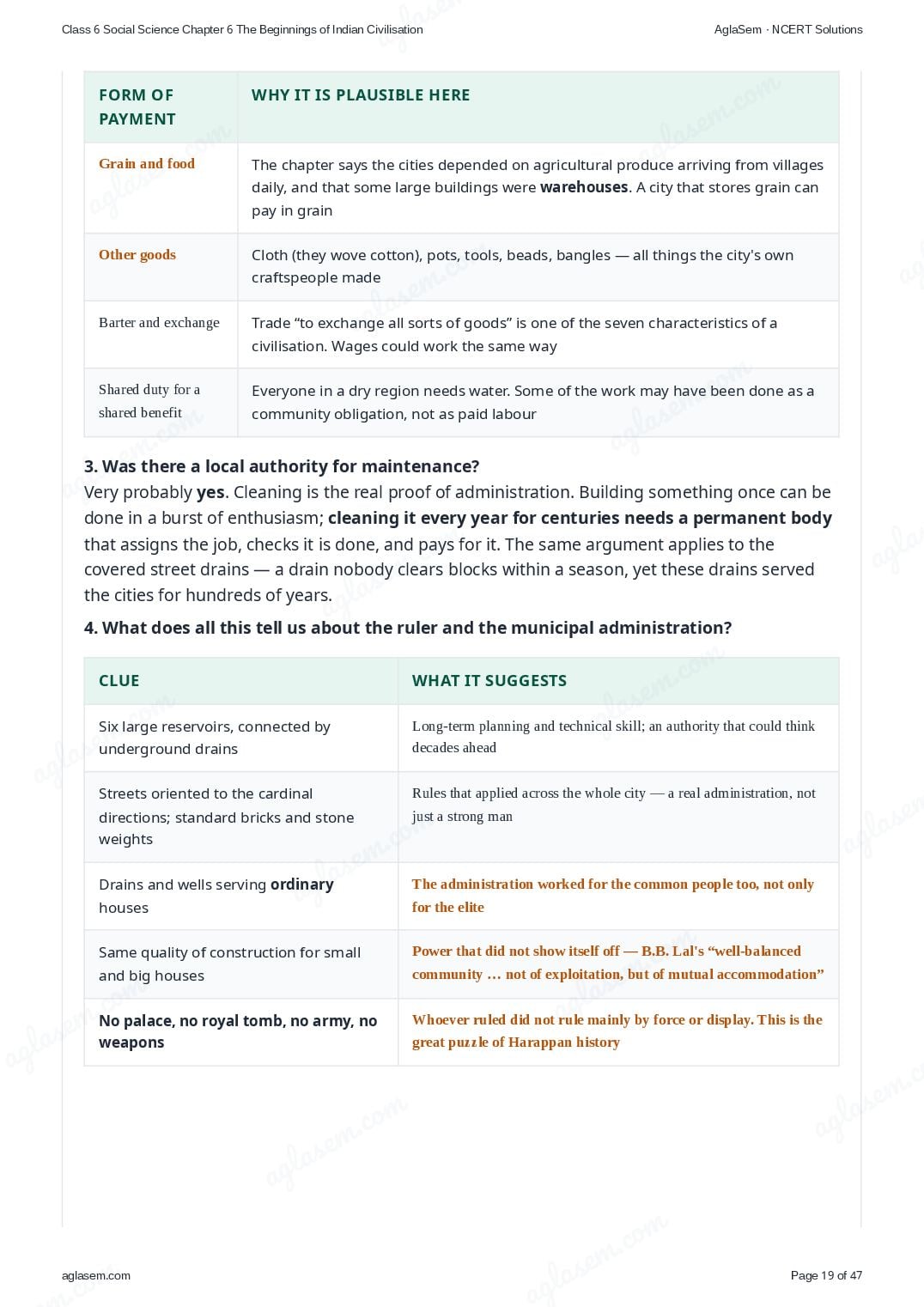
- Imagine the large number of workers required to build such a network of reservoirs. Who do you think organised their work and gave them precise instructions? How do you think they were paid for their labour? (Hint: there was no money at that time in the way we have today.) Since the reservoirs needed to be cleaned from time to time, was there some local authority to manage their maintenance? What clues do we get from all this about this city's ruler and municipal administration?
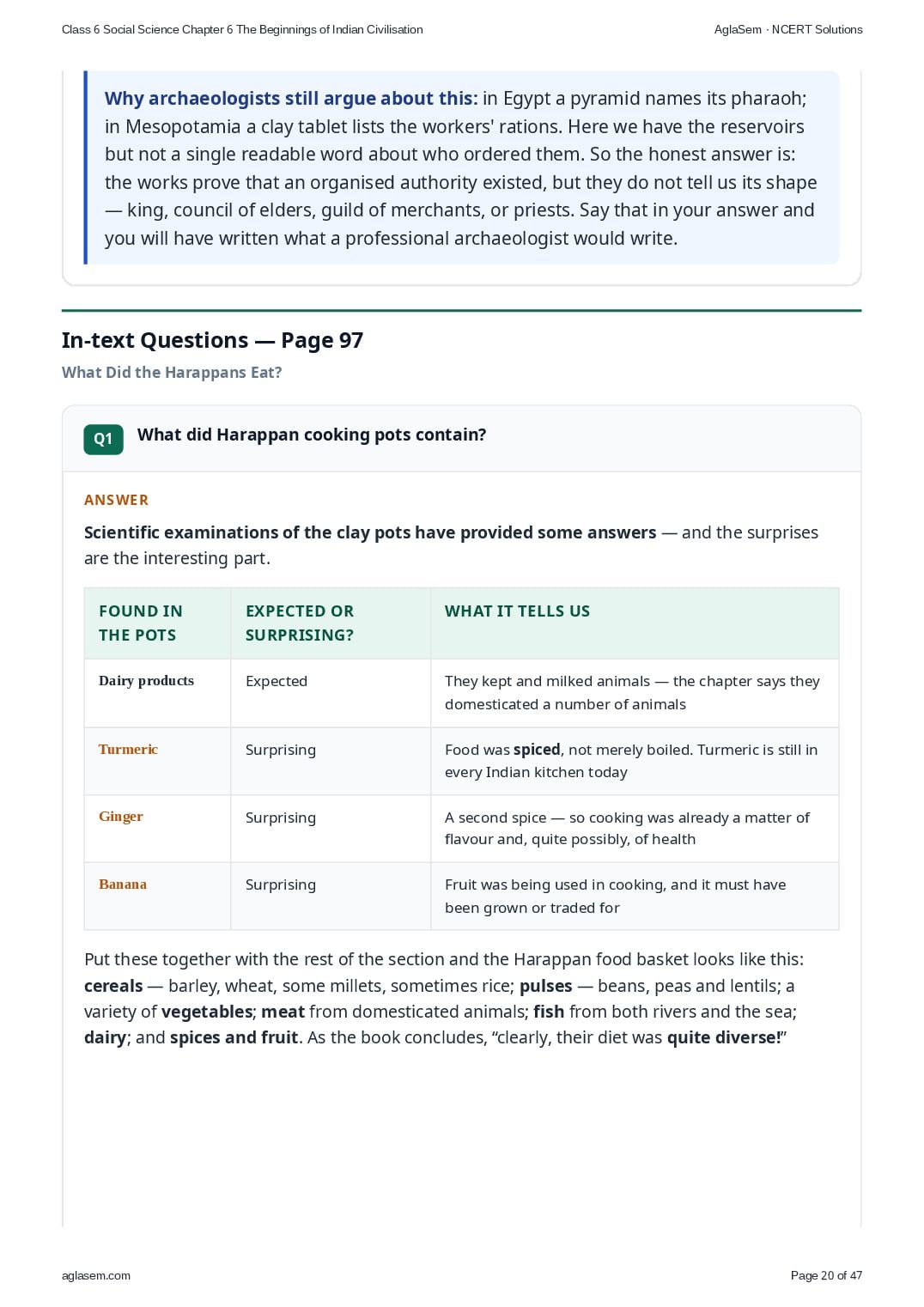
- What did Harappan cooking pots contain?
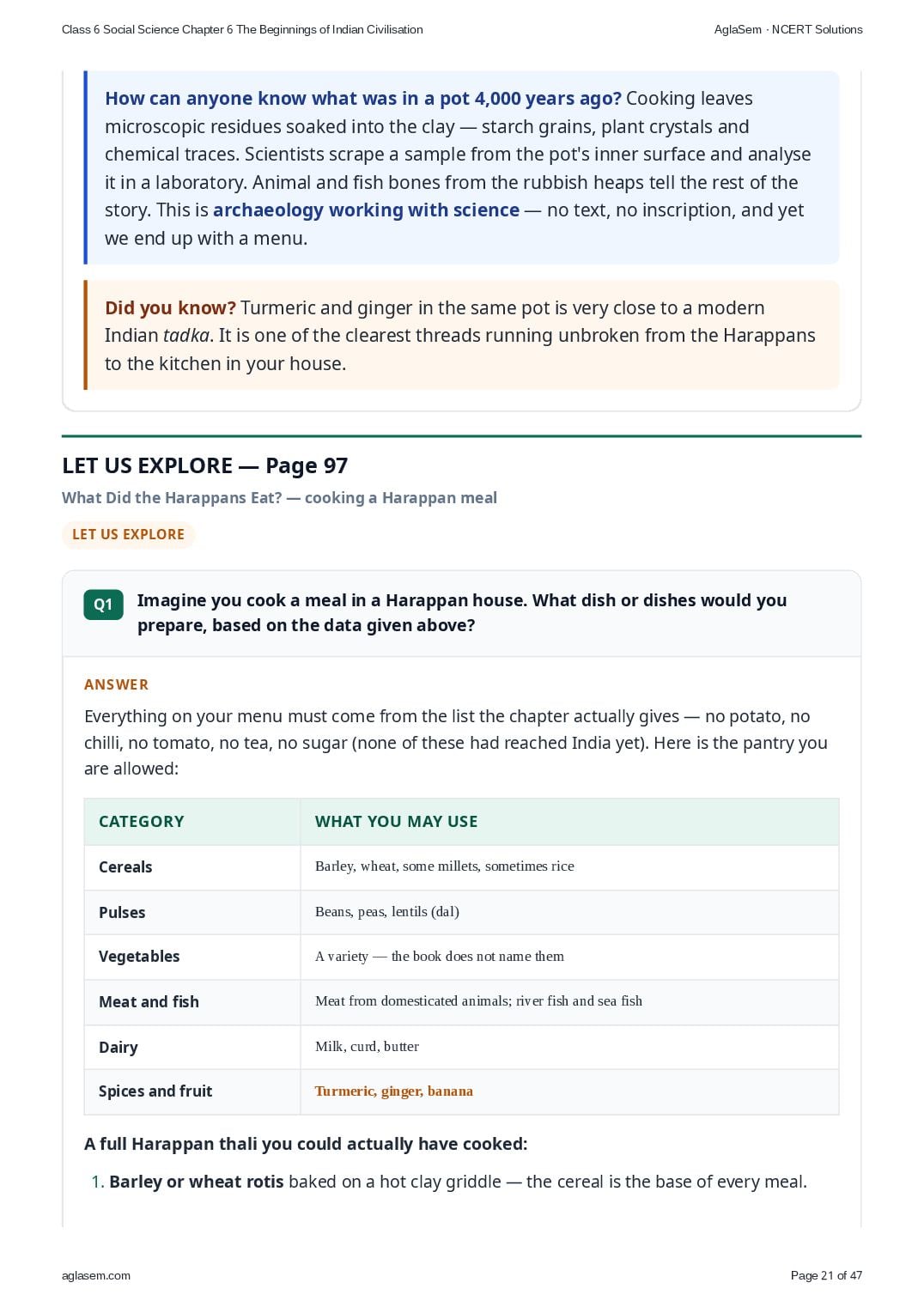
- Imagine you cook a meal in a Harappan house. What dish or dishes would you prepare, based on the data given above?
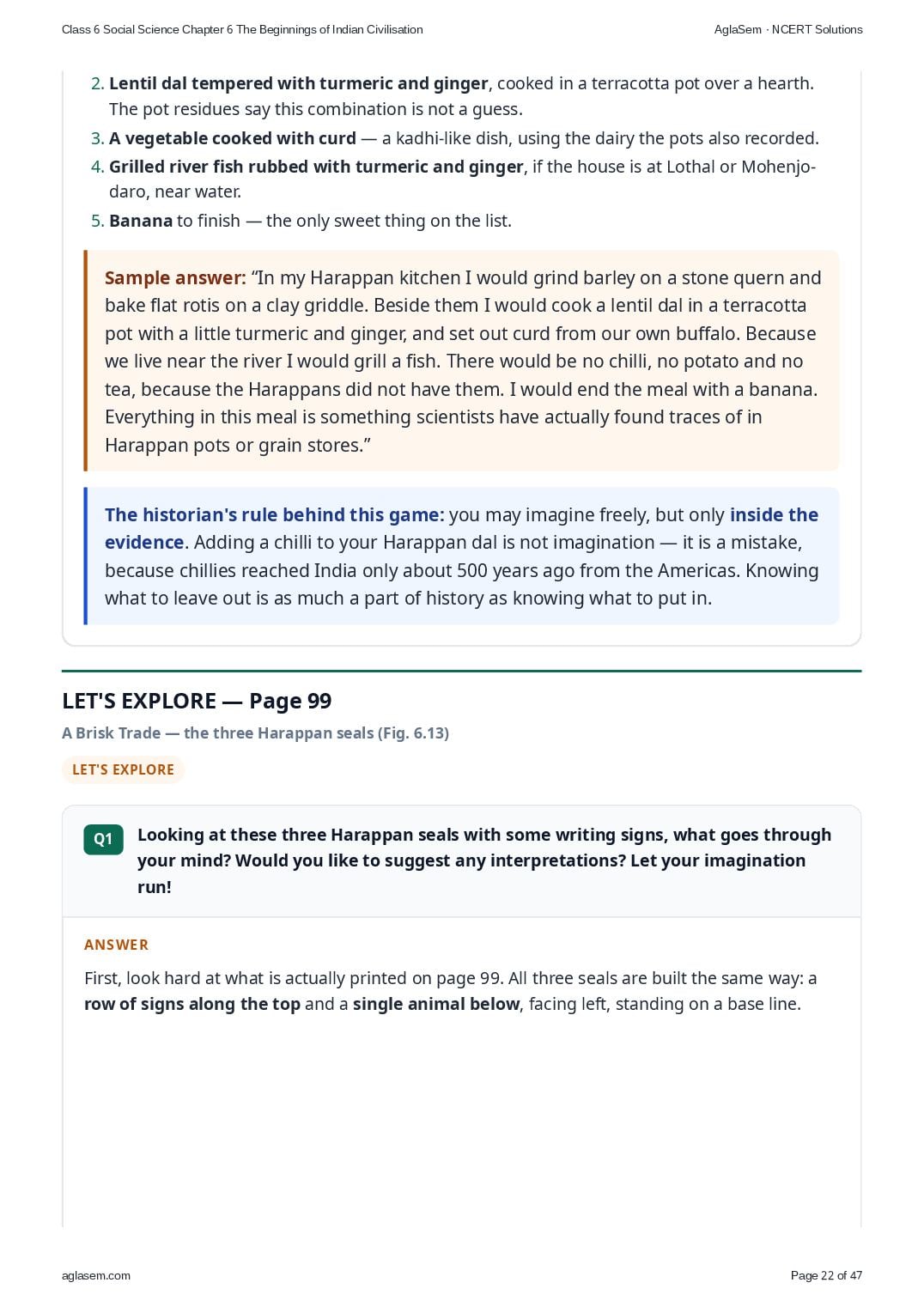
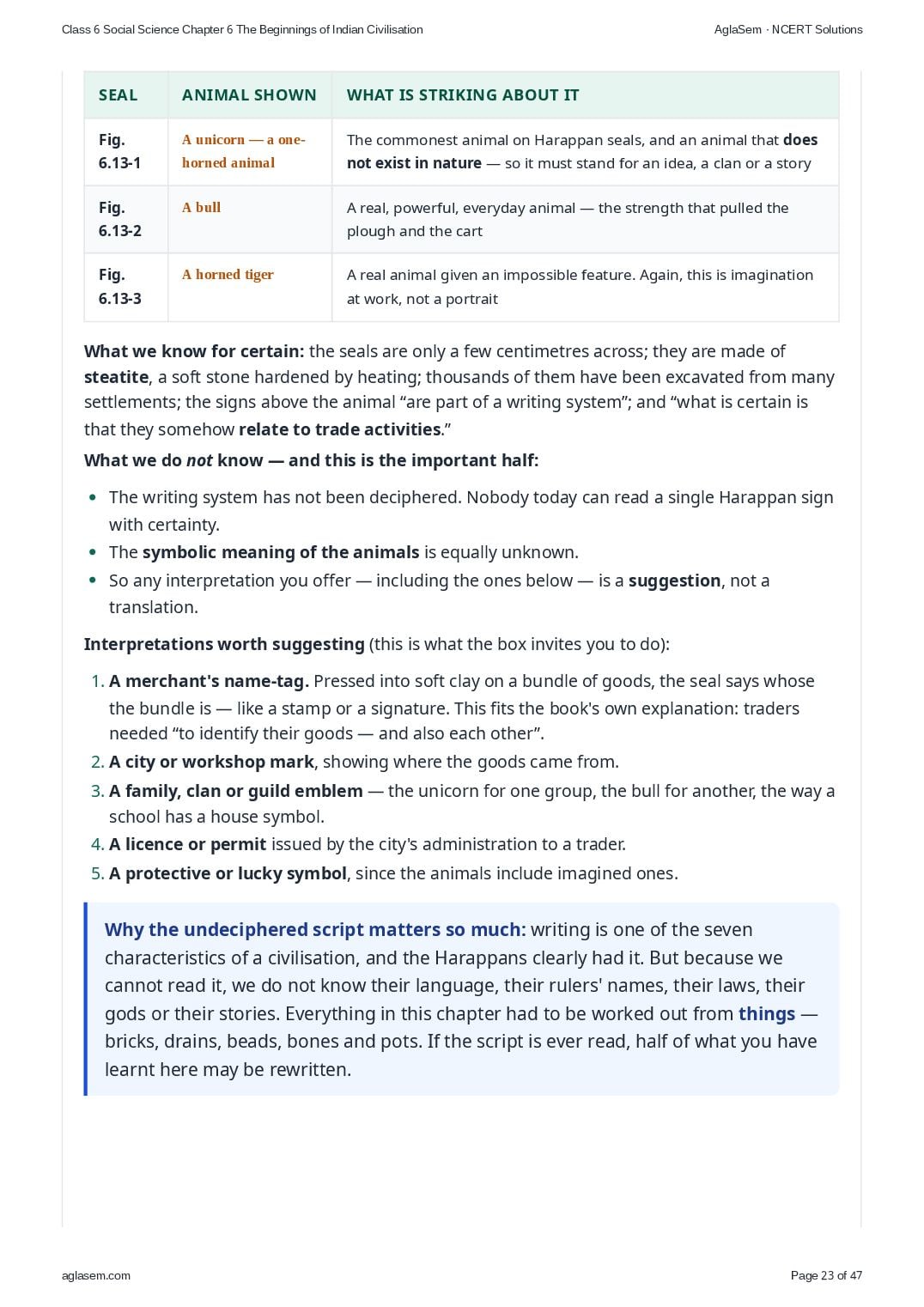
- Looking at these three Harappan seals with some writing signs, what goes through your mind? Would you like to suggest any interpretations? Let your imagination run!
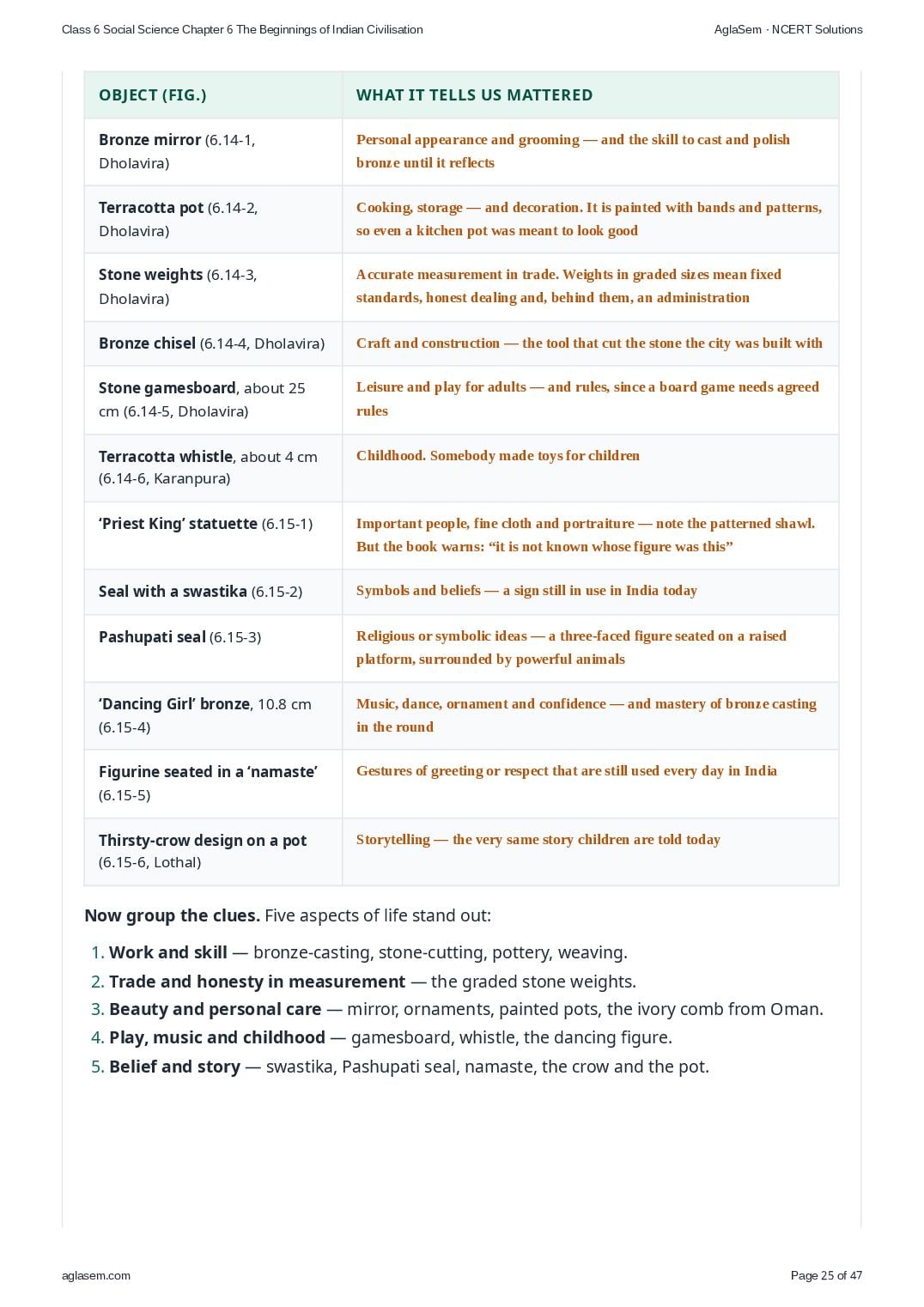
- Looking at the objects on pages 100 and 101 — or any other pictured in this chapter — can you make out what activities or aspects of life were important for the Harappans?
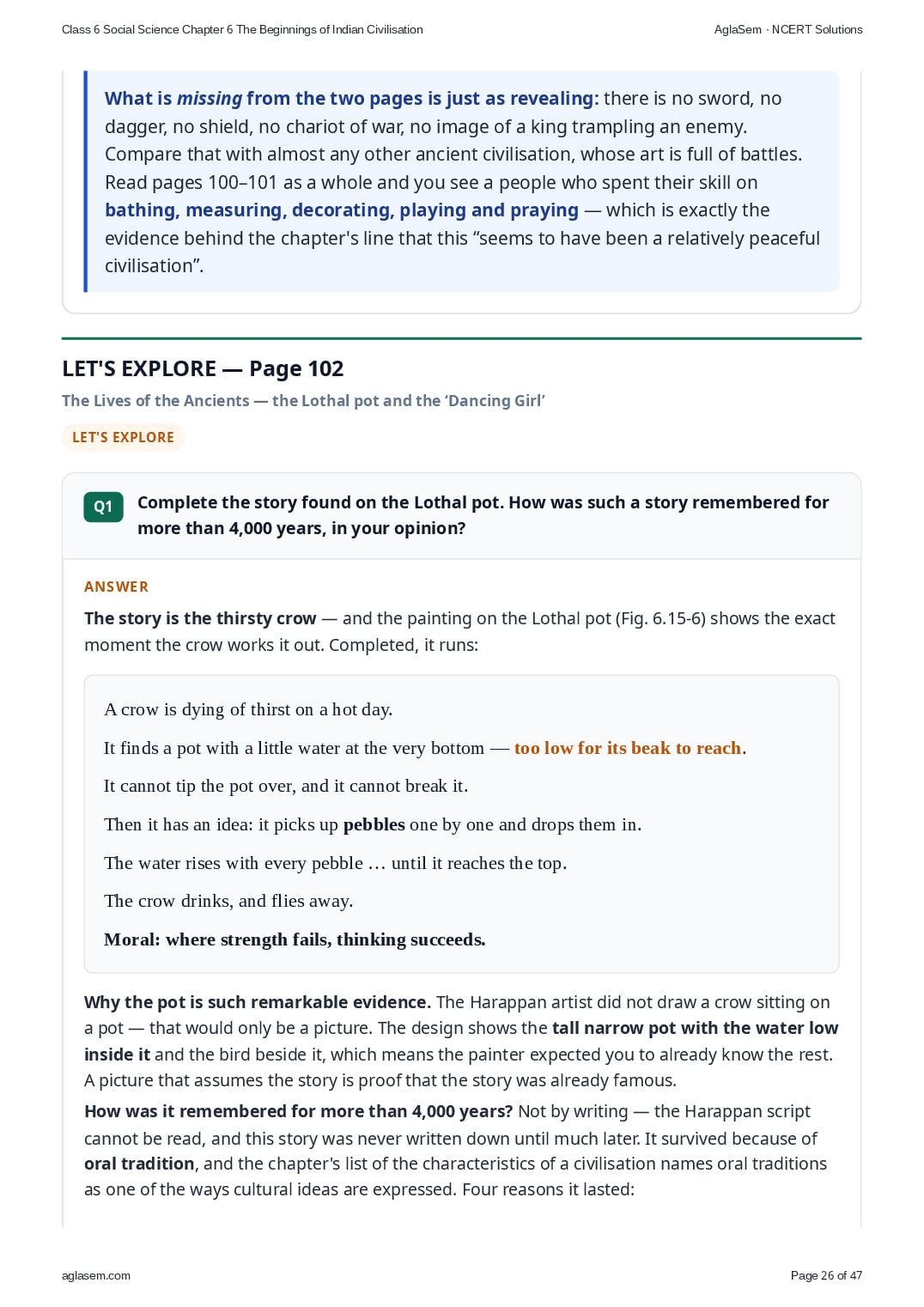
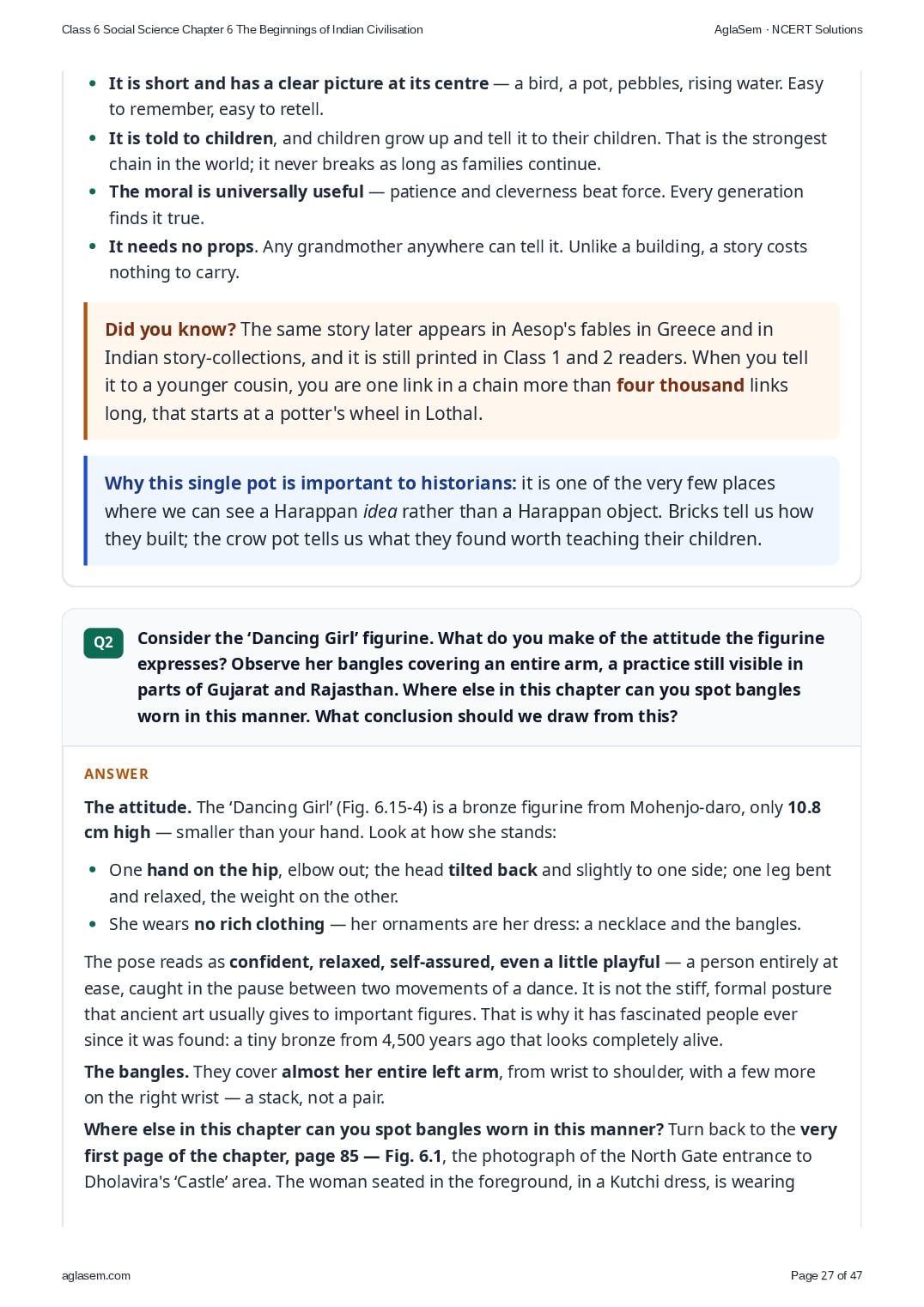
- Complete the story found on the Lothal pot. How was such a story remembered for more than 4,000 years, in your opinion?
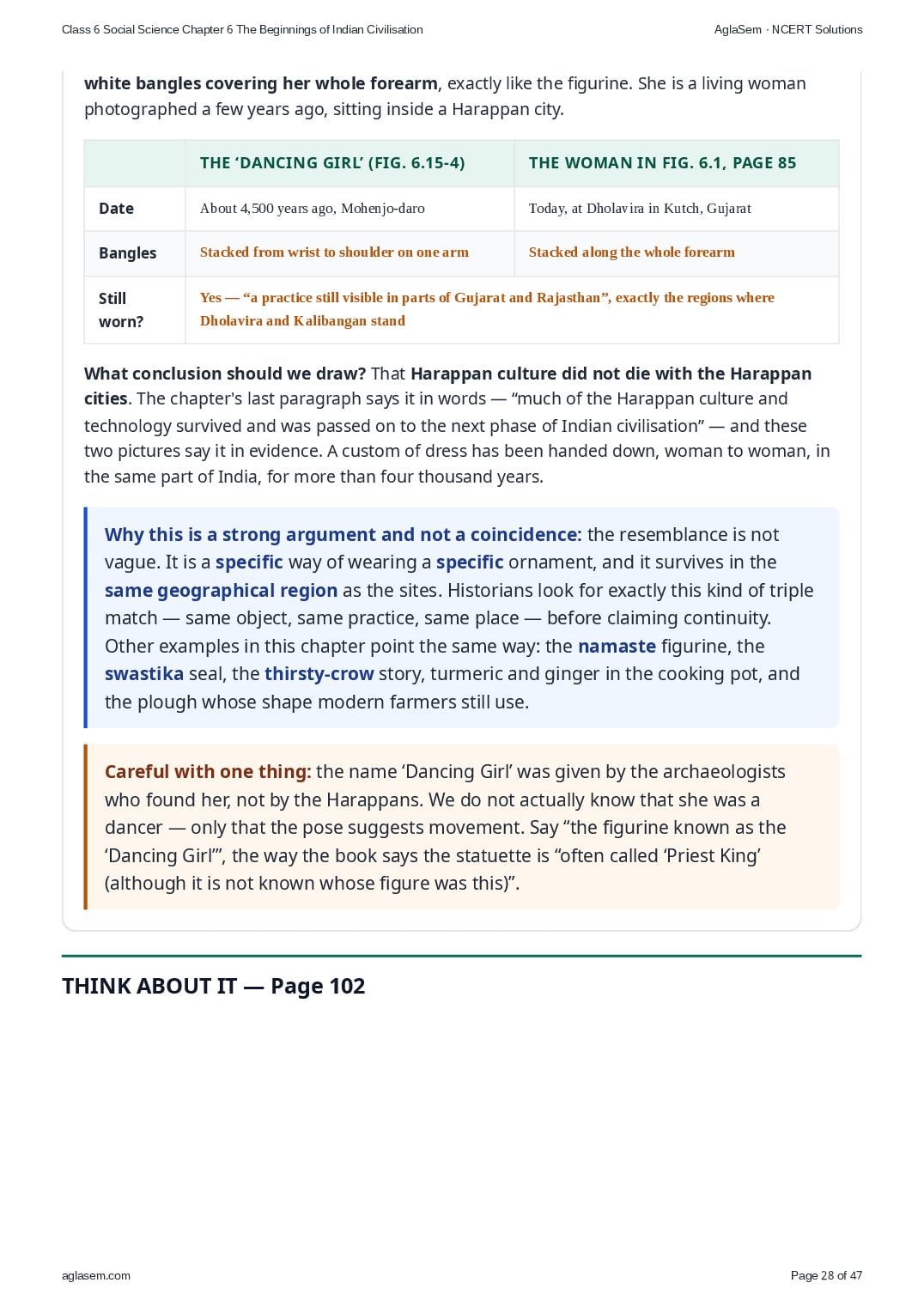
- Consider the ‘Dancing Girl’ figurine. What do you make of the attitude the figurine expresses? Observe her bangles covering an entire arm, a practice still visible in parts of Gujarat and Rajasthan. Where else in this chapter can you spot bangles worn in this manner. What conclusion should we draw from this?
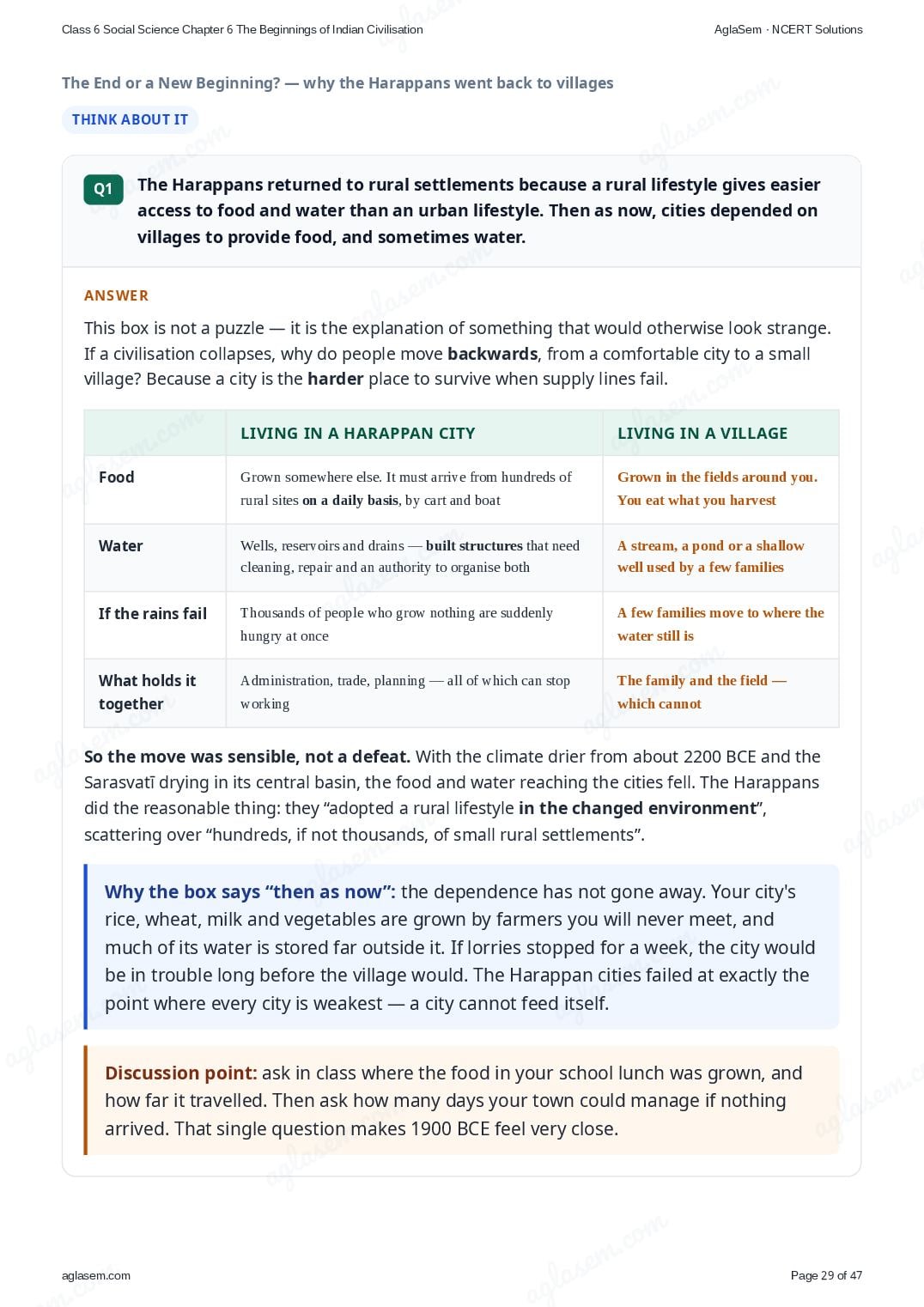
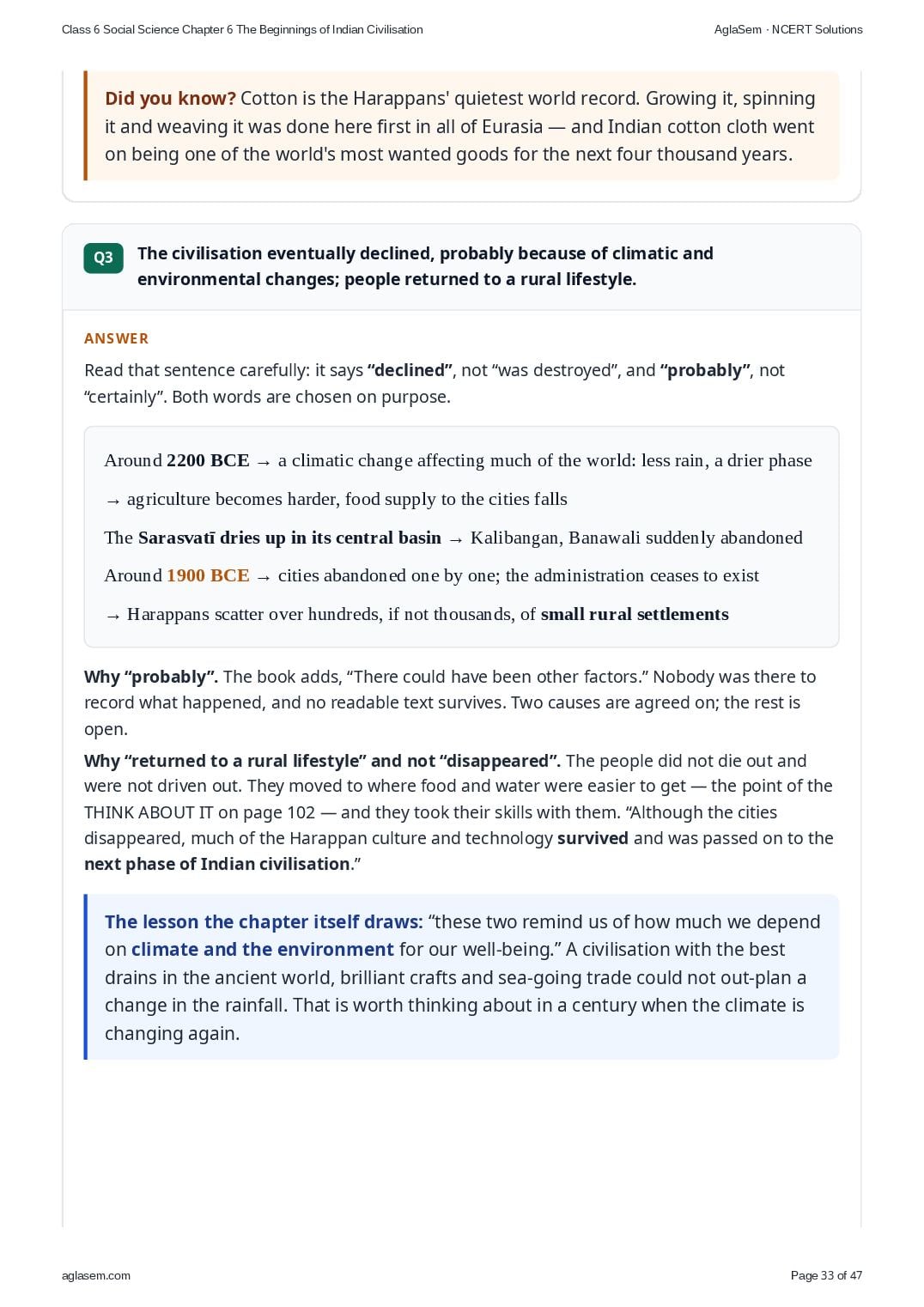
- The Harappans returned to rural settlements because a rural lifestyle gives easier access to food and water than an urban lifestyle. Then as now, cities depended on villages to provide food, and sometimes water.
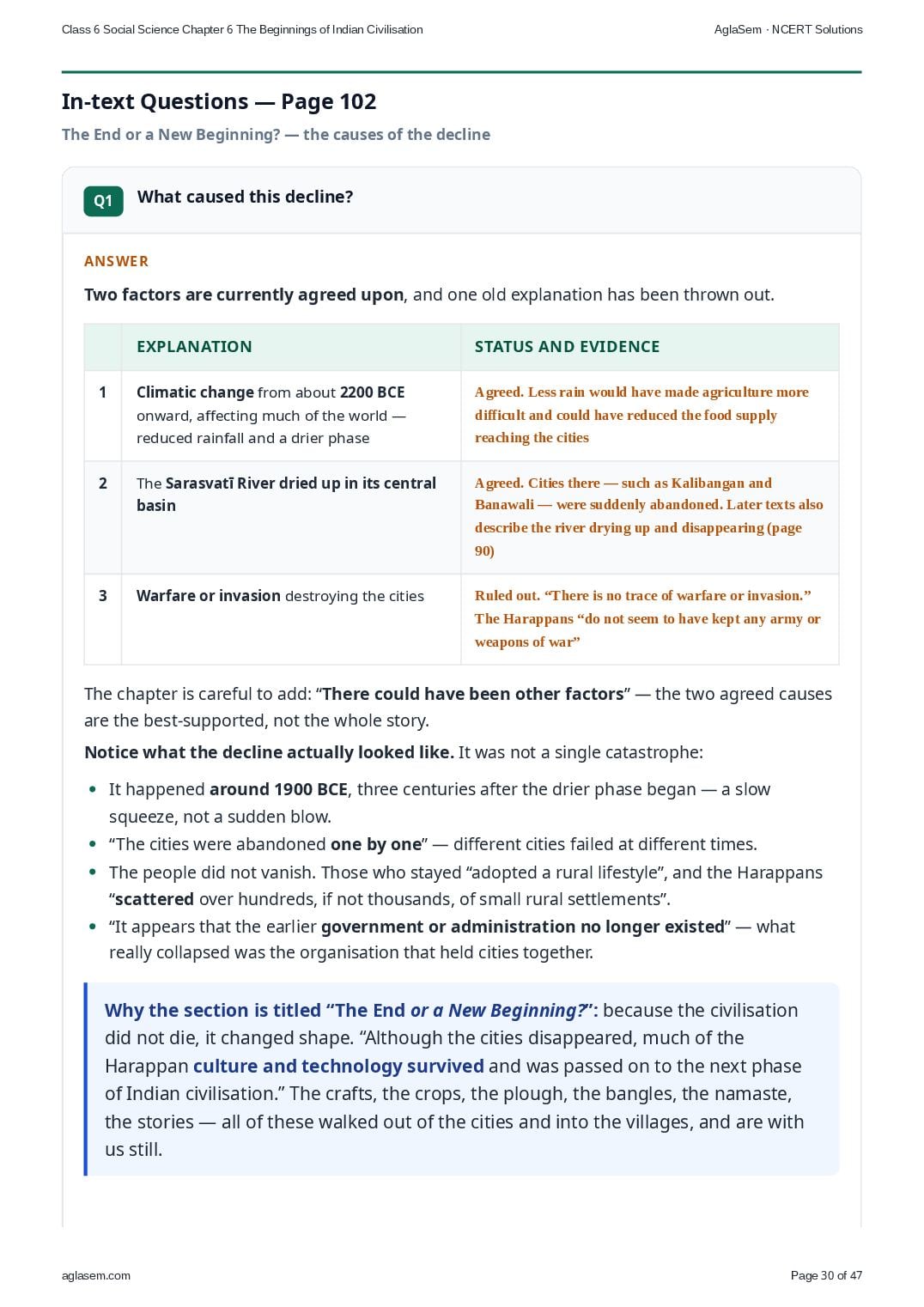
- What caused this decline?
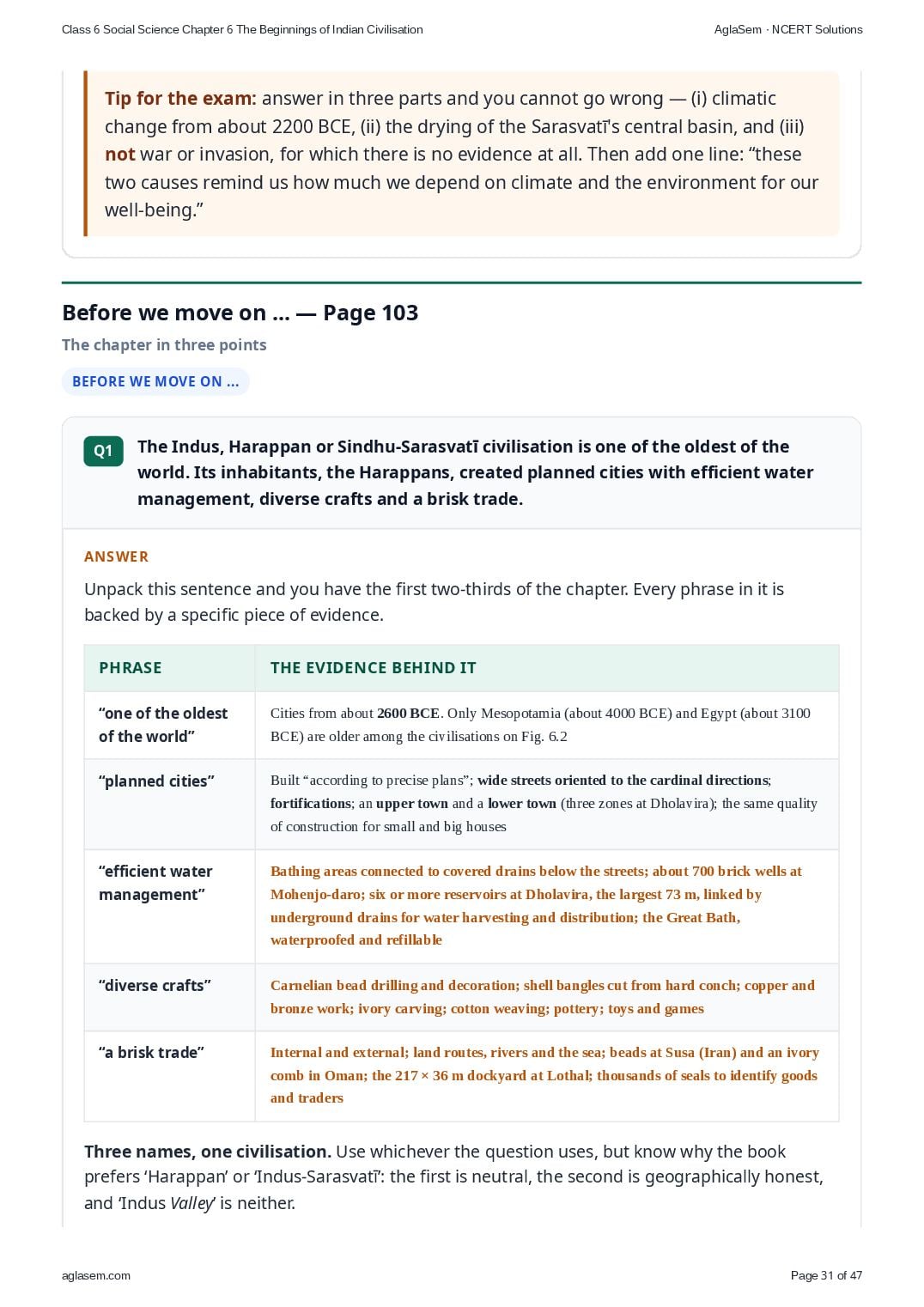
- The Indus, Harappan or Sindhu-Sarasvatī civilisation is one of the oldest of the world. Its inhabitants, the Harappans, created planned cities with efficient water management, diverse crafts and a brisk trade.
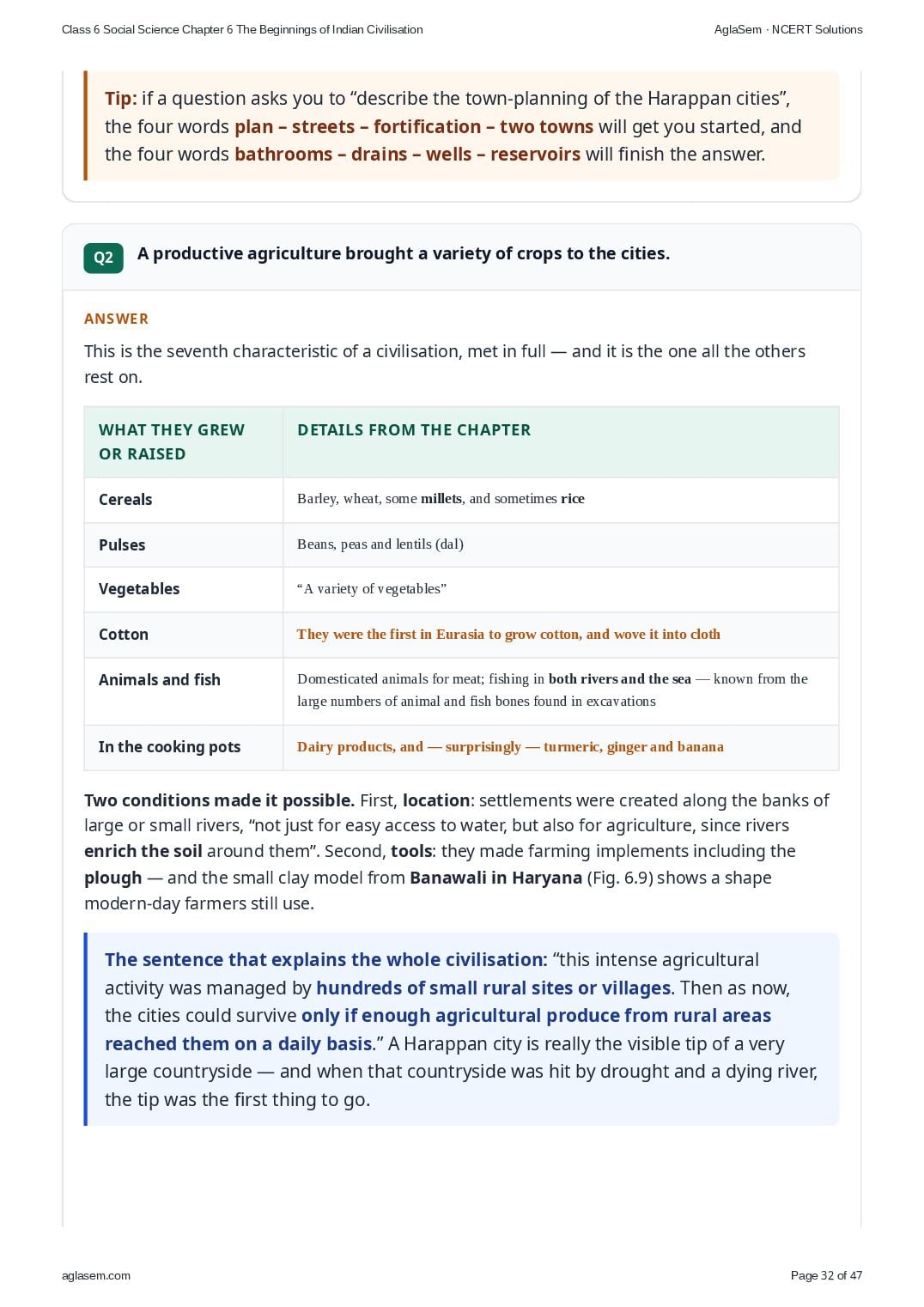
- A productive agriculture brought a variety of crops to the cities.
- The civilisation eventually declined, probably because of climatic and environmental changes; people returned to a rural lifestyle.
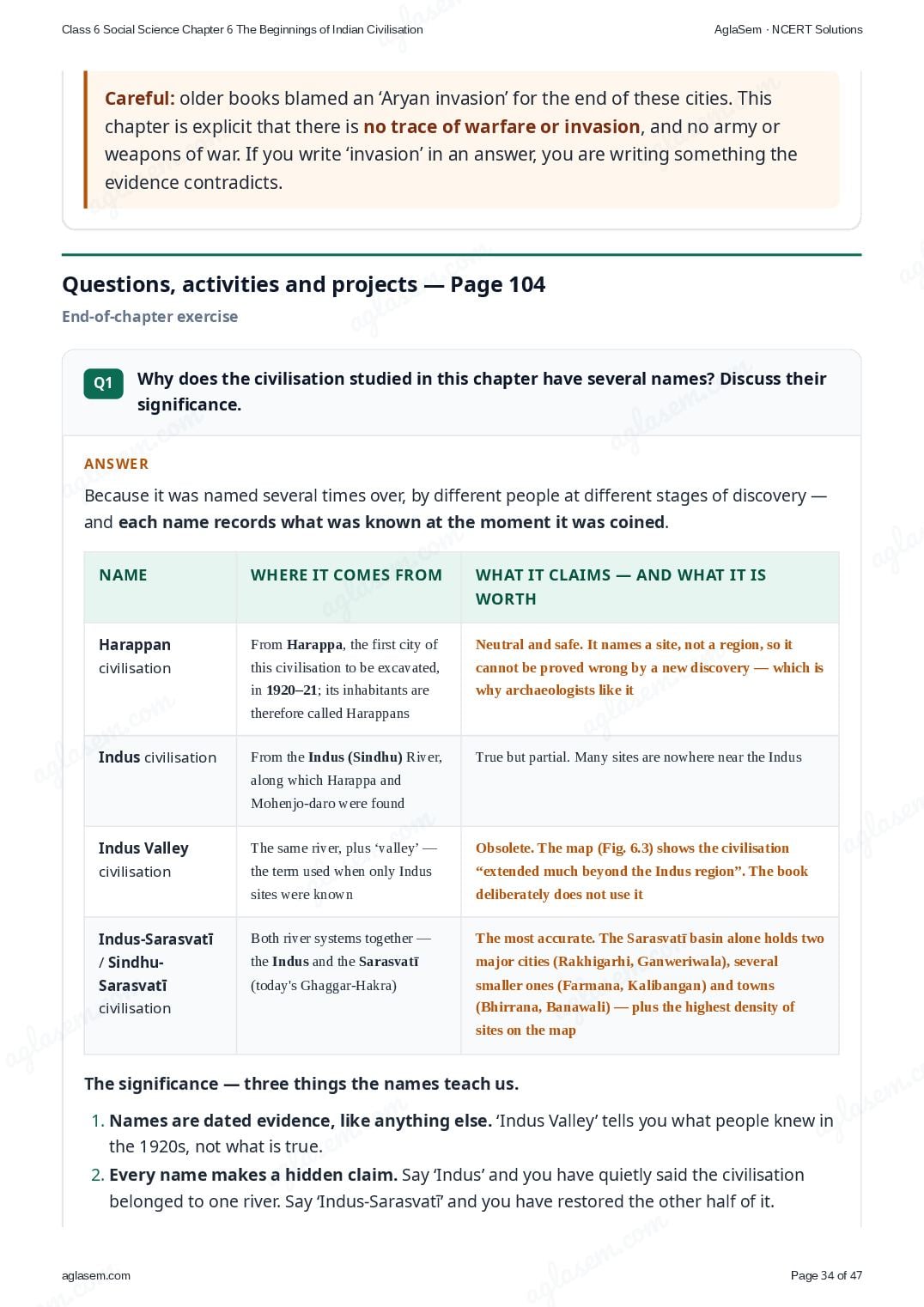
- Why does the civilisation studied in this chapter have several names? Discuss their significance.
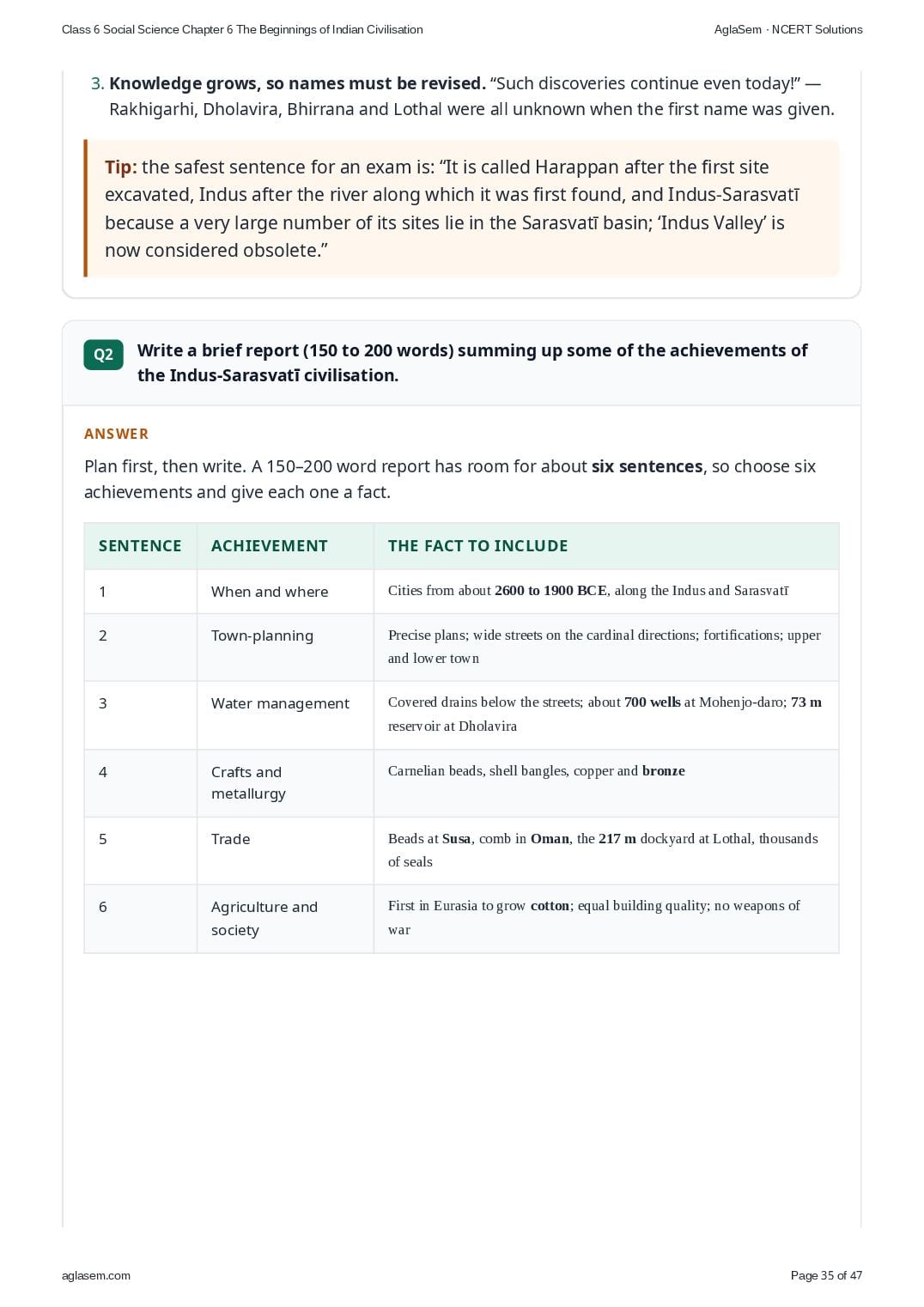
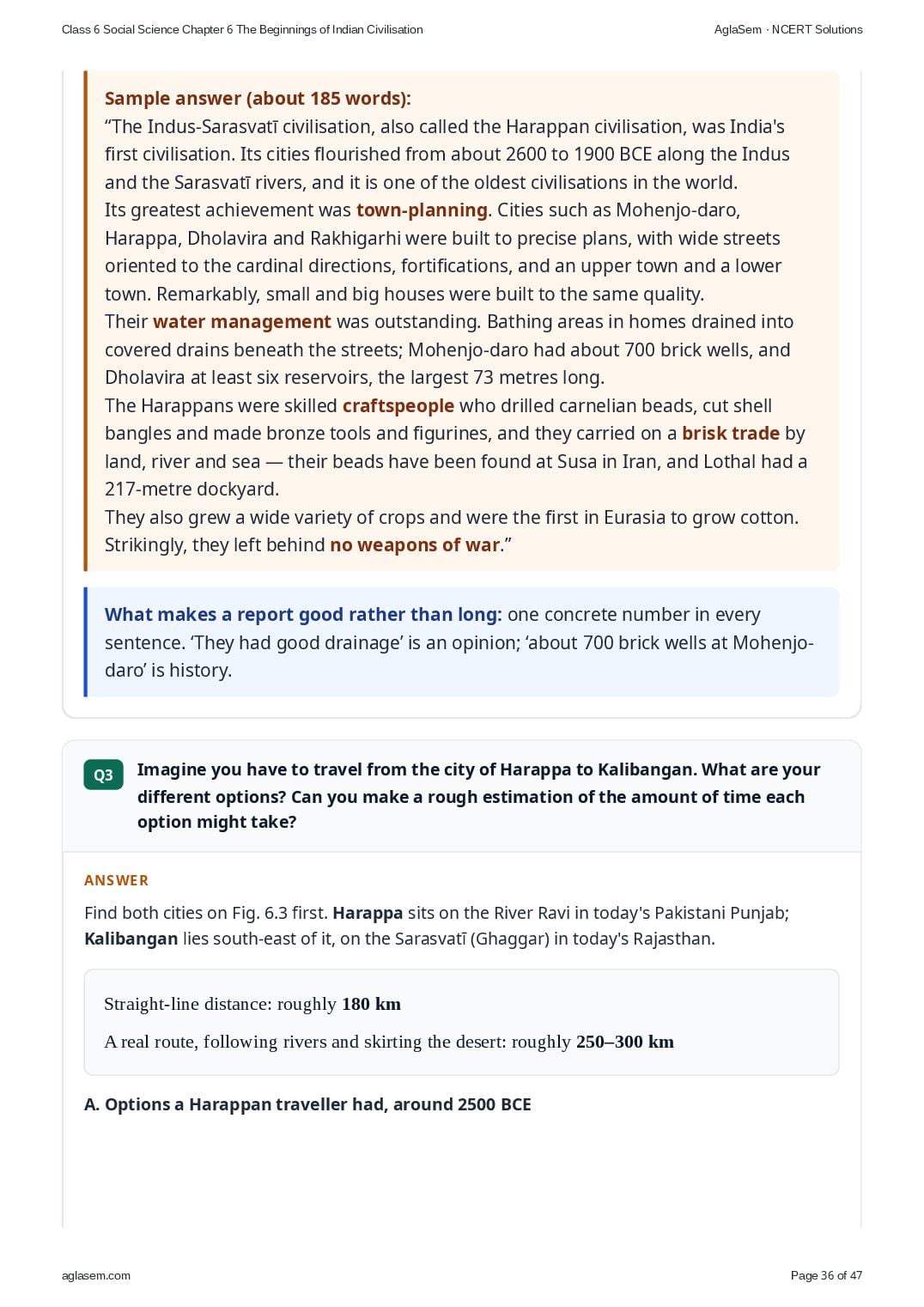
- Write a brief report (150 to 200 words) summing up some of the achievements of the Indus-Sarasvatī civilisation.
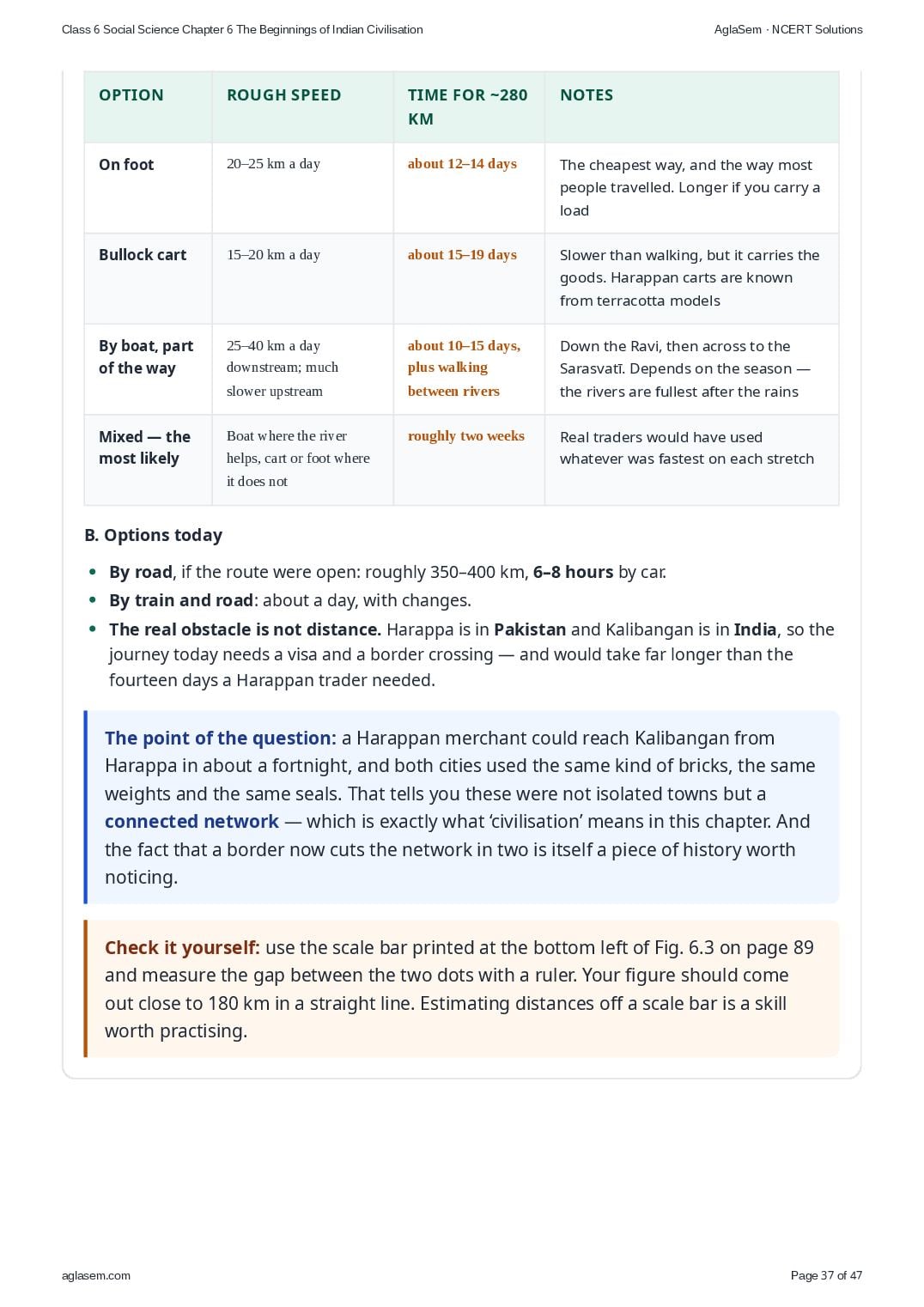
- Imagine you have to travel from the city of Harappa to Kalibangan. What are your different options? Can you make a rough estimation of the amount of time each option might take?
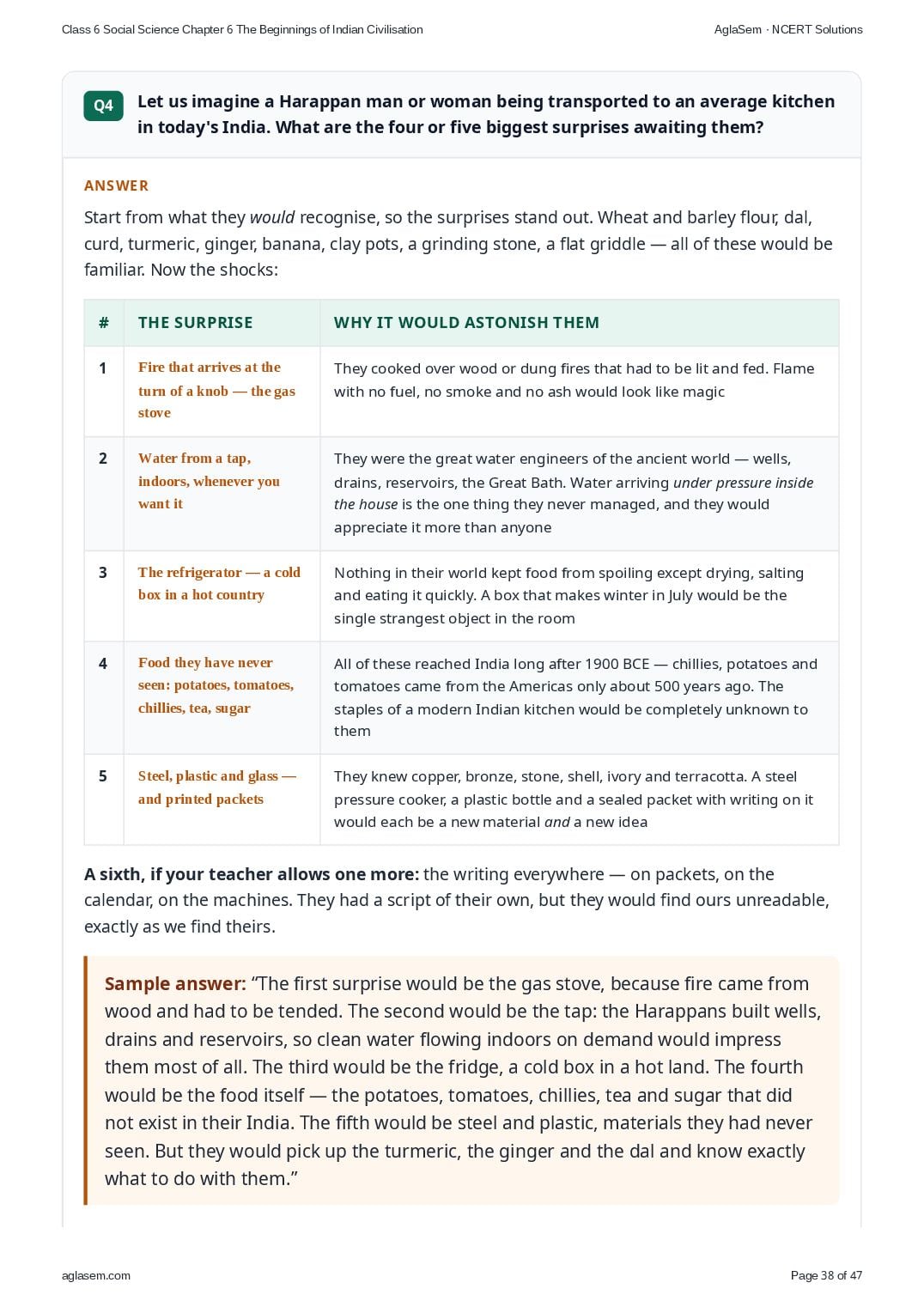
- Let us imagine a Harappan man or woman being transported to an average kitchen in today's India. What are the four or five biggest surprises awaiting them?
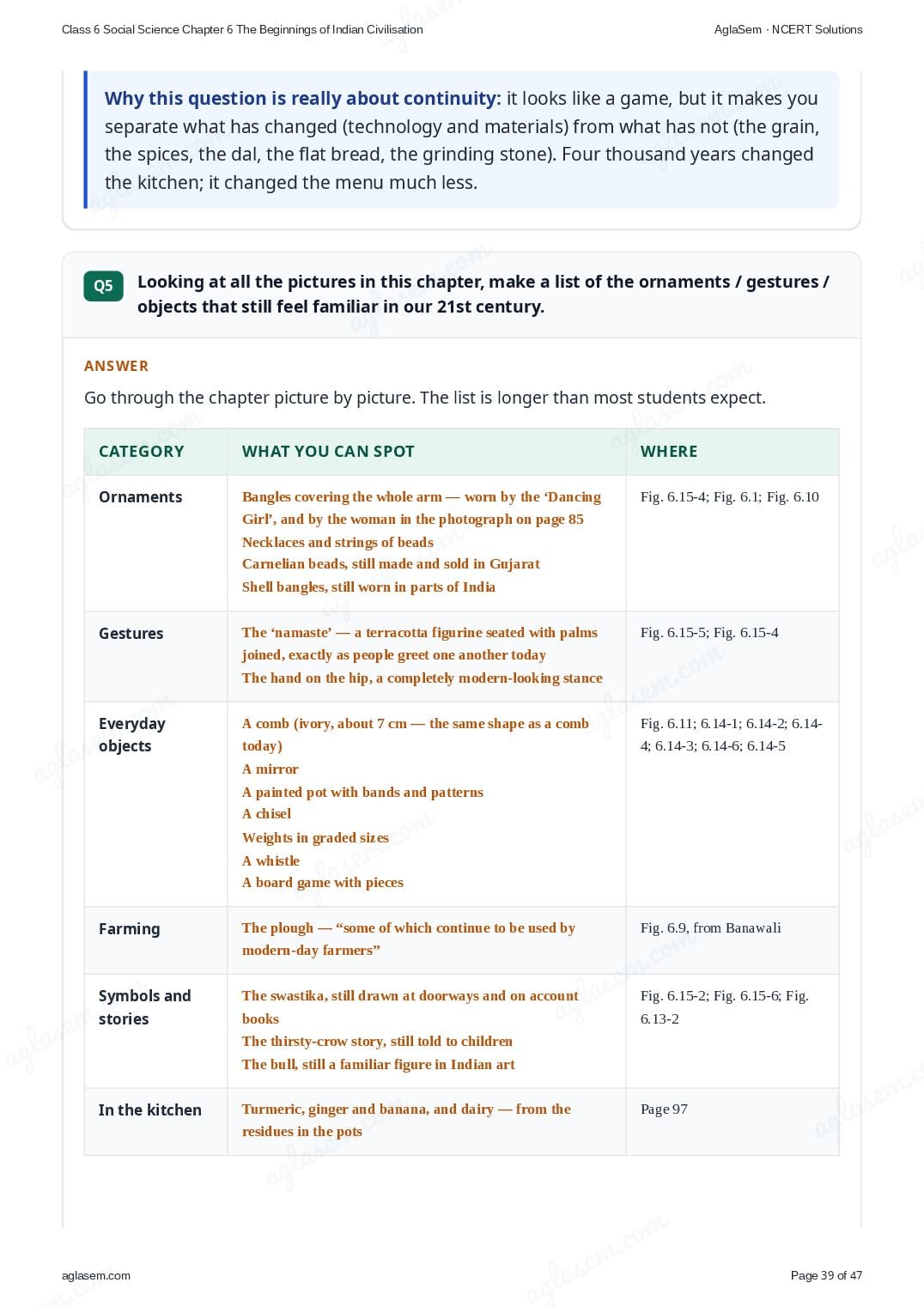
- Looking at all the pictures in this chapter, make a list of the ornaments / gestures / objects that still feel familiar in our 21st century.
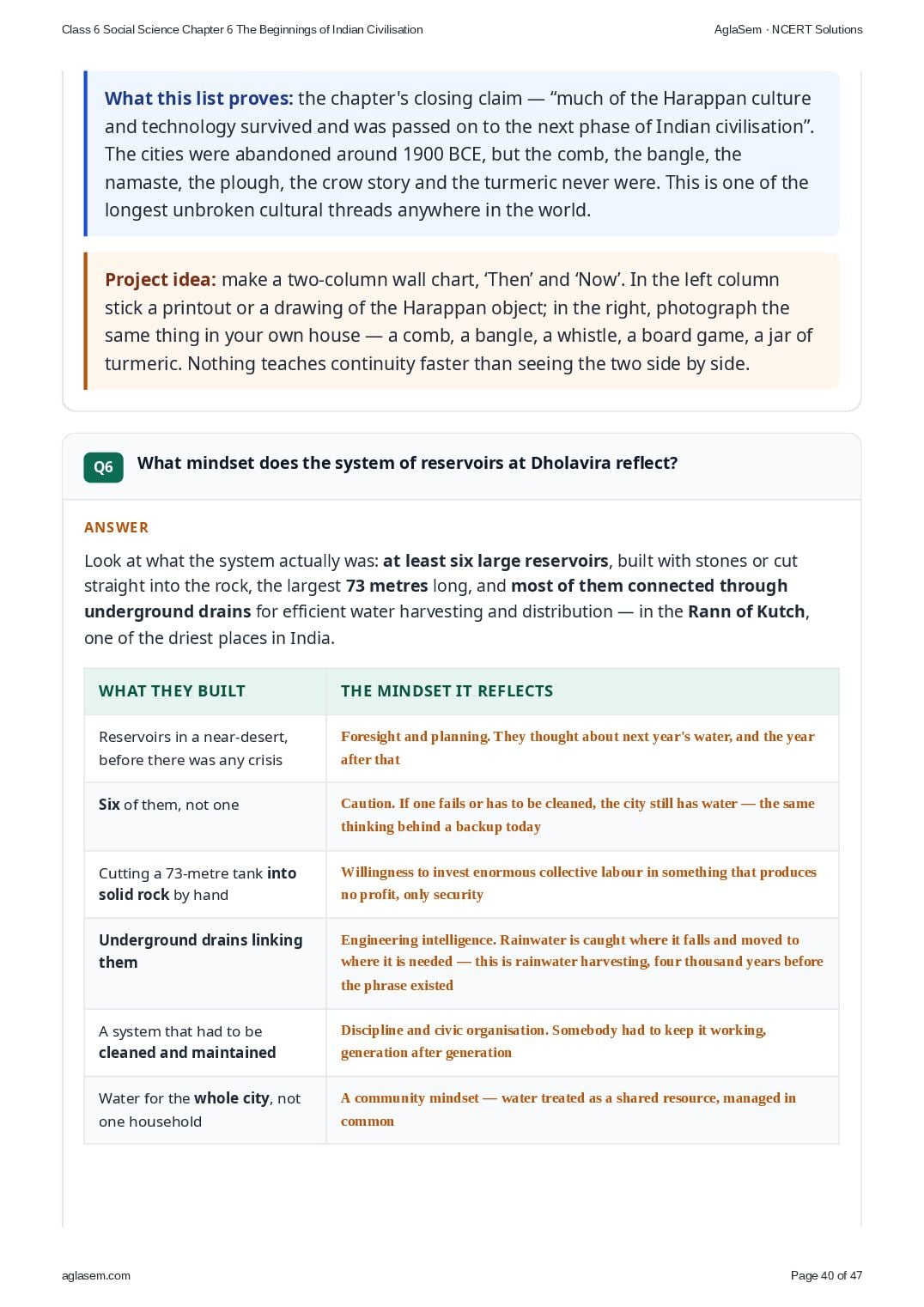
- What mindset does the system of reservoirs at Dholavira reflect?
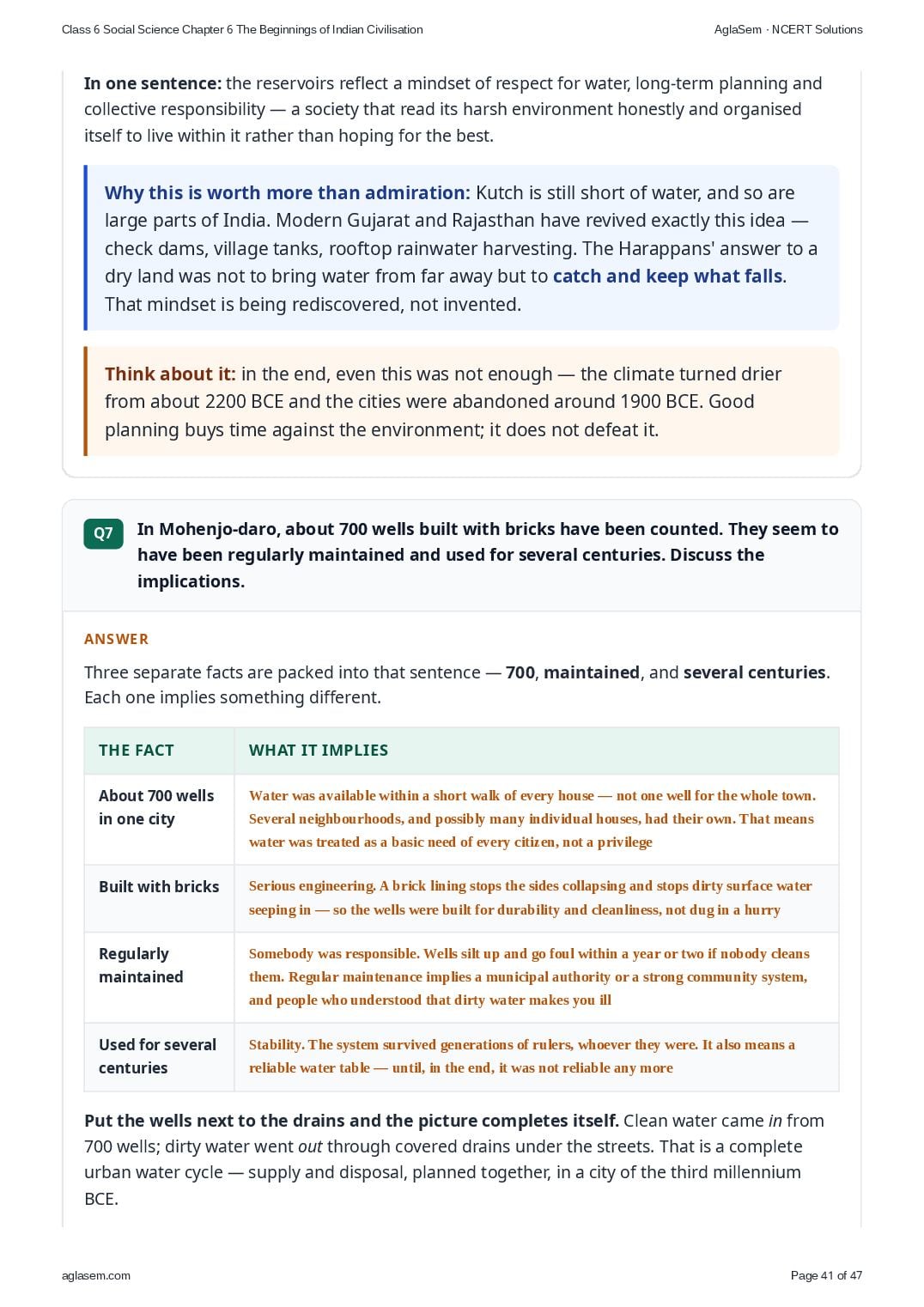
- In Mohenjo-daro, about 700 wells built with bricks have been counted. They seem to have been regularly maintained and used for several centuries. Discuss the implications.
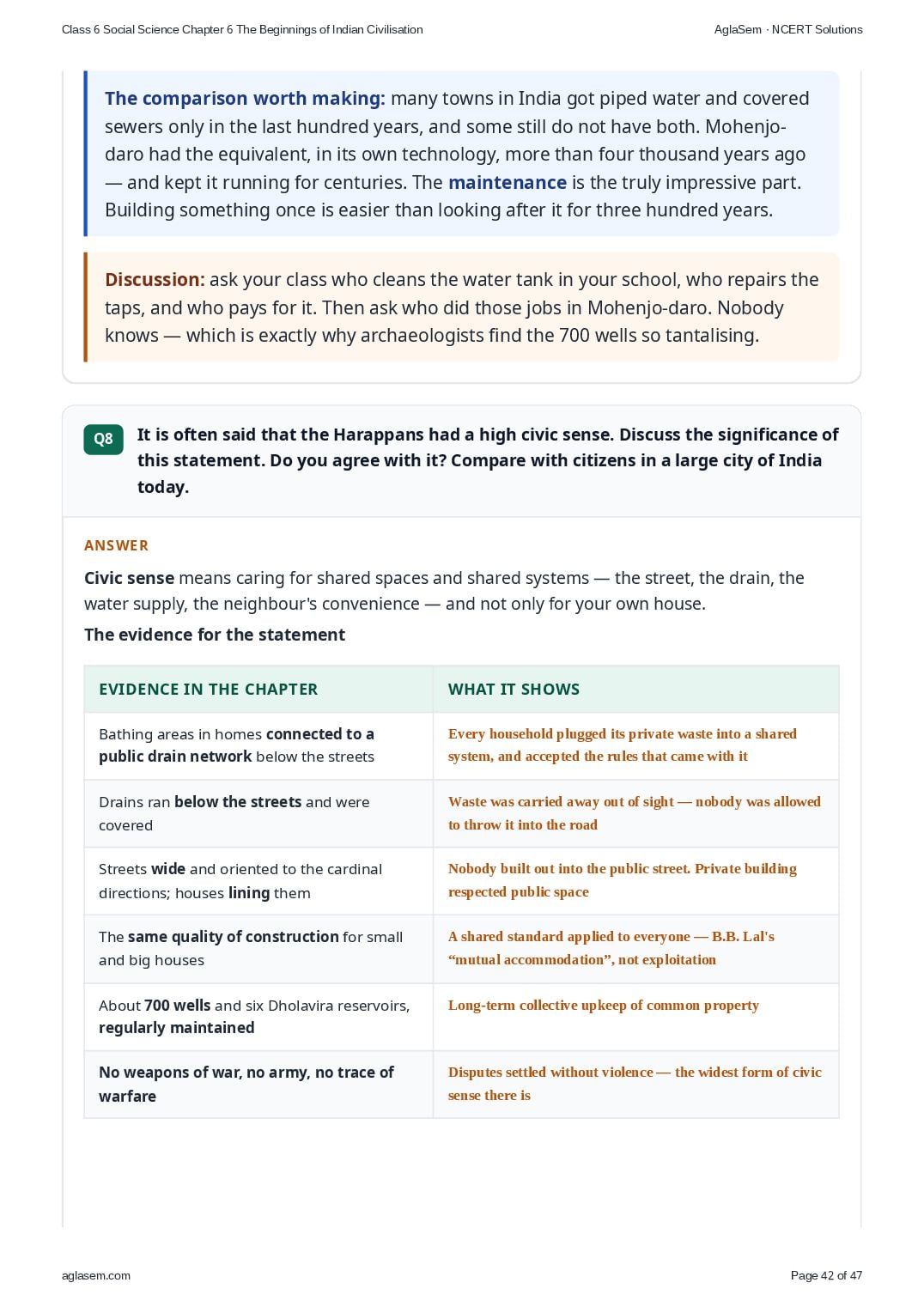
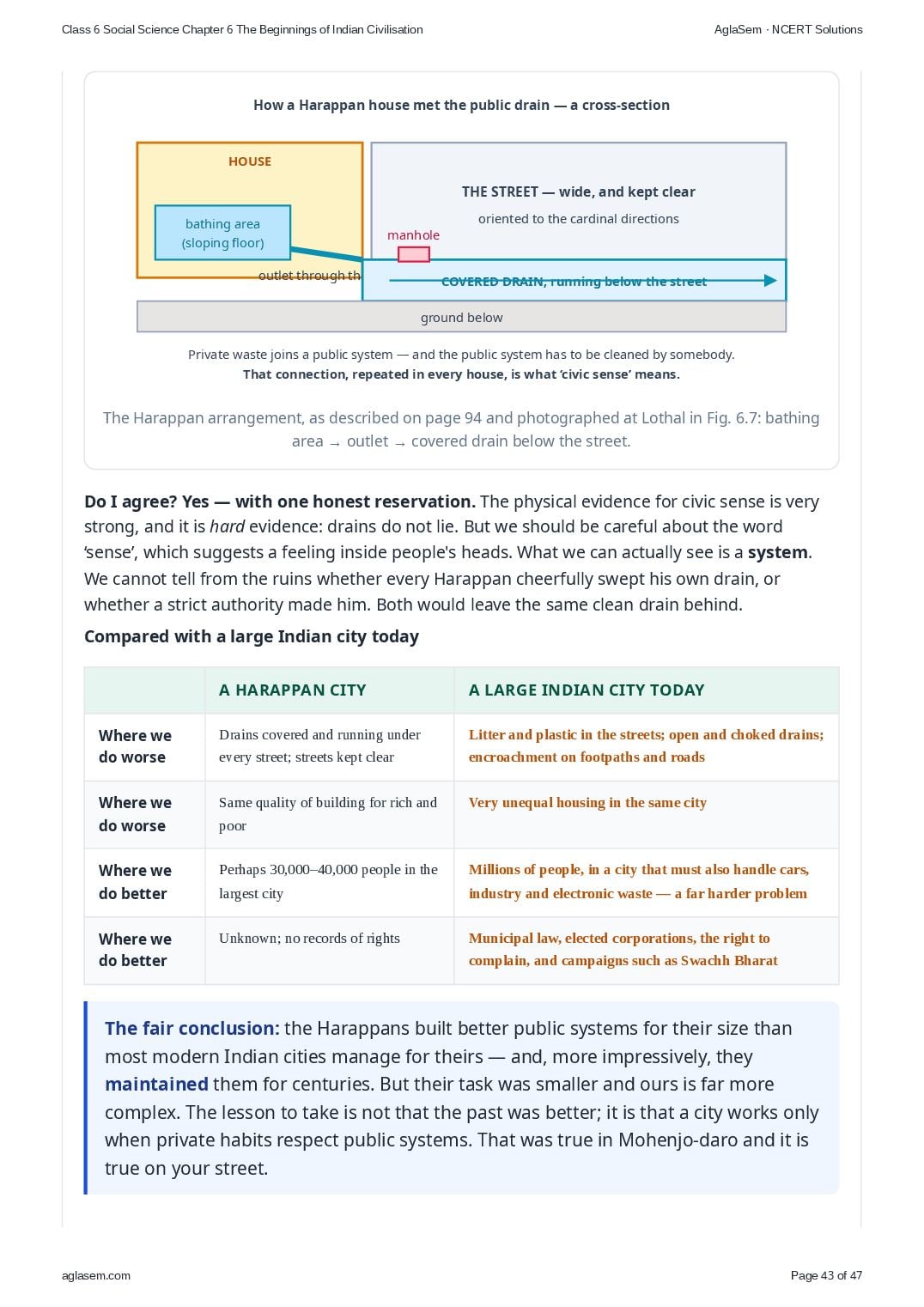
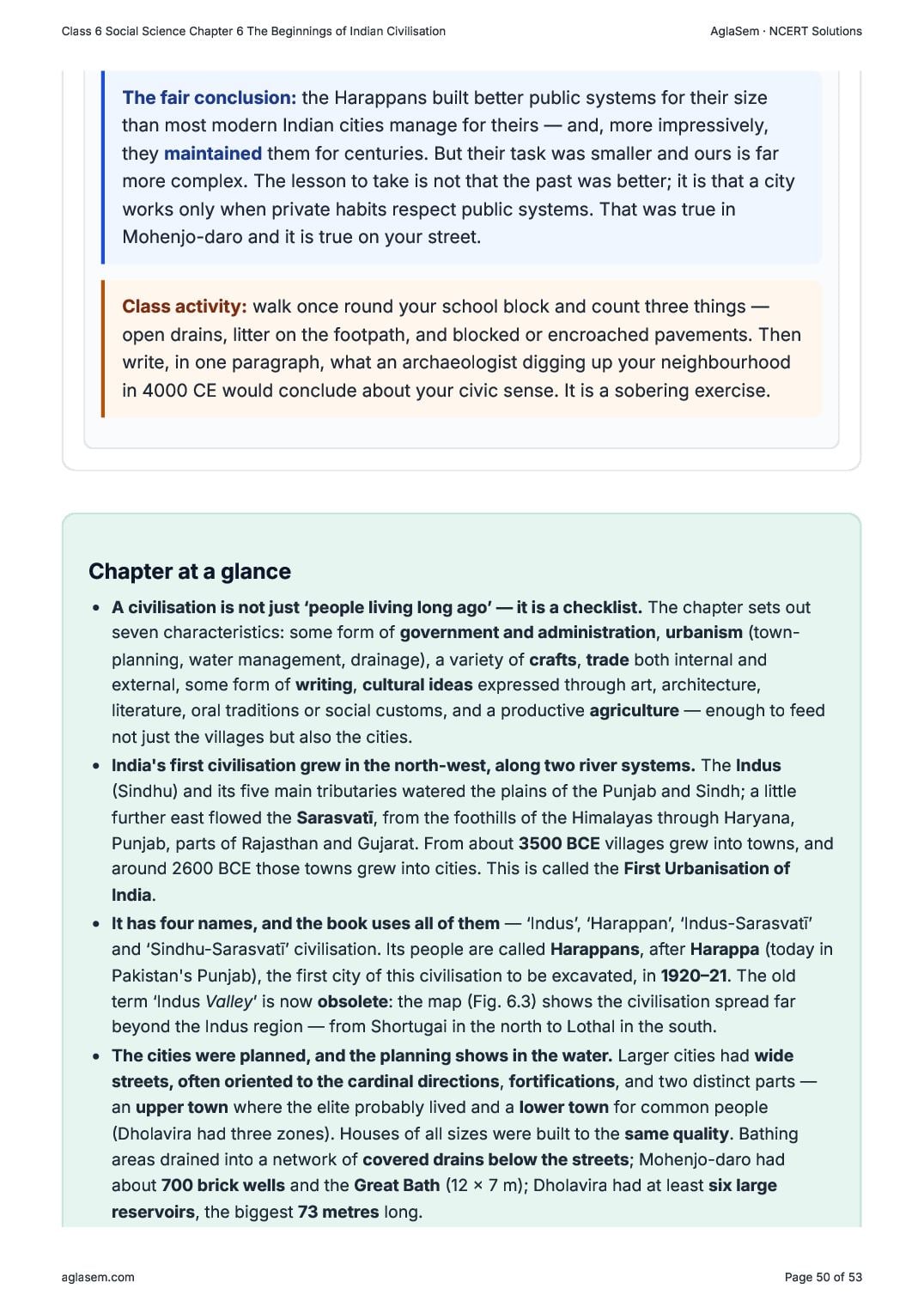
- It is often said that the Harappans had a high civic sense. Discuss the significance of this statement. Do you agree with it? Compare with citizens in a large city of India today.
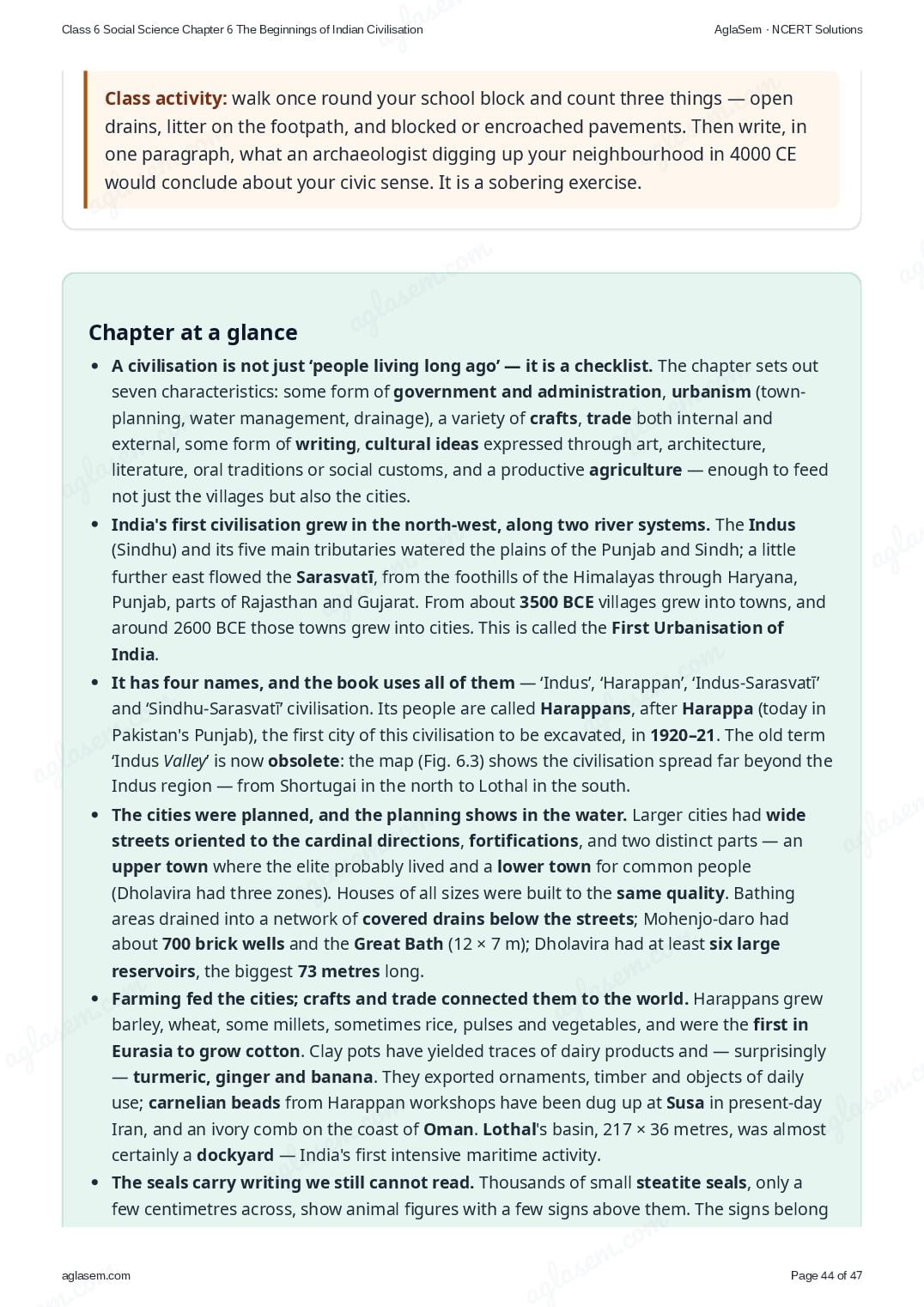
Chapter at a Glance
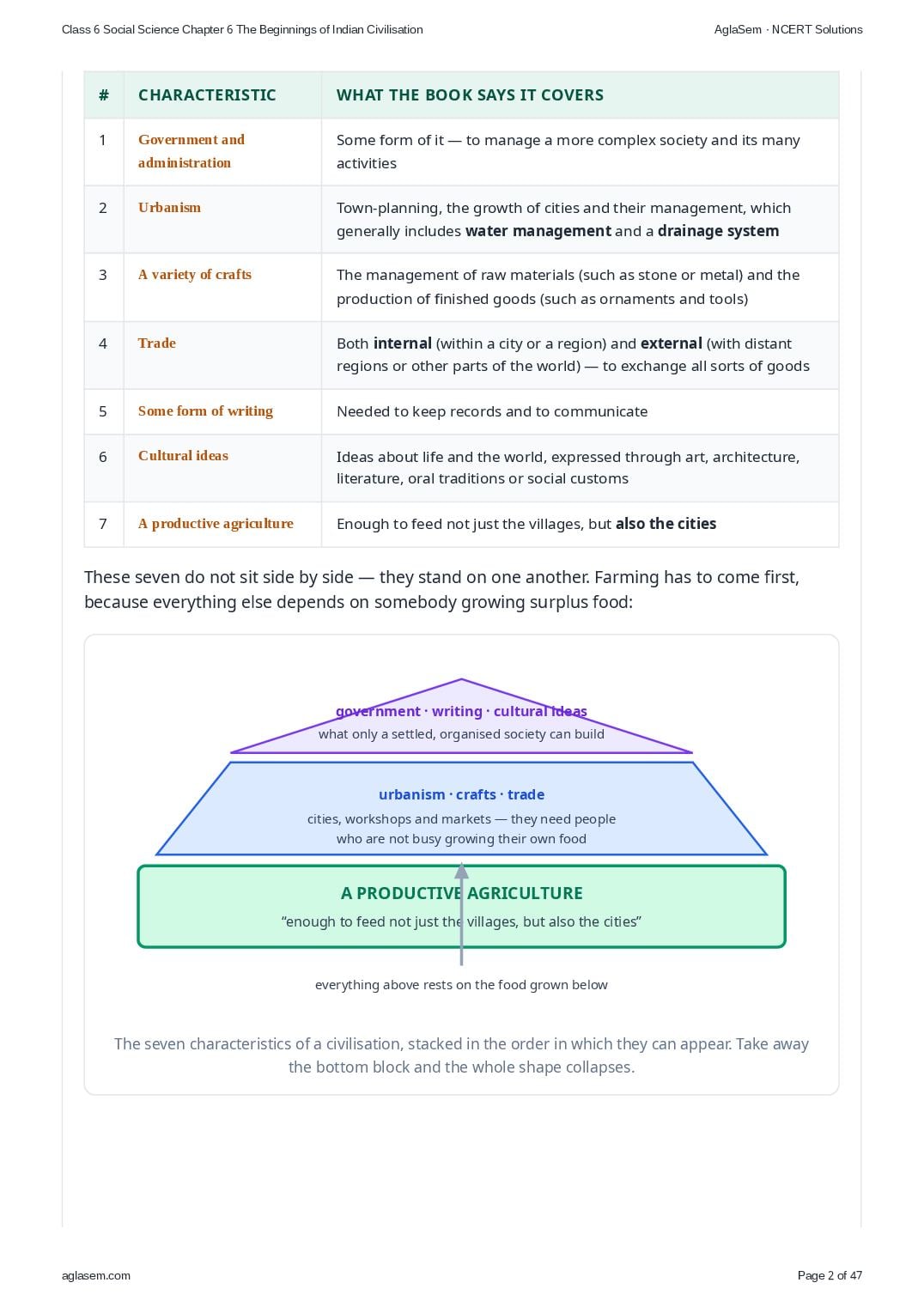
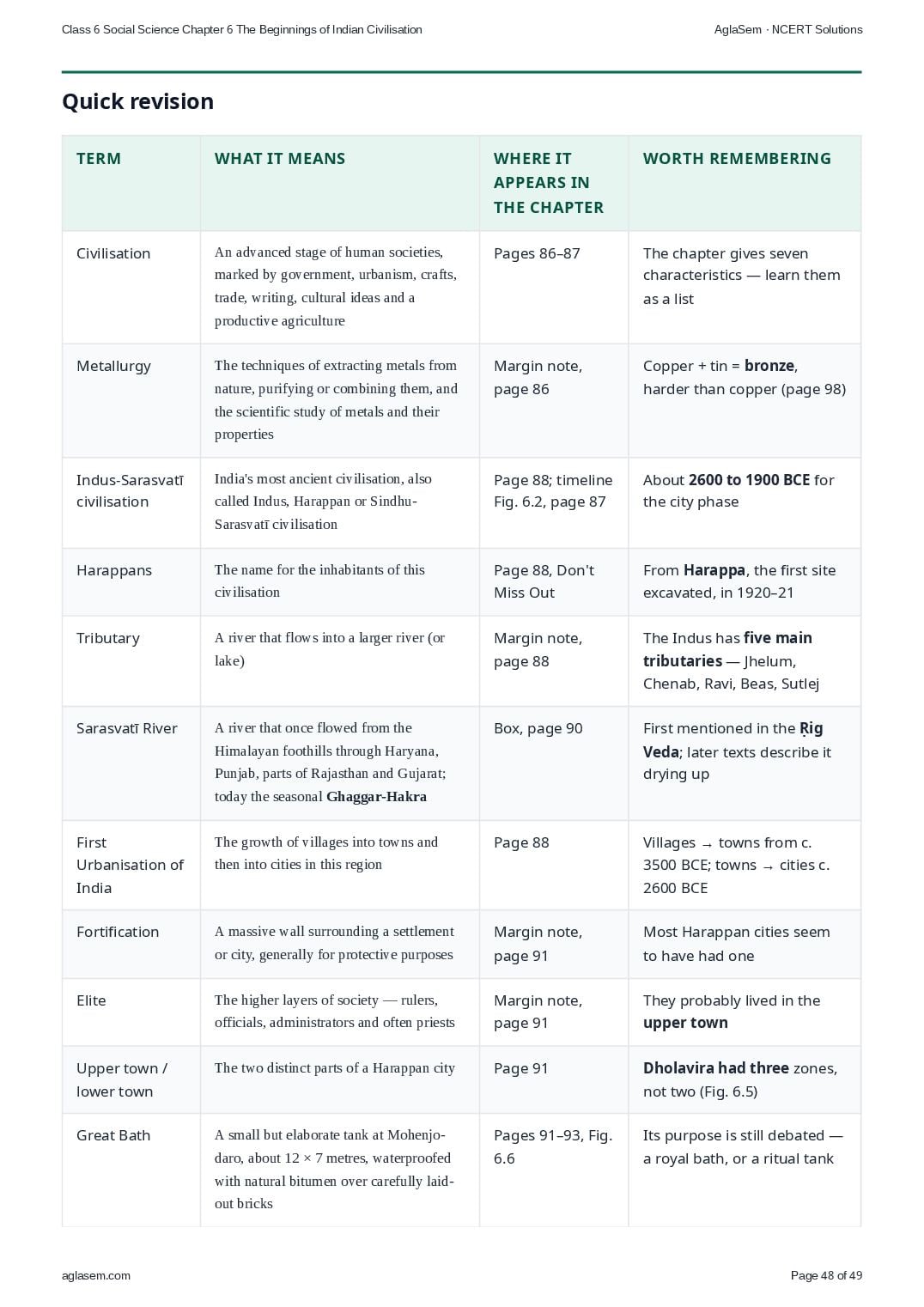
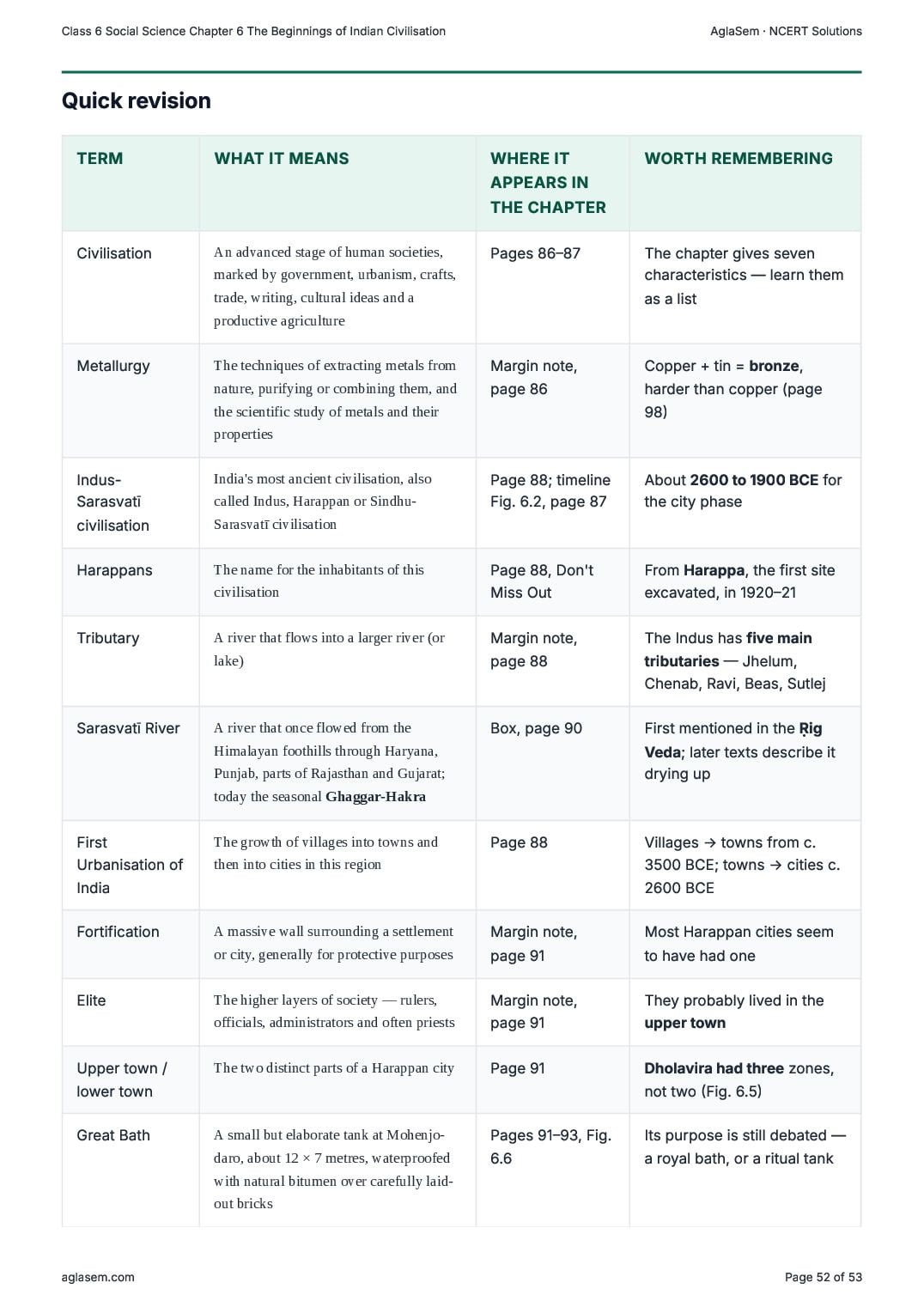
- A civilisation is not just ‘people living long ago’ — it is a checklist. The chapter sets out seven characteristics: some form of government and administration , urbanism (town-planning, water management, drainage), a variety of crafts , trade both internal and external, some form of writing , cultural ideas expressed through art, architecture, literature, oral traditions or social customs, and a productive agriculture — enough to feed not just the villages but also the cities.
- India's first civilisation grew in the north-west, along two river systems. The Indus (Sindhu) and its five main tributaries watered the plains of the Punjab and Sindh; a little further east flowed the Sarasvatī , from the foothills of the Himalayas through Haryana, Punjab, parts of Rajasthan and Gujarat. From about 3500 BCE villages grew into towns, and around 2600 BCE those towns grew into cities. This is called the First Urbanisation of India .
- It has four names, and the book uses all of them — ‘Indus’, ‘Harappan’, ‘Indus-Sarasvatī’ and ‘Sindhu-Sarasvatī’ civilisation. Its people are called Harappans , after Harappa (today in Pakistan's Punjab), the first city of this civilisation to be excavated, in 1920–21 . The old term ‘Indus Valley ’ is now obsolete : the map (Fig. 6.3) shows the civilisation spread far beyond the Indus region — from Shortugai in the north to Lothal in the south.
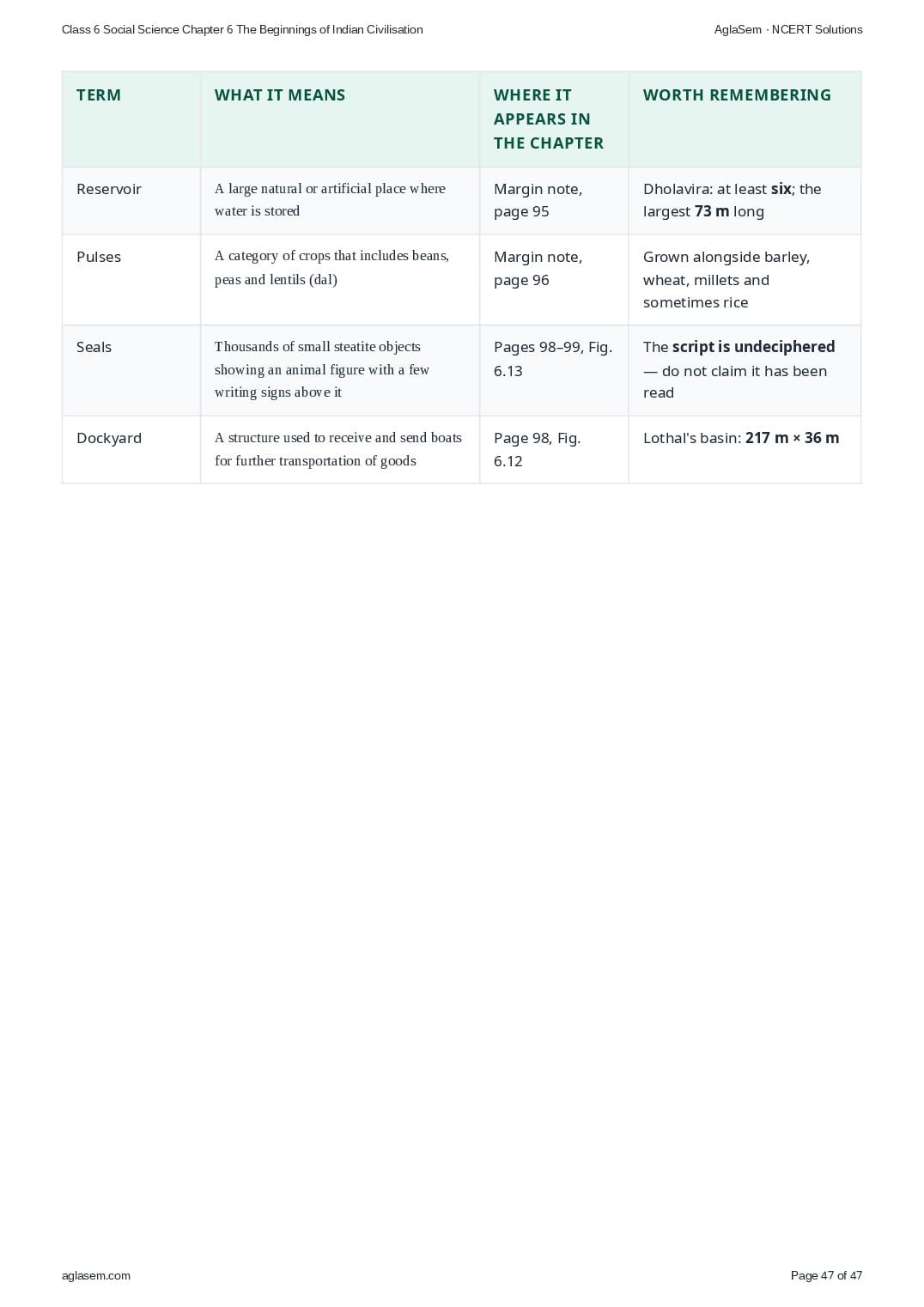
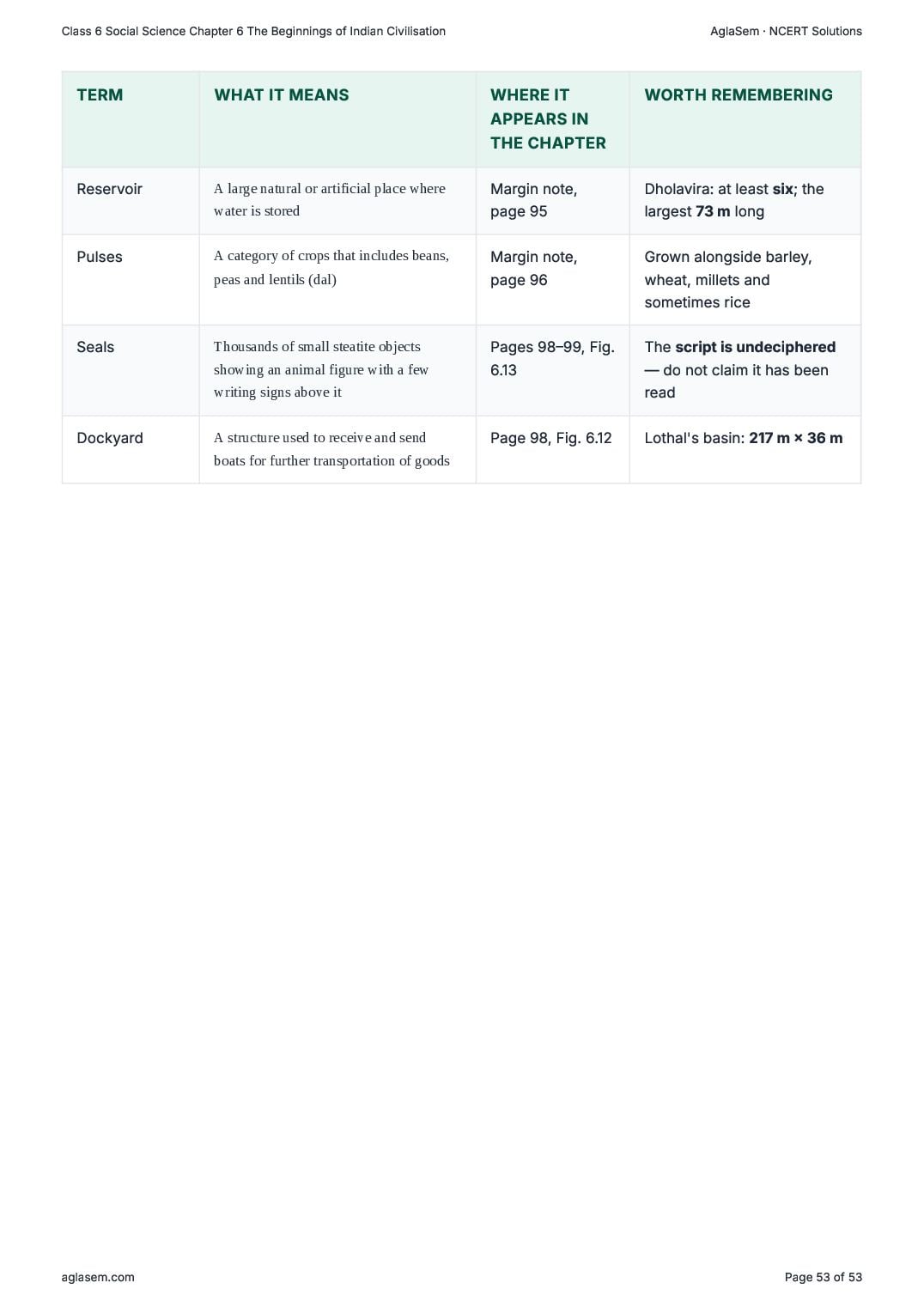
- The cities were planned, and the planning shows in the water. Larger cities had wide streets oriented to the cardinal directions , fortifications , and two distinct parts — an upper town where the elite probably lived and a lower town for common people (Dholavira had three zones). Houses of all sizes were built to the same quality . Bathing areas drained into a network of covered drains below the streets ; Mohenjo-daro had about 700 brick wells and the Great Bath (12 × 7 m); Dholavira had at least six large reservoirs , the biggest 73 metres long.
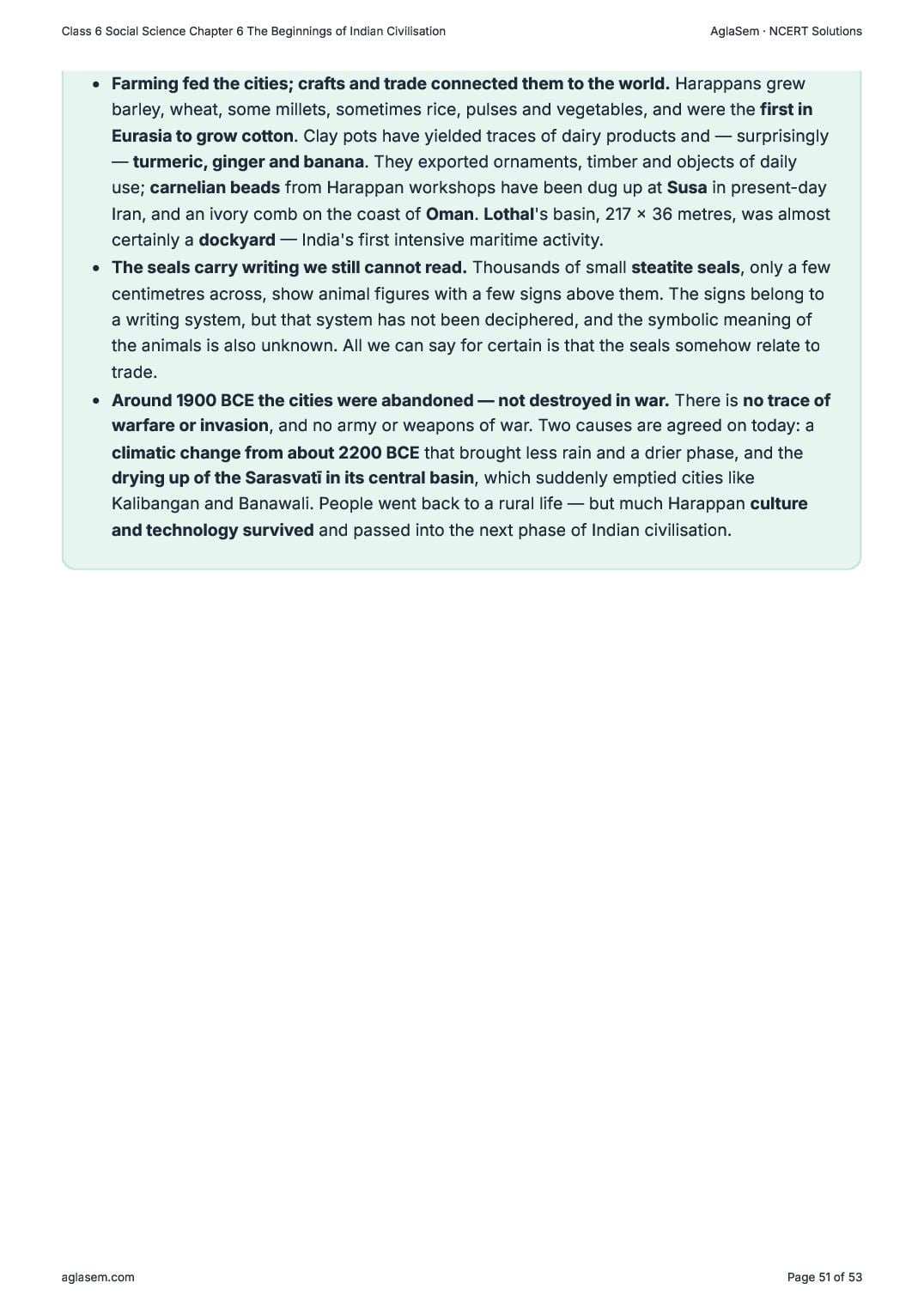
- Farming fed the cities; crafts and trade connected them to the world. Harappans grew barley, wheat, some millets, sometimes rice, pulses and vegetables, and were the first in Eurasia to grow cotton . Clay pots have yielded traces of dairy products and — surprisingly — turmeric, ginger and banana . They exported ornaments, timber and objects of daily use; carnelian beads from Harappan workshops have been dug up at Susa in present-day Iran, and an ivory comb on the coast of Oman . Lothal 's basin, 217 × 36 metres, was almost certainly a dockyard — India's first intensive maritime activity.
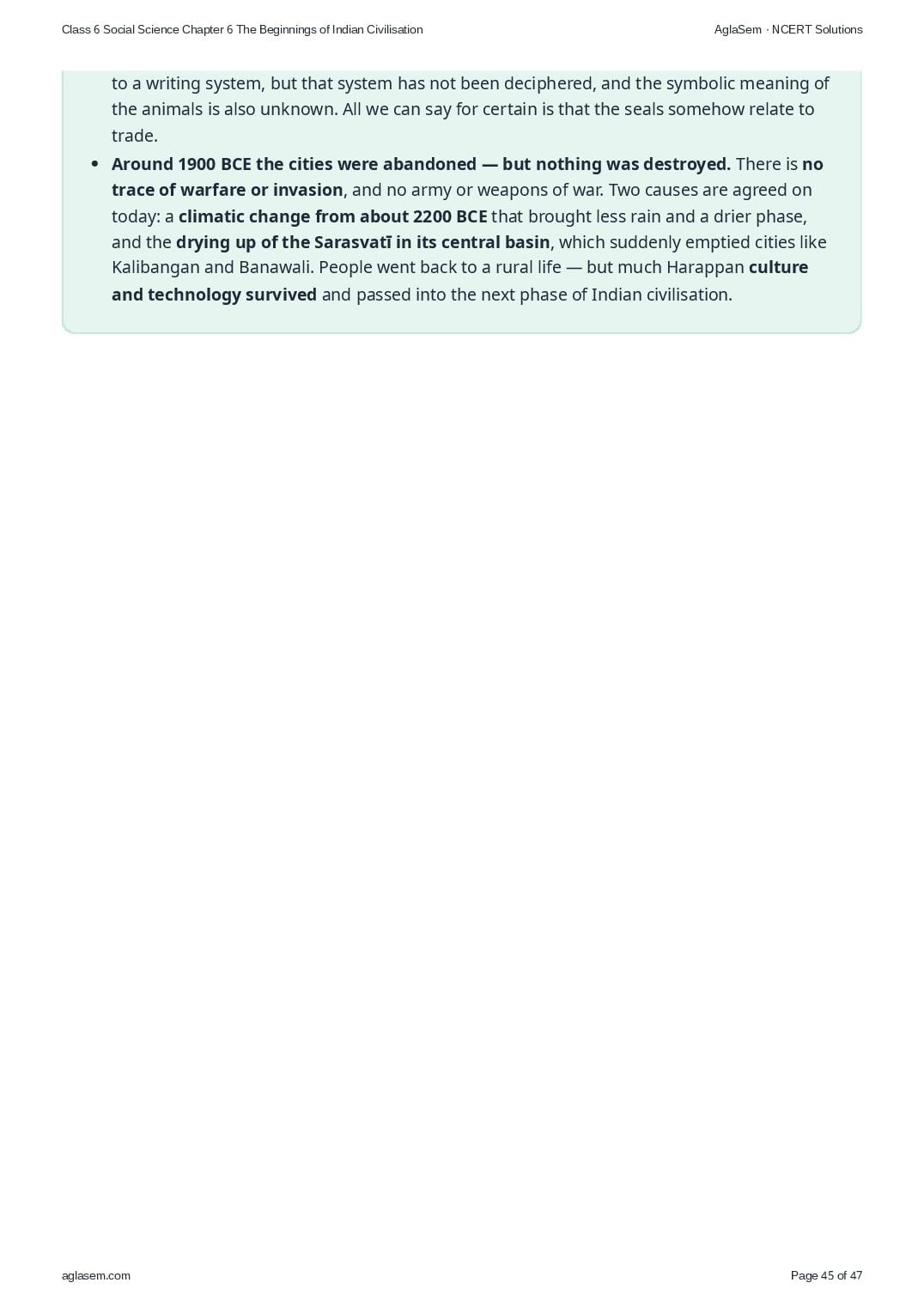
- The seals carry writing we still cannot read. Thousands of small steatite seals , only a few centimetres across, show animal figures with a few signs above them. The signs belong to a writing system, but that system has not been deciphered , and the symbolic meaning of the animals is also unknown. All we can say for certain is that the seals somehow relate to trade.
- Around 1900 BCE the cities were abandoned — but nothing was destroyed. There is no trace of warfare or invasion , and no army or weapons of war. Two causes are agreed on today: a climatic change from about 2200 BCE that brought less rain and a drier phase, and the drying up of the Sarasvatī in its central basin , which suddenly emptied cities like Kalibangan and Banawali. People went back to a rural life — but much Harappan culture and technology survived and passed into the next phase of Indian civilisation.
How to Download NCERT Solutions for Class 6 Social Science Chapter 6 PDF
Follow these simple steps to get the the Beginnings of Indian Civilisation questions-and-answers PDF from Exploring Society India and Beyond.
- Search NCERT Solutions for Class 6 Social Science Chapter 6 aglasem and open this page.
- Read the exercise questions with answers for the Beginnings of Indian Civilisation shown above.
- Click the Download PDF link to save the the Beginnings of Indian Civilisation solutions to your device.
NCERT Solutions for Class 6 Social Science – All Chapters
There are more chapters to study besides the Beginnings of Indian Civilisation in Social Science. Here are the NCERT Solutions for all chapters of Class 6 Social Science.
- Chapter 1 Locating Places on the Earth
- Chapter 2 Oceans and Continents
- Chapter 3 Landforms and Life
- Chapter 4 Timeline and Sources of History
- Chapter 5 India That Is Bharat
- Chapter 6 the Beginnings of Indian Civilisation
- Chapter 7 India’s Cultural Roots
- Chapter 8 Unity in Diversity or Many in the One
- Chapter 9 Family and Community
- Chapter 10 Grassroots Democracy part 1 Governance
- Chapter 11 Grassroots Democracy part 2 Local Government in Rural Areas
- Chapter 12 Grassroots Democracy part 3 Local Government in Urban Areas
- Chapter 13 the Value of Work
- Chapter 14 Economic Activities Around Us
NCERT Solutions for Class 6 – All Subjects
Just like Chapter 6 of Social Science, you can get the exercise questions with answers for every other subject of Class 6. Here are the NCERT Solutions for all subjects of Class 6.
NCERT Solutions for Class 6 Social Science Chapter 6 – An Overview
The key highlights of this study material are as follows.
| Aspects | Details |
|---|---|
| Class | Class 6 |
| Subject | Social Science |
| Chapter Number | Chapter 6 |
| Chapter Name | the Beginnings of Indian Civilisation |
| Book Name | Exploring Society India and Beyond |
| Book By | NCERT (National Council of Educational Research and Training) |
| Educational Resource Here | NCERT Solutions of Class 6 Social Science Chapter 6 for all exercises |
| More Questions Answers of This Subject | NCERT Solutions for Class 6 Social Science |
| Download Book Chapter | NCERT Book Class 6 Social Science |
| All Questions Answers For This Class | NCERT Solutions for Class 6 |
| Complete Solutions | NCERT Solutions |
NCERT Solutions for Class 6 Social Science Chapter 6 the Beginnings of Indian Civilisation – FAQs
What are the NCERT Solutions for Class 6 Social Science Chapter 6 the Beginnings of Indian Civilisation?
They are the complete, step-by-step answers to all the exercise and in-text questions of Chapter 6 the Beginnings of Indian Civilisation from the NCERT Class 6 Social Science textbook Exploring Society India and Beyond, written by experts as per the latest NCERT syllabus.
How can I download the Class 6 Social Science Chapter 6 solutions PDF for free?
Open this page on aglasem, read the the Beginnings of Indian Civilisation questions with answers, and click the “Download Solutions PDF” link. The Class 6 Social Science Chapter 6 NCERT Solutions PDF is completely free to download.
Are these NCERT Solutions as per the latest 2026-27 syllabus?
Yes. The NCERT Solutions for Class 6 Social Science Chapter 6 are based on the latest NCERT textbook Exploring Society India and Beyond and the current 2026-27 CBSE syllabus, so the questions and answers match what you study in class.
Where can I get NCERT Solutions for the other chapters of Class 6 Social Science?
You can find the answers to every chapter on the NCERT Solutions for Class 6 Social Science page, and solutions for every subject on the NCERT Solutions for Class 6 page.
How do NCERT Solutions help in exam preparation?
They show the correct method to solve each question, help you write answers the way they are expected in exams, let you check and correct your own work, and save revision time — which together improve your marks in Class 6 Social Science.
If you have any queries on NCERT Solutions for Class 6 Social Science Chapter 6 the Beginnings of Indian Civilisation, then please ask in the comments below.