NCERT Solutions for Class 6 Social Science Chapter 3 Landforms and Life provide clear, step-by-step answers to every exercise and in-text question from the chapter Landforms and Life of the NCERT textbook Exploring Society India and Beyond. Prepared by subject experts as per the latest NCERT (CBSE) syllabus for 2026-27, these NCERT Solutions for Class 6 Social Science help you understand each concept, write exam-ready answers, and check your own solutions. You can read them online below or download the free Class 6 Social Science Chapter 3 question-answer PDF.
NCERT Solutions for Class 6 Social Science Chapter 3 Landforms and Life
- Class: Class 6
- Subject: Social Science
- Chapter: Chapter 3 – Landforms and Life
- Textbook: Exploring Society India and Beyond (NCERT)
- Study material: NCERT Solutions – questions with answers, free PDF
These solutions answer all the exercise questions of Chapter 3 Landforms and Life — including the in-text questions, short-answer and long-answer questions, and activities — with complete explanations so you can follow the method, not just the final answer. Read the full solutions below.
NCERT Solutions Class 6 Social Science Chapter 3 Landforms and Life View Download

NCERT Solutions for Class 6 Social Science Chapter 3 PDF Download
You can read the NCERT Solutions for Class 6 Social Science Chapter 3 online above, or download the complete question-answer PDF to study Landforms and Life offline at any time.
NCERT Solutions for Class 6 Social Science Chapter 3 PDF Download Link – Click Here to Download Solutions PDF
Questions Covered in This Chapter
These NCERT Solutions answer all 23 questions of this chapter. The questions solved are:
- What are the major types of landforms and their significance to life and culture?
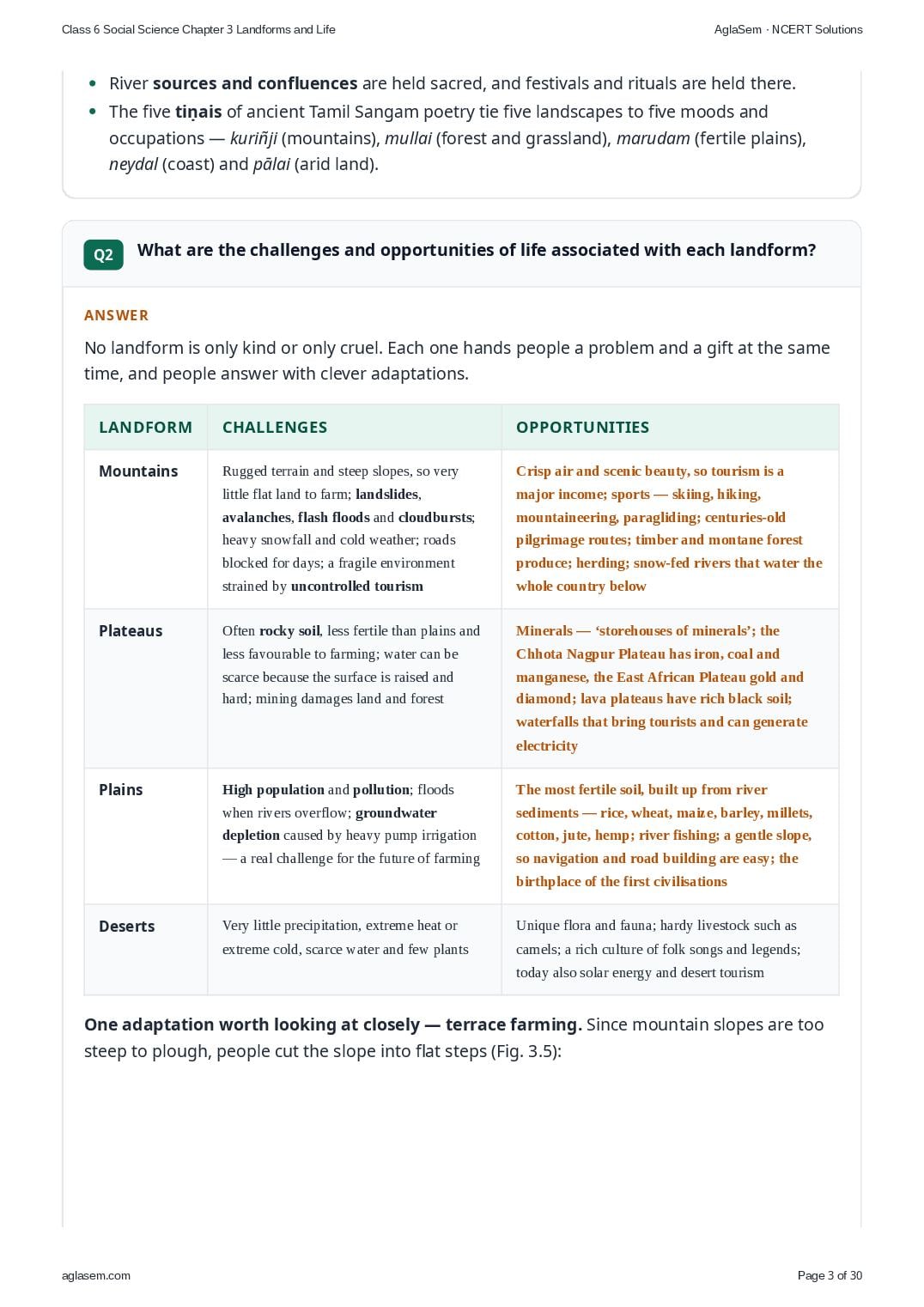
- What are the challenges and opportunities of life associated with each landform?
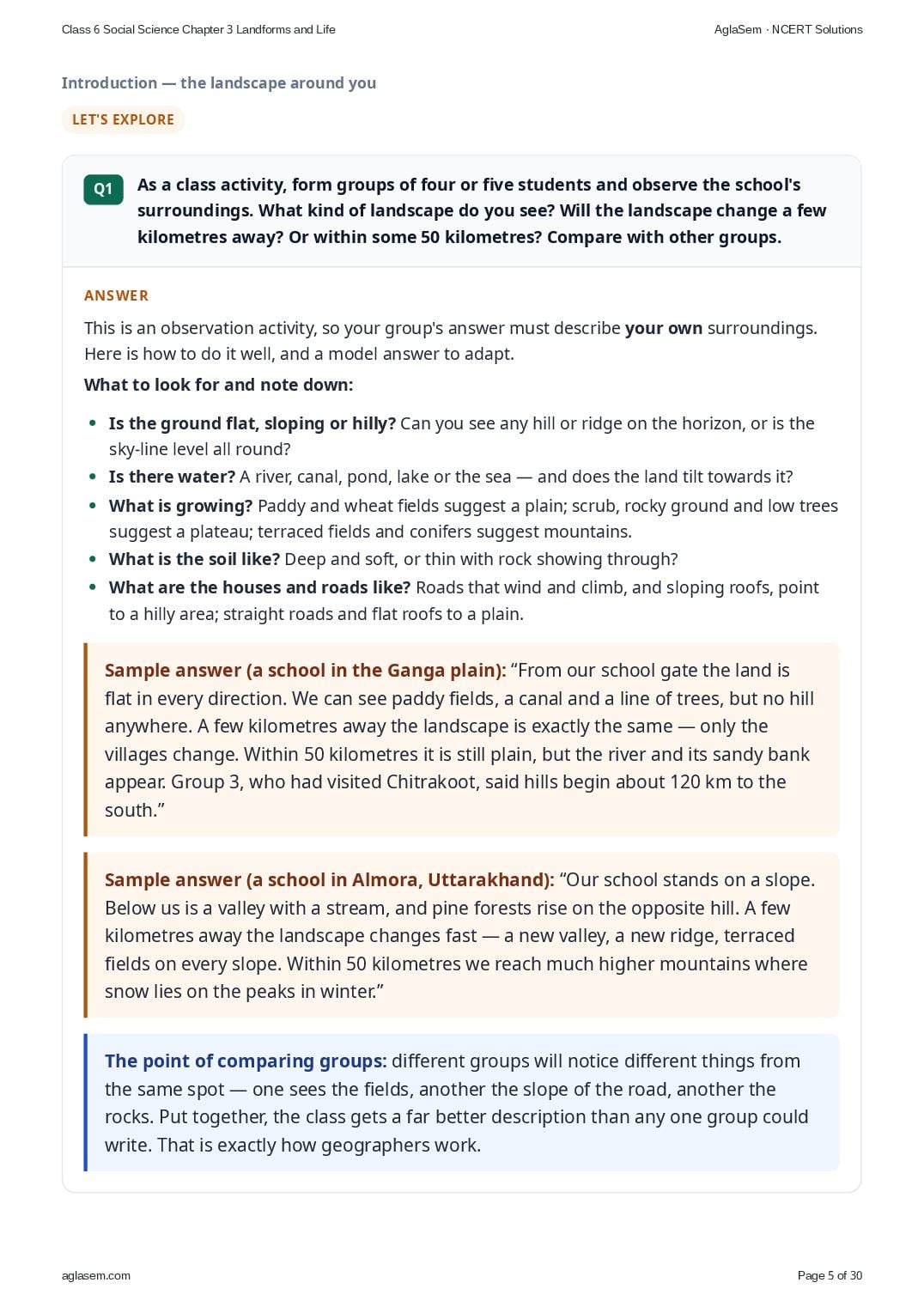
- As a class activity, form groups of four or five students and observe the school's surroundings. What kind of landscape do you see? Will the landscape change a few kilometres away? Or within some 50 kilometres? Compare with other groups.
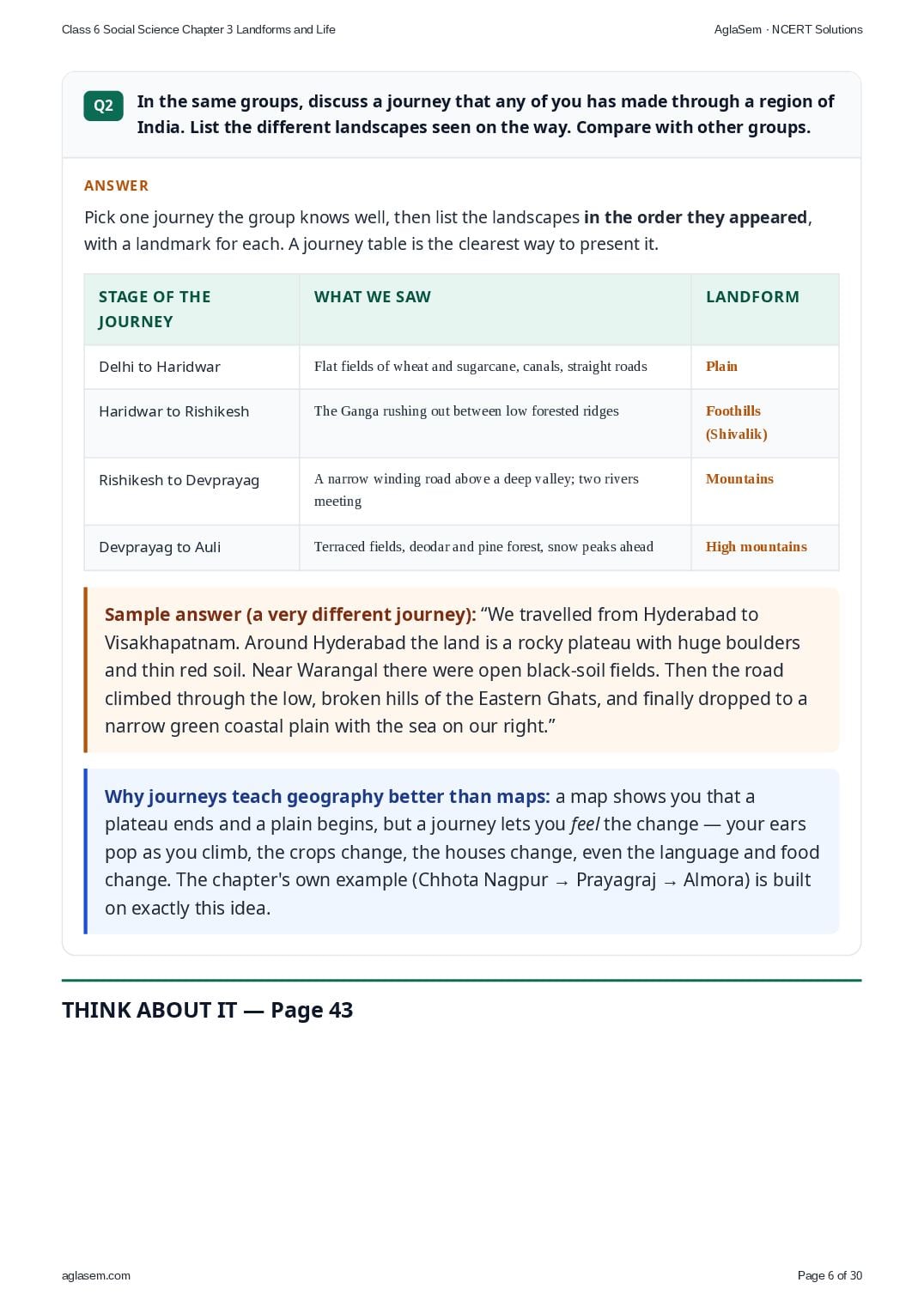
- In the same groups, discuss a journey that any of you has made through a region of India. List the different landscapes seen on the way. Compare with other groups.
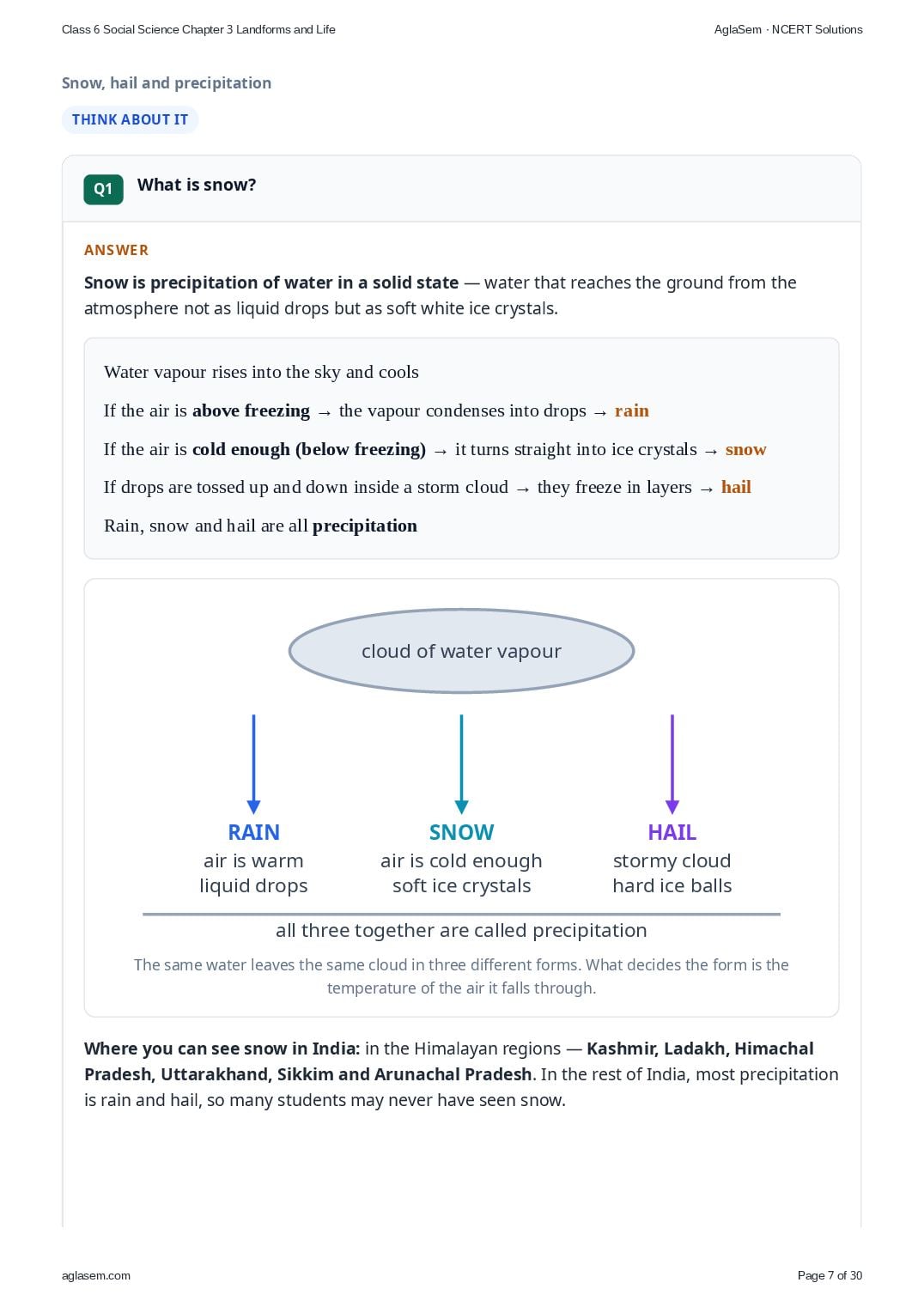
- What is snow?
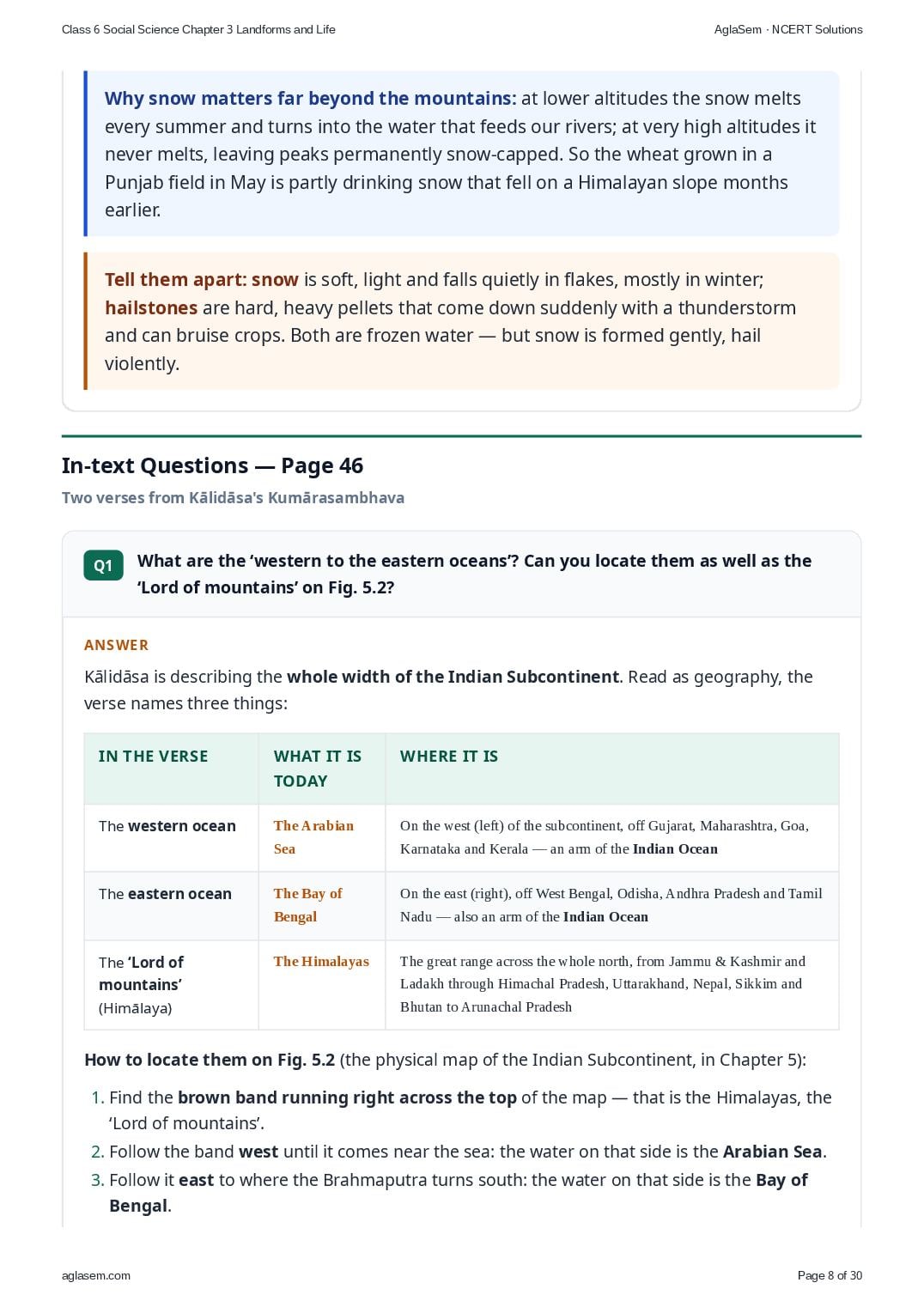
- What are the ‘western to the eastern oceans’? Can you locate them as well as the ‘Lord of mountains’ on Fig. 5.2?
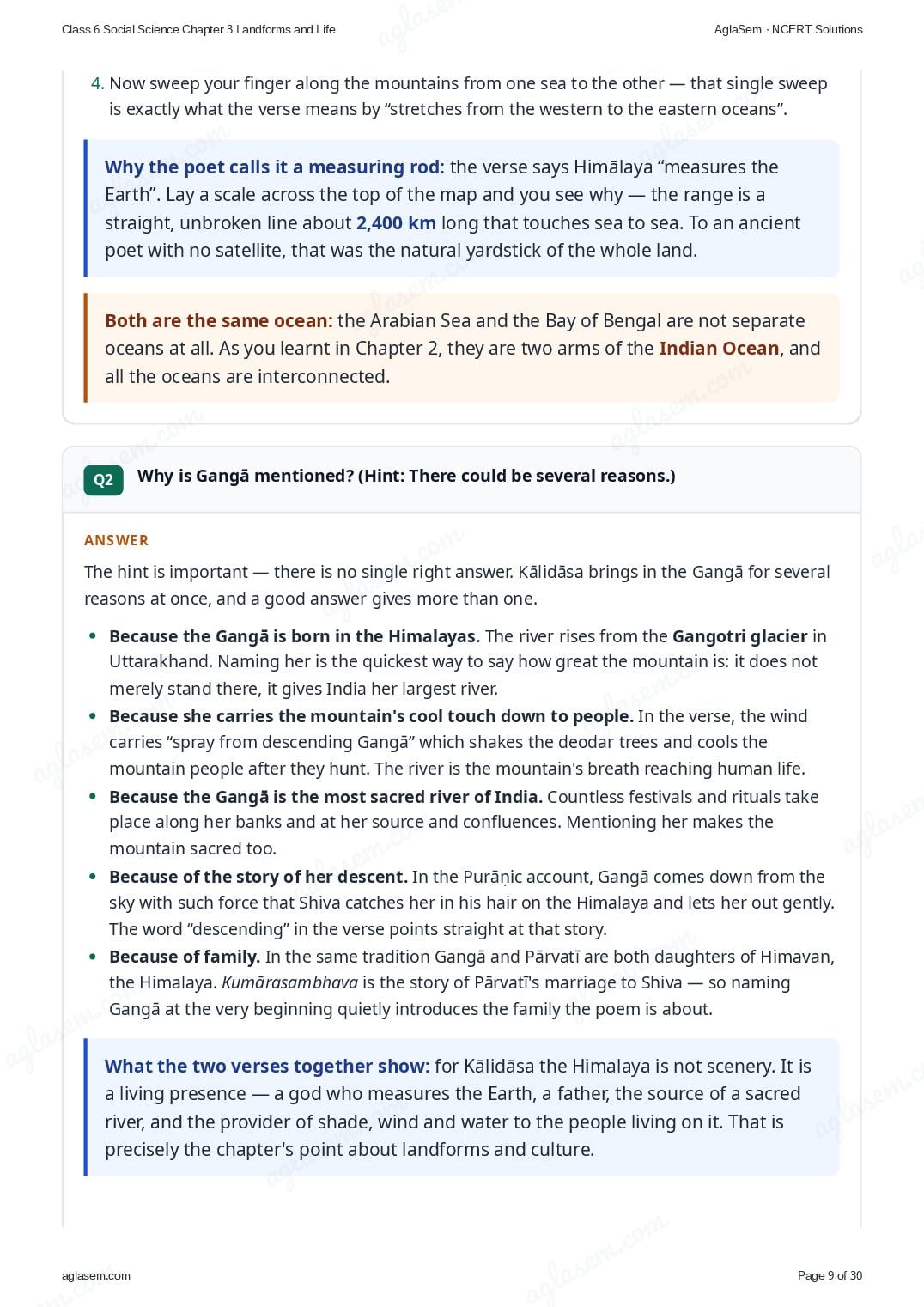
- Why is Gangā mentioned? (Hint: There could be several reasons.)
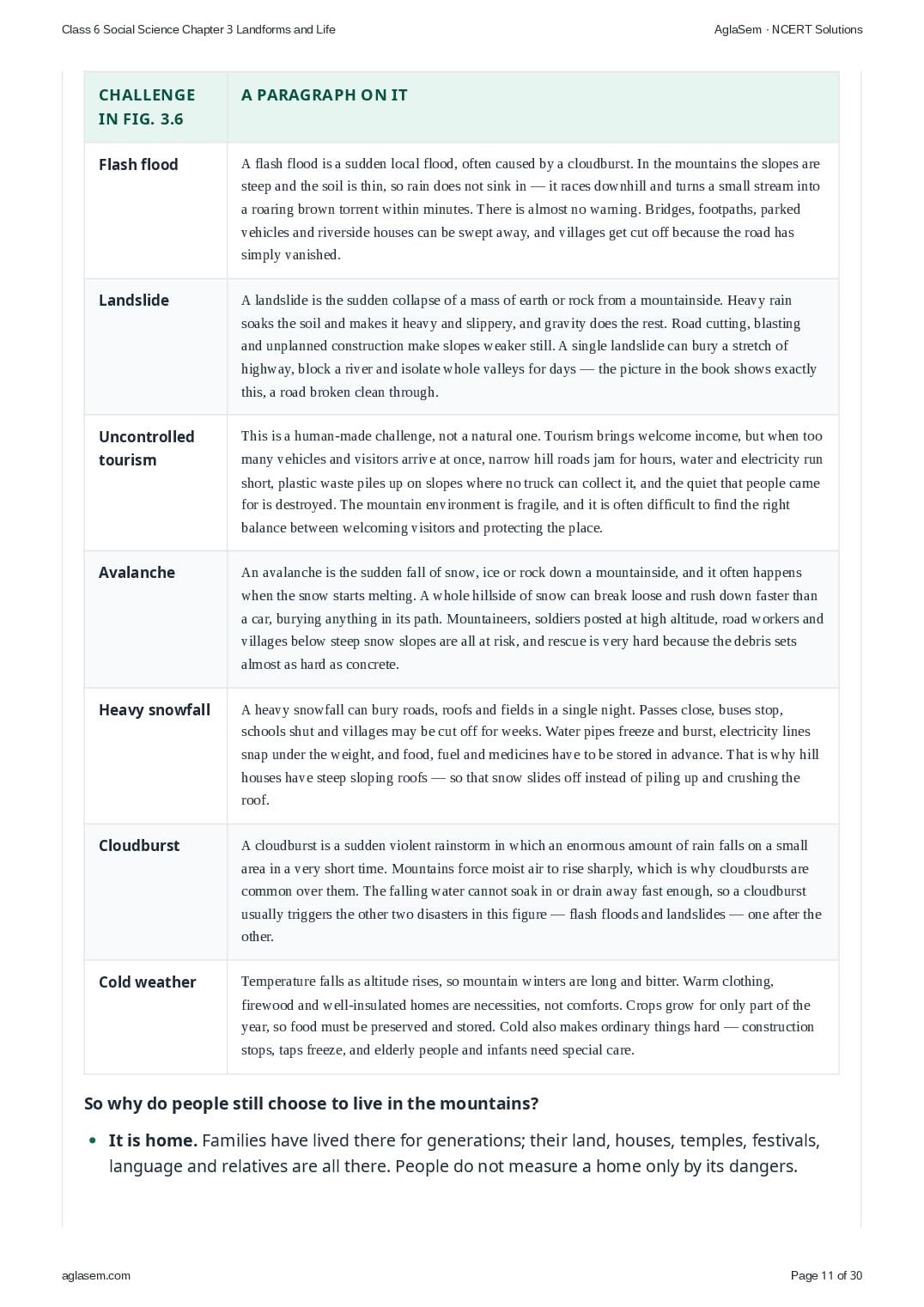
- These images (Fig. 3.6 on page 50) depict a few challenges that people living in the mountains may face. Discuss them in groups in the class and write one paragraph on each. Also discuss why, despite many such challenges, people still choose to live in the mountains.
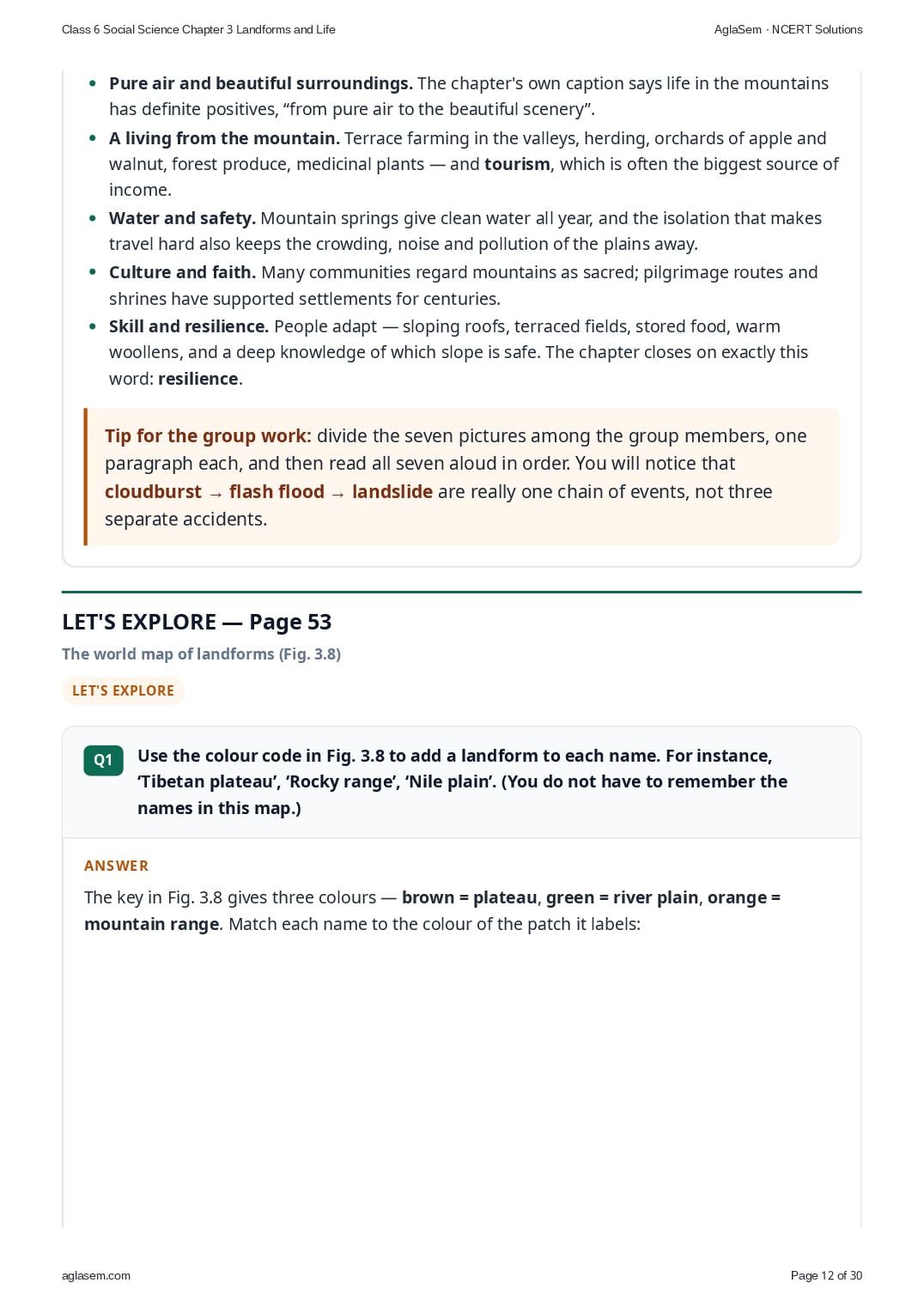
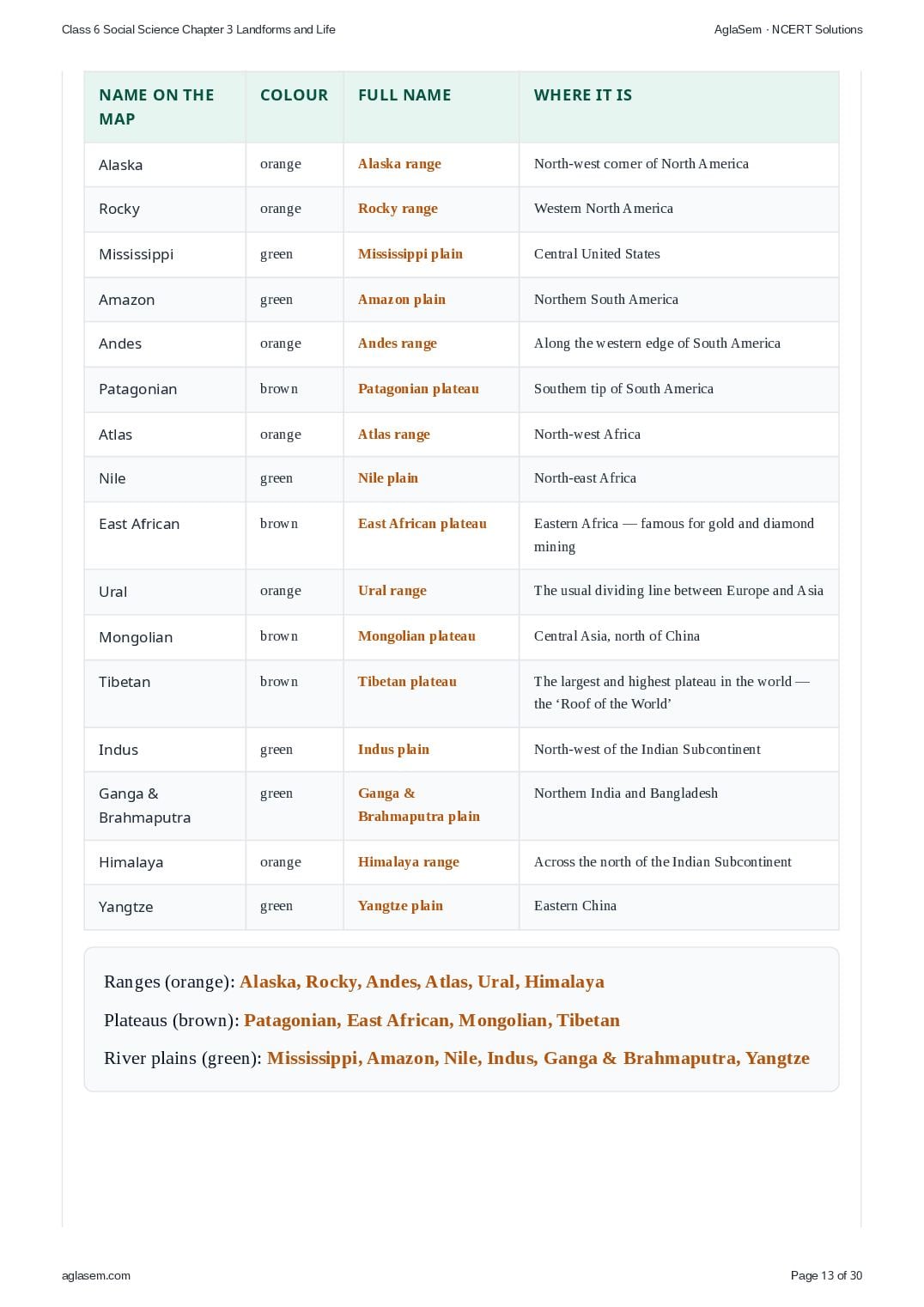
- Use the colour code in Fig. 3.8 to add a landform to each name. For instance, ‘Tibetan plateau’, ‘Rocky range’, ‘Nile plain’. (You do not have to remember the names in this map.)
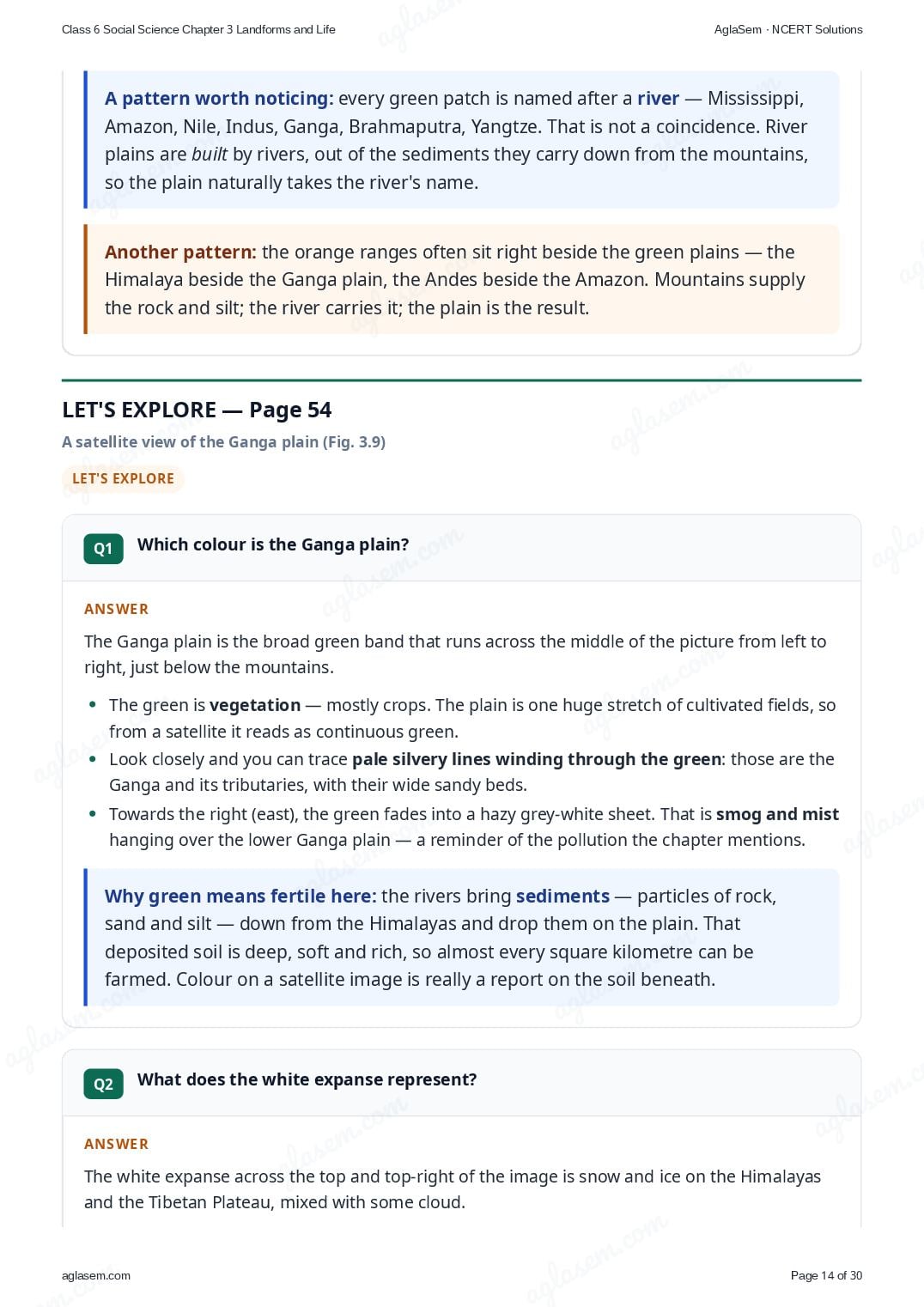
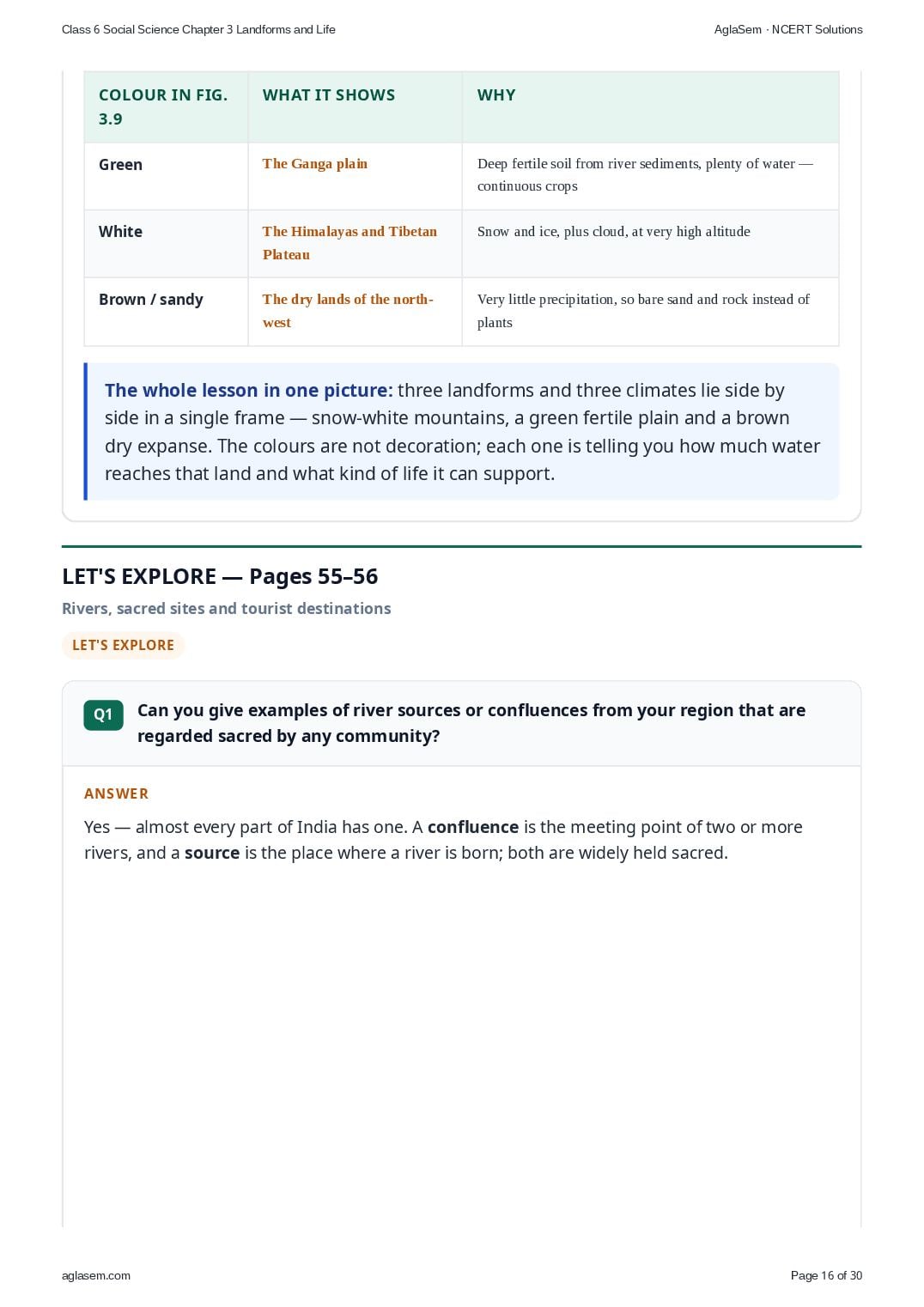
- Which colour is the Ganga plain?
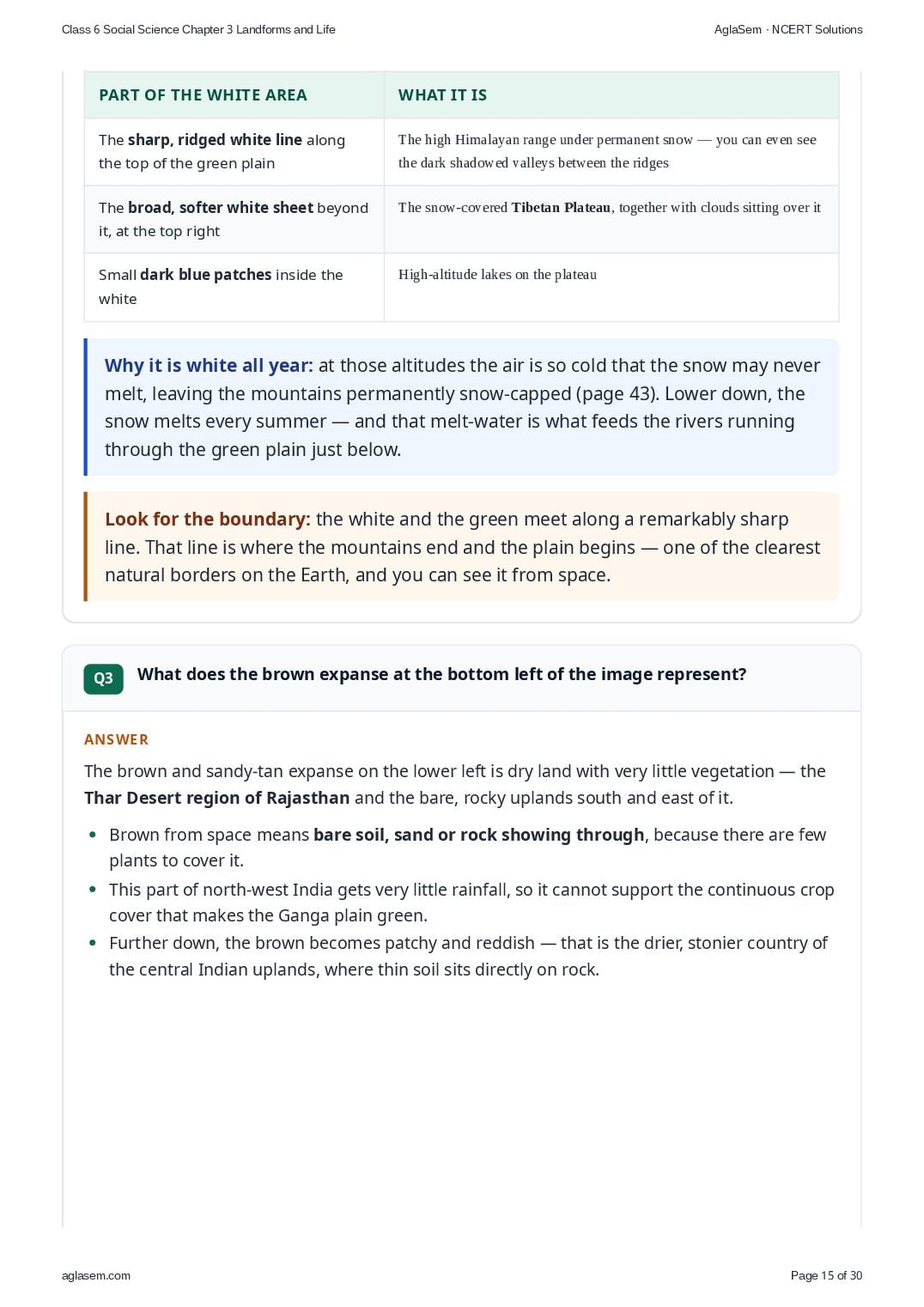
- What does the white expanse represent?
- What does the brown expanse at the bottom left of the image represent?
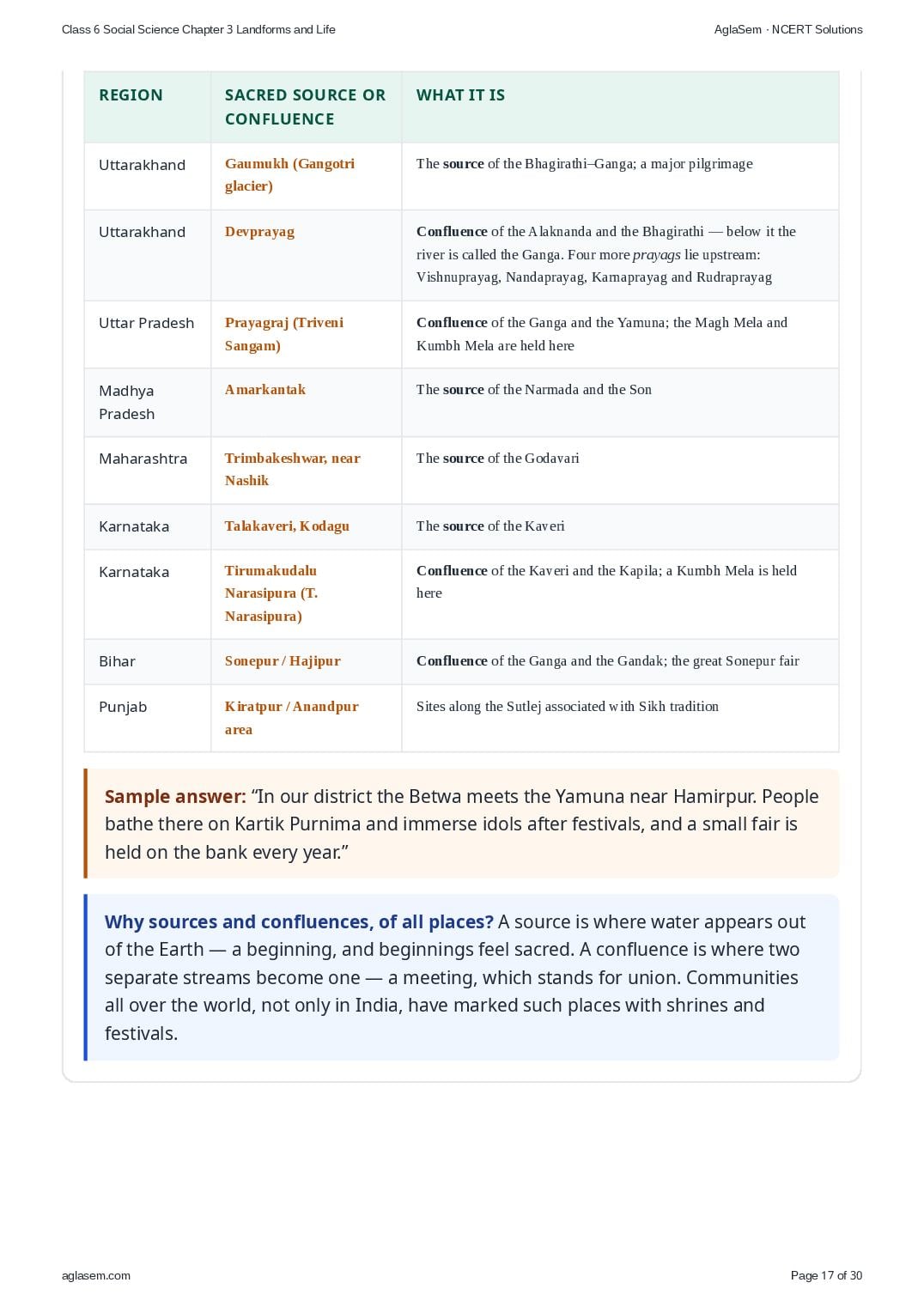
- Can you give examples of river sources or confluences from your region that are regarded sacred by any community?
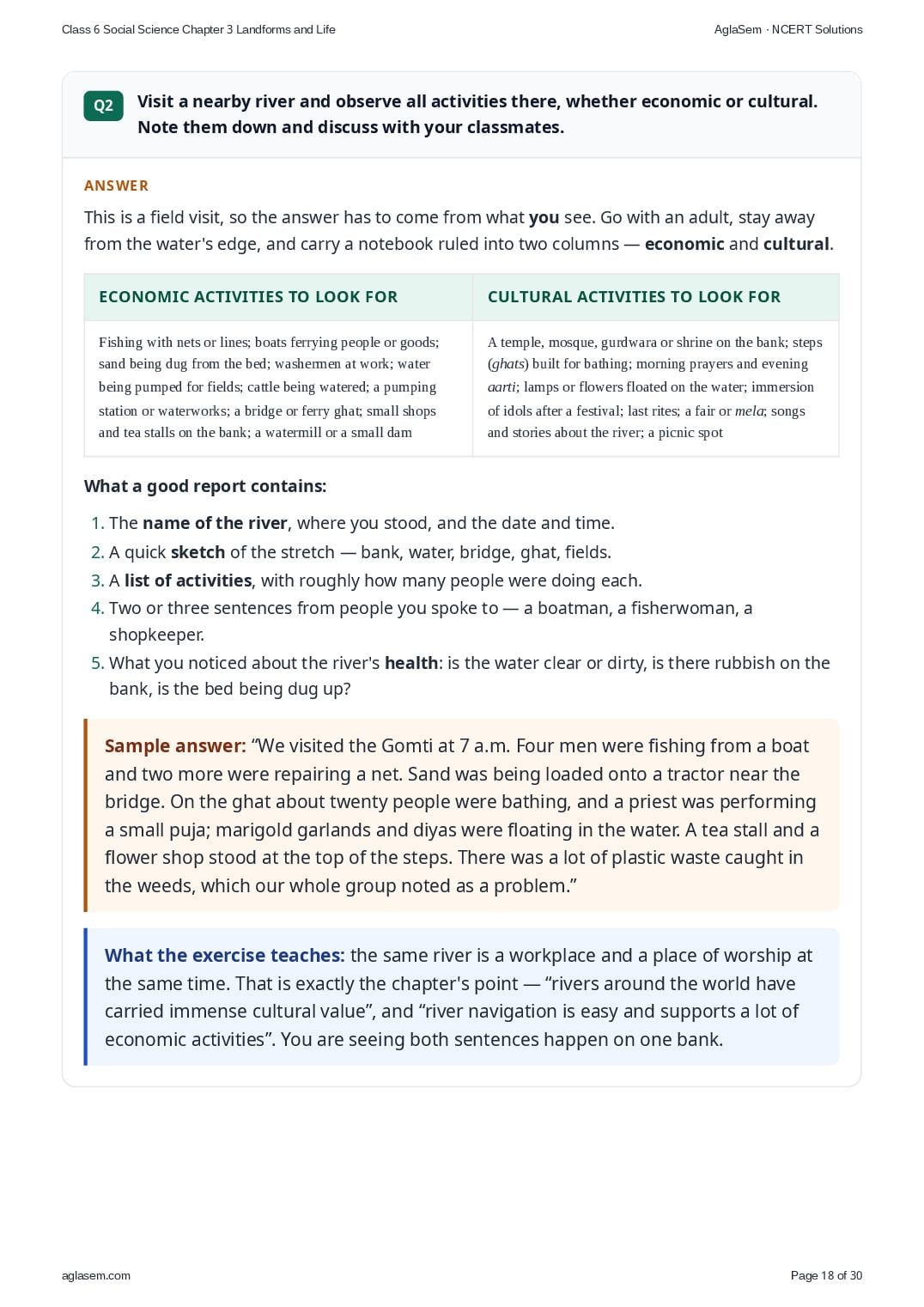
- Visit a nearby river and observe all activities there, whether economic or cultural. Note them down and discuss with your classmates.
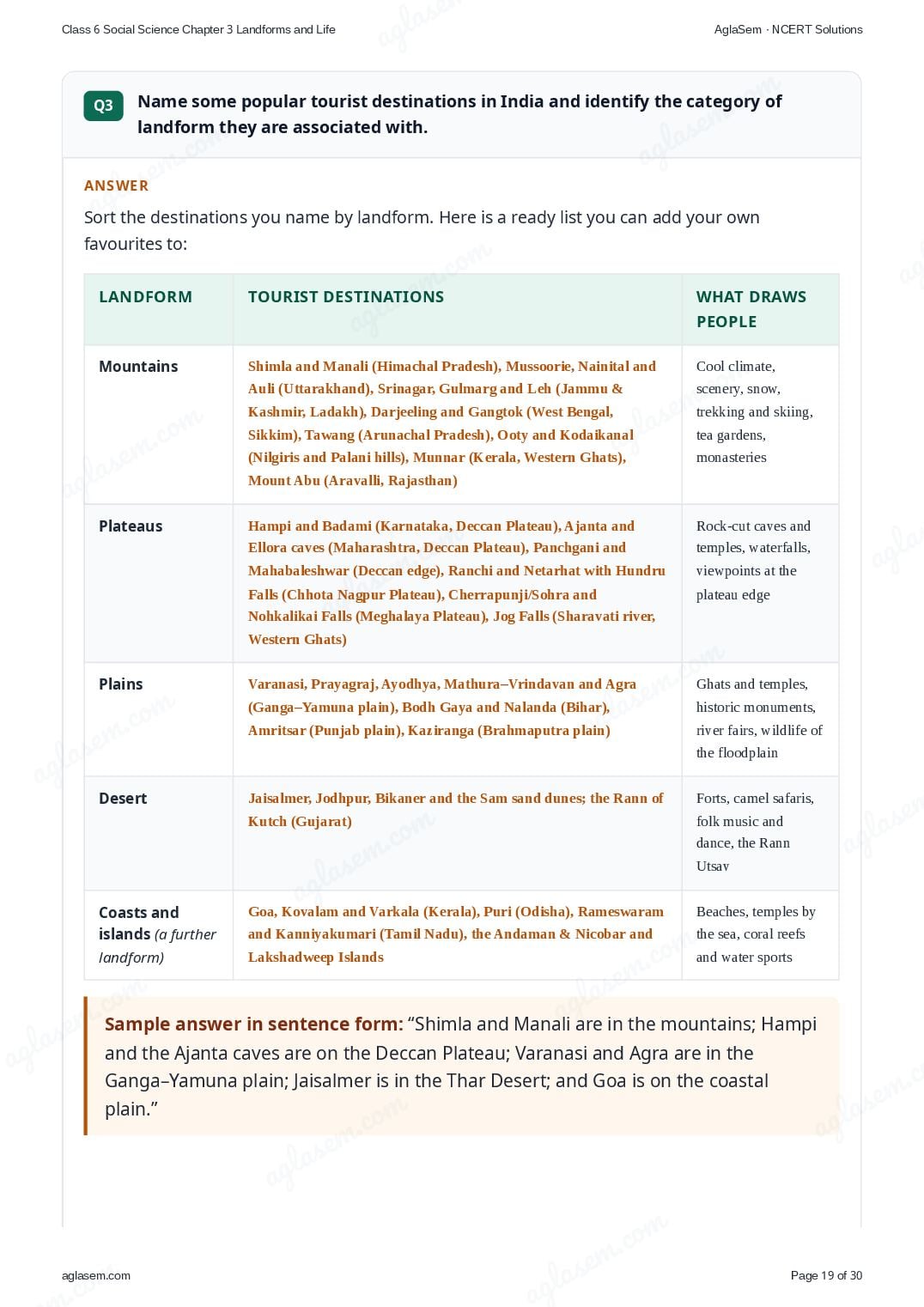
- Name some popular tourist destinations in India and identify the category of landform they are associated with.
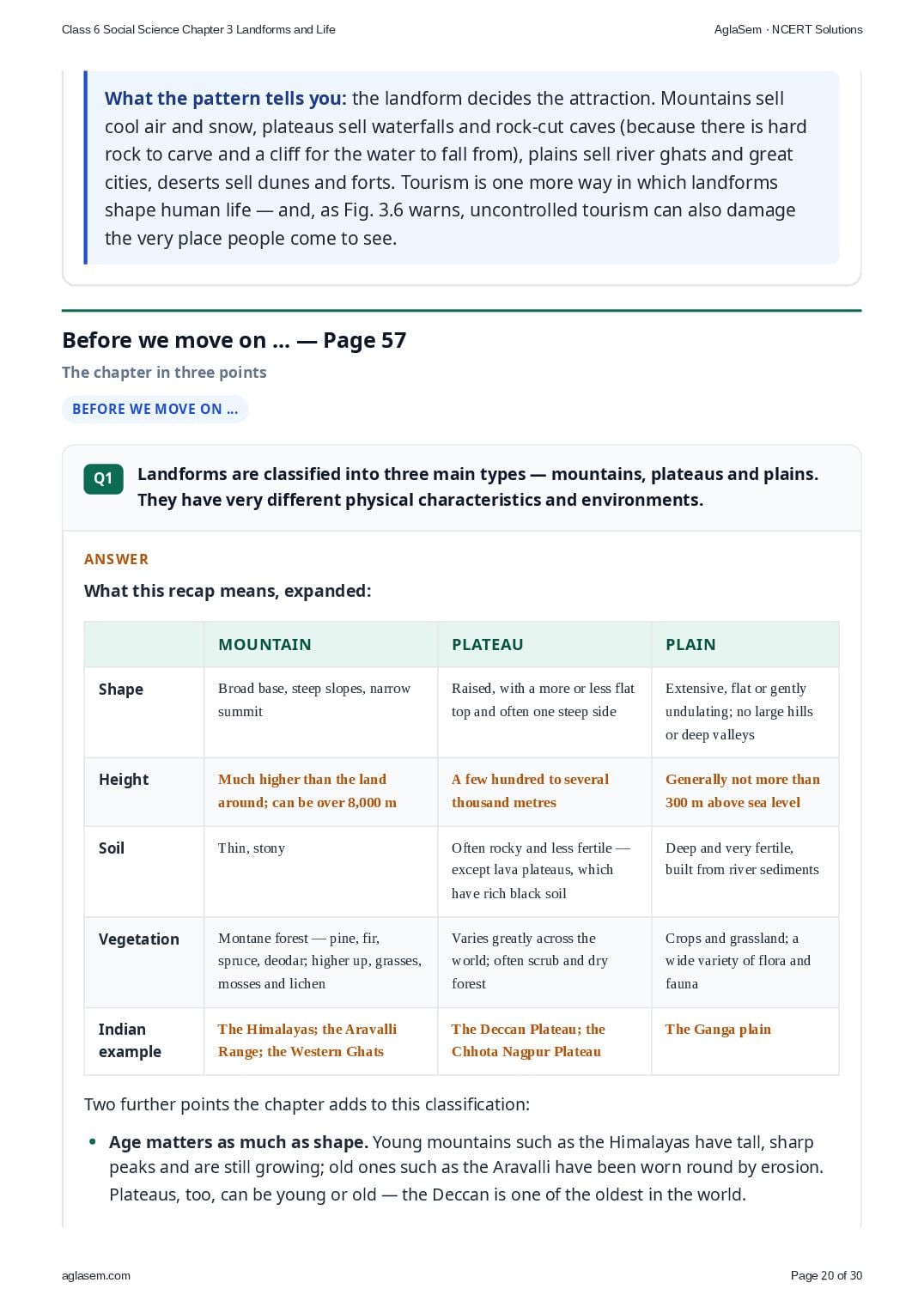
- Landforms are classified into three main types — mountains, plateaus and plains. They have very different physical characteristics and environments.
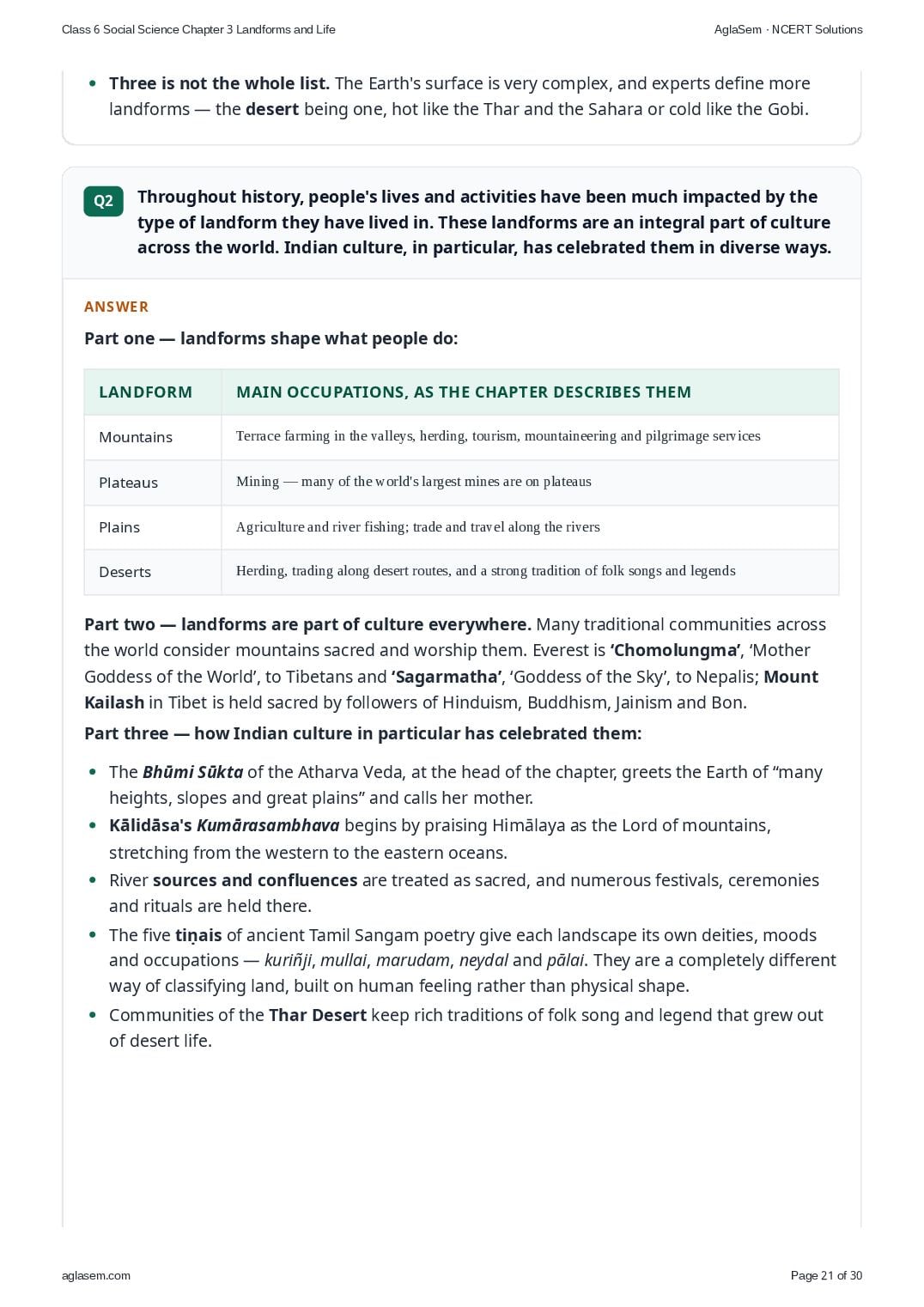
- Throughout history, people's lives and activities have been much impacted by the type of landform they have lived in. These landforms are an integral part of culture across the world. Indian culture, in particular, has celebrated them in diverse ways.
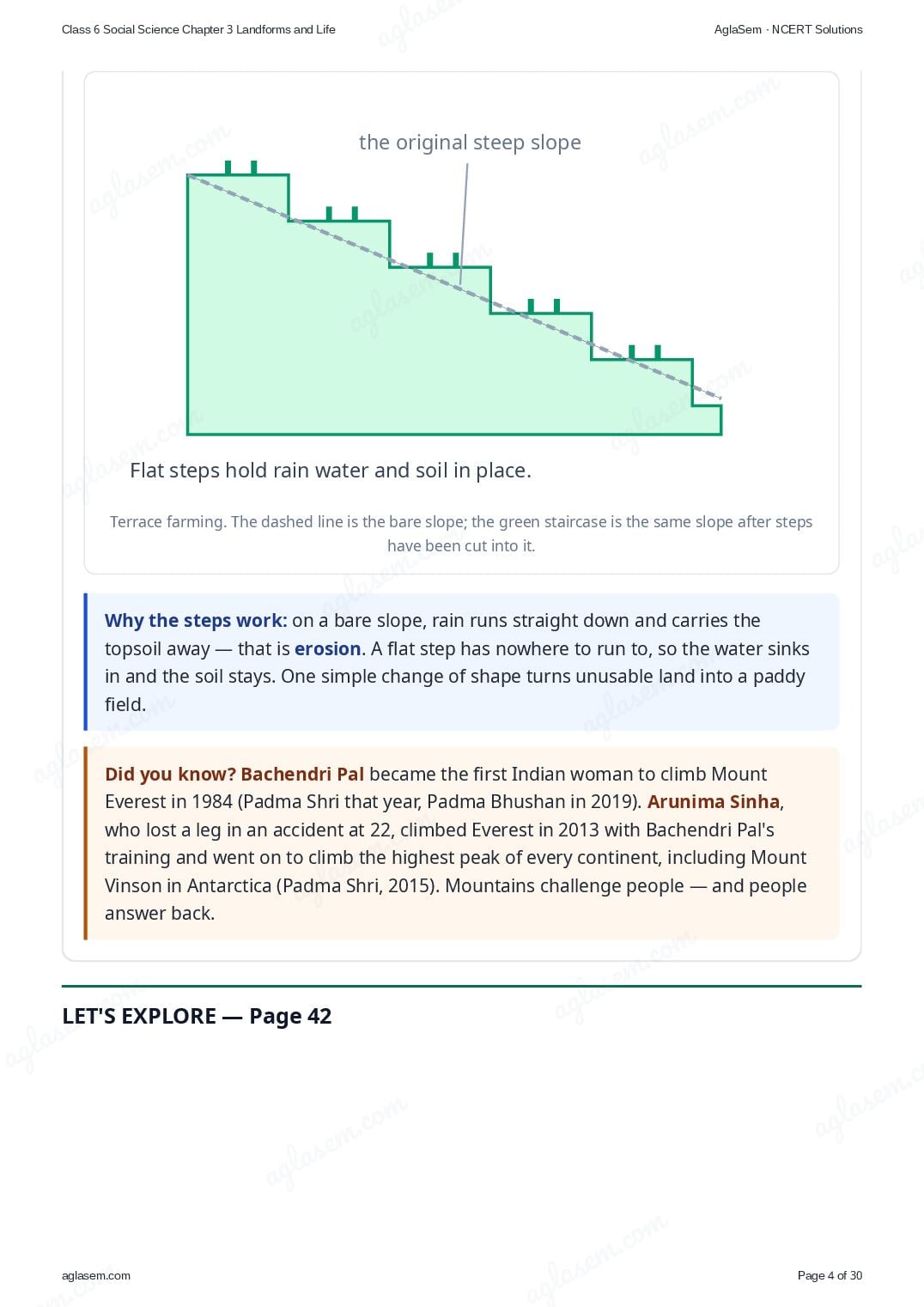
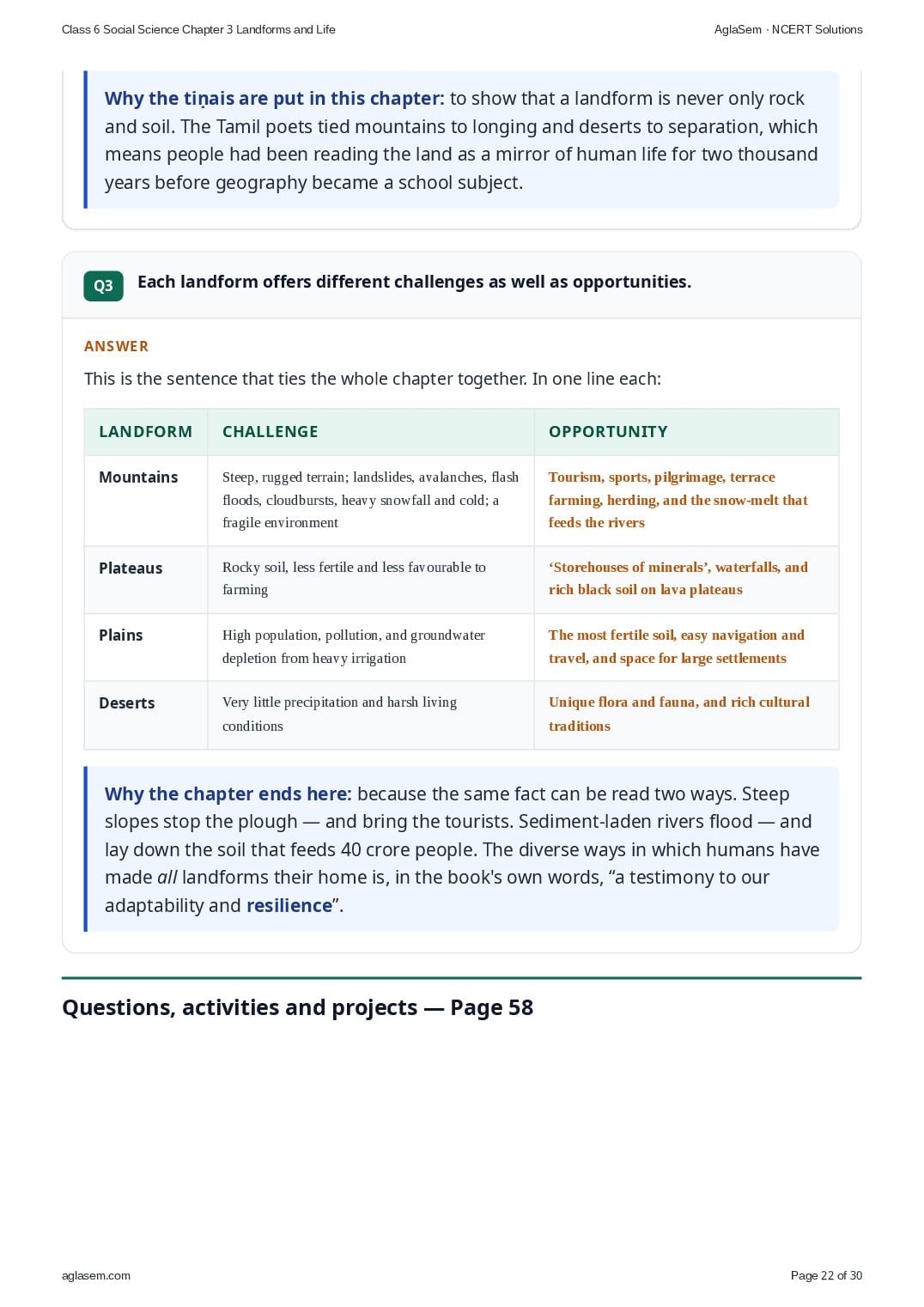
- Each landform offers different challenges as well as opportunities.
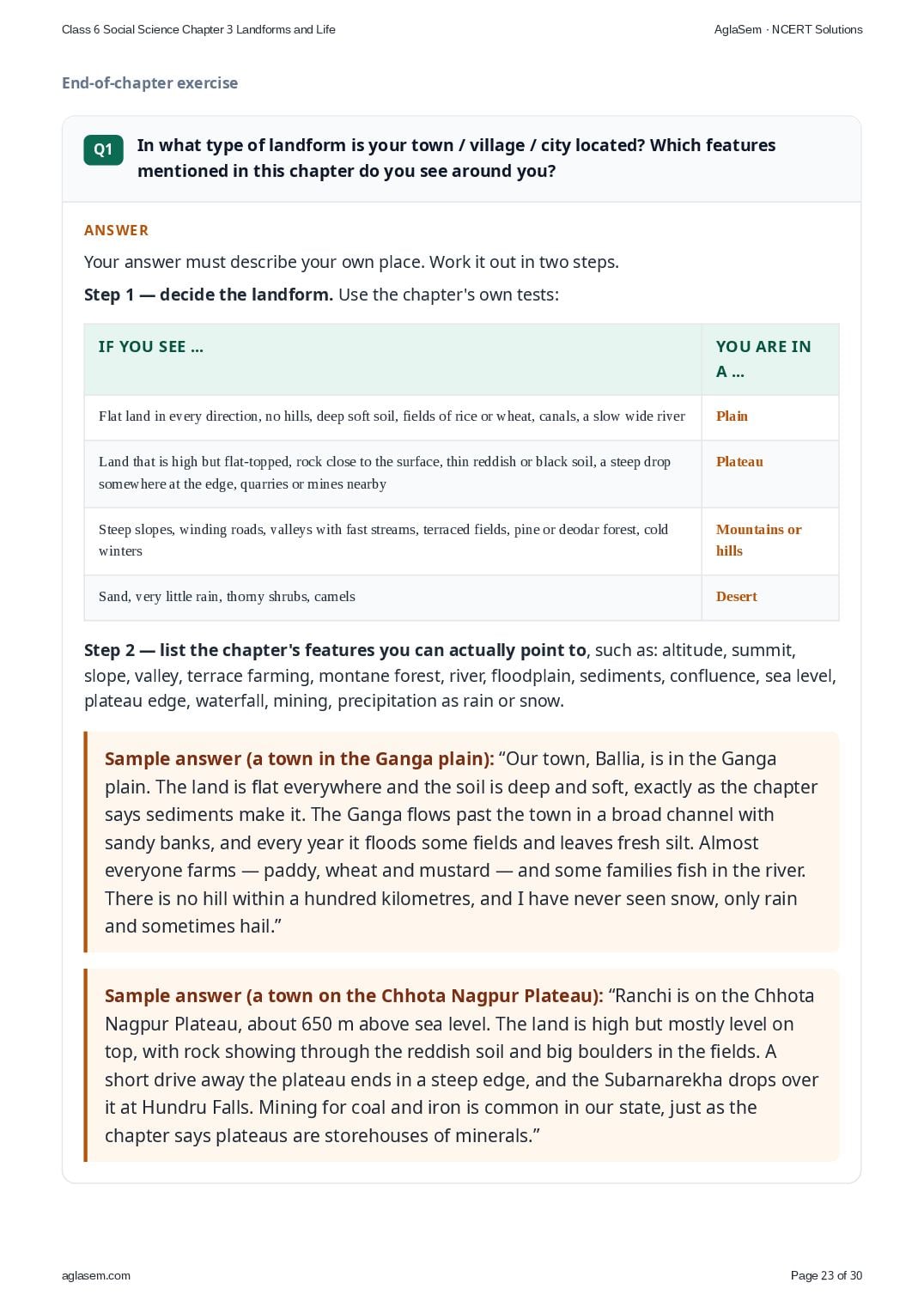
- In what type of landform is your town / village / city located? Which features mentioned in this chapter do you see around you?
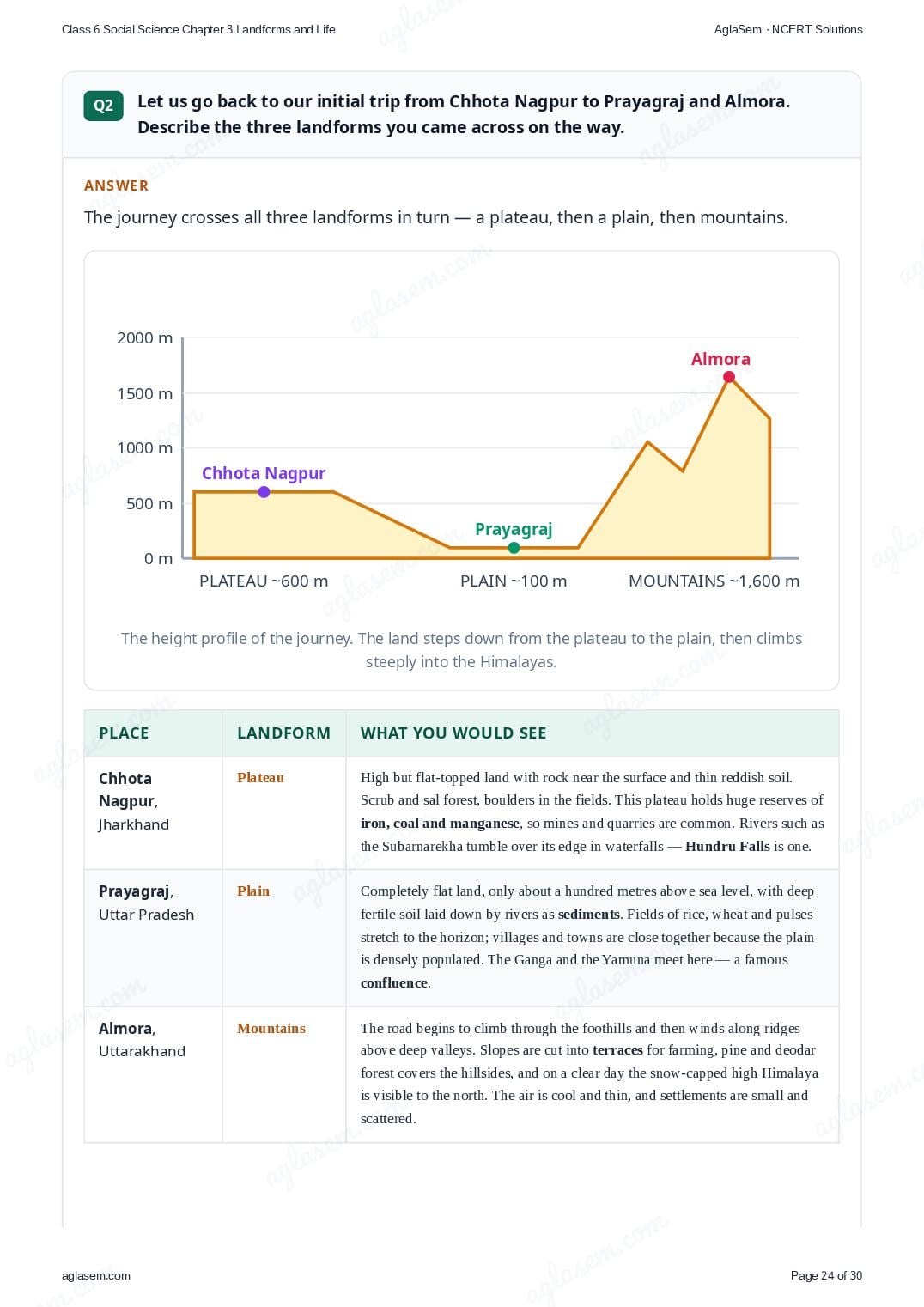
- Let us go back to our initial trip from Chhota Nagpur to Prayagraj and Almora. Describe the three landforms you came across on the way.
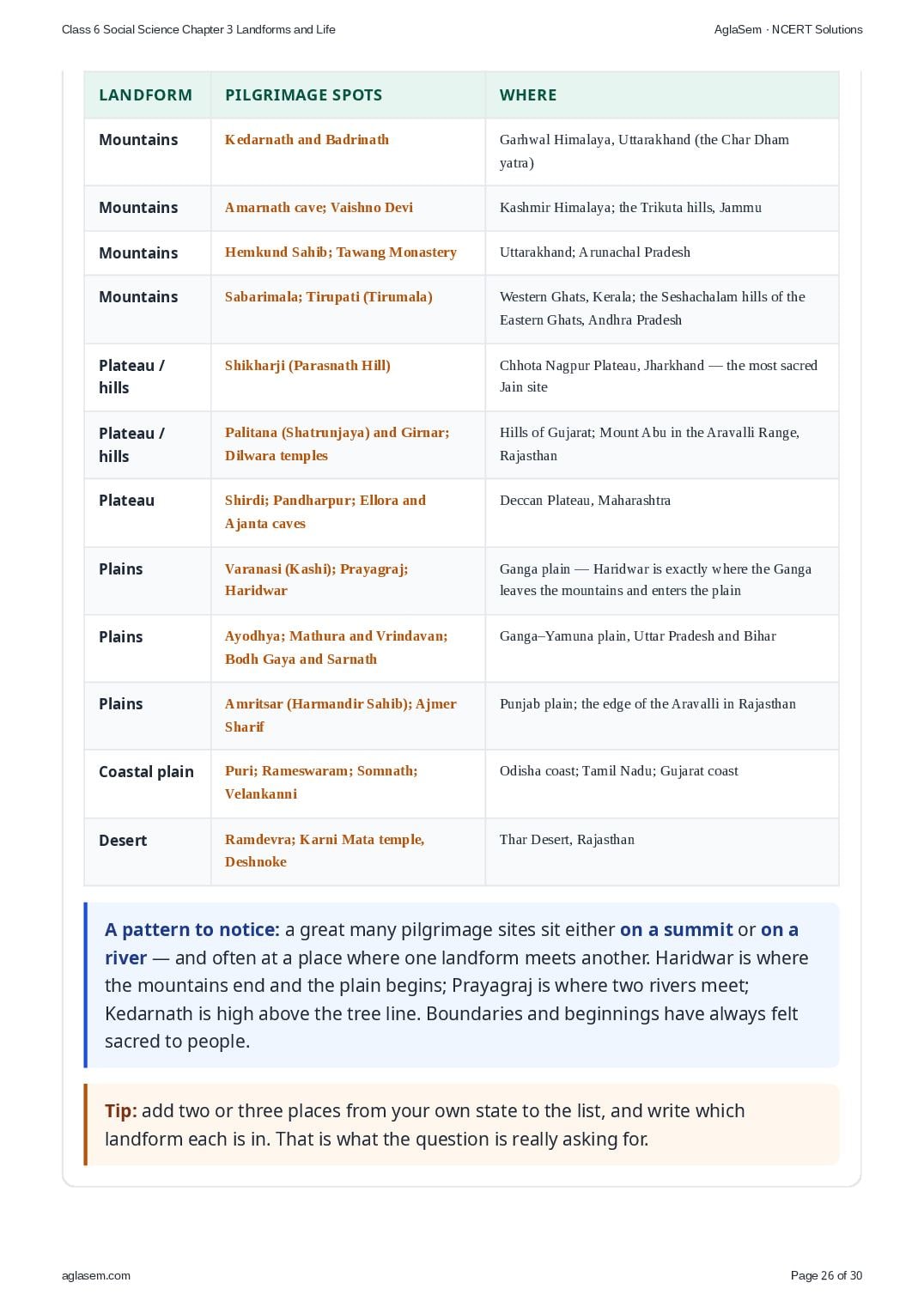
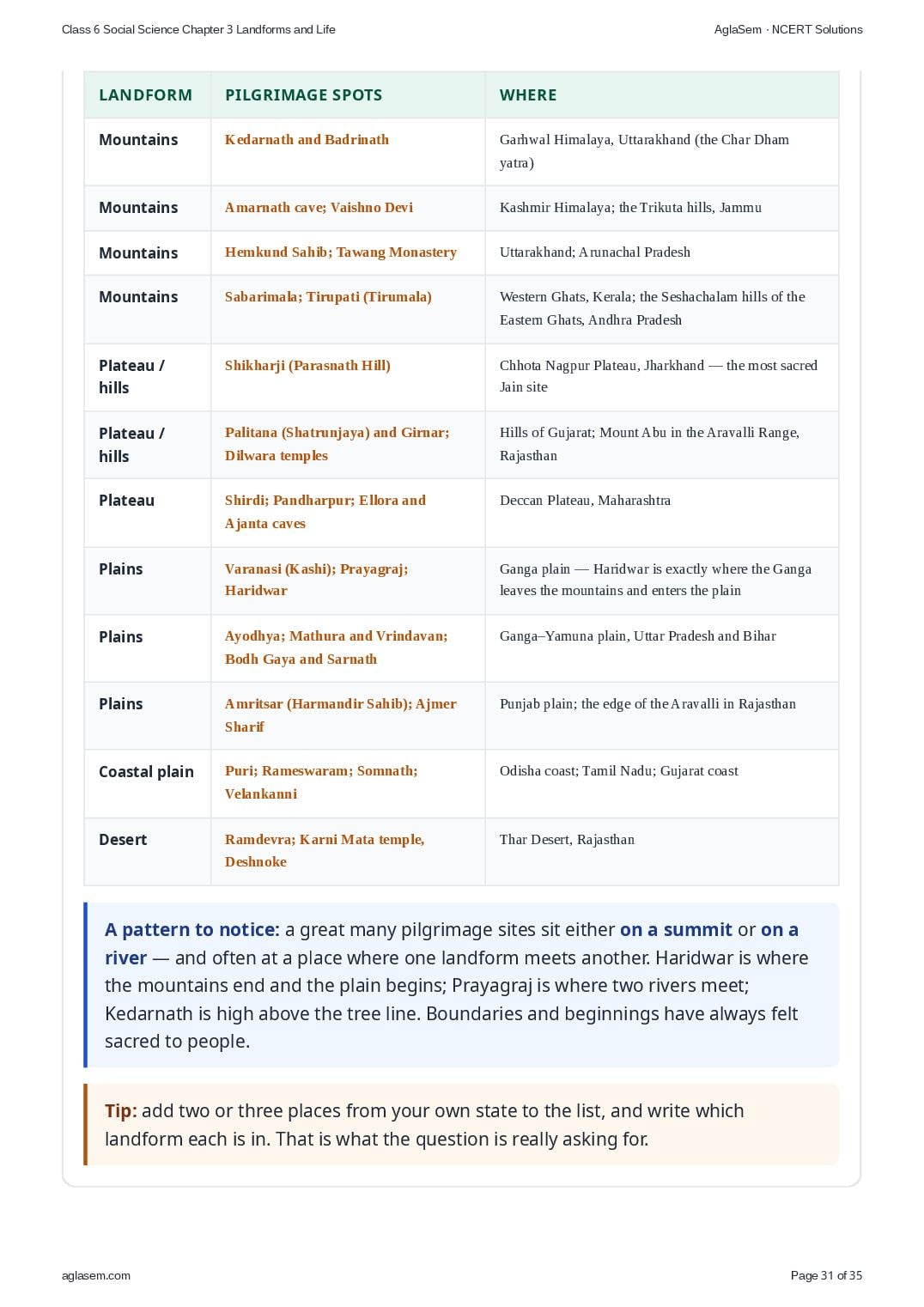
- List a few famous pilgrimage spots in India along with the landforms in which they are found.
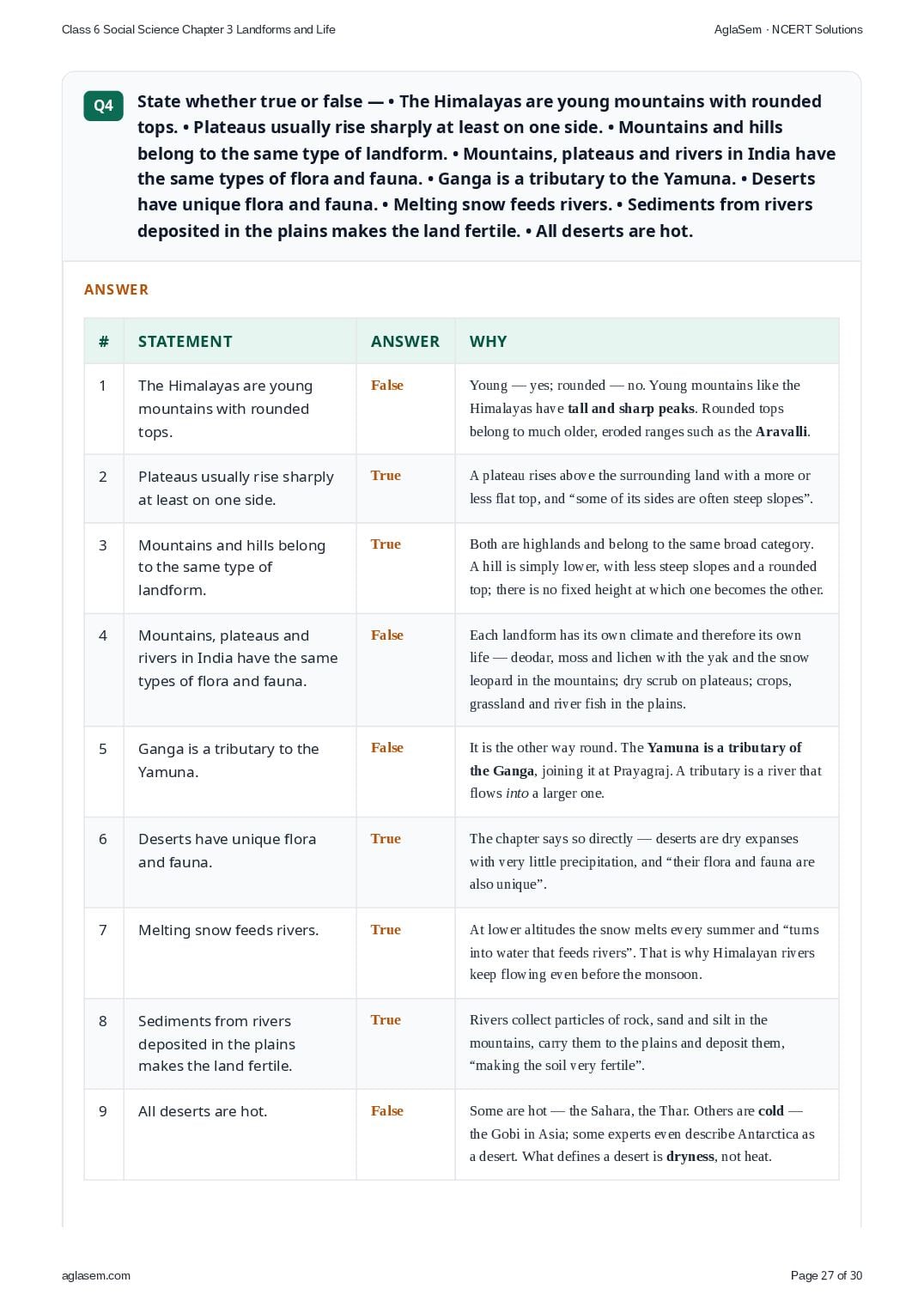
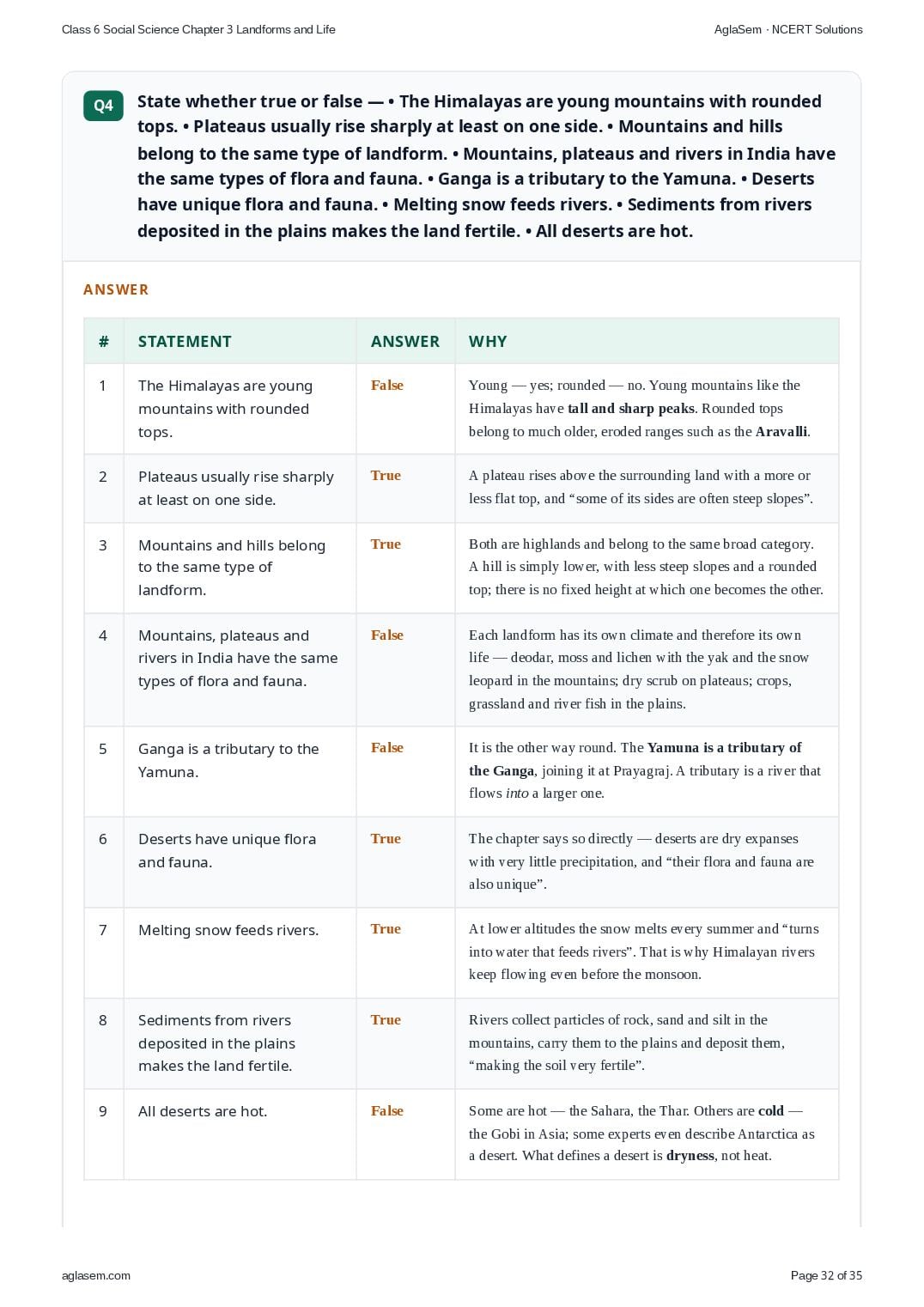
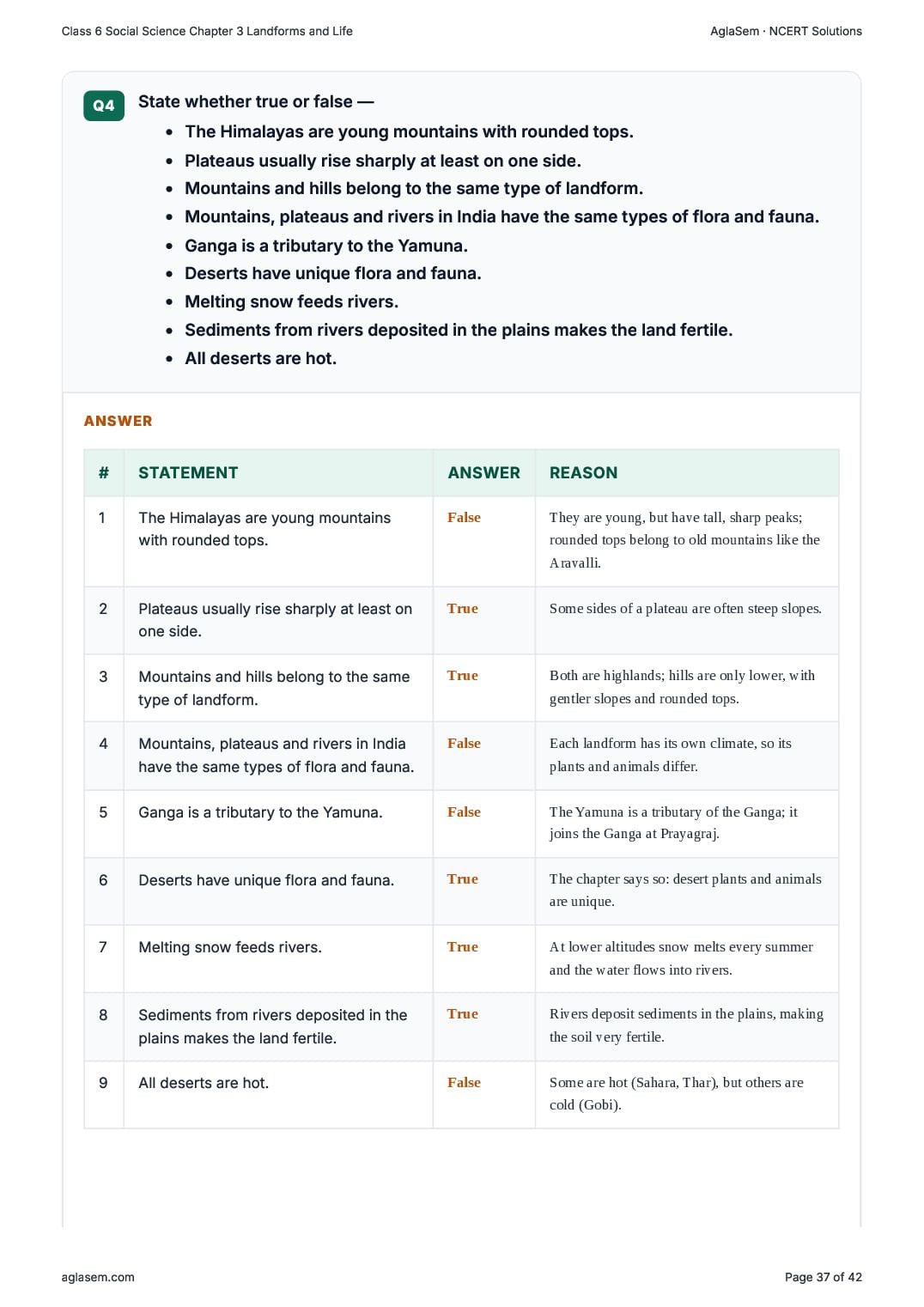
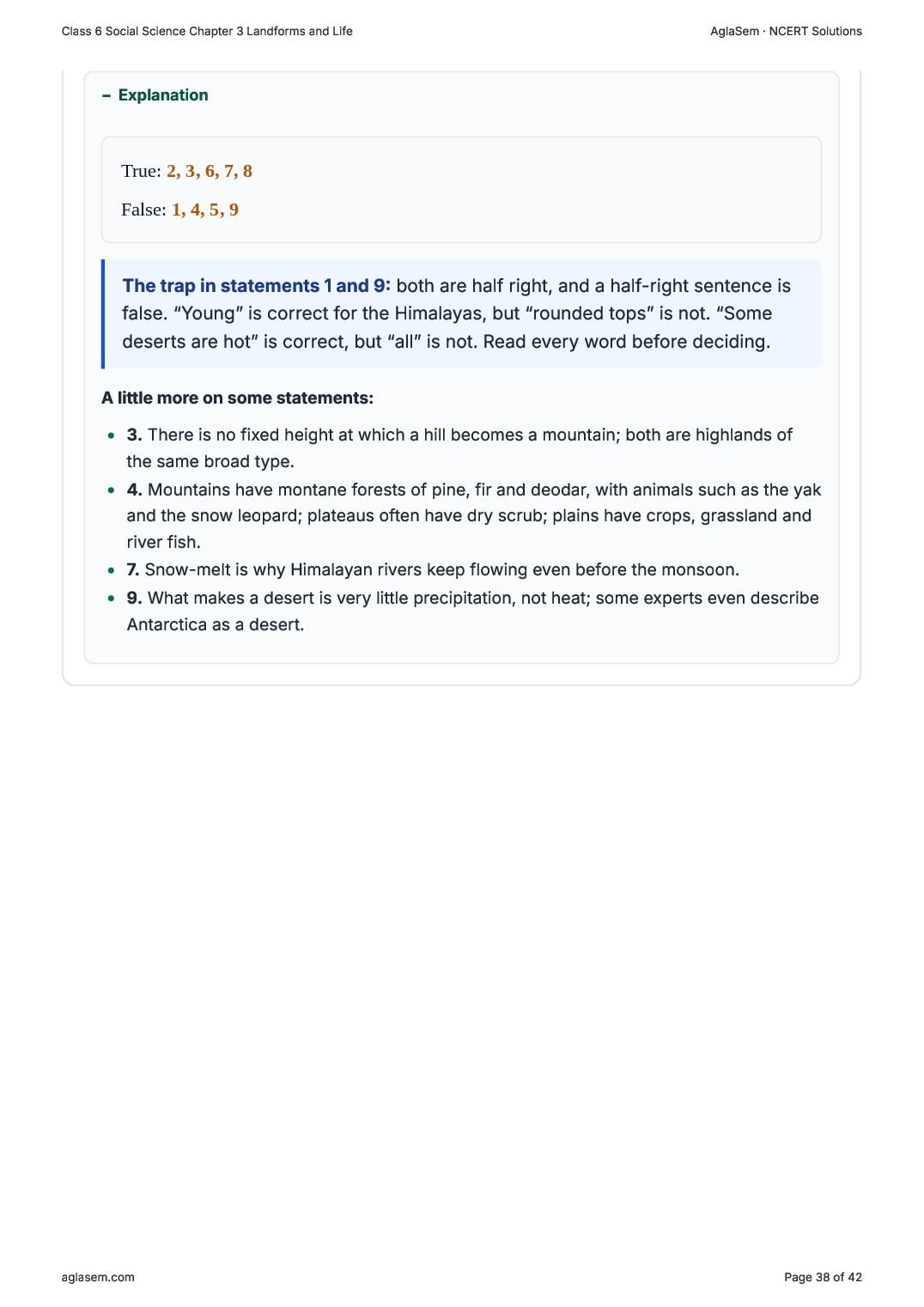
- State whether true or false — • The Himalayas are young mountains with rounded tops. • Plateaus usually rise sharply at least on one side. • Mountains and hills belong to the same type of landform. • Mountains, plateaus and rivers in India have the same types of flora and fauna. • Ganga is a tributary to the Yamuna. • Deserts have unique flora and fauna. • Melting snow feeds rivers. • Sediments from rivers deposited in the plains makes the land fertile. • All deserts are hot.
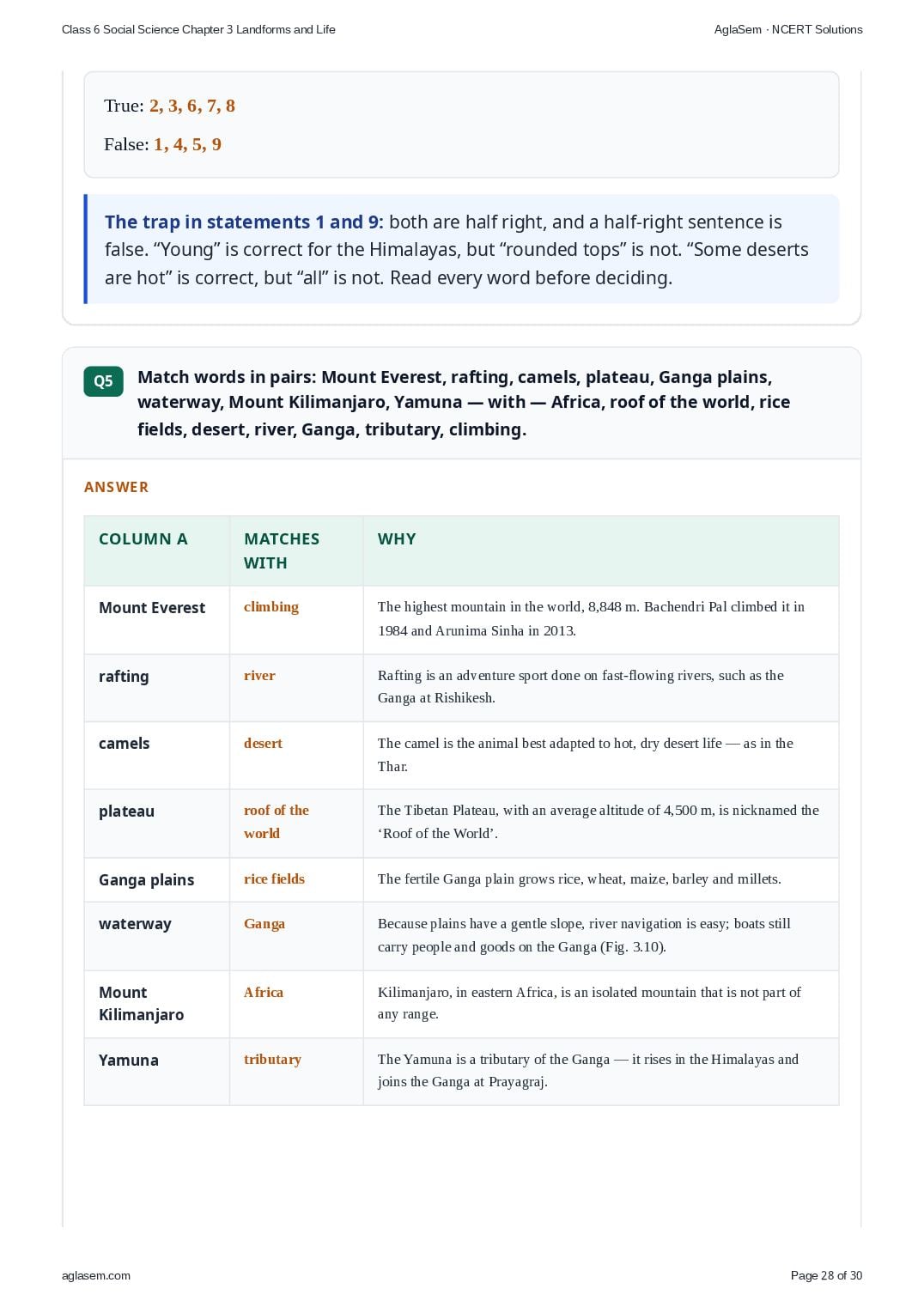
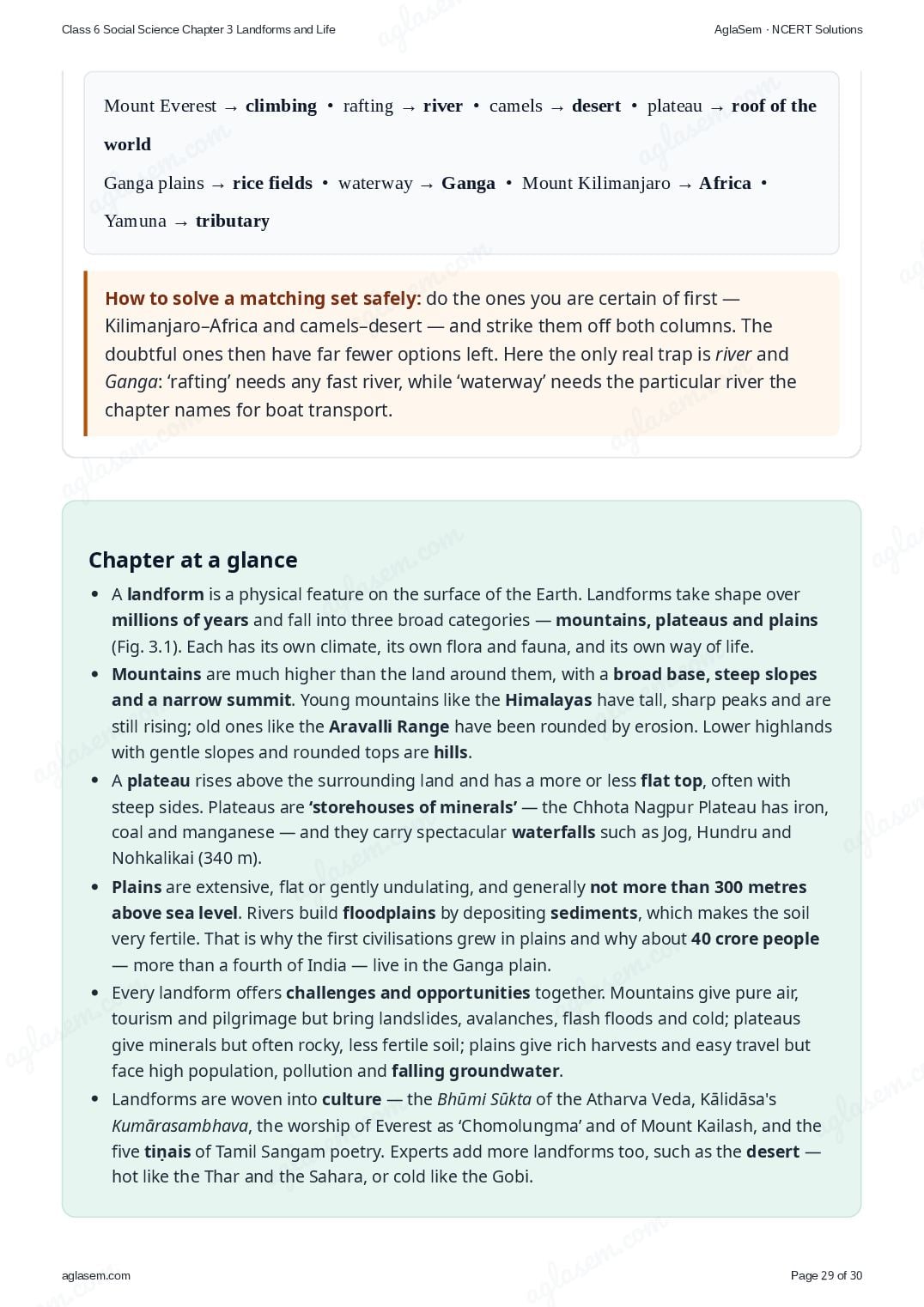
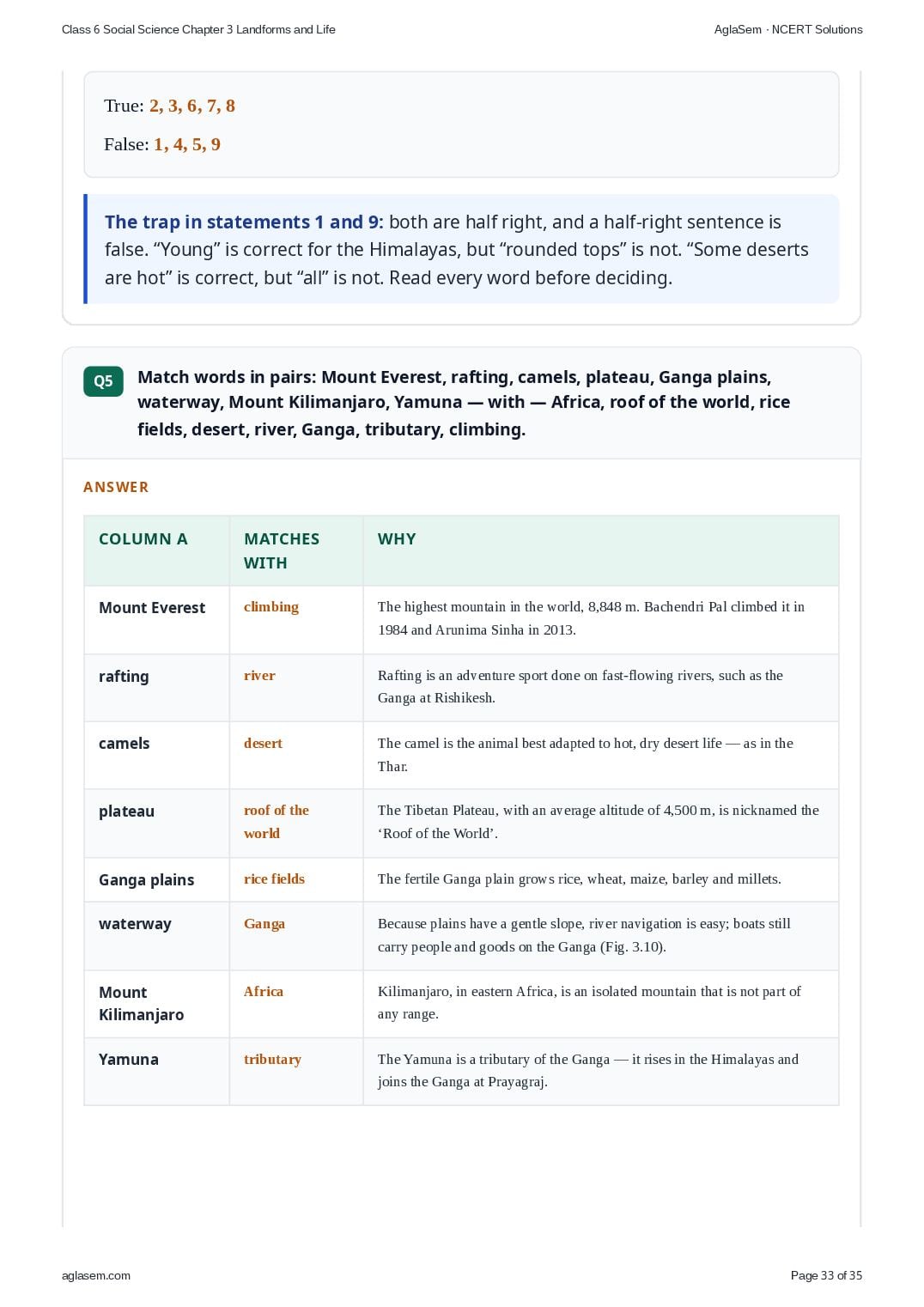
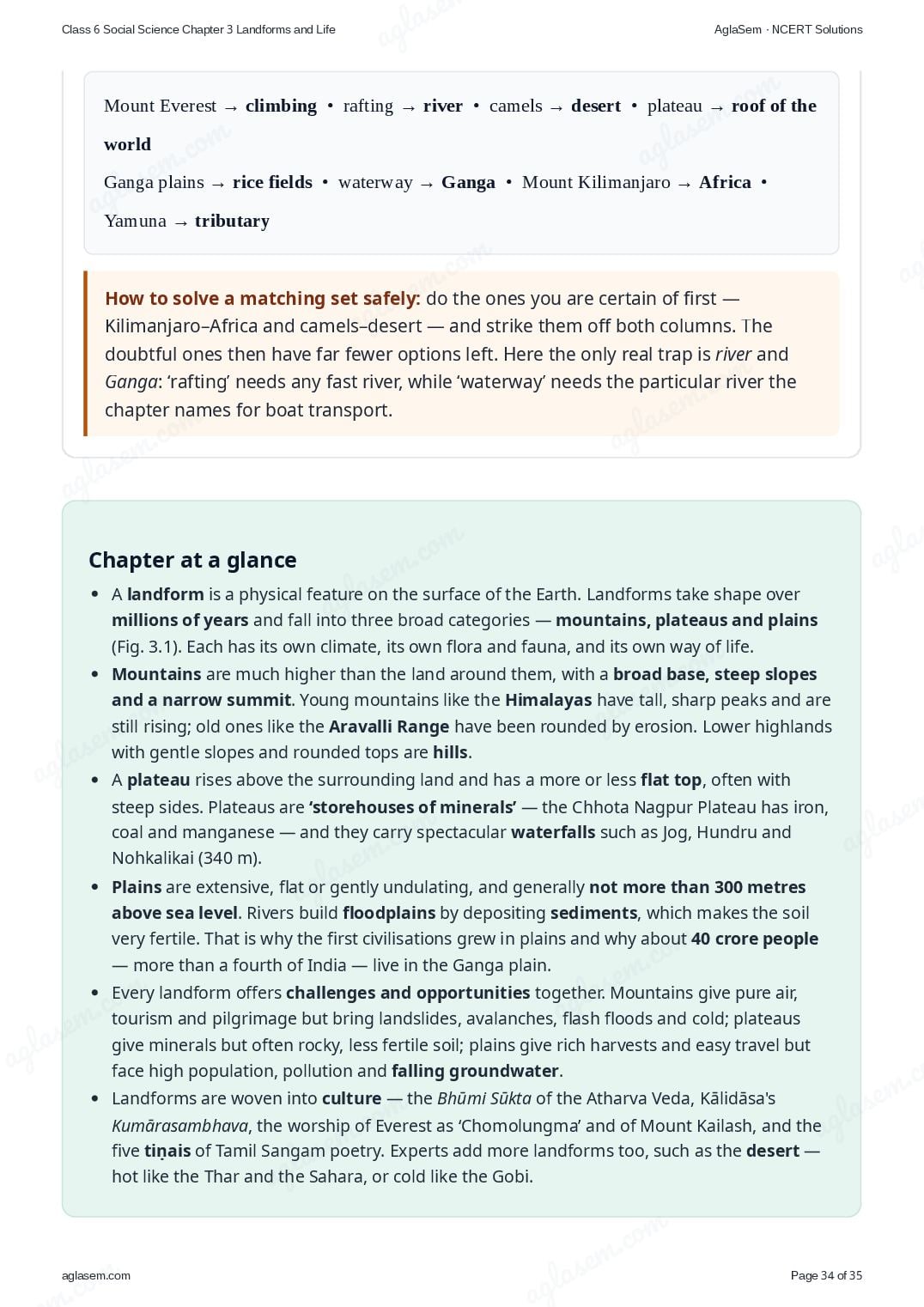
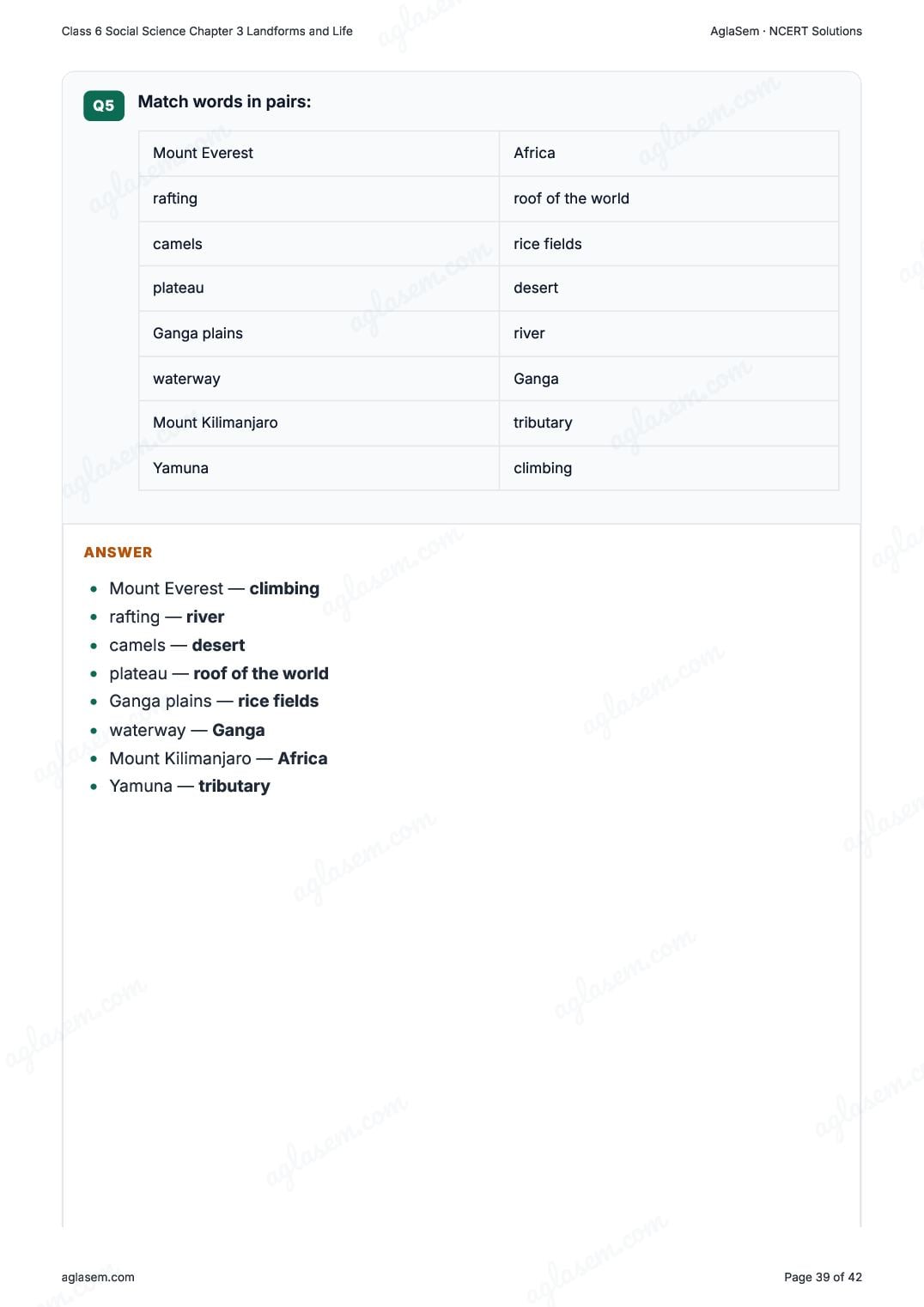
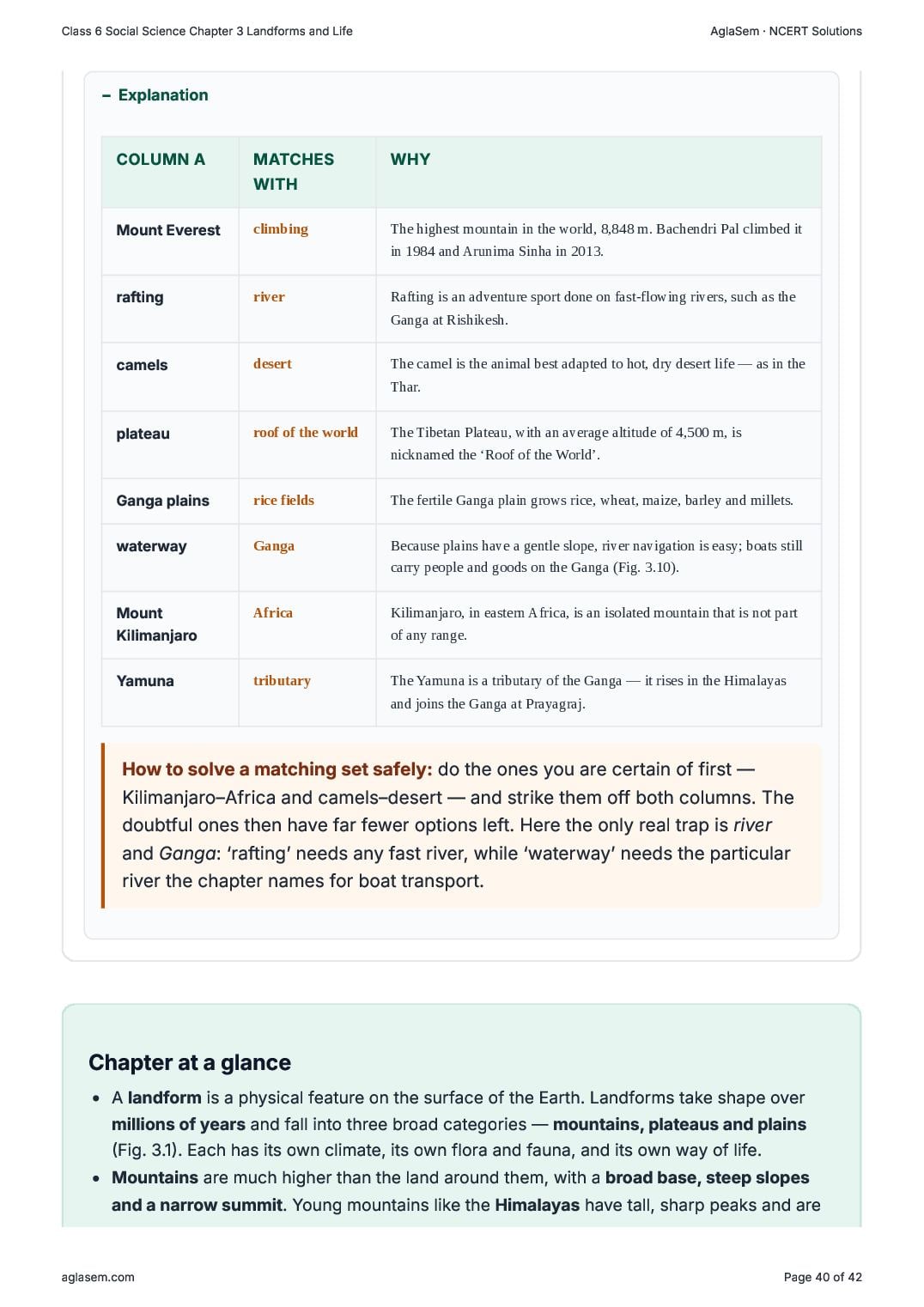
- Match words in pairs: Mount Everest, rafting, camels, plateau, Ganga plains, waterway, Mount Kilimanjaro, Yamuna — with — Africa, roof of the world, rice fields, desert, river, Ganga, tributary, climbing.
Chapter at a Glance
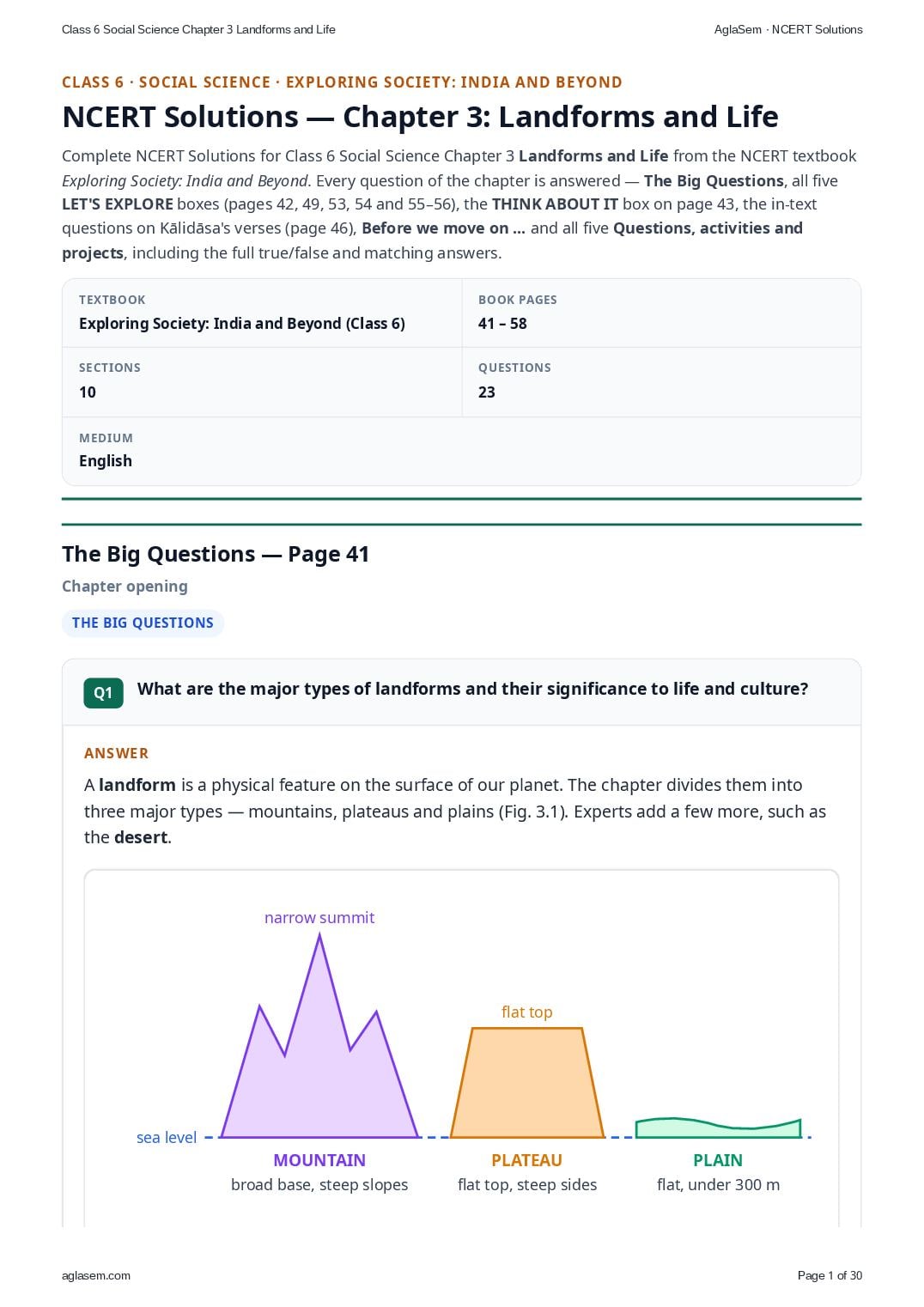
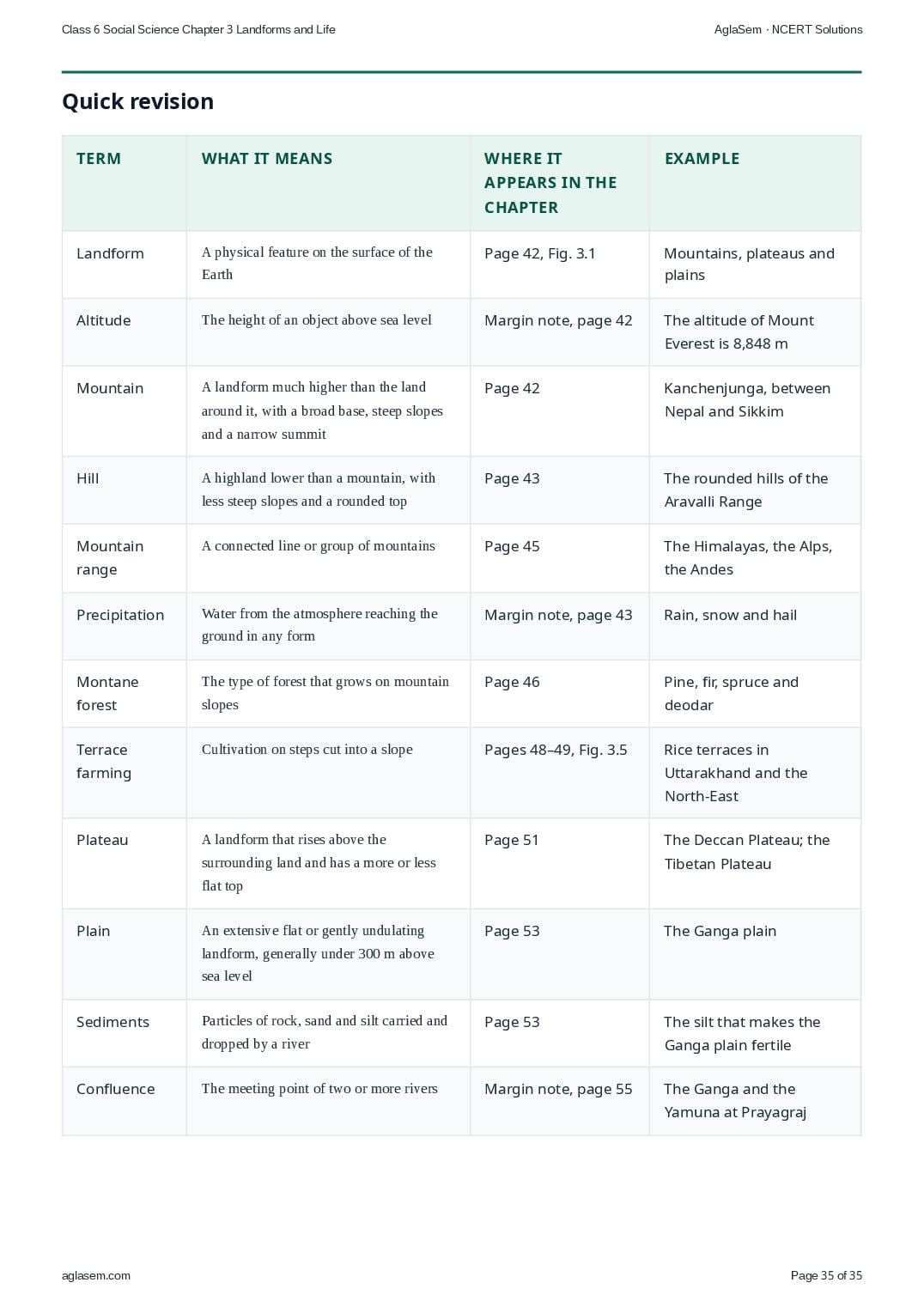
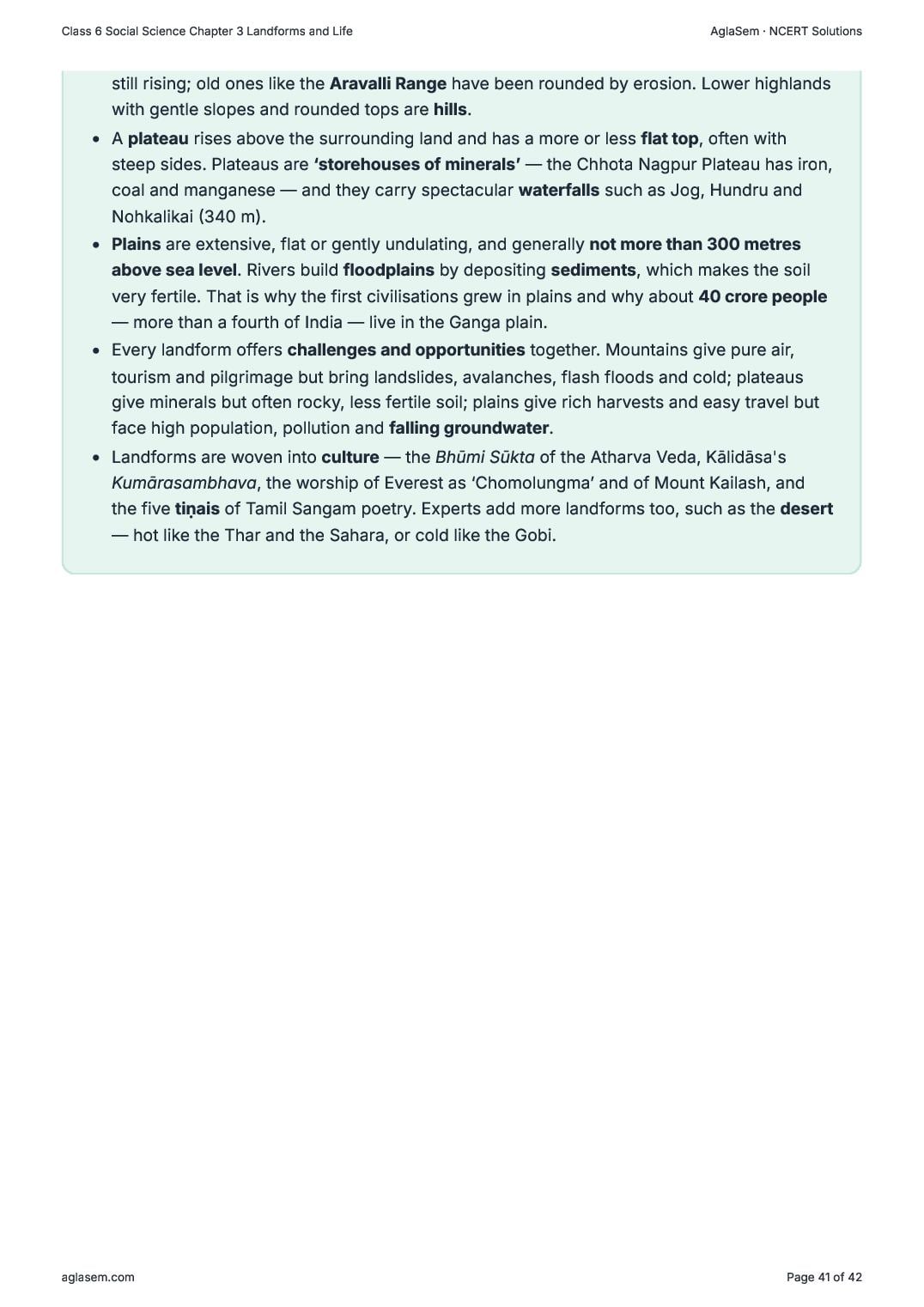
- A landform is a physical feature on the surface of the Earth. Landforms take shape over millions of years and fall into three broad categories — mountains, plateaus and plains (Fig. 3.1). Each has its own climate, its own flora and fauna, and its own way of life.
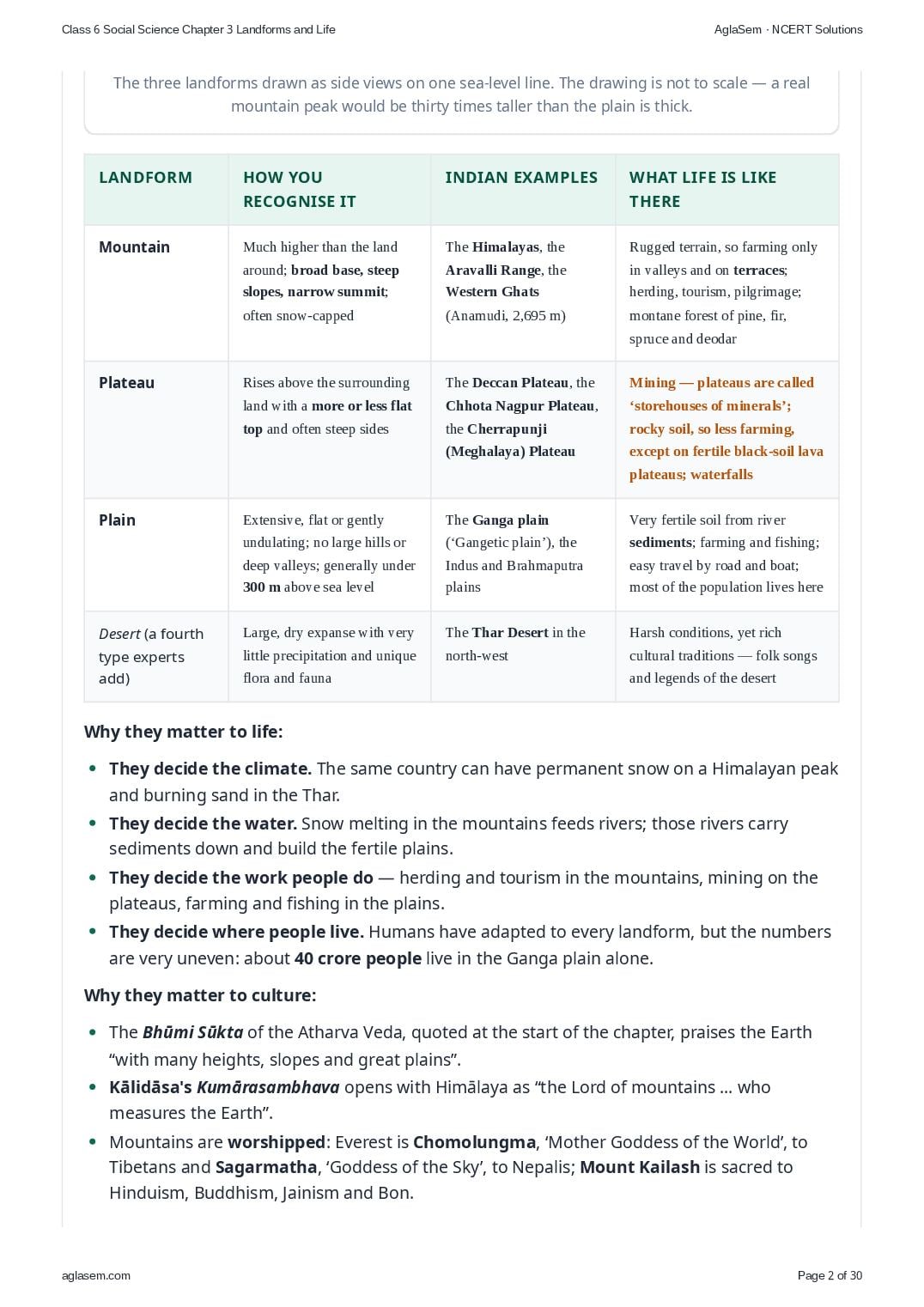
- Mountains are much higher than the land around them, with a broad base, steep slopes and a narrow summit . Young mountains like the Himalayas have tall, sharp peaks and are still rising; old ones like the Aravalli Range have been rounded by erosion. Lower highlands with gentle slopes and rounded tops are hills .
- A plateau rises above the surrounding land and has a more or less flat top , often with steep sides. Plateaus are ‘storehouses of minerals’ — the Chhota Nagpur Plateau has iron, coal and manganese — and they carry spectacular waterfalls such as Jog, Hundru and Nohkalikai (340 m).
- Plains are extensive, flat or gently undulating, and generally not more than 300 metres above sea level . Rivers build floodplains by depositing sediments , which makes the soil very fertile. That is why the first civilisations grew in plains and why about 40 crore people — more than a fourth of India — live in the Ganga plain.
- Every landform offers challenges and opportunities together. Mountains give pure air, tourism and pilgrimage but bring landslides, avalanches, flash floods and cold; plateaus give minerals but often rocky, less fertile soil; plains give rich harvests and easy travel but face high population, pollution and falling groundwater .
- Landforms are woven into culture — the Bhūmi Sūkta of the Atharva Veda, Kālidāsa's Kumārasambhava , the worship of Everest as ‘Chomolungma’ and of Mount Kailash, and the five tiṇais of Tamil Sangam poetry. Experts add more landforms too, such as the desert — hot like the Thar and the Sahara, or cold like the Gobi.
How to Download NCERT Solutions for Class 6 Social Science Chapter 3 PDF
Follow these simple steps to get the Landforms and Life questions-and-answers PDF from Exploring Society India and Beyond.
- Search NCERT Solutions for Class 6 Social Science Chapter 3 aglasem and open this page.
- Read the exercise questions with answers for Landforms and Life shown above.
- Click the Download PDF link to save the Landforms and Life solutions to your device.
NCERT Solutions for Class 6 Social Science – All Chapters
There are more chapters to study besides Landforms and Life in Social Science. Here are the NCERT Solutions for all chapters of Class 6 Social Science.
- Chapter 1 Locating Places on the Earth
- Chapter 2 Oceans and Continents
- Chapter 3 Landforms and Life
- Chapter 4 Timeline and Sources of History
- Chapter 5 India That Is Bharat
- Chapter 6 the Beginnings of Indian Civilisation
- Chapter 7 India’s Cultural Roots
- Chapter 8 Unity in Diversity or Many in the One
- Chapter 9 Family and Community
- Chapter 10 Grassroots Democracy part 1 Governance
- Chapter 11 Grassroots Democracy part 2 Local Government in Rural Areas
- Chapter 12 Grassroots Democracy part 3 Local Government in Urban Areas
- Chapter 13 the Value of Work
- Chapter 14 Economic Activities Around Us
NCERT Solutions for Class 6 – All Subjects
Just like Chapter 3 of Social Science, you can get the exercise questions with answers for every other subject of Class 6. Here are the NCERT Solutions for all subjects of Class 6.
NCERT Solutions for Class 6 Social Science Chapter 3 – An Overview
The key highlights of this study material are as follows.
| Aspects | Details |
|---|---|
| Class | Class 6 |
| Subject | Social Science |
| Chapter Number | Chapter 3 |
| Chapter Name | Landforms and Life |
| Book Name | Exploring Society India and Beyond |
| Book By | NCERT (National Council of Educational Research and Training) |
| Educational Resource Here | NCERT Solutions of Class 6 Social Science Chapter 3 for all exercises |
| More Questions Answers of This Subject | NCERT Solutions for Class 6 Social Science |
| Download Book Chapter | NCERT Book Class 6 Social Science |
| All Questions Answers For This Class | NCERT Solutions for Class 6 |
| Complete Solutions | NCERT Solutions |
NCERT Solutions for Class 6 Social Science Chapter 3 Landforms and Life – FAQs
What are the NCERT Solutions for Class 6 Social Science Chapter 3 Landforms and Life?
They are the complete, step-by-step answers to all the exercise and in-text questions of Chapter 3 Landforms and Life from the NCERT Class 6 Social Science textbook Exploring Society India and Beyond, written by experts as per the latest NCERT syllabus.
How can I download the Class 6 Social Science Chapter 3 solutions PDF for free?
Open this page on aglasem, read the Landforms and Life questions with answers, and click the “Download Solutions PDF” link. The Class 6 Social Science Chapter 3 NCERT Solutions PDF is completely free to download.
Are these NCERT Solutions as per the latest 2026-27 syllabus?
Yes. The NCERT Solutions for Class 6 Social Science Chapter 3 are based on the latest NCERT textbook Exploring Society India and Beyond and the current 2026-27 CBSE syllabus, so the questions and answers match what you study in class.
Where can I get NCERT Solutions for the other chapters of Class 6 Social Science?
You can find the answers to every chapter on the NCERT Solutions for Class 6 Social Science page, and solutions for every subject on the NCERT Solutions for Class 6 page.
How do NCERT Solutions help in exam preparation?
They show the correct method to solve each question, help you write answers the way they are expected in exams, let you check and correct your own work, and save revision time — which together improve your marks in Class 6 Social Science.
If you have any queries on NCERT Solutions for Class 6 Social Science Chapter 3 Landforms and Life, then please ask in the comments below.