NCERT Solutions for Class 6 Social Science Chapter 5 India That Is Bharat provide clear, step-by-step answers to every exercise and in-text question from the chapter India That Is Bharat of the NCERT textbook Exploring Society India and Beyond. Prepared by subject experts as per the latest NCERT (CBSE) syllabus for 2026-27, these NCERT Solutions for Class 6 Social Science help you understand each concept, write exam-ready answers, and check your own solutions. You can read them online below or download the free Class 6 Social Science Chapter 5 question-answer PDF.
NCERT Solutions for Class 6 Social Science Chapter 5 India That Is Bharat
- Class: Class 6
- Subject: Social Science
- Chapter: Chapter 5 – India That Is Bharat
- Textbook: Exploring Society India and Beyond (NCERT)
- Study material: NCERT Solutions – questions with answers, free PDF
These solutions answer all the exercise questions of Chapter 5 India That Is Bharat — including the in-text questions, short-answer and long-answer questions, and activities — with complete explanations so you can follow the method, not just the final answer. Read the full solutions below.
NCERT Solutions Class 6 Social Science Chapter 5 India That Is Bharat View Download
NCERT Solutions for Class 6 Social Science Chapter 5 PDF Download
You can read the NCERT Solutions for Class 6 Social Science Chapter 5 online above, or download the complete question-answer PDF to study India That Is Bharat offline at any time.
NCERT Solutions for Class 6 Social Science Chapter 5 PDF Download Link – Click Here to Download Solutions PDF
Questions Covered in This Chapter
These NCERT Solutions answer all 17 questions of this chapter. The questions solved are:
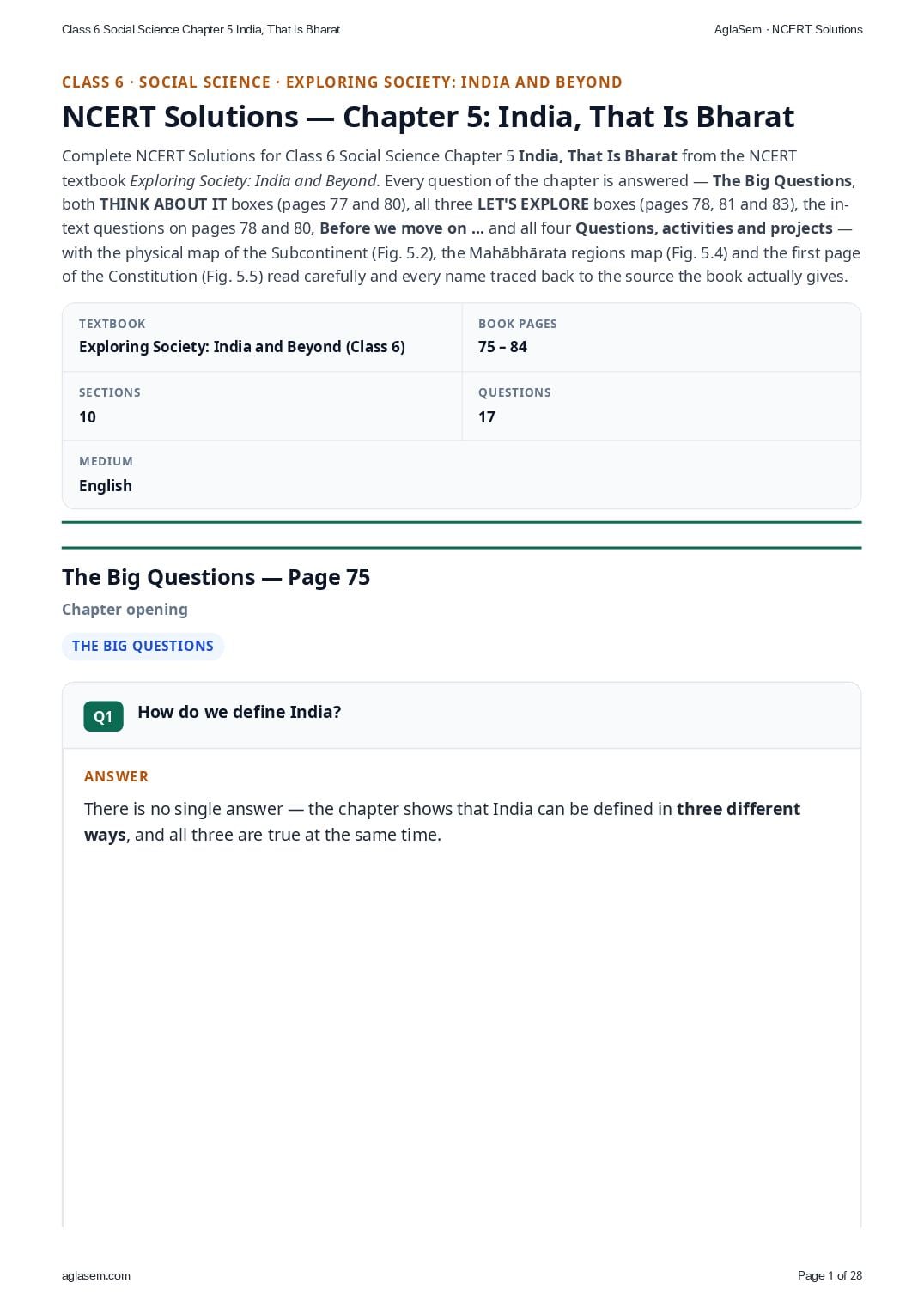
- How do we define India?
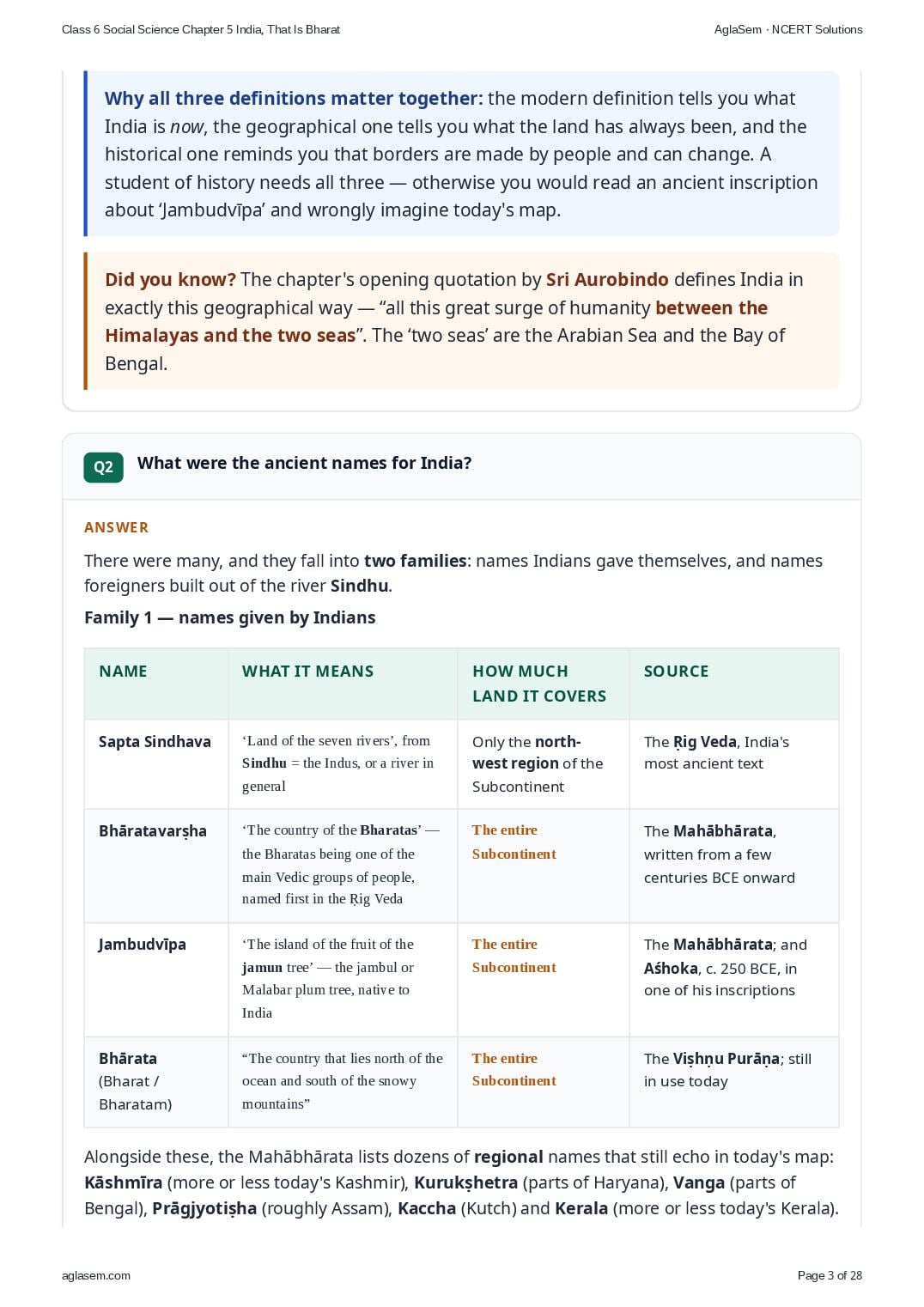
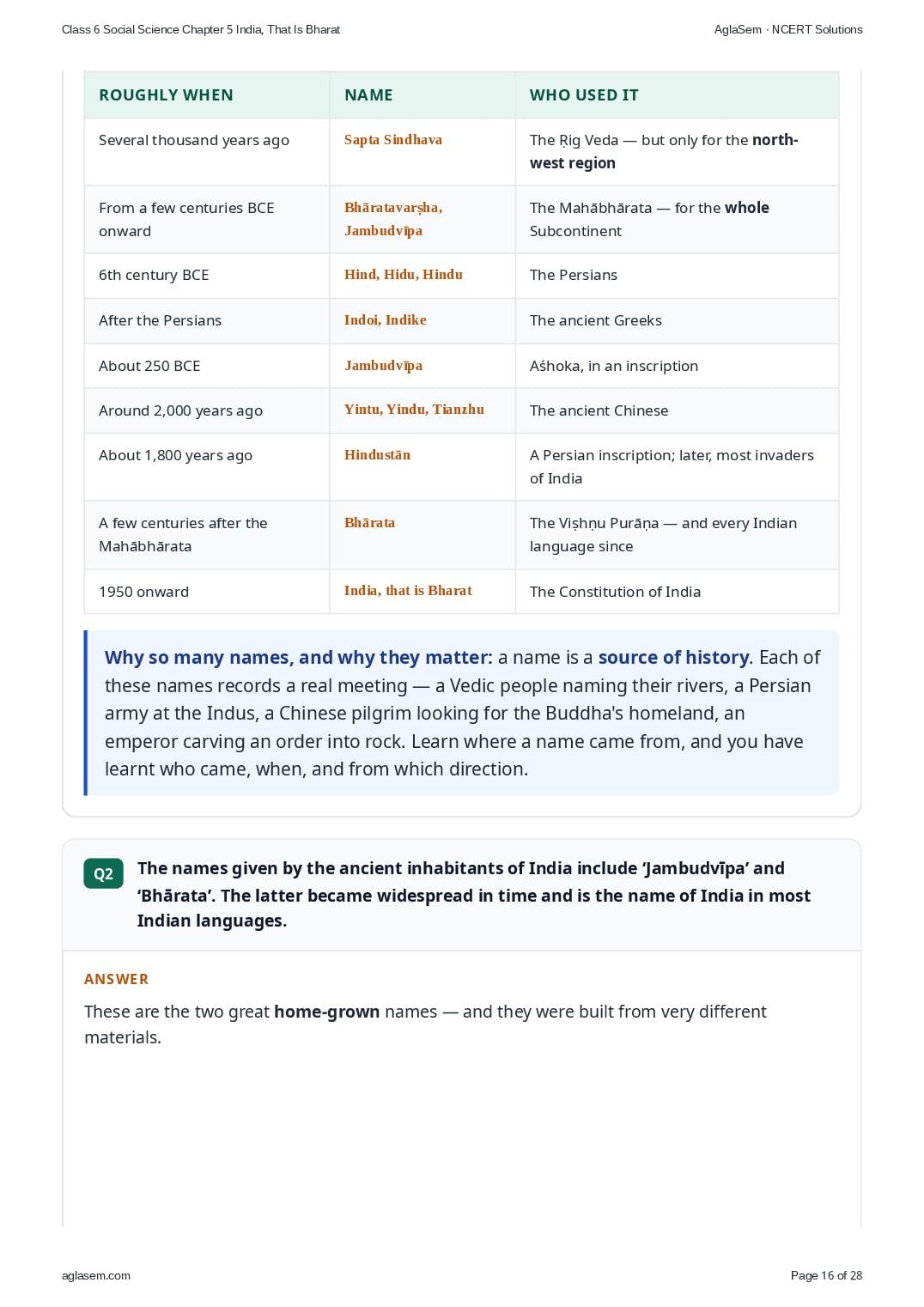
- What were the ancient names for India?
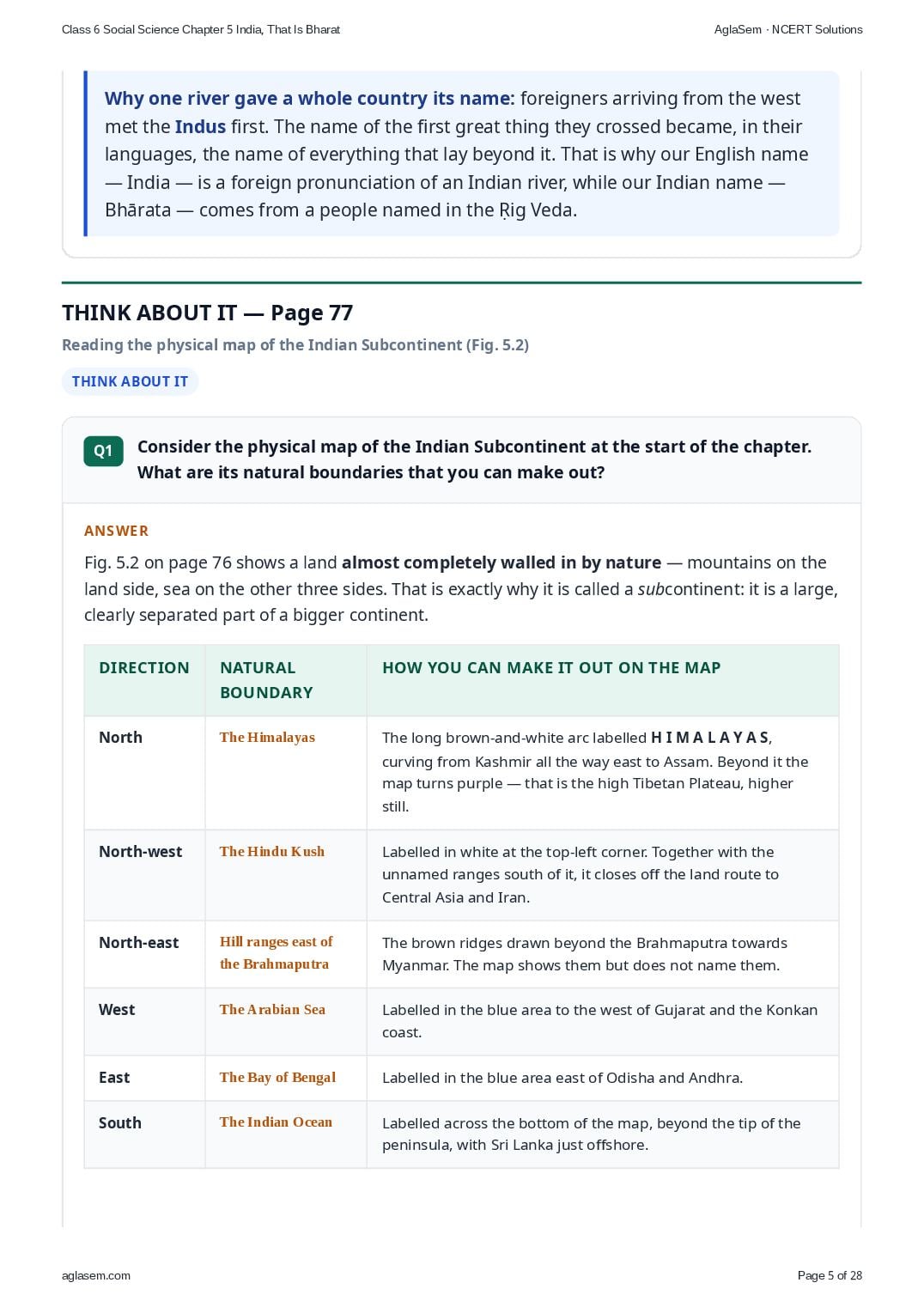
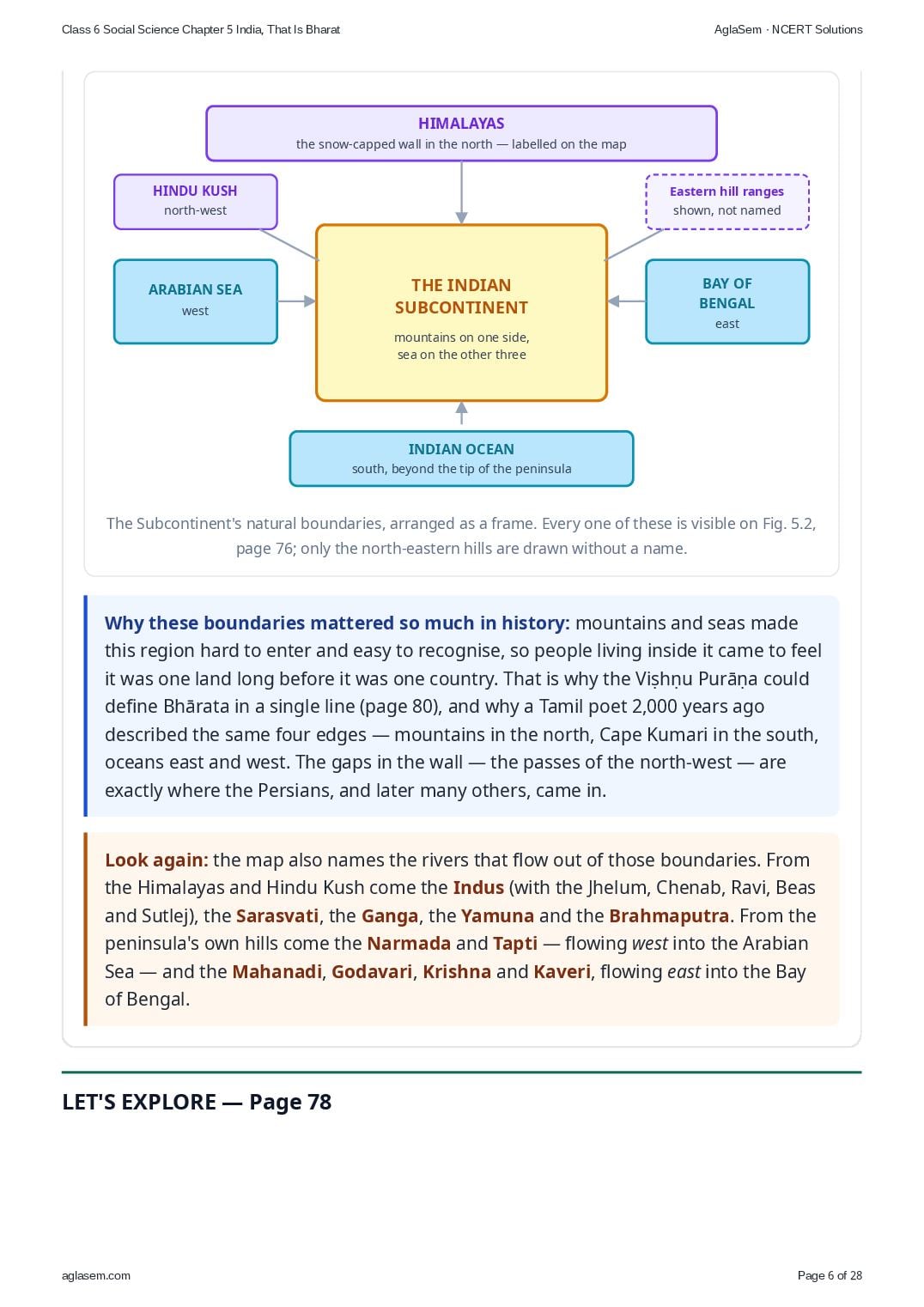
- Consider the physical map of the Indian Subcontinent at the start of the chapter. What are its natural boundaries that you can make out?
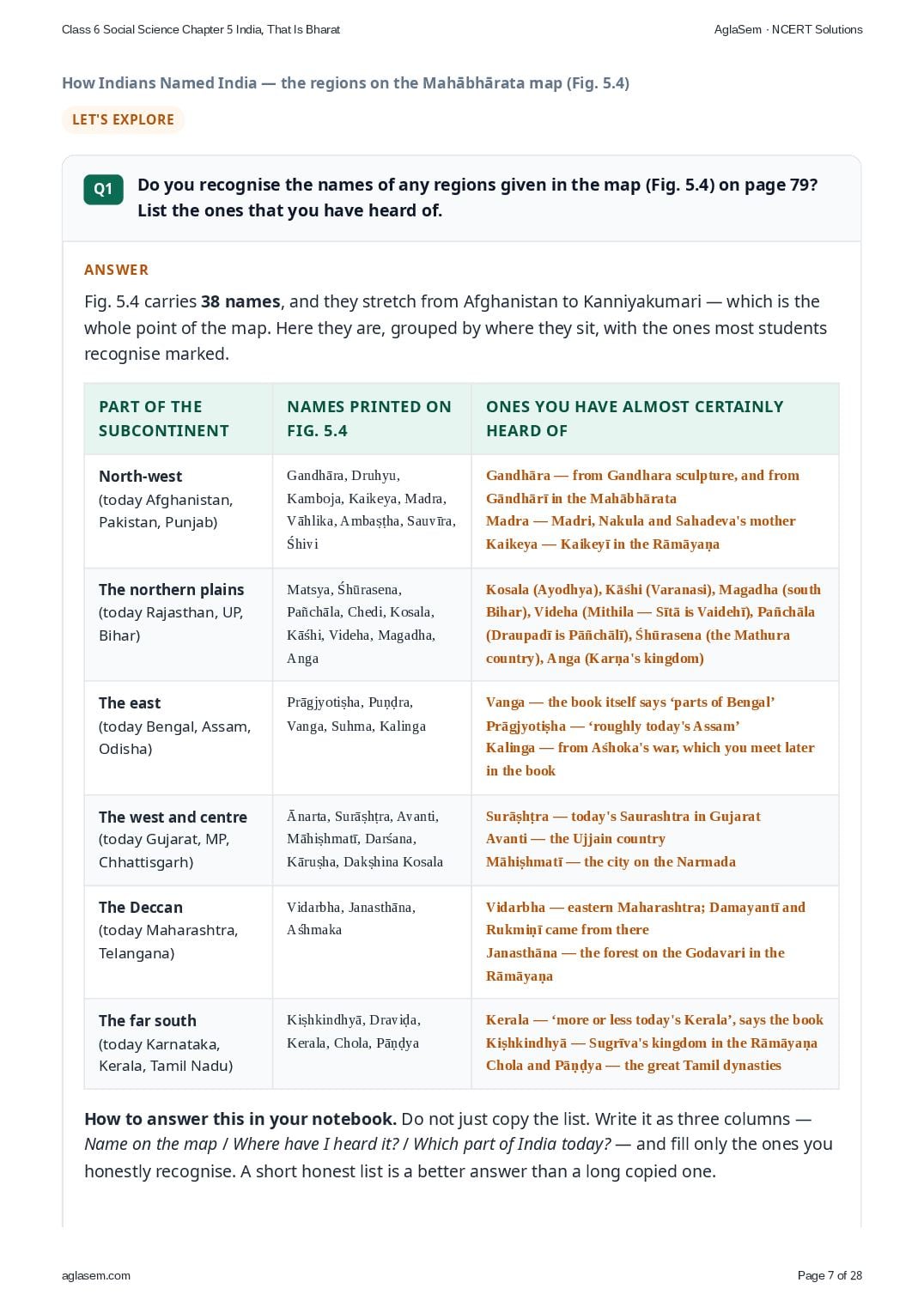
- Do you recognise the names of any regions given in the map (Fig. 5.4) on page 79? List the ones that you have heard of.
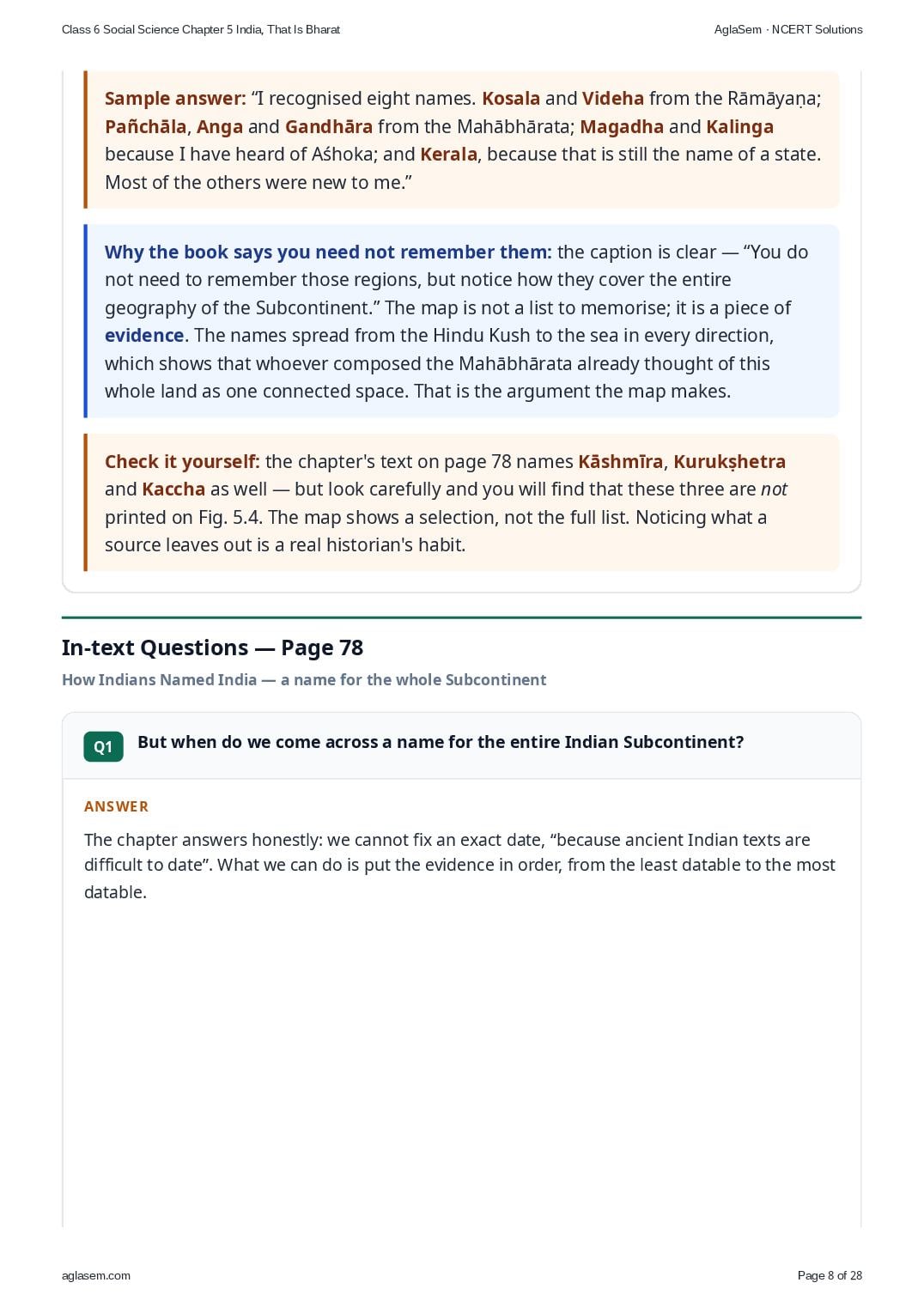
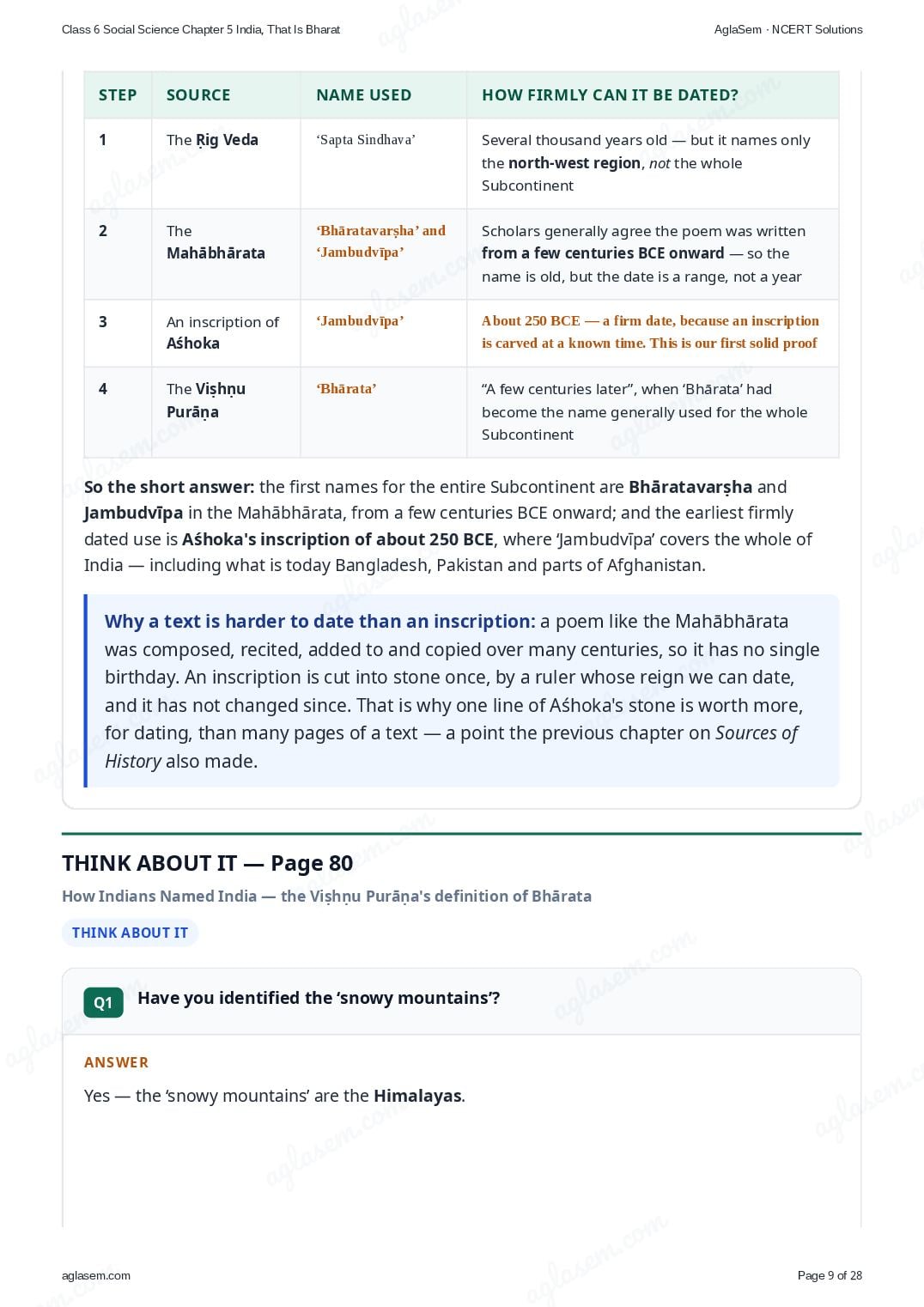
- But when do we come across a name for the entire Indian Subcontinent?
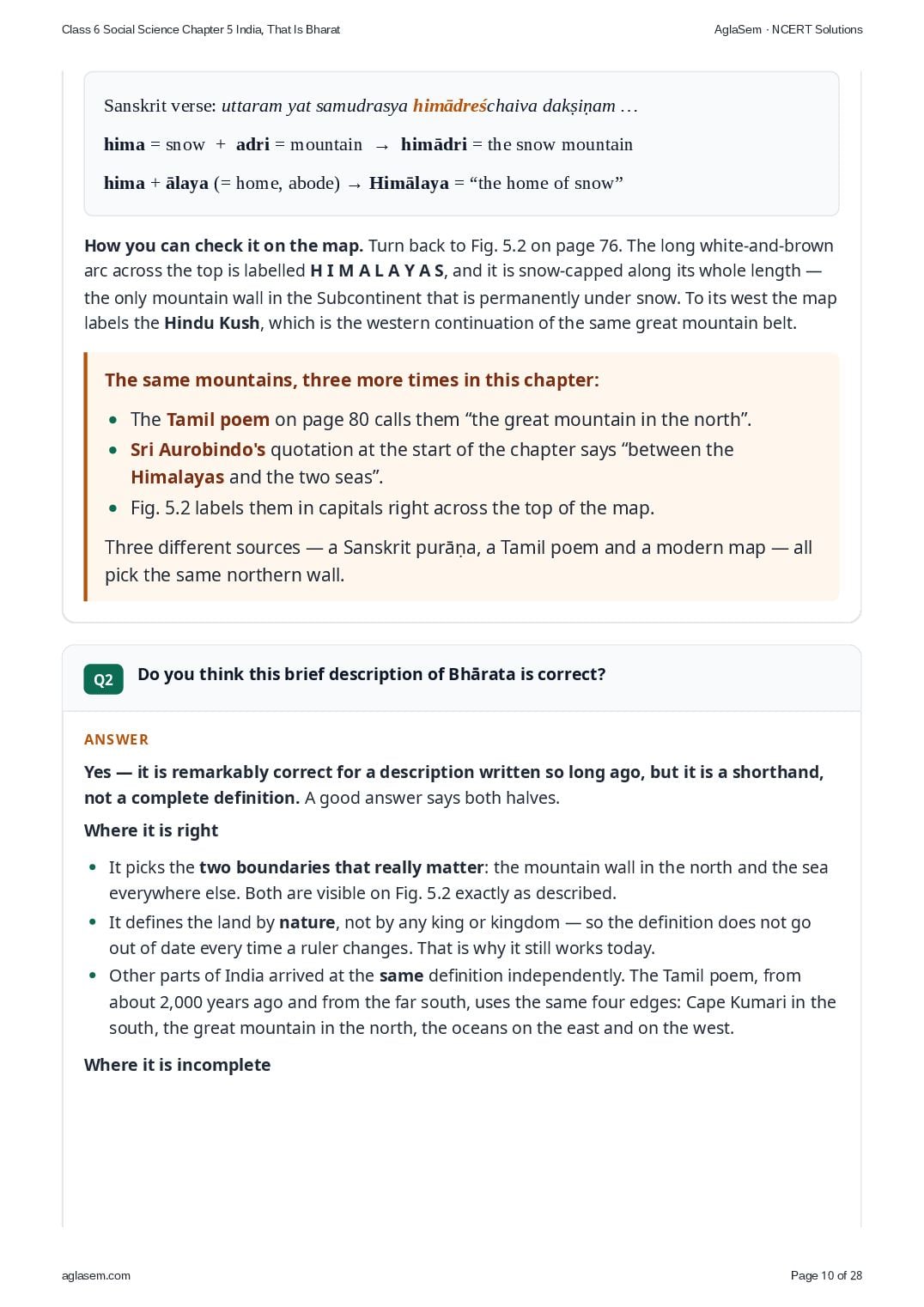
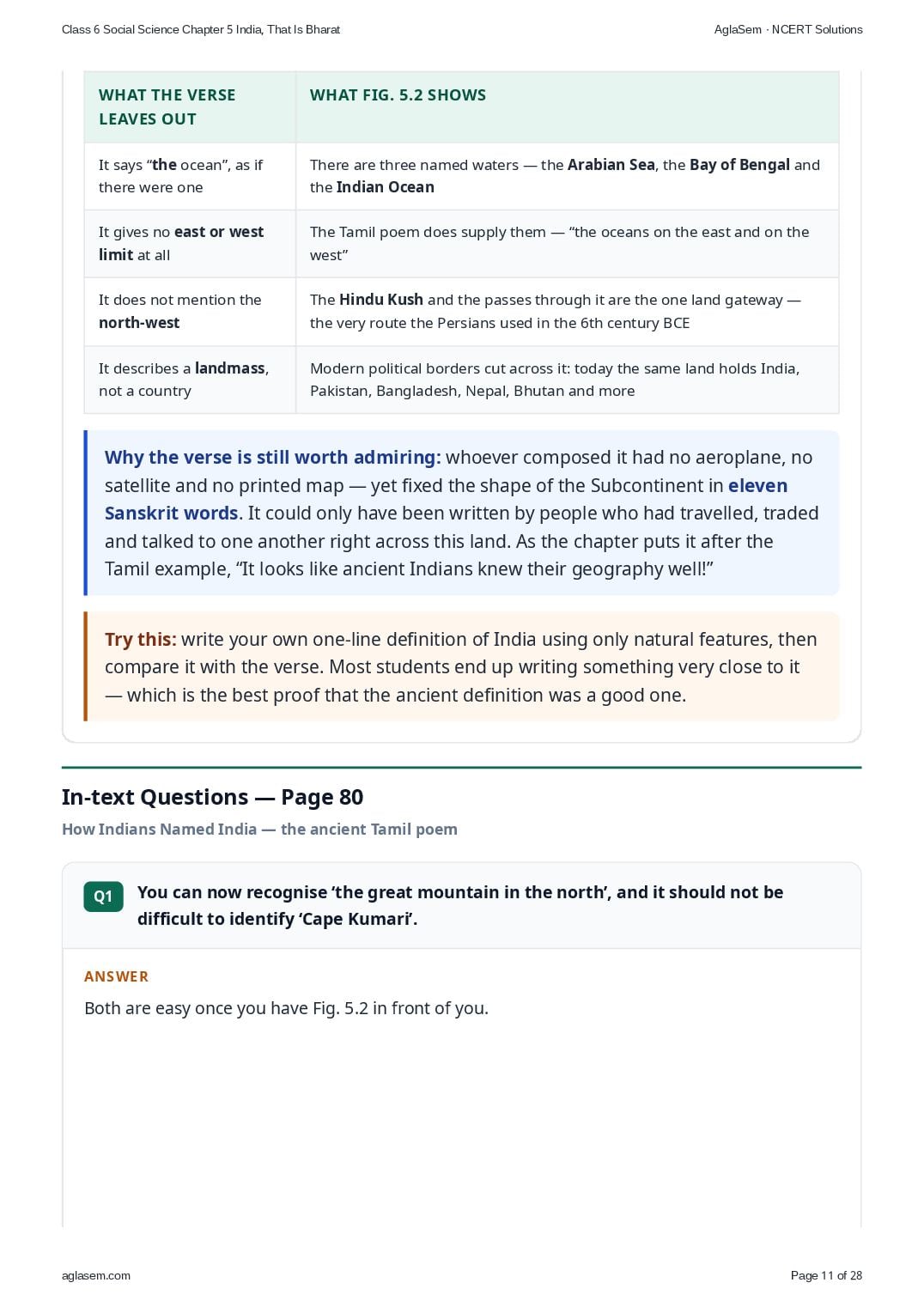
- Have you identified the ‘snowy mountains’?
- Do you think this brief description of Bhārata is correct?
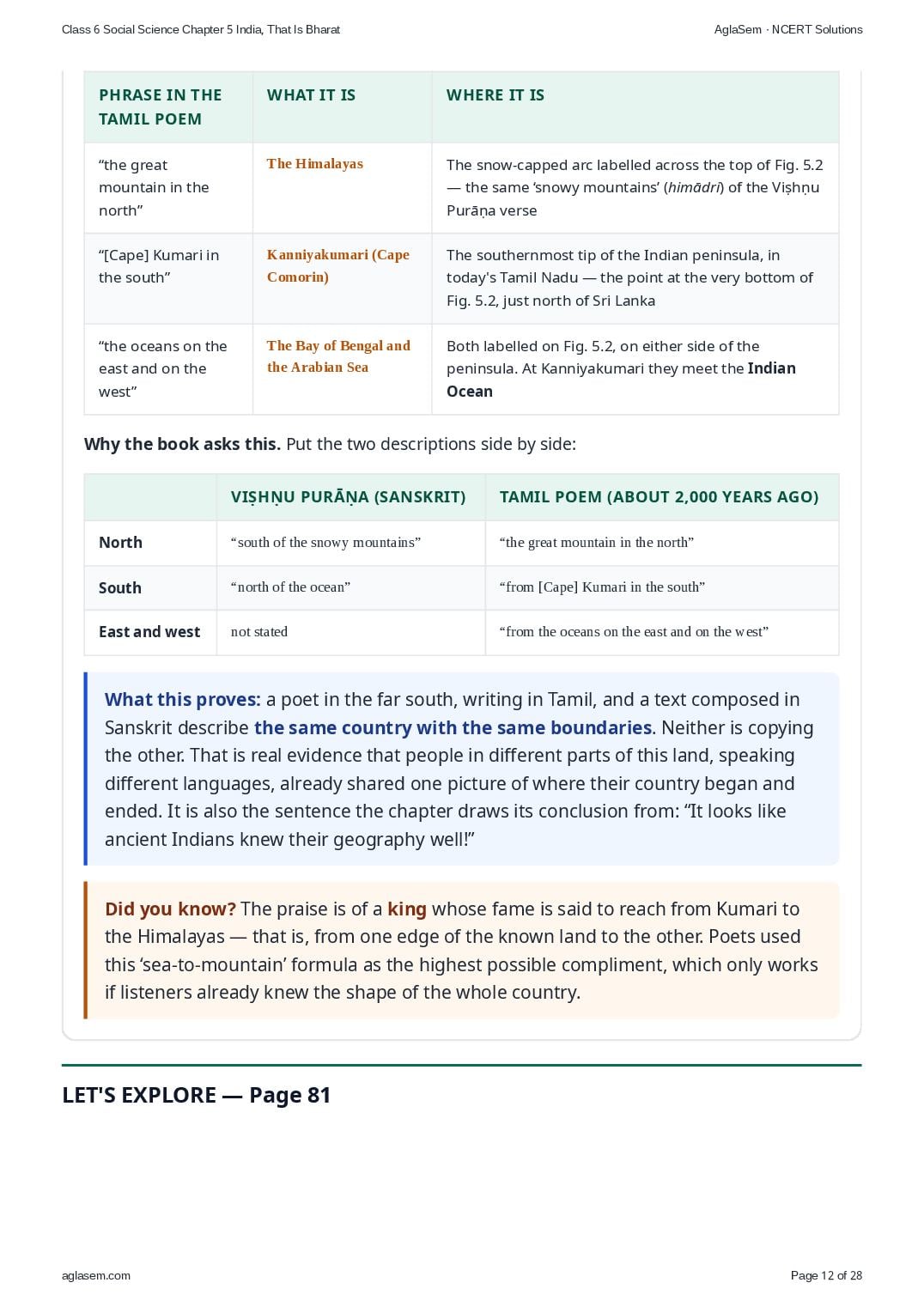
- You can now recognise ‘the great mountain in the north’, and it should not be difficult to identify ‘Cape Kumari’.
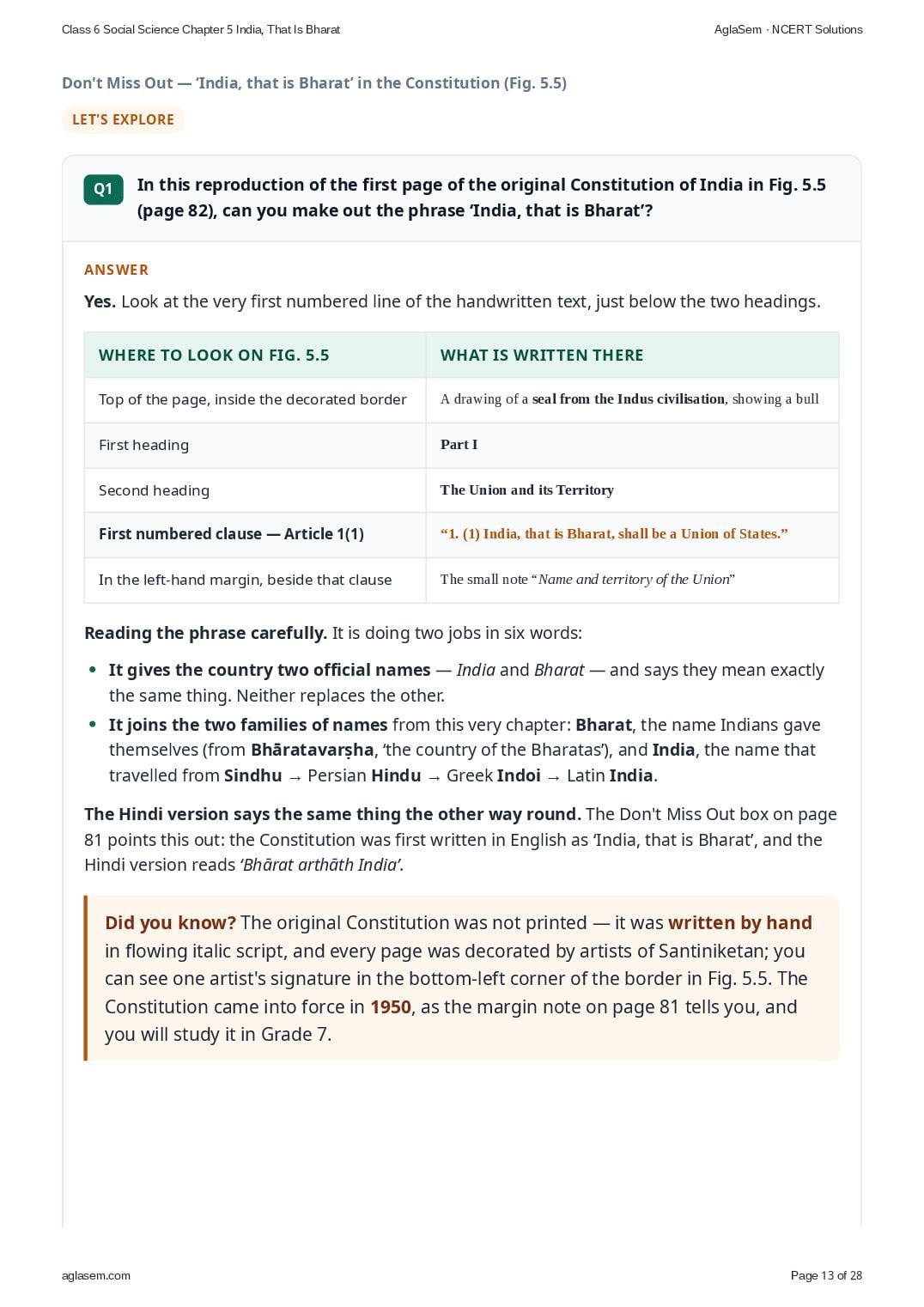
- In this reproduction of the first page of the original Constitution of India in Fig. 5.5 (page 82), can you make out the phrase ‘India, that is Bharat’?
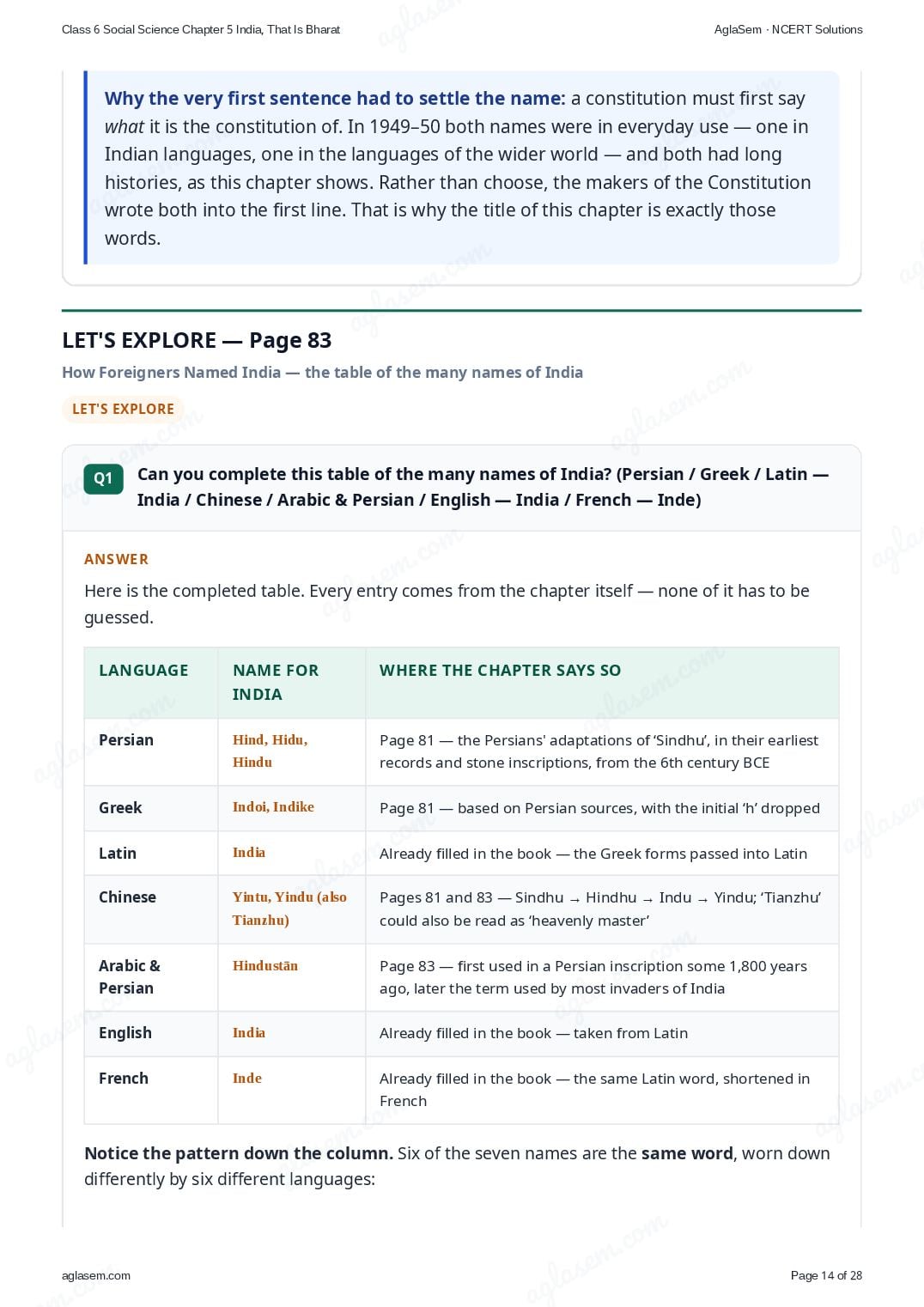
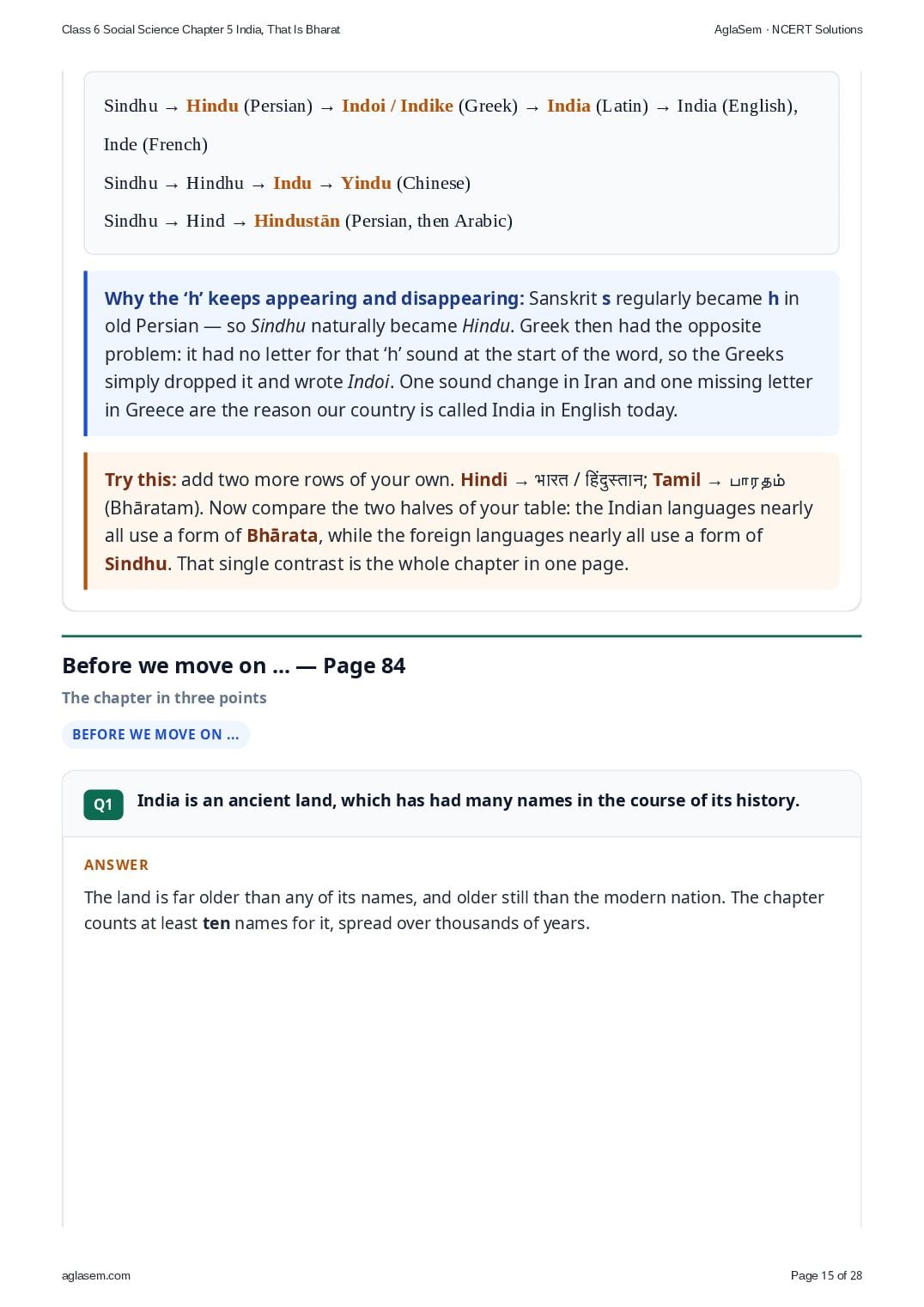
- Can you complete this table of the many names of India? (Persian / Greek / Latin — India / Chinese / Arabic & Persian / English — India / French — Inde)
- India is an ancient land, which has had many names in the course of its history.
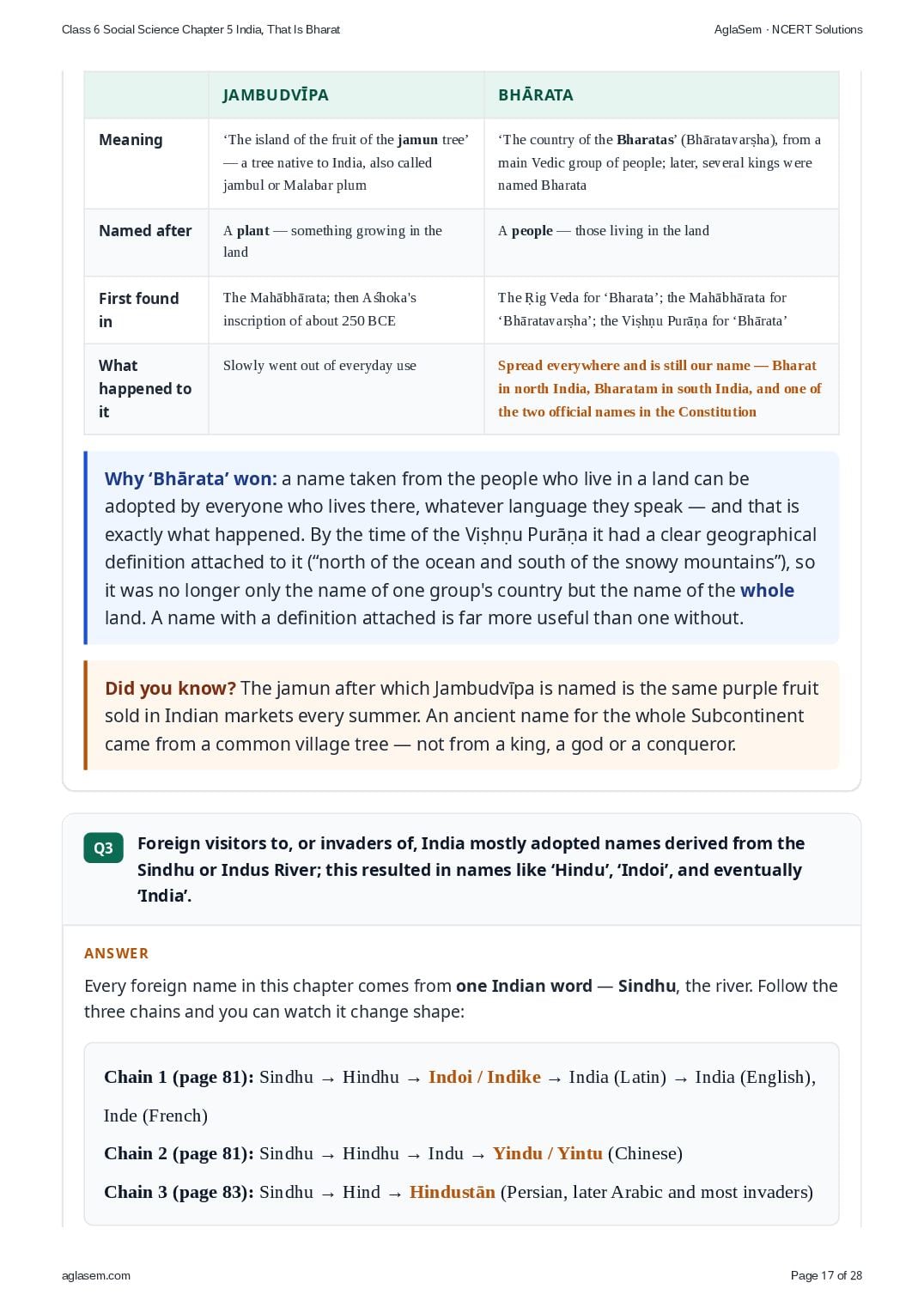
- The names given by the ancient inhabitants of India include ‘Jambudvīpa’ and ‘Bhārata’. The latter became widespread in time and is the name of India in most Indian languages.
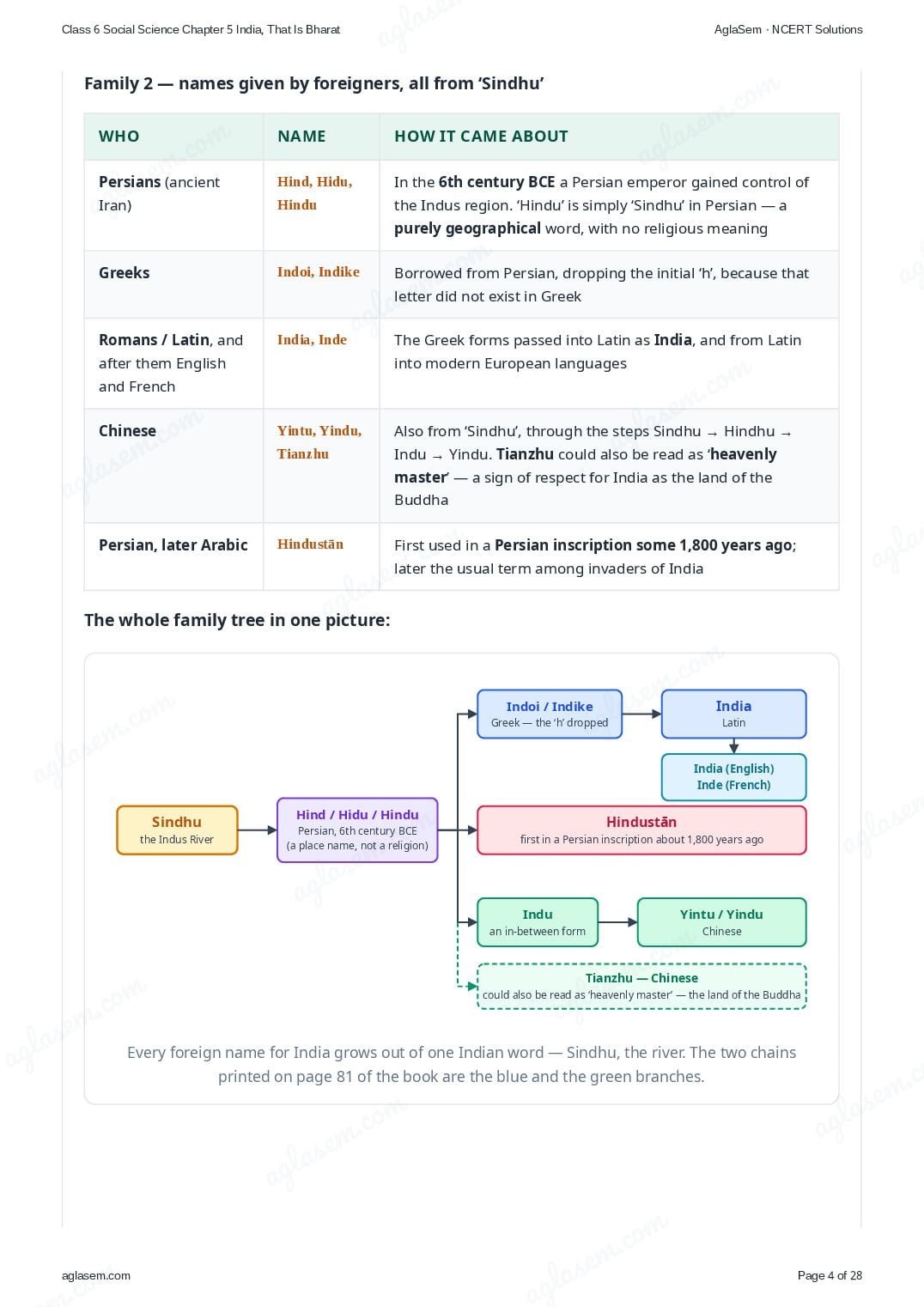
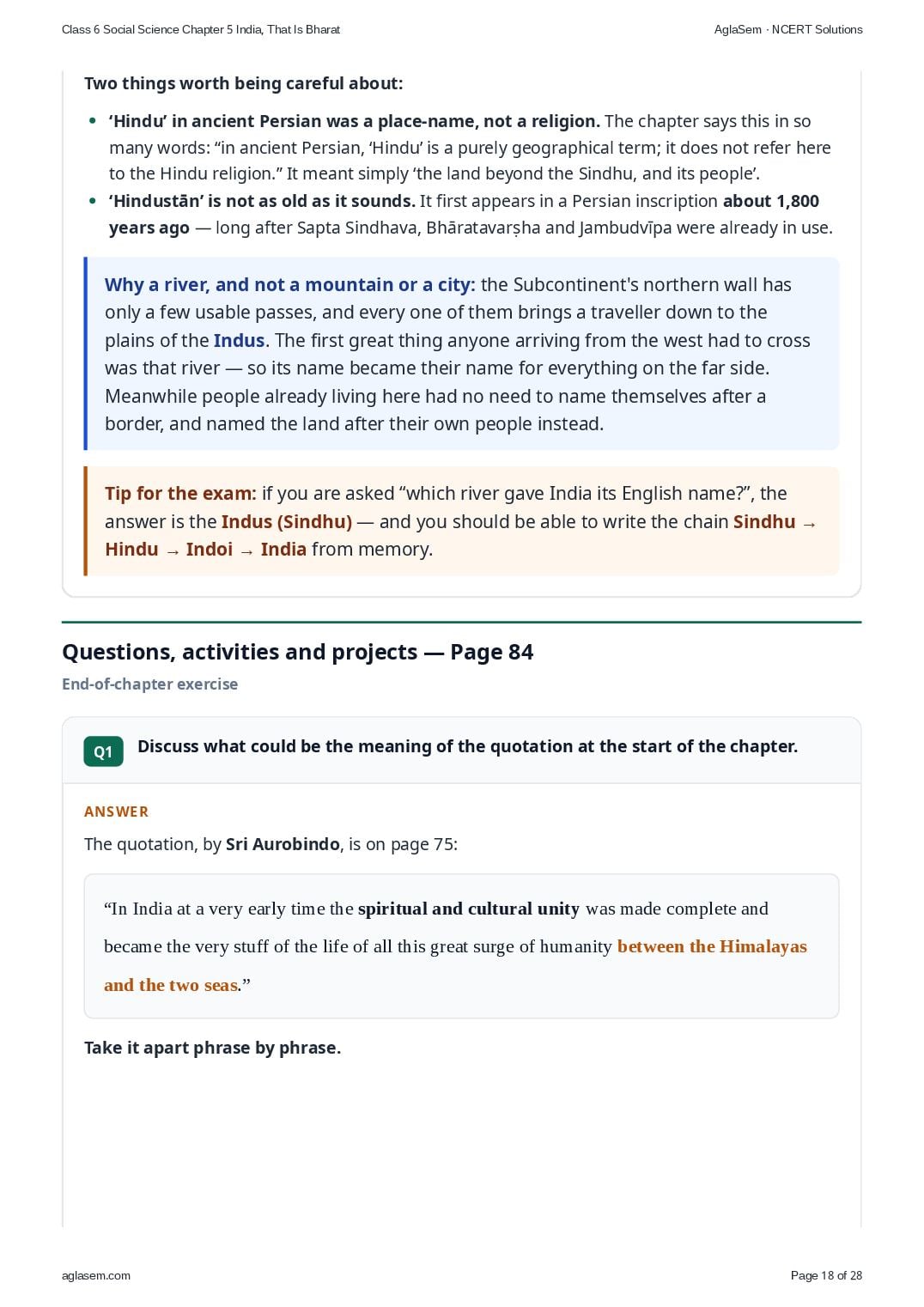
- Foreign visitors to, or invaders of, India mostly adopted names derived from the Sindhu or Indus River; this resulted in names like ‘Hindu’, ‘Indoi’, and eventually ‘India’.
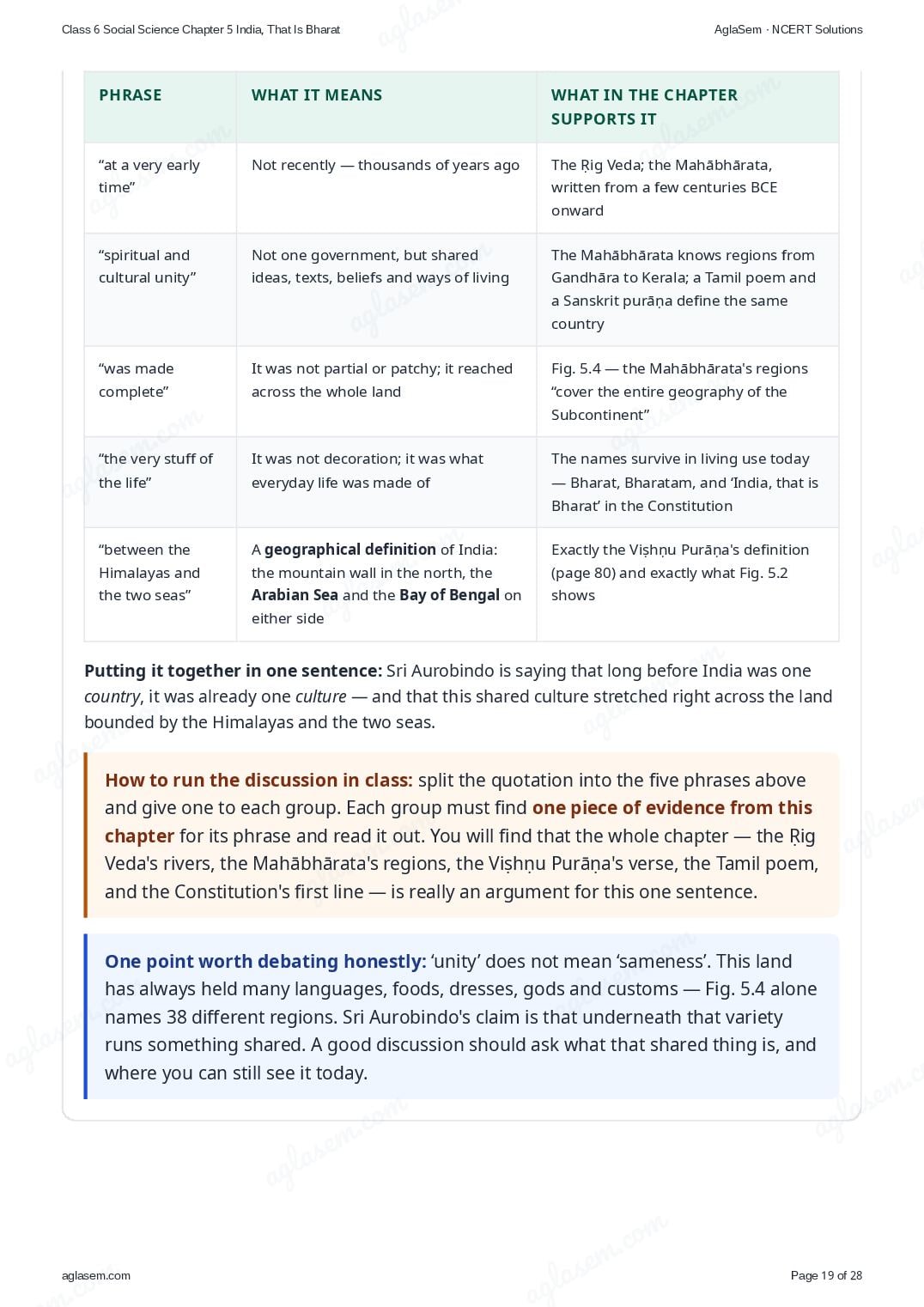
- Discuss what could be the meaning of the quotation at the start of the chapter.
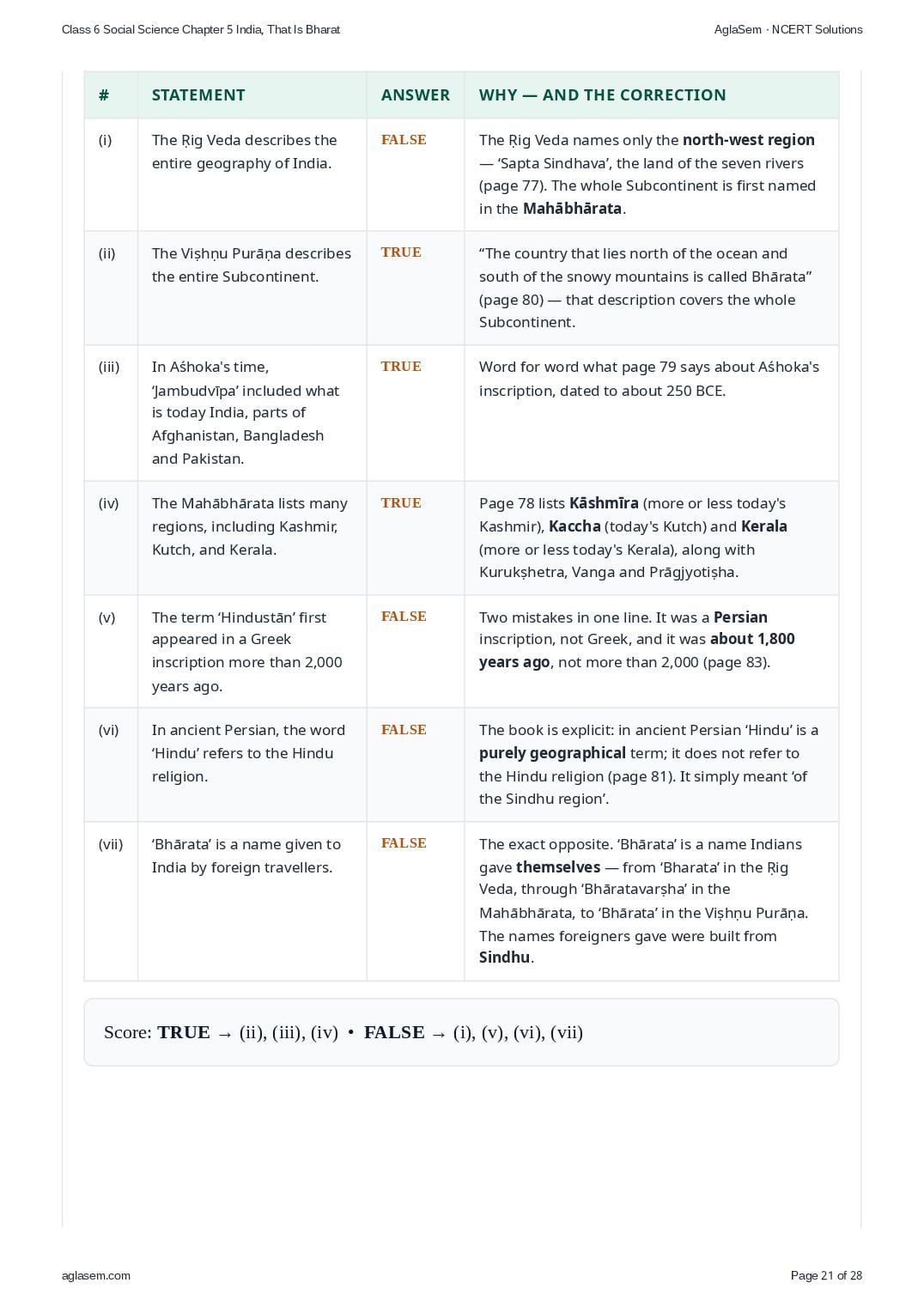
- True or false? (i) The Ṛig Veda describes the entire geography of India. (ii) The Viṣhṇu Purāṇa describes the entire Subcontinent. (iii) In Aśhoka's time, ‘Jambudvīpa’ included what is today India, parts of Afghanistan, Bangladesh and Pakistan. (iv) The Mahābhārata lists many regions, including Kashmir, Kutch, and Kerala. (v) The term ‘Hindustān’ first appeared in a Greek inscription more than 2,000 years ago. (vi) In ancient Persian, the word ‘Hindu’ refers to the Hindu religion. (vii) ‘Bhārata’ is a name given to India by foreign travellers.
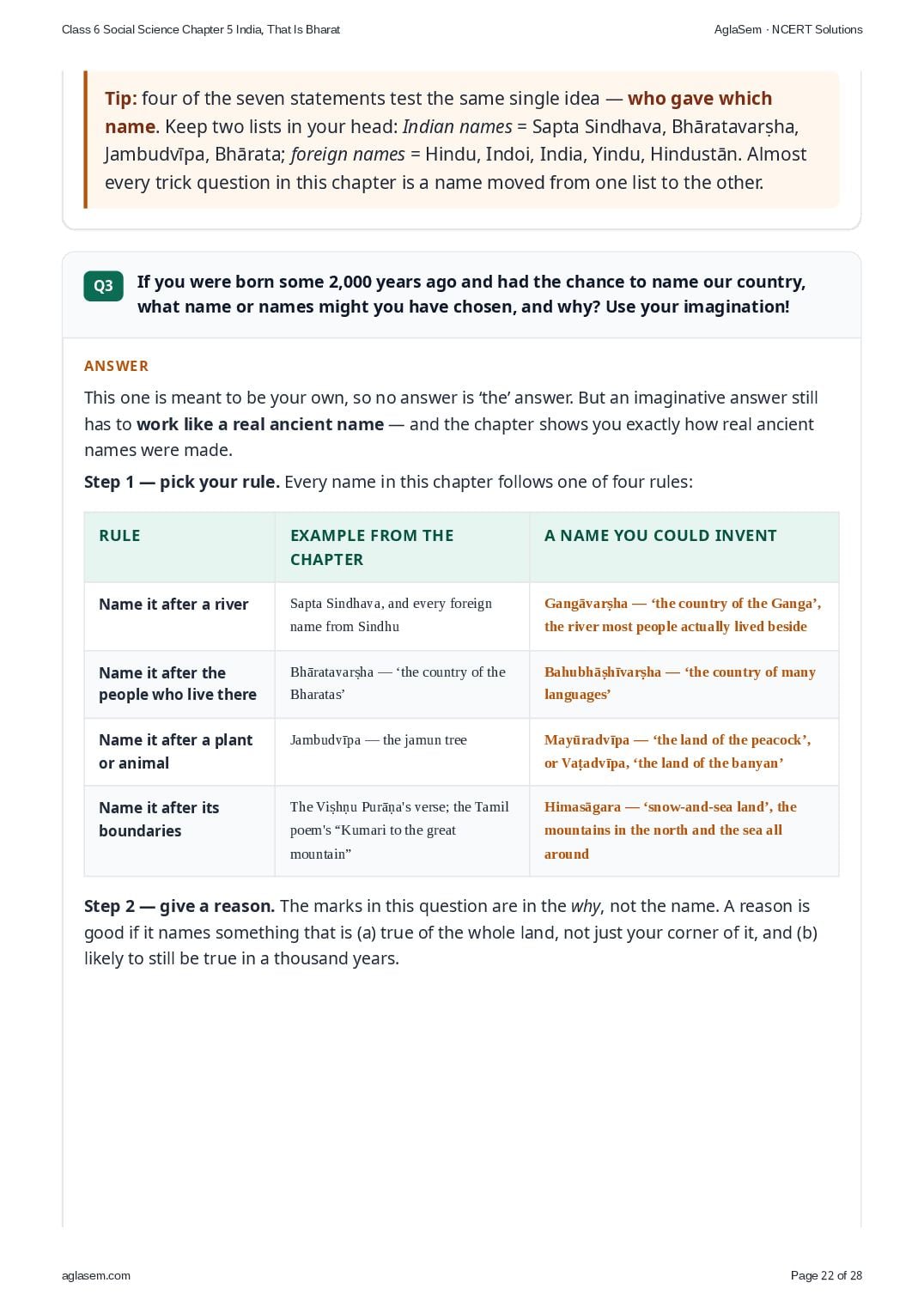
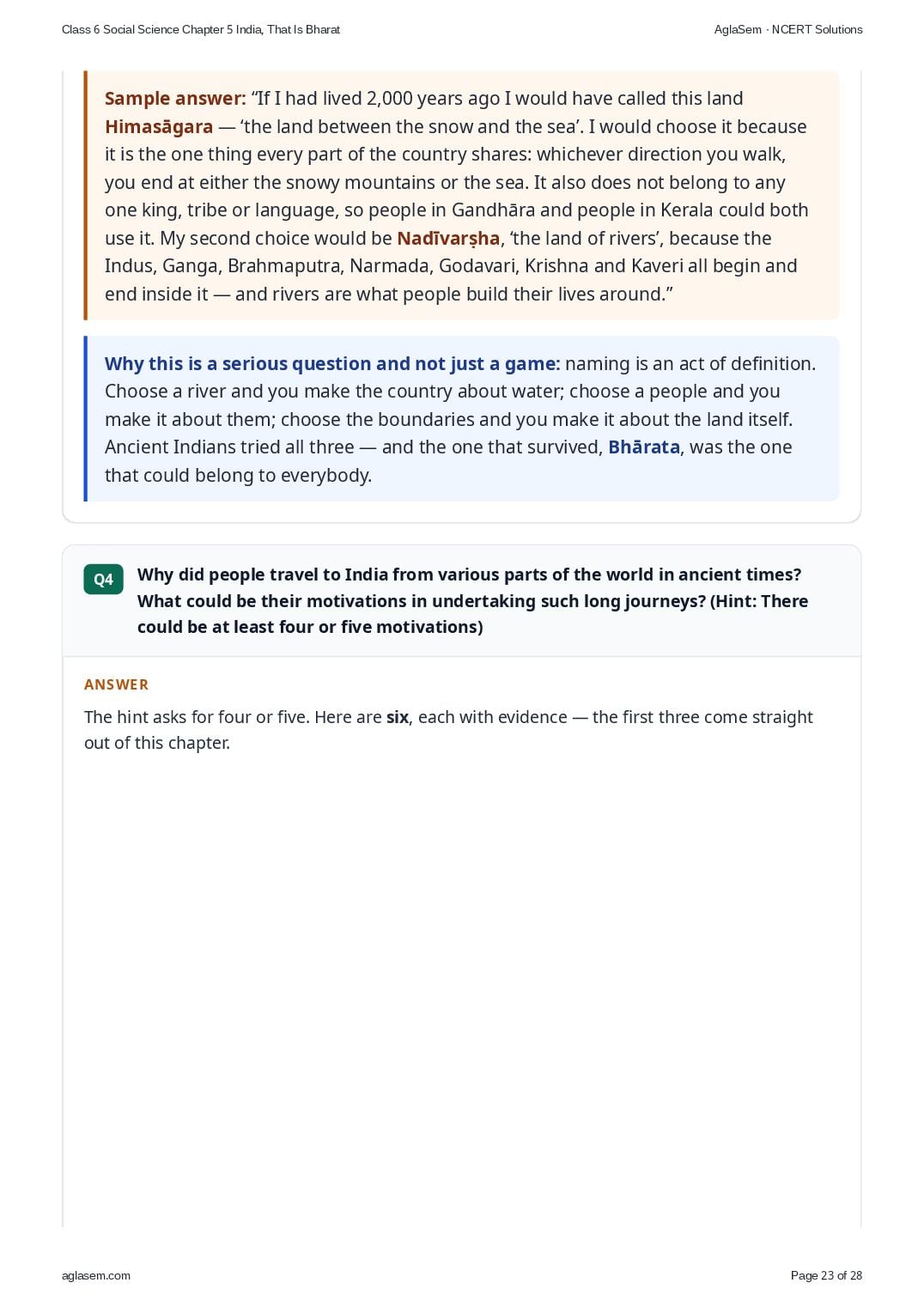
- If you were born some 2,000 years ago and had the chance to name our country, what name or names might you have chosen, and why? Use your imagination!
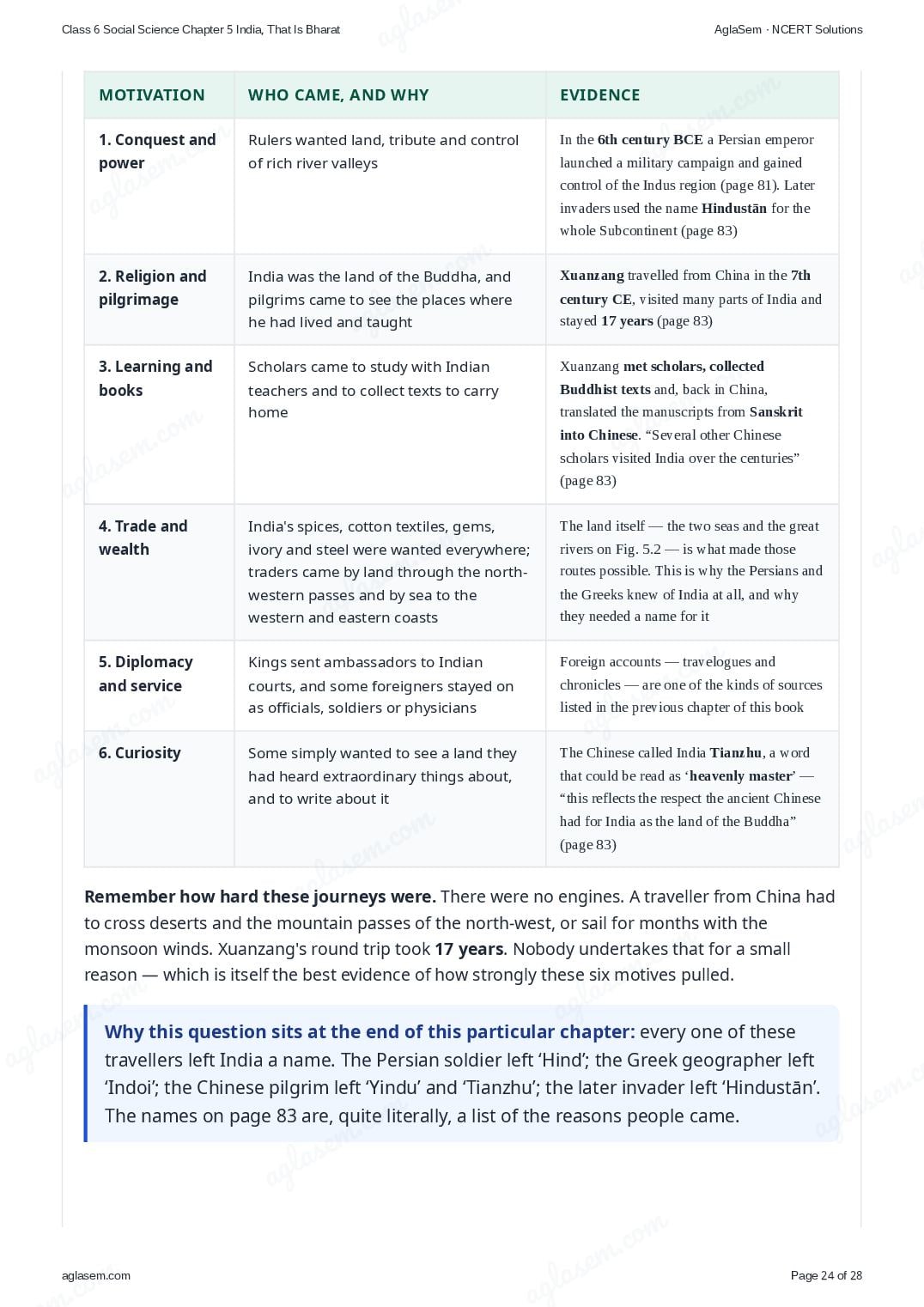
- Why did people travel to India from various parts of the world in ancient times? What could be their motivations in undertaking such long journeys? (Hint: There could be at least four or five motivations)
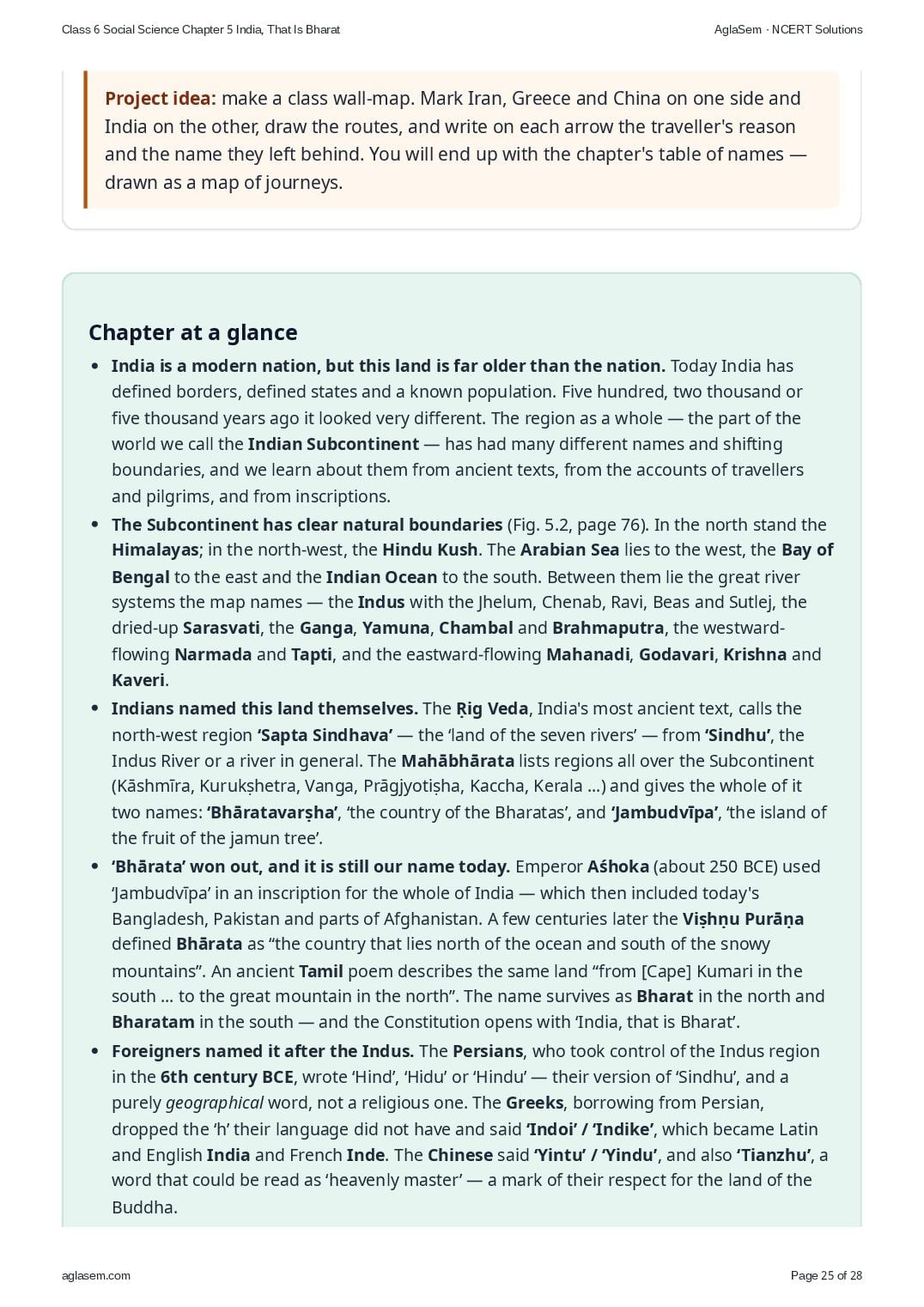
Chapter at a Glance
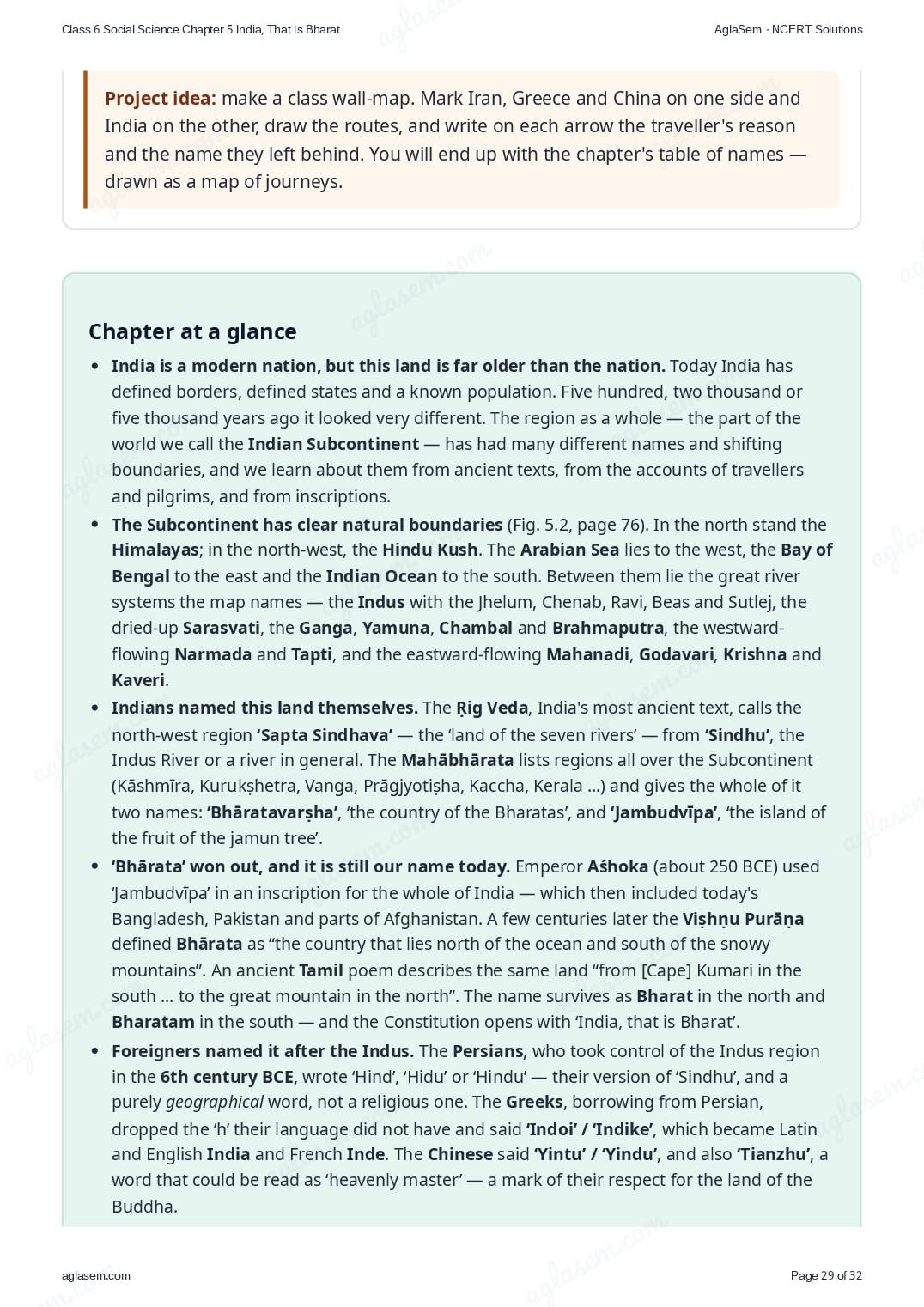
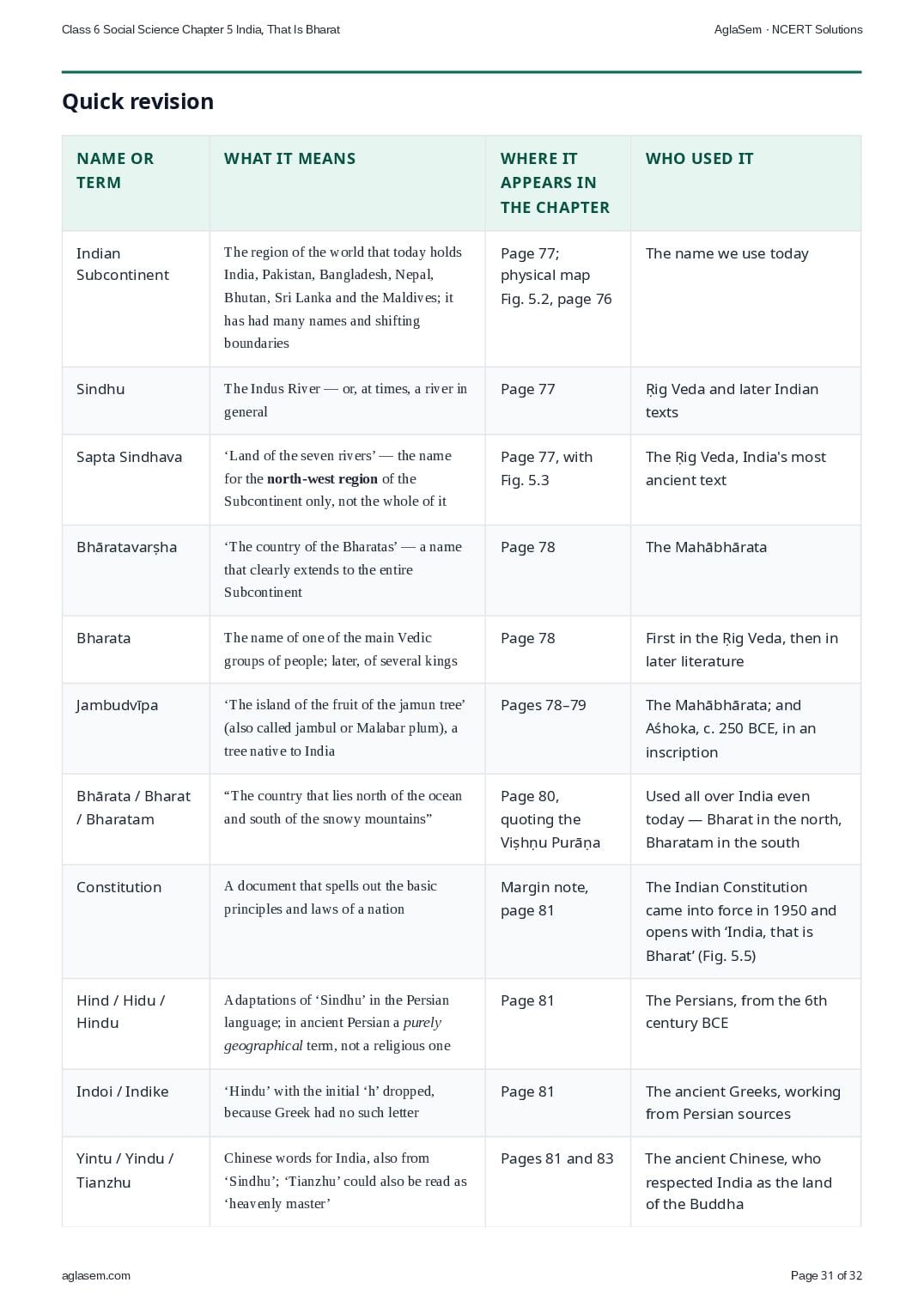
- India is a modern nation, but this land is far older than the nation. Today India has defined borders, defined states and a known population. Five hundred, two thousand or five thousand years ago it looked very different. The region as a whole — the part of the world we call the Indian Subcontinent — has had many different names and shifting boundaries , and we learn about them from ancient texts, from the accounts of travellers and pilgrims, and from inscriptions.
- The Subcontinent has clear natural boundaries (Fig. 5.2, page 76). In the north stand the Himalayas ; in the north-west, the Hindu Kush . The Arabian Sea lies to the west, the Bay of Bengal to the east and the Indian Ocean to the south. Between them lie the great river systems the map names — the Indus with the Jhelum, Chenab, Ravi, Beas and Sutlej, the dried-up Sarasvati , the Ganga , Yamuna , Chambal and Brahmaputra , the westward-flowing Narmada and Tapti , and the eastward-flowing Mahanadi , Godavari , Krishna and Kaveri .
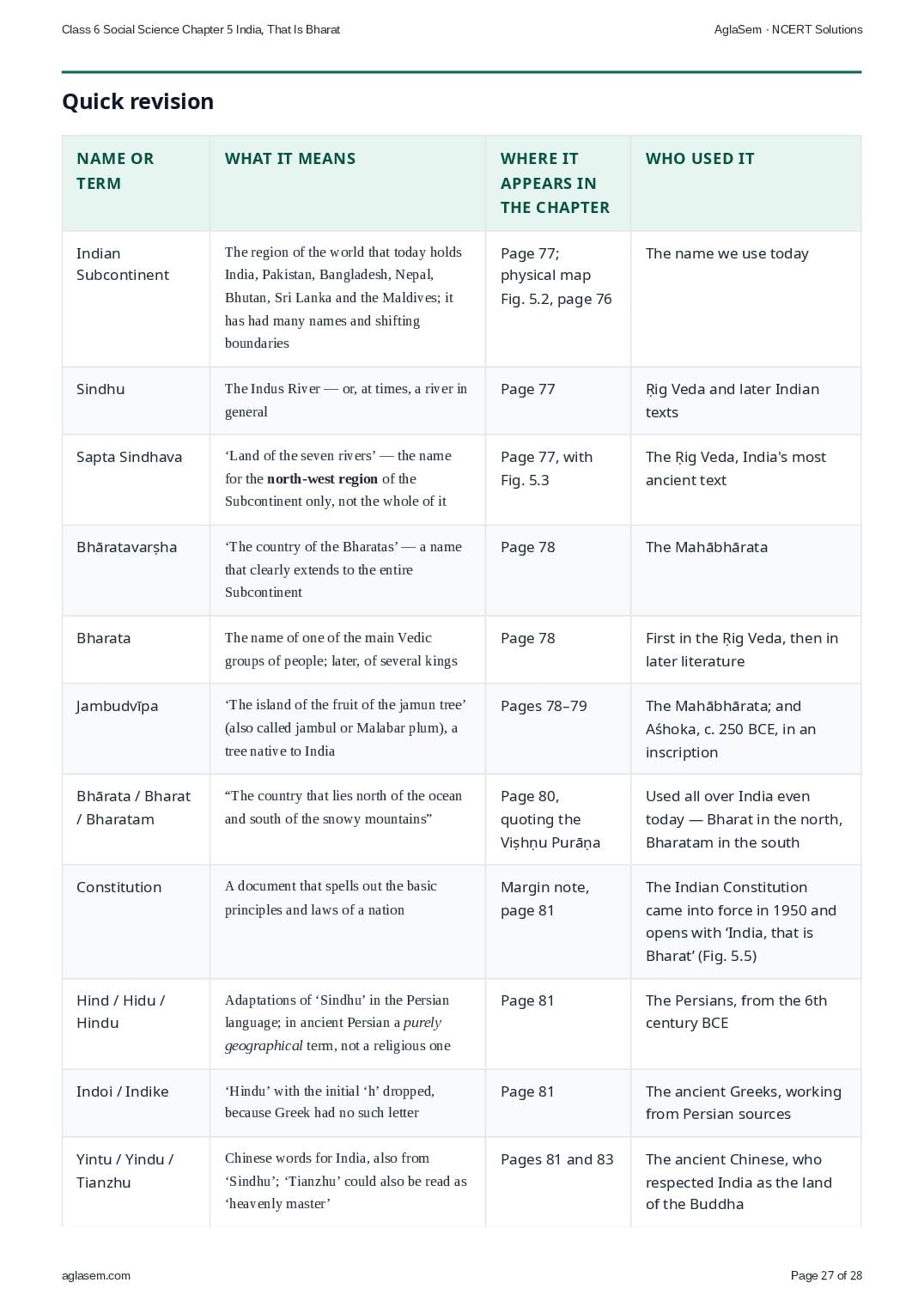
- Indians named this land themselves. The Ṛig Veda , India's most ancient text, calls the north-west region ‘Sapta Sindhava’ — the ‘land of the seven rivers’ — from ‘Sindhu’ , the Indus River or a river in general. The Mahābhārata lists regions all over the Subcontinent (Kāshmīra, Kurukṣhetra, Vanga, Prāgjyotiṣha, Kaccha, Kerala …) and gives the whole of it two names: ‘Bhāratavarṣha’ , ‘the country of the Bharatas’, and ‘Jambudvīpa’ , ‘the island of the fruit of the jamun tree’.
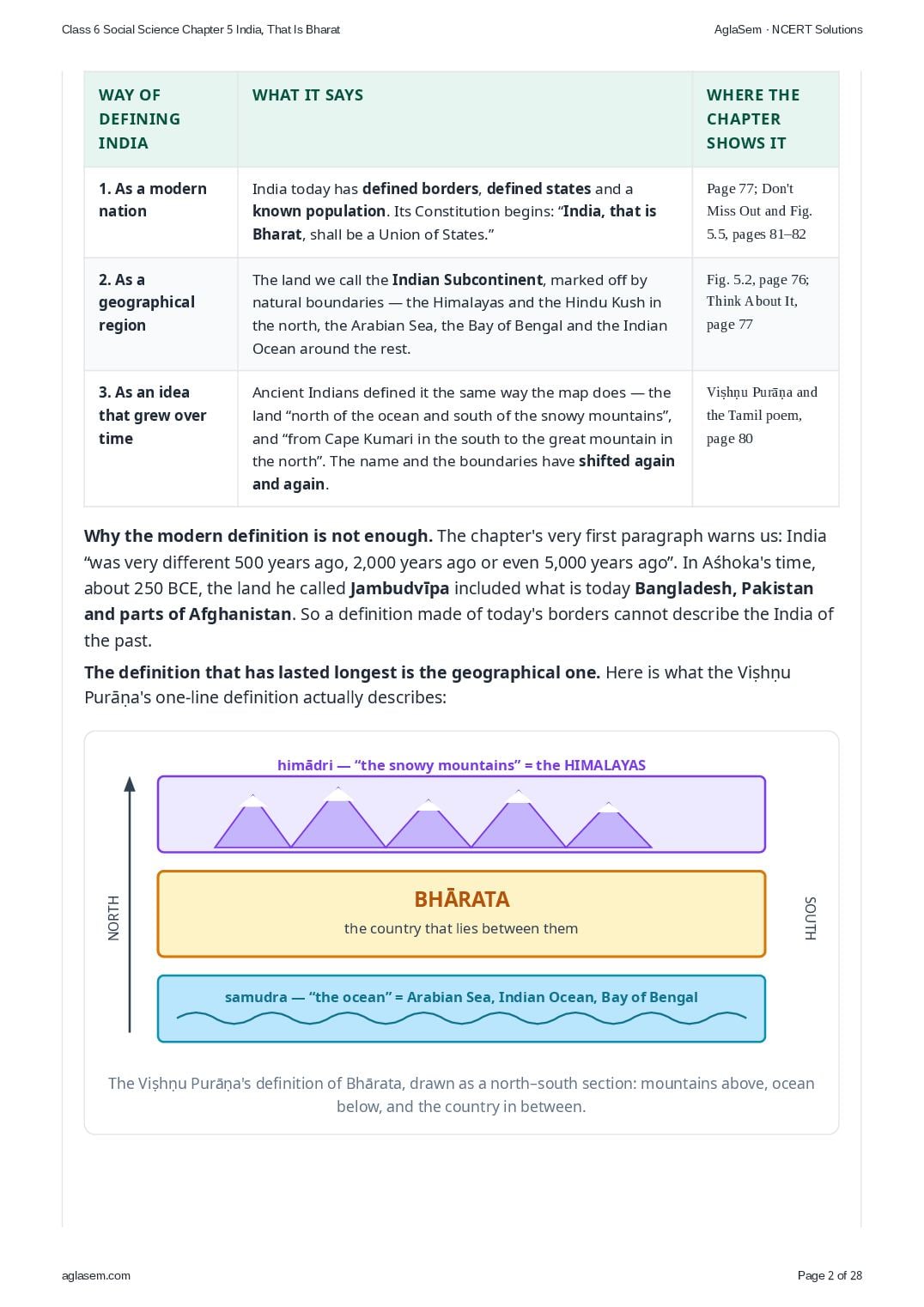
- ‘Bhārata’ won out, and it is still our name today. Emperor Aśhoka (about 250 BCE) used ‘Jambudvīpa’ in an inscription for the whole of India — which then included today's Bangladesh, Pakistan and parts of Afghanistan. A few centuries later the Viṣhṇu Purāṇa defined Bhārata as “the country that lies north of the ocean and south of the snowy mountains”. An ancient Tamil poem describes the same land “from [Cape] Kumari in the south … to the great mountain in the north”. The name survives as Bharat in the north and Bharatam in the south — and the Constitution opens with ‘India, that is Bharat’ .
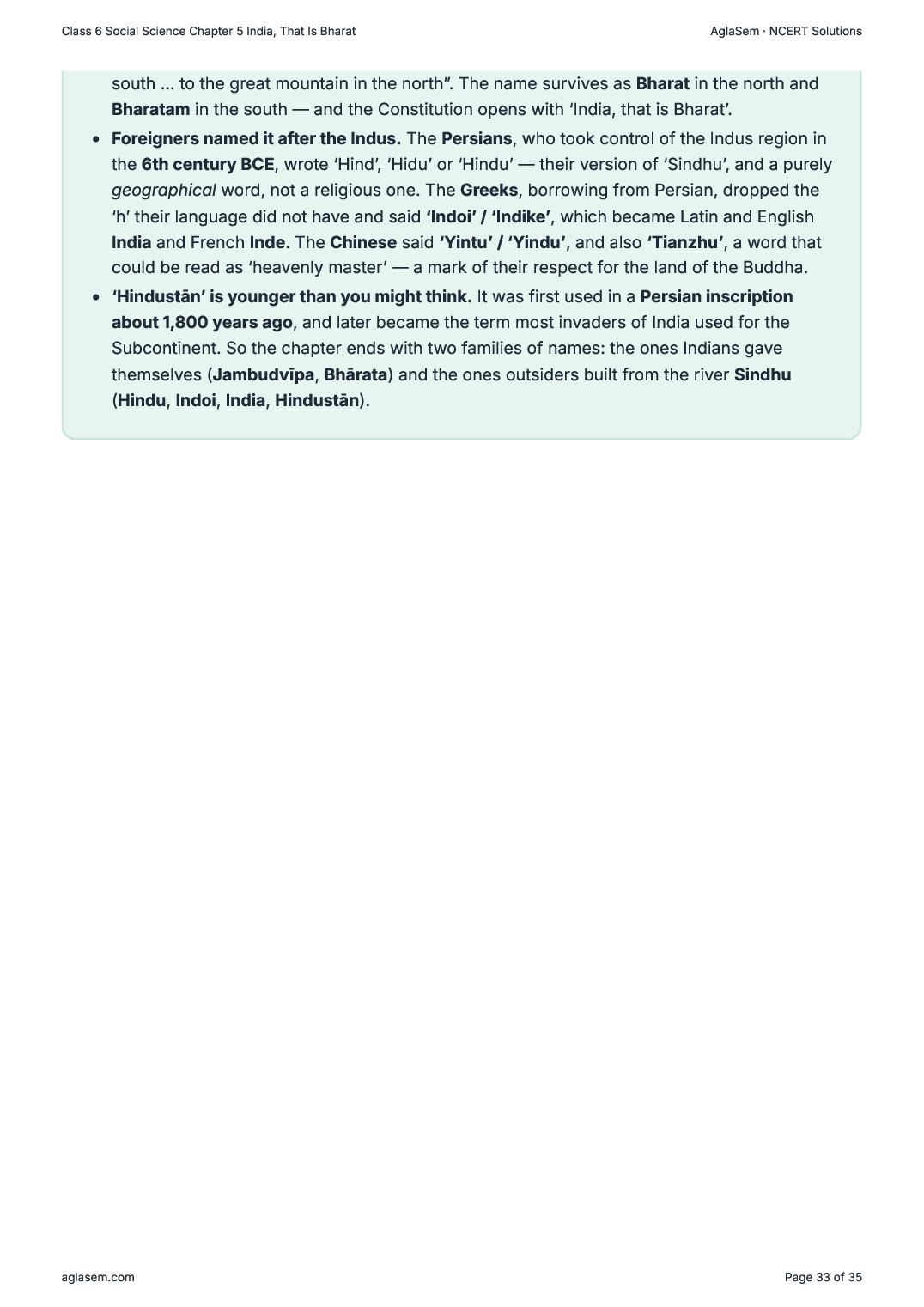
- Foreigners named it after the Indus. The Persians , who took control of the Indus region in the 6th century BCE , wrote ‘Hind’, ‘Hidu’ or ‘Hindu’ — their version of ‘Sindhu’, and a purely geographical word, not a religious one. The Greeks , borrowing from Persian, dropped the ‘h’ their language did not have and said ‘Indoi’ / ‘Indike’ , which became Latin and English India and French Inde . The Chinese said ‘Yintu’ / ‘Yindu’ , and also ‘Tianzhu’ , a word that could be read as ‘heavenly master’ — a mark of their respect for the land of the Buddha.
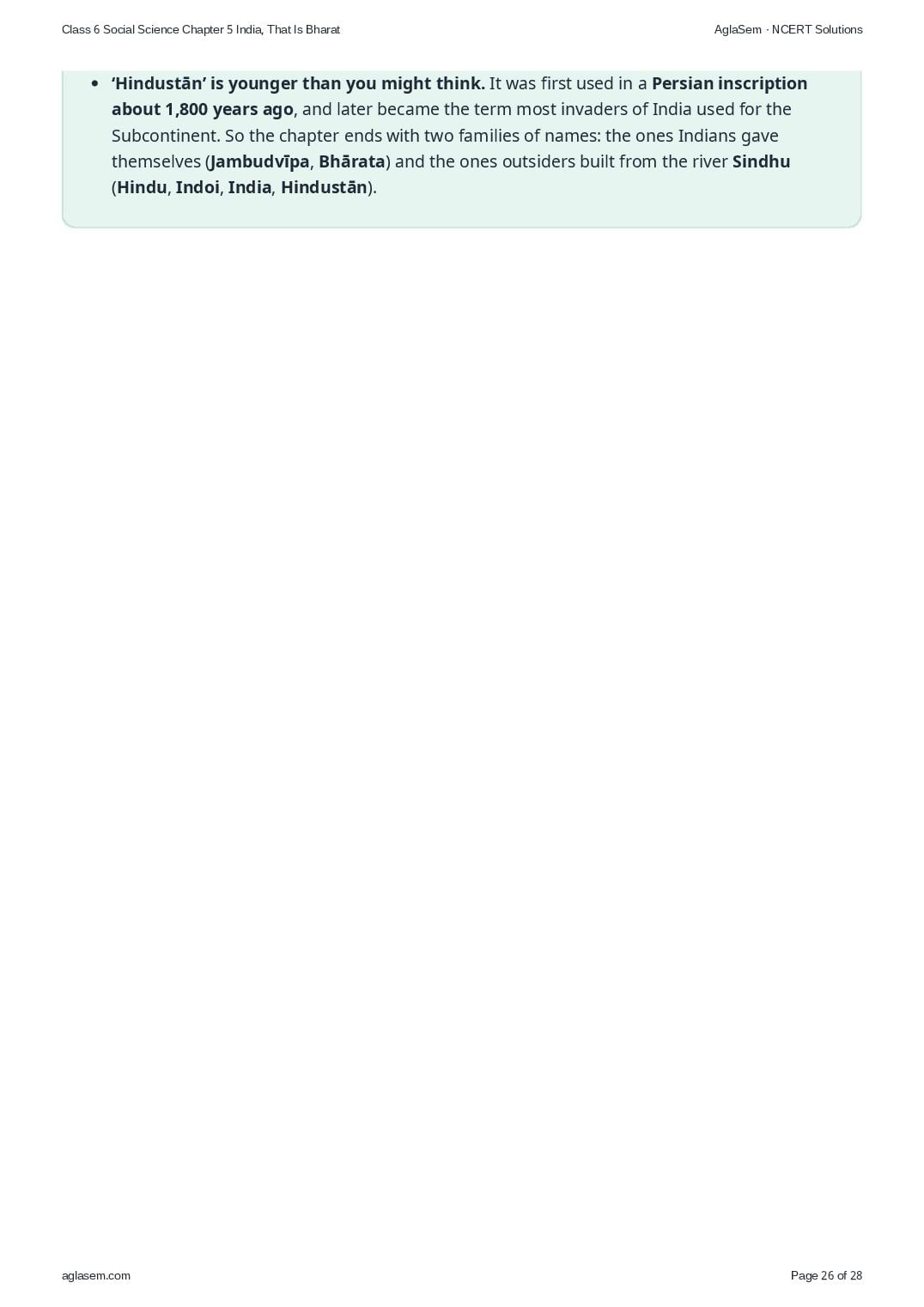
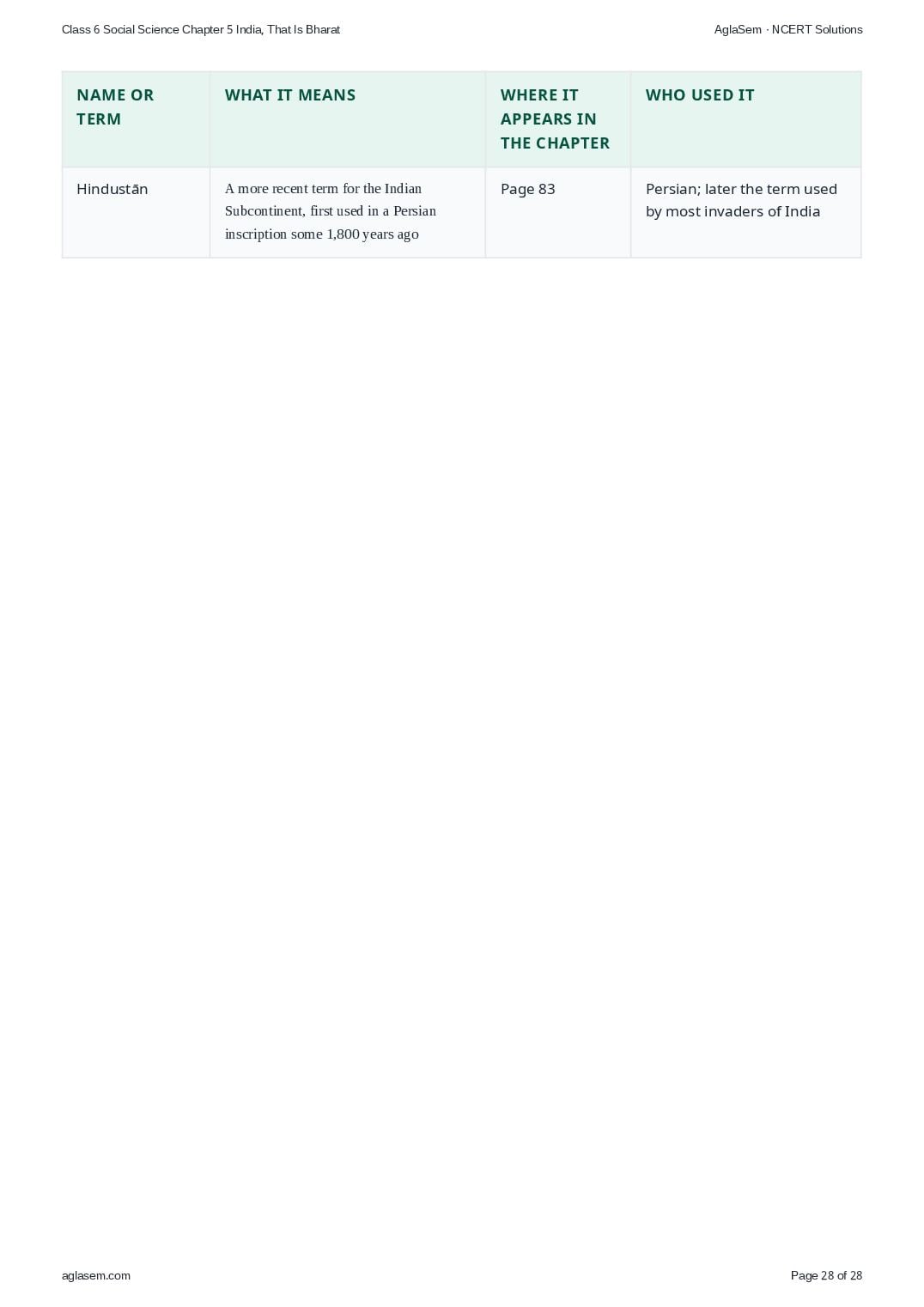
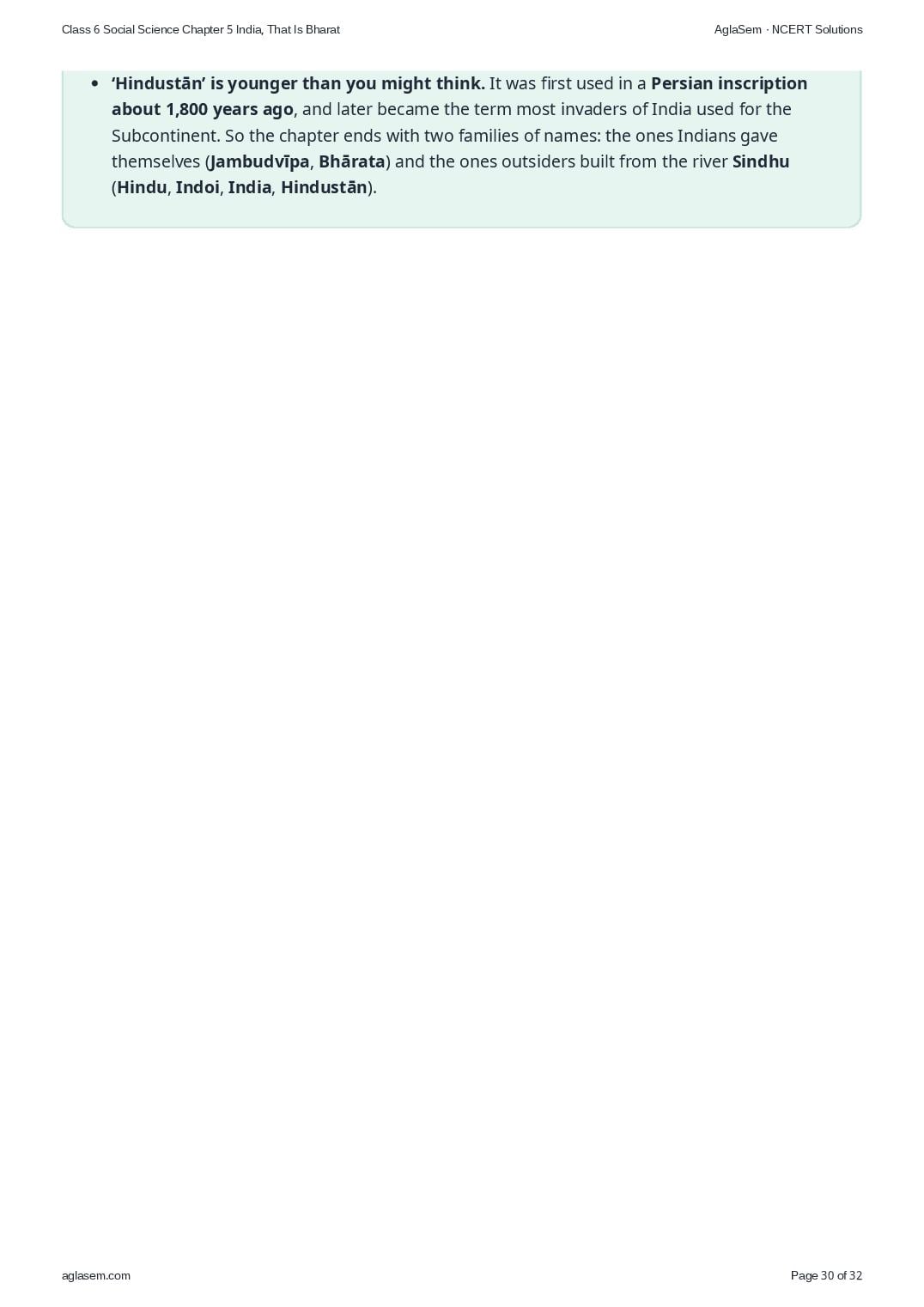
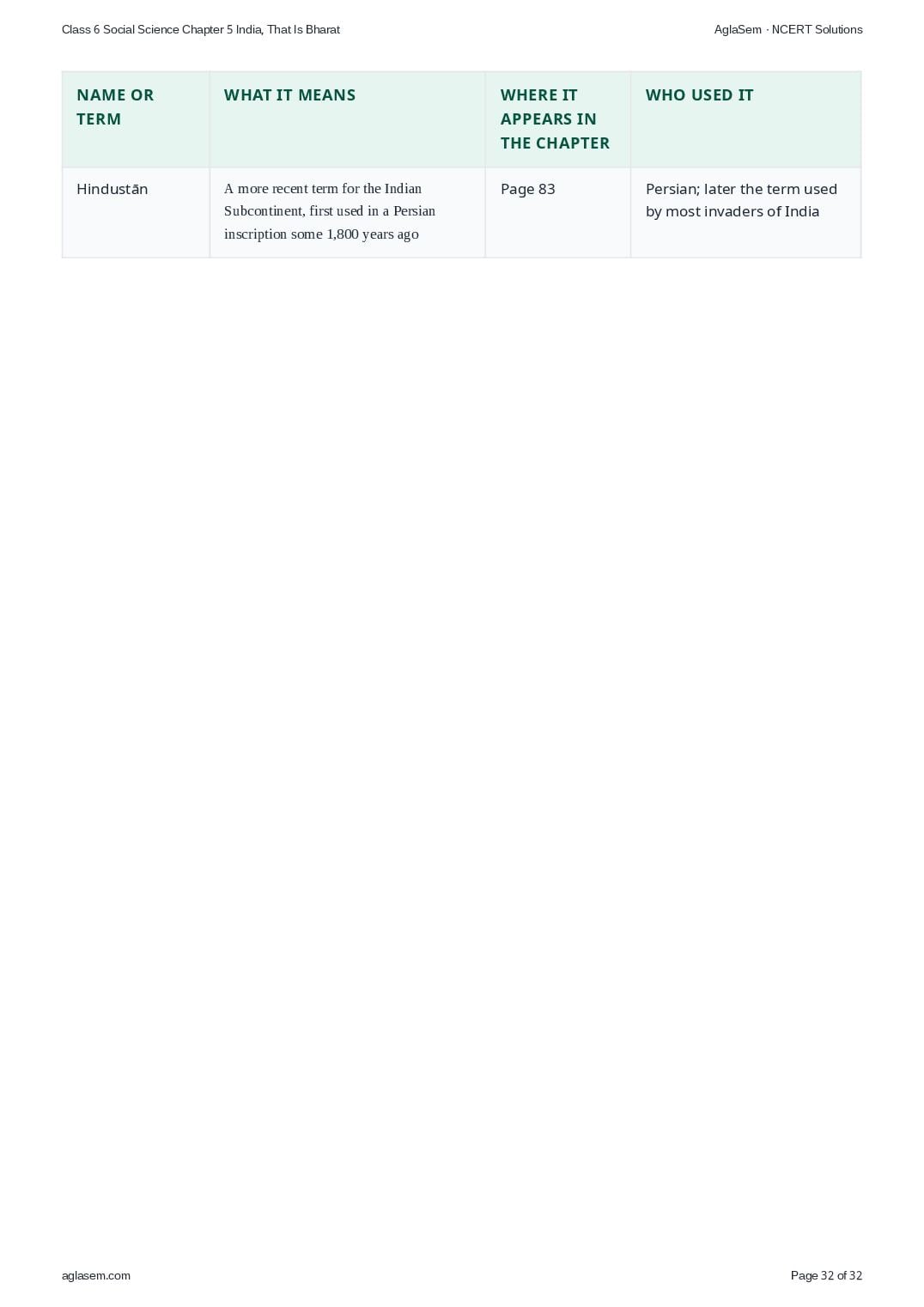
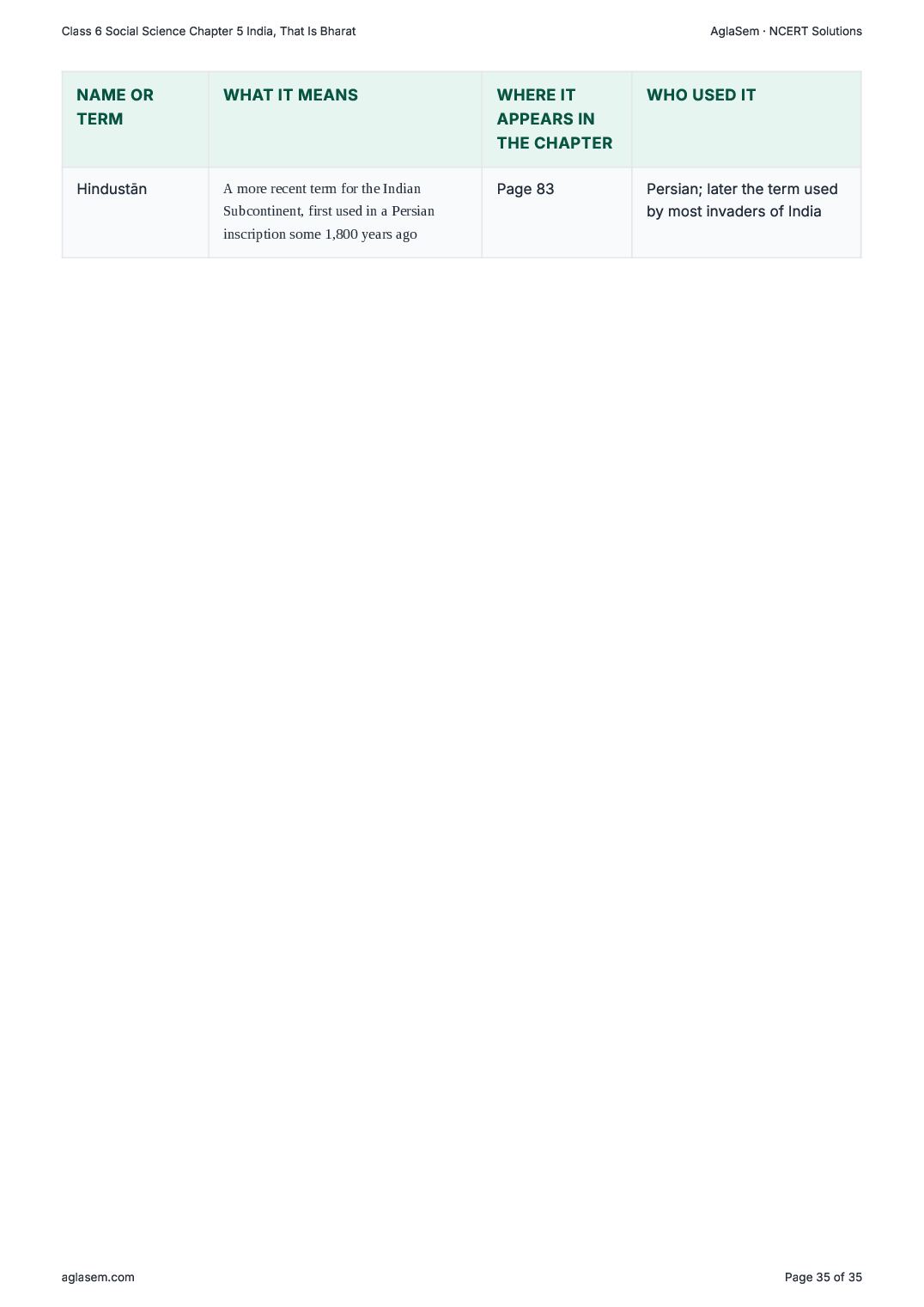
- ‘Hindustān’ is younger than you might think. It was first used in a Persian inscription about 1,800 years ago , and later became the term most invaders of India used for the Subcontinent. So the chapter ends with two families of names: the ones Indians gave themselves ( Jambudvīpa , Bhārata ) and the ones outsiders built from the river Sindhu ( Hindu , Indoi , India , Hindustān ).
How to Download NCERT Solutions for Class 6 Social Science Chapter 5 PDF
Follow these simple steps to get the India That Is Bharat questions-and-answers PDF from Exploring Society India and Beyond.
- Search NCERT Solutions for Class 6 Social Science Chapter 5 aglasem and open this page.
- Read the exercise questions with answers for India That Is Bharat shown above.
- Click the Download PDF link to save the India That Is Bharat solutions to your device.
NCERT Solutions for Class 6 Social Science – All Chapters
There are more chapters to study besides India That Is Bharat in Social Science. Here are the NCERT Solutions for all chapters of Class 6 Social Science.
- Chapter 1 Locating Places on the Earth
- Chapter 2 Oceans and Continents
- Chapter 3 Landforms and Life
- Chapter 4 Timeline and Sources of History
- Chapter 5 India That Is Bharat
- Chapter 6 the Beginnings of Indian Civilisation
- Chapter 7 India’s Cultural Roots
- Chapter 8 Unity in Diversity or Many in the One
- Chapter 9 Family and Community
- Chapter 10 Grassroots Democracy part 1 Governance
- Chapter 11 Grassroots Democracy part 2 Local Government in Rural Areas
- Chapter 12 Grassroots Democracy part 3 Local Government in Urban Areas
- Chapter 13 the Value of Work
- Chapter 14 Economic Activities Around Us
NCERT Solutions for Class 6 – All Subjects
Just like Chapter 5 of Social Science, you can get the exercise questions with answers for every other subject of Class 6. Here are the NCERT Solutions for all subjects of Class 6.
NCERT Solutions for Class 6 Social Science Chapter 5 – An Overview
The key highlights of this study material are as follows.
| Aspects | Details |
|---|---|
| Class | Class 6 |
| Subject | Social Science |
| Chapter Number | Chapter 5 |
| Chapter Name | India That Is Bharat |
| Book Name | Exploring Society India and Beyond |
| Book By | NCERT (National Council of Educational Research and Training) |
| Educational Resource Here | NCERT Solutions of Class 6 Social Science Chapter 5 for all exercises |
| More Questions Answers of This Subject | NCERT Solutions for Class 6 Social Science |
| Download Book Chapter | NCERT Book Class 6 Social Science |
| All Questions Answers For This Class | NCERT Solutions for Class 6 |
| Complete Solutions | NCERT Solutions |
NCERT Solutions for Class 6 Social Science Chapter 5 India That Is Bharat – FAQs
What are the NCERT Solutions for Class 6 Social Science Chapter 5 India That Is Bharat?
They are the complete, step-by-step answers to all the exercise and in-text questions of Chapter 5 India That Is Bharat from the NCERT Class 6 Social Science textbook Exploring Society India and Beyond, written by experts as per the latest NCERT syllabus.
How can I download the Class 6 Social Science Chapter 5 solutions PDF for free?
Open this page on aglasem, read the India That Is Bharat questions with answers, and click the “Download Solutions PDF” link. The Class 6 Social Science Chapter 5 NCERT Solutions PDF is completely free to download.
Are these NCERT Solutions as per the latest 2026-27 syllabus?
Yes. The NCERT Solutions for Class 6 Social Science Chapter 5 are based on the latest NCERT textbook Exploring Society India and Beyond and the current 2026-27 CBSE syllabus, so the questions and answers match what you study in class.
Where can I get NCERT Solutions for the other chapters of Class 6 Social Science?
You can find the answers to every chapter on the NCERT Solutions for Class 6 Social Science page, and solutions for every subject on the NCERT Solutions for Class 6 page.
How do NCERT Solutions help in exam preparation?
They show the correct method to solve each question, help you write answers the way they are expected in exams, let you check and correct your own work, and save revision time — which together improve your marks in Class 6 Social Science.
If you have any queries on NCERT Solutions for Class 6 Social Science Chapter 5 India That Is Bharat, then please ask in the comments below.