NCERT Solutions for Class 6 Social Science Chapter 10 Grassroots Democracy part 1 Governance provide clear, step-by-step answers to every exercise and in-text question from the chapter Grassroots Democracy part 1 Governance of the NCERT textbook Exploring Society India and Beyond. Prepared by subject experts as per the latest NCERT (CBSE) syllabus for 2026-27, these NCERT Solutions for Class 6 Social Science help you understand each concept, write exam-ready answers, and check your own solutions. You can read them online below or download the free Class 6 Social Science Chapter 10 question-answer PDF.
NCERT Solutions for Class 6 Social Science Chapter 10 Grassroots Democracy part 1 Governance
- Class: Class 6
- Subject: Social Science
- Chapter: Chapter 10 – Grassroots Democracy part 1 Governance
- Textbook: Exploring Society India and Beyond (NCERT)
- Study material: NCERT Solutions – questions with answers, free PDF
These solutions answer all the exercise questions of Chapter 10 Grassroots Democracy part 1 Governance — including the in-text questions, short-answer and long-answer questions, and activities — with complete explanations so you can follow the method, not just the final answer. Read the full solutions below.
NCERT Solutions Class 6 Social Science Chapter 10 Grassroots Democracy part 1 Governance View Download
NCERT Solutions for Class 6 Social Science Chapter 10 PDF Download
You can read the NCERT Solutions for Class 6 Social Science Chapter 10 online above, or download the complete question-answer PDF to study Grassroots Democracy part 1 Governance offline at any time.
NCERT Solutions for Class 6 Social Science Chapter 10 PDF Download Link – Click Here to Download Solutions PDF
Questions Covered in This Chapter
These NCERT Solutions answer all 25 questions of this chapter. The questions solved are:
- What is the meaning of ‘governance’?
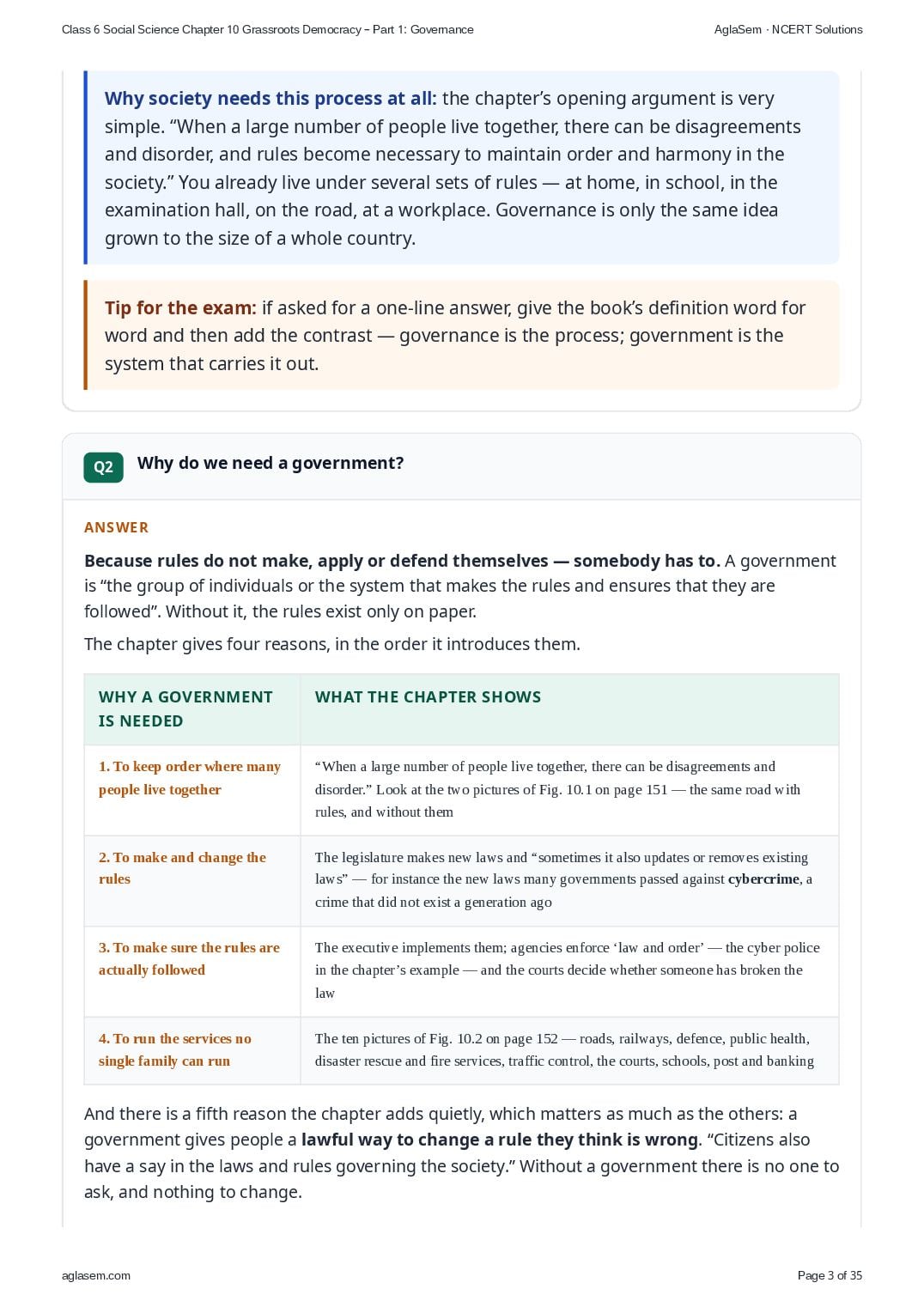
- Why do we need a government?
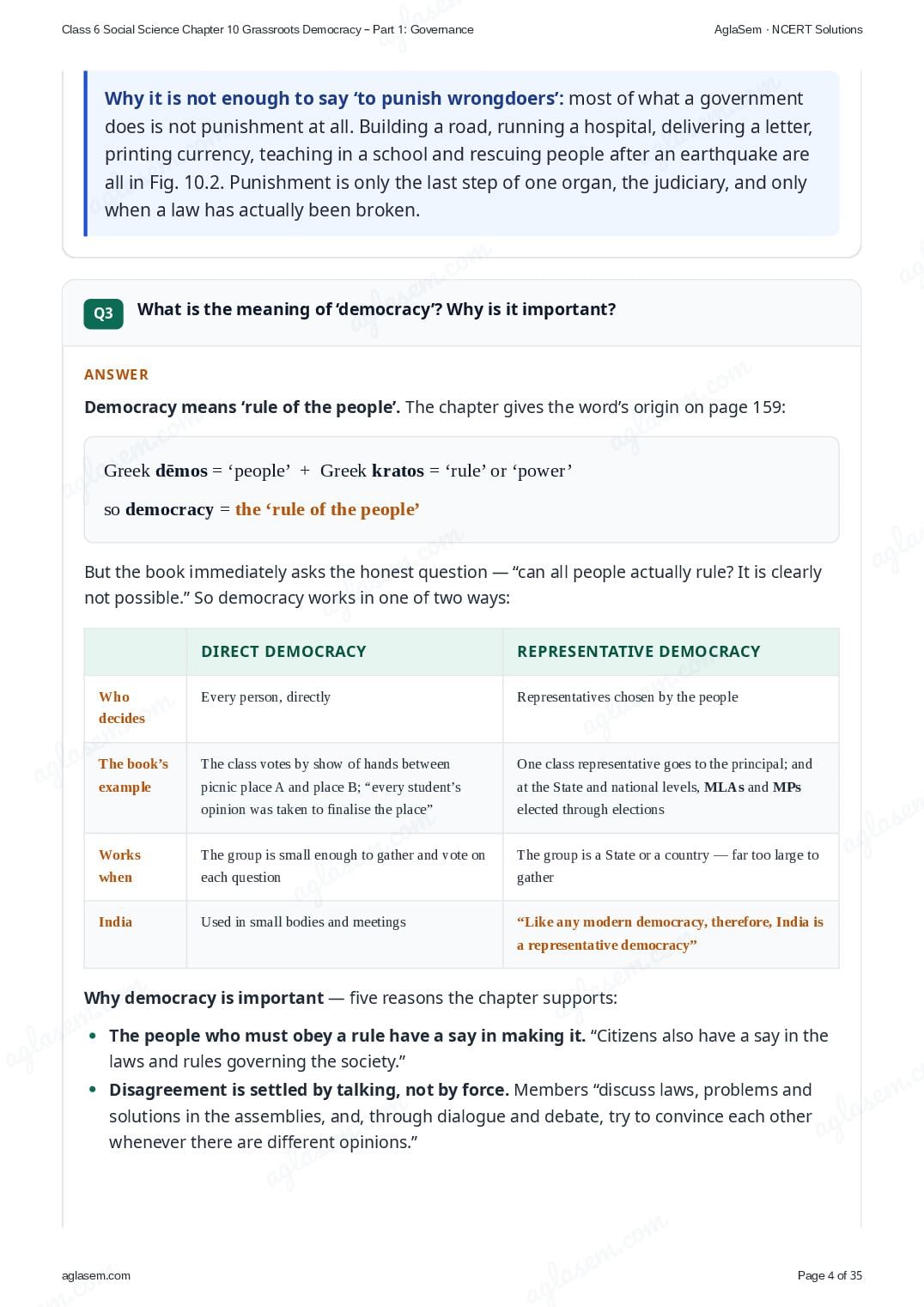
- What is the meaning of ‘democracy’? Why is it important?
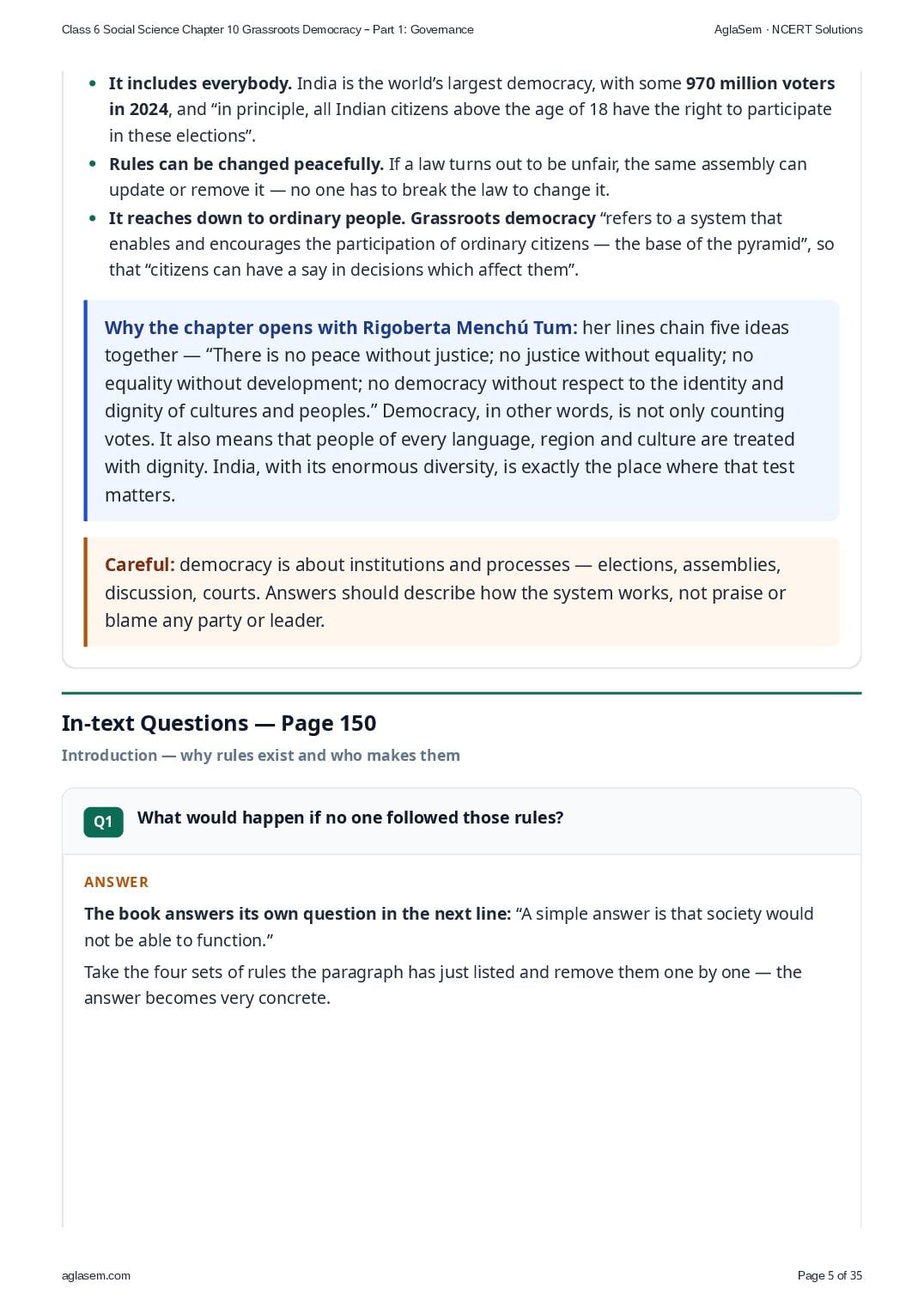
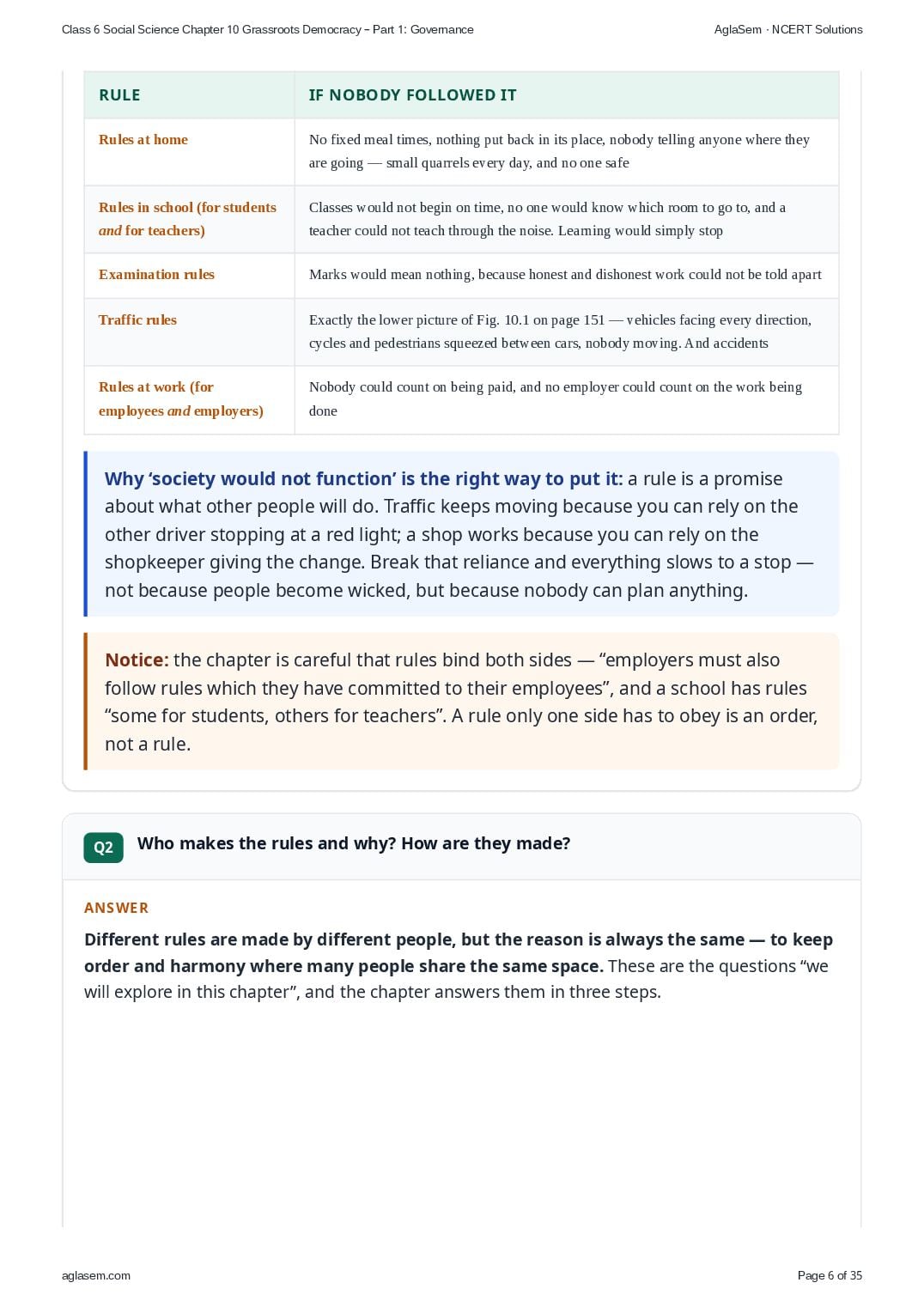
- What would happen if no one followed those rules?
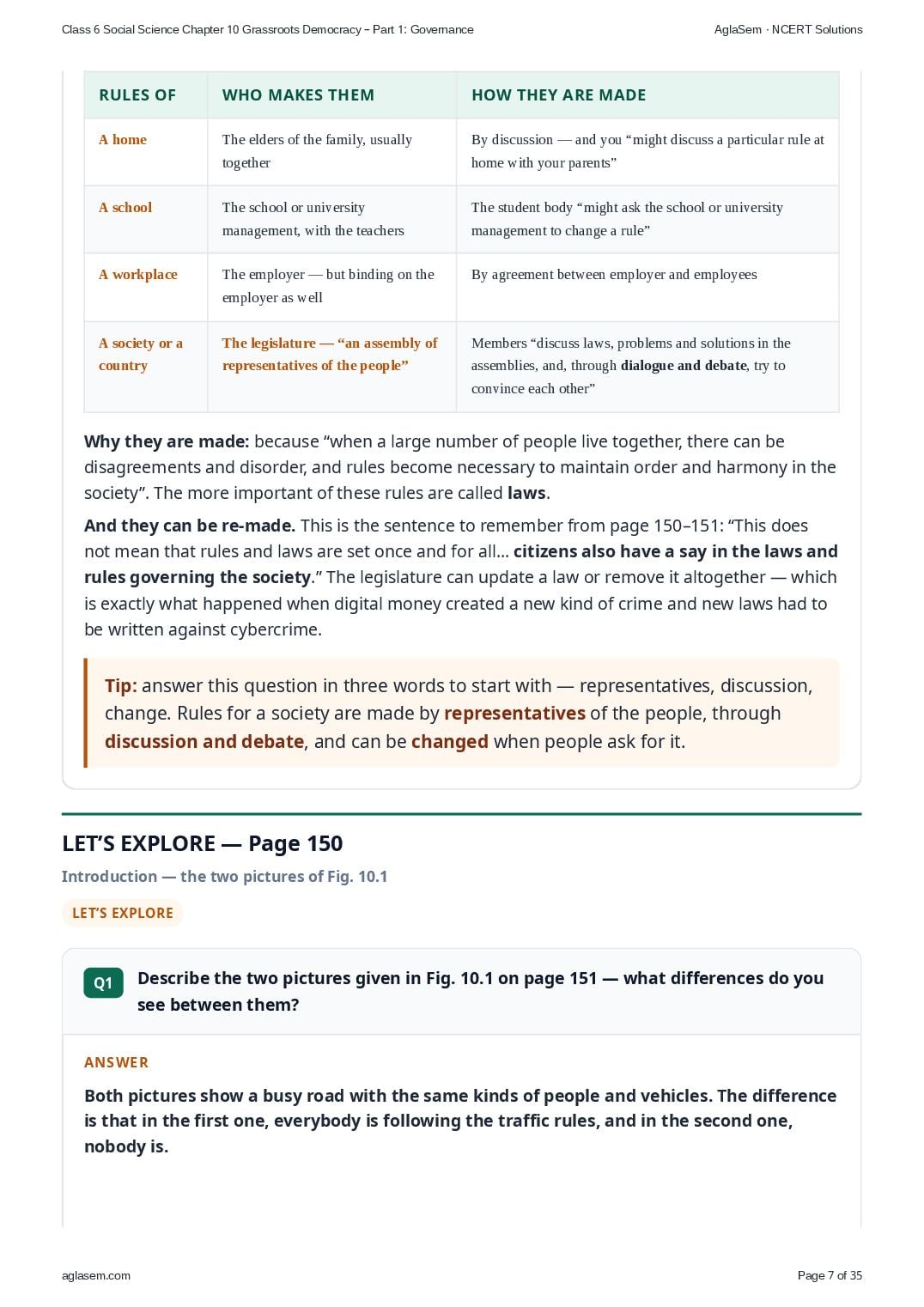
- Who makes the rules and why? How are they made?
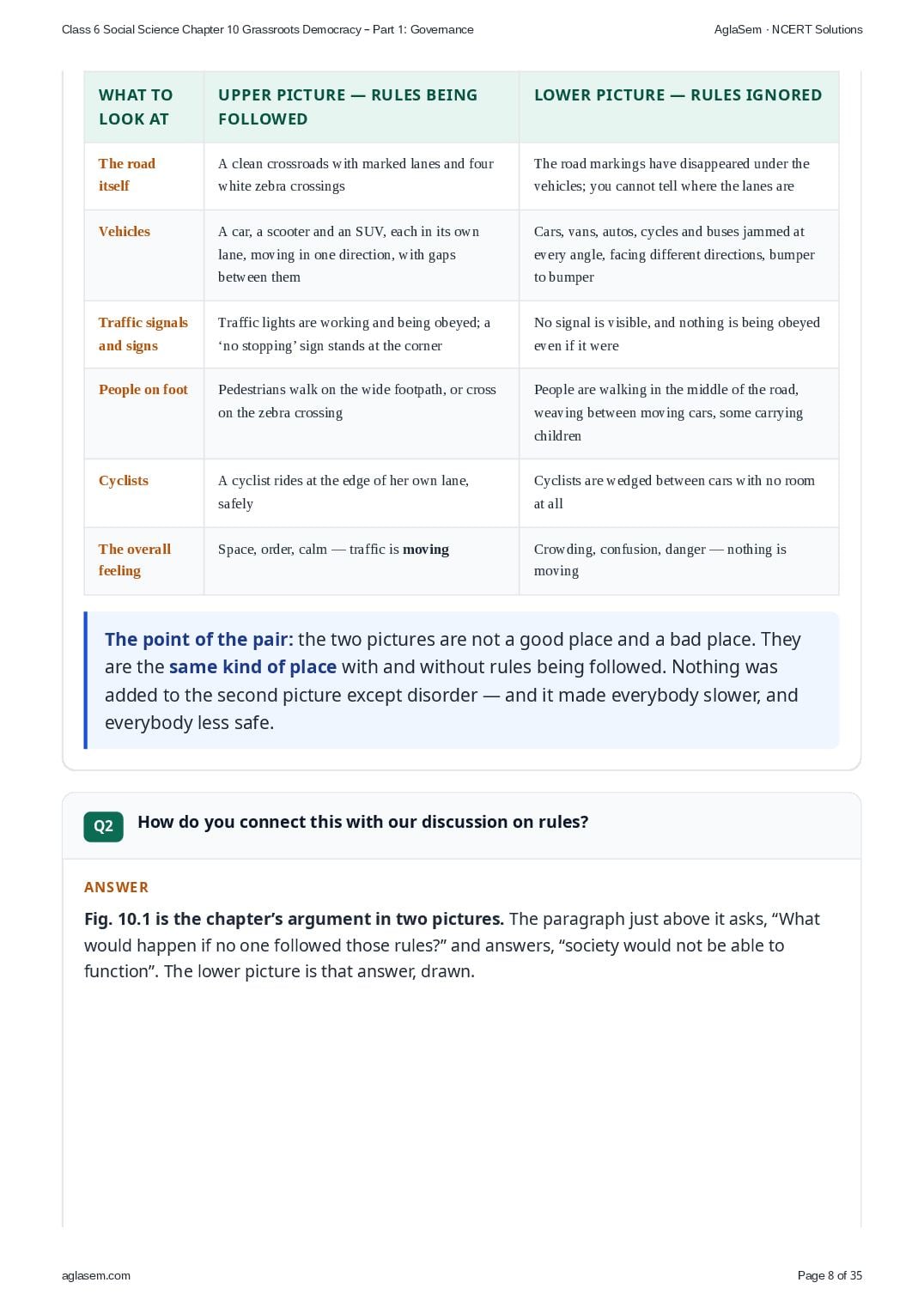
- Describe the two pictures given in Fig. 10.1 on page 151 — what differences do you see between them?
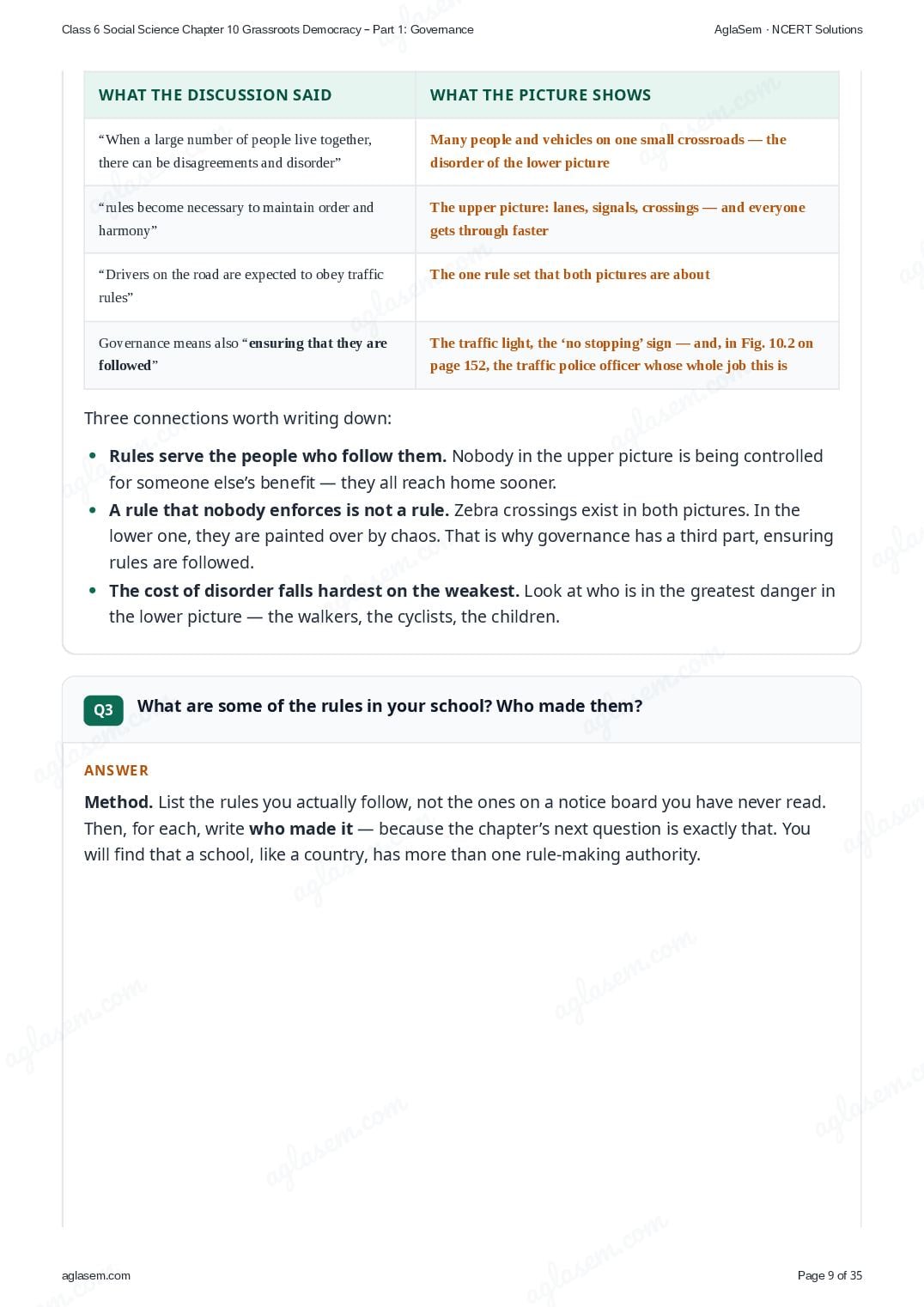
- How do you connect this with our discussion on rules?
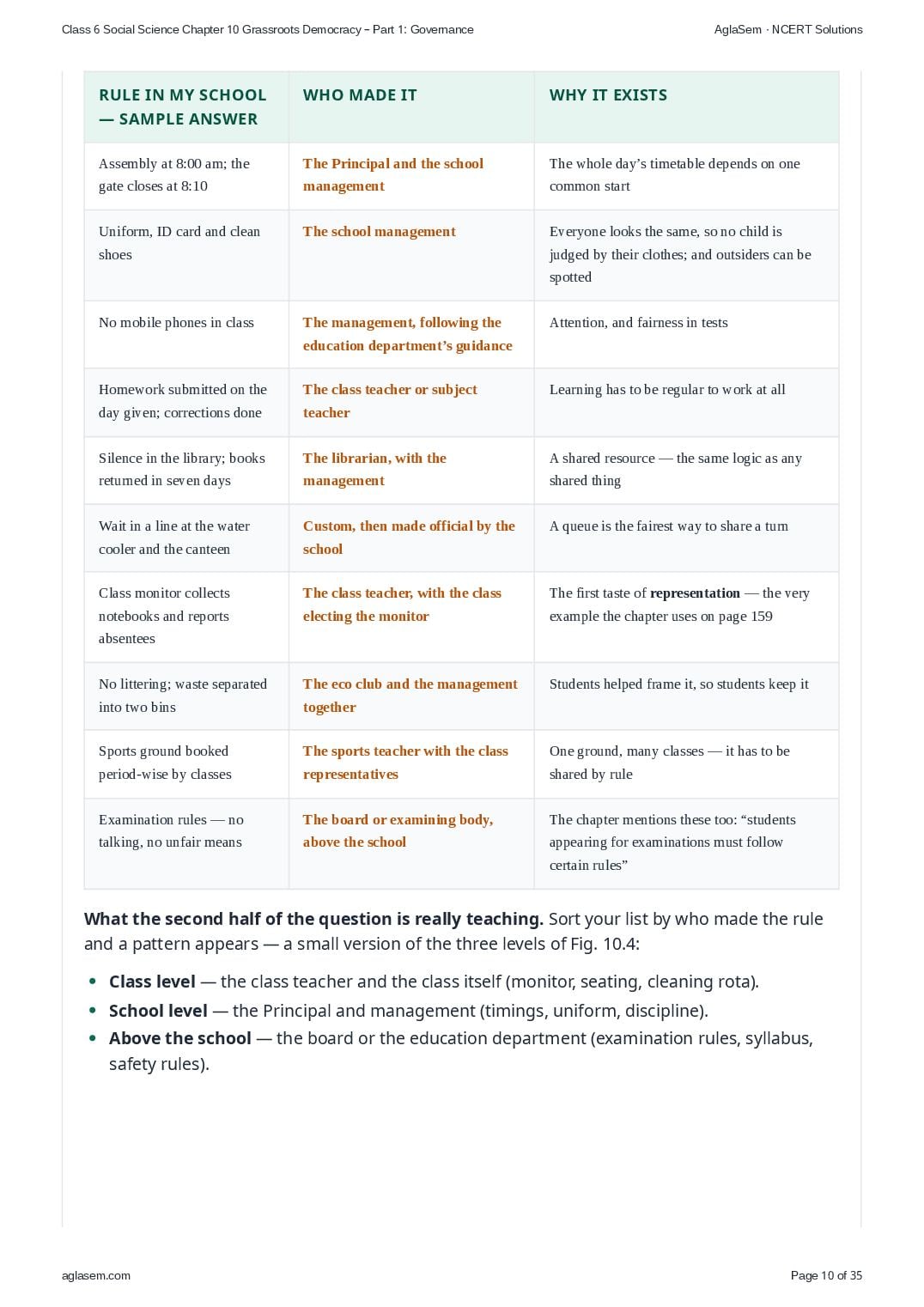
- What are some of the rules in your school? Who made them?
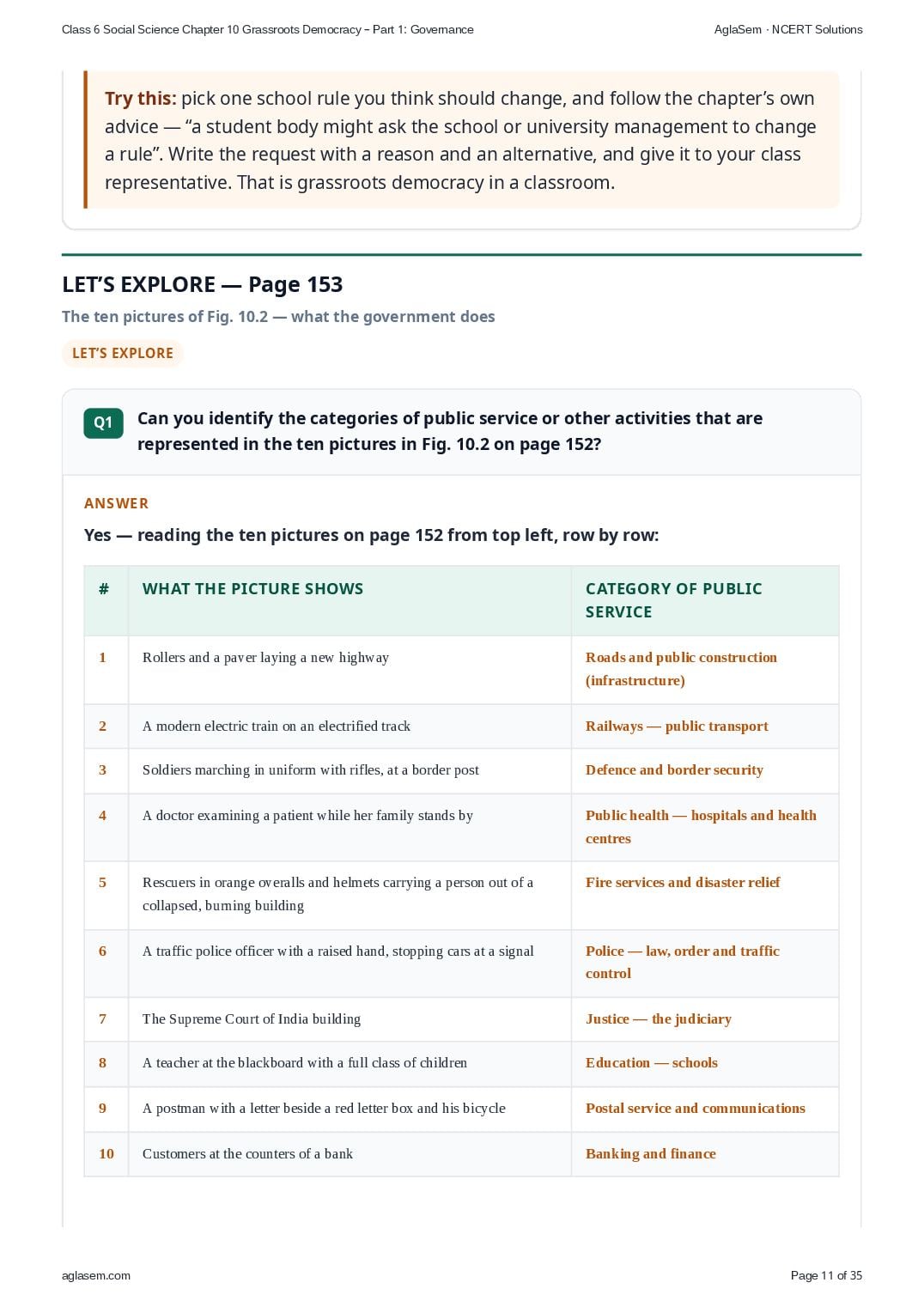
- Can you identify the categories of public service or other activities that are represented in the ten pictures in Fig. 10.2 on page 152?
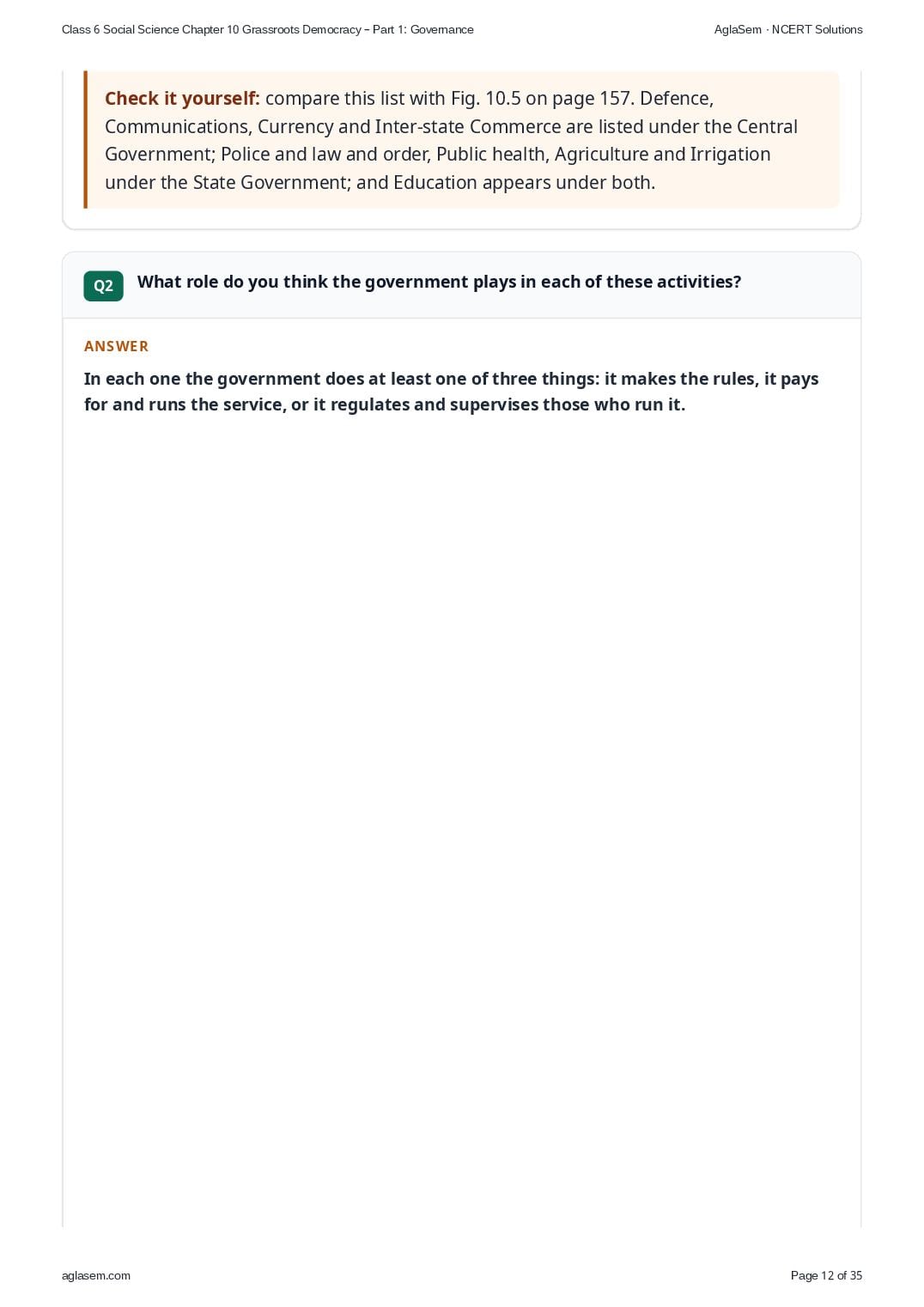
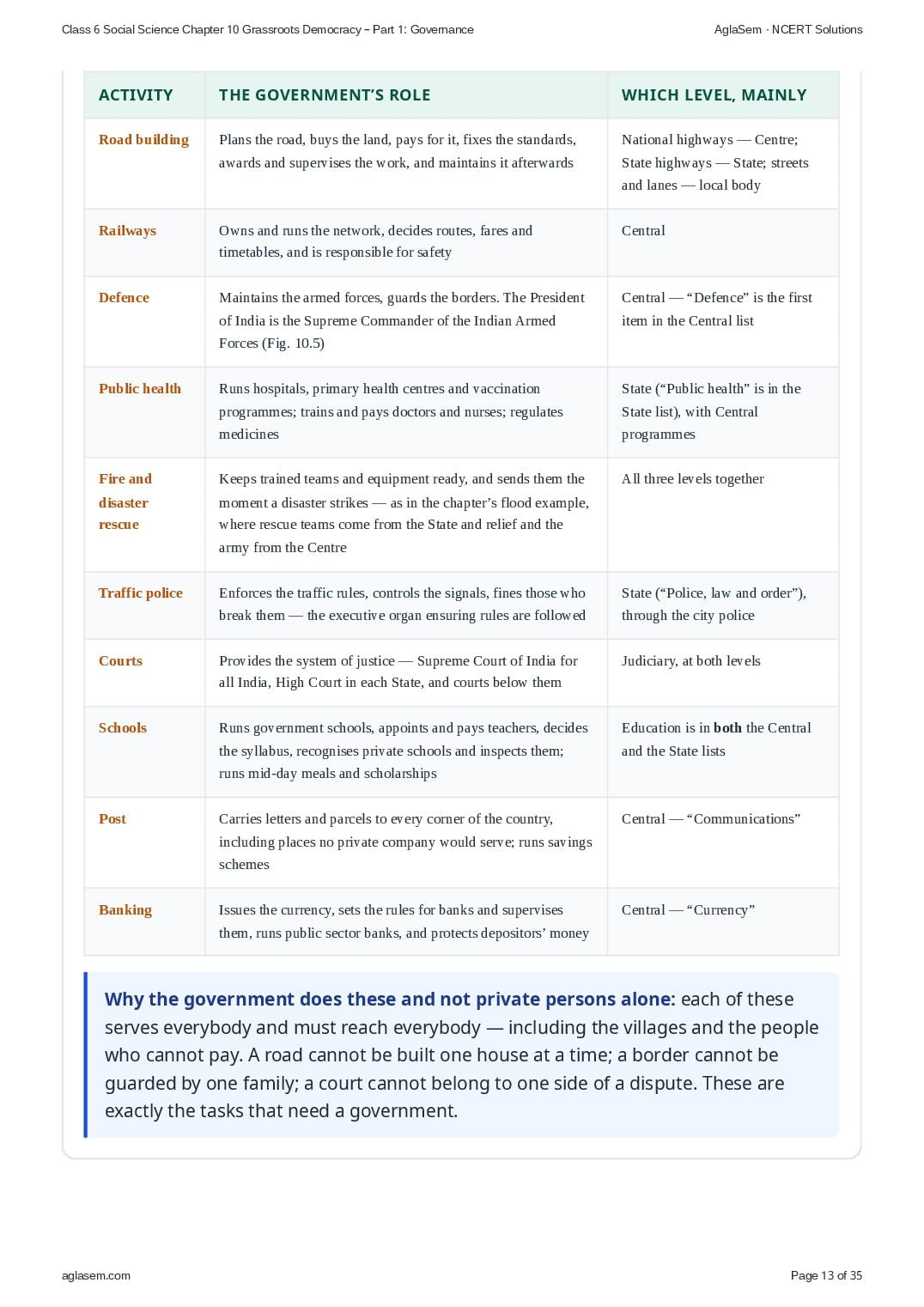
- What role do you think the government plays in each of these activities?
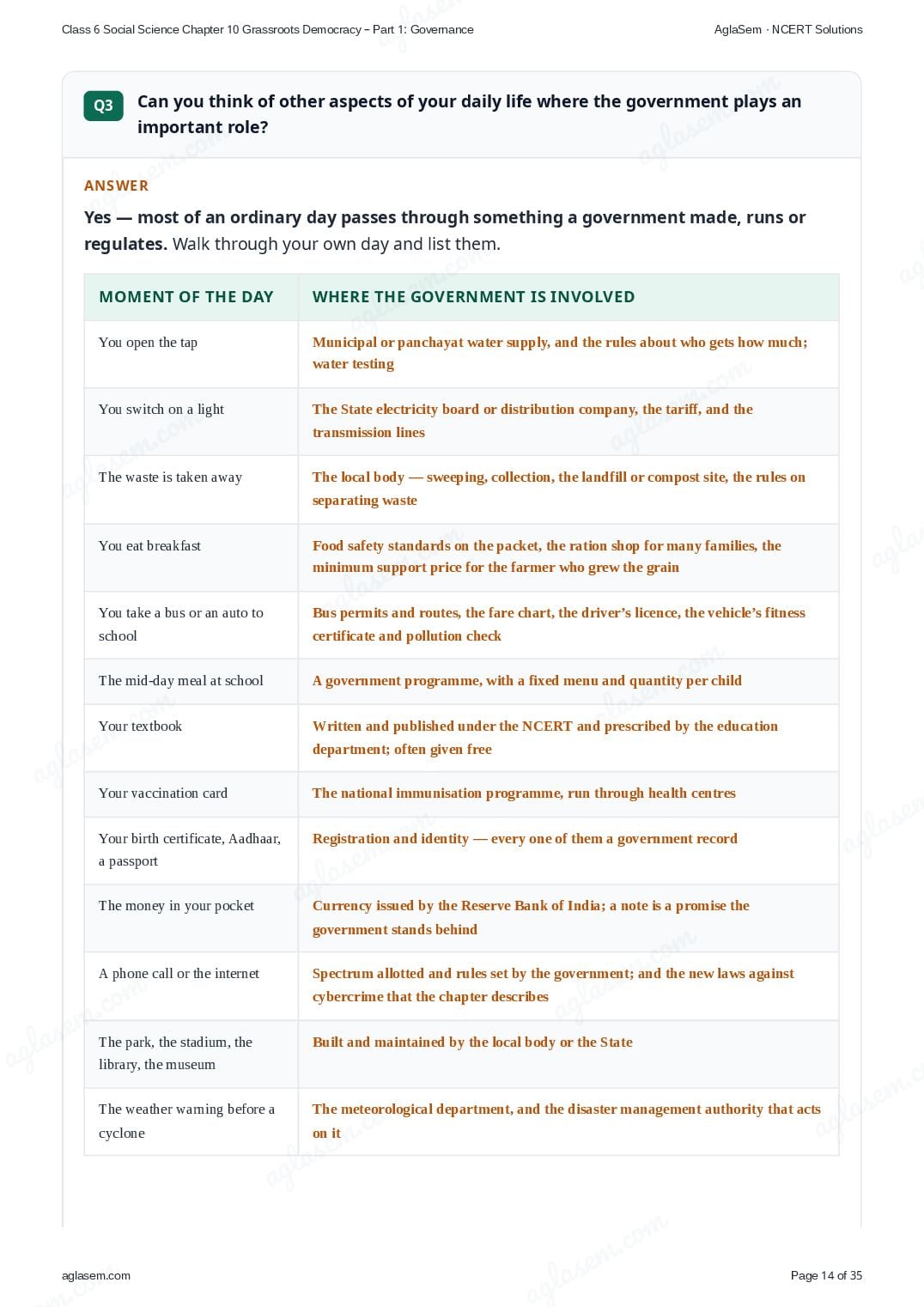
- Can you think of other aspects of your daily life where the government plays an important role?
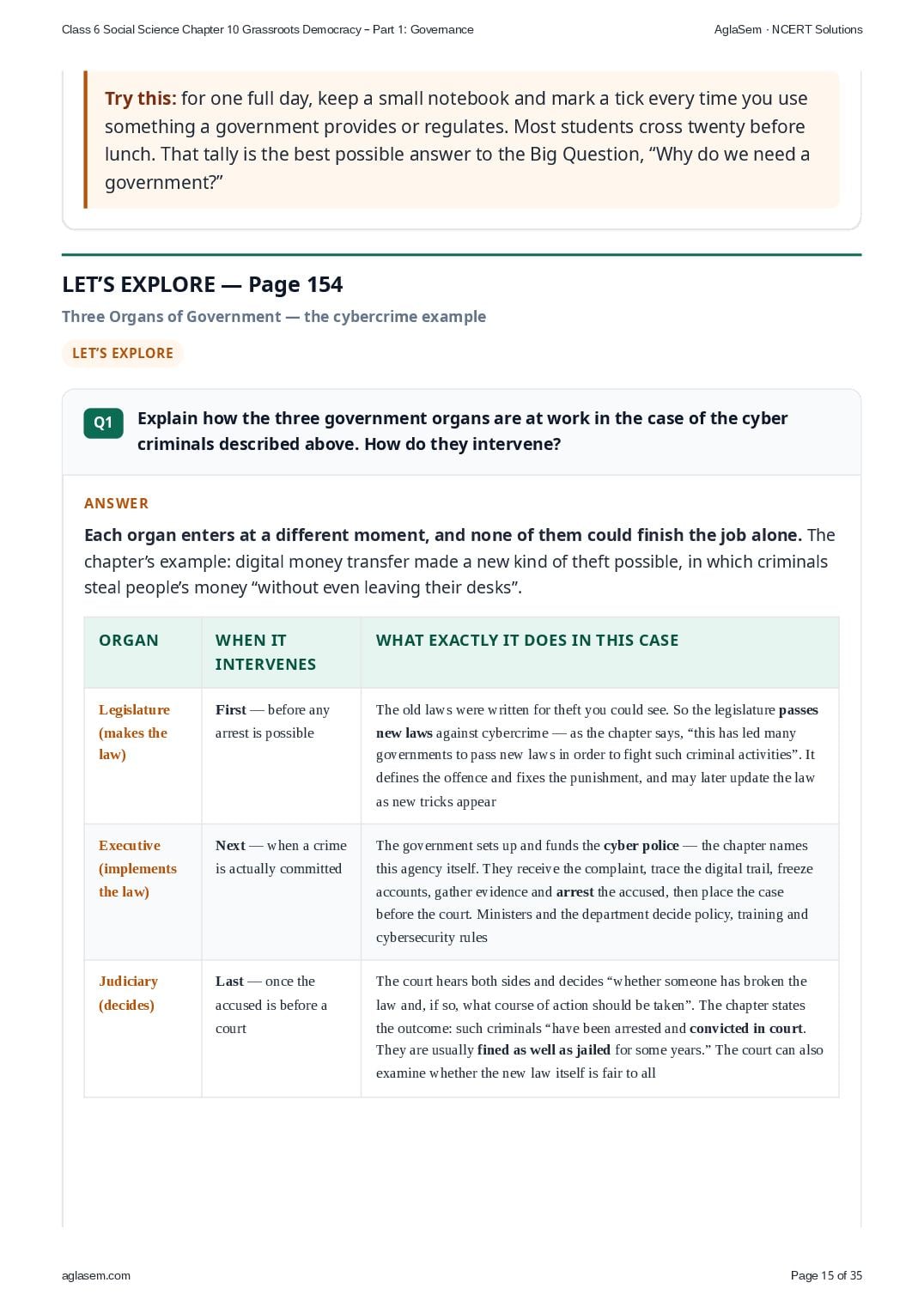
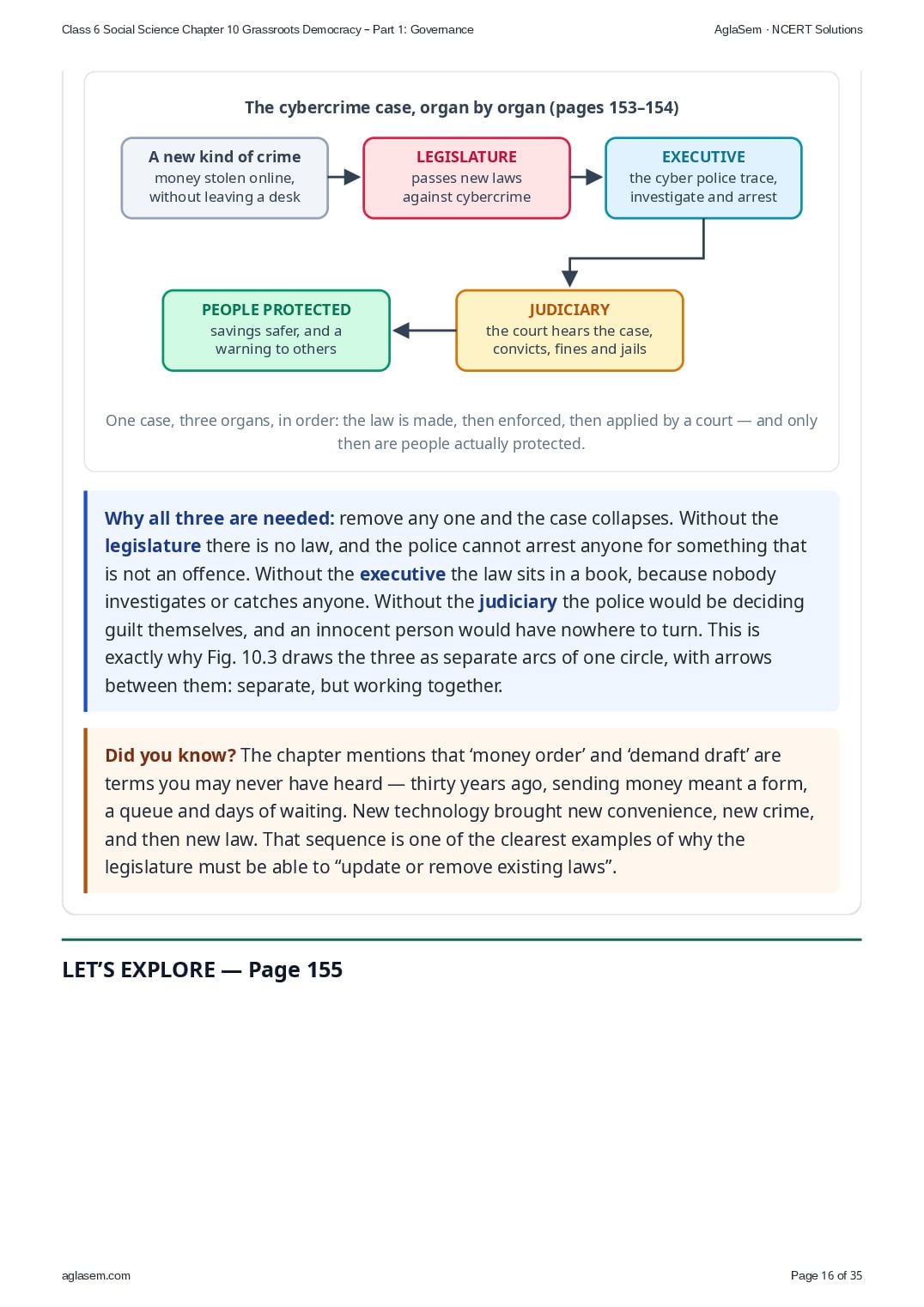
- Explain how the three government organs are at work in the case of the cyber criminals described above. How do they intervene?
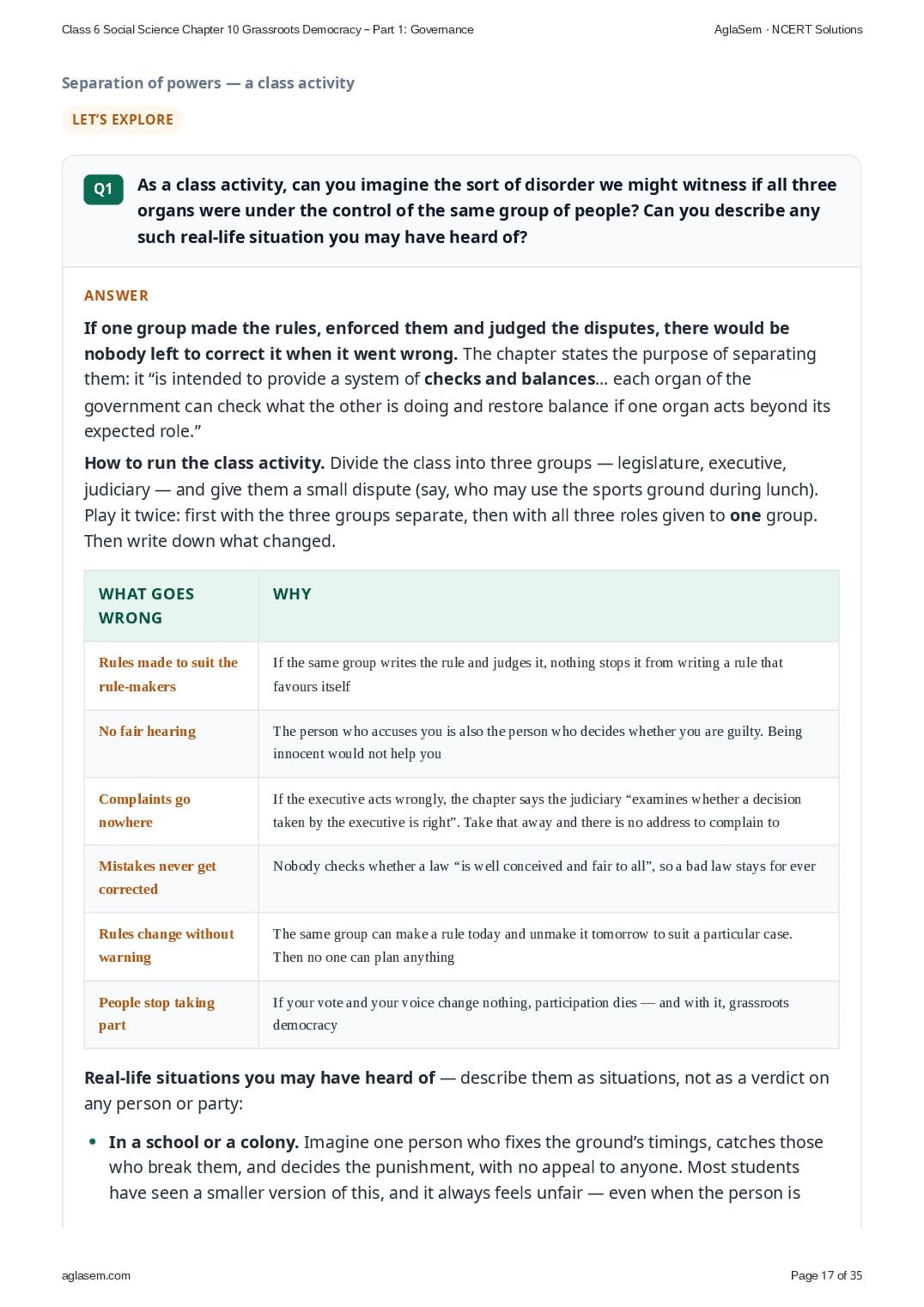
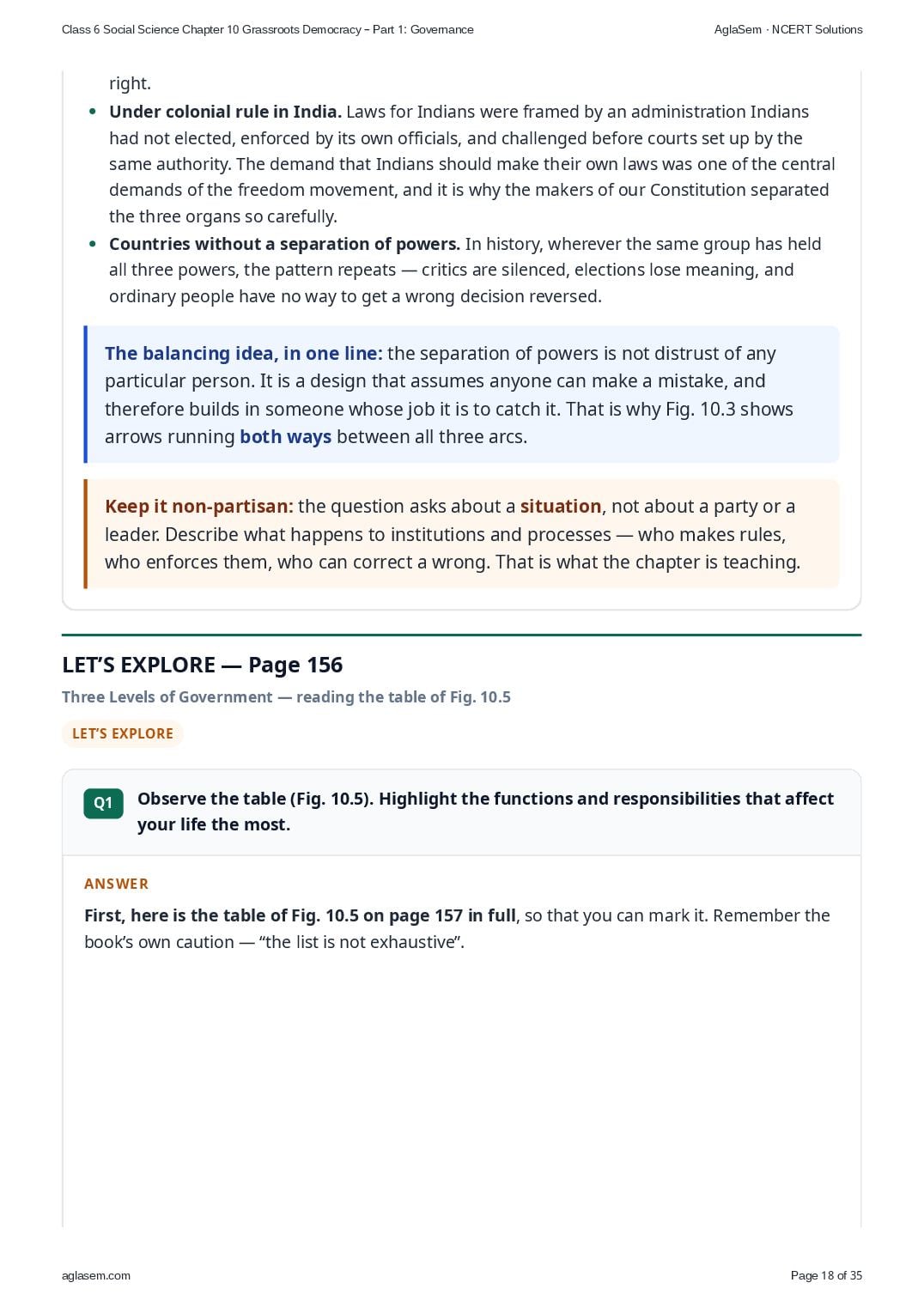
- As a class activity, can you imagine the sort of disorder we might witness if all three organs were under the control of the same group of people? Can you describe any such real-life situation you may have heard of?
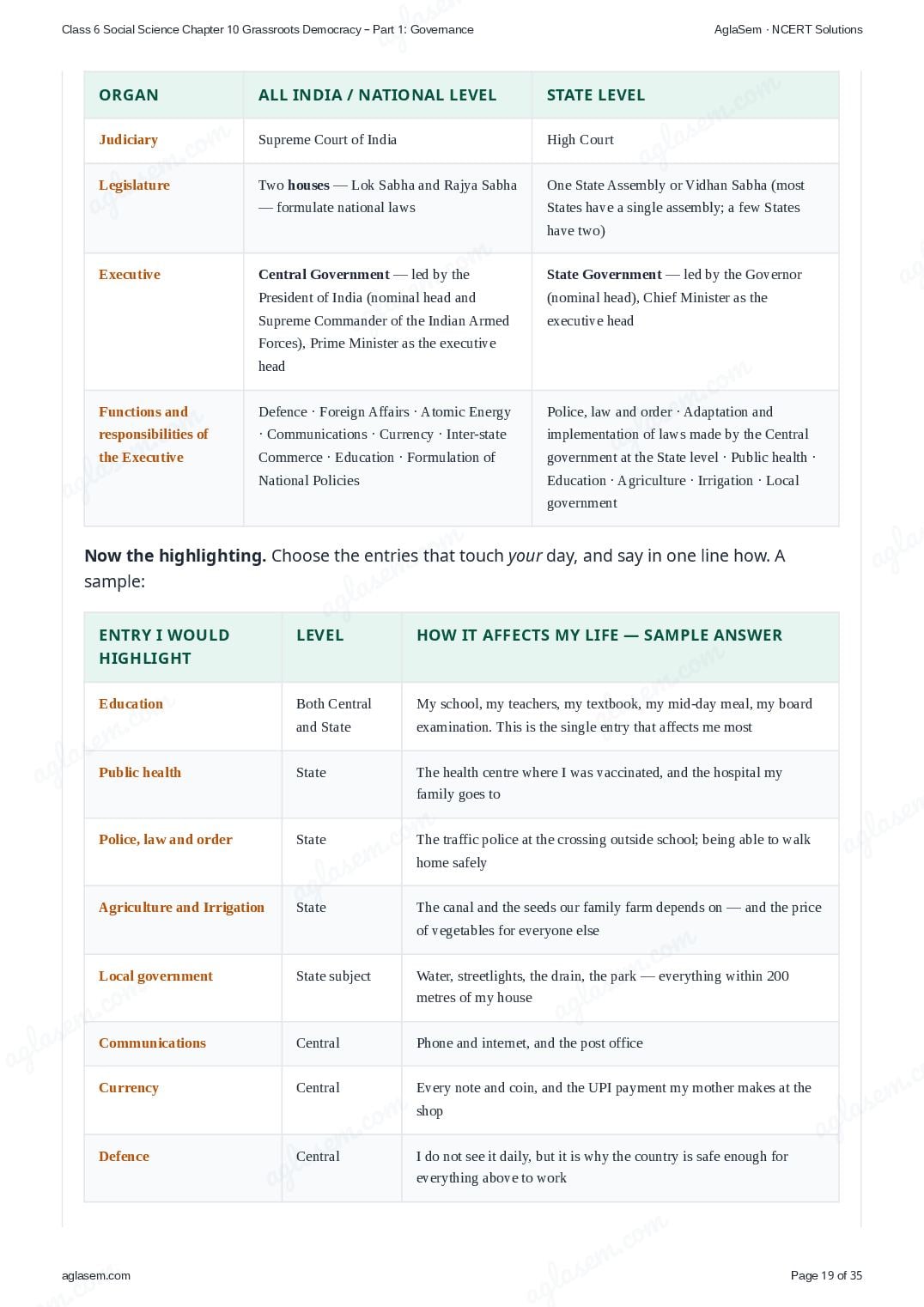
- Observe the table (Fig. 10.5). Highlight the functions and responsibilities that affect your life the most.
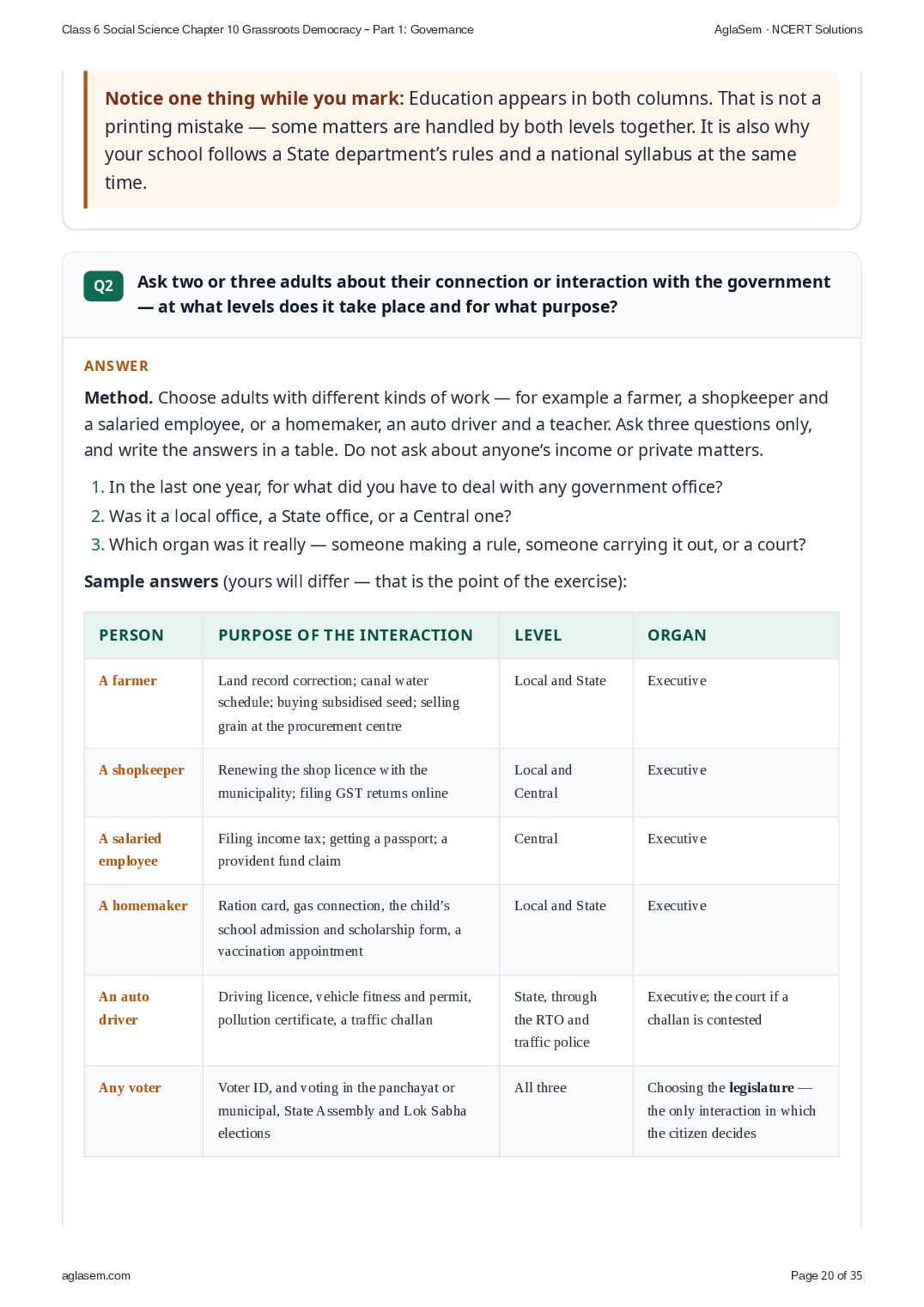
- Ask two or three adults about their connection or interaction with the government — at what levels does it take place and for what purpose?
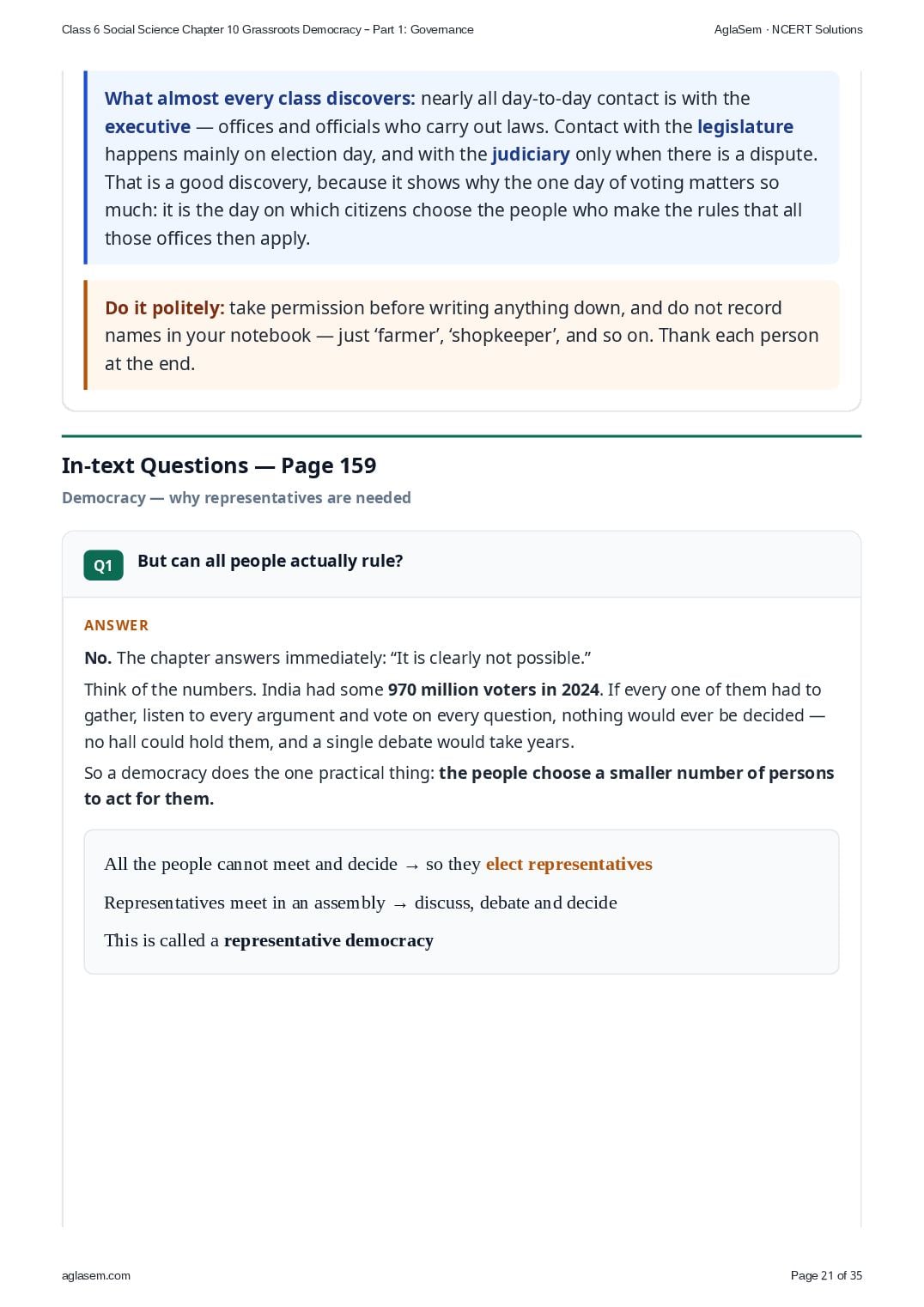
- But can all people actually rule?
- Will the entire class go to the principal?
- No country can run without governance and government.
- A modern government has three organs — legislative, executive and judiciary — which need to work together.
- The Indian government functions at three levels — Centre or national, State and local.
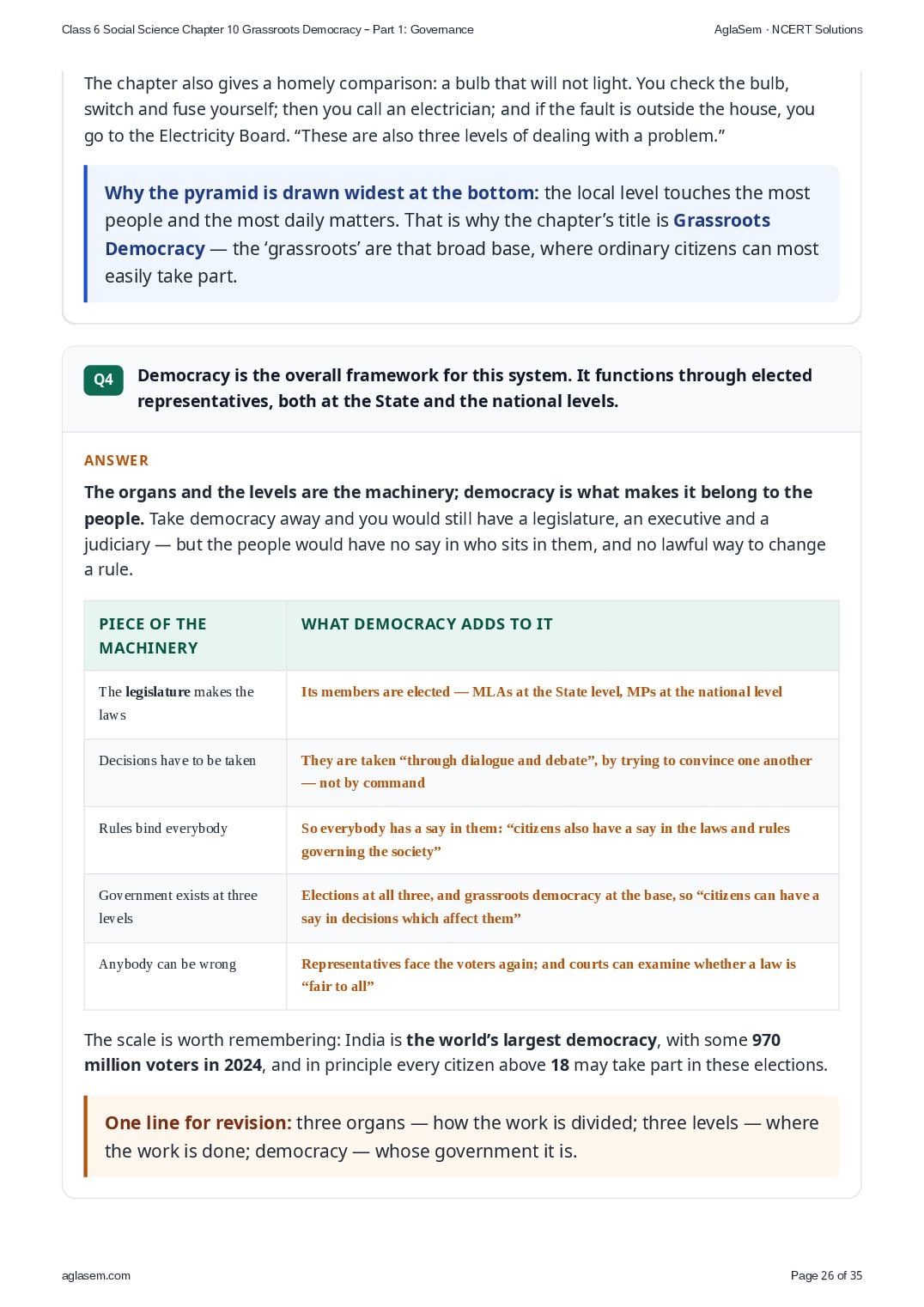
- Democracy is the overall framework for this system. It functions through elected representatives, both at the State and the national levels.
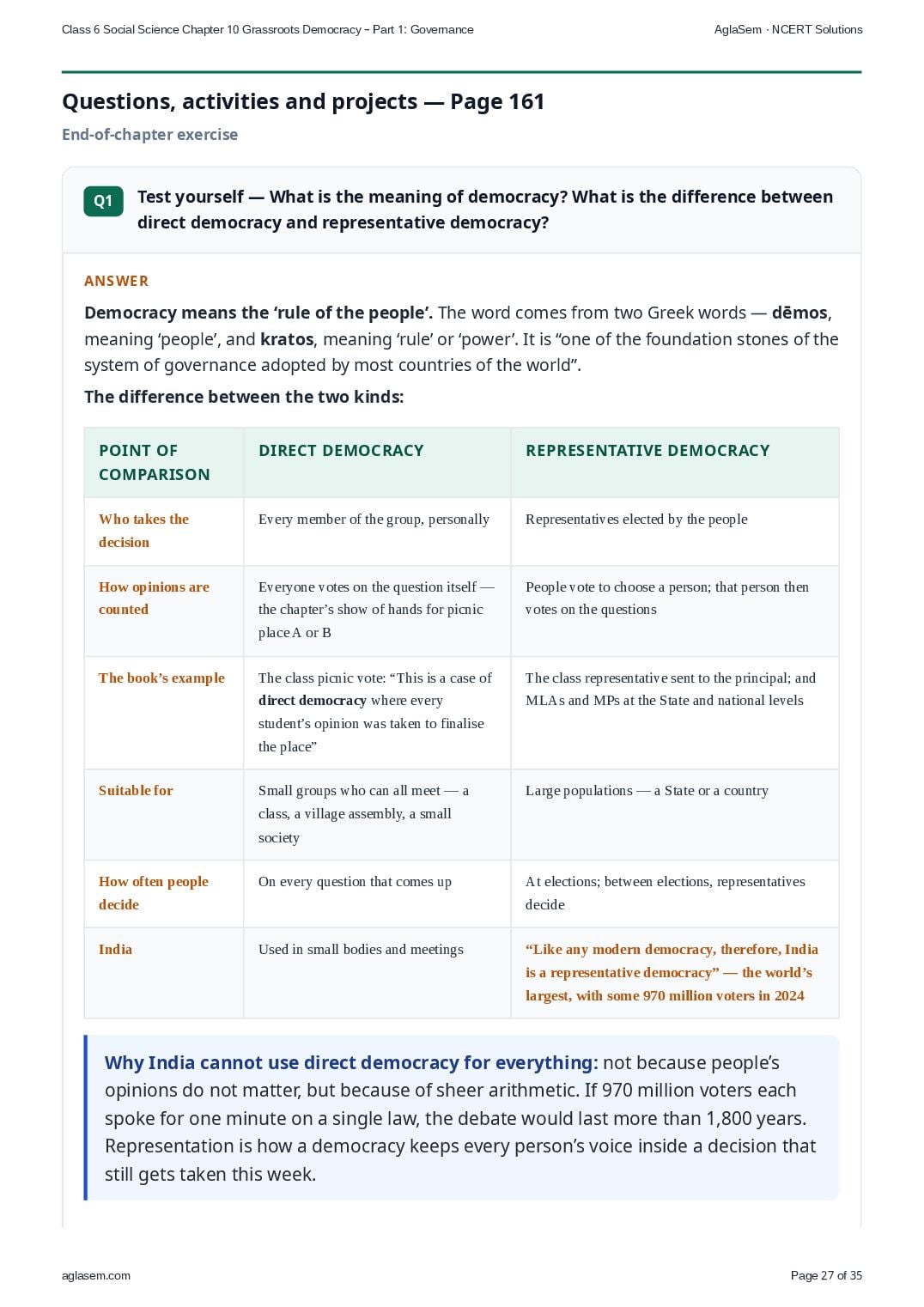
- Test yourself — What is the meaning of democracy? What is the difference between direct democracy and representative democracy?
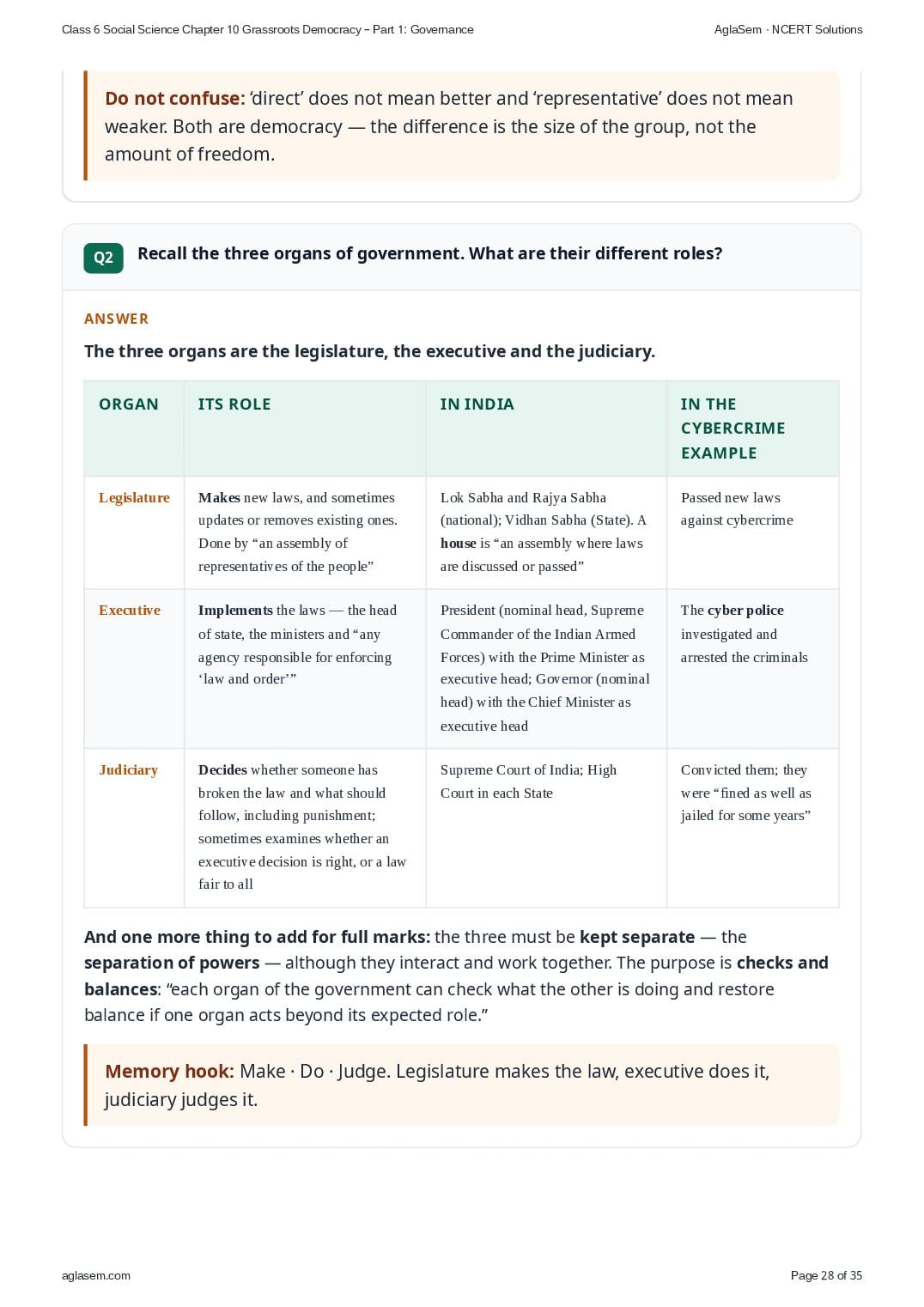
- Recall the three organs of government. What are their different roles?
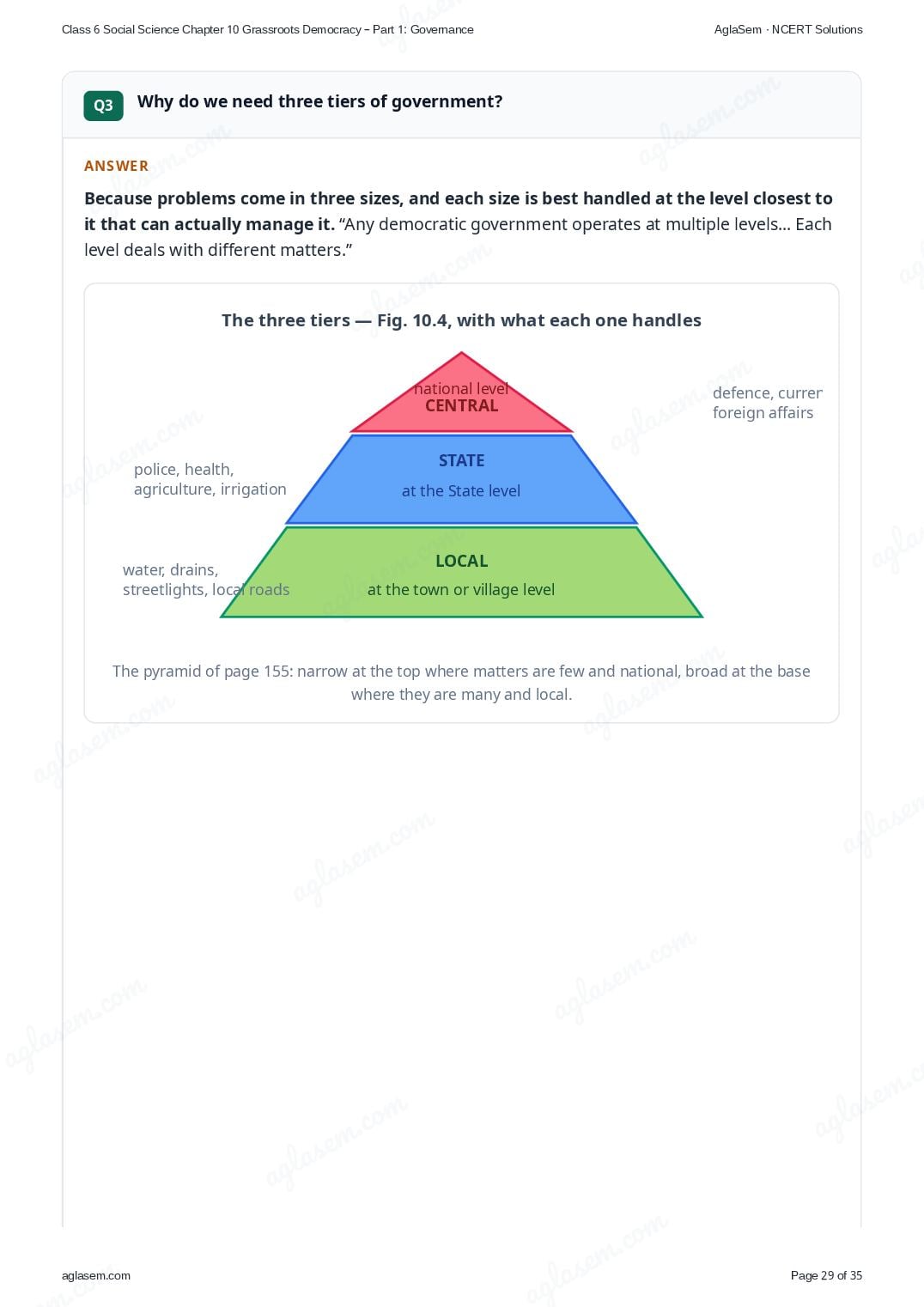
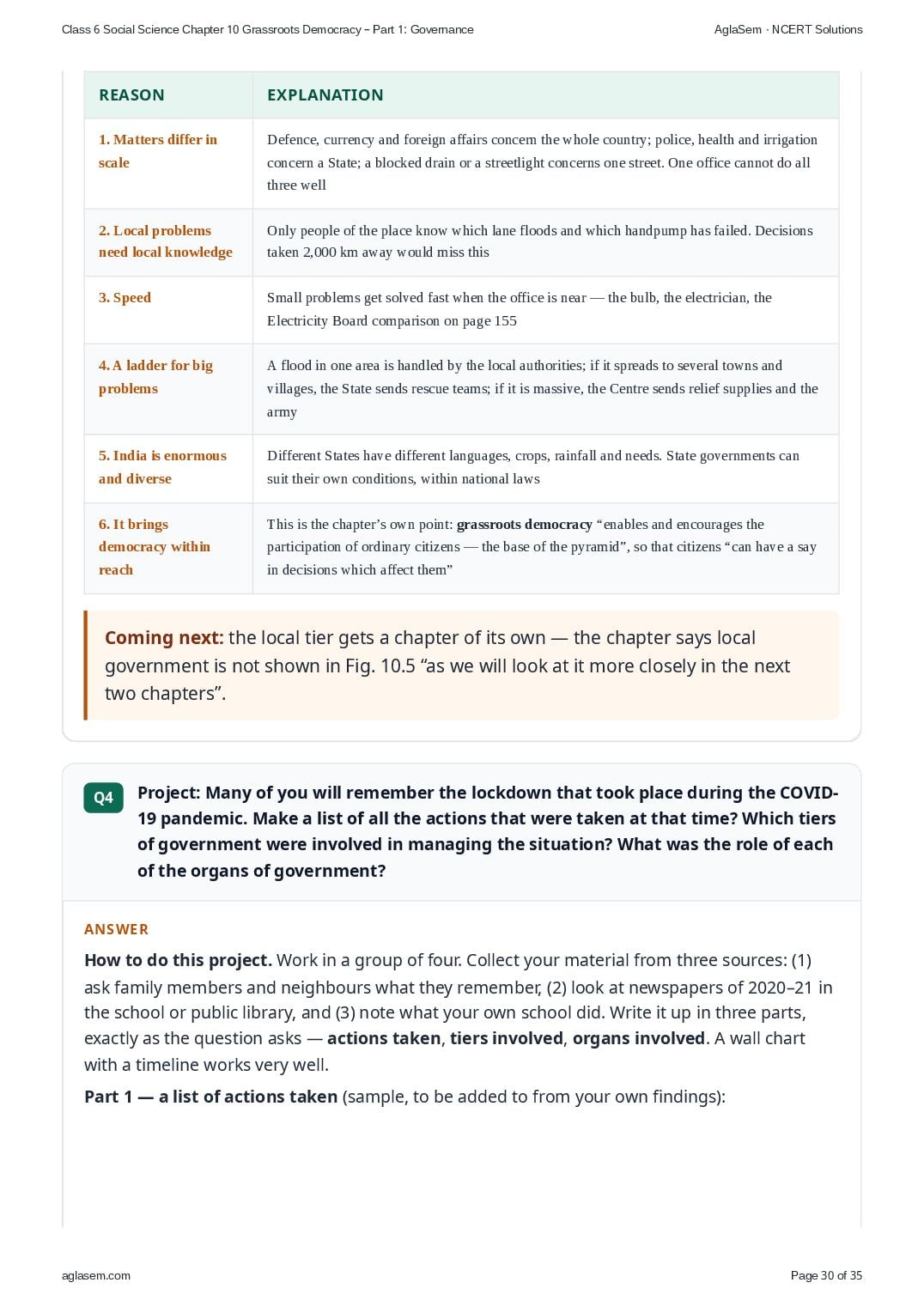
- Why do we need three tiers of government?
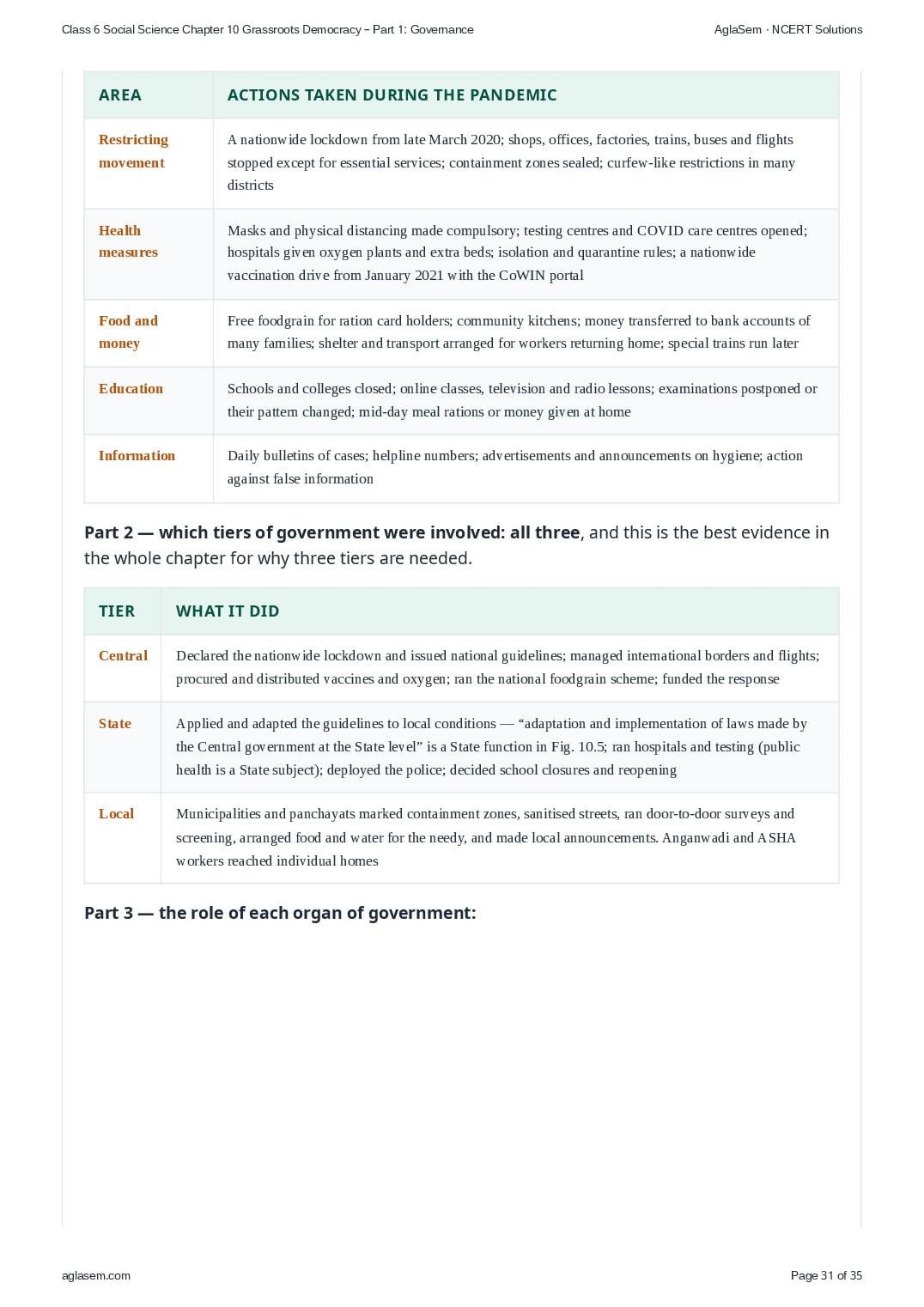
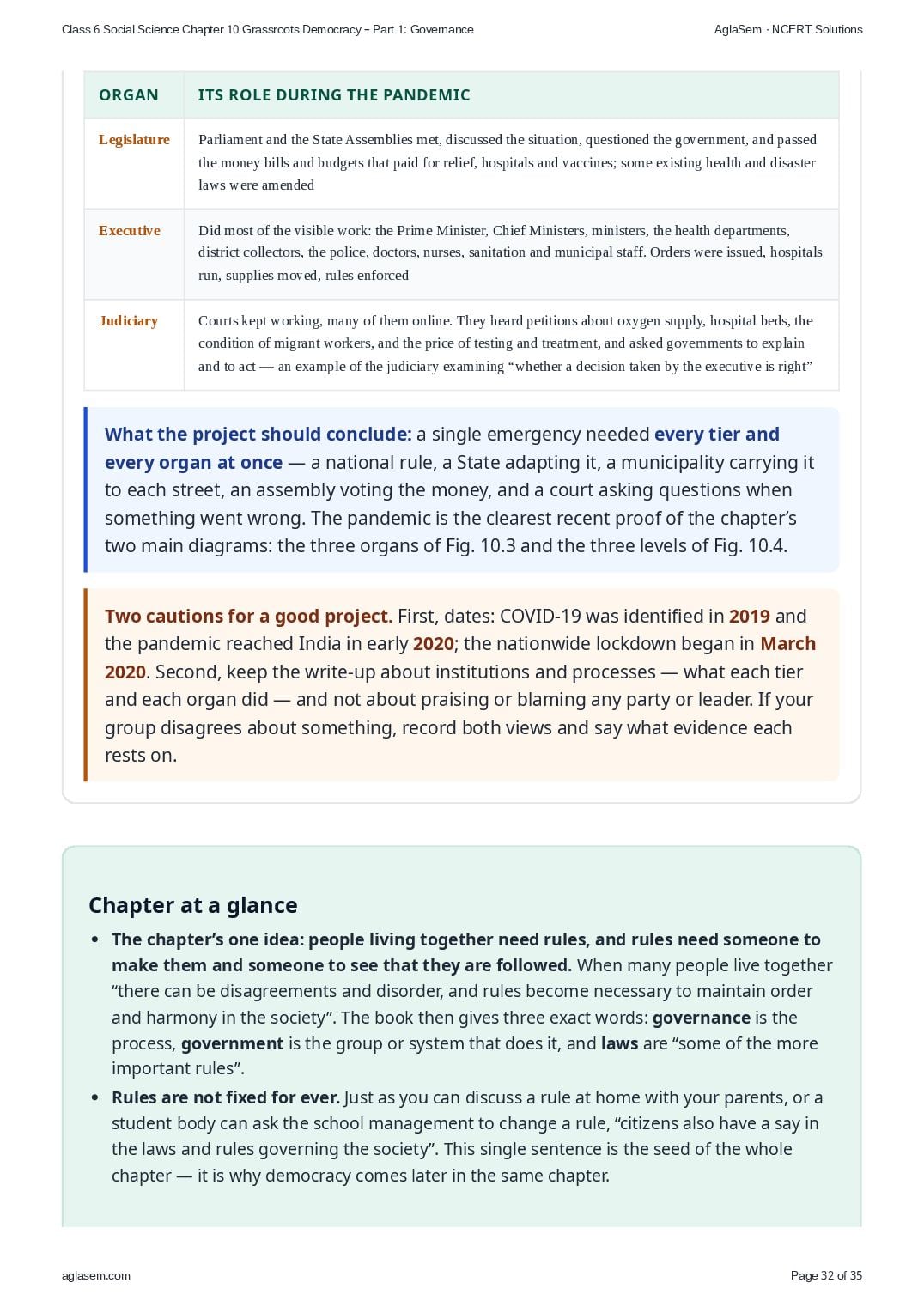
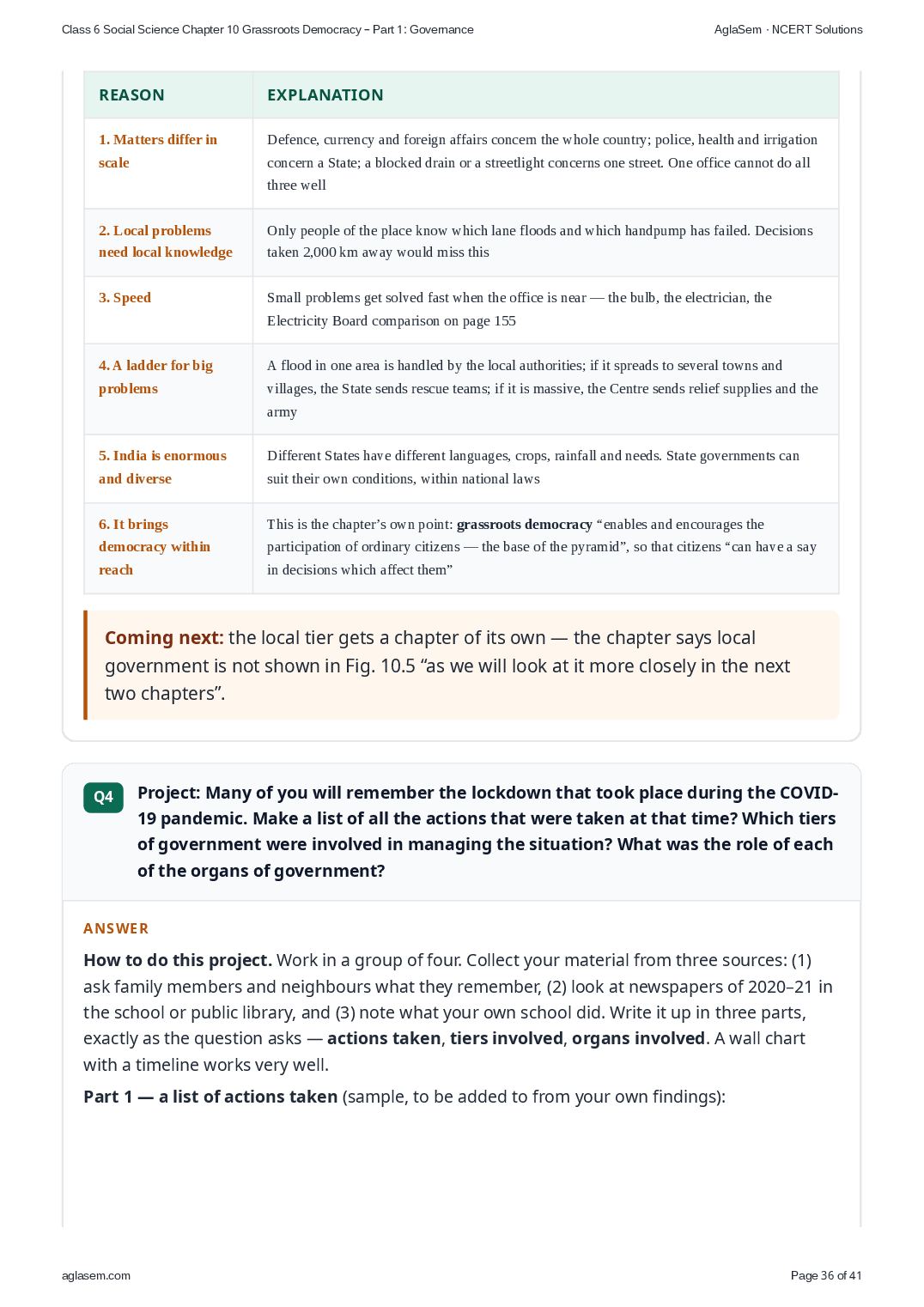
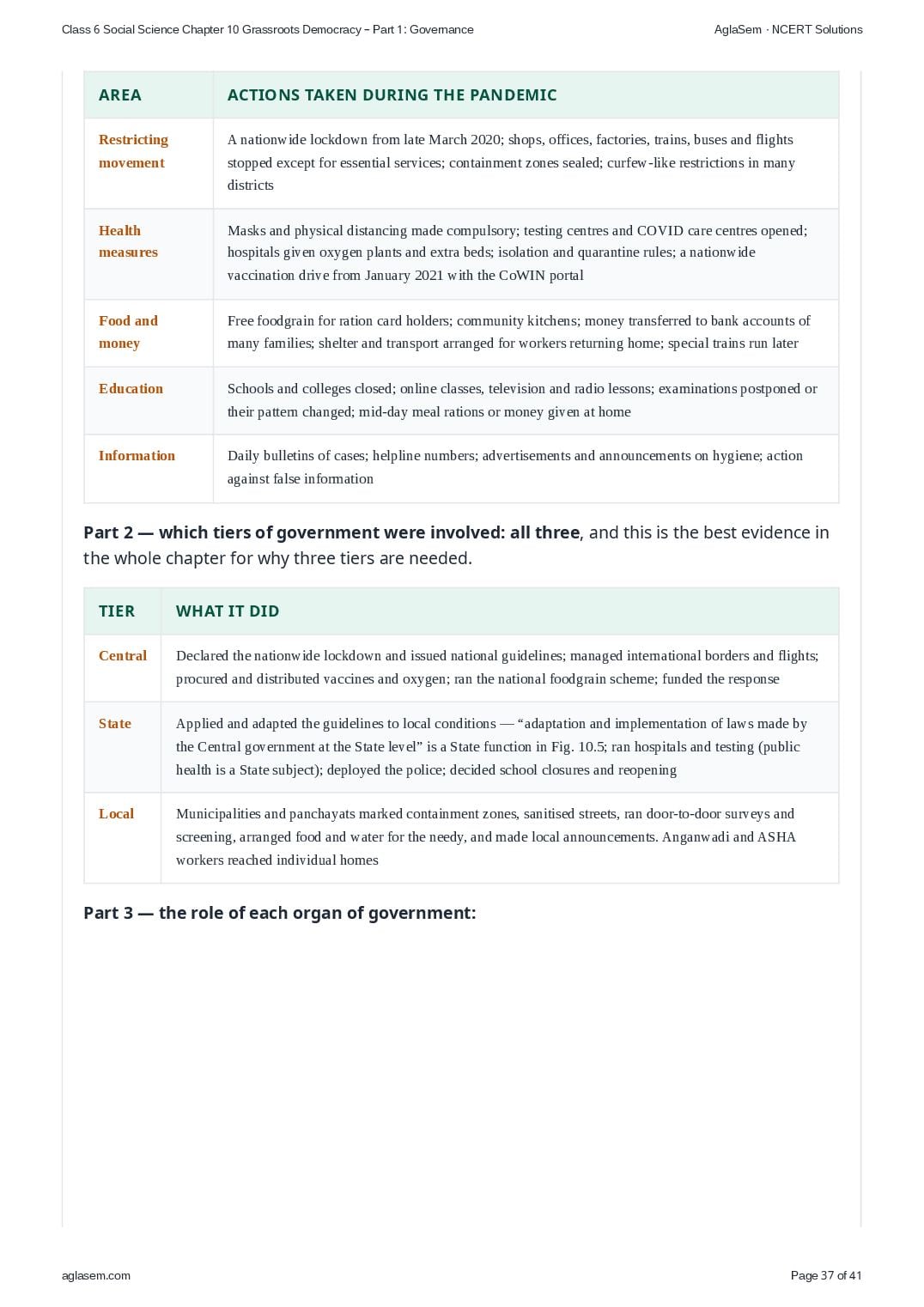
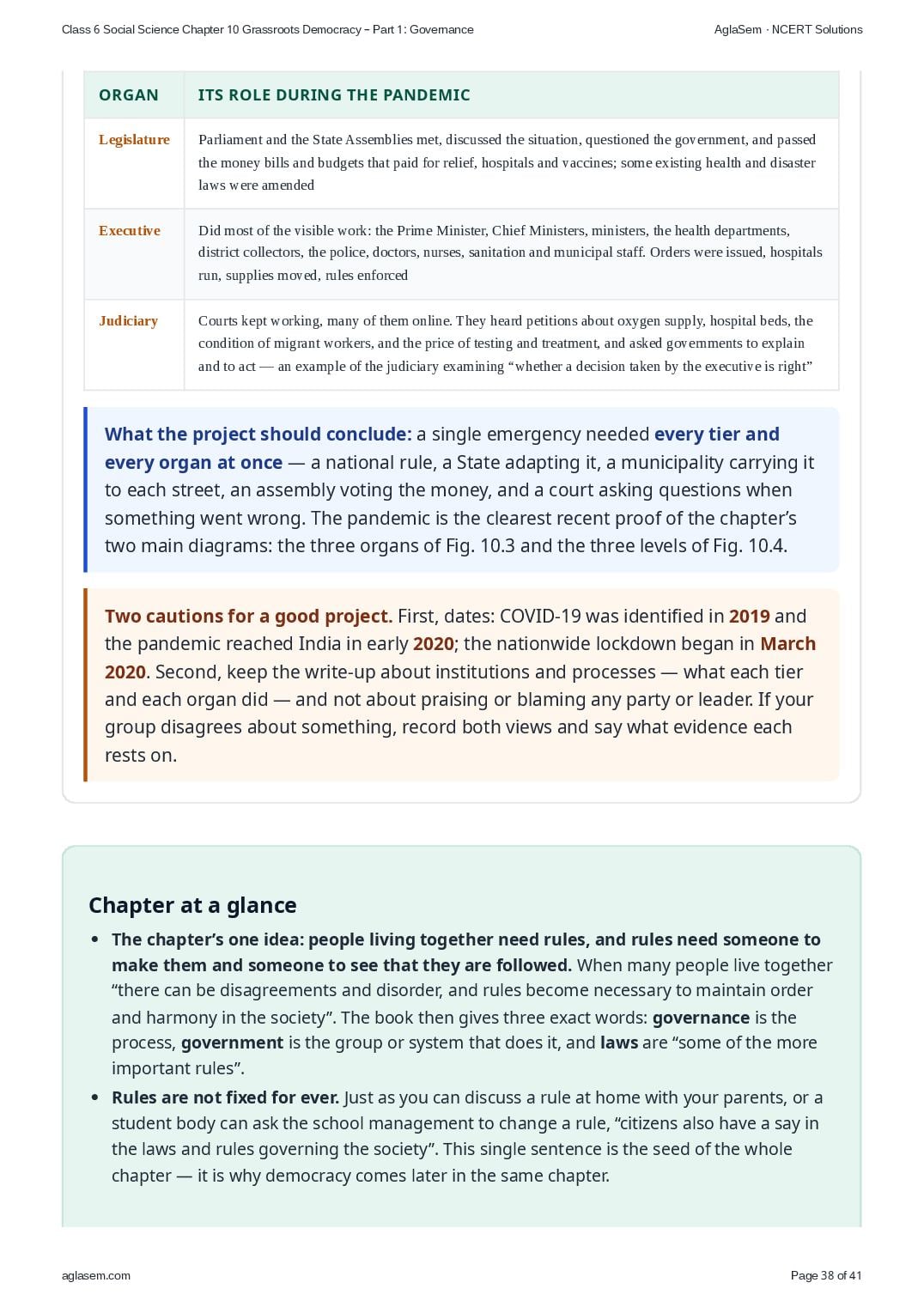
- Project: Many of you will remember the lockdown that took place during the COVID-19 pandemic. Make a list of all the actions that were taken at that time? Which tiers of government were involved in managing the situation? What was the role of each of the organs of government?
Chapter at a Glance
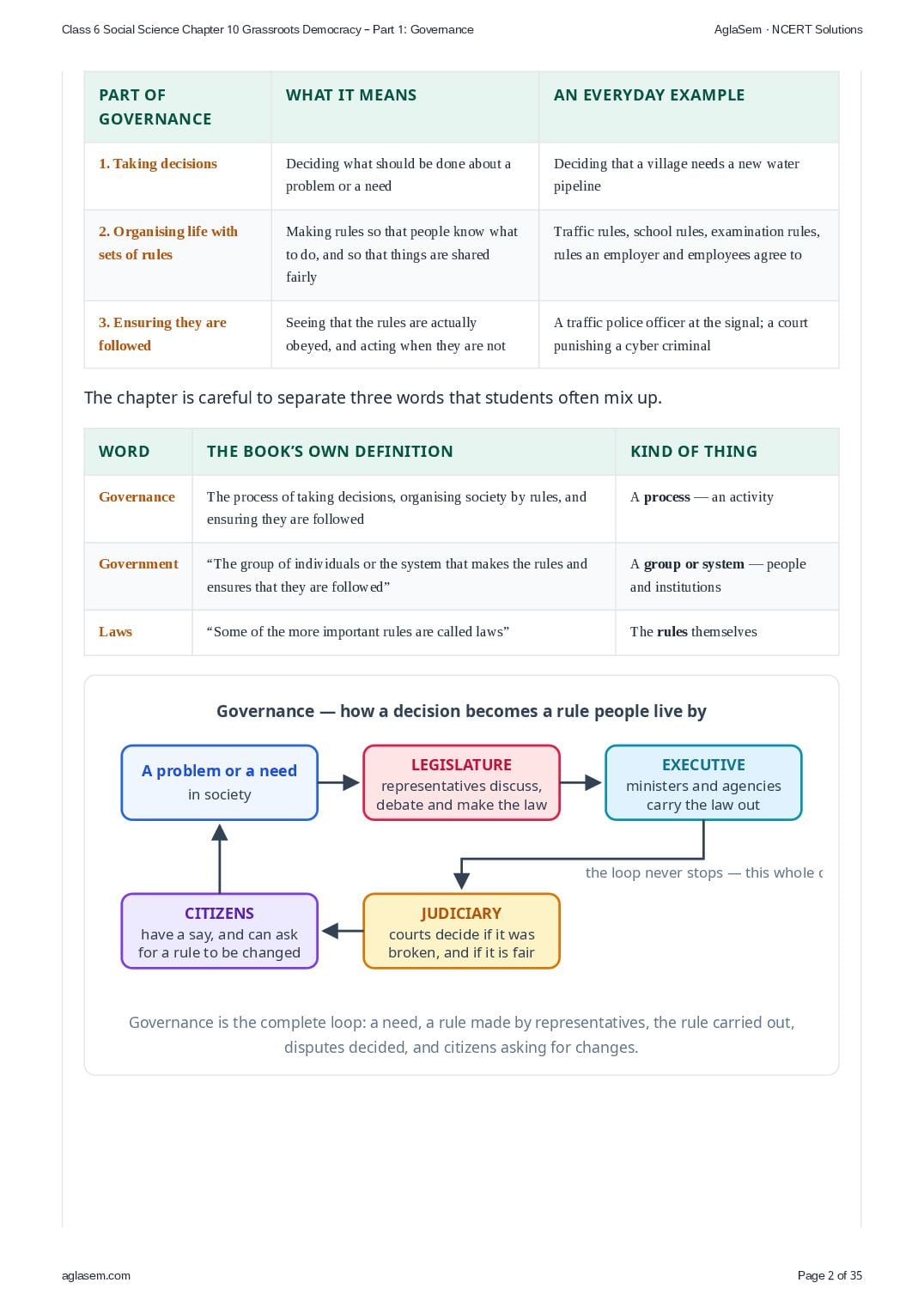
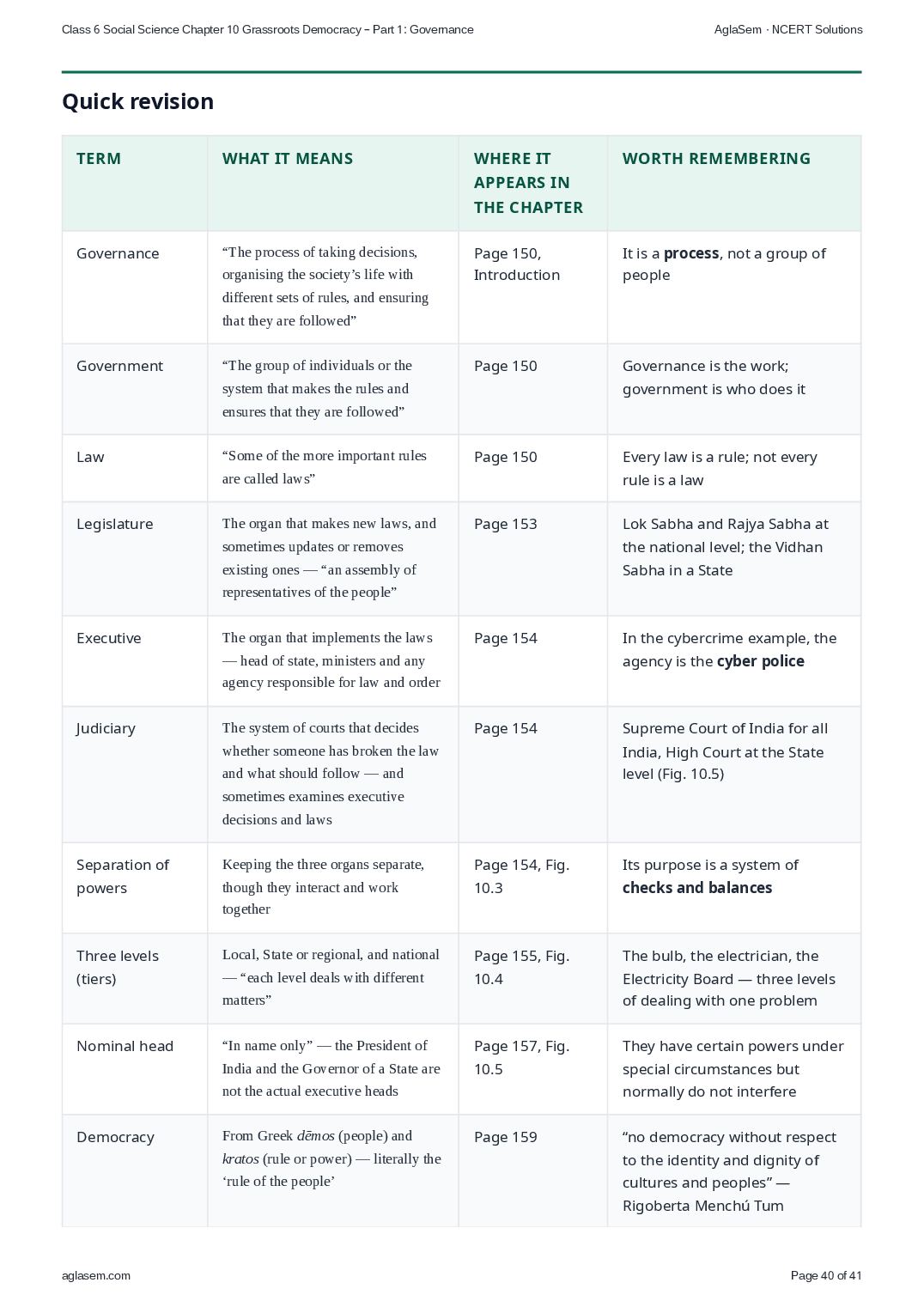
- The chapter’s one idea: people living together need rules, and rules need someone to make them and someone to see that they are followed. When many people live together “there can be disagreements and disorder, and rules become necessary to maintain order and harmony in the society”. The book then gives three exact words: governance is the process, government is the group or system that does it, and laws are “some of the more important rules”.
- Rules are not fixed for ever. Just as you can discuss a rule at home with your parents, or a student body can ask the school management to change a rule, “citizens also have a say in the laws and rules governing the society”. This single sentence is the seed of the whole chapter — it is why democracy comes later in the same chapter.
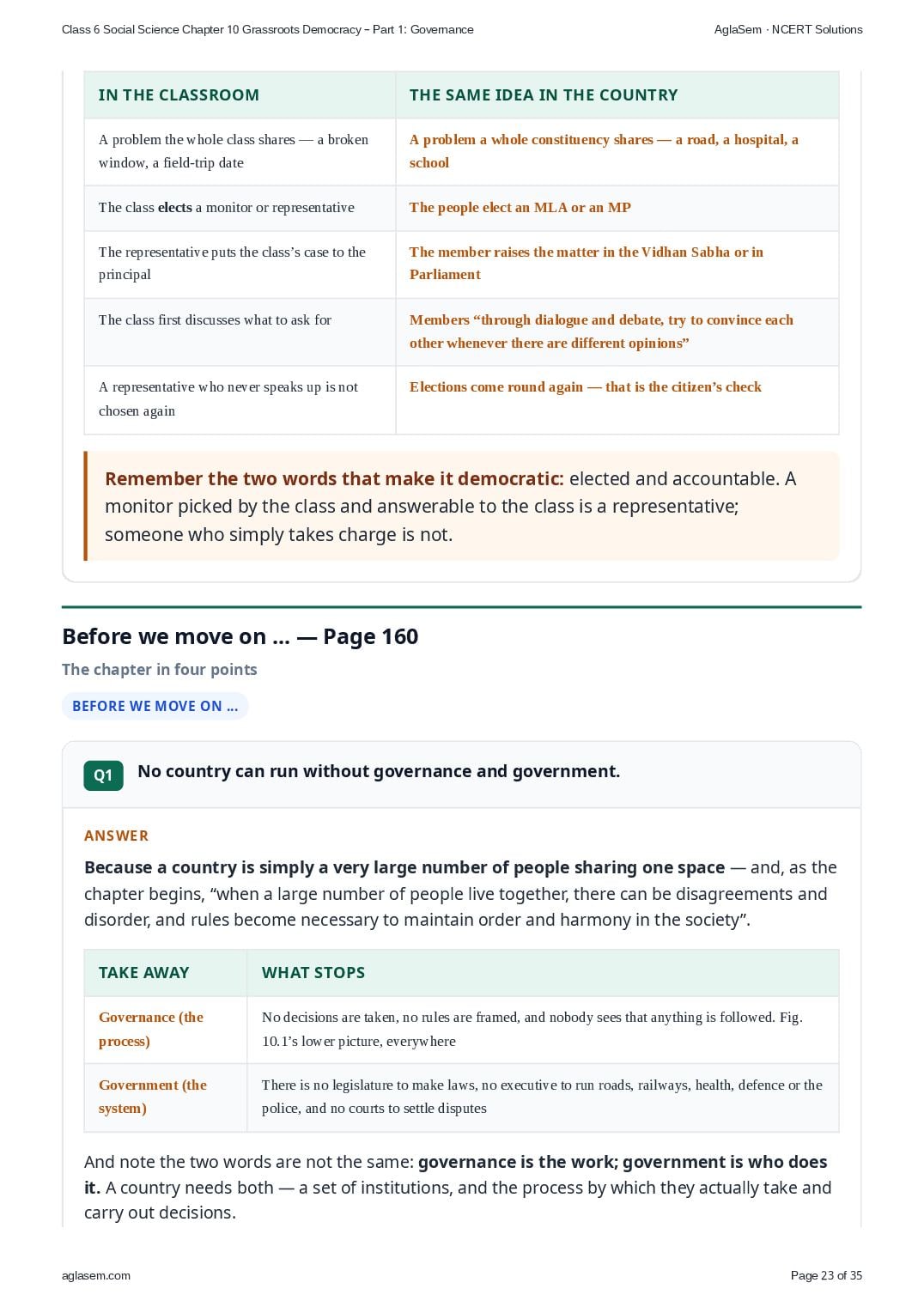
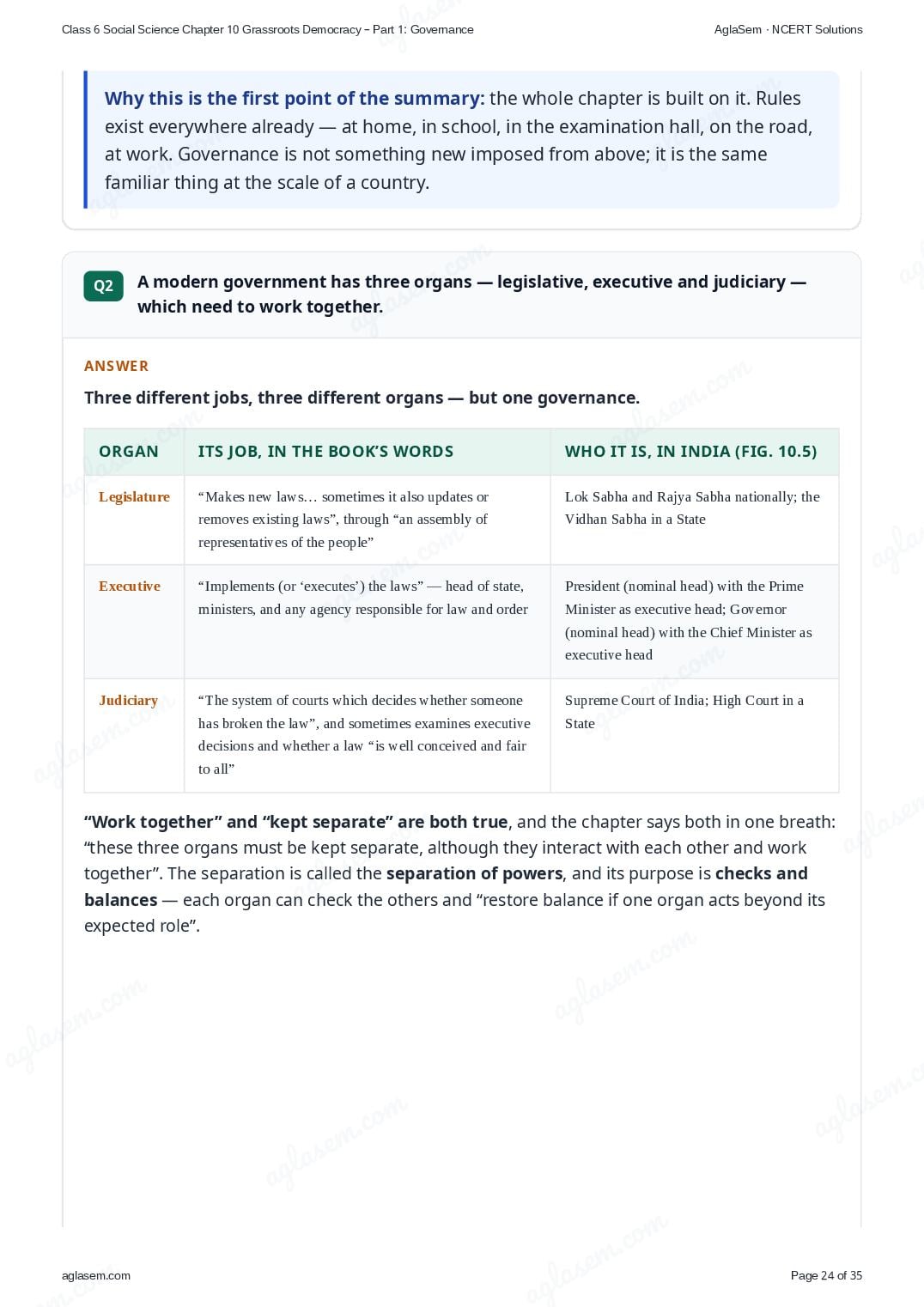
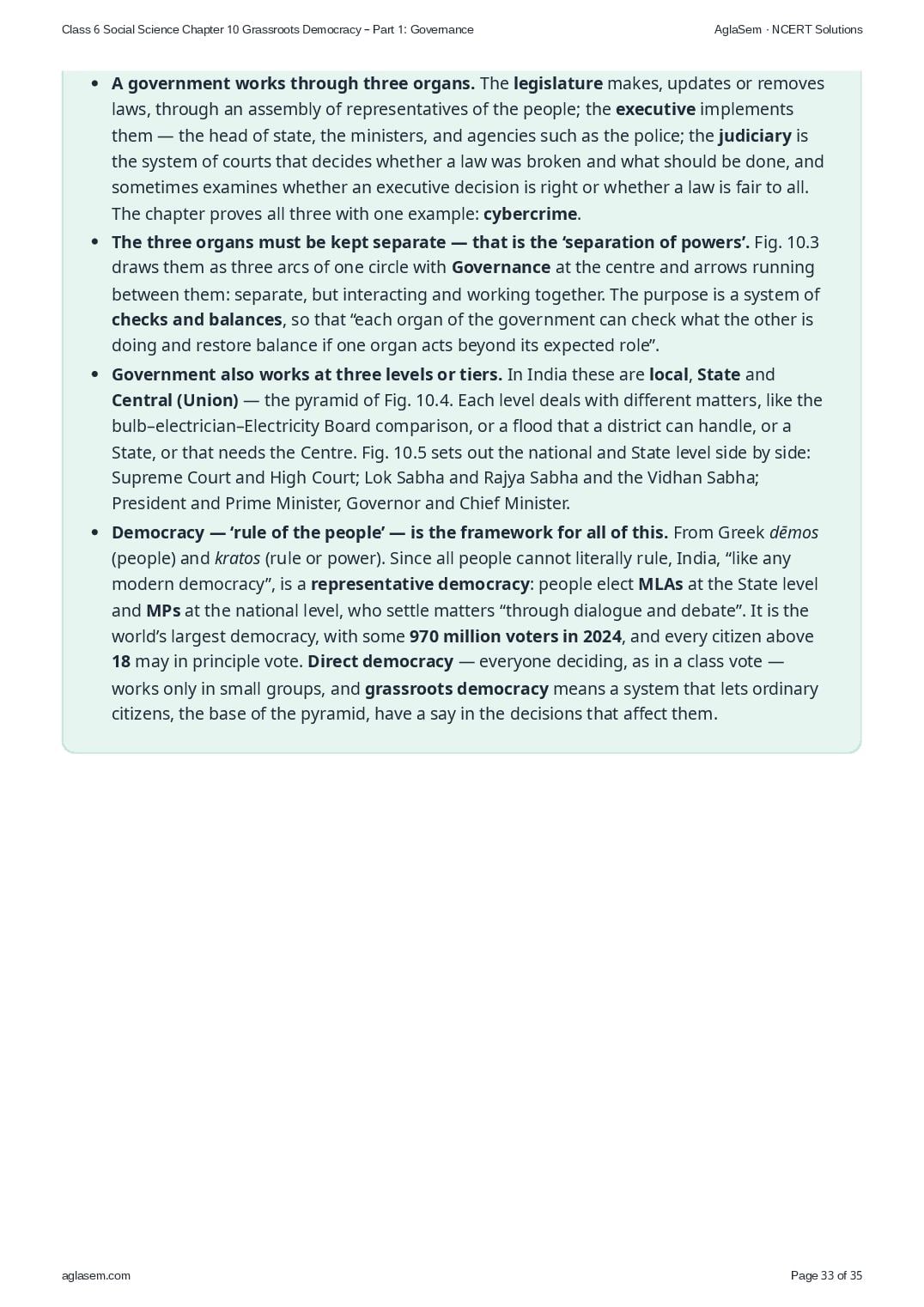
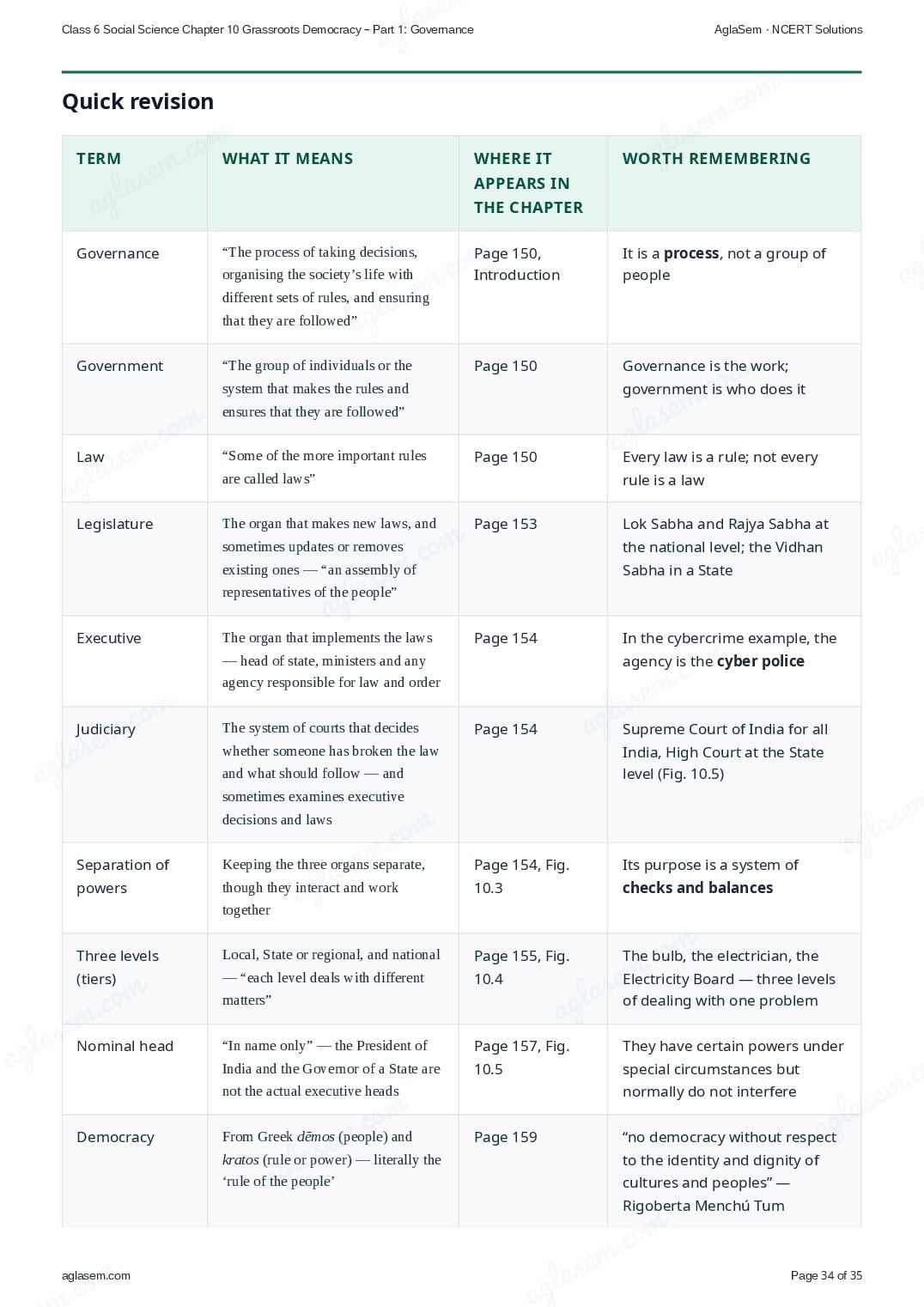
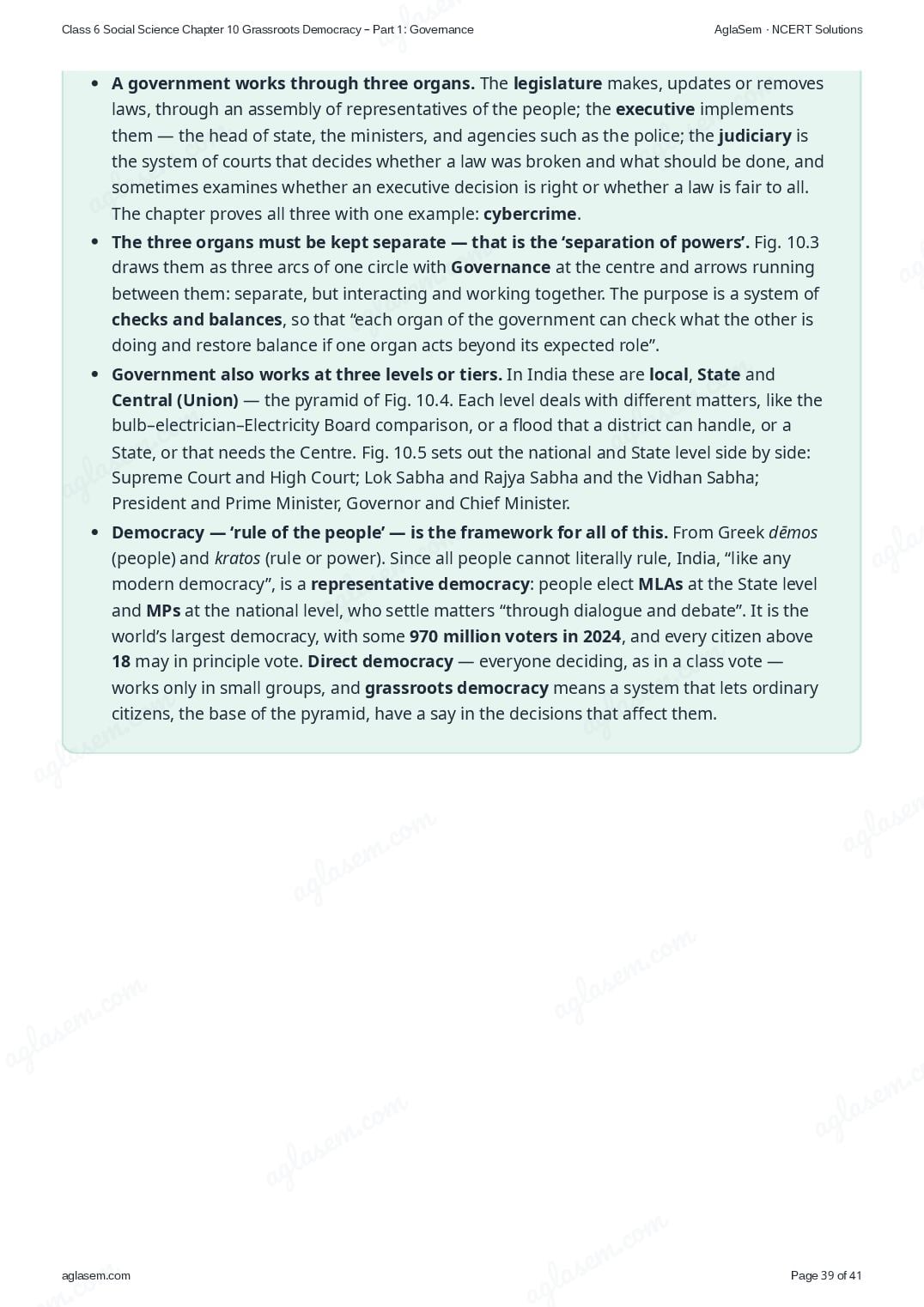
- A government works through three organs. The legislature makes, updates or removes laws, through an assembly of representatives of the people; the executive implements them — the head of state, the ministers, and agencies such as the police; the judiciary is the system of courts that decides whether a law was broken and what should be done, and sometimes examines whether an executive decision is right or whether a law is fair to all. The chapter proves all three with one example: cybercrime .
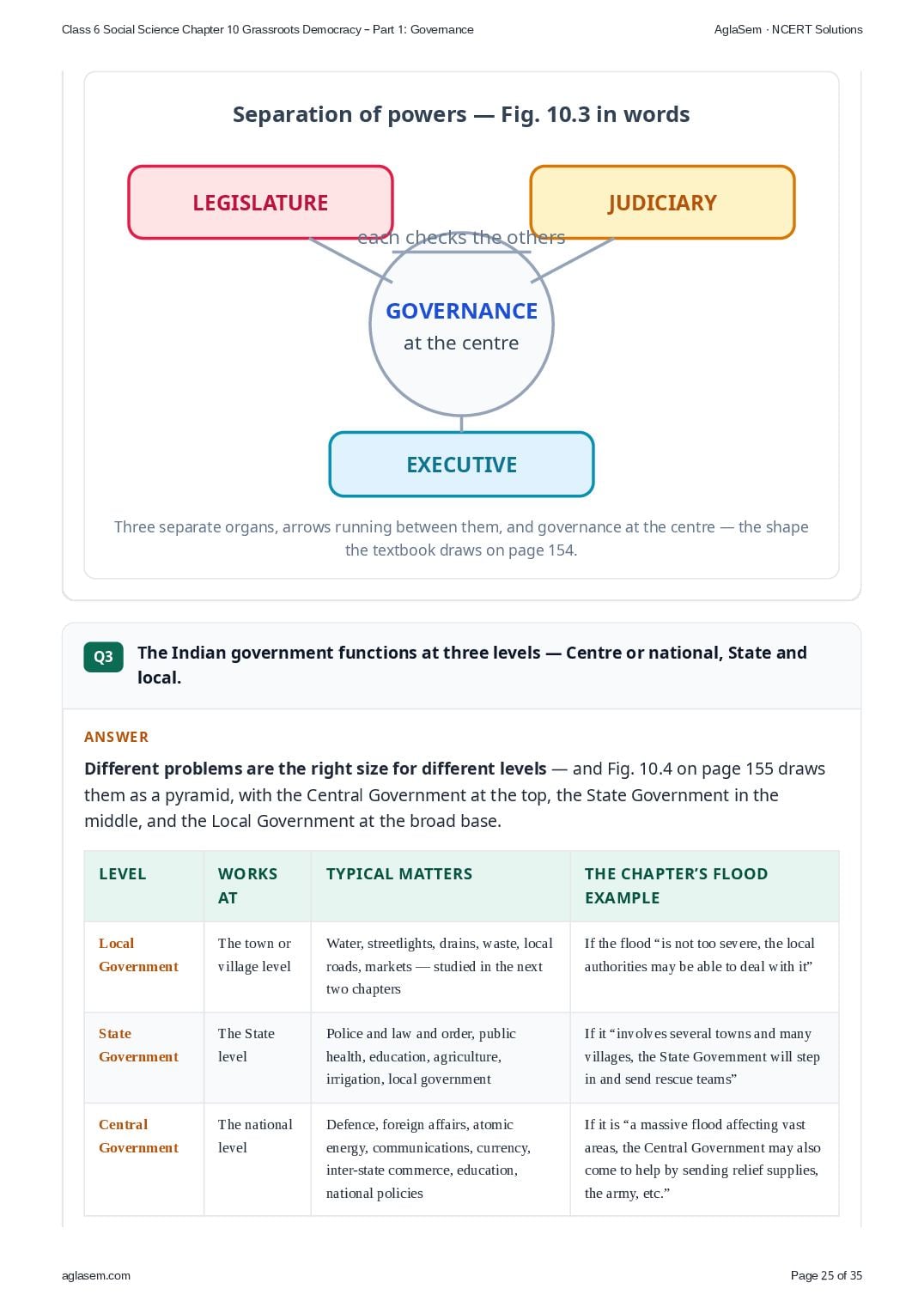
- The three organs must be kept separate — that is the ‘separation of powers’. Fig. 10.3 draws them as three arcs of one circle with Governance at the centre and arrows running between them: separate, but interacting and working together. The purpose is a system of checks and balances , so that “each organ of the government can check what the other is doing and restore balance if one organ acts beyond its expected role”.
- Government also works at three levels or tiers. In India these are local , State and Central (Union) — the pyramid of Fig. 10.4. Each level deals with different matters, like the bulb–electrician–Electricity Board comparison, or a flood that a district can handle, or a State, or that needs the Centre. Fig. 10.5 sets out the national and State level side by side: Supreme Court and High Court; Lok Sabha and Rajya Sabha and the Vidhan Sabha; President and Prime Minister, Governor and Chief Minister.
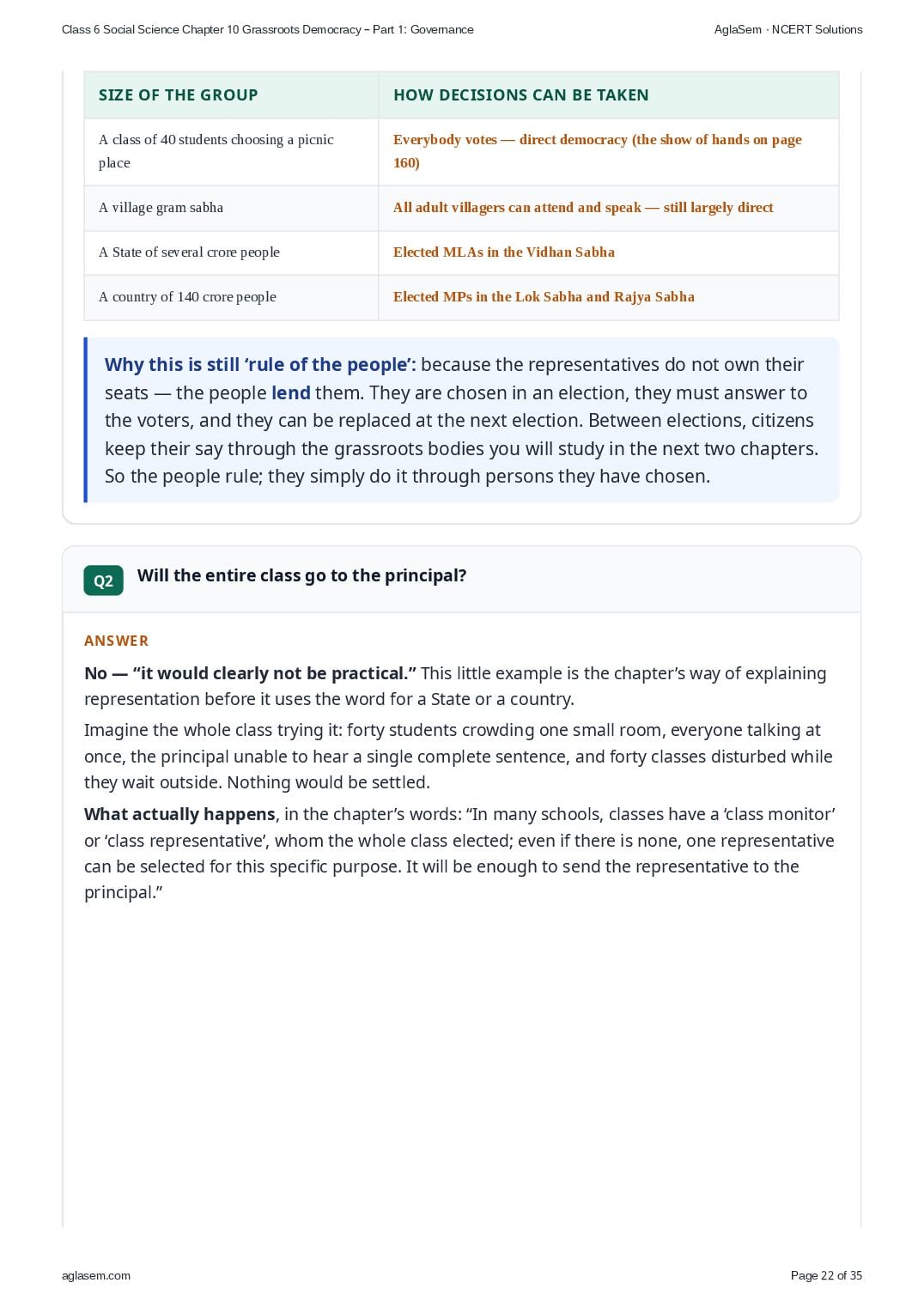
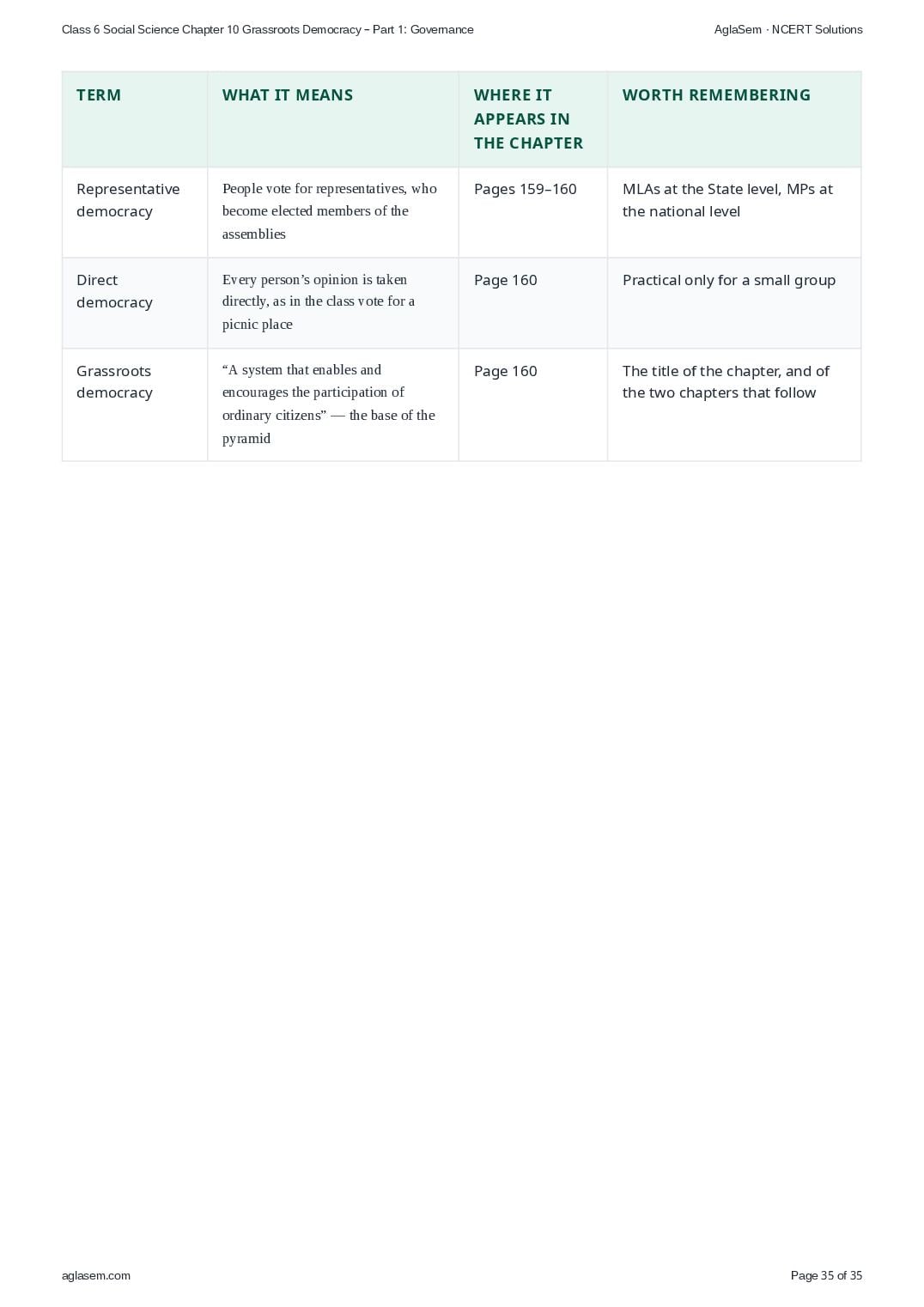
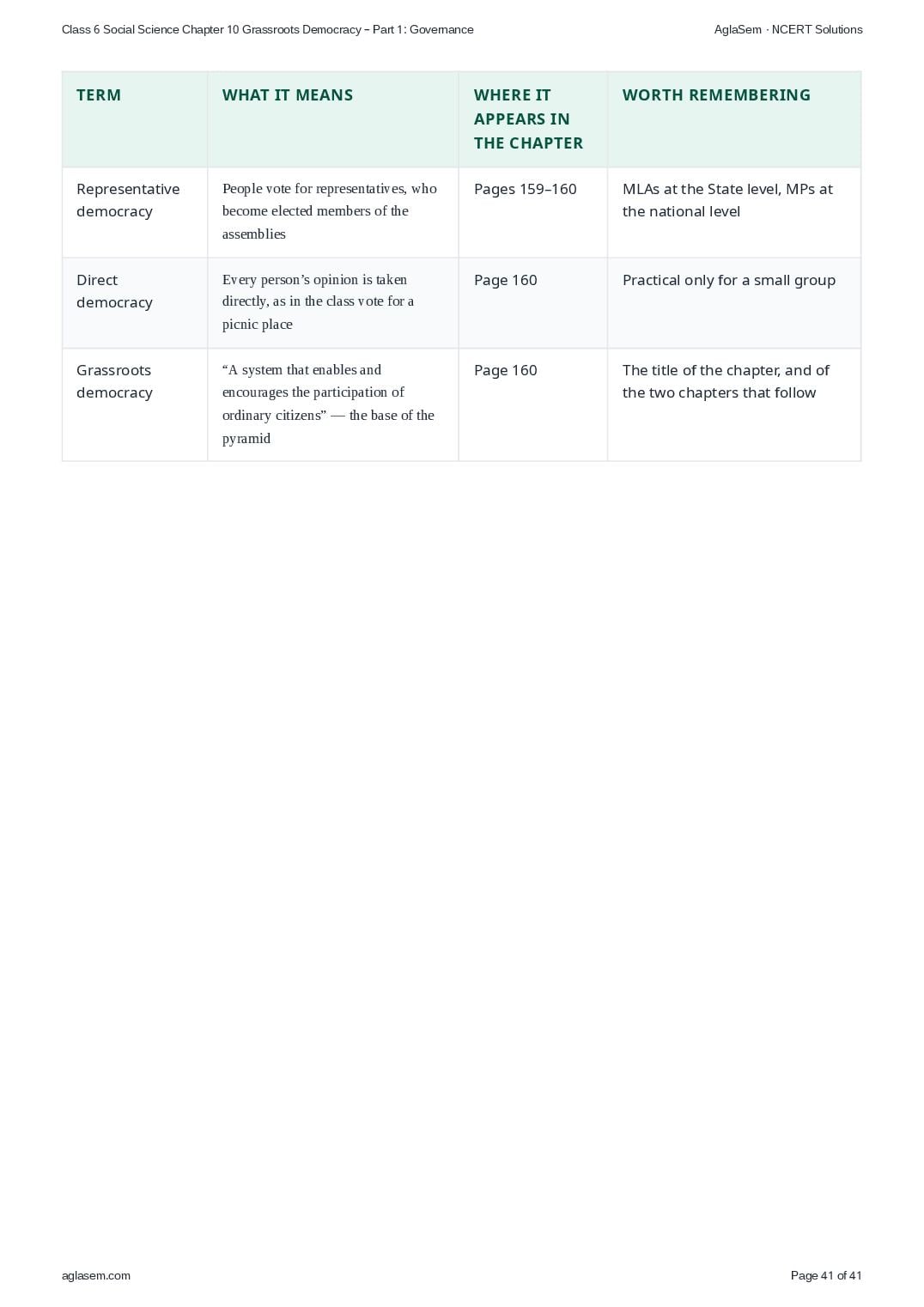
- Democracy — ‘rule of the people’ — is the framework for all of this. From Greek dēmos (people) and kratos (rule or power). Since all people cannot literally rule, India, “like any modern democracy”, is a representative democracy : people elect MLAs at the State level and MPs at the national level, who settle matters “through dialogue and debate”. It is the world’s largest democracy, with some 970 million voters in 2024 , and every citizen above 18 may in principle vote. Direct democracy — everyone deciding, as in a class vote — works only in small groups, and grassroots democracy means a system that lets ordinary citizens, the base of the pyramid, have a say in the decisions that affect them.
How to Download NCERT Solutions for Class 6 Social Science Chapter 10 PDF
Follow these simple steps to get the Grassroots Democracy part 1 Governance questions-and-answers PDF from Exploring Society India and Beyond.
- Search NCERT Solutions for Class 6 Social Science Chapter 10 aglasem and open this page.
- Read the exercise questions with answers for Grassroots Democracy part 1 Governance shown above.
- Click the Download PDF link to save the Grassroots Democracy part 1 Governance solutions to your device.
NCERT Solutions for Class 6 Social Science – All Chapters
There are more chapters to study besides Grassroots Democracy part 1 Governance in Social Science. Here are the NCERT Solutions for all chapters of Class 6 Social Science.
- Chapter 1 Locating Places on the Earth
- Chapter 2 Oceans and Continents
- Chapter 3 Landforms and Life
- Chapter 4 Timeline and Sources of History
- Chapter 5 India That Is Bharat
- Chapter 6 the Beginnings of Indian Civilisation
- Chapter 7 India’s Cultural Roots
- Chapter 8 Unity in Diversity or Many in the One
- Chapter 9 Family and Community
- Chapter 10 Grassroots Democracy part 1 Governance
- Chapter 11 Grassroots Democracy part 2 Local Government in Rural Areas
- Chapter 12 Grassroots Democracy part 3 Local Government in Urban Areas
- Chapter 13 the Value of Work
- Chapter 14 Economic Activities Around Us
NCERT Solutions for Class 6 – All Subjects
Just like Chapter 10 of Social Science, you can get the exercise questions with answers for every other subject of Class 6. Here are the NCERT Solutions for all subjects of Class 6.
NCERT Solutions for Class 6 Social Science Chapter 10 – An Overview
The key highlights of this study material are as follows.
| Aspects | Details |
|---|---|
| Class | Class 6 |
| Subject | Social Science |
| Chapter Number | Chapter 10 |
| Chapter Name | Grassroots Democracy part 1 Governance |
| Book Name | Exploring Society India and Beyond |
| Book By | NCERT (National Council of Educational Research and Training) |
| Educational Resource Here | NCERT Solutions of Class 6 Social Science Chapter 10 for all exercises |
| More Questions Answers of This Subject | NCERT Solutions for Class 6 Social Science |
| Download Book Chapter | NCERT Book Class 6 Social Science |
| All Questions Answers For This Class | NCERT Solutions for Class 6 |
| Complete Solutions | NCERT Solutions |
NCERT Solutions for Class 6 Social Science Chapter 10 Grassroots Democracy part 1 Governance – FAQs
What are the NCERT Solutions for Class 6 Social Science Chapter 10 Grassroots Democracy part 1 Governance?
They are the complete, step-by-step answers to all the exercise and in-text questions of Chapter 10 Grassroots Democracy part 1 Governance from the NCERT Class 6 Social Science textbook Exploring Society India and Beyond, written by experts as per the latest NCERT syllabus.
How can I download the Class 6 Social Science Chapter 10 solutions PDF for free?
Open this page on aglasem, read the Grassroots Democracy part 1 Governance questions with answers, and click the “Download Solutions PDF” link. The Class 6 Social Science Chapter 10 NCERT Solutions PDF is completely free to download.
Are these NCERT Solutions as per the latest 2026-27 syllabus?
Yes. The NCERT Solutions for Class 6 Social Science Chapter 10 are based on the latest NCERT textbook Exploring Society India and Beyond and the current 2026-27 CBSE syllabus, so the questions and answers match what you study in class.
Where can I get NCERT Solutions for the other chapters of Class 6 Social Science?
You can find the answers to every chapter on the NCERT Solutions for Class 6 Social Science page, and solutions for every subject on the NCERT Solutions for Class 6 page.
How do NCERT Solutions help in exam preparation?
They show the correct method to solve each question, help you write answers the way they are expected in exams, let you check and correct your own work, and save revision time — which together improve your marks in Class 6 Social Science.
If you have any queries on NCERT Solutions for Class 6 Social Science Chapter 10 Grassroots Democracy part 1 Governance, then please ask in the comments below.