NCERT Solutions for Class 6 Social Science Chapter 8 Unity in Diversity or Many in the One provide clear, step-by-step answers to every exercise and in-text question from the chapter Unity in Diversity or Many in the One of the NCERT textbook Exploring Society India and Beyond. Prepared by subject experts as per the latest NCERT (CBSE) syllabus for 2026-27, these NCERT Solutions for Class 6 Social Science help you understand each concept, write exam-ready answers, and check your own solutions. You can read them online below or download the free Class 6 Social Science Chapter 8 question-answer PDF.
NCERT Solutions for Class 6 Social Science Chapter 8 Unity in Diversity or Many in the One
- Class: Class 6
- Subject: Social Science
- Chapter: Chapter 8 – Unity in Diversity or Many in the One
- Textbook: Exploring Society India and Beyond (NCERT)
- Study material: NCERT Solutions – questions with answers, free PDF
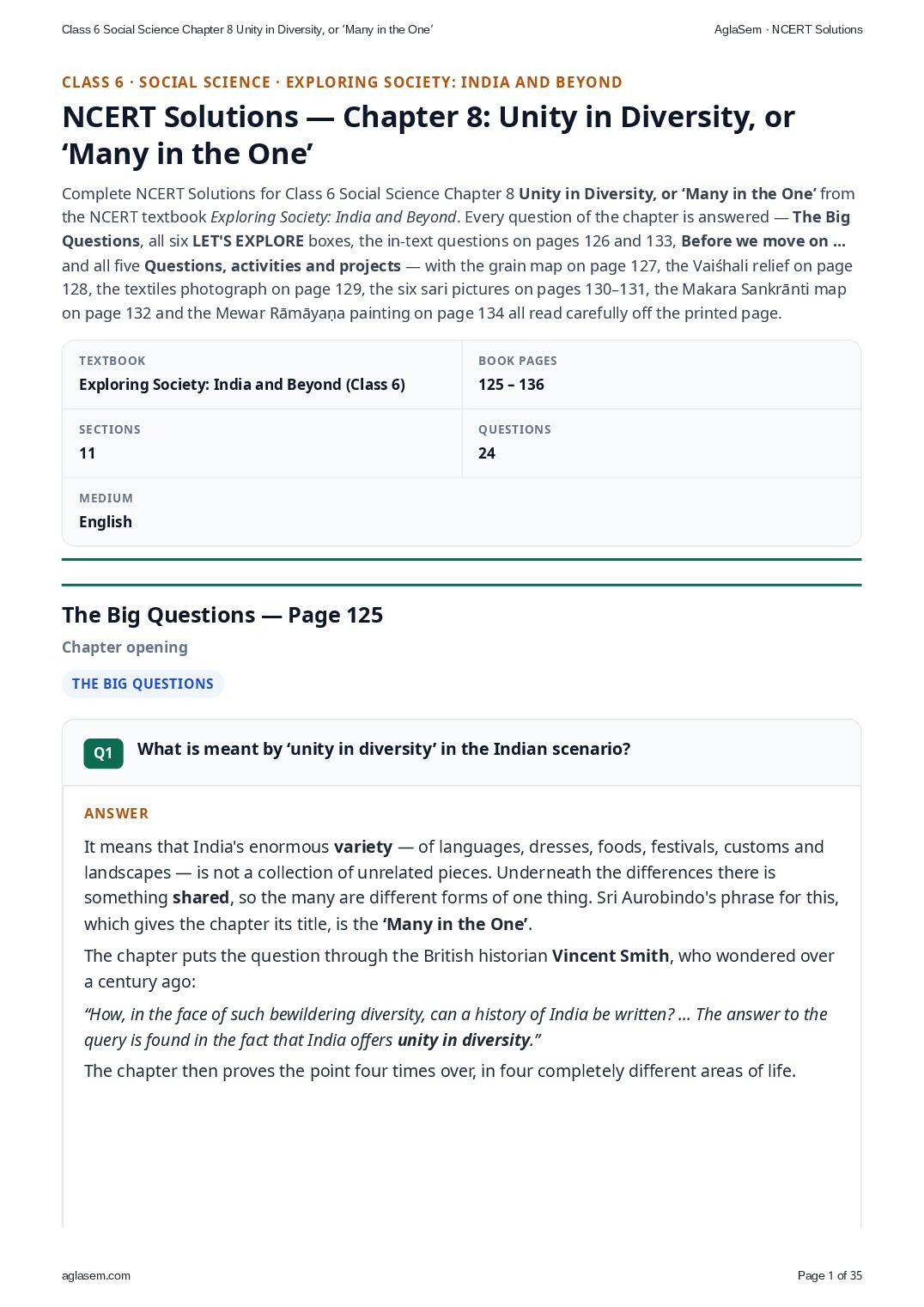
These solutions answer all the exercise questions of Chapter 8 Unity in Diversity or Many in the One — including the in-text questions, short-answer and long-answer questions, and activities — with complete explanations so you can follow the method, not just the final answer. Read the full solutions below.
NCERT Solutions Class 6 Social Science Chapter 8 Unity in Diversity or Many in the One View Download

NCERT Solutions for Class 6 Social Science Chapter 8 PDF Download
You can read the NCERT Solutions for Class 6 Social Science Chapter 8 online above, or download the complete question-answer PDF to study Unity in Diversity or Many in the One offline at any time.
NCERT Solutions for Class 6 Social Science Chapter 8 PDF Download Link – Click Here to Download Solutions PDF
Questions Covered in This Chapter
These NCERT Solutions answer all 24 questions of this chapter. The questions solved are:
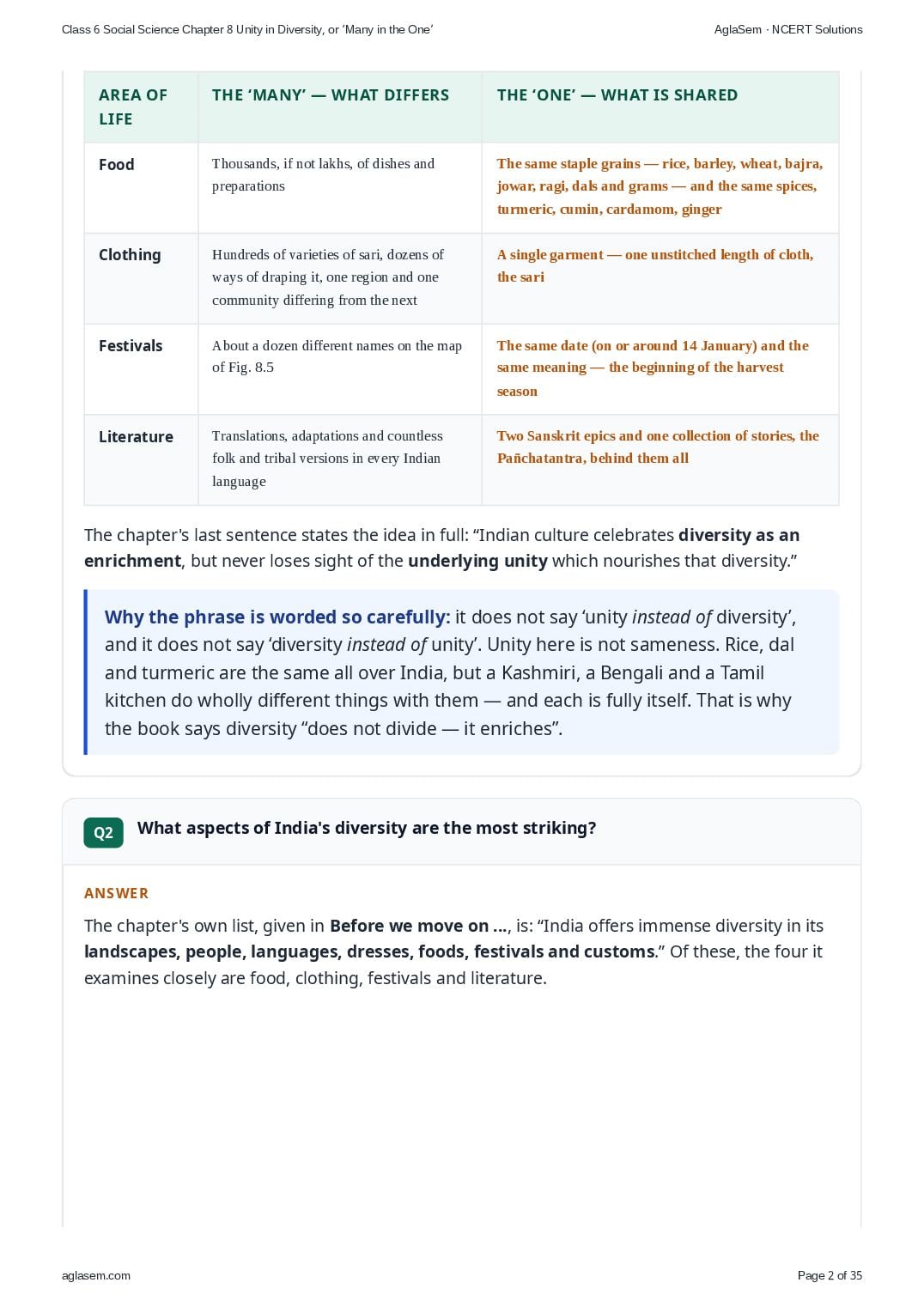
- What is meant by ‘unity in diversity’ in the Indian scenario?
- What aspects of India's diversity are the most striking?
- How do we make out the unity underlying the diversity?
- What is meant by ‘unity in diversity’?
- How shall we perceive and express this unity, or the ‘Many in the One’?
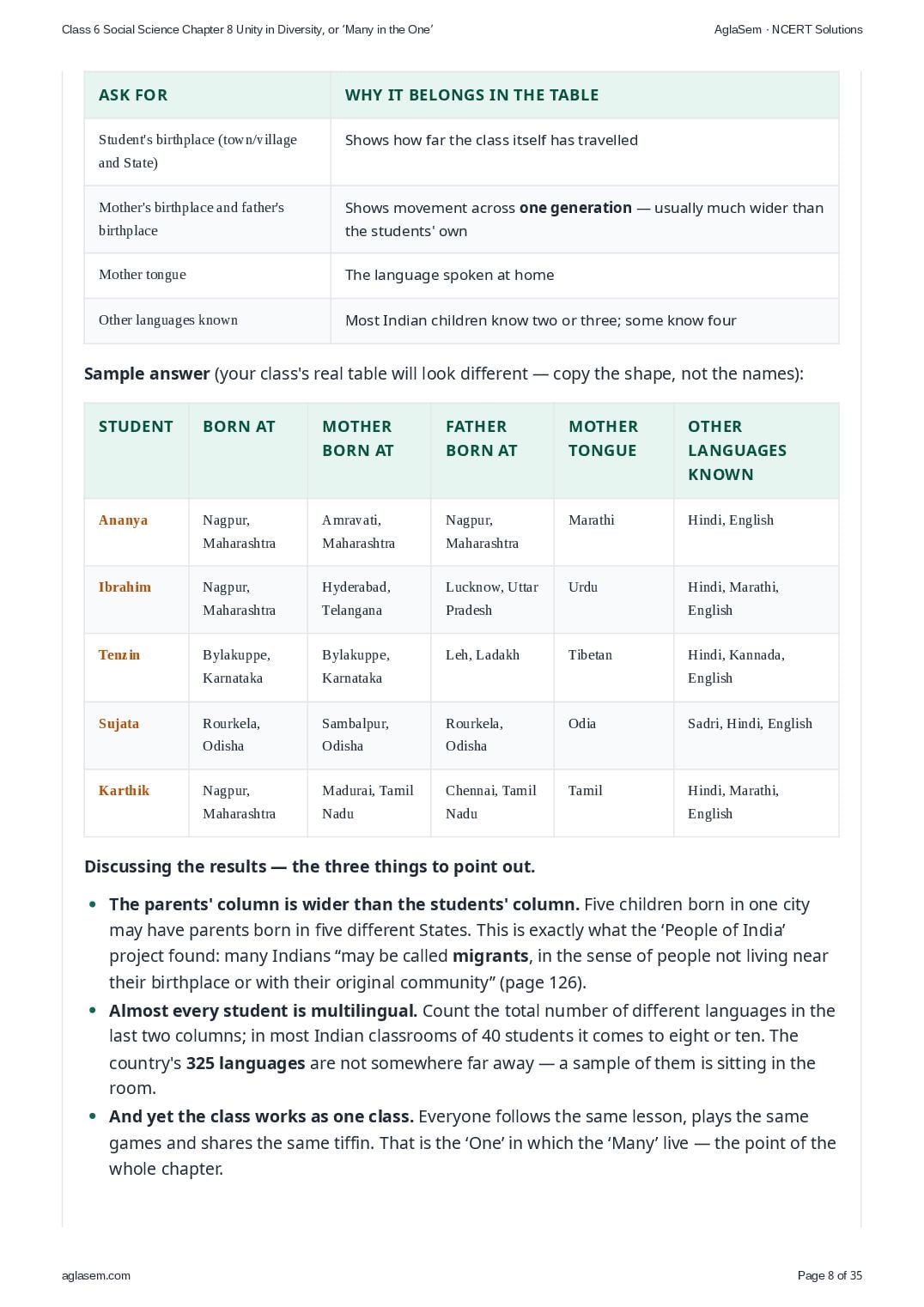
- As a class activity, make lists of (1) the birthplaces of at least 5 classmates and the birthplaces of their parents; (2) the students' mother tongues and other languages known to them. Discuss the results in terms of diversity.
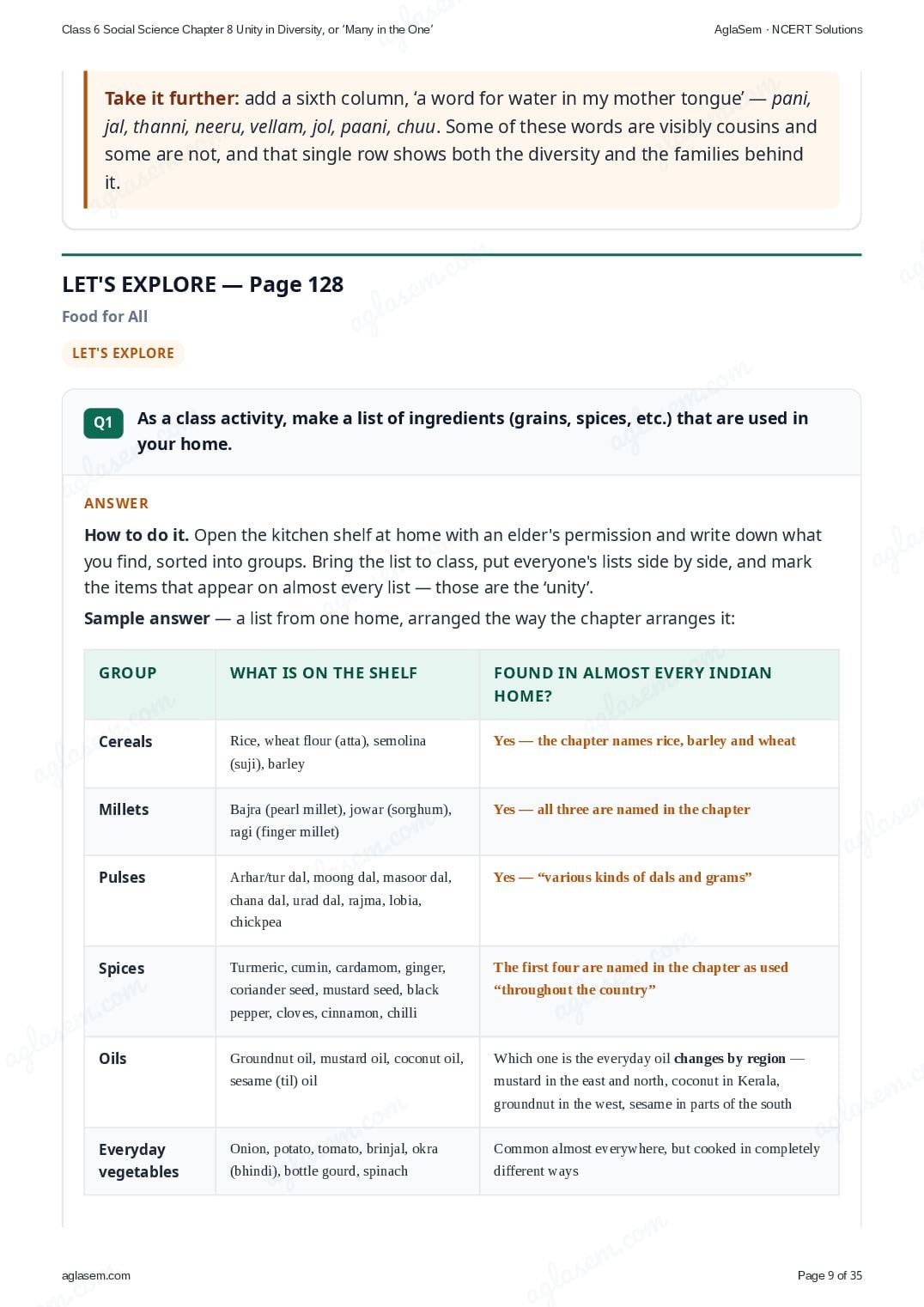
- As a class activity, make a list of ingredients (grains, spices, etc.) that are used in your home.
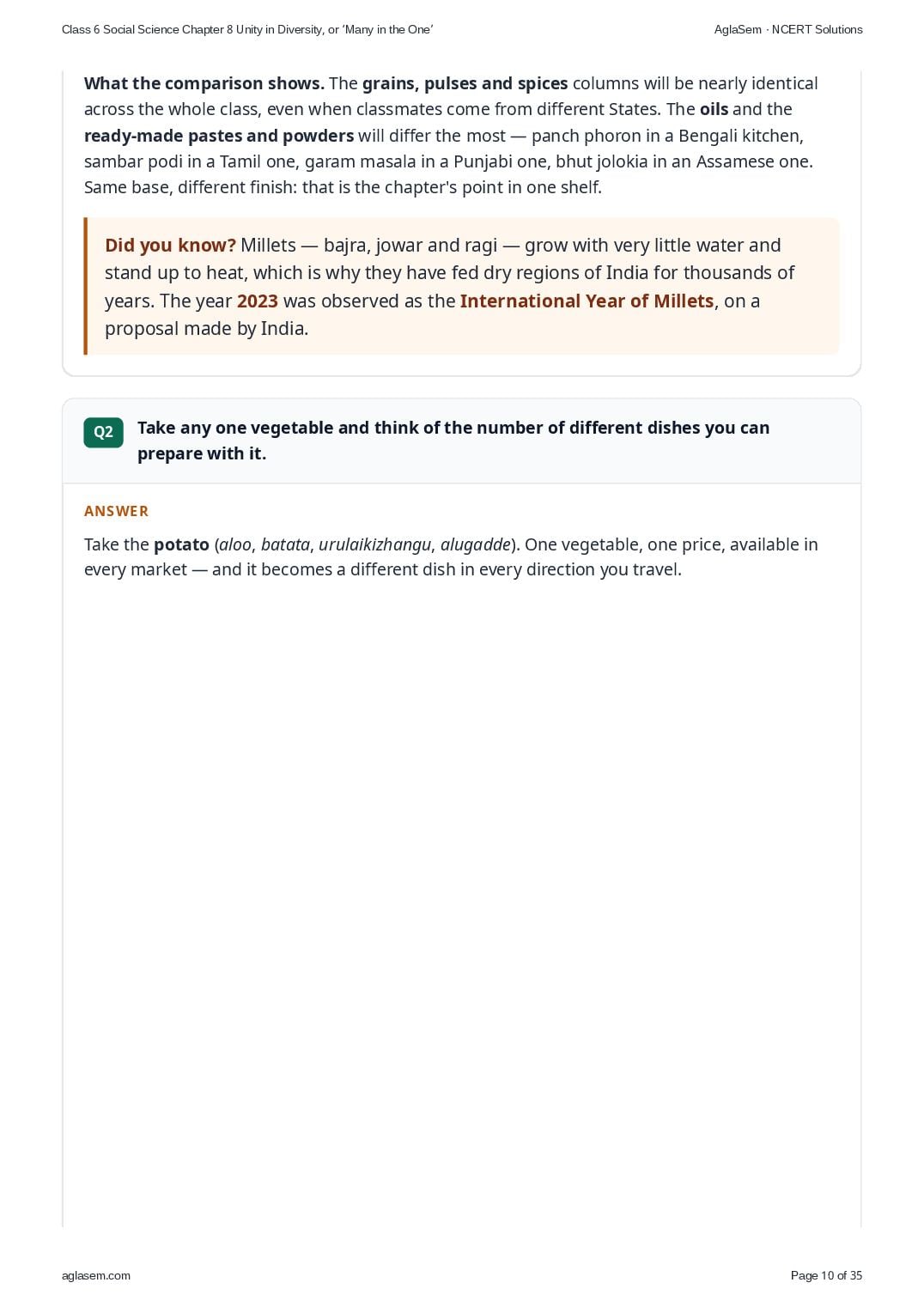
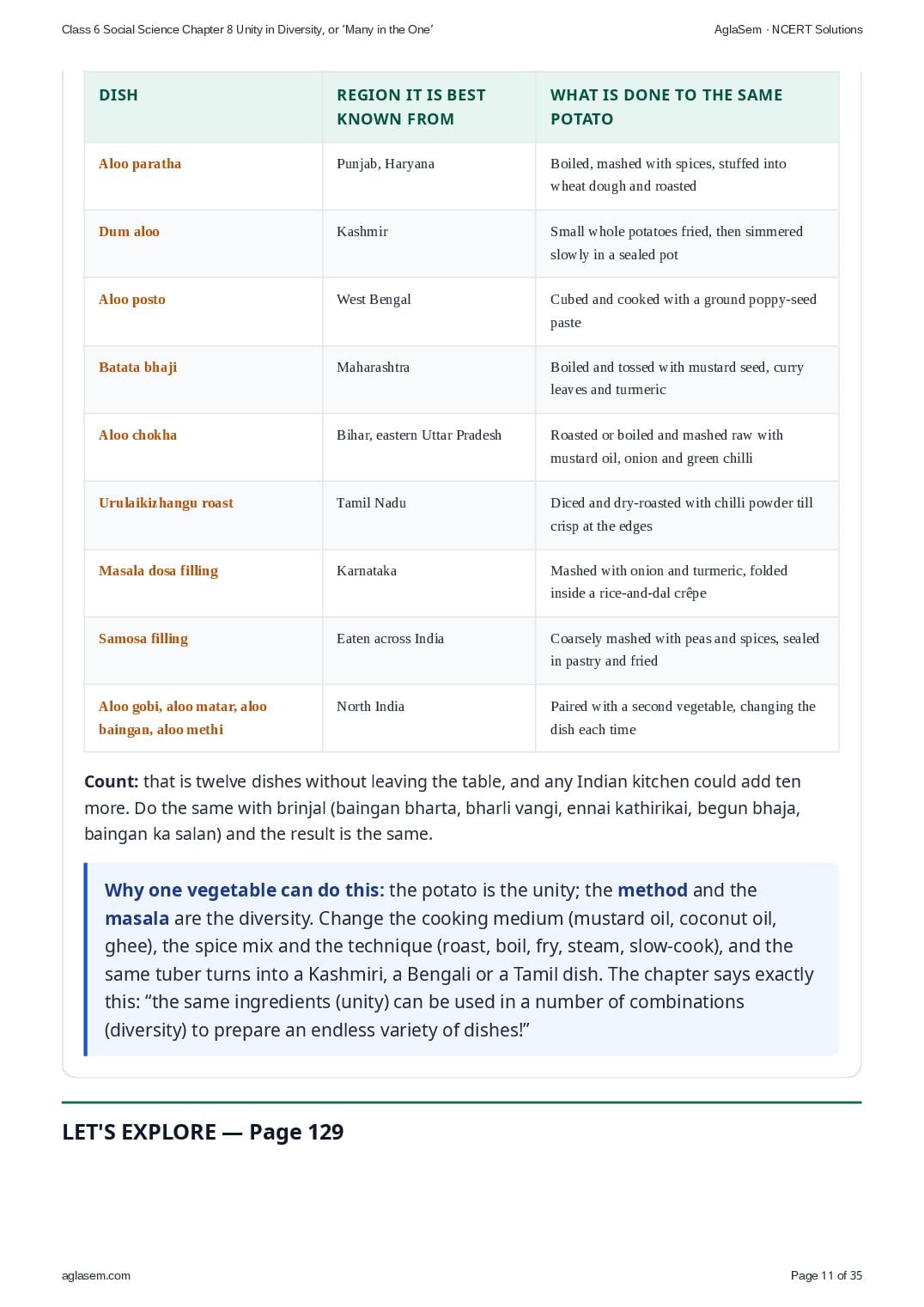
- Take any one vegetable and think of the number of different dishes you can prepare with it.
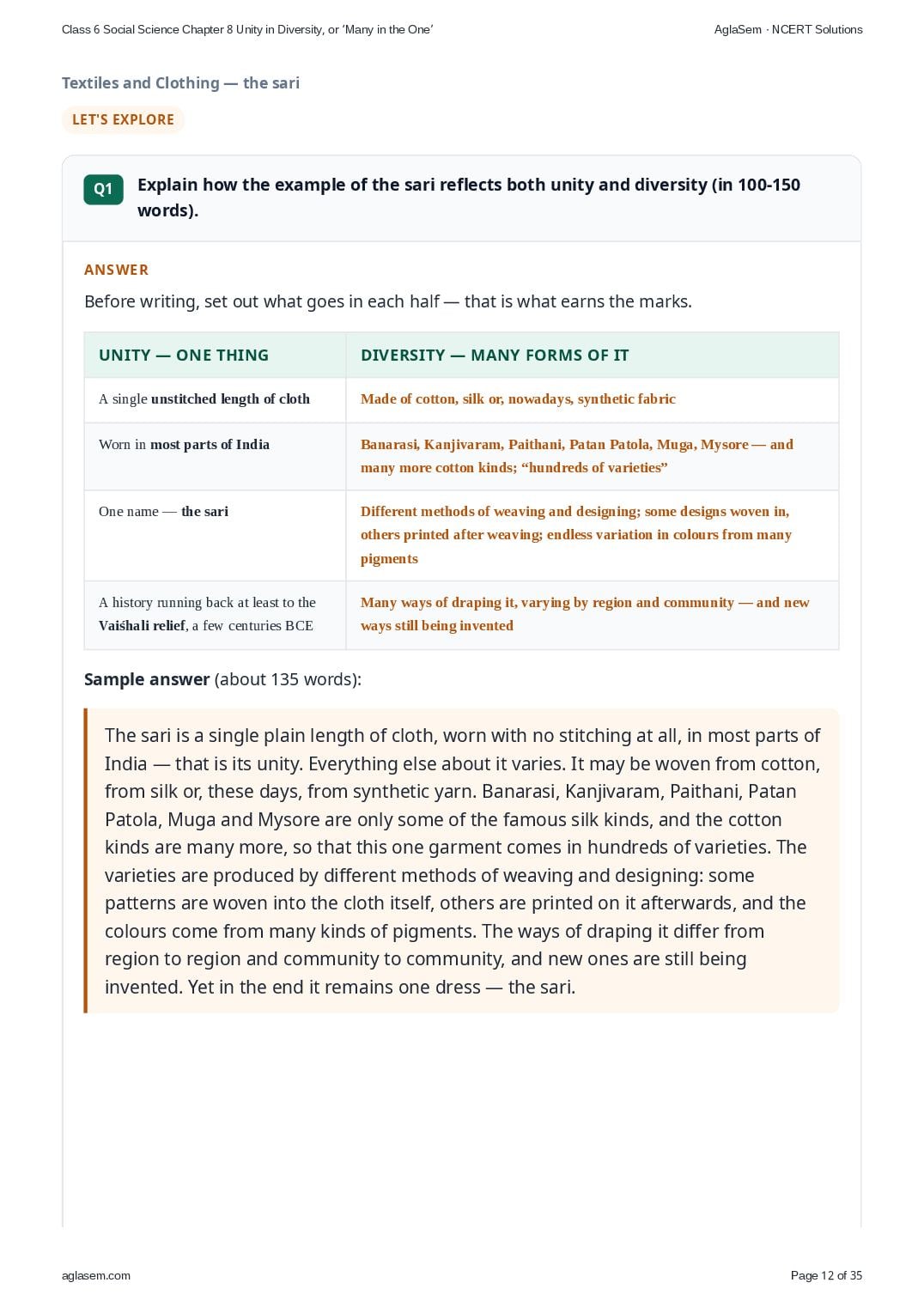
- Explain how the example of the sari reflects both unity and diversity (in 100-150 words).
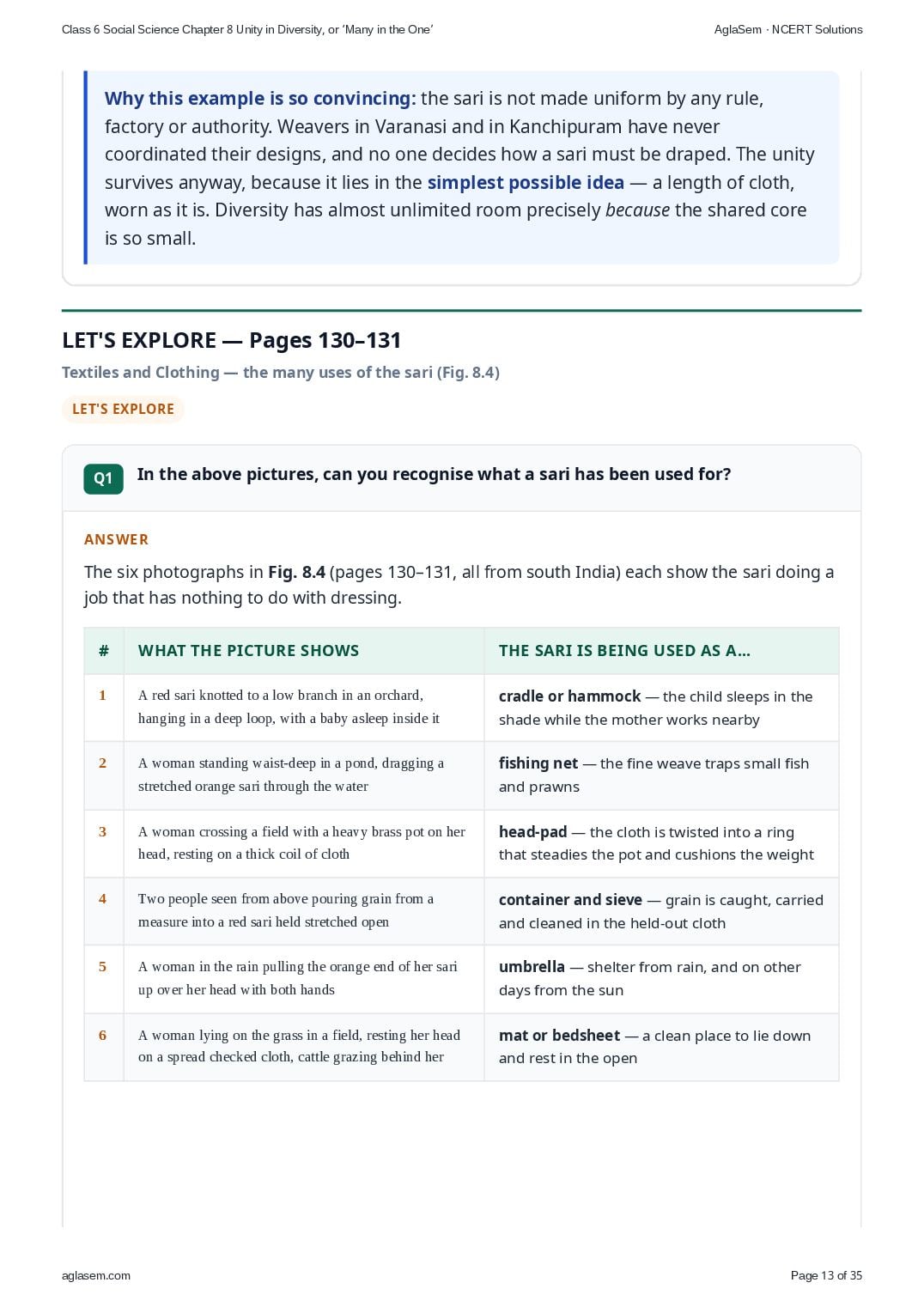
- In the above pictures, can you recognise what a sari has been used for?
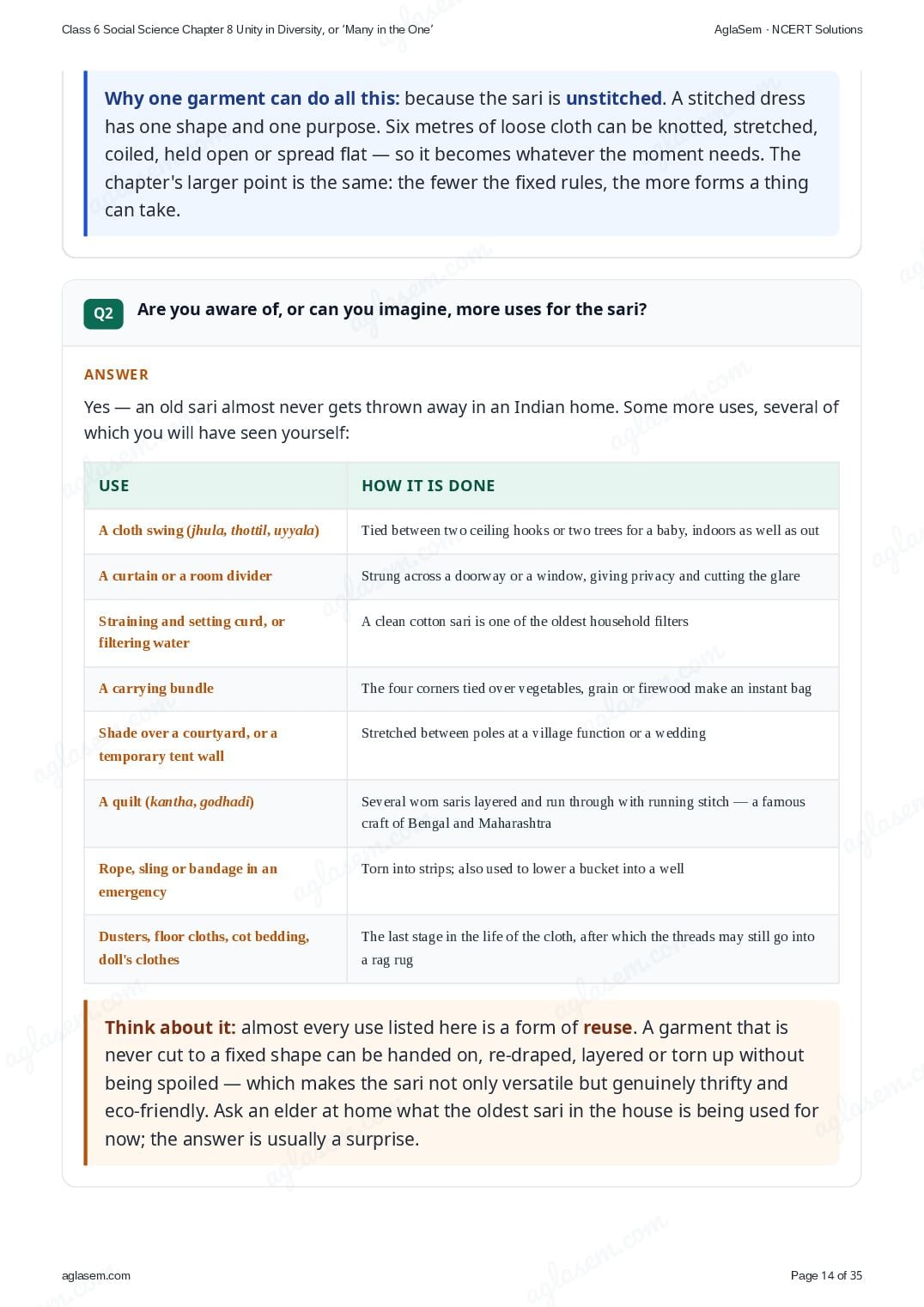
- Are you aware of, or can you imagine, more uses for the sari?
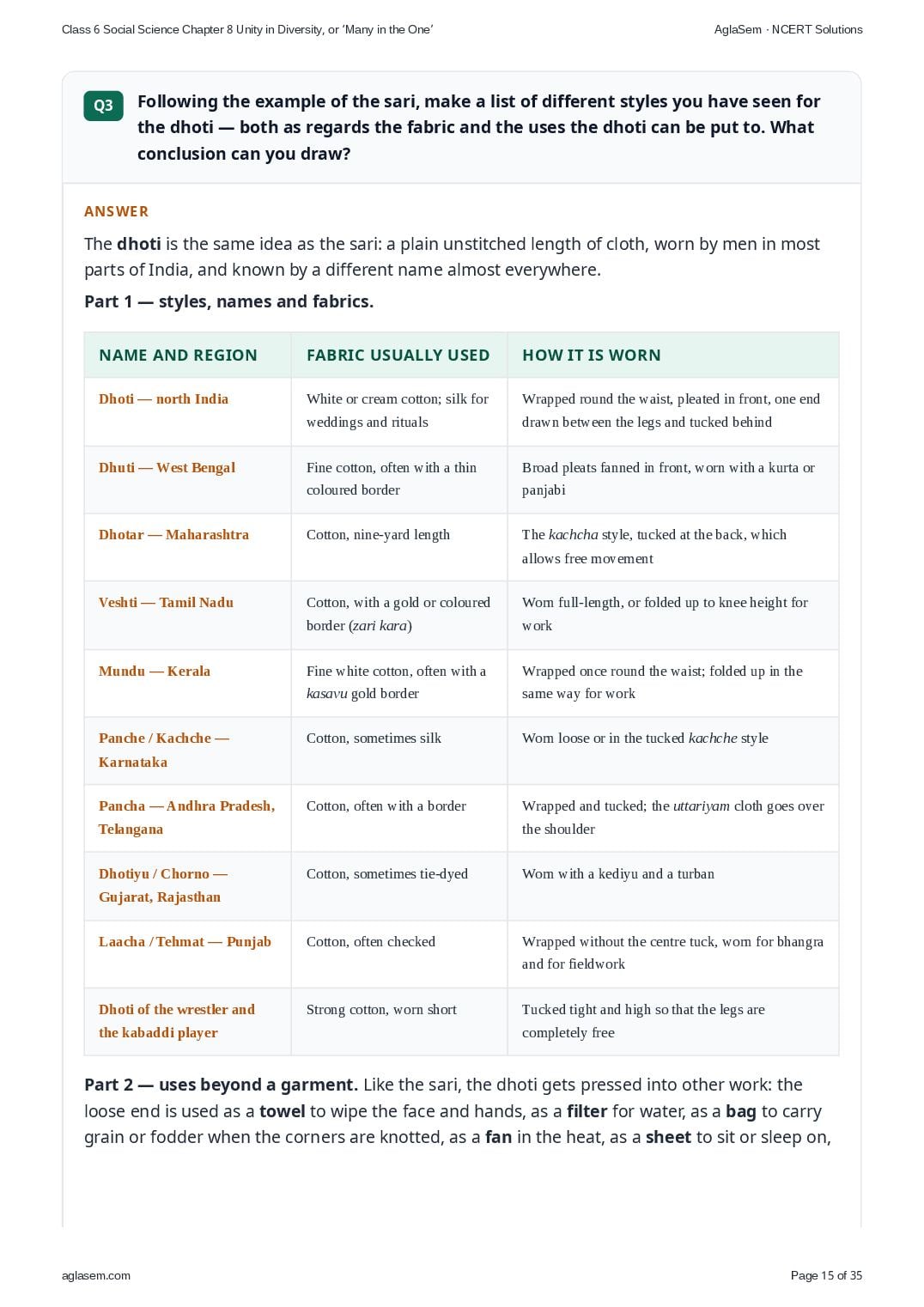
- Following the example of the sari, make a list of different styles you have seen for the dhoti — both as regards the fabric and the uses the dhoti can be put to. What conclusion can you draw?
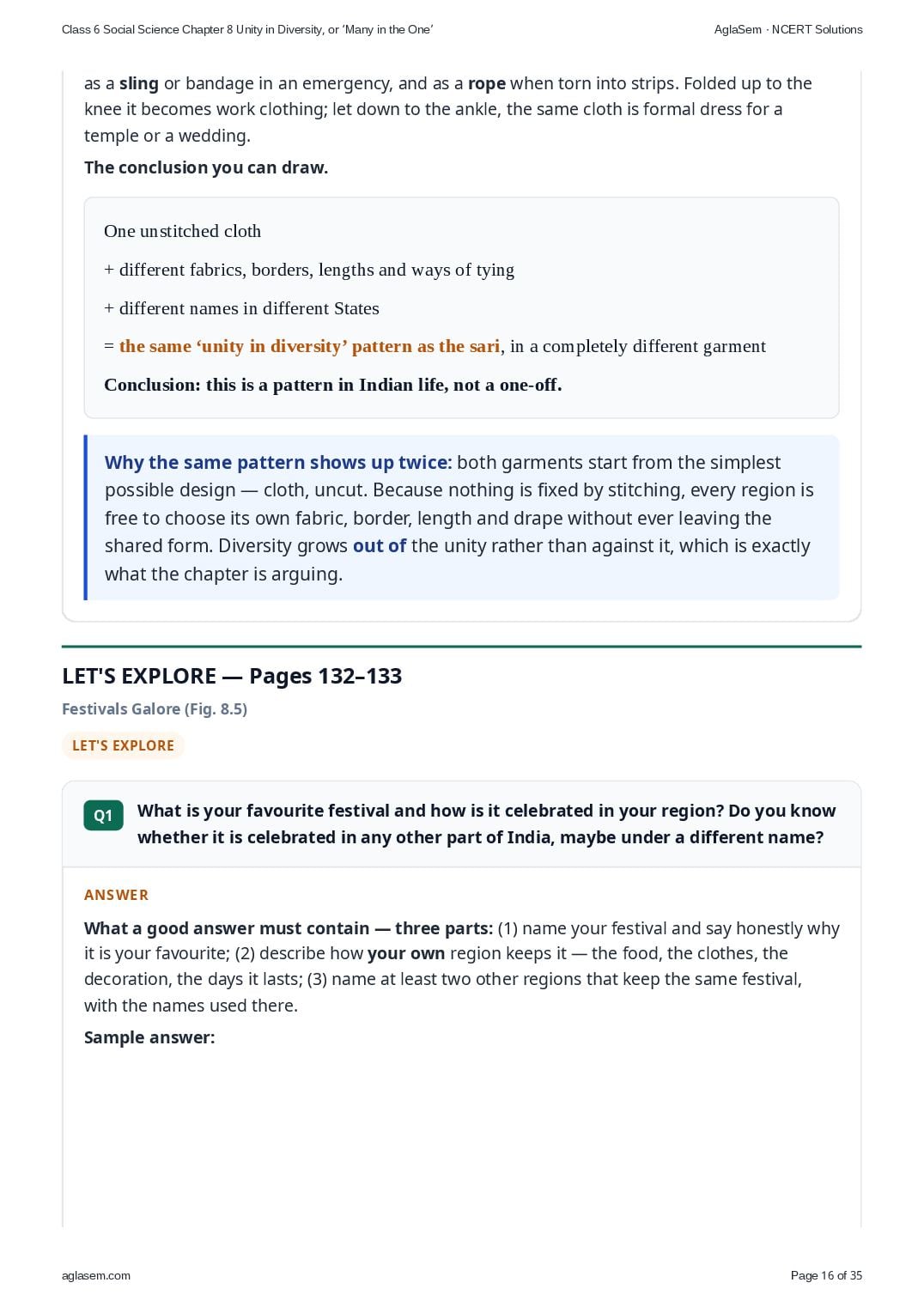
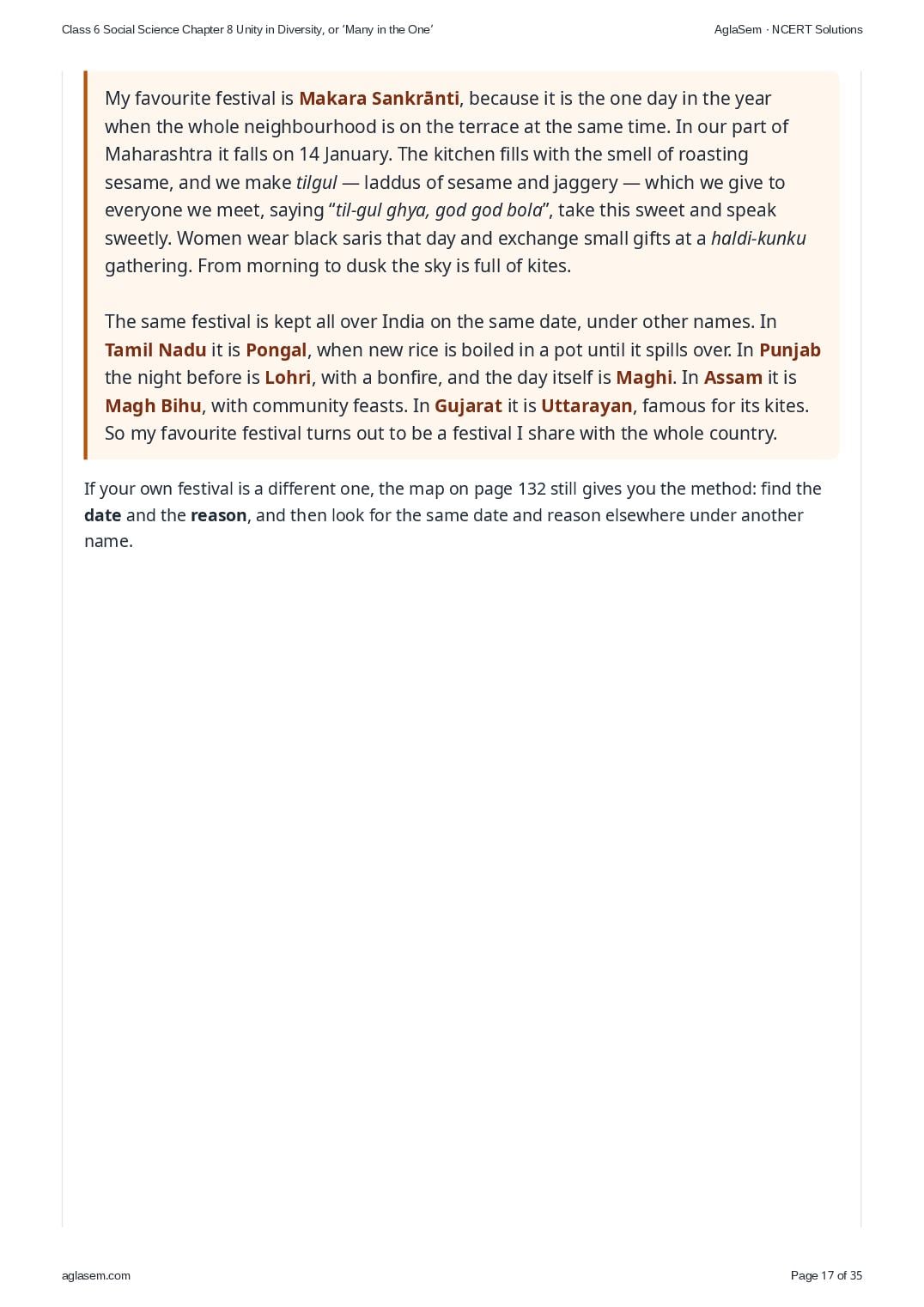
- What is your favourite festival and how is it celebrated in your region? Do you know whether it is celebrated in any other part of India, maybe under a different name?
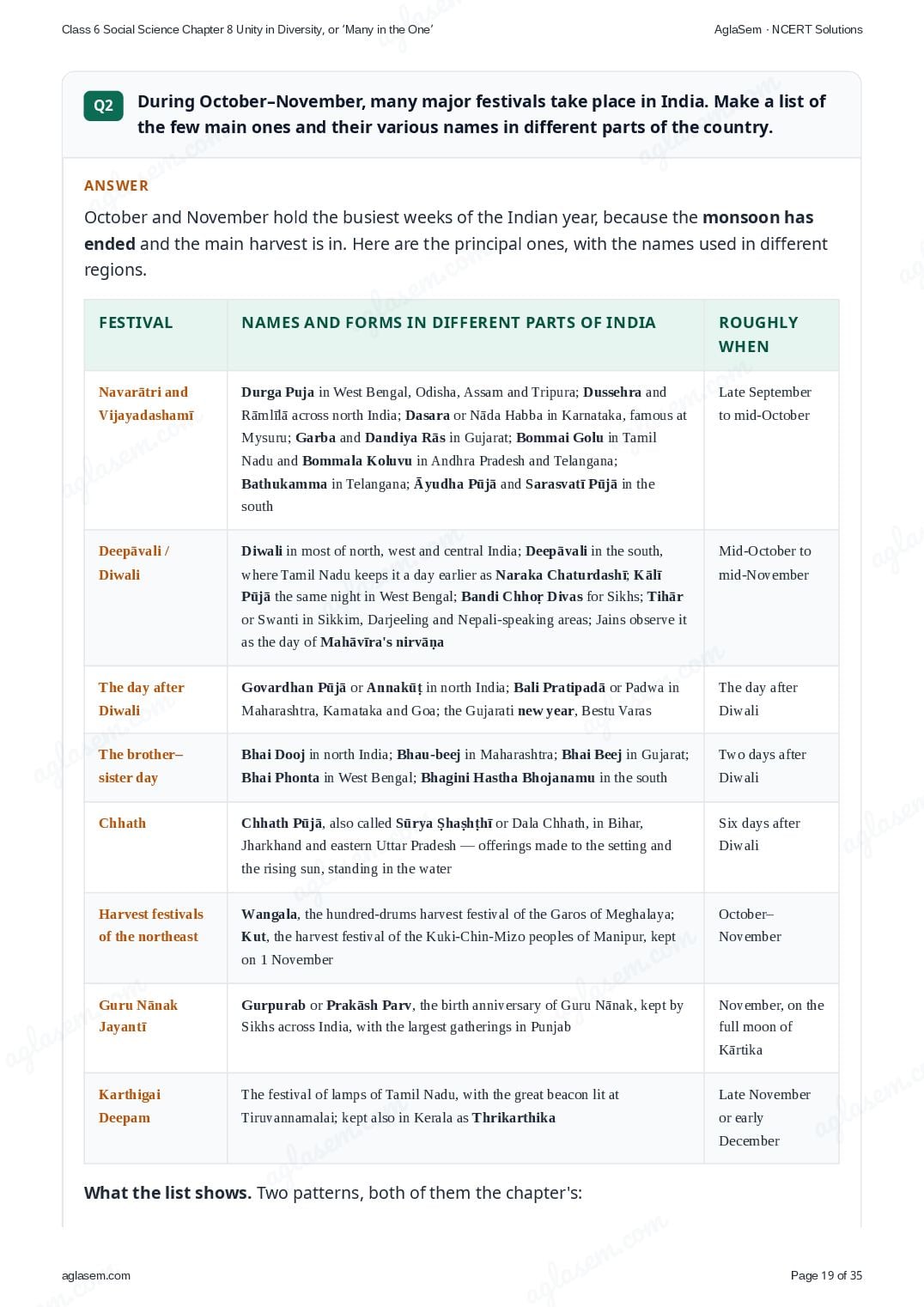
- During October–November, many major festivals take place in India. Make a list of the few main ones and their various names in different parts of the country.
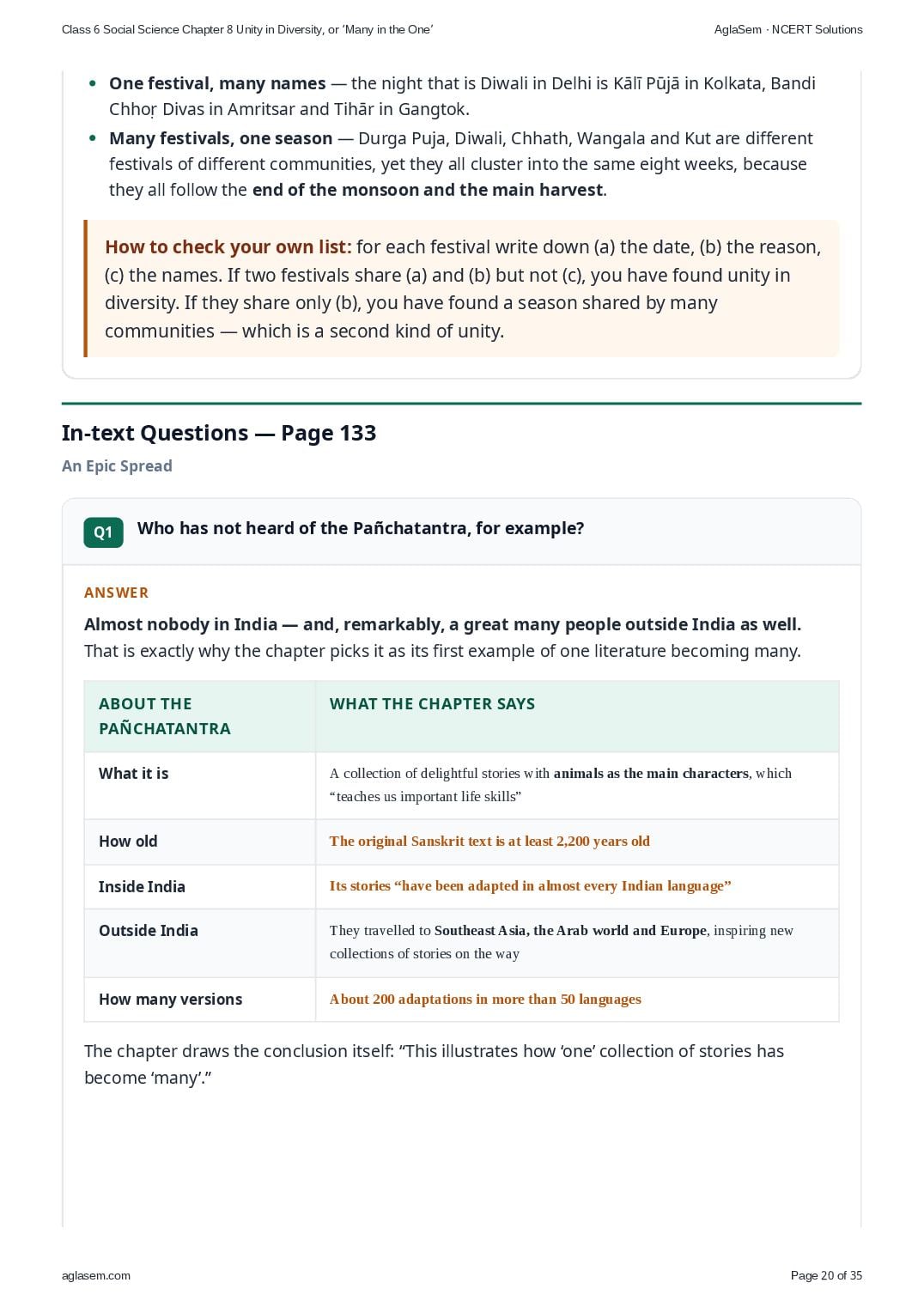
- Who has not heard of the Pañchatantra, for example?
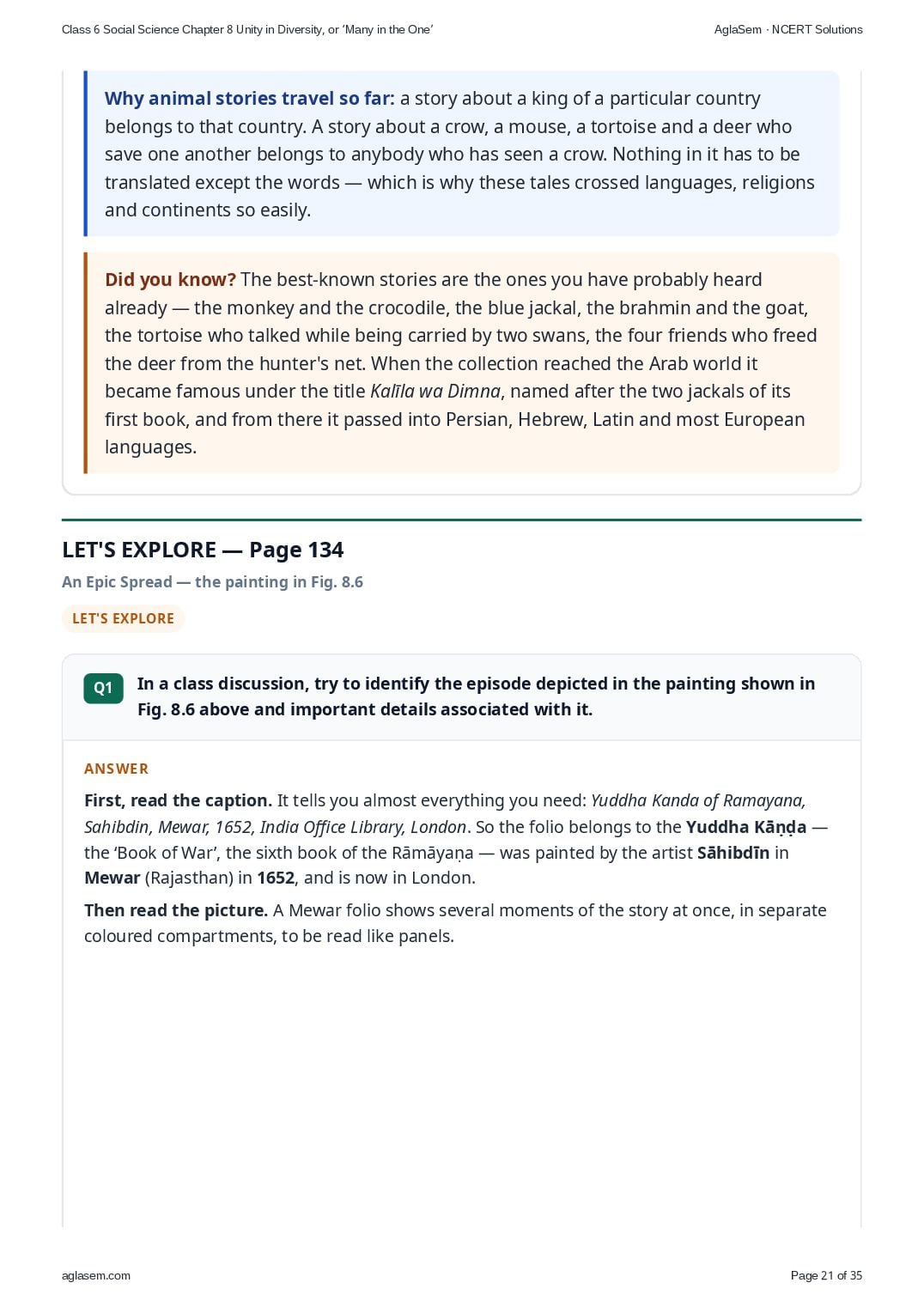
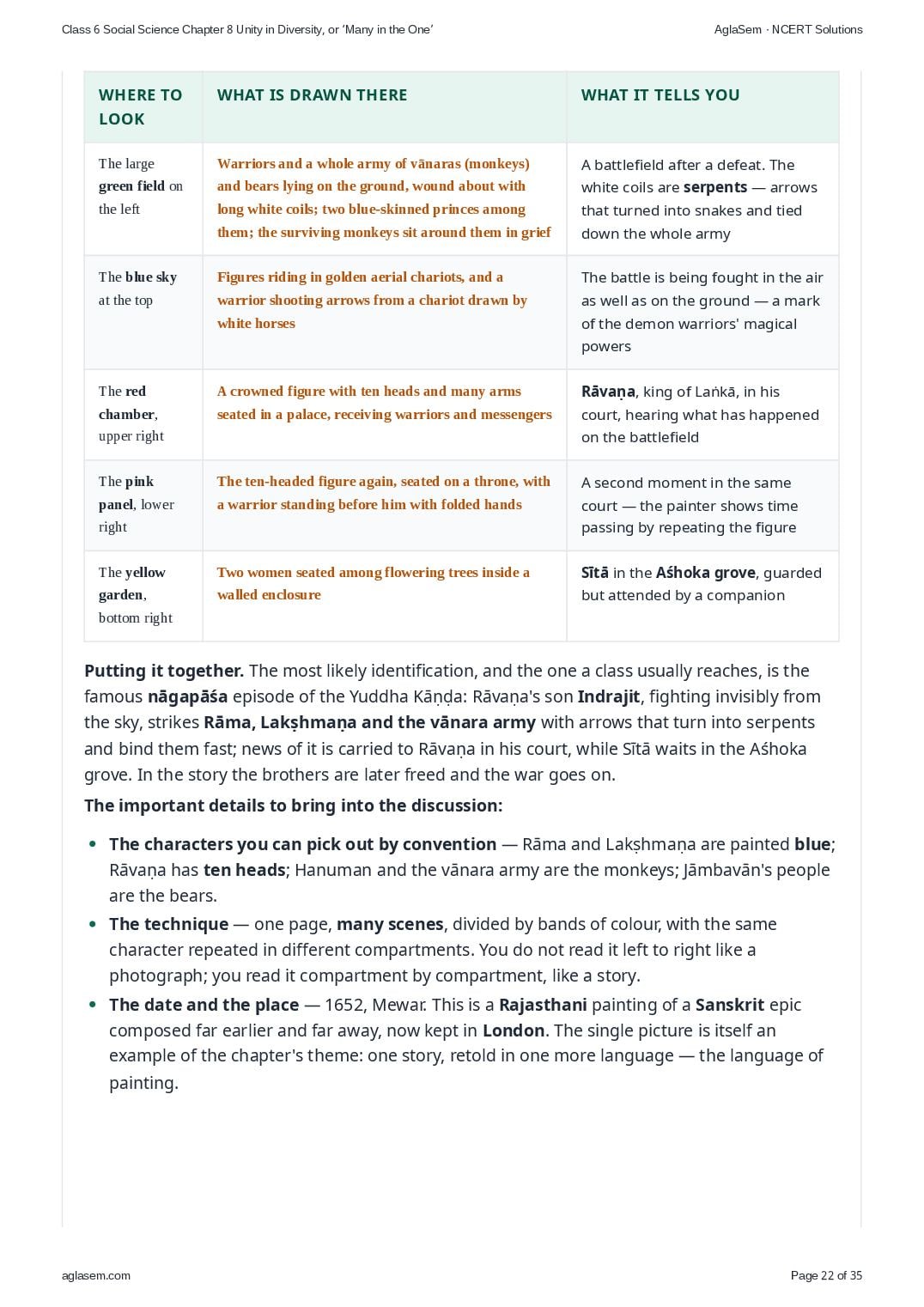
- In a class discussion, try to identify the episode depicted in the painting shown in Fig. 8.6 above and important details associated with it.
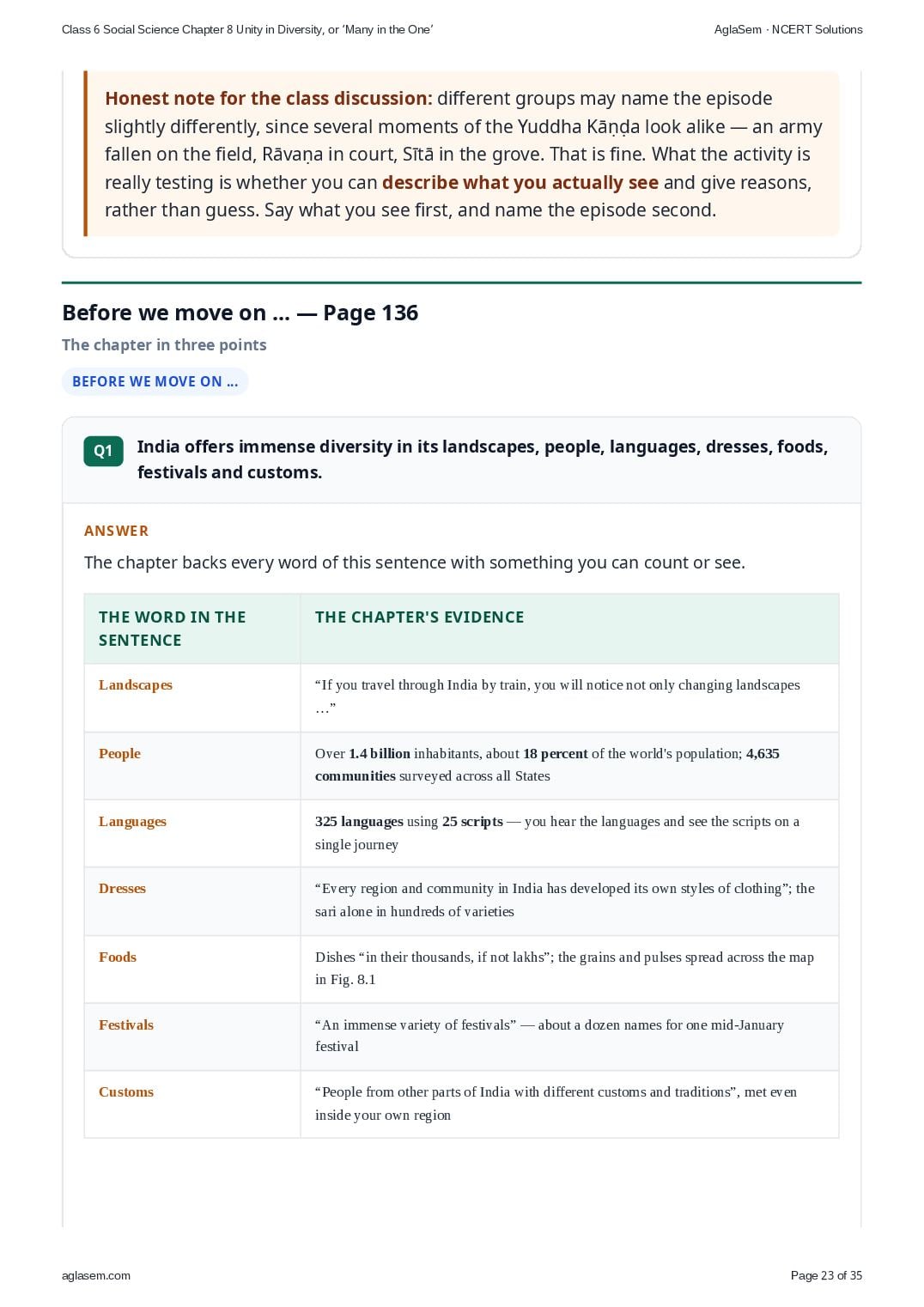
- India offers immense diversity in its landscapes, people, languages, dresses, foods, festivals and customs.
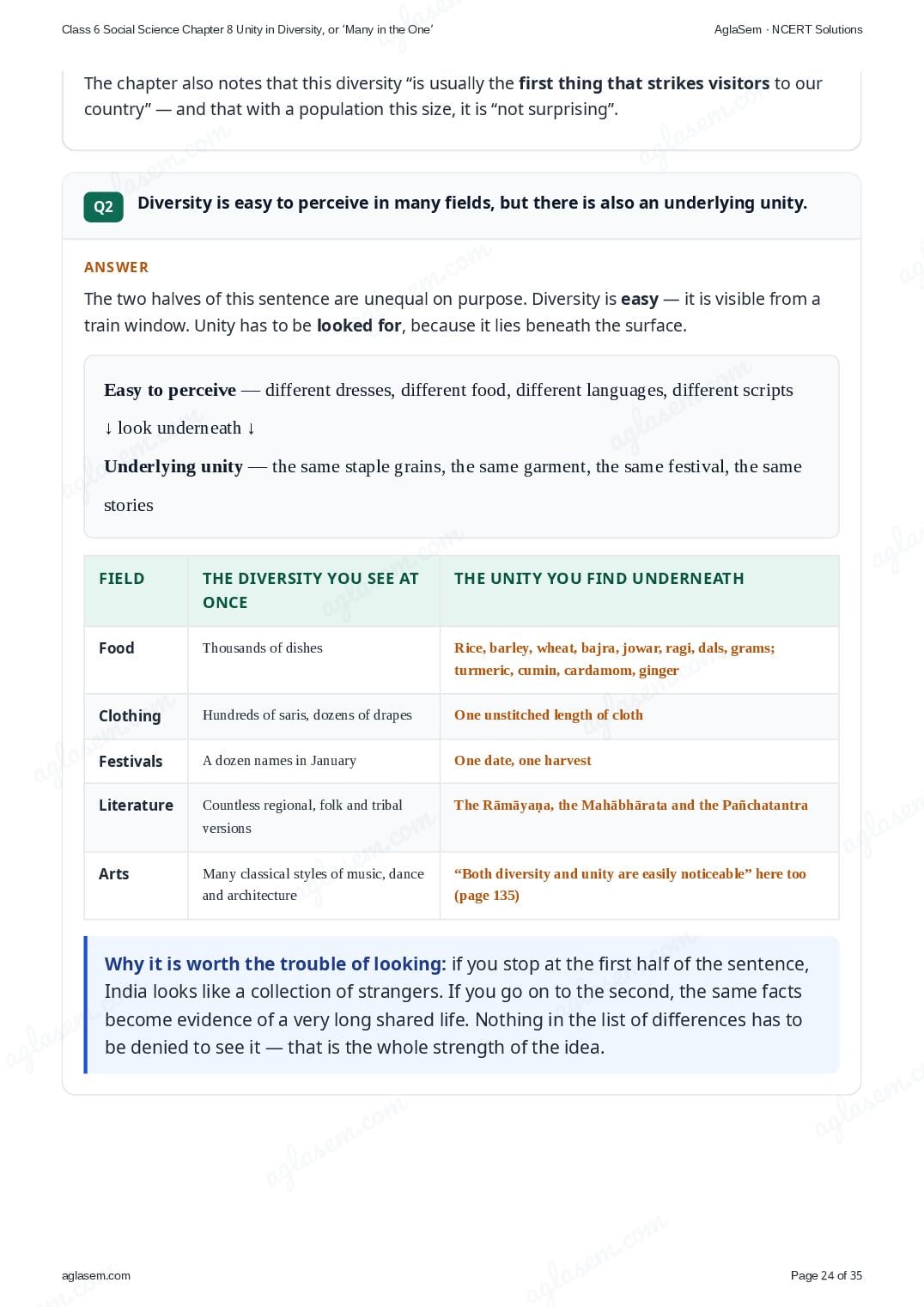
- Diversity is easy to perceive in many fields, but there is also an underlying unity.
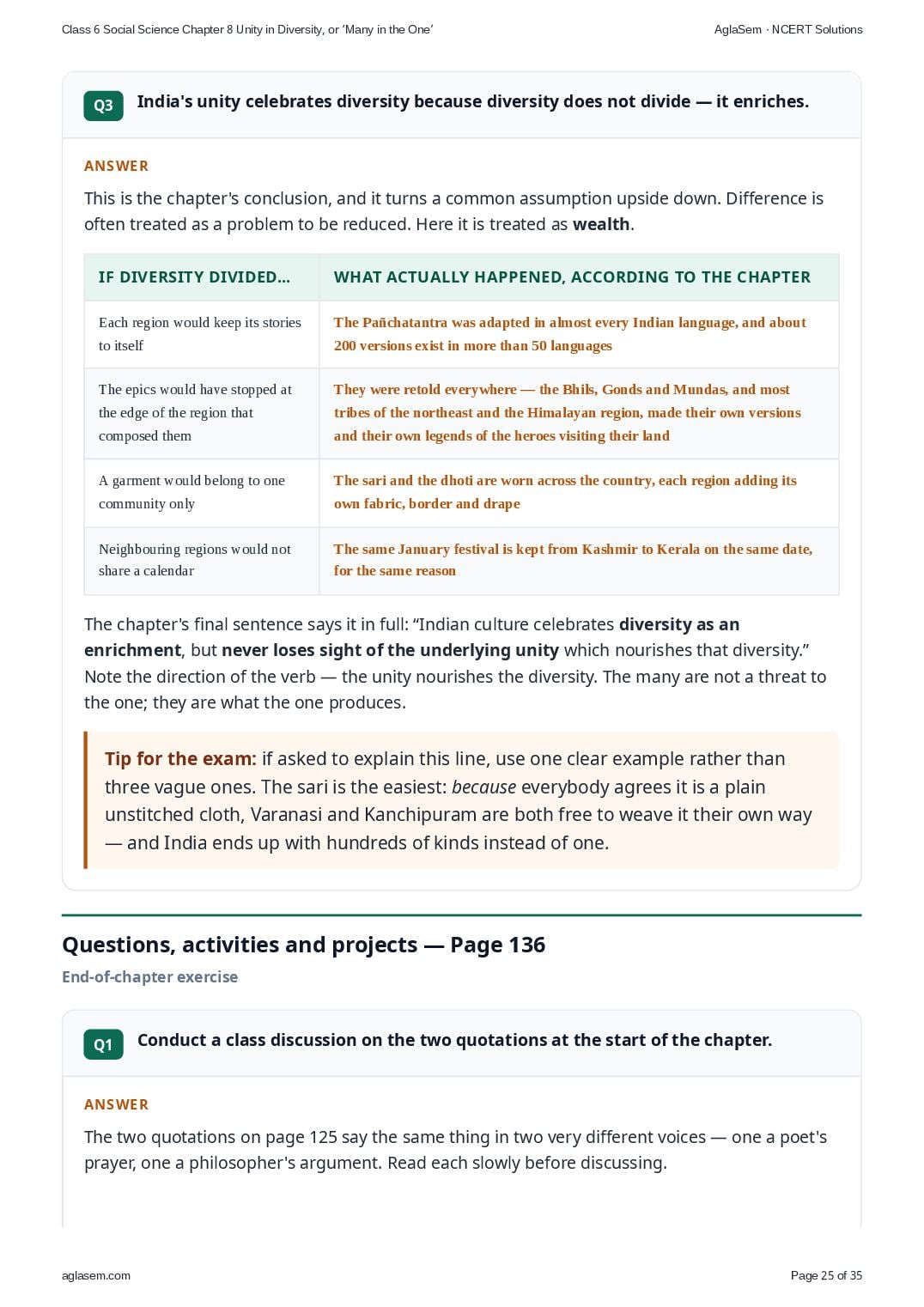
- India's unity celebrates diversity because diversity does not divide — it enriches.
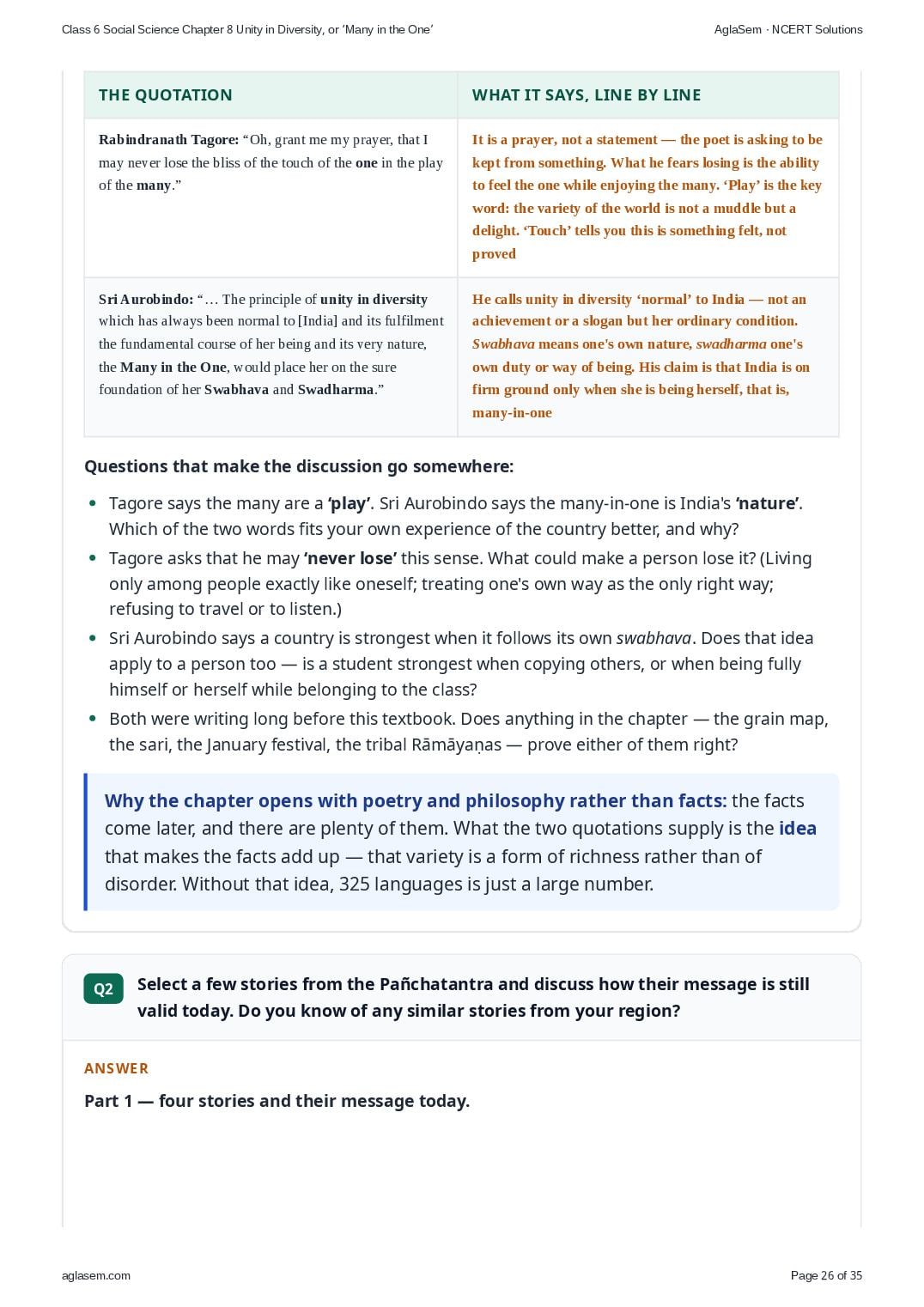
- Conduct a class discussion on the two quotations at the start of the chapter.
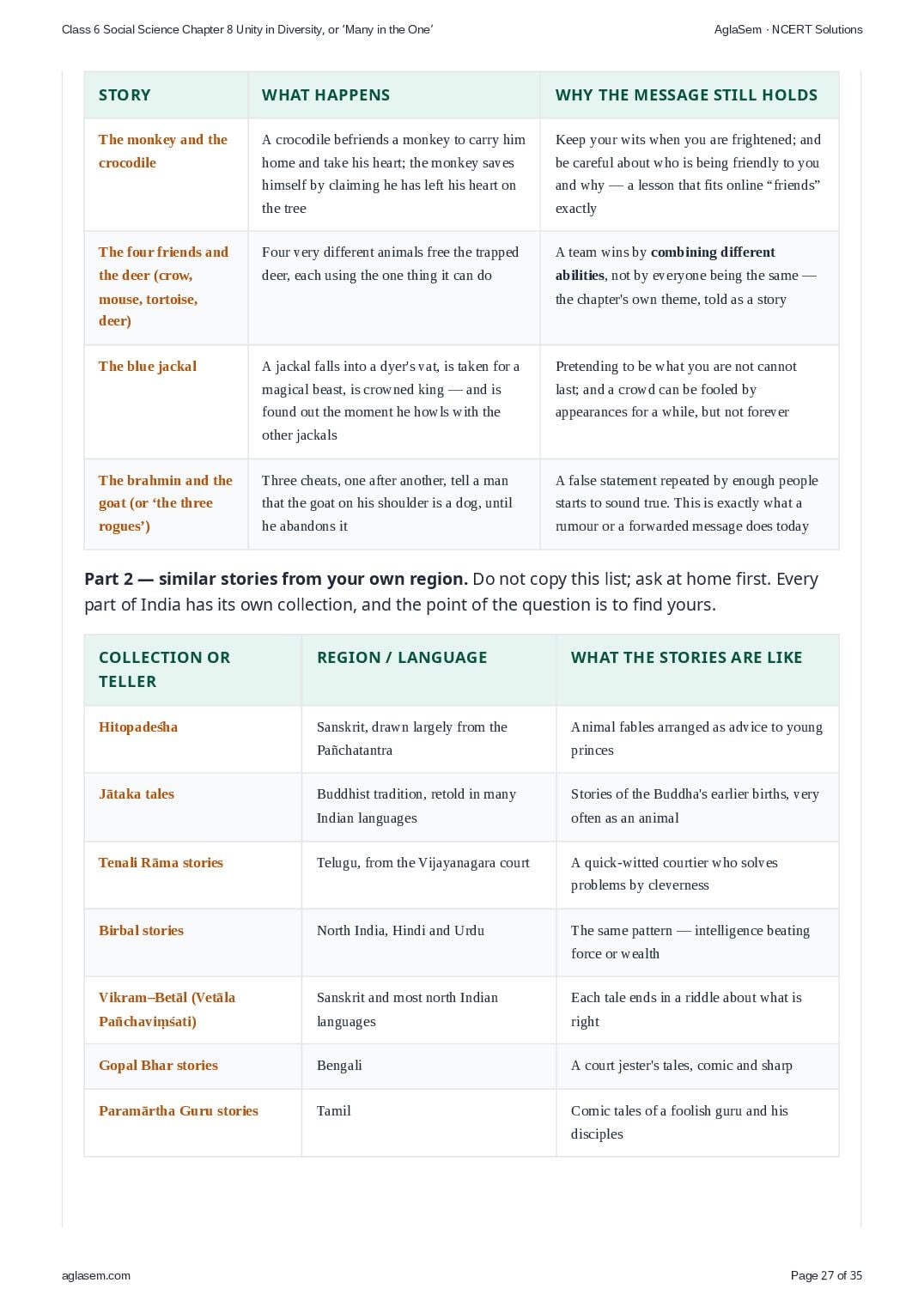
- Select a few stories from the Pañchatantra and discuss how their message is still valid today. Do you know of any similar stories from your region?
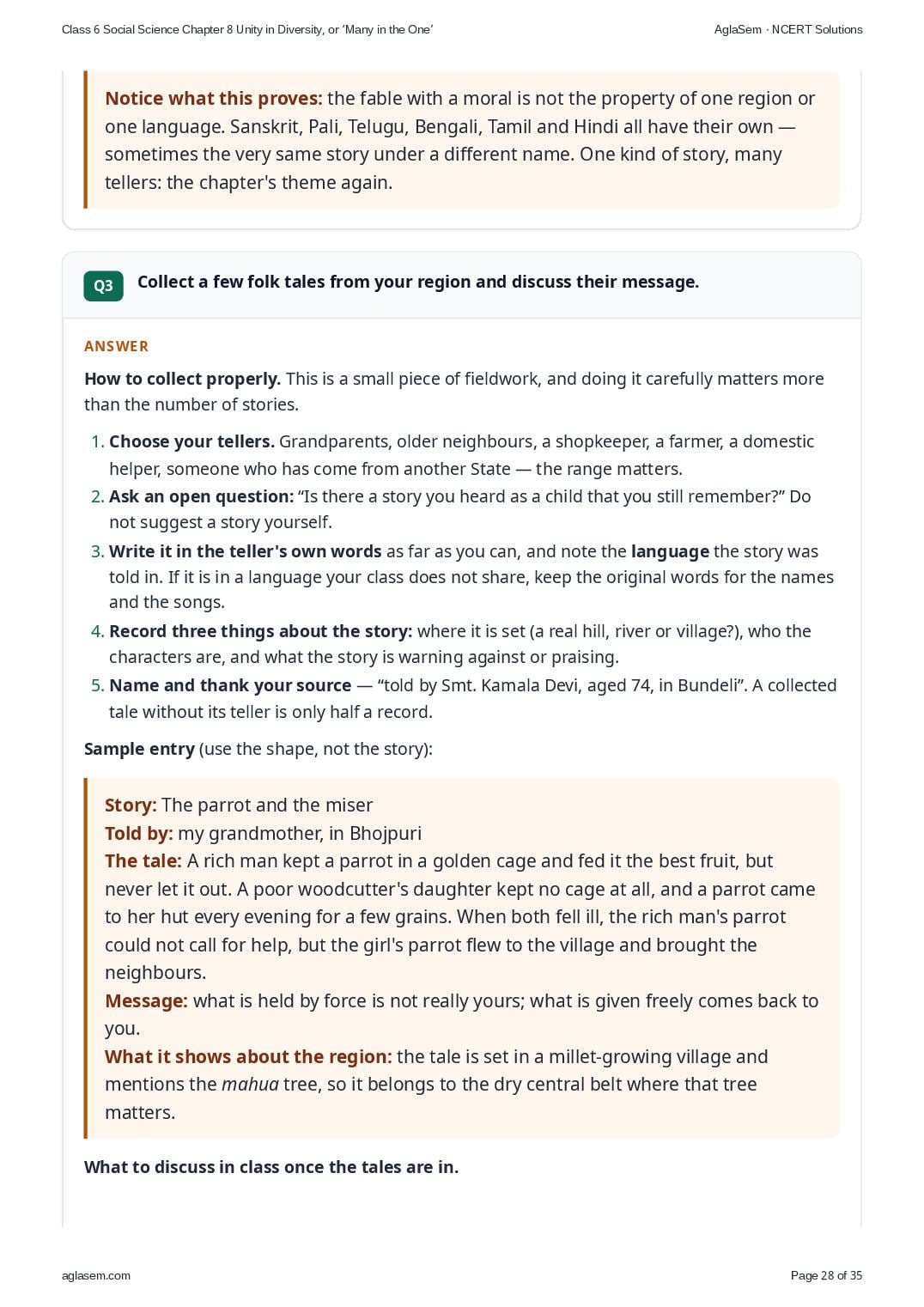
- Collect a few folk tales from your region and discuss their message.
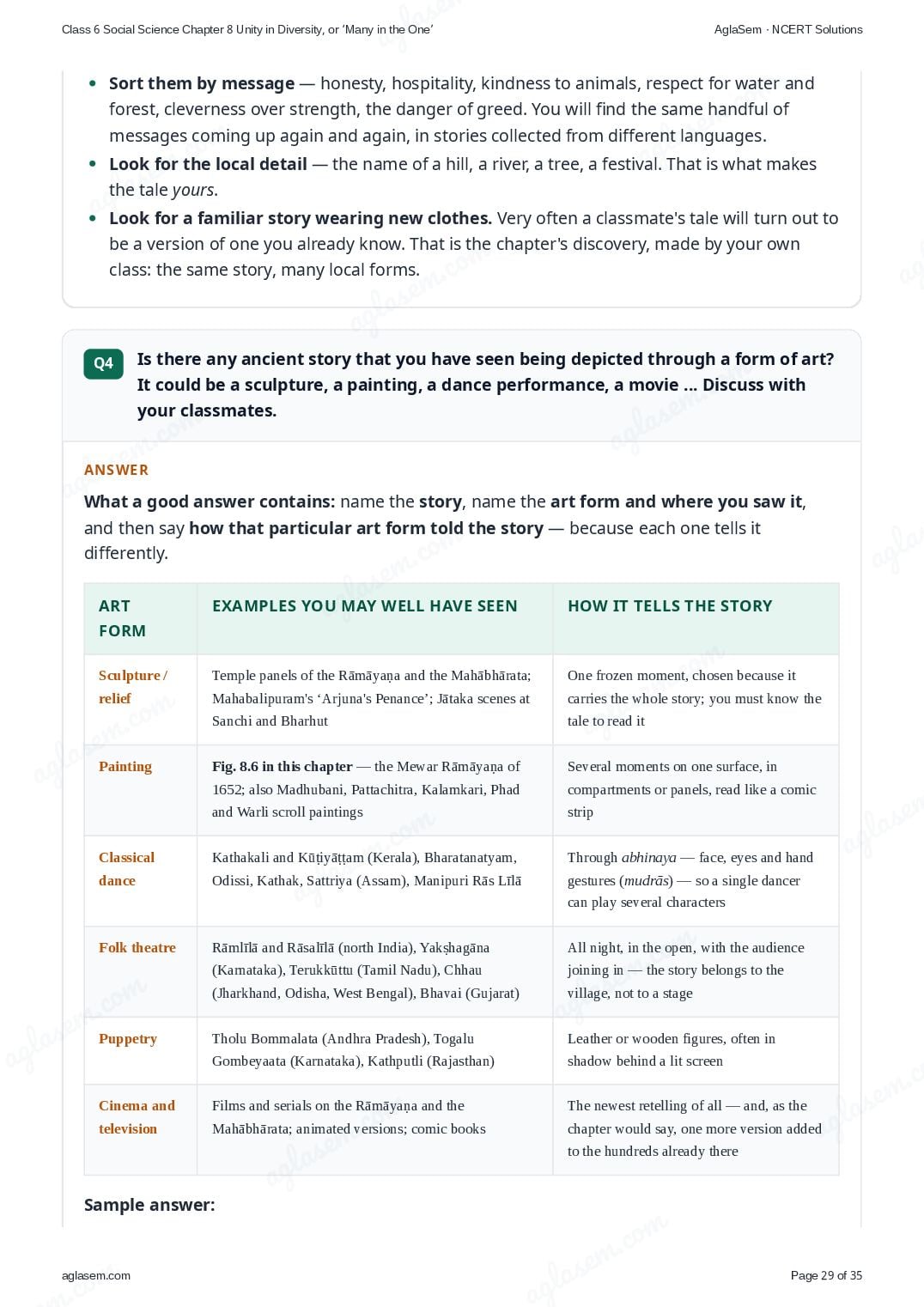
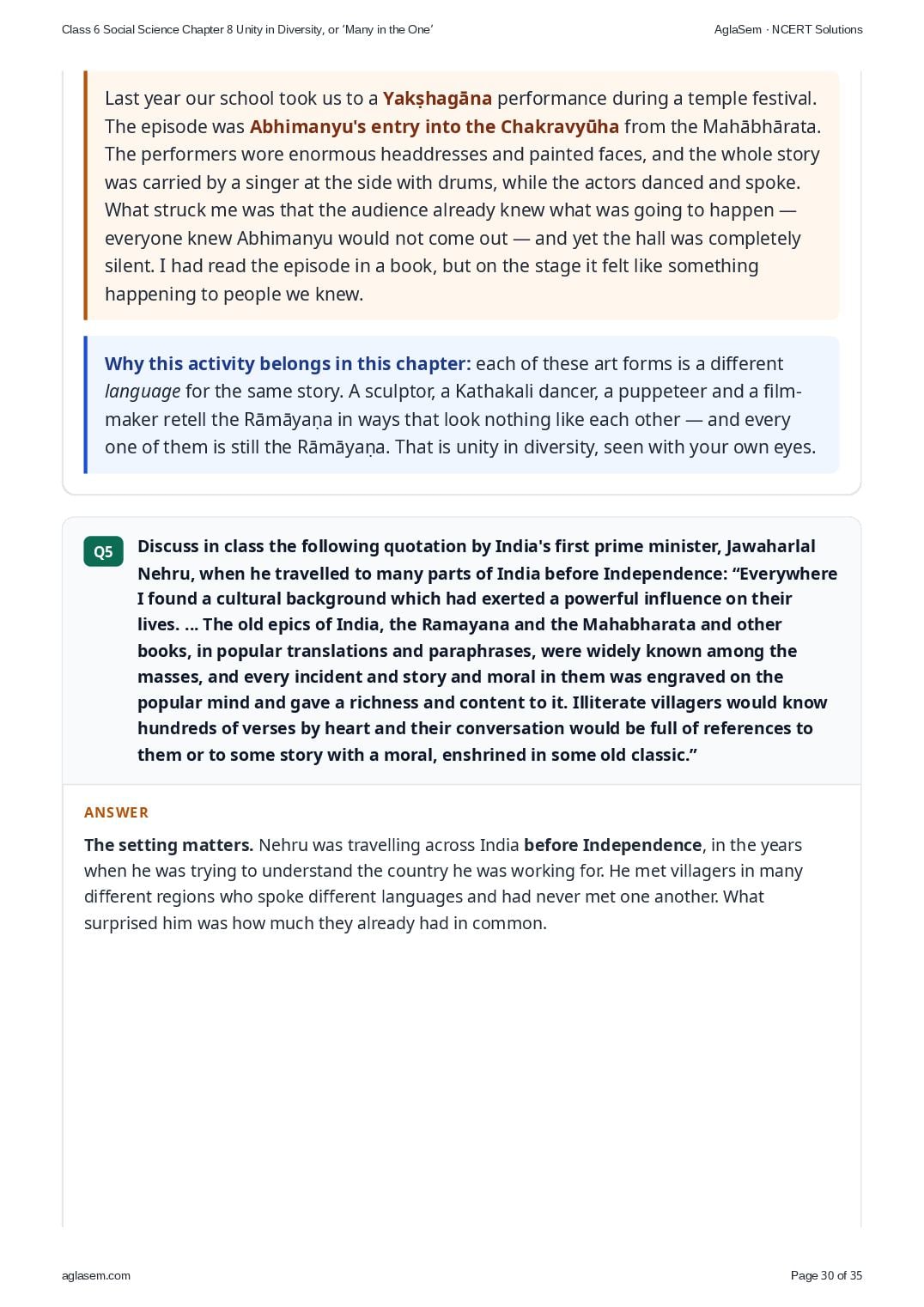
- Is there any ancient story that you have seen being depicted through a form of art? It could be a sculpture, a painting, a dance performance, a movie … Discuss with your classmates.
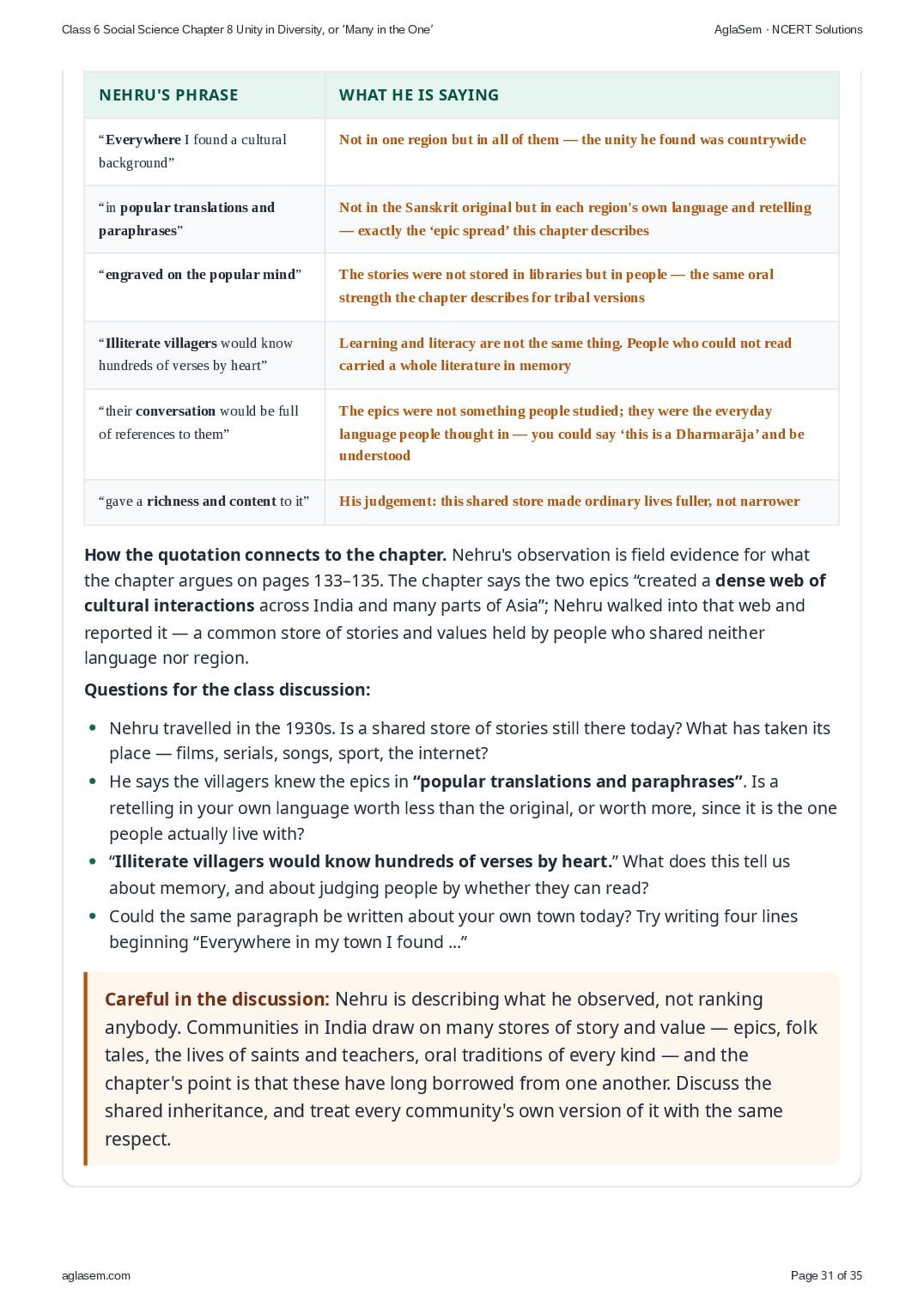
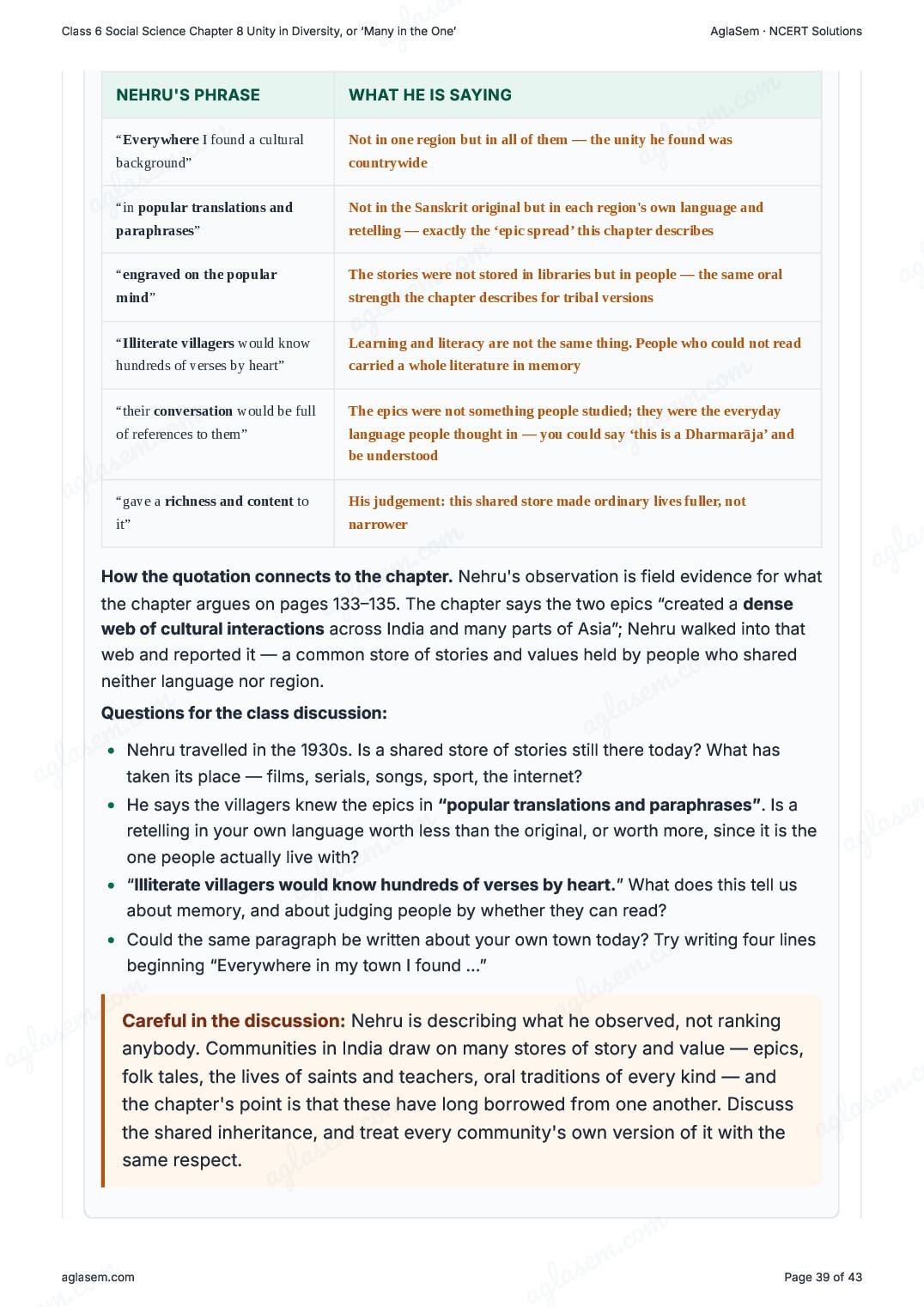
- Discuss in class the following quotation by India's first prime minister, Jawaharlal Nehru, when he travelled to many parts of India before Independence: “Everywhere I found a cultural background which had exerted a powerful influence on their lives. … The old epics of India, the Ramayana and the Mahabharata and other books, in popular translations and paraphrases, were widely known among the masses, and every incident and story and moral in them was engraved on the popular mind and gave a richness and content to it. Illiterate villagers would know hundreds of verses by heart and their conversation would be full of references to them or to some story with a moral, enshrined in some old classic.”
Chapter at a Glance
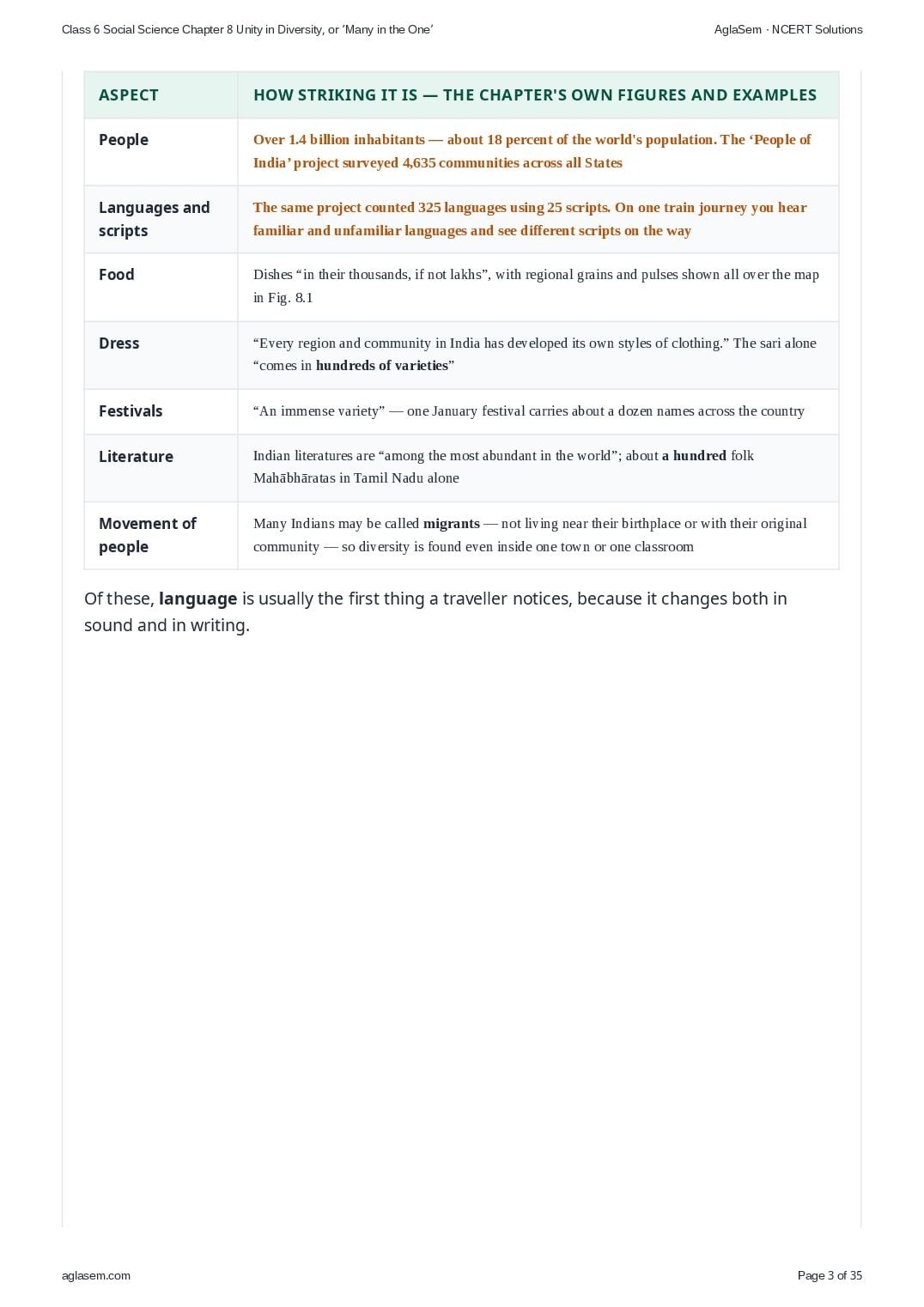
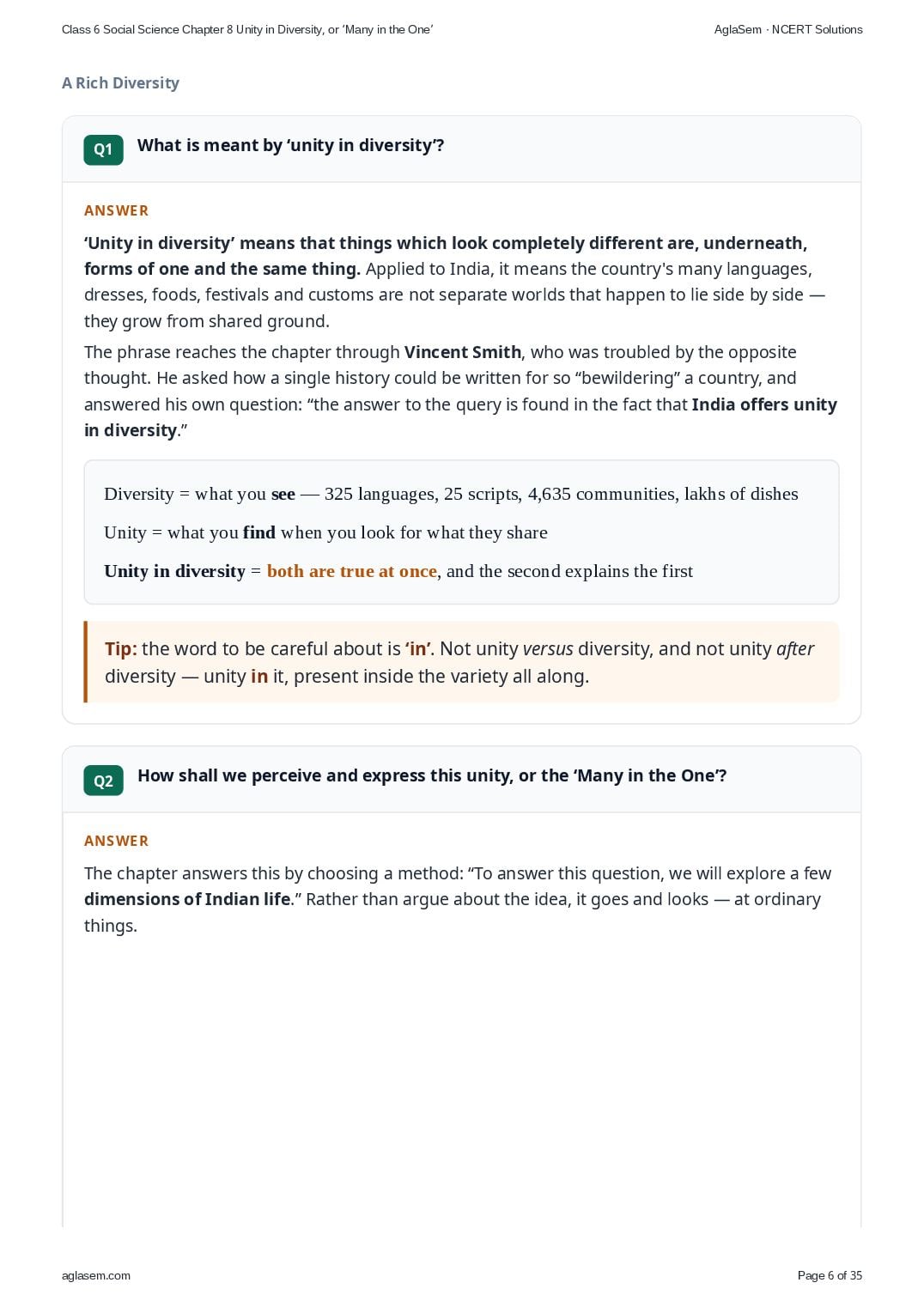
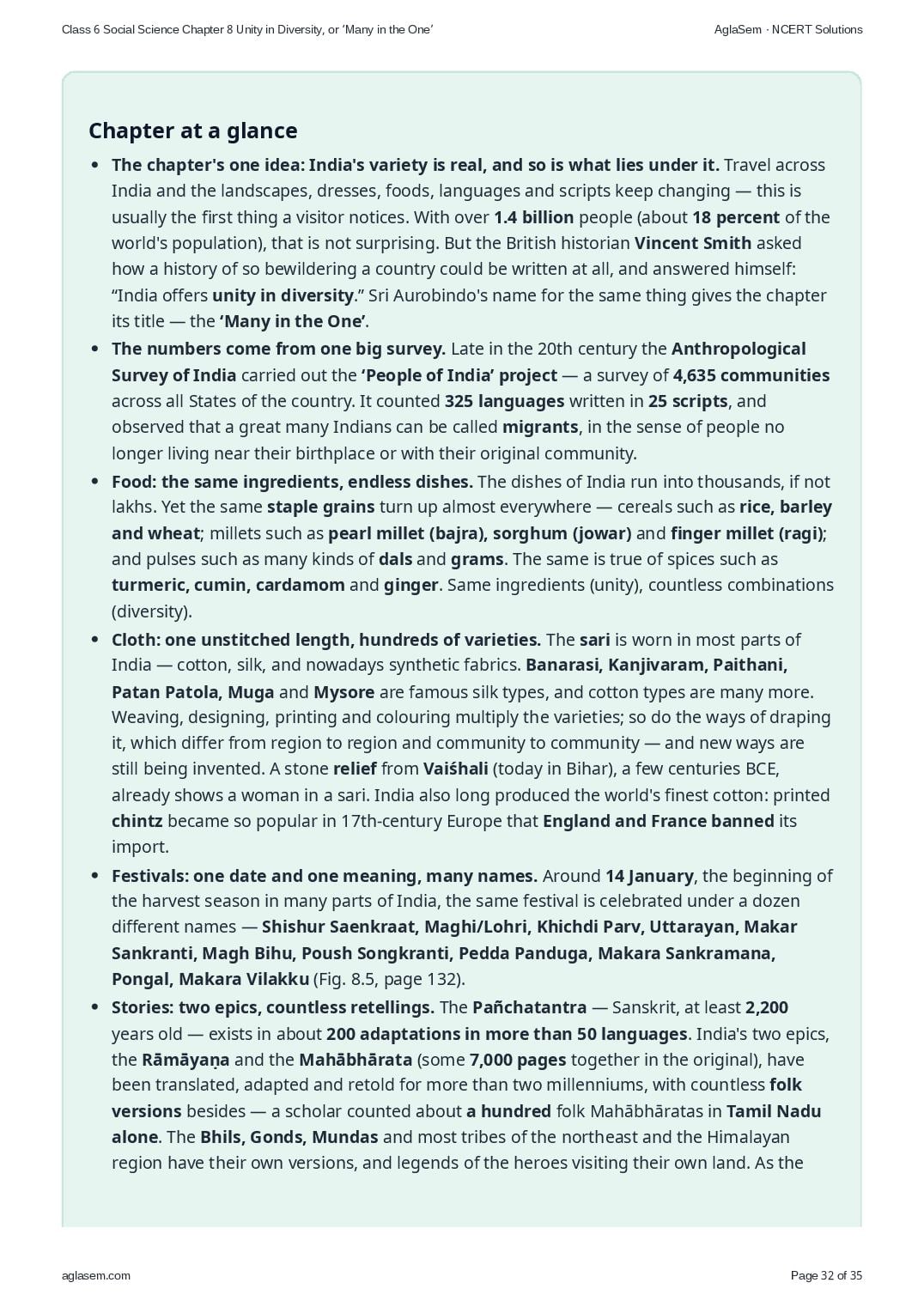
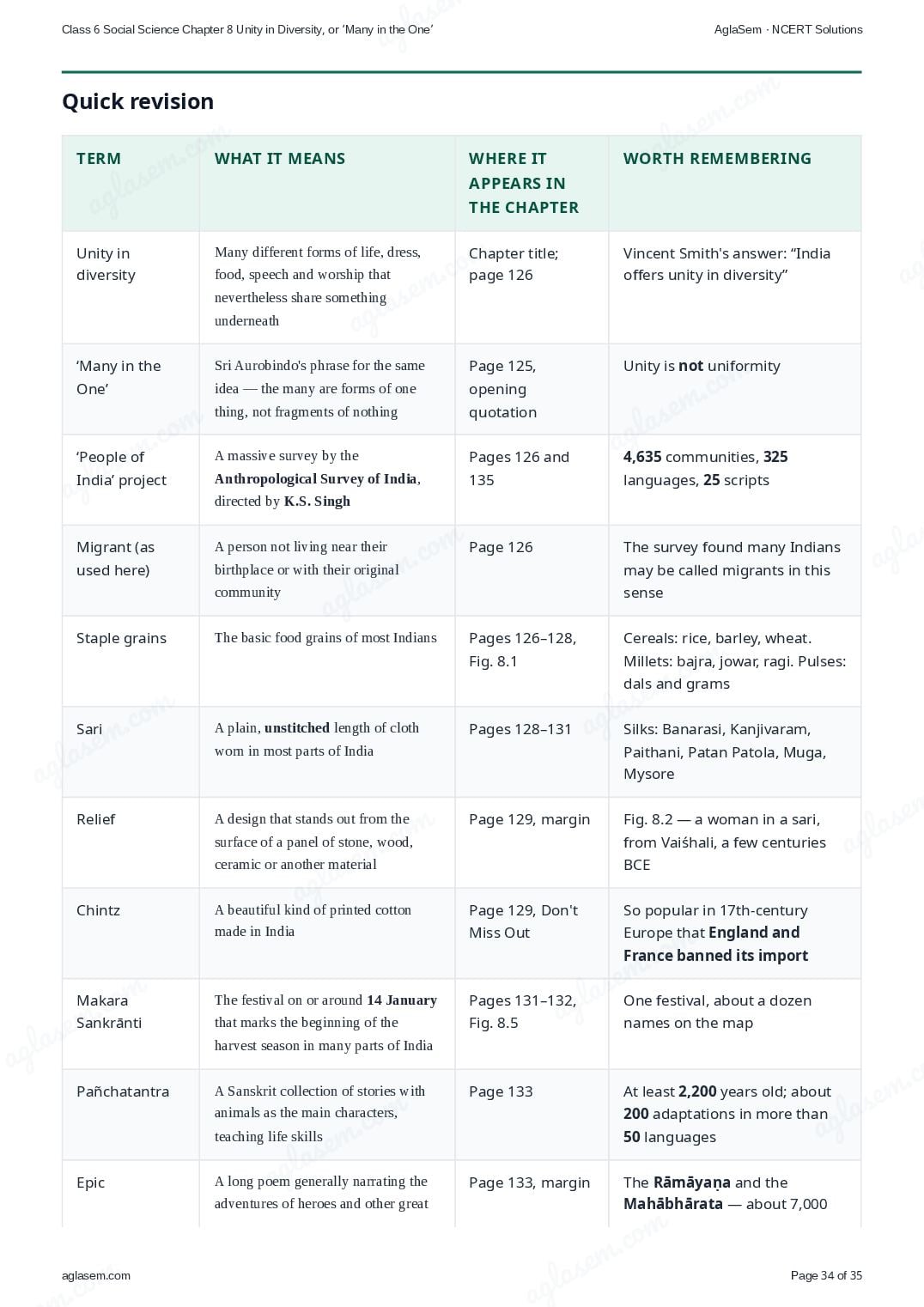
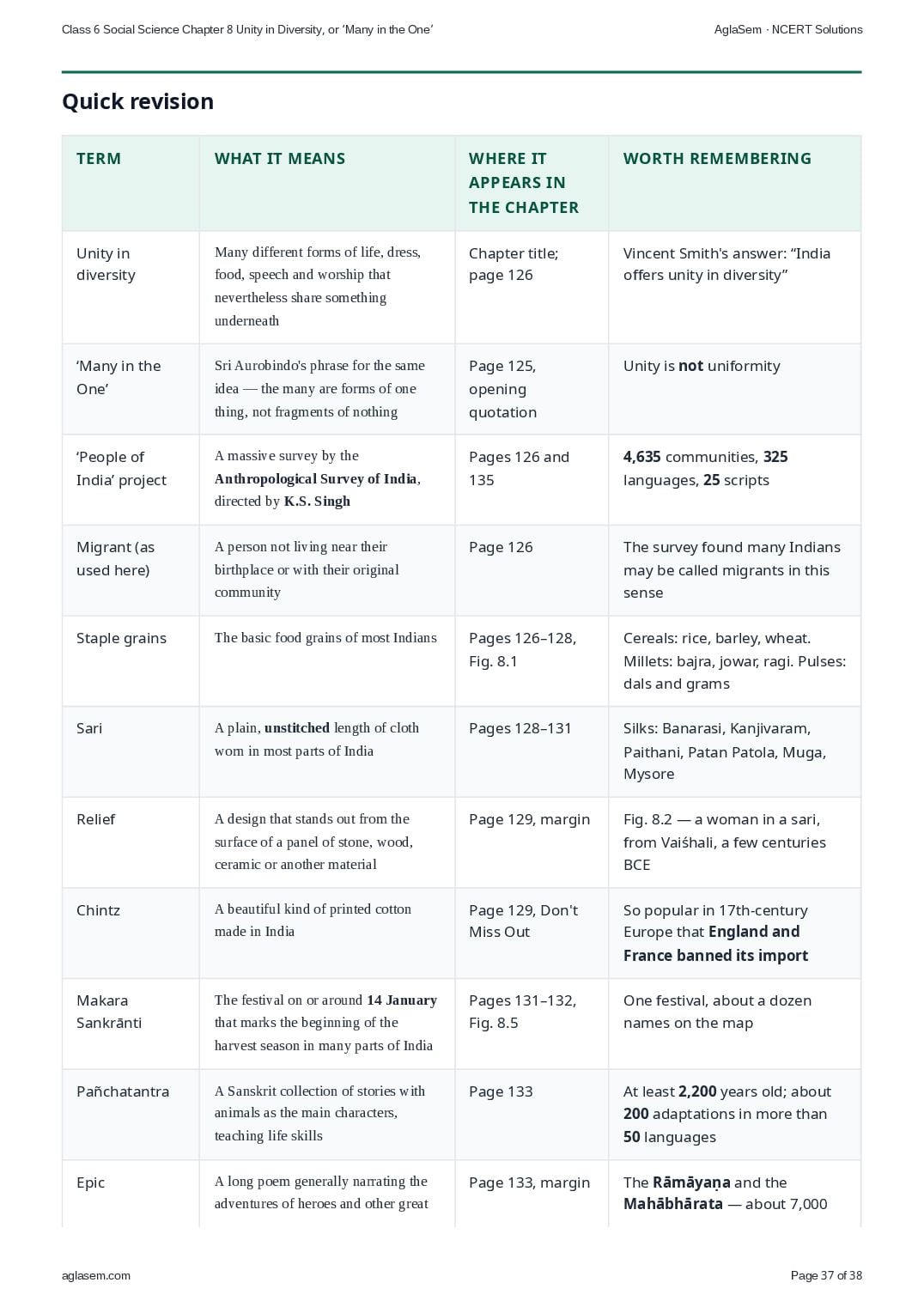
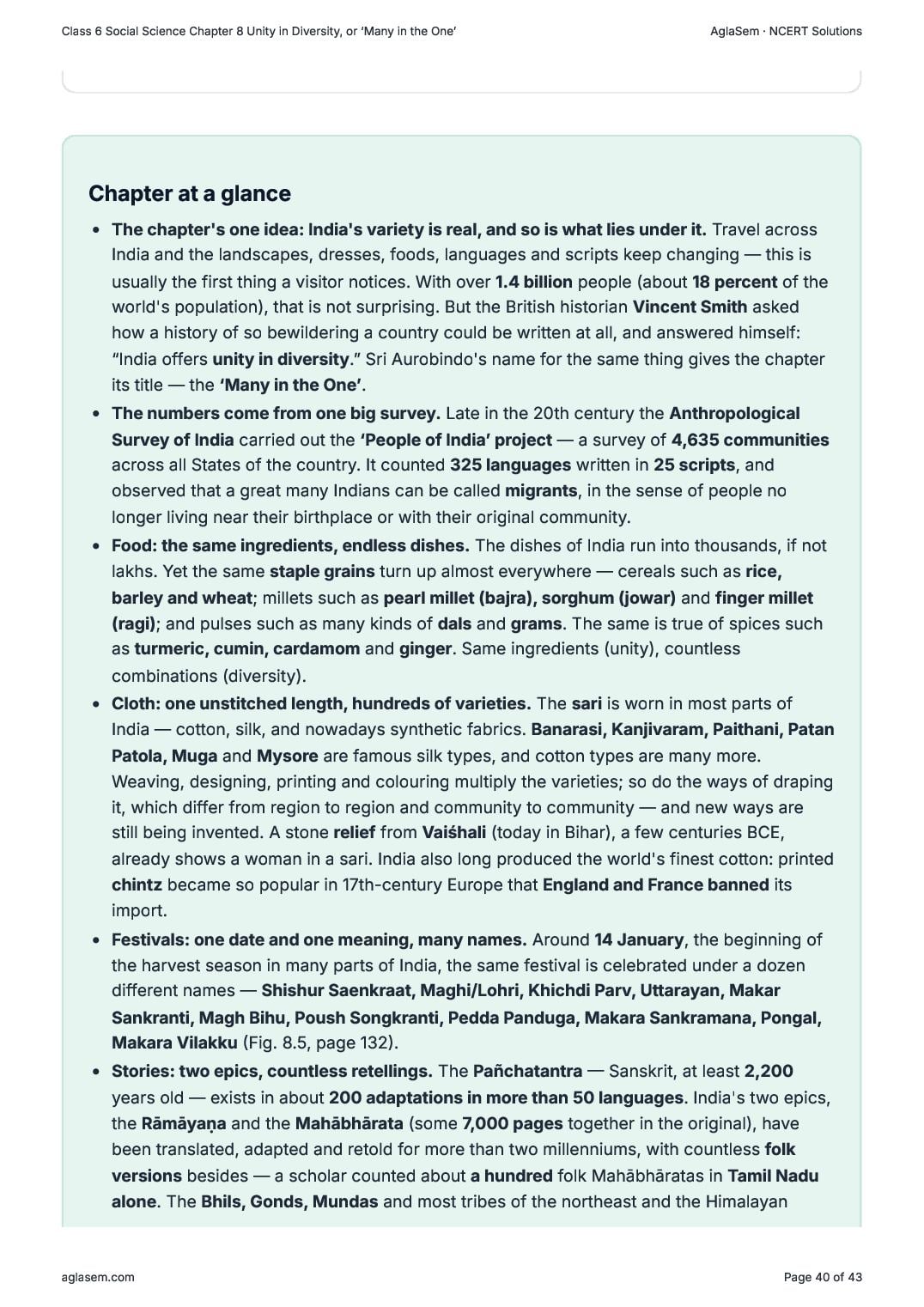
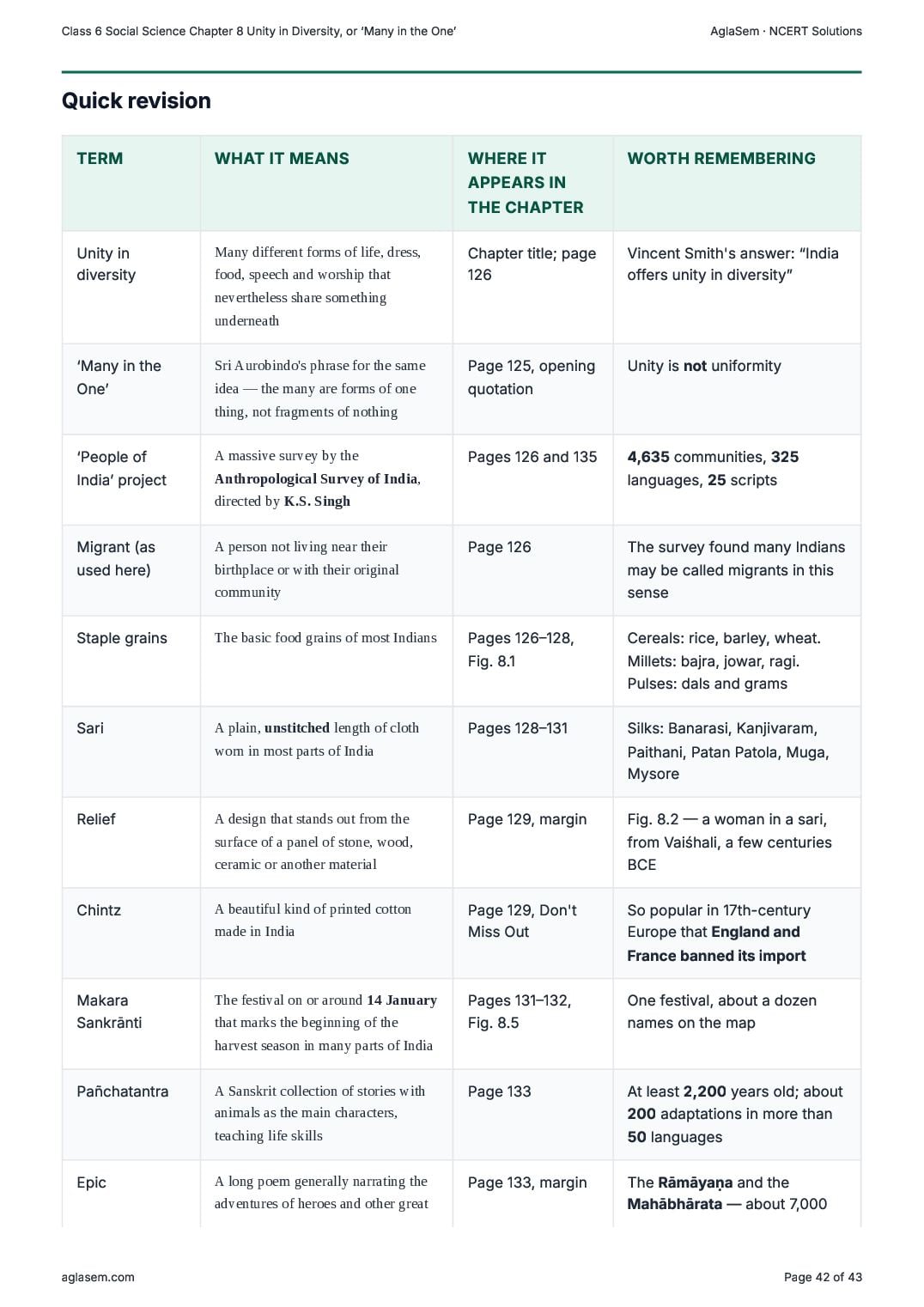
- The chapter's one idea: India's variety is real, and so is what lies under it. Travel across India and the landscapes, dresses, foods, languages and scripts keep changing — this is usually the first thing a visitor notices. With over 1.4 billion people (about 18 percent of the world's population), that is not surprising. But the British historian Vincent Smith asked how a history of so bewildering a country could be written at all, and answered himself: “India offers unity in diversity .” Sri Aurobindo's name for the same thing gives the chapter its title — the ‘Many in the One’ .
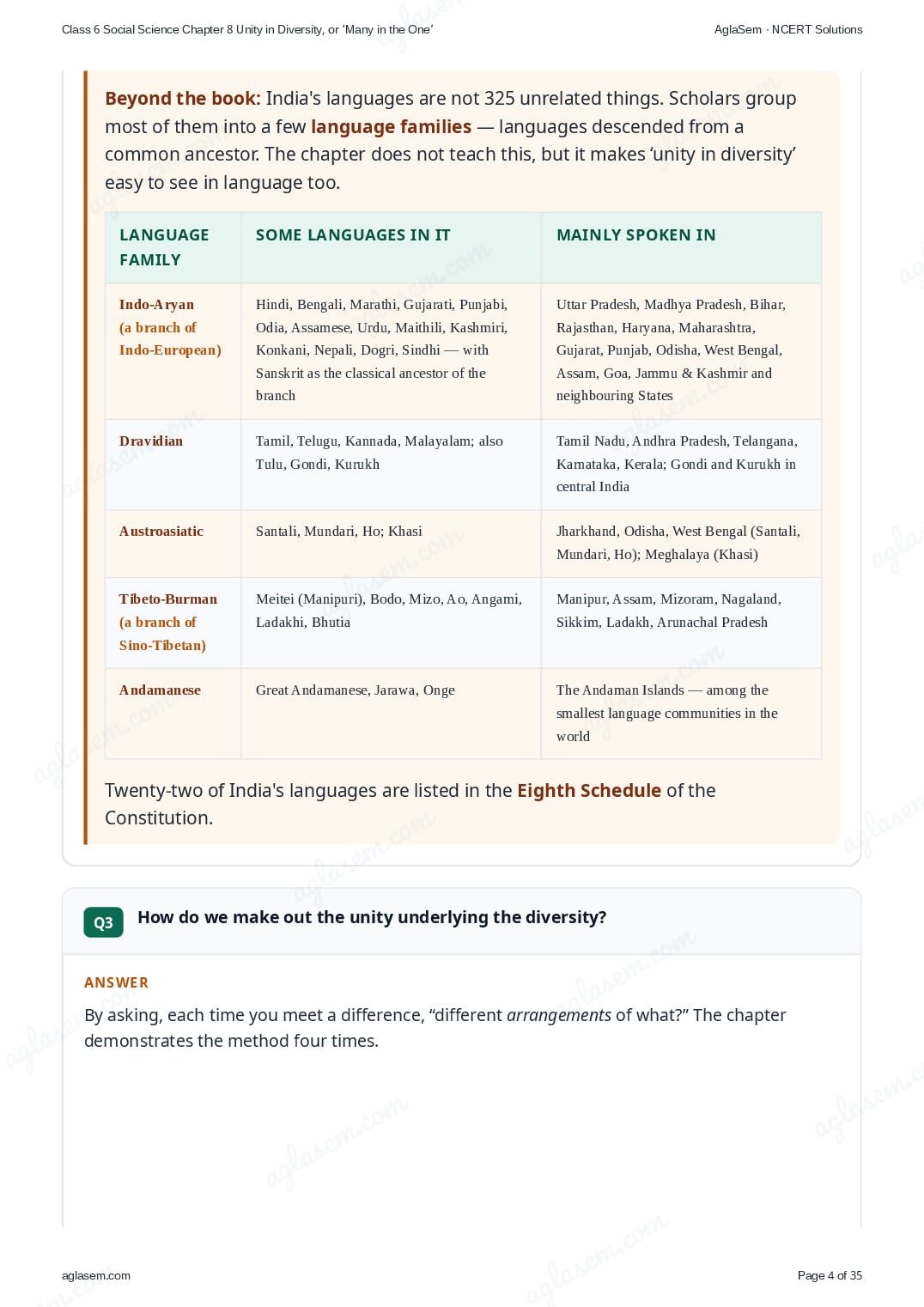
- The numbers come from one big survey. Late in the 20th century the Anthropological Survey of India carried out the ‘People of India’ project — a survey of 4,635 communities across all States of the country. It counted 325 languages written in 25 scripts , and observed that a great many Indians can be called migrants , in the sense of people no longer living near their birthplace or with their original community.
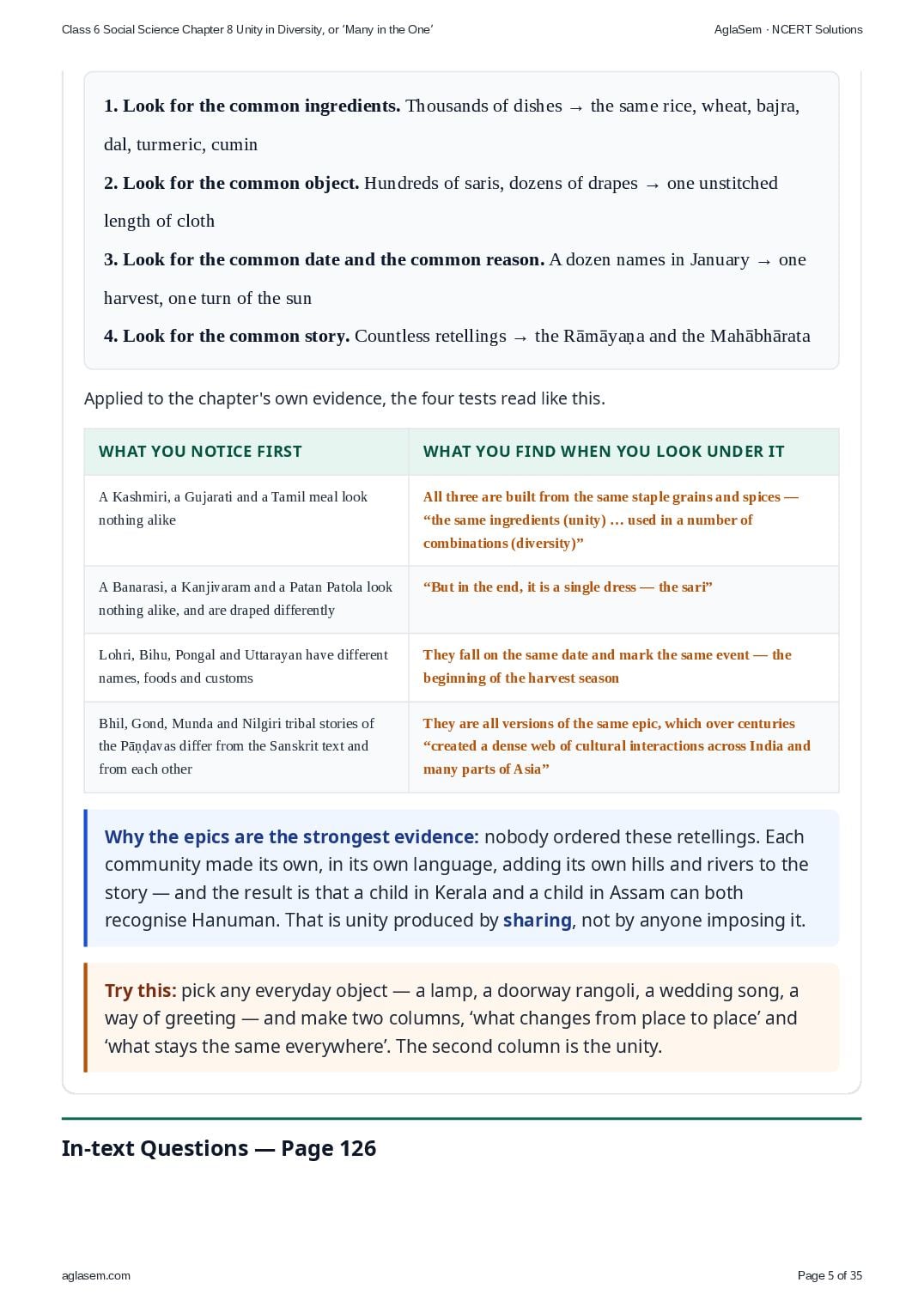
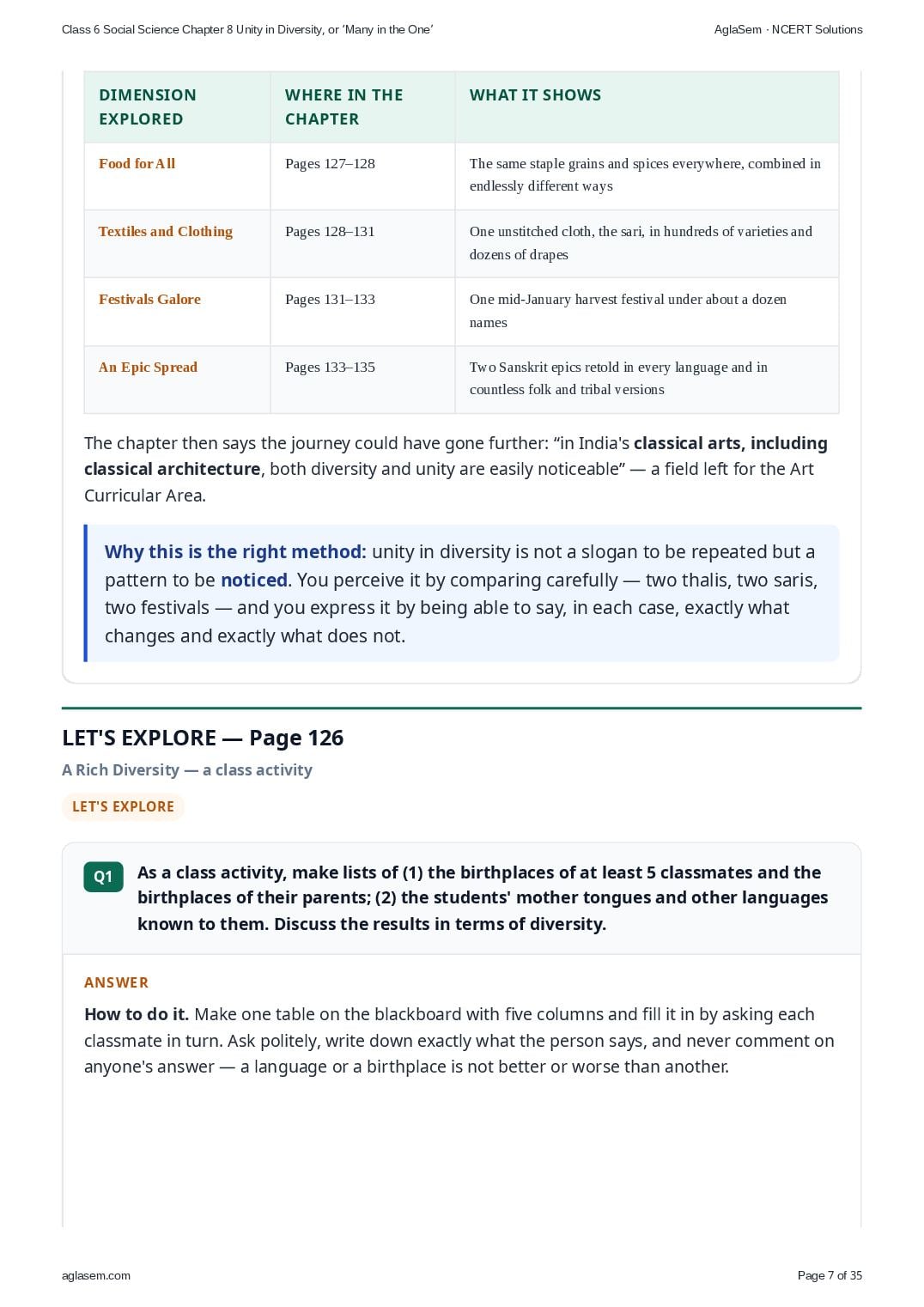
- Food: the same ingredients, endless dishes. The dishes of India run into thousands, if not lakhs. Yet the same staple grains turn up almost everywhere — cereals such as rice, barley and wheat ; millets such as pearl millet (bajra), sorghum (jowar) and finger millet (ragi) ; and pulses such as many kinds of dals and grams . The same is true of spices such as turmeric, cumin, cardamom and ginger . Same ingredients (unity), countless combinations (diversity).
- Cloth: one unstitched length, hundreds of varieties. The sari is worn in most parts of India — cotton, silk, and nowadays synthetic fabrics. Banarasi, Kanjivaram, Paithani, Patan Patola, Muga and Mysore are famous silk types, and cotton types are many more. Weaving, designing, printing and colouring multiply the varieties; so do the ways of draping it, which differ from region to region and community to community — and new ways are still being invented. A stone relief from Vaiśhali (today in Bihar), a few centuries BCE, already shows a woman in a sari. India also long produced the world's finest cotton: printed chintz became so popular in 17th-century Europe that England and France banned its import.
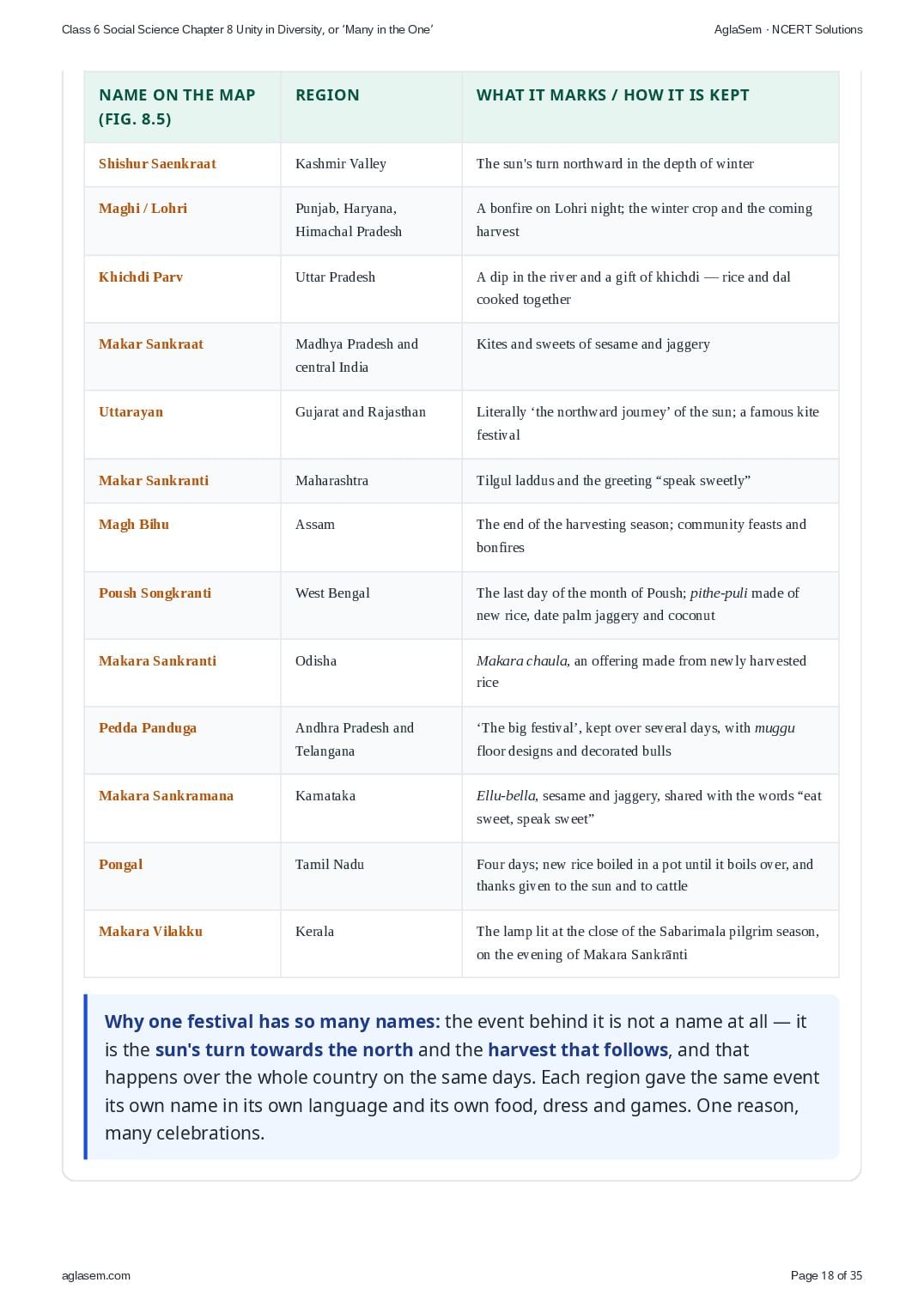
- Festivals: one date and one meaning, many names. Around 14 January , the beginning of the harvest season in many parts of India, the same festival is celebrated under a dozen different names — Shishur Saenkraat, Maghi/Lohri, Khichdi Parv, Uttarayan, Makar Sankranti, Magh Bihu, Poush Songkranti, Pedda Panduga, Makara Sankramana, Pongal, Makara Vilakku (Fig. 8.5, page 132).
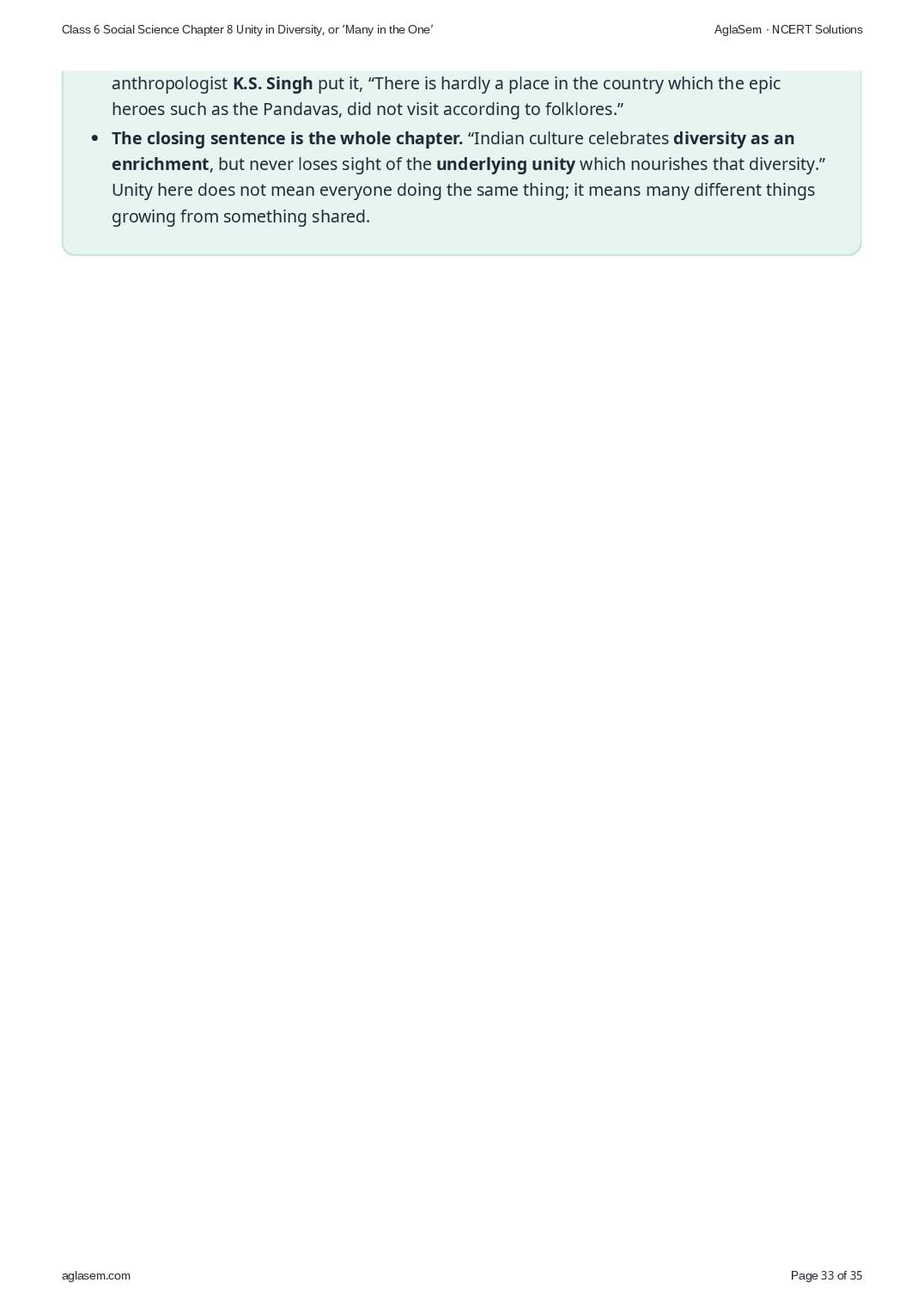
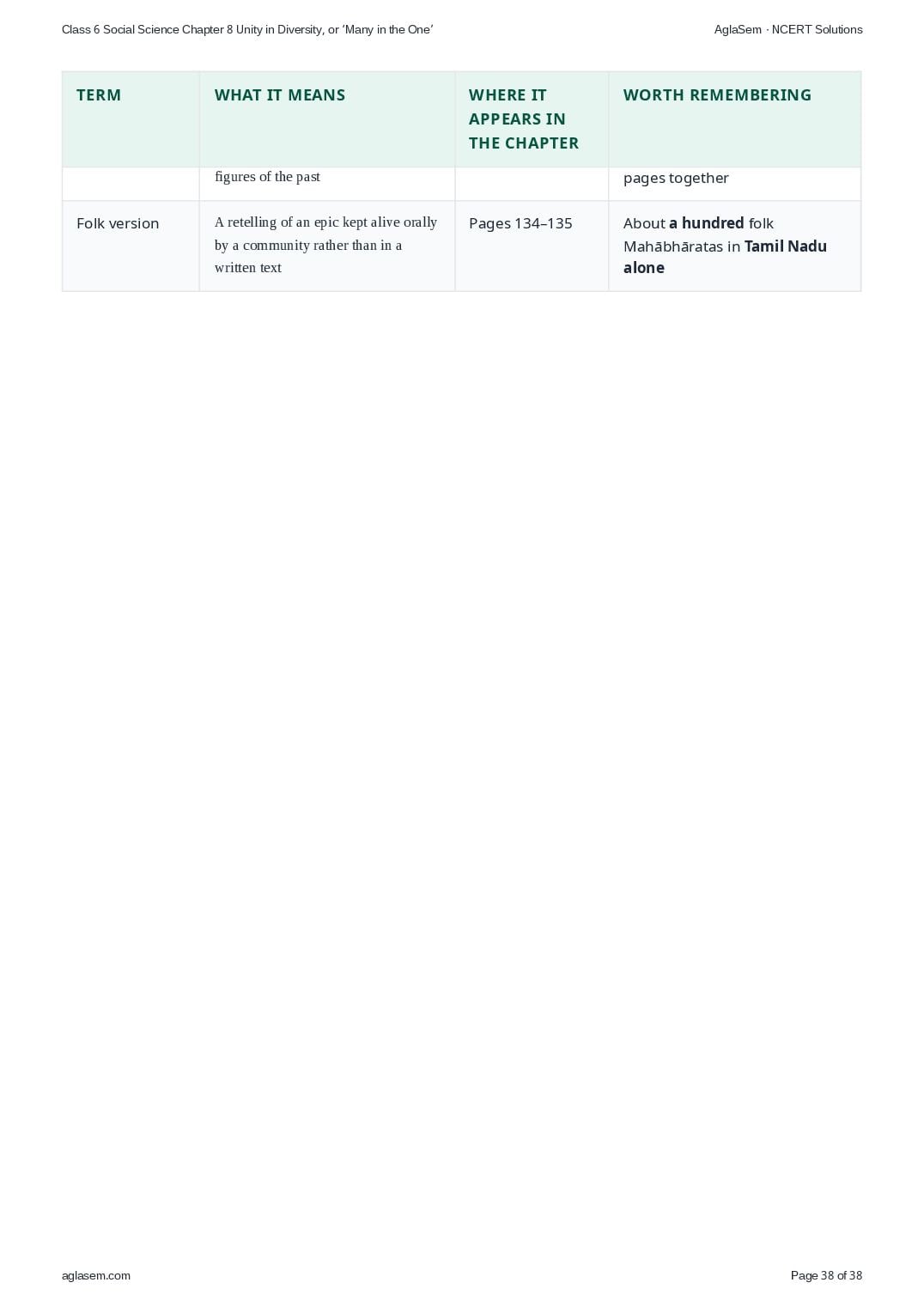
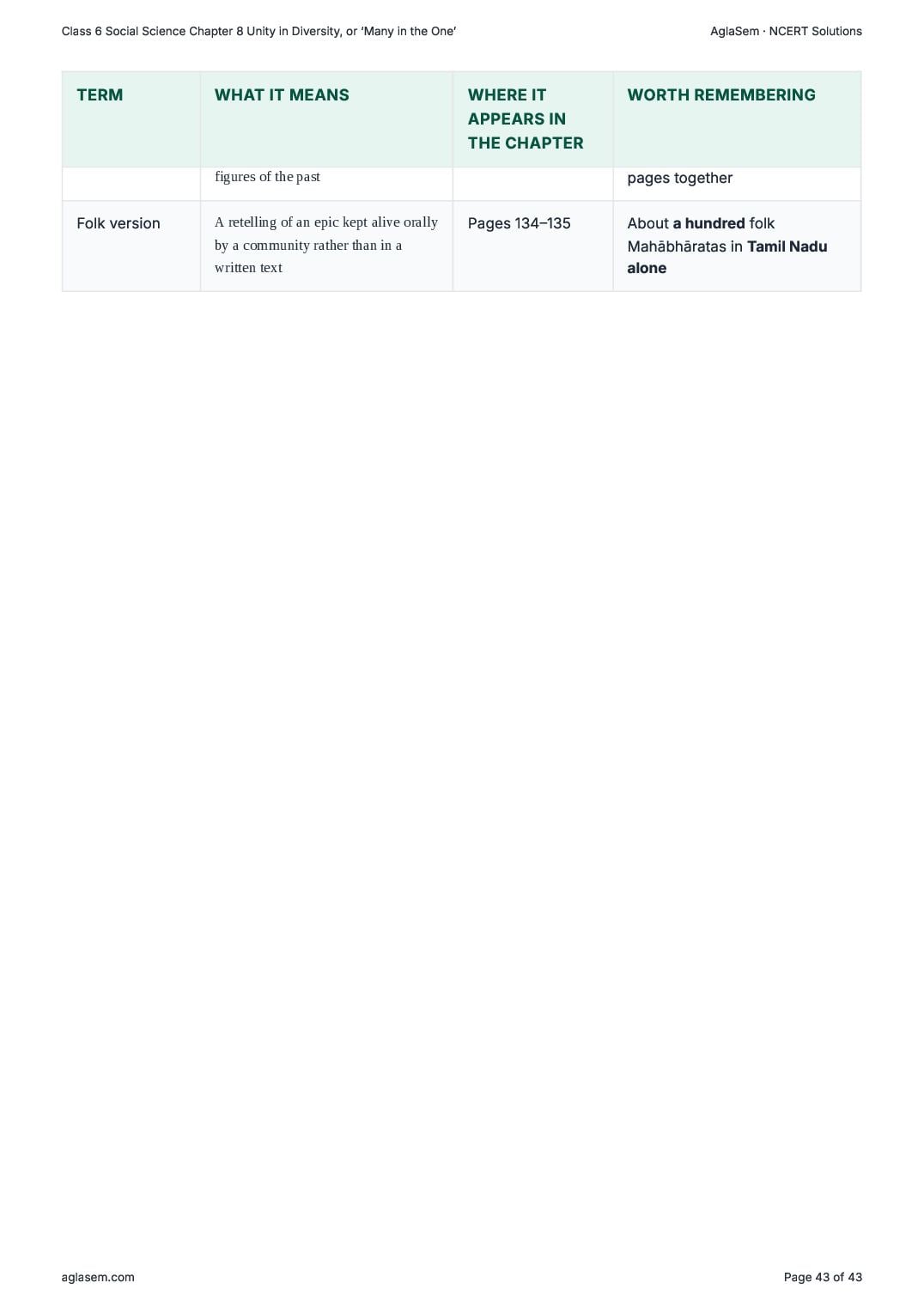
- Stories: two epics, countless retellings. The Pañchatantra — Sanskrit, at least 2,200 years old — exists in about 200 adaptations in more than 50 languages . India's two epics, the Rāmāyaṇa and the Mahābhārata (some 7,000 pages together in the original), have been translated, adapted and retold for more than two millenniums, with countless folk versions besides — a scholar counted about a hundred folk Mahābhāratas in Tamil Nadu alone . The Bhils, Gonds, Mundas and most tribes of the northeast and the Himalayan region have their own versions, and legends of the heroes visiting their own land. As the anthropologist K.S. Singh put it, “There is hardly a place in the country which the epic heroes such as the Pandavas, did not visit according to folklores.”
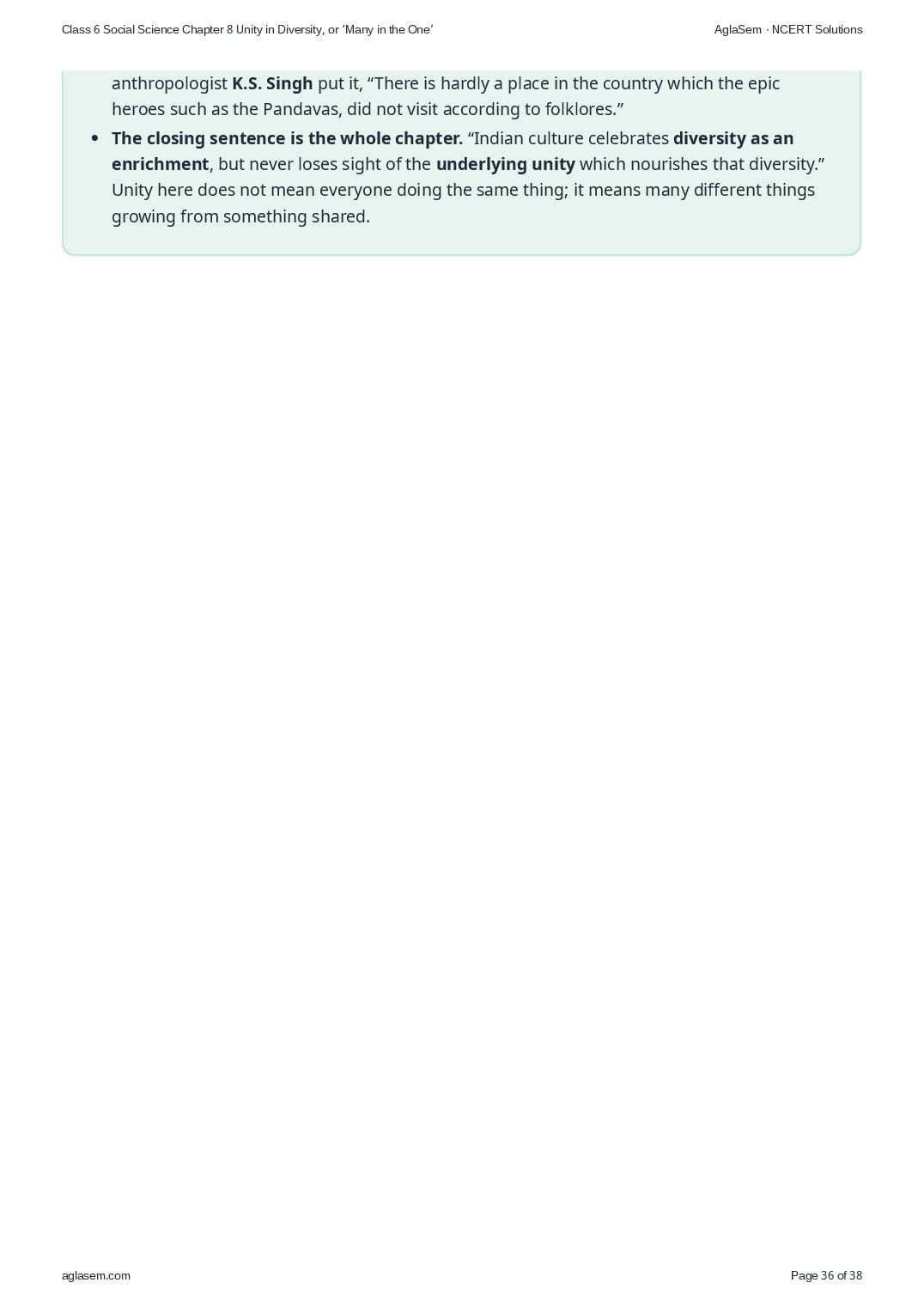
- The closing sentence is the whole chapter. “Indian culture celebrates diversity as an enrichment , but never loses sight of the underlying unity which nourishes that diversity.” Unity here does not mean everyone doing the same thing; it means many different things growing from something shared.
How to Download NCERT Solutions for Class 6 Social Science Chapter 8 PDF
Follow these simple steps to get the Unity in Diversity or Many in the One questions-and-answers PDF from Exploring Society India and Beyond.
- Search NCERT Solutions for Class 6 Social Science Chapter 8 aglasem and open this page.
- Read the exercise questions with answers for Unity in Diversity or Many in the One shown above.
- Click the Download PDF link to save the Unity in Diversity or Many in the One solutions to your device.
NCERT Solutions for Class 6 Social Science – All Chapters
There are more chapters to study besides Unity in Diversity or Many in the One in Social Science. Here are the NCERT Solutions for all chapters of Class 6 Social Science.
- Chapter 1 Locating Places on the Earth
- Chapter 2 Oceans and Continents
- Chapter 3 Landforms and Life
- Chapter 4 Timeline and Sources of History
- Chapter 5 India That Is Bharat
- Chapter 6 the Beginnings of Indian Civilisation
- Chapter 7 India’s Cultural Roots
- Chapter 8 Unity in Diversity or Many in the One
- Chapter 9 Family and Community
- Chapter 10 Grassroots Democracy part 1 Governance
- Chapter 11 Grassroots Democracy part 2 Local Government in Rural Areas
- Chapter 12 Grassroots Democracy part 3 Local Government in Urban Areas
- Chapter 13 the Value of Work
- Chapter 14 Economic Activities Around Us
NCERT Solutions for Class 6 – All Subjects
Just like Chapter 8 of Social Science, you can get the exercise questions with answers for every other subject of Class 6. Here are the NCERT Solutions for all subjects of Class 6.
NCERT Solutions for Class 6 Social Science Chapter 8 – An Overview
The key highlights of this study material are as follows.
| Aspects | Details |
|---|---|
| Class | Class 6 |
| Subject | Social Science |
| Chapter Number | Chapter 8 |
| Chapter Name | Unity in Diversity or Many in the One |
| Book Name | Exploring Society India and Beyond |
| Book By | NCERT (National Council of Educational Research and Training) |
| Educational Resource Here | NCERT Solutions of Class 6 Social Science Chapter 8 for all exercises |
| More Questions Answers of This Subject | NCERT Solutions for Class 6 Social Science |
| Download Book Chapter | NCERT Book Class 6 Social Science |
| All Questions Answers For This Class | NCERT Solutions for Class 6 |
| Complete Solutions | NCERT Solutions |
NCERT Solutions for Class 6 Social Science Chapter 8 Unity in Diversity or Many in the One – FAQs
What are the NCERT Solutions for Class 6 Social Science Chapter 8 Unity in Diversity or Many in the One?
They are the complete, step-by-step answers to all the exercise and in-text questions of Chapter 8 Unity in Diversity or Many in the One from the NCERT Class 6 Social Science textbook Exploring Society India and Beyond, written by experts as per the latest NCERT syllabus.
How can I download the Class 6 Social Science Chapter 8 solutions PDF for free?
Open this page on aglasem, read the Unity in Diversity or Many in the One questions with answers, and click the “Download Solutions PDF” link. The Class 6 Social Science Chapter 8 NCERT Solutions PDF is completely free to download.
Are these NCERT Solutions as per the latest 2026-27 syllabus?
Yes. The NCERT Solutions for Class 6 Social Science Chapter 8 are based on the latest NCERT textbook Exploring Society India and Beyond and the current 2026-27 CBSE syllabus, so the questions and answers match what you study in class.
Where can I get NCERT Solutions for the other chapters of Class 6 Social Science?
You can find the answers to every chapter on the NCERT Solutions for Class 6 Social Science page, and solutions for every subject on the NCERT Solutions for Class 6 page.
How do NCERT Solutions help in exam preparation?
They show the correct method to solve each question, help you write answers the way they are expected in exams, let you check and correct your own work, and save revision time — which together improve your marks in Class 6 Social Science.
If you have any queries on NCERT Solutions for Class 6 Social Science Chapter 8 Unity in Diversity or Many in the One, then please ask in the comments below.