NCERT Solutions for Class 6 Social Science Chapter 9 Family and Community provide clear, step-by-step answers to every exercise and in-text question from the chapter Family and Community of the NCERT textbook Exploring Society India and Beyond. Prepared by subject experts as per the latest NCERT (CBSE) syllabus for 2026-27, these NCERT Solutions for Class 6 Social Science help you understand each concept, write exam-ready answers, and check your own solutions. You can read them online below or download the free Class 6 Social Science Chapter 9 question-answer PDF.
NCERT Solutions for Class 6 Social Science Chapter 9 Family and Community
- Class: Class 6
- Subject: Social Science
- Chapter: Chapter 9 – Family and Community
- Textbook: Exploring Society India and Beyond (NCERT)
- Study material: NCERT Solutions – questions with answers, free PDF
These solutions answer all the exercise questions of Chapter 9 Family and Community — including the in-text questions, short-answer and long-answer questions, and activities — with complete explanations so you can follow the method, not just the final answer. Read the full solutions below.
NCERT Solutions Class 6 Social Science Chapter 9 Family and Community View Download
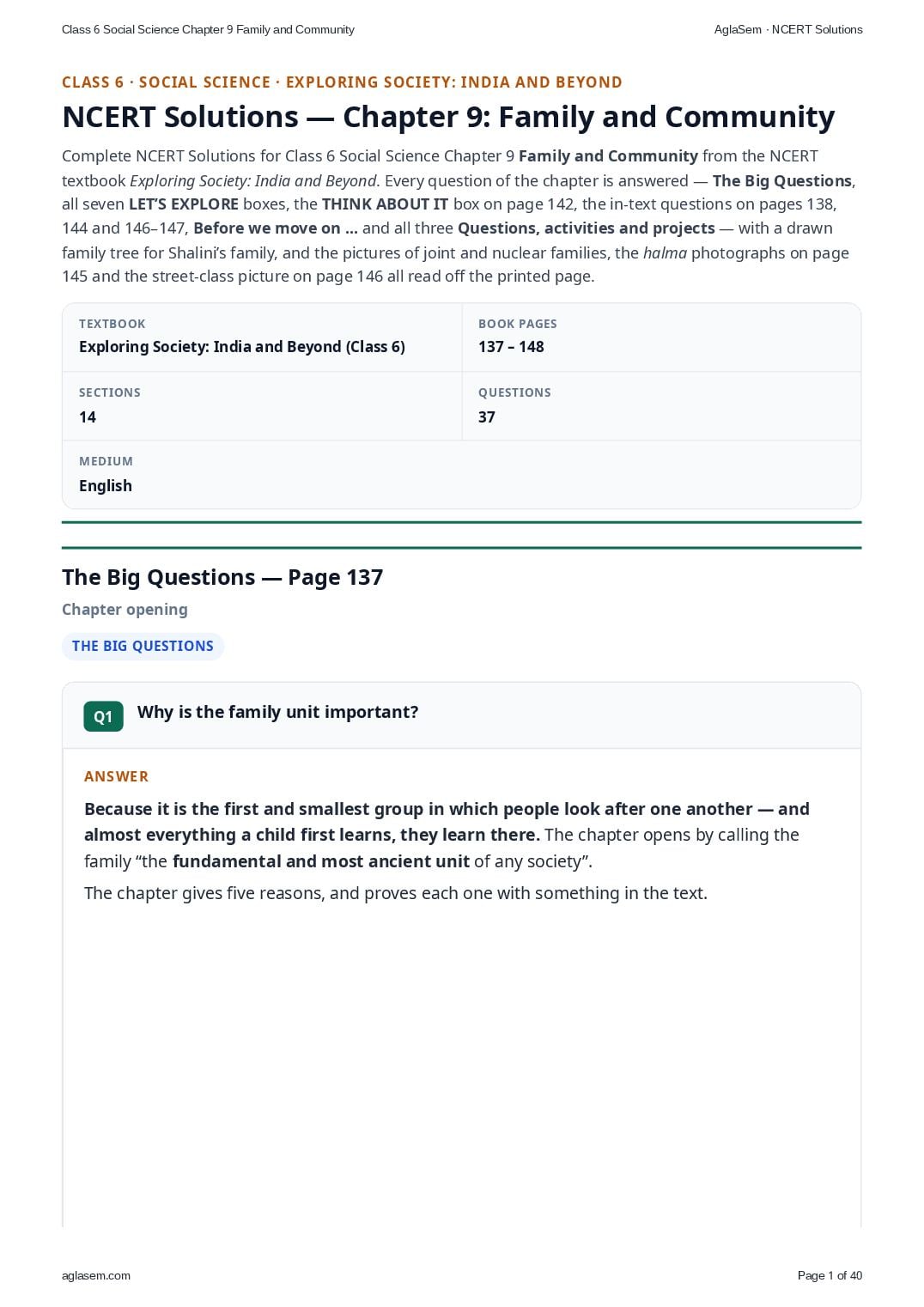
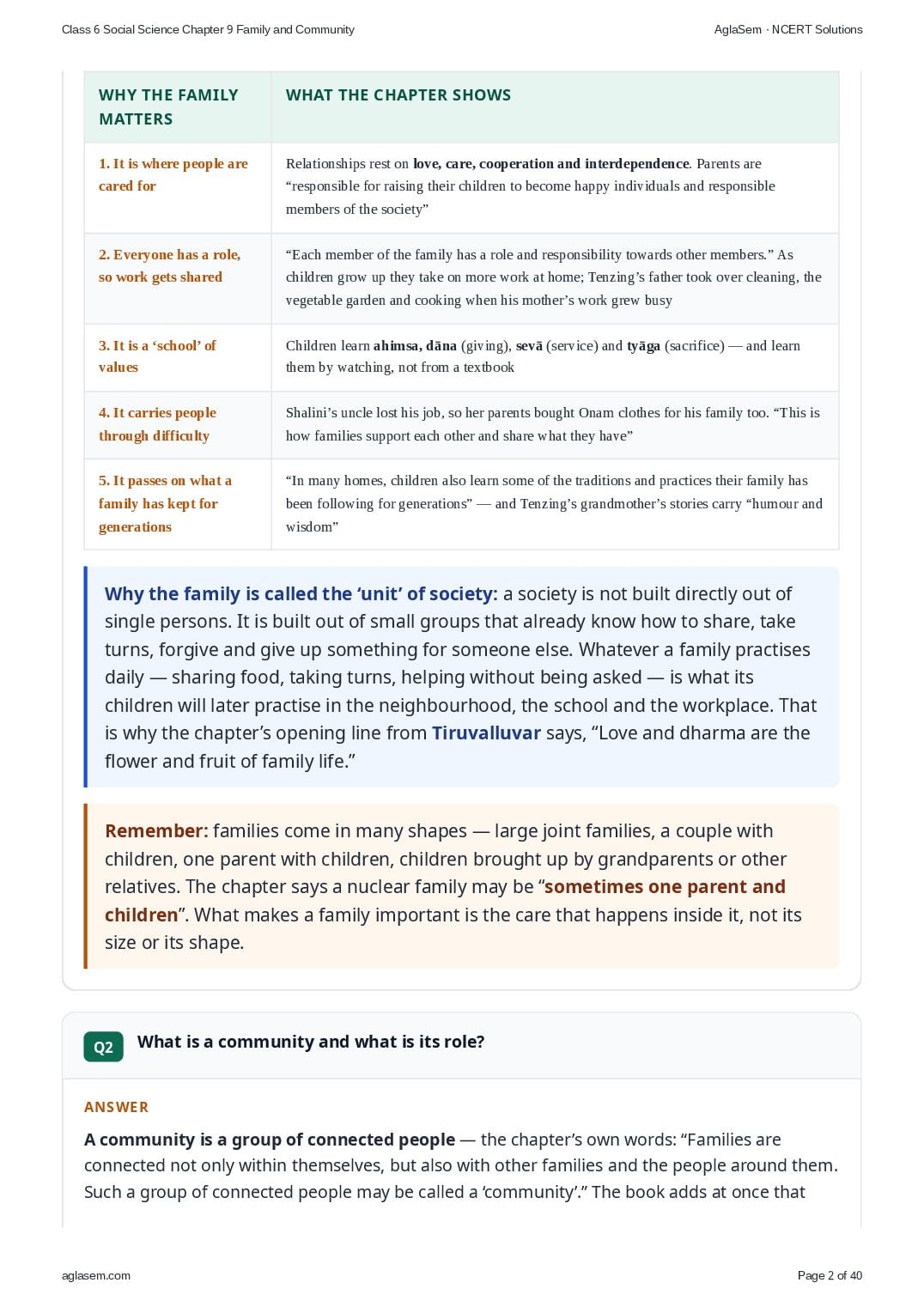
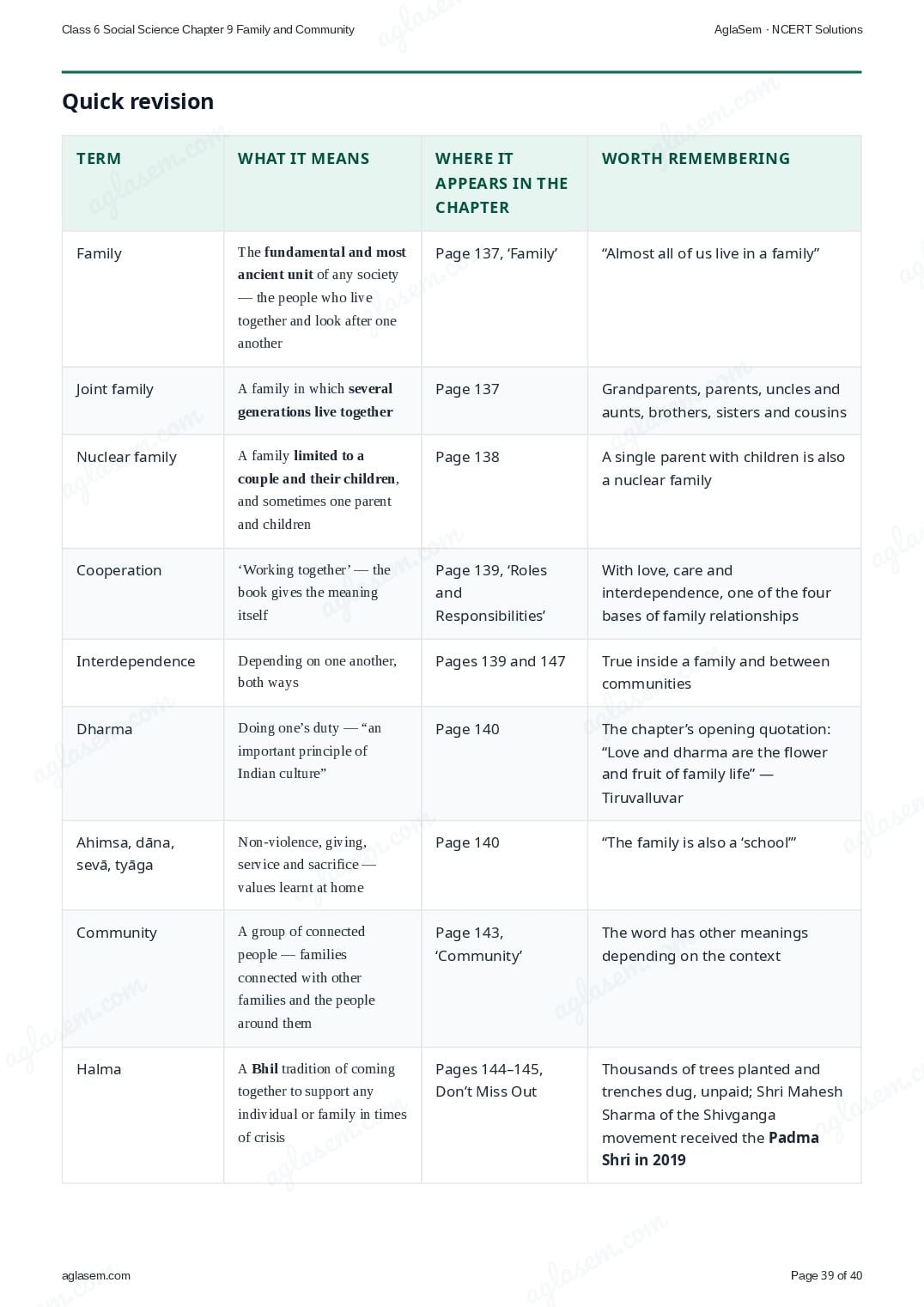
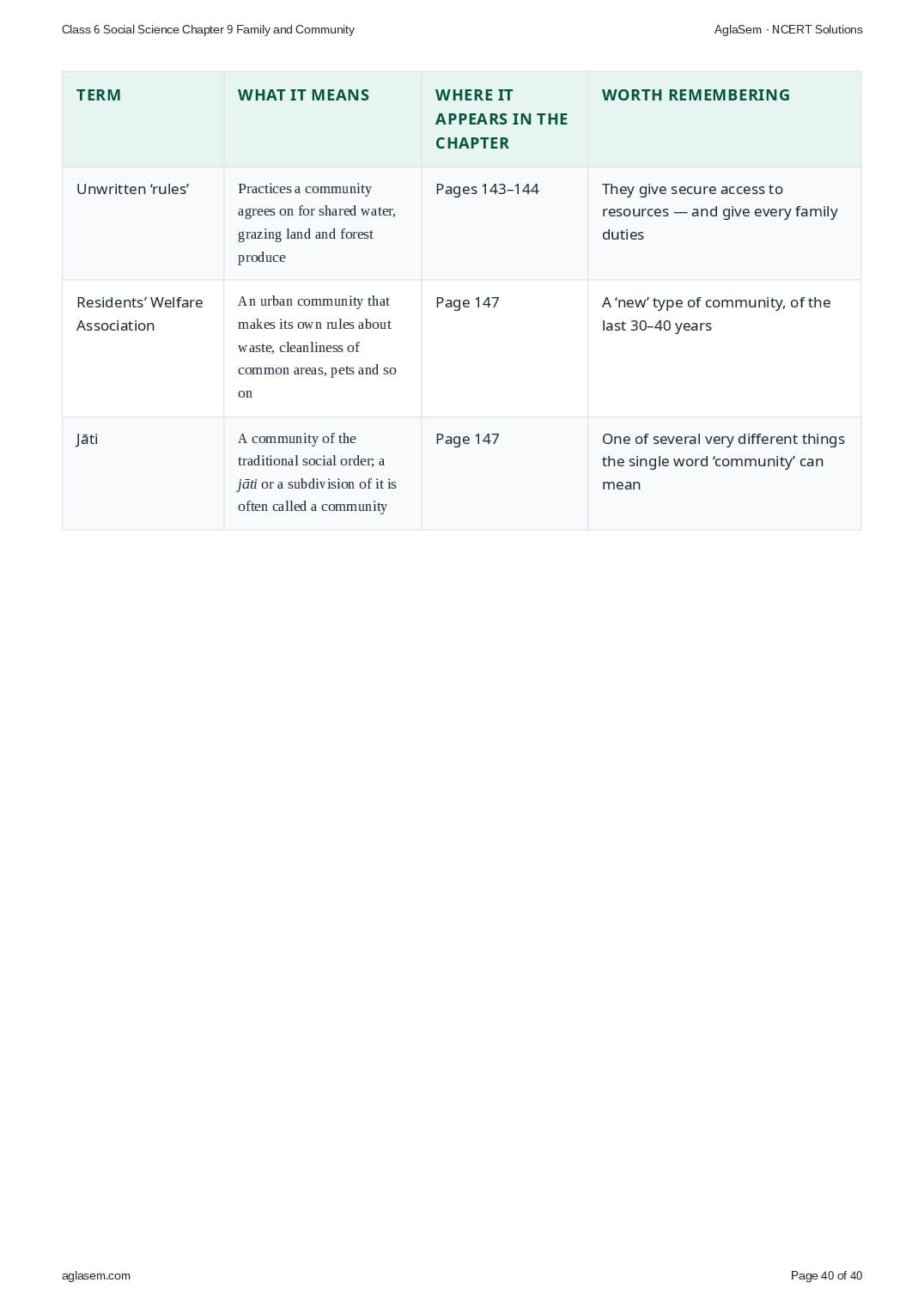
NCERT Solutions for Class 6 Social Science Chapter 9 PDF Download
You can read the NCERT Solutions for Class 6 Social Science Chapter 9 online above, or download the complete question-answer PDF to study Family and Community offline at any time.
NCERT Solutions for Class 6 Social Science Chapter 9 PDF Download Link – Click Here to Download Solutions PDF
Questions Covered in This Chapter
These NCERT Solutions answer all 37 questions of this chapter. The questions solved are:
- Why is the family unit important?
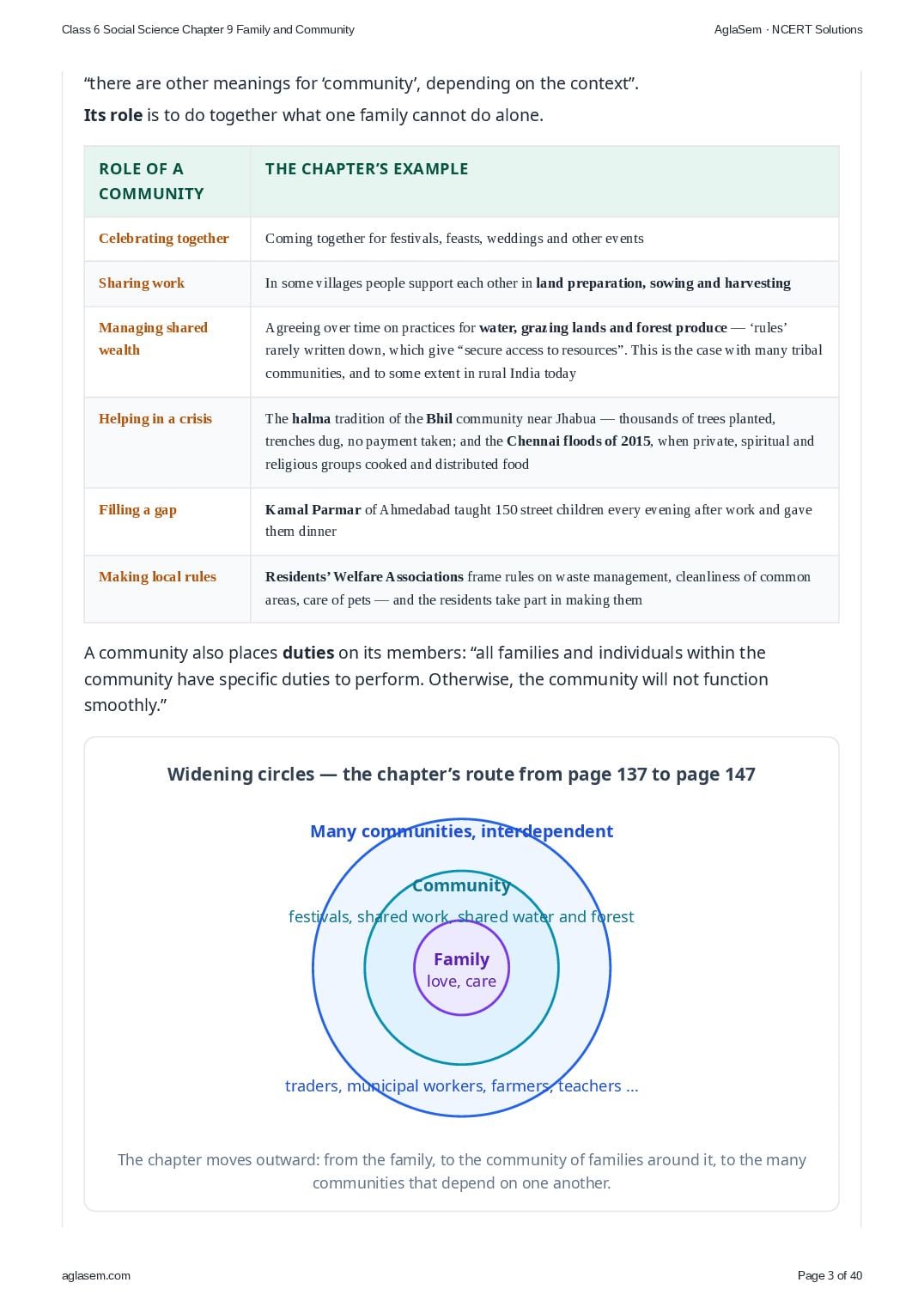
- What is a community and what is its role?
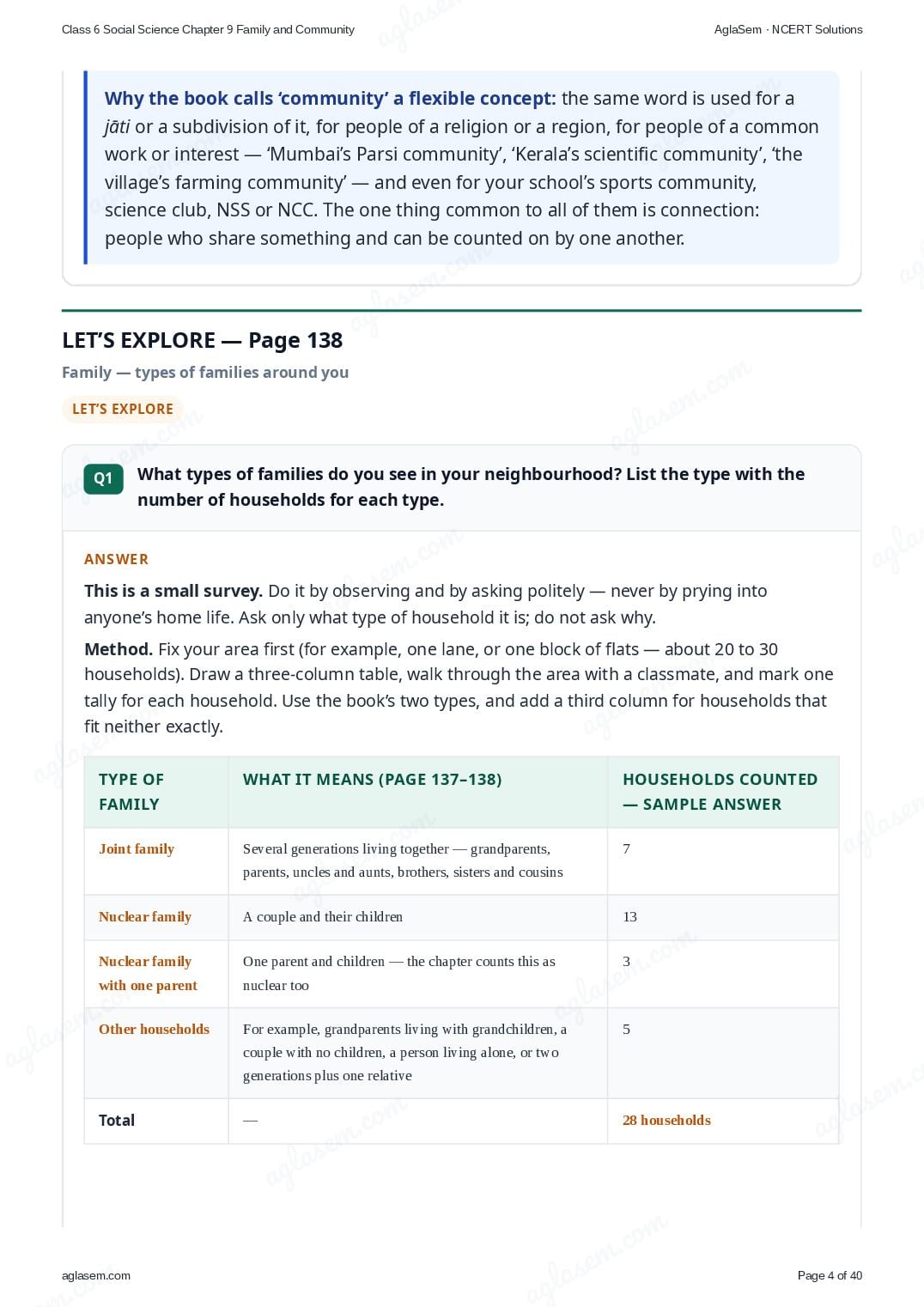
- What types of families do you see in your neighbourhood? List the type with the number of households for each type.
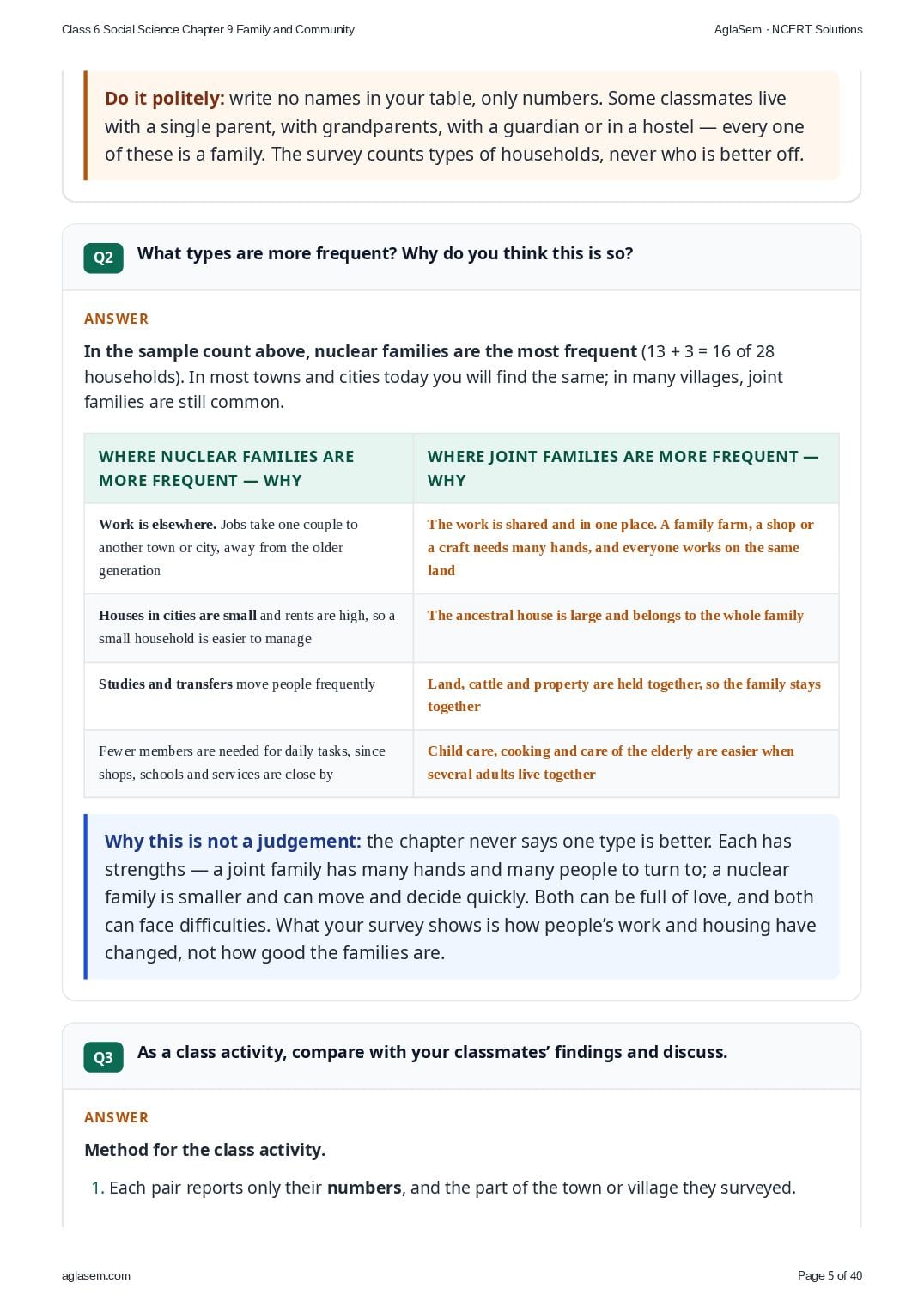
- What types are more frequent? Why do you think this is so?
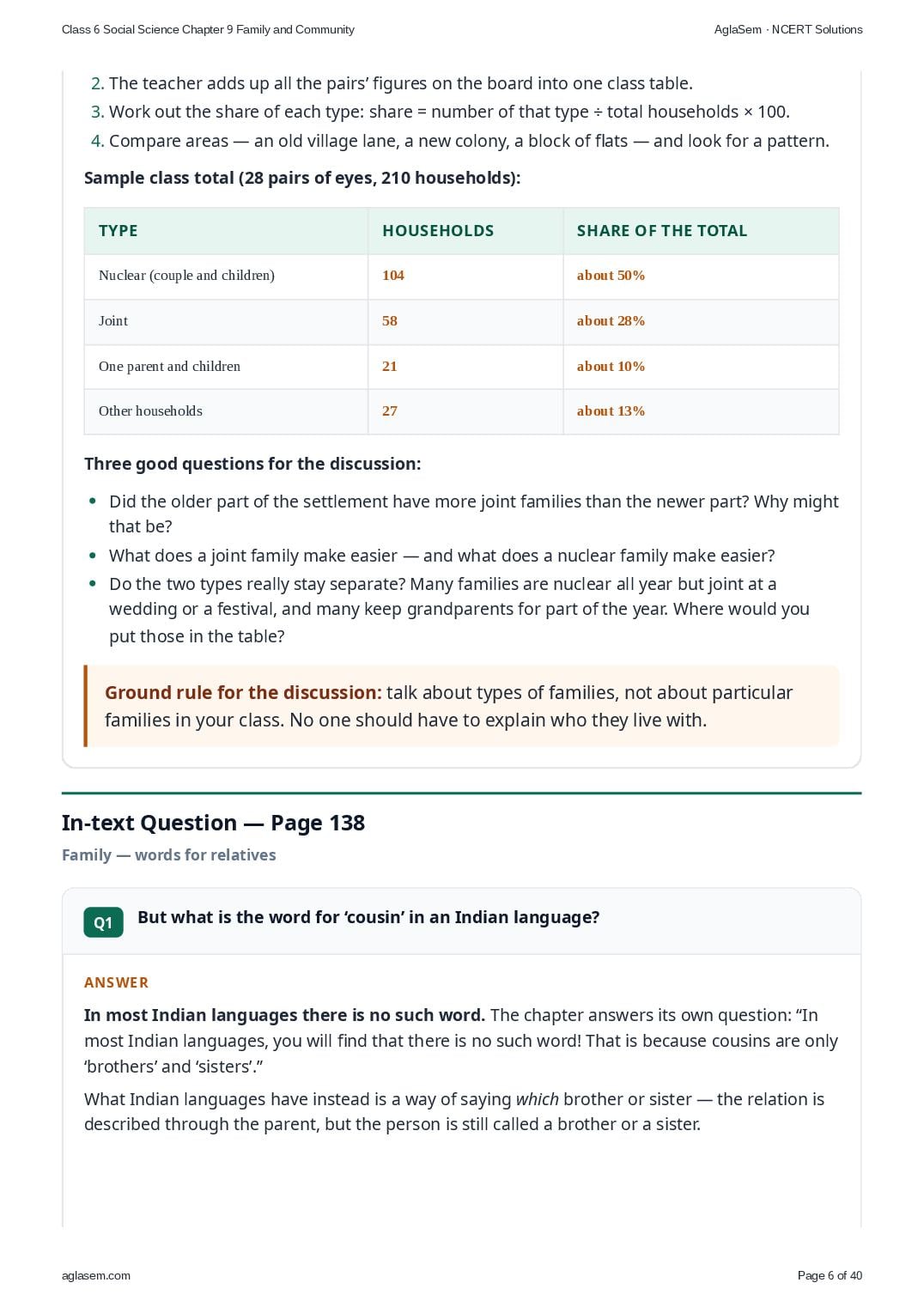
- As a class activity, compare with your classmates’ findings and discuss.
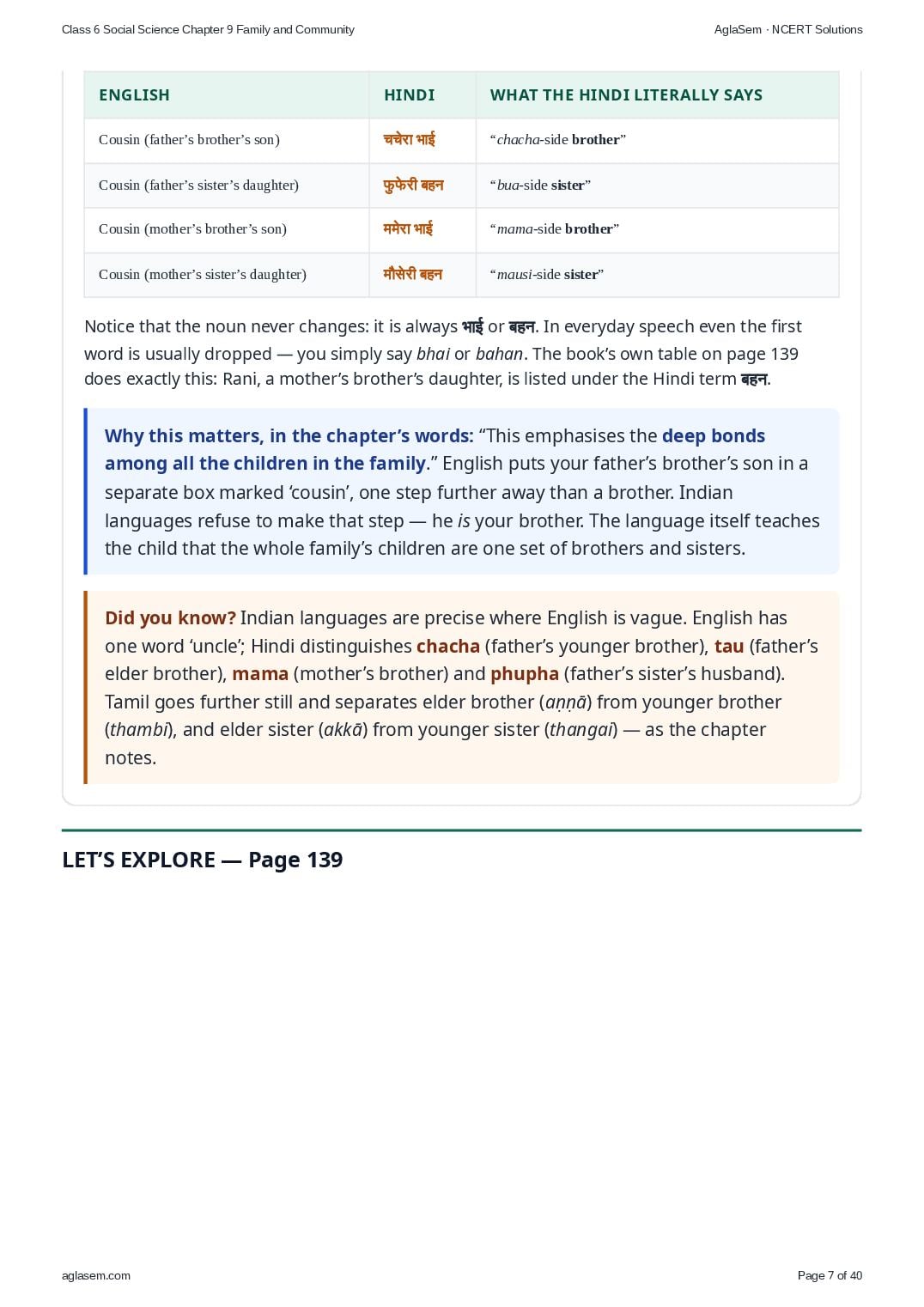
- But what is the word for ‘cousin’ in an Indian language?
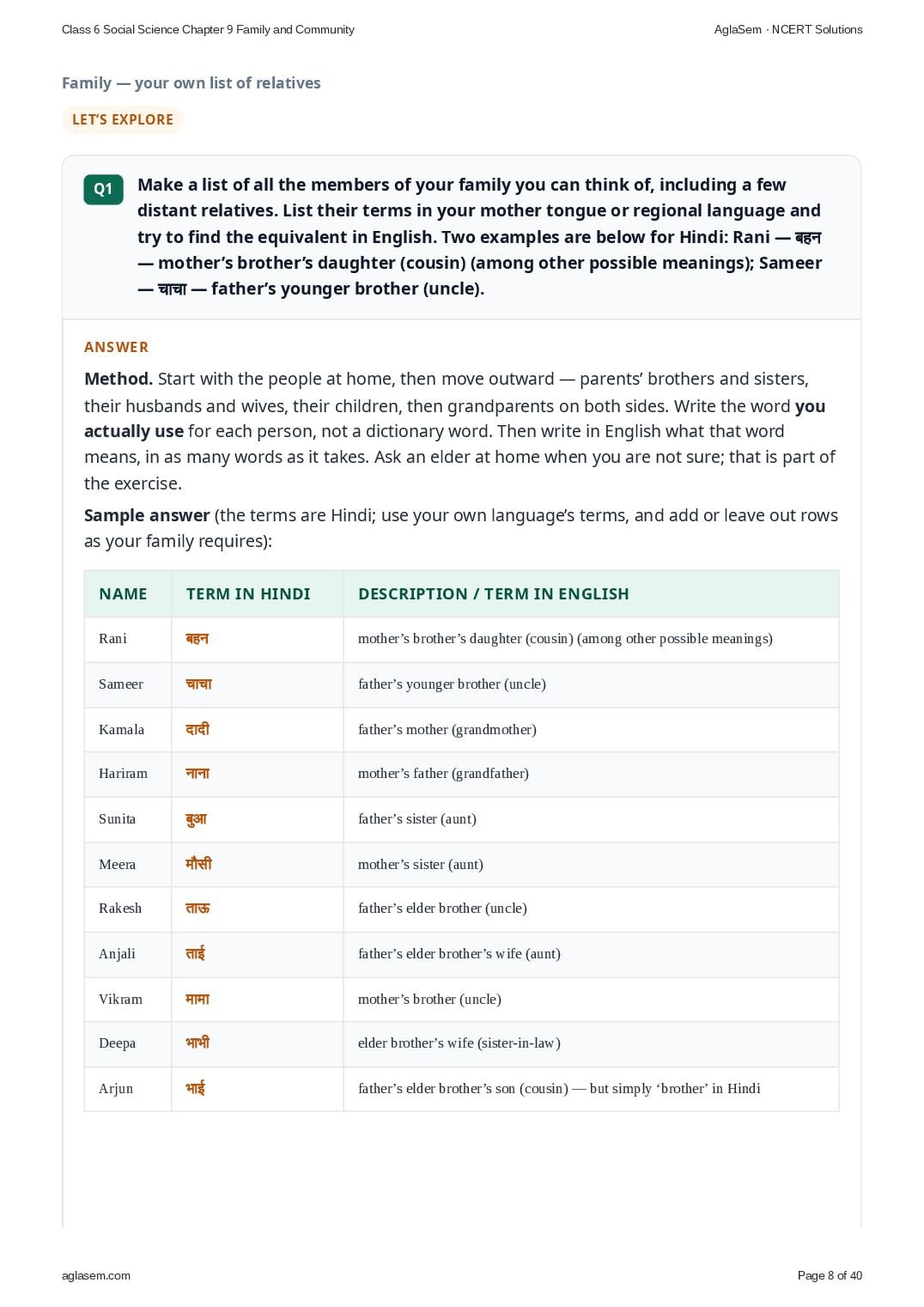
- Make a list of all the members of your family you can think of, including a few distant relatives. List their terms in your mother tongue or regional language and try to find the equivalent in English. Two examples are below for Hindi: Rani — बहन — mother’s brother’s daughter (cousin) (among other possible meanings); Sameer — चाचा — father’s younger brother (uncle).
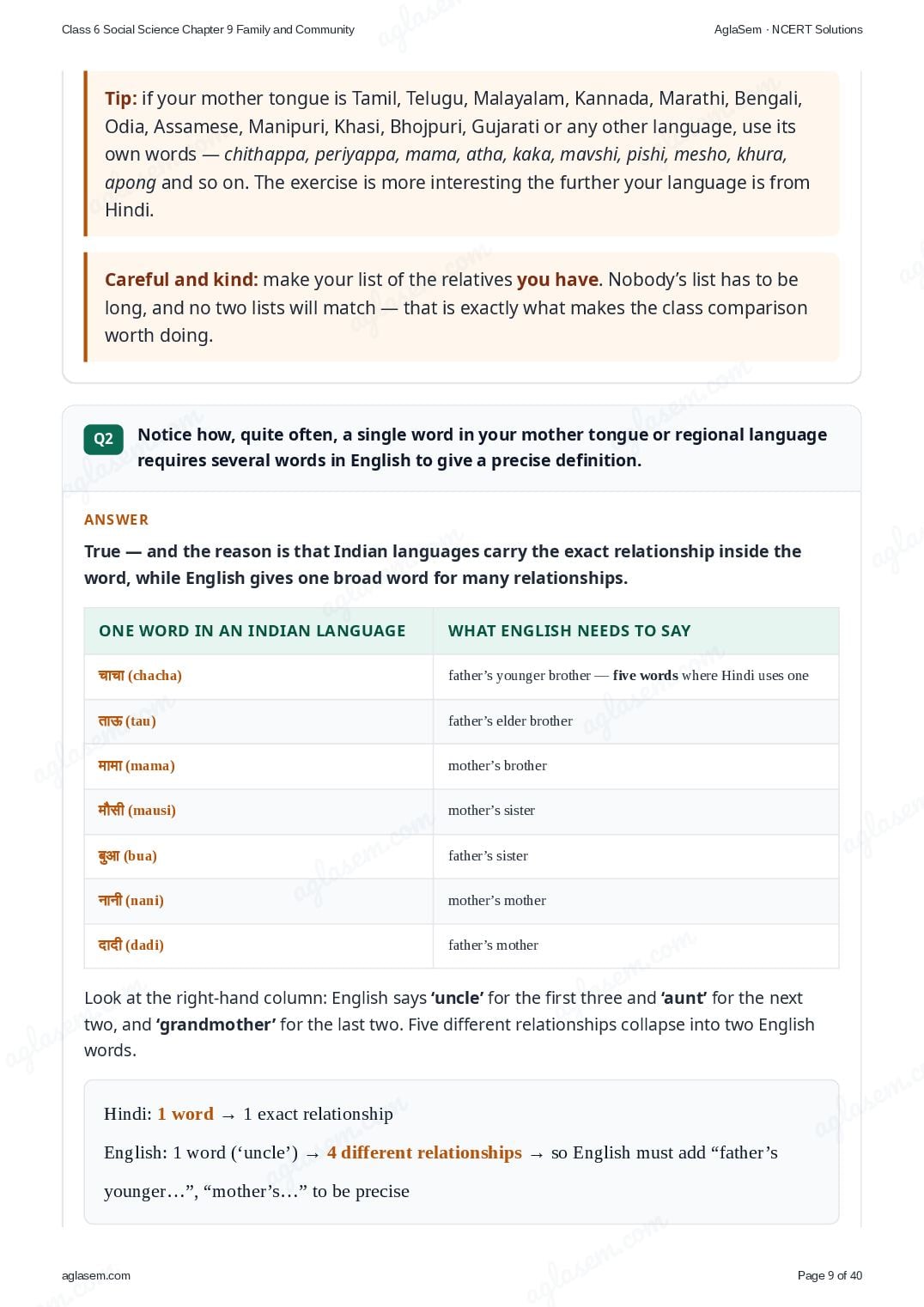
- Notice how, quite often, a single word in your mother tongue or regional language requires several words in English to give a precise definition.
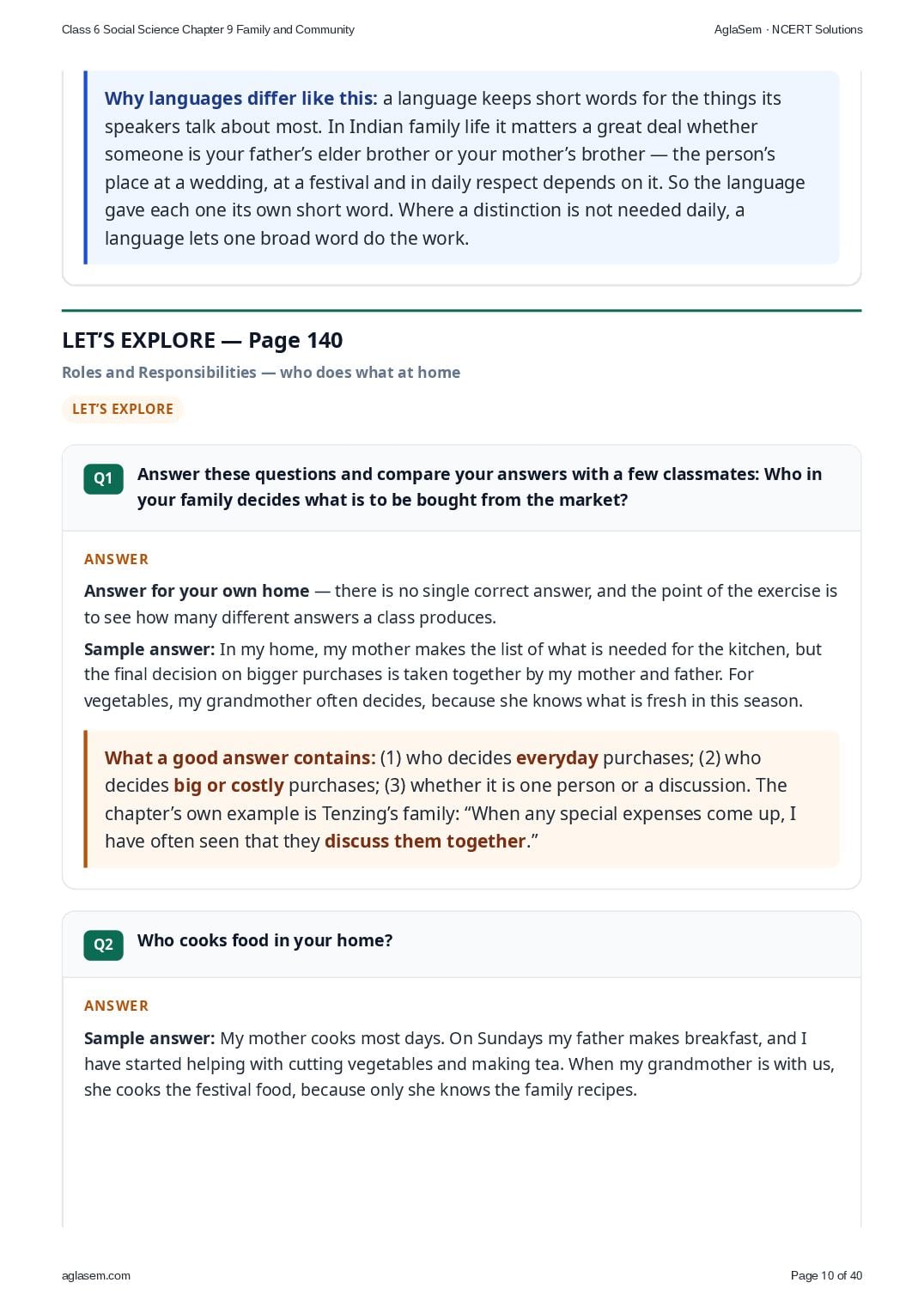
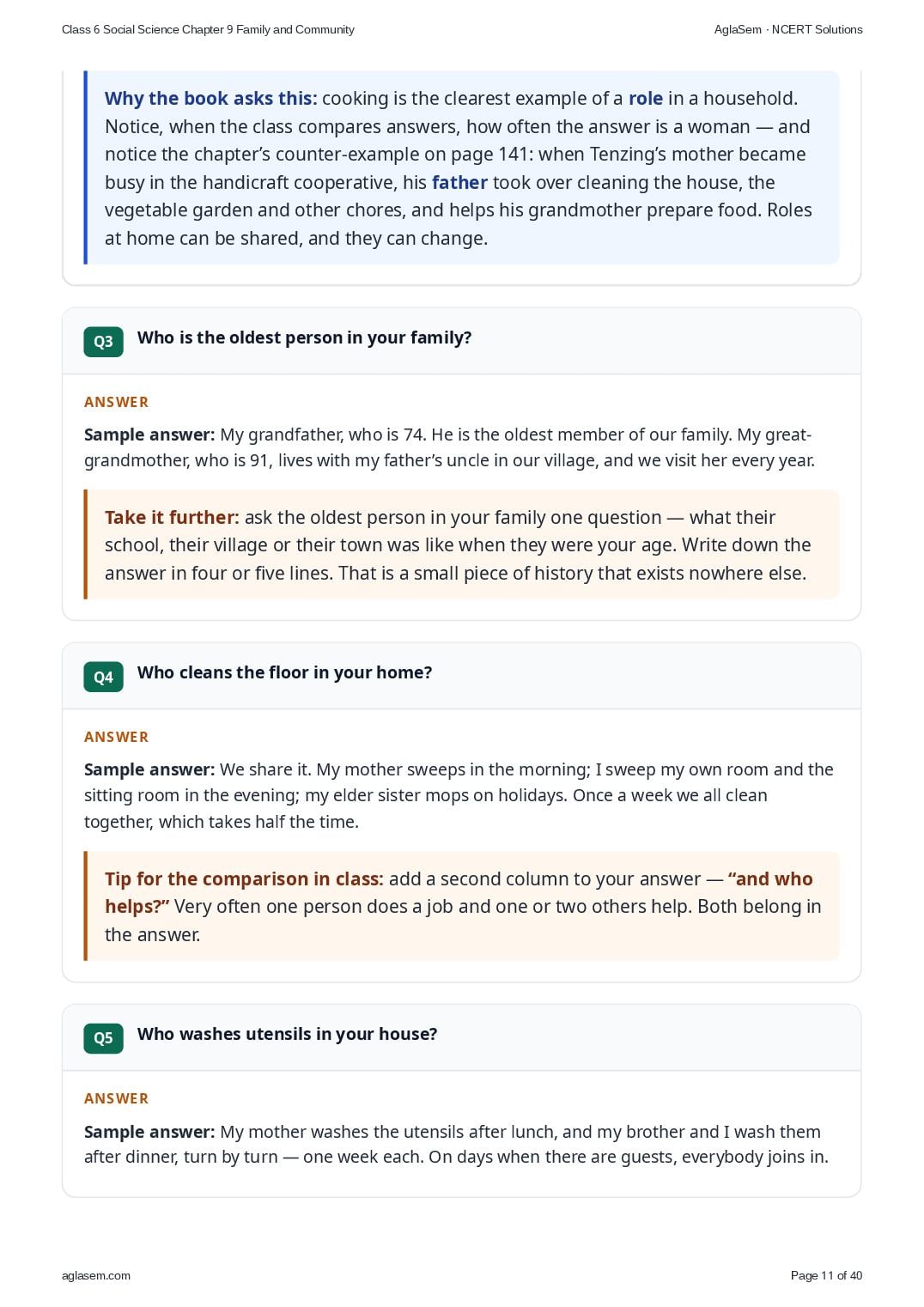
- Answer these questions and compare your answers with a few classmates: Who in your family decides what is to be bought from the market?
- Who cooks food in your home?
- Who is the oldest person in your family?
- Who cleans the floor in your home?
- Who washes utensils in your house?
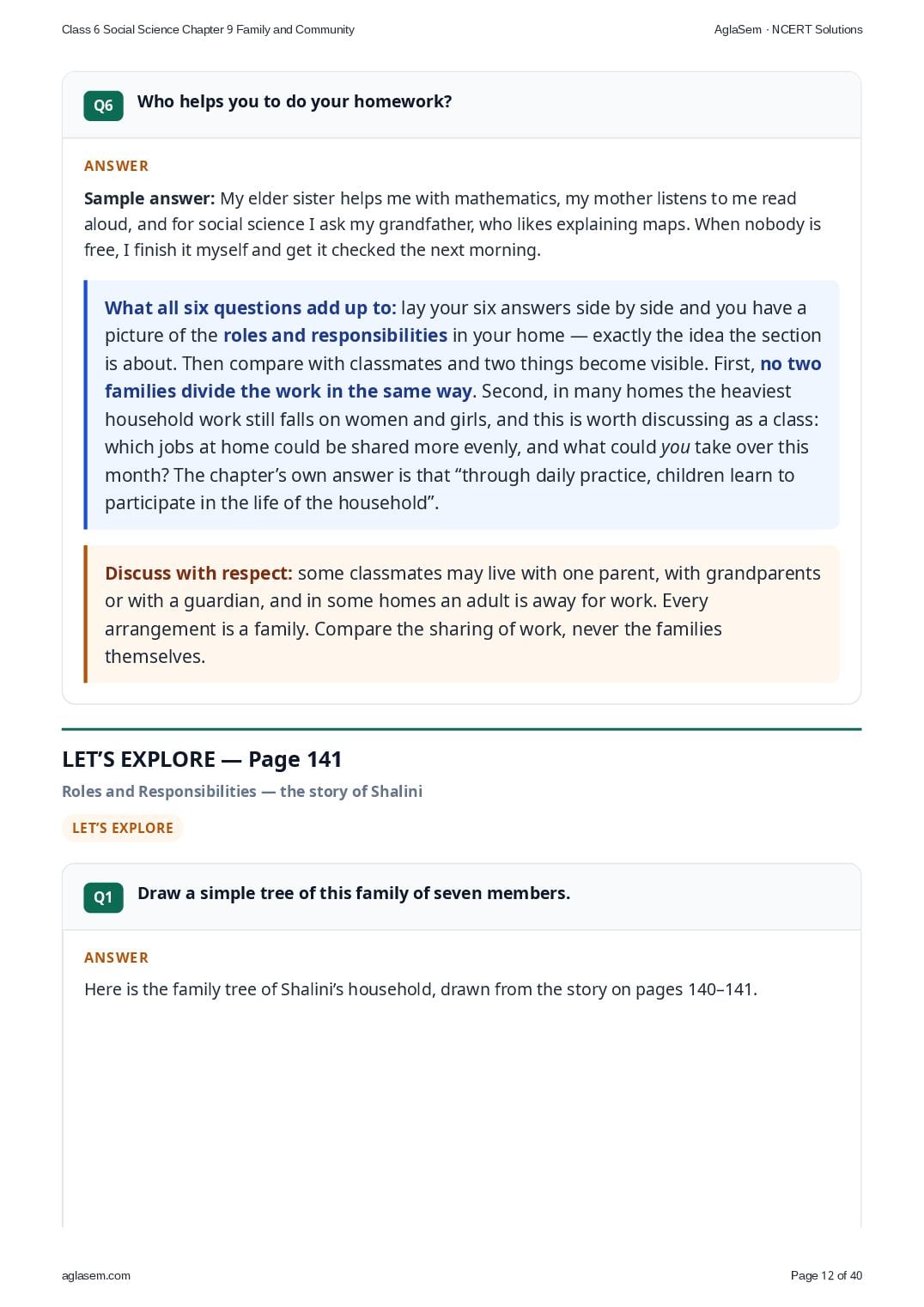
- Who helps you to do your homework?
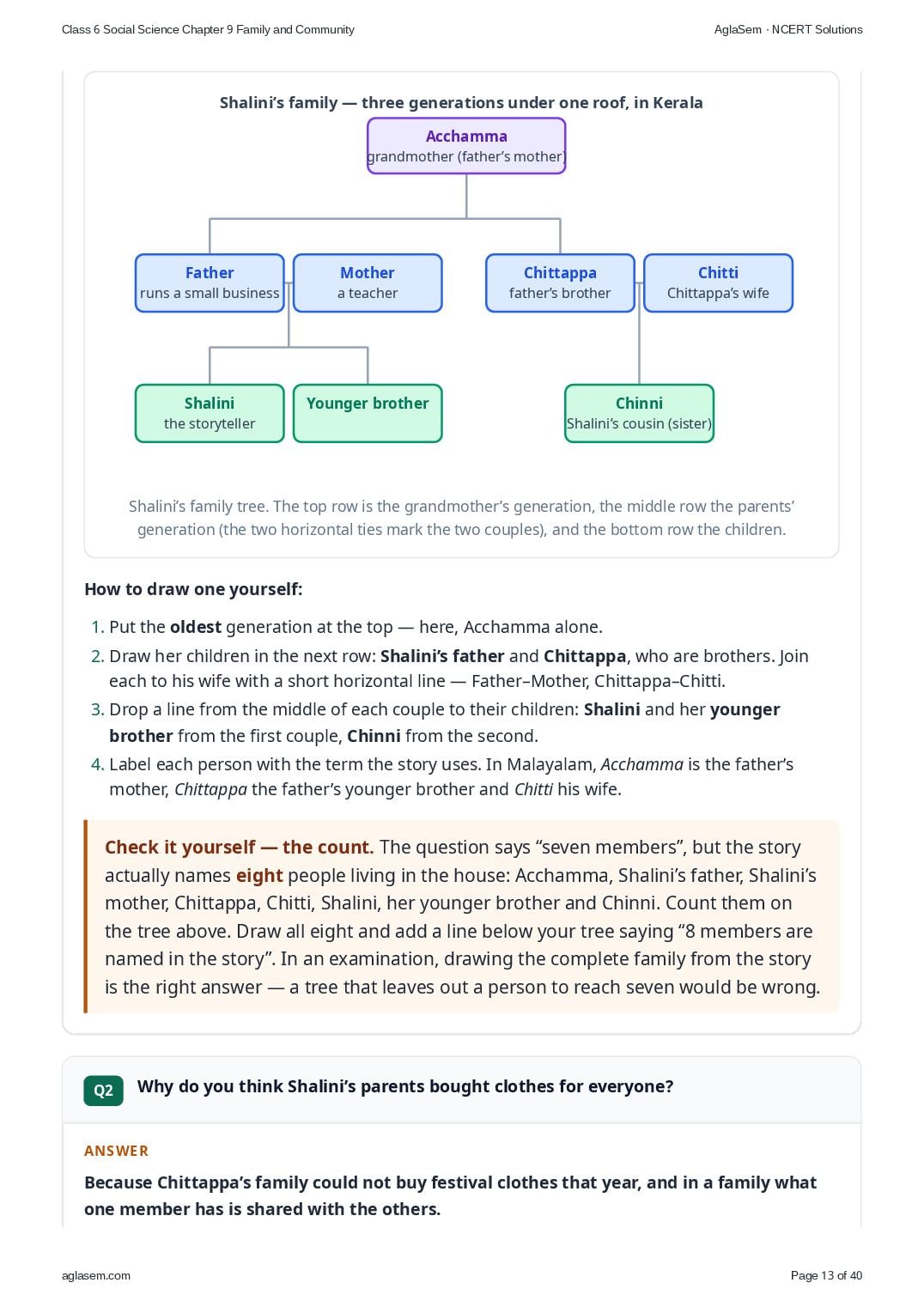
- Draw a simple tree of this family of seven members.
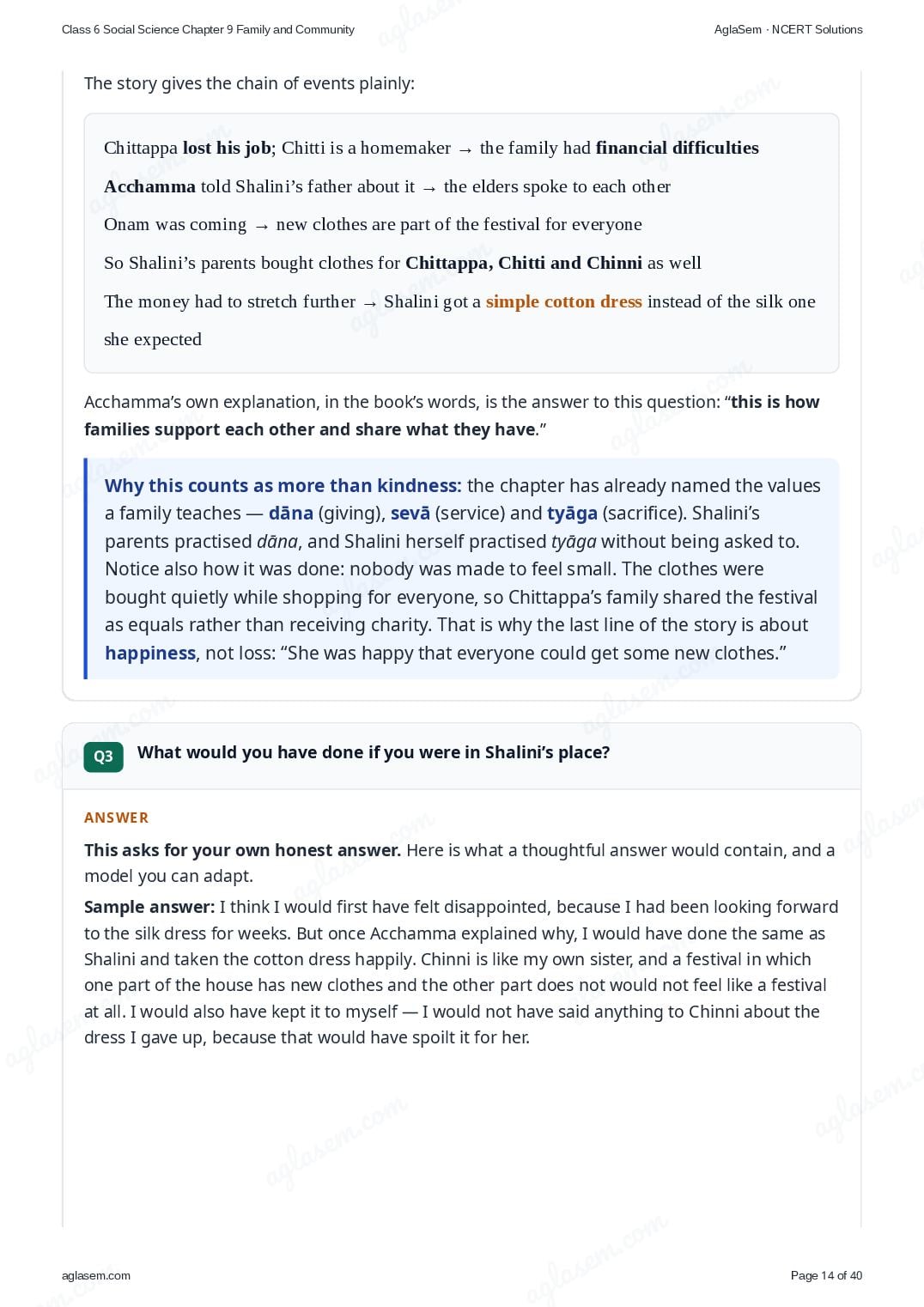
- Why do you think Shalini’s parents bought clothes for everyone?
- What would you have done if you were in Shalini’s place?
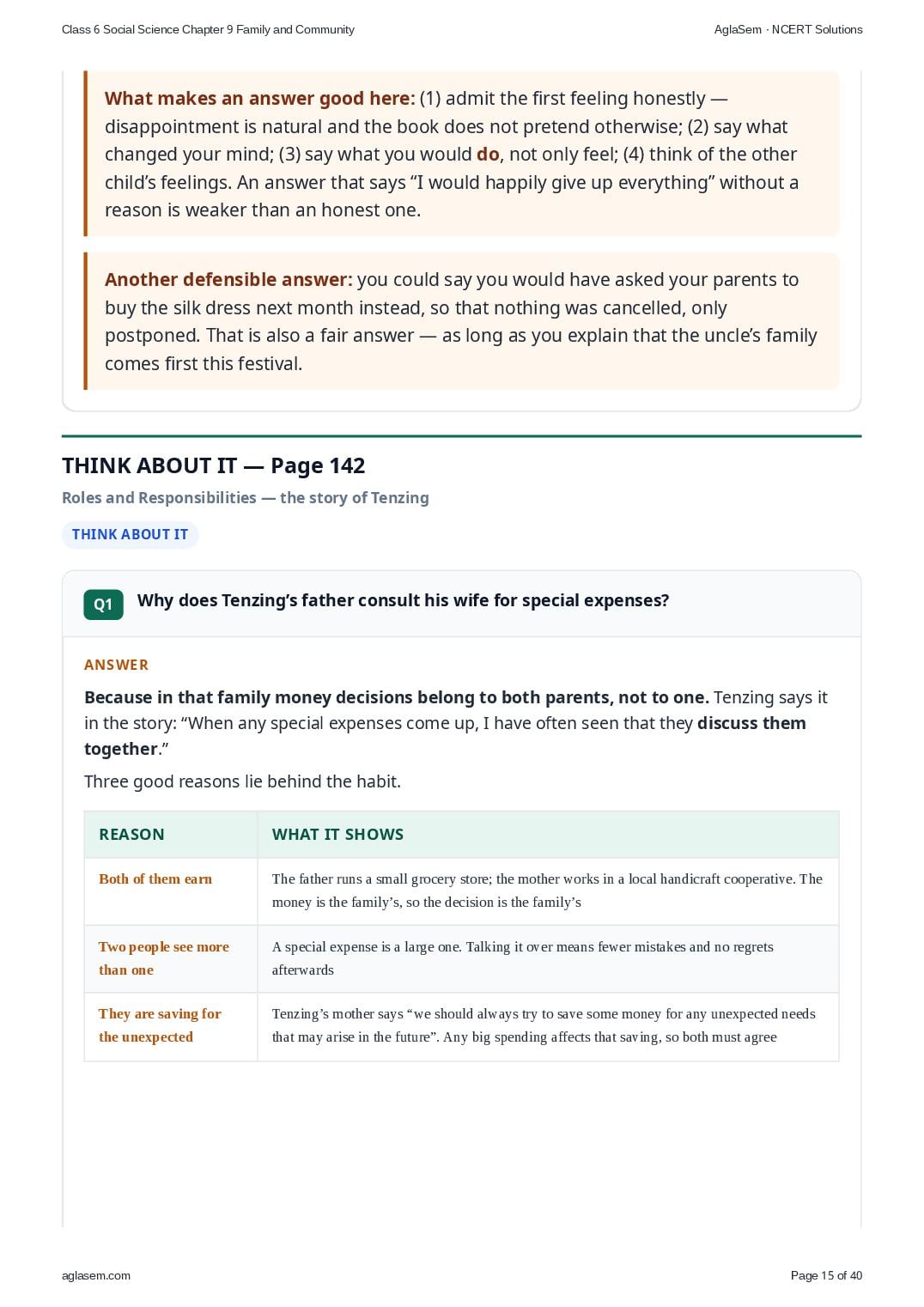
- Why does Tenzing’s father consult his wife for special expenses?
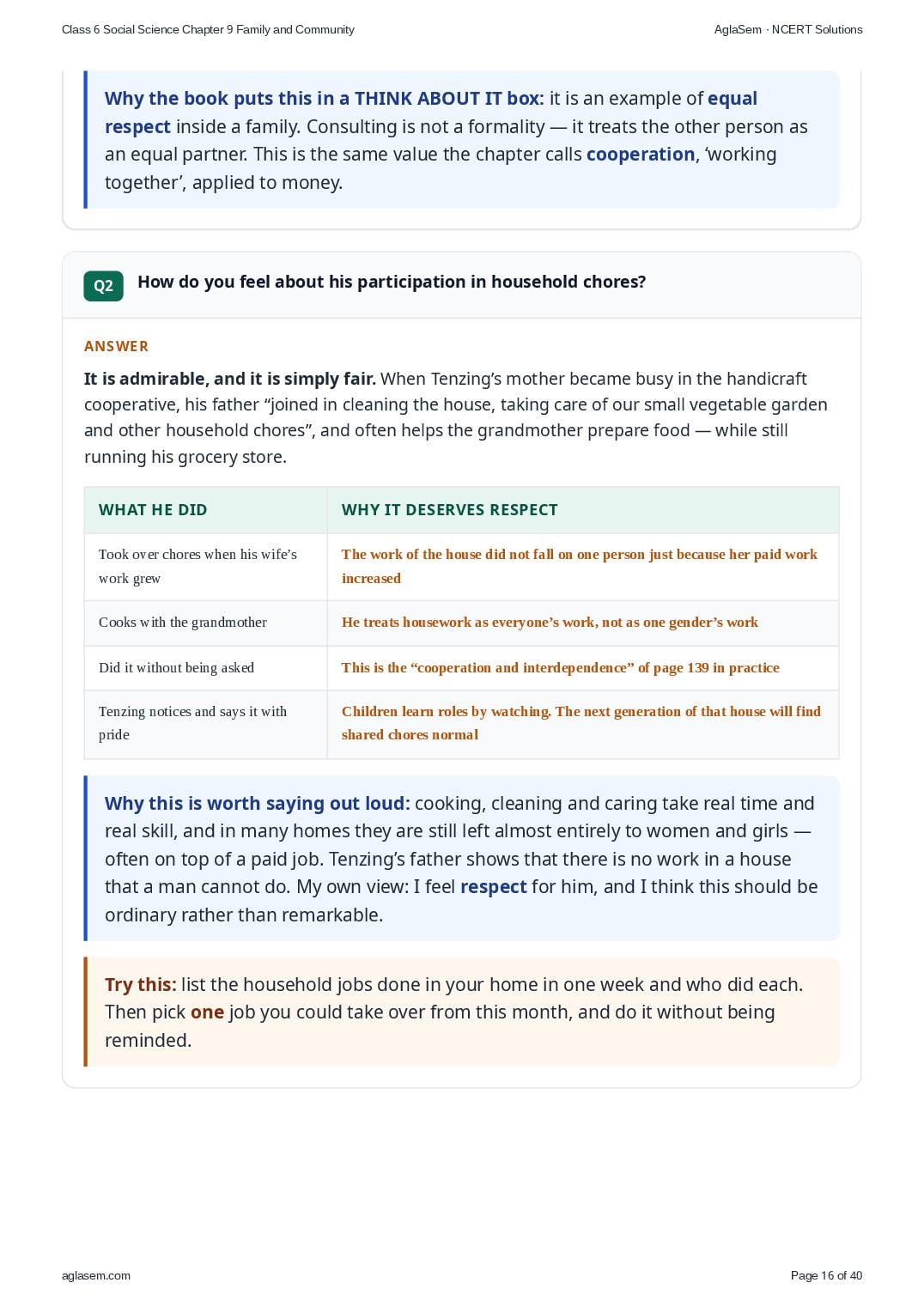
- How do you feel about his participation in household chores?
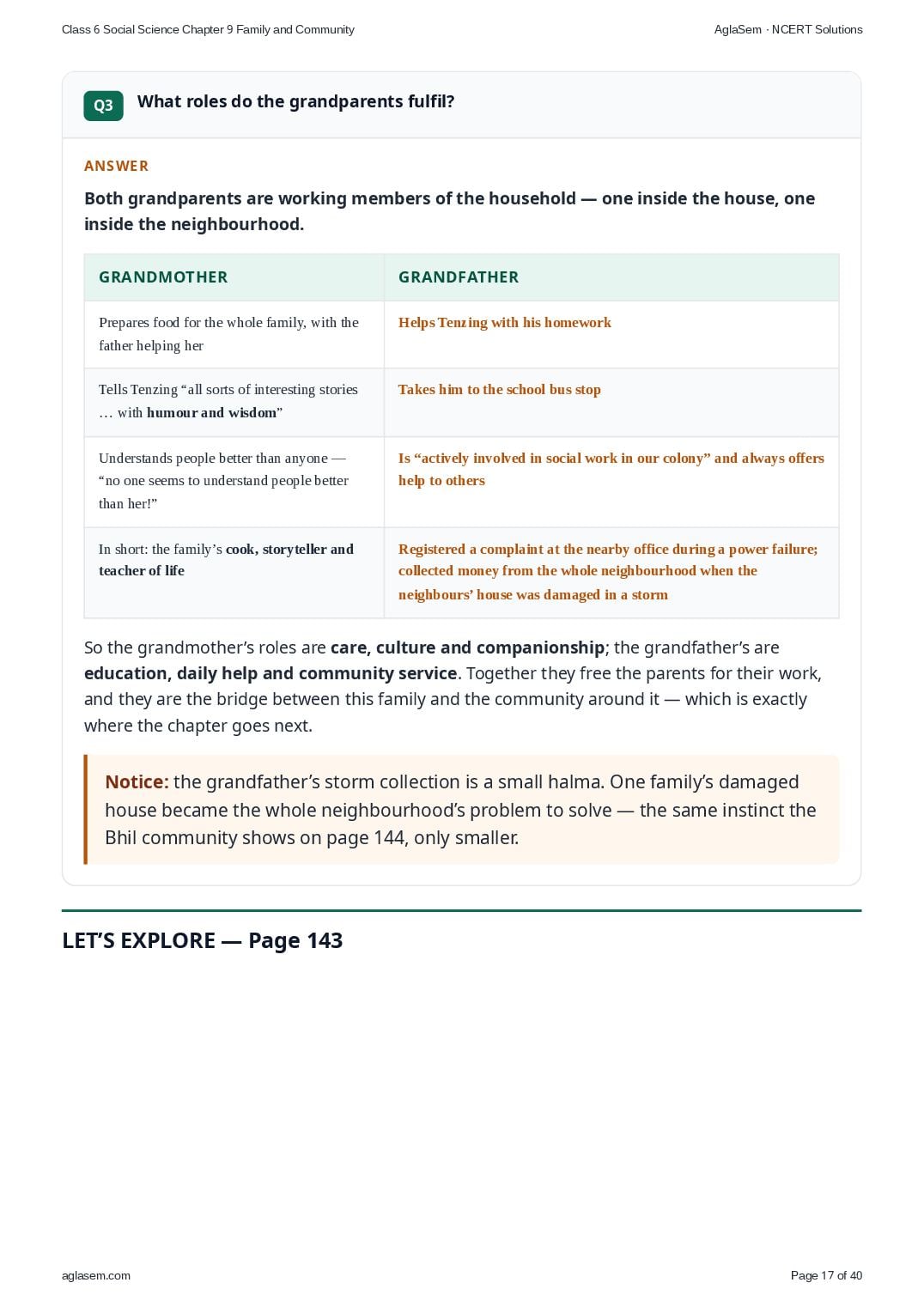
- What roles do the grandparents fulfil?
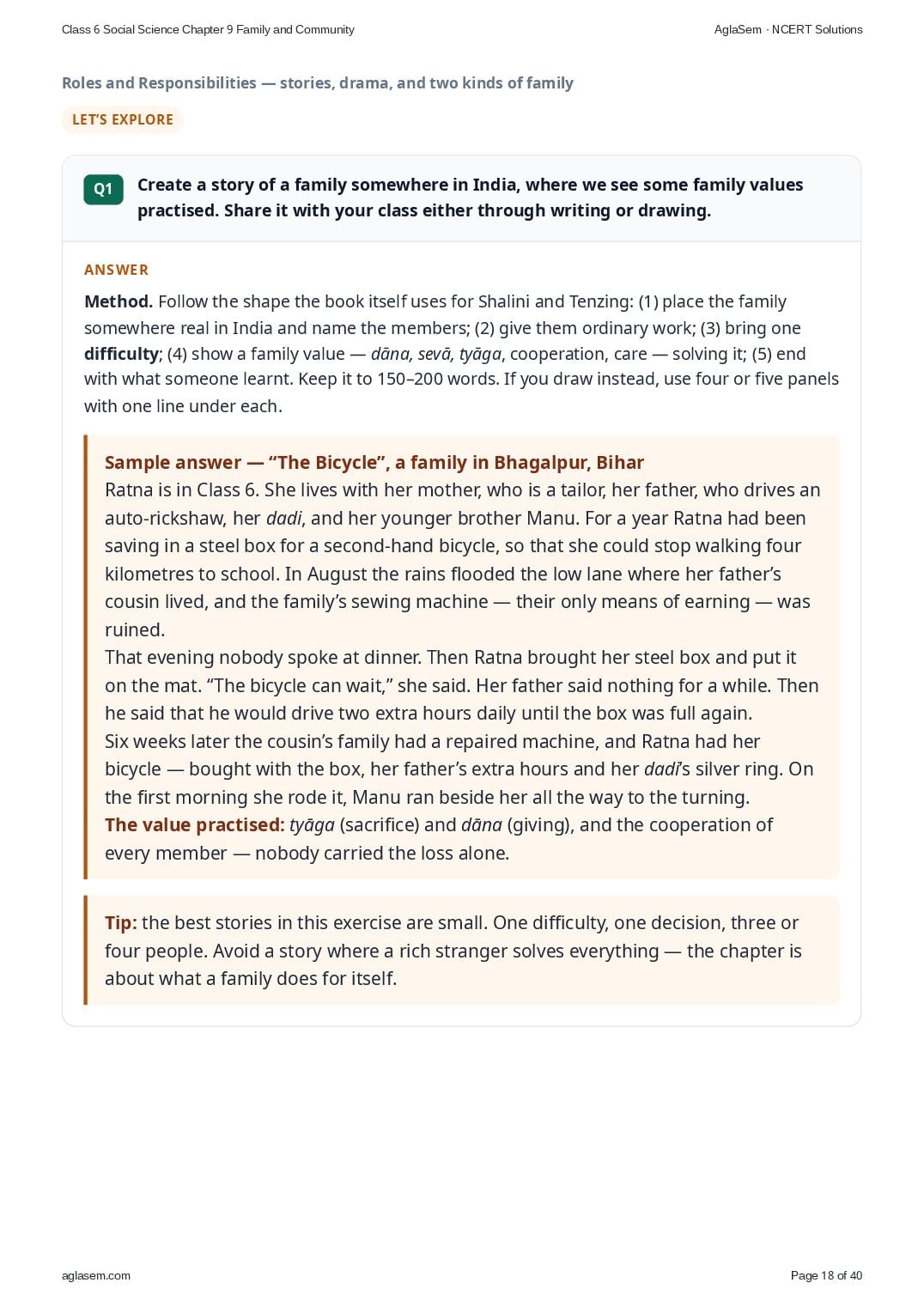
- Create a story of a family somewhere in India, where we see some family values practised. Share it with your class either through writing or drawing.
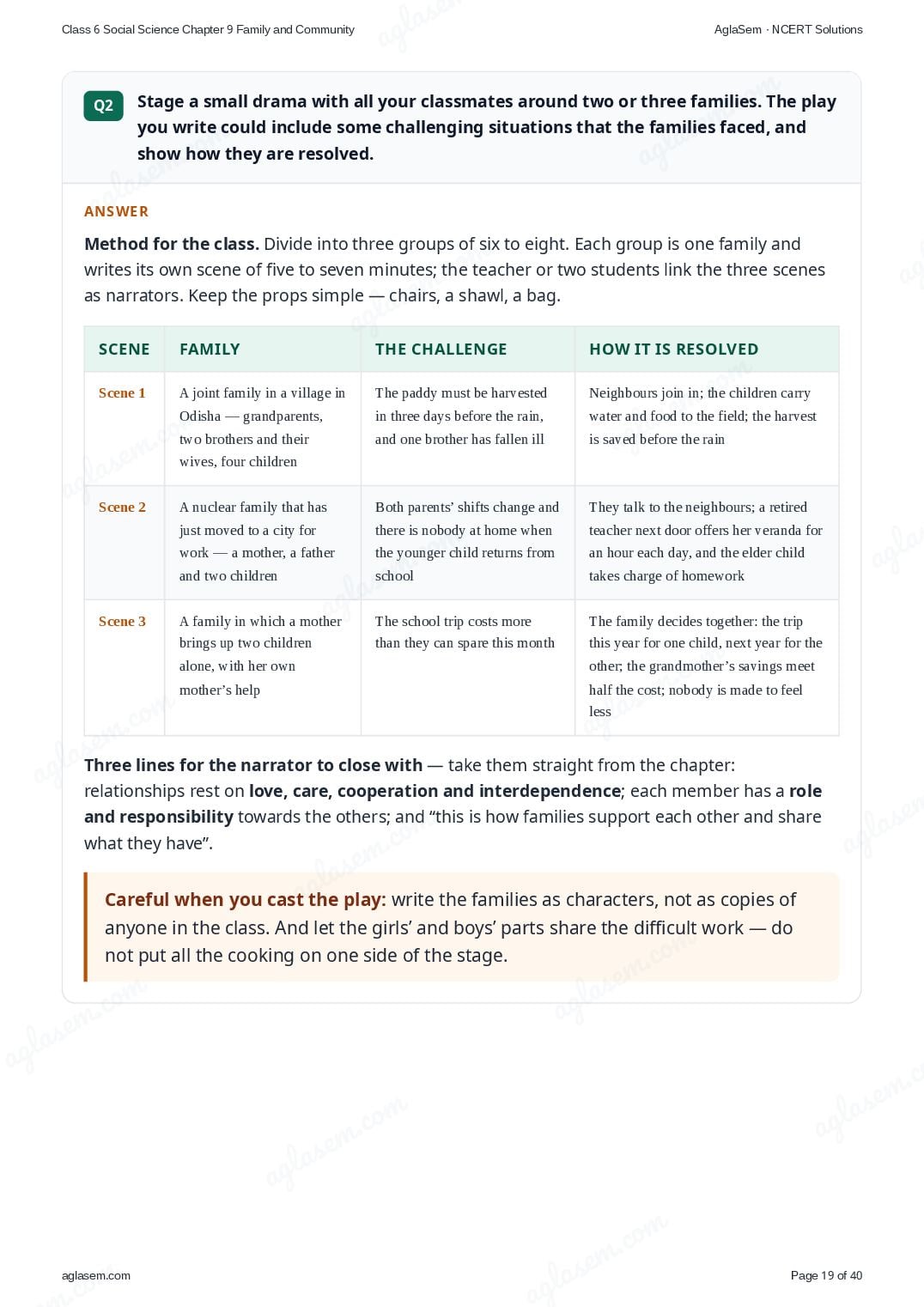
- Stage a small drama with all your classmates around two or three families. The play you write could include some challenging situations that the families faced, and show how they are resolved.
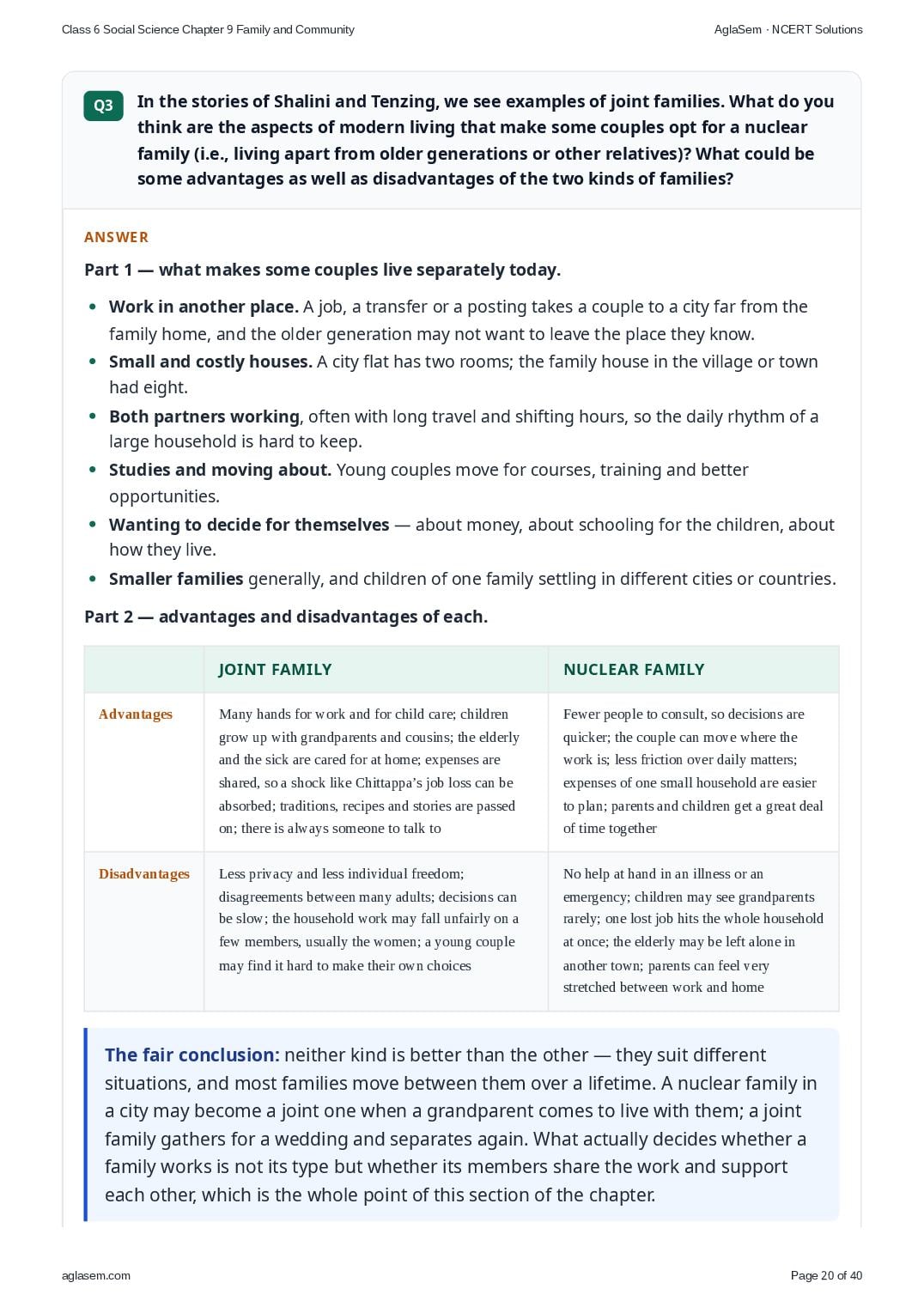
- In the stories of Shalini and Tenzing, we see examples of joint families. What do you think are the aspects of modern living that make some couples opt for a nuclear family (i.e., living apart from older generations or other relatives)? What could be some advantages as well as disadvantages of the two kinds of families?
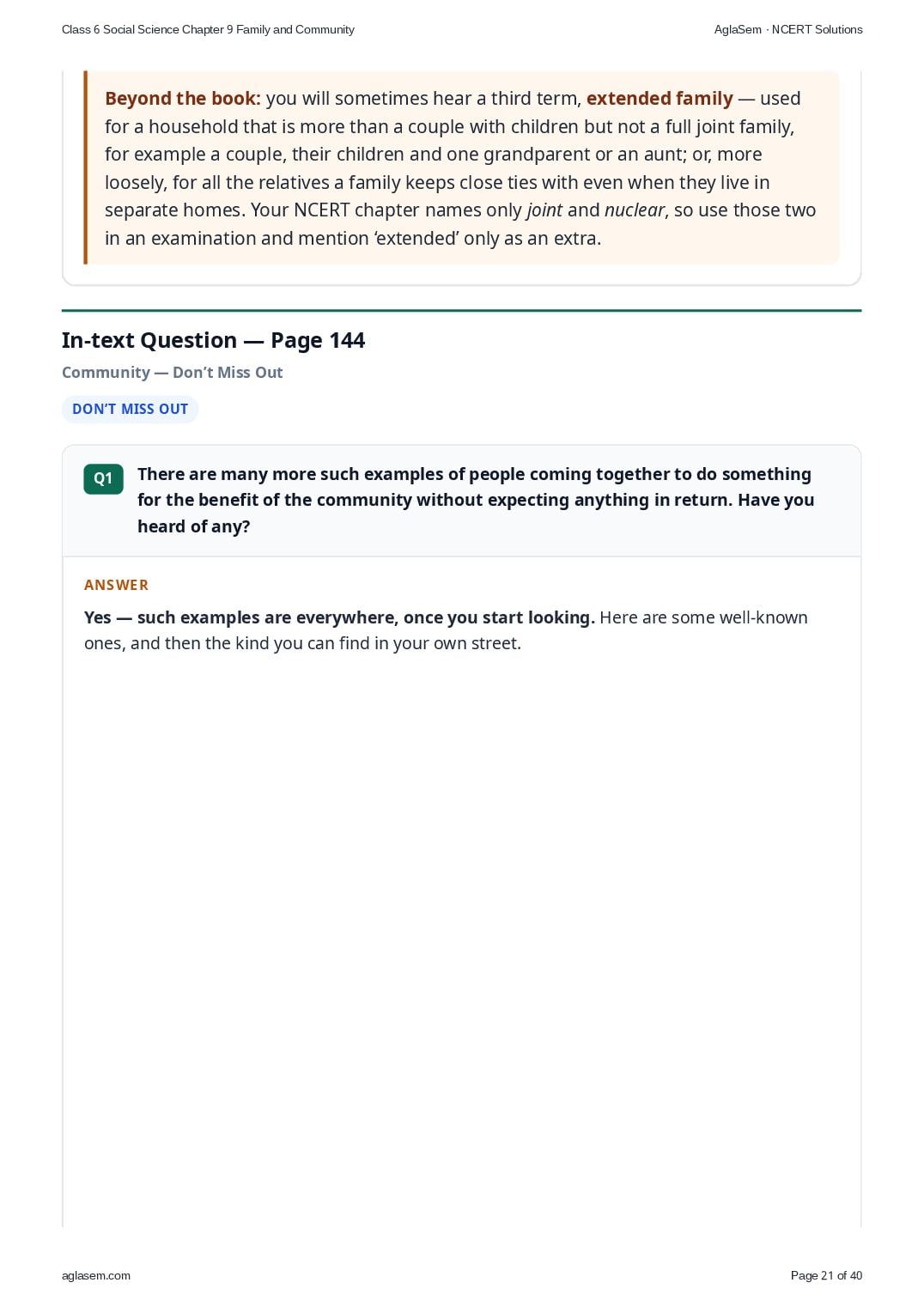
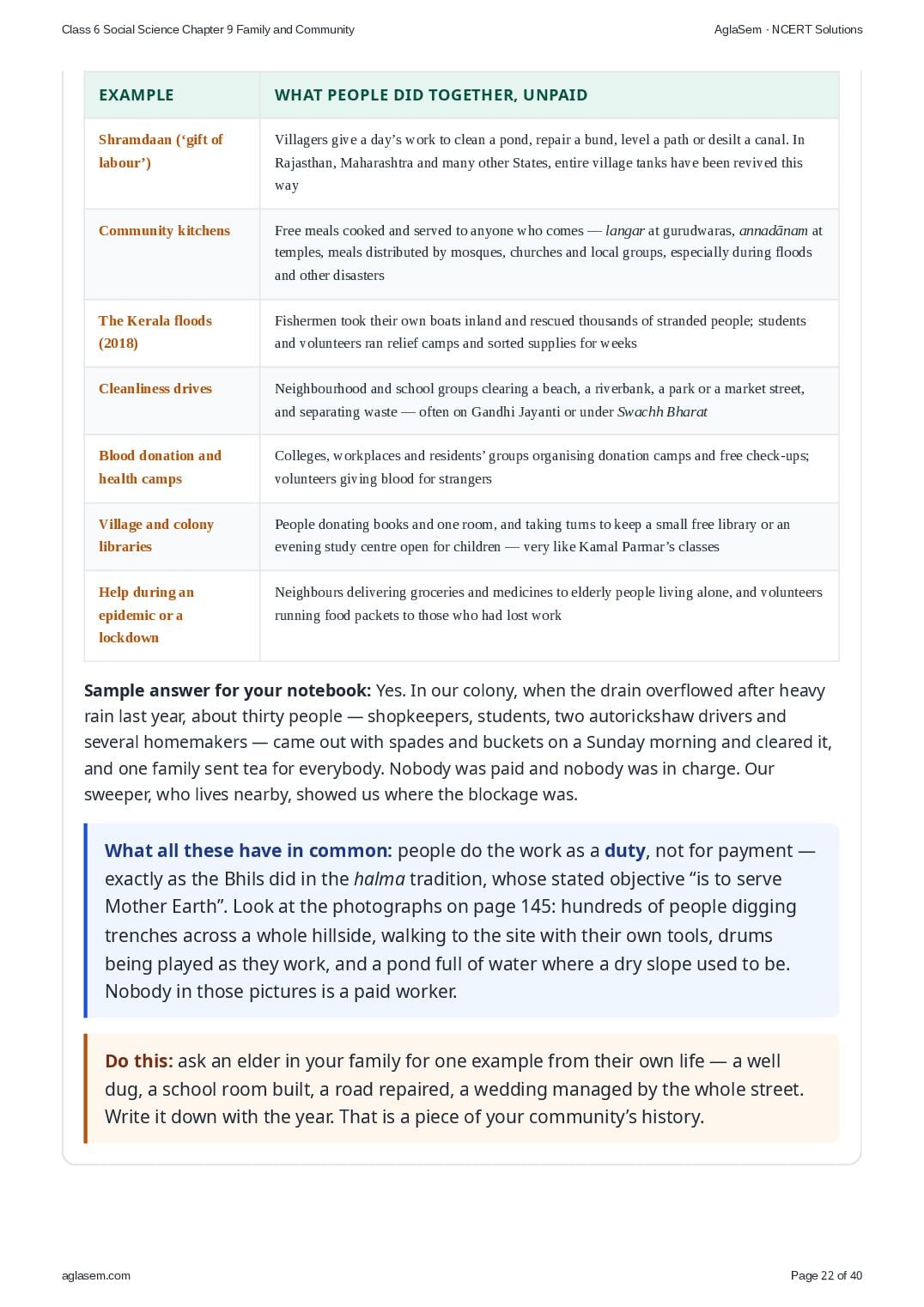
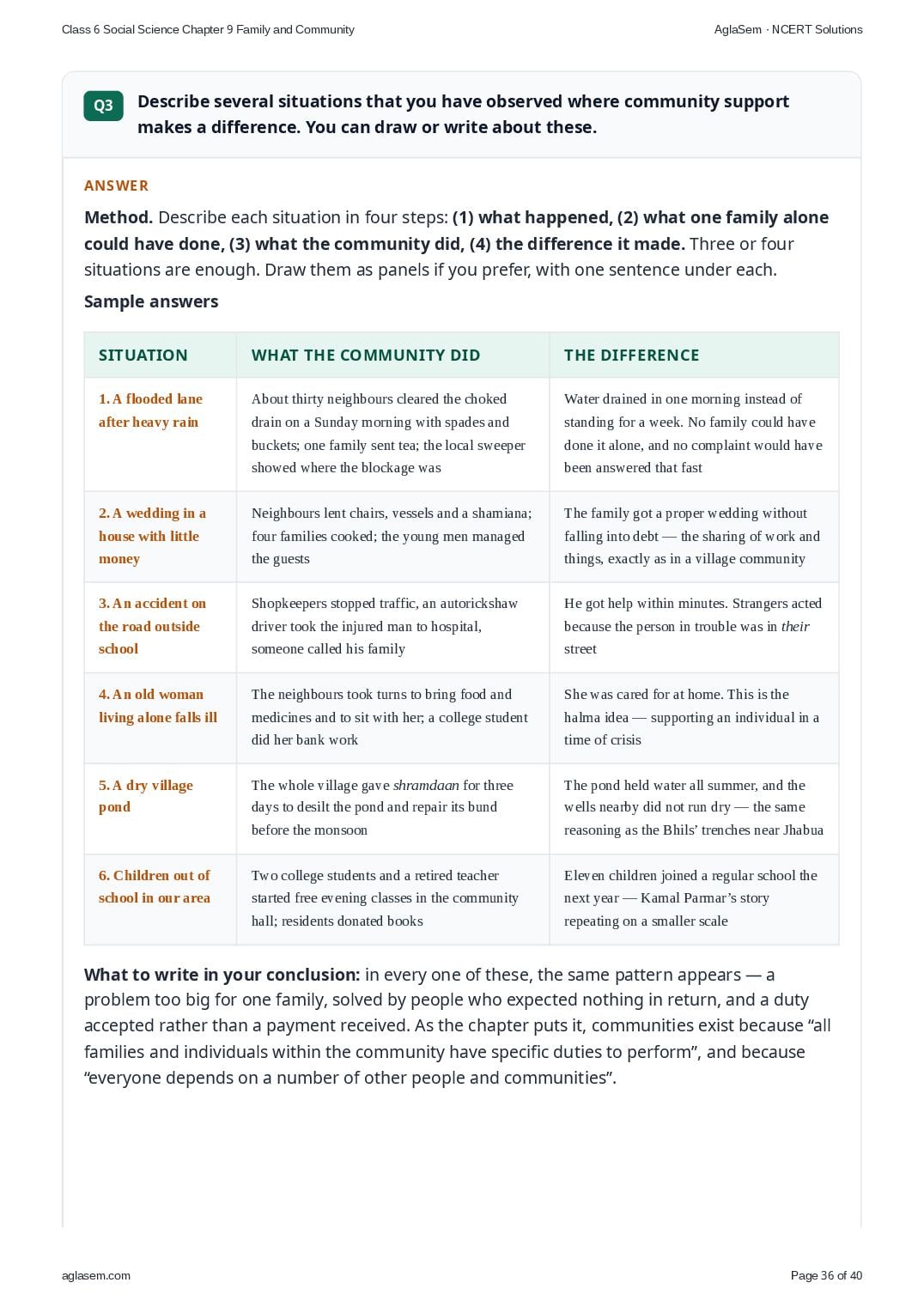
- There are many more such examples of people coming together to do something for the benefit of the community without expecting anything in return. Have you heard of any?
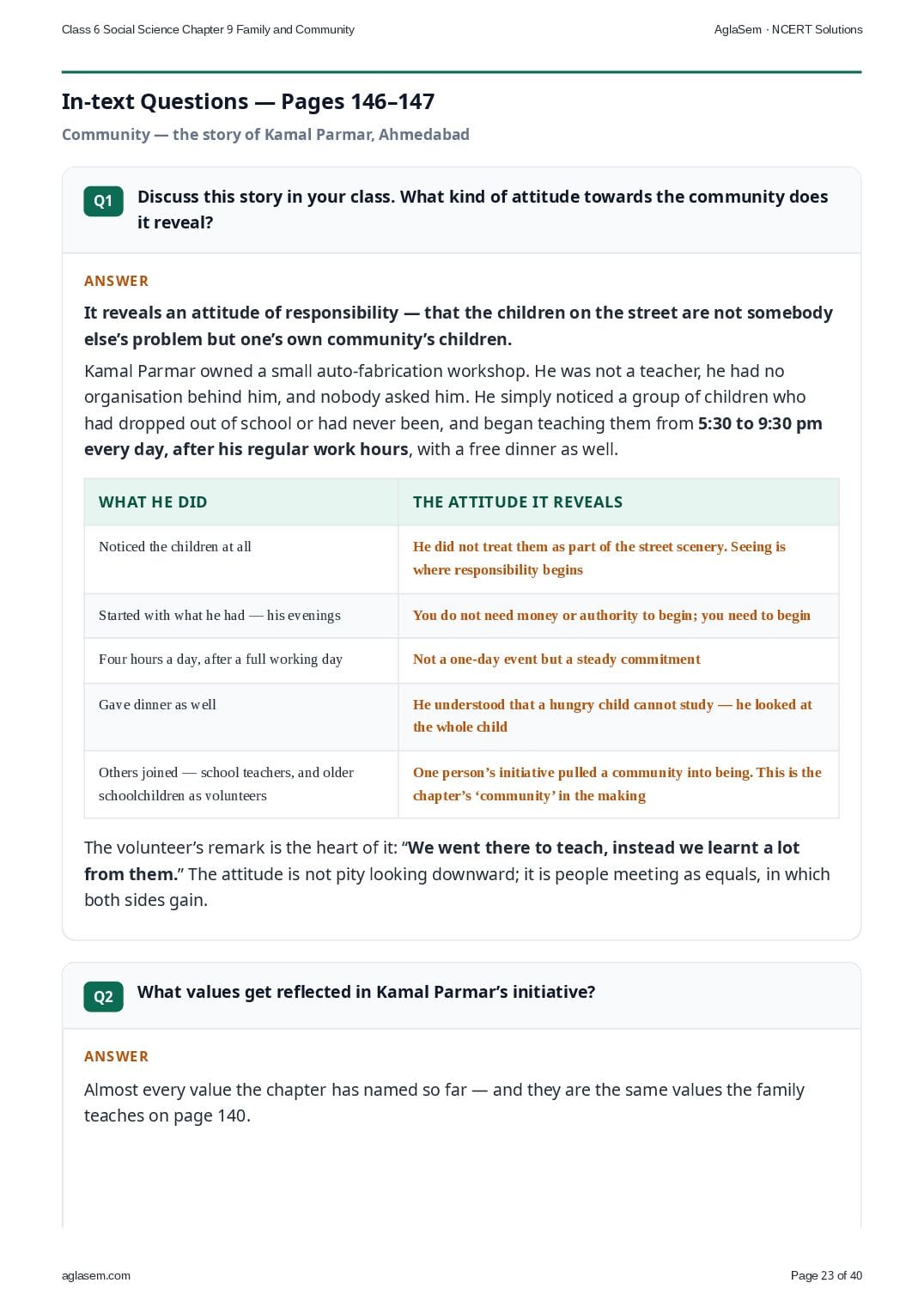
- Discuss this story in your class. What kind of attitude towards the community does it reveal?
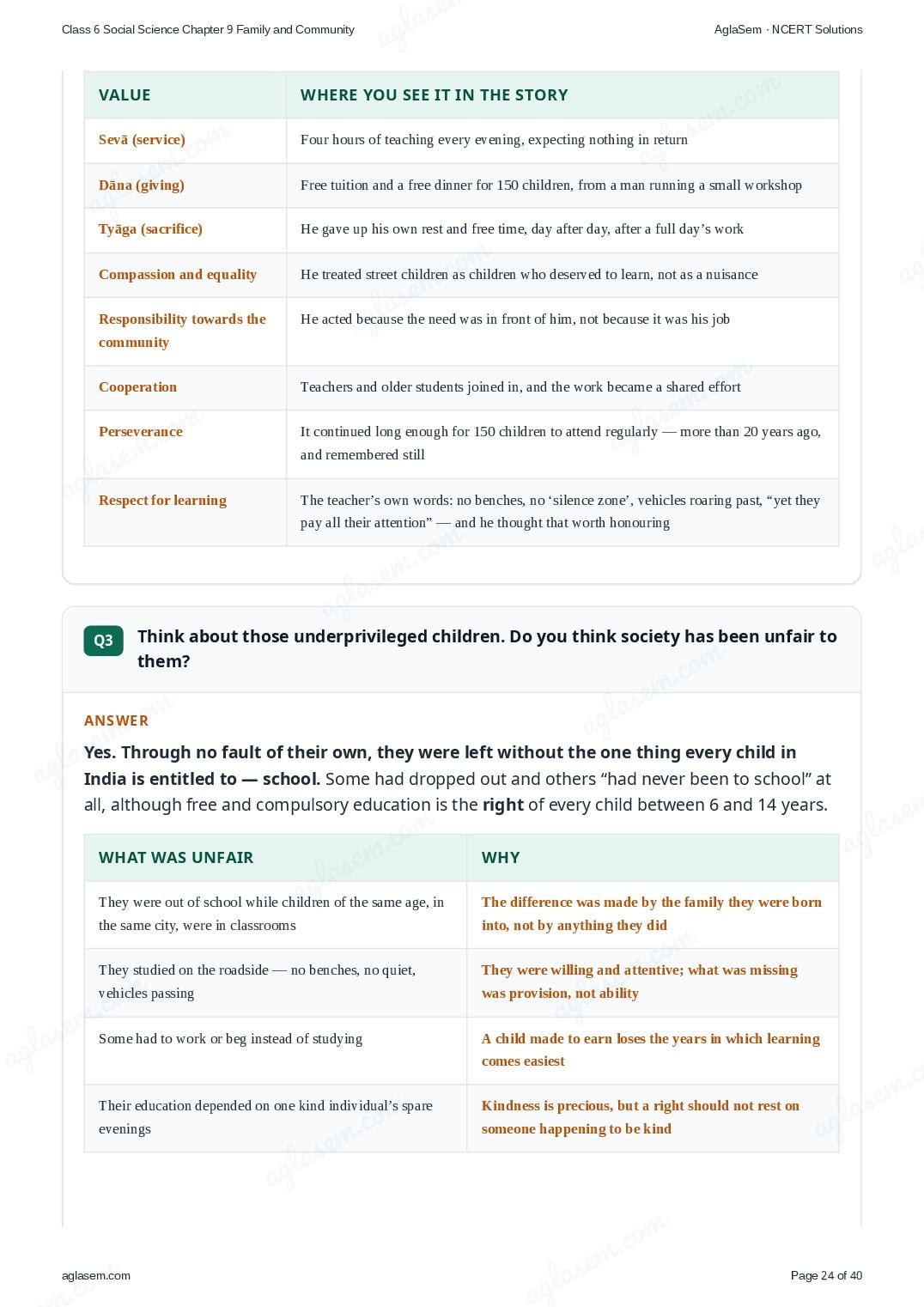
- What values get reflected in Kamal Parmar’s initiative?
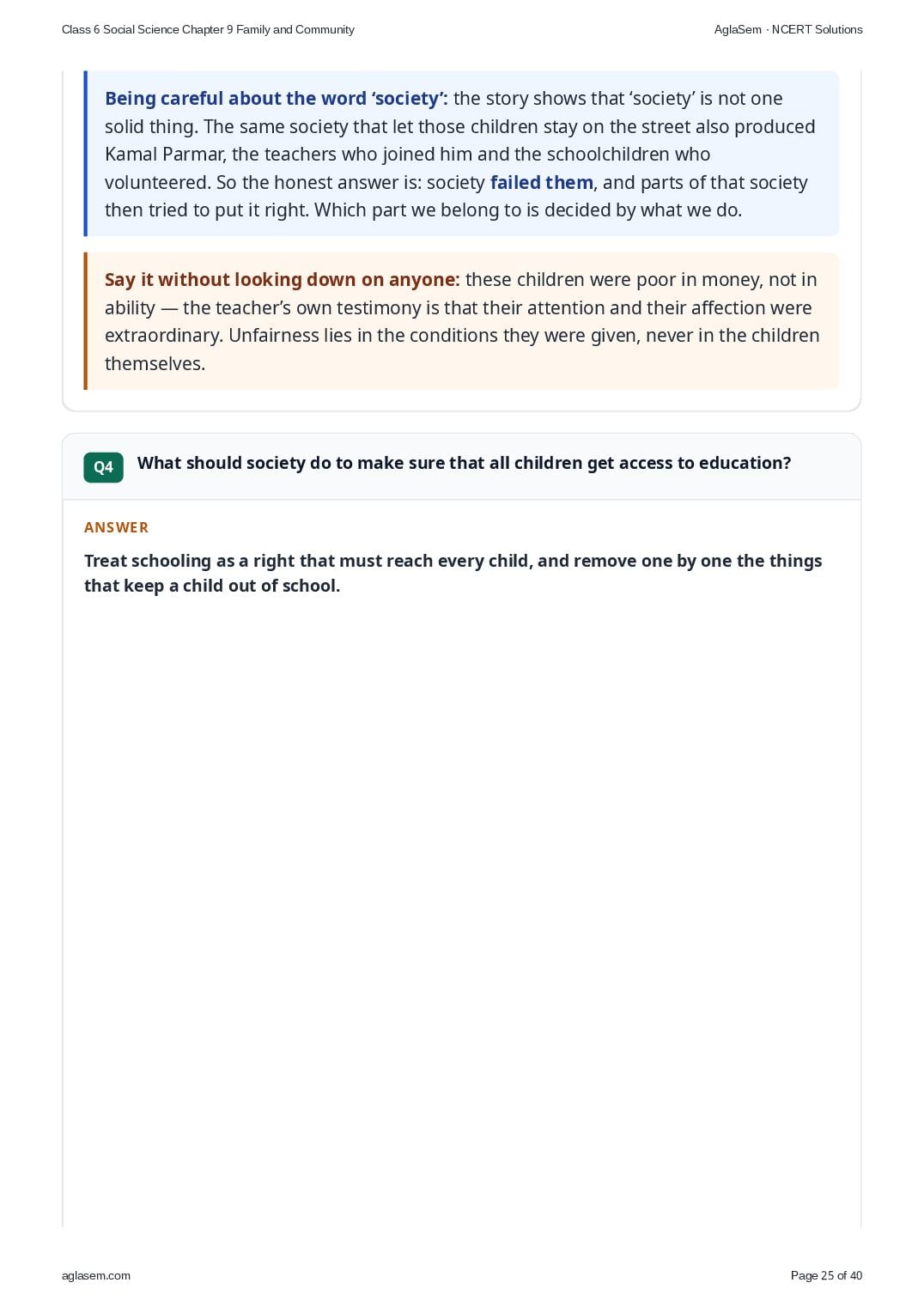
- Think about those underprivileged children. Do you think society has been unfair to them?
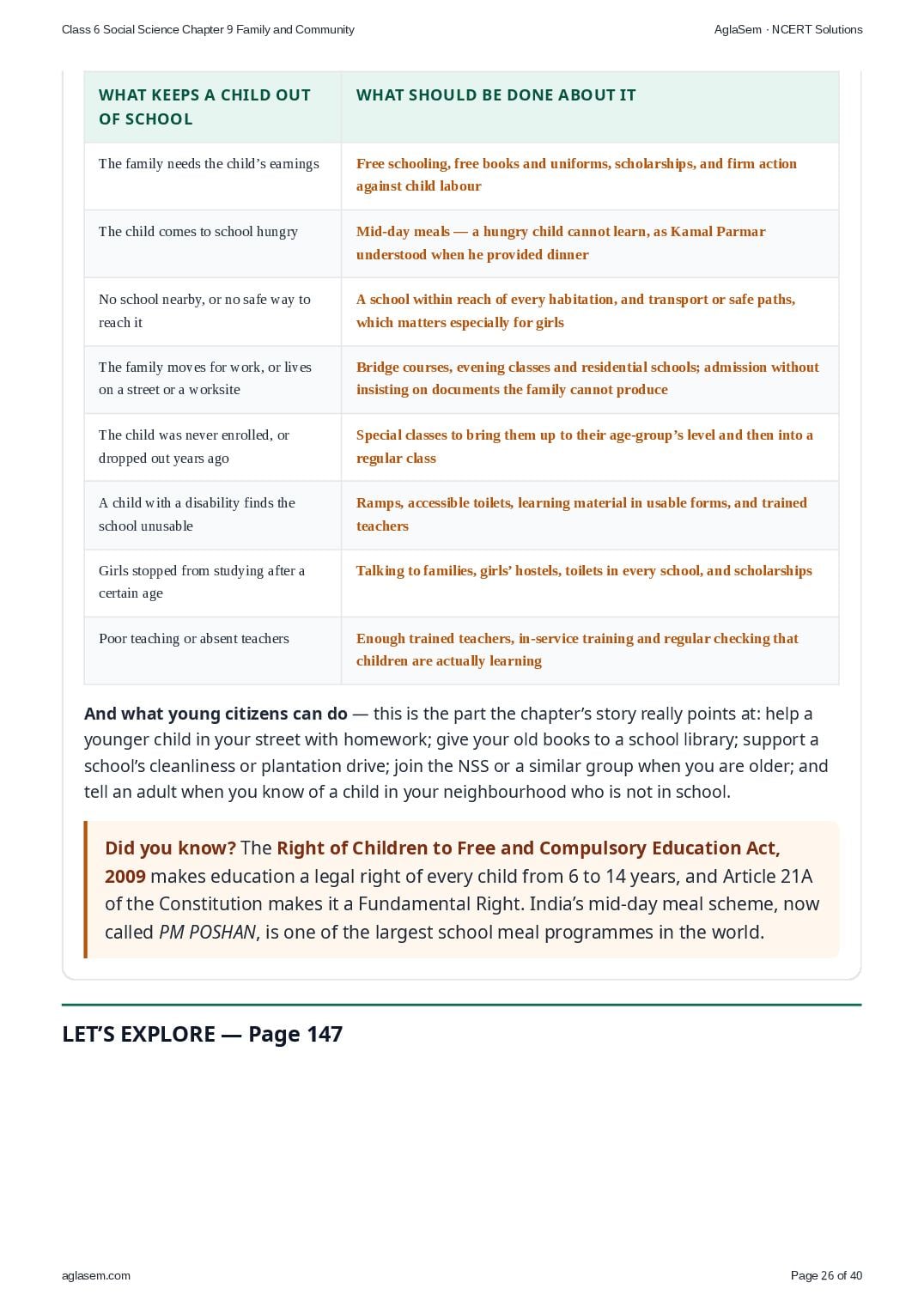
- What should society do to make sure that all children get access to education?
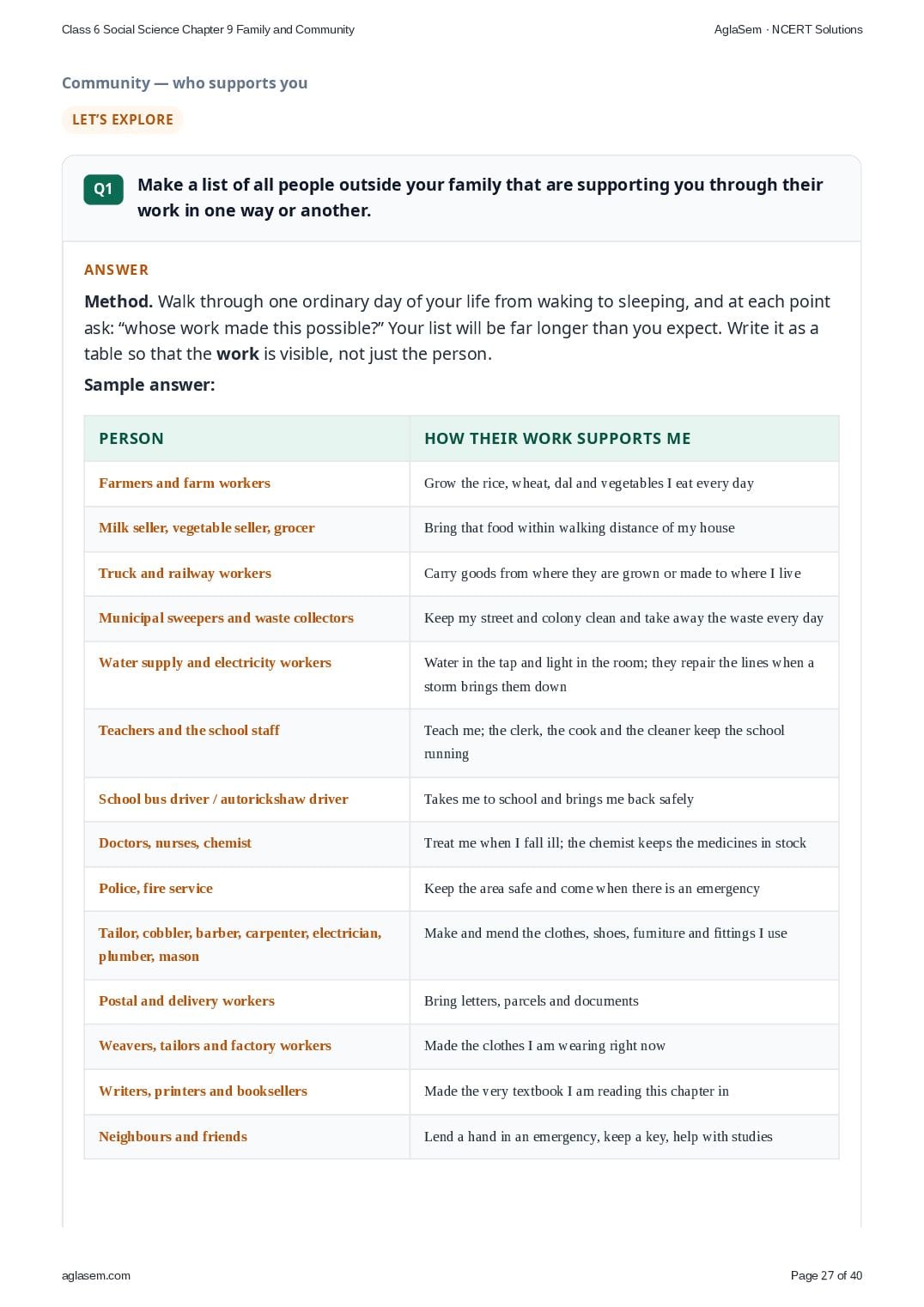
- Make a list of all people outside your family that are supporting you through their work in one way or another.
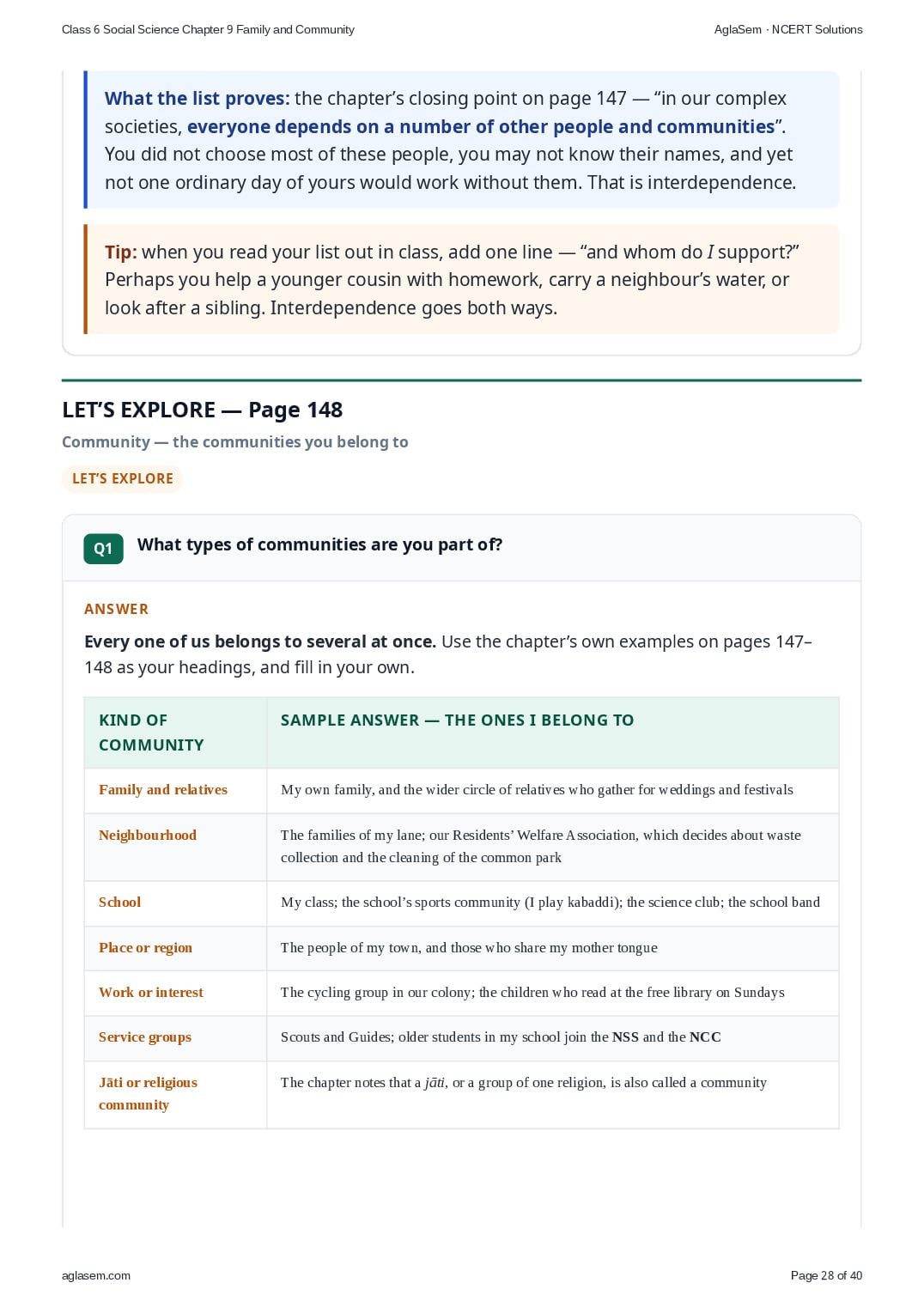
- What types of communities are you part of?
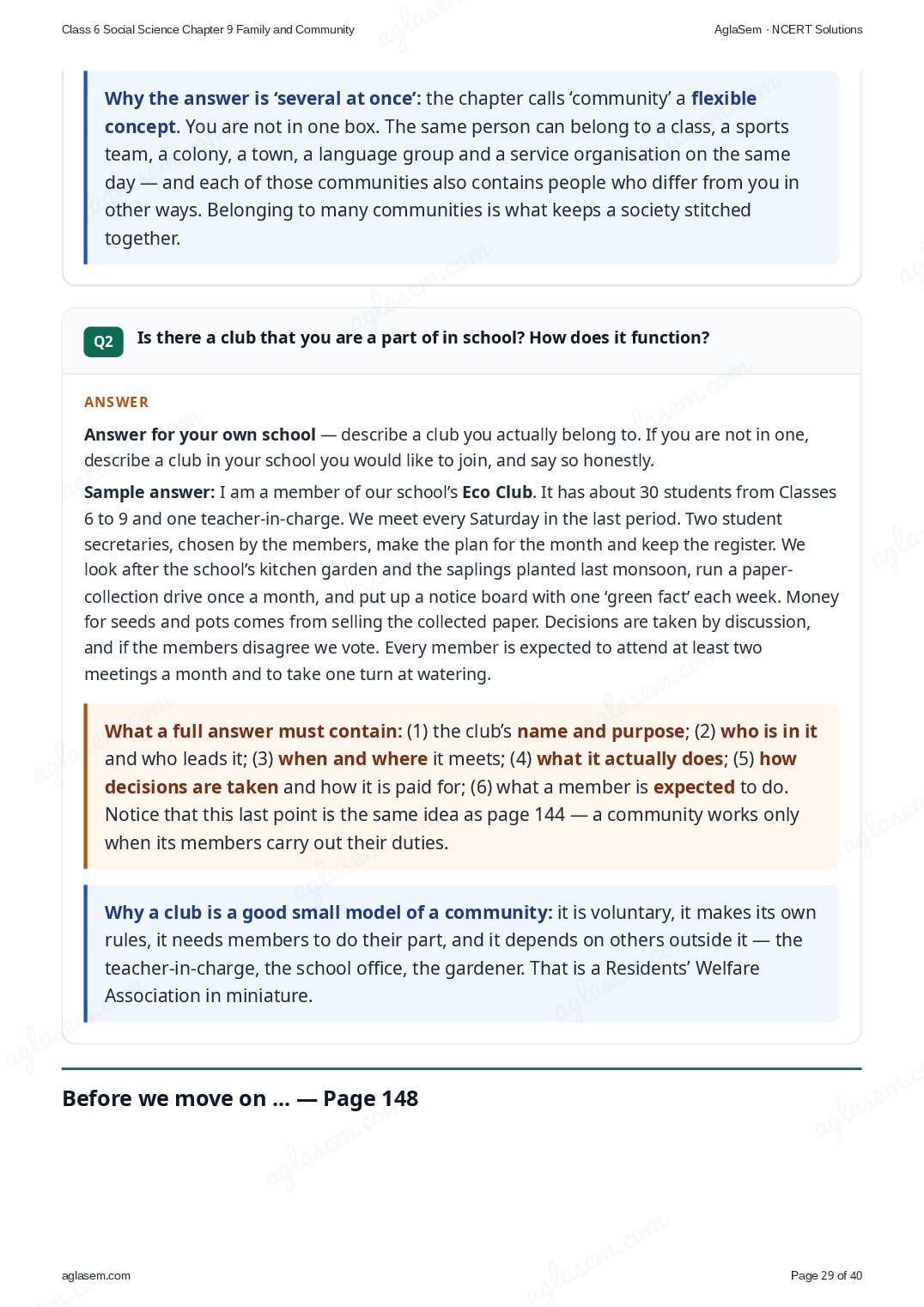
- Is there a club that you are a part of in school? How does it function?
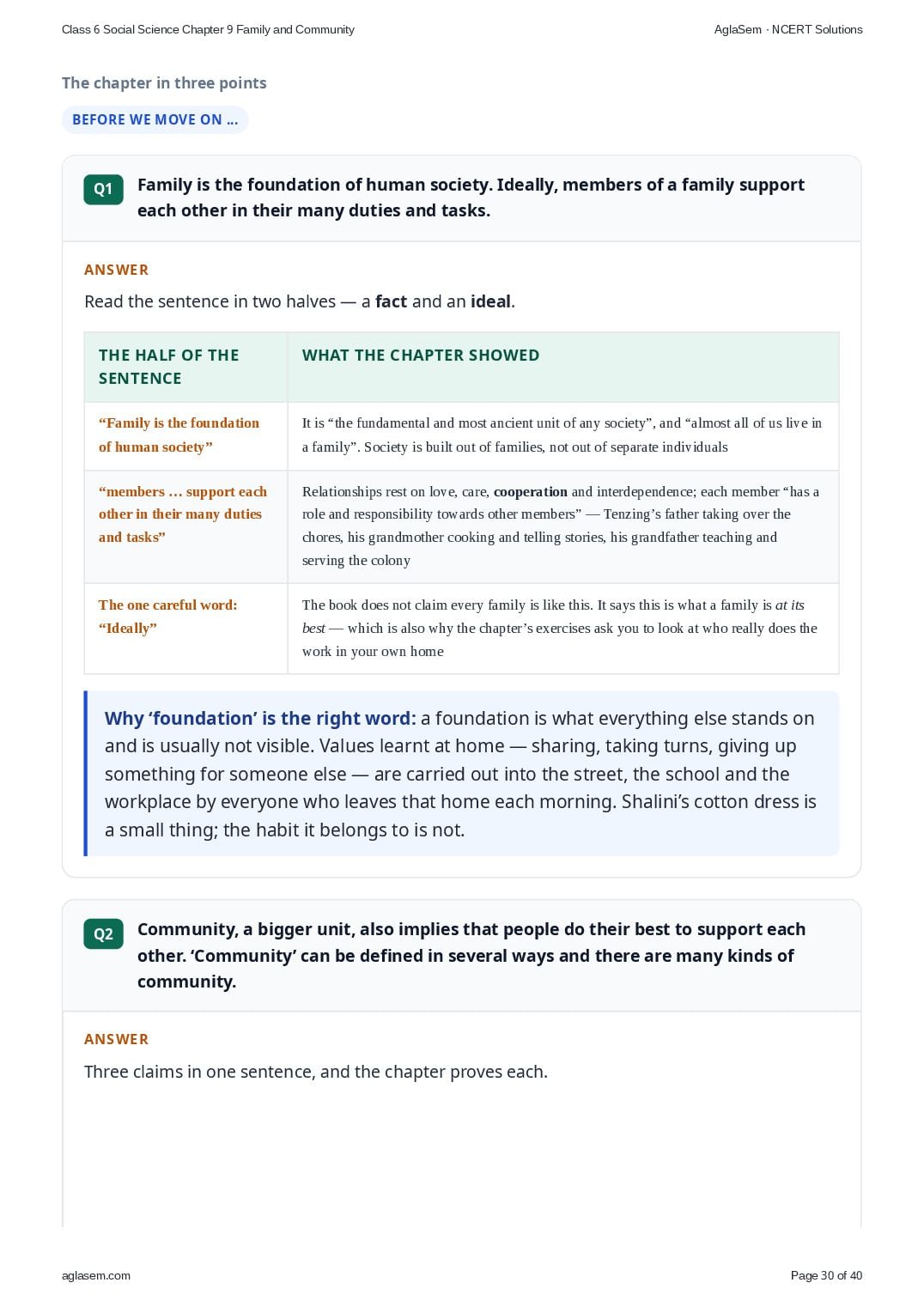
- Family is the foundation of human society. Ideally, members of a family support each other in their many duties and tasks.
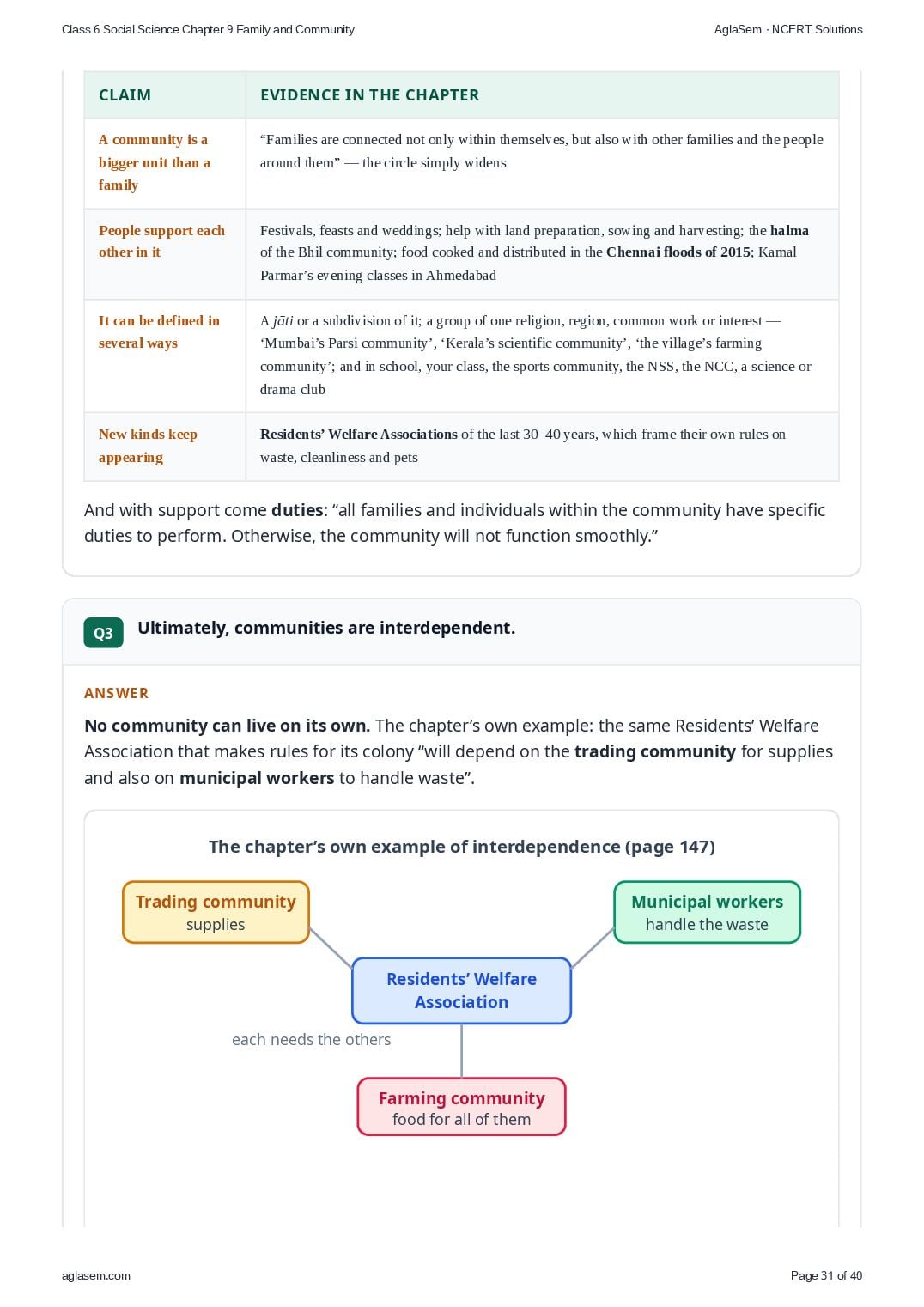
- Community, a bigger unit, also implies that people do their best to support each other. ‘Community’ can be defined in several ways and there are many kinds of community.
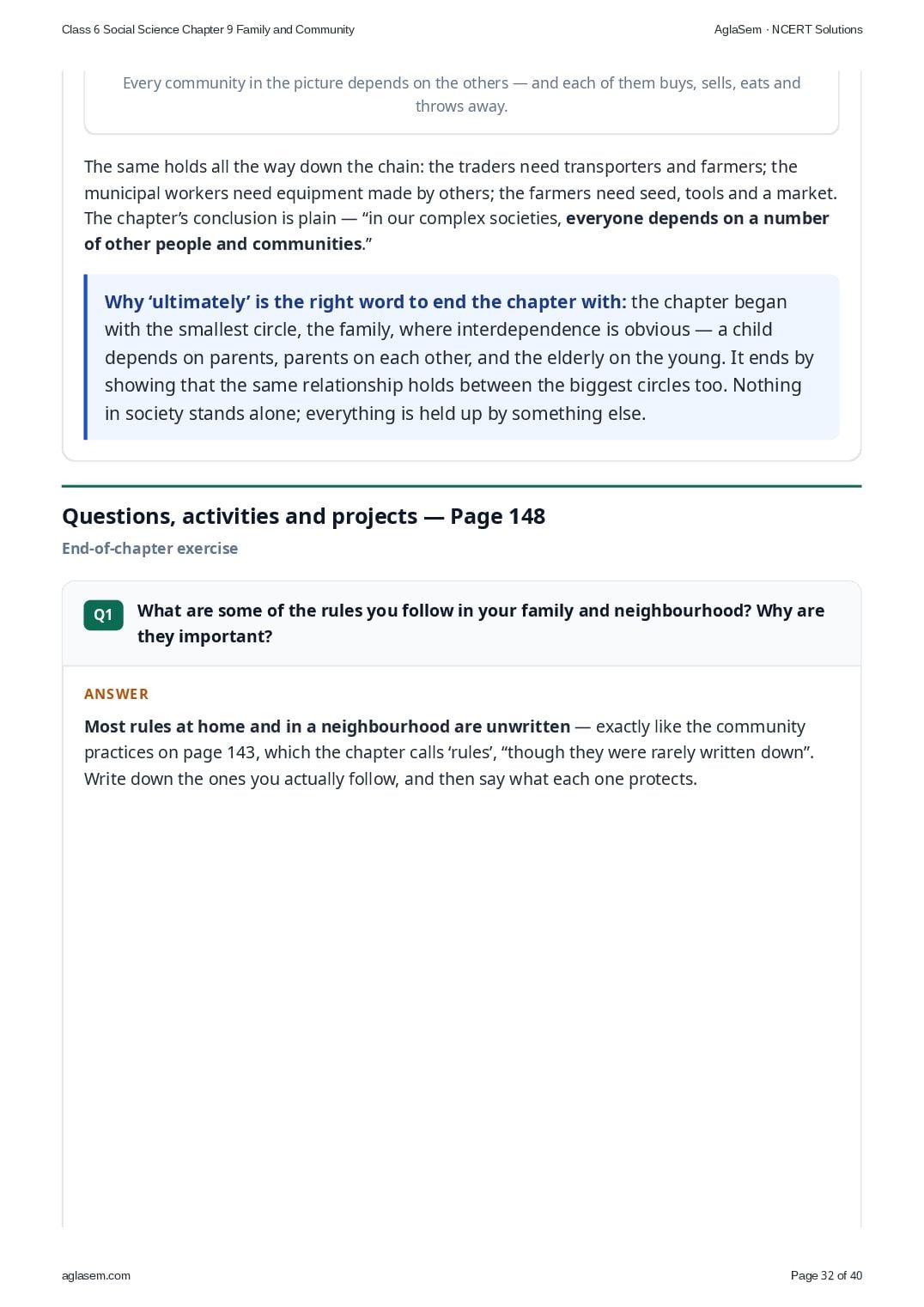
- Ultimately, communities are interdependent.
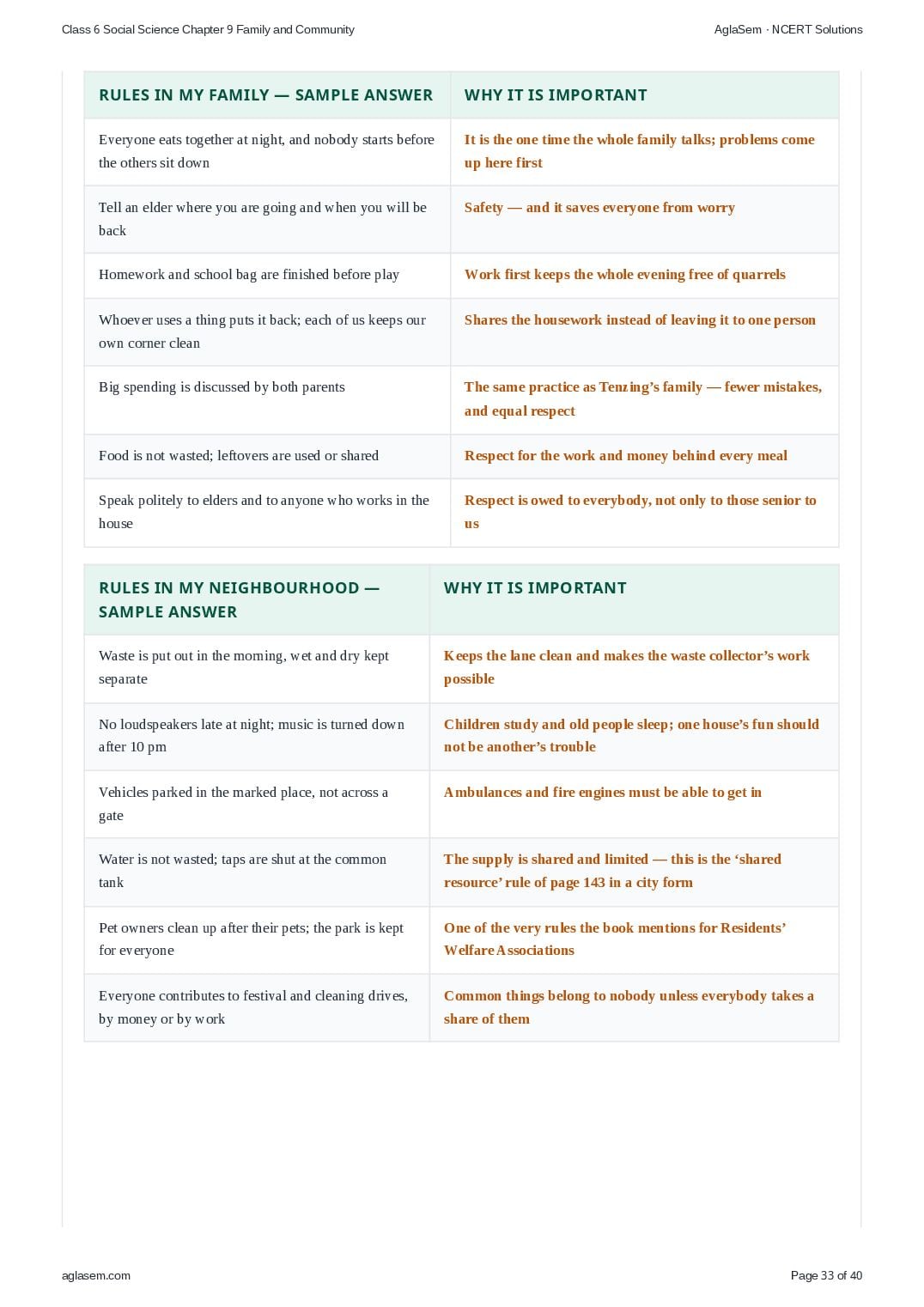
- What are some of the rules you follow in your family and neighbourhood? Why are they important?
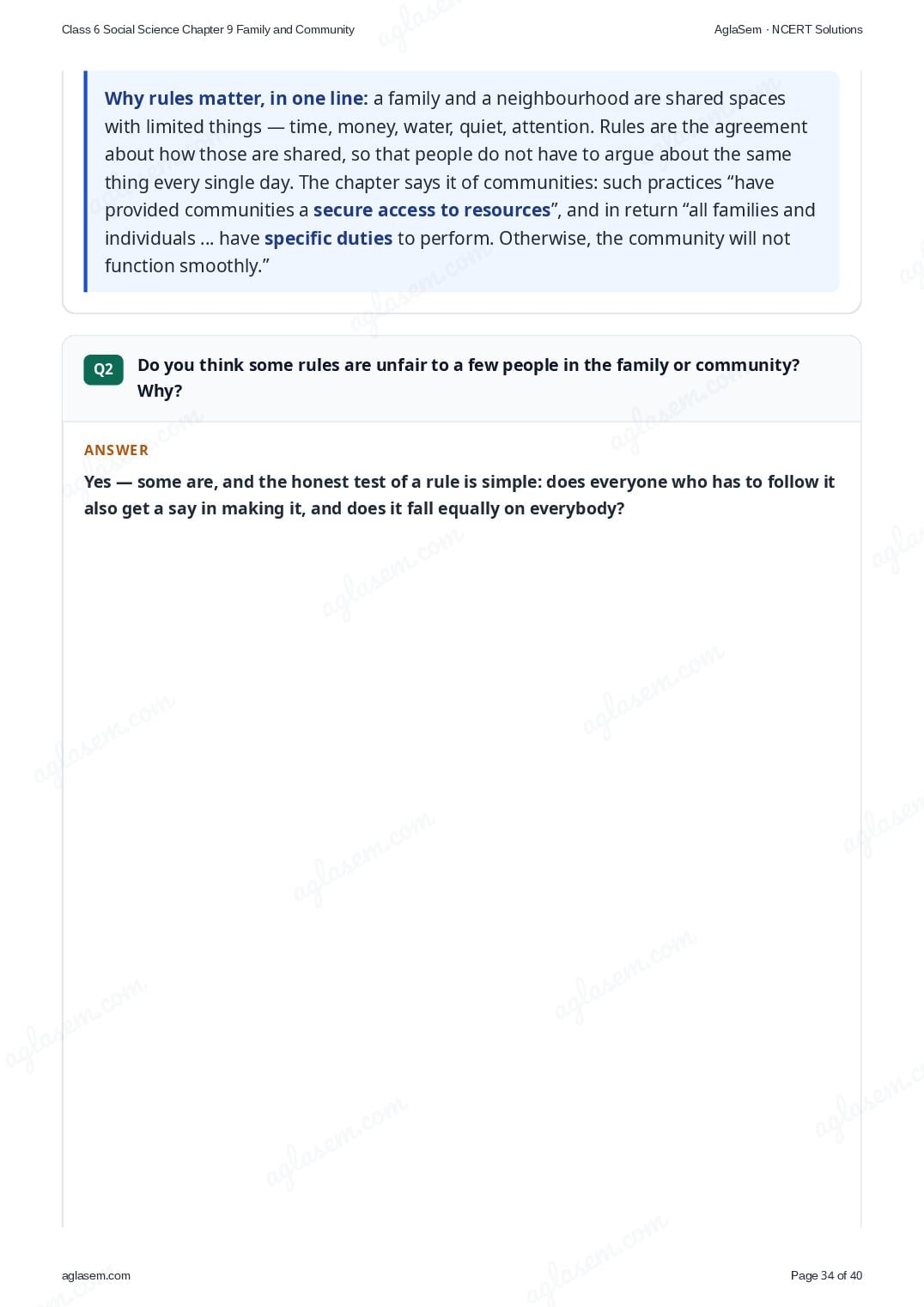
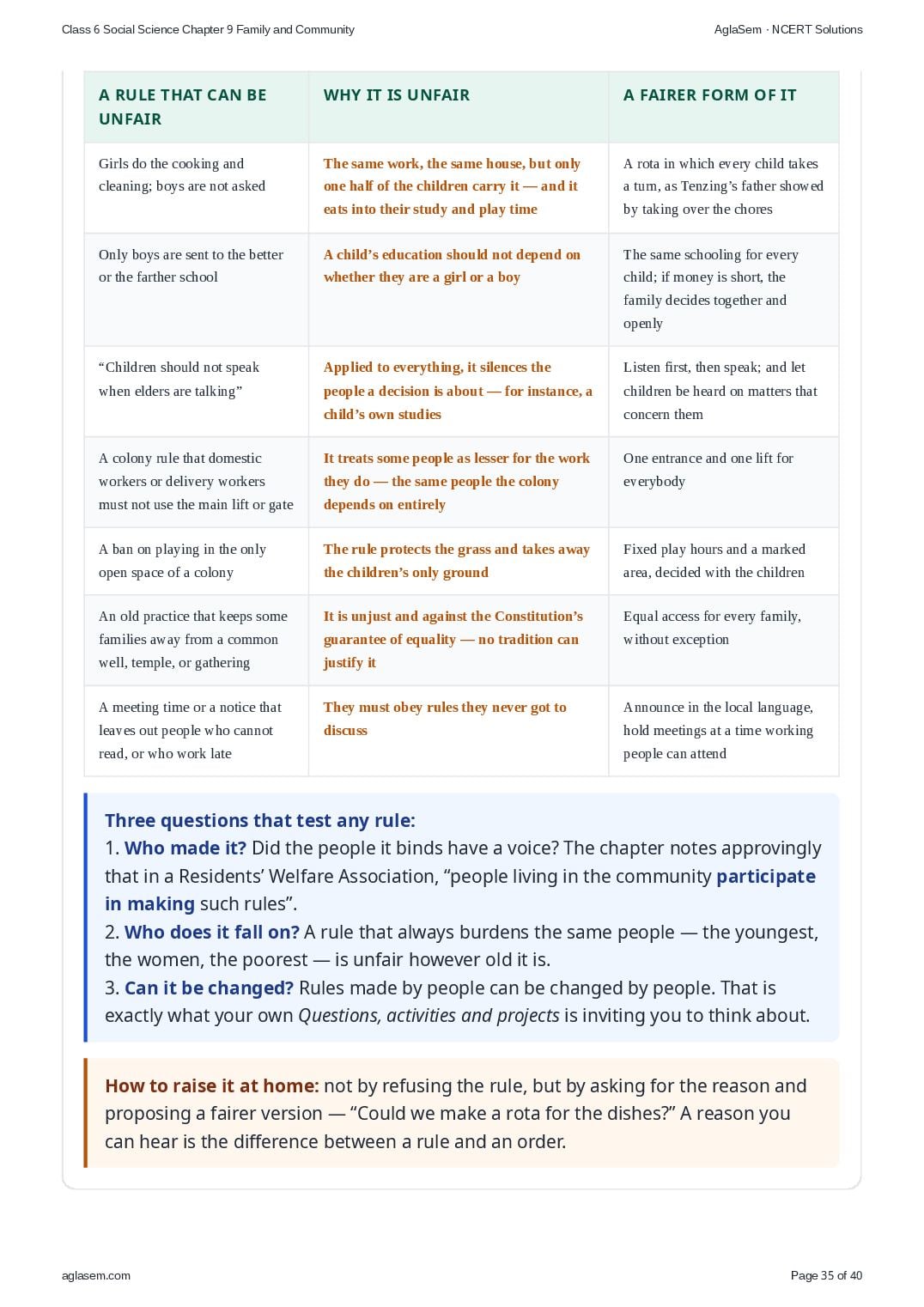
- Do you think some rules are unfair to a few people in the family or community? Why?
- Describe several situations that you have observed where community support makes a difference. You can draw or write about these.
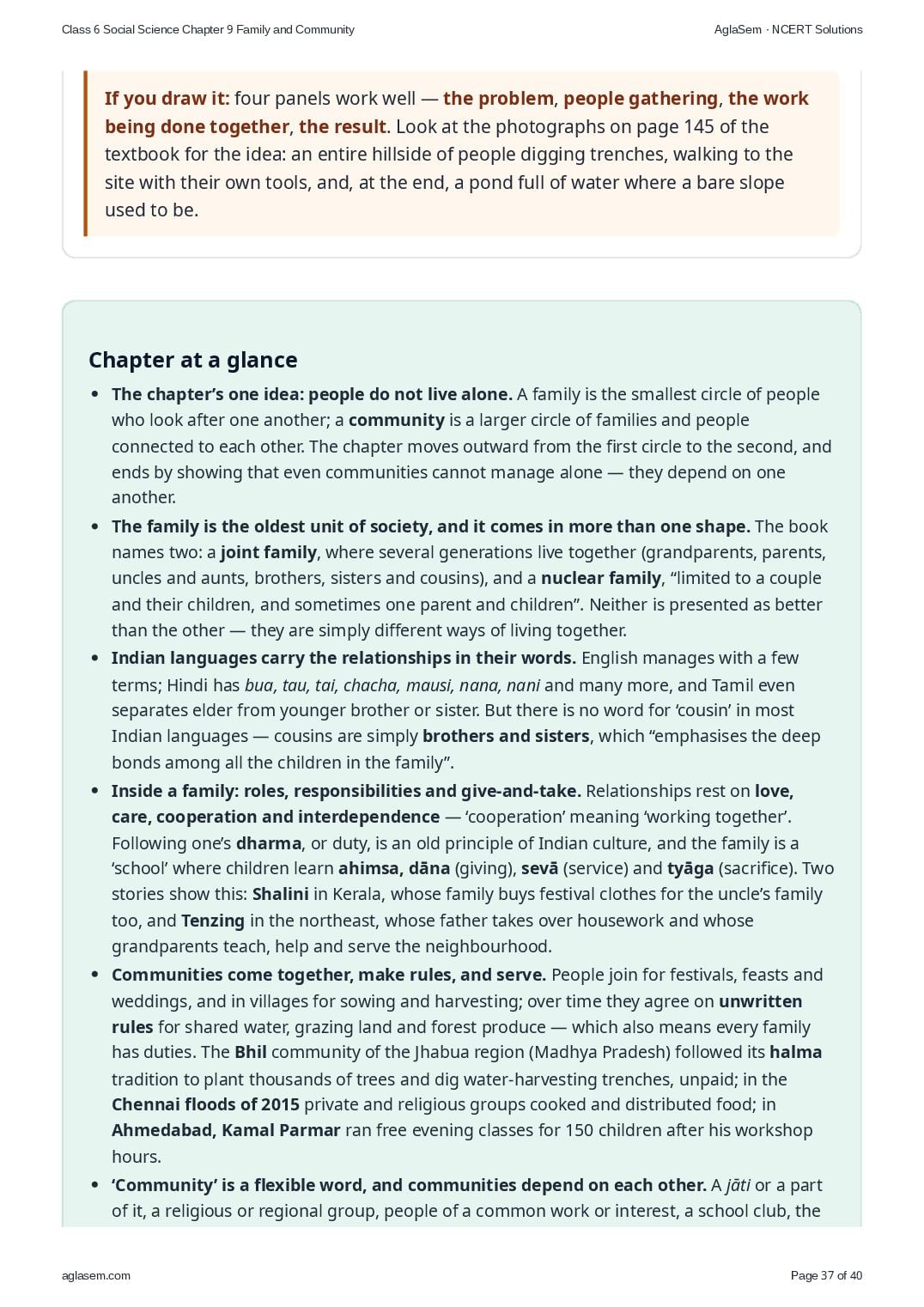
Chapter at a Glance
- The chapter’s one idea: people do not live alone. A family is the smallest circle of people who look after one another; a community is a larger circle of families and people connected to each other. The chapter moves outward from the first circle to the second, and ends by showing that even communities cannot manage alone — they depend on one another.
- The family is the oldest unit of society, and it comes in more than one shape. The book names two: a joint family , where several generations live together (grandparents, parents, uncles and aunts, brothers, sisters and cousins), and a nuclear family , “limited to a couple and their children, and sometimes one parent and children”. Neither is presented as better than the other — they are simply different ways of living together.
- Indian languages carry the relationships in their words. English manages with a few terms; Hindi has bua, tau, tai, chacha, mausi, nana, nani and many more, and Tamil even separates elder from younger brother or sister. But there is no word for ‘cousin’ in most Indian languages — cousins are simply brothers and sisters , which “emphasises the deep bonds among all the children in the family”.
- Inside a family: roles, responsibilities and give-and-take. Relationships rest on love, care, cooperation and interdependence — ‘cooperation’ meaning ‘working together’. Following one’s dharma , or duty, is an old principle of Indian culture, and the family is a ‘school’ where children learn ahimsa, dāna (giving), sevā (service) and tyāga (sacrifice). Two stories show this: Shalini in Kerala, whose family buys festival clothes for the uncle’s family too, and Tenzing in the northeast, whose father takes over housework and whose grandparents teach, help and serve the neighbourhood.
- Communities come together, make rules, and serve. People join for festivals, feasts and weddings, and in villages for sowing and harvesting; over time they agree on unwritten rules for shared water, grazing land and forest produce — which also means every family has duties. The Bhil community of the Jhabua region (Madhya Pradesh) followed its halma tradition to plant thousands of trees and dig water-harvesting trenches, unpaid; in the Chennai floods of 2015 private and religious groups cooked and distributed food; in Ahmedabad, Kamal Parmar ran free evening classes for 150 children after his workshop hours.
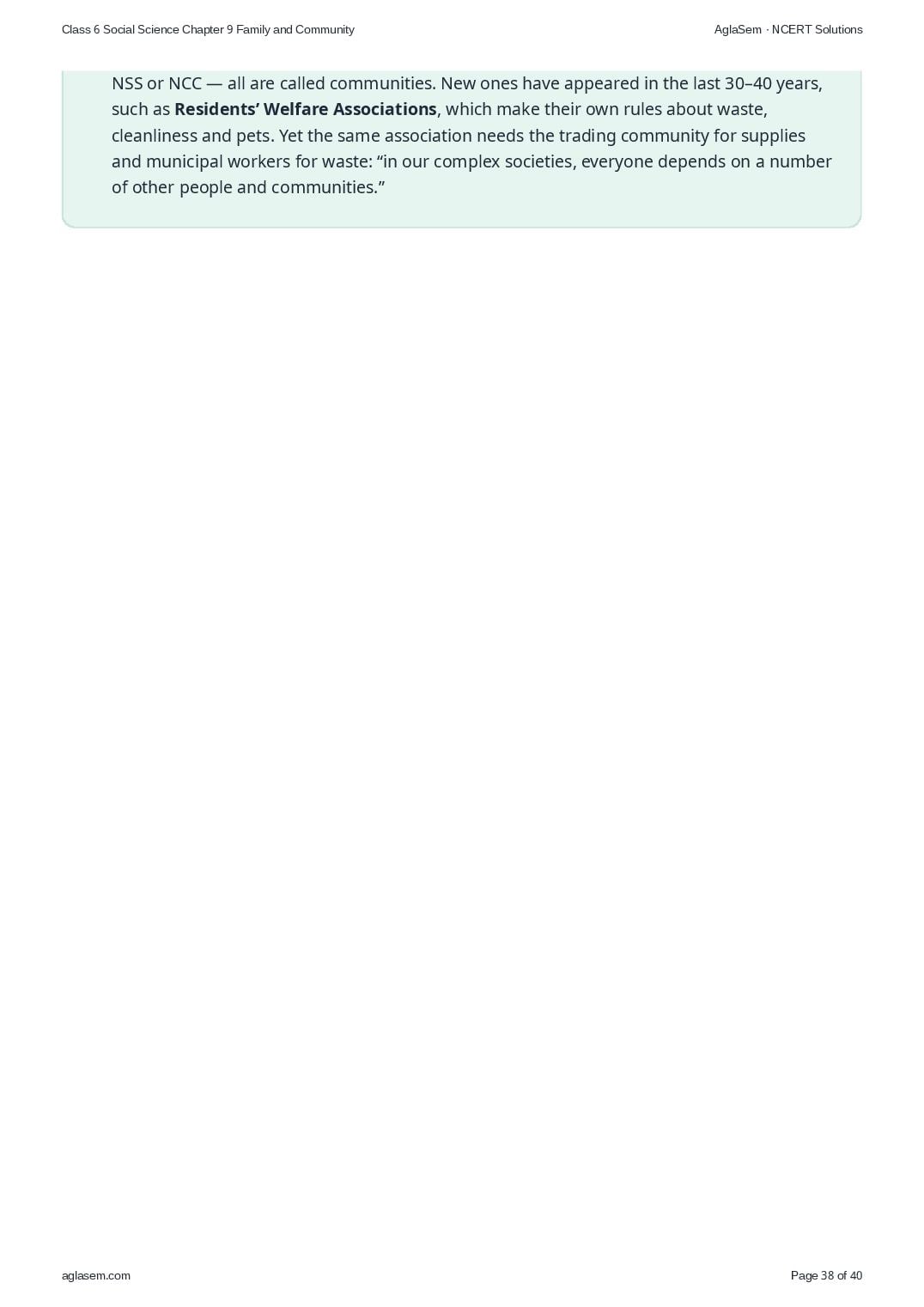
- ‘Community’ is a flexible word, and communities depend on each other. A jāti or a part of it, a religious or regional group, people of a common work or interest, a school club, the NSS or NCC — all are called communities. New ones have appeared in the last 30–40 years, such as Residents’ Welfare Associations , which make their own rules about waste, cleanliness and pets. Yet the same association needs the trading community for supplies and municipal workers for waste: “in our complex societies, everyone depends on a number of other people and communities.”
How to Download NCERT Solutions for Class 6 Social Science Chapter 9 PDF
Follow these simple steps to get the Family and Community questions-and-answers PDF from Exploring Society India and Beyond.
- Search NCERT Solutions for Class 6 Social Science Chapter 9 aglasem and open this page.
- Read the exercise questions with answers for Family and Community shown above.
- Click the Download PDF link to save the Family and Community solutions to your device.
NCERT Solutions for Class 6 Social Science – All Chapters
There are more chapters to study besides Family and Community in Social Science. Here are the NCERT Solutions for all chapters of Class 6 Social Science.
- Chapter 1 Locating Places on the Earth
- Chapter 2 Oceans and Continents
- Chapter 3 Landforms and Life
- Chapter 4 Timeline and Sources of History
- Chapter 5 India That Is Bharat
- Chapter 6 the Beginnings of Indian Civilisation
- Chapter 7 India’s Cultural Roots
- Chapter 8 Unity in Diversity or Many in the One
- Chapter 9 Family and Community
- Chapter 10 Grassroots Democracy part 1 Governance
- Chapter 11 Grassroots Democracy part 2 Local Government in Rural Areas
- Chapter 12 Grassroots Democracy part 3 Local Government in Urban Areas
- Chapter 13 the Value of Work
- Chapter 14 Economic Activities Around Us
NCERT Solutions for Class 6 – All Subjects
Just like Chapter 9 of Social Science, you can get the exercise questions with answers for every other subject of Class 6. Here are the NCERT Solutions for all subjects of Class 6.
NCERT Solutions for Class 6 Social Science Chapter 9 – An Overview
The key highlights of this study material are as follows.
| Aspects | Details |
|---|---|
| Class | Class 6 |
| Subject | Social Science |
| Chapter Number | Chapter 9 |
| Chapter Name | Family and Community |
| Book Name | Exploring Society India and Beyond |
| Book By | NCERT (National Council of Educational Research and Training) |
| Educational Resource Here | NCERT Solutions of Class 6 Social Science Chapter 9 for all exercises |
| More Questions Answers of This Subject | NCERT Solutions for Class 6 Social Science |
| Download Book Chapter | NCERT Book Class 6 Social Science |
| All Questions Answers For This Class | NCERT Solutions for Class 6 |
| Complete Solutions | NCERT Solutions |
NCERT Solutions for Class 6 Social Science Chapter 9 Family and Community – FAQs
What are the NCERT Solutions for Class 6 Social Science Chapter 9 Family and Community?
They are the complete, step-by-step answers to all the exercise and in-text questions of Chapter 9 Family and Community from the NCERT Class 6 Social Science textbook Exploring Society India and Beyond, written by experts as per the latest NCERT syllabus.
How can I download the Class 6 Social Science Chapter 9 solutions PDF for free?
Open this page on aglasem, read the Family and Community questions with answers, and click the “Download Solutions PDF” link. The Class 6 Social Science Chapter 9 NCERT Solutions PDF is completely free to download.
Are these NCERT Solutions as per the latest 2026-27 syllabus?
Yes. The NCERT Solutions for Class 6 Social Science Chapter 9 are based on the latest NCERT textbook Exploring Society India and Beyond and the current 2026-27 CBSE syllabus, so the questions and answers match what you study in class.
Where can I get NCERT Solutions for the other chapters of Class 6 Social Science?
You can find the answers to every chapter on the NCERT Solutions for Class 6 Social Science page, and solutions for every subject on the NCERT Solutions for Class 6 page.
How do NCERT Solutions help in exam preparation?
They show the correct method to solve each question, help you write answers the way they are expected in exams, let you check and correct your own work, and save revision time — which together improve your marks in Class 6 Social Science.
If you have any queries on NCERT Solutions for Class 6 Social Science Chapter 9 Family and Community, then please ask in the comments below.