NCERT Solutions for Class 6 Social Science Chapter 13 the Value of Work provide clear, step-by-step answers to every exercise and in-text question from the chapter the Value of Work of the NCERT textbook Exploring Society India and Beyond. Prepared by subject experts as per the latest NCERT (CBSE) syllabus for 2026-27, these NCERT Solutions for Class 6 Social Science help you understand each concept, write exam-ready answers, and check your own solutions. You can read them online below or download the free Class 6 Social Science Chapter 13 question-answer PDF.
NCERT Solutions for Class 6 Social Science Chapter 13 the Value of Work
- Class: Class 6
- Subject: Social Science
- Chapter: Chapter 13 – the Value of Work
- Textbook: Exploring Society India and Beyond (NCERT)
- Study material: NCERT Solutions – questions with answers, free PDF
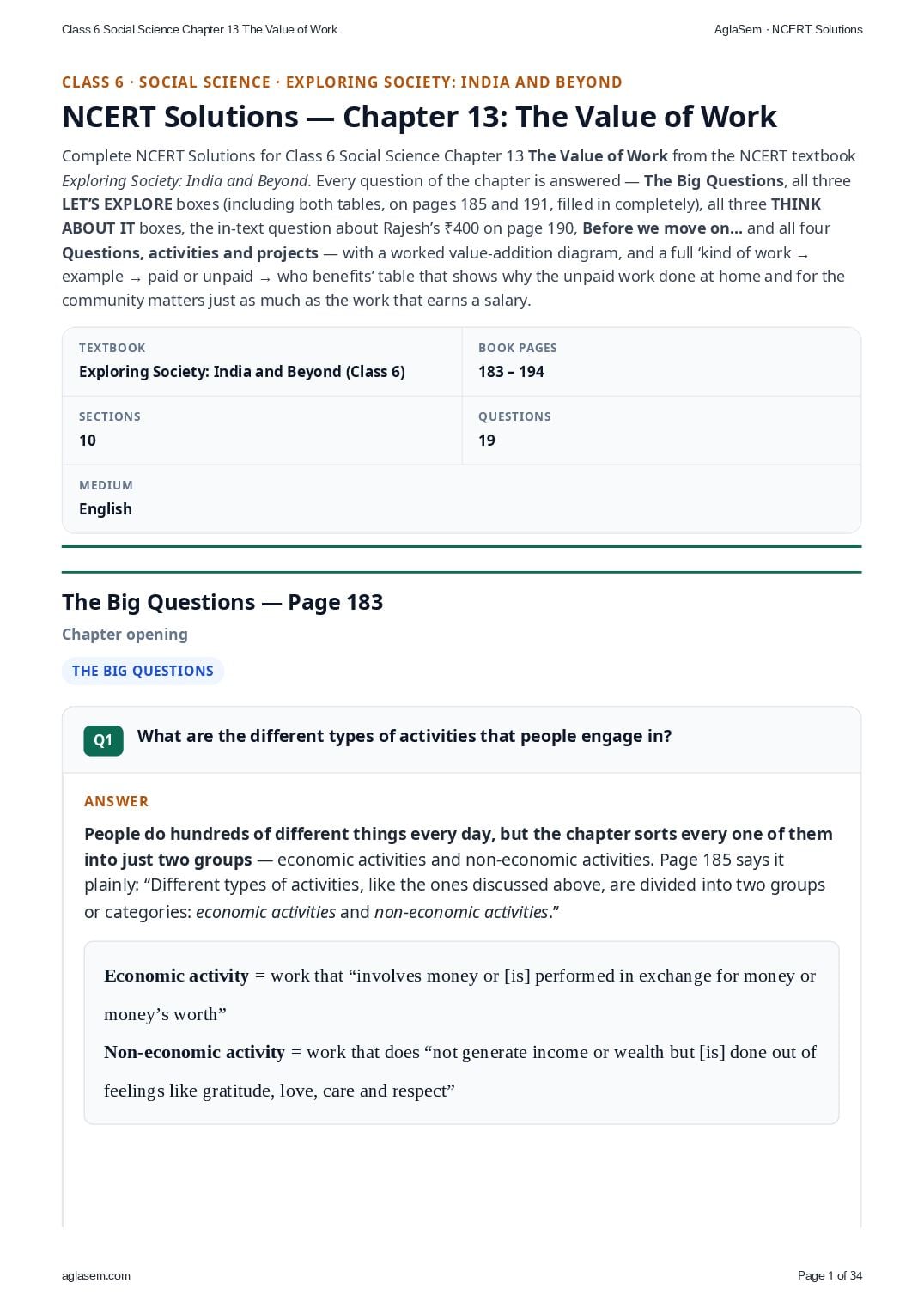
These solutions answer all the exercise questions of Chapter 13 the Value of Work — including the in-text questions, short-answer and long-answer questions, and activities — with complete explanations so you can follow the method, not just the final answer. Read the full solutions below.
NCERT Solutions Class 6 Social Science Chapter 13 the Value of Work View Download


NCERT Solutions for Class 6 Social Science Chapter 13 PDF Download
You can read the NCERT Solutions for Class 6 Social Science Chapter 13 online above, or download the complete question-answer PDF to study the Value of Work offline at any time.
NCERT Solutions for Class 6 Social Science Chapter 13 PDF Download Link – Click Here to Download Solutions PDF
Questions Covered in This Chapter
These NCERT Solutions answer all 19 questions of this chapter. The questions solved are:
- What are the different types of activities that people engage in?
- What is their contribution to our everyday lives?
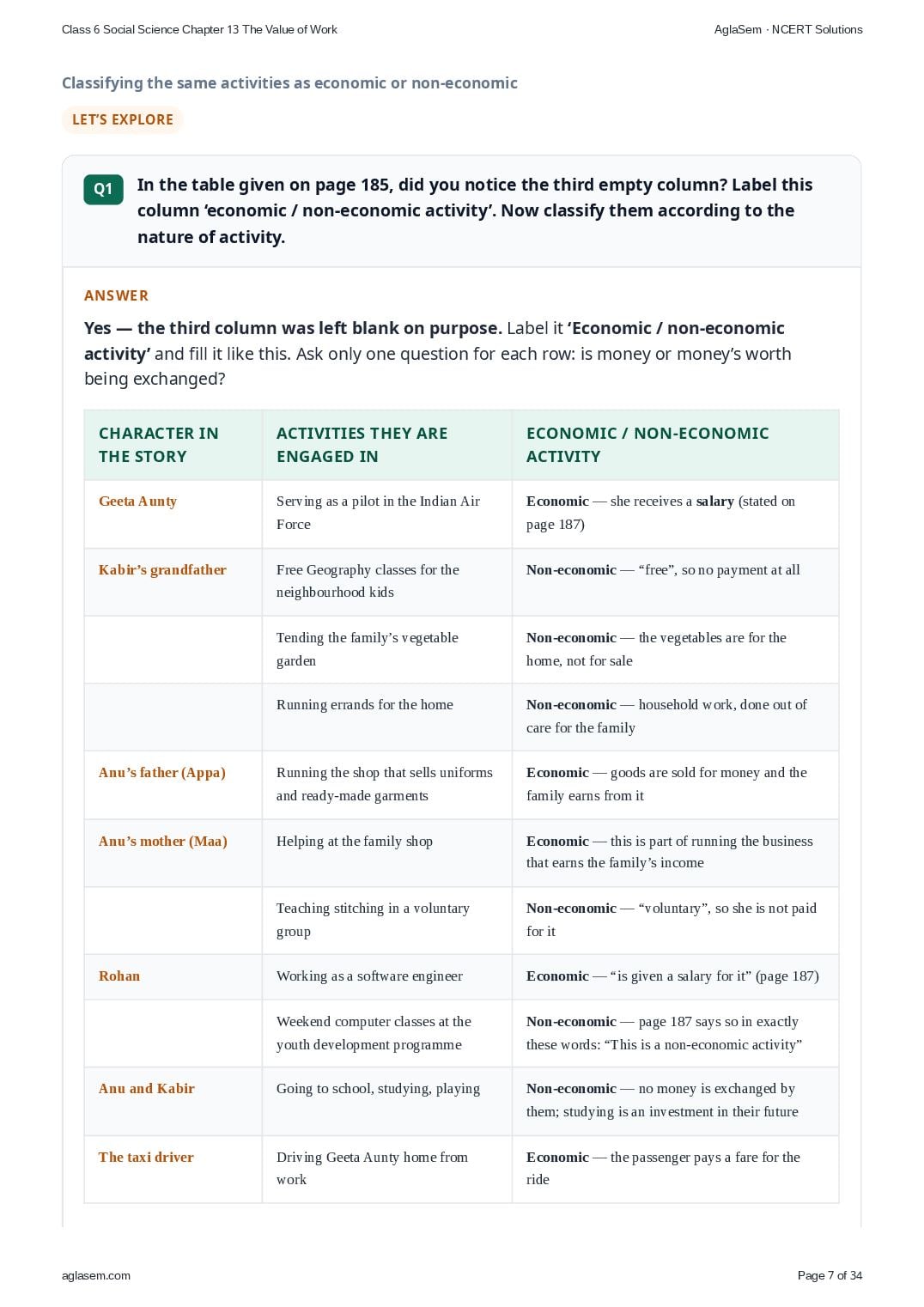
- What activities did the people in Anu’s and Kabir’s story engage in? Mention them in the table given below: (Character in the story / Activities they are engaged in)
- In the table given on page 185, did you notice the third empty column? Label this column ‘economic / non-economic activity’. Now classify them according to the nature of activity.
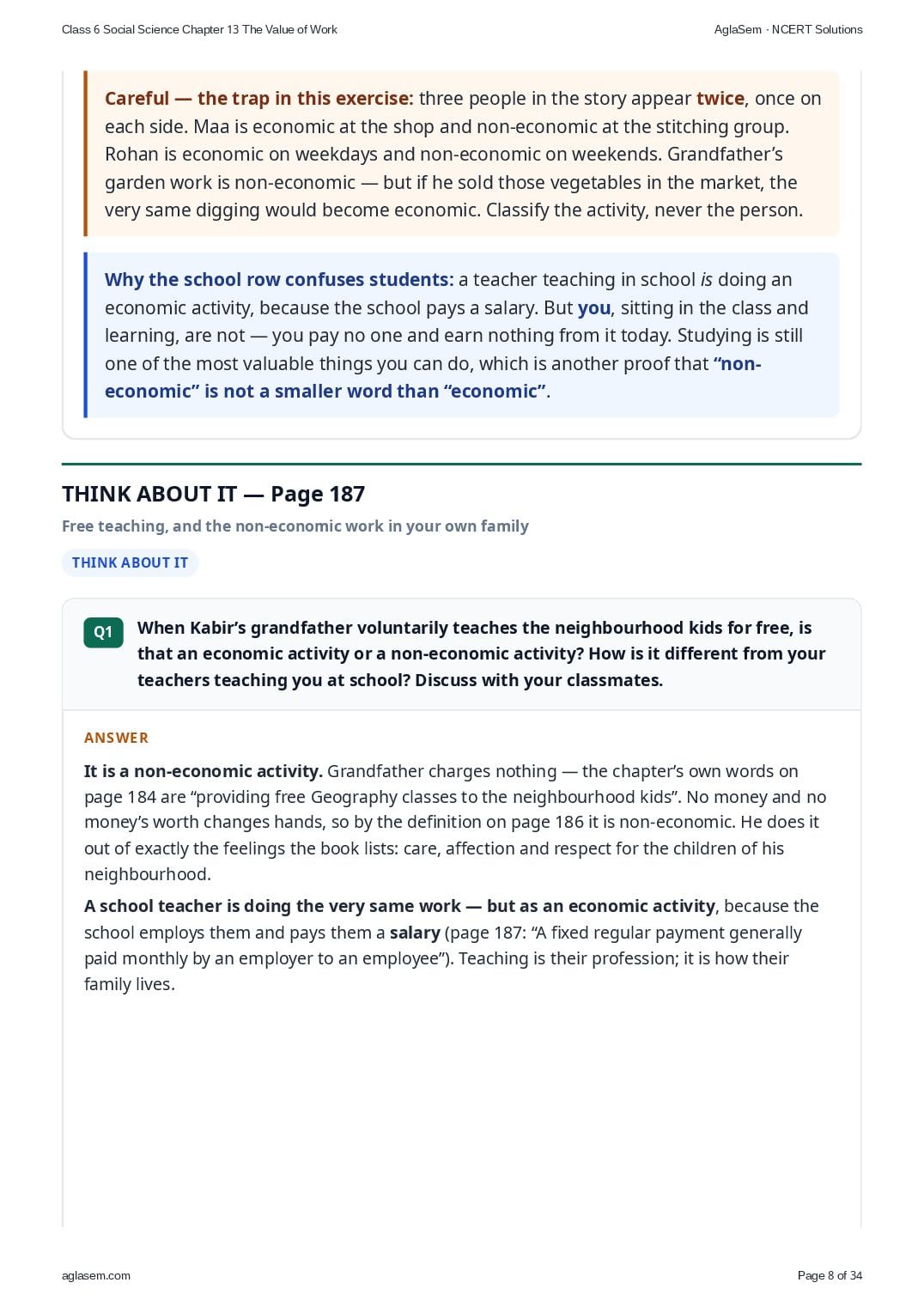
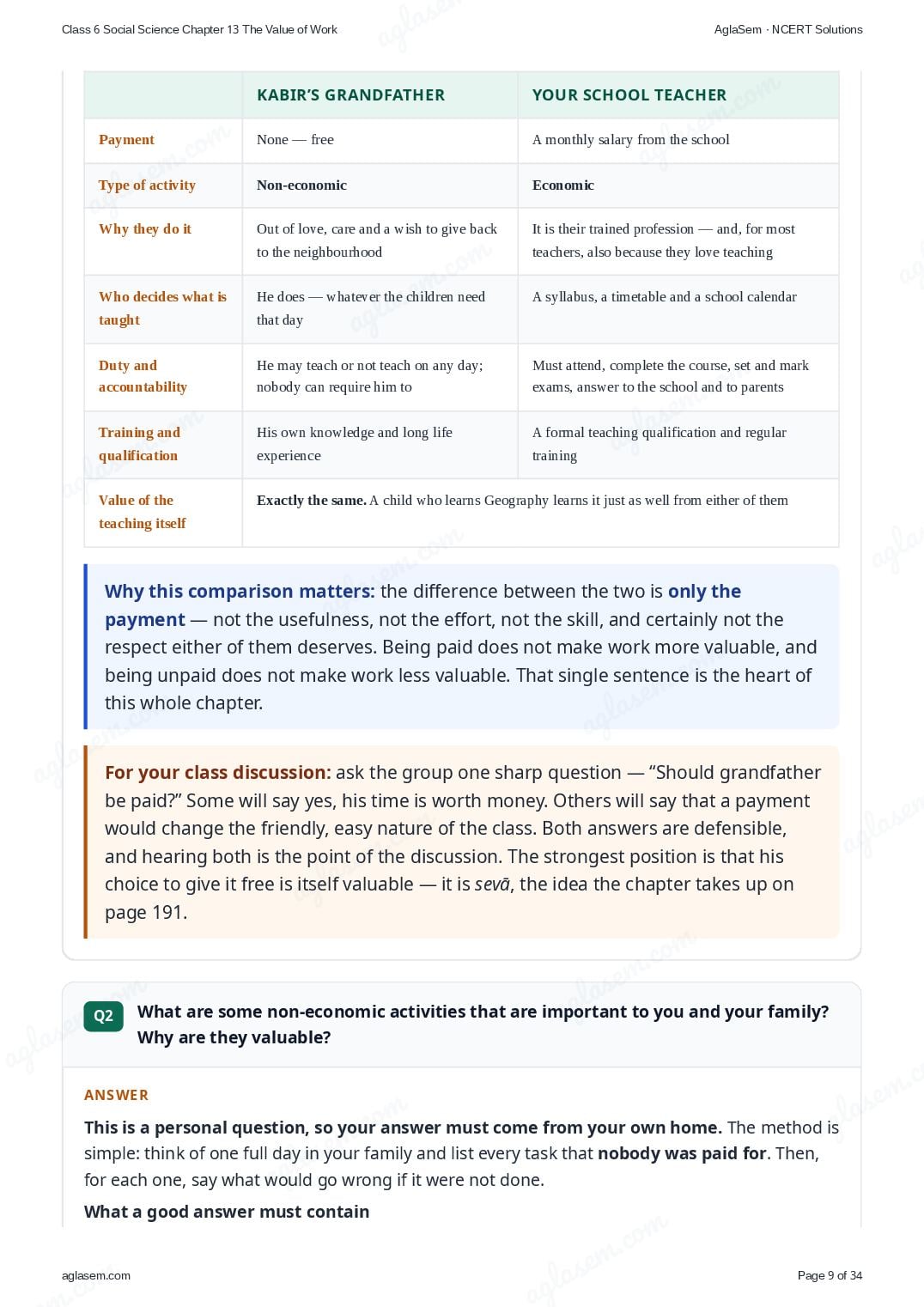
- When Kabir’s grandfather voluntarily teaches the neighbourhood kids for free, is that an economic activity or a non-economic activity? How is it different from your teachers teaching you at school? Discuss with your classmates.
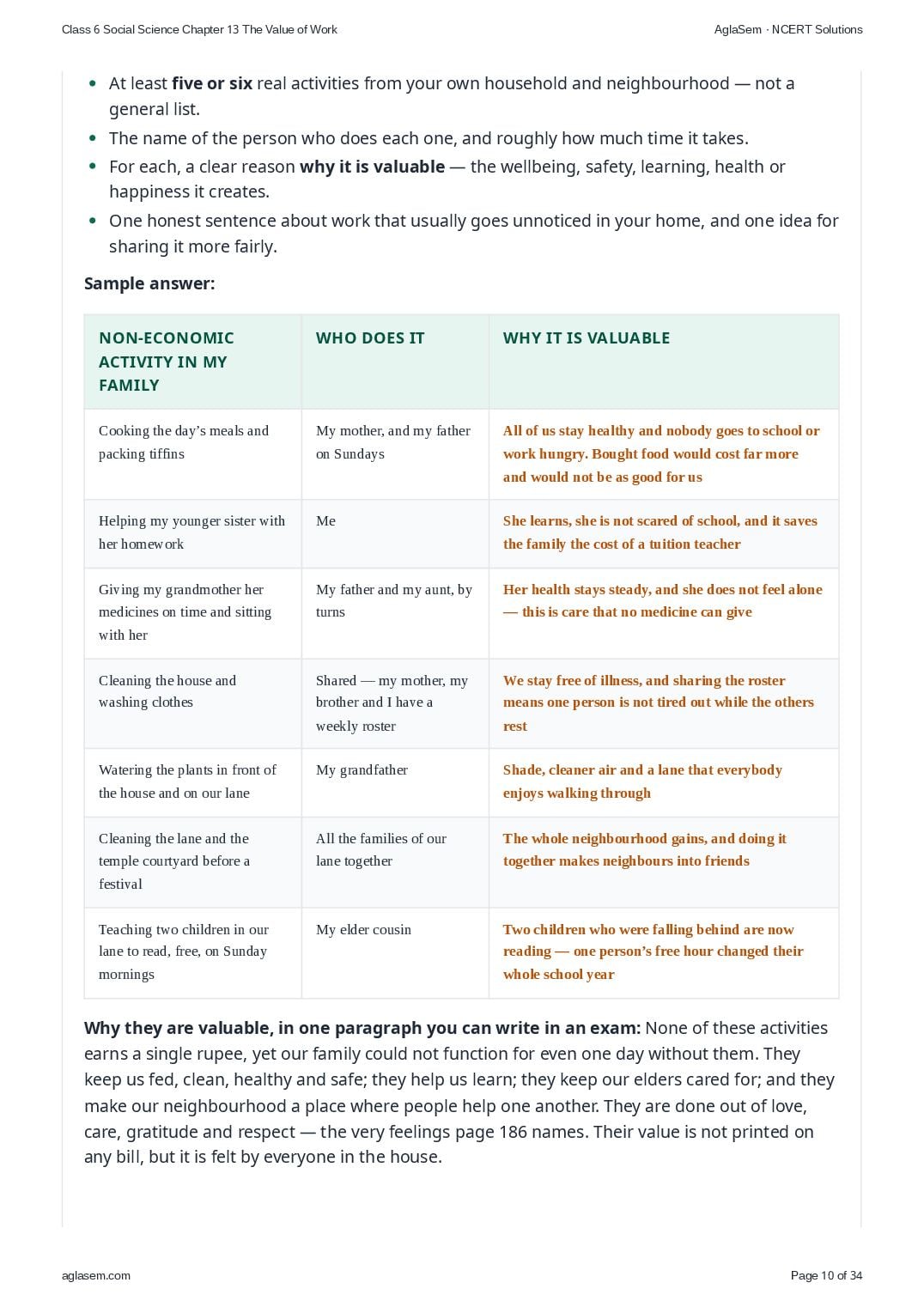
- What are some non-economic activities that are important to you and your family? Why are they valuable?
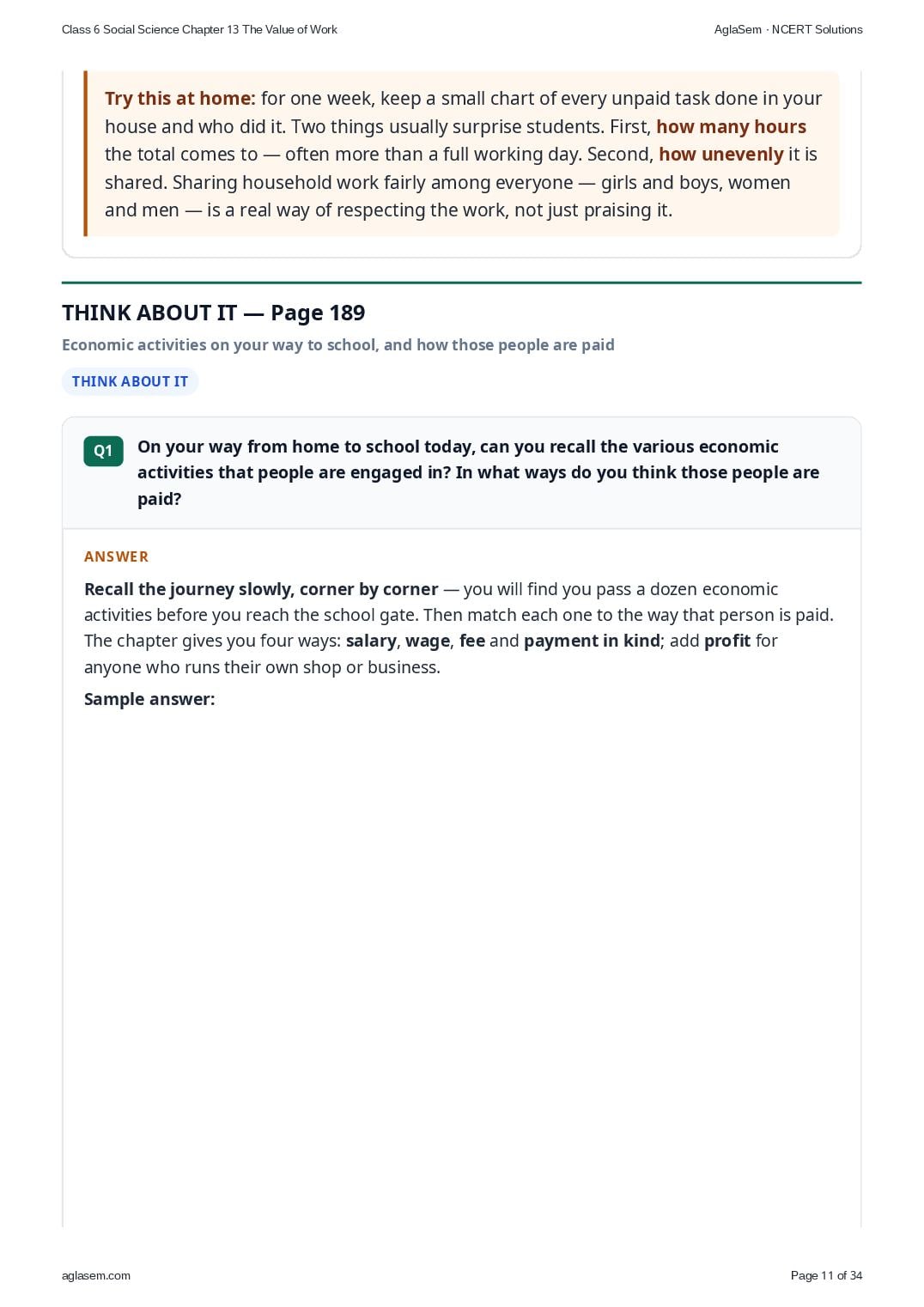
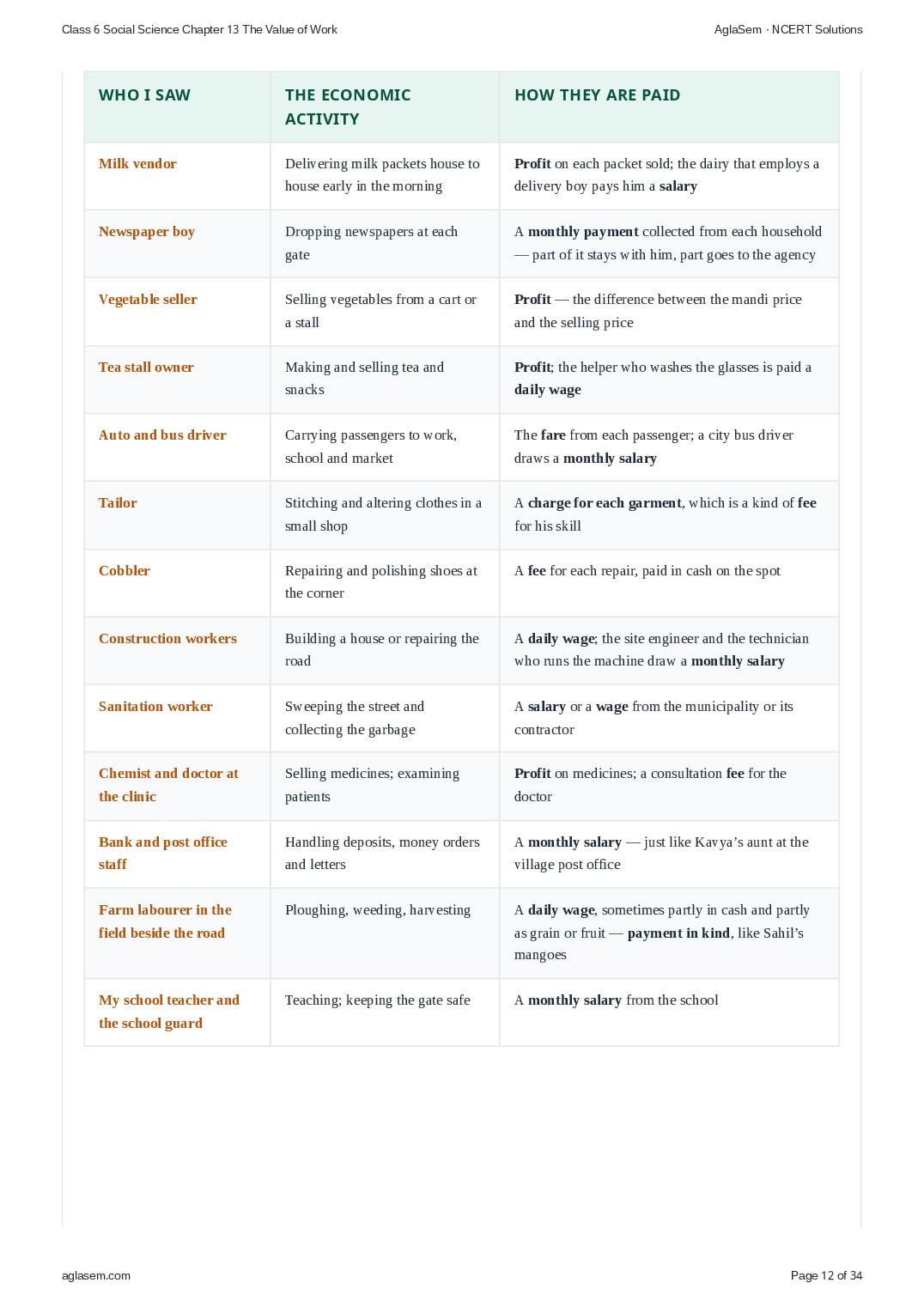
- On your way from home to school today, can you recall the various economic activities that people are engaged in? In what ways do you think those people are paid?
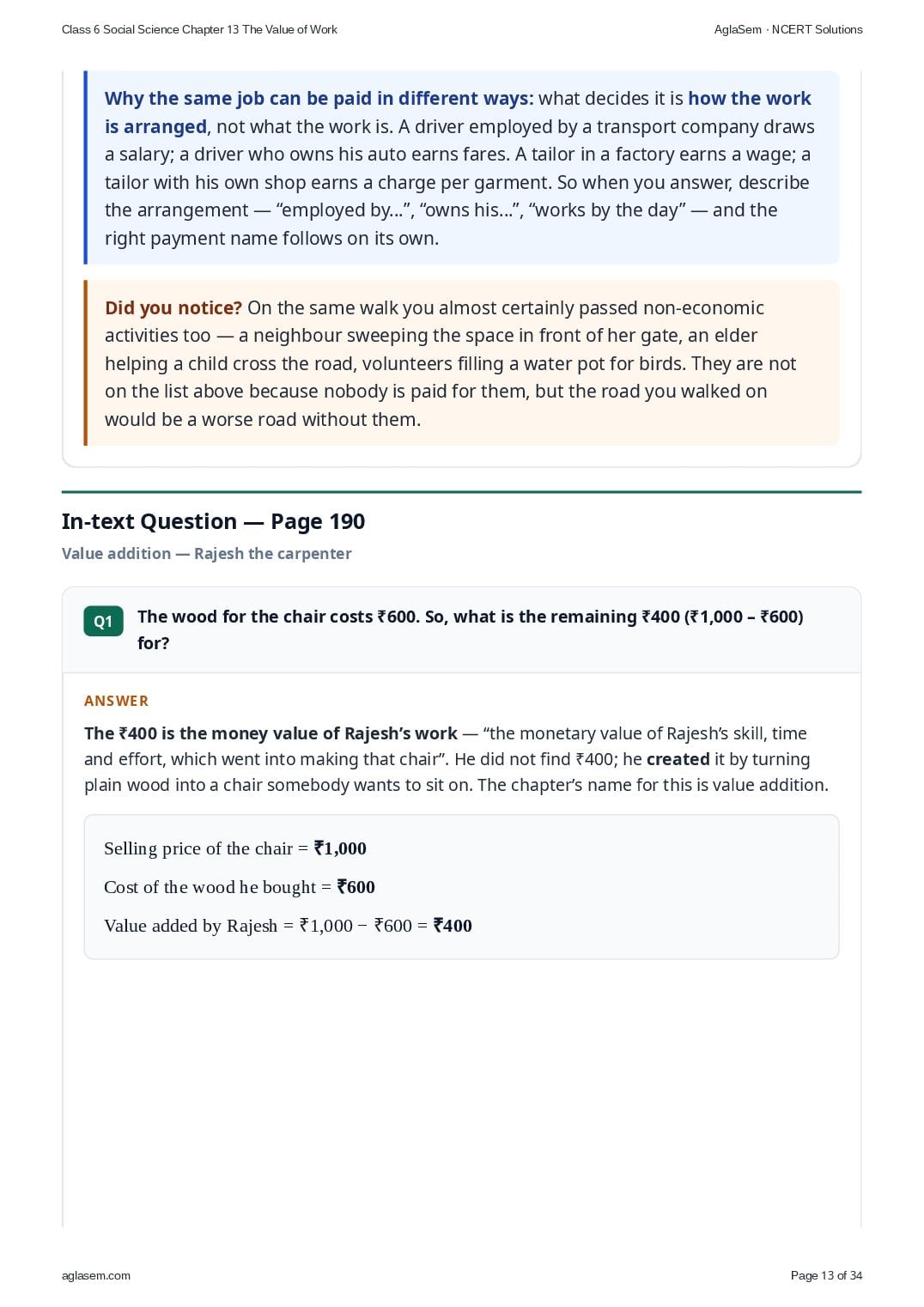
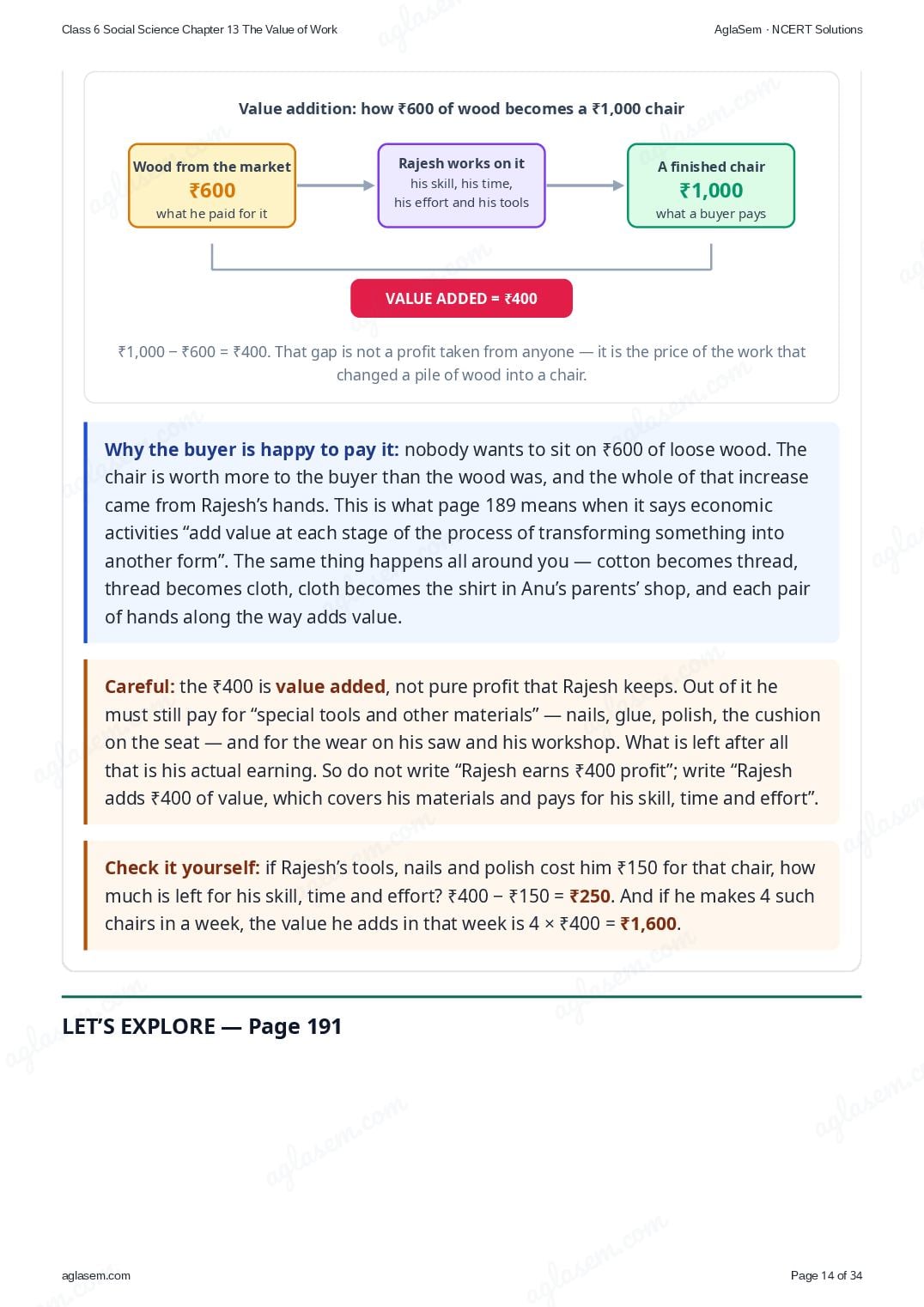
- The wood for the chair costs ₹600. So, what is the remaining ₹400 (₹1,000 – ₹600) for?
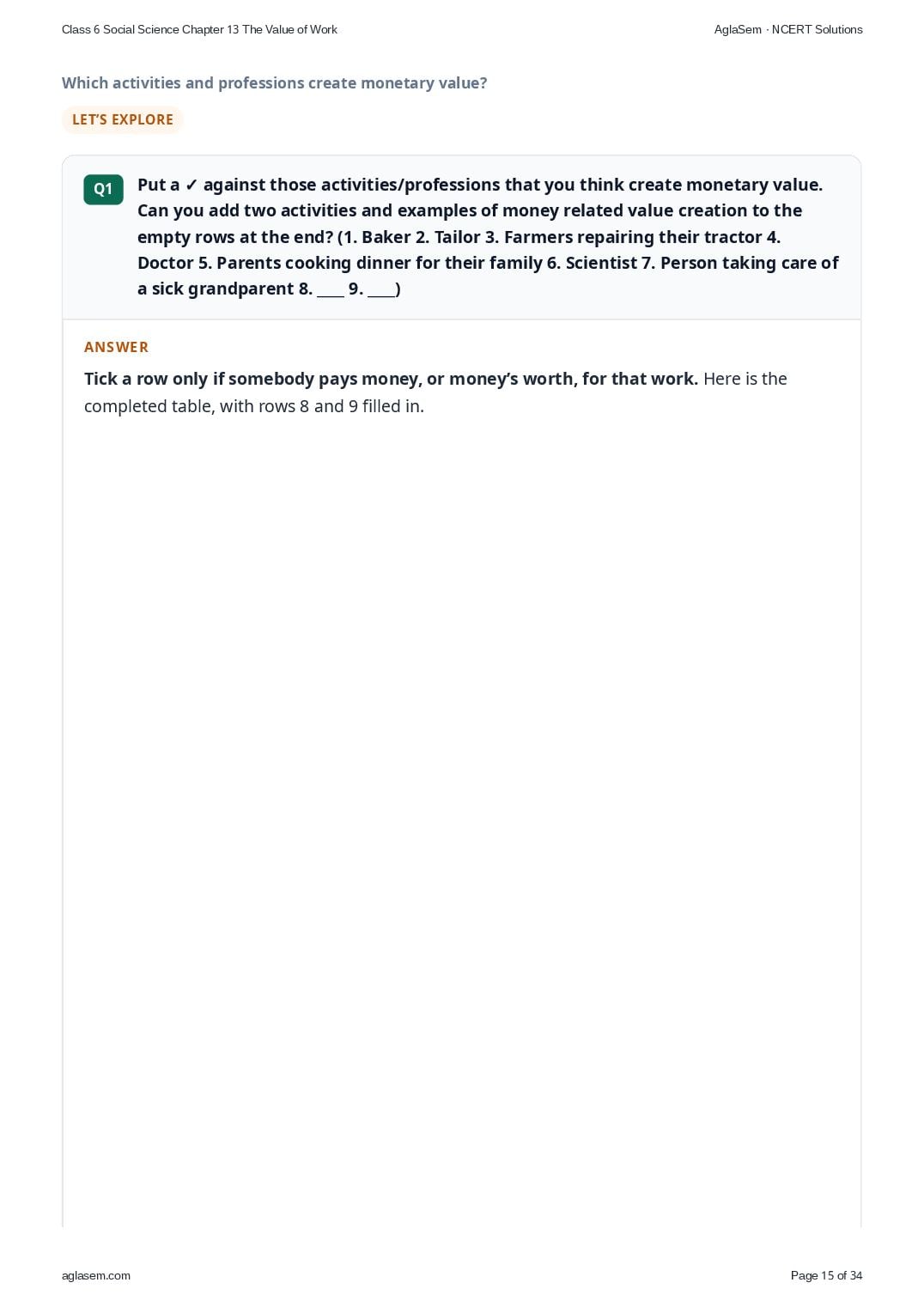
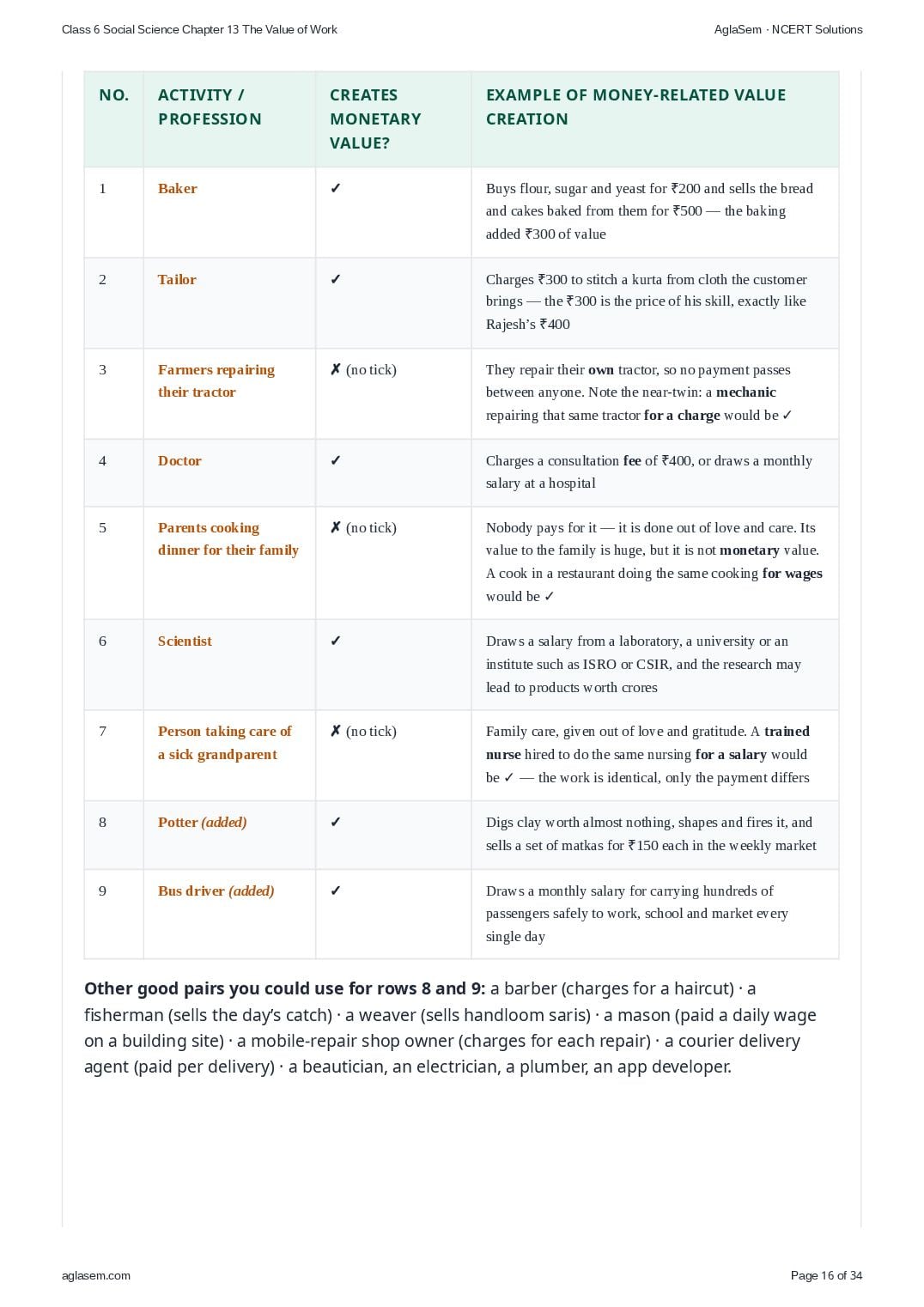
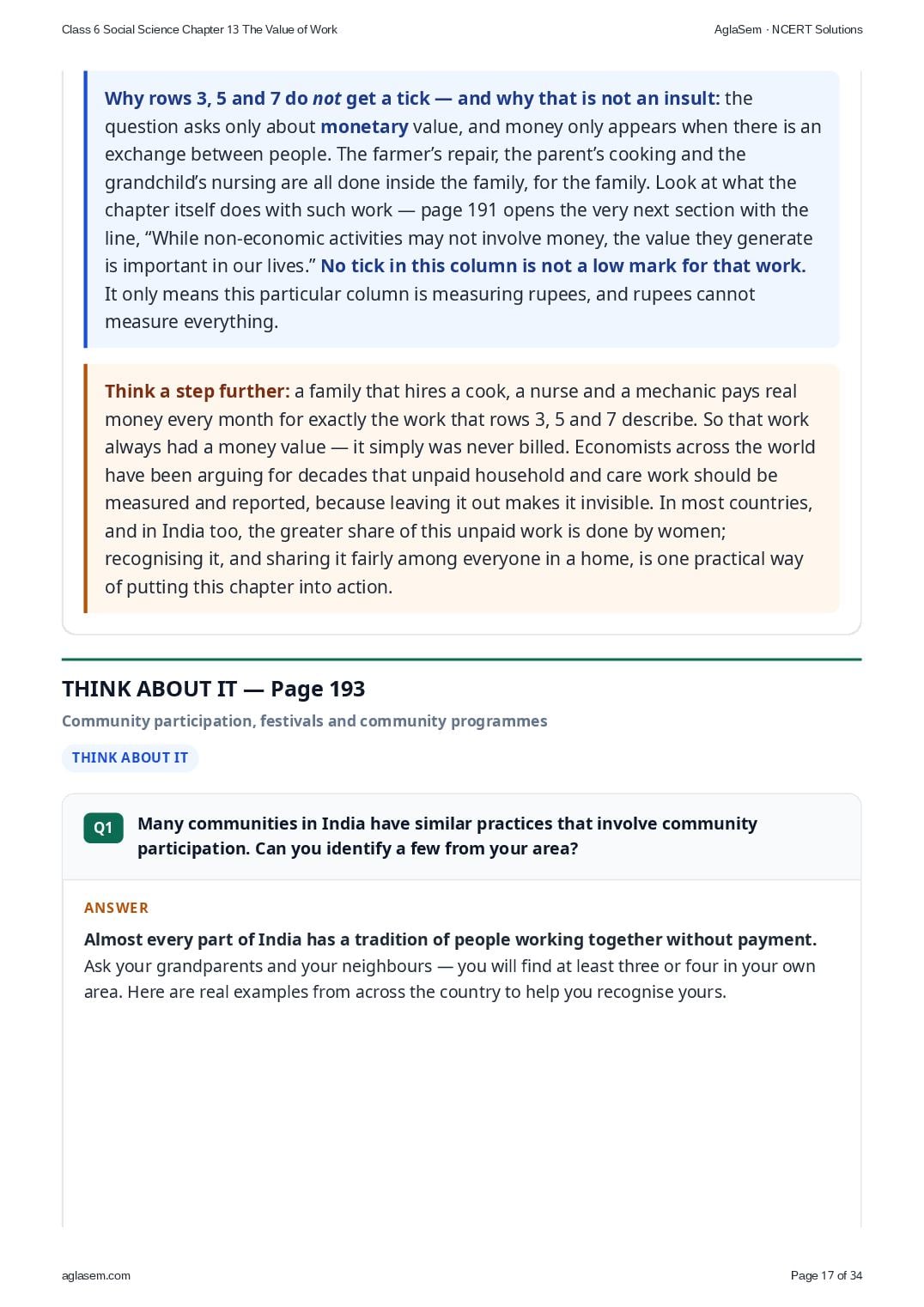
- Put a ✓ against those activities/professions that you think create monetary value. Can you add two activities and examples of money related value creation to the empty rows at the end? (1. Baker 2. Tailor 3. Farmers repairing their tractor 4. Doctor 5. Parents cooking dinner for their family 6. Scientist 7. Person taking care of a sick grandparent 8. ____ 9. ____)
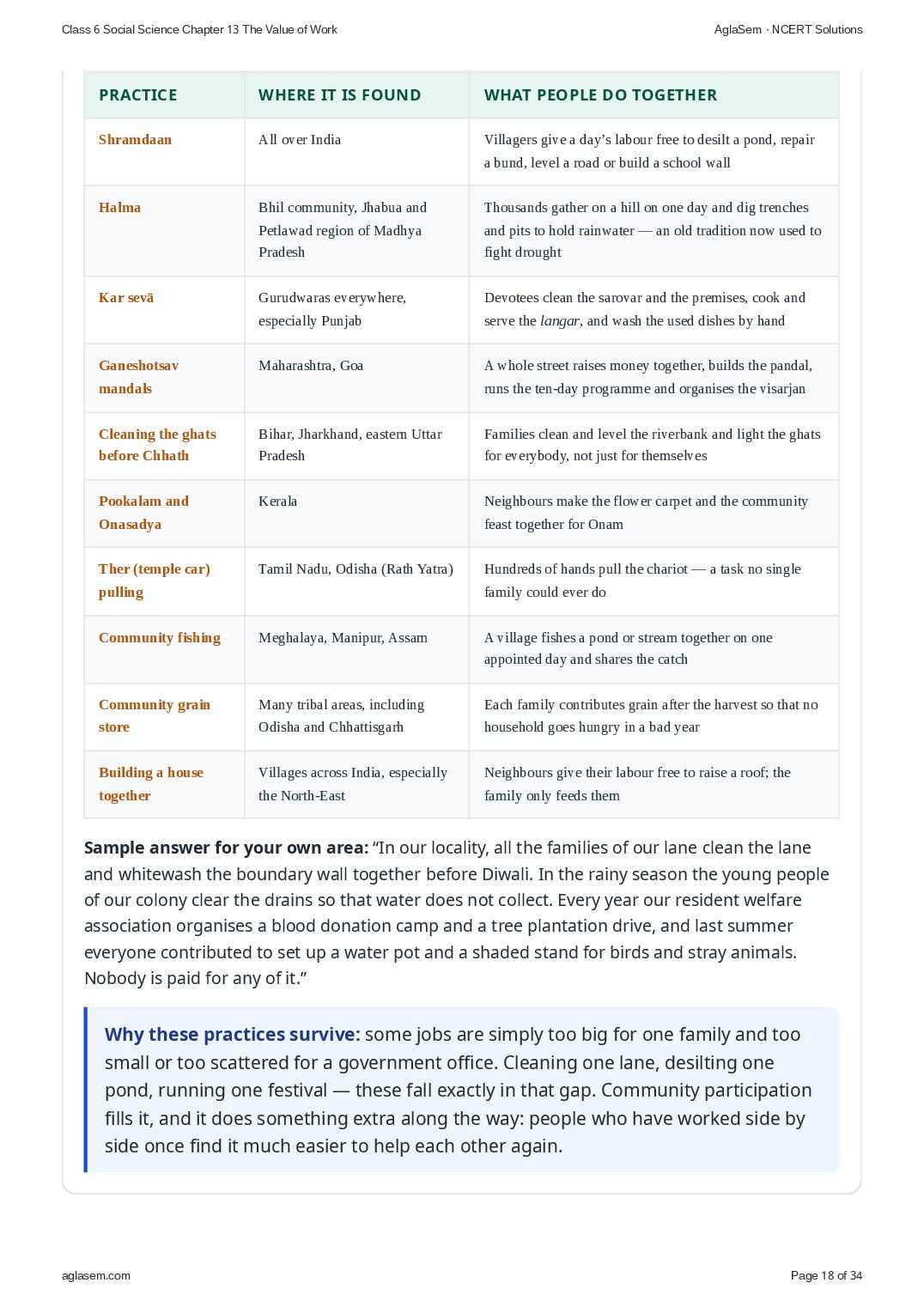
- Many communities in India have similar practices that involve community participation. Can you identify a few from your area?
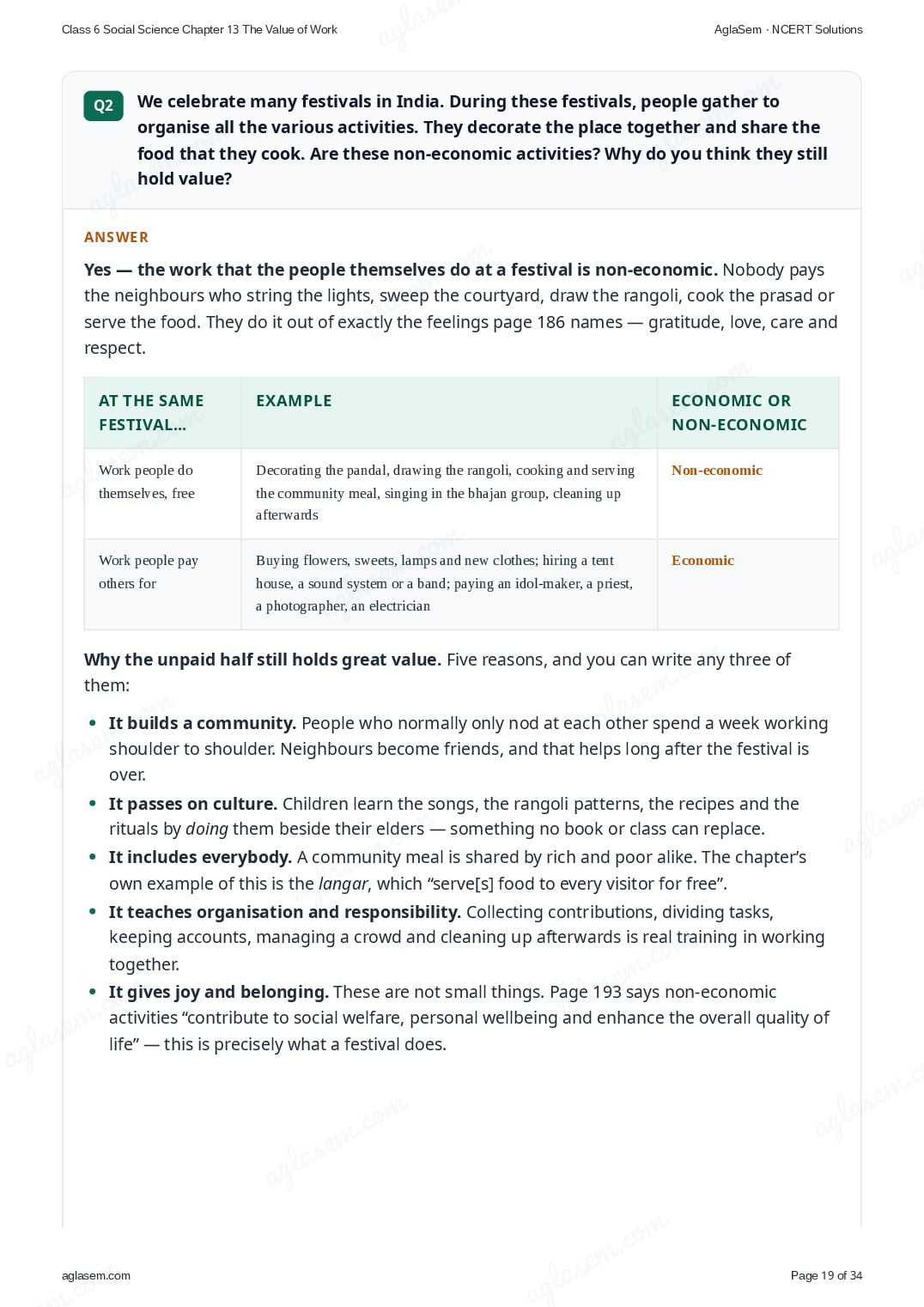
- We celebrate many festivals in India. During these festivals, people gather to organise all the various activities. They decorate the place together and share the food that they cook. Are these non-economic activities? Why do you think they still hold value?
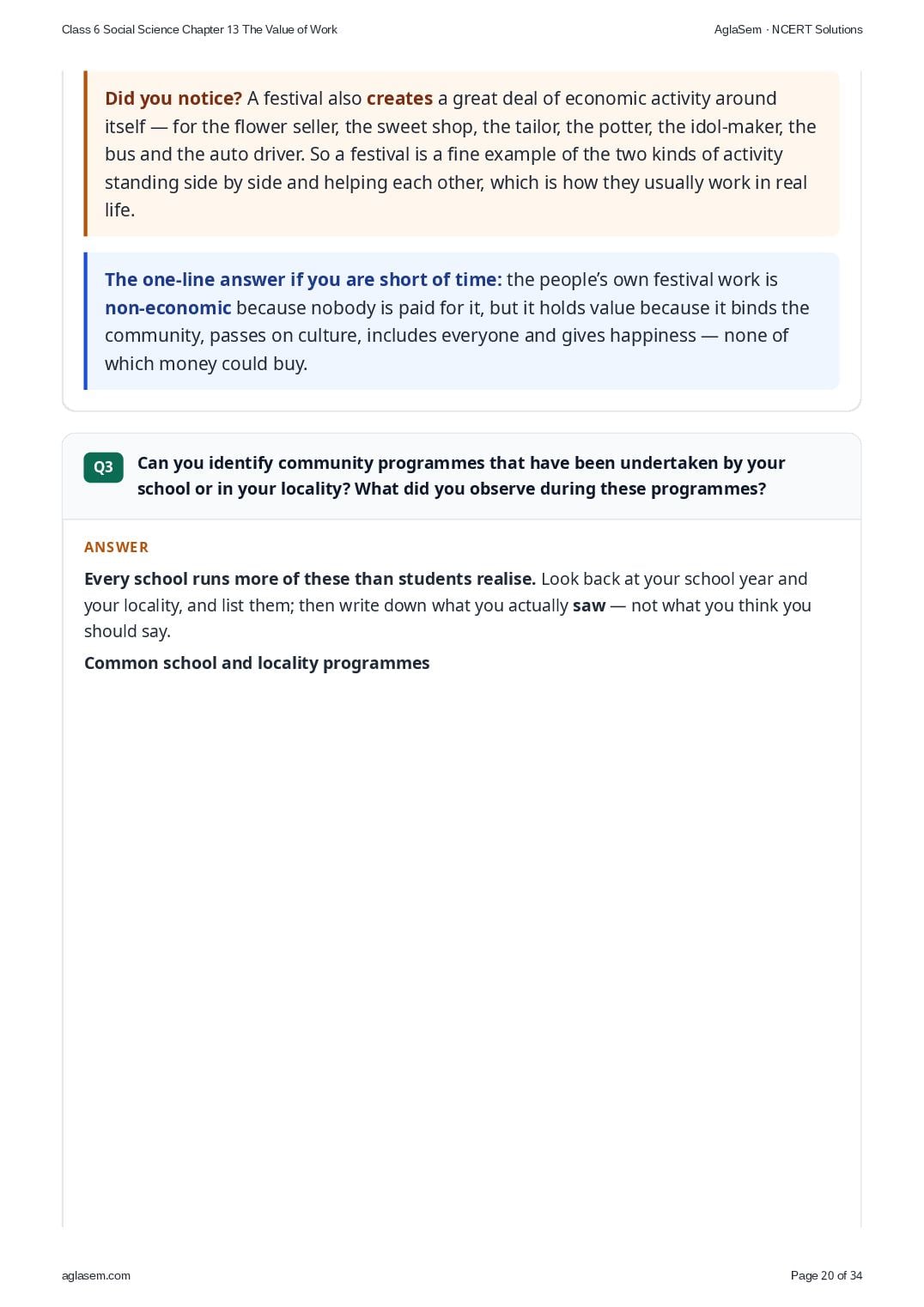
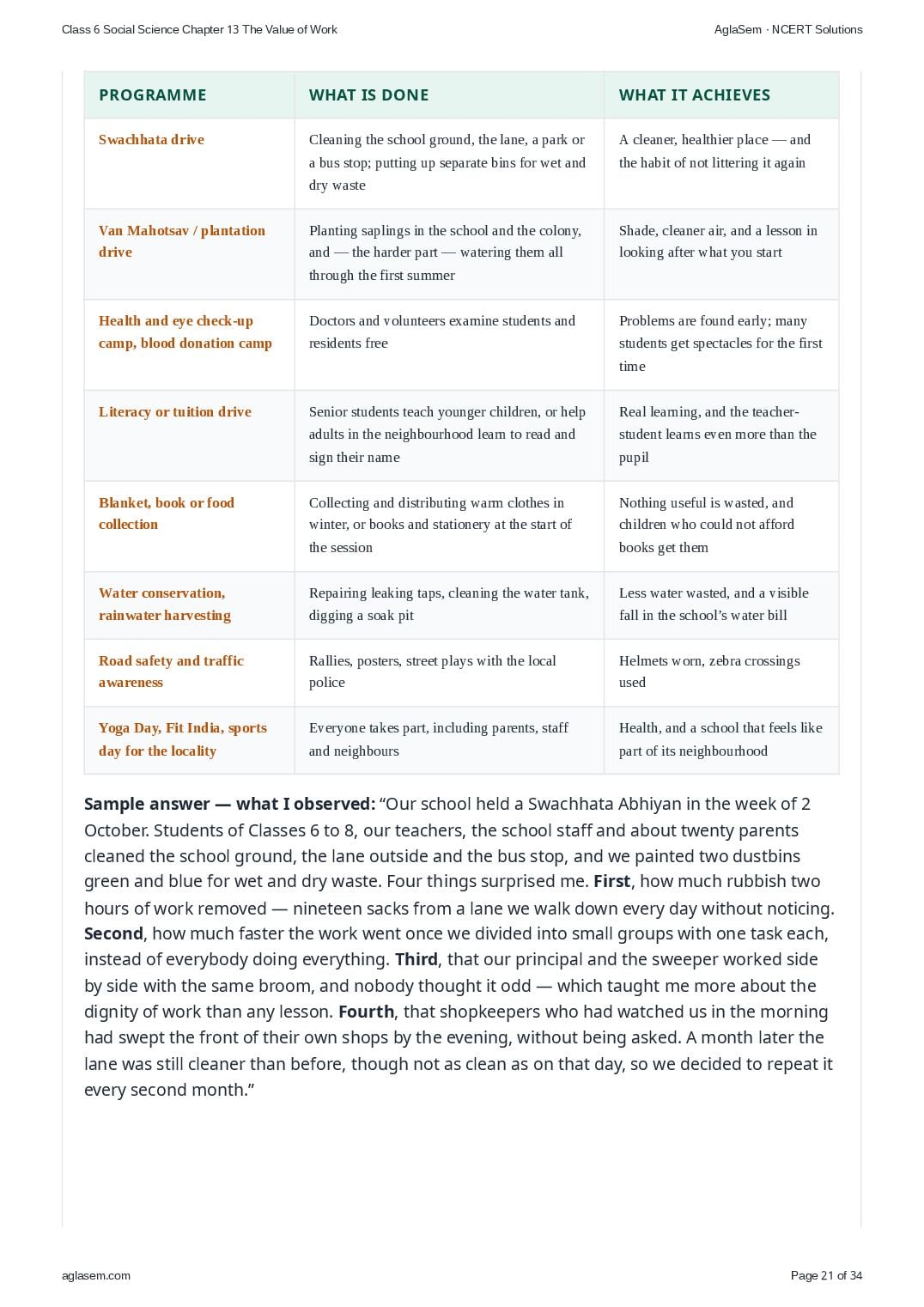
- Can you identify community programmes that have been undertaken by your school or in your locality? What did you observe during these programmes?
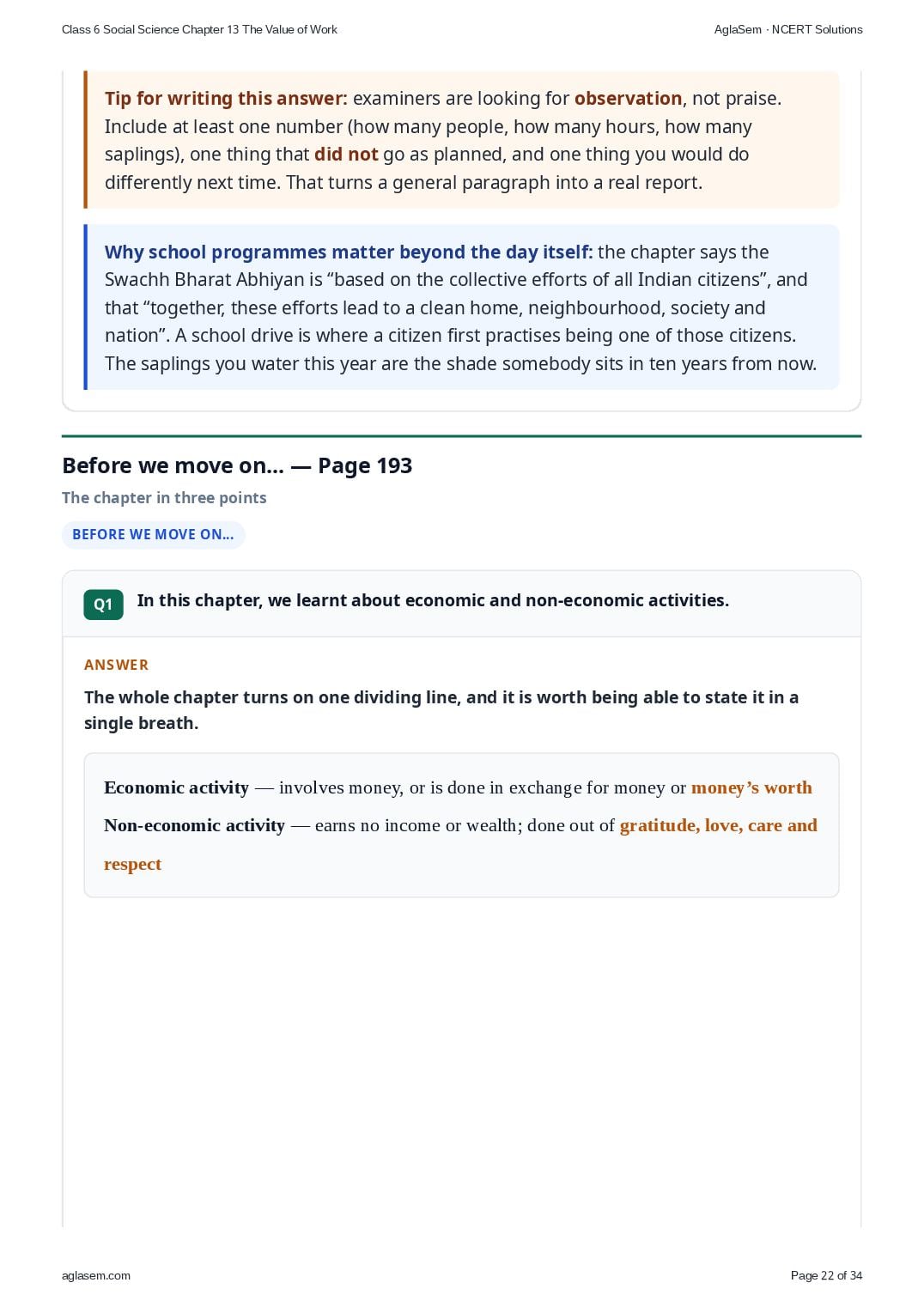
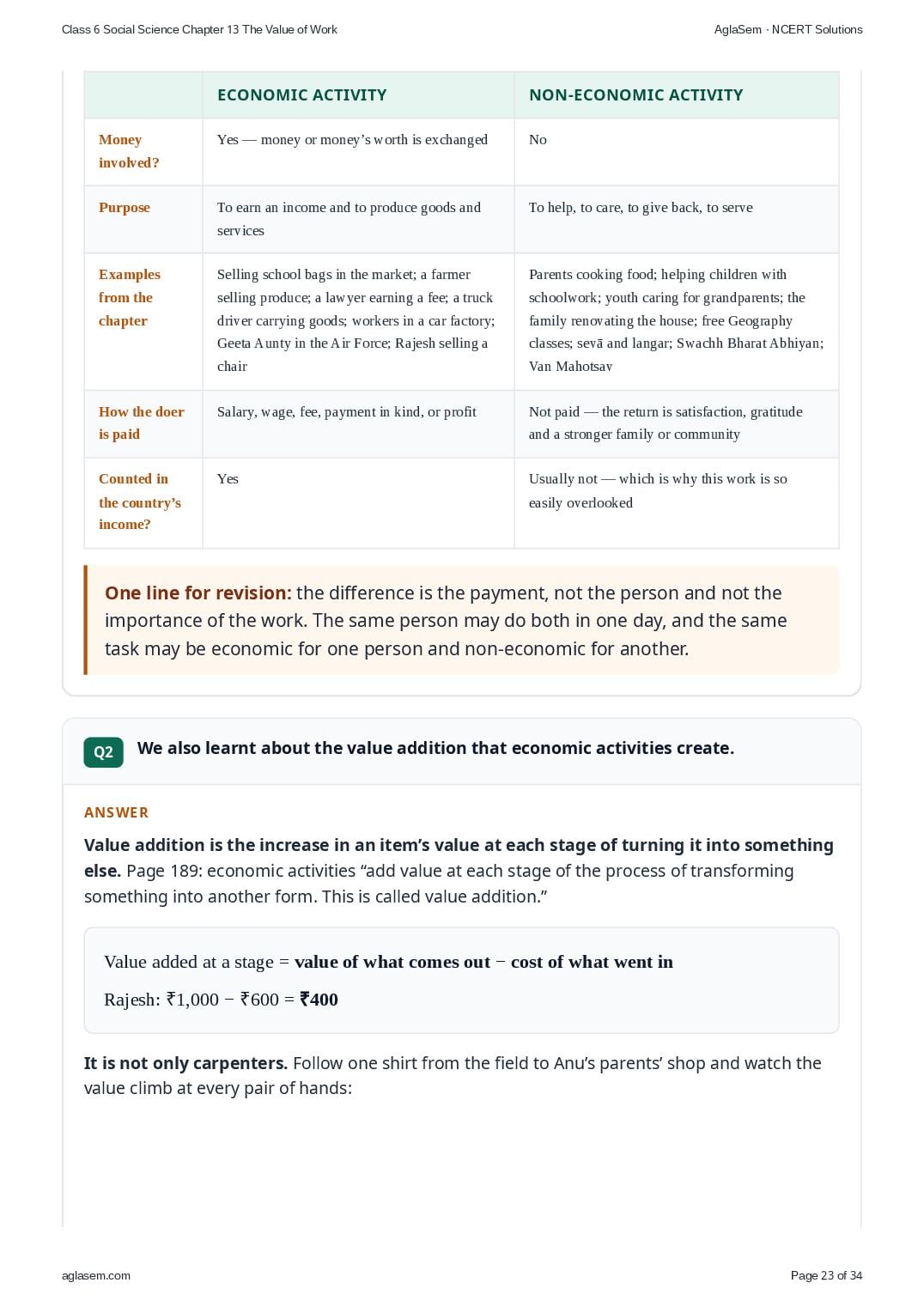
- In this chapter, we learnt about economic and non-economic activities.
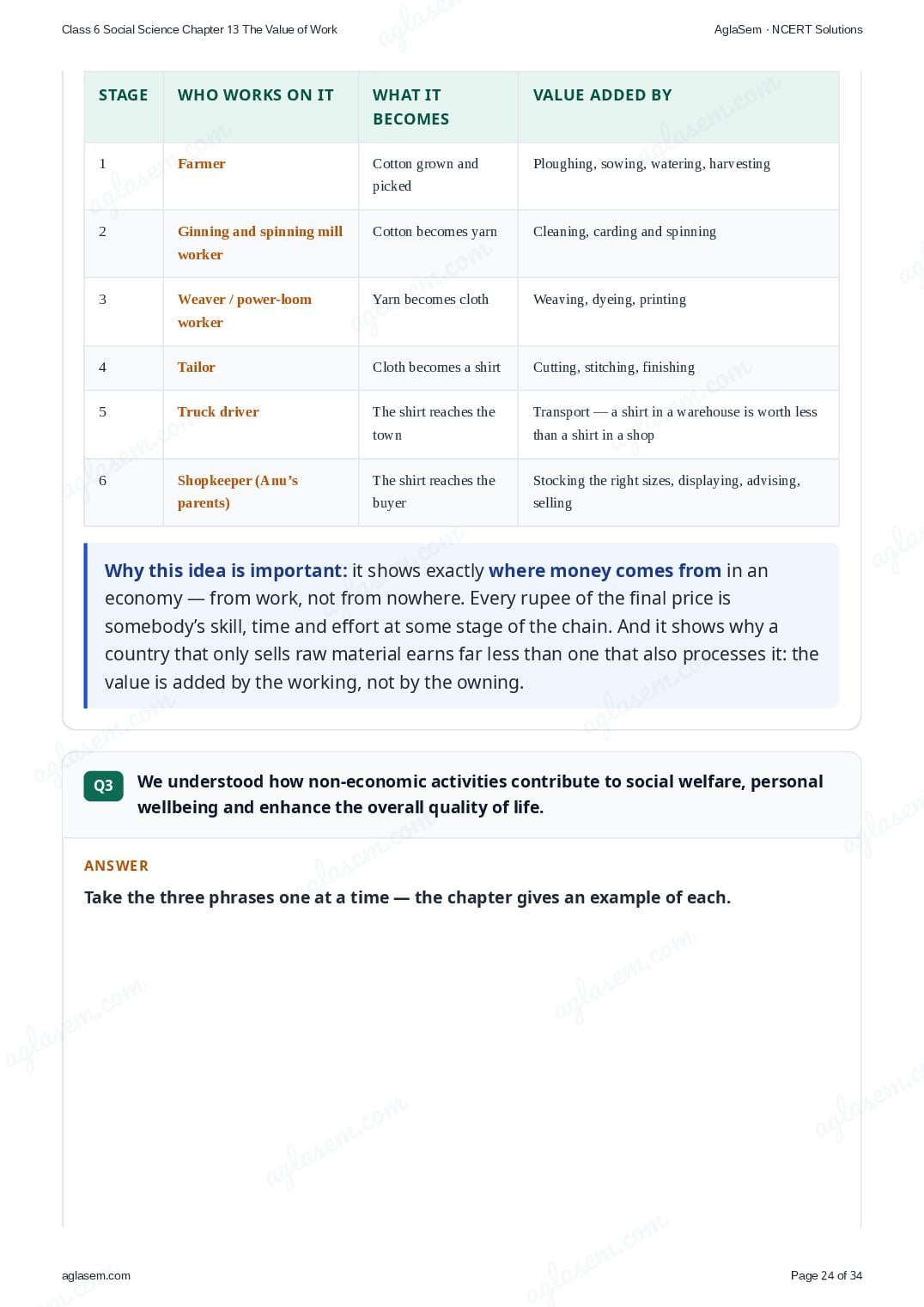
- We also learnt about the value addition that economic activities create.
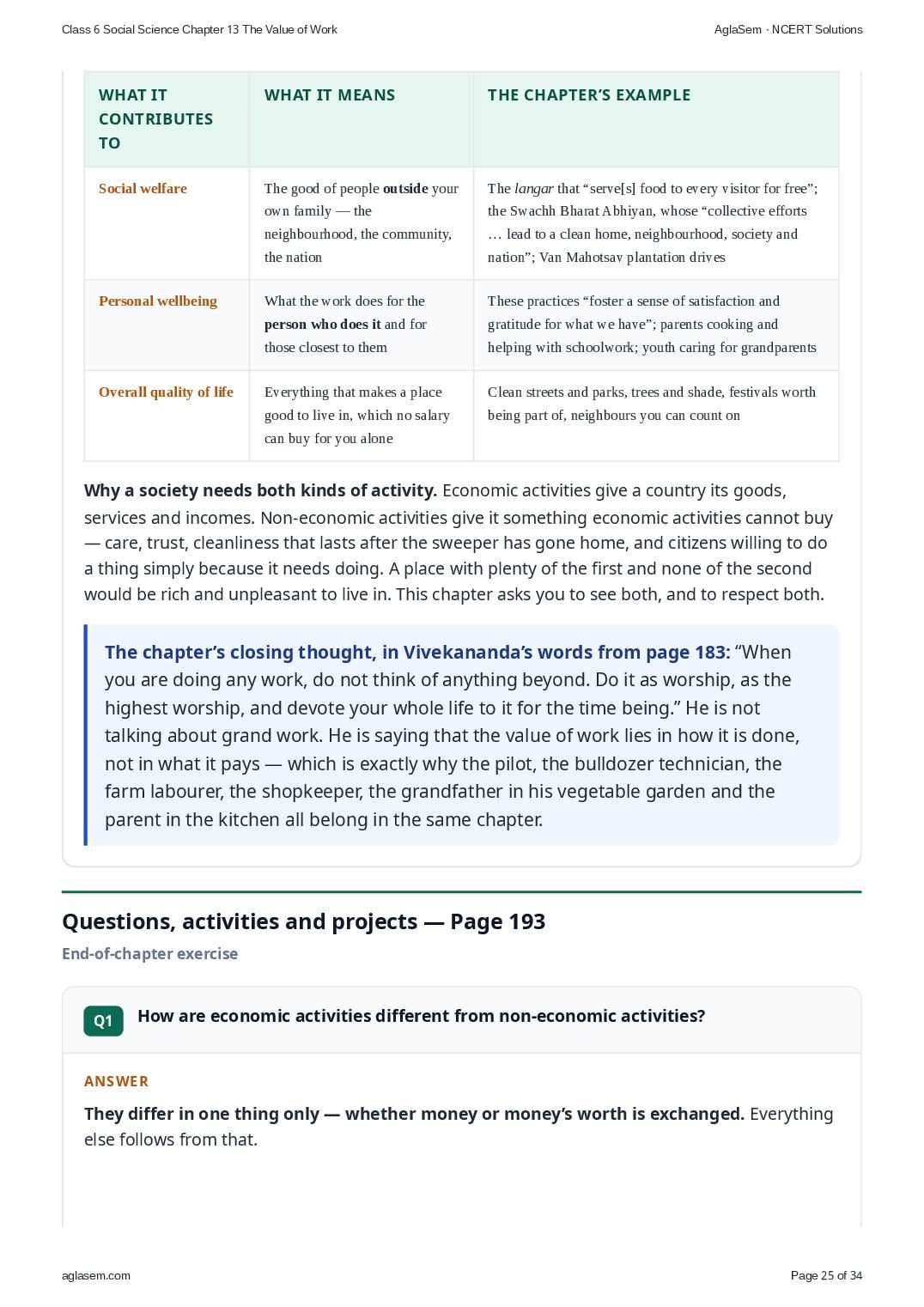
- We understood how non-economic activities contribute to social welfare, personal wellbeing and enhance the overall quality of life.
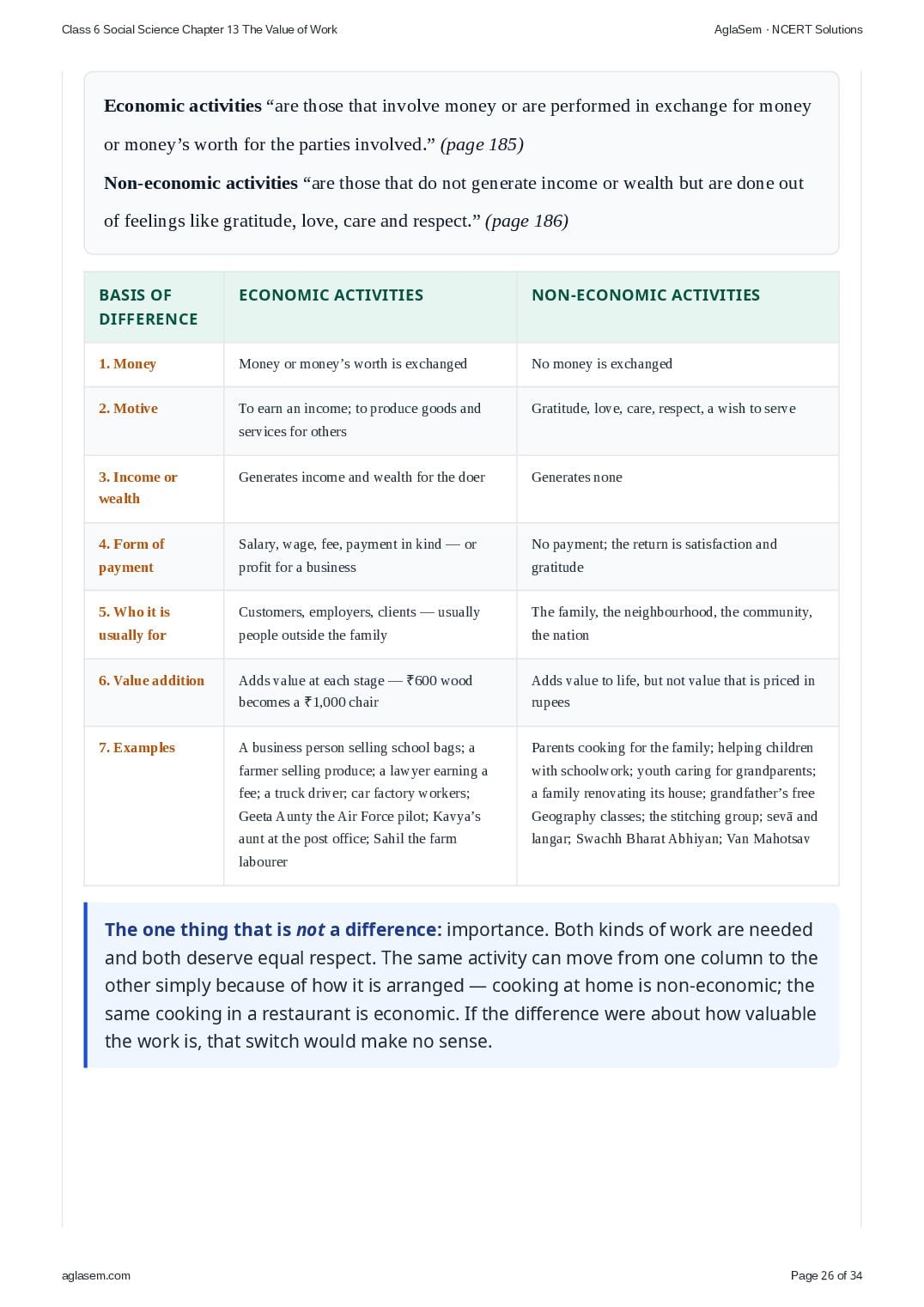
- How are economic activities different from non-economic activities?
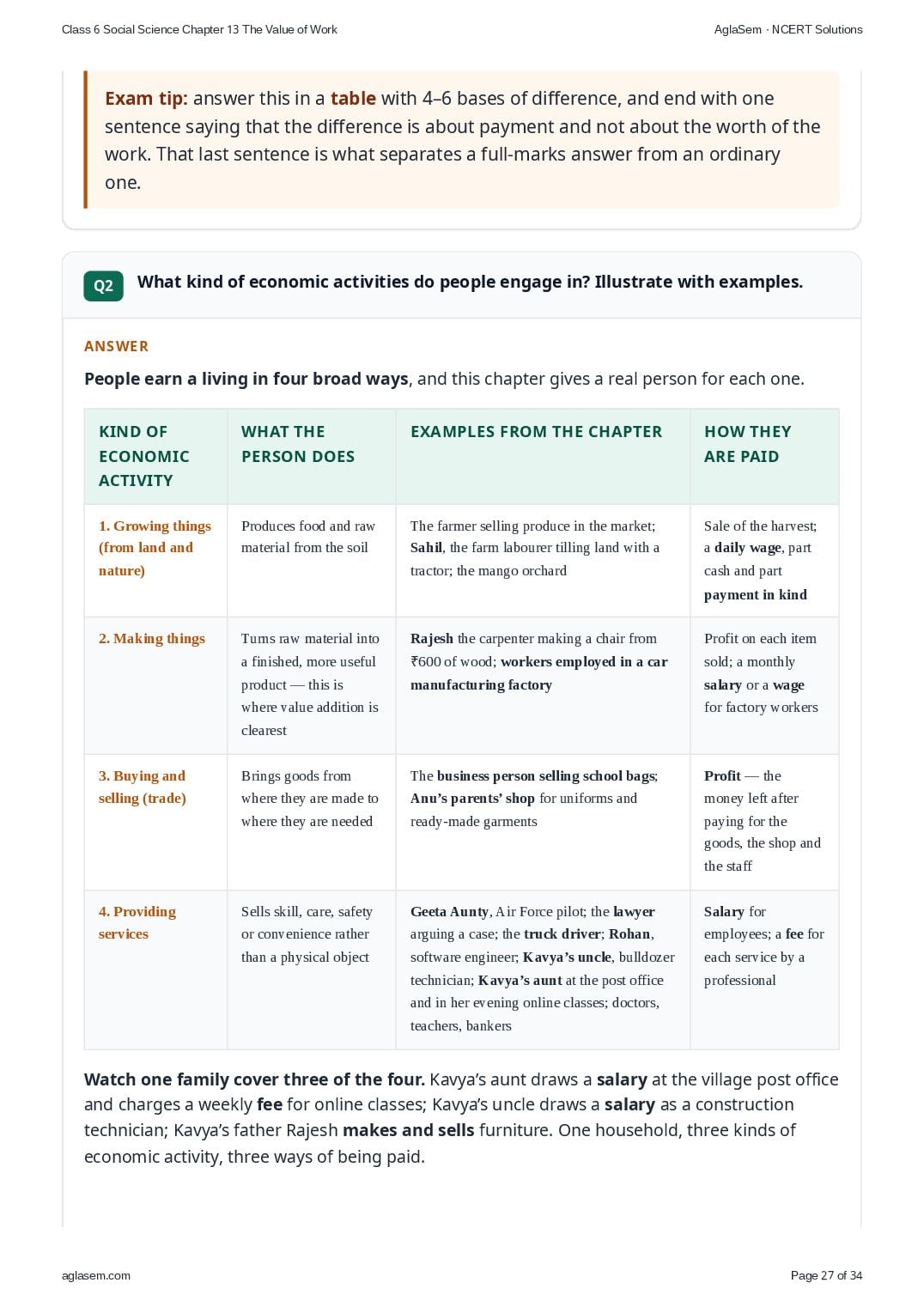
- What kind of economic activities do people engage in? Illustrate with examples.
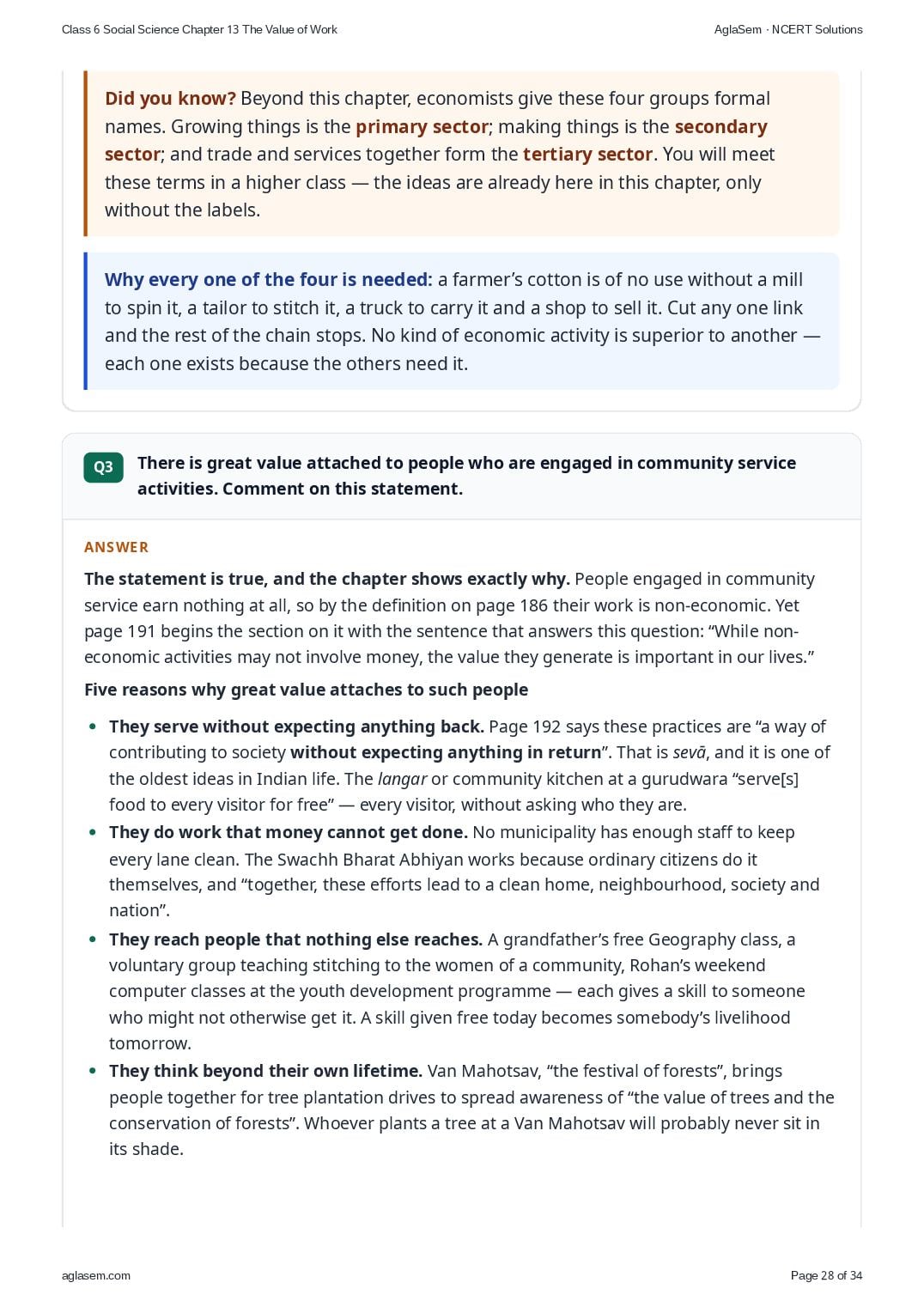
- There is great value attached to people who are engaged in community service activities. Comment on this statement.
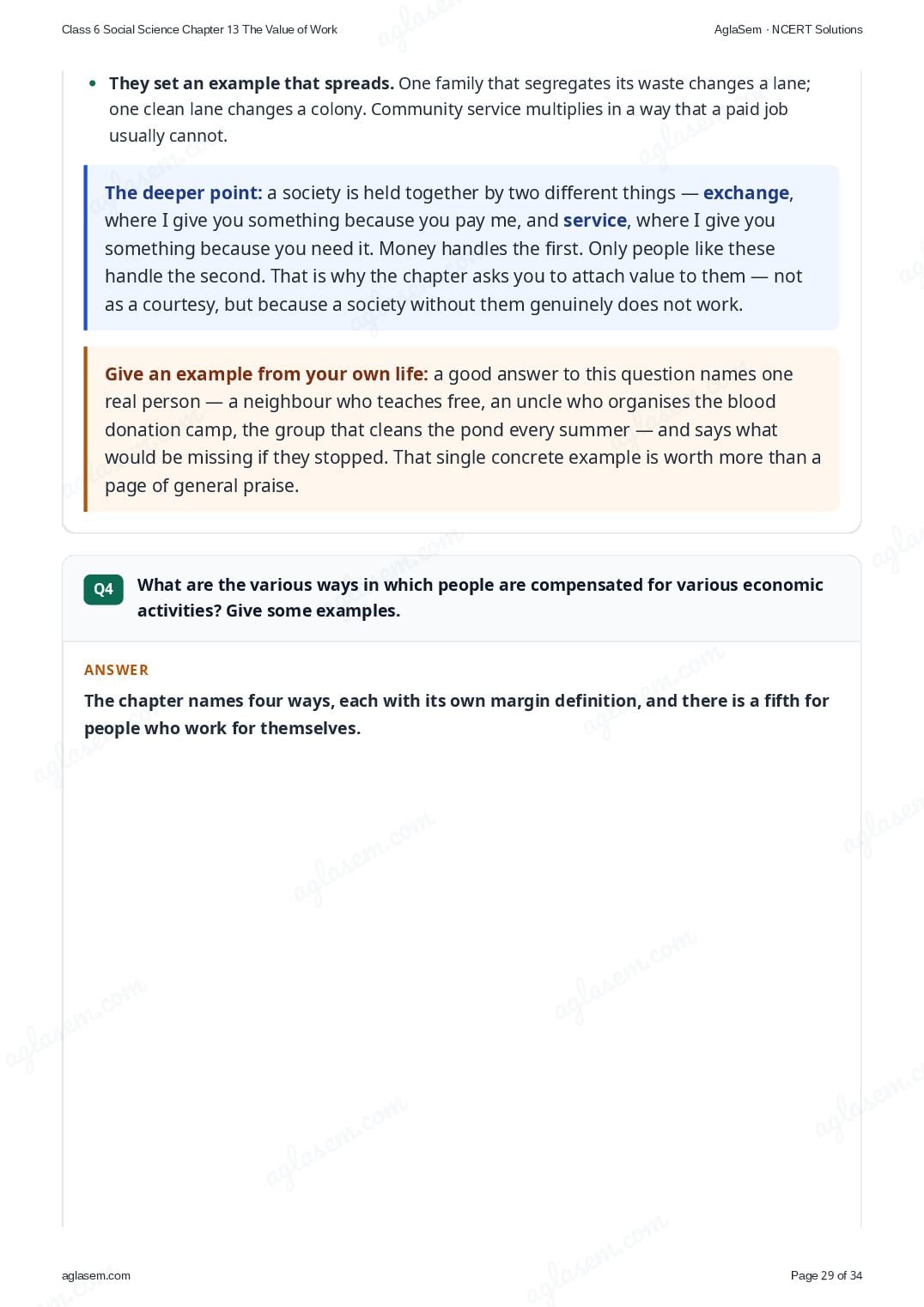
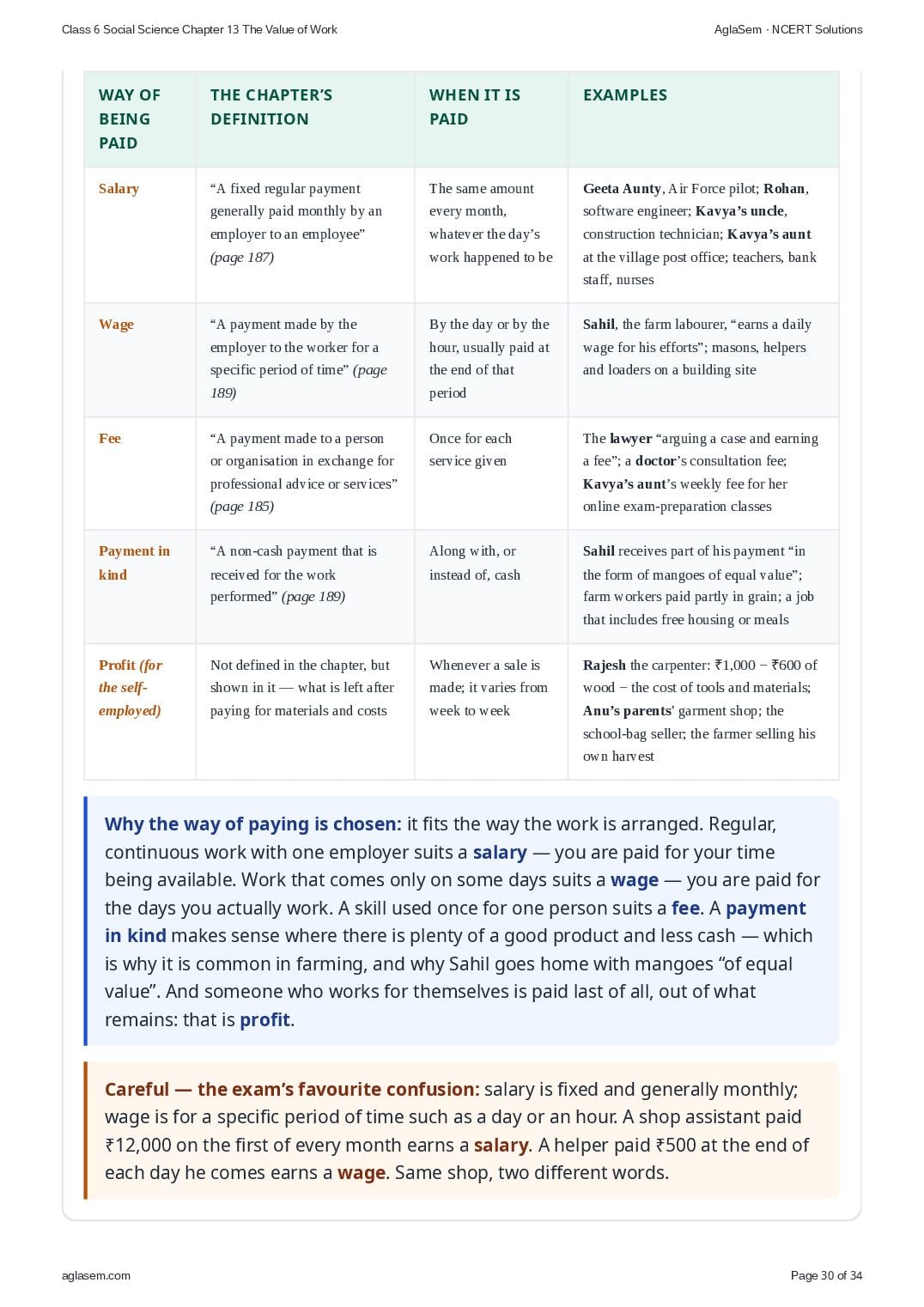
- What are the various ways in which people are compensated for various economic activities? Give some examples.
Chapter at a Glance
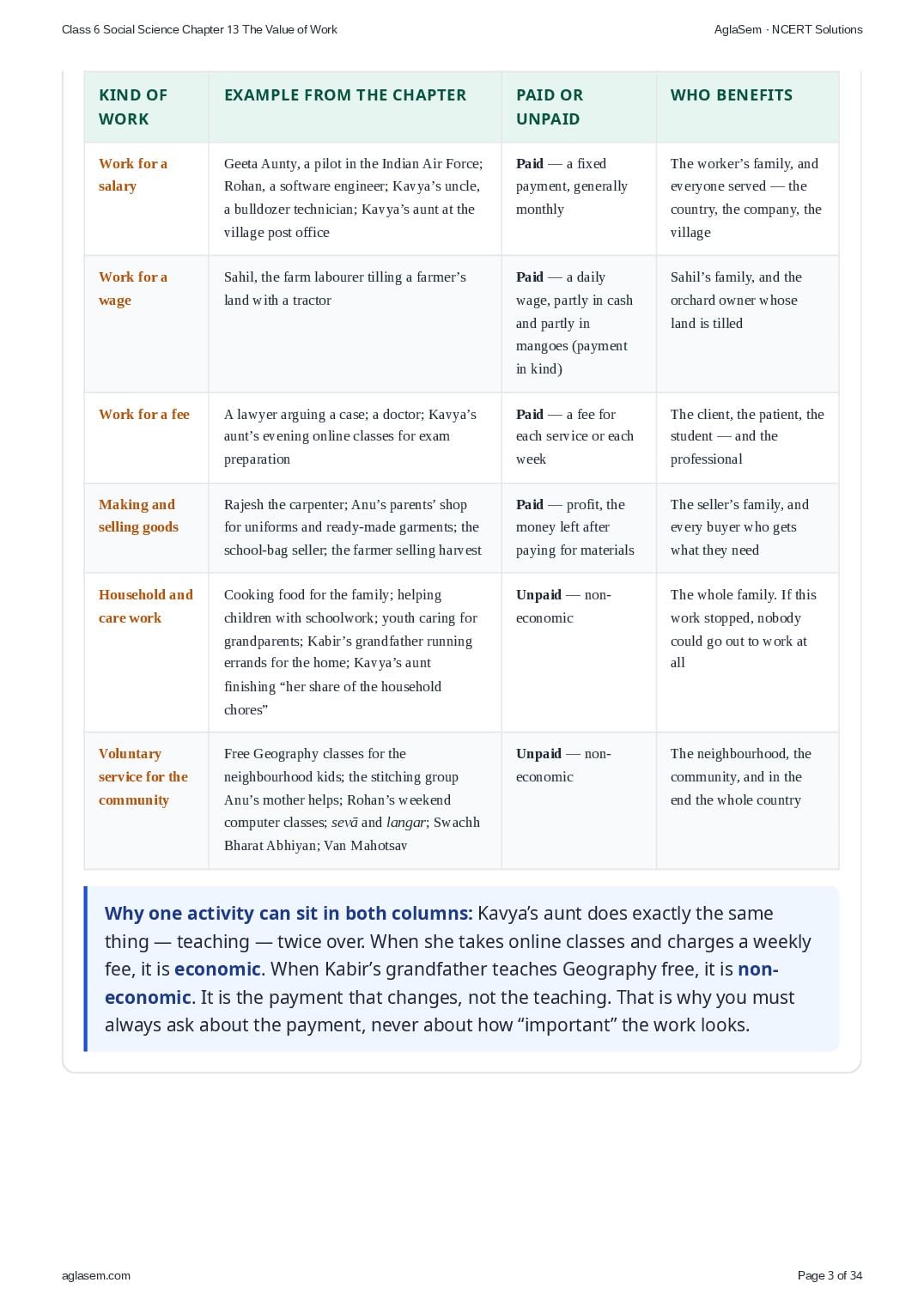
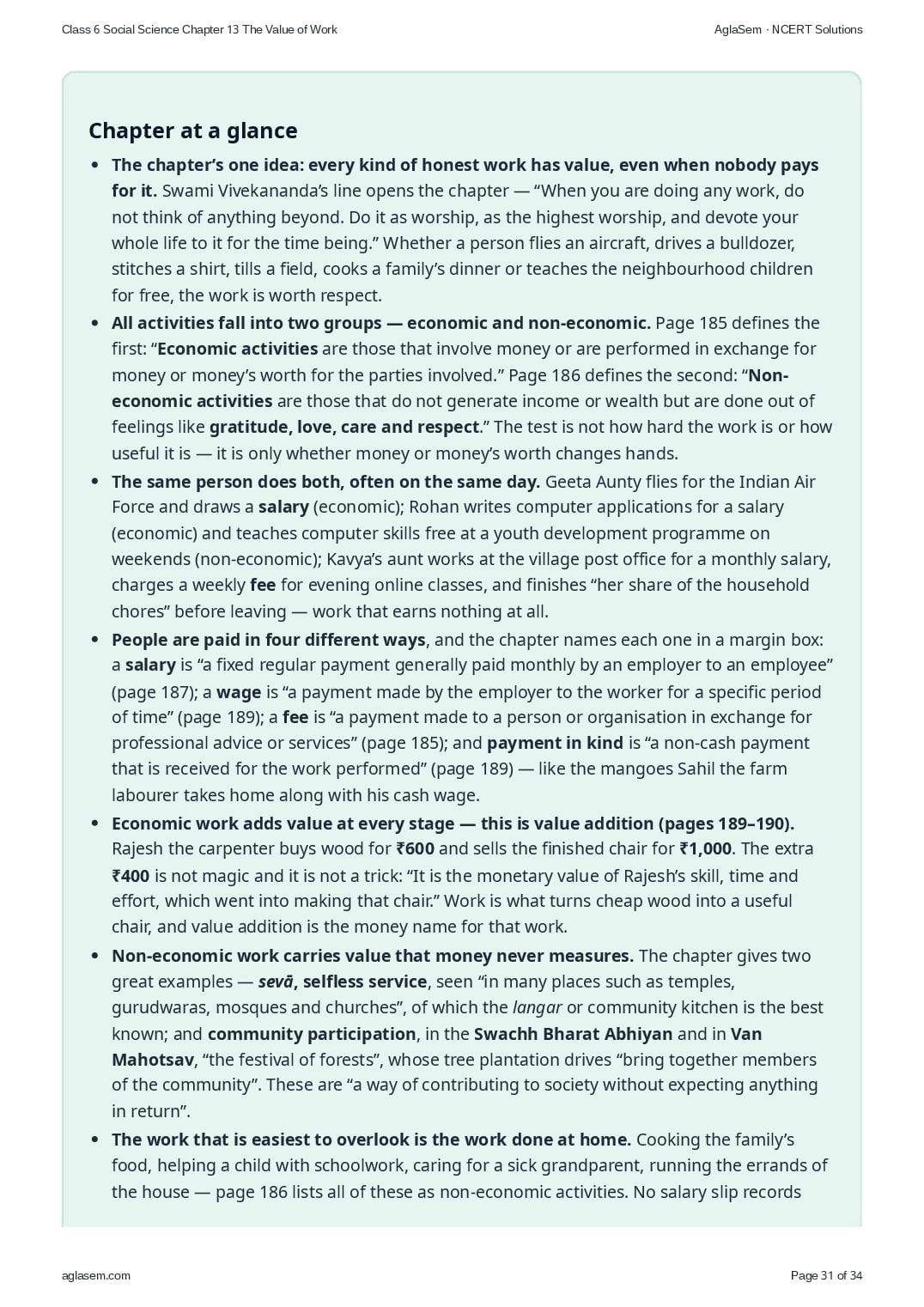
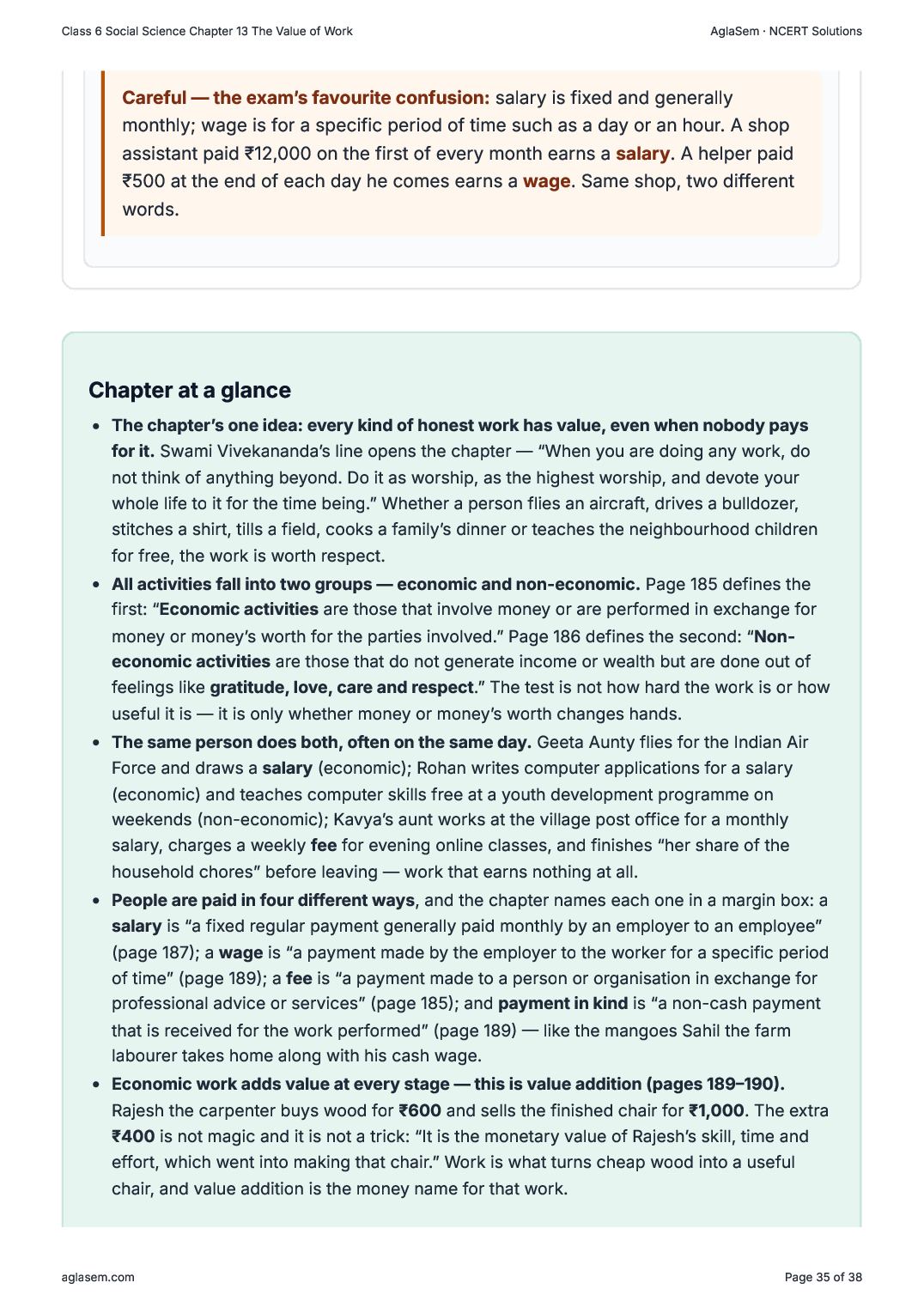
- The chapter’s one idea: every kind of honest work has value, even when nobody pays for it. Swami Vivekananda’s line opens the chapter — “When you are doing any work, do not think of anything beyond. Do it as worship, as the highest worship, and devote your whole life to it for the time being.” Whether a person flies an aircraft, drives a bulldozer, stitches a shirt, tills a field, cooks a family’s dinner or teaches the neighbourhood children for free, the work is worth respect.
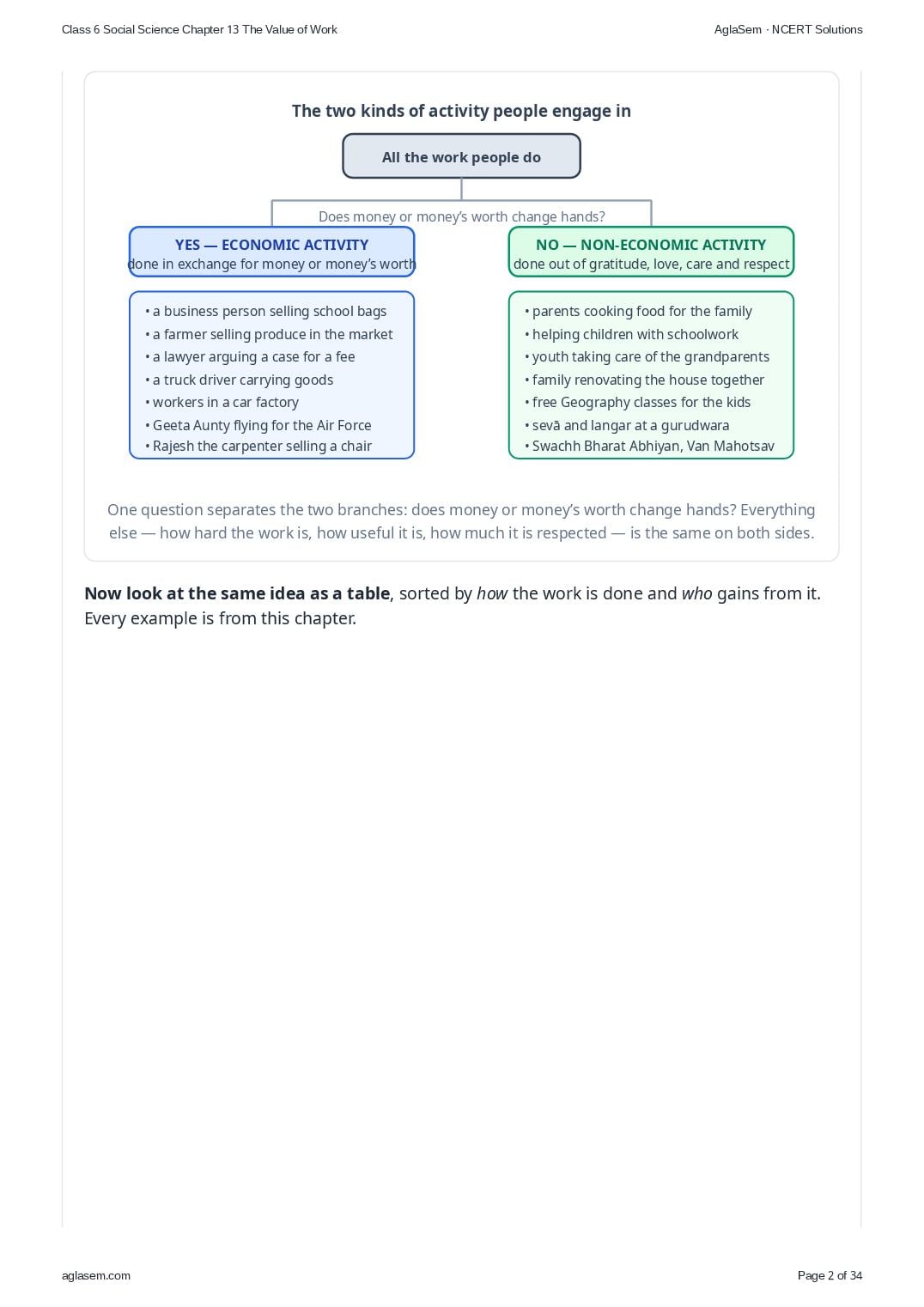
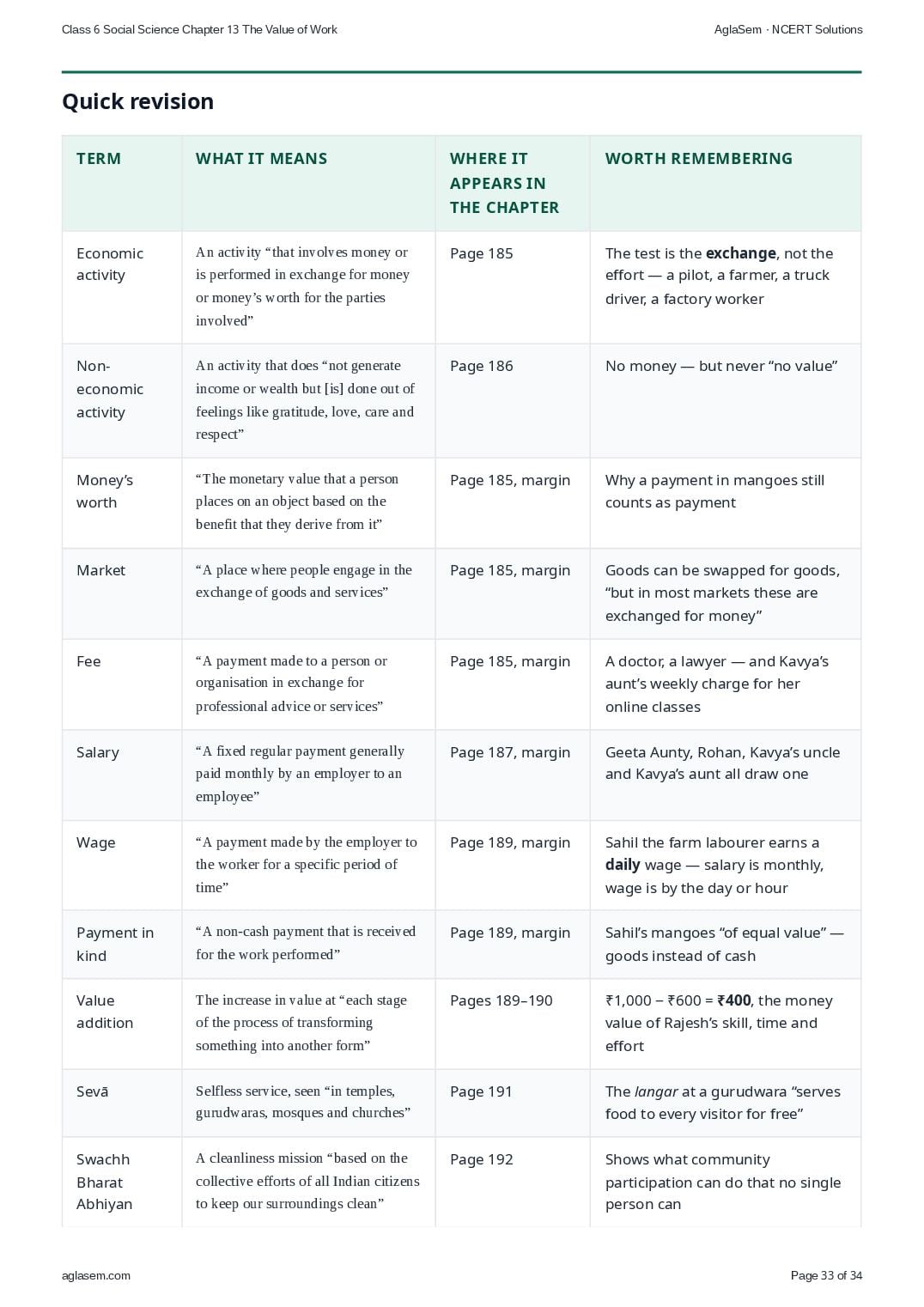
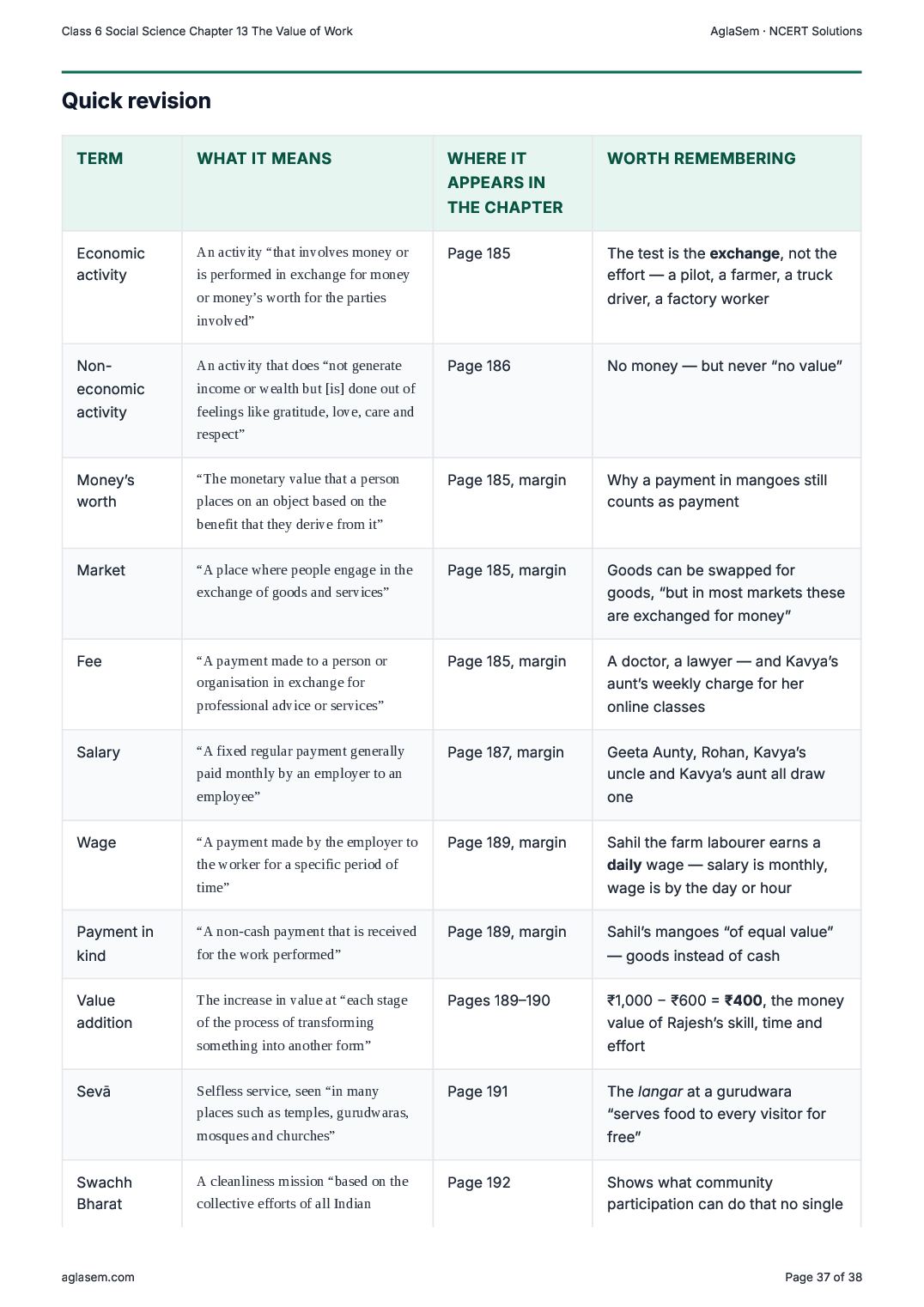
- All activities fall into two groups — economic and non-economic. Page 185 defines the first: “ Economic activities are those that involve money or are performed in exchange for money or money’s worth for the parties involved.” Page 186 defines the second: “ Non-economic activities are those that do not generate income or wealth but are done out of feelings like gratitude, love, care and respect .” The test is not how hard the work is or how useful it is — it is only whether money or money’s worth changes hands.
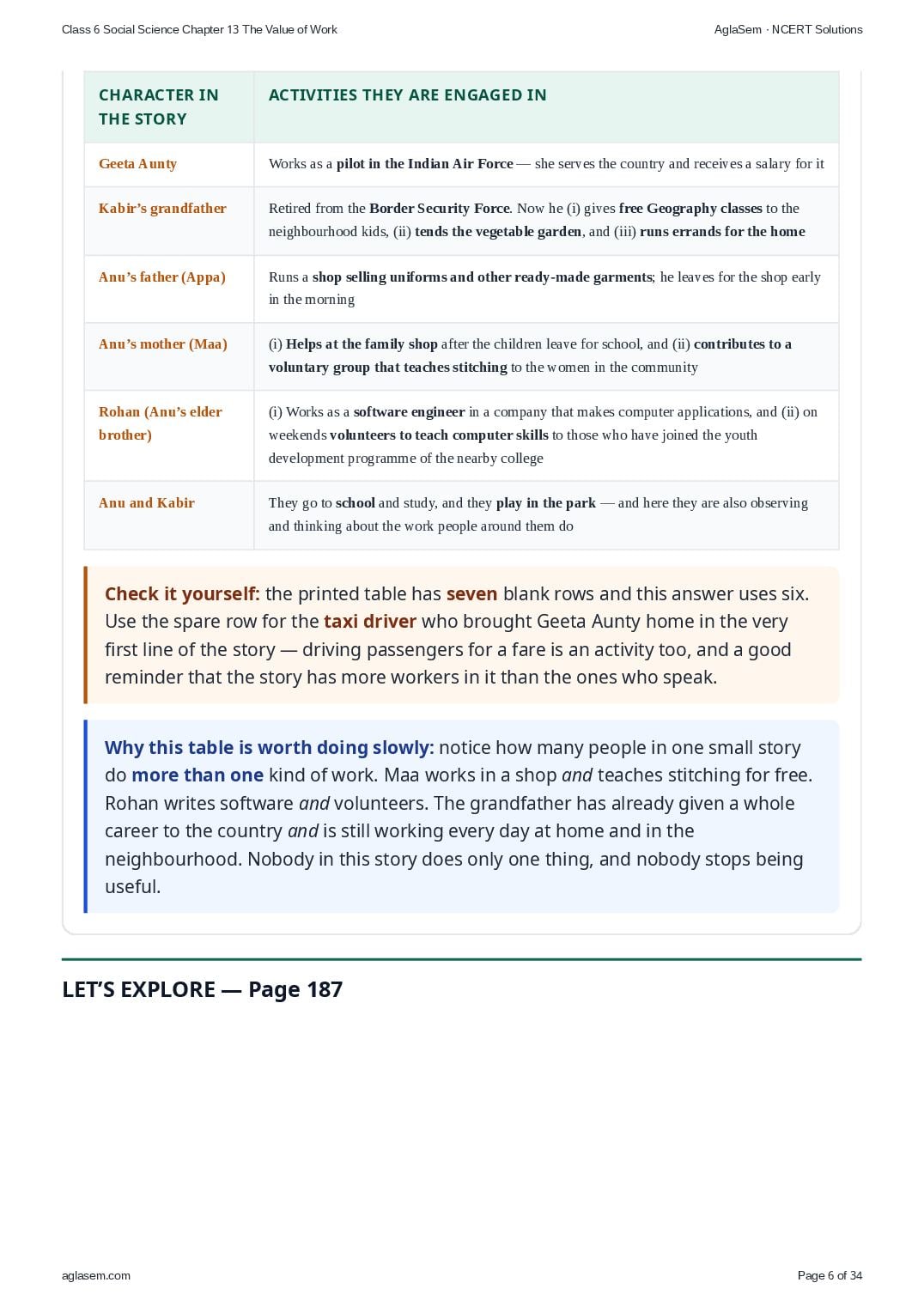
- The same person does both, often on the same day. Geeta Aunty flies for the Indian Air Force and draws a salary (economic); Rohan writes computer applications for a salary (economic) and teaches computer skills free at a youth development programme on weekends (non-economic); Kavya’s aunt works at the village post office for a monthly salary, charges a weekly fee for evening online classes, and finishes “her share of the household chores” before leaving — work that earns nothing at all.
- People are paid in four different ways , and the chapter names each one in a margin box: a salary is “a fixed regular payment generally paid monthly by an employer to an employee” (page 187); a wage is “a payment made by the employer to the worker for a specific period of time” (page 189); a fee is “a payment made to a person or organisation in exchange for professional advice or services” (page 185); and payment in kind is “a non-cash payment that is received for the work performed” (page 189) — like the mangoes Sahil the farm labourer takes home along with his cash wage.
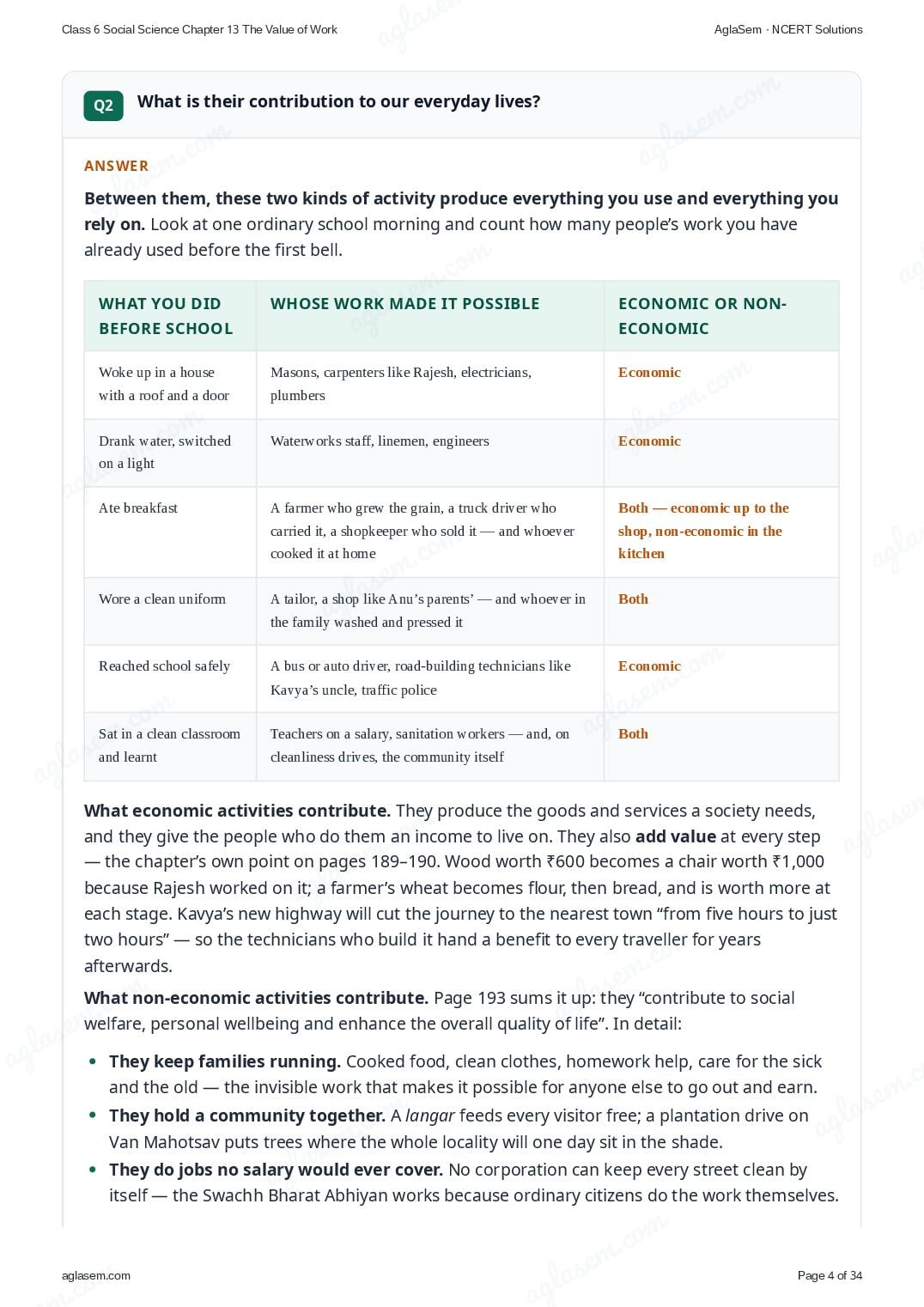
- Economic work adds value at every stage — this is value addition (pages 189–190). Rajesh the carpenter buys wood for ₹600 and sells the finished chair for ₹1,000 . The extra ₹400 is not magic and it is not a trick: “It is the monetary value of Rajesh’s skill, time and effort, which went into making that chair.” Work is what turns cheap wood into a useful chair, and value addition is the money name for that work.
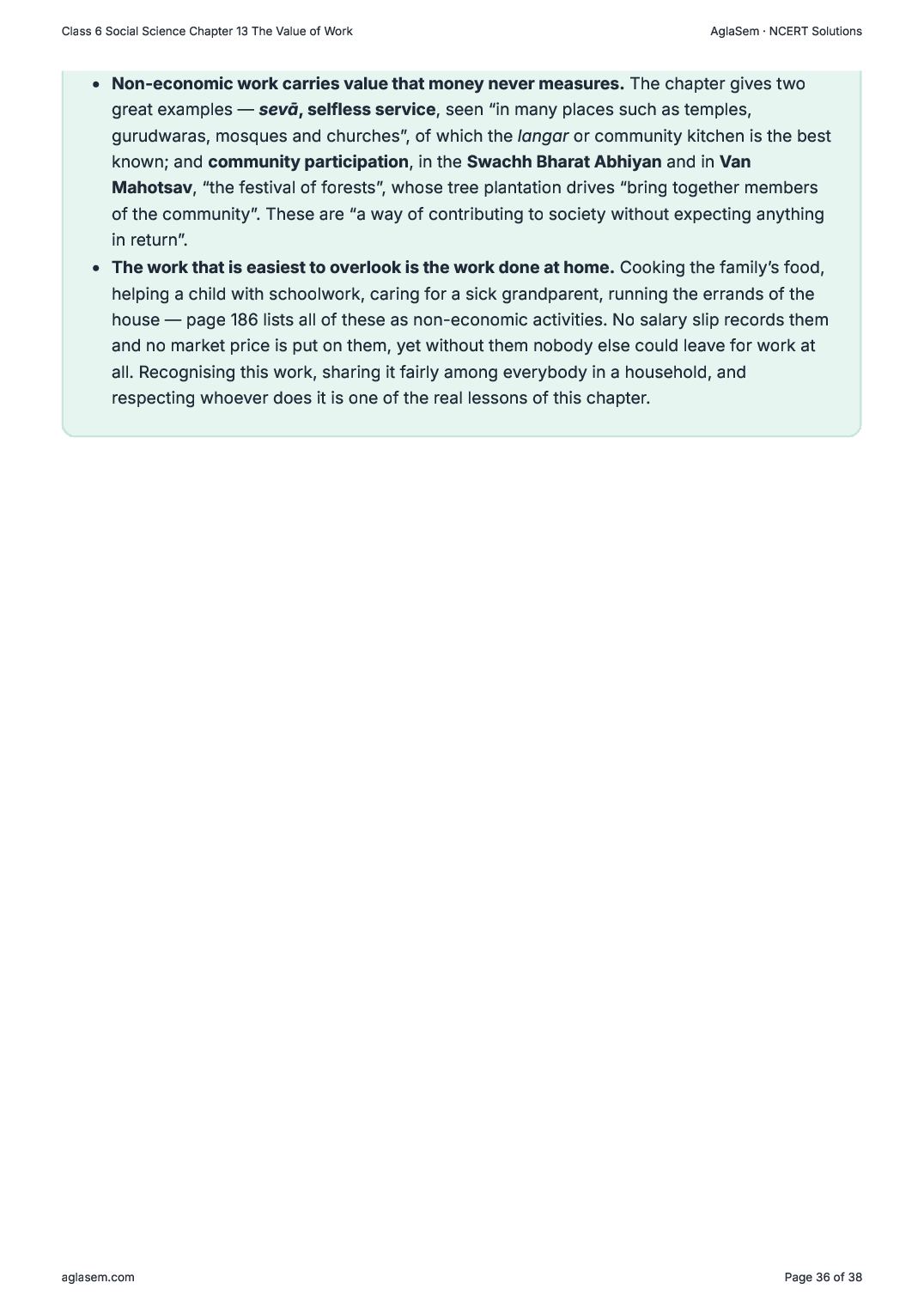
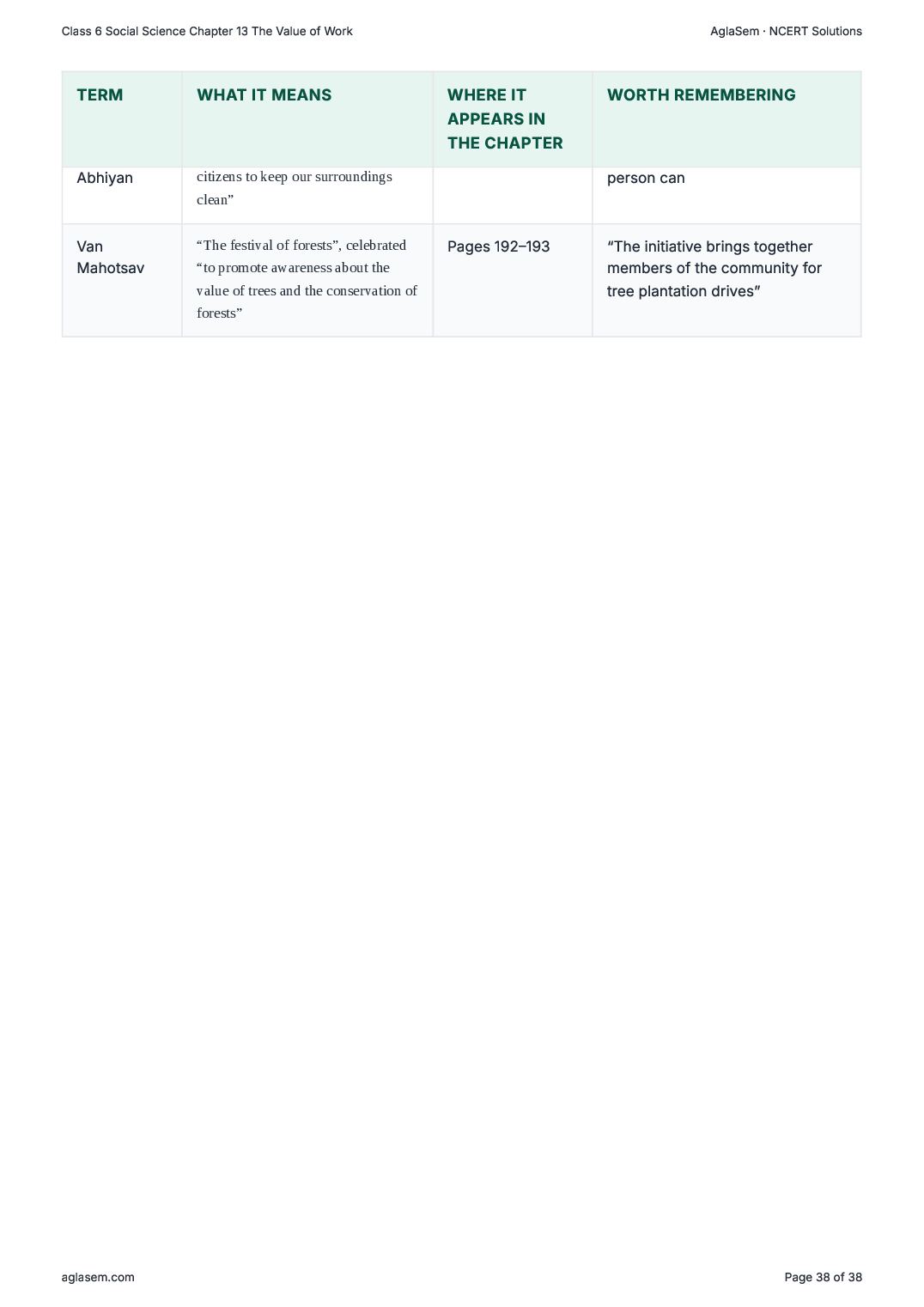
- Non-economic work carries value that money never measures. The chapter gives two great examples — sevā , selfless service , seen “in many places such as temples, gurudwaras, mosques and churches”, of which the langar or community kitchen is the best known; and community participation , in the Swachh Bharat Abhiyan and in Van Mahotsav , “the festival of forests”, whose tree plantation drives “bring together members of the community”. These are “a way of contributing to society without expecting anything in return”.
- The work that is easiest to overlook is the work done at home. Cooking the family’s food, helping a child with schoolwork, caring for a sick grandparent, running the errands of the house — page 186 lists all of these as non-economic activities. No salary slip records them and no market price is put on them, yet without them nobody else could leave for work at all. Recognising this work, sharing it fairly among everybody in a household, and respecting whoever does it is one of the real lessons of this chapter.
How to Download NCERT Solutions for Class 6 Social Science Chapter 13 PDF
Follow these simple steps to get the the Value of Work questions-and-answers PDF from Exploring Society India and Beyond.
- Search NCERT Solutions for Class 6 Social Science Chapter 13 aglasem and open this page.
- Read the exercise questions with answers for the Value of Work shown above.
- Click the Download PDF link to save the the Value of Work solutions to your device.
NCERT Solutions for Class 6 Social Science – All Chapters
There are more chapters to study besides the Value of Work in Social Science. Here are the NCERT Solutions for all chapters of Class 6 Social Science.
- Chapter 1 Locating Places on the Earth
- Chapter 2 Oceans and Continents
- Chapter 3 Landforms and Life
- Chapter 4 Timeline and Sources of History
- Chapter 5 India That Is Bharat
- Chapter 6 the Beginnings of Indian Civilisation
- Chapter 7 India’s Cultural Roots
- Chapter 8 Unity in Diversity or Many in the One
- Chapter 9 Family and Community
- Chapter 10 Grassroots Democracy part 1 Governance
- Chapter 11 Grassroots Democracy part 2 Local Government in Rural Areas
- Chapter 12 Grassroots Democracy part 3 Local Government in Urban Areas
- Chapter 13 the Value of Work
- Chapter 14 Economic Activities Around Us
NCERT Solutions for Class 6 – All Subjects
Just like Chapter 13 of Social Science, you can get the exercise questions with answers for every other subject of Class 6. Here are the NCERT Solutions for all subjects of Class 6.
NCERT Solutions for Class 6 Social Science Chapter 13 – An Overview
The key highlights of this study material are as follows.
| Aspects | Details |
|---|---|
| Class | Class 6 |
| Subject | Social Science |
| Chapter Number | Chapter 13 |
| Chapter Name | the Value of Work |
| Book Name | Exploring Society India and Beyond |
| Book By | NCERT (National Council of Educational Research and Training) |
| Educational Resource Here | NCERT Solutions of Class 6 Social Science Chapter 13 for all exercises |
| More Questions Answers of This Subject | NCERT Solutions for Class 6 Social Science |
| Download Book Chapter | NCERT Book Class 6 Social Science |
| All Questions Answers For This Class | NCERT Solutions for Class 6 |
| Complete Solutions | NCERT Solutions |
NCERT Solutions for Class 6 Social Science Chapter 13 the Value of Work – FAQs
What are the NCERT Solutions for Class 6 Social Science Chapter 13 the Value of Work?
They are the complete, step-by-step answers to all the exercise and in-text questions of Chapter 13 the Value of Work from the NCERT Class 6 Social Science textbook Exploring Society India and Beyond, written by experts as per the latest NCERT syllabus.
How can I download the Class 6 Social Science Chapter 13 solutions PDF for free?
Open this page on aglasem, read the the Value of Work questions with answers, and click the “Download Solutions PDF” link. The Class 6 Social Science Chapter 13 NCERT Solutions PDF is completely free to download.
Are these NCERT Solutions as per the latest 2026-27 syllabus?
Yes. The NCERT Solutions for Class 6 Social Science Chapter 13 are based on the latest NCERT textbook Exploring Society India and Beyond and the current 2026-27 CBSE syllabus, so the questions and answers match what you study in class.
Where can I get NCERT Solutions for the other chapters of Class 6 Social Science?
You can find the answers to every chapter on the NCERT Solutions for Class 6 Social Science page, and solutions for every subject on the NCERT Solutions for Class 6 page.
How do NCERT Solutions help in exam preparation?
They show the correct method to solve each question, help you write answers the way they are expected in exams, let you check and correct your own work, and save revision time — which together improve your marks in Class 6 Social Science.
If you have any queries on NCERT Solutions for Class 6 Social Science Chapter 13 the Value of Work, then please ask in the comments below.