NCERT Solutions for Class 6 Social Science Chapter 4 Timeline and Sources of History provide clear, step-by-step answers to every exercise and in-text question from the chapter Timeline and Sources of History of the NCERT textbook Exploring Society India and Beyond. Prepared by subject experts as per the latest NCERT (CBSE) syllabus for 2026-27, these NCERT Solutions for Class 6 Social Science help you understand each concept, write exam-ready answers, and check your own solutions. You can read them online below or download the free Class 6 Social Science Chapter 4 question-answer PDF.
NCERT Solutions for Class 6 Social Science Chapter 4 Timeline and Sources of History
- Class: Class 6
- Subject: Social Science
- Chapter: Chapter 4 – Timeline and Sources of History
- Textbook: Exploring Society India and Beyond (NCERT)
- Study material: NCERT Solutions – questions with answers, free PDF
These solutions answer all the exercise questions of Chapter 4 Timeline and Sources of History — including the in-text questions, short-answer and long-answer questions, and activities — with complete explanations so you can follow the method, not just the final answer. Read the full solutions below.
NCERT Solutions Class 6 Social Science Chapter 4 Timeline and Sources of History View Download
NCERT Solutions for Class 6 Social Science Chapter 4 PDF Download
You can read the NCERT Solutions for Class 6 Social Science Chapter 4 online above, or download the complete question-answer PDF to study Timeline and Sources of History offline at any time.
NCERT Solutions for Class 6 Social Science Chapter 4 PDF Download Link – Click Here to Download Solutions PDF
Questions Covered in This Chapter
These NCERT Solutions answer all 29 questions of this chapter. The questions solved are:
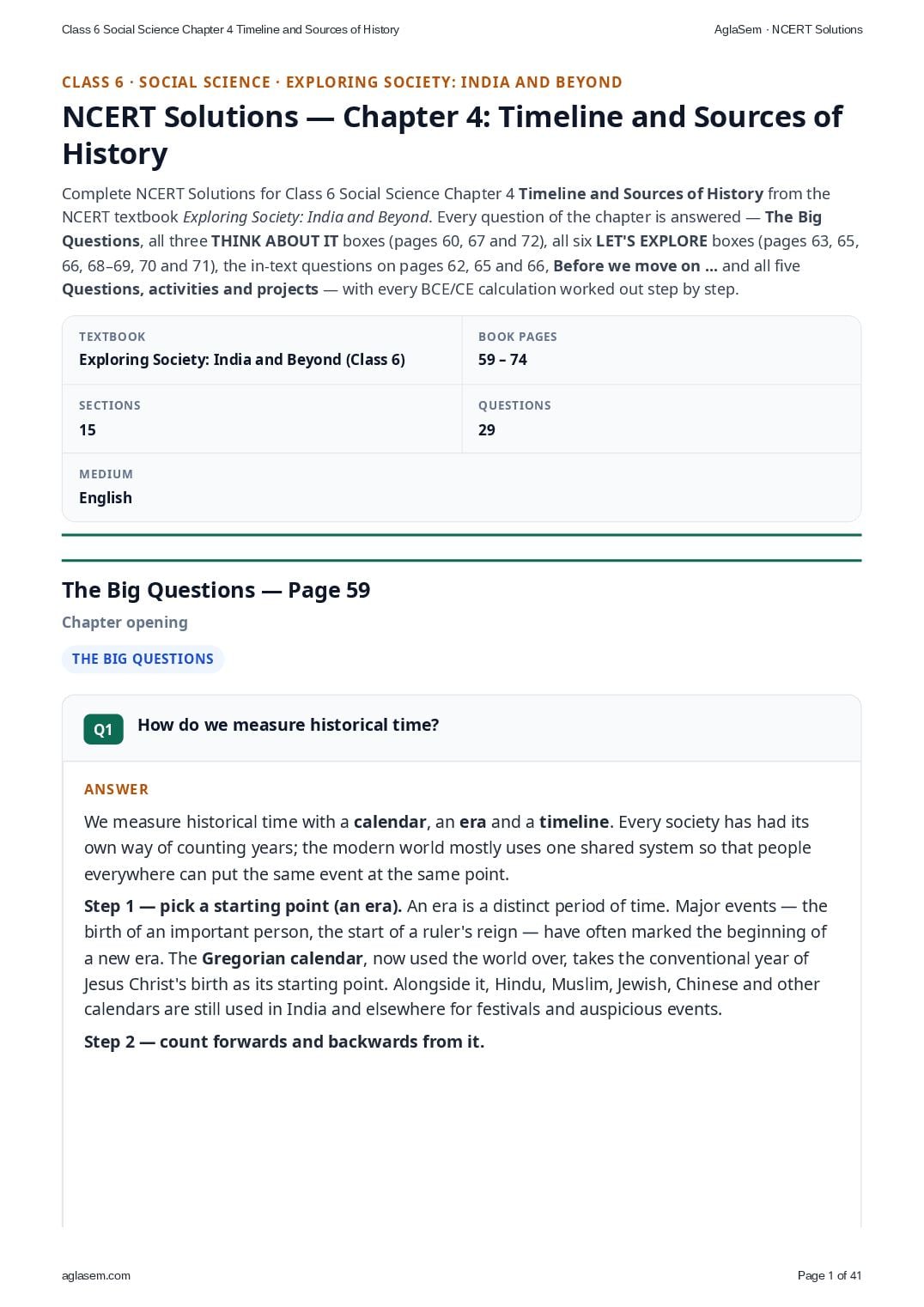
- How do we measure historical time?
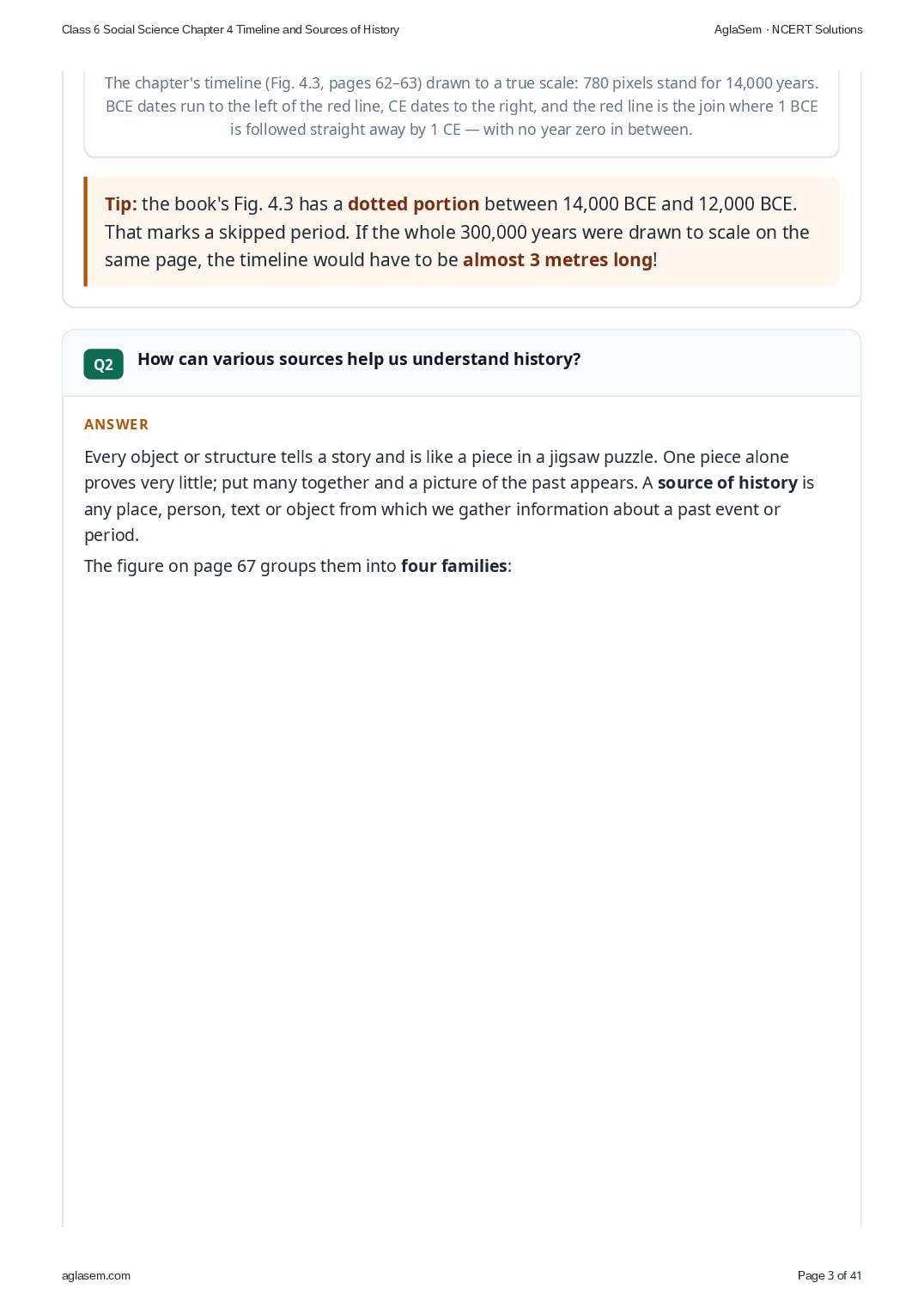
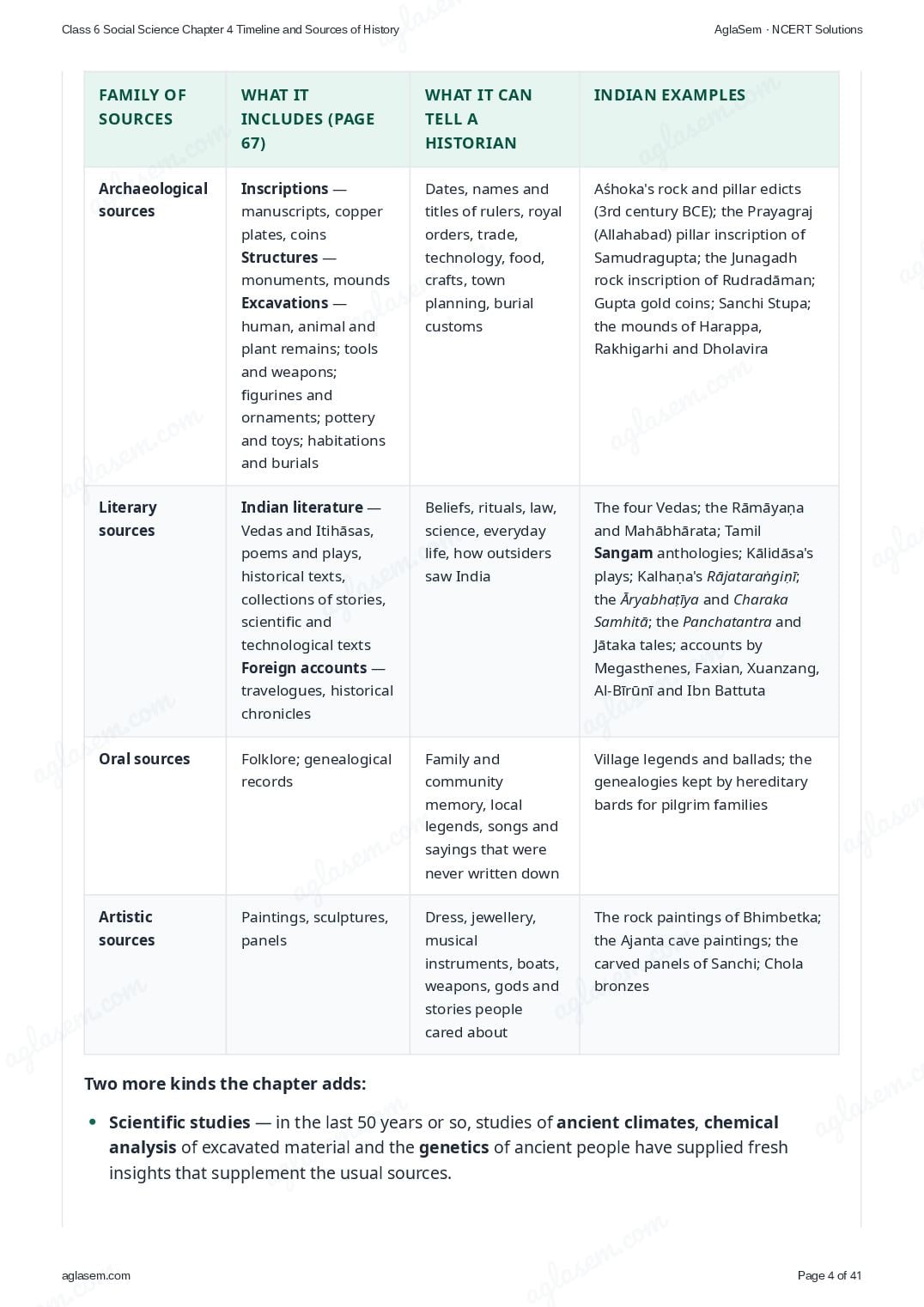
- How can various sources help us understand history?
- How did early humans live?
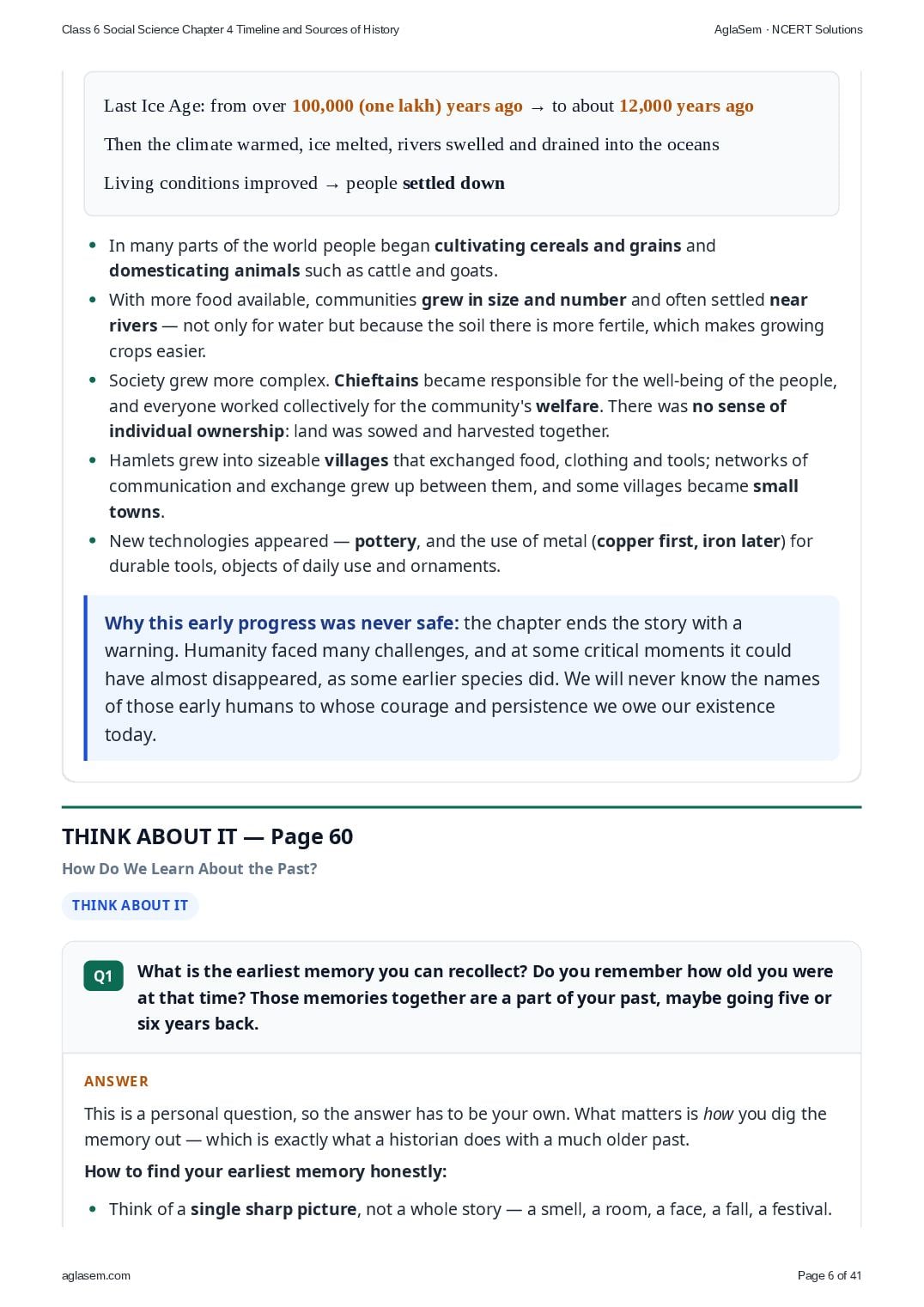
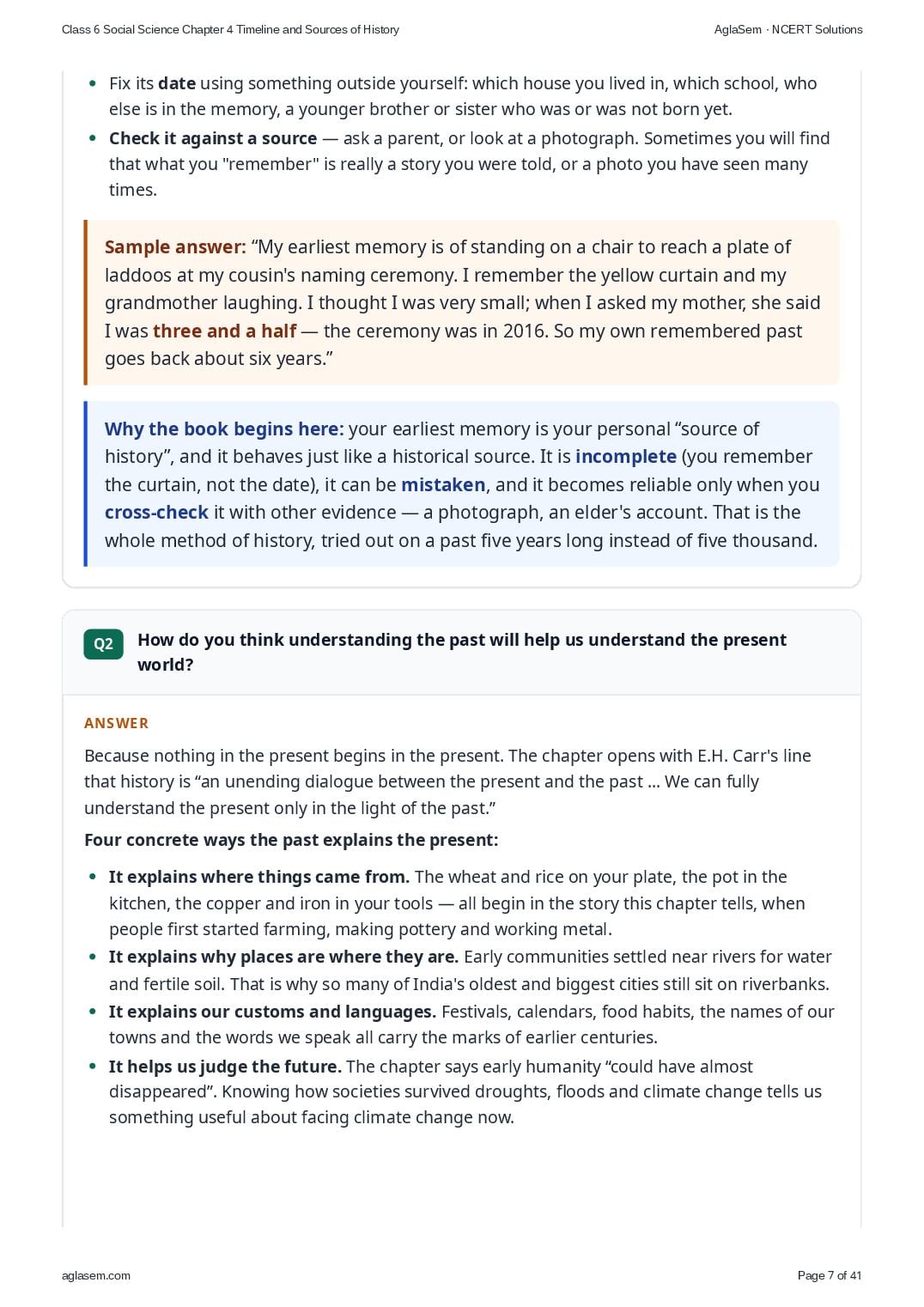
- What is the earliest memory you can recollect? Do you remember how old you were at that time? Those memories together are a part of your past, maybe going five or six years back.
- How do you think understanding the past will help us understand the present world?
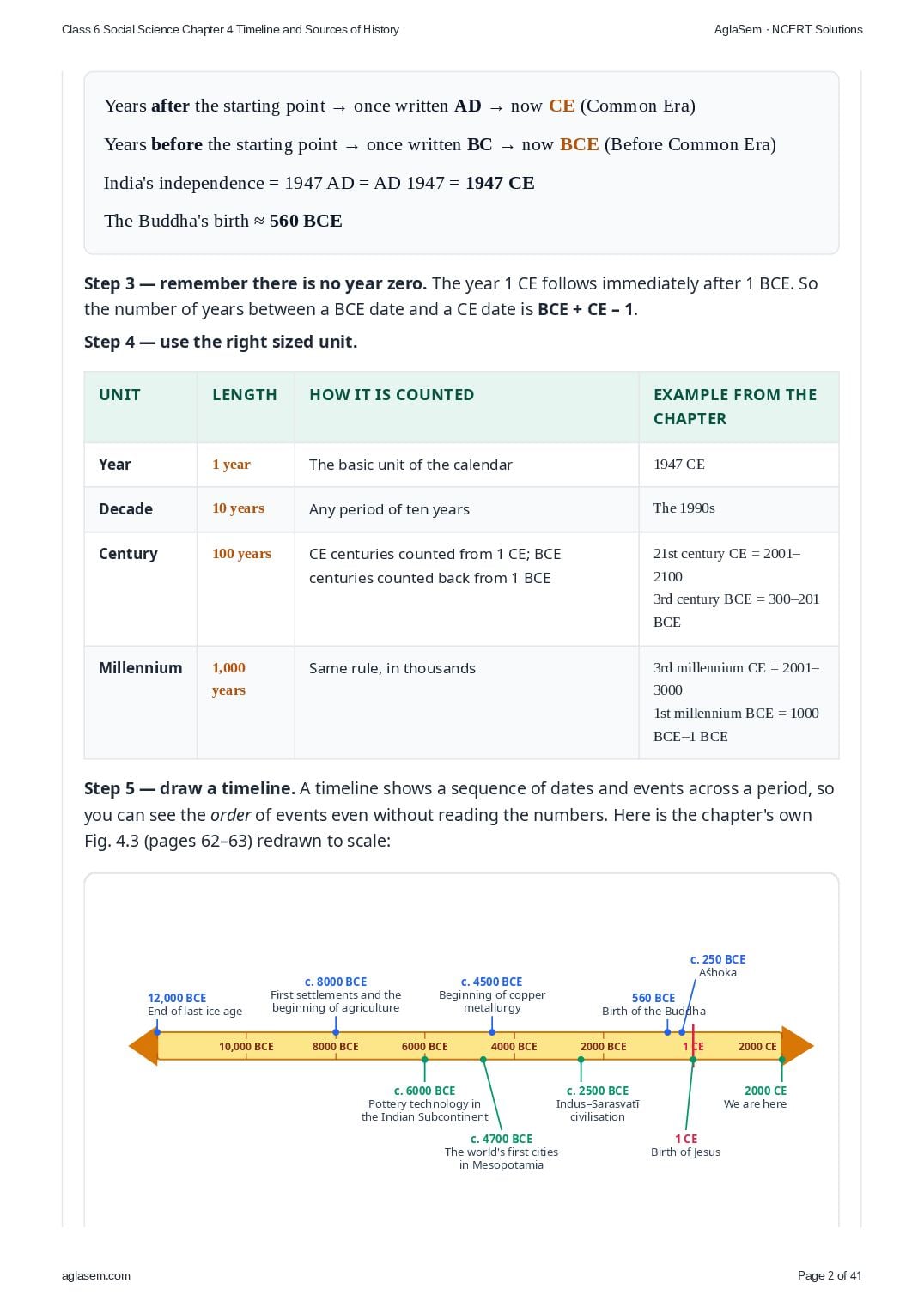
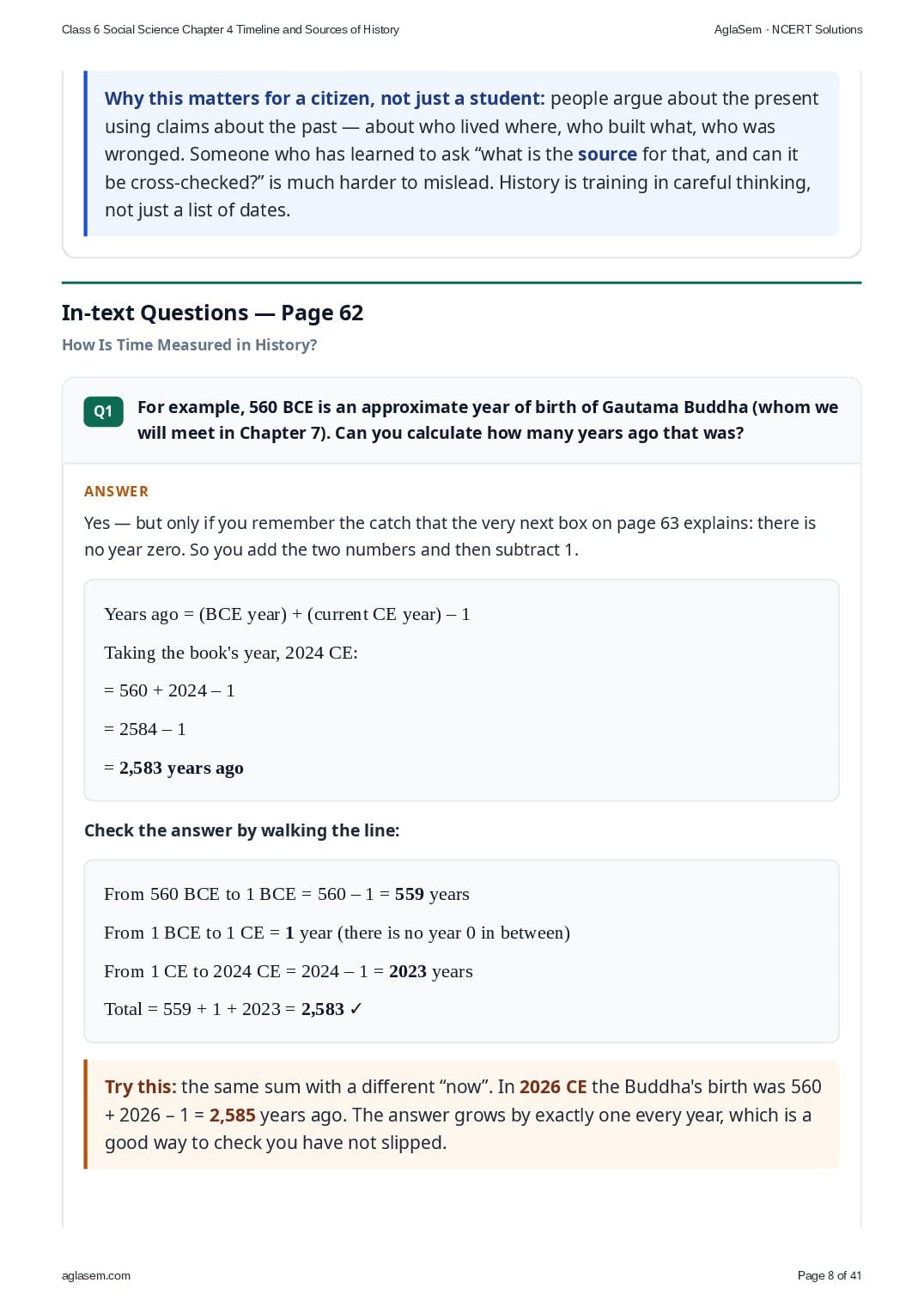
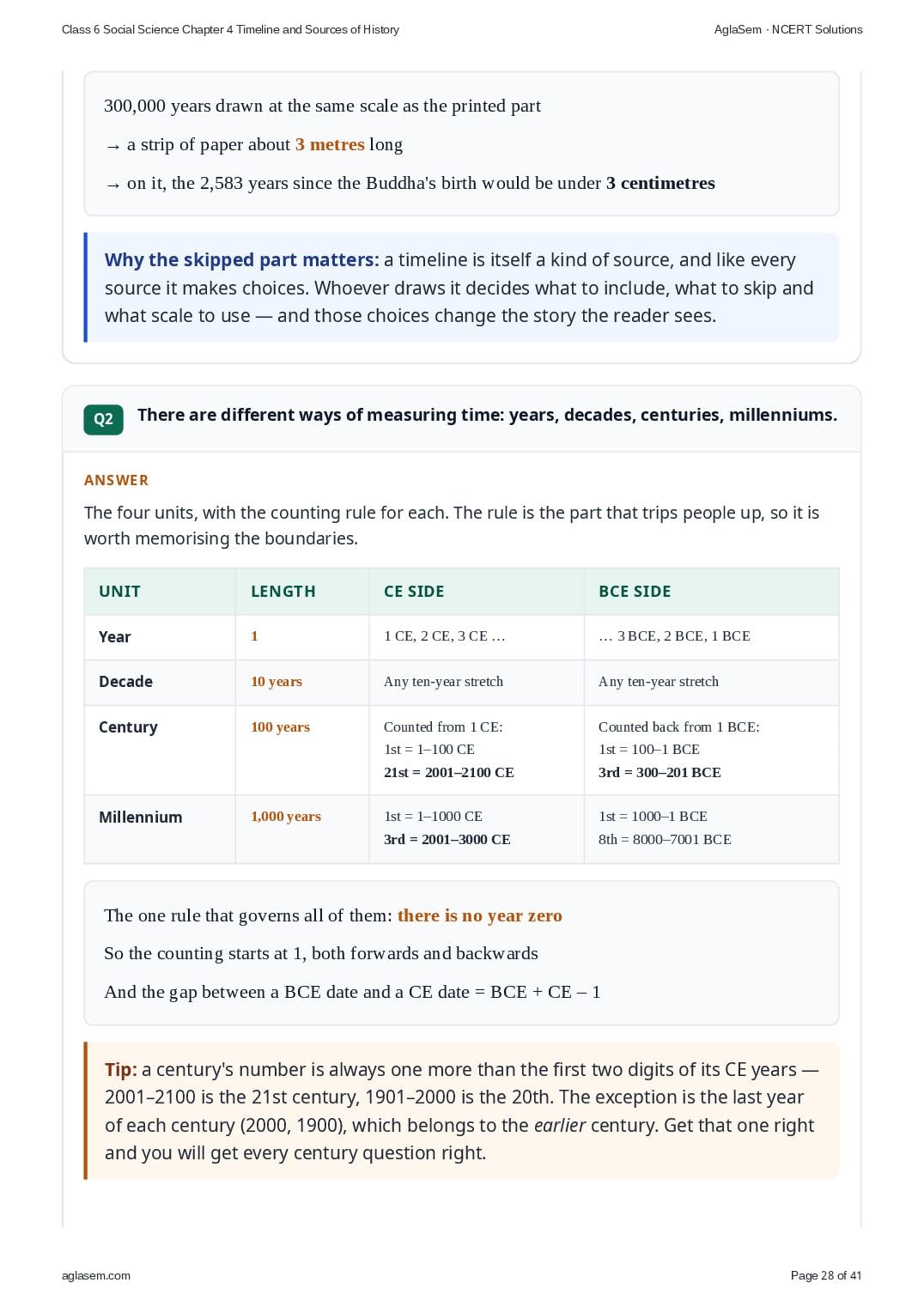
- For example, 560 BCE is an approximate year of birth of Gautama Buddha (whom we will meet in Chapter 7). Can you calculate how many years ago that was?
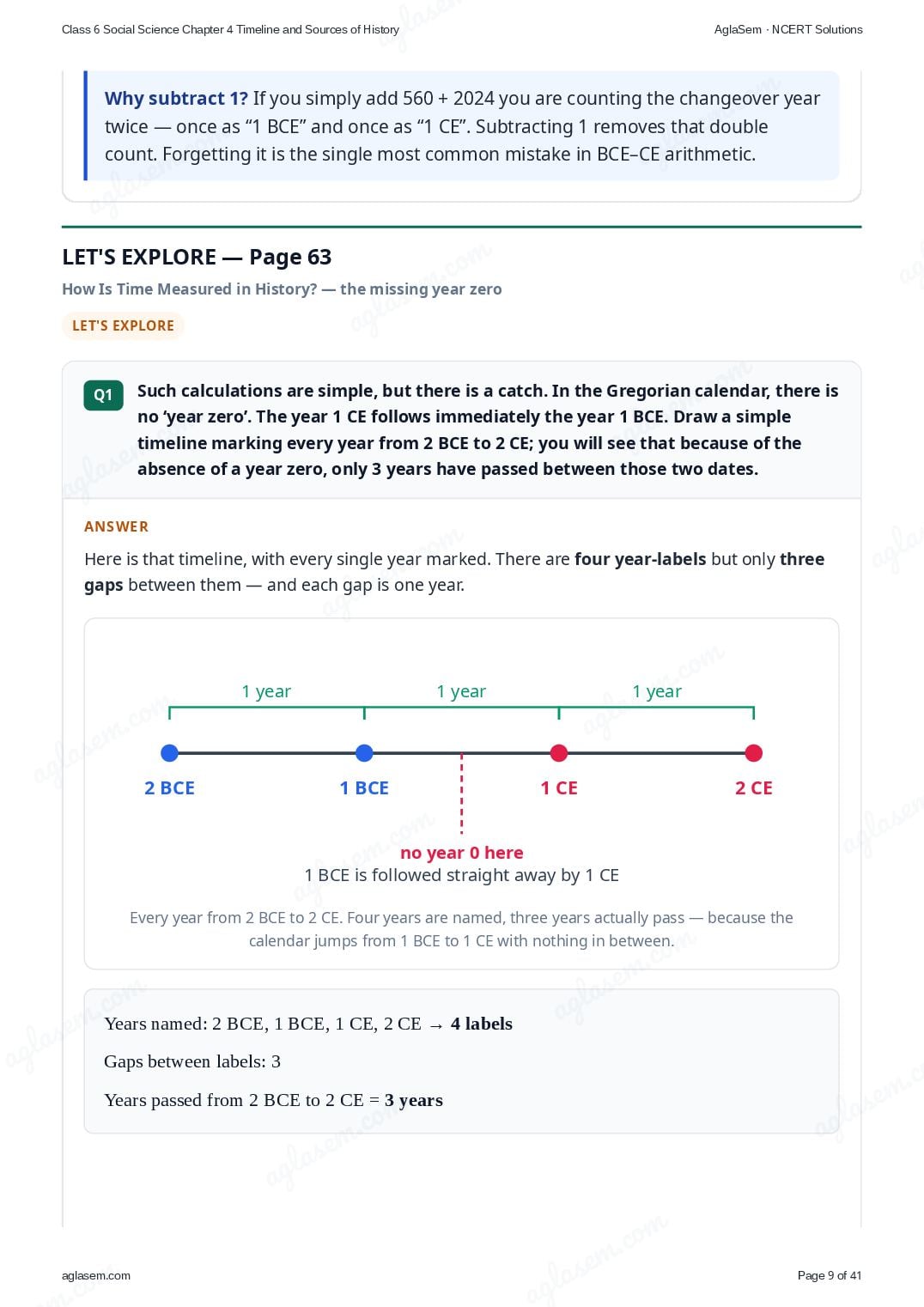
- Such calculations are simple, but there is a catch. In the Gregorian calendar, there is no ‘year zero’. The year 1 CE follows immediately the year 1 BCE. Draw a simple timeline marking every year from 2 BCE to 2 CE; you will see that because of the absence of a year zero, only 3 years have passed between those two dates.
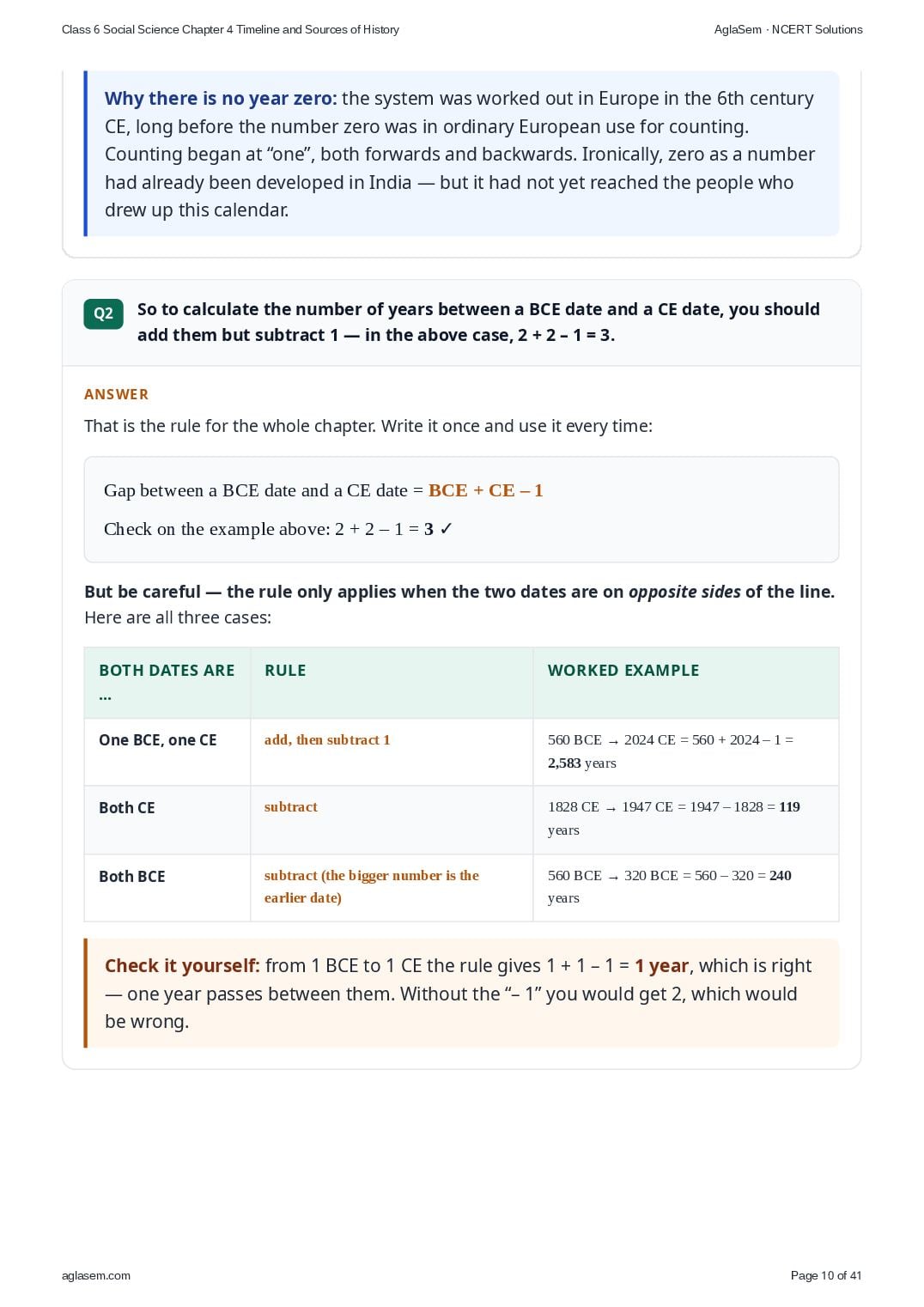
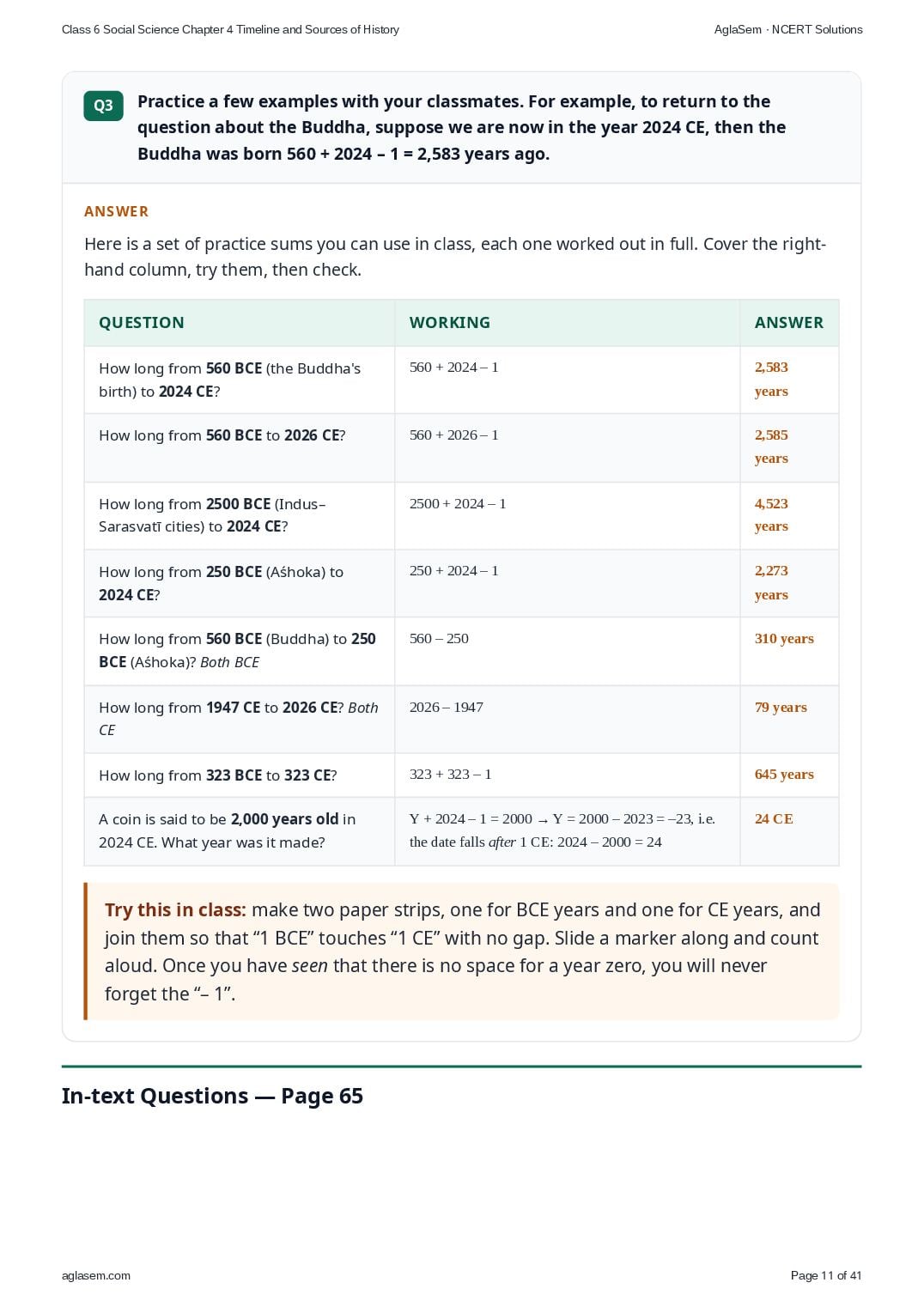
- So to calculate the number of years between a BCE date and a CE date, you should add them but subtract 1 — in the above case, 2 + 2 – 1 = 3.
- Practice a few examples with your classmates. For example, to return to the question about the Buddha, suppose we are now in the year 2024 CE, then the Buddha was born 560 + 2024 – 1 = 2,583 years ago.
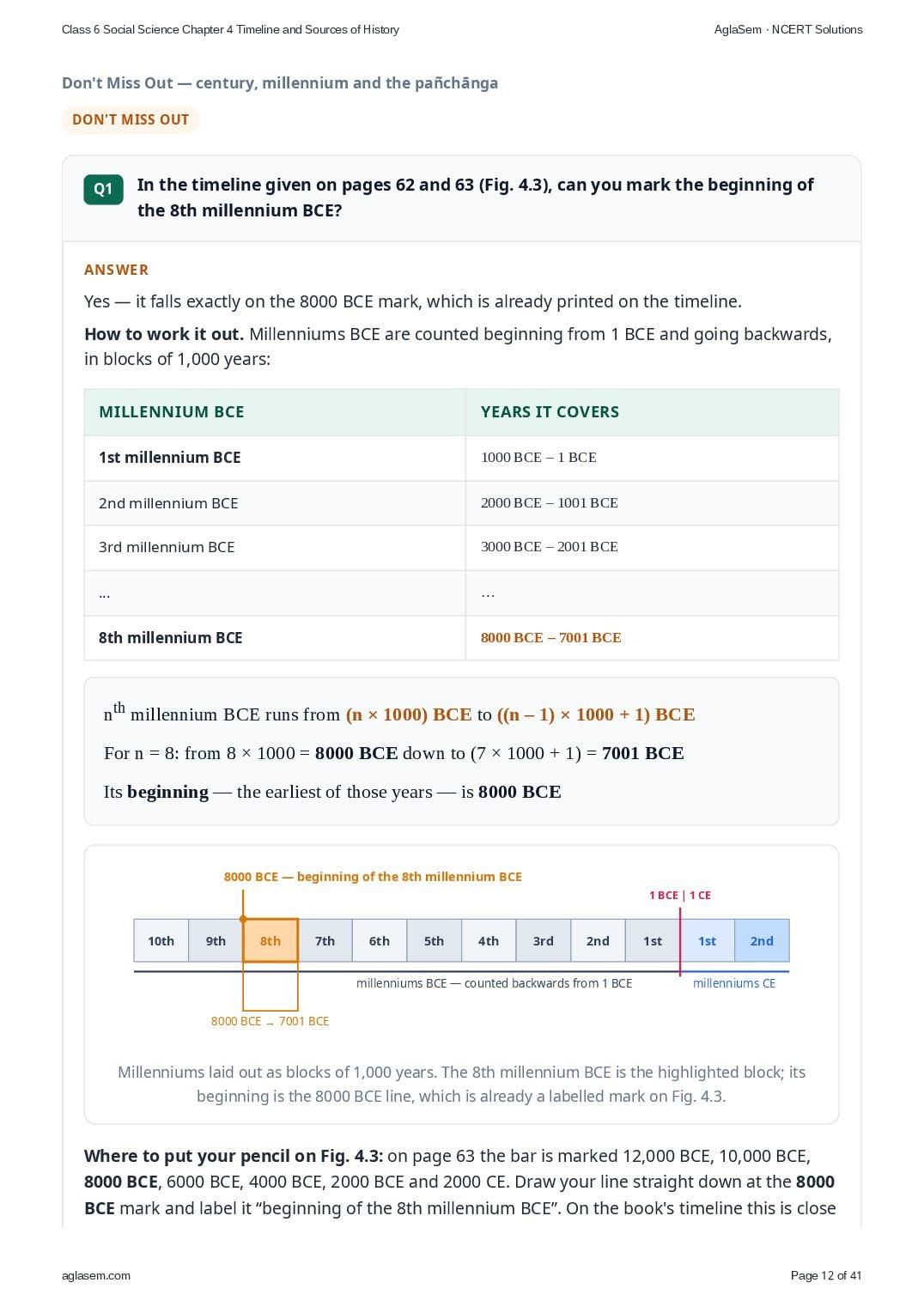
- In the timeline given on pages 62 and 63 (Fig. 4.3), can you mark the beginning of the 8th millennium BCE?
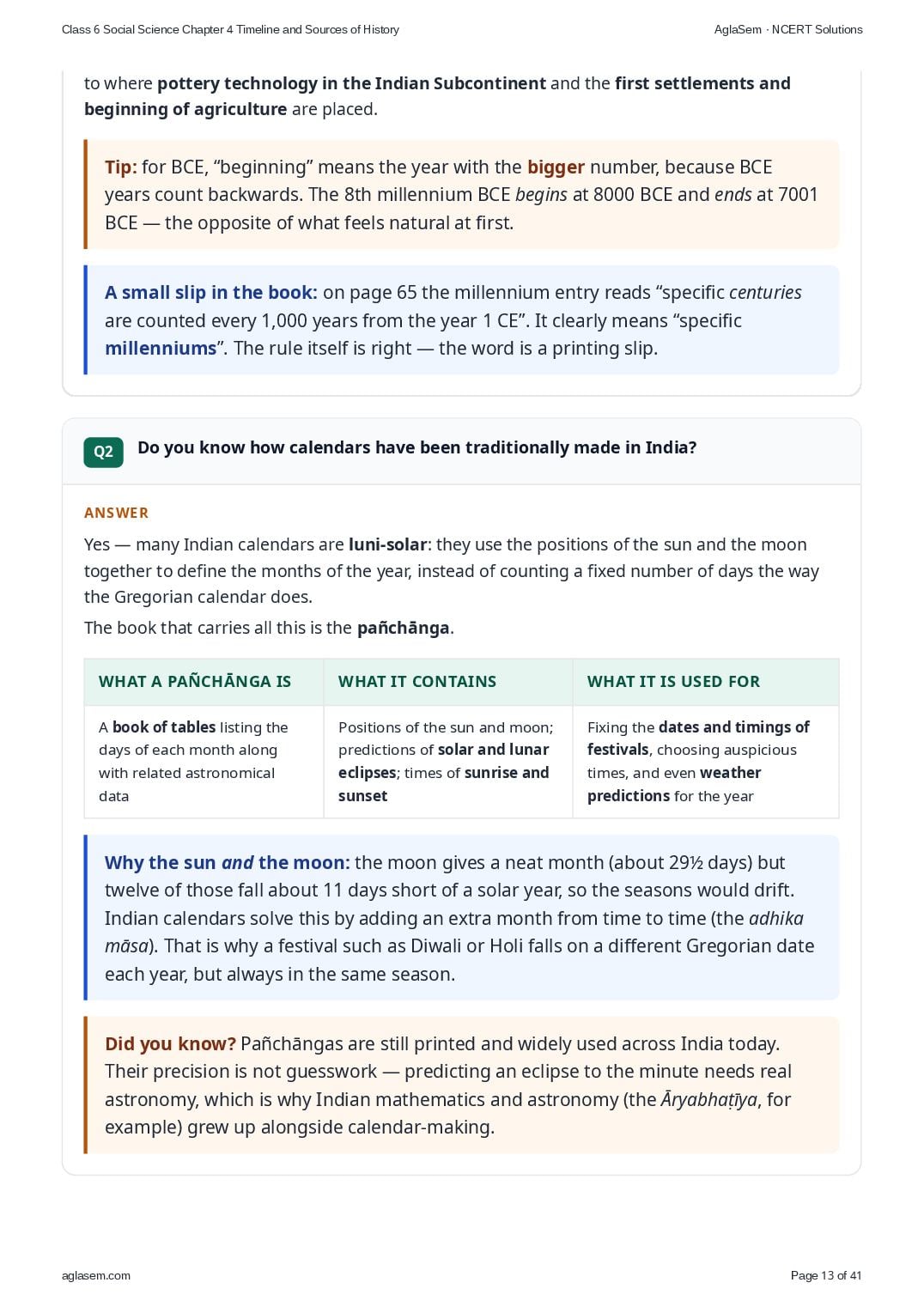
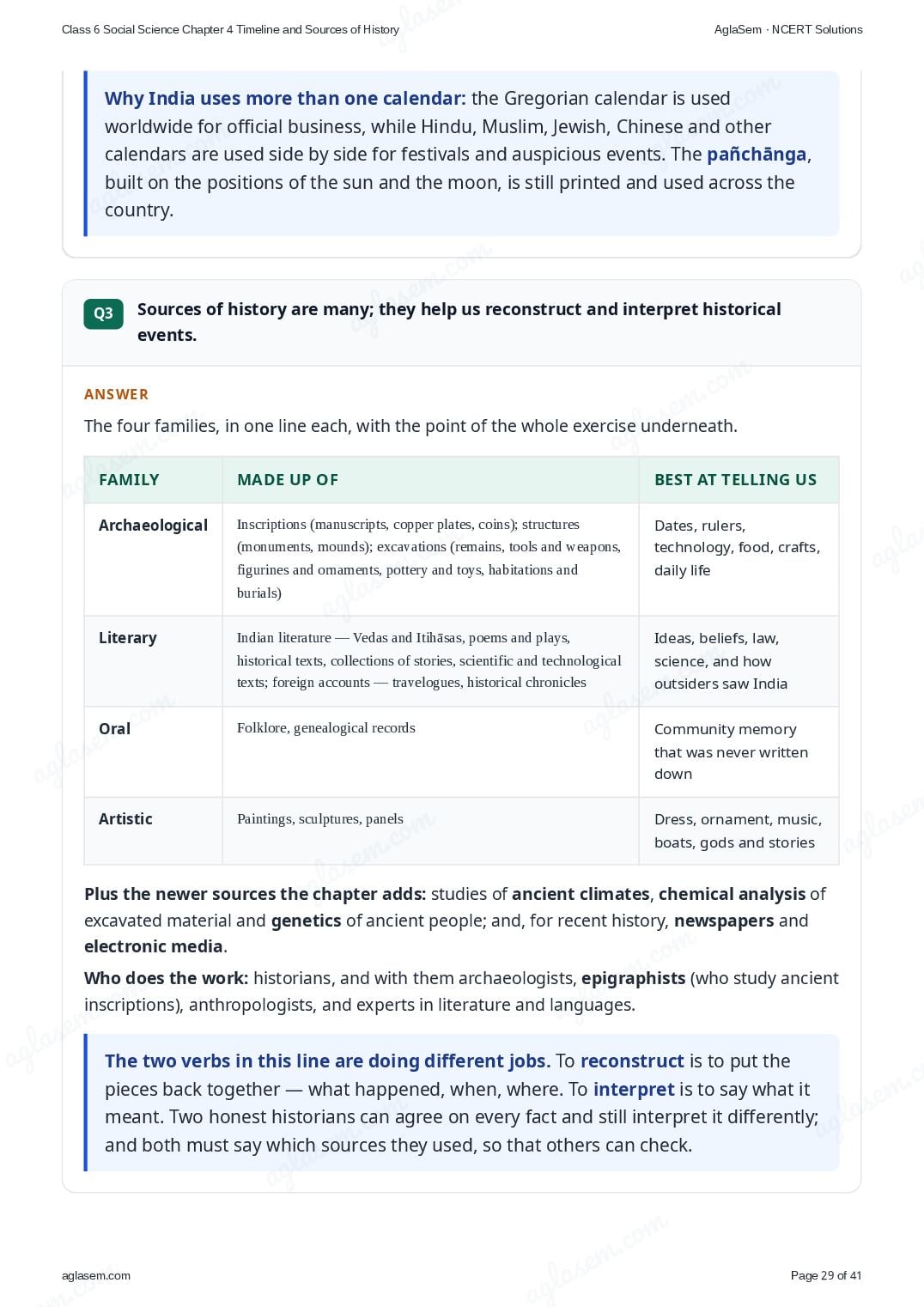
- Do you know how calendars have been traditionally made in India?
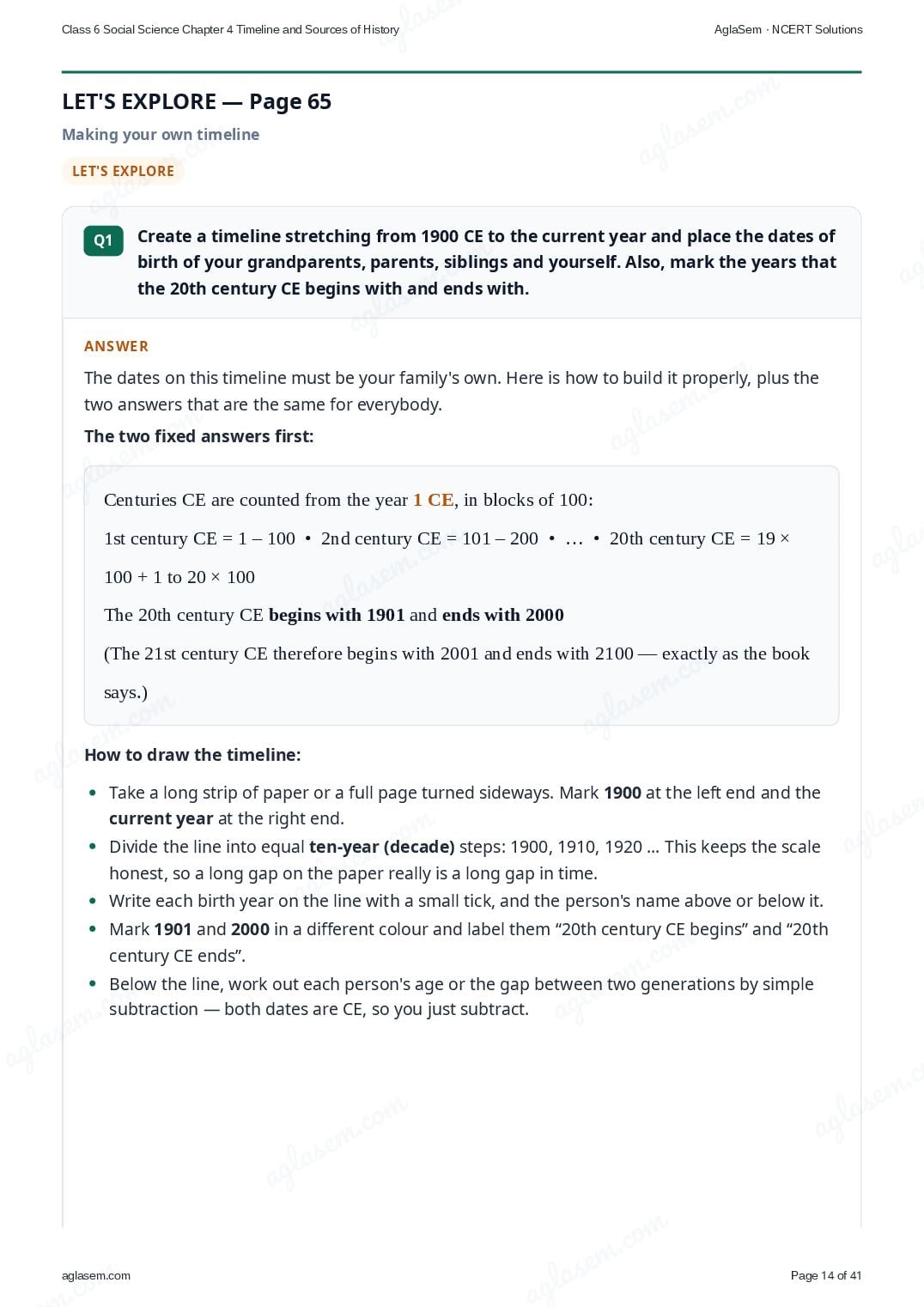
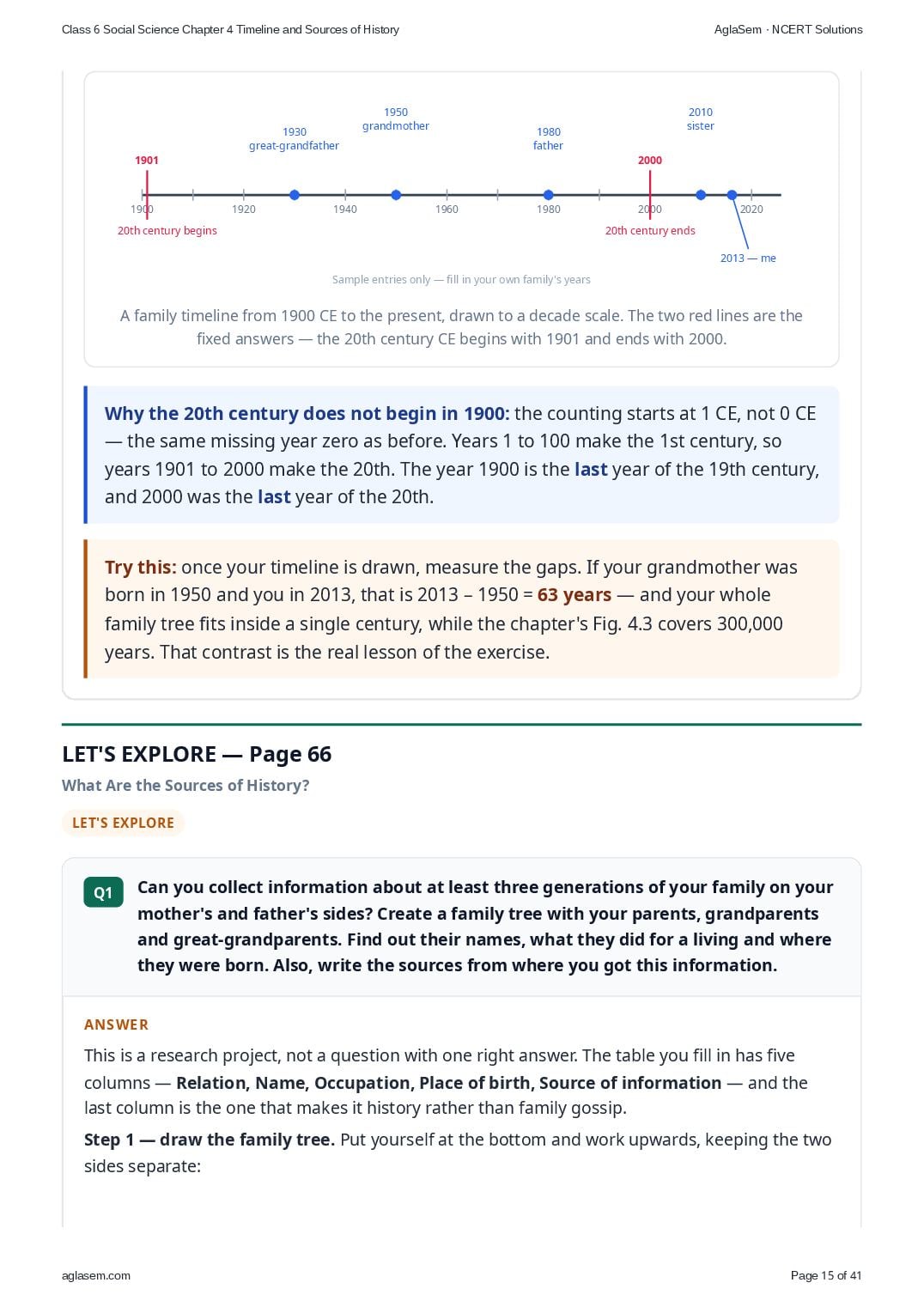
- Create a timeline stretching from 1900 CE to the current year and place the dates of birth of your grandparents, parents, siblings and yourself. Also, mark the years that the 20th century CE begins with and ends with.
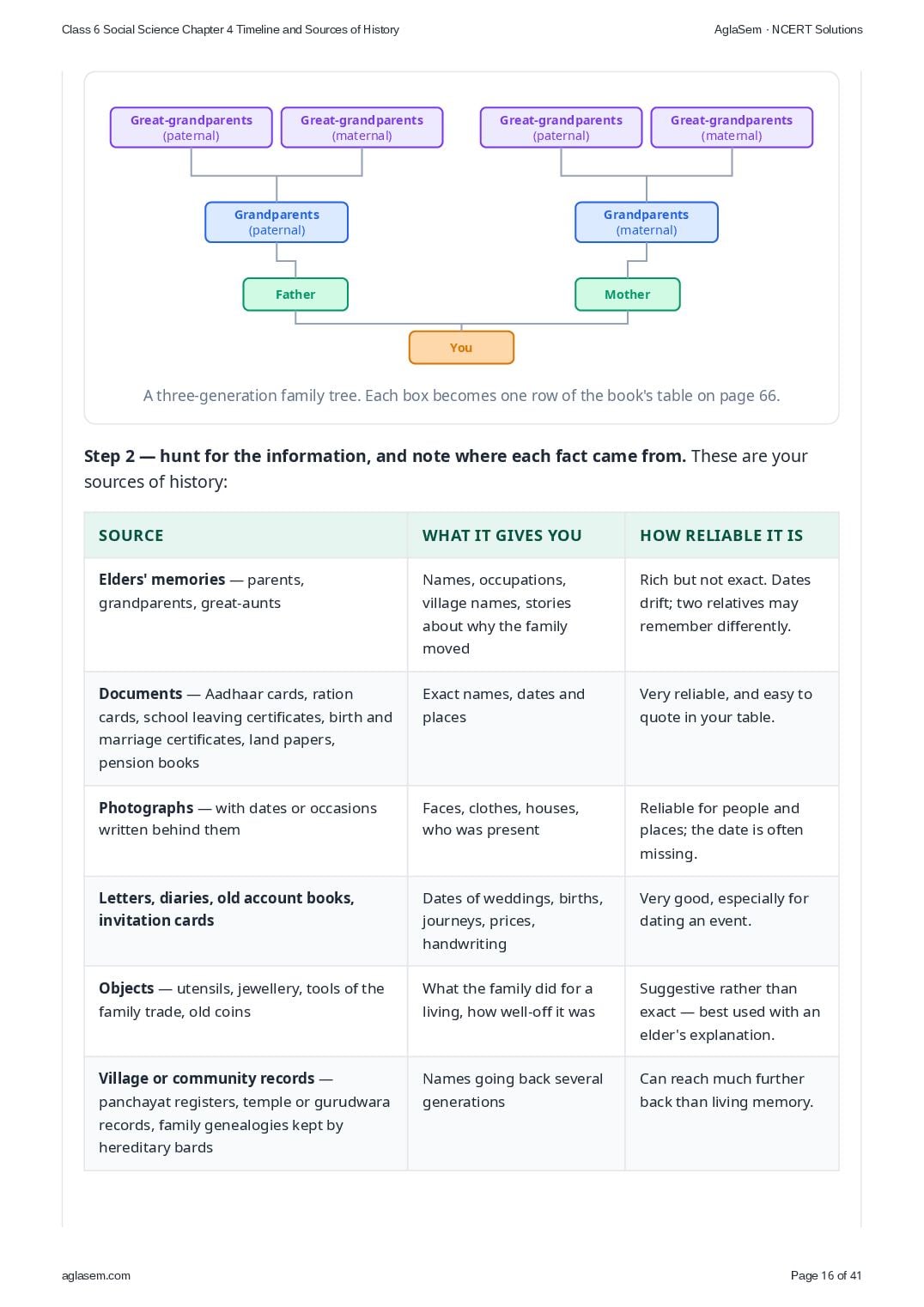
- Can you collect information about at least three generations of your family on your mother's and father's sides? Create a family tree with your parents, grandparents and great-grandparents. Find out their names, what they did for a living and where they were born. Also, write the sources from where you got this information.
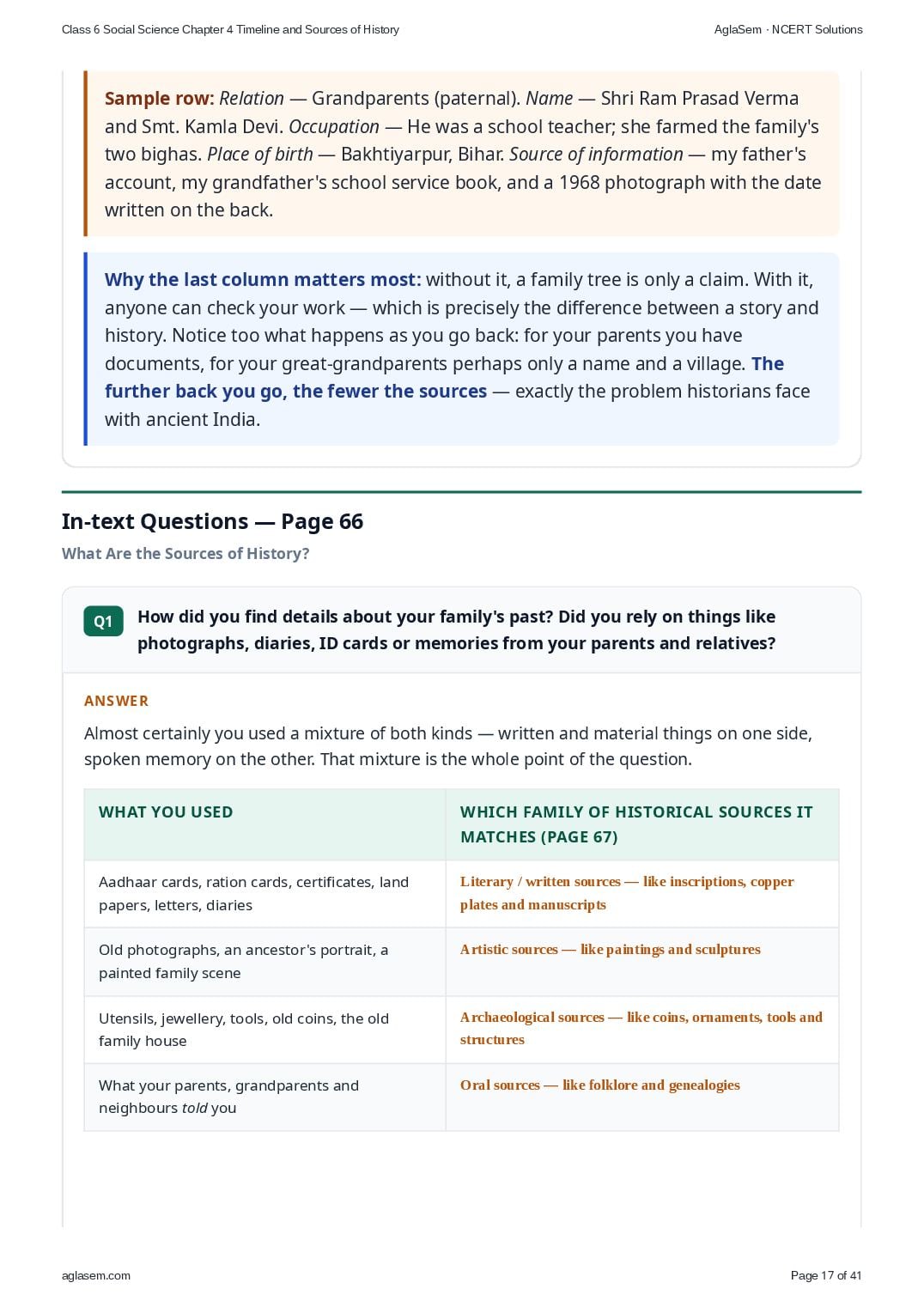
- How did you find details about your family's past? Did you rely on things like photographs, diaries, ID cards or memories from your parents and relatives?
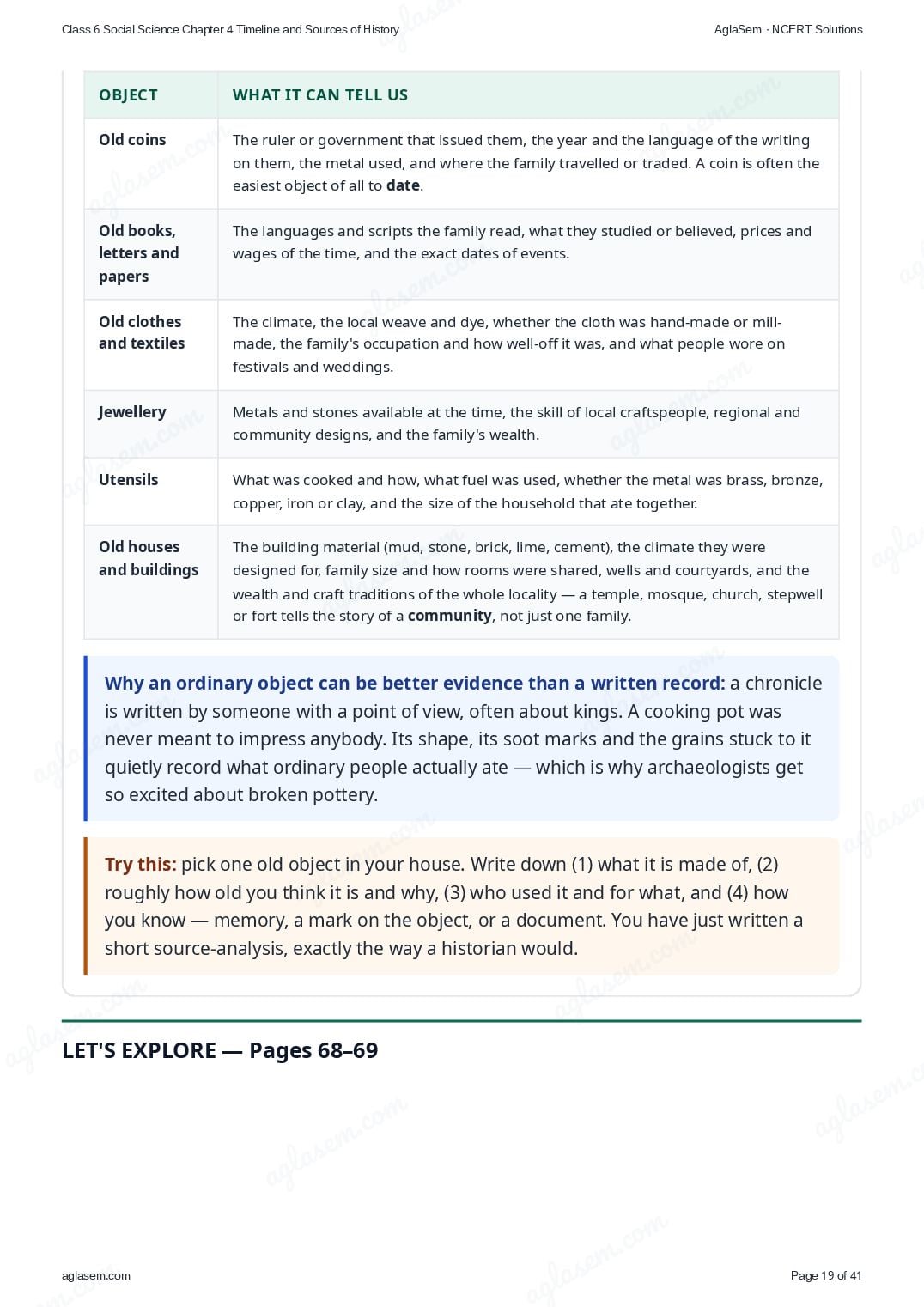
- Have you ever seen old coins, books, clothes, jewellery or utensils in and around your house? What type of information can we gain from such objects? Or from old houses or buildings?
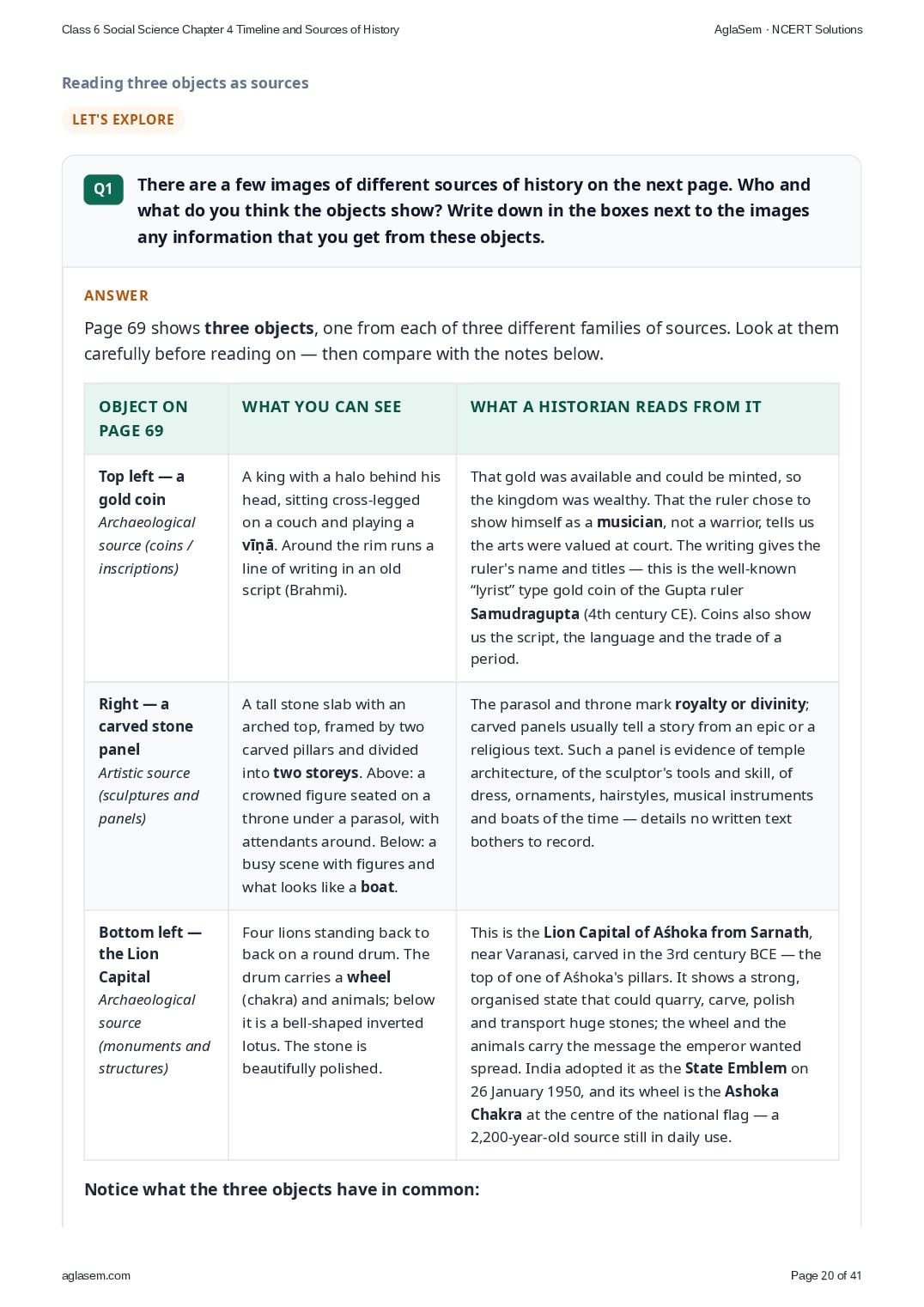
- There are a few images of different sources of history on the next page. Who and what do you think the objects show? Write down in the boxes next to the images any information that you get from these objects.
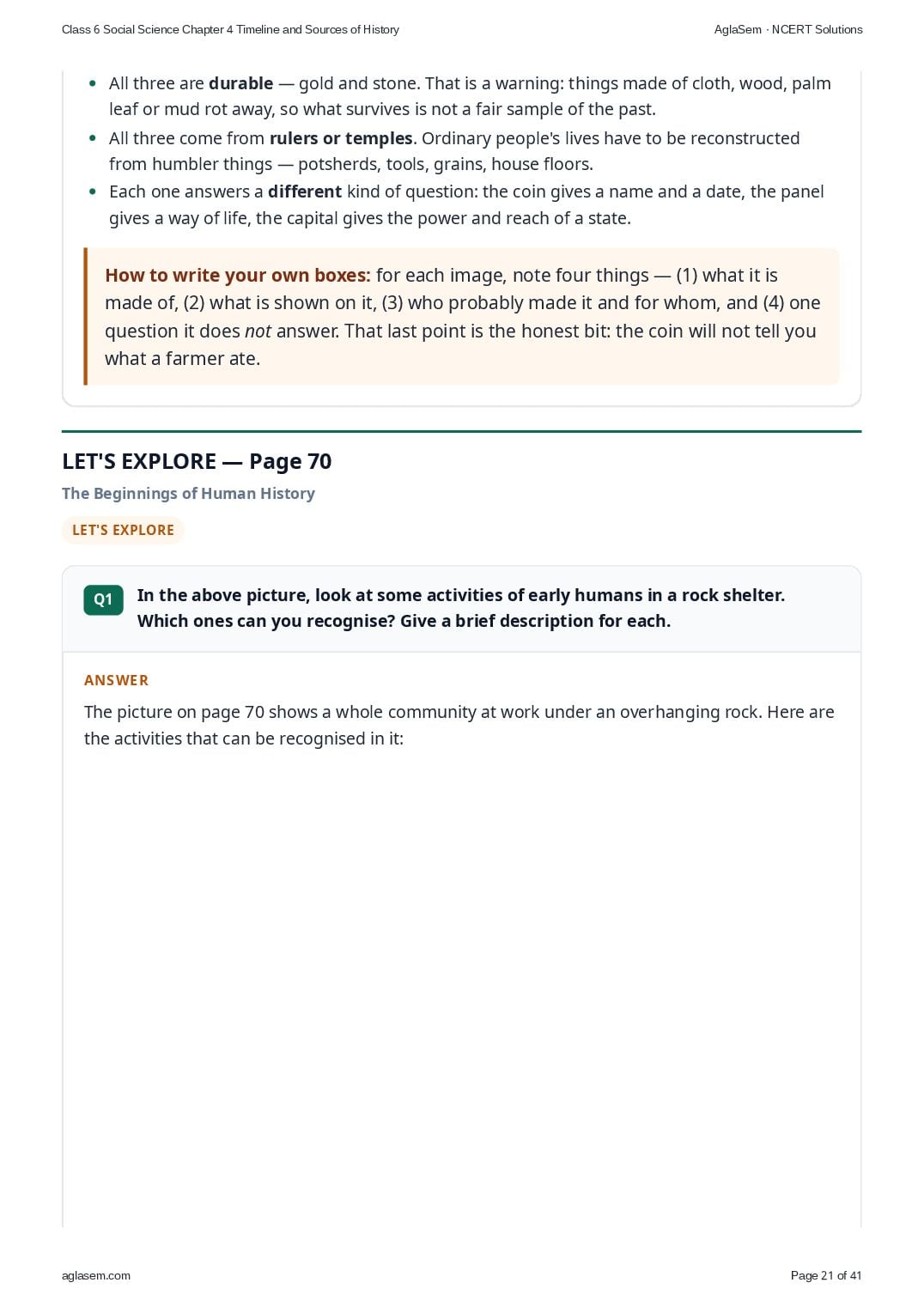
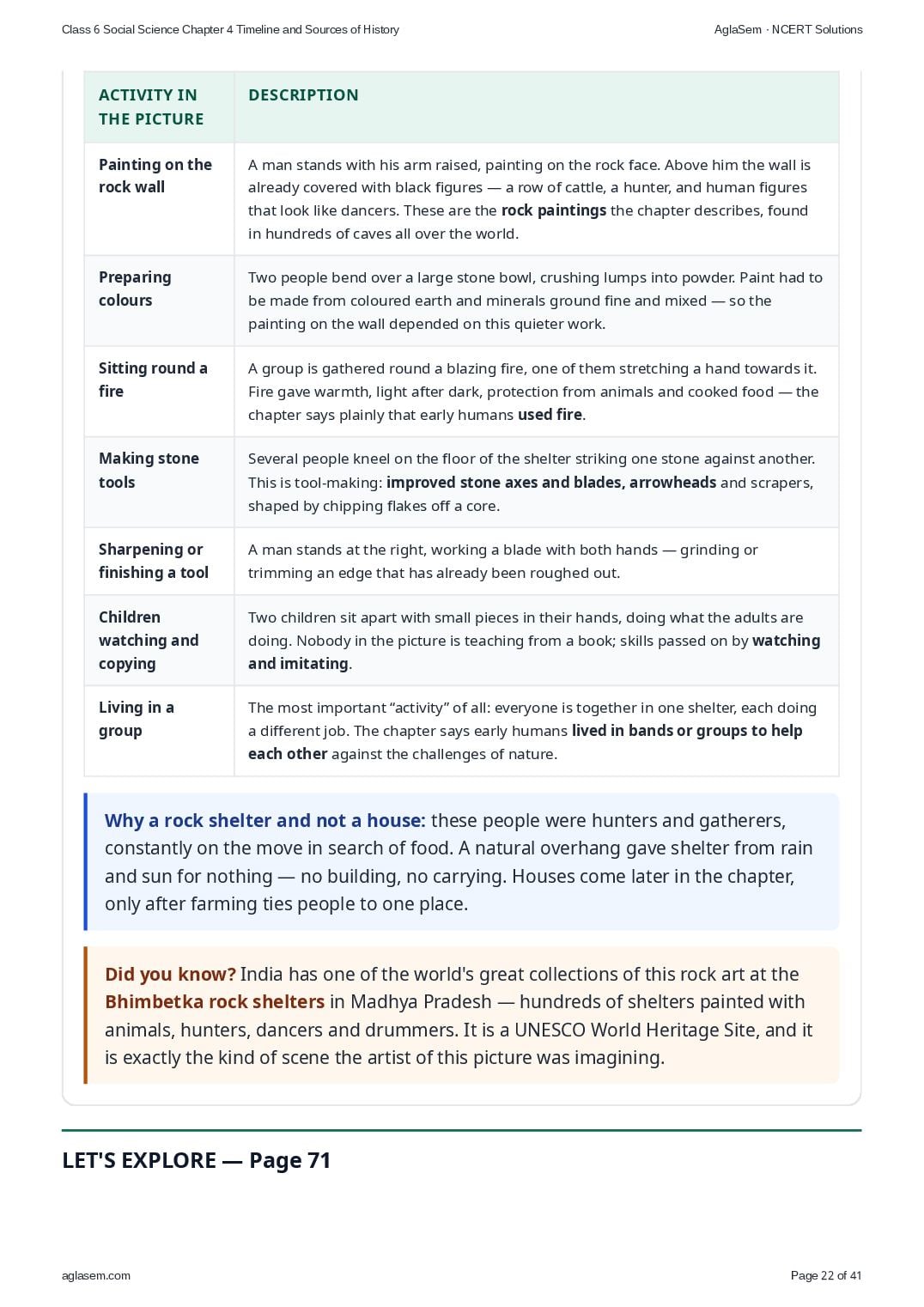
- In the above picture, look at some activities of early humans in a rock shelter. Which ones can you recognise? Give a brief description for each.
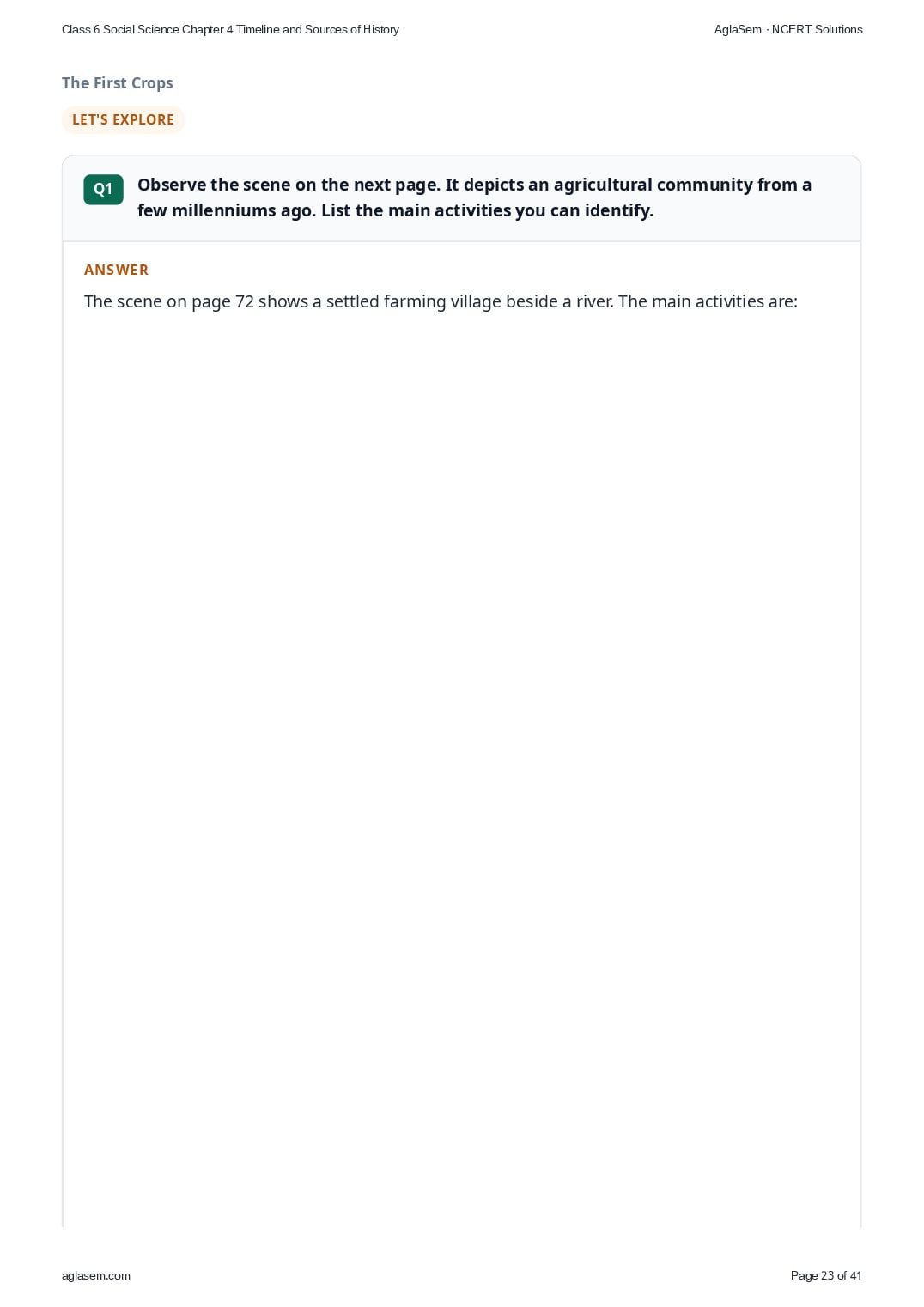
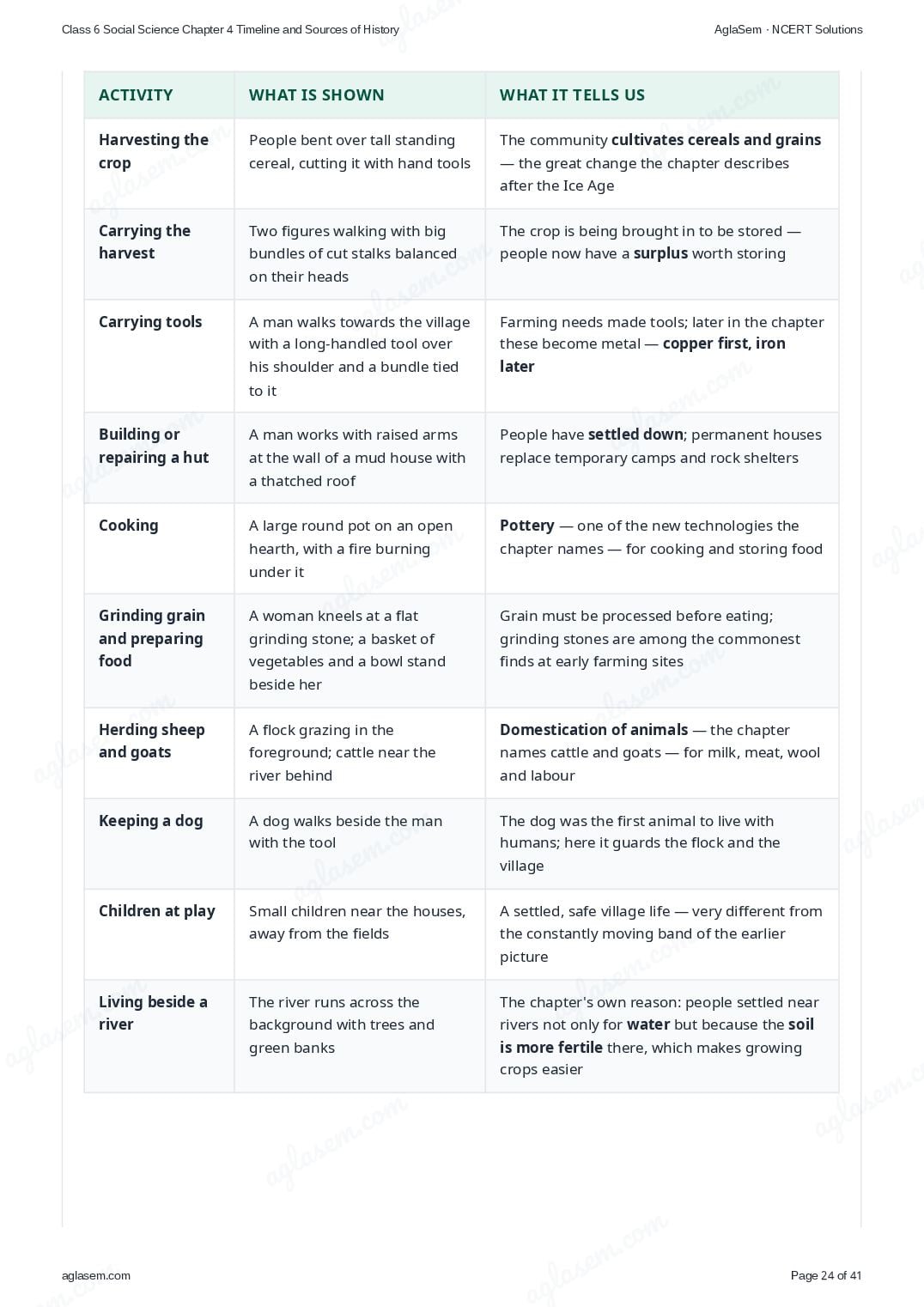
- Observe the scene on the next page. It depicts an agricultural community from a few millenniums ago. List the main activities you can identify.
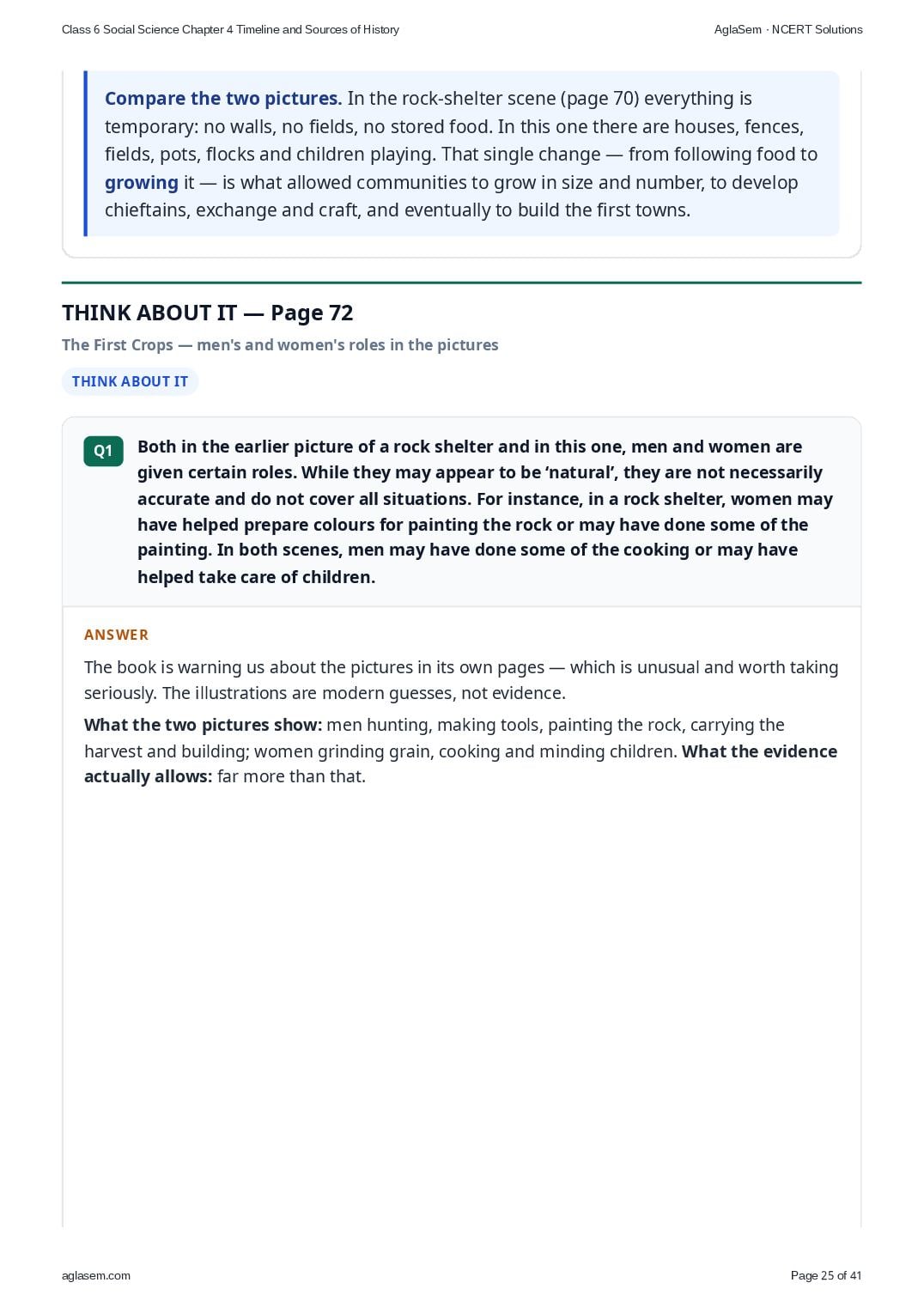
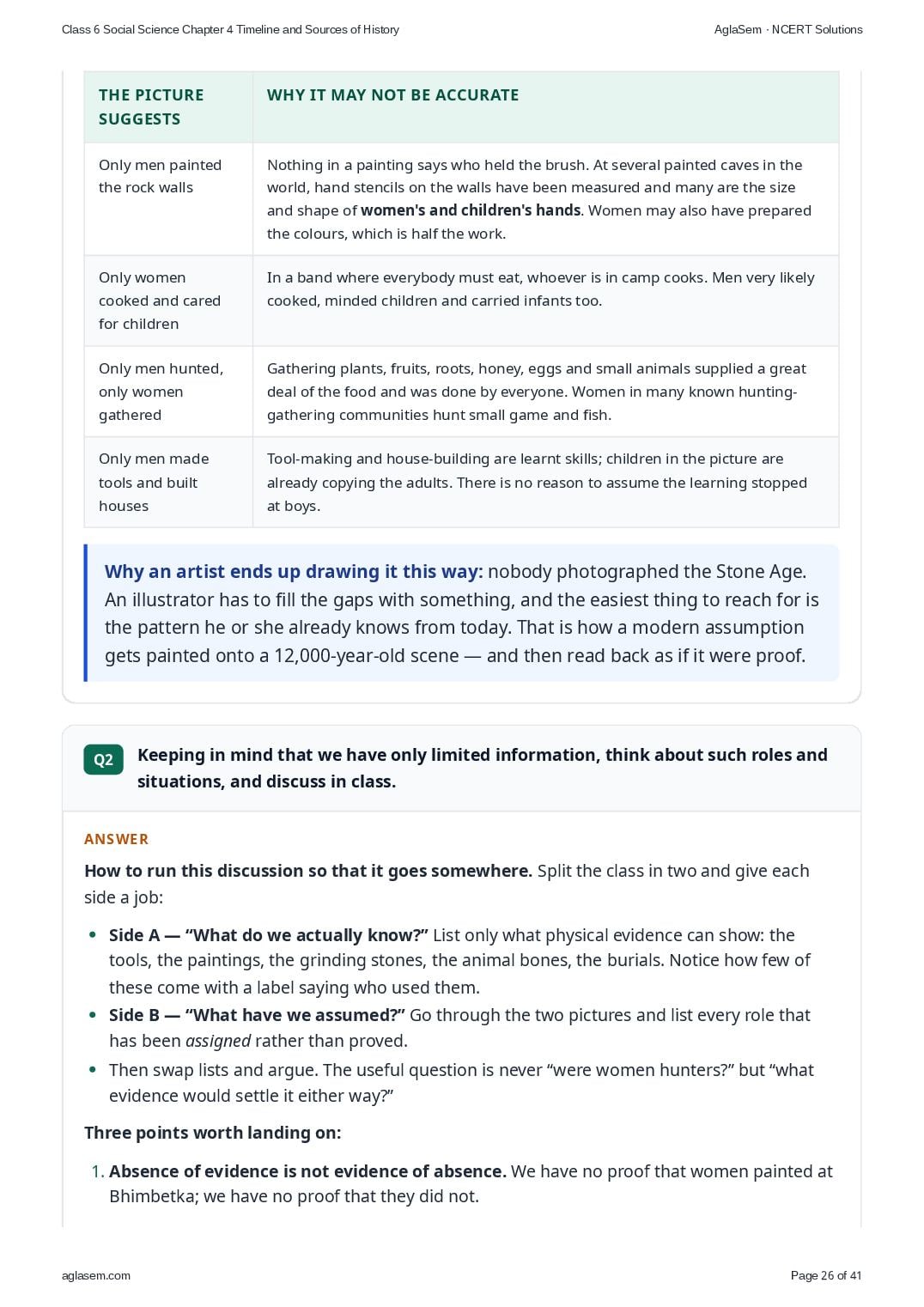
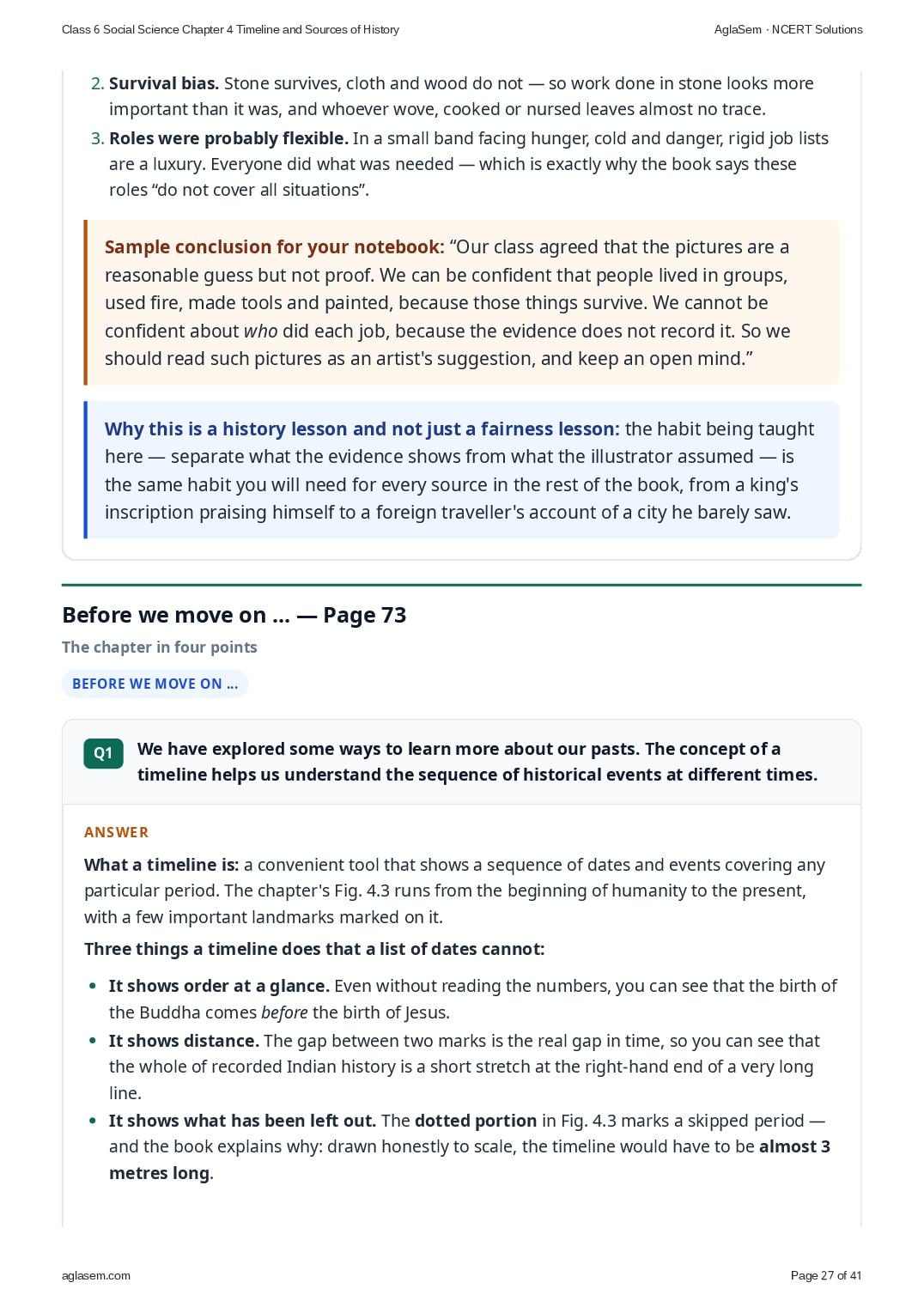
- Both in the earlier picture of a rock shelter and in this one, men and women are given certain roles. While they may appear to be ‘natural’, they are not necessarily accurate and do not cover all situations. For instance, in a rock shelter, women may have helped prepare colours for painting the rock or may have done some of the painting. In both scenes, men may have done some of the cooking or may have helped take care of children.
- Keeping in mind that we have only limited information, think about such roles and situations, and discuss in class.
- We have explored some ways to learn more about our pasts. The concept of a timeline helps us understand the sequence of historical events at different times.
- There are different ways of measuring time: years, decades, centuries, millenniums.
- Sources of history are many; they help us reconstruct and interpret historical events.
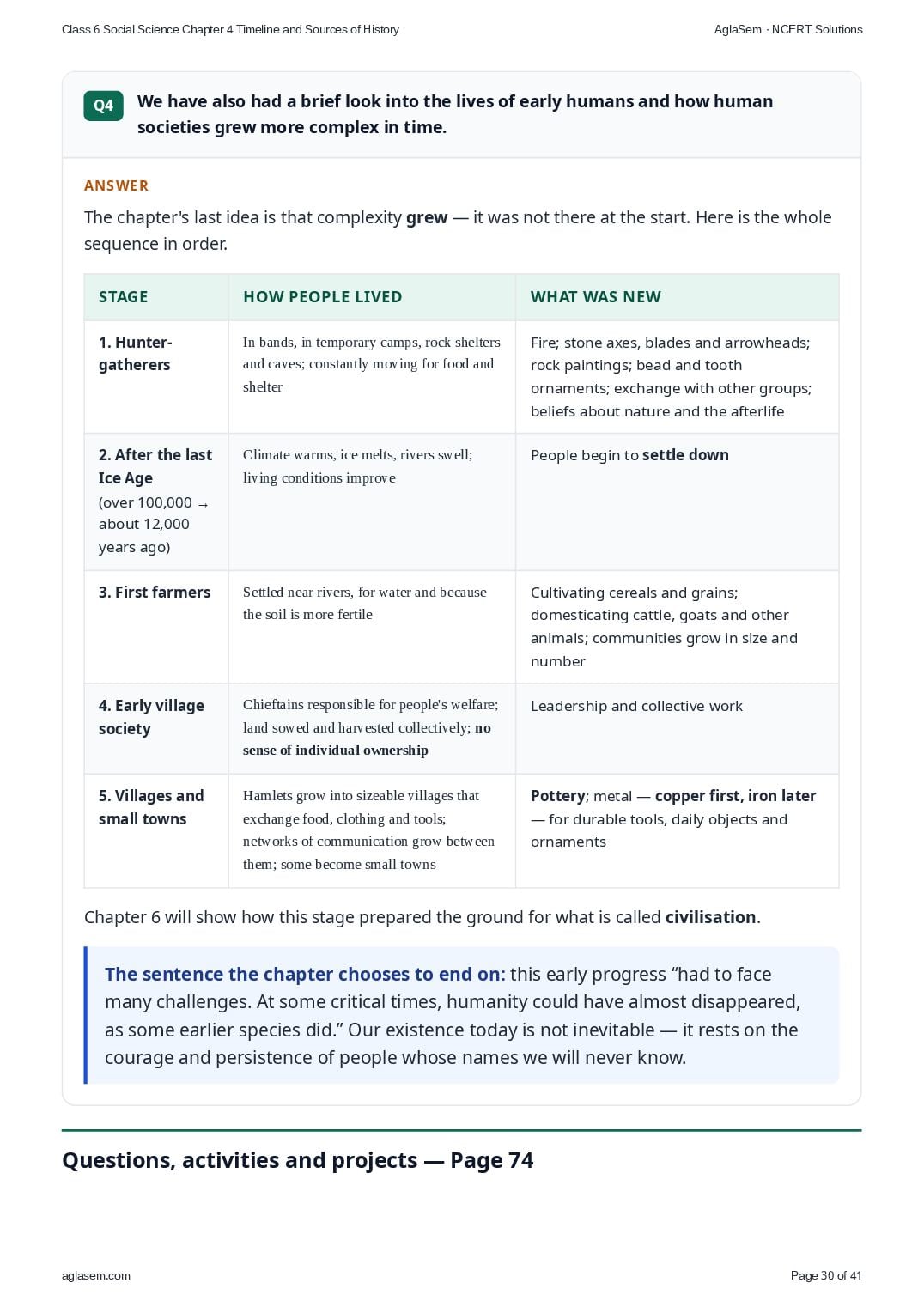
- We have also had a brief look into the lives of early humans and how human societies grew more complex in time.
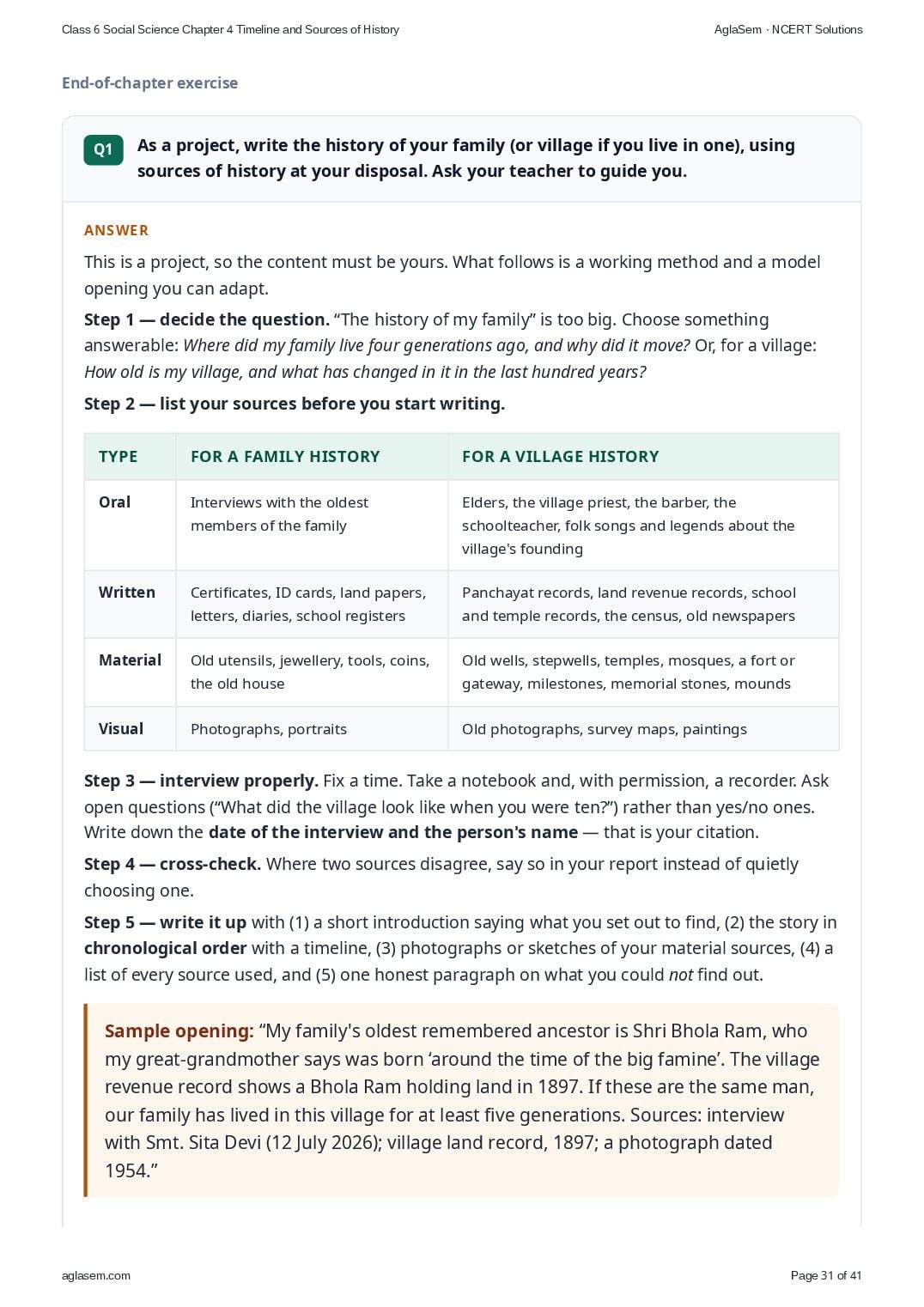
- As a project, write the history of your family (or village if you live in one), using sources of history at your disposal. Ask your teacher to guide you.
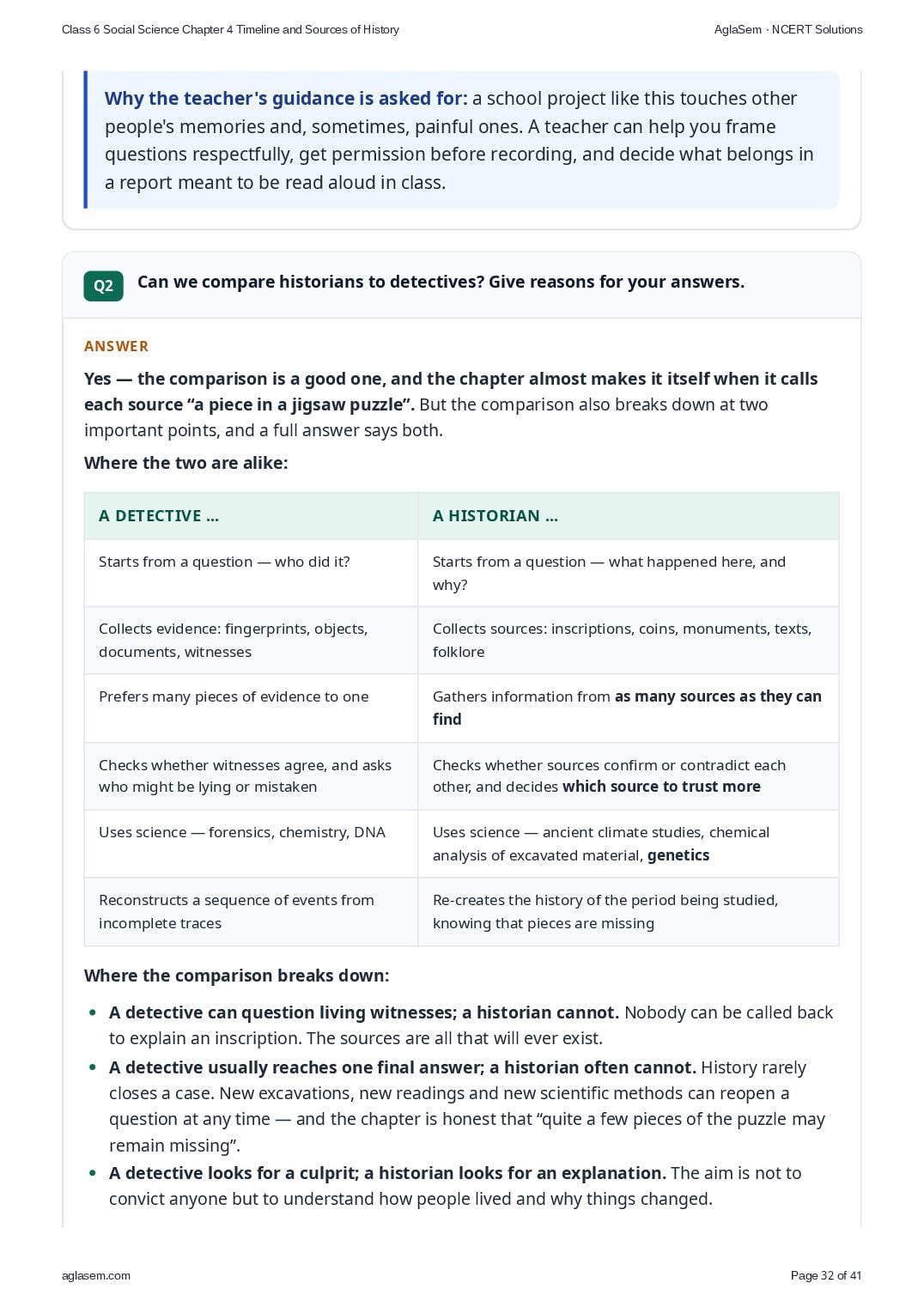
- Can we compare historians to detectives? Give reasons for your answers.
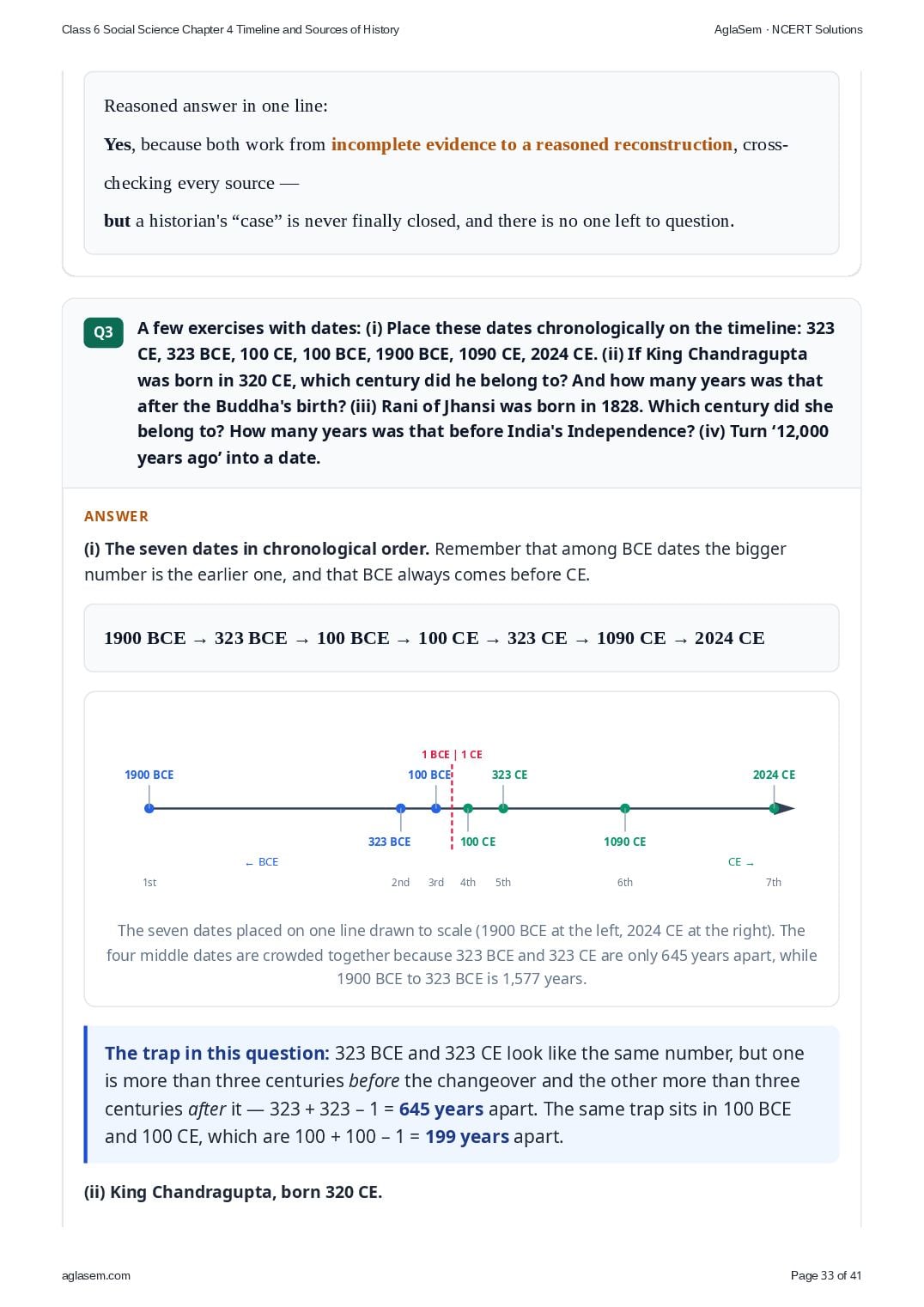
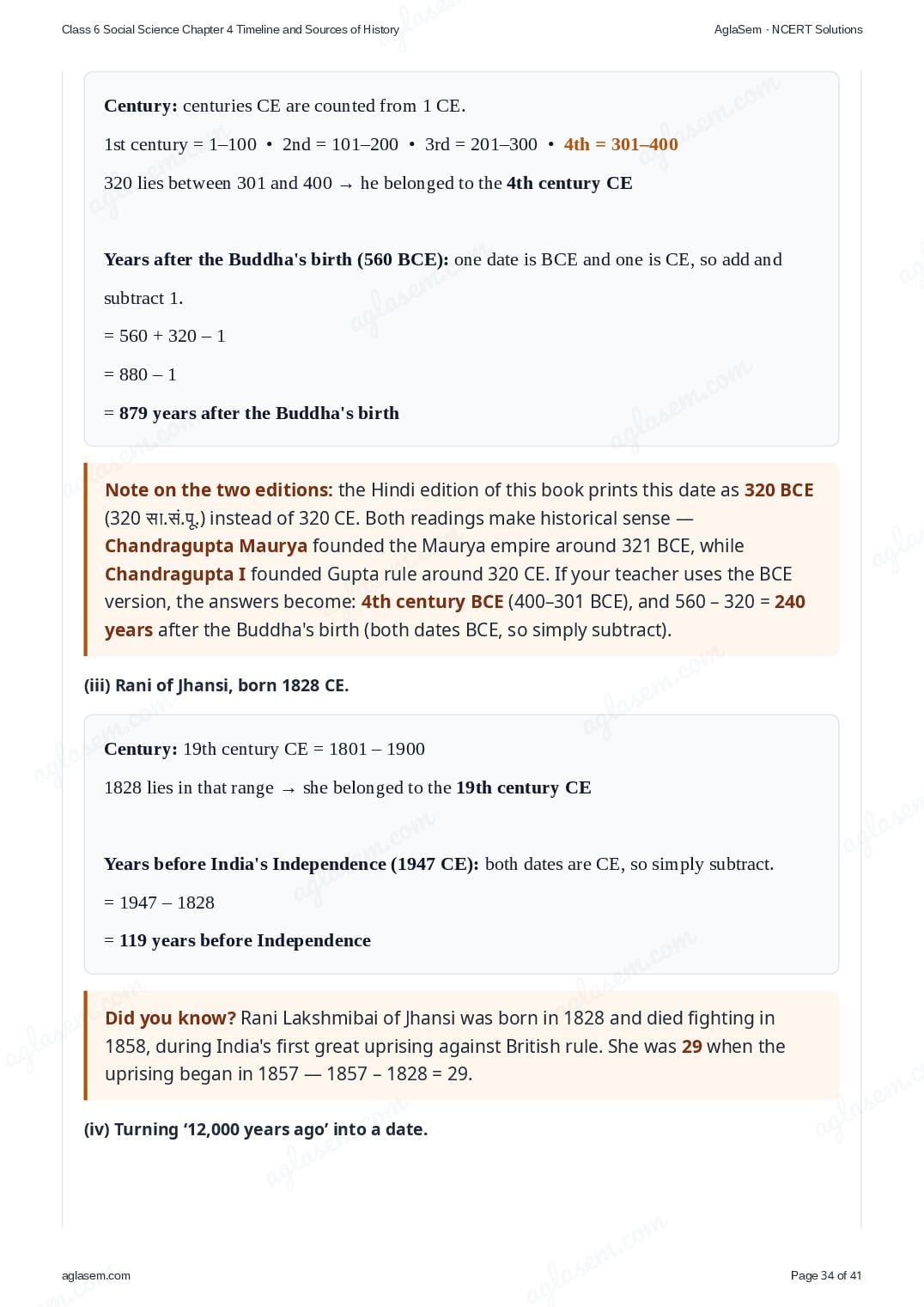
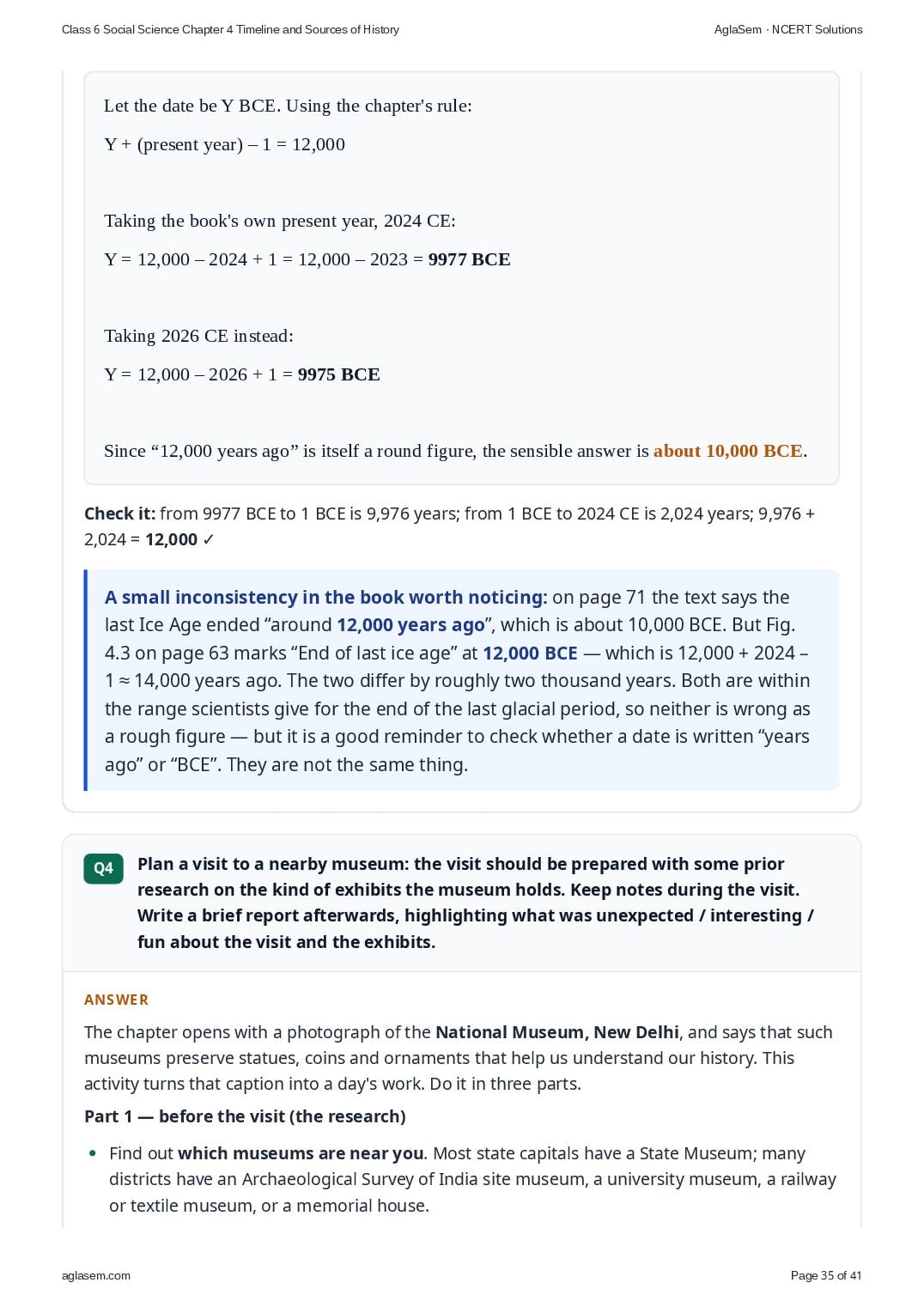
- A few exercises with dates: (i) Place these dates chronologically on the timeline: 323 CE, 323 BCE, 100 CE, 100 BCE, 1900 BCE, 1090 CE, 2024 CE. (ii) If King Chandragupta was born in 320 CE, which century did he belong to? And how many years was that after the Buddha's birth? (iii) Rani of Jhansi was born in 1828. Which century did she belong to? How many years was that before India's Independence? (iv) Turn ‘12,000 years ago’ into a date.
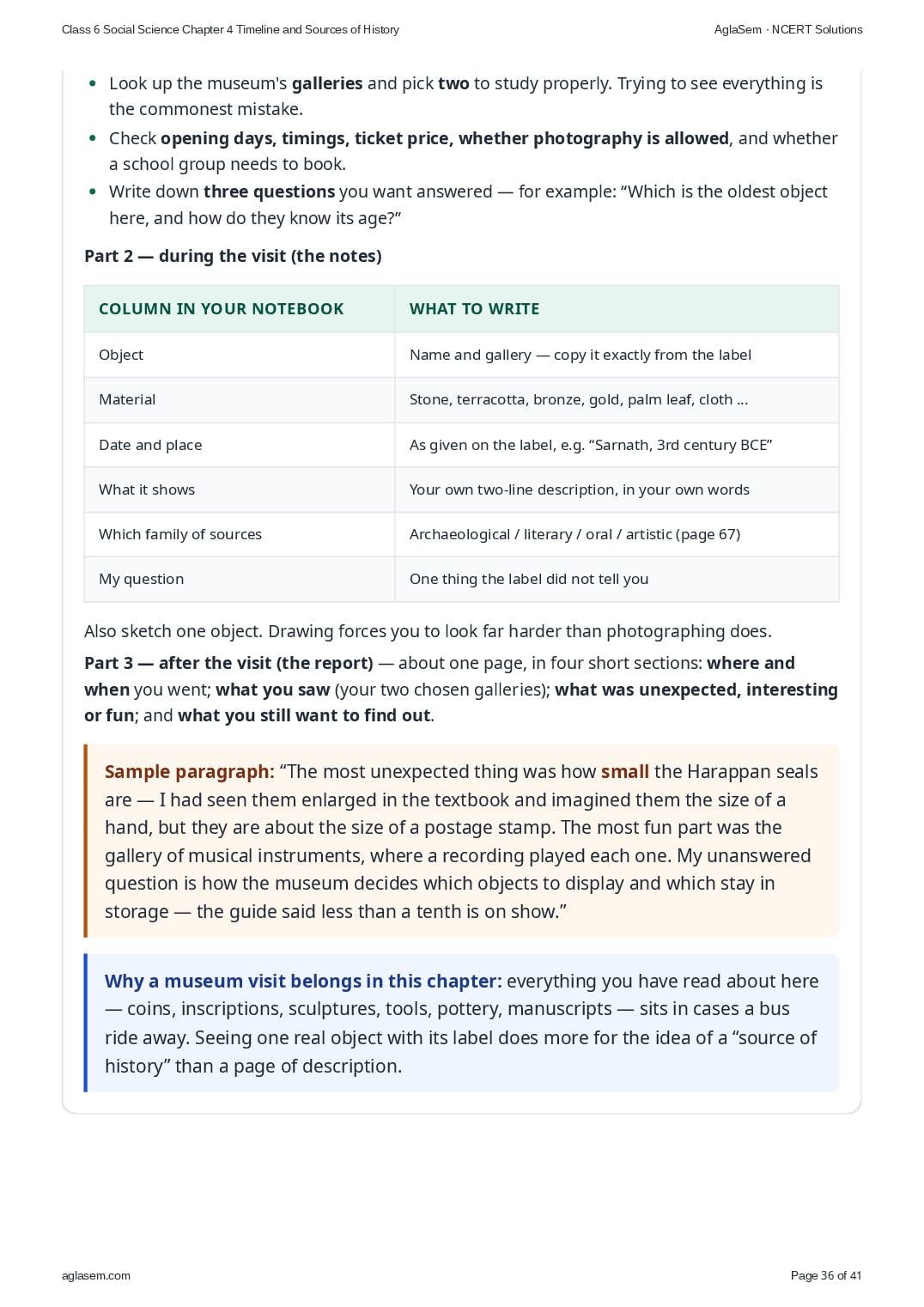
- Plan a visit to a nearby museum: the visit should be prepared with some prior research on the kind of exhibits the museum holds. Keep notes during the visit. Write a brief report afterwards, highlighting what was unexpected / interesting / fun about the visit and the exhibits.
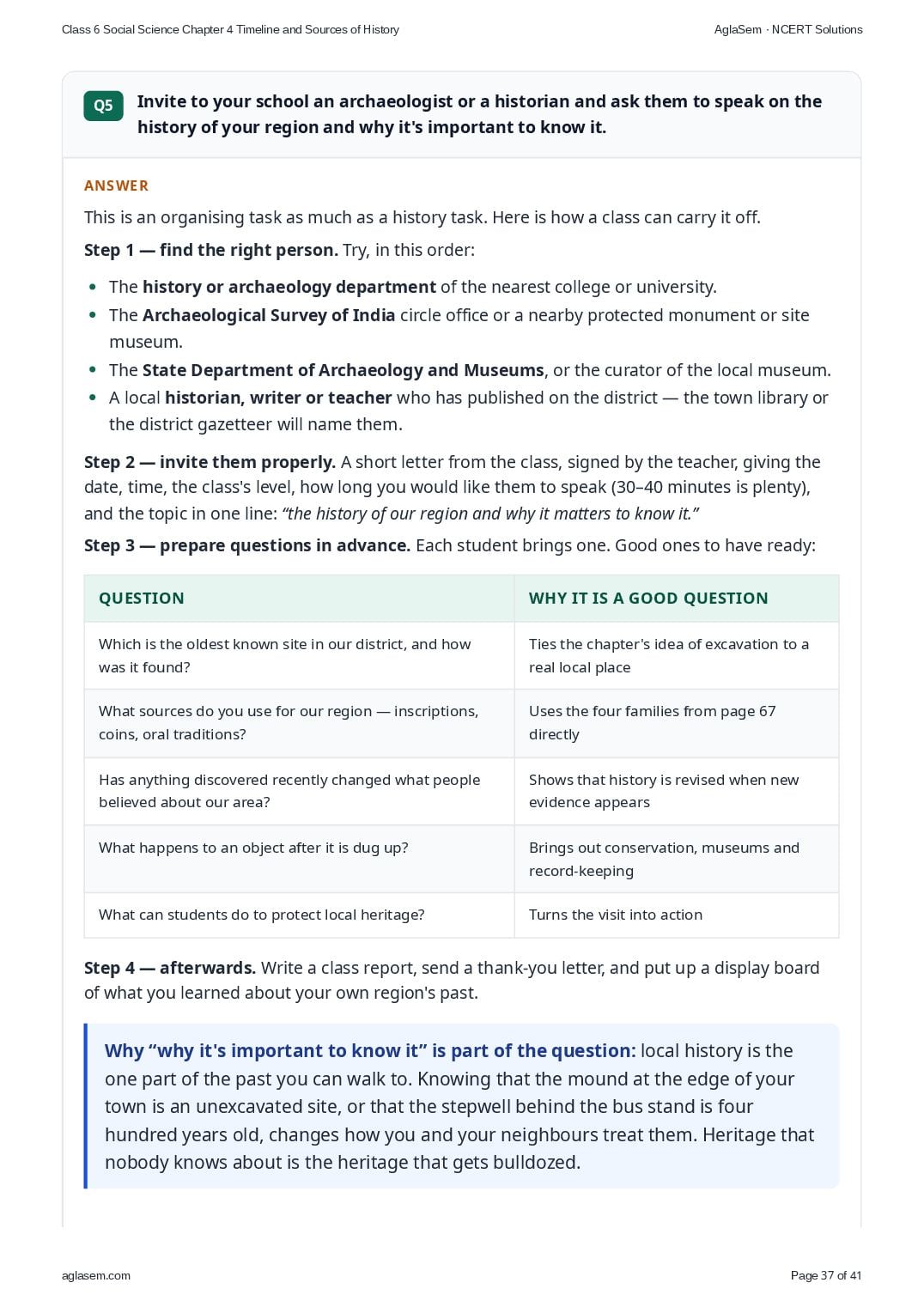
- Invite to your school an archaeologist or a historian and ask them to speak on the history of your region and why it's important to know it.
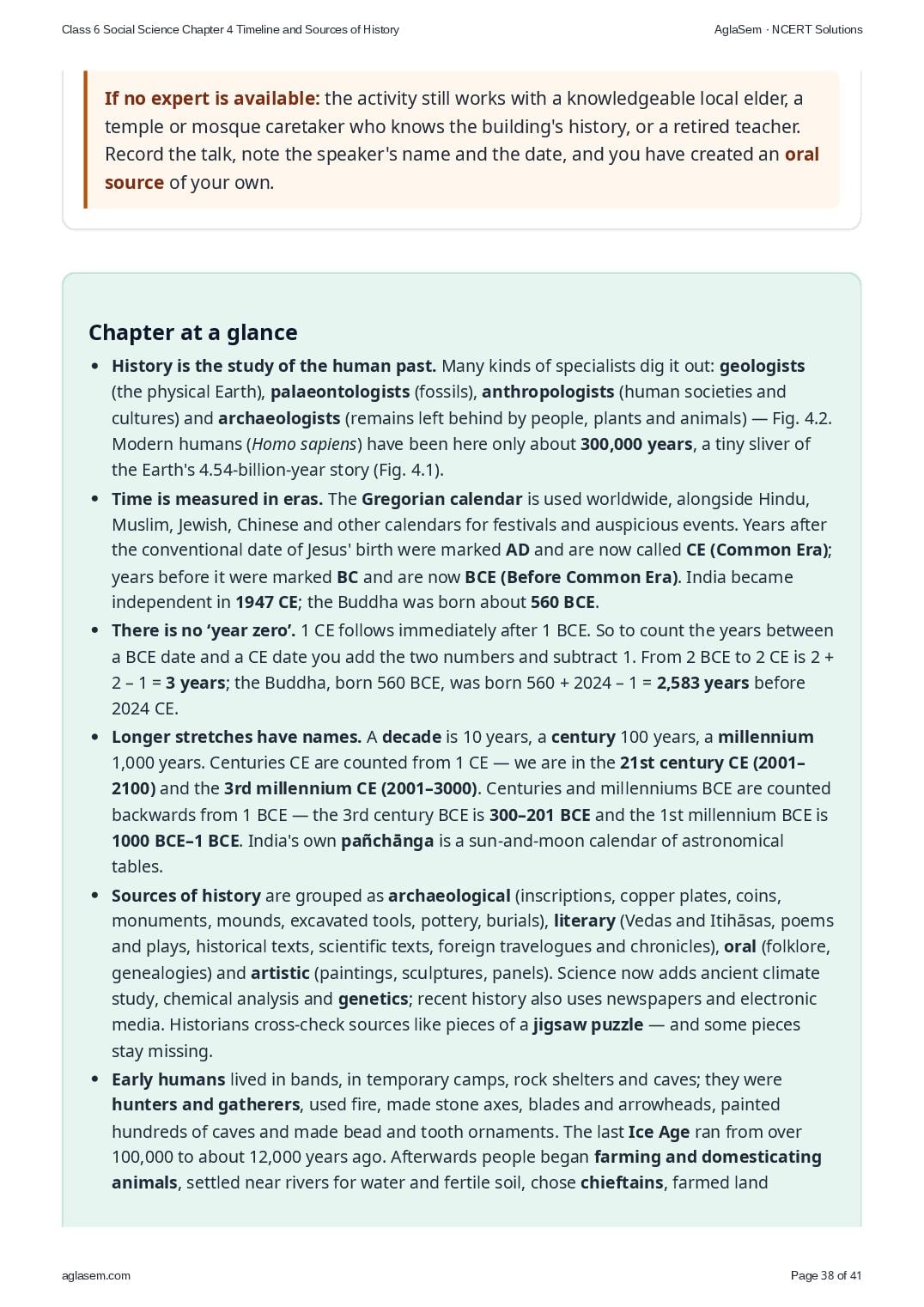
Chapter at a Glance
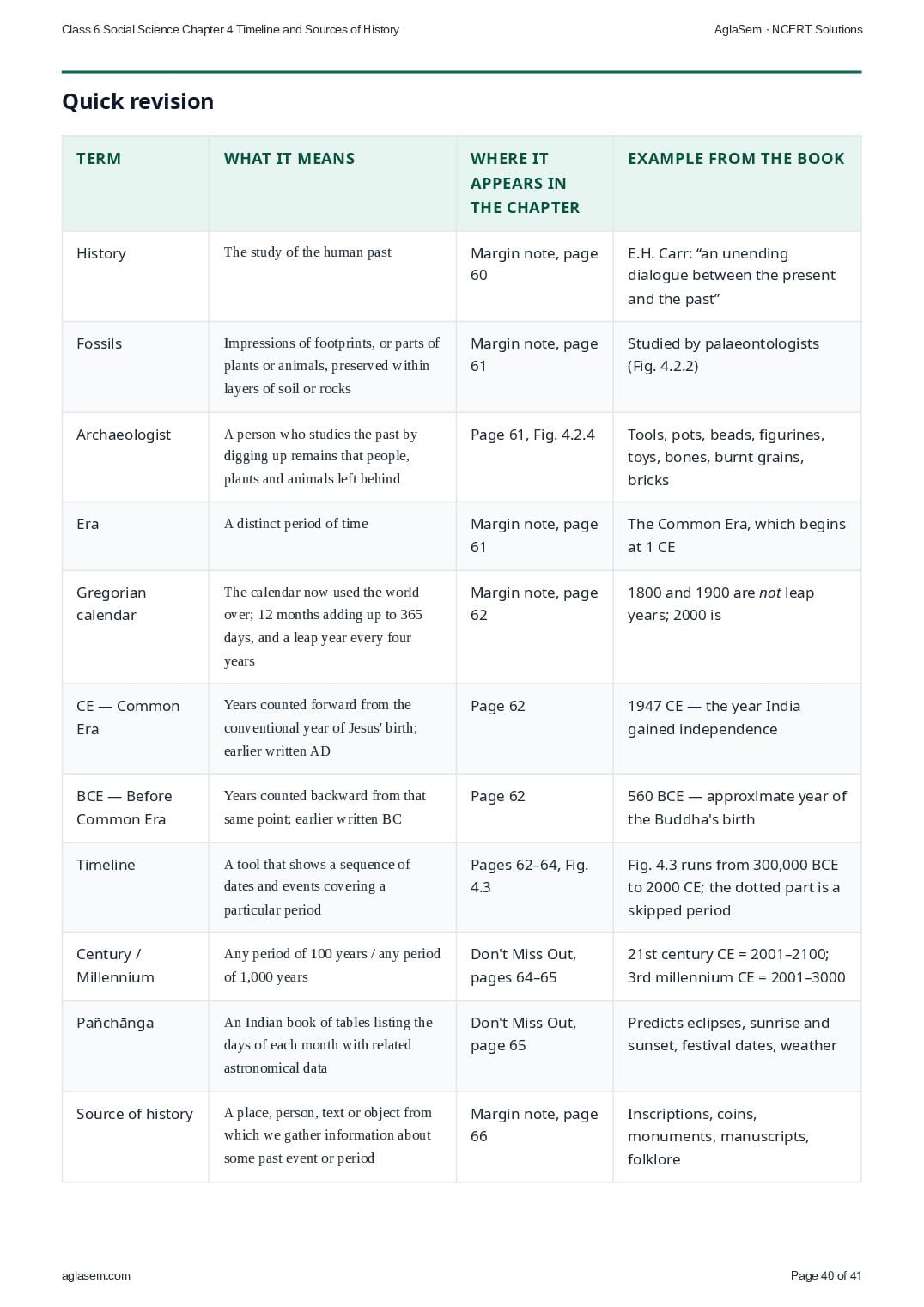
- History is the study of the human past. Many kinds of specialists dig it out: geologists (the physical Earth), palaeontologists (fossils), anthropologists (human societies and cultures) and archaeologists (remains left behind by people, plants and animals) — Fig. 4.2. Modern humans ( Homo sapiens ) have been here only about 300,000 years , a tiny sliver of the Earth's 4.54-billion-year story (Fig. 4.1).
- Time is measured in eras. The Gregorian calendar is used worldwide, alongside Hindu, Muslim, Jewish, Chinese and other calendars for festivals and auspicious events. Years after the conventional date of Jesus' birth were marked AD and are now called CE (Common Era) ; years before it were marked BC and are now BCE (Before Common Era) . India became independent in 1947 CE ; the Buddha was born about 560 BCE .
- There is no ‘year zero’. 1 CE follows immediately after 1 BCE. So to count the years between a BCE date and a CE date you add the two numbers and subtract 1 . From 2 BCE to 2 CE is 2 + 2 – 1 = 3 years ; the Buddha, born 560 BCE, was born 560 + 2024 – 1 = 2,583 years before 2024 CE.
- Longer stretches have names. A decade is 10 years, a century 100 years, a millennium 1,000 years. Centuries CE are counted from 1 CE — we are in the 21st century CE (2001–2100) and the 3rd millennium CE (2001–3000) . Centuries and millenniums BCE are counted backwards from 1 BCE — the 3rd century BCE is 300–201 BCE and the 1st millennium BCE is 1000 BCE–1 BCE . India's own pañchānga is a sun-and-moon calendar of astronomical tables.
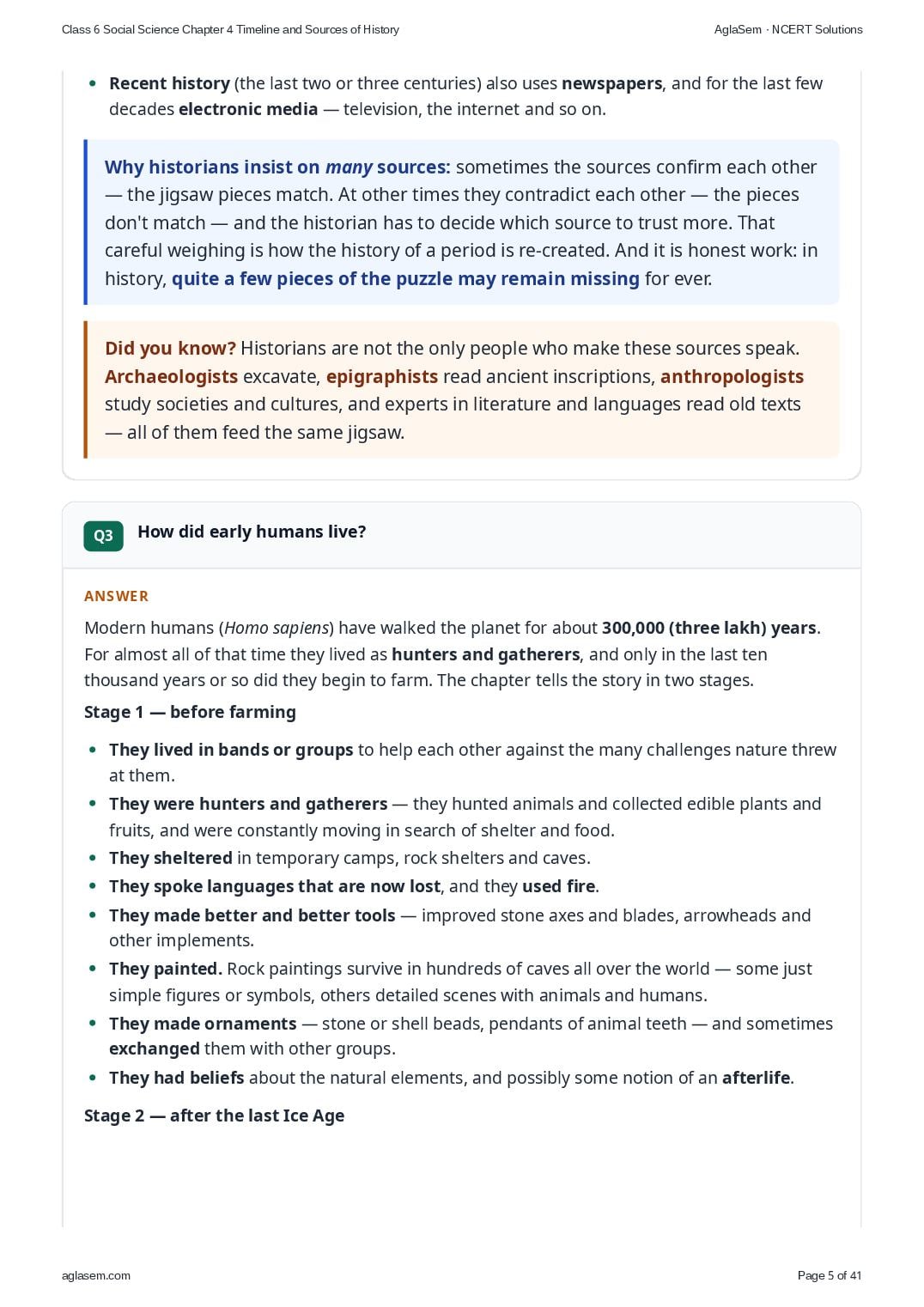
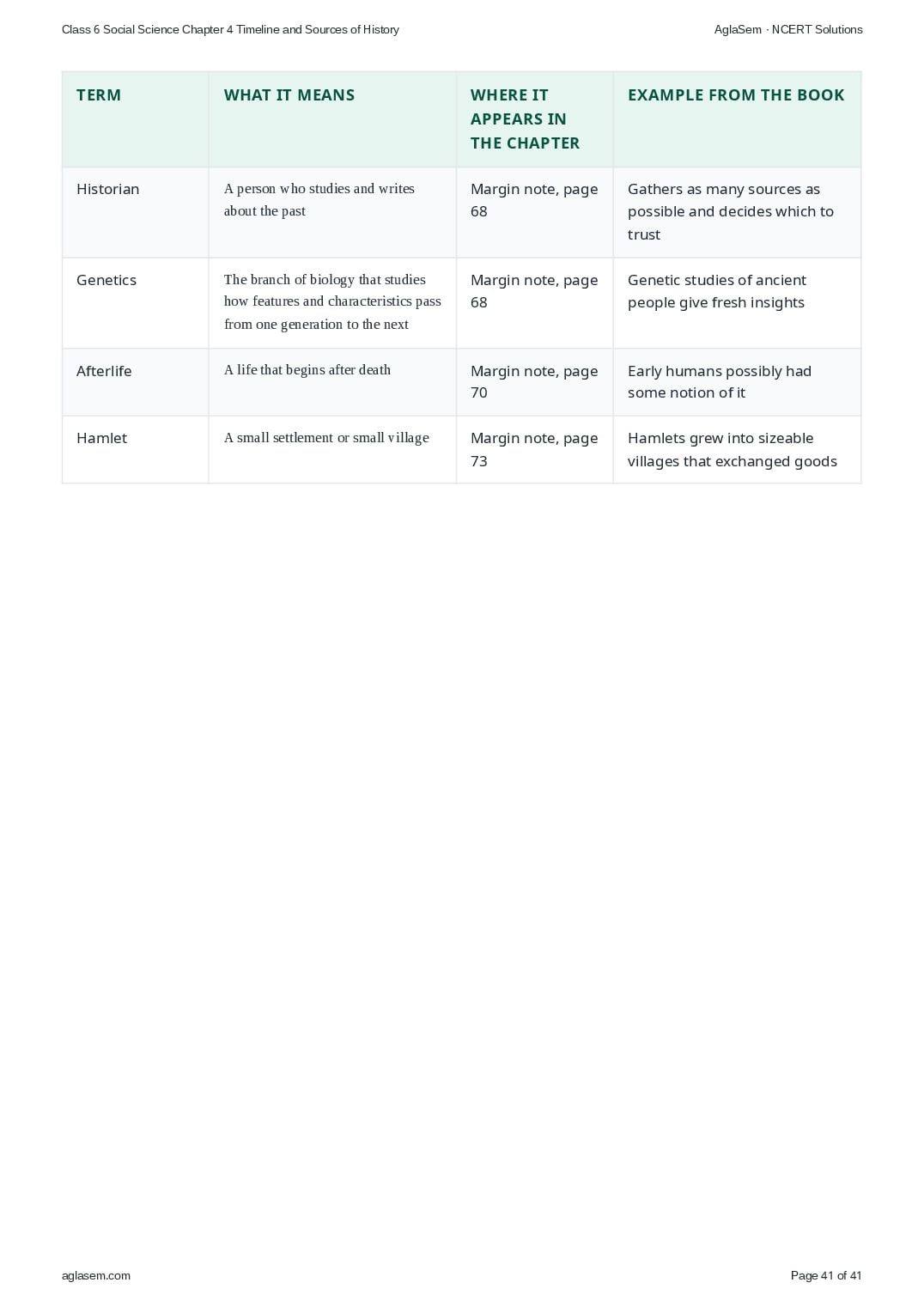
- Sources of history are grouped as archaeological (inscriptions, copper plates, coins, monuments, mounds, excavated tools, pottery, burials), literary (Vedas and Itihāsas, poems and plays, historical texts, scientific texts, foreign travelogues and chronicles), oral (folklore, genealogies) and artistic (paintings, sculptures, panels). Science now adds ancient climate study, chemical analysis and genetics ; recent history also uses newspapers and electronic media. Historians cross-check sources like pieces of a jigsaw puzzle — and some pieces stay missing.
- Early humans lived in bands, in temporary camps, rock shelters and caves; they were hunters and gatherers , used fire, made stone axes, blades and arrowheads, painted hundreds of caves and made bead and tooth ornaments. The last Ice Age ran from over 100,000 to about 12,000 years ago. Afterwards people began farming and domesticating animals , settled near rivers for water and fertile soil, chose chieftains , farmed land collectively, and grew from hamlets into villages and small towns with pottery and metal — copper first, iron later .
How to Download NCERT Solutions for Class 6 Social Science Chapter 4 PDF
Follow these simple steps to get the Timeline and Sources of History questions-and-answers PDF from Exploring Society India and Beyond.
- Search NCERT Solutions for Class 6 Social Science Chapter 4 aglasem and open this page.
- Read the exercise questions with answers for Timeline and Sources of History shown above.
- Click the Download PDF link to save the Timeline and Sources of History solutions to your device.
NCERT Solutions for Class 6 Social Science – All Chapters
There are more chapters to study besides Timeline and Sources of History in Social Science. Here are the NCERT Solutions for all chapters of Class 6 Social Science.
- Chapter 1 Locating Places on the Earth
- Chapter 2 Oceans and Continents
- Chapter 3 Landforms and Life
- Chapter 4 Timeline and Sources of History
- Chapter 5 India That Is Bharat
- Chapter 6 the Beginnings of Indian Civilisation
- Chapter 7 India’s Cultural Roots
- Chapter 8 Unity in Diversity or Many in the One
- Chapter 9 Family and Community
- Chapter 10 Grassroots Democracy part 1 Governance
- Chapter 11 Grassroots Democracy part 2 Local Government in Rural Areas
- Chapter 12 Grassroots Democracy part 3 Local Government in Urban Areas
- Chapter 13 the Value of Work
- Chapter 14 Economic Activities Around Us
NCERT Solutions for Class 6 – All Subjects
Just like Chapter 4 of Social Science, you can get the exercise questions with answers for every other subject of Class 6. Here are the NCERT Solutions for all subjects of Class 6.
NCERT Solutions for Class 6 Social Science Chapter 4 – An Overview
The key highlights of this study material are as follows.
| Aspects | Details |
|---|---|
| Class | Class 6 |
| Subject | Social Science |
| Chapter Number | Chapter 4 |
| Chapter Name | Timeline and Sources of History |
| Book Name | Exploring Society India and Beyond |
| Book By | NCERT (National Council of Educational Research and Training) |
| Educational Resource Here | NCERT Solutions of Class 6 Social Science Chapter 4 for all exercises |
| More Questions Answers of This Subject | NCERT Solutions for Class 6 Social Science |
| Download Book Chapter | NCERT Book Class 6 Social Science |
| All Questions Answers For This Class | NCERT Solutions for Class 6 |
| Complete Solutions | NCERT Solutions |
NCERT Solutions for Class 6 Social Science Chapter 4 Timeline and Sources of History – FAQs
What are the NCERT Solutions for Class 6 Social Science Chapter 4 Timeline and Sources of History?
They are the complete, step-by-step answers to all the exercise and in-text questions of Chapter 4 Timeline and Sources of History from the NCERT Class 6 Social Science textbook Exploring Society India and Beyond, written by experts as per the latest NCERT syllabus.
How can I download the Class 6 Social Science Chapter 4 solutions PDF for free?
Open this page on aglasem, read the Timeline and Sources of History questions with answers, and click the “Download Solutions PDF” link. The Class 6 Social Science Chapter 4 NCERT Solutions PDF is completely free to download.
Are these NCERT Solutions as per the latest 2026-27 syllabus?
Yes. The NCERT Solutions for Class 6 Social Science Chapter 4 are based on the latest NCERT textbook Exploring Society India and Beyond and the current 2026-27 CBSE syllabus, so the questions and answers match what you study in class.
Where can I get NCERT Solutions for the other chapters of Class 6 Social Science?
You can find the answers to every chapter on the NCERT Solutions for Class 6 Social Science page, and solutions for every subject on the NCERT Solutions for Class 6 page.
How do NCERT Solutions help in exam preparation?
They show the correct method to solve each question, help you write answers the way they are expected in exams, let you check and correct your own work, and save revision time — which together improve your marks in Class 6 Social Science.
If you have any queries on NCERT Solutions for Class 6 Social Science Chapter 4 Timeline and Sources of History, then please ask in the comments below.