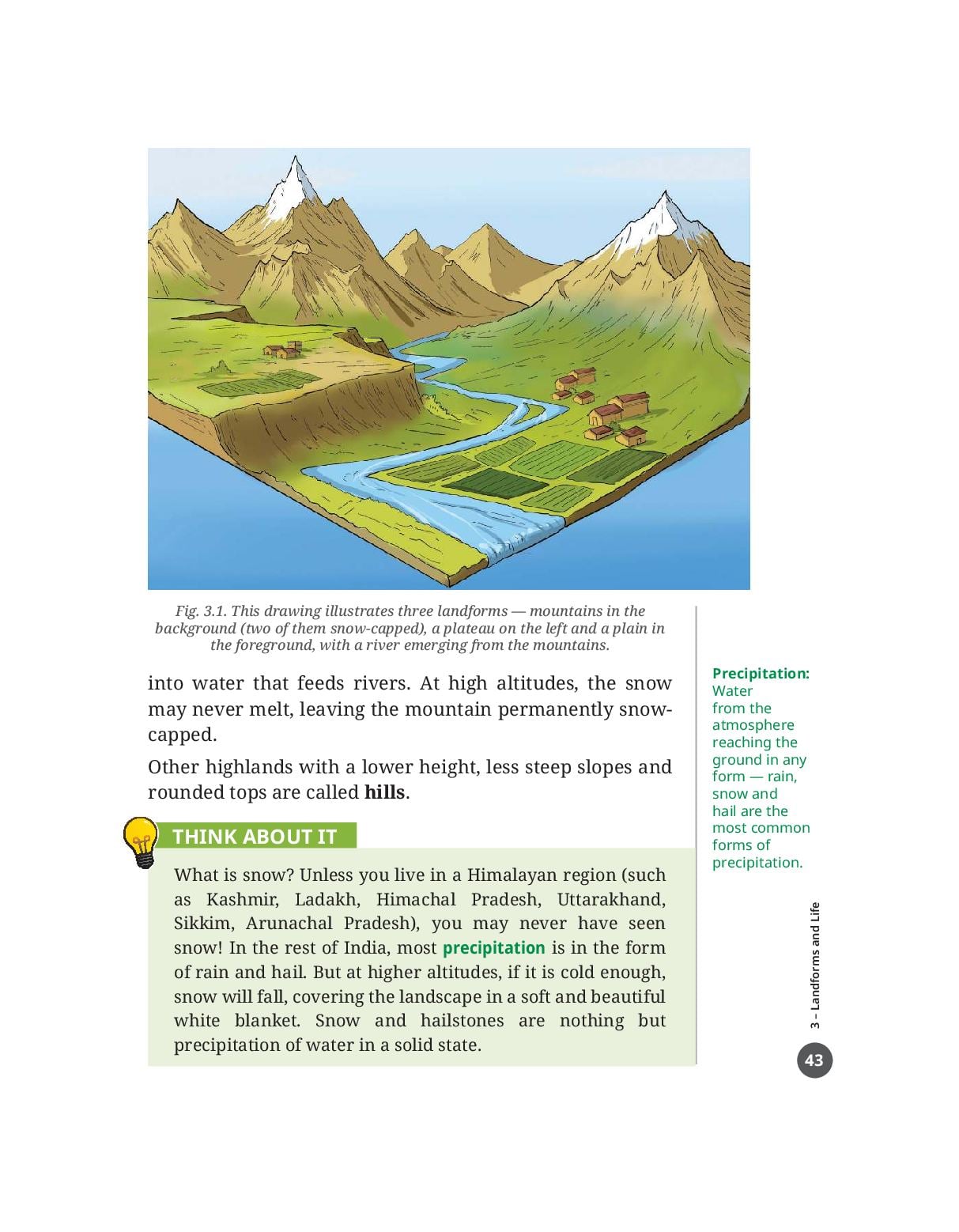
Download Landforms and Life – NCERT Class 6 Social Science Chapter 3 PDF from the new NCERT Class 6 Social Science book Exploring Society: India and Beyond (2026-27). Read the chapter online or download the free PDF. A landform is a physical feature on the surface of the Earth. Landforms take shape over millions of years and fall into three broad categories — mountains, plateaus and plains (Fig. 3.1). Each has its own climate, its own flora and fauna, and its…
Landforms and Life PDF – Chapter 3 of Exploring Society: India and Beyond
Read the chapter online or download the PDF.
| Chapter | Download | |
|---|---|---|
| Chapter 3 PDF | Landforms and Life | View PDF |
| Full book | NCERT Class 6 Social Science – Exploring Society: India and Beyond | View Book |
Read Online
What Is in Landforms and Life? (Class 6 Social Science Chapter 3)
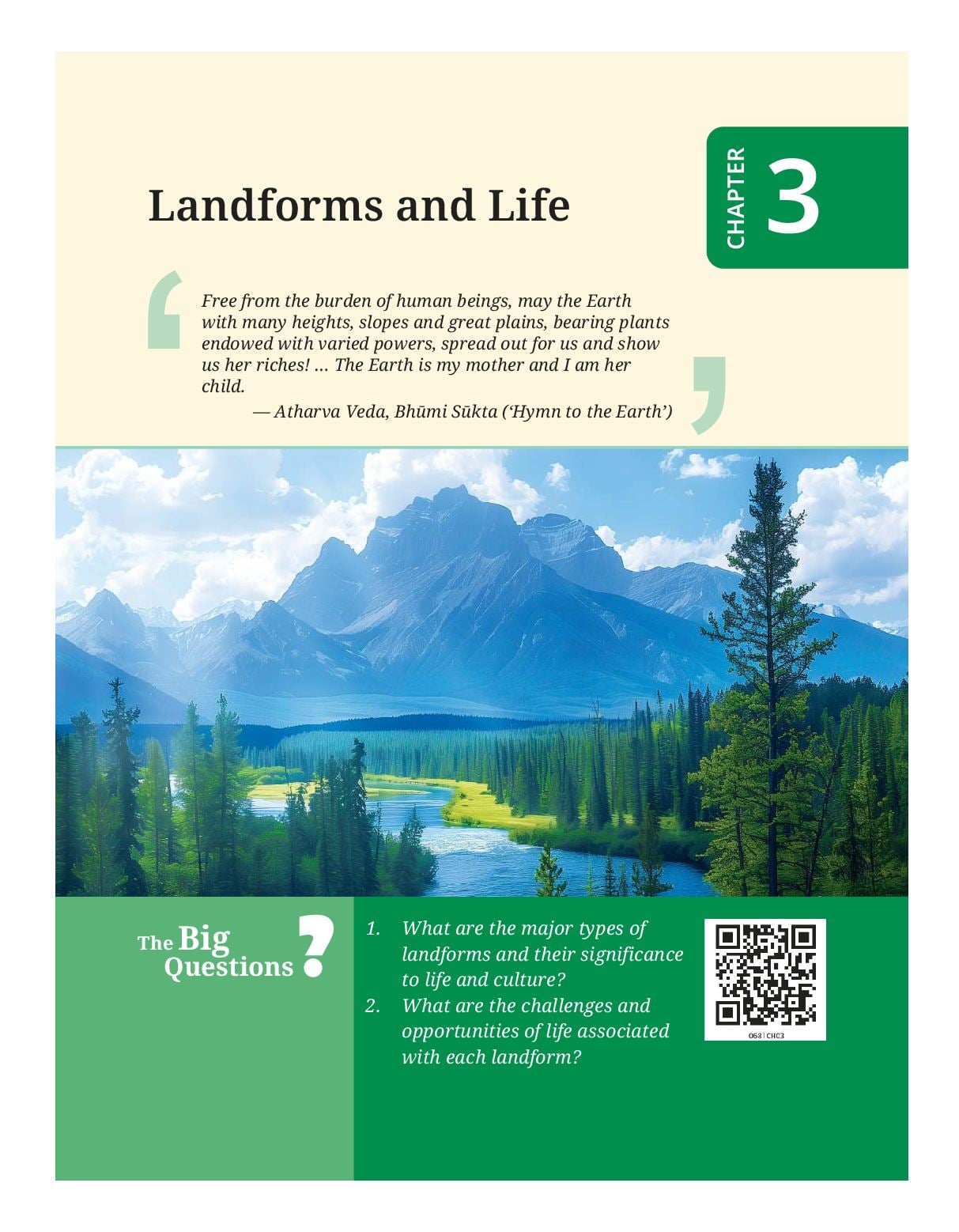
- A landform is a physical feature on the surface of the Earth. Landforms take shape over millions of years and fall into three broad categories — mountains, plateaus and plains (Fig. 3.1). Each has its own climate, its own flora and fauna, and its own way of life.
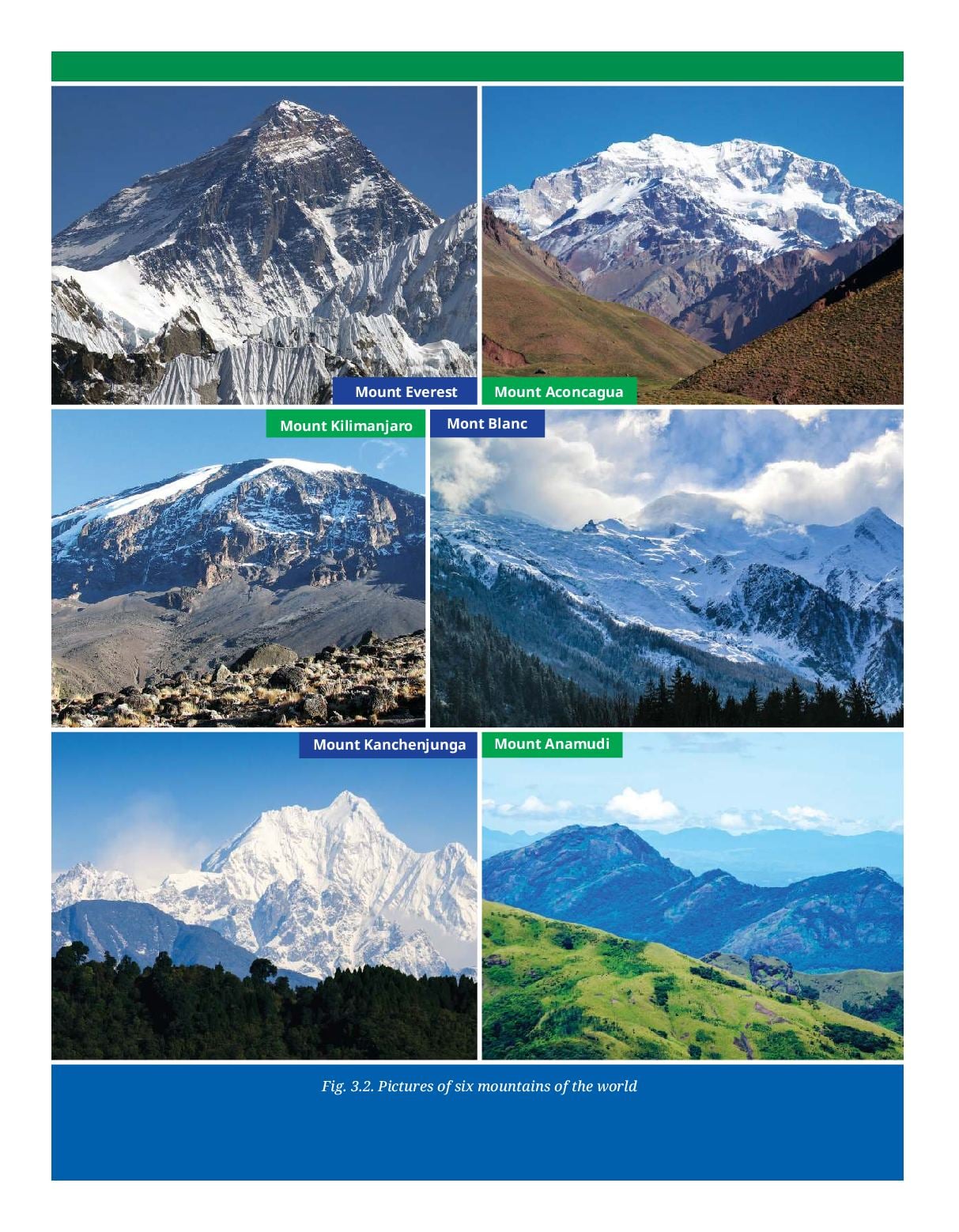
- Mountains are much higher than the land around them, with a broad base, steep slopes and a narrow summit. Young mountains like the Himalayas have tall, sharp peaks and are still rising; old ones like the Aravalli Range have been rounded by erosion. Lower highlands with gentle slopes and rounded tops are hills.
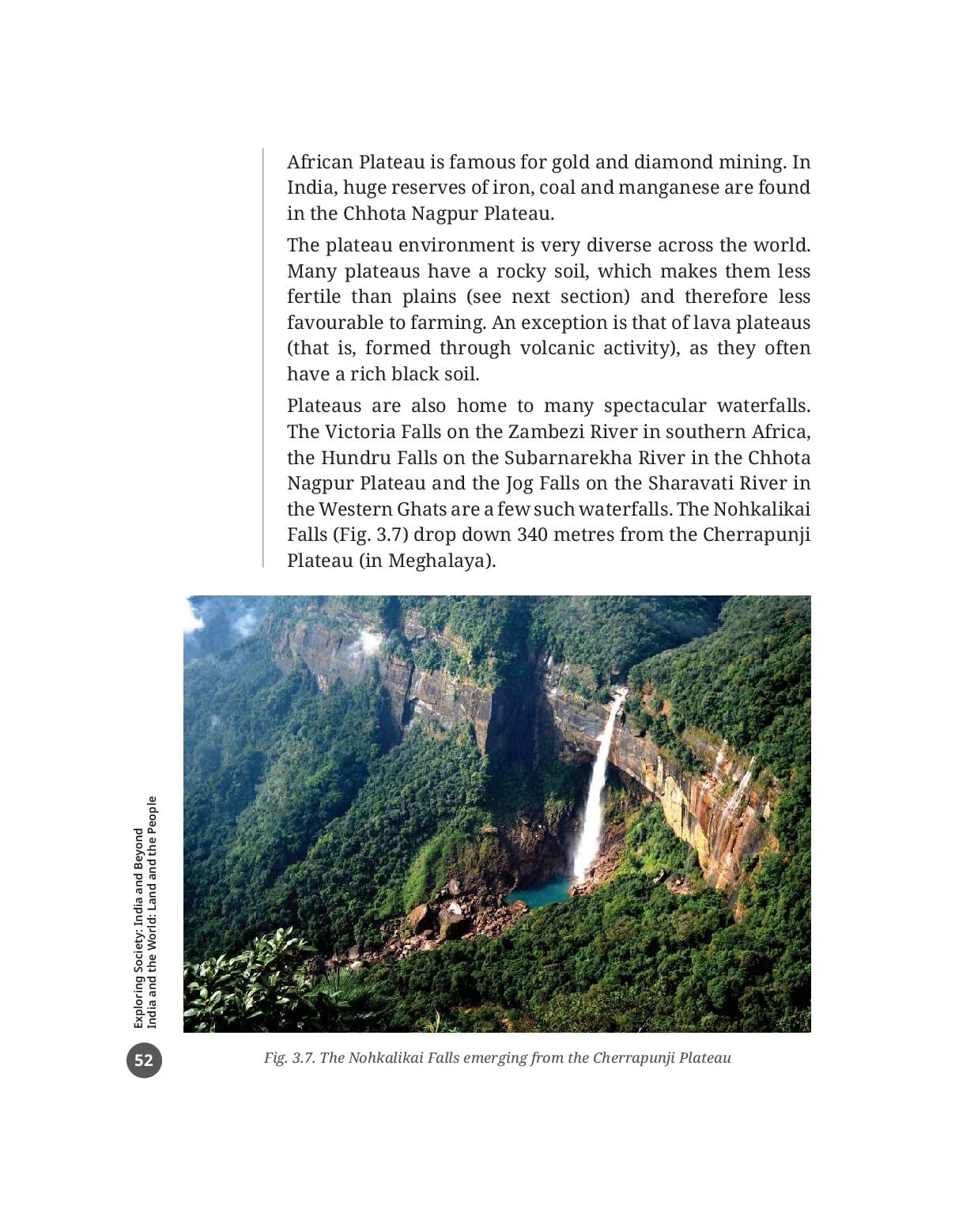
- A plateau rises above the surrounding land and has a more or less flat top, often with steep sides. Plateaus are ‘storehouses of minerals’ — the Chhota Nagpur Plateau has iron, coal and manganese — and they carry spectacular waterfalls such as Jog, Hundru and Nohkalikai (340 m).
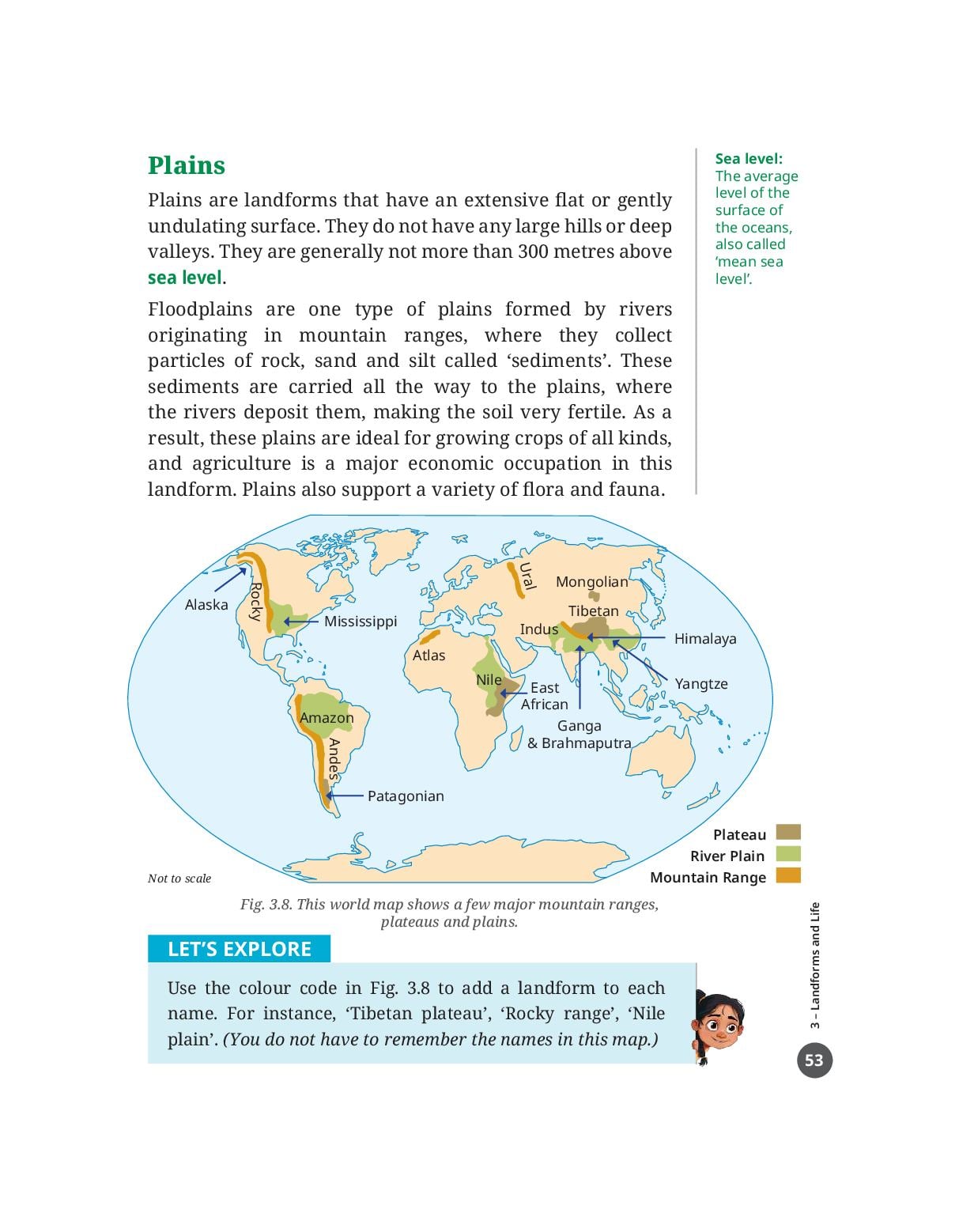
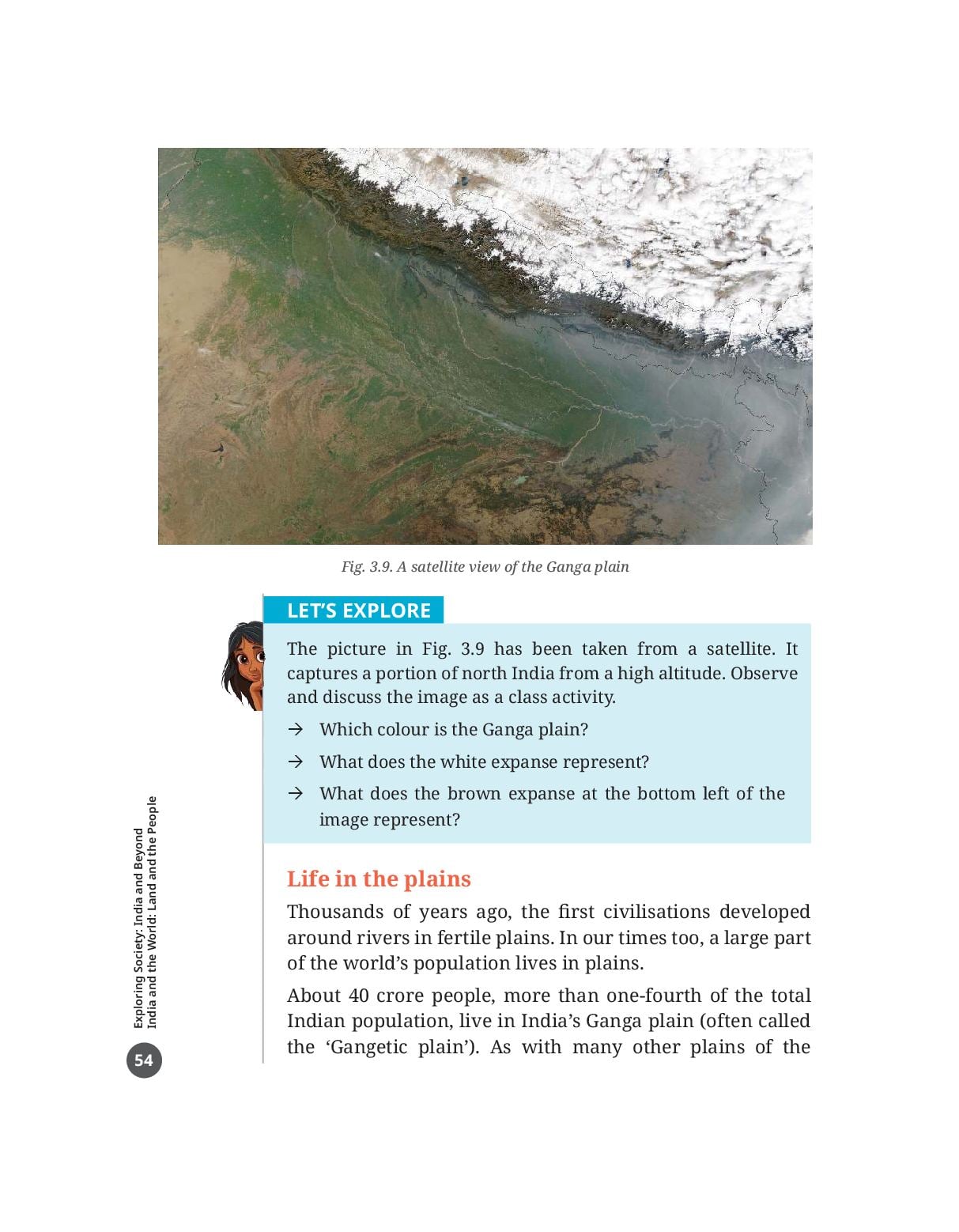
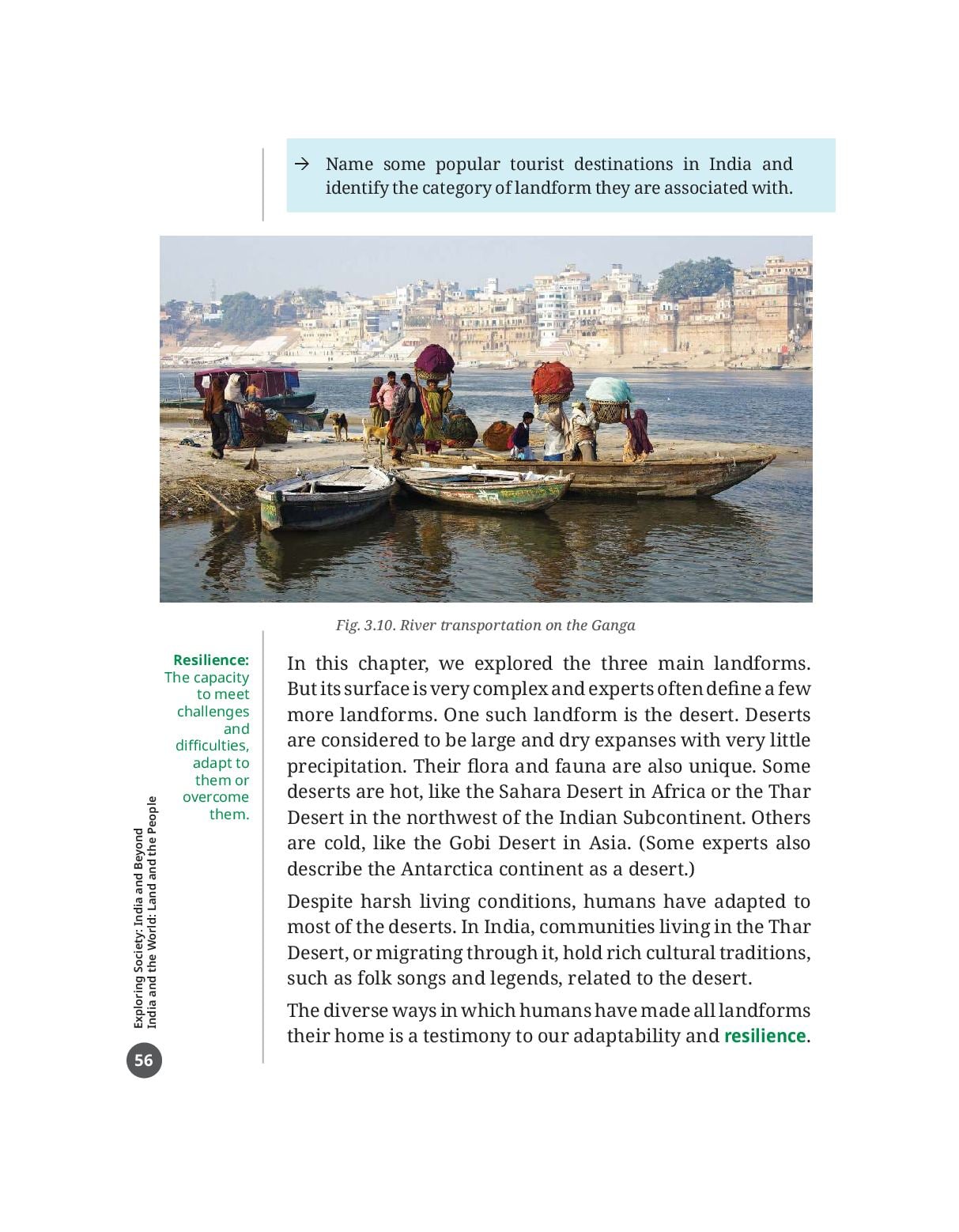
- Plains are extensive, flat or gently undulating, and generally not more than 300 metres above sea level. Rivers build floodplains by depositing sediments, which makes the soil very fertile. That is why the first civilisations grew in plains and why about 40 crore people — more than a fourth of India — live in the Ganga plain.
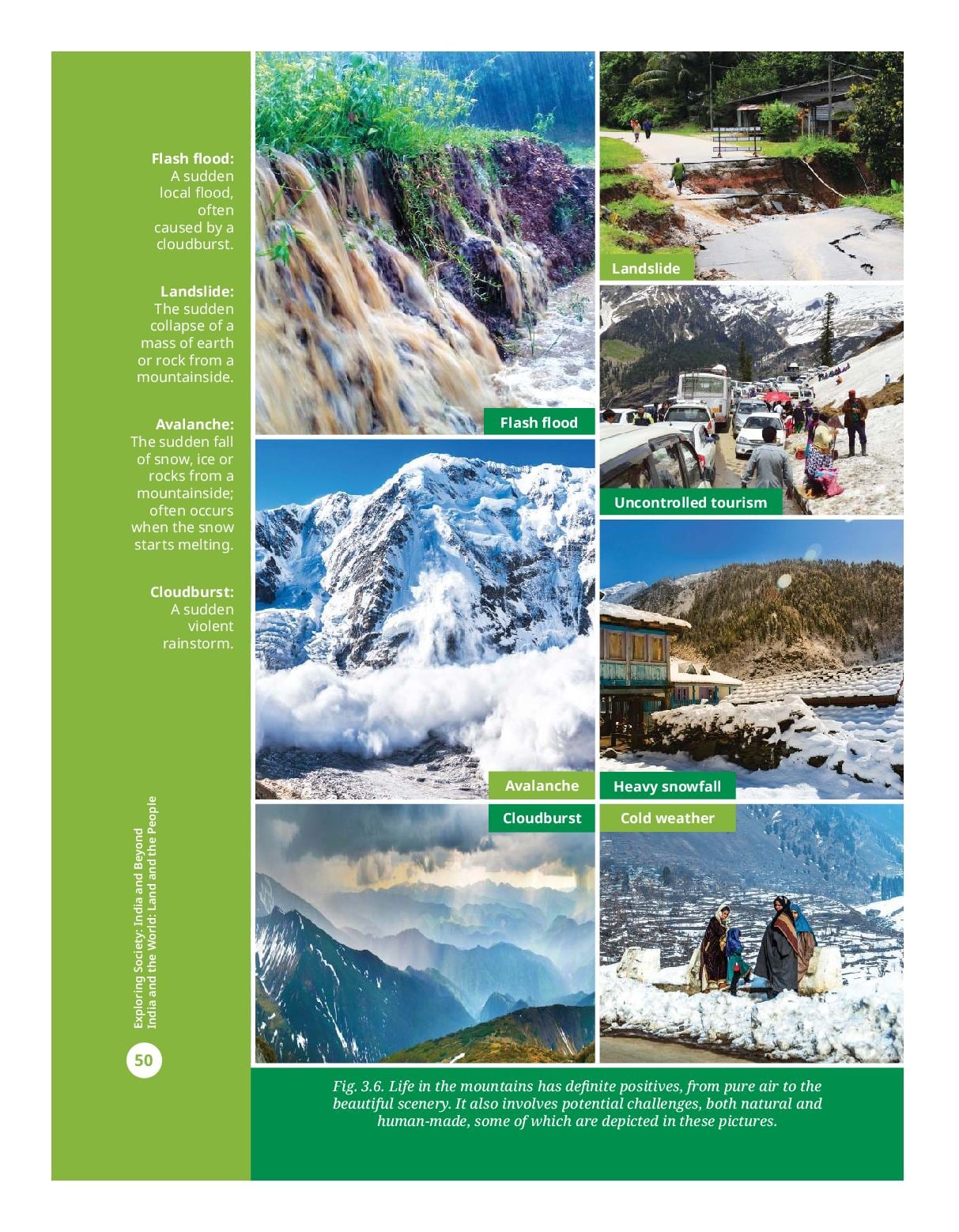
- Every landform offers challenges and opportunities together. Mountains give pure air, tourism and pilgrimage but bring landslides, avalanches, flash floods and cold; plateaus give minerals but often rocky, less fertile soil; plains give rich harvests and easy travel but face high population, pollution and falling groundwater.
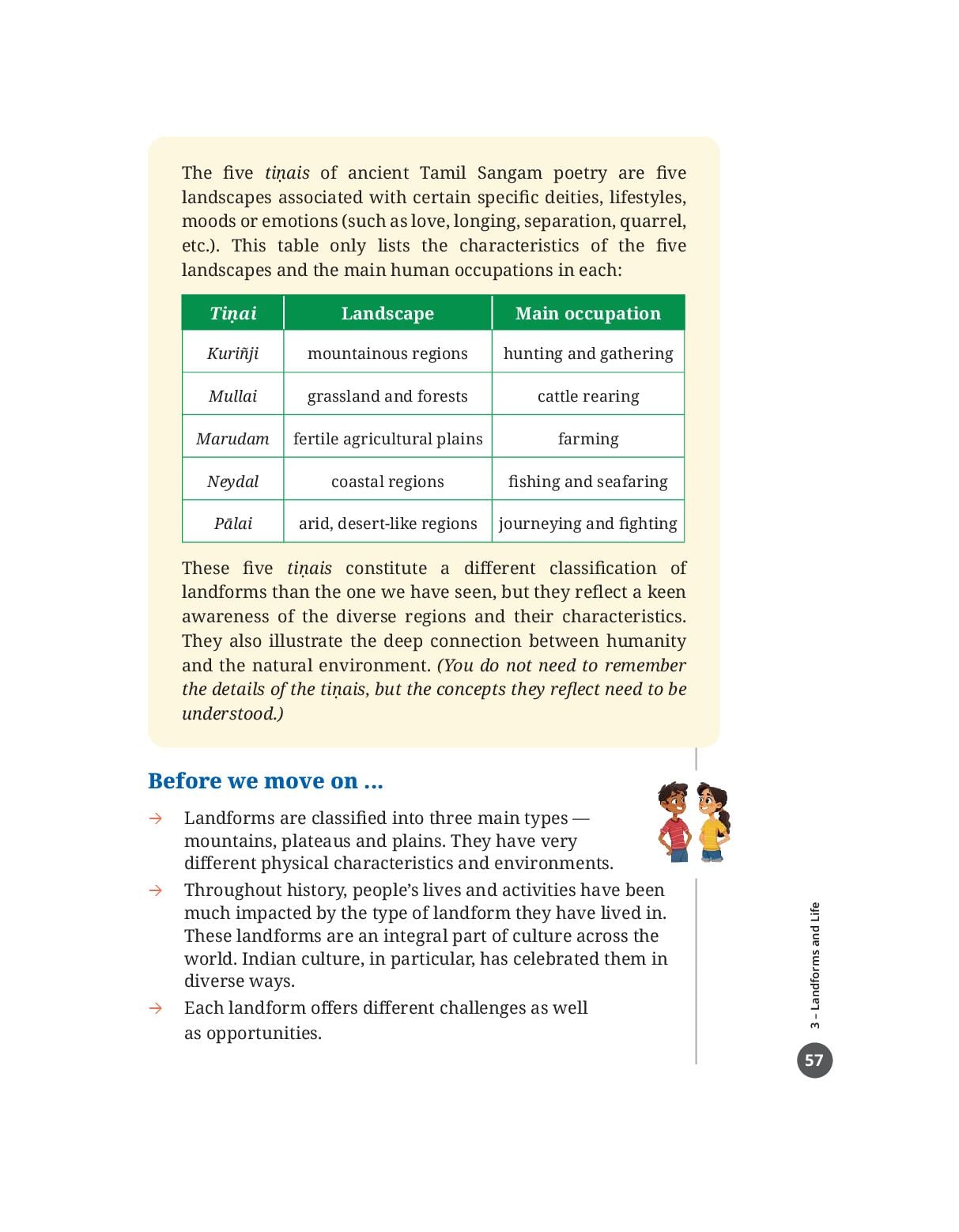
- Landforms are woven into culture — the Bhūmi Sūkta of the Atharva Veda, Kālidāsa’s Kumārasambhava, the worship of Everest as ‘Chomolungma’ and of Mount Kailash, and the five tiṇais of Tamil Sangam poetry. Experts add more landforms too, such as the desert — hot like the Thar and the Sahara, or cold like the Gobi.
Quick revision – Landforms and Life
| Term | What it means | Where it appears in the chapter | Example |
|---|---|---|---|
| Landform | A physical feature on the surface of the Earth | Page 42, Fig. 3.1 | Mountains, plateaus and plains |
| Altitude | The height of an object above sea level | Margin note, page 42 | The altitude of Mount Everest is 8,848 m |
| Mountain | A landform much higher than the land around it, with a broad base, steep slopes and a narrow summit | Page 42 | Kanchenjunga, between Nepal and Sikkim |
| Hill | A highland lower than a mountain, with less steep slopes and a rounded top | Page 43 | The rounded hills of the Aravalli Range |
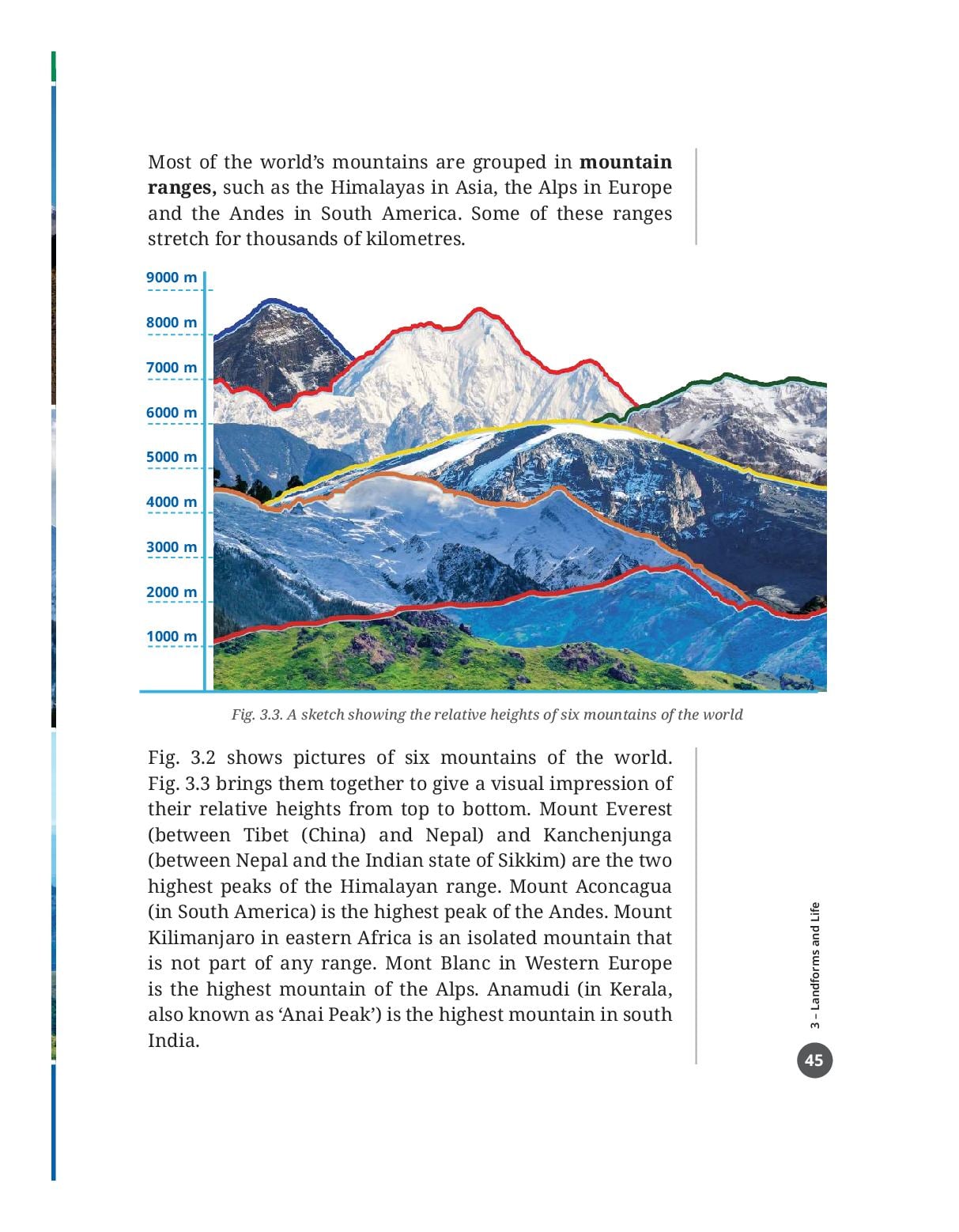
| Mountain range | A connected line or group of mountains | Page 45 | The Himalayas, the Alps, the Andes |
| Precipitation | Water from the atmosphere reaching the ground in any form | Margin note, page 43 | Rain, snow and hail |
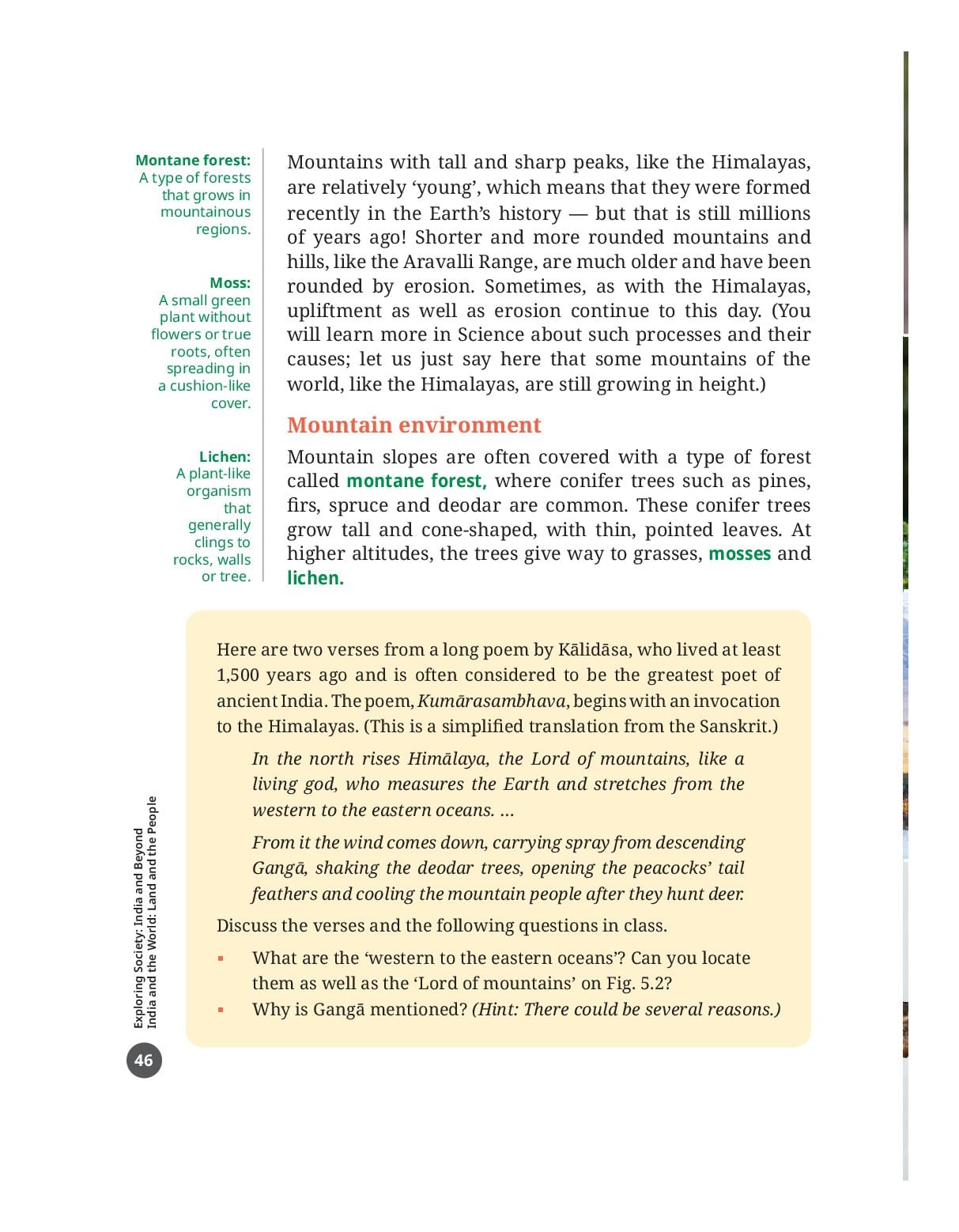
| Montane forest | The type of forest that grows on mountain slopes | Page 46 | Pine, fir, spruce and deodar |
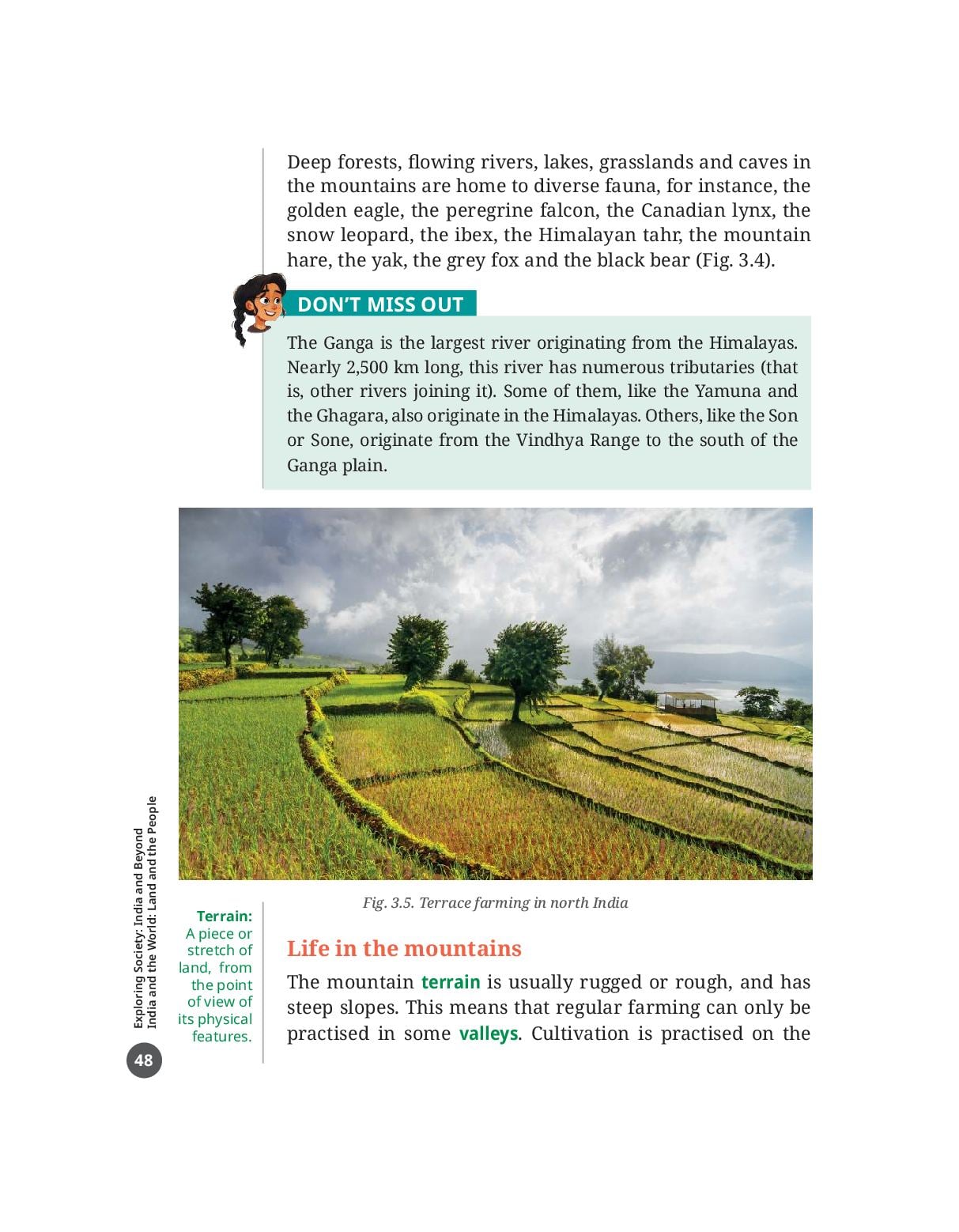
| Terrace farming | Cultivation on steps cut into a slope | Pages 48–49, Fig. 3.5 | Rice terraces in Uttarakhand and the North-East |
| Plateau | A landform that rises above the surrounding land and has a more or less flat top | Page 51 | The Deccan Plateau; the Tibetan Plateau |
| Plain | An extensive flat or gently undulating landform, generally under 300 m above sea level | Page 53 | The Ganga plain |
| Sediments | Particles of rock, sand and silt carried and dropped by a river | Page 53 | The silt that makes the Ganga plain fertile |
| Confluence | The meeting point of two or more rivers | Margin note, page 55 | The Ganga and the Yamuna at Prayagraj |
Old NCERT vs New – Class 6 Social Science
This chapter is from Exploring Society: India and Beyond, the new NCERT Class 6 Social Science book (NCF-SE 2023, used from 2024-25). It replaced the old book “Our Pasts, The Earth Our Habitat and Social and Political Life”, so chapter numbers and names differ from older PDFs.
Solutions and All Chapters
Answers to the exercises and the full chapter list of Exploring Society: India and Beyond:
Landforms and Life – Overview
| Class | Class 6 |
| Subject | Social Science |
| Book | Exploring Society: India and Beyond – new NCERT book |
| Chapter | 3 of 14 – Landforms and Life |
| Book pages | 41 – 58 |
| Edition | NCERT Reprint 2026-27 |
| Session | 2026-27 |
| Free – read online or download |
Class 6 Social Science Chapter 3 – FAQs
Where can I download Landforms and Life Class 6 PDF?
From the download table on this page – the chapter PDF is free, and the full book is linked too.
What is Class 6 Social Science Chapter 3 about?
A landform is a physical feature on the surface of the Earth. Landforms take shape over millions of years and fall into three broad categories — mountains, plateaus and plains (Fig. 3.1). Each has its own climate, its own flora and fauna, and its own way of life.
Is Landforms and Life from the new NCERT Class 6 Social Science book?
Yes. It is chapter 3 of exploring society: india and beyond, the new NCERT Class 6 Social Science book for 2026-27.
Is this the latest NCERT edition for 2026-27?
Yes – the PDF is NCERT’s latest edition for the 2026-27 session.
Where are the NCERT Solutions for Class 6 Social Science Chapter 3?
Open the NCERT Solutions link above for answers to the exercise questions.