Download India, That Is Bharat – NCERT Class 6 Social Science Chapter 5 PDF from the new NCERT Class 6 Social Science book Exploring Society: India and Beyond (2026-27). Read the chapter online or download the free PDF. India is a modern nation, but this land is far older than the nation. Today India has defined borders, defined states and a known population. Five hundred, two thousand or five thousand years ago it looked very different. The region as a whole — the…
India, That Is Bharat PDF – Chapter 5 of Exploring Society: India and Beyond
Read the chapter online or download the PDF.
| Chapter | Download | |
|---|---|---|
| Chapter 5 PDF | India, That Is Bharat | View PDF |
| Full book | NCERT Class 6 Social Science – Exploring Society: India and Beyond | View Book |
Read Online
What Is in India, That Is Bharat? (Class 6 Social Science Chapter 5)
- India is a modern nation, but this land is far older than the nation. Today India has defined borders, defined states and a known population. Five hundred, two thousand or five thousand years ago it looked very different. The region as a whole — the part of the world we call the Indian Subcontinent — has had many different names and shifting boundaries, and we learn about them from ancient texts, from the accounts of travellers and pilgrims, and from inscriptions.
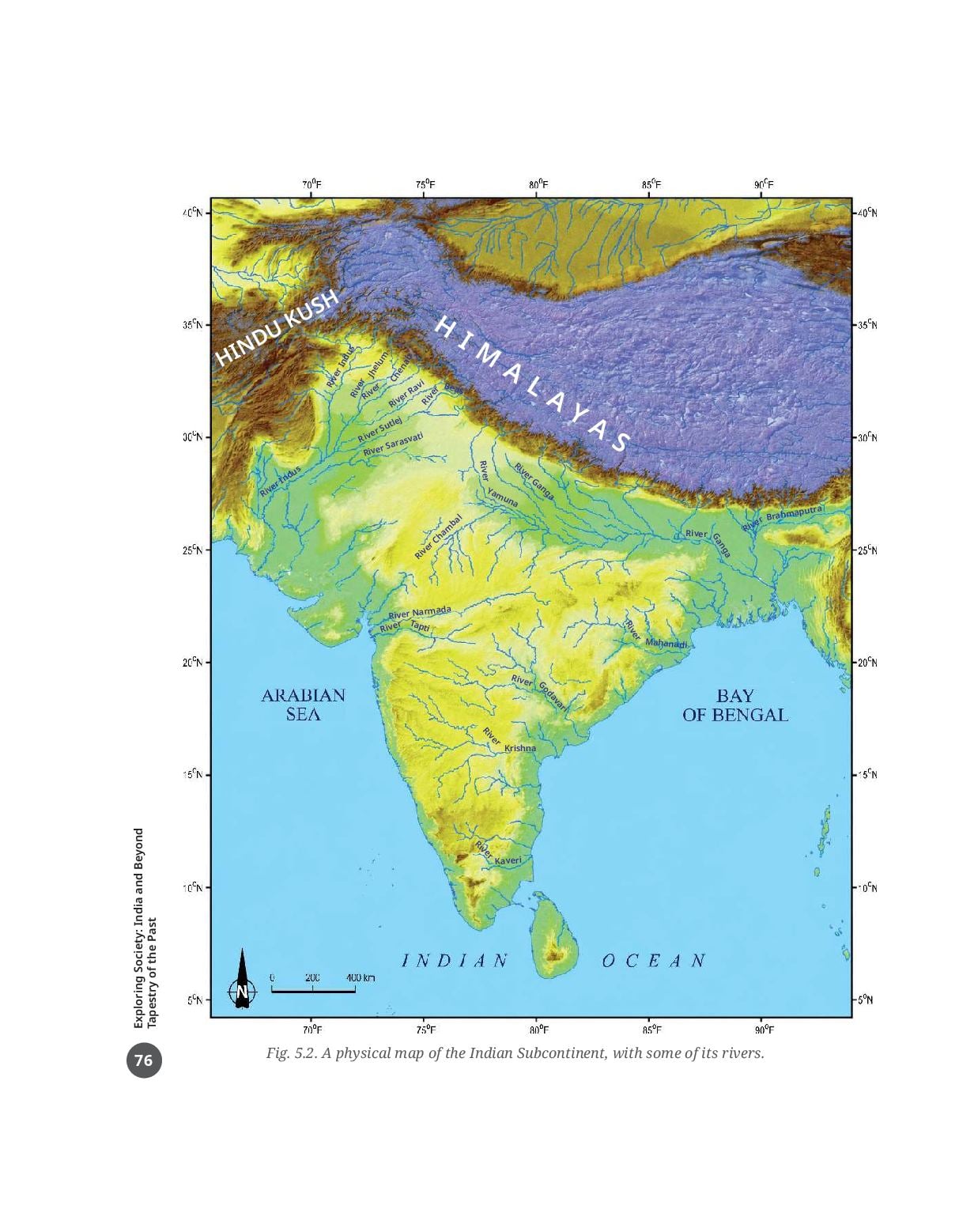
- The Subcontinent has clear natural boundaries (Fig. 5.2, page 76). In the north stand the Himalayas; in the north-west, the Hindu Kush. The Arabian Sea lies to the west, the Bay of Bengal to the east and the Indian Ocean to the south. Between them lie the great river systems the map names — the Indus with the Jhelum, Chenab, Ravi, Beas and Sutlej, the dried-up Sarasvati, the Ganga, Yamuna, Chambal and Brahmaputra, the westward-flowing Narmada and Tapti, and the eastward-flowing Mahanadi, Godavari, Krishna and Kaveri.
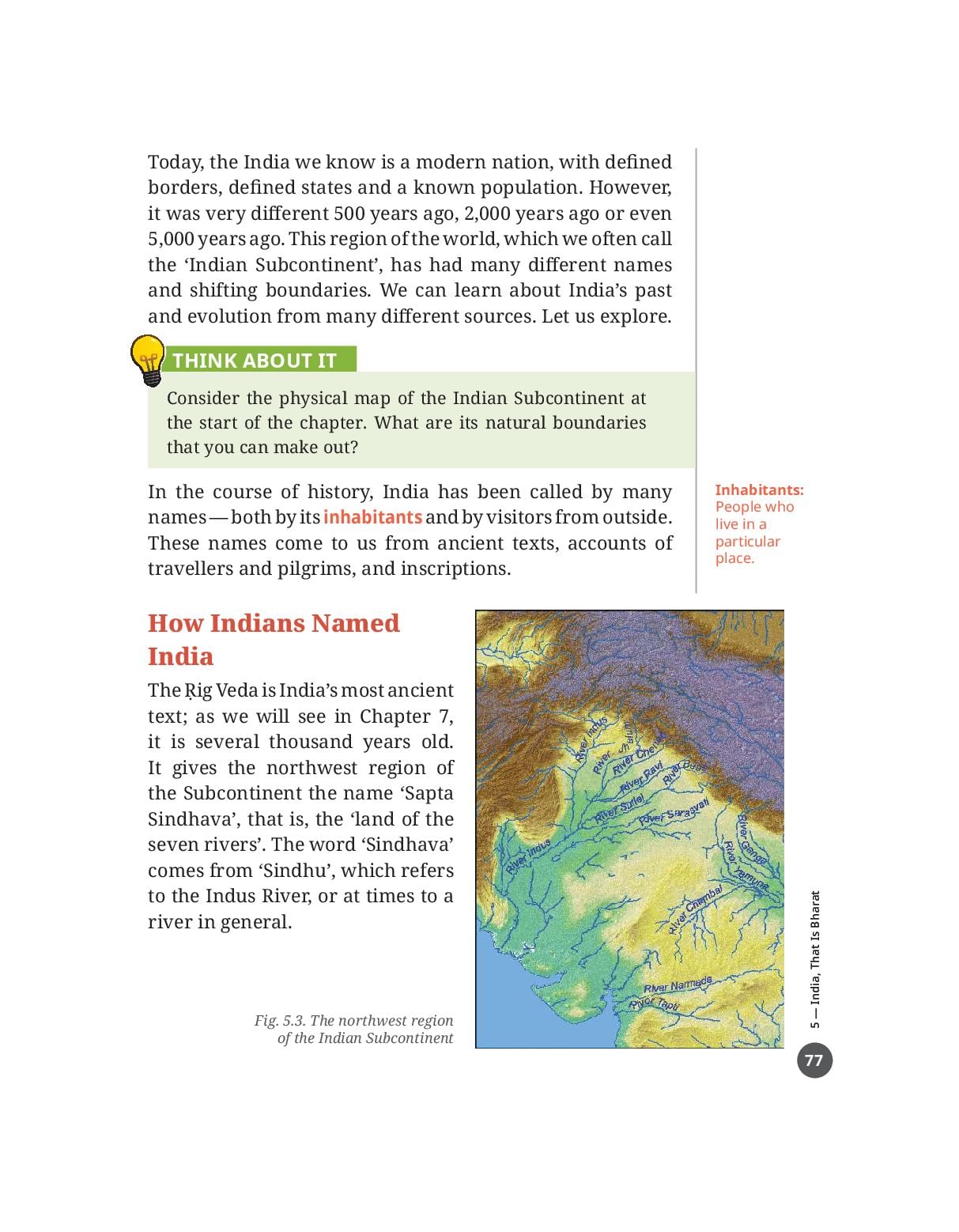
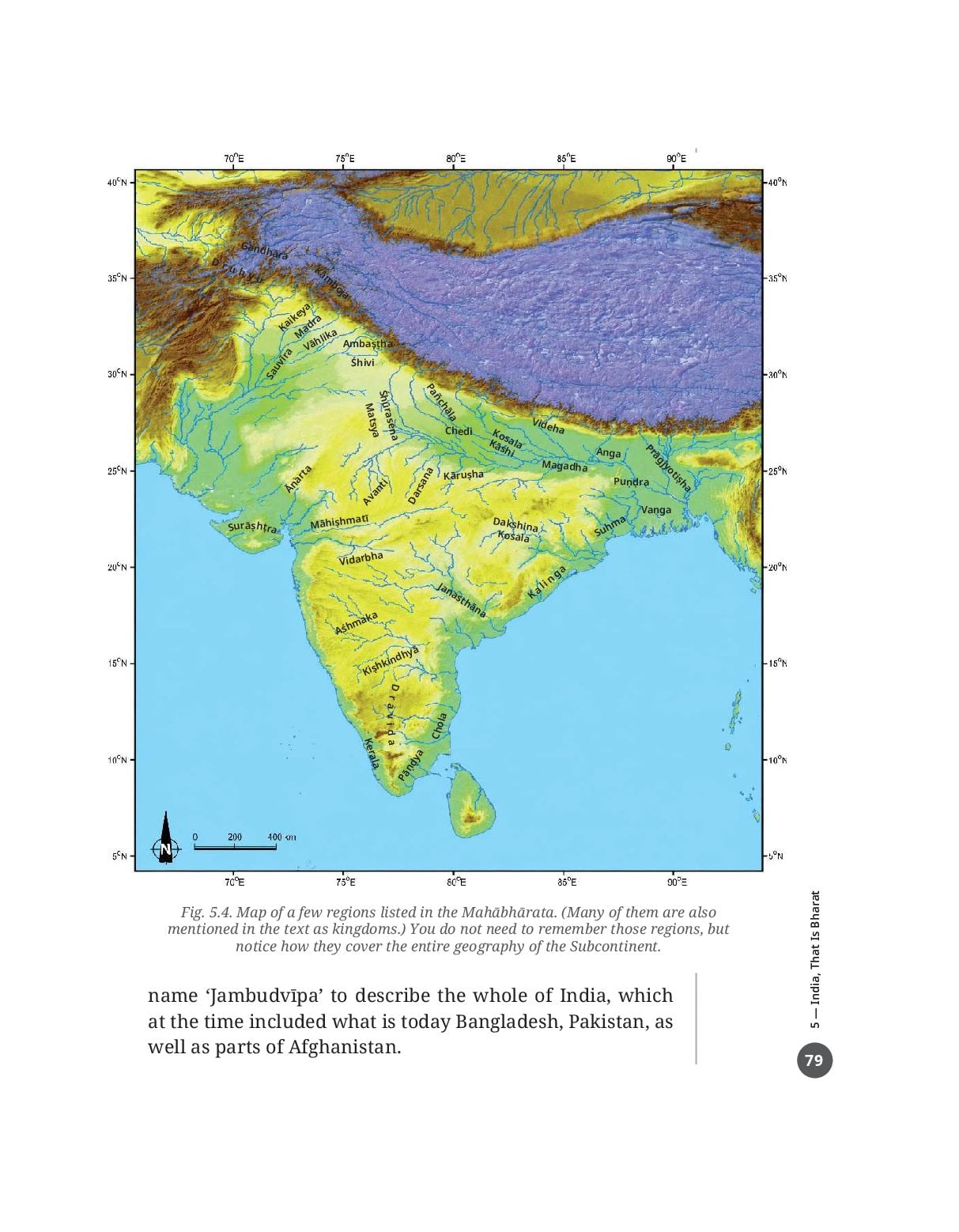
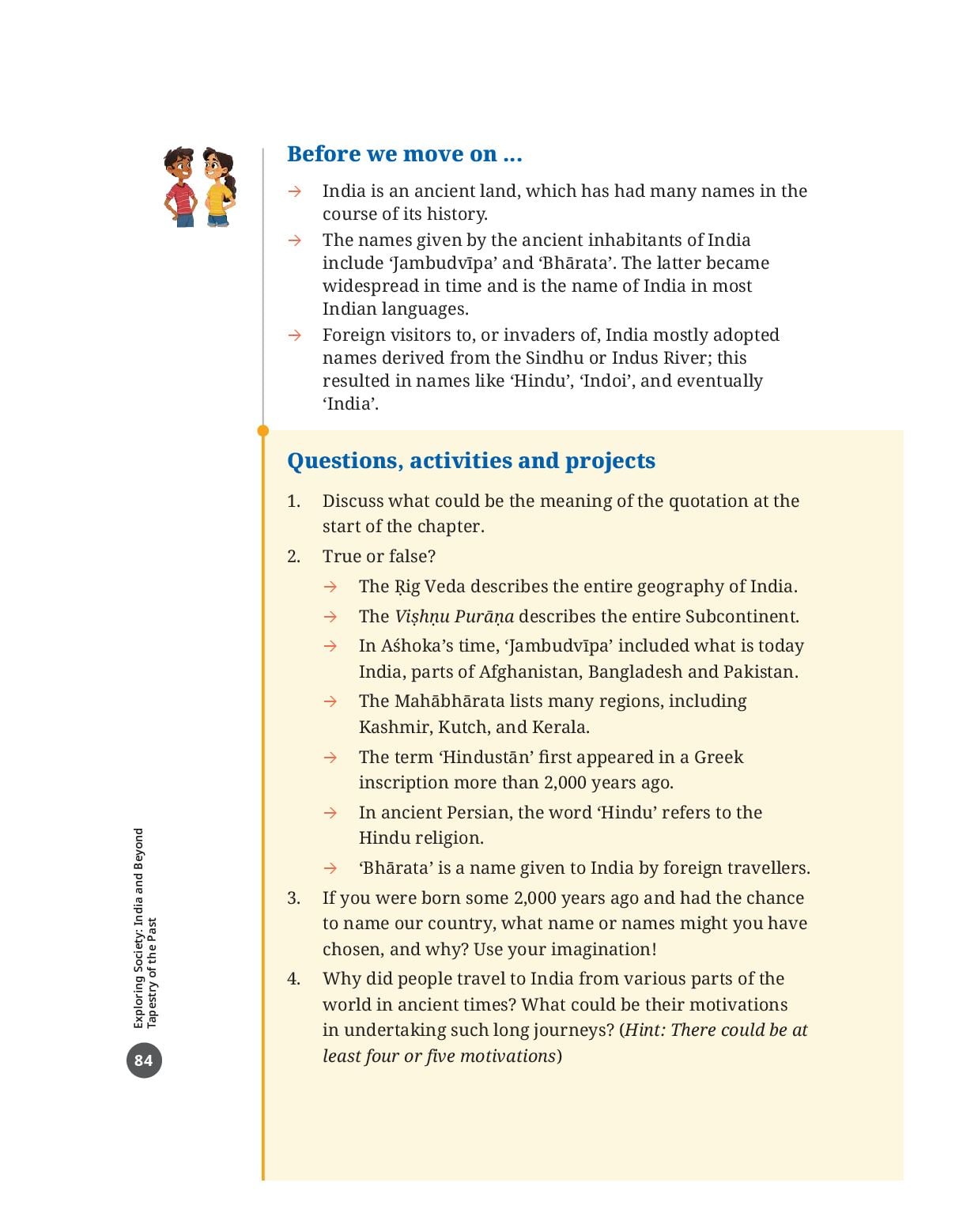
- Indians named this land themselves. The Ṛig Veda, India’s most ancient text, calls the north-west region ‘Sapta Sindhava’ — the ‘land of the seven rivers’ — from ‘Sindhu’, the Indus River or a river in general. The Mahābhārata lists regions all over the Subcontinent (Kāshmīra, Kurukṣhetra, Vanga, Prāgjyotiṣha, Kaccha, Kerala …) and gives the whole of it two names: ‘Bhāratavarṣha’, ‘the country of the Bharatas’, and ‘Jambudvīpa’, ‘the island of the fruit of the jamun tree’.
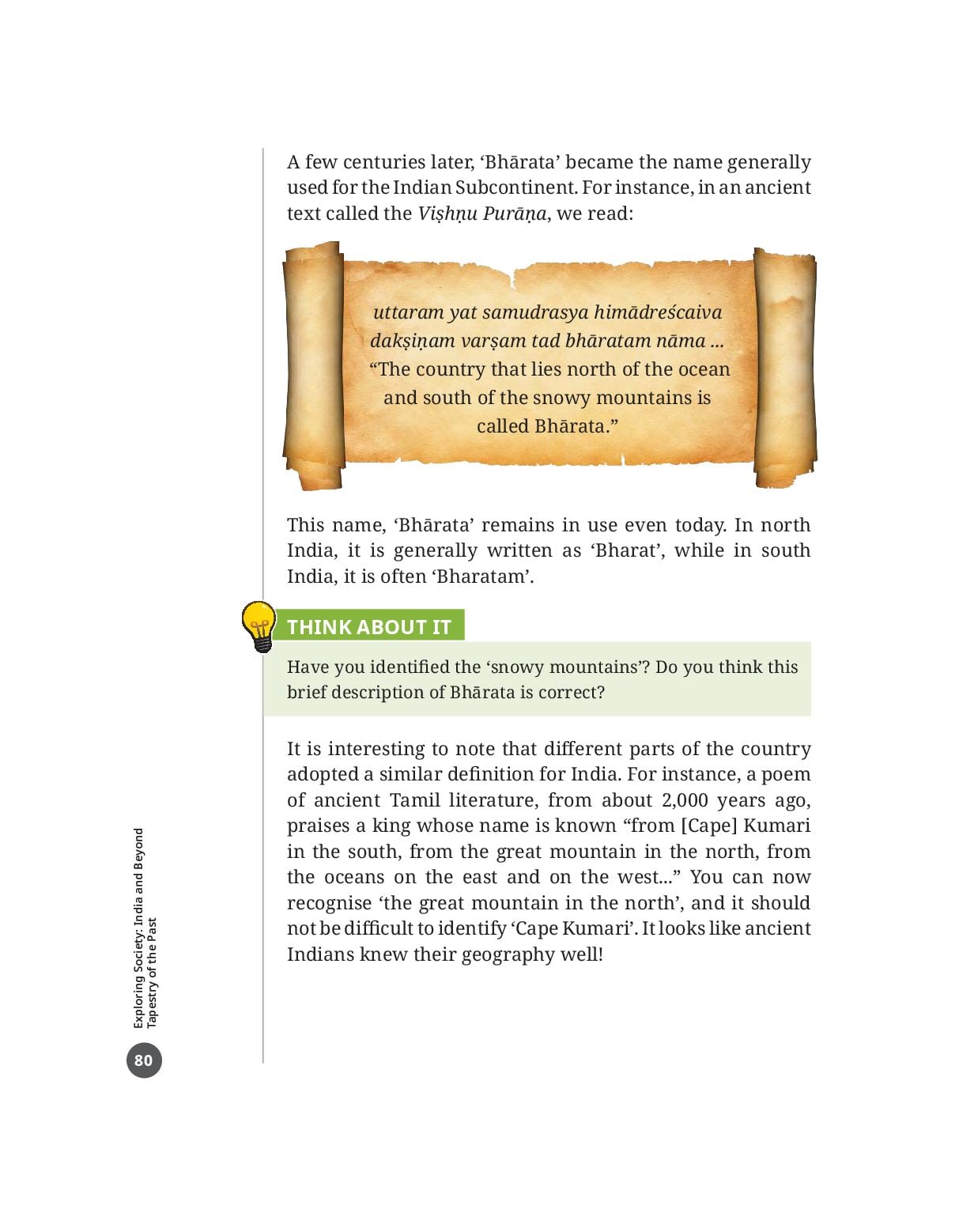
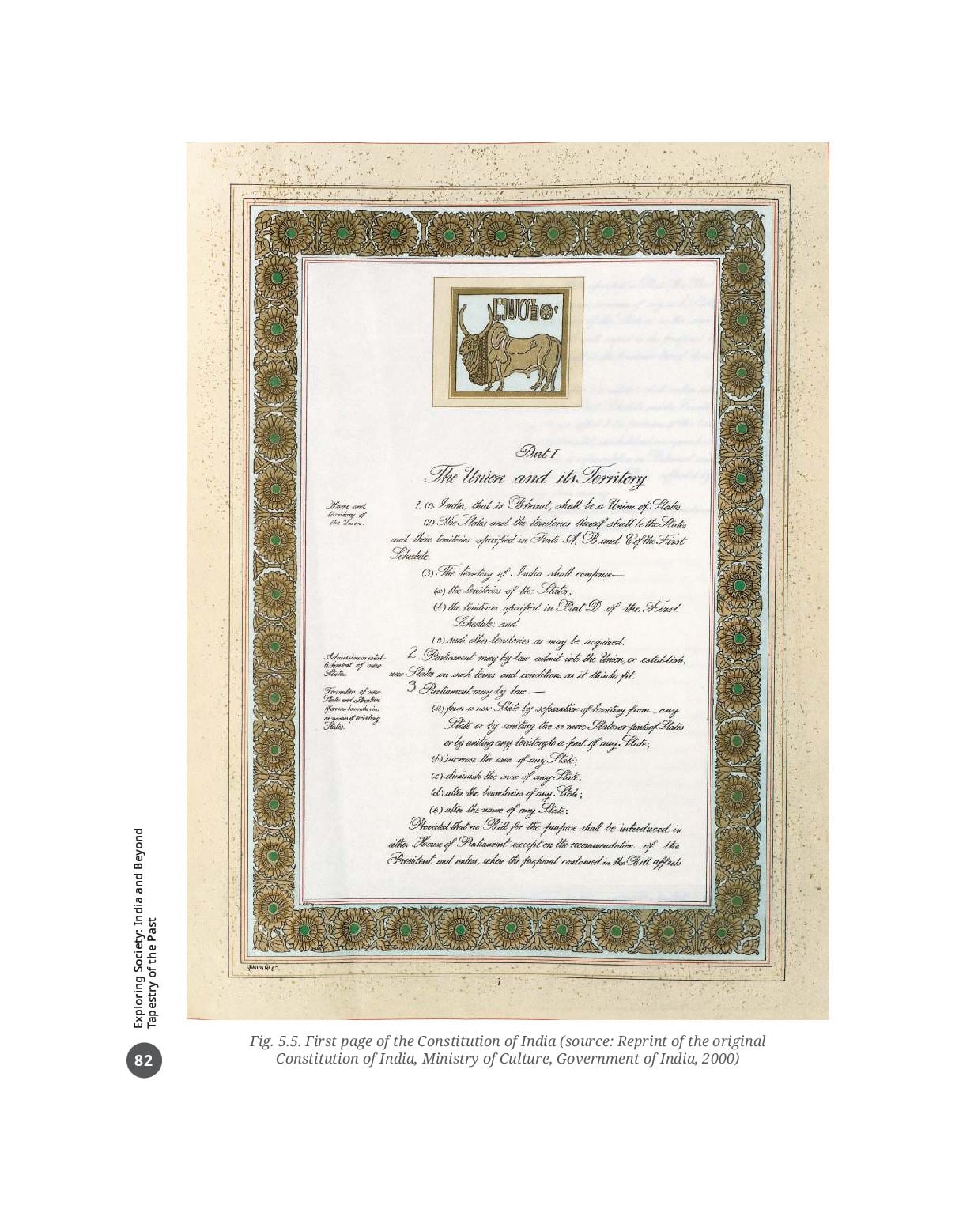
- ‘Bhārata’ won out, and it is still our name today. Emperor Aśhoka (about 250 BCE) used ‘Jambudvīpa’ in an inscription for the whole of India — which then included today’s Bangladesh, Pakistan and parts of Afghanistan. A few centuries later the Viṣhṇu Purāṇa defined Bhārata as “the country that lies north of the ocean and south of the snowy mountains”. An ancient Tamil poem describes the same land “from [Cape] Kumari in the south … to the great mountain in the north”. The name survives as Bharat in the north and Bharatam in the south — and the Constitution opens with ‘India, that is Bharat’.
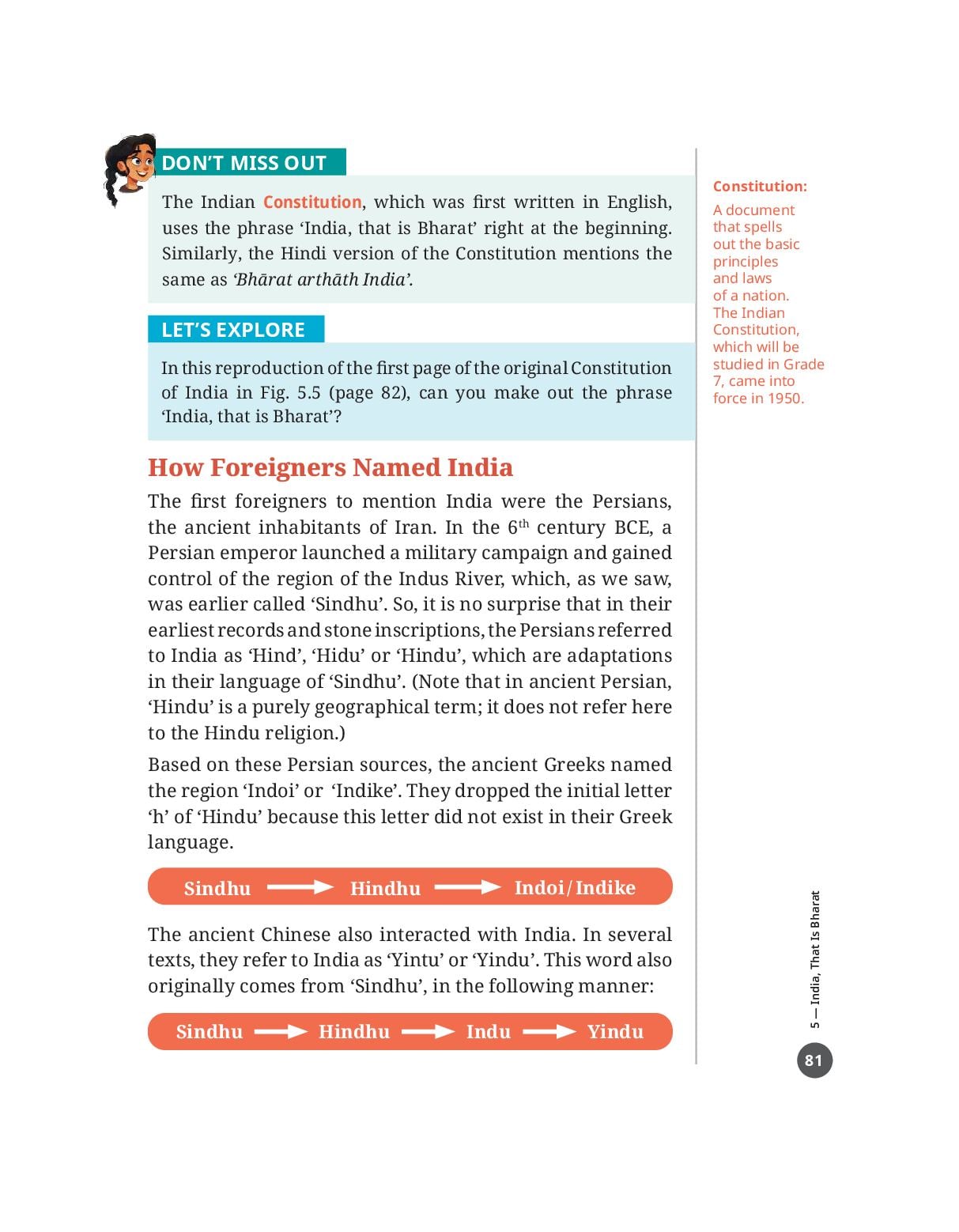
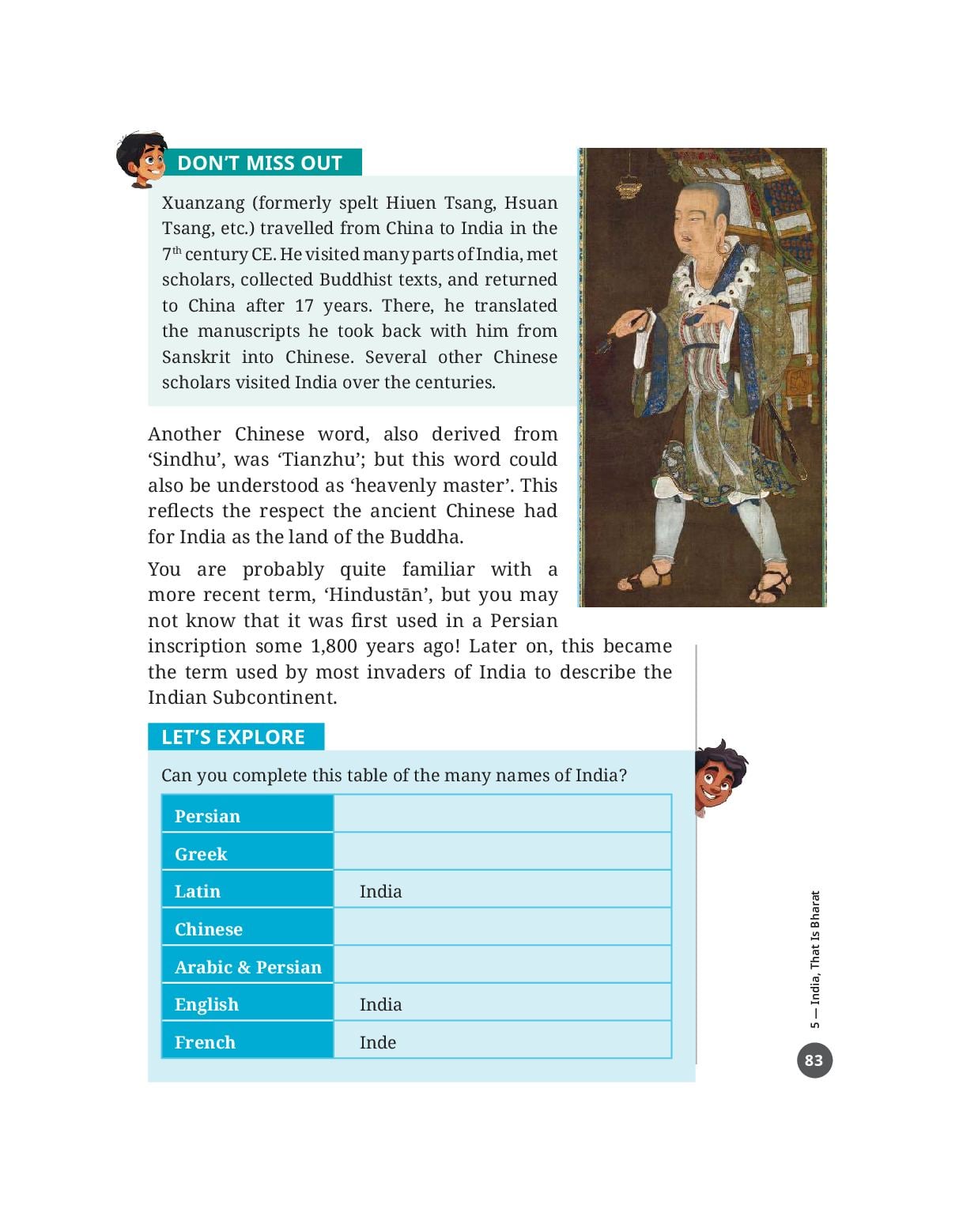
- Foreigners named it after the Indus. The Persians, who took control of the Indus region in the 6th century BCE, wrote ‘Hind’, ‘Hidu’ or ‘Hindu’ — their version of ‘Sindhu’, and a purely geographical word, not a religious one. The Greeks, borrowing from Persian, dropped the ‘h’ their language did not have and said ‘Indoi’ / ‘Indike’, which became Latin and English India and French Inde. The Chinese said ‘Yintu’ / ‘Yindu’, and also ‘Tianzhu’, a word that could be read as ‘heavenly master’ — a mark of their respect for the land of the Buddha.
- ‘Hindustān’ is younger than you might think. It was first used in a Persian inscription about 1,800 years ago, and later became the term most invaders of India used for the Subcontinent. So the chapter ends with two families of names: the ones Indians gave themselves (Jambudvīpa, Bhārata) and the ones outsiders built from the river Sindhu (Hindu, Indoi, India, Hindustān).
Quick revision – India, That Is Bharat
| Name or term | What it means | Where it appears in the chapter | Who used it |
|---|---|---|---|
| Indian Subcontinent | The region of the world that today holds India, Pakistan, Bangladesh, Nepal, Bhutan, Sri Lanka and the Maldives; it has had many names and shifting boundaries | Page 77; physical map Fig. 5.2, page 76 | The name we use today |
| Sindhu | The Indus River — or, at times, a river in general | Page 77 | Ṛig Veda and later Indian texts |
| Sapta Sindhava | ‘Land of the seven rivers’ — the name for the north-west region of the Subcontinent only, not the whole of it | Page 77, with Fig. 5.3 | The Ṛig Veda, India’s most ancient text |
| Bhāratavarṣha | ‘The country of the Bharatas’ — a name that clearly extends to the entire Subcontinent | Page 78 | The Mahābhārata |
| Bharata | The name of one of the main Vedic groups of people; later, of several kings | Page 78 | First in the Ṛig Veda, then in later literature |
| Jambudvīpa | ‘The island of the fruit of the jamun tree’ (also called jambul or Malabar plum), a tree native to India | Pages 78–79 | The Mahābhārata; and Aśhoka, c. 250 BCE, in an inscription |
| Bhārata / Bharat / Bharatam | “The country that lies north of the ocean and south of the snowy mountains” | Page 80, quoting the Viṣhṇu Purāṇa | Used all over India even today — Bharat in the north, Bharatam in the south |
| Constitution | A document that spells out the basic principles and laws of a nation | Margin note, page 81 | The Indian Constitution came into force in 1950 and opens with ‘India, that is Bharat’ (Fig. 5.5) |
| Hind / Hidu / Hindu | Adaptations of ‘Sindhu’ in the Persian language; in ancient Persian a purely geographical term, not a religious one | Page 81 | The Persians, from the 6th century BCE |
| Indoi / Indike | ‘Hindu’ with the initial ‘h’ dropped, because Greek had no such letter | Page 81 | The ancient Greeks, working from Persian sources |
| Yintu / Yindu / Tianzhu | Chinese words for India, also from ‘Sindhu’; ‘Tianzhu’ could also be read as ‘heavenly master’ | Pages 81 and 83 | The ancient Chinese, who respected India as the land of the Buddha |
| Hindustān | A more recent term for the Indian Subcontinent, first used in a Persian inscription some 1,800 years ago | Page 83 | Persian; later the term used by most invaders of India |
Old NCERT vs New – Class 6 Social Science
This chapter is from Exploring Society: India and Beyond, the new NCERT Class 6 Social Science book (NCF-SE 2023, used from 2024-25). It replaced the old book “Our Pasts, The Earth Our Habitat and Social and Political Life”, so chapter numbers and names differ from older PDFs.
Solutions and All Chapters
Answers to the exercises and the full chapter list of Exploring Society: India and Beyond:
India, That Is Bharat – Overview
| Class | Class 6 |
| Subject | Social Science |
| Book | Exploring Society: India and Beyond – new NCERT book |
| Chapter | 5 of 14 – India, That Is Bharat |
| Book pages | 75 – 84 |
| Edition | NCERT Reprint 2026-27 |
| Session | 2026-27 |
| Free – read online or download |
Class 6 Social Science Chapter 5 – FAQs
Where can I download India, That Is Bharat Class 6 PDF?
From the download table on this page – the chapter PDF is free, and the full book is linked too.
What is Class 6 Social Science Chapter 5 about?
India is a modern nation, but this land is far older than the nation. Today India has defined borders, defined states and a known population. Five hundred, two thousand or five thousand years ago it looked very different. The region as a whole — the part of the world we call the Indian Subcontinent — has had many different names and shifting boundaries, and we learn about them from ancient texts, from the accounts of travellers and pilgrims, and from inscriptions.
Is India, That Is Bharat from the new NCERT Class 6 Social Science book?
Yes. It is chapter 5 of exploring society: india and beyond, the new NCERT Class 6 Social Science book for 2026-27.
Is this the latest NCERT edition for 2026-27?
Yes – the PDF is NCERT’s latest edition for the 2026-27 session.
Where are the NCERT Solutions for Class 6 Social Science Chapter 5?
Open the NCERT Solutions link above for answers to the exercise questions.