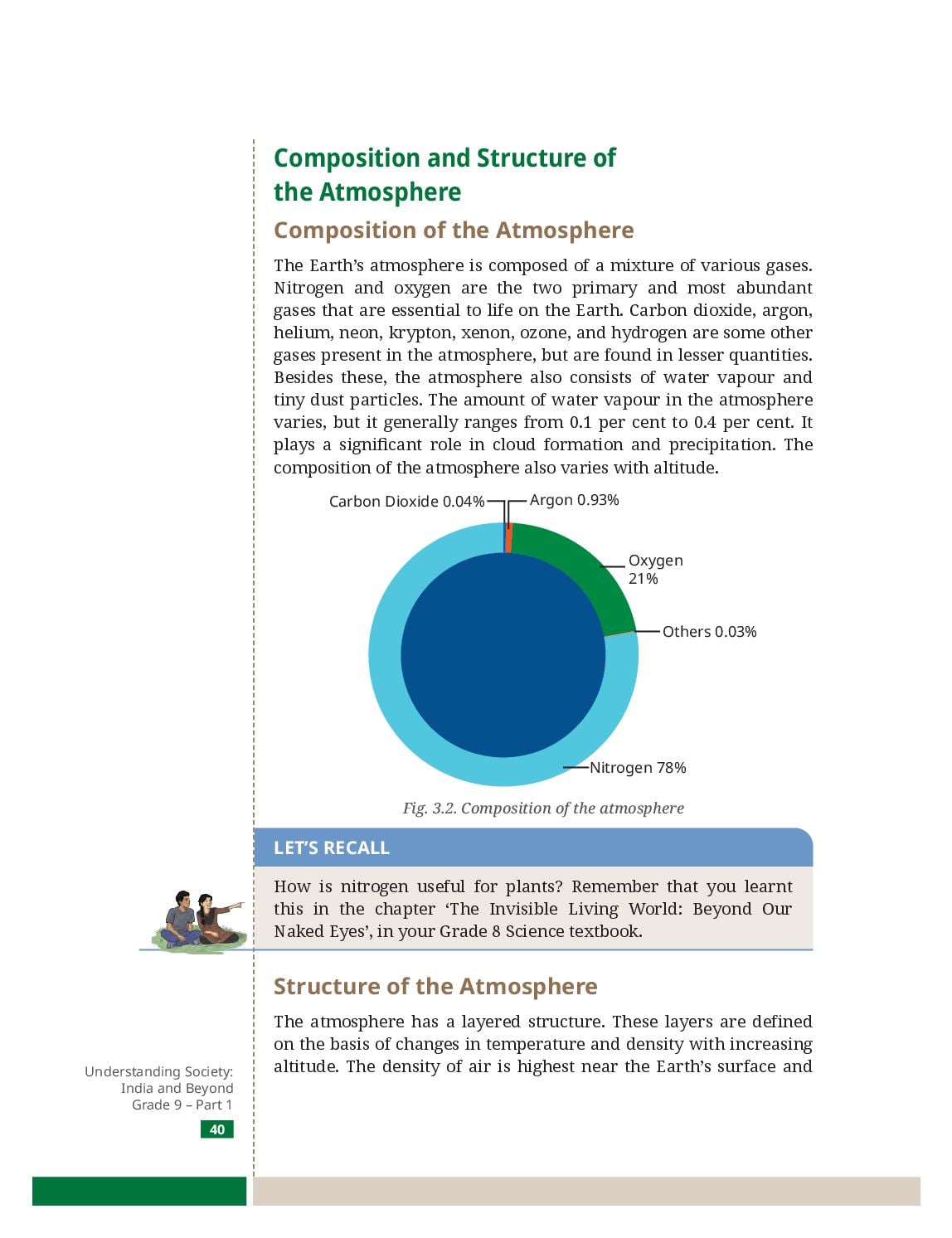
Download Atmosphere and Climate – NCERT Class 9 Social Science Chapter 3 PDF from the new NCERT Class 9 Social Science book Understanding Society: India and Beyond (2026-27). Read the chapter online or download the free PDF. The atmosphere is the blanket of air held around the Earth by gravity. Fig. 3.2 gives its composition: nitrogen 78%, oxygen 21%, argon 0.93%, carbon dioxide 0.04% and other gases 0.03% — which add to exactly 100% — plus water vapour (0.1–0.4%) and…
Atmosphere and Climate PDF – Chapter 3 of Understanding Society: India and Beyond (Part I)
Read the chapter online or download the PDF.
| Chapter | Download | |
|---|---|---|
| Chapter 3 PDF | Atmosphere and Climate | View PDF |
| Full book | NCERT Class 9 Social Science – Understanding Society: India and Beyond | View Book |
Read Online
What Is in Atmosphere and Climate? (Class 9 Social Science Chapter 3)
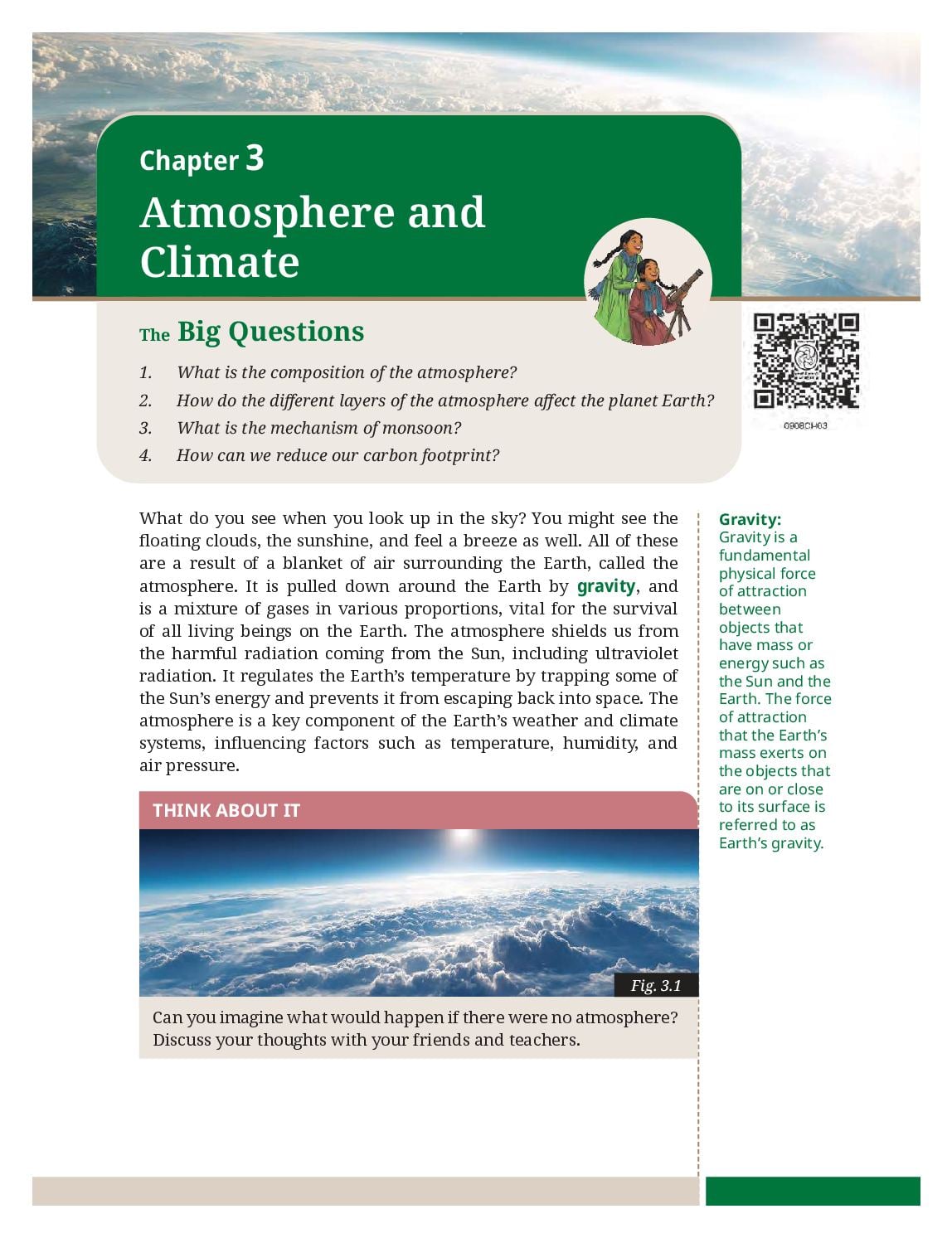
- The atmosphere is the blanket of air held around the Earth by gravity. Fig. 3.2 gives its composition: nitrogen 78%, oxygen 21%, argon 0.93%, carbon dioxide 0.04% and other gases 0.03% — which add to exactly 100% — plus water vapour (0.1–0.4%) and dust on top of that. It shields us from harmful radiation including ultraviolet, and regulates temperature by trapping some of the Sun’s energy.
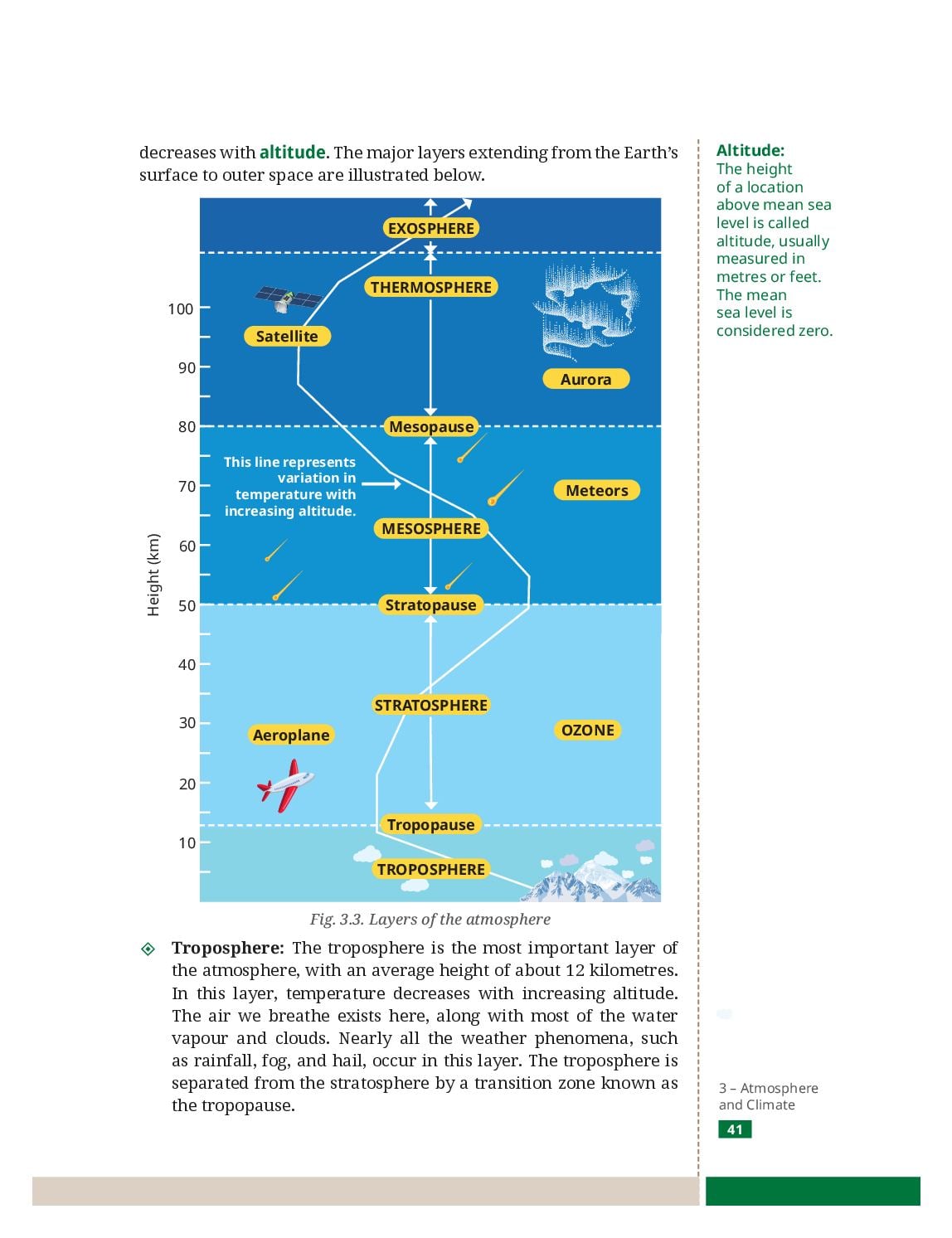
- The atmosphere is layered, and the layers are defined by how temperature and density change with altitude. Density is highest at the surface and falls with height. Temperature falls with height in the troposphere (about 12 km, where nearly all weather happens) and in the mesosphere (to 80 km, where meteors burn up), and rises with height in the stratosphere (to 50 km, because ozone absorbs ultraviolet) and the thermosphere (80–700 km, because gas molecules absorb X-rays and short-wave ultraviolet). Above that is the exosphere, where helium and hydrogen escape into space.
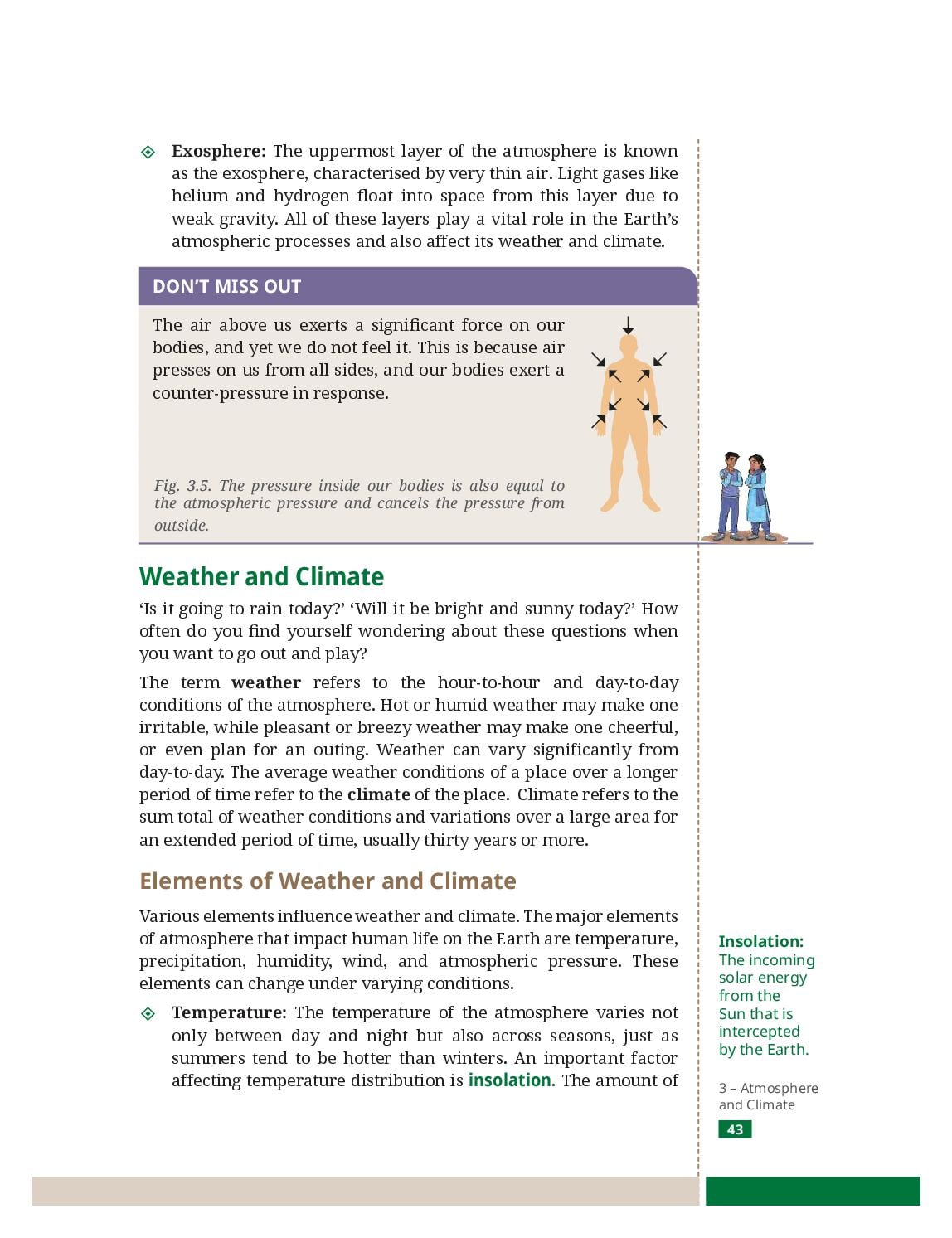
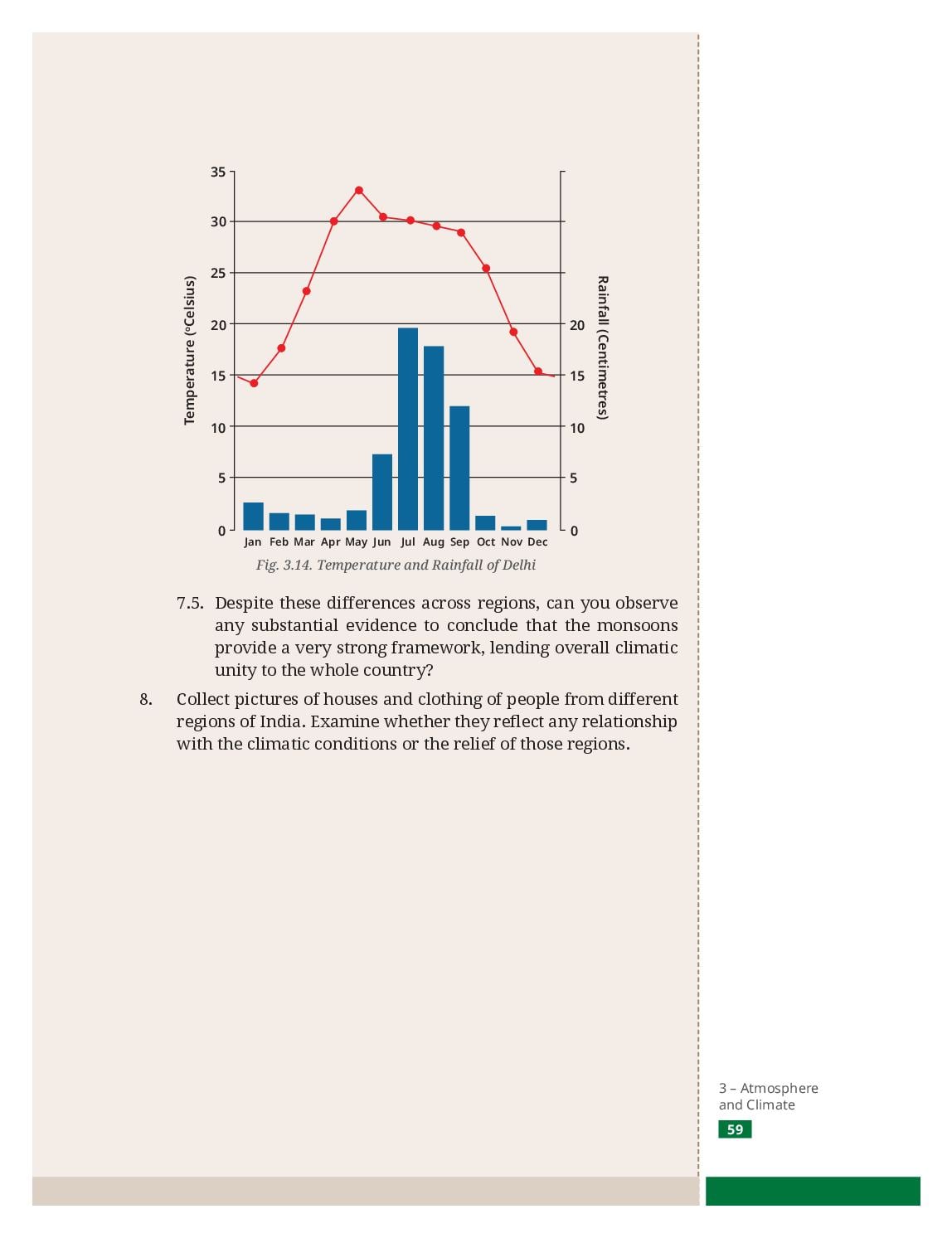
- Weather is the hour-to-hour and day-to-day state of the atmosphere; climate is the sum total of weather conditions over a large area for an extended period, usually thirty years or more. Both are built from five elements — temperature, humidity, precipitation, atmospheric pressure and wind.
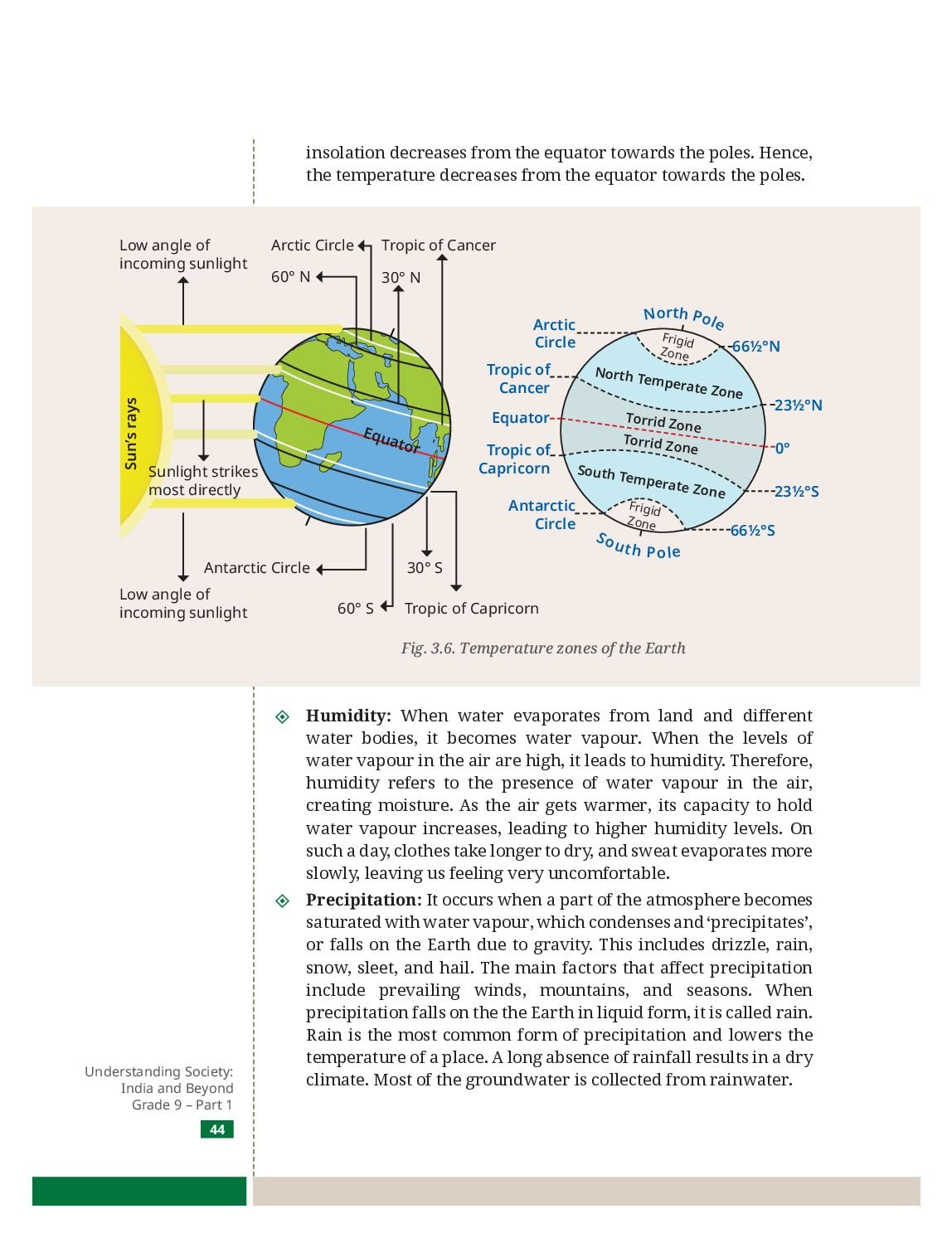
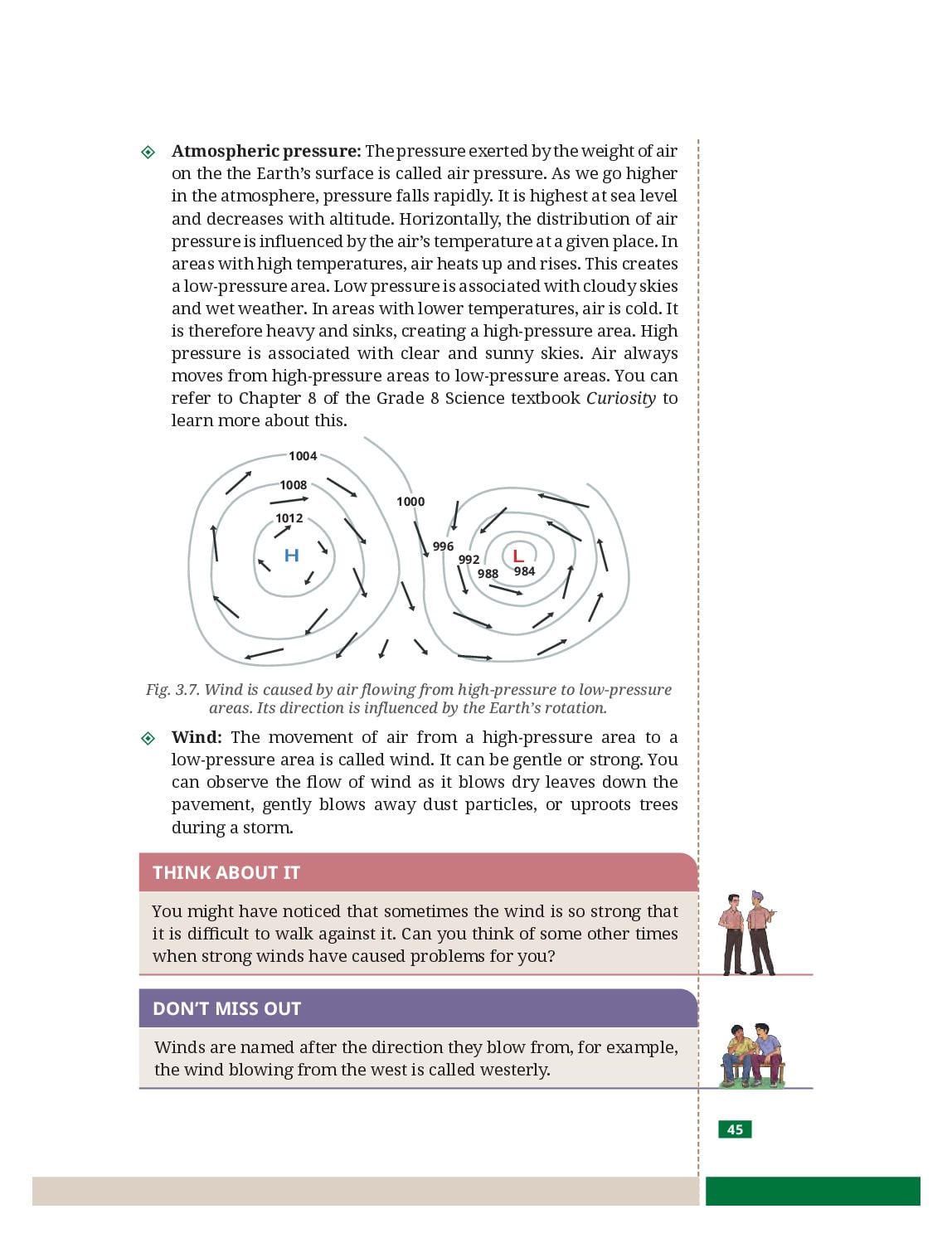
- The engine behind wind is unequal heating. Insolation falls off from the equator to the poles, so temperature does too (Fig. 3.6: torrid, temperate and frigid zones). Warm air rises and leaves low pressure (cloudy, wet weather); cold air sinks and makes high pressure (clear, sunny skies); and air always moves from high pressure to low pressure — that is wind. Fig. 3.7 shows it flowing from a 1012 high to a 984 low, its direction bent by the Earth’s rotation.
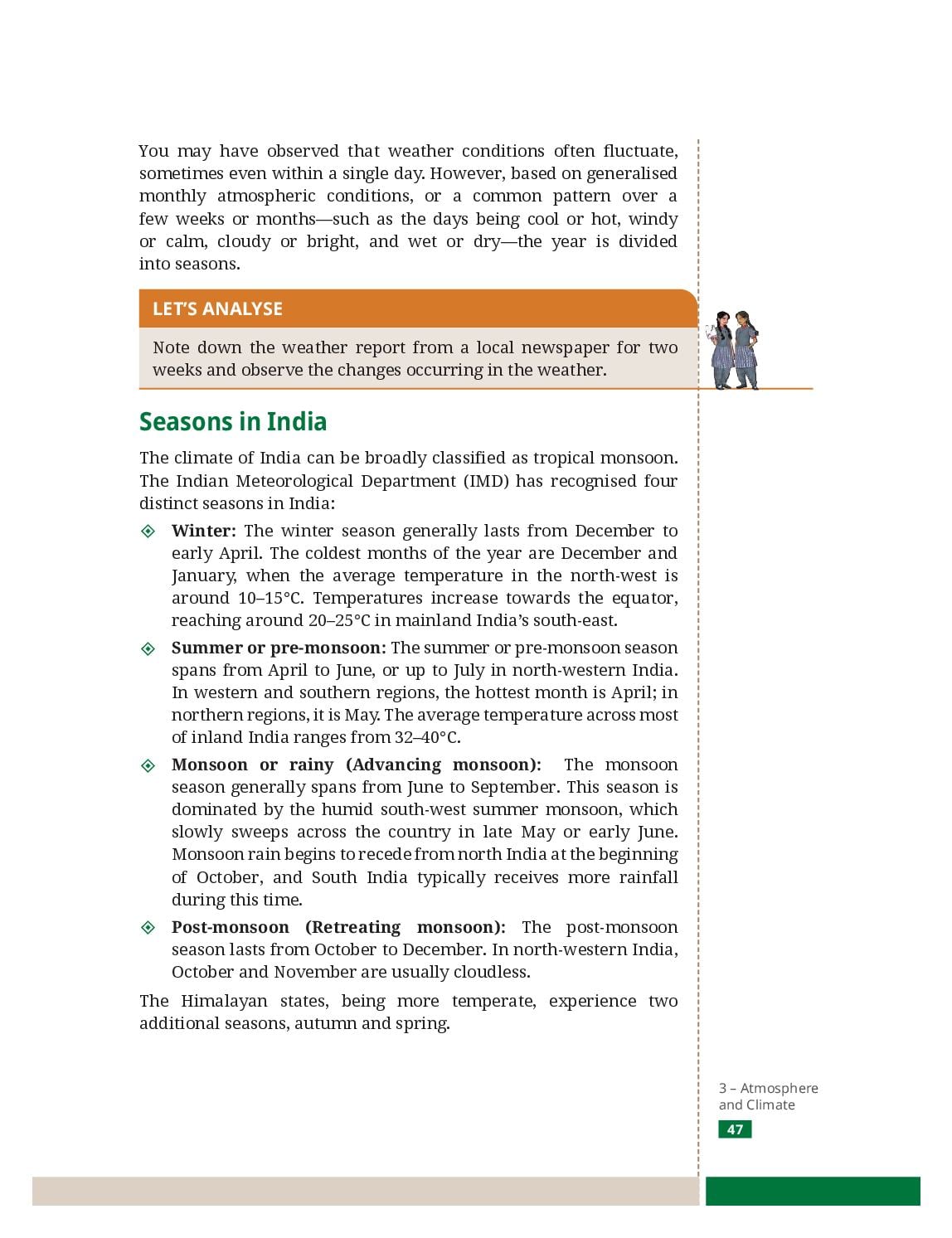
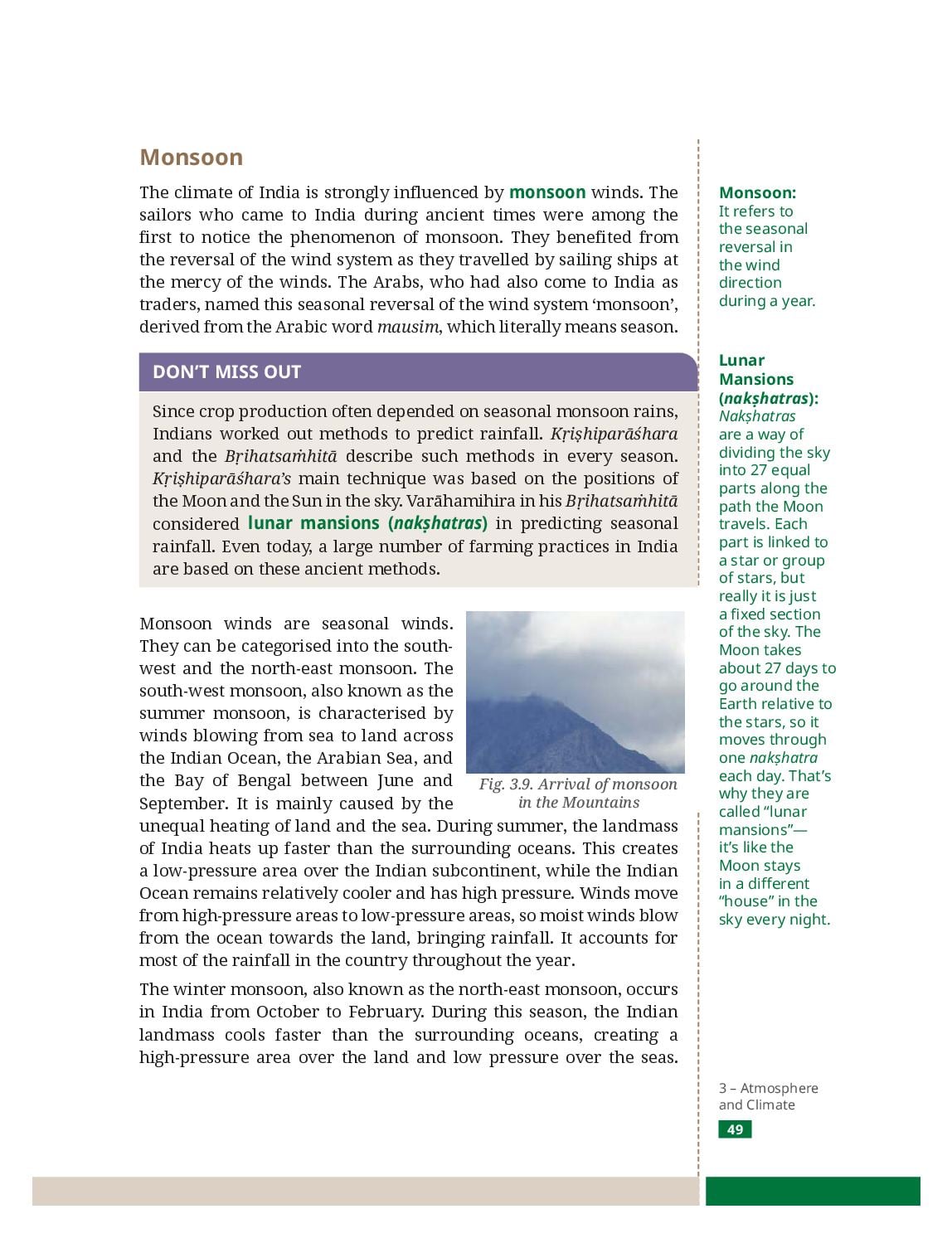
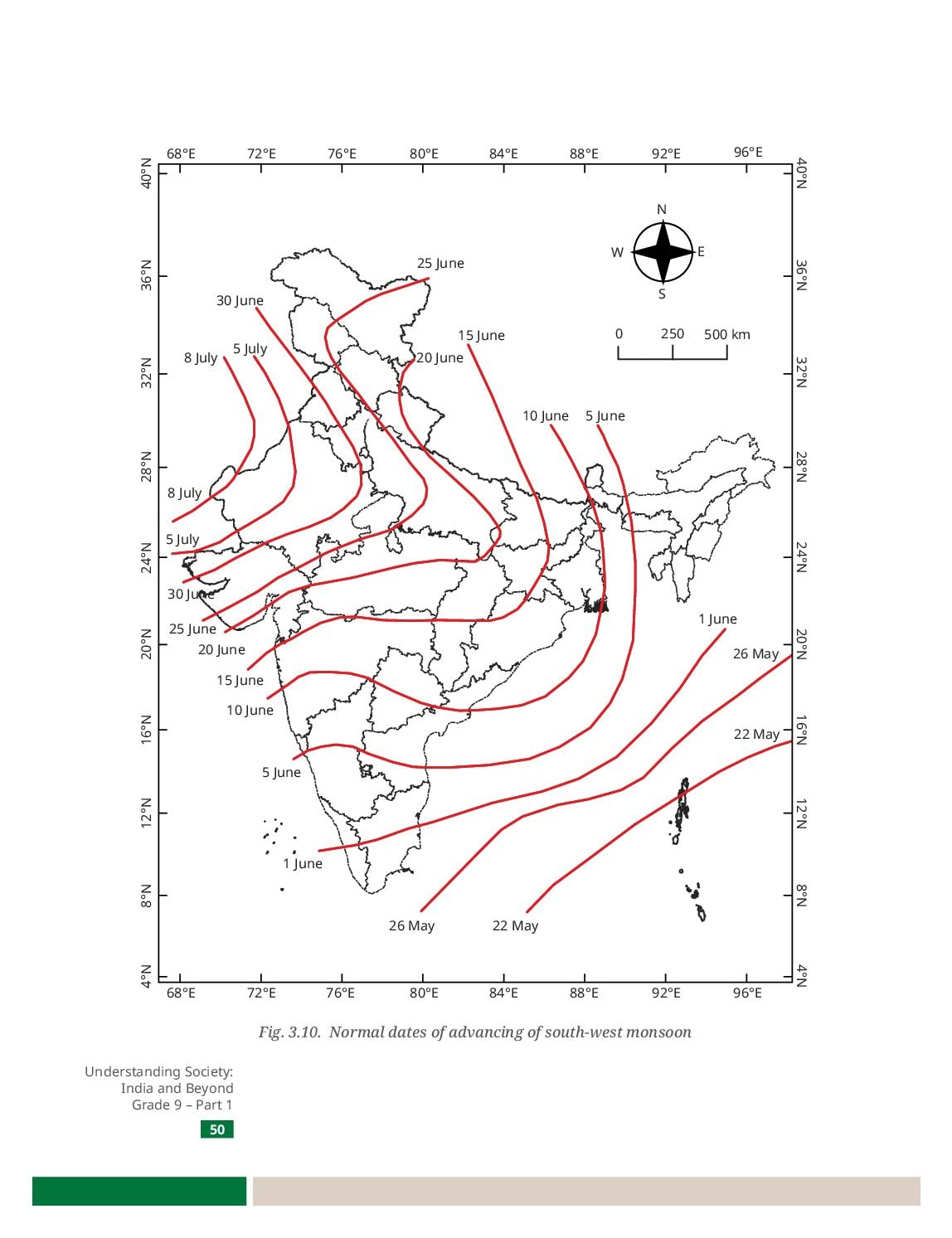
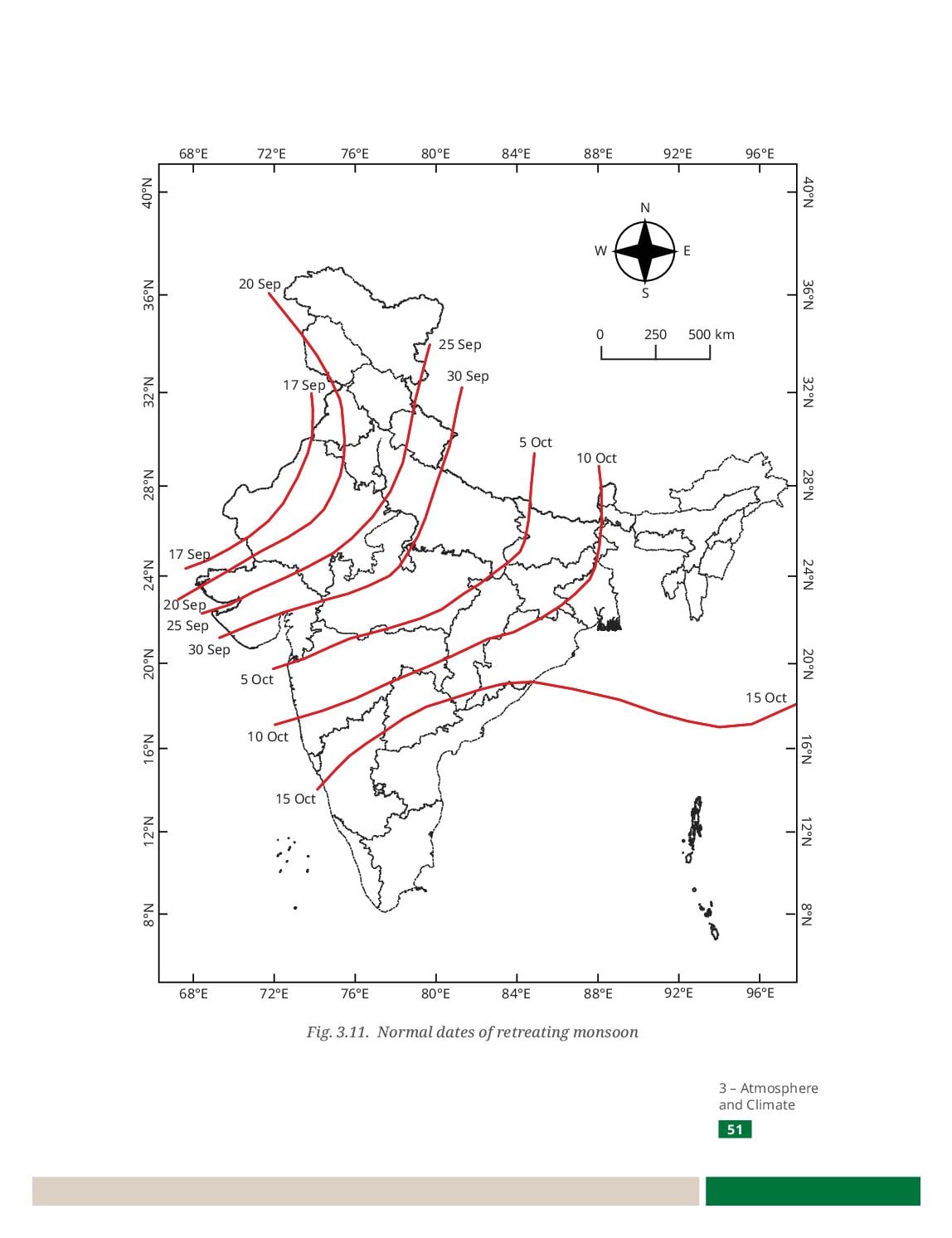
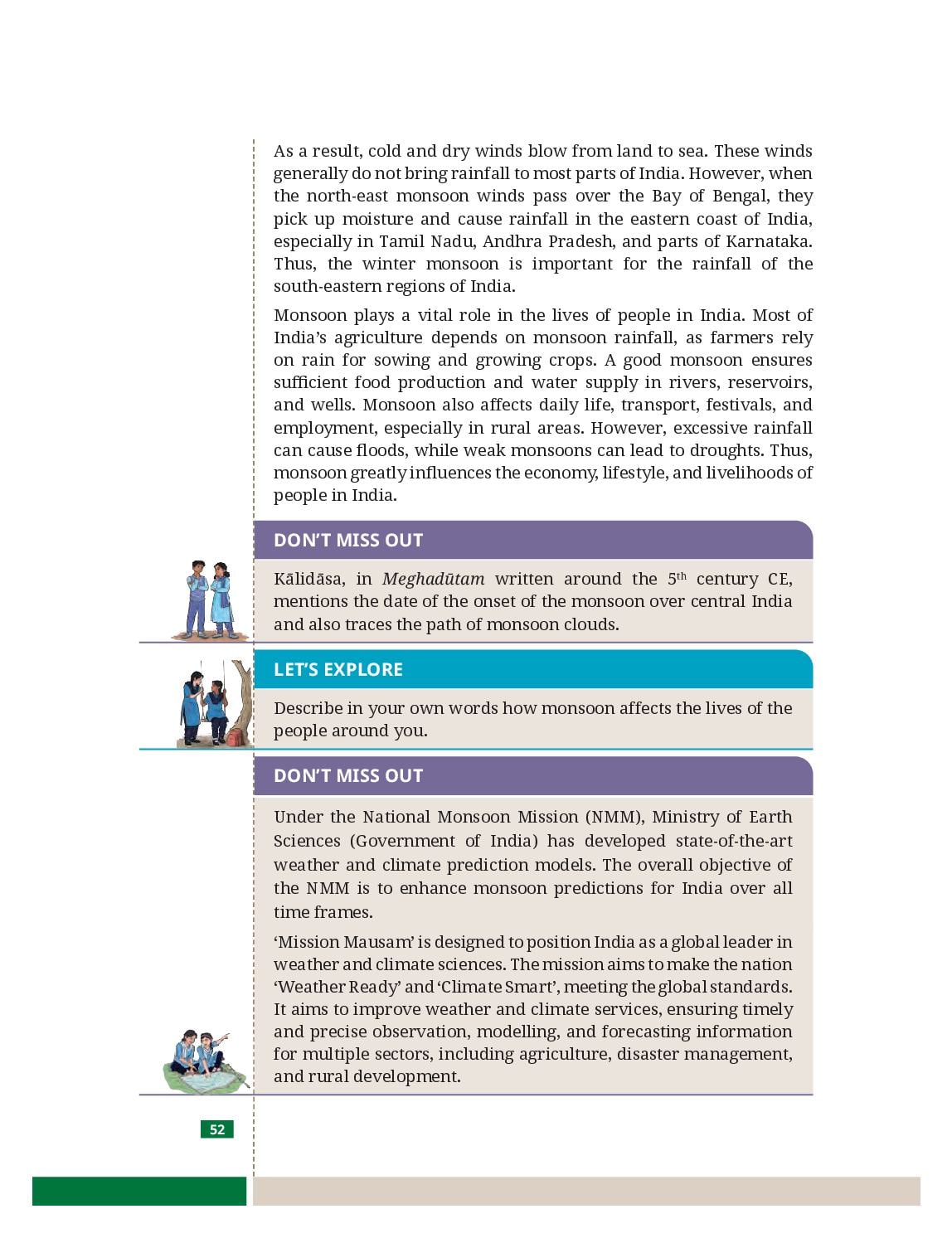
- The monsoon is that same rule working on a seasonal scale — a reversal of the wind direction during the year. In summer the land heats faster than the sea, so low pressure over India draws moist winds in from the ocean (south-west monsoon, June–September, most of India’s rain). In winter the land cools faster, so dry winds blow out to sea (north-east monsoon, October–February) — except over the Bay of Bengal, where they pick up moisture and rain on Tamil Nadu, Andhra Pradesh and parts of Karnataka. Fig. 3.10 shows the monsoon advancing from 22 May in the far south-east to 8 July in the north-west; Fig. 3.11 shows it retreating the other way, from 17 September to 15 October.
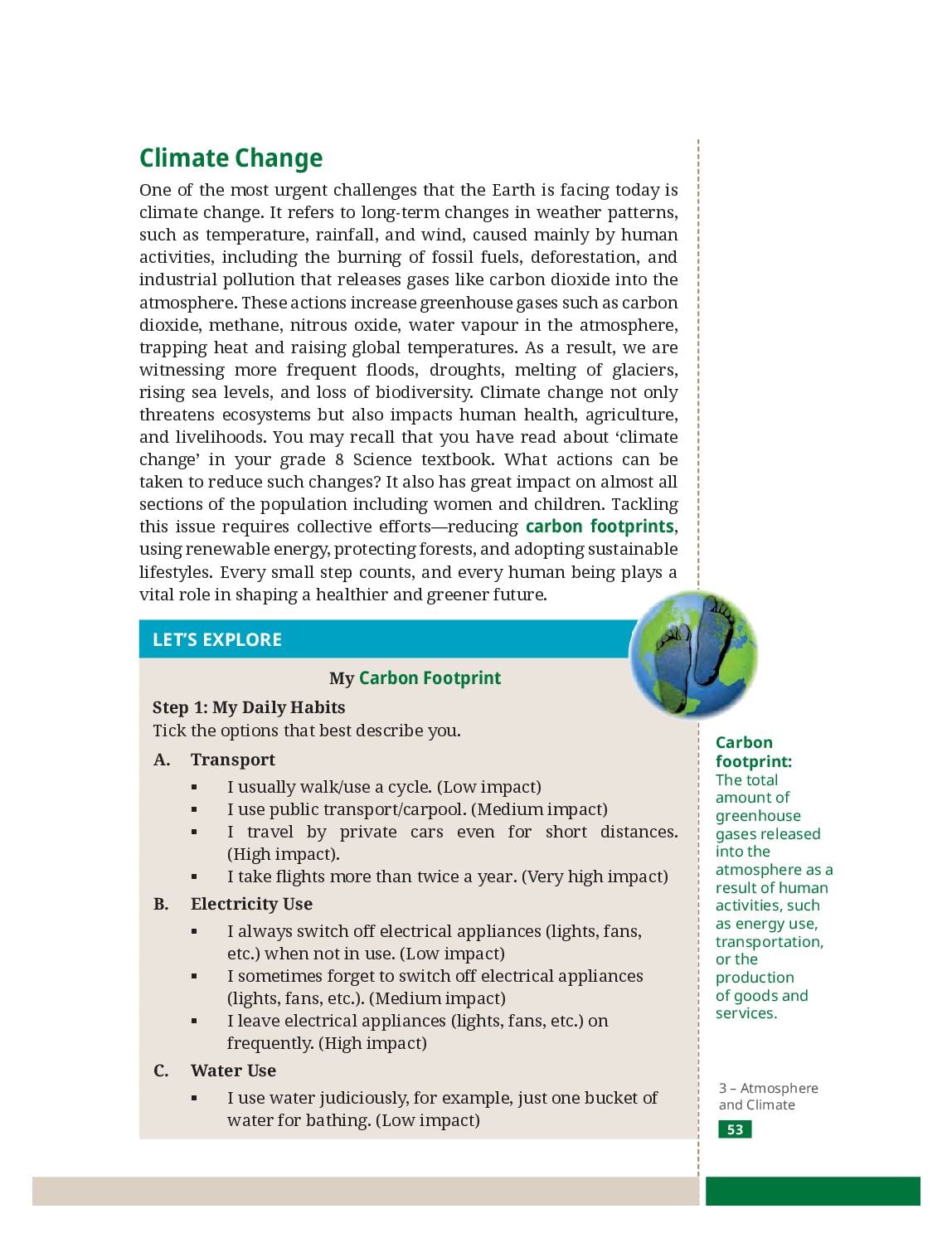
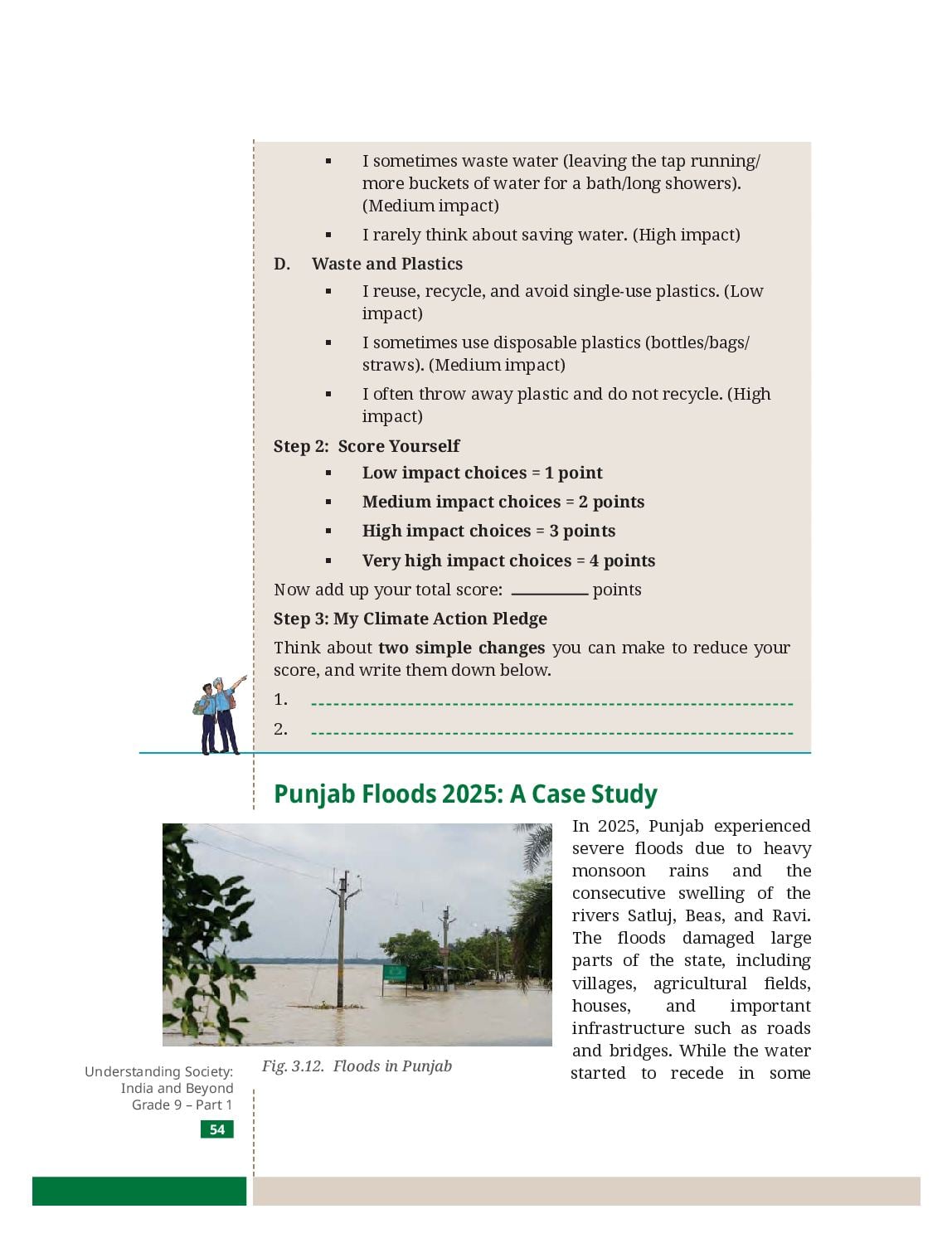
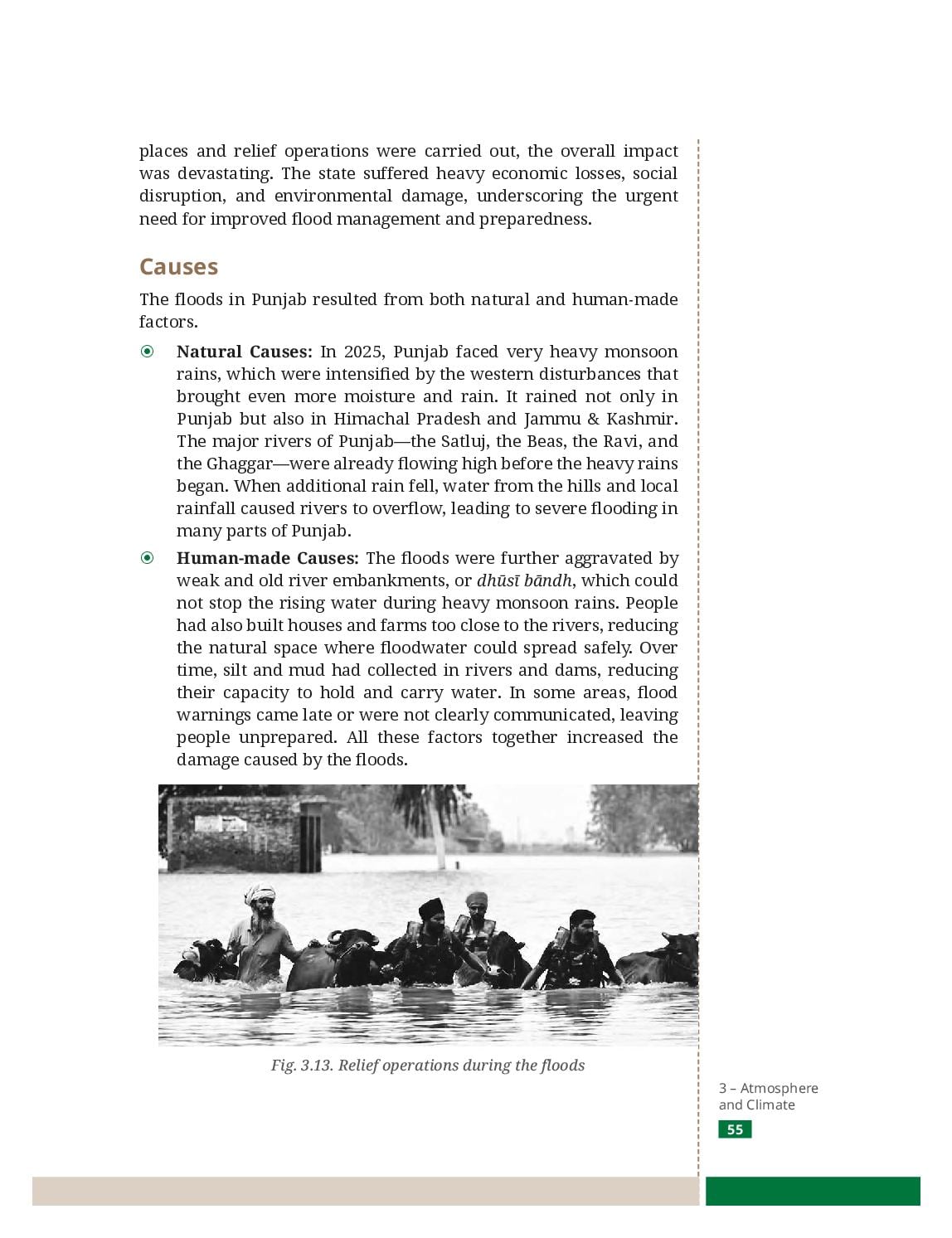
- Climate change is the long-term shift in weather patterns caused mainly by human activity — burning fossil fuels, deforestation and industrial pollution — which raises greenhouse gases such as carbon dioxide, methane, nitrous oxide and water vapour, traps heat and brings more floods, droughts, melting glaciers, rising seas and loss of biodiversity. Reducing our carbon footprint, using renewable energy, protecting forests and living sustainably are the chapter’s answers. The Punjab floods of 2025 are its case study of how natural and human-made causes combine.
Quick revision – Atmosphere and Climate
| Term | What it means | Where it appears in the chapter | Value or example from the book |
|---|---|---|---|
| Atmosphere | The blanket of air surrounding the Earth, held down by gravity — a mixture of gases vital for all life. | Page 39 | Shields us from ultraviolet radiation; regulates the Earth’s temperature |
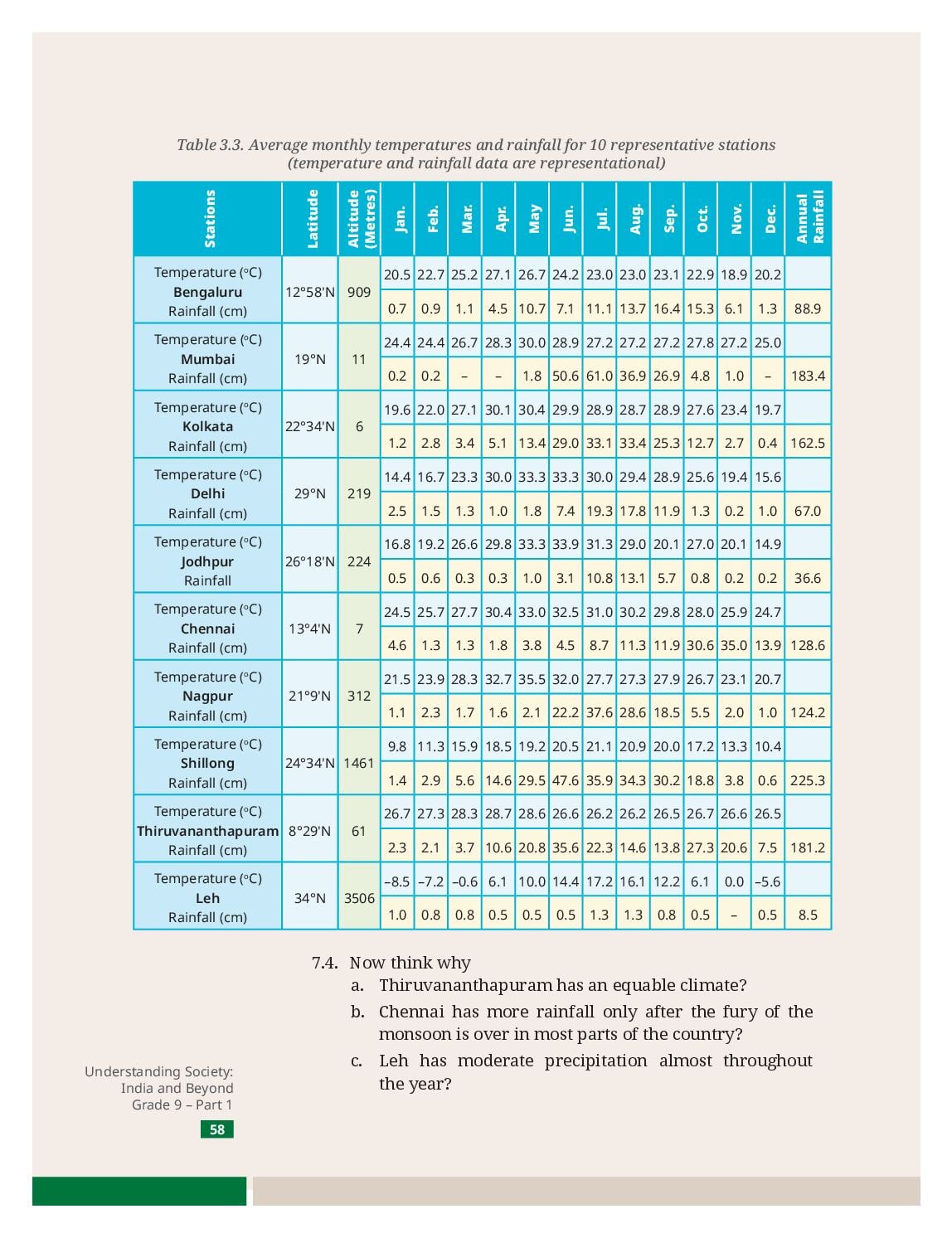
| Altitude | The height of a location above mean sea level, measured in metres or feet; mean sea level is taken as zero. | Page 41, margin note | Leh in Table 3.3 stands at 3506 m; Kolkata at 6 m |
| Insolation | The incoming solar energy from the Sun that is intercepted by the Earth. | Page 43, margin note | It decreases from the equator towards the poles — so temperature does too |
| Troposphere | The lowest layer, about 12 km high; temperature falls with altitude and nearly all weather happens here. | Page 41 | Rainfall, fog and hail; most water vapour and clouds; the air we breathe |
| Stratosphere | The layer above, up to 50 km; free of clouds and weather, and holding the ozone layer. | Page 42 | Aeroplanes fly here; ozone filters the Sun’s ultraviolet radiation |
| Mesosphere | The third layer, up to 80 km; temperature falls with altitude again. | Page 42 | Most meteorites entering from space burn up here |
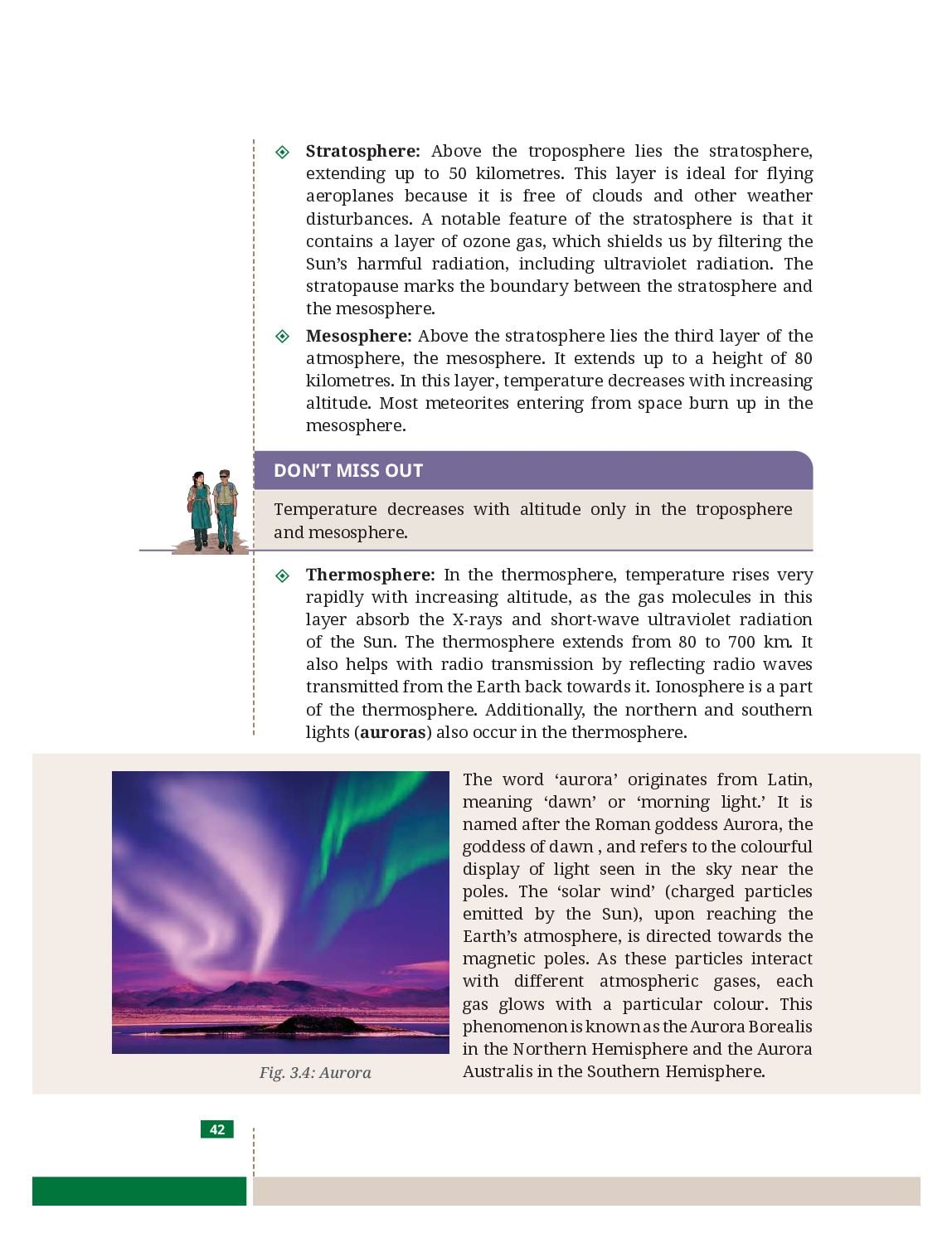
| Thermosphere | 80 to 700 km; temperature rises very rapidly with altitude. | Page 42 | Contains the ionosphere, reflects radio waves, and hosts the auroras |
| Exosphere | The uppermost layer, with very thin air and weak gravity. | Page 43 | Light gases such as helium and hydrogen float away into space |
| Weather | The hour-to-hour and day-to-day condition of the atmosphere. | Page 43 | ‘Is it going to rain today?’ — a weather question |
| Climate | The sum total of weather conditions and variations over a large area for an extended period, usually thirty years or more. | Page 43 | India’s climate is classified as tropical monsoon |
| Atmospheric pressure | The pressure exerted by the weight of air on the Earth’s surface. Highest at sea level, and it falls rapidly with altitude. | Page 45, Fig. 3.7 | Fig. 3.7 runs from 984 at the low centre to 1012 at the high centre |
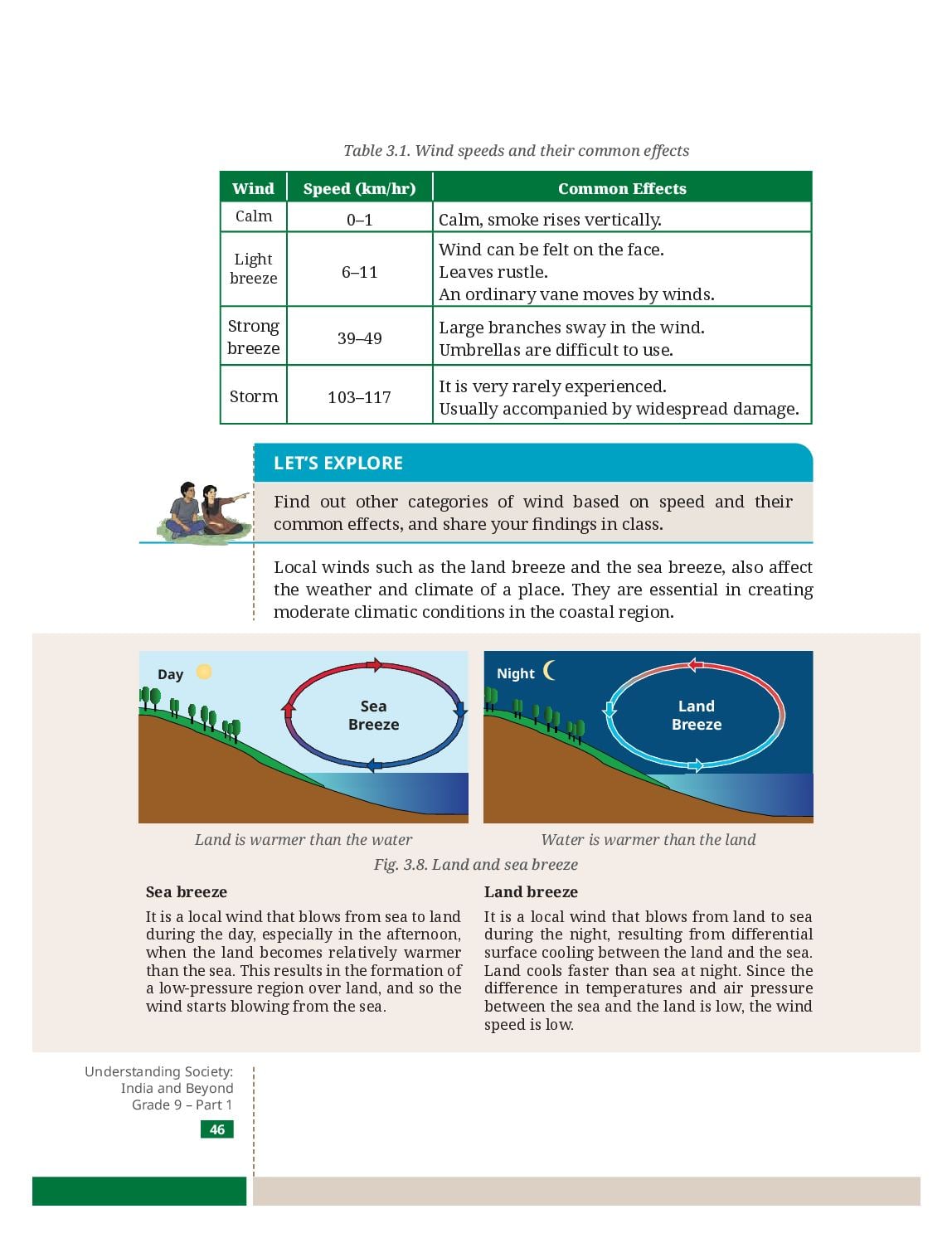
| Wind | The movement of air from a high-pressure area to a low-pressure area; named after the direction it blows from. | Pages 45–46, Table 3.1 | A wind from the west is a westerly; a storm blows at 103–117 km/hr |
| Monsoon | The seasonal reversal in the wind direction during a year. | Page 49, margin note | From Arabic mausim, meaning season — the name the Arab traders gave it |
| South-west monsoon | The summer monsoon, June–September: moist winds blowing from sea to land. | Pages 49–50, Fig. 3.10 | Advances from 22 May in the south-east to 8 July in the north-west |
Old NCERT vs New – Class 9 Social Science
This chapter is from Understanding Society: India and Beyond, the new NCERT Class 9 Social Science book (NCF-SE 2023, used from 2026-27). It replaced the old book “India and the Contemporary World, Contemporary India, Democratic Politics and Economics”, so chapter numbers and names differ from older PDFs.
Solutions and All Chapters
Answers to the exercises and the full chapter list of Understanding Society: India and Beyond:
Atmosphere and Climate – Overview
| Class | Class 9 |
| Subject | Social Science |
| Book | Understanding Society: India and Beyond – new NCERT book |
| Part | Part I |
| Chapter | 3 of 15 – Atmosphere and Climate |
| Book pages | 39 – 59 |
| Edition | Latest NCERT edition (2026-27) |
| Session | 2026-27 |
| Free – read online or download |
Class 9 Social Science Chapter 3 – FAQs
Where can I download Atmosphere and Climate Class 9 PDF?
From the download table on this page – the chapter PDF is free, and the full book is linked too.
What is Class 9 Social Science Chapter 3 about?
The atmosphere is the blanket of air held around the Earth by gravity. Fig. 3.2 gives its composition: nitrogen 78%, oxygen 21%, argon 0.93%, carbon dioxide 0.04% and other gases 0.03% — which add to exactly 100% — plus water vapour (0.1–0.4%) and dust on top of that. It shields us from harmful radiation including ultraviolet, and regulates temperature by trapping some of the Sun’s energy.
Is Atmosphere and Climate from the new NCERT Class 9 Social Science book?
Yes. It is chapter 3 of understanding society: india and beyond (part i), the new NCERT Class 9 Social Science book for 2026-27.
Is this the latest NCERT edition for 2026-27?
Yes – the PDF is NCERT’s latest edition for the 2026-27 session.
Where are the NCERT Solutions for Class 9 Social Science Chapter 3?
Open the NCERT Solutions link above for answers to the exercise questions.