Download the CBSE Class 12 Economics Sample Paper 2027 PDF with its marking scheme (solutions) – the official CBSE sample question paper (SQP) for the 2026-27 session, the paper to practise for the CBSE Class 12 board exam 2027. It is an 80-mark, 3-hour paper with 34 questions in 2 sections. The pattern is the same as the 2026 sample paper. The 2026 and 2025 sample papers are also here. Students also call it the CBSE 12th Economics model question paper 2027 or model test paper – it is the same official CBSE paper.
CBSE Class 12 Economics Sample Paper 2027 PDF Download
Open a paper to read it online or download the PDF. The marking scheme has the answers, with the marks for each step.
| Year | Document | Download |
|---|---|---|
| 2027 | CBSE Class 12 Sample Paper 2027 for Economics | View PDF |
| 2027 | CBSE Class 12 Sample Paper 2027 Solution (Marking Scheme) for Economics | View PDF |
| 2026 | CBSE Class 12 Sample Paper 2026 for Economics | View PDF |
| 2026 | CBSE Class 12 Sample Paper 2026 Solution for Economics | View PDF |
| 2025 | CBSE Class 12 Sample Paper 2025 for Economics | View PDF |
CBSE 12th Economics Model Question Paper 2027 – Quick Facts
| Board | Central Board of Secondary Education (CBSE) |
| Class | Class 12 |
| Subject | Economics (code 030) |
| Session | 2026-27 – for the board exam 2027 |
| Marks and time | 80 marks, 3 hours |
| Questions | 34 questions in 2 sections |
| Solutions | Yes – official CBSE marking scheme |
| Older papers | 2026, 2025 |
| Released by | CBSE (cbseacademic.nic.in) |
CBSE Class 12 Economics Sample Paper 2027 – Read Online
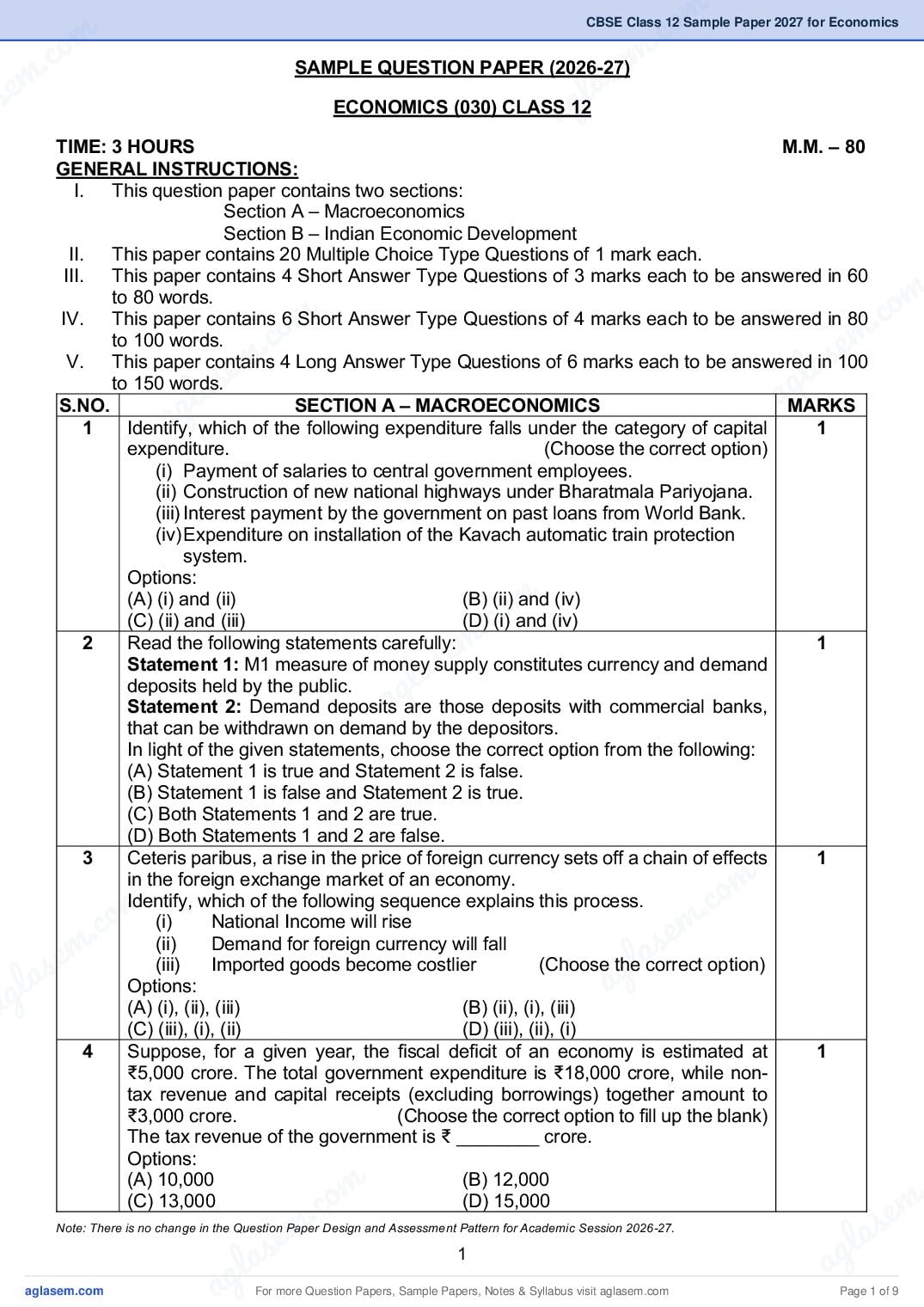
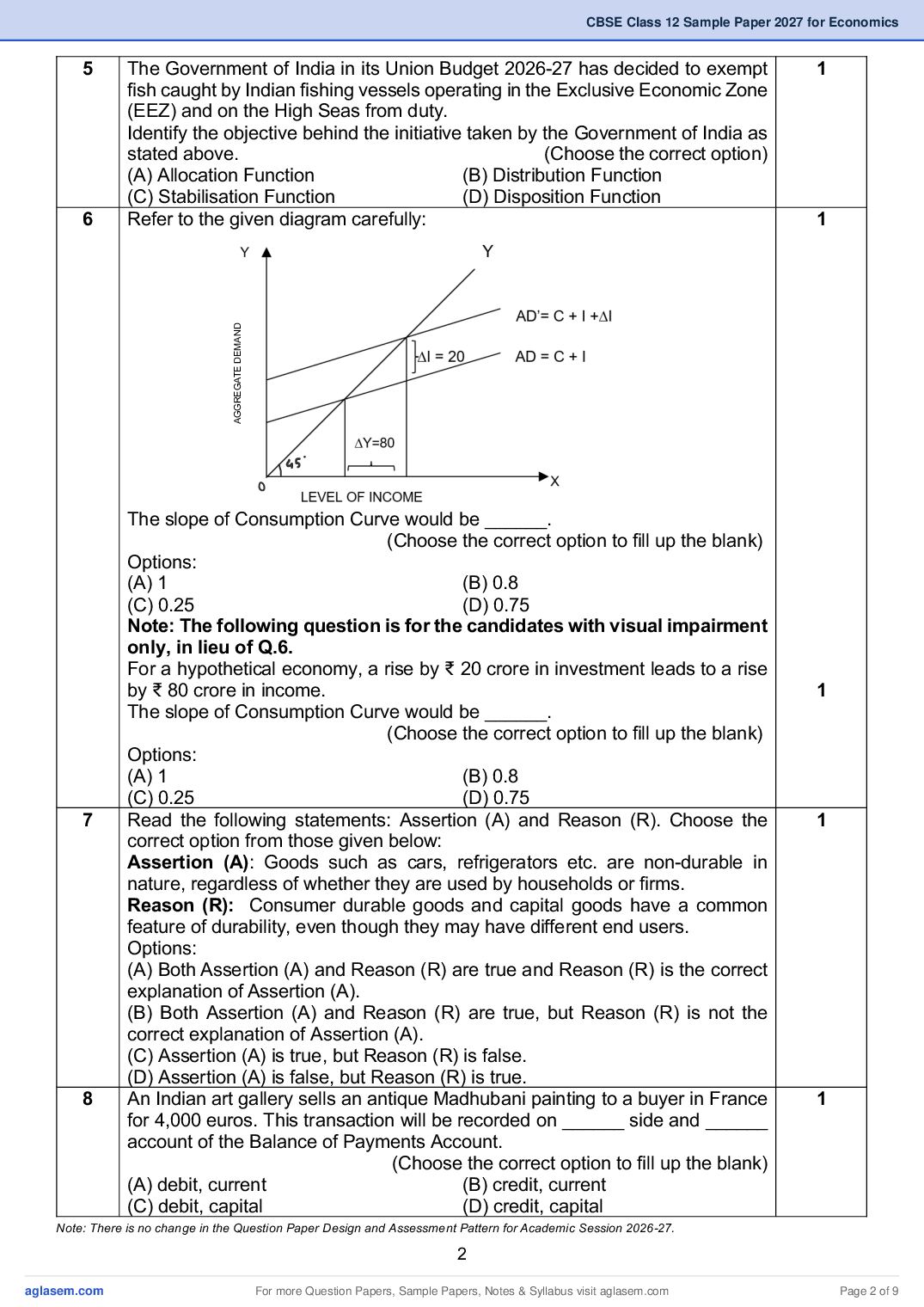
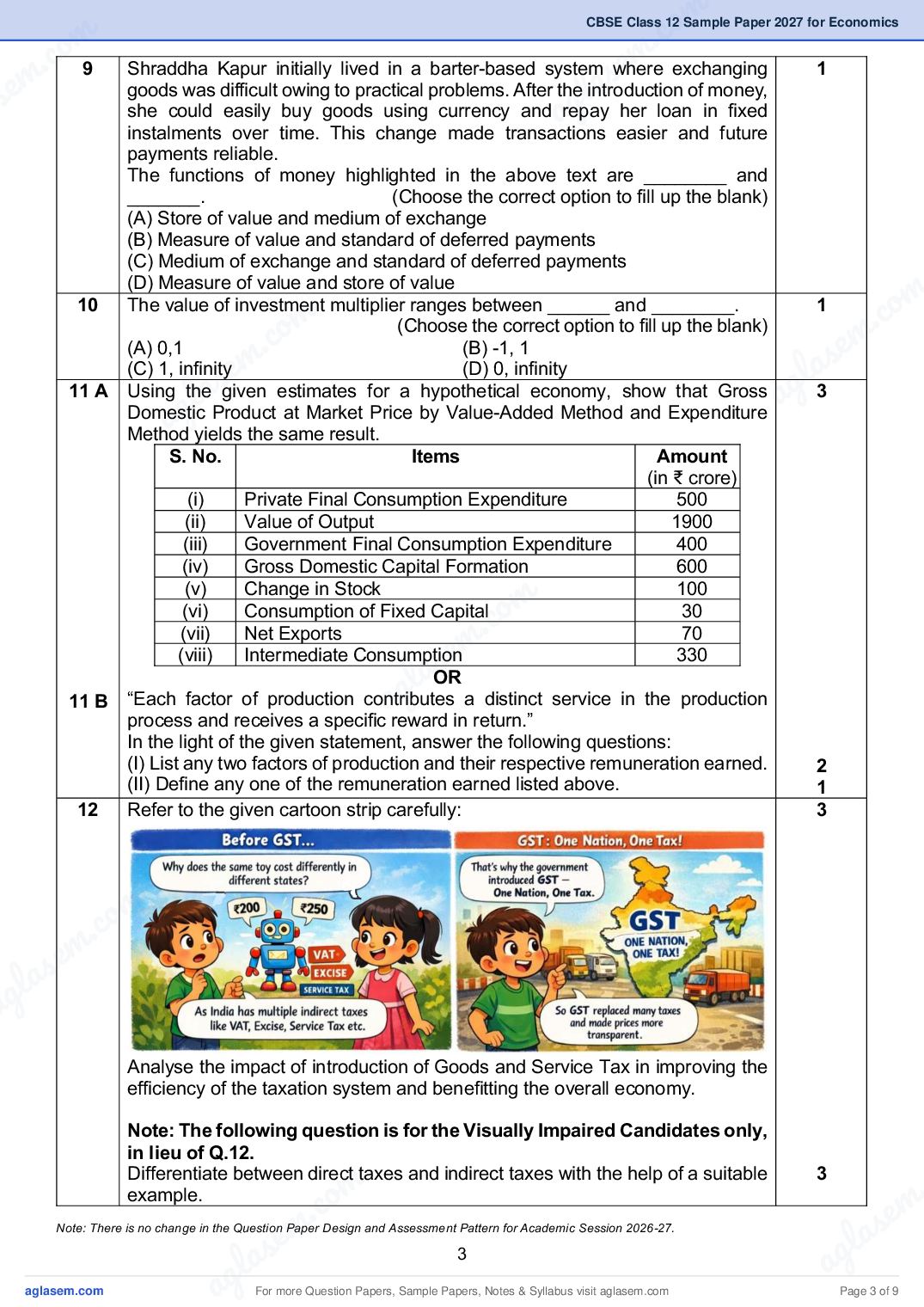
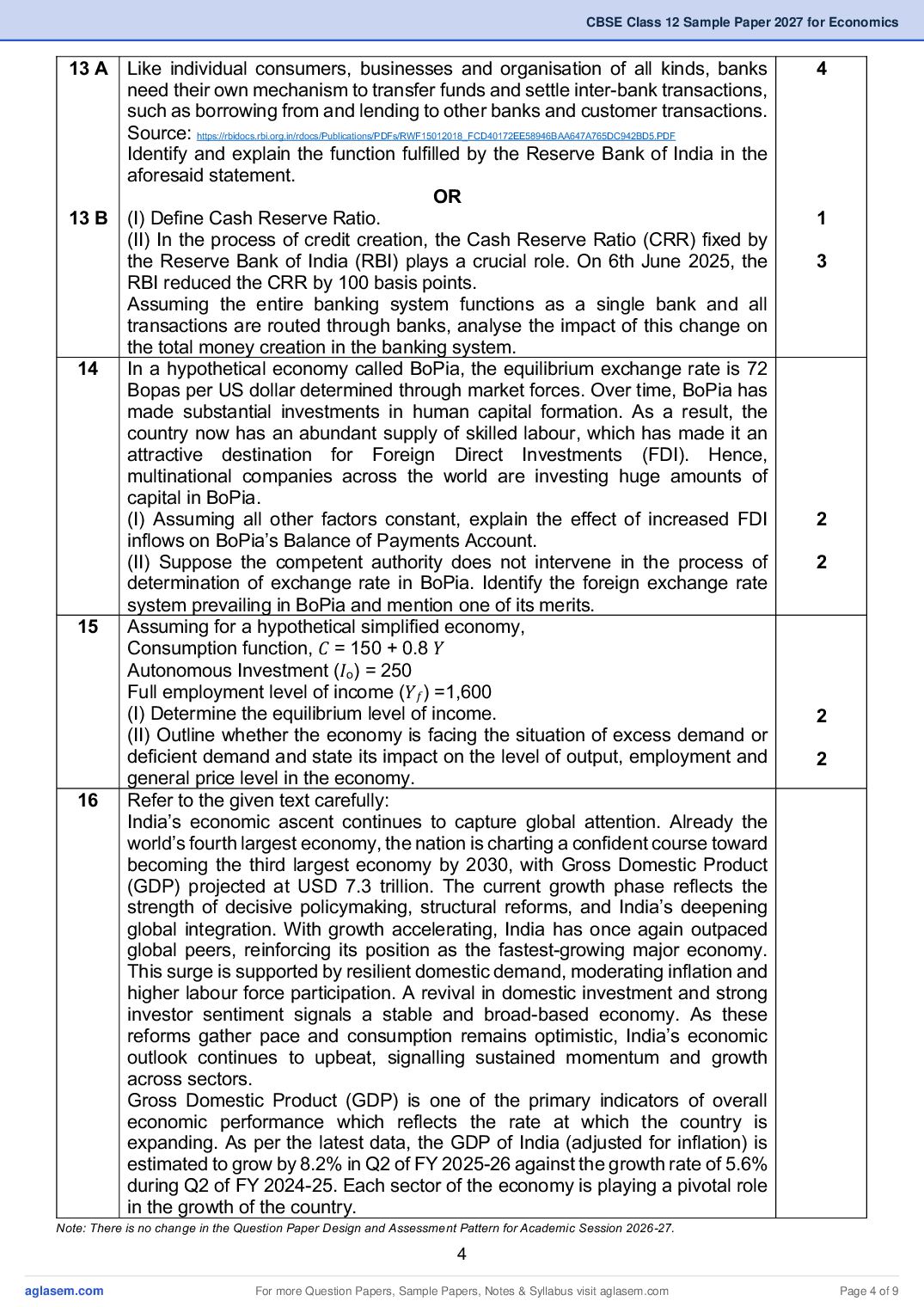
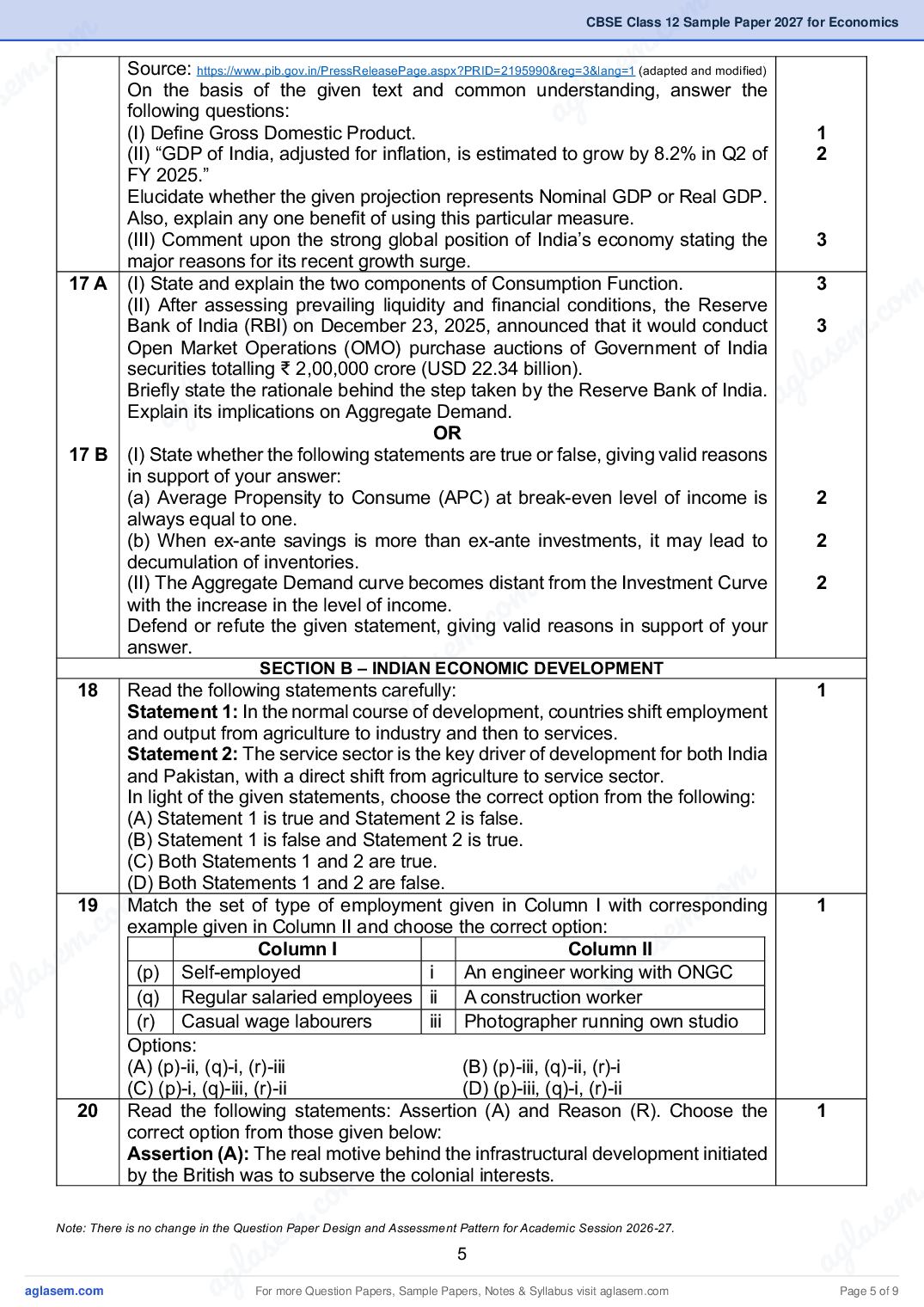
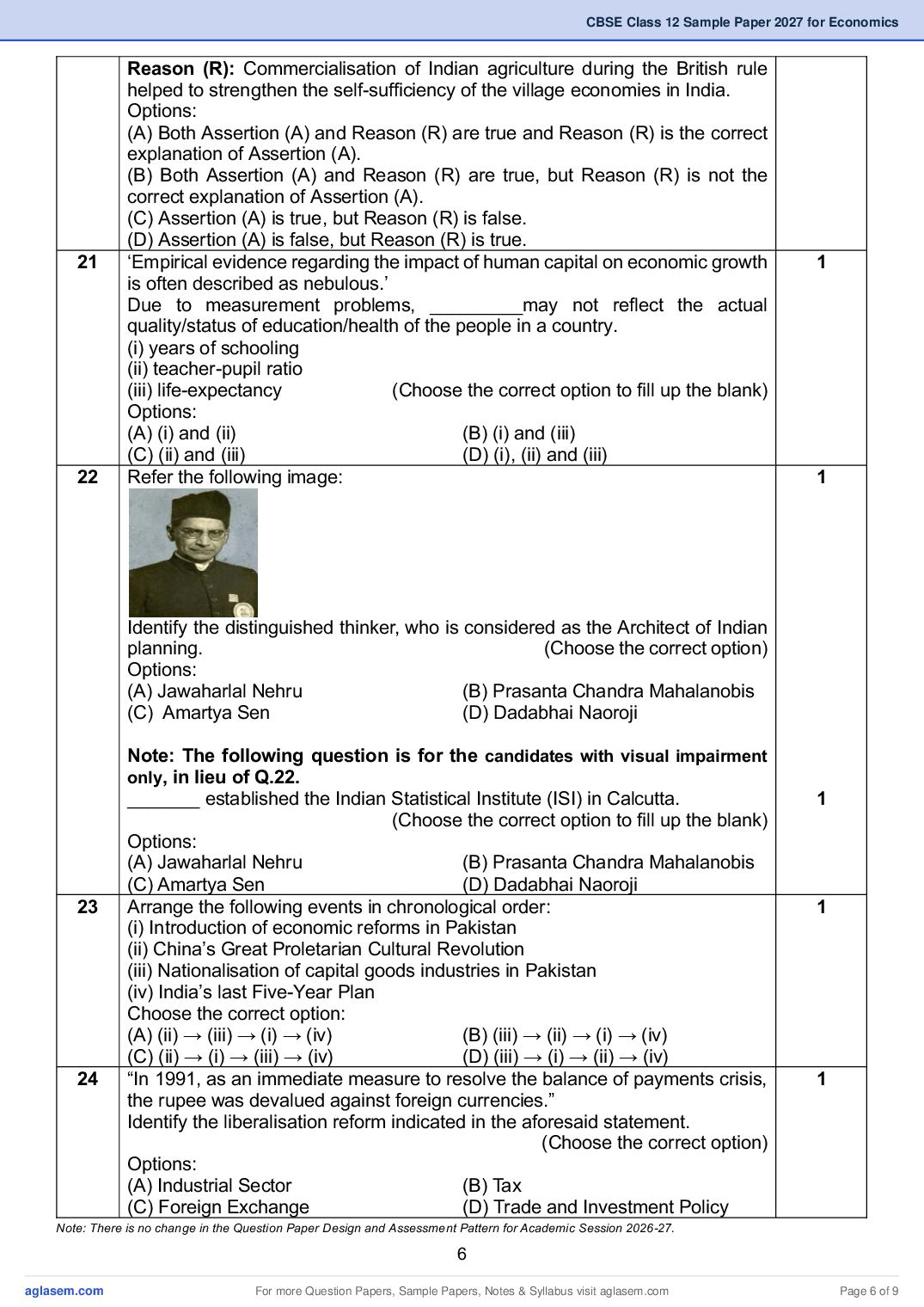
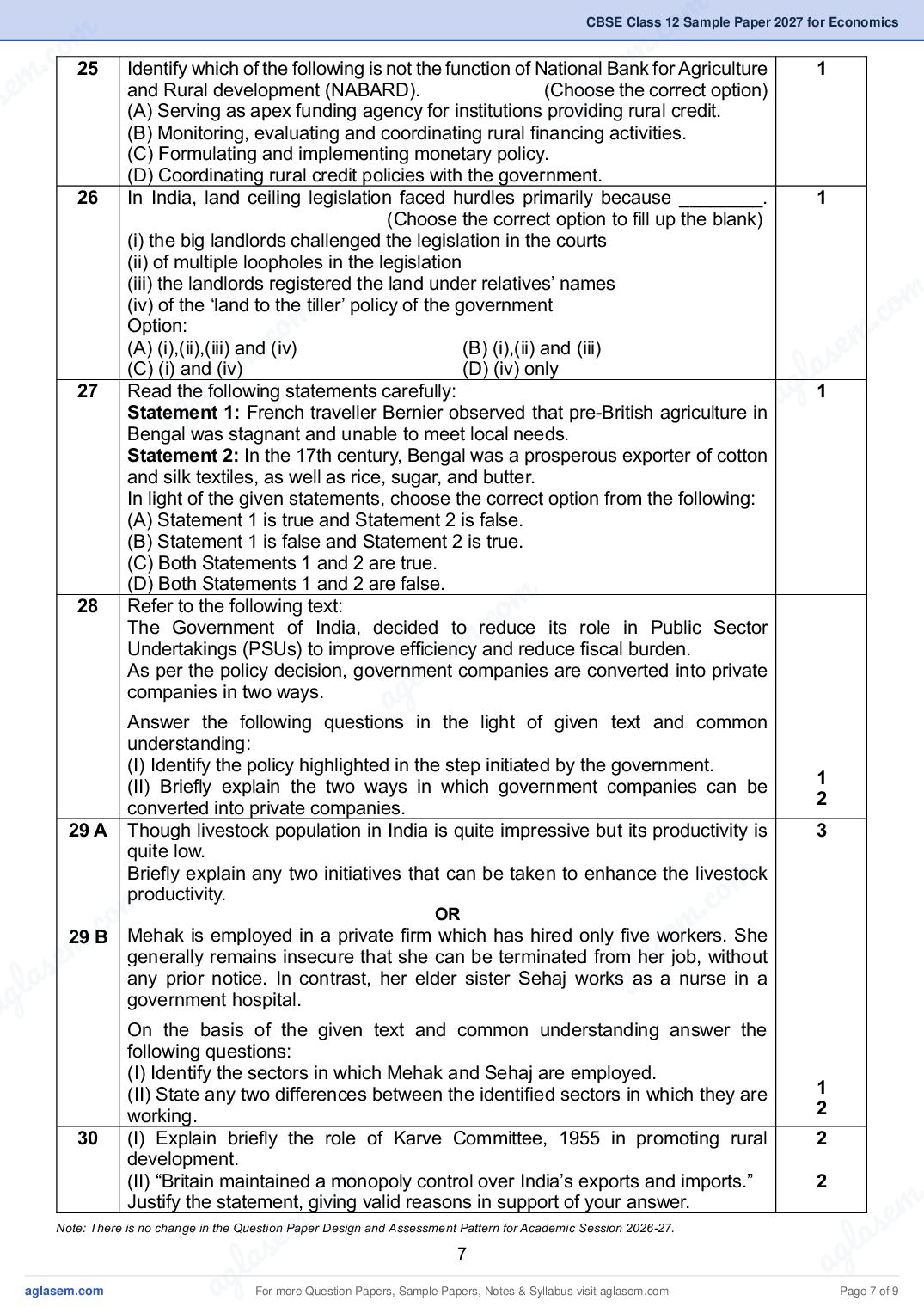
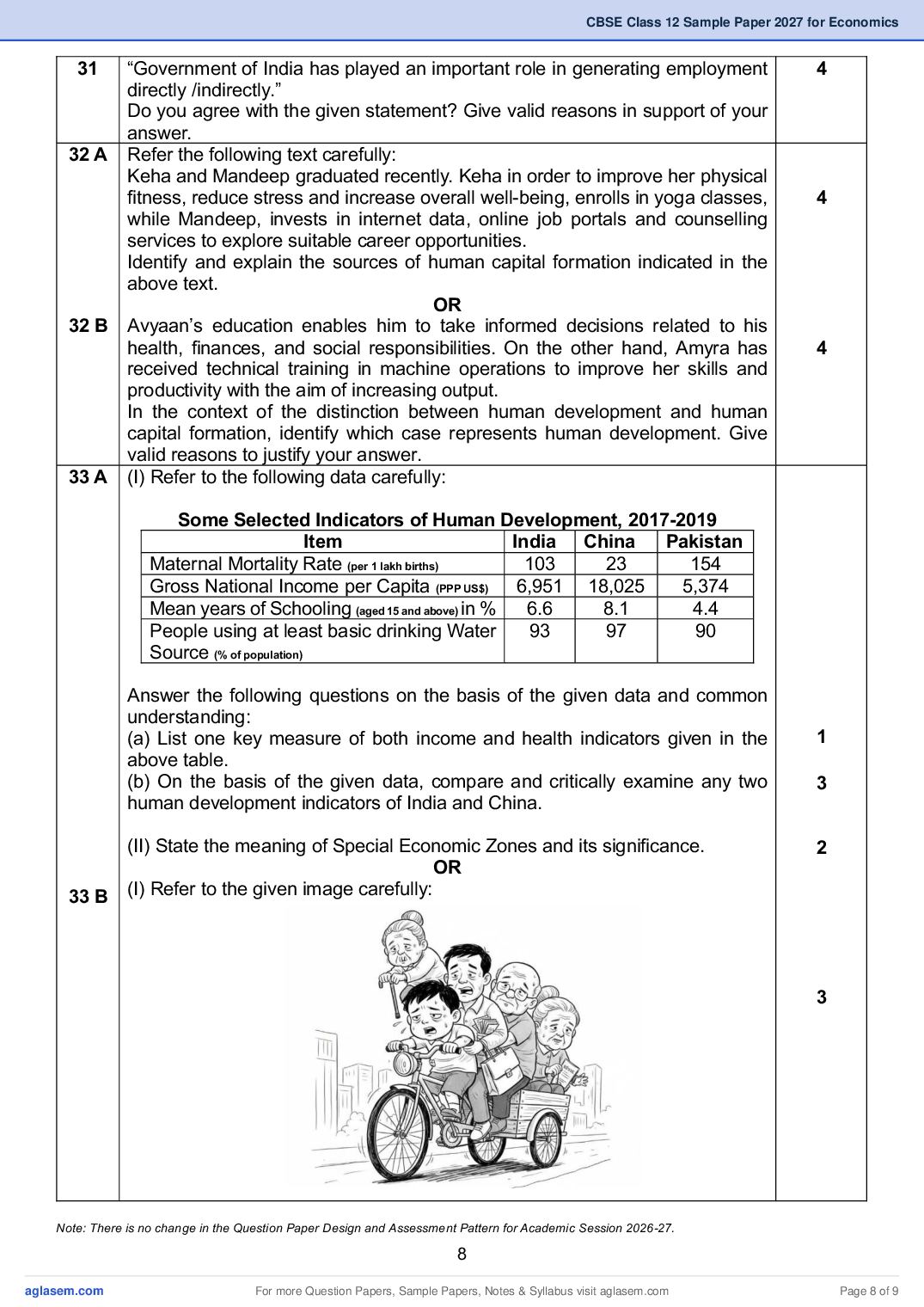
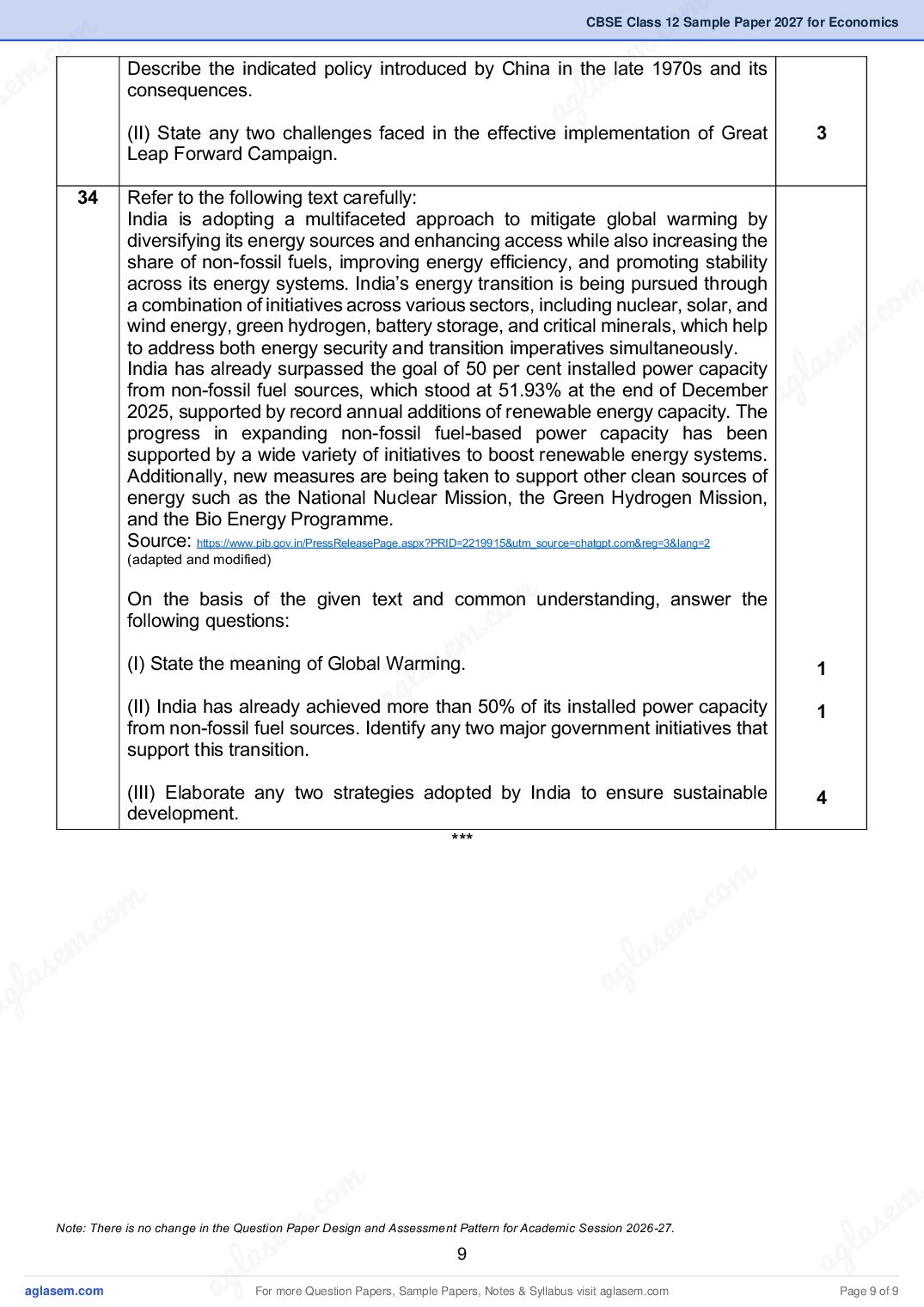
CBSE Class 12 Economics Paper Pattern 2027
How the 2027 sample paper is set (from the paper itself) – 80 marks, 3 hours, 34 questions:
| Section | Questions | Type | Marks each | Total |
|---|---|---|---|---|
| A – Macroeconomics | 1–10 | MCQ (incl. statement-based, assertion-reason, fill-in-the-blank, diagram-based) | 1 | 10 |
| A | 11–12 | Short answer (60–80 words; Q11 numerical/theory choice, Q12 cartoon-based) | 3 | 6 |
| A | 13–15 | Short answer (80–100 words; incl. numerical Q15) | 4 | 12 |
| A | 16–17 | Long answer (100–150 words; Q16 text/source-based) | 6 | 12 |
| B – Indian Economic Development | 18–27 | MCQ (incl. statement-based, match-the-columns, assertion-reason, chronological order, image-based) | 1 | 10 |
| B | 28–29 | Short answer (60–80 words) | 3 | 6 |
| B | 30–32 | Short answer (80–100 words) | 4 | 12 |
| B | 33–34 | Long answer (100–150 words; data-table/image-based Q33, text-based Q34) | 6 | 12 |
| Total | 34 | 80 |
Choice: No choice in the MCQs; internal A/B choice in 6 questions – Q11 (3 marks), Q13 (4), Q17 (6) in Section A and Q29 (3), Q32 (4), Q33 (6) in Section B.
- Section A is Macroeconomics and Section B is Indian Economic Development.
- Word limits are printed by question type: 3 marks 60–80 words, 4 marks 80–100 words, 6 marks 100–150 words.
- Separate alternative questions are printed for candidates with visual impairment in place of the diagram/cartoon/image-based Q6, Q12 and Q22.
Unit-wise Marks in the Economics Sample Paper 2027
Marks for each unit (counted question by question from the 2027 paper):
| Unit | Questions | Marks |
|---|---|---|
| National Income and Related Aggregates | Q7, Q11, Q16 | 10 |
| Money and Banking | Q2, Q9, Q13 | 6 |
| Determination of Income and Employment | Q6, Q10, Q15, Q17 | 12 |
| Government Budget and the Economy | Q1, Q4, Q5, Q12 | 6 |
| Balance of Payments (incl. foreign exchange rate) | Q3, Q8, Q14 | 6 |
| Development Experience (1947–90) and Economic Reforms since 1991 | Q20, Q22, Q24, Q26, Q27, Q28, Q30 | 12 |
| Current Challenges facing the Indian Economy (human capital, rural development, employment, sustainable development) | Q19, Q21, Q25, Q29, Q31, Q32, Q34 | 20 |
| Development Experience of India – A Comparison with Neighbours | Q18, Q23, Q33 | 8 |
What Is New in the Economics Sample Paper 2027?
Compared with the 2026 sample paper (session 2025-26):
- No change in pattern – same two sections (A Macroeconomics, B Indian Economic Development, 40 marks each), 34 questions, 80 marks, 3 hours, and the same question numbering by marks (Q1–10/18–27 one mark, Q11–12/28–29 three marks, Q13–15/30–32 four marks, Q16–17/33–34 six marks) and word limits as the 2025-26 paper.
- Internal choice is still in 6 questions but in different places: 2025-26 had it in Q12, Q13, Q16, Q29, Q30, Q33; 2026-27 has it in Q11, Q13, Q17, Q29, Q32, Q33.
- Visually impaired alternatives: 2025-26 printed them for Q1, Q5, Q15 and Q32; 2026-27 prints them for Q6, Q12 and Q22.
- Section A heading spelt ‘Macroeconomics’ (2025-26: ‘Macro Economics’); paper footnote changed from ‘the assessment scheme of the academic session 2024-25 will continue in the current session i.e. 2025-26’ to ‘There is no change in the Question Paper Design and Assessment Pattern for Academic Session 2026-27’.
- Both papers are 9 pages.
Questions from the Economics Sample Paper 2027
Two questions from the 2027 paper, to show the level:
- Section A, 1 mark: Suppose the fiscal deficit of an economy is ₹5,000 crore, total government expenditure is ₹18,000 crore, and non-tax revenue and capital receipts (excluding borrowings) together are ₹3,000 crore. The tax revenue of the government is ₹____ crore. (A) 10,000 (B) 12,000 (C) 13,000 (D) 15,000
- Section A, 4 marks: For a hypothetical economy, C = 150 + 0.8Y, autonomous investment = 250 and full employment level of income = 1,600. (I) Determine the equilibrium level of income. (II) Outline whether the economy faces excess demand or deficient demand and state its impact on output, employment and the general price level.
CBSE Class 12 Economics Marking Scheme 2027 (Solutions)
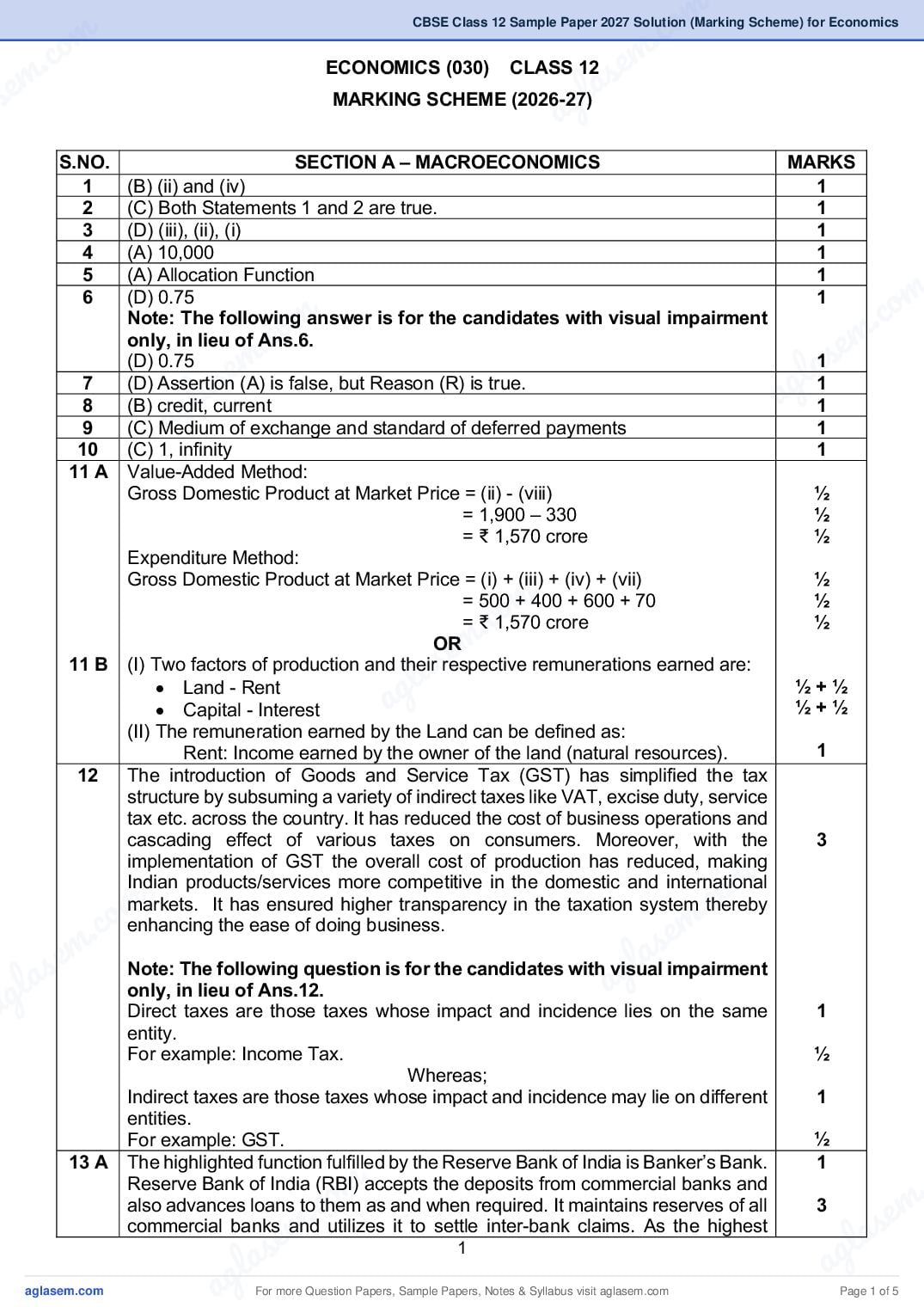
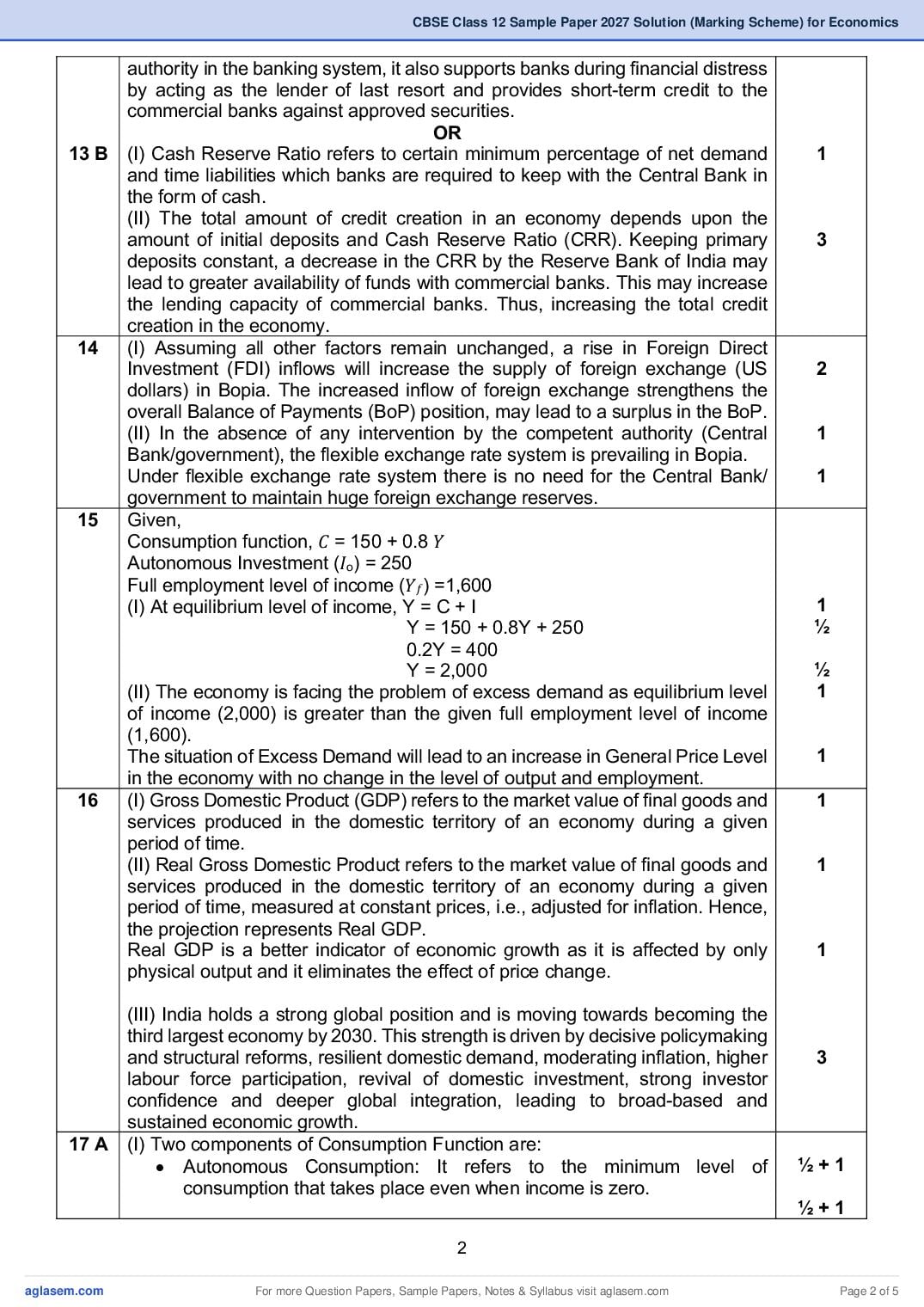
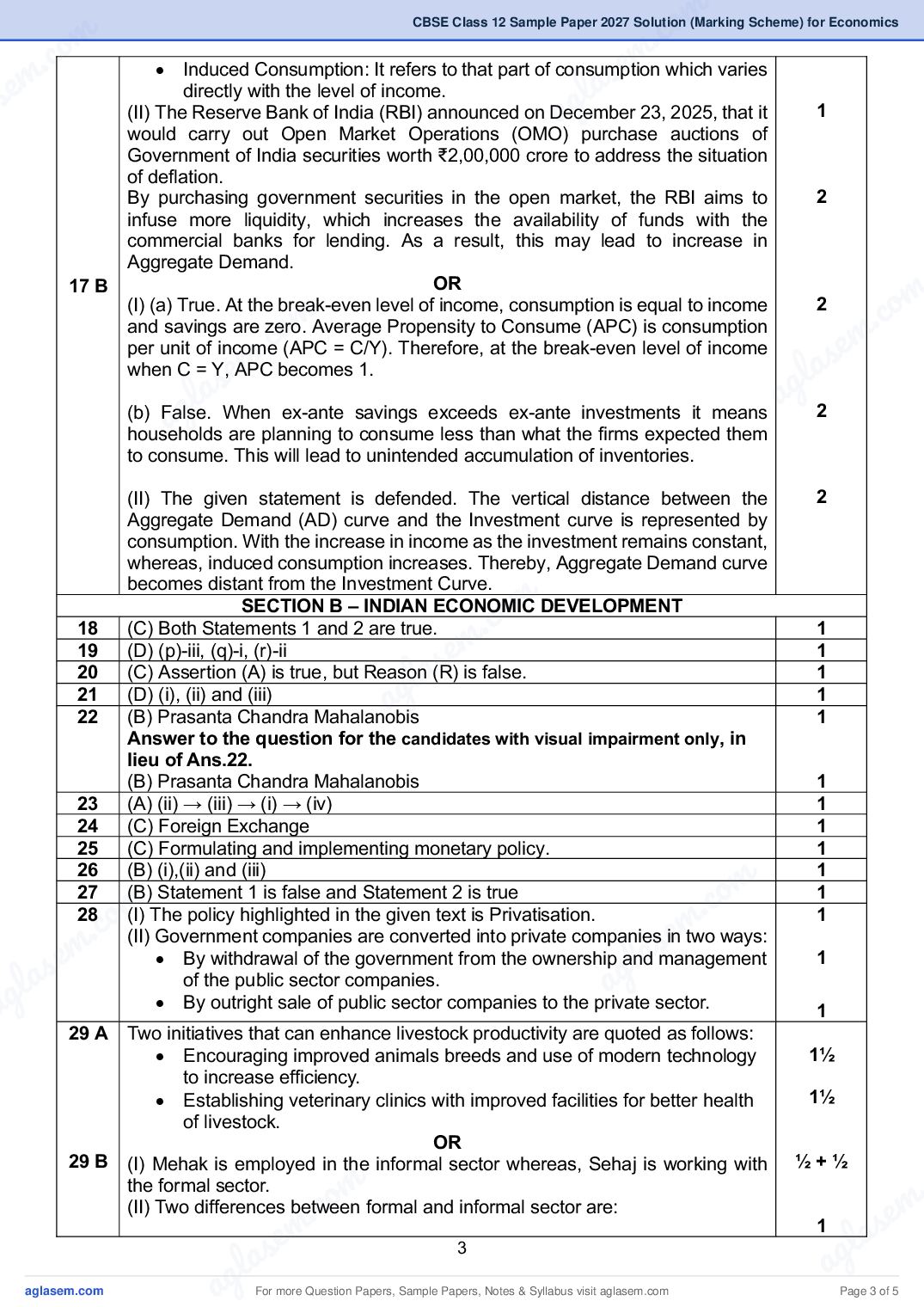
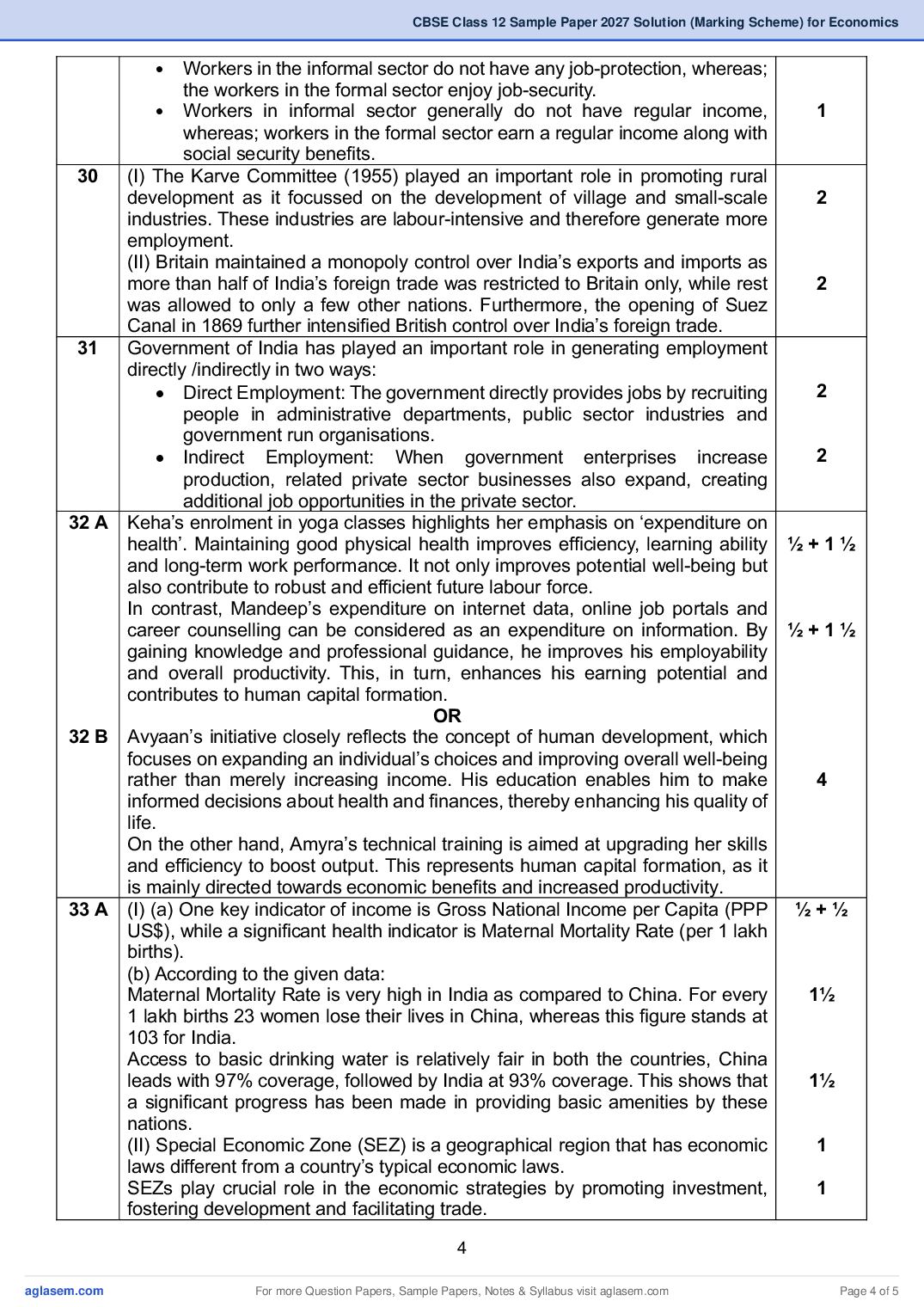
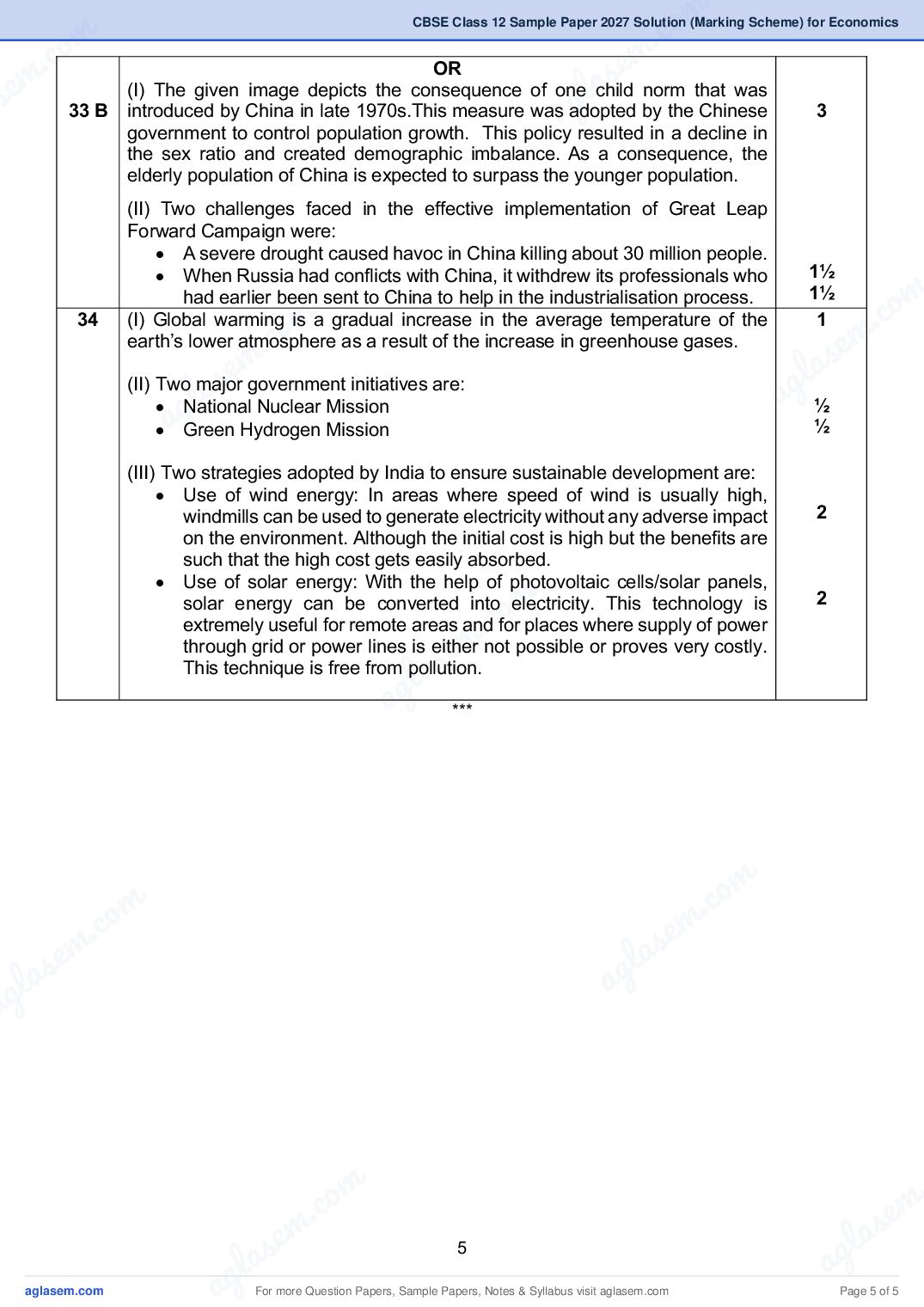
The 2026-27 marking scheme gives the correct option for all MCQs (including the visually-impaired alternatives) and model answers for descriptive questions with marks against each point – e.g. ½-mark steps for the GDP calculation in Q11 A (formula, substitution, answer for both methods) and the equilibrium-income working in Q15, and ½ + 1½ splits for identify-and-explain answers. Check your answers against it after you solve the paper.
Economics Marking Scheme 2027 – Read Online
How to Score Well – Tips from the 2027 Paper
- Practise short numericals that appear as 1-mark MCQs and 3–4-mark answers: fiscal deficit/tax revenue (Q4), multiplier and MPC (Q6, Q10), GDP by value-added and expenditure methods (Q11 A), and equilibrium income with excess/deficient demand (Q15).
- Read current-affairs-based case texts carefully – the paper uses Union Budget 2026-27, RBI’s June 2025 CRR cut and December 2025 OMO purchase, PIB GDP data and India’s non-fossil power capacity; answers are expected to link them to textbook concepts.
- In true/false and ‘defend or refute’ questions (Q17 B), the marks are for the reason – state the verdict first and then the economic logic.
- Revise the India–China–Pakistan comparison including data tables (Q33 A uses a human development indicator table) and China’s policies such as the one-child norm and Great Leap Forward.
- Keep to the printed word limits: 60–80 words for 3 marks, 80–100 for 4 marks and 100–150 for 6 marks.
- Solve the 2027 paper in one sitting with a timer, check it with the marking scheme, then solve the 2026 paper a few days later.
More Class 12 Economics Papers and Study Material
Practise past board papers, or plan your revision with the syllabus and important questions for Class 12 Economics:
CBSE Class 12 Economics Sample Paper 2027 – FAQs
Is the CBSE Class 12 Economics Sample Paper 2027 out?
Yes. CBSE has released the Class 12 Economics sample paper 2027 for the 2026-27 session with its marking scheme – both are in the table on this page, free.
Is the CBSE Class 12 Economics Sample Paper 2027 available with solutions?
Yes. The official CBSE marking scheme is the solution – it gives the answers and the marks for each step. Download it from the table above or read it online on this page.
Has the CBSE Class 12 Economics paper pattern changed for 2027?
No. CBSE says there is no change in the question paper design for 2026-27. The 2027 sample paper keeps the 2026 pattern – 80 marks, 3 hours, 34 questions in 2 sections. Small changes: Internal choice is still in 6 questions but in different places: 2025-26 had it in Q12, Q13, Q16, Q29, Q30, Q33; 2026-27 has it in Q11, Q13, Q17, Q29, Q32, Q33.; Visually impaired alternatives: 2025-26 printed them for Q1, Q5, Q15 and Q32; 2026-27 prints them for Q6, Q12 and Q22..
How many marks and questions are in the CBSE Class 12 Economics Sample Paper 2027?
It is a 80 marks, 3 hours, 34 questions paper – Section A – Macroeconomics: 1–10 (10 marks); Section A – Macroeconomics: 11–12 (6 marks); Section A – Macroeconomics: 13–15 (12 marks); Section A – Macroeconomics: 16–17 (12 marks); Section B – Indian Economic Development: 18–27 (10 marks); Section B – Indian Economic Development: 28–29 (6 marks).
Which units carry the most marks in the Economics sample paper 2027?
In the 2027 sample paper: Current Challenges facing the Indian Economy (human capital, rural development, employment, sustainable development) (20 marks), Determination of Income and Employment (12 marks), Development Experience (1947–90) and Economic Reforms since 1991 (12 marks).
Is the CBSE 12th Economics model question paper 2027 the same as the sample paper?
Yes. CBSE calls it the sample question paper (SQP); students also search for it as the 12th Economics model question paper or model test paper – it is the same official paper on this page.
Will the board exam paper be the same as the sample paper?
No – the CBSE Class 12 board exam 2027 has different questions, but it follows the same pattern as the sample paper: the same sections, marks and question types.