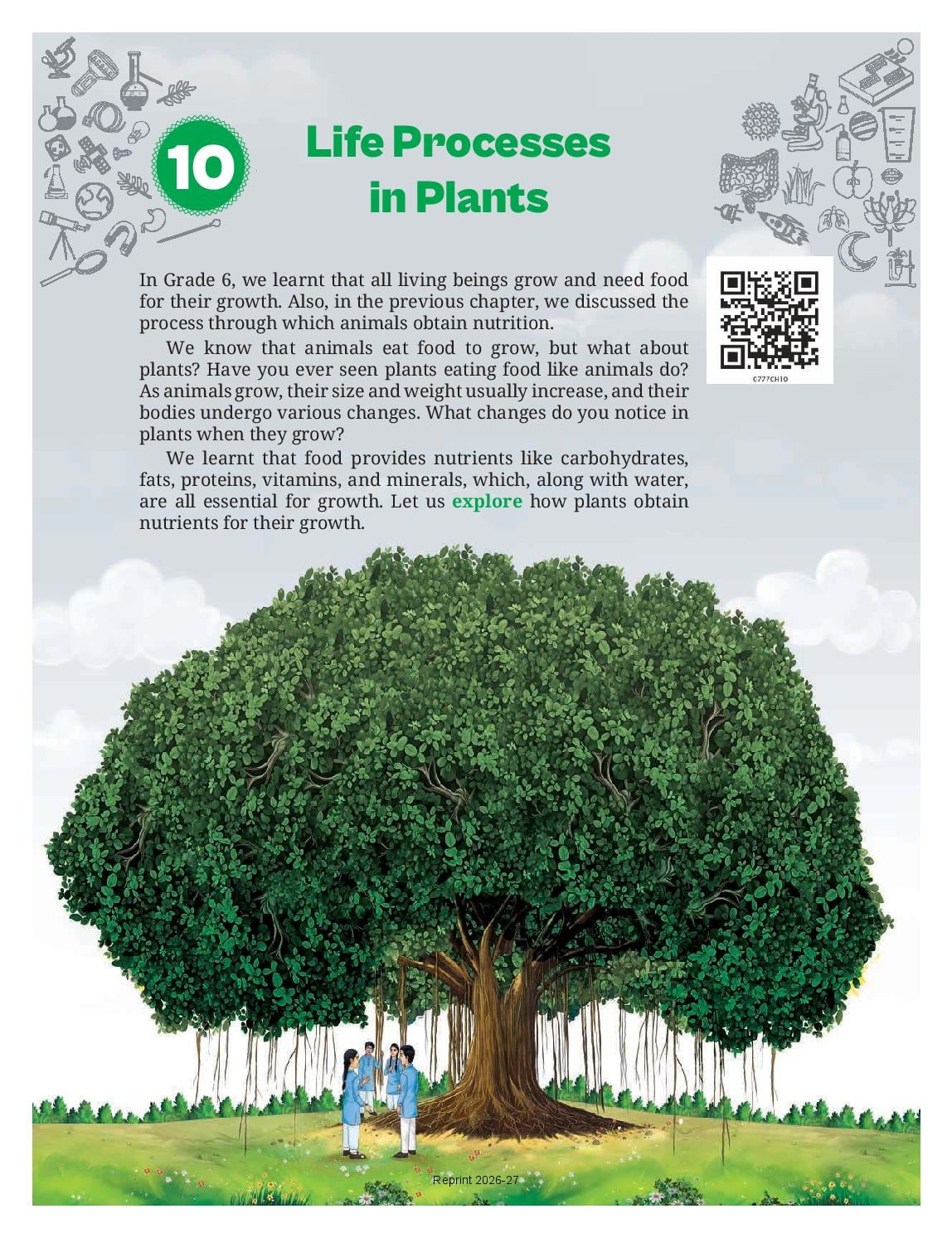
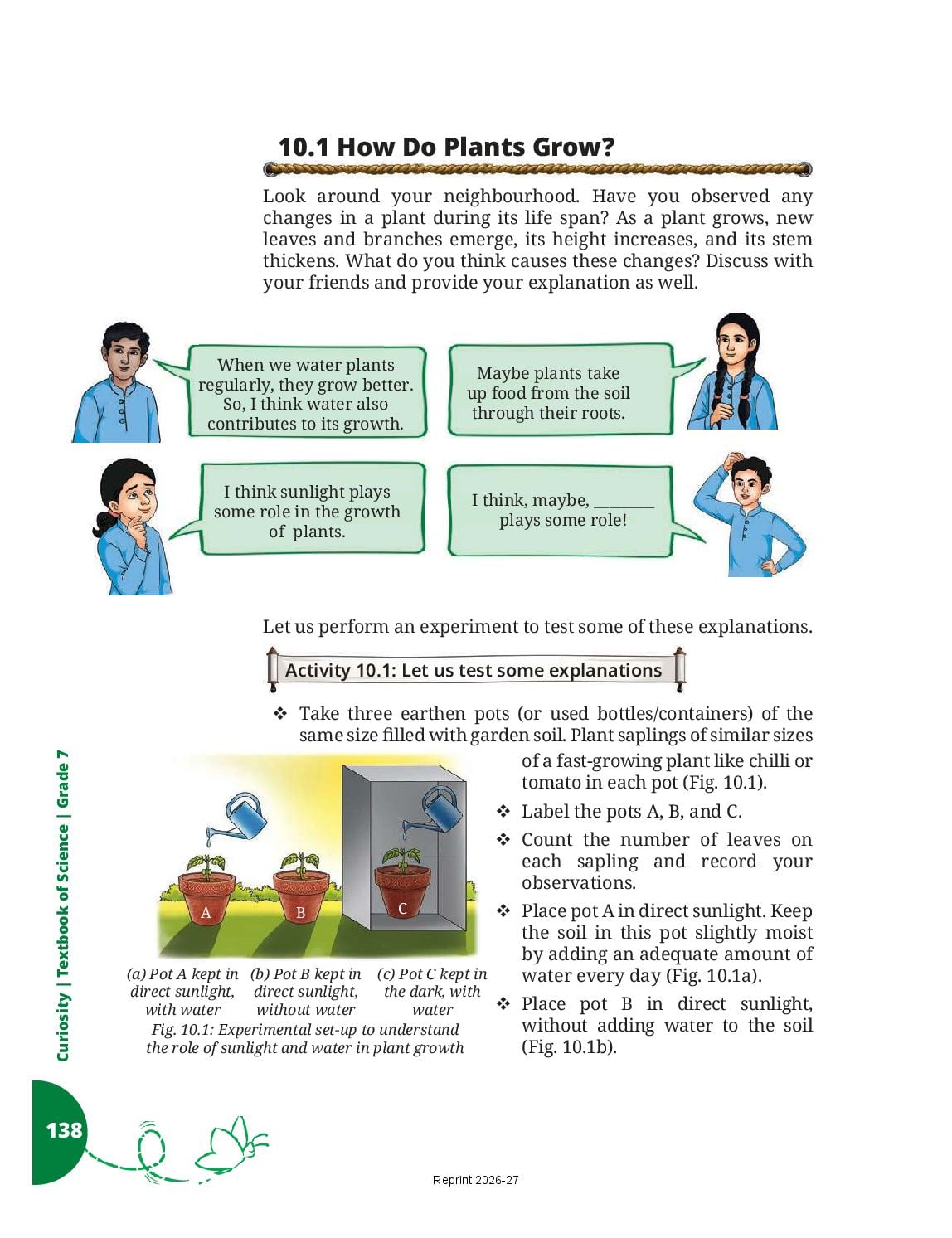
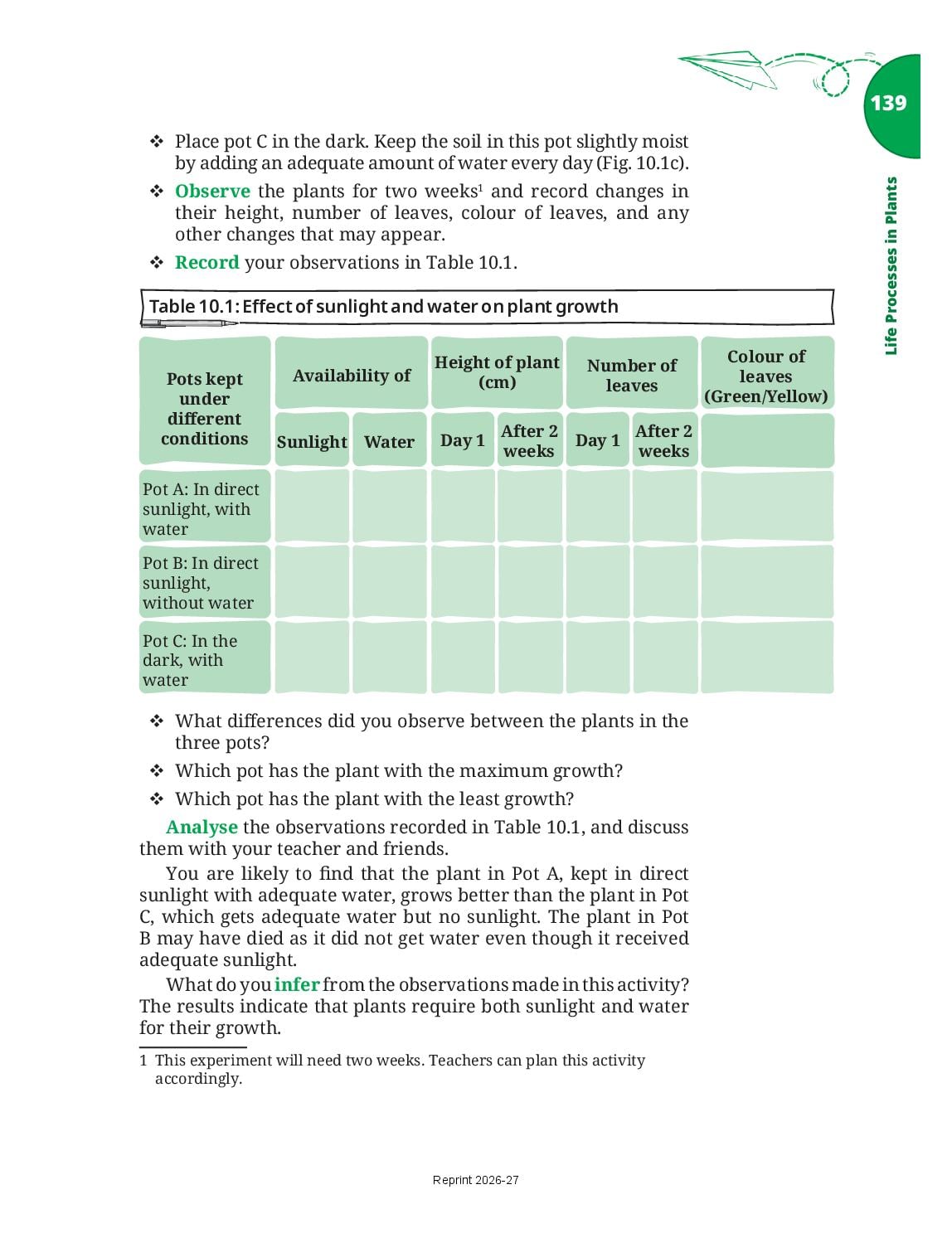
Download Life Processes in Plants – NCERT Class 7 Science Chapter 10 PDF from the new NCERT Class 7 Science book Curiosity (2026-27). Read the chapter online or download the free PDF. Plants need sunlight and water to grow. Activity 10.1 shows this: the pot kept in sunlight with water grows best, the pot kept in the dark with water grows poorly and turns pale, and the pot kept in sunlight without water dries up and may die.
Life Processes in Plants PDF – Chapter 10 of Curiosity
Read the chapter online or download the PDF.
| Chapter | Download | |
|---|---|---|
| Chapter 10 PDF | Life Processes in Plants | View PDF |
| Full book | NCERT Class 7 Science – Curiosity | View Book |
Read Online
What Is in Life Processes in Plants? (Class 7 Science Chapter 10)
- Plants need sunlight and water to grow. Activity 10.1 shows this: the pot kept in sunlight with water grows best, the pot kept in the dark with water grows poorly and turns pale, and the pot kept in sunlight without water dries up and may die.
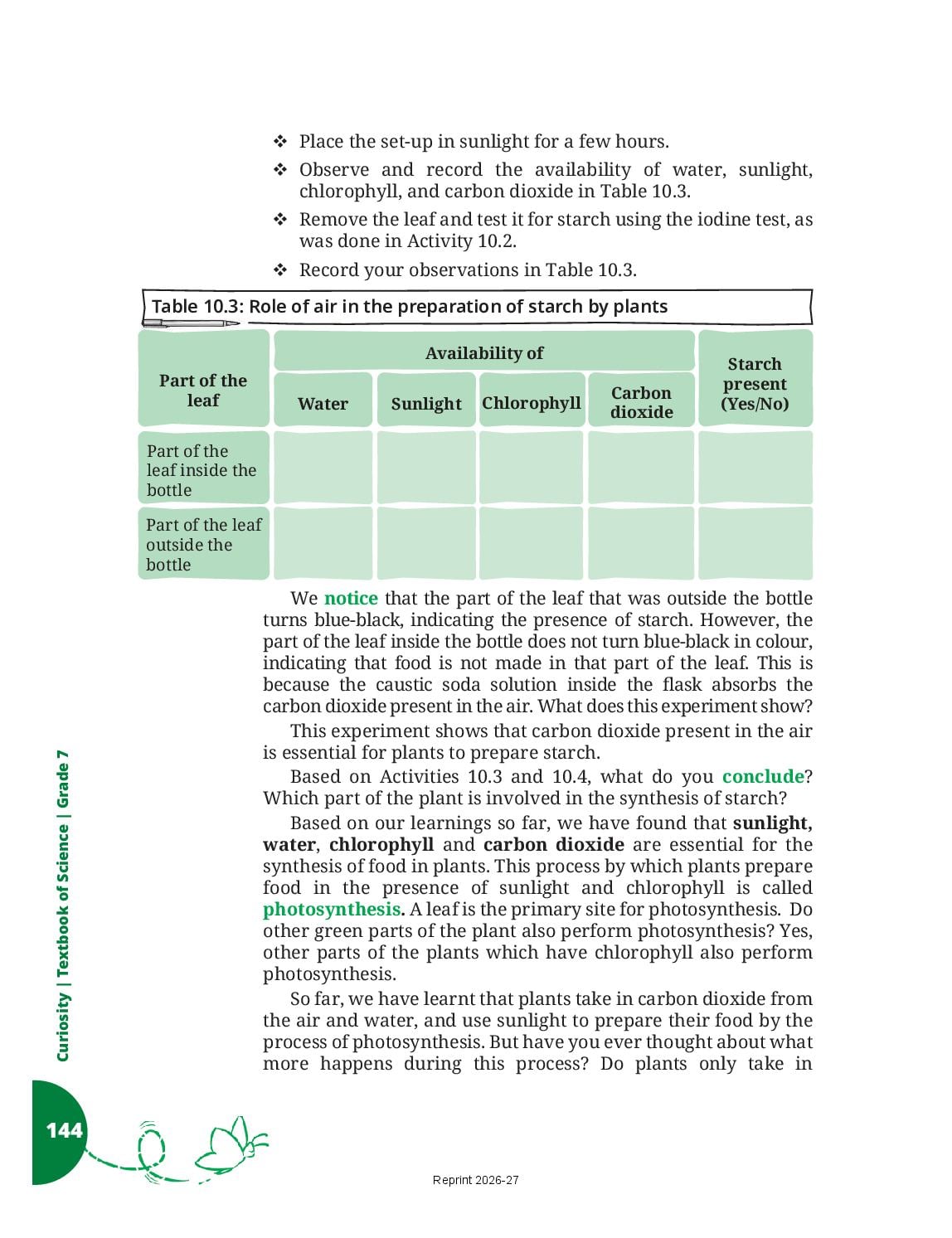
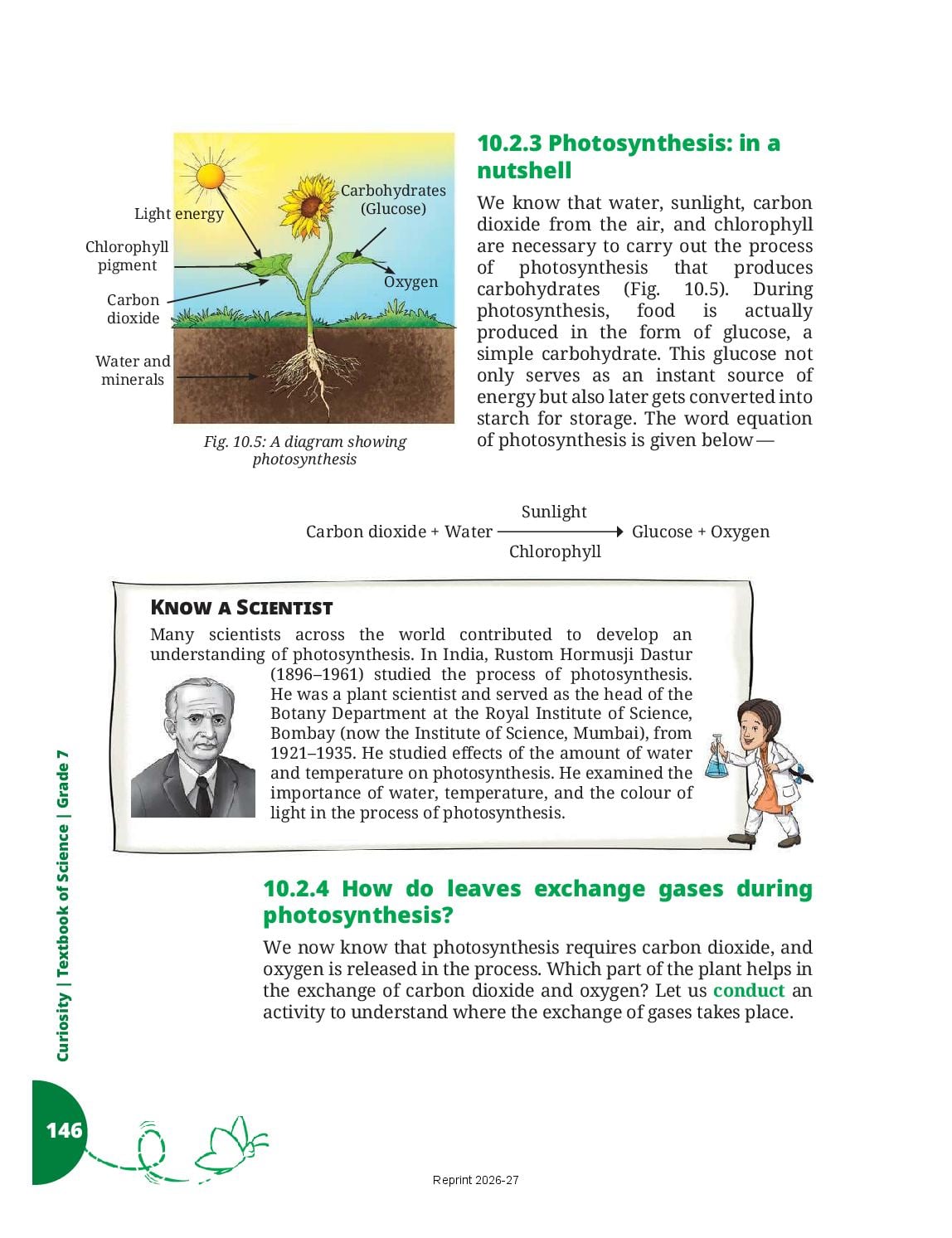
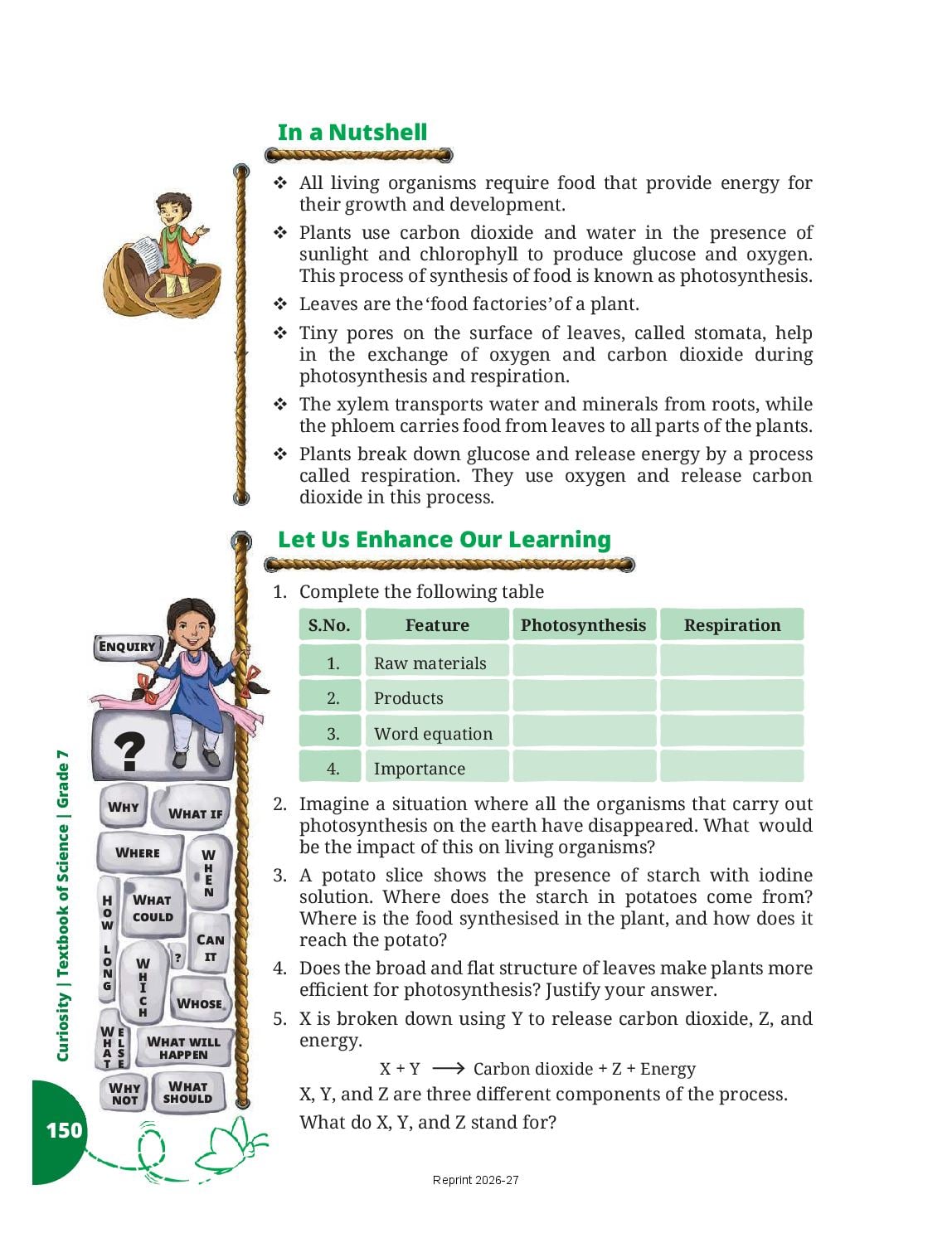
- Plants make their own food. Photosynthesis is the process by which plants prepare food in the presence of sunlight and chlorophyll, using carbon dioxide and water as raw materials. The word equation is: Carbon dioxide + Water → Glucose + Oxygen.
- Leaves are the ‘food factories’ of plants. They are broad and flat, and green because of the pigment chlorophyll, which captures sunlight efficiently. Food is first made as glucose and later stored as starch.
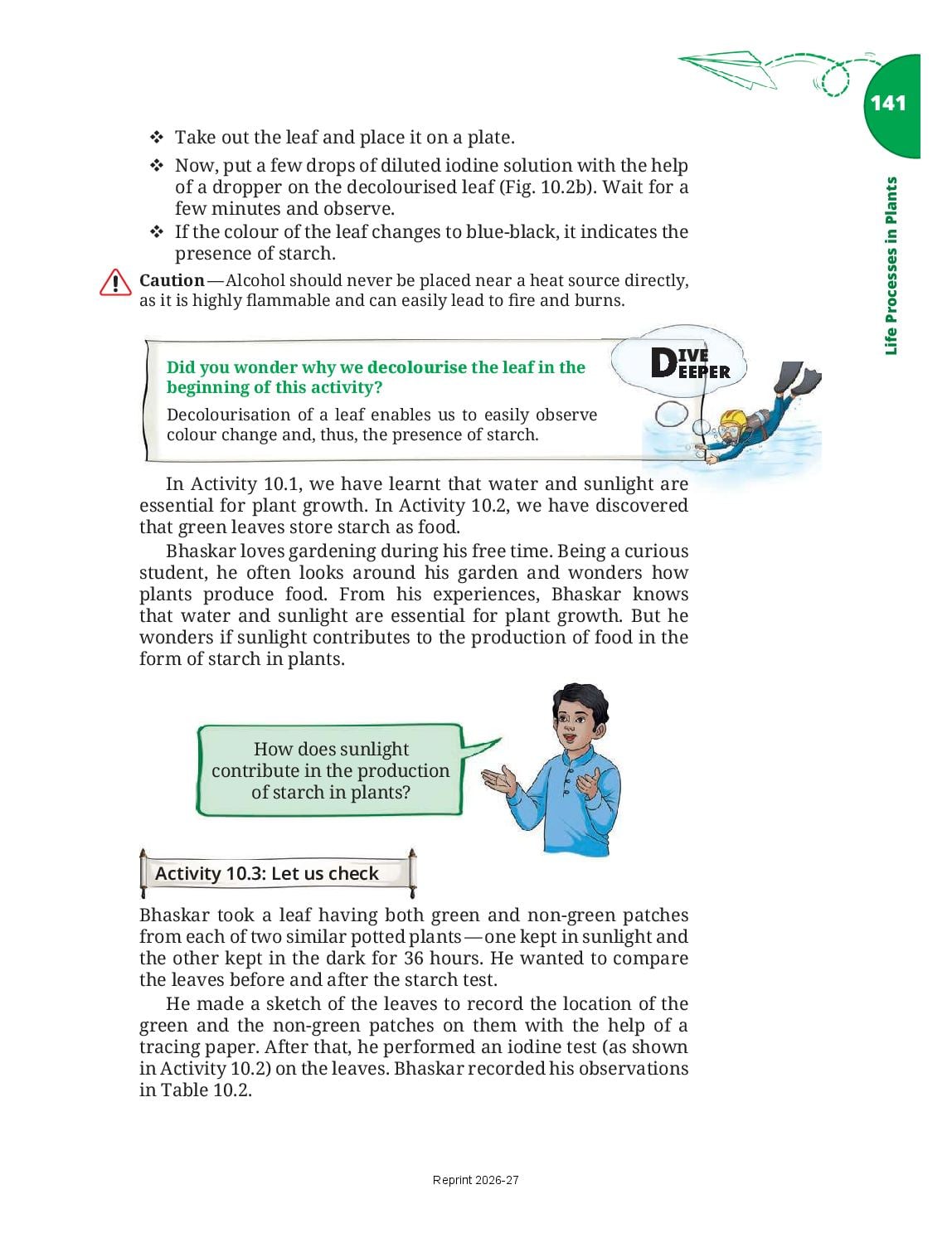
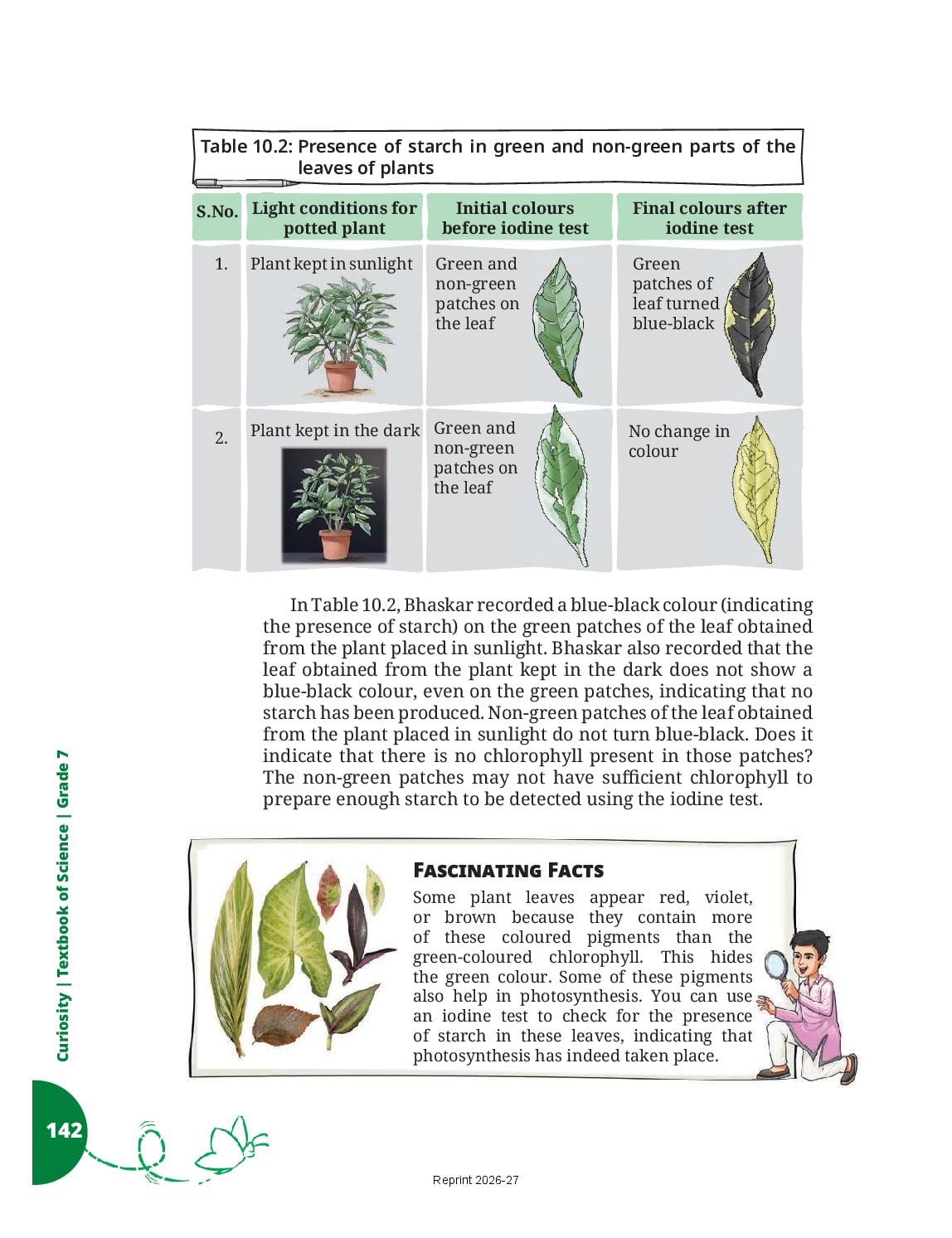
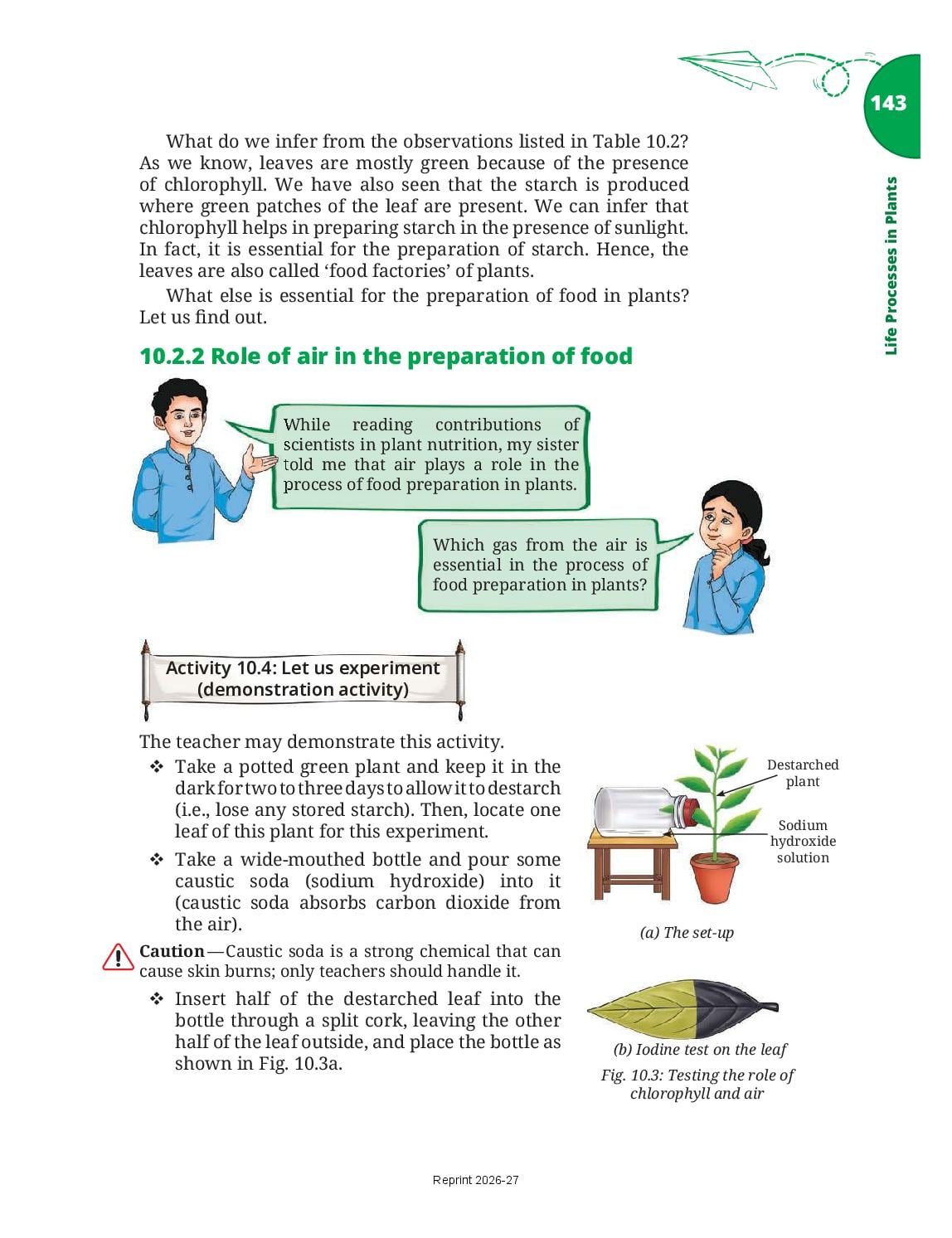
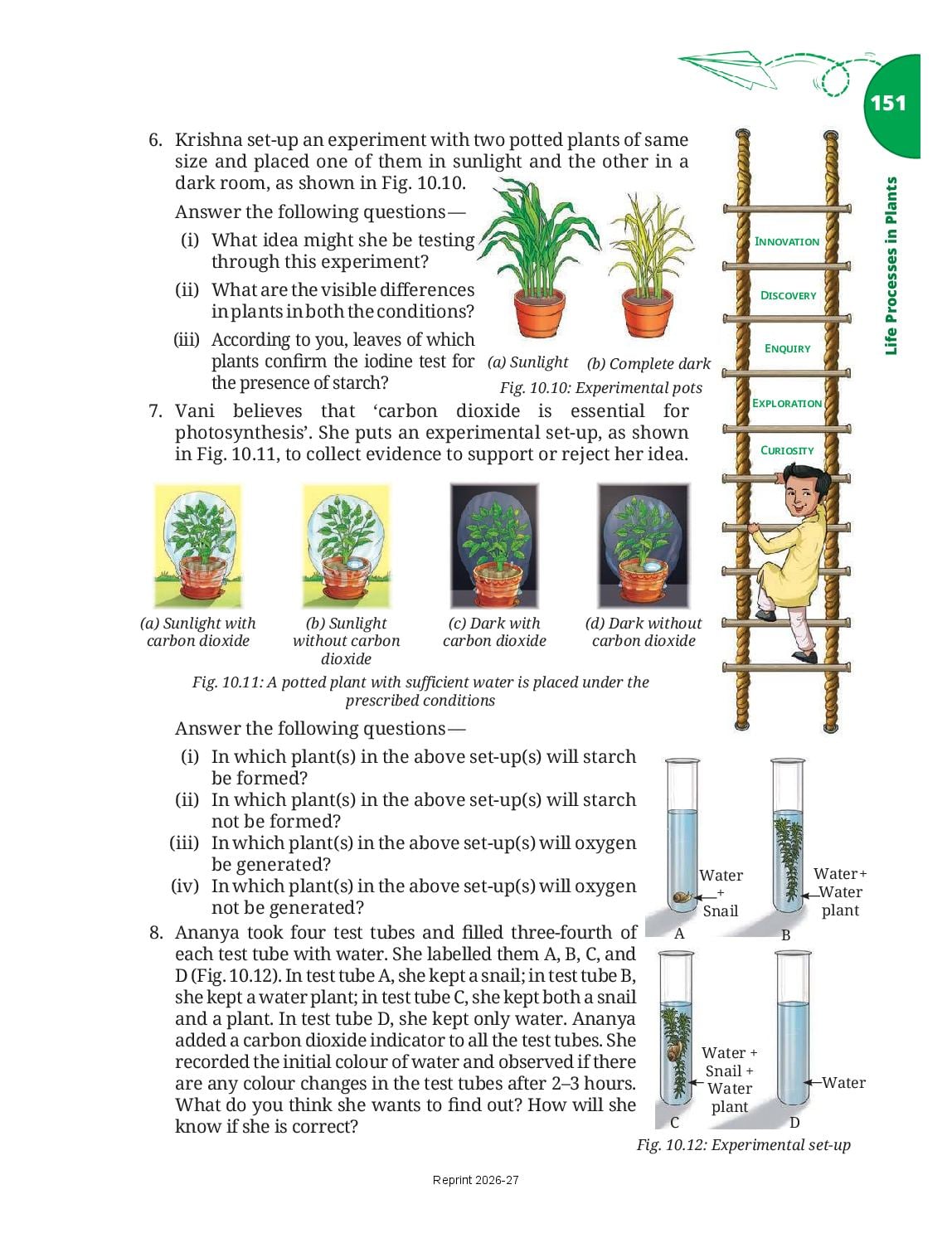
- Starch is detected with the iodine test — a decolourised leaf containing starch turns blue-black. Activity 10.3 shows starch only in the green patches of a leaf from a plant kept in sunlight; Activity 10.4 shows no starch in the leaf-half enclosed with caustic soda, proving carbon dioxide is essential.
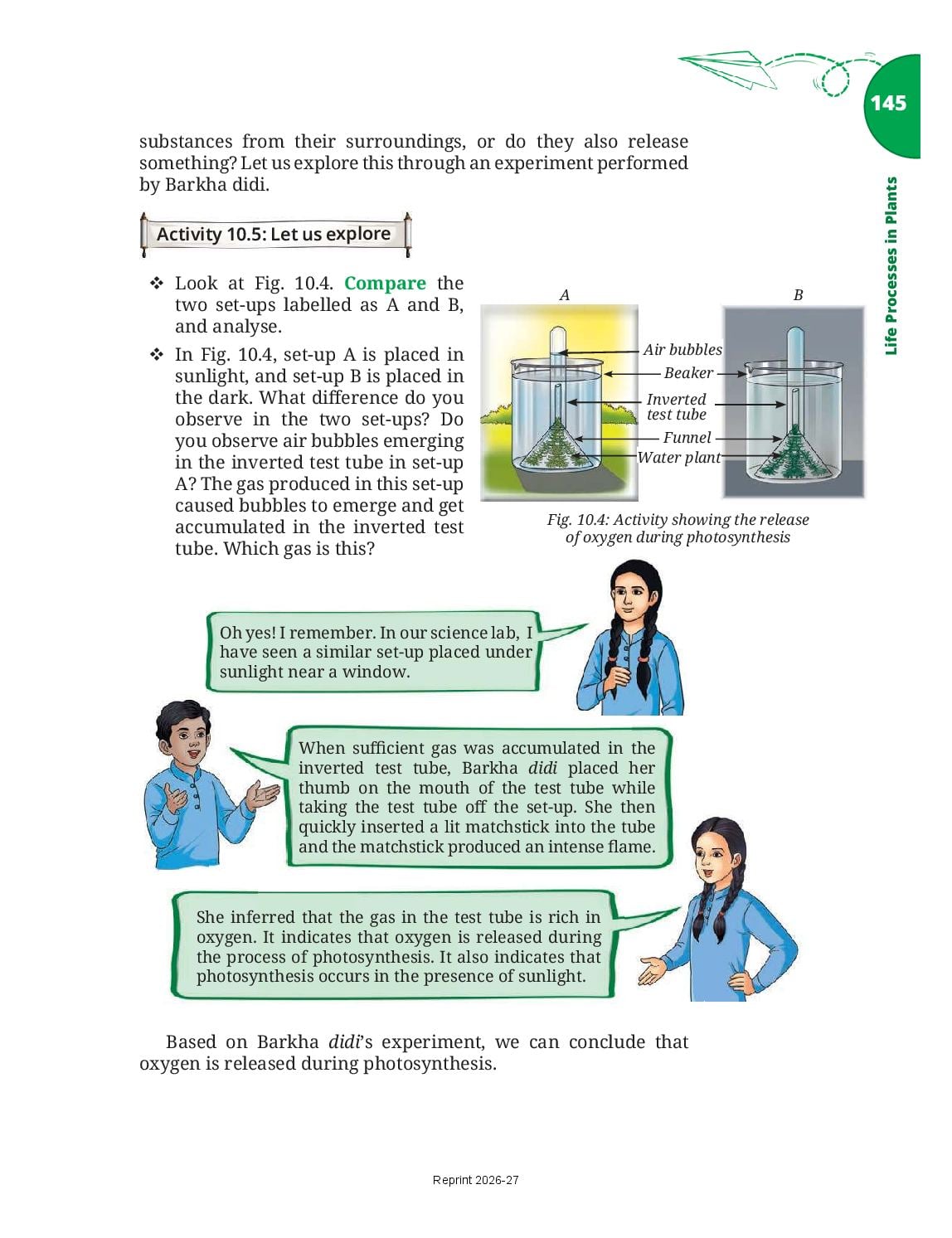
- Oxygen is released during photosynthesis. In Activity 10.5, bubbles collect in the inverted test tube only in the set-up kept in sunlight, and a lit matchstick inserted into the collected gas burns with an intense flame.
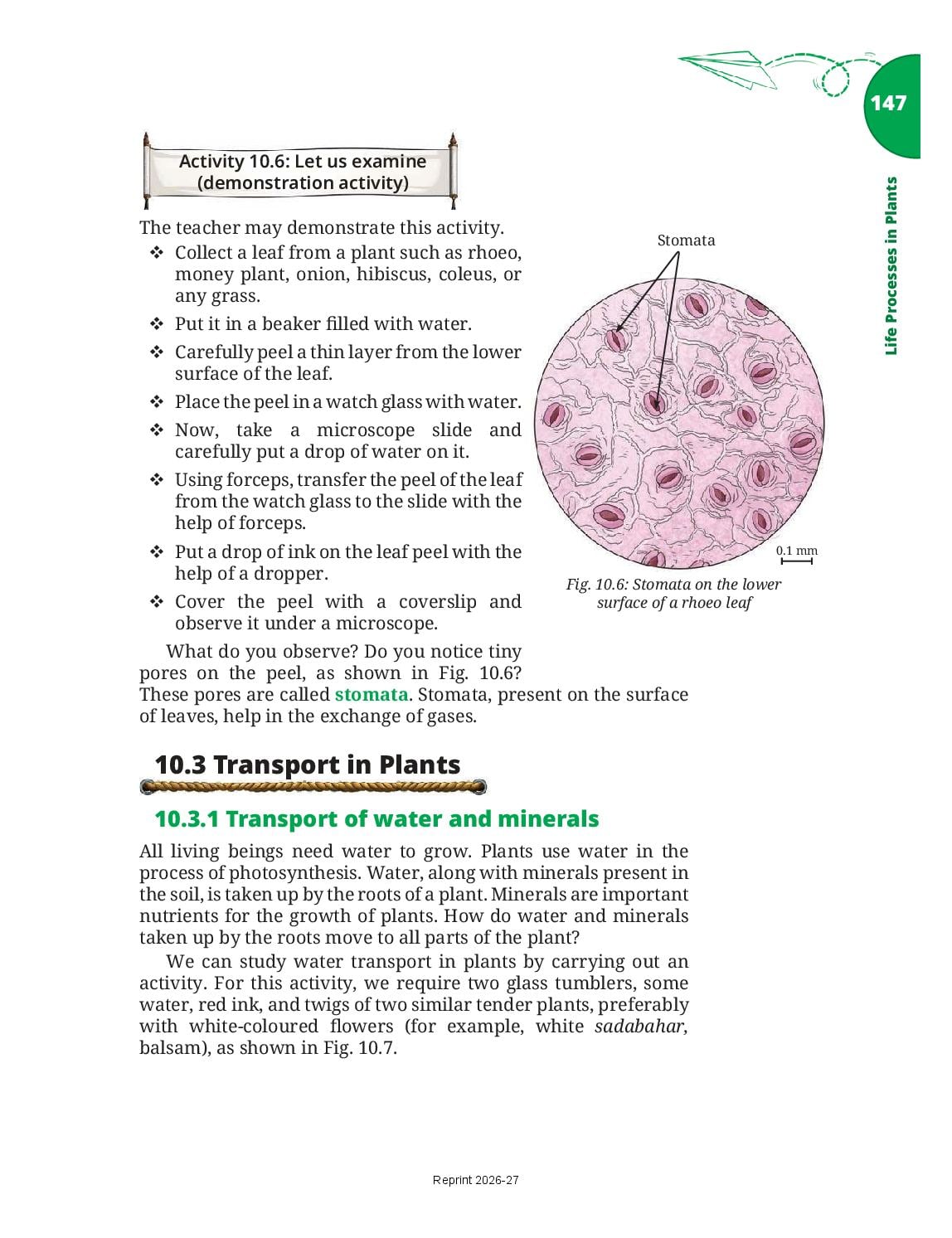
- Tiny pores on the surface of leaves, called stomata, help in the exchange of gases — carbon dioxide in and oxygen out during photosynthesis, and the reverse during respiration.
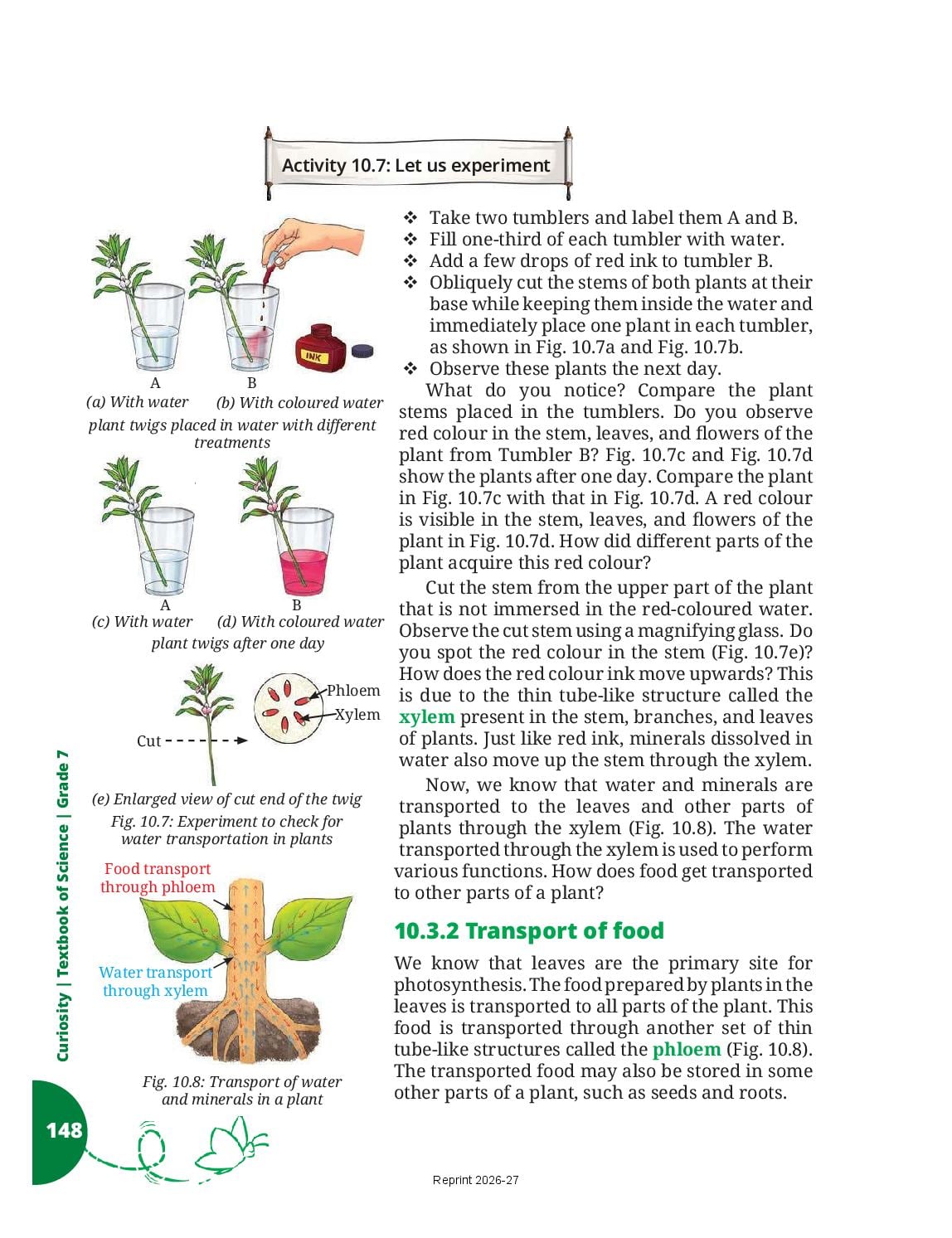
- Xylem carries water and dissolved minerals upward from the roots to all parts of the plant. Phloem carries the food made in the leaves to every other part, including storage organs such as seeds, roots and tubers.
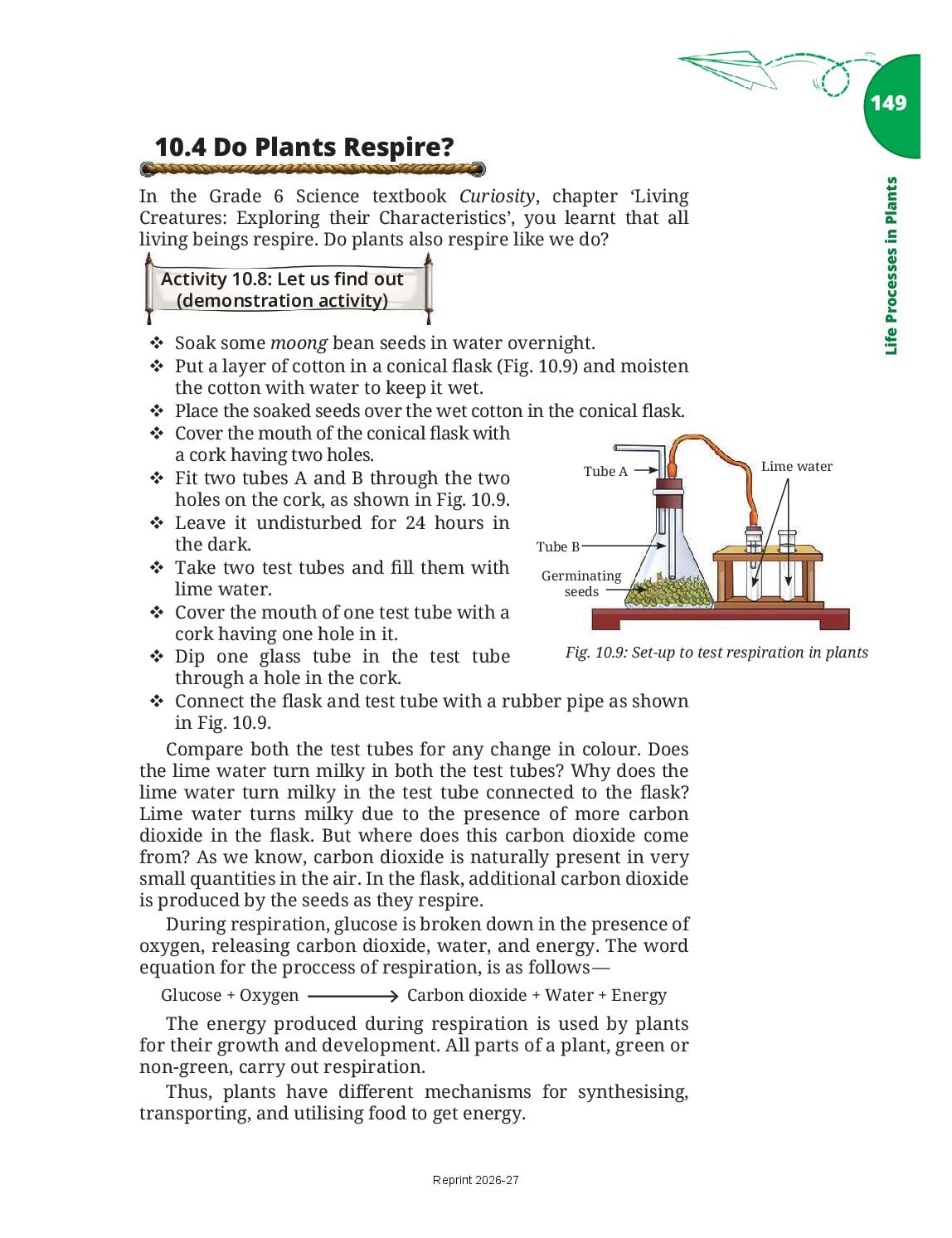
- Plants also respire. During respiration, glucose is broken down in the presence of oxygen, releasing carbon dioxide, water and energy: Glucose + Oxygen → Carbon dioxide + Water + Energy. All parts of a plant, green or non-green, respire, day and night.
Quick revision – Life Processes in Plants
| Term | What it means | Where it appears in the chapter | Point to remember |
|---|---|---|---|
| Photosynthesis | The process by which plants prepare food in the presence of sunlight and chlorophyll | Section 10.2.3, Fig. 10.5, page 146 | Raw materials: carbon dioxide and water. Products: glucose and oxygen |
| Chlorophyll | The green pigment in leaves that captures sunlight efficiently | Section 10.2.1, page 140; Activity 10.3 | Only the green patches of a leaf make starch |
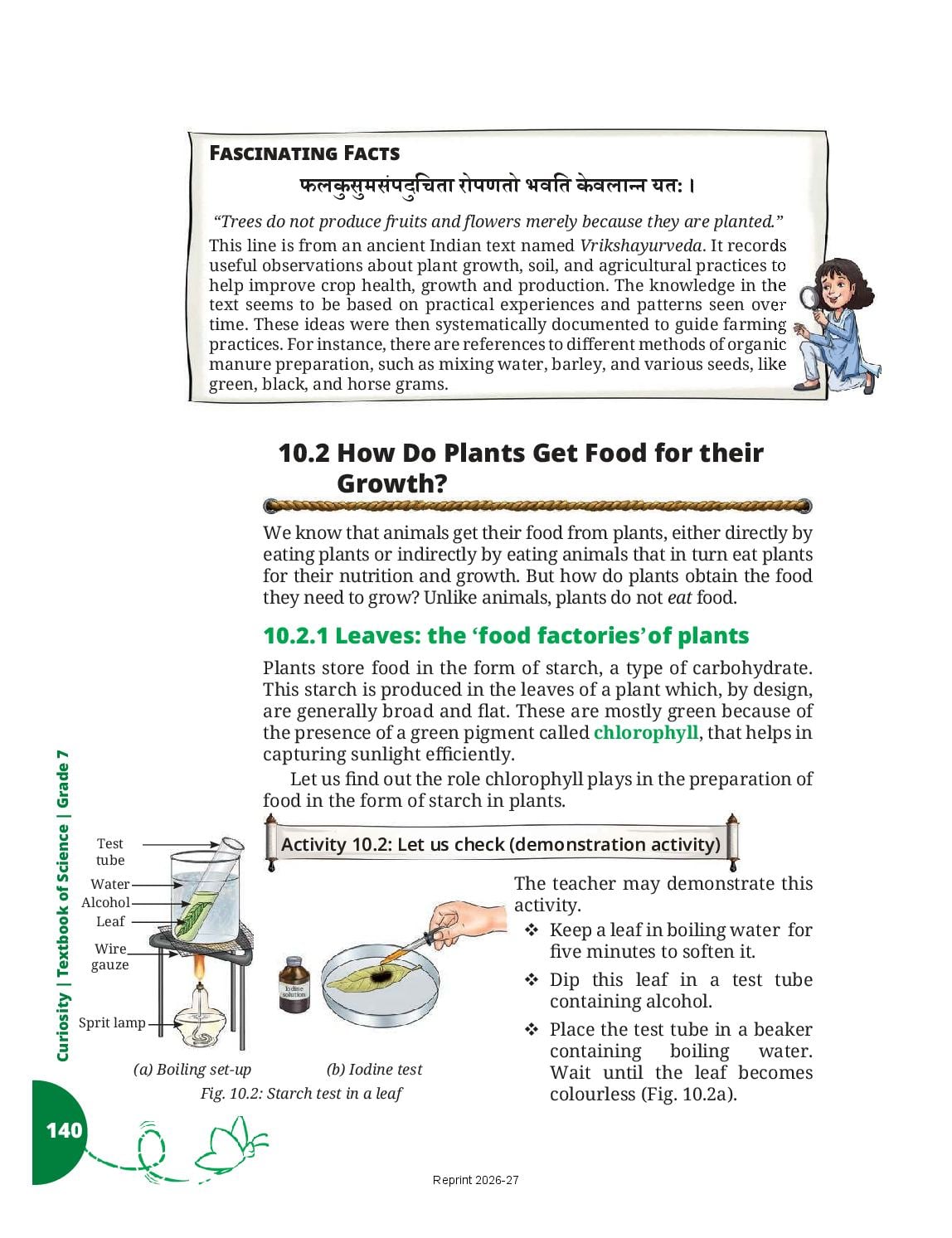
| Starch | A type of carbohydrate in which plants store food | Section 10.2.1; iodine test in Activity 10.2 | A leaf with starch turns blue-black with iodine |
| Glucose | The simple carbohydrate actually produced during photosynthesis | Section 10.2.3, page 146 | Instant energy; later converted to starch for storage |
| Iodine test | Test for starch — a decolourised leaf is treated with dilute iodine solution | Activity 10.2, Fig. 10.2, pages 140–141 | Blue-black colour = starch present |
| Destarching | Keeping a plant in the dark for 2–3 days so it loses its stored starch | Activity 10.4, page 143 | Without it, old starch would spoil the result |
| Caustic soda | Sodium hydroxide — it absorbs carbon dioxide from the air | Activity 10.4, Fig. 10.3, page 143 | Only teachers should handle it; it burns the skin |
| Stomata | Tiny pores on the surface of leaves that help in the exchange of gases | Activity 10.6, Fig. 10.6, page 147 | Mostly on the lower surface of a leaf |
| Xylem | Thin tube-like structures that carry water and minerals from the roots upward | Activity 10.7 and Fig. 10.8, page 148 | Red ink rises through the xylem and colours stem, leaves and flowers |
| Phloem | Thin tube-like structures that carry food from the leaves to all parts of the plant | Section 10.3.2, Fig. 10.8, page 148 | Food may be stored in seeds, roots and tubers such as potato |
| Respiration | Breakdown of glucose in the presence of oxygen to release energy | Section 10.4, Activity 10.8, page 149 | Glucose + Oxygen → Carbon dioxide + Water + Energy |
| Lime water test | Lime water turns milky in the presence of carbon dioxide | Activity 10.8, Fig. 10.9, page 149 | Germinating seeds give out carbon dioxide as they respire |
Old NCERT vs New – Class 7 Science
This chapter is from Curiosity, the new NCERT Class 7 Science book (NCF-SE 2023, used from 2025-26). It replaced the old book “Science”, so chapter numbers and names differ from older PDFs.
Solutions and All Chapters
Answers to the exercises and the full chapter list of Curiosity:
Life Processes in Plants – Overview
| Class | Class 7 |
| Subject | Science |
| Book | Curiosity – new NCERT book |
| Chapter | 10 of 12 – Life Processes in Plants |
| Book pages | 137 – 152 |
| Edition | NCERT Reprint 2026-27 |
| Session | 2026-27 |
| Free – read online or download |
Class 7 Science Chapter 10 – FAQs
Where can I download Life Processes in Plants Class 7 PDF?
From the download table on this page – the chapter PDF is free, and the full book is linked too.
What is Class 7 Science Chapter 10 about?
Plants need sunlight and water to grow. Activity 10.1 shows this: the pot kept in sunlight with water grows best, the pot kept in the dark with water grows poorly and turns pale, and the pot kept in sunlight without water dries up and may die.
Is Life Processes in Plants from the new NCERT Class 7 Science book?
Yes. It is chapter 10 of curiosity, the new NCERT Class 7 Science book for 2026-27.
Is this the latest NCERT edition for 2026-27?
Yes – the PDF is NCERT’s latest edition for the 2026-27 session.
Where are the NCERT Solutions for Class 7 Science Chapter 10?
Open the NCERT Solutions link above for answers to the exercise questions.