Download Heat Transfer in Nature – NCERT Class 7 Science Chapter 7 PDF from the new NCERT Class 7 Science book Curiosity (2026-27). Read the chapter online or download the free PDF. Heat travels from a hotter place to a colder place in three ways — conduction, convection and radiation. Pema and Palden meet all three in one evening: the metal pan on the fire, the smoke rising from the burning wood, and the warmth they feel…
Heat Transfer in Nature PDF – Chapter 7 of Curiosity
Read the chapter online or download the PDF.
| Chapter | Download | |
|---|---|---|
| Chapter 7 PDF | Heat Transfer in Nature | View PDF |
| Full book | NCERT Class 7 Science – Curiosity | View Book |
Read Online
What Is in Heat Transfer in Nature? (Class 7 Science Chapter 7)
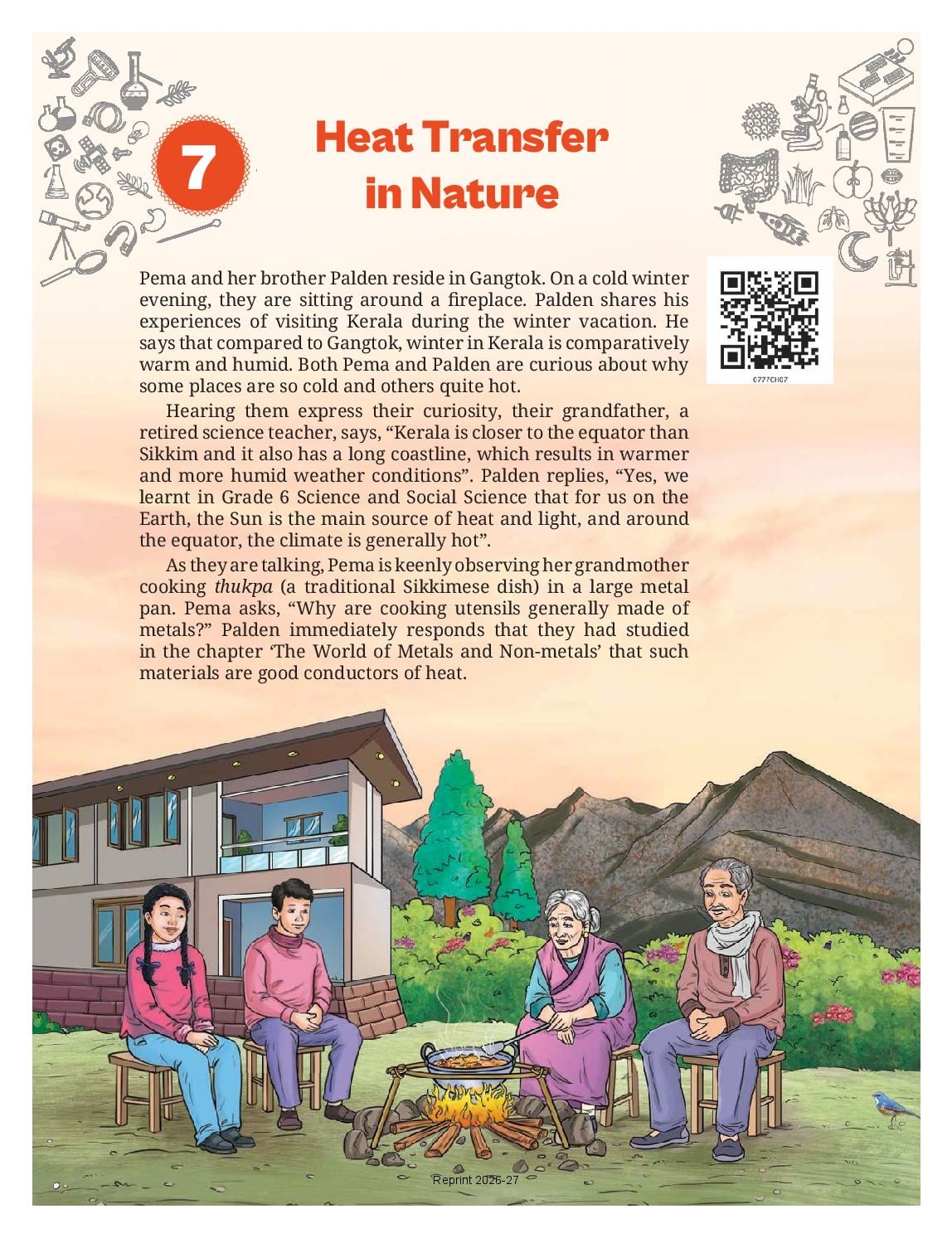
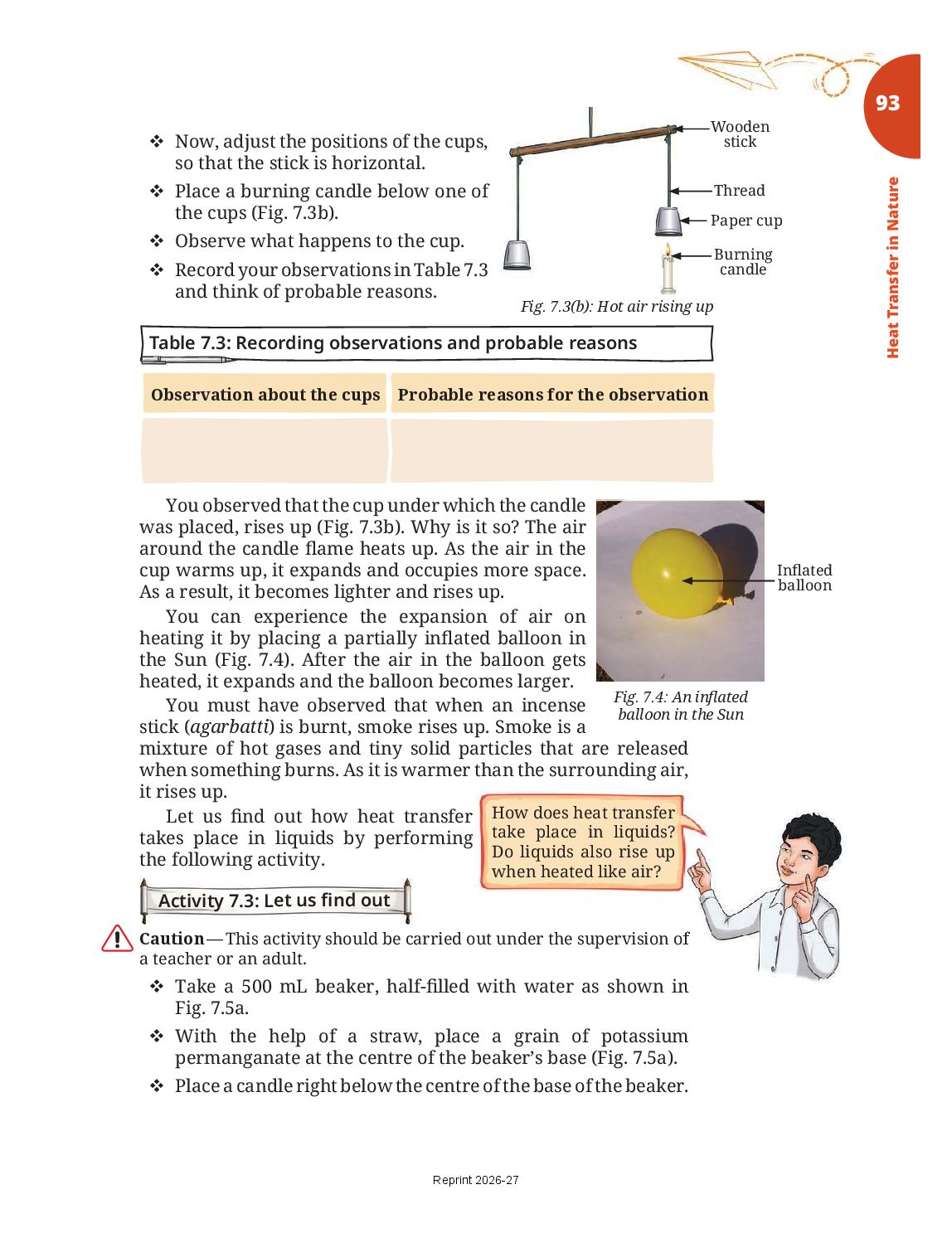
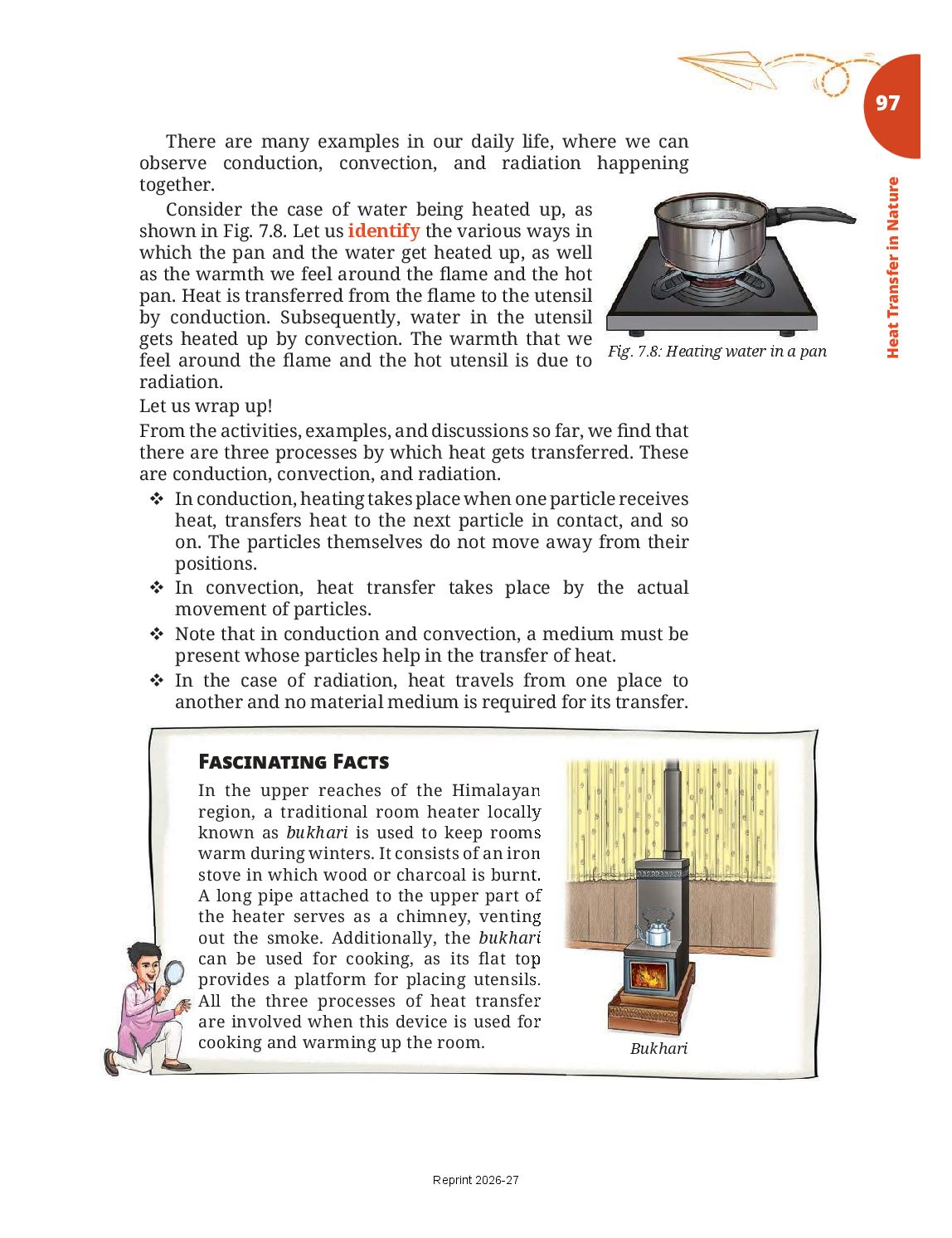
- Heat travels from a hotter place to a colder place in three ways — conduction, convection and radiation. Pema and Palden meet all three in one evening: the metal pan on the fire, the smoke rising from the burning wood, and the warmth they feel sitting around the fireplace.
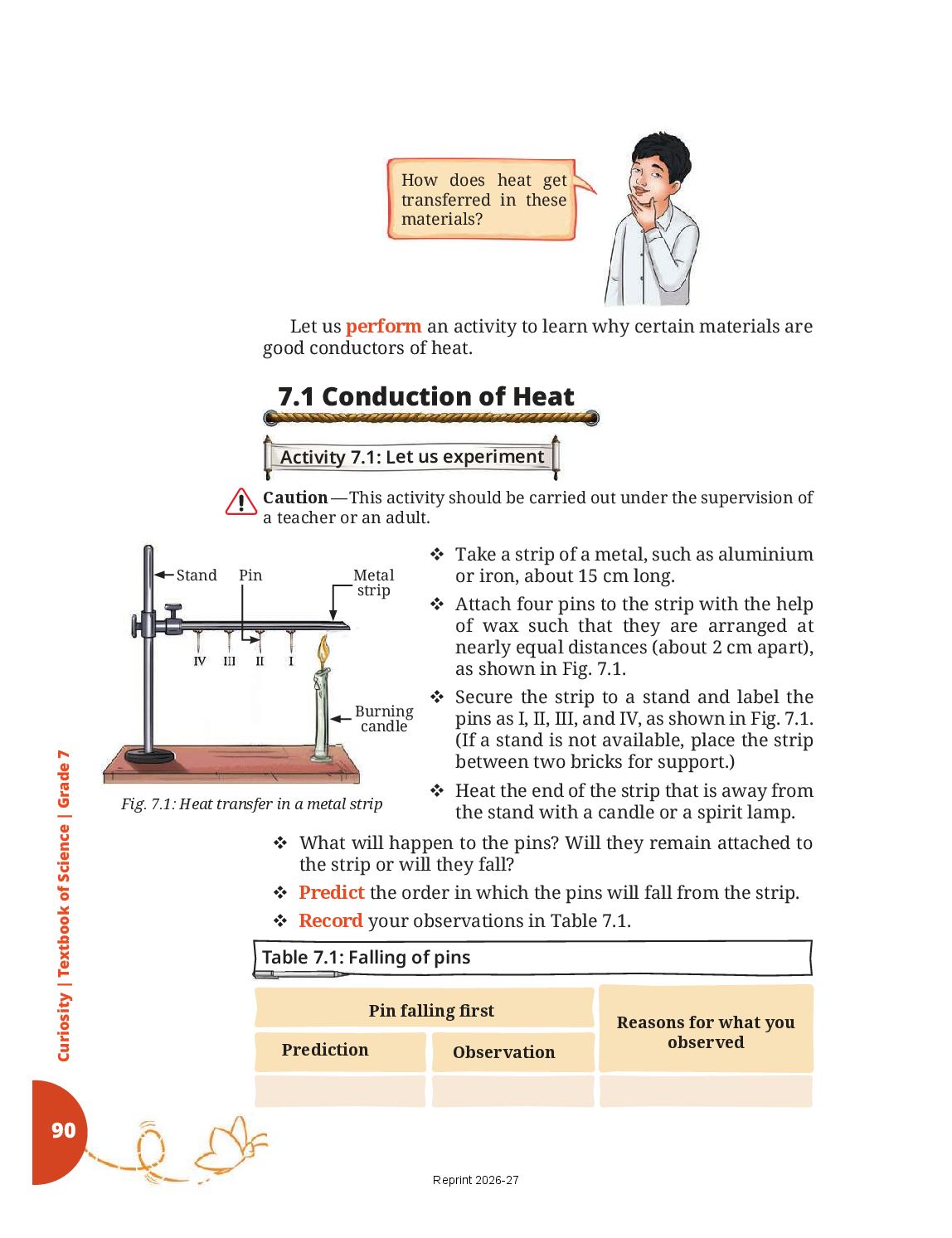
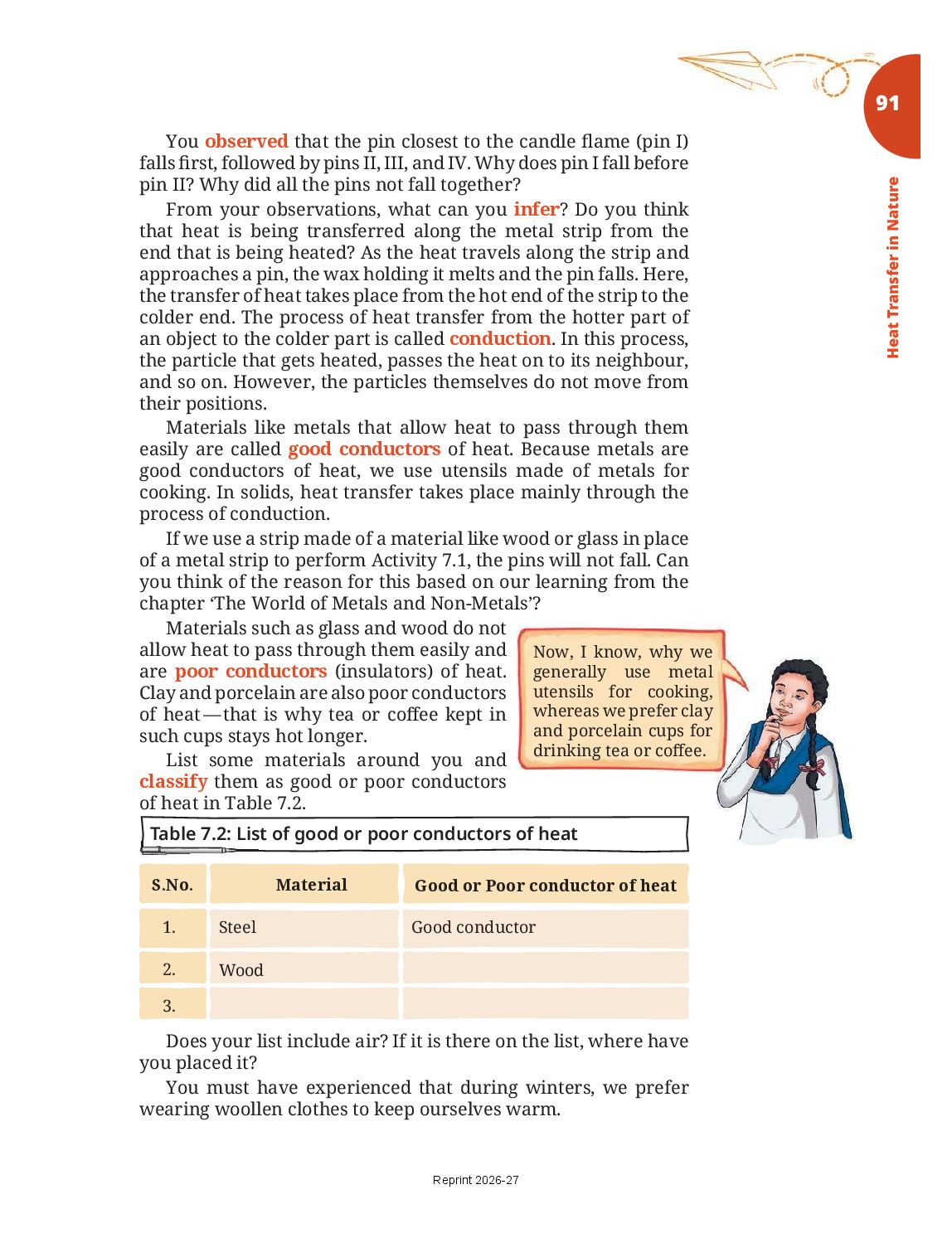
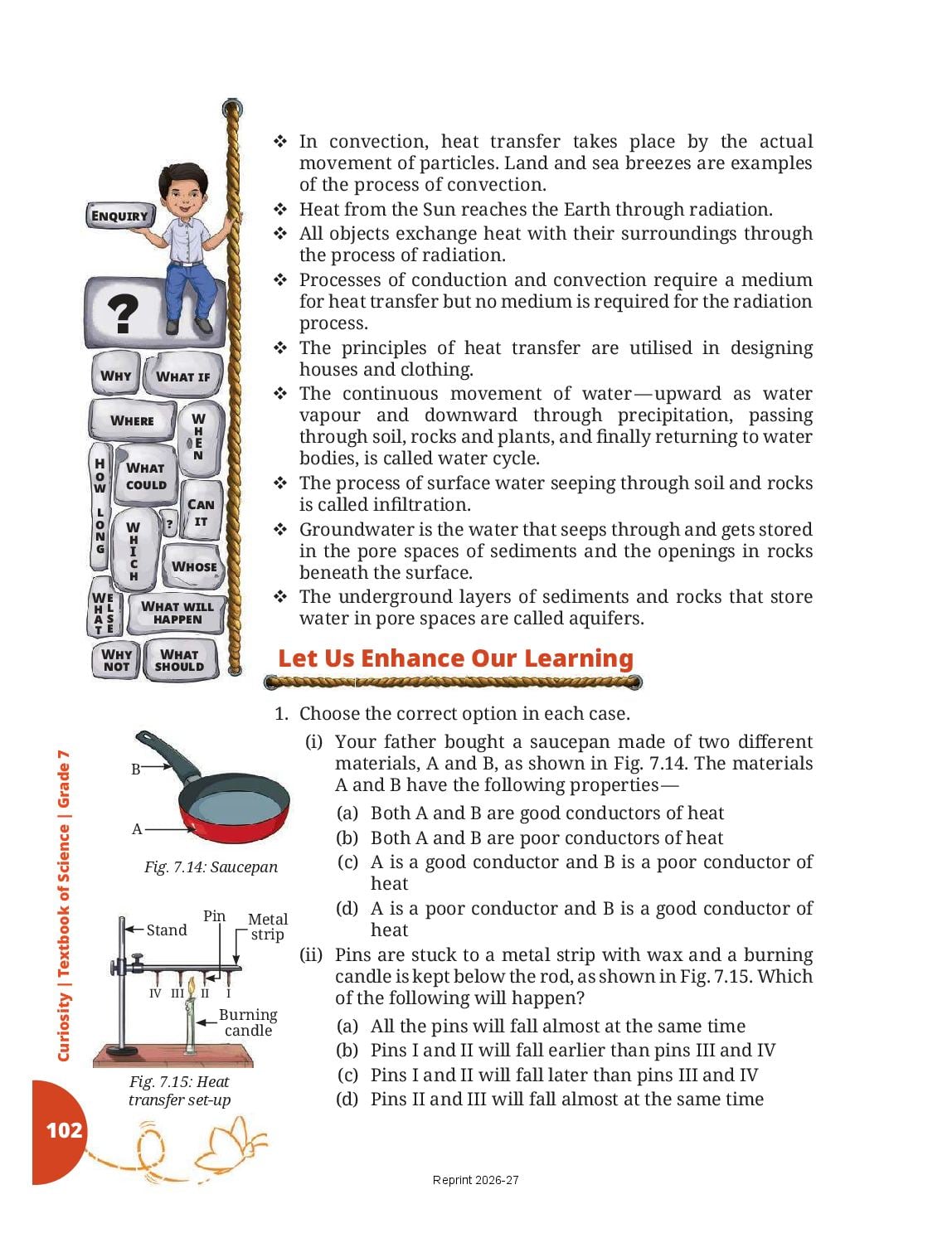
- In conduction, heat passes from the hotter part of an object to its colder part. A heated particle passes heat on to its neighbour, and so on, but the particles themselves do not move from their positions. This is how heat travels in solids.
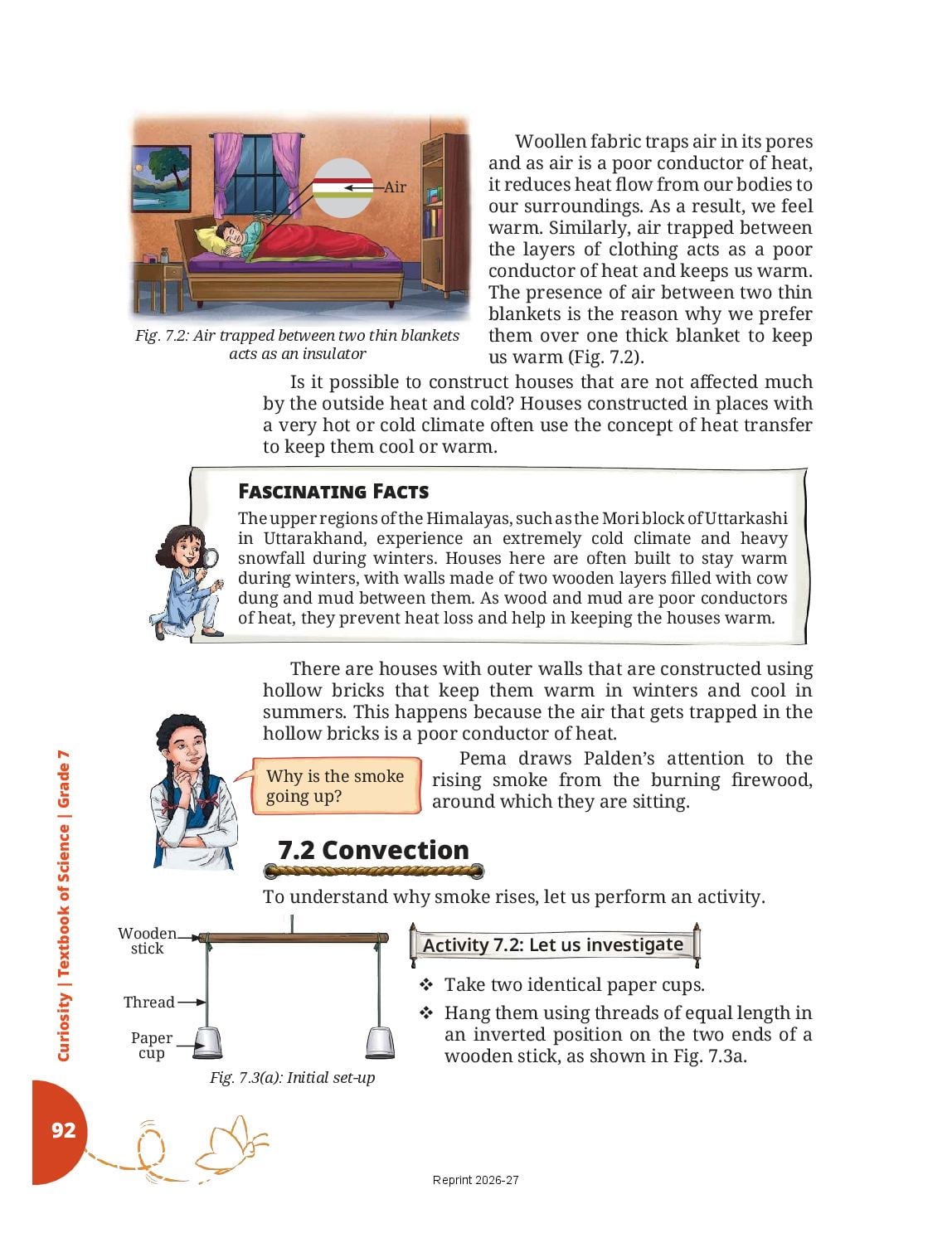
- Materials that let heat pass through them easily — metals such as aluminium, iron and steel — are good conductors of heat. Wood, glass, clay, porcelain, plastic and air are poor conductors (insulators). Woollen clothes, two thin blankets and hollow bricks all work by trapping air.
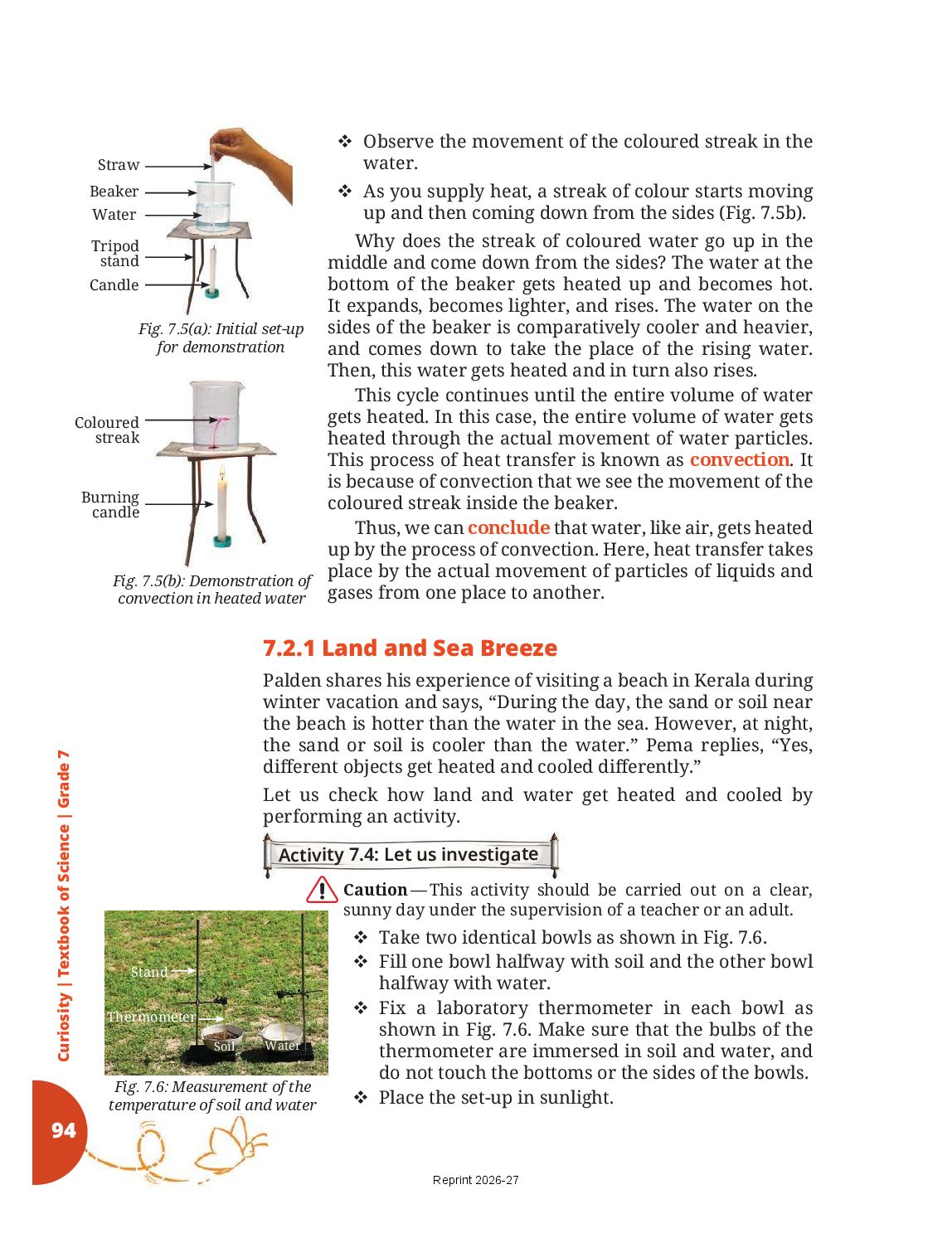
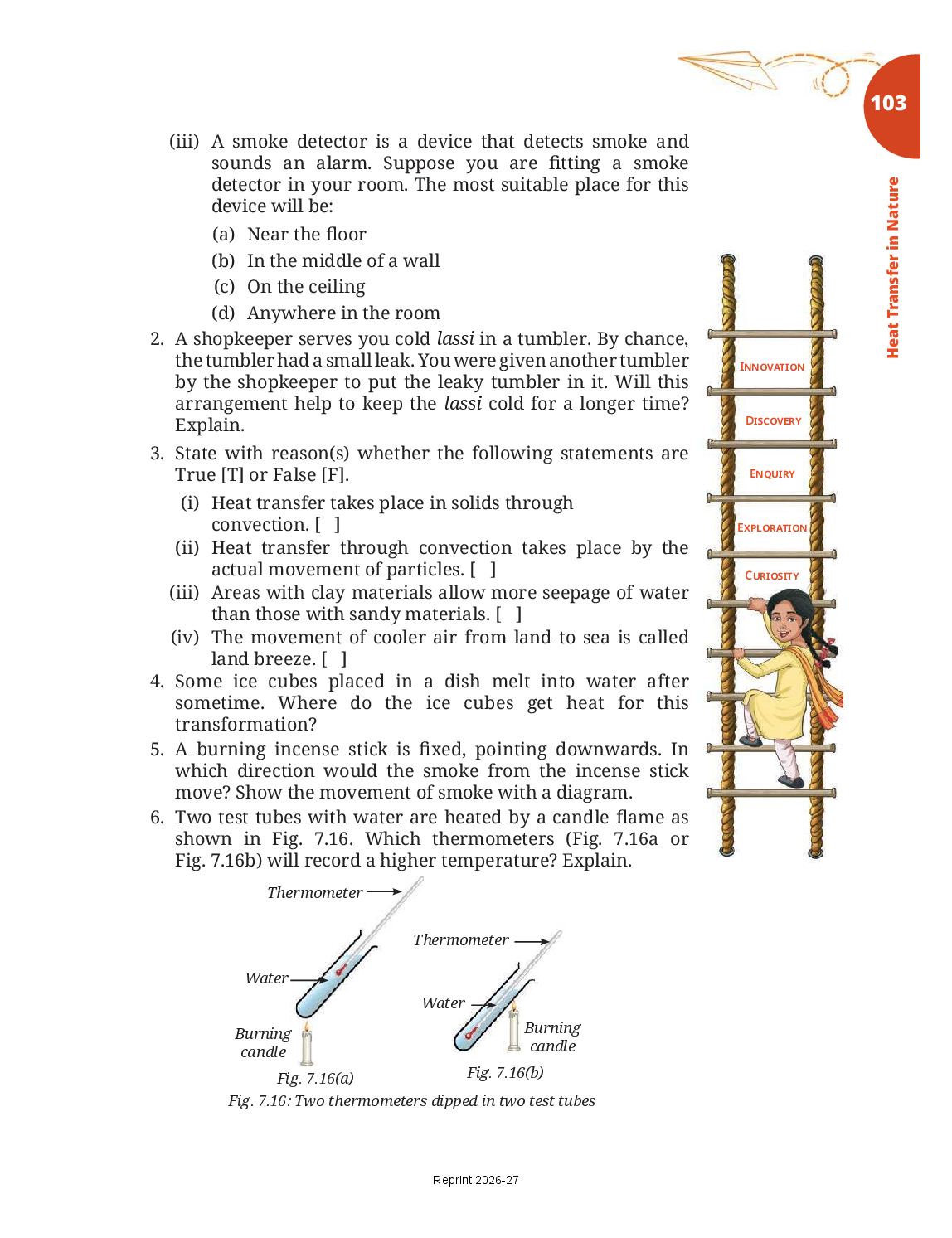
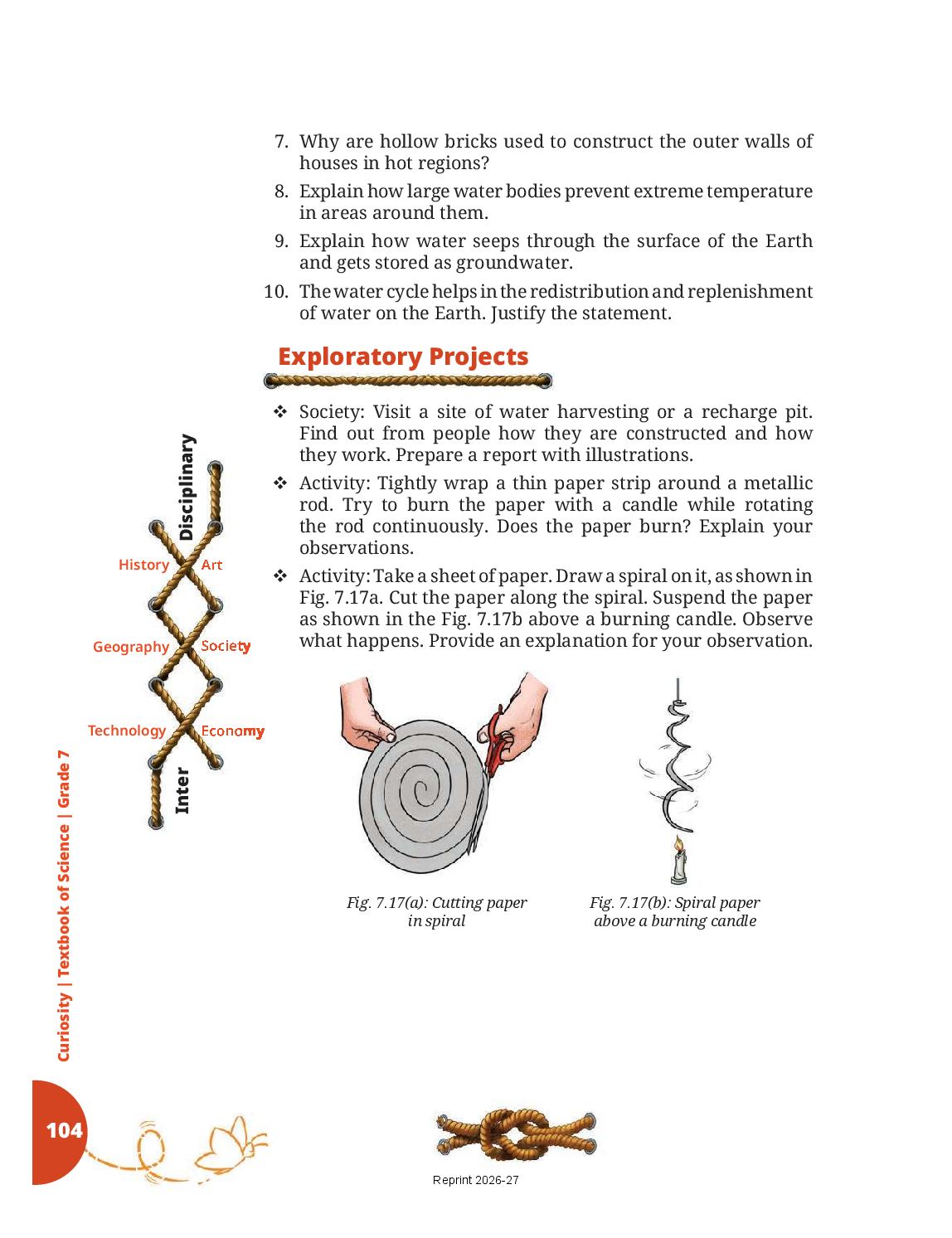
- In convection, heat is carried by the actual movement of particles of a liquid or a gas. On being heated, the fluid expands, becomes lighter and rises; cooler, heavier fluid comes down to take its place, setting up a convection current — seen as the coloured streak in Activity 7.3.
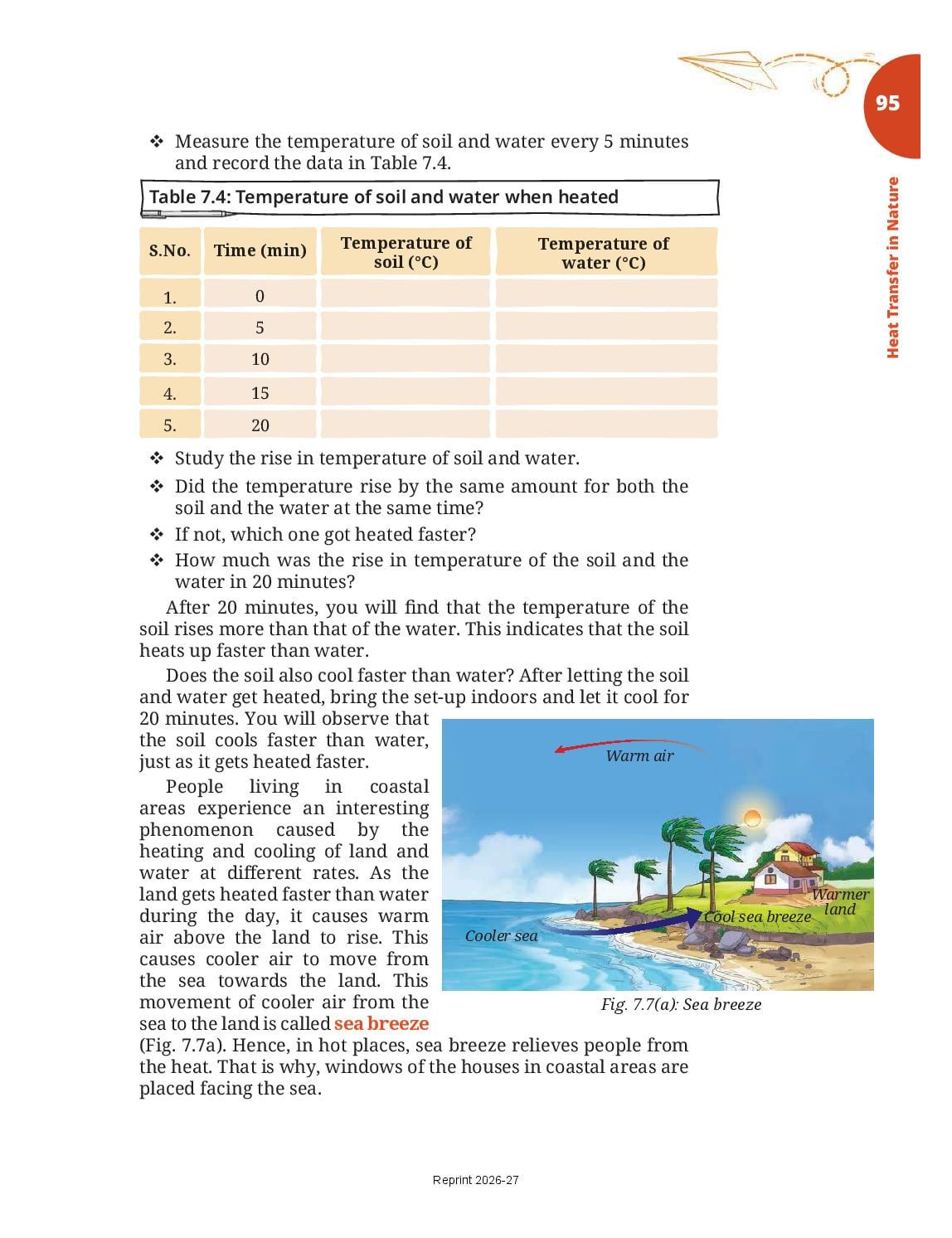
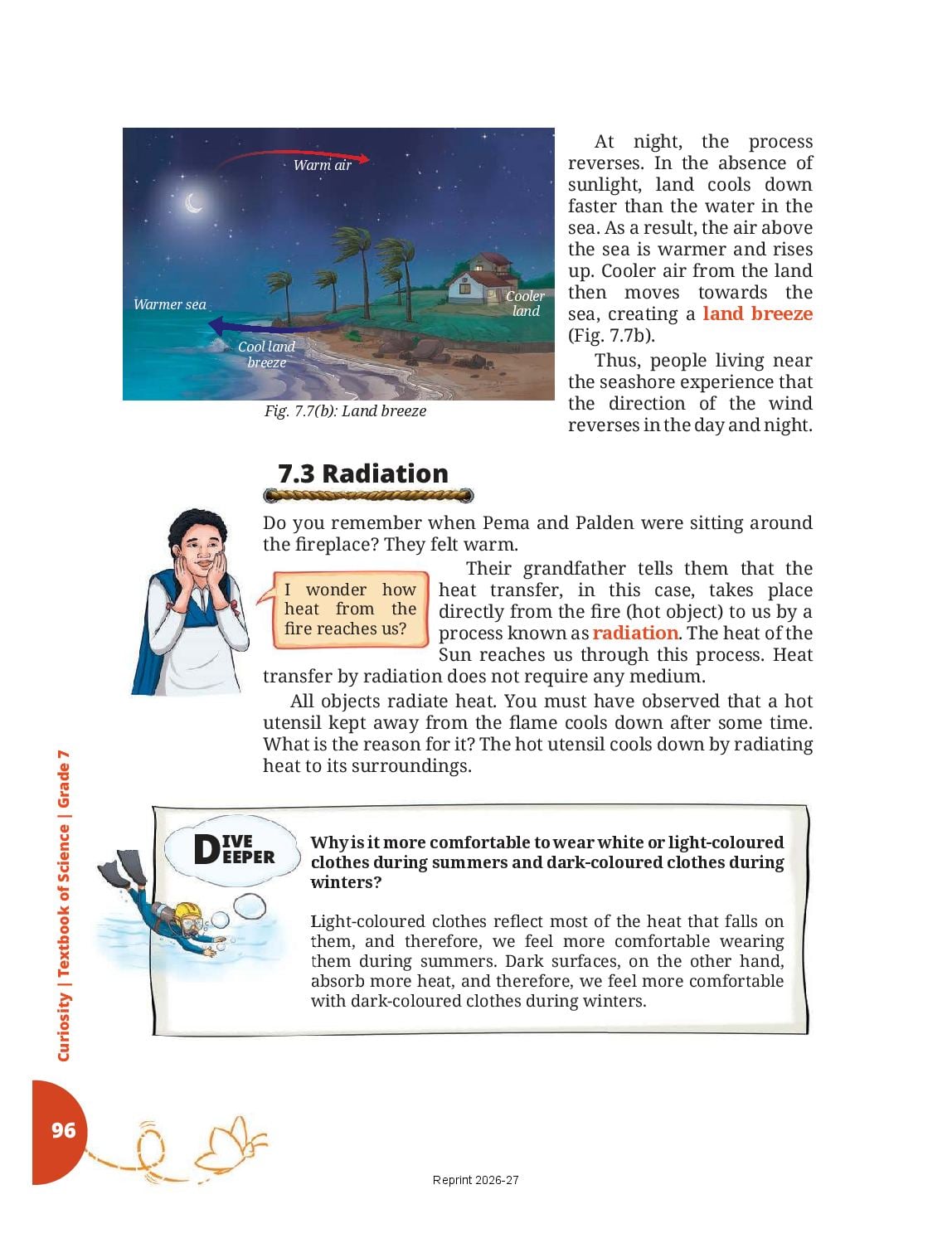
- Land and sea breezes are convection on a large scale. Land heats up and cools down faster than water, so warm air rises over the land by day and cool air blows in from the sea (sea breeze); at night the flow reverses and a land breeze blows from land to sea.
- In radiation, heat travels directly from a hot object to us and no medium is needed. That is how the Sun’s heat reaches the Earth and how a hot utensil kept away from the flame cools down. Light surfaces reflect heat; dark surfaces absorb it.
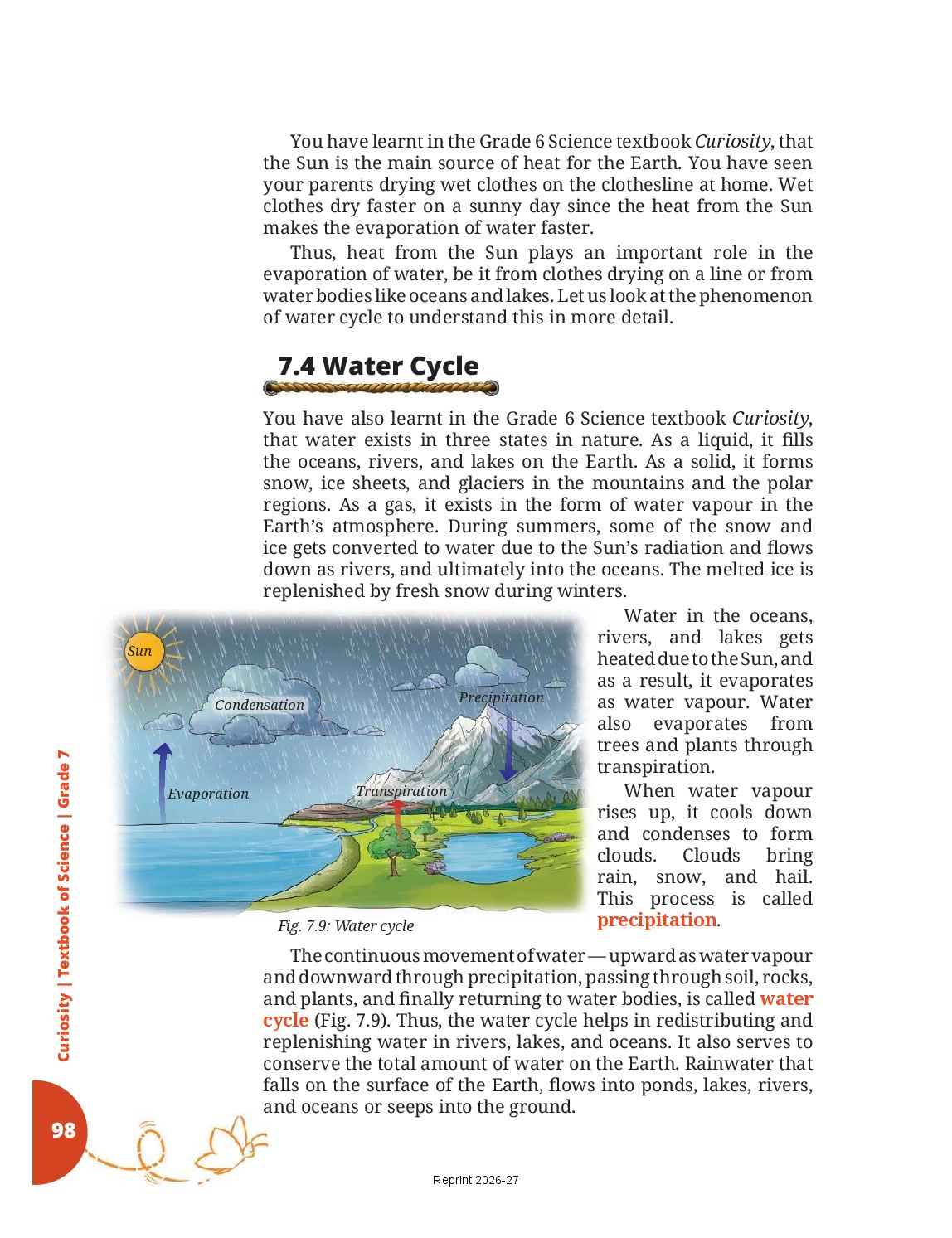
- The Sun drives the water cycle — evaporation and transpiration lift water as vapour, condensation forms clouds, and precipitation brings it back as rain, snow and hail. The cycle redistributes and replenishes water and conserves the Earth’s total water.
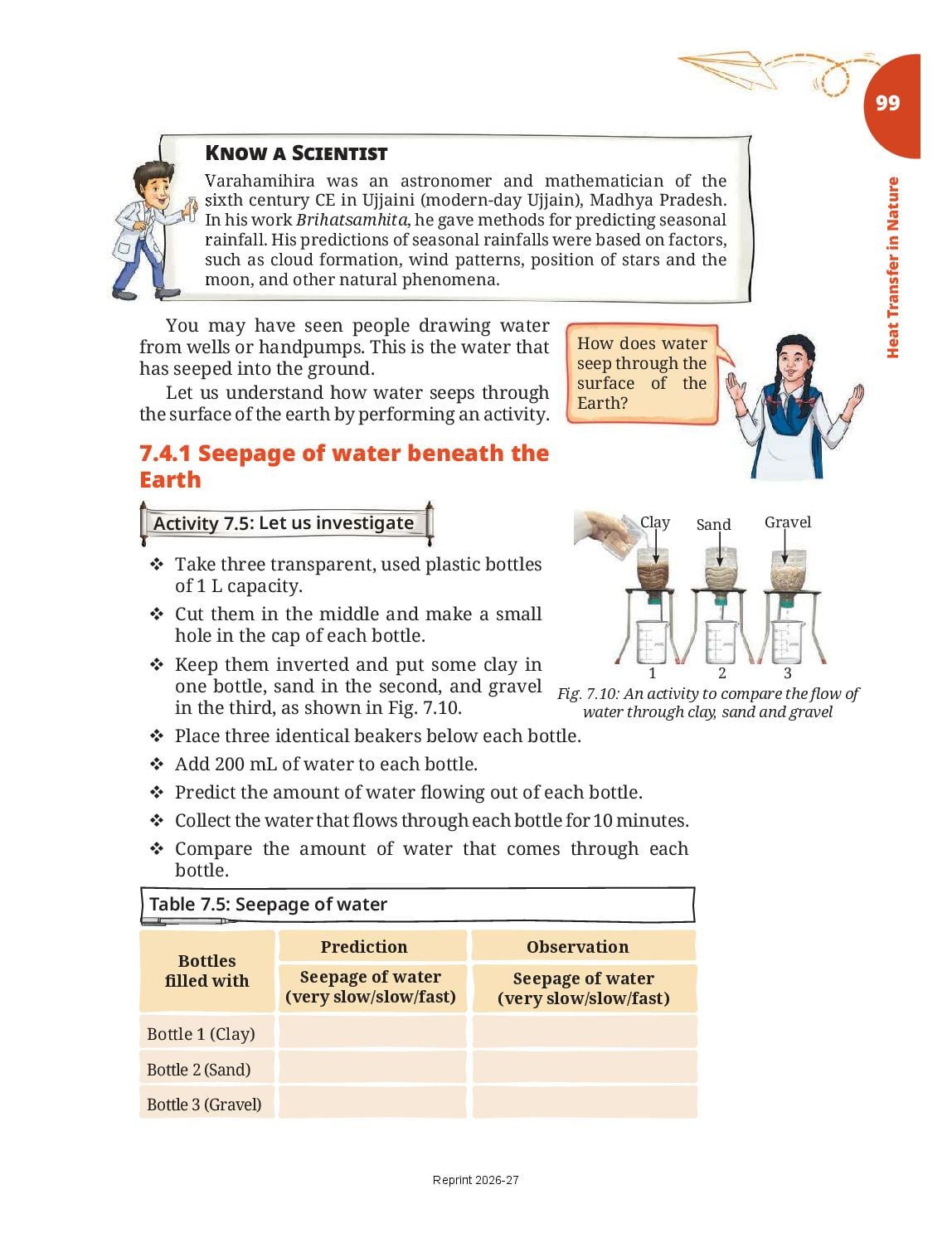
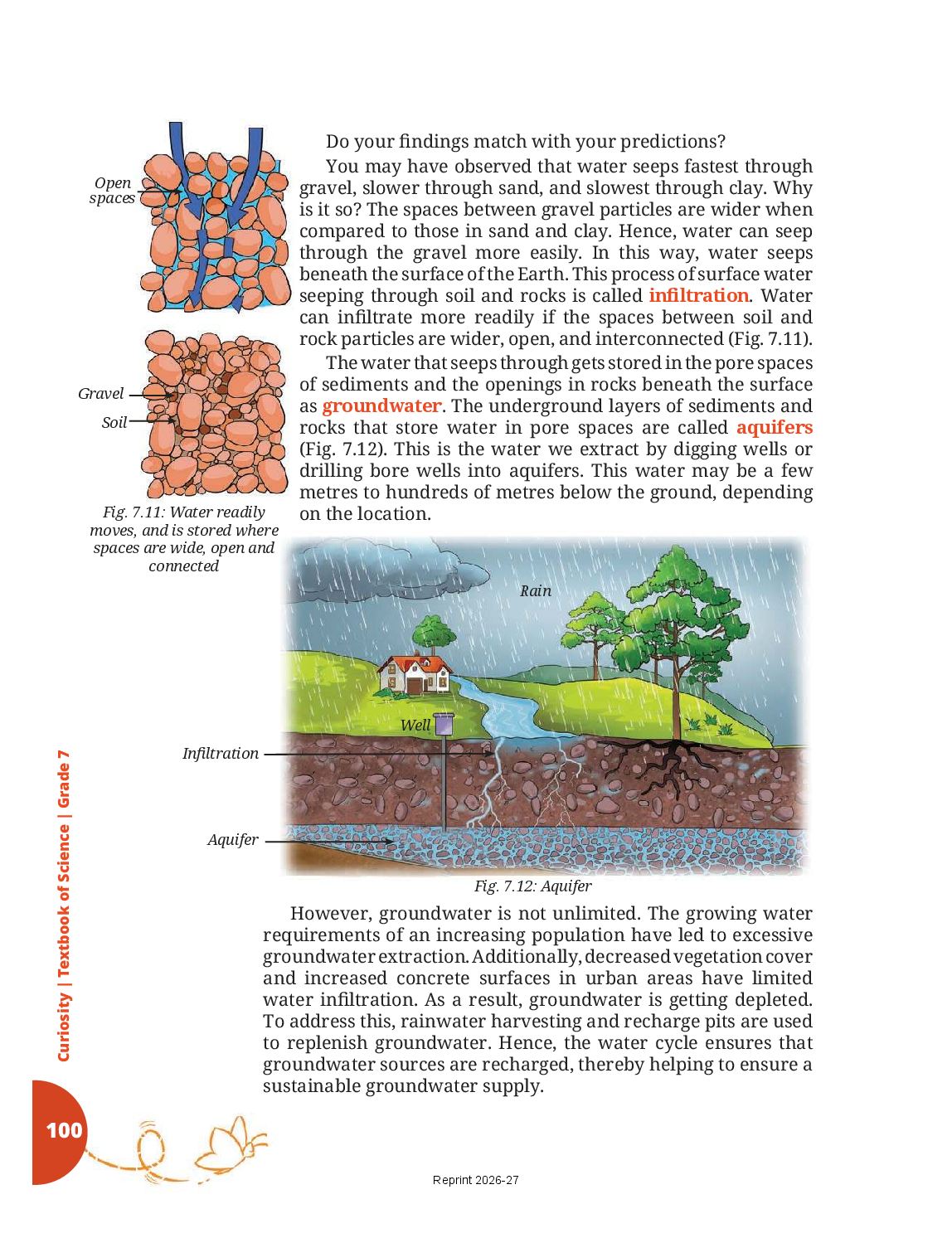
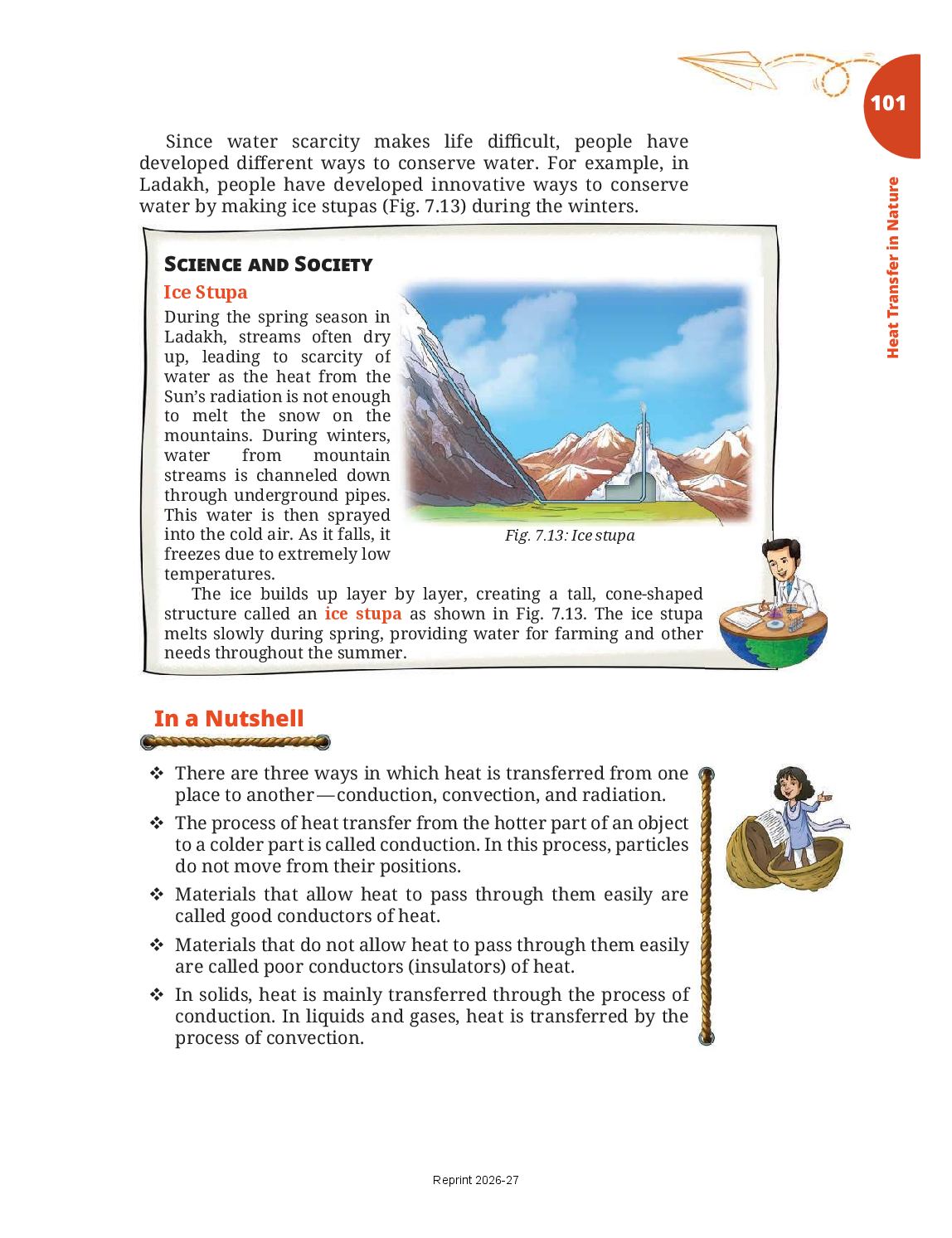
- Water that soaks into the ground by infiltration is stored as groundwater in aquifers. Seepage is fastest through gravel and slowest through clay. Excessive extraction and concrete surfaces deplete groundwater; rainwater harvesting, recharge pits and Ladakh’s ice stupas help conserve it.
Quick revision – Heat Transfer in Nature
| Term | What it means | Example from the chapter | Point to remember |
|---|---|---|---|
| Conduction | Transfer of heat from the hotter part of an object to its colder part | Pins I, II, III, IV falling one after another from a heated metal strip (Activity 7.1) | Particles pass heat on but do not leave their positions |
| Good conductor of heat | A material that allows heat to pass through it easily | Aluminium, iron, steel — used for cooking utensils | All metals are good conductors of heat |
| Poor conductor (insulator) | A material that does not allow heat to pass through it easily | Wood, glass, clay and porcelain cups, plastic, air | Air is one of the best insulators — wool and hollow bricks use it |
| Convection | Transfer of heat by the actual movement of particles of a liquid or a gas | The coloured streak rising in the middle and coming down at the sides (Activity 7.3) | Works only in liquids and gases, never in solids |
| Sea breeze | Movement of cooler air from the sea towards the land | Blows during the day, when land is warmer than the sea (Fig. 7.7a) | Windows of coastal houses face the sea to catch it |
| Land breeze | Movement of cooler air from the land towards the sea | Blows at night, when the sea is warmer than the land (Fig. 7.7b) | The wind direction reverses between day and night |
| Radiation | Transfer of heat that does not require any medium | Heat of the Sun reaching the Earth; warmth felt around a fireplace | All objects radiate heat to their surroundings |
| Water cycle | The continuous upward movement of water as vapour and downward movement through precipitation | Evaporation, transpiration, condensation and precipitation (Fig. 7.9) | It redistributes water and conserves the Earth’s total water |
| Evaporation | Change of water into water vapour | Wet clothes drying faster on a sunny day | The Sun’s heat makes evaporation faster |
| Transpiration | Loss of water as vapour from trees and plants | Shown by the arrow rising from the tree in Fig. 7.9 | It adds to the water vapour in the air along with evaporation |
| Precipitation | Water falling from clouds as rain, snow or hail | Clouds bring rain, snow and hail | It is the downward half of the water cycle |
| Infiltration | The seeping of surface water through soil and rocks | Water passing fastest through gravel and slowest through clay (Activity 7.5) | Wider, open and interconnected spaces allow faster infiltration |
| Groundwater | Water stored in the pore spaces of sediments and openings in rocks beneath the surface | The water drawn from wells and handpumps | It is not unlimited — it is getting depleted |
| Aquifer | An underground layer of sediments and rocks that stores water in pore spaces | Fig. 7.12 — a well drawing water from an aquifer | May lie a few metres to hundreds of metres below the ground |
Old NCERT vs New – Class 7 Science
This chapter is from Curiosity, the new NCERT Class 7 Science book (NCF-SE 2023, used from 2025-26). It replaced the old book “Science”, so chapter numbers and names differ from older PDFs.
Solutions and All Chapters
Answers to the exercises and the full chapter list of Curiosity:
Heat Transfer in Nature – Overview
| Class | Class 7 |
| Subject | Science |
| Book | Curiosity – new NCERT book |
| Chapter | 7 of 12 – Heat Transfer in Nature |
| Book pages | 89 – 104 |
| Edition | NCERT Reprint 2026-27 |
| Session | 2026-27 |
| Free – read online or download |
Class 7 Science Chapter 7 – FAQs
Where can I download Heat Transfer in Nature Class 7 PDF?
From the download table on this page – the chapter PDF is free, and the full book is linked too.
What is Class 7 Science Chapter 7 about?
Heat travels from a hotter place to a colder place in three ways — conduction, convection and radiation. Pema and Palden meet all three in one evening: the metal pan on the fire, the smoke rising from the burning wood, and the warmth they feel sitting around the fireplace.
Is Heat Transfer in Nature from the new NCERT Class 7 Science book?
Yes. It is chapter 7 of curiosity, the new NCERT Class 7 Science book for 2026-27.
Is this the latest NCERT edition for 2026-27?
Yes – the PDF is NCERT’s latest edition for the 2026-27 session.
Where are the NCERT Solutions for Class 7 Science Chapter 7?
Open the NCERT Solutions link above for answers to the exercise questions.