NCERT Solutions for Class 7 Science Chapter 7 Heat Transfer in Nature provide clear, step-by-step answers to every exercise and in-text question from the chapter Heat Transfer in Nature of the NCERT textbook Curiosity. Prepared by subject experts as per the latest NCERT (CBSE) syllabus for 2026-27, these NCERT Solutions for Class 7 Science help you understand each concept, write exam-ready answers, and check your own solutions. You can read them online below or download the free Class 7 Science Chapter 7 question-answer PDF.
NCERT Solutions for Class 7 Science Chapter 7 Heat Transfer in Nature
- Class: Class 7
- Subject: Science
- Chapter: Chapter 7 – Heat Transfer in Nature
- Textbook: Curiosity (NCERT)
- Study material: NCERT Solutions – questions with answers, free PDF
These solutions answer all the exercise questions of Chapter 7 Heat Transfer in Nature — including the in-text questions, short-answer and long-answer questions, and activities — with complete explanations so you can follow the method, not just the final answer. Read the full solutions below.
NCERT Solutions Class 7 Science Chapter 7 Heat Transfer in Nature View Download



NCERT Solutions for Class 7 Science Chapter 7 PDF Download
You can read the NCERT Solutions for Class 7 Science Chapter 7 online above, or download the complete question-answer PDF to study Heat Transfer in Nature offline at any time.
NCERT Solutions for Class 7 Science Chapter 7 PDF Download Link – Click Here to Download Solutions PDF
Questions Covered in This Chapter
These NCERT Solutions answer all 48 questions of this chapter. The questions solved are:
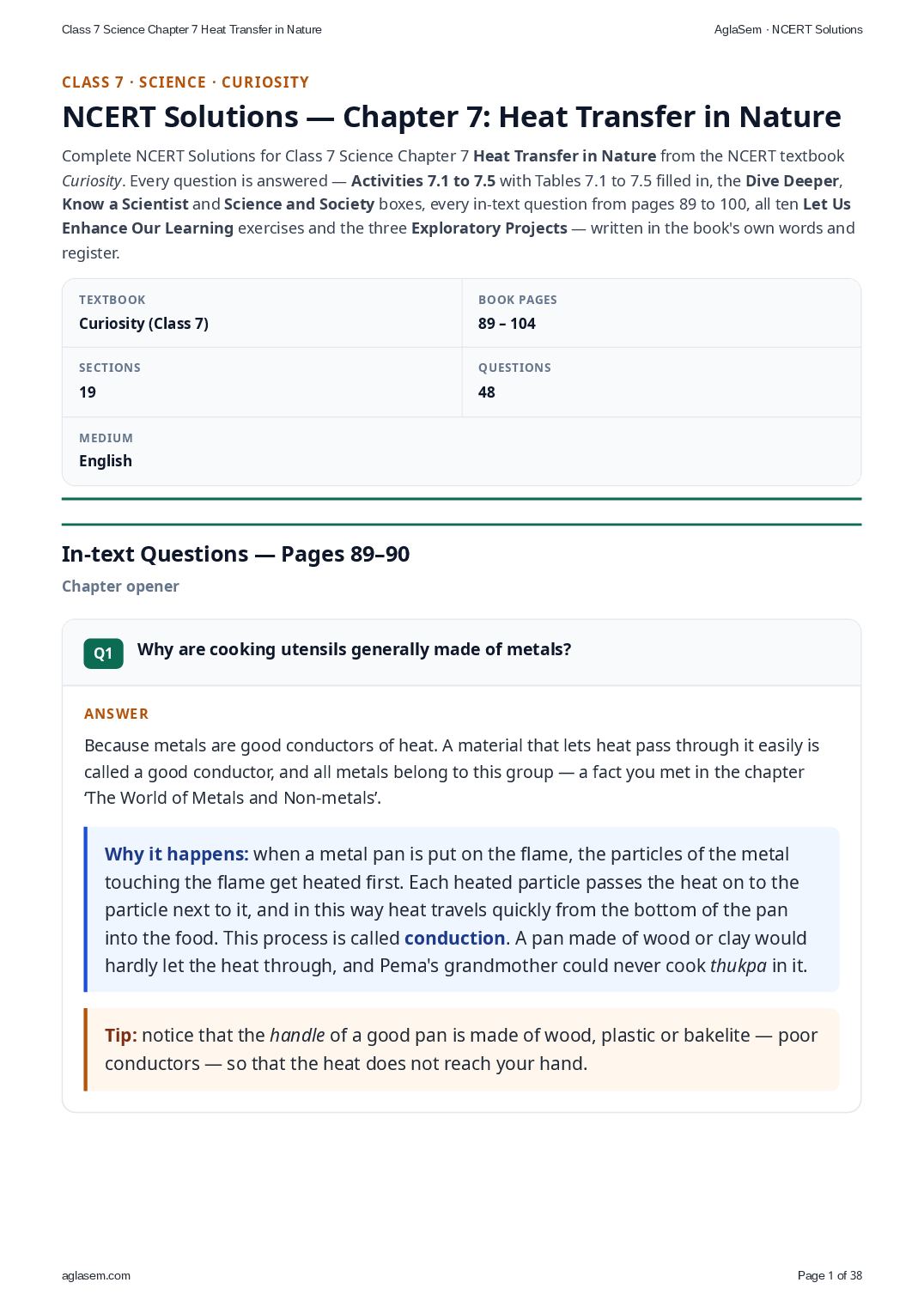
- Why are cooking utensils generally made of metals?
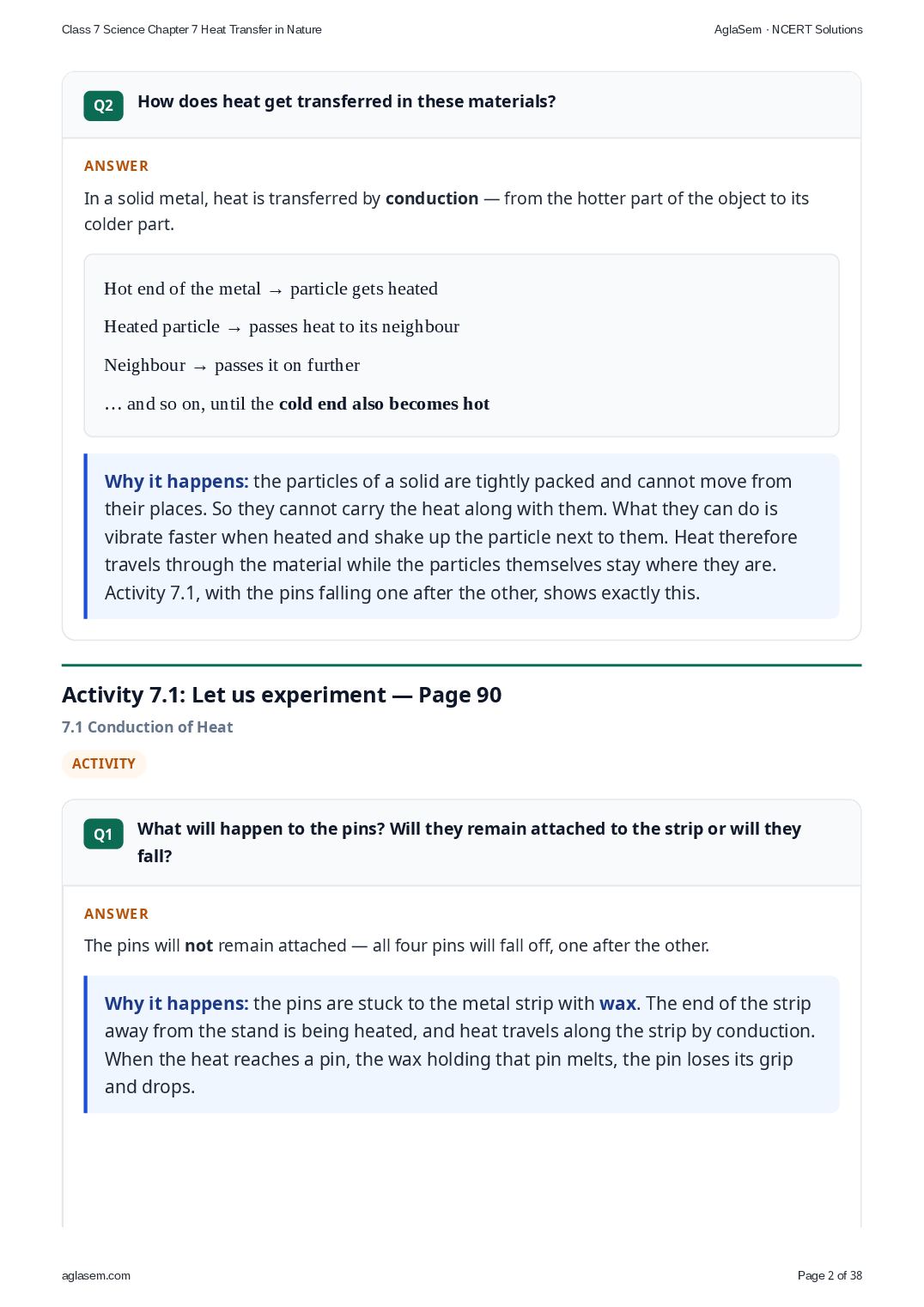
- How does heat get transferred in these materials?
- What will happen to the pins? Will they remain attached to the strip or will they fall?
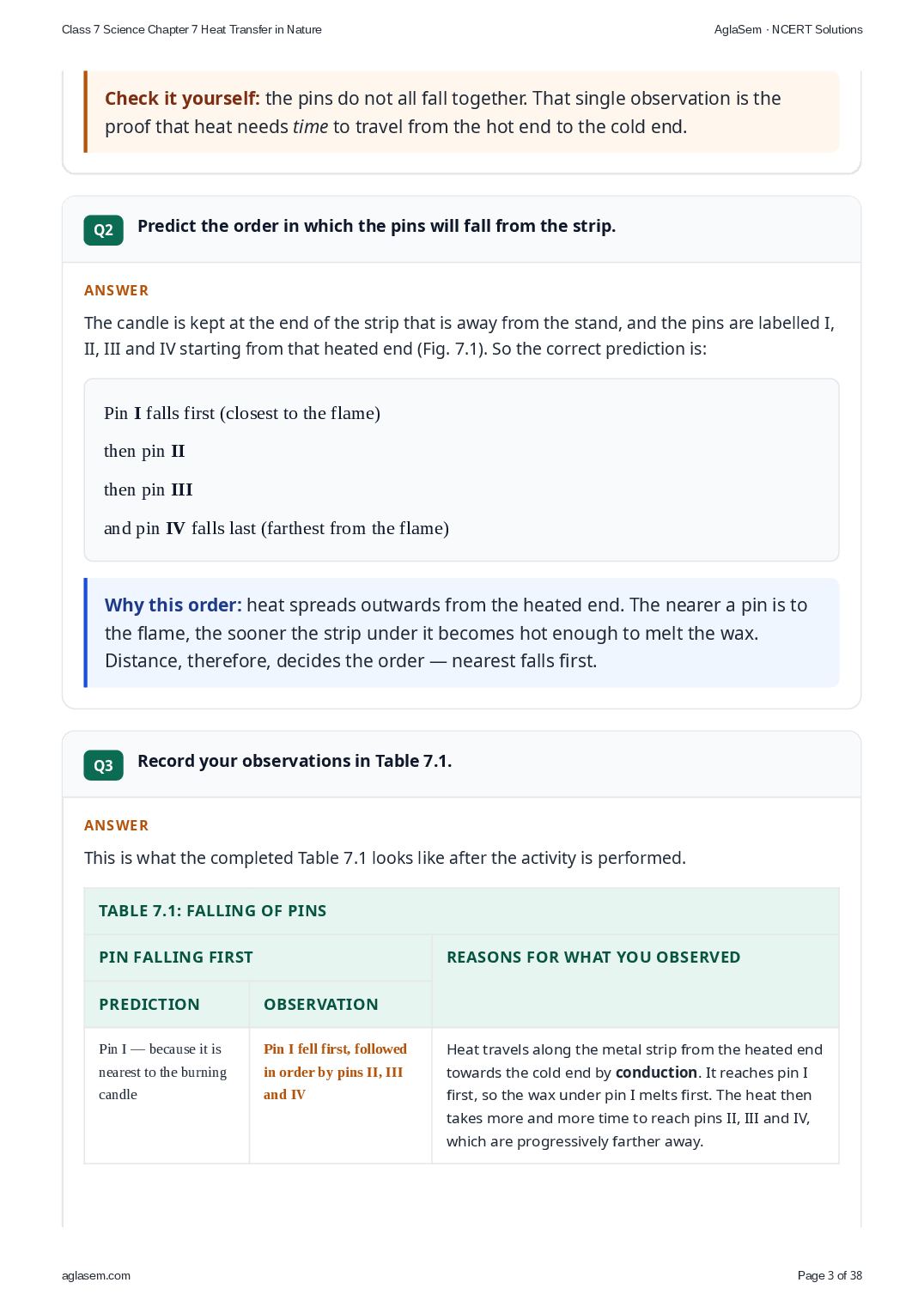
- Predict the order in which the pins will fall from the strip.
- Record your observations in Table 7.1.
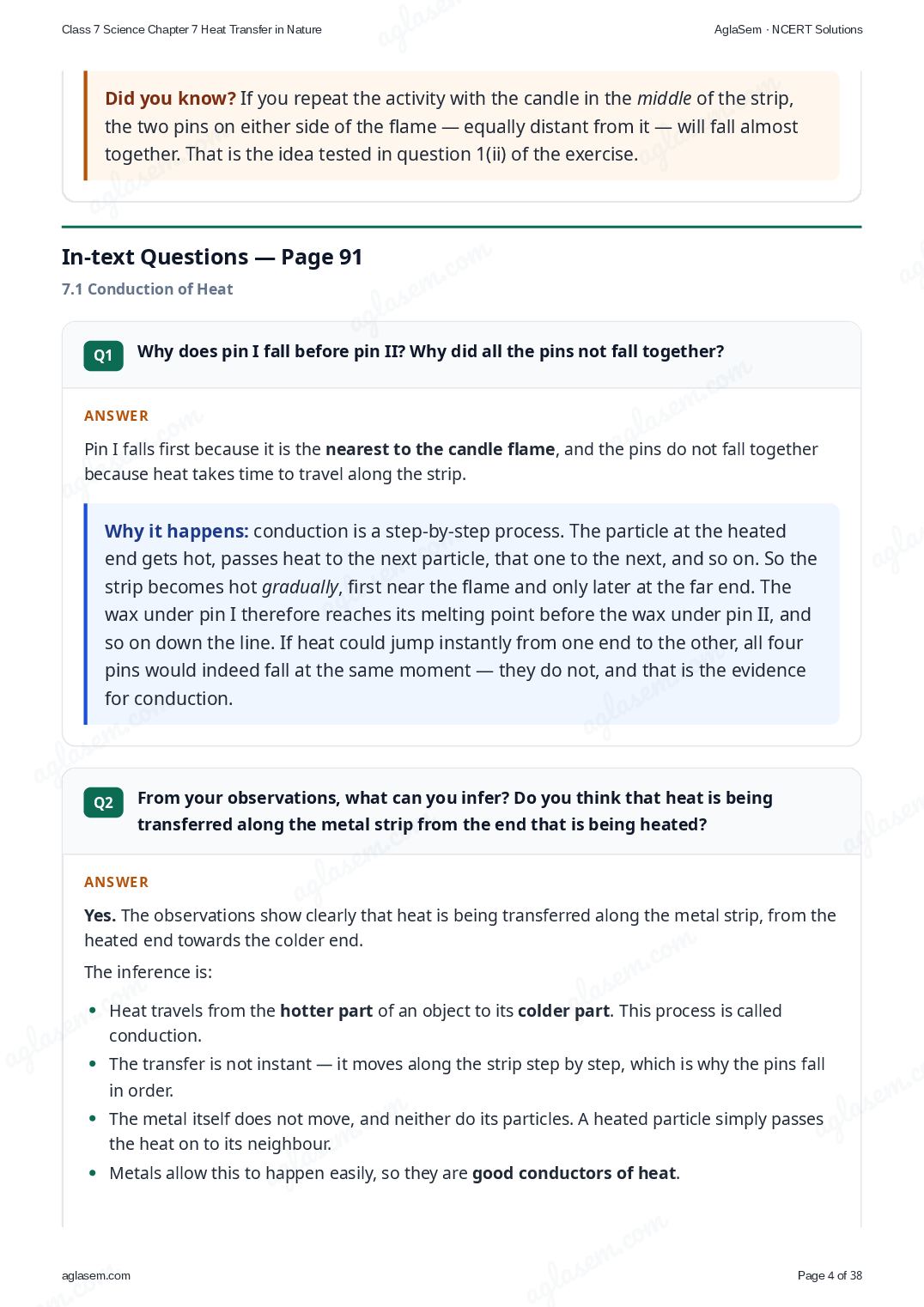
- Why does pin I fall before pin II? Why did all the pins not fall together?
- From your observations, what can you infer? Do you think that heat is being transferred along the metal strip from the end that is being heated?
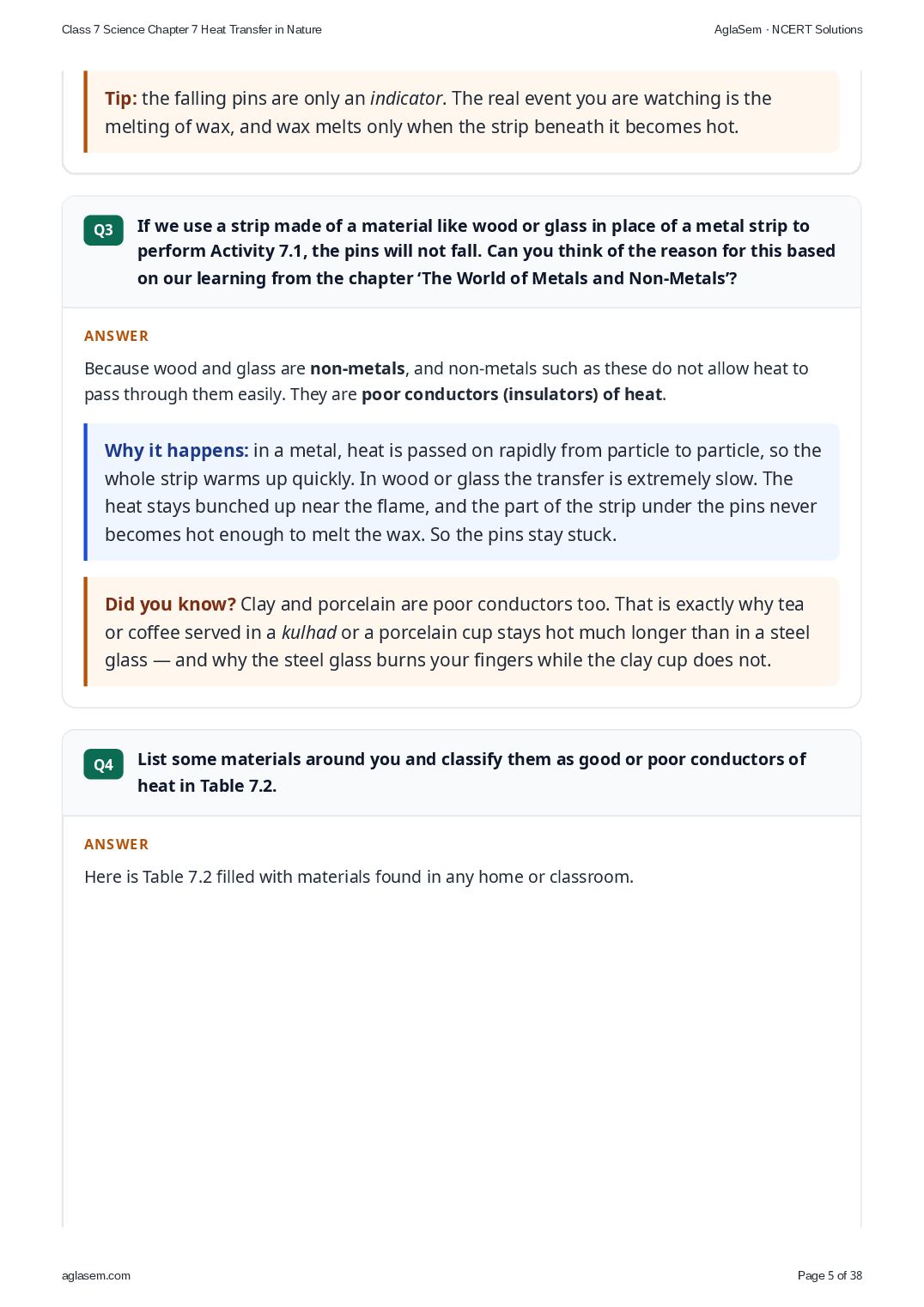
- If we use a strip made of a material like wood or glass in place of a metal strip to perform Activity 7.1, the pins will not fall. Can you think of the reason for this based on our learning from the chapter ‘The World of Metals and Non-Metals’?
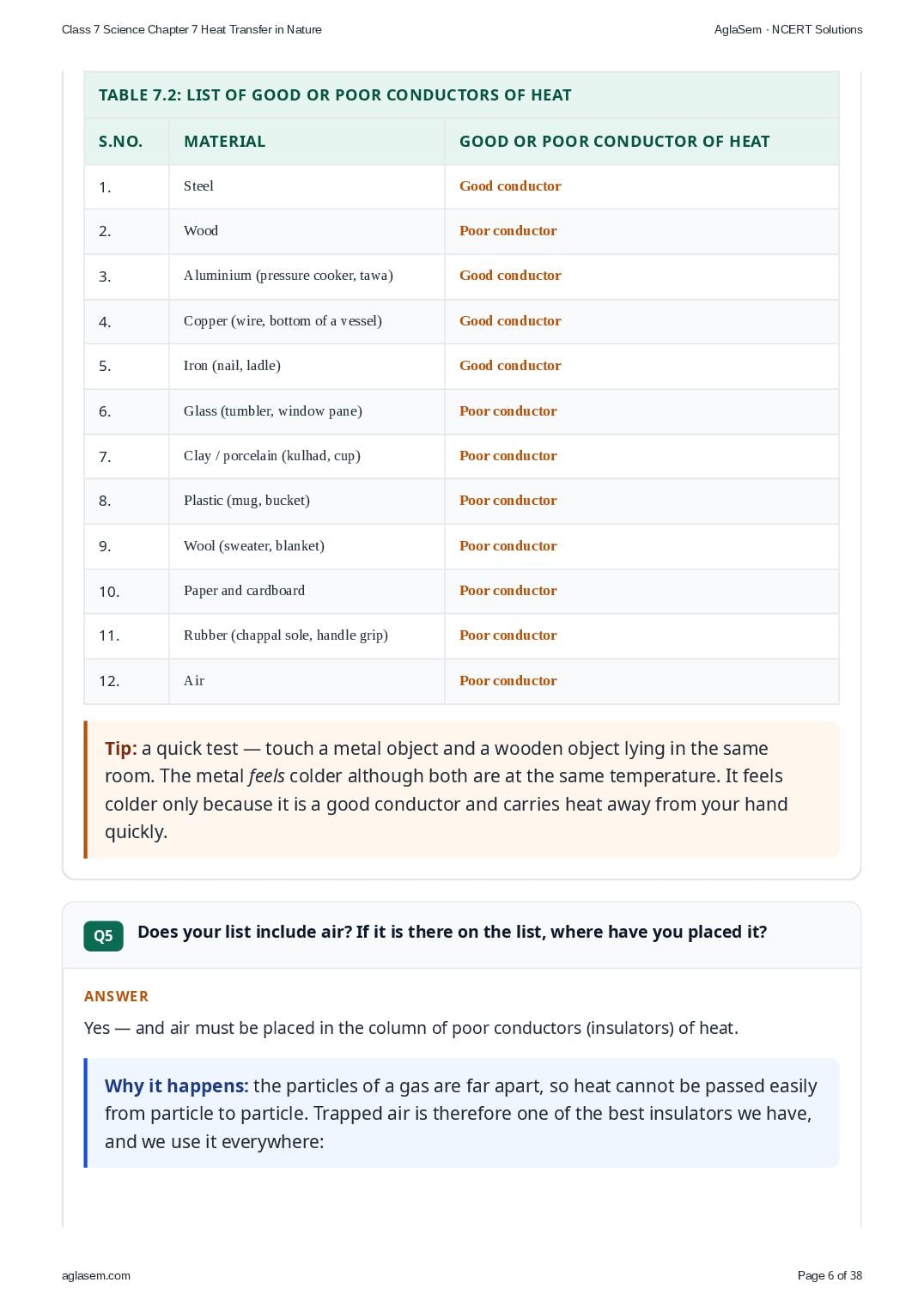
- List some materials around you and classify them as good or poor conductors of heat in Table 7.2.
- Does your list include air? If it is there on the list, where have you placed it?
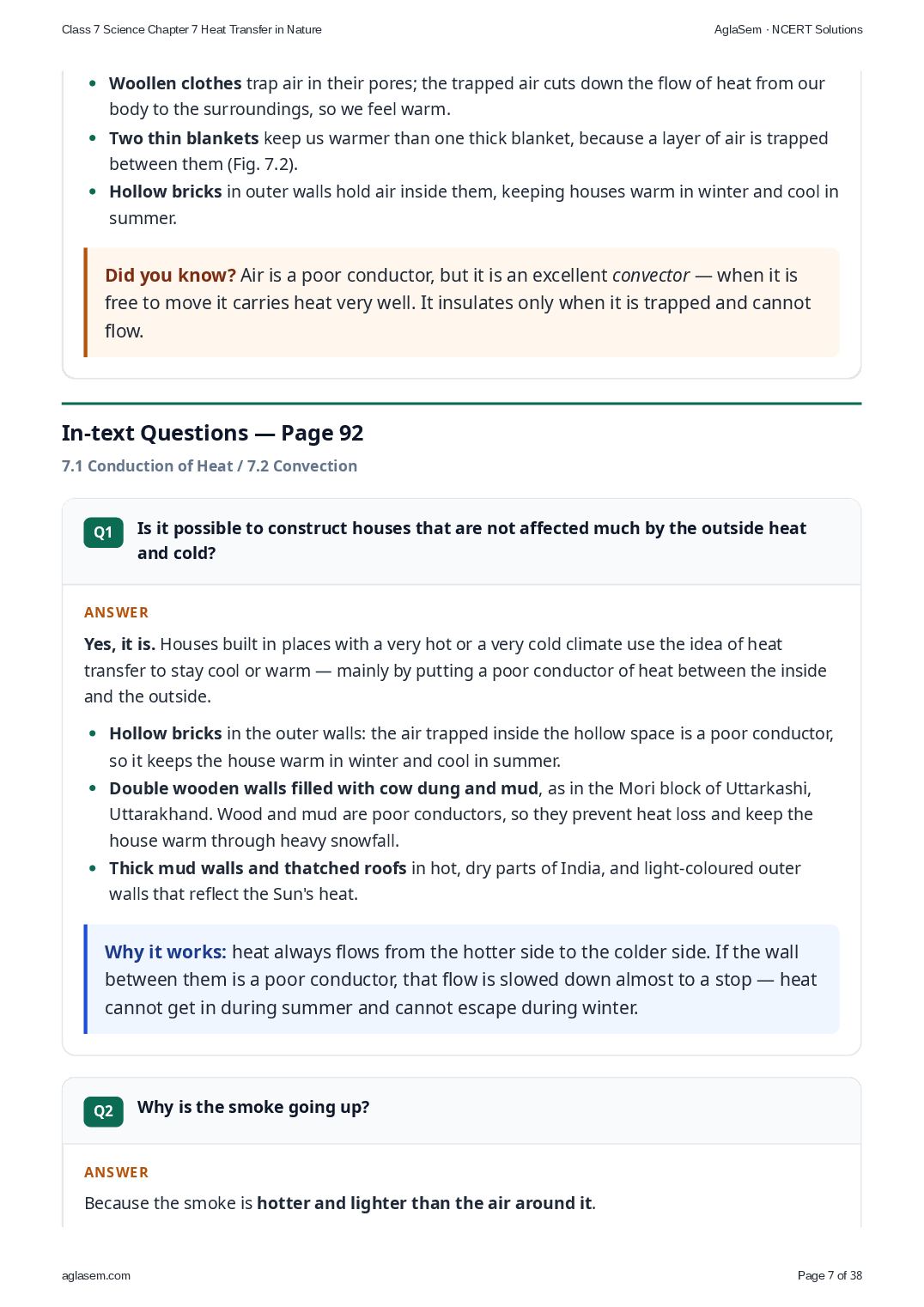
- Is it possible to construct houses that are not affected much by the outside heat and cold?
- Why is the smoke going up?
- Observe what happens to the cup.
- Record your observations in Table 7.3 and think of probable reasons.
- You observed that the cup under which the candle was placed, rises up (Fig. 7.3b). Why is it so?
- How does heat transfer take place in liquids? Do liquids also rise up when heated like air?
- Observe the movement of the coloured streak in the water.
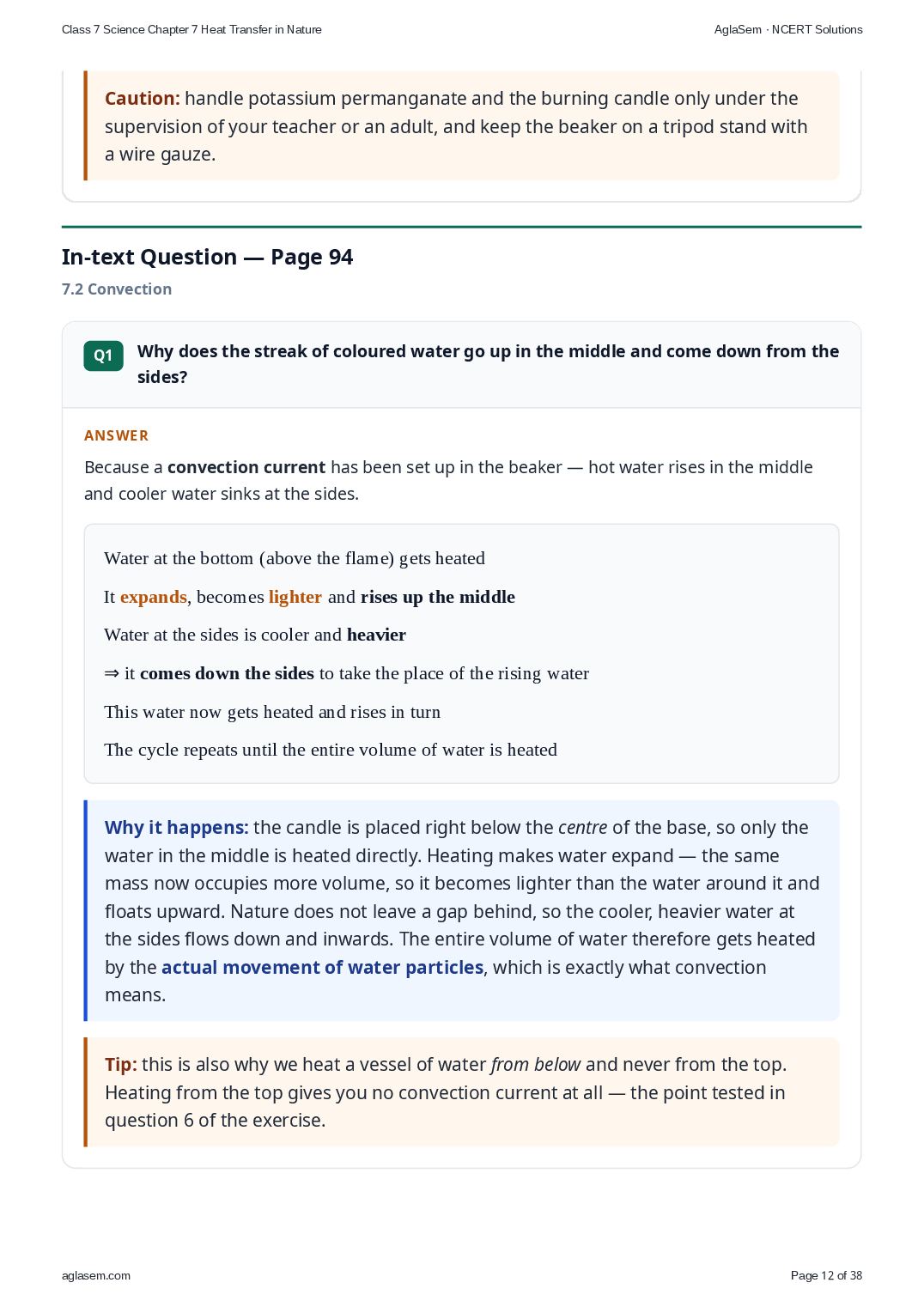
- Why does the streak of coloured water go up in the middle and come down from the sides?
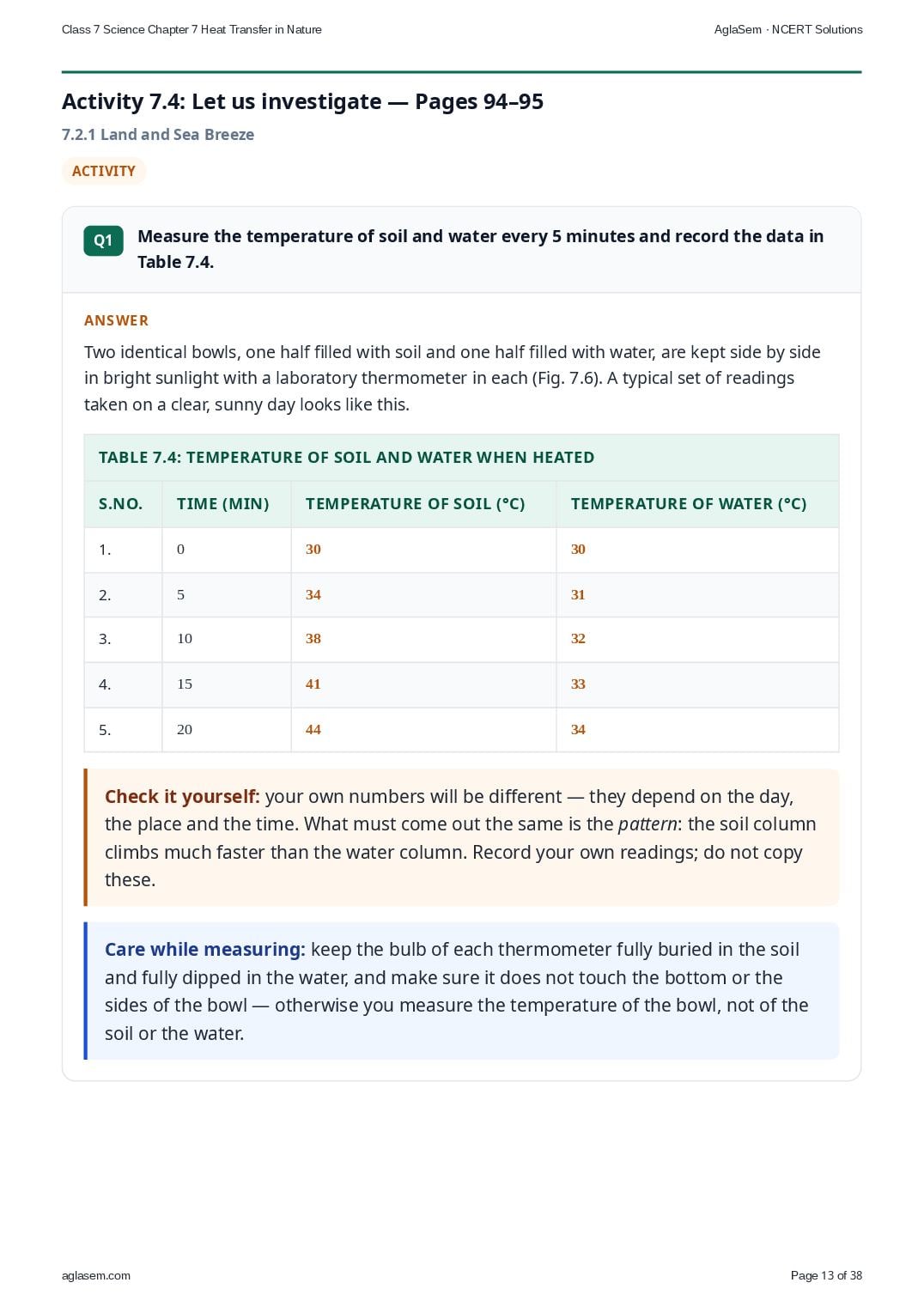
- Measure the temperature of soil and water every 5 minutes and record the data in Table 7.4.
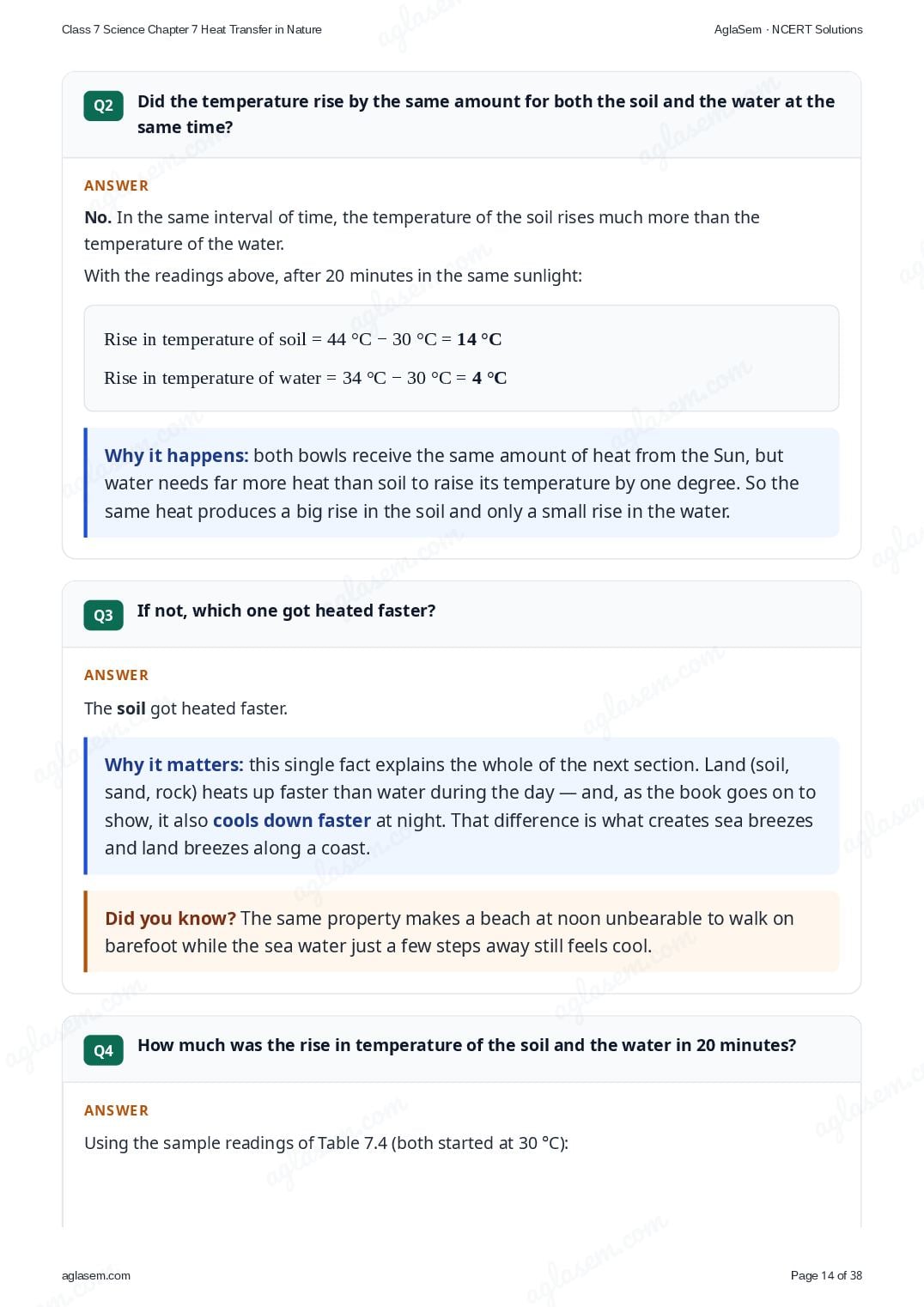
- Did the temperature rise by the same amount for both the soil and the water at the same time?
- If not, which one got heated faster?
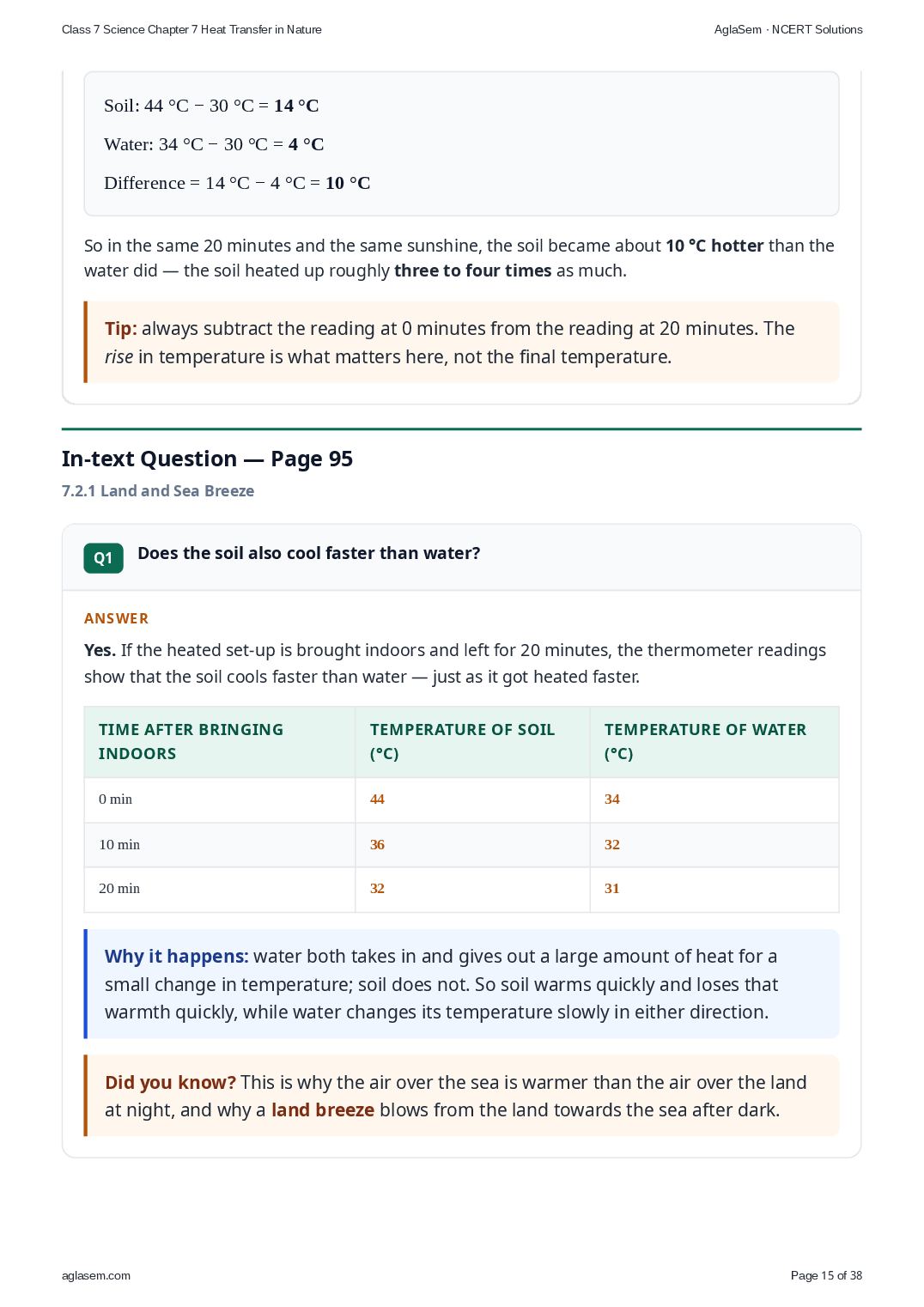
- How much was the rise in temperature of the soil and the water in 20 minutes?
- Does the soil also cool faster than water?
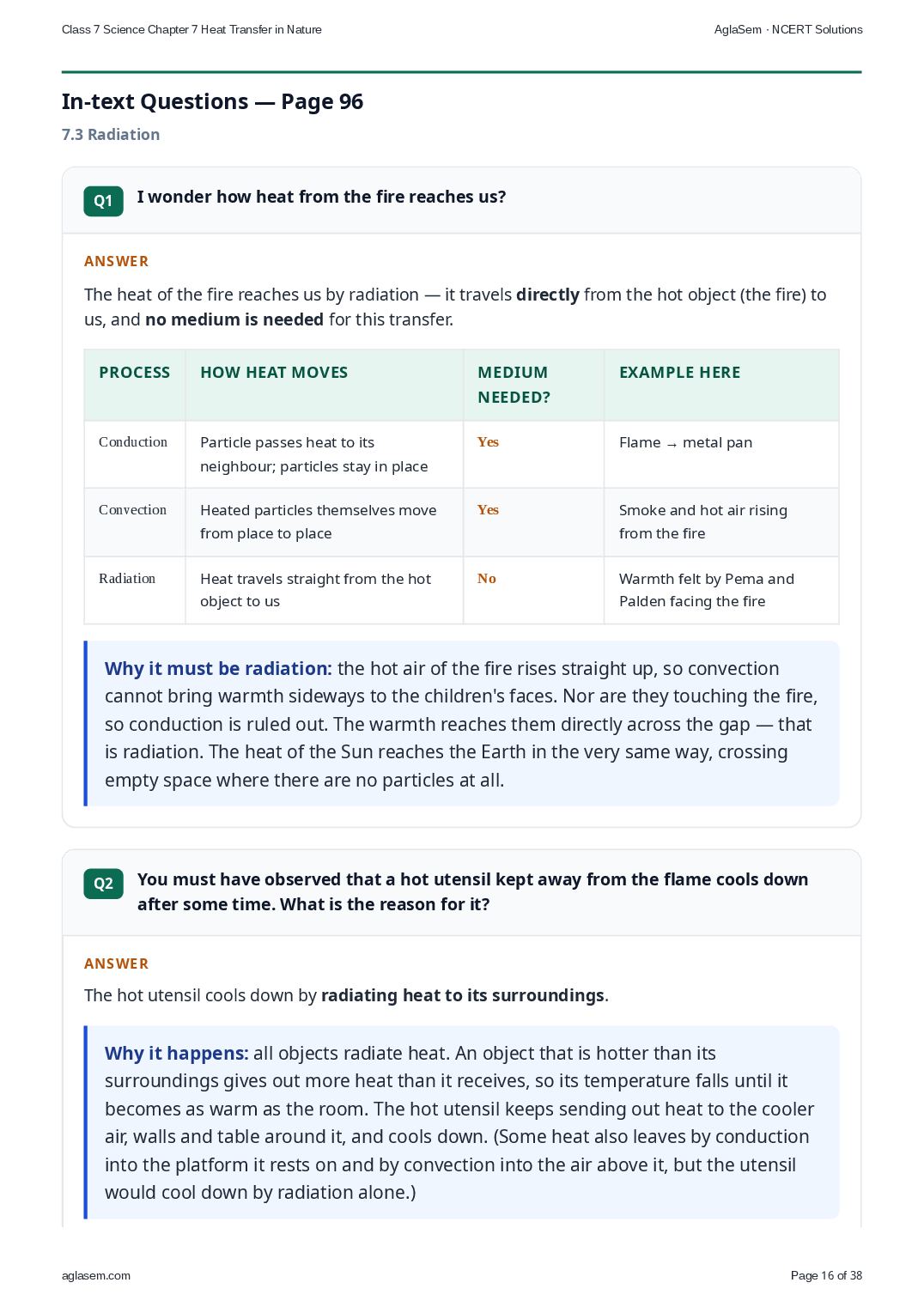
- I wonder how heat from the fire reaches us?
- You must have observed that a hot utensil kept away from the flame cools down after some time. What is the reason for it?
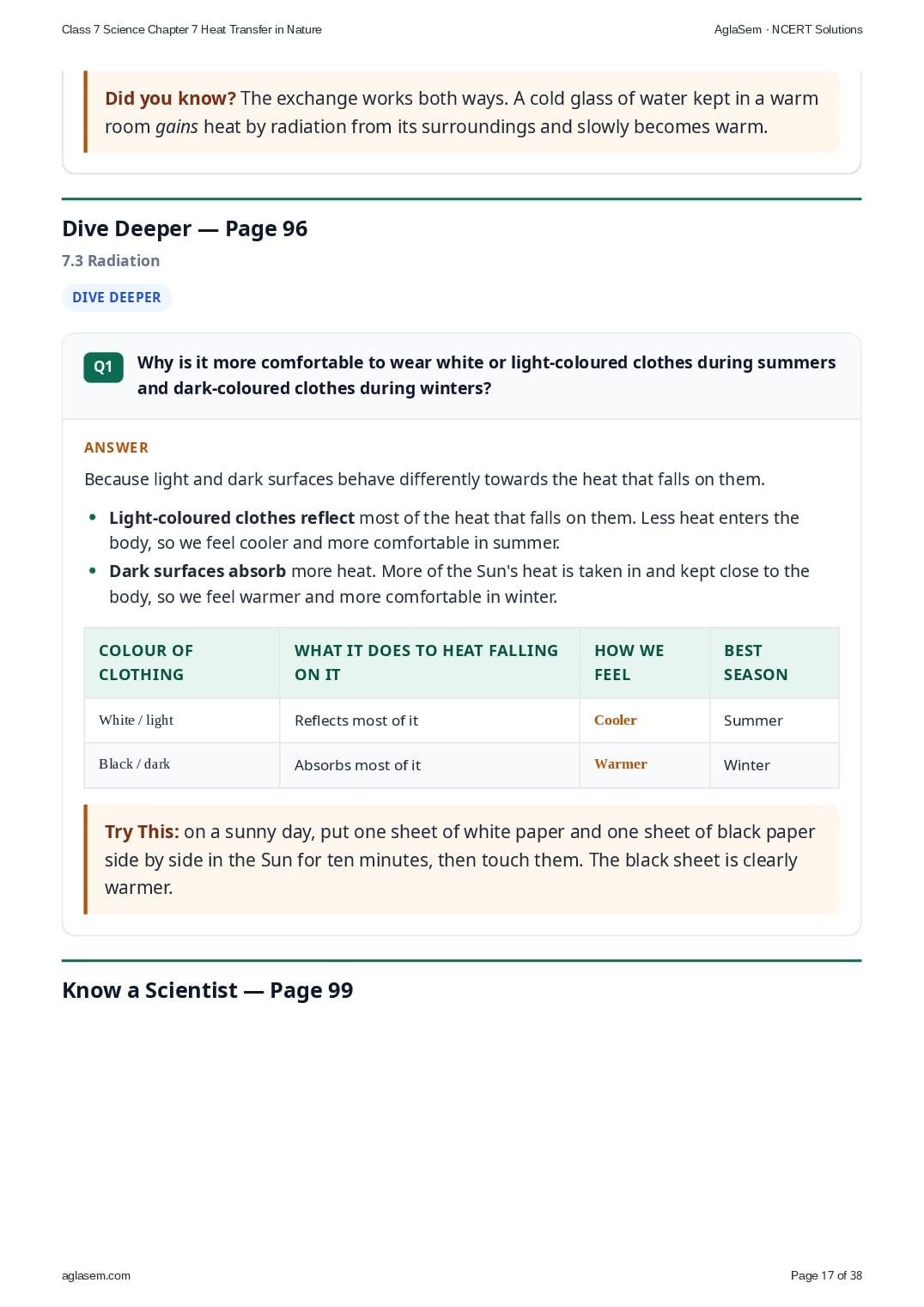
- Why is it more comfortable to wear white or light-coloured clothes during summers and dark-coloured clothes during winters?
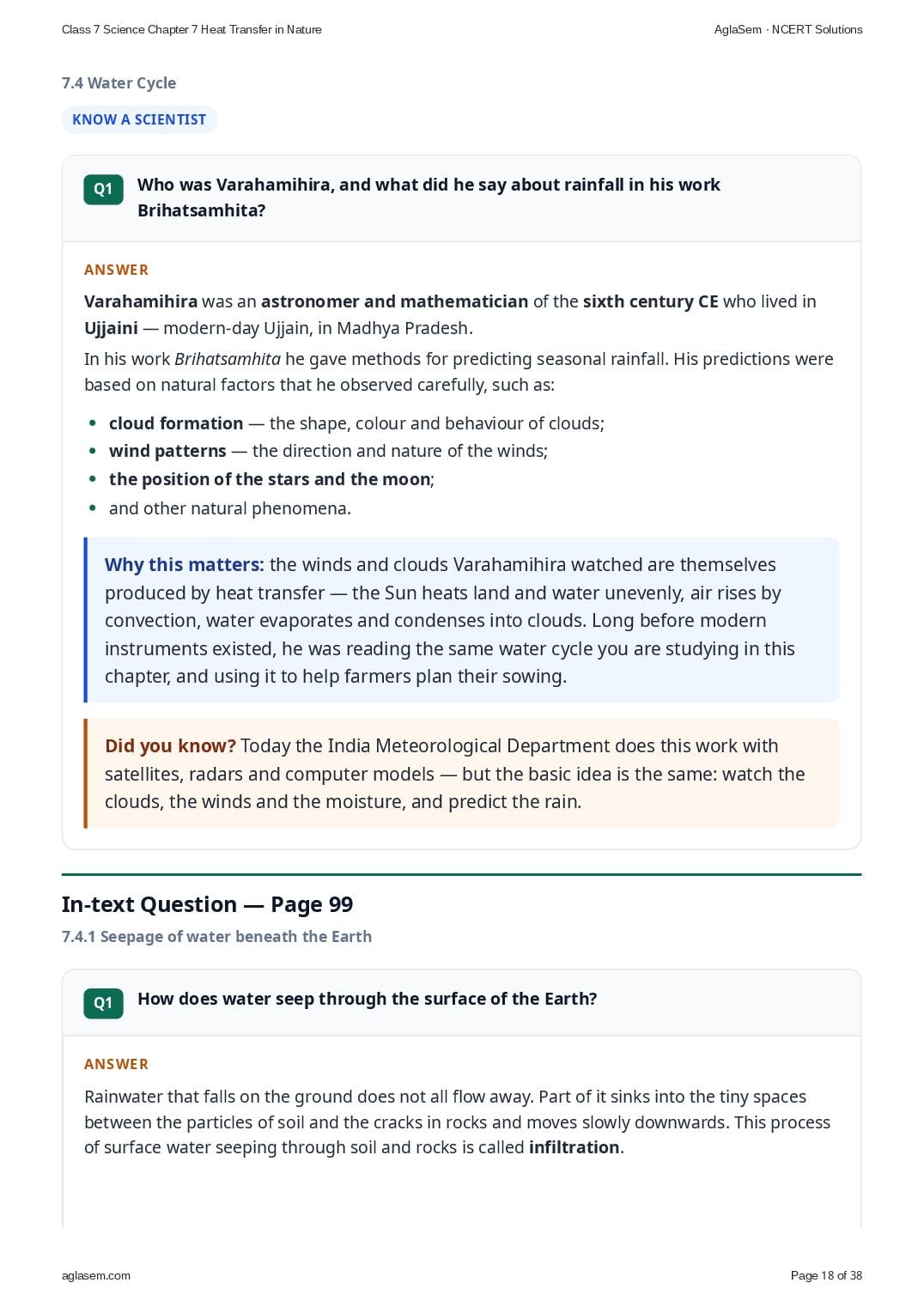
- Who was Varahamihira, and what did he say about rainfall in his work Brihatsamhita?
- How does water seep through the surface of the Earth?
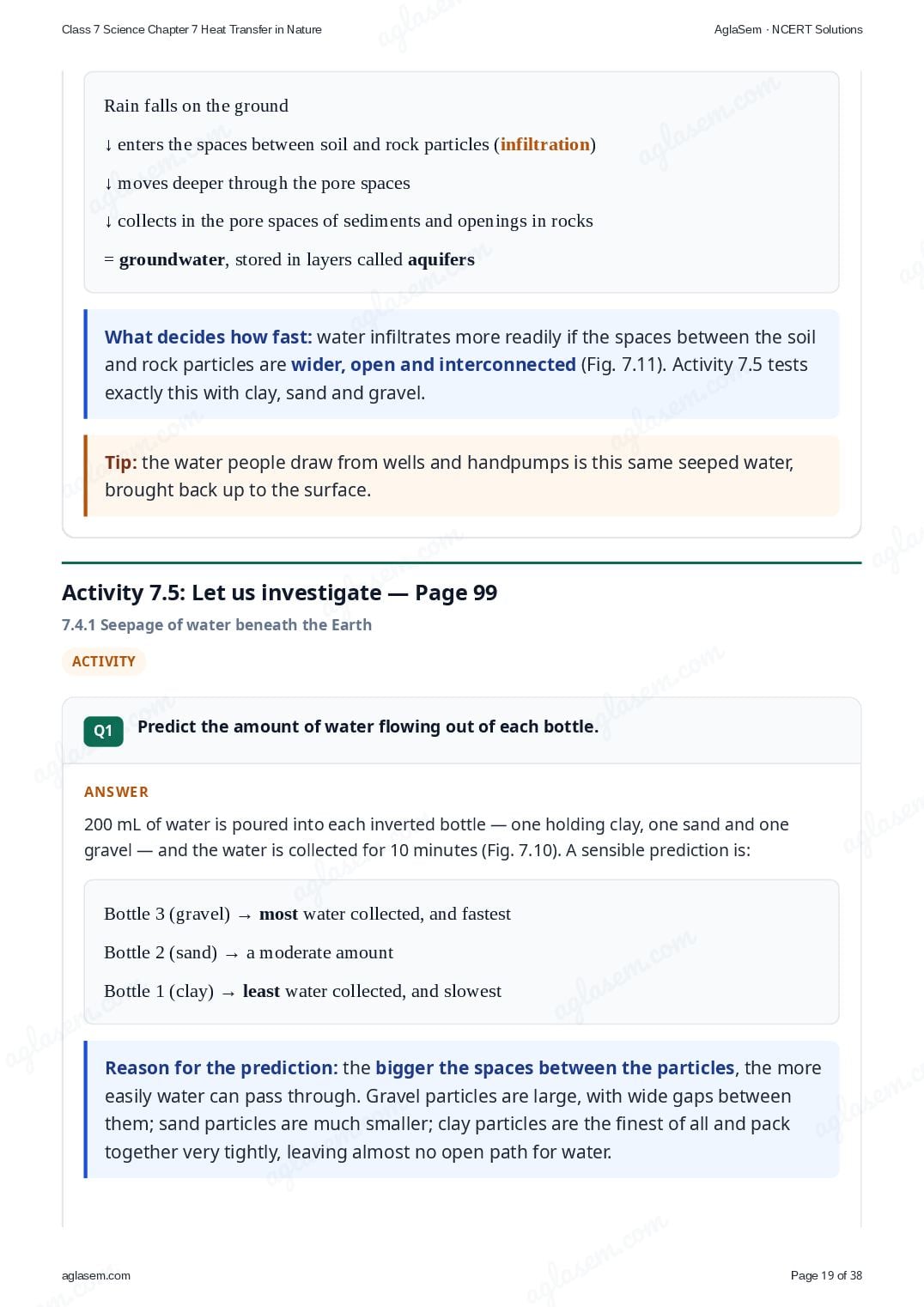
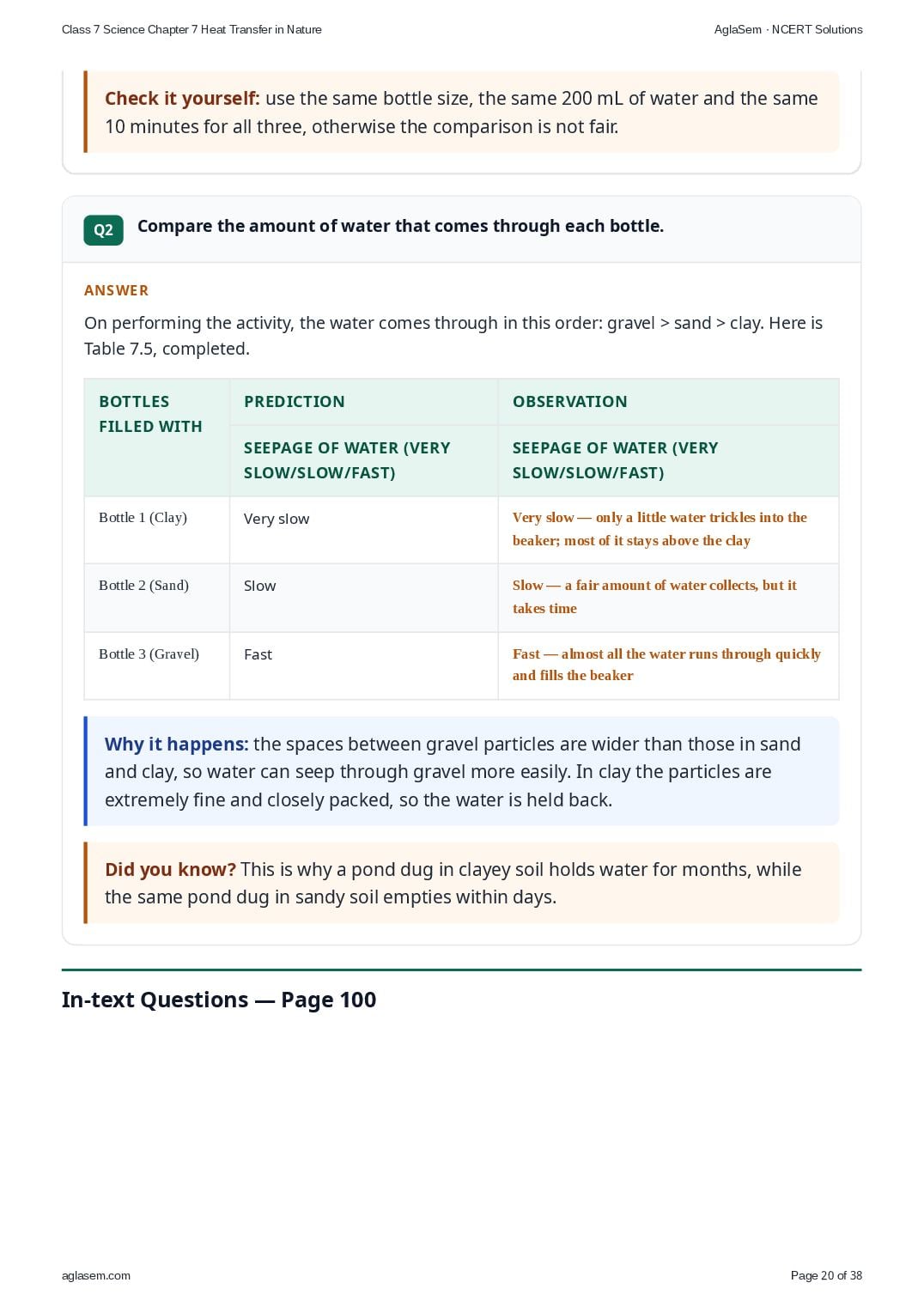
- Predict the amount of water flowing out of each bottle.
- Compare the amount of water that comes through each bottle.
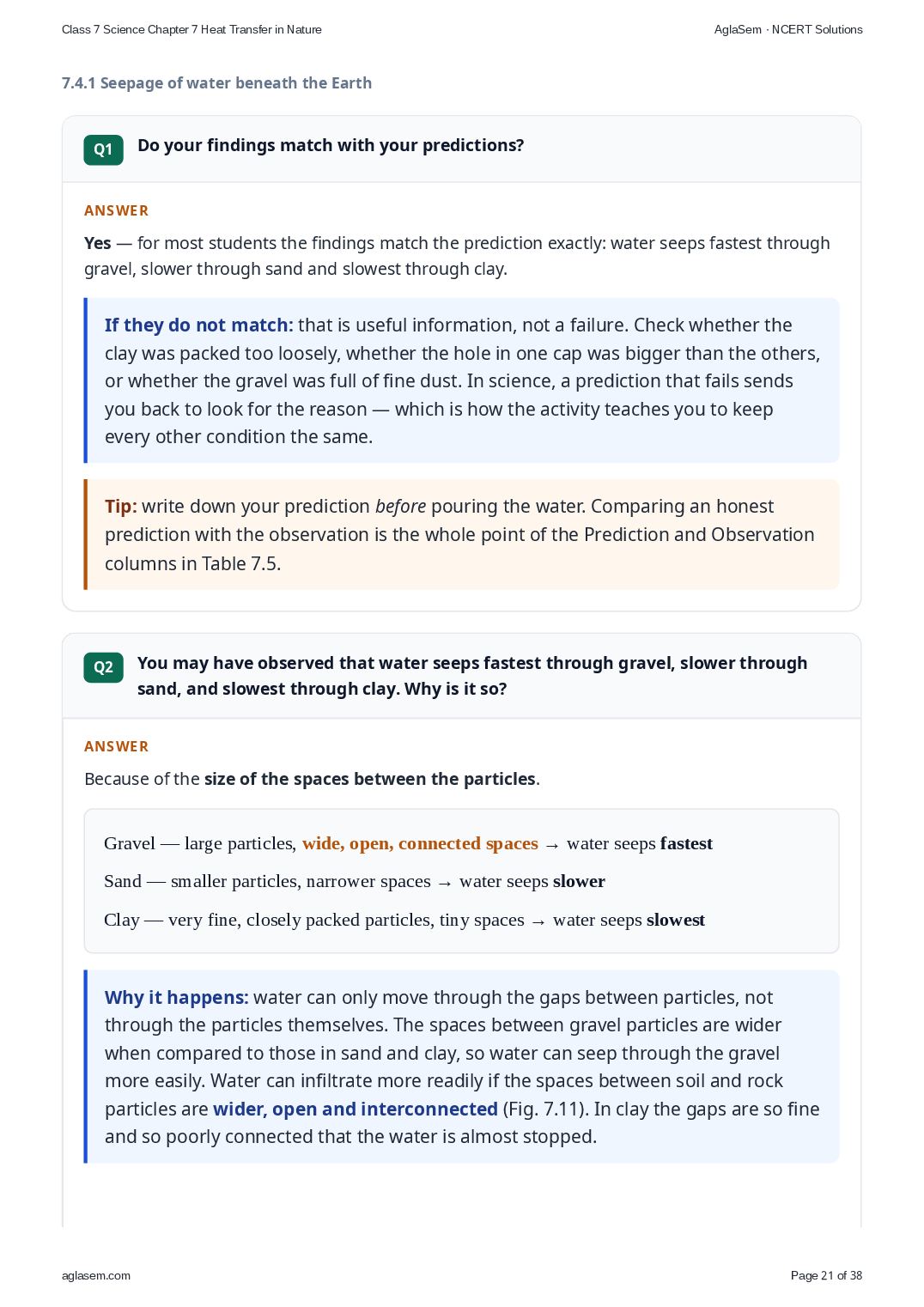
- Do your findings match with your predictions?
- You may have observed that water seeps fastest through gravel, slower through sand, and slowest through clay. Why is it so?
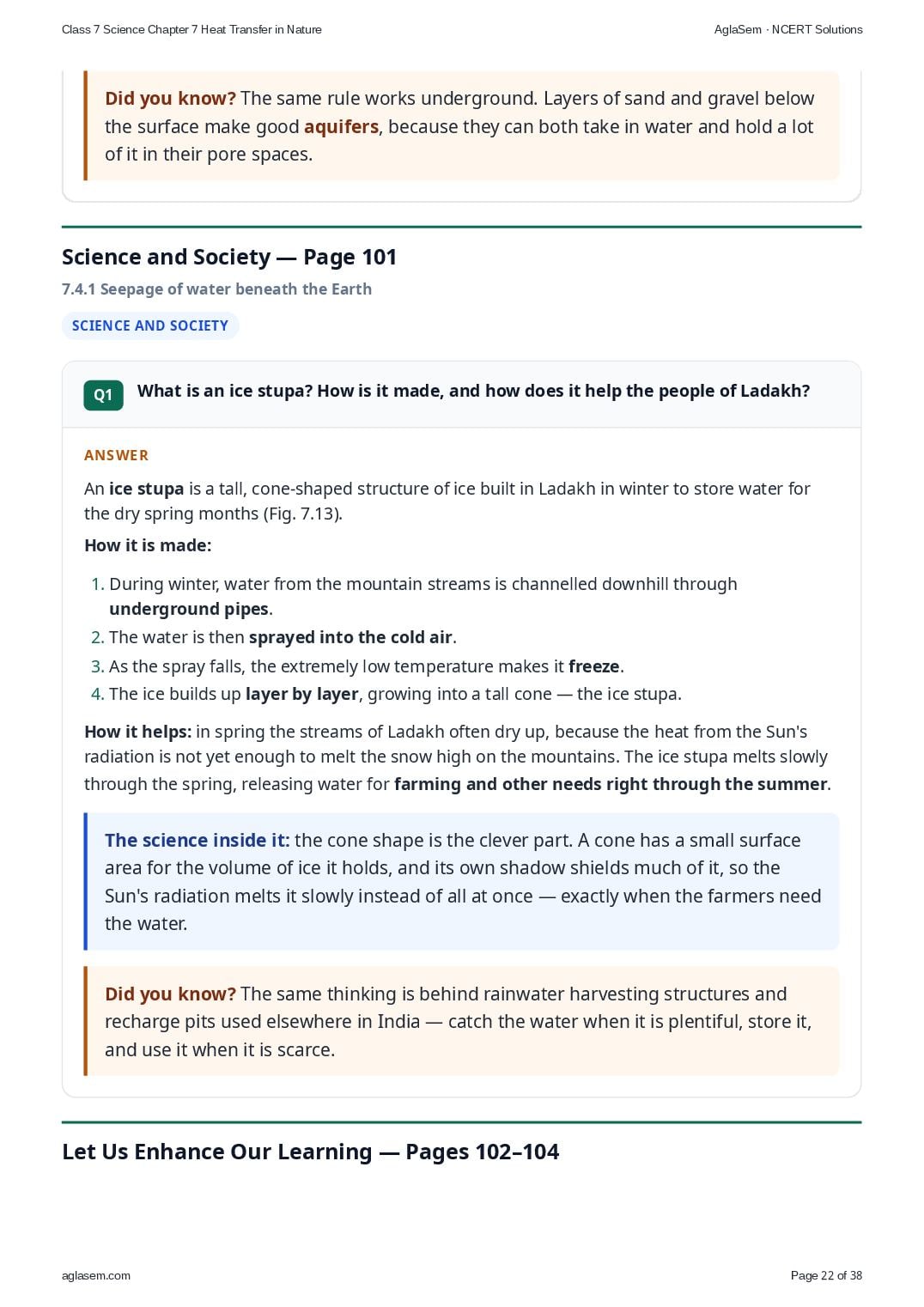
- What is an ice stupa? How is it made, and how does it help the people of Ladakh?
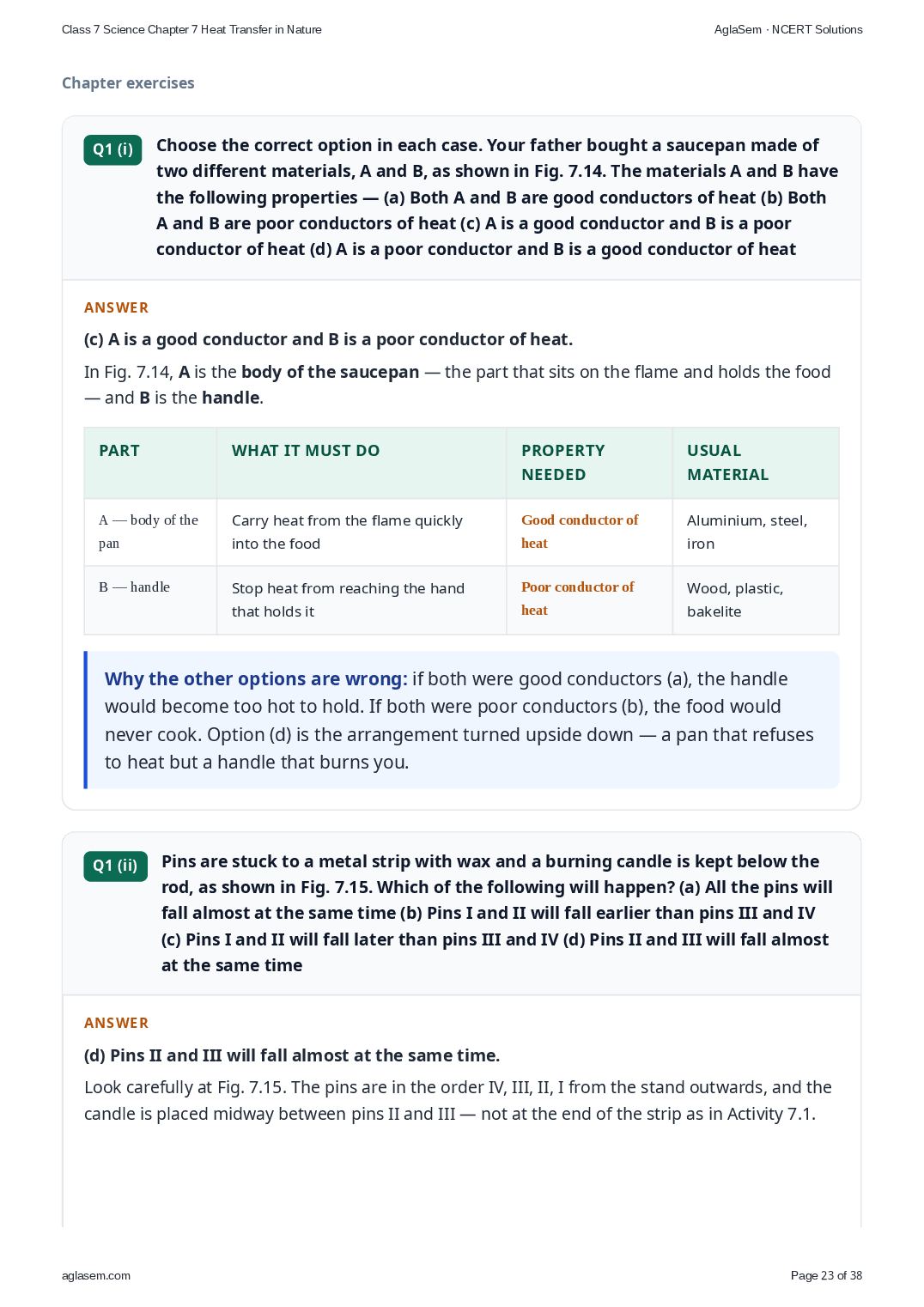
- Choose the correct option in each case. Your father bought a saucepan made of two different materials, A and B, as shown in Fig. 7.14. The materials A and B have the following properties — (a) Both A and B are good conductors of heat (b) Both A and B are poor conductors of heat (c) A is a good conductor and B is a poor conductor of heat (d) A is a poor conductor and B is a good conductor of heat
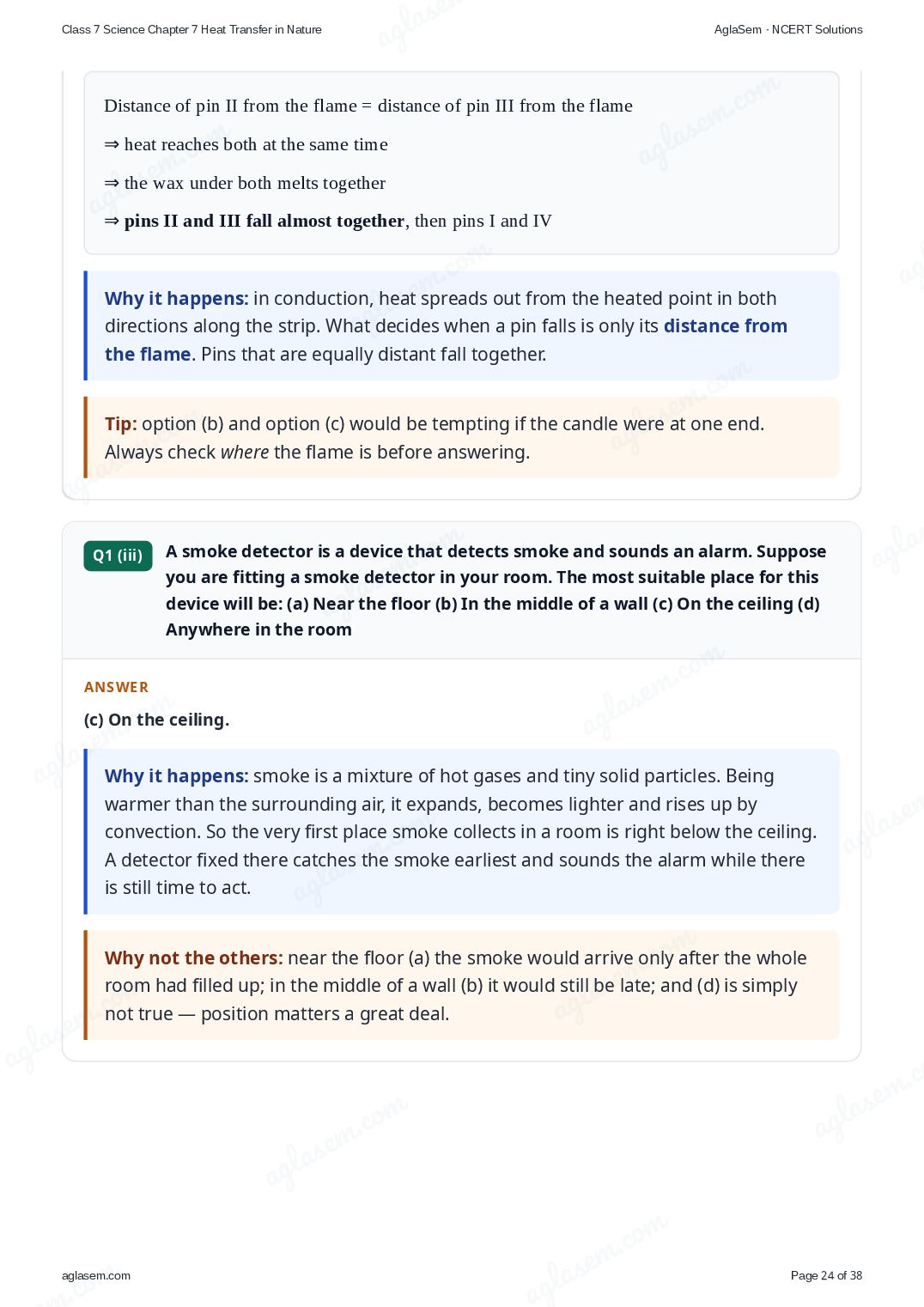
- Pins are stuck to a metal strip with wax and a burning candle is kept below the rod, as shown in Fig. 7.15. Which of the following will happen? (a) All the pins will fall almost at the same time (b) Pins I and II will fall earlier than pins III and IV (c) Pins I and II will fall later than pins III and IV (d) Pins II and III will fall almost at the same time
- A smoke detector is a device that detects smoke and sounds an alarm. Suppose you are fitting a smoke detector in your room. The most suitable place for this device will be: (a) Near the floor (b) In the middle of a wall (c) On the ceiling (d) Anywhere in the room
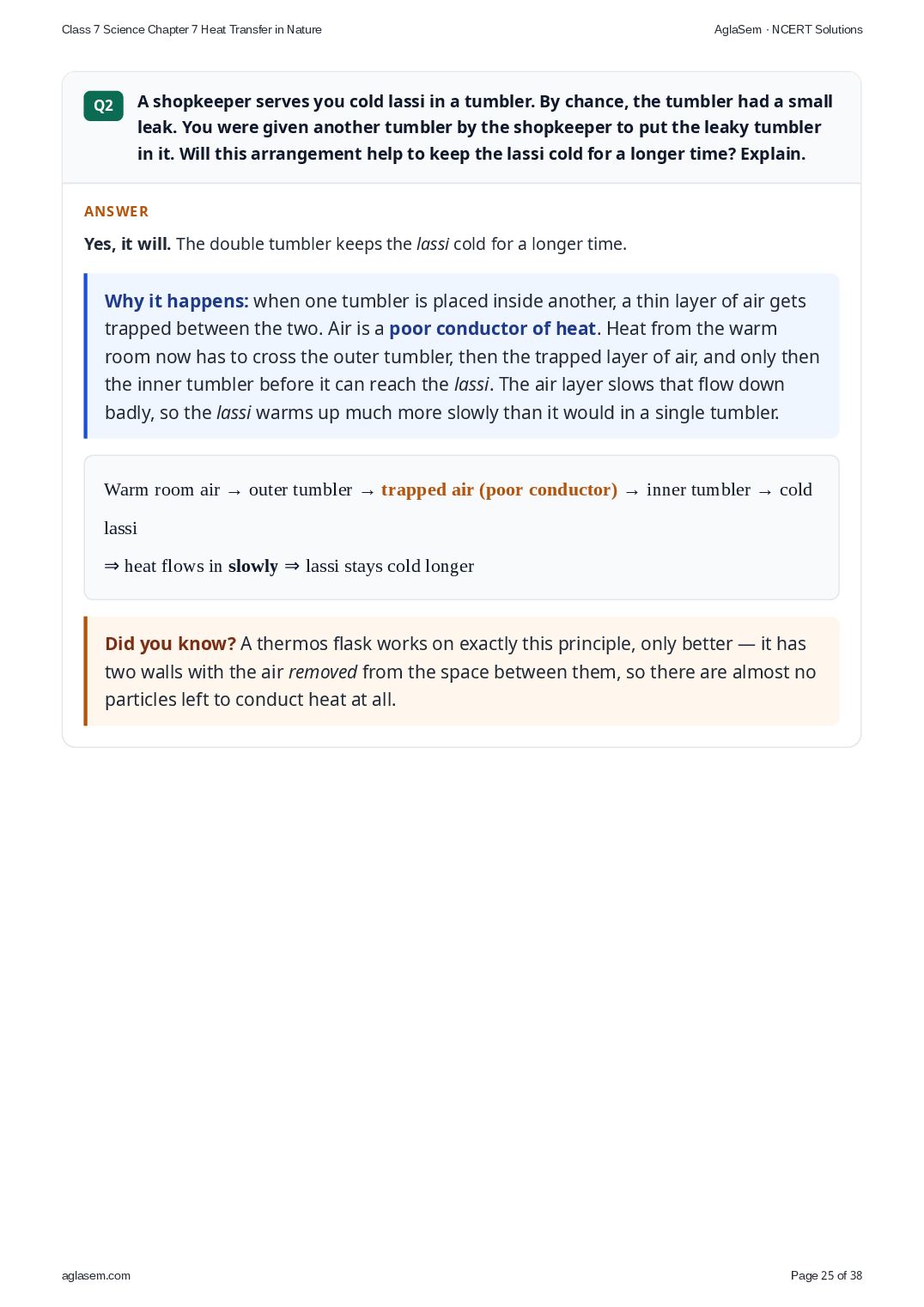
- A shopkeeper serves you cold lassi in a tumbler. By chance, the tumbler had a small leak. You were given another tumbler by the shopkeeper to put the leaky tumbler in it. Will this arrangement help to keep the lassi cold for a longer time? Explain.
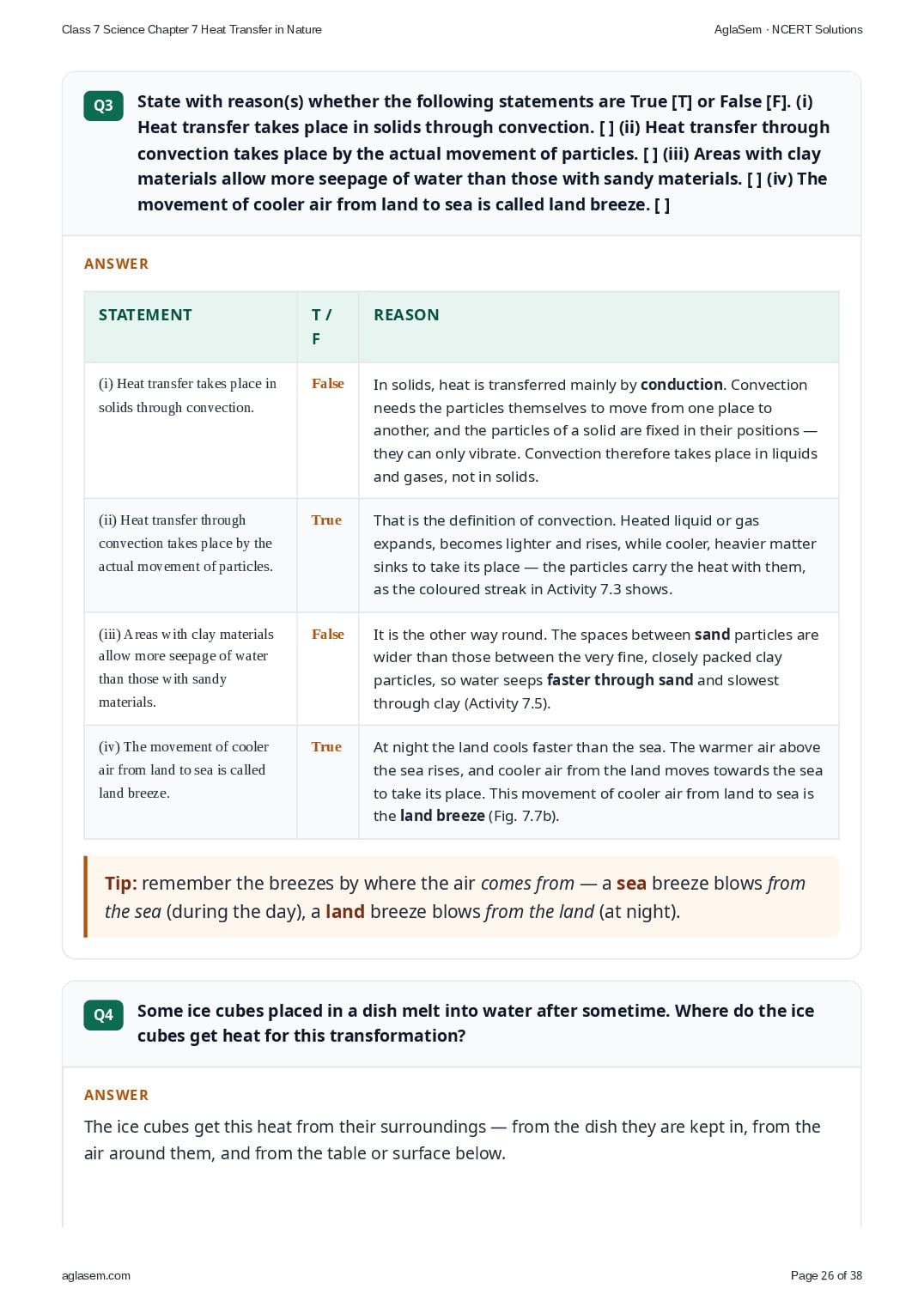
- State with reason(s) whether the following statements are True [T] or False [F]. (i) Heat transfer takes place in solids through convection. [ ] (ii) Heat transfer through convection takes place by the actual movement of particles. [ ] (iii) Areas with clay materials allow more seepage of water than those with sandy materials. [ ] (iv) The movement of cooler air from land to sea is called land breeze. [ ]
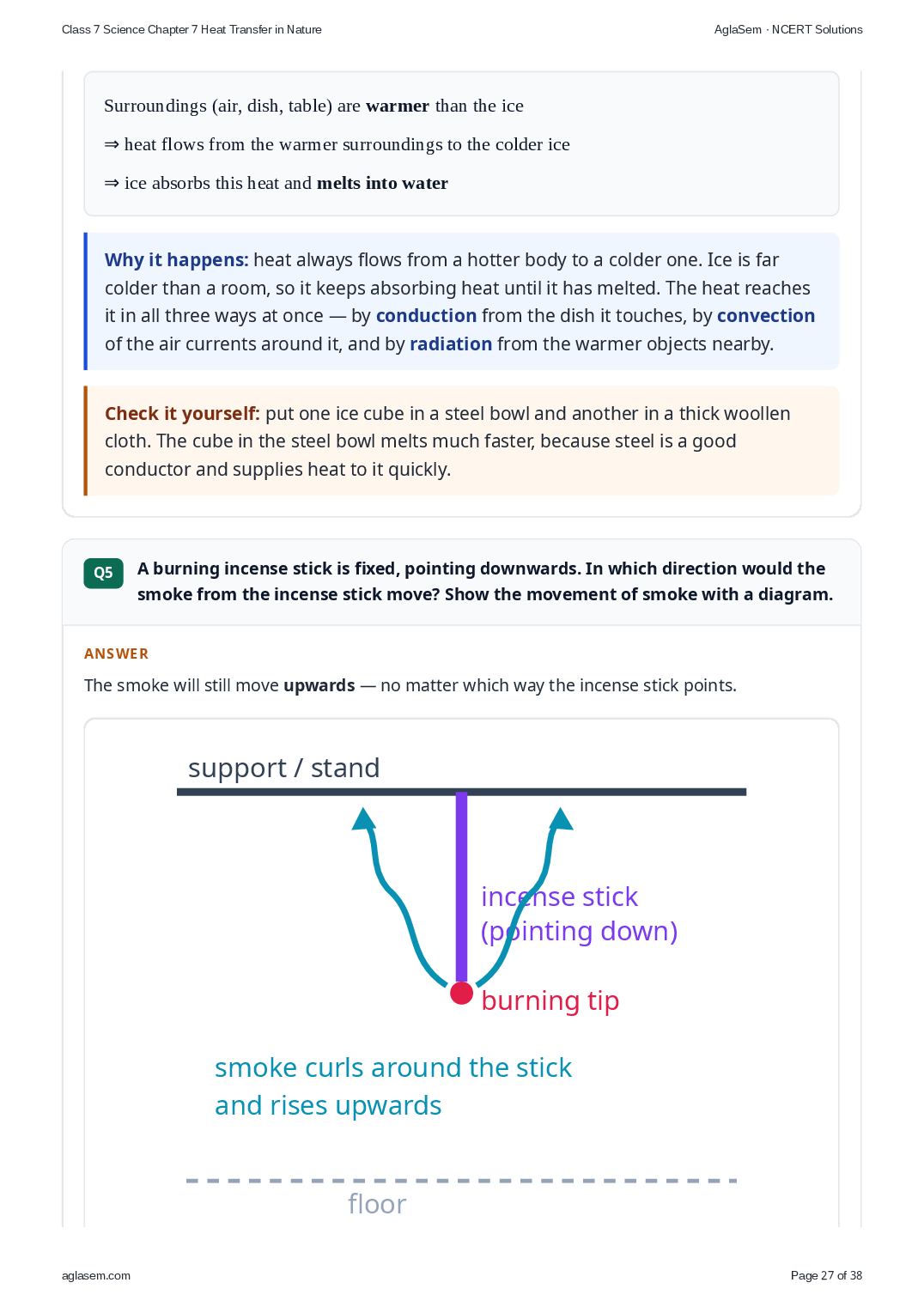
- Some ice cubes placed in a dish melt into water after sometime. Where do the ice cubes get heat for this transformation?
- A burning incense stick is fixed, pointing downwards. In which direction would the smoke from the incense stick move? Show the movement of smoke with a diagram.
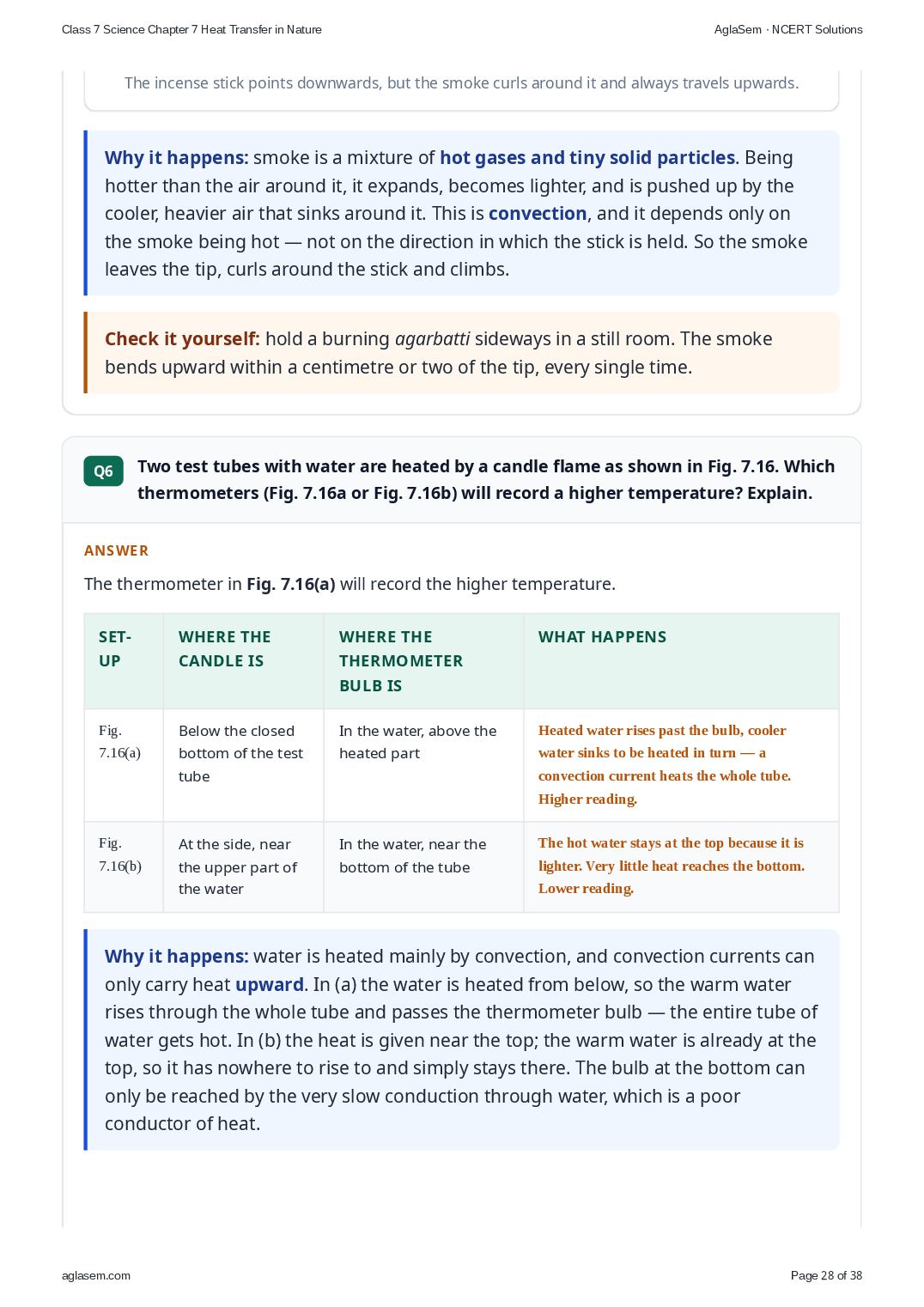
- Two test tubes with water are heated by a candle flame as shown in Fig. 7.16. Which thermometers (Fig. 7.16a or Fig. 7.16b) will record a higher temperature? Explain.
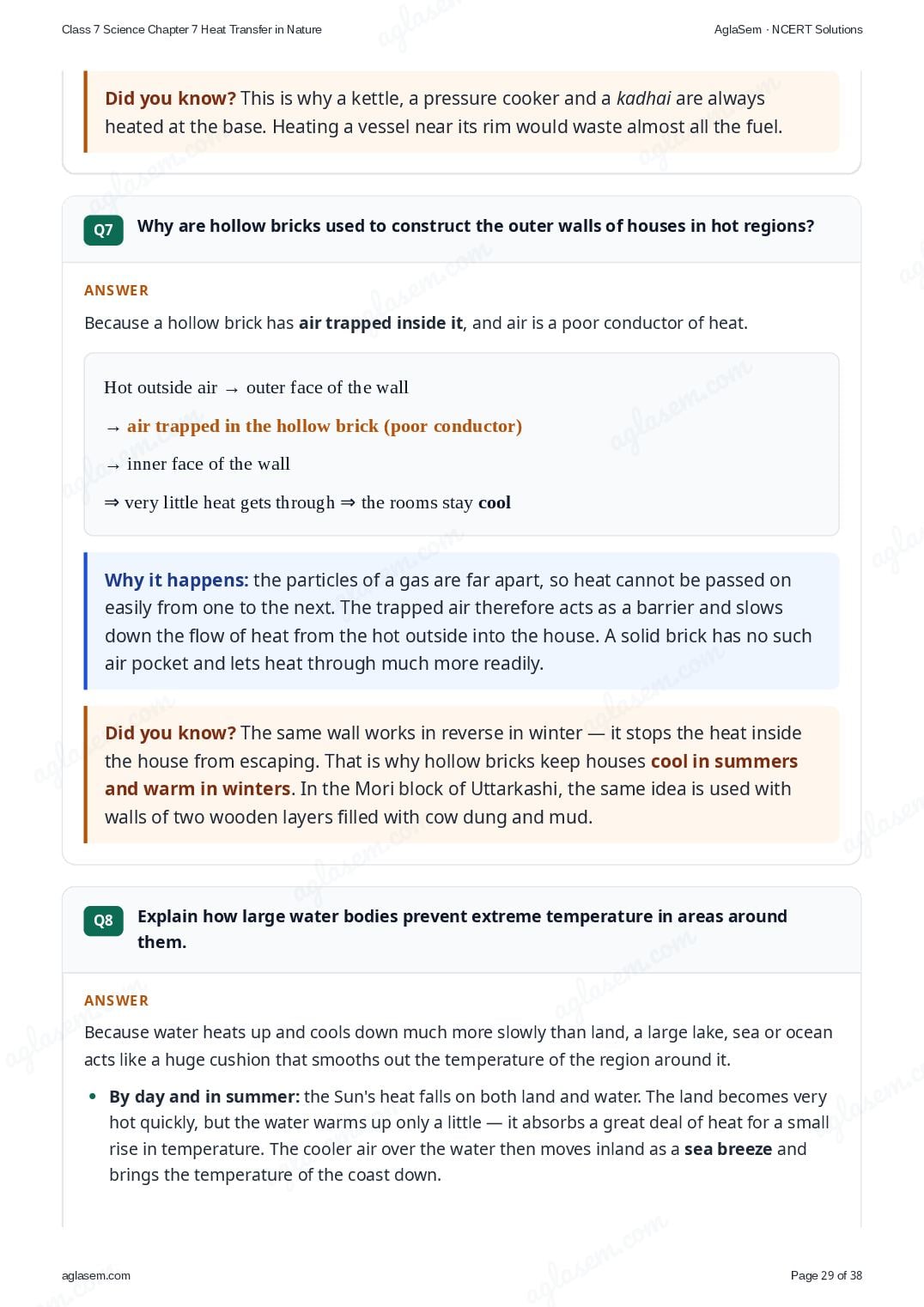
- Why are hollow bricks used to construct the outer walls of houses in hot regions?
- Explain how large water bodies prevent extreme temperature in areas around them.
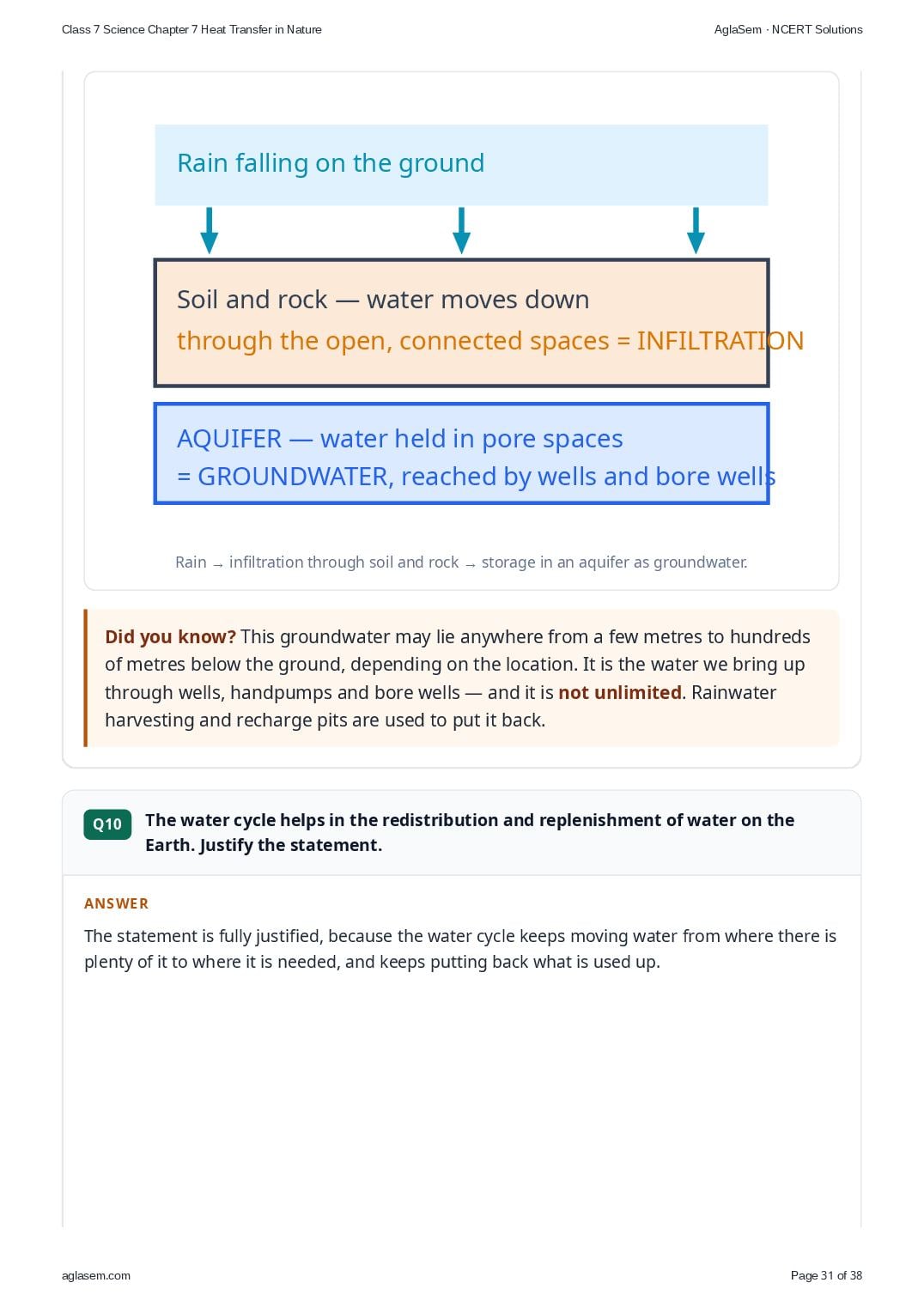
- Explain how water seeps through the surface of the Earth and gets stored as groundwater.
- The water cycle helps in the redistribution and replenishment of water on the Earth. Justify the statement.
- Society: Visit a site of water harvesting or a recharge pit. Find out from people how they are constructed and how they work. Prepare a report with illustrations.
- Activity: Tightly wrap a thin paper strip around a metallic rod. Try to burn the paper with a candle while rotating the rod continuously. Does the paper burn? Explain your observations.
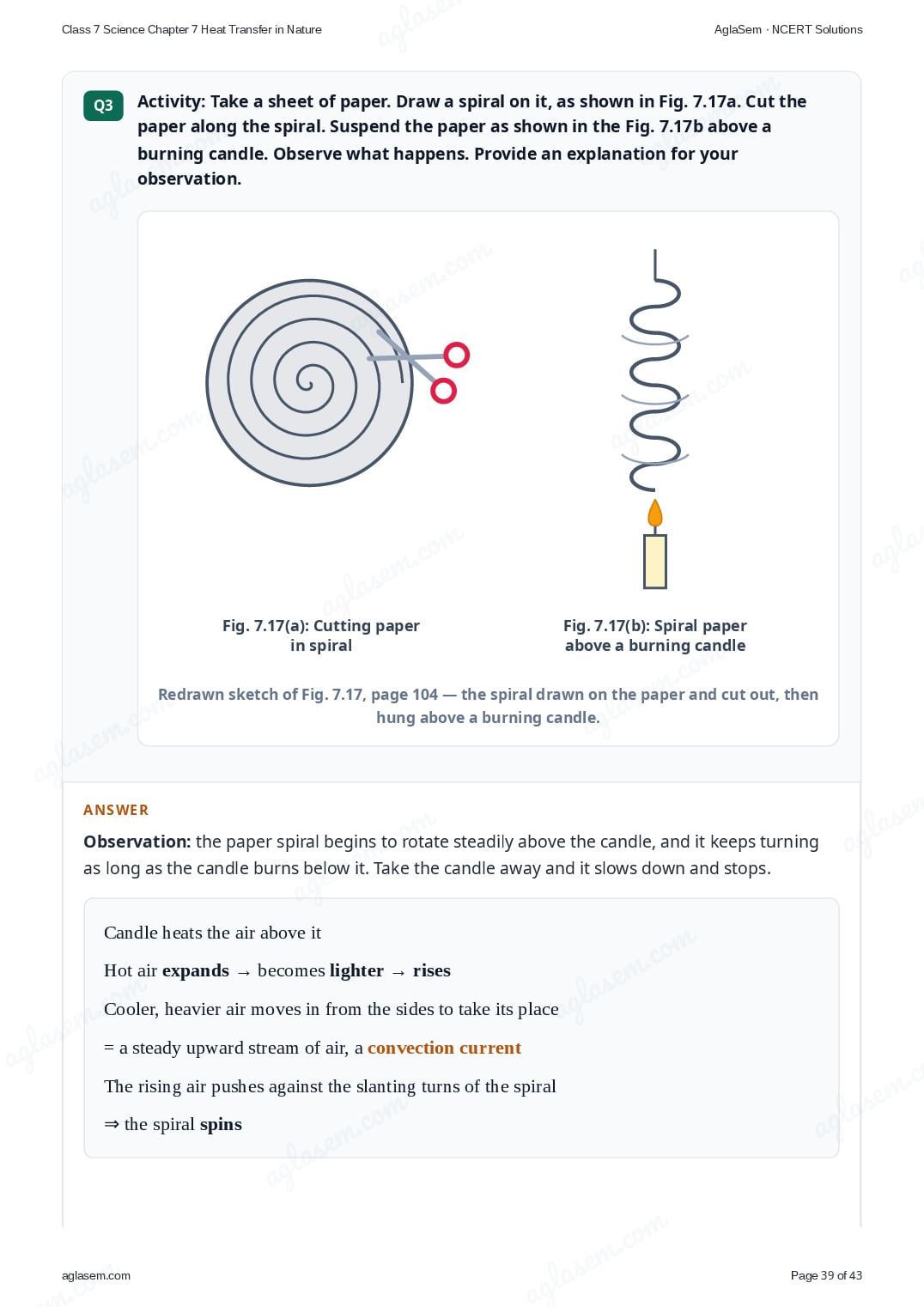
- Activity: Take a sheet of paper. Draw a spiral on it, as shown in Fig. 7.17a. Cut the paper along the spiral. Suspend the paper as shown in the Fig. 7.17b above a burning candle. Observe what happens. Provide an explanation for your observation.
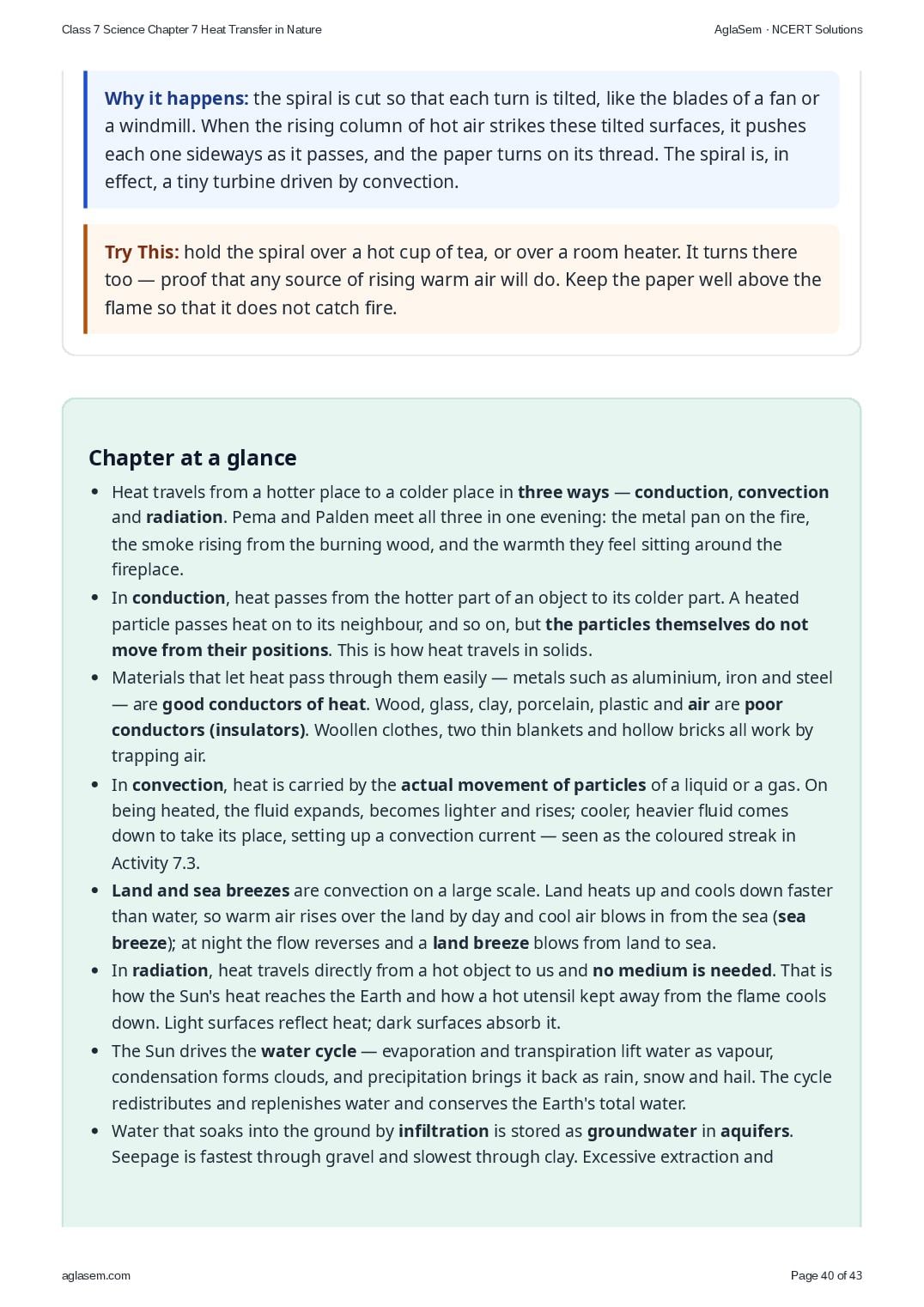
Chapter at a Glance
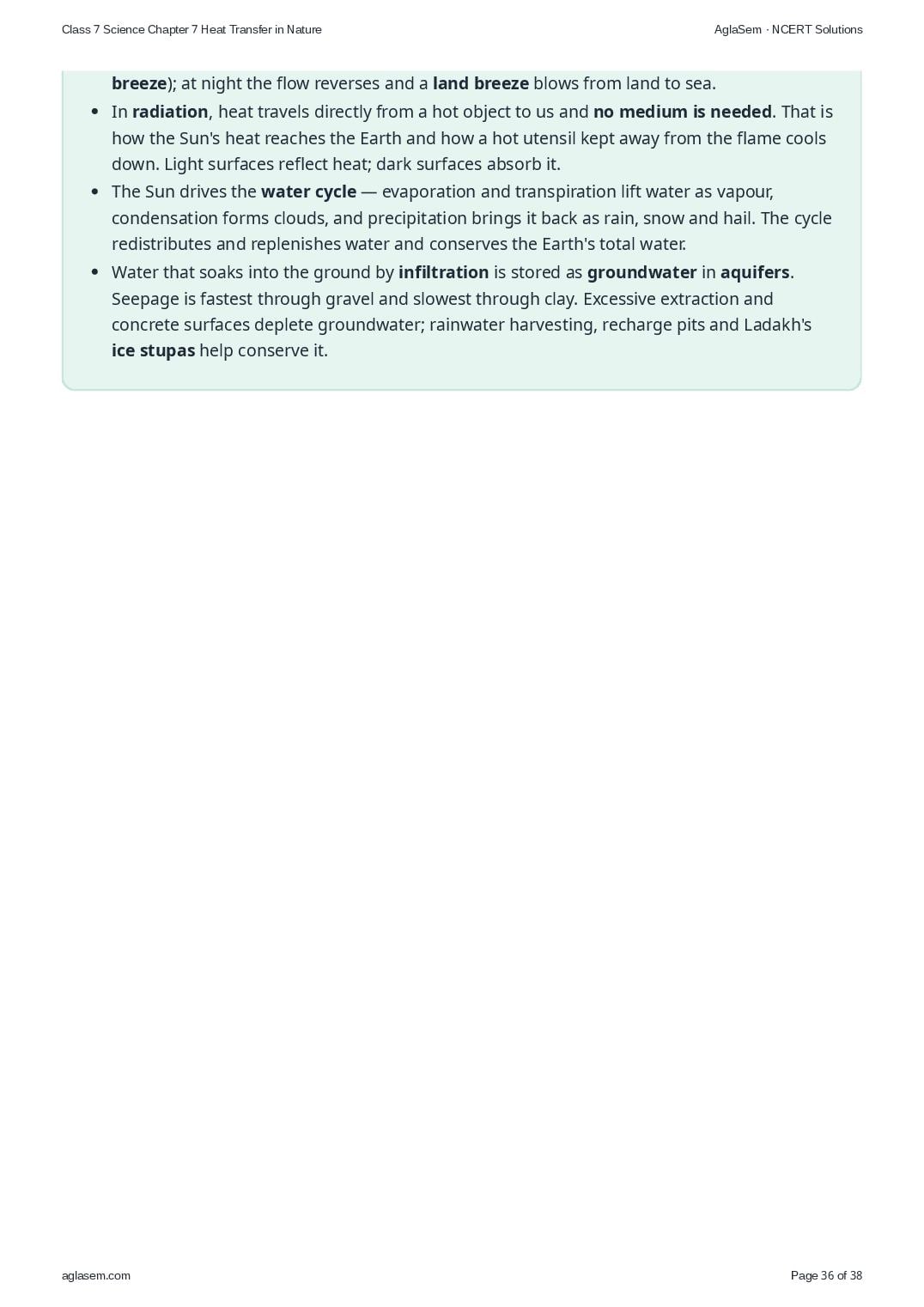
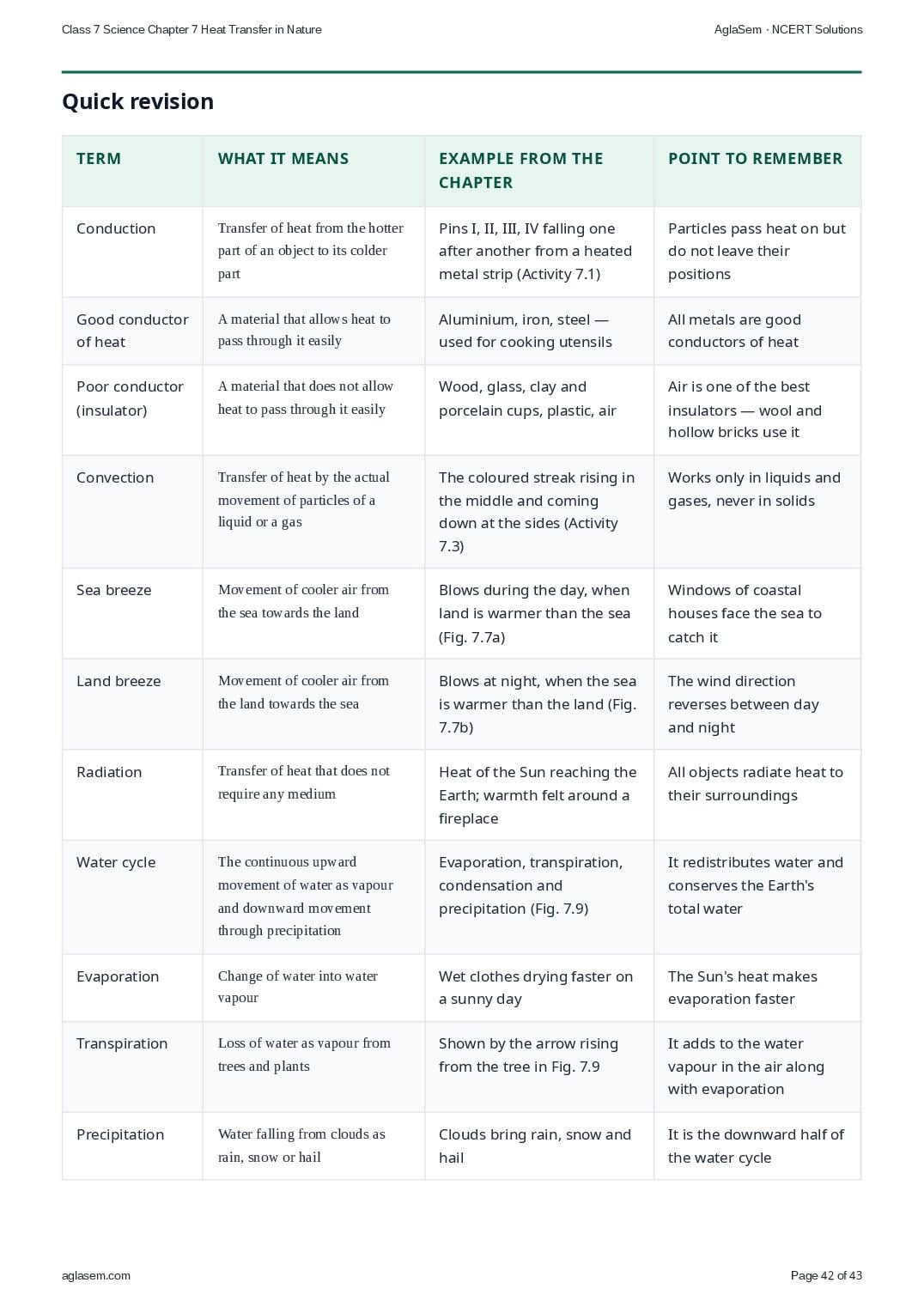
- Heat travels from a hotter place to a colder place in three ways — conduction , convection and radiation . Pema and Palden meet all three in one evening: the metal pan on the fire, the smoke rising from the burning wood, and the warmth they feel sitting around the fireplace.
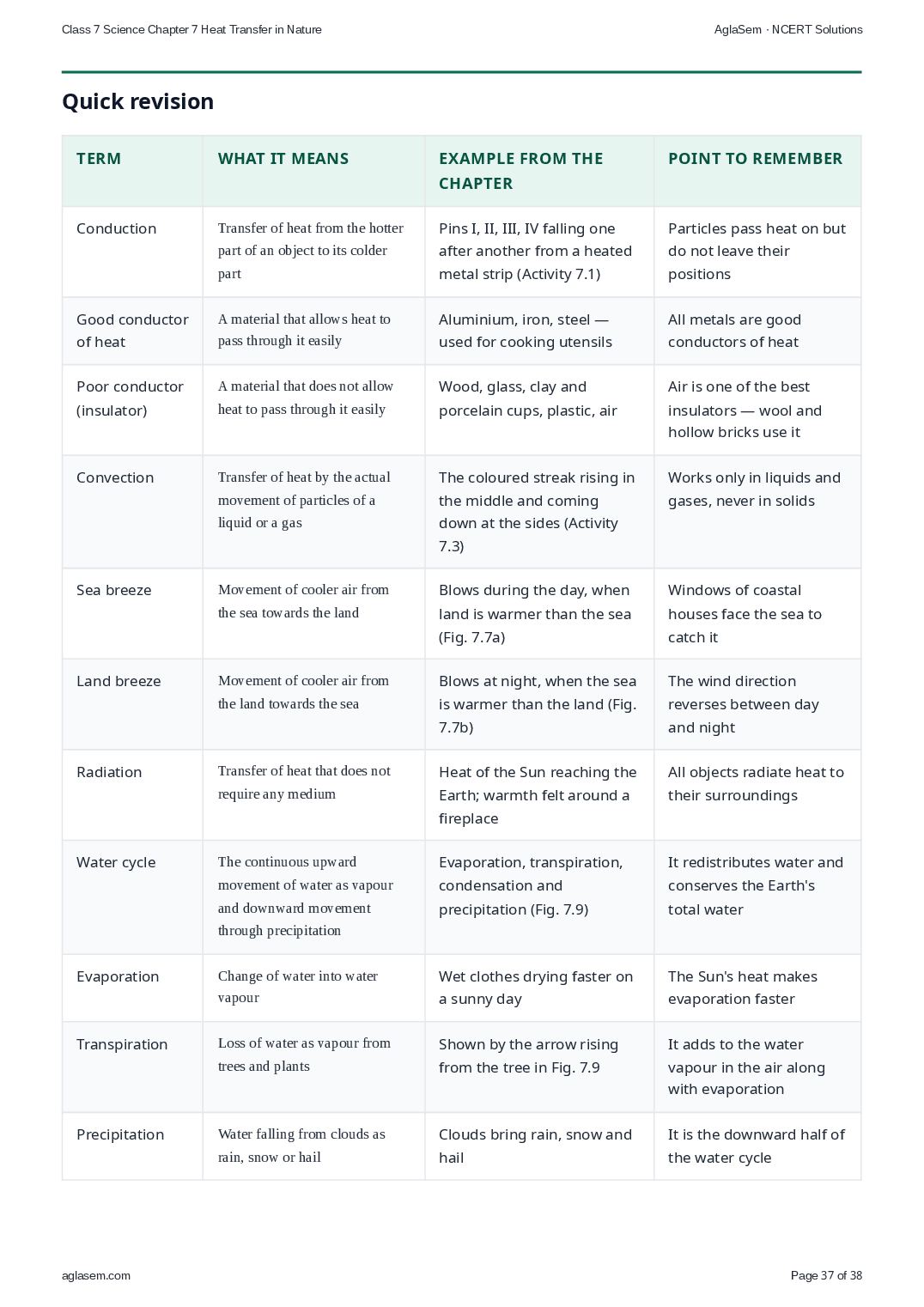
- In conduction , heat passes from the hotter part of an object to its colder part. A heated particle passes heat on to its neighbour, and so on, but the particles themselves do not move from their positions . This is how heat travels in solids.
- Materials that let heat pass through them easily — metals such as aluminium, iron and steel — are good conductors of heat . Wood, glass, clay, porcelain, plastic and air are poor conductors (insulators) . Woollen clothes, two thin blankets and hollow bricks all work by trapping air.
- In convection , heat is carried by the actual movement of particles of a liquid or a gas. On being heated, the fluid expands, becomes lighter and rises; cooler, heavier fluid comes down to take its place, setting up a convection current — seen as the coloured streak in Activity 7.3.
- Land and sea breezes are convection on a large scale. Land heats up and cools down faster than water, so warm air rises over the land by day and cool air blows in from the sea ( sea breeze ); at night the flow reverses and a land breeze blows from land to sea.
- In radiation , heat travels directly from a hot object to us and no medium is needed . That is how the Sun's heat reaches the Earth and how a hot utensil kept away from the flame cools down. Light surfaces reflect heat; dark surfaces absorb it.
- The Sun drives the water cycle — evaporation and transpiration lift water as vapour, condensation forms clouds, and precipitation brings it back as rain, snow and hail. The cycle redistributes and replenishes water and conserves the Earth's total water.
- Water that soaks into the ground by infiltration is stored as groundwater in aquifers . Seepage is fastest through gravel and slowest through clay. Excessive extraction and concrete surfaces deplete groundwater; rainwater harvesting, recharge pits and Ladakh's ice stupas help conserve it.
How to Download NCERT Solutions for Class 7 Science Chapter 7 PDF
Follow these simple steps to get the Heat Transfer in Nature questions-and-answers PDF from Curiosity.
- Search NCERT Solutions for Class 7 Science Chapter 7 aglasem and open this page.
- Read the exercise questions with answers for Heat Transfer in Nature shown above.
- Click the Download PDF link to save the Heat Transfer in Nature solutions to your device.
NCERT Solutions for Class 7 Science – All Chapters
There are more chapters to study besides Heat Transfer in Nature in Science. Here are the NCERT Solutions for all chapters of Class 7 Science.
- Chapter 1 the Ever Evolving World of Science
- Chapter 2 Exploring Substances Acidic Basic and Neutral
- Chapter 3 Electricity Circuits and Their Components
- Chapter 4 the World of Metals and Non Metals
- Chapter 5 Changes Around Us Physical and Chemical
- Chapter 6 Adolescence a Stage of Growth and Change
- Chapter 7 Heat Transfer in Nature
- Chapter 8 Measurement of Time and Motion
- Chapter 9 Life Processes in Animals
- Chapter 10 Life Processes in Plants
- Chapter 11 Light Shadows and Reflections
- Chapter 12 Earth Moon and the Sun
NCERT Solutions for Class 7 – All Subjects
Just like Chapter 7 of Science, you can get the exercise questions with answers for every other subject of Class 7. Here are the NCERT Solutions for all subjects of Class 7.
NCERT Solutions for Class 7 Science Chapter 7 – An Overview
The key highlights of this study material are as follows.
| Aspects | Details |
|---|---|
| Class | Class 7 |
| Subject | Science |
| Chapter Number | Chapter 7 |
| Chapter Name | Heat Transfer in Nature |
| Book Name | Curiosity |
| Book By | NCERT (National Council of Educational Research and Training) |
| Educational Resource Here | NCERT Solutions of Class 7 Science Chapter 7 for all exercises |
| More Questions Answers of This Subject | NCERT Solutions for Class 7 Science |
| Download Book Chapter | NCERT Book Class 7 Science |
| All Questions Answers For This Class | NCERT Solutions for Class 7 |
| Complete Solutions | NCERT Solutions |
NCERT Solutions for Class 7 Science Chapter 7 Heat Transfer in Nature – FAQs
What are the NCERT Solutions for Class 7 Science Chapter 7 Heat Transfer in Nature?
They are the complete, step-by-step answers to all the exercise and in-text questions of Chapter 7 Heat Transfer in Nature from the NCERT Class 7 Science textbook Curiosity, written by experts as per the latest NCERT syllabus.
How can I download the Class 7 Science Chapter 7 solutions PDF for free?
Open this page on aglasem, read the Heat Transfer in Nature questions with answers, and click the “Download Solutions PDF” link. The Class 7 Science Chapter 7 NCERT Solutions PDF is completely free to download.
Are these NCERT Solutions as per the latest 2026-27 syllabus?
Yes. The NCERT Solutions for Class 7 Science Chapter 7 are based on the latest NCERT textbook Curiosity and the current 2026-27 CBSE syllabus, so the questions and answers match what you study in class.
Where can I get NCERT Solutions for the other chapters of Class 7 Science?
You can find the answers to every chapter on the NCERT Solutions for Class 7 Science page, and solutions for every subject on the NCERT Solutions for Class 7 page.
How do NCERT Solutions help in exam preparation?
They show the correct method to solve each question, help you write answers the way they are expected in exams, let you check and correct your own work, and save revision time — which together improve your marks in Class 7 Science.
If you have any queries on NCERT Solutions for Class 7 Science Chapter 7 Heat Transfer in Nature, then please ask in the comments below.
