NCERT Solutions for Class 7 Science Chapter 12 Earth Moon and the Sun provide clear, step-by-step answers to every exercise and in-text question from the chapter Earth Moon and the Sun of the NCERT textbook Curiosity. Prepared by subject experts as per the latest NCERT (CBSE) syllabus for 2026-27, these NCERT Solutions for Class 7 Science help you understand each concept, write exam-ready answers, and check your own solutions. You can read them online below or download the free Class 7 Science Chapter 12 question-answer PDF.
NCERT Solutions for Class 7 Science Chapter 12 Earth Moon and the Sun
- Class: Class 7
- Subject: Science
- Chapter: Chapter 12 – Earth Moon and the Sun
- Textbook: Curiosity (NCERT)
- Study material: NCERT Solutions – questions with answers, free PDF
These solutions answer all the exercise questions of Chapter 12 Earth Moon and the Sun — including the in-text questions, short-answer and long-answer questions, and activities — with complete explanations so you can follow the method, not just the final answer. Read the full solutions below.
NCERT Solutions Class 7 Science Chapter 12 Earth Moon and the Sun View Download
NCERT Solutions for Class 7 Science Chapter 12 PDF Download
You can read the NCERT Solutions for Class 7 Science Chapter 12 online above, or download the complete question-answer PDF to study Earth Moon and the Sun offline at any time.
NCERT Solutions for Class 7 Science Chapter 12 PDF Download Link – Click Here to Download Solutions PDF
Questions Covered in This Chapter
These NCERT Solutions answer all 41 questions of this chapter. The questions solved are:
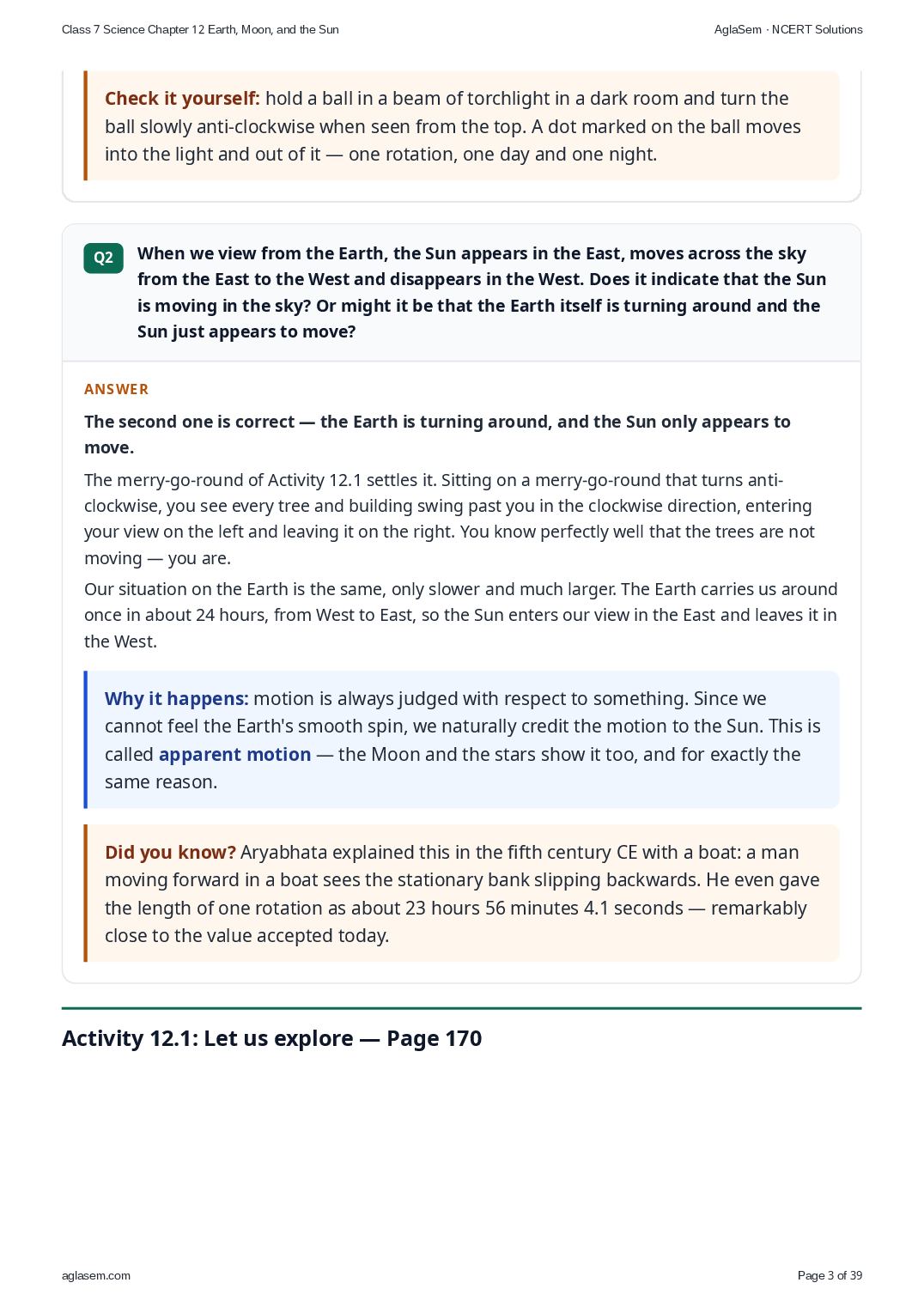
- She wondered — does the Sun move in the sky? Or does the Earth move?
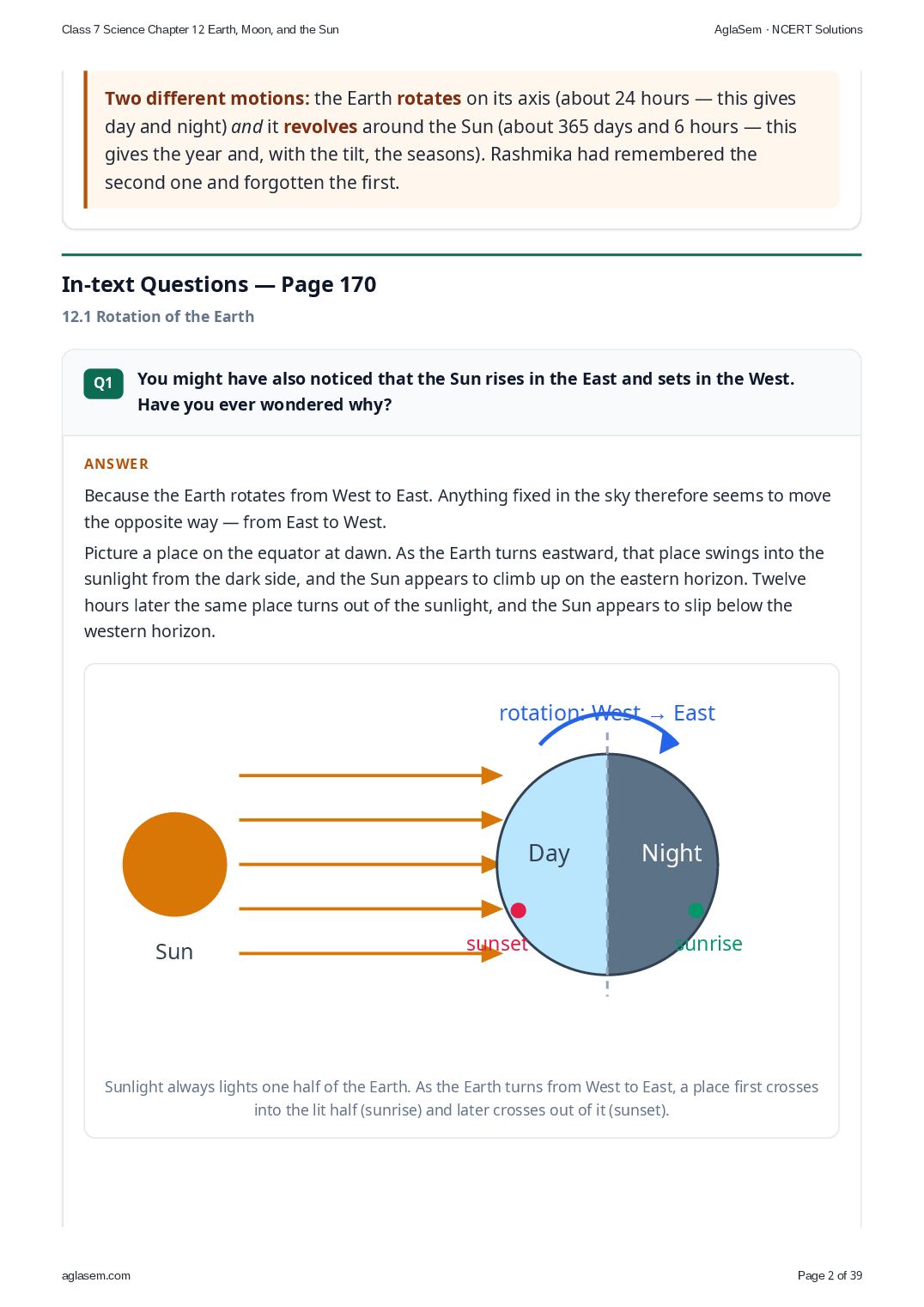
- You might have also noticed that the Sun rises in the East and sets in the West. Have you ever wondered why?
- When we view from the Earth, the Sun appears in the East, moves across the sky from the East to the West and disappears in the West. Does it indicate that the Sun is moving in the sky? Or might it be that the Earth itself is turning around and the Sun just appears to move?
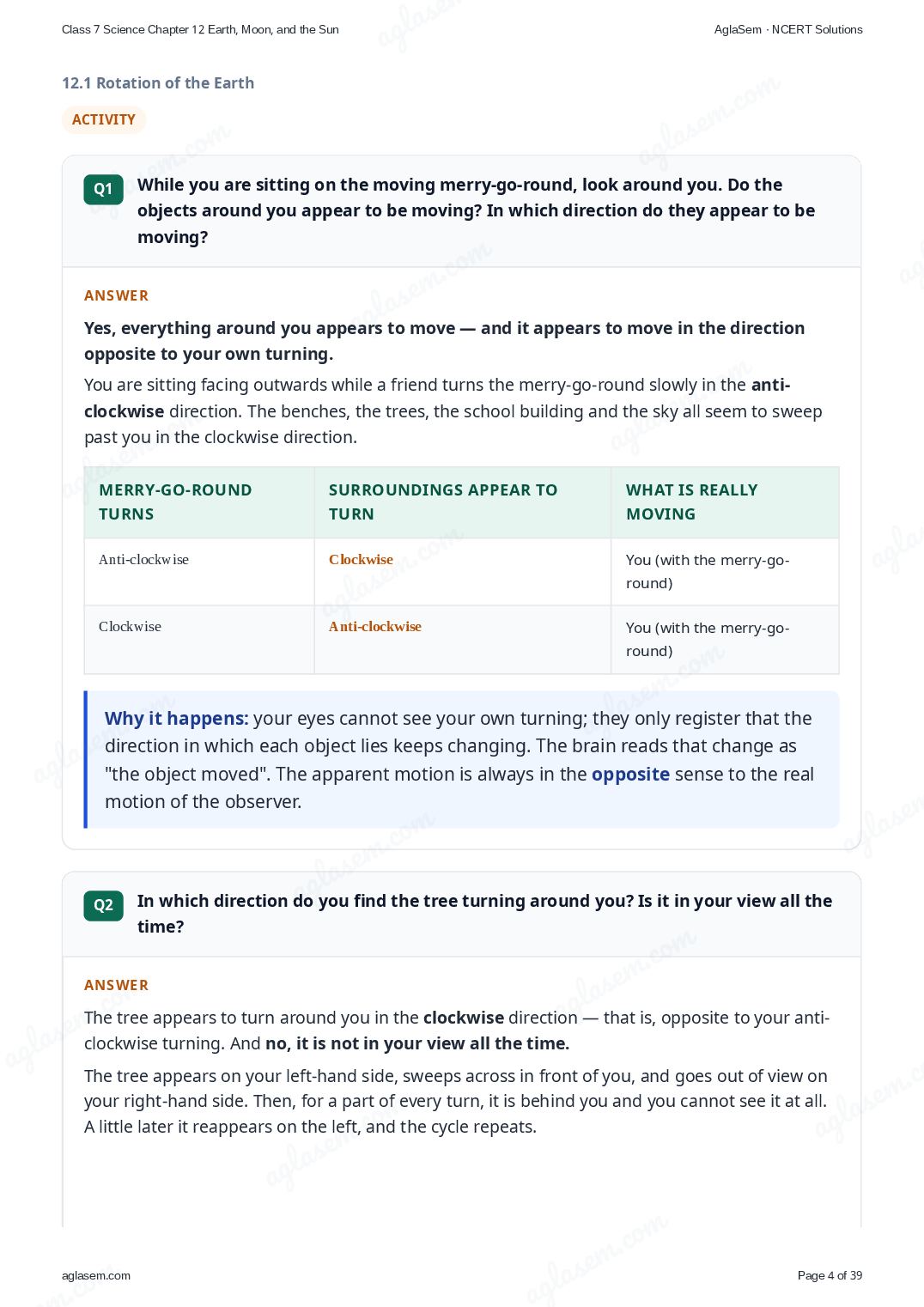
- While you are sitting on the moving merry-go-round, look around you. Do the objects around you appear to be moving? In which direction do they appear to be moving?
- In which direction do you find the tree turning around you? Is it in your view all the time?
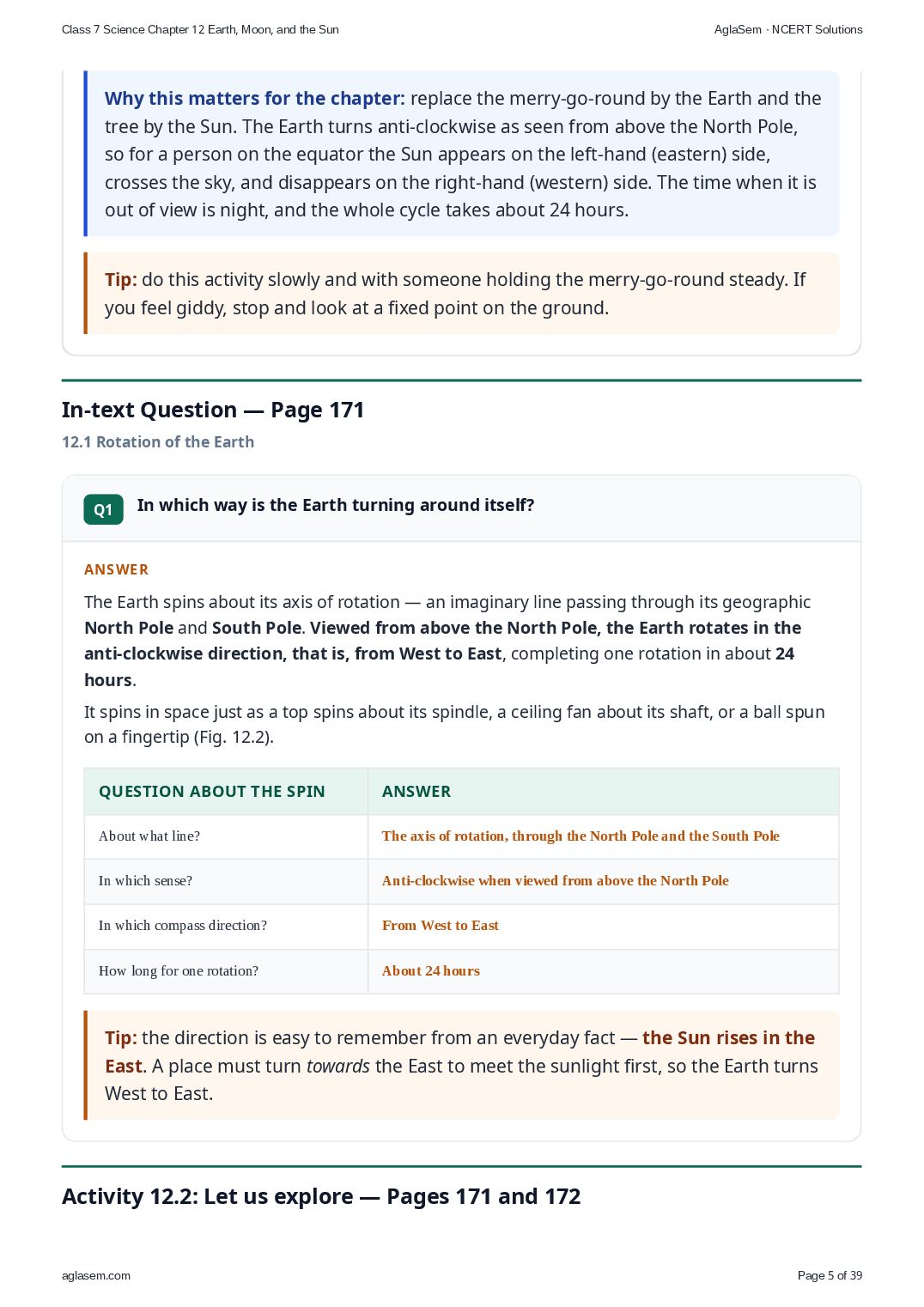
- In which way is the Earth turning around itself?
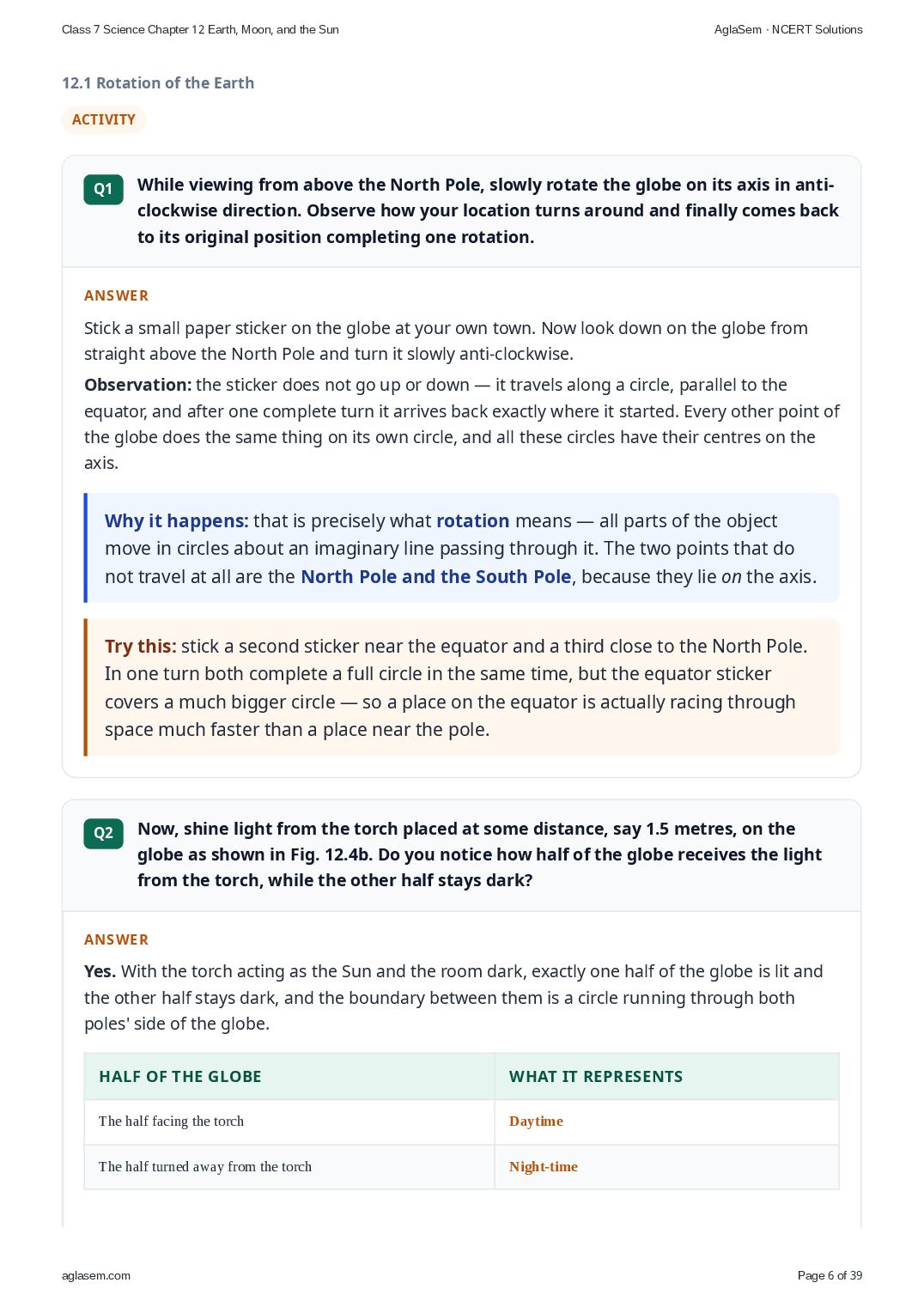
- While viewing from above the North Pole, slowly rotate the globe on its axis in anti-clockwise direction. Observe how your location turns around and finally comes back to its original position completing one rotation.
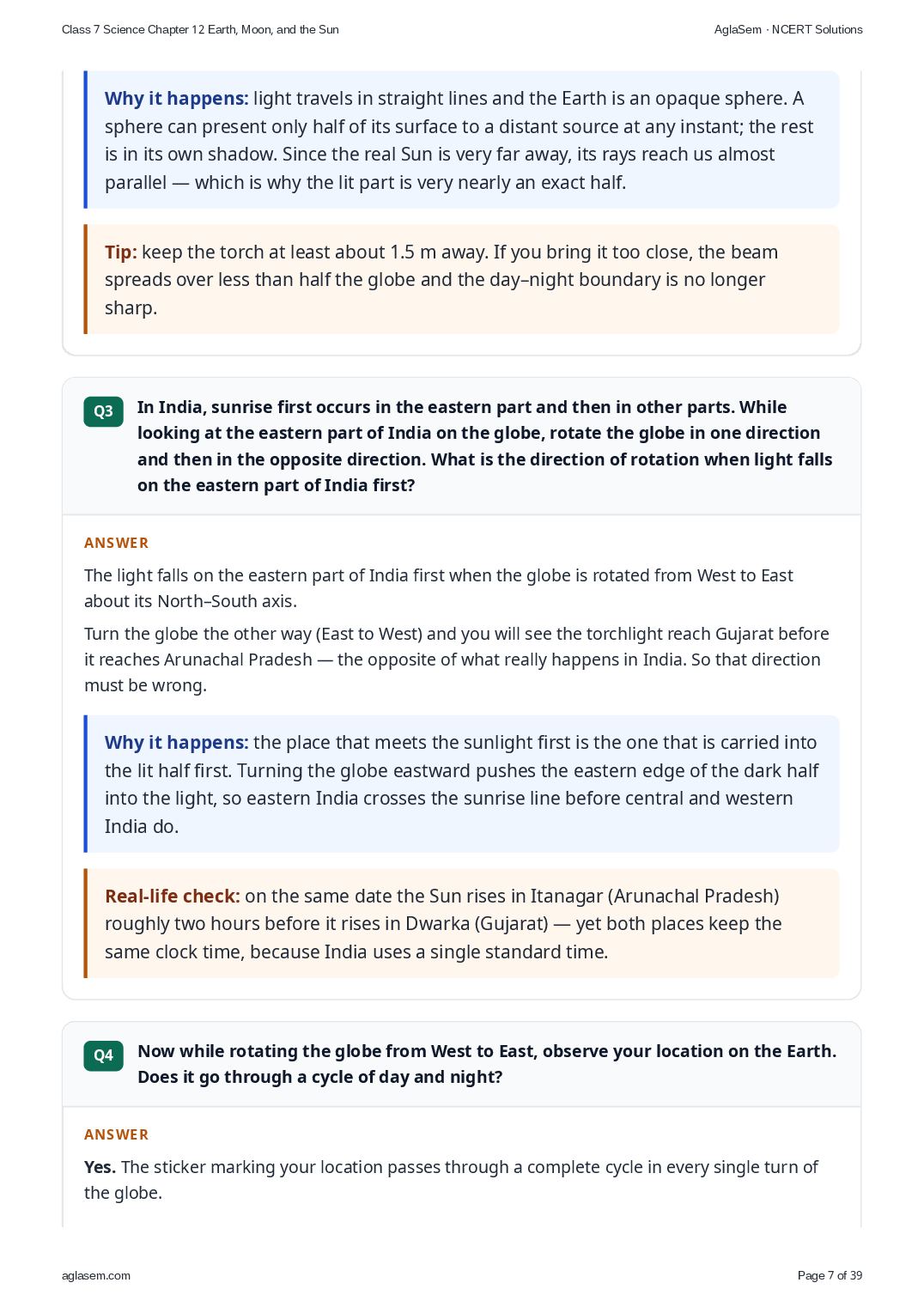
- Now, shine light from the torch placed at some distance, say 1.5 metres, on the globe as shown in Fig. 12.4b. Do you notice how half of the globe receives the light from the torch, while the other half stays dark?
- In India, sunrise first occurs in the eastern part and then in other parts. While looking at the eastern part of India on the globe, rotate the globe in one direction and then in the opposite direction. What is the direction of rotation when light falls on the eastern part of India first?
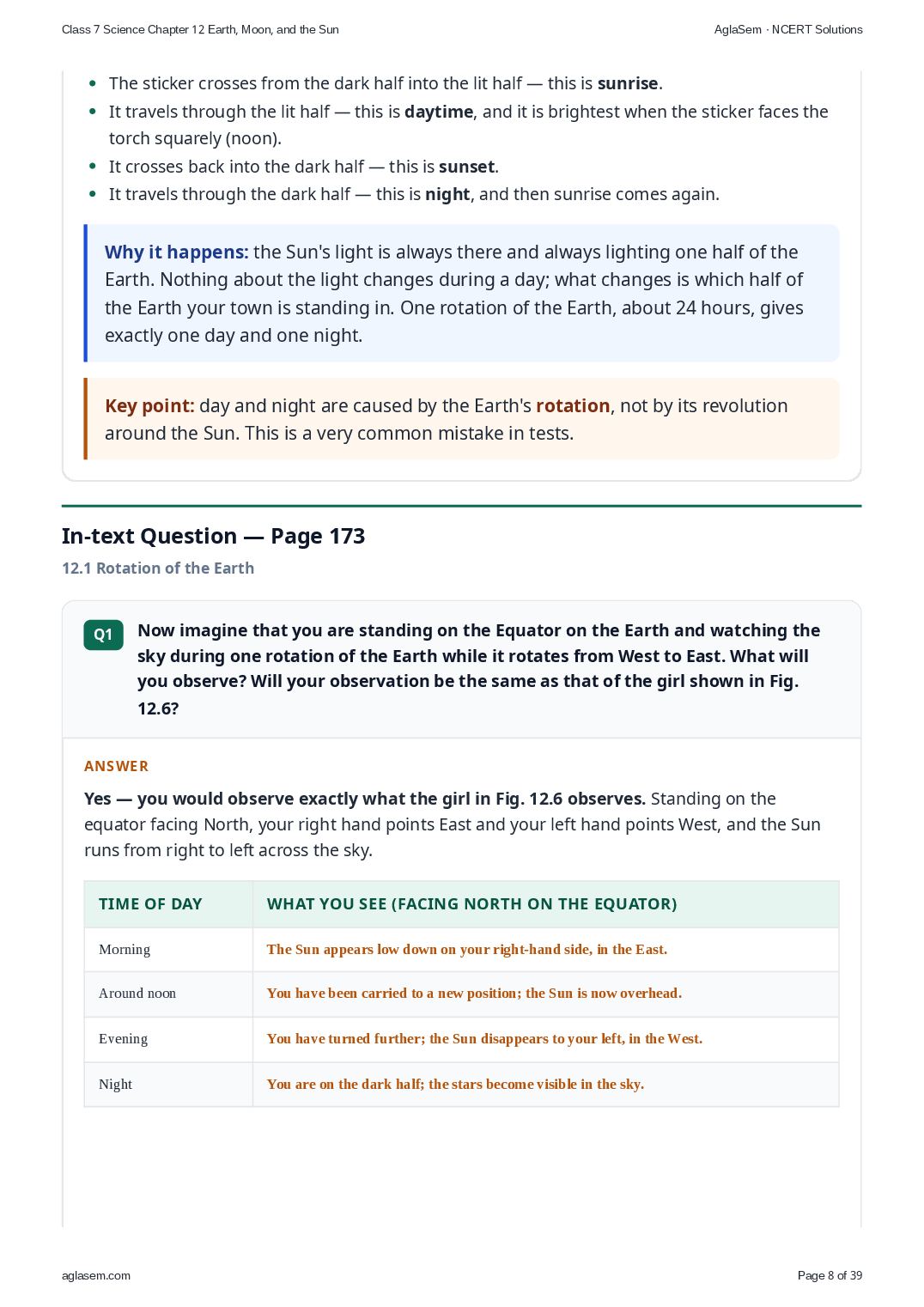
- Now while rotating the globe from West to East, observe your location on the Earth. Does it go through a cycle of day and night?
- Now imagine that you are standing on the Equator on the Earth and watching the sky during one rotation of the Earth while it rotates from West to East. What will you observe? Will your observation be the same as that of the girl shown in Fig. 12.6?
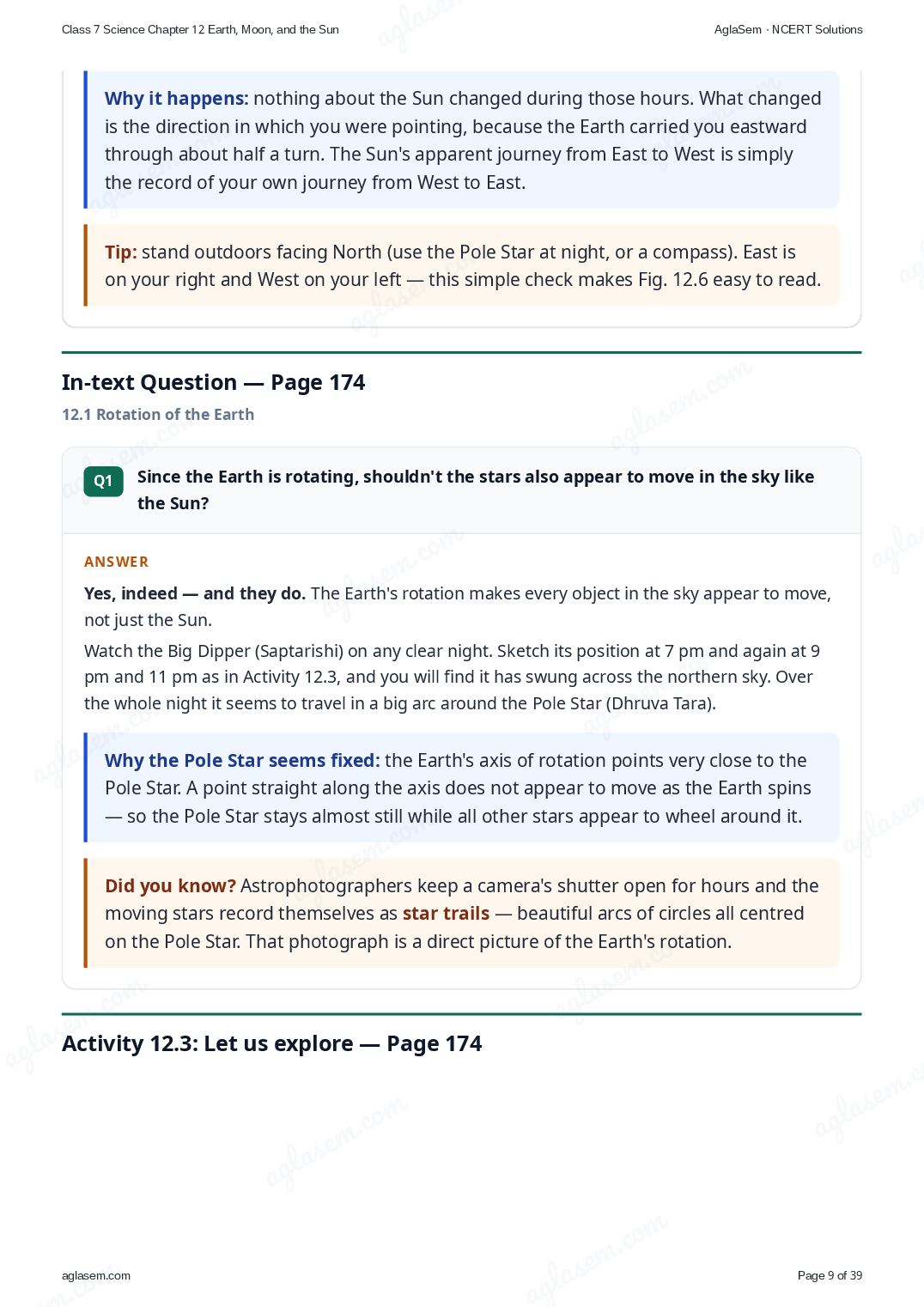
- Since the Earth is rotating, shouldn't the stars also appear to move in the sky like the Sun?
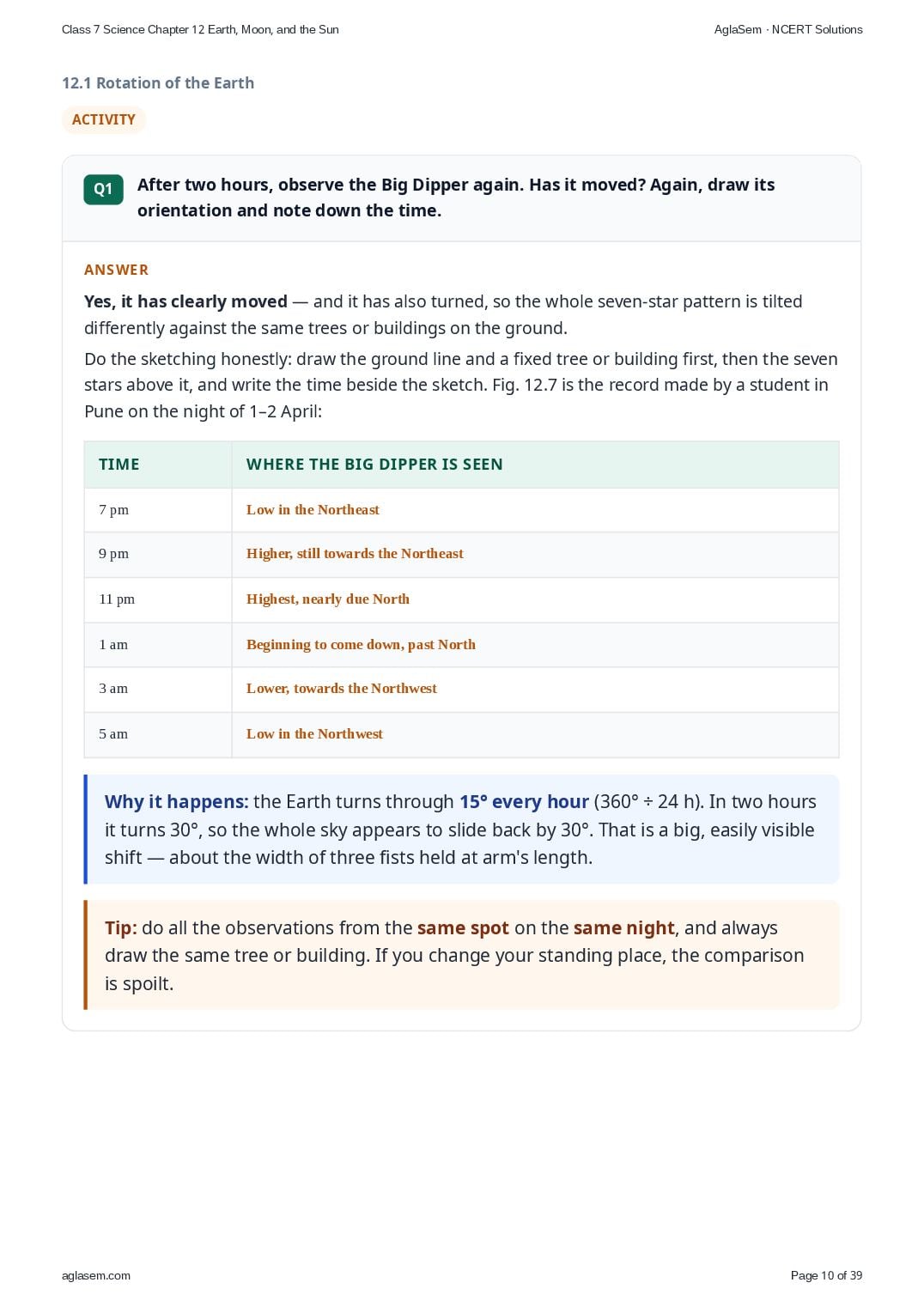
- After two hours, observe the Big Dipper again. Has it moved? Again, draw its orientation and note down the time.
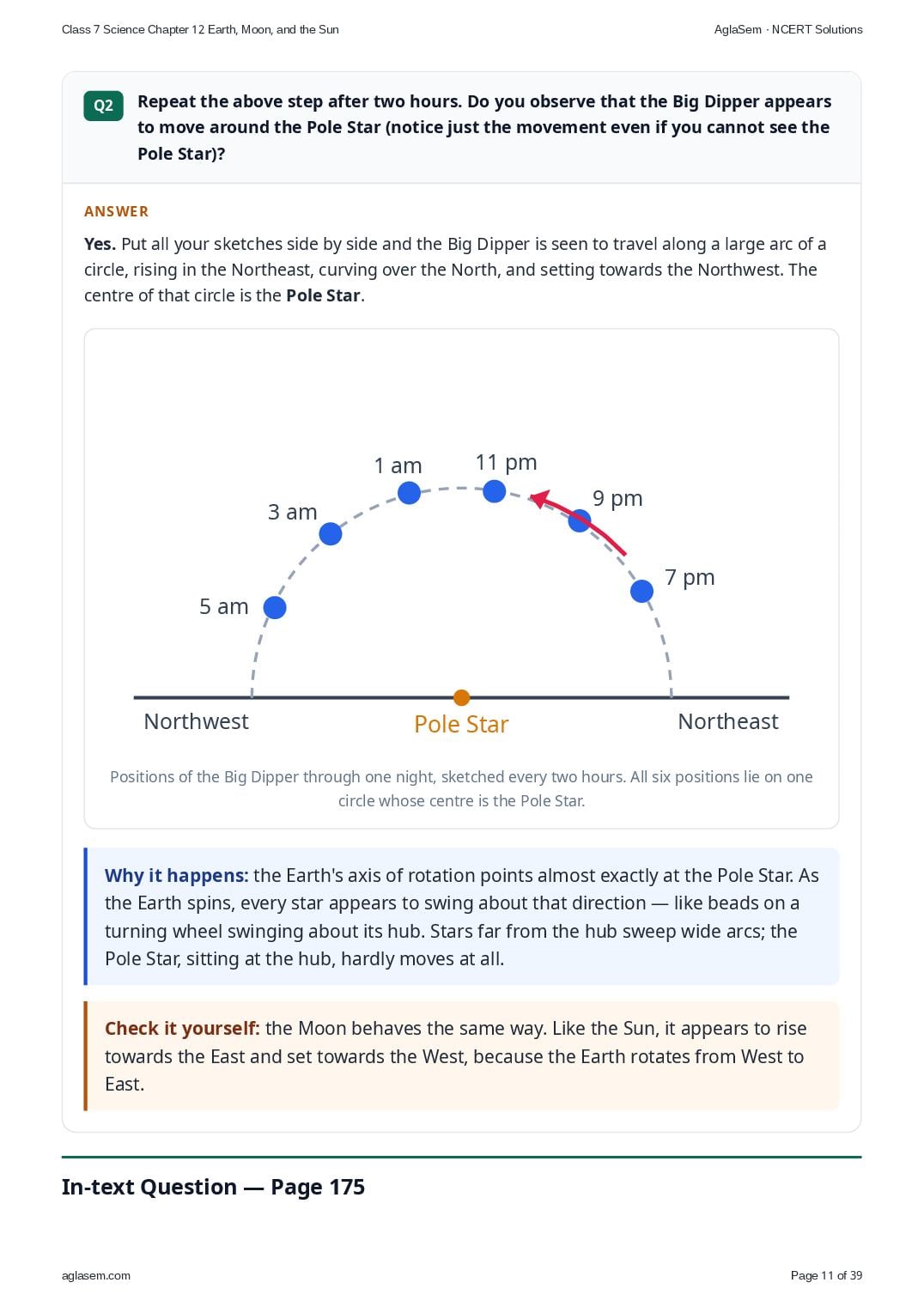
- Repeat the above step after two hours. Do you observe that the Big Dipper appears to move around the Pole Star (notice just the movement even if you cannot see the Pole Star)?
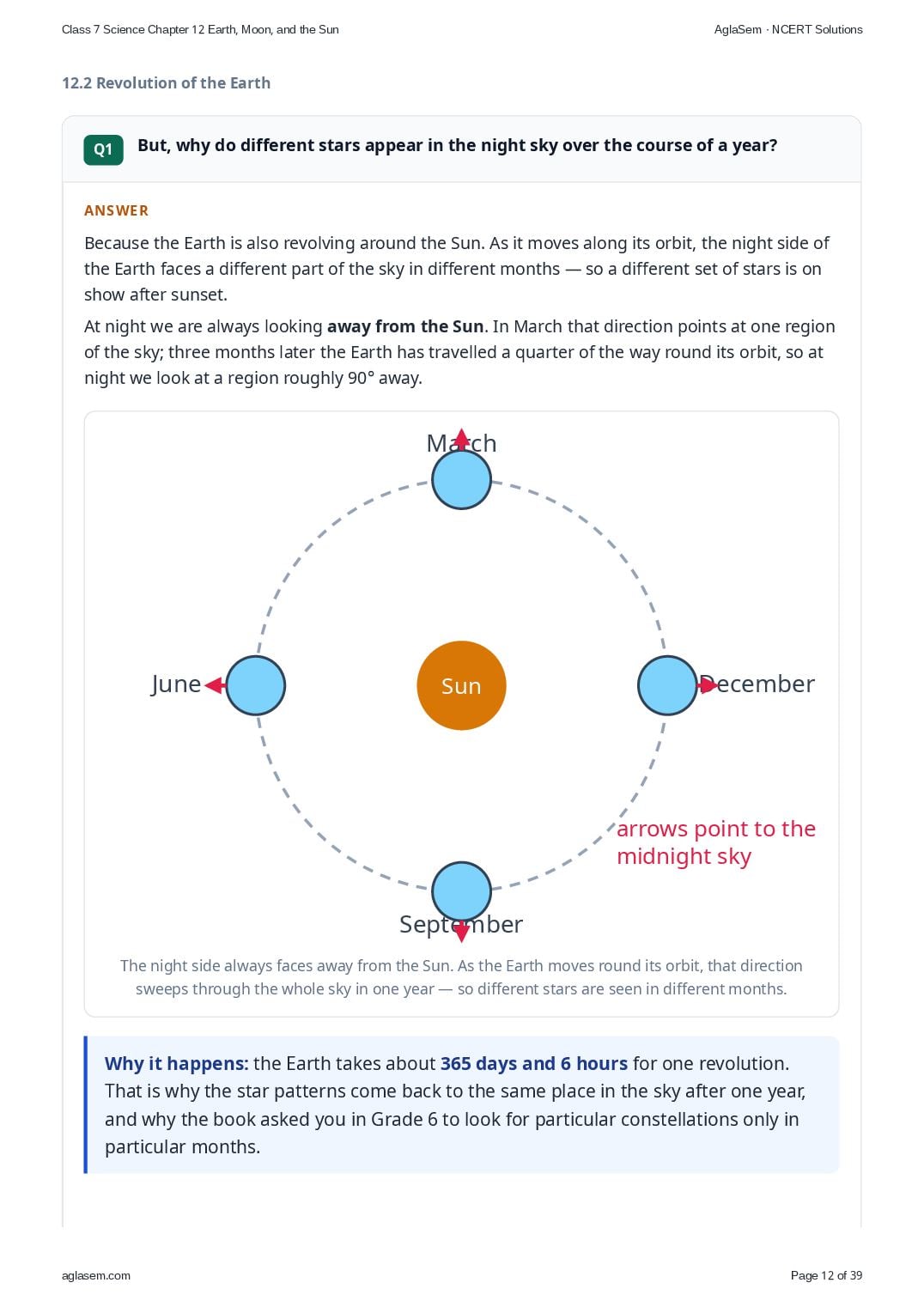
- But, why do different stars appear in the night sky over the course of a year?
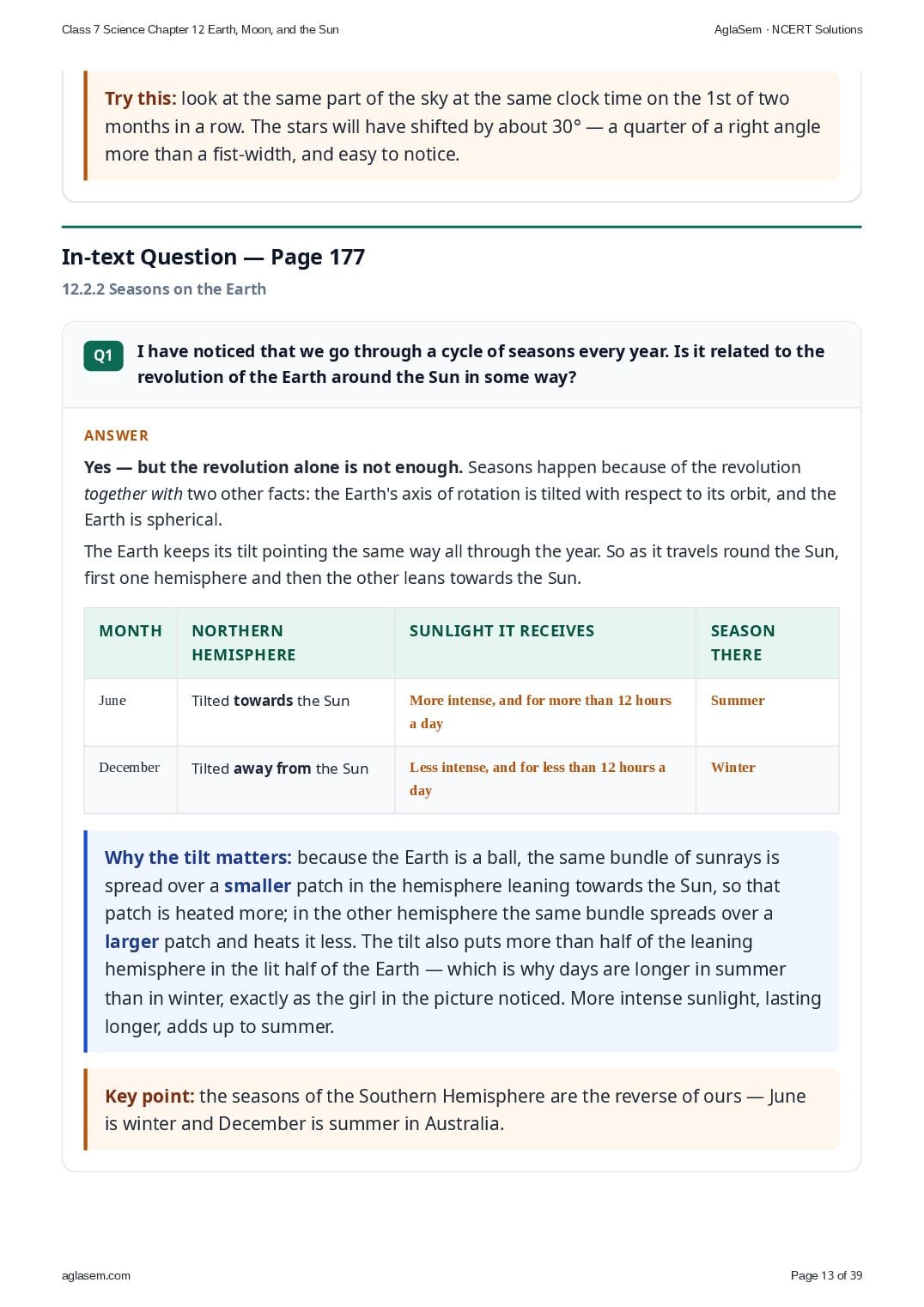
- I have noticed that we go through a cycle of seasons every year. Is it related to the revolution of the Earth around the Sun in some way?
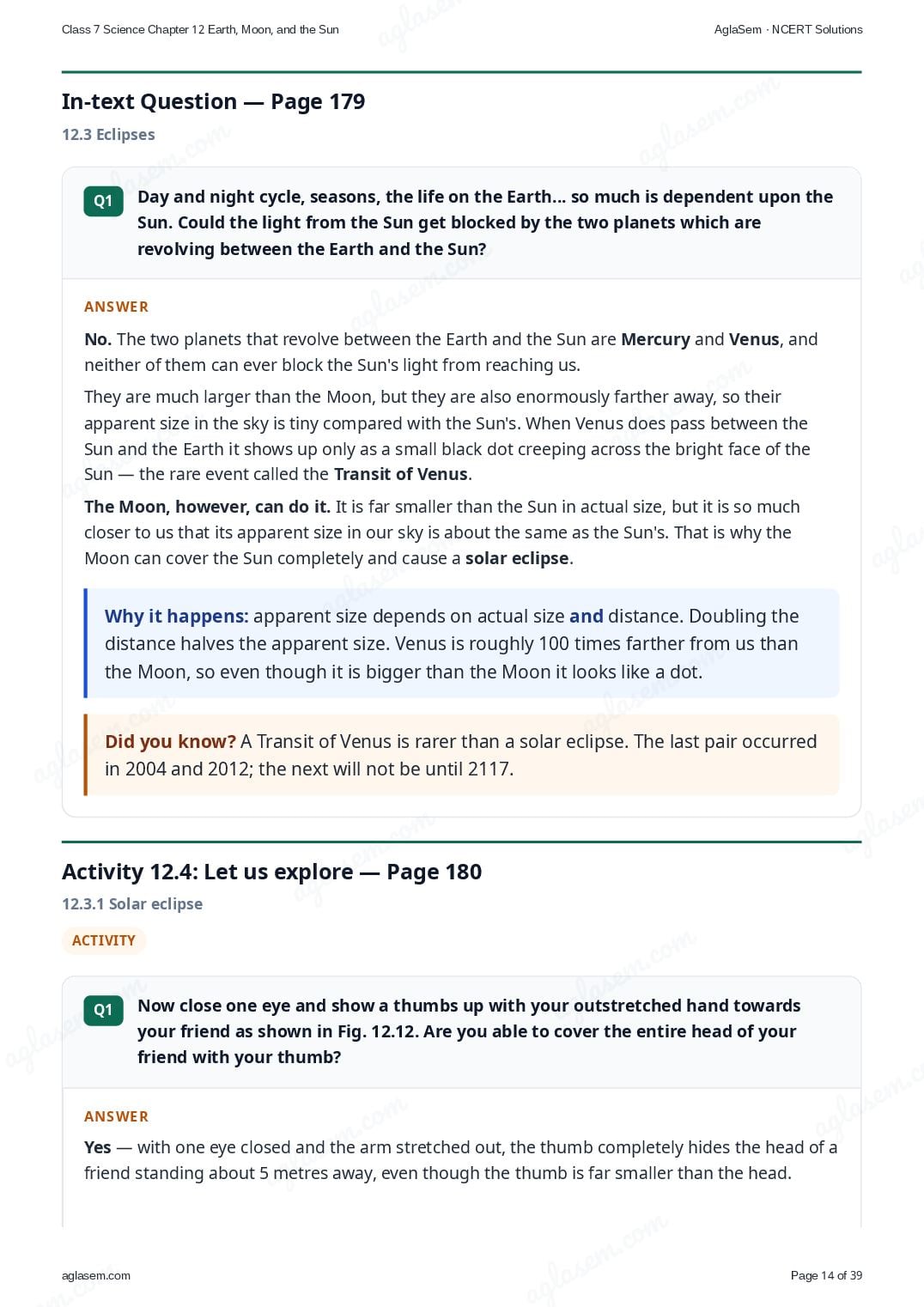
- Day and night cycle, seasons, the life on the Earth… so much is dependent upon the Sun. Could the light from the Sun get blocked by the two planets which are revolving between the Earth and the Sun?
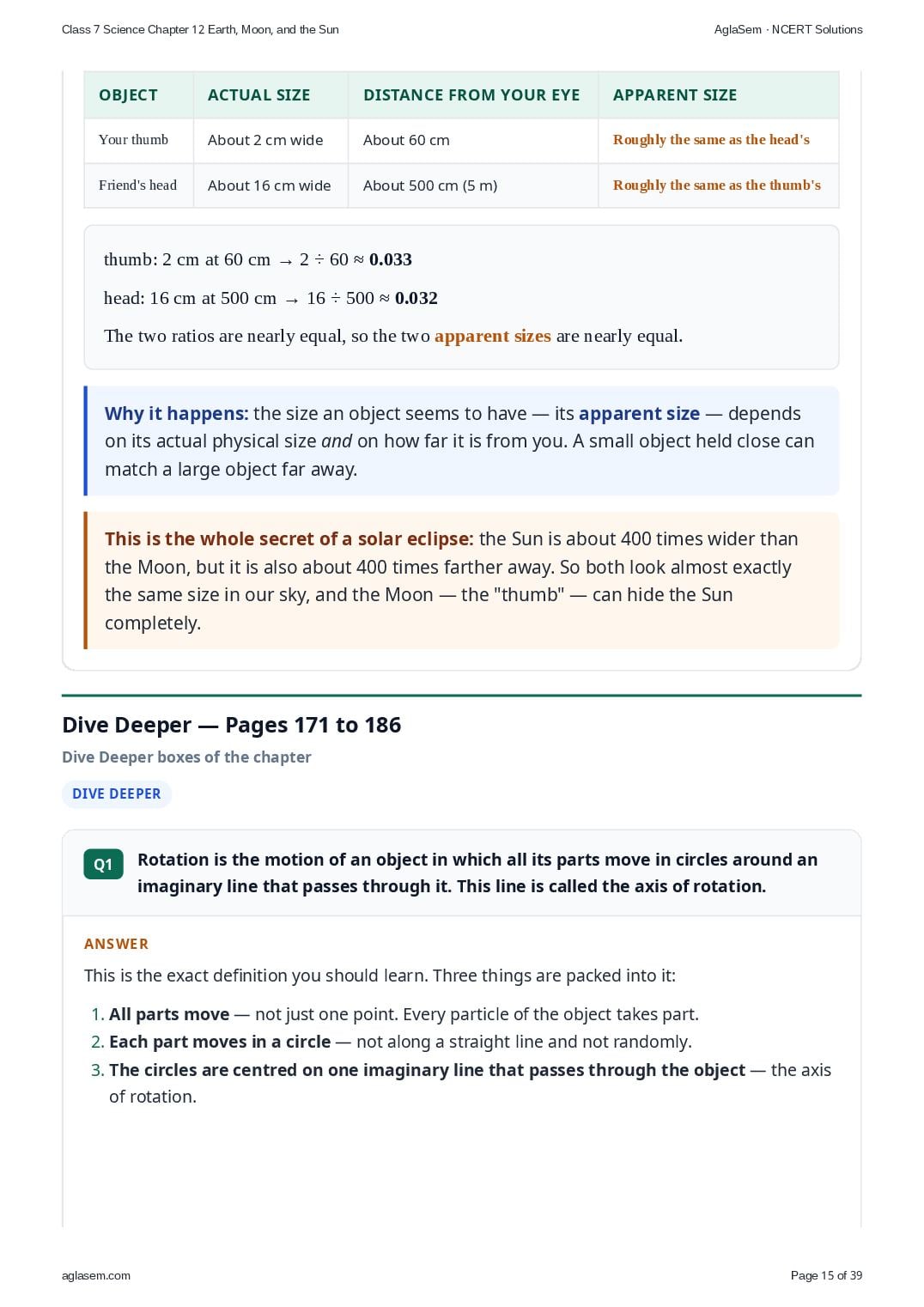
- Now close one eye and show a thumbs up with your outstretched hand towards your friend as shown in Fig. 12.12. Are you able to cover the entire head of your friend with your thumb?
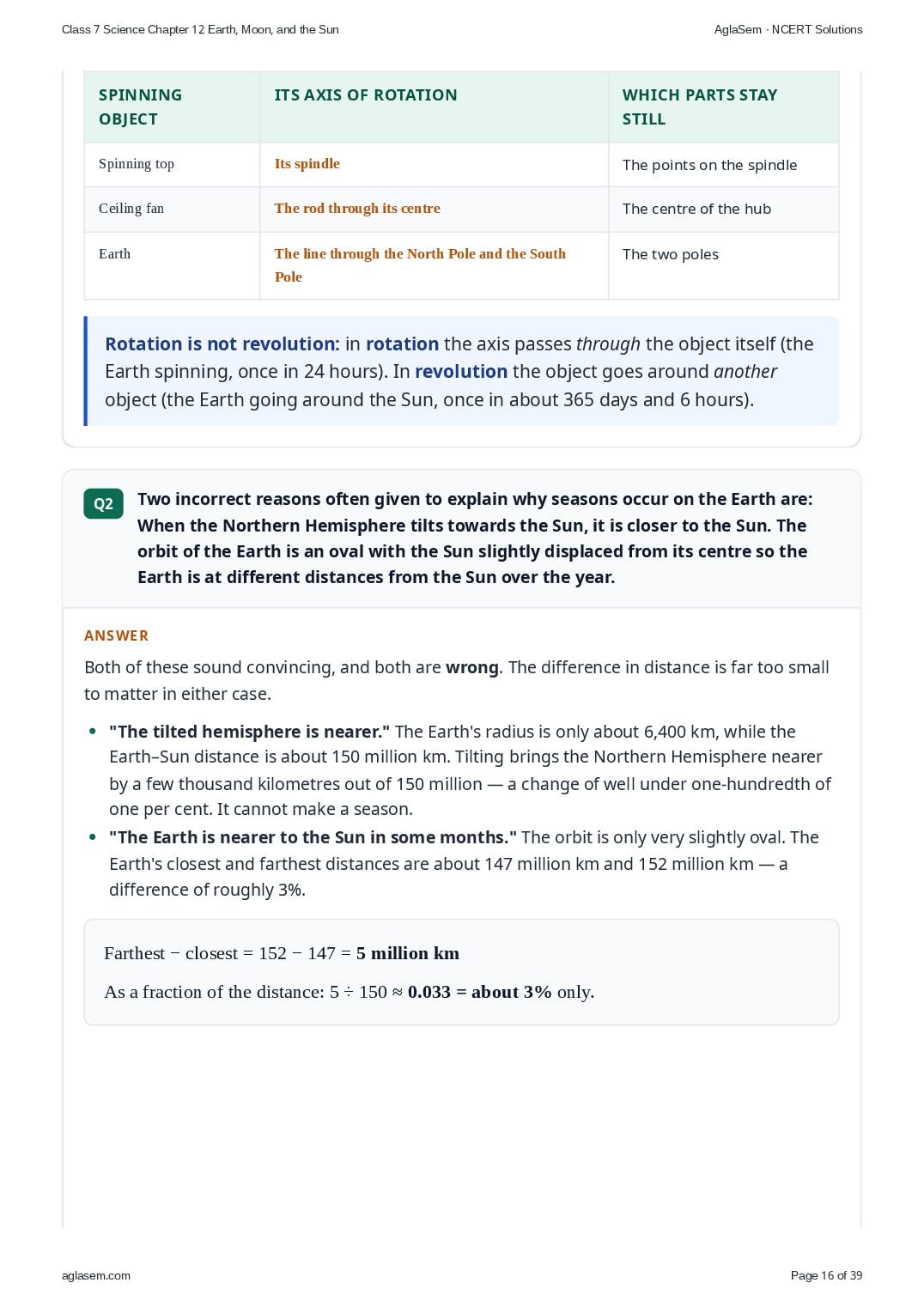
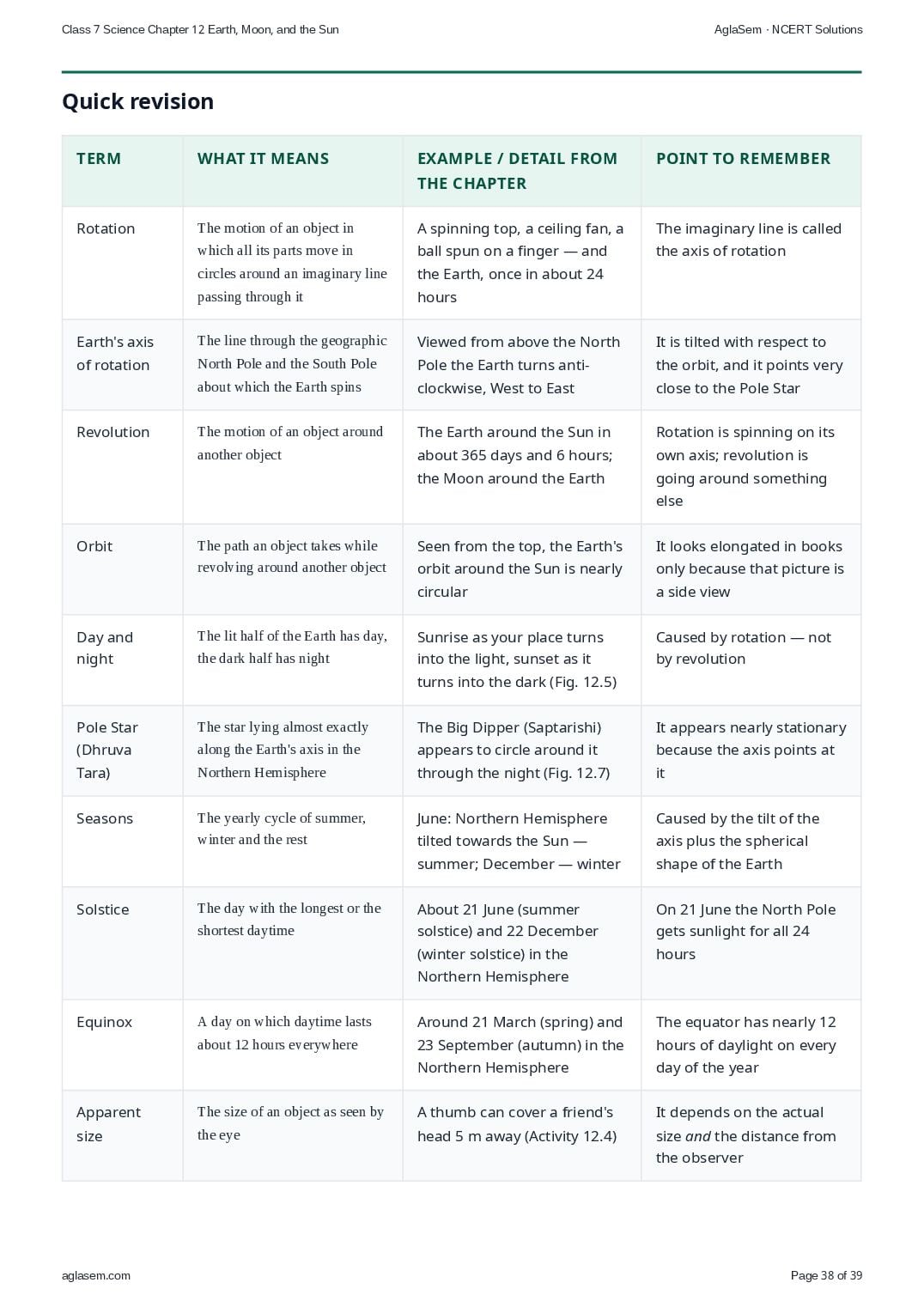
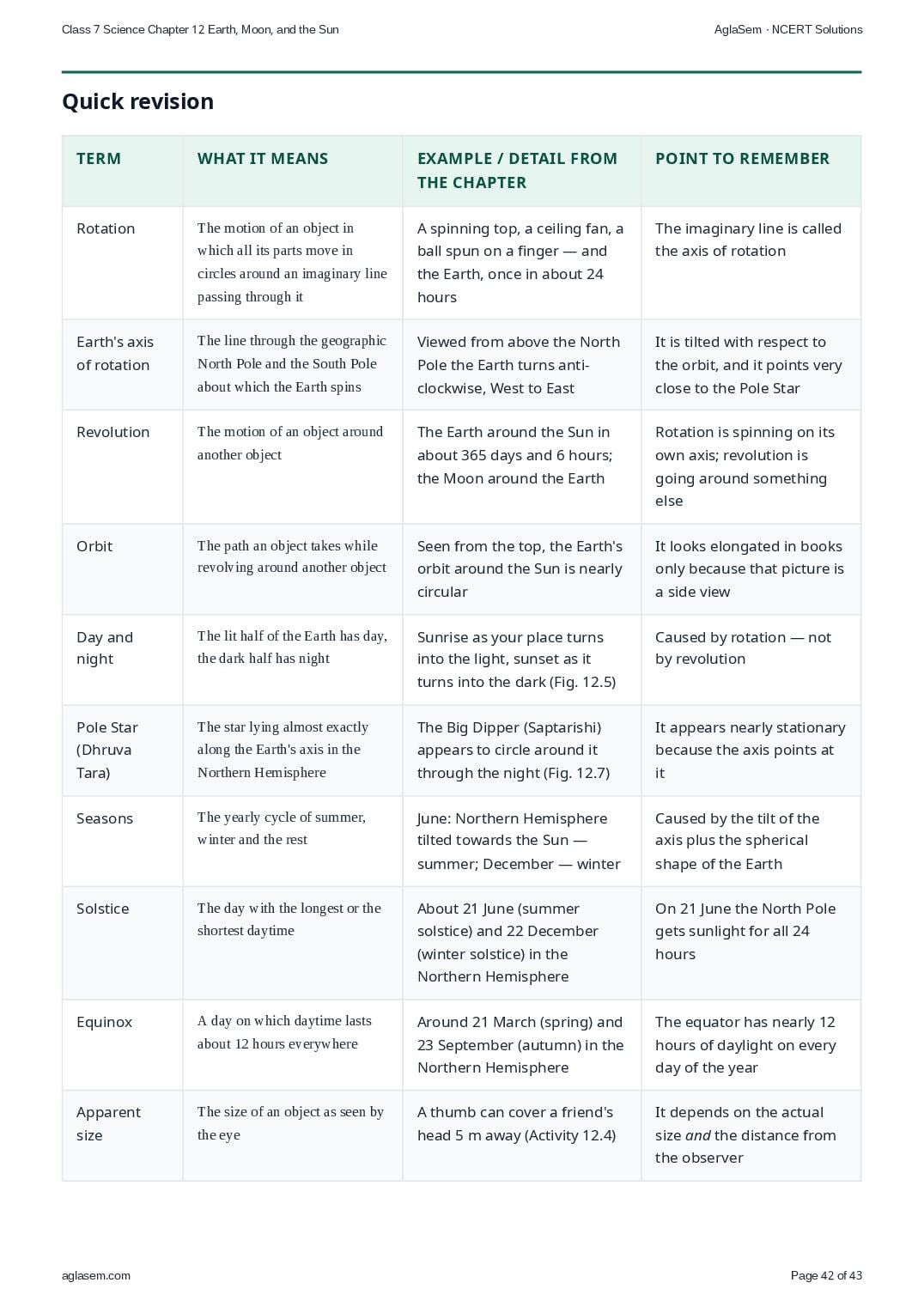
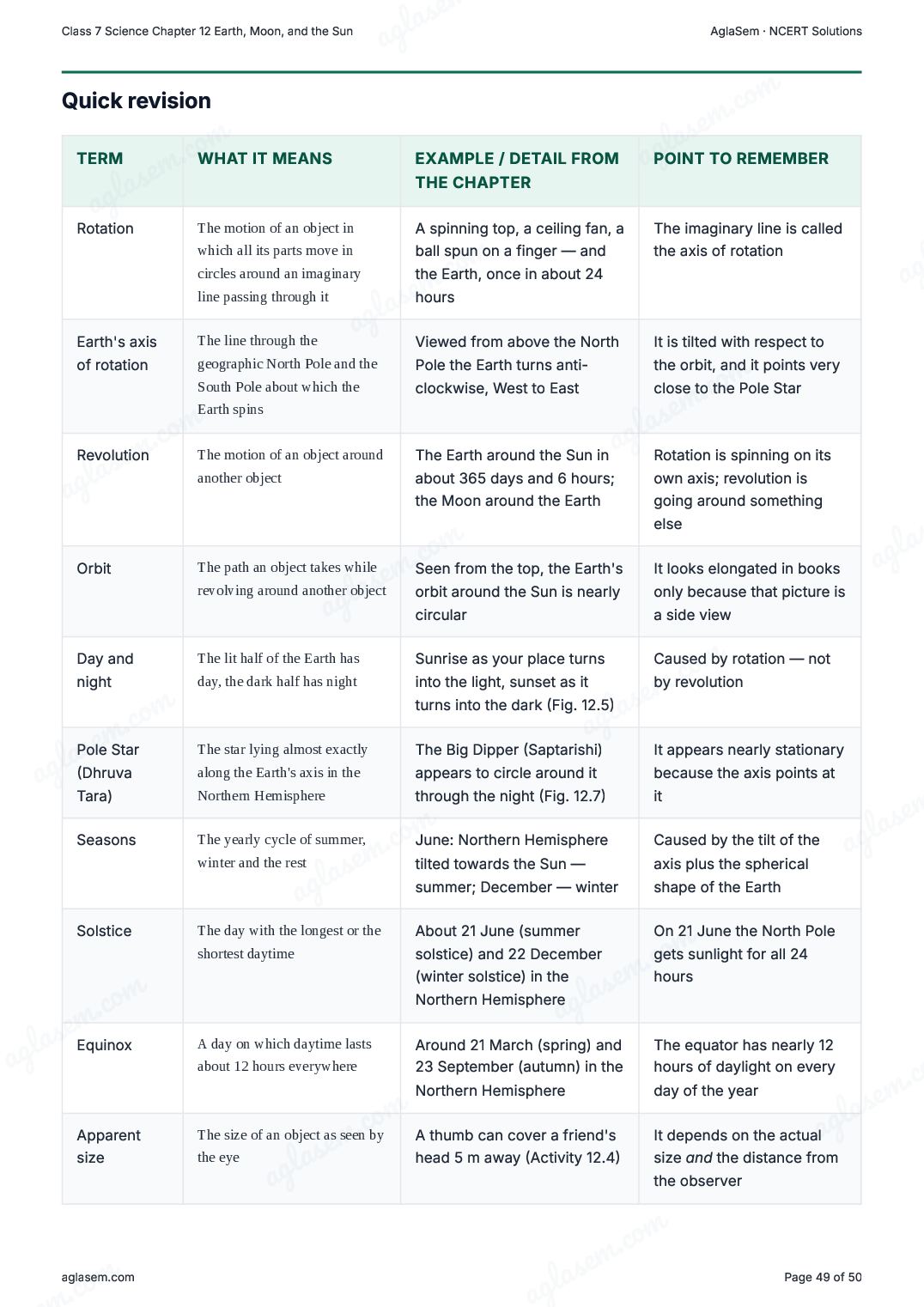
- Rotation is the motion of an object in which all its parts move in circles around an imaginary line that passes through it. This line is called the axis of rotation.
- Two incorrect reasons often given to explain why seasons occur on the Earth are: When the Northern Hemisphere tilts towards the Sun, it is closer to the Sun. The orbit of the Earth is an oval with the Sun slightly displaced from its centre so the Earth is at different distances from the Sun over the year.
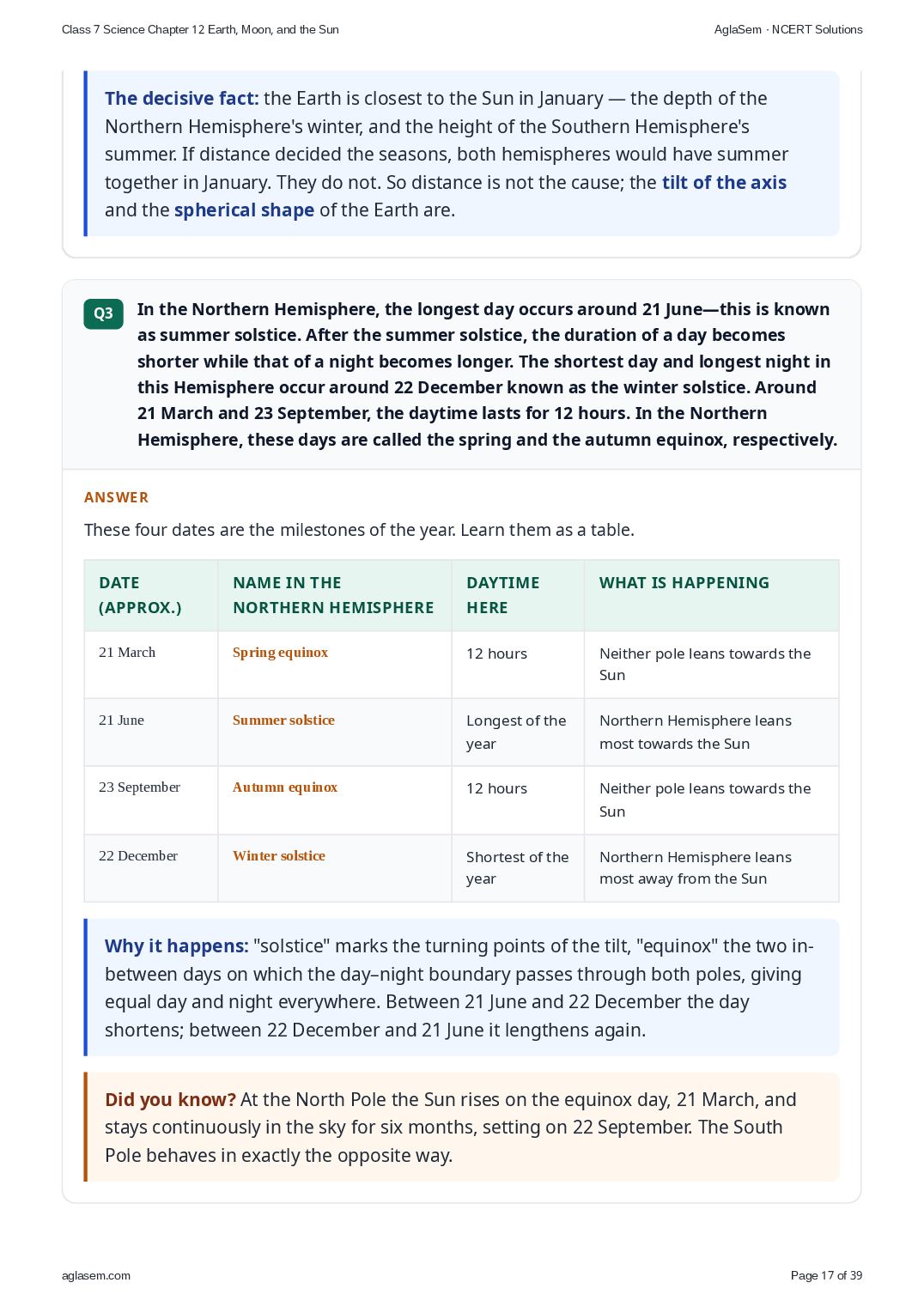
- In the Northern Hemisphere, the longest day occurs around 21 June—this is known as summer solstice. After the summer solstice, the duration of a day becomes shorter while that of a night becomes longer. The shortest day and longest night in this Hemisphere occur around 22 December known as the winter solstice. Around 21 March and 23 September, the daytime lasts for 12 hours. In the Northern Hemisphere, these days are called the spring and the autumn equinox, respectively.
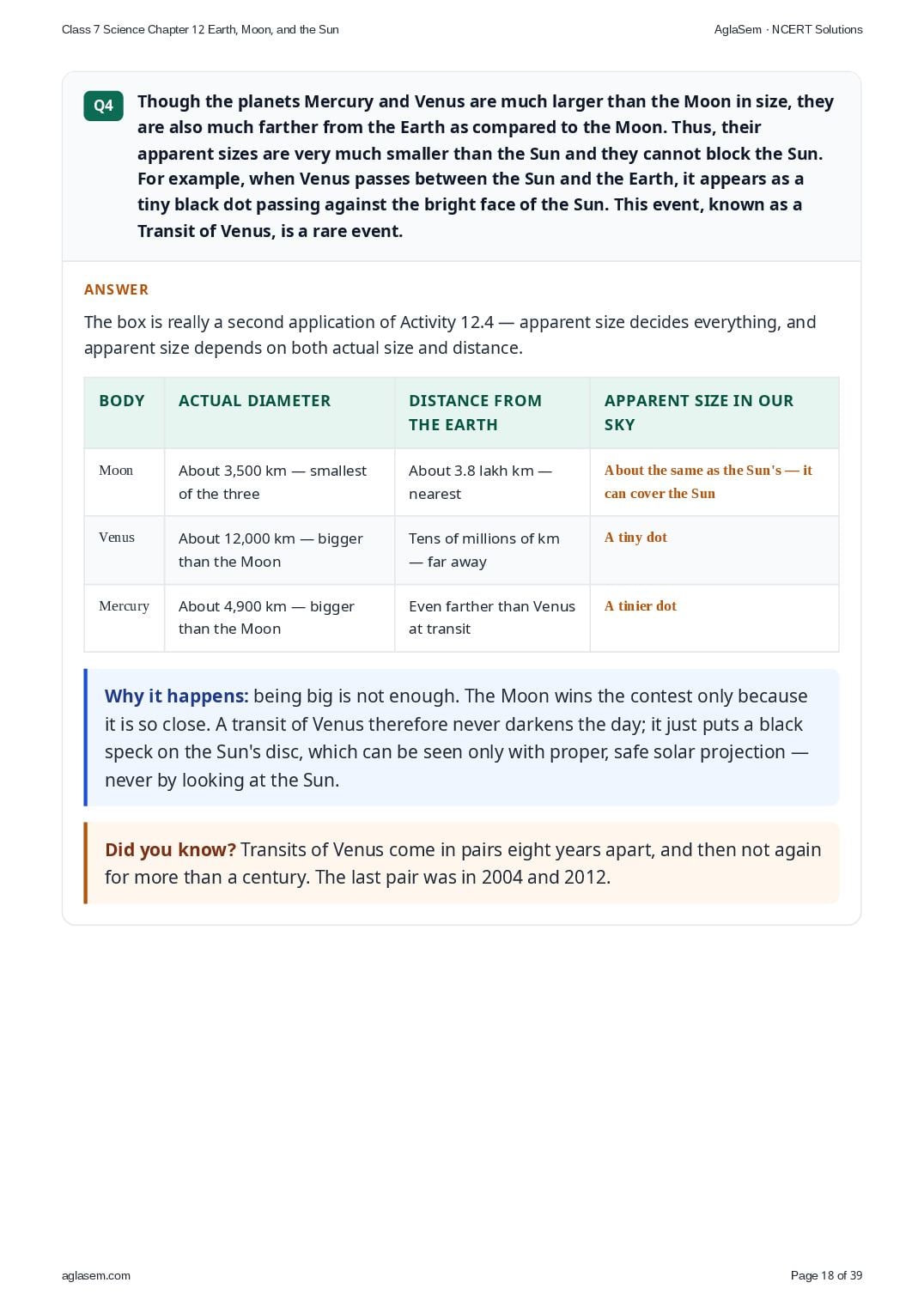
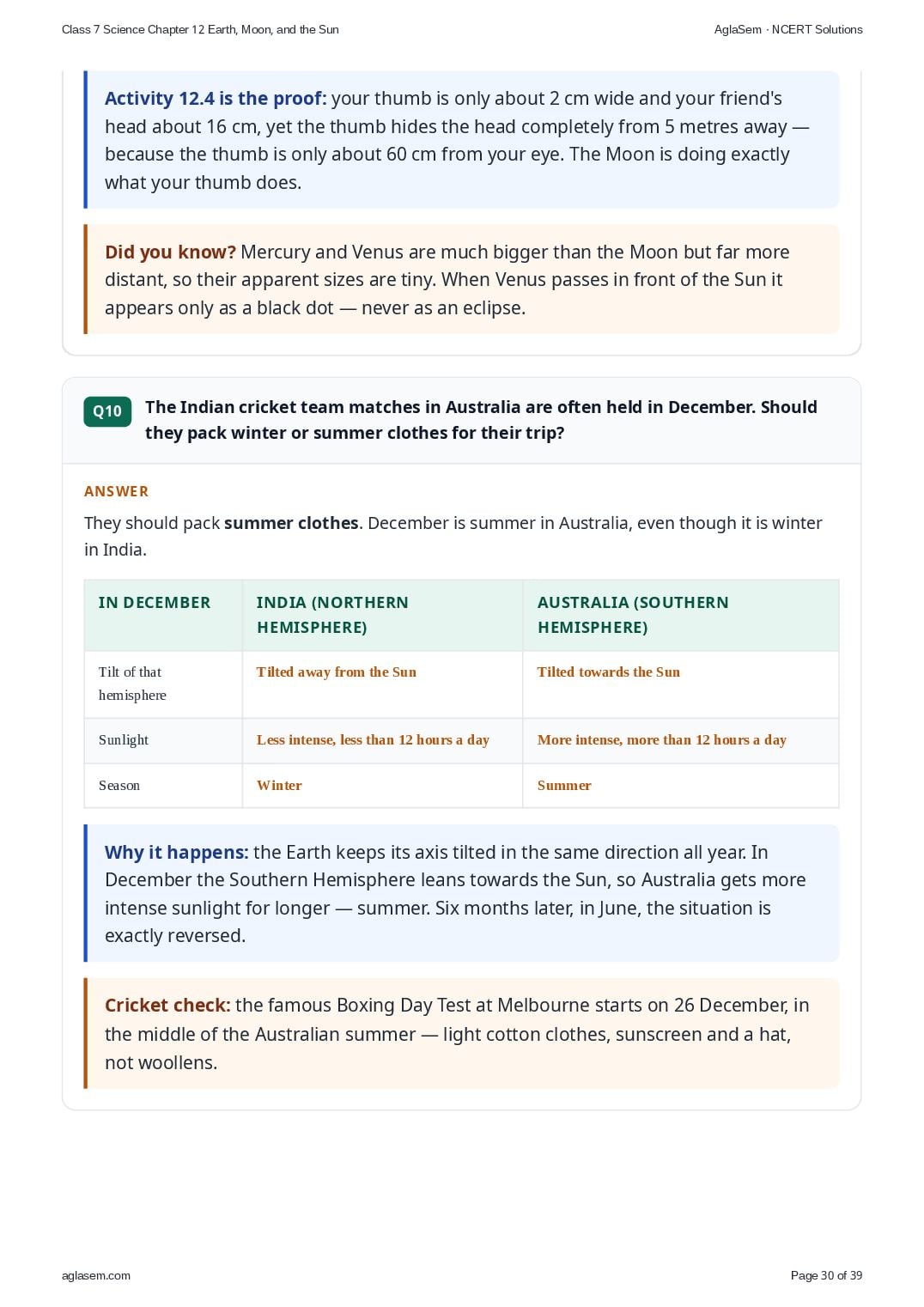
- Though the planets Mercury and Venus are much larger than the Moon in size, they are also much farther from the Earth as compared to the Moon. Thus, their apparent sizes are very much smaller than the Sun and they cannot block the Sun. For example, when Venus passes between the Sun and the Earth, it appears as a tiny black dot passing against the bright face of the Sun. This event, known as a Transit of Venus, is a rare event.
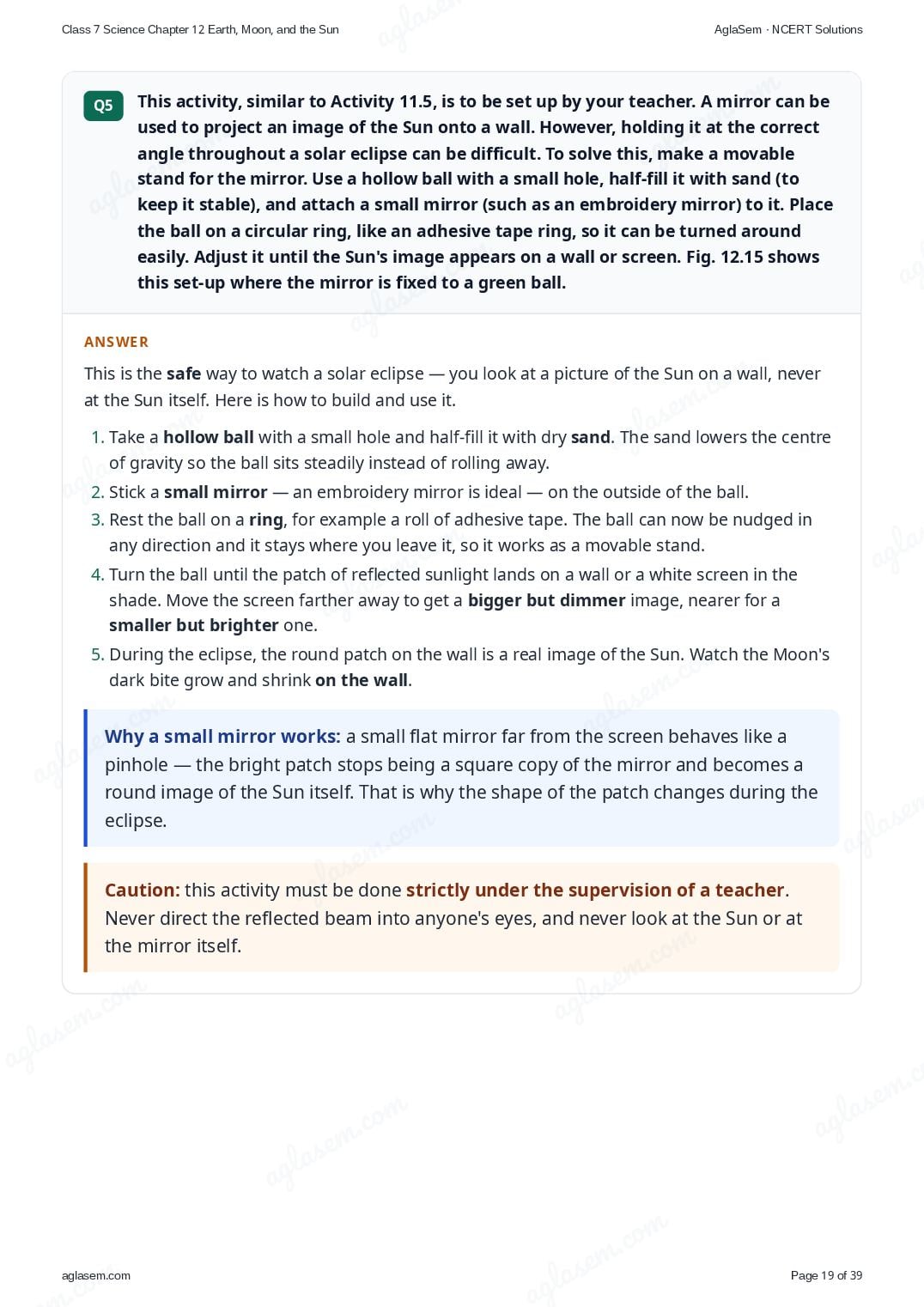
- This activity, similar to Activity 11.5, is to be set up by your teacher. A mirror can be used to project an image of the Sun onto a wall. However, holding it at the correct angle throughout a solar eclipse can be difficult. To solve this, make a movable stand for the mirror. Use a hollow ball with a small hole, half-fill it with sand (to keep it stable), and attach a small mirror (such as an embroidery mirror) to it. Place the ball on a circular ring, like an adhesive tape ring, so it can be turned around easily. Adjust it until the Sun's image appears on a wall or screen. Fig. 12.15 shows this set-up where the mirror is fixed to a green ball.
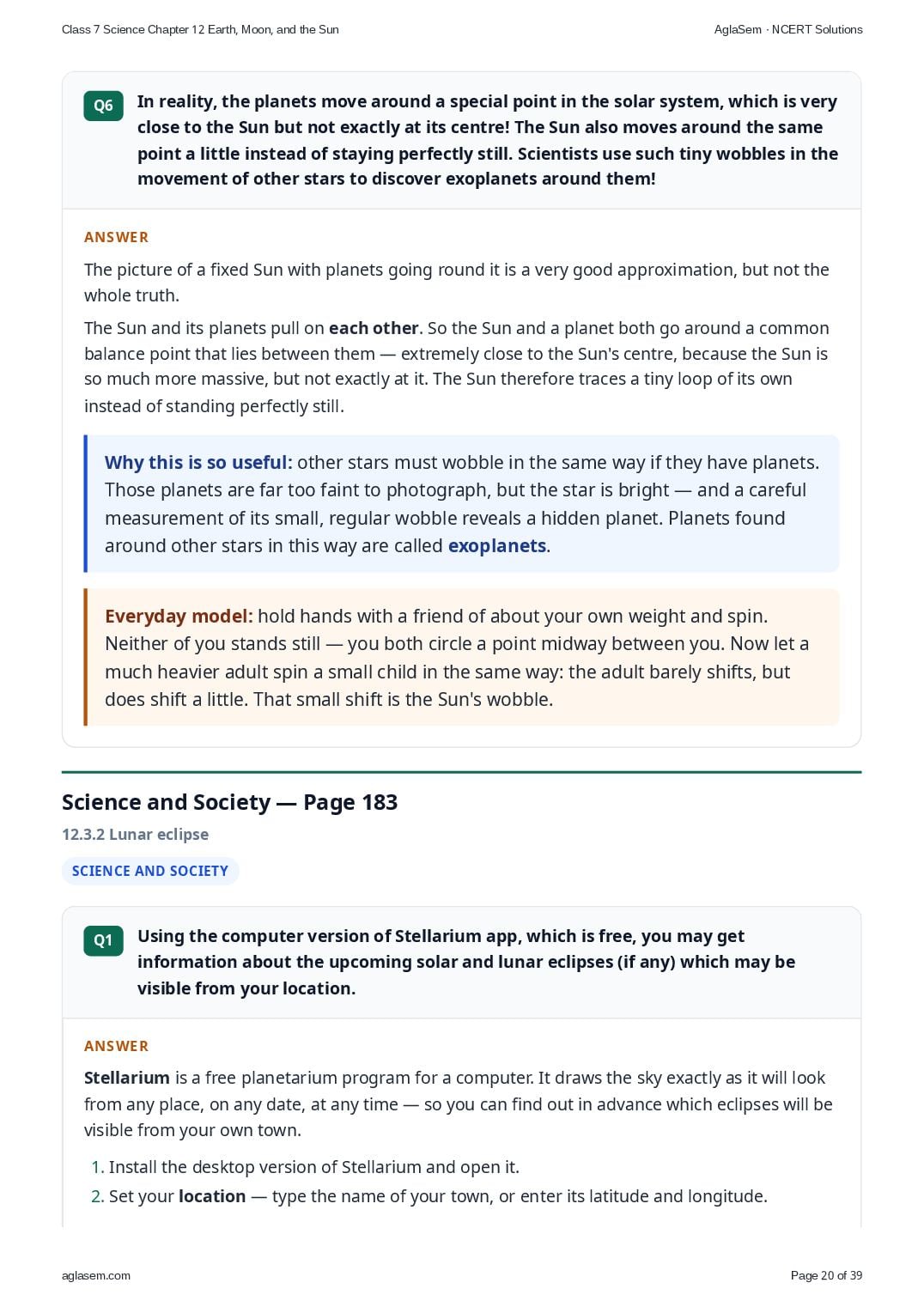
- In reality, the planets move around a special point in the solar system, which is very close to the Sun but not exactly at its centre! The Sun also moves around the same point a little instead of staying perfectly still. Scientists use such tiny wobbles in the movement of other stars to discover exoplanets around them!
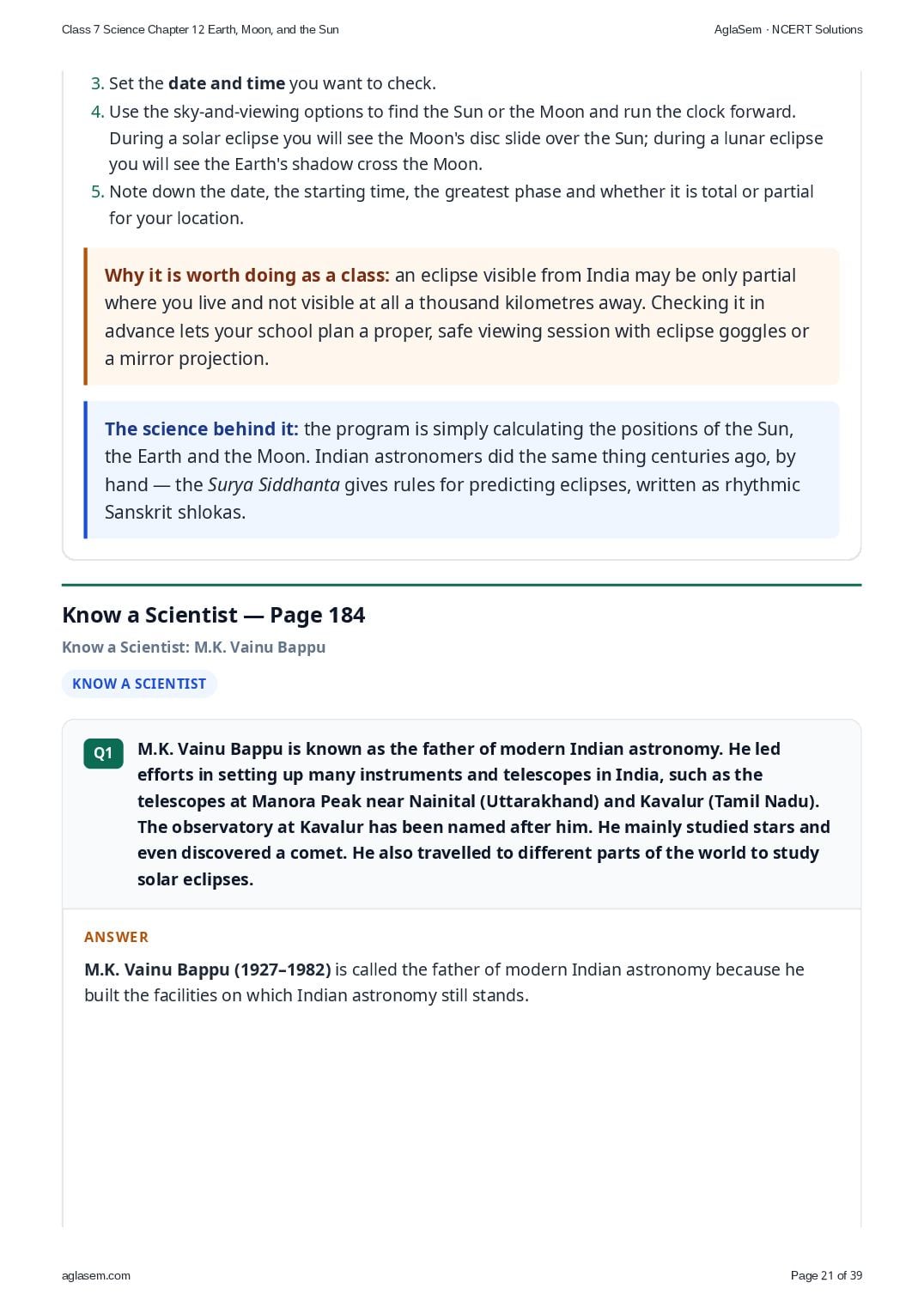
- Using the computer version of Stellarium app, which is free, you may get information about the upcoming solar and lunar eclipses (if any) which may be visible from your location.
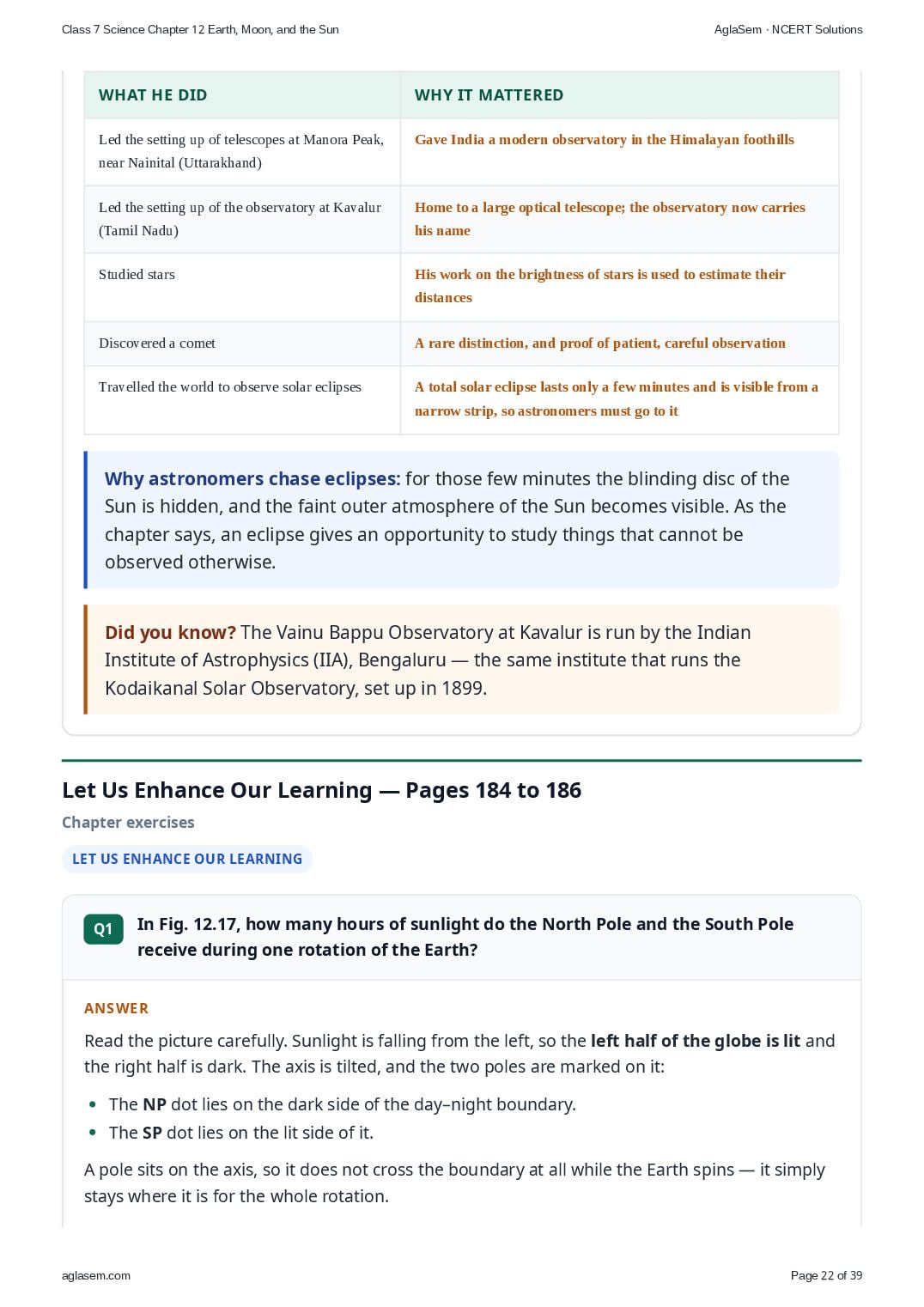
- M.K. Vainu Bappu is known as the father of modern Indian astronomy. He led efforts in setting up many instruments and telescopes in India, such as the telescopes at Manora Peak near Nainital (Uttarakhand) and Kavalur (Tamil Nadu). The observatory at Kavalur has been named after him. He mainly studied stars and even discovered a comet. He also travelled to different parts of the world to study solar eclipses.
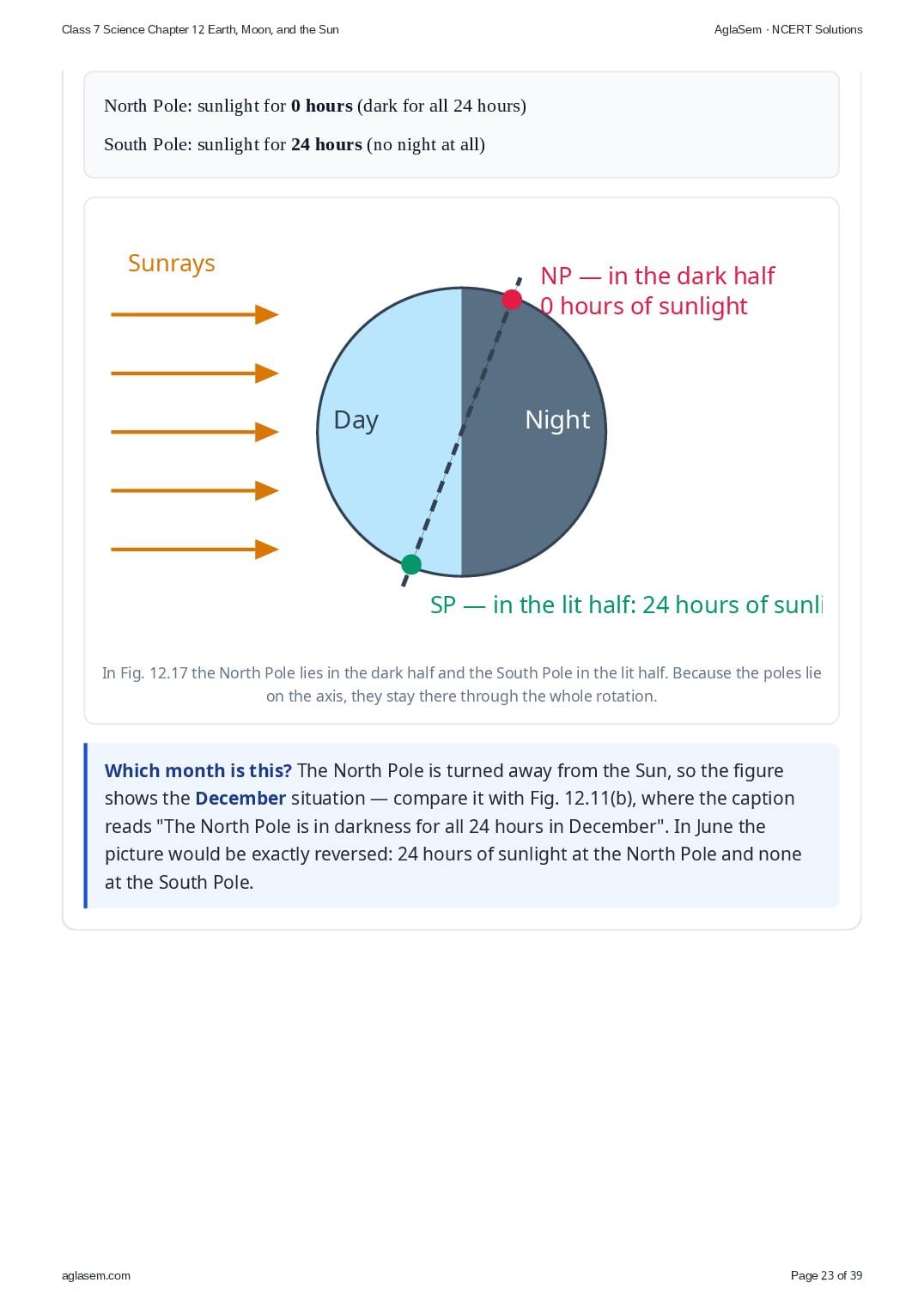
- In Fig. 12.17, how many hours of sunlight do the North Pole and the South Pole receive during one rotation of the Earth?
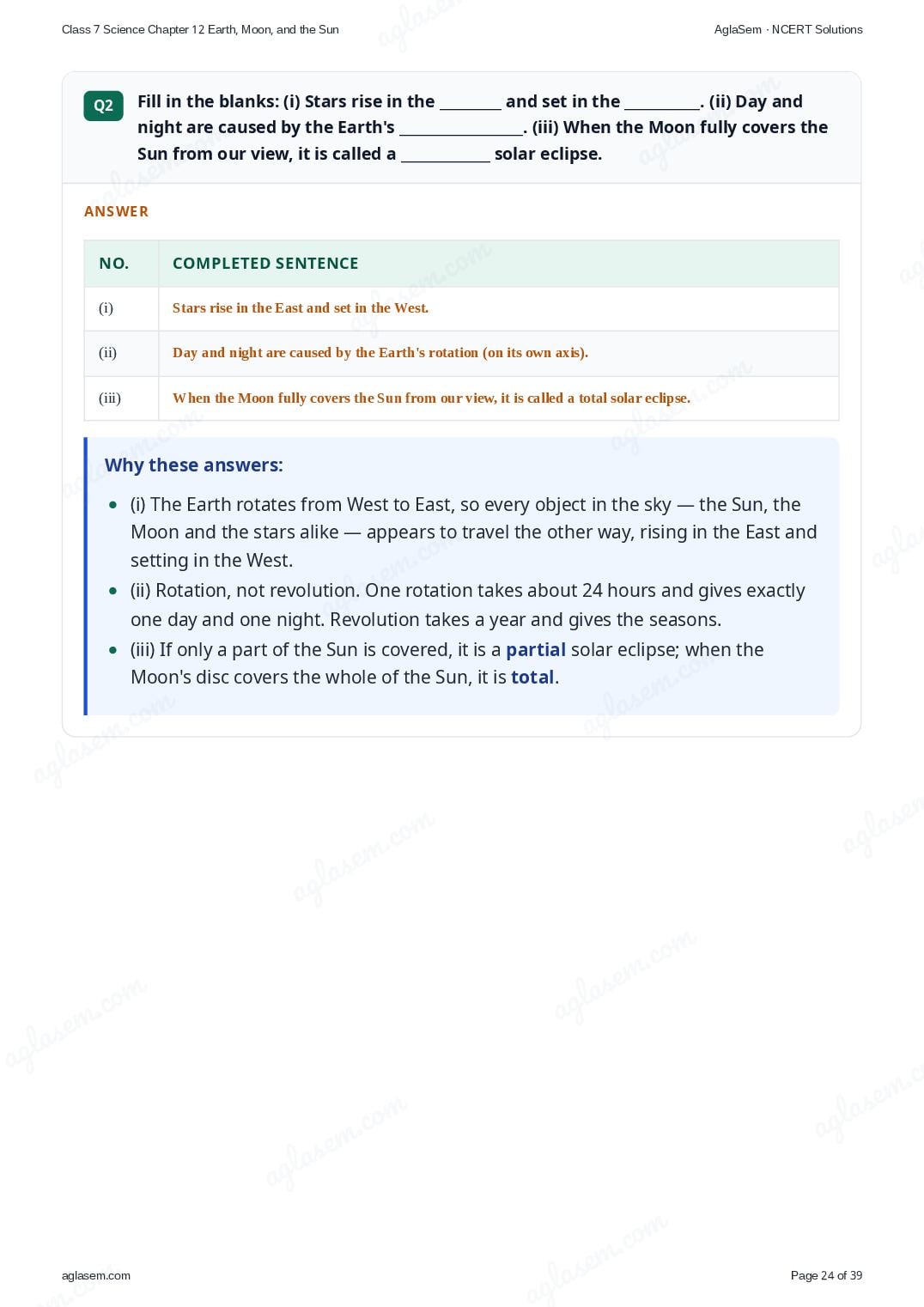
- Fill in the blanks: (i) Stars rise in the _________ and set in the ___________. (ii) Day and night are caused by the Earth's __________________. (iii) When the Moon fully covers the Sun from our view, it is called a _____________ solar eclipse.
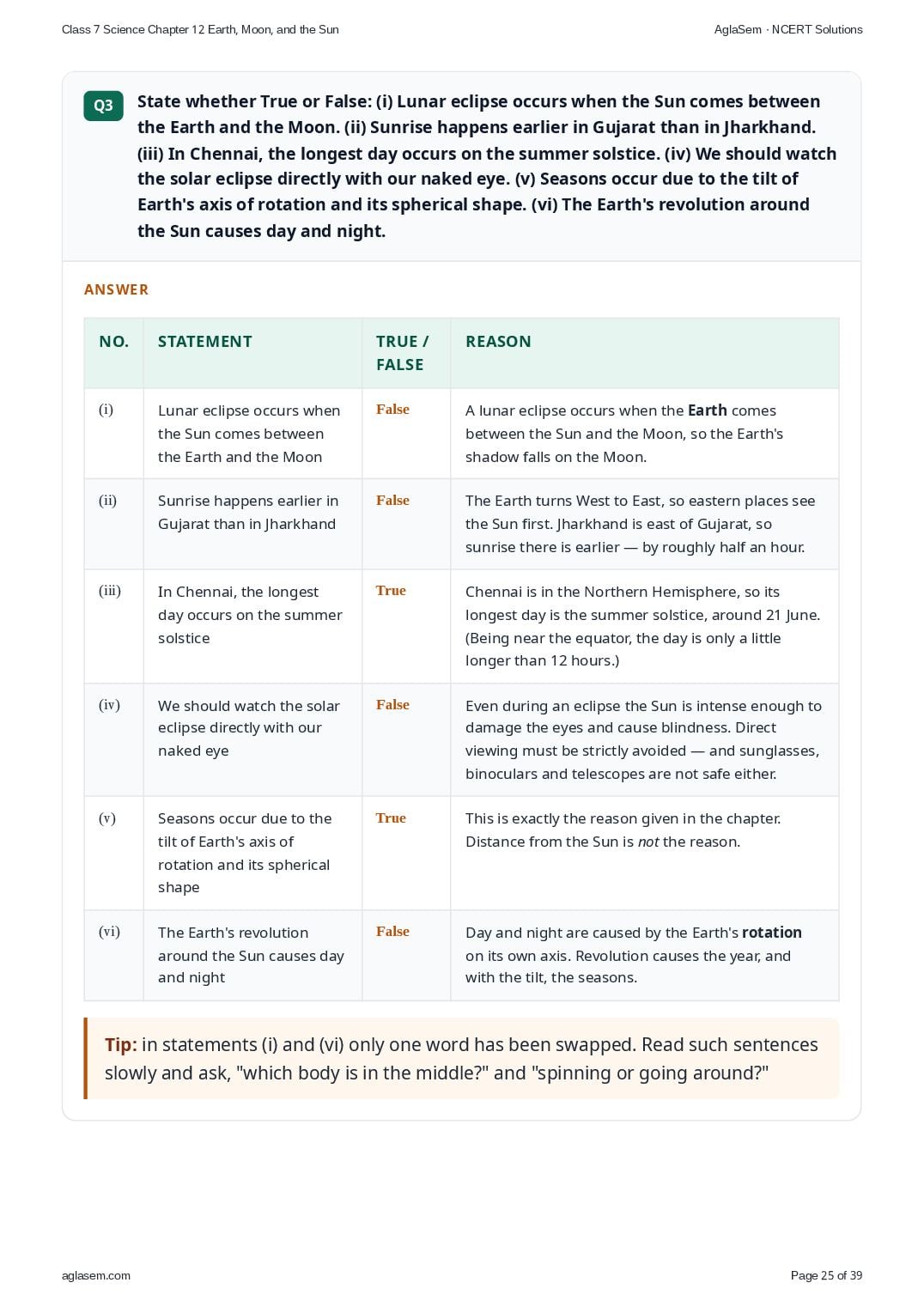
- State whether True or False: (i) Lunar eclipse occurs when the Sun comes between the Earth and the Moon. (ii) Sunrise happens earlier in Gujarat than in Jharkhand. (iii) In Chennai, the longest day occurs on the summer solstice. (iv) We should watch the solar eclipse directly with our naked eye. (v) Seasons occur due to the tilt of Earth's axis of rotation and its spherical shape. (vi) The Earth's revolution around the Sun causes day and night.
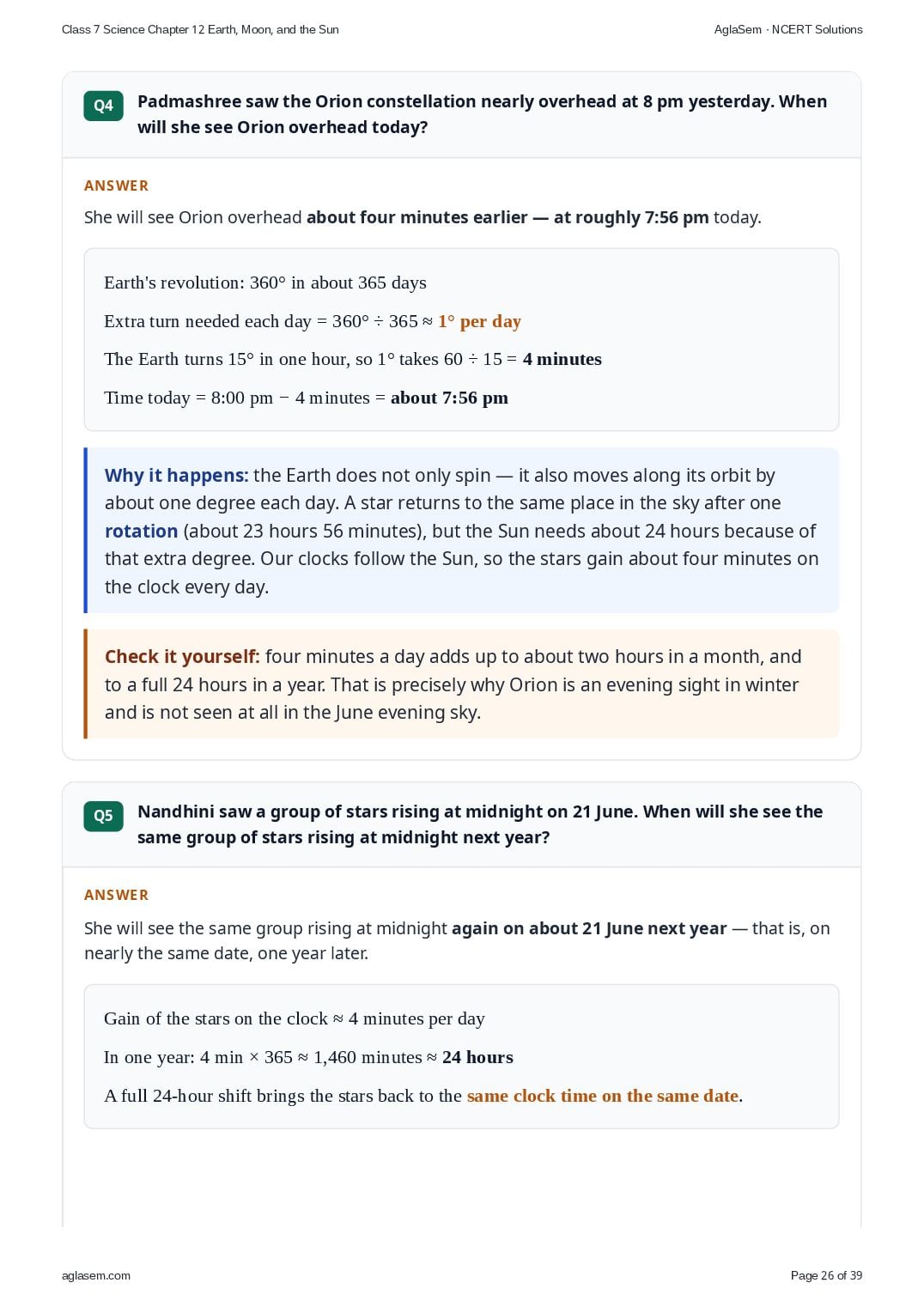
- Padmashree saw the Orion constellation nearly overhead at 8 pm yesterday. When will she see Orion overhead today?
- Nandhini saw a group of stars rising at midnight on 21 June. When will she see the same group of stars rising at midnight next year?
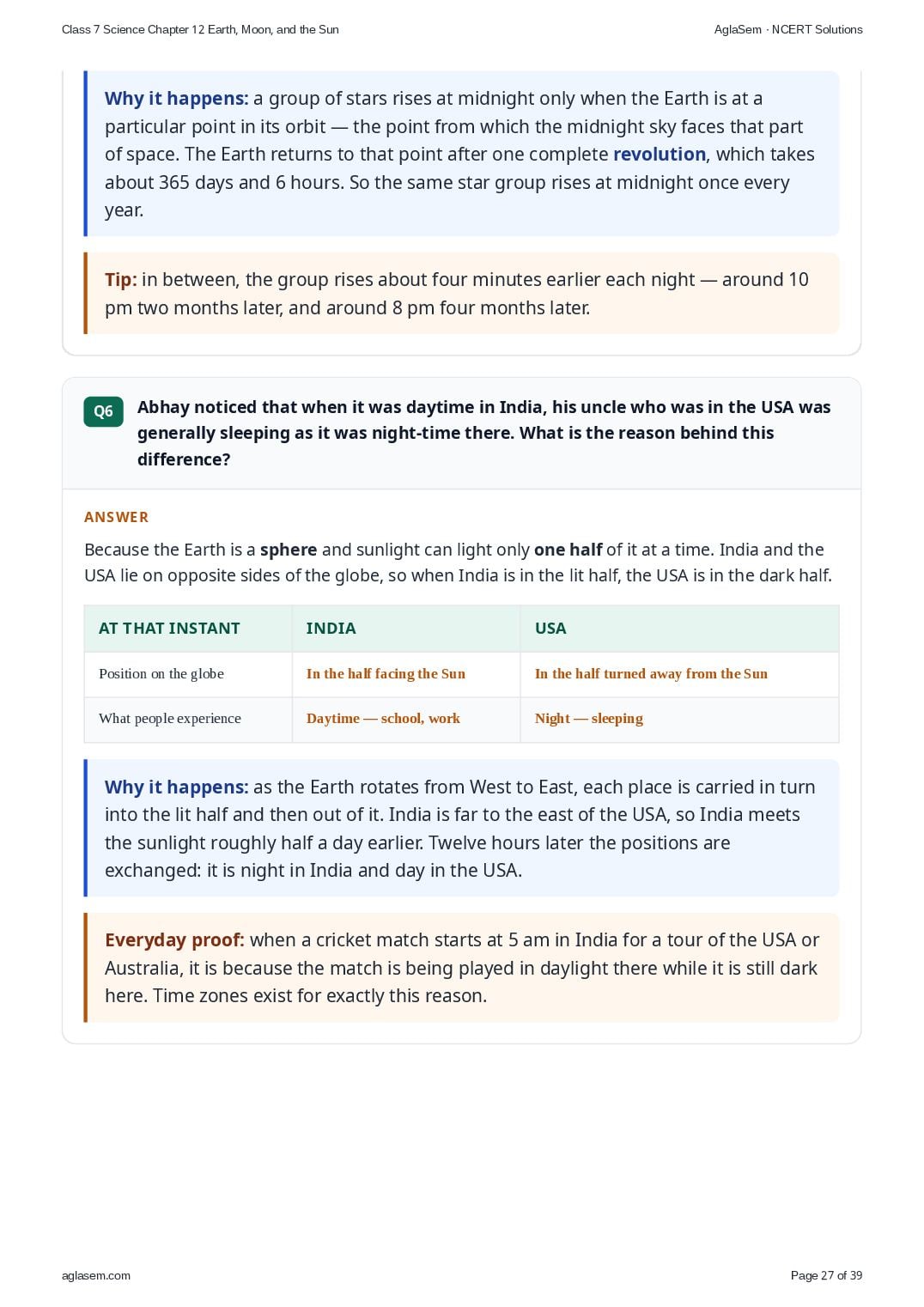
- Abhay noticed that when it was daytime in India, his uncle who was in the USA was generally sleeping as it was night-time there. What is the reason behind this difference?
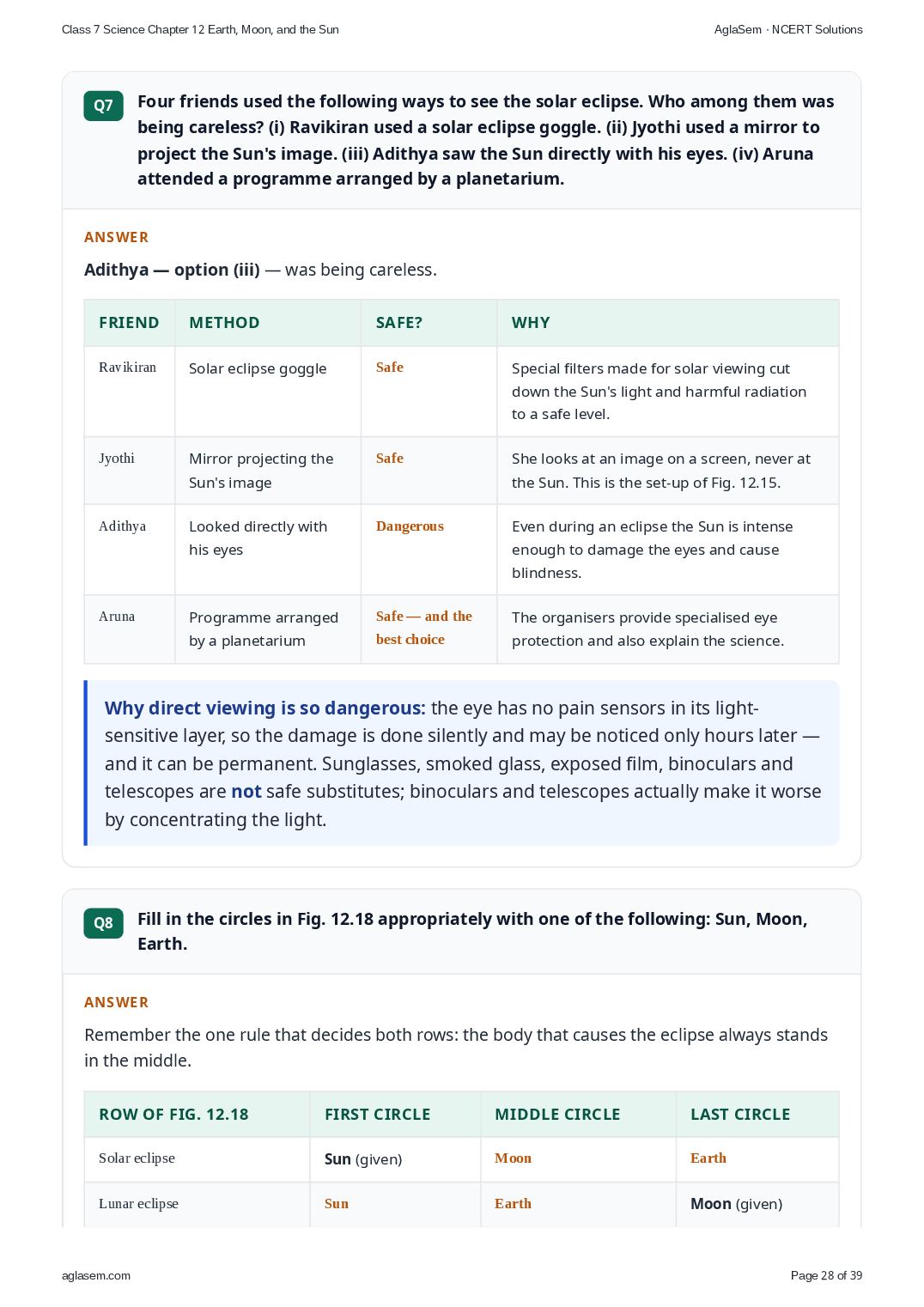
- Four friends used the following ways to see the solar eclipse. Who among them was being careless? (i) Ravikiran used a solar eclipse goggle. (ii) Jyothi used a mirror to project the Sun's image. (iii) Adithya saw the Sun directly with his eyes. (iv) Aruna attended a programme arranged by a planetarium.
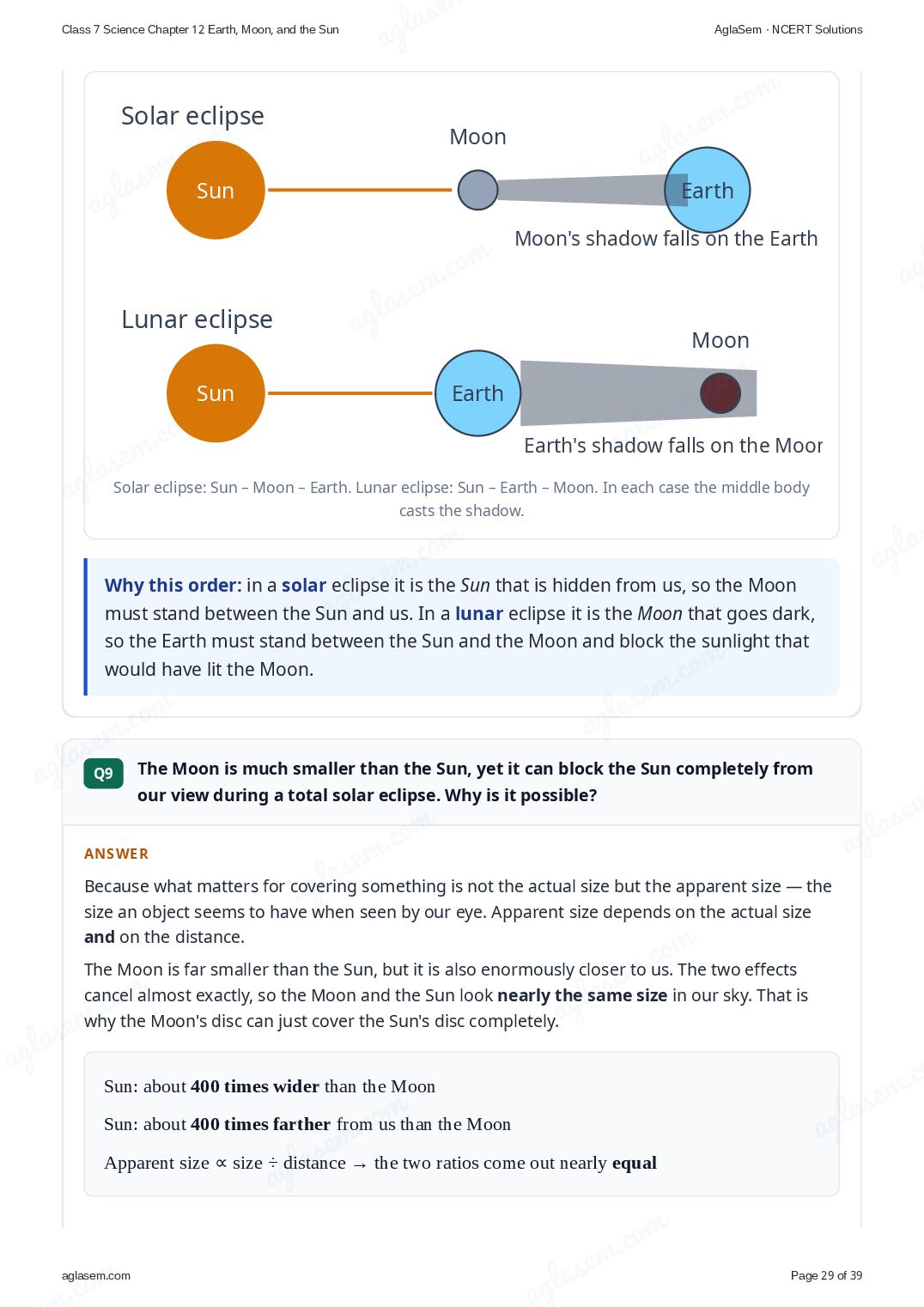
- Fill in the circles in Fig. 12.18 appropriately with one of the following: Sun, Moon, Earth.
- The Moon is much smaller than the Sun, yet it can block the Sun completely from our view during a total solar eclipse. Why is it possible?
- The Indian cricket team matches in Australia are often held in December. Should they pack winter or summer clothes for their trip?
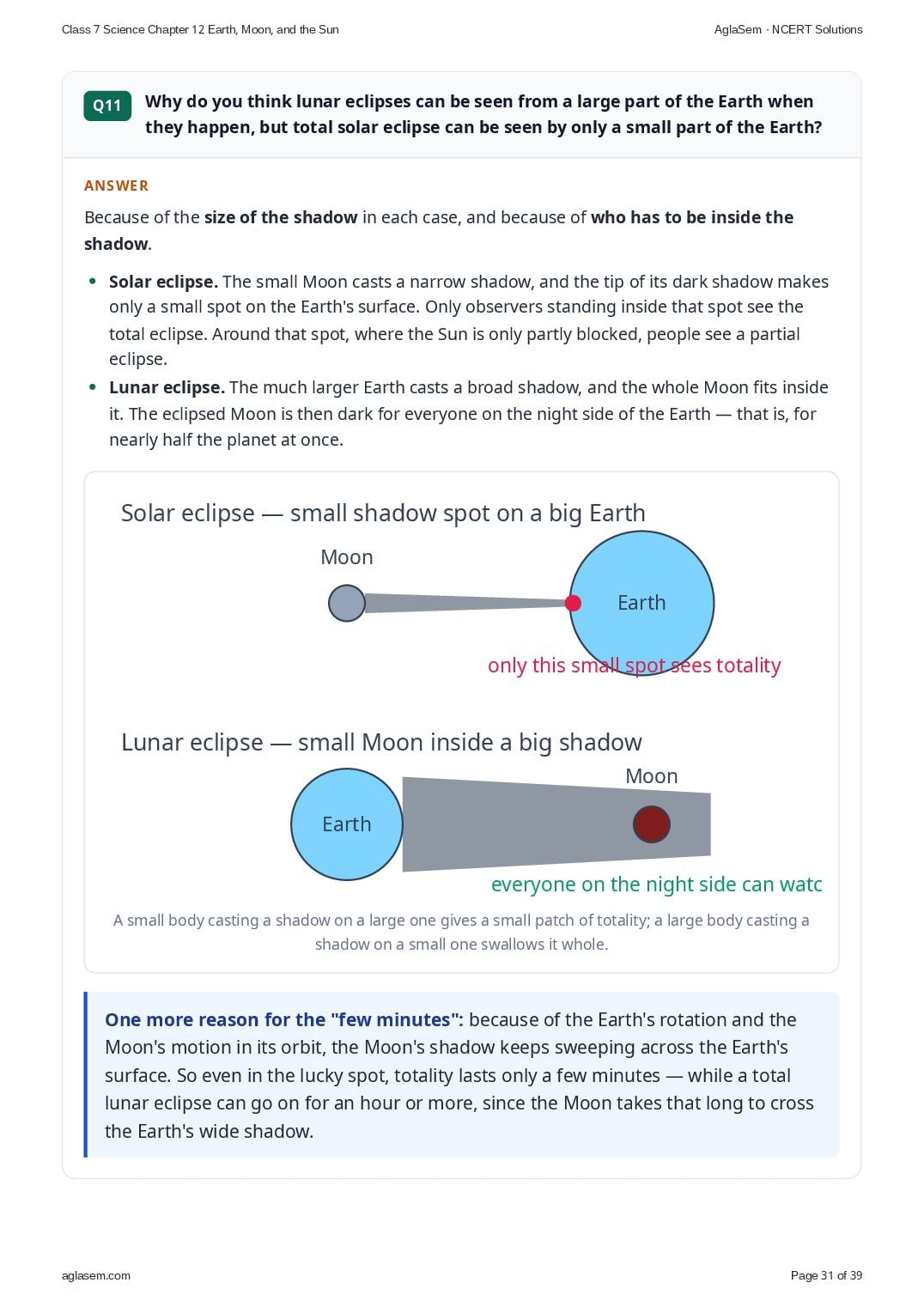
- Why do you think lunar eclipses can be seen from a large part of the Earth when they happen, but total solar eclipse can be seen by only a small part of the Earth?
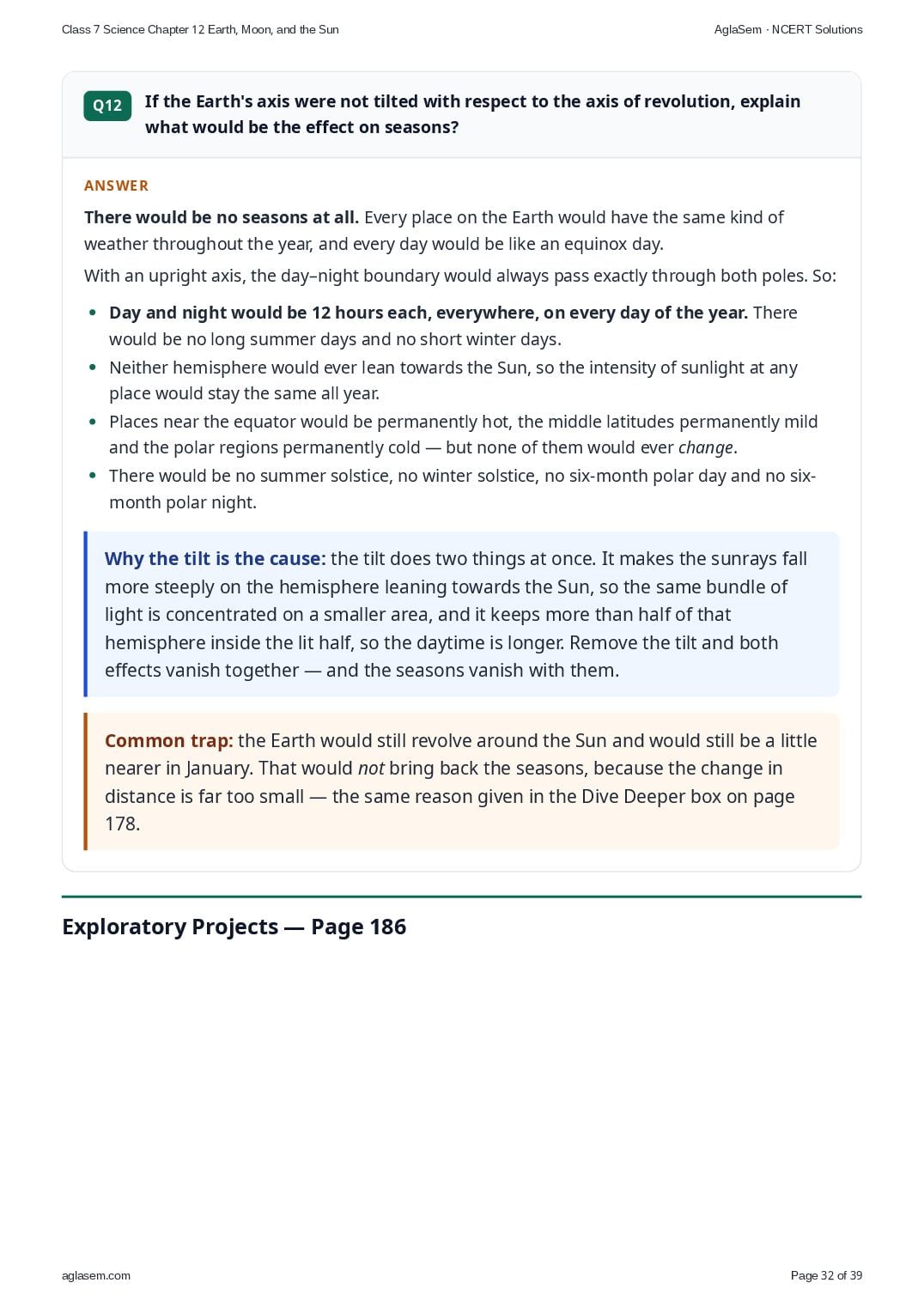
- If the Earth's axis were not tilted with respect to the axis of revolution, explain what would be the effect on seasons?
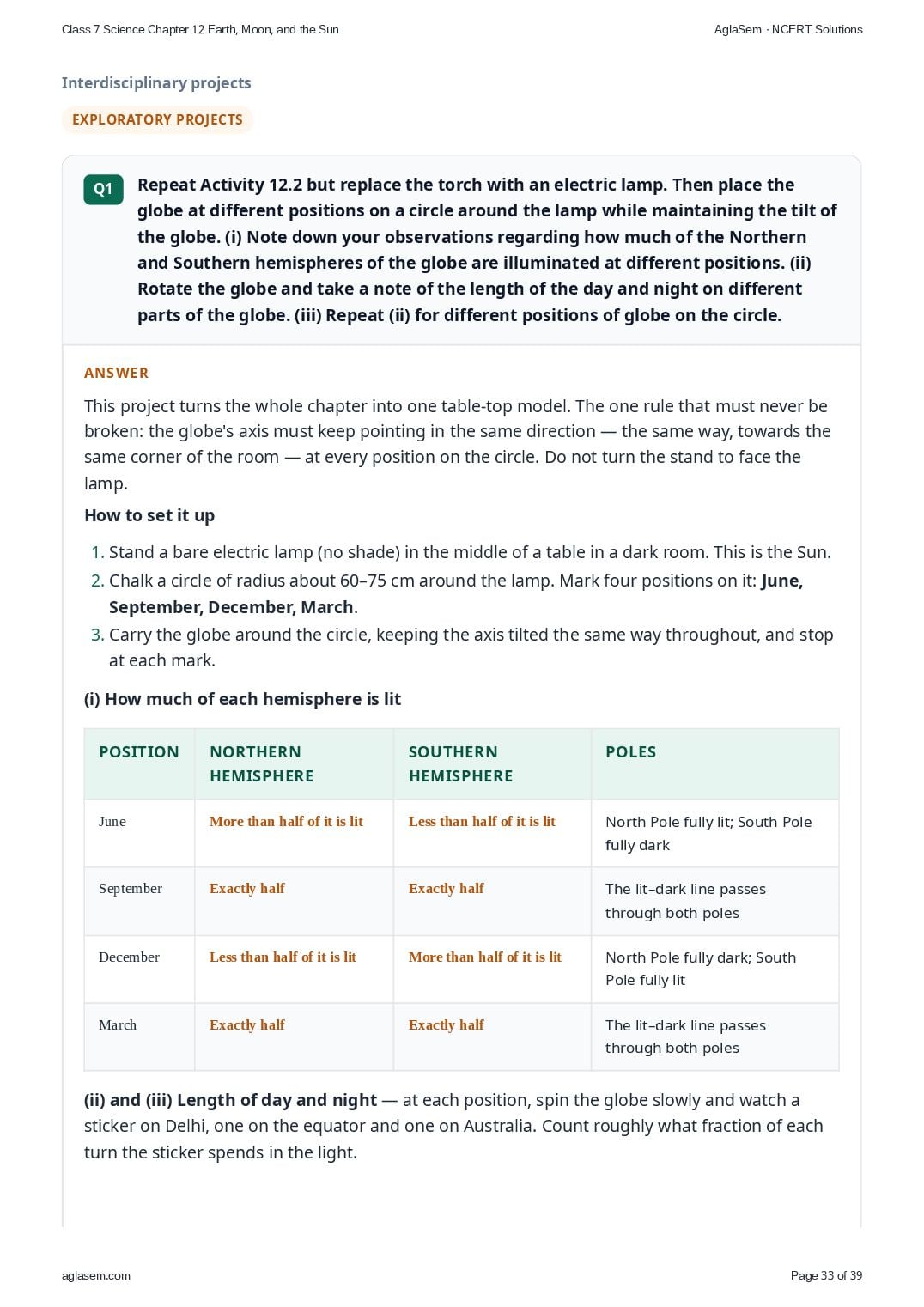
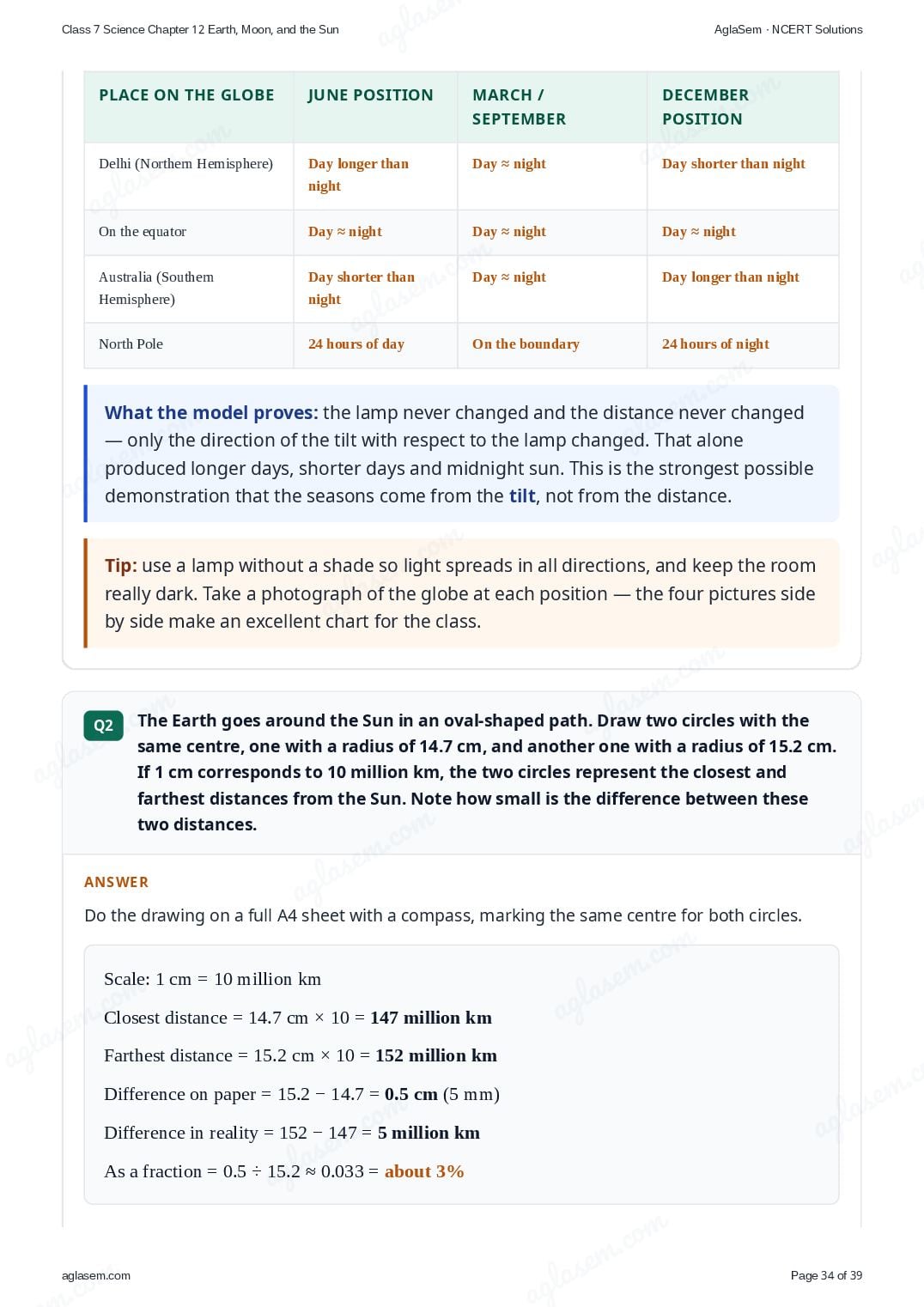
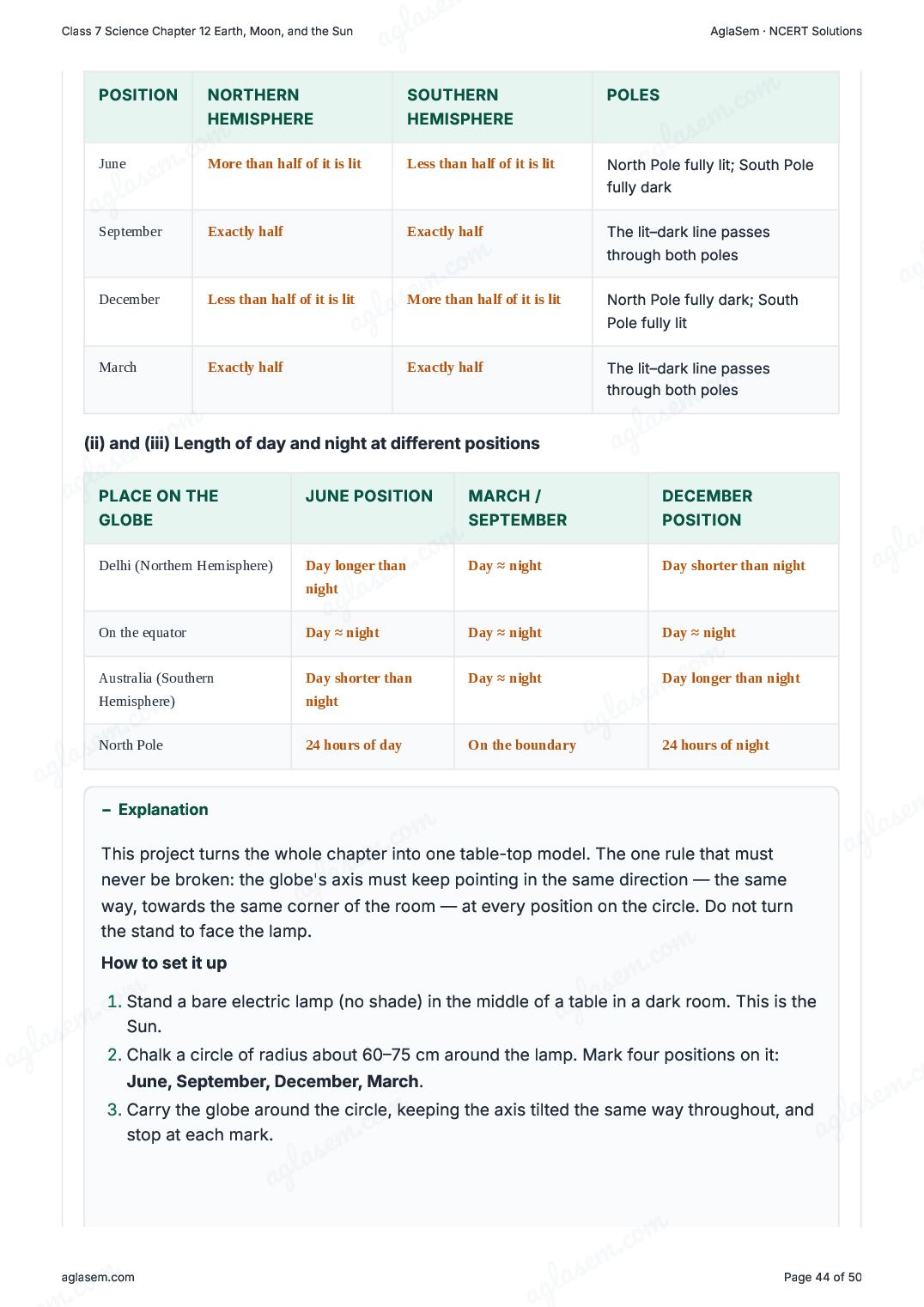
- Repeat Activity 12.2 but replace the torch with an electric lamp. Then place the globe at different positions on a circle around the lamp while maintaining the tilt of the globe. (i) Note down your observations regarding how much of the Northern and Southern hemispheres of the globe are illuminated at different positions. (ii) Rotate the globe and take a note of the length of the day and night on different parts of the globe. (iii) Repeat (ii) for different positions of globe on the circle.
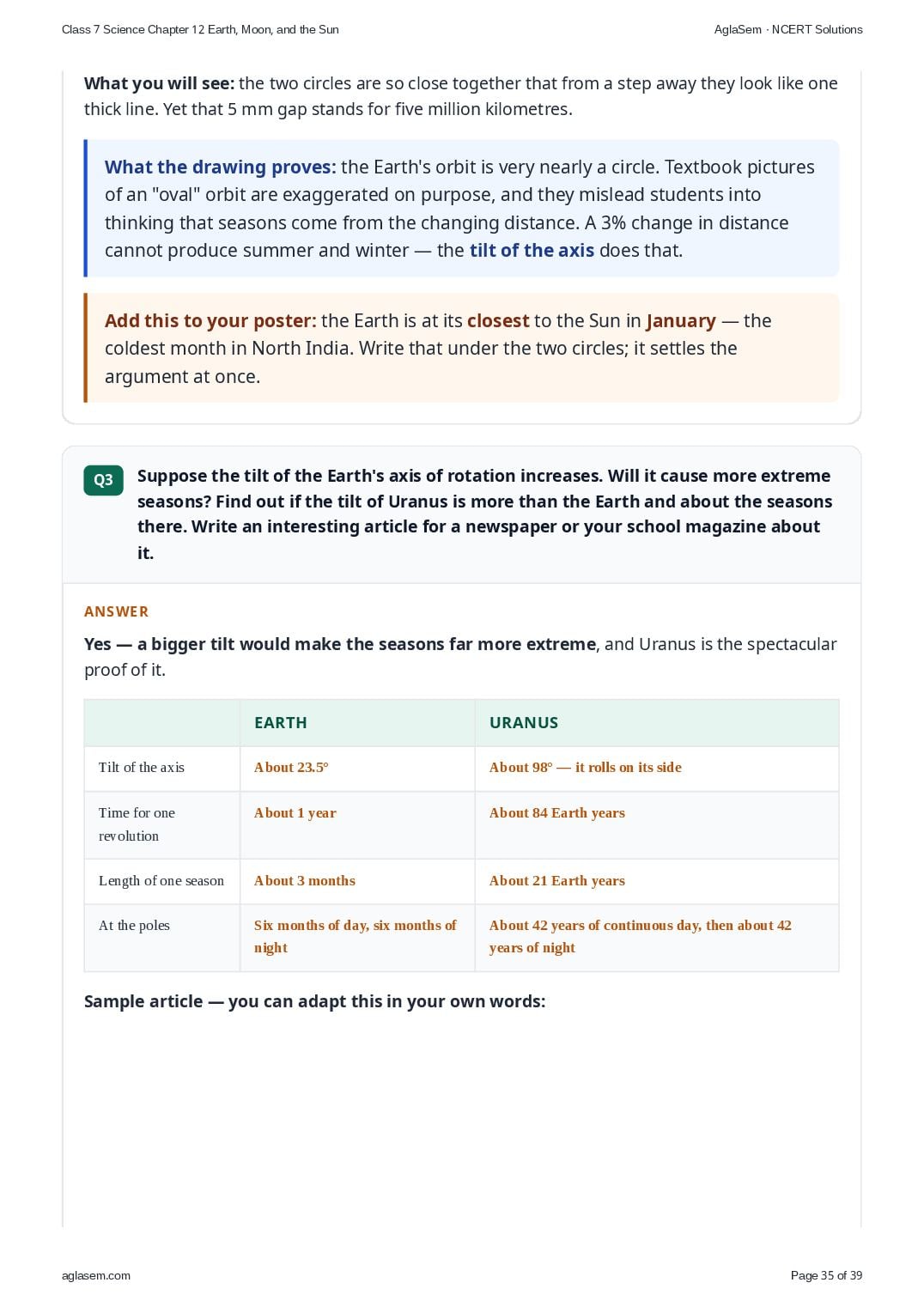
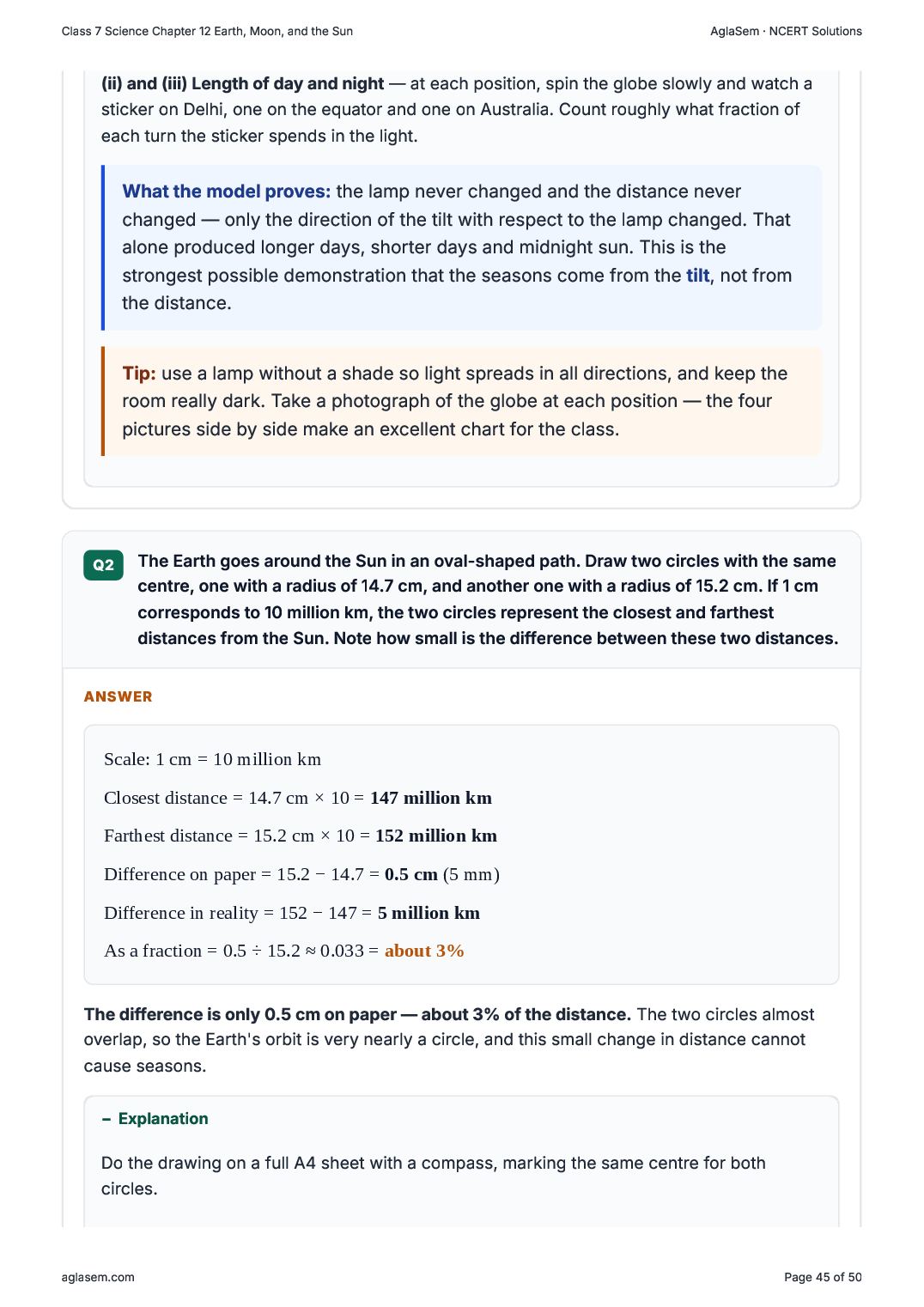
- The Earth goes around the Sun in an oval-shaped path. Draw two circles with the same centre, one with a radius of 14.7 cm, and another one with a radius of 15.2 cm. If 1 cm corresponds to 10 million km, the two circles represent the closest and farthest distances from the Sun. Note how small is the difference between these two distances.
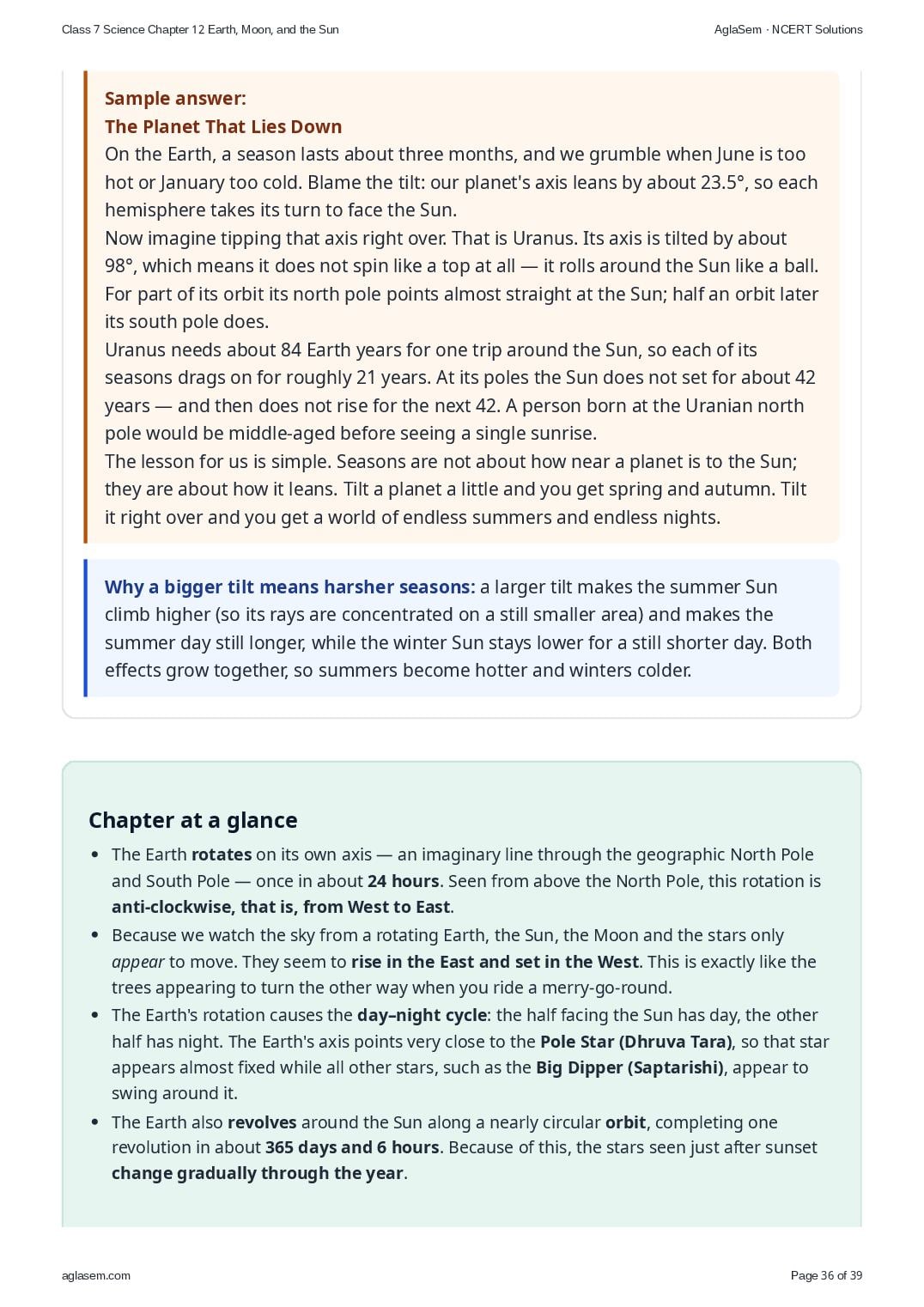
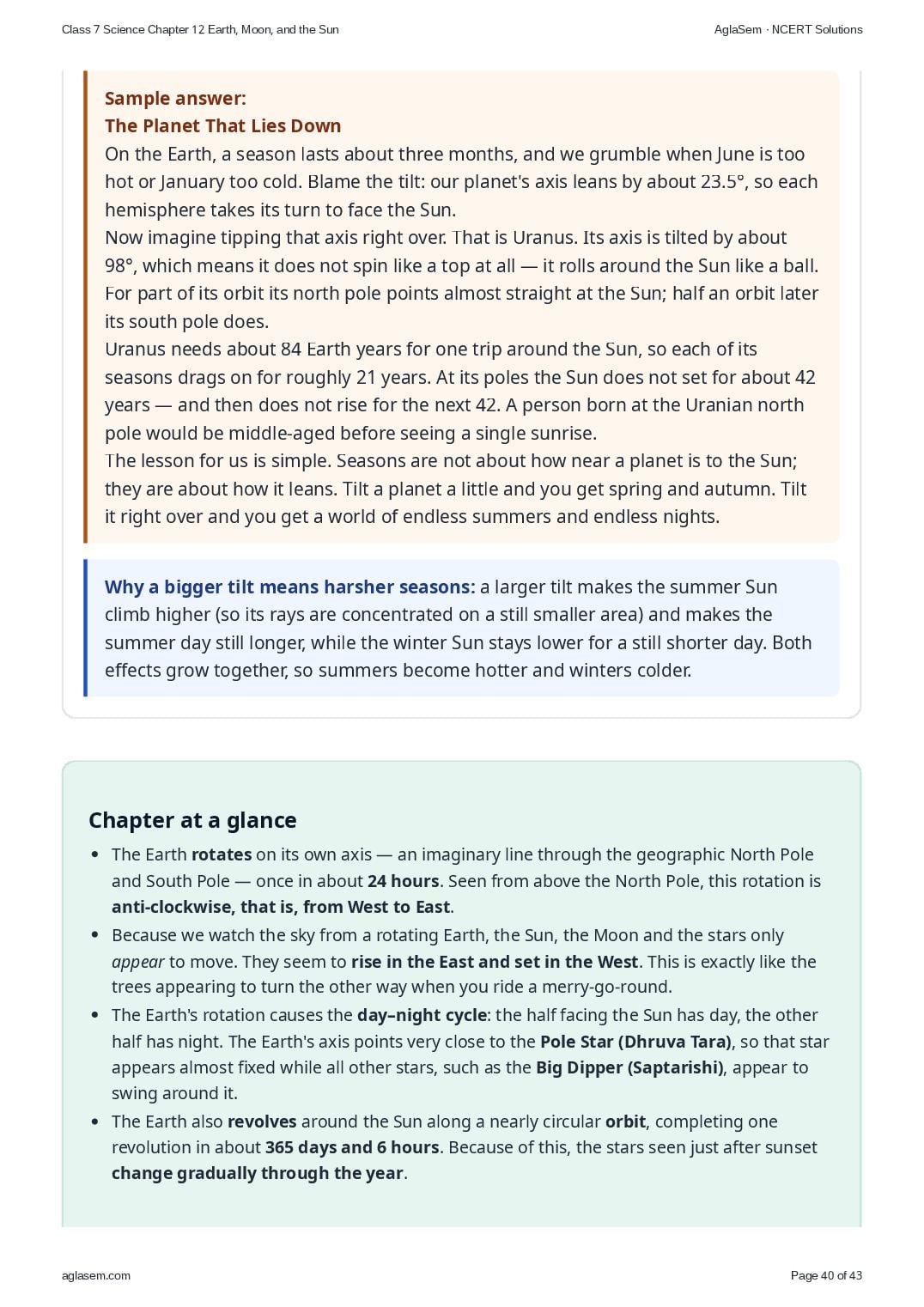
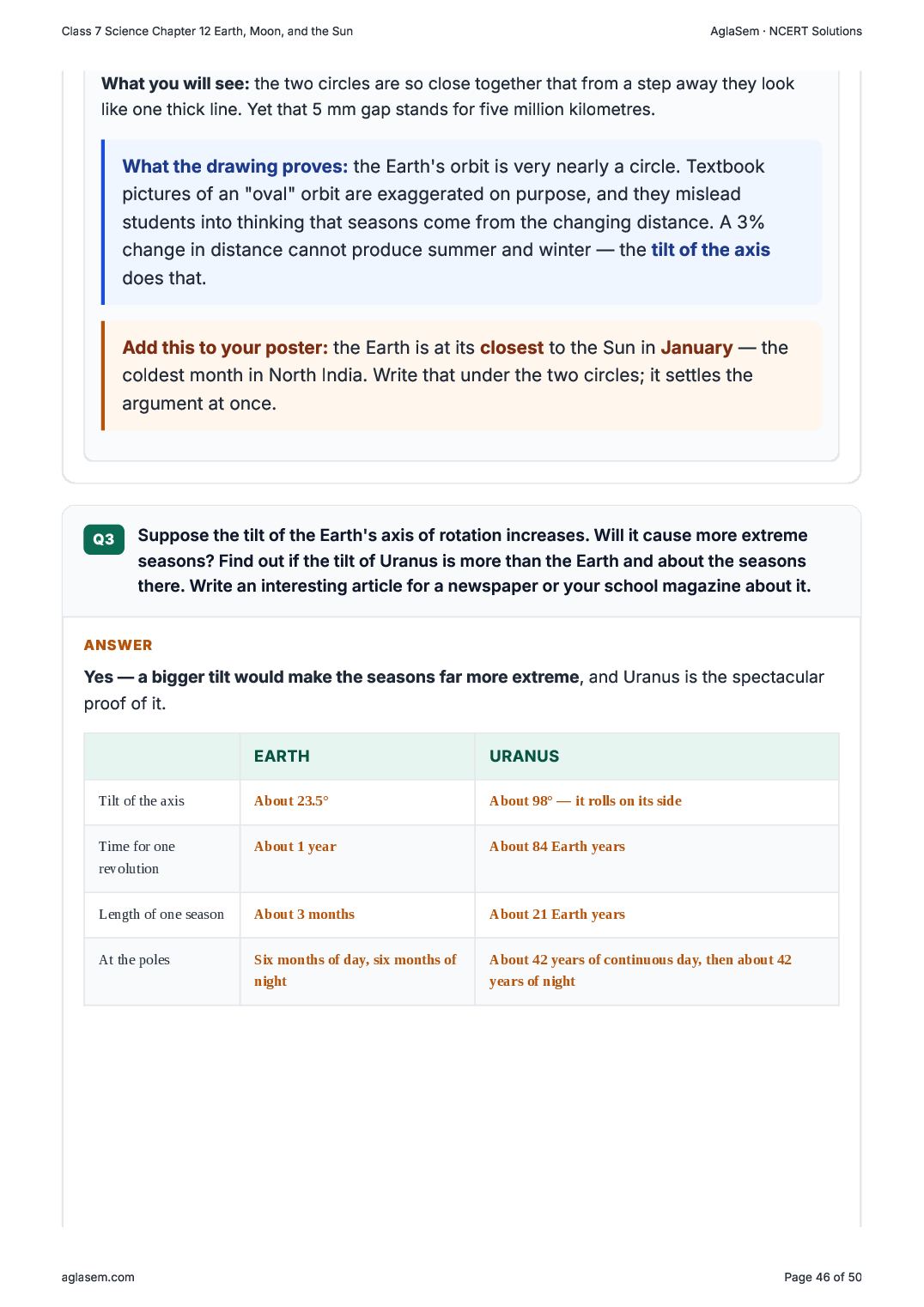
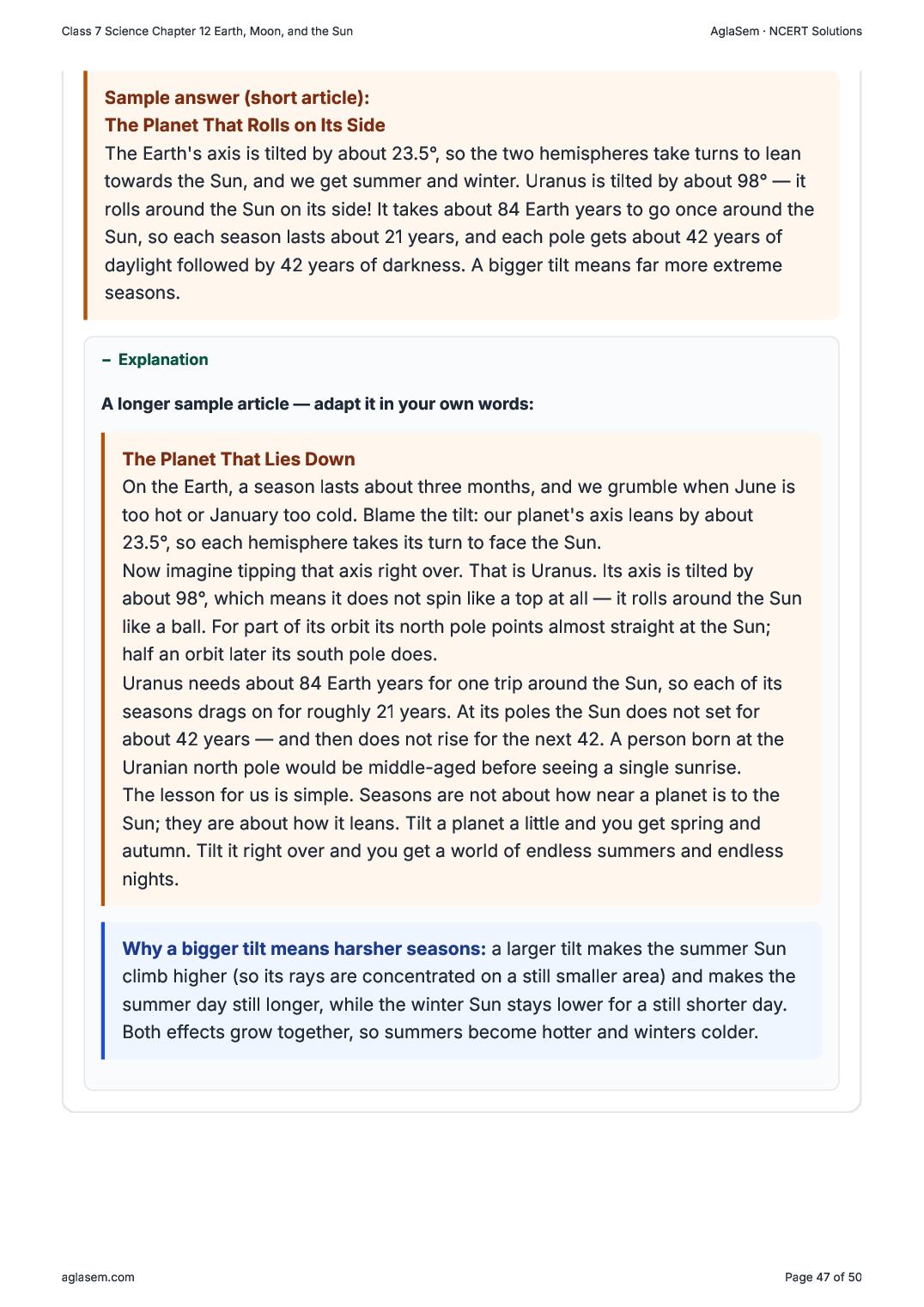
- Suppose the tilt of the Earth's axis of rotation increases. Will it cause more extreme seasons? Find out if the tilt of Uranus is more than the Earth and about the seasons there. Write an interesting article for a newspaper or your school magazine about it.
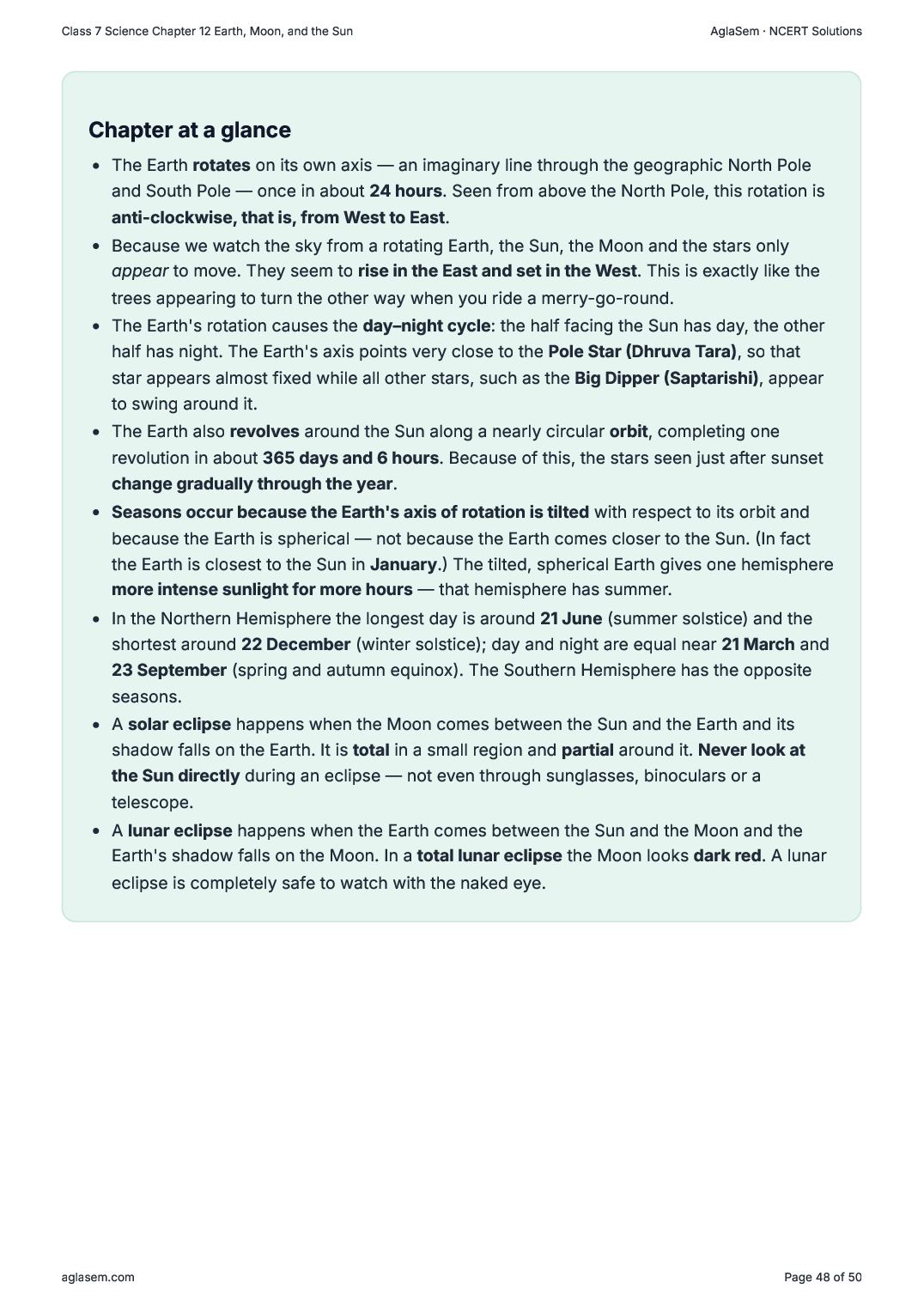
Chapter at a Glance
- The Earth rotates on its own axis — an imaginary line through the geographic North Pole and South Pole — once in about 24 hours . Seen from above the North Pole, this rotation is anti-clockwise, that is, from West to East .
- Because we watch the sky from a rotating Earth, the Sun, the Moon and the stars only appear to move. They seem to rise in the East and set in the West . This is exactly like the trees appearing to turn the other way when you ride a merry-go-round.
- The Earth's rotation causes the day–night cycle : the half facing the Sun has day, the other half has night. The Earth's axis points very close to the Pole Star (Dhruva Tara) , so that star appears almost fixed while all other stars, such as the Big Dipper (Saptarishi) , appear to swing around it.
- The Earth also revolves around the Sun along a nearly circular orbit , completing one revolution in about 365 days and 6 hours . Because of this, the stars seen just after sunset change gradually through the year .
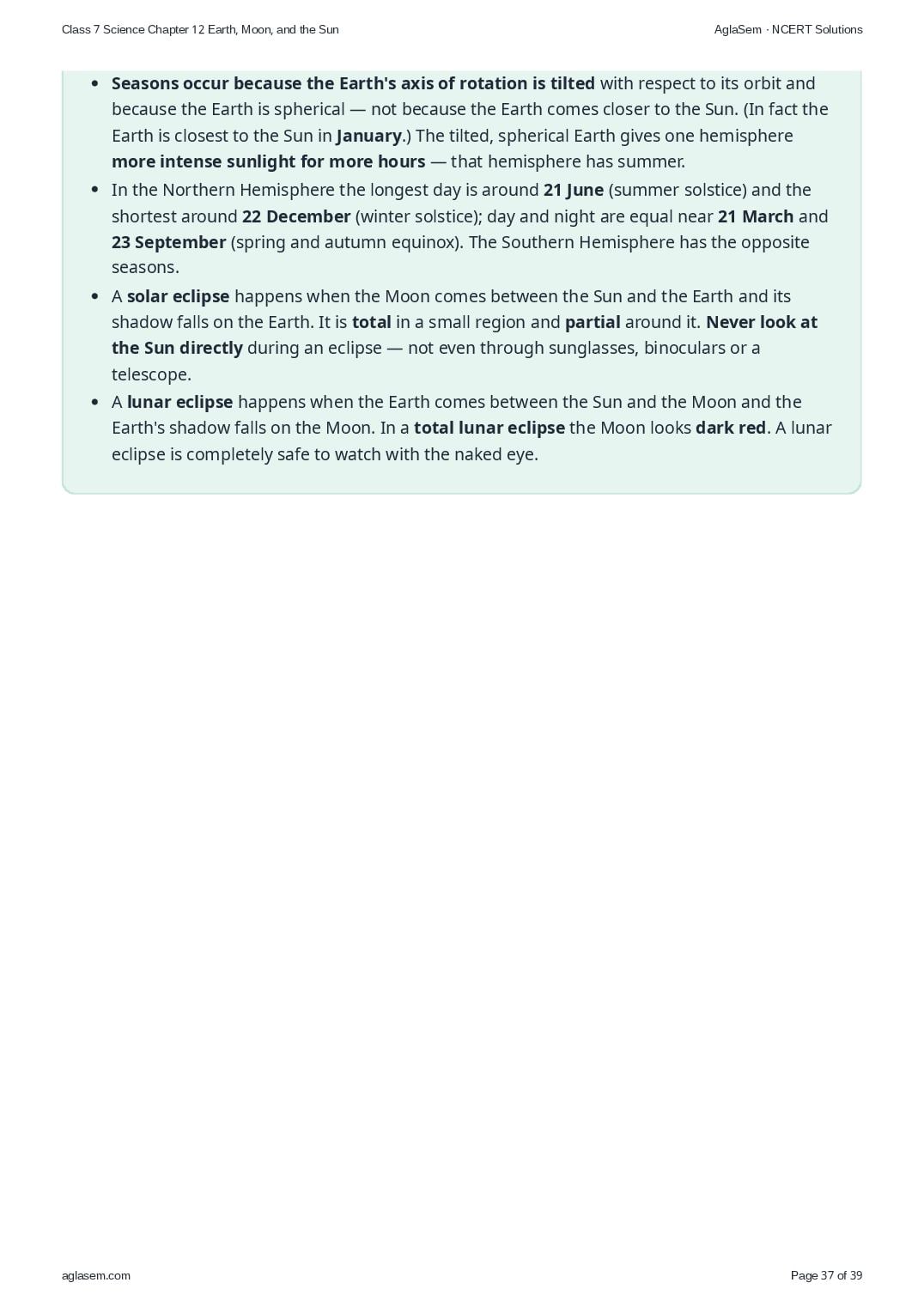
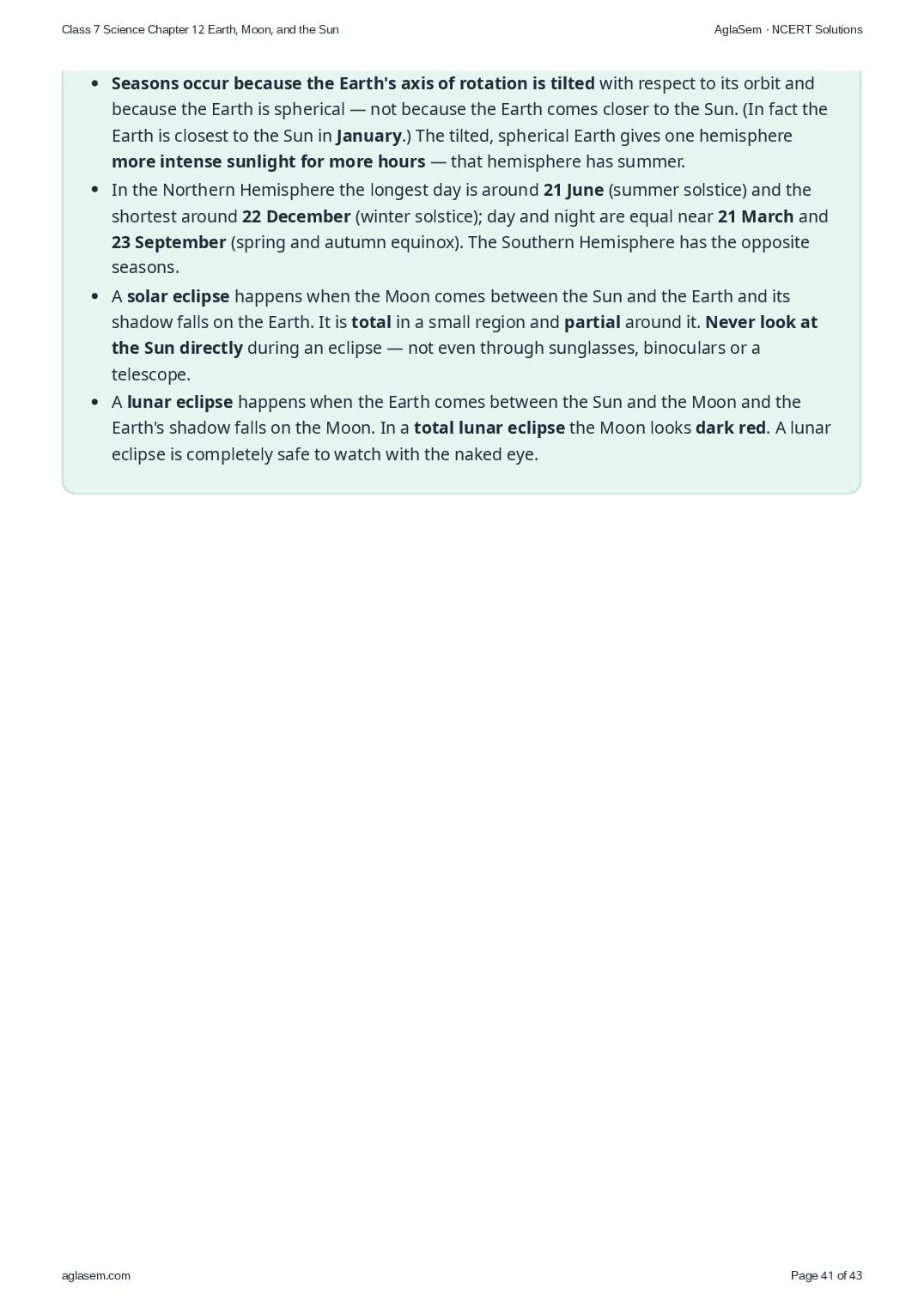
- Seasons occur because the Earth's axis of rotation is tilted with respect to its orbit and because the Earth is spherical — not because the Earth comes closer to the Sun. (In fact the Earth is closest to the Sun in January .) The tilted, spherical Earth gives one hemisphere more intense sunlight for more hours — that hemisphere has summer.
- In the Northern Hemisphere the longest day is around 21 June (summer solstice) and the shortest around 22 December (winter solstice); day and night are equal near 21 March and 23 September (spring and autumn equinox). The Southern Hemisphere has the opposite seasons.
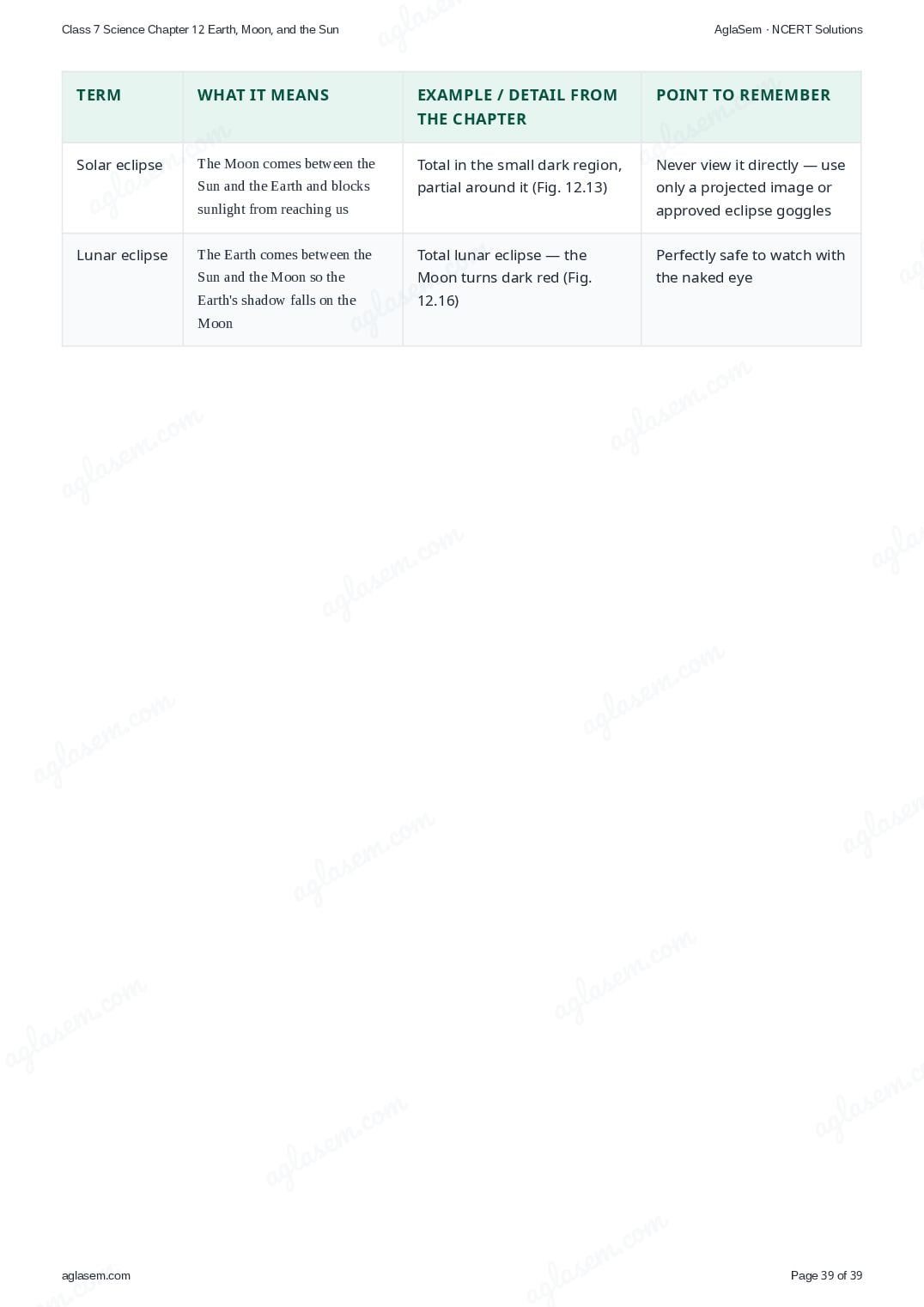
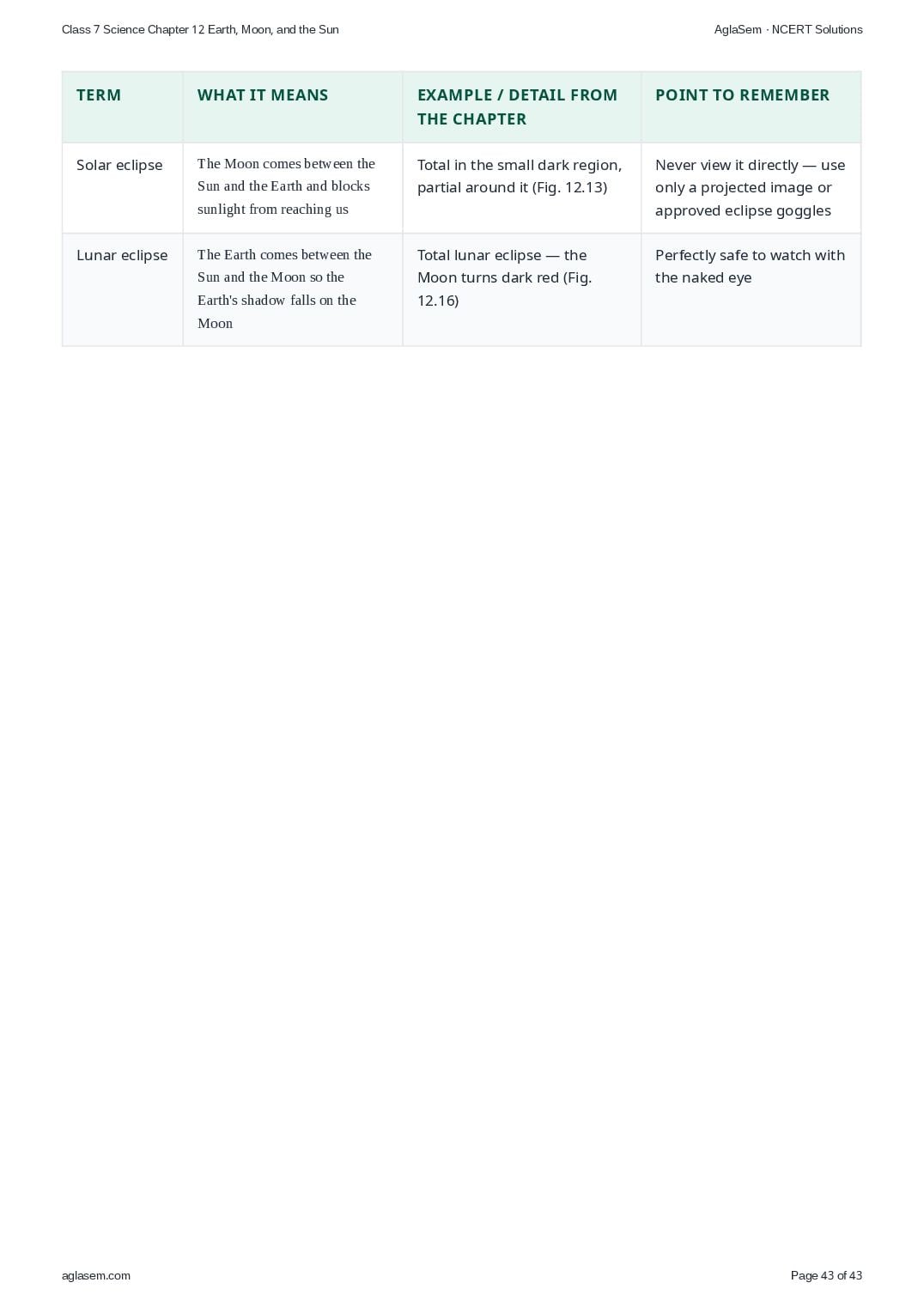
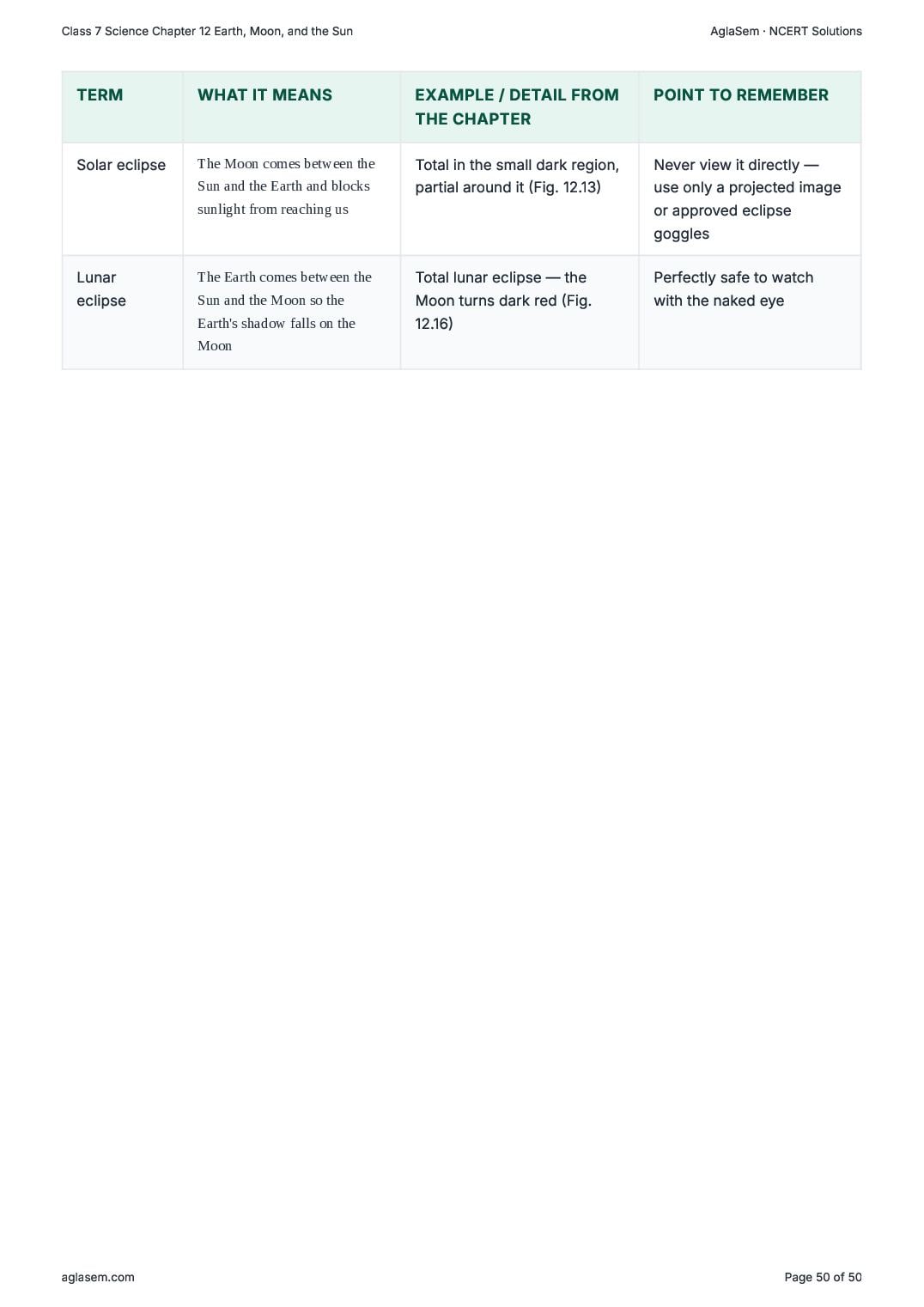
- A solar eclipse happens when the Moon comes between the Sun and the Earth and its shadow falls on the Earth. It is total in a small region and partial around it. Never look at the Sun directly during an eclipse — not even through sunglasses, binoculars or a telescope.
- A lunar eclipse happens when the Earth comes between the Sun and the Moon and the Earth's shadow falls on the Moon. In a total lunar eclipse the Moon looks dark red . A lunar eclipse is completely safe to watch with the naked eye.
How to Download NCERT Solutions for Class 7 Science Chapter 12 PDF
Follow these simple steps to get the Earth Moon and the Sun questions-and-answers PDF from Curiosity.
- Search NCERT Solutions for Class 7 Science Chapter 12 aglasem and open this page.
- Read the exercise questions with answers for Earth Moon and the Sun shown above.
- Click the Download PDF link to save the Earth Moon and the Sun solutions to your device.
NCERT Solutions for Class 7 Science – All Chapters
There are more chapters to study besides Earth Moon and the Sun in Science. Here are the NCERT Solutions for all chapters of Class 7 Science.
- Chapter 1 the Ever Evolving World of Science
- Chapter 2 Exploring Substances Acidic Basic and Neutral
- Chapter 3 Electricity Circuits and Their Components
- Chapter 4 the World of Metals and Non Metals
- Chapter 5 Changes Around Us Physical and Chemical
- Chapter 6 Adolescence a Stage of Growth and Change
- Chapter 7 Heat Transfer in Nature
- Chapter 8 Measurement of Time and Motion
- Chapter 9 Life Processes in Animals
- Chapter 10 Life Processes in Plants
- Chapter 11 Light Shadows and Reflections
- Chapter 12 Earth Moon and the Sun
NCERT Solutions for Class 7 – All Subjects
Just like Chapter 12 of Science, you can get the exercise questions with answers for every other subject of Class 7. Here are the NCERT Solutions for all subjects of Class 7.
NCERT Solutions for Class 7 Science Chapter 12 – An Overview
The key highlights of this study material are as follows.
| Aspects | Details |
|---|---|
| Class | Class 7 |
| Subject | Science |
| Chapter Number | Chapter 12 |
| Chapter Name | Earth Moon and the Sun |
| Book Name | Curiosity |
| Book By | NCERT (National Council of Educational Research and Training) |
| Educational Resource Here | NCERT Solutions of Class 7 Science Chapter 12 for all exercises |
| More Questions Answers of This Subject | NCERT Solutions for Class 7 Science |
| Download Book Chapter | NCERT Book Class 7 Science |
| All Questions Answers For This Class | NCERT Solutions for Class 7 |
| Complete Solutions | NCERT Solutions |
NCERT Solutions for Class 7 Science Chapter 12 Earth Moon and the Sun – FAQs
What are the NCERT Solutions for Class 7 Science Chapter 12 Earth Moon and the Sun?
They are the complete, step-by-step answers to all the exercise and in-text questions of Chapter 12 Earth Moon and the Sun from the NCERT Class 7 Science textbook Curiosity, written by experts as per the latest NCERT syllabus.
How can I download the Class 7 Science Chapter 12 solutions PDF for free?
Open this page on aglasem, read the Earth Moon and the Sun questions with answers, and click the “Download Solutions PDF” link. The Class 7 Science Chapter 12 NCERT Solutions PDF is completely free to download.
Are these NCERT Solutions as per the latest 2026-27 syllabus?
Yes. The NCERT Solutions for Class 7 Science Chapter 12 are based on the latest NCERT textbook Curiosity and the current 2026-27 CBSE syllabus, so the questions and answers match what you study in class.
Where can I get NCERT Solutions for the other chapters of Class 7 Science?
You can find the answers to every chapter on the NCERT Solutions for Class 7 Science page, and solutions for every subject on the NCERT Solutions for Class 7 page.
How do NCERT Solutions help in exam preparation?
They show the correct method to solve each question, help you write answers the way they are expected in exams, let you check and correct your own work, and save revision time — which together improve your marks in Class 7 Science.
If you have any queries on NCERT Solutions for Class 7 Science Chapter 12 Earth Moon and the Sun, then please ask in the comments below.