NCERT Solutions for Class 7 Science Chapter 3 Electricity Circuits and Their Components provide clear, step-by-step answers to every exercise and in-text question from the chapter Electricity Circuits and Their Components of the NCERT textbook Curiosity. Prepared by subject experts as per the latest NCERT (CBSE) syllabus for 2026-27, these NCERT Solutions for Class 7 Science help you understand each concept, write exam-ready answers, and check your own solutions. You can read them online below or download the free Class 7 Science Chapter 3 question-answer PDF.
NCERT Solutions for Class 7 Science Chapter 3 Electricity Circuits and Their Components
- Class: Class 7
- Subject: Science
- Chapter: Chapter 3 – Electricity Circuits and Their Components
- Textbook: Curiosity (NCERT)
- Study material: NCERT Solutions – questions with answers, free PDF
These solutions answer all the exercise questions of Chapter 3 Electricity Circuits and Their Components — including the in-text questions, short-answer and long-answer questions, and activities — with complete explanations so you can follow the method, not just the final answer. Read the full solutions below.
NCERT Solutions Class 7 Science Chapter 3 Electricity Circuits and Their Components View Download
NCERT Solutions for Class 7 Science Chapter 3 PDF Download
You can read the NCERT Solutions for Class 7 Science Chapter 3 online above, or download the complete question-answer PDF to study Electricity Circuits and Their Components offline at any time.
NCERT Solutions for Class 7 Science Chapter 3 PDF Download Link – Click Here to Download Solutions PDF
Questions Covered in This Chapter
These NCERT Solutions answer all 51 questions of this chapter. The questions solved are:
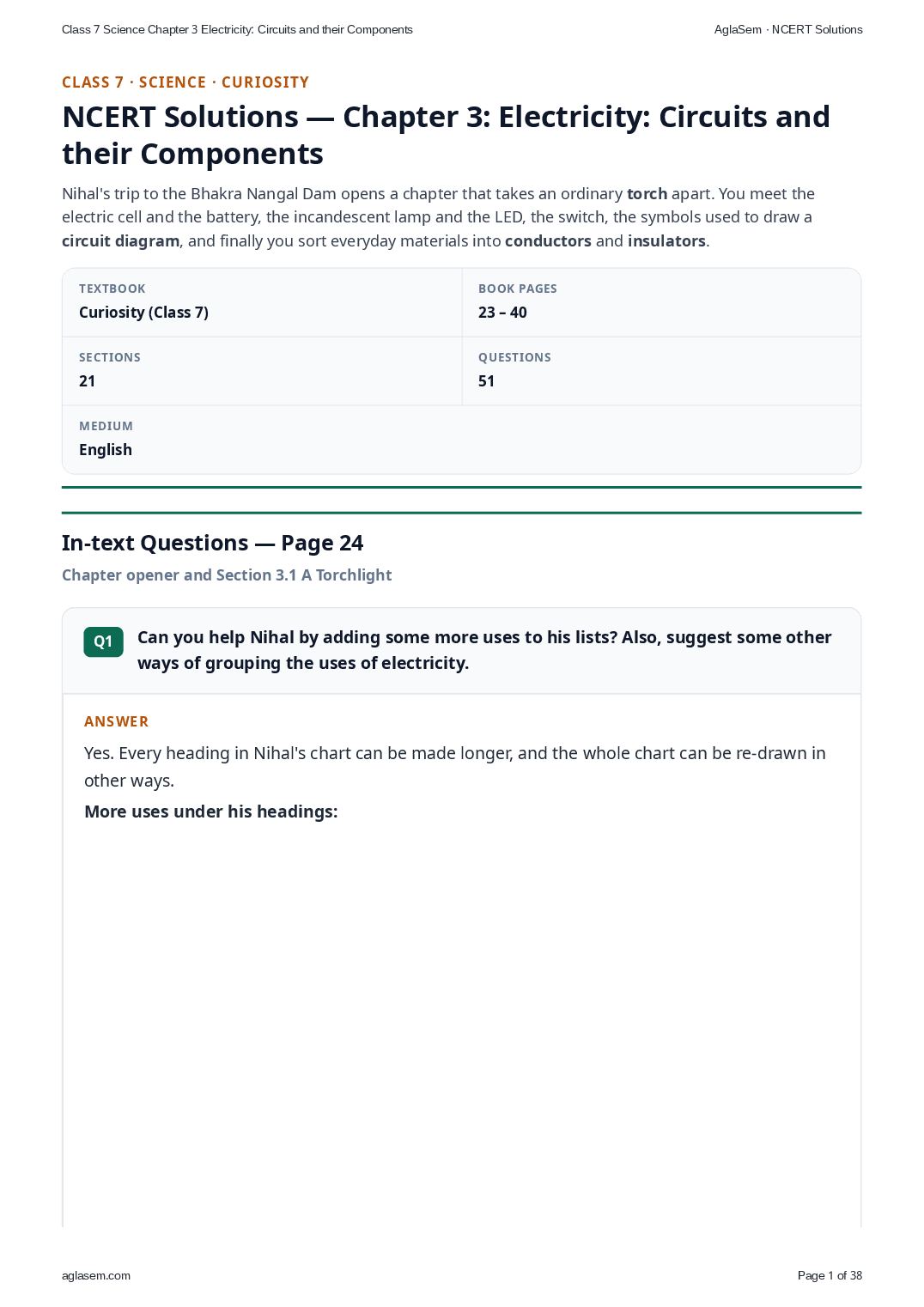
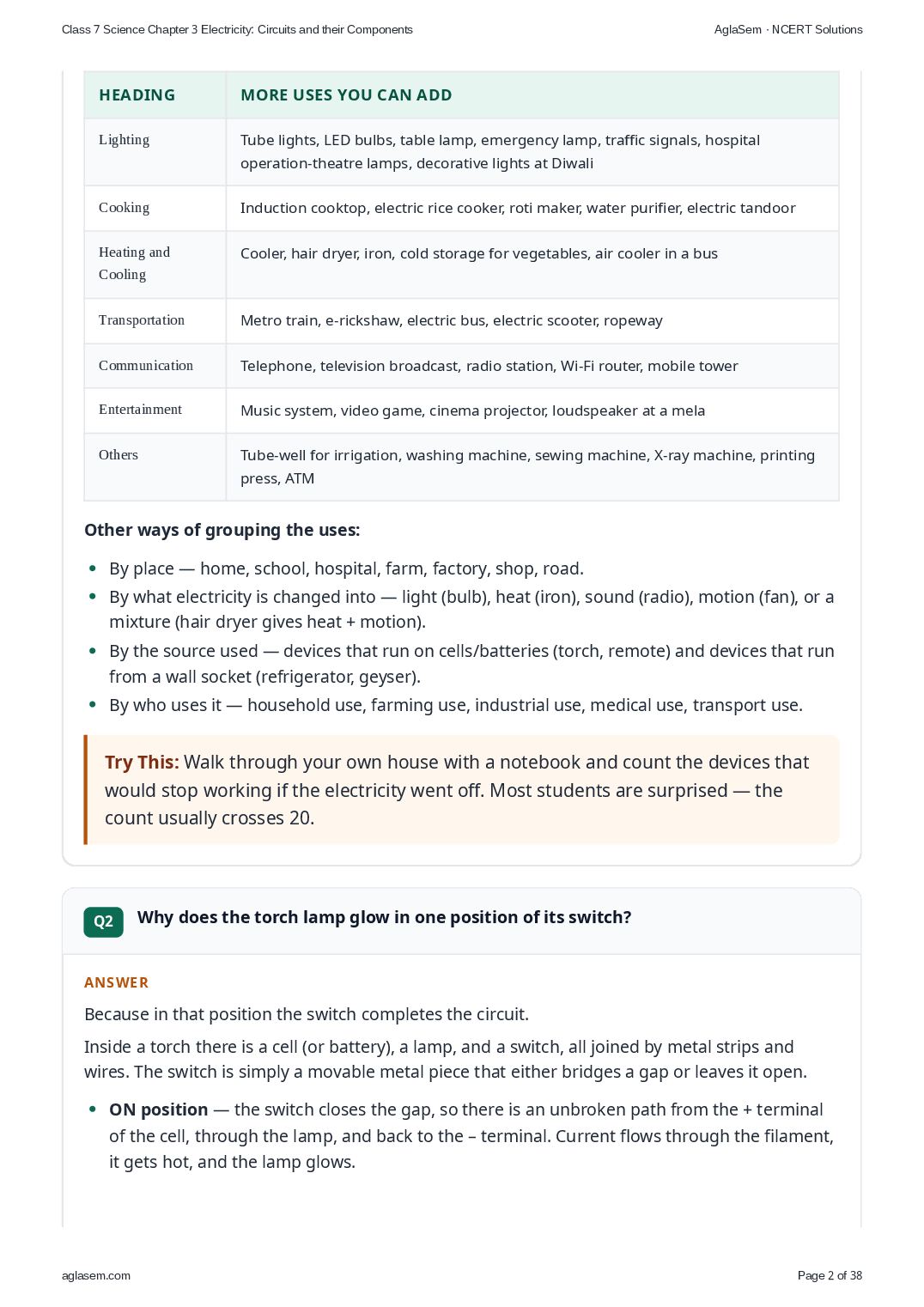
- Can you help Nihal by adding some more uses to his lists? Also, suggest some other ways of grouping the uses of electricity.
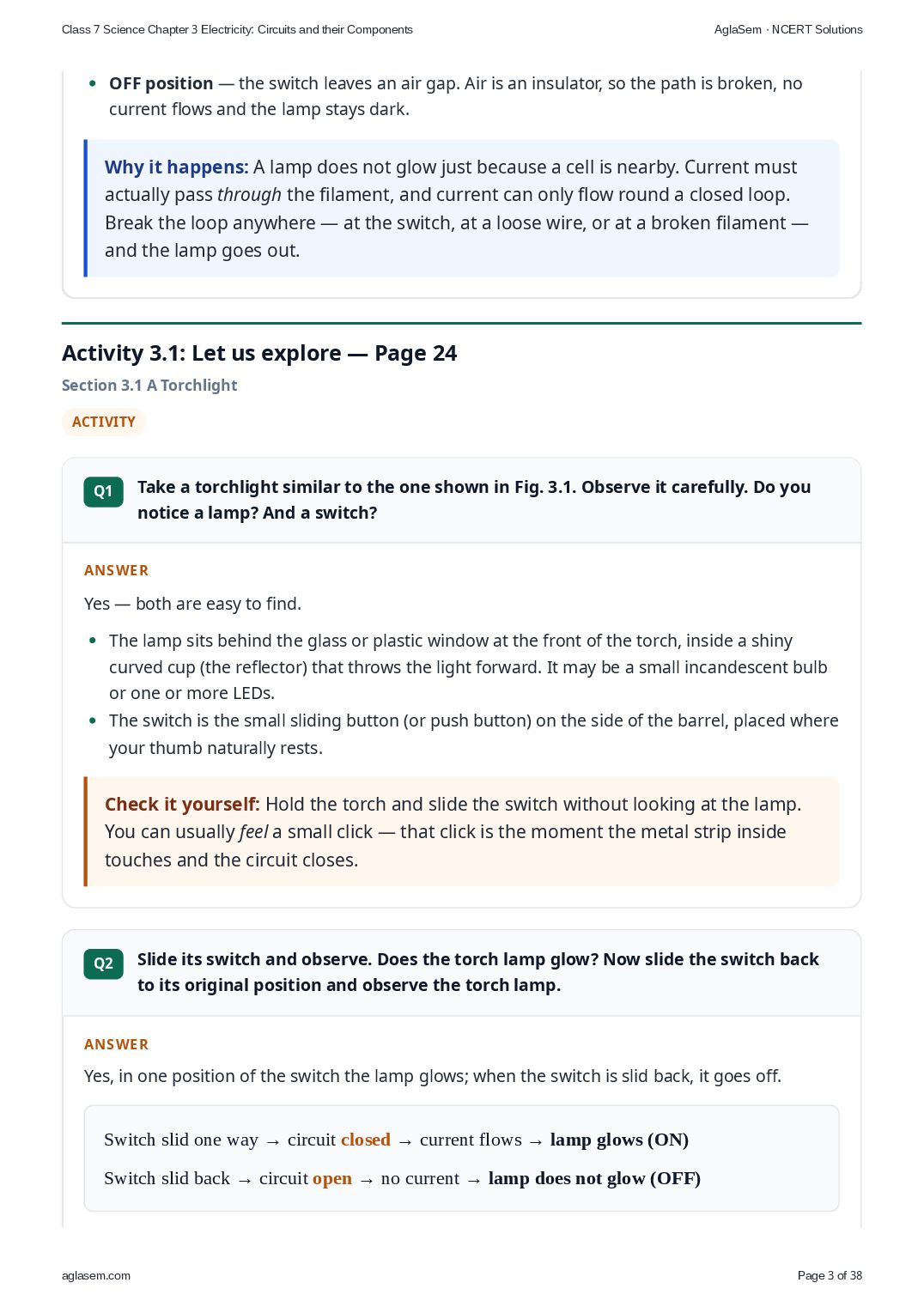
- Why does the torch lamp glow in one position of its switch?
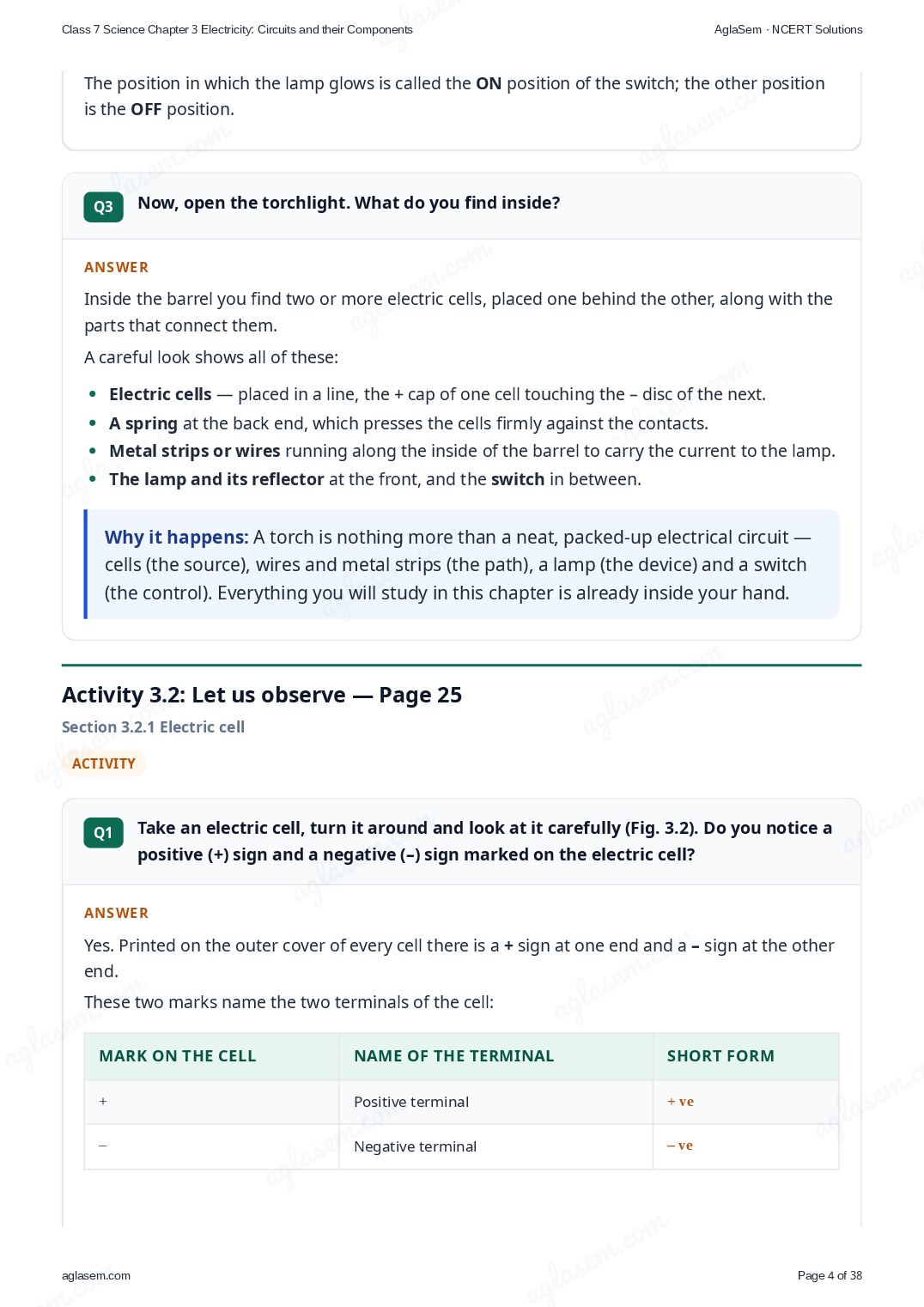
- Take a torchlight similar to the one shown in Fig. 3.1. Observe it carefully. Do you notice a lamp? And a switch?
- Slide its switch and observe. Does the torch lamp glow? Now slide the switch back to its original position and observe the torch lamp.
- Now, open the torchlight. What do you find inside?
- Take an electric cell, turn it around and look at it carefully (Fig. 3.2). Do you notice a positive (+) sign and a negative (–) sign marked on the electric cell?
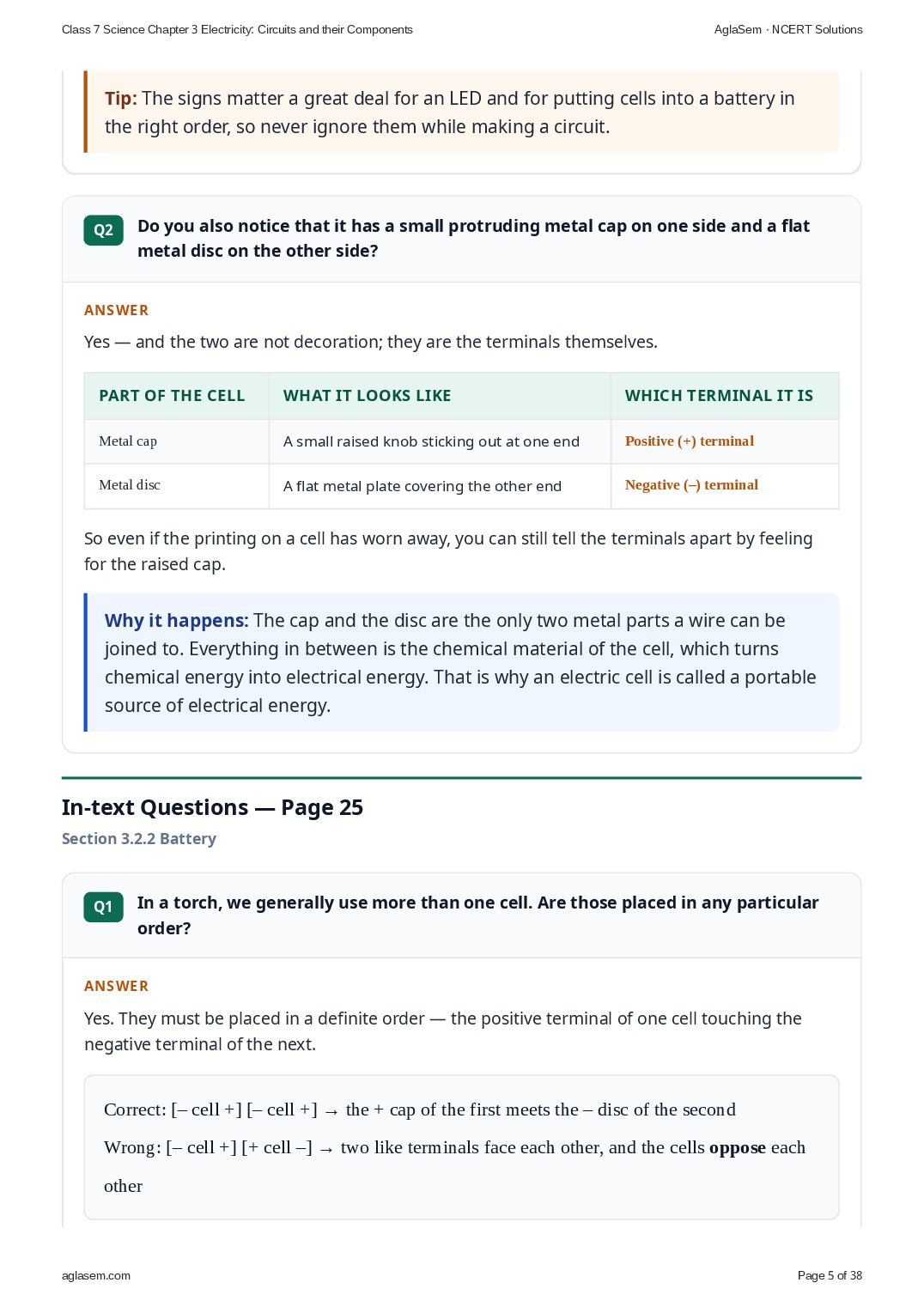
- Do you also notice that it has a small protruding metal cap on one side and a flat metal disc on the other side?
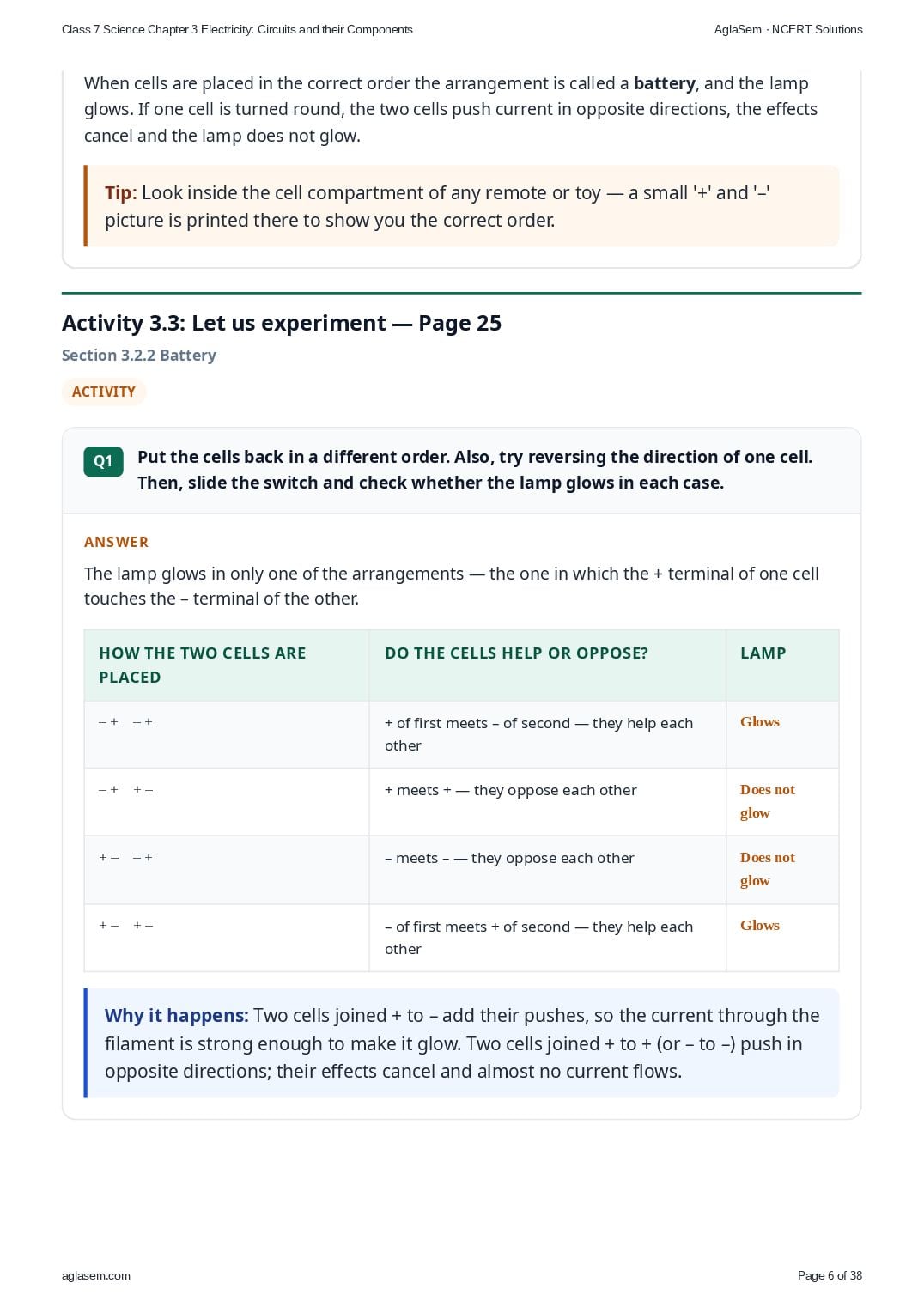
- In a torch, we generally use more than one cell. Are those placed in any particular order?
- Put the cells back in a different order. Also, try reversing the direction of one cell. Then, slide the switch and check whether the lamp glows in each case.
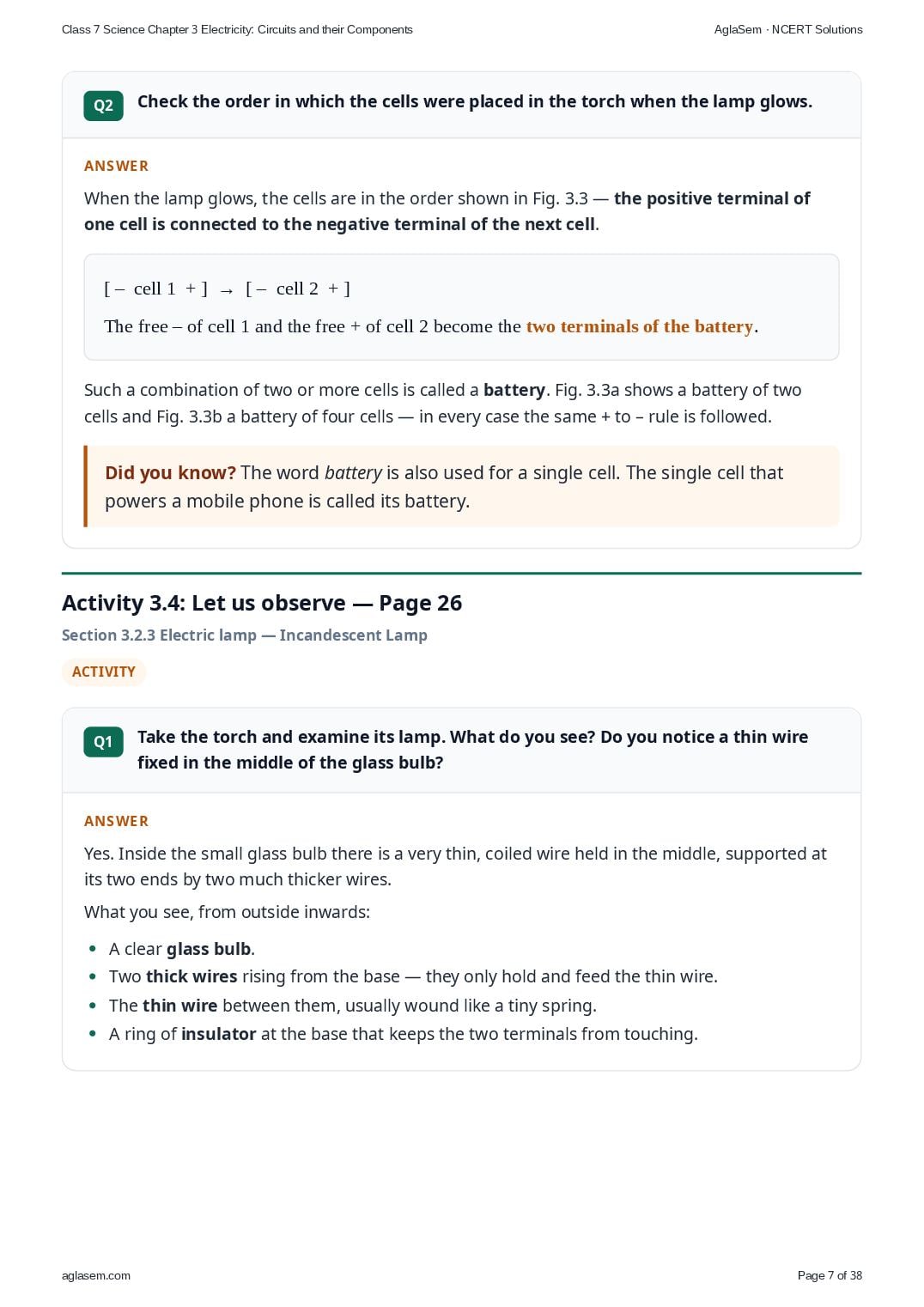
- Check the order in which the cells were placed in the torch when the lamp glows.
- Take the torch and examine its lamp. What do you see? Do you notice a thin wire fixed in the middle of the glass bulb?
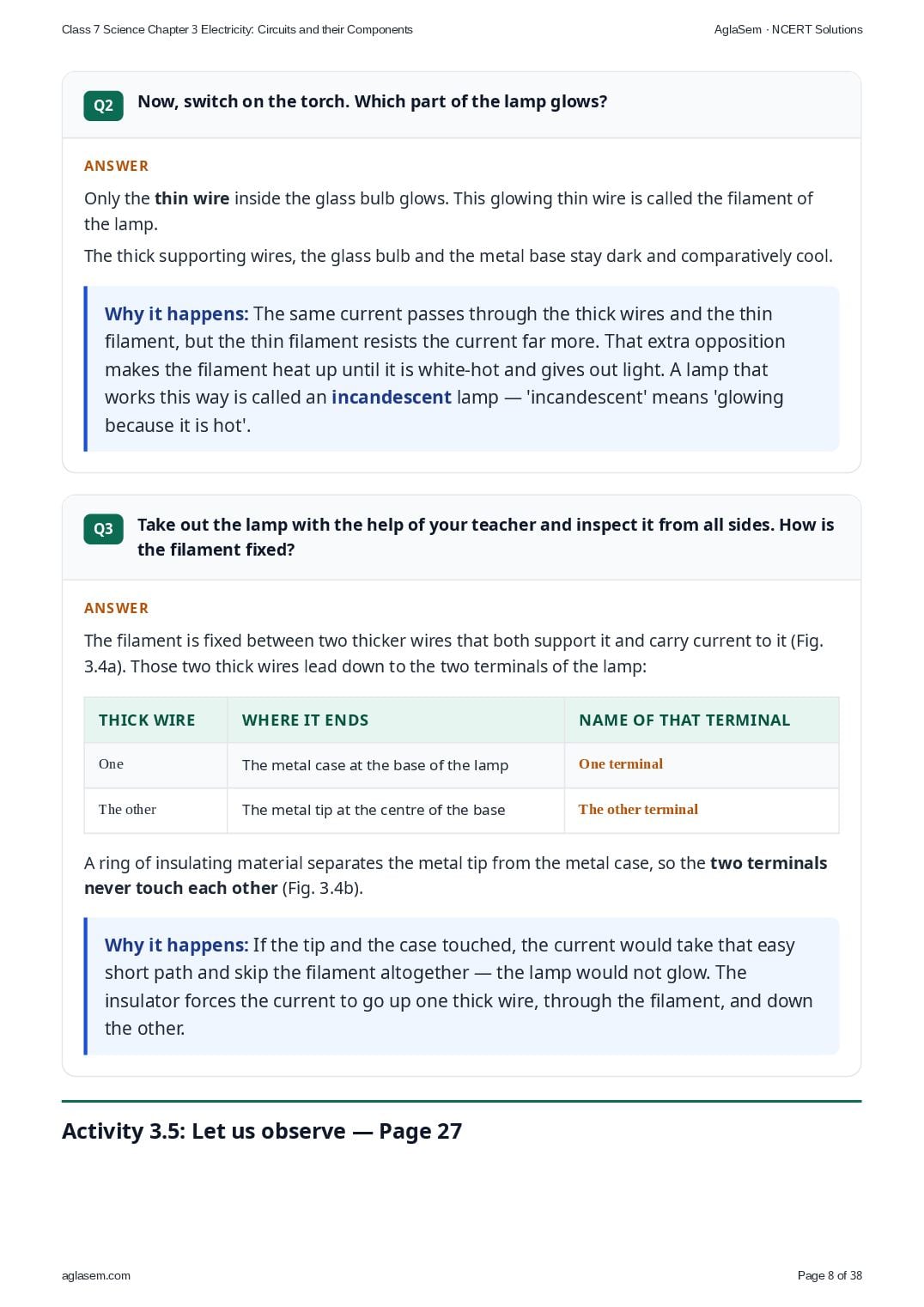
- Now, switch on the torch. Which part of the lamp glows?
- Take out the lamp with the help of your teacher and inspect it from all sides. How is the filament fixed?
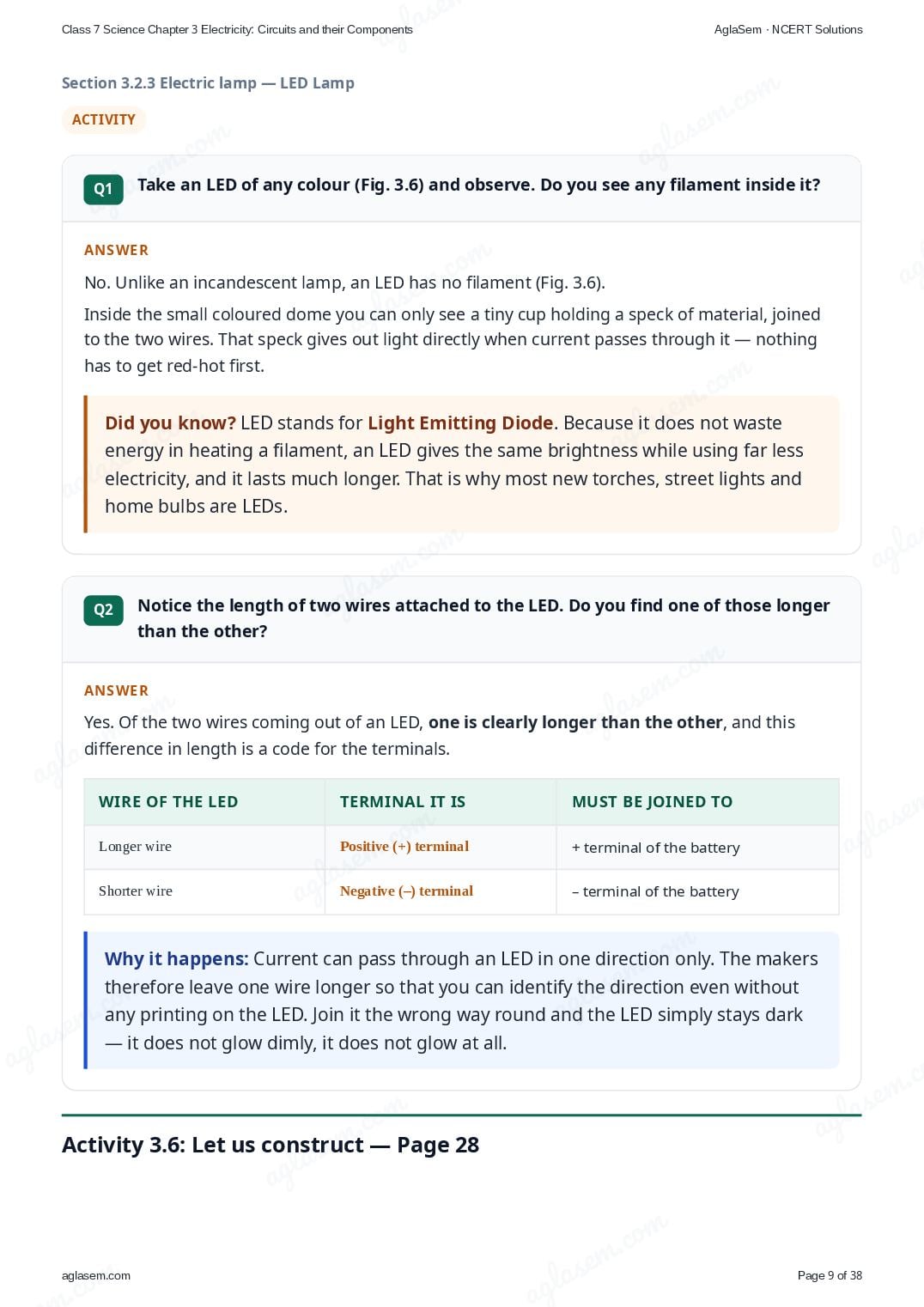
- Take an LED of any colour (Fig. 3.6) and observe. Do you see any filament inside it?
- Notice the length of two wires attached to the LED. Do you find one of those longer than the other?
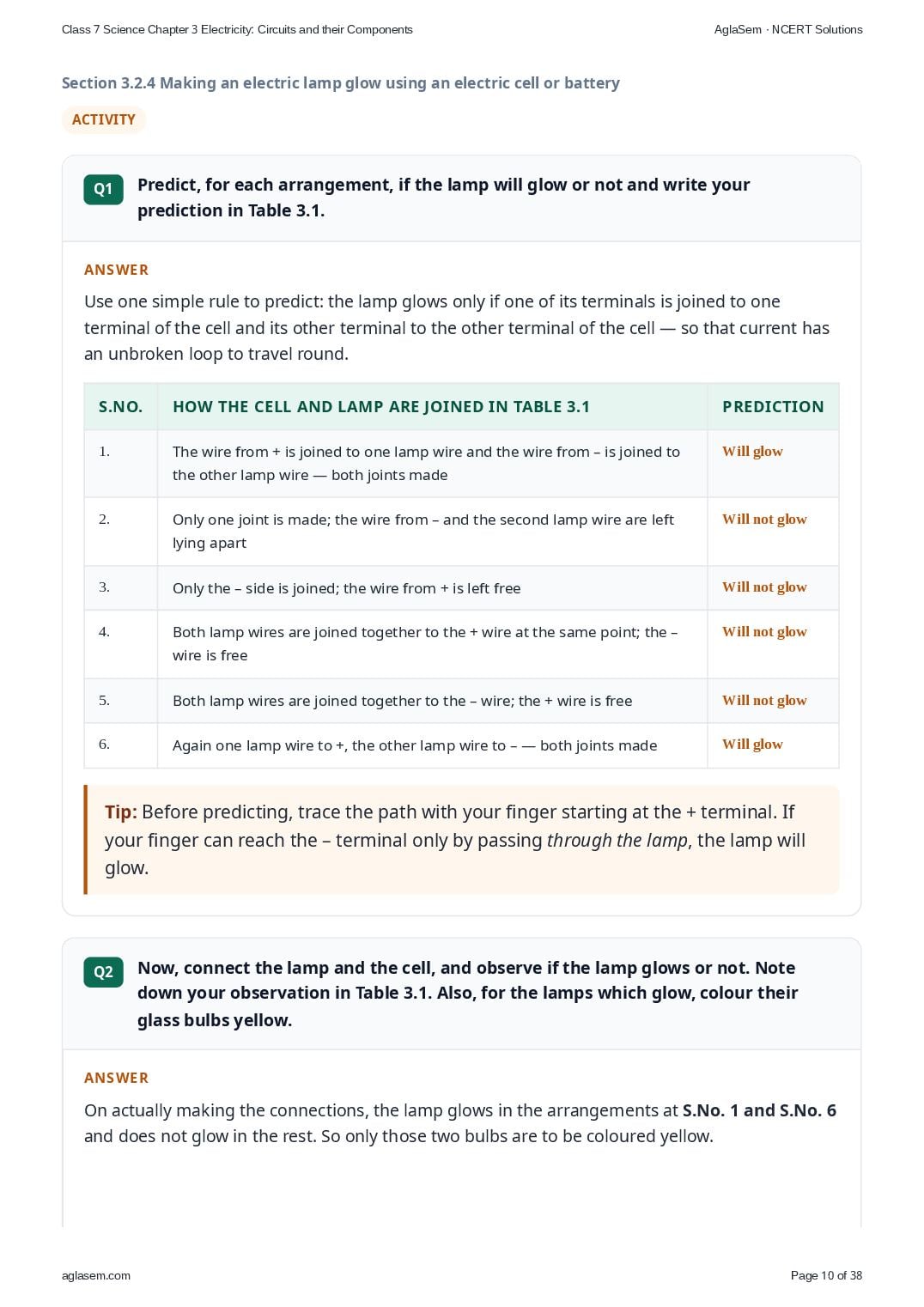
- Predict, for each arrangement, if the lamp will glow or not and write your prediction in Table 3.1.
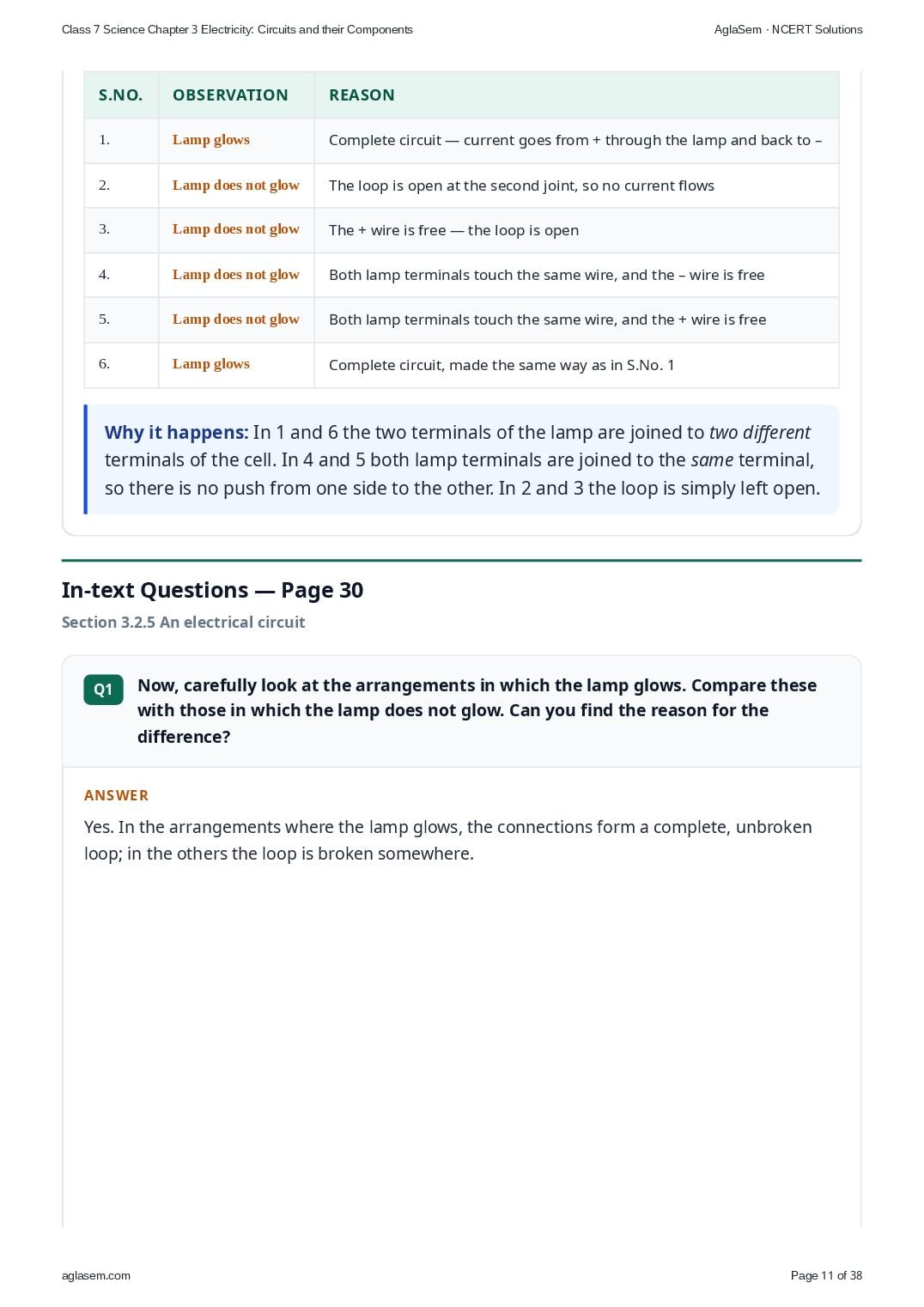
- Now, connect the lamp and the cell, and observe if the lamp glows or not. Note down your observation in Table 3.1. Also, for the lamps which glow, colour their glass bulbs yellow.
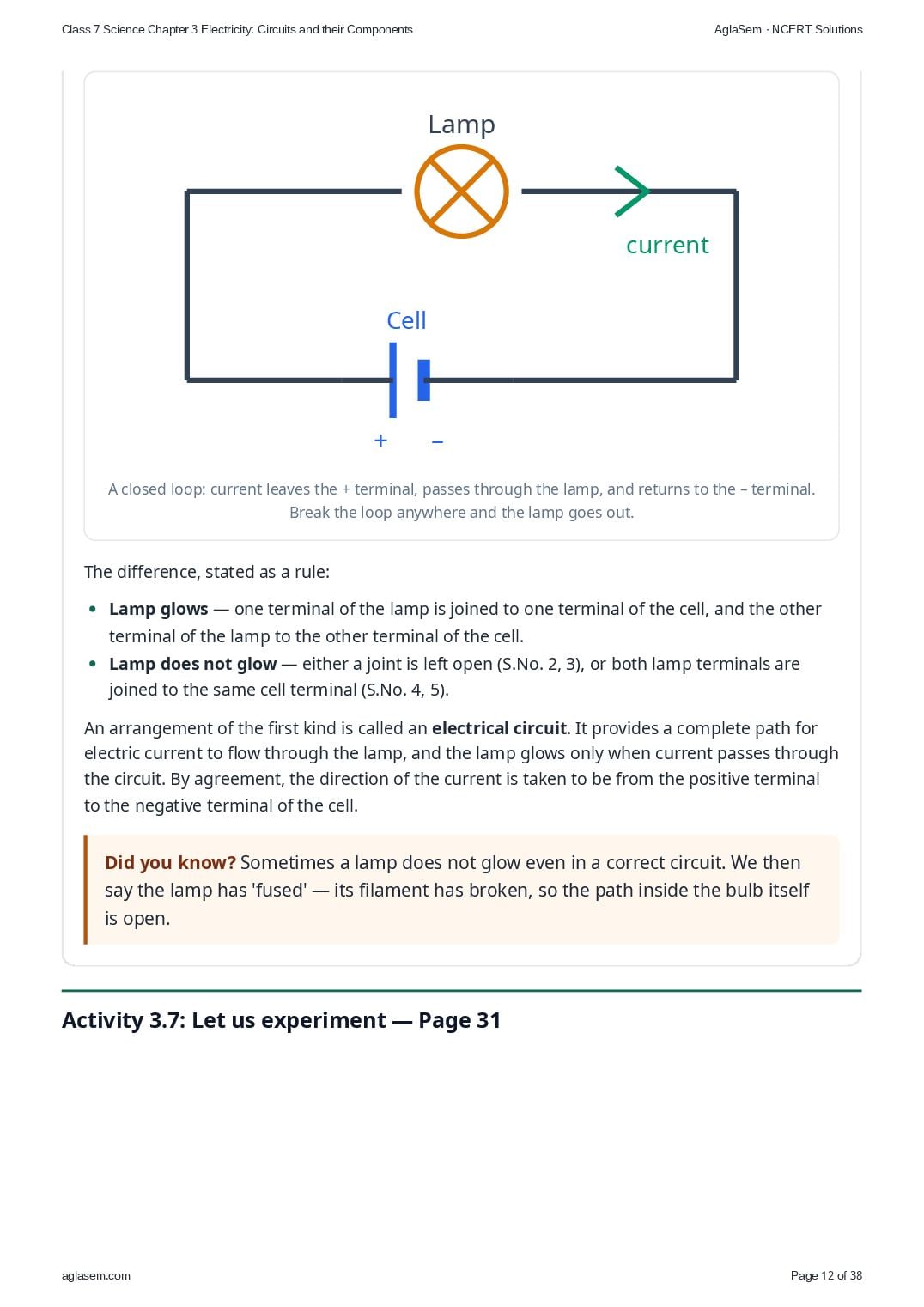
- Now, carefully look at the arrangements in which the lamp glows. Compare these with those in which the lamp does not glow. Can you find the reason for the difference?
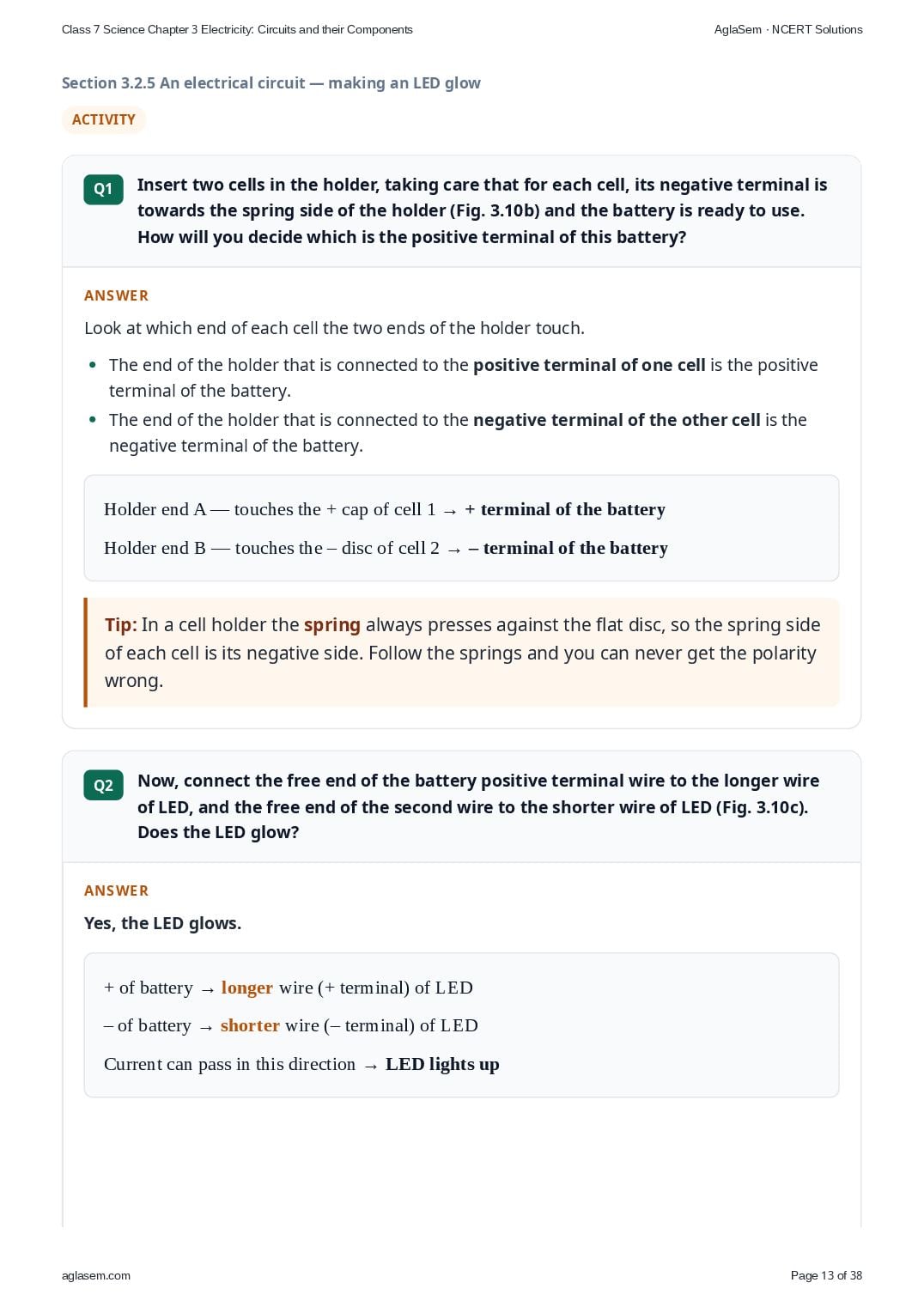
- Insert two cells in the holder, taking care that for each cell, its negative terminal is towards the spring side of the holder (Fig. 3.10b) and the battery is ready to use. How will you decide which is the positive terminal of this battery?
- Now, connect the free end of the battery positive terminal wire to the longer wire of LED, and the free end of the second wire to the shorter wire of LED (Fig. 3.10c). Does the LED glow?
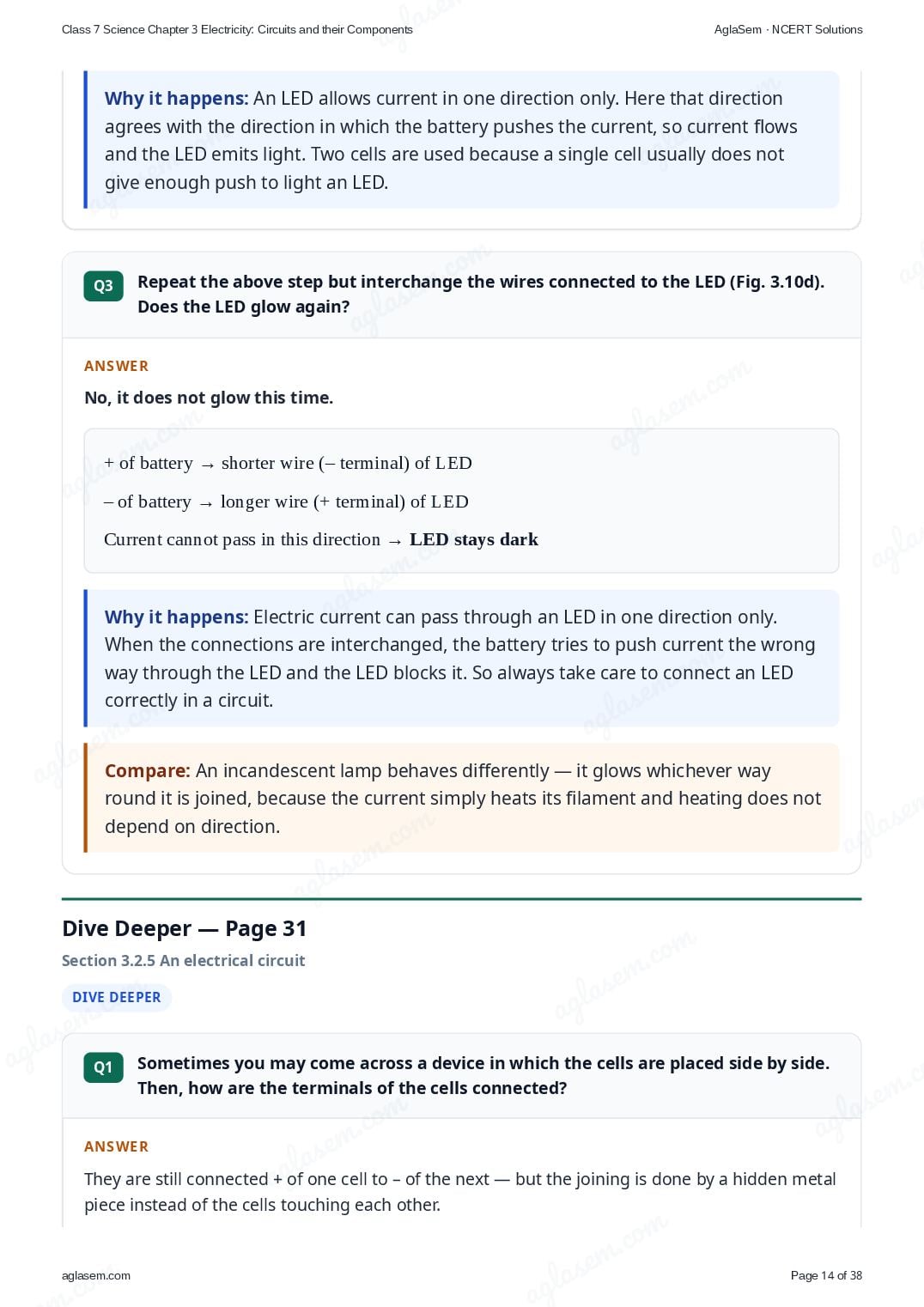
- Repeat the above step but interchange the wires connected to the LED (Fig. 3.10d). Does the LED glow again?
- Sometimes you may come across a device in which the cells are placed side by side. Then, how are the terminals of the cells connected?
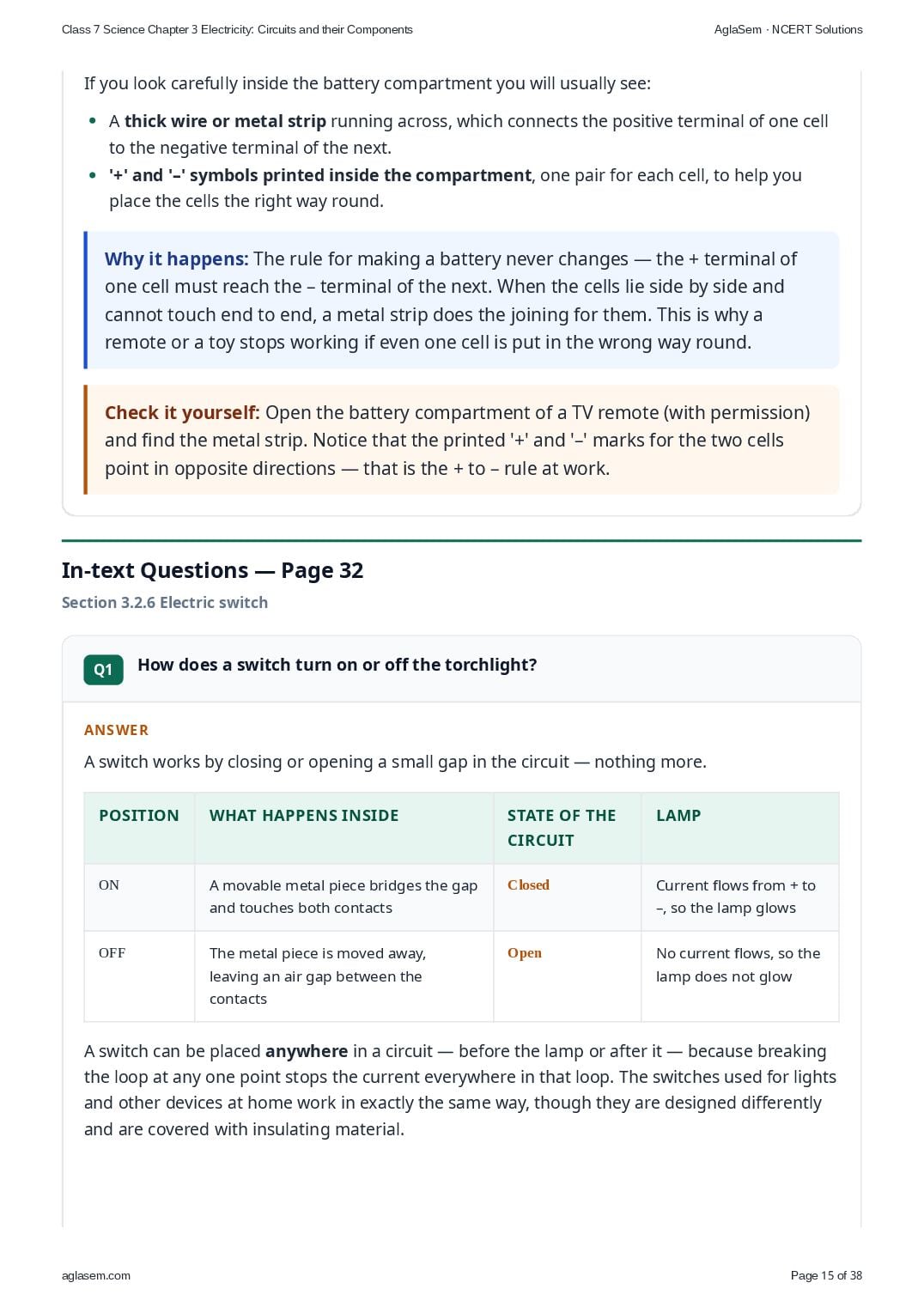
- How does a switch turn on or off the torchlight?
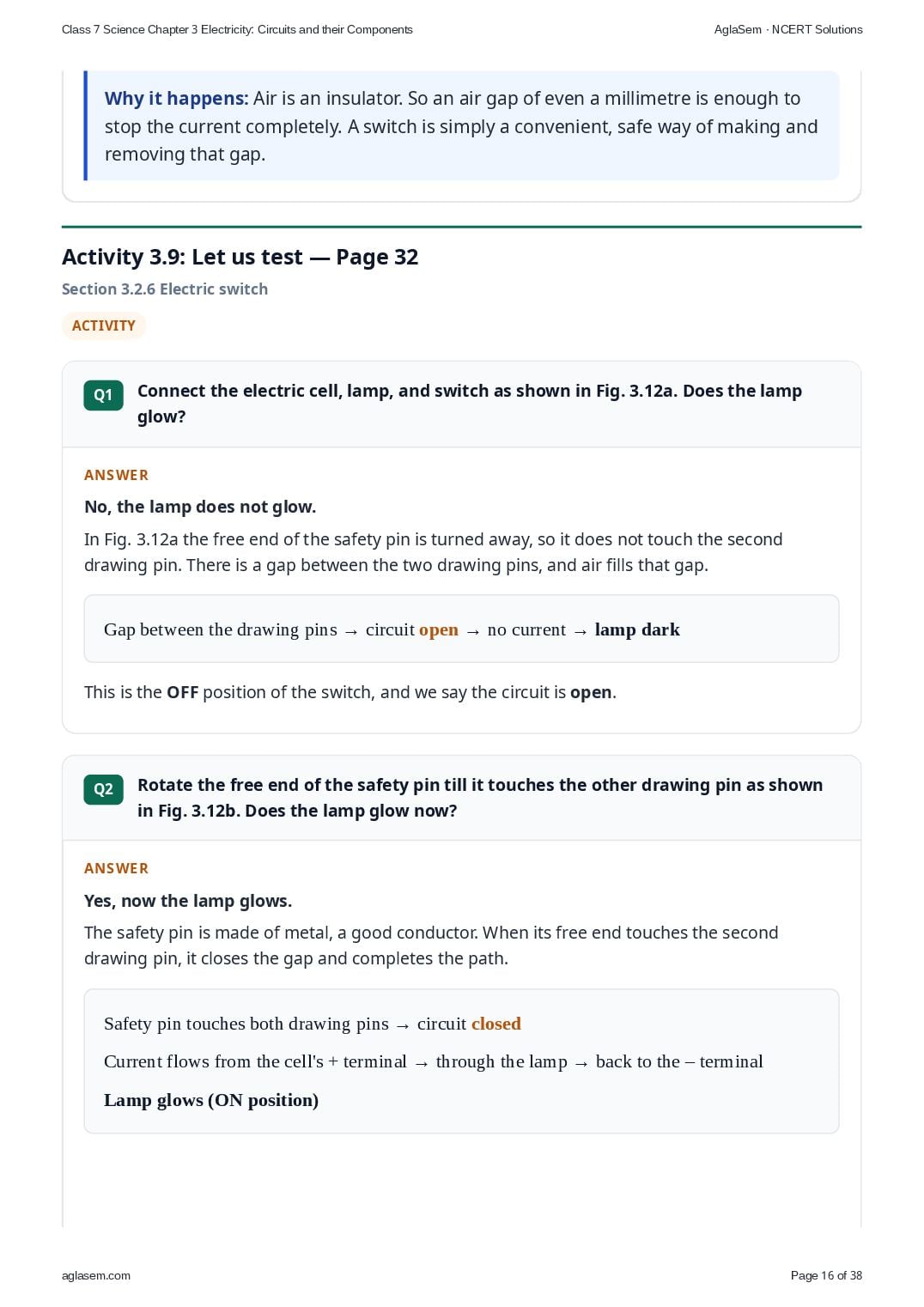
- Connect the electric cell, lamp, and switch as shown in Fig. 3.12a. Does the lamp glow?
- Rotate the free end of the safety pin till it touches the other drawing pin as shown in Fig. 3.12b. Does the lamp glow now?
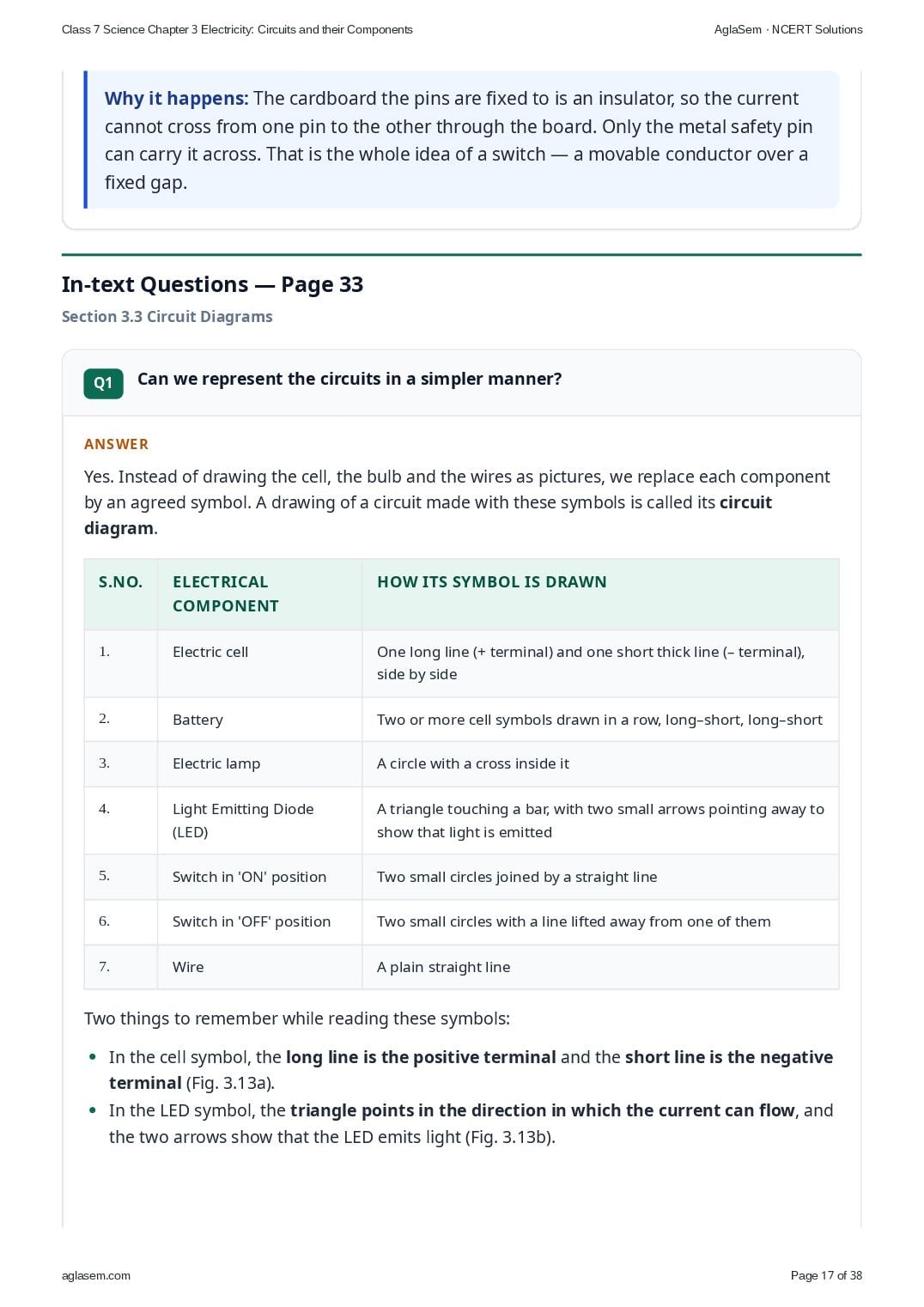
- Can we represent the circuits in a simpler manner?
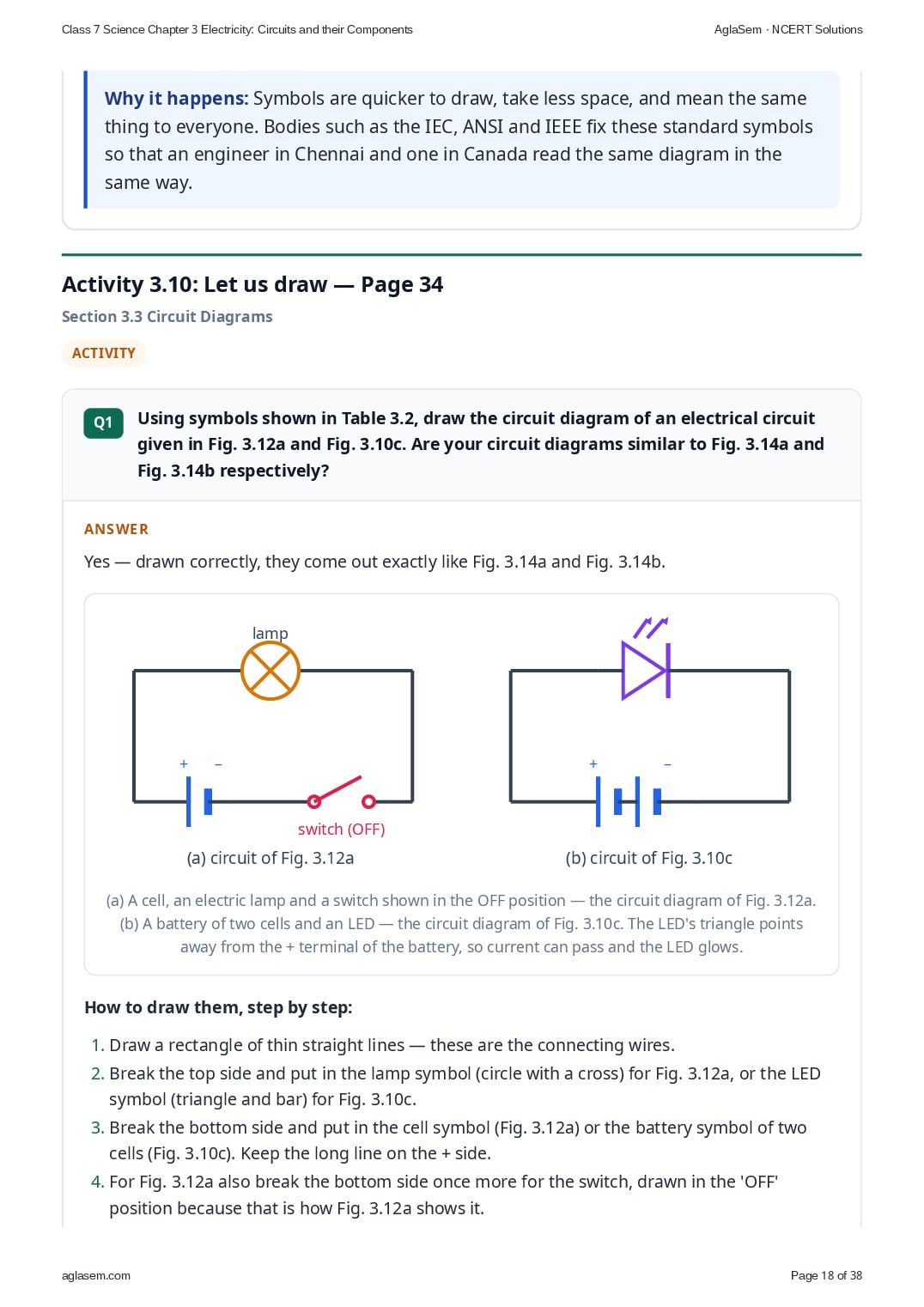
- Using symbols shown in Table 3.2, draw the circuit diagram of an electrical circuit given in Fig. 3.12a and Fig. 3.10c. Are your circuit diagrams similar to Fig. 3.14a and Fig. 3.14b respectively?
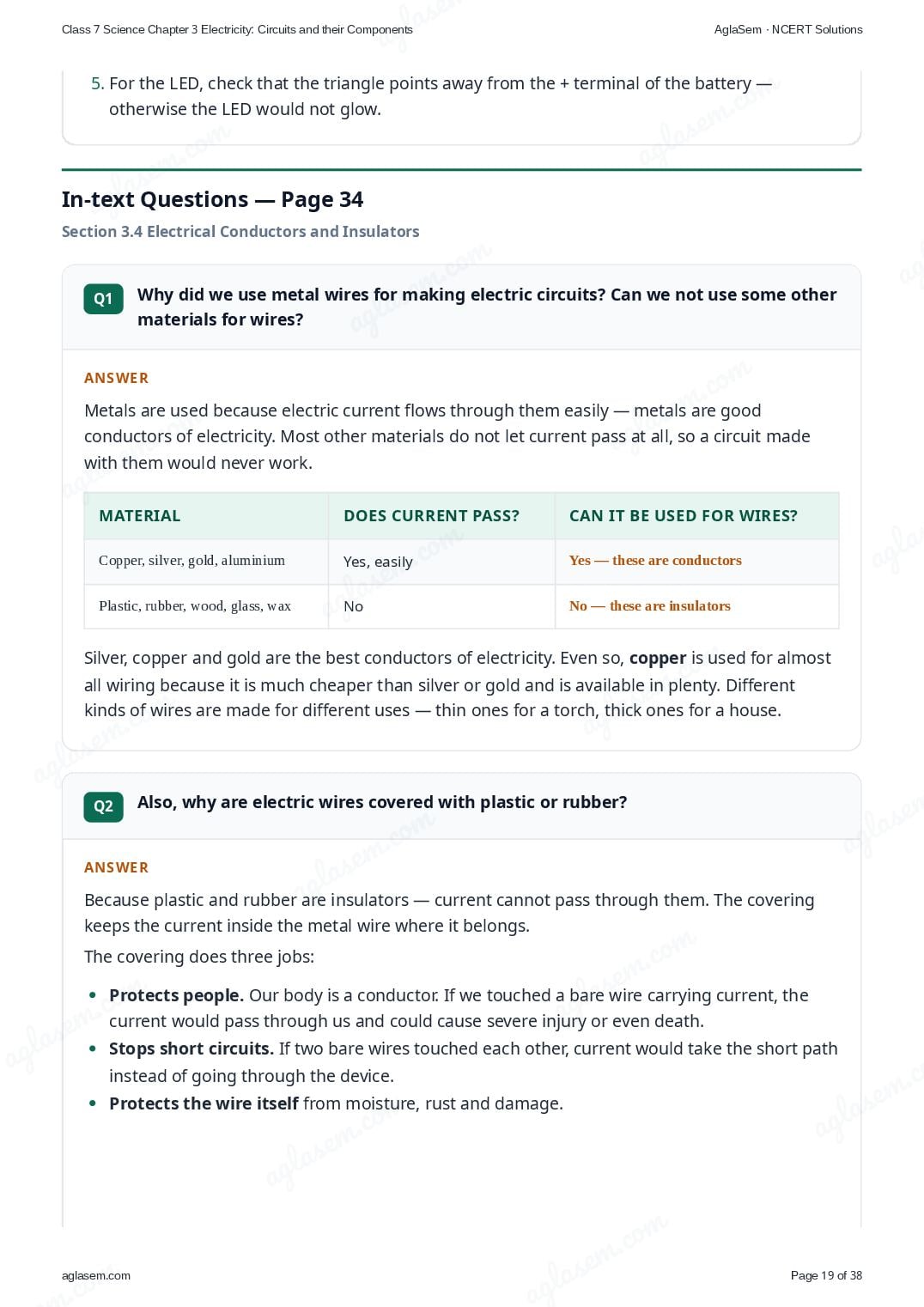
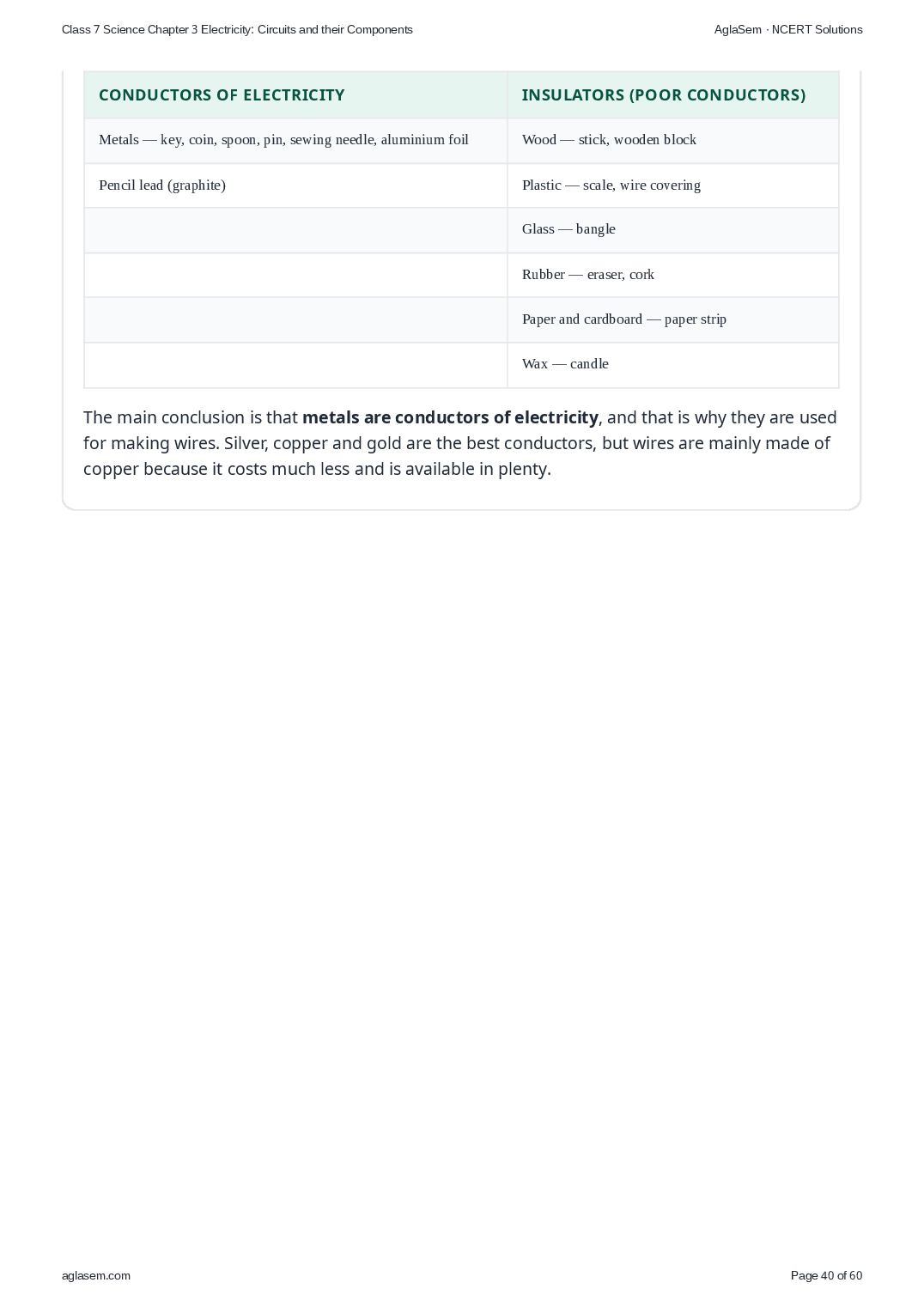
- Why did we use metal wires for making electric circuits? Can we not use some other materials for wires?
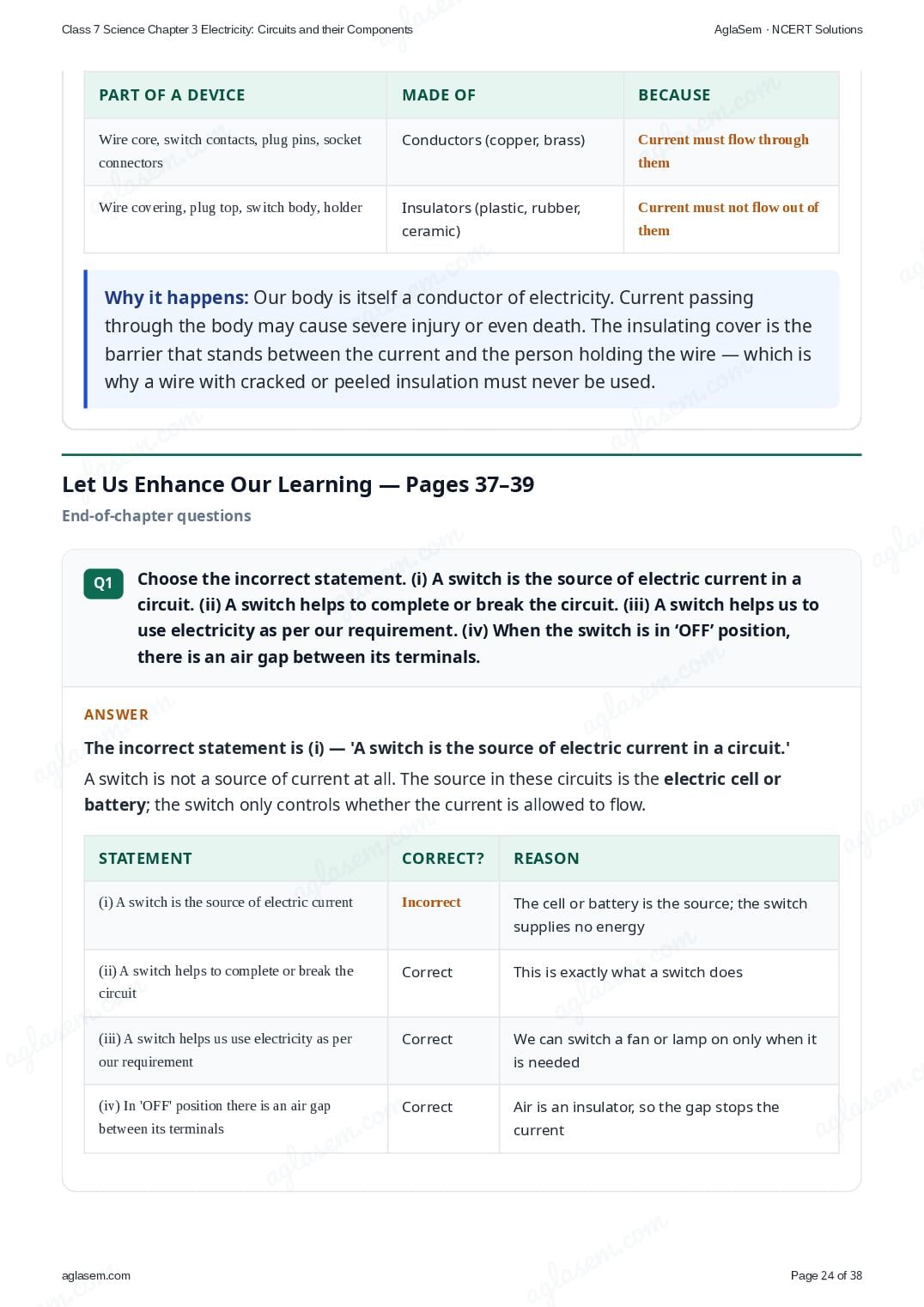
- Also, why are electric wires covered with plastic or rubber?
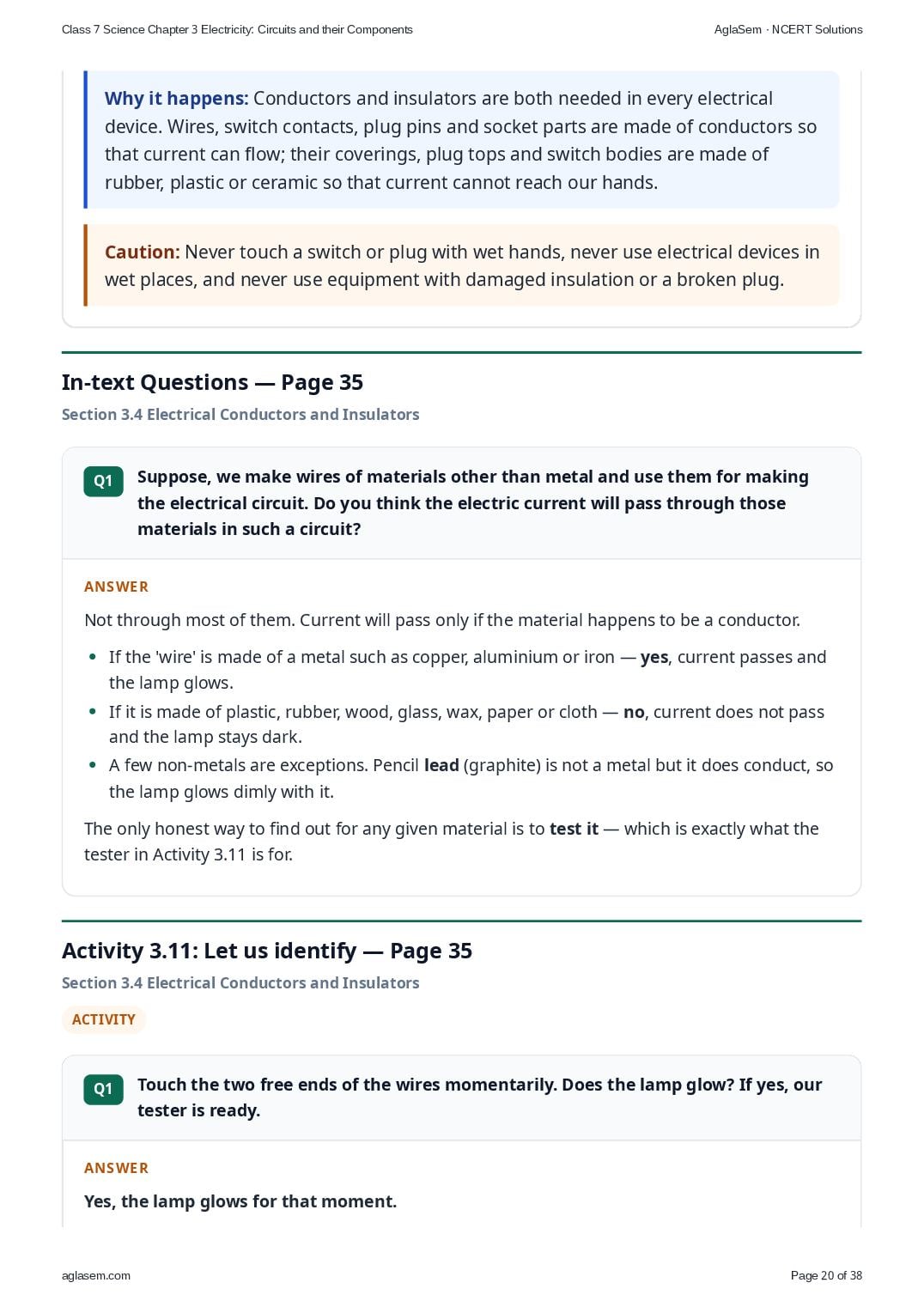
- Suppose, we make wires of materials other than metal and use them for making the electrical circuit. Do you think the electric current will pass through those materials in such a circuit?
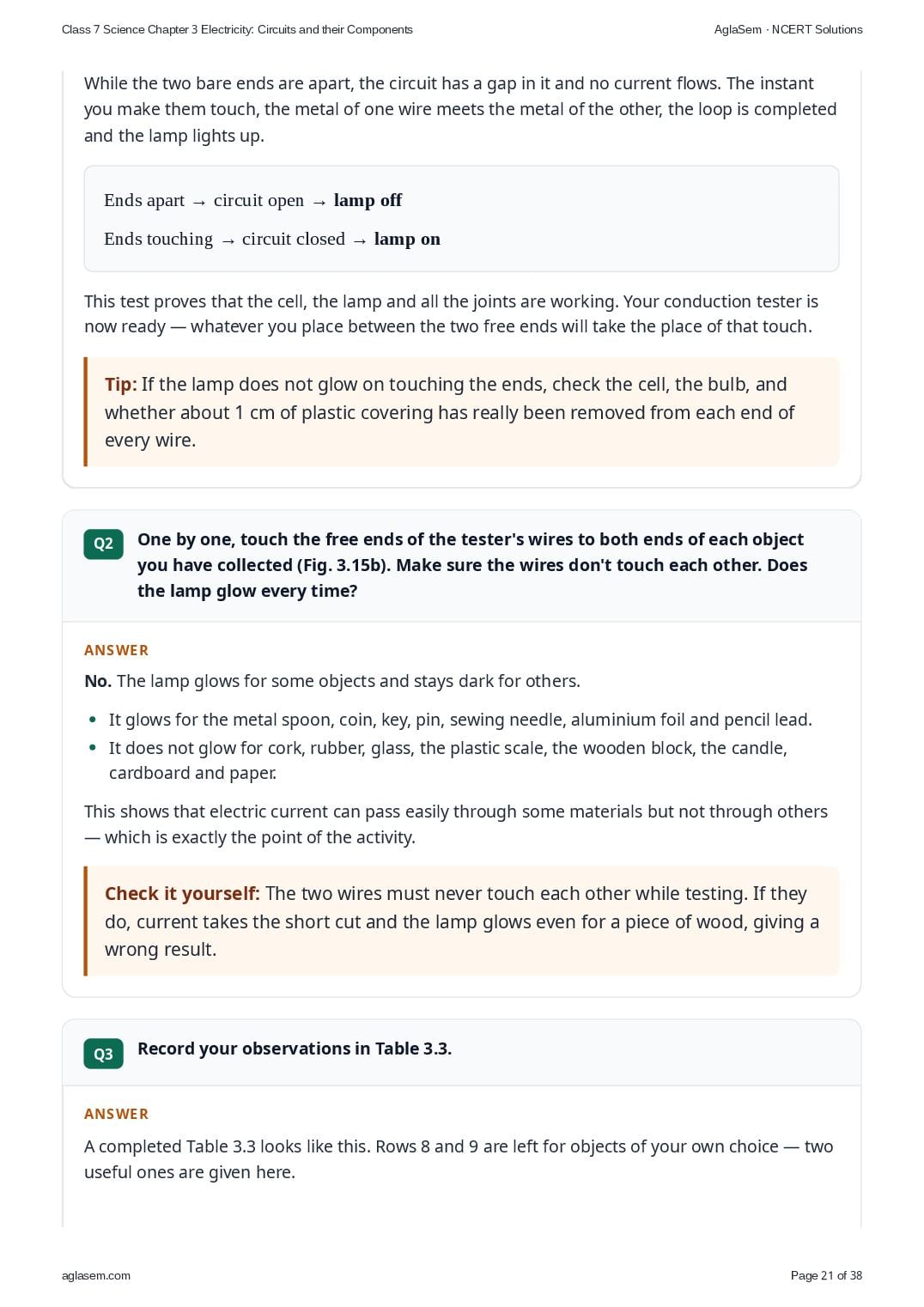
- Touch the two free ends of the wires momentarily. Does the lamp glow? If yes, our tester is ready.
- One by one, touch the free ends of the tester's wires to both ends of each object you have collected (Fig. 3.15b). Make sure the wires don't touch each other. Does the lamp glow every time?
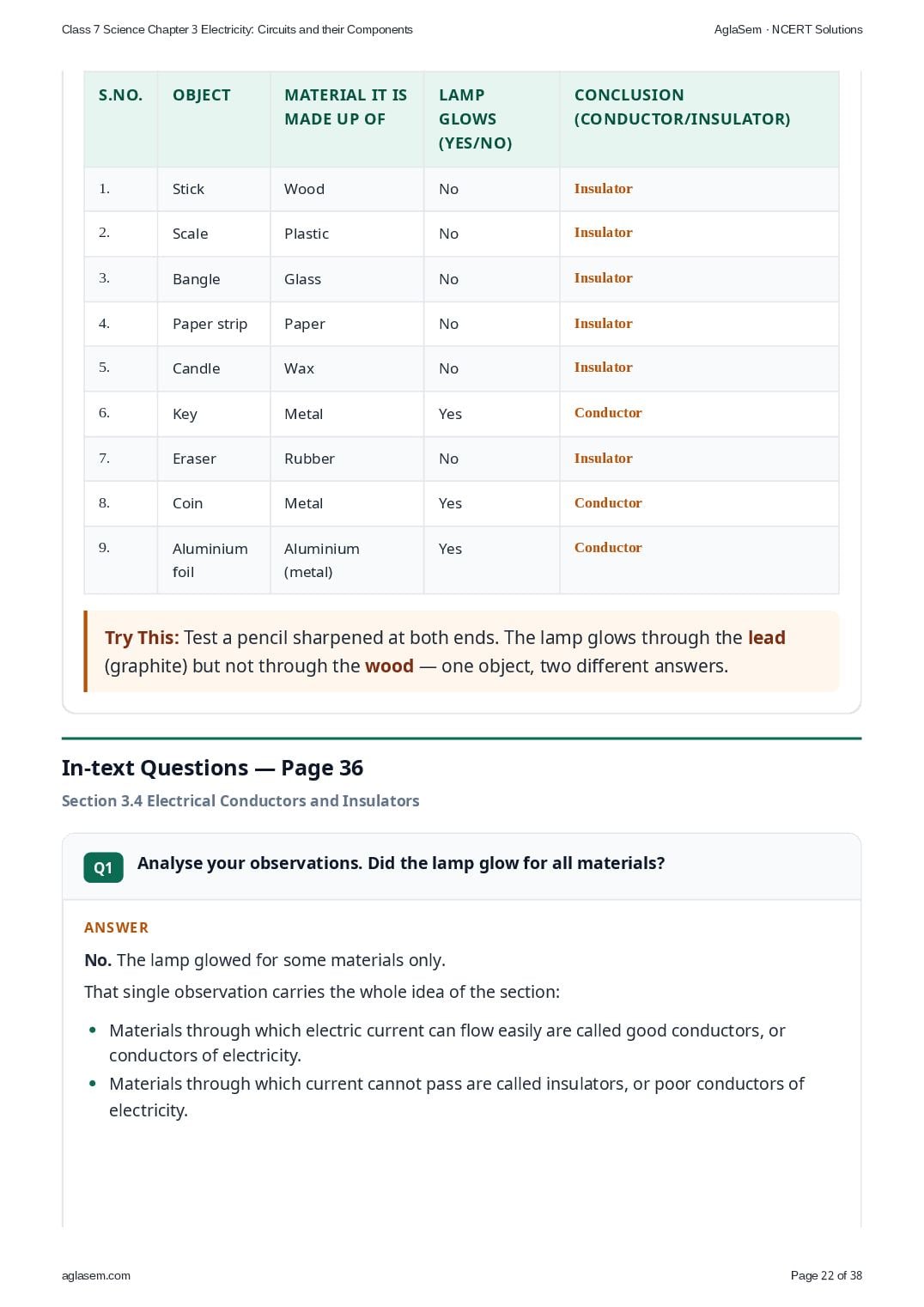
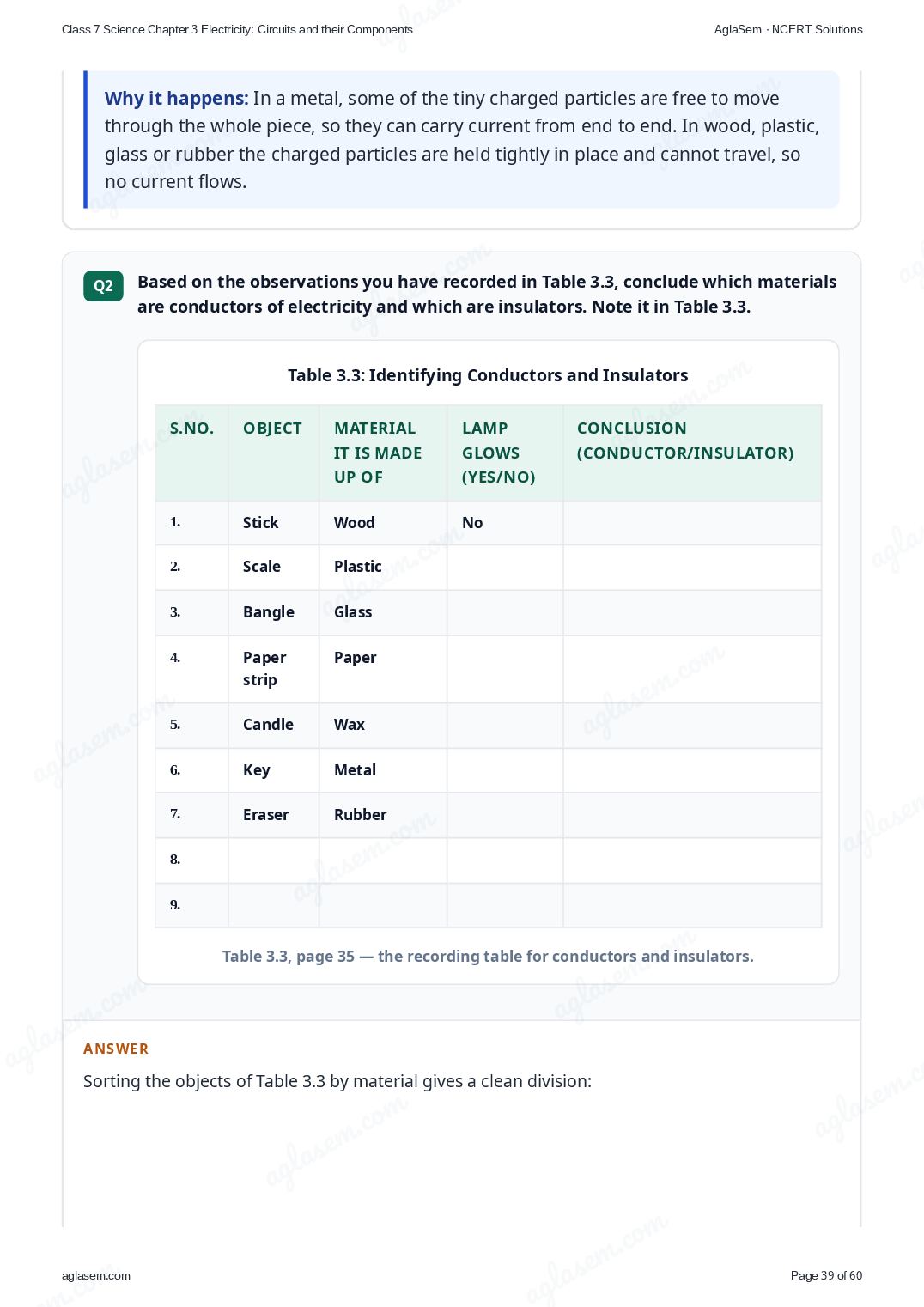
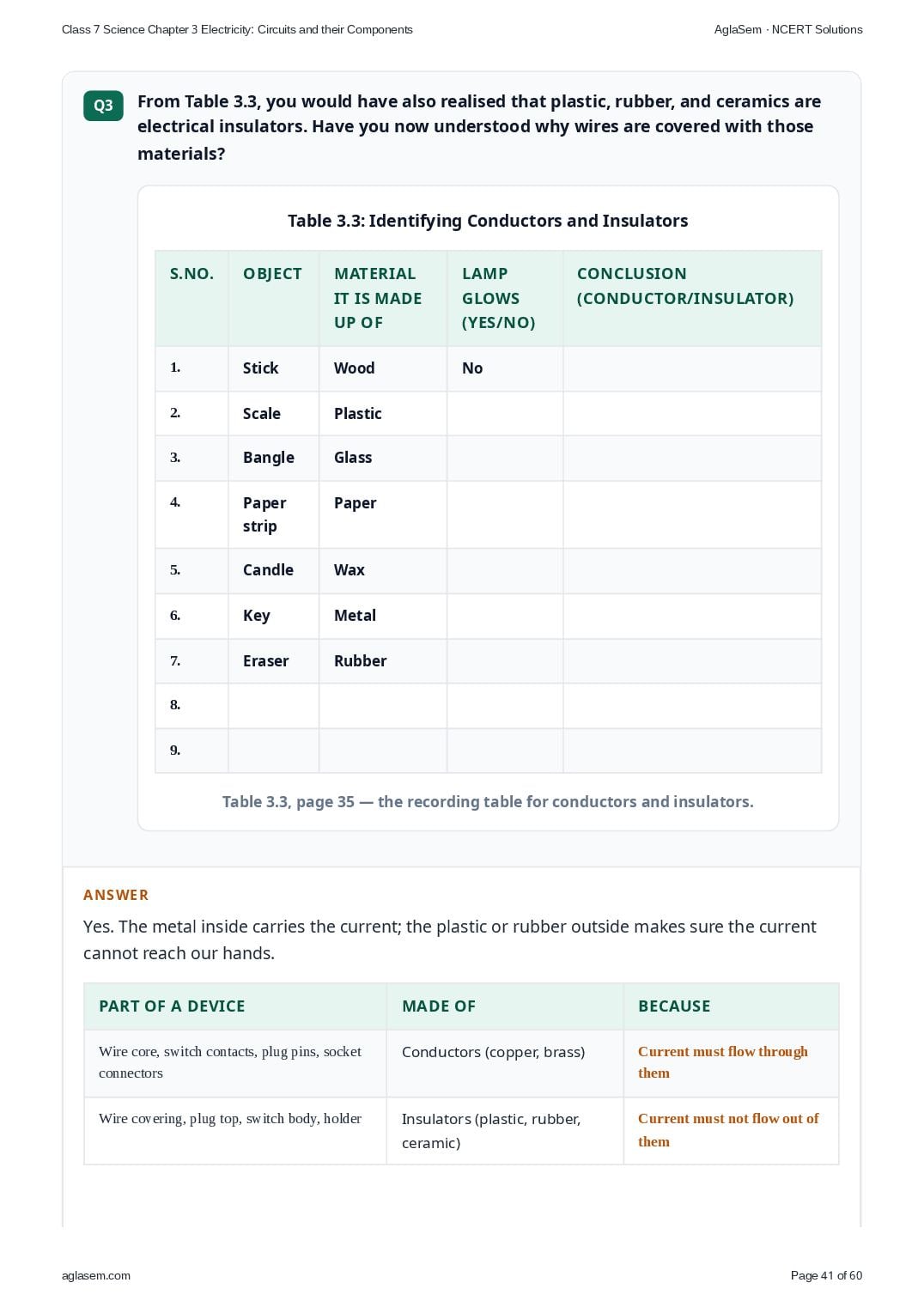
- Record your observations in Table 3.3.
- Analyse your observations. Did the lamp glow for all materials?
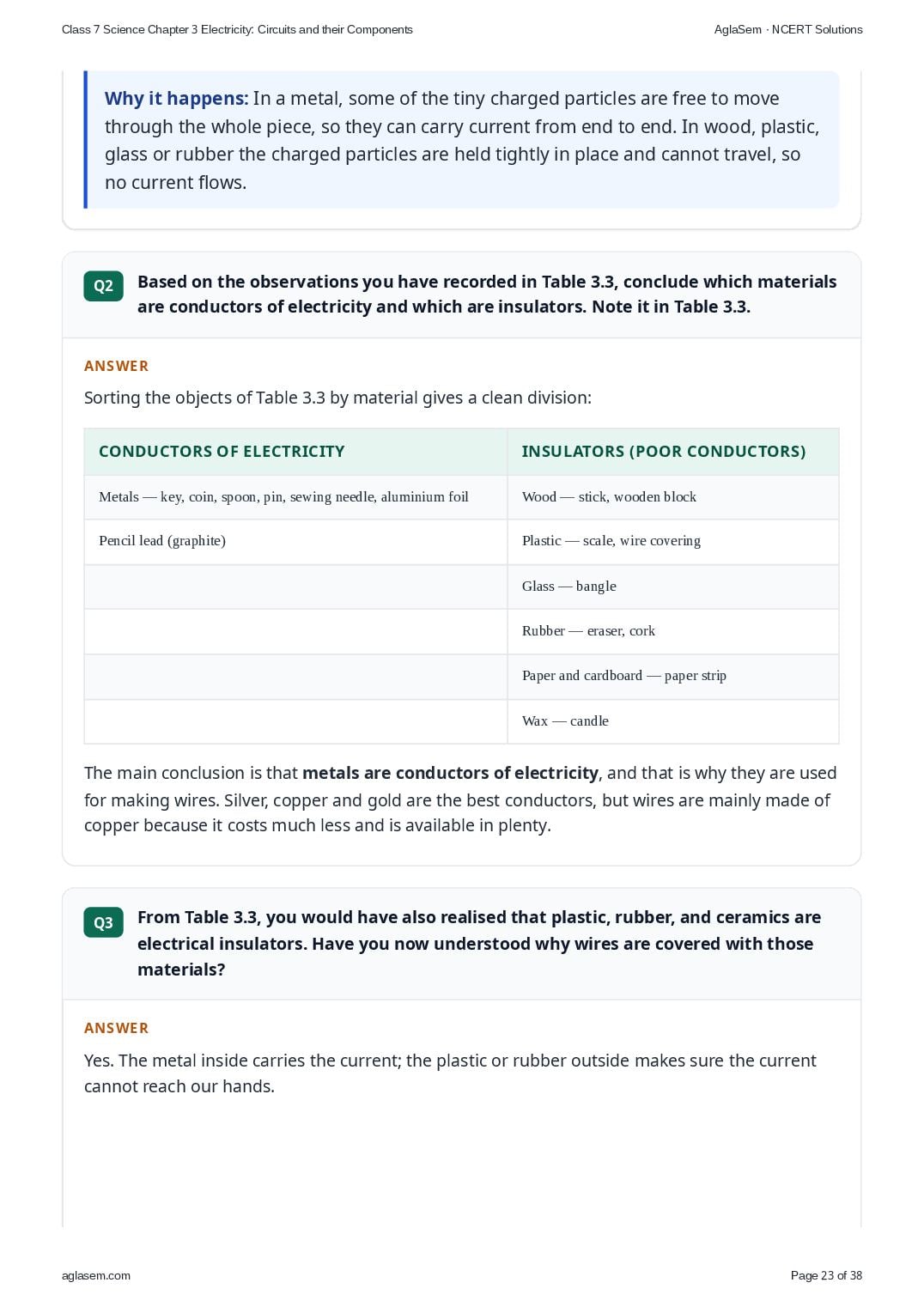
- Based on the observations you have recorded in Table 3.3, conclude which materials are conductors of electricity and which are insulators. Note it in Table 3.3.
- From Table 3.3, you would have also realised that plastic, rubber, and ceramics are electrical insulators. Have you now understood why wires are covered with those materials?
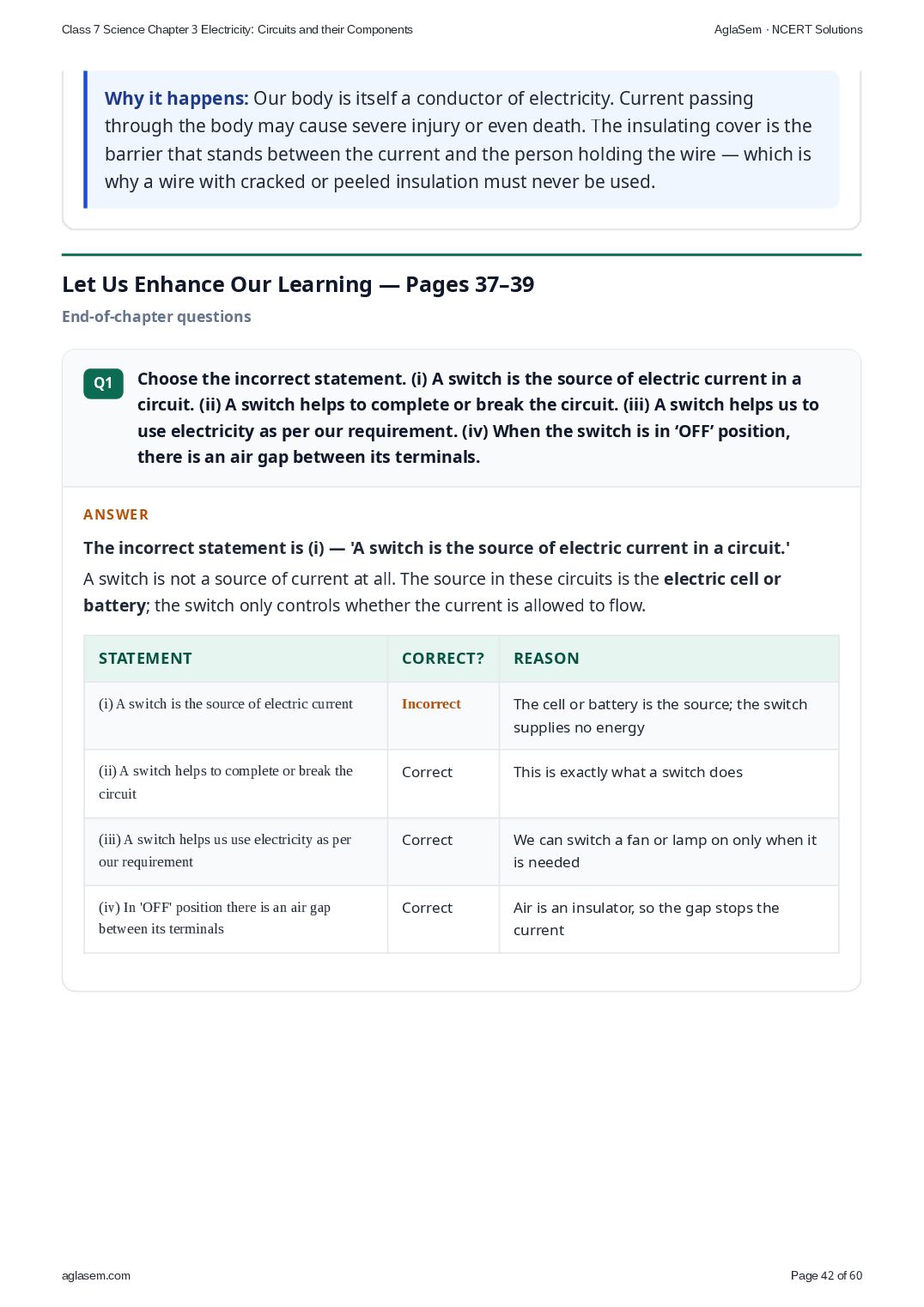
- Choose the incorrect statement. (i) A switch is the source of electric current in a circuit. (ii) A switch helps to complete or break the circuit. (iii) A switch helps us to use electricity as per our requirement. (iv) When the switch is in ‘OFF’ position, there is an air gap between its terminals.
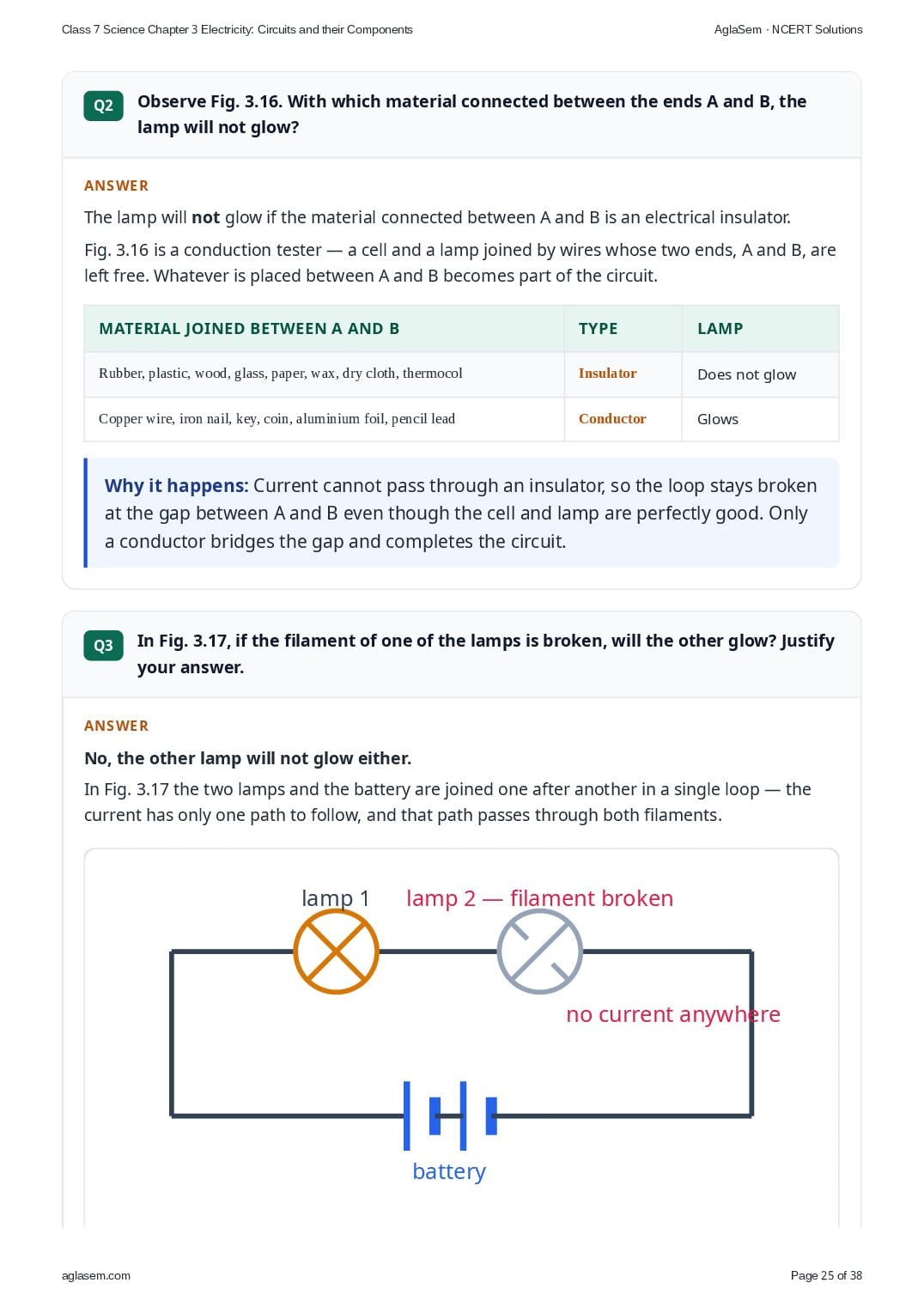
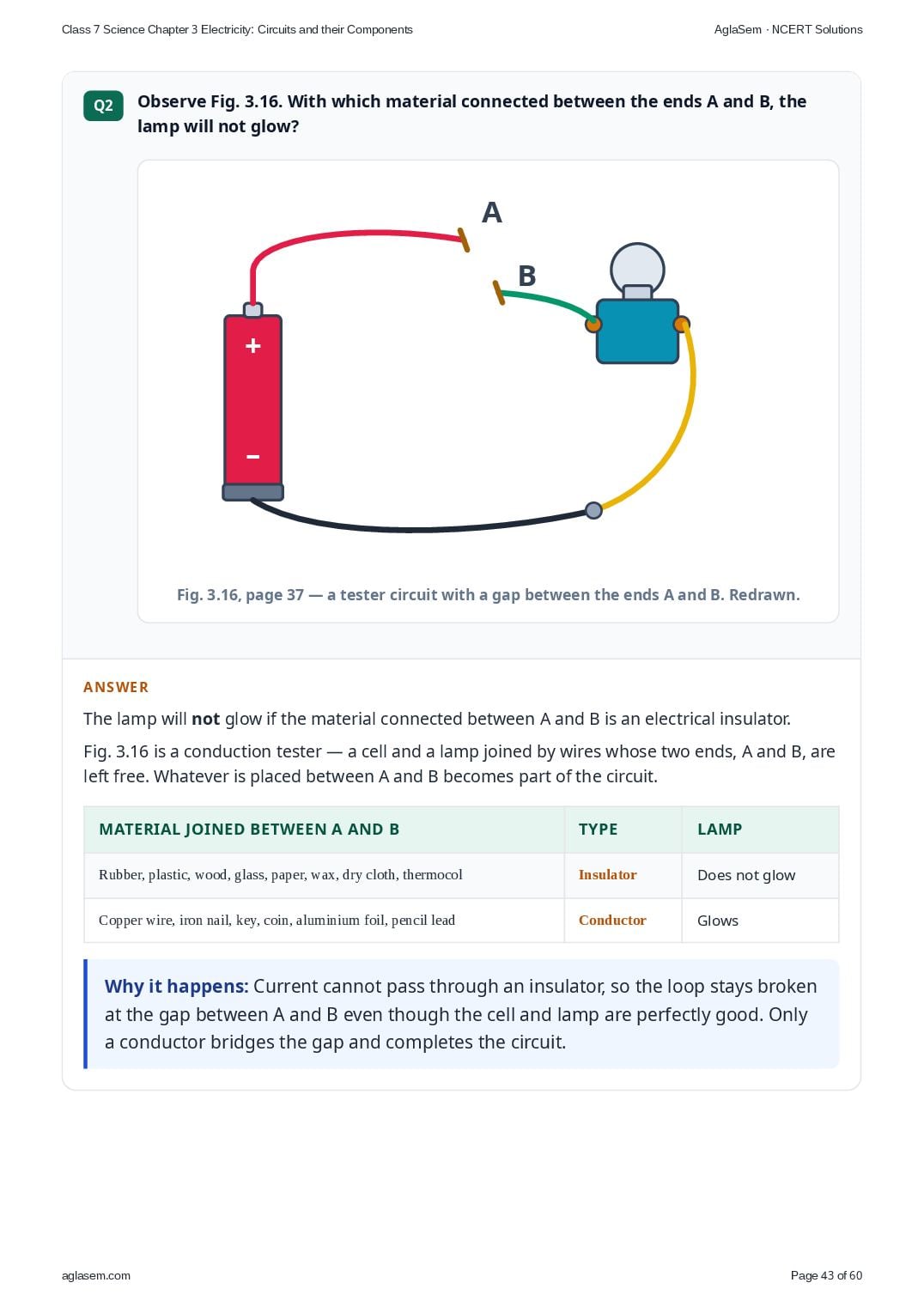
- Observe Fig. 3.16. With which material connected between the ends A and B, the lamp will not glow?
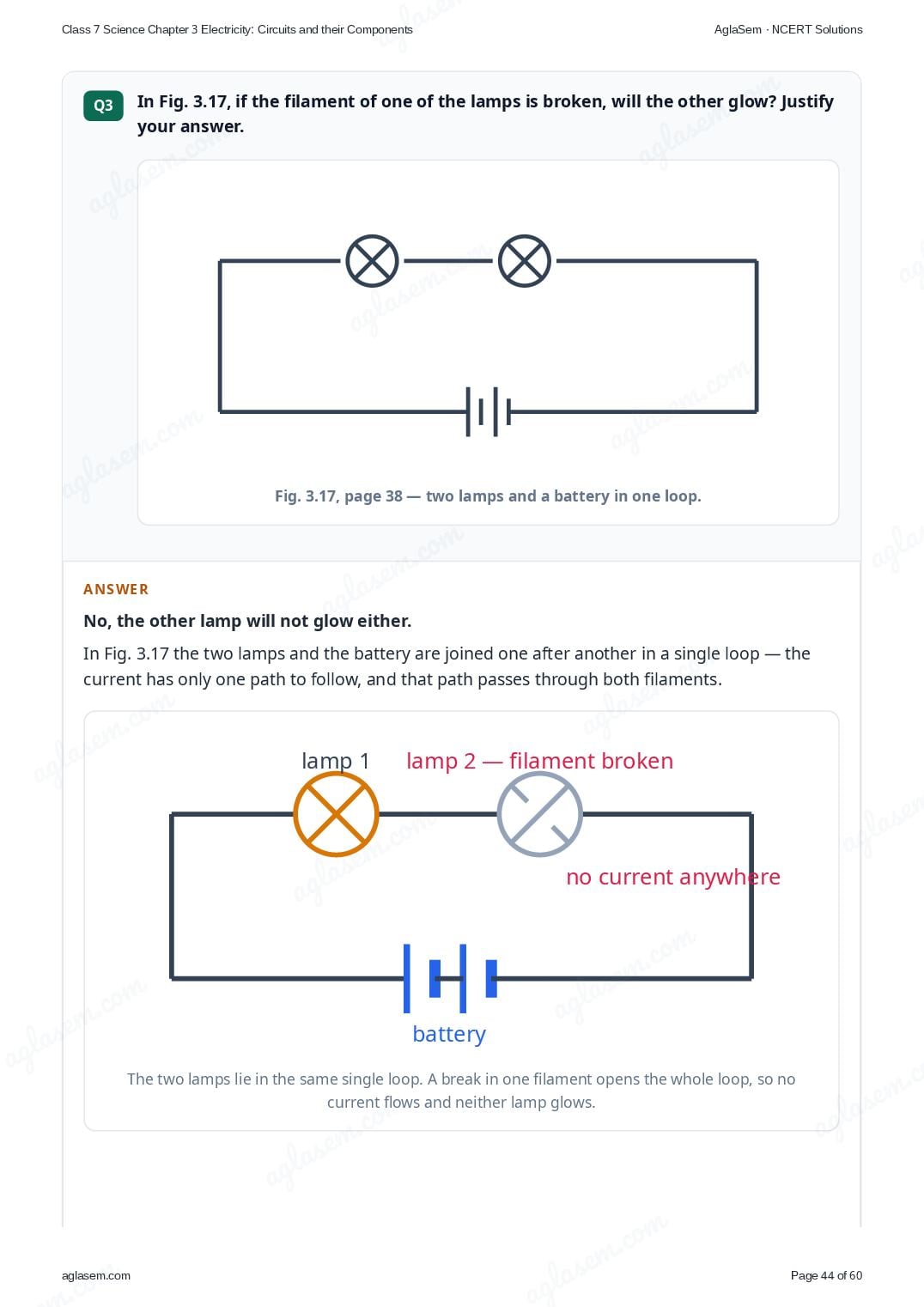
- In Fig. 3.17, if the filament of one of the lamps is broken, will the other glow? Justify your answer.
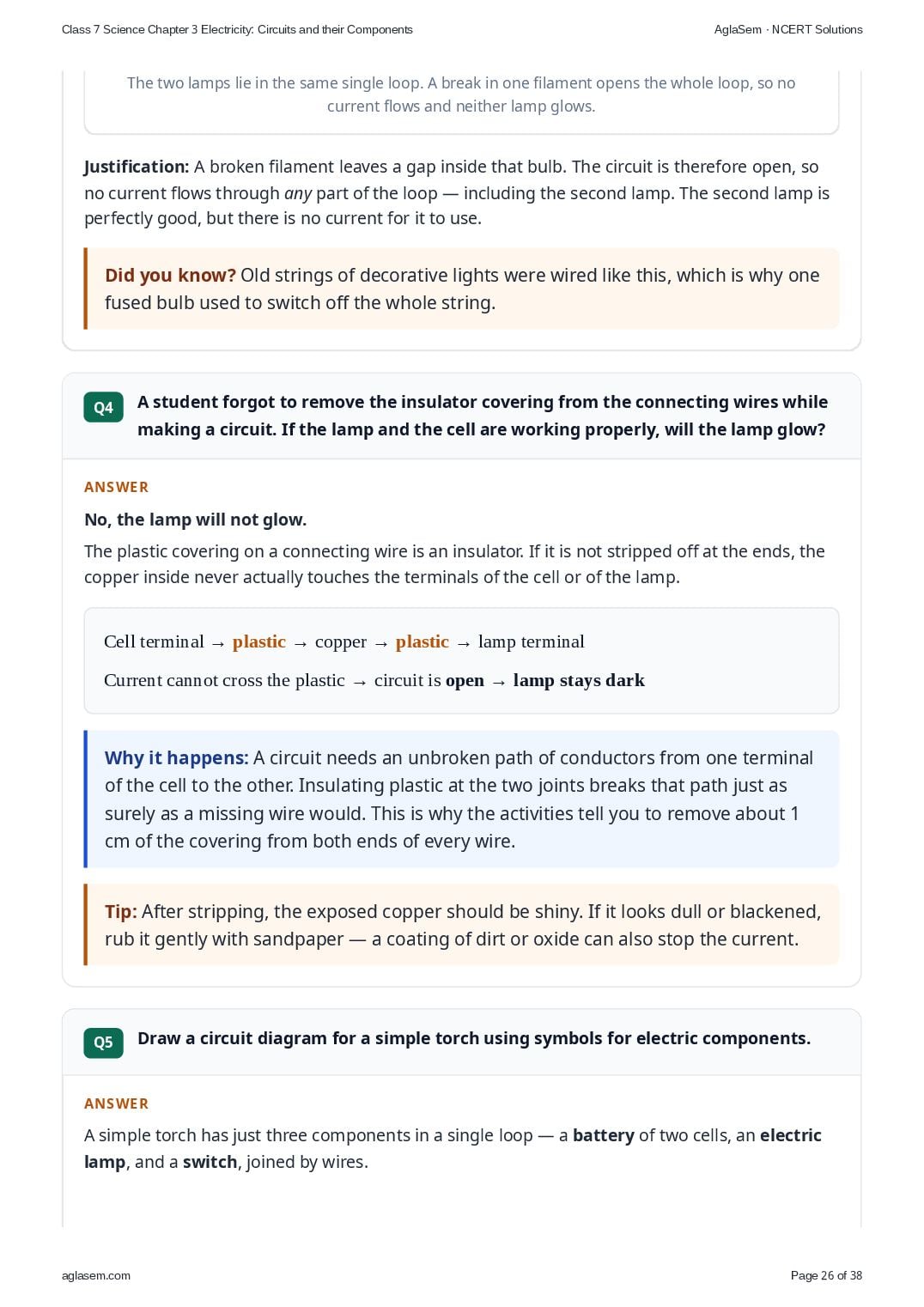
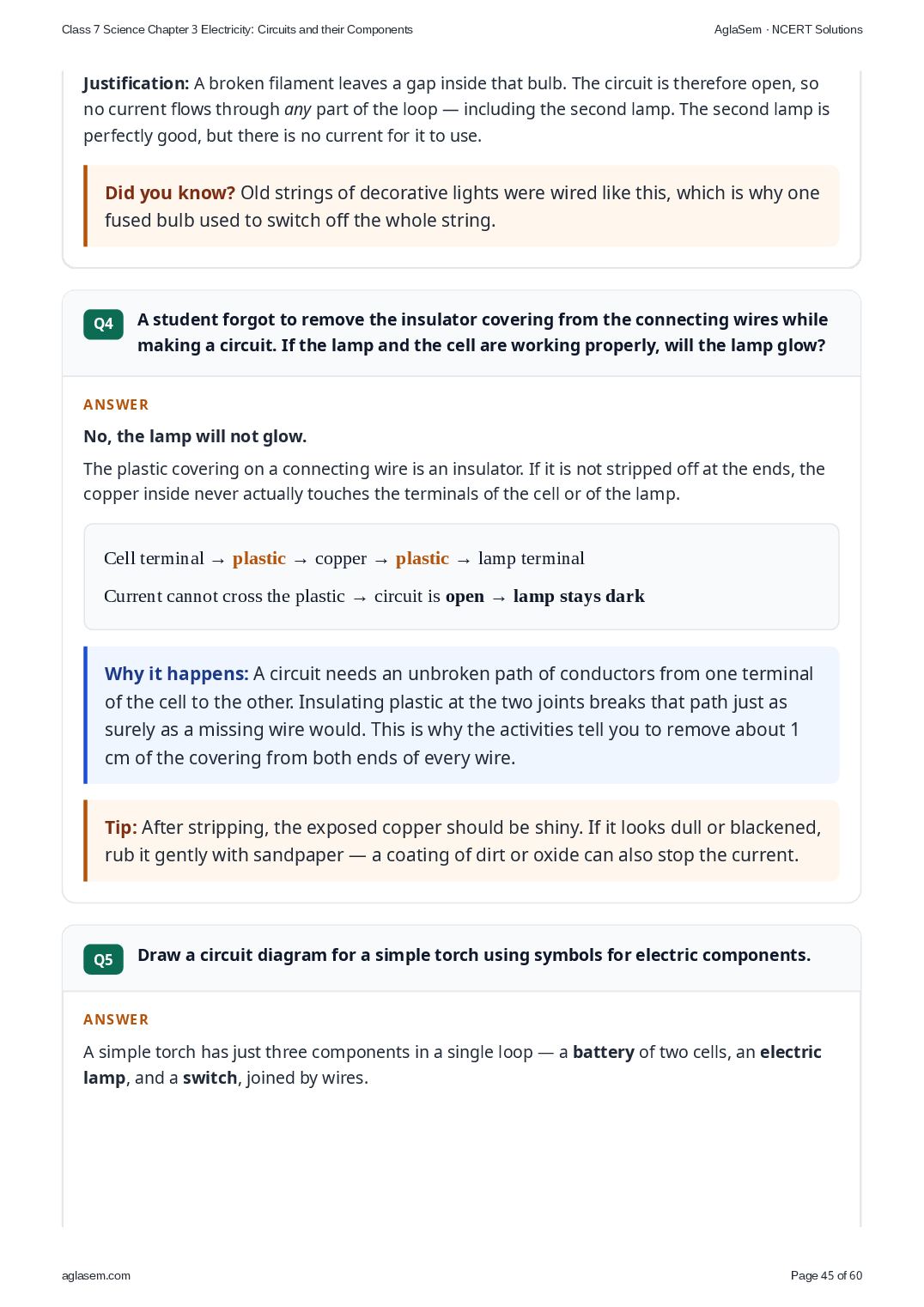
- A student forgot to remove the insulator covering from the connecting wires while making a circuit. If the lamp and the cell are working properly, will the lamp glow?
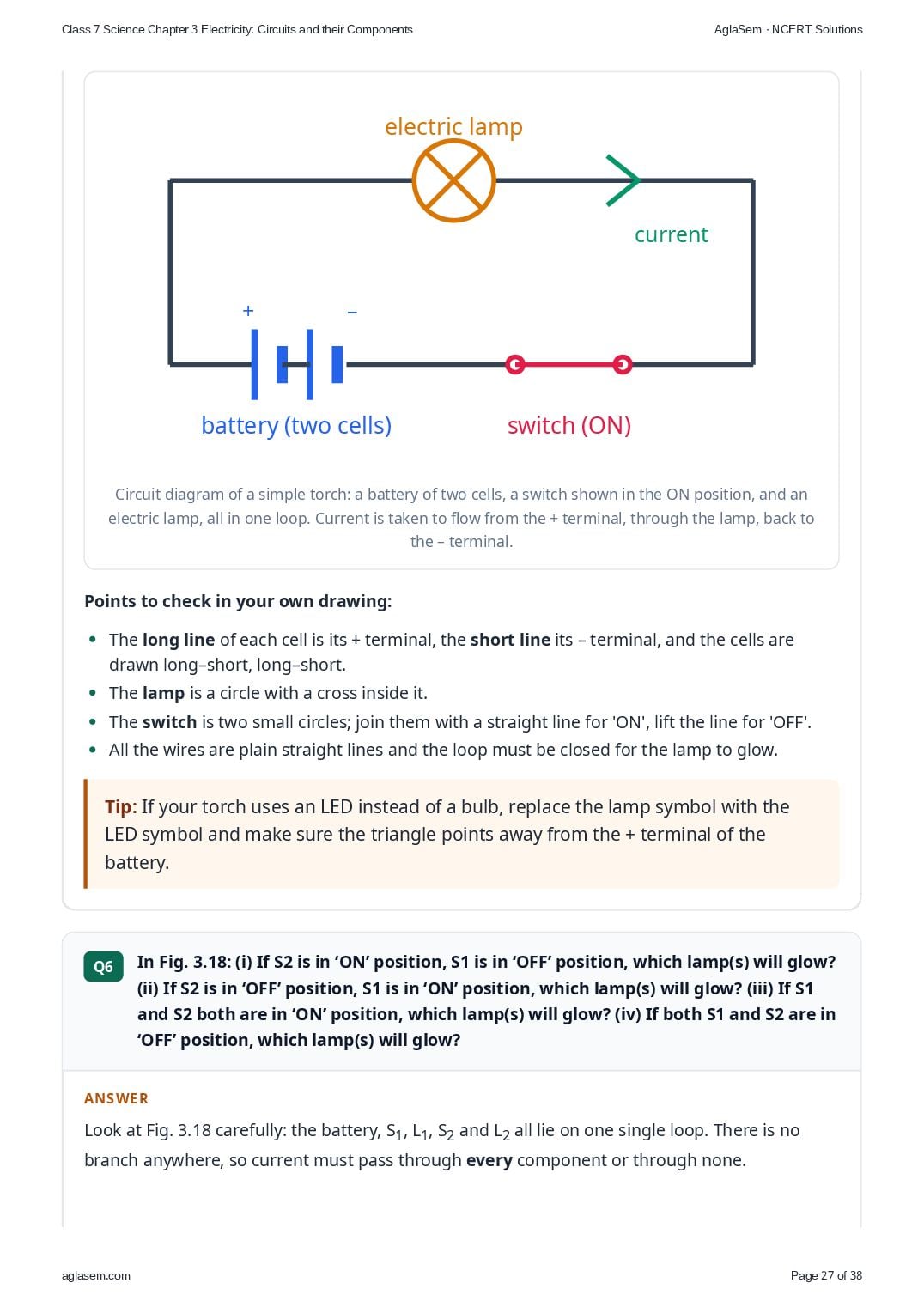
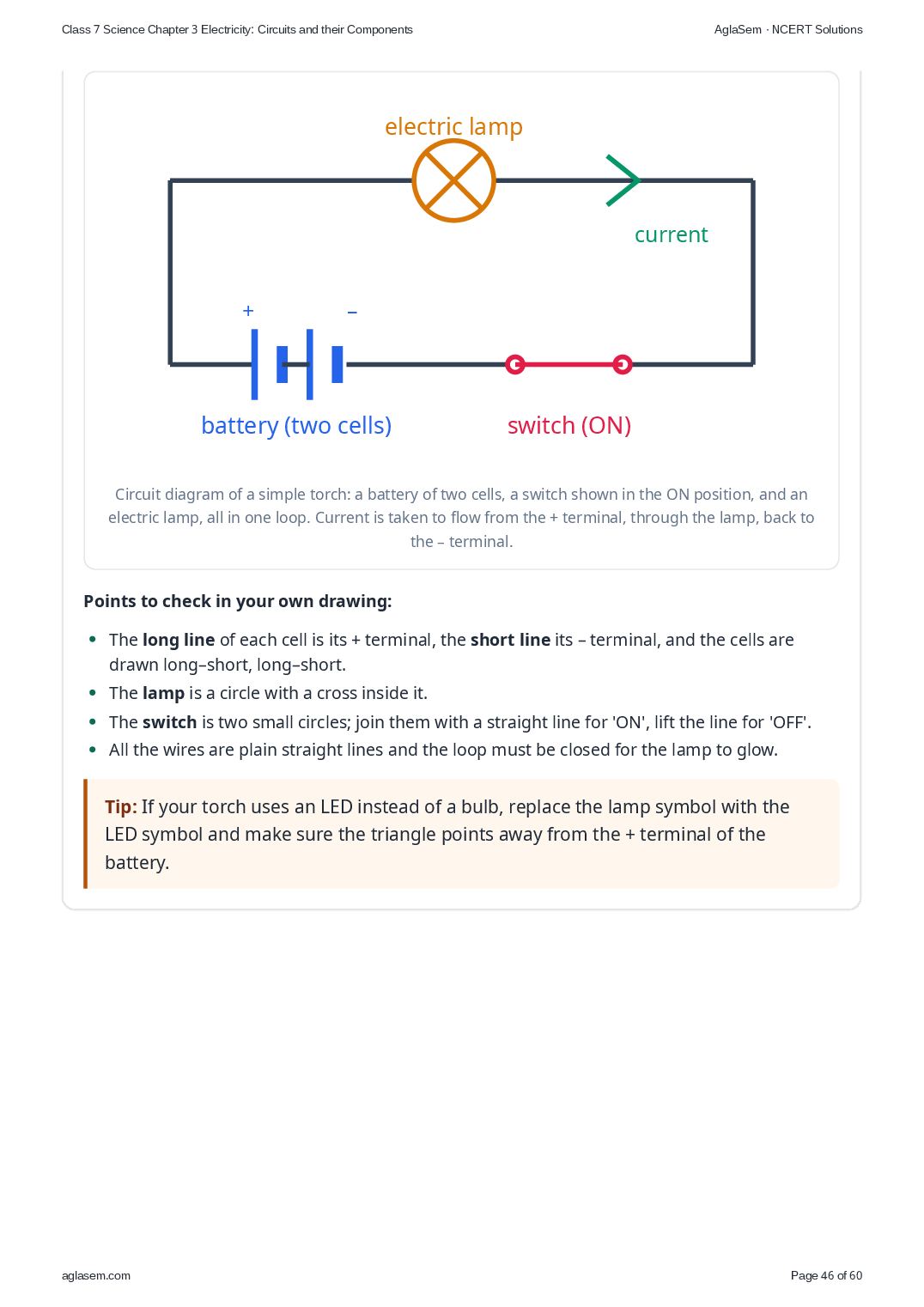
- Draw a circuit diagram for a simple torch using symbols for electric components.
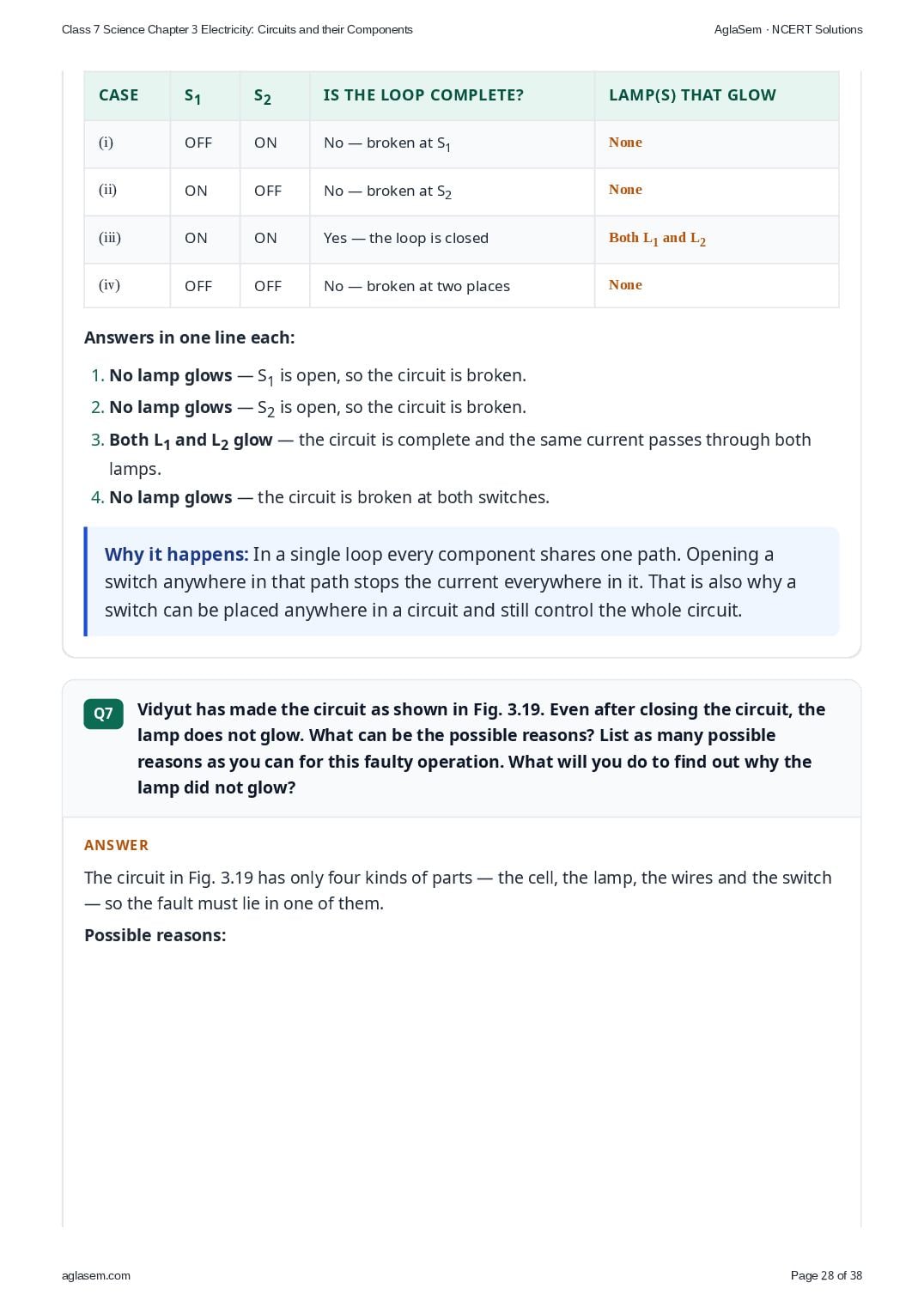
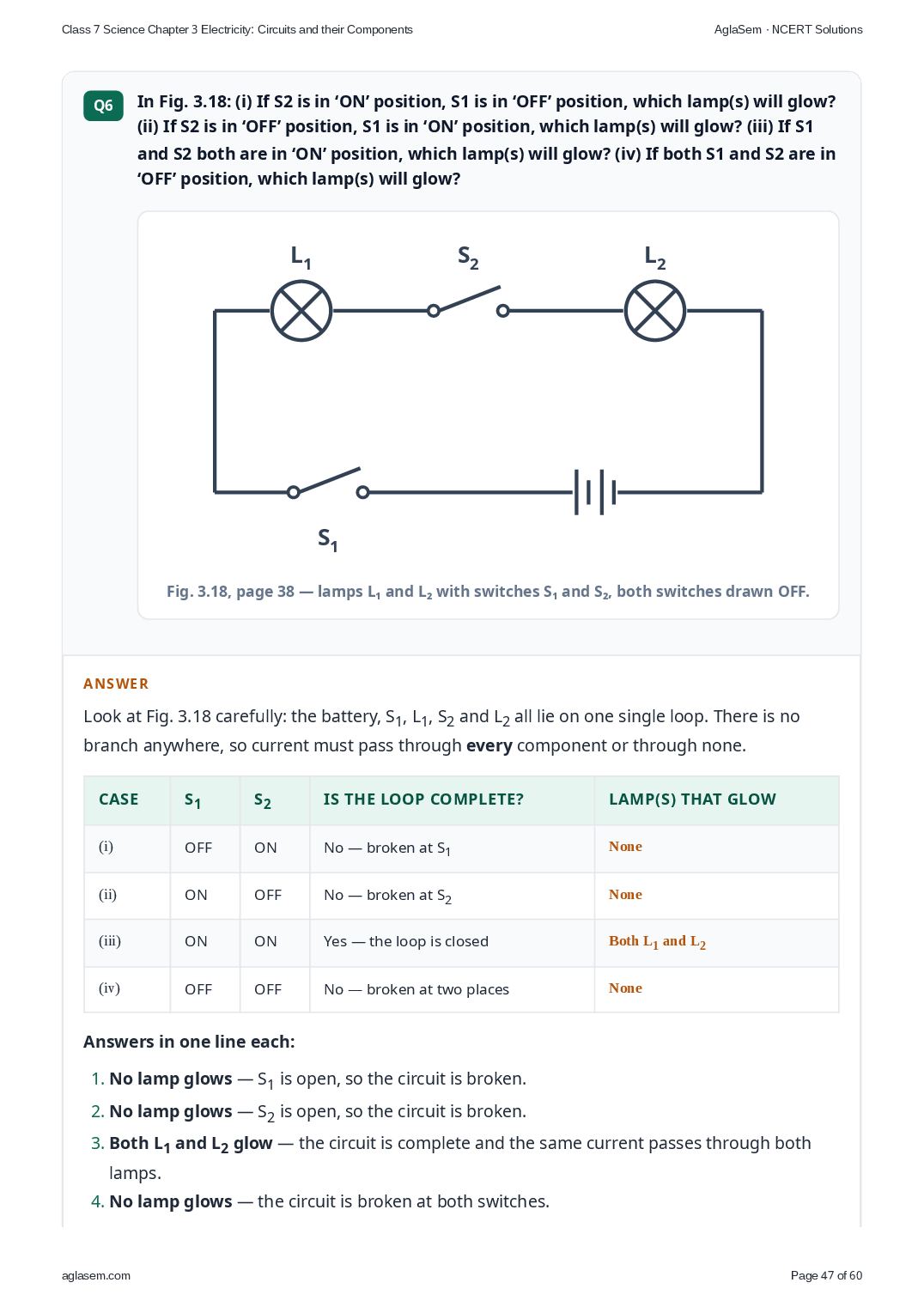
- In Fig. 3.18: (i) If S2 is in ‘ON’ position, S1 is in ‘OFF’ position, which lamp(s) will glow? (ii) If S2 is in ‘OFF’ position, S1 is in ‘ON’ position, which lamp(s) will glow? (iii) If S1 and S2 both are in ‘ON’ position, which lamp(s) will glow? (iv) If both S1 and S2 are in ‘OFF’ position, which lamp(s) will glow?
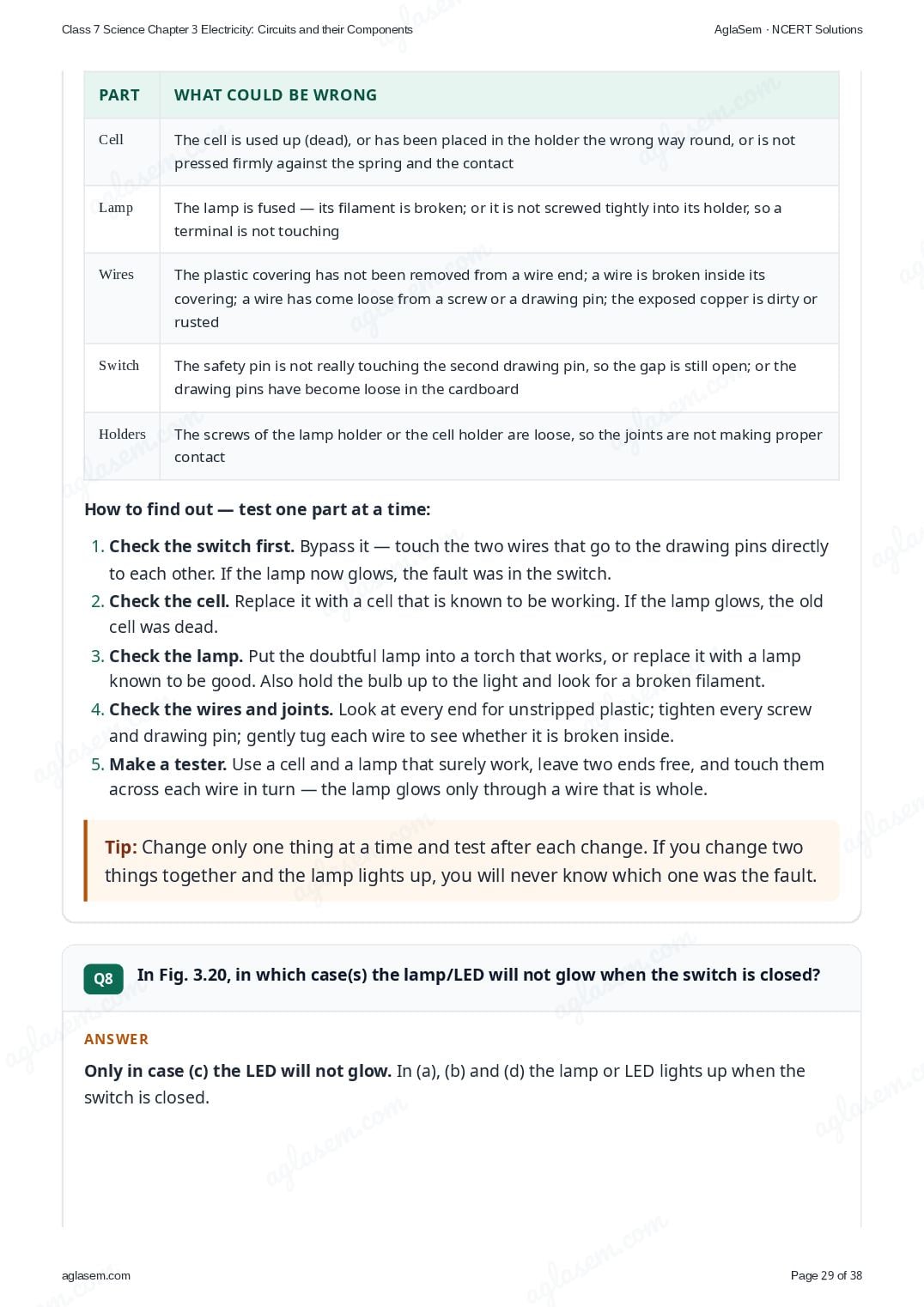
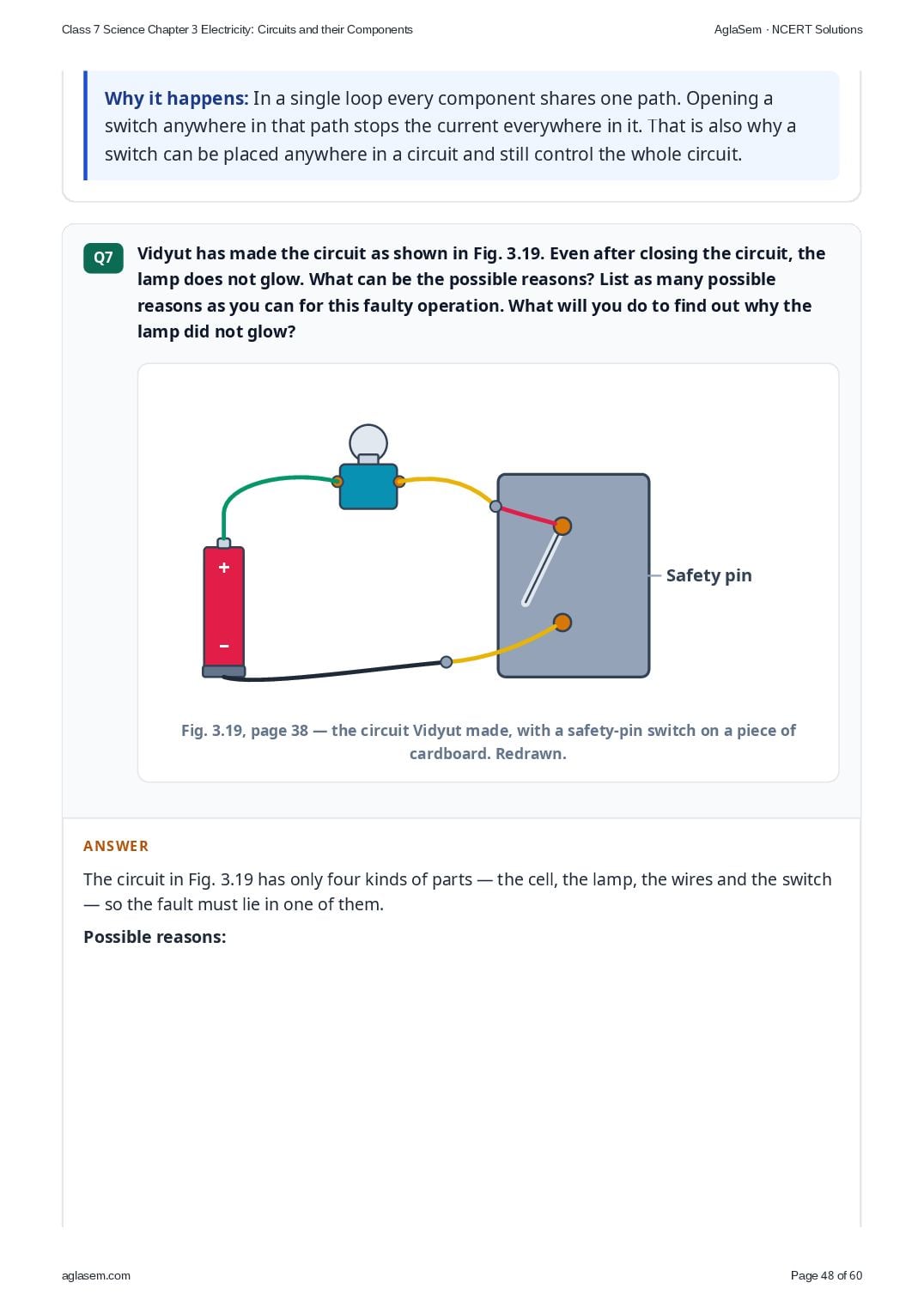
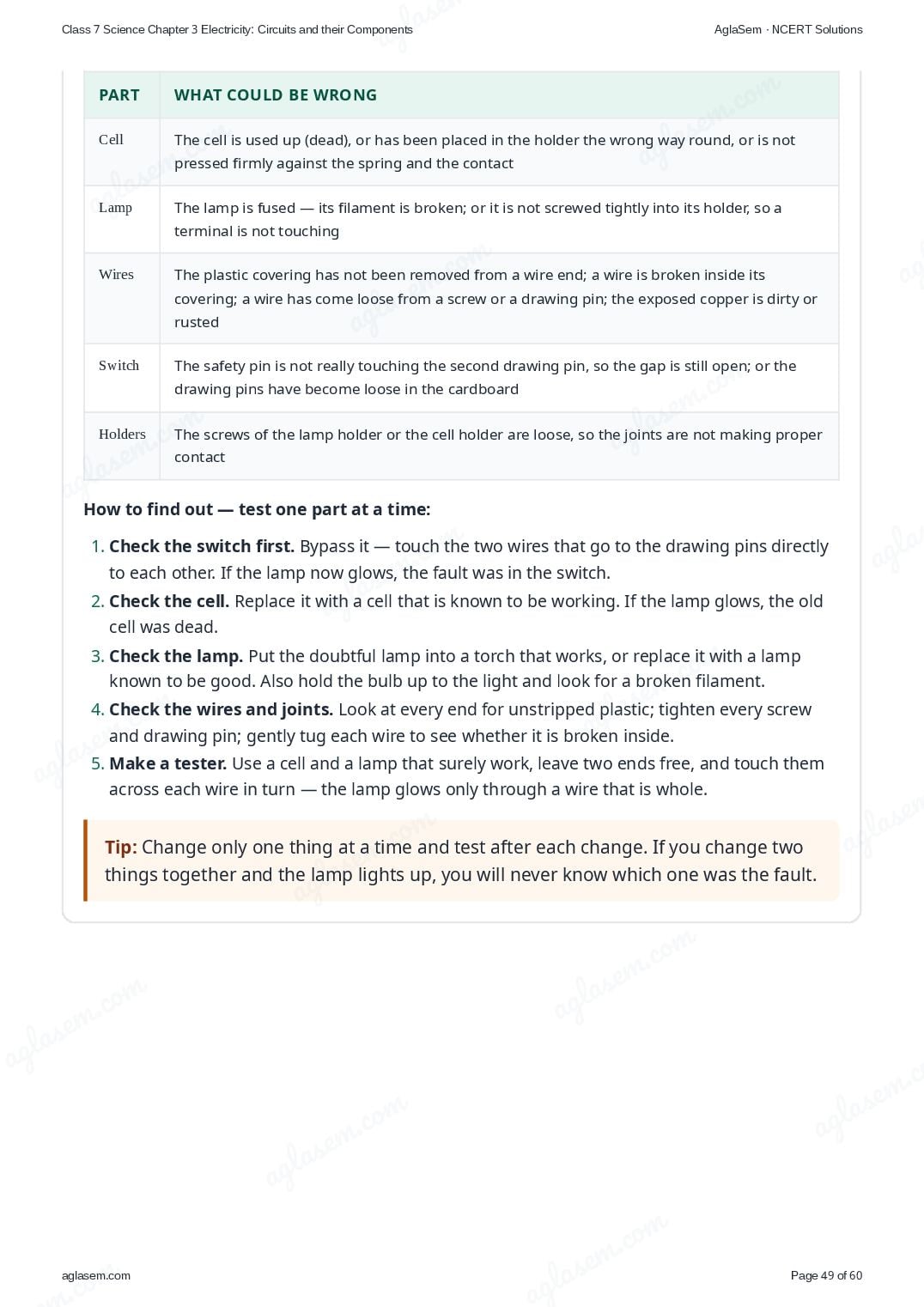
- Vidyut has made the circuit as shown in Fig. 3.19. Even after closing the circuit, the lamp does not glow. What can be the possible reasons? List as many possible reasons as you can for this faulty operation. What will you do to find out why the lamp did not glow?
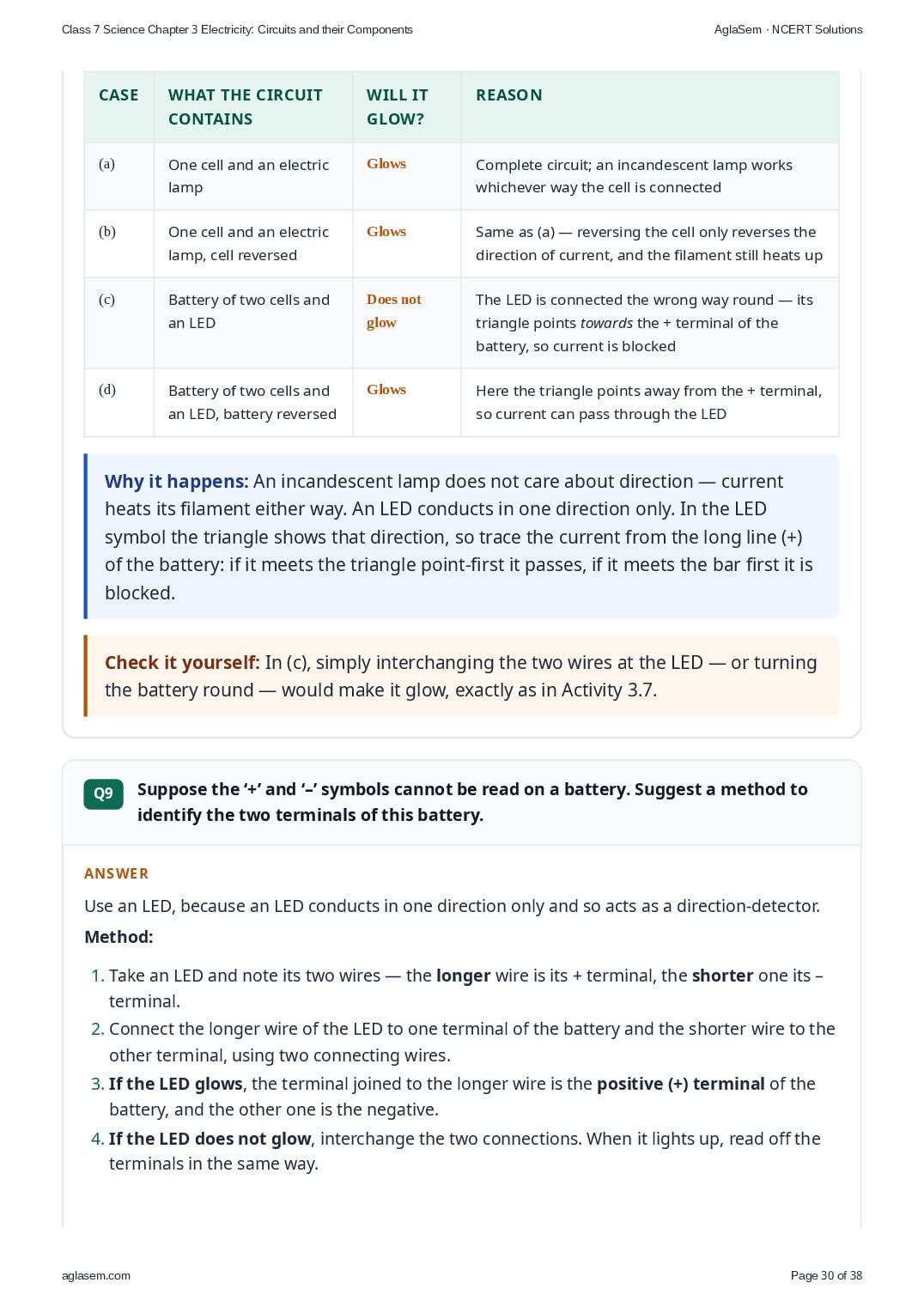
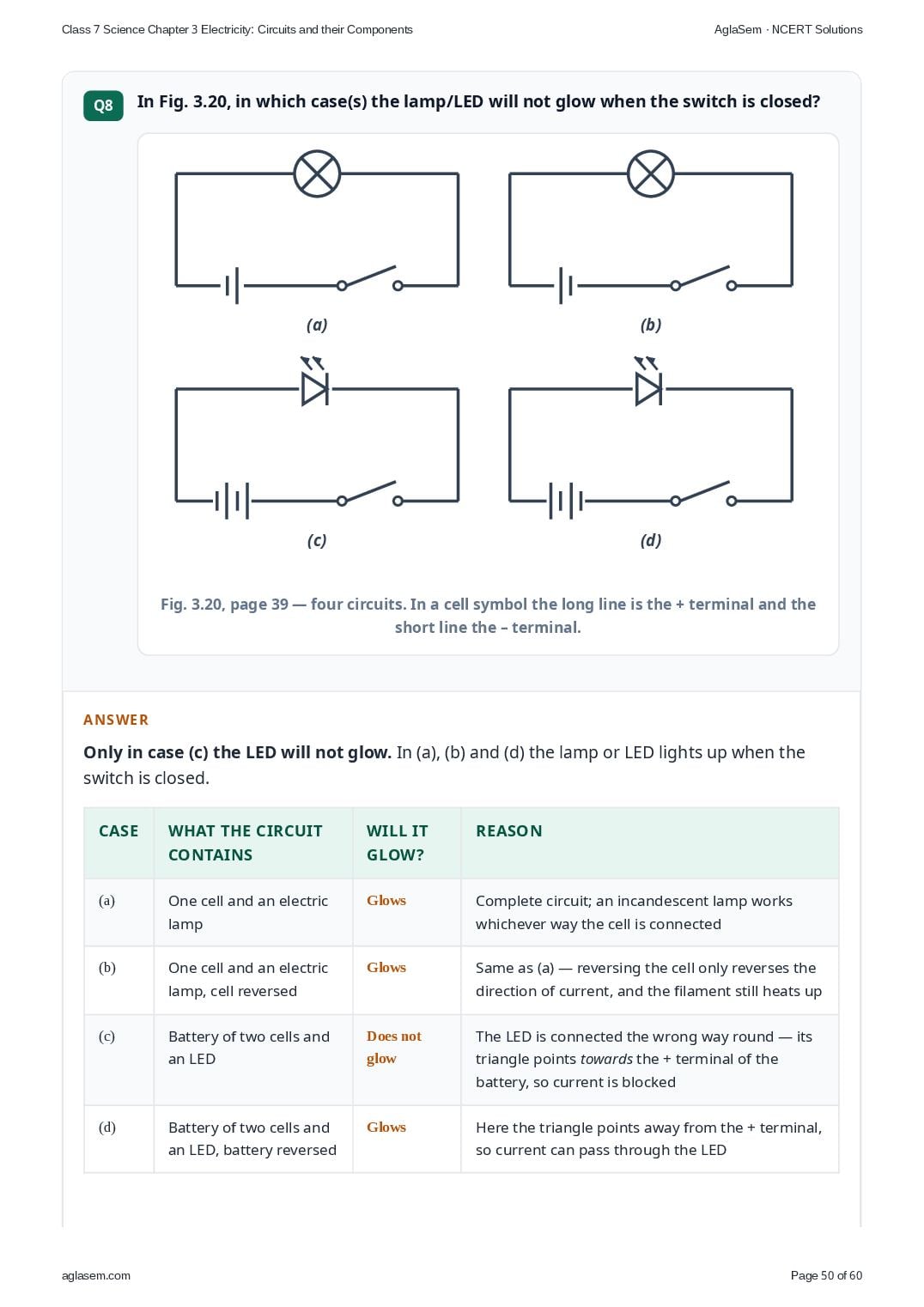
- In Fig. 3.20, in which case(s) the lamp/LED will not glow when the switch is closed?
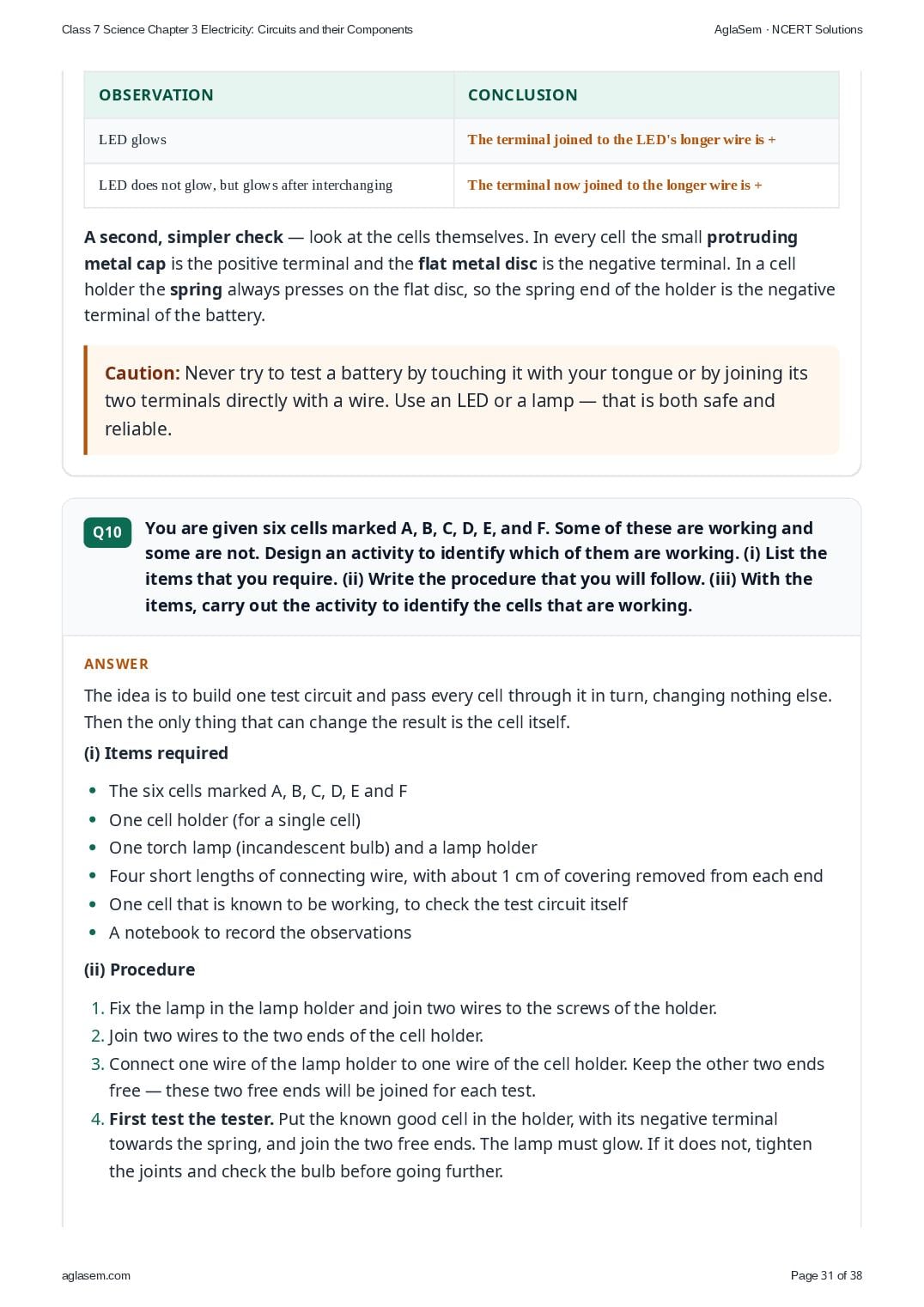
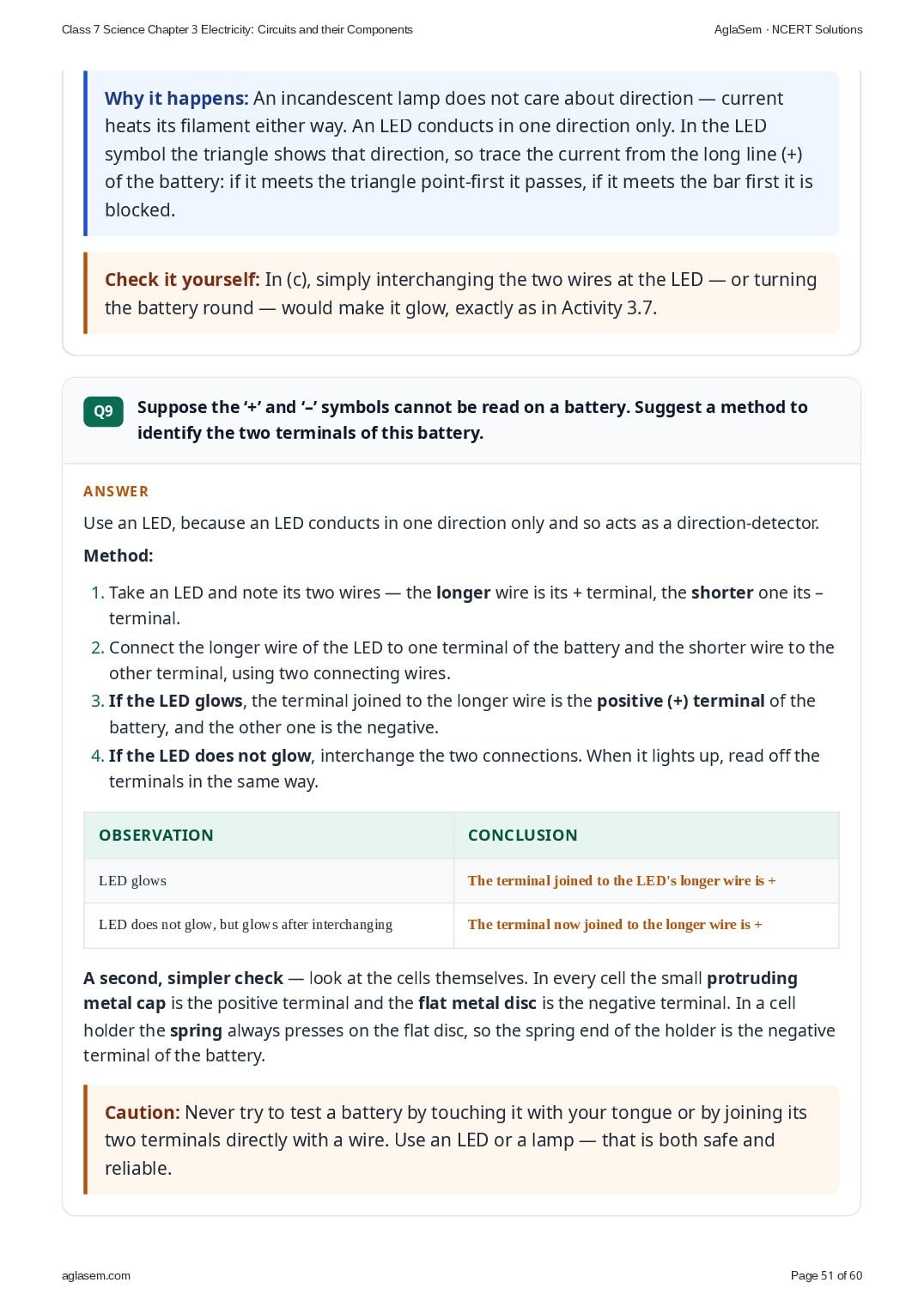
- Suppose the ‘+’ and ‘–’ symbols cannot be read on a battery. Suggest a method to identify the two terminals of this battery.
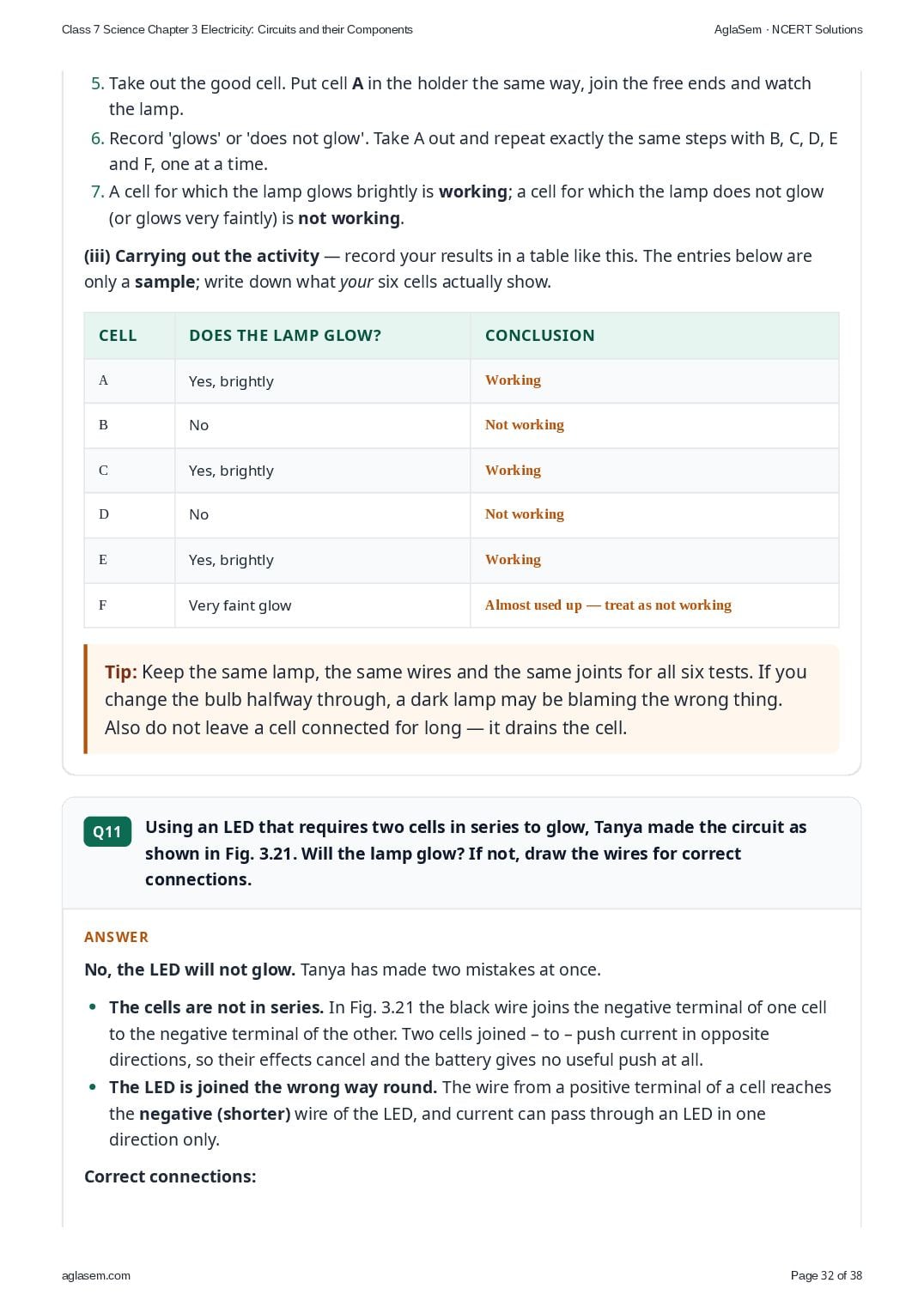
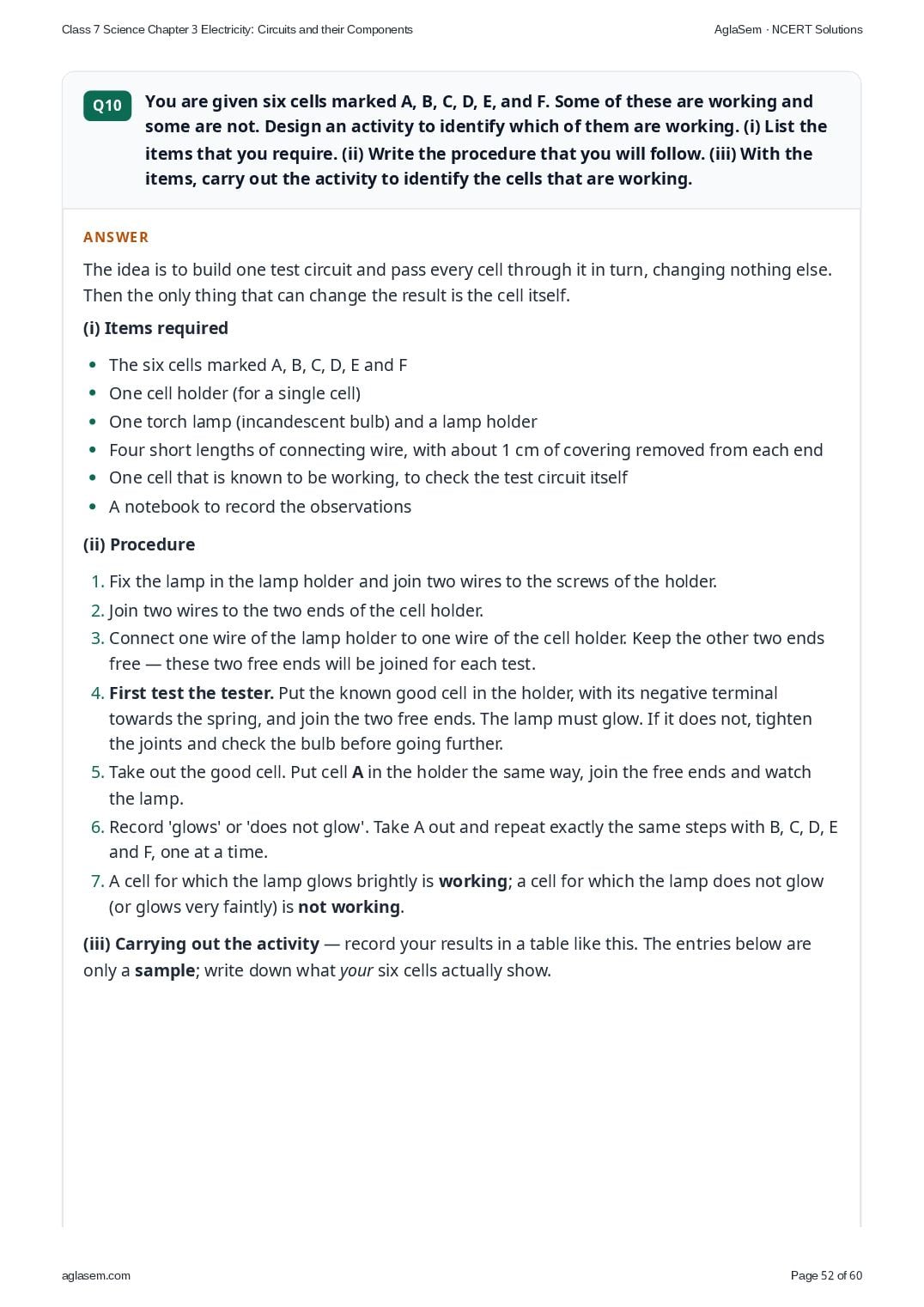
- You are given six cells marked A, B, C, D, E, and F. Some of these are working and some are not. Design an activity to identify which of them are working. (i) List the items that you require. (ii) Write the procedure that you will follow. (iii) With the items, carry out the activity to identify the cells that are working.
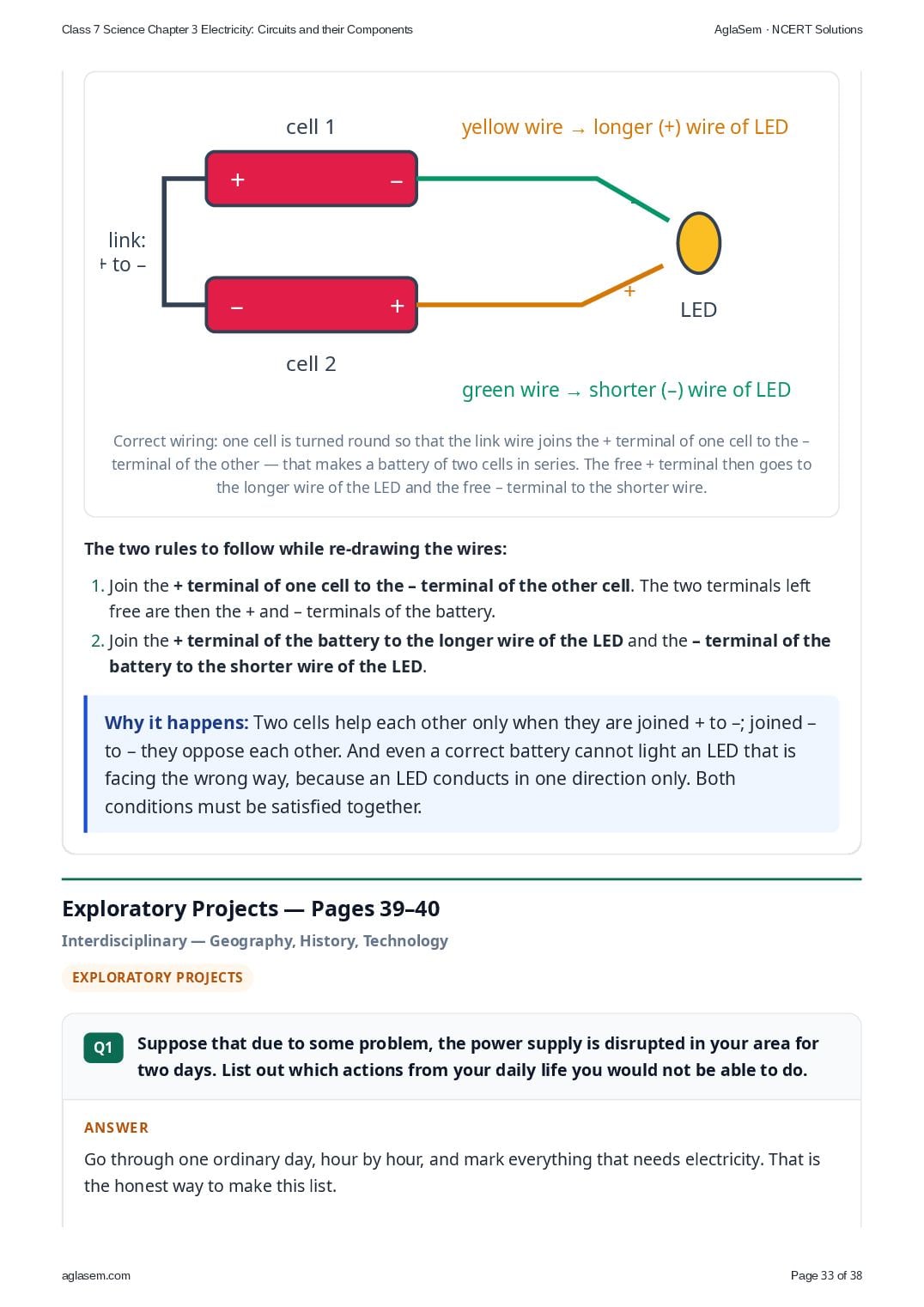
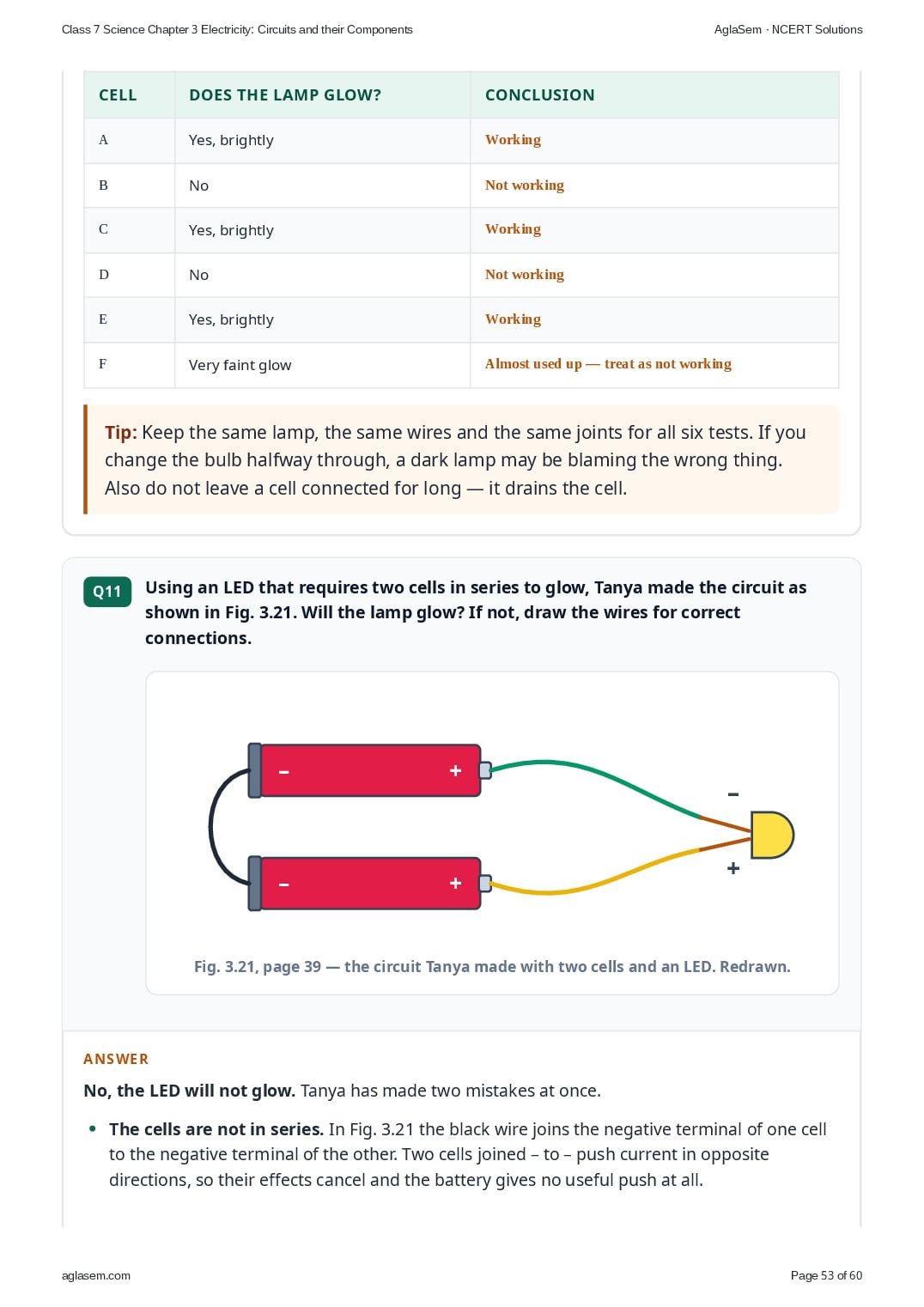
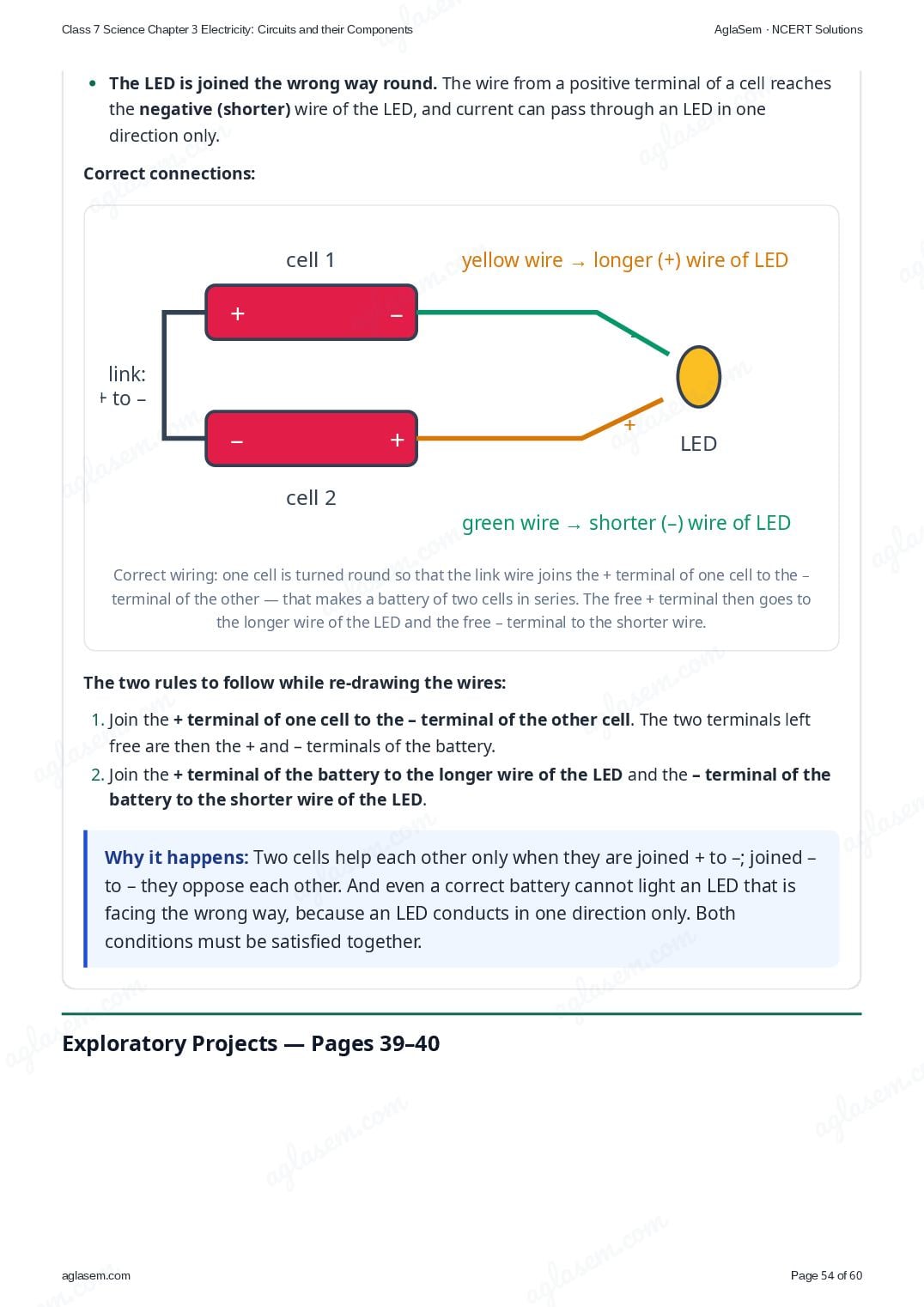
- Using an LED that requires two cells in series to glow, Tanya made the circuit as shown in Fig. 3.21. Will the lamp glow? If not, draw the wires for correct connections.
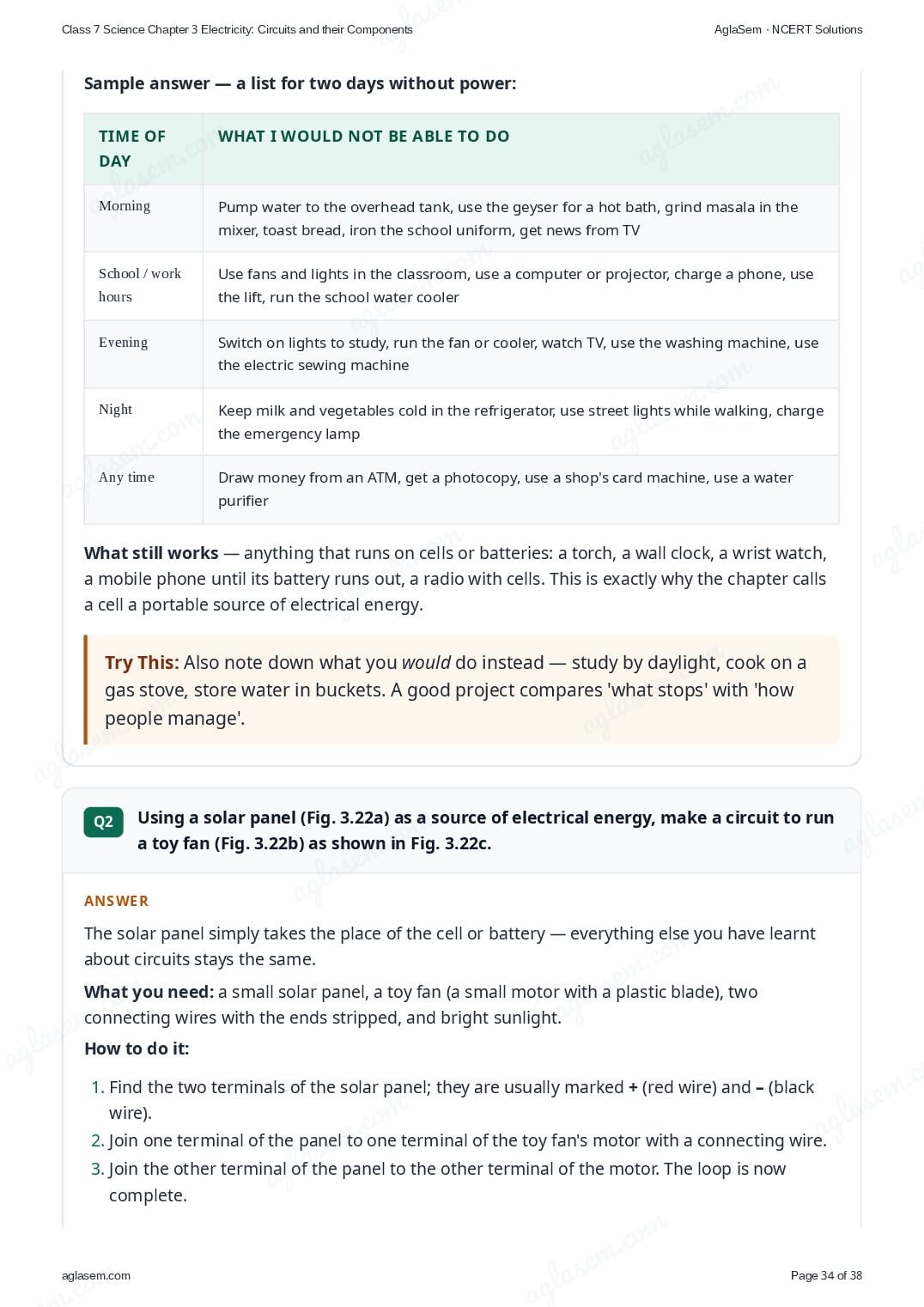
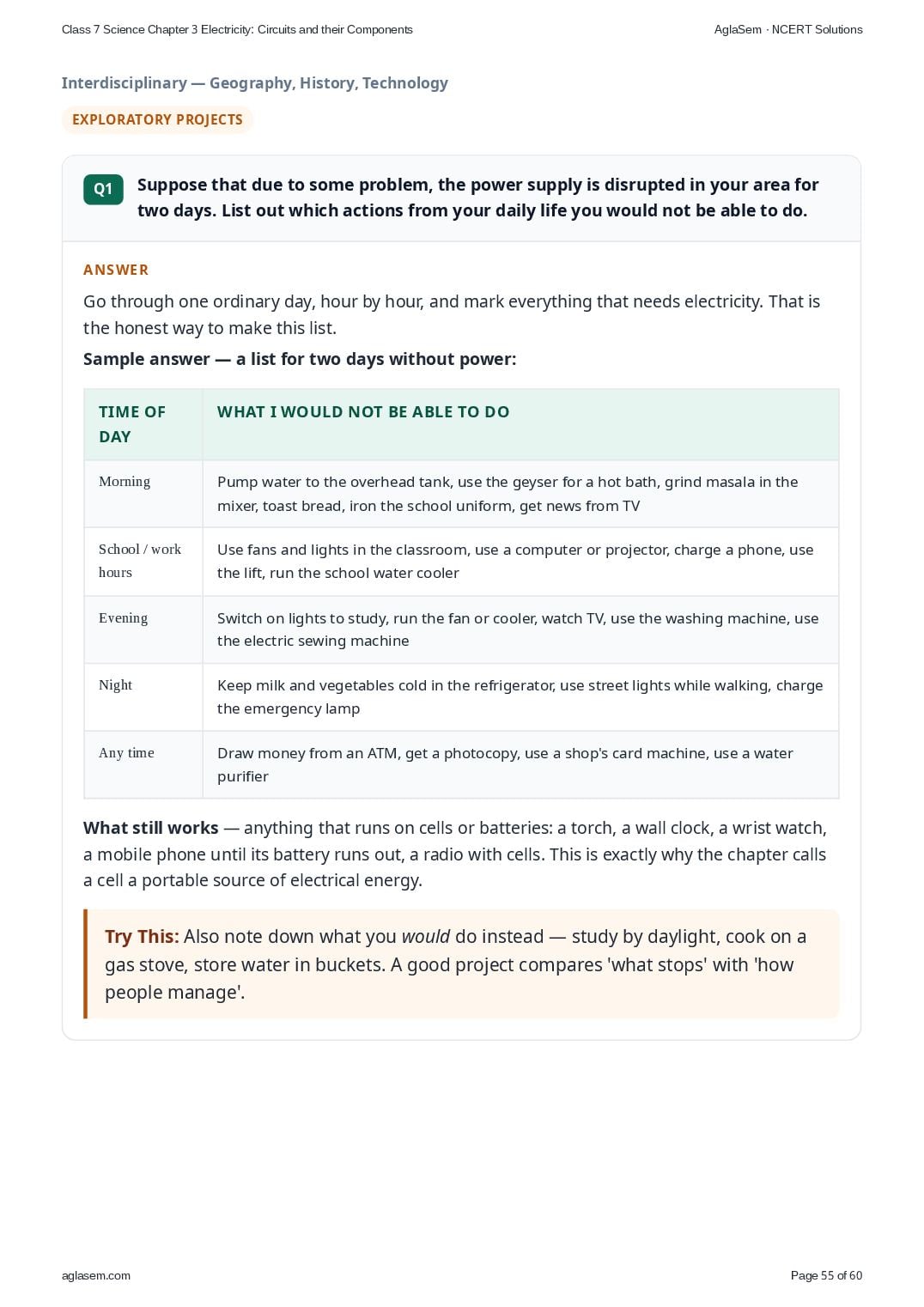
- Suppose that due to some problem, the power supply is disrupted in your area for two days. List out which actions from your daily life you would not be able to do.
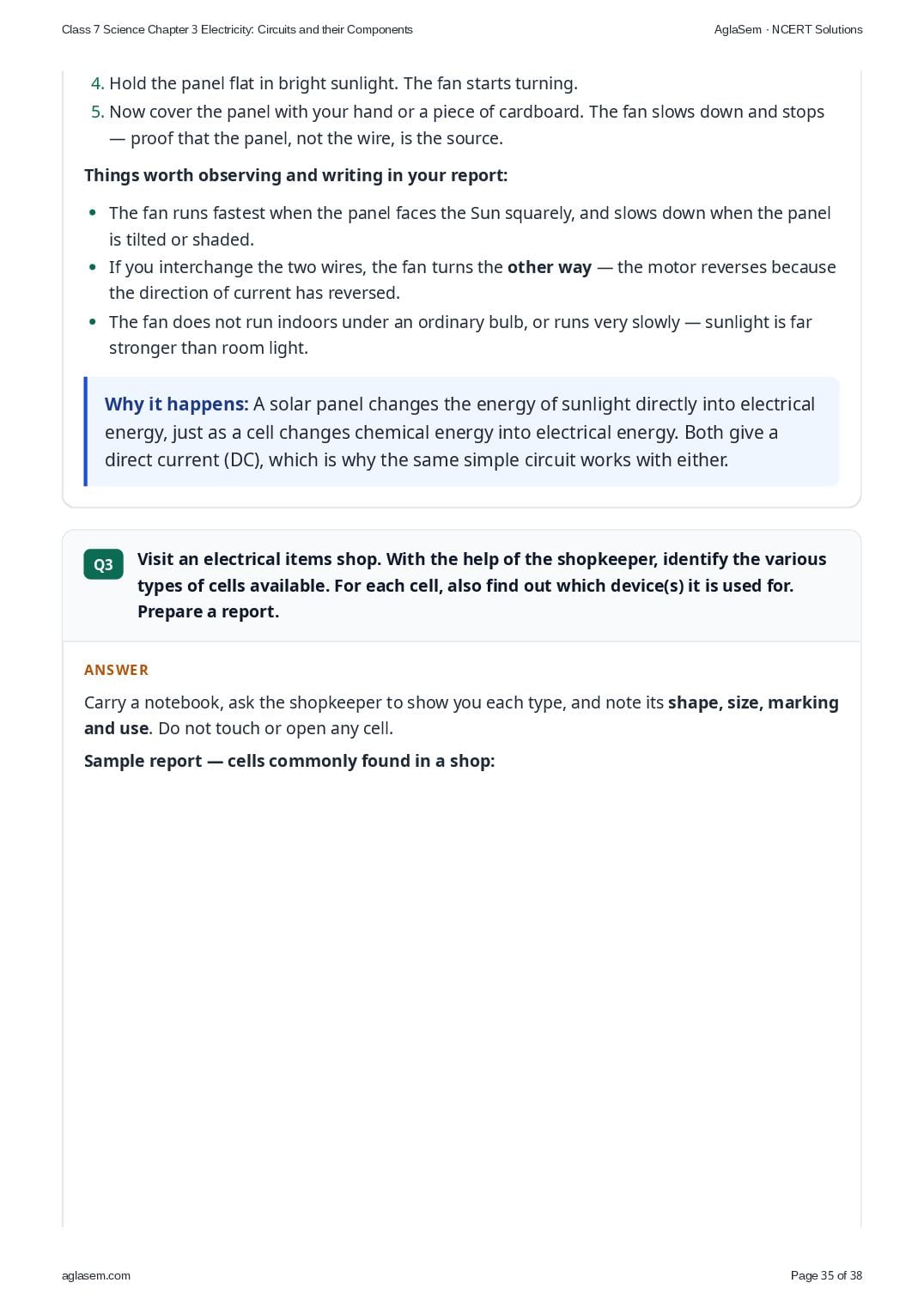
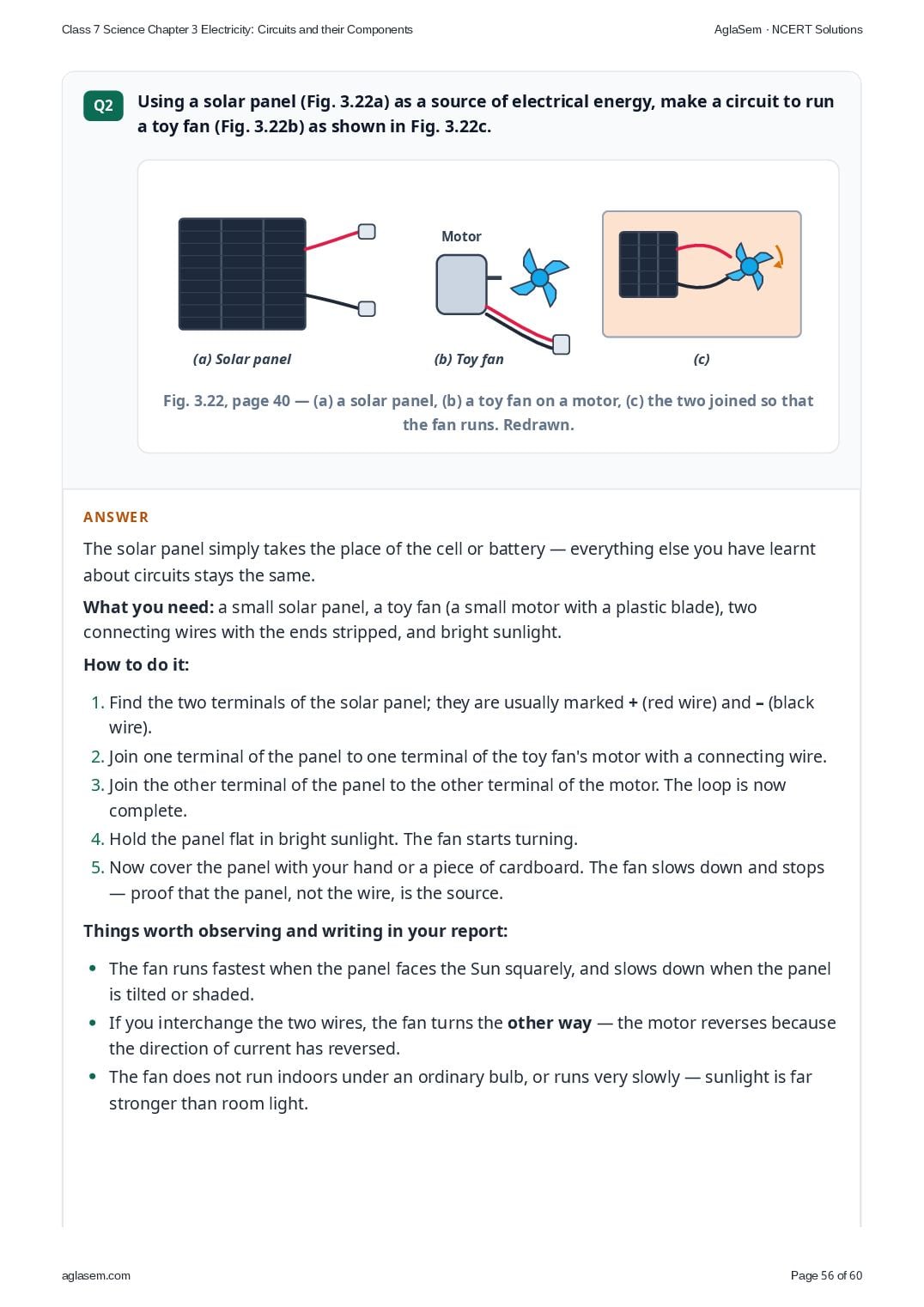
- Using a solar panel (Fig. 3.22a) as a source of electrical energy, make a circuit to run a toy fan (Fig. 3.22b) as shown in Fig. 3.22c.
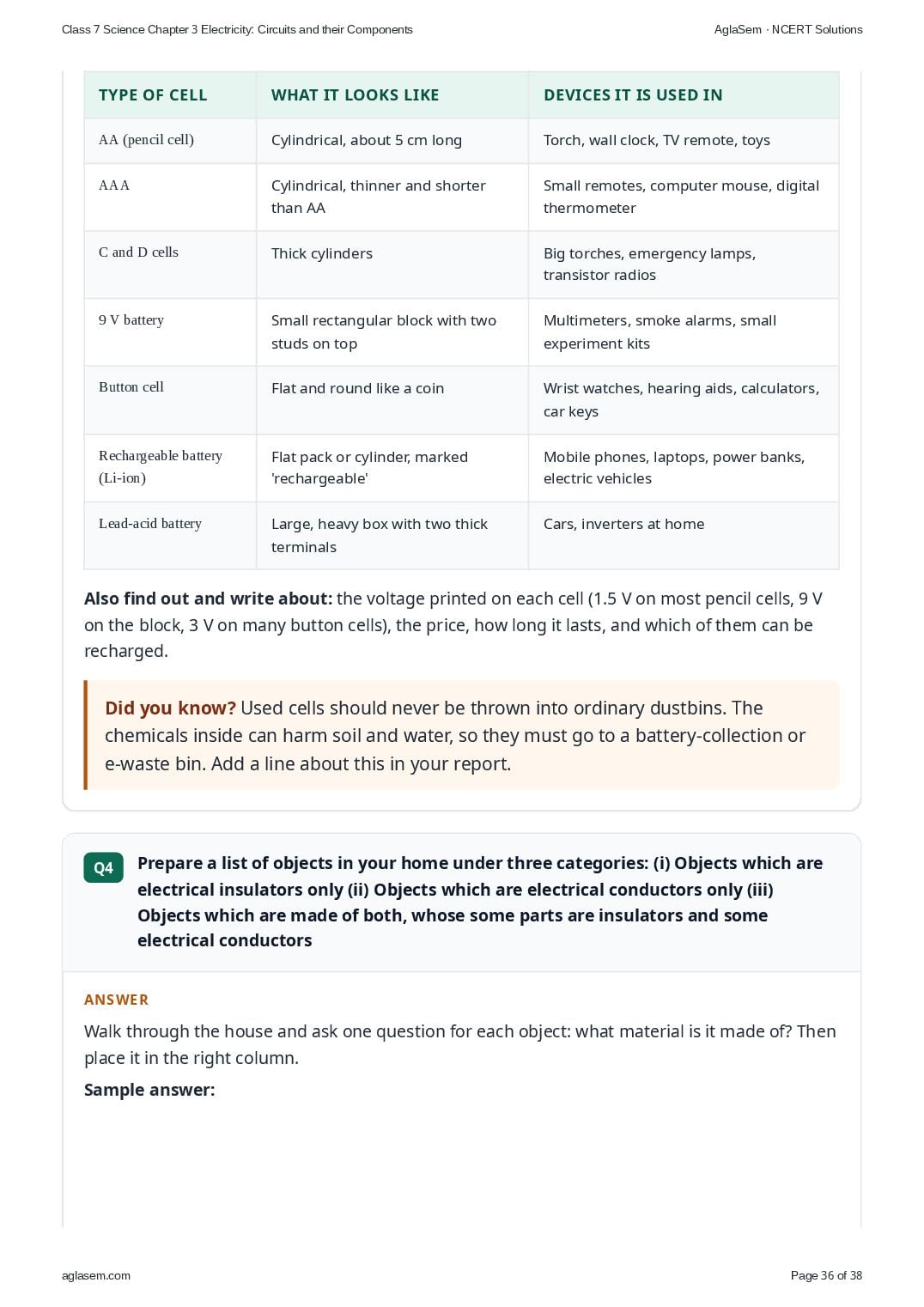
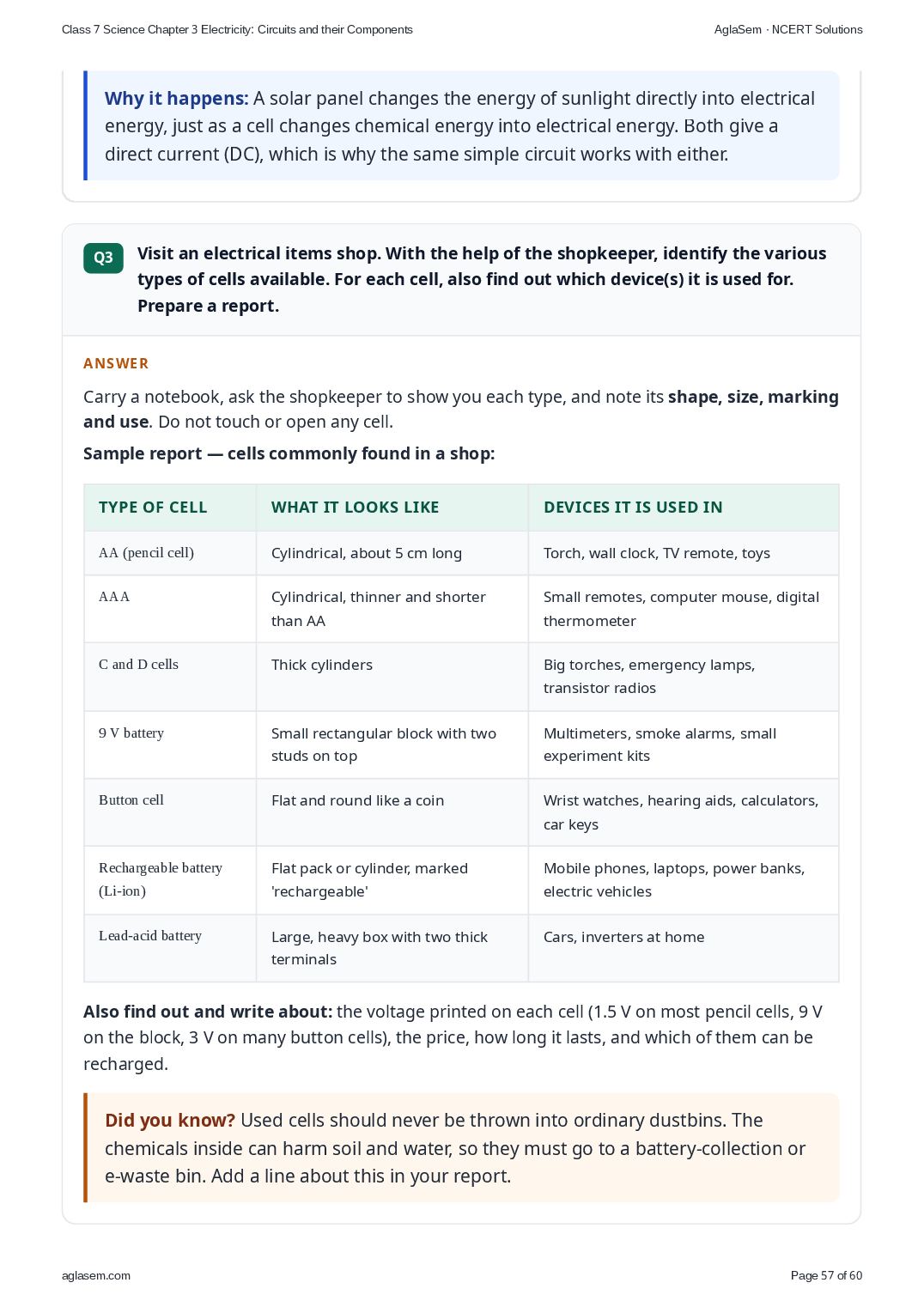
- Visit an electrical items shop. With the help of the shopkeeper, identify the various types of cells available. For each cell, also find out which device(s) it is used for. Prepare a report.
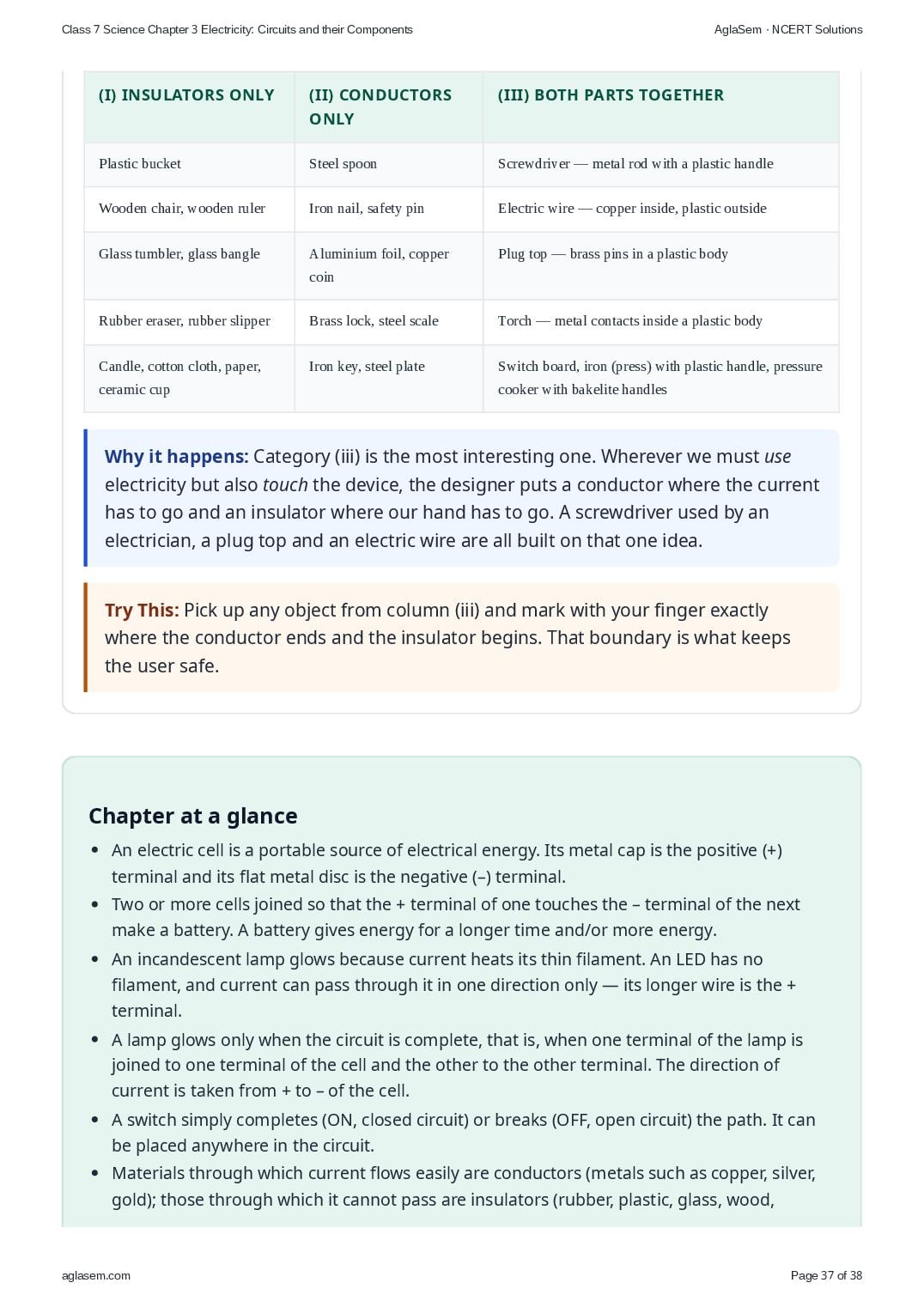
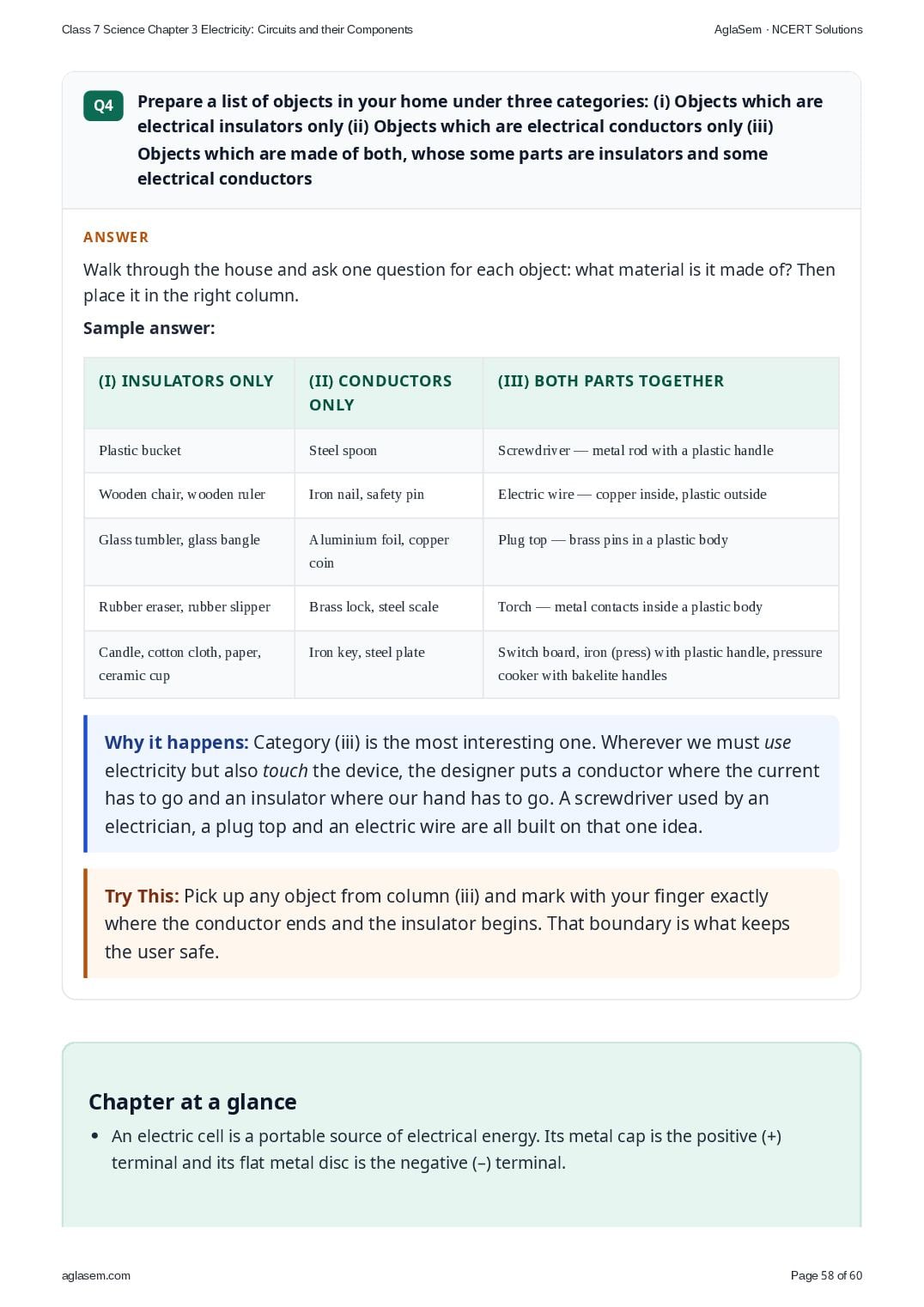
- Prepare a list of objects in your home under three categories: (i) Objects which are electrical insulators only (ii) Objects which are electrical conductors only (iii) Objects which are made of both, whose some parts are insulators and some electrical conductors
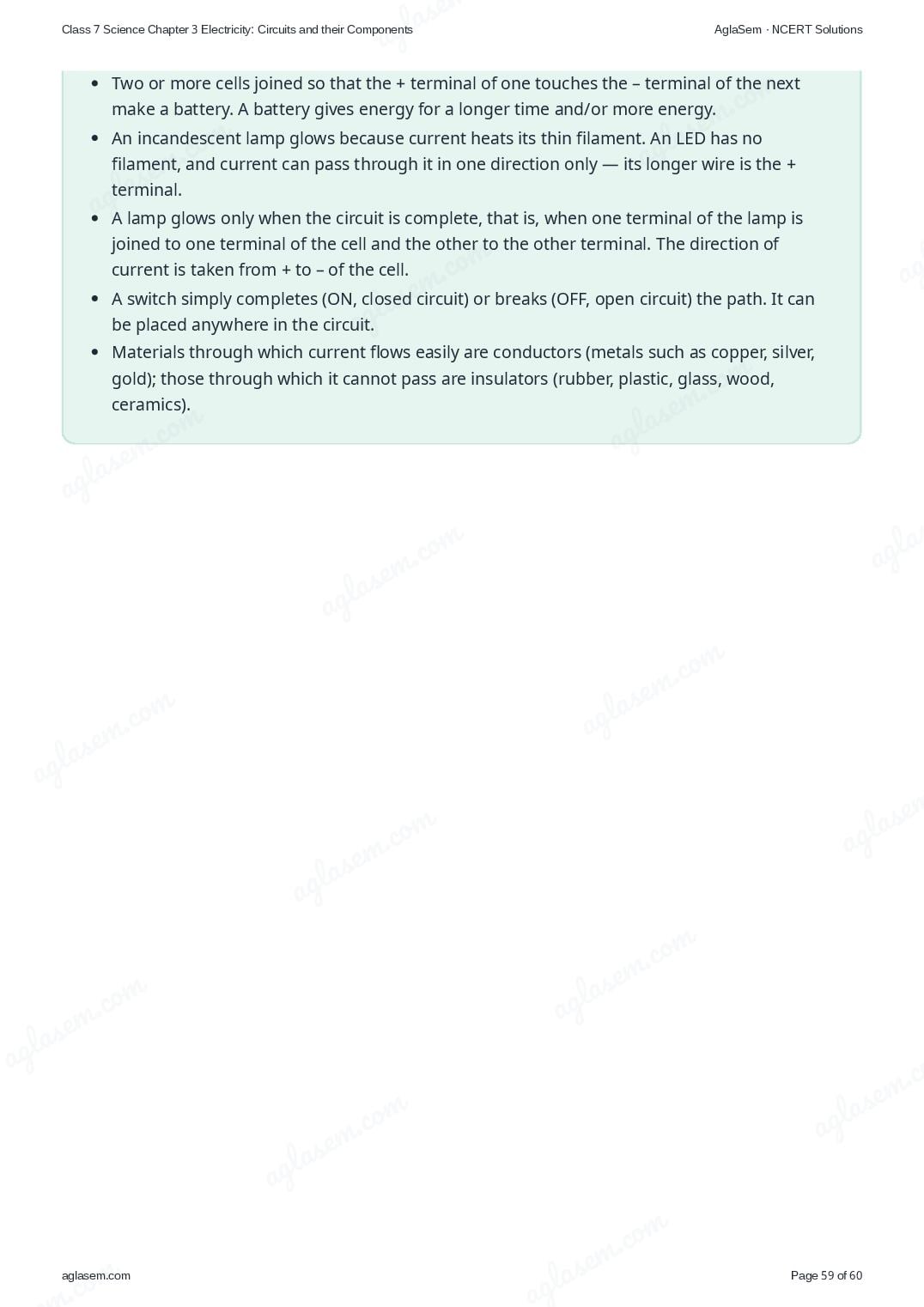
Chapter at a Glance
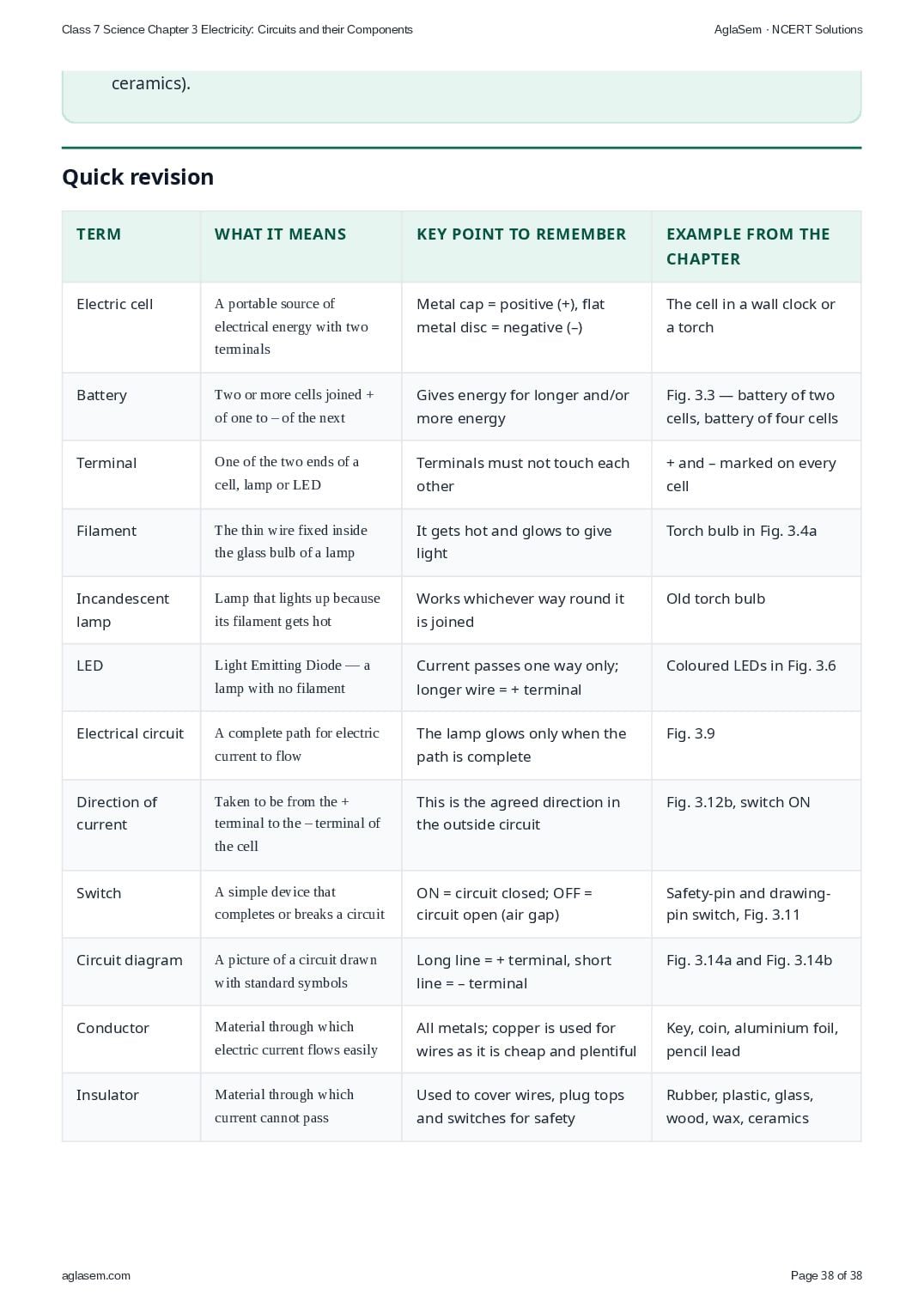
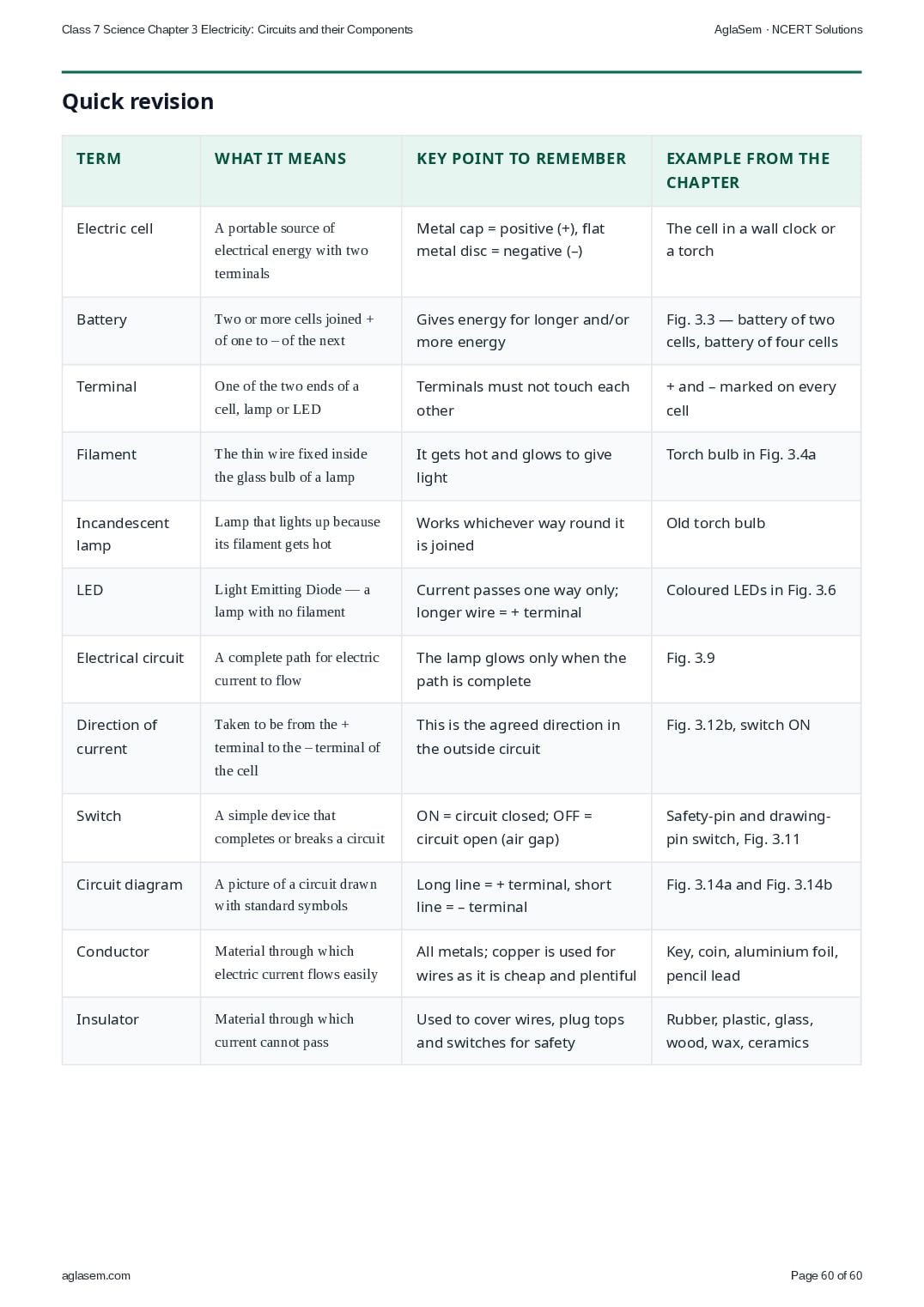
- An electric cell is a portable source of electrical energy. Its metal cap is the positive (+) terminal and its flat metal disc is the negative (–) terminal.
- Two or more cells joined so that the + terminal of one touches the – terminal of the next make a battery. A battery gives energy for a longer time and/or more energy.
- An incandescent lamp glows because current heats its thin filament. An LED has no filament, and current can pass through it in one direction only — its longer wire is the + terminal.
- A lamp glows only when the circuit is complete, that is, when one terminal of the lamp is joined to one terminal of the cell and the other to the other terminal. The direction of current is taken from + to – of the cell.
- A switch simply completes (ON, closed circuit) or breaks (OFF, open circuit) the path. It can be placed anywhere in the circuit.
- Materials through which current flows easily are conductors (metals such as copper, silver, gold); those through which it cannot pass are insulators (rubber, plastic, glass, wood, ceramics).
How to Download NCERT Solutions for Class 7 Science Chapter 3 PDF
Follow these simple steps to get the Electricity Circuits and Their Components questions-and-answers PDF from Curiosity.
- Search NCERT Solutions for Class 7 Science Chapter 3 aglasem and open this page.
- Read the exercise questions with answers for Electricity Circuits and Their Components shown above.
- Click the Download PDF link to save the Electricity Circuits and Their Components solutions to your device.
NCERT Solutions for Class 7 Science – All Chapters
There are more chapters to study besides Electricity Circuits and Their Components in Science. Here are the NCERT Solutions for all chapters of Class 7 Science.
- Chapter 1 the Ever Evolving World of Science
- Chapter 2 Exploring Substances Acidic Basic and Neutral
- Chapter 3 Electricity Circuits and Their Components
- Chapter 4 the World of Metals and Non Metals
- Chapter 5 Changes Around Us Physical and Chemical
- Chapter 6 Adolescence a Stage of Growth and Change
- Chapter 7 Heat Transfer in Nature
- Chapter 8 Measurement of Time and Motion
- Chapter 9 Life Processes in Animals
- Chapter 10 Life Processes in Plants
- Chapter 11 Light Shadows and Reflections
- Chapter 12 Earth Moon and the Sun
NCERT Solutions for Class 7 – All Subjects
Just like Chapter 3 of Science, you can get the exercise questions with answers for every other subject of Class 7. Here are the NCERT Solutions for all subjects of Class 7.
NCERT Solutions for Class 7 Science Chapter 3 – An Overview
The key highlights of this study material are as follows.
| Aspects | Details |
|---|---|
| Class | Class 7 |
| Subject | Science |
| Chapter Number | Chapter 3 |
| Chapter Name | Electricity Circuits and Their Components |
| Book Name | Curiosity |
| Book By | NCERT (National Council of Educational Research and Training) |
| Educational Resource Here | NCERT Solutions of Class 7 Science Chapter 3 for all exercises |
| More Questions Answers of This Subject | NCERT Solutions for Class 7 Science |
| Download Book Chapter | NCERT Book Class 7 Science |
| All Questions Answers For This Class | NCERT Solutions for Class 7 |
| Complete Solutions | NCERT Solutions |
NCERT Solutions for Class 7 Science Chapter 3 Electricity Circuits and Their Components – FAQs
What are the NCERT Solutions for Class 7 Science Chapter 3 Electricity Circuits and Their Components?
They are the complete, step-by-step answers to all the exercise and in-text questions of Chapter 3 Electricity Circuits and Their Components from the NCERT Class 7 Science textbook Curiosity, written by experts as per the latest NCERT syllabus.
How can I download the Class 7 Science Chapter 3 solutions PDF for free?
Open this page on aglasem, read the Electricity Circuits and Their Components questions with answers, and click the “Download Solutions PDF” link. The Class 7 Science Chapter 3 NCERT Solutions PDF is completely free to download.
Are these NCERT Solutions as per the latest 2026-27 syllabus?
Yes. The NCERT Solutions for Class 7 Science Chapter 3 are based on the latest NCERT textbook Curiosity and the current 2026-27 CBSE syllabus, so the questions and answers match what you study in class.
Where can I get NCERT Solutions for the other chapters of Class 7 Science?
You can find the answers to every chapter on the NCERT Solutions for Class 7 Science page, and solutions for every subject on the NCERT Solutions for Class 7 page.
How do NCERT Solutions help in exam preparation?
They show the correct method to solve each question, help you write answers the way they are expected in exams, let you check and correct your own work, and save revision time — which together improve your marks in Class 7 Science.
If you have any queries on NCERT Solutions for Class 7 Science Chapter 3 Electricity Circuits and Their Components, then please ask in the comments below.