NCERT Solutions for Class 7 Science Chapter 10 Life Processes in Plants provide clear, step-by-step answers to every exercise and in-text question from the chapter Life Processes in Plants of the NCERT textbook Curiosity. Prepared by subject experts as per the latest NCERT (CBSE) syllabus for 2026-27, these NCERT Solutions for Class 7 Science help you understand each concept, write exam-ready answers, and check your own solutions. You can read them online below or download the free Class 7 Science Chapter 10 question-answer PDF.
NCERT Solutions for Class 7 Science Chapter 10 Life Processes in Plants
- Class: Class 7
- Subject: Science
- Chapter: Chapter 10 – Life Processes in Plants
- Textbook: Curiosity (NCERT)
- Study material: NCERT Solutions – questions with answers, free PDF
These solutions answer all the exercise questions of Chapter 10 Life Processes in Plants — including the in-text questions, short-answer and long-answer questions, and activities — with complete explanations so you can follow the method, not just the final answer. Read the full solutions below.
NCERT Solutions Class 7 Science Chapter 10 Life Processes in Plants View Download
NCERT Solutions for Class 7 Science Chapter 10 PDF Download
You can read the NCERT Solutions for Class 7 Science Chapter 10 online above, or download the complete question-answer PDF to study Life Processes in Plants offline at any time.
NCERT Solutions for Class 7 Science Chapter 10 PDF Download Link – Click Here to Download Solutions PDF
Questions Covered in This Chapter
These NCERT Solutions answer all 54 questions of this chapter. The questions solved are:
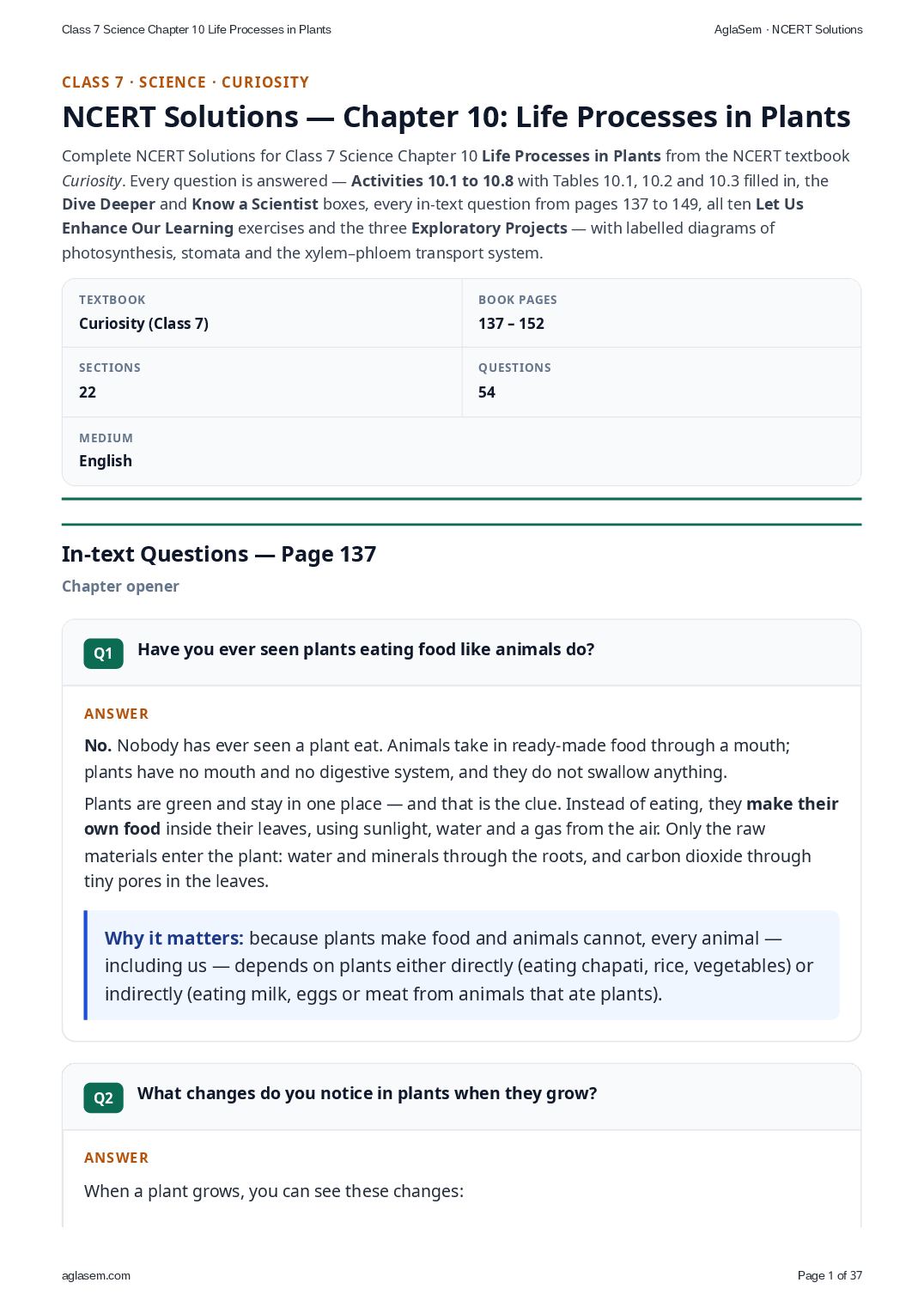
- Have you ever seen plants eating food like animals do?
- What changes do you notice in plants when they grow?
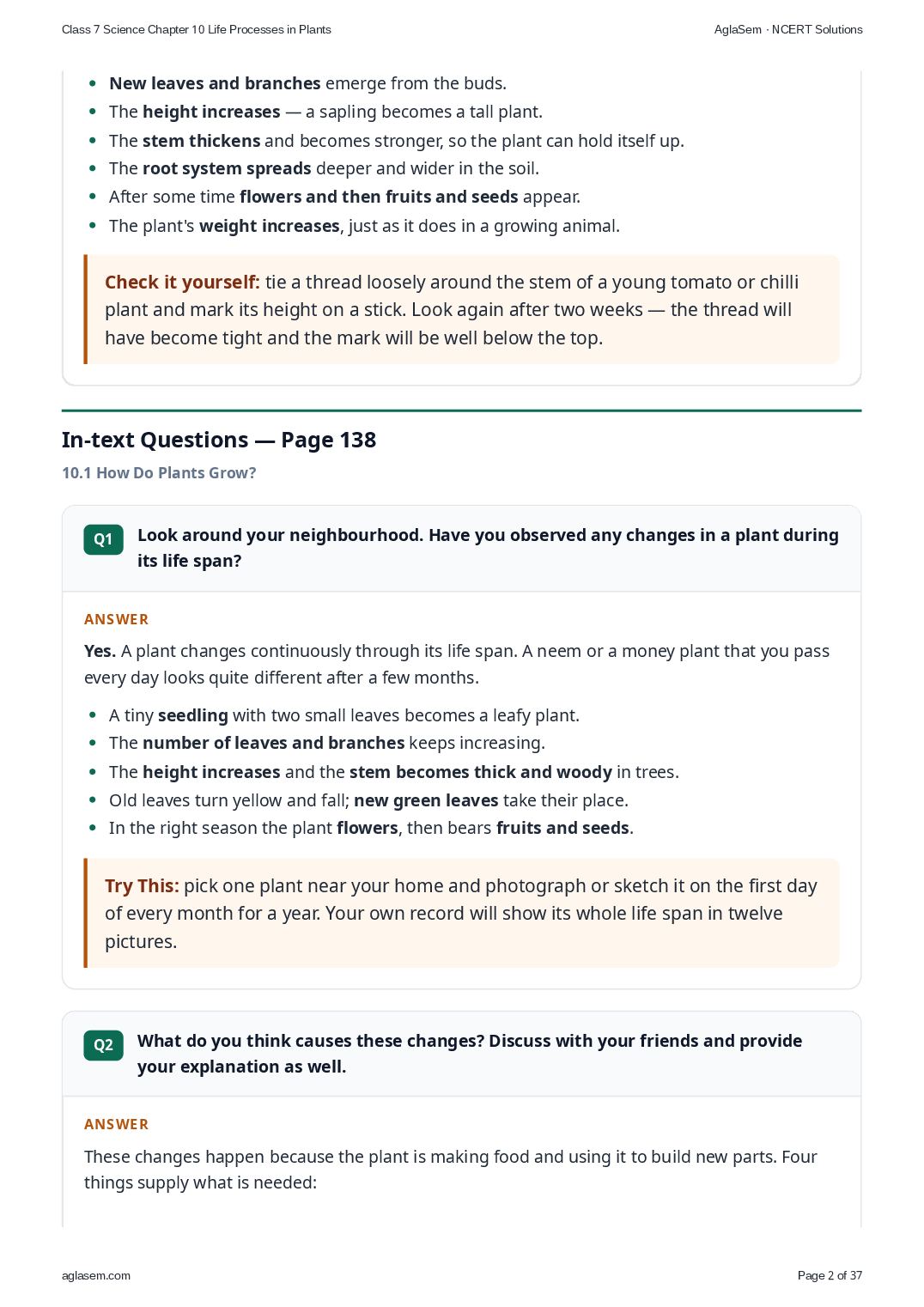
- Look around your neighbourhood. Have you observed any changes in a plant during its life span?
- What do you think causes these changes? Discuss with your friends and provide your explanation as well.
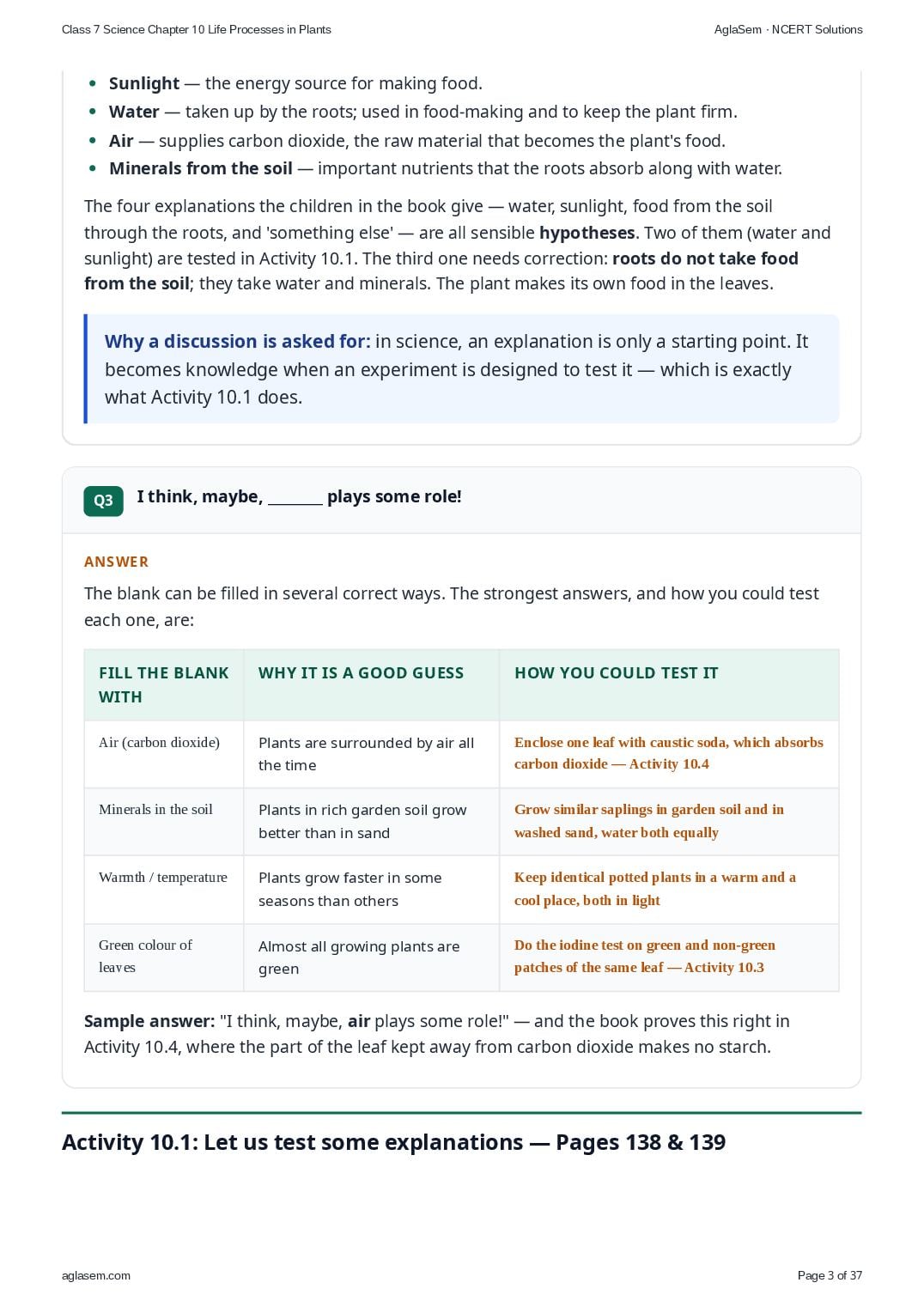
- I think, maybe, ________ plays some role!
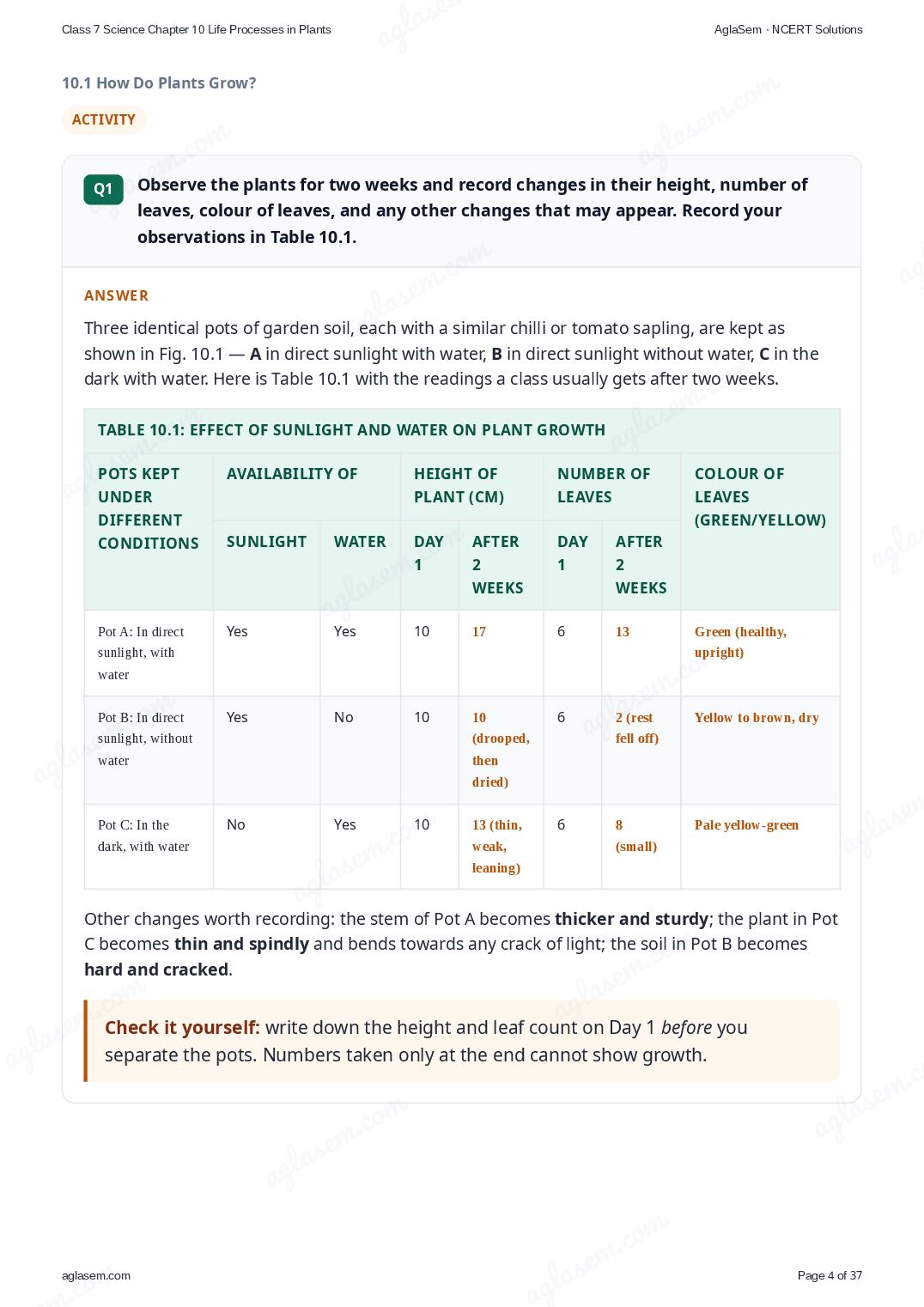
- Observe the plants for two weeks and record changes in their height, number of leaves, colour of leaves, and any other changes that may appear. Record your observations in Table 10.1.
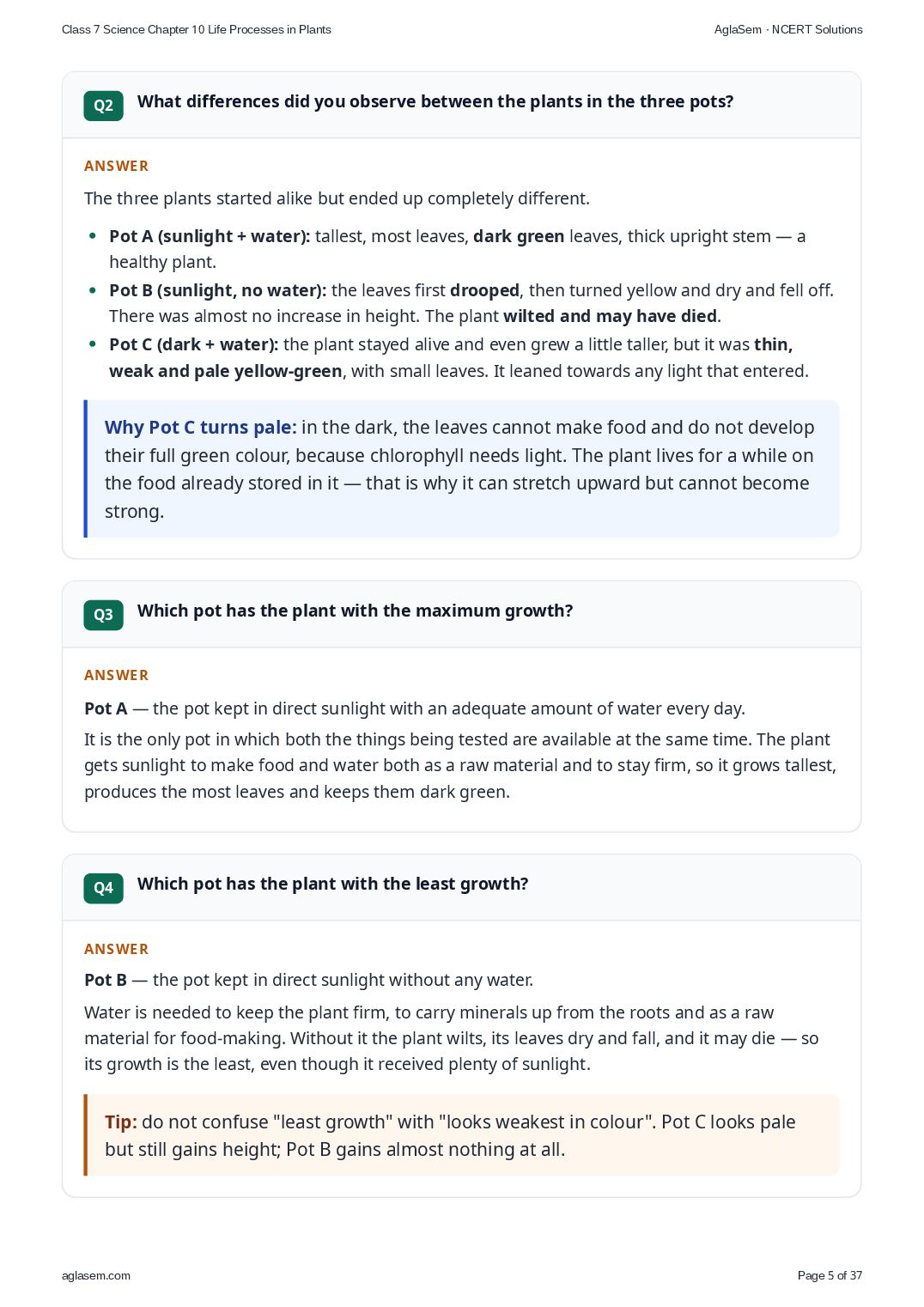
- What differences did you observe between the plants in the three pots?
- Which pot has the plant with the maximum growth?
- Which pot has the plant with the least growth?
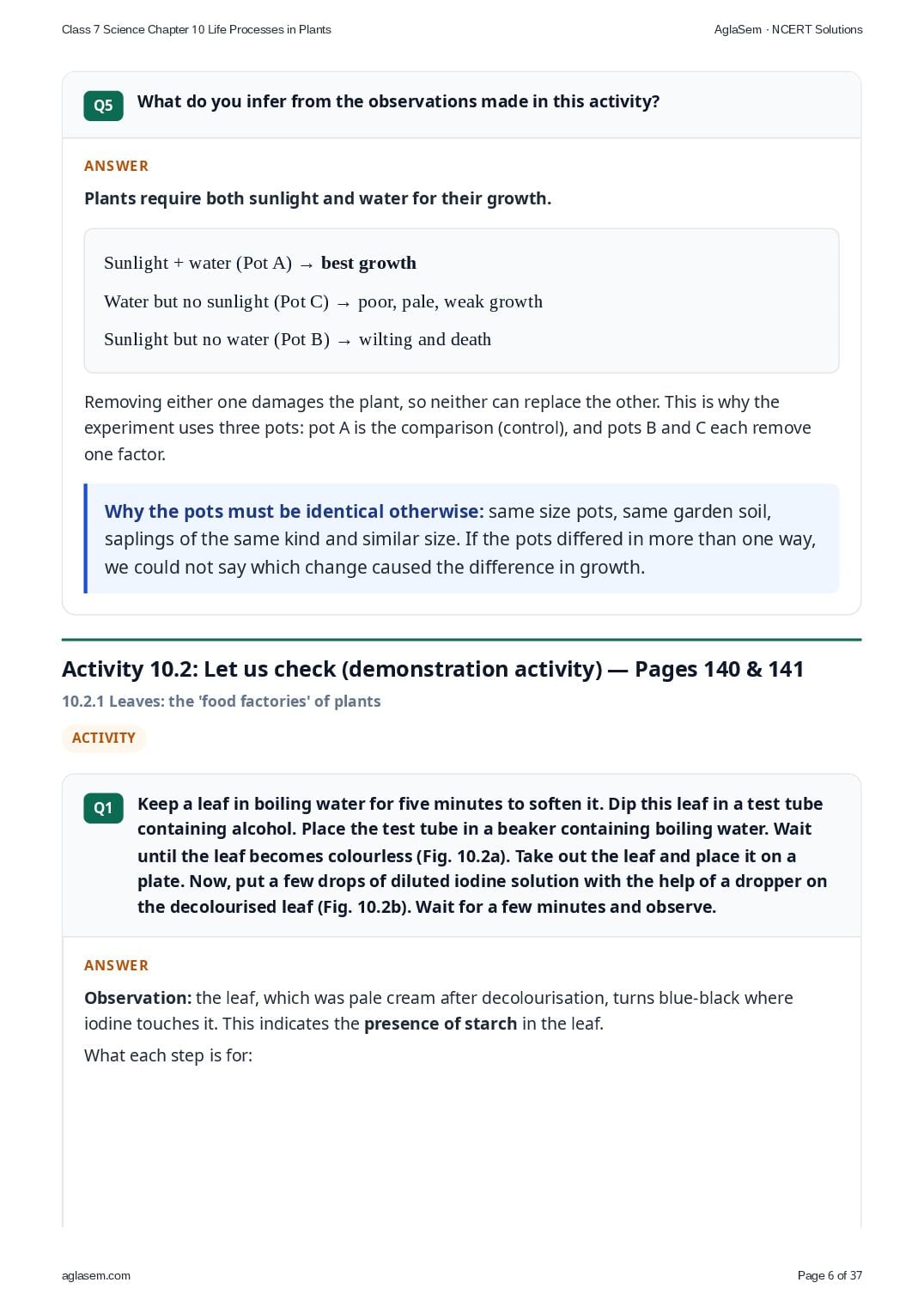
- What do you infer from the observations made in this activity?
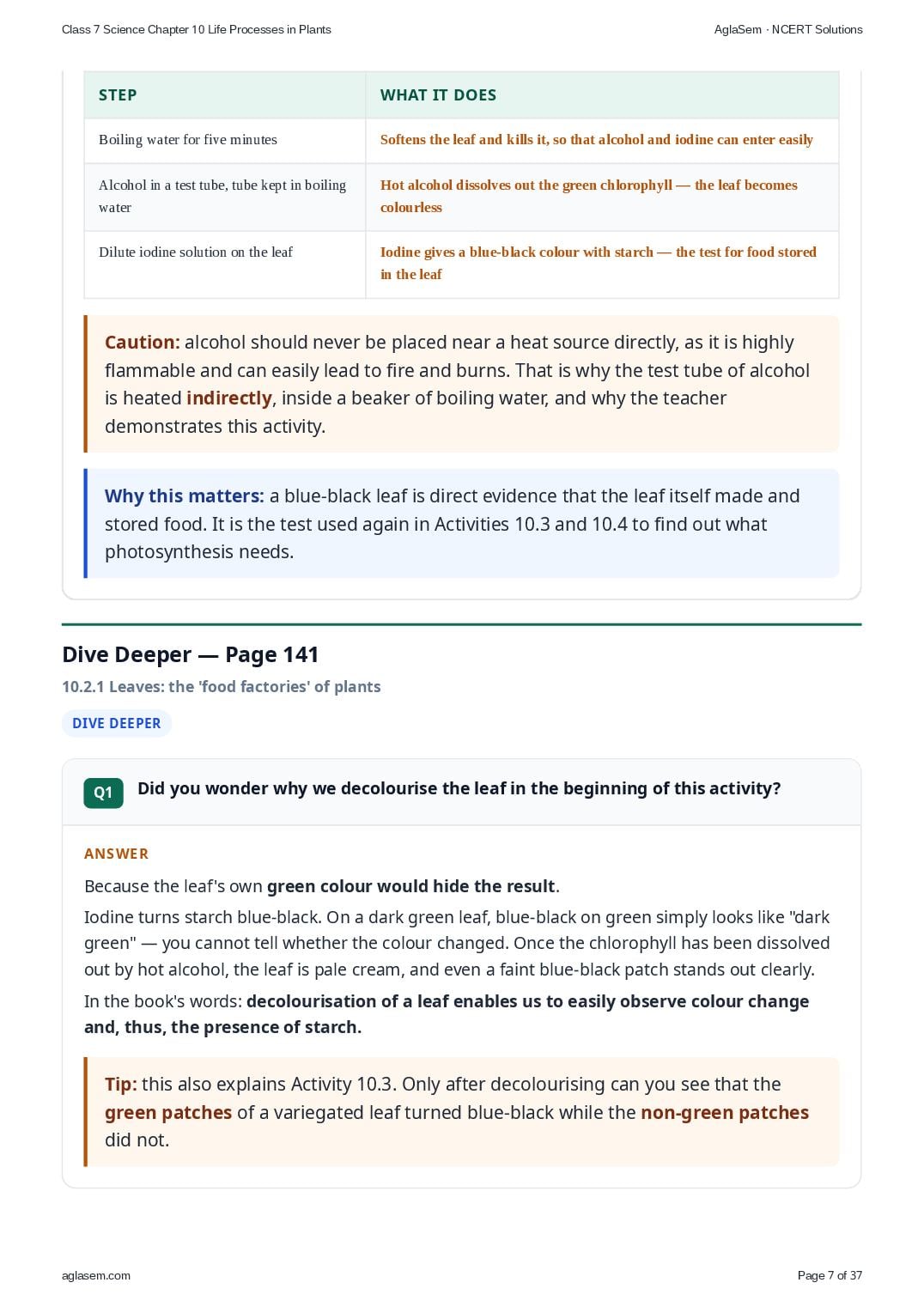
- Keep a leaf in boiling water for five minutes to soften it. Dip this leaf in a test tube containing alcohol. Place the test tube in a beaker containing boiling water. Wait until the leaf becomes colourless (Fig. 10.2a). Take out the leaf and place it on a plate. Now, put a few drops of diluted iodine solution with the help of a dropper on the decolourised leaf (Fig. 10.2b). Wait for a few minutes and observe.
- Did you wonder why we decolourise the leaf in the beginning of this activity?
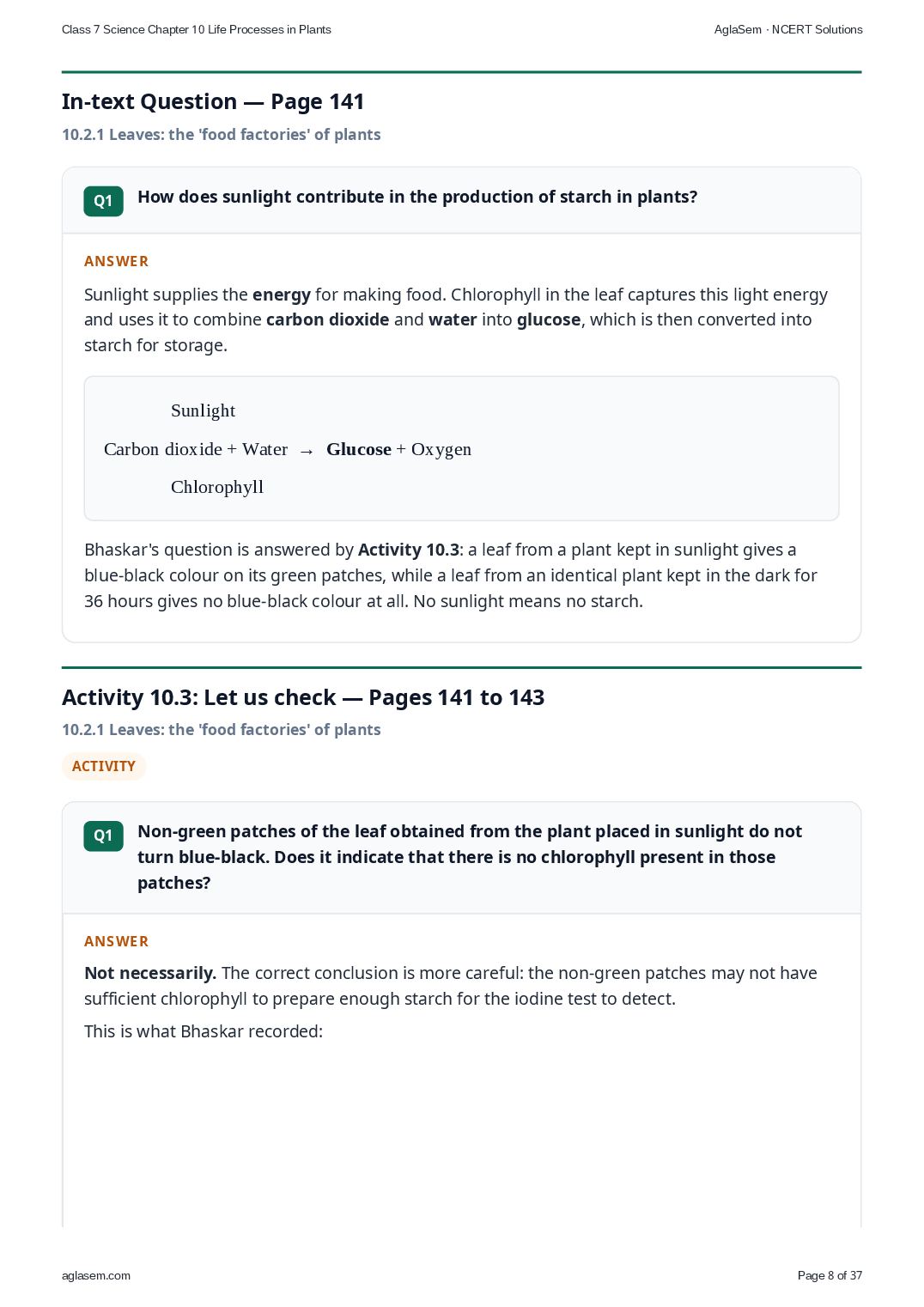
- How does sunlight contribute in the production of starch in plants?
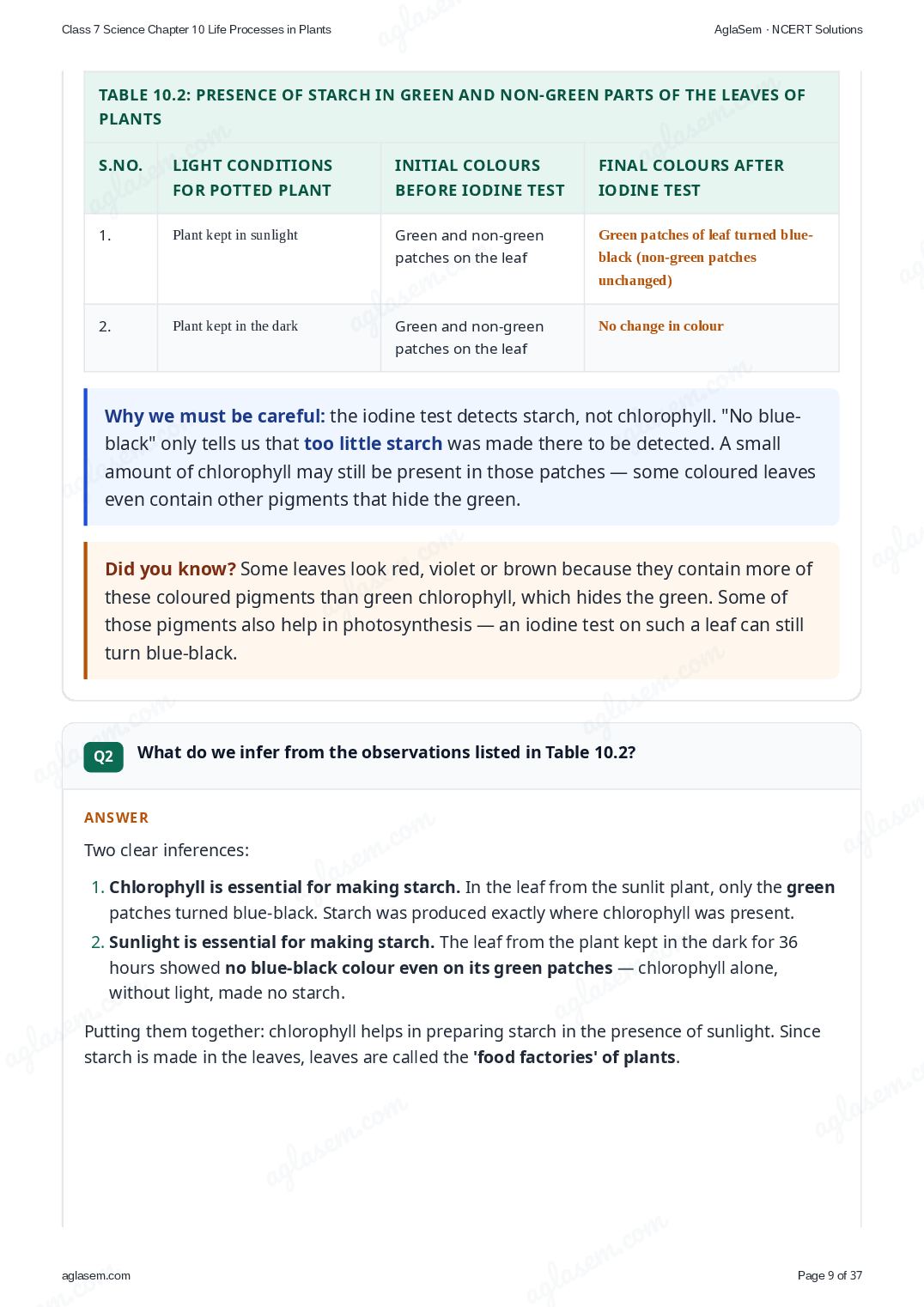
- Non-green patches of the leaf obtained from the plant placed in sunlight do not turn blue-black. Does it indicate that there is no chlorophyll present in those patches?
- What do we infer from the observations listed in Table 10.2?
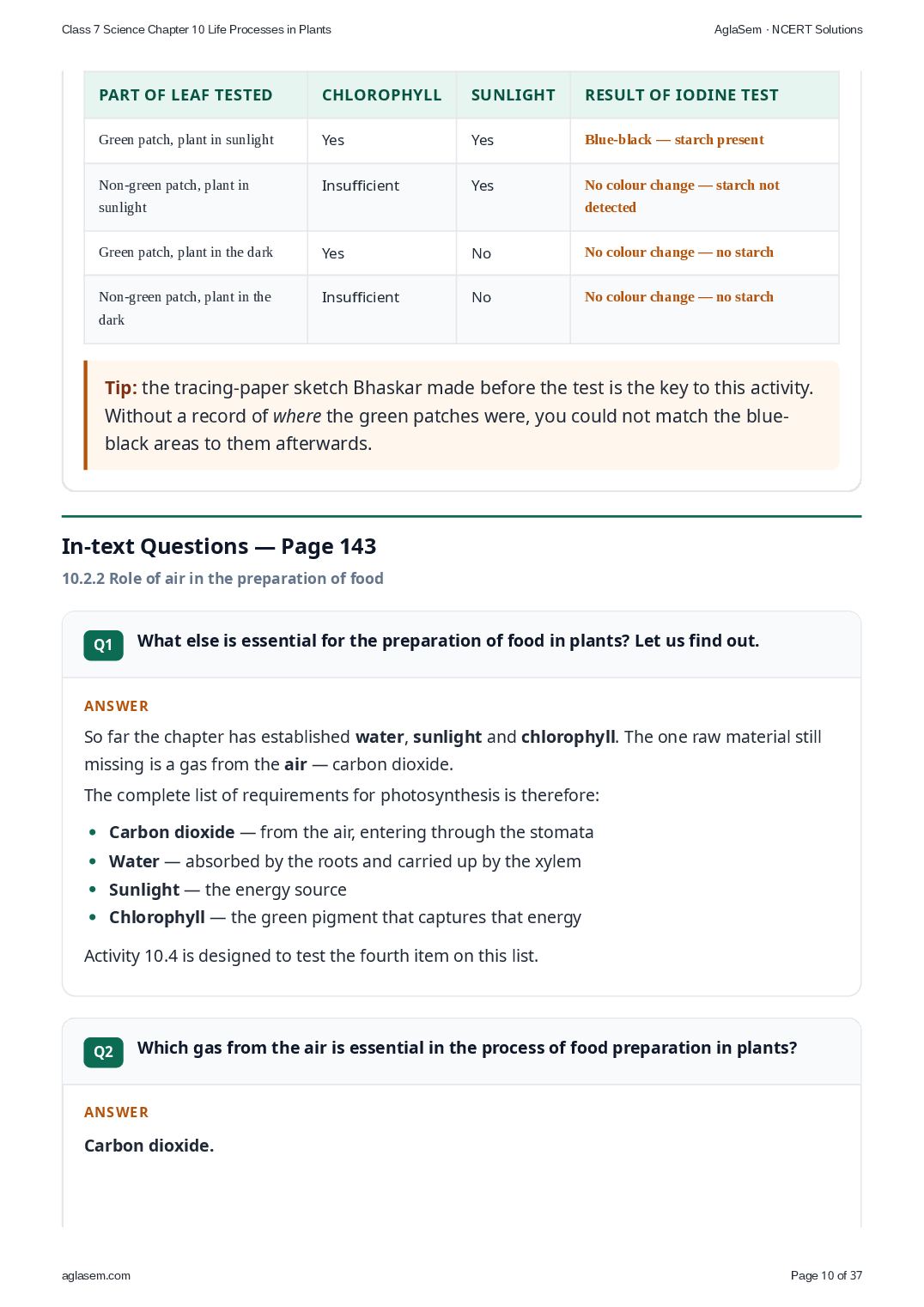
- What else is essential for the preparation of food in plants? Let us find out.
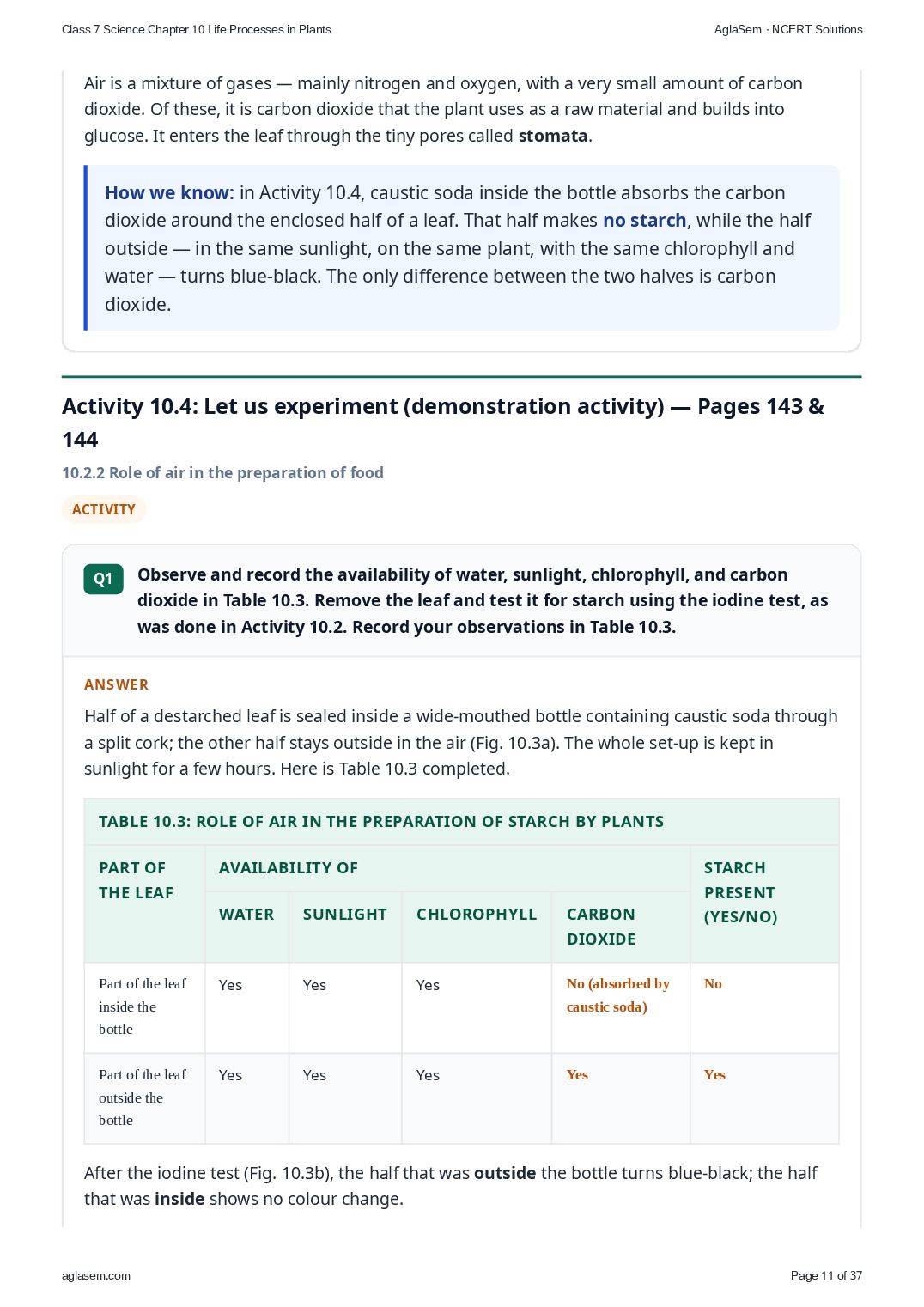
- Which gas from the air is essential in the process of food preparation in plants?
- Observe and record the availability of water, sunlight, chlorophyll, and carbon dioxide in Table 10.3. Remove the leaf and test it for starch using the iodine test, as was done in Activity 10.2. Record your observations in Table 10.3.
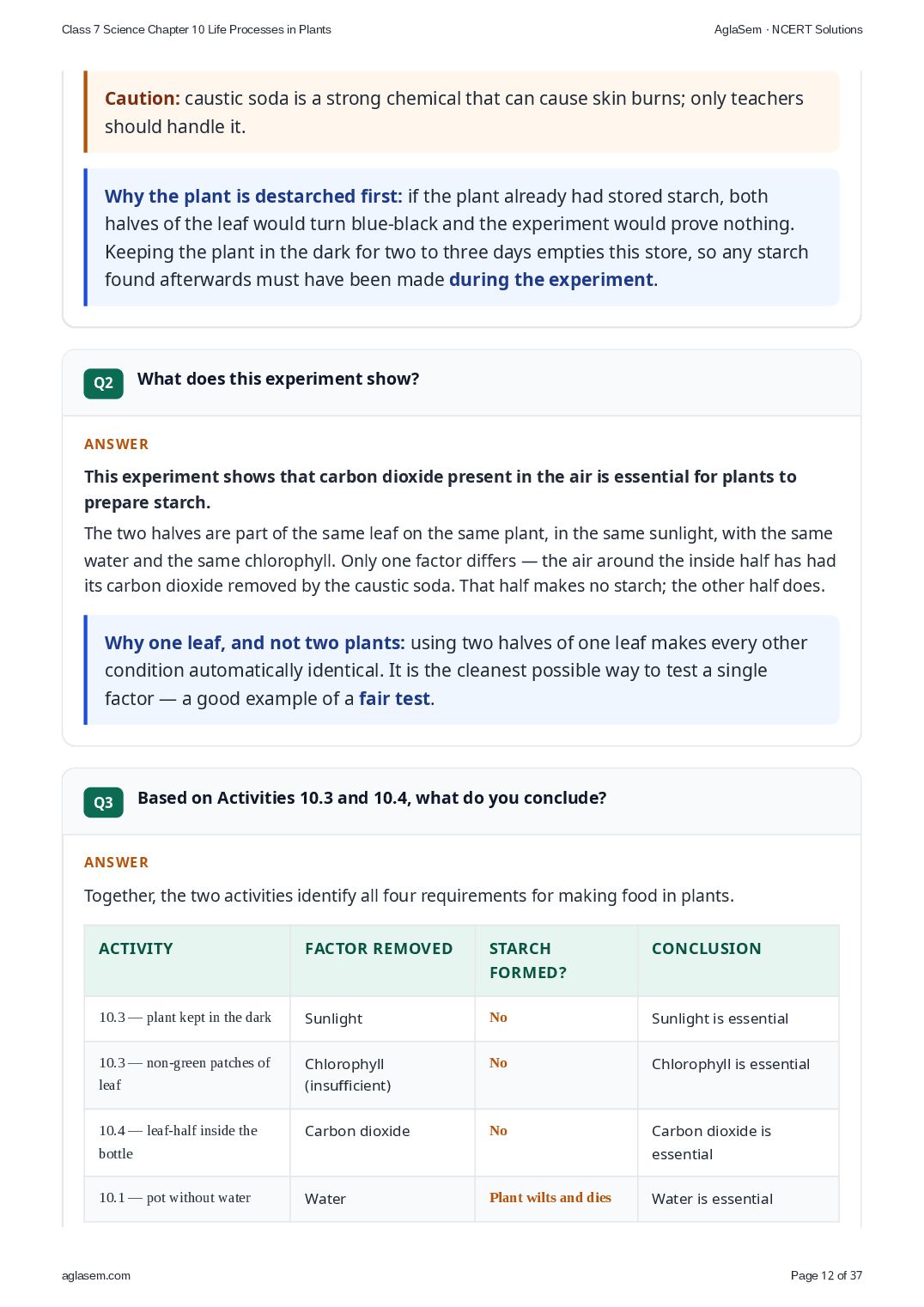
- What does this experiment show?
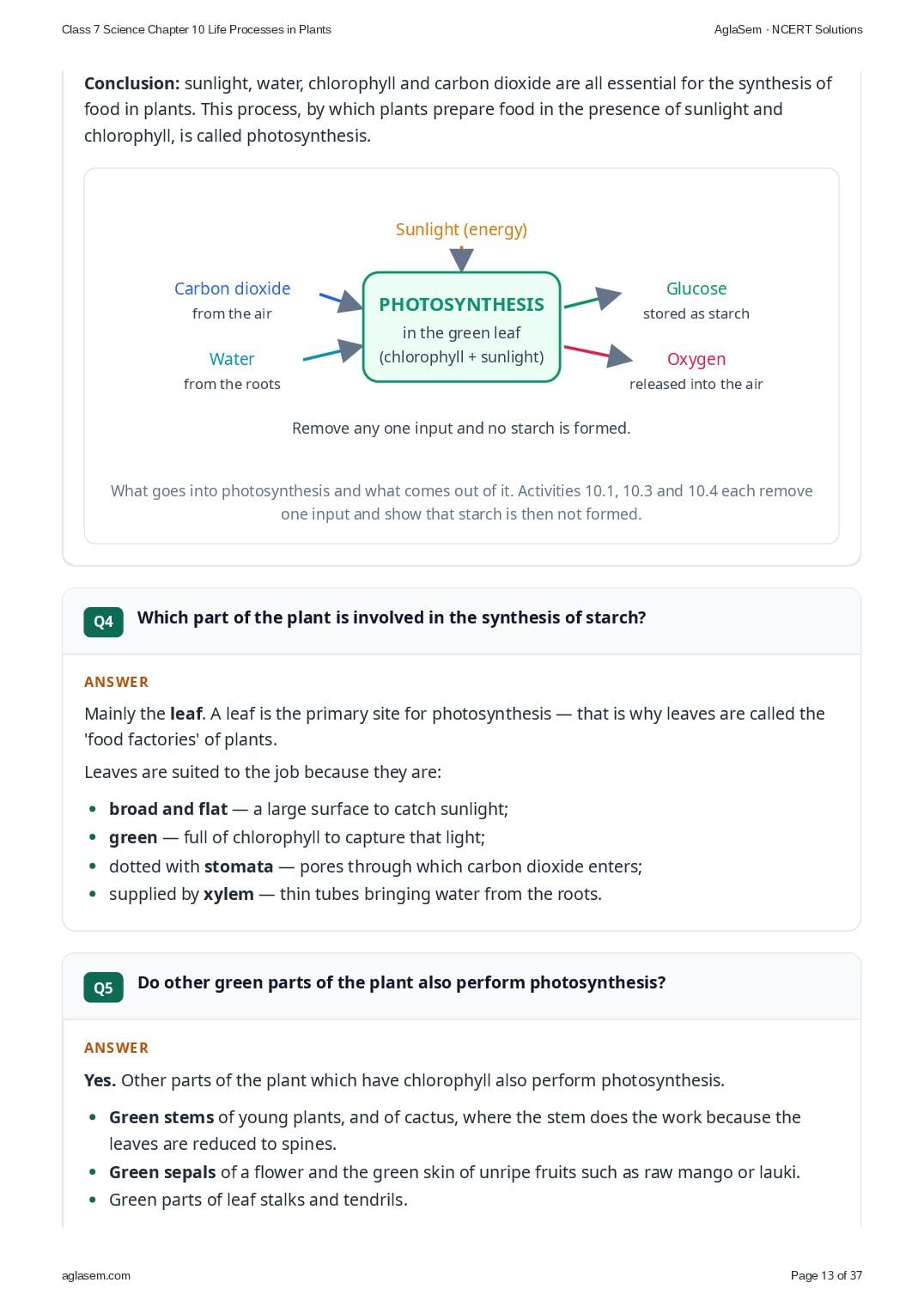
- Based on Activities 10.3 and 10.4, what do you conclude?
- Which part of the plant is involved in the synthesis of starch?
- Do other green parts of the plant also perform photosynthesis?
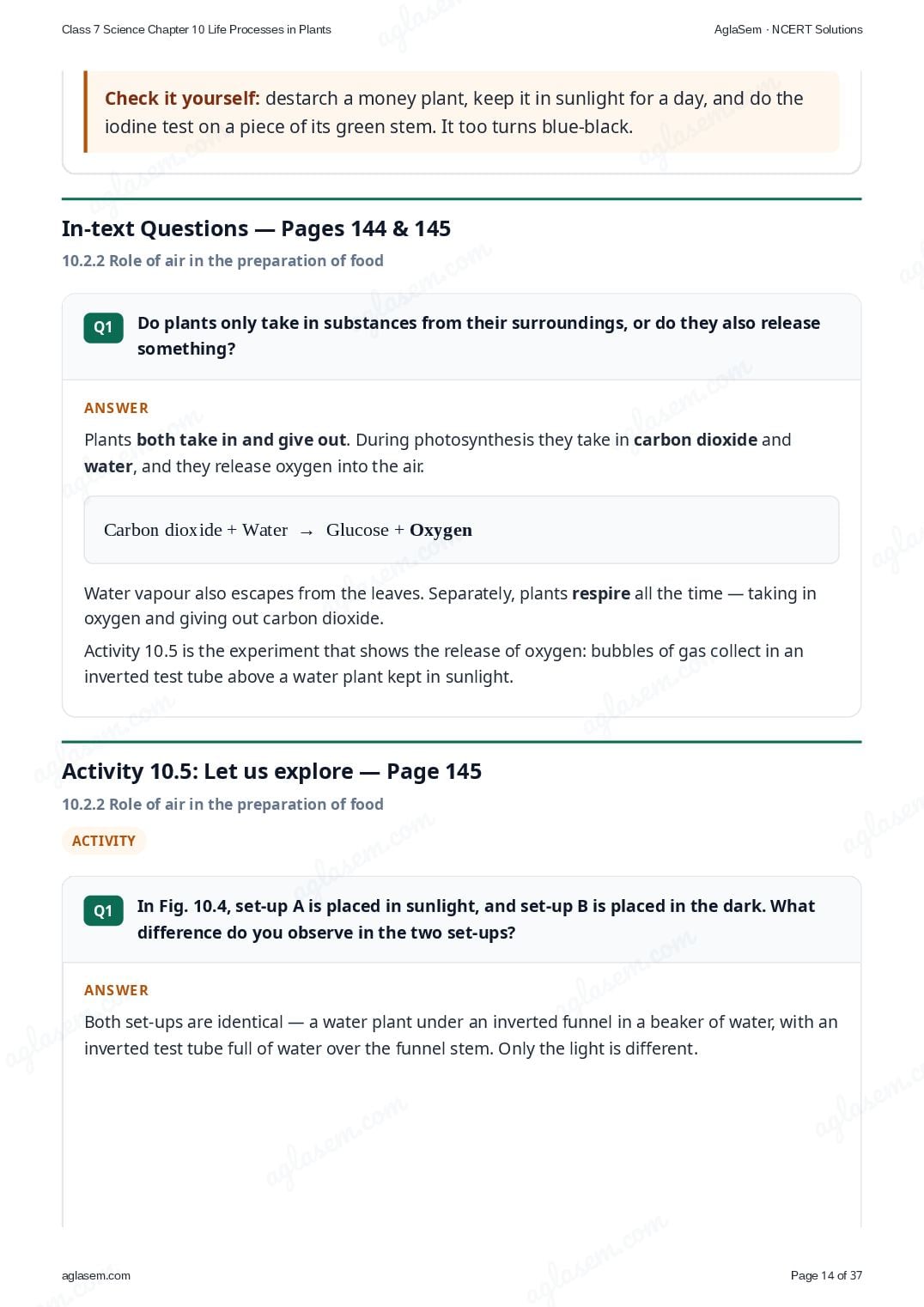
- Do plants only take in substances from their surroundings, or do they also release something?
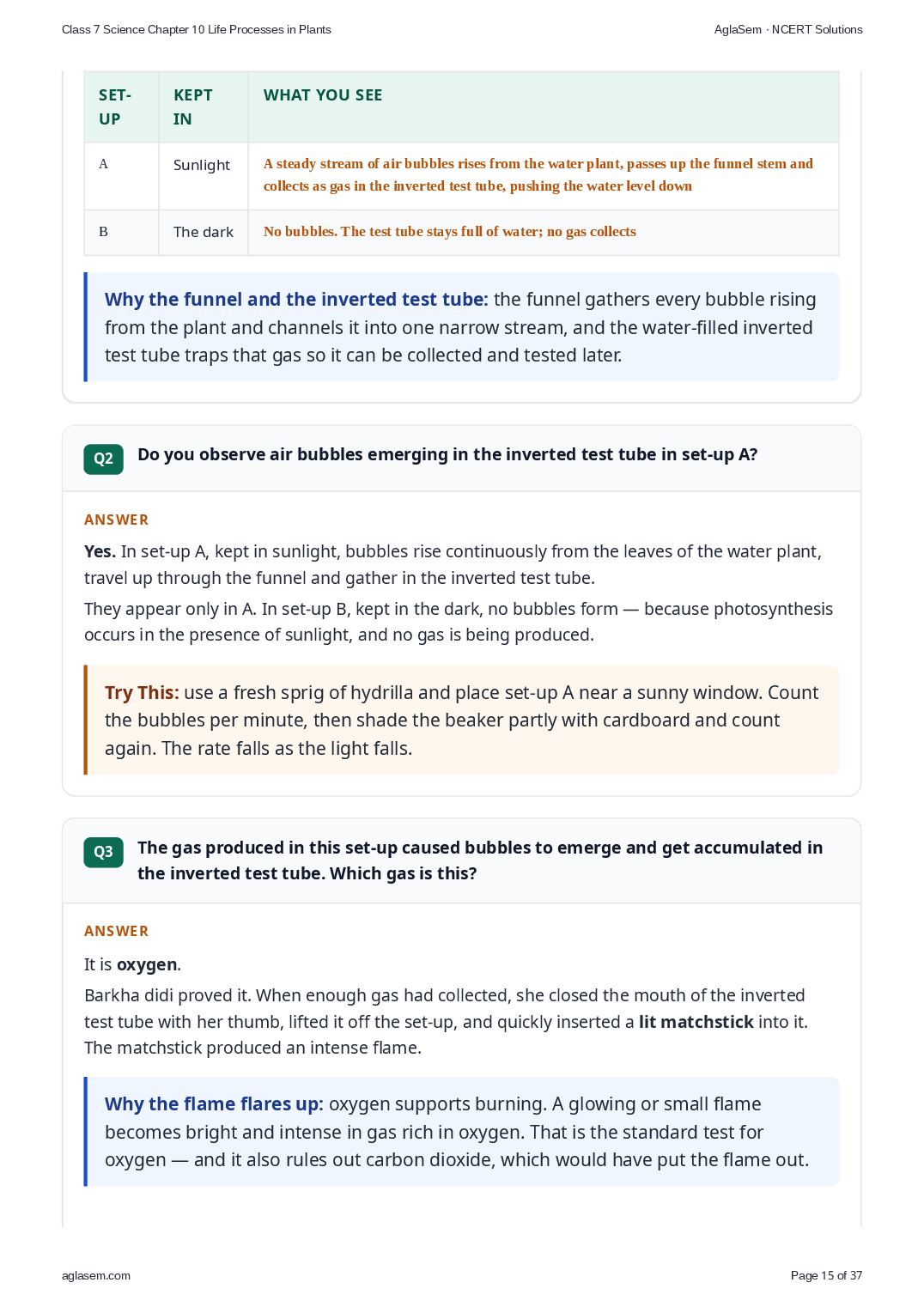
- In Fig. 10.4, set-up A is placed in sunlight, and set-up B is placed in the dark. What difference do you observe in the two set-ups?
- Do you observe air bubbles emerging in the inverted test tube in set-up A?
- The gas produced in this set-up caused bubbles to emerge and get accumulated in the inverted test tube. Which gas is this?
- Who was Rustom Hormusji Dastur, and what did he contribute to our understanding of photosynthesis?
- Which part of the plant helps in the exchange of carbon dioxide and oxygen?
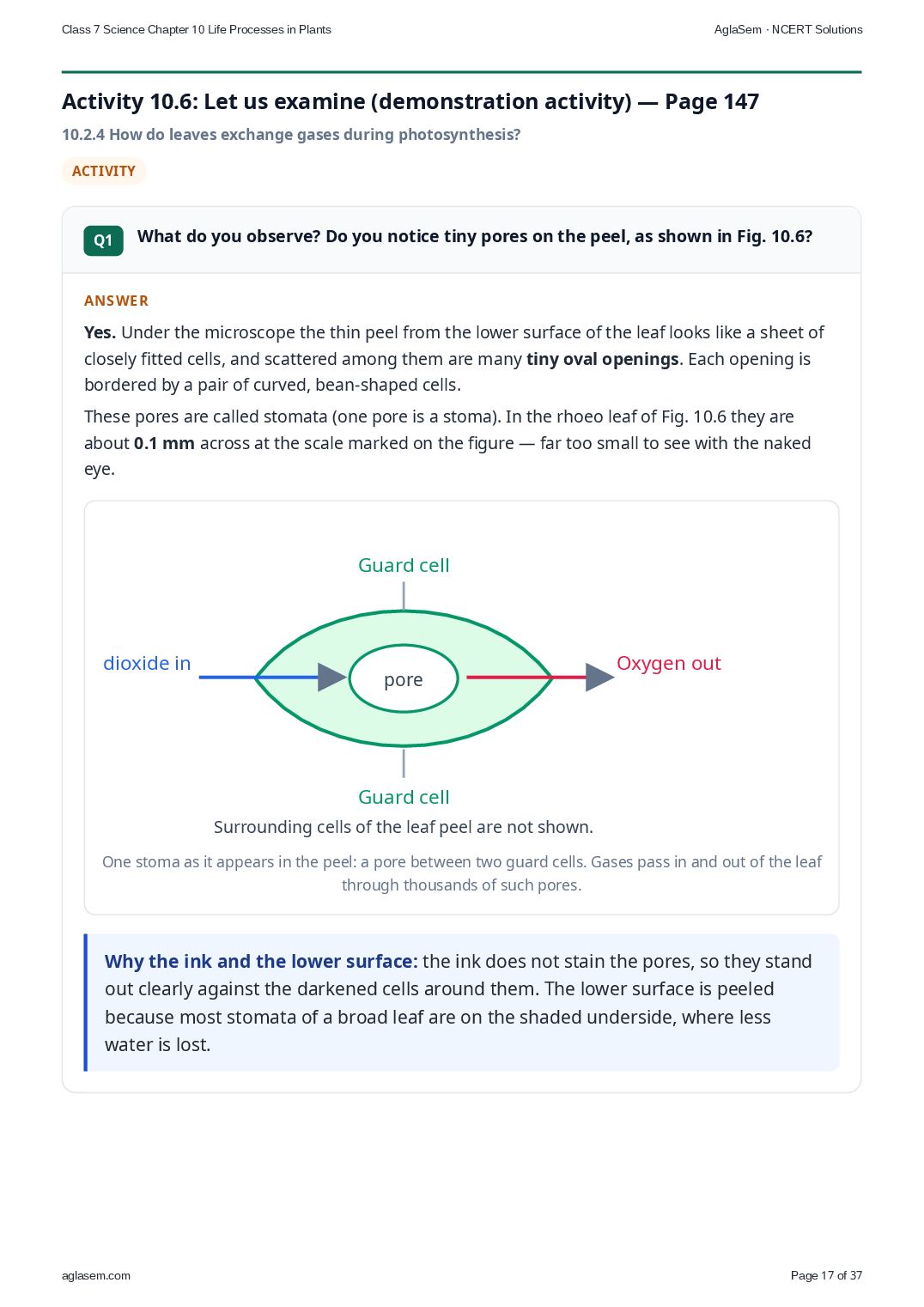
- What do you observe? Do you notice tiny pores on the peel, as shown in Fig. 10.6?
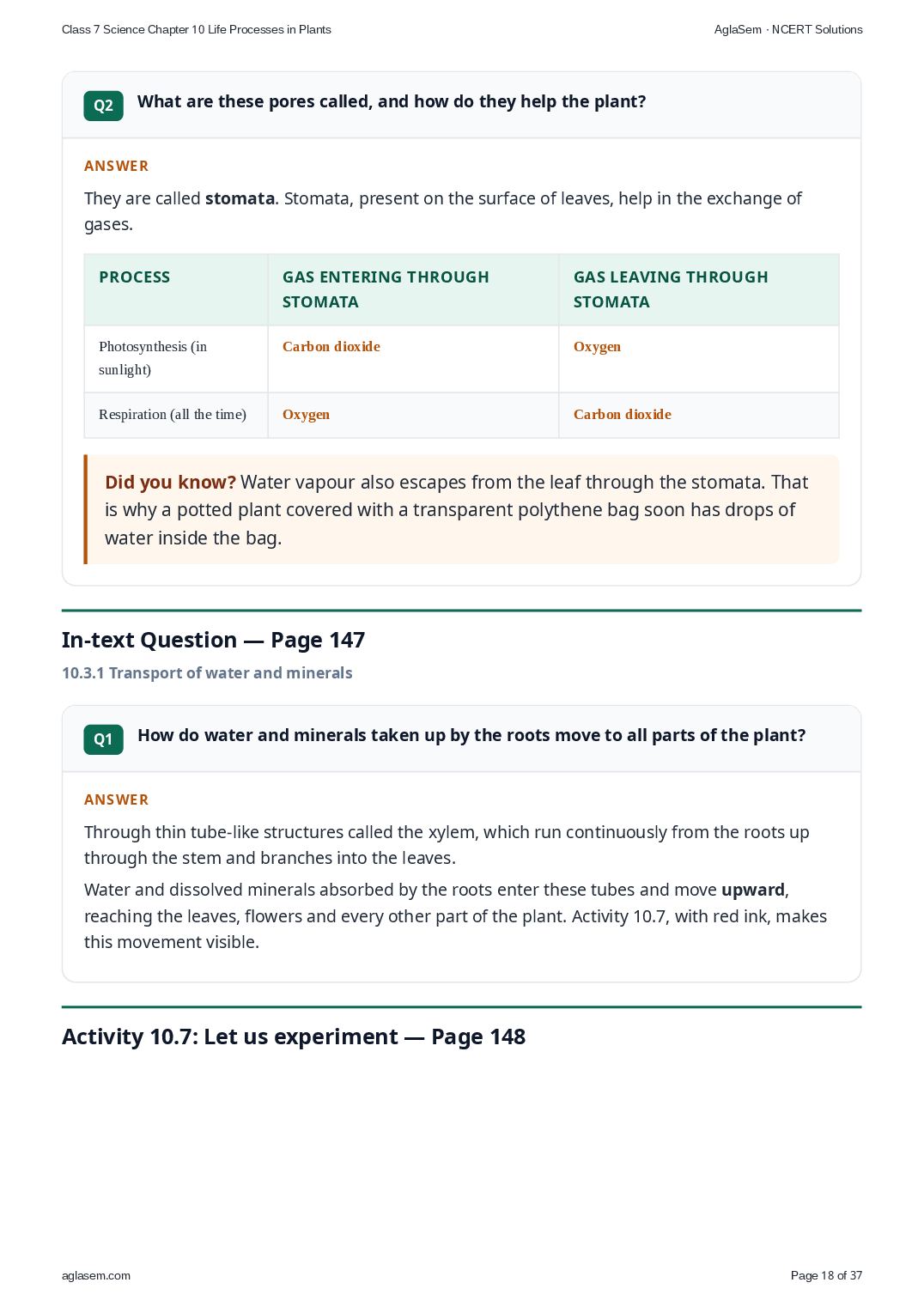
- What are these pores called, and how do they help the plant?
- How do water and minerals taken up by the roots move to all parts of the plant?
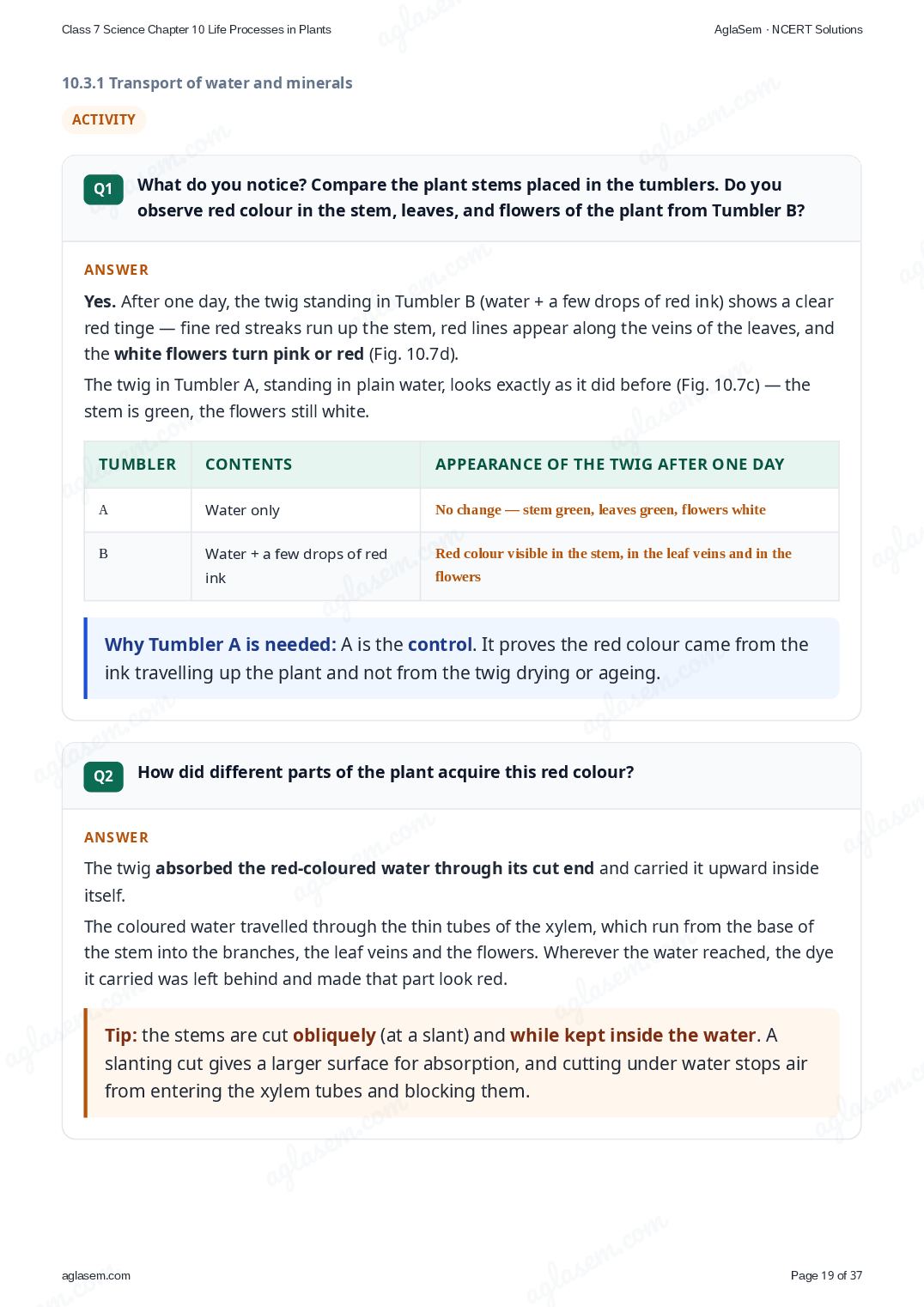
- What do you notice? Compare the plant stems placed in the tumblers. Do you observe red colour in the stem, leaves, and flowers of the plant from Tumbler B?
- How did different parts of the plant acquire this red colour?
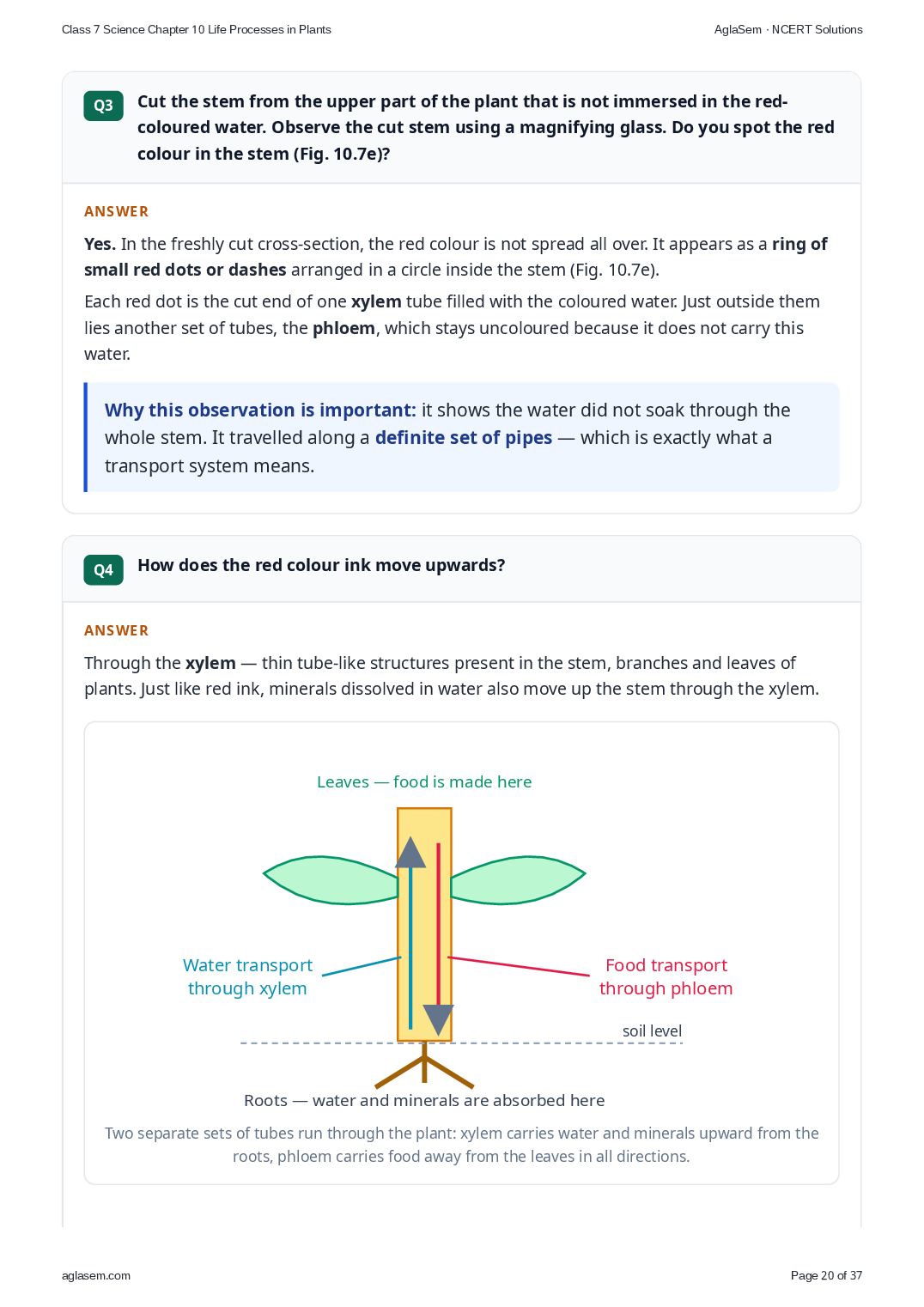
- Cut the stem from the upper part of the plant that is not immersed in the red-coloured water. Observe the cut stem using a magnifying glass. Do you spot the red colour in the stem (Fig. 10.7e)?
- How does the red colour ink move upwards?
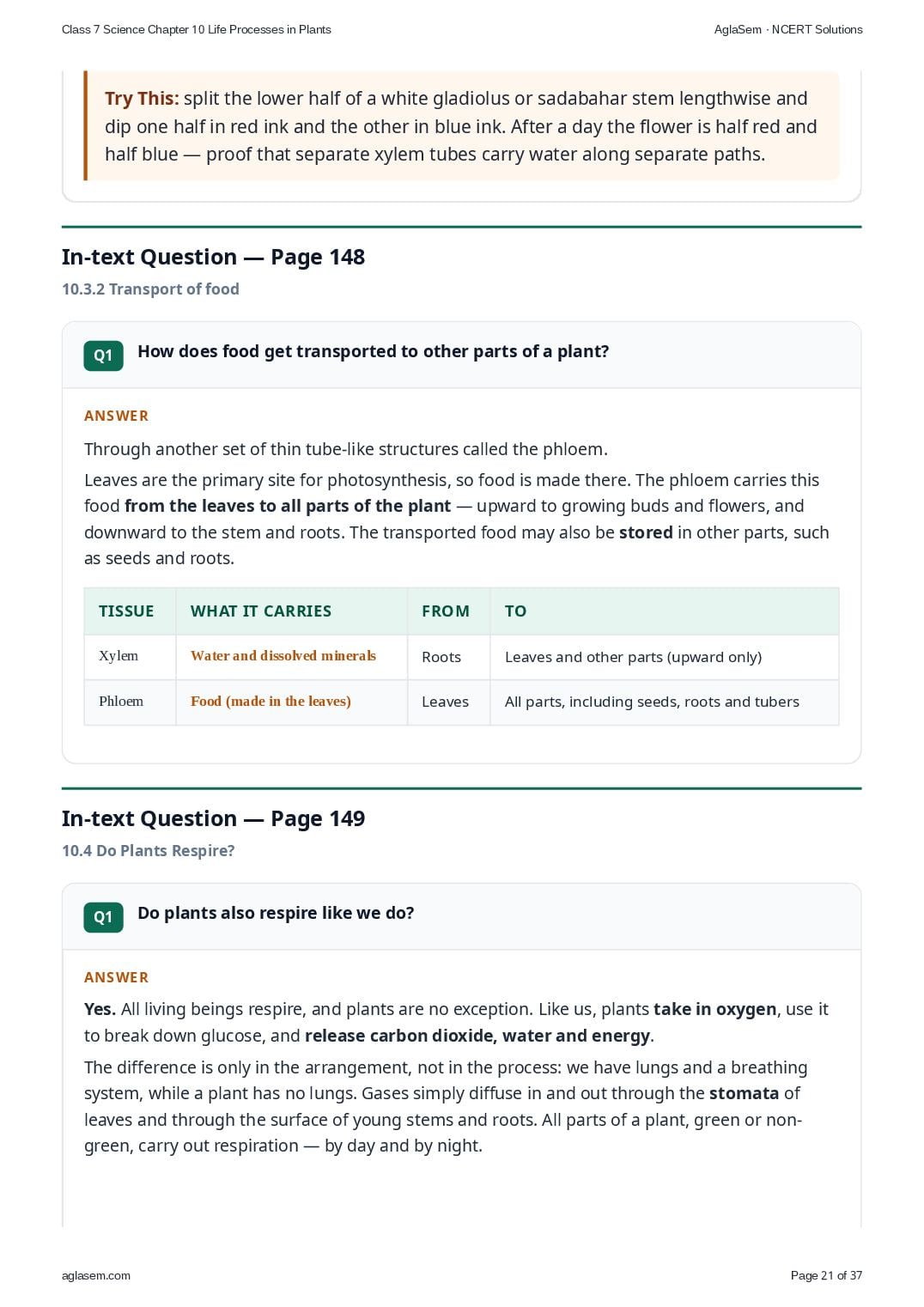
- How does food get transported to other parts of a plant?
- Do plants also respire like we do?
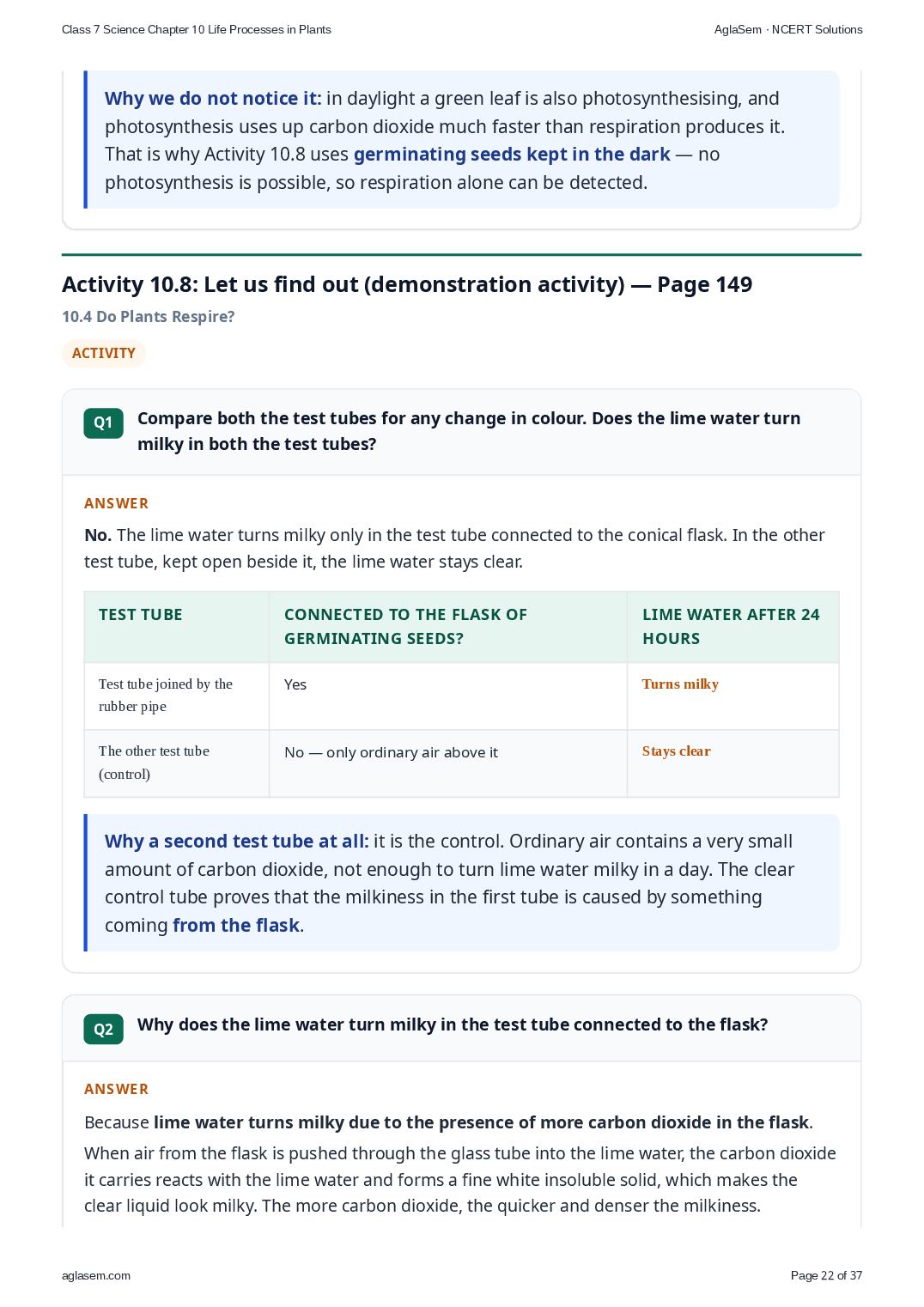
- Compare both the test tubes for any change in colour. Does the lime water turn milky in both the test tubes?
- Why does the lime water turn milky in the test tube connected to the flask?
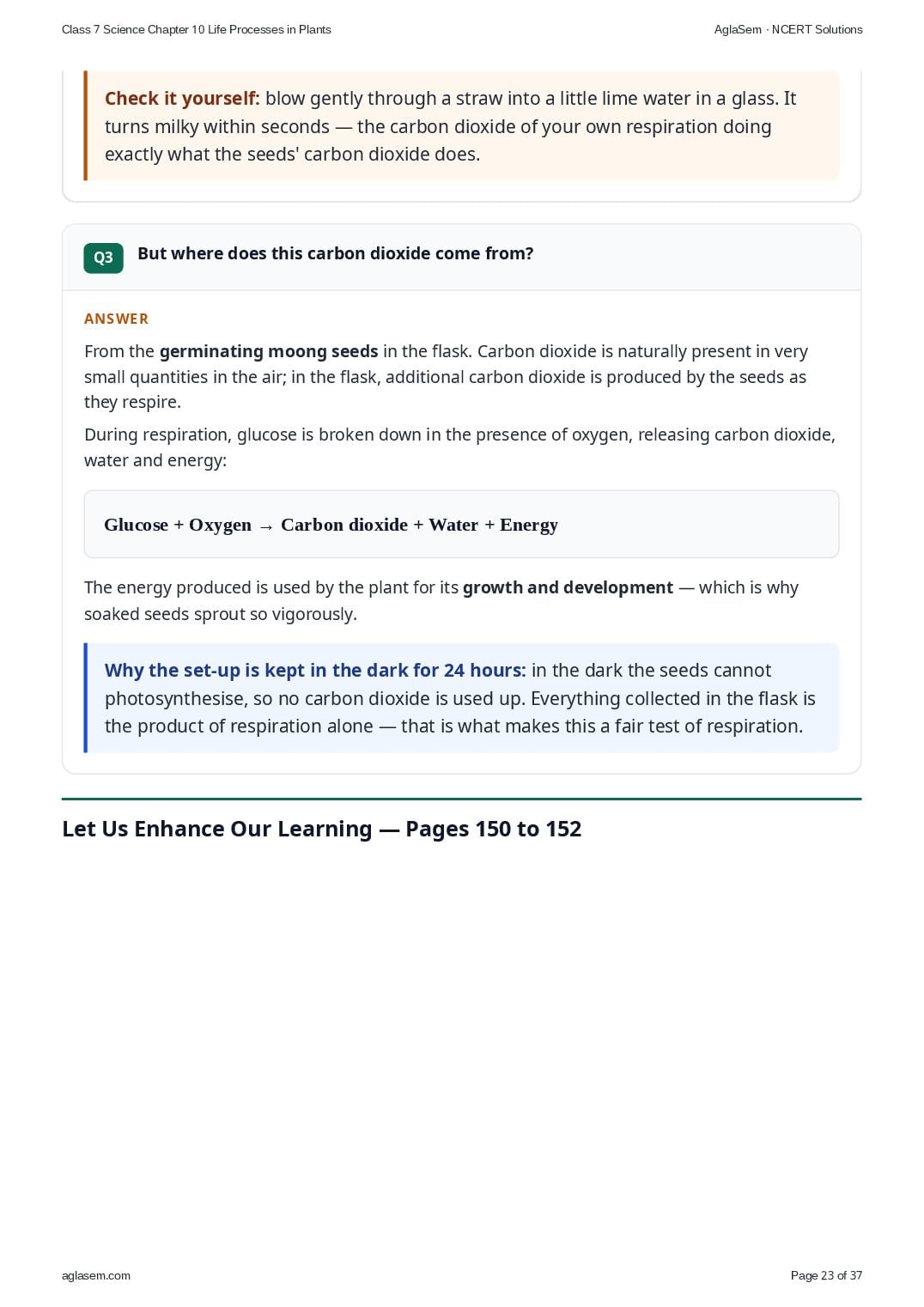
- But where does this carbon dioxide come from?
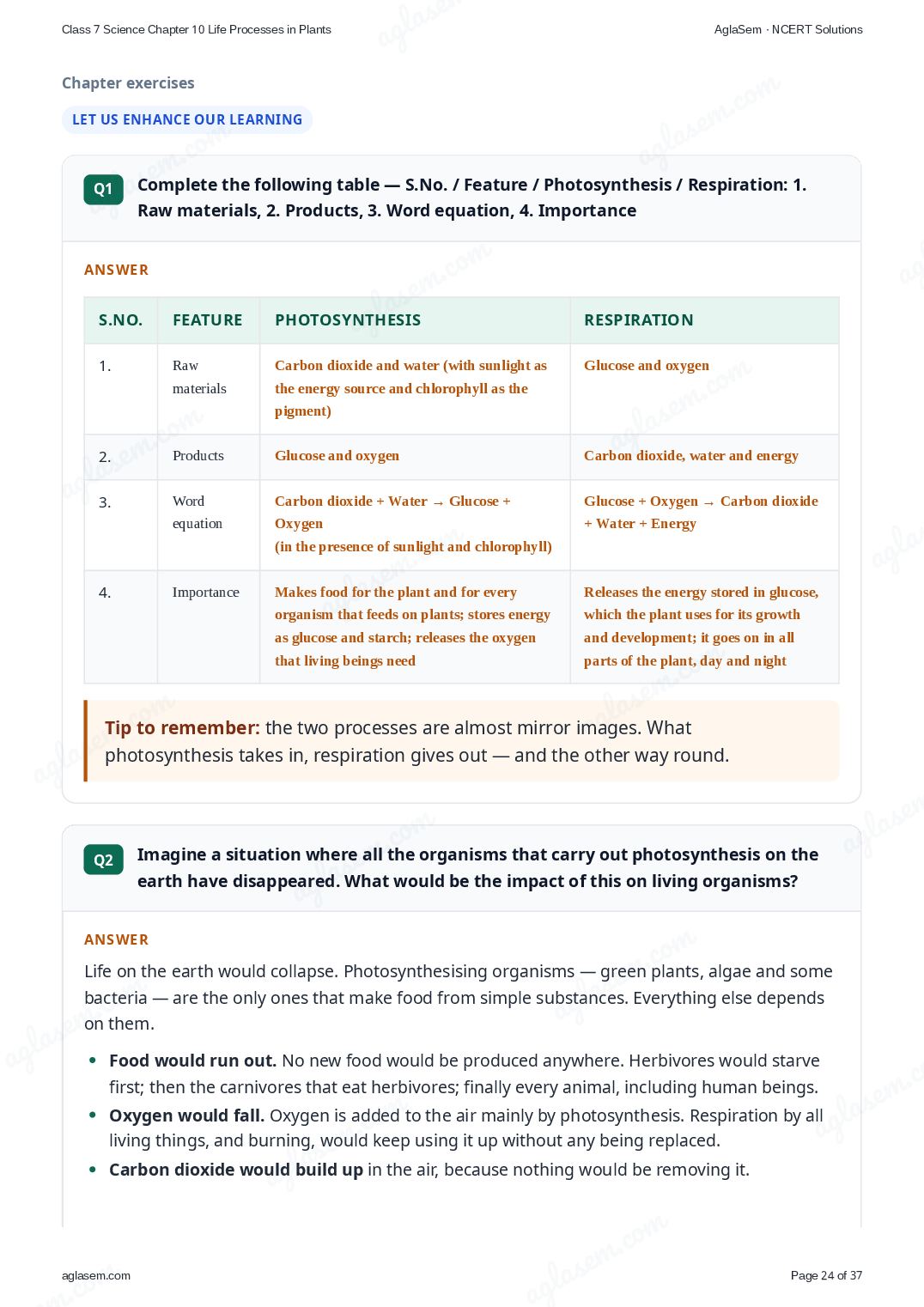
- Complete the following table — S.No. / Feature / Photosynthesis / Respiration: 1. Raw materials, 2. Products, 3. Word equation, 4. Importance
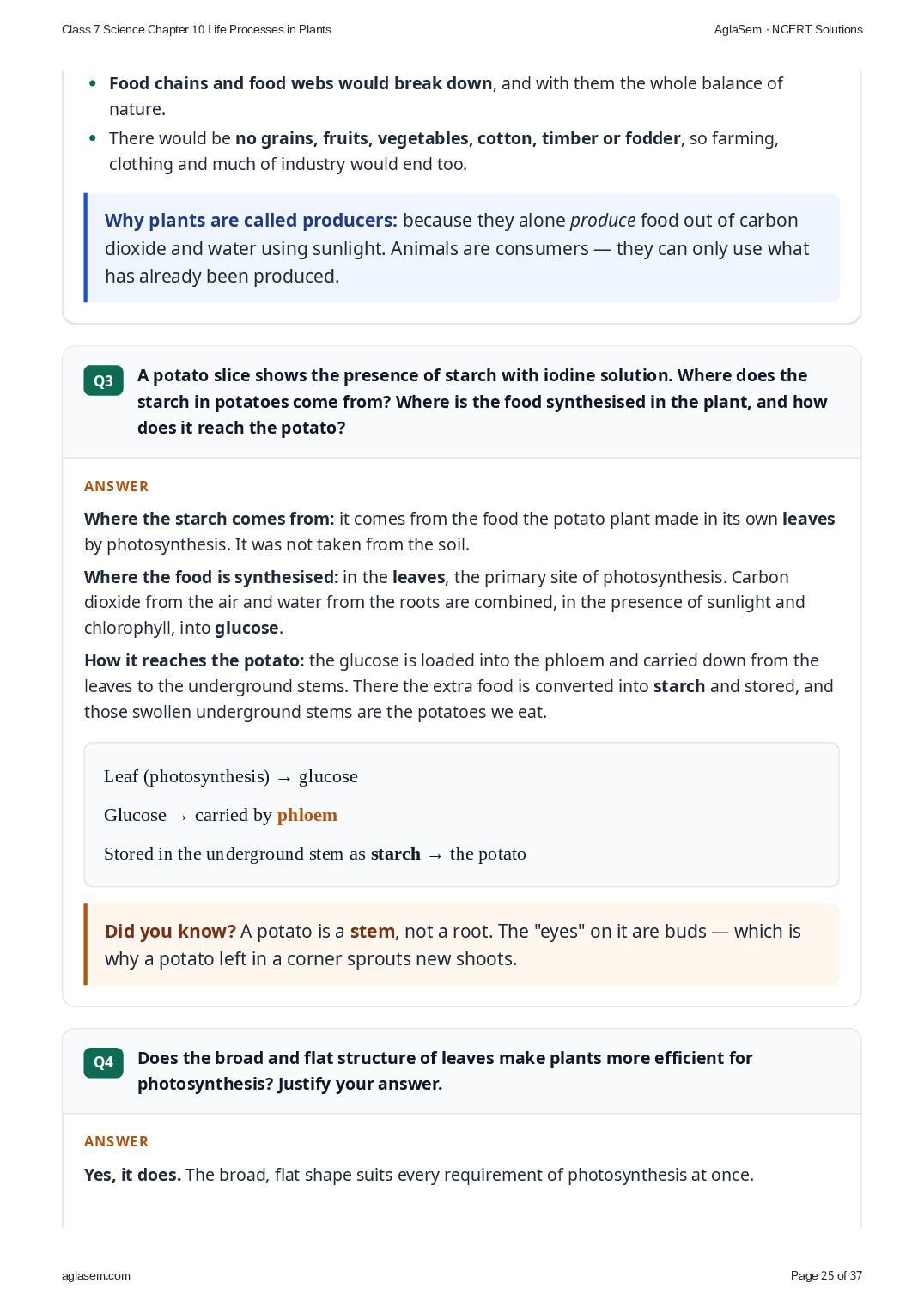
- Imagine a situation where all the organisms that carry out photosynthesis on the earth have disappeared. What would be the impact of this on living organisms?
- A potato slice shows the presence of starch with iodine solution. Where does the starch in potatoes come from? Where is the food synthesised in the plant, and how does it reach the potato?
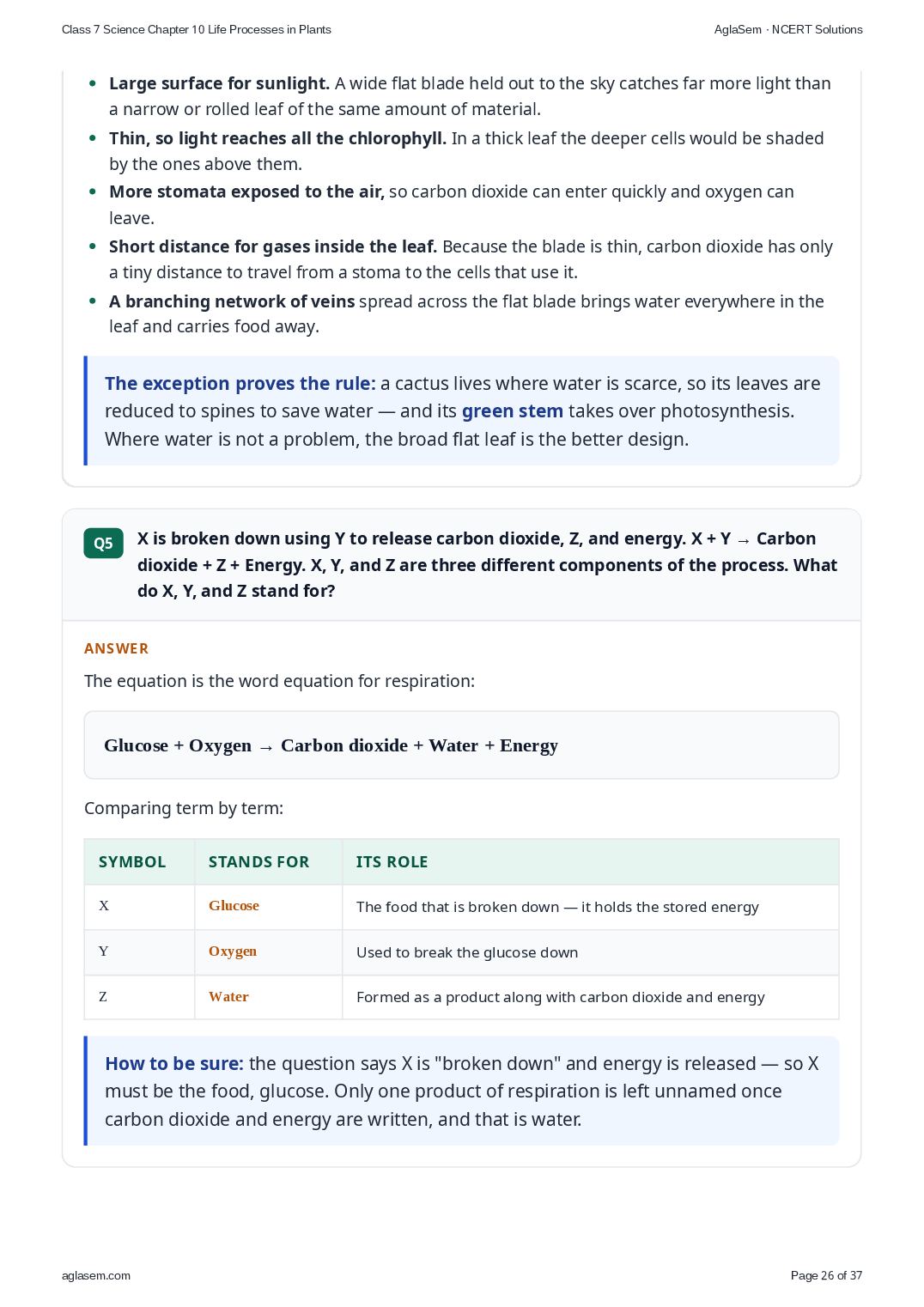
- Does the broad and flat structure of leaves make plants more efficient for photosynthesis? Justify your answer.
- X is broken down using Y to release carbon dioxide, Z, and energy. X + Y → Carbon dioxide + Z + Energy. X, Y, and Z are three different components of the process. What do X, Y, and Z stand for?
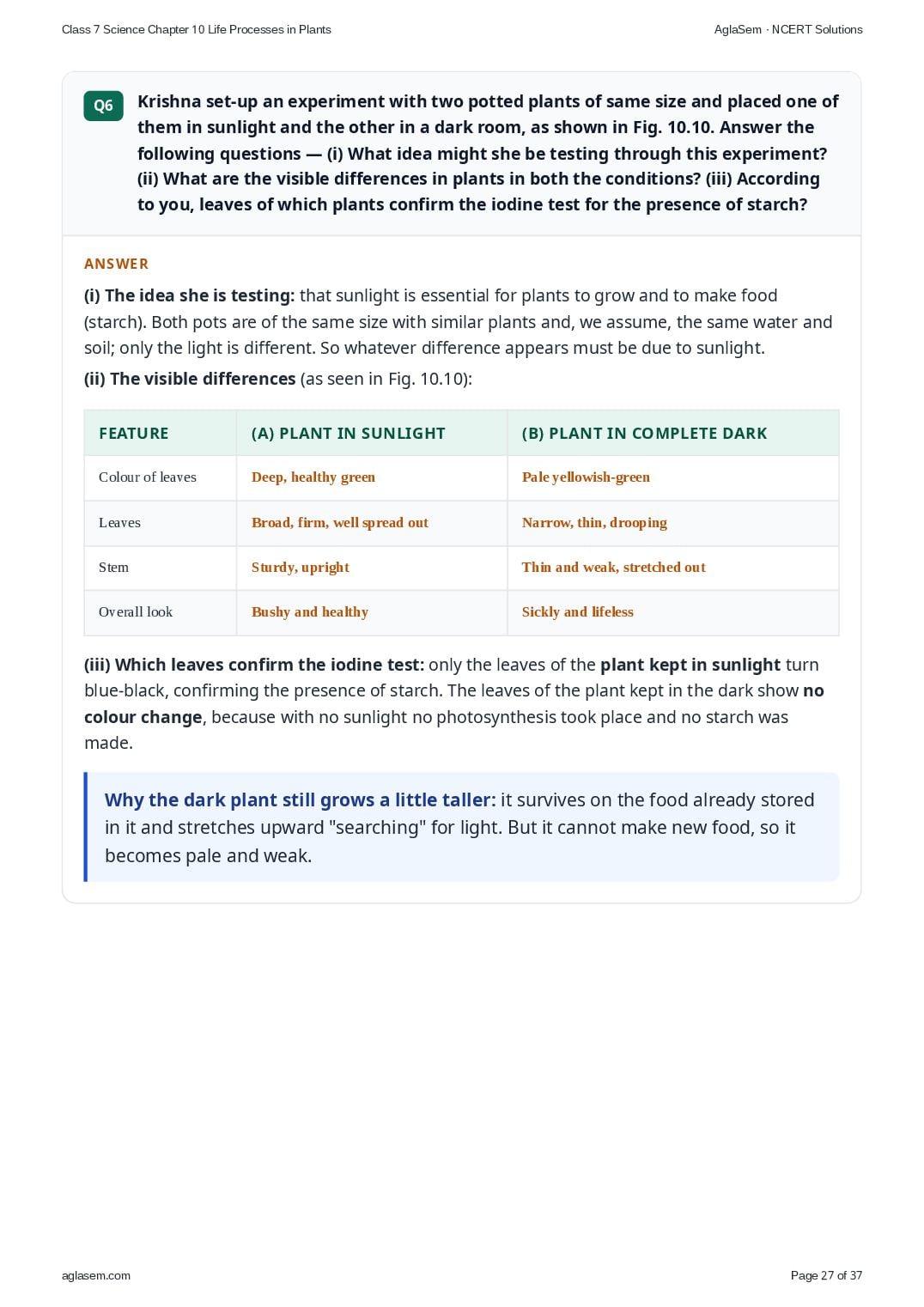
- Krishna set-up an experiment with two potted plants of same size and placed one of them in sunlight and the other in a dark room, as shown in Fig. 10.10. Answer the following questions — (i) What idea might she be testing through this experiment? (ii) What are the visible differences in plants in both the conditions? (iii) According to you, leaves of which plants confirm the iodine test for the presence of starch?
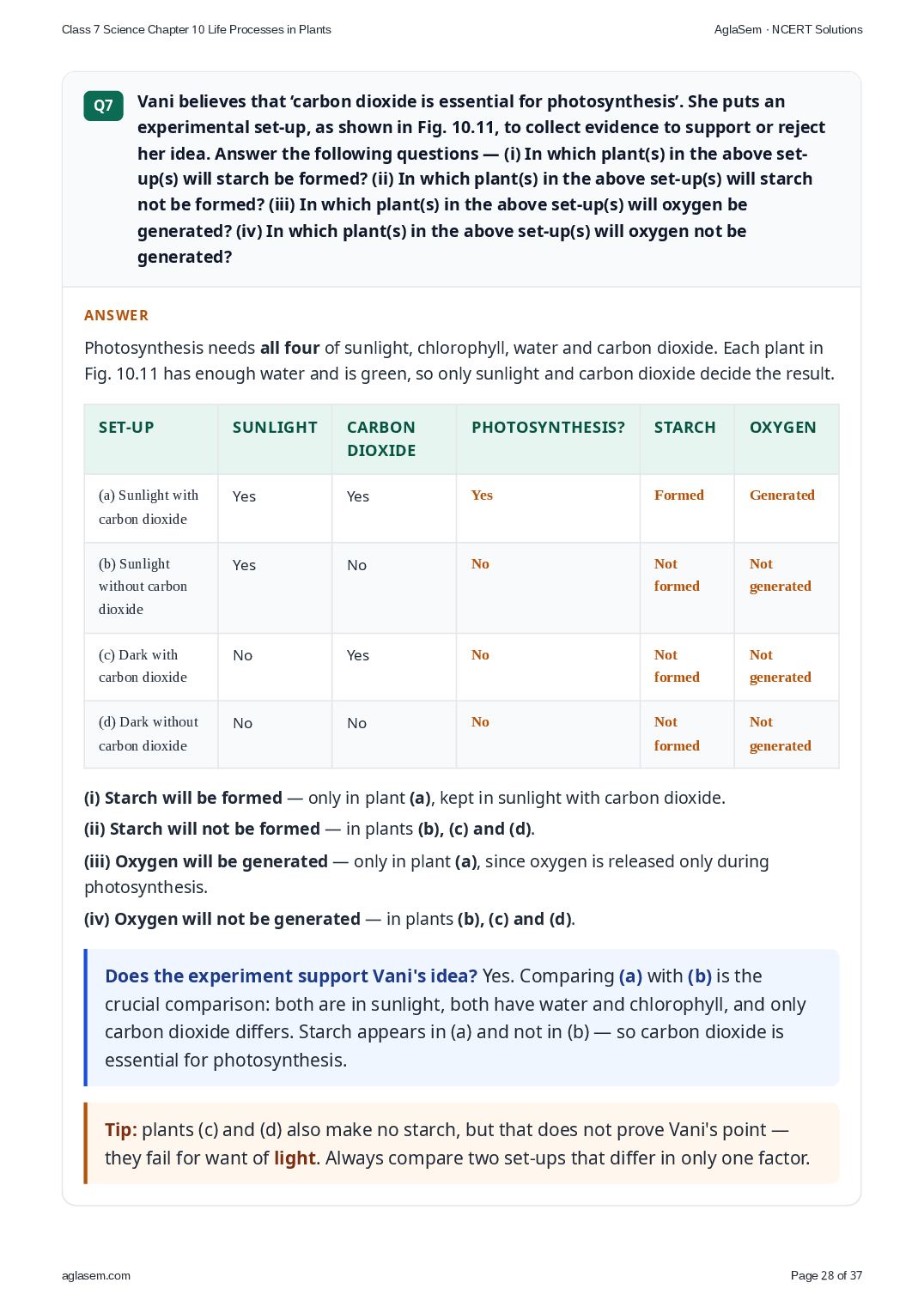
- Vani believes that ‘carbon dioxide is essential for photosynthesis’. She puts an experimental set-up, as shown in Fig. 10.11, to collect evidence to support or reject her idea. Answer the following questions — (i) In which plant(s) in the above set-up(s) will starch be formed? (ii) In which plant(s) in the above set-up(s) will starch not be formed? (iii) In which plant(s) in the above set-up(s) will oxygen be generated? (iv) In which plant(s) in the above set-up(s) will oxygen not be generated?
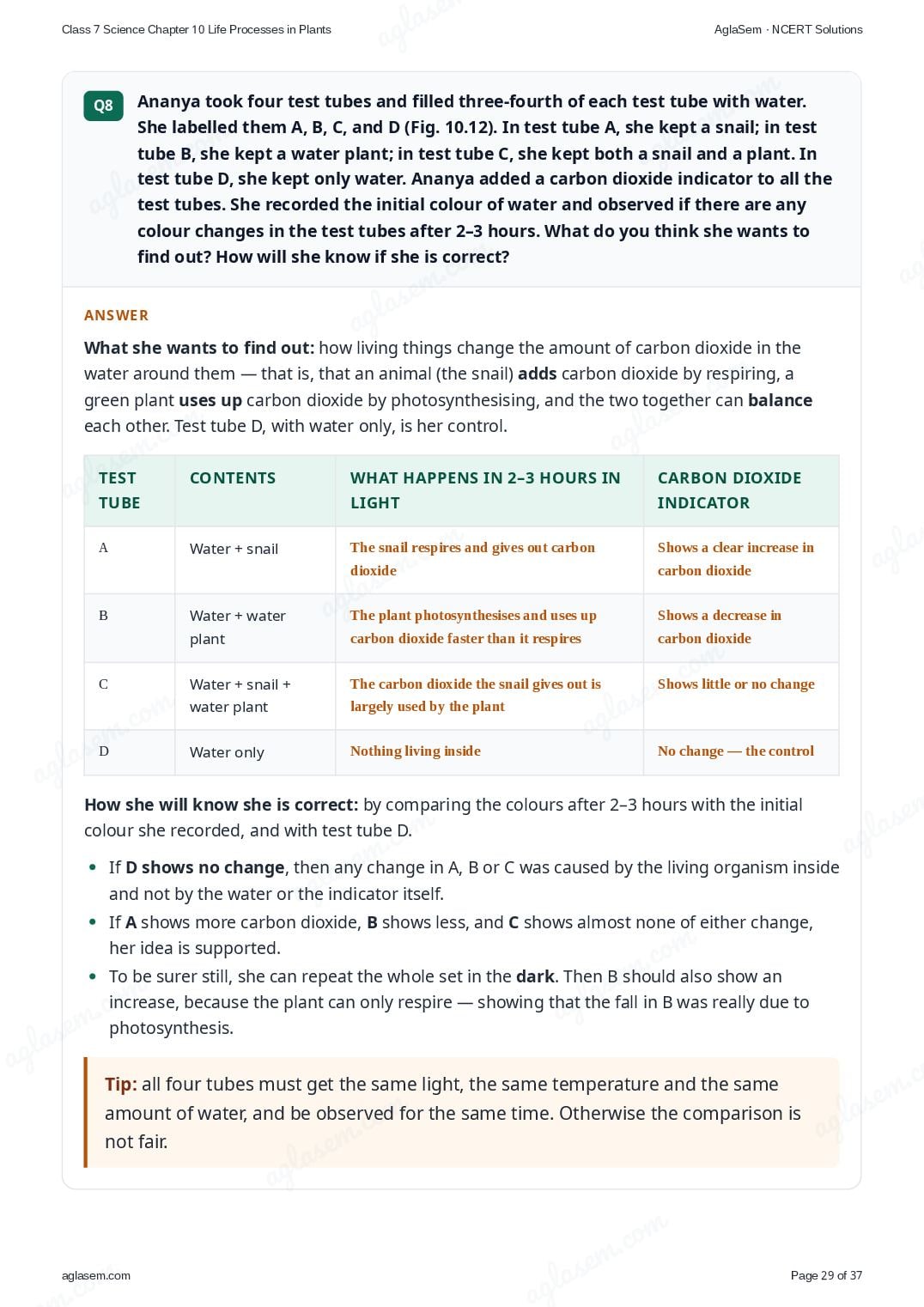
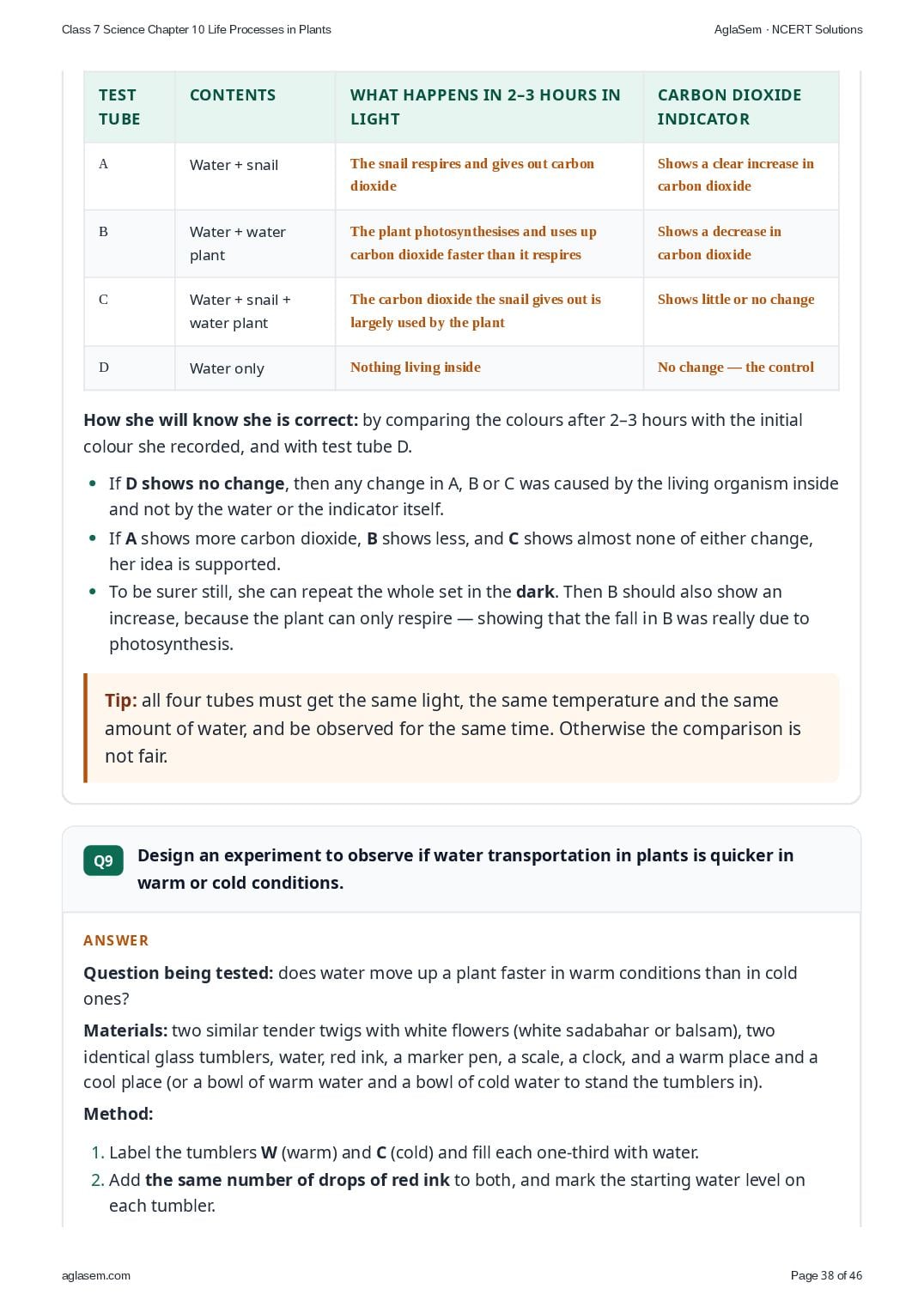
- Ananya took four test tubes and filled three-fourth of each test tube with water. She labelled them A, B, C, and D (Fig. 10.12). In test tube A, she kept a snail; in test tube B, she kept a water plant; in test tube C, she kept both a snail and a plant. In test tube D, she kept only water. Ananya added a carbon dioxide indicator to all the test tubes. She recorded the initial colour of water and observed if there are any colour changes in the test tubes after 2–3 hours. What do you think she wants to find out? How will she know if she is correct?
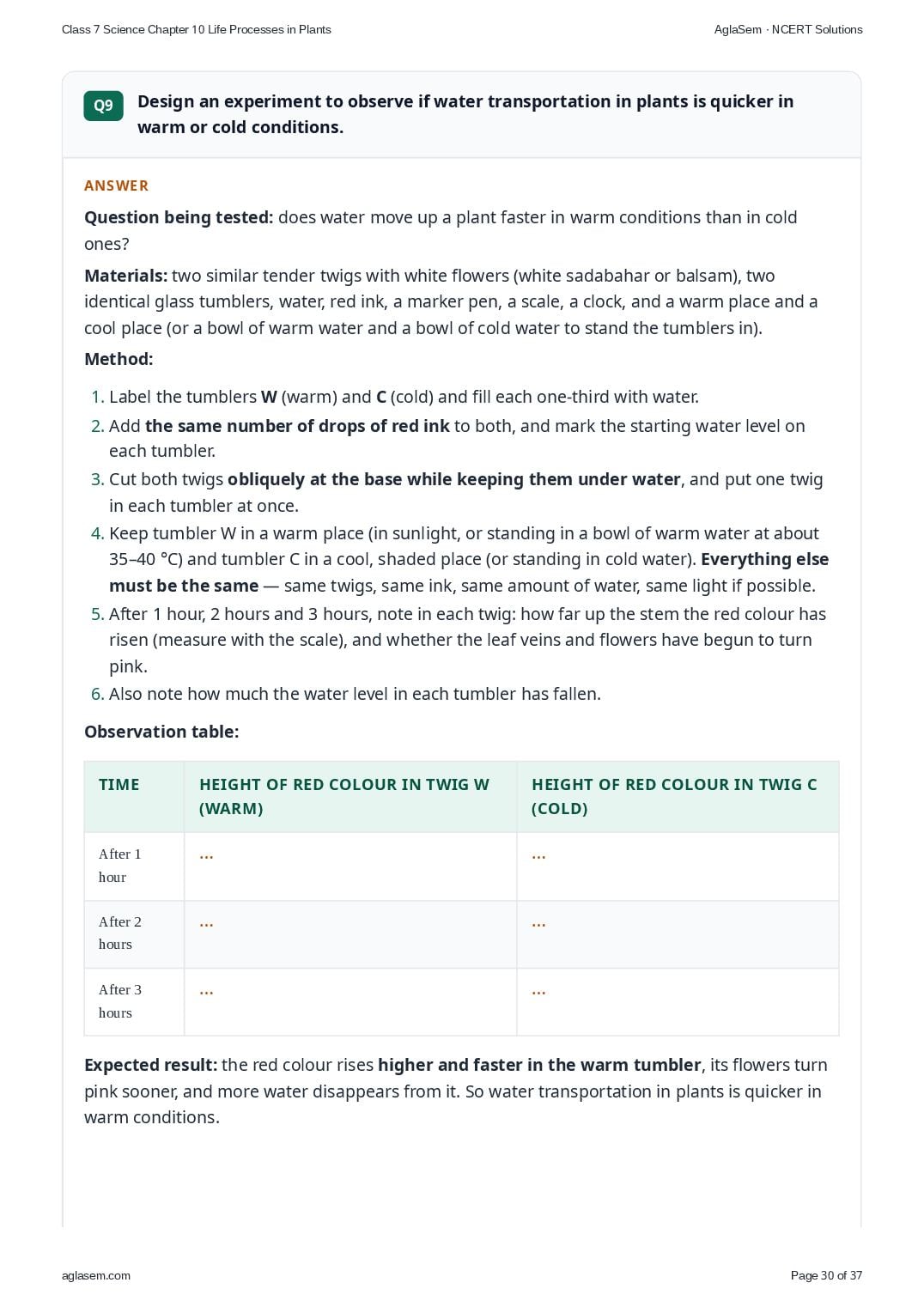
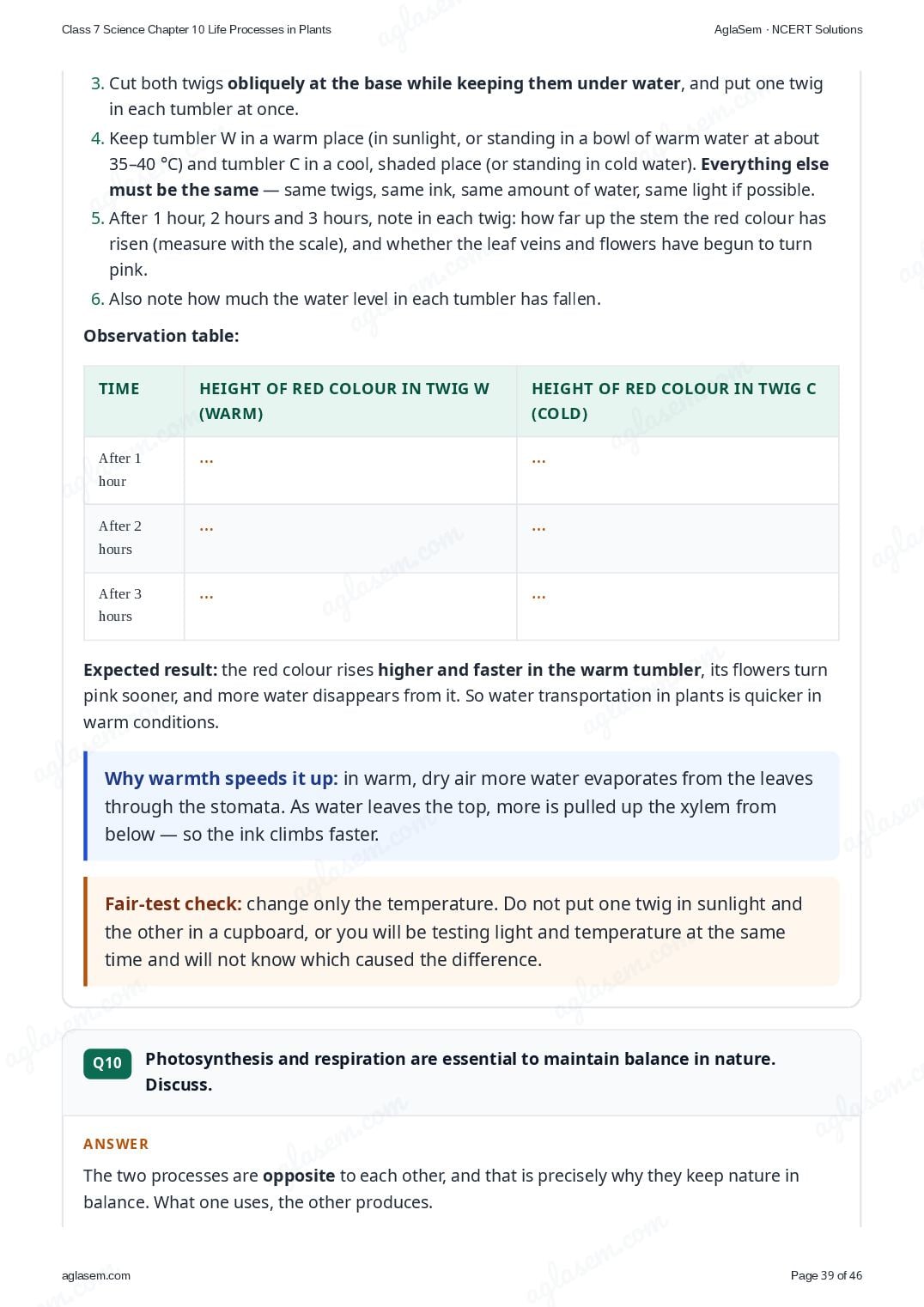
- Design an experiment to observe if water transportation in plants is quicker in warm or cold conditions.
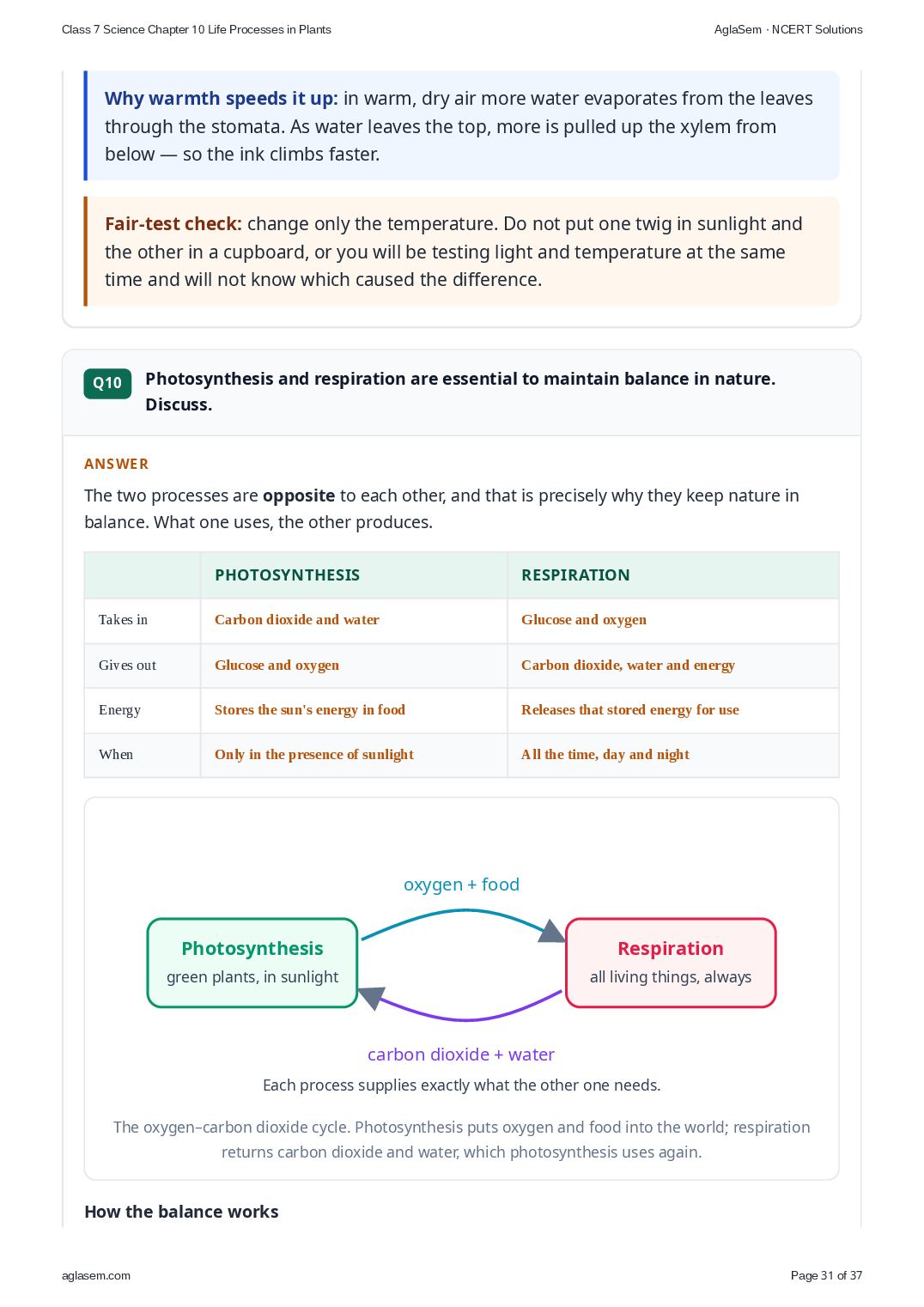
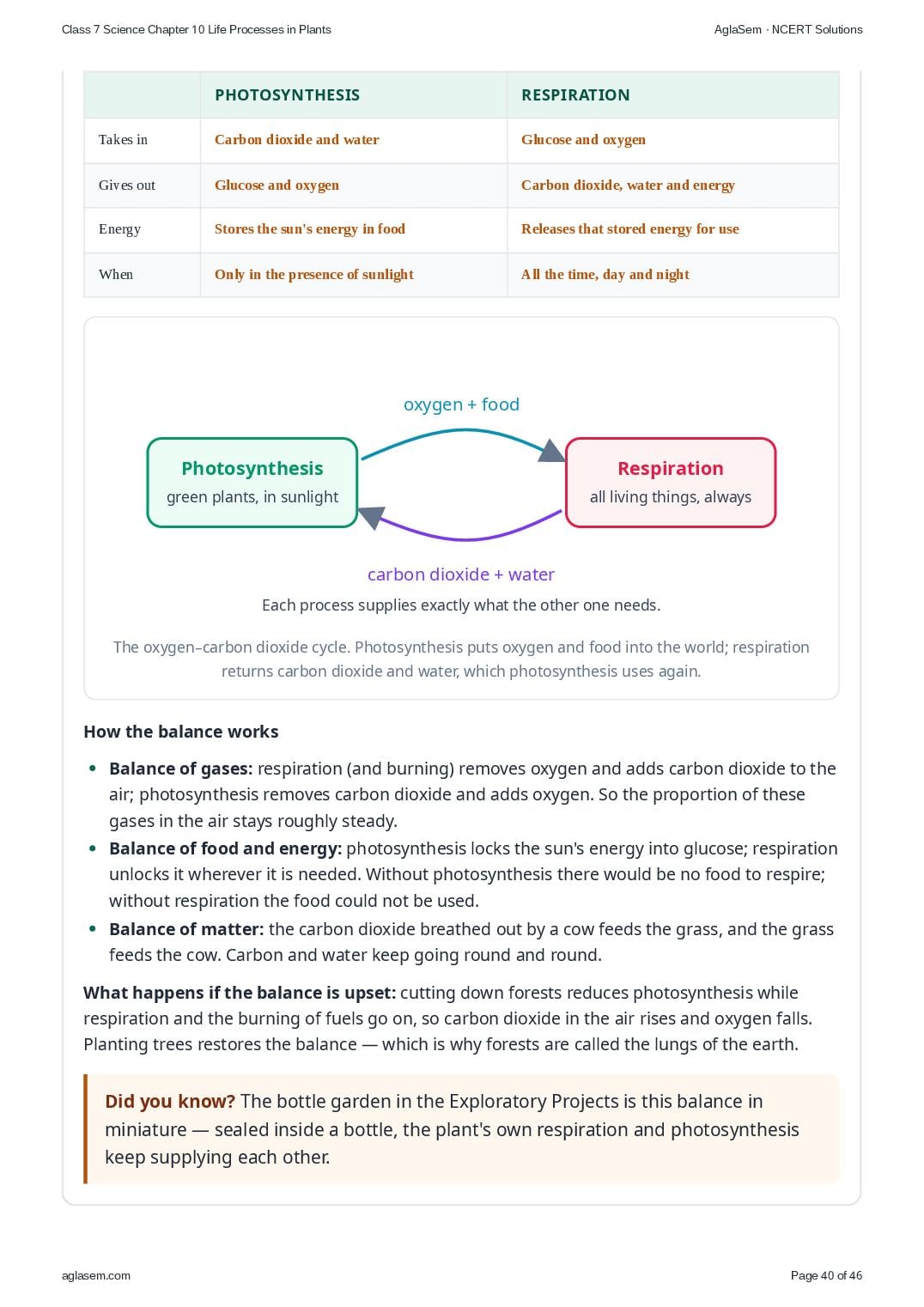
- Photosynthesis and respiration are essential to maintain balance in nature. Discuss.
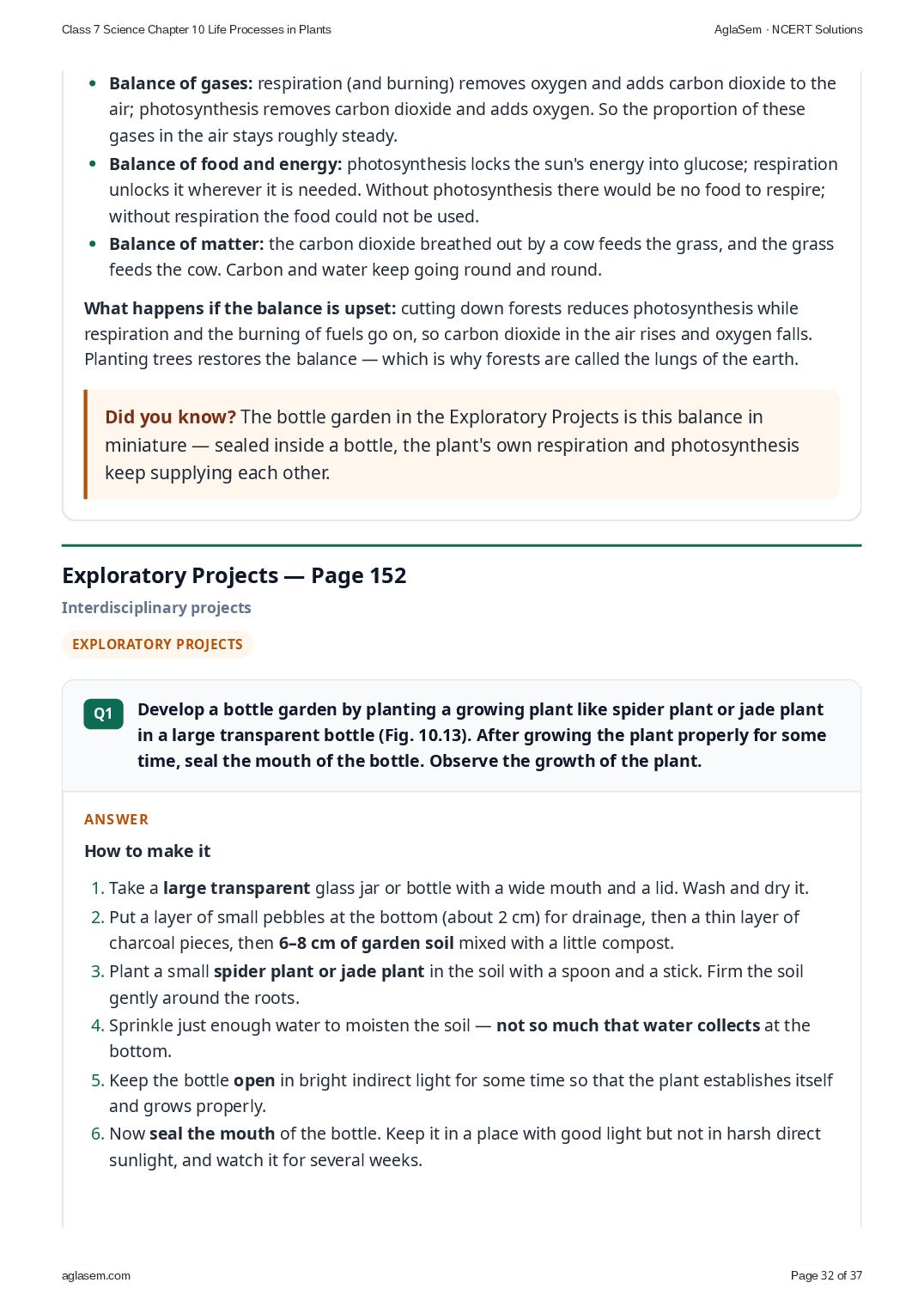
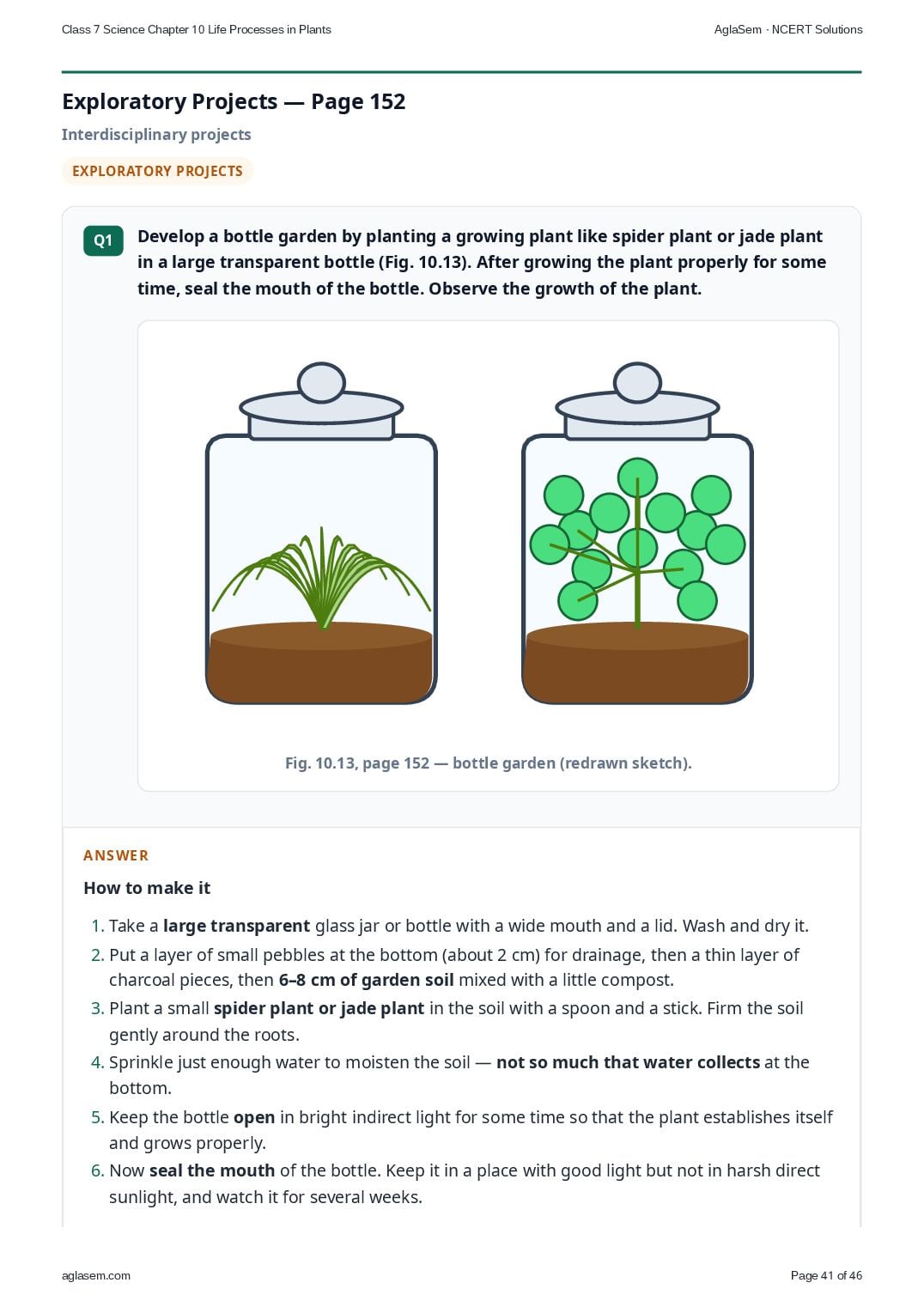
- Develop a bottle garden by planting a growing plant like spider plant or jade plant in a large transparent bottle (Fig. 10.13). After growing the plant properly for some time, seal the mouth of the bottle. Observe the growth of the plant.
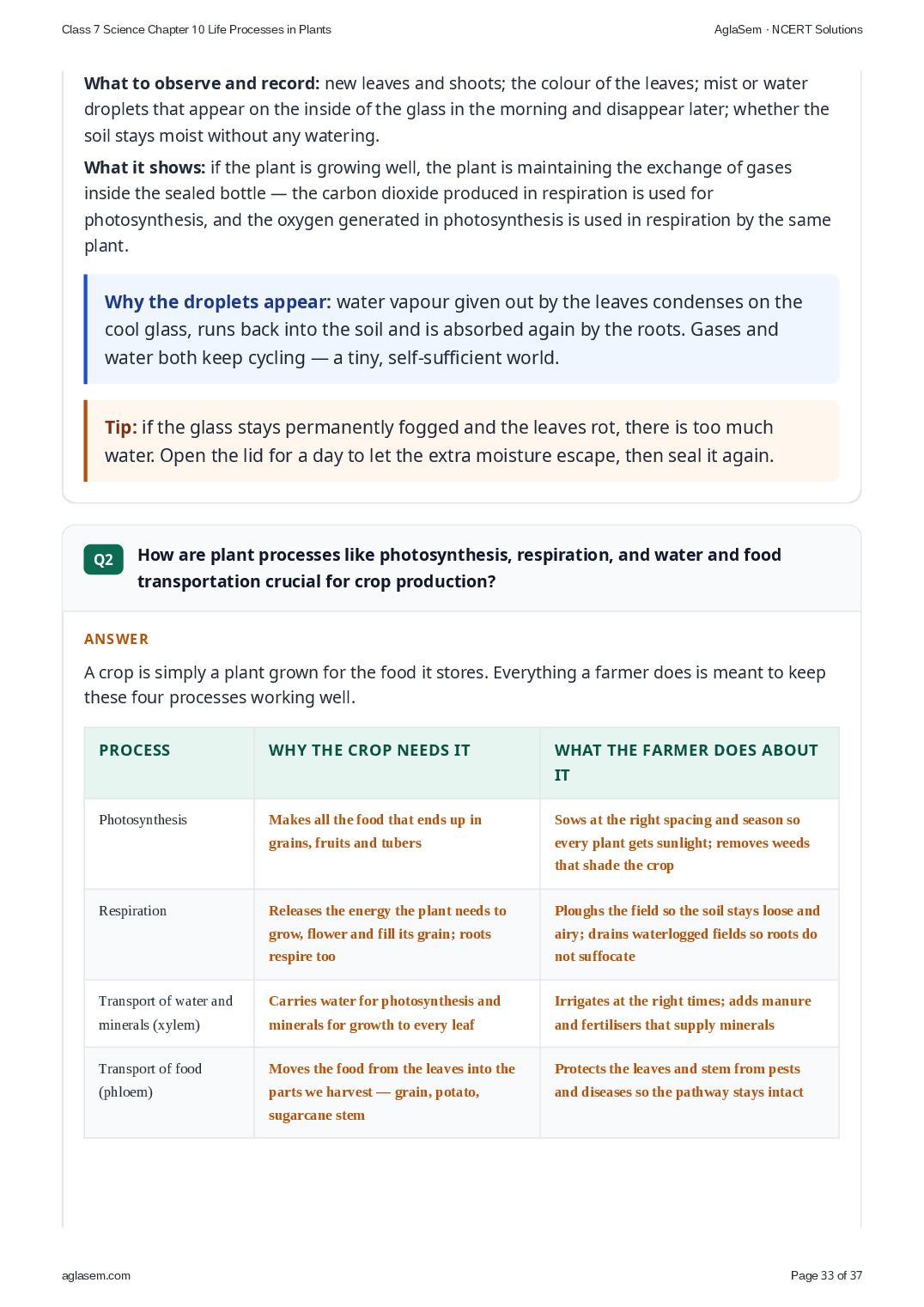
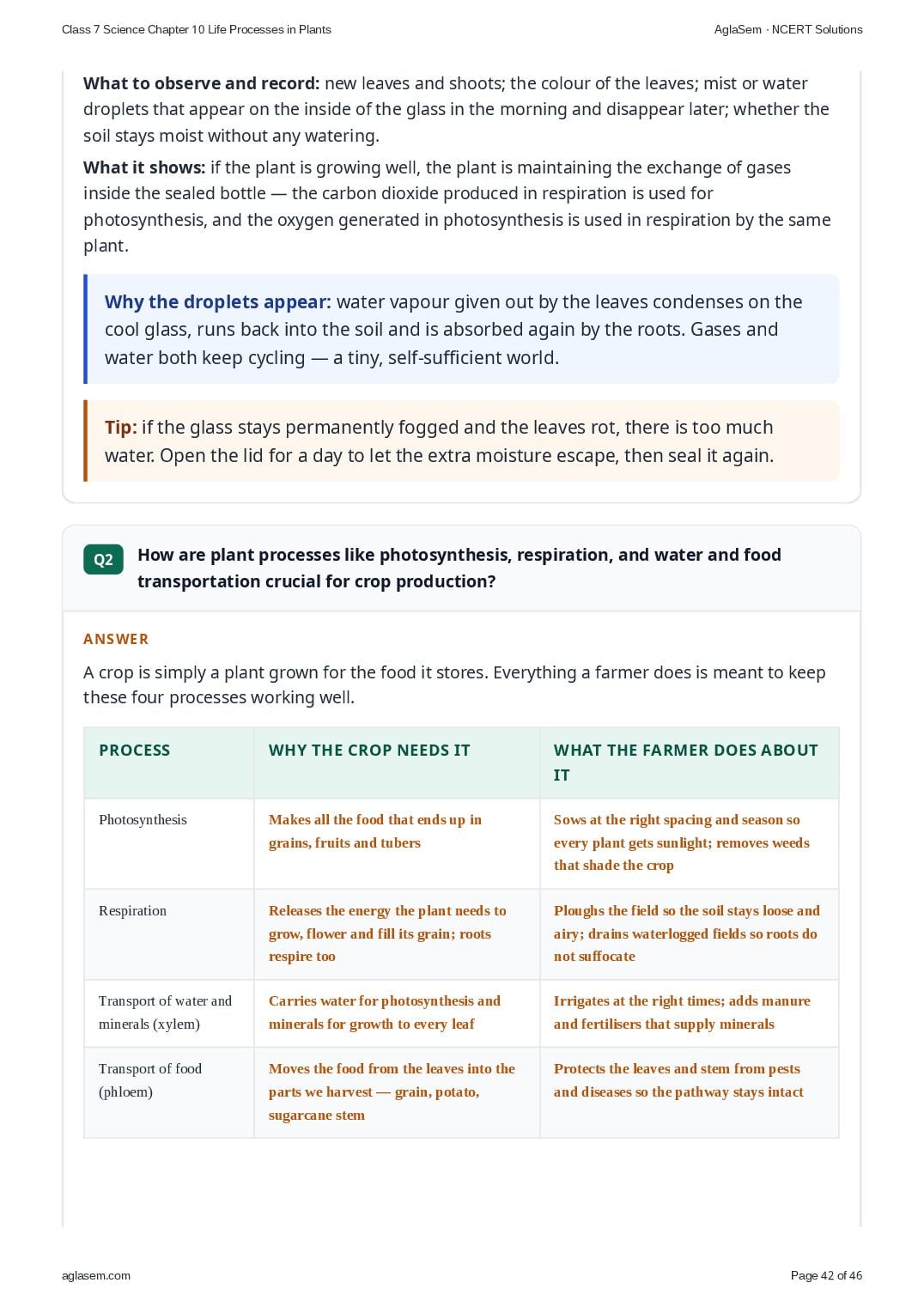
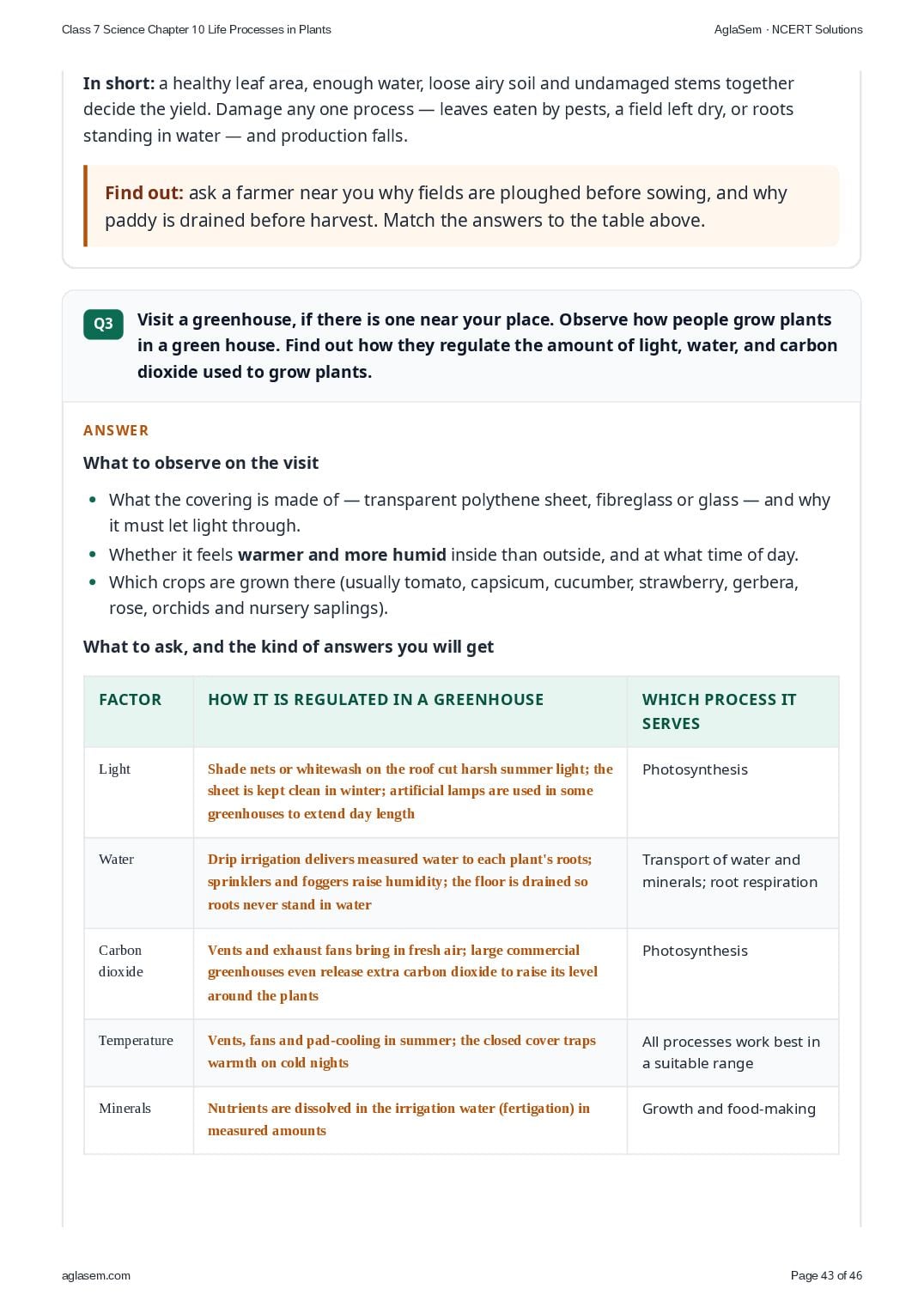
- How are plant processes like photosynthesis, respiration, and water and food transportation crucial for crop production?
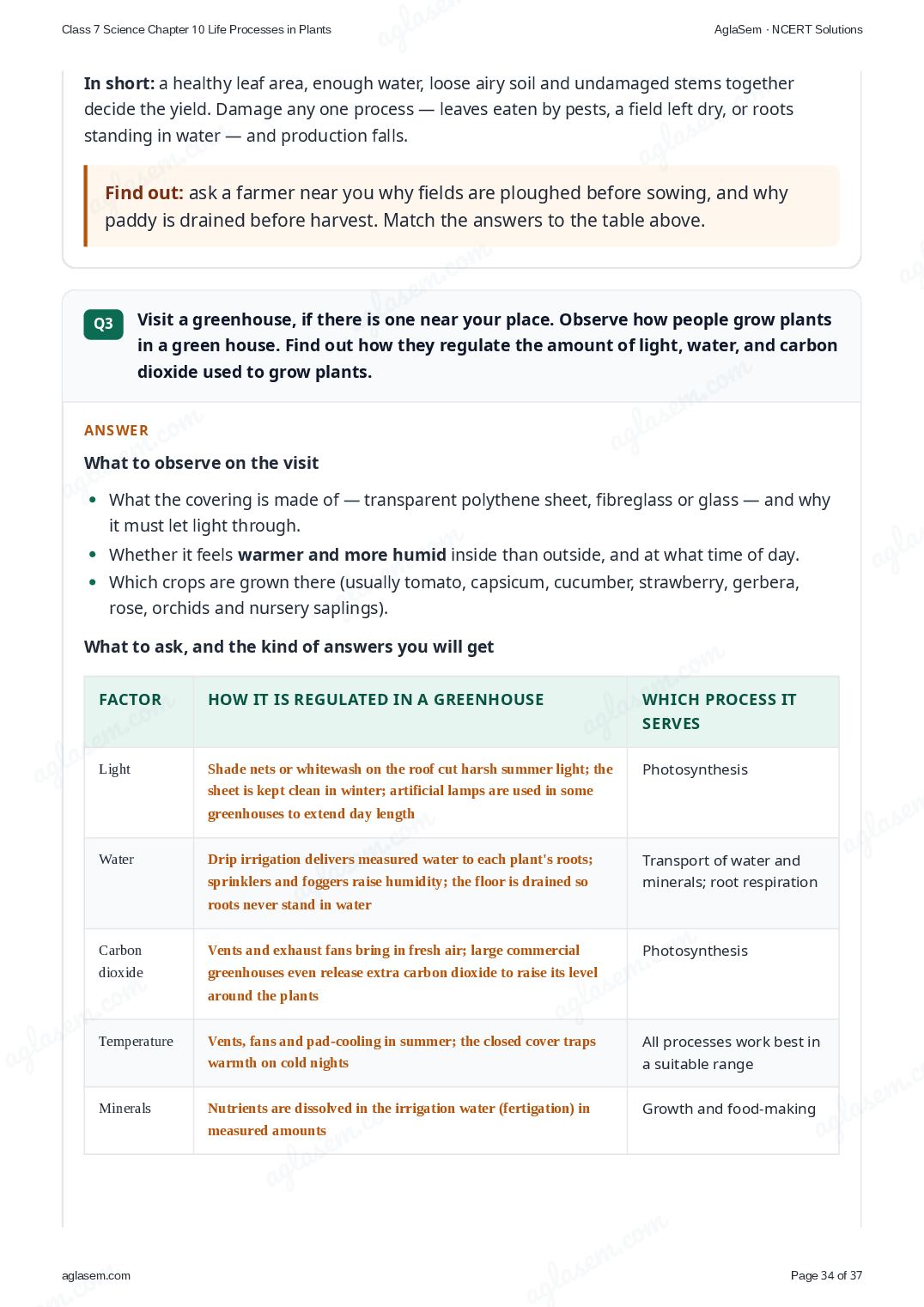
- Visit a greenhouse, if there is one near your place. Observe how people grow plants in a green house. Find out how they regulate the amount of light, water, and carbon dioxide used to grow plants.
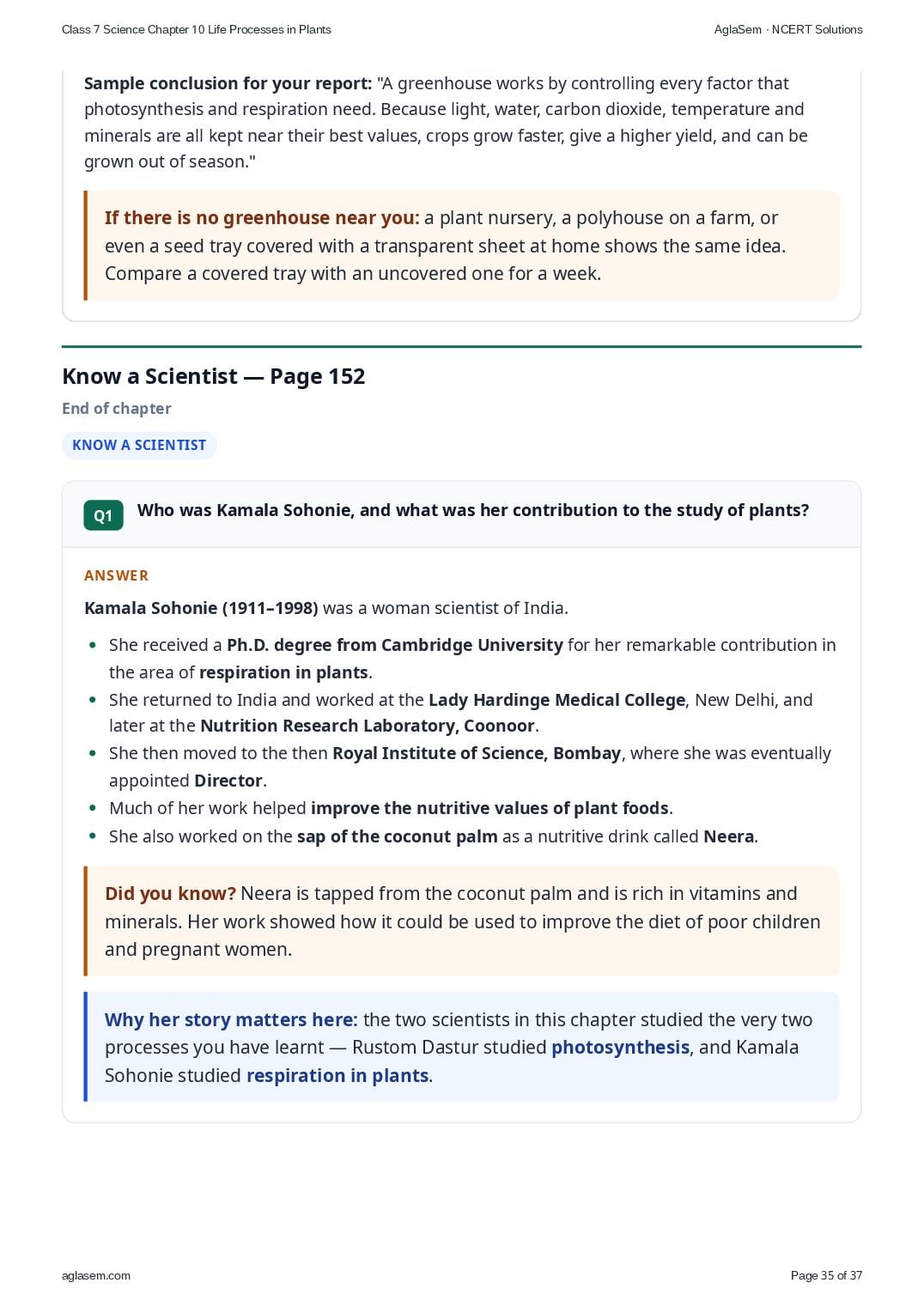
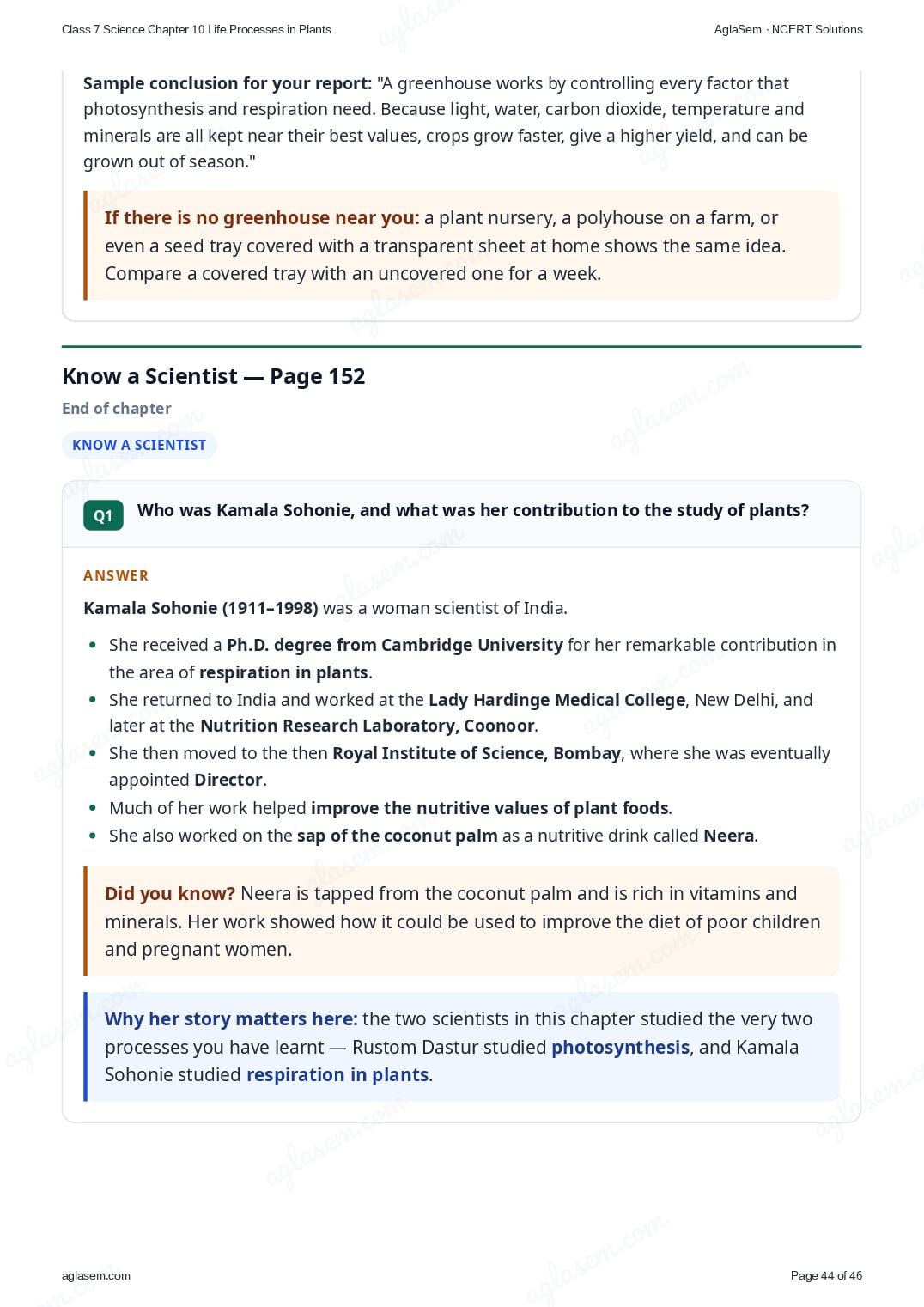
- Who was Kamala Sohonie, and what was her contribution to the study of plants?
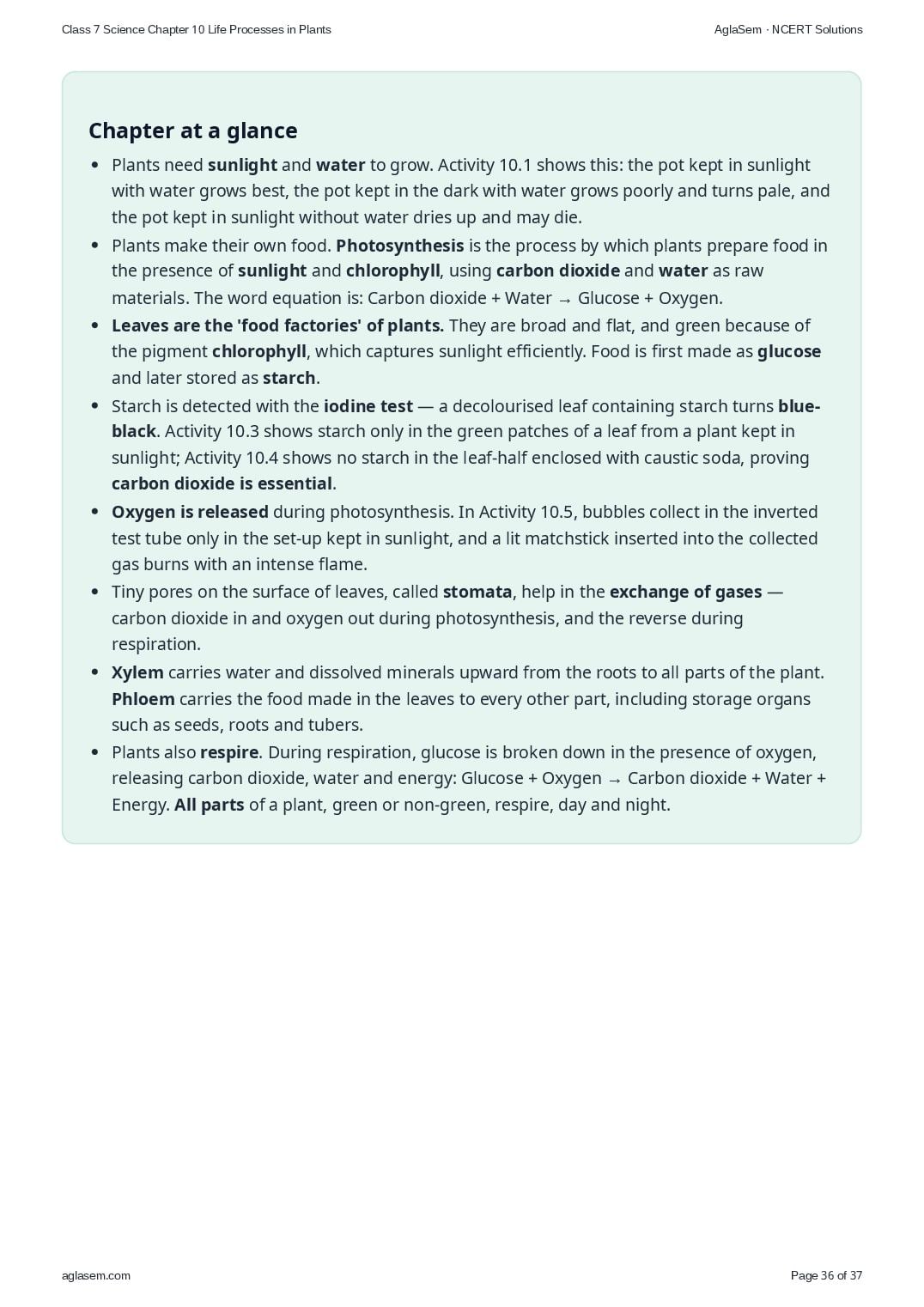
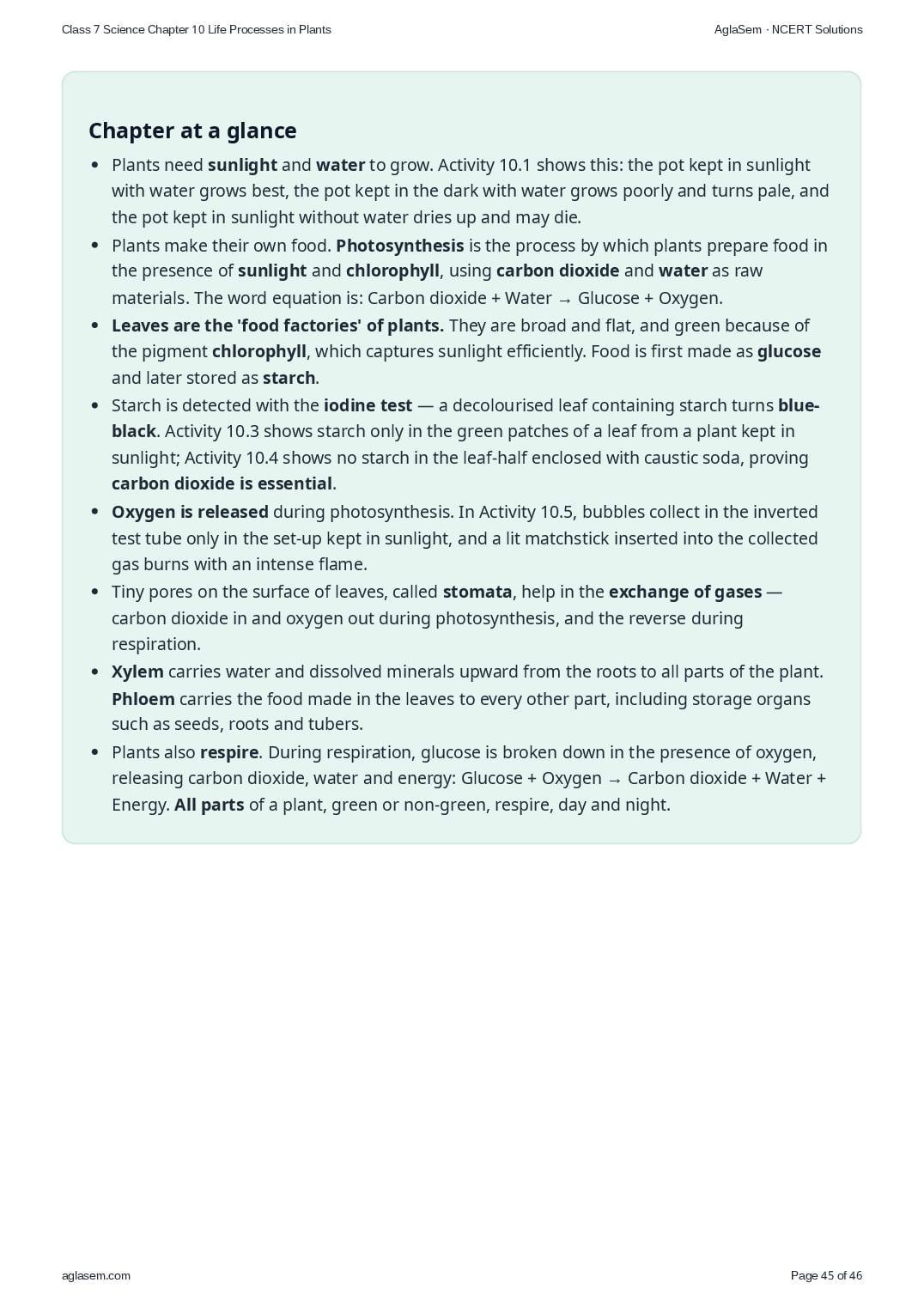
Chapter at a Glance
- Plants need sunlight and water to grow. Activity 10.1 shows this: the pot kept in sunlight with water grows best, the pot kept in the dark with water grows poorly and turns pale, and the pot kept in sunlight without water dries up and may die.
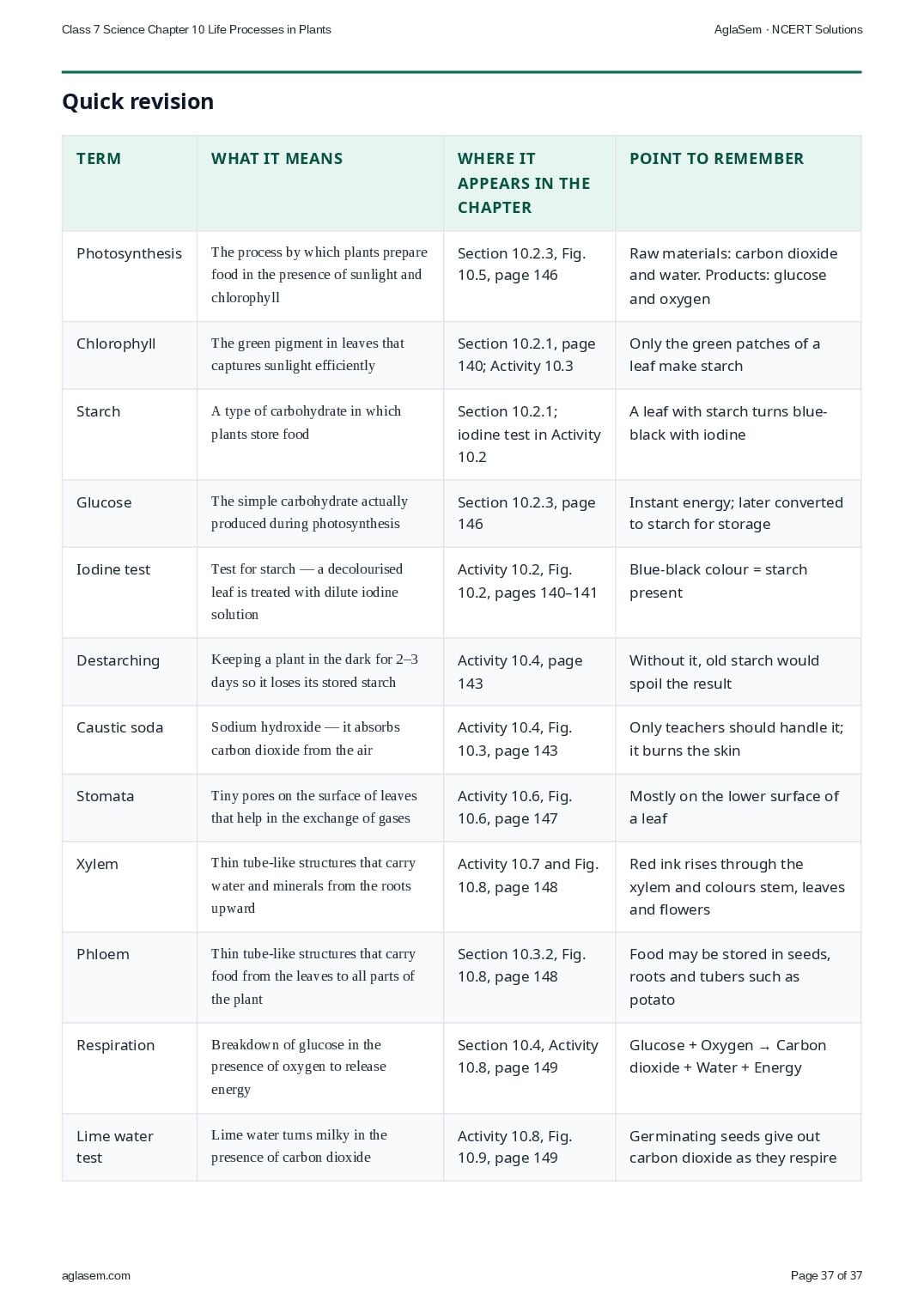
- Plants make their own food. Photosynthesis is the process by which plants prepare food in the presence of sunlight and chlorophyll , using carbon dioxide and water as raw materials. The word equation is: Carbon dioxide + Water → Glucose + Oxygen.
- Leaves are the 'food factories' of plants. They are broad and flat, and green because of the pigment chlorophyll , which captures sunlight efficiently. Food is first made as glucose and later stored as starch .
- Starch is detected with the iodine test — a decolourised leaf containing starch turns blue-black . Activity 10.3 shows starch only in the green patches of a leaf from a plant kept in sunlight; Activity 10.4 shows no starch in the leaf-half enclosed with caustic soda, proving carbon dioxide is essential .
- Oxygen is released during photosynthesis. In Activity 10.5, bubbles collect in the inverted test tube only in the set-up kept in sunlight, and a lit matchstick inserted into the collected gas burns with an intense flame.
- Tiny pores on the surface of leaves, called stomata , help in the exchange of gases — carbon dioxide in and oxygen out during photosynthesis, and the reverse during respiration.
- Xylem carries water and dissolved minerals upward from the roots to all parts of the plant. Phloem carries the food made in the leaves to every other part, including storage organs such as seeds, roots and tubers.
- Plants also respire . During respiration, glucose is broken down in the presence of oxygen, releasing carbon dioxide, water and energy: Glucose + Oxygen → Carbon dioxide + Water + Energy. All parts of a plant, green or non-green, respire, day and night.
How to Download NCERT Solutions for Class 7 Science Chapter 10 PDF
Follow these simple steps to get the Life Processes in Plants questions-and-answers PDF from Curiosity.
- Search NCERT Solutions for Class 7 Science Chapter 10 aglasem and open this page.
- Read the exercise questions with answers for Life Processes in Plants shown above.
- Click the Download PDF link to save the Life Processes in Plants solutions to your device.
NCERT Solutions for Class 7 Science – All Chapters
There are more chapters to study besides Life Processes in Plants in Science. Here are the NCERT Solutions for all chapters of Class 7 Science.
- Chapter 1 the Ever Evolving World of Science
- Chapter 2 Exploring Substances Acidic Basic and Neutral
- Chapter 3 Electricity Circuits and Their Components
- Chapter 4 the World of Metals and Non Metals
- Chapter 5 Changes Around Us Physical and Chemical
- Chapter 6 Adolescence a Stage of Growth and Change
- Chapter 7 Heat Transfer in Nature
- Chapter 8 Measurement of Time and Motion
- Chapter 9 Life Processes in Animals
- Chapter 10 Life Processes in Plants
- Chapter 11 Light Shadows and Reflections
- Chapter 12 Earth Moon and the Sun
NCERT Solutions for Class 7 – All Subjects
Just like Chapter 10 of Science, you can get the exercise questions with answers for every other subject of Class 7. Here are the NCERT Solutions for all subjects of Class 7.
NCERT Solutions for Class 7 Science Chapter 10 – An Overview
The key highlights of this study material are as follows.
| Aspects | Details |
|---|---|
| Class | Class 7 |
| Subject | Science |
| Chapter Number | Chapter 10 |
| Chapter Name | Life Processes in Plants |
| Book Name | Curiosity |
| Book By | NCERT (National Council of Educational Research and Training) |
| Educational Resource Here | NCERT Solutions of Class 7 Science Chapter 10 for all exercises |
| More Questions Answers of This Subject | NCERT Solutions for Class 7 Science |
| Download Book Chapter | NCERT Book Class 7 Science |
| All Questions Answers For This Class | NCERT Solutions for Class 7 |
| Complete Solutions | NCERT Solutions |
NCERT Solutions for Class 7 Science Chapter 10 Life Processes in Plants – FAQs
What are the NCERT Solutions for Class 7 Science Chapter 10 Life Processes in Plants?
They are the complete, step-by-step answers to all the exercise and in-text questions of Chapter 10 Life Processes in Plants from the NCERT Class 7 Science textbook Curiosity, written by experts as per the latest NCERT syllabus.
How can I download the Class 7 Science Chapter 10 solutions PDF for free?
Open this page on aglasem, read the Life Processes in Plants questions with answers, and click the “Download Solutions PDF” link. The Class 7 Science Chapter 10 NCERT Solutions PDF is completely free to download.
Are these NCERT Solutions as per the latest 2026-27 syllabus?
Yes. The NCERT Solutions for Class 7 Science Chapter 10 are based on the latest NCERT textbook Curiosity and the current 2026-27 CBSE syllabus, so the questions and answers match what you study in class.
Where can I get NCERT Solutions for the other chapters of Class 7 Science?
You can find the answers to every chapter on the NCERT Solutions for Class 7 Science page, and solutions for every subject on the NCERT Solutions for Class 7 page.
How do NCERT Solutions help in exam preparation?
They show the correct method to solve each question, help you write answers the way they are expected in exams, let you check and correct your own work, and save revision time — which together improve your marks in Class 7 Science.
If you have any queries on NCERT Solutions for Class 7 Science Chapter 10 Life Processes in Plants, then please ask in the comments below.
