NCERT Solutions for Class 7 Science Chapter 8 Measurement of Time and Motion provide clear, step-by-step answers to every exercise and in-text question from the chapter Measurement of Time and Motion of the NCERT textbook Curiosity. Prepared by subject experts as per the latest NCERT (CBSE) syllabus for 2026-27, these NCERT Solutions for Class 7 Science help you understand each concept, write exam-ready answers, and check your own solutions. You can read them online below or download the free Class 7 Science Chapter 8 question-answer PDF.
NCERT Solutions for Class 7 Science Chapter 8 Measurement of Time and Motion
- Class: Class 7
- Subject: Science
- Chapter: Chapter 8 – Measurement of Time and Motion
- Textbook: Curiosity (NCERT)
- Study material: NCERT Solutions – questions with answers, free PDF
These solutions answer all the exercise questions of Chapter 8 Measurement of Time and Motion — including the in-text questions, short-answer and long-answer questions, and activities — with complete explanations so you can follow the method, not just the final answer. Read the full solutions below.
NCERT Solutions Class 7 Science Chapter 8 Measurement of Time and Motion View Download
NCERT Solutions for Class 7 Science Chapter 8 PDF Download
You can read the NCERT Solutions for Class 7 Science Chapter 8 online above, or download the complete question-answer PDF to study Measurement of Time and Motion offline at any time.
NCERT Solutions for Class 7 Science Chapter 8 PDF Download Link – Click Here to Download Solutions PDF
Questions Covered in This Chapter
These NCERT Solutions answer all 36 questions of this chapter. The questions solved are:
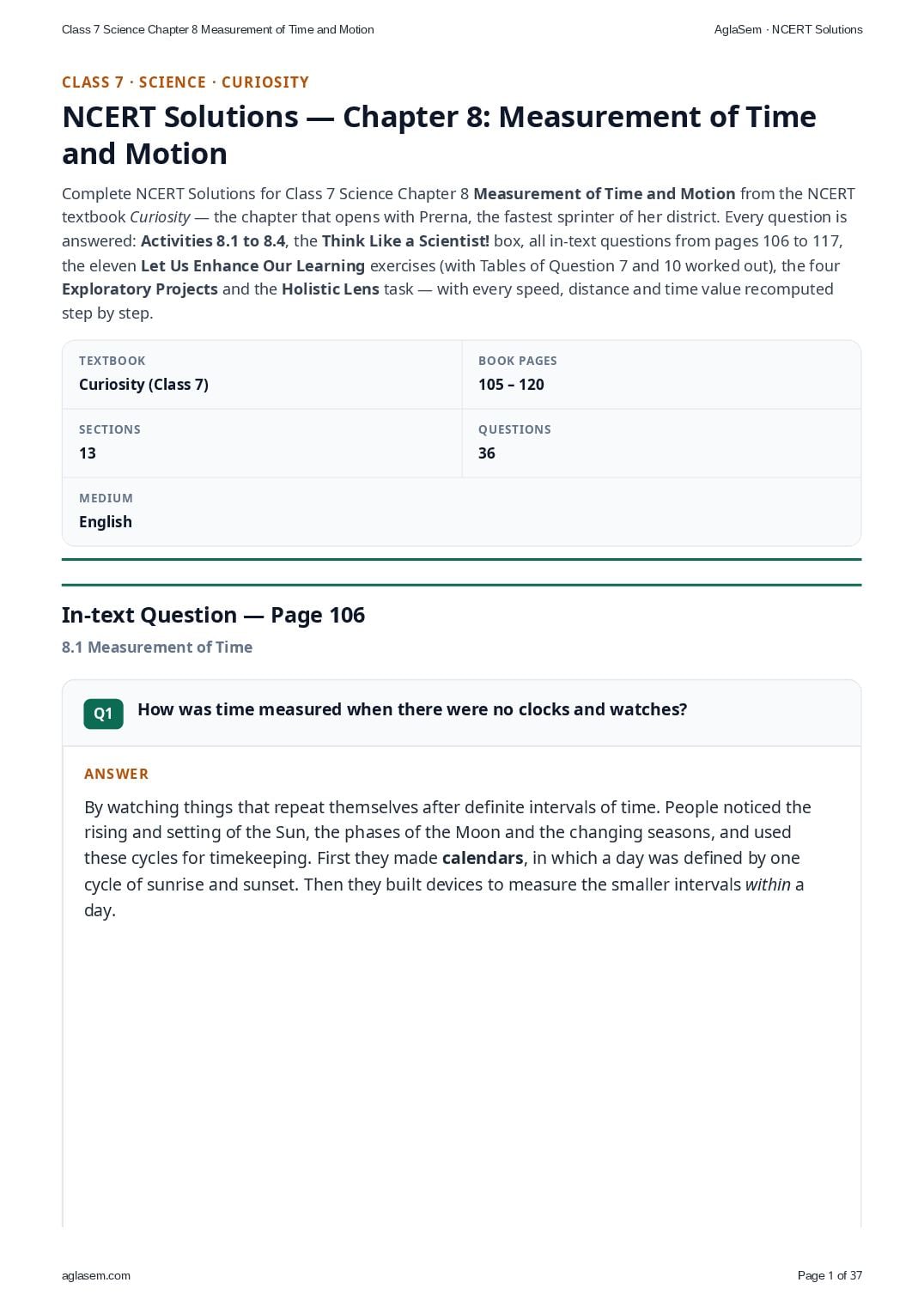
- How was time measured when there were no clocks and watches?
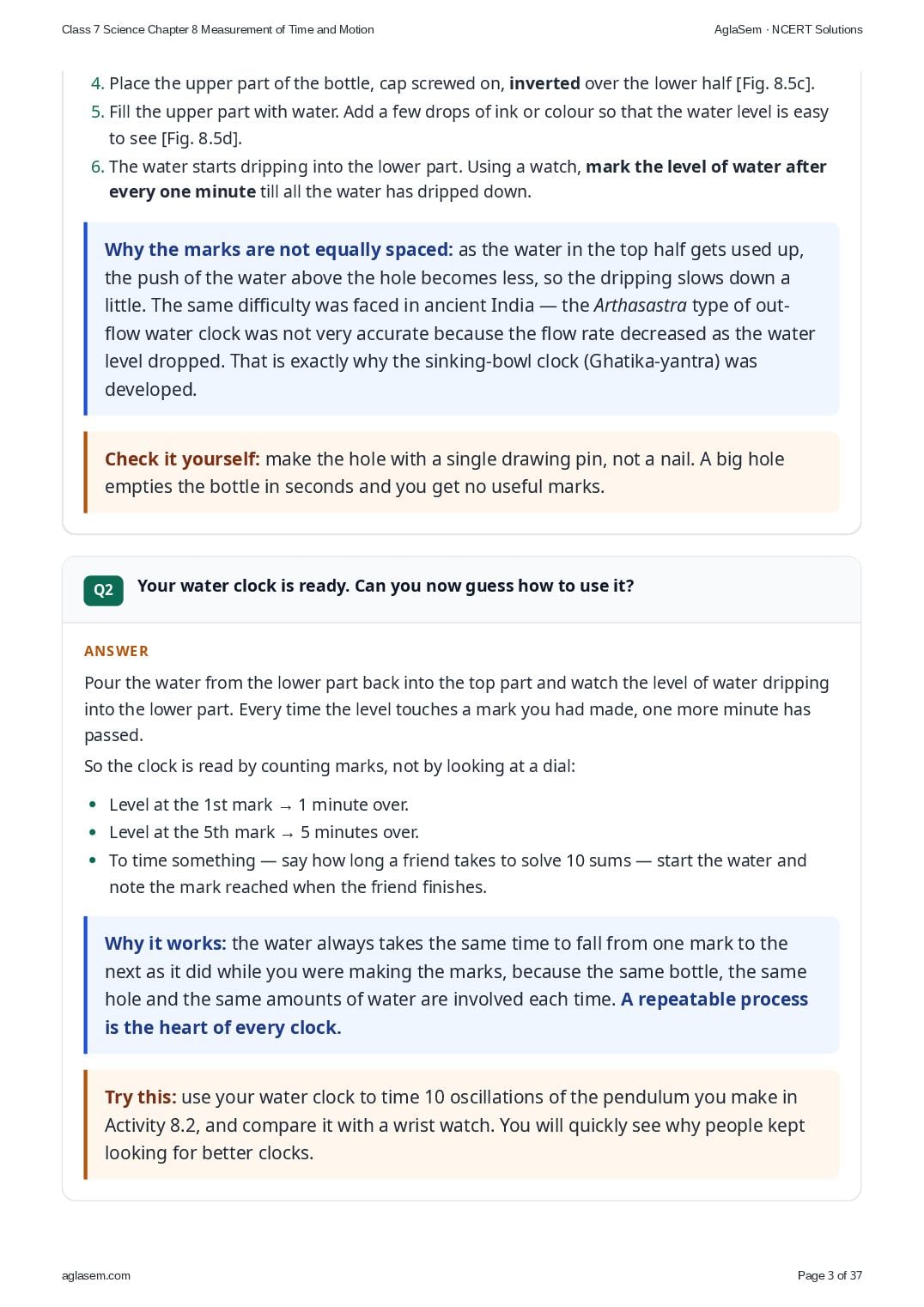
- Should we make a simple water clock?
- Your water clock is ready. Can you now guess how to use it?
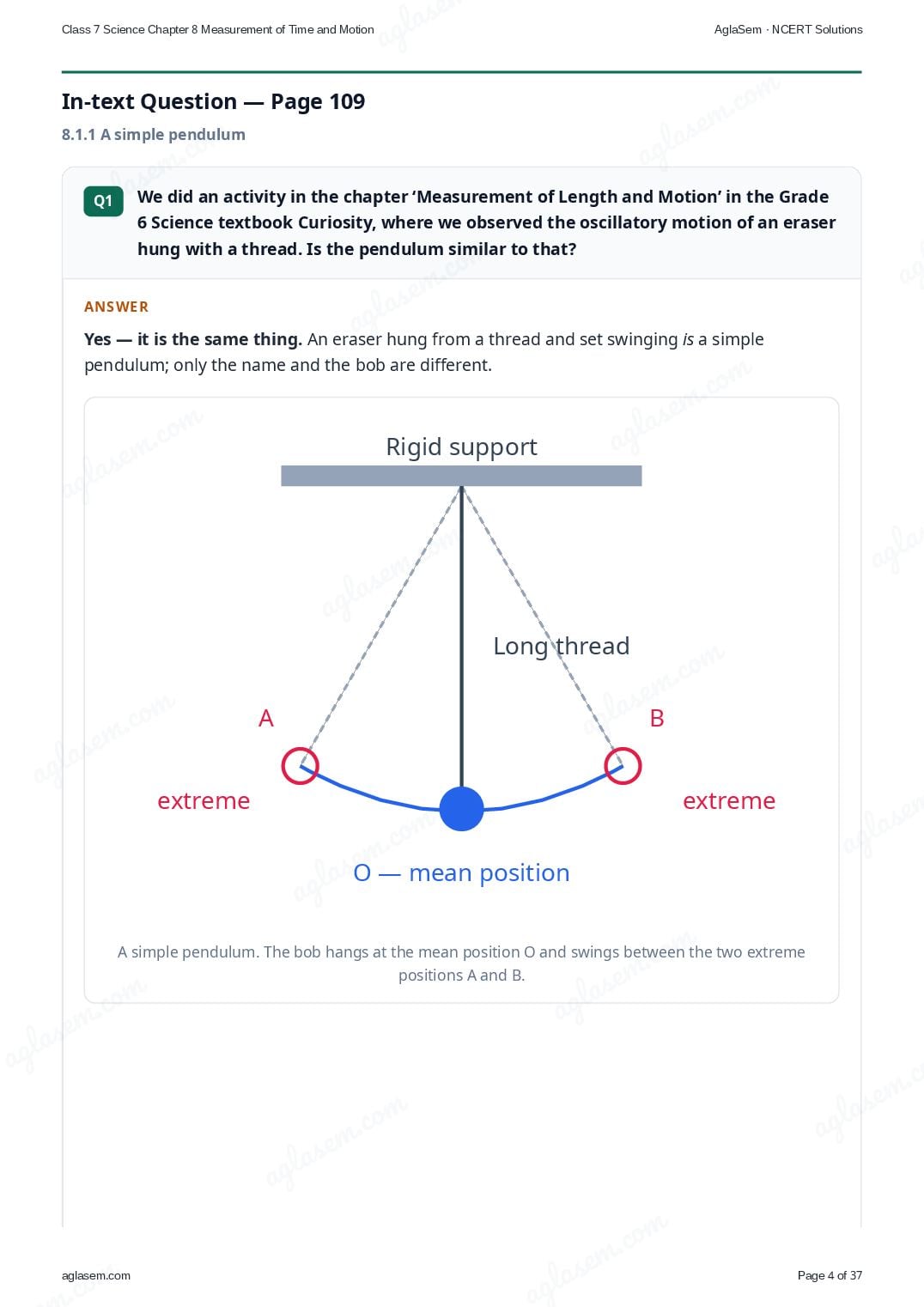
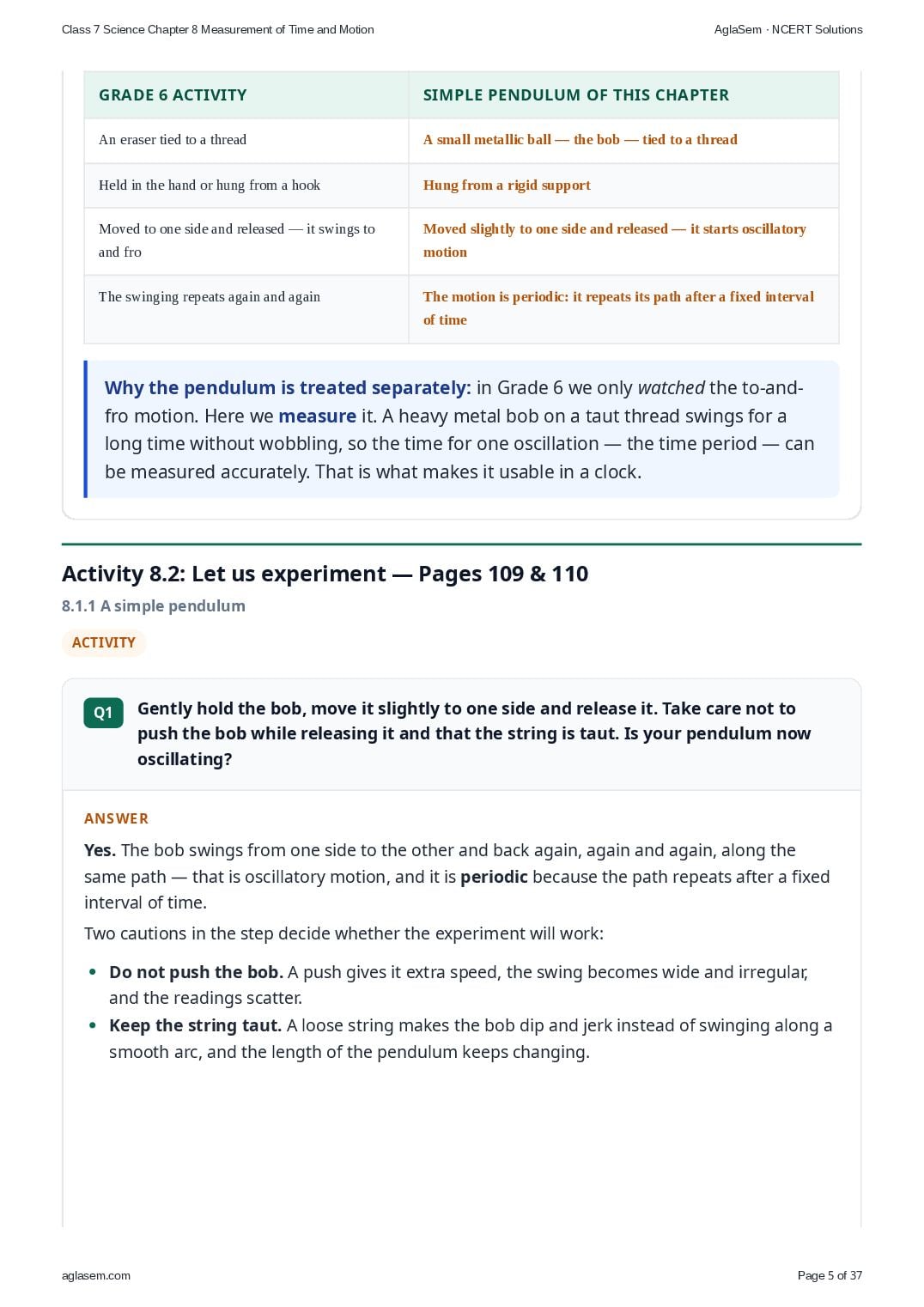
- We did an activity in the chapter ‘Measurement of Length and Motion’ in the Grade 6 Science textbook Curiosity, where we observed the oscillatory motion of an eraser hung with a thread. Is the pendulum similar to that?
- Gently hold the bob, move it slightly to one side and release it. Take care not to push the bob while releasing it and that the string is taut. Is your pendulum now oscillating?
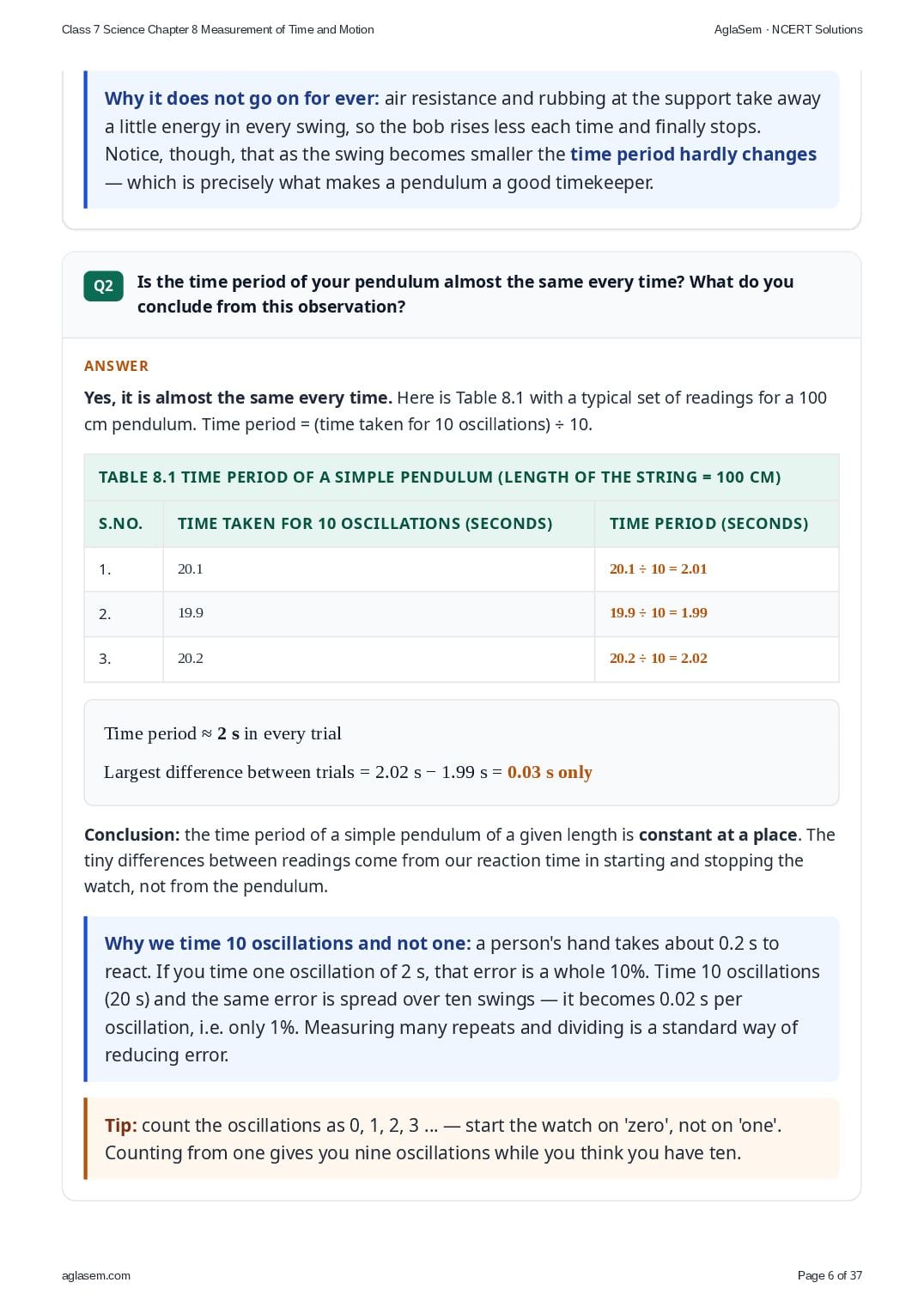
- Is the time period of your pendulum almost the same every time? What do you conclude from this observation?
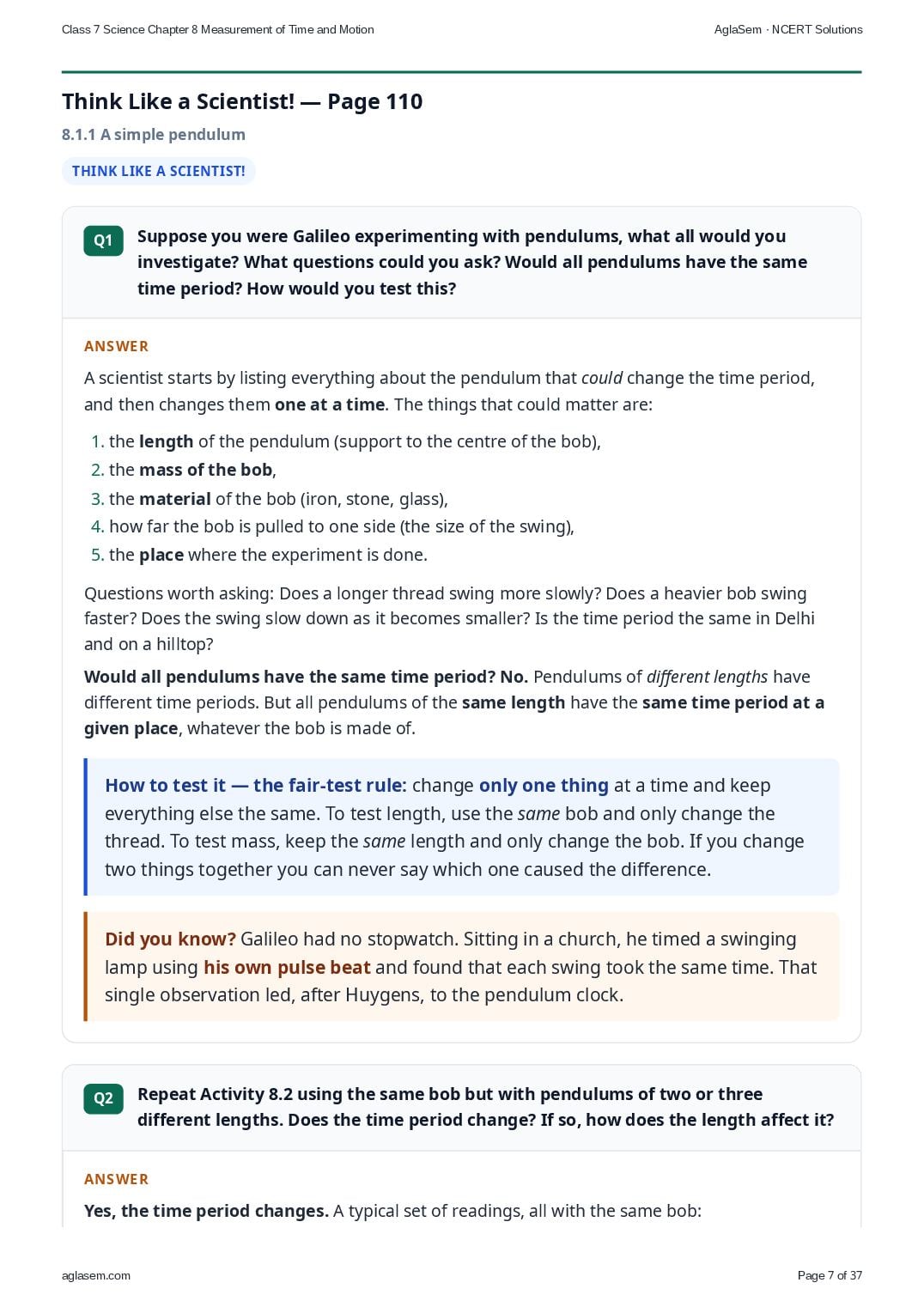
- Suppose you were Galileo experimenting with pendulums, what all would you investigate? What questions could you ask? Would all pendulums have the same time period? How would you test this?
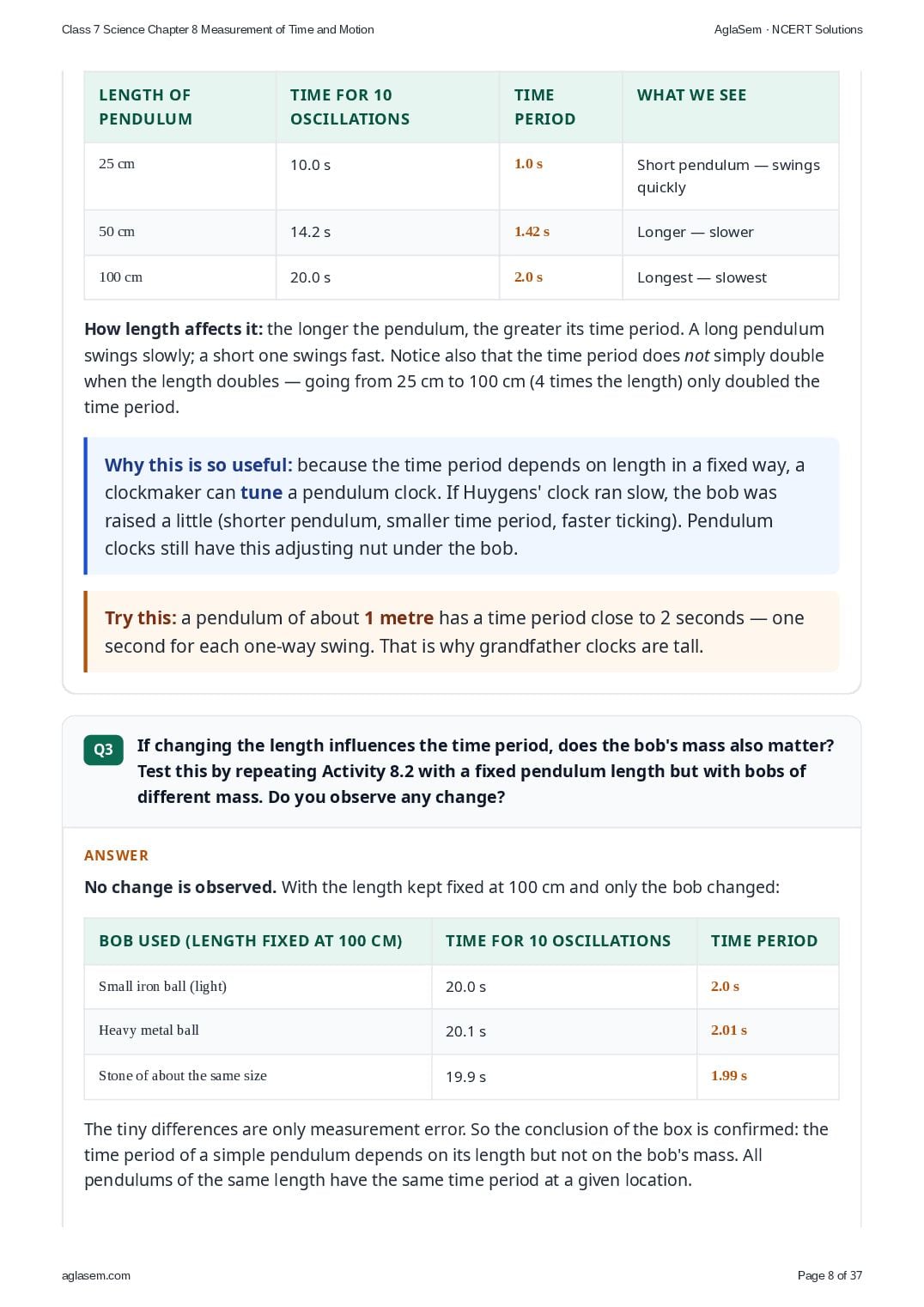
- Repeat Activity 8.2 using the same bob but with pendulums of two or three different lengths. Does the time period change? If so, how does the length affect it?
- If changing the length influences the time period, does the bob's mass also matter? Test this by repeating Activity 8.2 with a fixed pendulum length but with bobs of different mass. Do you observe any change?
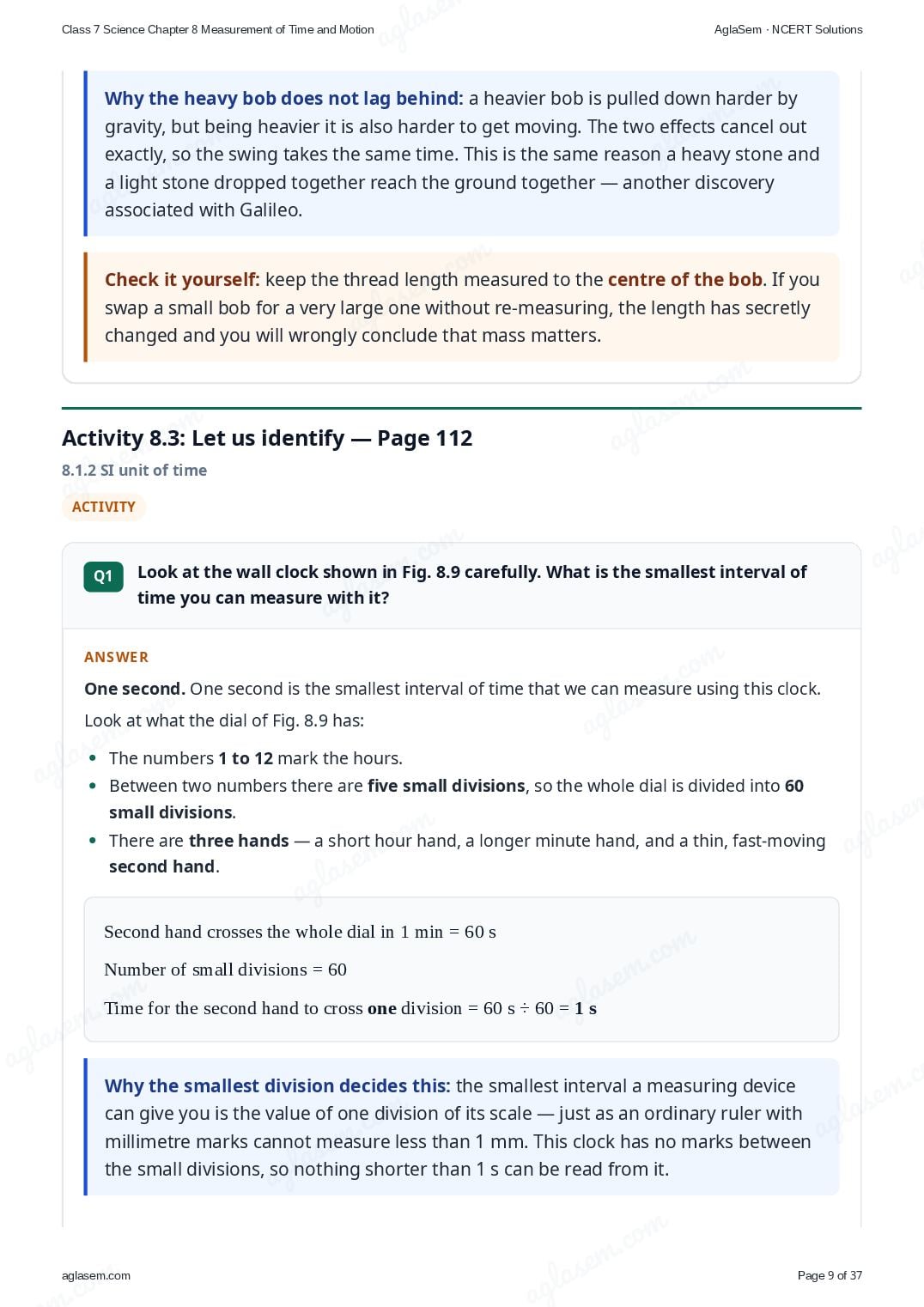
- Look at the wall clock shown in Fig. 8.9 carefully. What is the smallest interval of time you can measure with it?
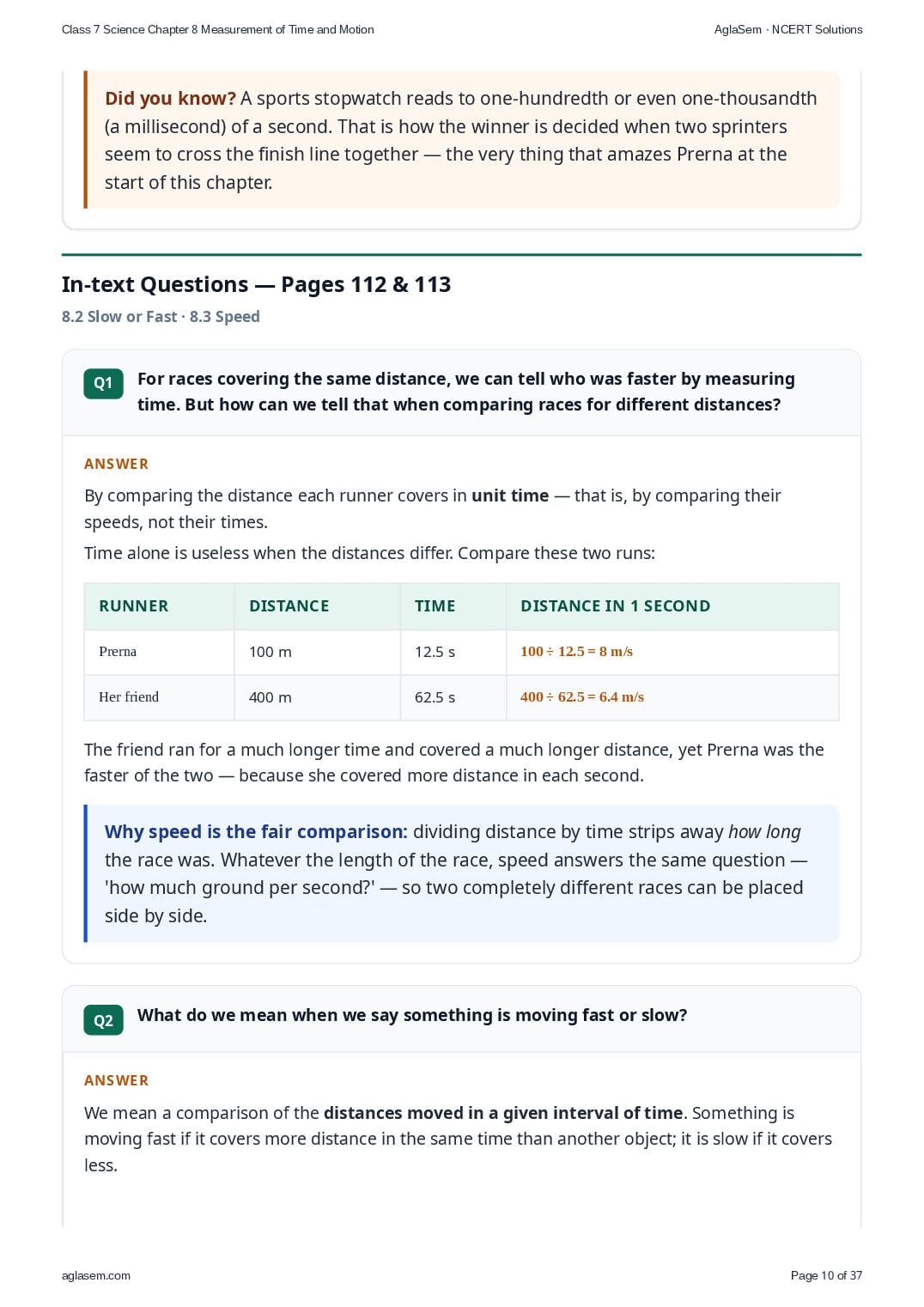
- For races covering the same distance, we can tell who was faster by measuring time. But how can we tell that when comparing races for different distances?
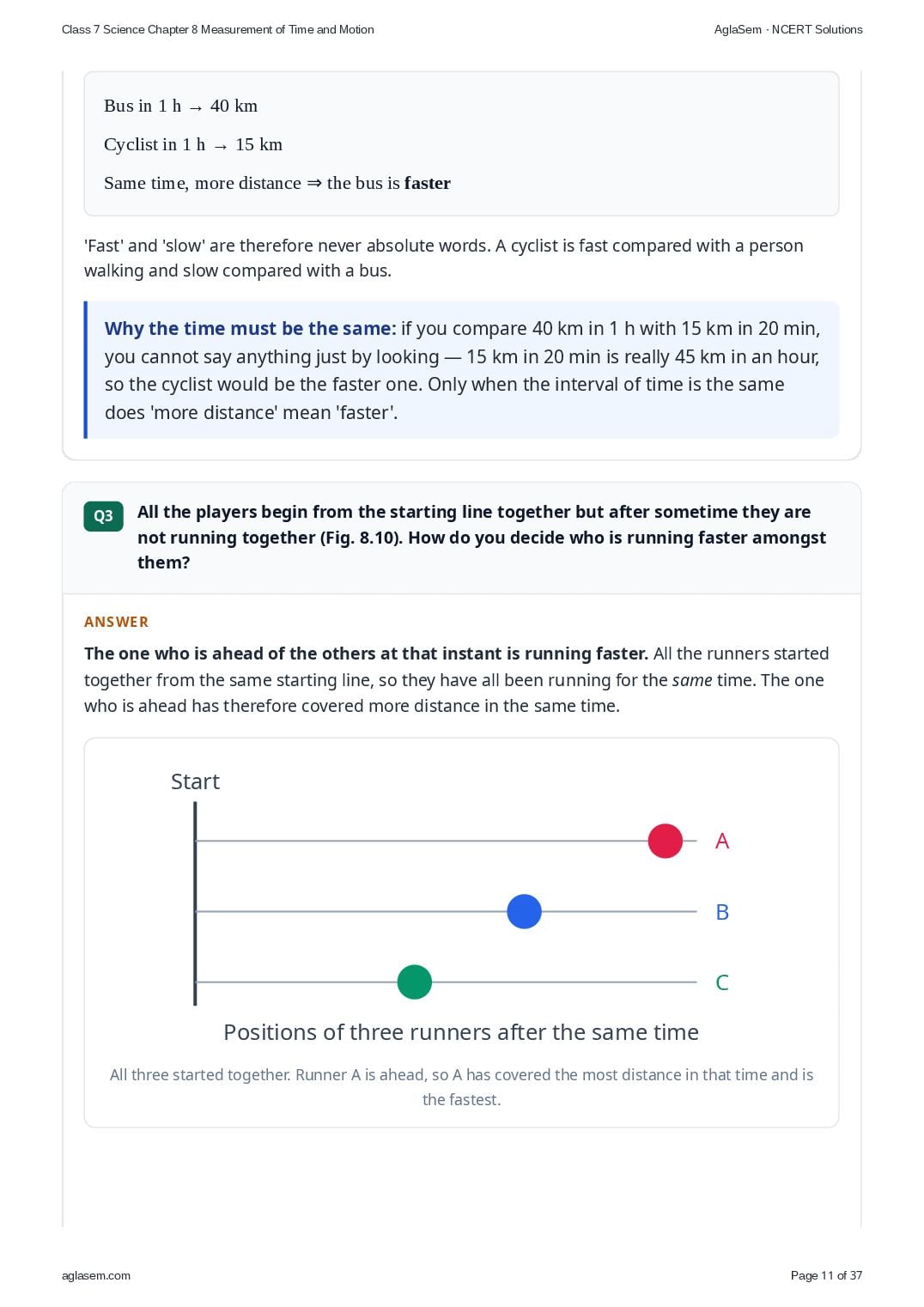
- What do we mean when we say something is moving fast or slow?
- All the players begin from the starting line together but after sometime they are not running together (Fig. 8.10). How do you decide who is running faster amongst them?
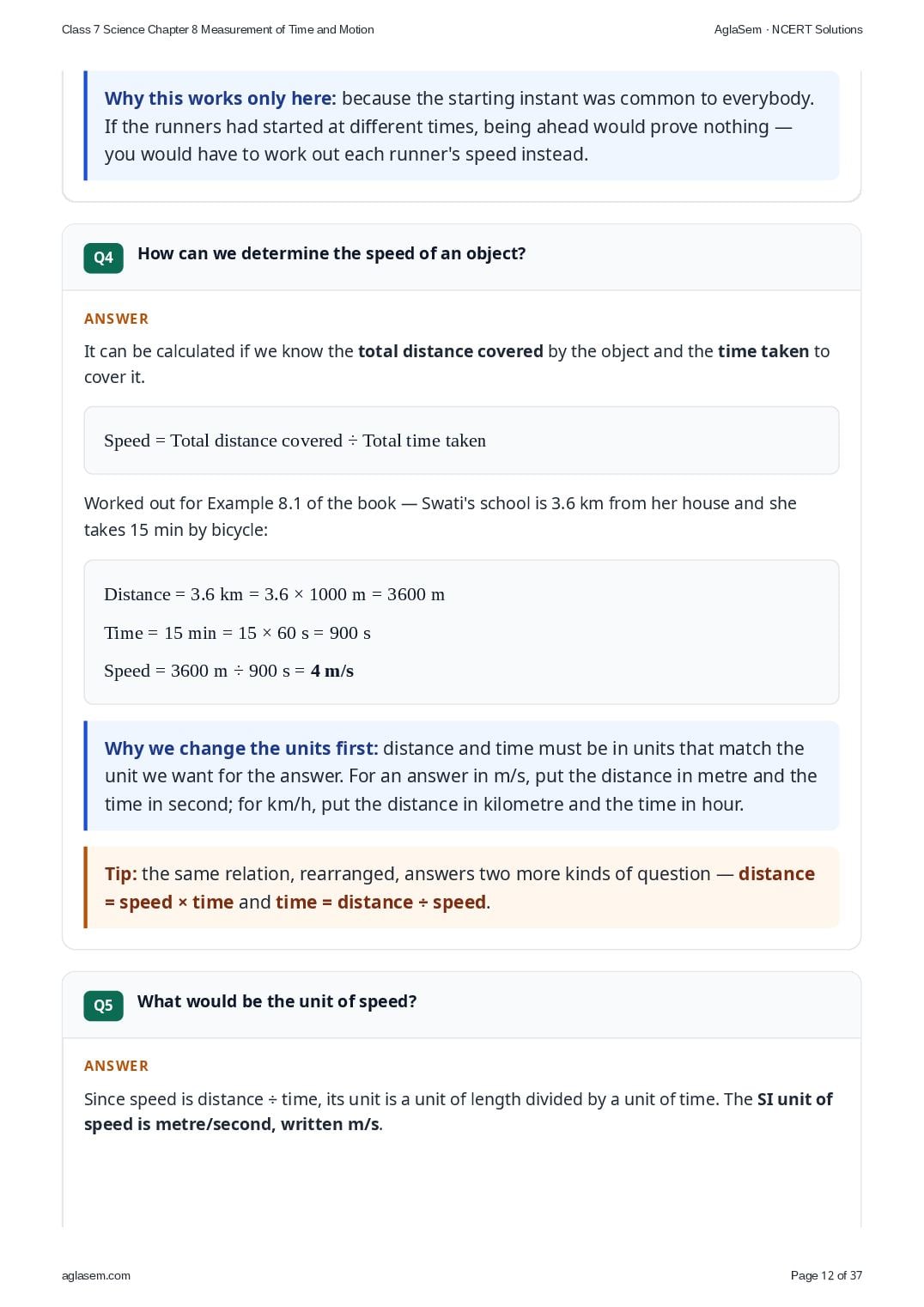
- How can we determine the speed of an object?
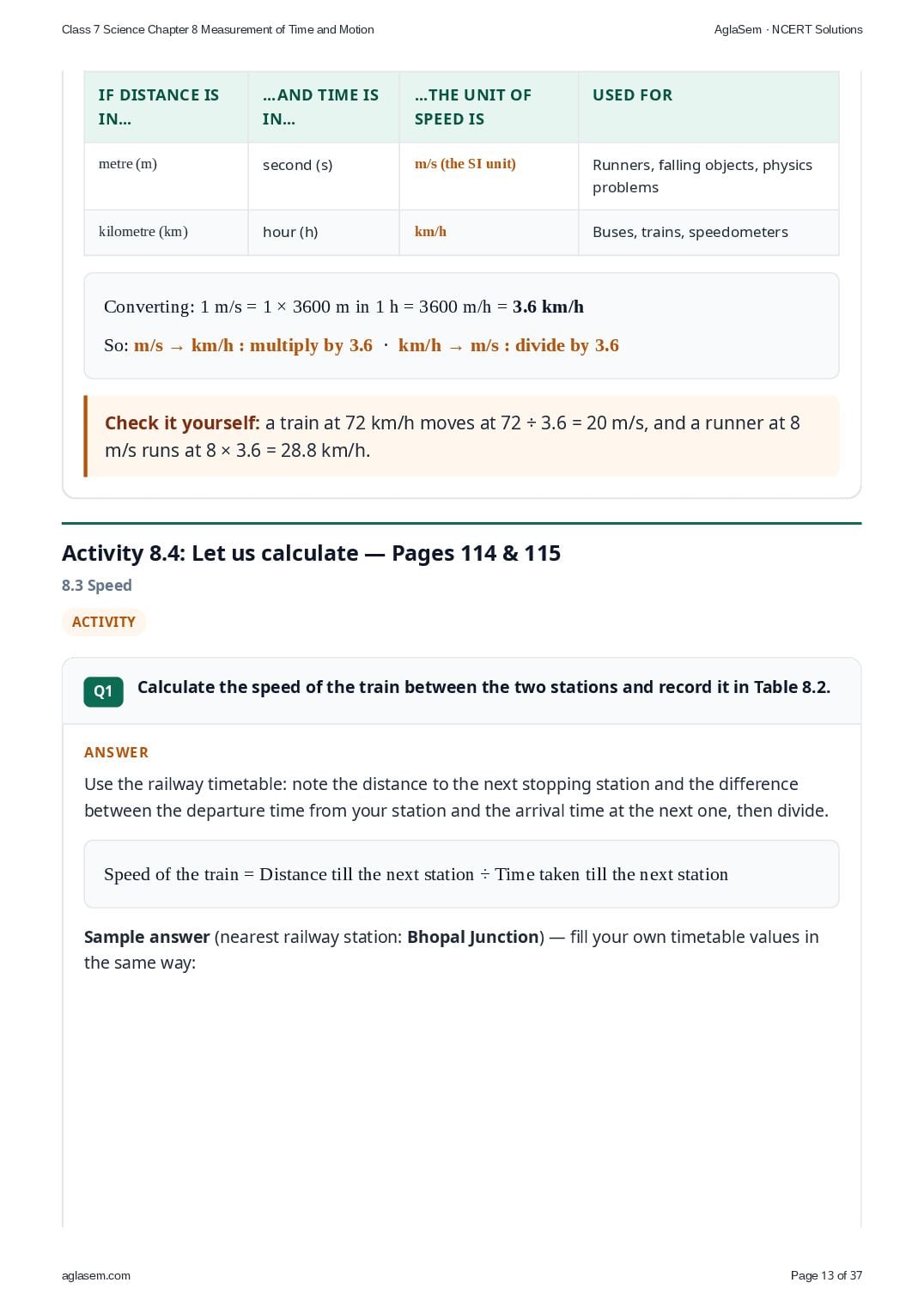
- What would be the unit of speed?
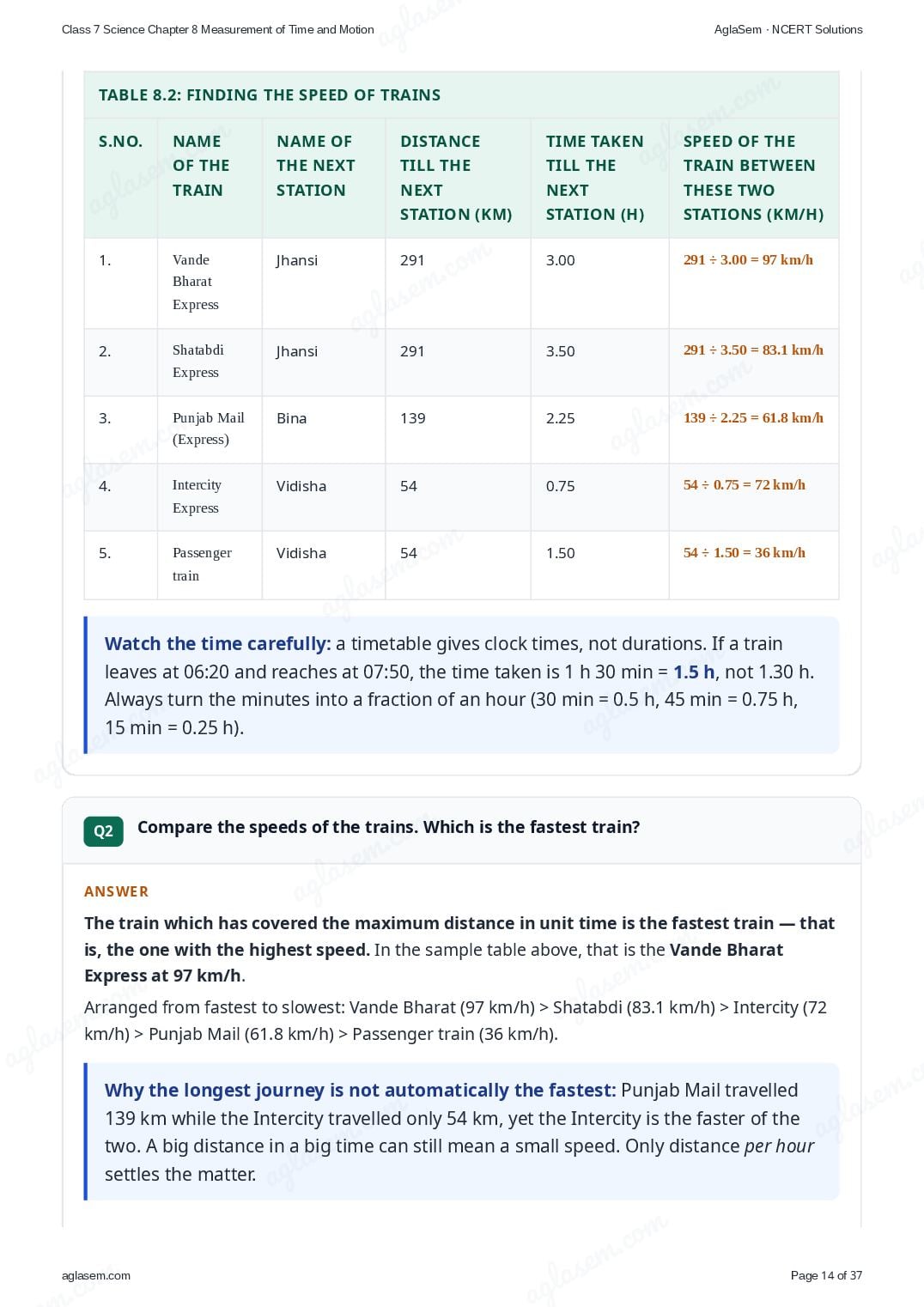
- Calculate the speed of the train between the two stations and record it in Table 8.2.
- Compare the speeds of the trains. Which is the fastest train?
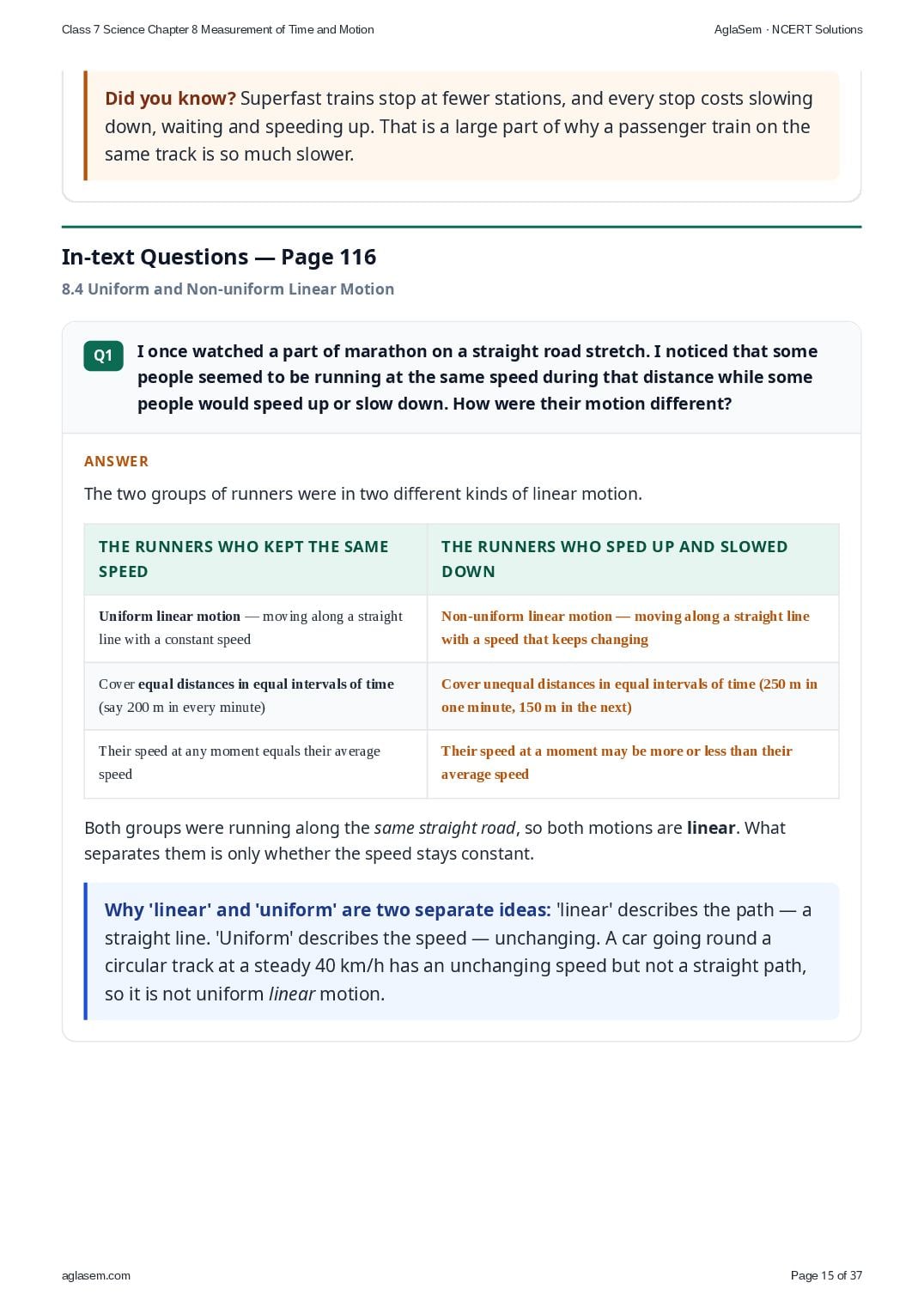
- I once watched a part of marathon on a straight road stretch. I noticed that some people seemed to be running at the same speed during that distance while some people would speed up or slow down. How were their motion different?
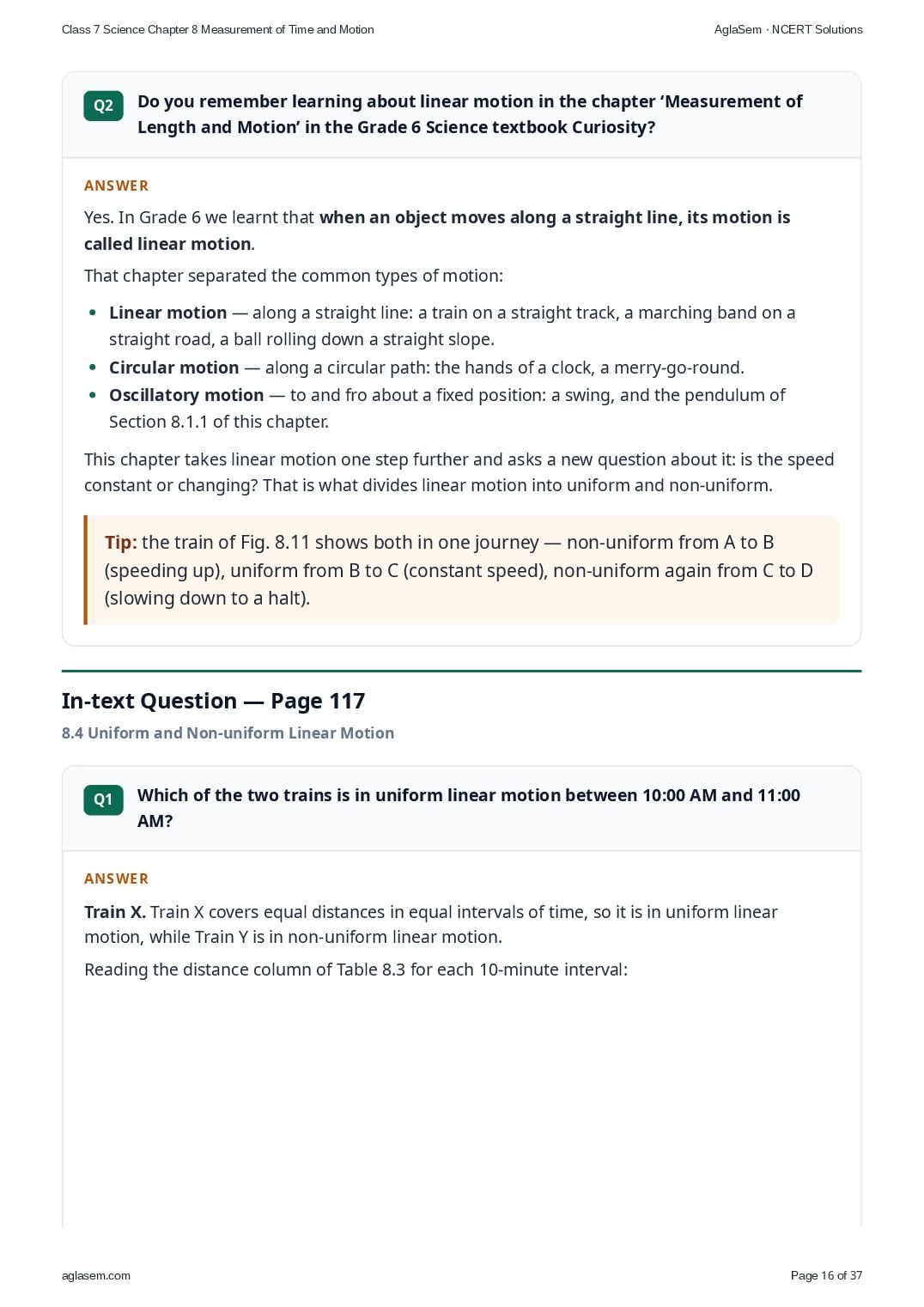
- Do you remember learning about linear motion in the chapter ‘Measurement of Length and Motion’ in the Grade 6 Science textbook Curiosity?
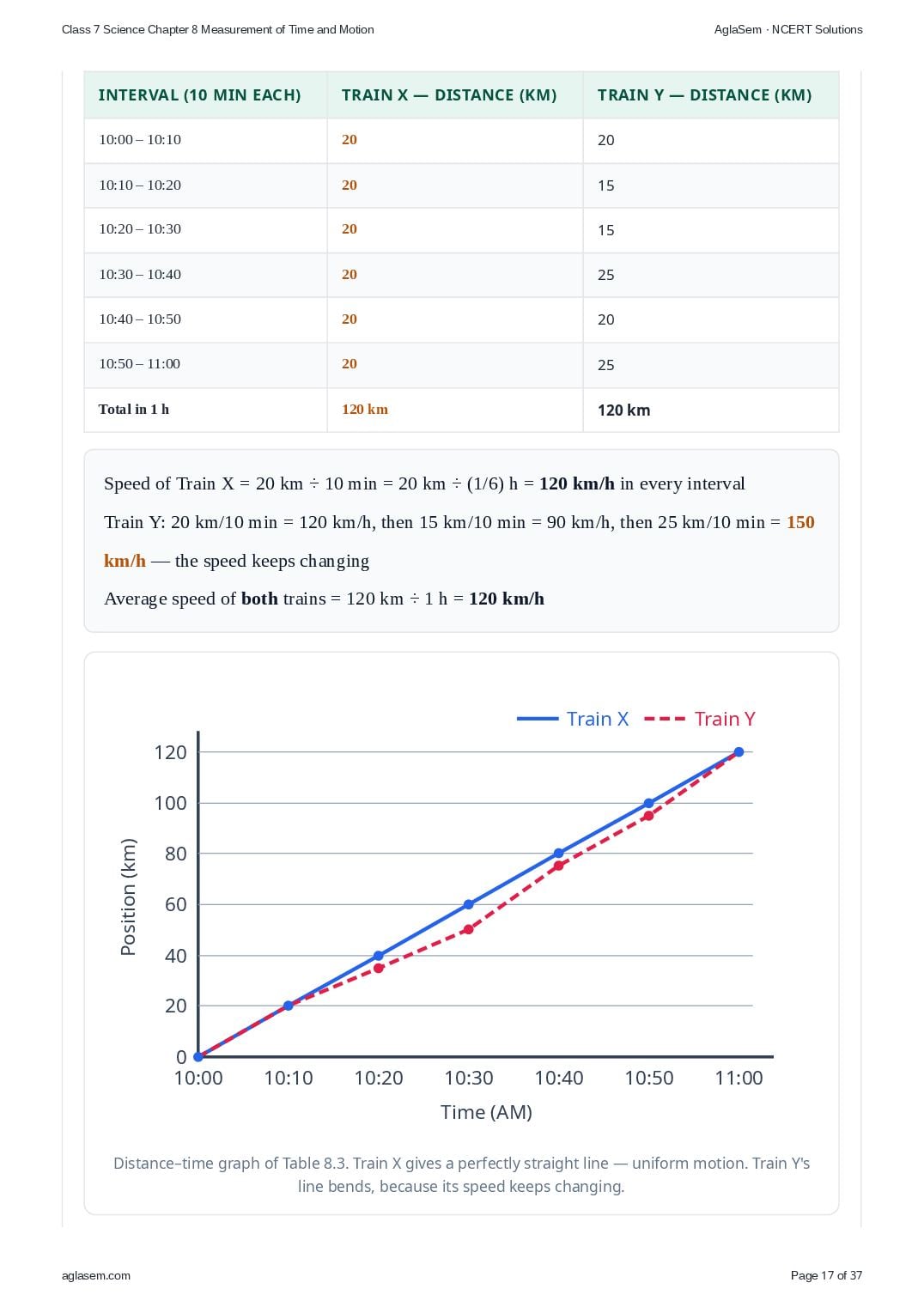
- Which of the two trains is in uniform linear motion between 10:00 AM and 11:00 AM?
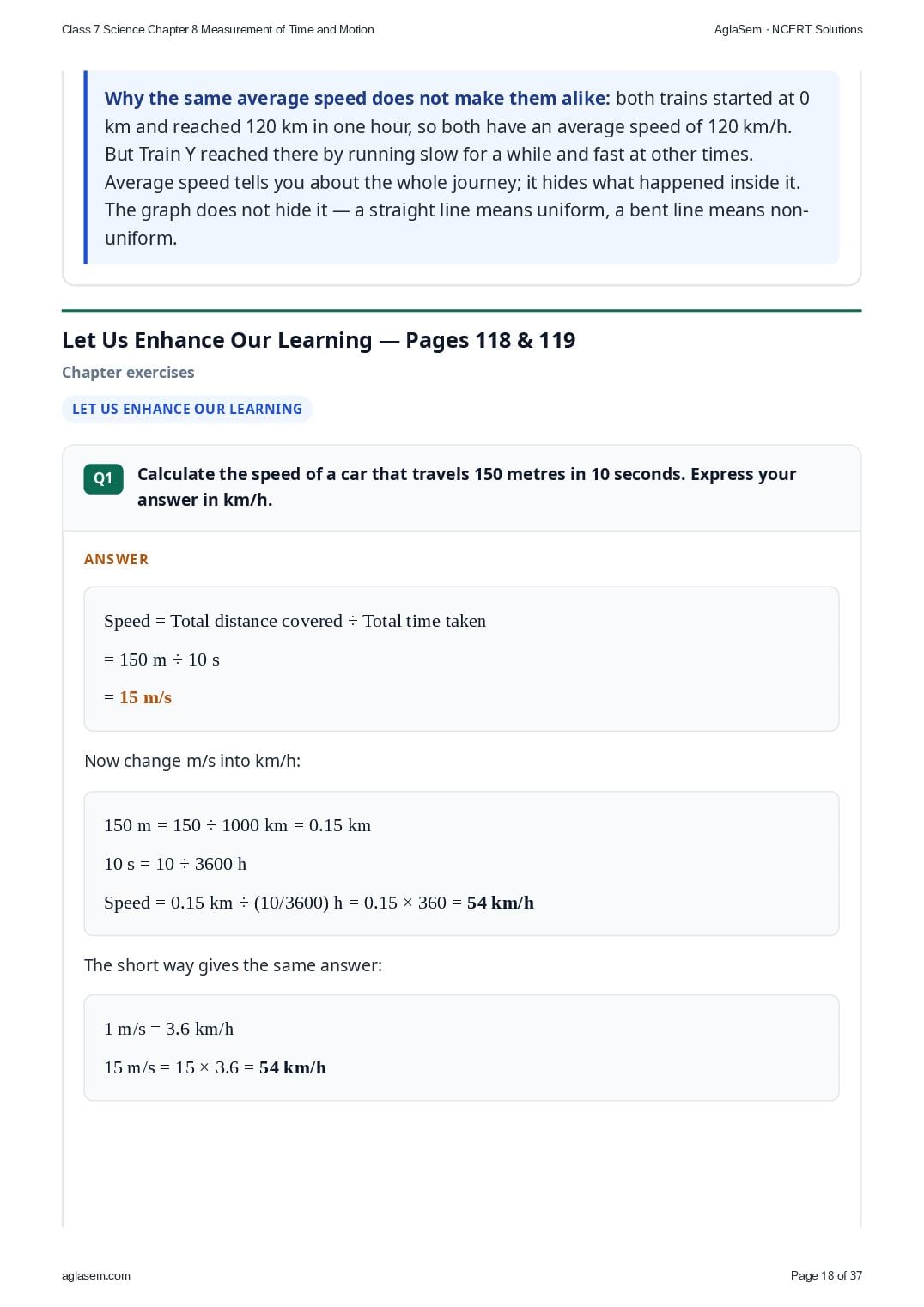
- Calculate the speed of a car that travels 150 metres in 10 seconds. Express your answer in km/h.
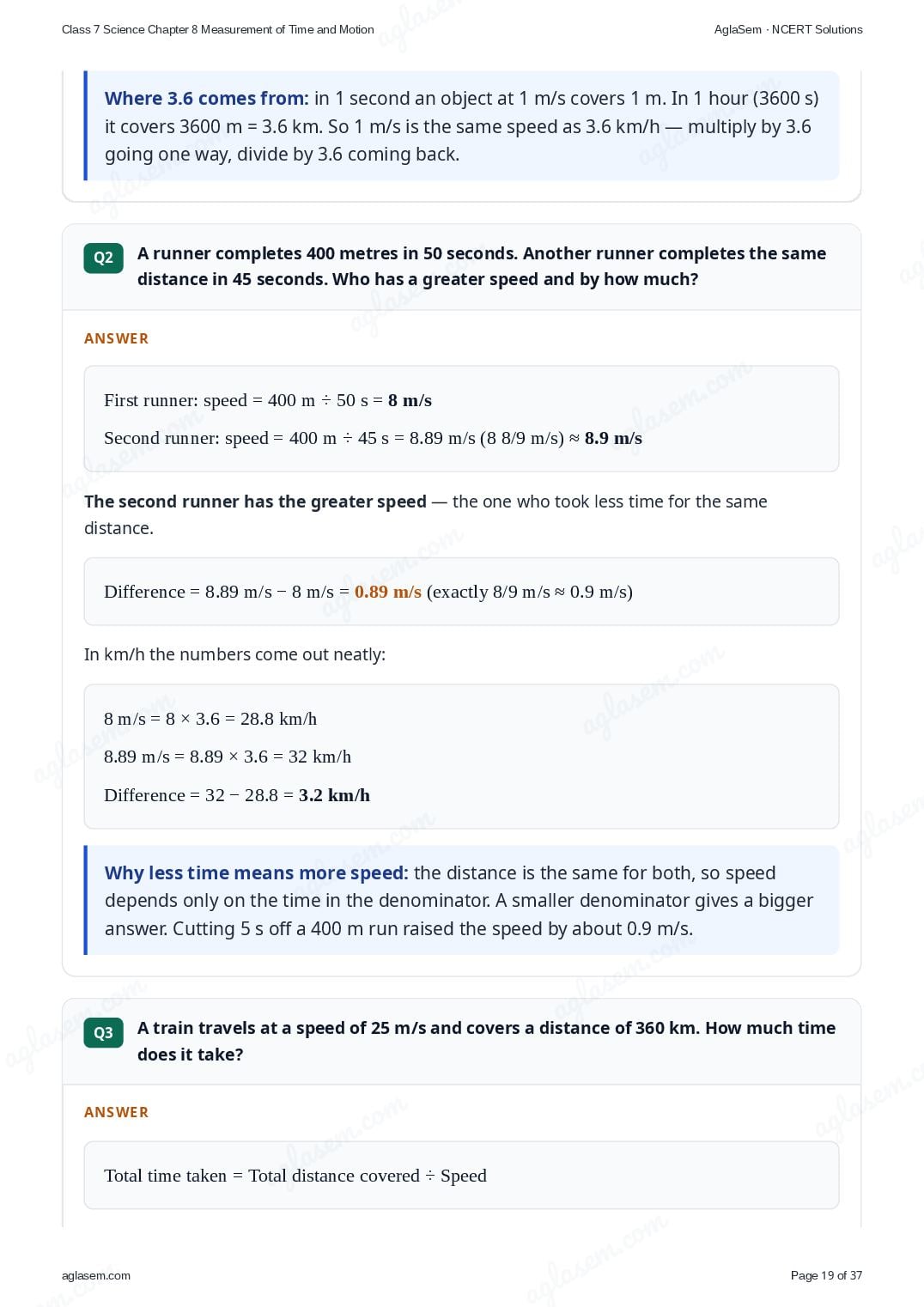
- A runner completes 400 metres in 50 seconds. Another runner completes the same distance in 45 seconds. Who has a greater speed and by how much?
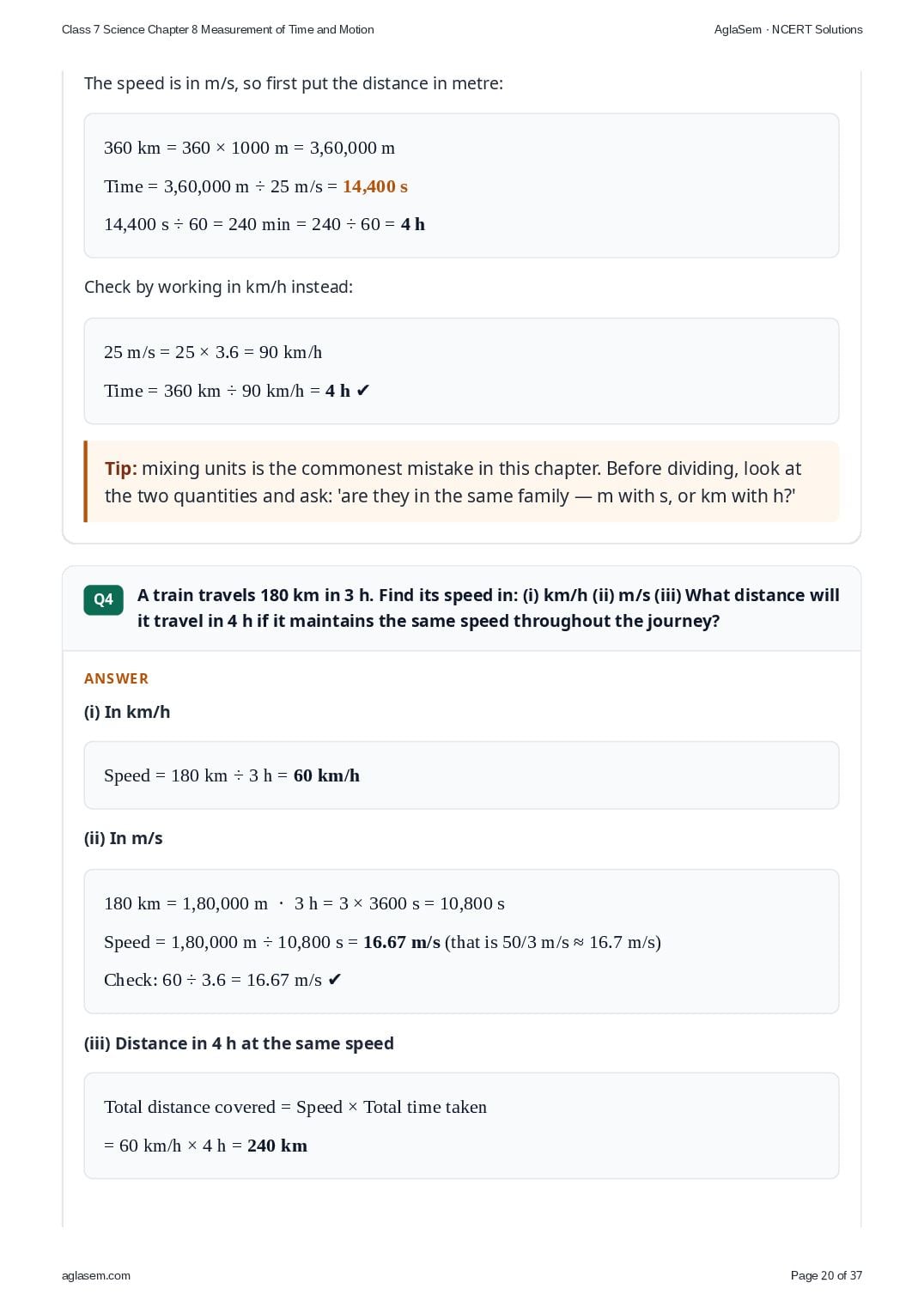
- A train travels at a speed of 25 m/s and covers a distance of 360 km. How much time does it take?
- A train travels 180 km in 3 h. Find its speed in: (i) km/h (ii) m/s (iii) What distance will it travel in 4 h if it maintains the same speed throughout the journey?
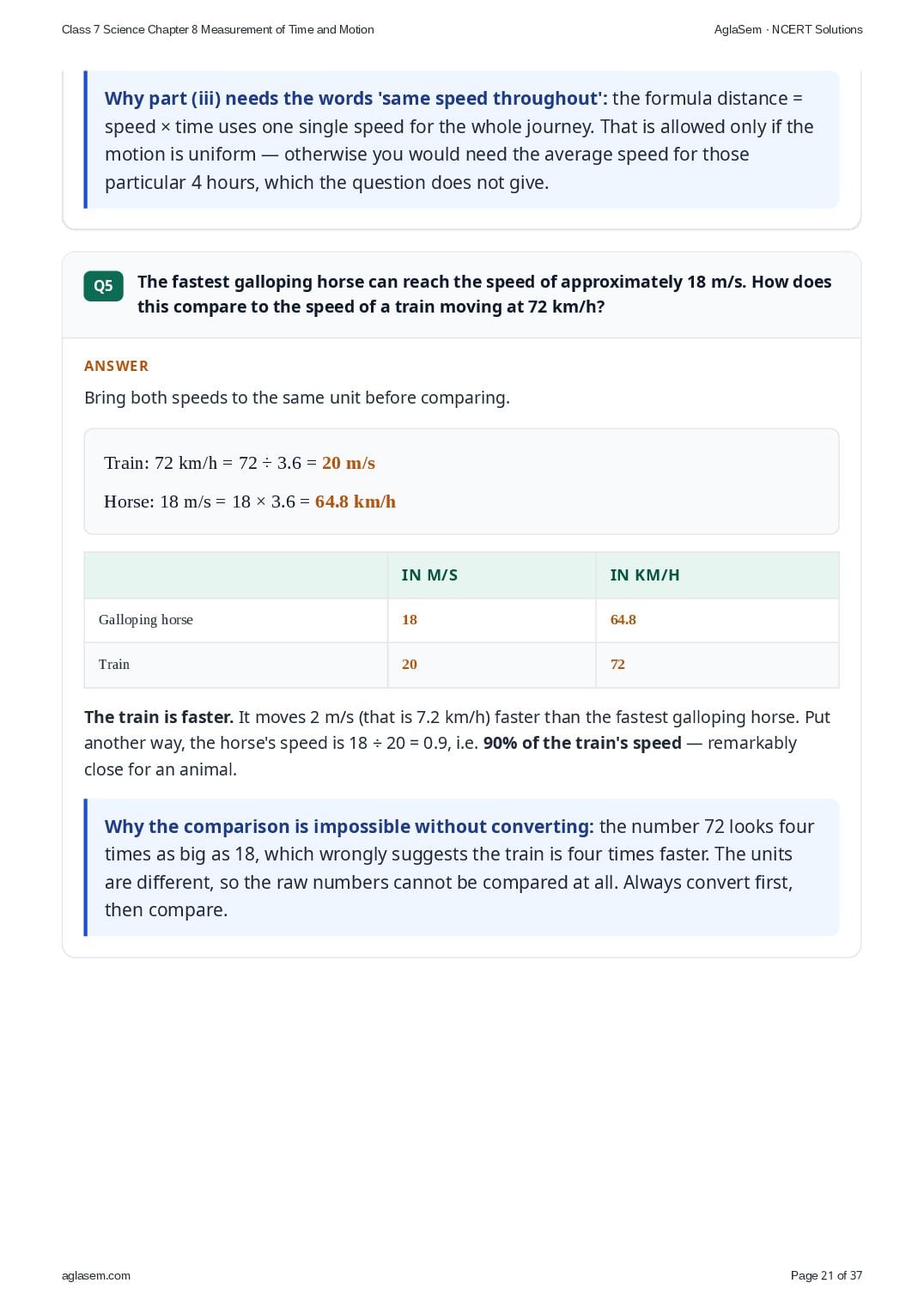
- The fastest galloping horse can reach the speed of approximately 18 m/s. How does this compare to the speed of a train moving at 72 km/h?
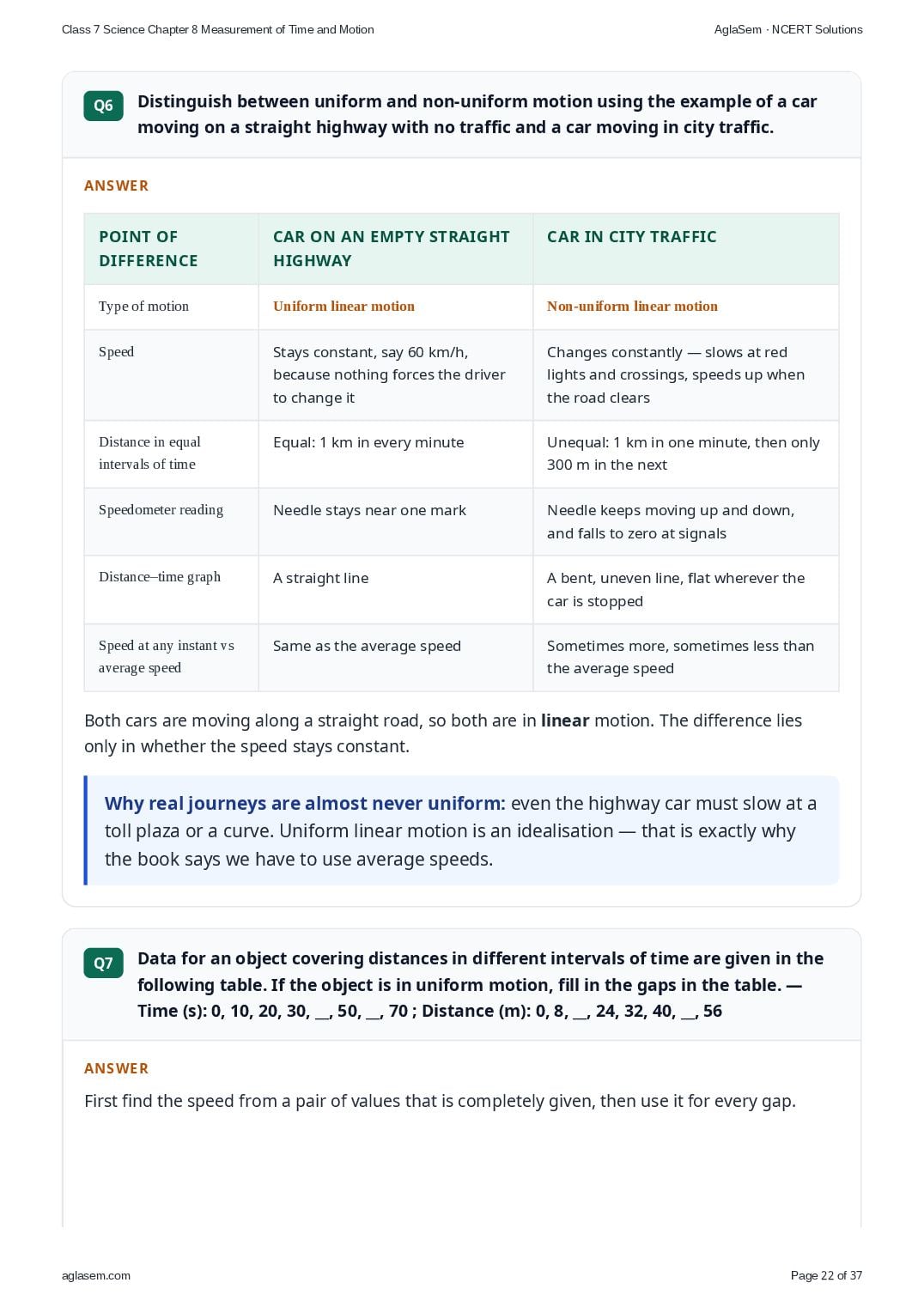
- Distinguish between uniform and non-uniform motion using the example of a car moving on a straight highway with no traffic and a car moving in city traffic.
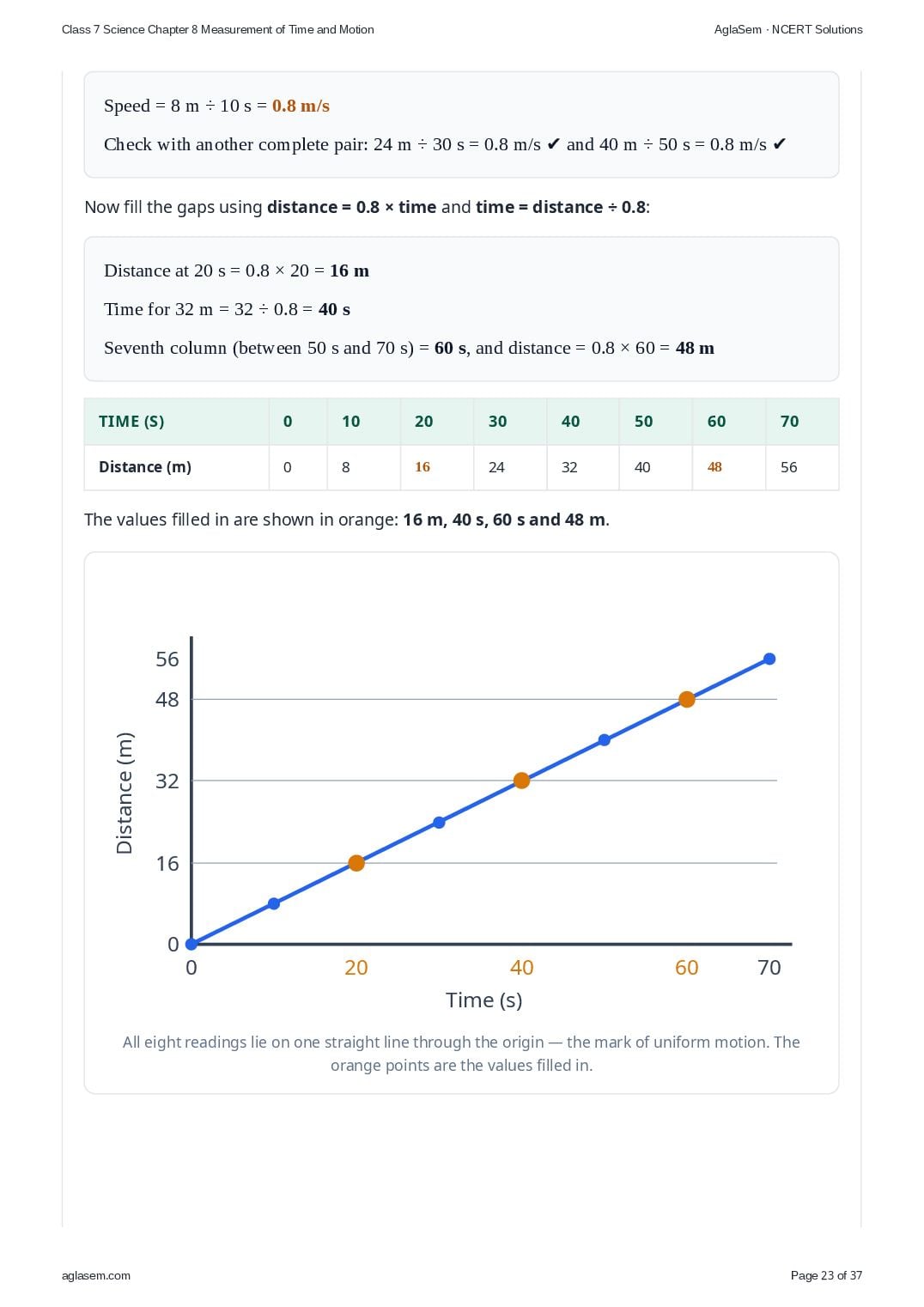
- Data for an object covering distances in different intervals of time are given in the following table. If the object is in uniform motion, fill in the gaps in the table. — Time (s): 0, 10, 20, 30, __, 50, __, 70 ; Distance (m): 0, 8, __, 24, 32, 40, __, 56
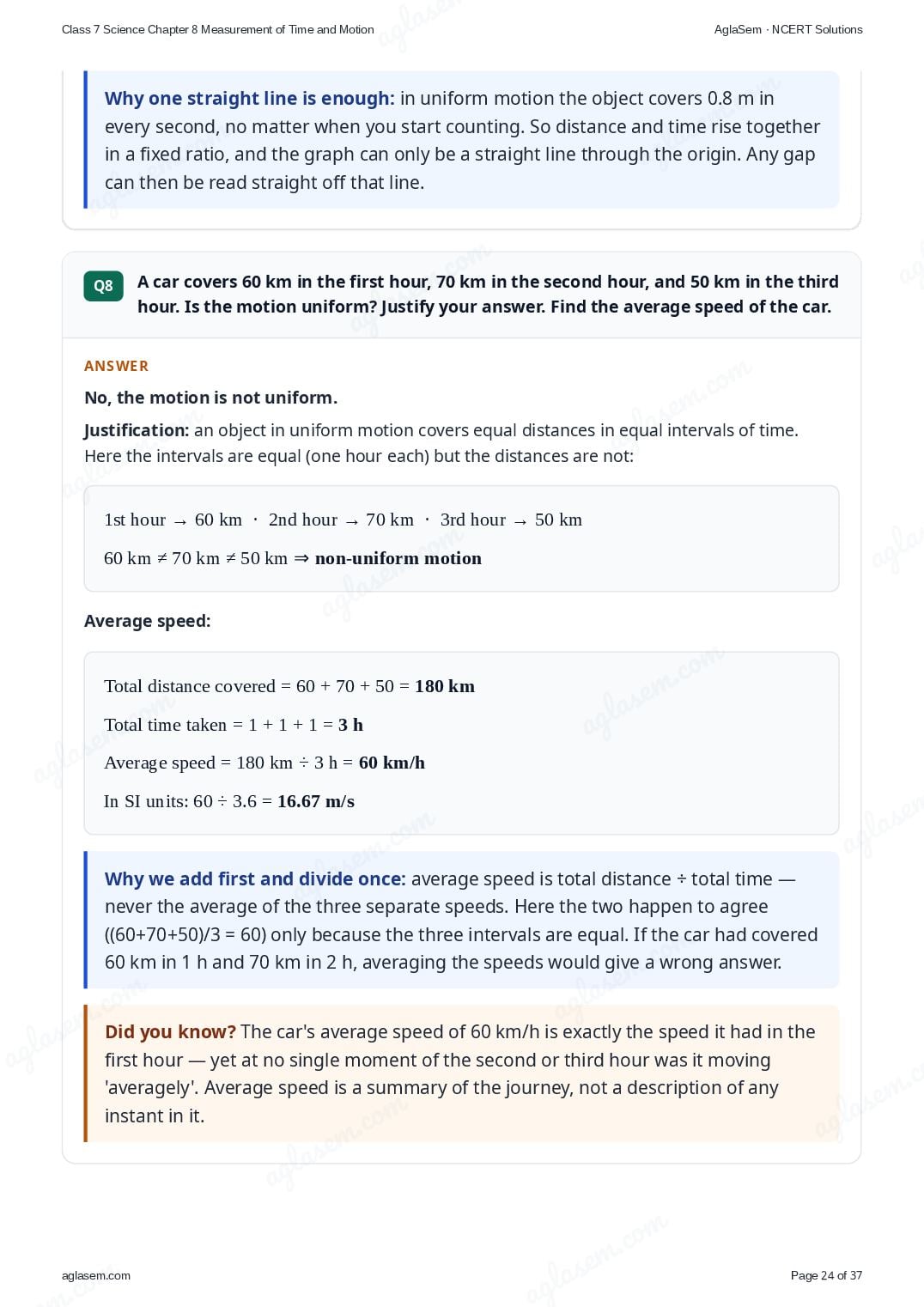
- A car covers 60 km in the first hour, 70 km in the second hour, and 50 km in the third hour. Is the motion uniform? Justify your answer. Find the average speed of the car.
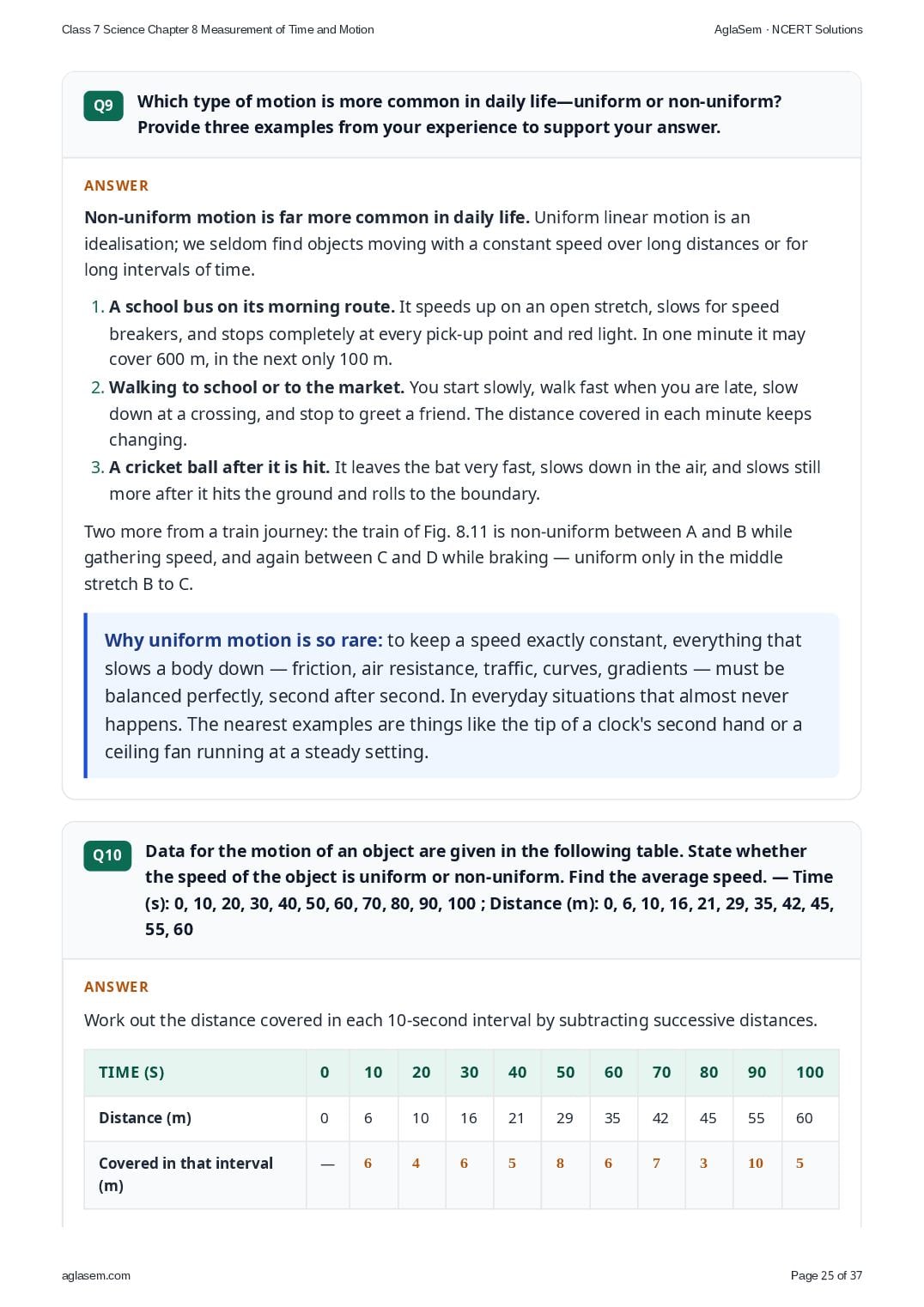
- Which type of motion is more common in daily life—uniform or non-uniform? Provide three examples from your experience to support your answer.
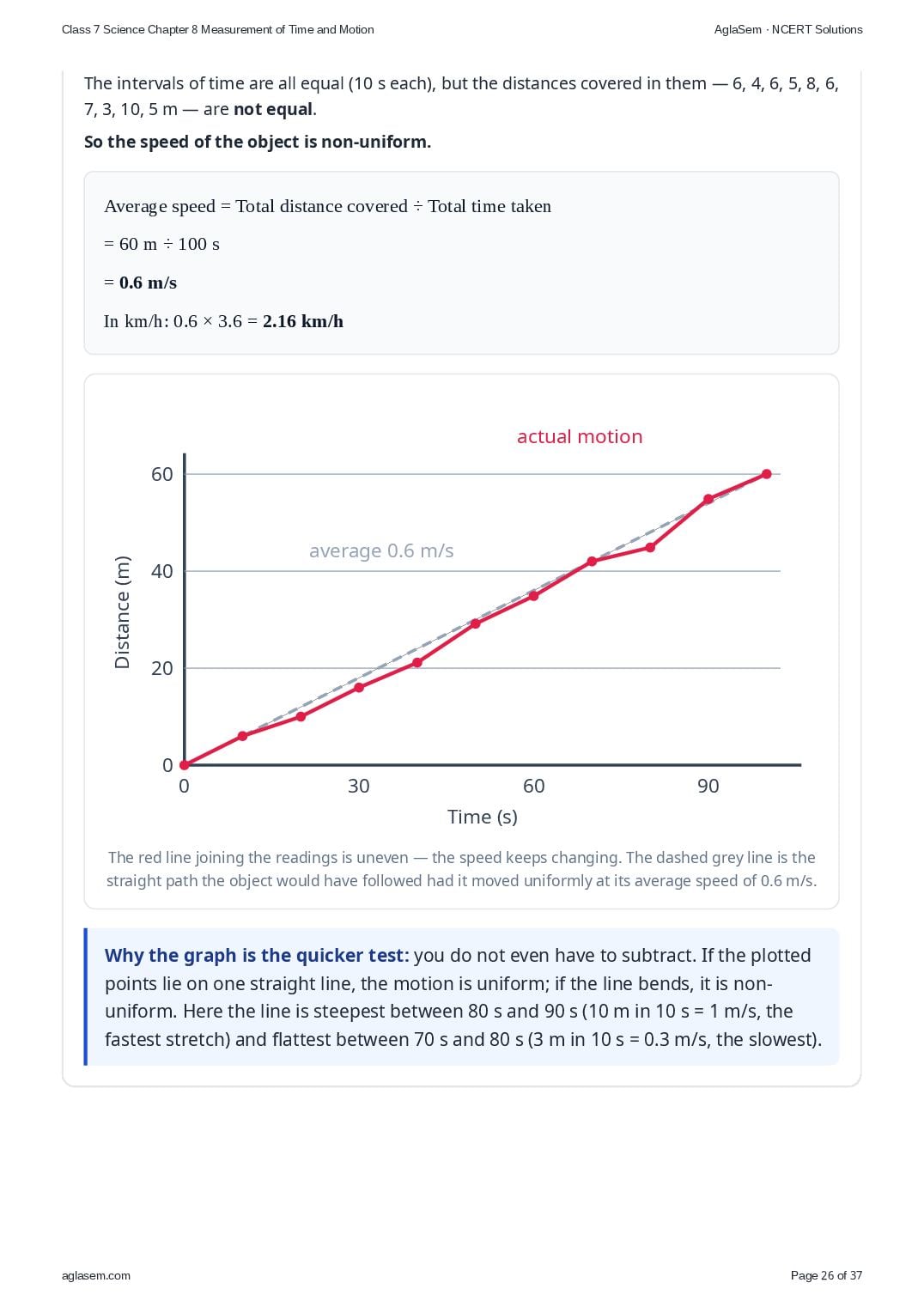
- Data for the motion of an object are given in the following table. State whether the speed of the object is uniform or non-uniform. Find the average speed. — Time (s): 0, 10, 20, 30, 40, 50, 60, 70, 80, 90, 100 ; Distance (m): 0, 6, 10, 16, 21, 29, 35, 42, 45, 55, 60
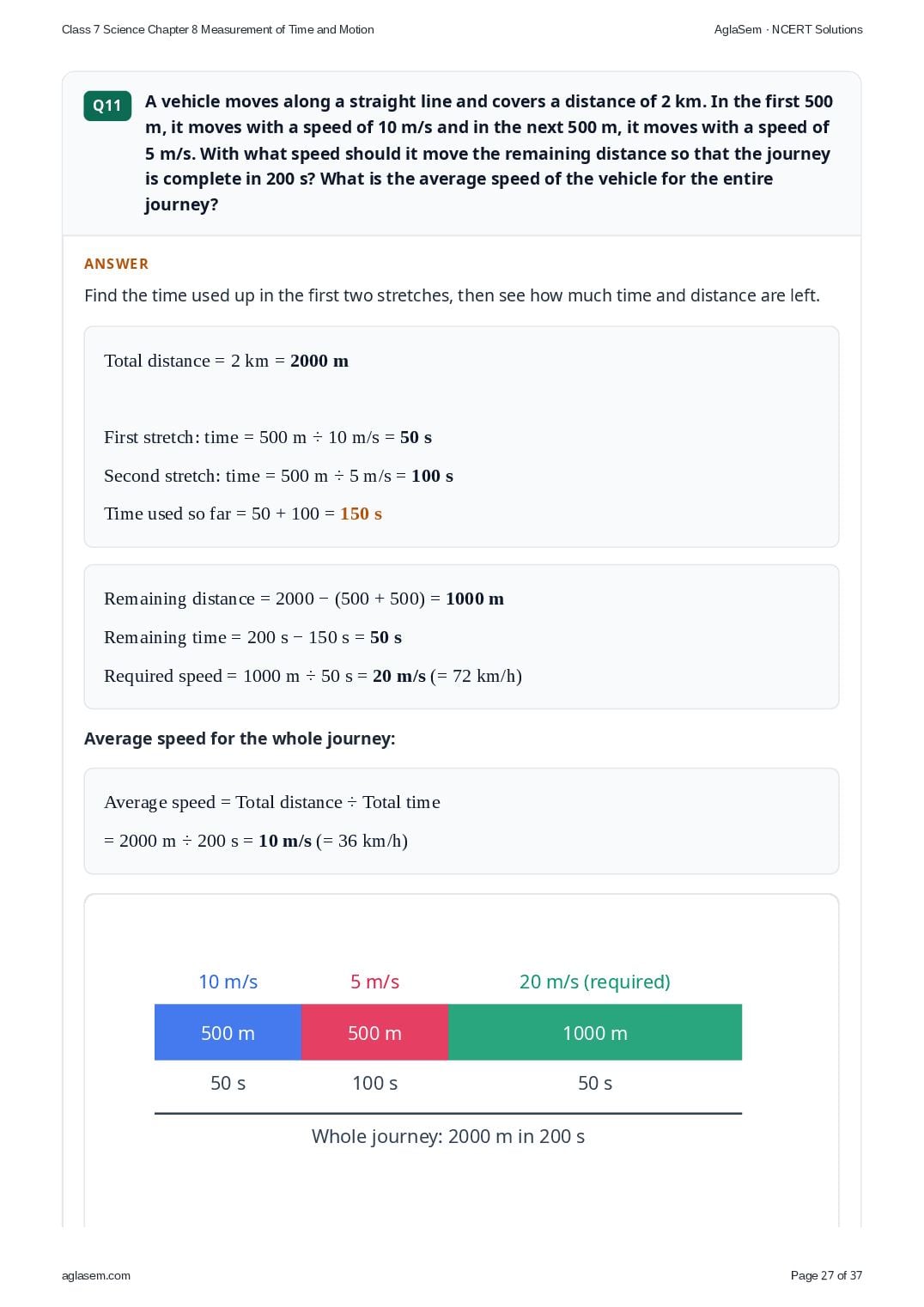
- A vehicle moves along a straight line and covers a distance of 2 km. In the first 500 m, it moves with a speed of 10 m/s and in the next 500 m, it moves with a speed of 5 m/s. With what speed should it move the remaining distance so that the journey is complete in 200 s? What is the average speed of the vehicle for the entire journey?
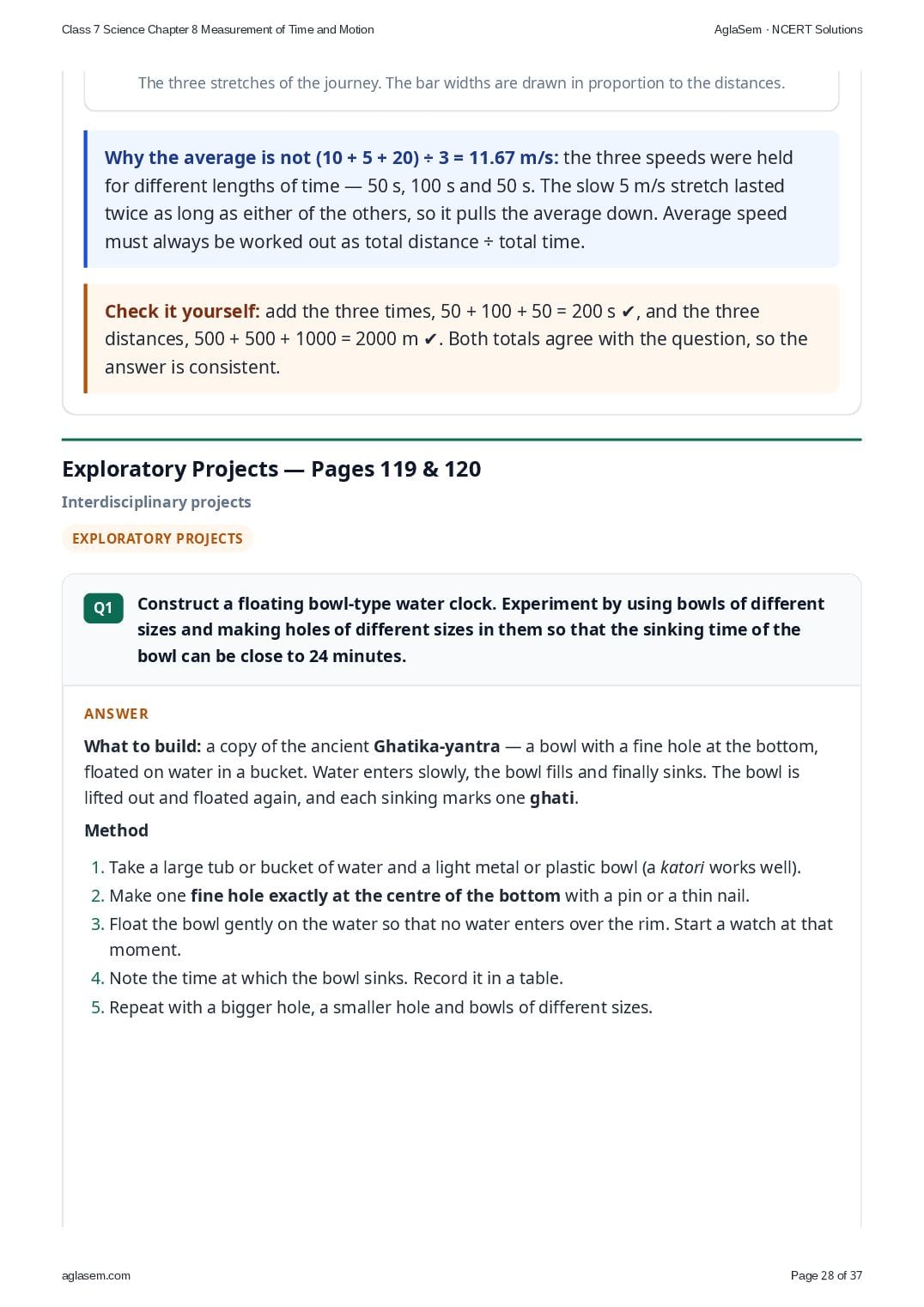
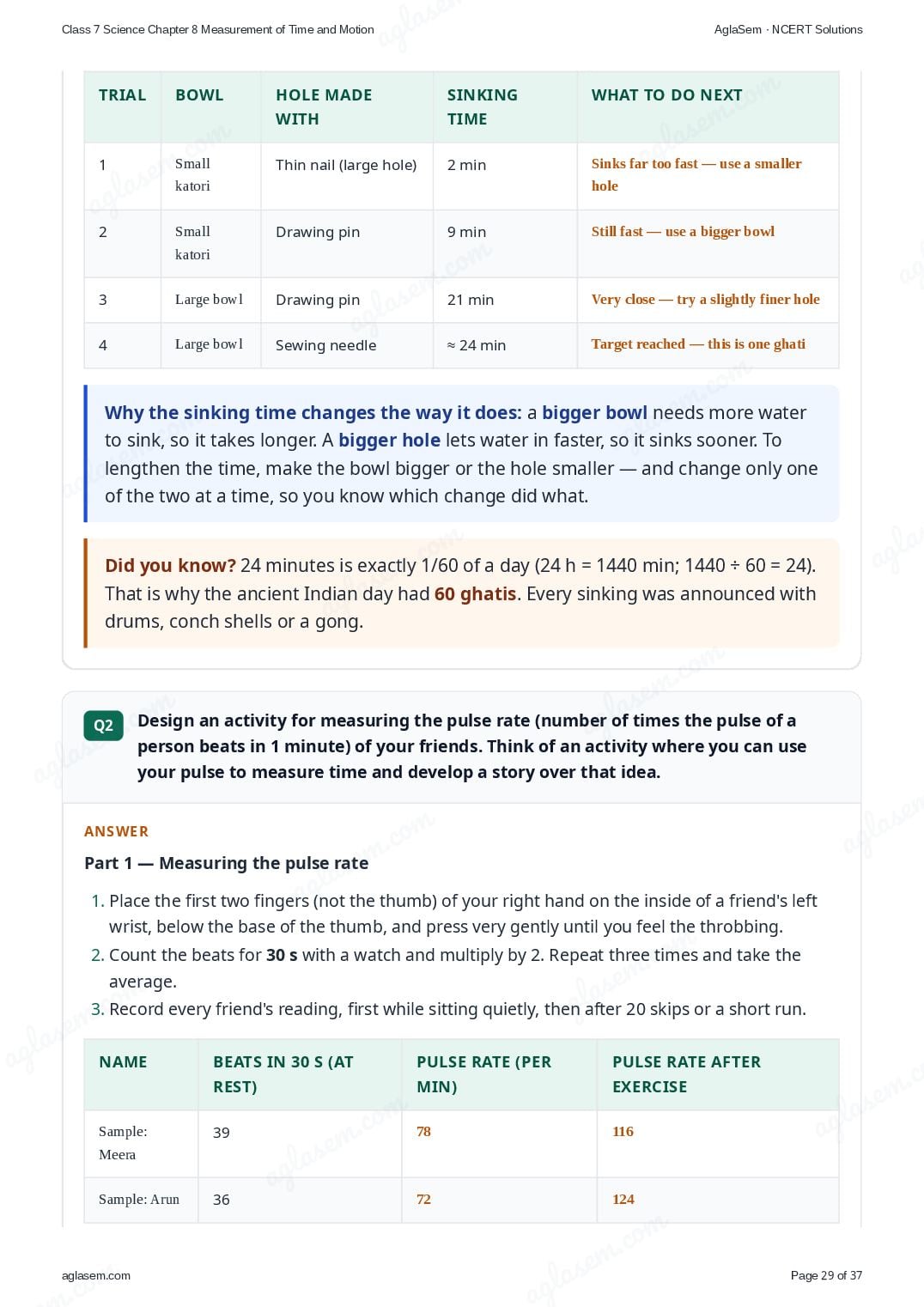
- Construct a floating bowl-type water clock. Experiment by using bowls of different sizes and making holes of different sizes in them so that the sinking time of the bowl can be close to 24 minutes.
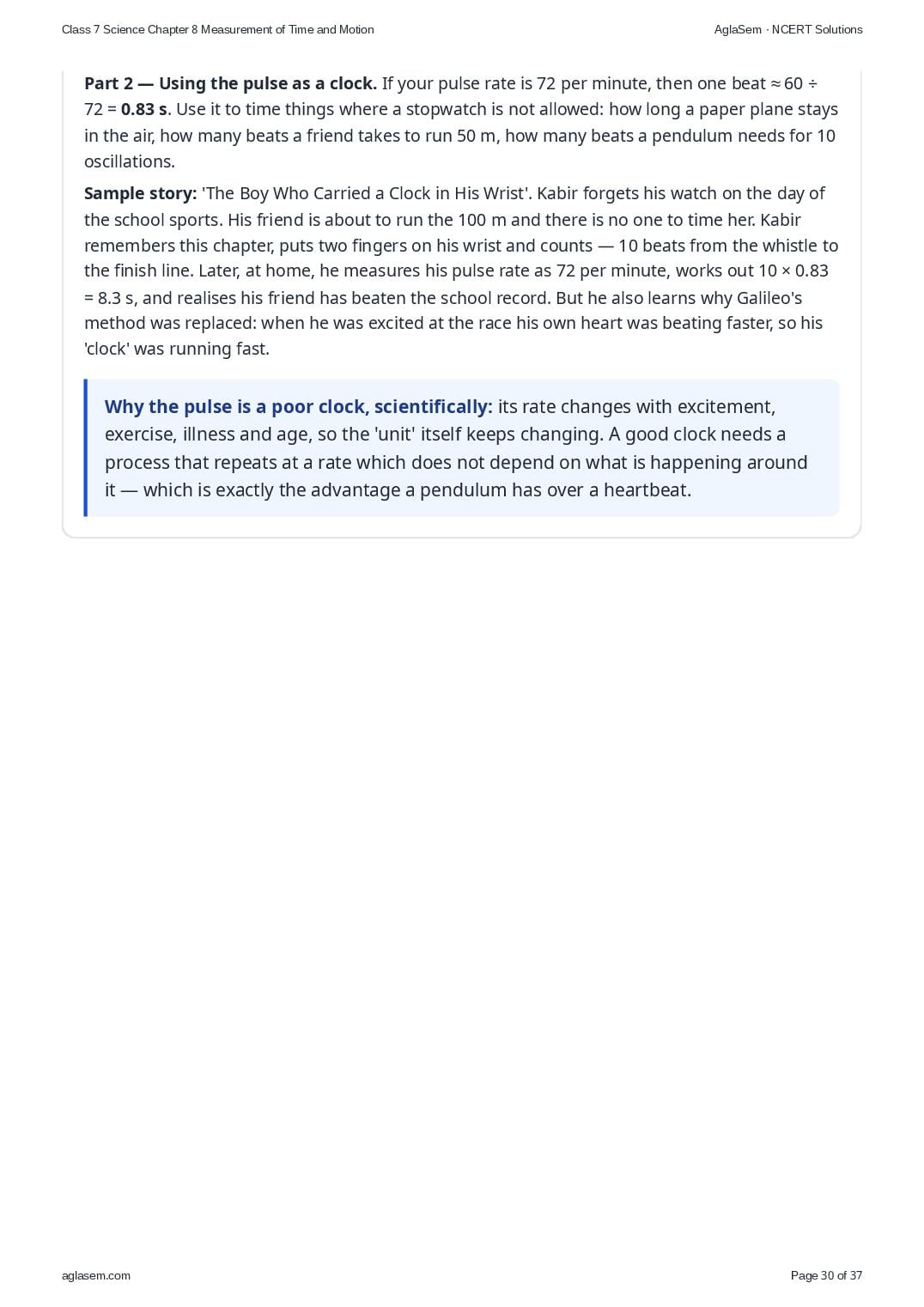
- Design an activity for measuring the pulse rate (number of times the pulse of a person beats in 1 minute) of your friends. Think of an activity where you can use your pulse to measure time and develop a story over that idea.
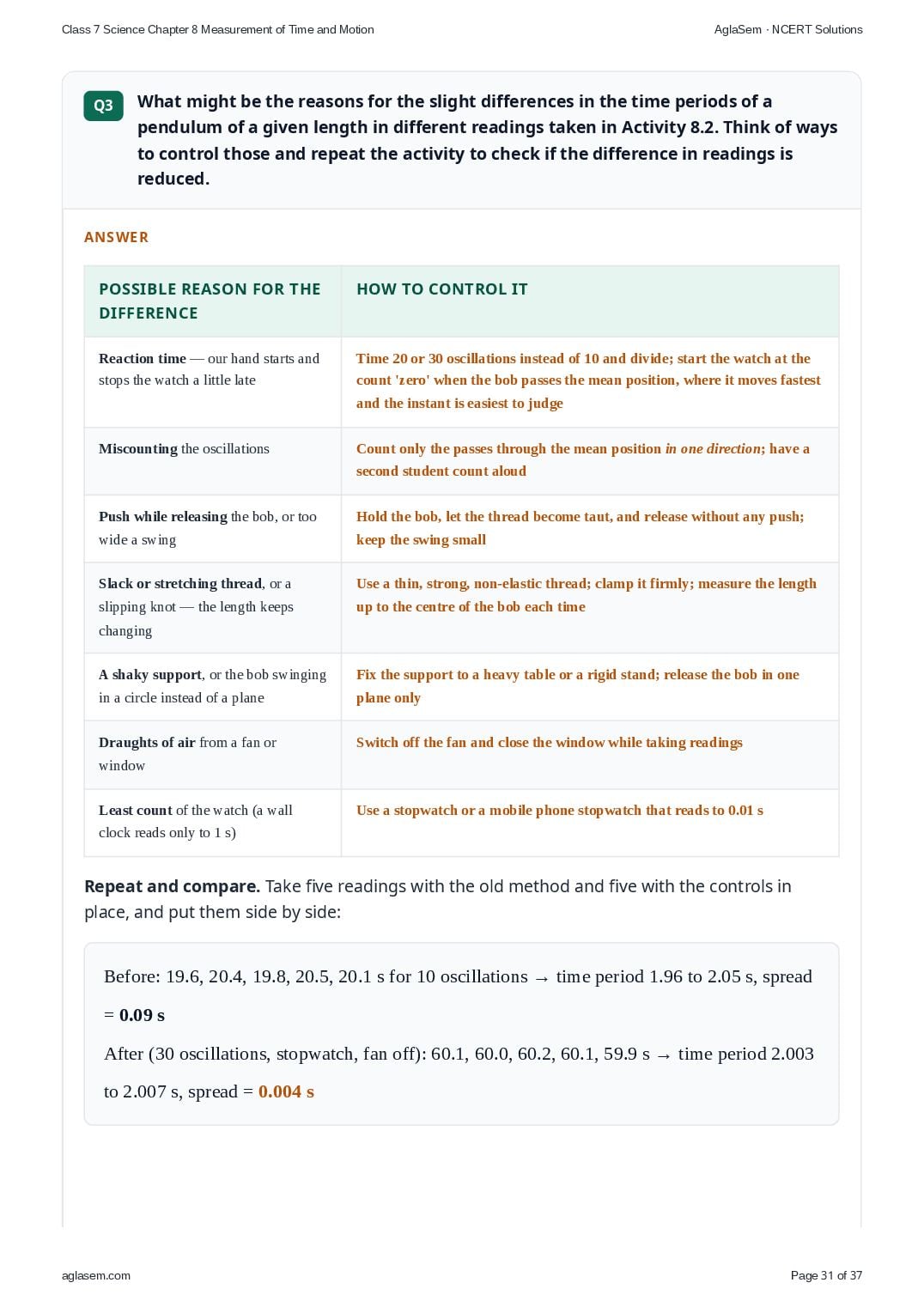
- What might be the reasons for the slight differences in the time periods of a pendulum of a given length in different readings taken in Activity 8.2. Think of ways to control those and repeat the activity to check if the difference in readings is reduced.
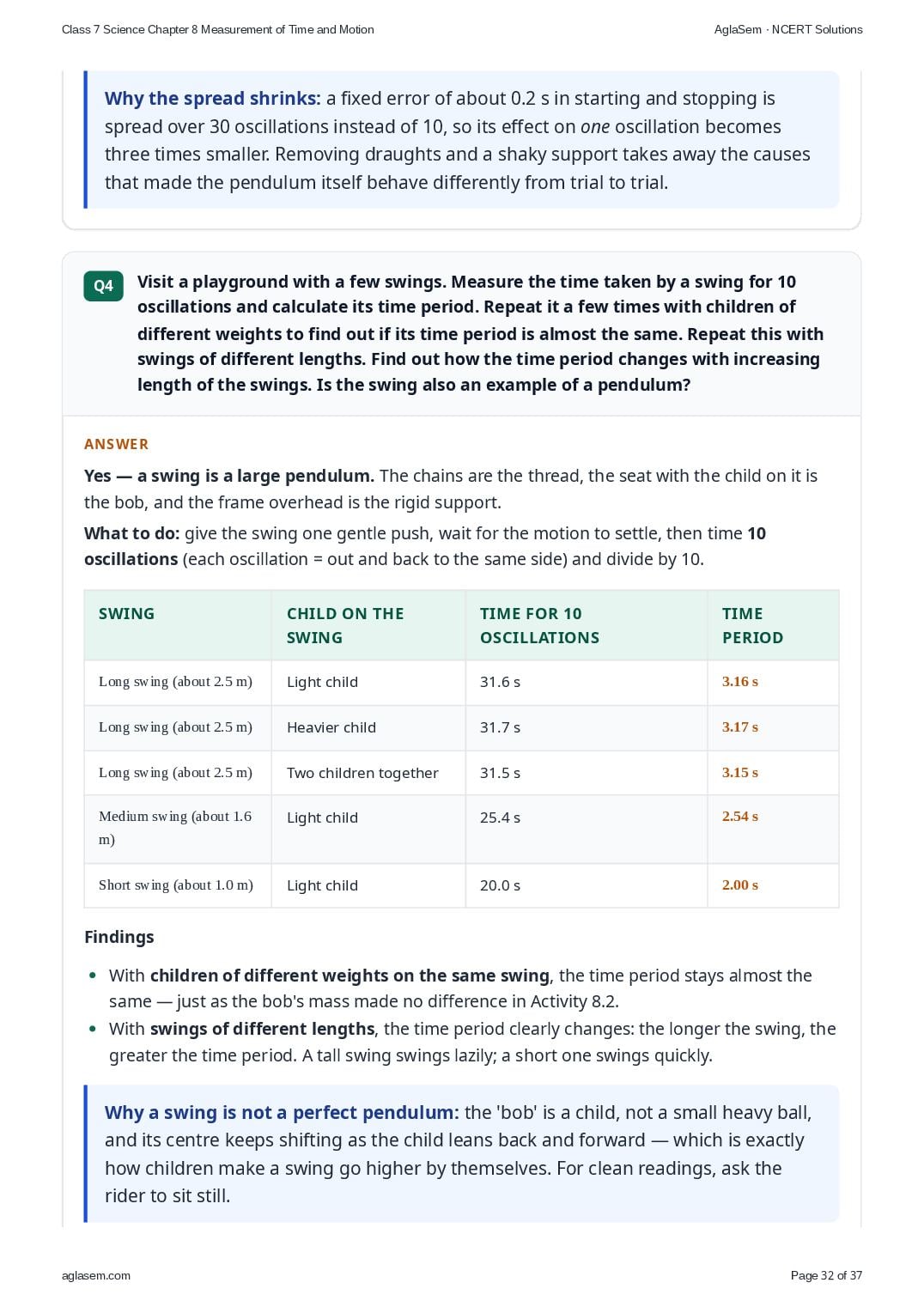
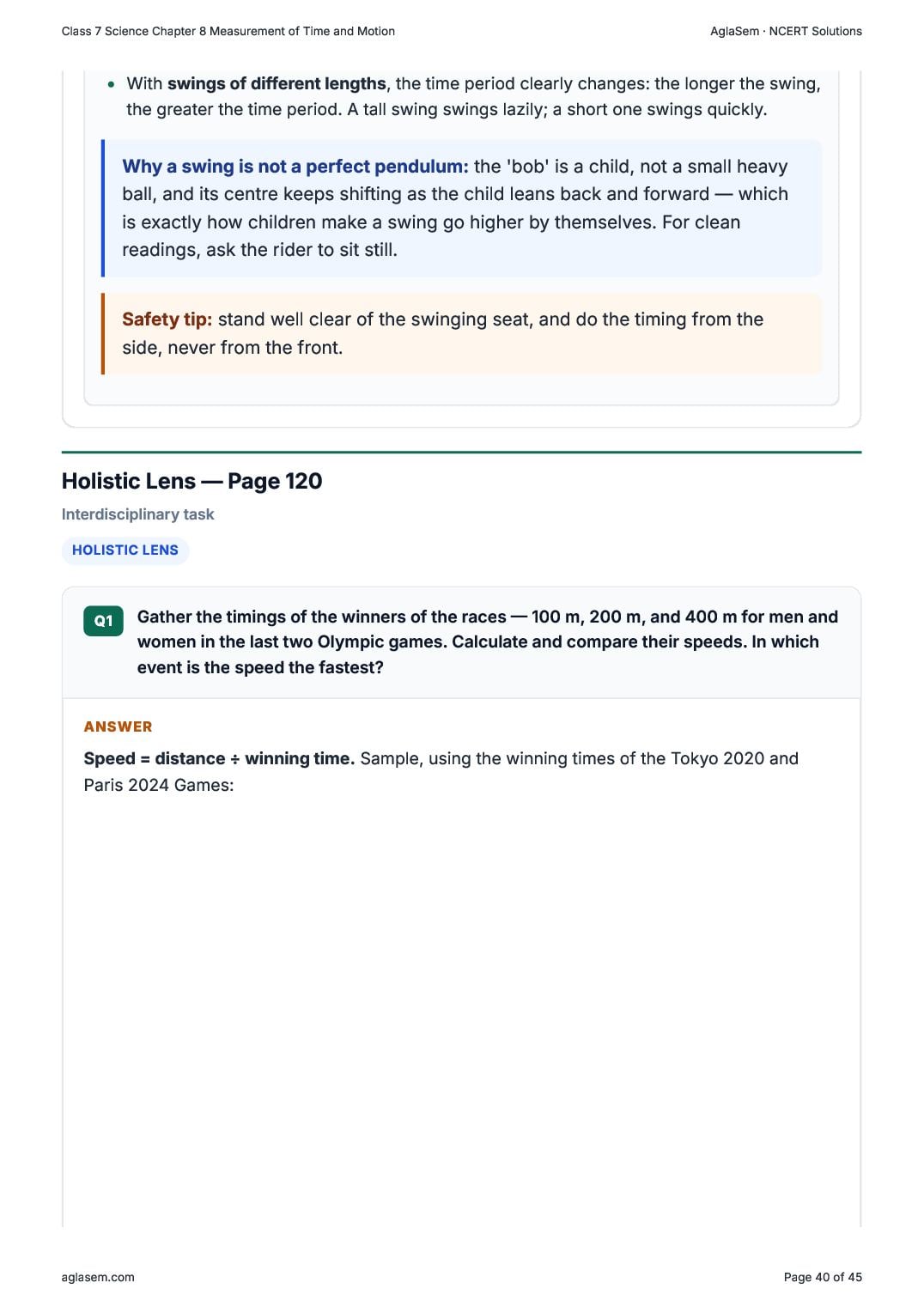
- Visit a playground with a few swings. Measure the time taken by a swing for 10 oscillations and calculate its time period. Repeat it a few times with children of different weights to find out if its time period is almost the same. Repeat this with swings of different lengths. Find out how the time period changes with increasing length of the swings. Is the swing also an example of a pendulum?
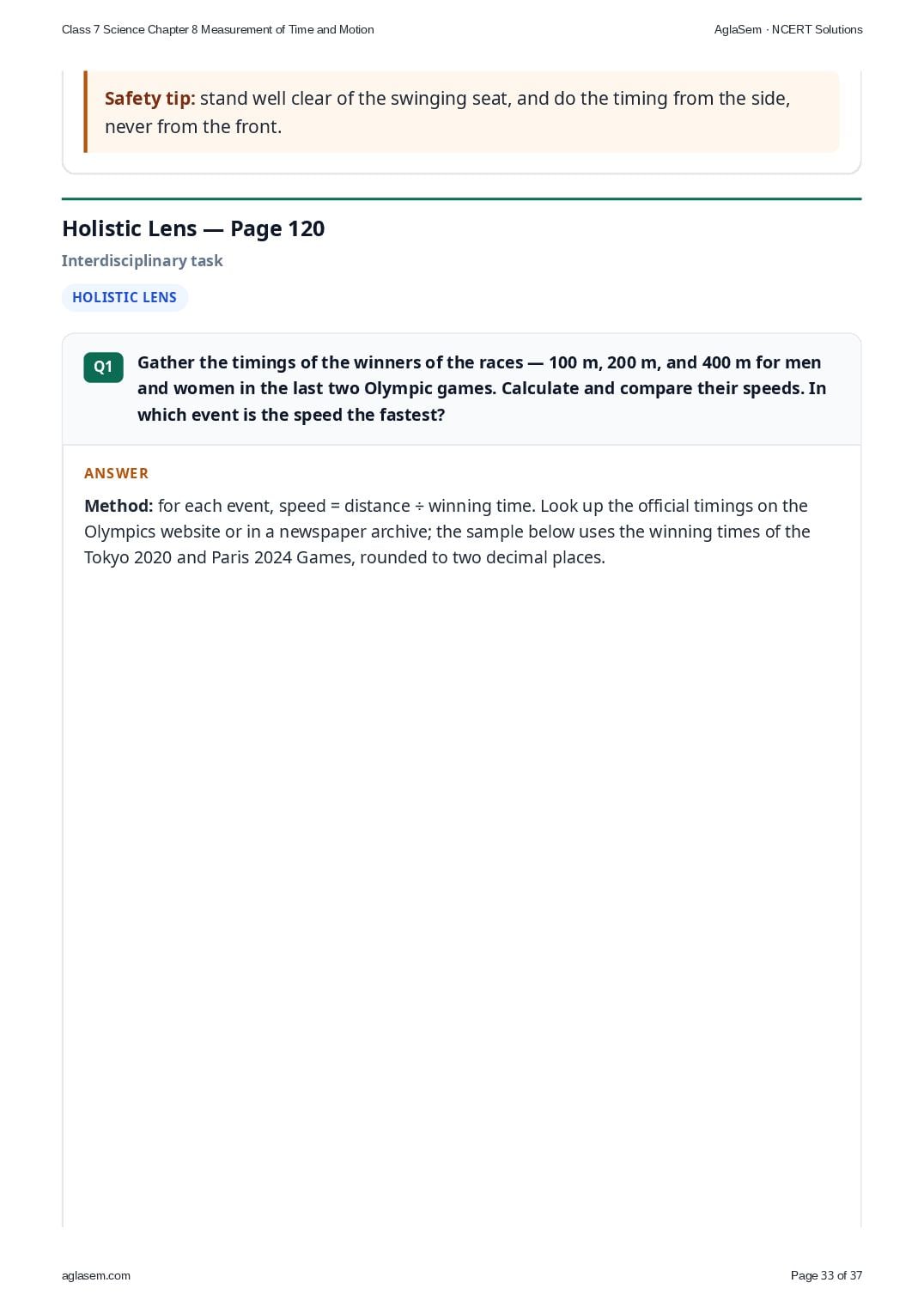
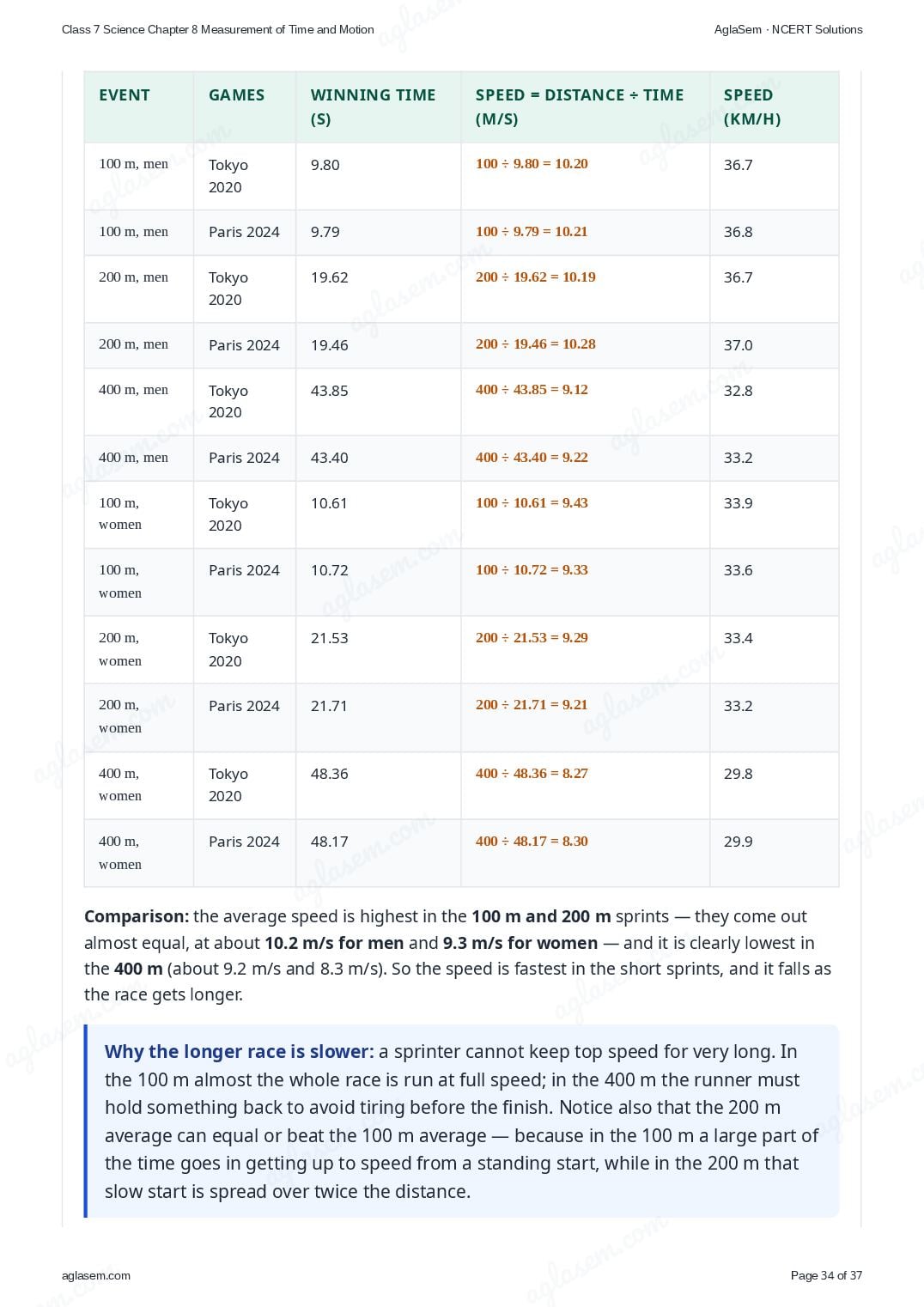
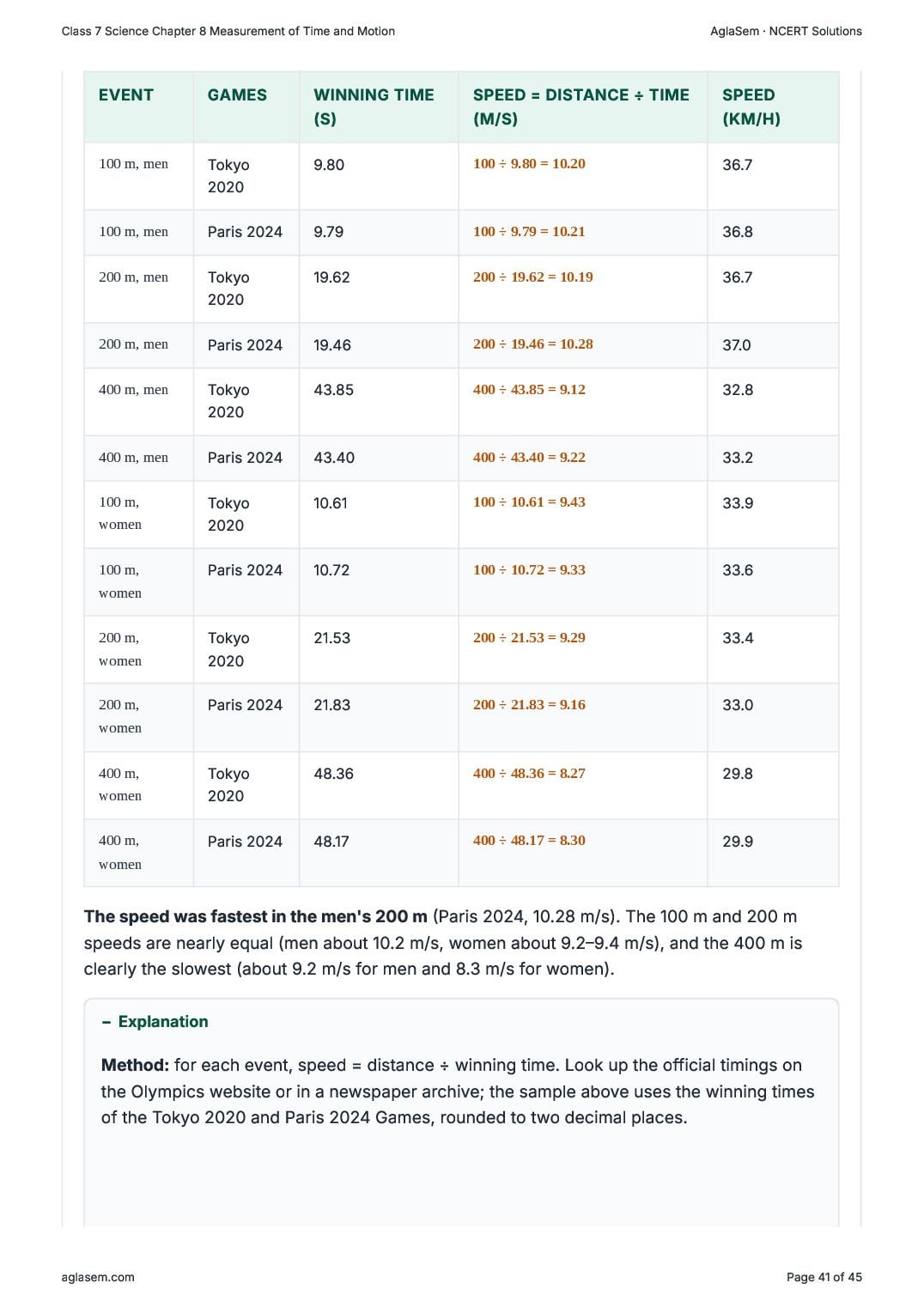
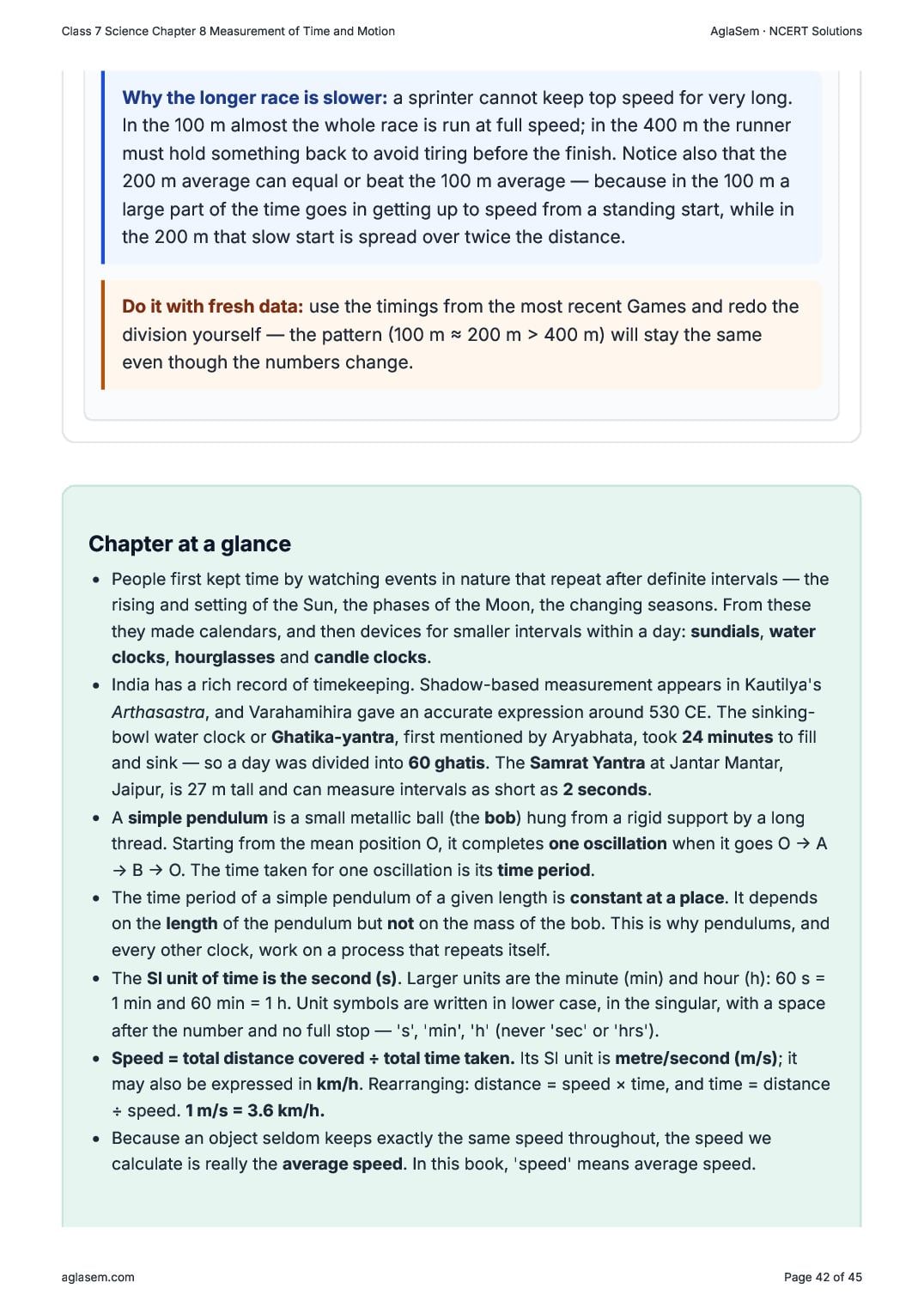
- Gather the timings of the winners of the races — 100 m, 200 m, and 400 m for men and women in the last two Olympic games. Calculate and compare their speeds. In which event is the speed the fastest?
Chapter at a Glance
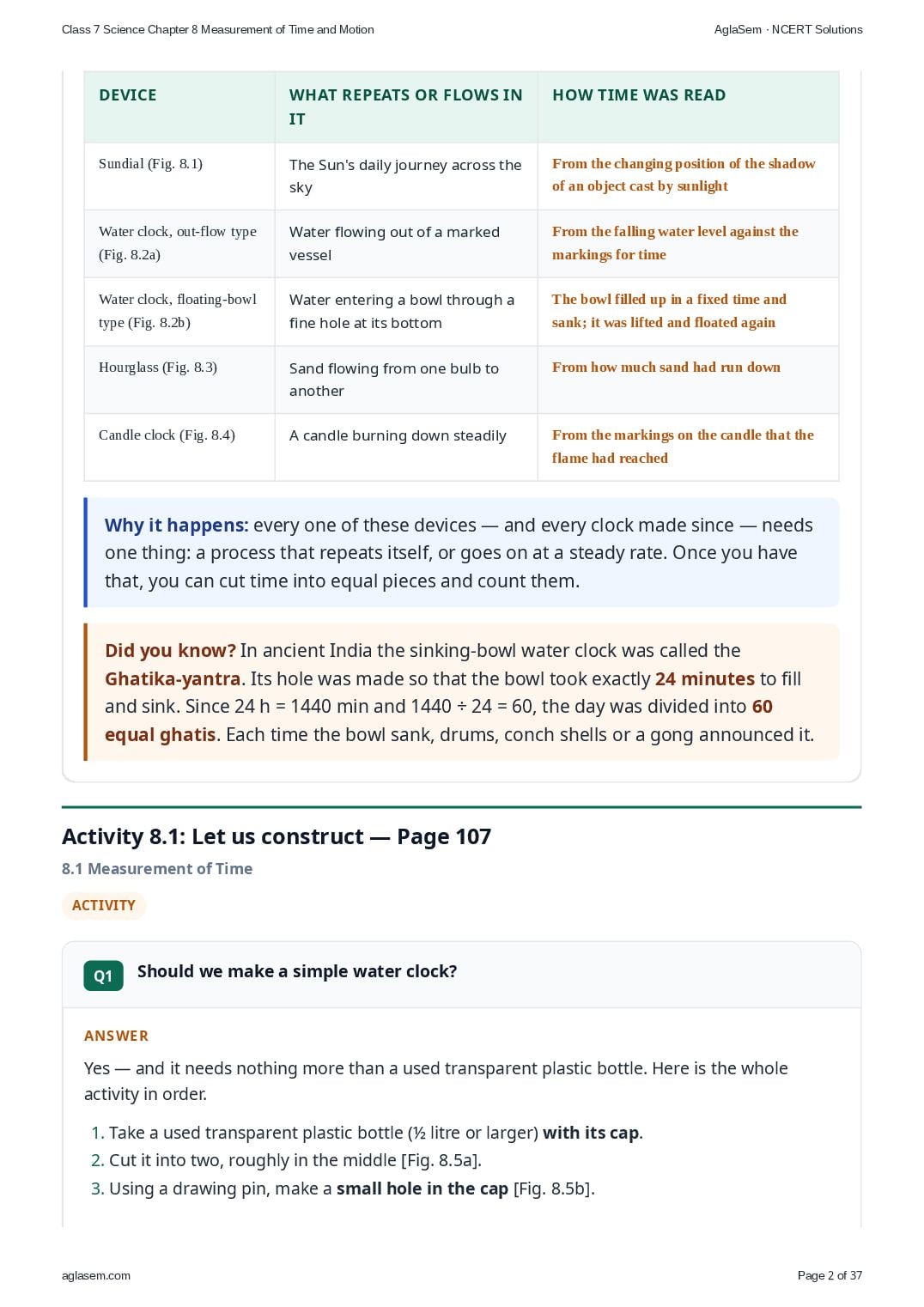
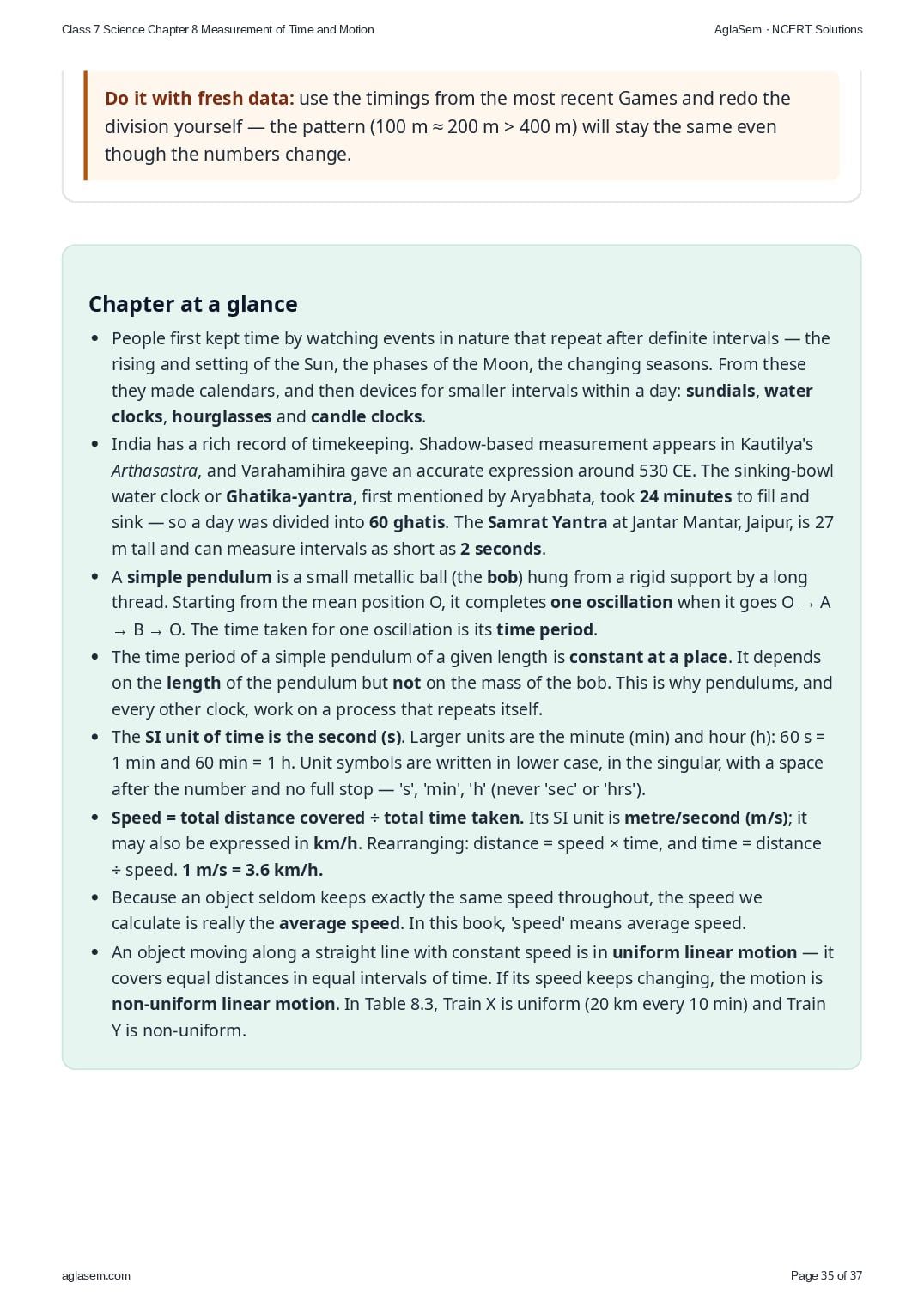
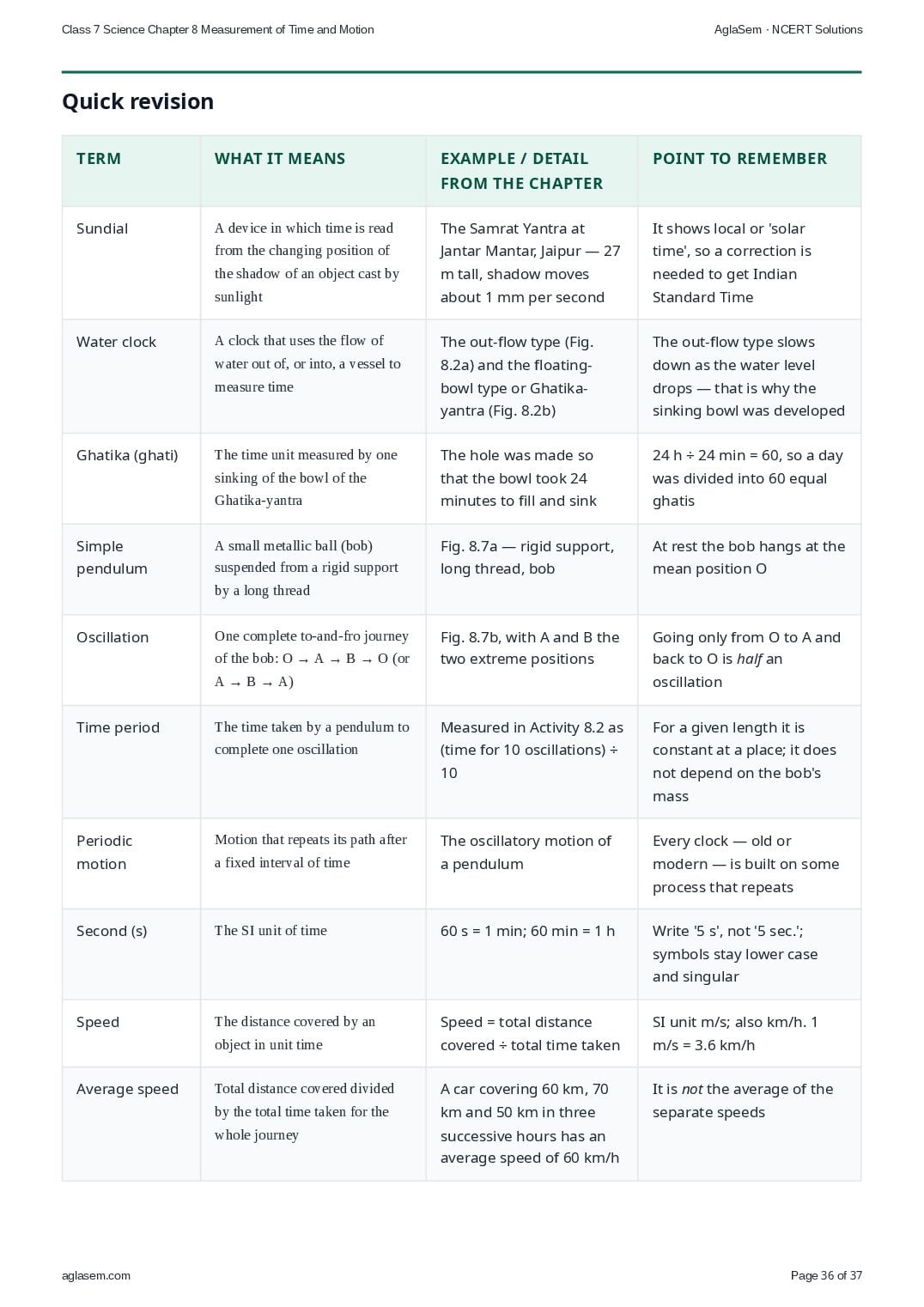
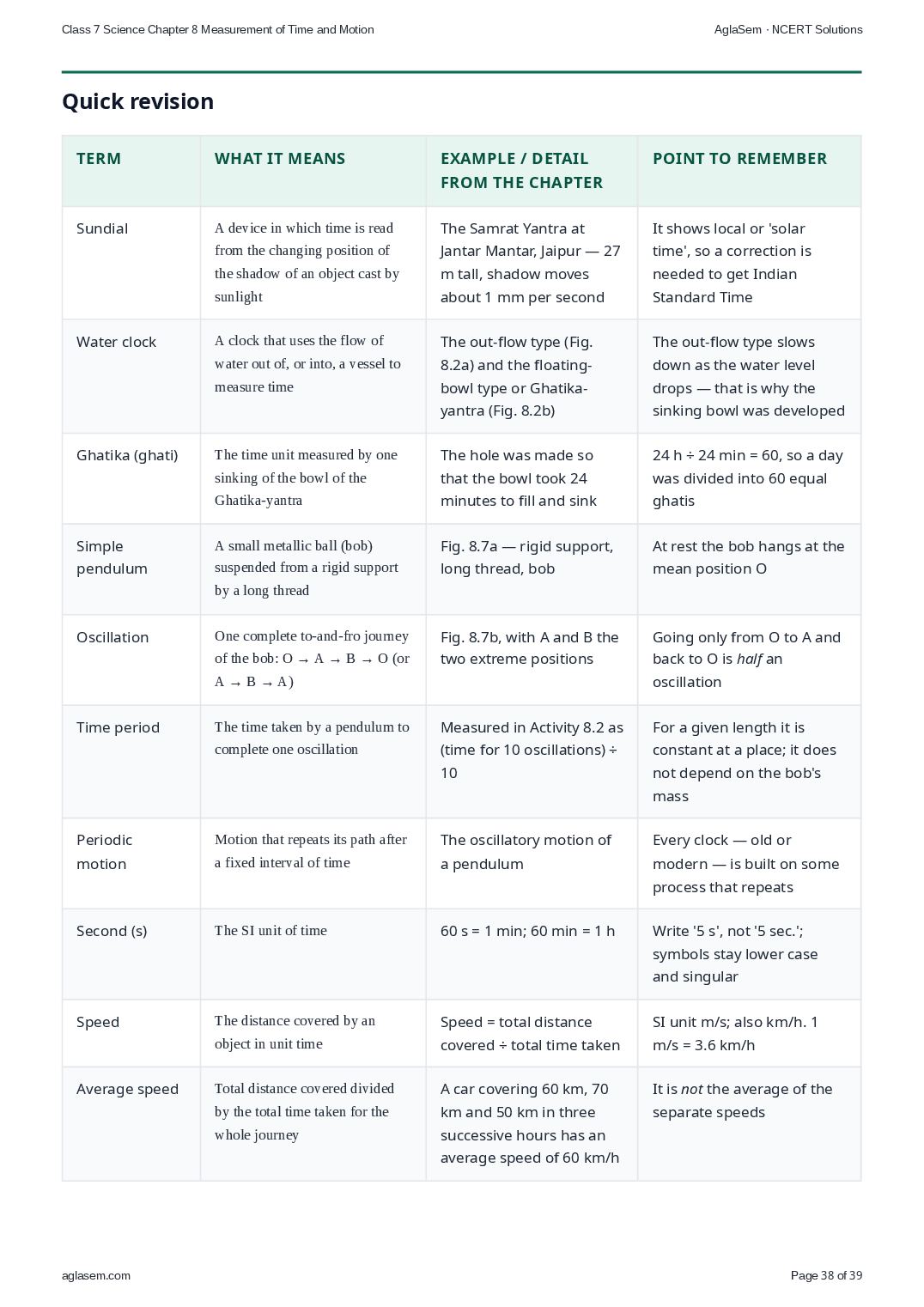
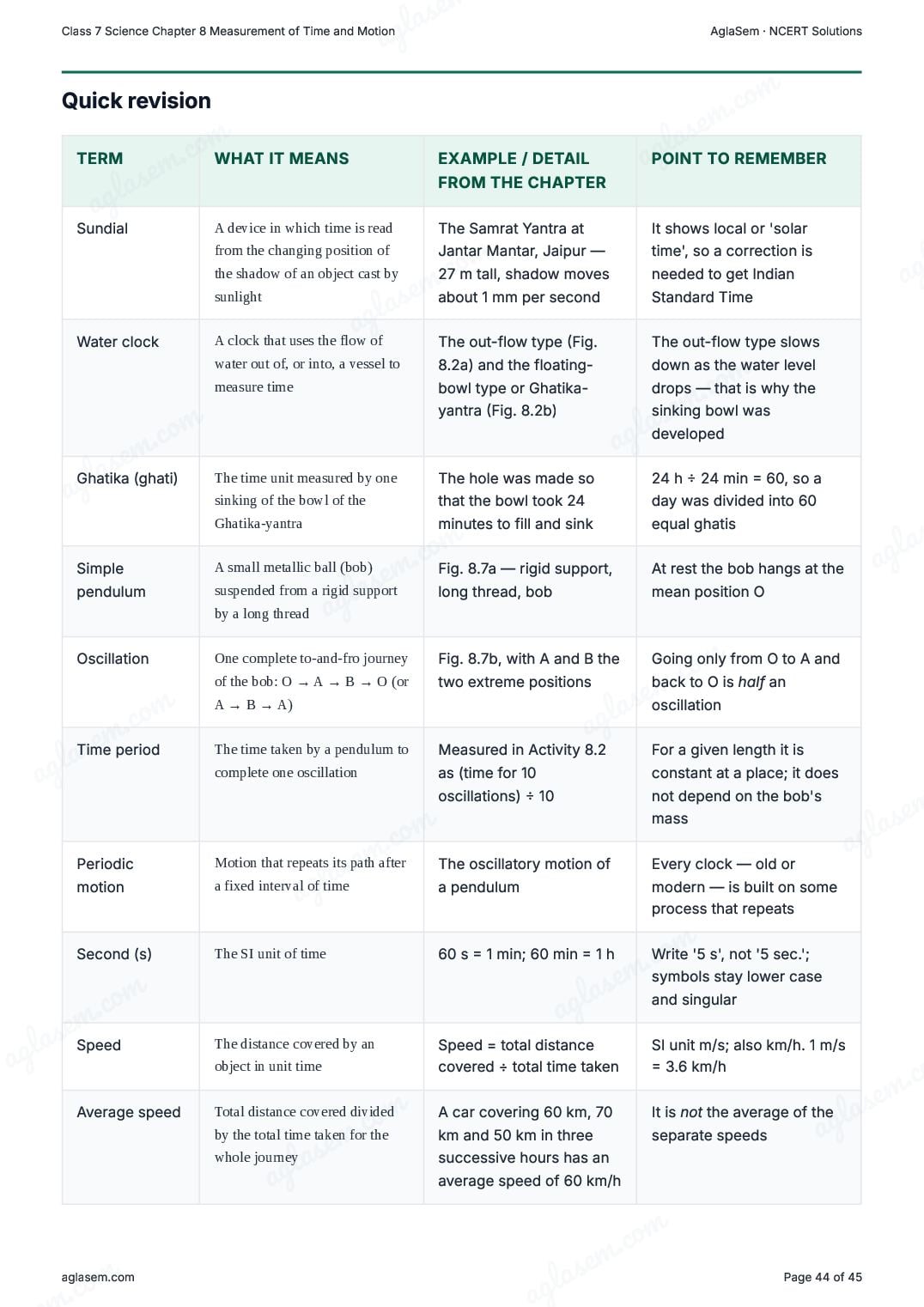
- People first kept time by watching events in nature that repeat after definite intervals — the rising and setting of the Sun, the phases of the Moon, the changing seasons. From these they made calendars, and then devices for smaller intervals within a day: sundials , water clocks , hourglasses and candle clocks .
- India has a rich record of timekeeping. Shadow-based measurement appears in Kautilya's Arthasastra , and Varahamihira gave an accurate expression around 530 CE. The sinking-bowl water clock or Ghatika-yantra , first mentioned by Aryabhata, took 24 minutes to fill and sink — so a day was divided into 60 ghatis . The Samrat Yantra at Jantar Mantar, Jaipur, is 27 m tall and can measure intervals as short as 2 seconds .
- A simple pendulum is a small metallic ball (the bob ) hung from a rigid support by a long thread. Starting from the mean position O, it completes one oscillation when it goes O → A → B → O. The time taken for one oscillation is its time period .
- The time period of a simple pendulum of a given length is constant at a place . It depends on the length of the pendulum but not on the mass of the bob. This is why pendulums, and every other clock, work on a process that repeats itself.
- The SI unit of time is the second (s) . Larger units are the minute (min) and hour (h): 60 s = 1 min and 60 min = 1 h. Unit symbols are written in lower case, in the singular, with a space after the number and no full stop — 's', 'min', 'h' (never 'sec' or 'hrs').
- Speed = total distance covered ÷ total time taken. Its SI unit is metre/second (m/s) ; it may also be expressed in km/h . Rearranging: distance = speed × time, and time = distance ÷ speed. 1 m/s = 3.6 km/h.
- Because an object seldom keeps exactly the same speed throughout, the speed we calculate is really the average speed . In this book, 'speed' means average speed.
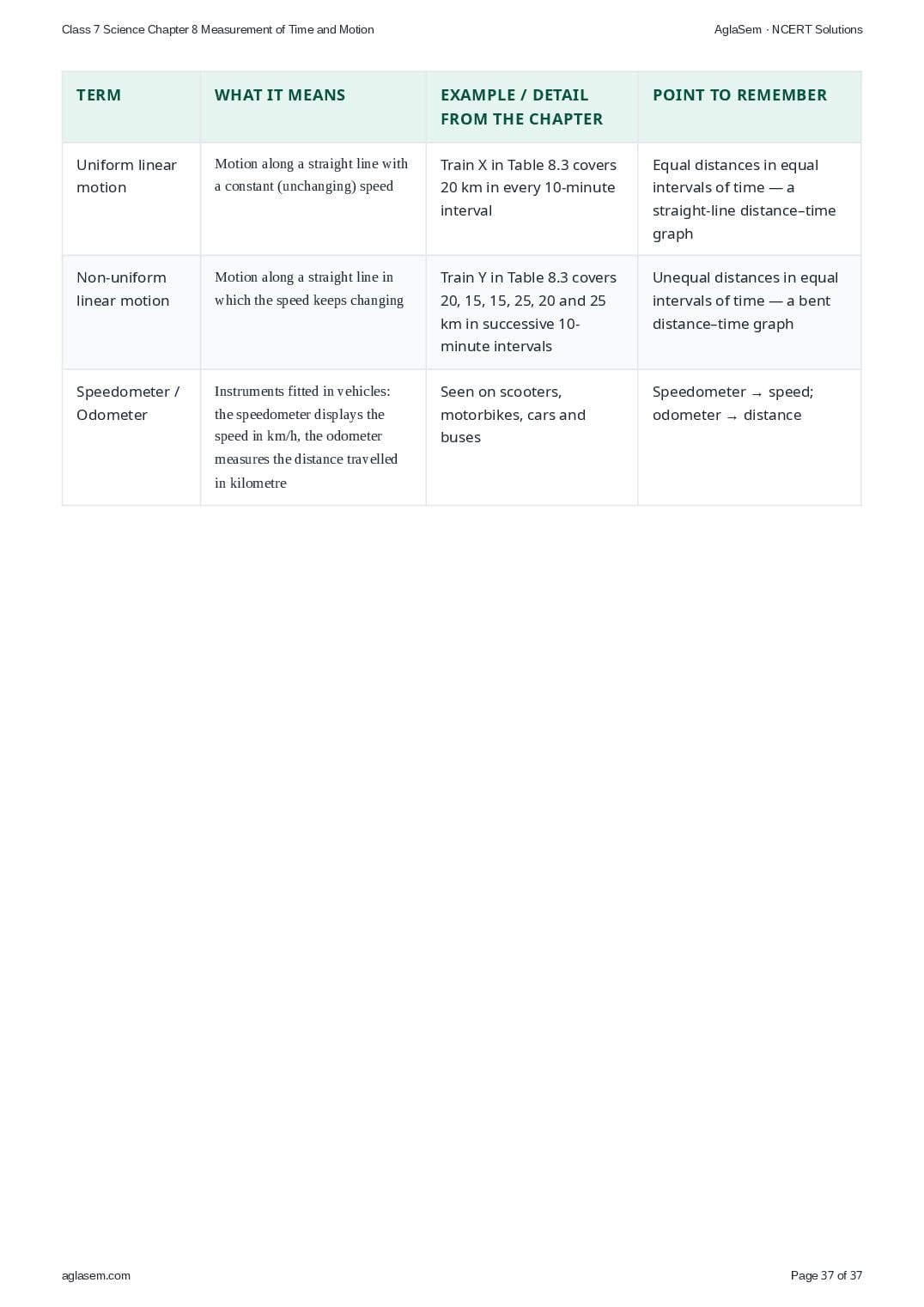
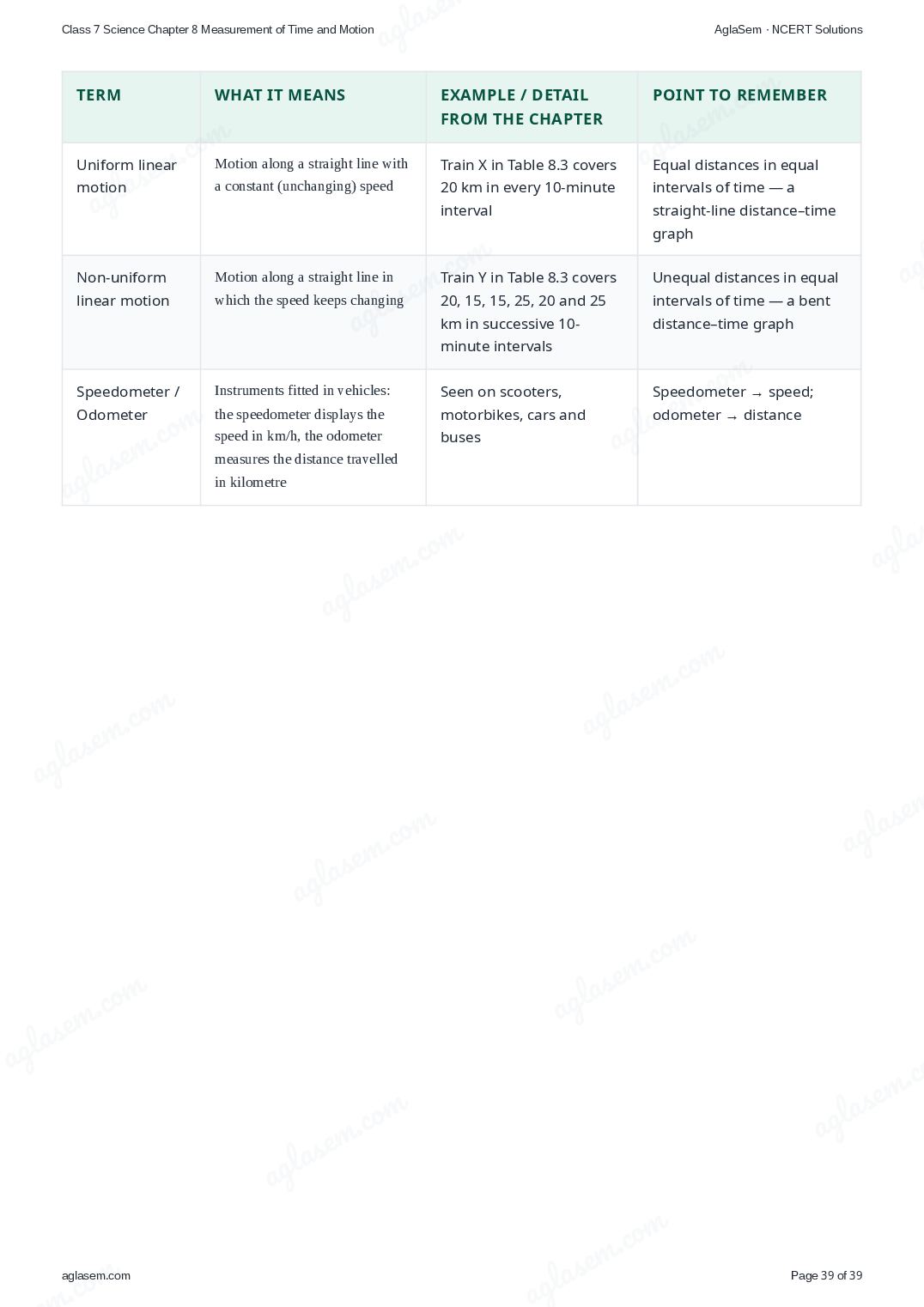
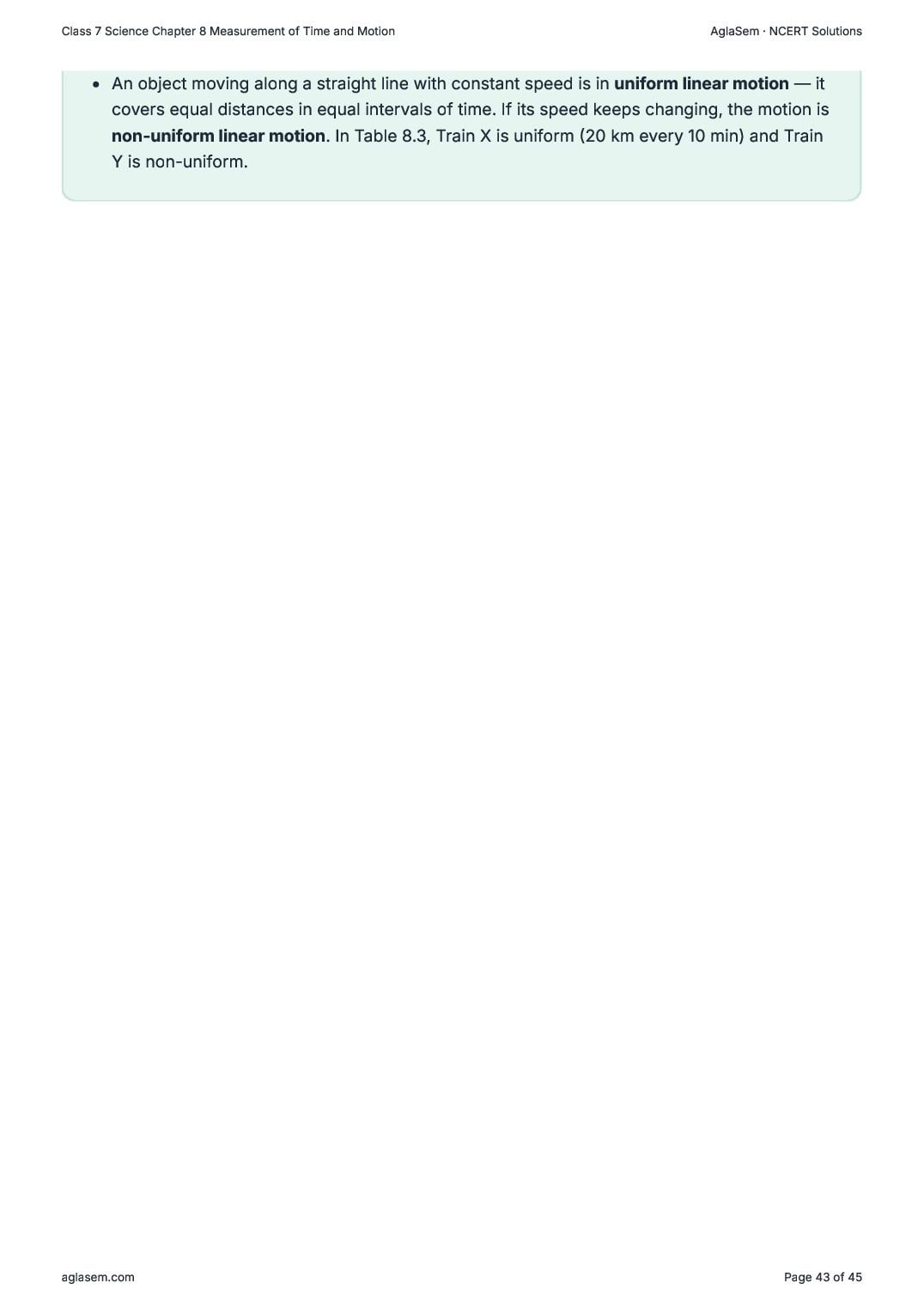
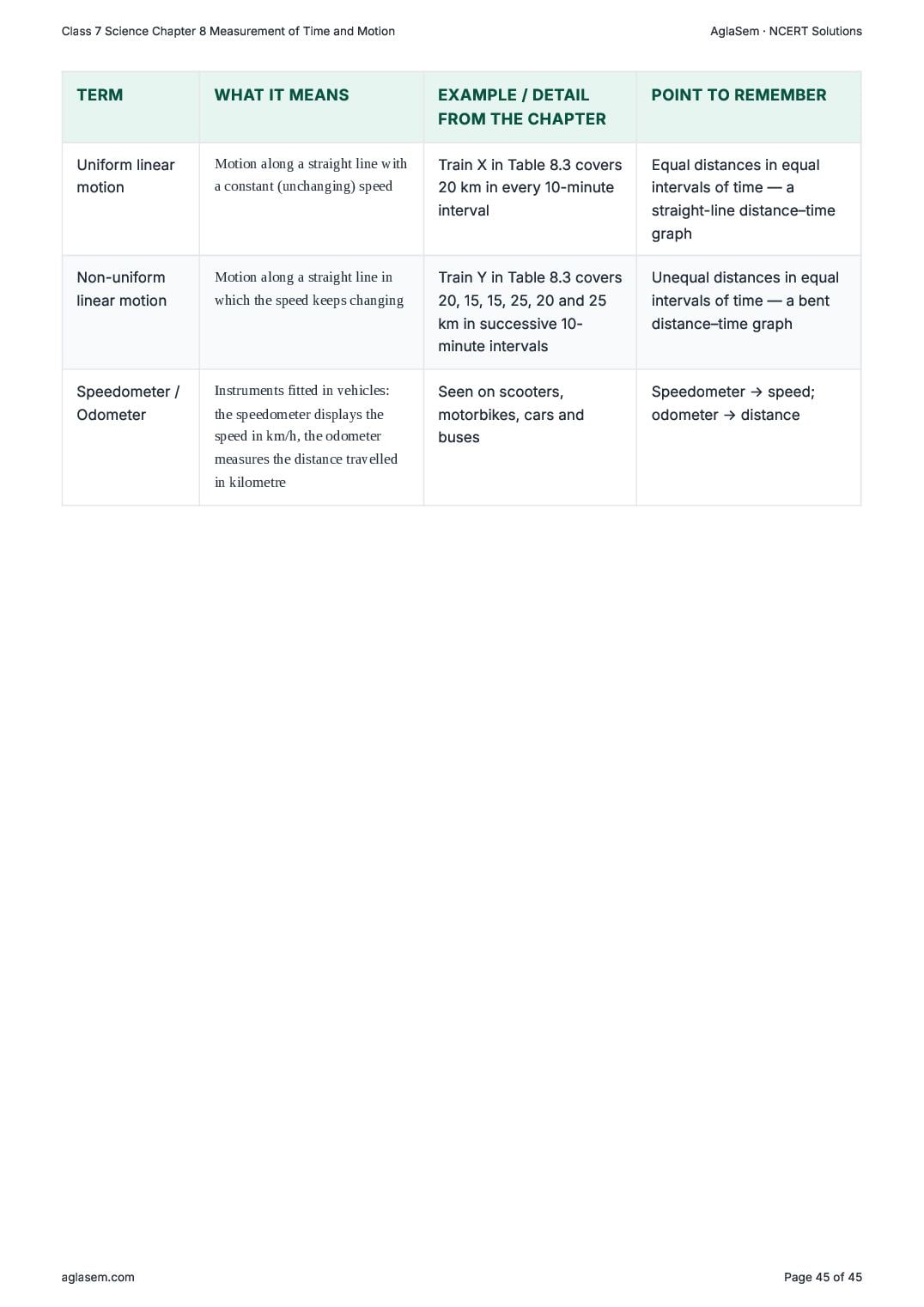
- An object moving along a straight line with constant speed is in uniform linear motion — it covers equal distances in equal intervals of time. If its speed keeps changing, the motion is non-uniform linear motion . In Table 8.3, Train X is uniform (20 km every 10 min) and Train Y is non-uniform.
How to Download NCERT Solutions for Class 7 Science Chapter 8 PDF
Follow these simple steps to get the Measurement of Time and Motion questions-and-answers PDF from Curiosity.
- Search NCERT Solutions for Class 7 Science Chapter 8 aglasem and open this page.
- Read the exercise questions with answers for Measurement of Time and Motion shown above.
- Click the Download PDF link to save the Measurement of Time and Motion solutions to your device.
NCERT Solutions for Class 7 Science – All Chapters
There are more chapters to study besides Measurement of Time and Motion in Science. Here are the NCERT Solutions for all chapters of Class 7 Science.
- Chapter 1 the Ever Evolving World of Science
- Chapter 2 Exploring Substances Acidic Basic and Neutral
- Chapter 3 Electricity Circuits and Their Components
- Chapter 4 the World of Metals and Non Metals
- Chapter 5 Changes Around Us Physical and Chemical
- Chapter 6 Adolescence a Stage of Growth and Change
- Chapter 7 Heat Transfer in Nature
- Chapter 8 Measurement of Time and Motion
- Chapter 9 Life Processes in Animals
- Chapter 10 Life Processes in Plants
- Chapter 11 Light Shadows and Reflections
- Chapter 12 Earth Moon and the Sun
NCERT Solutions for Class 7 – All Subjects
Just like Chapter 8 of Science, you can get the exercise questions with answers for every other subject of Class 7. Here are the NCERT Solutions for all subjects of Class 7.
NCERT Solutions for Class 7 Science Chapter 8 – An Overview
The key highlights of this study material are as follows.
| Aspects | Details |
|---|---|
| Class | Class 7 |
| Subject | Science |
| Chapter Number | Chapter 8 |
| Chapter Name | Measurement of Time and Motion |
| Book Name | Curiosity |
| Book By | NCERT (National Council of Educational Research and Training) |
| Educational Resource Here | NCERT Solutions of Class 7 Science Chapter 8 for all exercises |
| More Questions Answers of This Subject | NCERT Solutions for Class 7 Science |
| Download Book Chapter | NCERT Book Class 7 Science |
| All Questions Answers For This Class | NCERT Solutions for Class 7 |
| Complete Solutions | NCERT Solutions |
NCERT Solutions for Class 7 Science Chapter 8 Measurement of Time and Motion – FAQs
What are the NCERT Solutions for Class 7 Science Chapter 8 Measurement of Time and Motion?
They are the complete, step-by-step answers to all the exercise and in-text questions of Chapter 8 Measurement of Time and Motion from the NCERT Class 7 Science textbook Curiosity, written by experts as per the latest NCERT syllabus.
How can I download the Class 7 Science Chapter 8 solutions PDF for free?
Open this page on aglasem, read the Measurement of Time and Motion questions with answers, and click the “Download Solutions PDF” link. The Class 7 Science Chapter 8 NCERT Solutions PDF is completely free to download.
Are these NCERT Solutions as per the latest 2026-27 syllabus?
Yes. The NCERT Solutions for Class 7 Science Chapter 8 are based on the latest NCERT textbook Curiosity and the current 2026-27 CBSE syllabus, so the questions and answers match what you study in class.
Where can I get NCERT Solutions for the other chapters of Class 7 Science?
You can find the answers to every chapter on the NCERT Solutions for Class 7 Science page, and solutions for every subject on the NCERT Solutions for Class 7 page.
How do NCERT Solutions help in exam preparation?
They show the correct method to solve each question, help you write answers the way they are expected in exams, let you check and correct your own work, and save revision time — which together improve your marks in Class 7 Science.
If you have any queries on NCERT Solutions for Class 7 Science Chapter 8 Measurement of Time and Motion, then please ask in the comments below.