Download Measurement of Time and Motion – NCERT Class 7 Science Chapter 8 PDF from the new NCERT Class 7 Science book Curiosity (2026-27). Read the chapter online or download the free PDF. People first kept time by watching events in nature that repeat after definite intervals — the rising and setting of the Sun, the phases of the Moon, the changing seasons. From these they made calendars, and then devices for smaller intervals within…
Measurement of Time and Motion PDF – Chapter 8 of Curiosity
Read the chapter online or download the PDF.
| Chapter | Download | |
|---|---|---|
| Chapter 8 PDF | Measurement of Time and Motion | View PDF |
| Full book | NCERT Class 7 Science – Curiosity | View Book |
Read Online
What Is in Measurement of Time and Motion? (Class 7 Science Chapter 8)
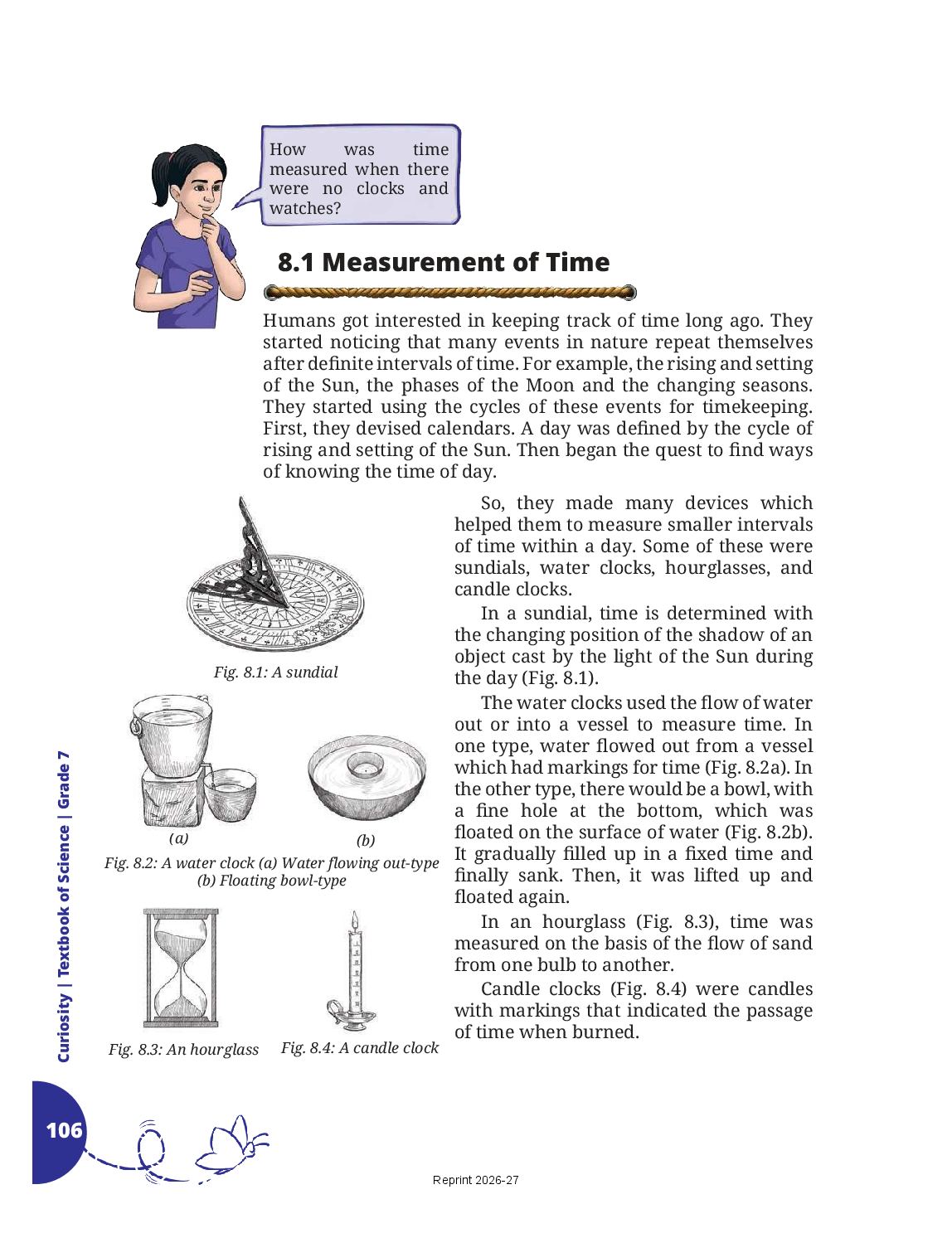
- People first kept time by watching events in nature that repeat after definite intervals — the rising and setting of the Sun, the phases of the Moon, the changing seasons. From these they made calendars, and then devices for smaller intervals within a day: sundials, water clocks, hourglasses and candle clocks.
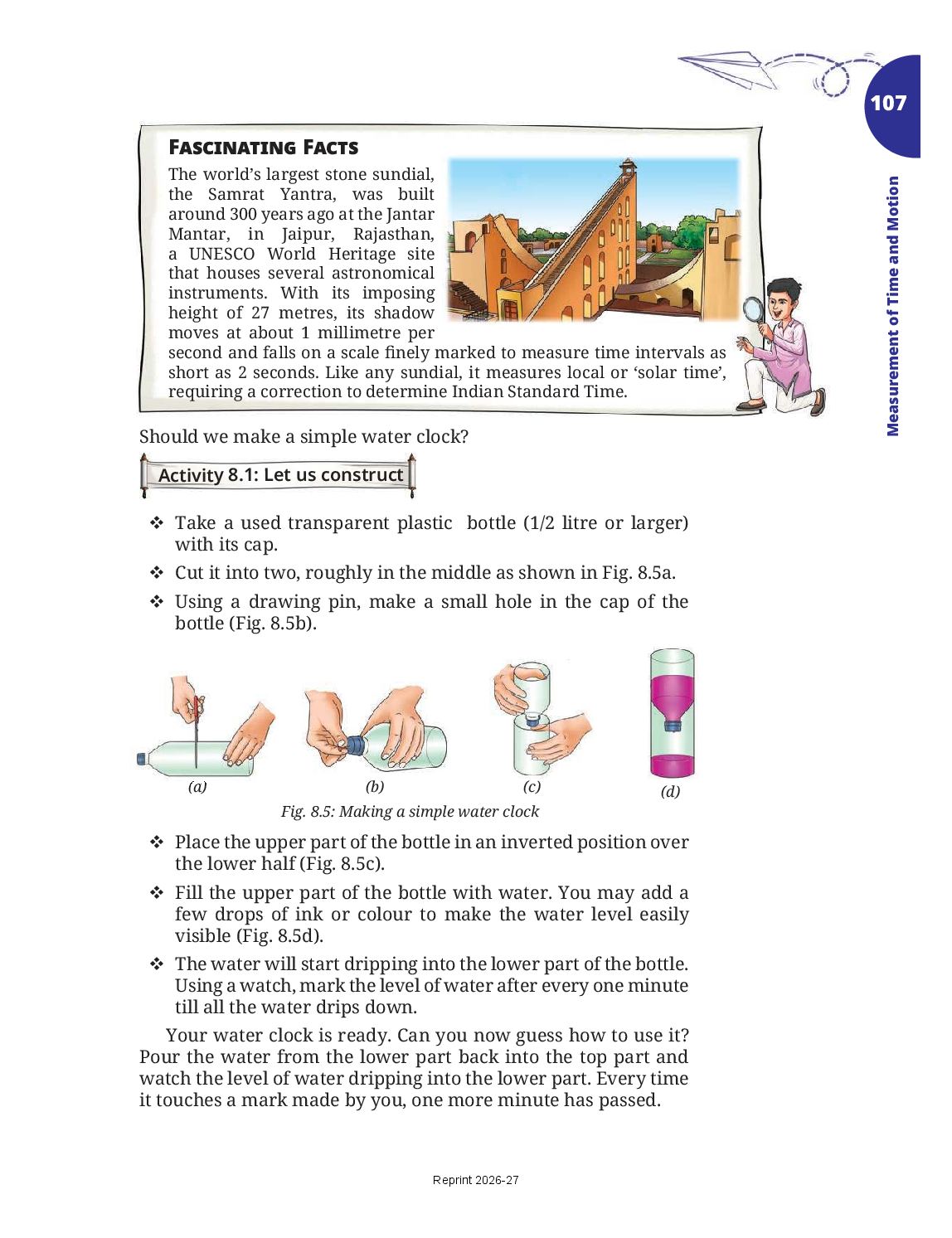
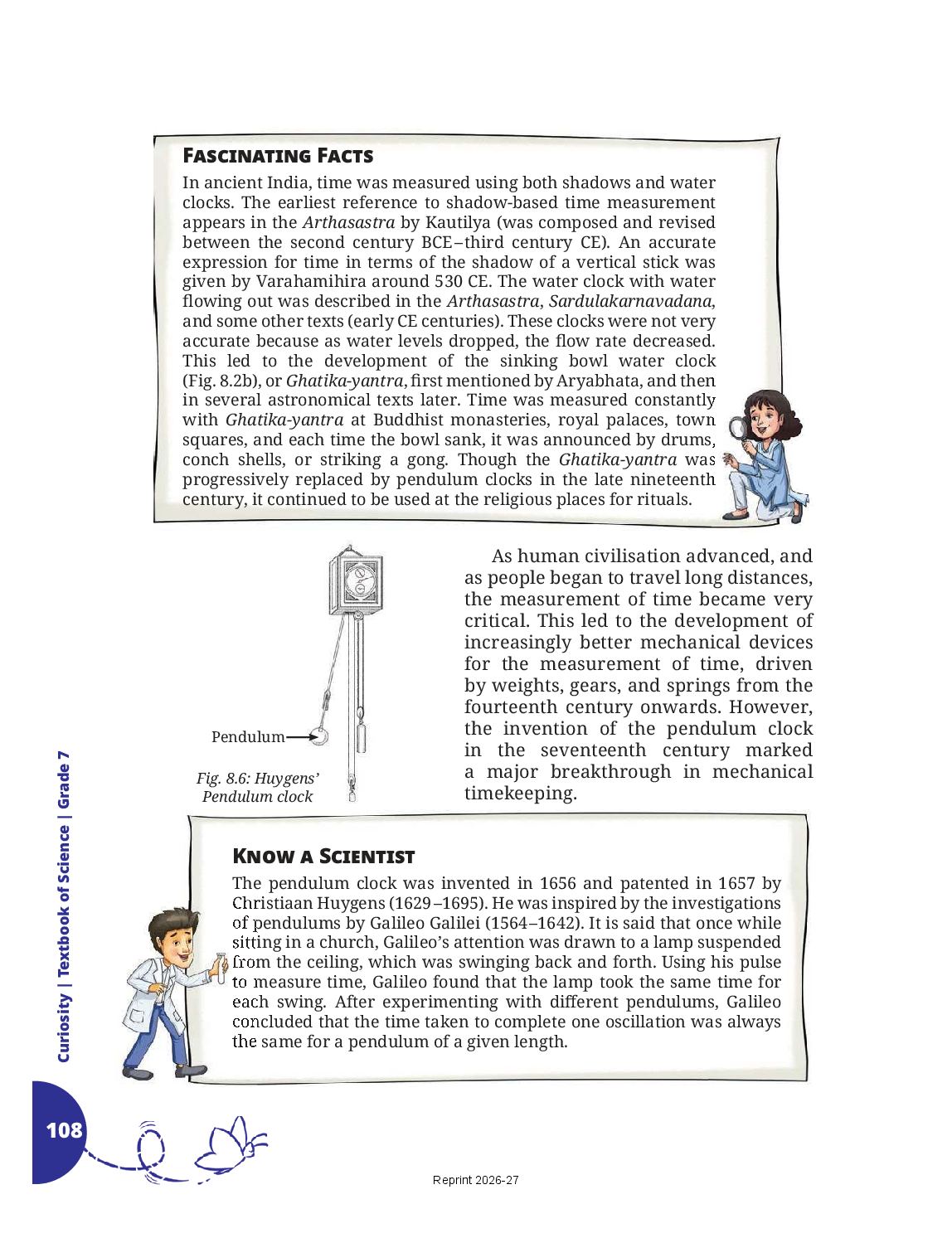
- India has a rich record of timekeeping. Shadow-based measurement appears in Kautilya’s Arthasastra, and Varahamihira gave an accurate expression around 530 CE. The sinking-bowl water clock or Ghatika-yantra, first mentioned by Aryabhata, took 24 minutes to fill and sink — so a day was divided into 60 ghatis. The Samrat Yantra at Jantar Mantar, Jaipur, is 27 m tall and can measure intervals as short as 2 seconds.
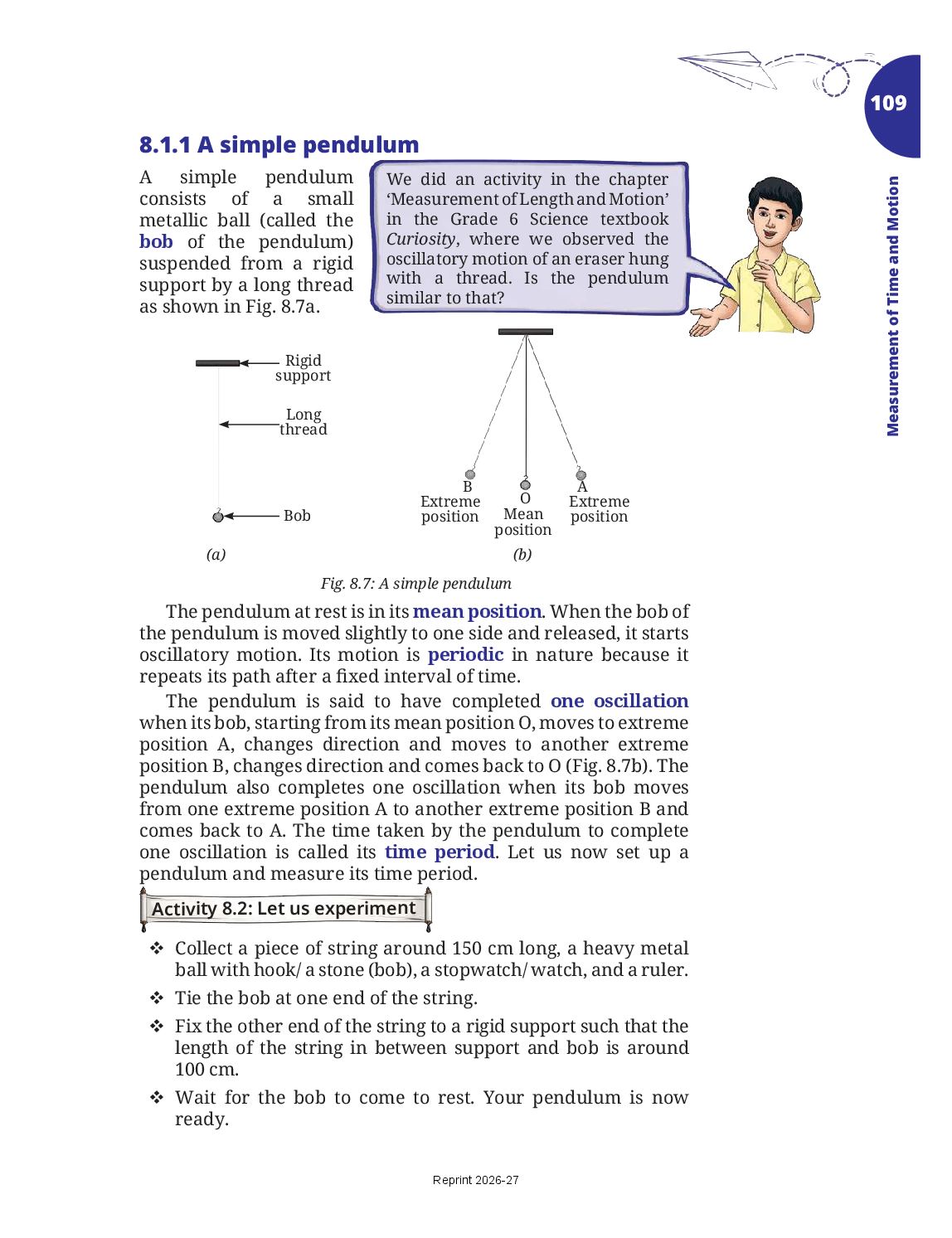
- A simple pendulum is a small metallic ball (the bob) hung from a rigid support by a long thread. Starting from the mean position O, it completes one oscillation when it goes O → A → B → O. The time taken for one oscillation is its time period.
- The time period of a simple pendulum of a given length is constant at a place. It depends on the length of the pendulum but not on the mass of the bob. This is why pendulums, and every other clock, work on a process that repeats itself.
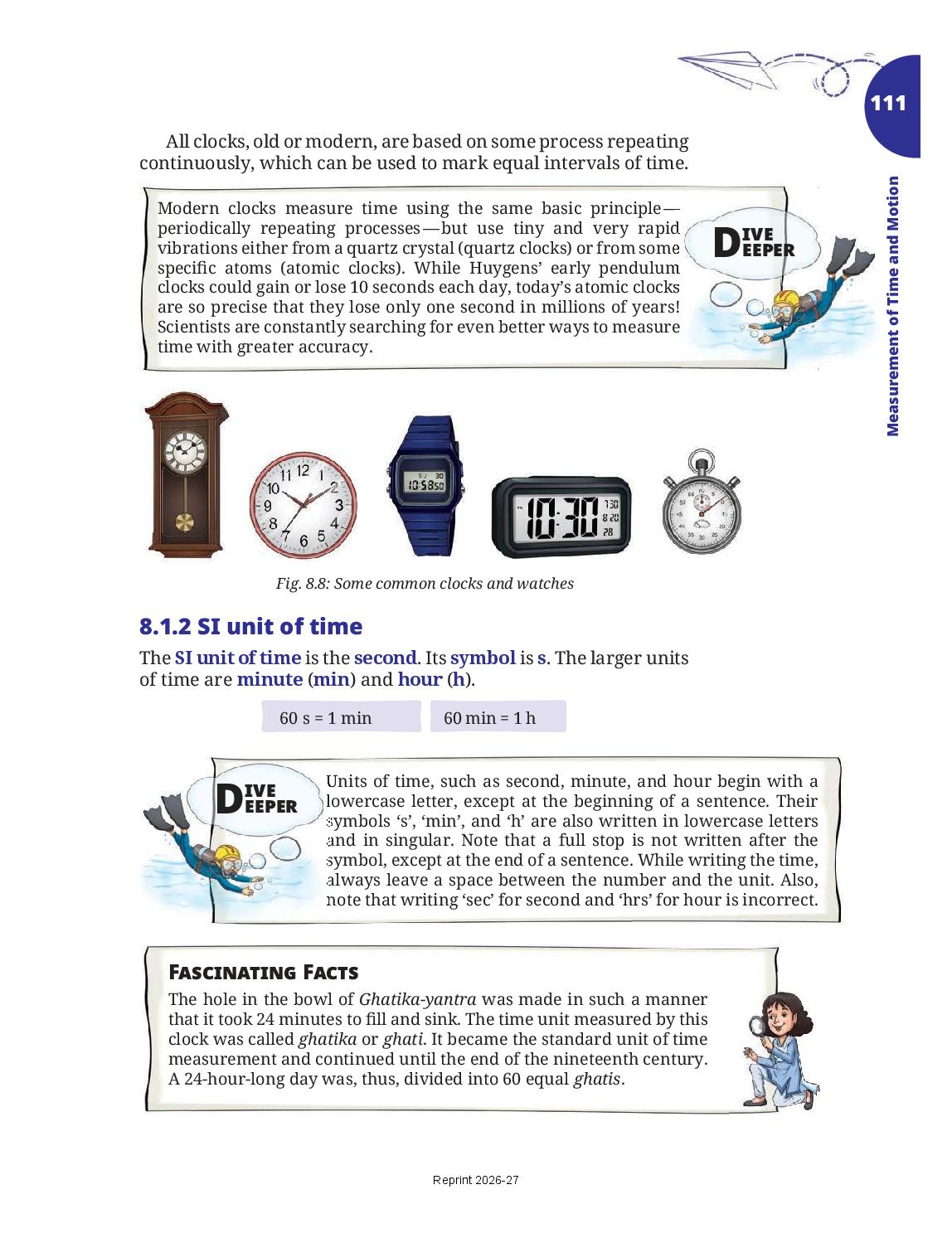
- The SI unit of time is the second (s). Larger units are the minute (min) and hour (h): 60 s = 1 min and 60 min = 1 h. Unit symbols are written in lower case, in the singular, with a space after the number and no full stop — ‘s’, ‘min’, ‘h’ (never ‘sec’ or ‘hrs’).
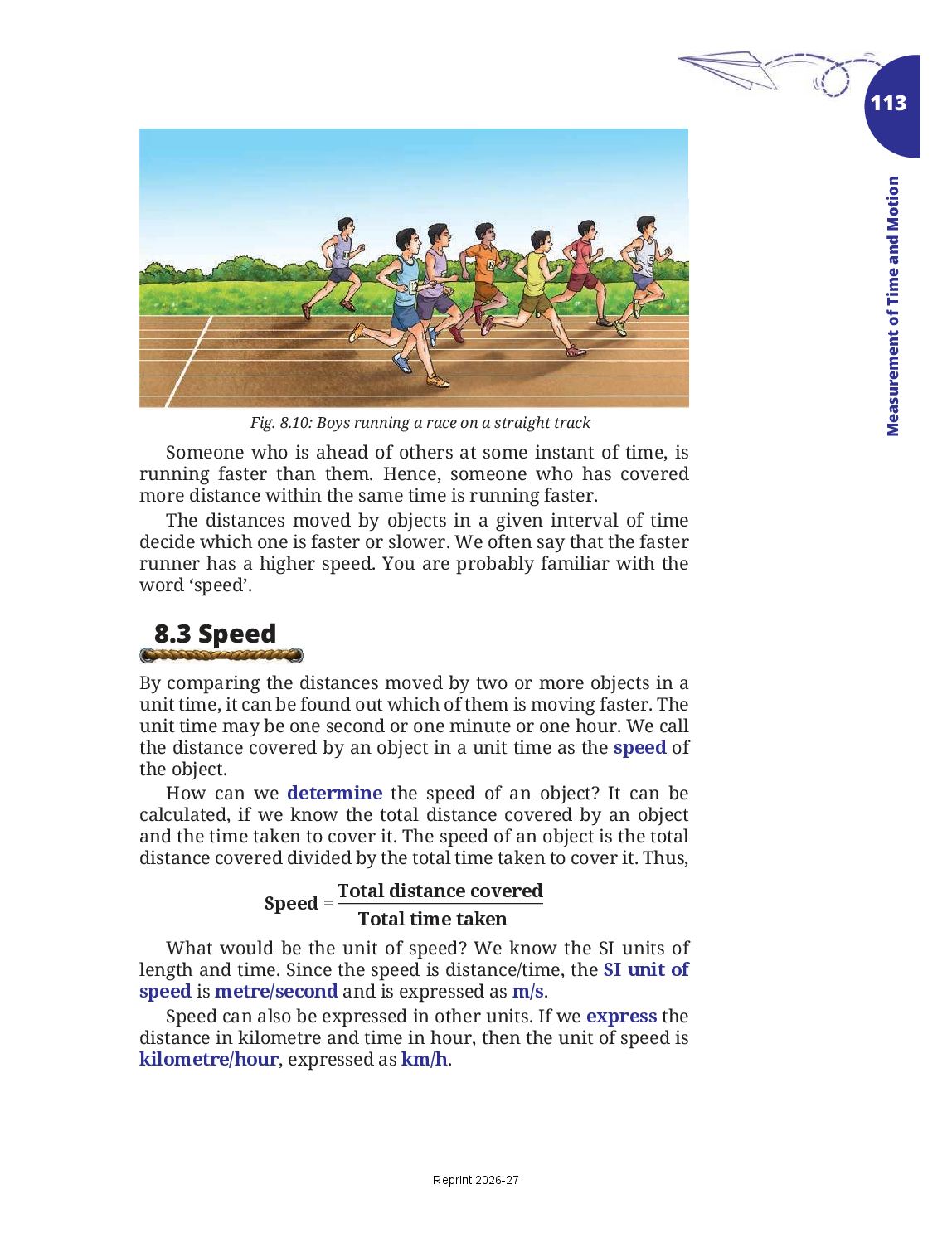
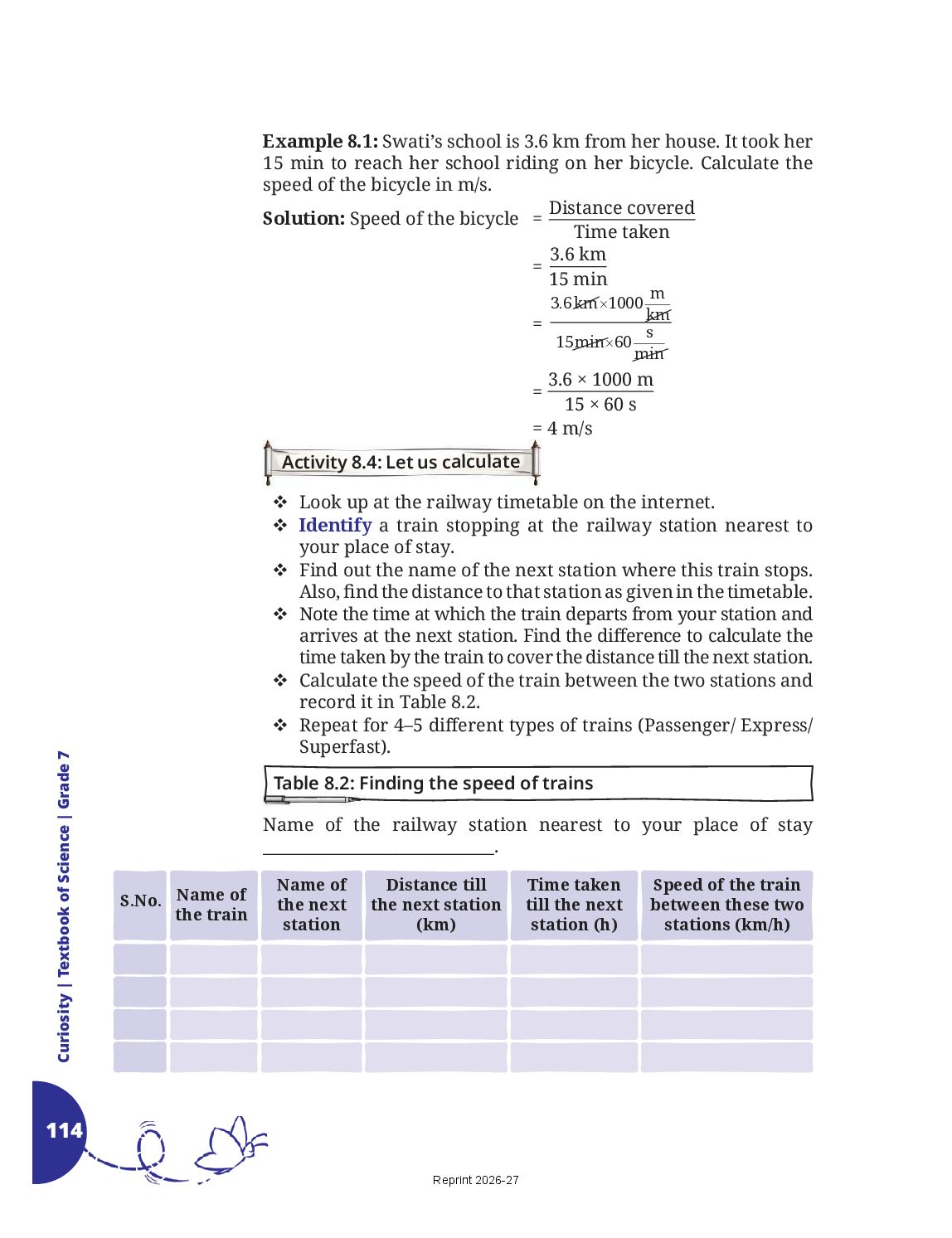
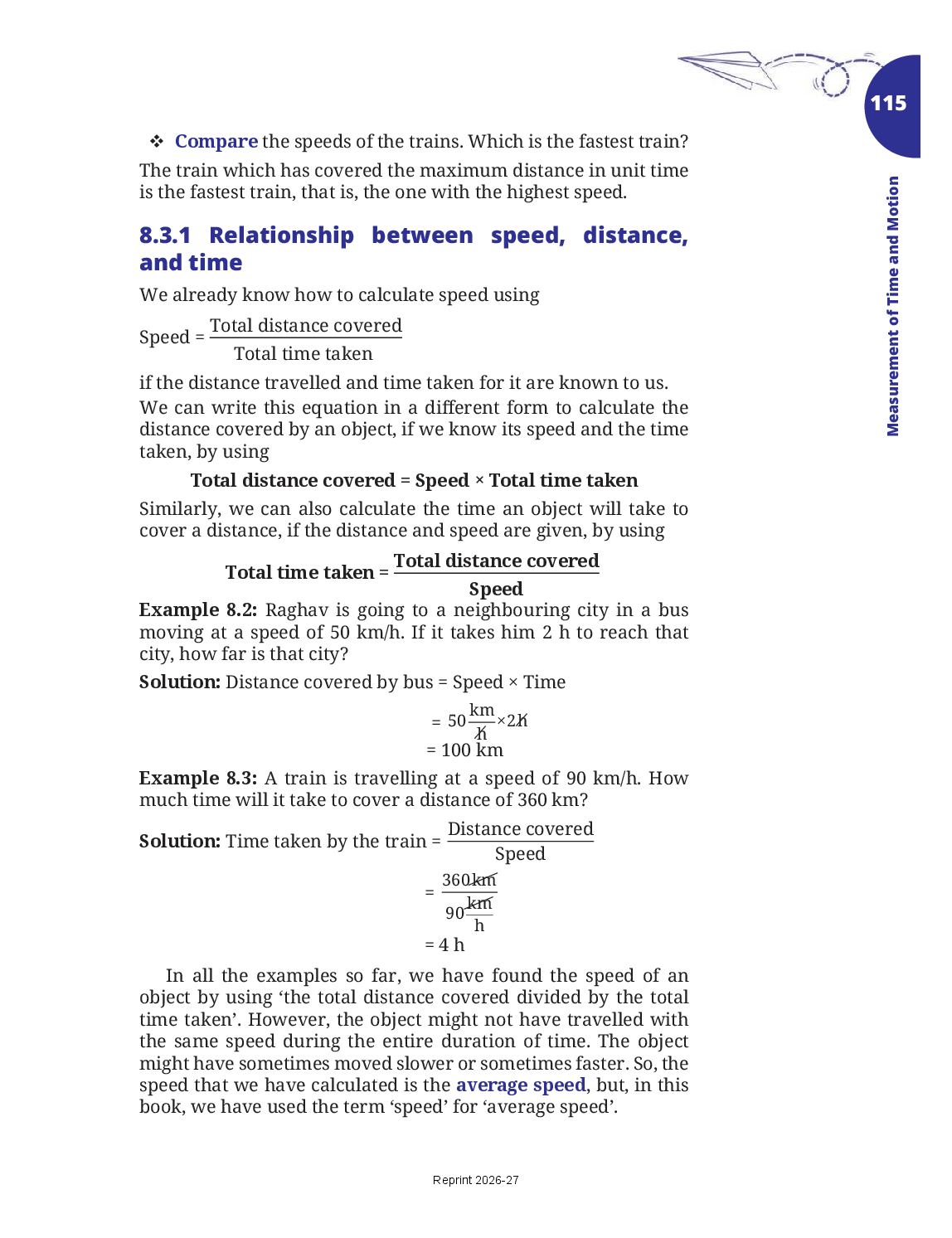
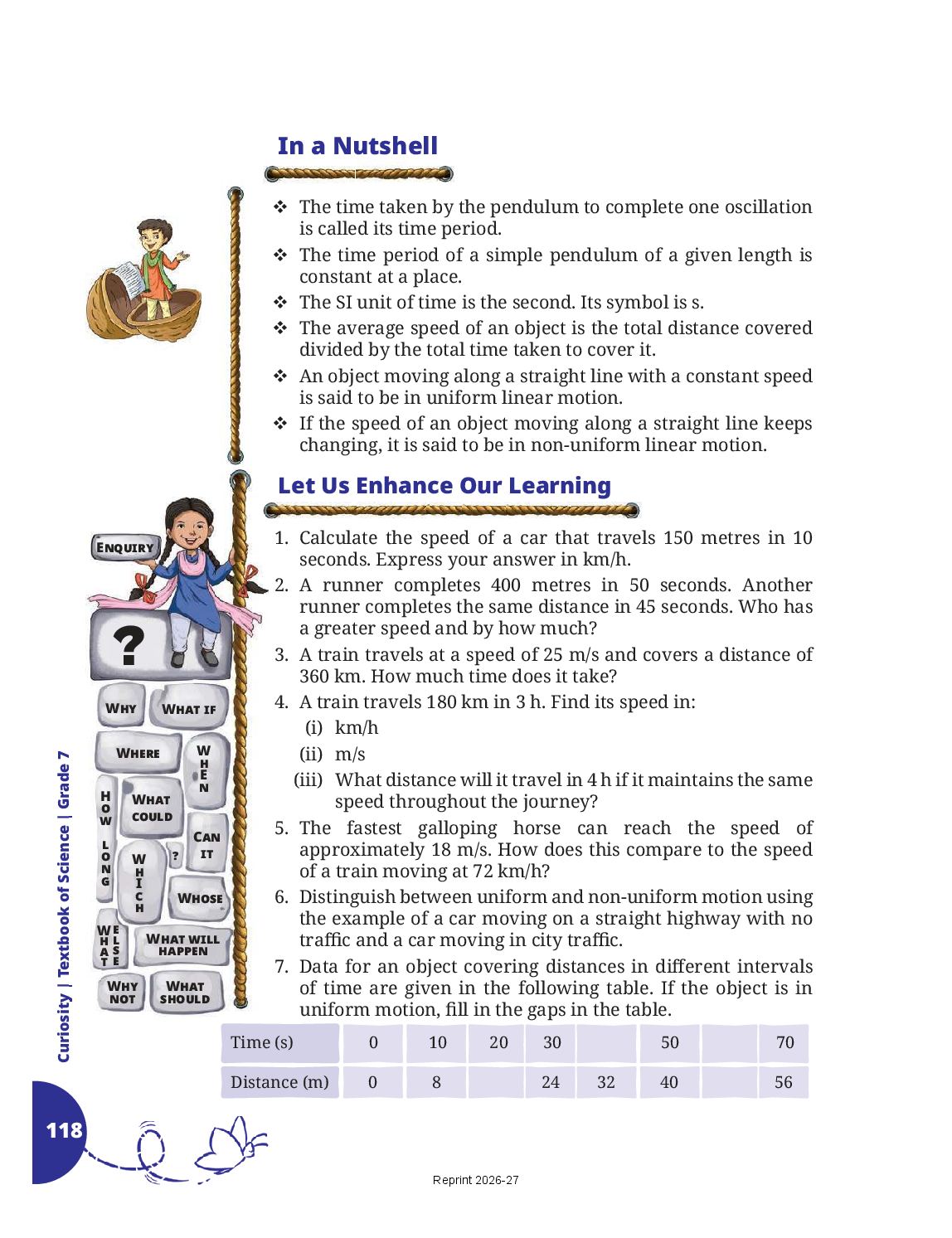
- Speed = total distance covered ÷ total time taken. Its SI unit is metre/second (m/s); it may also be expressed in km/h. Rearranging: distance = speed × time, and time = distance ÷ speed. 1 m/s = 3.6 km/h.
- Because an object seldom keeps exactly the same speed throughout, the speed we calculate is really the average speed. In this book, ‘speed’ means average speed.
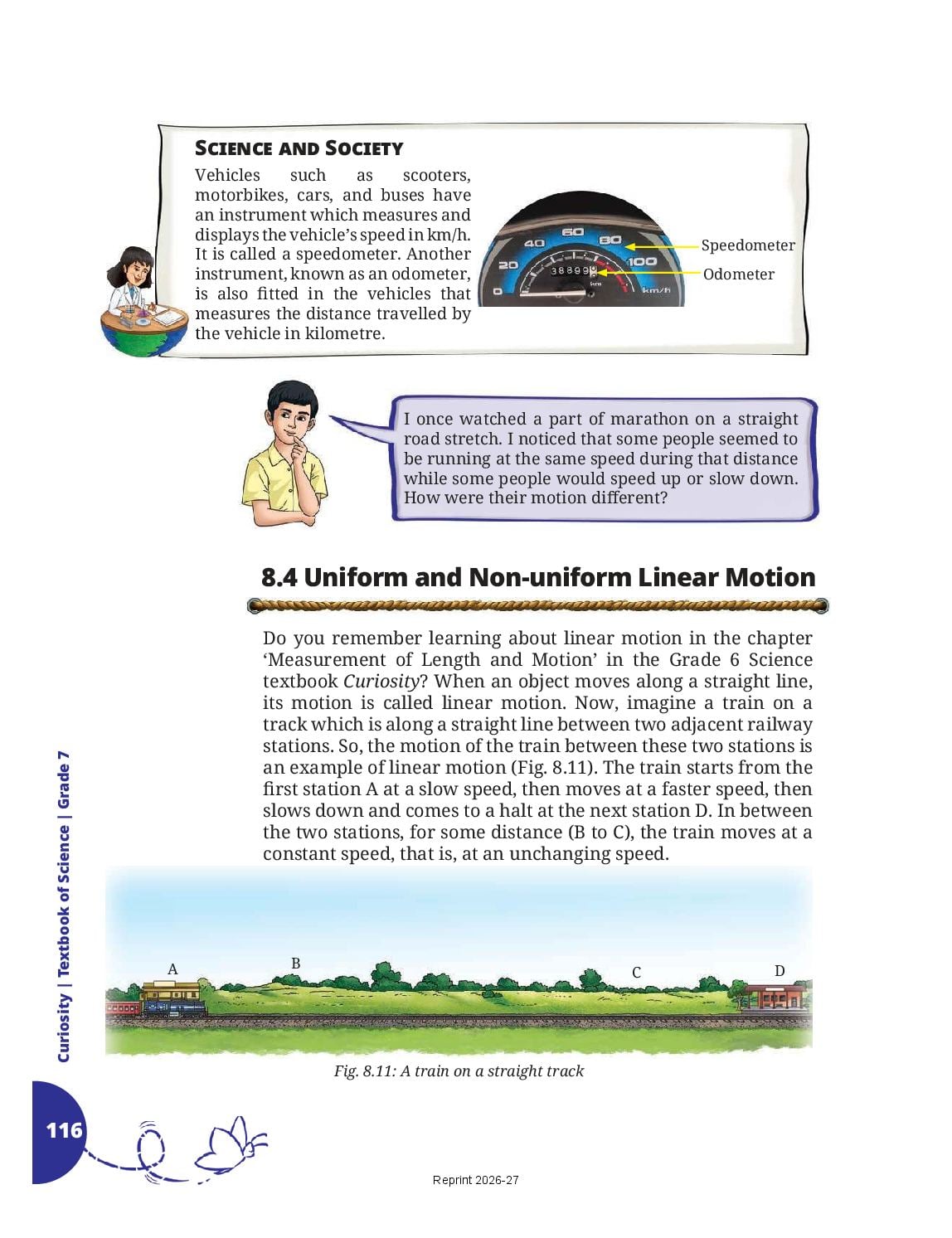
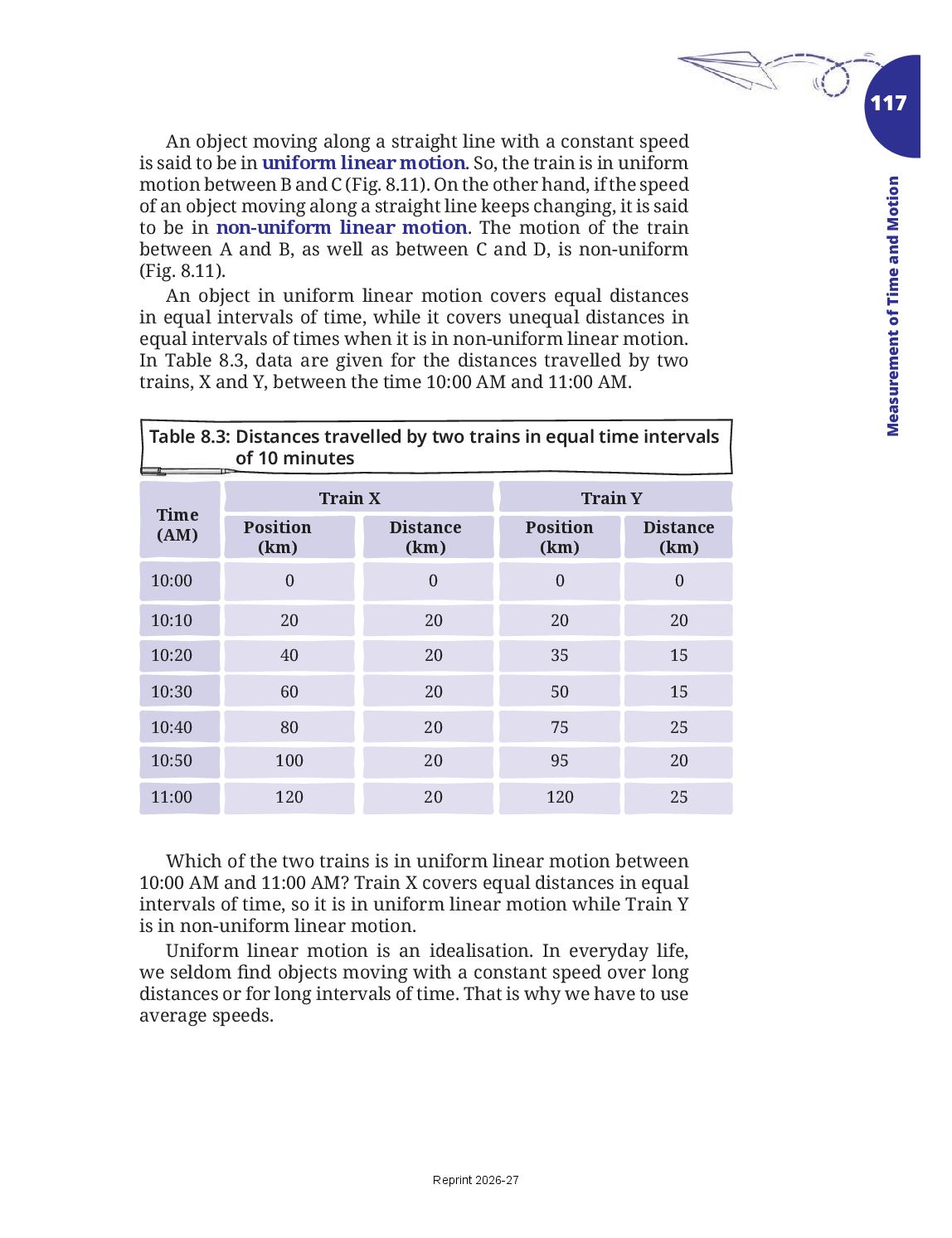
- An object moving along a straight line with constant speed is in uniform linear motion — it covers equal distances in equal intervals of time. If its speed keeps changing, the motion is non-uniform linear motion. In Table 8.3, Train X is uniform (20 km every 10 min) and Train Y is non-uniform.
Quick revision – Measurement of Time and Motion
| Term | What it means | Example / detail from the chapter | Point to remember |
|---|---|---|---|
| Sundial | A device in which time is read from the changing position of the shadow of an object cast by sunlight | The Samrat Yantra at Jantar Mantar, Jaipur — 27 m tall, shadow moves about 1 mm per second | It shows local or ‘solar time’, so a correction is needed to get Indian Standard Time |
| Water clock | A clock that uses the flow of water out of, or into, a vessel to measure time | The out-flow type (Fig. 8.2a) and the floating-bowl type or Ghatika-yantra (Fig. 8.2b) | The out-flow type slows down as the water level drops — that is why the sinking bowl was developed |
| Ghatika (ghati) | The time unit measured by one sinking of the bowl of the Ghatika-yantra | The hole was made so that the bowl took 24 minutes to fill and sink | 24 h ÷ 24 min = 60, so a day was divided into 60 equal ghatis |
| Simple pendulum | A small metallic ball (bob) suspended from a rigid support by a long thread | Fig. 8.7a — rigid support, long thread, bob | At rest the bob hangs at the mean position O |
| Oscillation | One complete to-and-fro journey of the bob: O → A → B → O (or A → B → A) | Fig. 8.7b, with A and B the two extreme positions | Going only from O to A and back to O is half an oscillation |
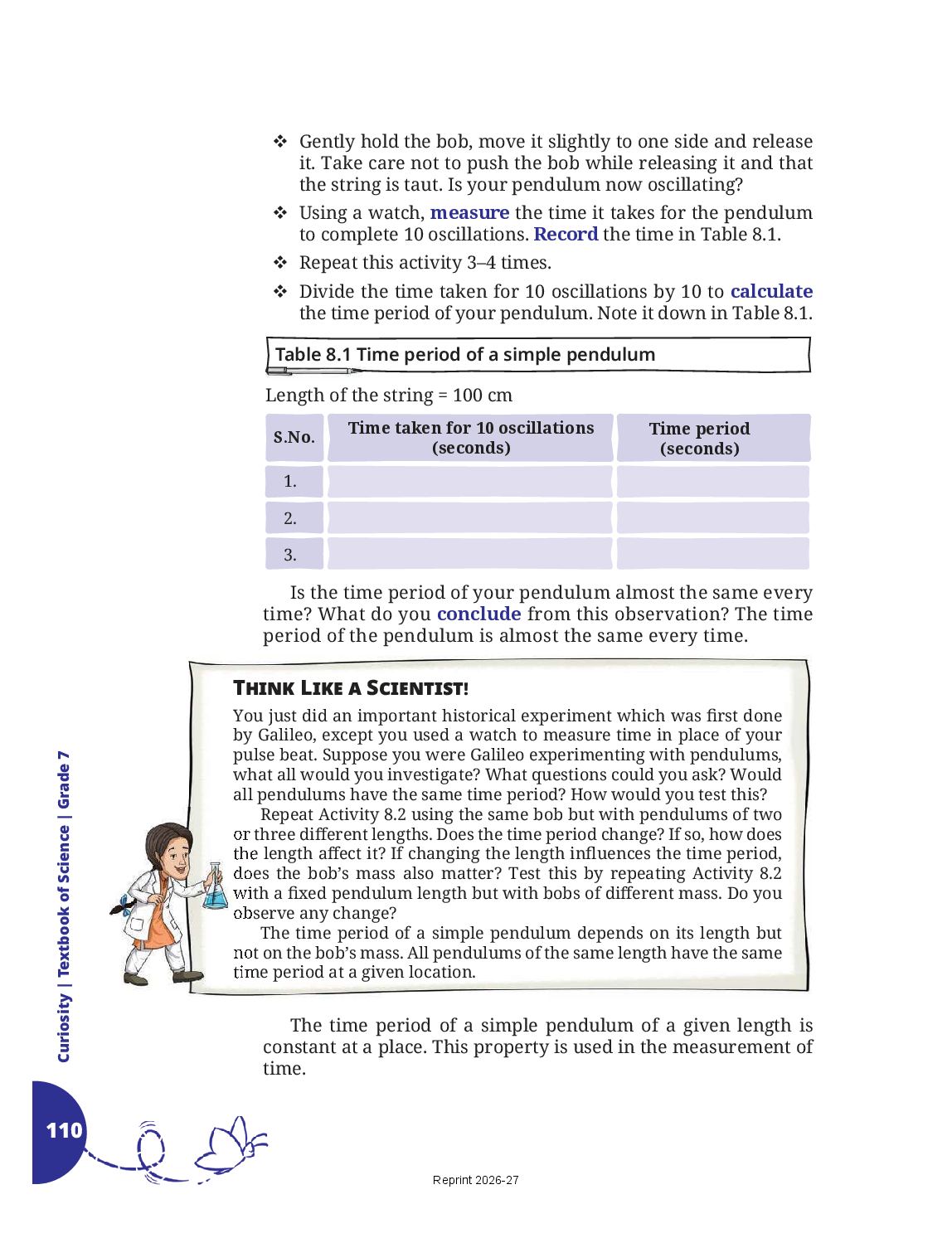
| Time period | The time taken by a pendulum to complete one oscillation | Measured in Activity 8.2 as (time for 10 oscillations) ÷ 10 | For a given length it is constant at a place; it does not depend on the bob’s mass |
| Periodic motion | Motion that repeats its path after a fixed interval of time | The oscillatory motion of a pendulum | Every clock — old or modern — is built on some process that repeats |
| Second (s) | The SI unit of time | 60 s = 1 min; 60 min = 1 h | Write ‘5 s’, not ‘5 sec.’; symbols stay lower case and singular |
| Speed | The distance covered by an object in unit time | Speed = total distance covered ÷ total time taken | SI unit m/s; also km/h. 1 m/s = 3.6 km/h |
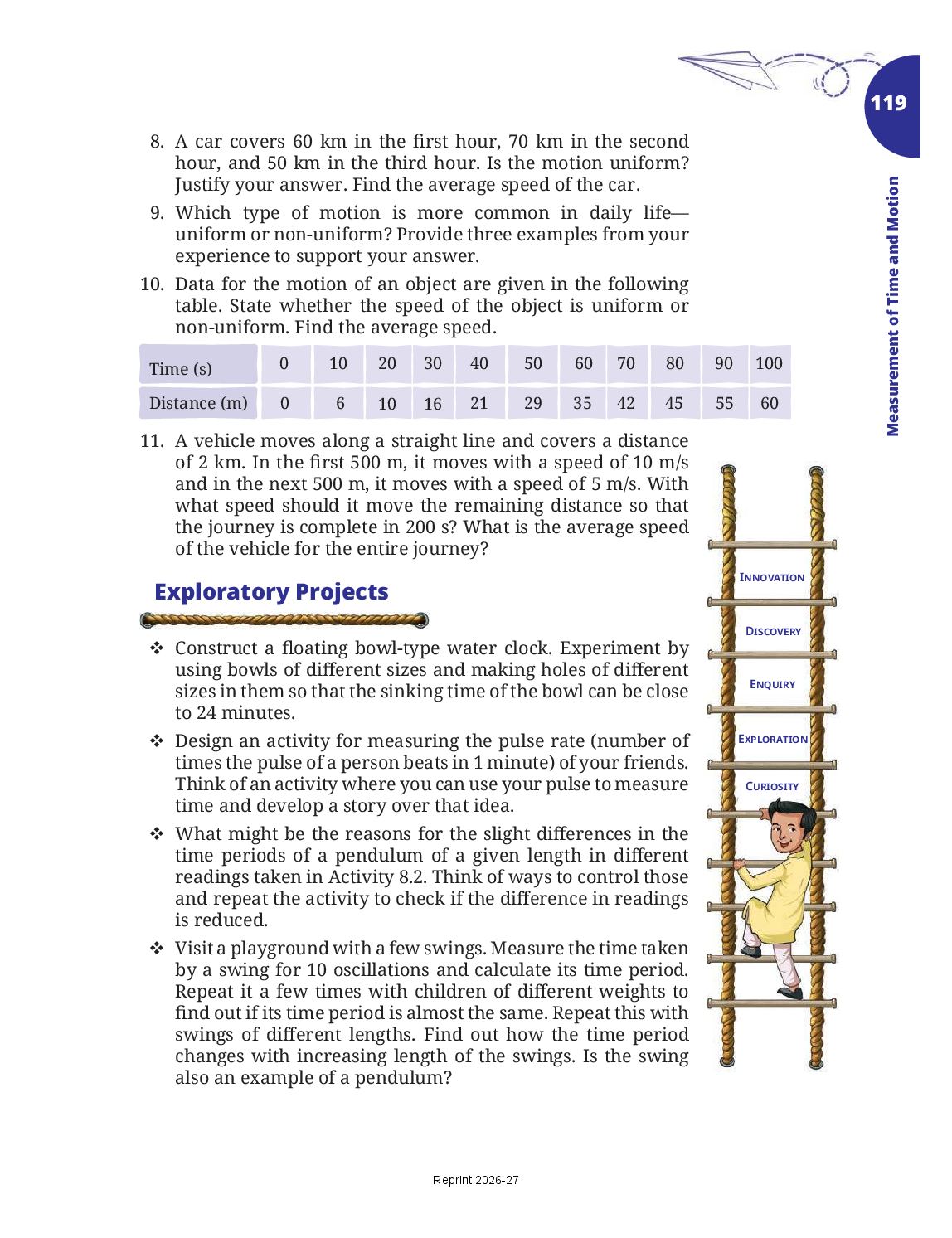
| Average speed | Total distance covered divided by the total time taken for the whole journey | A car covering 60 km, 70 km and 50 km in three successive hours has an average speed of 60 km/h | It is not the average of the separate speeds |
| Uniform linear motion | Motion along a straight line with a constant (unchanging) speed | Train X in Table 8.3 covers 20 km in every 10-minute interval | Equal distances in equal intervals of time — a straight-line distance–time graph |
| Non-uniform linear motion | Motion along a straight line in which the speed keeps changing | Train Y in Table 8.3 covers 20, 15, 15, 25, 20 and 25 km in successive 10-minute intervals | Unequal distances in equal intervals of time — a bent distance–time graph |
| Speedometer / Odometer | Instruments fitted in vehicles: the speedometer displays the speed in km/h, the odometer measures the distance travelled in kilometre | Seen on scooters, motorbikes, cars and buses | Speedometer → speed; odometer → distance |
Old NCERT vs New – Class 7 Science
This chapter is from Curiosity, the new NCERT Class 7 Science book (NCF-SE 2023, used from 2025-26). It replaced the old book “Science”, so chapter numbers and names differ from older PDFs.
Solutions and All Chapters
Answers to the exercises and the full chapter list of Curiosity:
Measurement of Time and Motion – Overview
| Class | Class 7 |
| Subject | Science |
| Book | Curiosity – new NCERT book |
| Chapter | 8 of 12 – Measurement of Time and Motion |
| Book pages | 105 – 120 |
| Edition | NCERT Reprint 2026-27 |
| Session | 2026-27 |
| Free – read online or download |
Class 7 Science Chapter 8 – FAQs
Where can I download Measurement of Time and Motion Class 7 PDF?
From the download table on this page – the chapter PDF is free, and the full book is linked too.
What is Class 7 Science Chapter 8 about?
People first kept time by watching events in nature that repeat after definite intervals — the rising and setting of the Sun, the phases of the Moon, the changing seasons. From these they made calendars, and then devices for smaller intervals within a day: sundials, water clocks, hourglasses and candle clocks.
Is Measurement of Time and Motion from the new NCERT Class 7 Science book?
Yes. It is chapter 8 of curiosity, the new NCERT Class 7 Science book for 2026-27.
Is this the latest NCERT edition for 2026-27?
Yes – the PDF is NCERT’s latest edition for the 2026-27 session.
Where are the NCERT Solutions for Class 7 Science Chapter 8?
Open the NCERT Solutions link above for answers to the exercise questions.