Download The World of Metals and Non-metals – NCERT Class 7 Science Chapter 4 PDF from the new NCERT Class 7 Science book Curiosity (2026-27). Read the chapter online or download the free PDF. Metals are generally lustrous (they show metallic lustre), hard, malleable (can be beaten into thin sheets), ductile (can be drawn into wires) and sonorous (give a ringing sound). Copper, aluminium, iron, gold and silver are metals.
The World of Metals and Non-metals PDF – Chapter 4 of Curiosity
Read the chapter online or download the PDF.
| Chapter | Download | |
|---|---|---|
| Chapter 4 PDF | The World of Metals and Non-metals | View PDF |
| Full book | NCERT Class 7 Science – Curiosity | View Book |
Read Online
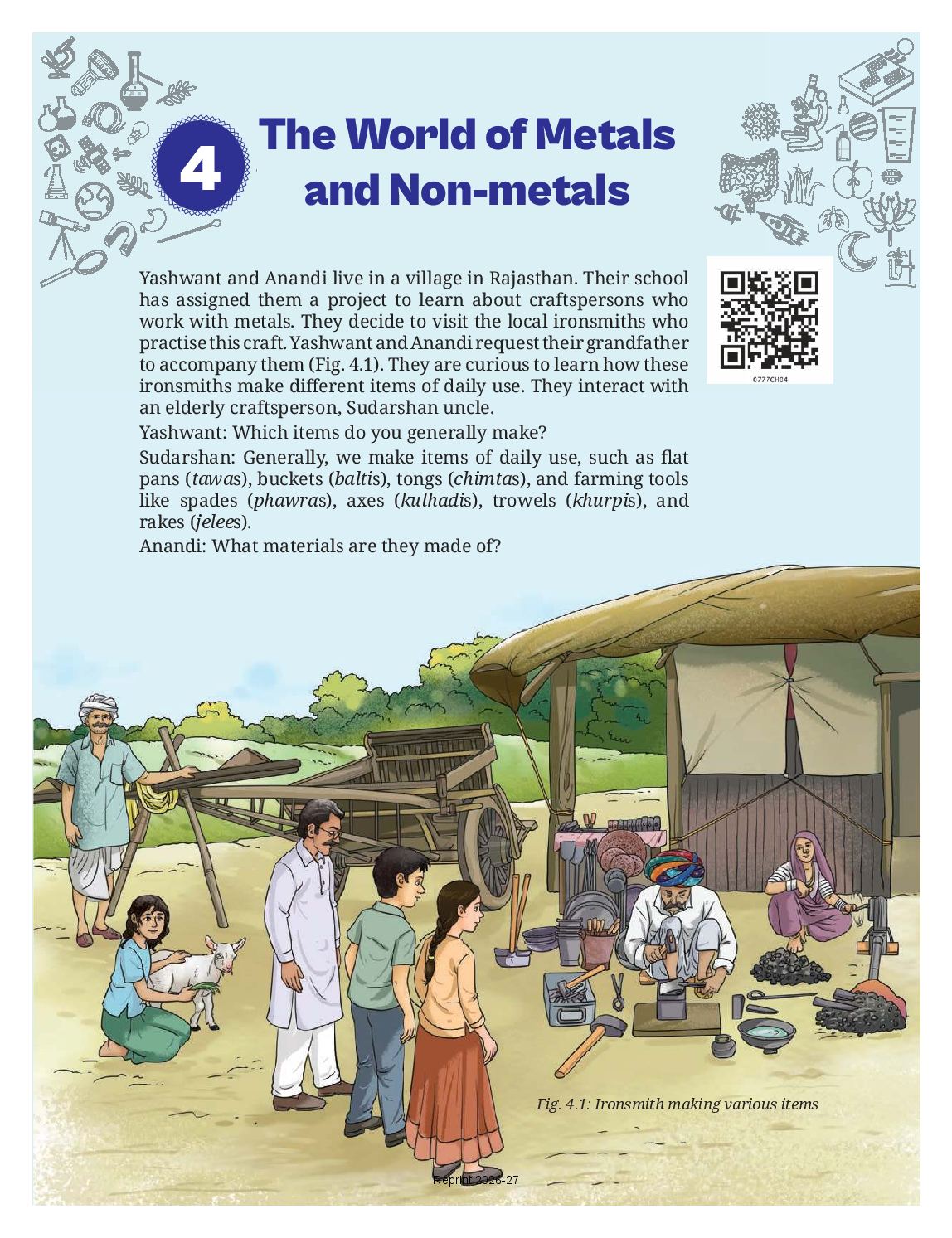
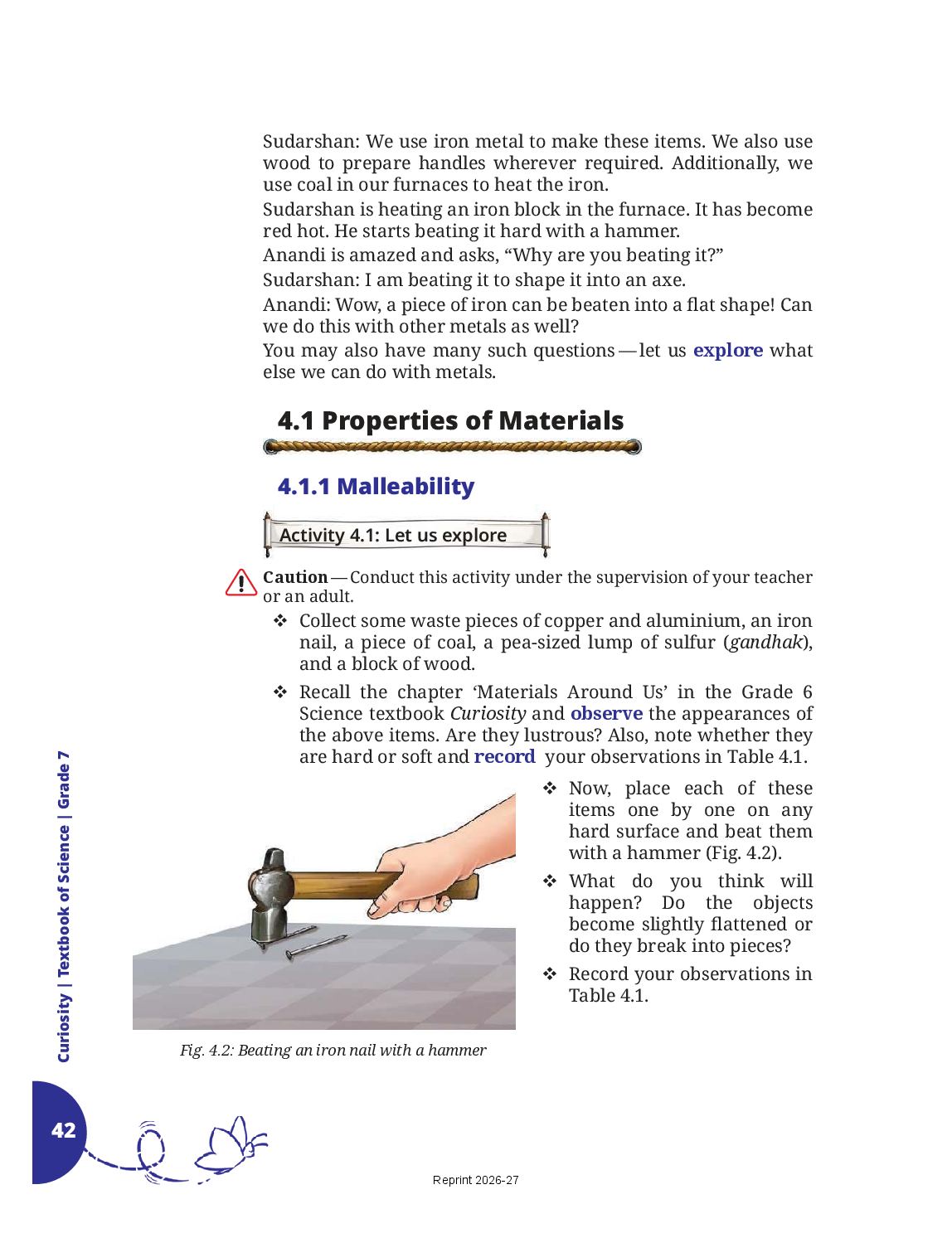
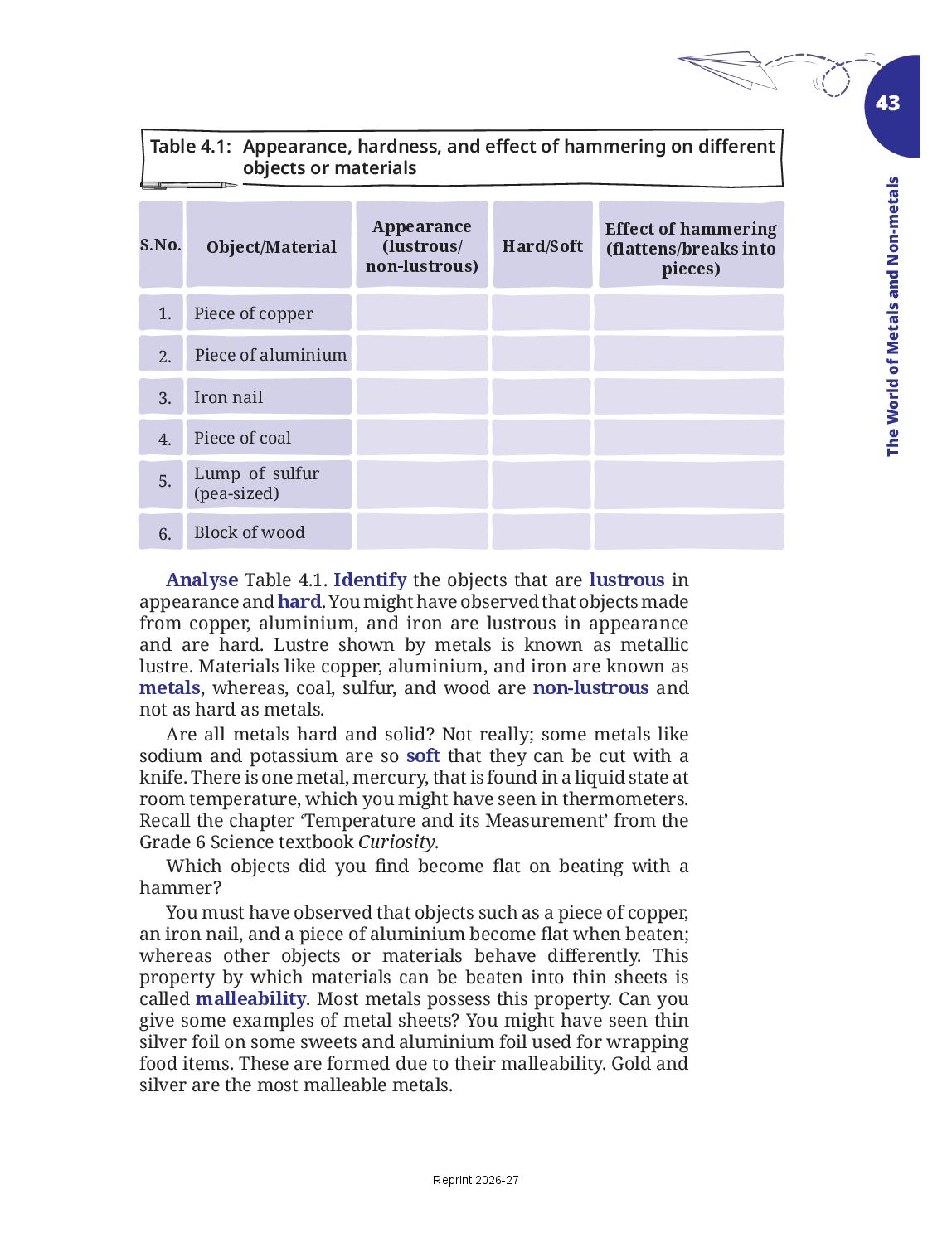
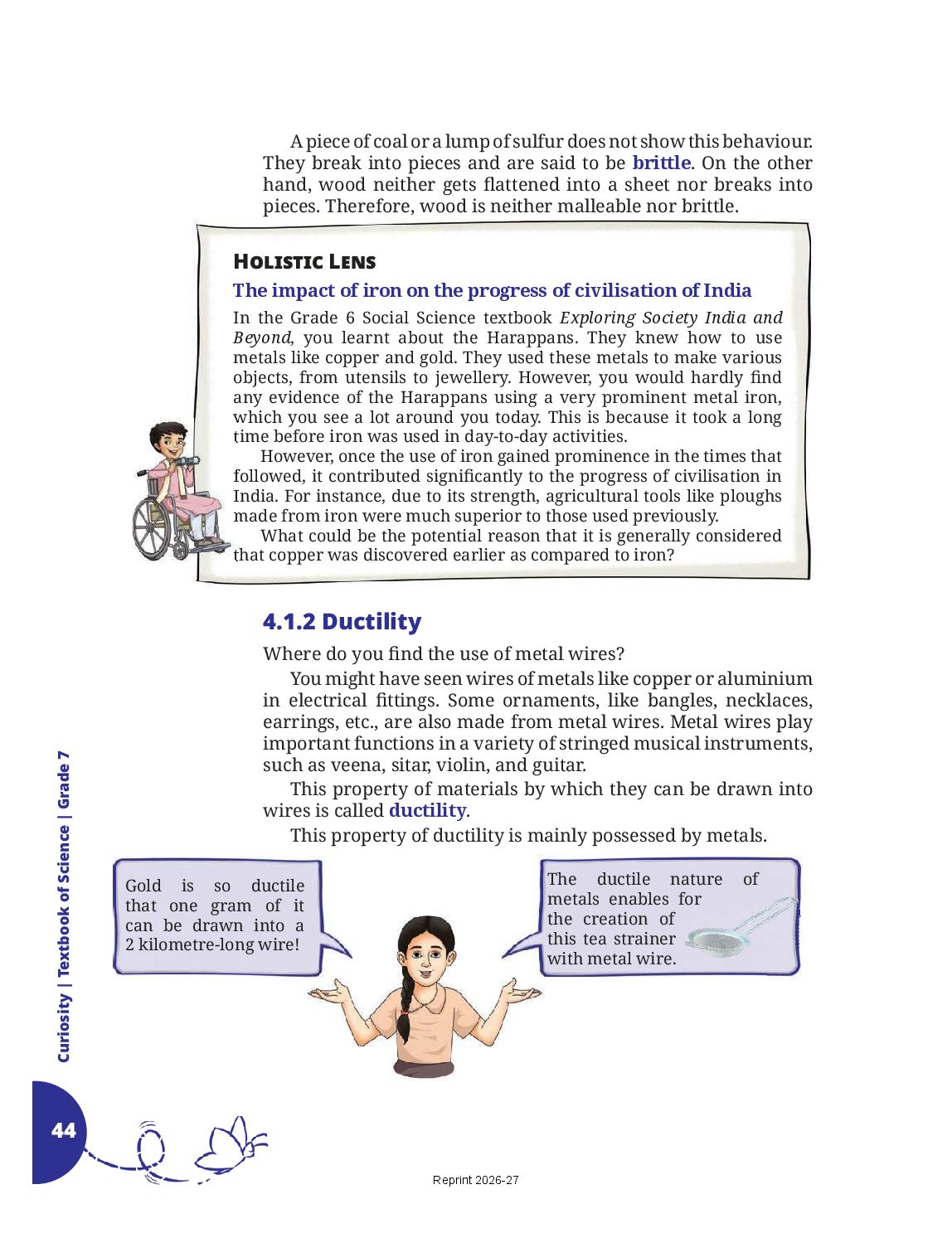
What Is in The World of Metals and Non-metals? (Class 7 Science Chapter 4)
- Metals are generally lustrous (they show metallic lustre), hard, malleable (can be beaten into thin sheets), ductile (can be drawn into wires) and sonorous (give a ringing sound). Copper, aluminium, iron, gold and silver are metals.
- There are exceptions to every rule — sodium and potassium are so soft they can be cut with a knife, and mercury is a liquid at room temperature.
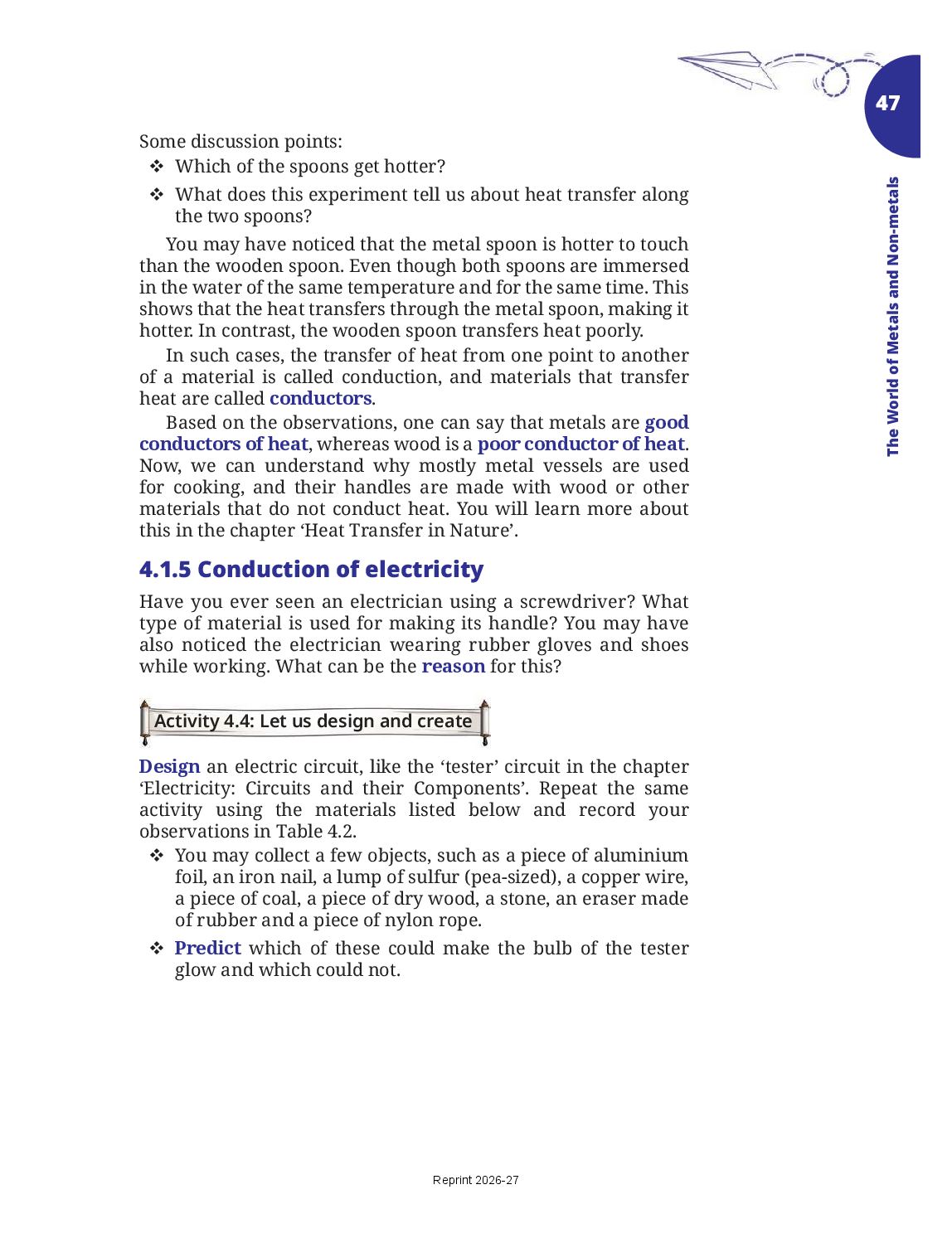
- Metals are good conductors of heat and electricity. That is why cooking vessels are metal while their handles are wood, and why an electrician’s screwdriver has a plastic grip and rubber gloves.
- Non-metals such as coal (carbon), sulfur and phosphorus are dull, soft, brittle, non-ductile, non-sonorous and poor conductors of heat and electricity.
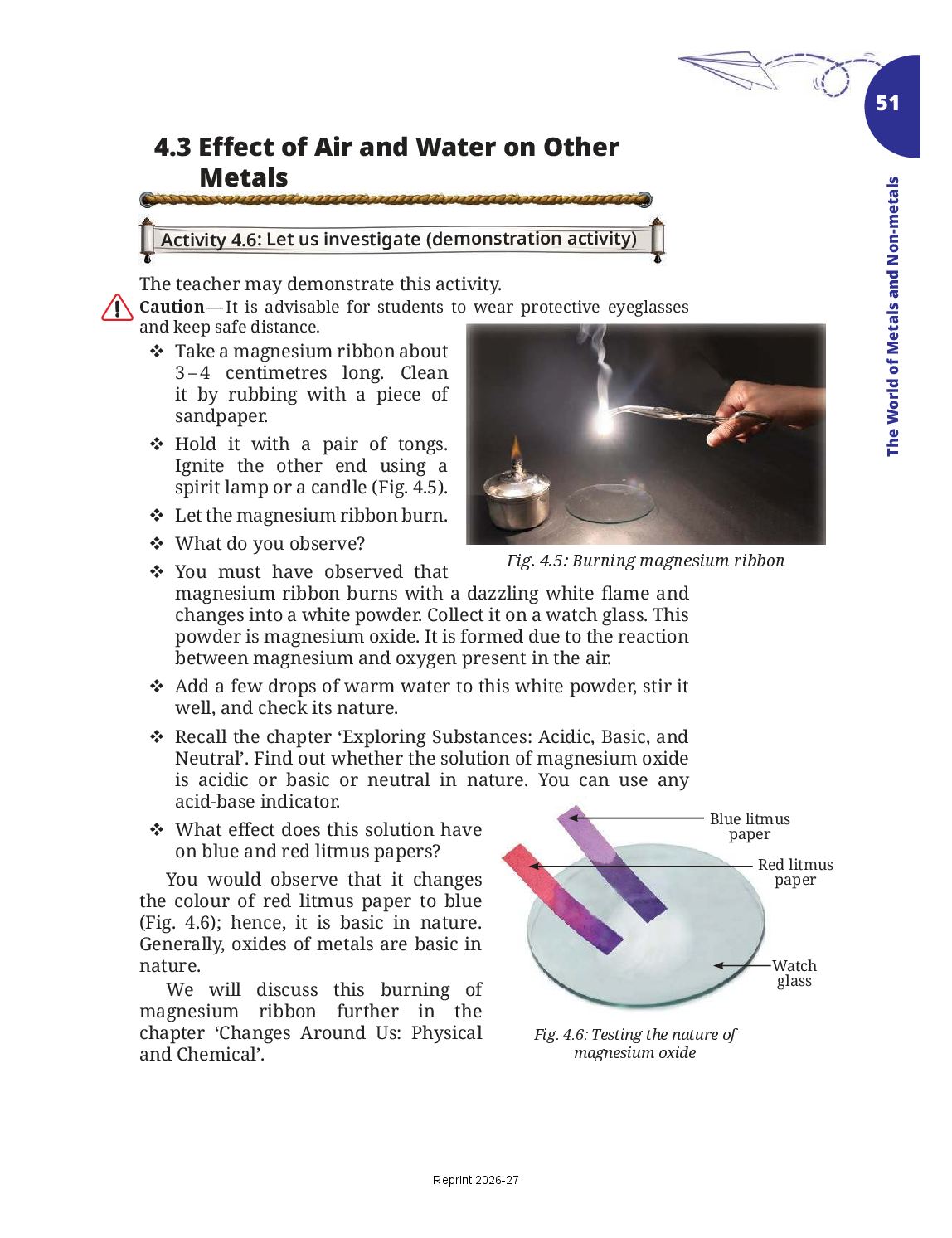
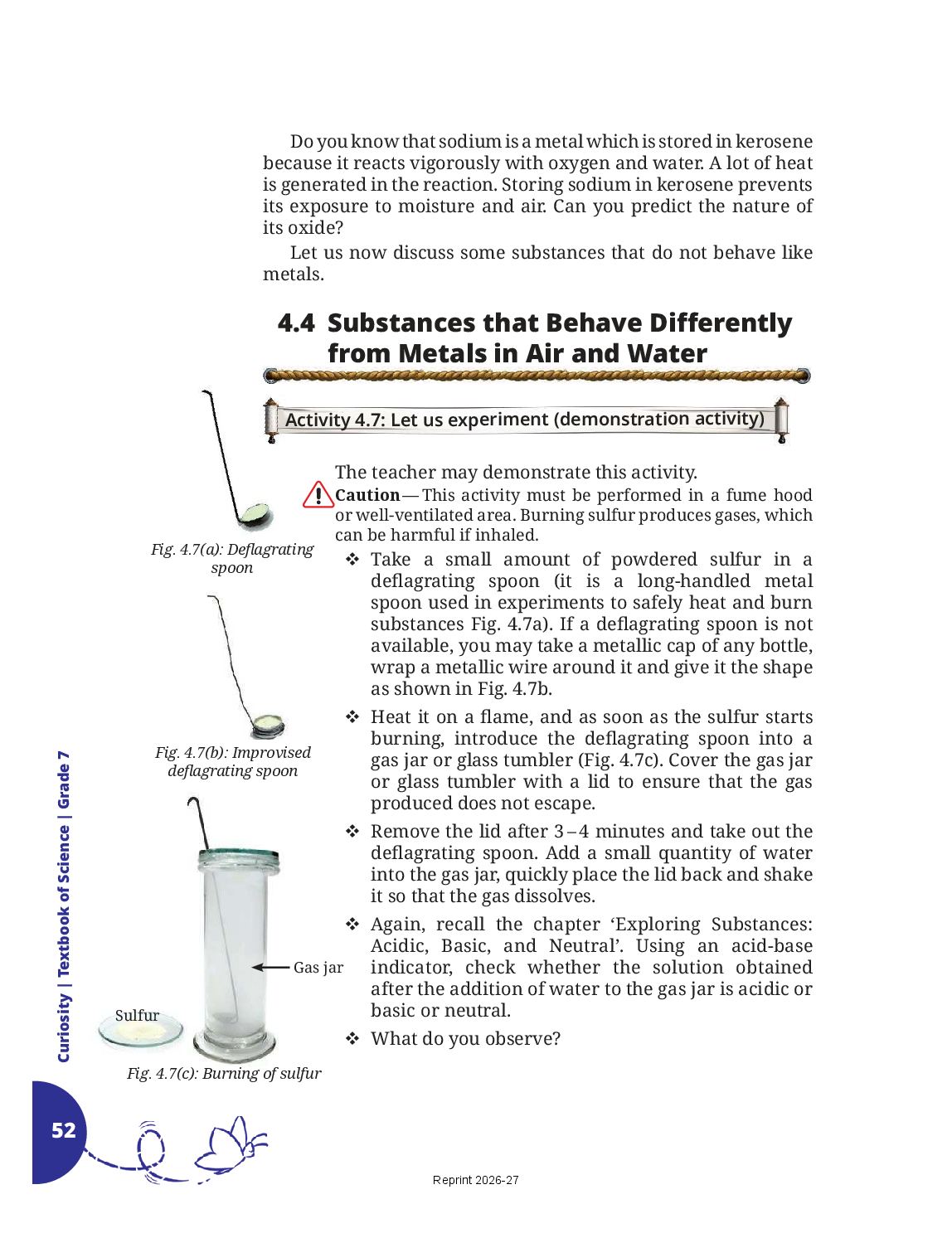
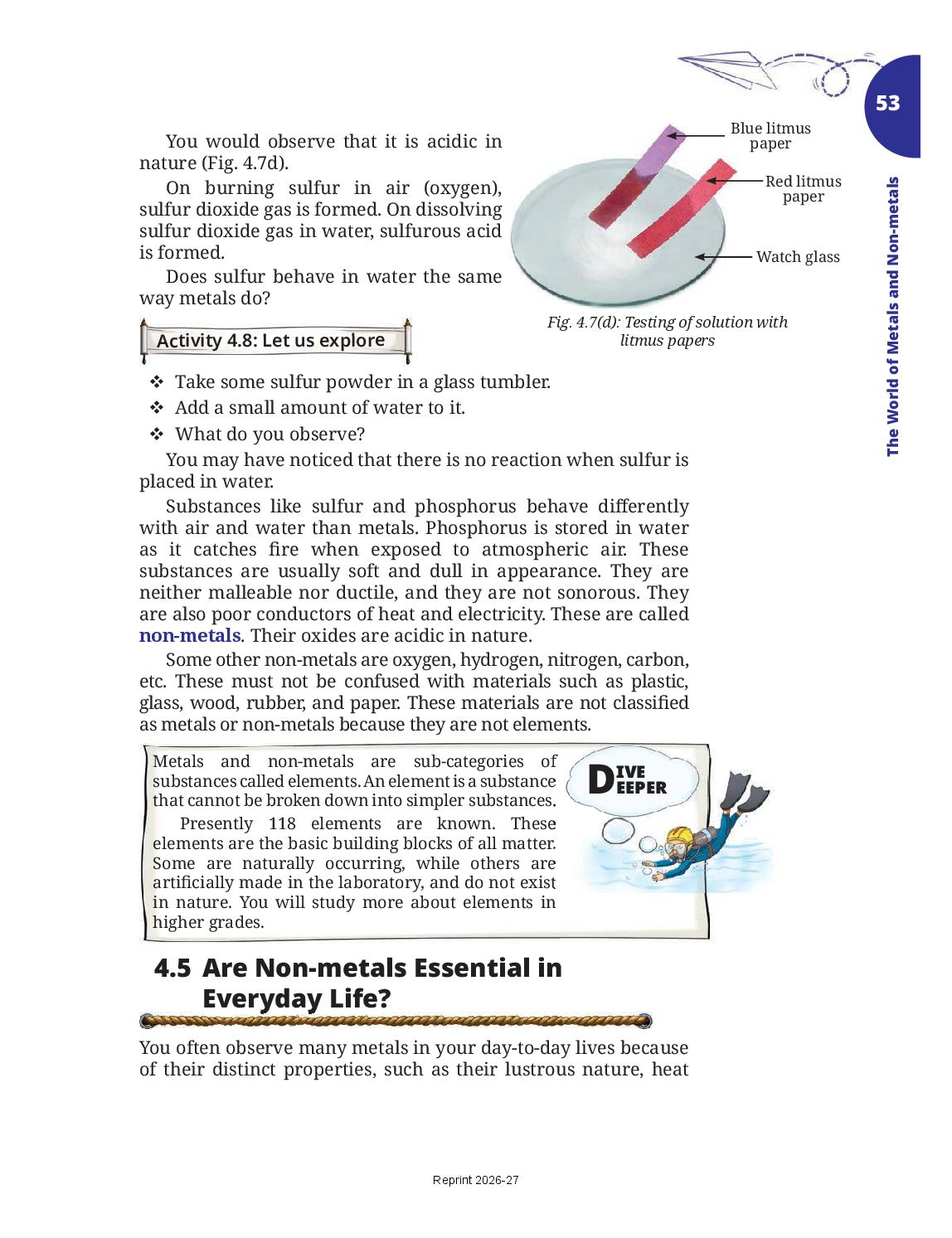
- Metal oxides are basic — burning magnesium gives magnesium oxide, whose solution turns red litmus blue. Non-metal oxides are acidic — burning sulfur gives sulfur dioxide, whose solution (sulfurous acid) turns blue litmus red.
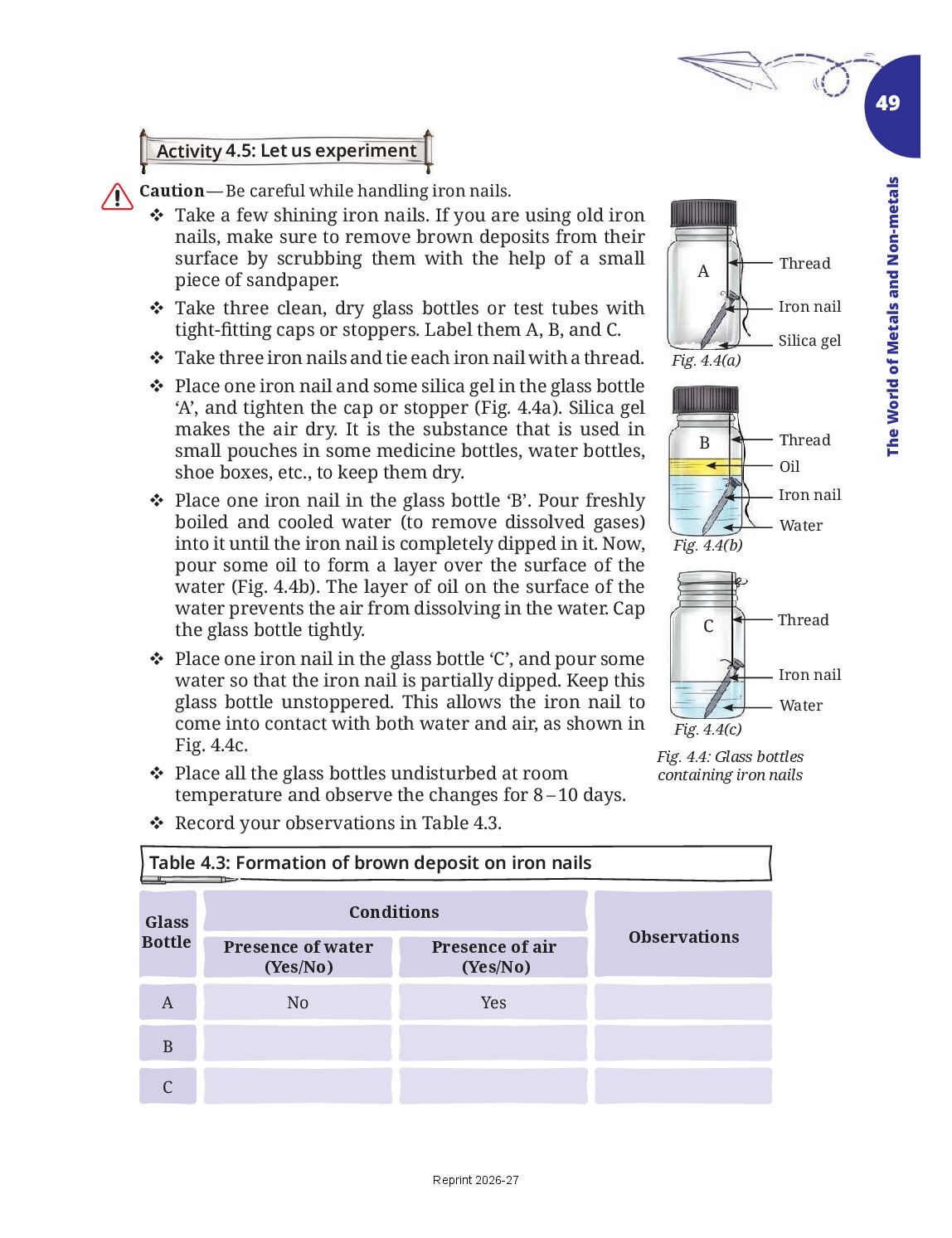
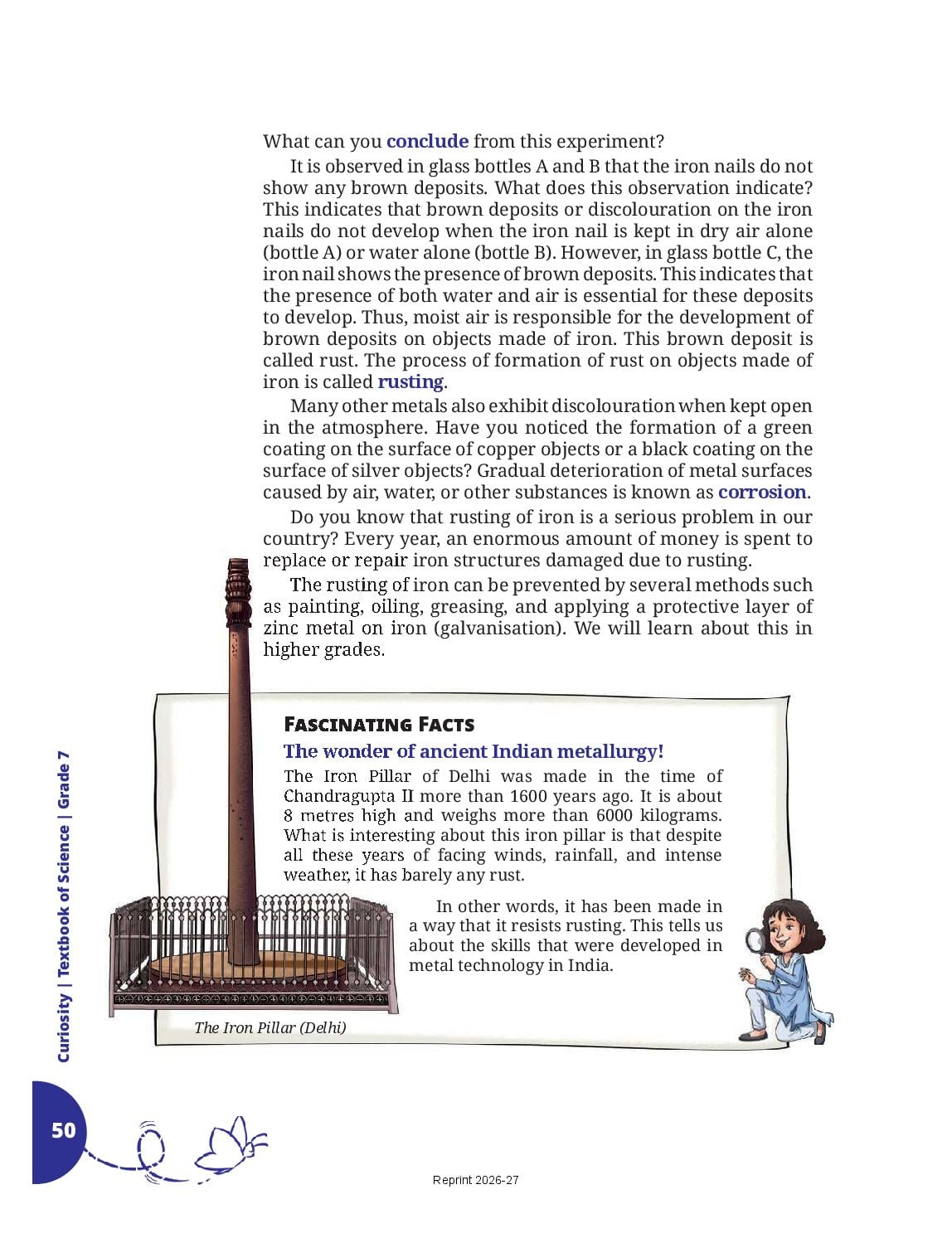
- Iron rusts only when both air and water are present; the slow eating away of any metal surface by air, water or other substances is called corrosion. Rusting is prevented by painting, oiling, greasing and galvanisation (a zinc coating).
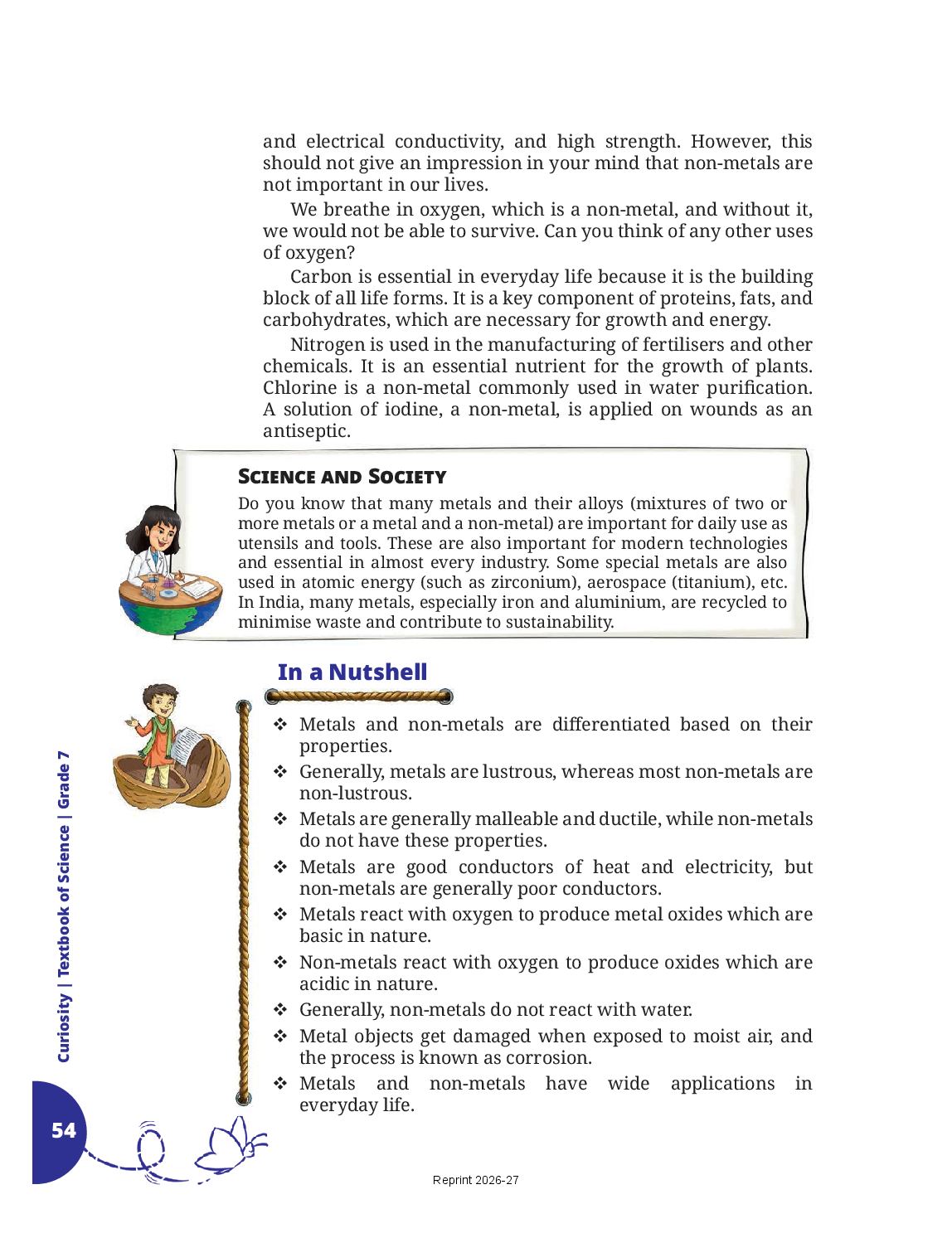
- Metals and non-metals are both elements — substances that cannot be broken into simpler substances. 118 elements are known. Plastic, glass, wood, rubber and paper are not elements, so they are neither metals nor non-metals.
Quick revision – The World of Metals and Non-metals
| Term | What it means | Where it comes in the chapter | Everyday example |
|---|---|---|---|
| Metallic lustre | The shine shown by the surface of a metal | Section 4.1.1, page 43 | A freshly cut piece of aluminium, a polished steel plate |
| Malleability | The property by which a material can be beaten into thin sheets | Section 4.1.1, page 43 | Silver foil (vark) on sweets, aluminium foil for wrapping rotis |
| Brittle | Breaks into pieces on hammering instead of flattening | Page 44 | A lump of coal, a piece of sulfur, a clay kulhad |
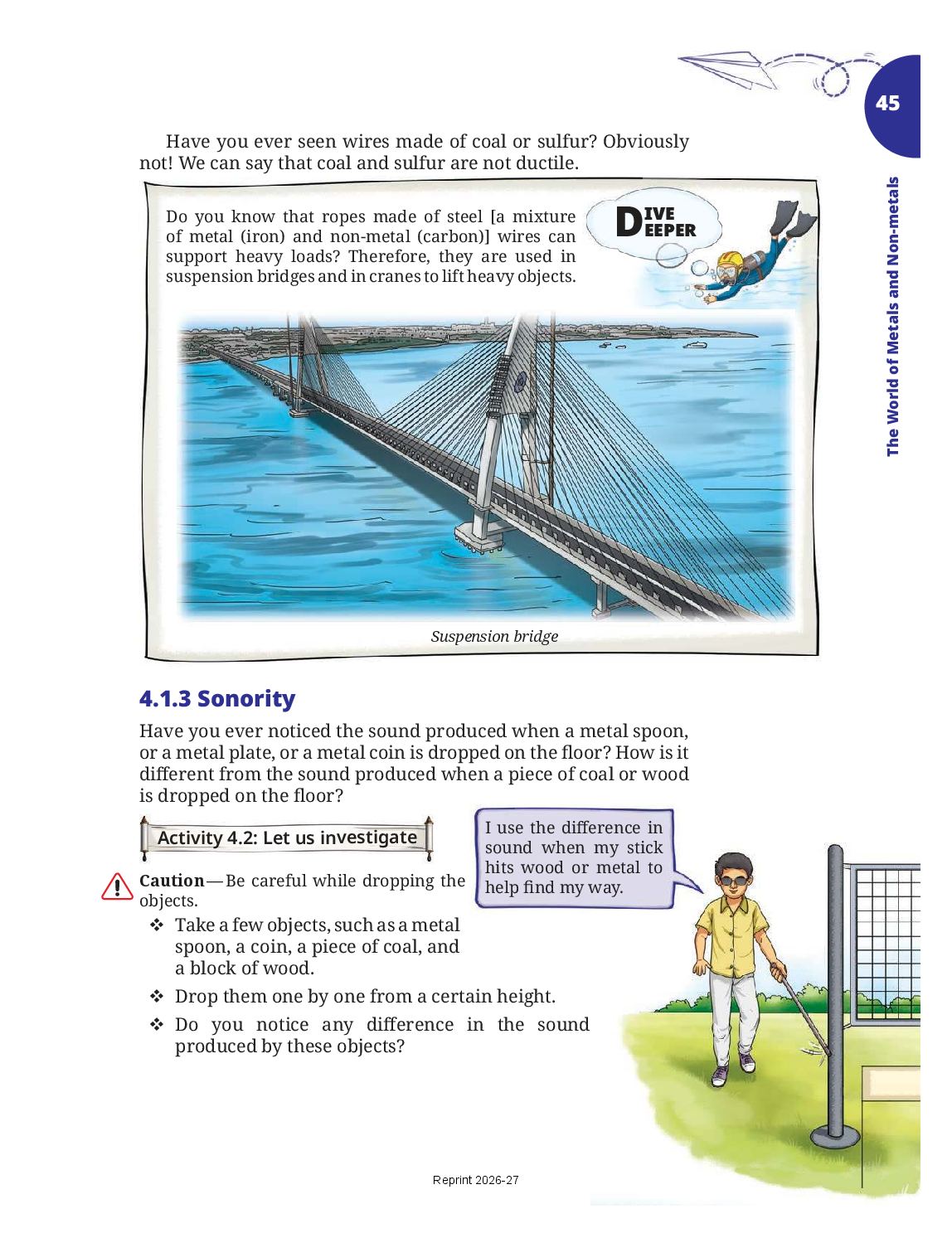
| Ductility | The property by which a material can be drawn into wires | Section 4.1.2, page 44 | Copper wire in a fan, the strings of a sitar or veena |
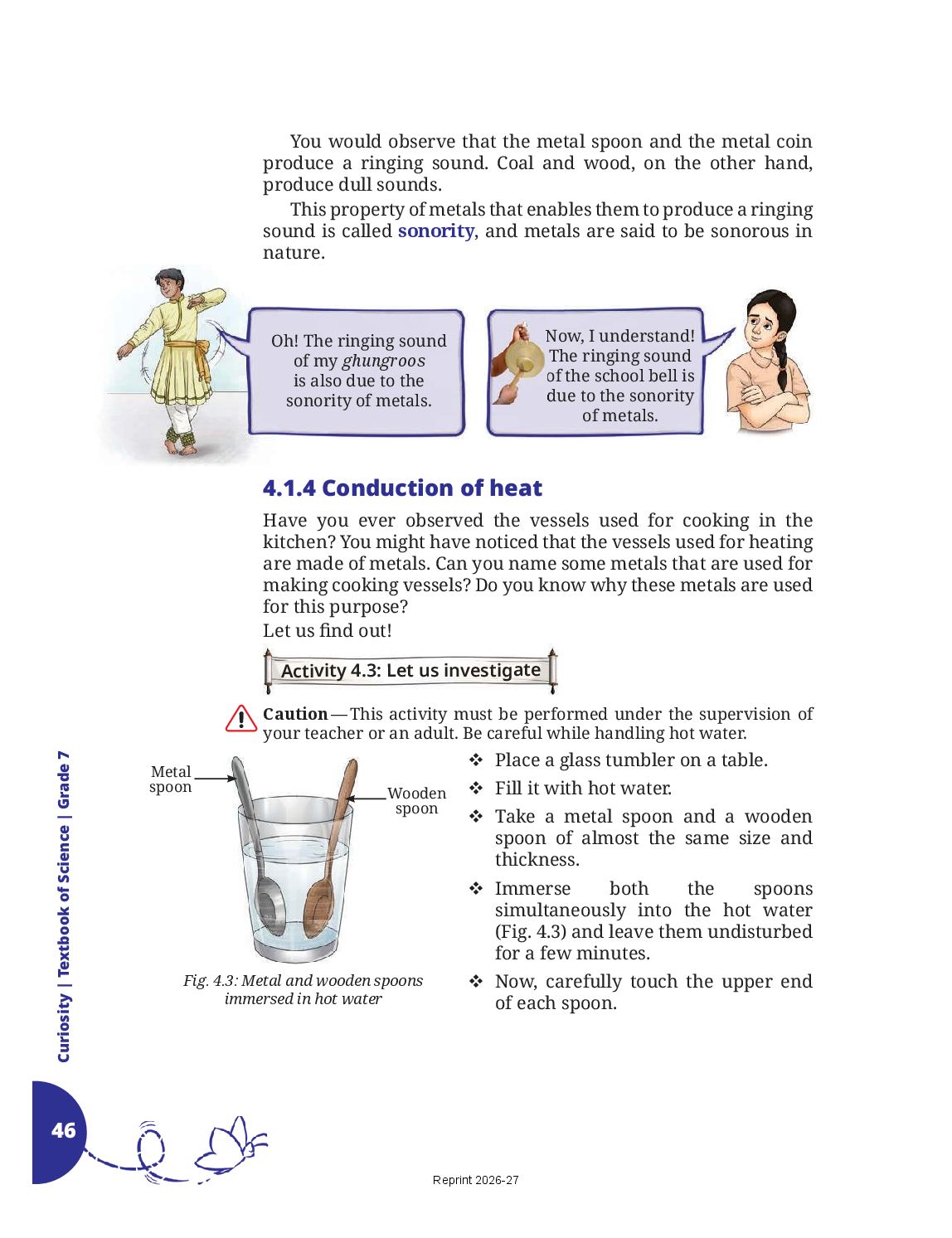
| Sonority | The property of metals of producing a ringing sound | Section 4.1.3, page 46 | The school bell, ghungroos, a steel plate falling down |
| Conduction | Transfer of heat from one point of a material to another | Section 4.1.4, page 47 | A steel spoon left in hot tea becomes hot at the top |
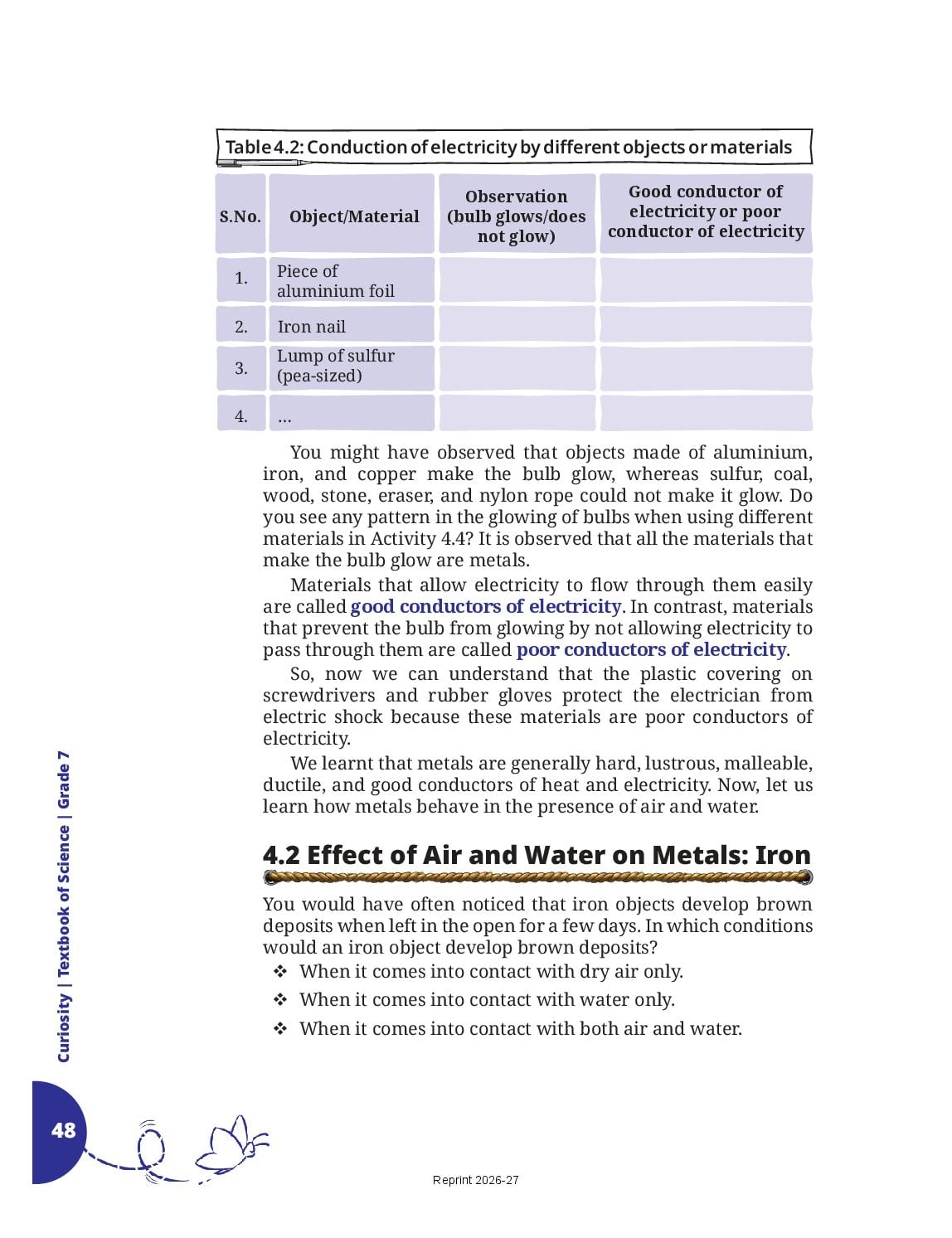
| Good conductor of electricity | A material that lets electricity pass through it easily | Section 4.1.5, page 48 | Copper wiring in the house, an iron nail in a tester |
| Poor conductor of electricity | A material that does not let electricity pass through it | Section 4.1.5, page 48 | Rubber gloves, the plastic handle of a screwdriver |
| Rust | The brown deposit formed on iron in the presence of both air and water | Section 4.2, page 50 | Brown flakes on an old gate left in the rain |
| Corrosion | Gradual deterioration of a metal surface by air, water or other substances | Page 50 | Green coating on a copper vessel, black coating on silver |
| Galvanisation | Coating iron with a protective layer of zinc metal | Page 50 | Galvanised iron buckets and roofing sheets |
| Element | A substance that cannot be broken down into simpler substances; 118 are known | Page 53 | Oxygen, carbon, iron, gold — but not plastic or glass |
Old NCERT vs New – Class 7 Science
This chapter is from Curiosity, the new NCERT Class 7 Science book (NCF-SE 2023, used from 2025-26). It replaced the old book “Science”, so chapter numbers and names differ from older PDFs.
Solutions and All Chapters
Answers to the exercises and the full chapter list of Curiosity:
The World of Metals and Non-metals – Overview
| Class | Class 7 |
| Subject | Science |
| Book | Curiosity – new NCERT book |
| Chapter | 4 of 12 – The World of Metals and Non-metals |
| Book pages | 41 – 56 |
| Edition | NCERT Reprint 2026-27 |
| Session | 2026-27 |
| Free – read online or download |
Class 7 Science Chapter 4 – FAQs
Where can I download The World of Metals and Non-metals Class 7 PDF?
From the download table on this page – the chapter PDF is free, and the full book is linked too.
What is Class 7 Science Chapter 4 about?
Metals are generally lustrous (they show metallic lustre), hard, malleable (can be beaten into thin sheets), ductile (can be drawn into wires) and sonorous (give a ringing sound). Copper, aluminium, iron, gold and silver are metals.
Is The World of Metals and Non-metals from the new NCERT Class 7 Science book?
Yes. It is chapter 4 of curiosity, the new NCERT Class 7 Science book for 2026-27.
Is this the latest NCERT edition for 2026-27?
Yes – the PDF is NCERT’s latest edition for the 2026-27 session.
Where are the NCERT Solutions for Class 7 Science Chapter 4?
Open the NCERT Solutions link above for answers to the exercise questions.