NCERT Solutions for Class 7 Science Chapter 5 Changes Around Us Physical and Chemical provide clear, step-by-step answers to every exercise and in-text question from the chapter Changes Around Us Physical and Chemical of the NCERT textbook Curiosity. Prepared by subject experts as per the latest NCERT (CBSE) syllabus for 2026-27, these NCERT Solutions for Class 7 Science help you understand each concept, write exam-ready answers, and check your own solutions. You can read them online below or download the free Class 7 Science Chapter 5 question-answer PDF.
NCERT Solutions for Class 7 Science Chapter 5 Changes Around Us Physical and Chemical
- Class: Class 7
- Subject: Science
- Chapter: Chapter 5 – Changes Around Us Physical and Chemical
- Textbook: Curiosity (NCERT)
- Study material: NCERT Solutions – questions with answers, free PDF
These solutions answer all the exercise questions of Chapter 5 Changes Around Us Physical and Chemical — including the in-text questions, short-answer and long-answer questions, and activities — with complete explanations so you can follow the method, not just the final answer. Read the full solutions below.
NCERT Solutions Class 7 Science Chapter 5 Changes Around Us Physical and Chemical View Download
NCERT Solutions for Class 7 Science Chapter 5 PDF Download
You can read the NCERT Solutions for Class 7 Science Chapter 5 online above, or download the complete question-answer PDF to study Changes Around Us Physical and Chemical offline at any time.
NCERT Solutions for Class 7 Science Chapter 5 PDF Download Link – Click Here to Download Solutions PDF
Questions Covered in This Chapter
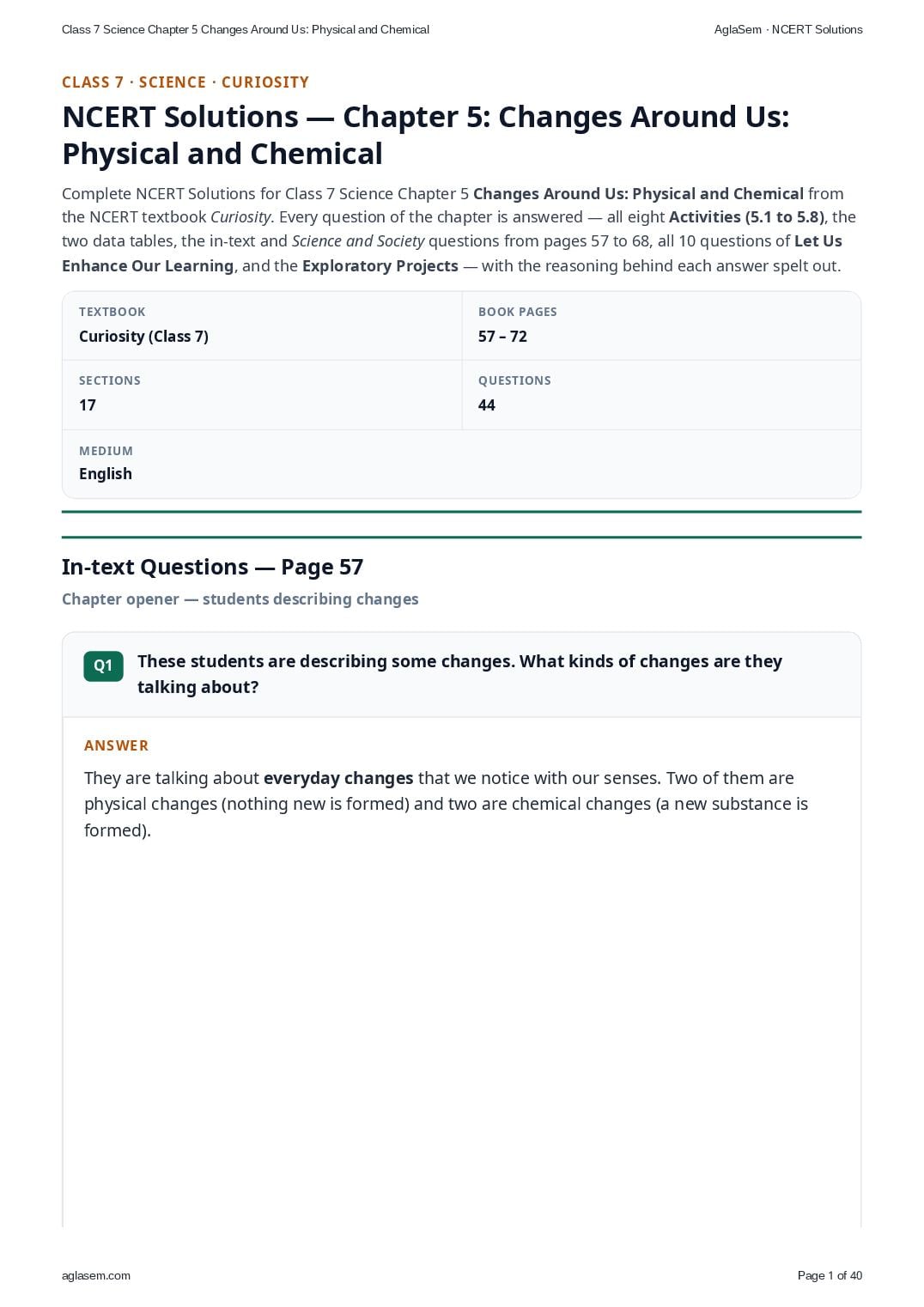
These NCERT Solutions answer all 44 questions of this chapter. The questions solved are:
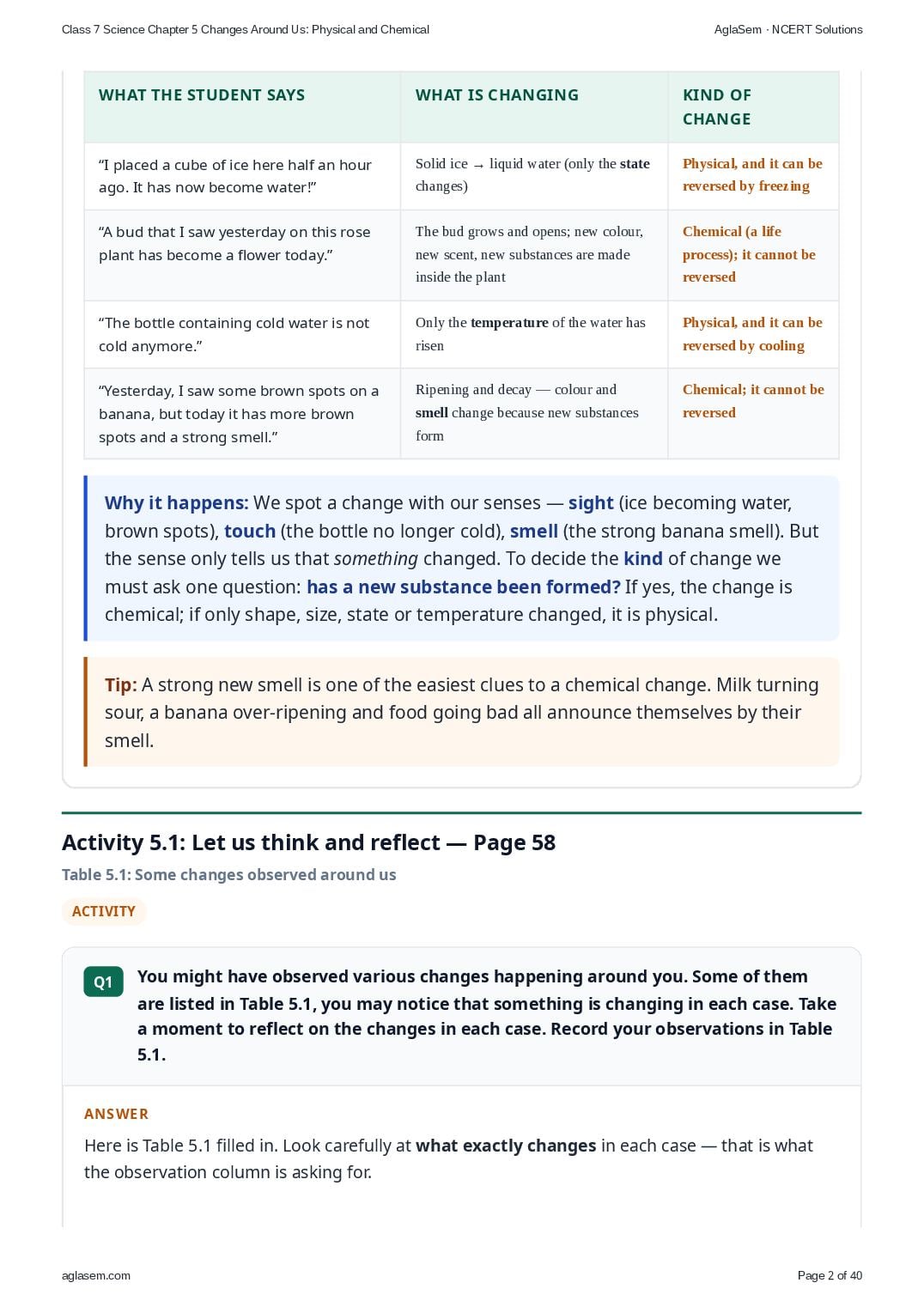
- These students are describing some changes. What kinds of changes are they talking about?
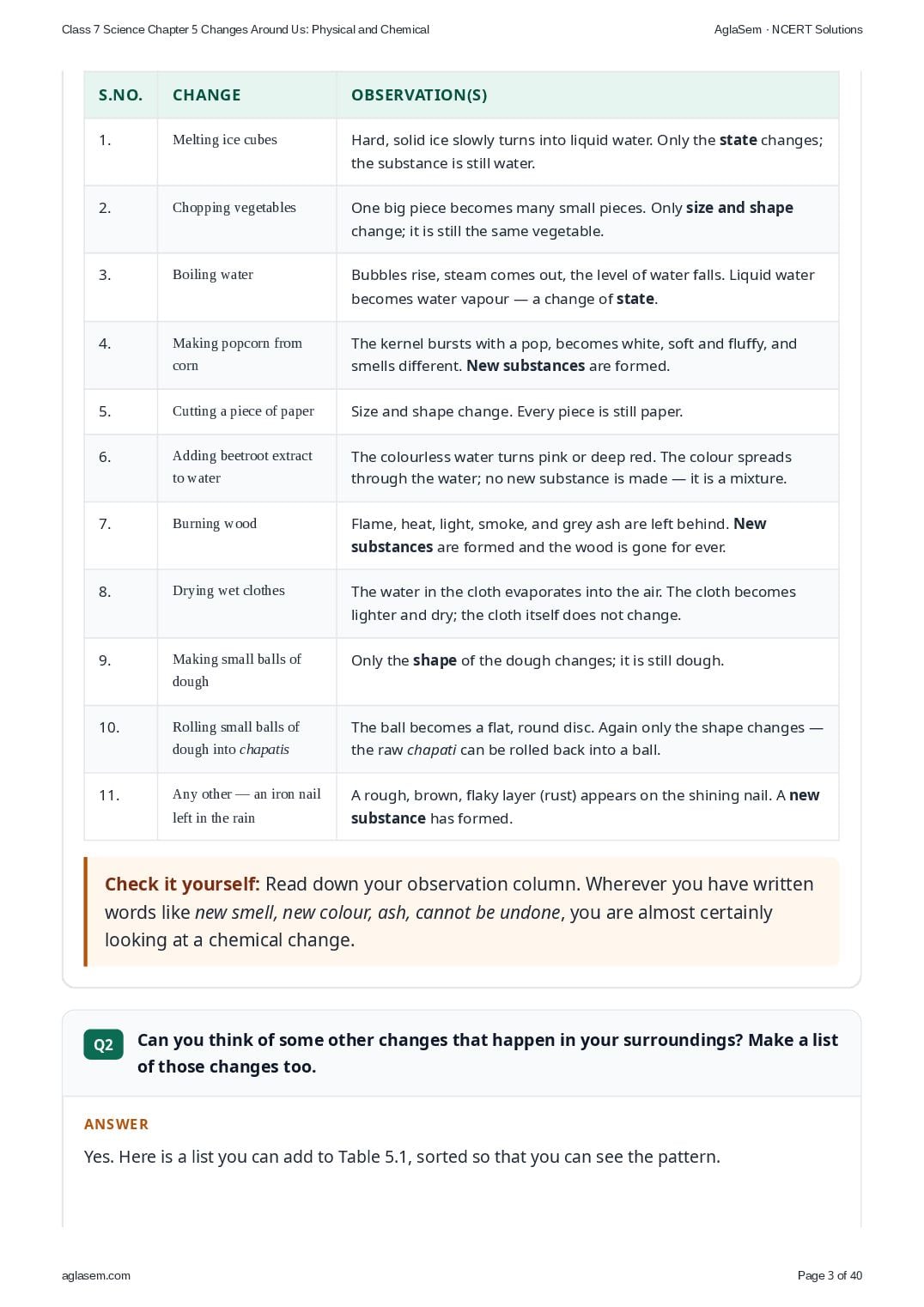
- You might have observed various changes happening around you. Some of them are listed in Table 5.1, you may notice that something is changing in each case. Take a moment to reflect on the changes in each case. Record your observations in Table 5.1.
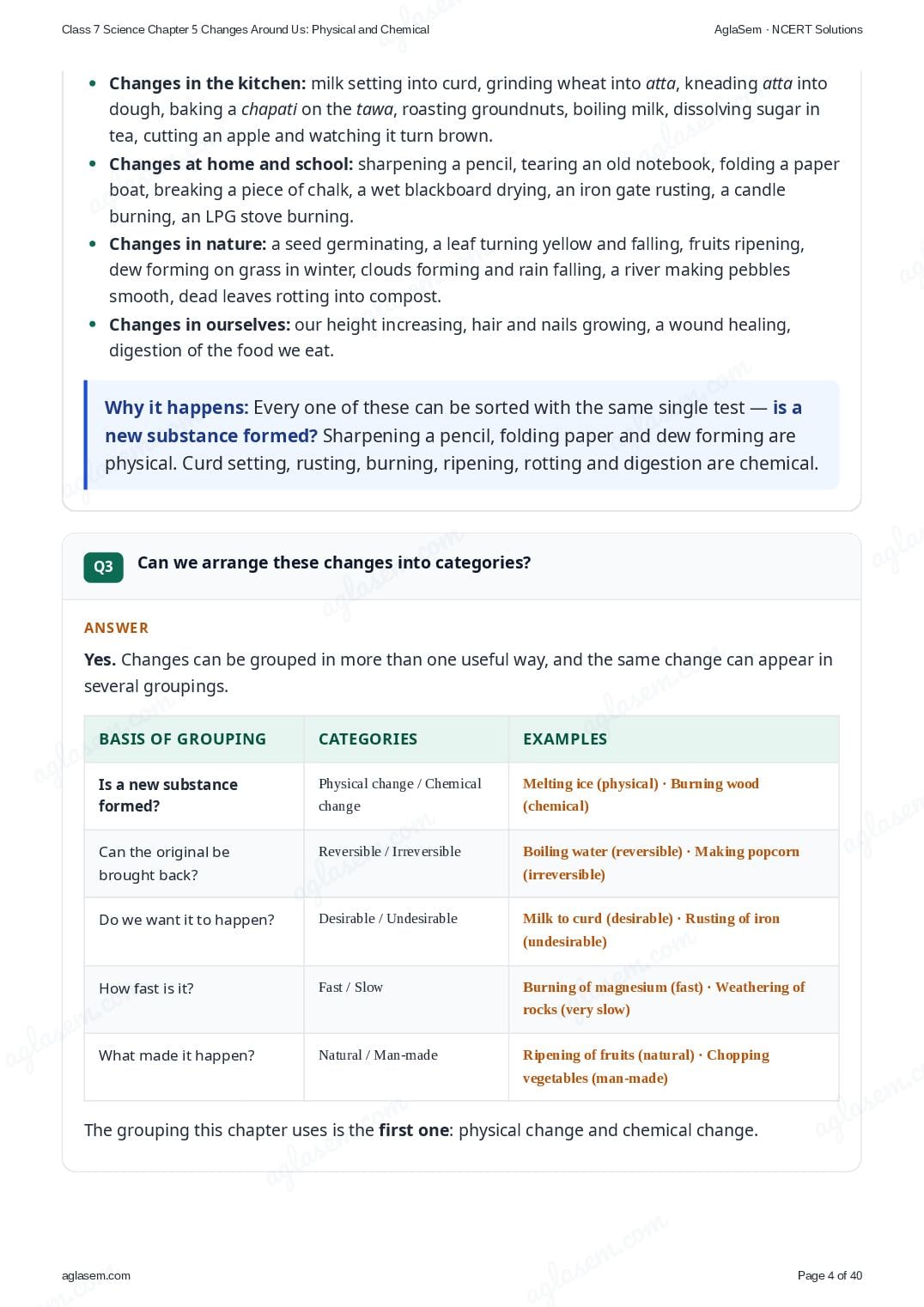
- Can you think of some other changes that happen in your surroundings? Make a list of those changes too.
- Can we arrange these changes into categories?
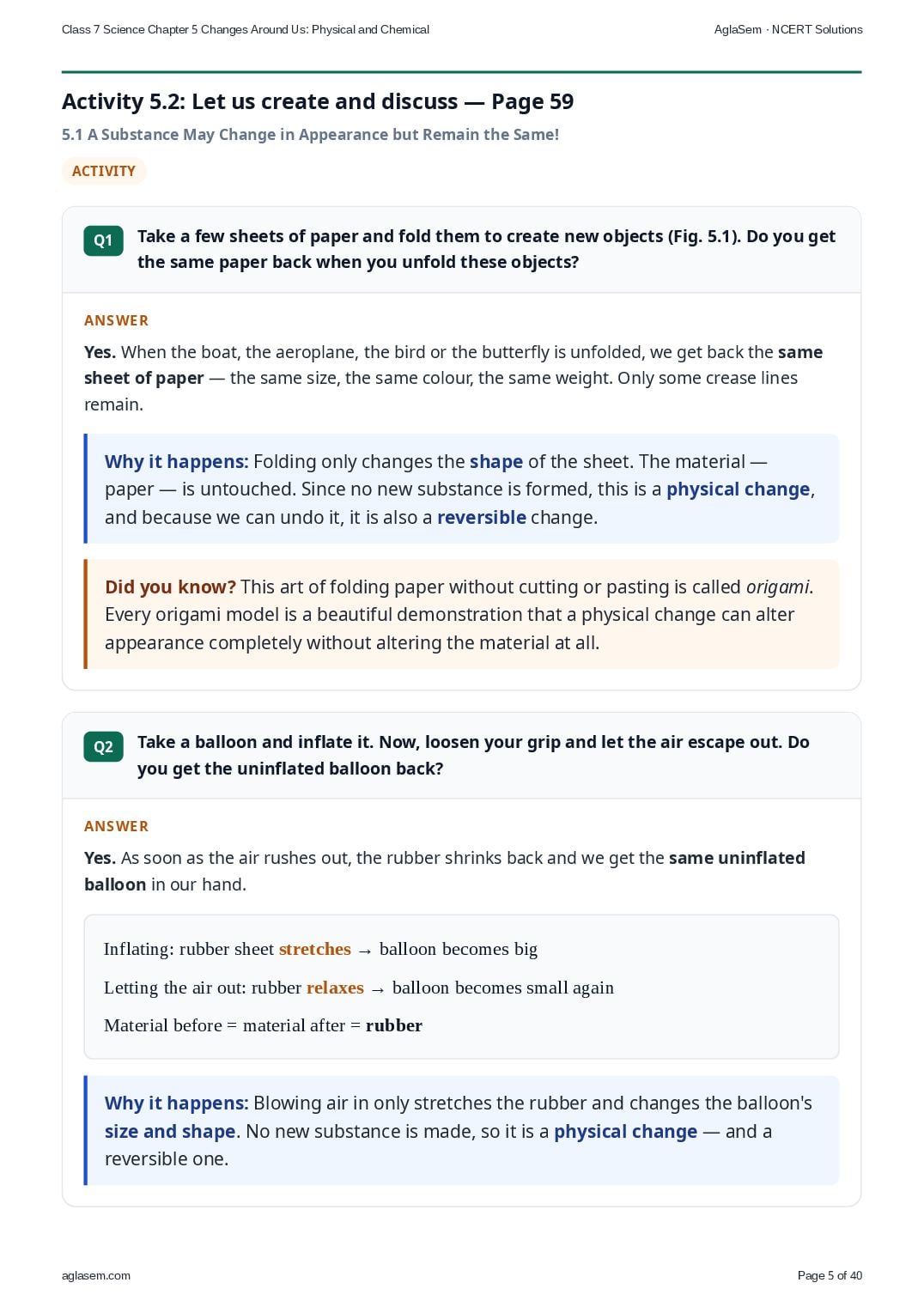
- Take a few sheets of paper and fold them to create new objects (Fig. 5.1). Do you get the same paper back when you unfold these objects?
- Take a balloon and inflate it. Now, loosen your grip and let the air escape out. Do you get the uninflated balloon back?
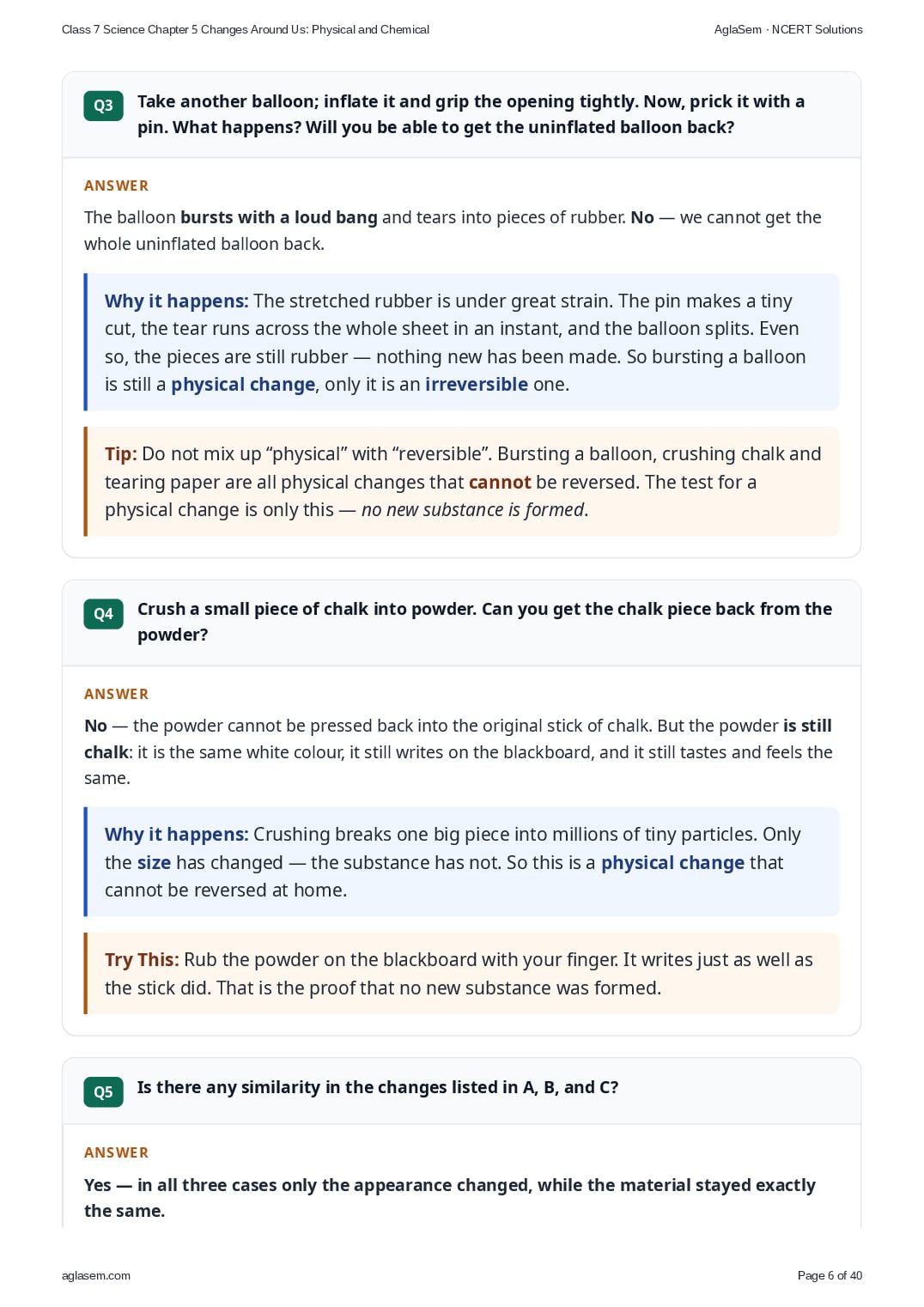
- Take another balloon; inflate it and grip the opening tightly. Now, prick it with a pin. What happens? Will you be able to get the uninflated balloon back?
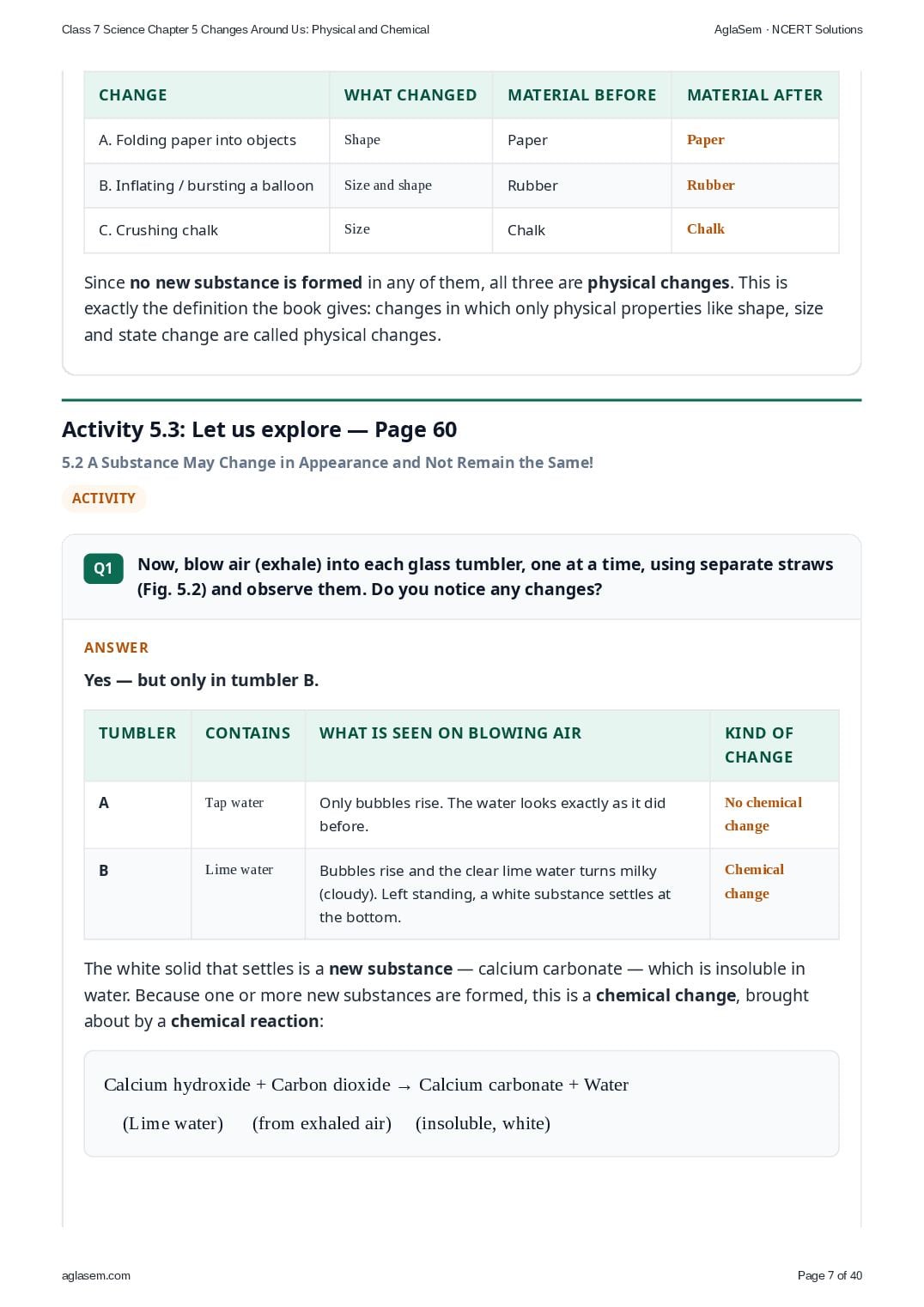
- Crush a small piece of chalk into powder. Can you get the chalk piece back from the powder?
- Is there any similarity in the changes listed in A, B, and C?
- Now, blow air (exhale) into each glass tumbler, one at a time, using separate straws (Fig. 5.2) and observe them. Do you notice any changes?
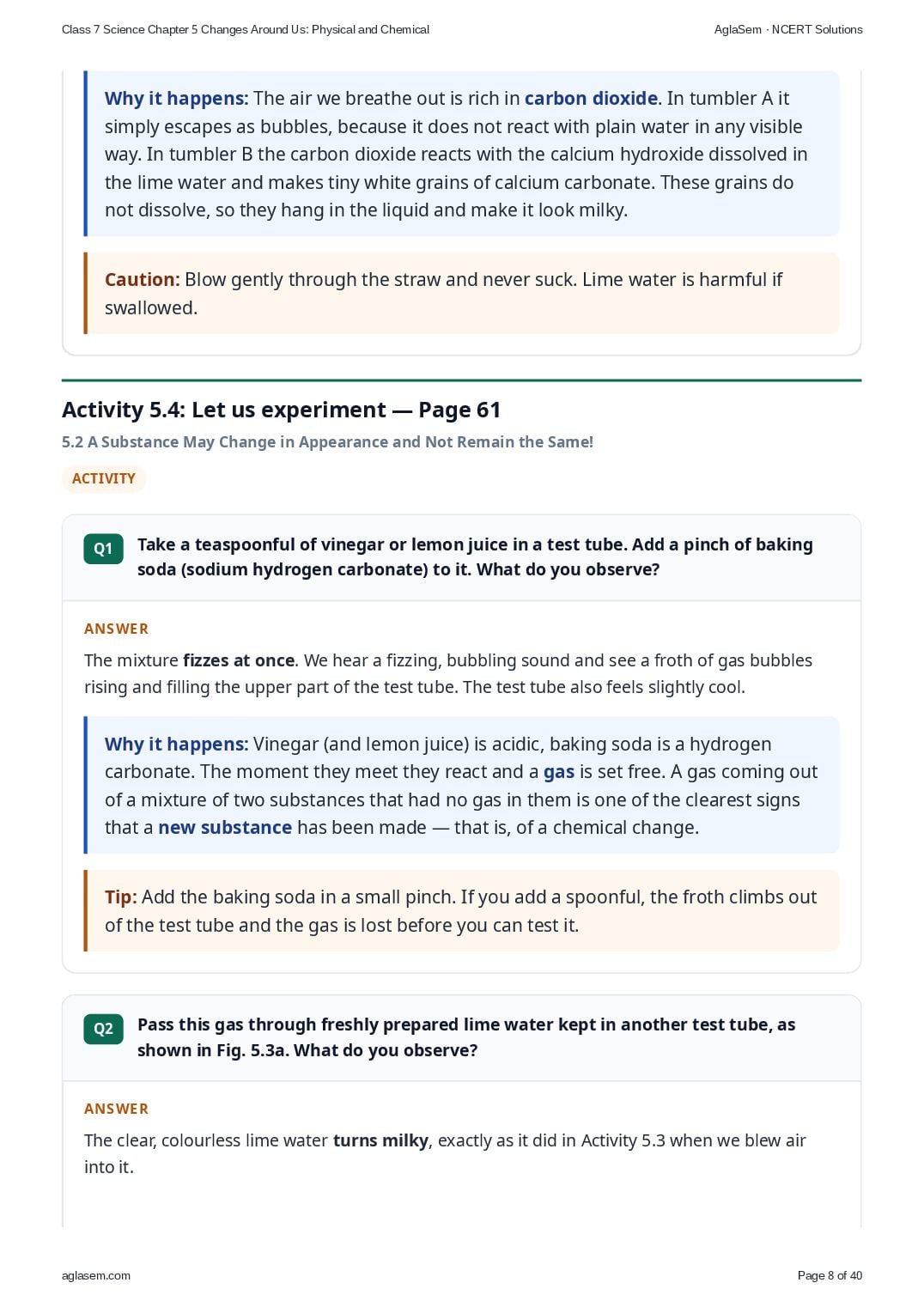
- Take a teaspoonful of vinegar or lemon juice in a test tube. Add a pinch of baking soda (sodium hydrogen carbonate) to it. What do you observe?
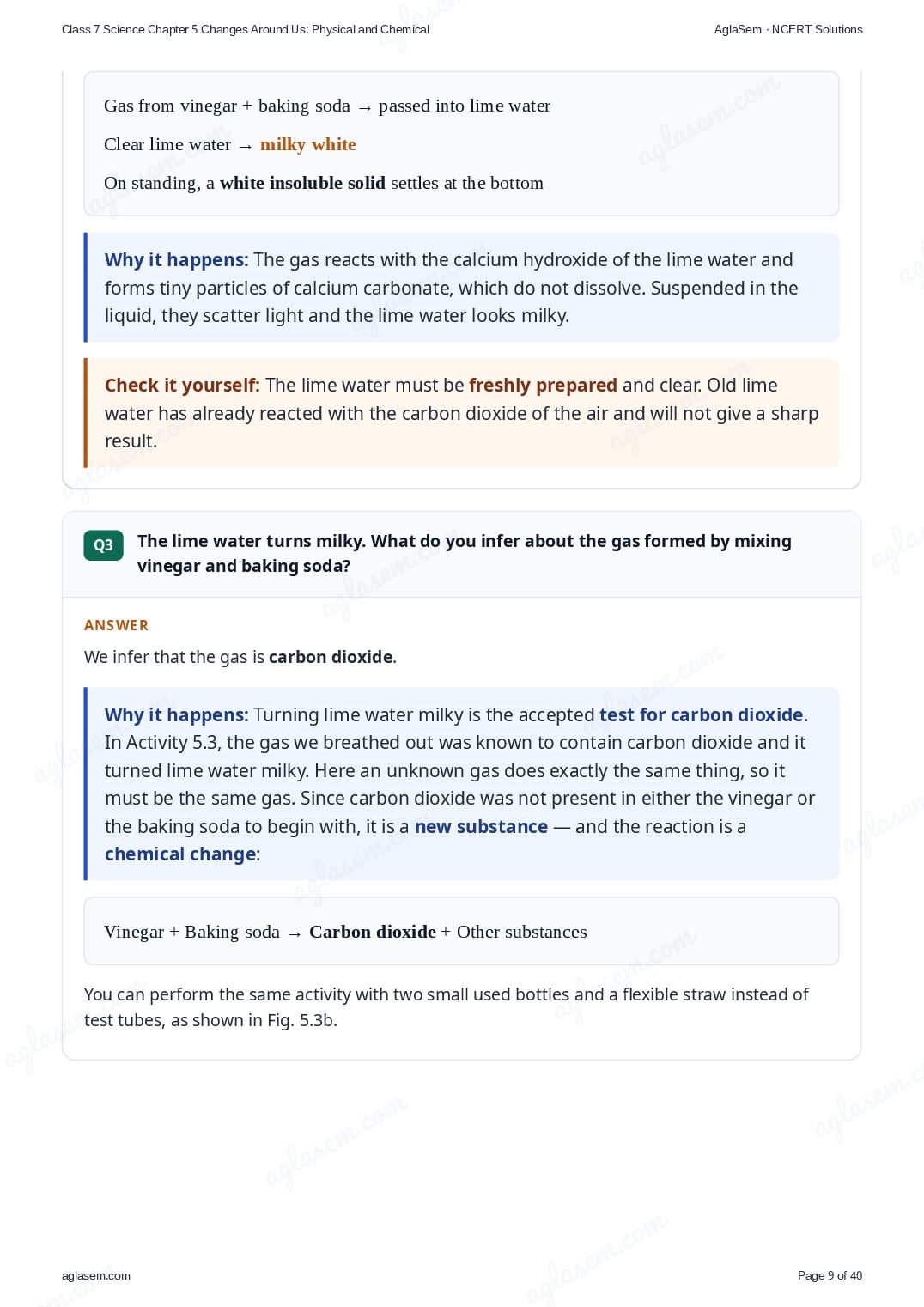
- Pass this gas through freshly prepared lime water kept in another test tube, as shown in Fig. 5.3a. What do you observe?
- The lime water turns milky. What do you infer about the gas formed by mixing vinegar and baking soda?
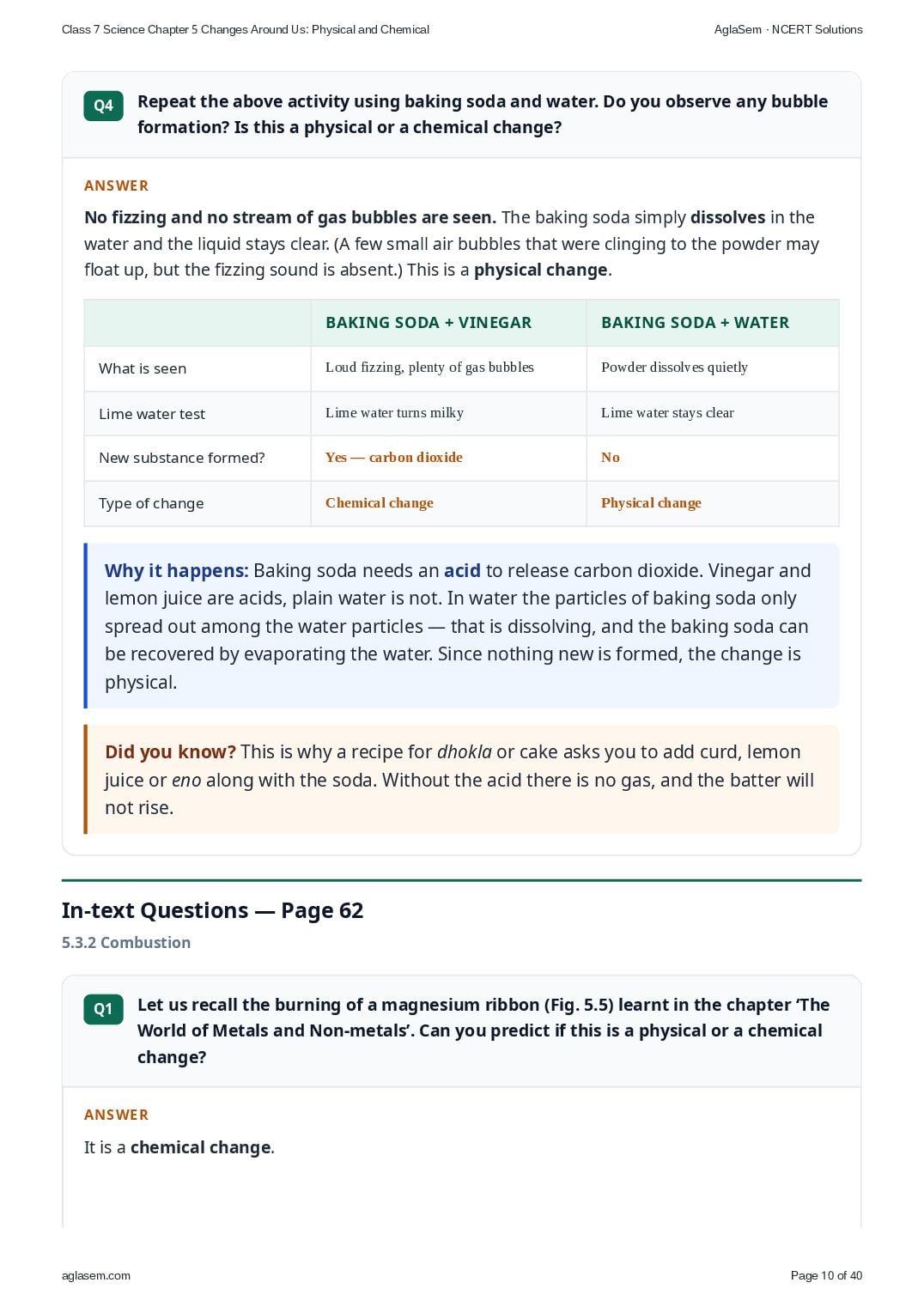
- Repeat the above activity using baking soda and water. Do you observe any bubble formation? Is this a physical or a chemical change?
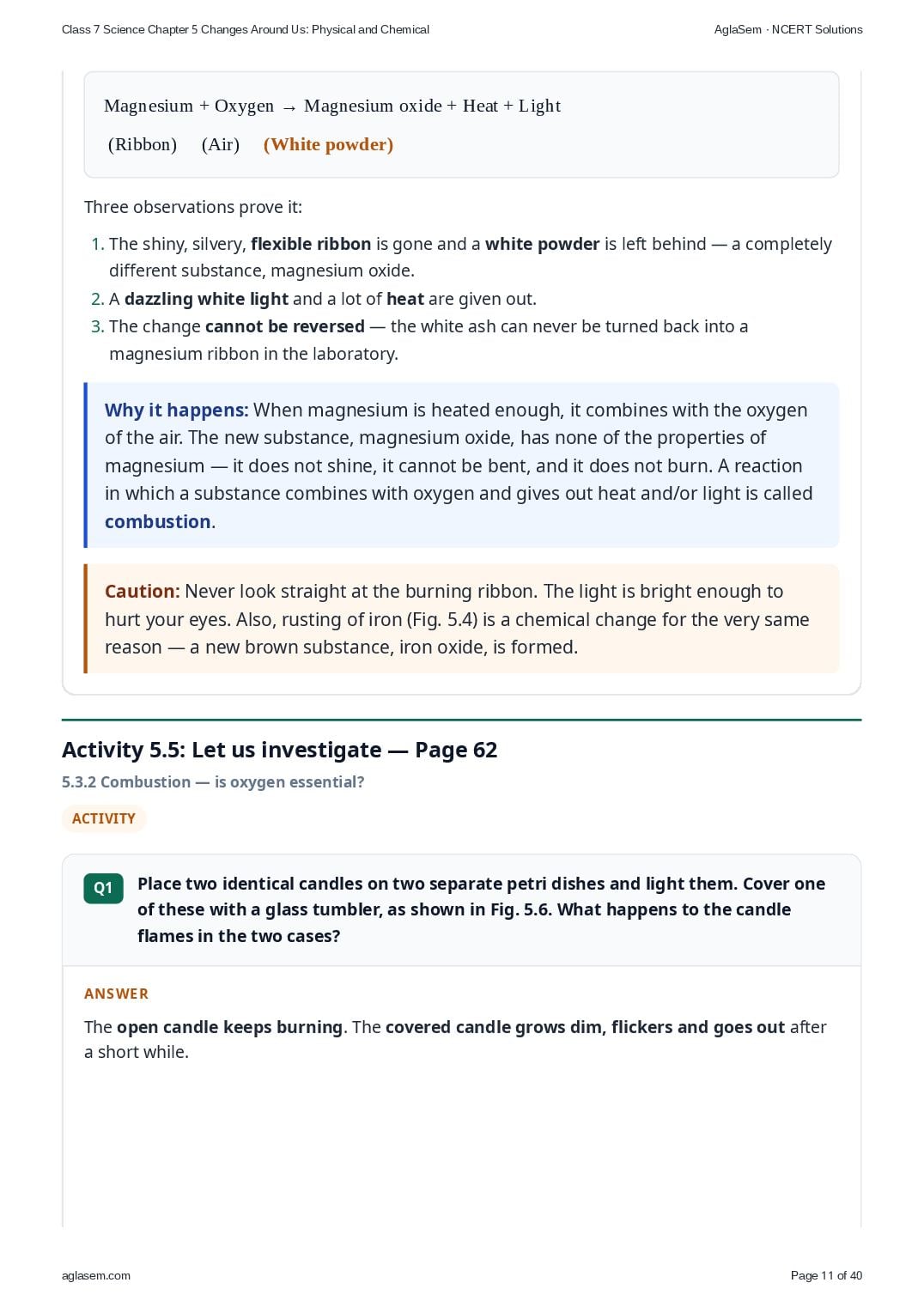
- Let us recall the burning of a magnesium ribbon (Fig. 5.5) learnt in the chapter ‘The World of Metals and Non-metals’. Can you predict if this is a physical or a chemical change?
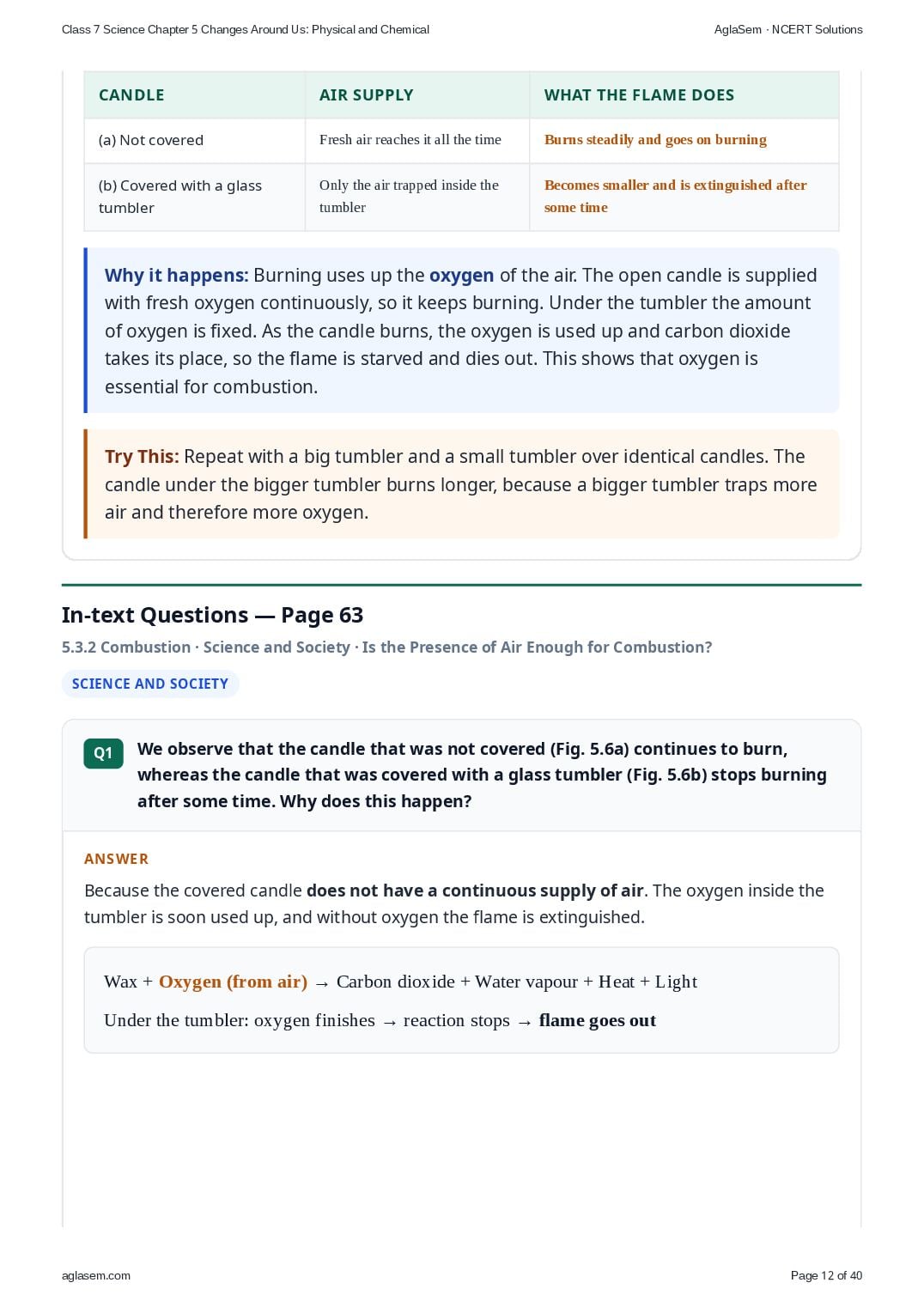
- Place two identical candles on two separate petri dishes and light them. Cover one of these with a glass tumbler, as shown in Fig. 5.6. What happens to the candle flames in the two cases?
- We observe that the candle that was not covered (Fig. 5.6a) continues to burn, whereas the candle that was covered with a glass tumbler (Fig. 5.6b) stops burning after some time. Why does this happen?
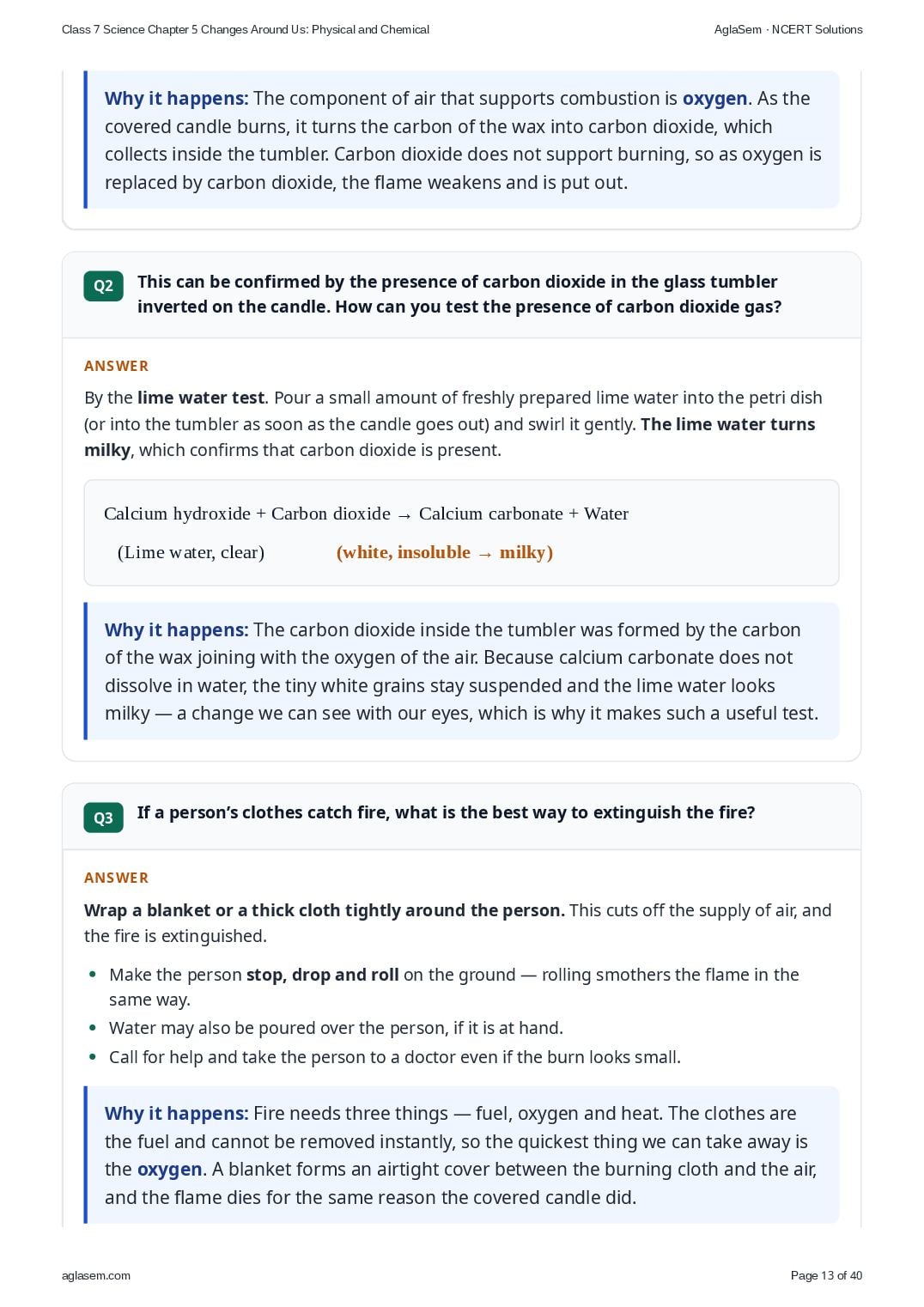
- This can be confirmed by the presence of carbon dioxide in the glass tumbler inverted on the candle. How can you test the presence of carbon dioxide gas?
- If a person’s clothes catch fire, what is the best way to extinguish the fire?
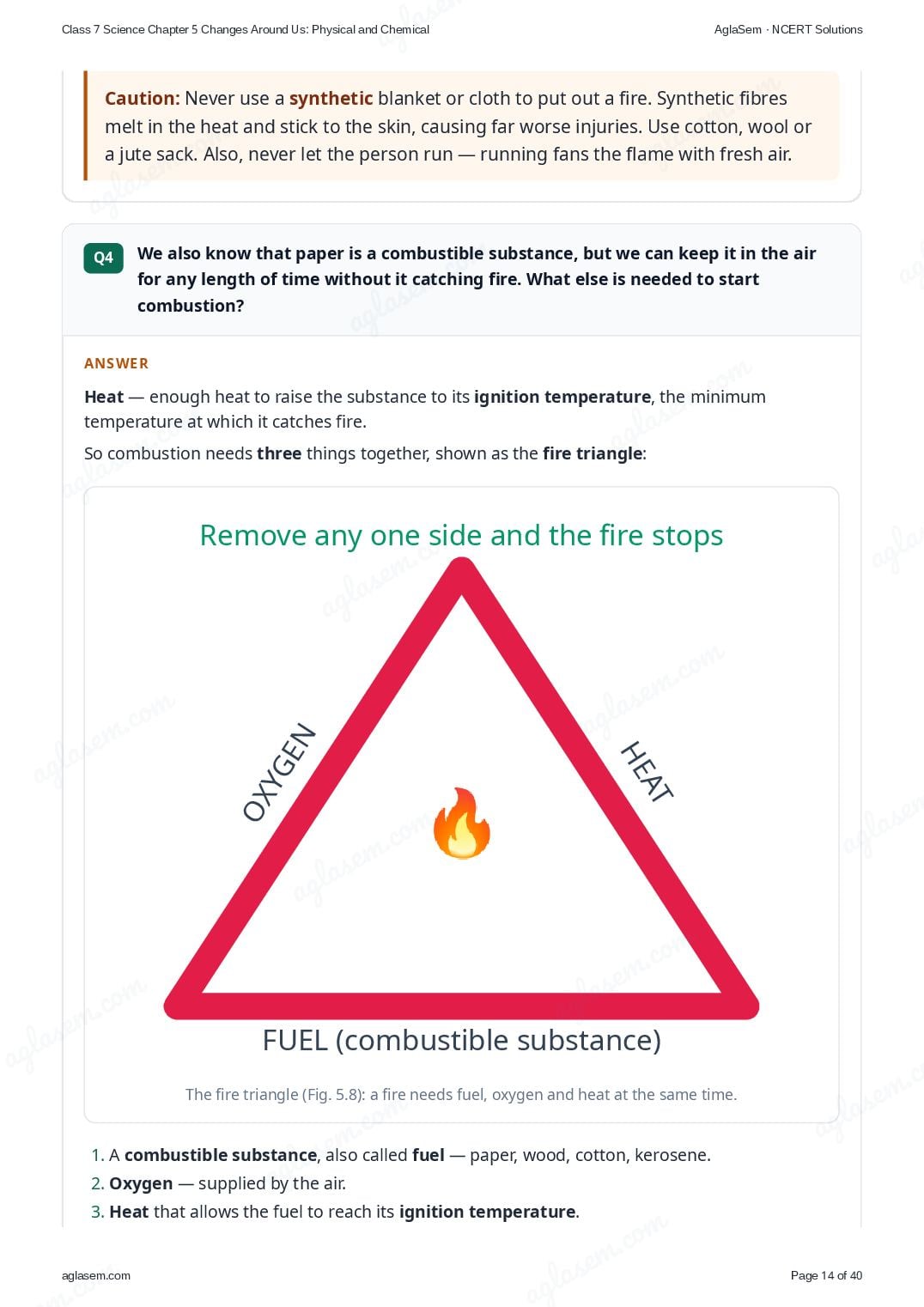
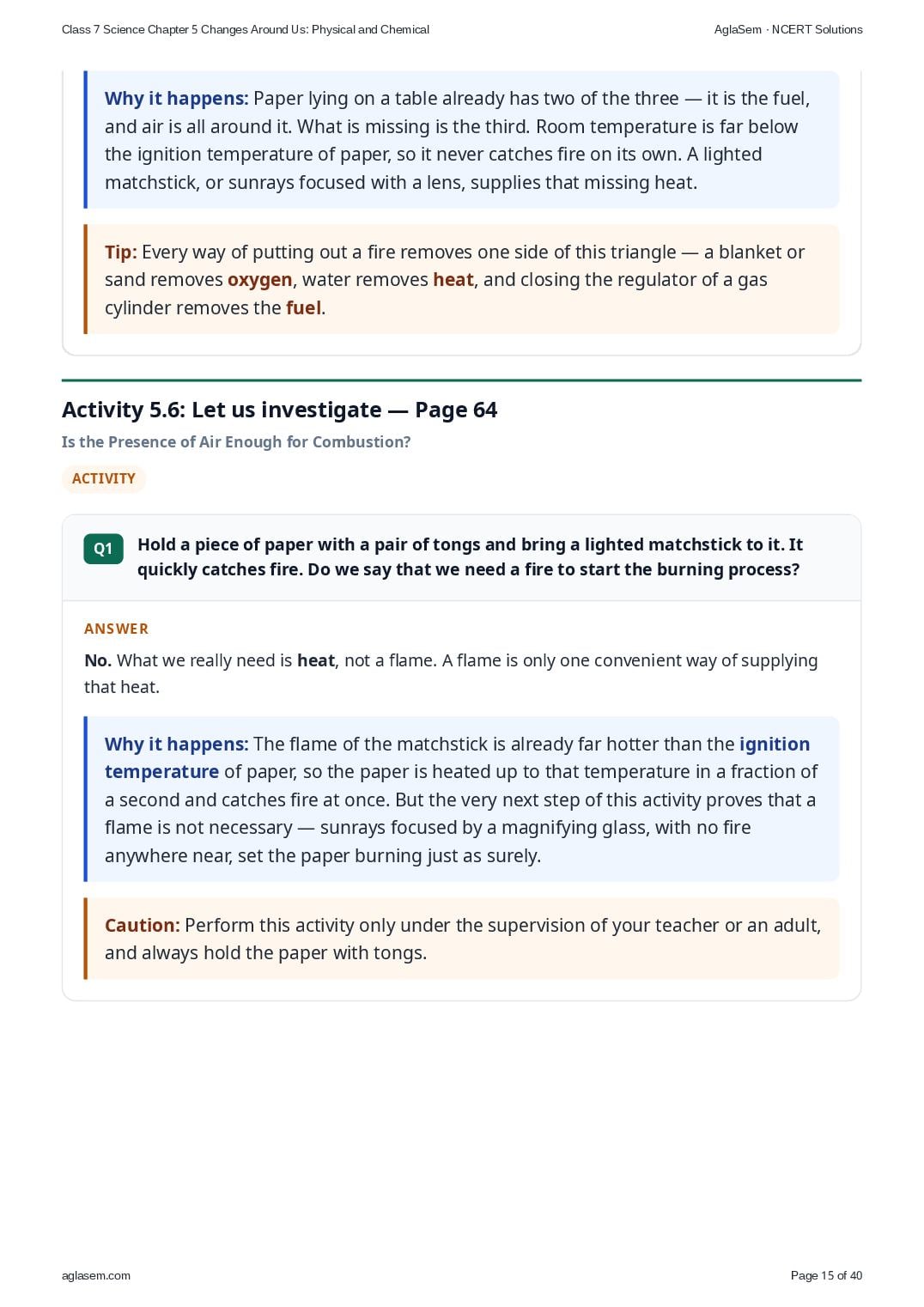
- We also know that paper is a combustible substance, but we can keep it in the air for any length of time without it catching fire. What else is needed to start combustion?
- Hold a piece of paper with a pair of tongs and bring a lighted matchstick to it. It quickly catches fire. Do we say that we need a fire to start the burning process?
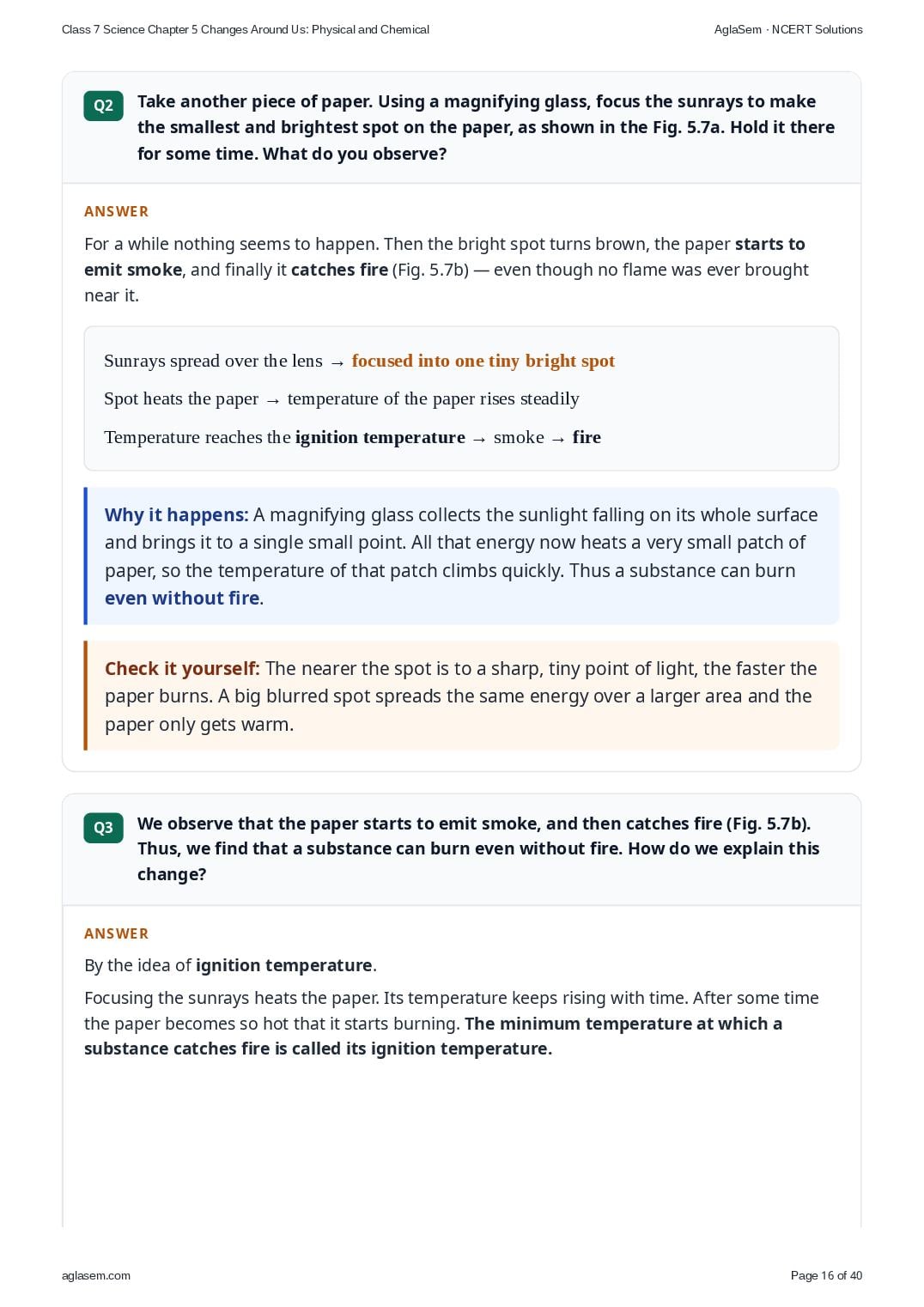
- Take another piece of paper. Using a magnifying glass, focus the sunrays to make the smallest and brightest spot on the paper, as shown in the Fig. 5.7a. Hold it there for some time. What do you observe?
- We observe that the paper starts to emit smoke, and then catches fire (Fig. 5.7b). Thus, we find that a substance can burn even without fire. How do we explain this change?
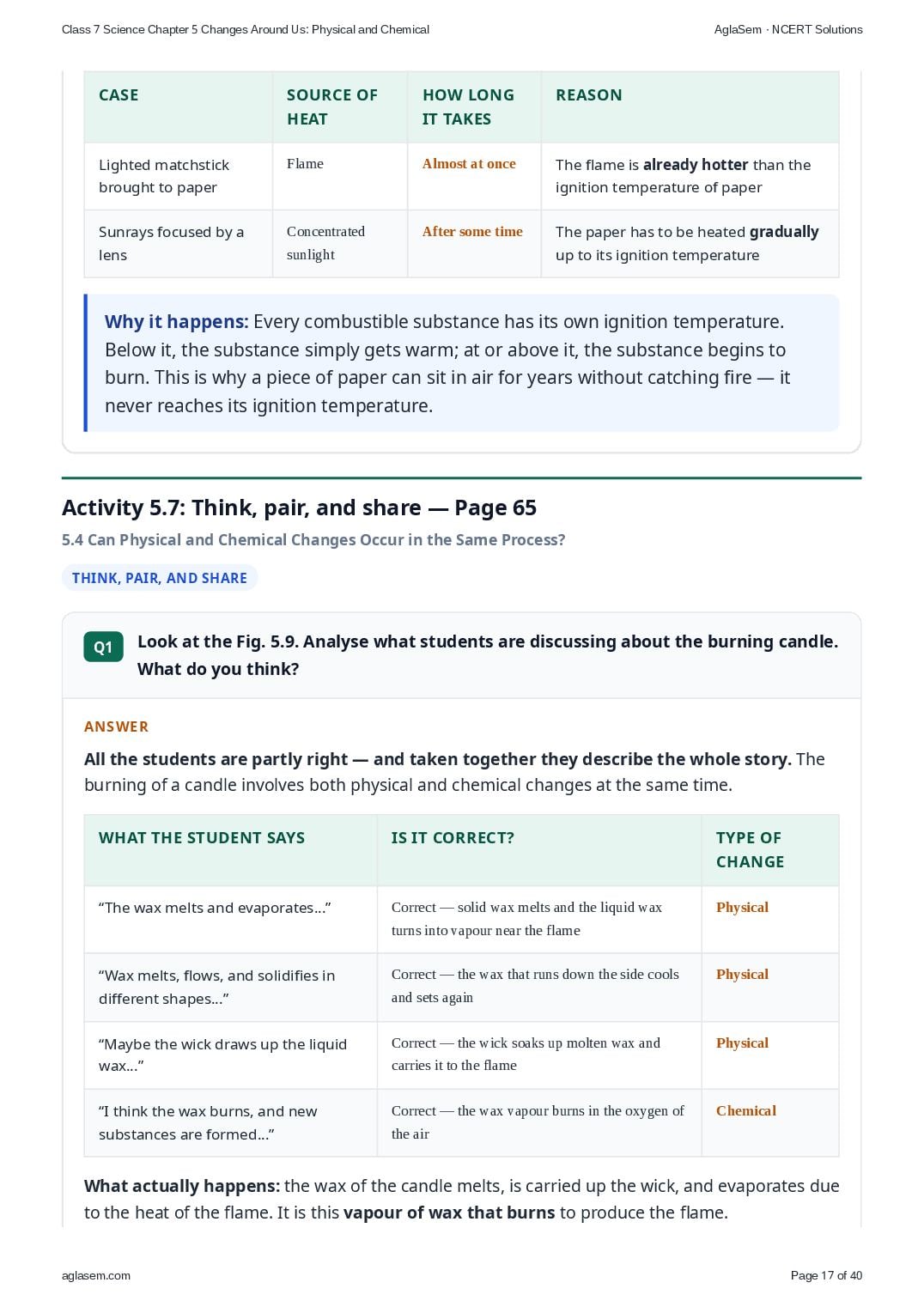
- Look at the Fig. 5.9. Analyse what students are discussing about the burning candle. What do you think?
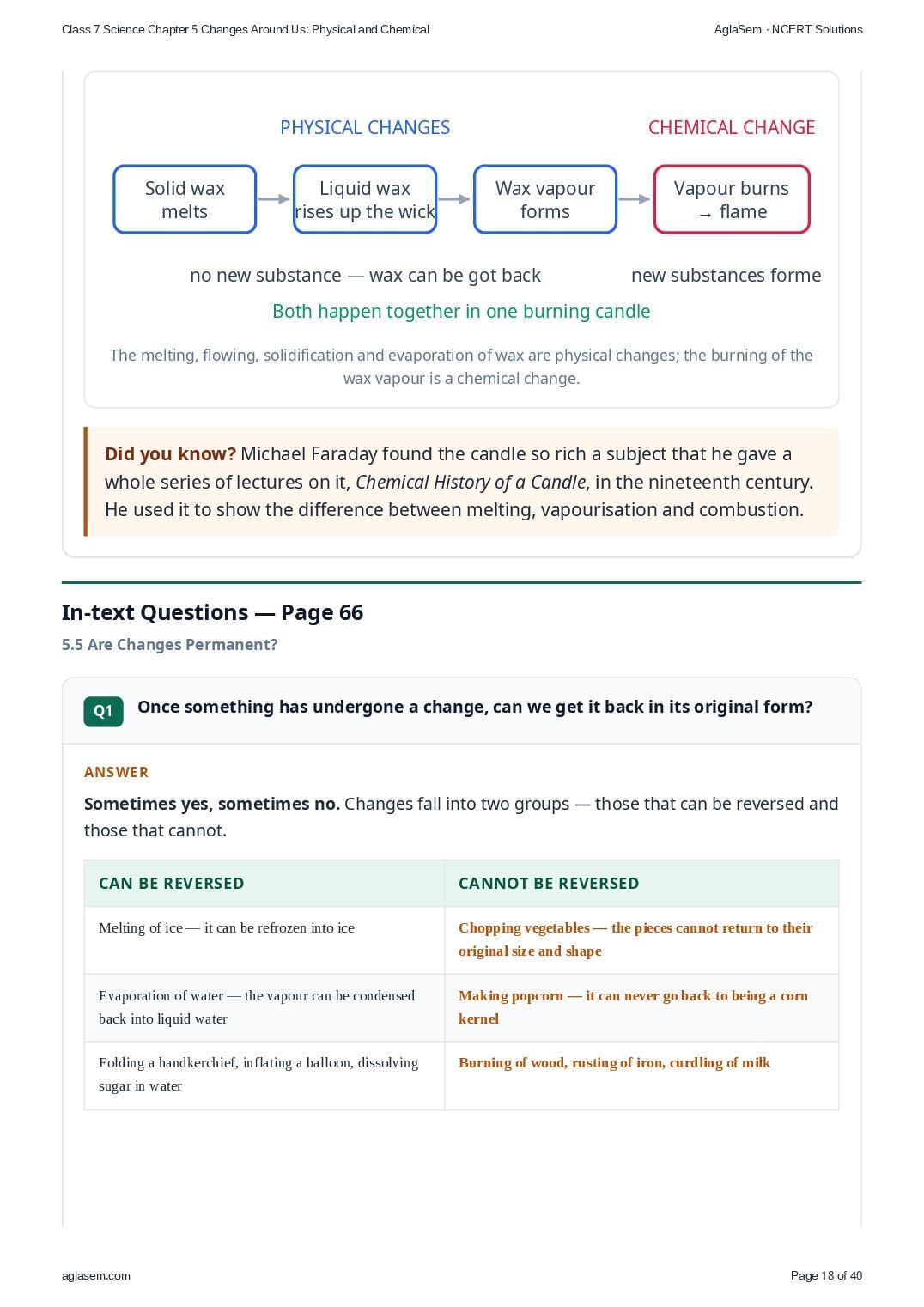
- Once something has undergone a change, can we get it back in its original form?
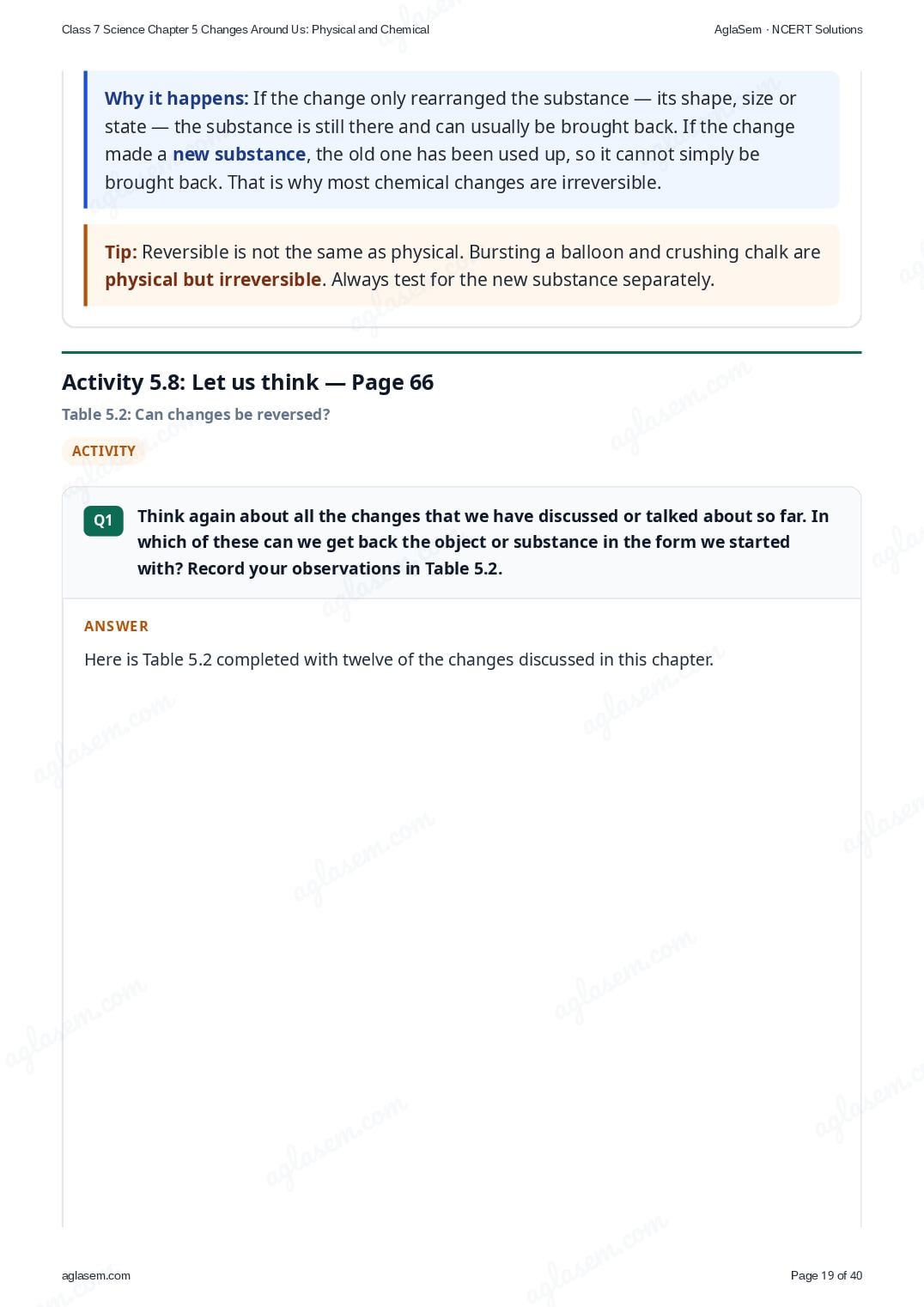
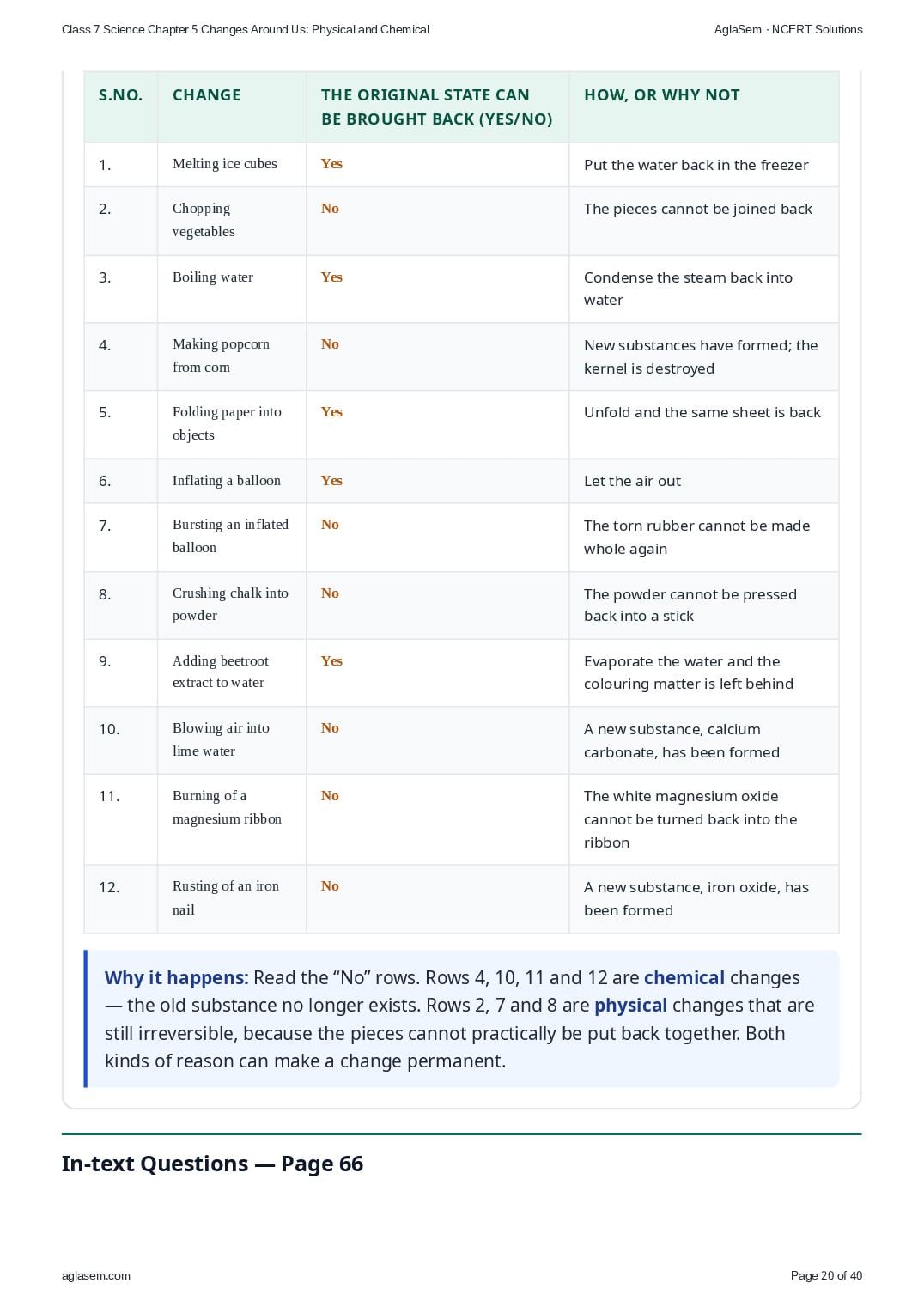
- Think again about all the changes that we have discussed or talked about so far. In which of these can we get back the object or substance in the form we started with? Record your observations in Table 5.2.
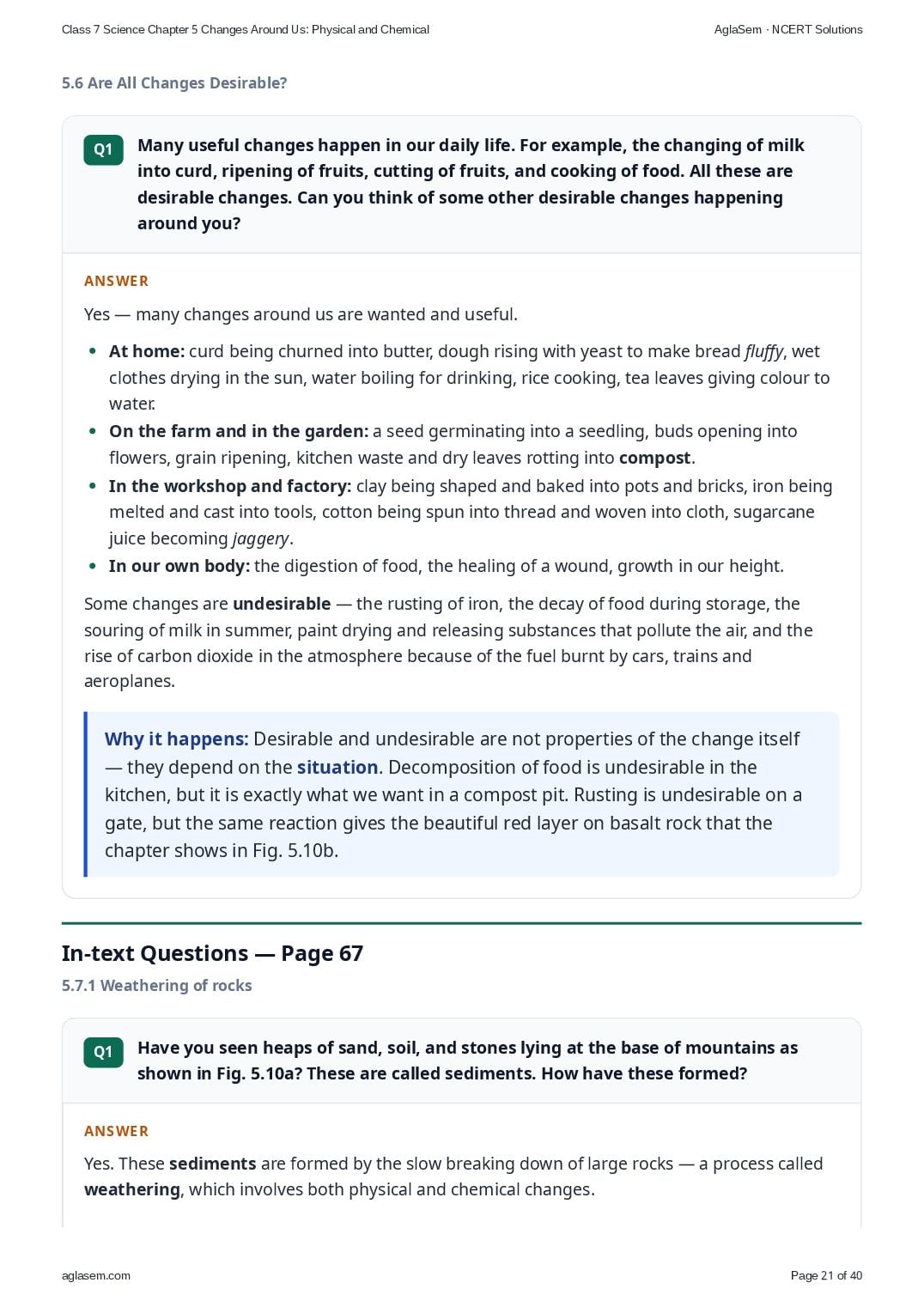
- Many useful changes happen in our daily life. For example, the changing of milk into curd, ripening of fruits, cutting of fruits, and cooking of food. All these are desirable changes. Can you think of some other desirable changes happening around you?
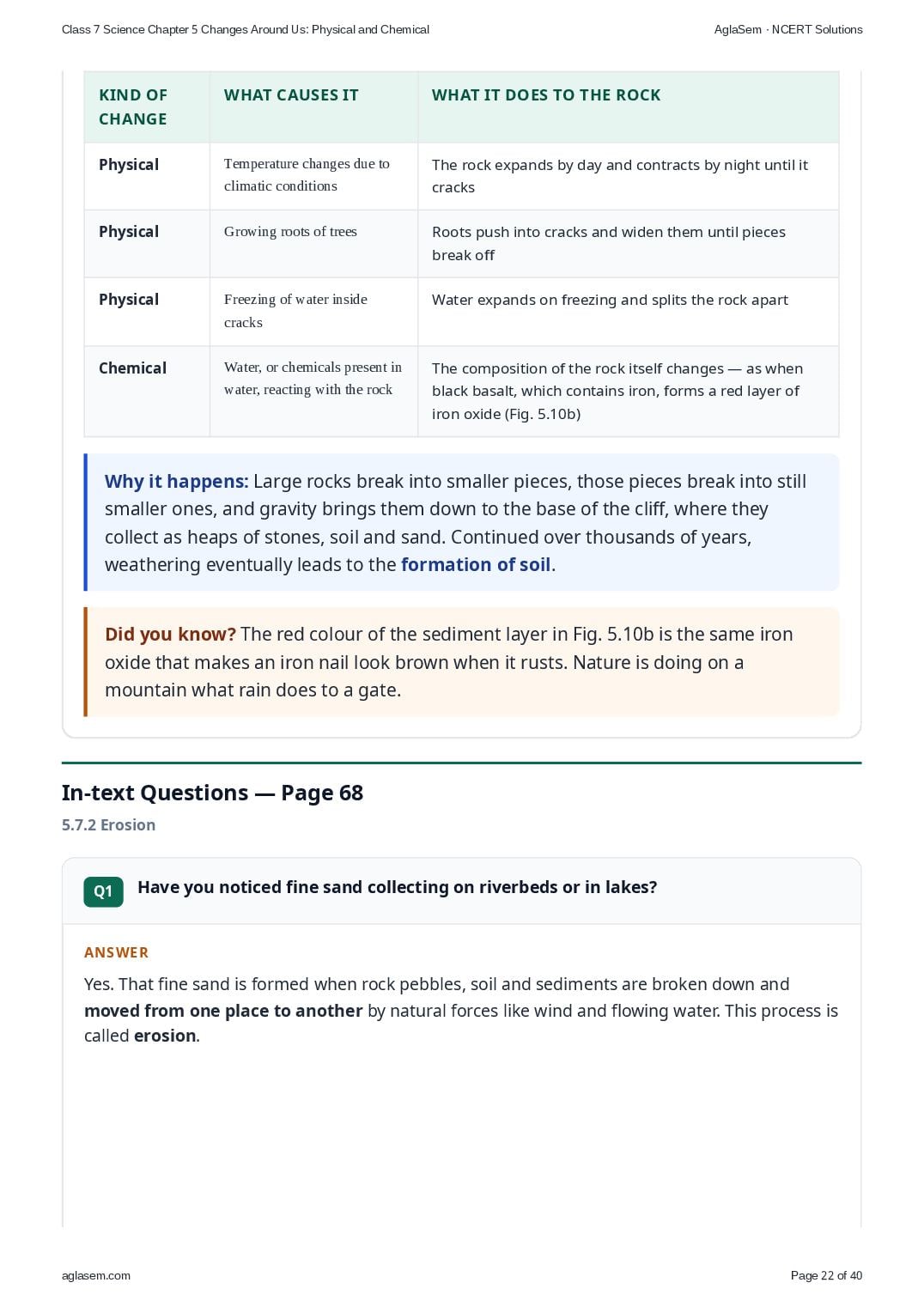
- Have you seen heaps of sand, soil, and stones lying at the base of mountains as shown in Fig. 5.10a? These are called sediments. How have these formed?
- Have you noticed fine sand collecting on riverbeds or in lakes?
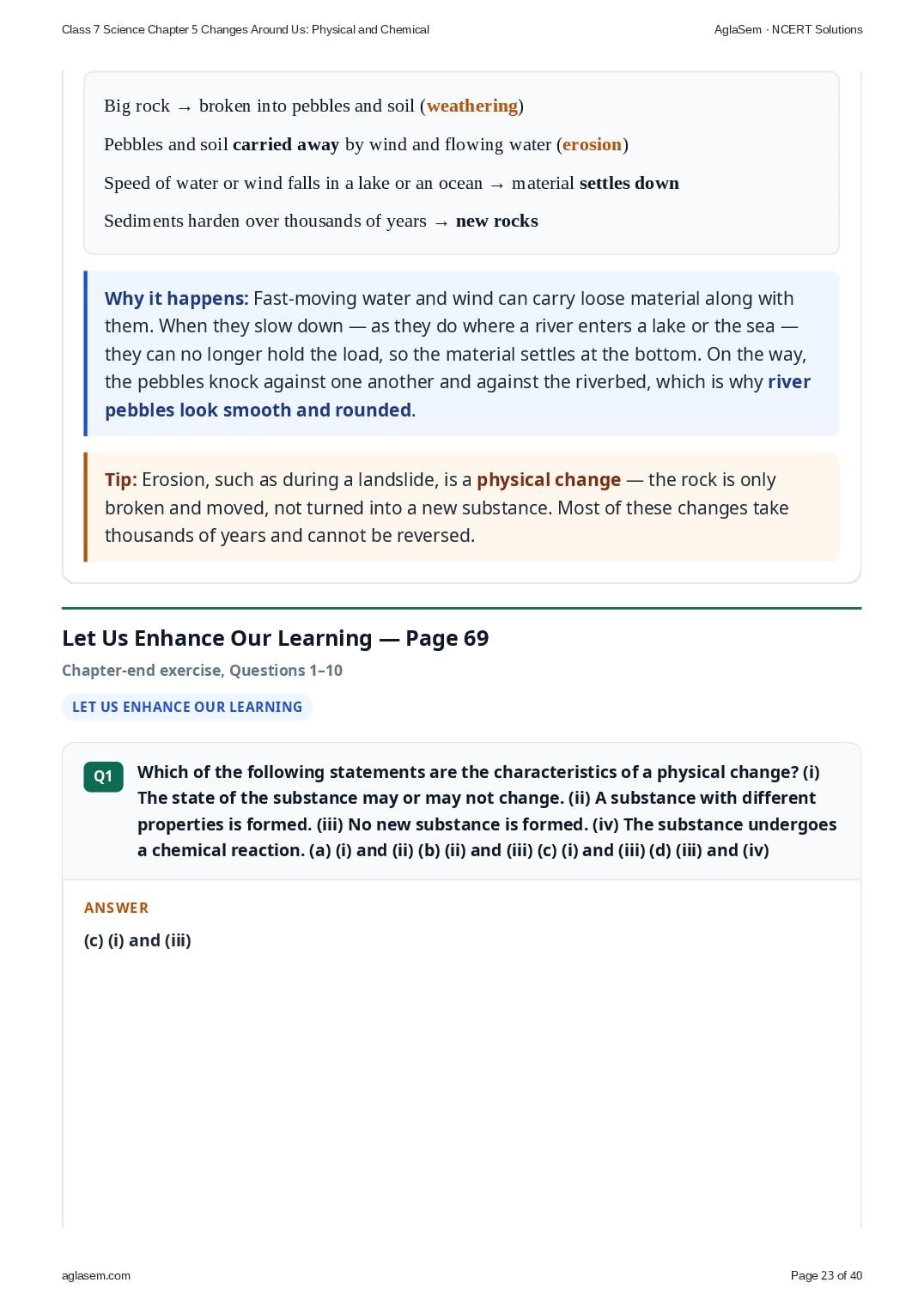
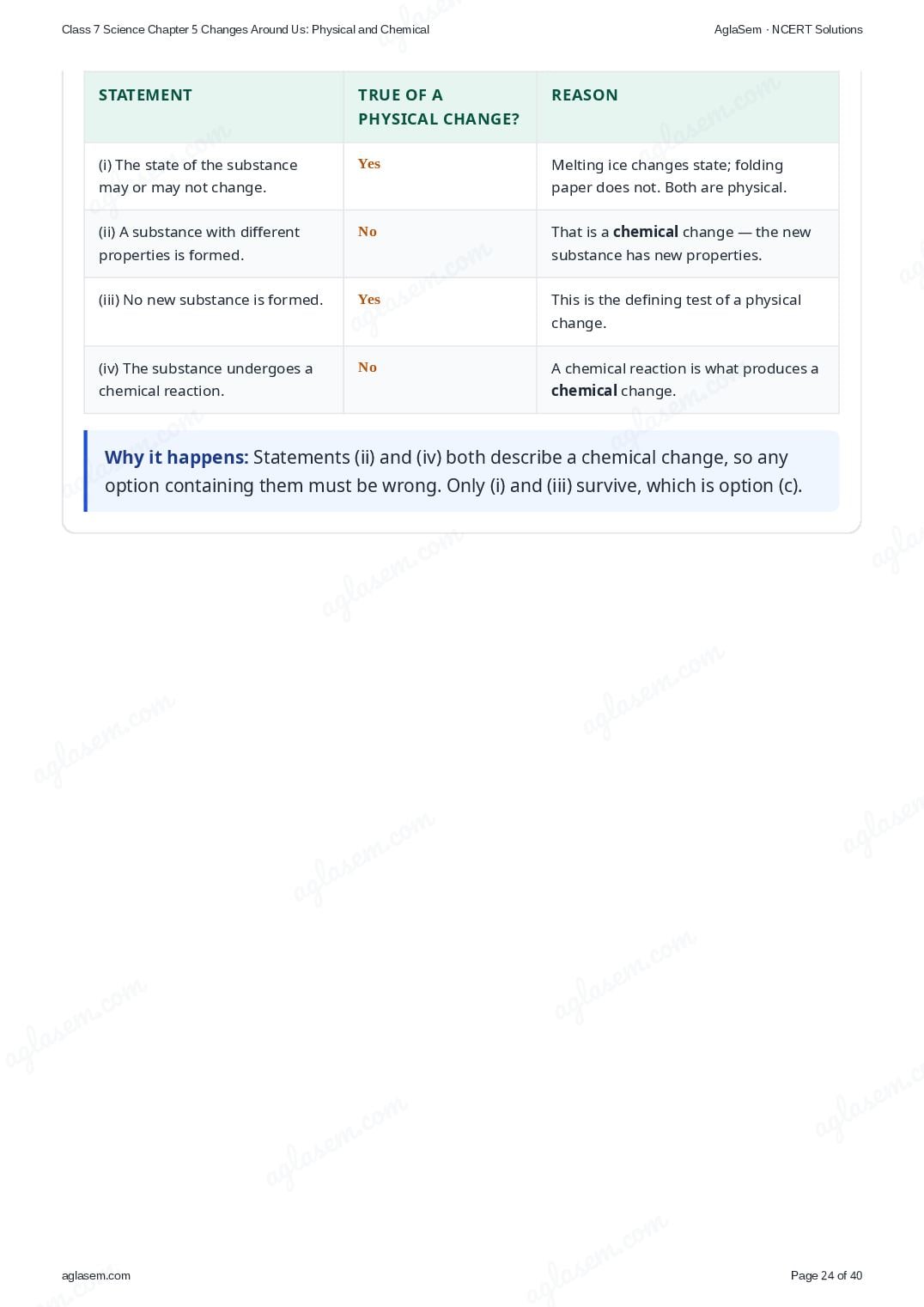
- Which of the following statements are the characteristics of a physical change? (i) The state of the substance may or may not change. (ii) A substance with different properties is formed. (iii) No new substance is formed. (iv) The substance undergoes a chemical reaction. (a) (i) and (ii) (b) (ii) and (iii) (c) (i) and (iii) (d) (iii) and (iv)
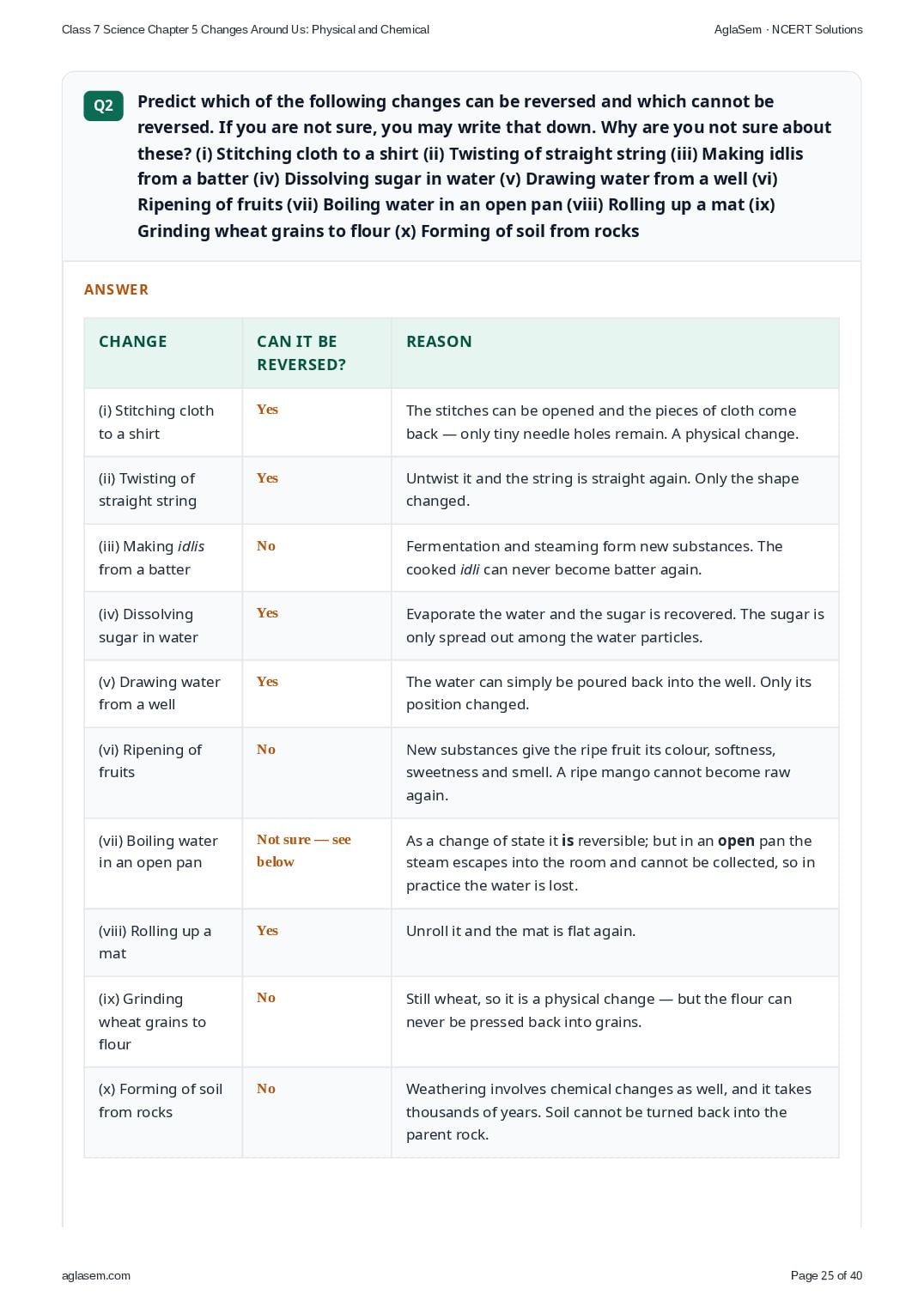
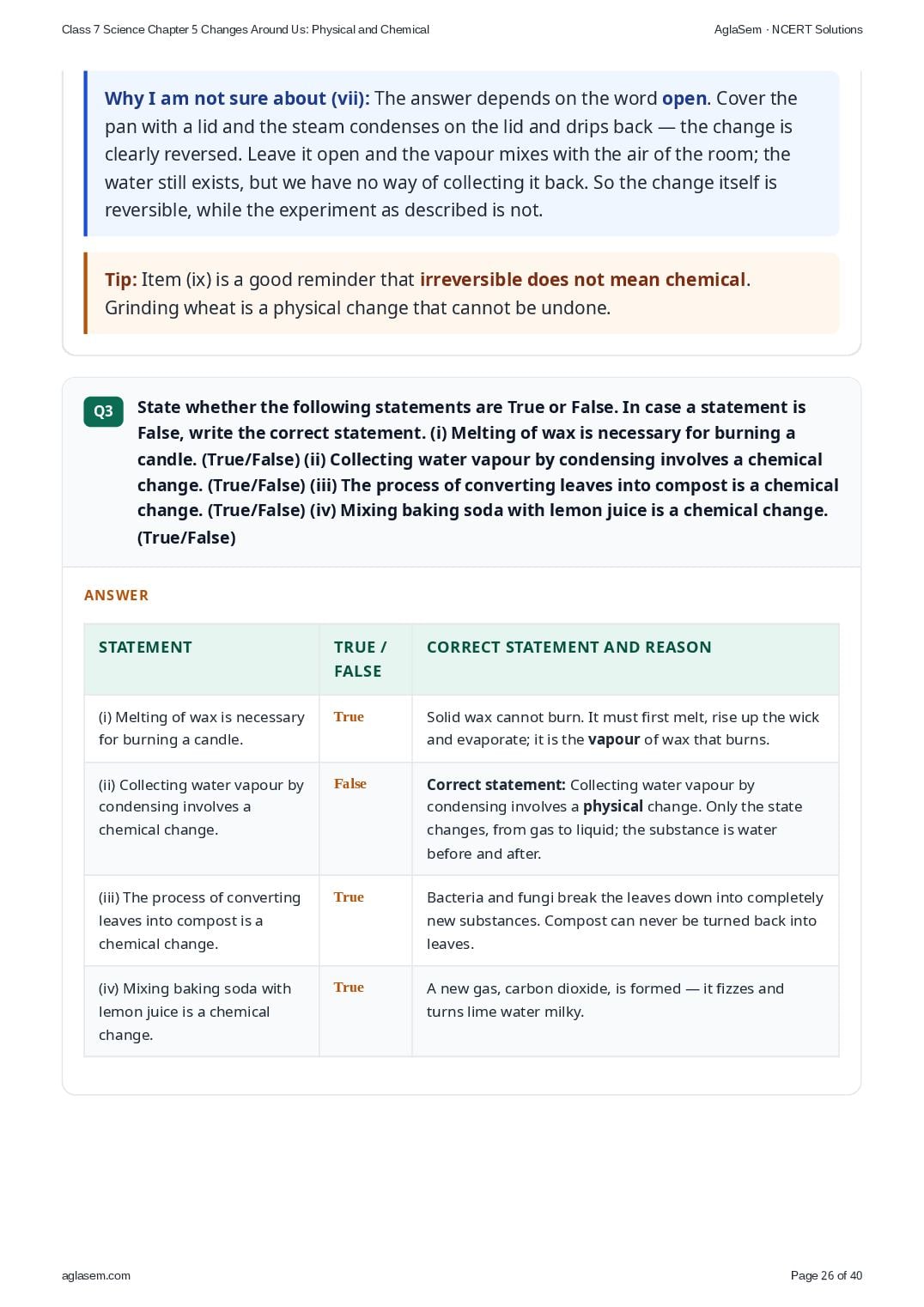
- Predict which of the following changes can be reversed and which cannot be reversed. If you are not sure, you may write that down. Why are you not sure about these? (i) Stitching cloth to a shirt (ii) Twisting of straight string (iii) Making idlis from a batter (iv) Dissolving sugar in water (v) Drawing water from a well (vi) Ripening of fruits (vii) Boiling water in an open pan (viii) Rolling up a mat (ix) Grinding wheat grains to flour (x) Forming of soil from rocks
- State whether the following statements are True or False. In case a statement is False, write the correct statement. (i) Melting of wax is necessary for burning a candle. (True/False) (ii) Collecting water vapour by condensing involves a chemical change. (True/False) (iii) The process of converting leaves into compost is a chemical change. (True/False) (iv) Mixing baking soda with lemon juice is a chemical change. (True/False)
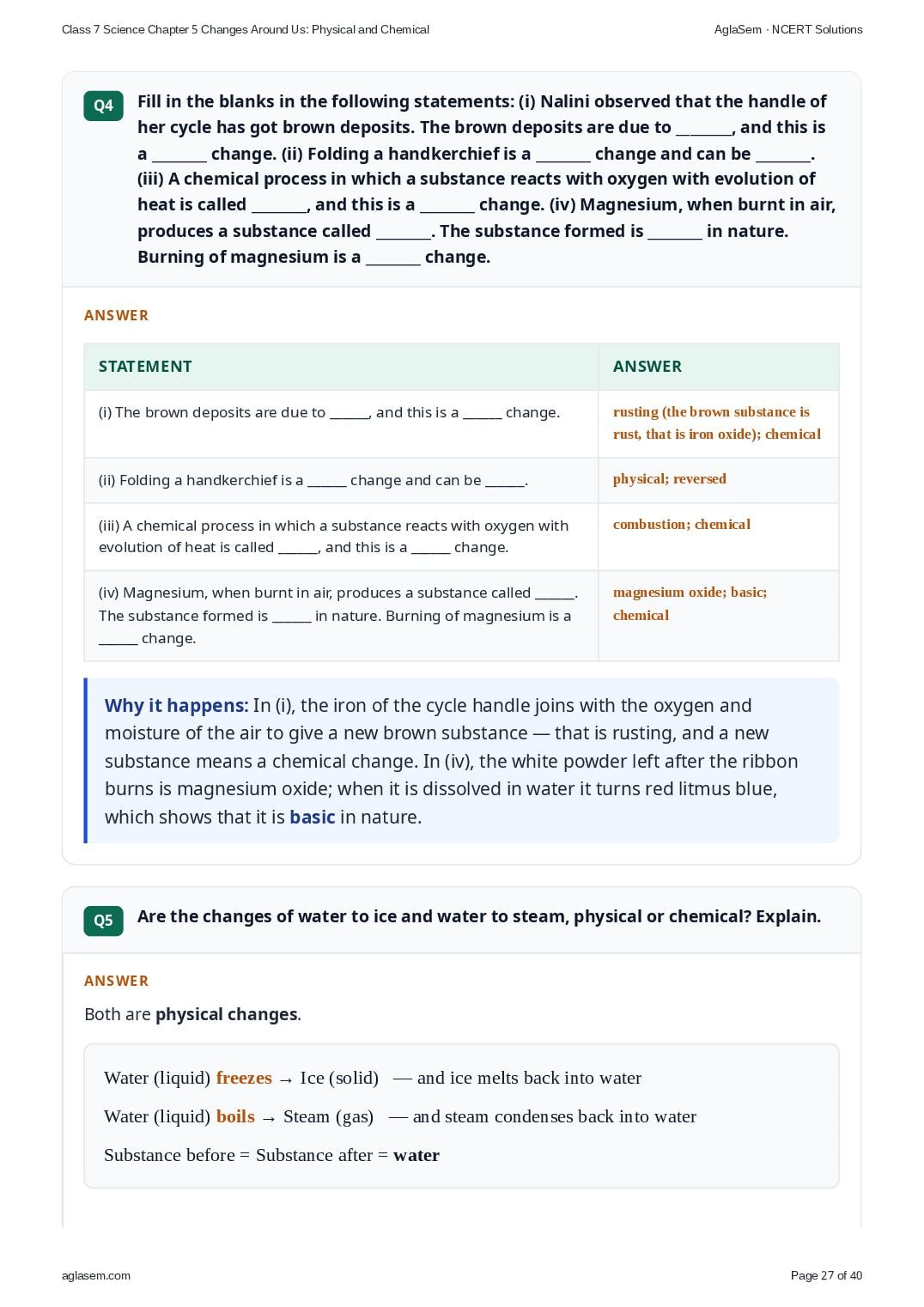
- Fill in the blanks in the following statements: (i) Nalini observed that the handle of her cycle has got brown deposits. The brown deposits are due to ________, and this is a ________ change. (ii) Folding a handkerchief is a ________ change and can be ________. (iii) A chemical process in which a substance reacts with oxygen with evolution of heat is called ________, and this is a ________ change. (iv) Magnesium, when burnt in air, produces a substance called ________. The substance formed is ________ in nature. Burning of magnesium is a ________ change.
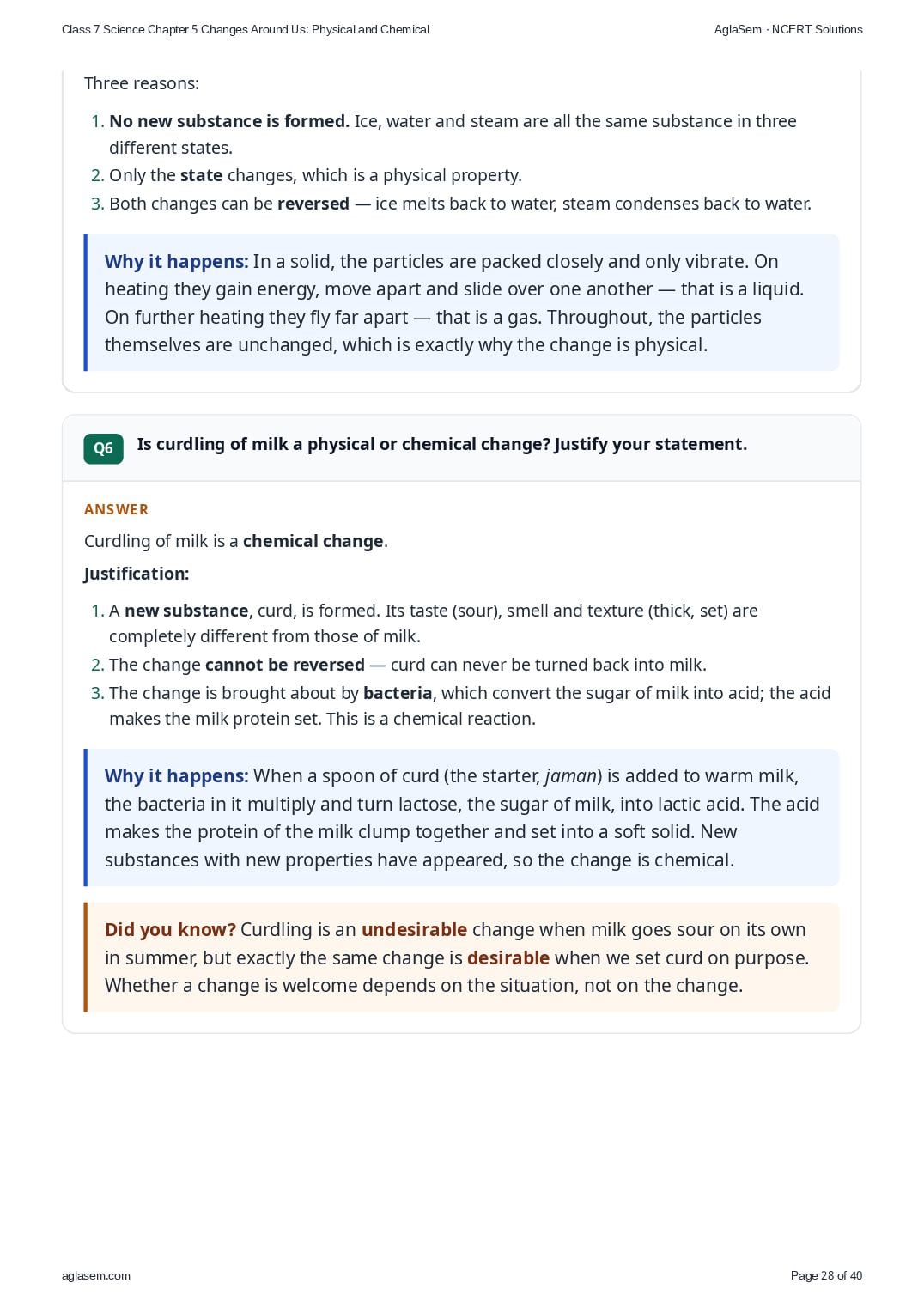
- Are the changes of water to ice and water to steam, physical or chemical? Explain.
- Is curdling of milk a physical or chemical change? Justify your statement.
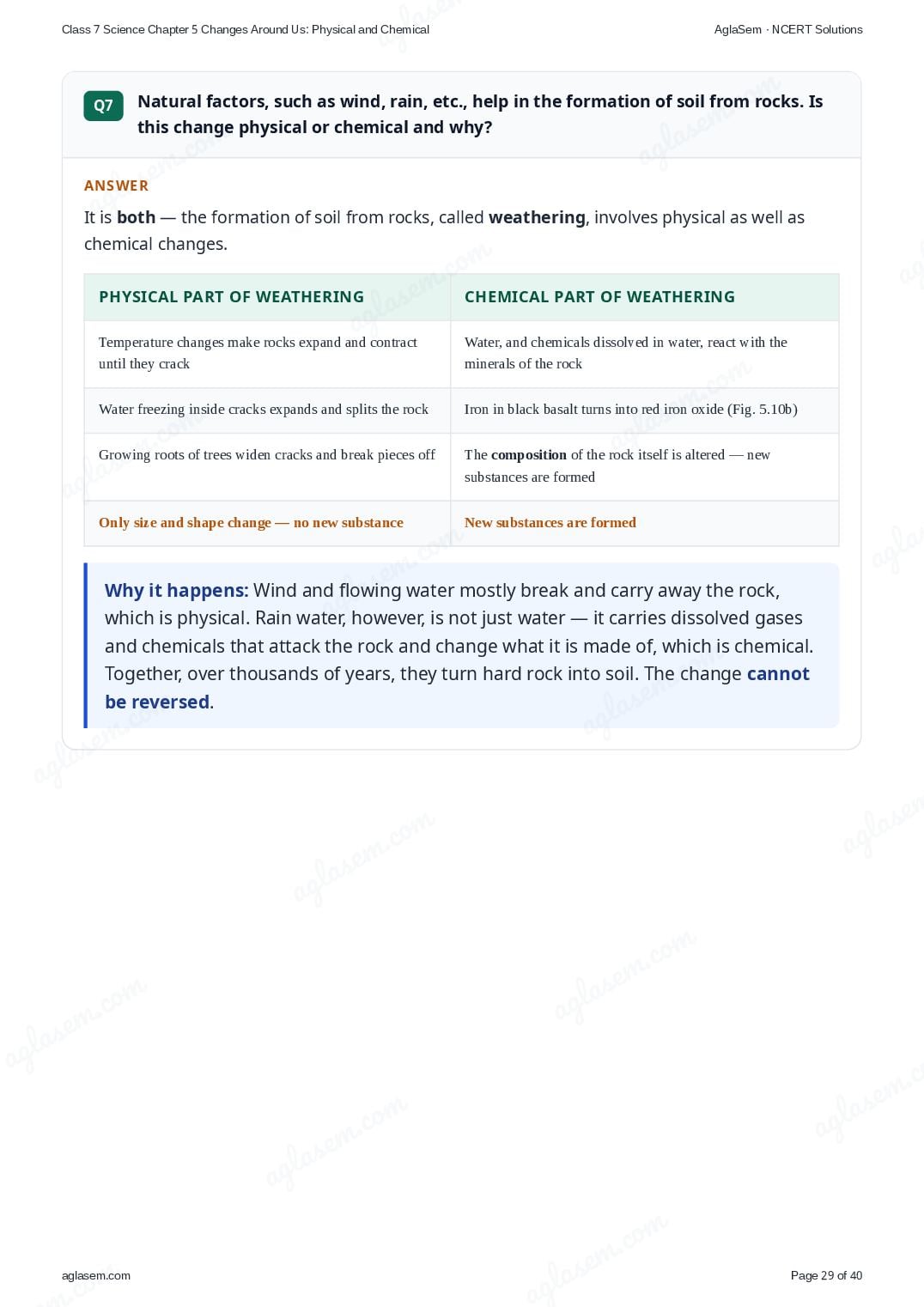
- Natural factors, such as wind, rain, etc., help in the formation of soil from rocks. Is this change physical or chemical and why?
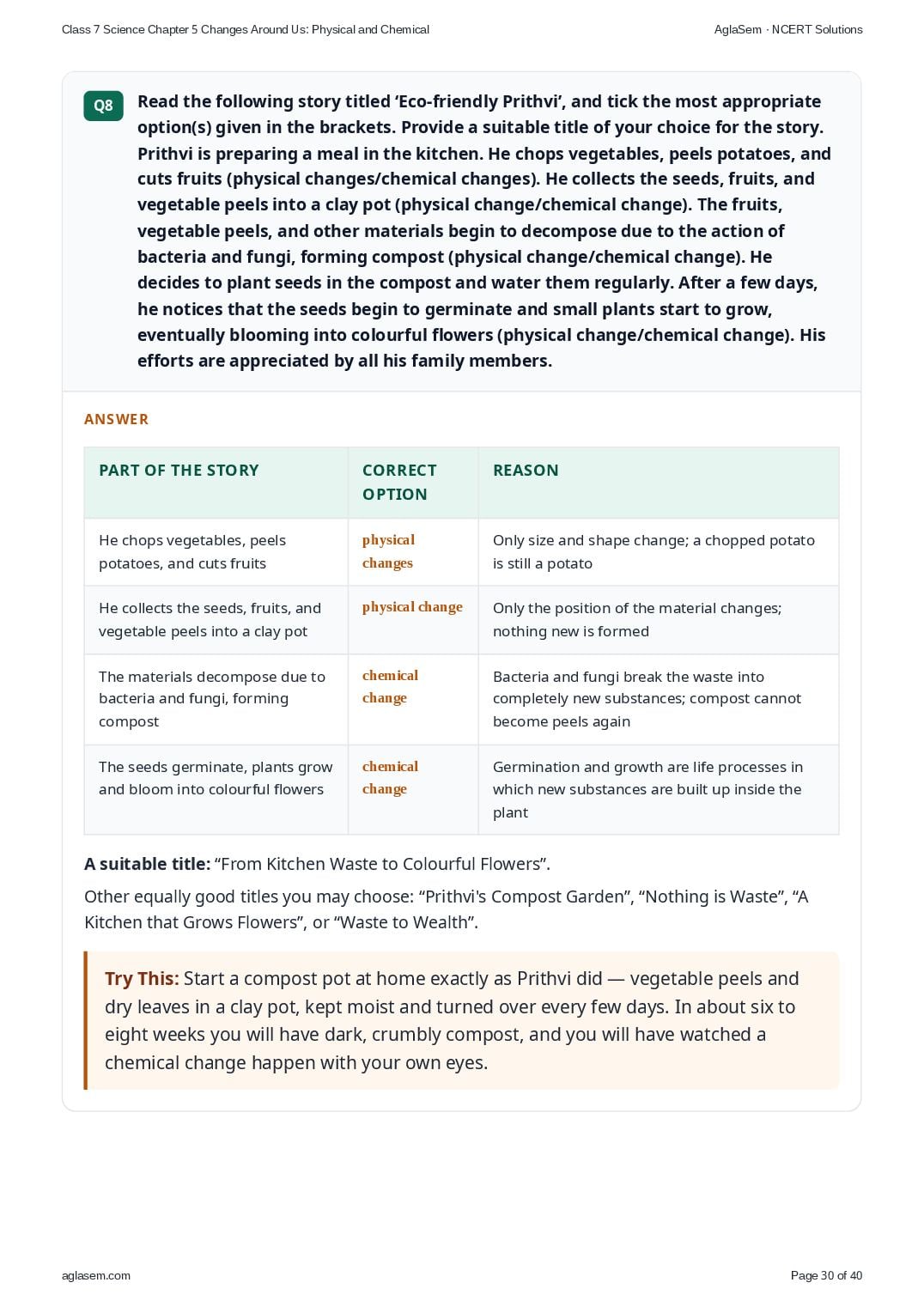
- Read the following story titled ‘Eco-friendly Prithvi’, and tick the most appropriate option(s) given in the brackets. Provide a suitable title of your choice for the story. Prithvi is preparing a meal in the kitchen. He chops vegetables, peels potatoes, and cuts fruits (physical changes/chemical changes). He collects the seeds, fruits, and vegetable peels into a clay pot (physical change/chemical change). The fruits, vegetable peels, and other materials begin to decompose due to the action of bacteria and fungi, forming compost (physical change/chemical change). He decides to plant seeds in the compost and water them regularly. After a few days, he notices that the seeds begin to germinate and small plants start to grow, eventually blooming into colourful flowers (physical change/chemical change). His efforts are appreciated by all his family members.
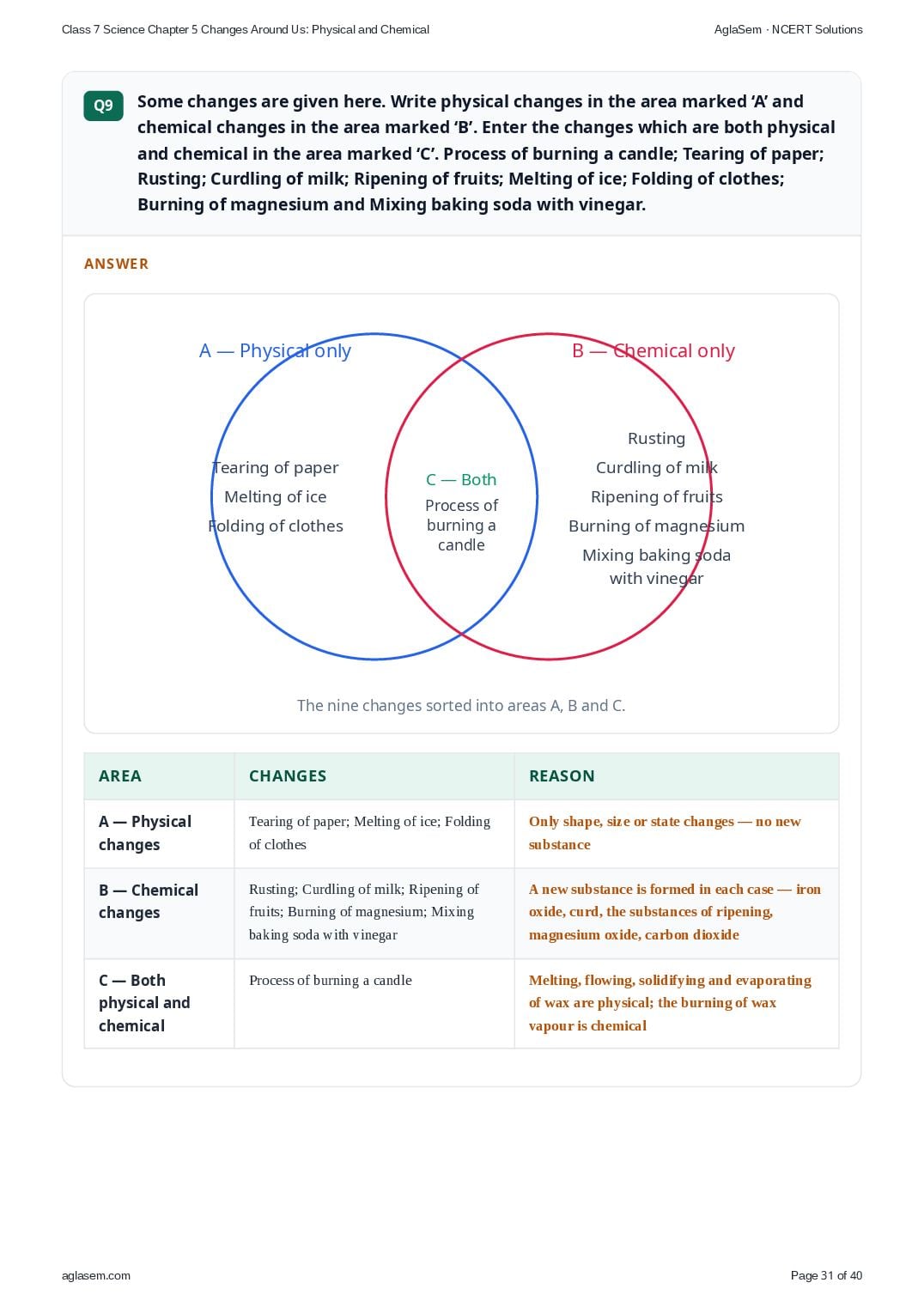
- Some changes are given here. Write physical changes in the area marked ‘A’ and chemical changes in the area marked ‘B’. Enter the changes which are both physical and chemical in the area marked ‘C’. Process of burning a candle; Tearing of paper; Rusting; Curdling of milk; Ripening of fruits; Melting of ice; Folding of clothes; Burning of magnesium and Mixing baking soda with vinegar.
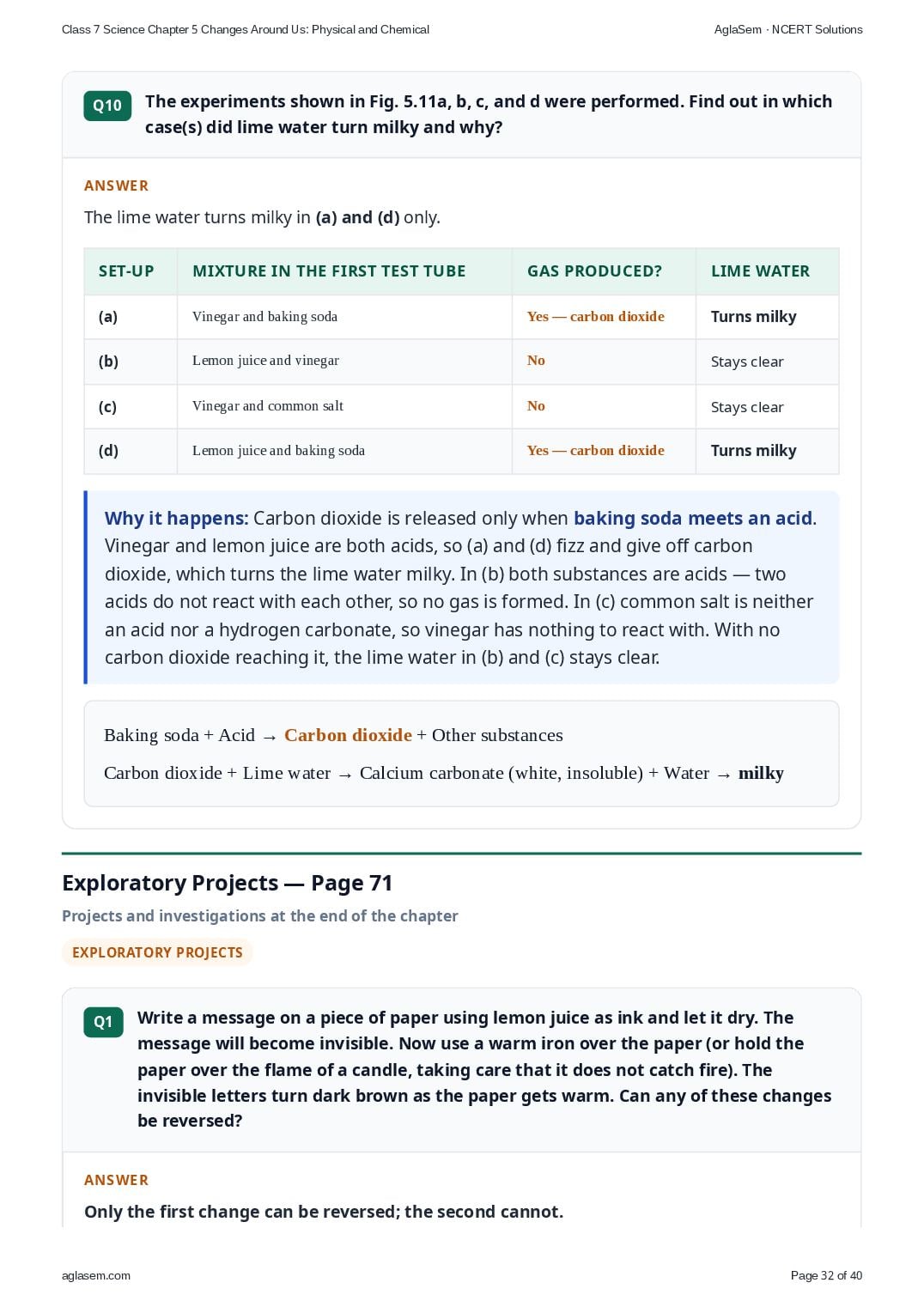
- The experiments shown in Fig. 5.11a, b, c, and d were performed. Find out in which case(s) did lime water turn milky and why?
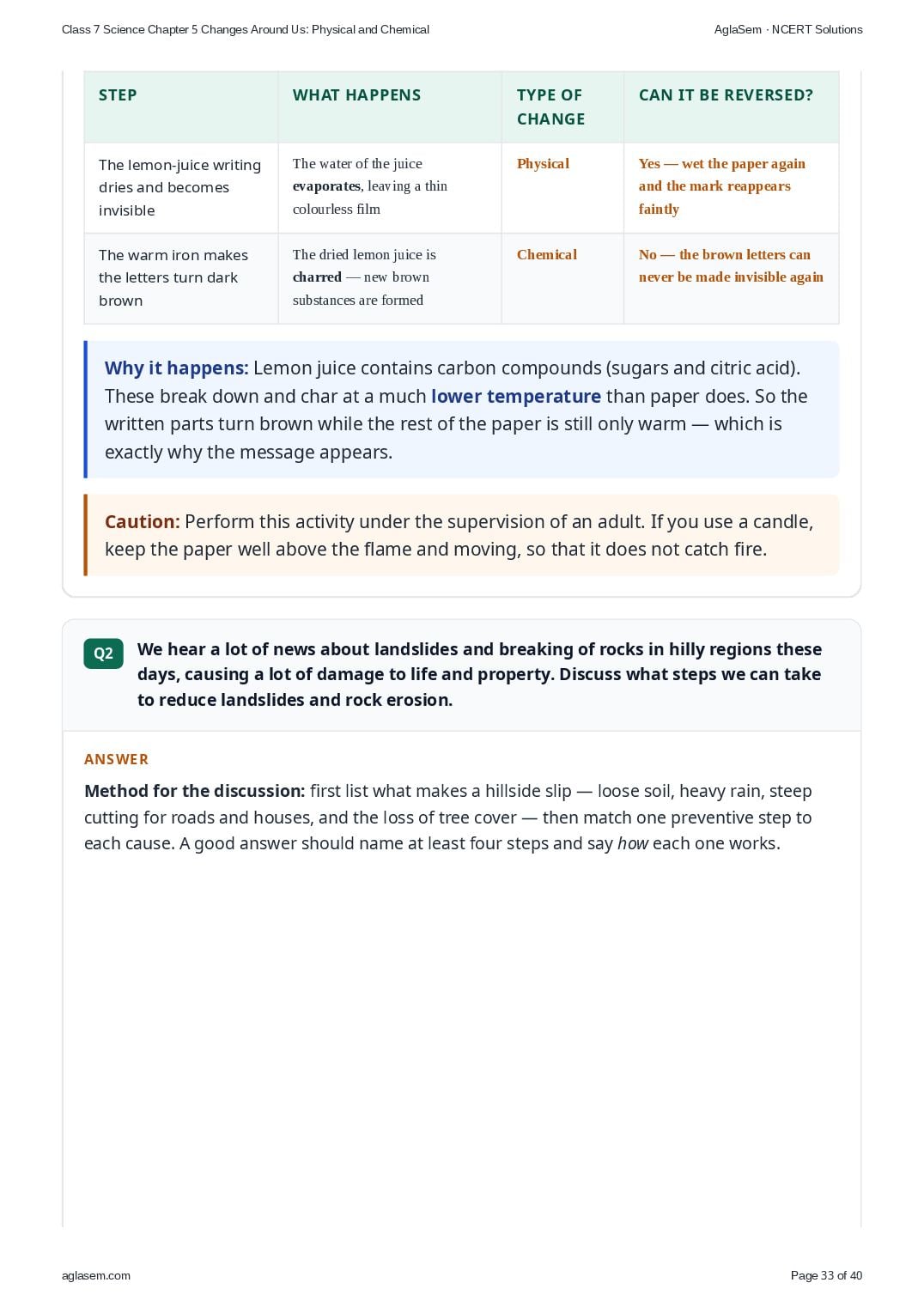
- Write a message on a piece of paper using lemon juice as ink and let it dry. The message will become invisible. Now use a warm iron over the paper (or hold the paper over the flame of a candle, taking care that it does not catch fire). The invisible letters turn dark brown as the paper gets warm. Can any of these changes be reversed?
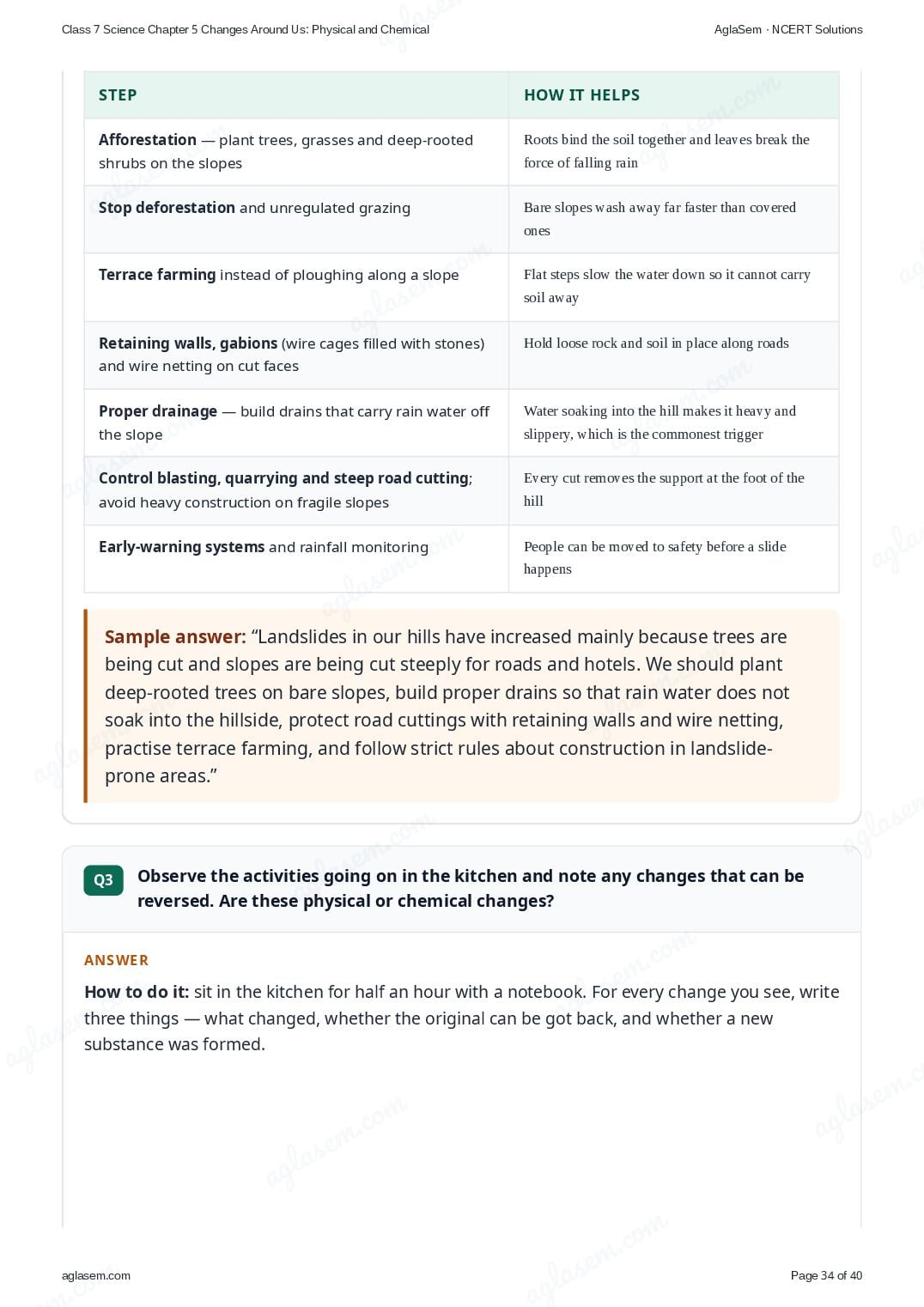
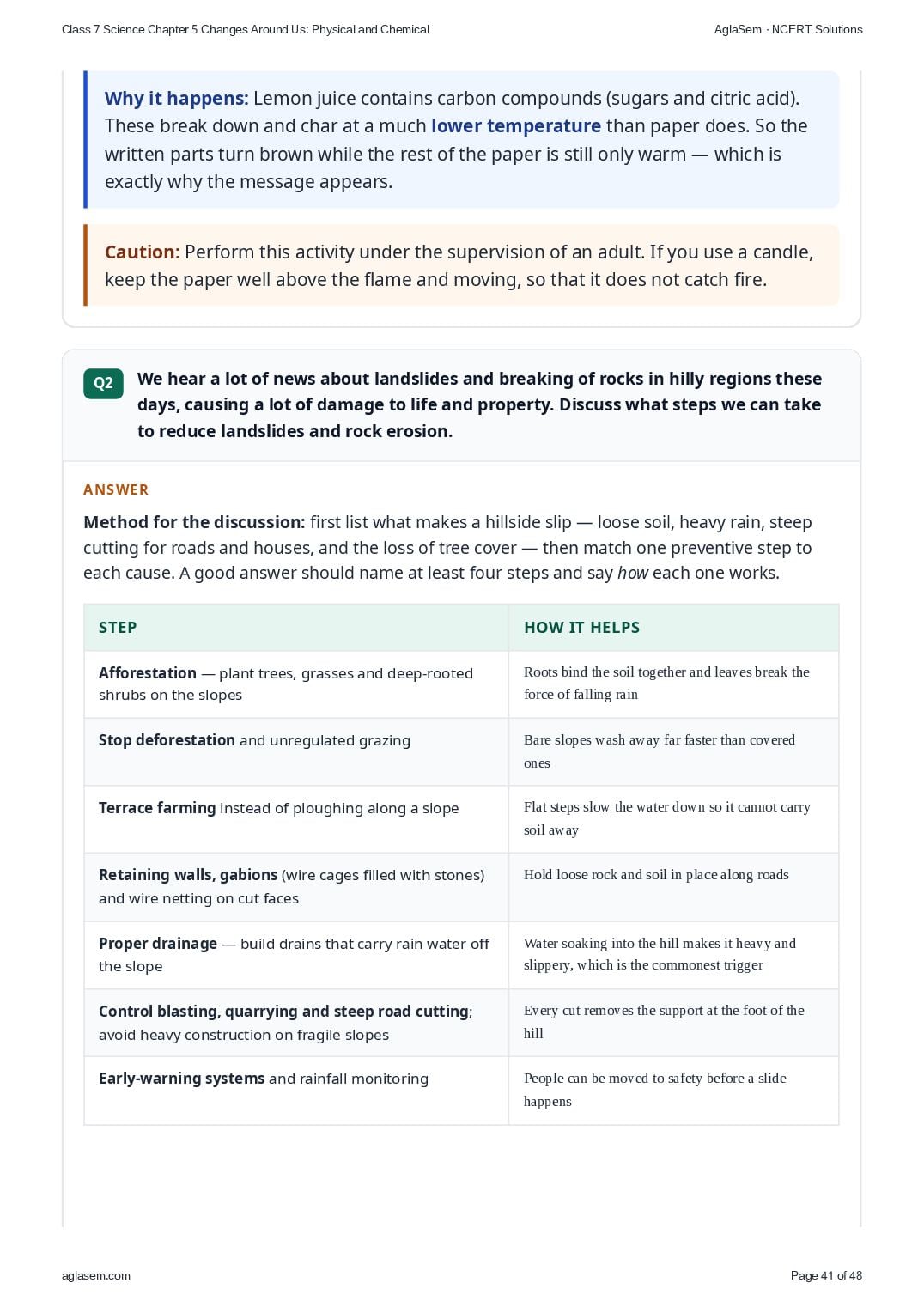
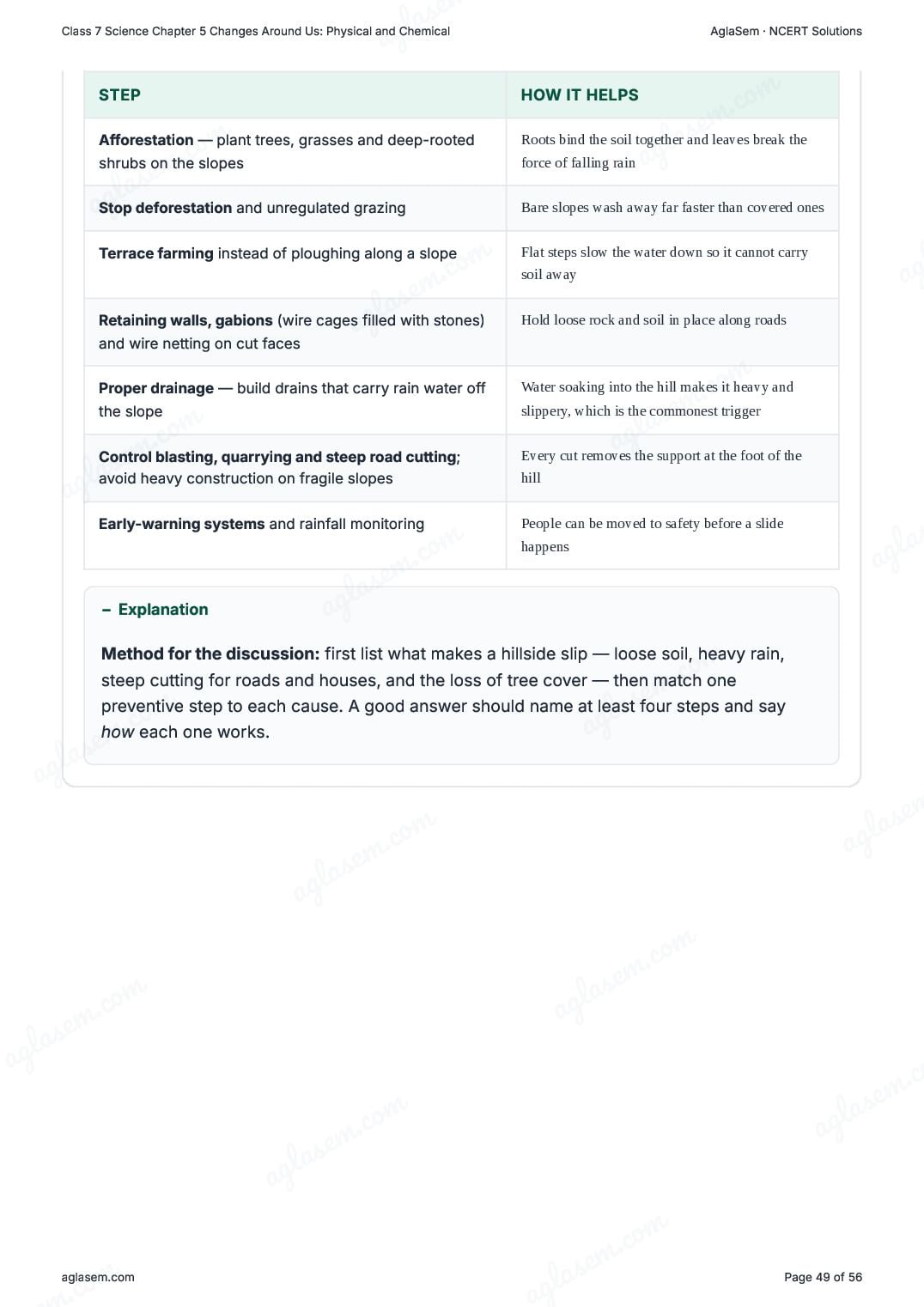
- We hear a lot of news about landslides and breaking of rocks in hilly regions these days, causing a lot of damage to life and property. Discuss what steps we can take to reduce landslides and rock erosion.
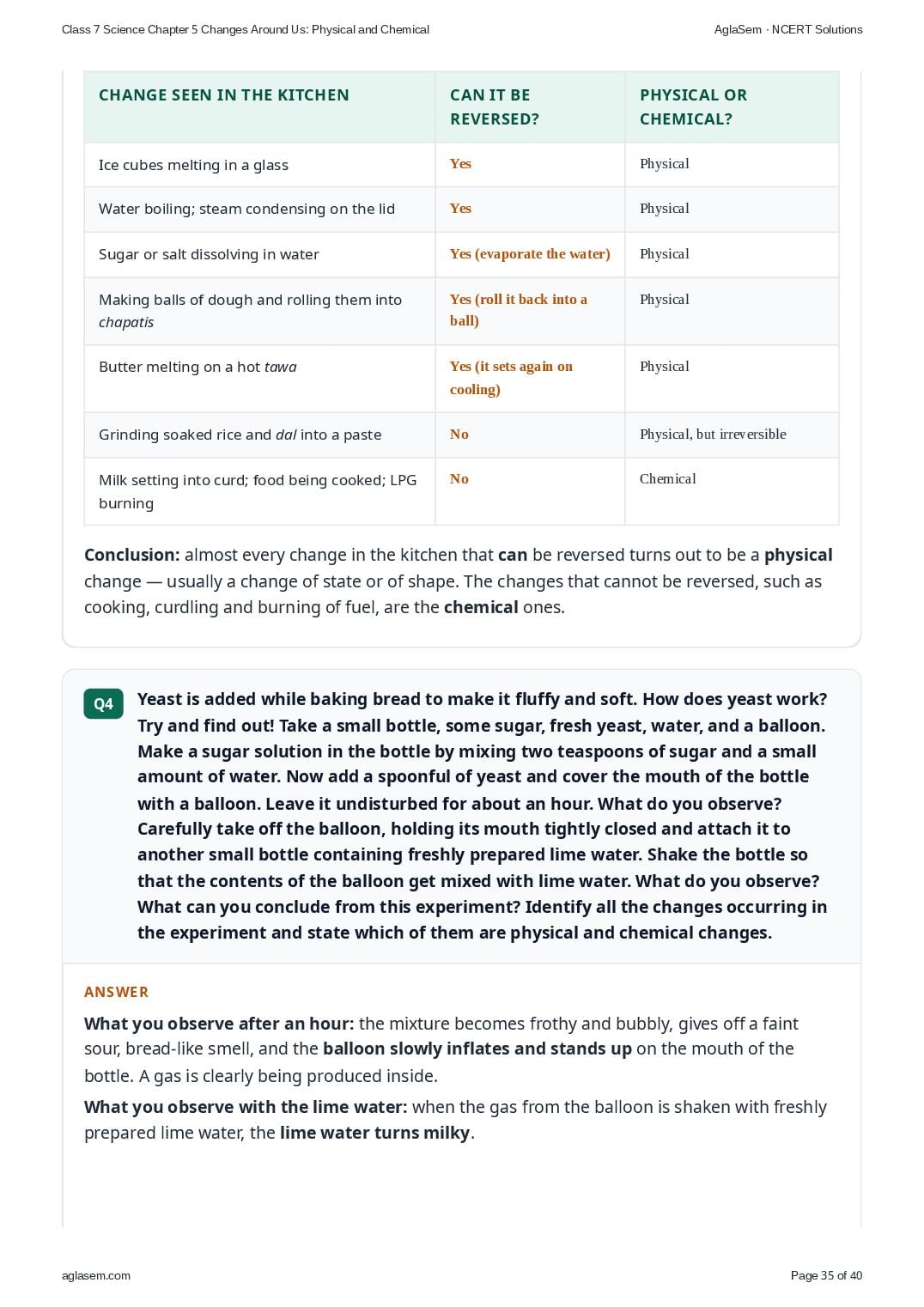
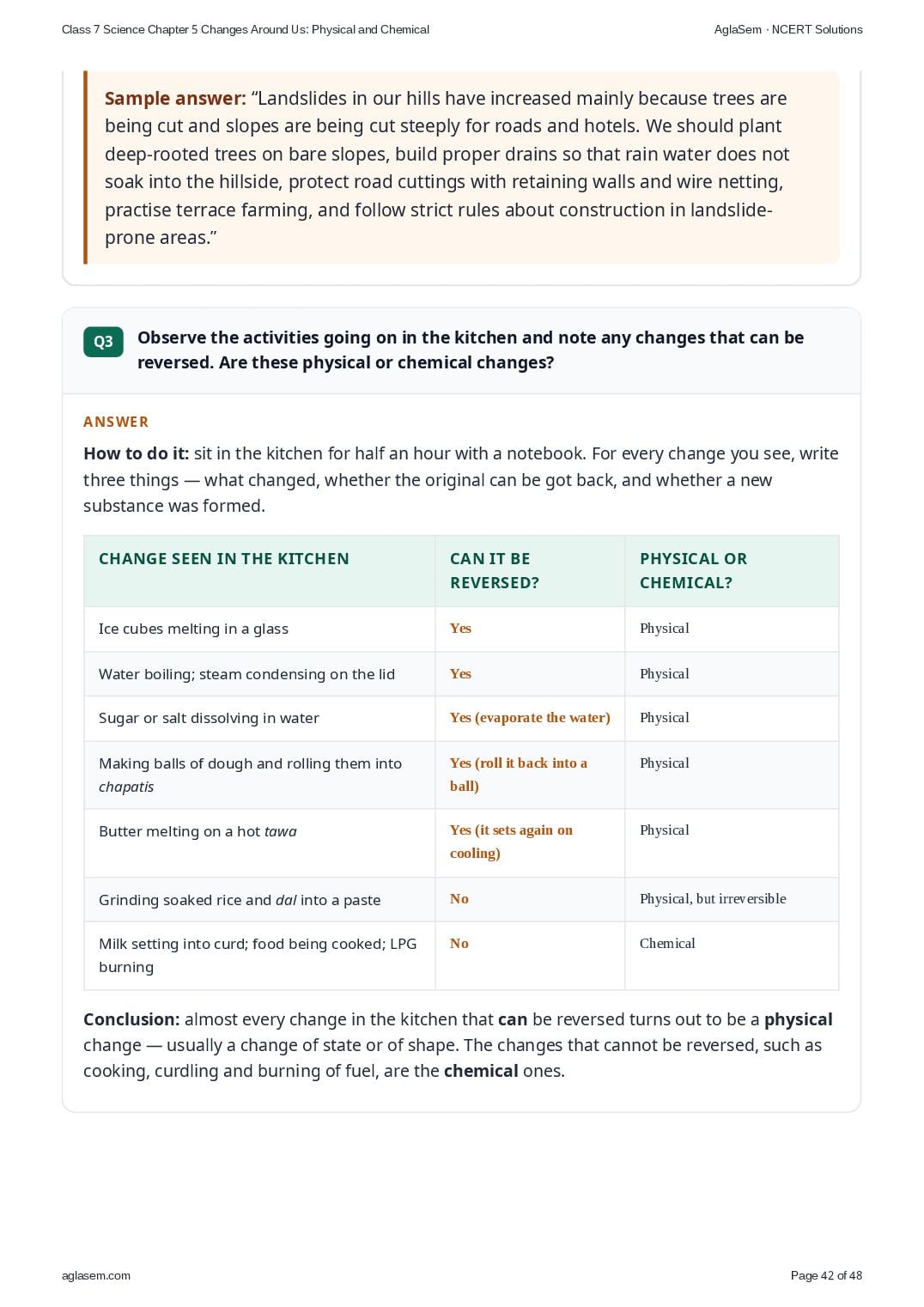
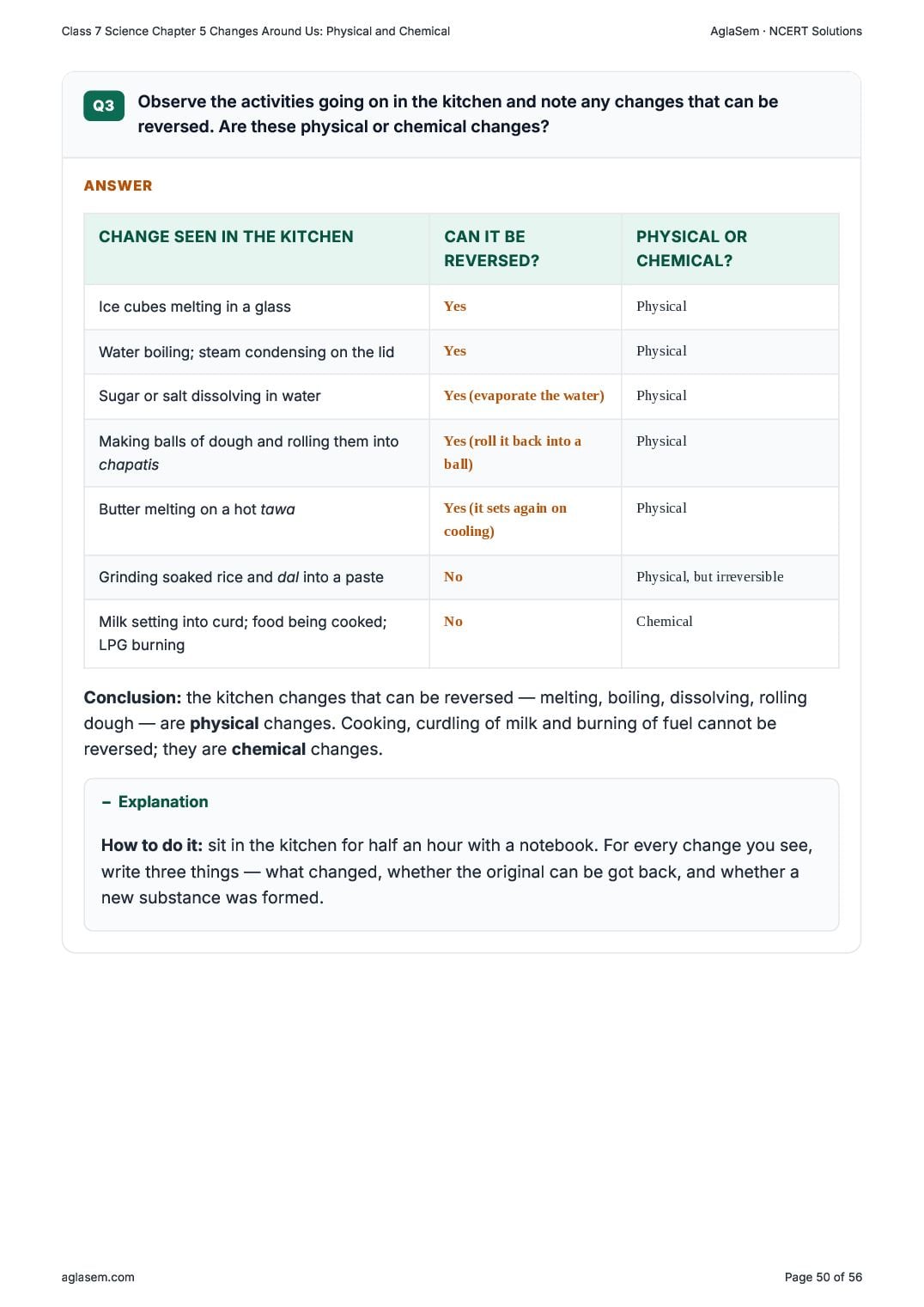
- Observe the activities going on in the kitchen and note any changes that can be reversed. Are these physical or chemical changes?
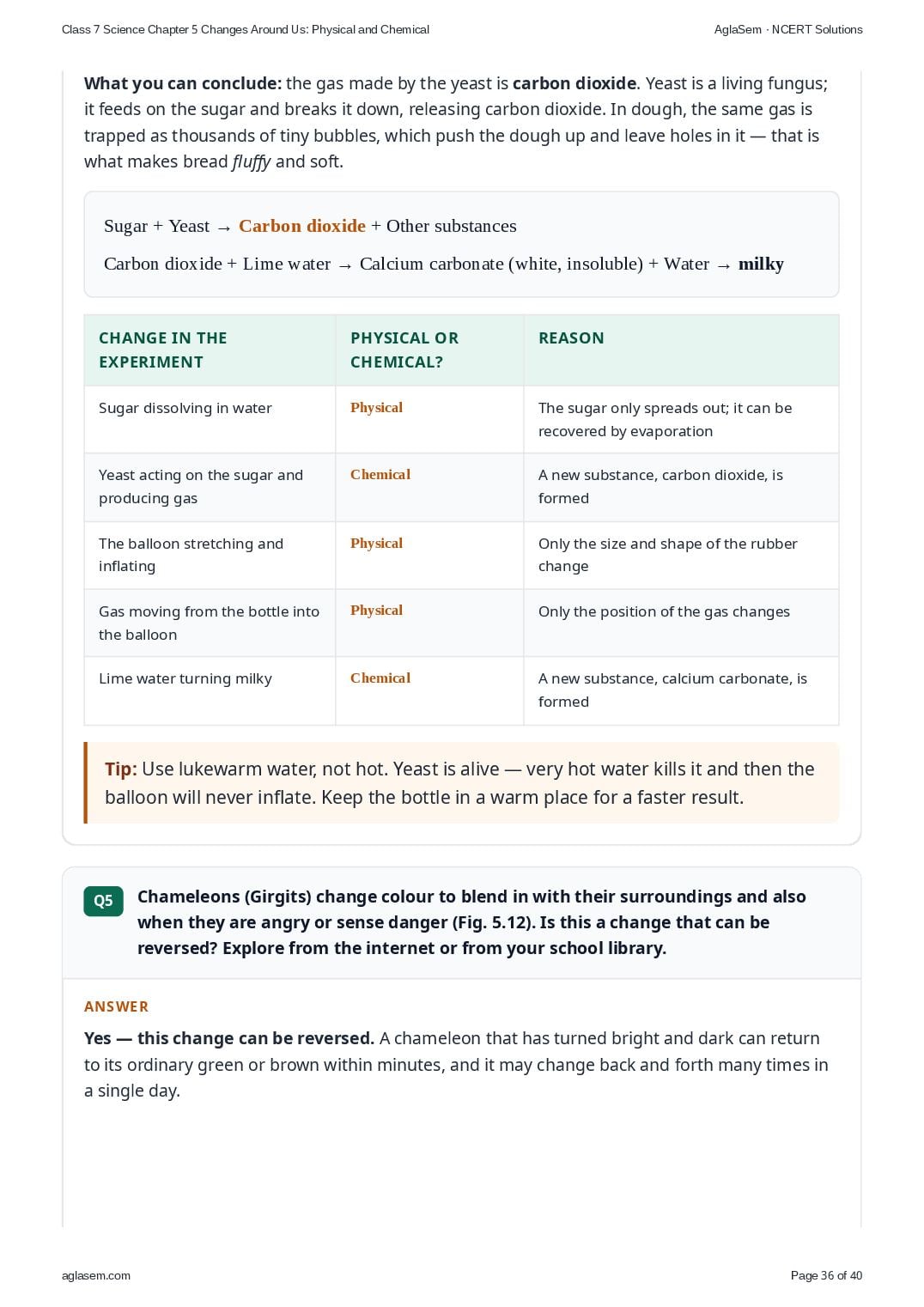
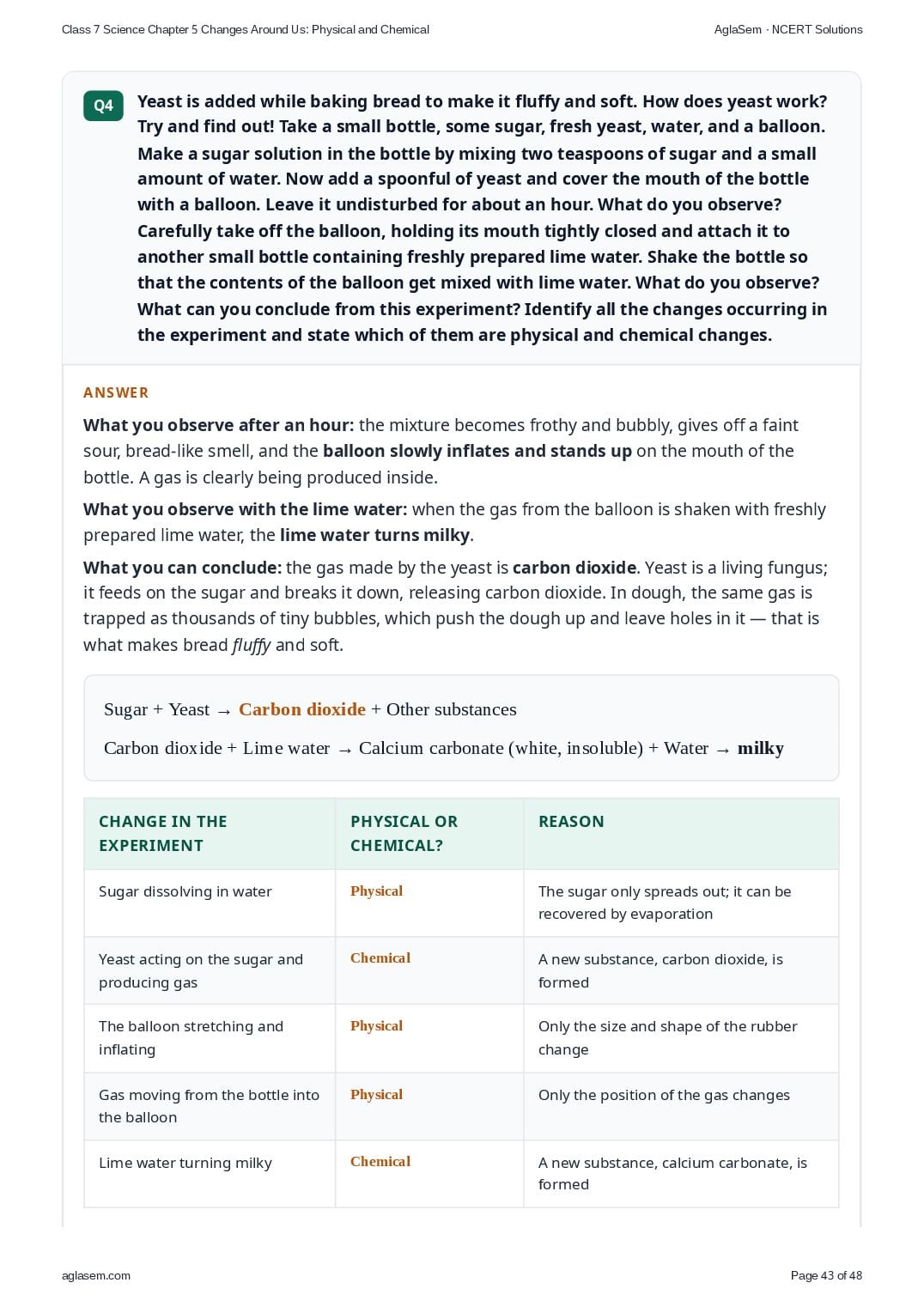
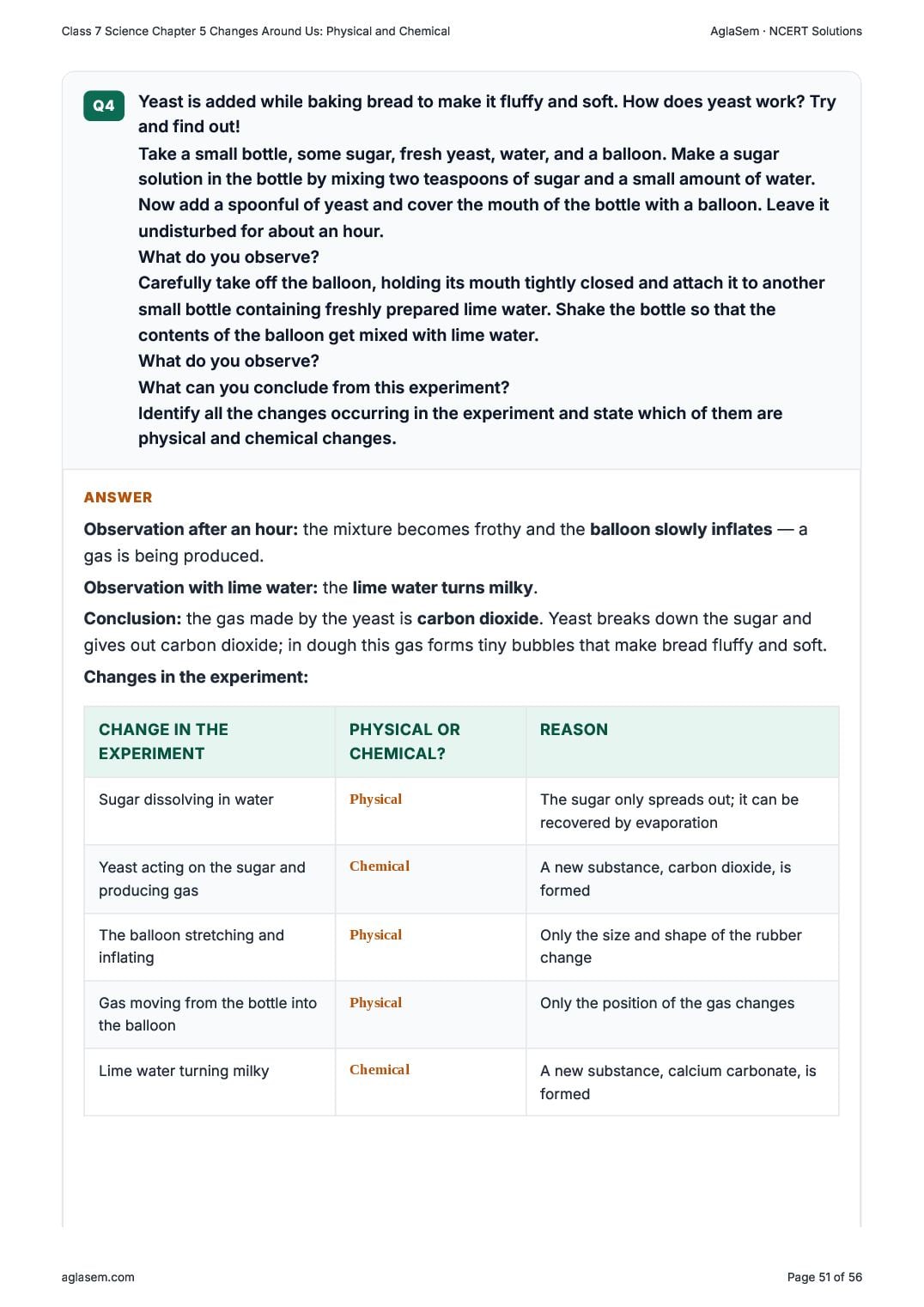
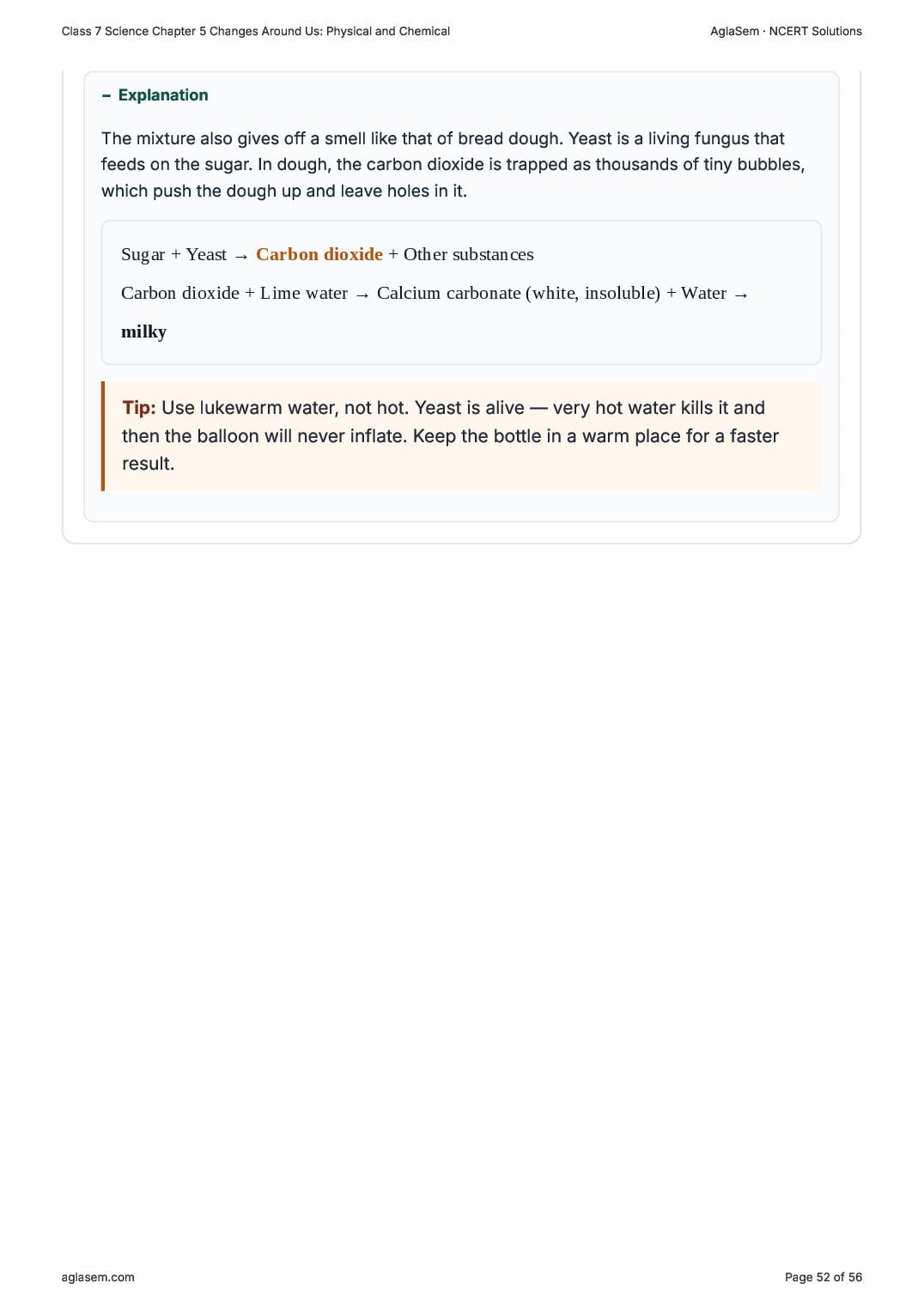
- Yeast is added while baking bread to make it fluffy and soft. How does yeast work? Try and find out! Take a small bottle, some sugar, fresh yeast, water, and a balloon. Make a sugar solution in the bottle by mixing two teaspoons of sugar and a small amount of water. Now add a spoonful of yeast and cover the mouth of the bottle with a balloon. Leave it undisturbed for about an hour. What do you observe? Carefully take off the balloon, holding its mouth tightly closed and attach it to another small bottle containing freshly prepared lime water. Shake the bottle so that the contents of the balloon get mixed with lime water. What do you observe? What can you conclude from this experiment? Identify all the changes occurring in the experiment and state which of them are physical and chemical changes.
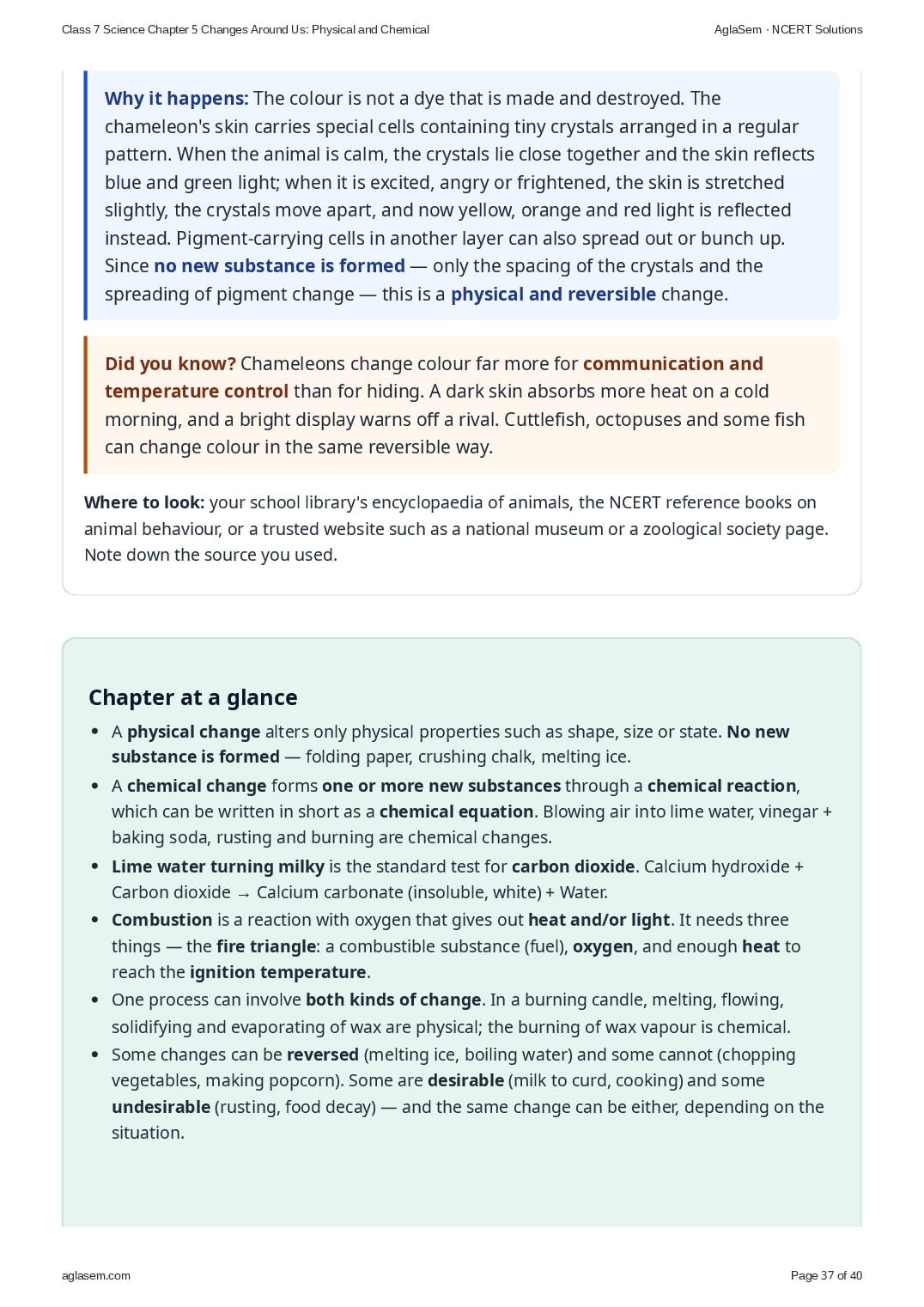
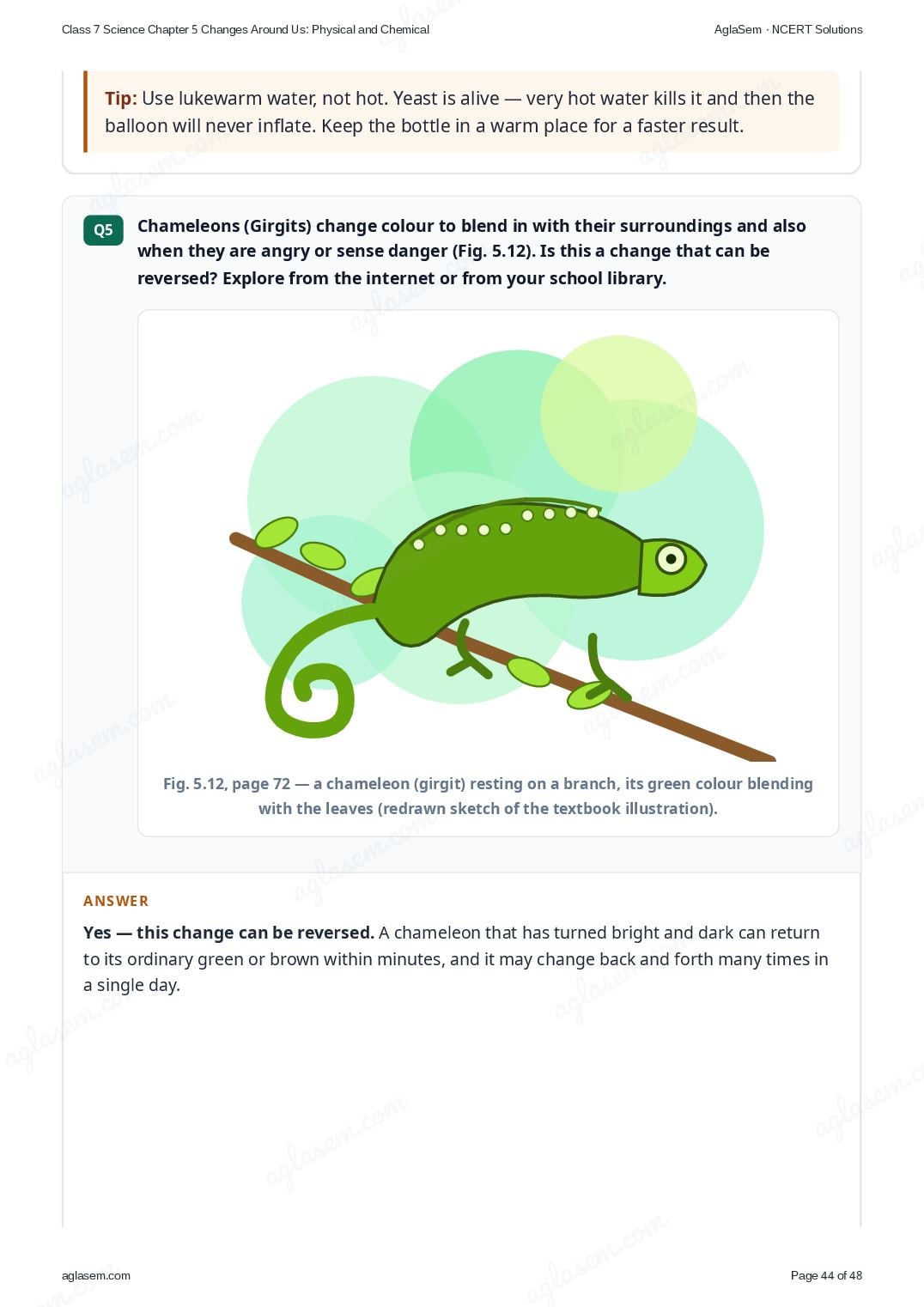
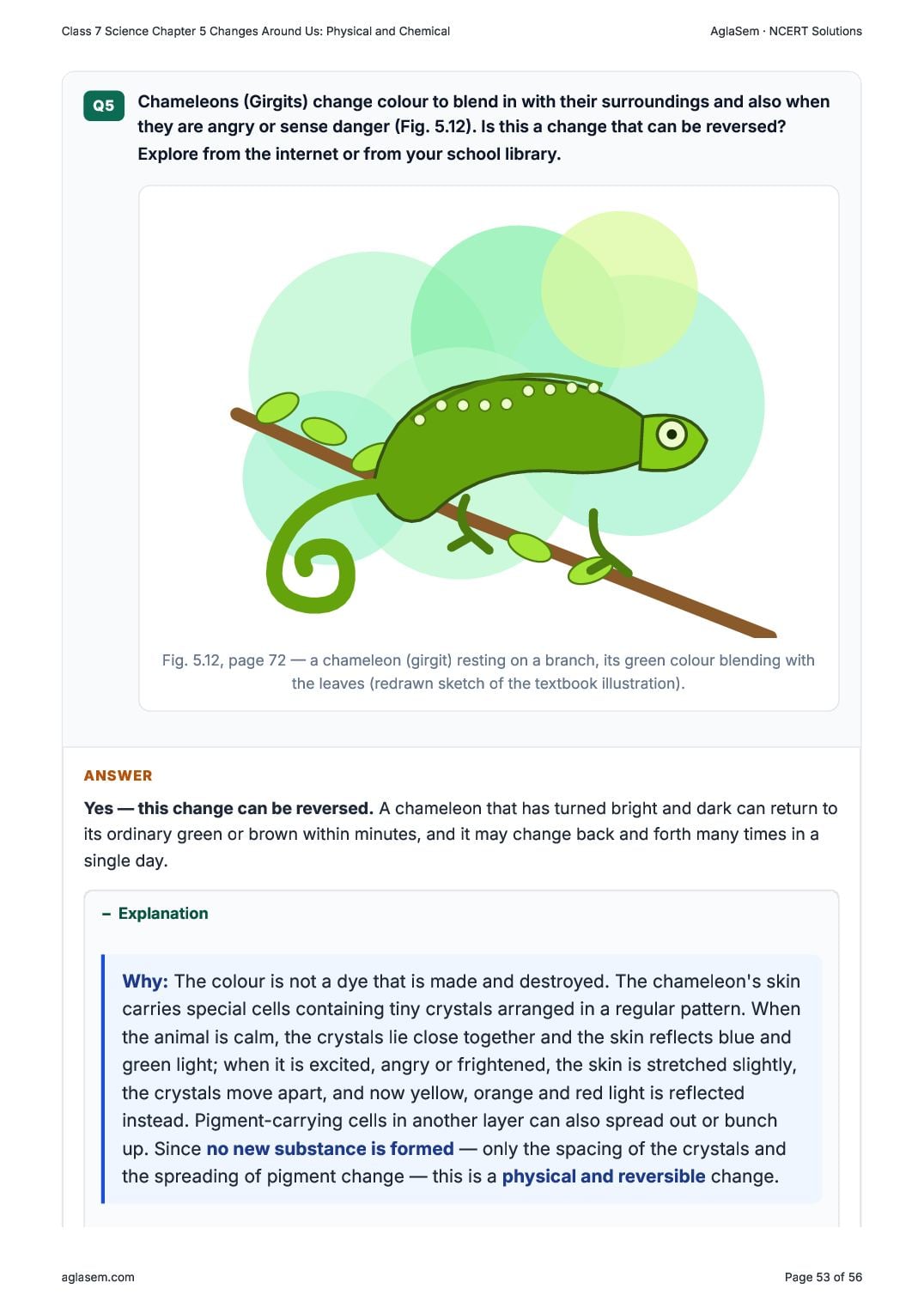
- Chameleons (Girgits) change colour to blend in with their surroundings and also when they are angry or sense danger (Fig. 5.12). Is this a change that can be reversed? Explore from the internet or from your school library.
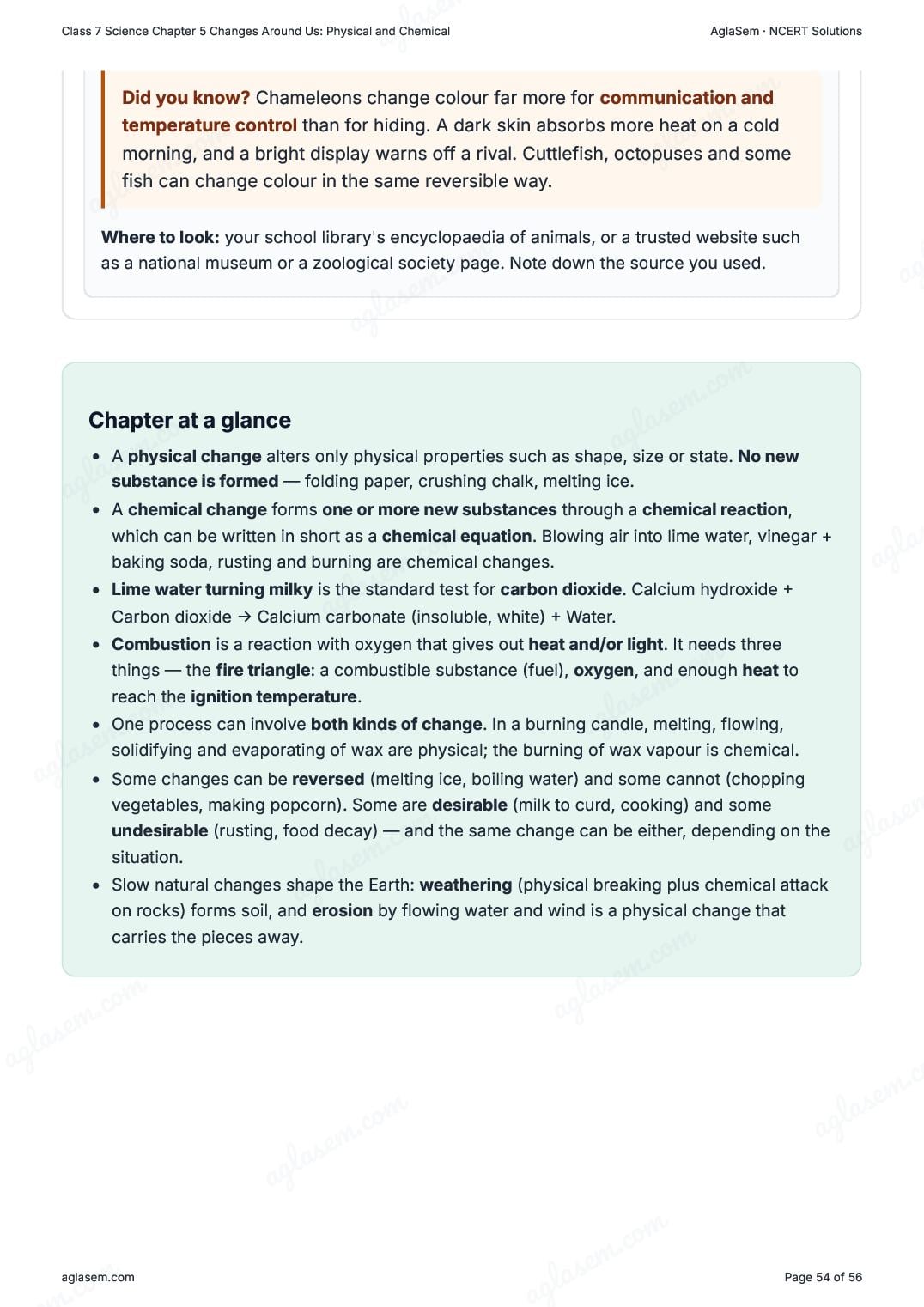
Chapter at a Glance
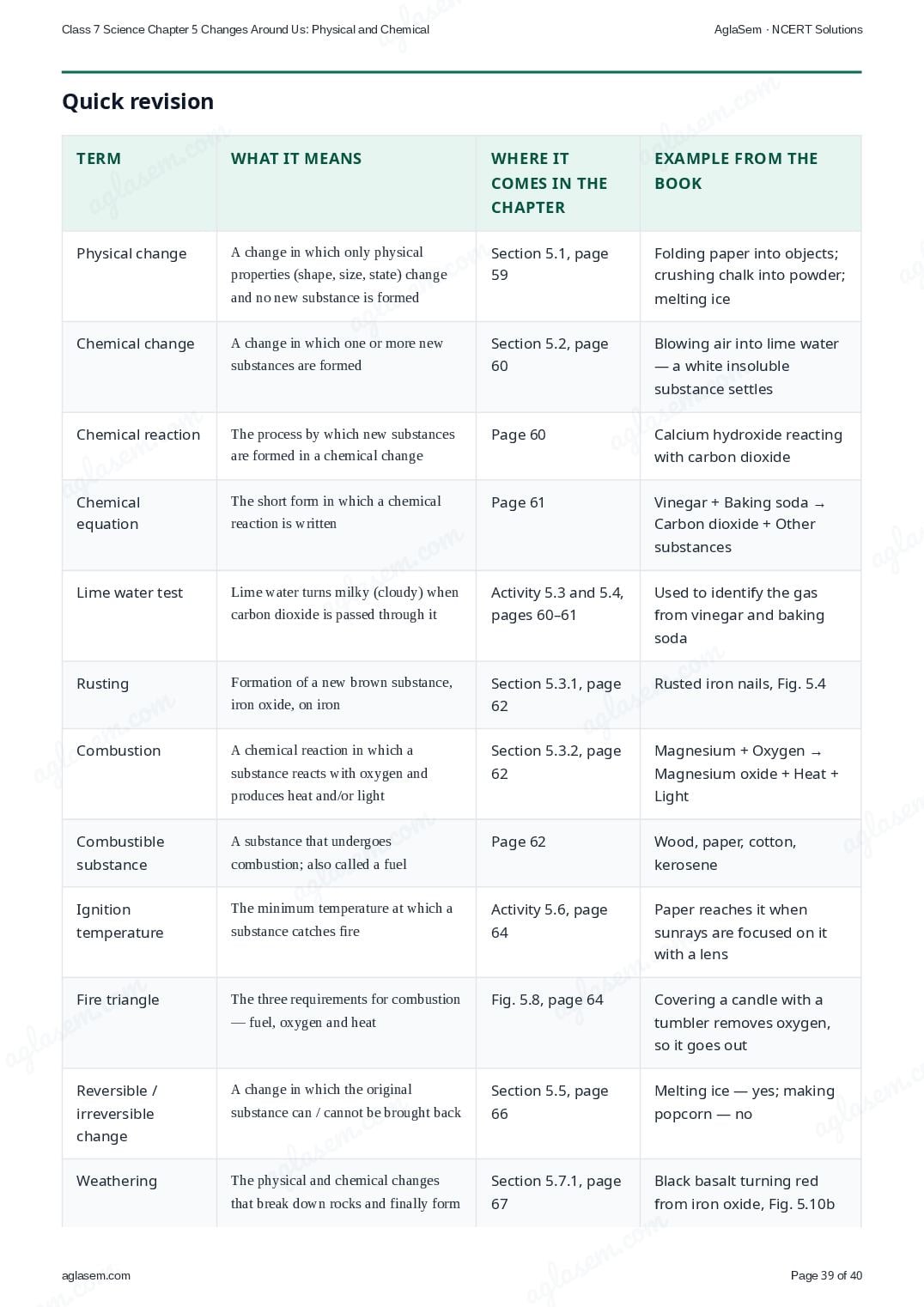
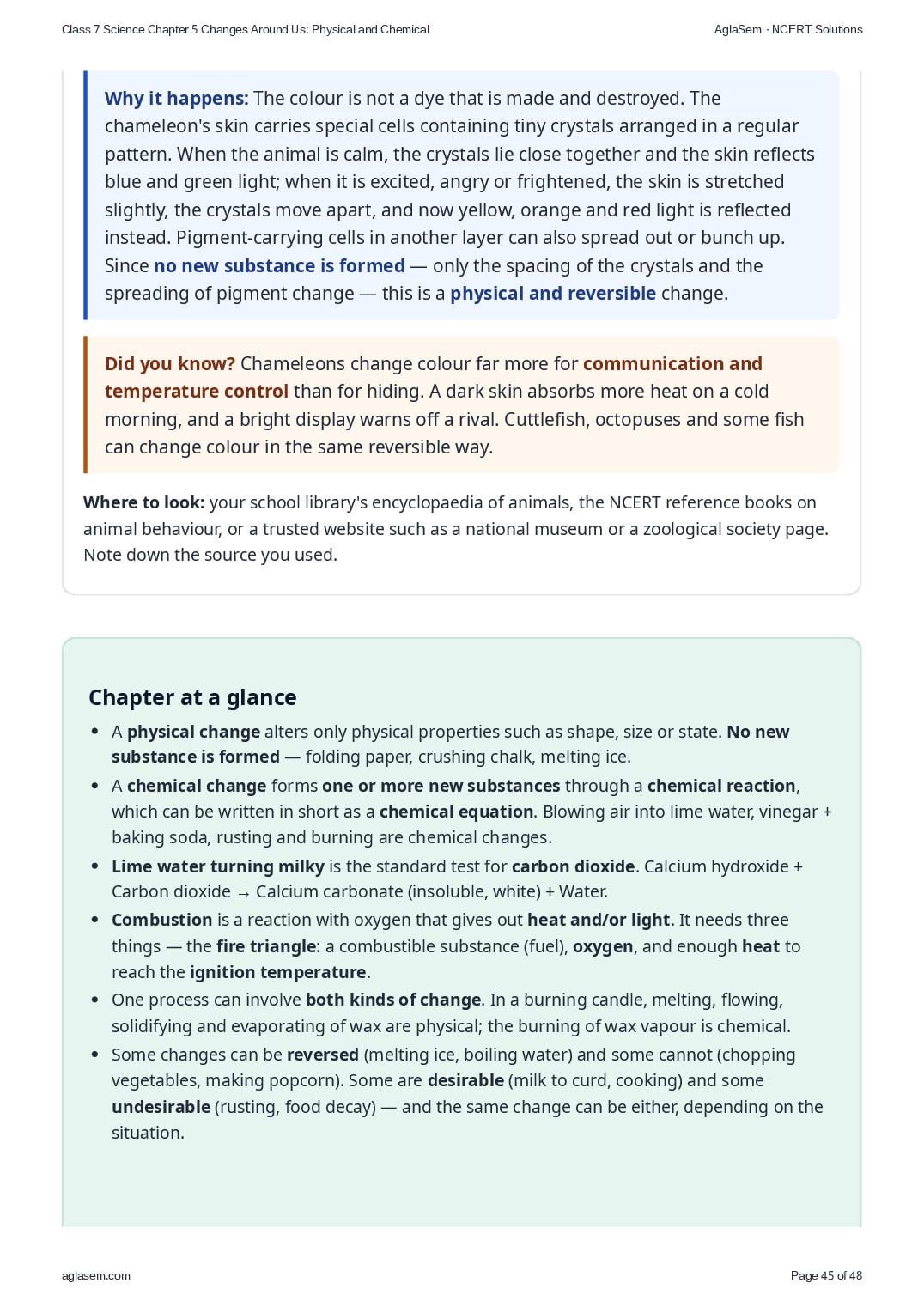
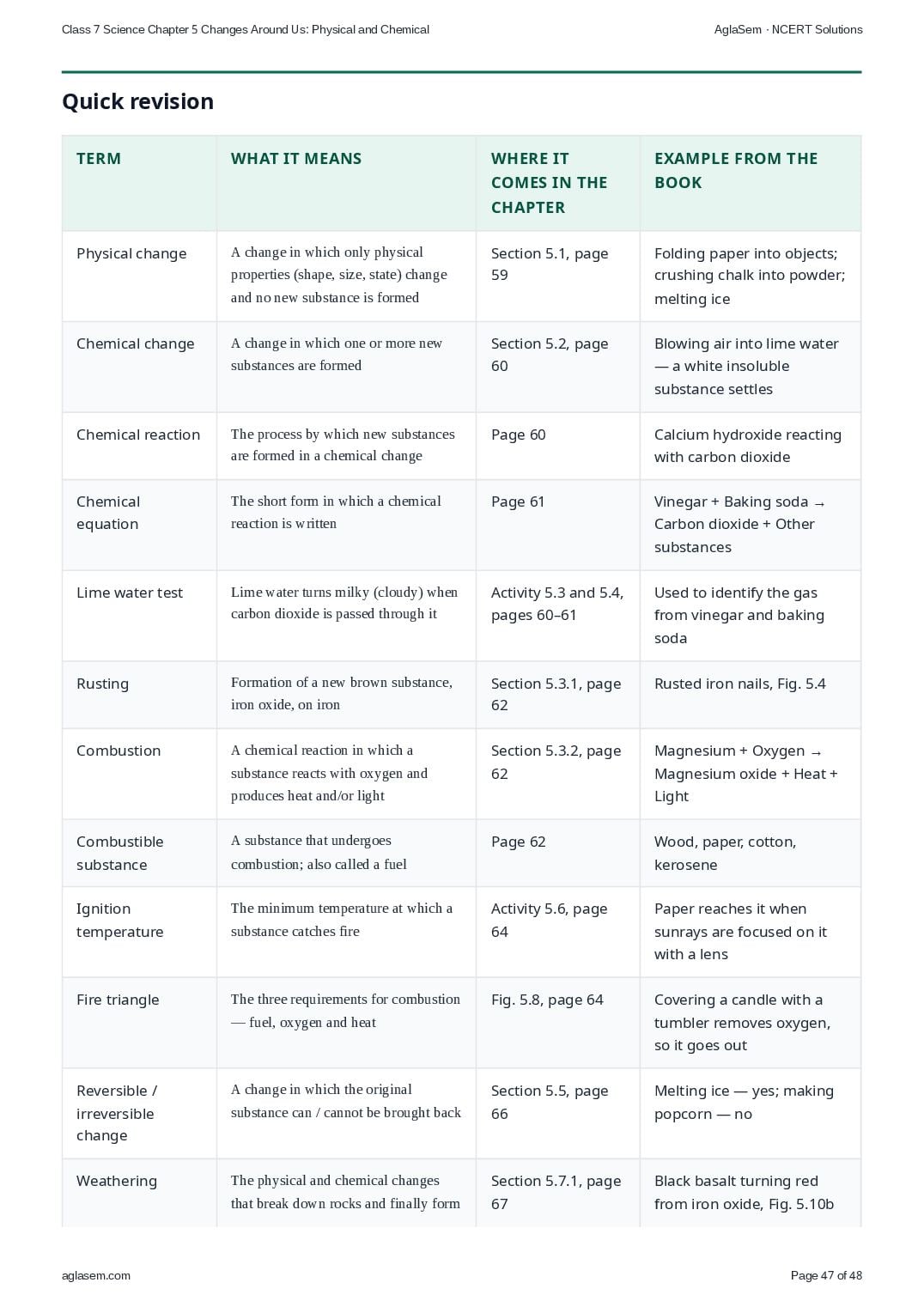
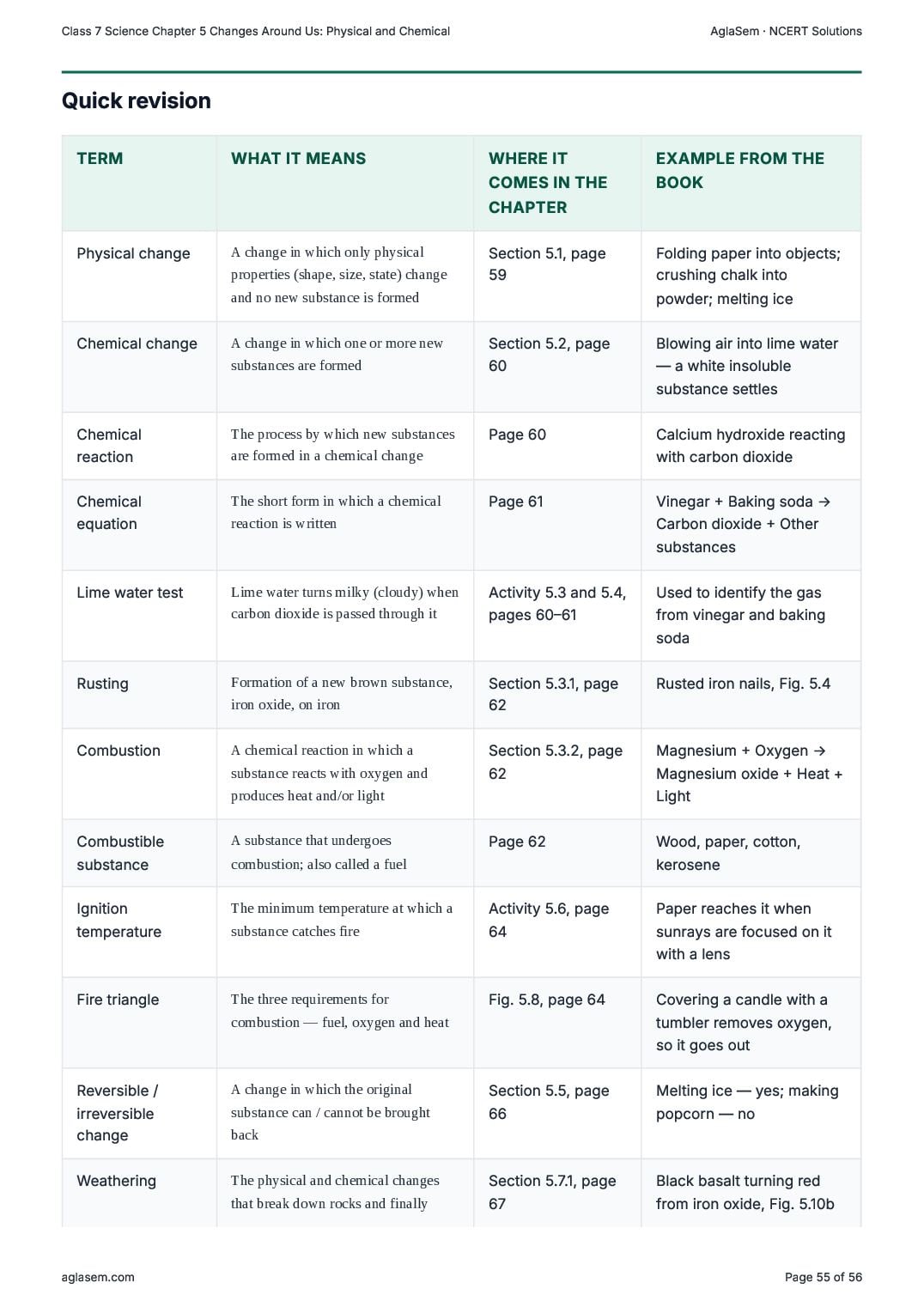
- A physical change alters only physical properties such as shape, size or state. No new substance is formed — folding paper, crushing chalk, melting ice.
- A chemical change forms one or more new substances through a chemical reaction , which can be written in short as a chemical equation . Blowing air into lime water, vinegar + baking soda, rusting and burning are chemical changes.
- Lime water turning milky is the standard test for carbon dioxide . Calcium hydroxide + Carbon dioxide → Calcium carbonate (insoluble, white) + Water.
- Combustion is a reaction with oxygen that gives out heat and/or light . It needs three things — the fire triangle : a combustible substance (fuel), oxygen , and enough heat to reach the ignition temperature .
- One process can involve both kinds of change . In a burning candle, melting, flowing, solidifying and evaporating of wax are physical; the burning of wax vapour is chemical.
- Some changes can be reversed (melting ice, boiling water) and some cannot (chopping vegetables, making popcorn). Some are desirable (milk to curd, cooking) and some undesirable (rusting, food decay) — and the same change can be either, depending on the situation.
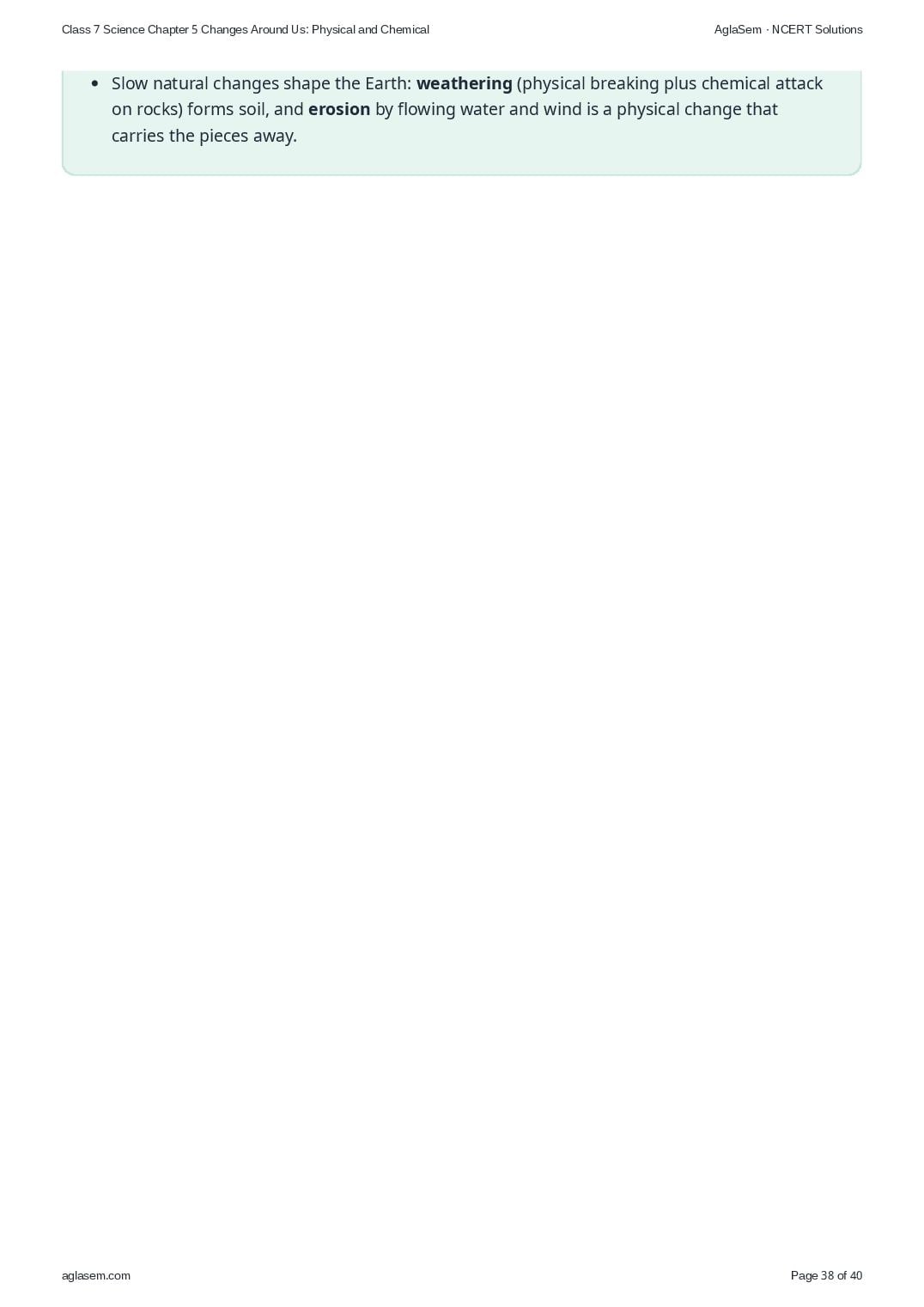
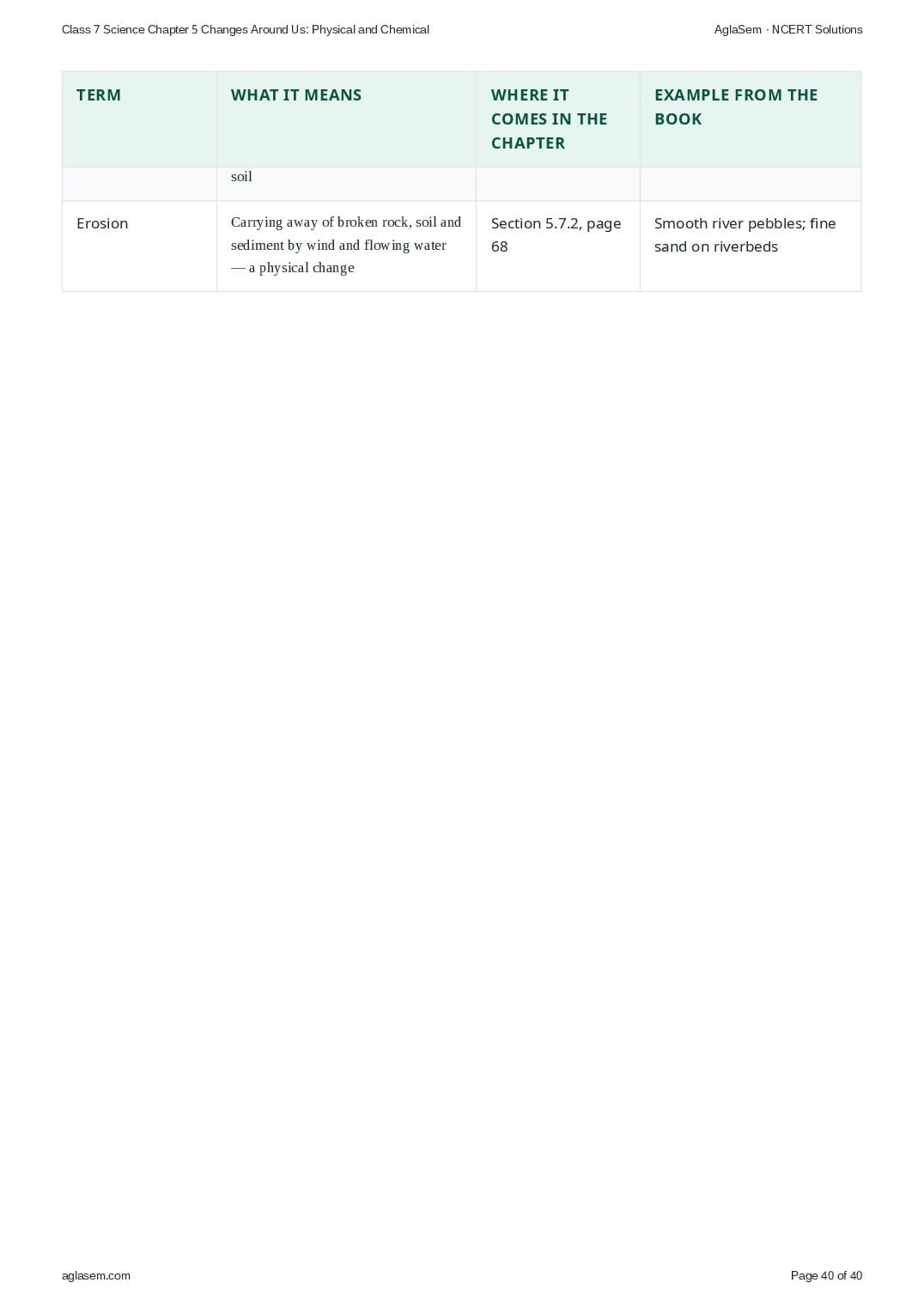
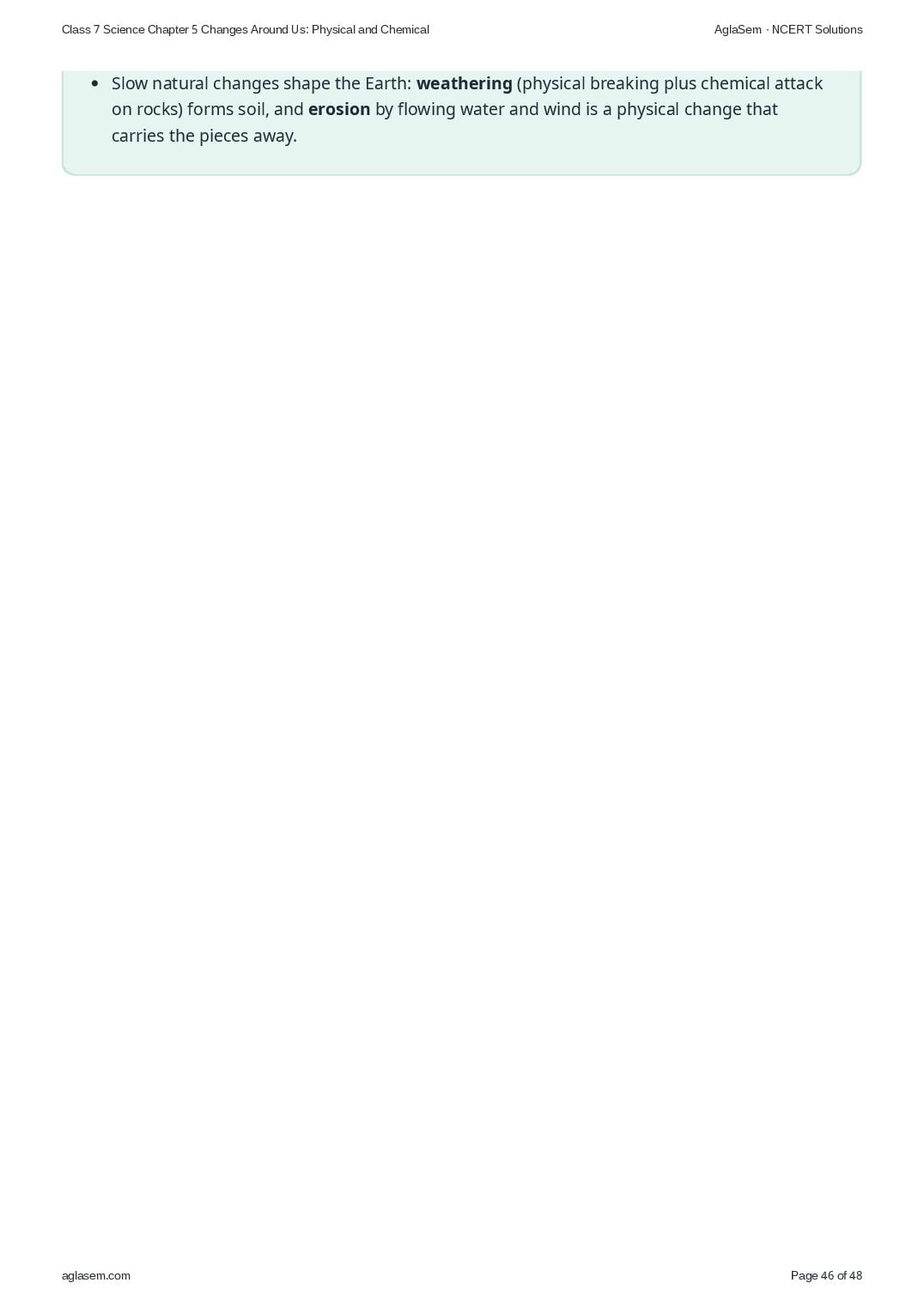
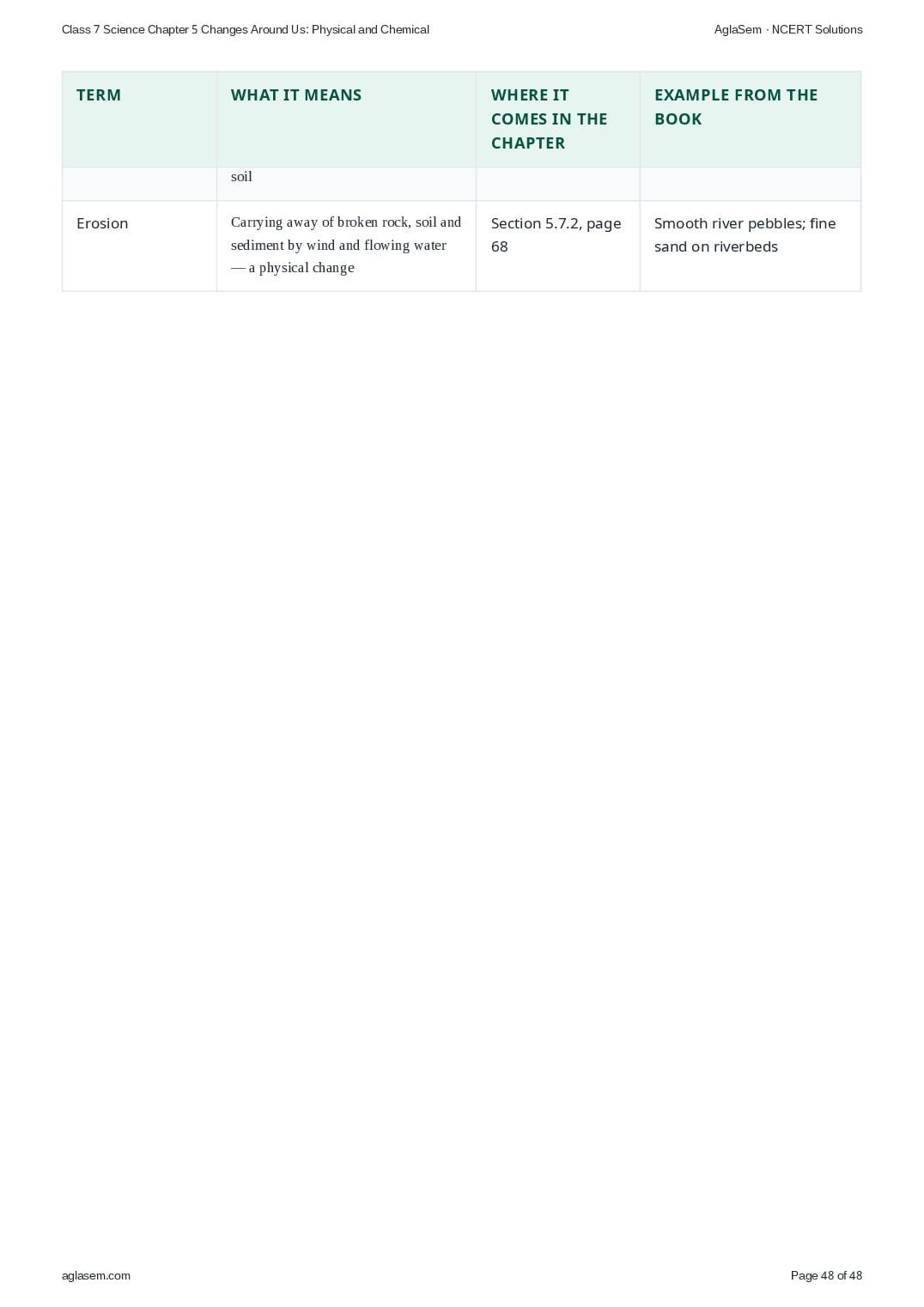
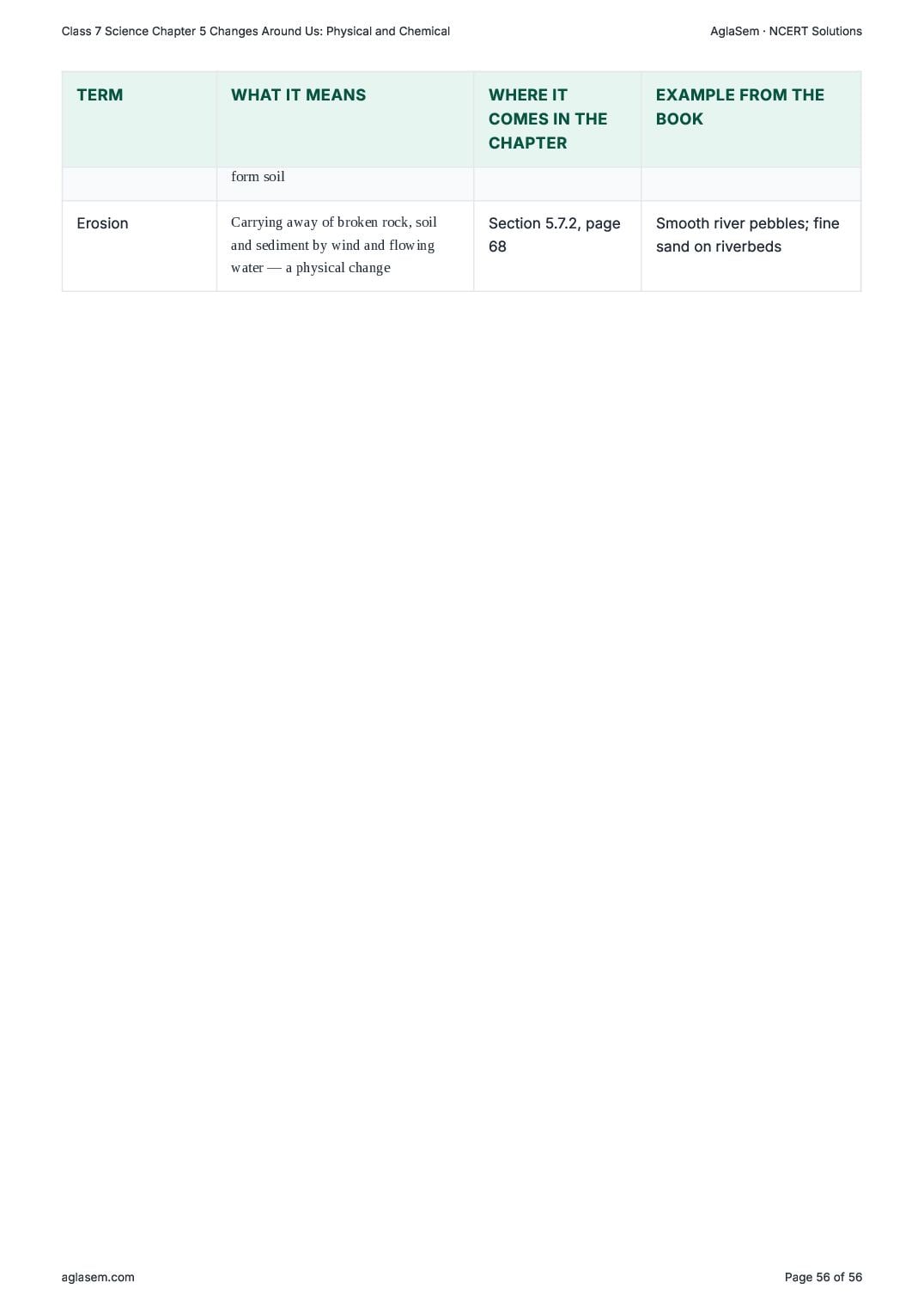
- Slow natural changes shape the Earth: weathering (physical breaking plus chemical attack on rocks) forms soil, and erosion by flowing water and wind is a physical change that carries the pieces away.
How to Download NCERT Solutions for Class 7 Science Chapter 5 PDF
Follow these simple steps to get the Changes Around Us Physical and Chemical questions-and-answers PDF from Curiosity.
- Search NCERT Solutions for Class 7 Science Chapter 5 aglasem and open this page.
- Read the exercise questions with answers for Changes Around Us Physical and Chemical shown above.
- Click the Download PDF link to save the Changes Around Us Physical and Chemical solutions to your device.
NCERT Solutions for Class 7 Science – All Chapters
There are more chapters to study besides Changes Around Us Physical and Chemical in Science. Here are the NCERT Solutions for all chapters of Class 7 Science.
- Chapter 1 the Ever Evolving World of Science
- Chapter 2 Exploring Substances Acidic Basic and Neutral
- Chapter 3 Electricity Circuits and Their Components
- Chapter 4 the World of Metals and Non Metals
- Chapter 5 Changes Around Us Physical and Chemical
- Chapter 6 Adolescence a Stage of Growth and Change
- Chapter 7 Heat Transfer in Nature
- Chapter 8 Measurement of Time and Motion
- Chapter 9 Life Processes in Animals
- Chapter 10 Life Processes in Plants
- Chapter 11 Light Shadows and Reflections
- Chapter 12 Earth Moon and the Sun
NCERT Solutions for Class 7 – All Subjects
Just like Chapter 5 of Science, you can get the exercise questions with answers for every other subject of Class 7. Here are the NCERT Solutions for all subjects of Class 7.
NCERT Solutions for Class 7 Science Chapter 5 – An Overview
The key highlights of this study material are as follows.
| Aspects | Details |
|---|---|
| Class | Class 7 |
| Subject | Science |
| Chapter Number | Chapter 5 |
| Chapter Name | Changes Around Us Physical and Chemical |
| Book Name | Curiosity |
| Book By | NCERT (National Council of Educational Research and Training) |
| Educational Resource Here | NCERT Solutions of Class 7 Science Chapter 5 for all exercises |
| More Questions Answers of This Subject | NCERT Solutions for Class 7 Science |
| Download Book Chapter | NCERT Book Class 7 Science |
| All Questions Answers For This Class | NCERT Solutions for Class 7 |
| Complete Solutions | NCERT Solutions |
NCERT Solutions for Class 7 Science Chapter 5 Changes Around Us Physical and Chemical – FAQs
What are the NCERT Solutions for Class 7 Science Chapter 5 Changes Around Us Physical and Chemical?
They are the complete, step-by-step answers to all the exercise and in-text questions of Chapter 5 Changes Around Us Physical and Chemical from the NCERT Class 7 Science textbook Curiosity, written by experts as per the latest NCERT syllabus.
How can I download the Class 7 Science Chapter 5 solutions PDF for free?
Open this page on aglasem, read the Changes Around Us Physical and Chemical questions with answers, and click the “Download Solutions PDF” link. The Class 7 Science Chapter 5 NCERT Solutions PDF is completely free to download.
Are these NCERT Solutions as per the latest 2026-27 syllabus?
Yes. The NCERT Solutions for Class 7 Science Chapter 5 are based on the latest NCERT textbook Curiosity and the current 2026-27 CBSE syllabus, so the questions and answers match what you study in class.
Where can I get NCERT Solutions for the other chapters of Class 7 Science?
You can find the answers to every chapter on the NCERT Solutions for Class 7 Science page, and solutions for every subject on the NCERT Solutions for Class 7 page.
How do NCERT Solutions help in exam preparation?
They show the correct method to solve each question, help you write answers the way they are expected in exams, let you check and correct your own work, and save revision time — which together improve your marks in Class 7 Science.
If you have any queries on NCERT Solutions for Class 7 Science Chapter 5 Changes Around Us Physical and Chemical, then please ask in the comments below.