NCERT Solutions for Class 7 Science Chapter 11 Light Shadows and Reflections provide clear, step-by-step answers to every exercise and in-text question from the chapter Light Shadows and Reflections of the NCERT textbook Curiosity. Prepared by subject experts as per the latest NCERT (CBSE) syllabus for 2026-27, these NCERT Solutions for Class 7 Science help you understand each concept, write exam-ready answers, and check your own solutions. You can read them online below or download the free Class 7 Science Chapter 11 question-answer PDF.
NCERT Solutions for Class 7 Science Chapter 11 Light Shadows and Reflections
- Class: Class 7
- Subject: Science
- Chapter: Chapter 11 – Light Shadows and Reflections
- Textbook: Curiosity (NCERT)
- Study material: NCERT Solutions – questions with answers, free PDF
These solutions answer all the exercise questions of Chapter 11 Light Shadows and Reflections — including the in-text questions, short-answer and long-answer questions, and activities — with complete explanations so you can follow the method, not just the final answer. Read the full solutions below.
NCERT Solutions Class 7 Science Chapter 11 Light Shadows and Reflections View Download
NCERT Solutions for Class 7 Science Chapter 11 PDF Download
You can read the NCERT Solutions for Class 7 Science Chapter 11 online above, or download the complete question-answer PDF to study Light Shadows and Reflections offline at any time.
NCERT Solutions for Class 7 Science Chapter 11 PDF Download Link – Click Here to Download Solutions PDF
Questions Covered in This Chapter
These NCERT Solutions answer all 47 questions of this chapter. The questions solved are:
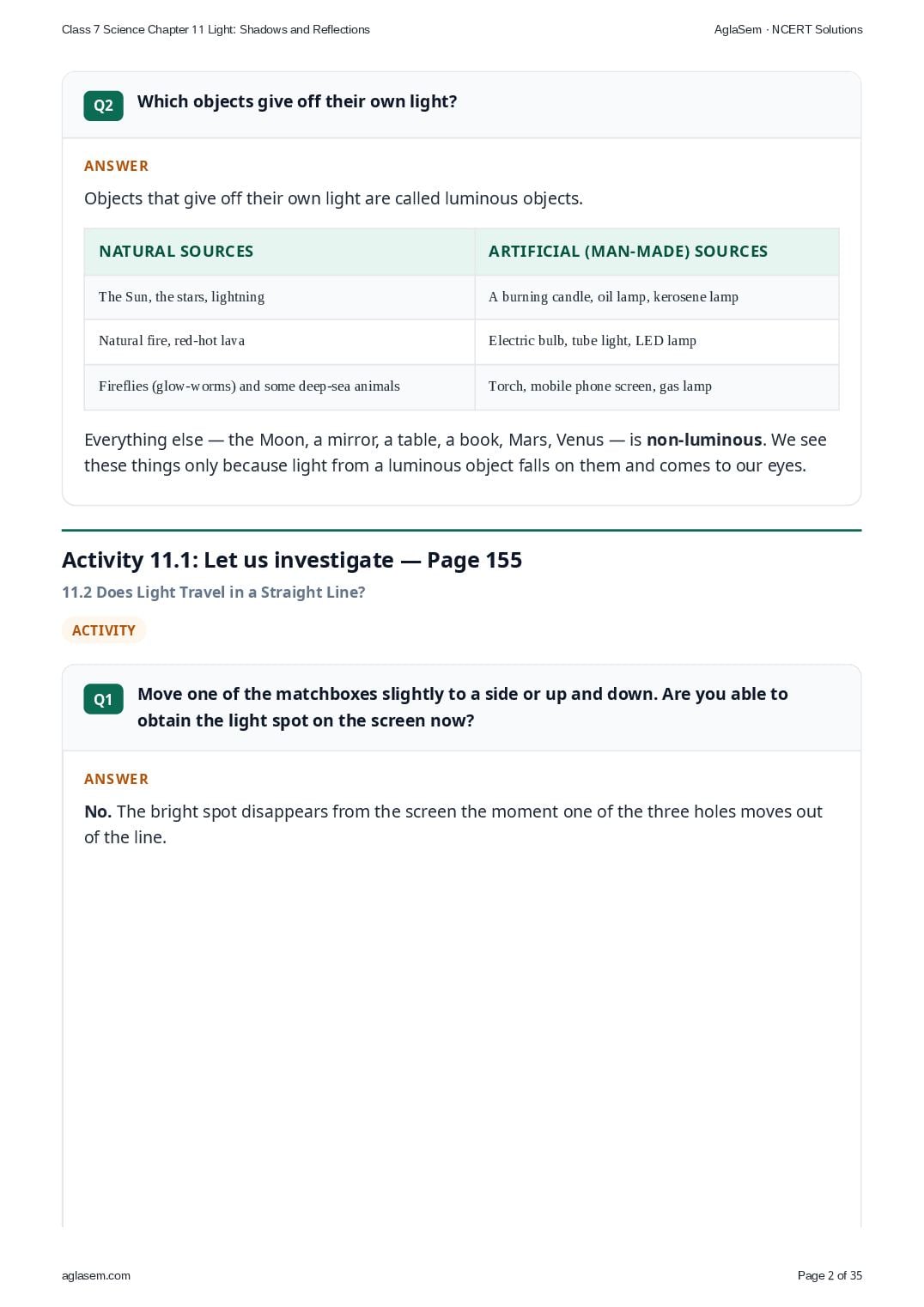
- Does the Moon actually produce its own light? Is moonlight just reflected sunlight?
- Which objects give off their own light?
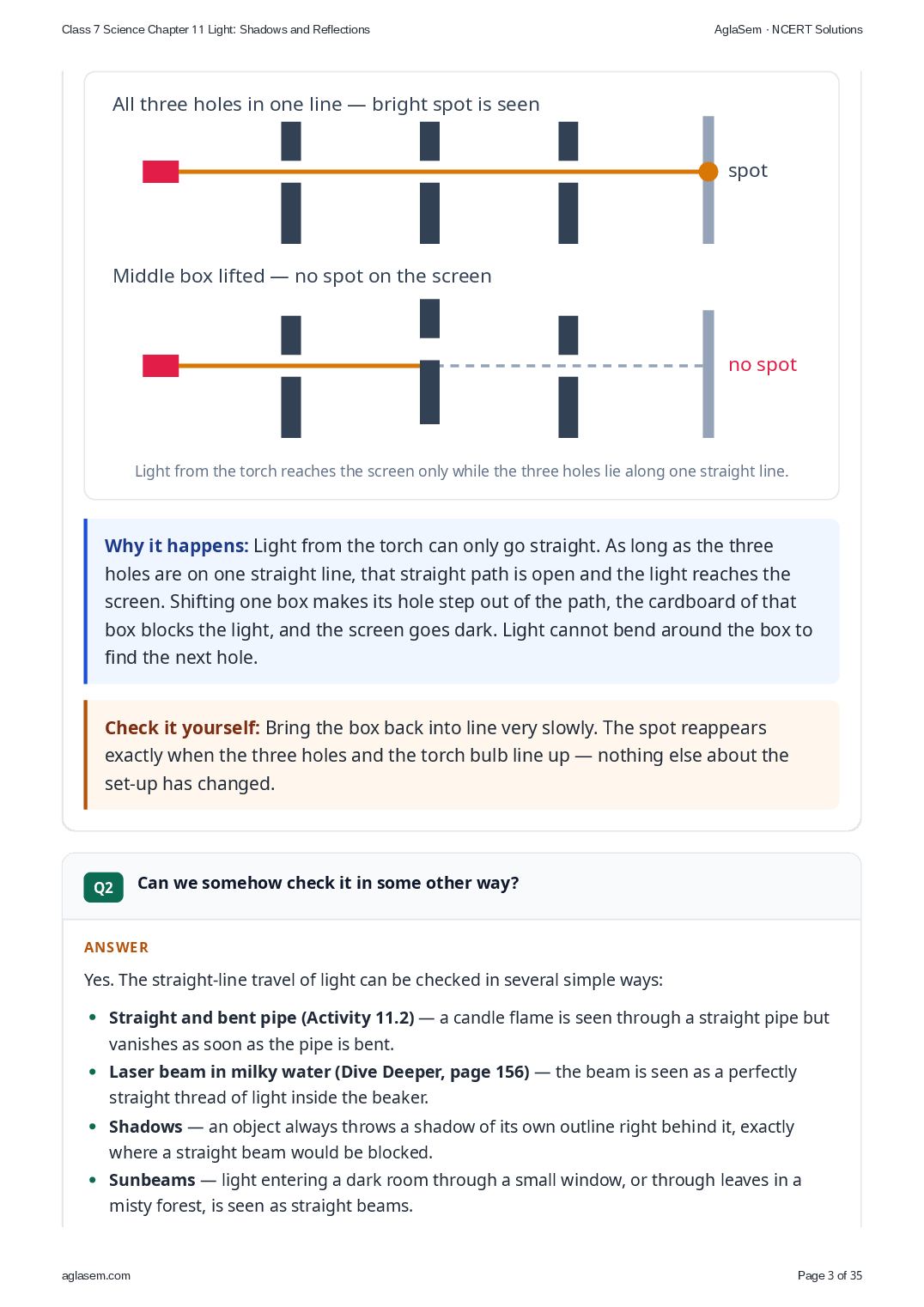
- Move one of the matchboxes slightly to a side or up and down. Are you able to obtain the light spot on the screen now?
- Can we somehow check it in some other way?
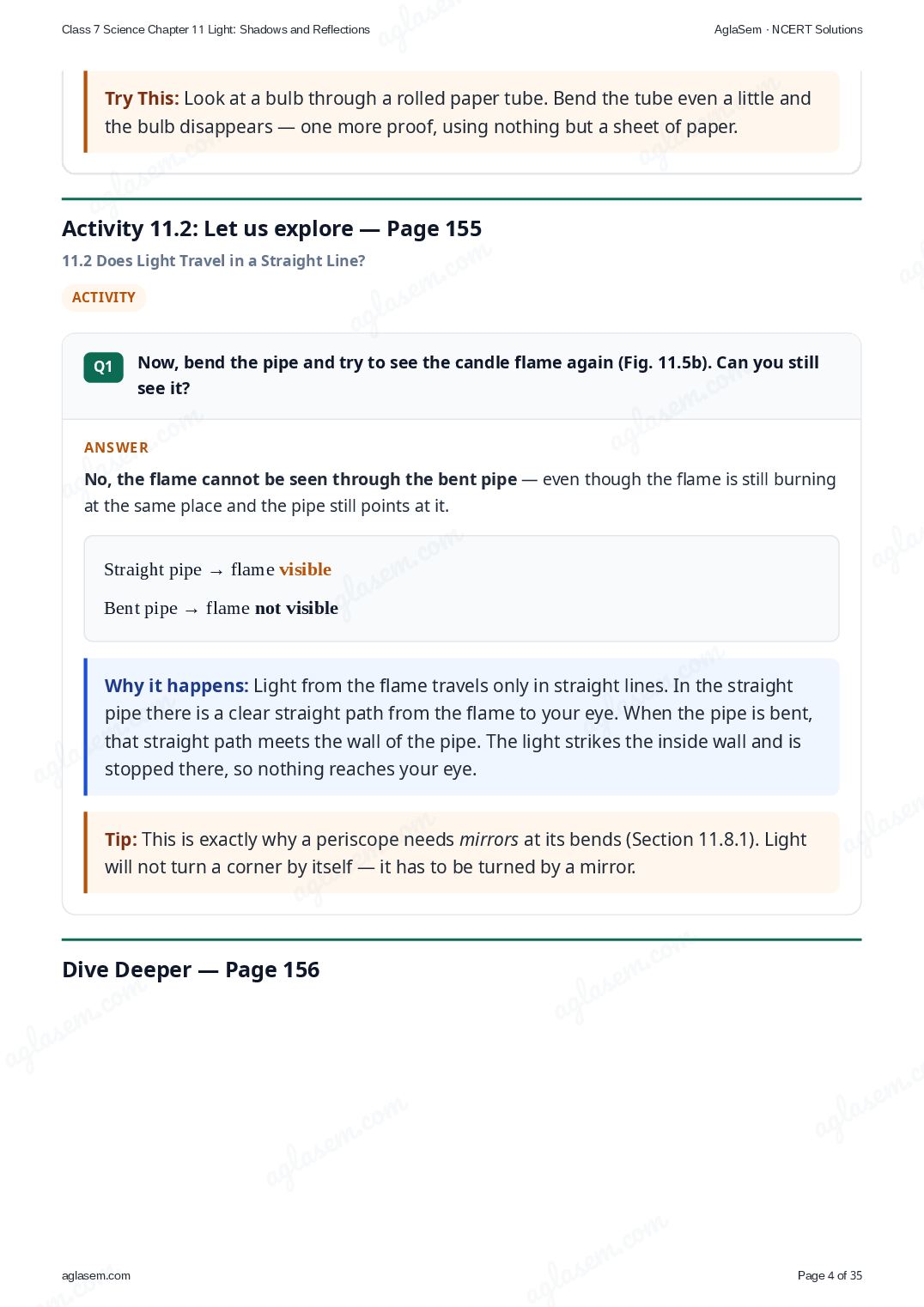
- Now, bend the pipe and try to see the candle flame again (Fig. 11.5b). Can you still see it?
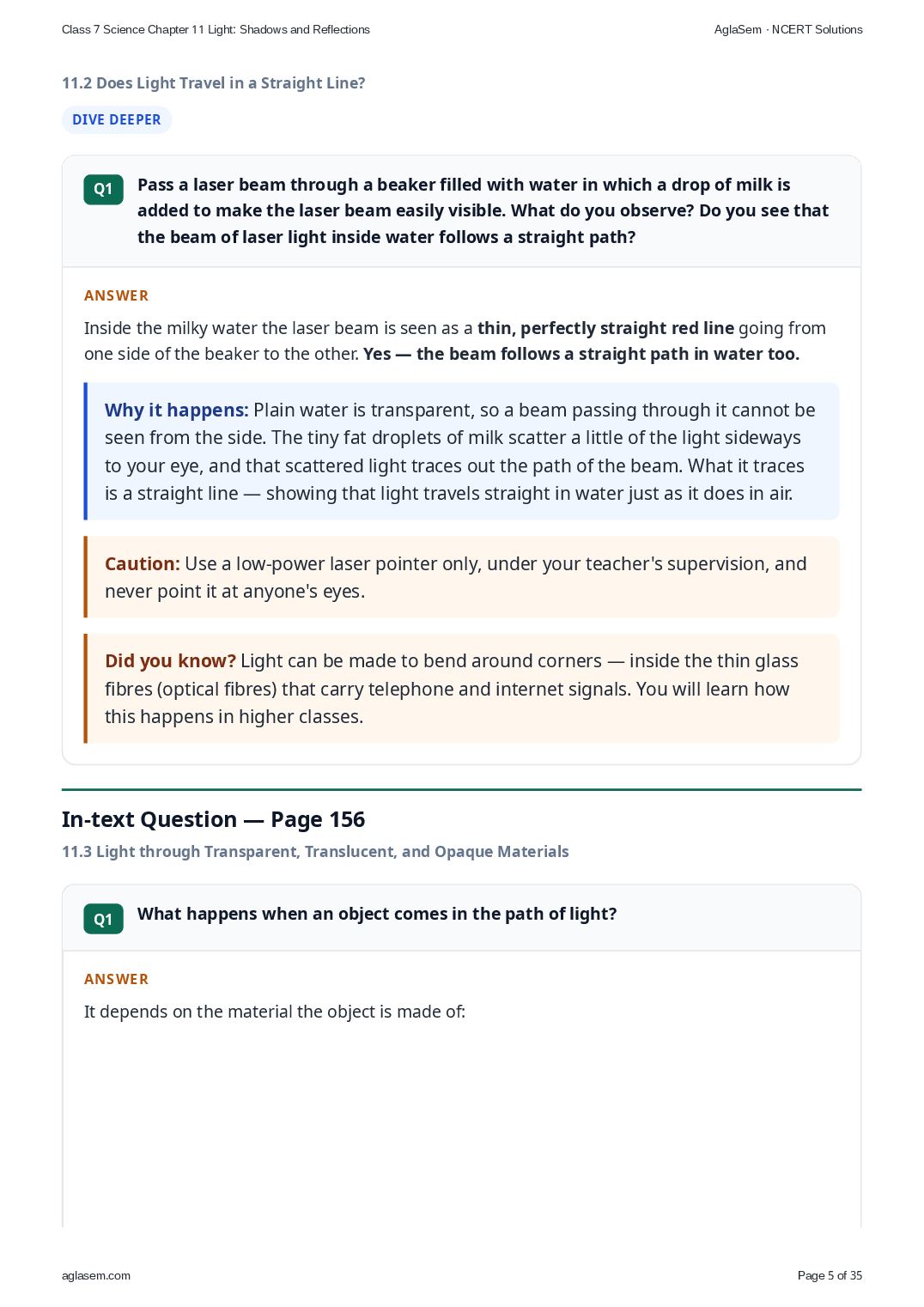
- Pass a laser beam through a beaker filled with water in which a drop of milk is added to make the laser beam easily visible. What do you observe? Do you see that the beam of laser light inside water follows a straight path?
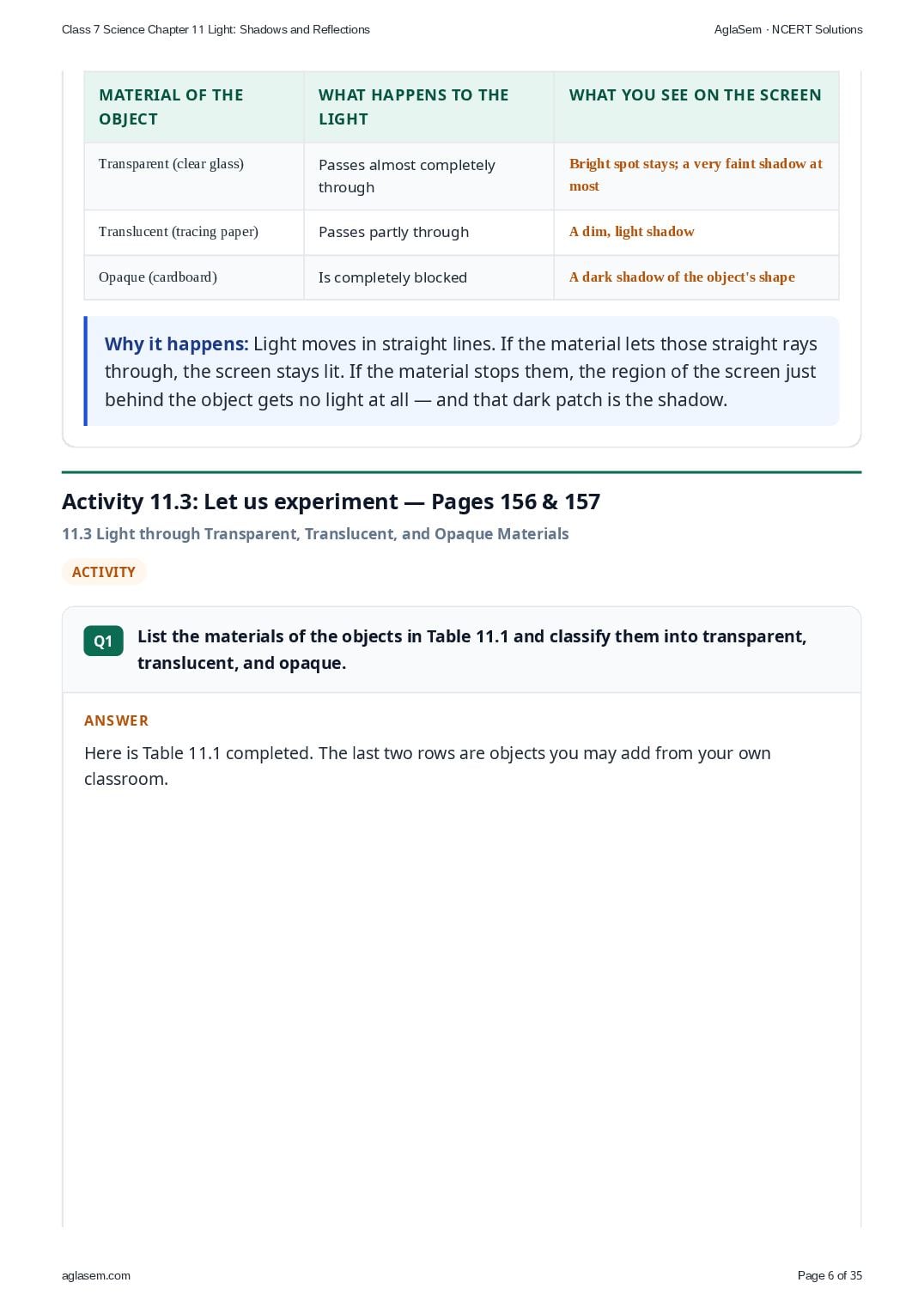
- What happens when an object comes in the path of light?
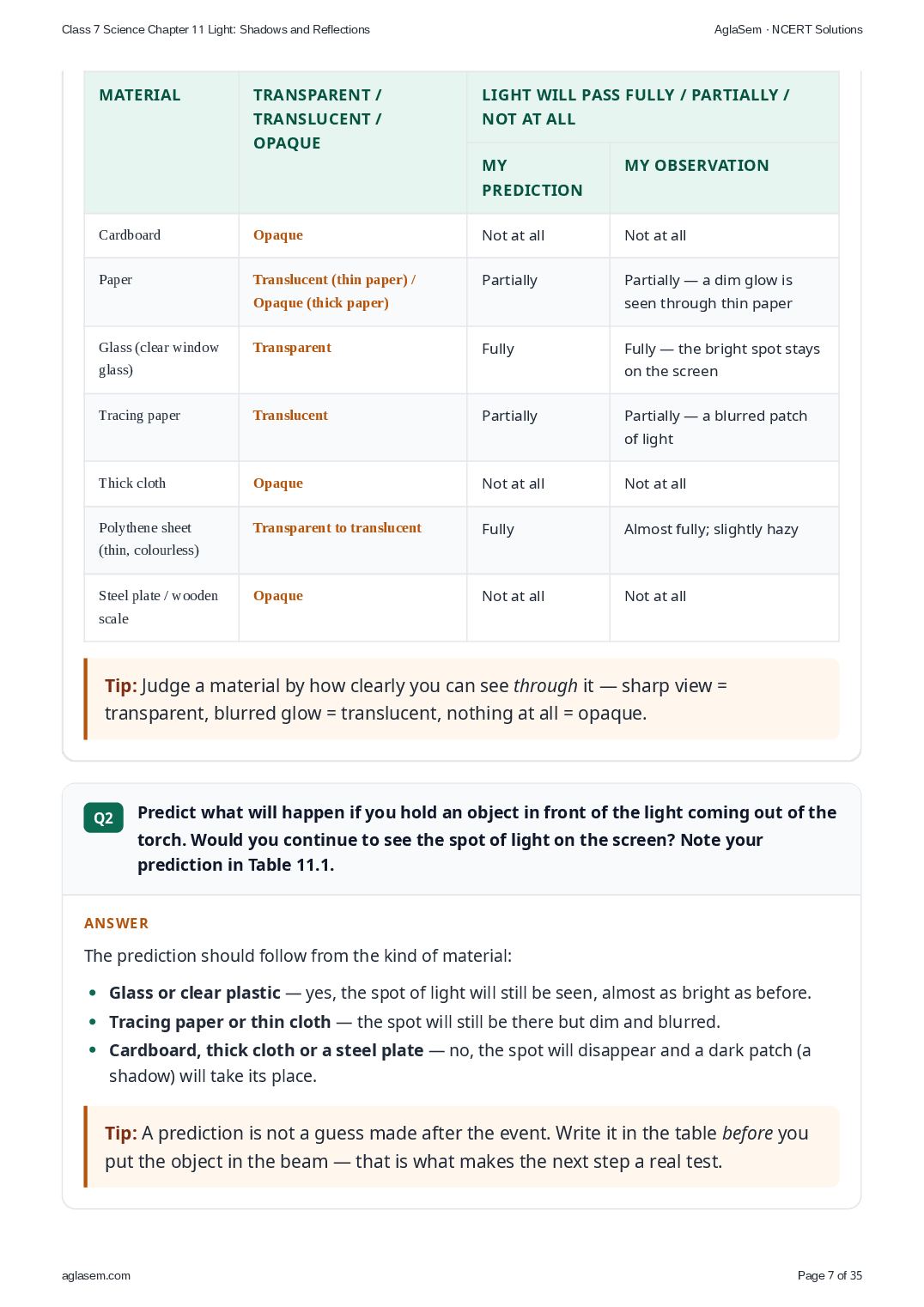
- List the materials of the objects in Table 11.1 and classify them into transparent, translucent, and opaque.
- Predict what will happen if you hold an object in front of the light coming out of the torch. Would you continue to see the spot of light on the screen? Note your prediction in Table 11.1.
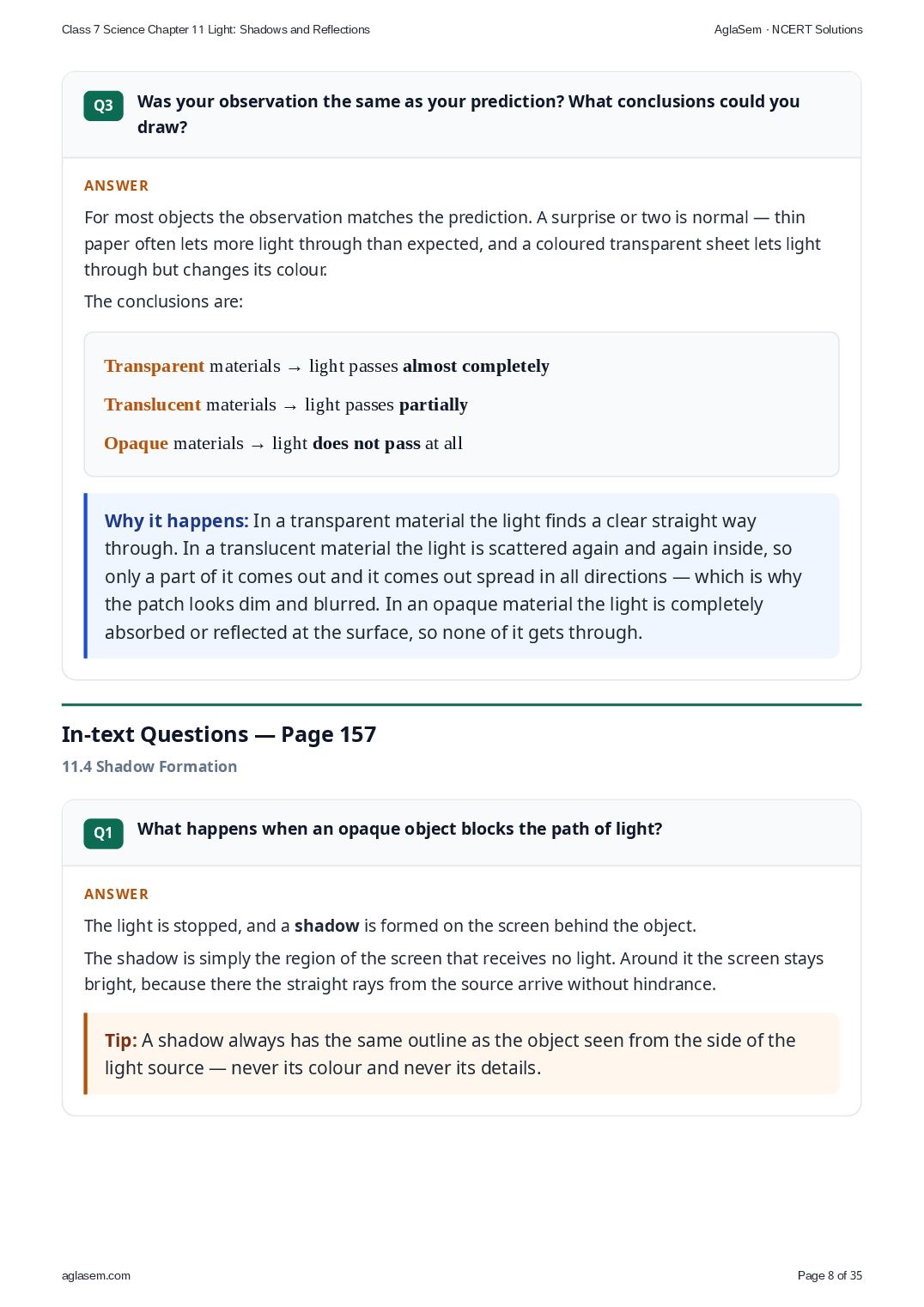
- Was your observation the same as your prediction? What conclusions could you draw?
- What happens when an opaque object blocks the path of light?
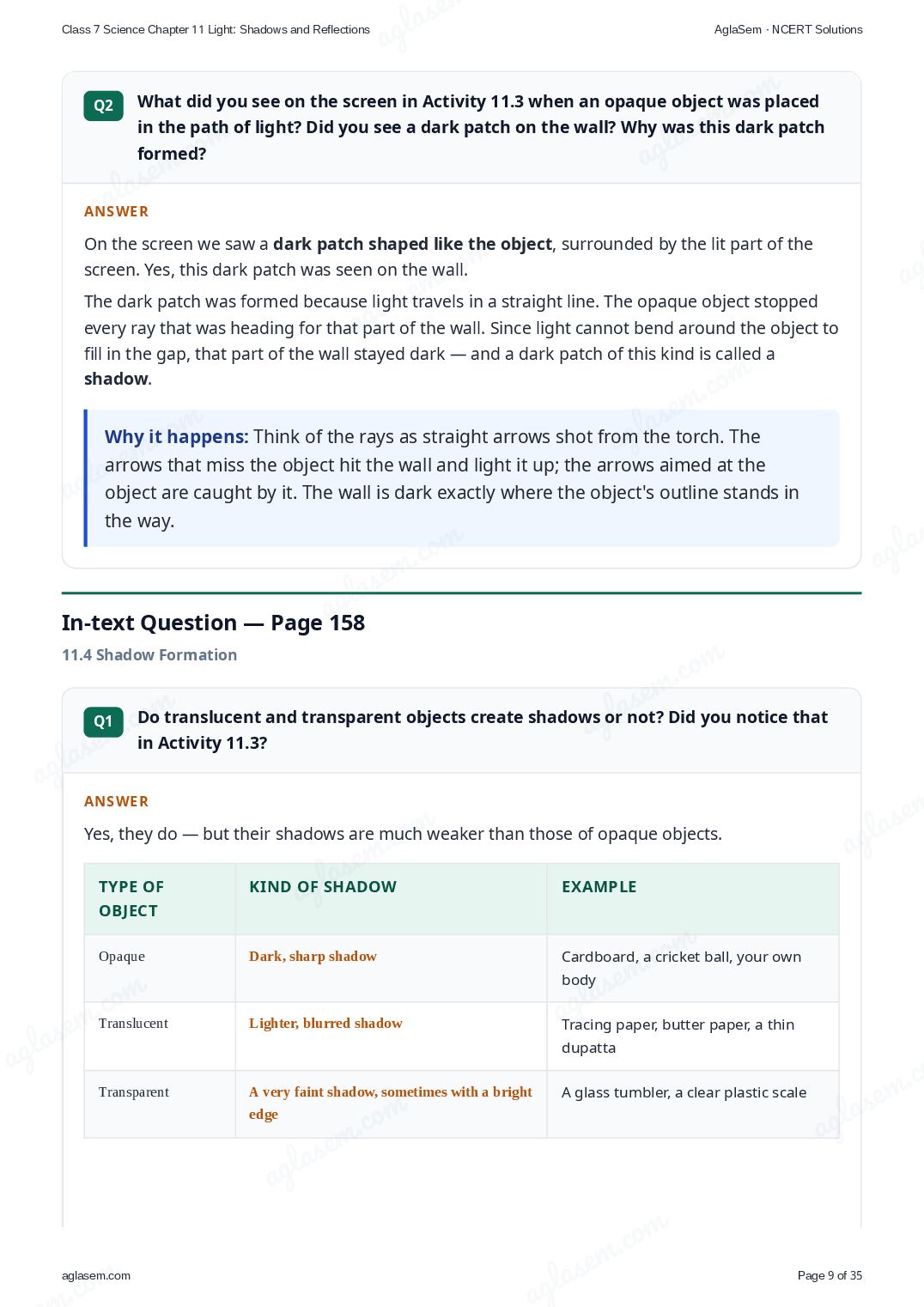
- What did you see on the screen in Activity 11.3 when an opaque object was placed in the path of light? Did you see a dark patch on the wall? Why was this dark patch formed?
- Do translucent and transparent objects create shadows or not? Did you notice that in Activity 11.3?
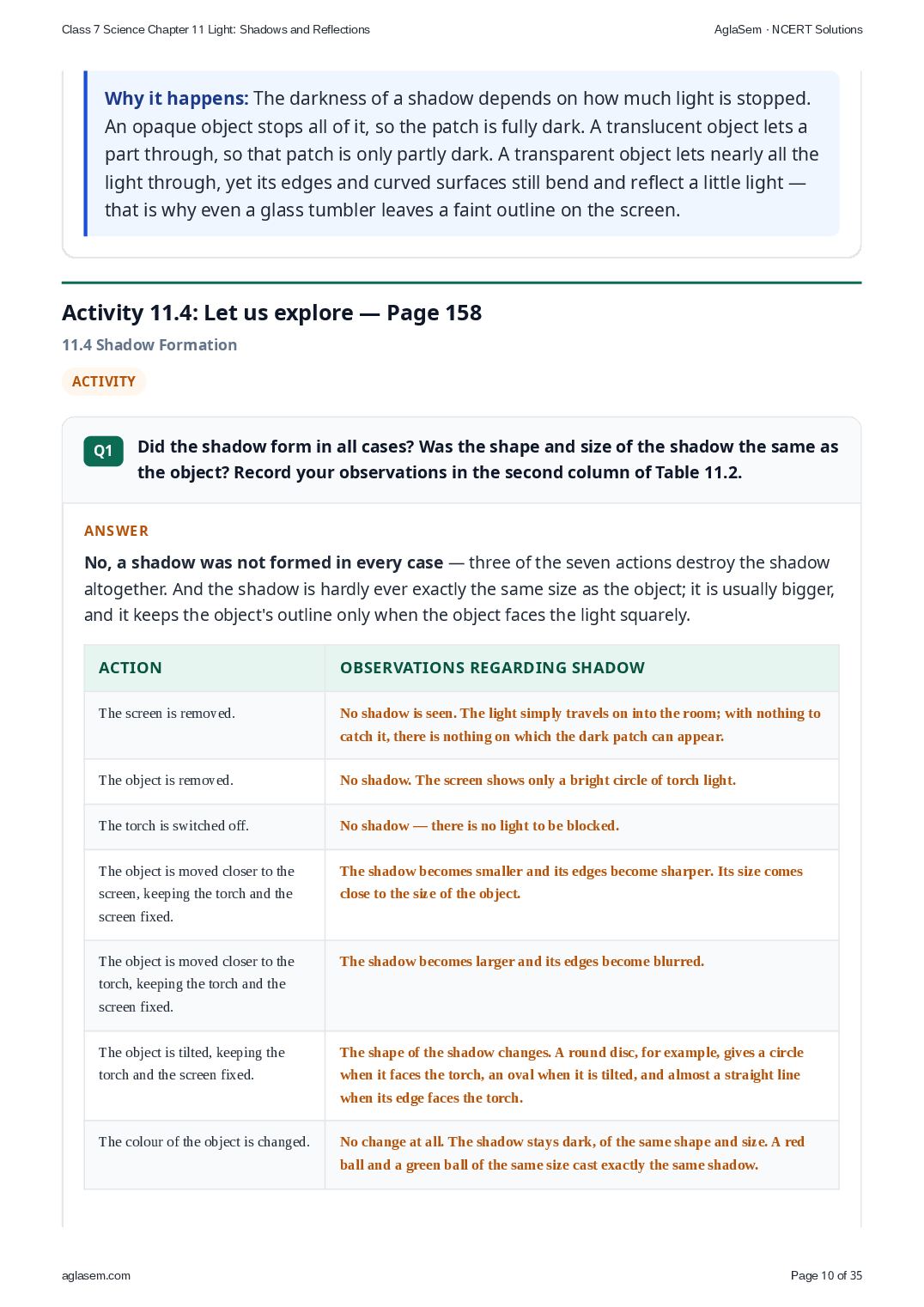
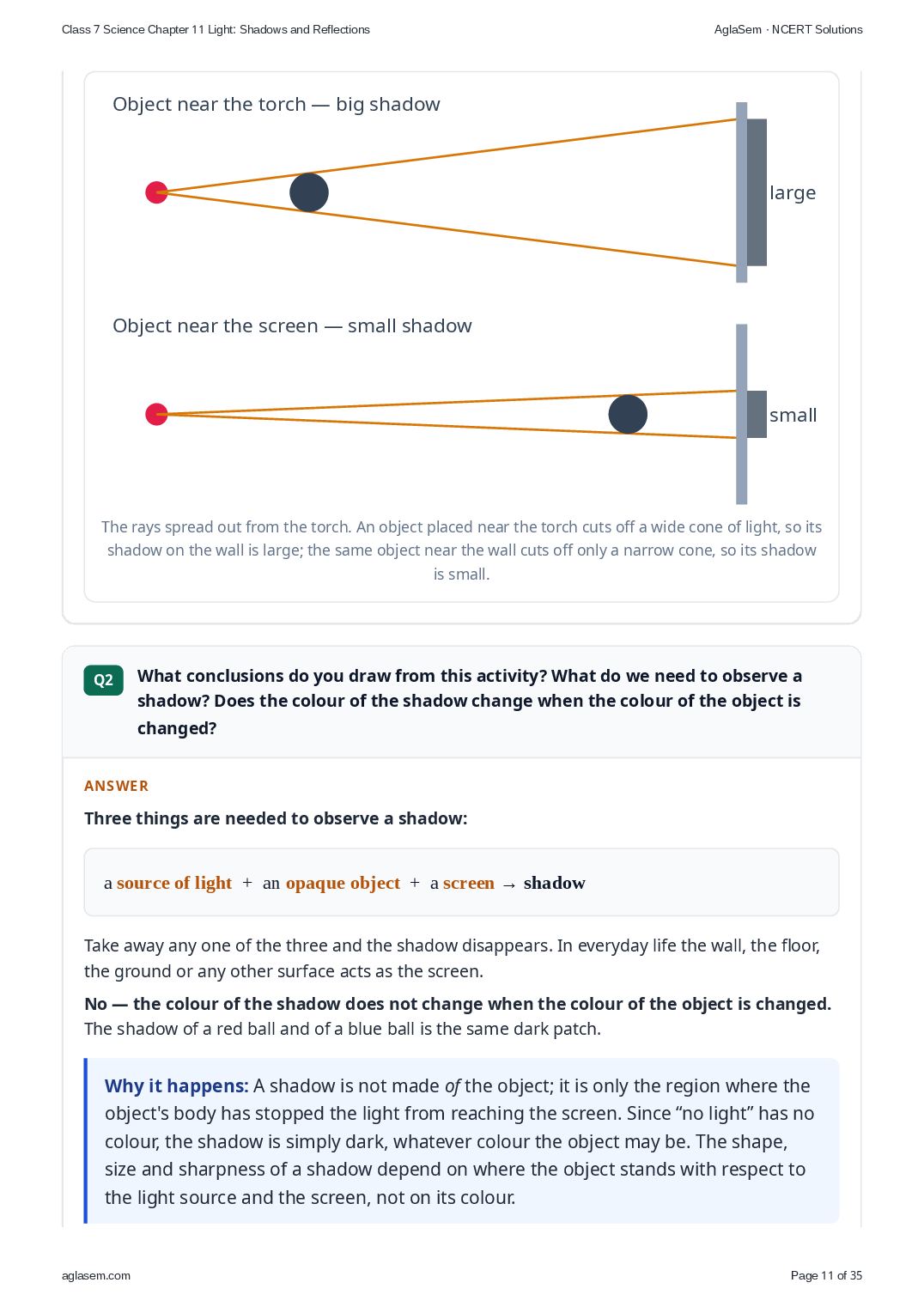
- Did the shadow form in all cases? Was the shape and size of the shadow the same as the object? Record your observations in the second column of Table 11.2.
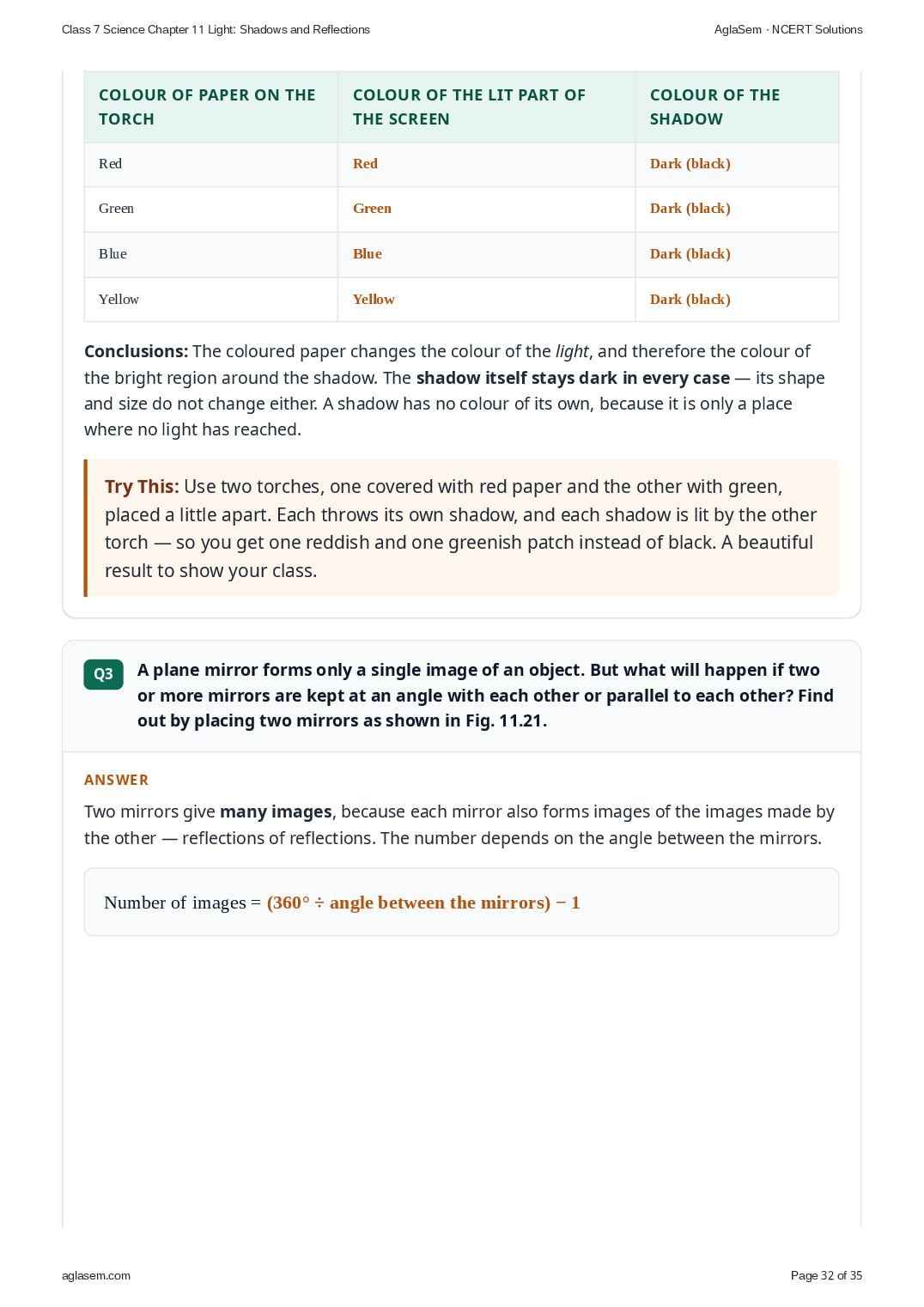
- What conclusions do you draw from this activity? What do we need to observe a shadow? Does the colour of the shadow change when the colour of the object is changed?
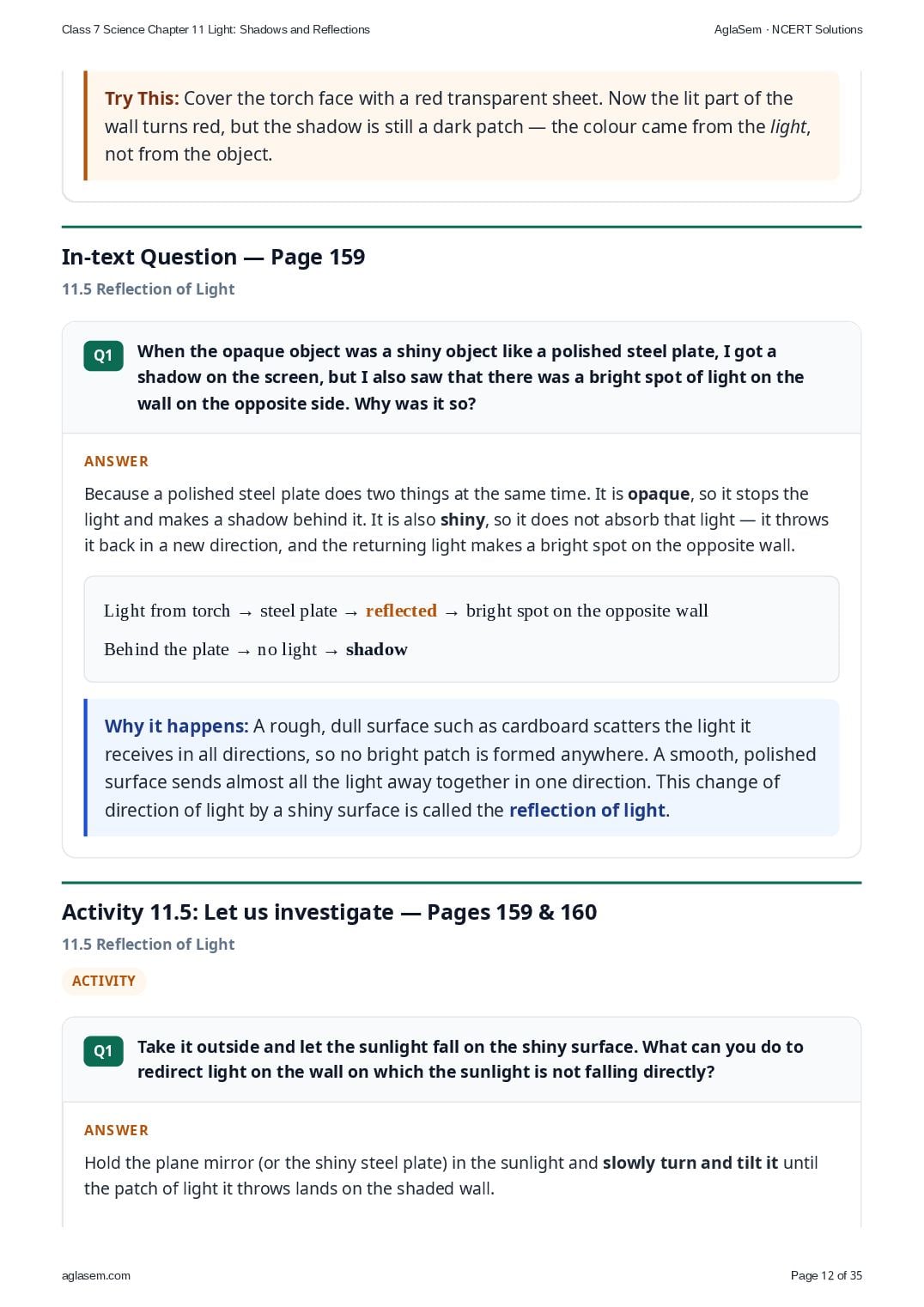
- When the opaque object was a shiny object like a polished steel plate, I got a shadow on the screen, but I also saw that there was a bright spot of light on the wall on the opposite side. Why was it so?
- Take it outside and let the sunlight fall on the shiny surface. What can you do to redirect light on the wall on which the sunlight is not falling directly?
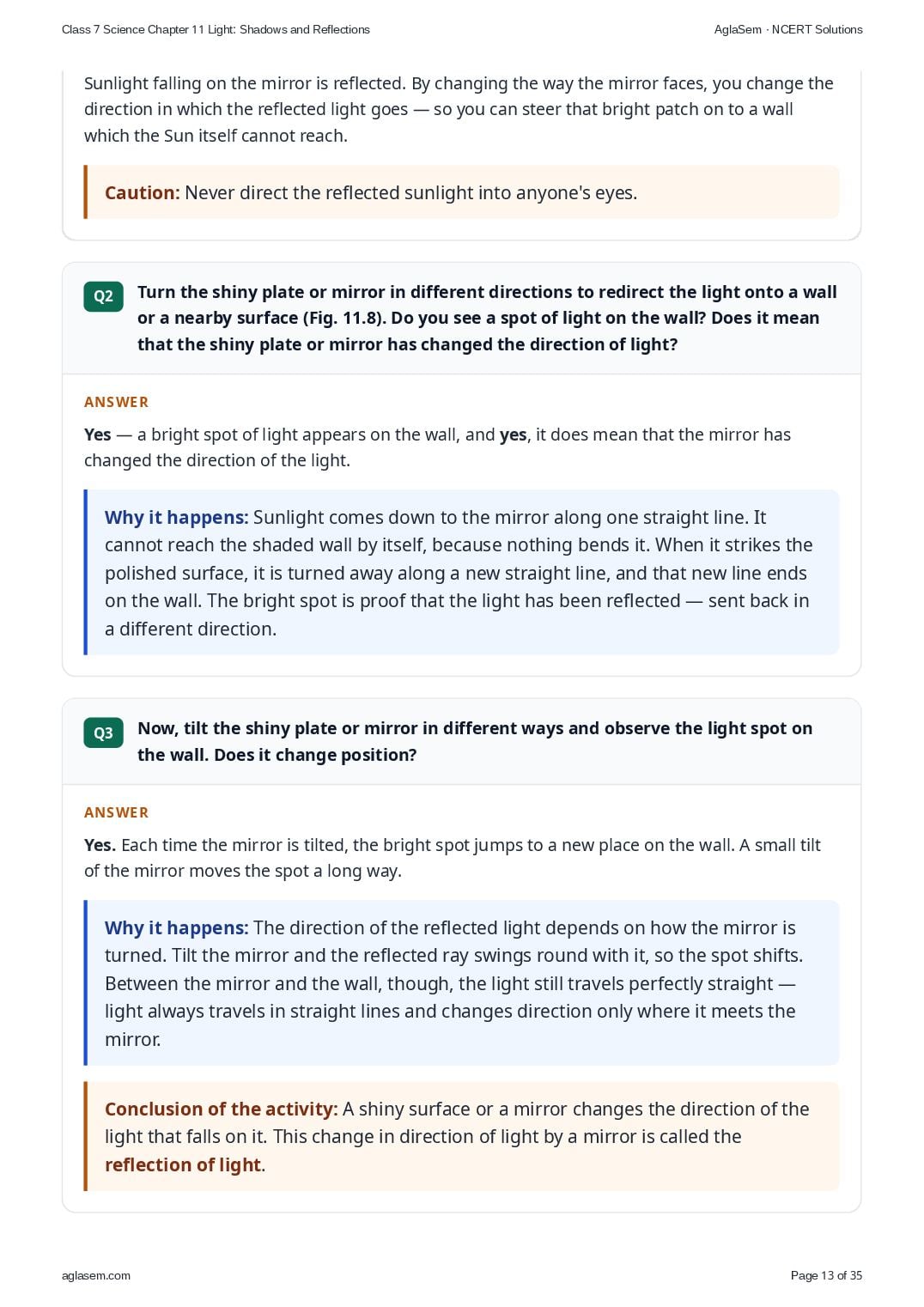
- Turn the shiny plate or mirror in different directions to redirect the light onto a wall or a nearby surface (Fig. 11.8). Do you see a spot of light on the wall? Does it mean that the shiny plate or mirror has changed the direction of light?
- Now, tilt the shiny plate or mirror in different ways and observe the light spot on the wall. Does it change position?
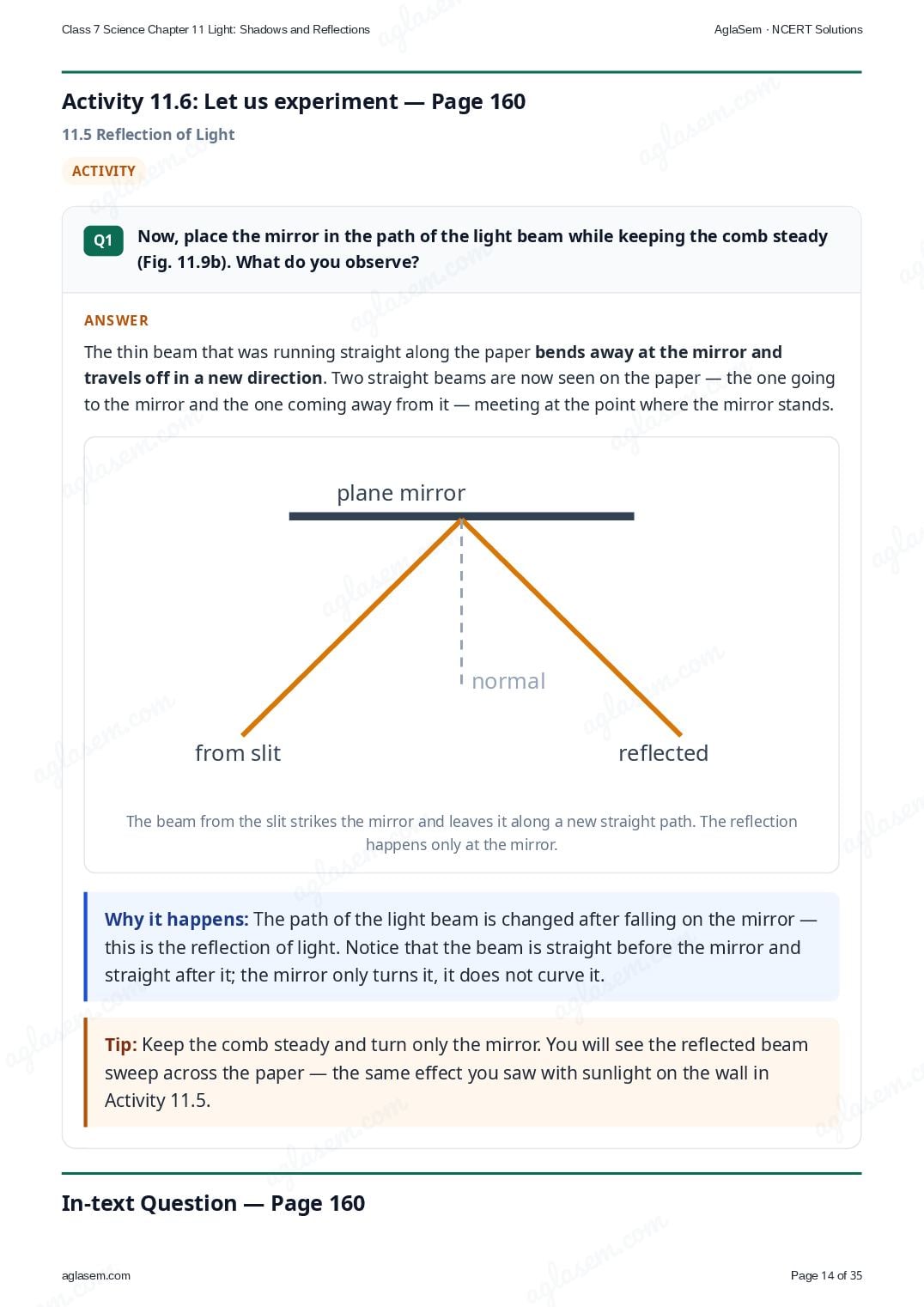
- Now, place the mirror in the path of the light beam while keeping the comb steady (Fig. 11.9b). What do you observe?
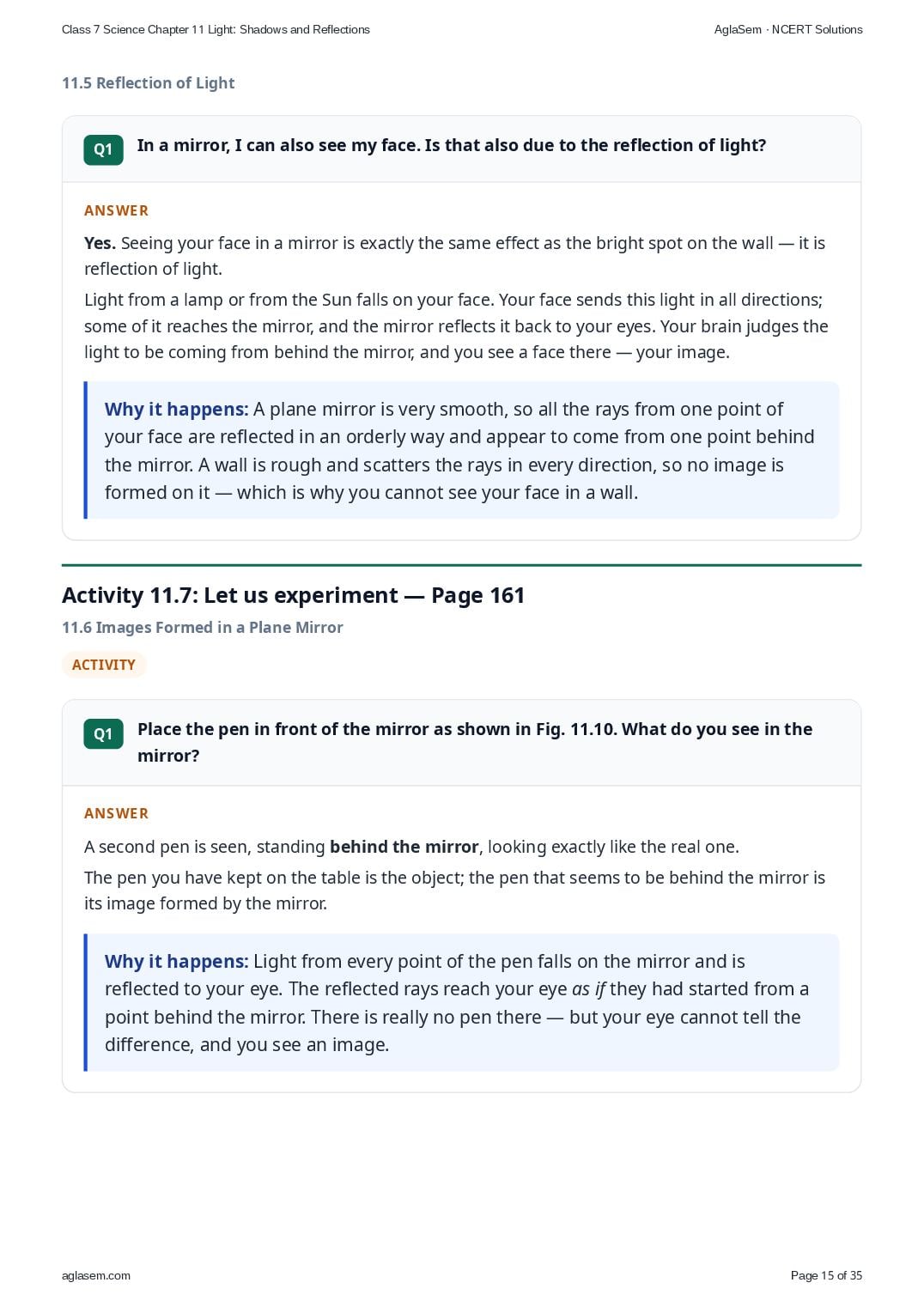
- In a mirror, I can also see my face. Is that also due to the reflection of light?
- Place the pen in front of the mirror as shown in Fig. 11.10. What do you see in the mirror?
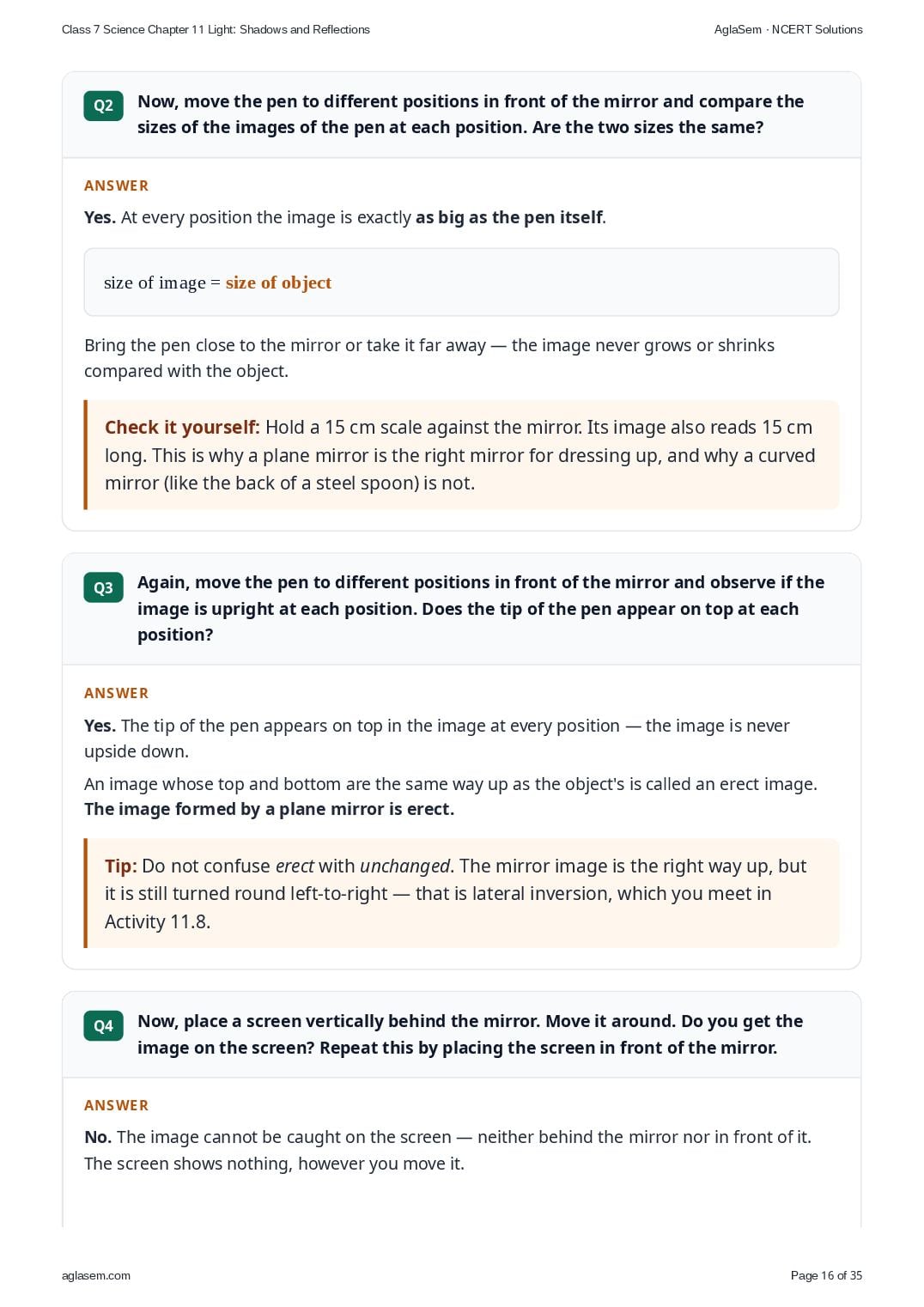
- Now, move the pen to different positions in front of the mirror and compare the sizes of the images of the pen at each position. Are the two sizes the same?
- Again, move the pen to different positions in front of the mirror and observe if the image is upright at each position. Does the tip of the pen appear on top at each position?
- Now, place a screen vertically behind the mirror. Move it around. Do you get the image on the screen? Repeat this by placing the screen in front of the mirror.
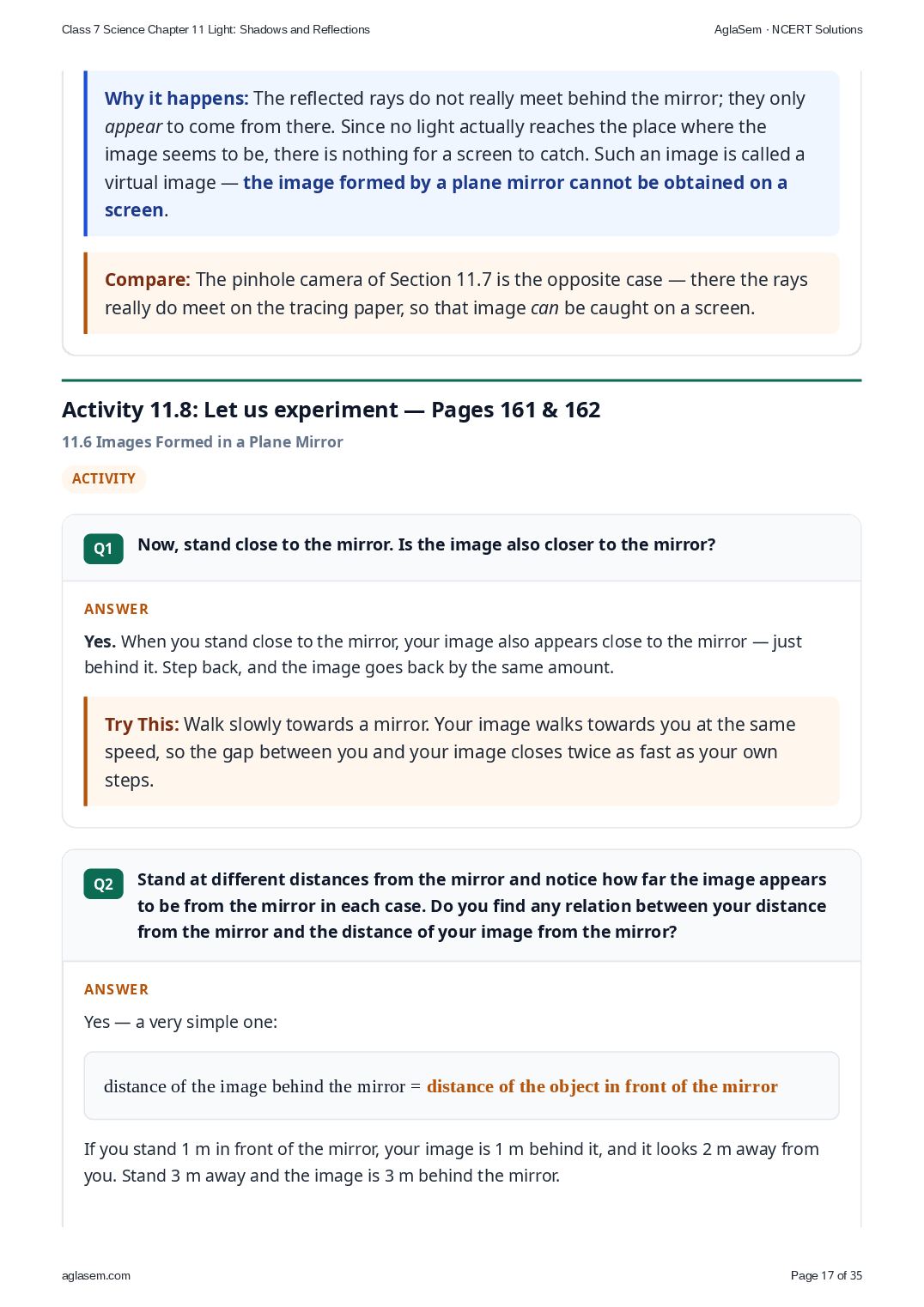
- Now, stand close to the mirror. Is the image also closer to the mirror?
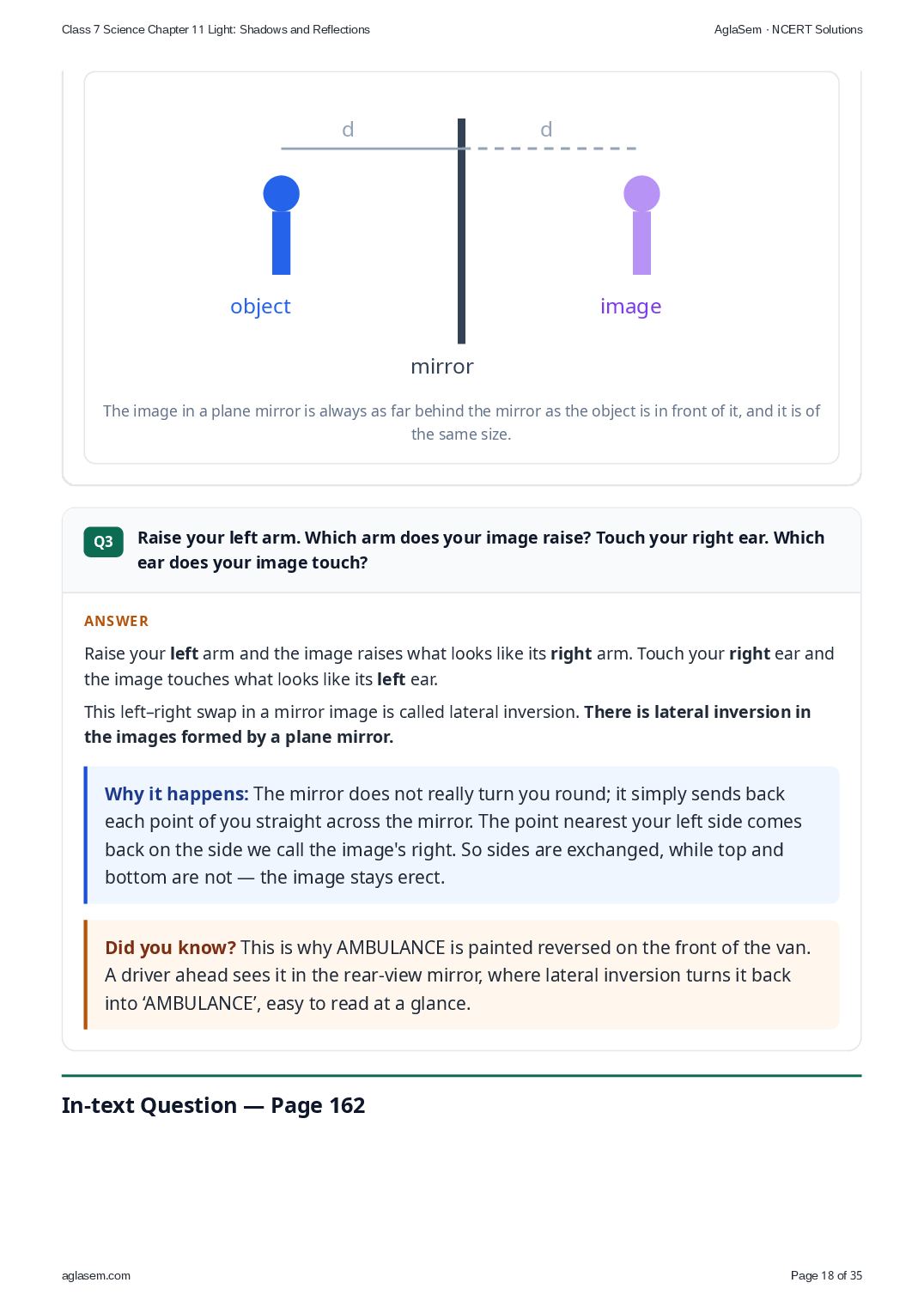
- Stand at different distances from the mirror and notice how far the image appears to be from the mirror in each case. Do you find any relation between your distance from the mirror and the distance of your image from the mirror?
- Raise your left arm. Which arm does your image raise? Touch your right ear. Which ear does your image touch?
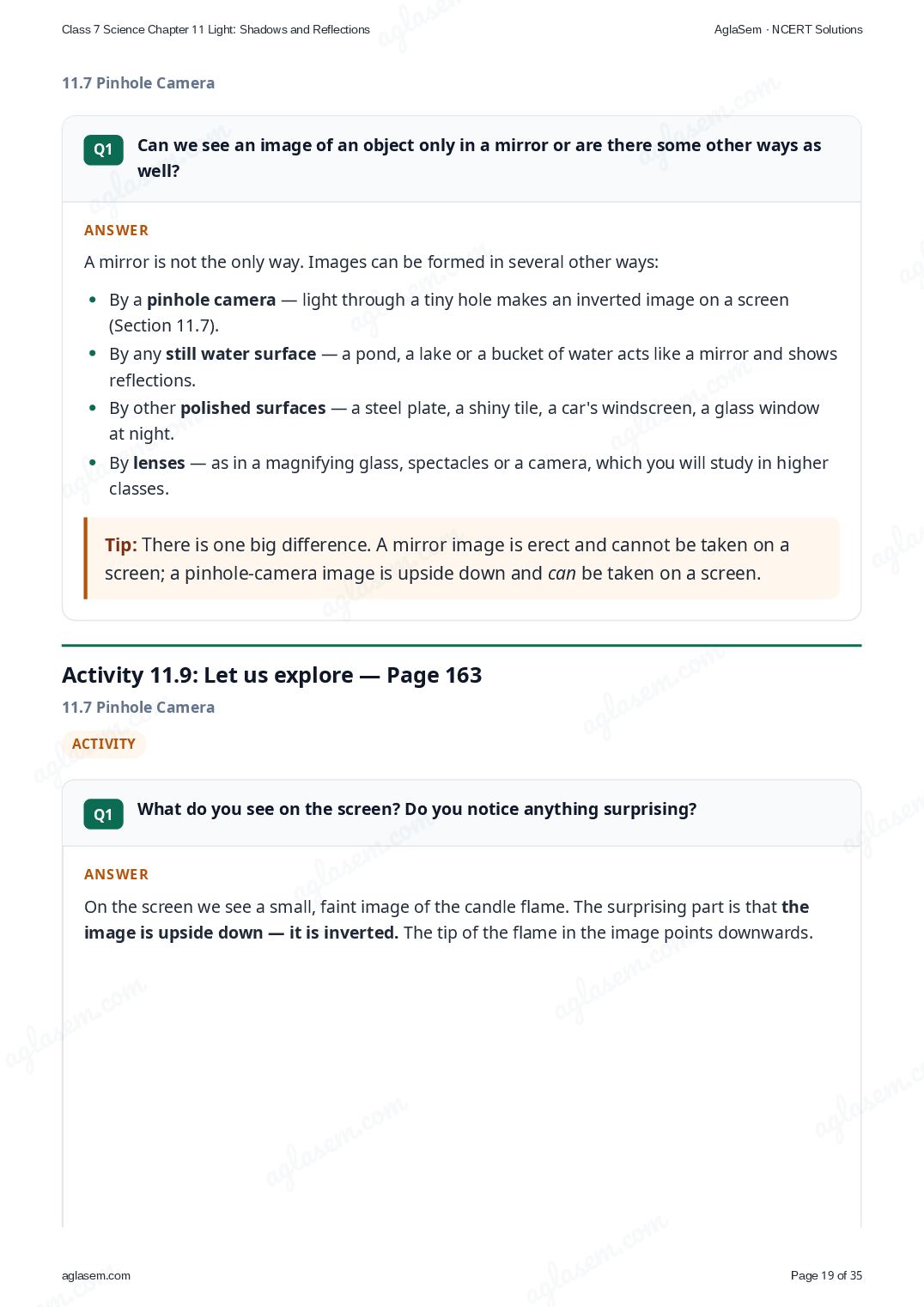
- Can we see an image of an object only in a mirror or are there some other ways as well?
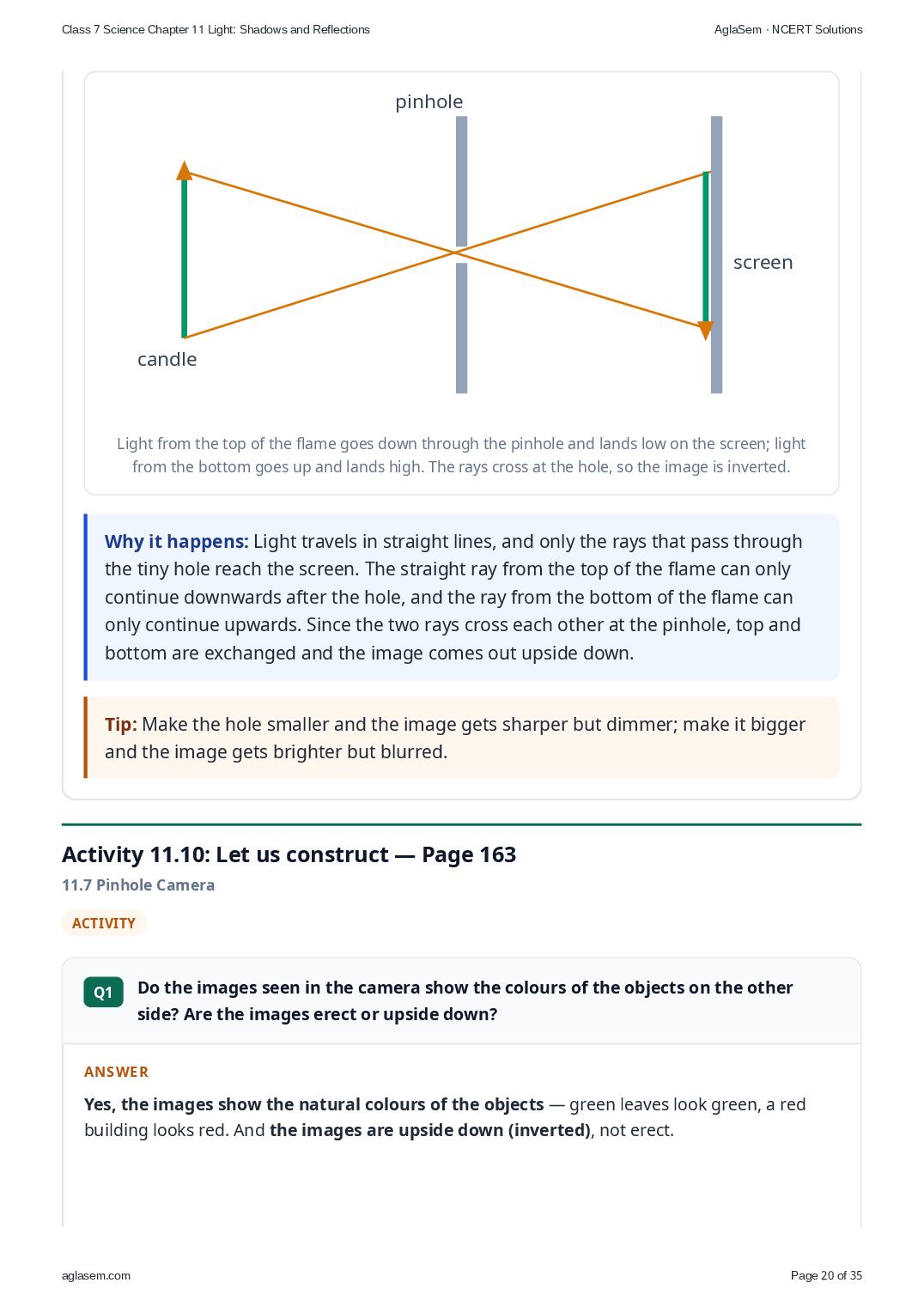
- What do you see on the screen? Do you notice anything surprising?
- Do the images seen in the camera show the colours of the objects on the other side? Are the images erect or upside down?
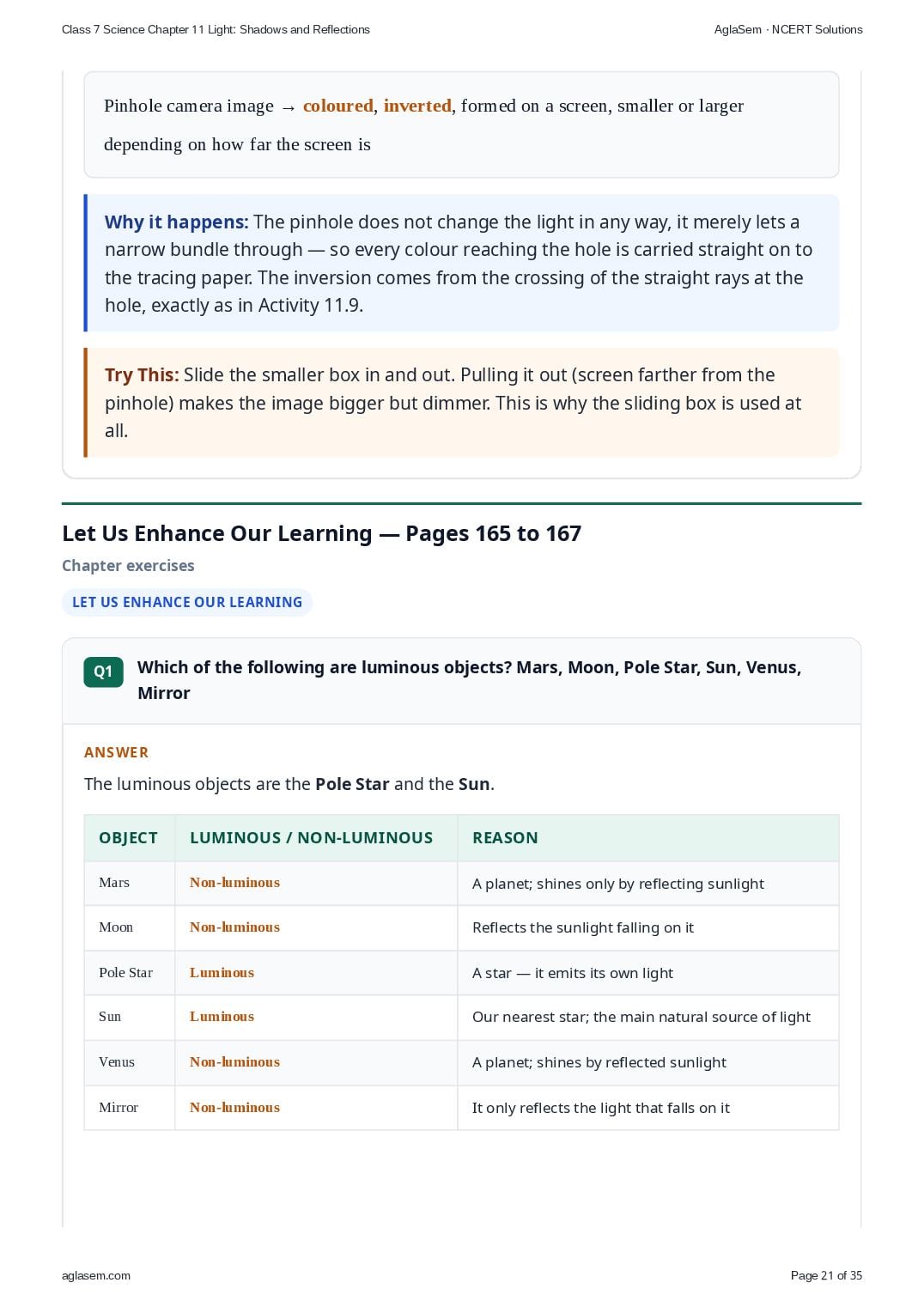
- Which of the following are luminous objects? Mars, Moon, Pole Star, Sun, Venus, Mirror
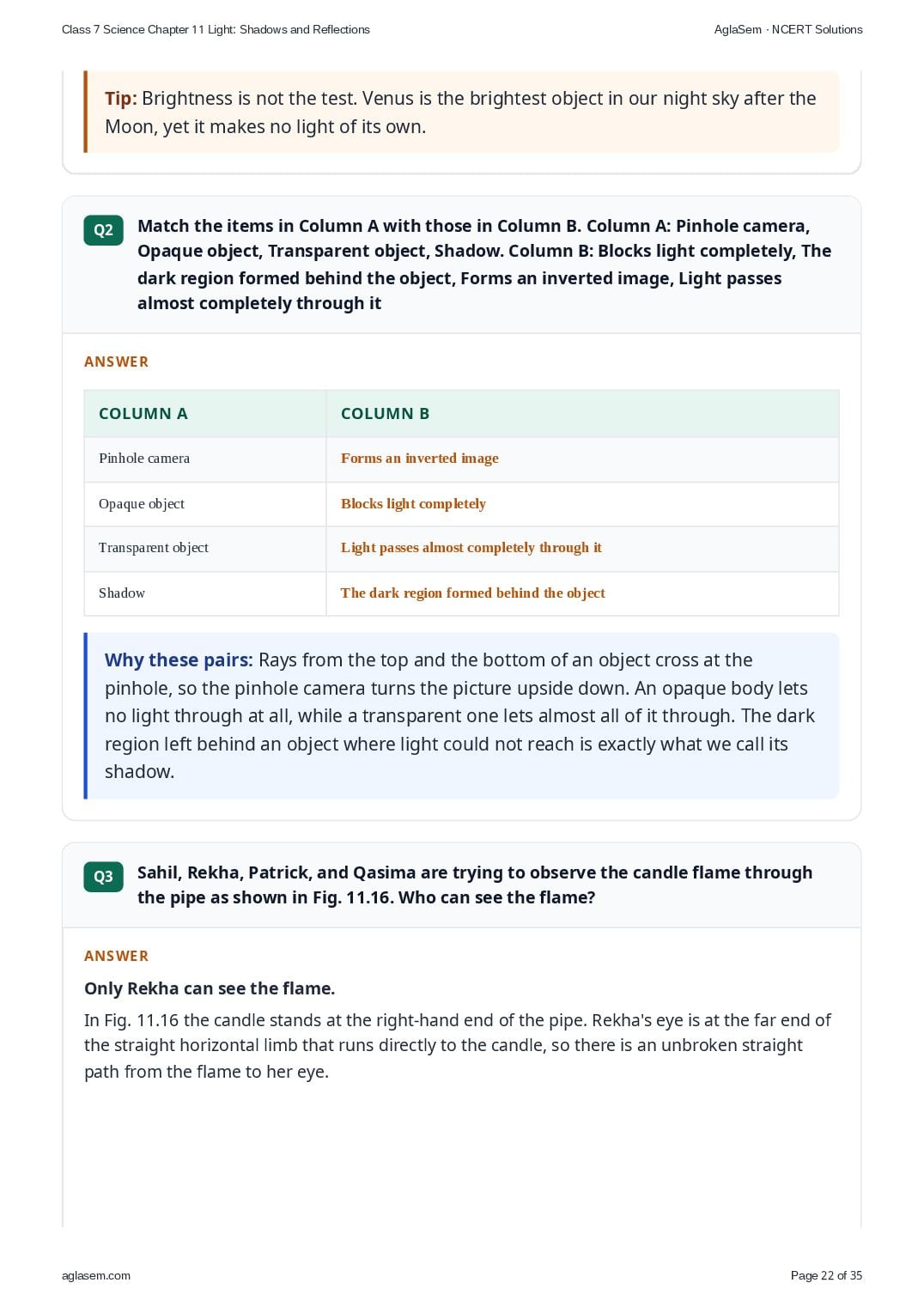
- Match the items in Column A with those in Column B. Column A: Pinhole camera, Opaque object, Transparent object, Shadow. Column B: Blocks light completely, The dark region formed behind the object, Forms an inverted image, Light passes almost completely through it
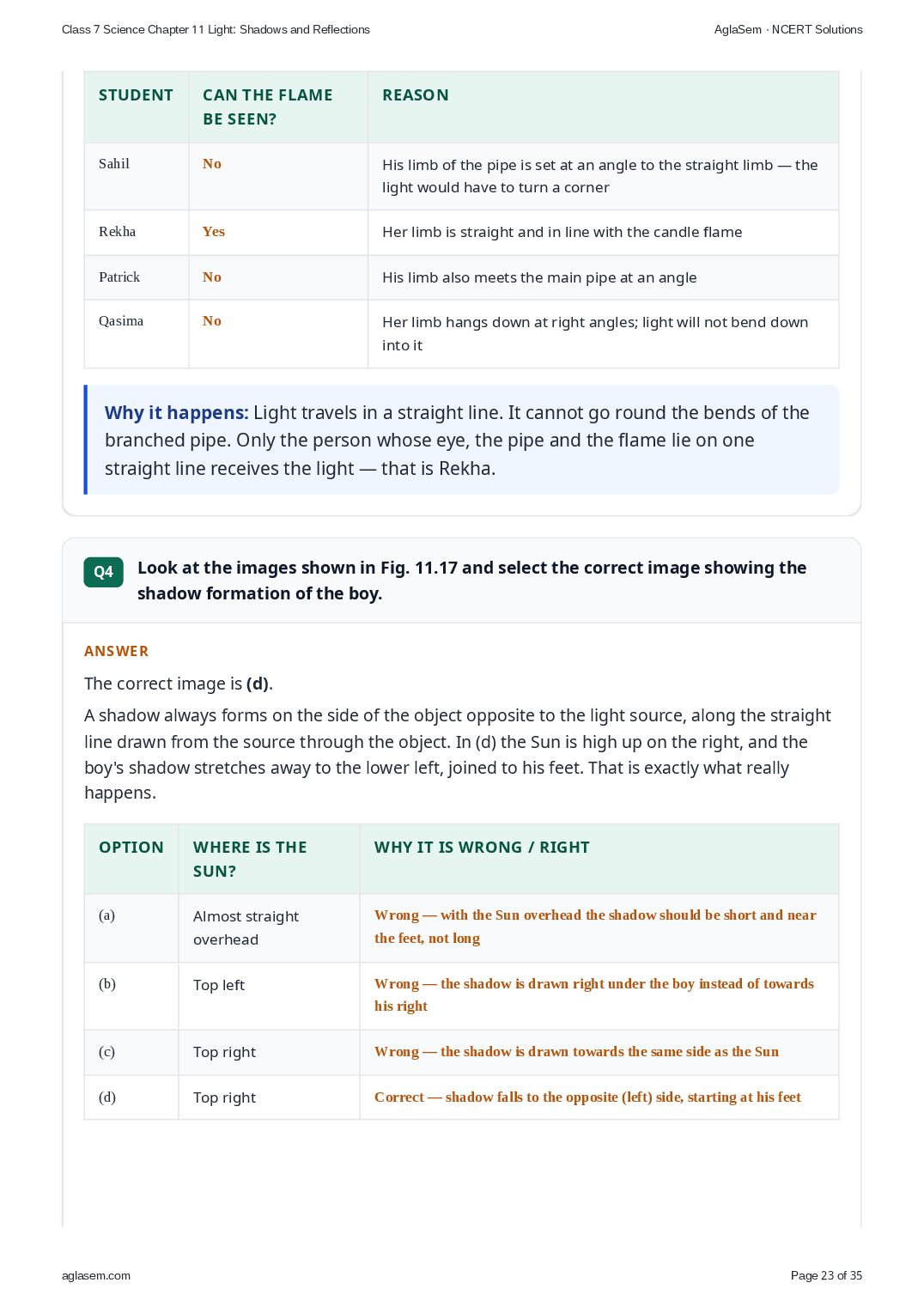
- Sahil, Rekha, Patrick, and Qasima are trying to observe the candle flame through the pipe as shown in Fig. 11.16. Who can see the flame?
- Look at the images shown in Fig. 11.17 and select the correct image showing the shadow formation of the boy.
- The shadow of a ball is formed on a wall by placing the ball in front of a fixed torch as shown in Fig. 11.18. In scenario (i) the ball is closer to the torch, while in scenario (ii) the ball is closer to the wall. Choose the most accurate representation of the shadows formed in both scenarios from the options provided (a and b).
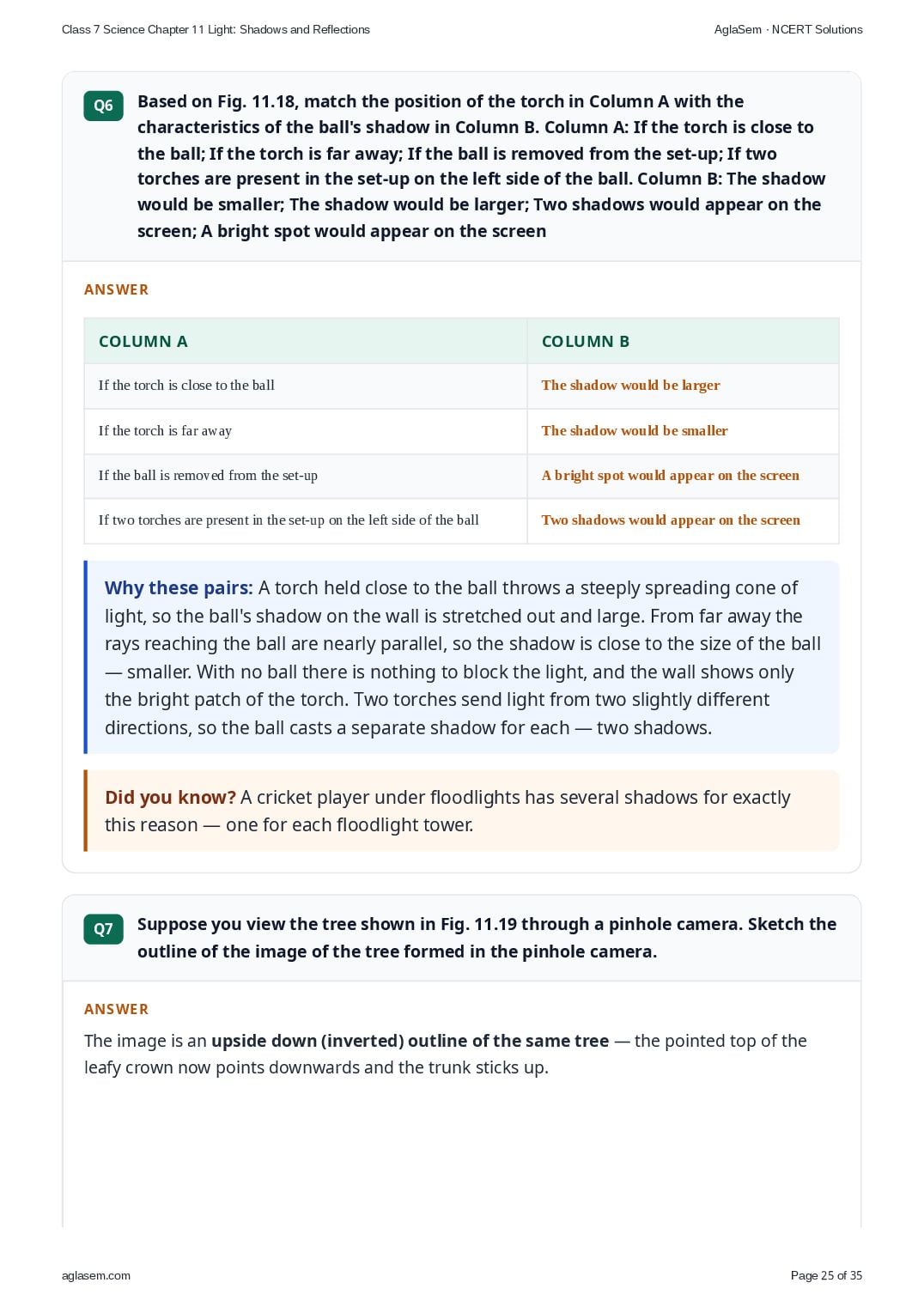
- Based on Fig. 11.18, match the position of the torch in Column A with the characteristics of the ball's shadow in Column B. Column A: If the torch is close to the ball; If the torch is far away; If the ball is removed from the set-up; If two torches are present in the set-up on the left side of the ball. Column B: The shadow would be smaller; The shadow would be larger; Two shadows would appear on the screen; A bright spot would appear on the screen
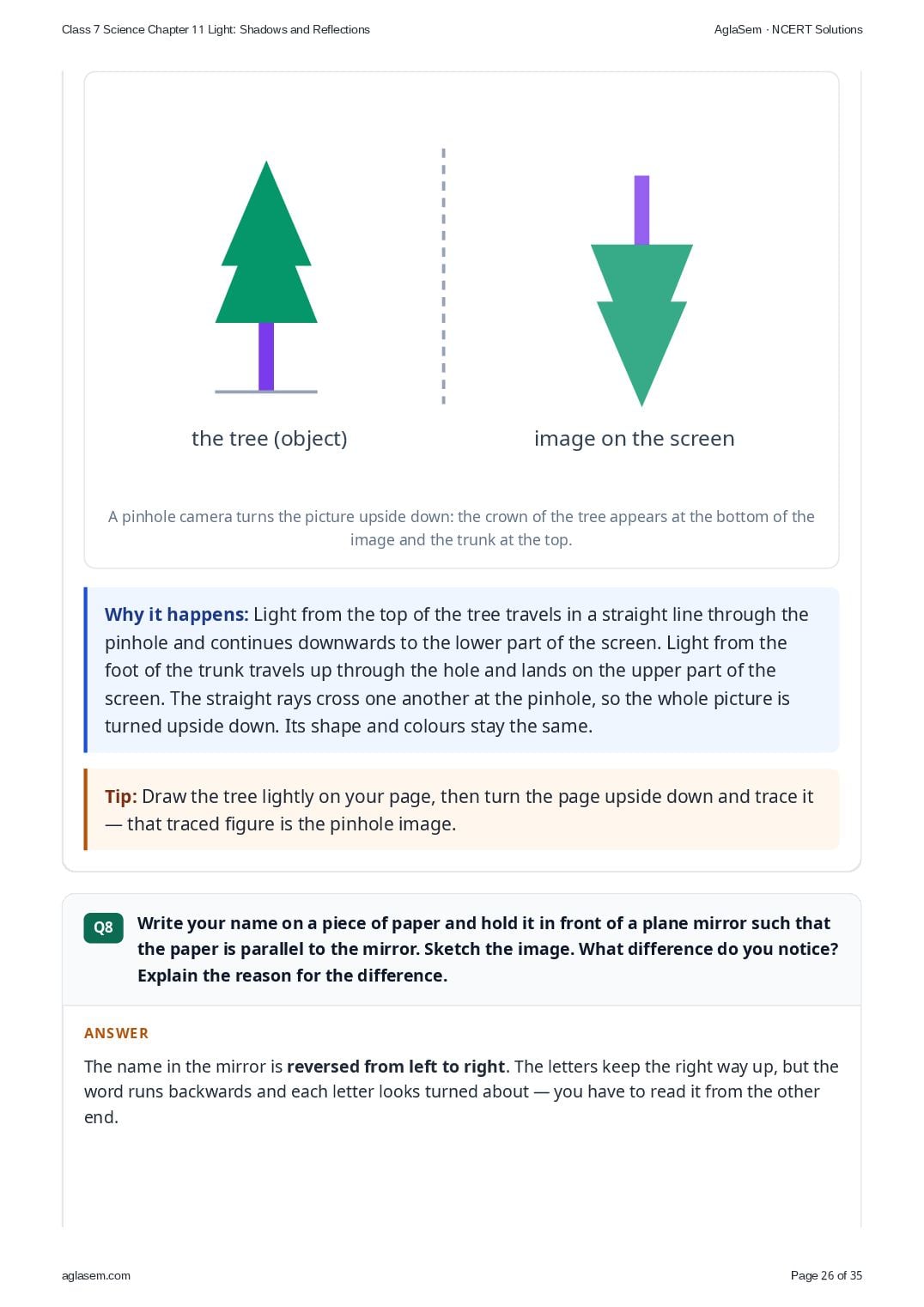
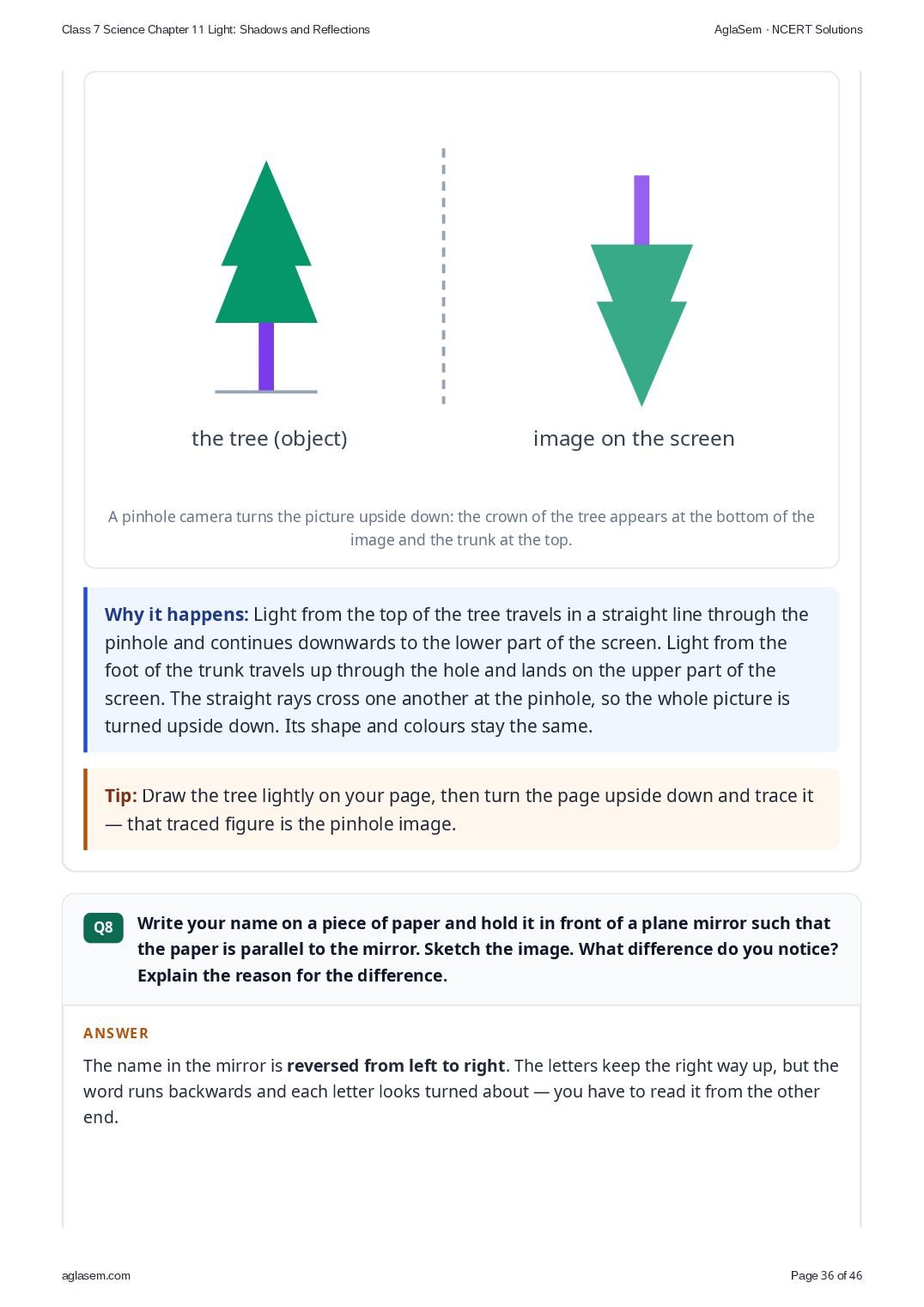
- Suppose you view the tree shown in Fig. 11.19 through a pinhole camera. Sketch the outline of the image of the tree formed in the pinhole camera.
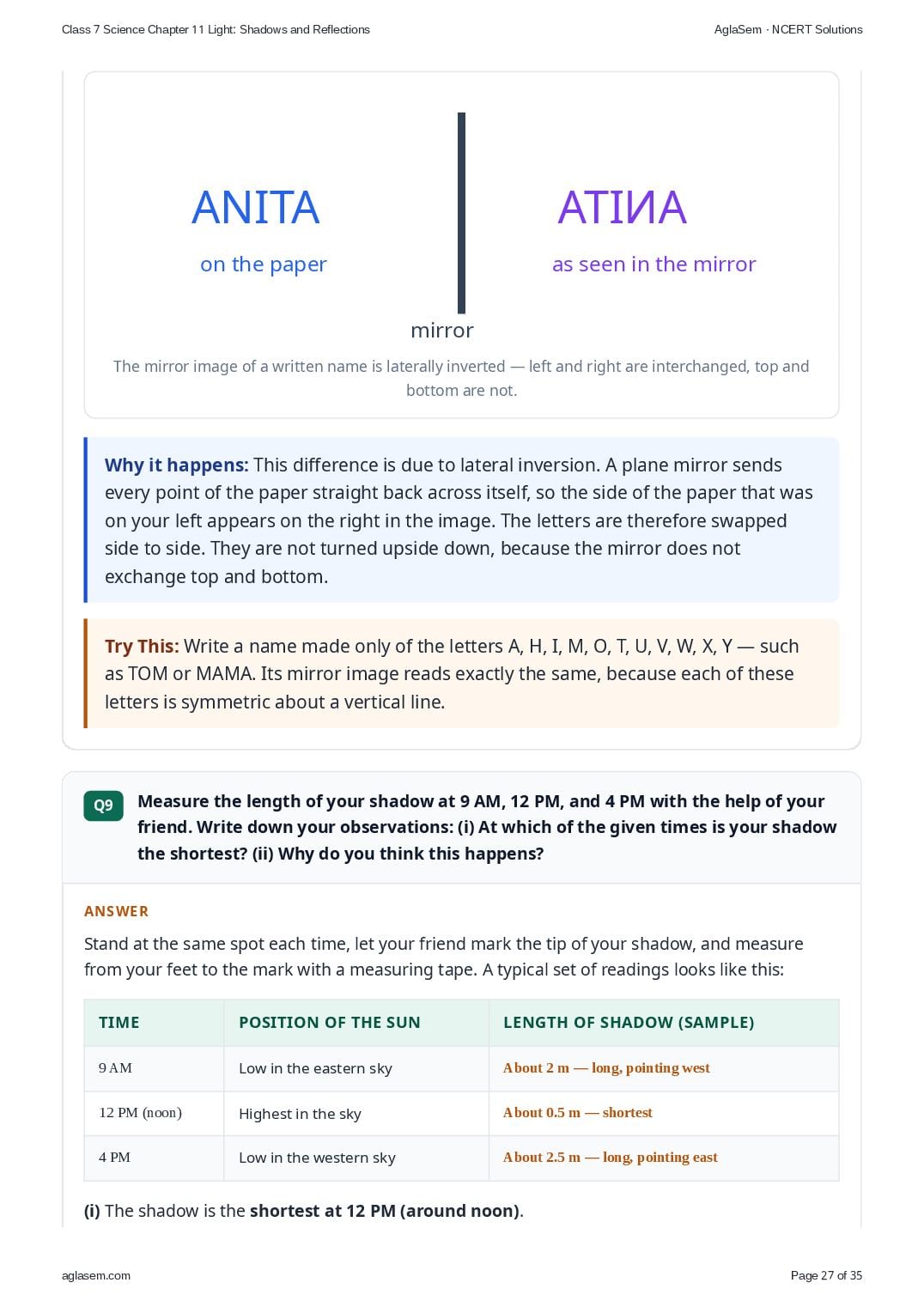
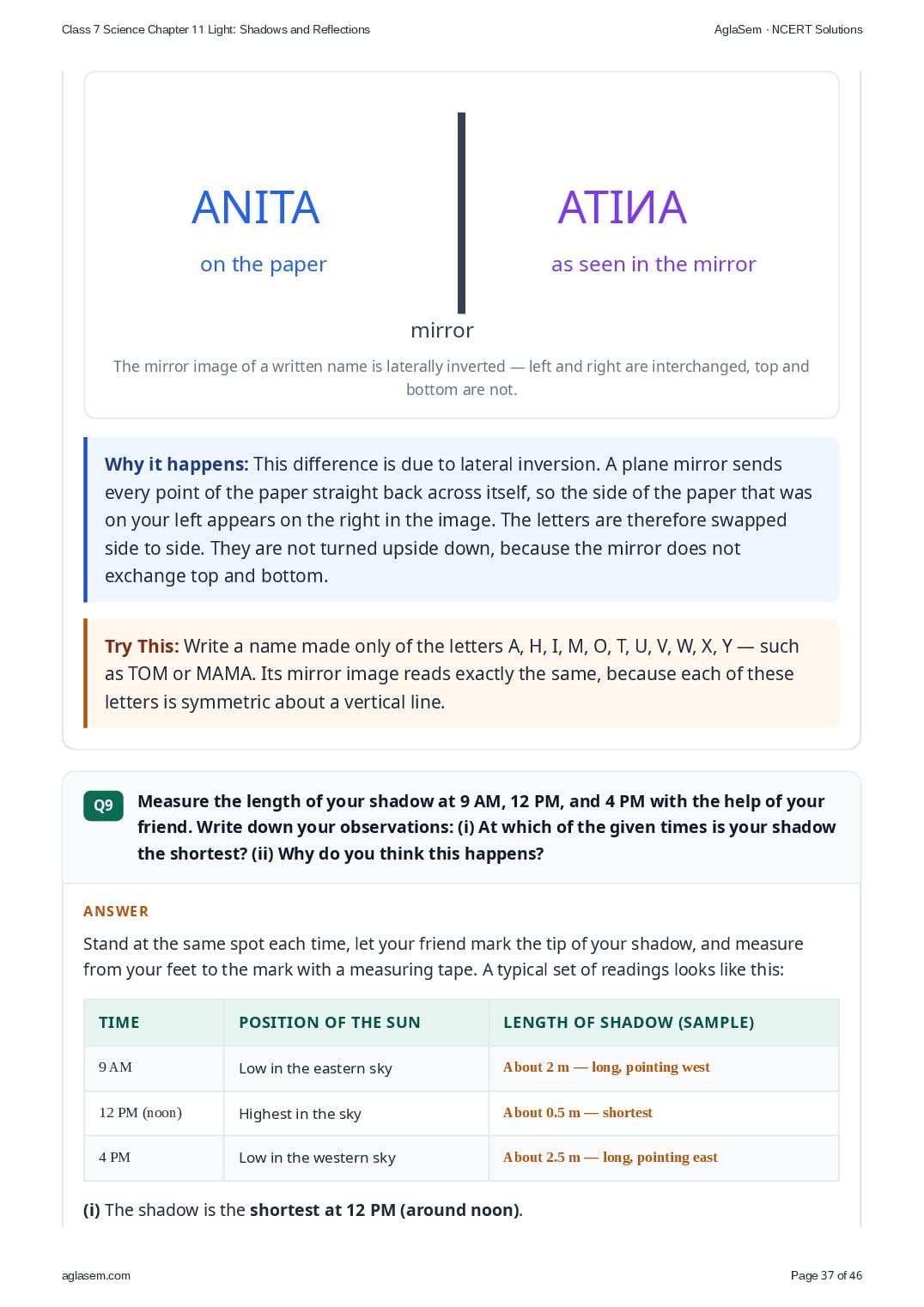
- Write your name on a piece of paper and hold it in front of a plane mirror such that the paper is parallel to the mirror. Sketch the image. What difference do you notice? Explain the reason for the difference.
- Measure the length of your shadow at 9 AM, 12 PM, and 4 PM with the help of your friend. Write down your observations: (i) At which of the given times is your shadow the shortest? (ii) Why do you think this happens?
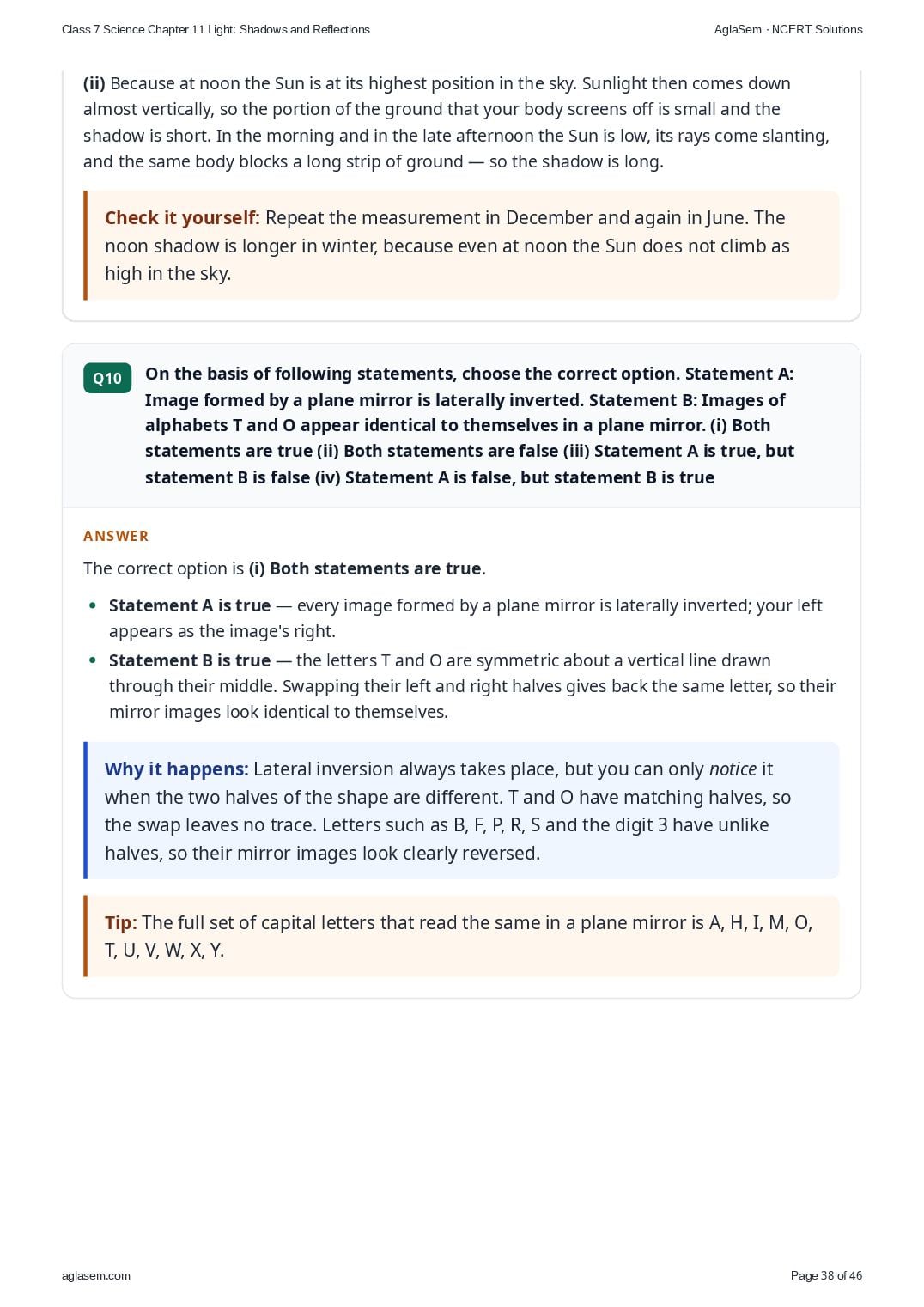
- On the basis of following statements, choose the correct option. Statement A: Image formed by a plane mirror is laterally inverted. Statement B: Images of alphabets T and O appear identical to themselves in a plane mirror. (i) Both statements are true (ii) Both statements are false (iii) Statement A is true, but statement B is false (iv) Statement A is false, but statement B is true
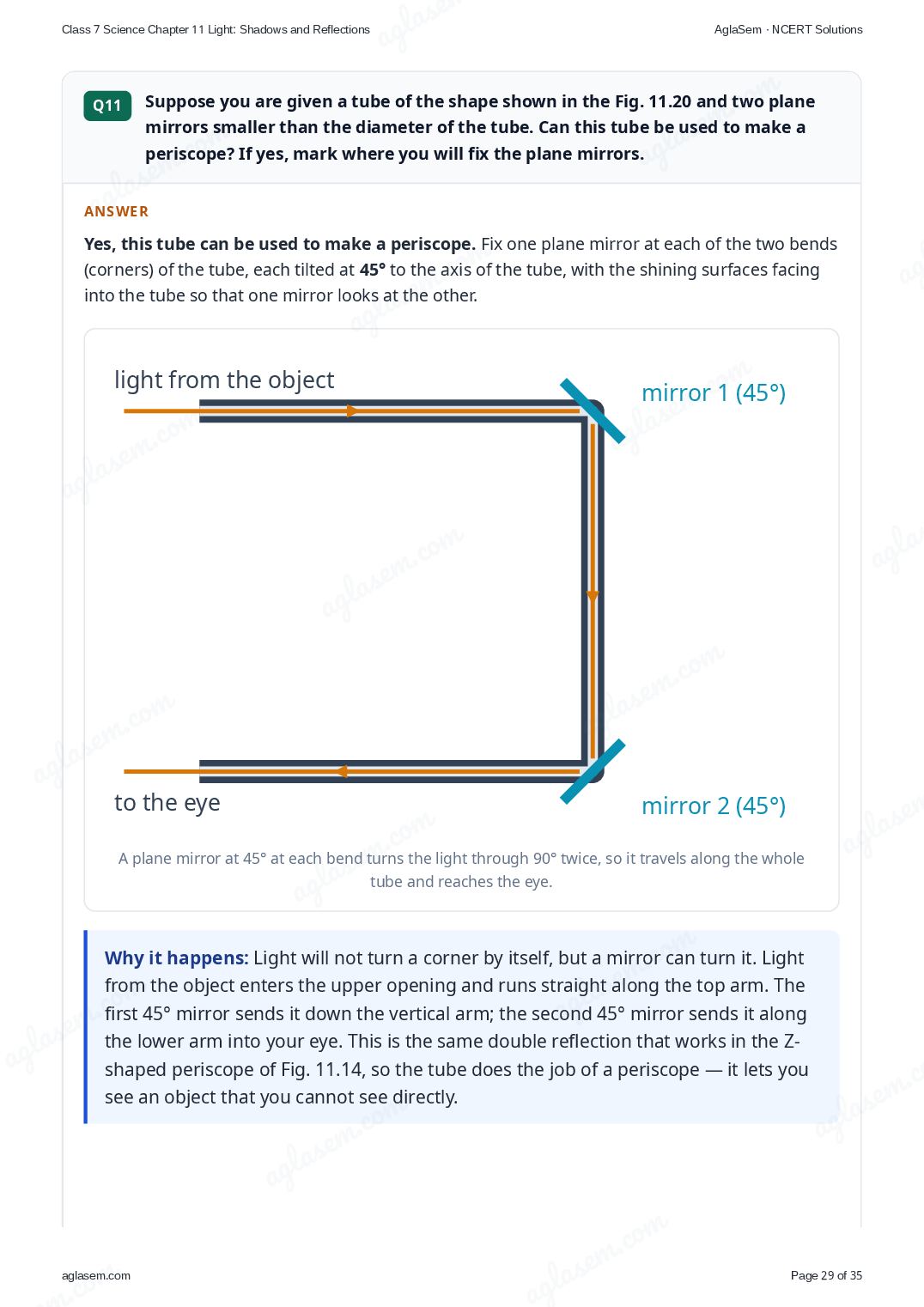
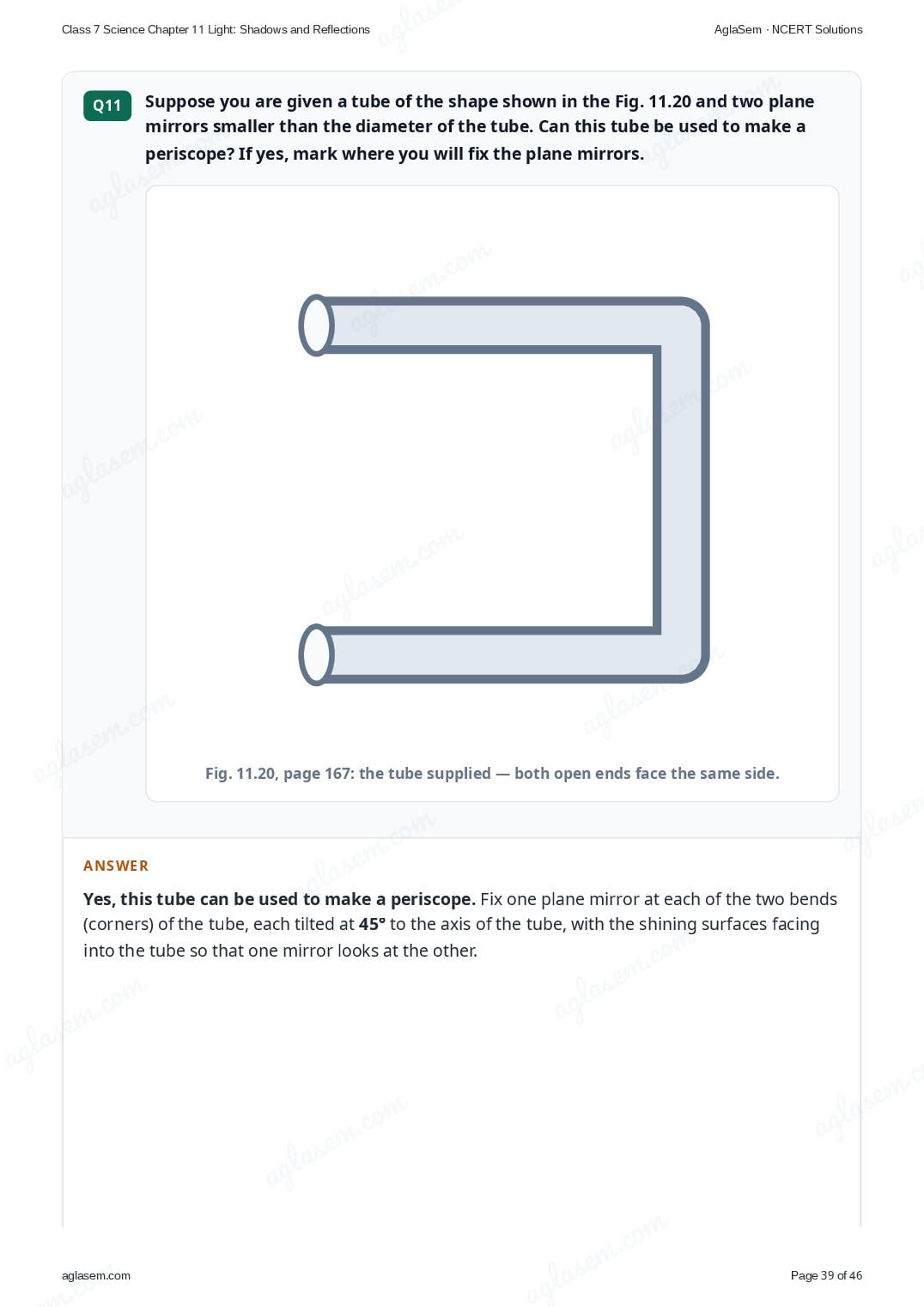
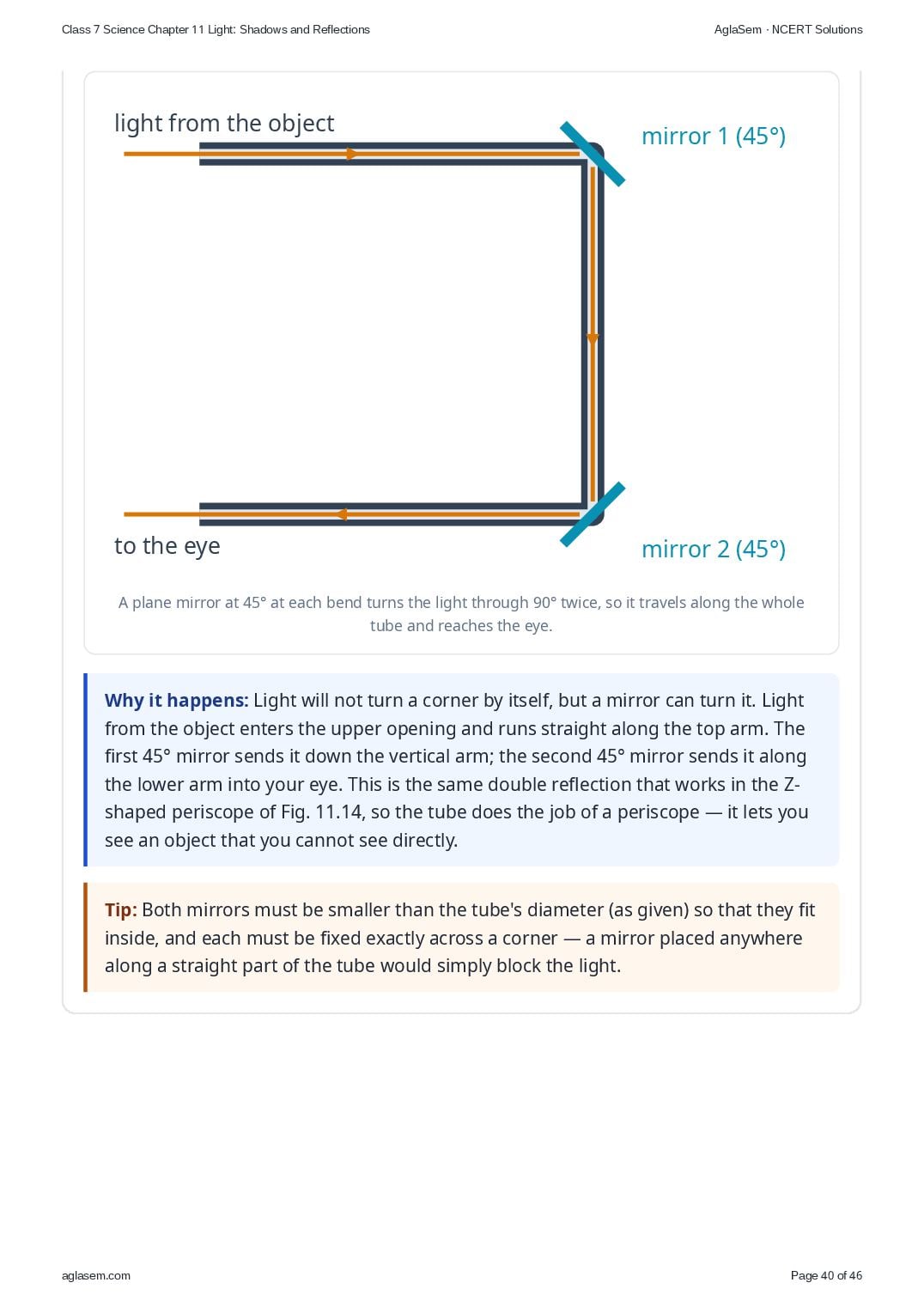
- Suppose you are given a tube of the shape shown in the Fig. 11.20 and two plane mirrors smaller than the diameter of the tube. Can this tube be used to make a periscope? If yes, mark where you will fix the plane mirrors.
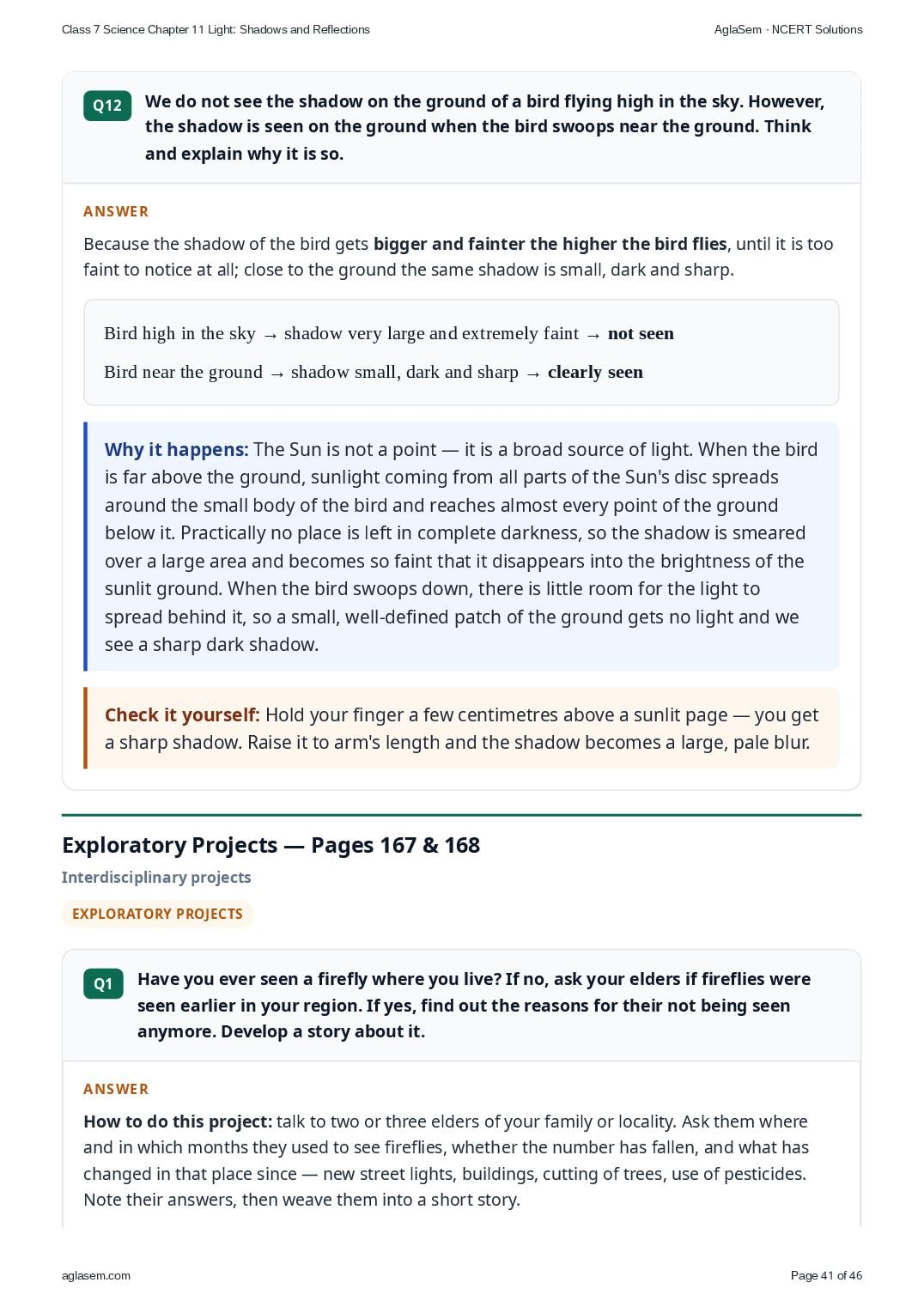
- We do not see the shadow on the ground of a bird flying high in the sky. However, the shadow is seen on the ground when the bird swoops near the ground. Think and explain why it is so.
- Have you ever seen a firefly where you live? If no, ask your elders if fireflies were seen earlier in your region. If yes, find out the reasons for their not being seen anymore. Develop a story about it.
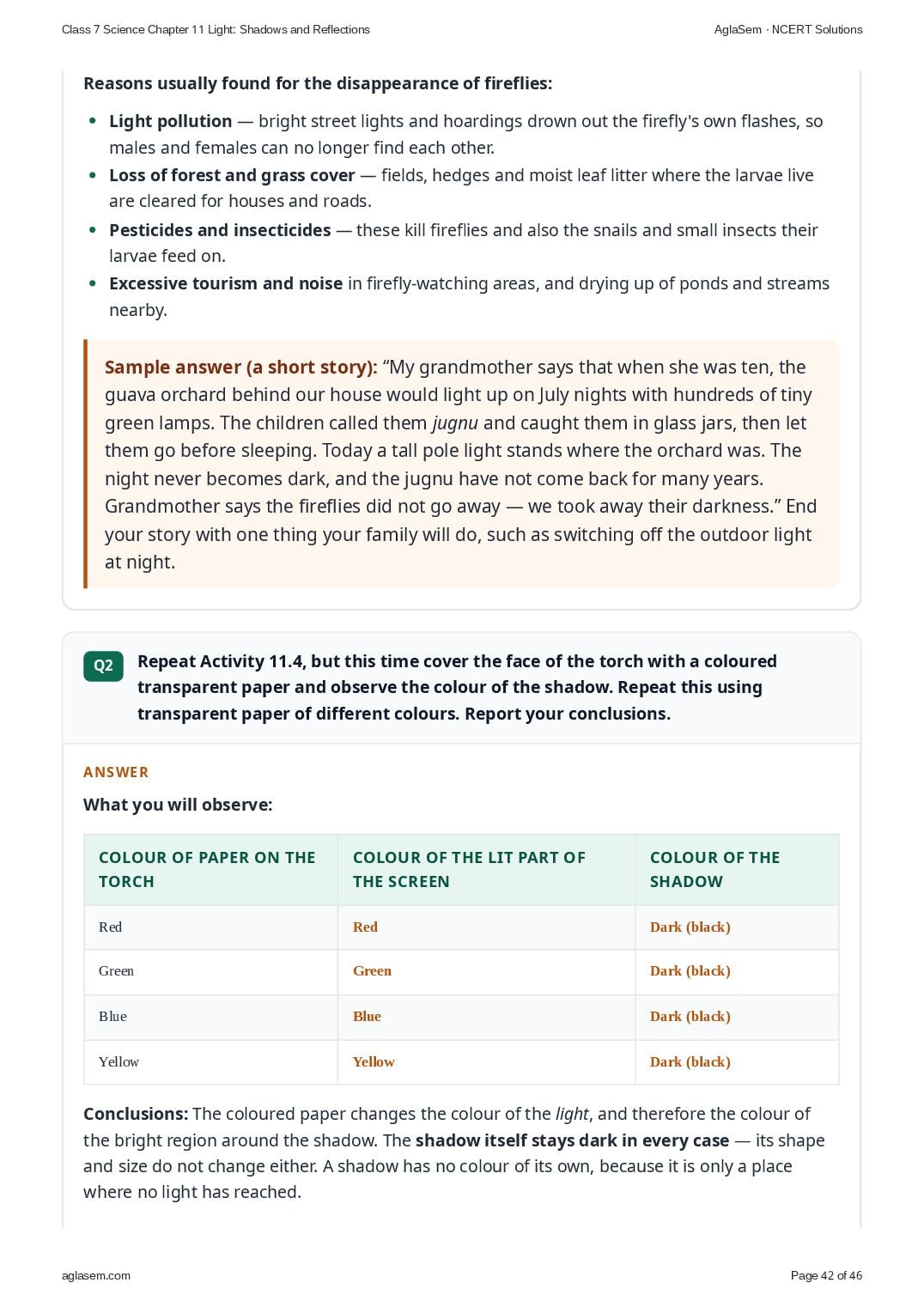
- Repeat Activity 11.4, but this time cover the face of the torch with a coloured transparent paper and observe the colour of the shadow. Repeat this using transparent paper of different colours. Report your conclusions.
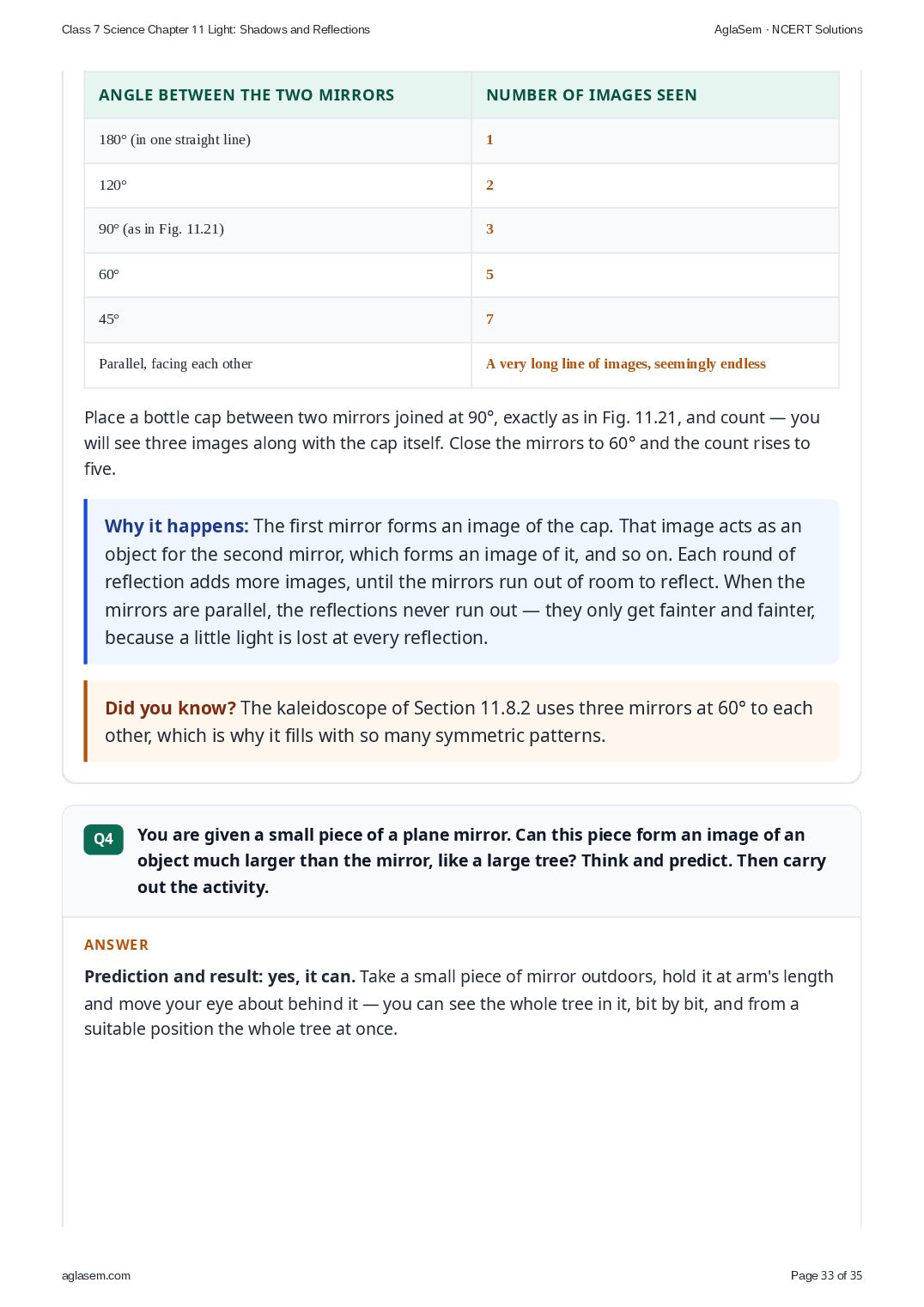
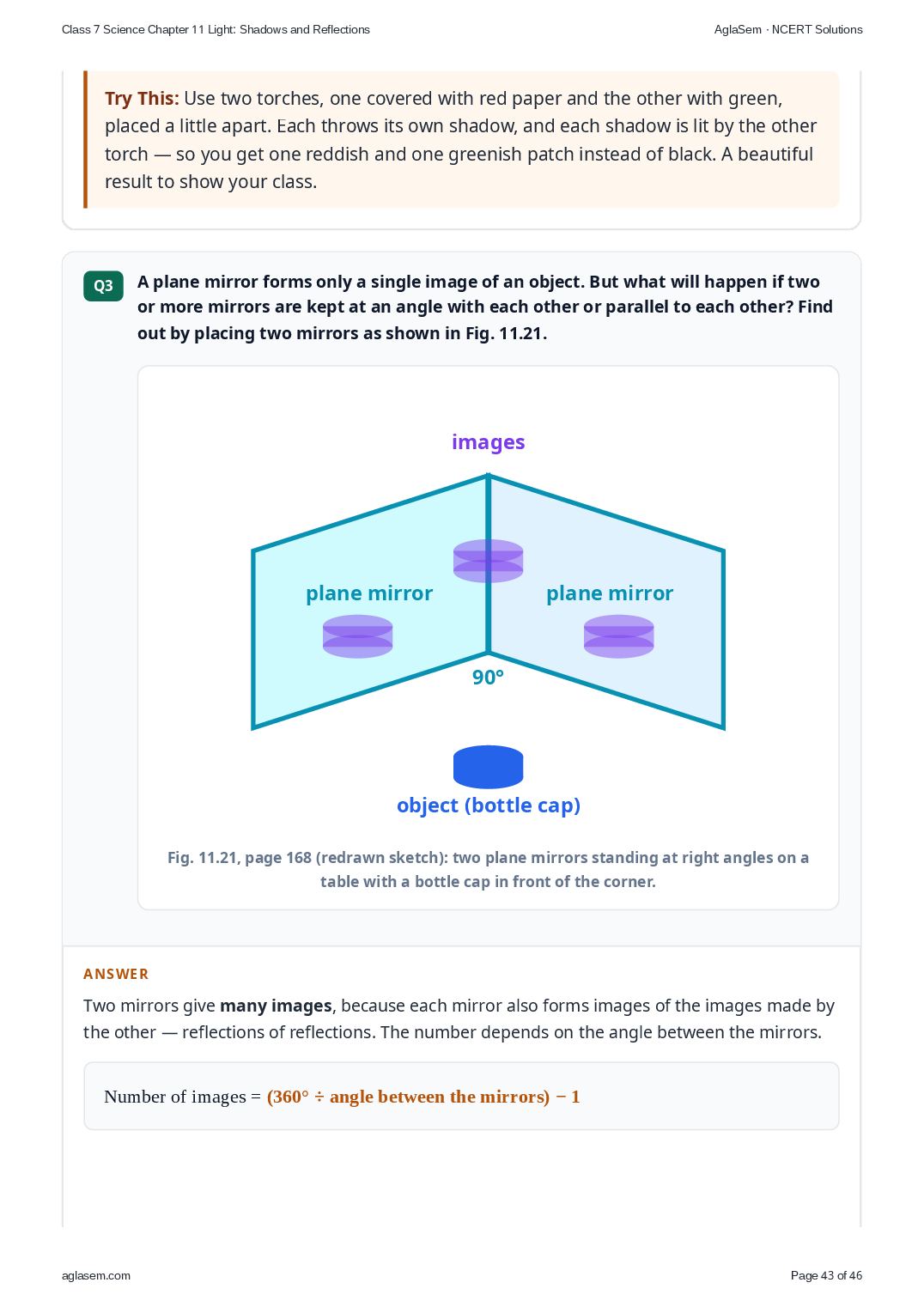
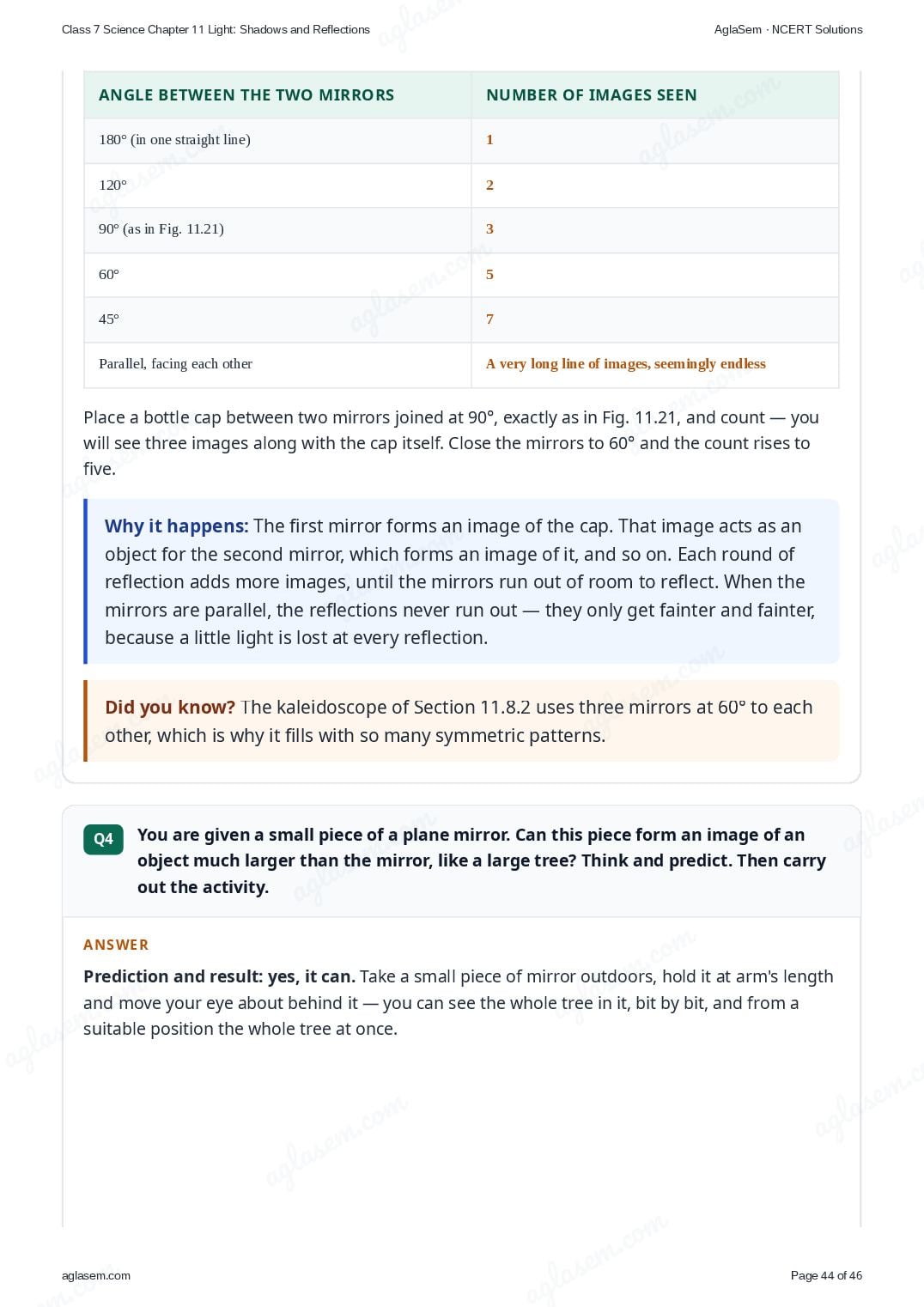
- A plane mirror forms only a single image of an object. But what will happen if two or more mirrors are kept at an angle with each other or parallel to each other? Find out by placing two mirrors as shown in Fig. 11.21.
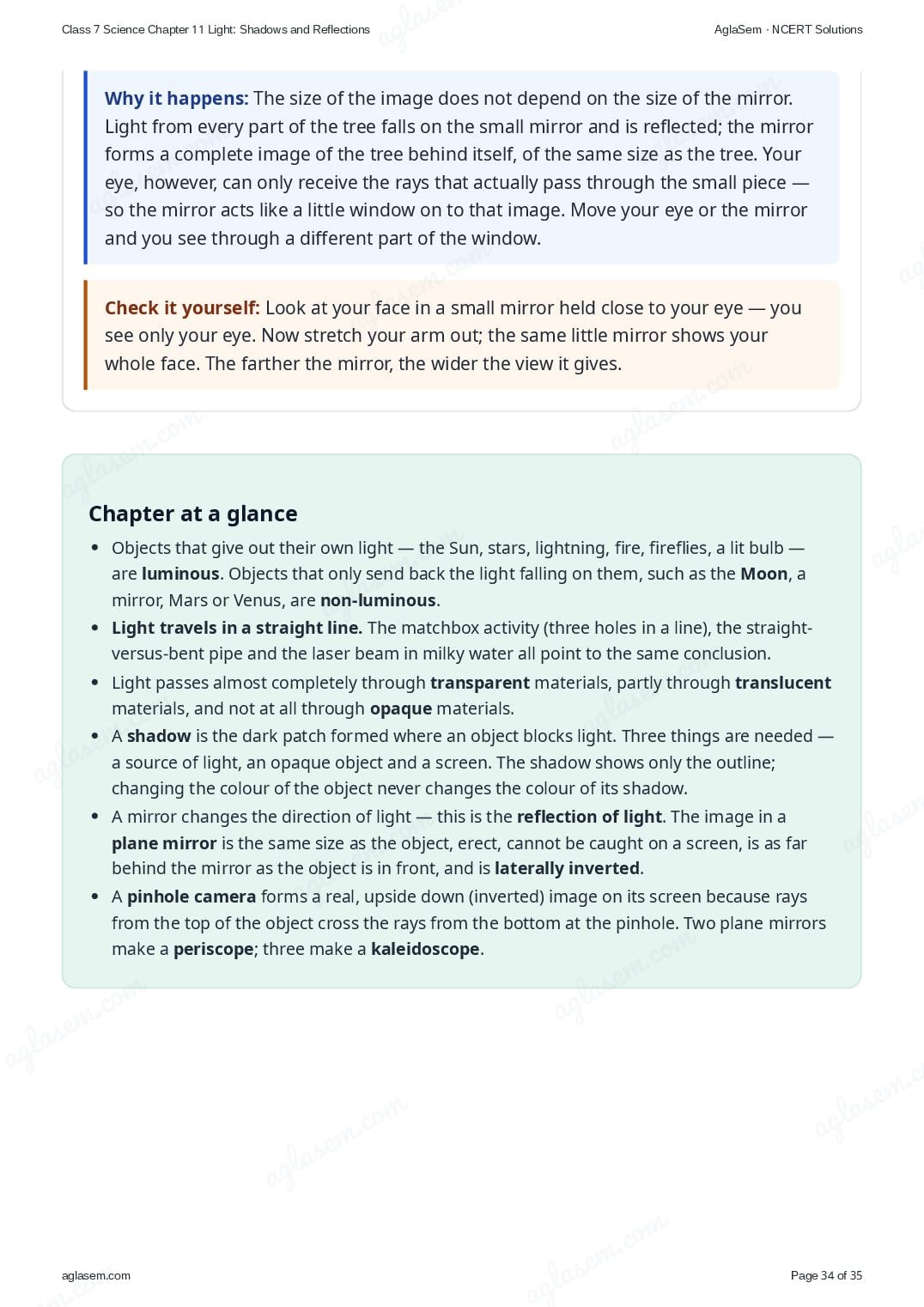
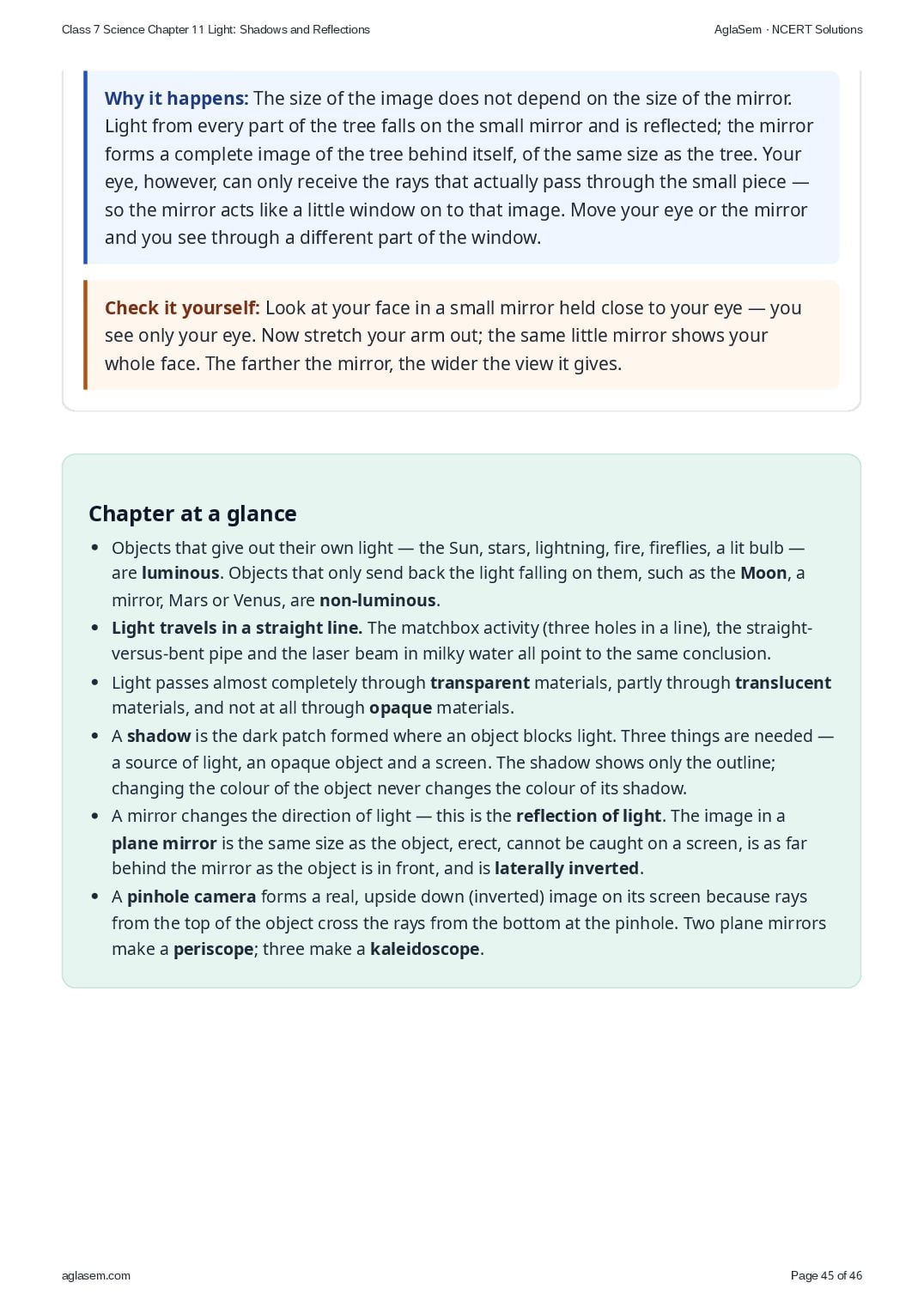
- You are given a small piece of a plane mirror. Can this piece form an image of an object much larger than the mirror, like a large tree? Think and predict. Then carry out the activity.
Chapter at a Glance
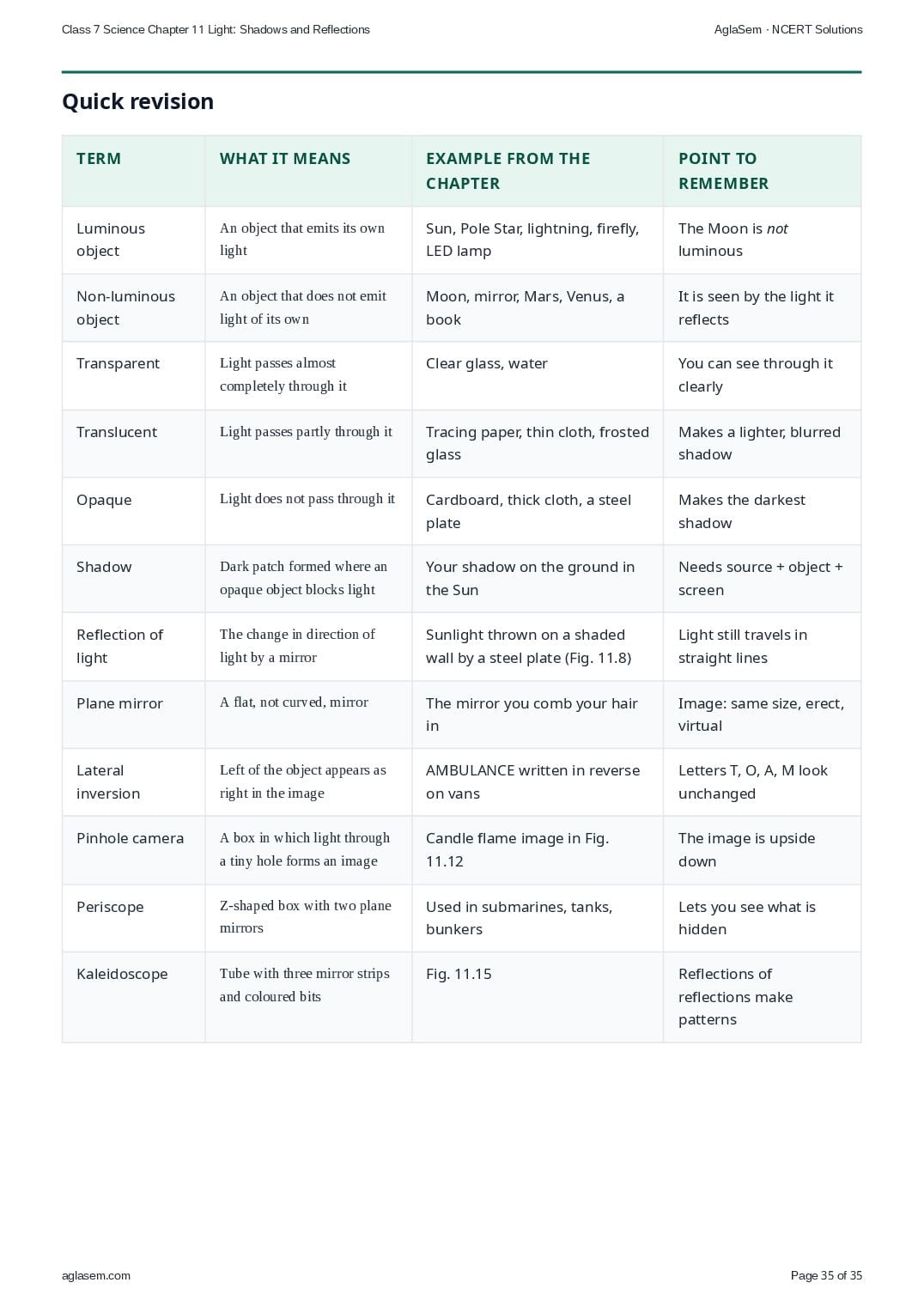
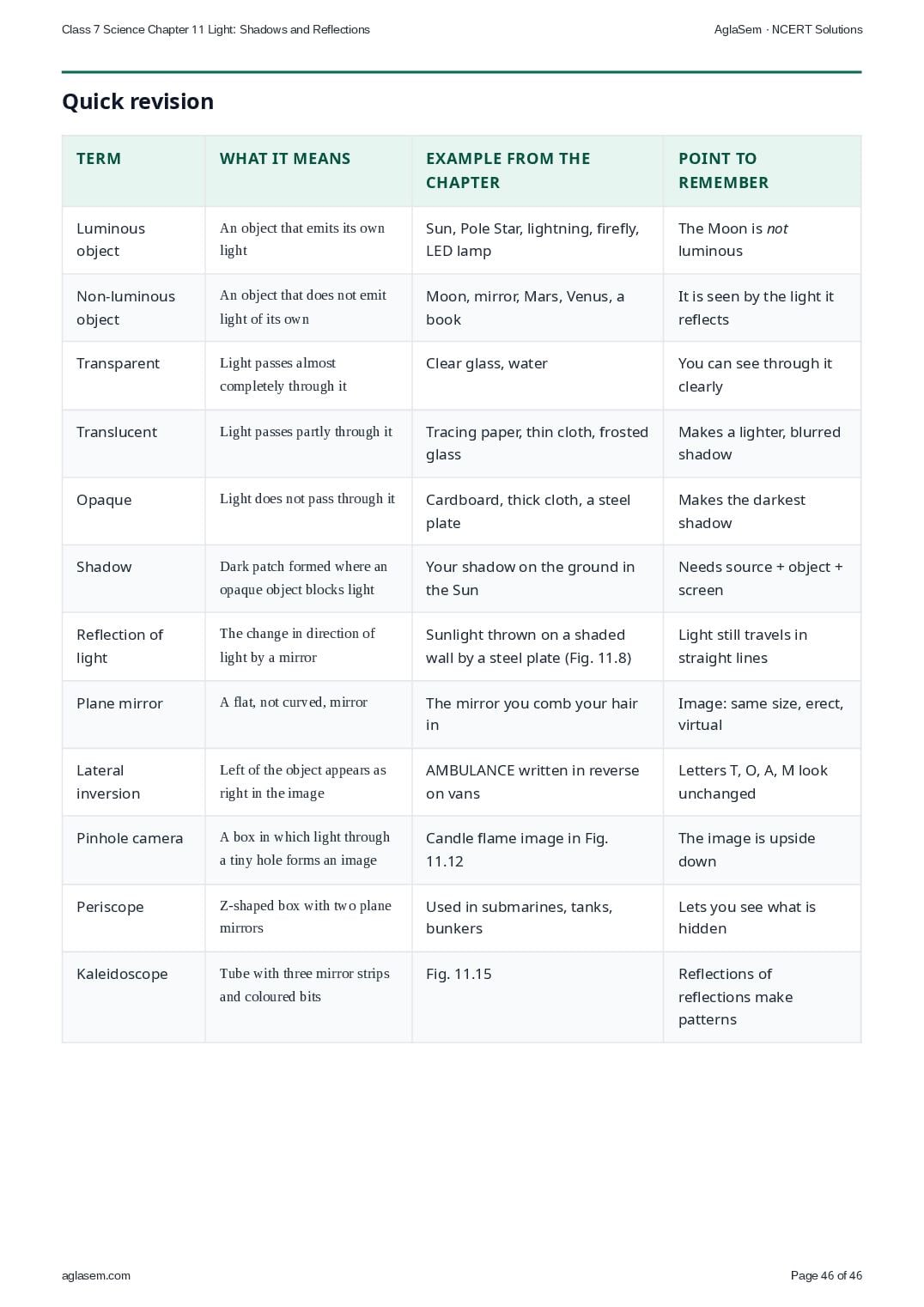
- Objects that give out their own light — the Sun, stars, lightning, fire, fireflies, a lit bulb — are luminous . Objects that only send back the light falling on them, such as the Moon , a mirror, Mars or Venus, are non-luminous .
- Light travels in a straight line. The matchbox activity (three holes in a line), the straight-versus-bent pipe and the laser beam in milky water all point to the same conclusion.
- Light passes almost completely through transparent materials, partly through translucent materials, and not at all through opaque materials.
- A shadow is the dark patch formed where an object blocks light. Three things are needed — a source of light, an opaque object and a screen. The shadow shows only the outline; changing the colour of the object never changes the colour of its shadow.
- A mirror changes the direction of light — this is the reflection of light . The image in a plane mirror is the same size as the object, erect, cannot be caught on a screen, is as far behind the mirror as the object is in front, and is laterally inverted .
- A pinhole camera forms a real, upside down (inverted) image on its screen because rays from the top of the object cross the rays from the bottom at the pinhole. Two plane mirrors make a periscope ; three make a kaleidoscope .
How to Download NCERT Solutions for Class 7 Science Chapter 11 PDF
Follow these simple steps to get the Light Shadows and Reflections questions-and-answers PDF from Curiosity.
- Search NCERT Solutions for Class 7 Science Chapter 11 aglasem and open this page.
- Read the exercise questions with answers for Light Shadows and Reflections shown above.
- Click the Download PDF link to save the Light Shadows and Reflections solutions to your device.
NCERT Solutions for Class 7 Science – All Chapters
There are more chapters to study besides Light Shadows and Reflections in Science. Here are the NCERT Solutions for all chapters of Class 7 Science.
- Chapter 1 the Ever Evolving World of Science
- Chapter 2 Exploring Substances Acidic Basic and Neutral
- Chapter 3 Electricity Circuits and Their Components
- Chapter 4 the World of Metals and Non Metals
- Chapter 5 Changes Around Us Physical and Chemical
- Chapter 6 Adolescence a Stage of Growth and Change
- Chapter 7 Heat Transfer in Nature
- Chapter 8 Measurement of Time and Motion
- Chapter 9 Life Processes in Animals
- Chapter 10 Life Processes in Plants
- Chapter 11 Light Shadows and Reflections
- Chapter 12 Earth Moon and the Sun
NCERT Solutions for Class 7 – All Subjects
Just like Chapter 11 of Science, you can get the exercise questions with answers for every other subject of Class 7. Here are the NCERT Solutions for all subjects of Class 7.
NCERT Solutions for Class 7 Science Chapter 11 – An Overview
The key highlights of this study material are as follows.
| Aspects | Details |
|---|---|
| Class | Class 7 |
| Subject | Science |
| Chapter Number | Chapter 11 |
| Chapter Name | Light Shadows and Reflections |
| Book Name | Curiosity |
| Book By | NCERT (National Council of Educational Research and Training) |
| Educational Resource Here | NCERT Solutions of Class 7 Science Chapter 11 for all exercises |
| More Questions Answers of This Subject | NCERT Solutions for Class 7 Science |
| Download Book Chapter | NCERT Book Class 7 Science |
| All Questions Answers For This Class | NCERT Solutions for Class 7 |
| Complete Solutions | NCERT Solutions |
NCERT Solutions for Class 7 Science Chapter 11 Light Shadows and Reflections – FAQs
What are the NCERT Solutions for Class 7 Science Chapter 11 Light Shadows and Reflections?
They are the complete, step-by-step answers to all the exercise and in-text questions of Chapter 11 Light Shadows and Reflections from the NCERT Class 7 Science textbook Curiosity, written by experts as per the latest NCERT syllabus.
How can I download the Class 7 Science Chapter 11 solutions PDF for free?
Open this page on aglasem, read the Light Shadows and Reflections questions with answers, and click the “Download Solutions PDF” link. The Class 7 Science Chapter 11 NCERT Solutions PDF is completely free to download.
Are these NCERT Solutions as per the latest 2026-27 syllabus?
Yes. The NCERT Solutions for Class 7 Science Chapter 11 are based on the latest NCERT textbook Curiosity and the current 2026-27 CBSE syllabus, so the questions and answers match what you study in class.
Where can I get NCERT Solutions for the other chapters of Class 7 Science?
You can find the answers to every chapter on the NCERT Solutions for Class 7 Science page, and solutions for every subject on the NCERT Solutions for Class 7 page.
How do NCERT Solutions help in exam preparation?
They show the correct method to solve each question, help you write answers the way they are expected in exams, let you check and correct your own work, and save revision time — which together improve your marks in Class 7 Science.
If you have any queries on NCERT Solutions for Class 7 Science Chapter 11 Light Shadows and Reflections, then please ask in the comments below.
