NCERT Solutions for Class 4 Maths Chapter 1 Shapes Around Us provide clear, step-by-step answers to every exercise and in-text question from the chapter Shapes Around Us of the NCERT textbook Math Mela. Prepared by subject experts as per the latest NCERT (CBSE) syllabus for 2026-27, these NCERT Solutions for Class 4 Maths help you understand each concept, write exam-ready answers, and check your own solutions. You can read them online below or download the free Class 4 Maths Chapter 1 question-answer PDF.
NCERT Solutions for Class 4 Maths Chapter 1 Shapes Around Us
- Class: Class 4
- Subject: Maths
- Chapter: Chapter 1 – Shapes Around Us
- Textbook: Math Mela (NCERT)
- Study material: NCERT Solutions – questions with answers, free PDF
These solutions answer all the exercise questions of Chapter 1 Shapes Around Us — including the in-text questions, short-answer and long-answer questions, and activities — with complete explanations so you can follow the method, not just the final answer. Read the full solutions below.
NCERT Solutions Class 4 Maths Chapter 1 Shapes Around Us View Download
NCERT Solutions for Class 4 Maths Chapter 1 PDF Download
You can read the NCERT Solutions for Class 4 Maths Chapter 1 online above, or download the complete question-answer PDF to study Shapes Around Us offline at any time.
NCERT Solutions for Class 4 Maths Chapter 1 PDF Download Link – Click Here to Download Solutions PDF
Questions Covered in This Chapter
These NCERT Solutions answer all 103 questions of this chapter. The questions solved are:
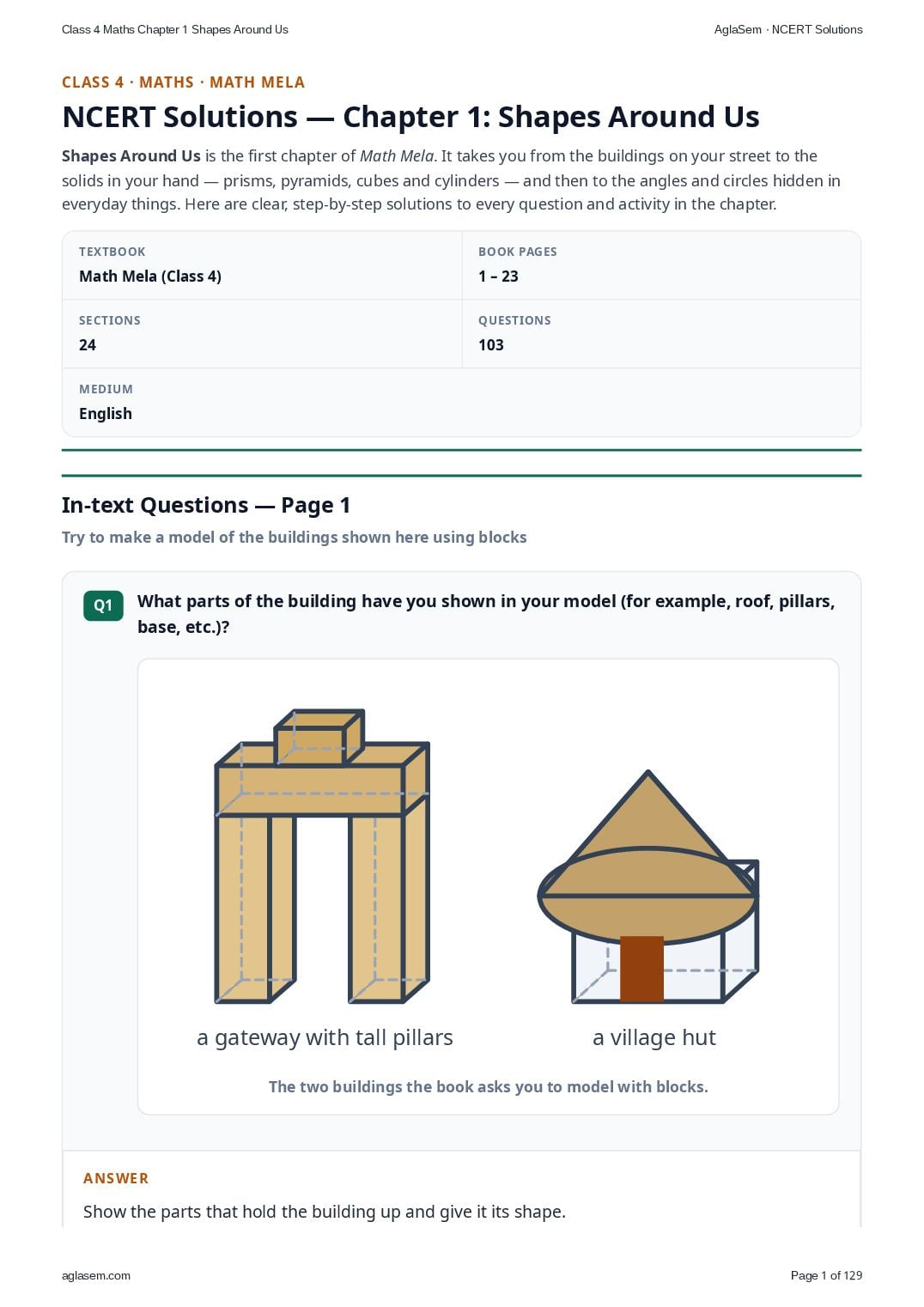
- What parts of the building have you shown in your model (for example, roof, pillars, base, etc.)? a gateway with tall pillarsa village hutThe two buildings the book asks you to model with blocks.
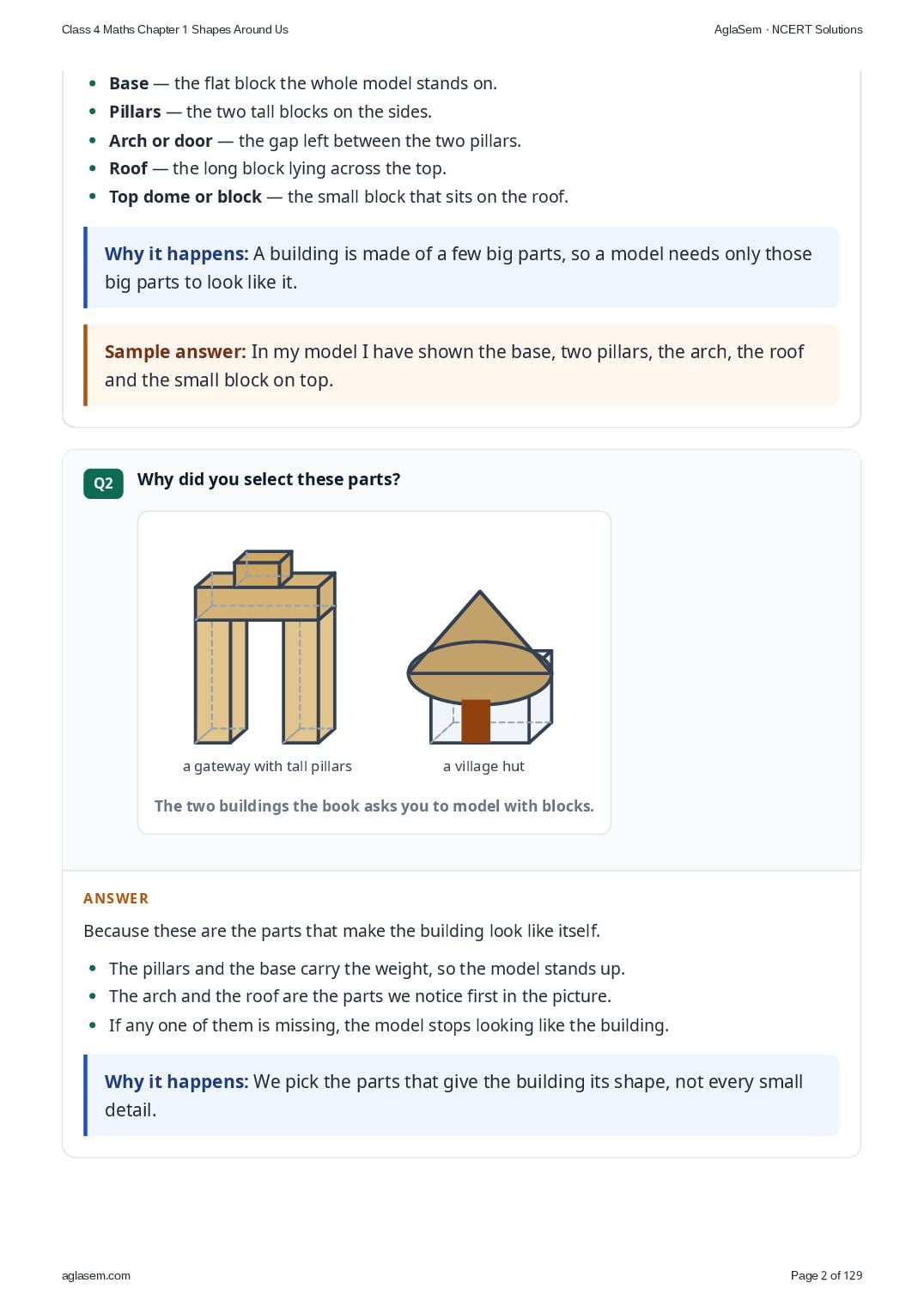
- Why did you select these parts? a gateway with tall pillarsa village hutThe two buildings the book asks you to model with blocks.
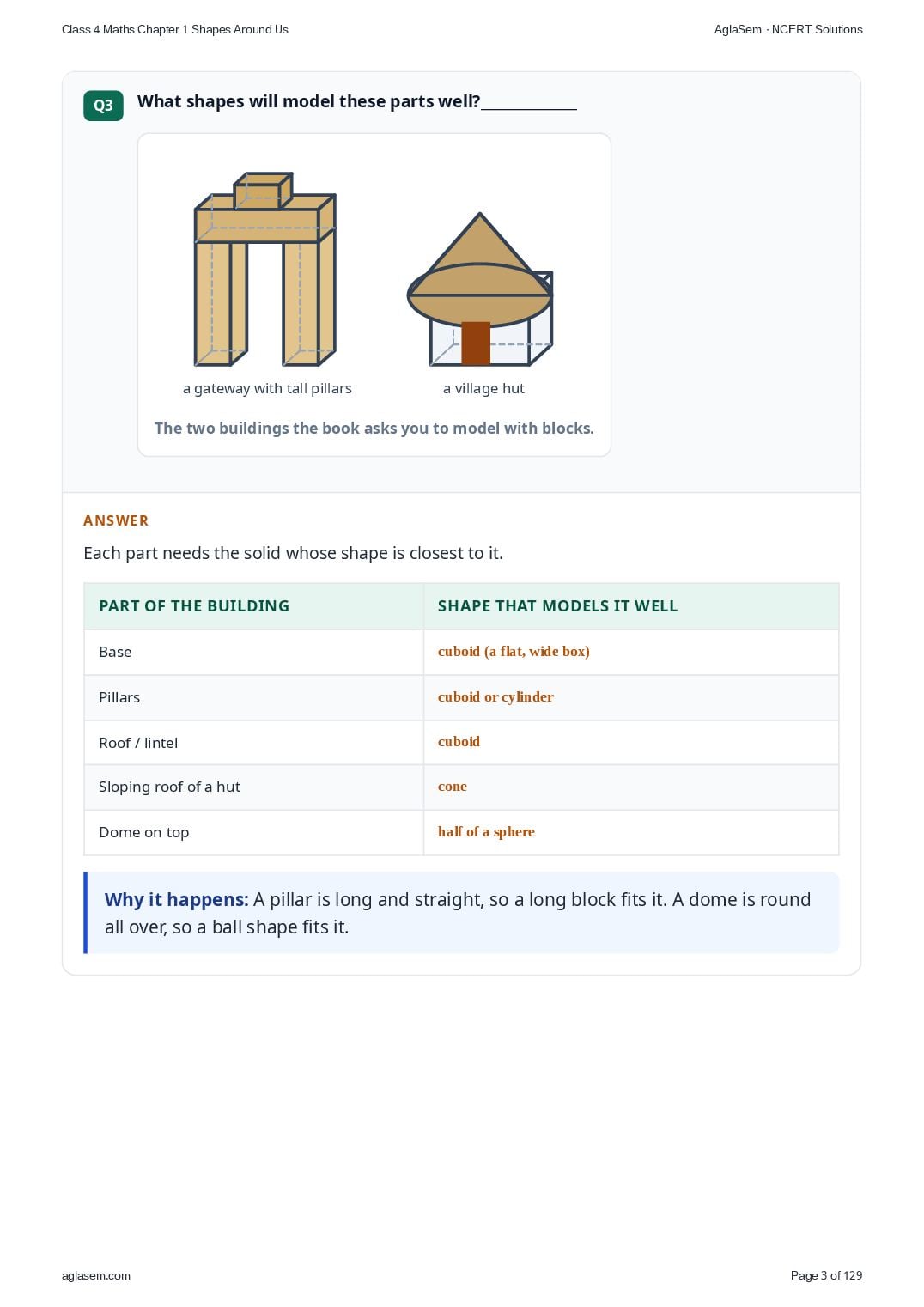
- What shapes will model these parts well?______________ a gateway with tall pillarsa village hutThe two buildings the book asks you to model with blocks.
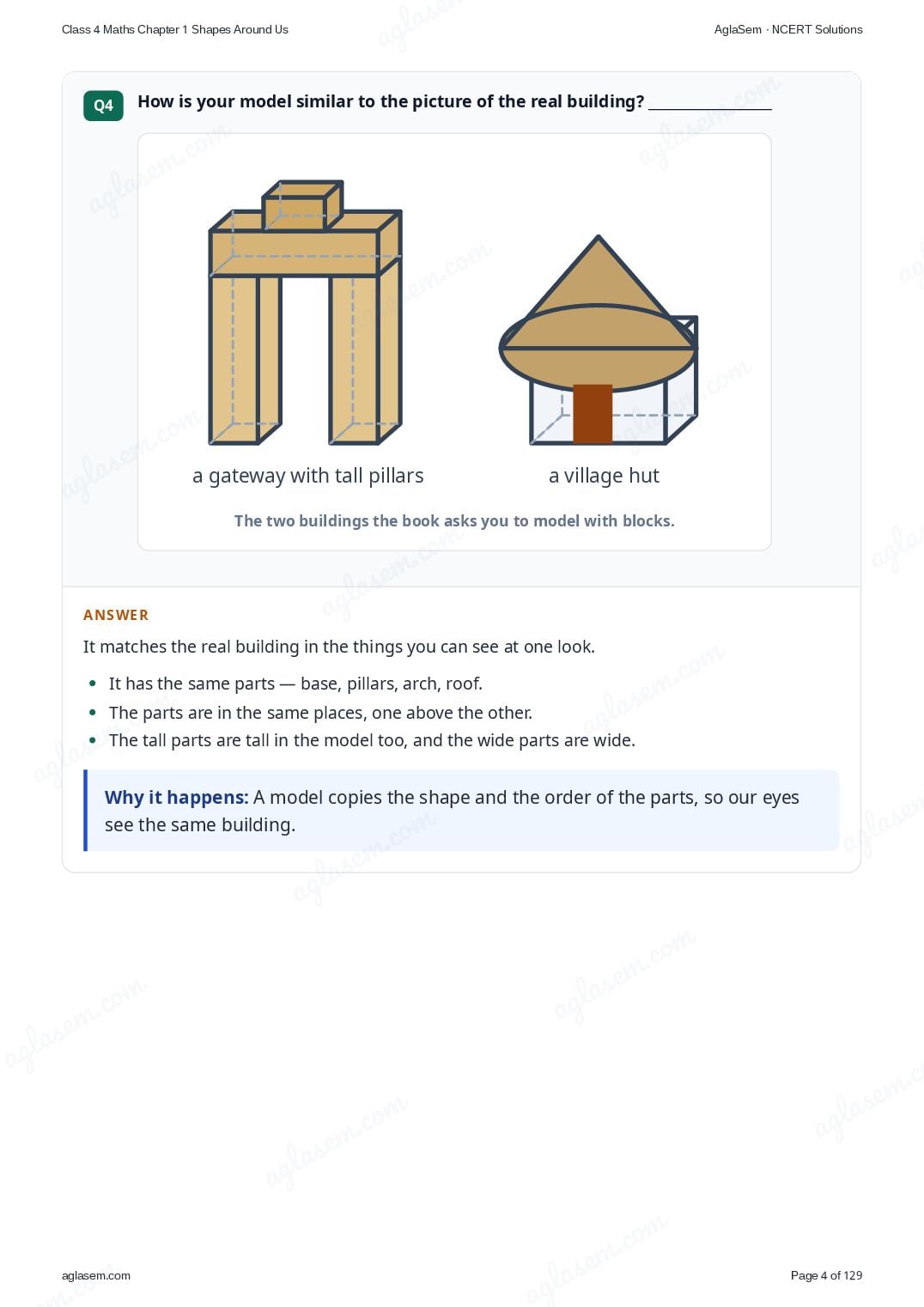
- How is your model similar to the picture of the real building? __________________ a gateway with tall pillarsa village hutThe two buildings the book asks you to model with blocks.
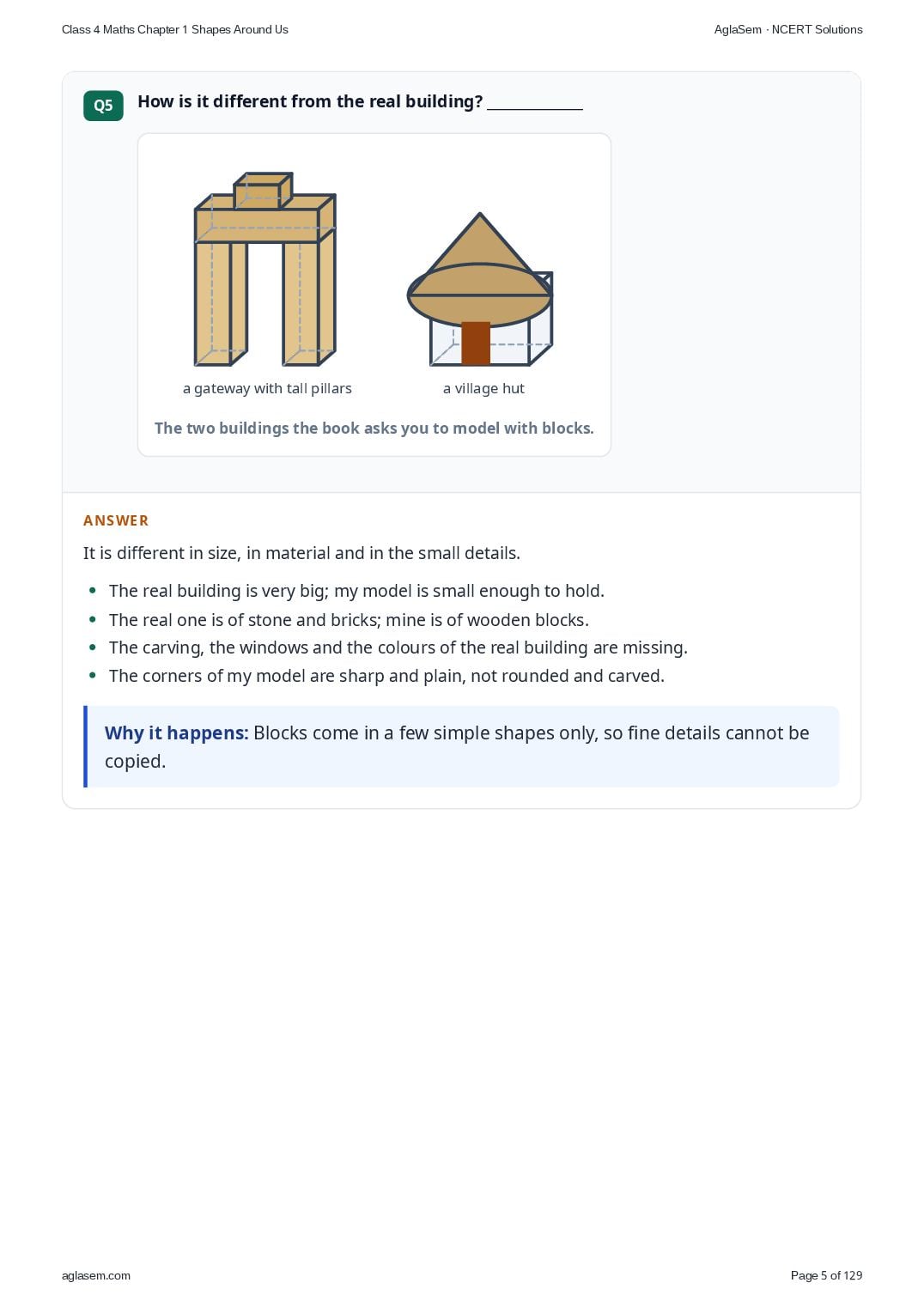
- How is it different from the real building? ______________ a gateway with tall pillarsa village hutThe two buildings the book asks you to model with blocks.
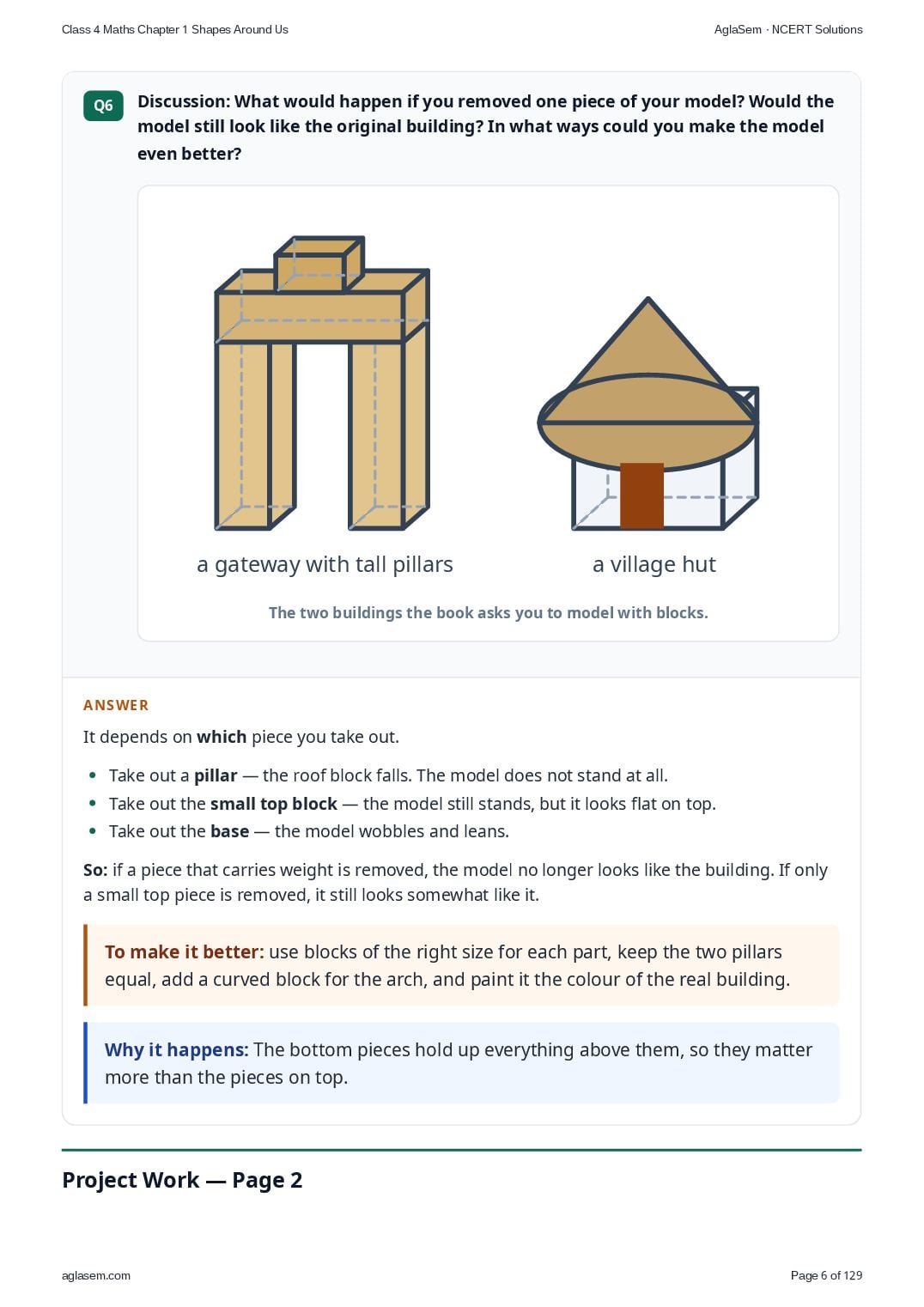
- Discussion: What would happen if you removed one piece of your model? Would the model still look like the original building? In what ways could you make the model even better? a gateway with tall pillarsa village hutThe two buildings the book asks you to model with blocks.
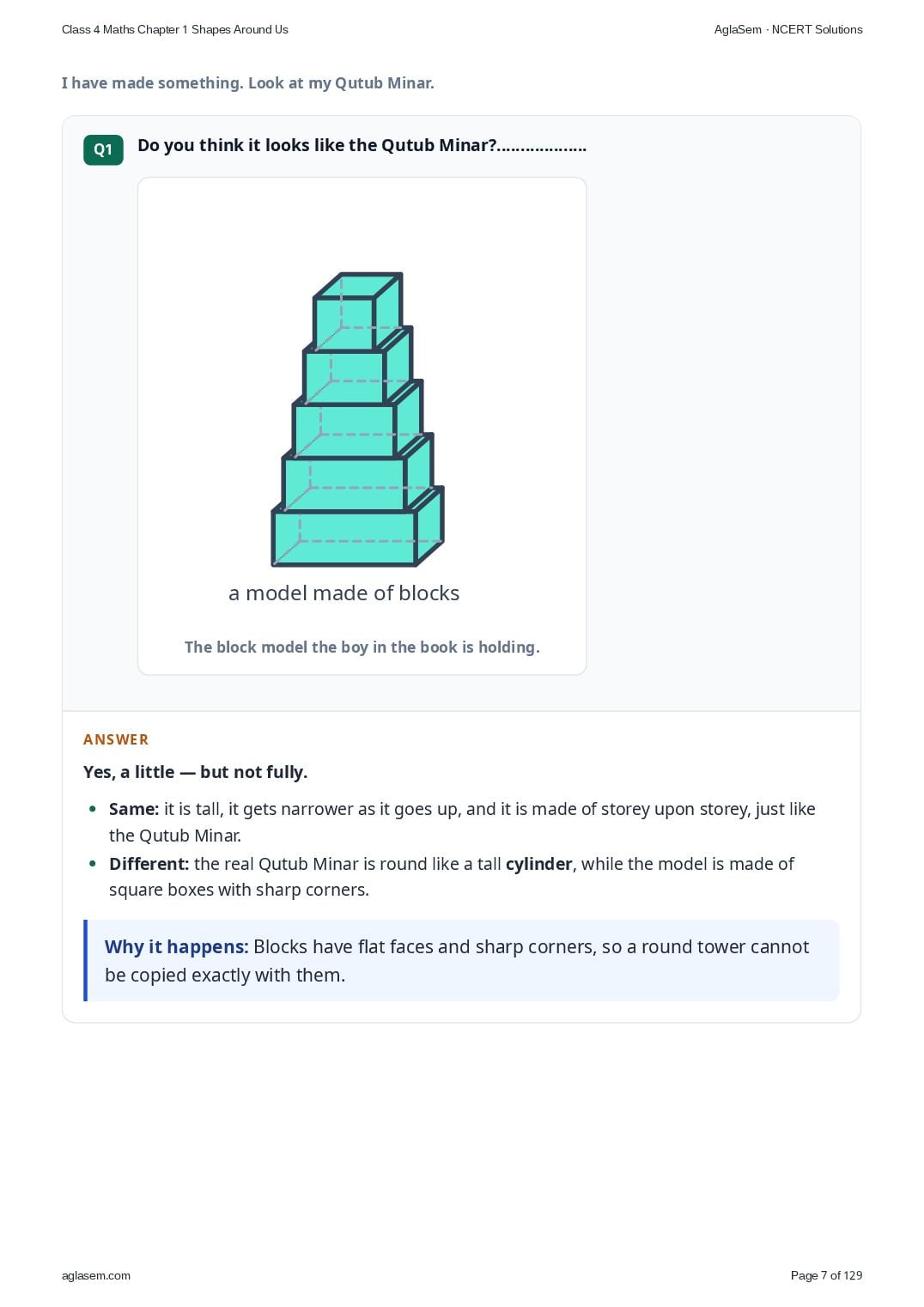
- Do you think it looks like the Qutub Minar?………………. a model made of blocksThe block model the boy in the book is holding.
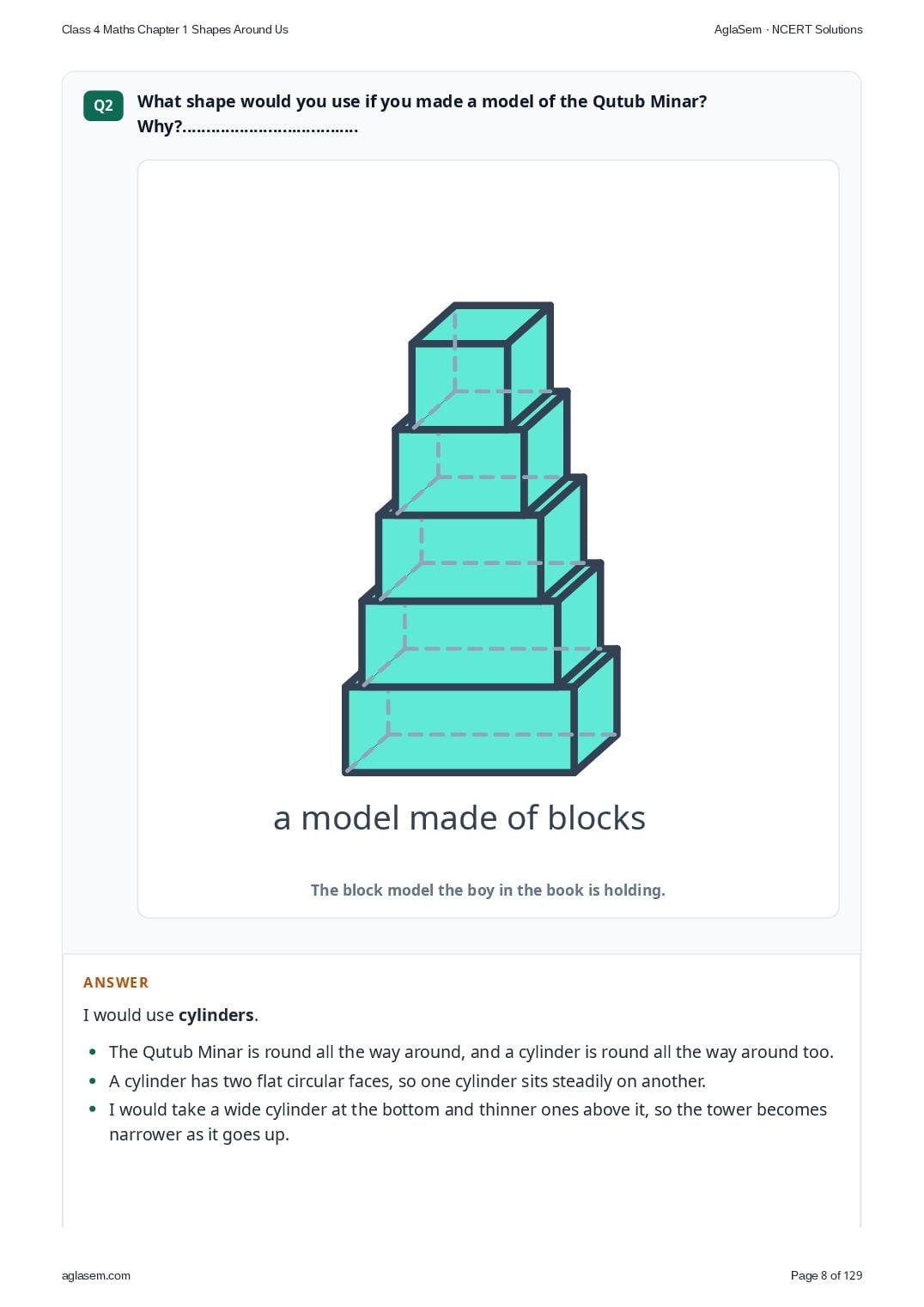
- What shape would you use if you made a model of the Qutub Minar? Why?………………………………. a model made of blocksThe block model the boy in the book is holding.
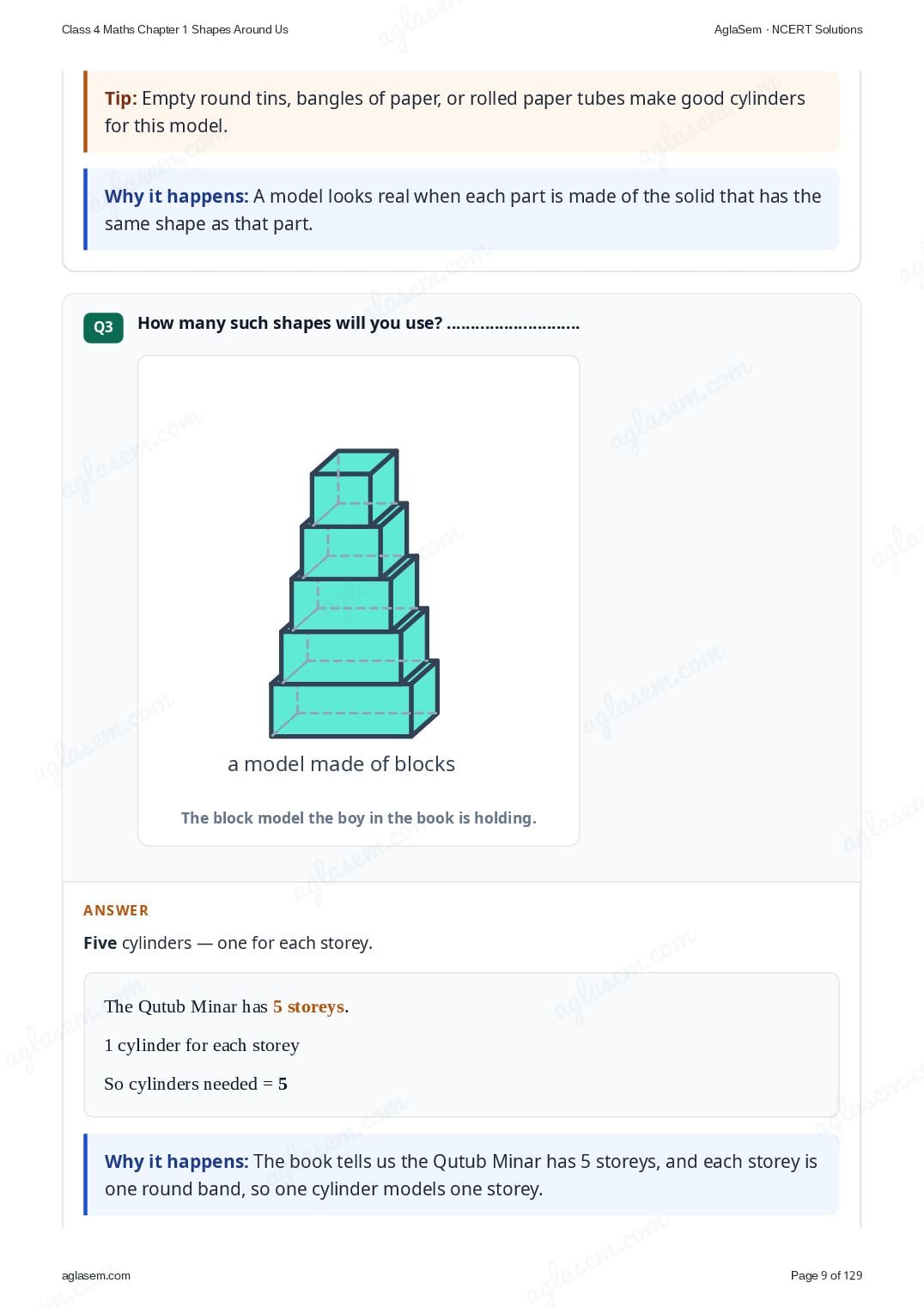
- How many such shapes will you use? ………………………. a model made of blocksThe block model the boy in the book is holding.
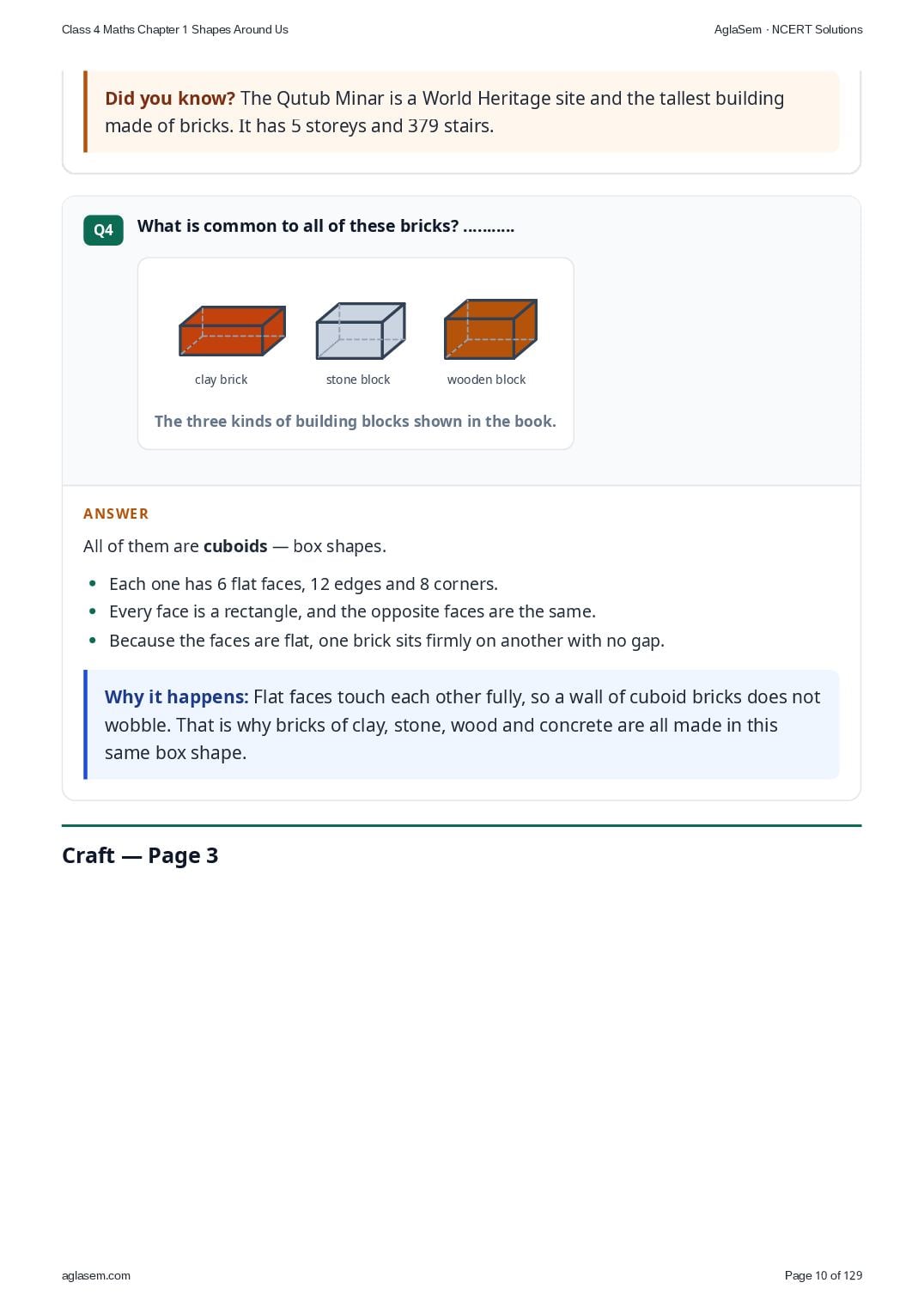
- What is common to all of these bricks? ……….. clay brickstone blockwooden blockThe three kinds of building blocks shown in the book.
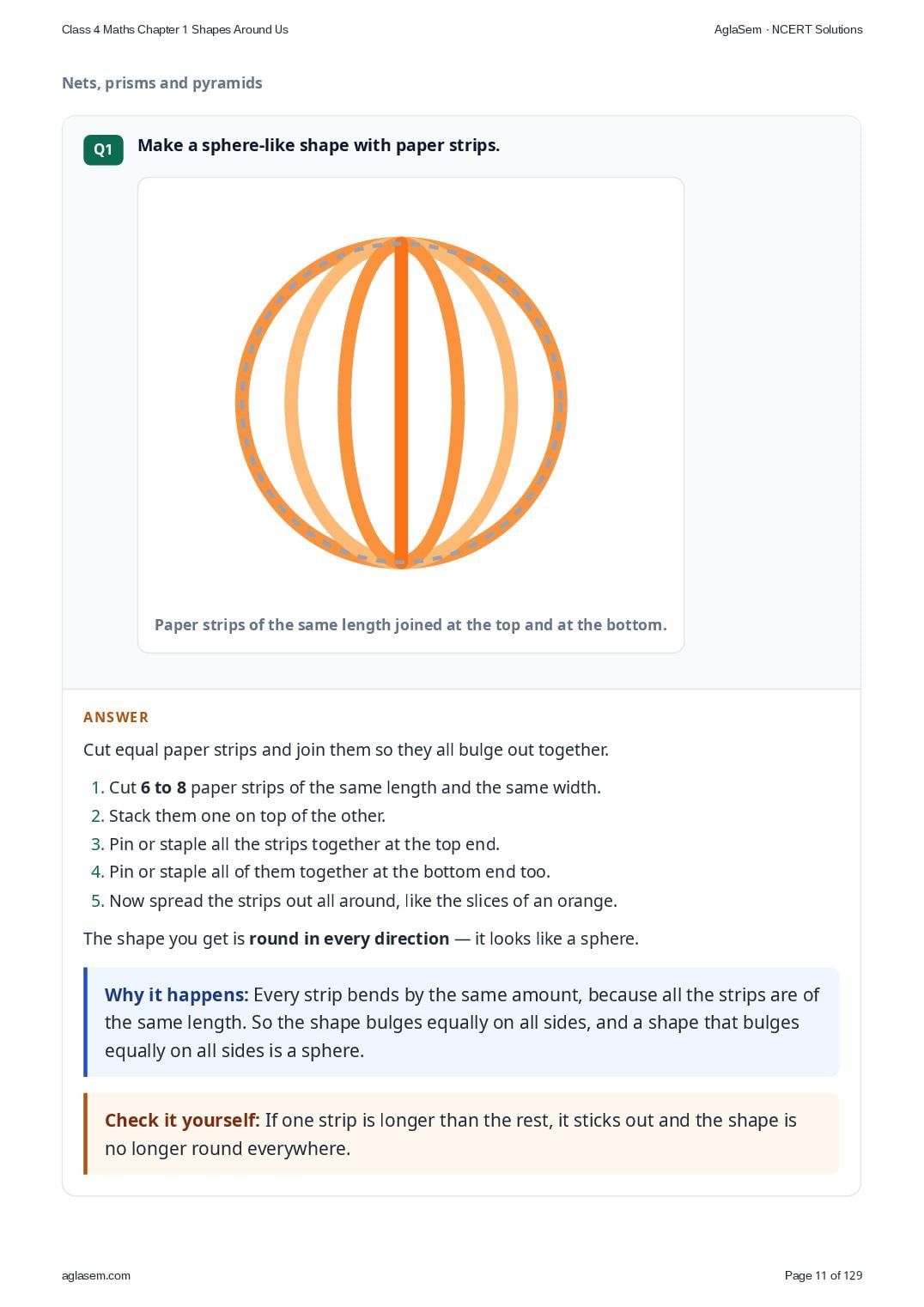
- Make a sphere-like shape with paper strips. Paper strips of the same length joined at the top and at the bottom.
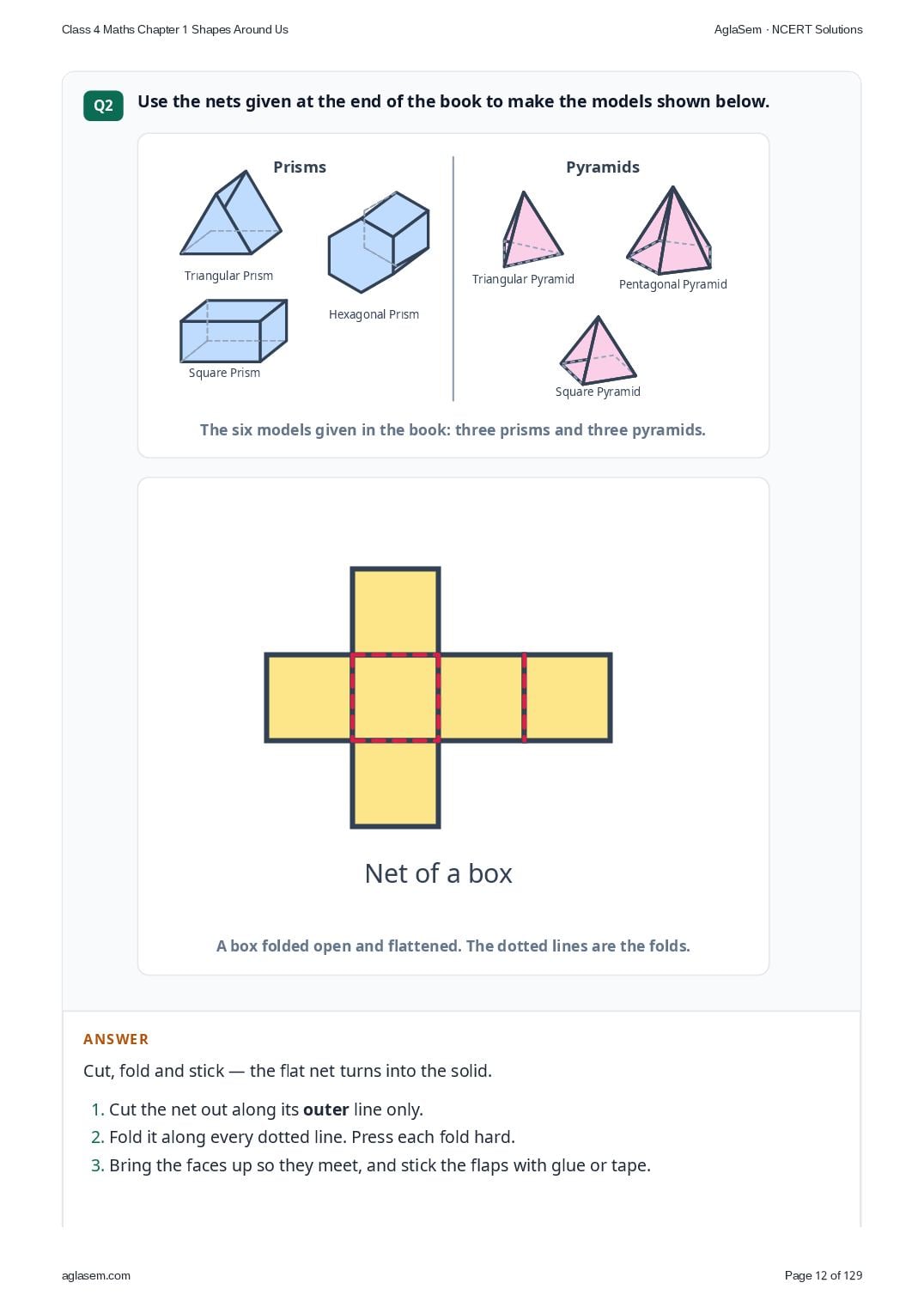
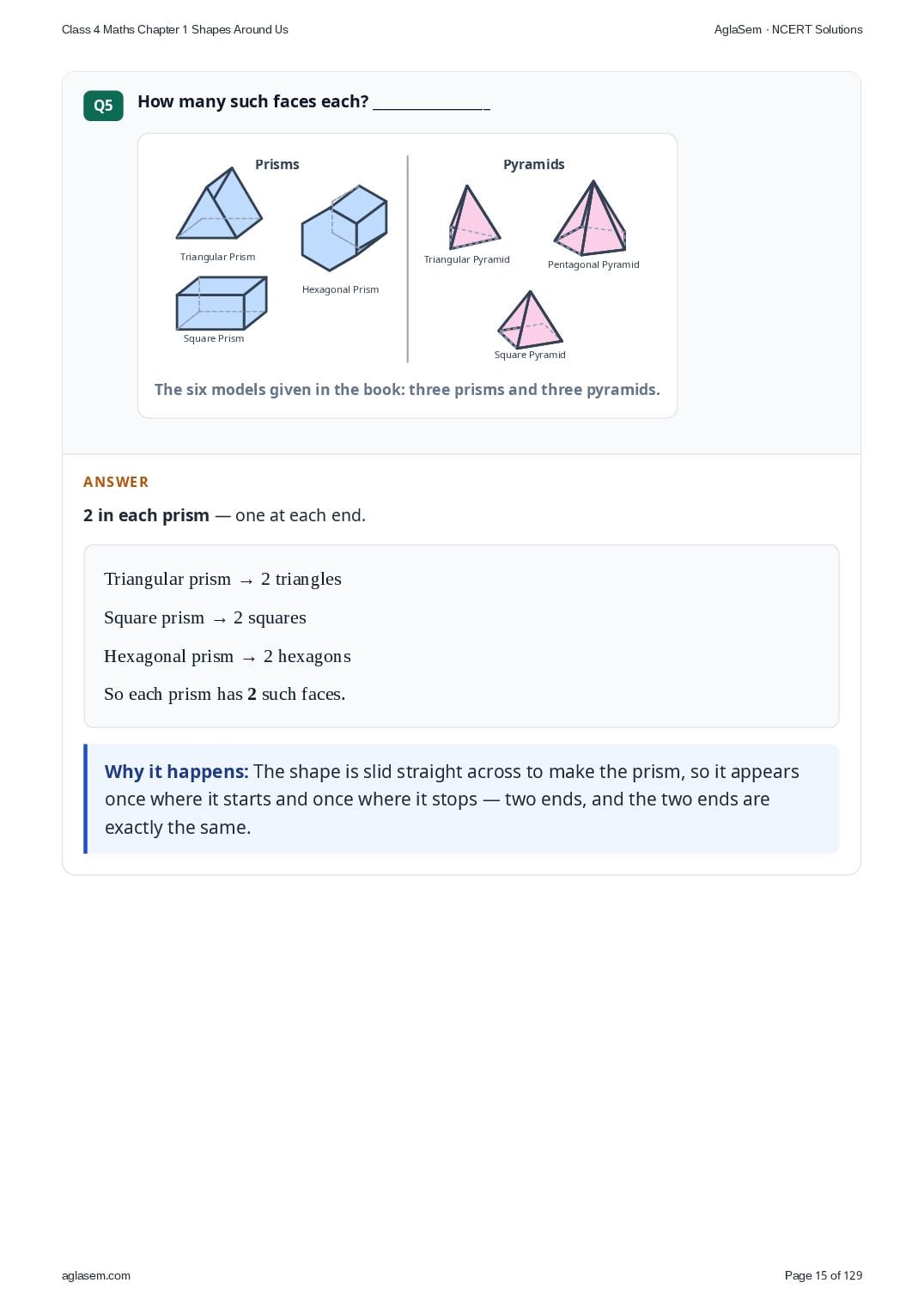
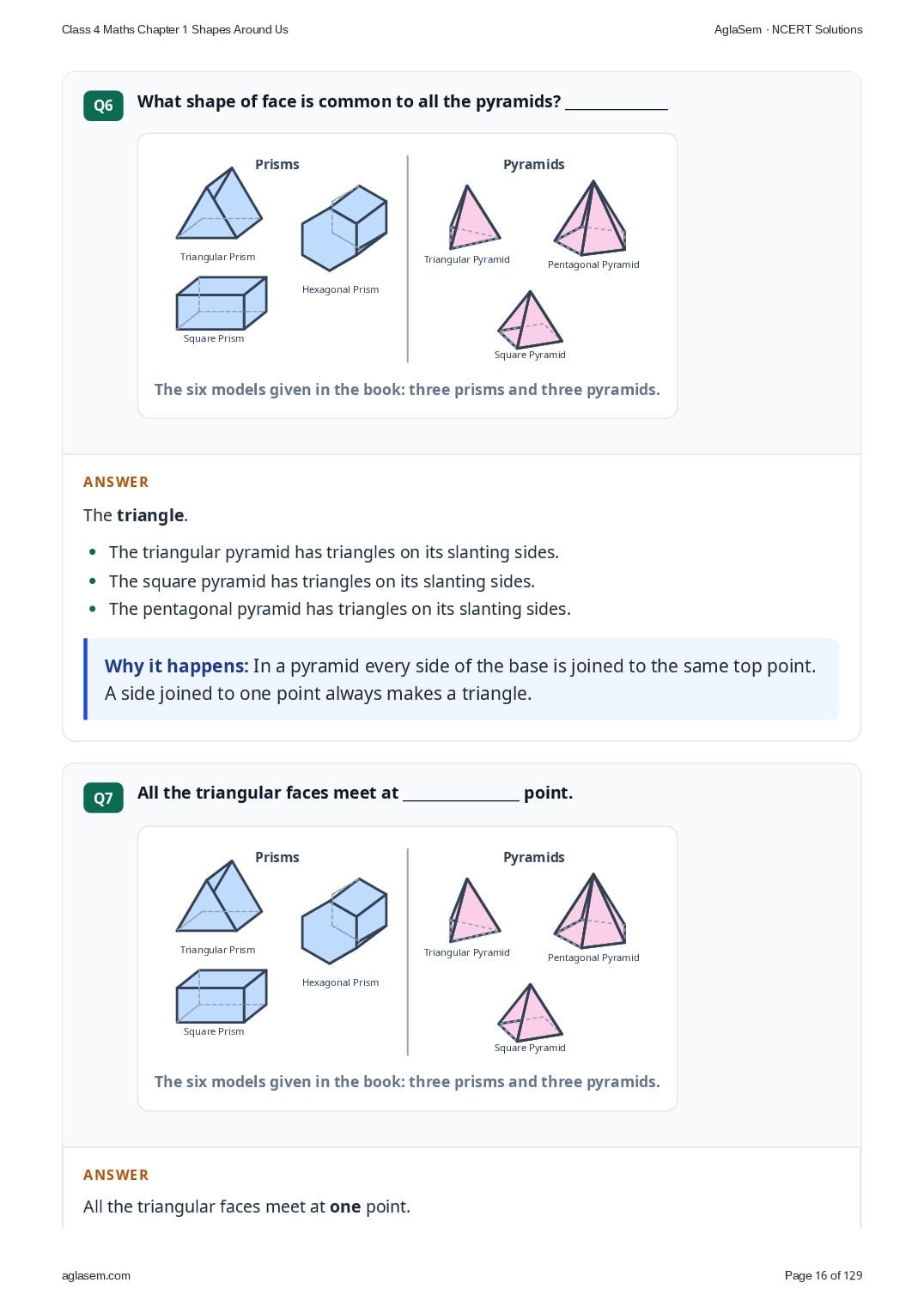
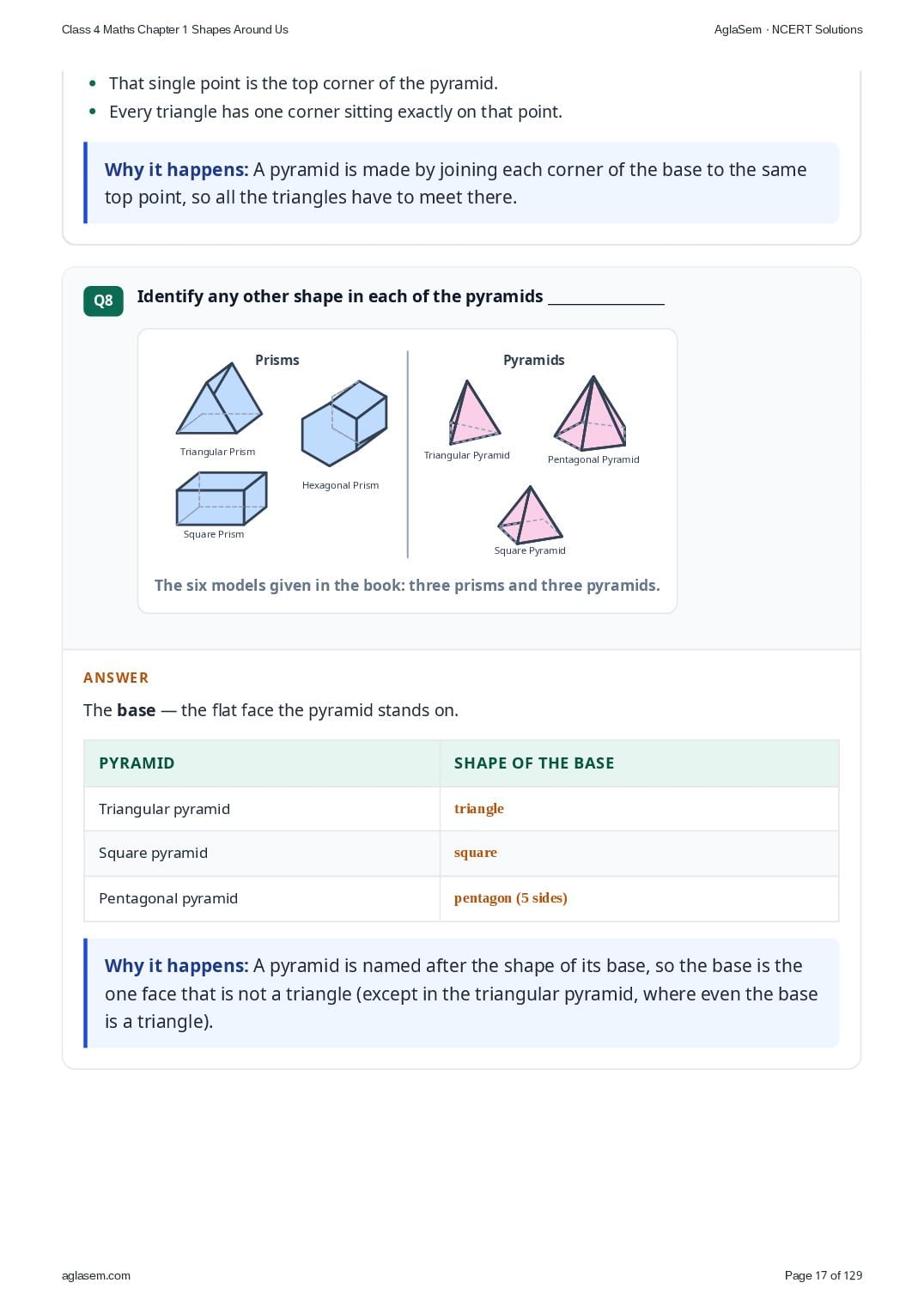
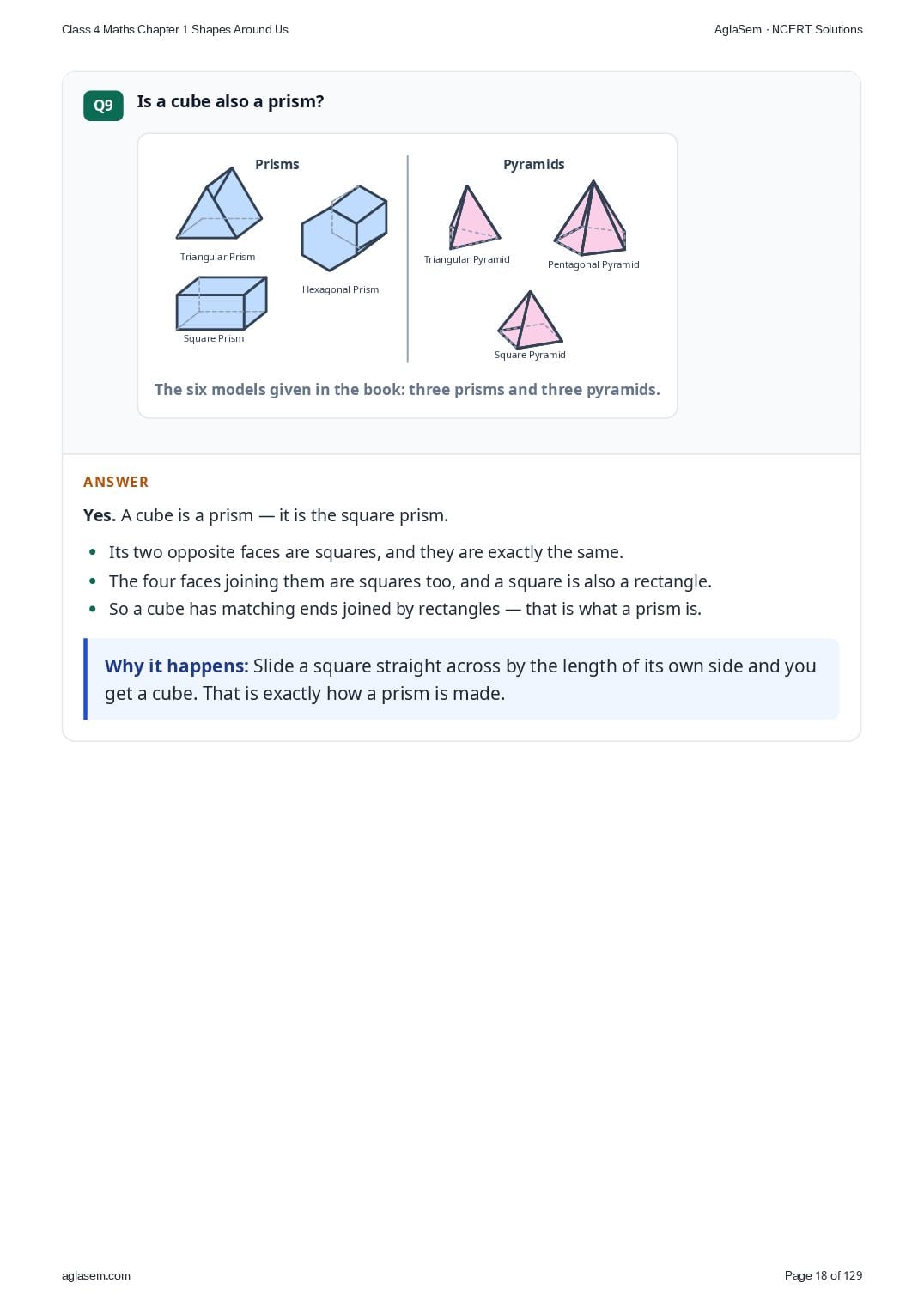
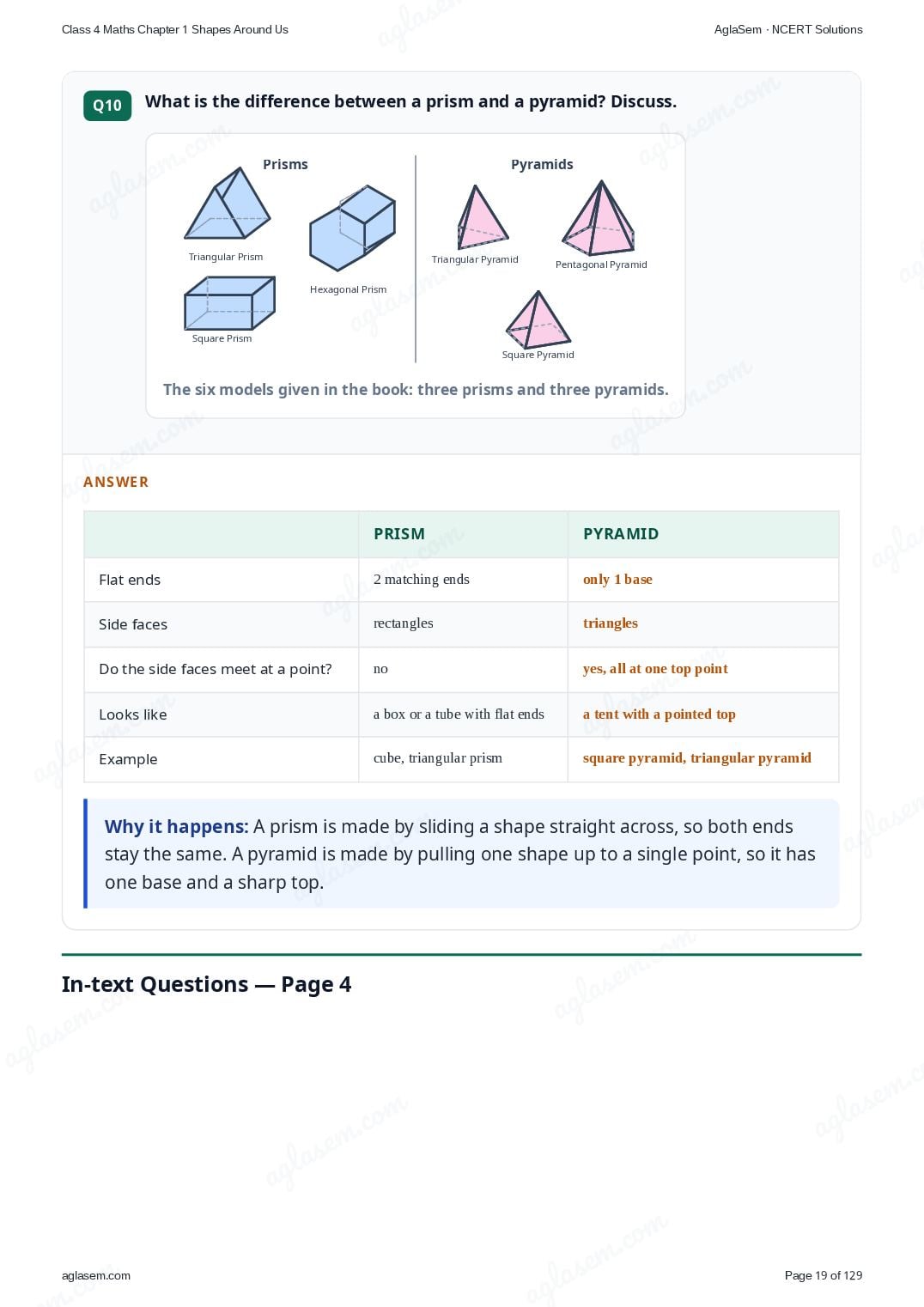
- Use the nets given at the end of the book to make the models shown below. PrismsPyramidsTriangular PrismSquare PrismHexagonal PrismTriangular PyramidPentagonal PyramidSquare PyramidThe six models given in the book: three prisms and three pyramids.Net of a boxA box folded open and flattened. The dotted lines are the folds.
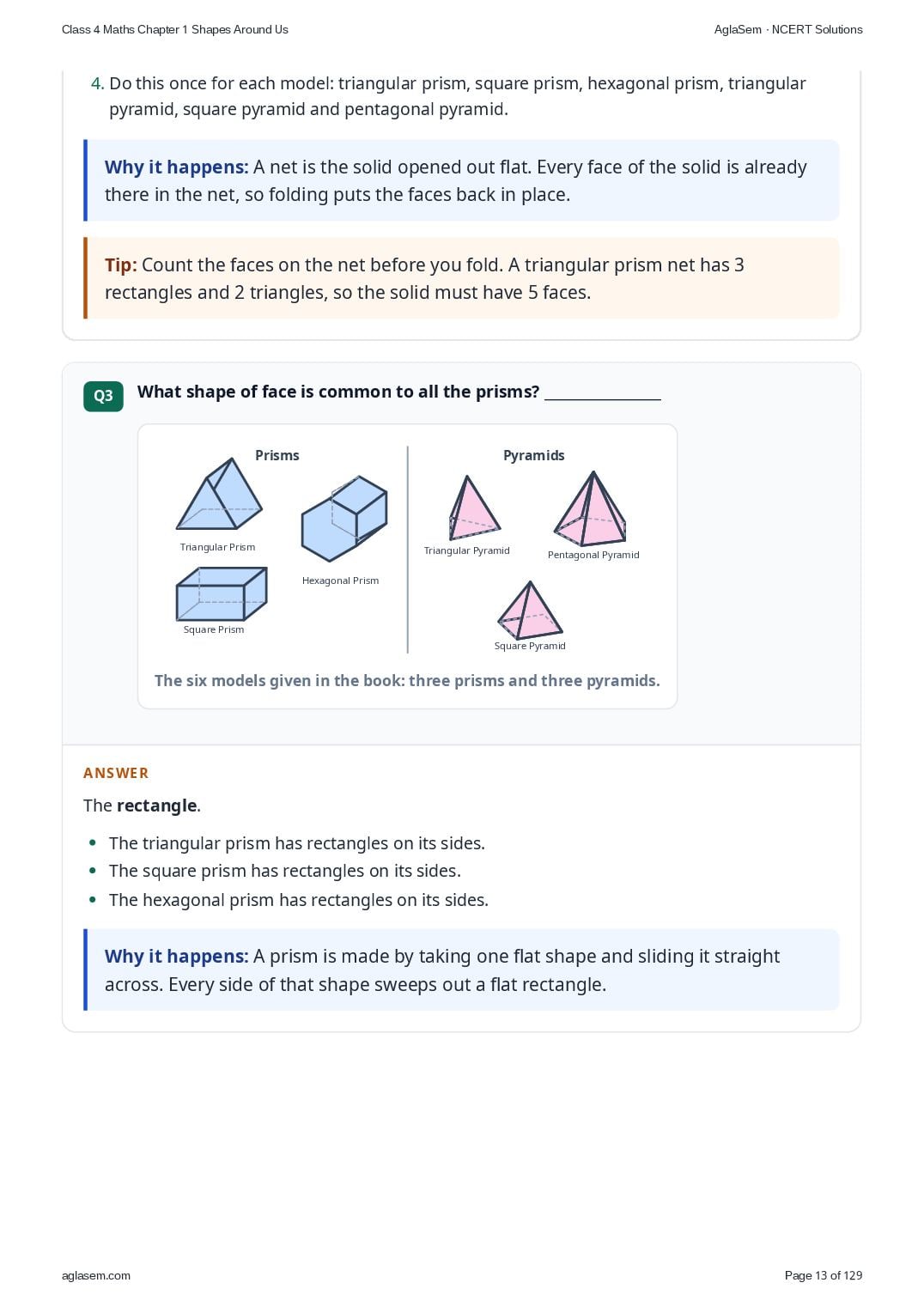
- What shape of face is common to all the prisms? _________________ PrismsPyramidsTriangular PrismSquare PrismHexagonal PrismTriangular PyramidPentagonal PyramidSquare PyramidThe six models given in the book: three prisms and three pyramids.
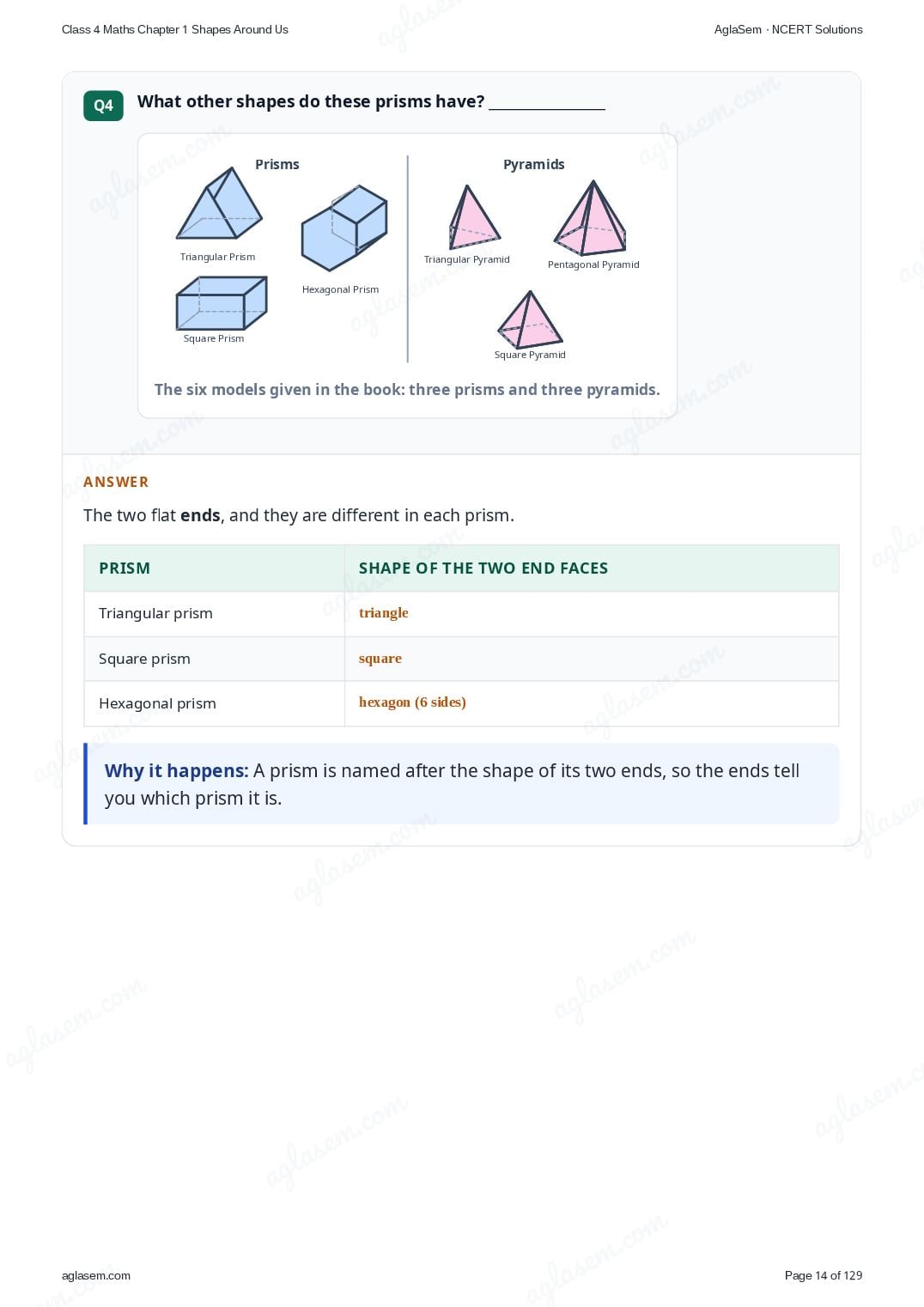
- What other shapes do these prisms have? _________________ PrismsPyramidsTriangular PrismSquare PrismHexagonal PrismTriangular PyramidPentagonal PyramidSquare PyramidThe six models given in the book: three prisms and three pyramids.
- How many such faces each? _________________ PrismsPyramidsTriangular PrismSquare PrismHexagonal PrismTriangular PyramidPentagonal PyramidSquare PyramidThe six models given in the book: three prisms and three pyramids.
- What shape of face is common to all the pyramids? _______________ PrismsPyramidsTriangular PrismSquare PrismHexagonal PrismTriangular PyramidPentagonal PyramidSquare PyramidThe six models given in the book: three prisms and three pyramids.
- All the triangular faces meet at _________________ point. PrismsPyramidsTriangular PrismSquare PrismHexagonal PrismTriangular PyramidPentagonal PyramidSquare PyramidThe six models given in the book: three prisms and three pyramids.
- Identify any other shape in each of the pyramids _________________ PrismsPyramidsTriangular PrismSquare PrismHexagonal PrismTriangular PyramidPentagonal PyramidSquare PyramidThe six models given in the book: three prisms and three pyramids.
- Is a cube also a prism? PrismsPyramidsTriangular PrismSquare PrismHexagonal PrismTriangular PyramidPentagonal PyramidSquare PyramidThe six models given in the book: three prisms and three pyramids.
- What is the difference between a prism and a pyramid? Discuss. PrismsPyramidsTriangular PrismSquare PrismHexagonal PrismTriangular PyramidPentagonal PyramidSquare PyramidThe six models given in the book: three prisms and three pyramids.
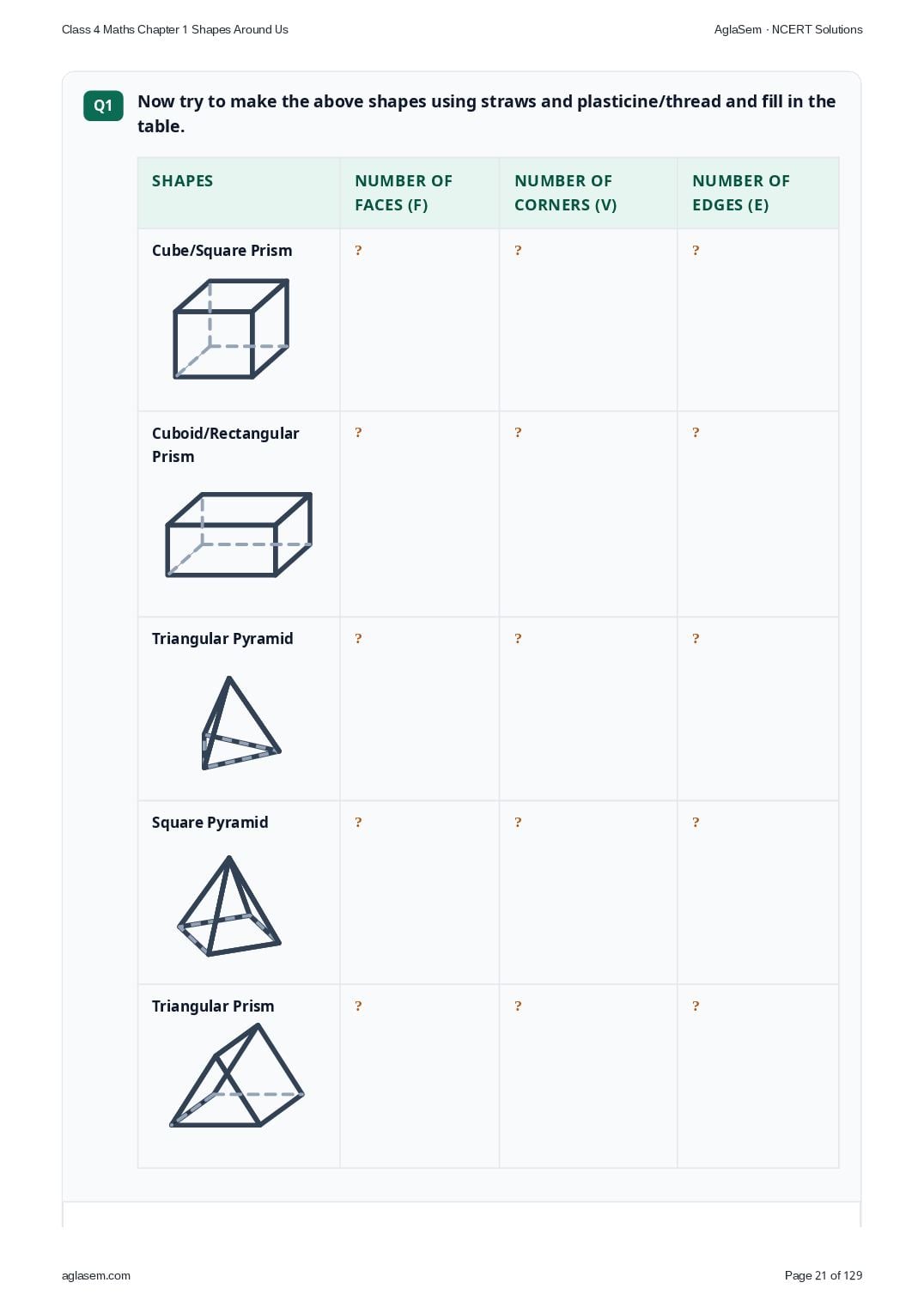
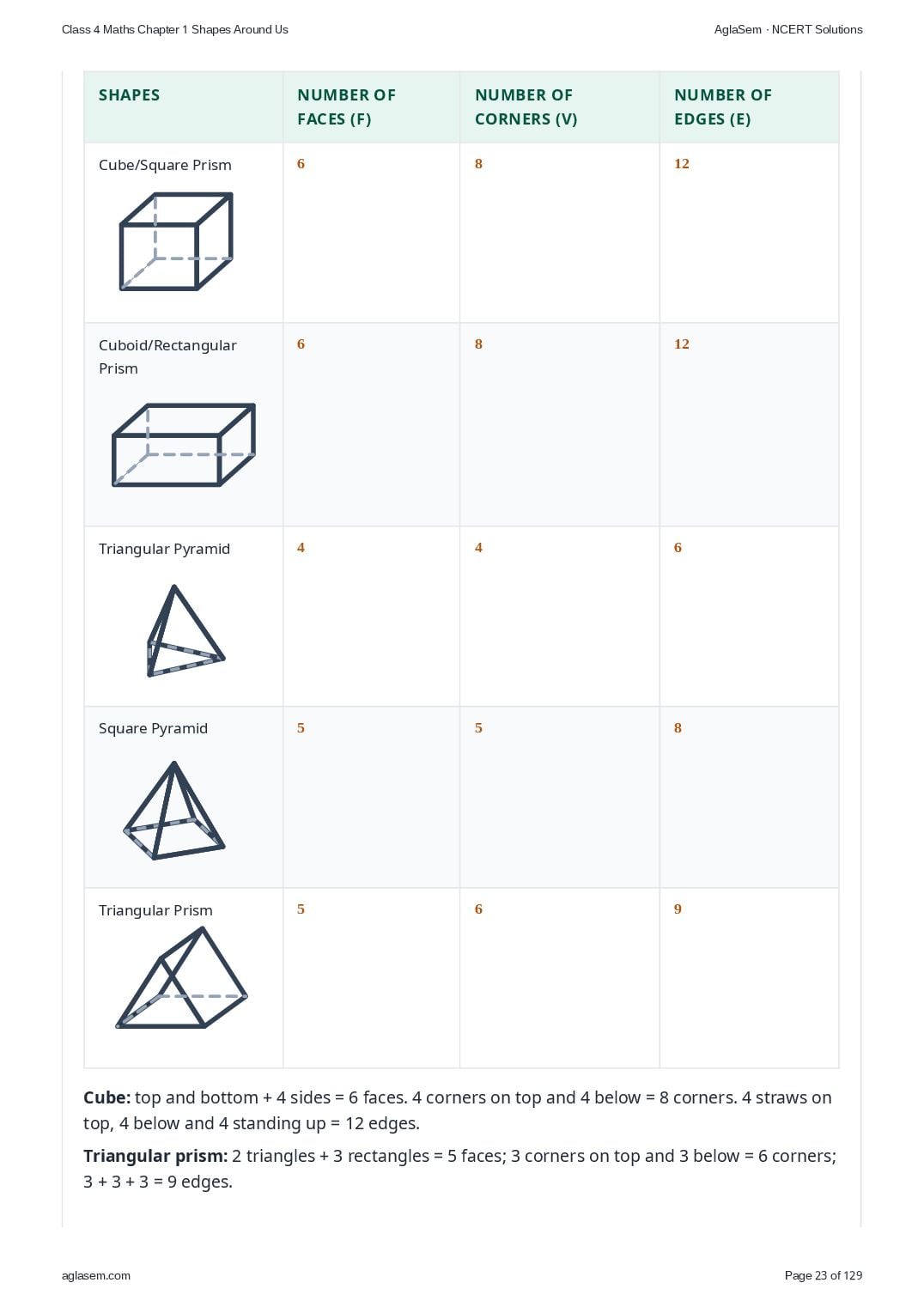
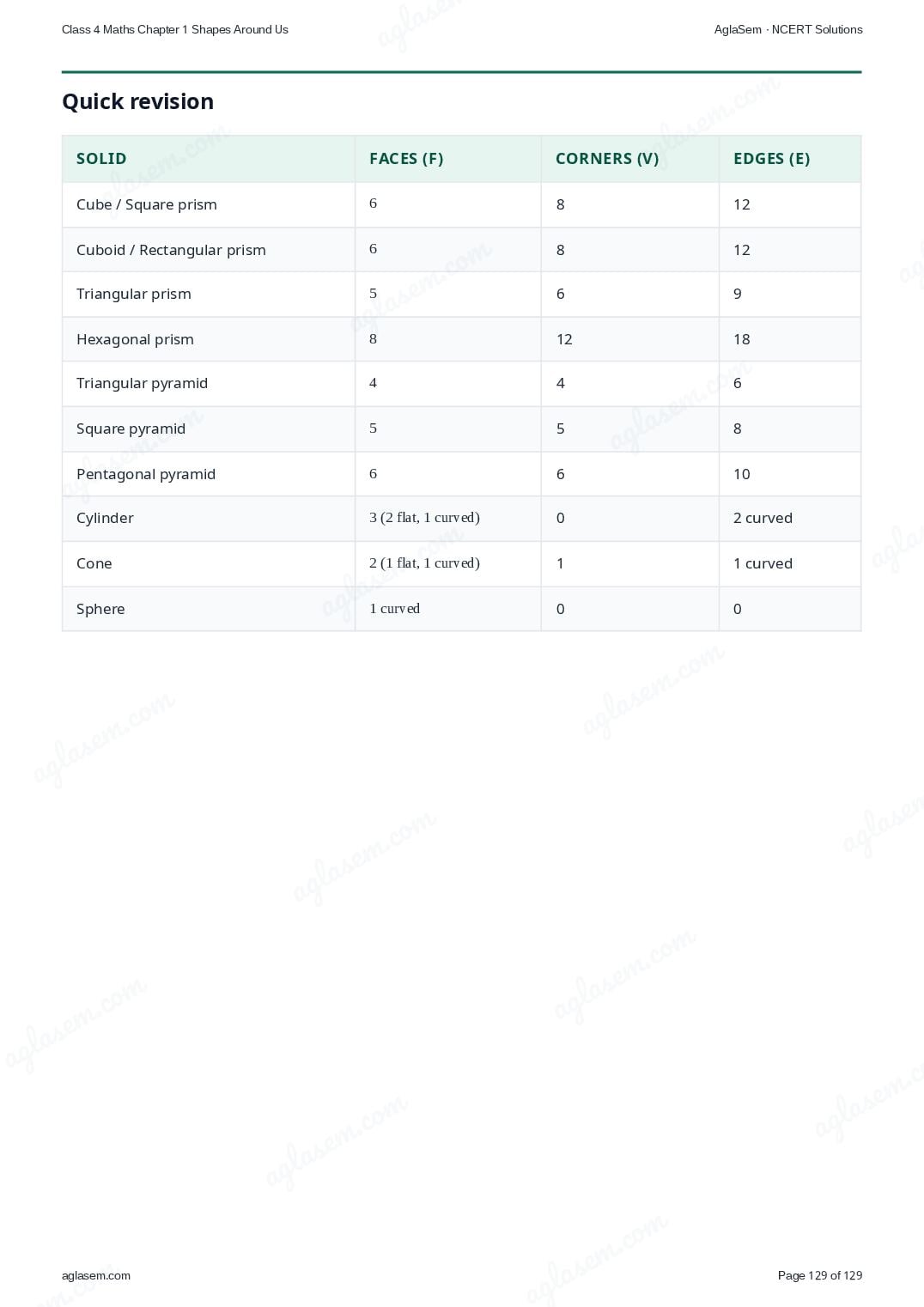
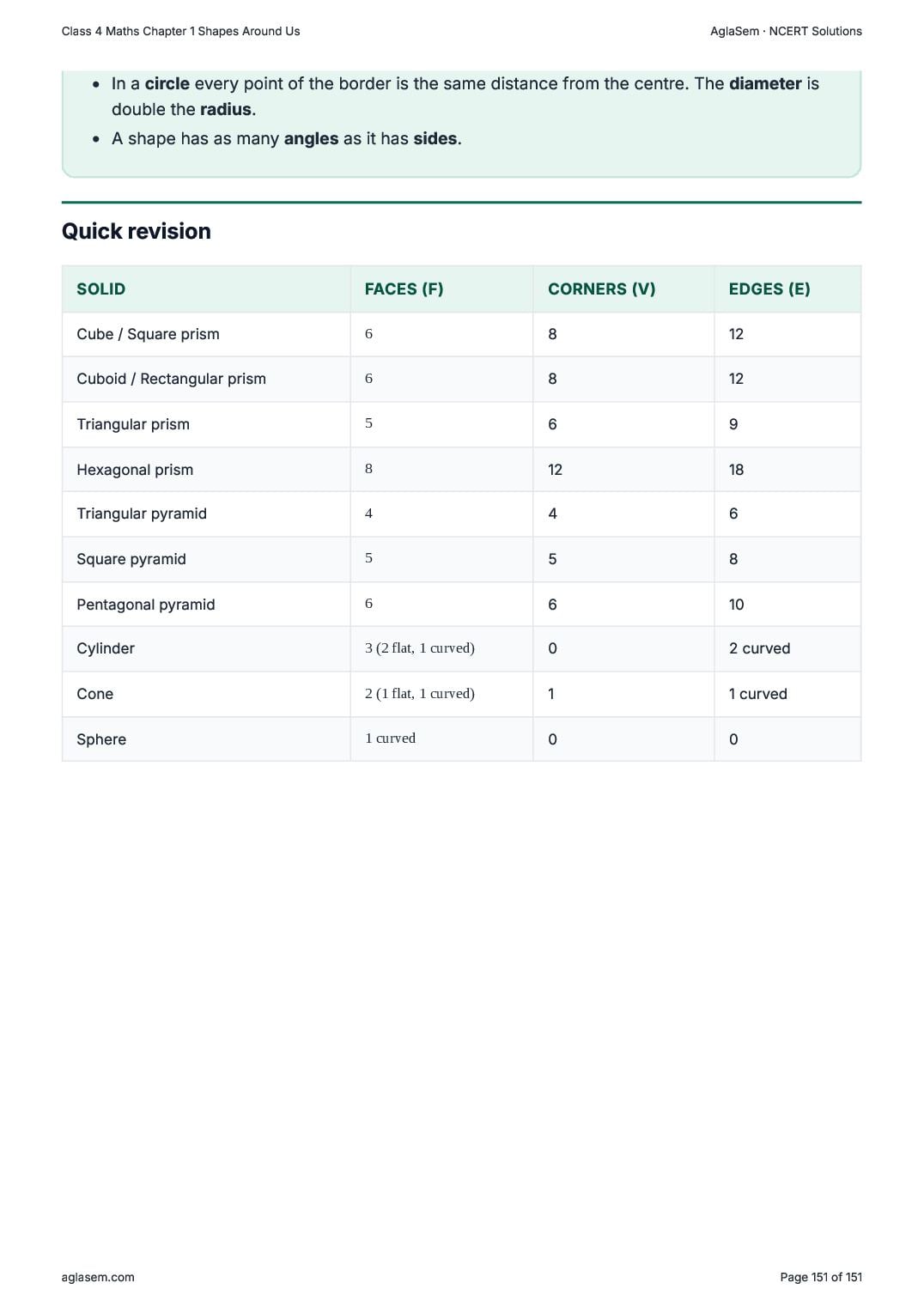
- Now try to make the above shapes using straws and plasticine/thread and fill in the table.ShapesNumber of faces (F)Number of corners (V)Number of edges (E)Cube/Square Prism???Cuboid/Rectangular Prism???Triangular Pyramid???Square Pyramid???Triangular Prism???
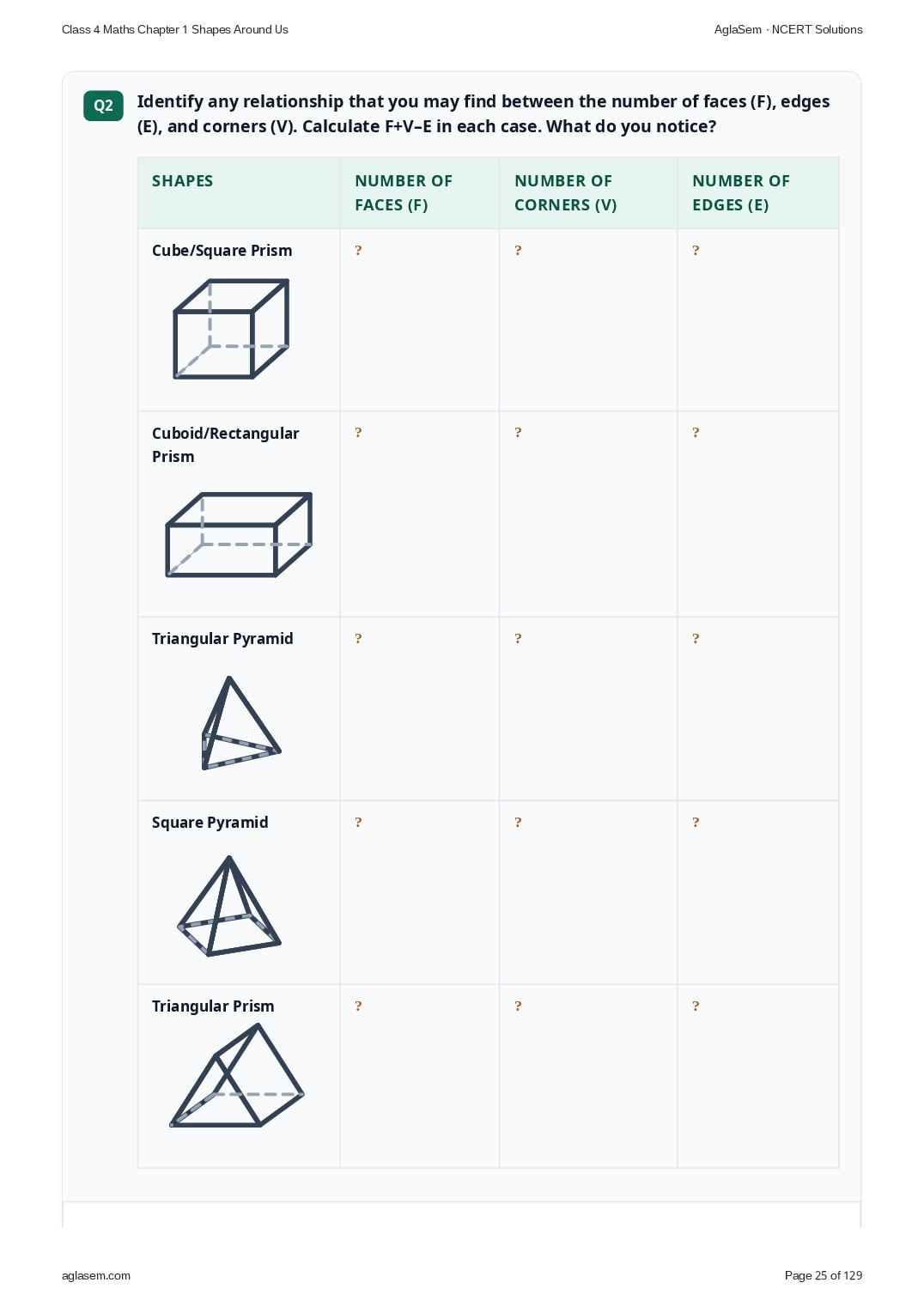
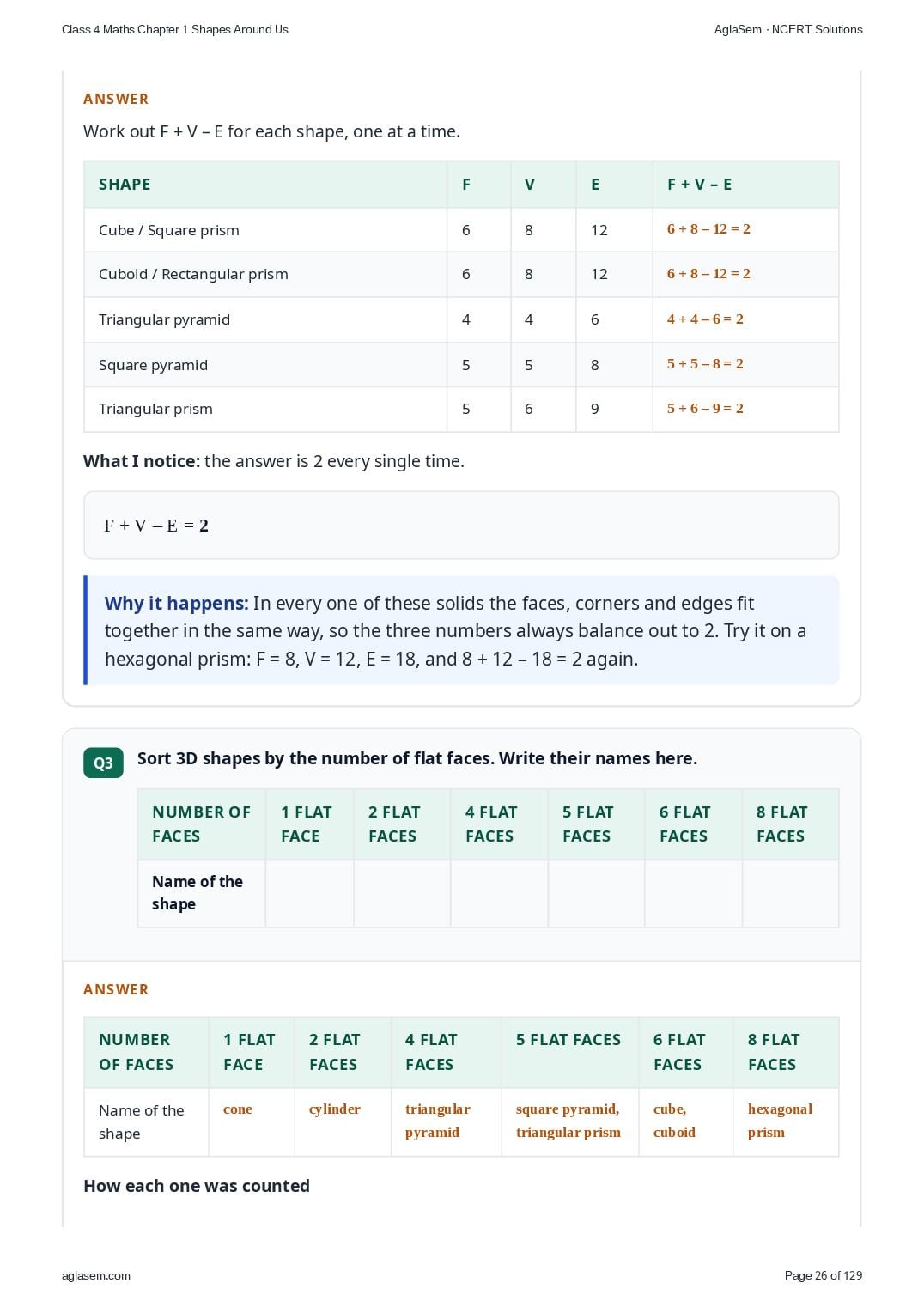
- Identify any relationship that you may find between the number of faces (F), edges (E), and corners (V). Calculate F+V–E in each case. What do you notice? ShapesNumber of faces (F)Number of corners (V)Number of edges (E)Cube/Square Prism???Cuboid/Rectangular Prism???Triangular Pyramid???Square Pyramid???Triangular Prism???
- Sort 3D shapes by the number of flat faces. Write their names here.Number of faces1 flat face2 flat faces4 flat faces5 flat faces6 flat faces8 flat facesName of the shape
- Can you construct a 3D shape with 3 flat faces?
- Now sort 3D shapes by the number of straight edges. Write their names here.Number of edges6 straight edges8 straight edges9 straight edges12 straight edgesName of the shape
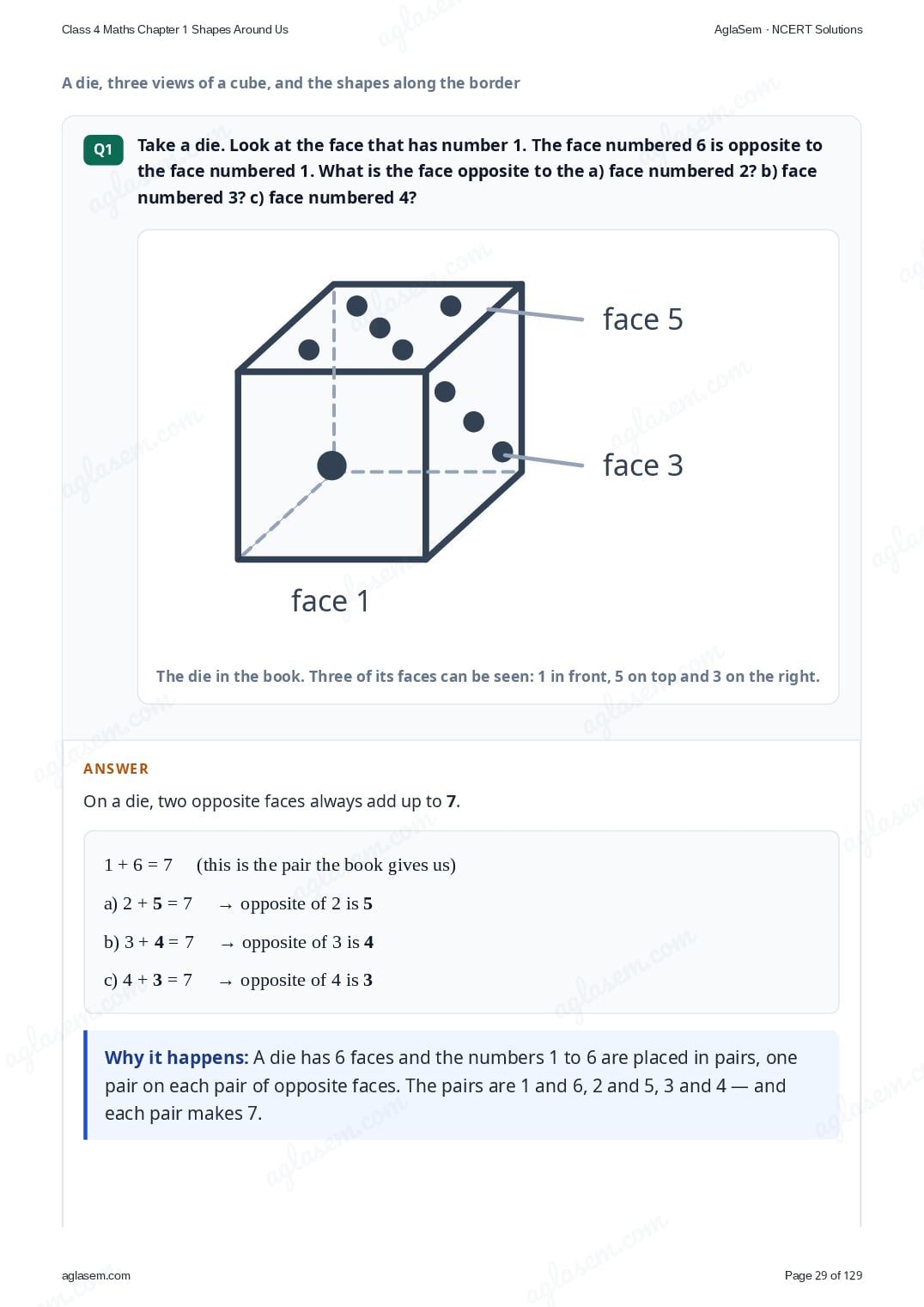
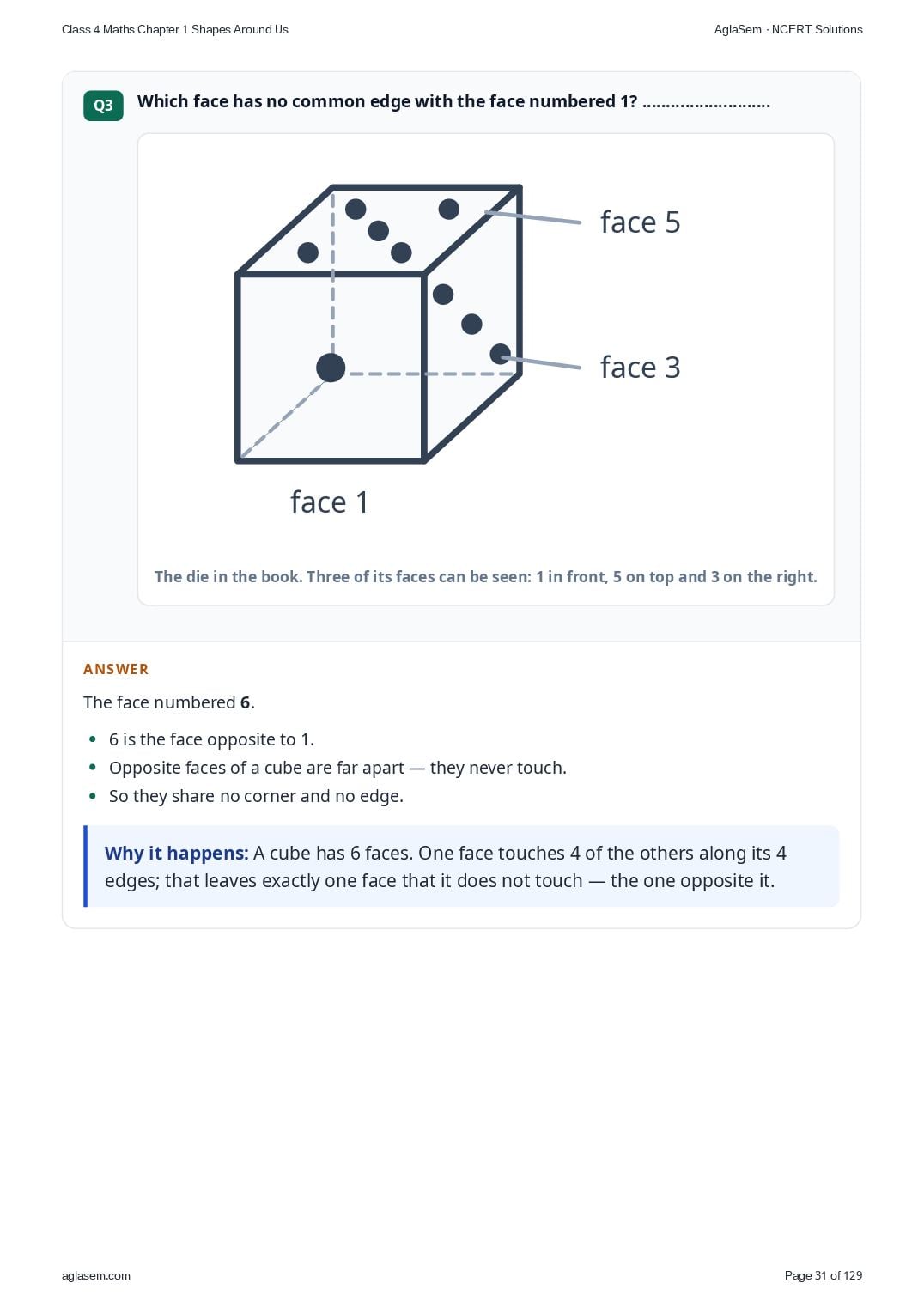
- Take a die. Look at the face that has number 1. The face numbered 6 is opposite to the face numbered 1. What is the face opposite to the a) face numbered 2? b) face numbered 3? c) face numbered 4? face 1face 5face 3The die in the book. Three of its faces can be seen: 1 in front, 5 on top and 3 on the right.
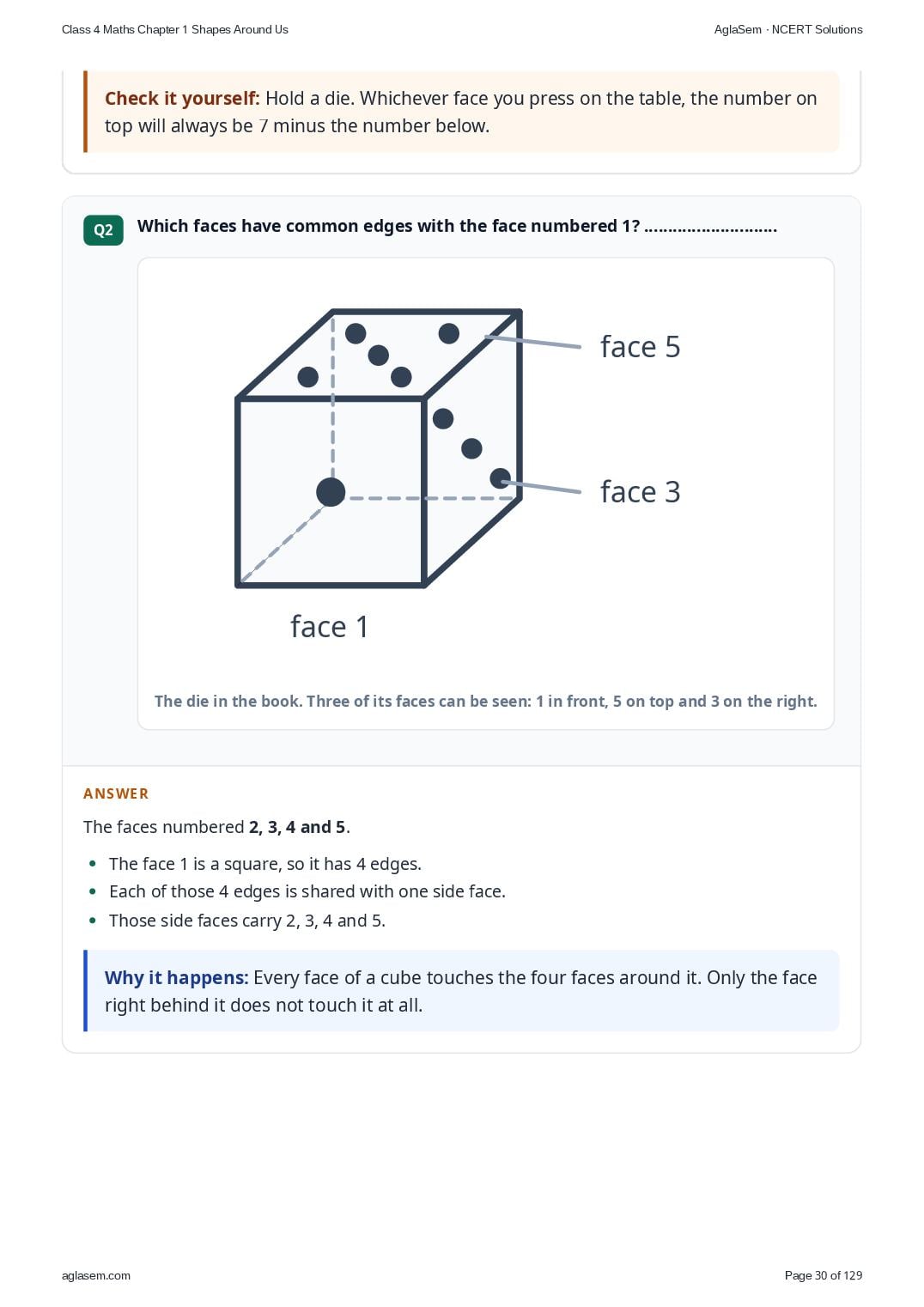
- Which faces have common edges with the face numbered 1? ………………………. face 1face 5face 3The die in the book. Three of its faces can be seen: 1 in front, 5 on top and 3 on the right.
- Which face has no common edge with the face numbered 1? ……………………… face 1face 5face 3The die in the book. Three of its faces can be seen: 1 in front, 5 on top and 3 on the right.
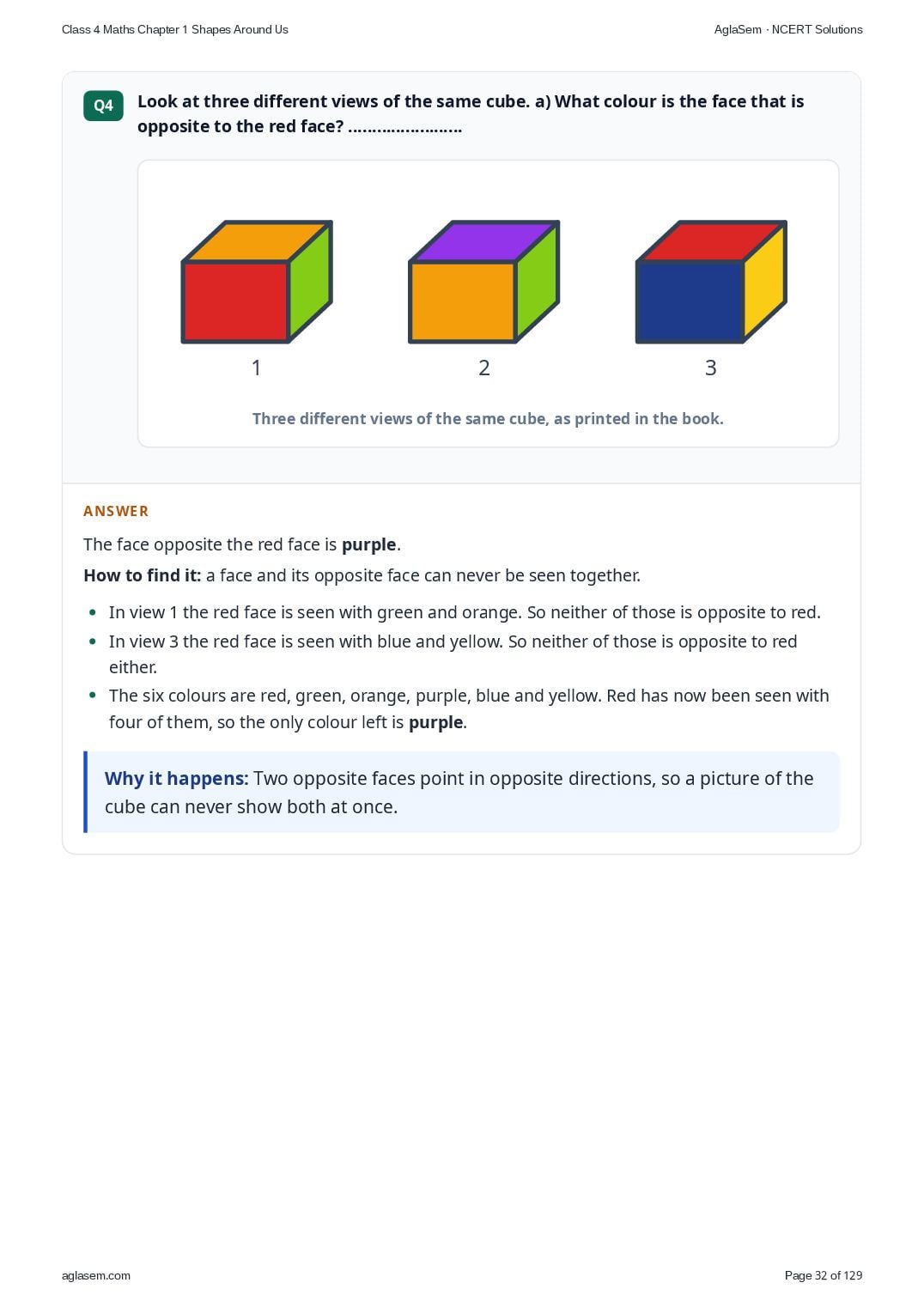
- Look at three different views of the same cube. a) What colour is the face that is opposite to the red face? …………………… 123Three different views of the same cube, as printed in the book.
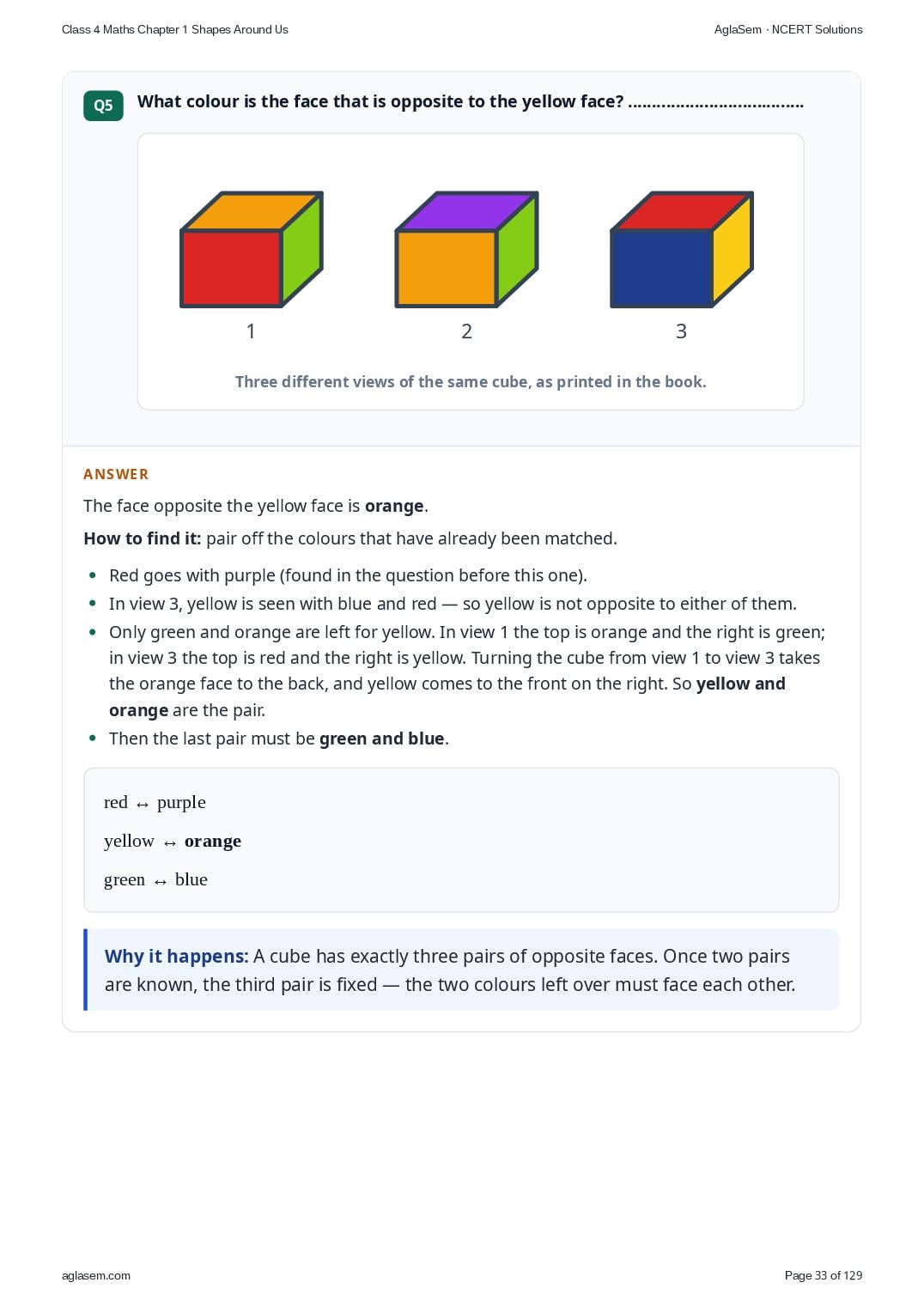
- What colour is the face that is opposite to the yellow face? …………………..………….. 123Three different views of the same cube, as printed in the book.
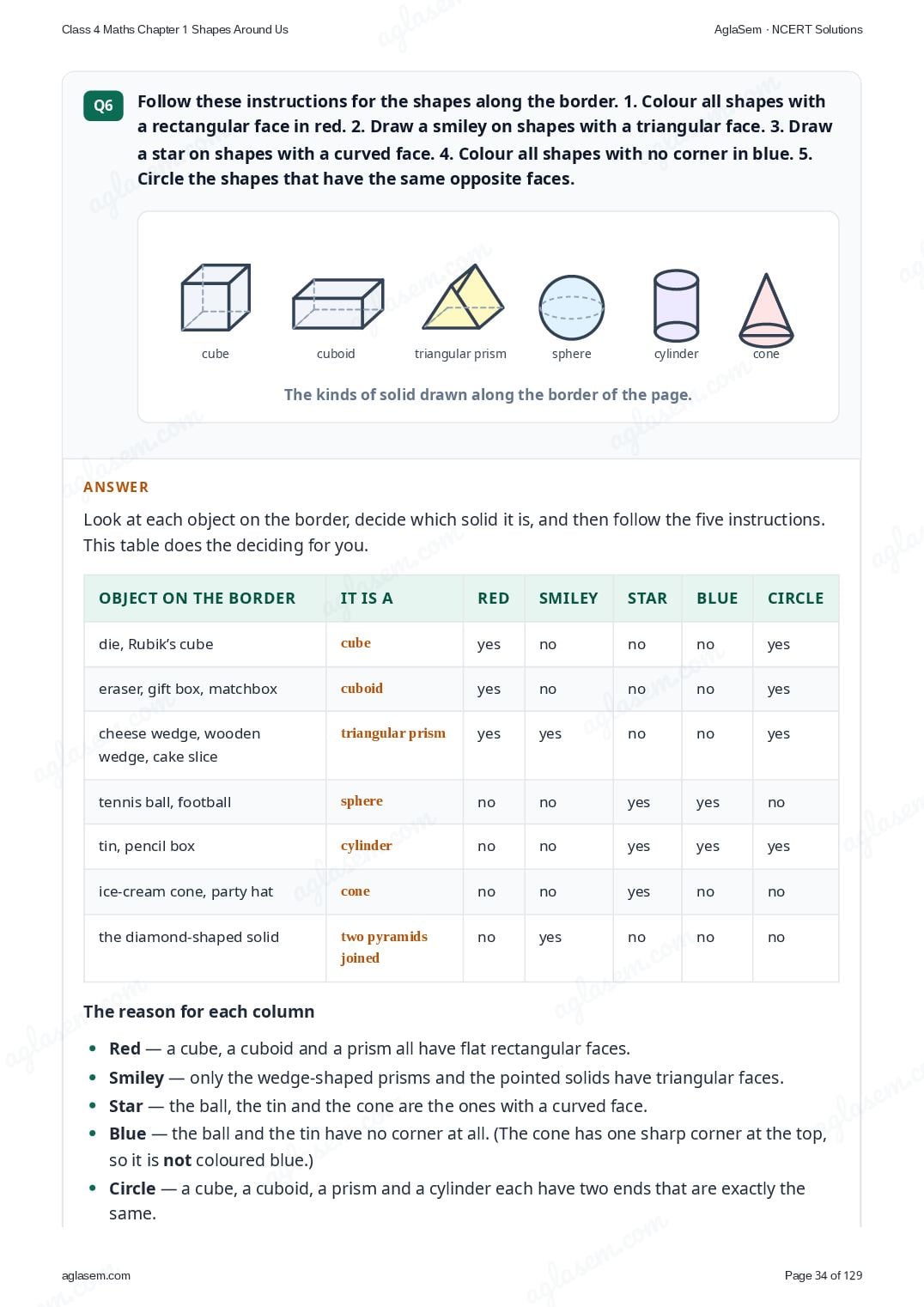
- Follow these instructions for the shapes along the border. 1. Colour all shapes with a rectangular face in red. 2. Draw a smiley on shapes with a triangular face. 3. Draw a star on shapes with a curved face. 4. Colour all shapes with no corner in blue. 5. Circle the shapes that have the same opposite faces. cubecuboidtriangular prismspherecylinderconeThe kinds of solid drawn along the border of the page.
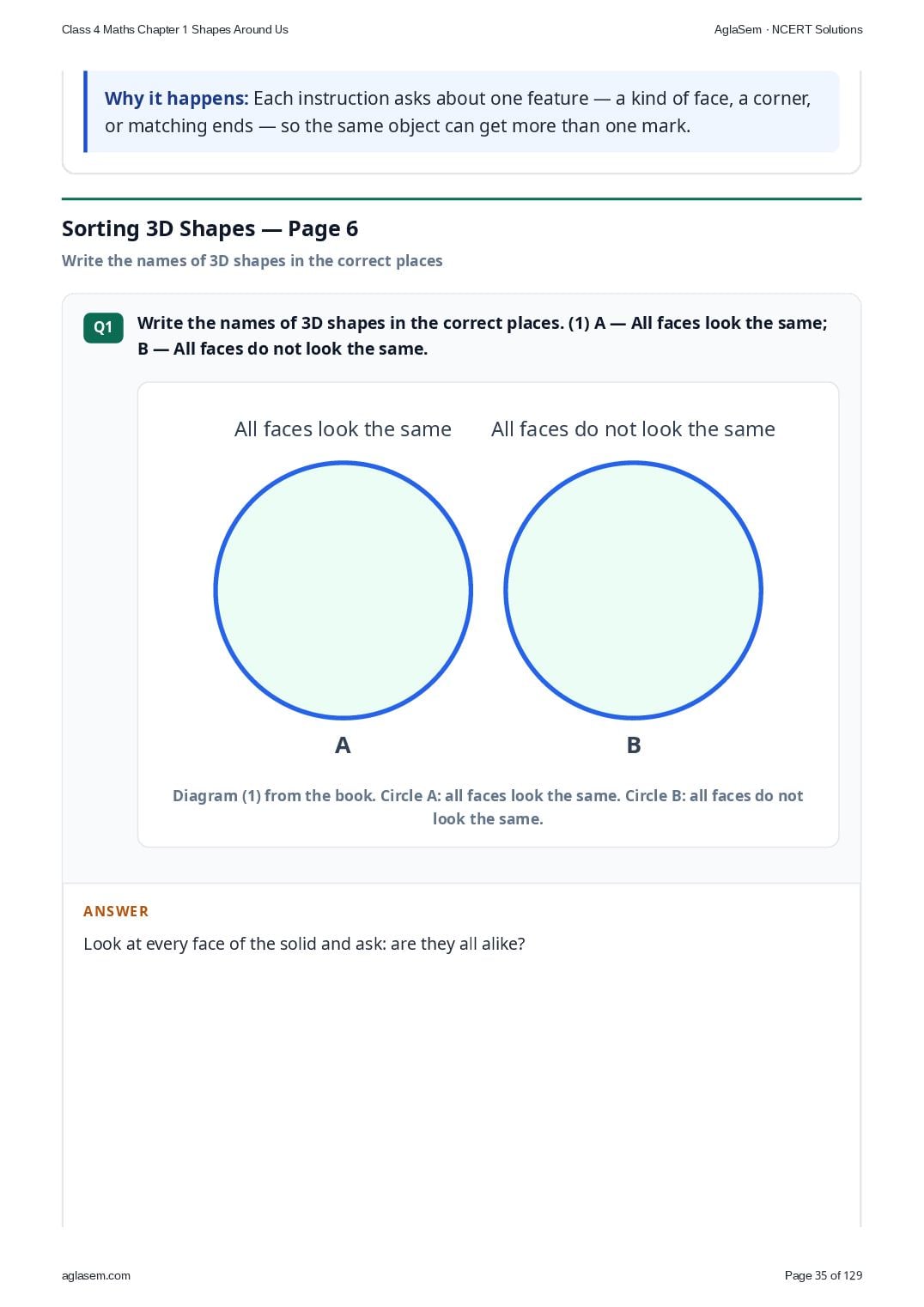
- Write the names of 3D shapes in the correct places. (1) A — All faces look the same; B — All faces do not look the same. All faces look the sameAll faces do not look the sameABDiagram (1) from the book. Circle A: all faces look the same. Circle B: all faces do not look the same.
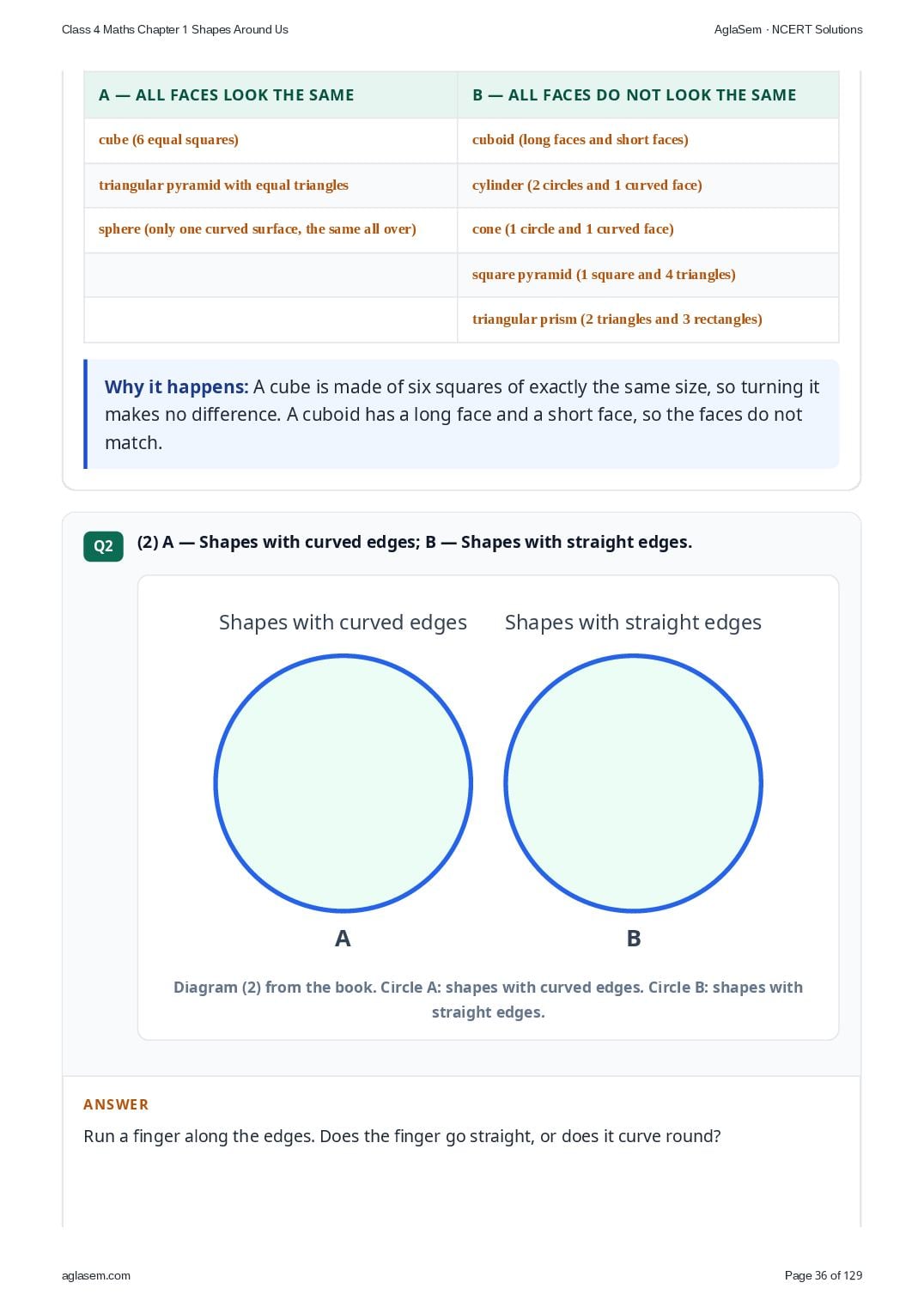
- (2) A — Shapes with curved edges; B — Shapes with straight edges. Shapes with curved edgesShapes with straight edgesABDiagram (2) from the book. Circle A: shapes with curved edges. Circle B: shapes with straight edges.
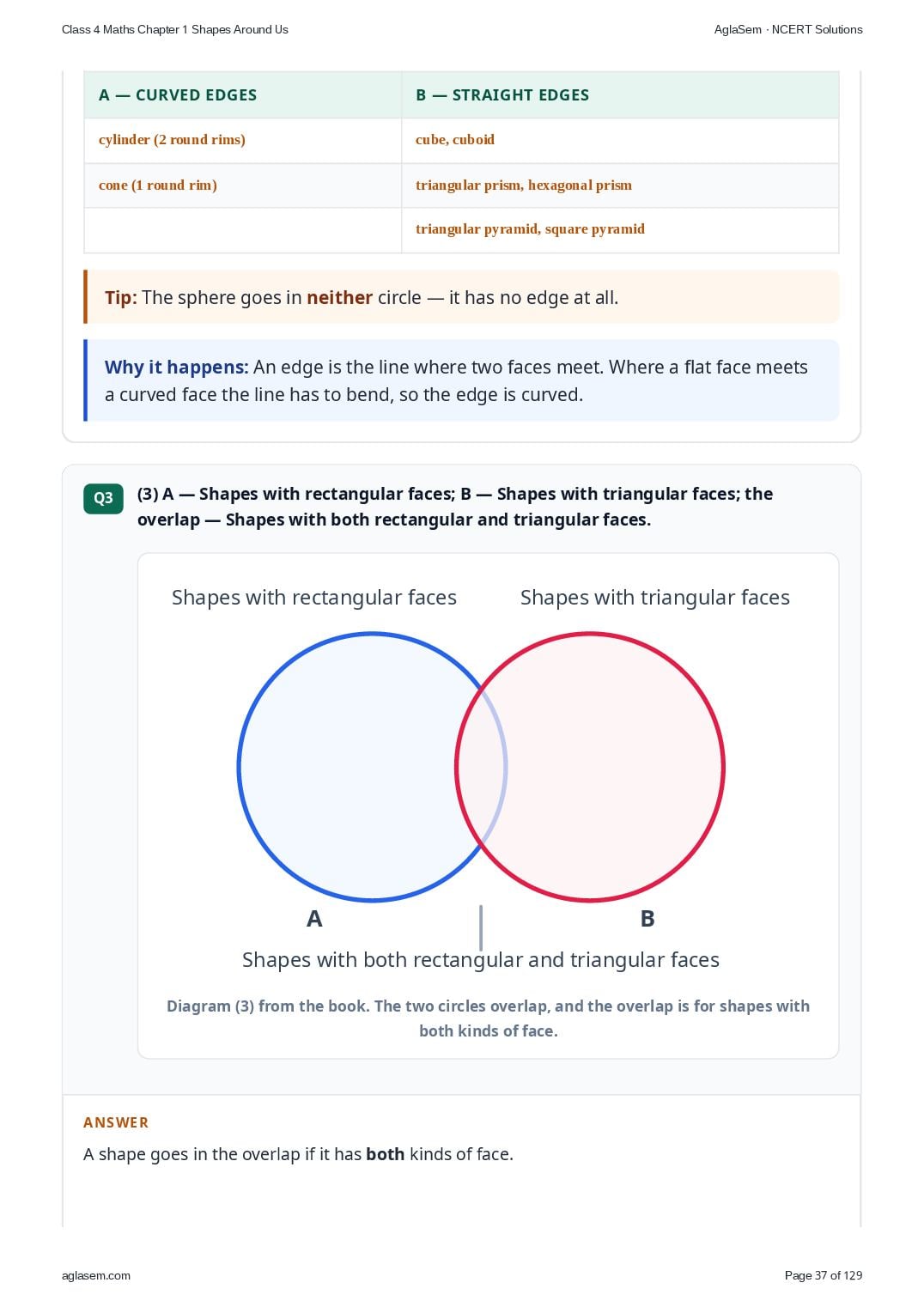
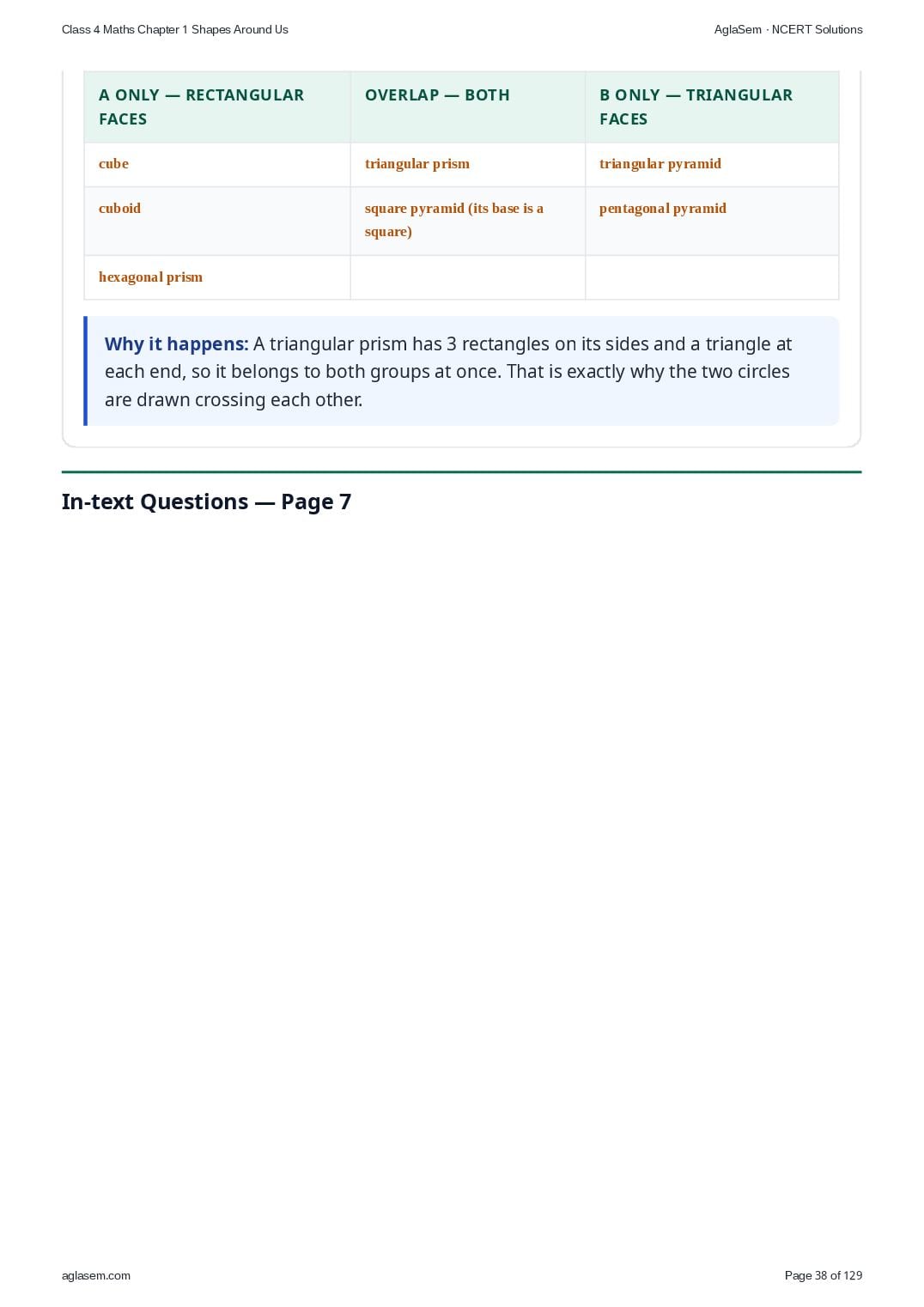
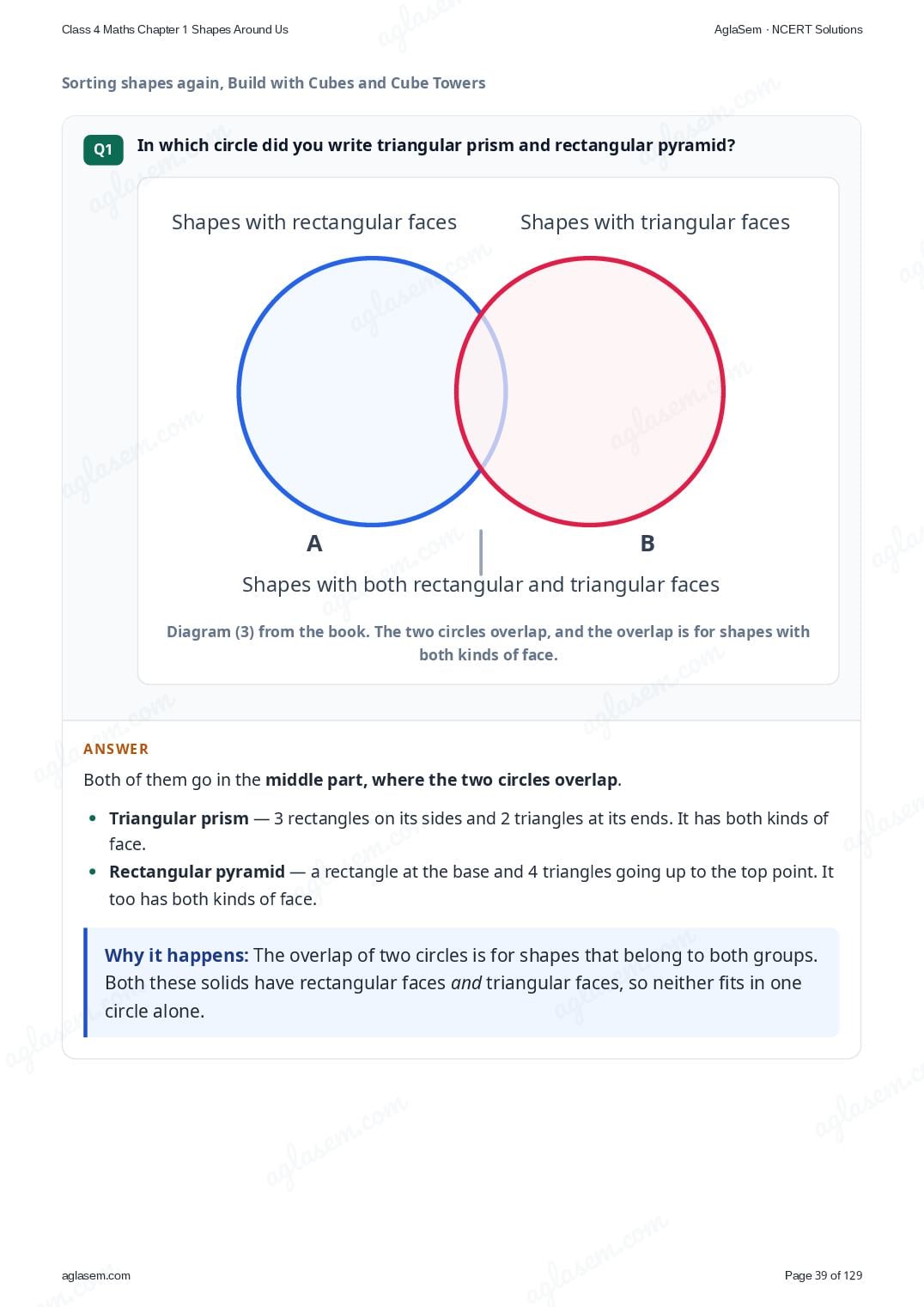
- (3) A — Shapes with rectangular faces; B — Shapes with triangular faces; the overlap — Shapes with both rectangular and triangular faces. Shapes with rectangular facesShapes with triangular facesABShapes with both rectangular and triangular facesDiagram (3) from the book. The two circles overlap, and the overlap is for shapes with both kinds of face.
- In which circle did you write triangular prism and rectangular pyramid? Shapes with rectangular facesShapes with triangular facesABShapes with both rectangular and triangular facesDiagram (3) from the book. The two circles overlap, and the overlap is for shapes with both kinds of face.
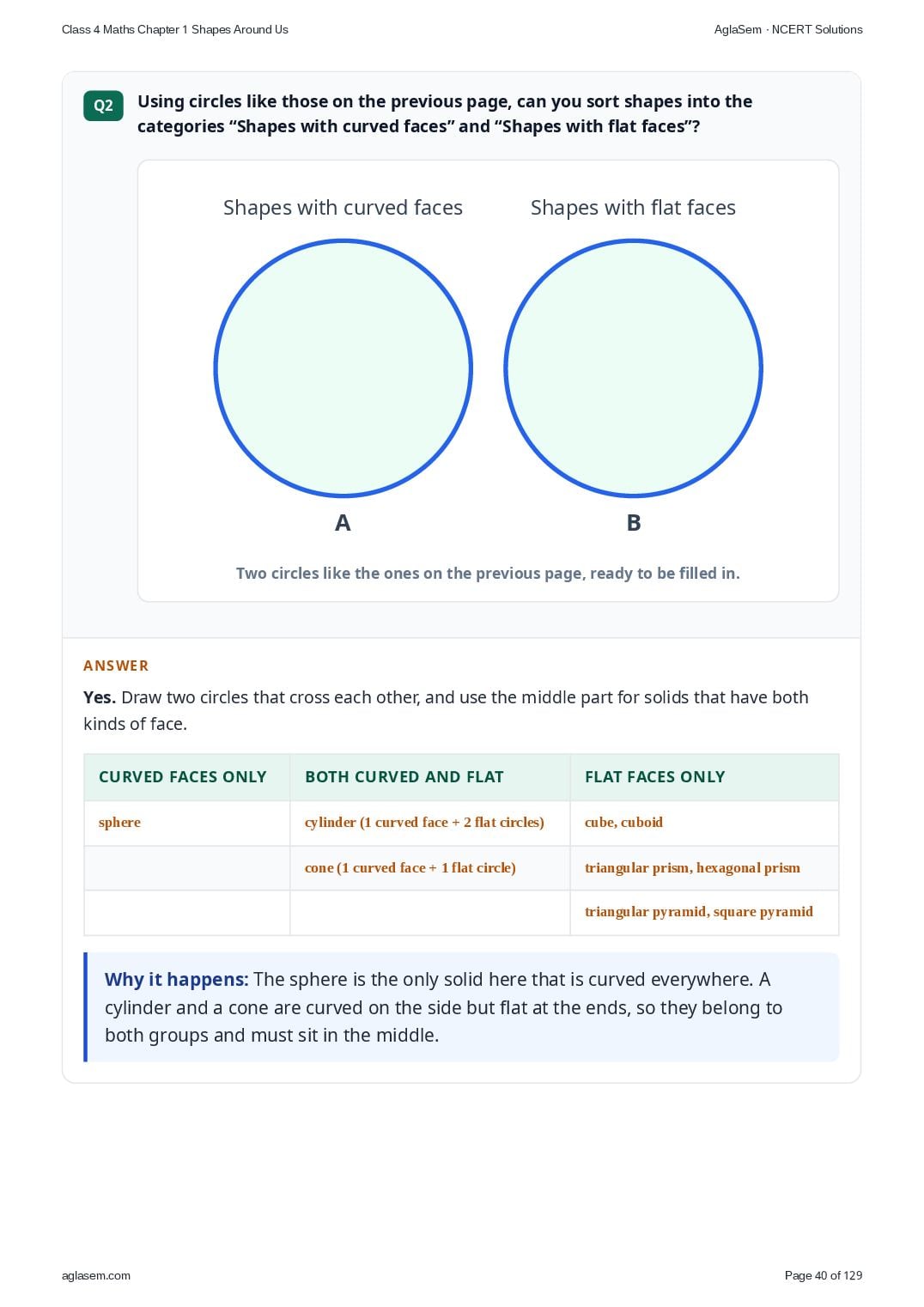
- Using circles like those on the previous page, can you sort shapes into the categories “Shapes with curved faces” and “Shapes with flat faces”? Shapes with curved facesShapes with flat facesABTwo circles like the ones on the previous page, ready to be filled in.
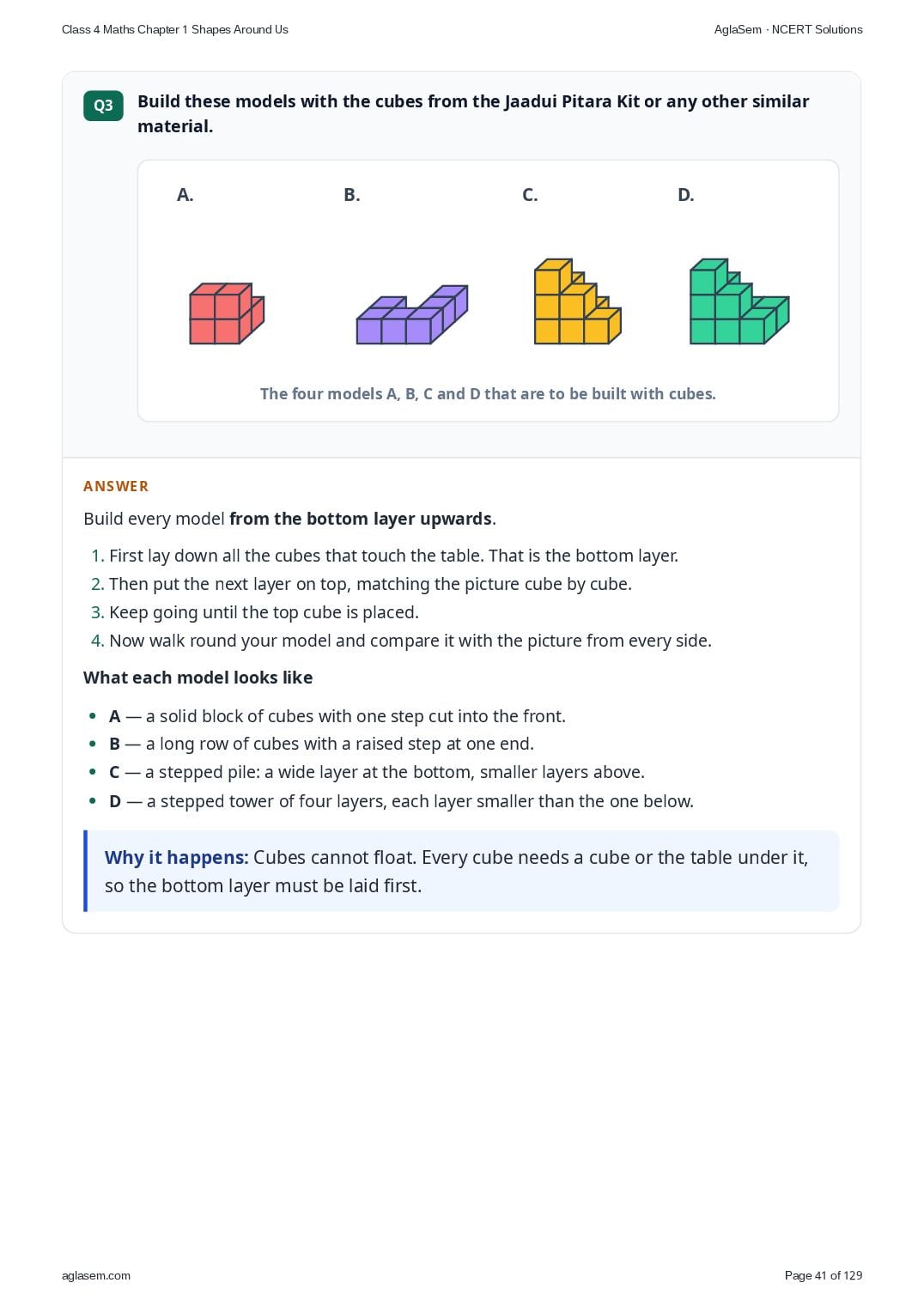
- Build these models with the cubes from the Jaadui Pitara Kit or any other similar material. A.B.C.D.The four models A, B, C and D that are to be built with cubes.
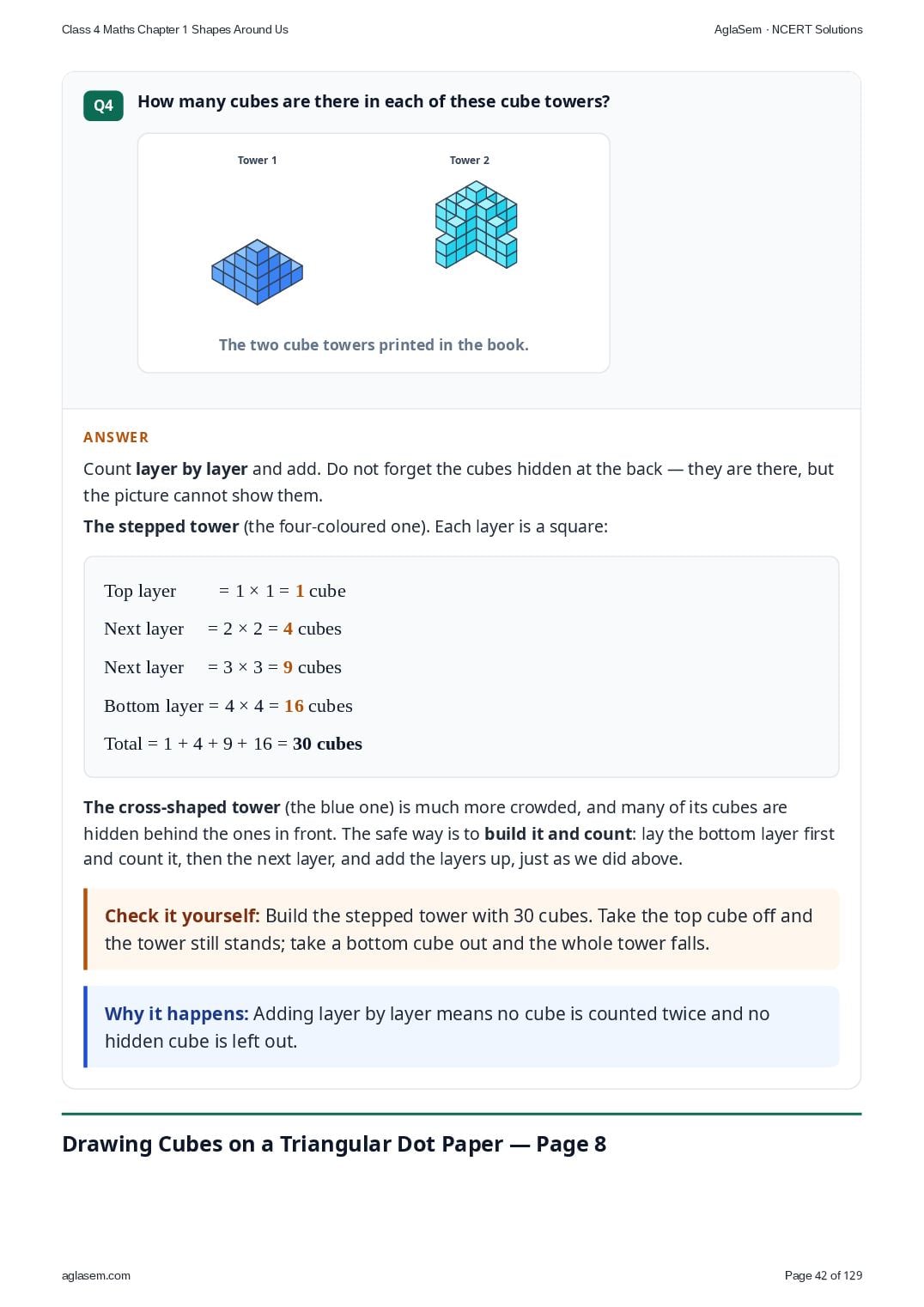
- How many cubes are there in each of these cube towers? Tower 1Tower 2The two cube towers printed in the book.
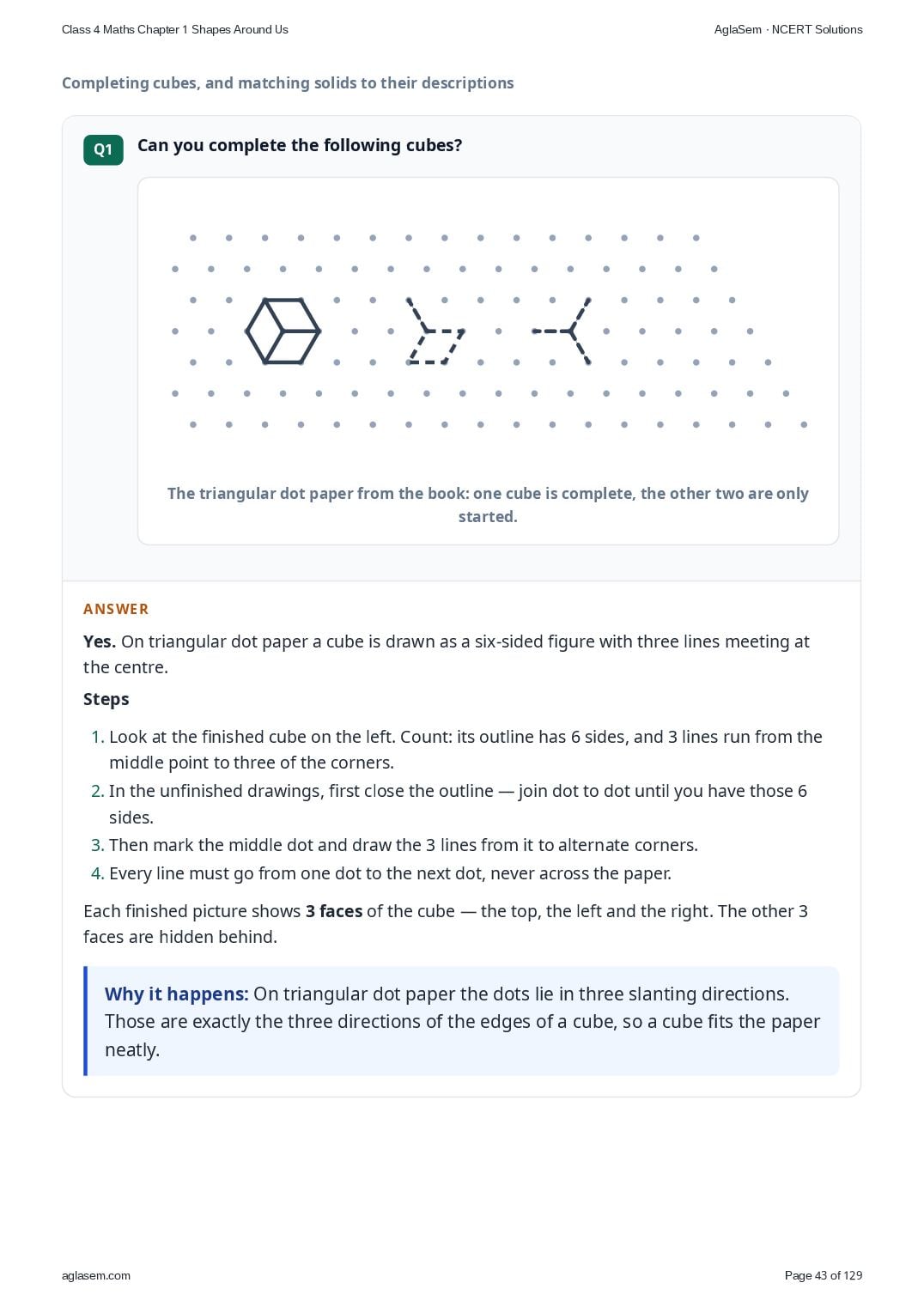
- Can you complete the following cubes? The triangular dot paper from the book: one cube is complete, the other two are only started.
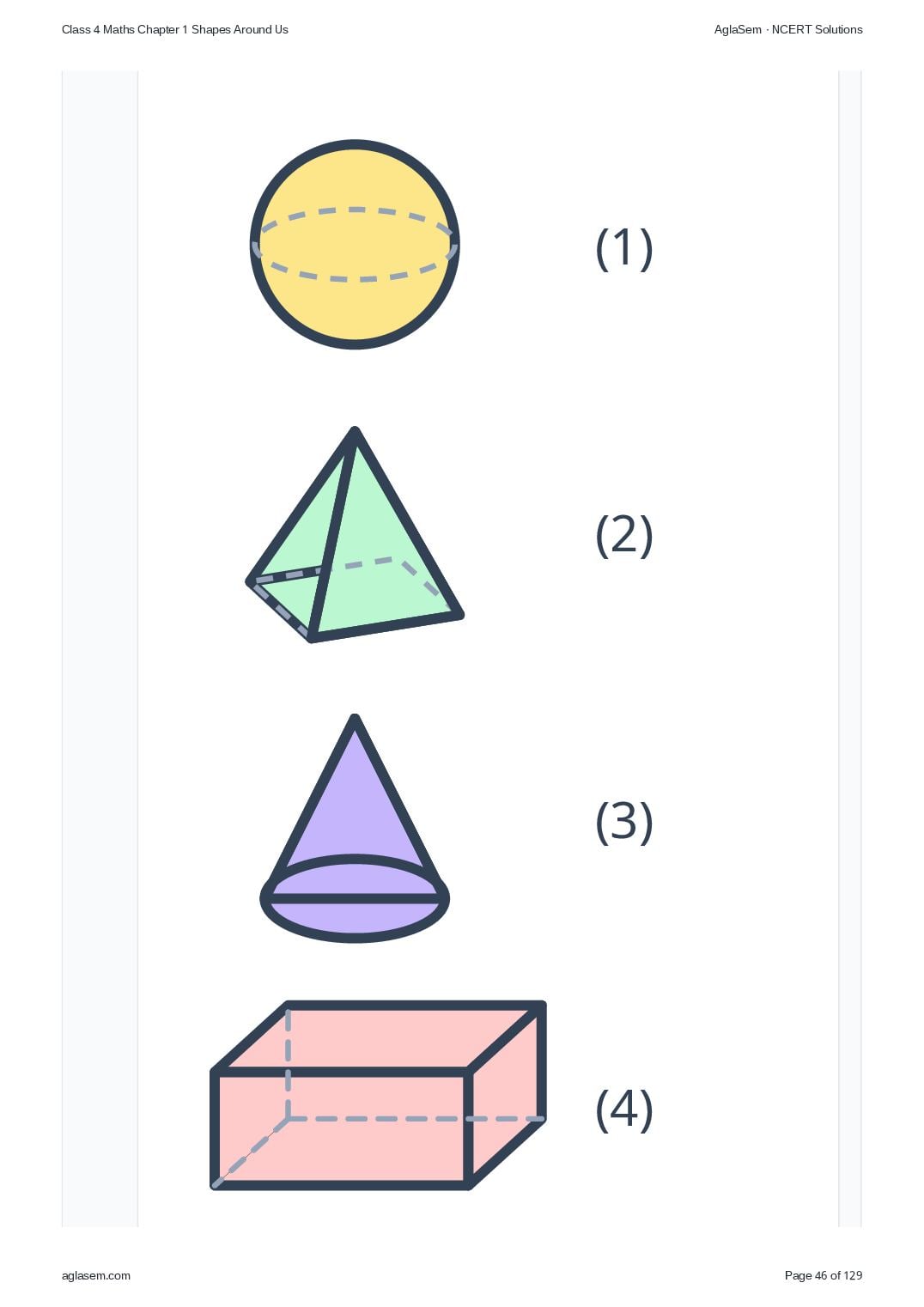
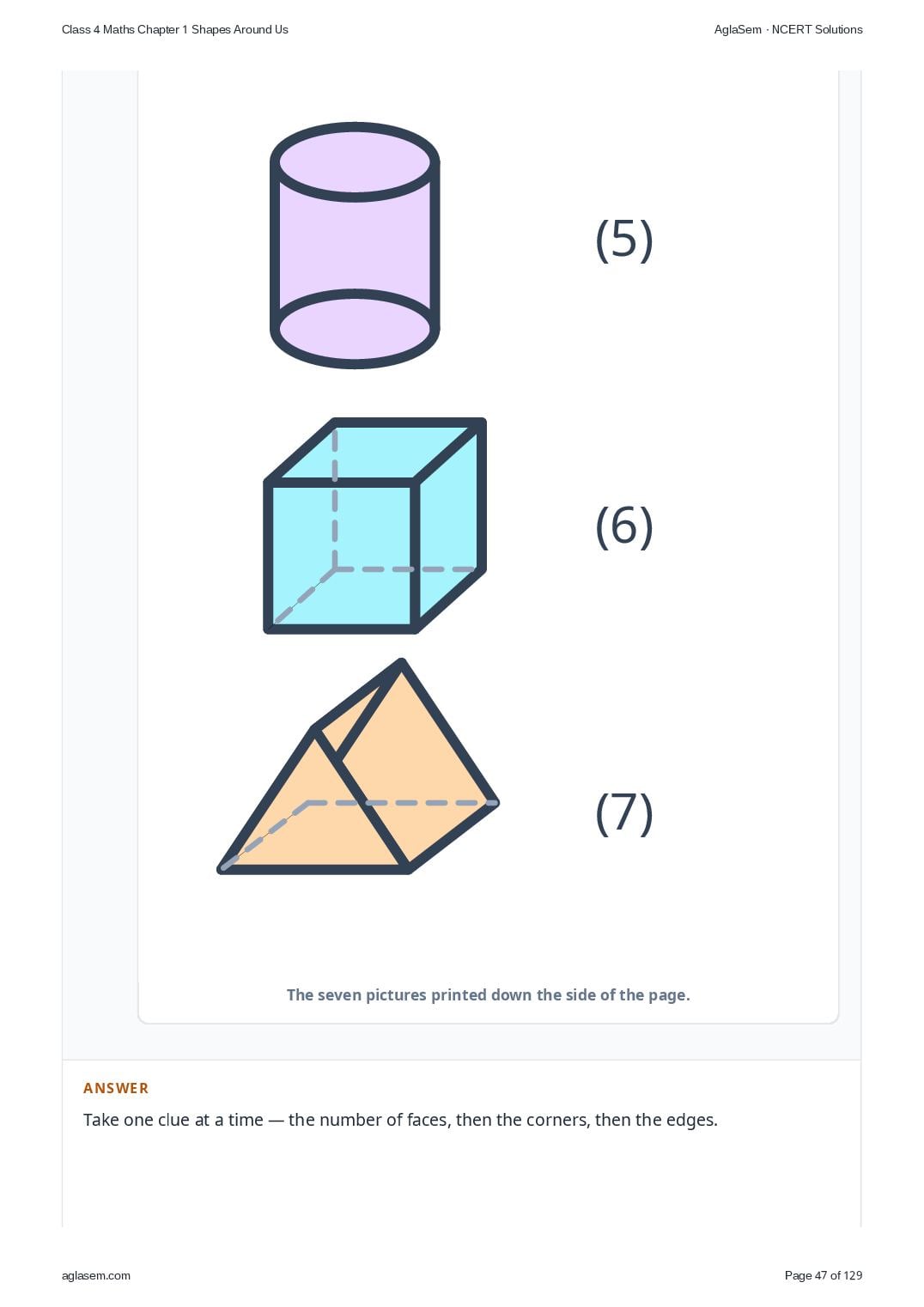
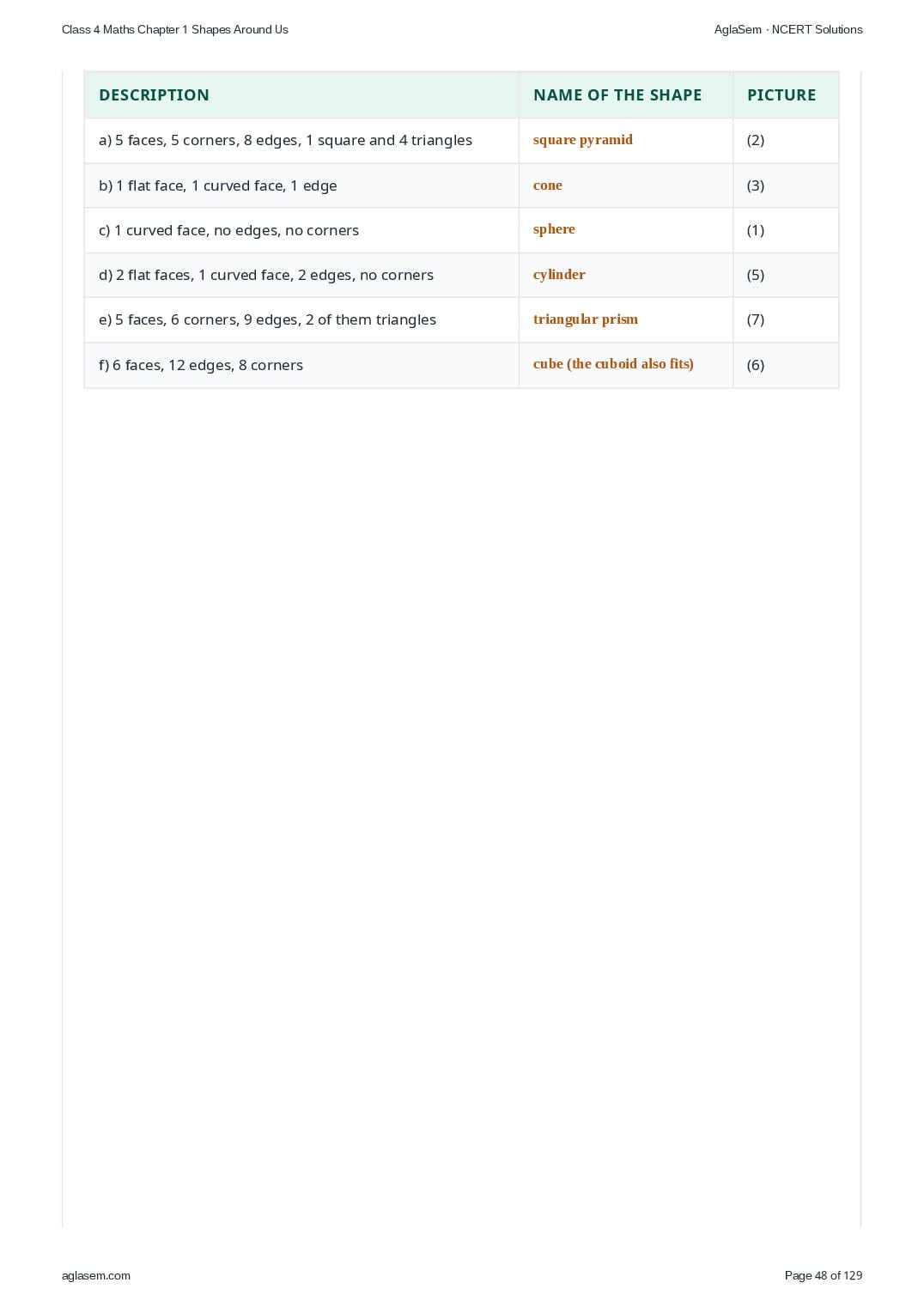
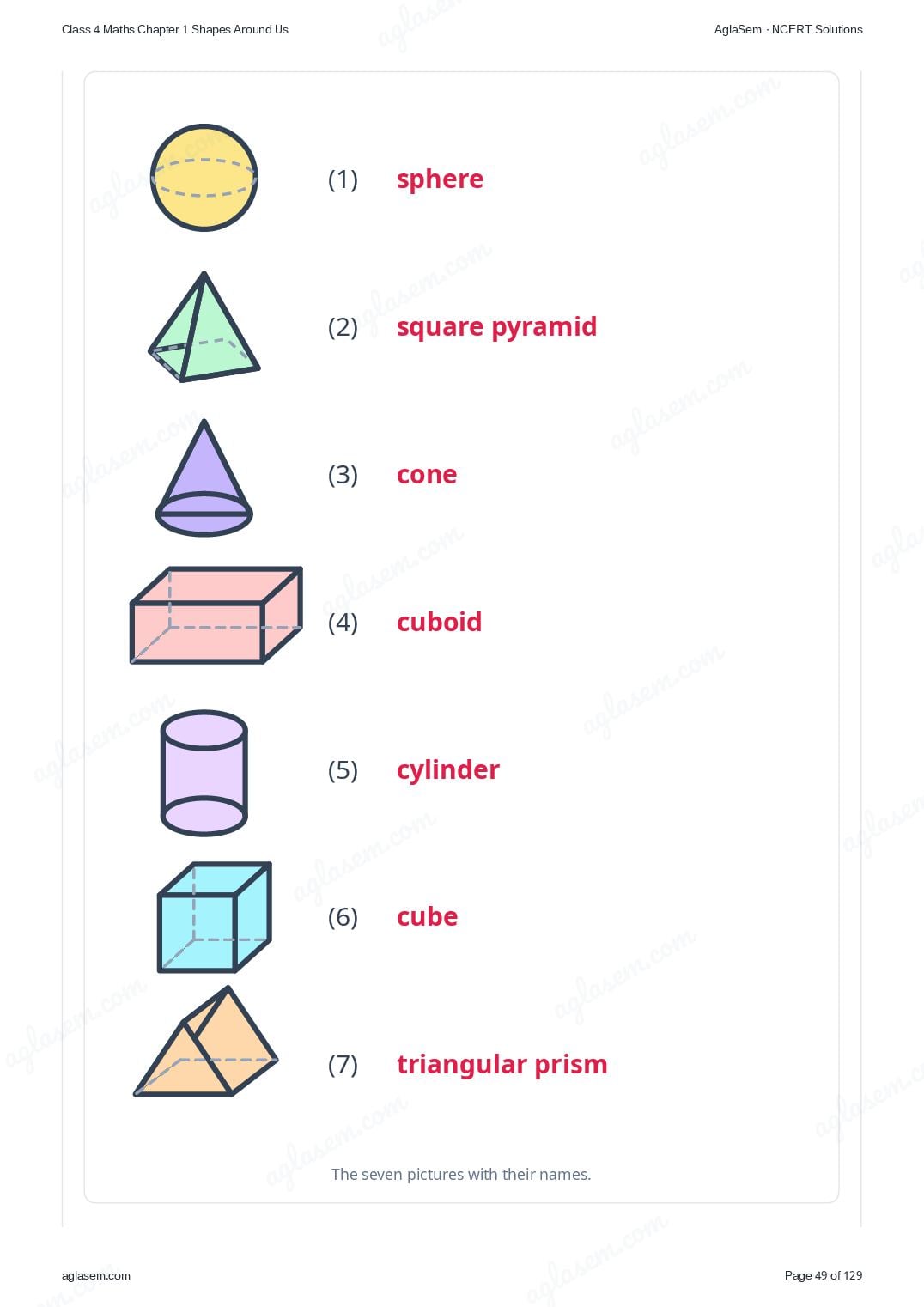
- Match the pictures to the descriptions and name the shapes. a) I have 5 faces and 5 corners. I have 8 edges. 1 of my faces is a square and 4 of my faces are triangles.………. b) I have 1 flat face, 1 curved face, and 1 edge.………. c) I have 1 curved face. I have no edges or corners.……. d) I have 2 flat faces, 1 curved face, and 2 edges. I have no corners.………. e) I have 5 faces, 6 corners, and 9 edges, and 2 of my faces are triangles.………. f) I have 6 faces, 12 edges, and 8 corners.………. (1)(2)(3)(4)(5)(6)(7)The seven pictures printed down the side of the page.
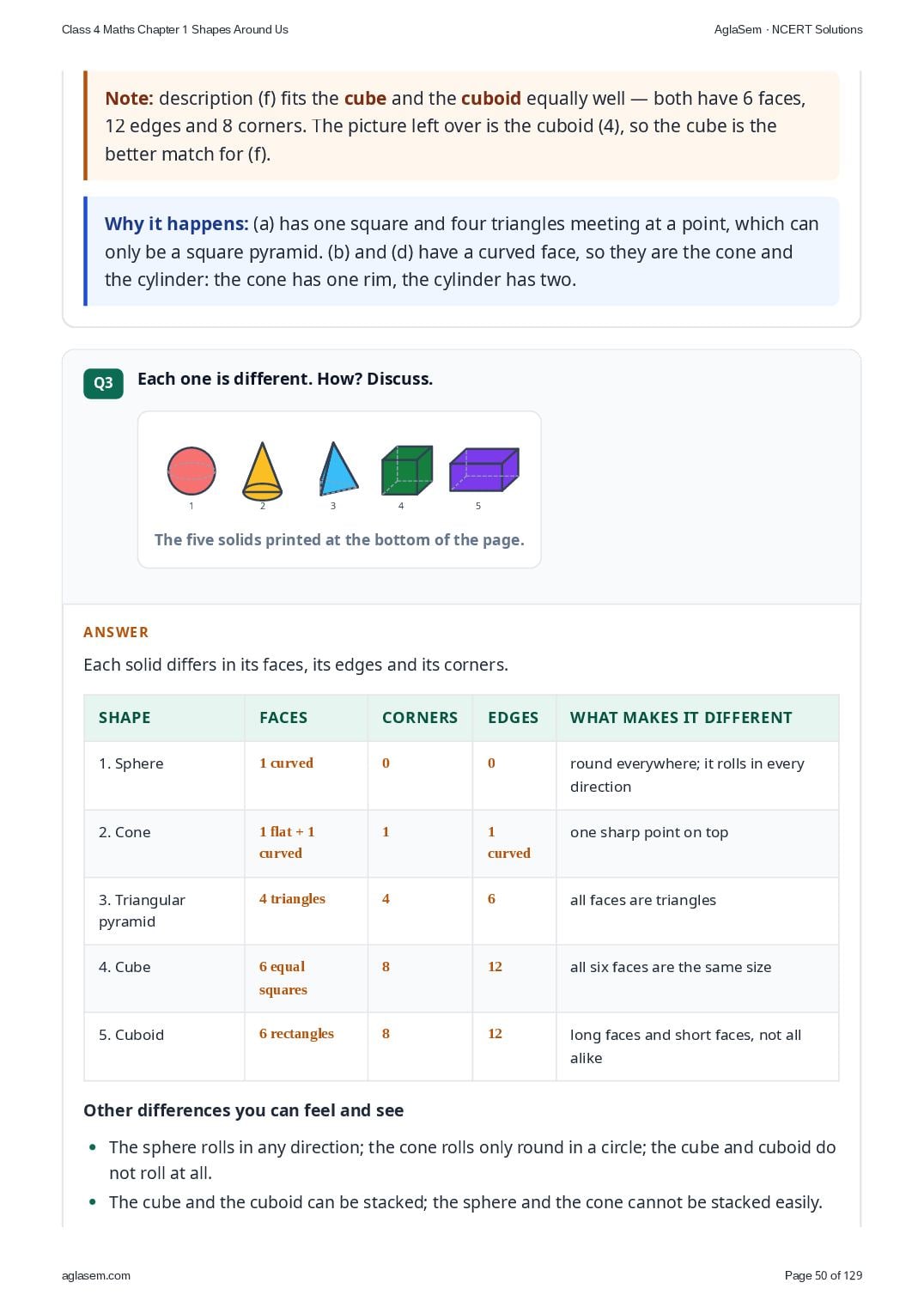
- Each one is different. How? Discuss. 12345The five solids printed at the bottom of the page.
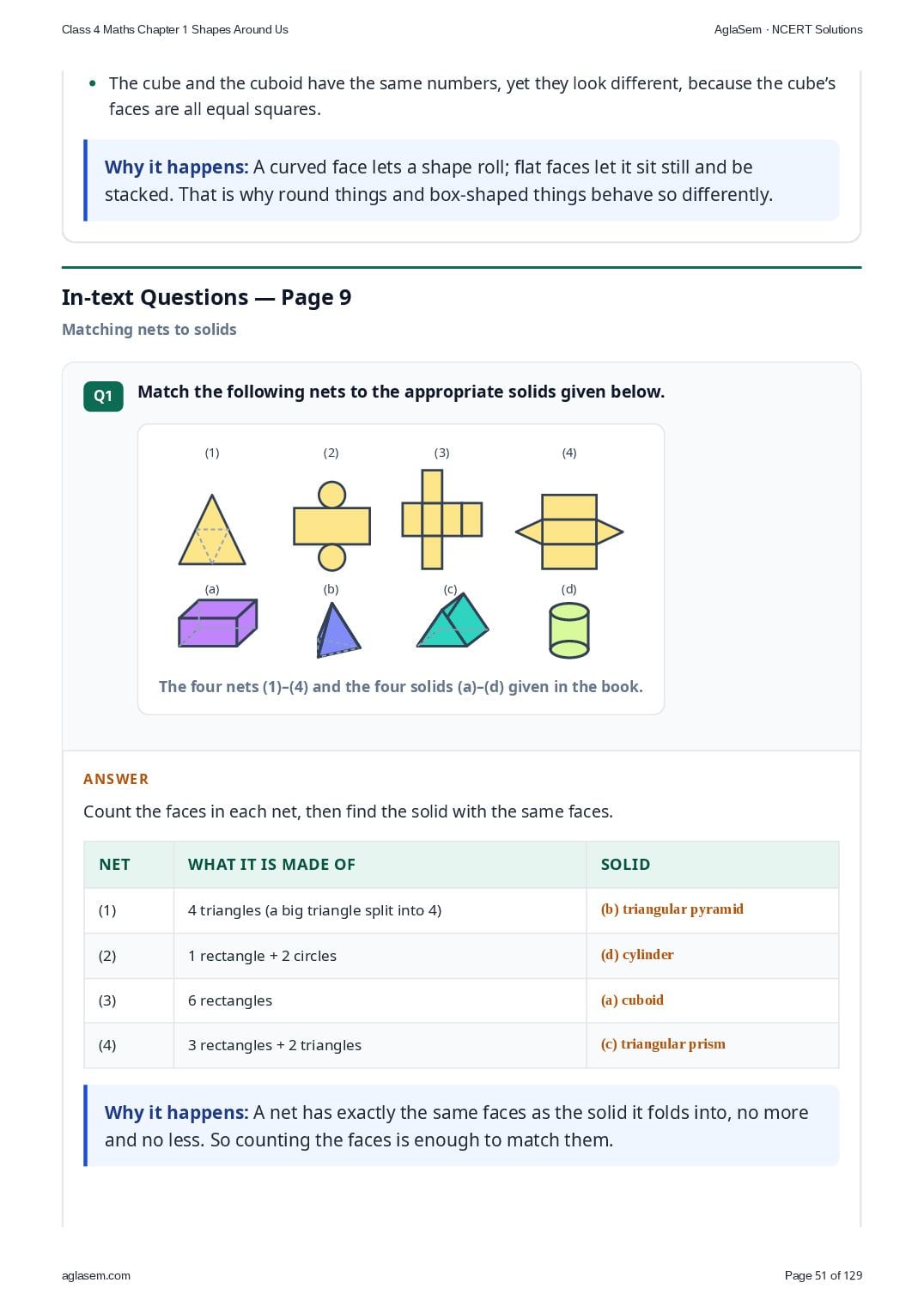
- Match the following nets to the appropriate solids given below. (1)(2)(3)(4)(a)(b)(c)(d)The four nets (1)–(4) and the four solids (a)–(d) given in the book.
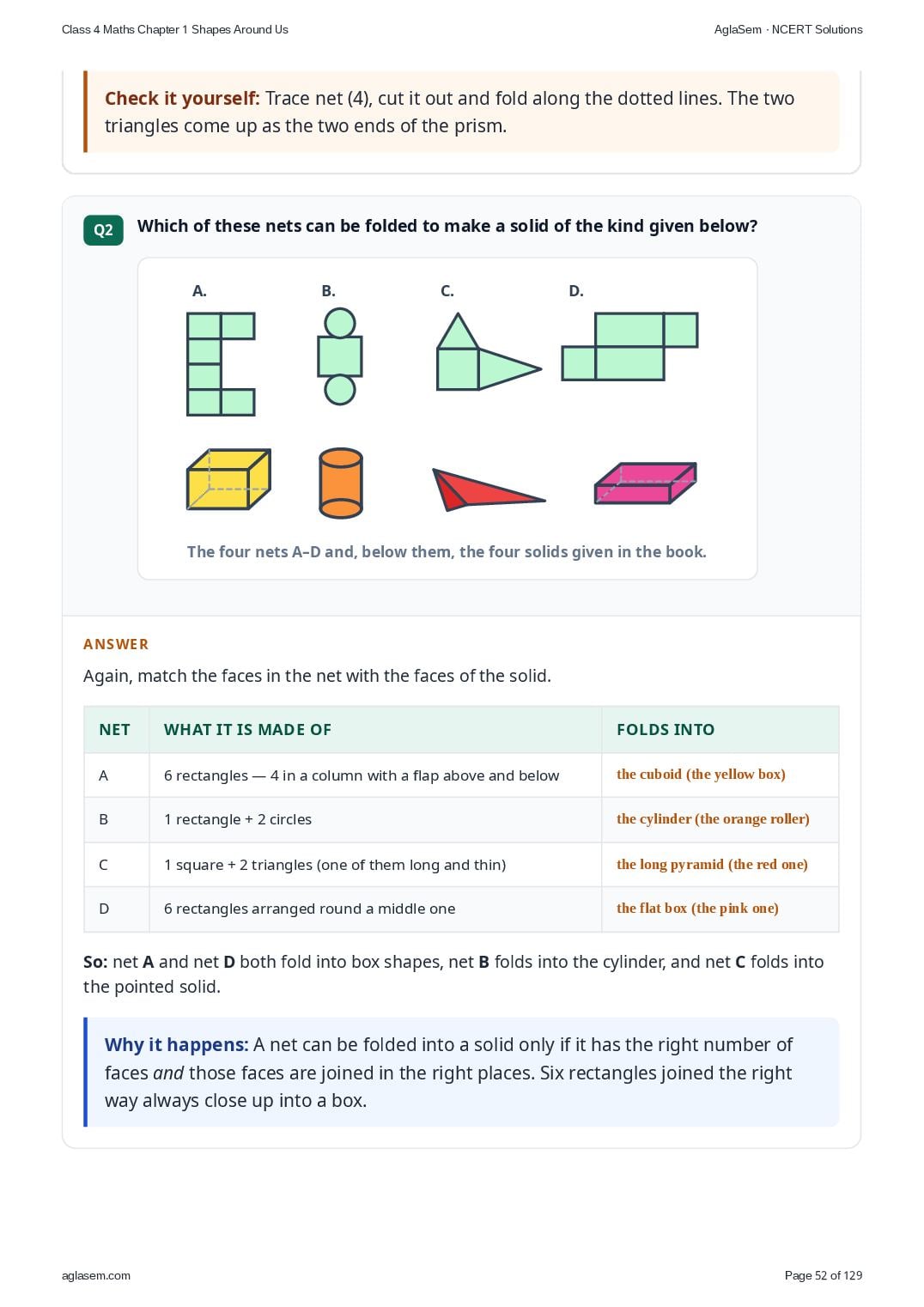
- Which of these nets can be folded to make a solid of the kind given below? A.B.C.D.The four nets A–D and, below them, the four solids given in the book.
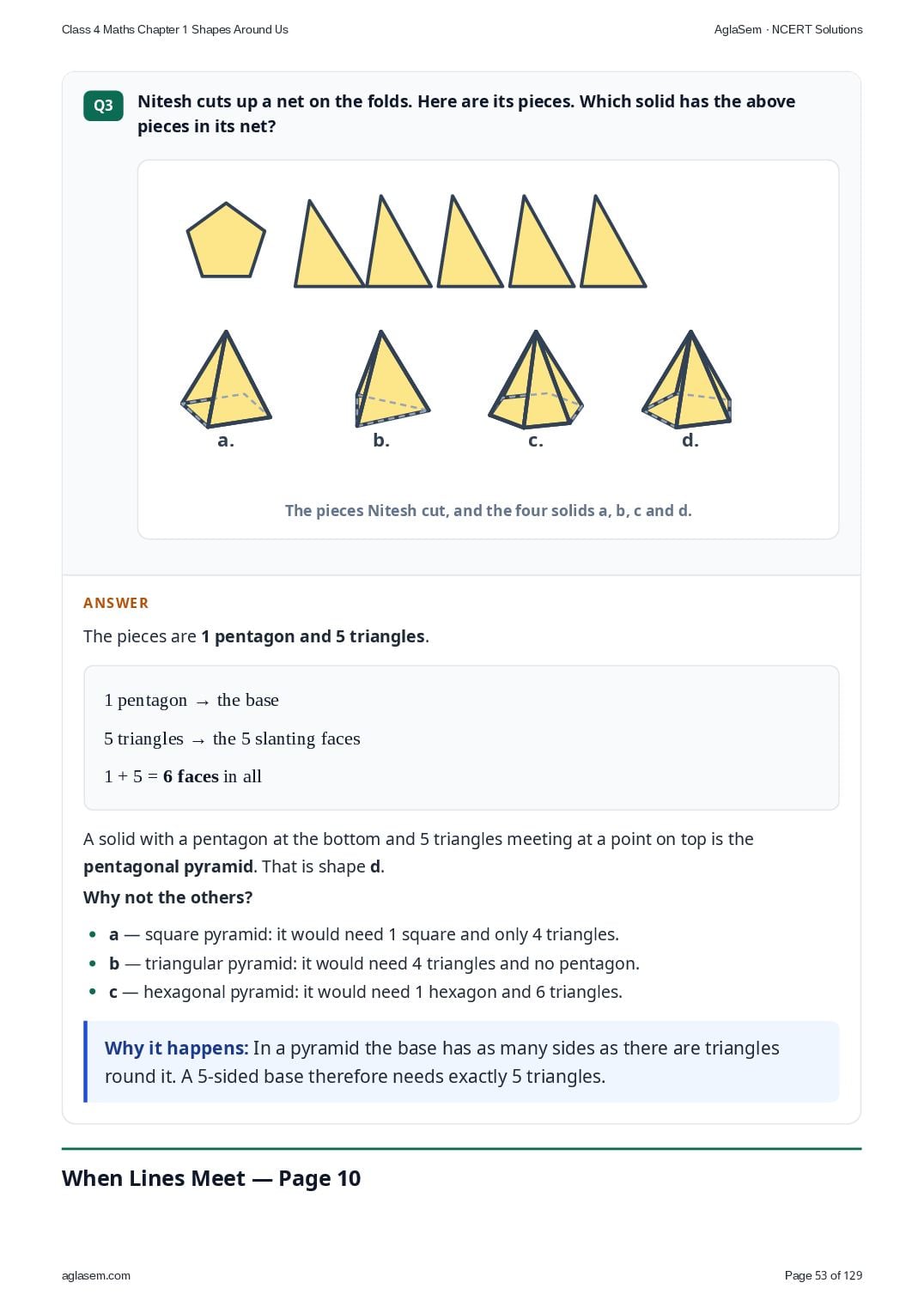
- Nitesh cuts up a net on the folds. Here are its pieces. Which solid has the above pieces in its net? a.b.c.d.The pieces Nitesh cut, and the four solids a, b, c and d.
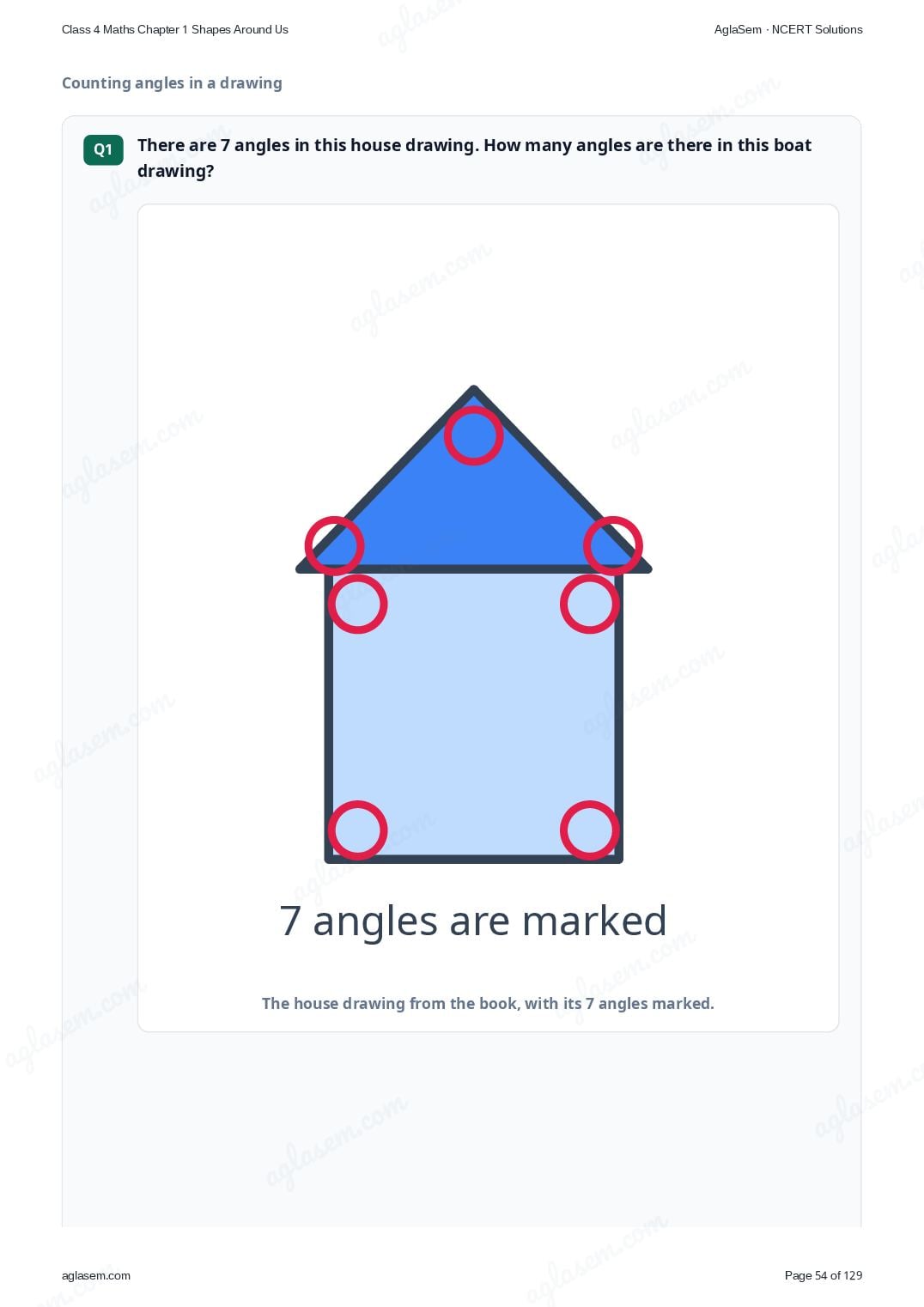
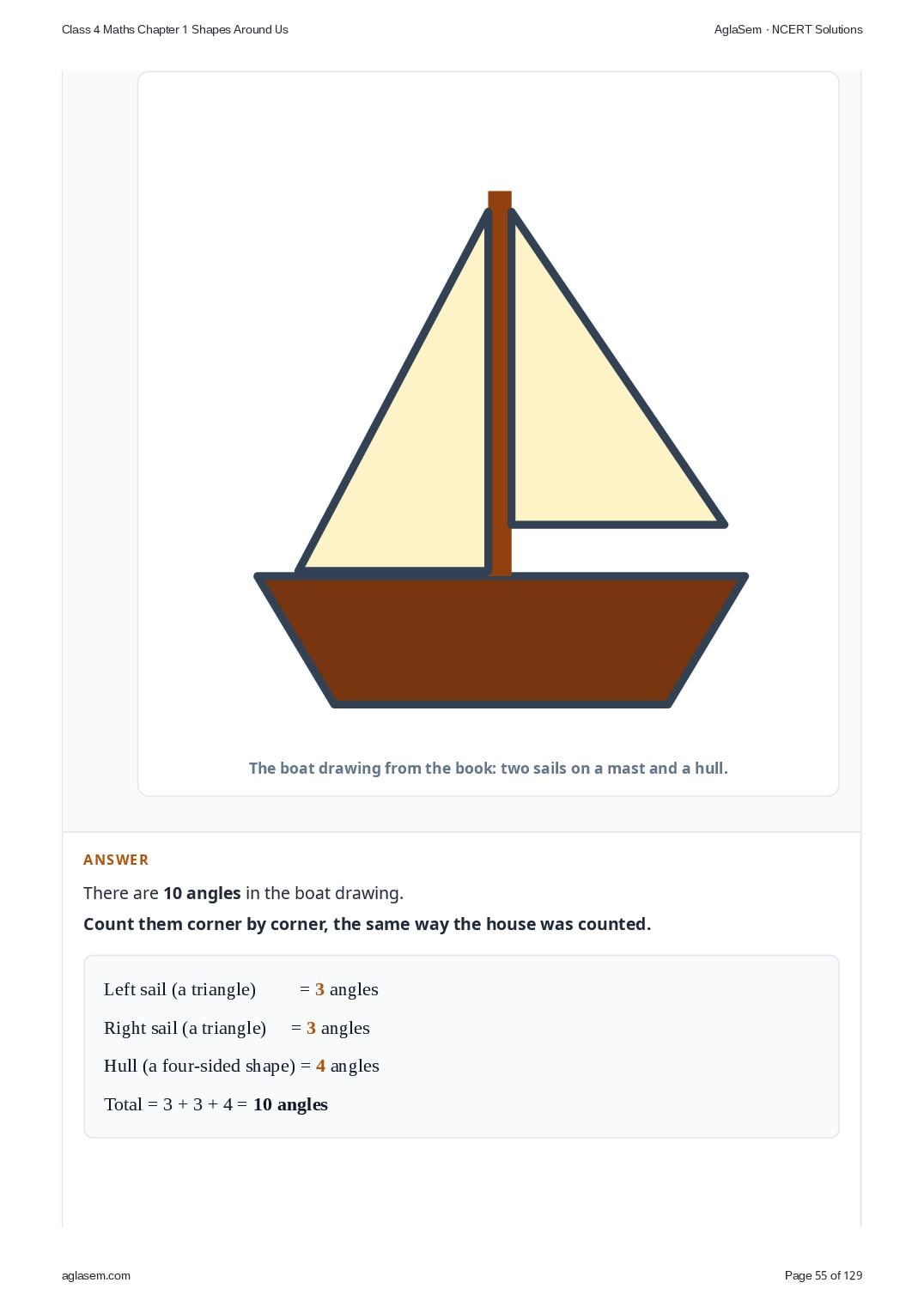
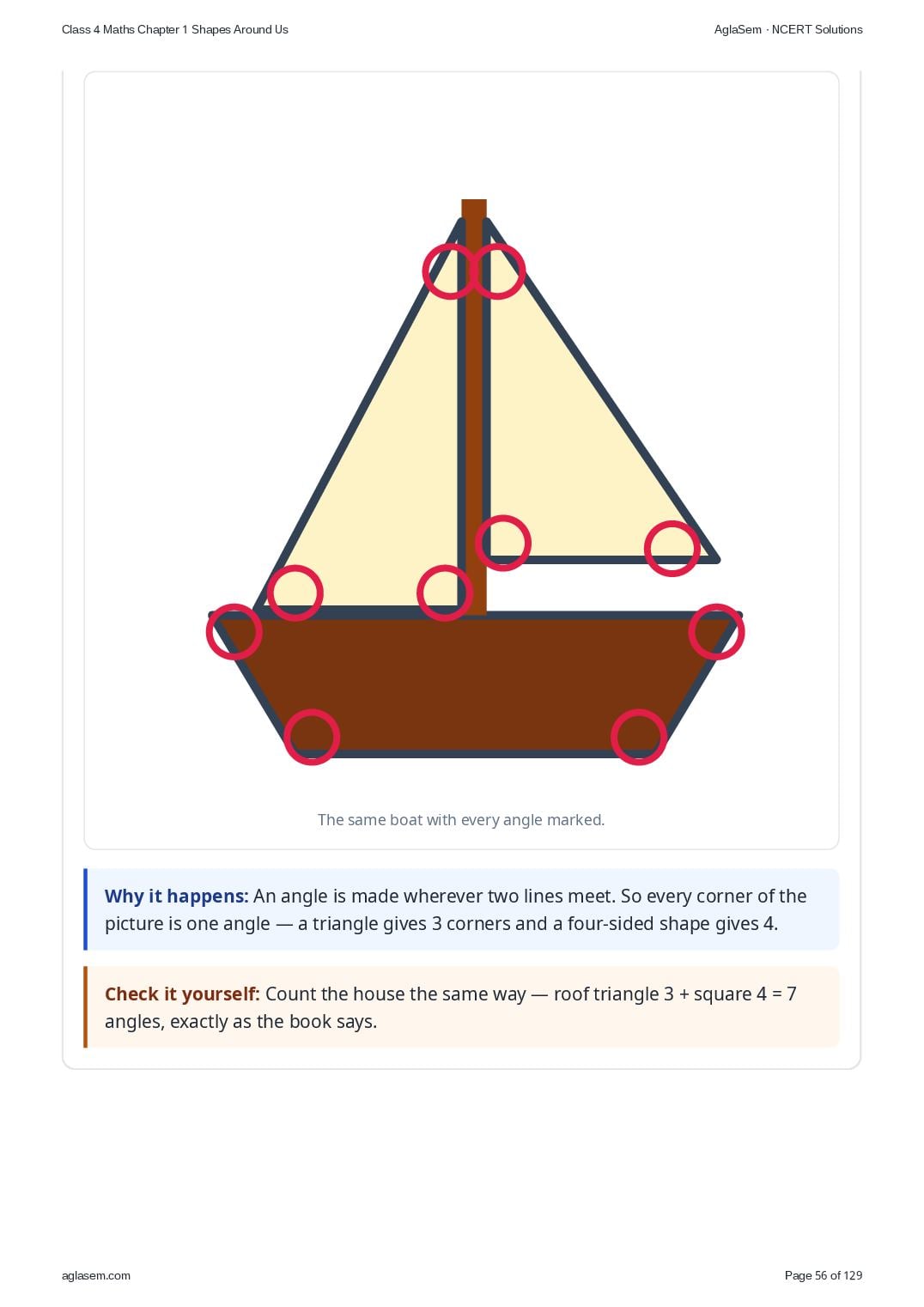
- There are 7 angles in this house drawing. How many angles are there in this boat drawing? 7 angles are markedThe house drawing from the book, with its 7 angles marked.The boat drawing from the book: two sails on a mast and a hull.
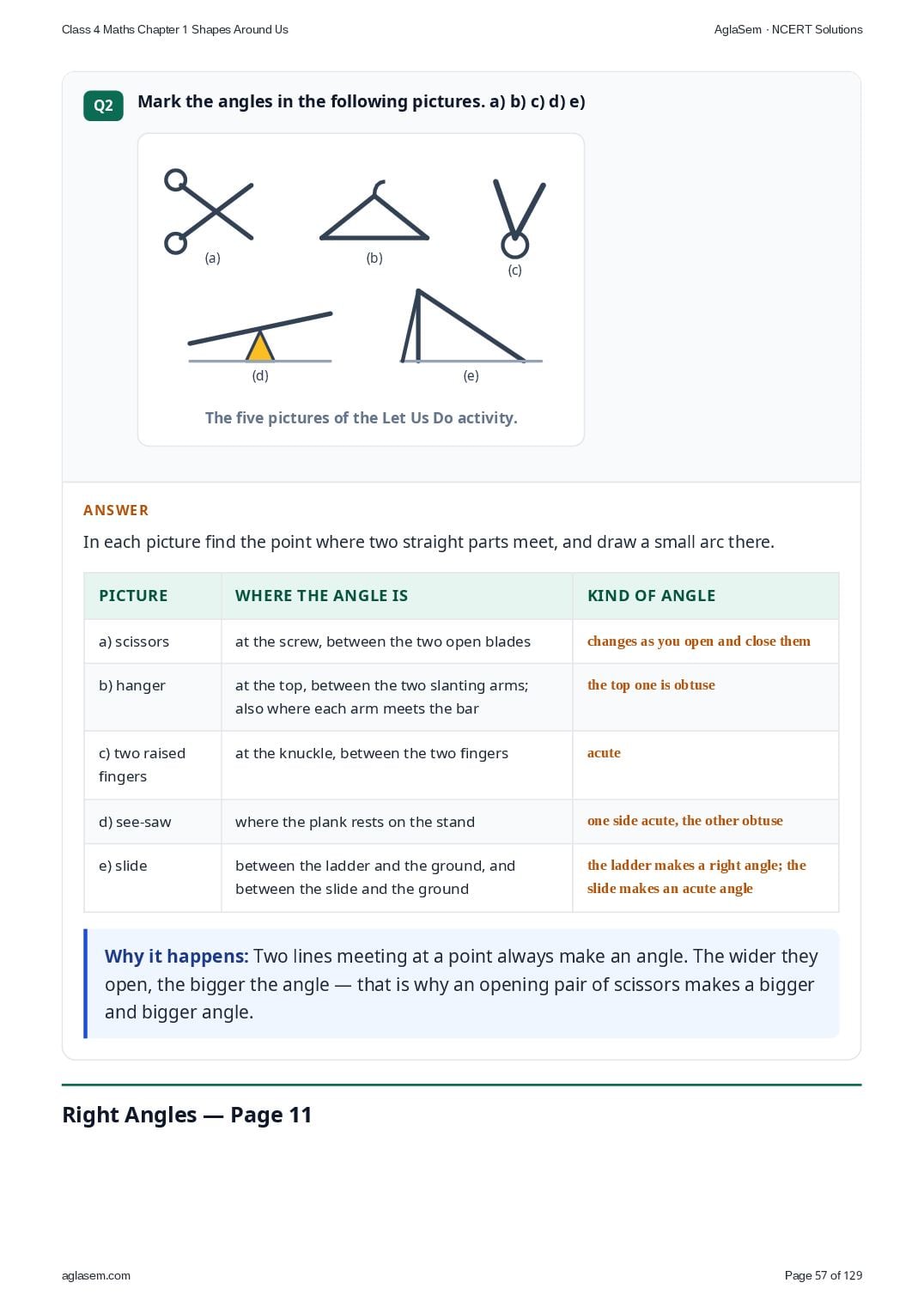
- Mark the angles in the following pictures. a) b) c) d) e) (a)(b)(c)(d)(e)The five pictures of the Let Us Do activity.
- Where do you see angles in the classroom? Give a few examples.
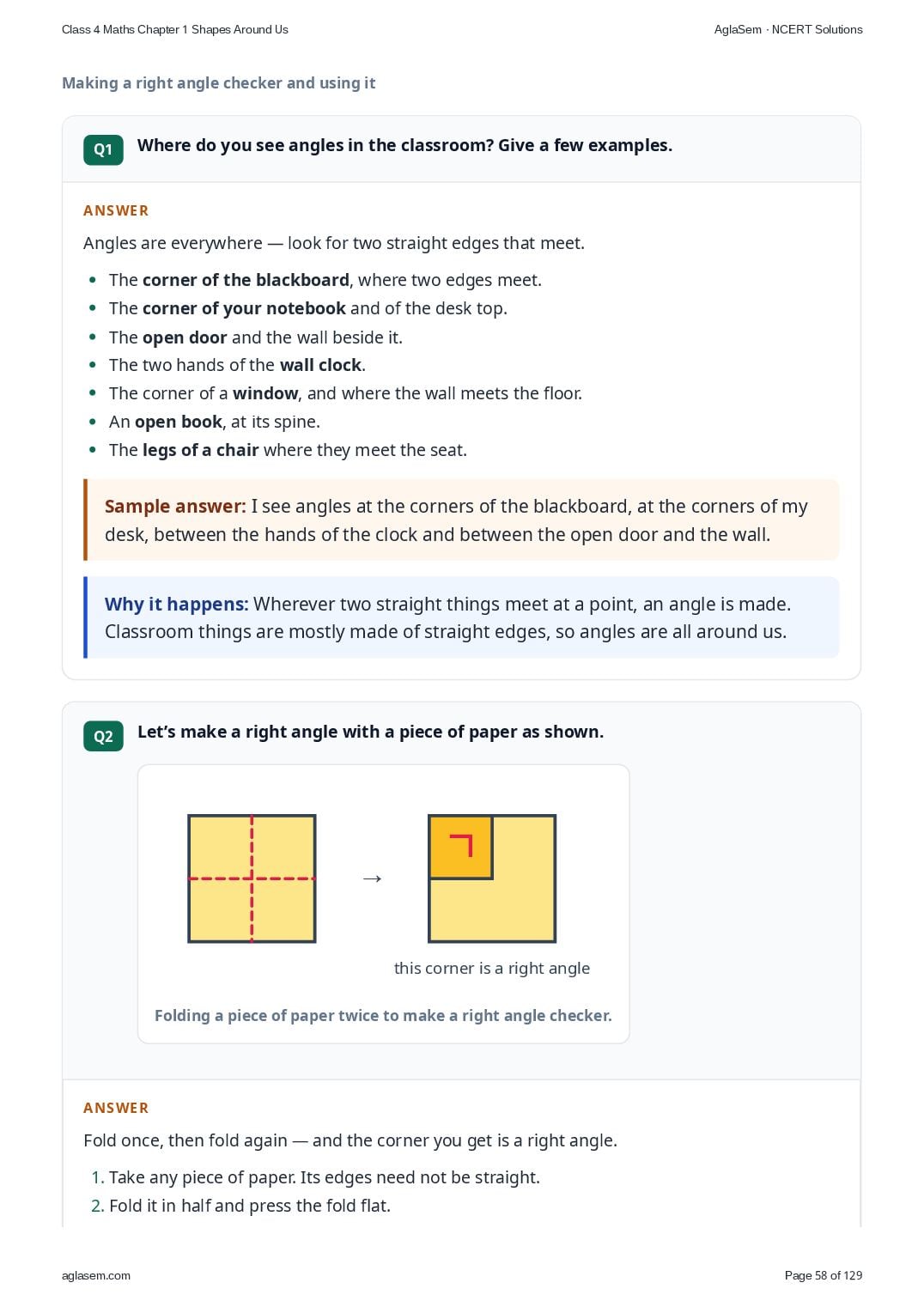
- Let’s make a right angle with a piece of paper as shown. →this corner is a right angleFolding a piece of paper twice to make a right angle checker.
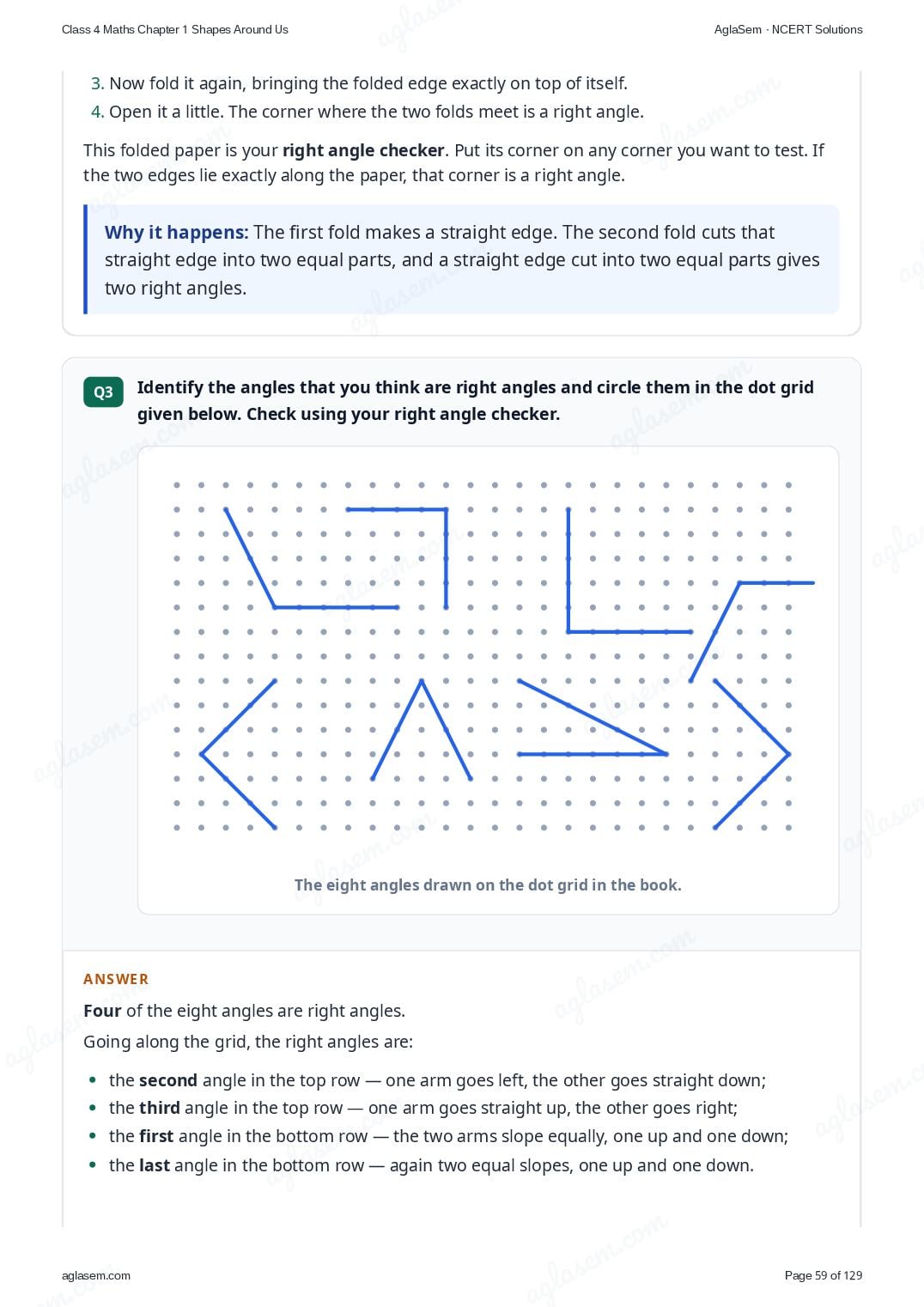
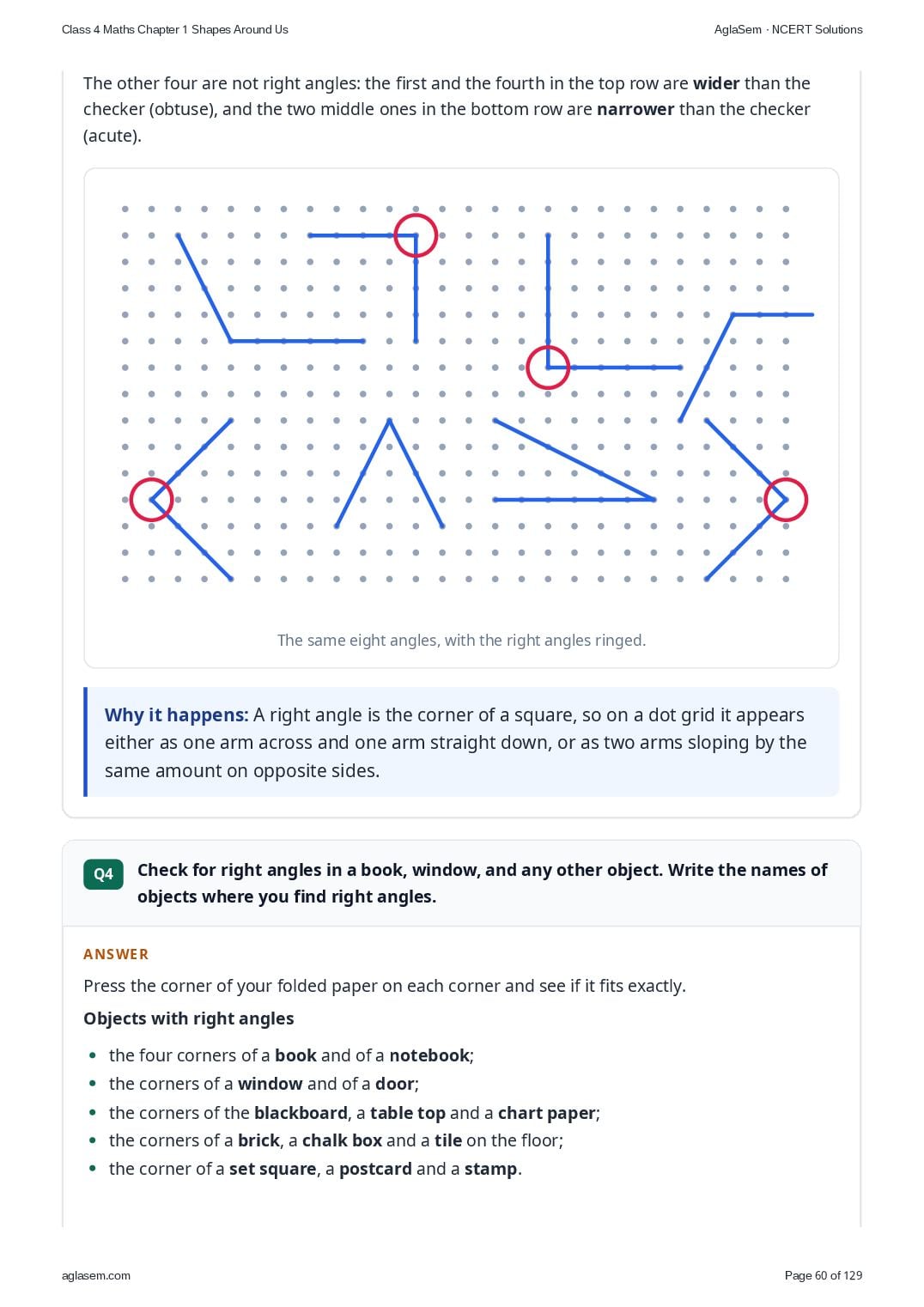
- Identify the angles that you think are right angles and circle them in the dot grid given below. Check using your right angle checker. The eight angles drawn on the dot grid in the book.
- Check for right angles in a book, window, and any other object. Write the names of objects where you find right angles.
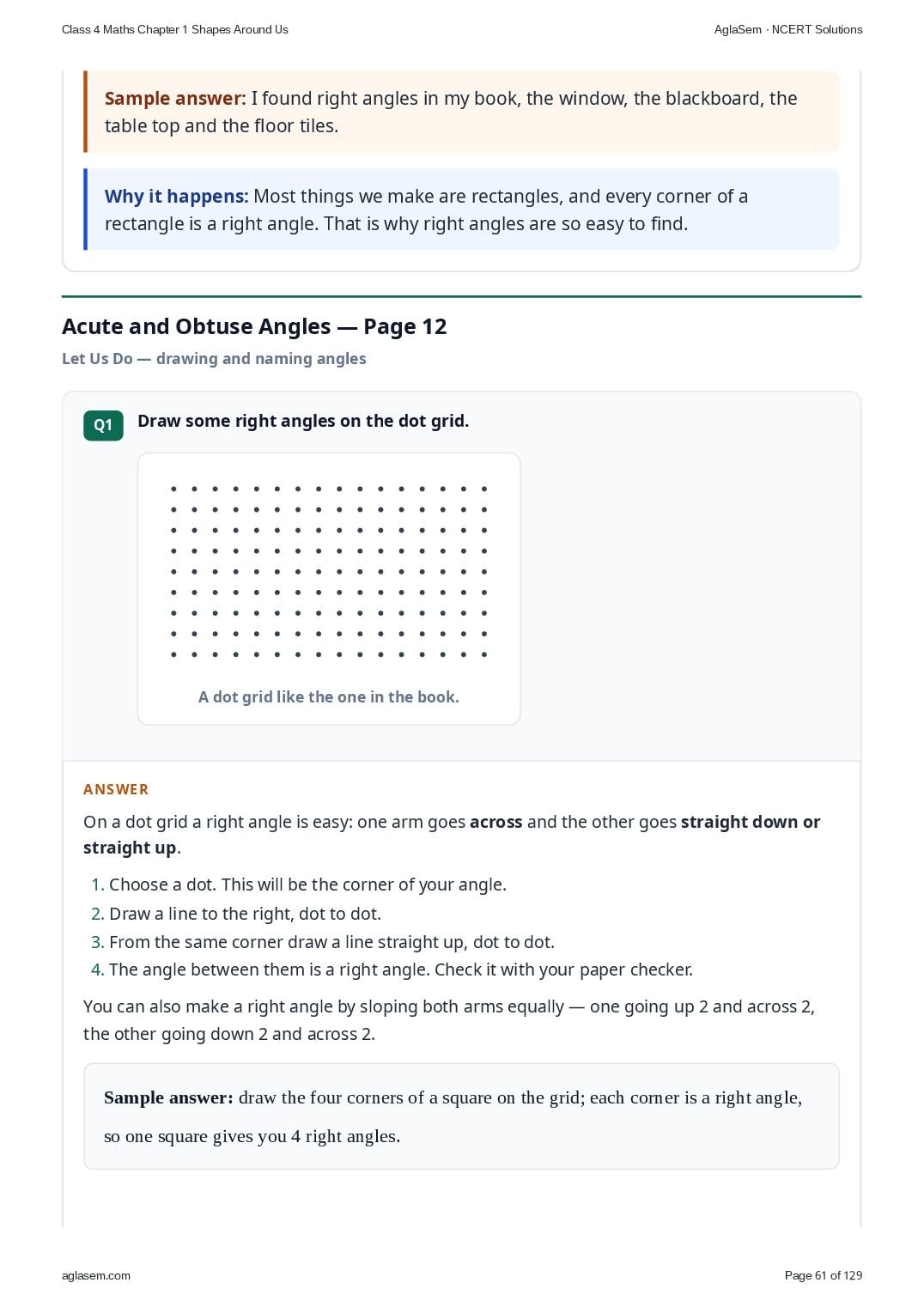
- Draw some right angles on the dot grid. A dot grid like the one in the book.
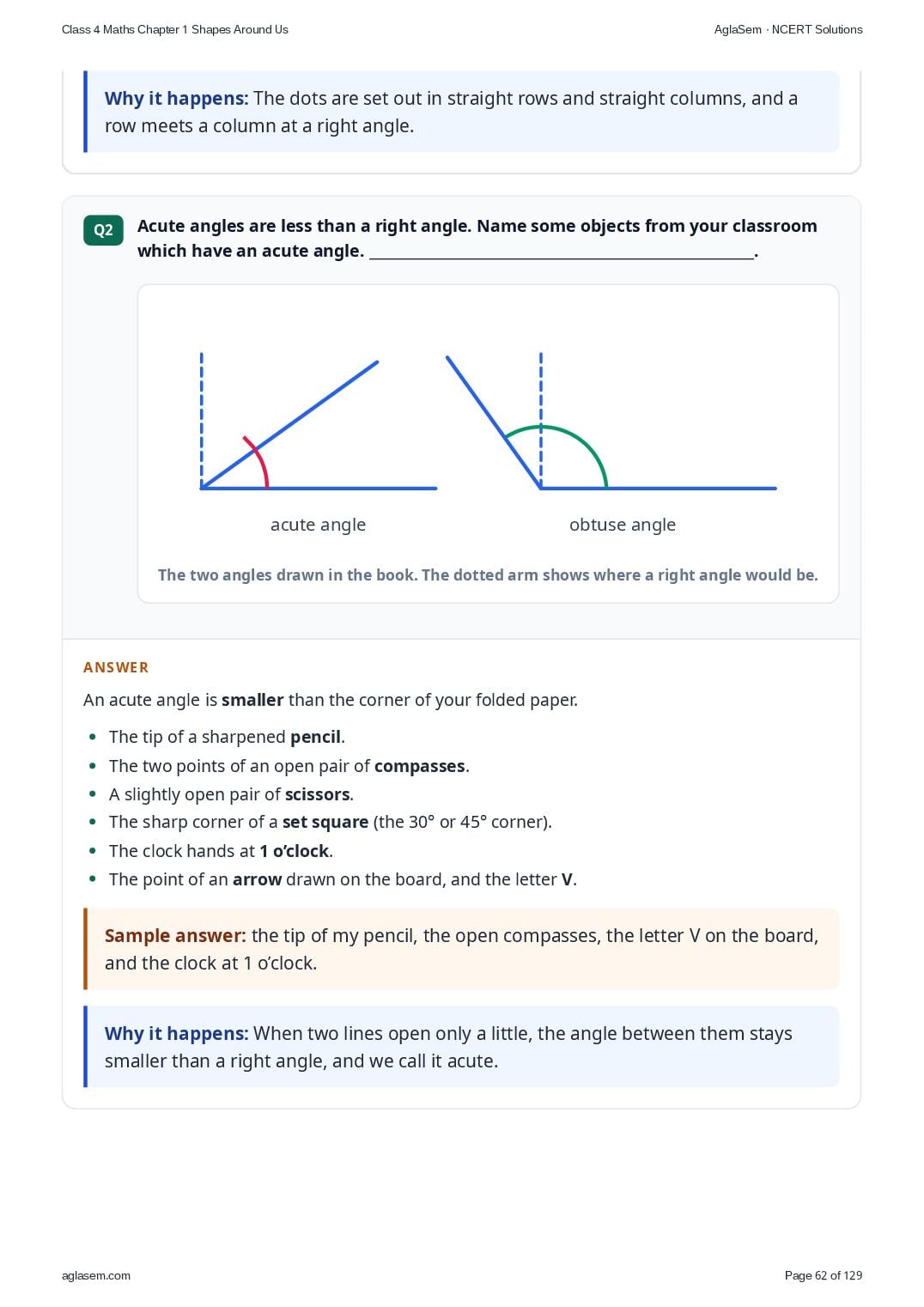
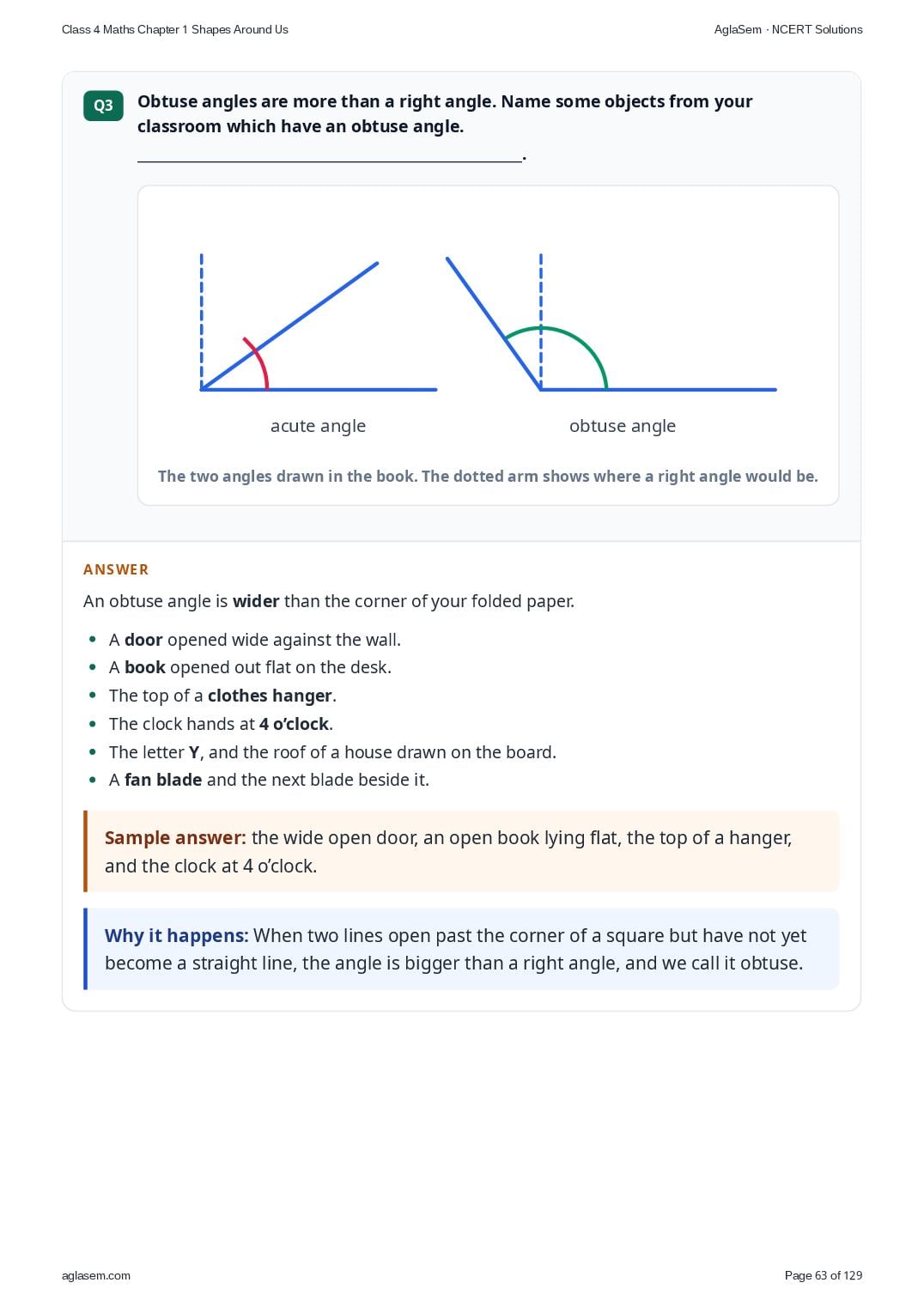
- Acute angles are less than a right angle. Name some objects from your classroom which have an acute angle. ________________________________________________________. acute angleobtuse angleThe two angles drawn in the book. The dotted arm shows where a right angle would be.
- Obtuse angles are more than a right angle. Name some objects from your classroom which have an obtuse angle. ________________________________________________________. acute angleobtuse angleThe two angles drawn in the book. The dotted arm shows where a right angle would be.
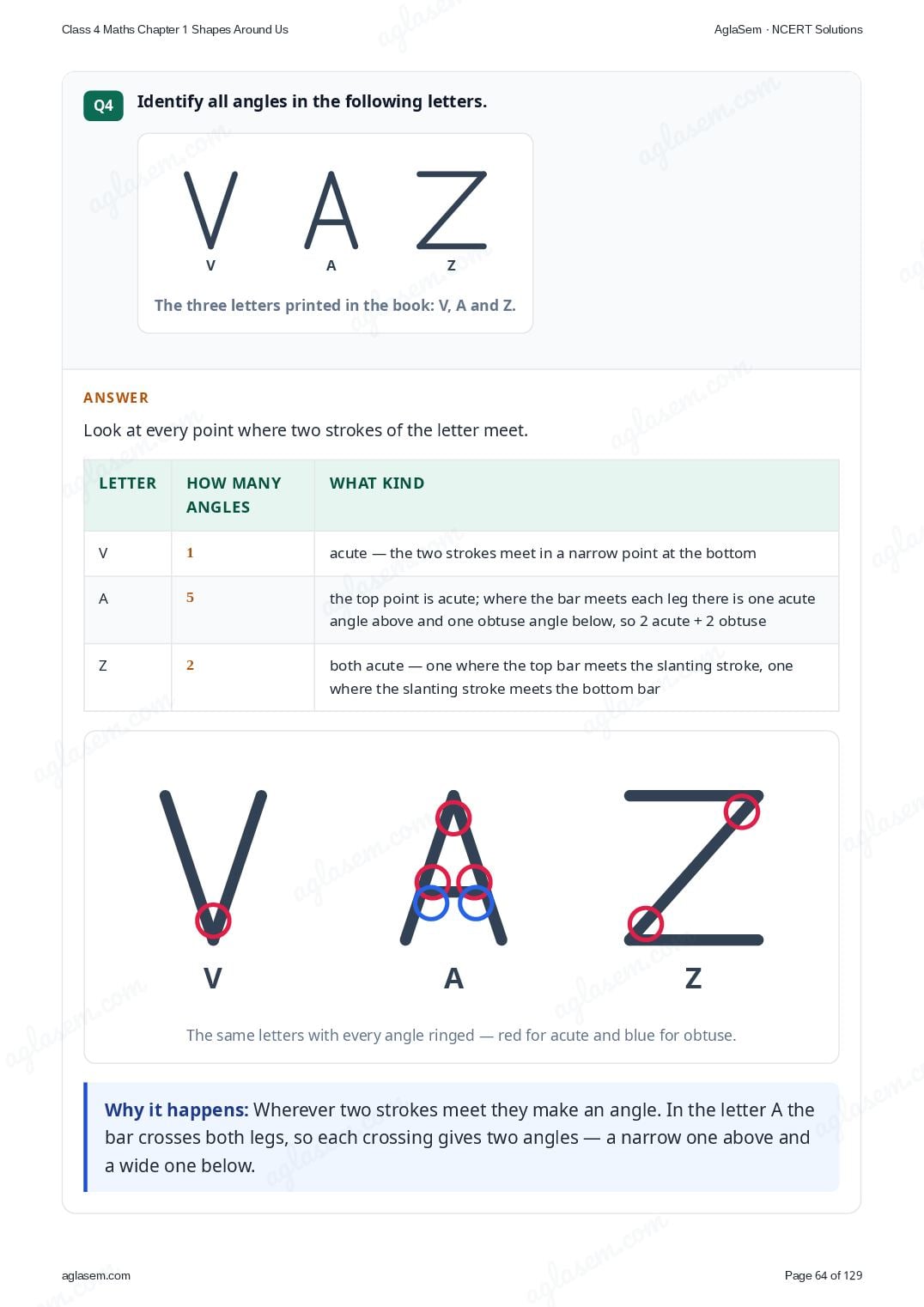
- Identify all angles in the following letters. VAZThe three letters printed in the book: V, A and Z.
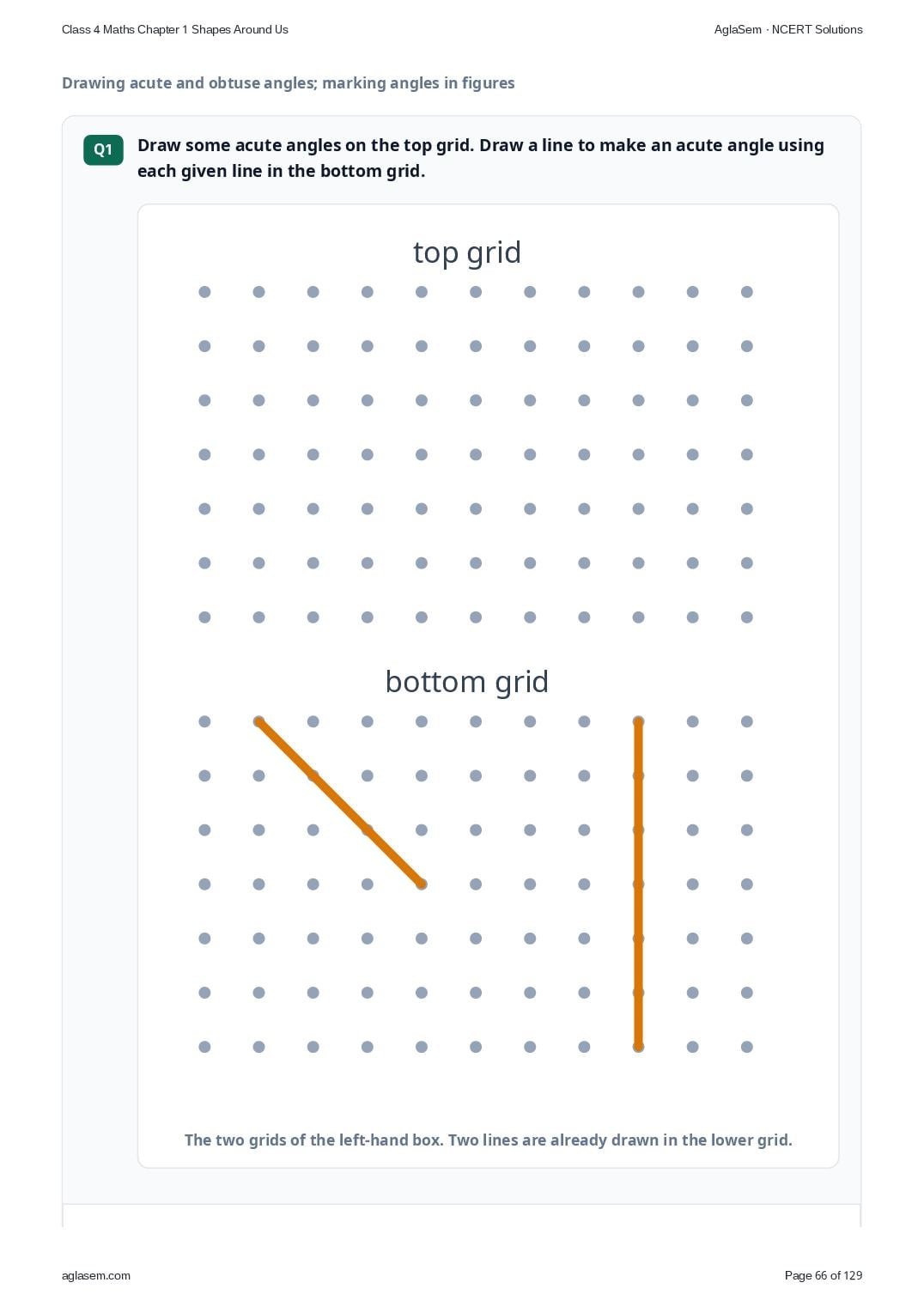
- Draw some acute angles on the top grid. Draw a line to make an acute angle using each given line in the bottom grid. top gridbottom gridThe two grids of the left-hand box. Two lines are already drawn in the lower grid.
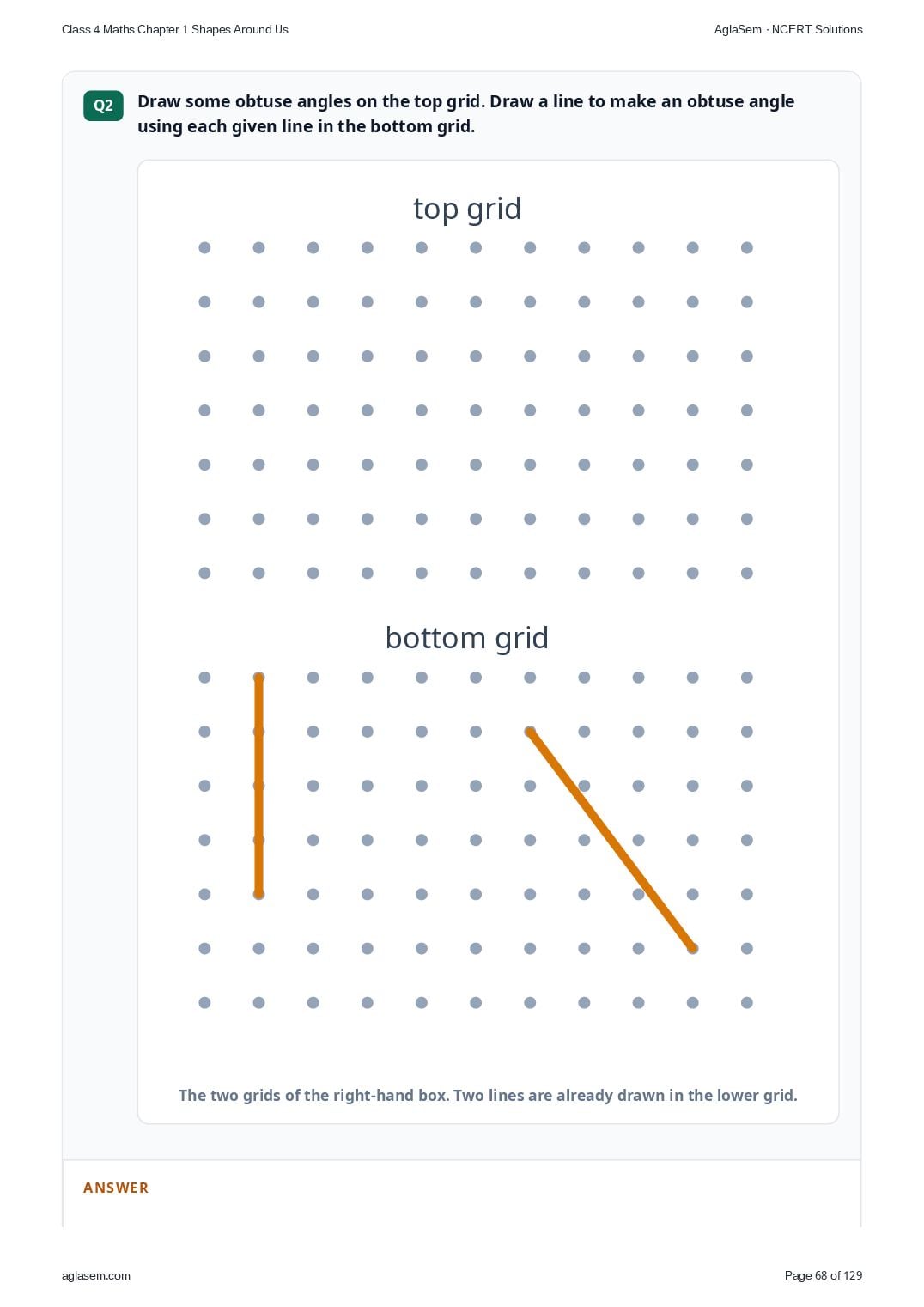
- Draw some obtuse angles on the top grid. Draw a line to make an obtuse angle using each given line in the bottom grid. top gridbottom gridThe two grids of the right-hand box. Two lines are already drawn in the lower grid.
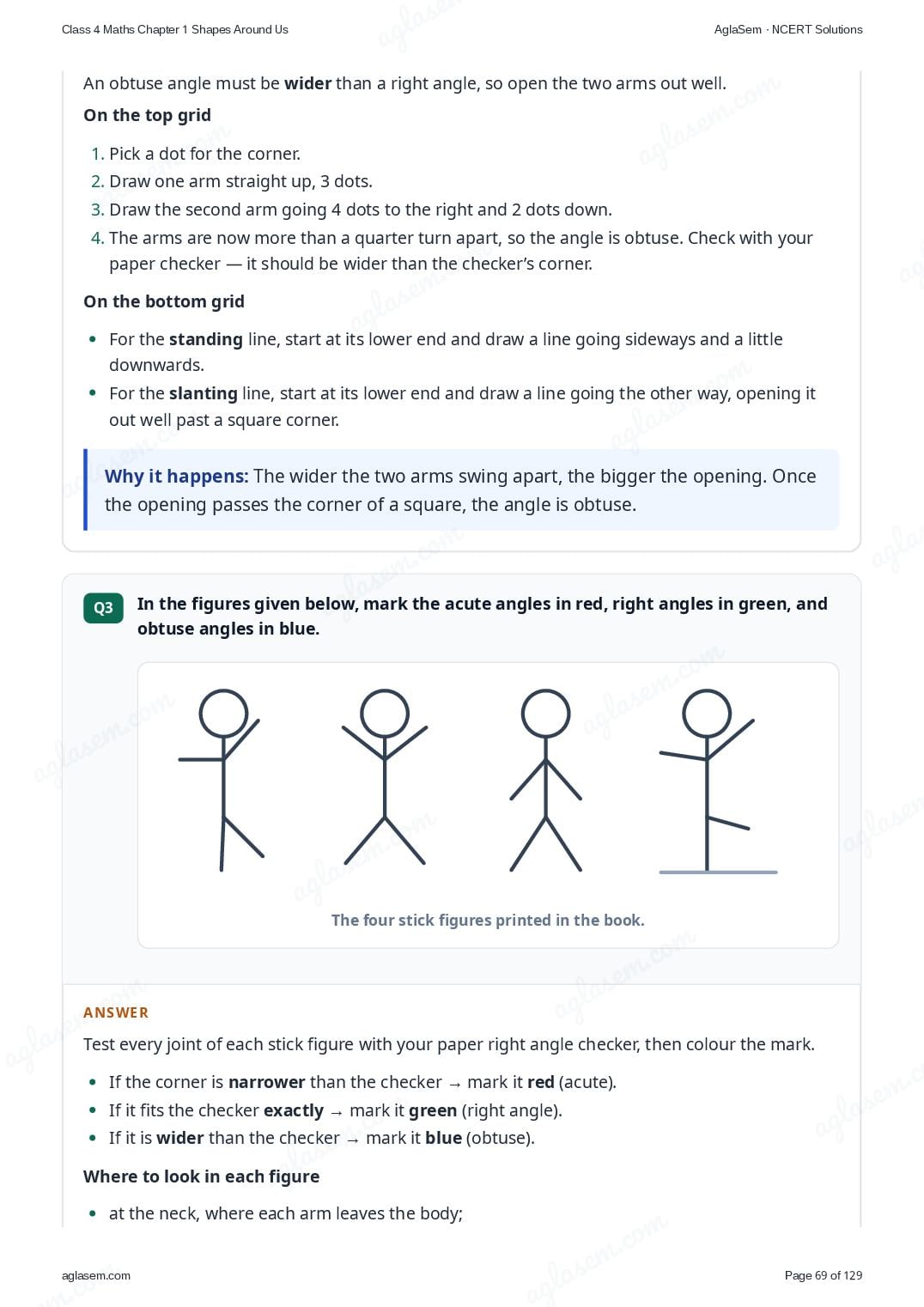
- In the figures given below, mark the acute angles in red, right angles in green, and obtuse angles in blue. The four stick figures printed in the book.
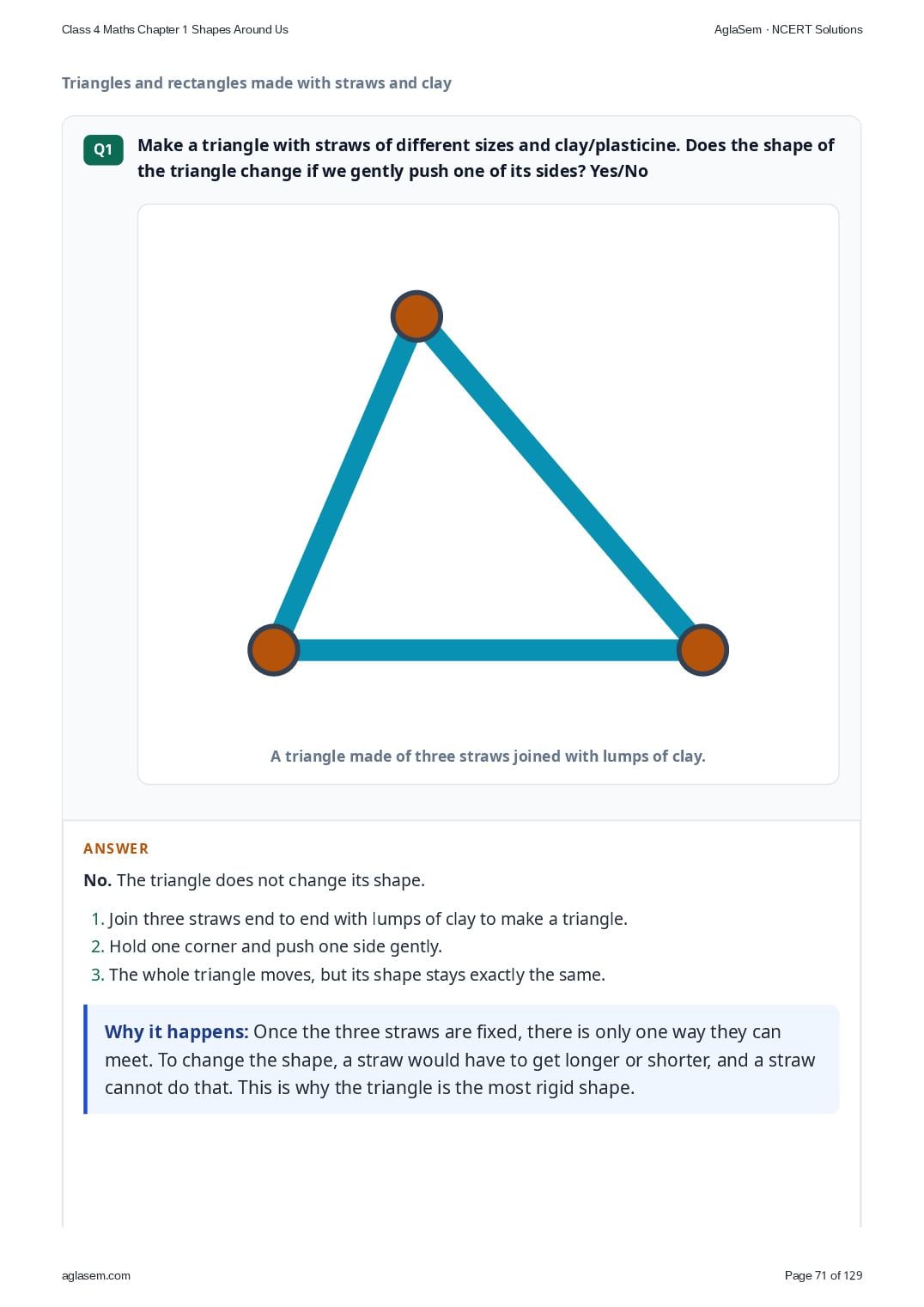
- Make a triangle with straws of different sizes and clay/plasticine. Does the shape of the triangle change if we gently push one of its sides? Yes/No A triangle made of three straws joined with lumps of clay.
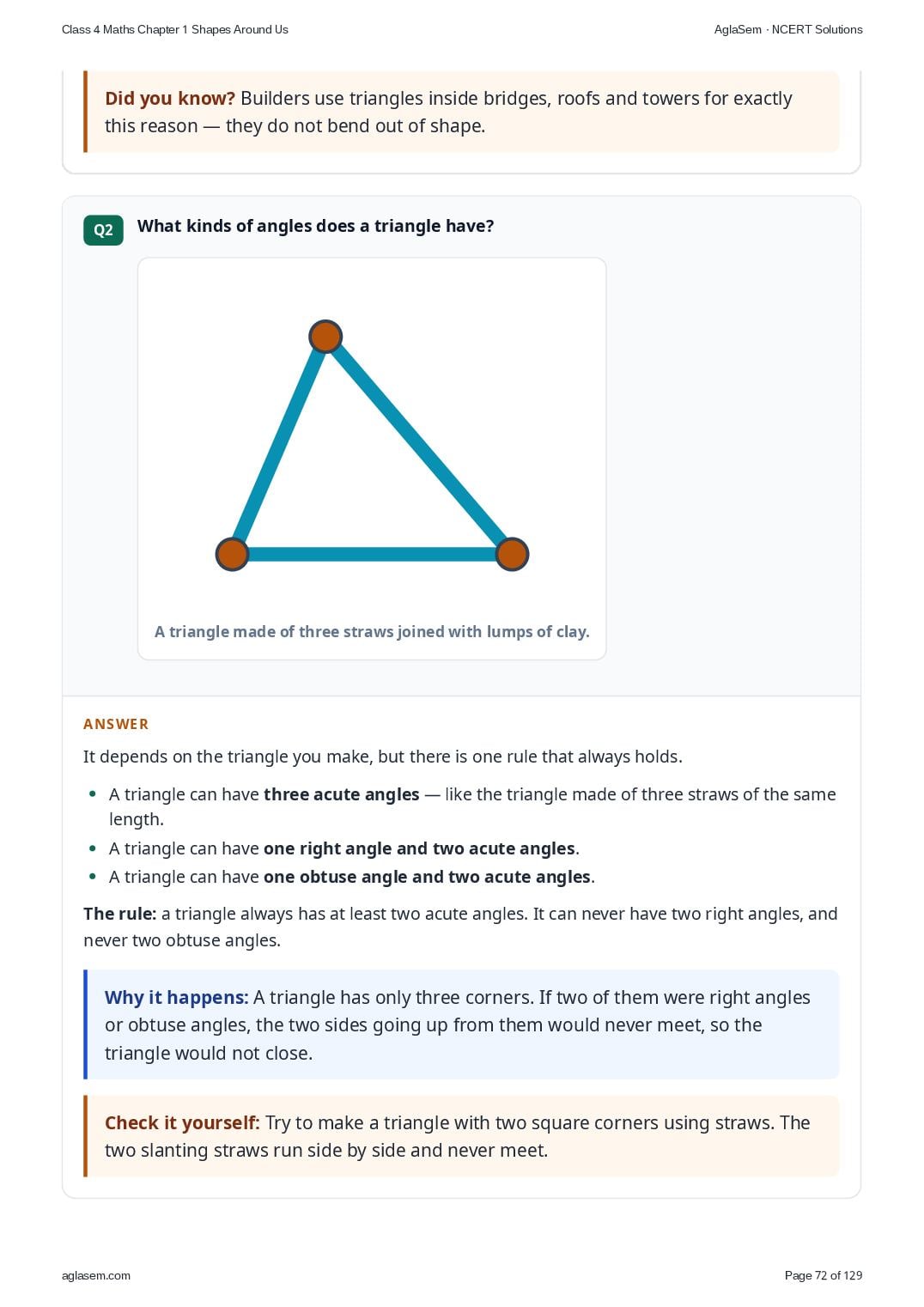
- What kinds of angles does a triangle have? A triangle made of three straws joined with lumps of clay.
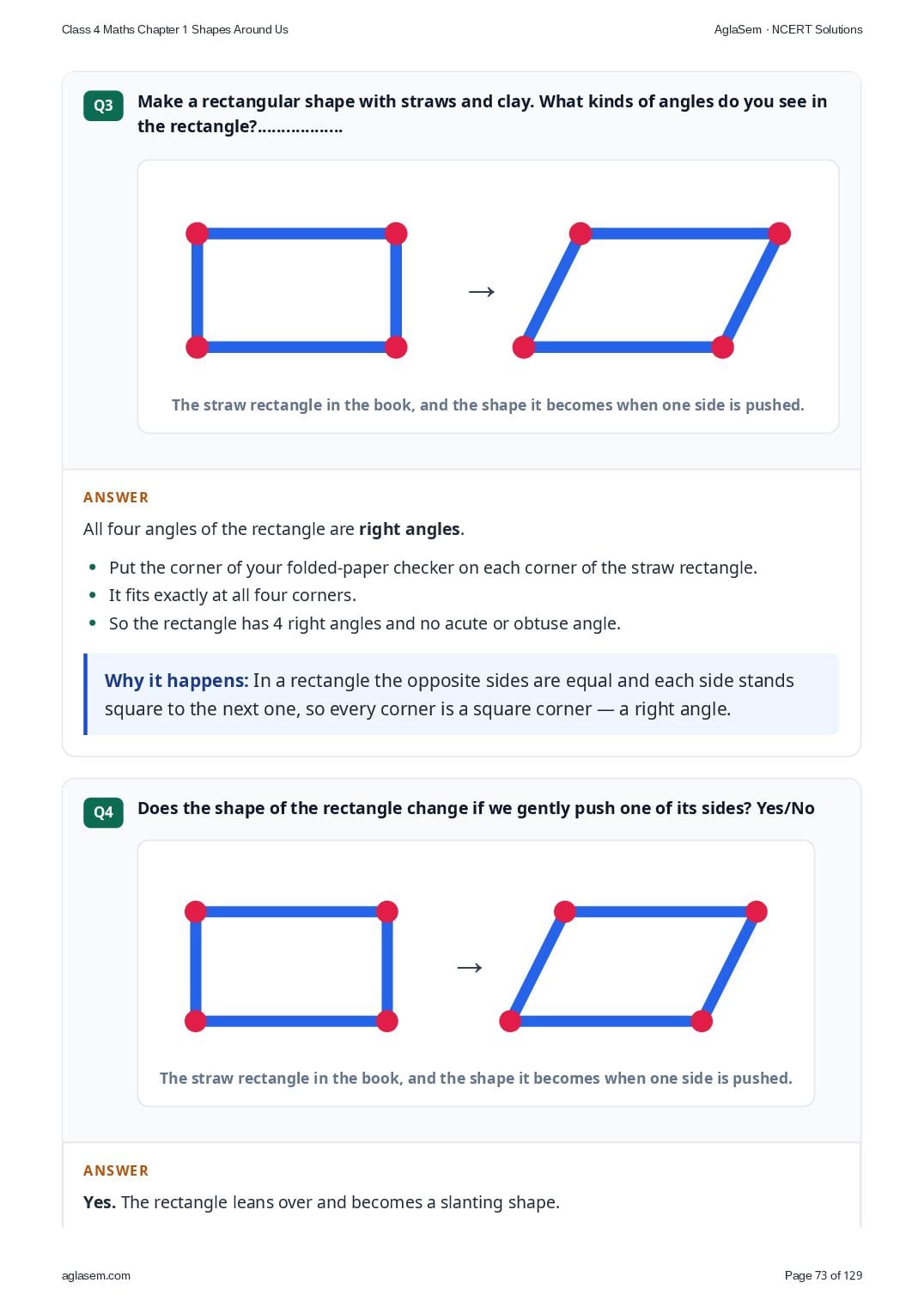
- Make a rectangular shape with straws and clay. What kinds of angles do you see in the rectangle?……………… →The straw rectangle in the book, and the shape it becomes when one side is pushed.
- Does the shape of the rectangle change if we gently push one of its sides? Yes/No →The straw rectangle in the book, and the shape it becomes when one side is pushed.
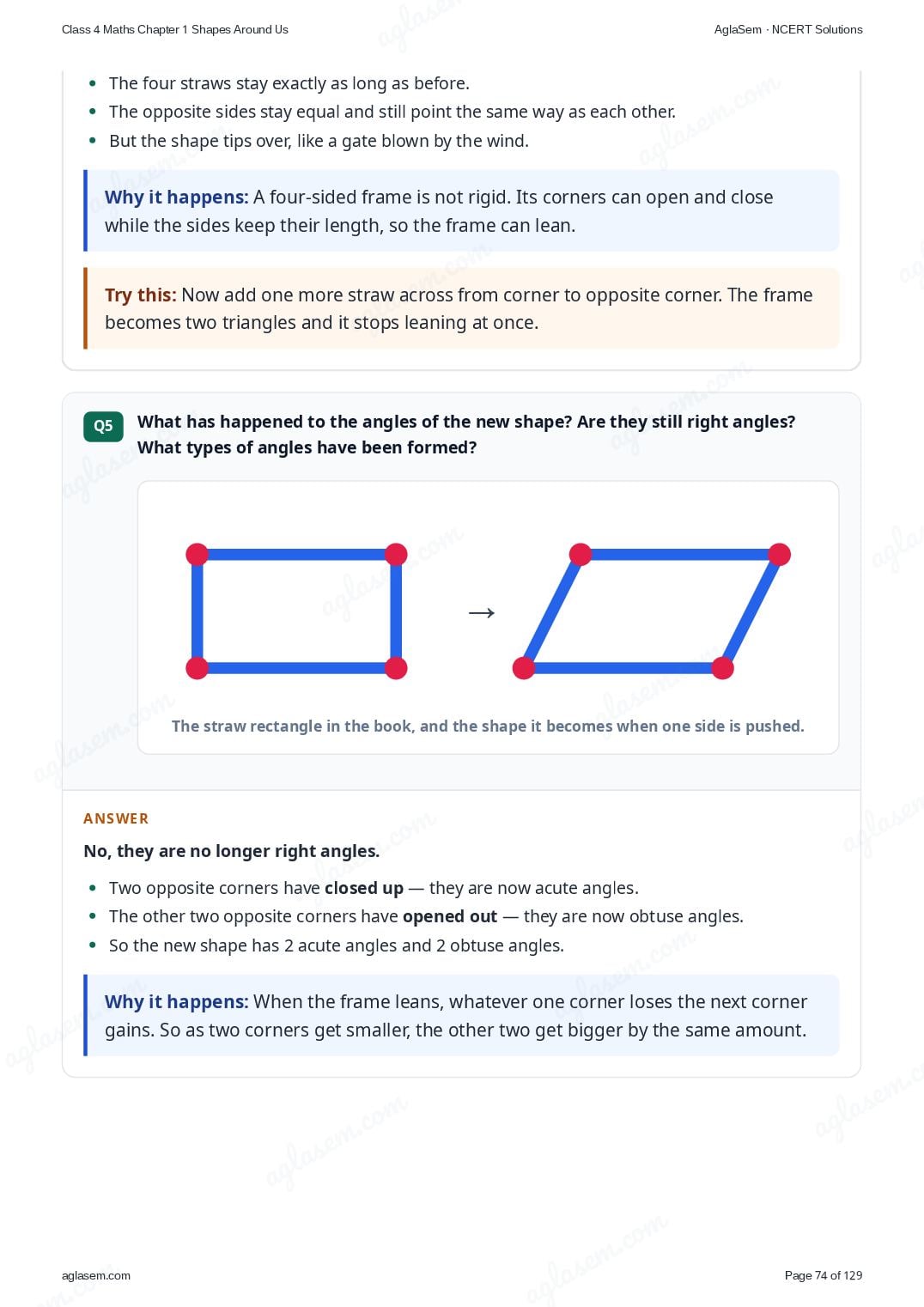
- What has happened to the angles of the new shape? Are they still right angles? What types of angles have been formed? →The straw rectangle in the book, and the shape it becomes when one side is pushed.
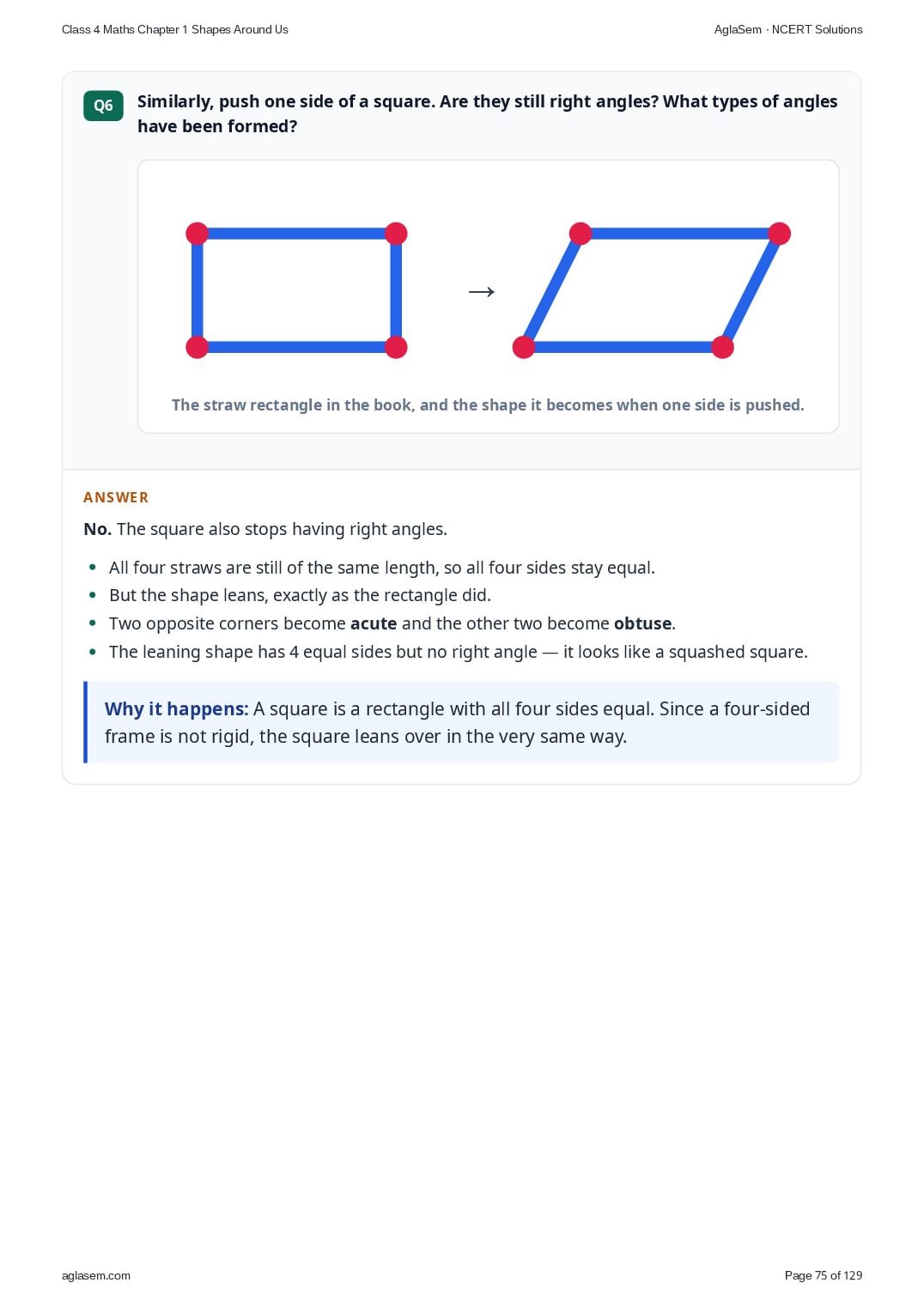
- Similarly, push one side of a square. Are they still right angles? What types of angles have been formed? →The straw rectangle in the book, and the shape it becomes when one side is pushed.
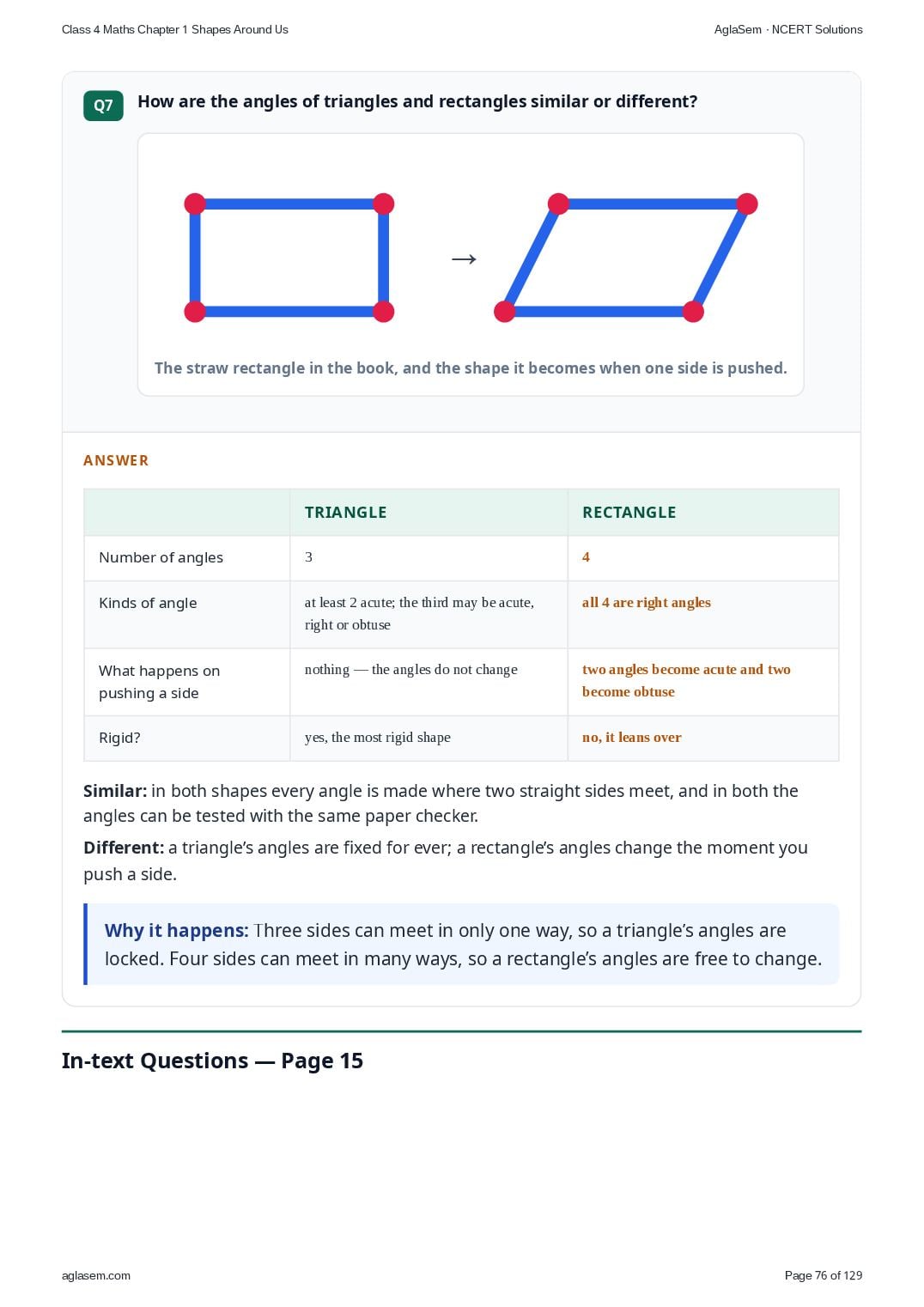
- How are the angles of triangles and rectangles similar or different? →The straw rectangle in the book, and the shape it becomes when one side is pushed.
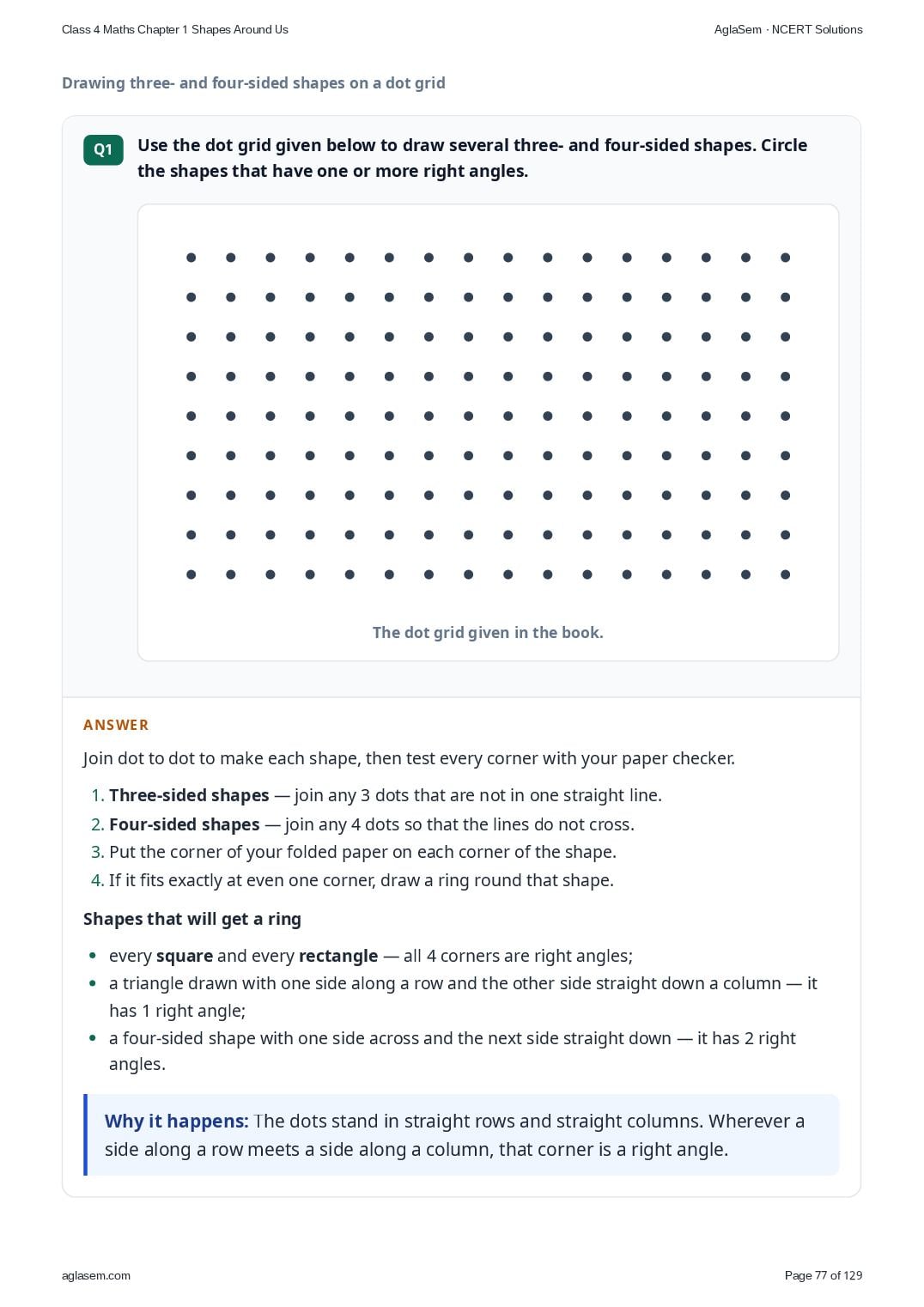
- Use the dot grid given below to draw several three- and four-sided shapes. Circle the shapes that have one or more right angles. The dot grid given in the book.
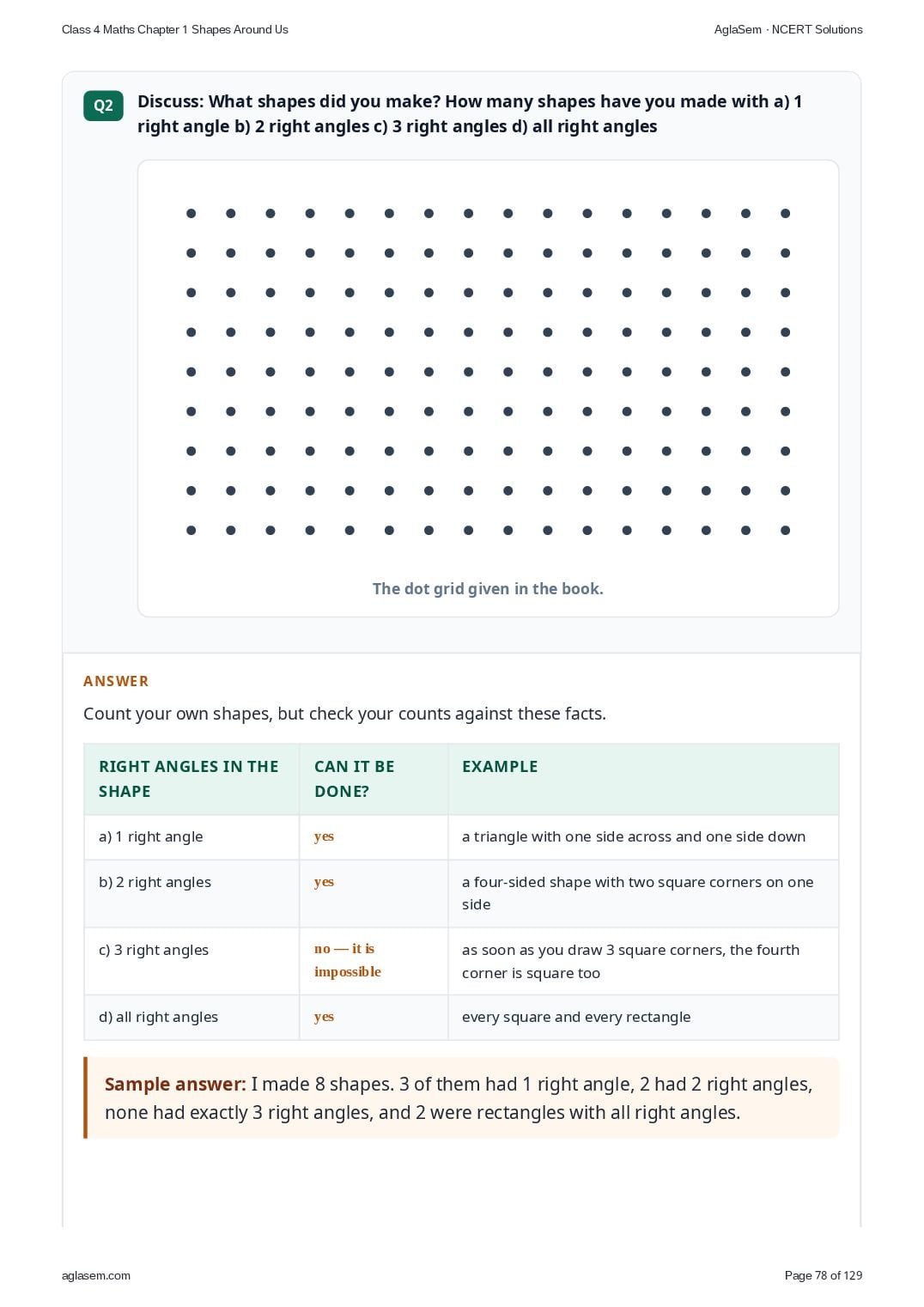
- Discuss: What shapes did you make? How many shapes have you made with a) 1 right angle b) 2 right angles c) 3 right angles d) all right angles The dot grid given in the book.
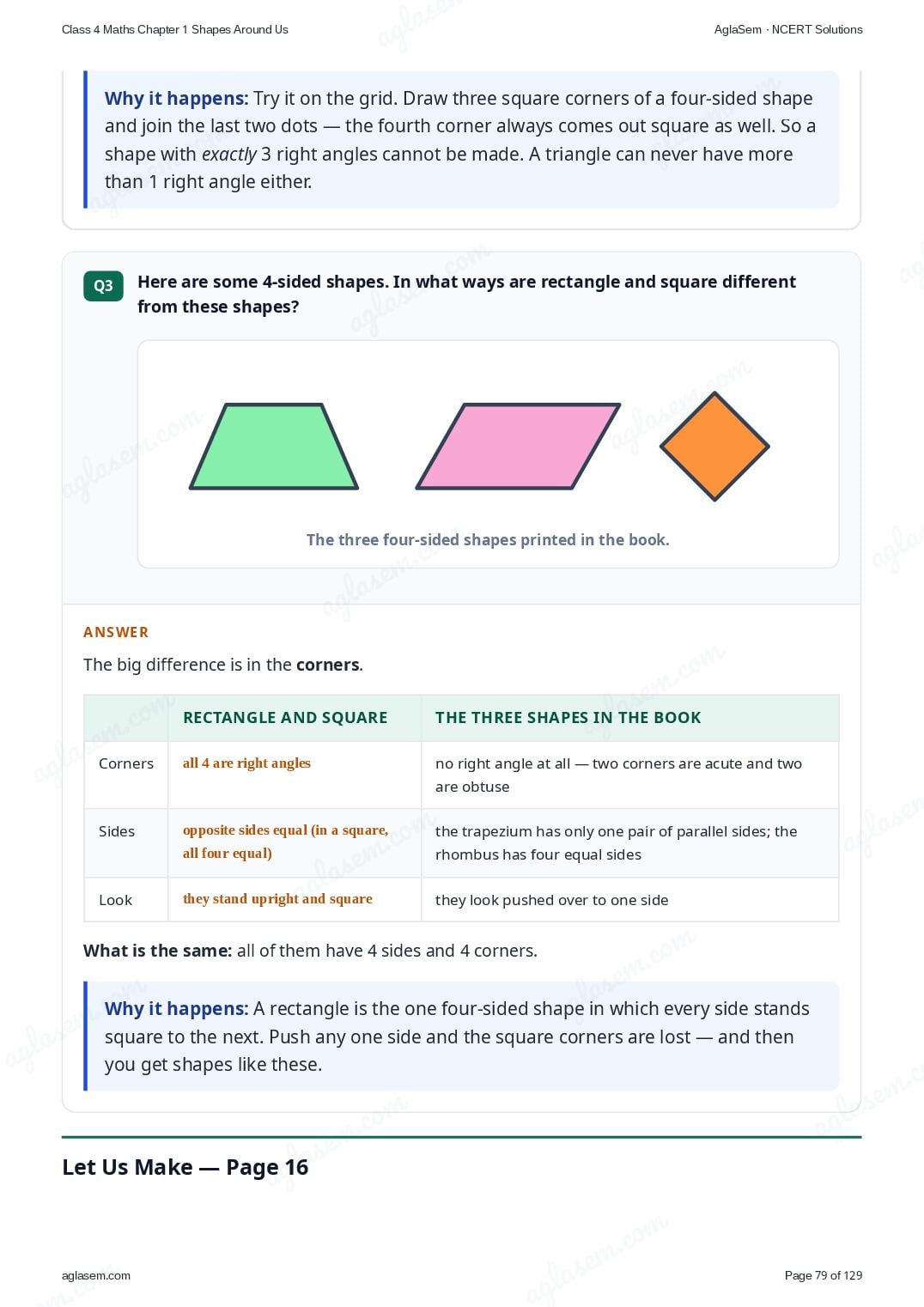
- Here are some 4-sided shapes. In what ways are rectangle and square different from these shapes? The three four-sided shapes printed in the book.
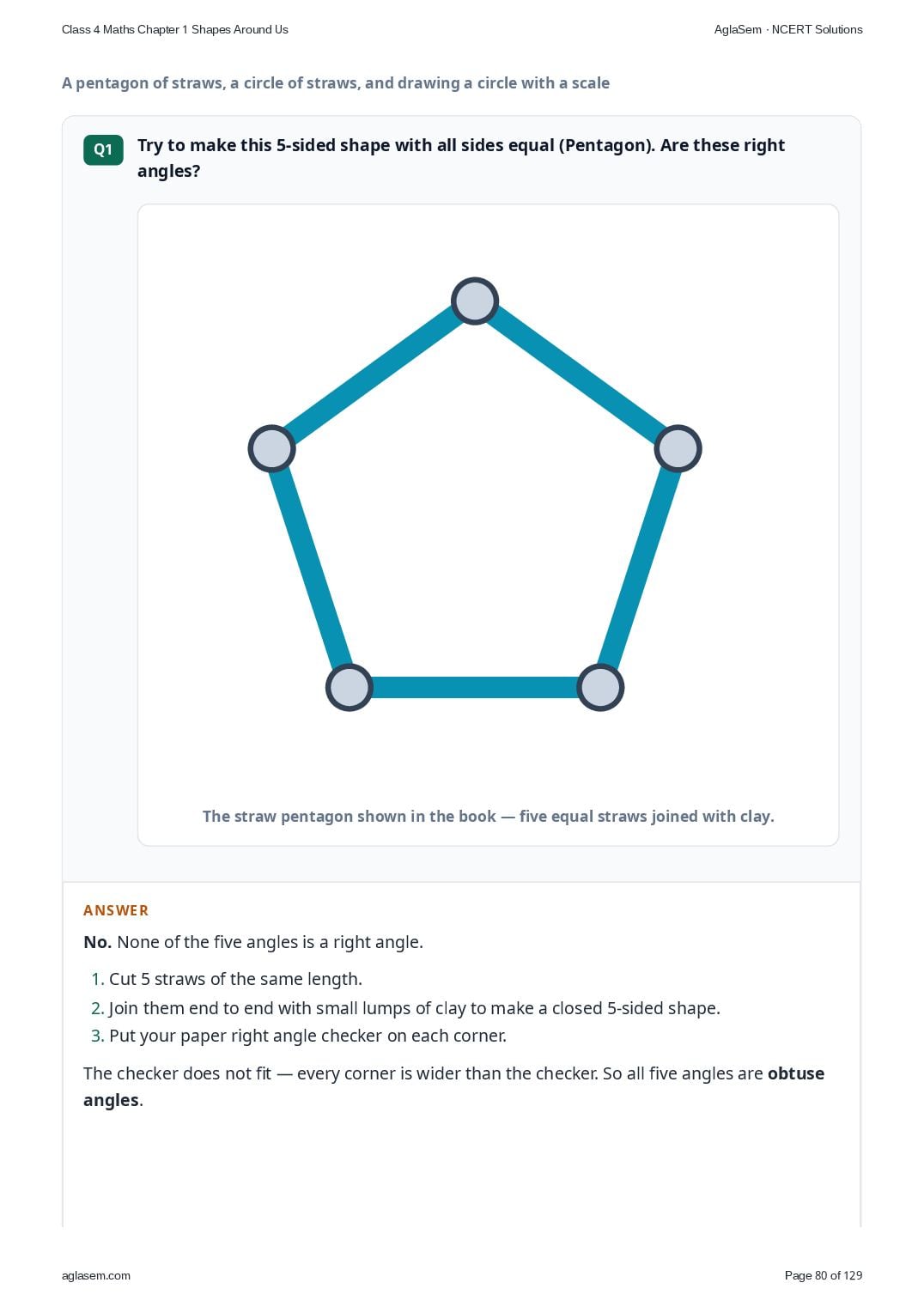
- Try to make this 5-sided shape with all sides equal (Pentagon). Are these right angles? The straw pentagon shown in the book — five equal straws joined with clay.
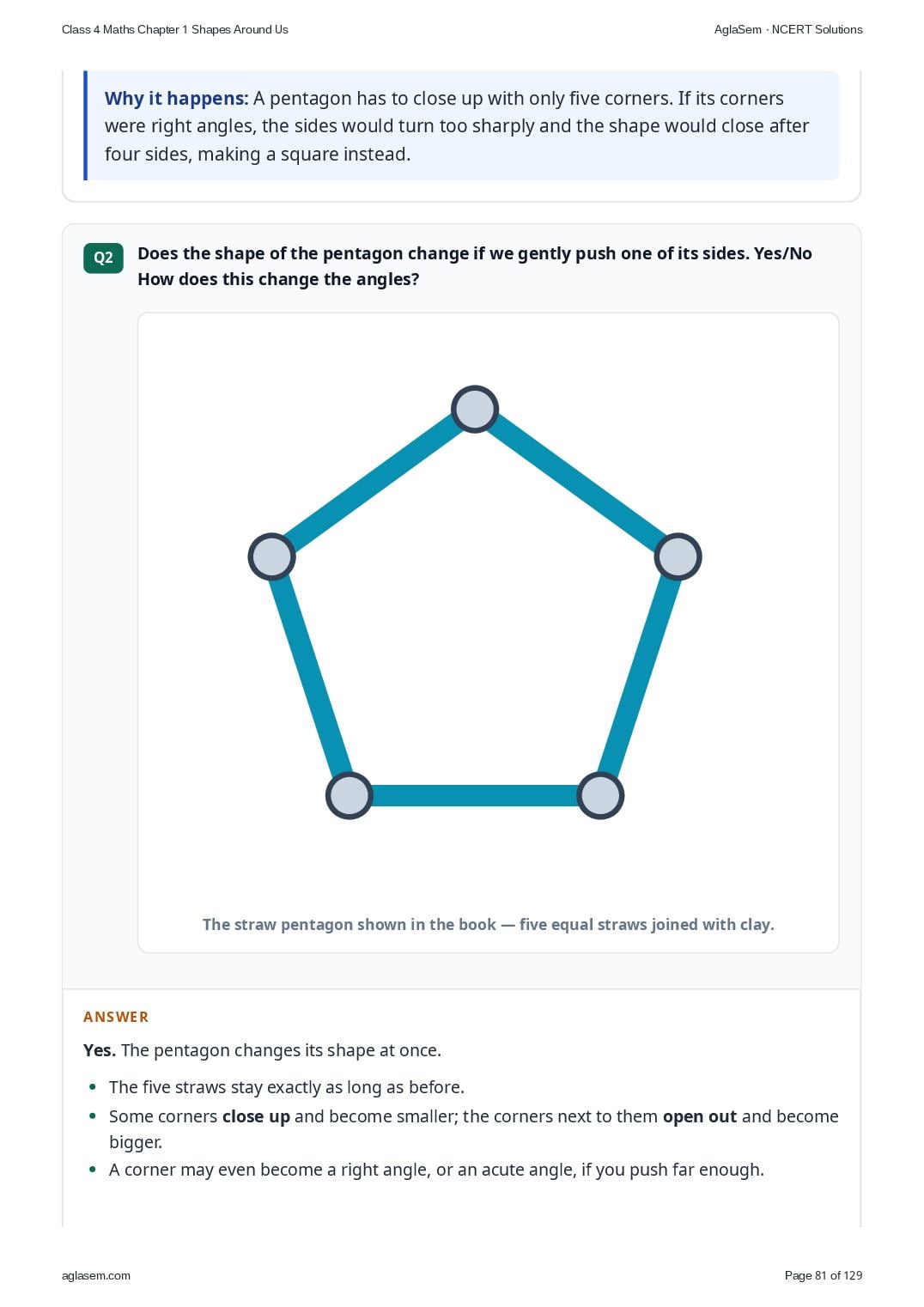
- Does the shape of the pentagon change if we gently push one of its sides. Yes/No How does this change the angles? The straw pentagon shown in the book — five equal straws joined with clay.
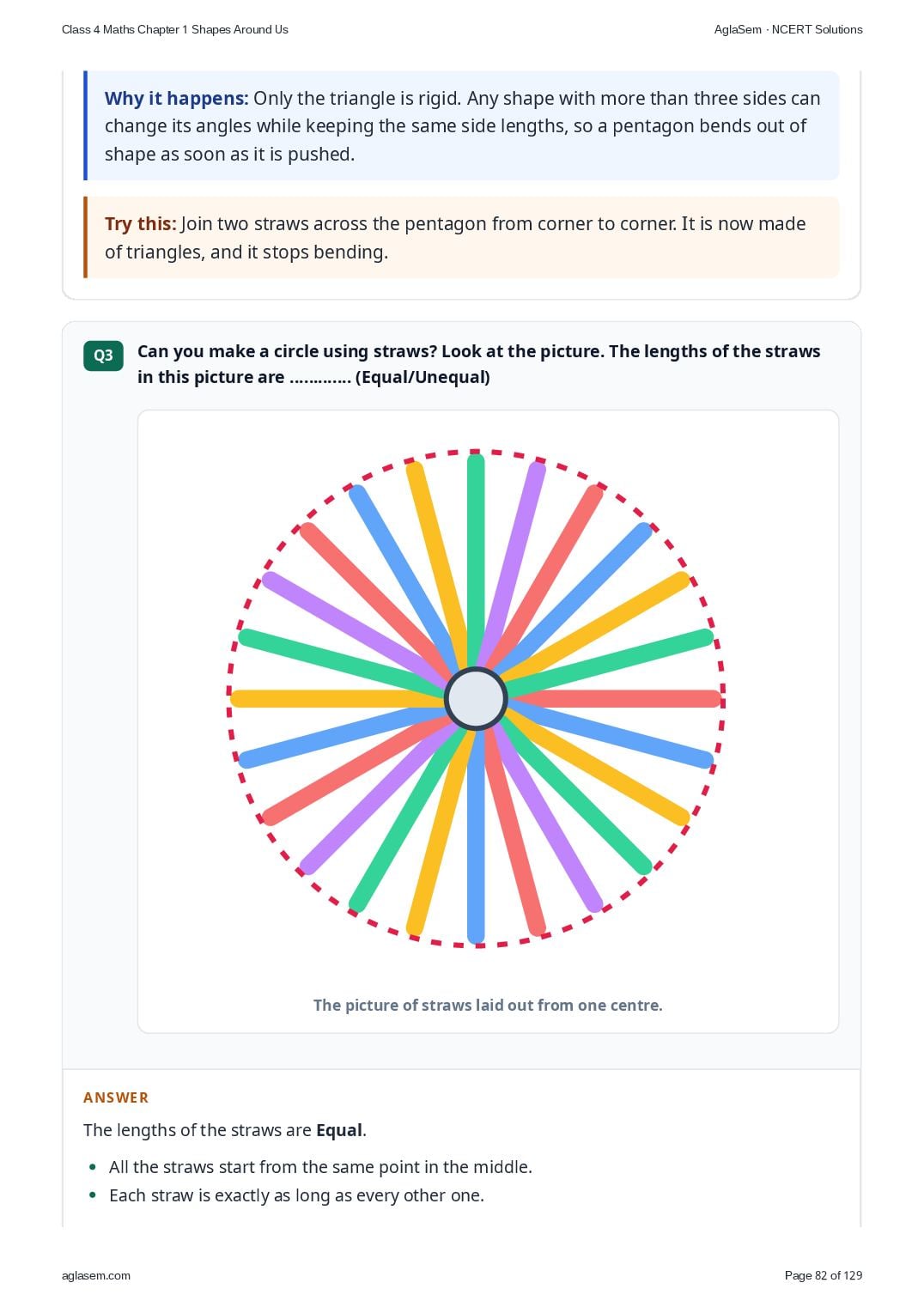
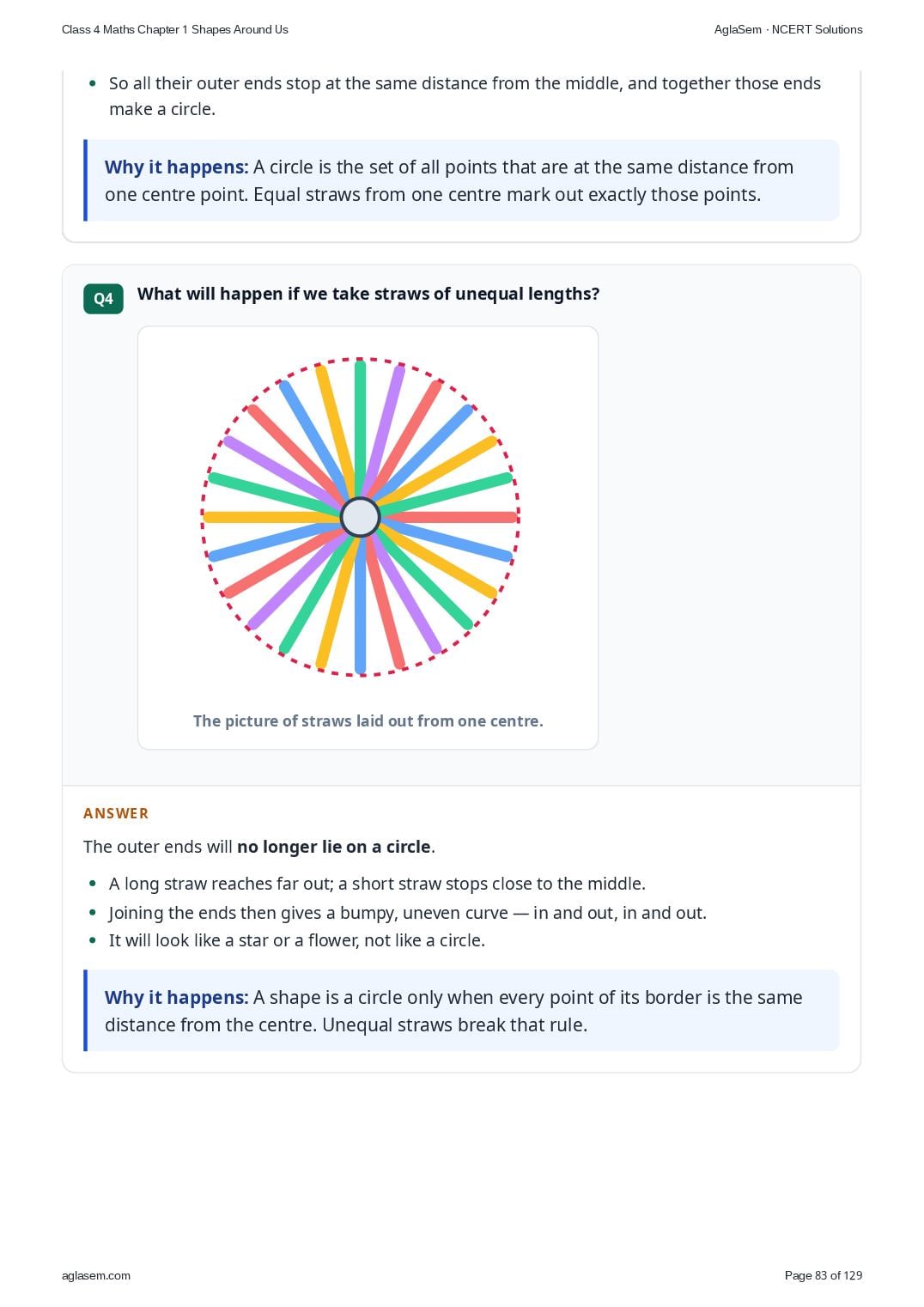
- Can you make a circle using straws? Look at the picture. The lengths of the straws in this picture are …………. (Equal/Unequal) The picture of straws laid out from one centre.
- What will happen if we take straws of unequal lengths? The picture of straws laid out from one centre.
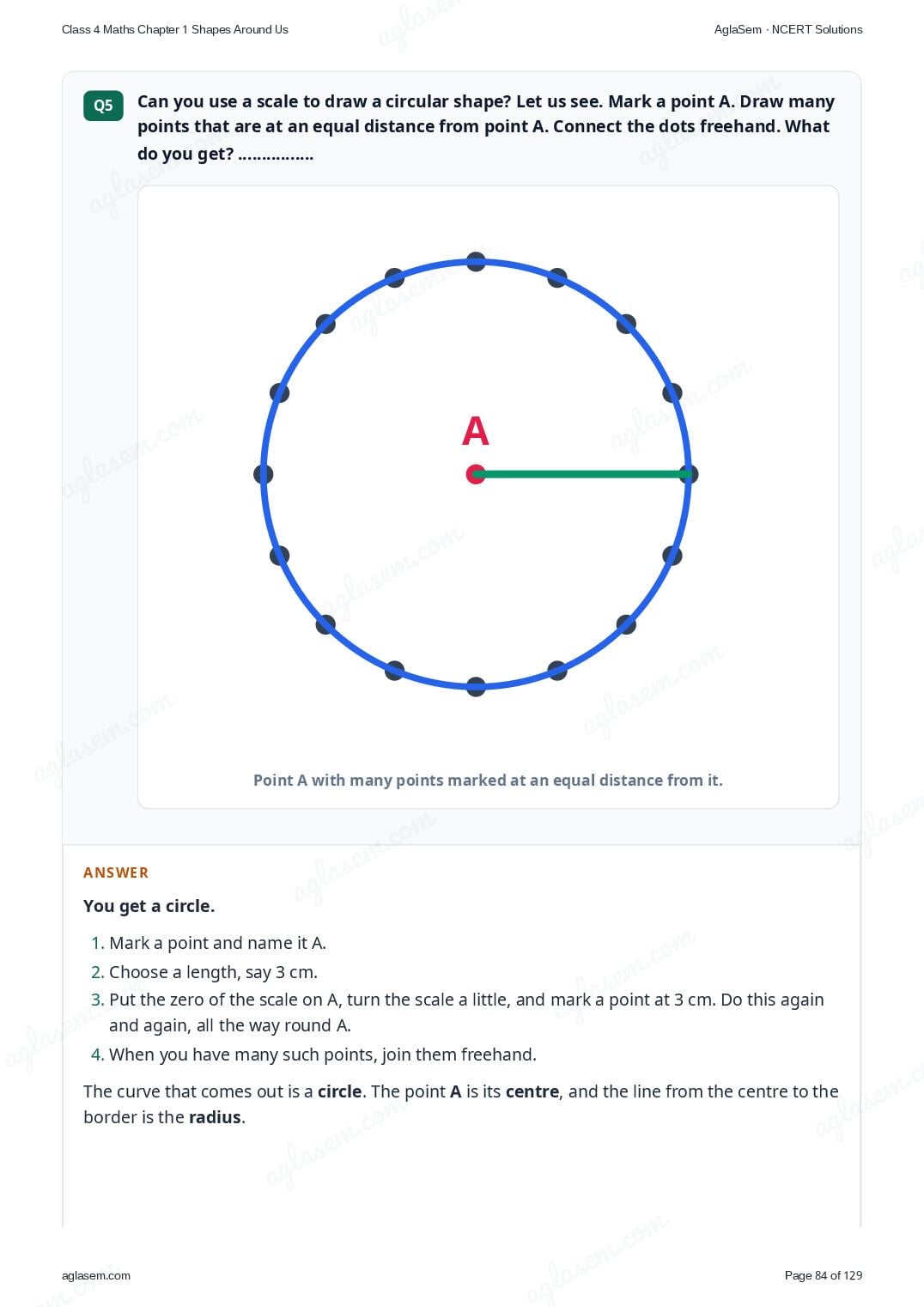
- Can you use a scale to draw a circular shape? Let us see. Mark a point A. Draw many points that are at an equal distance from point A. Connect the dots freehand. What do you get? ……………. APoint A with many points marked at an equal distance from it.
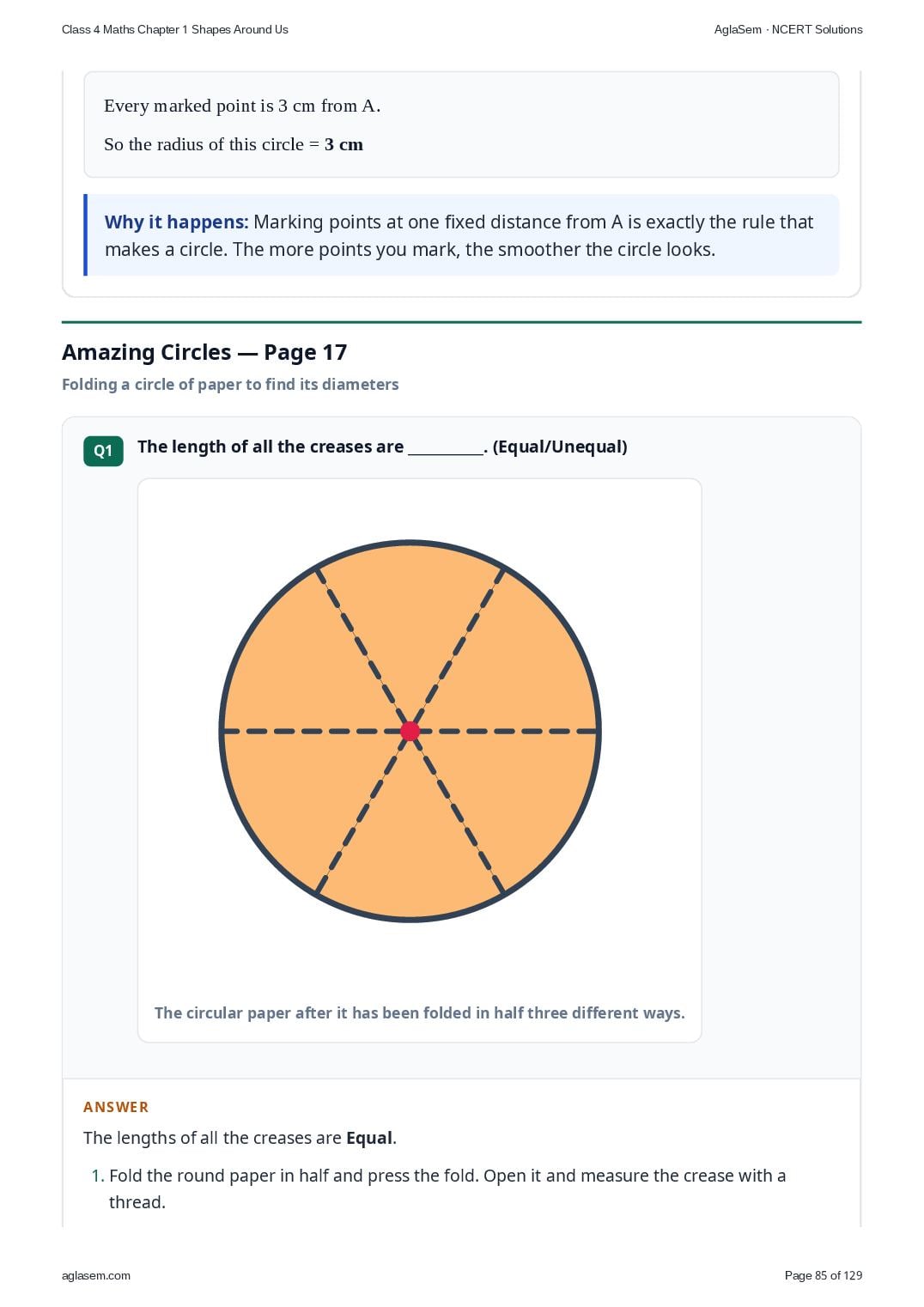
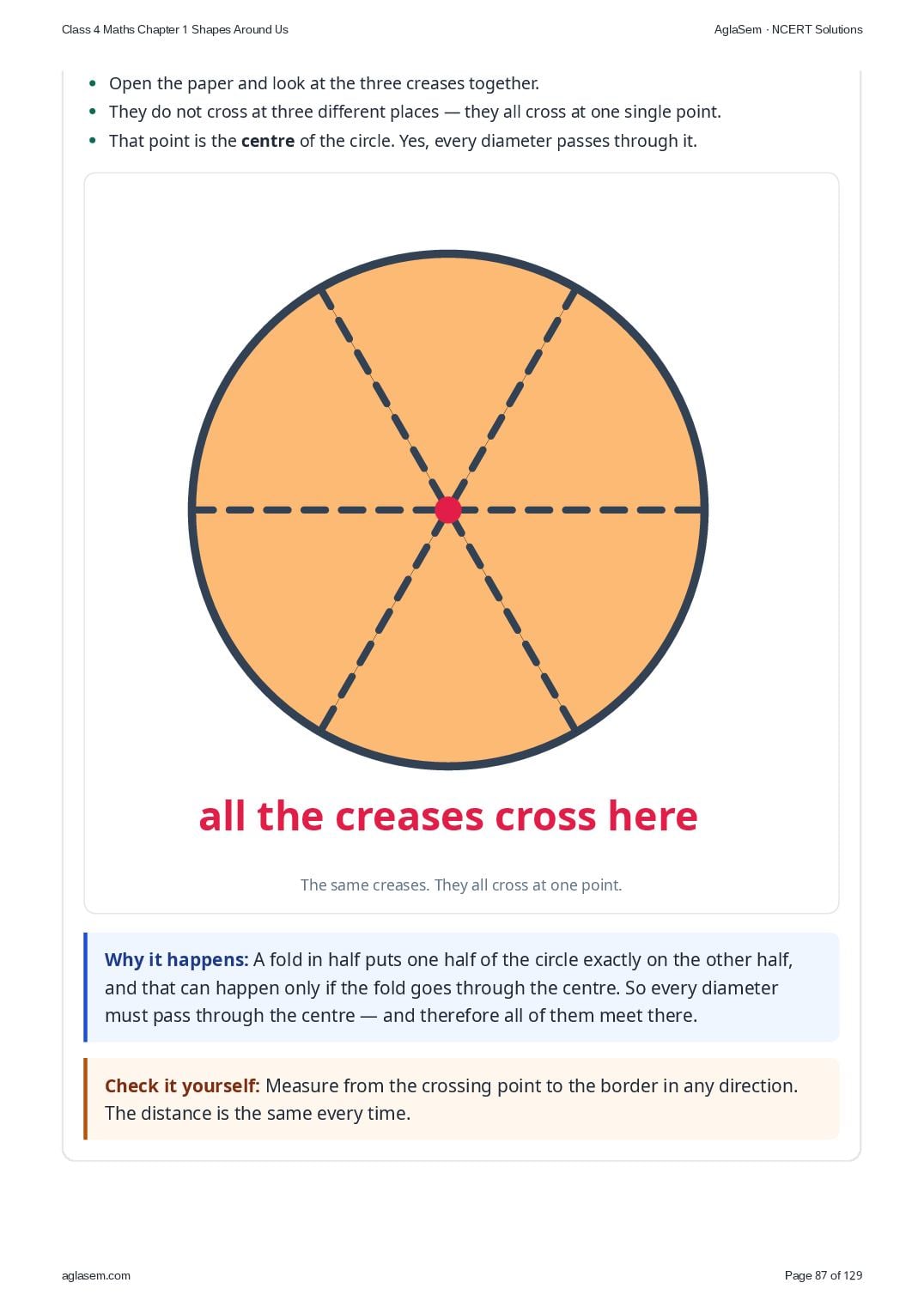
- The length of all the creases are ___________. (Equal/Unequal) The circular paper after it has been folded in half three different ways.
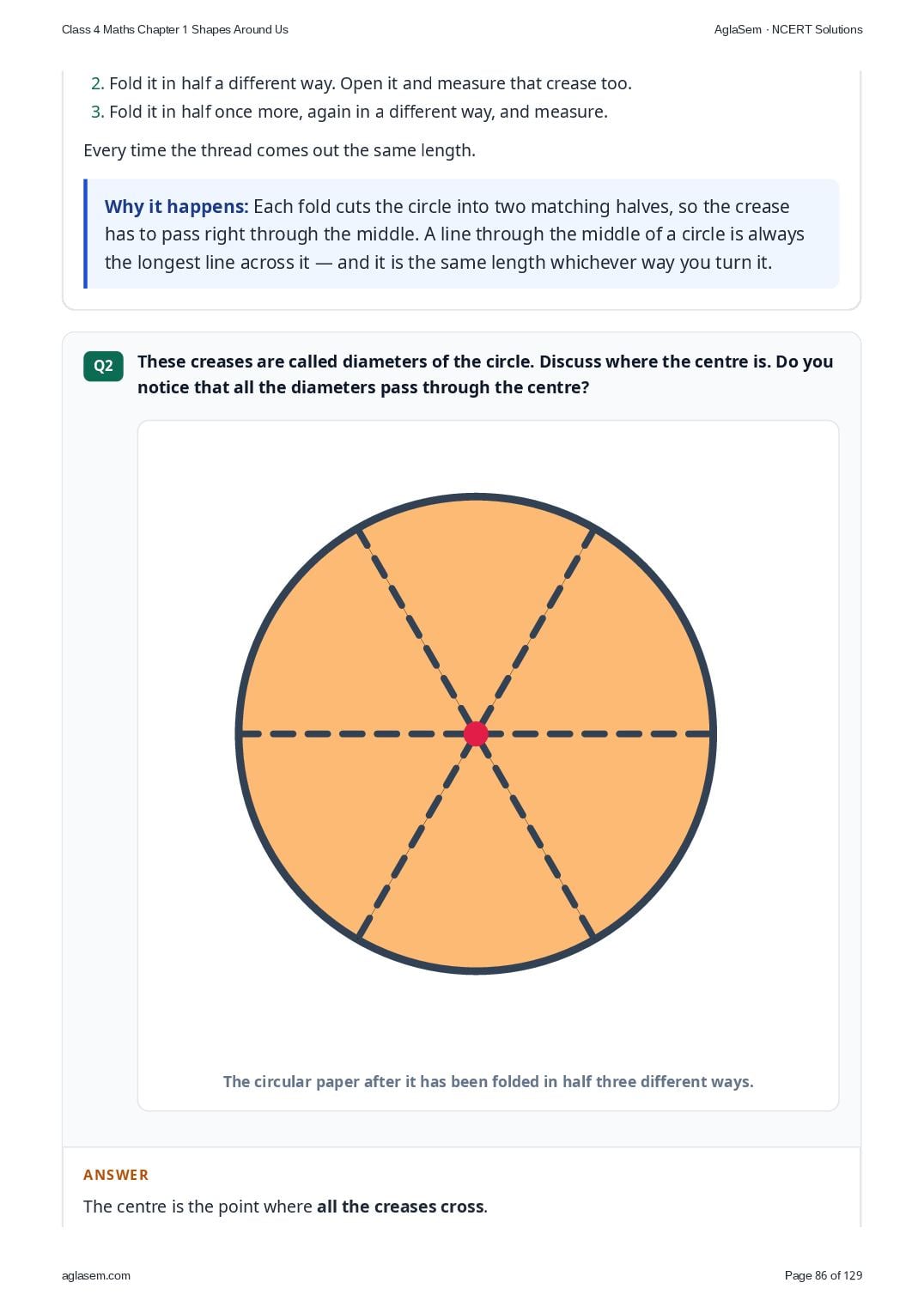
- These creases are called diameters of the circle. Discuss where the centre is. Do you notice that all the diameters pass through the centre? The circular paper after it has been folded in half three different ways.
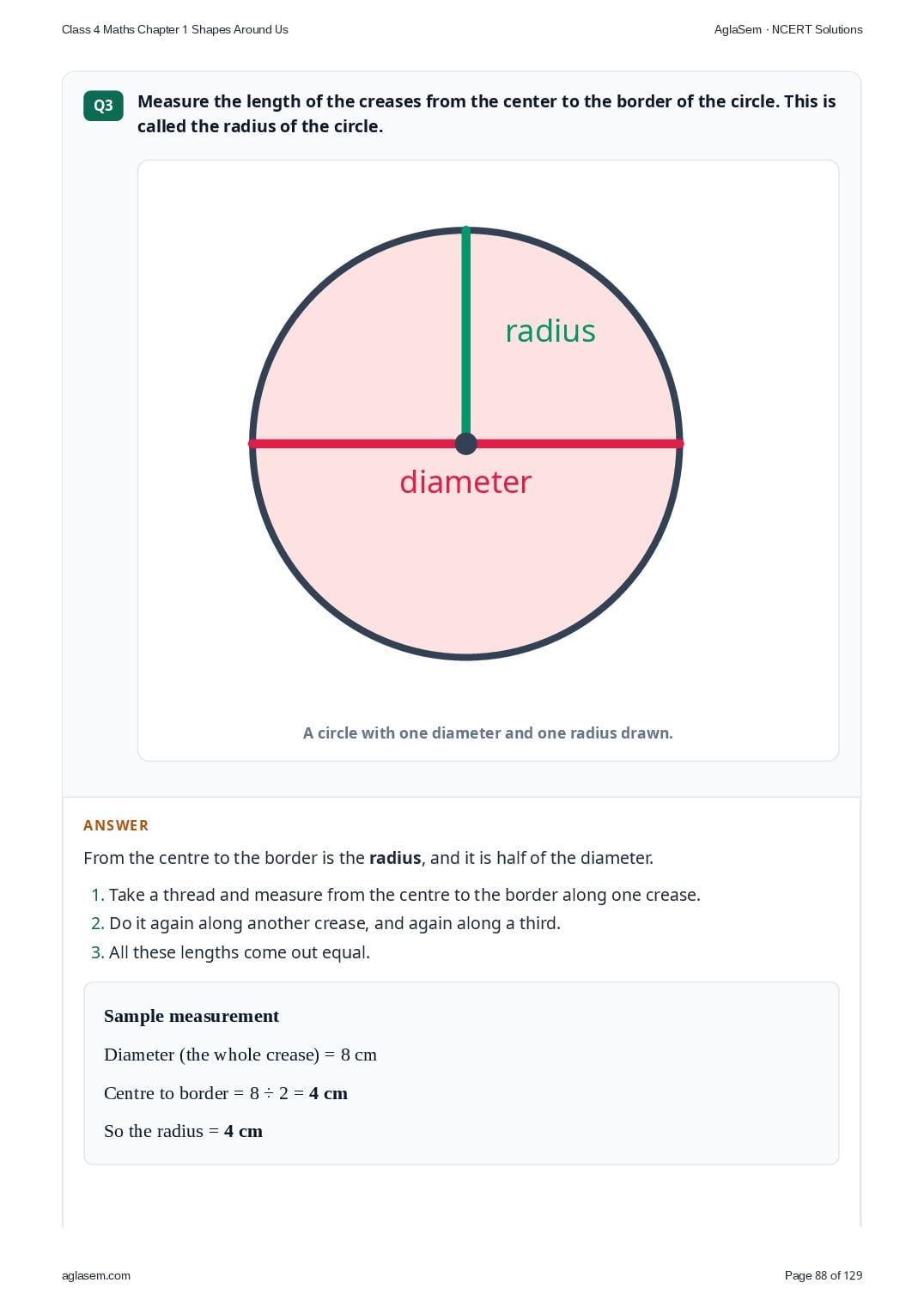
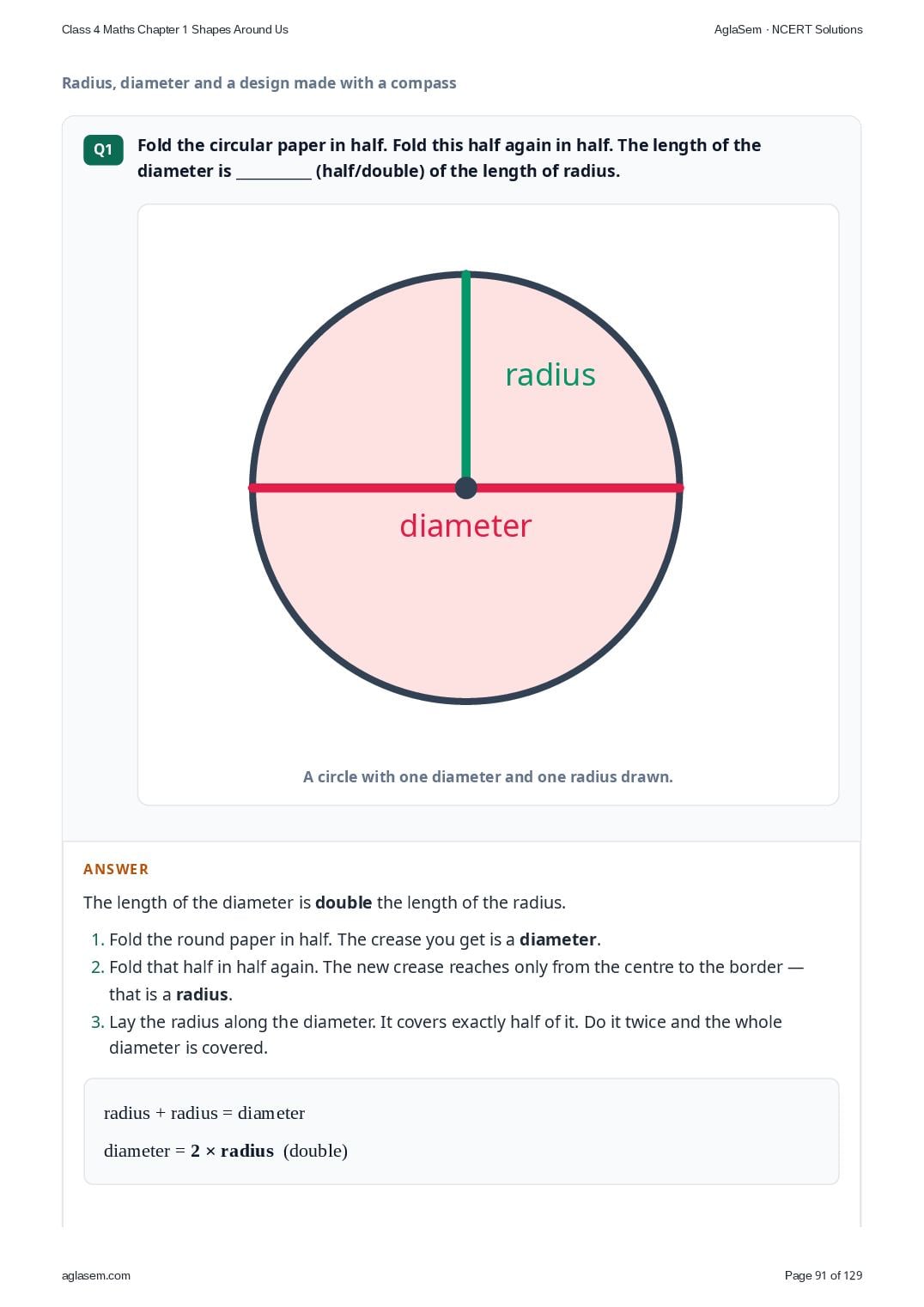
- Measure the length of the creases from the center to the border of the circle. This is called the radius of the circle. diameterradiusA circle with one diameter and one radius drawn.
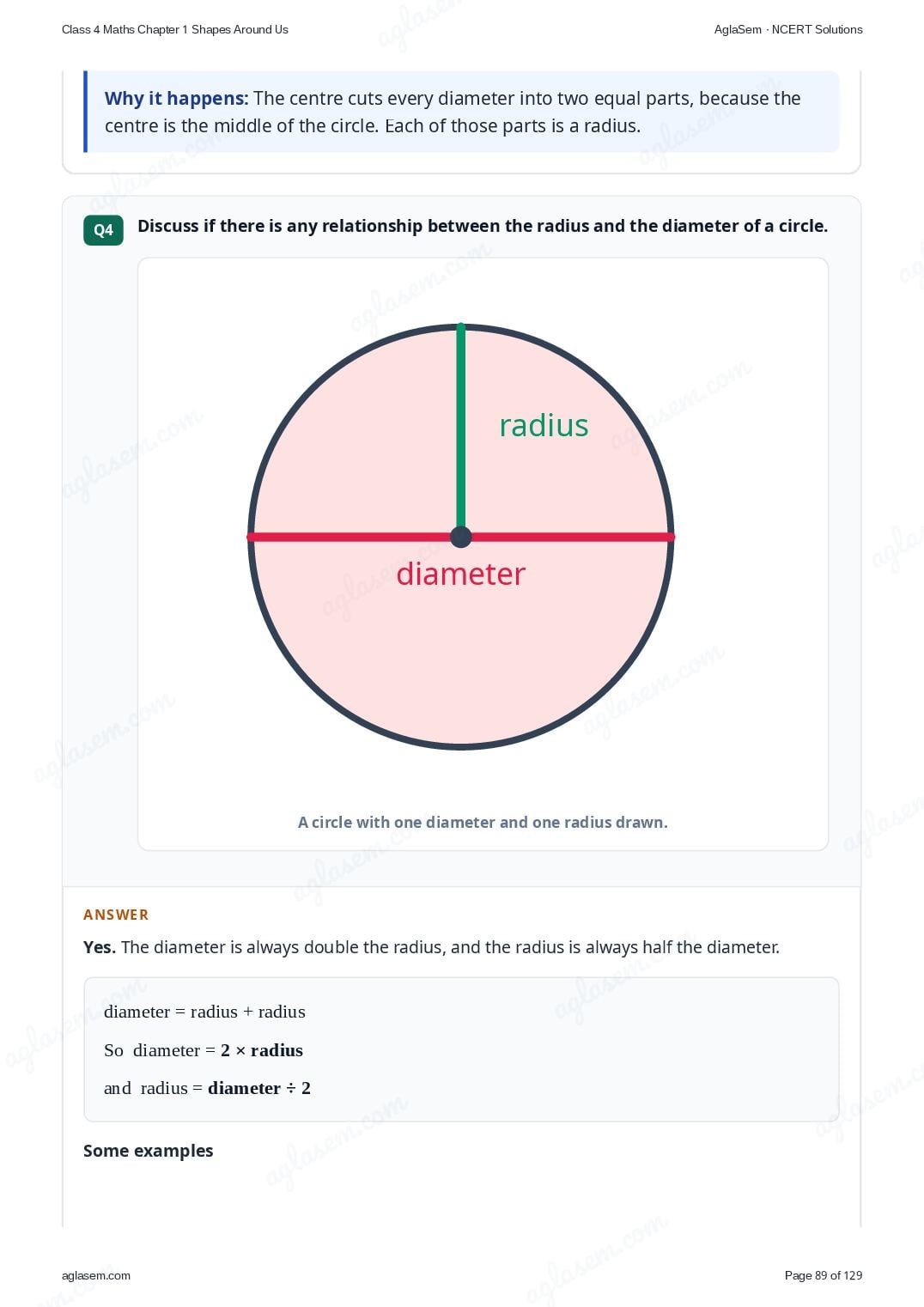
- Discuss if there is any relationship between the radius and the diameter of a circle. diameterradiusA circle with one diameter and one radius drawn.
- Fold the circular paper in half. Fold this half again in half. The length of the diameter is ___________ (half/double) of the length of radius. diameterradiusA circle with one diameter and one radius drawn.
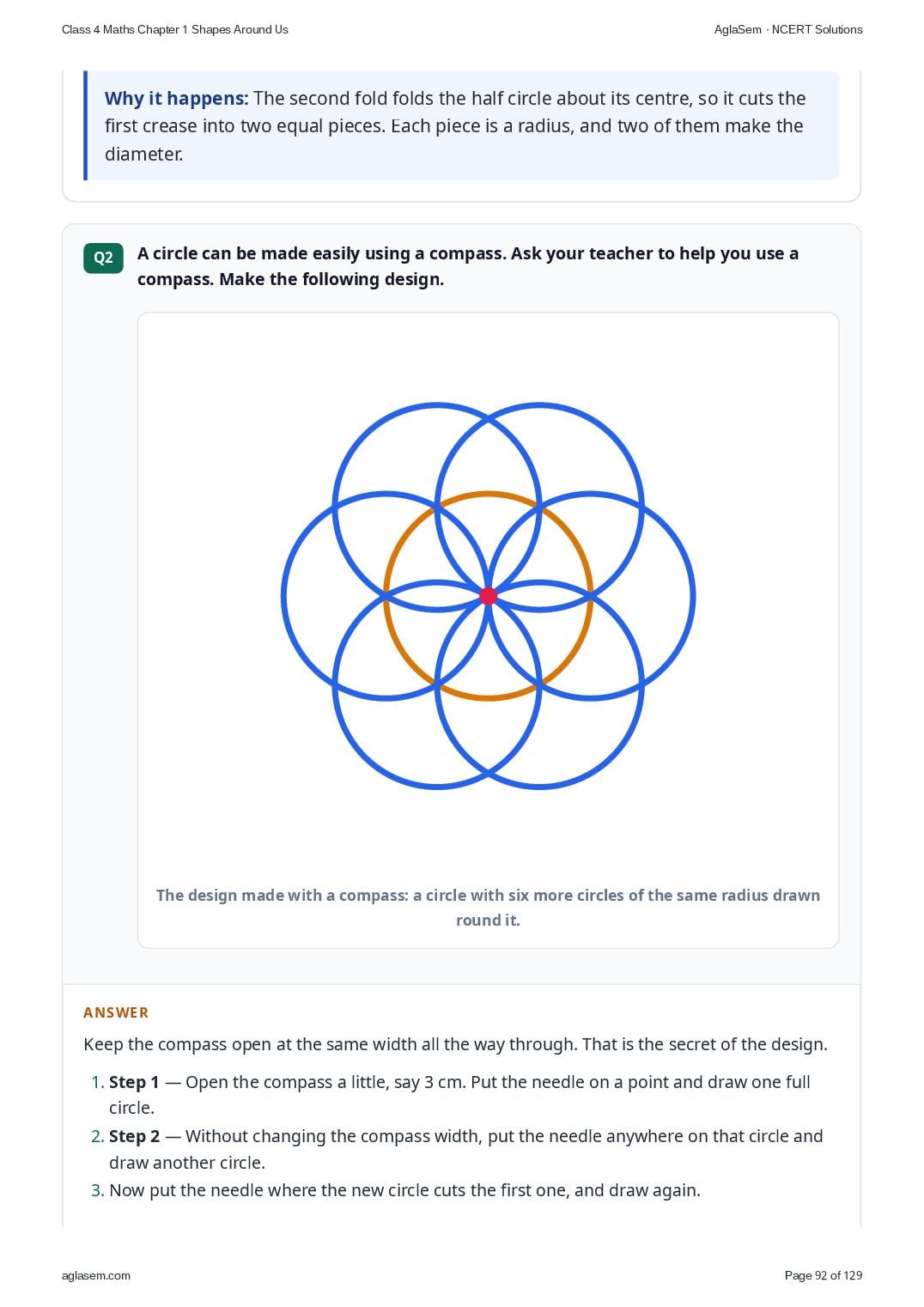
- A circle can be made easily using a compass. Ask your teacher to help you use a compass. Make the following design. The design made with a compass: a circle with six more circles of the same radius drawn round it.
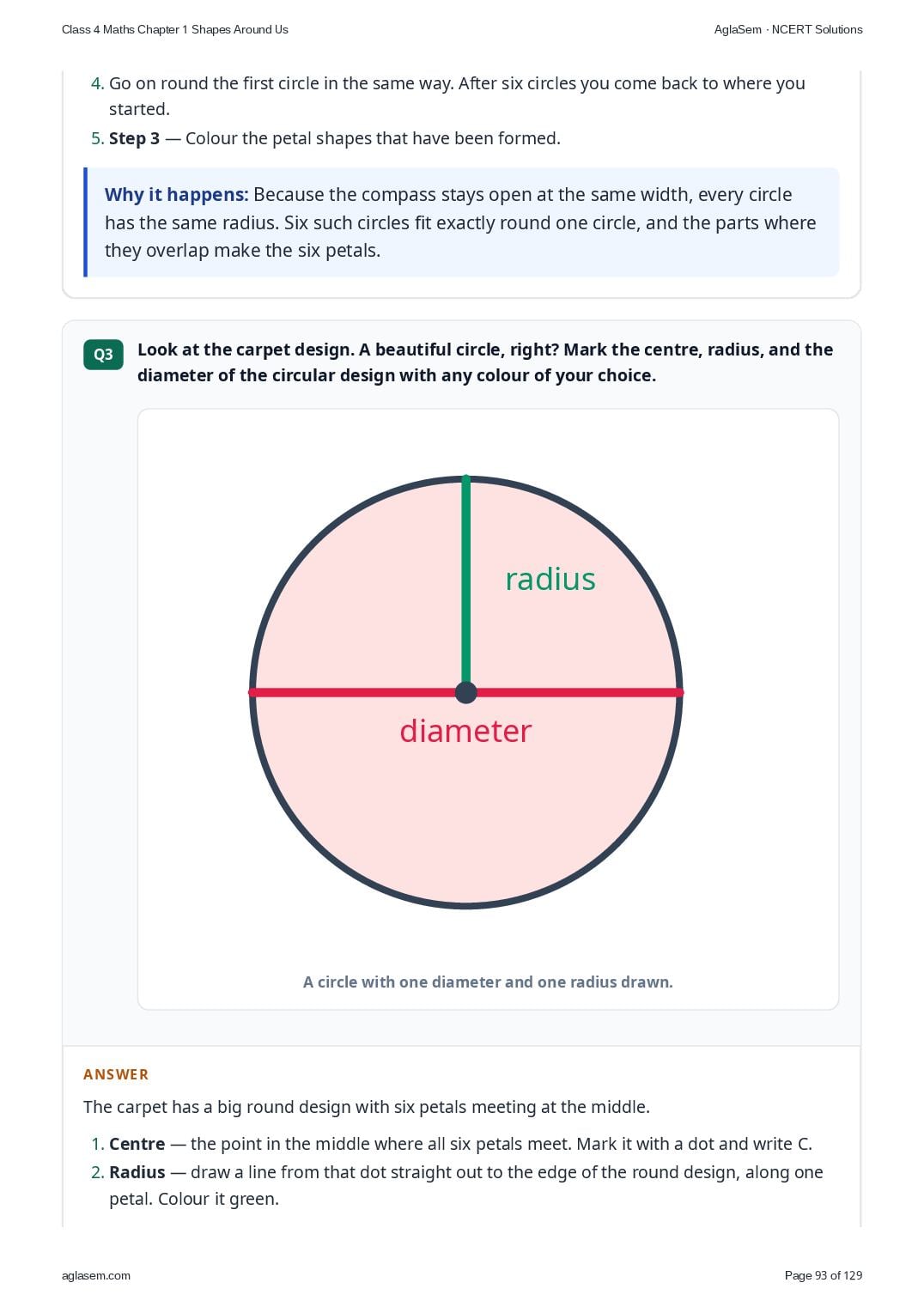
- Look at the carpet design. A beautiful circle, right? Mark the centre, radius, and the diameter of the circular design with any colour of your choice. diameterradiusA circle with one diameter and one radius drawn.
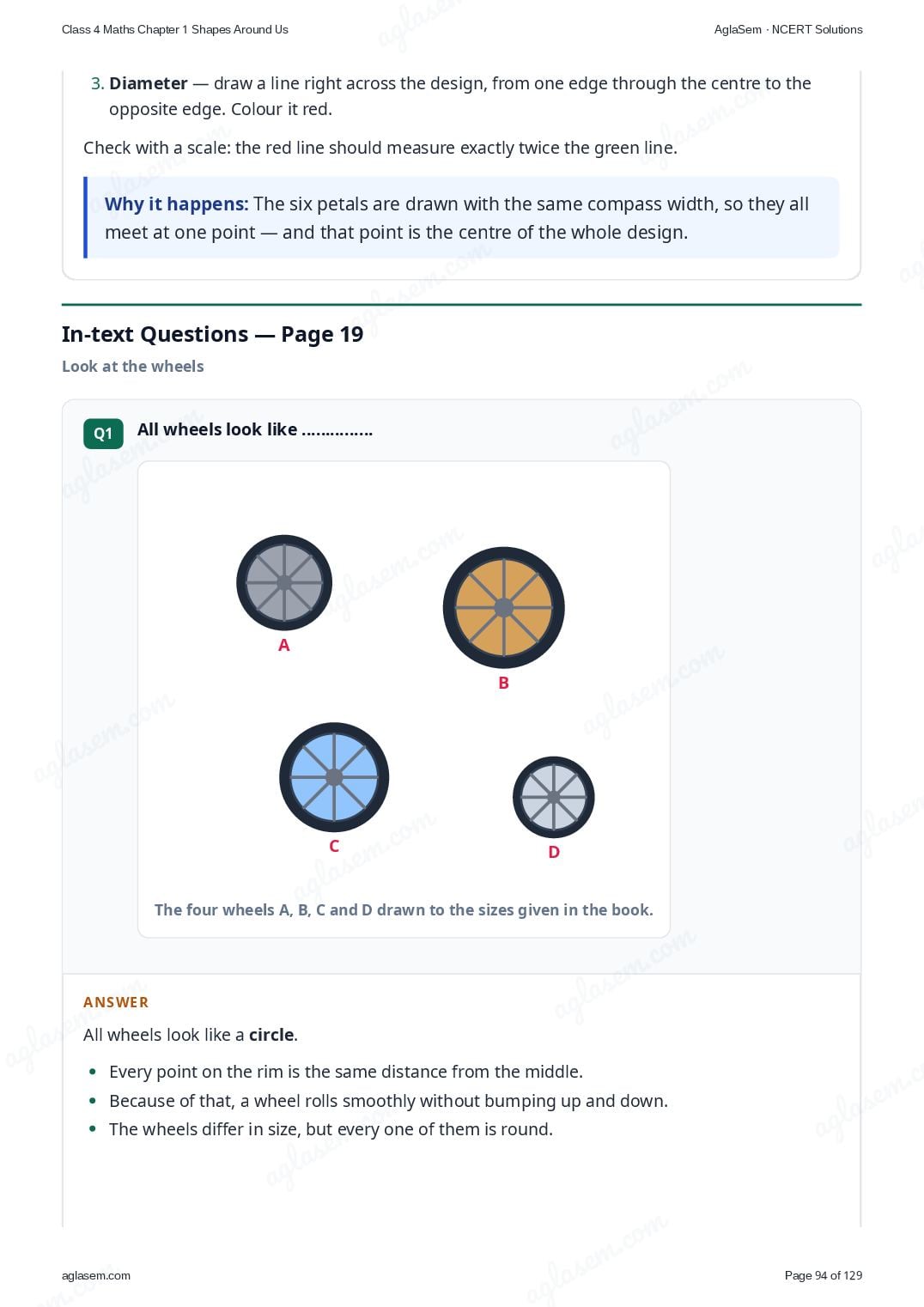
- All wheels look like …………… ABCDThe four wheels A, B, C and D drawn to the sizes given in the book.
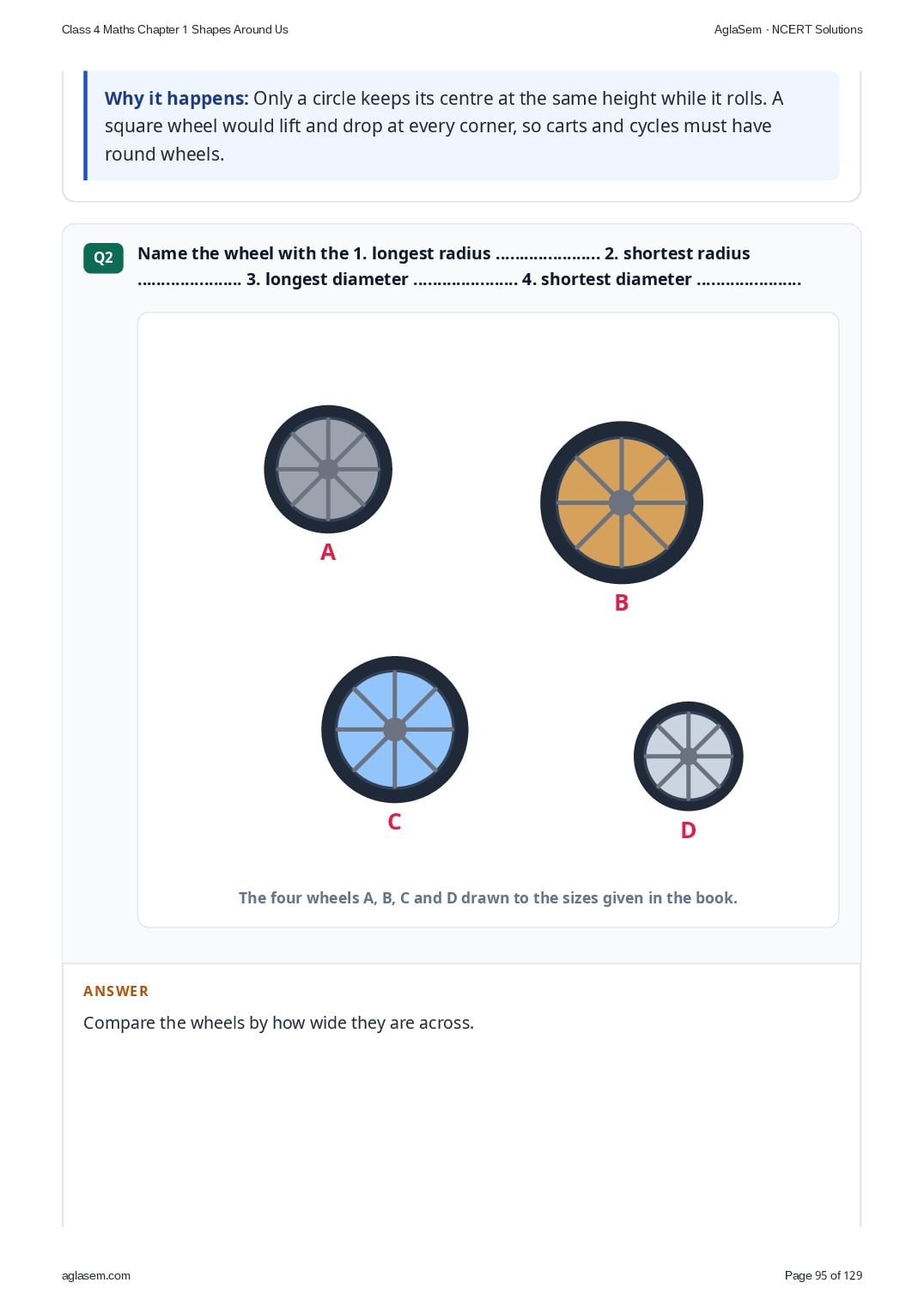
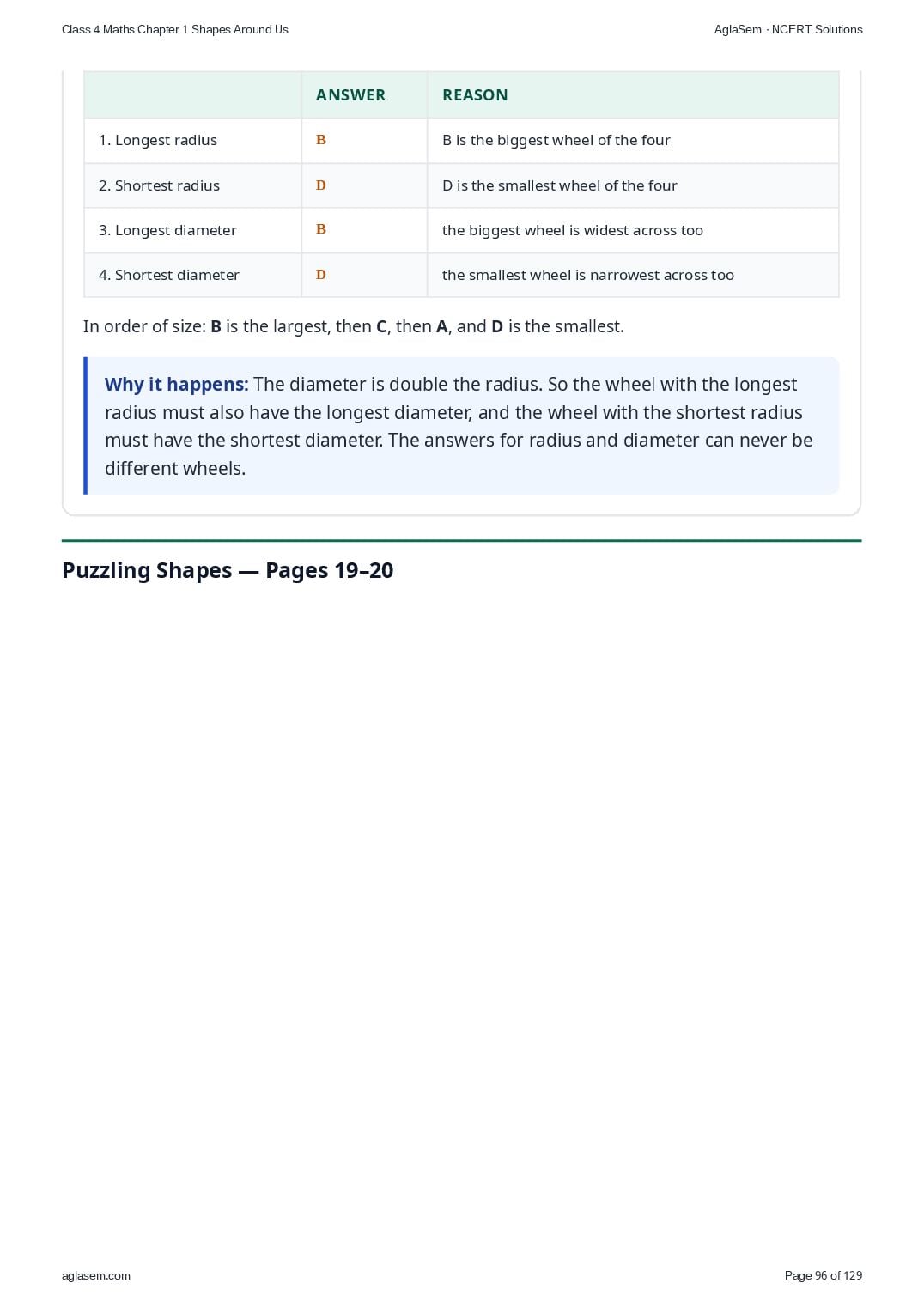
- Name the wheel with the 1. longest radius …………………. 2. shortest radius …………………. 3. longest diameter …………………. 4. shortest diameter …………………. ABCDThe four wheels A, B, C and D drawn to the sizes given in the book.
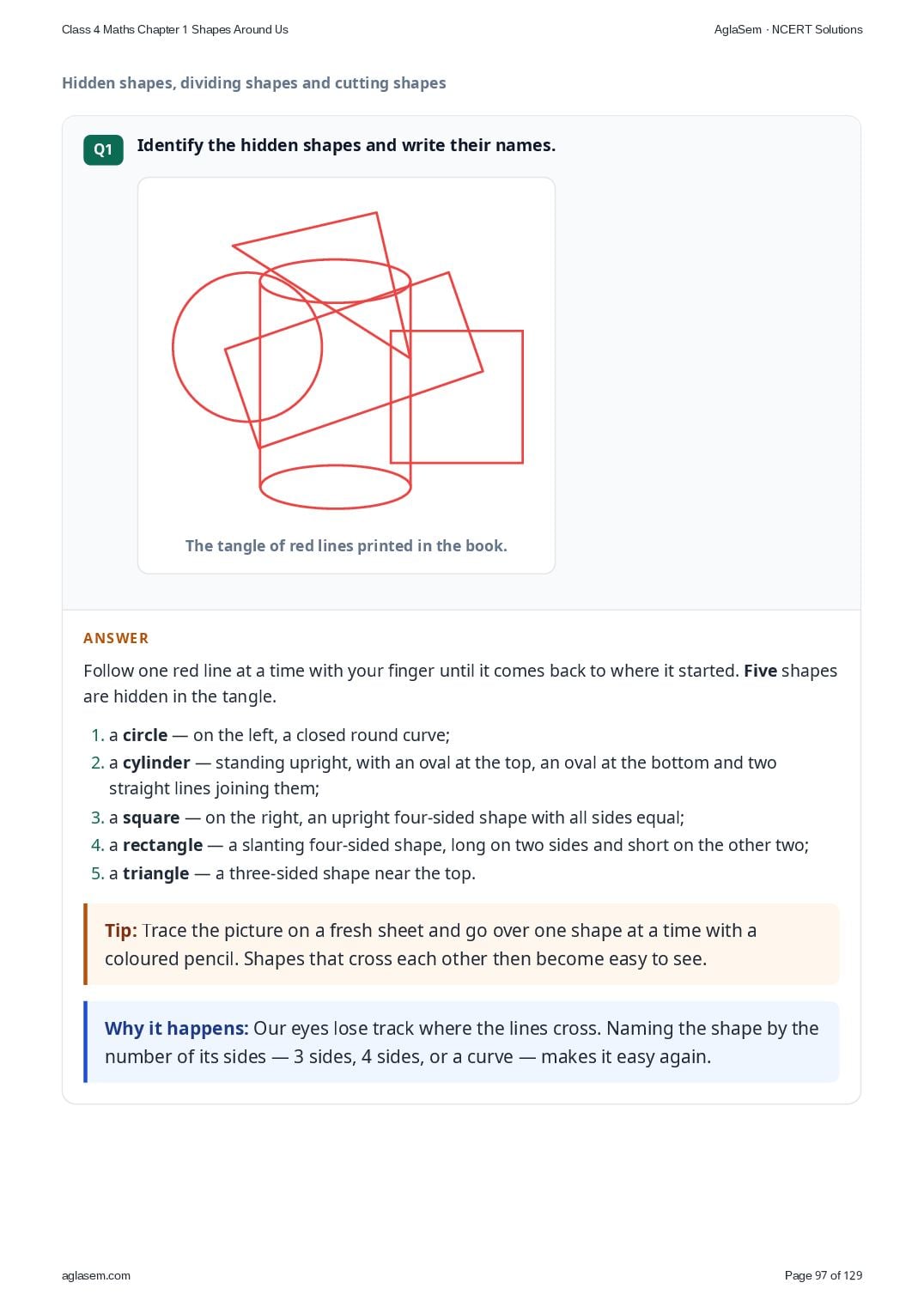
- Identify the hidden shapes and write their names. The tangle of red lines printed in the book.
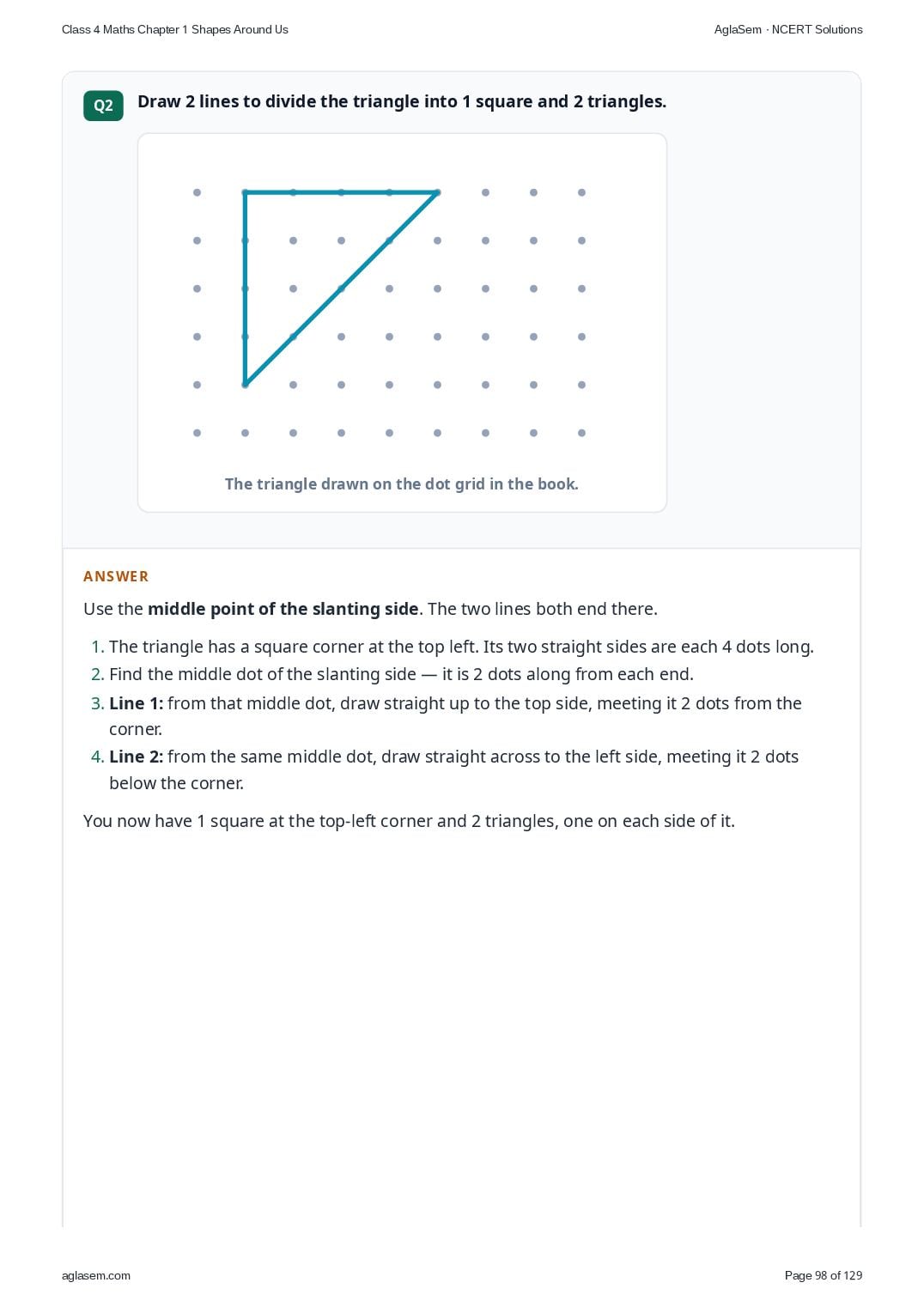
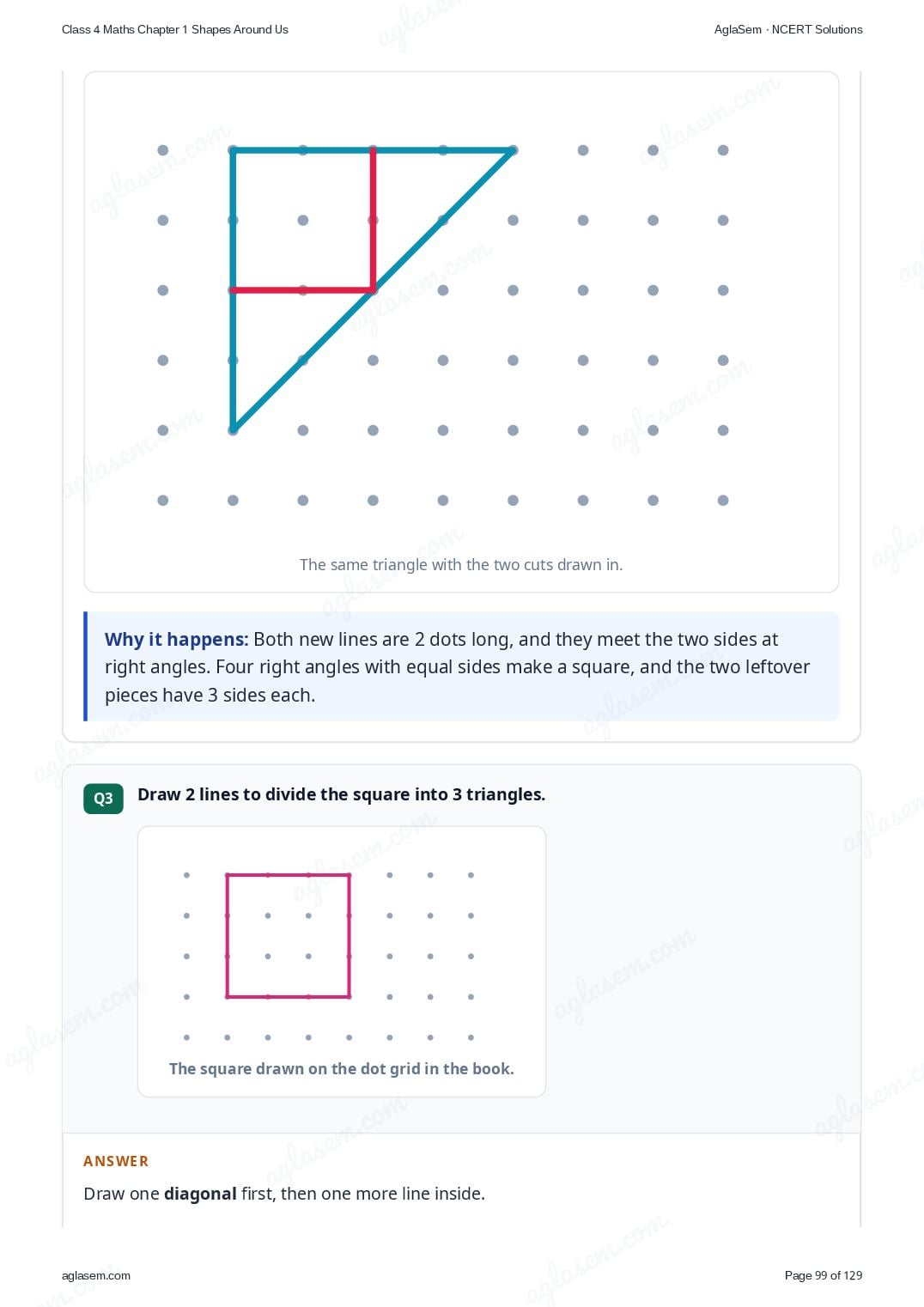
- Draw 2 lines to divide the triangle into 1 square and 2 triangles. The triangle drawn on the dot grid in the book.
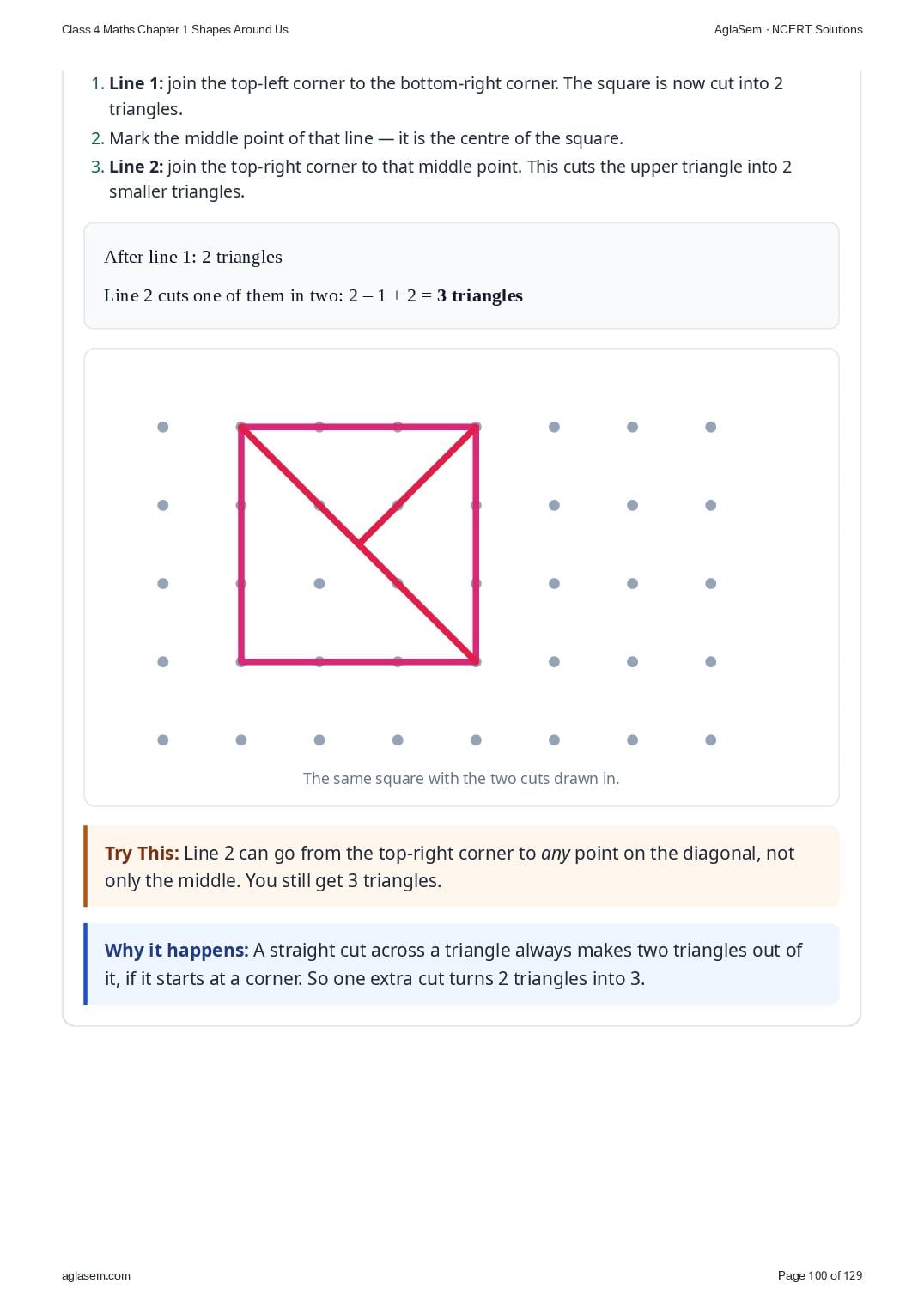
- Draw 2 lines to divide the square into 3 triangles. The square drawn on the dot grid in the book.
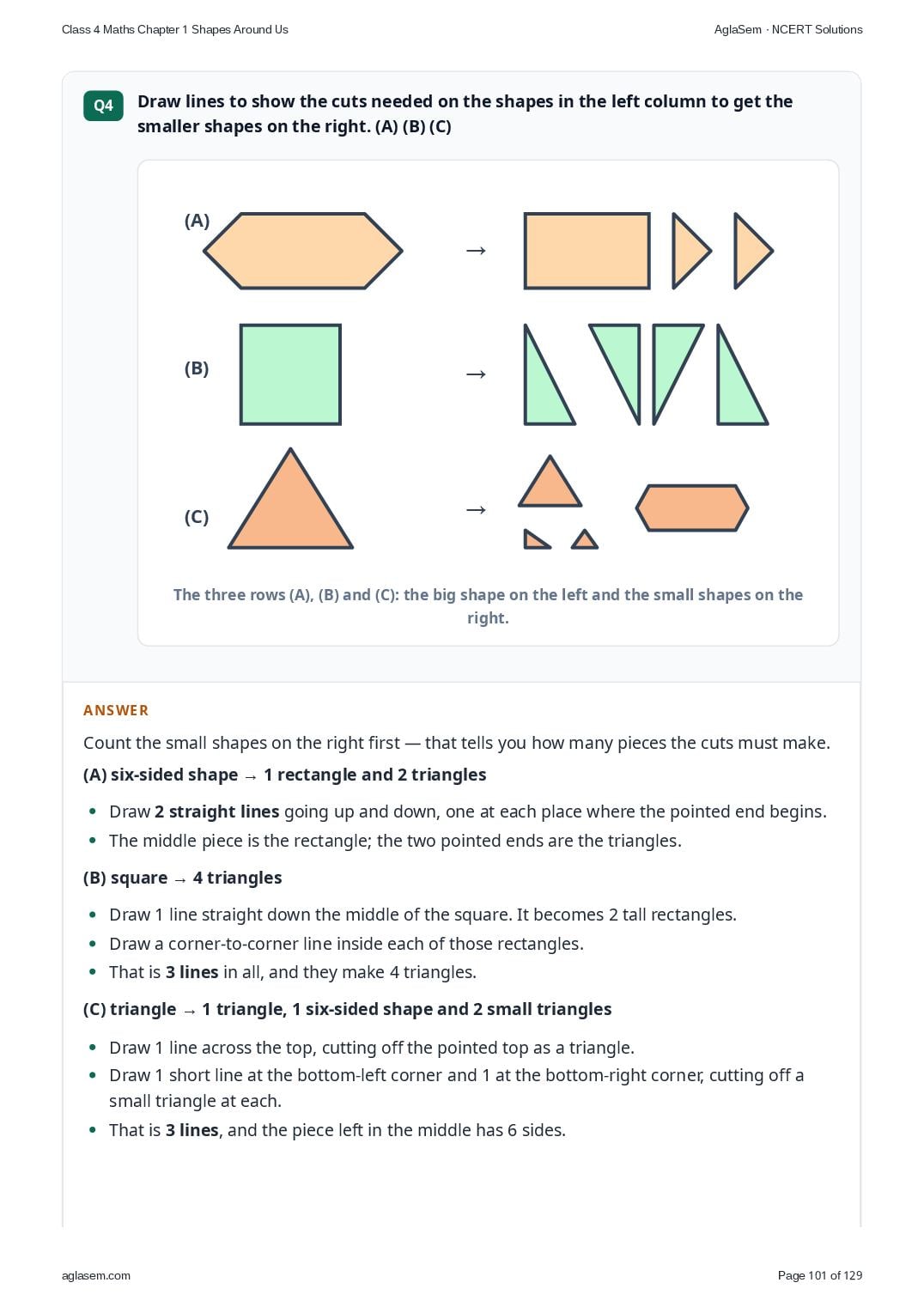
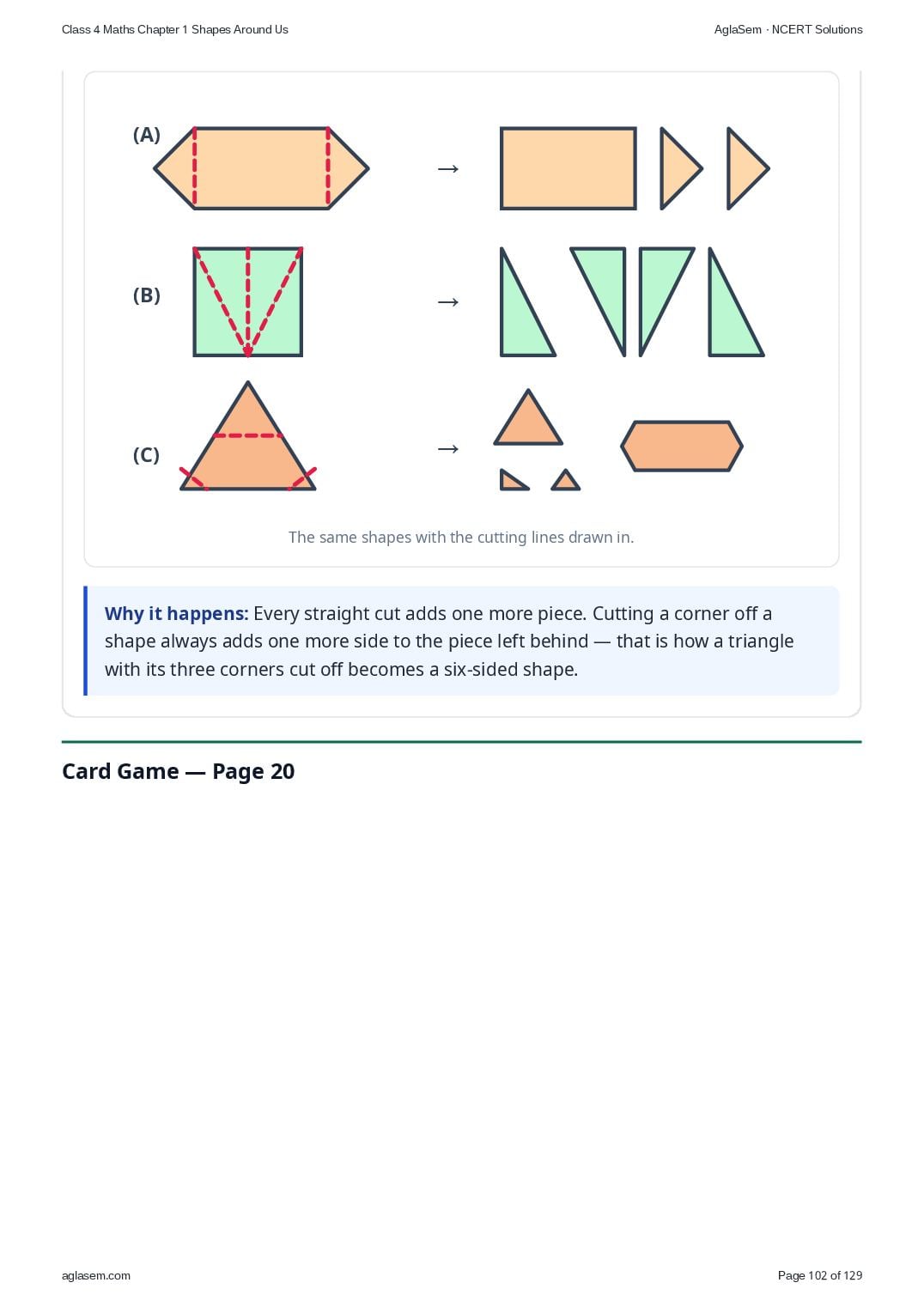
- Draw lines to show the cuts needed on the shapes in the left column to get the smaller shapes on the right. (A) (B) (C) (A)→(B)→(C)→The three rows (A), (B) and (C): the big shape on the left and the small shapes on the right.
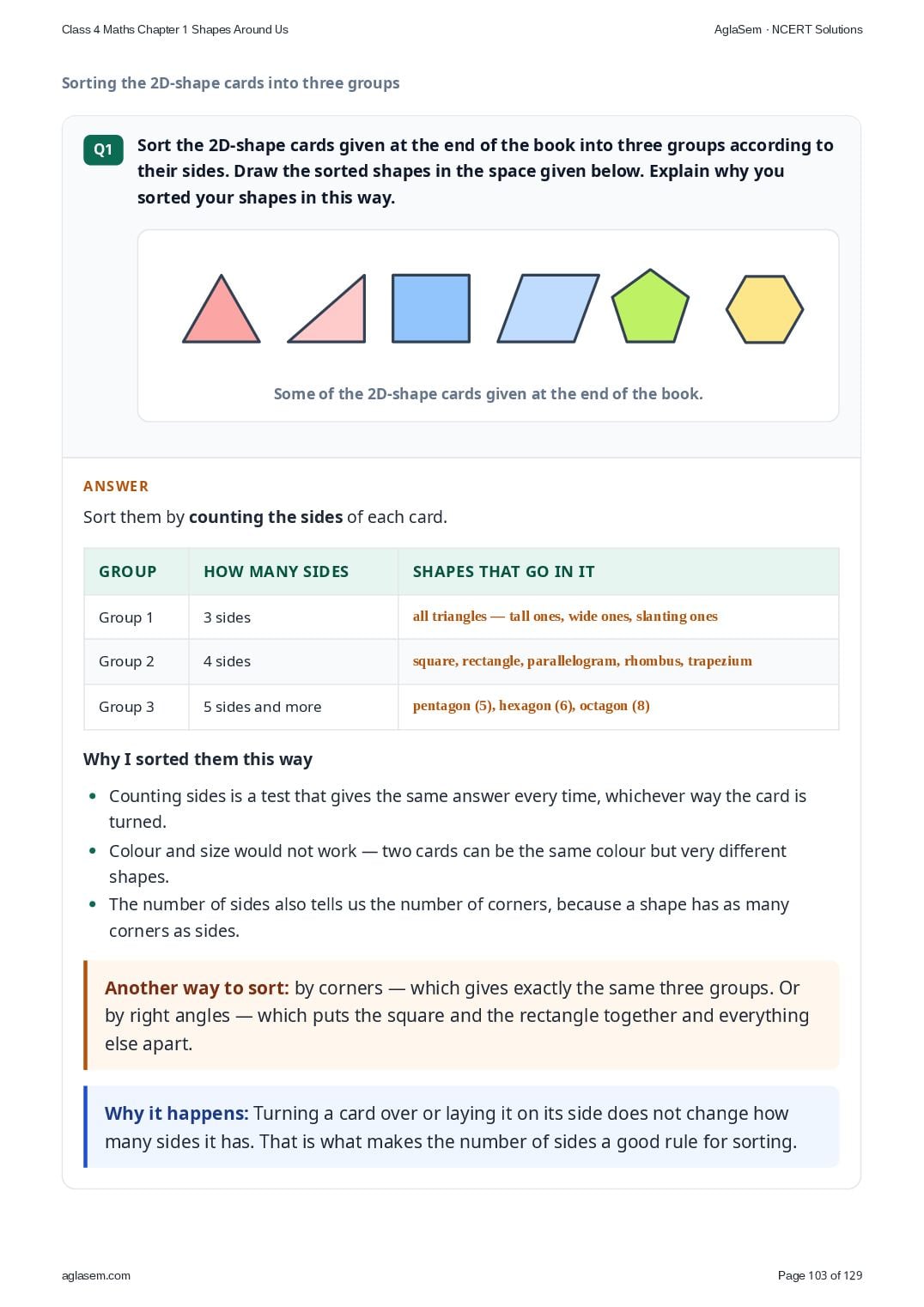
- Sort the 2D-shape cards given at the end of the book into three groups according to their sides. Draw the sorted shapes in the space given below. Explain why you sorted your shapes in this way. Some of the 2D-shape cards given at the end of the book.
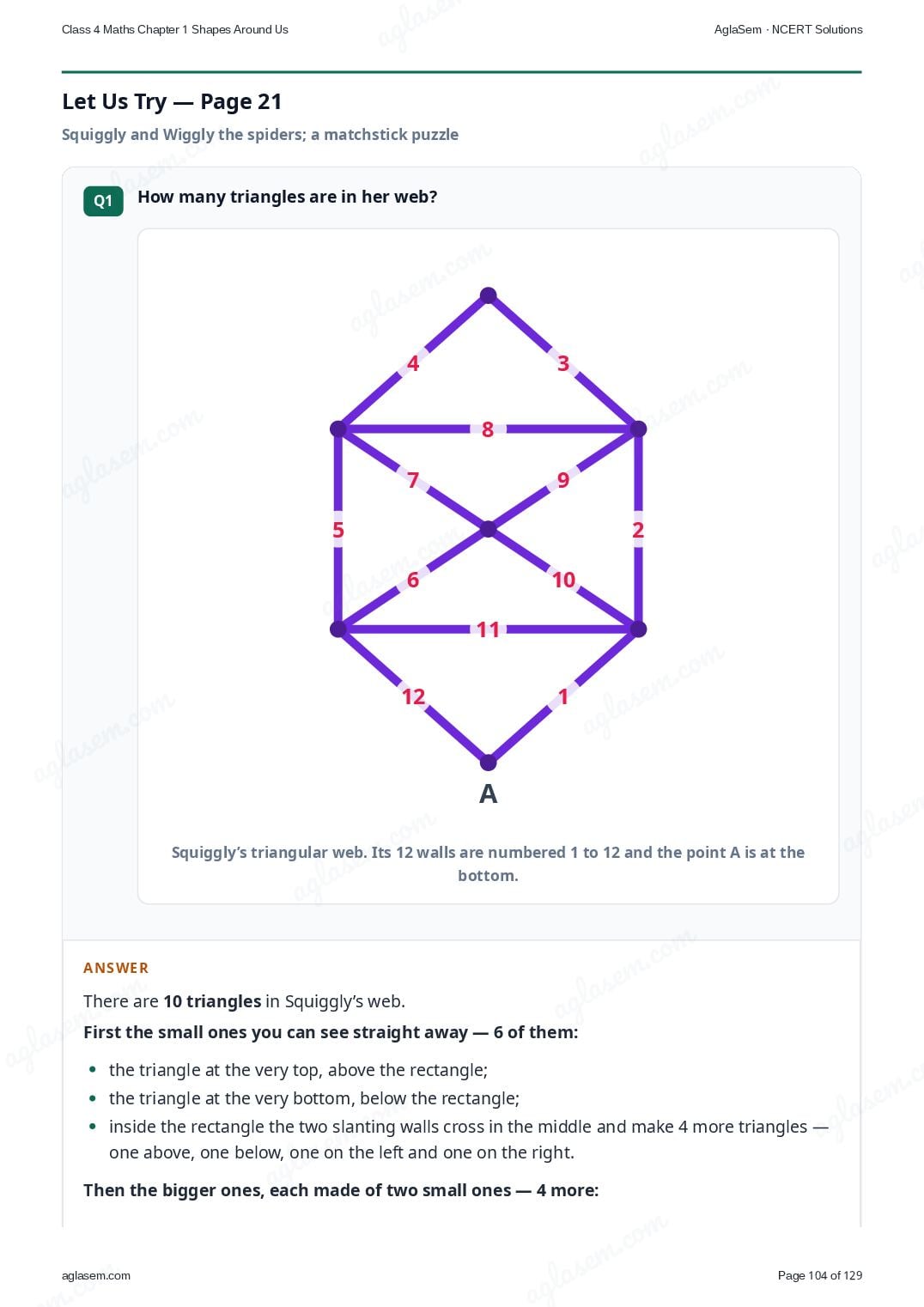
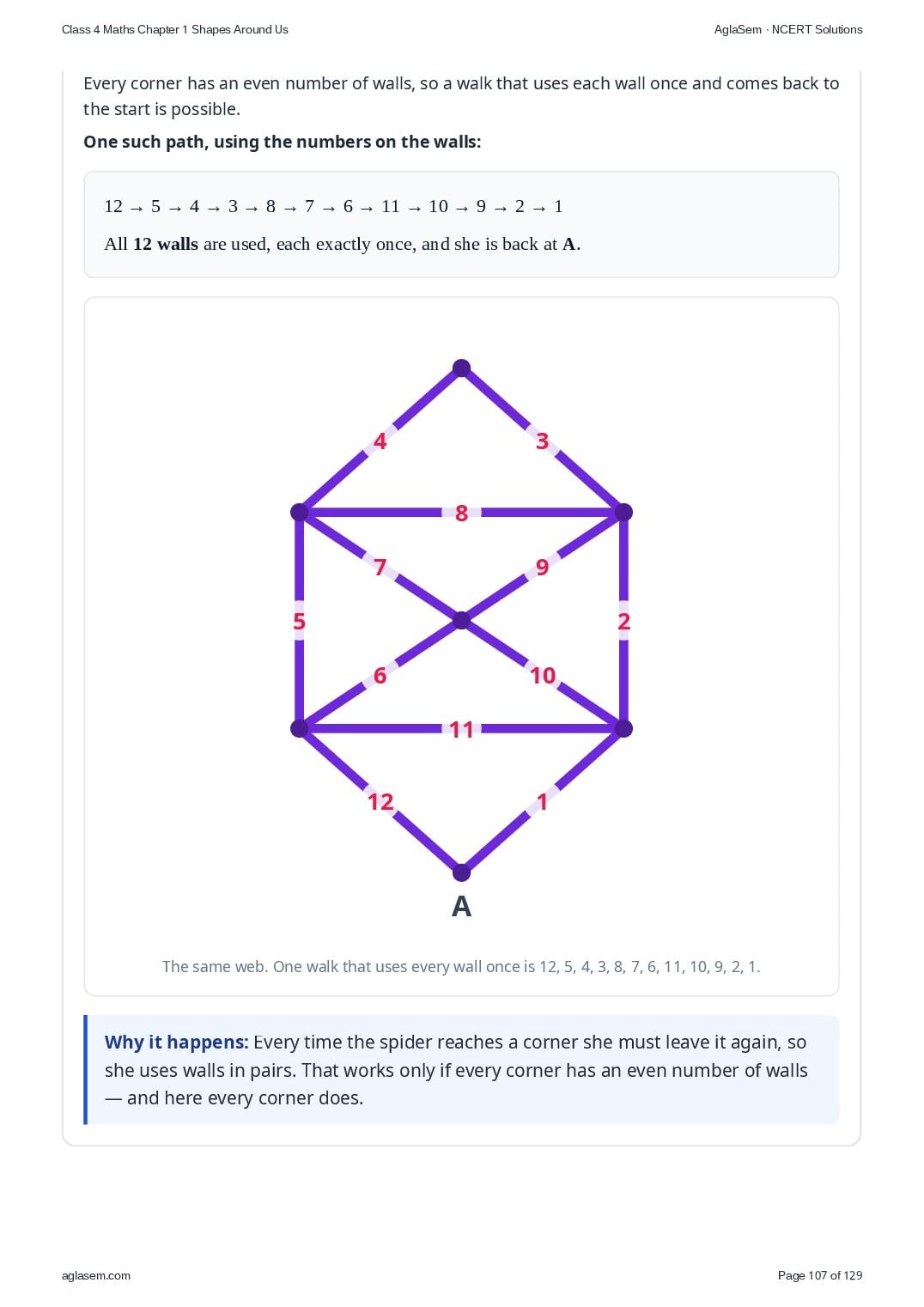
- How many triangles are in her web? 123456789101112ASquiggly’s triangular web. Its 12 walls are numbered 1 to 12 and the point A is at the bottom.
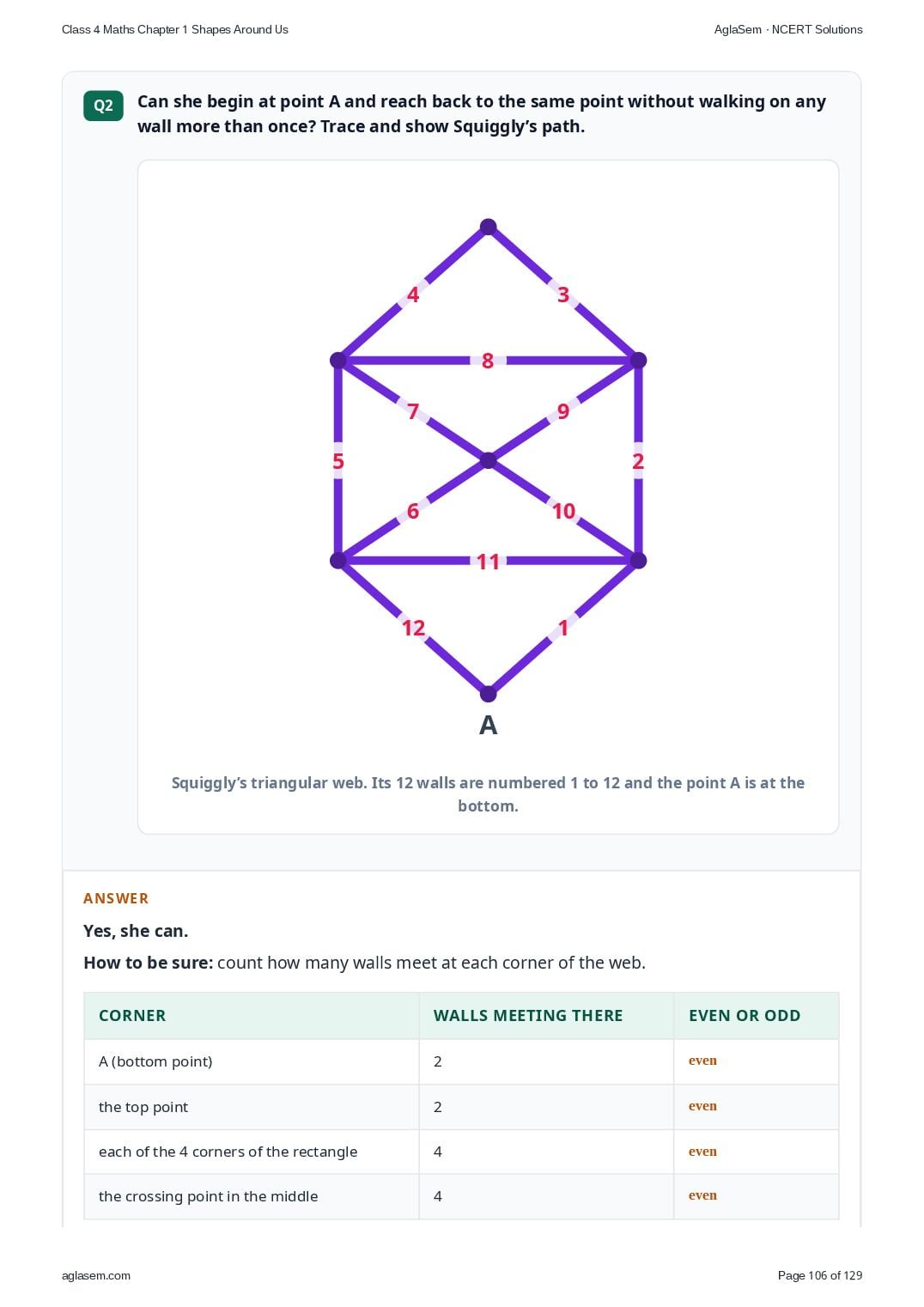
- Can she begin at point A and reach back to the same point without walking on any wall more than once? Trace and show Squiggly’s path. 123456789101112ASquiggly’s triangular web. Its 12 walls are numbered 1 to 12 and the point A is at the bottom.
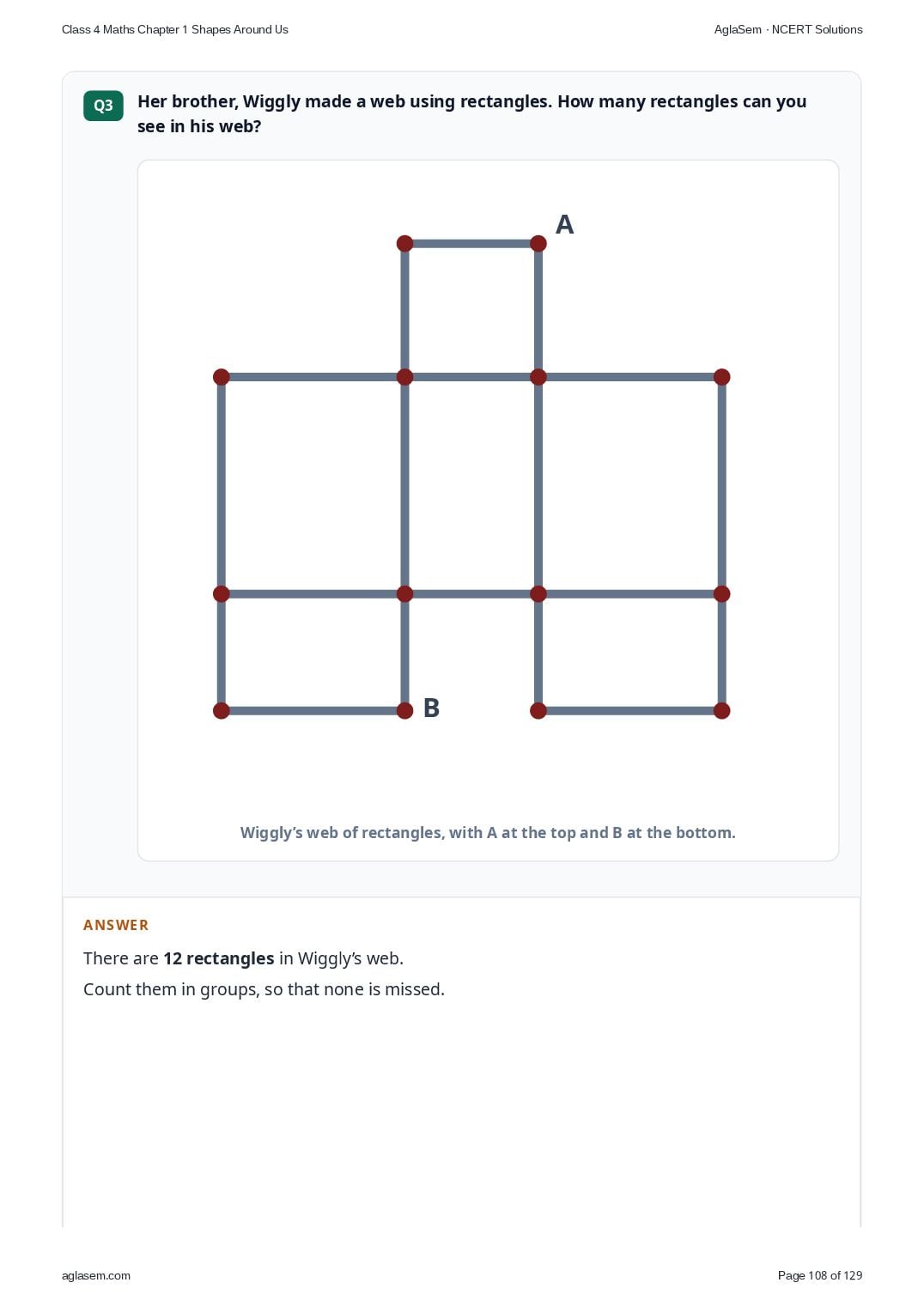
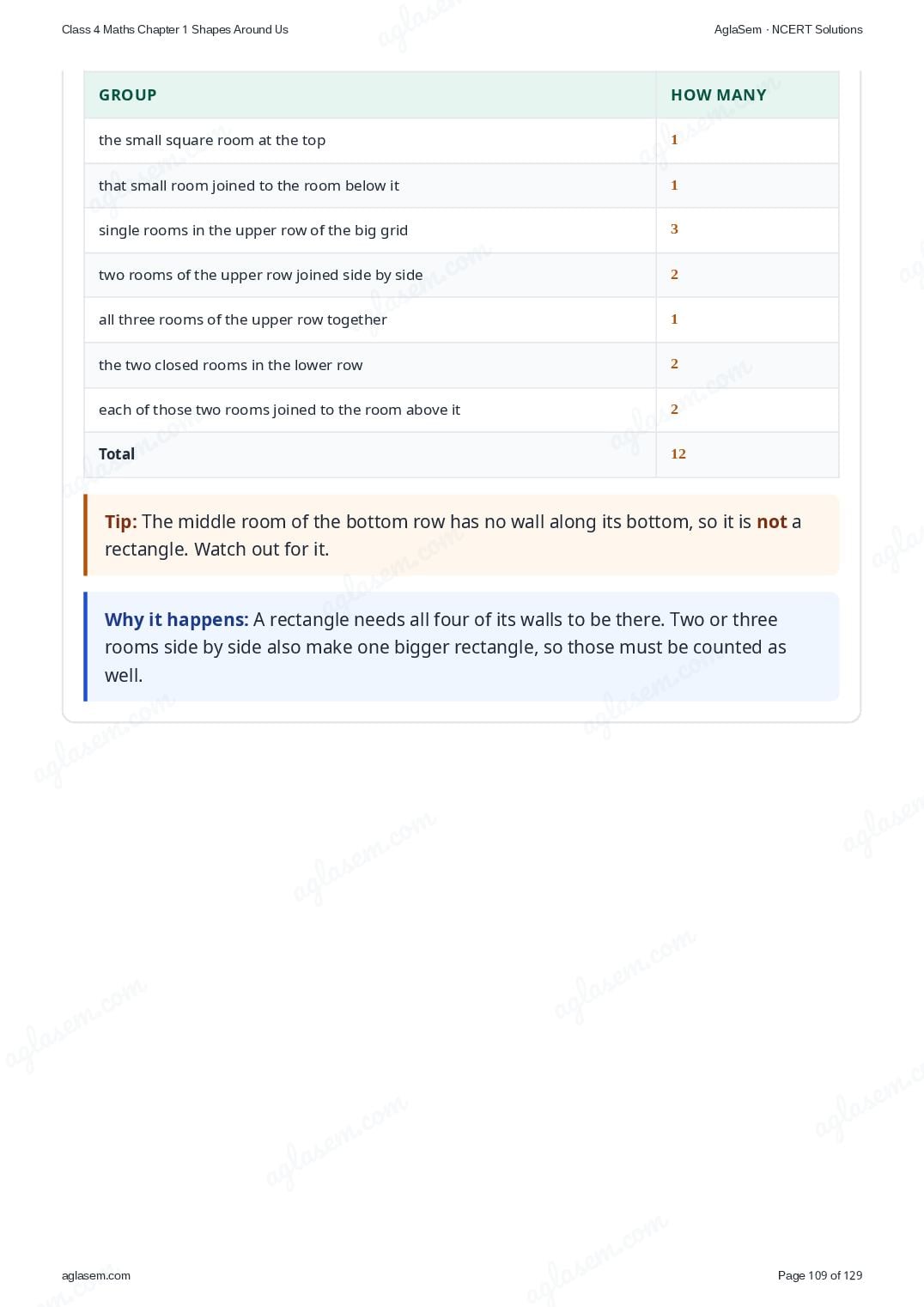
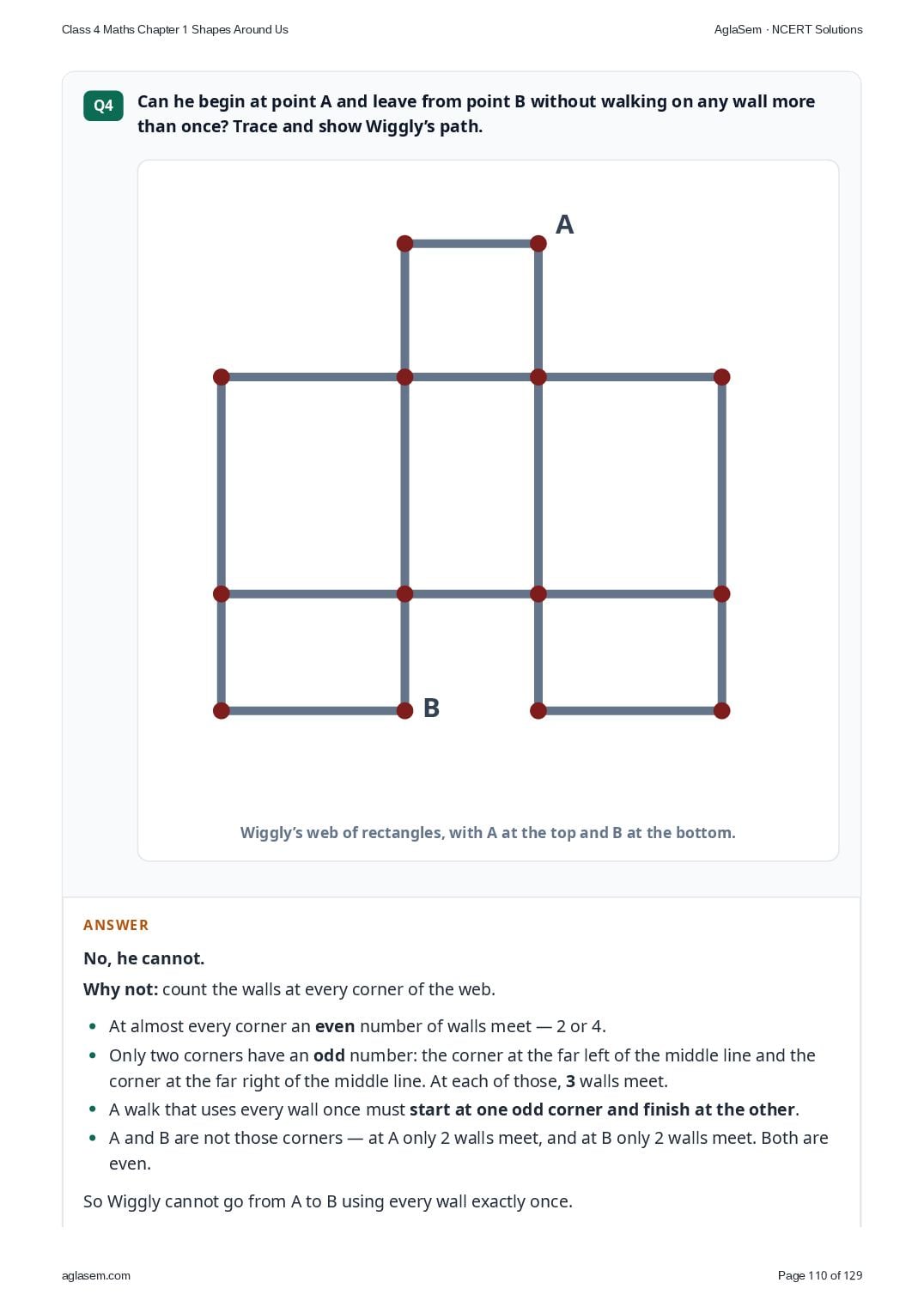
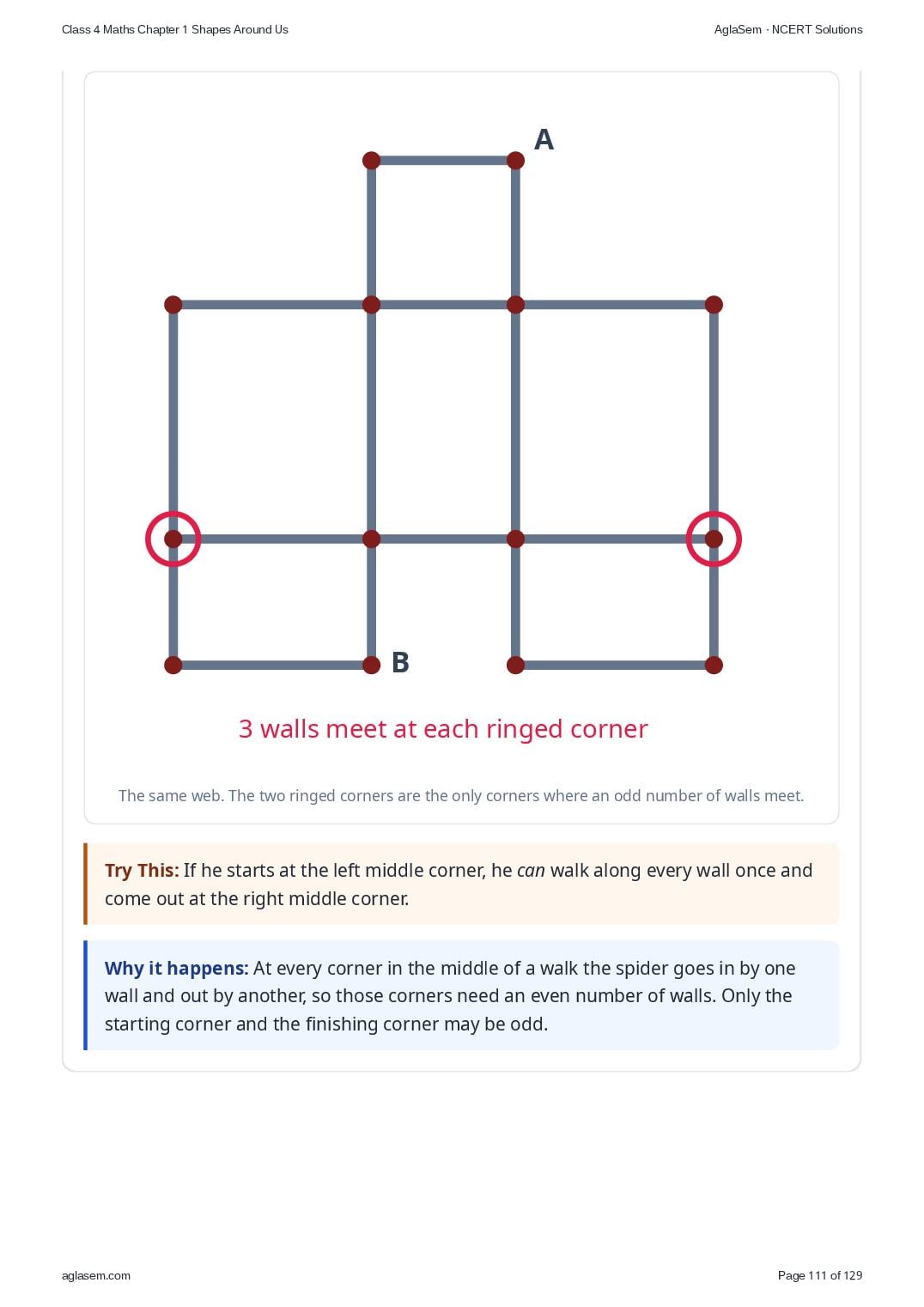
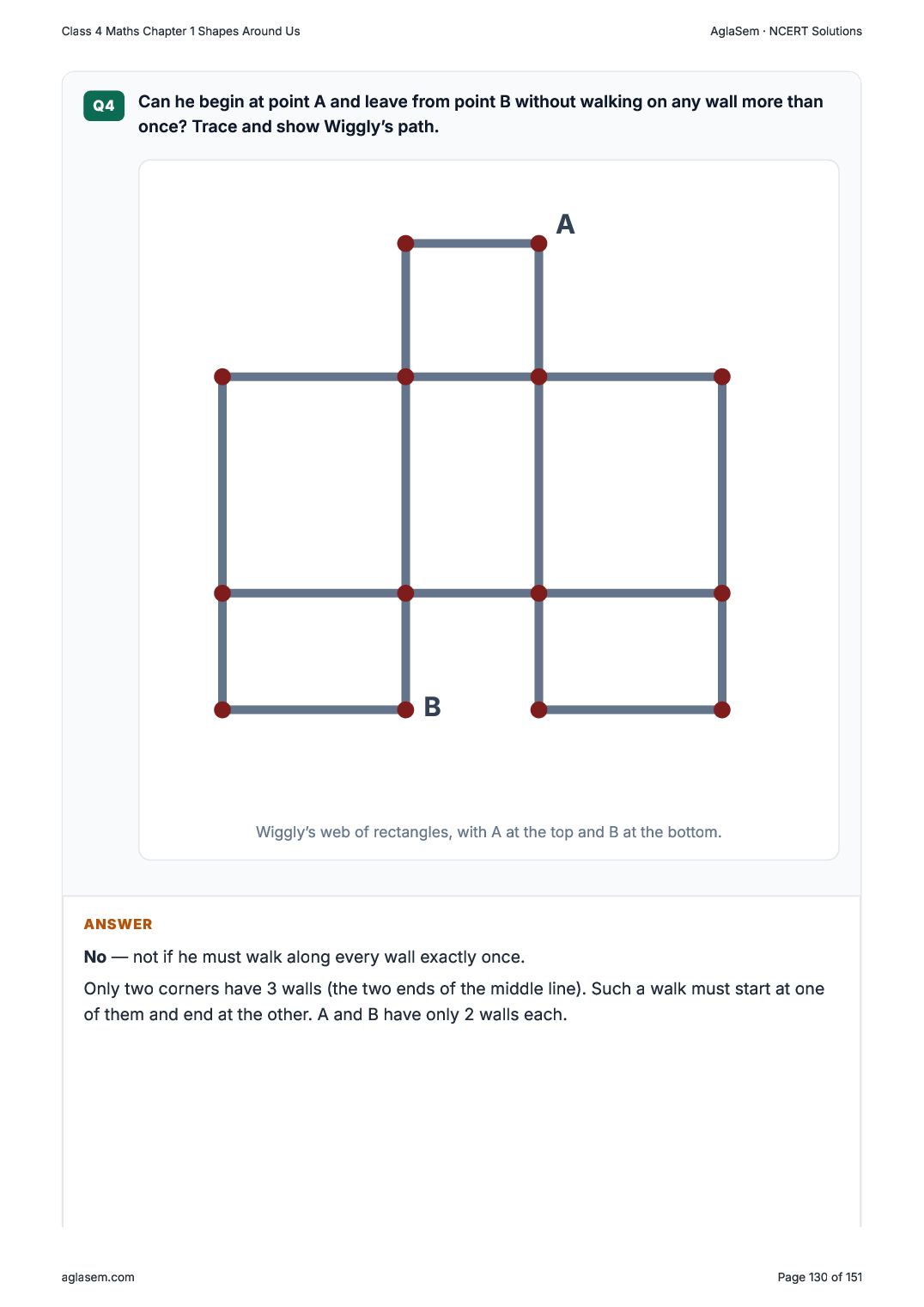
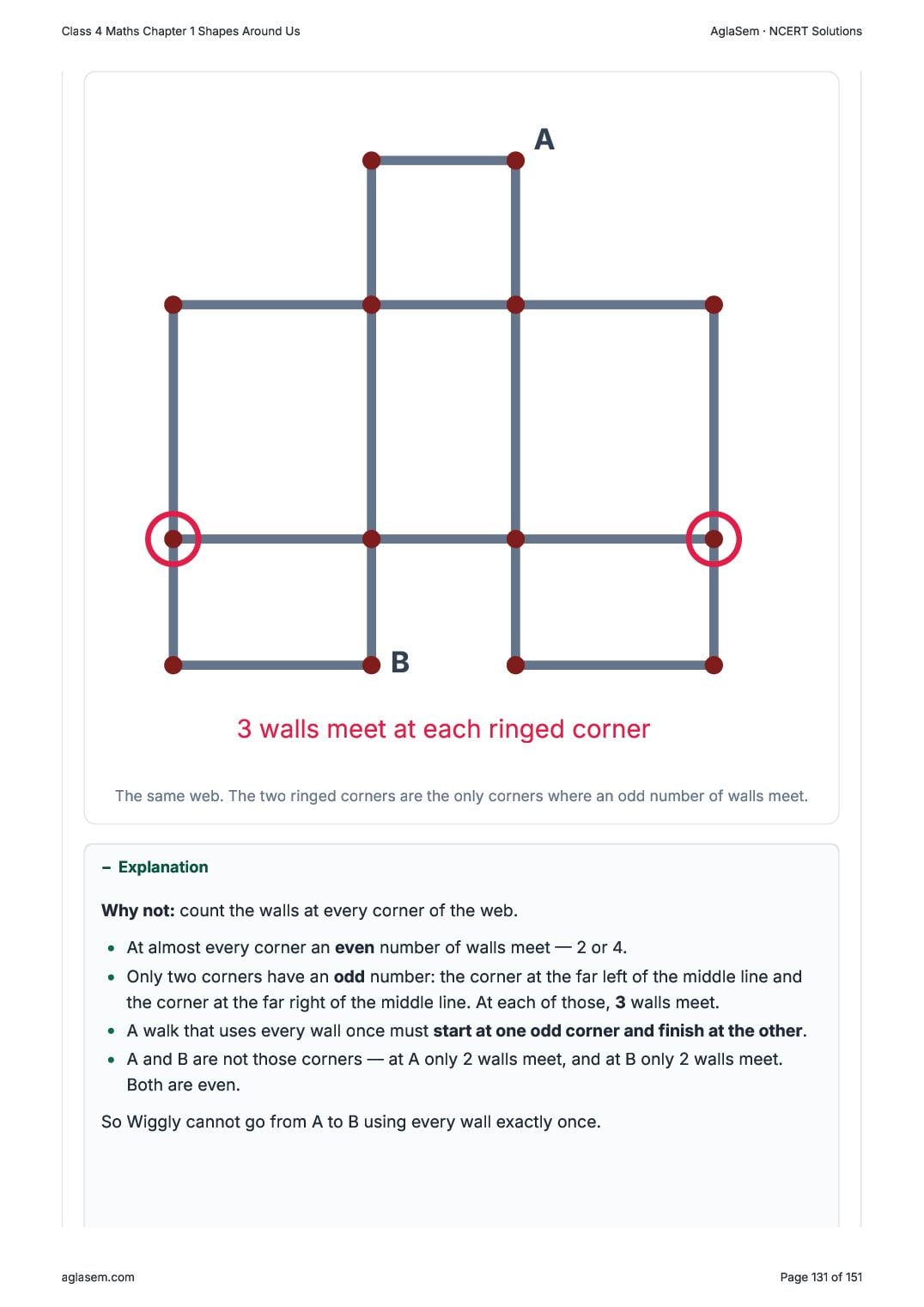
- Her brother, Wiggly made a web using rectangles. How many rectangles can you see in his web? ABWiggly’s web of rectangles, with A at the top and B at the bottom.
- Can he begin at point A and leave from point B without walking on any wall more than once? Trace and show Wiggly’s path. ABWiggly’s web of rectangles, with A at the top and B at the bottom.
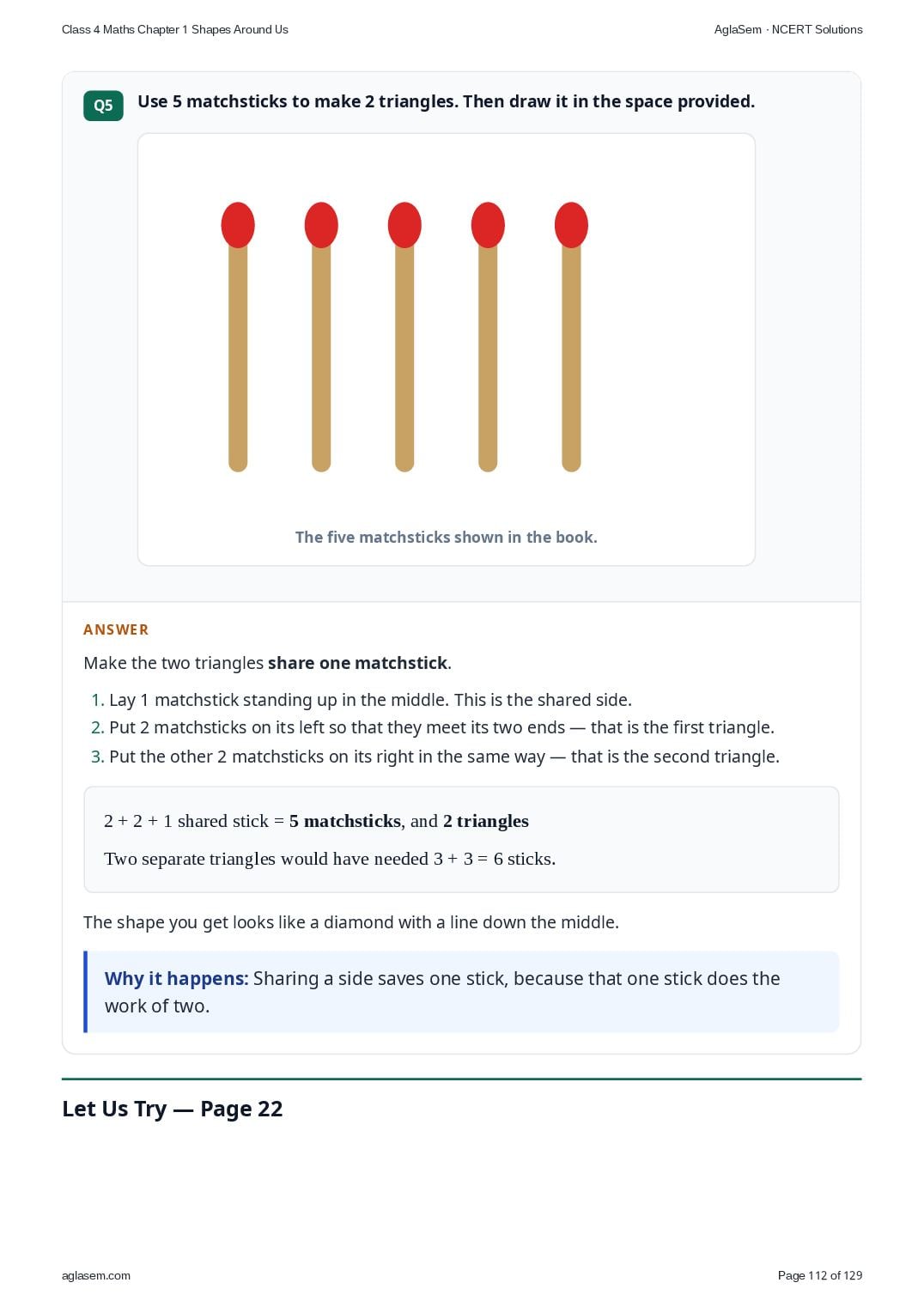
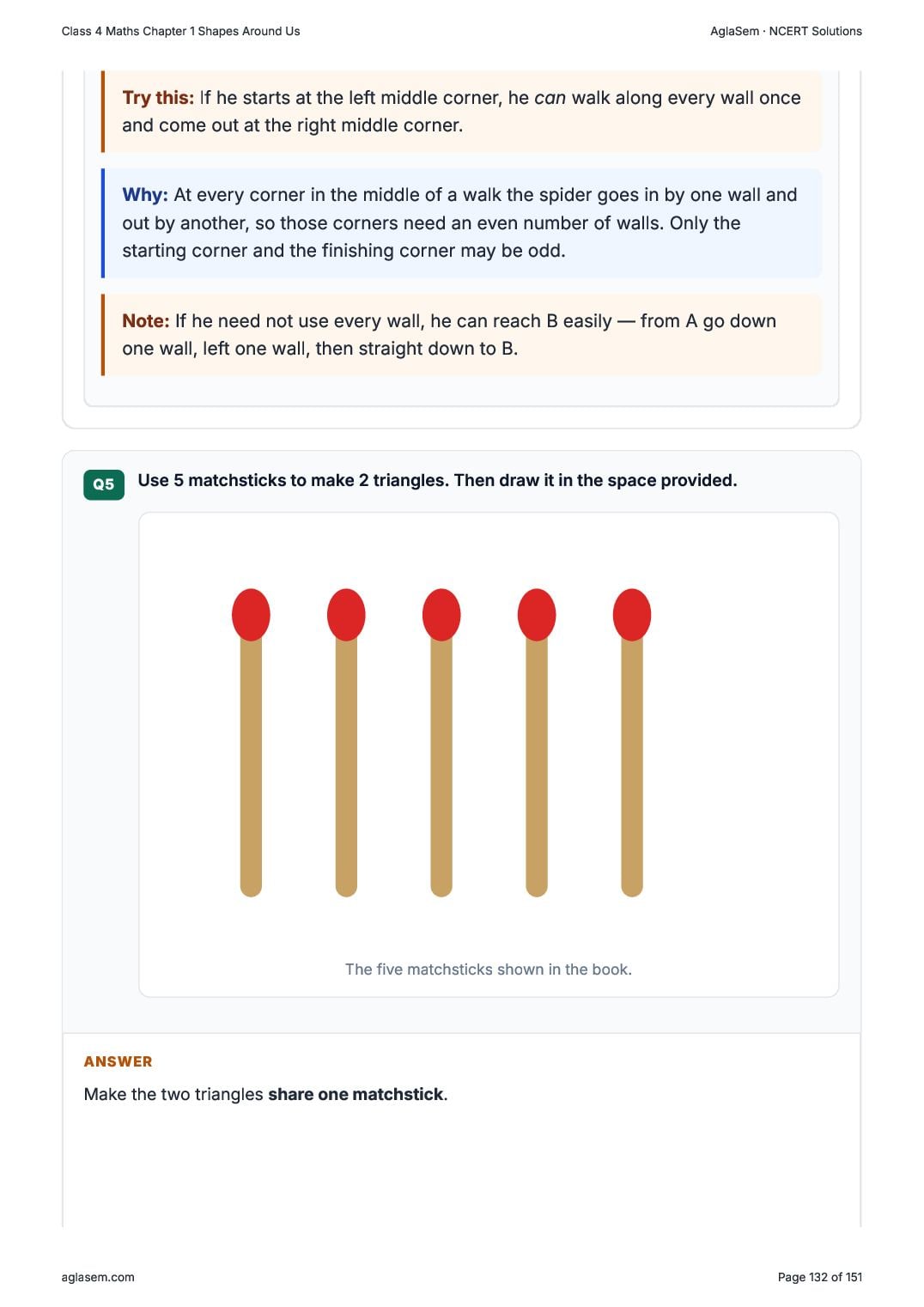
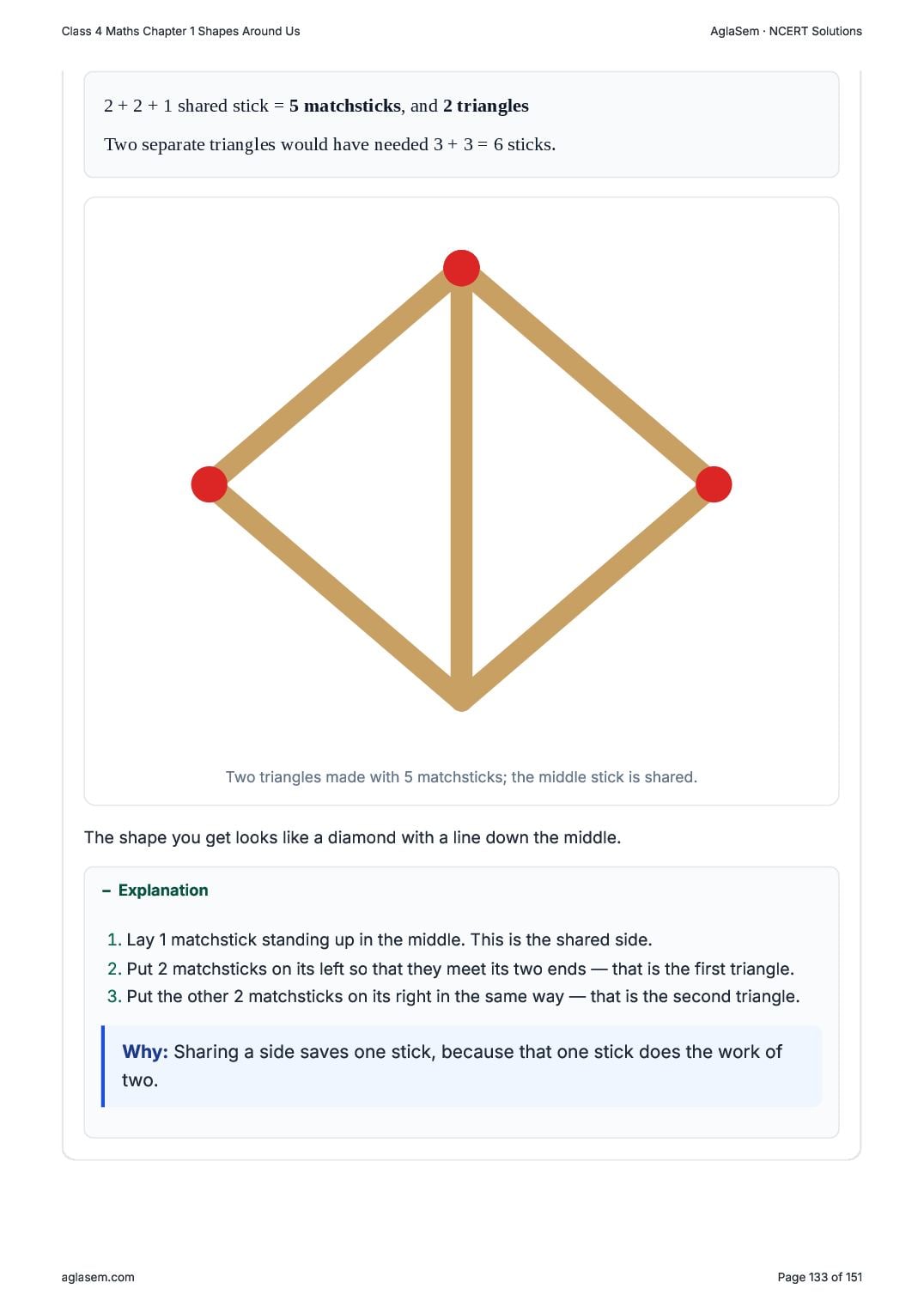
- Use 5 matchsticks to make 2 triangles. Then draw it in the space provided. The five matchsticks shown in the book.
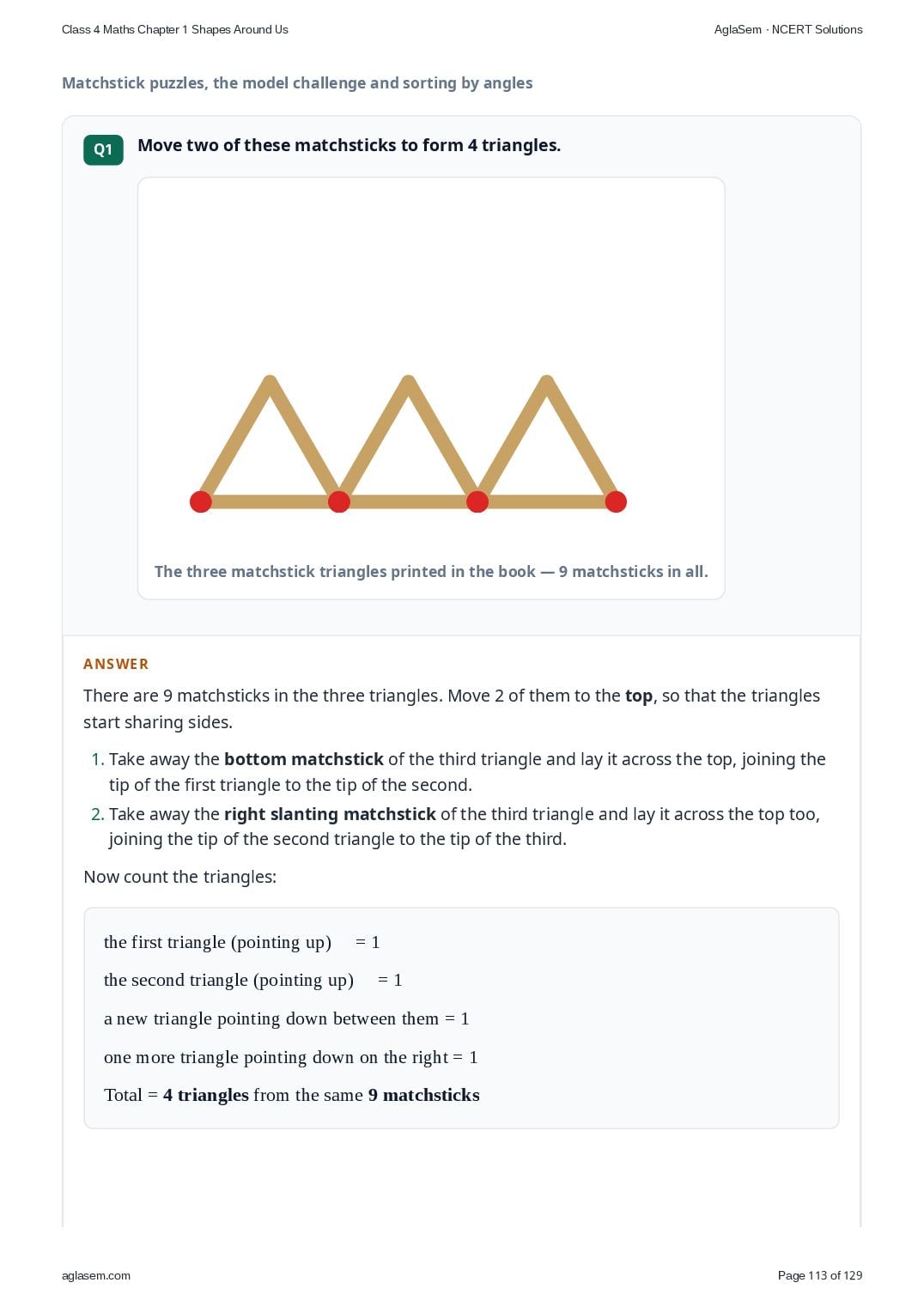
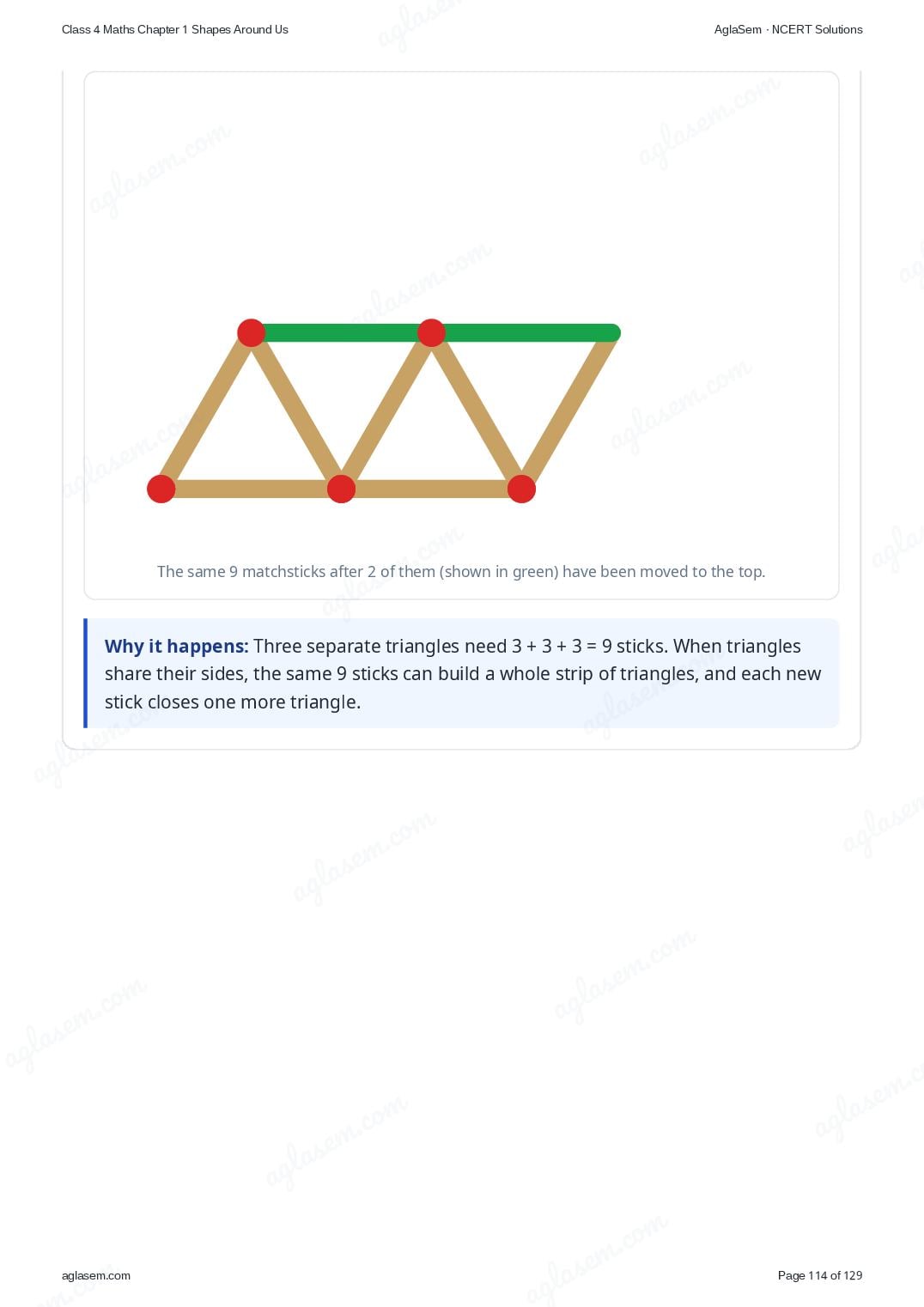
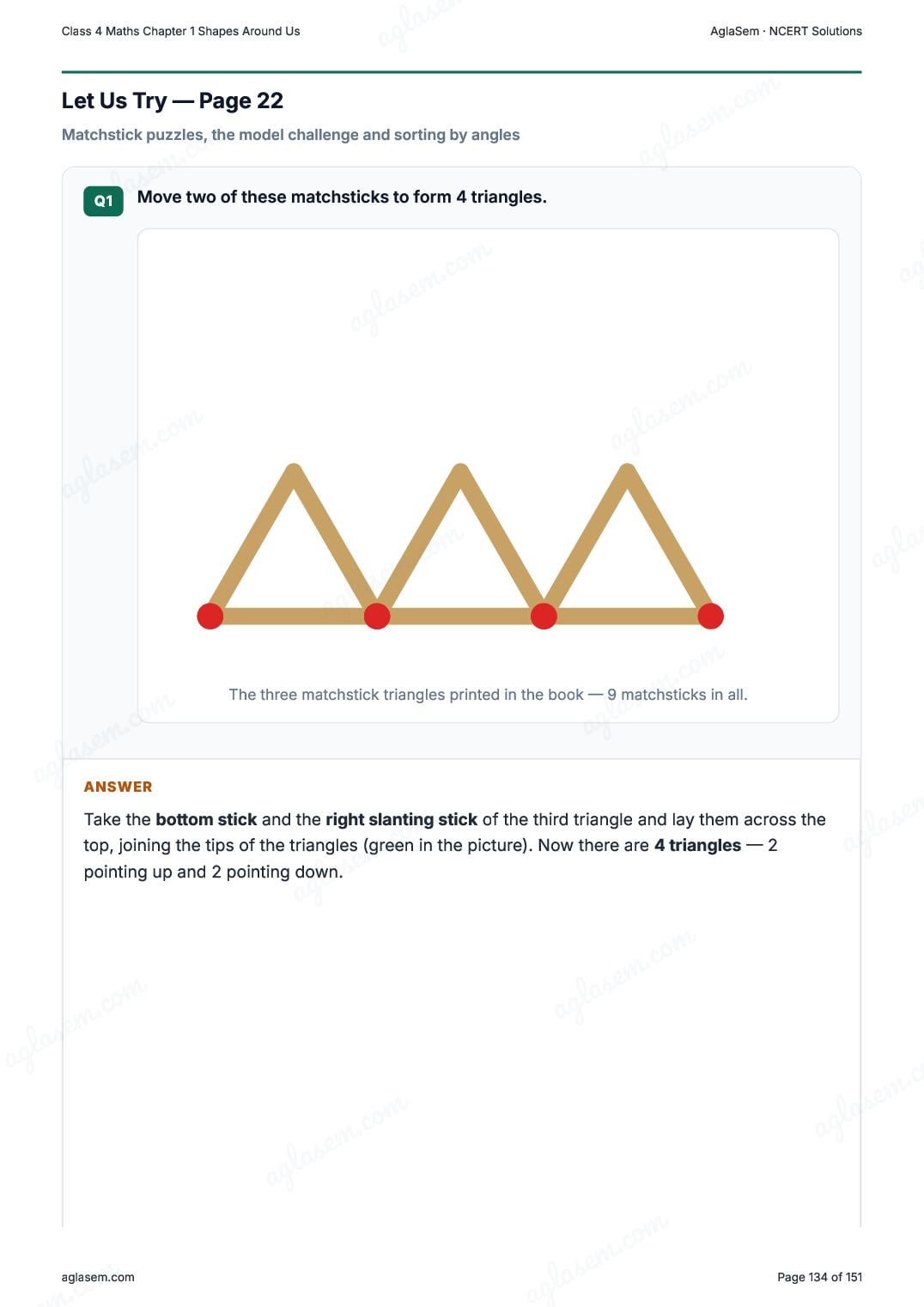
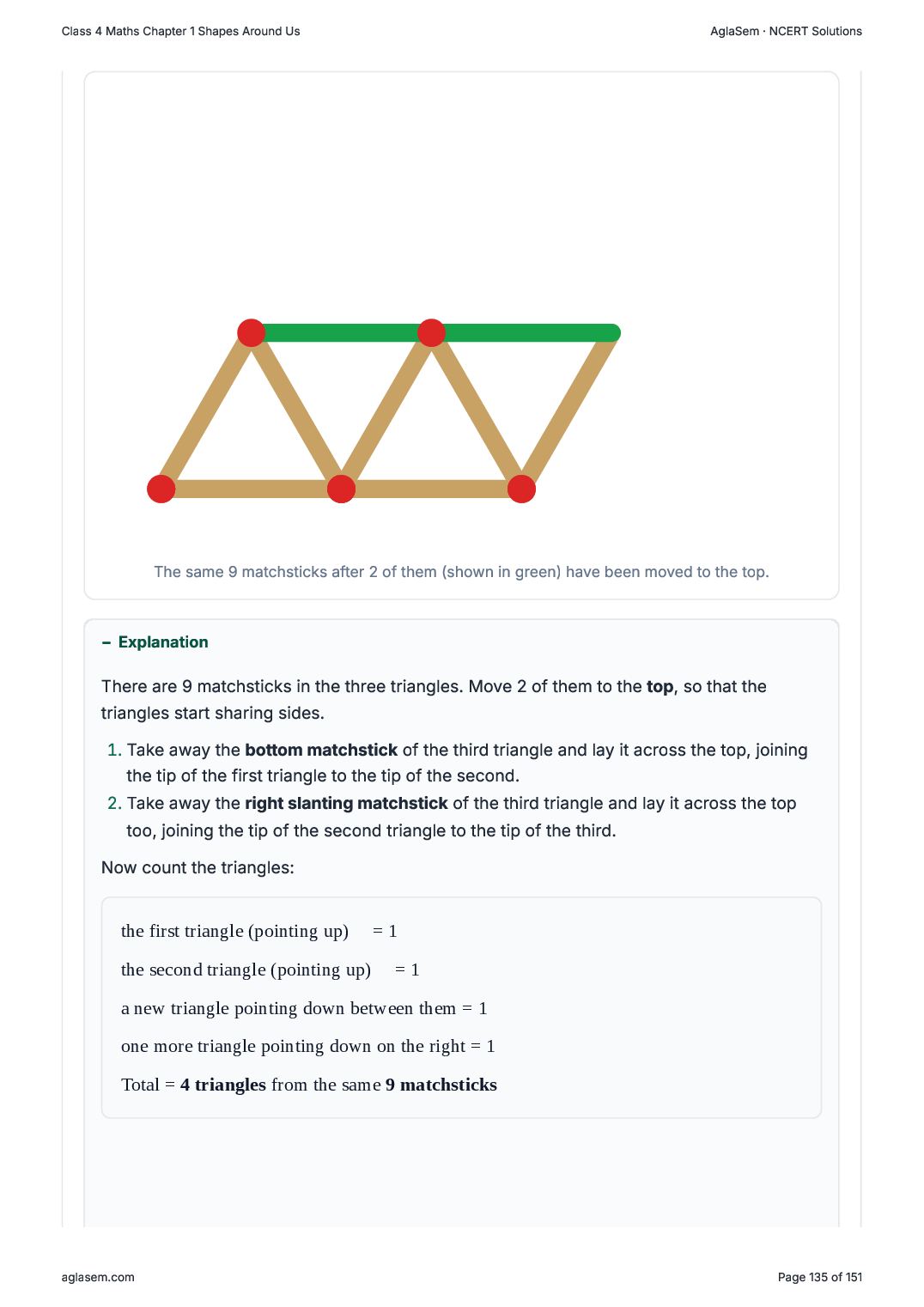
- Move two of these matchsticks to form 4 triangles. The three matchstick triangles printed in the book — 9 matchsticks in all.
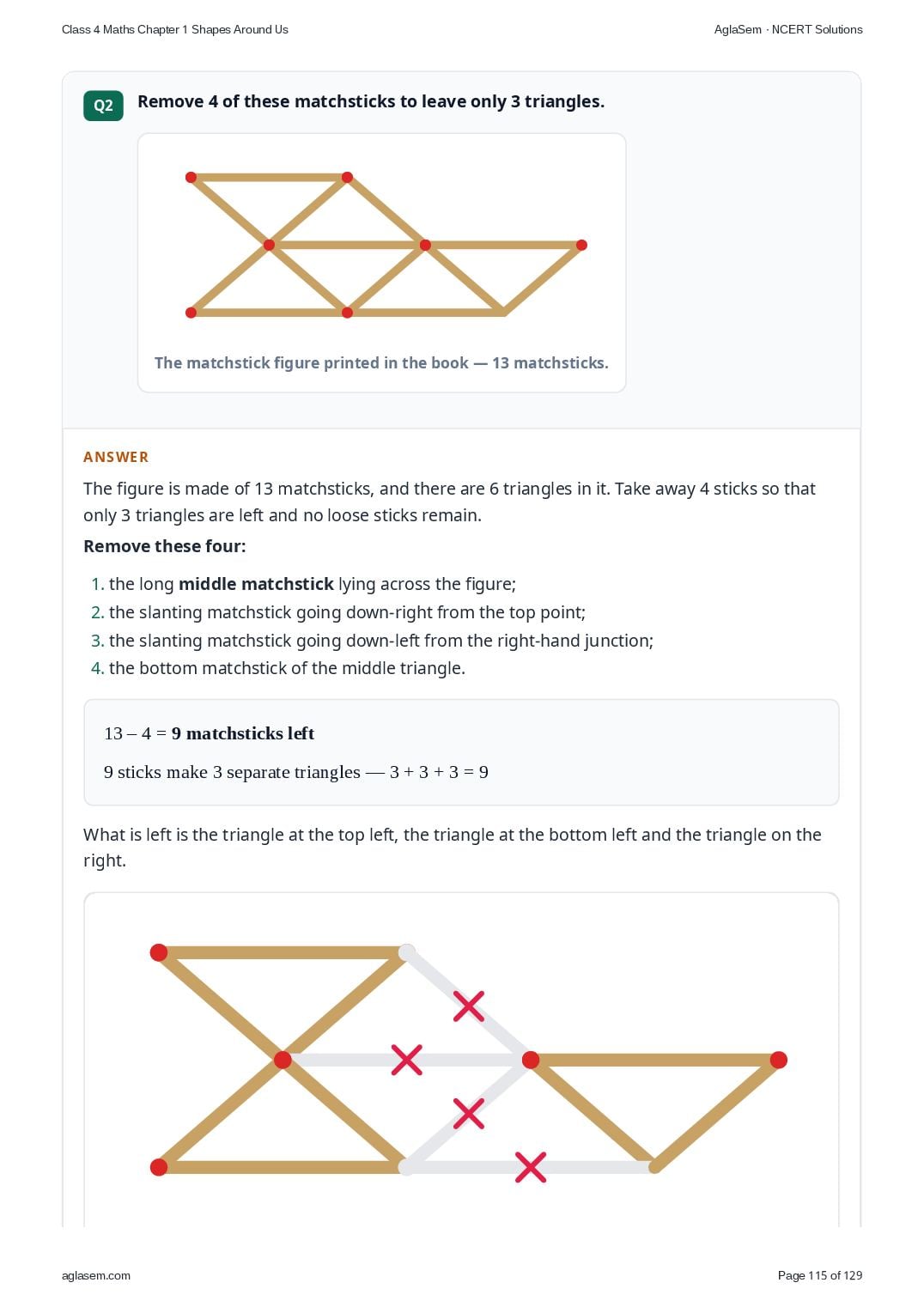
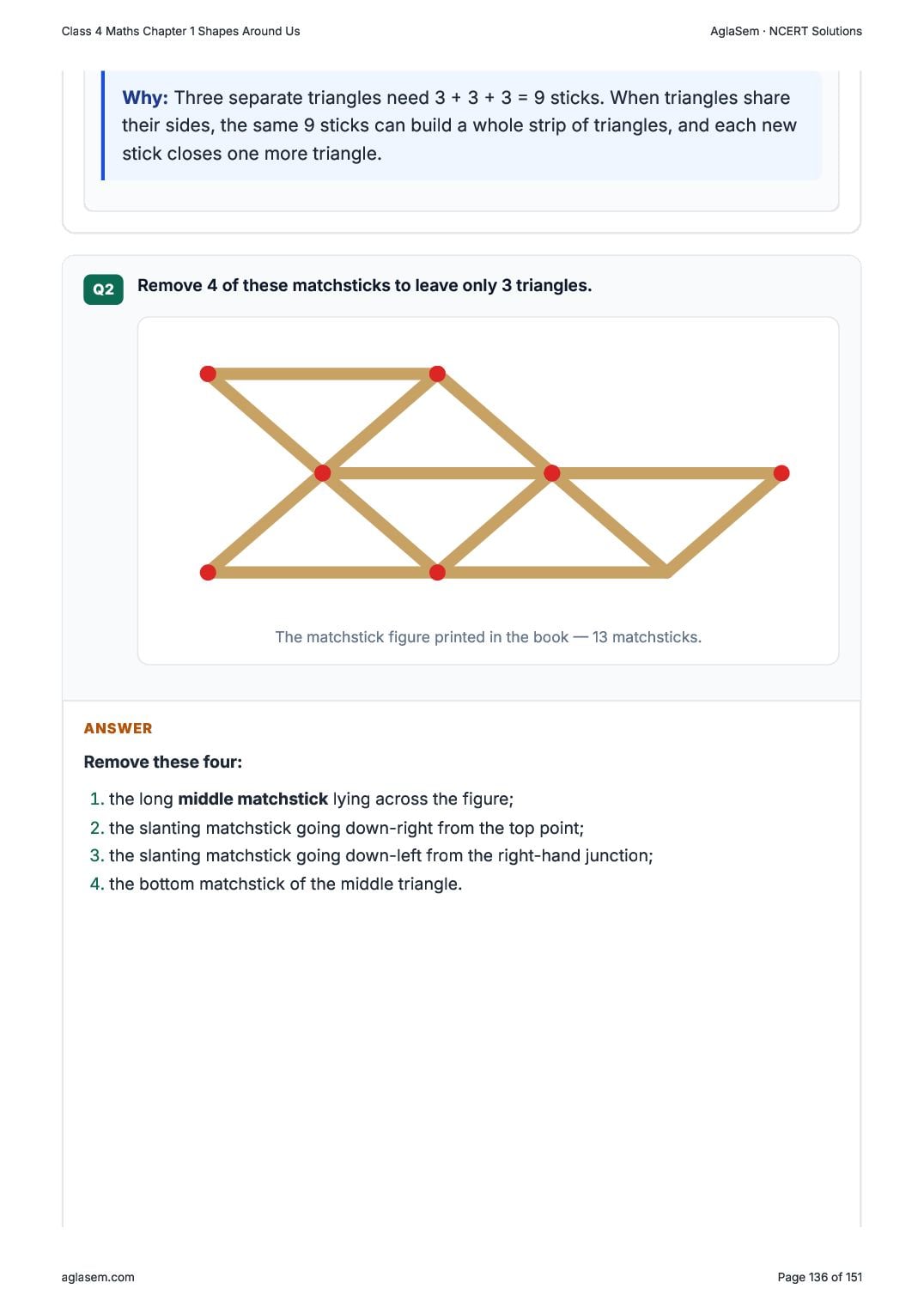
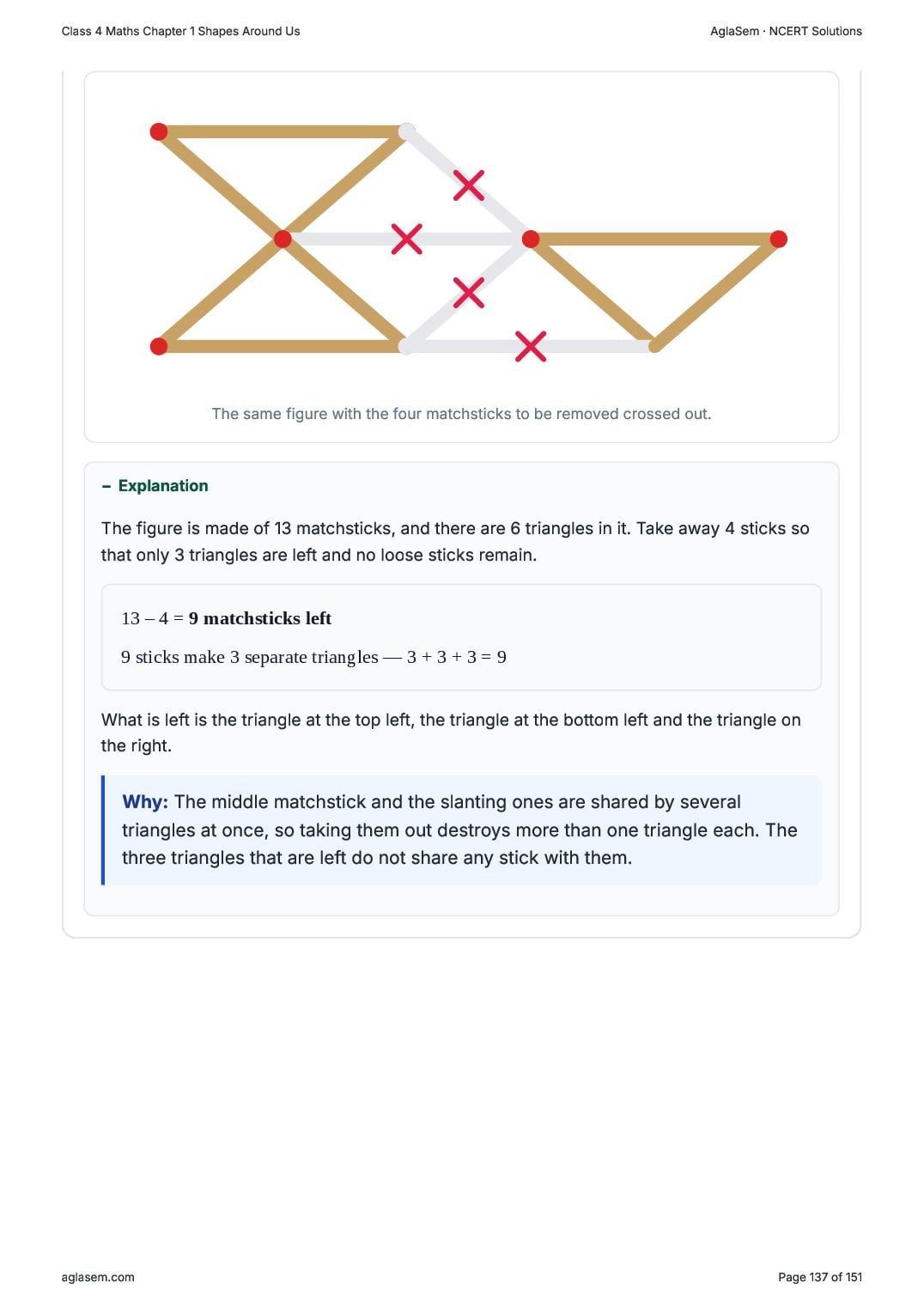
- Remove 4 of these matchsticks to leave only 3 triangles. The matchstick figure printed in the book — 13 matchsticks.
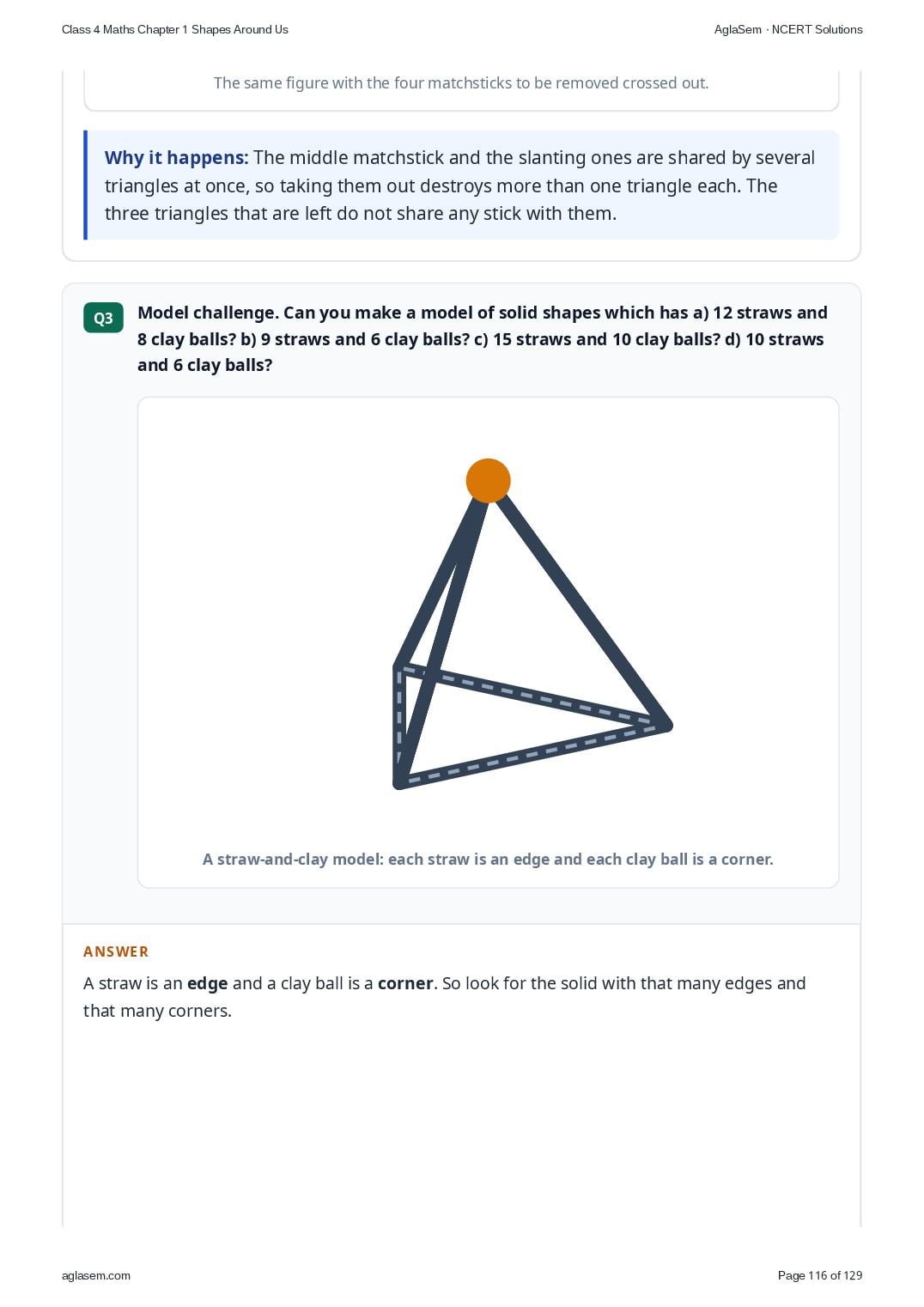
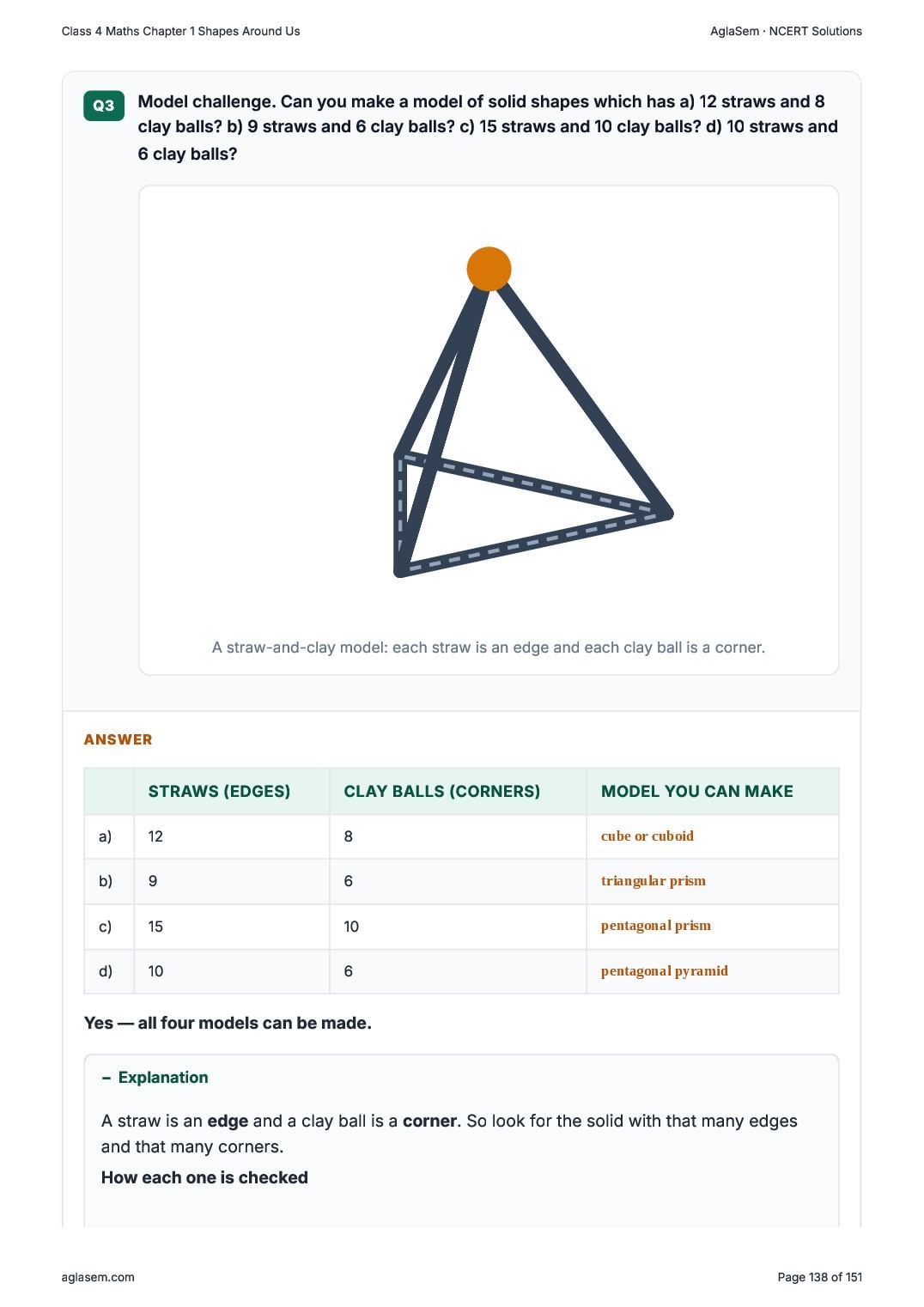
- Model challenge. Can you make a model of solid shapes which has a) 12 straws and 8 clay balls? b) 9 straws and 6 clay balls? c) 15 straws and 10 clay balls? d) 10 straws and 6 clay balls? A straw-and-clay model: each straw is an edge and each clay ball is a corner.
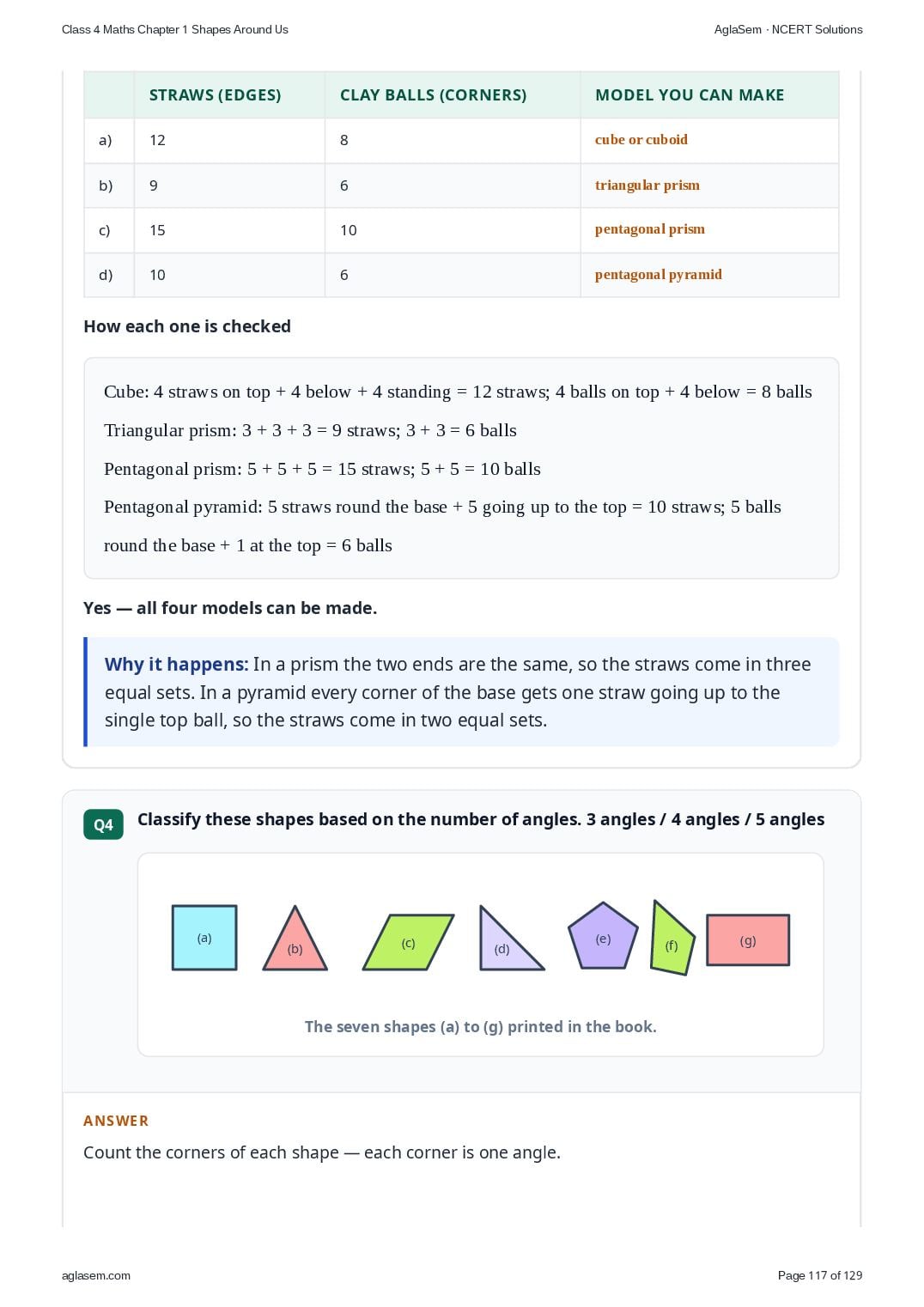
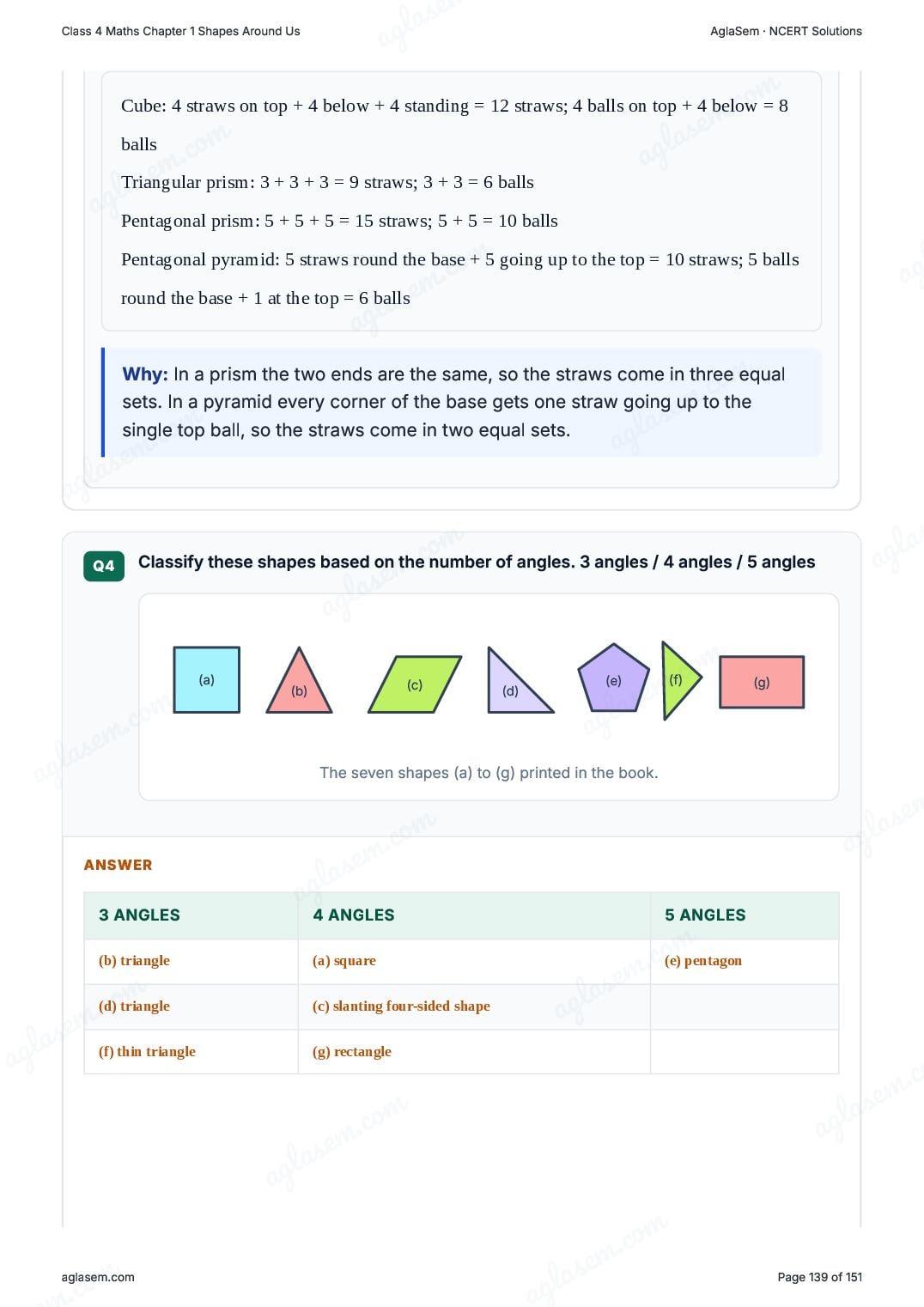
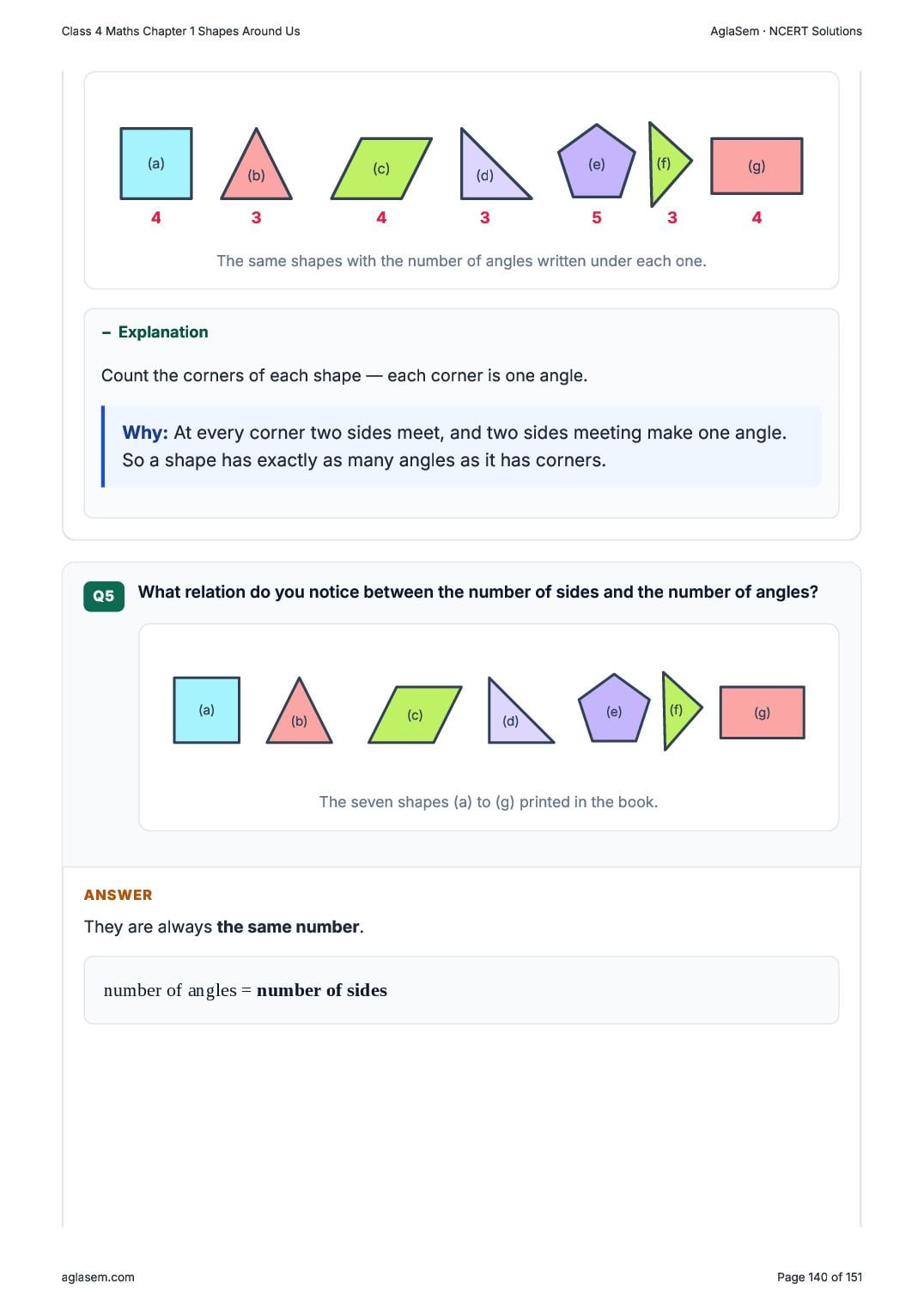
- Classify these shapes based on the number of angles. 3 angles / 4 angles / 5 angles (a)(b)(c)(d)(e)(f)(g)The seven shapes (a) to (g) printed in the book.
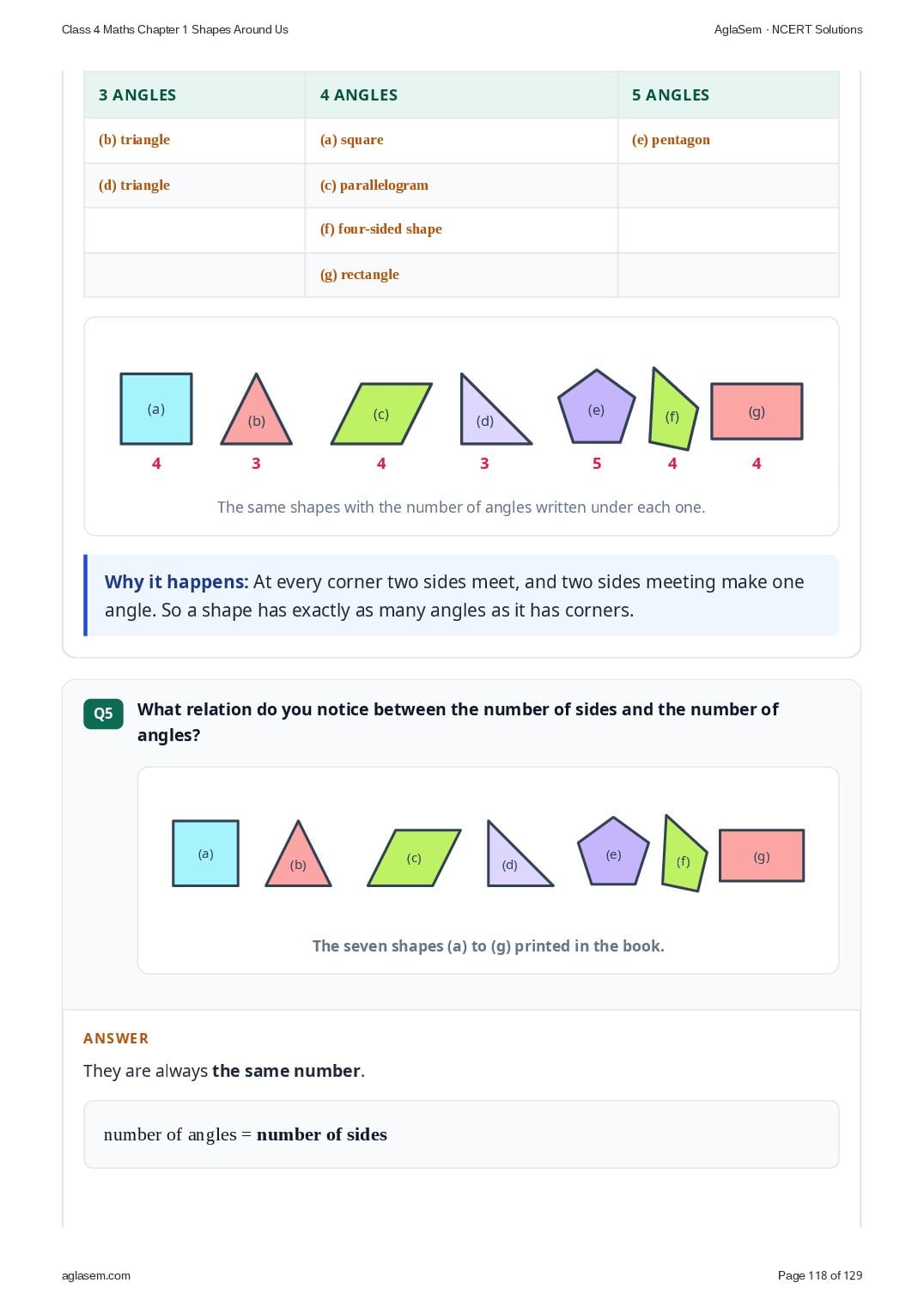
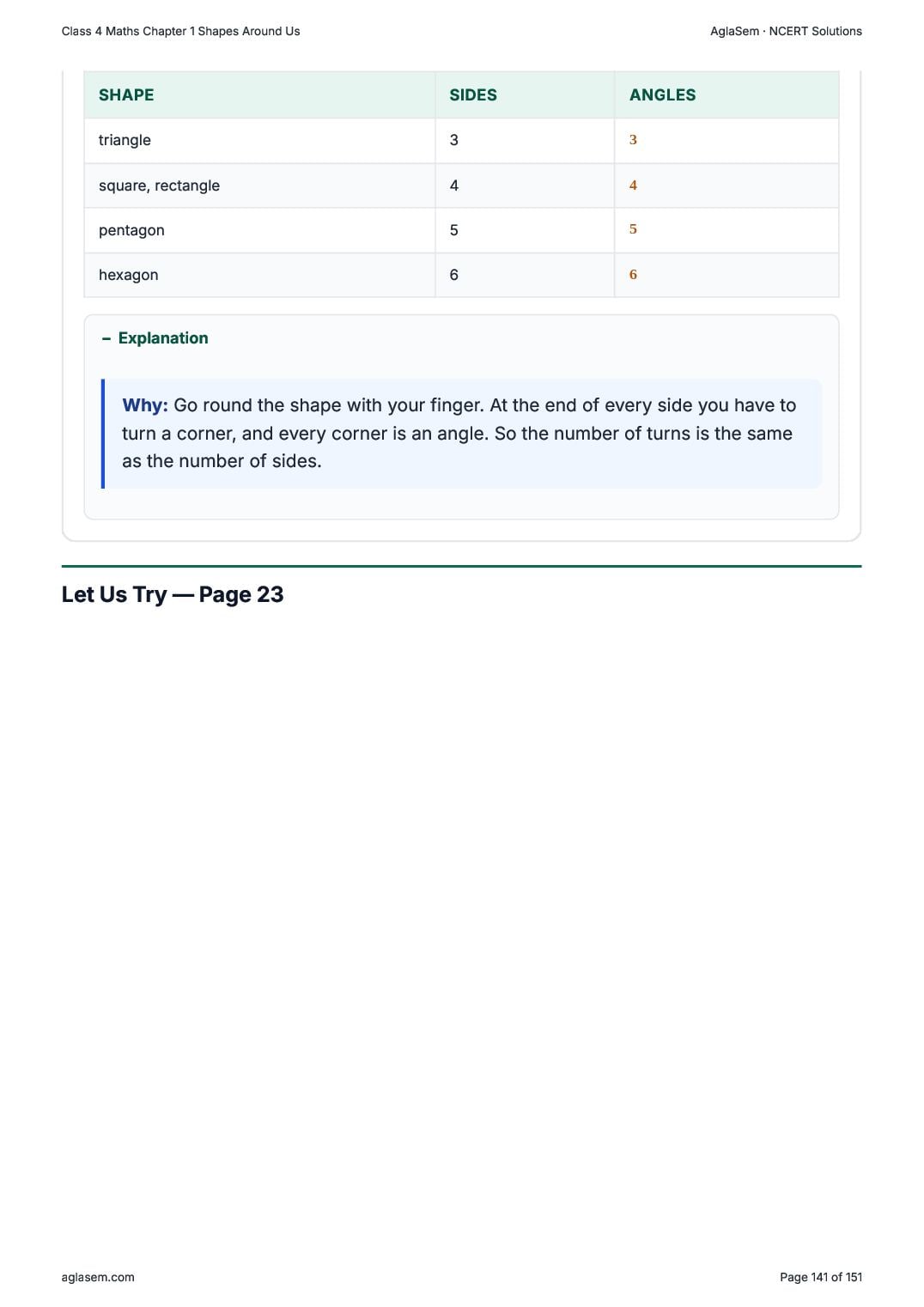
- What relation do you notice between the number of sides and the number of angles? (a)(b)(c)(d)(e)(f)(g)The seven shapes (a) to (g) printed in the book.
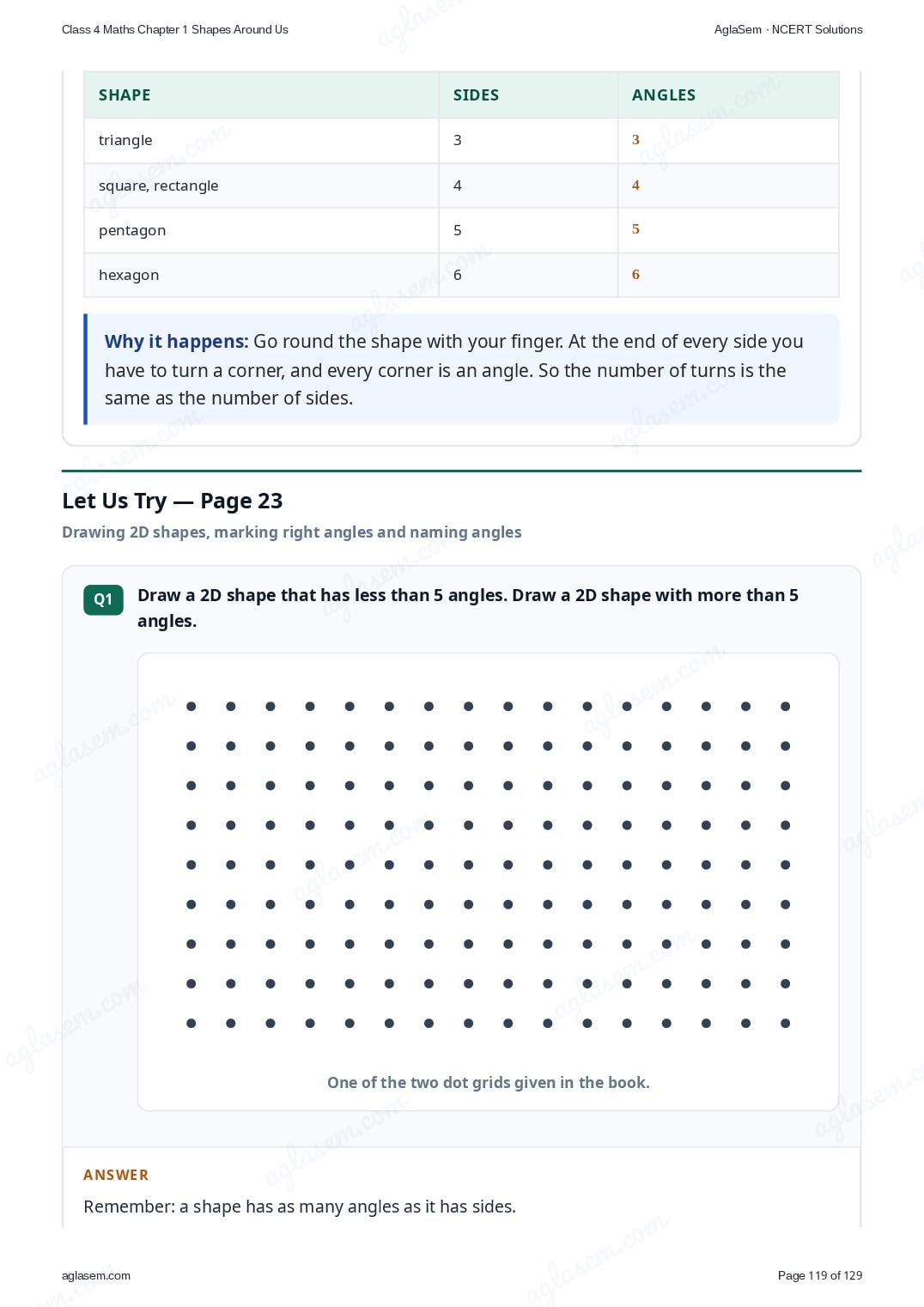
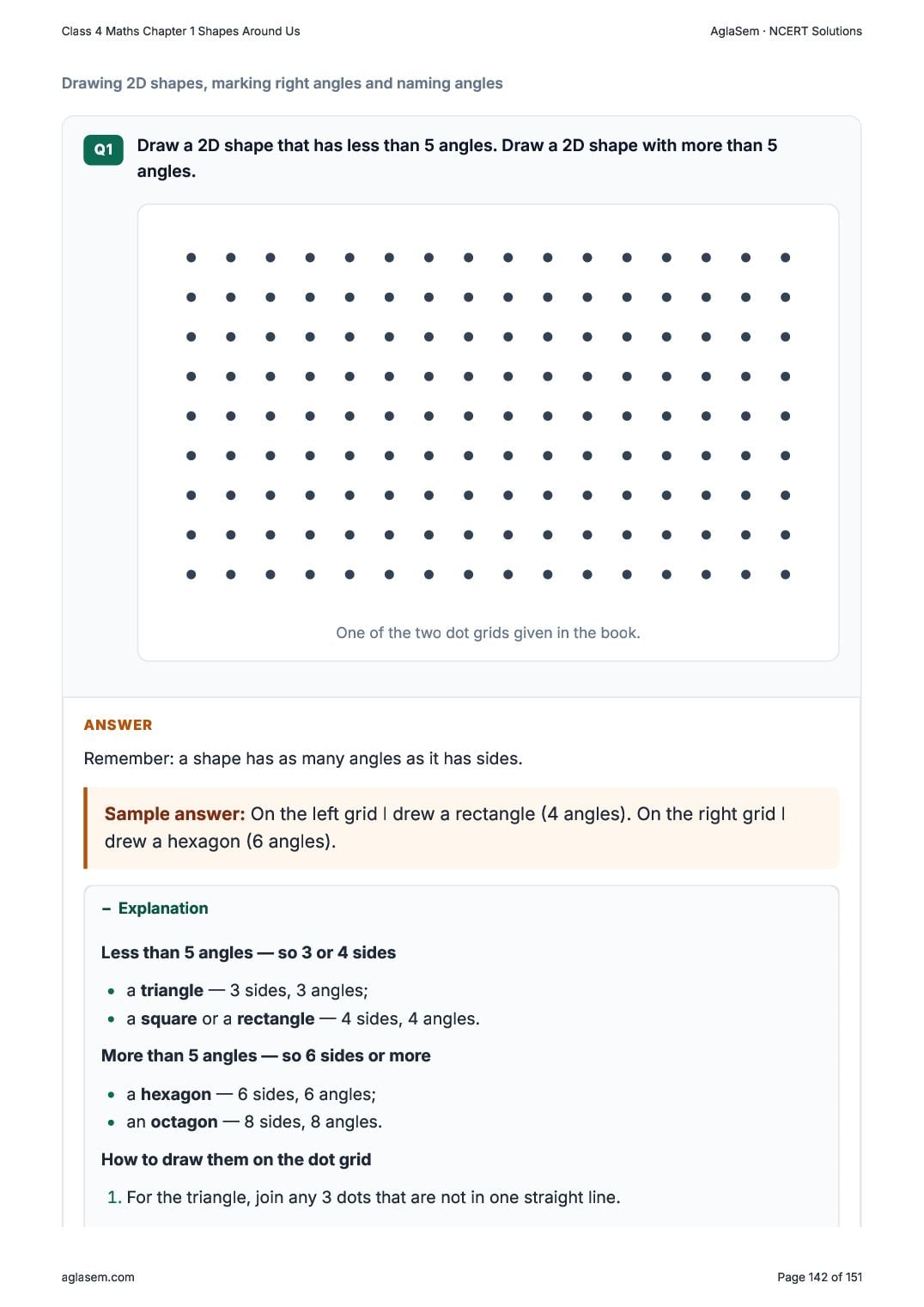
- Draw a 2D shape that has less than 5 angles. Draw a 2D shape with more than 5 angles. One of the two dot grids given in the book.
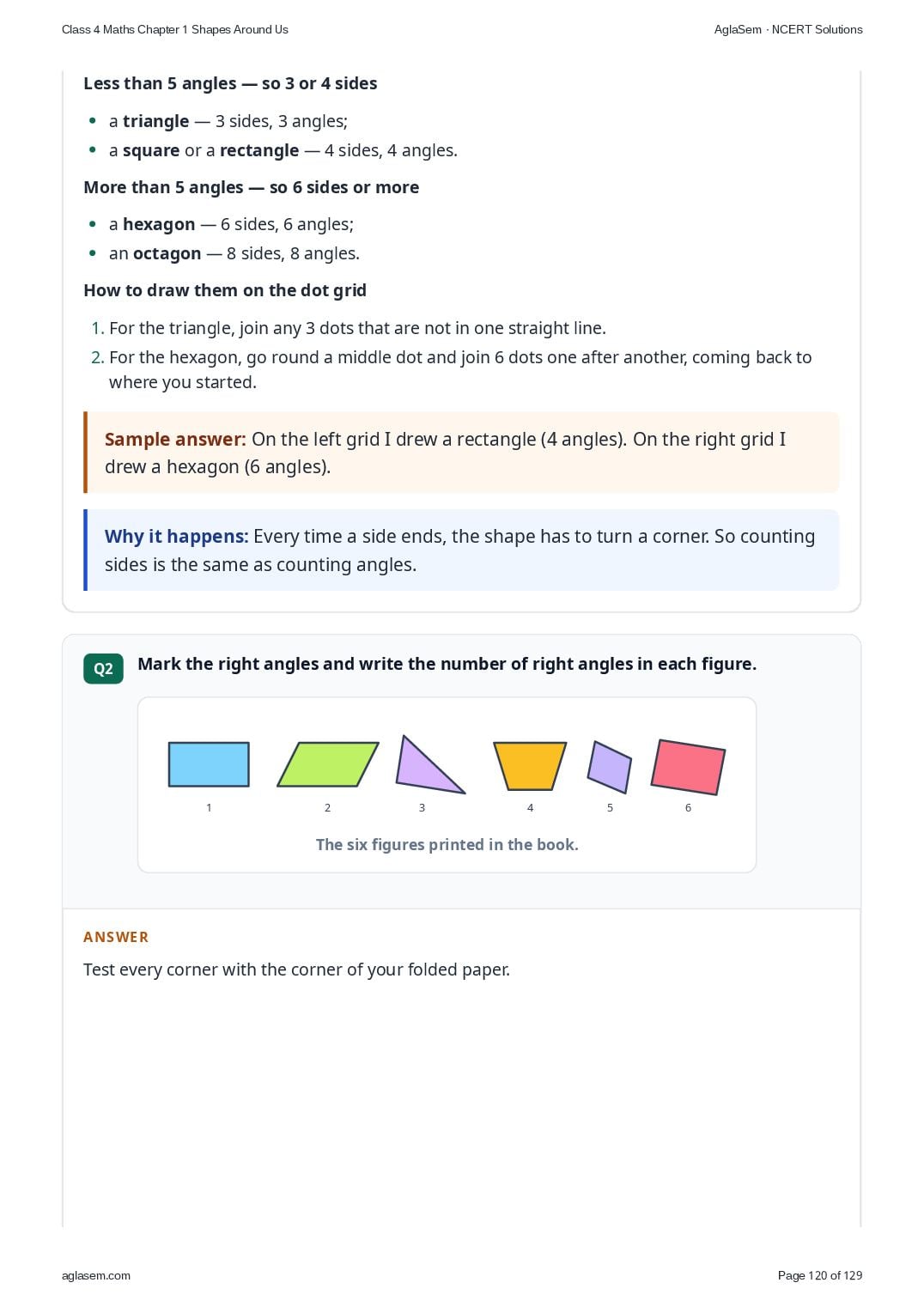
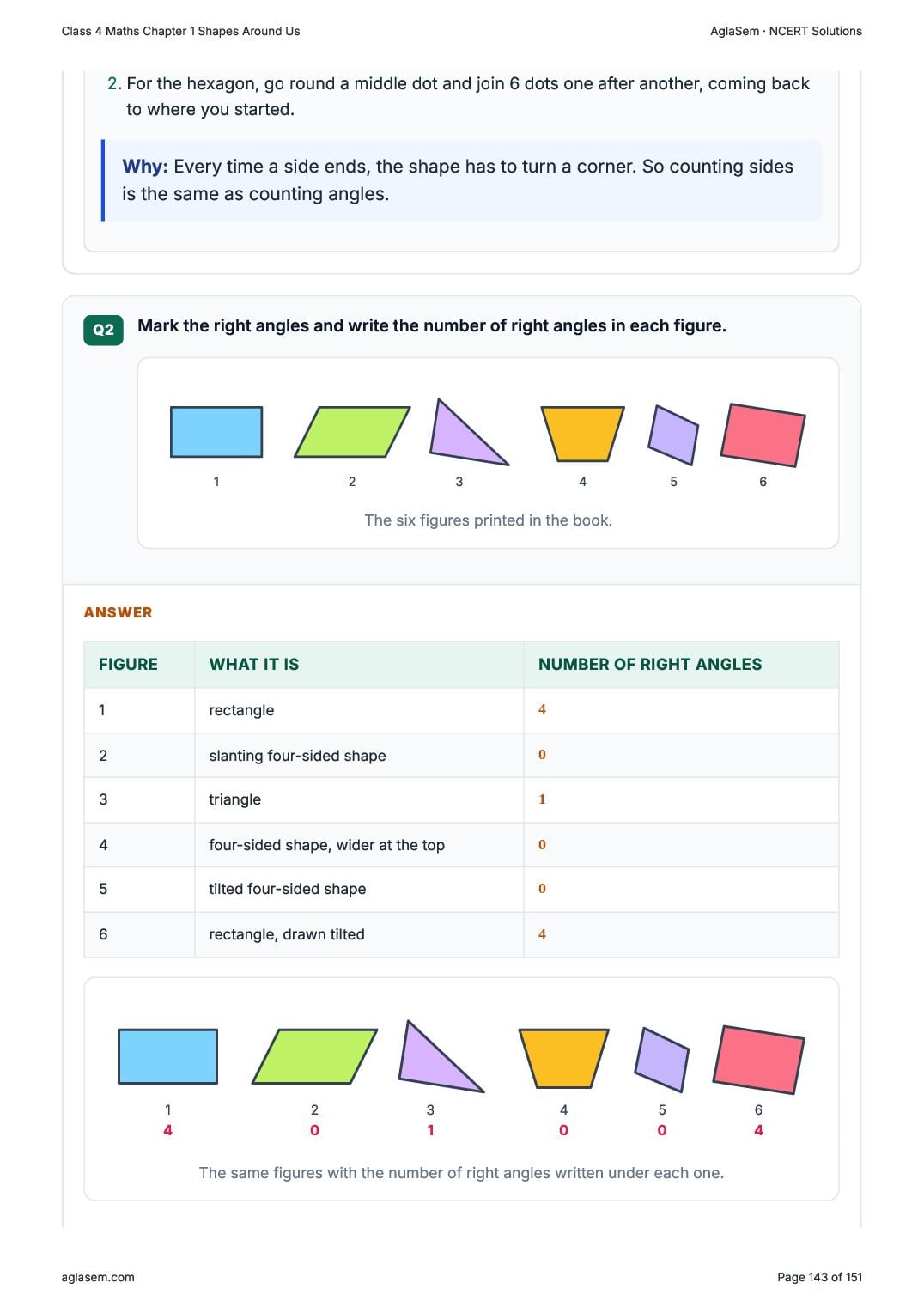
- Mark the right angles and write the number of right angles in each figure. 123456The six figures printed in the book.
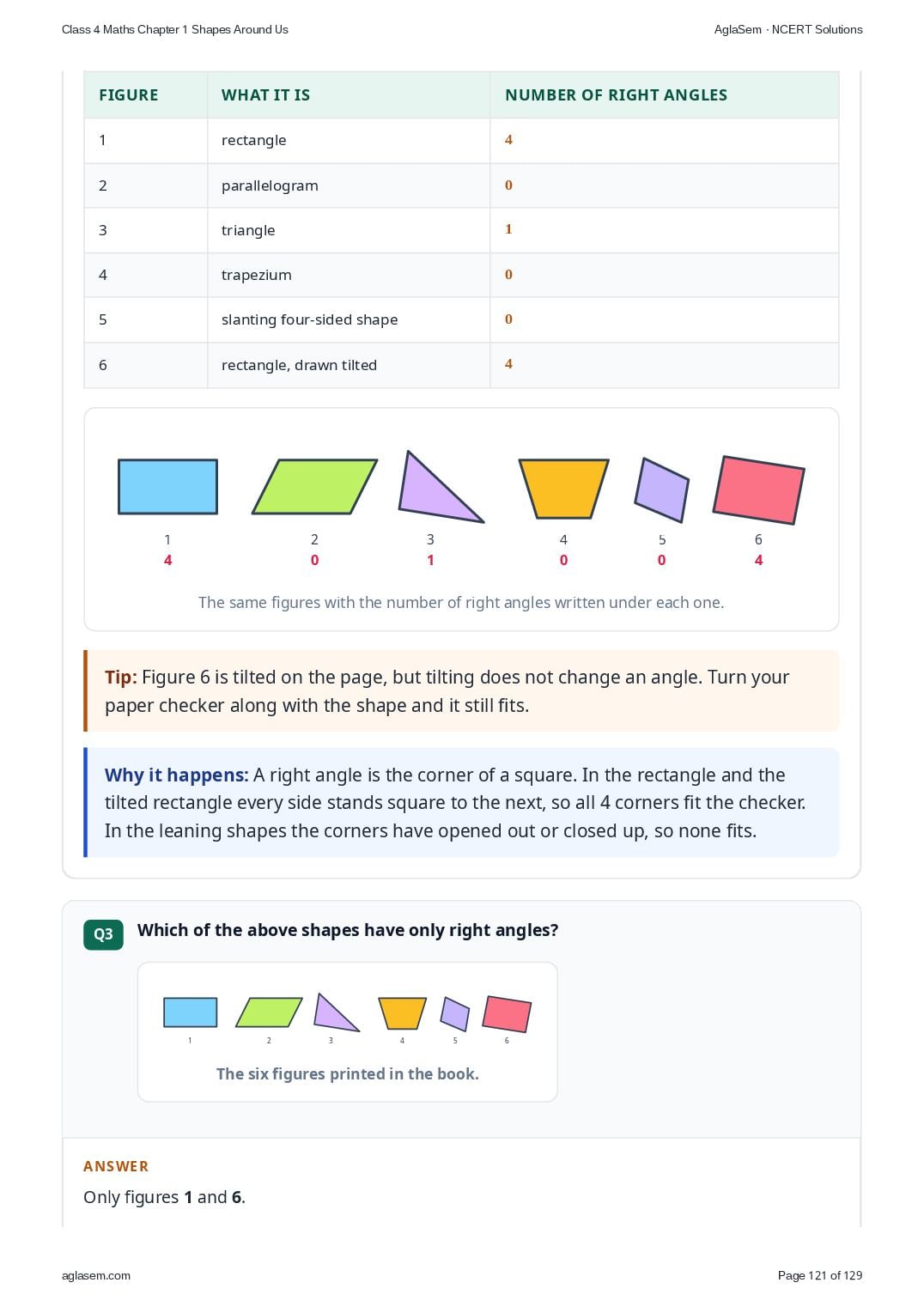
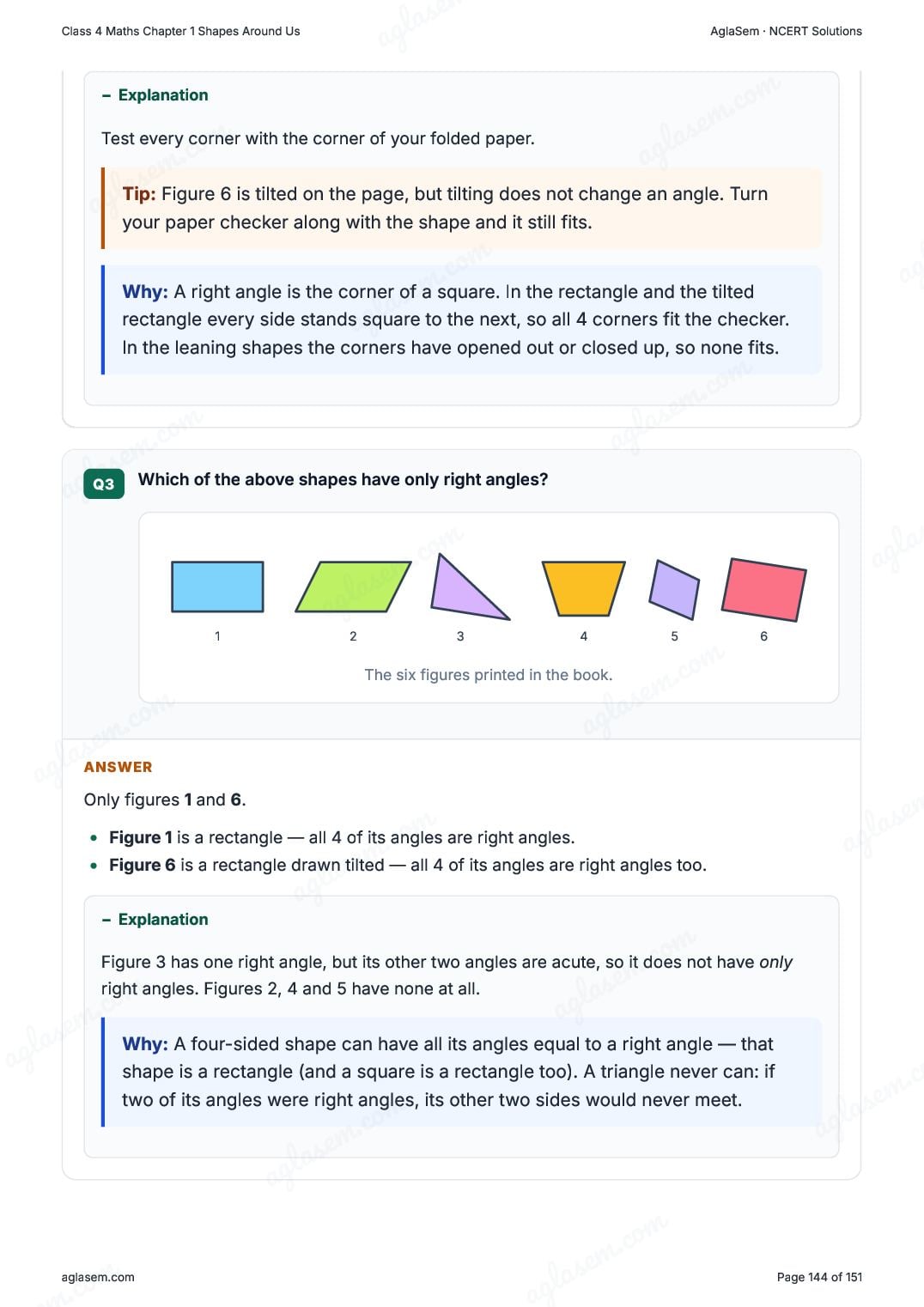
- Which of the above shapes have only right angles? 123456The six figures printed in the book.
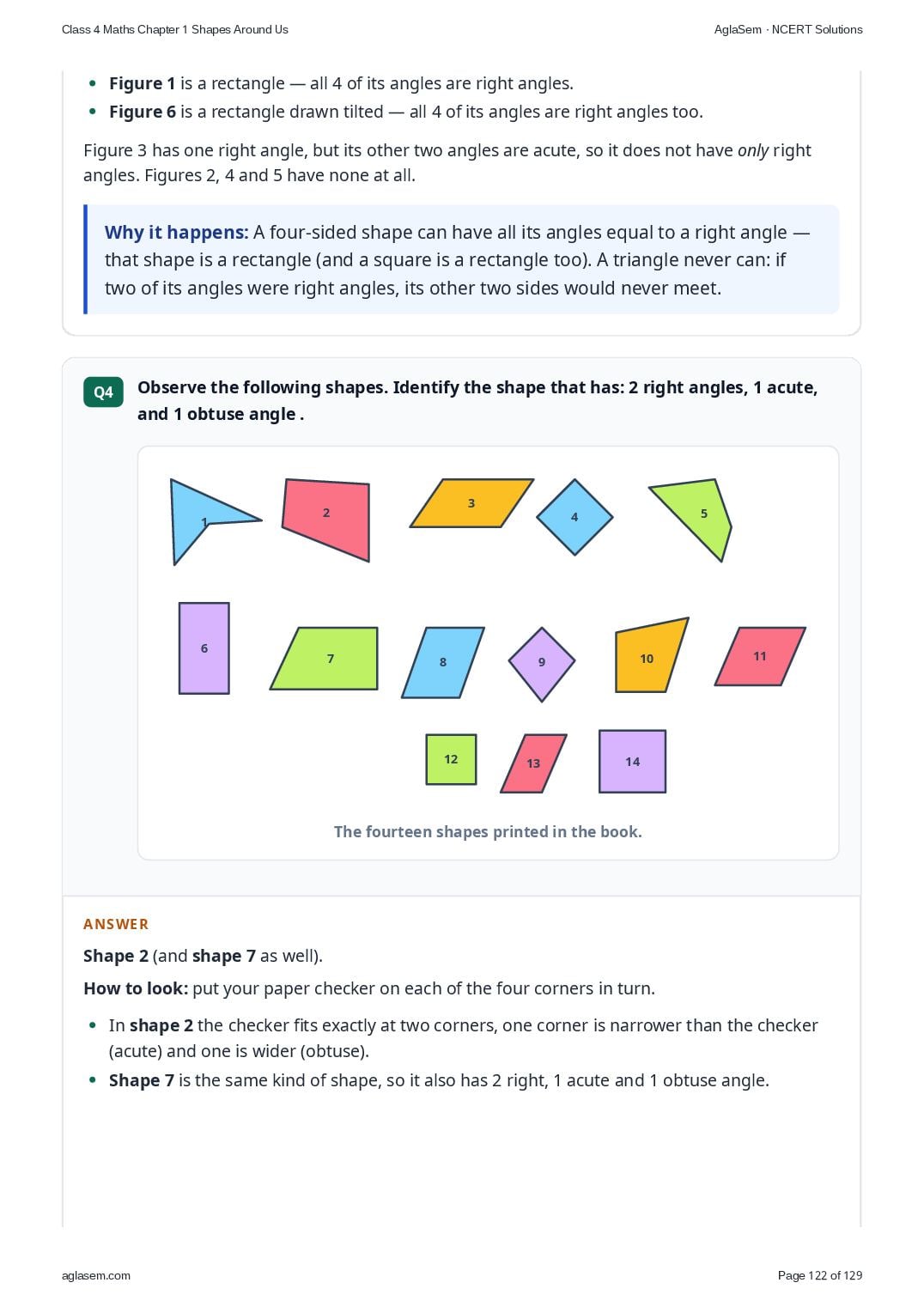
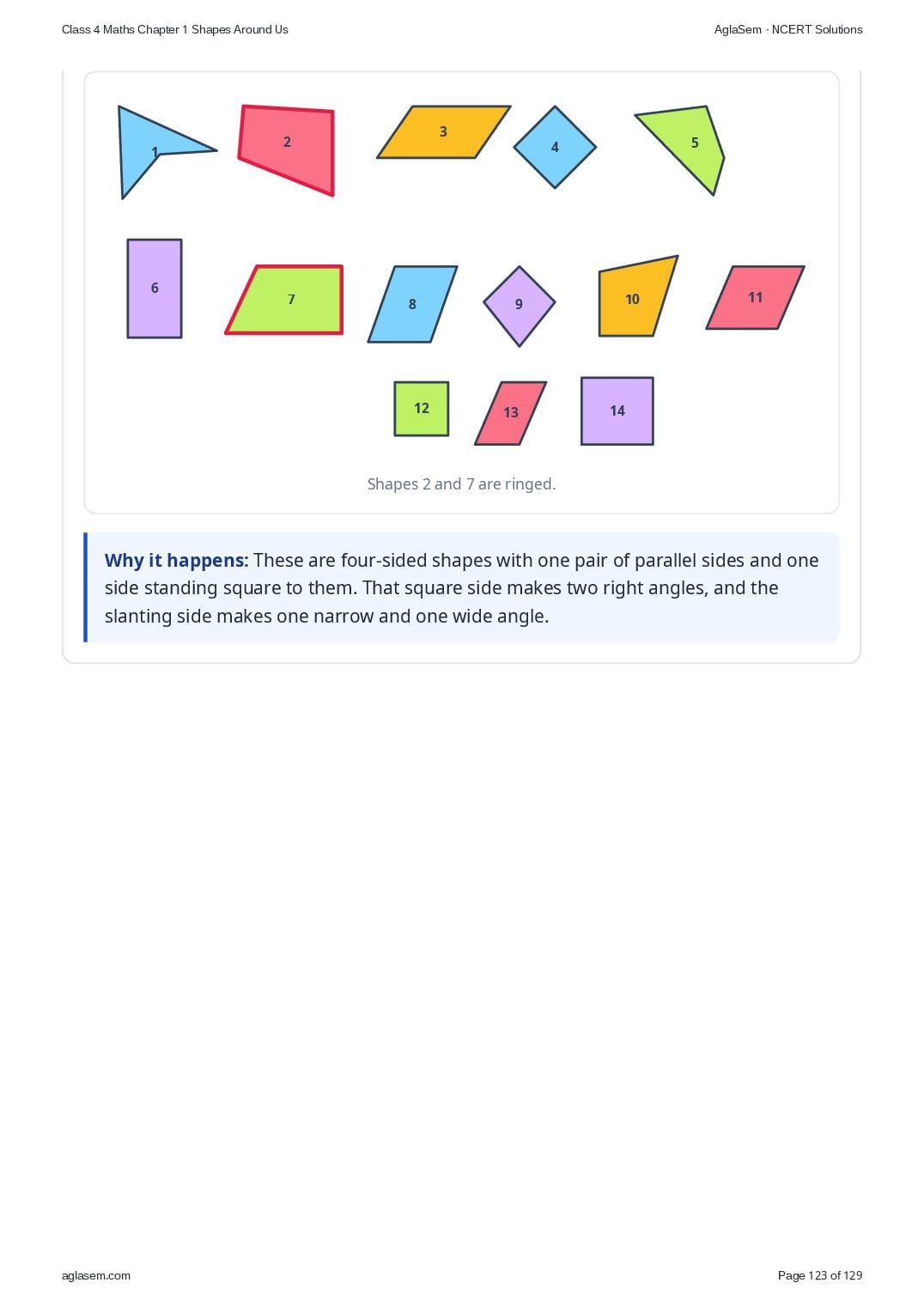
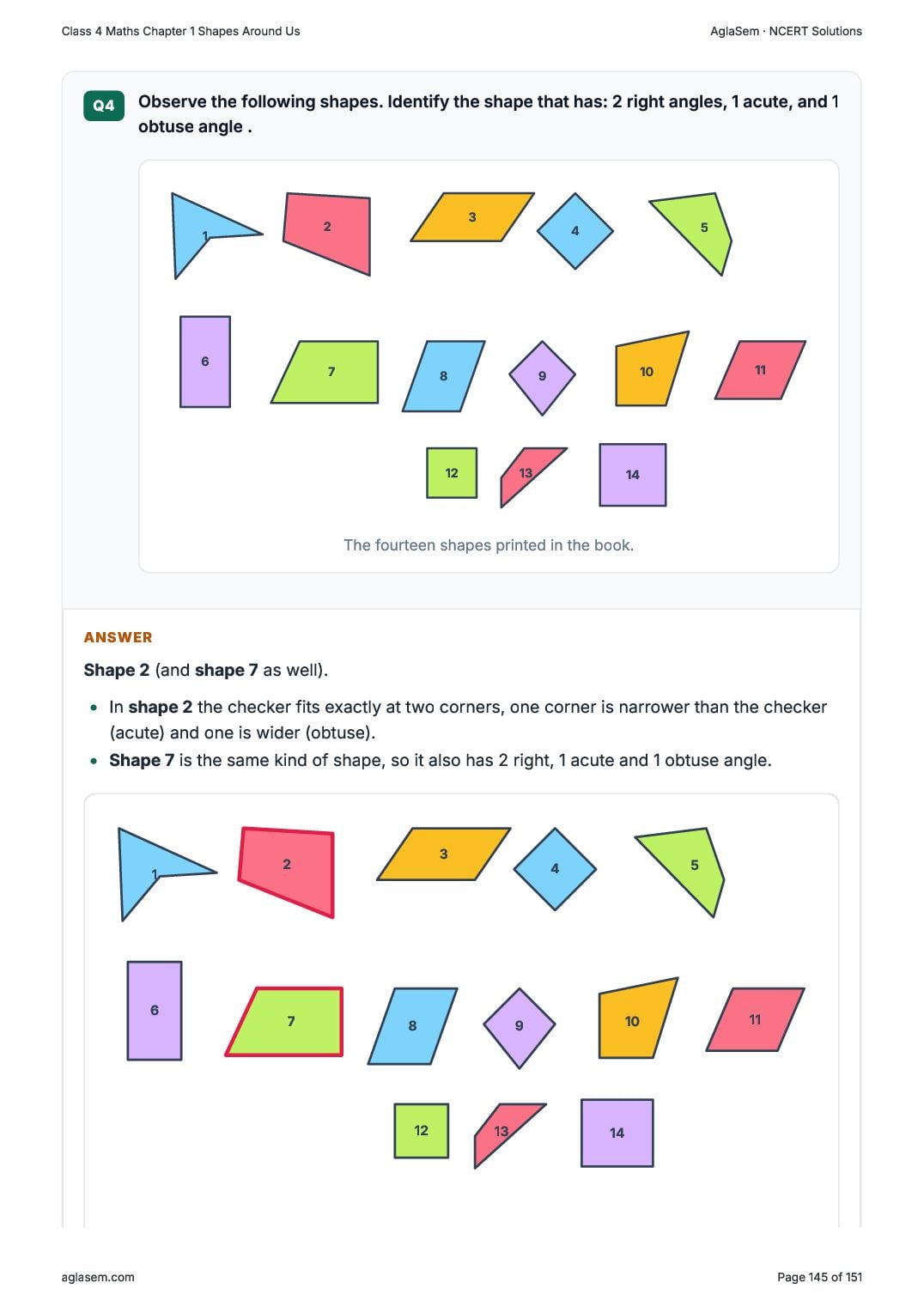
- Observe the following shapes. Identify the shape that has: 2 right angles, 1 acute, and 1 obtuse angle . 1234567891011121314The fourteen shapes printed in the book.
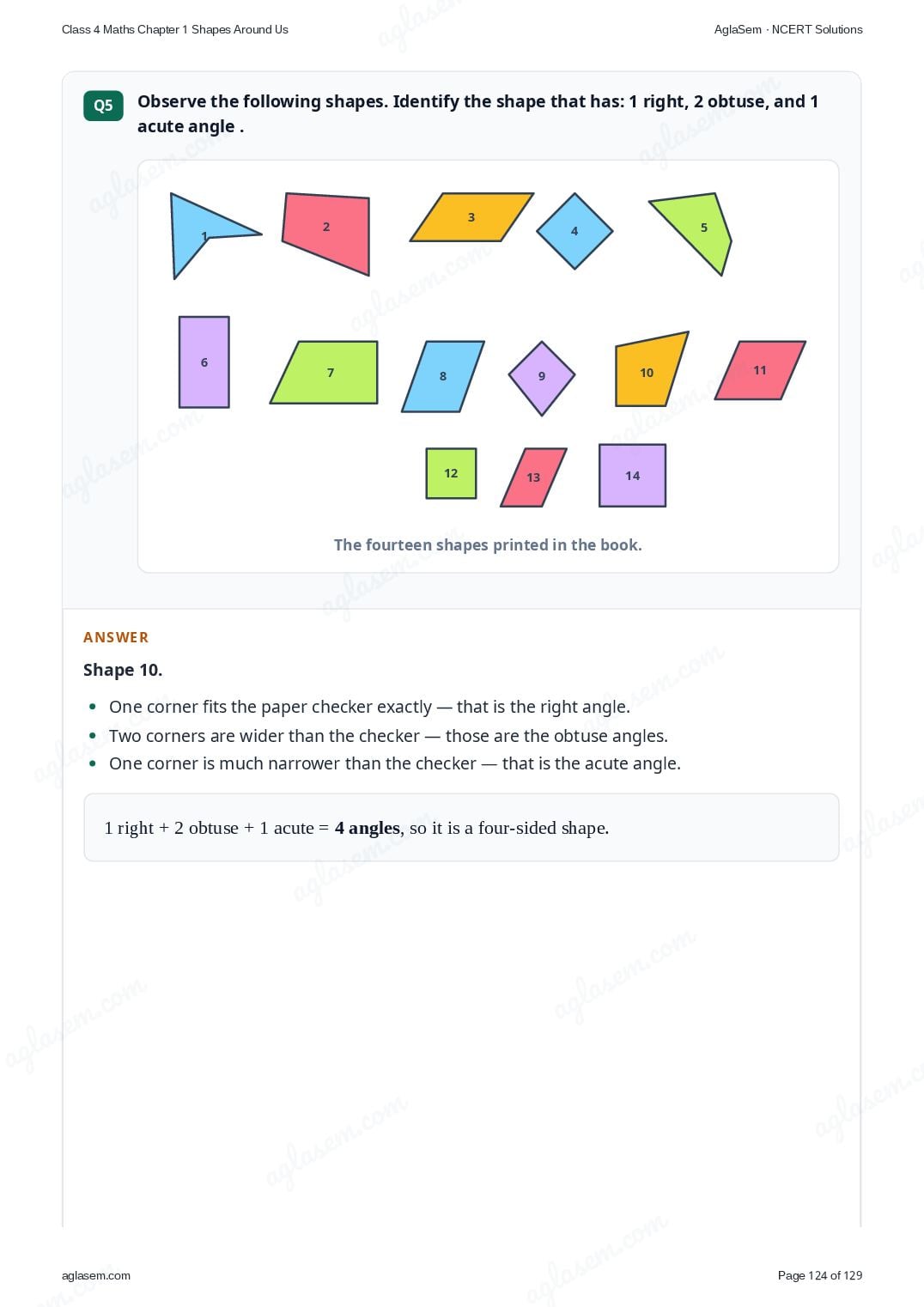
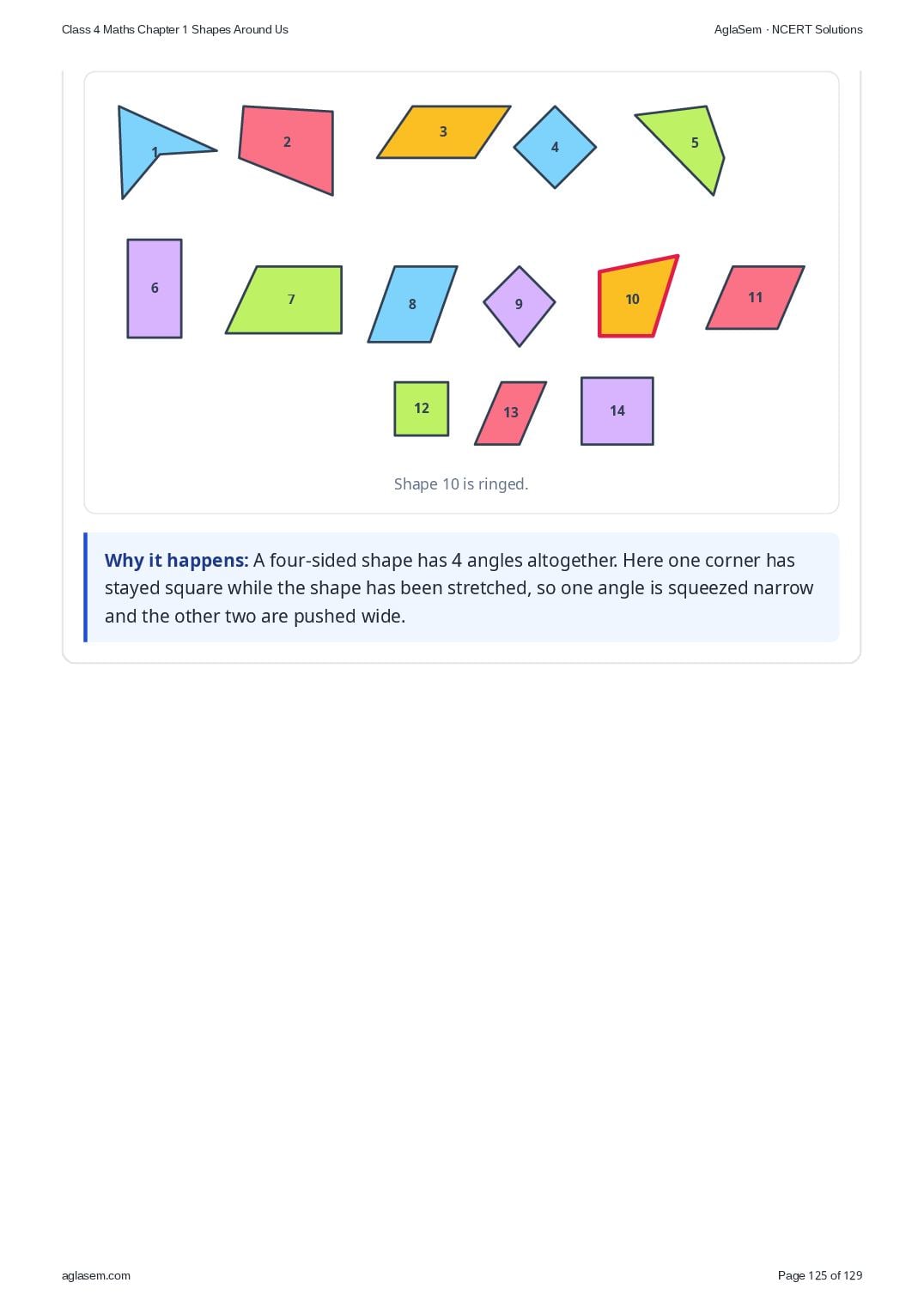
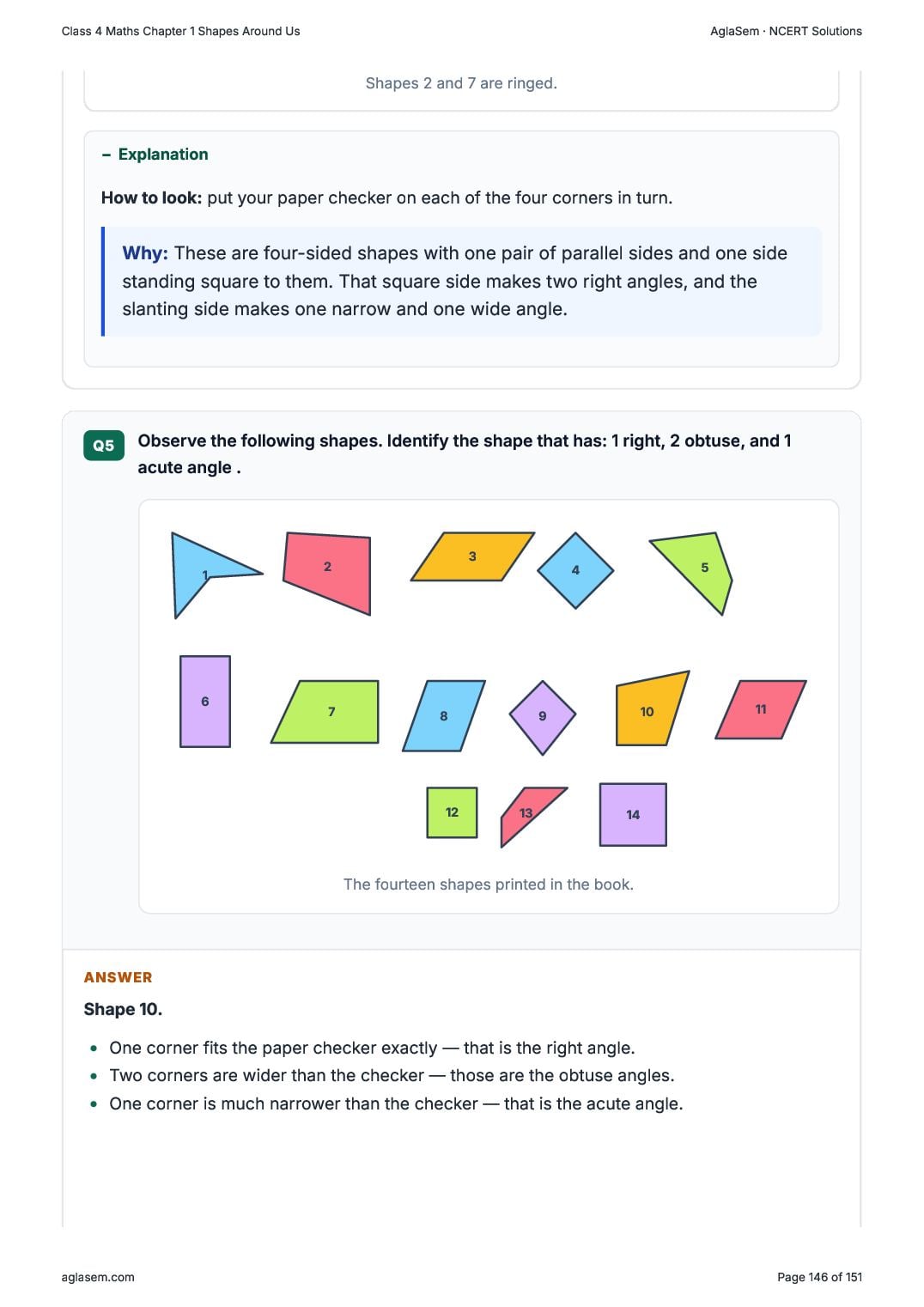
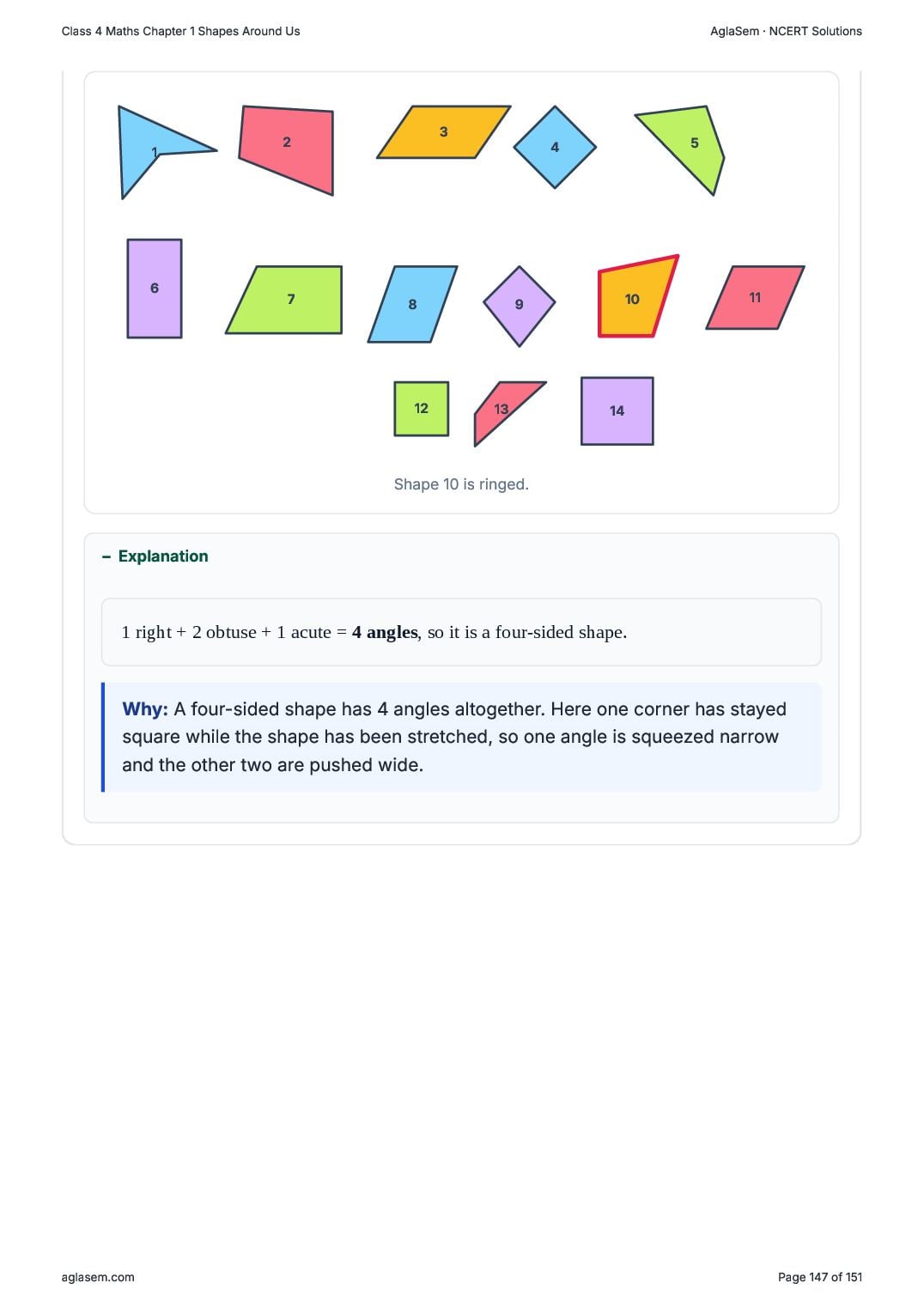
- Observe the following shapes. Identify the shape that has: 1 right, 2 obtuse, and 1 acute angle . 1234567891011121314The fourteen shapes printed in the book.
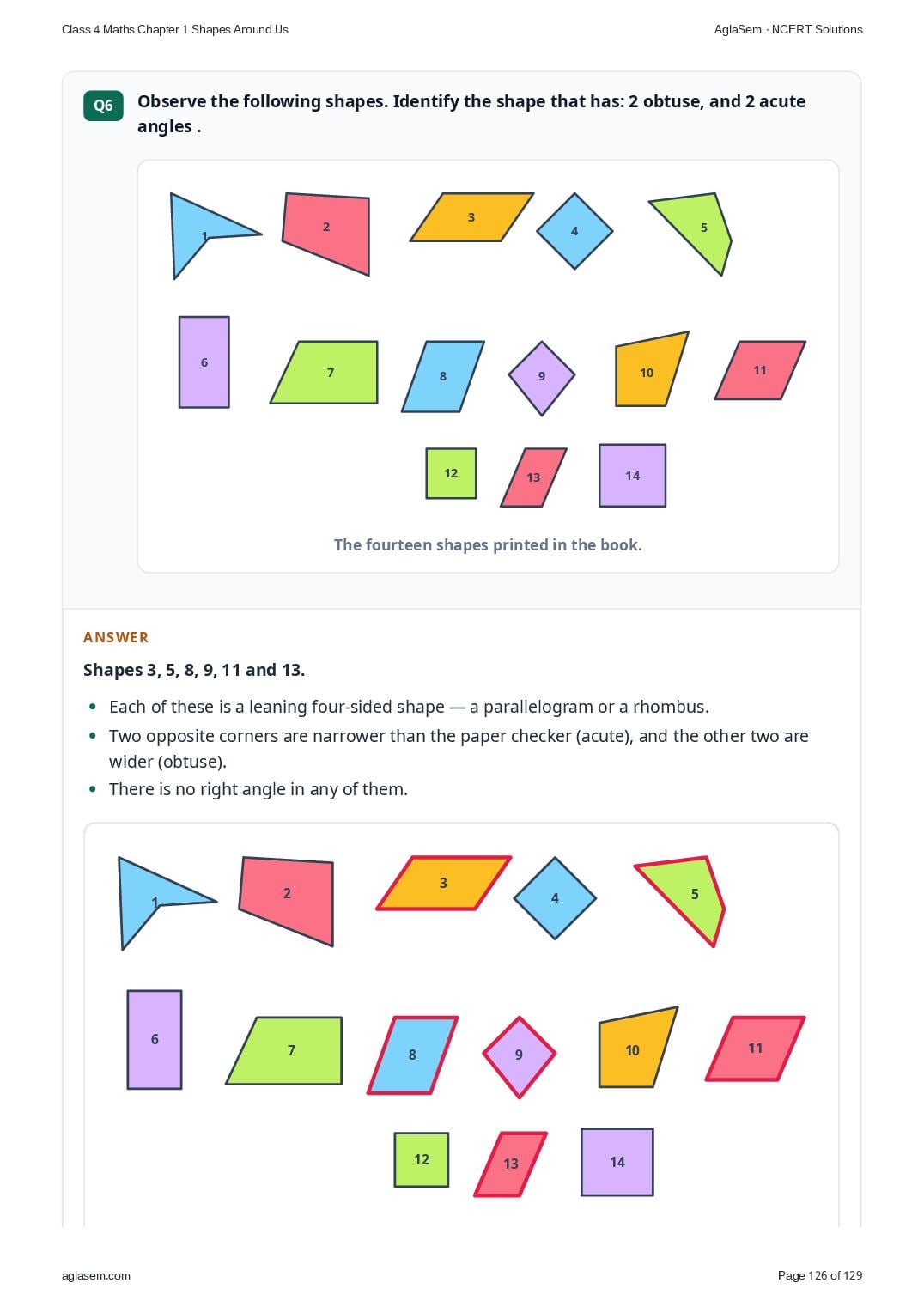
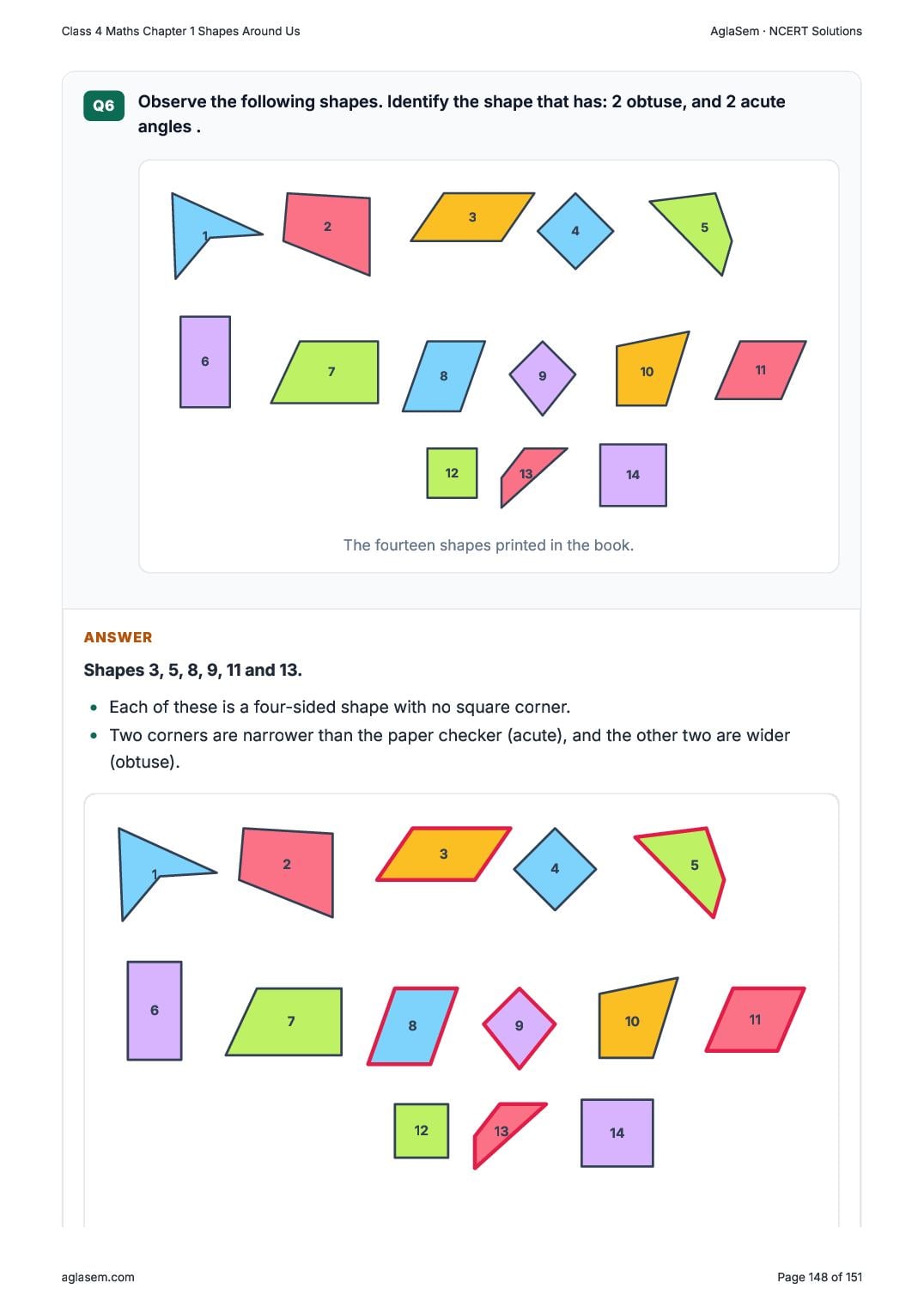
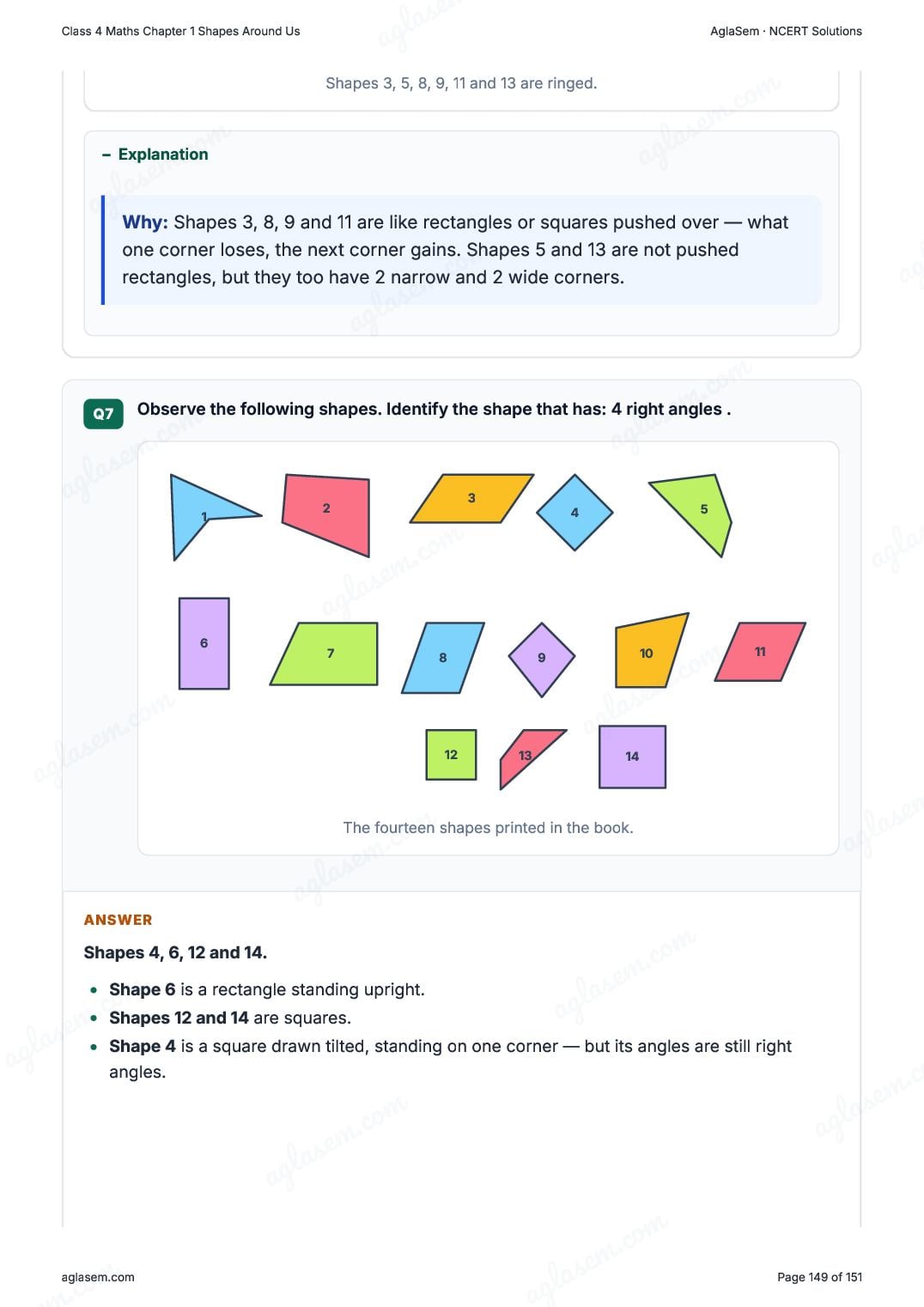
- Observe the following shapes. Identify the shape that has: 2 obtuse, and 2 acute angles . 1234567891011121314The fourteen shapes printed in the book.
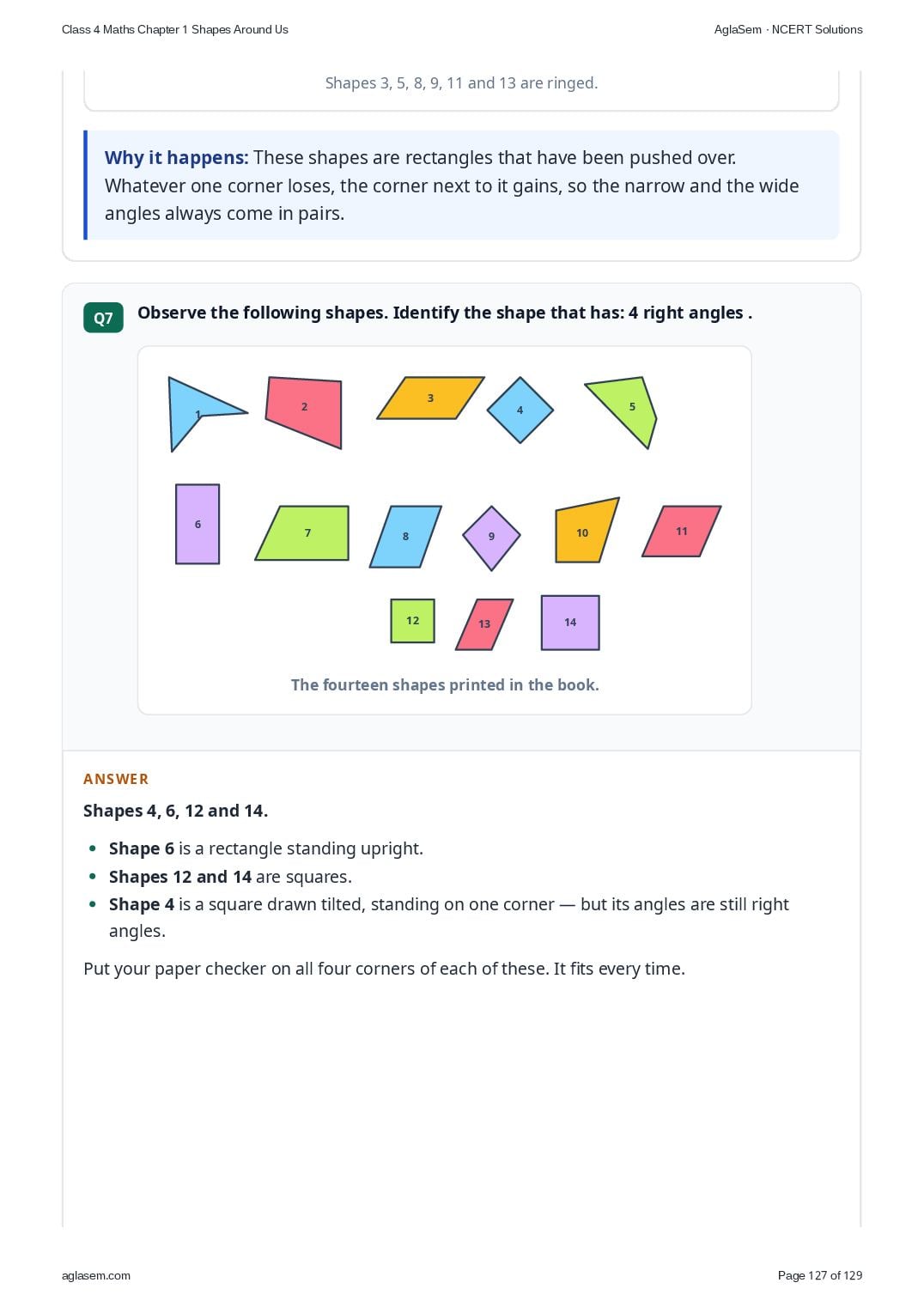
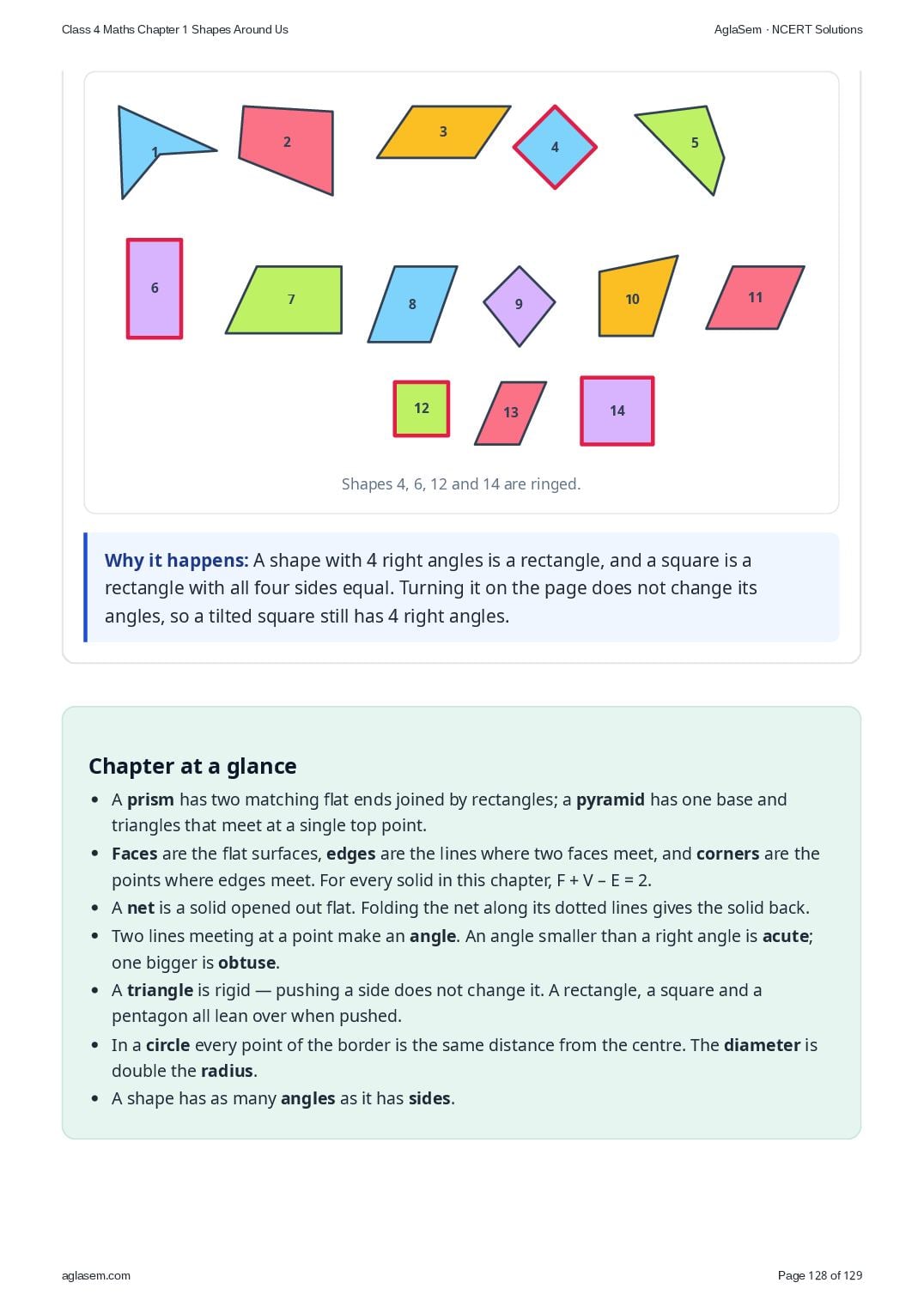
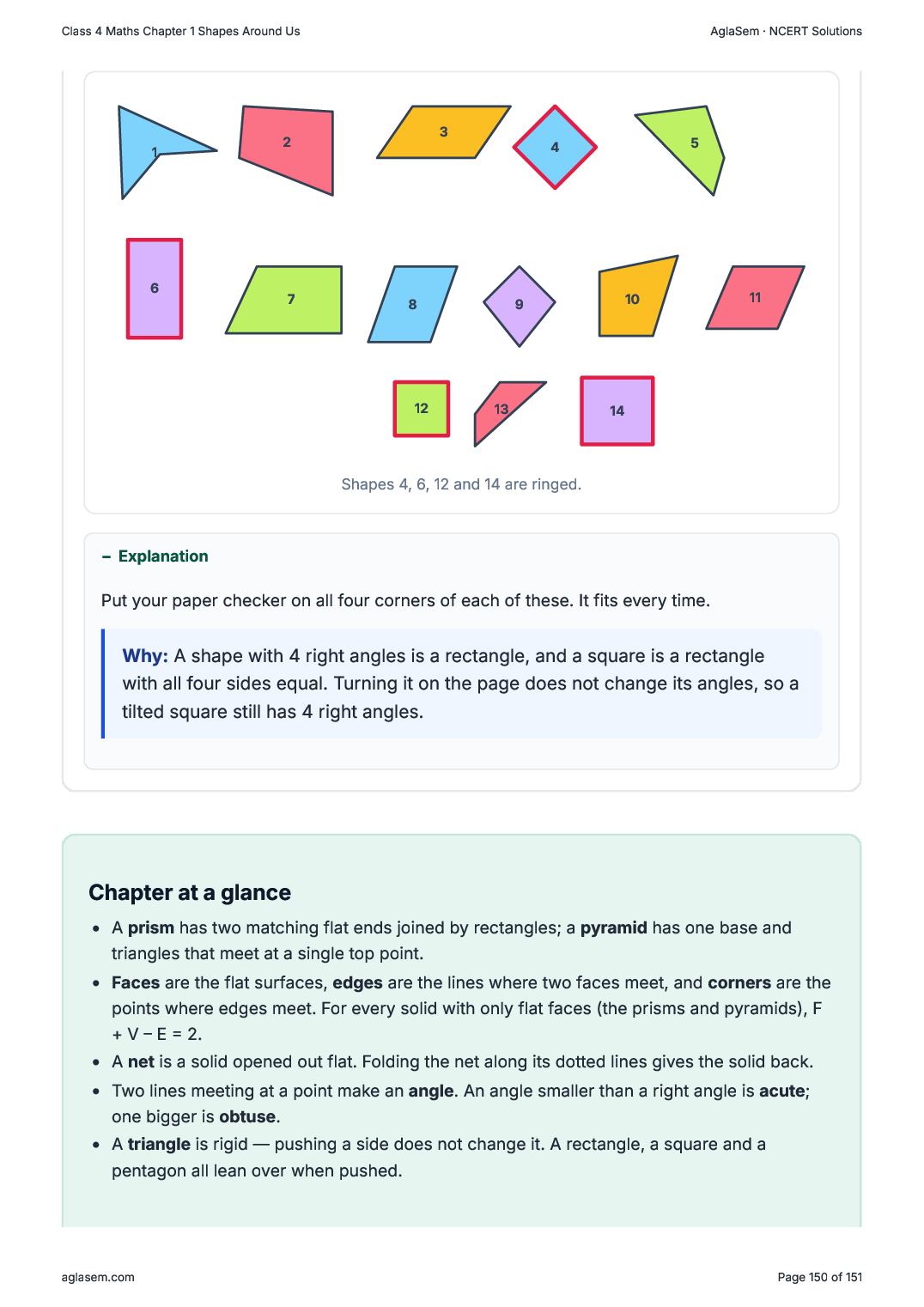
- Observe the following shapes. Identify the shape that has: 4 right angles . 1234567891011121314The fourteen shapes printed in the book.
Chapter at a Glance
- A prism has two matching flat ends joined by rectangles; a pyramid has one base and triangles that meet at a single top point.
- Faces are the flat surfaces, edges are the lines where two faces meet, and corners are the points where edges meet. For every solid in this chapter, F + V – E = 2.
- A net is a solid opened out flat. Folding the net along its dotted lines gives the solid back.
- Two lines meeting at a point make an angle. An angle smaller than a right angle is acute; one bigger is obtuse.
- A triangle is rigid — pushing a side does not change it. A rectangle, a square and a pentagon all lean over when pushed.
- In a circle every point of the border is the same distance from the centre. The diameter is double the radius.
- A shape has as many angles as it has sides.
How to Download NCERT Solutions for Class 4 Maths Chapter 1 PDF
Follow these simple steps to get the Shapes Around Us questions-and-answers PDF from Math Mela.
- Search NCERT Solutions for Class 4 Maths Chapter 1 aglasem and open this page.
- Read the exercise questions with answers for Shapes Around Us shown above.
- Click the Download PDF link to save the Shapes Around Us solutions to your device.
NCERT Solutions for Class 4 Maths – All Chapters
There are more chapters to study besides Shapes Around Us in Maths. Here are the NCERT Solutions for all chapters of Class 4 Maths.
- Chapter 1 Shapes Around Us
- Chapter 2 Hide and Seek
- Chapter 3 Patterns Around Us
- Chapter 4 Thousands Around Us
- Chapter 5 Sharing and Measuring
- Chapter 6 Measuring Length
- Chapter 7 the Cleanest Village
- Chapter 8 Weigh It Pour It
- Chapter 9 Equal Groups
- Chapter 10 Elephants Tigers and Leopards
- Chapter 11 Fun with Symmetry
- Chapter 12 Ticking Clocks and Turning Calendar
- Chapter 13 the Transport Museum
- Chapter 14 Data Handling
NCERT Solutions for Class 4 – All Subjects
Just like Chapter 1 of Maths, you can get the exercise questions with answers for every other subject of Class 4. Here are the NCERT Solutions for all subjects of Class 4.
NCERT Solutions for Class 4 Maths Chapter 1 – An Overview
The key highlights of this study material are as follows.
| Aspects | Details |
|---|---|
| Class | Class 4 |
| Subject | Maths |
| Chapter Number | Chapter 1 |
| Chapter Name | Shapes Around Us |
| Book Name | Math Mela |
| Book By | NCERT (National Council of Educational Research and Training) |
| Educational Resource Here | NCERT Solutions of Class 4 Maths Chapter 1 for all exercises |
| More Questions Answers of This Subject | NCERT Solutions for Class 4 Maths |
| Download Book Chapter | NCERT Book Class 4 Maths |
| All Questions Answers For This Class | NCERT Solutions for Class 4 |
| Complete Solutions | NCERT Solutions |
NCERT Solutions for Class 4 Maths Chapter 1 Shapes Around Us – FAQs
What are the NCERT Solutions for Class 4 Maths Chapter 1 Shapes Around Us?
They are the complete, step-by-step answers to all the exercise and in-text questions of Chapter 1 Shapes Around Us from the NCERT Class 4 Maths textbook Math Mela, written by experts as per the latest NCERT syllabus.
How can I download the Class 4 Maths Chapter 1 solutions PDF for free?
Open this page on aglasem, read the Shapes Around Us questions with answers, and click the “Download Solutions PDF” link. The Class 4 Maths Chapter 1 NCERT Solutions PDF is completely free to download.
Are these NCERT Solutions as per the latest 2026-27 syllabus?
Yes. The NCERT Solutions for Class 4 Maths Chapter 1 are based on the latest NCERT textbook Math Mela and the current 2026-27 CBSE syllabus, so the questions and answers match what you study in class.
Where can I get NCERT Solutions for the other chapters of Class 4 Maths?
You can find the answers to every chapter on the NCERT Solutions for Class 4 Maths page, and solutions for every subject on the NCERT Solutions for Class 4 page.
How do NCERT Solutions help in exam preparation?
They show the correct method to solve each question, help you write answers the way they are expected in exams, let you check and correct your own work, and save revision time — which together improve your marks in Class 4 Maths.
If you have any queries on NCERT Solutions for Class 4 Maths Chapter 1 Shapes Around Us, then please ask in the comments below.