NCERT Solutions for Class 4 Maths Chapter 4 Thousands Around Us provide clear, step-by-step answers to every exercise and in-text question from the chapter Thousands Around Us of the NCERT textbook Math Mela. Prepared by subject experts as per the latest NCERT (CBSE) syllabus for 2026-27, these NCERT Solutions for Class 4 Maths help you understand each concept, write exam-ready answers, and check your own solutions. You can read them online below or download the free Class 4 Maths Chapter 4 question-answer PDF.
NCERT Solutions for Class 4 Maths Chapter 4 Thousands Around Us
- Class: Class 4
- Subject: Maths
- Chapter: Chapter 4 – Thousands Around Us
- Textbook: Math Mela (NCERT)
- Study material: NCERT Solutions – questions with answers, free PDF
These solutions answer all the exercise questions of Chapter 4 Thousands Around Us — including the in-text questions, short-answer and long-answer questions, and activities — with complete explanations so you can follow the method, not just the final answer. Read the full solutions below.
NCERT Solutions Class 4 Maths Chapter 4 Thousands Around Us View Download


NCERT Solutions for Class 4 Maths Chapter 4 PDF Download
You can read the NCERT Solutions for Class 4 Maths Chapter 4 online above, or download the complete question-answer PDF to study Thousands Around Us offline at any time.
NCERT Solutions for Class 4 Maths Chapter 4 PDF Download Link – Click Here to Download Solutions PDF
Questions Covered in This Chapter
These NCERT Solutions answer all 103 questions of this chapter. The questions solved are:
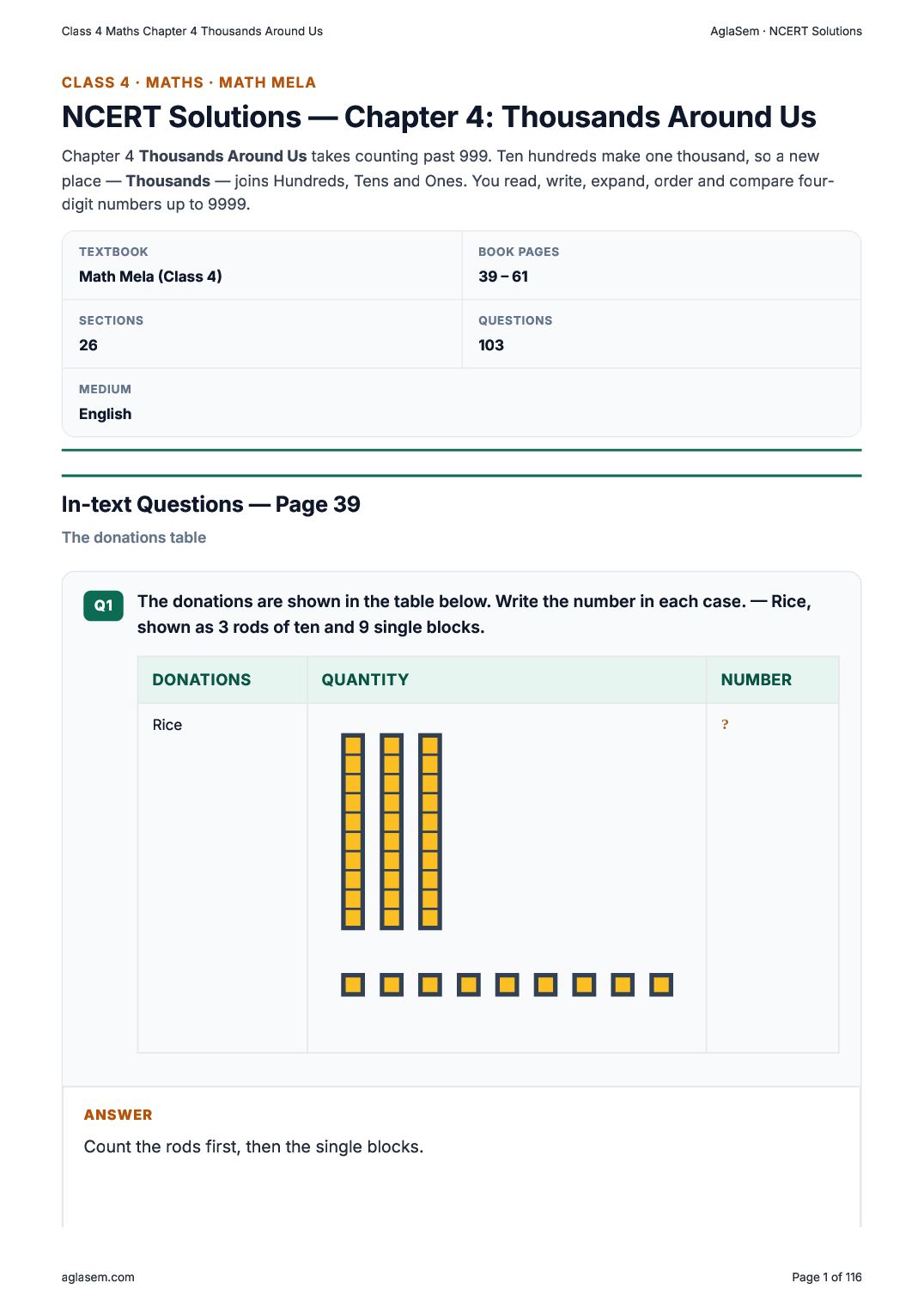
- The donations are shown in the table below. Write the number in each case. — Rice, shown as 3 rods of ten and 9 single blocks.DonationsQuantityNumberRice?
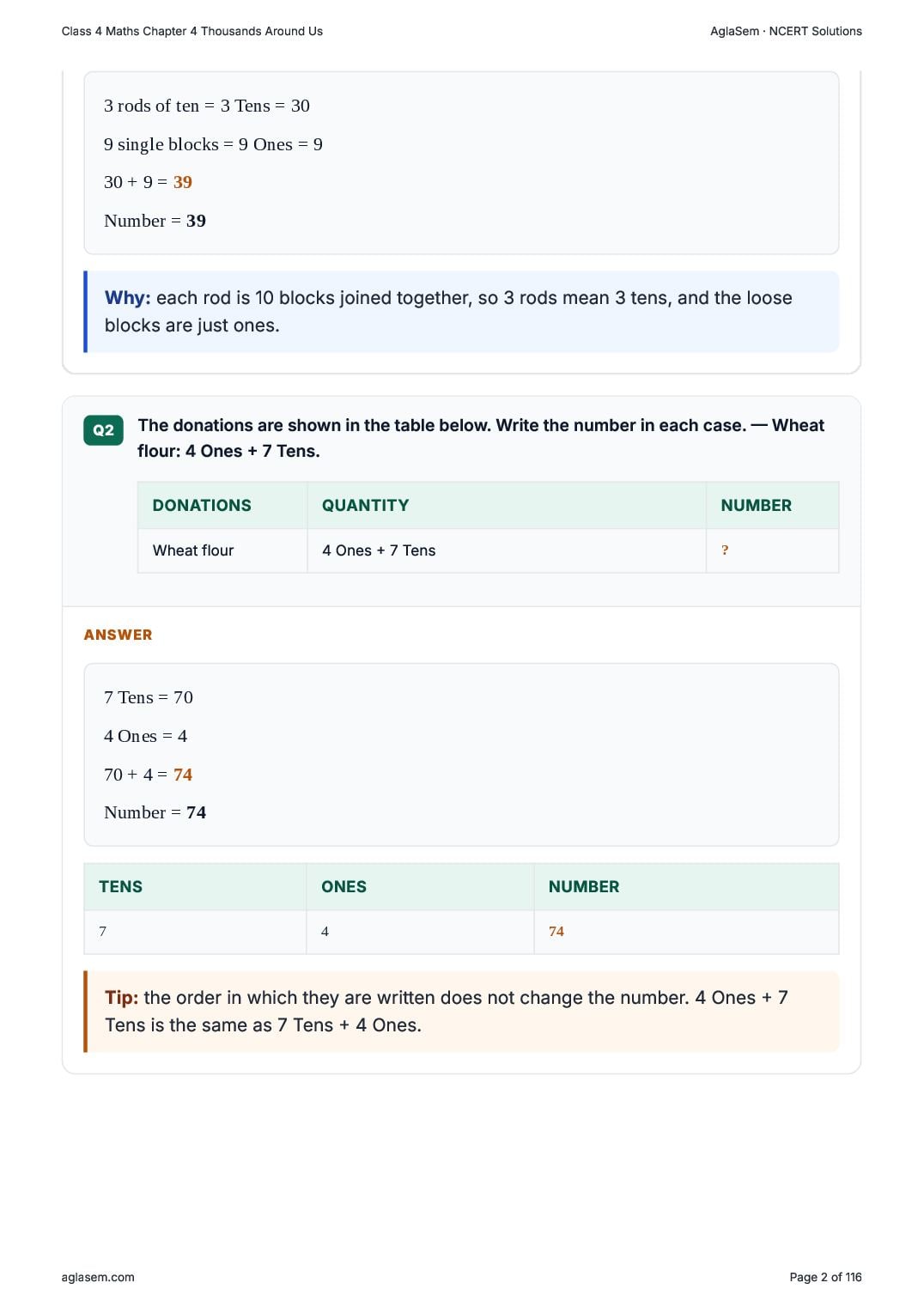
- The donations are shown in the table below. Write the number in each case. — Wheat flour: 4 Ones + 7 Tens.DonationsQuantityNumberWheat flour4 Ones + 7 Tens?
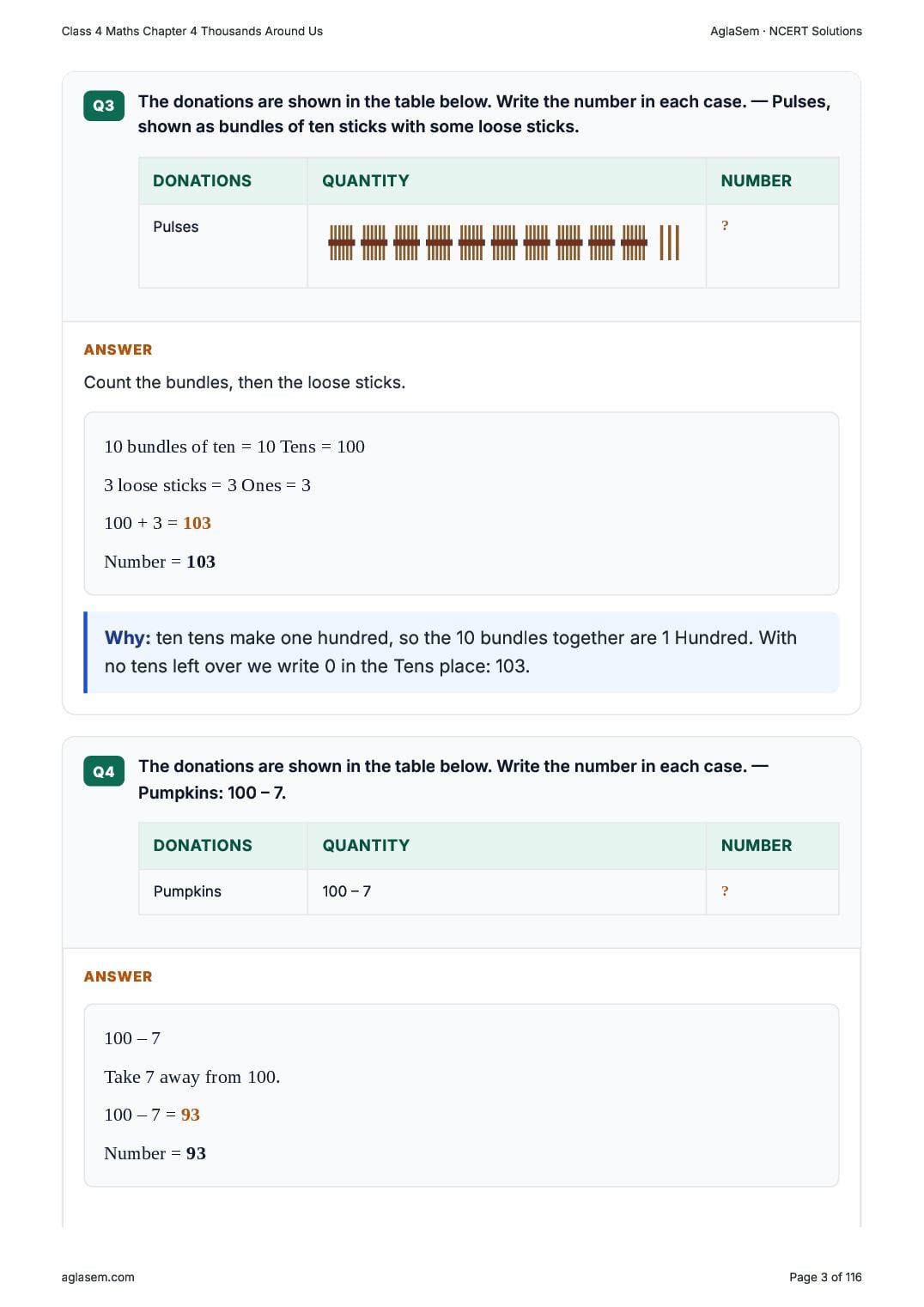
- The donations are shown in the table below. Write the number in each case. — Pulses, shown as bundles of ten sticks with some loose sticks.DonationsQuantityNumberPulses?
- The donations are shown in the table below. Write the number in each case. — Pumpkins: 100 – 7.DonationsQuantityNumberPumpkins100 – 7?
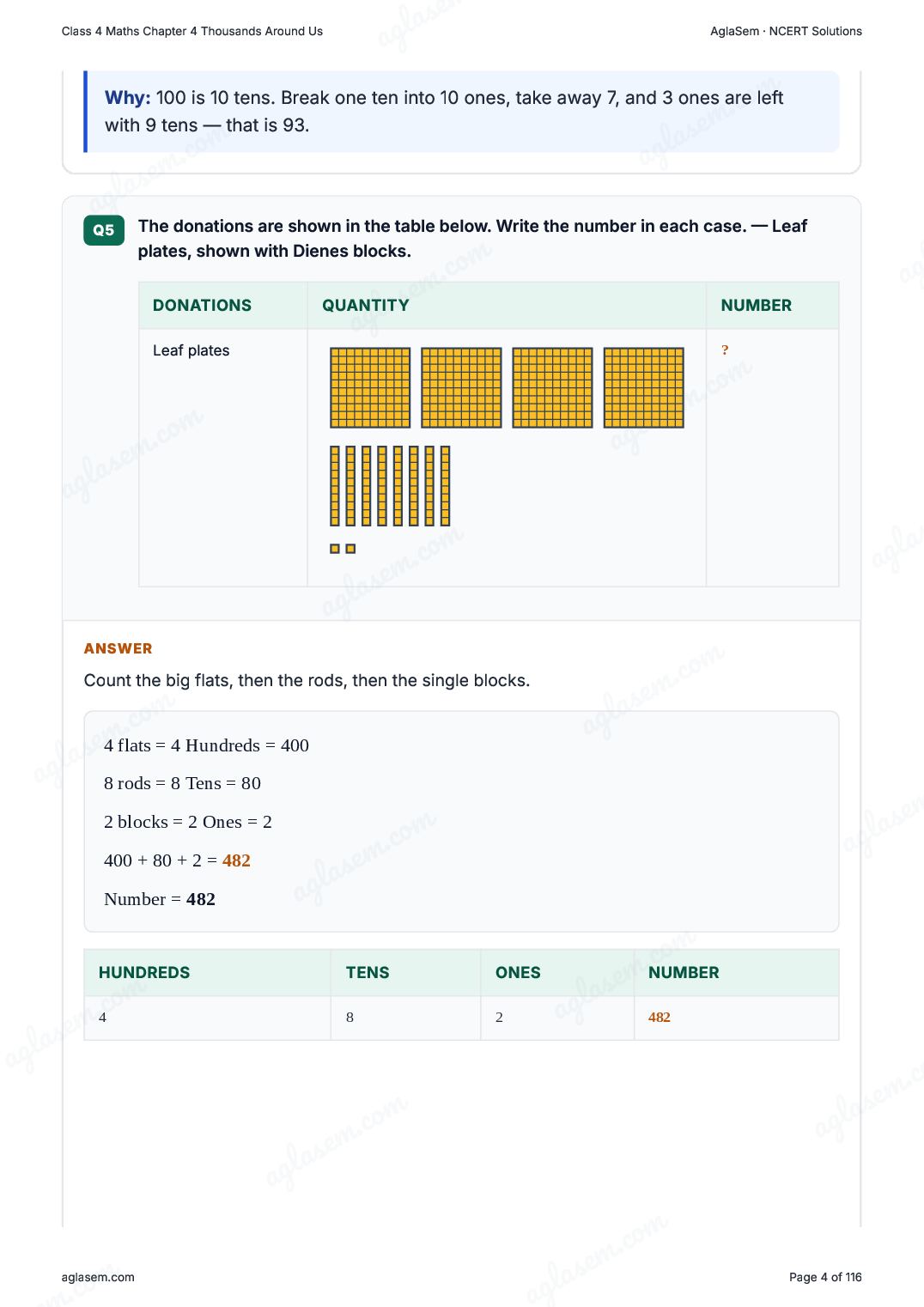
- The donations are shown in the table below. Write the number in each case. — Leaf plates, shown with Dienes blocks.DonationsQuantityNumberLeaf plates?
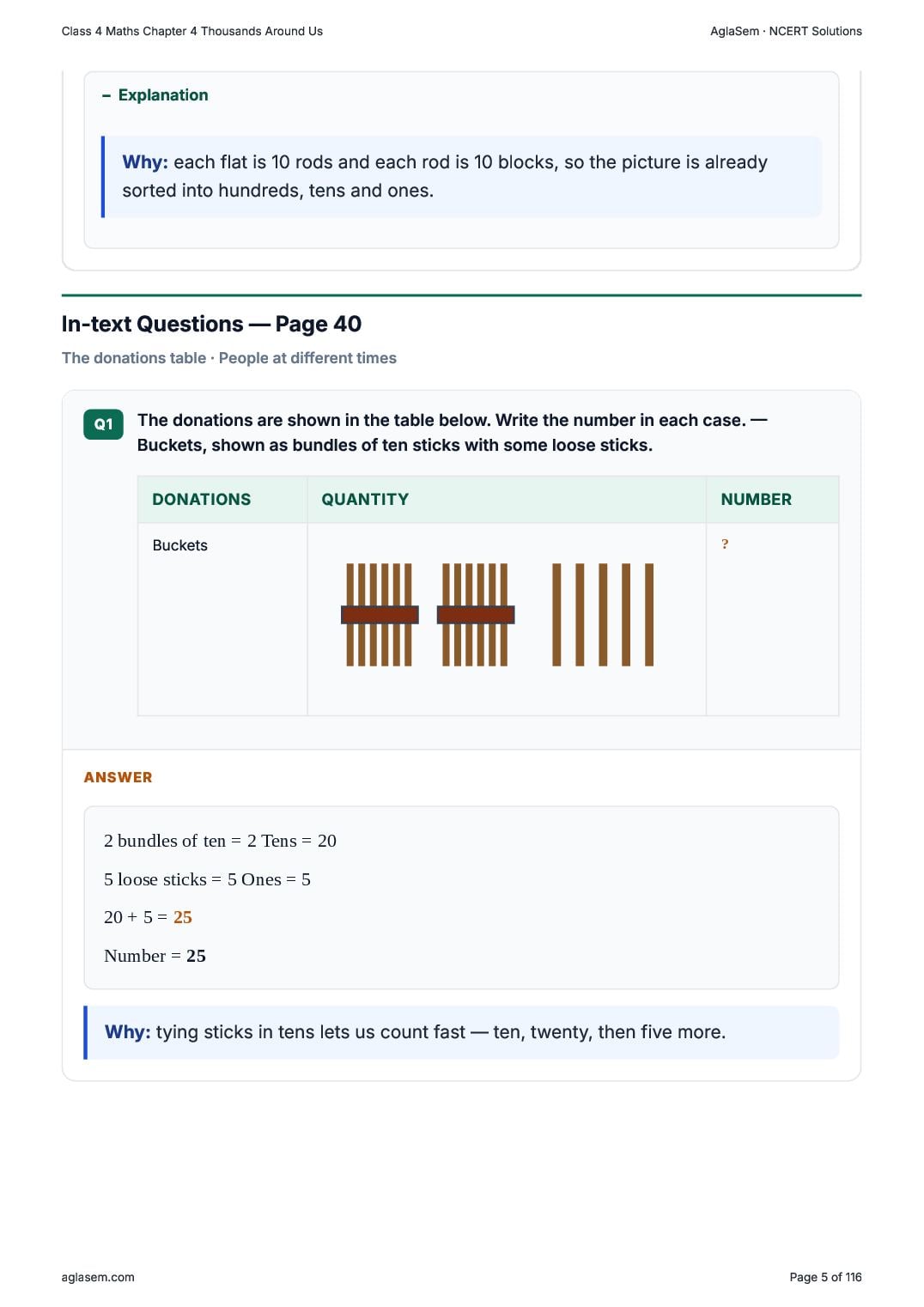
- The donations are shown in the table below. Write the number in each case. — Buckets, shown as bundles of ten sticks with some loose sticks.DonationsQuantityNumberBuckets?
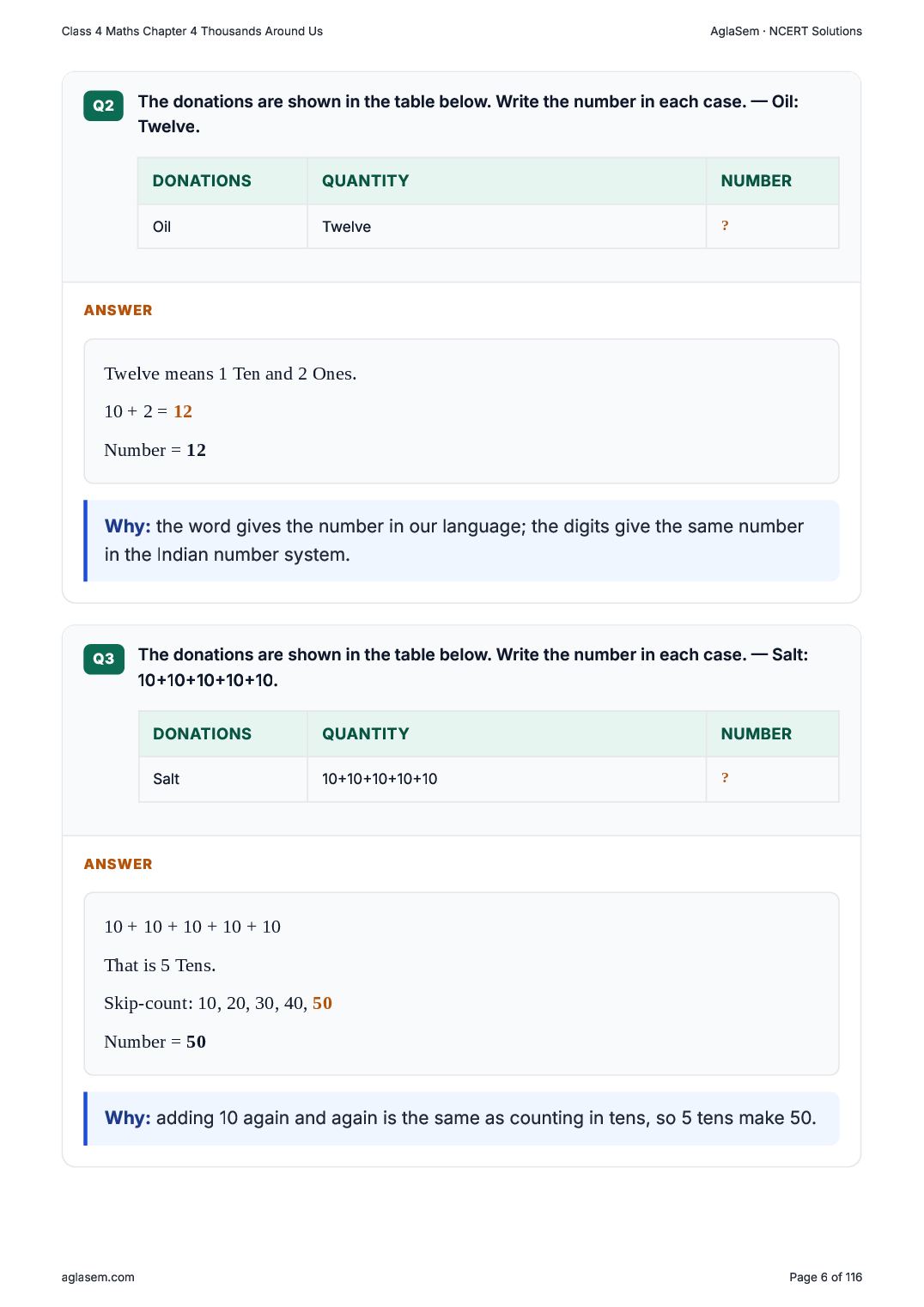
- The donations are shown in the table below. Write the number in each case. — Oil: Twelve.DonationsQuantityNumberOilTwelve?
- The donations are shown in the table below. Write the number in each case. — Salt: 10+10+10+10+10.DonationsQuantityNumberSalt10+10+10+10+10?
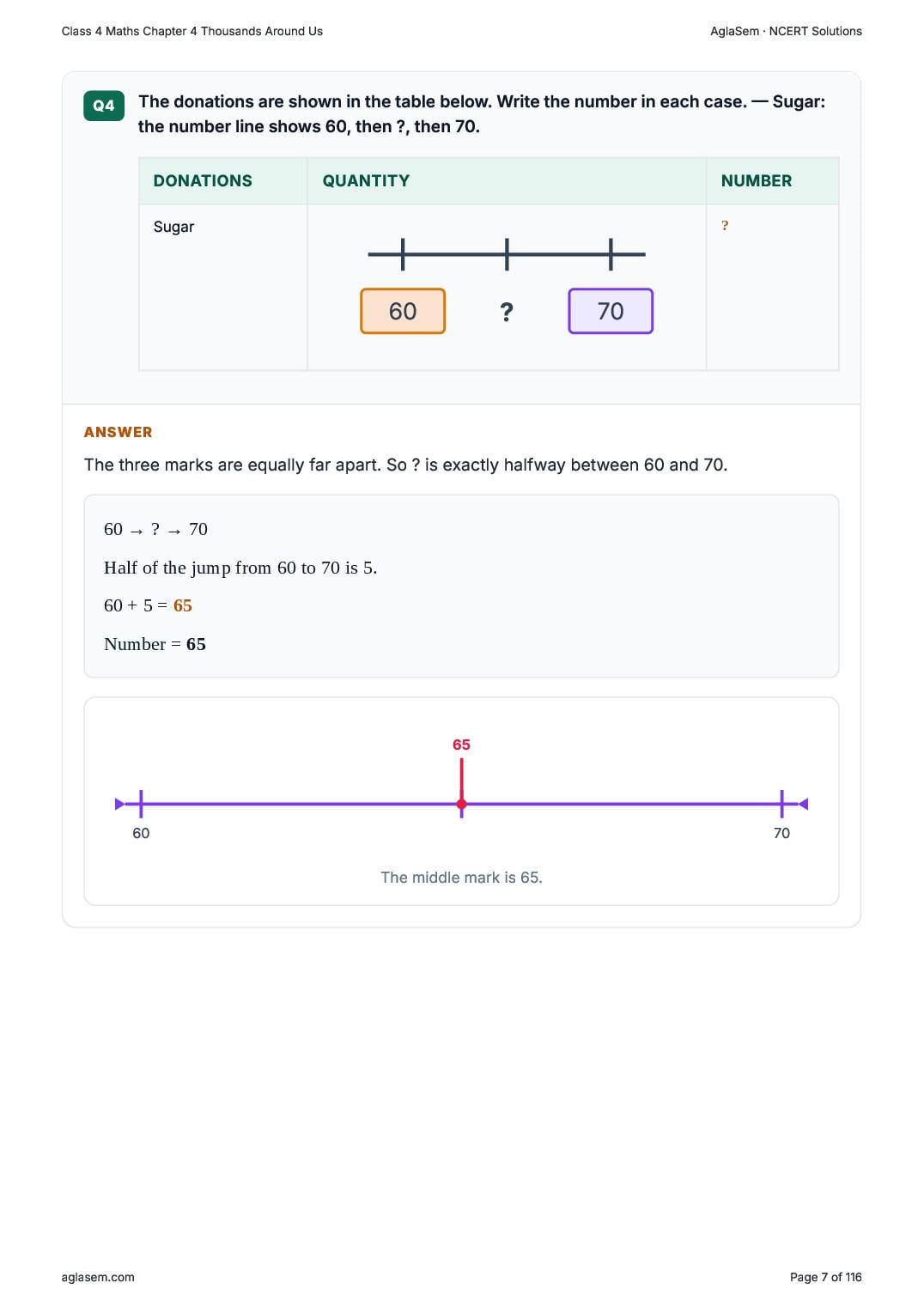
- The donations are shown in the table below. Write the number in each case. — Sugar: the number line shows 60, then ?, then 70.DonationsQuantityNumberSugar60?70?
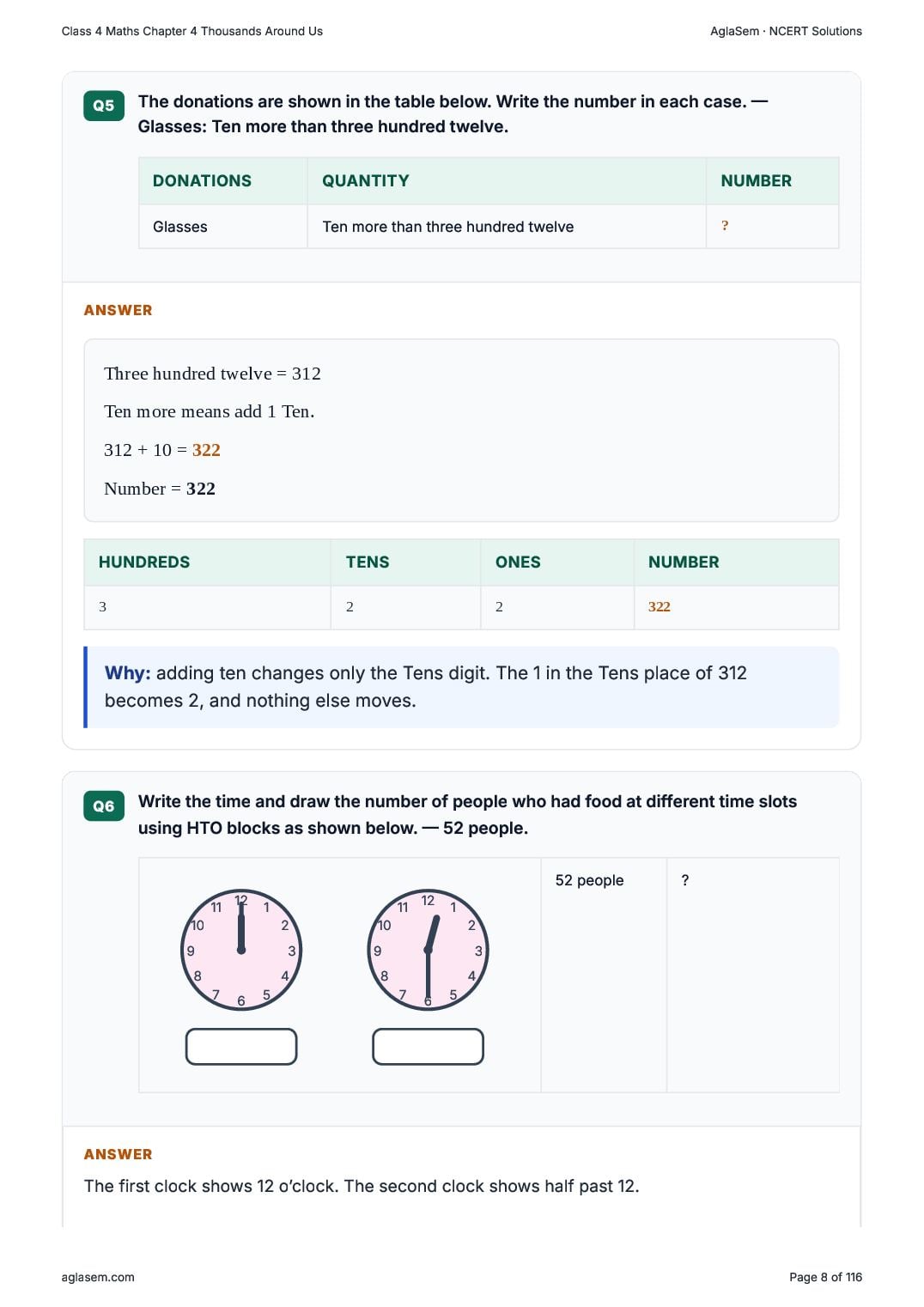
- The donations are shown in the table below. Write the number in each case. — Glasses: Ten more than three hundred twelve.DonationsQuantityNumberGlassesTen more than three hundred twelve?
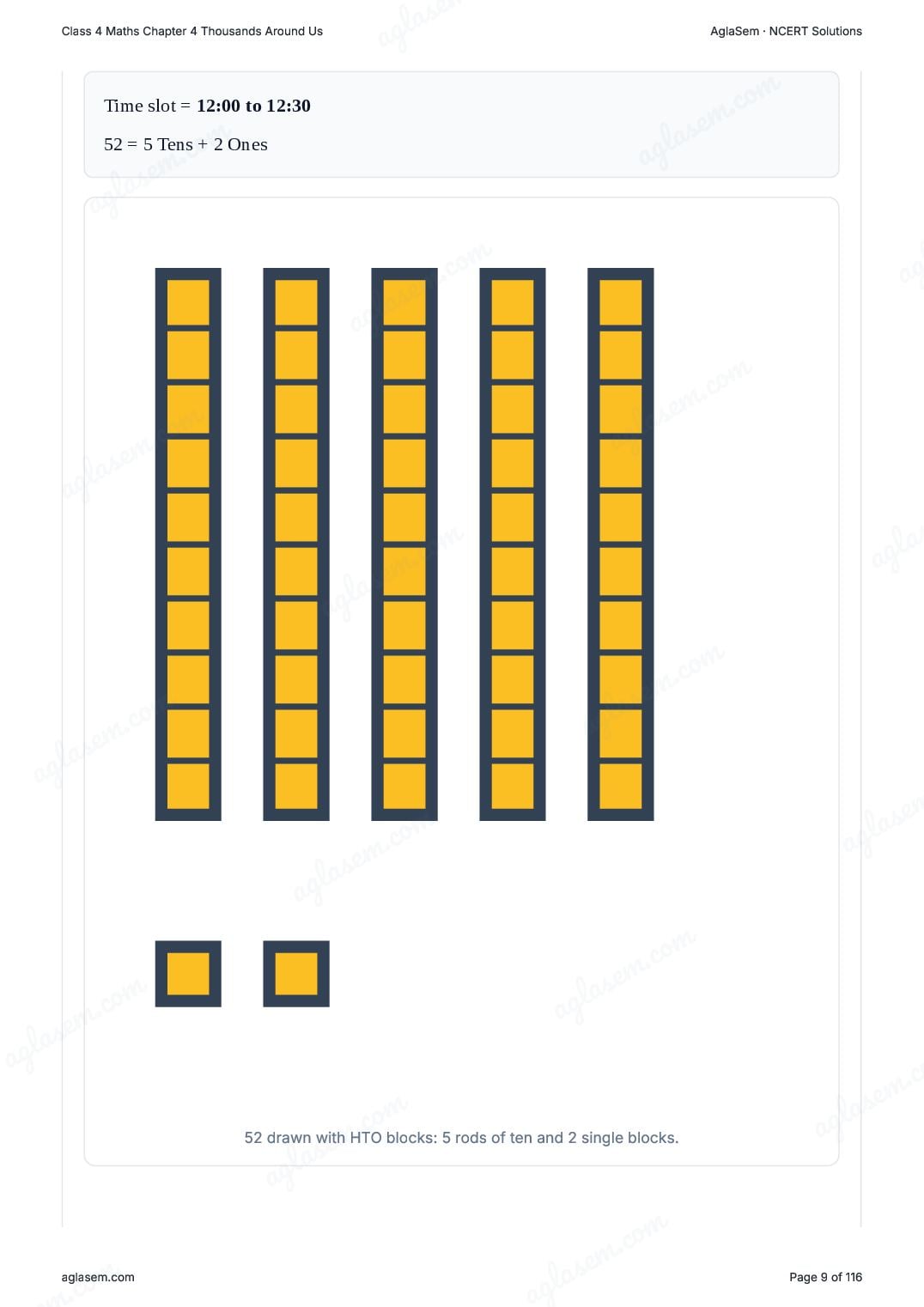
- Write the time and draw the number of people who had food at different time slots using HTO blocks as shown below. — 52 people.12123456789101112123456789101152 people?
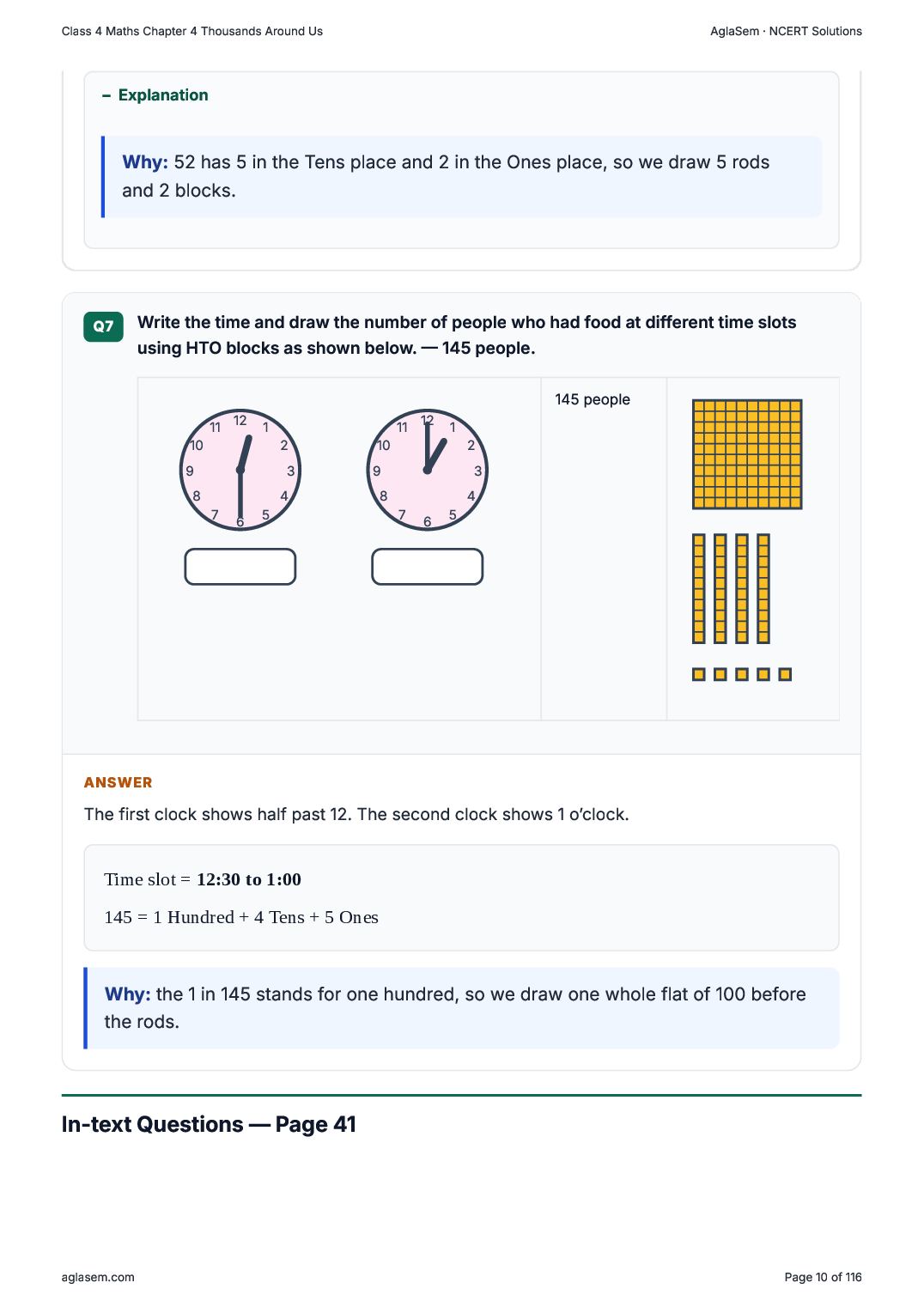
- Write the time and draw the number of people who had food at different time slots using HTO blocks as shown below. — 145 people.121234567891011121234567891011145 people
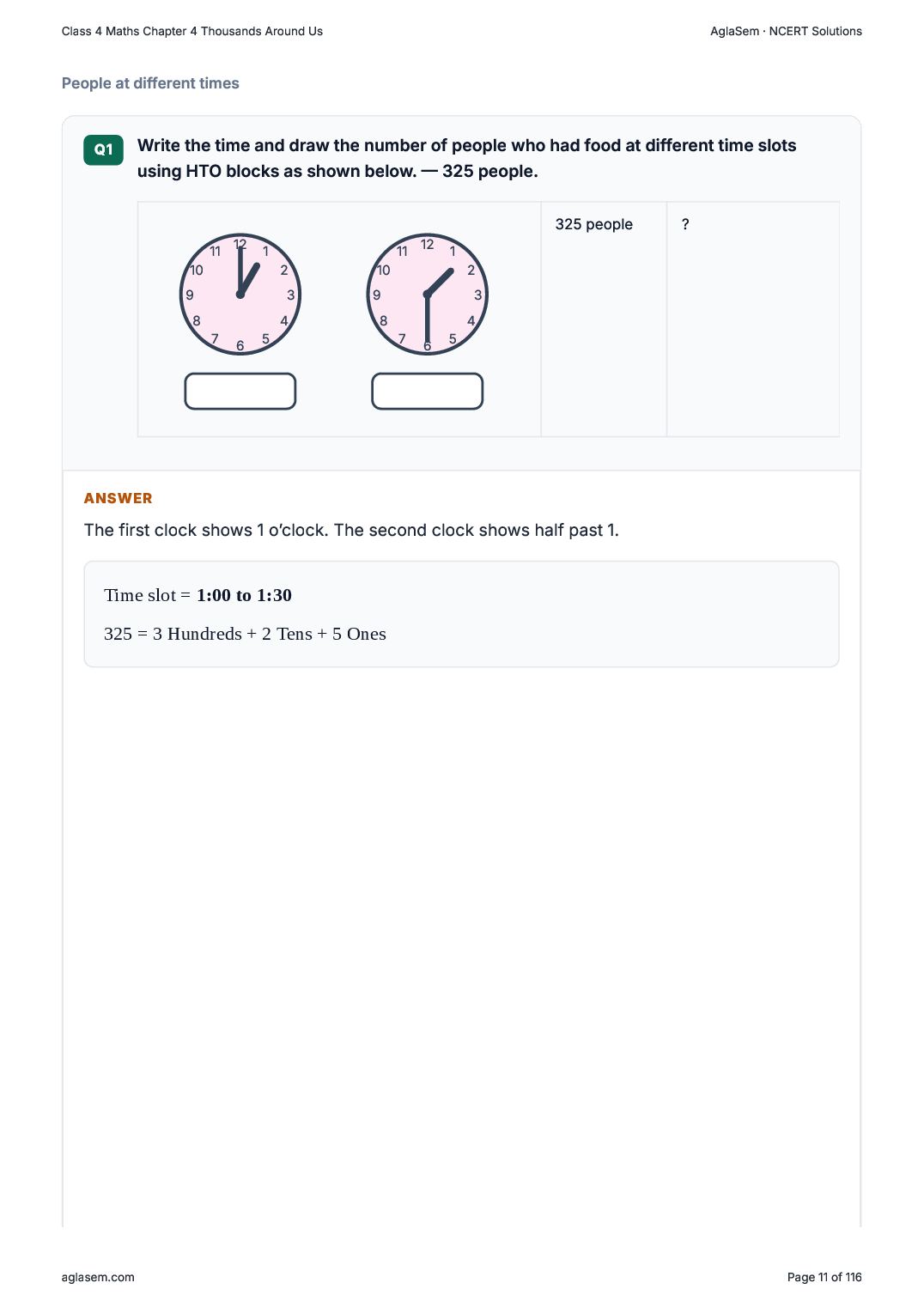
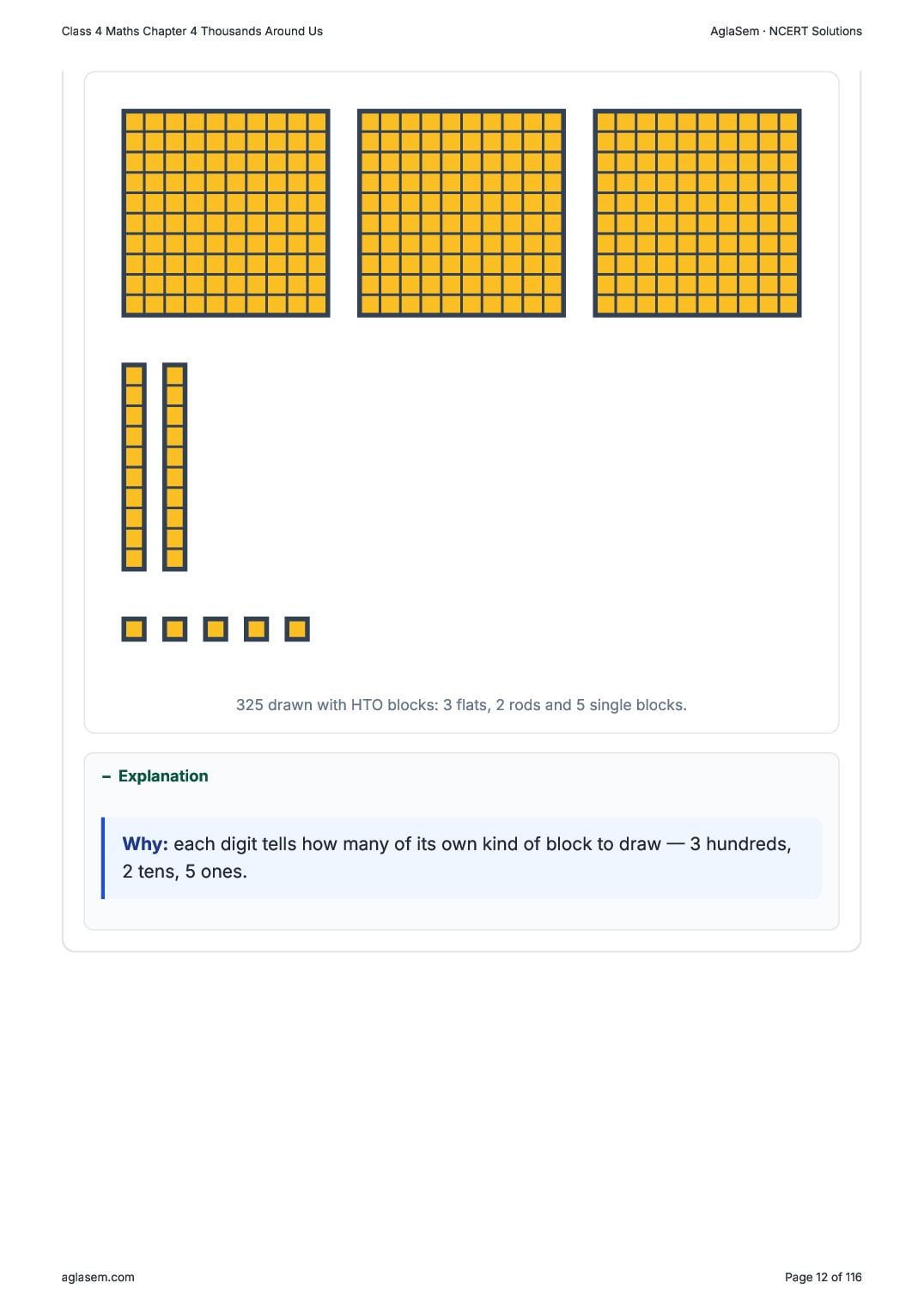
- Write the time and draw the number of people who had food at different time slots using HTO blocks as shown below. — 325 people.121234567891011121234567891011325 people?
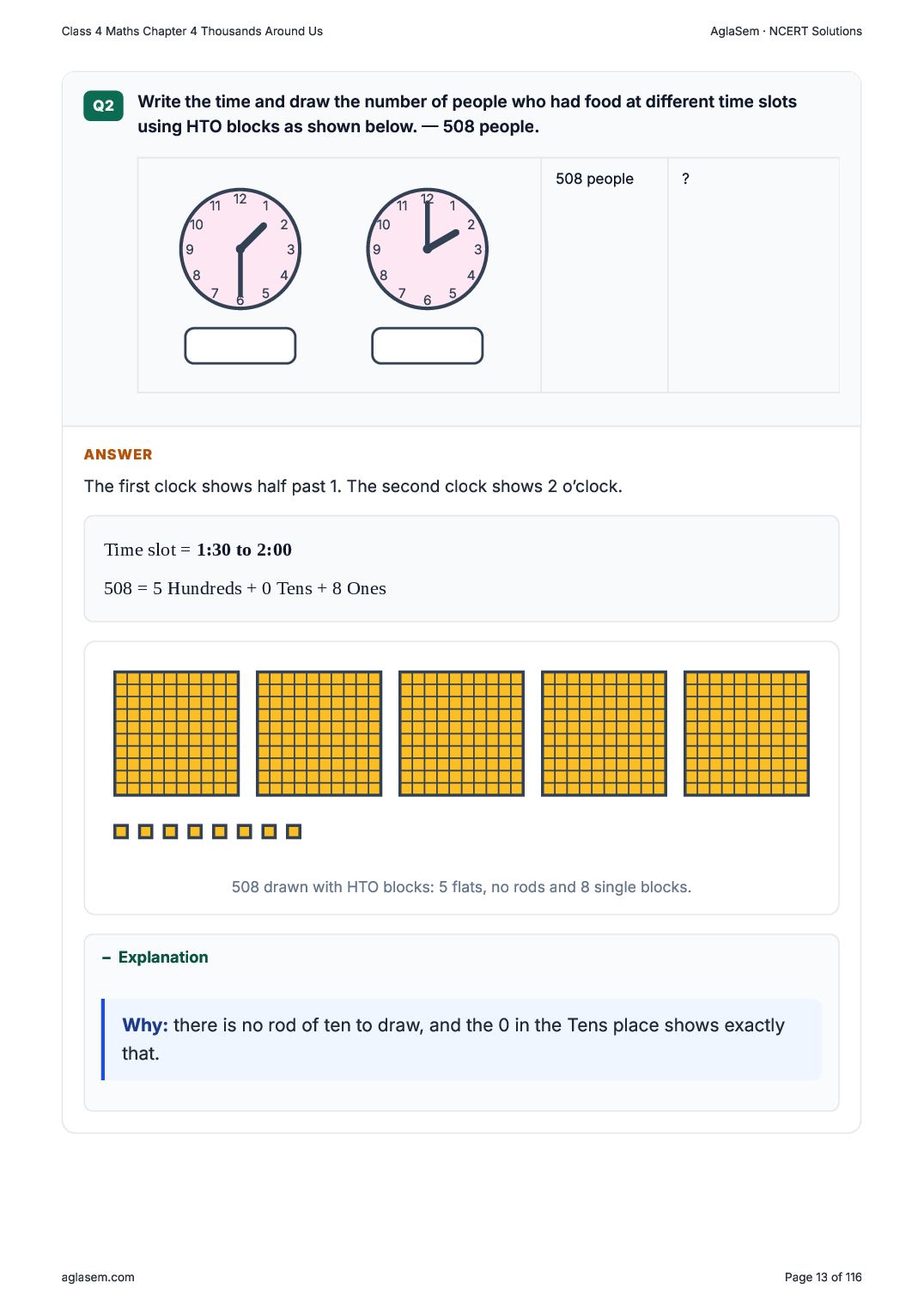
- Write the time and draw the number of people who had food at different time slots using HTO blocks as shown below. — 508 people.121234567891011121234567891011508 people?
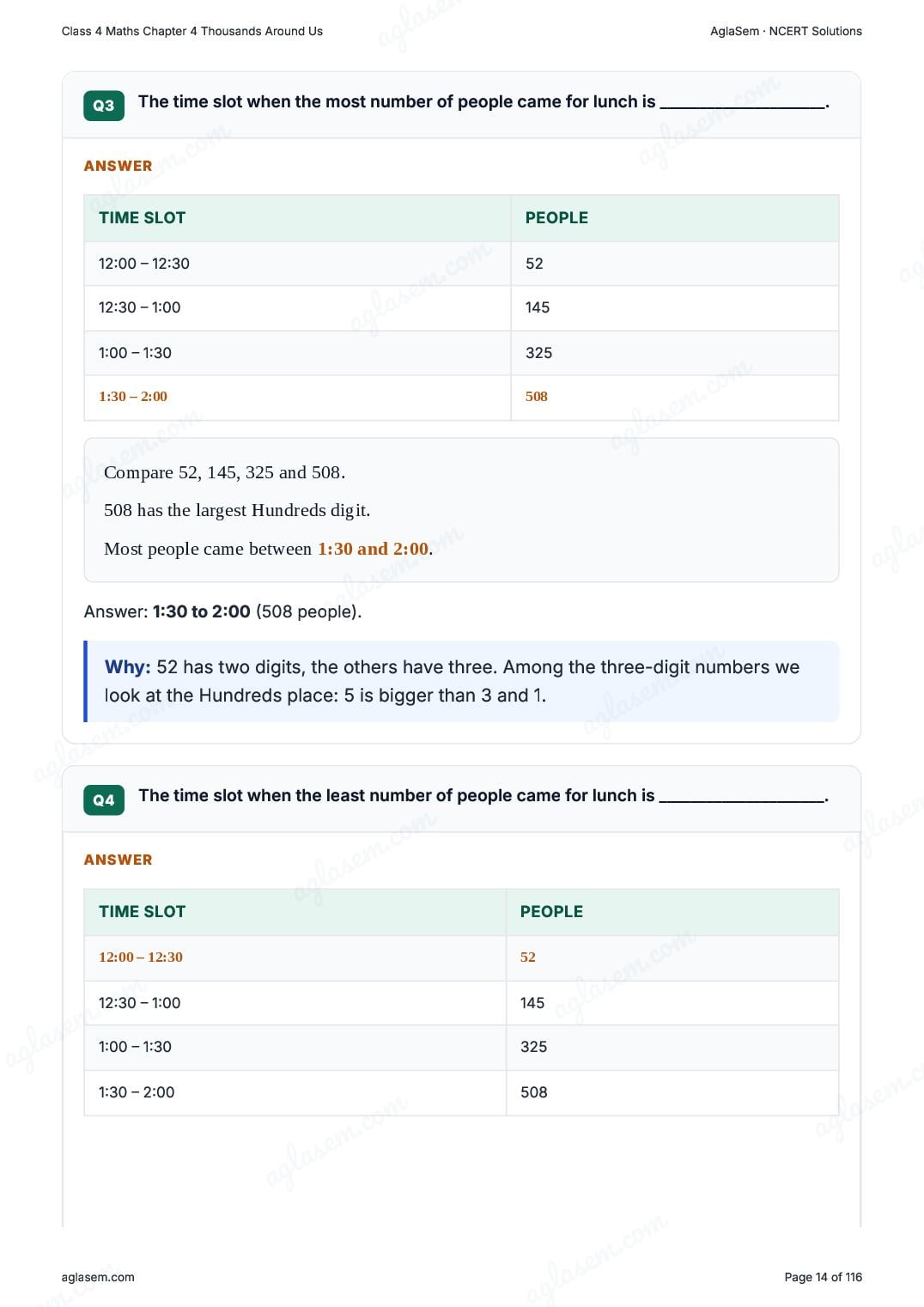
- The time slot when the most number of people came for lunch is _____________________.
- The time slot when the least number of people came for lunch is _____________________.
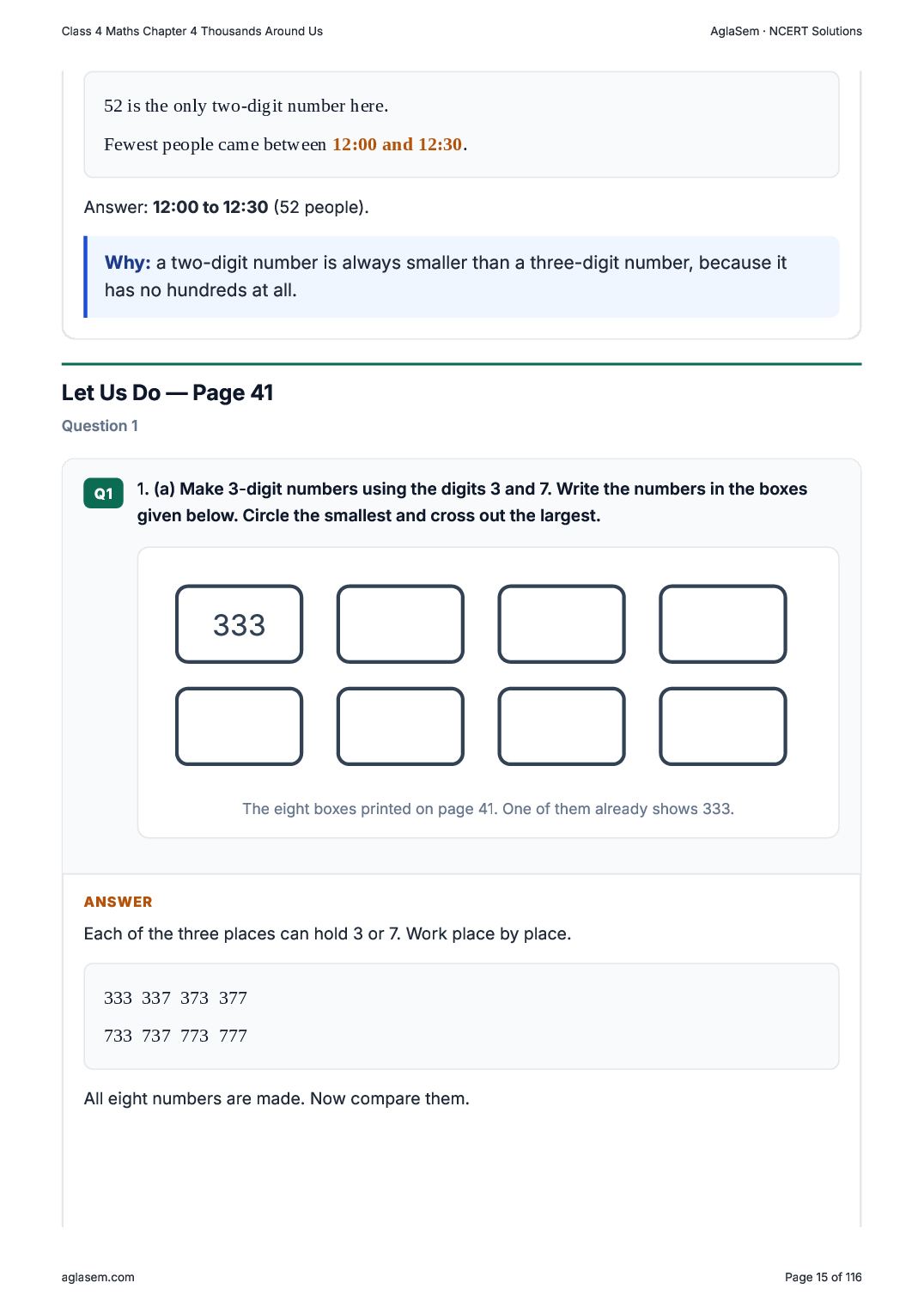
- 1. (a) Make 3-digit numbers using the digits 3 and 7. Write the numbers in the boxes given below. Circle the smallest and cross out the largest.333The eight boxes printed on page 41. One of them already shows 333.
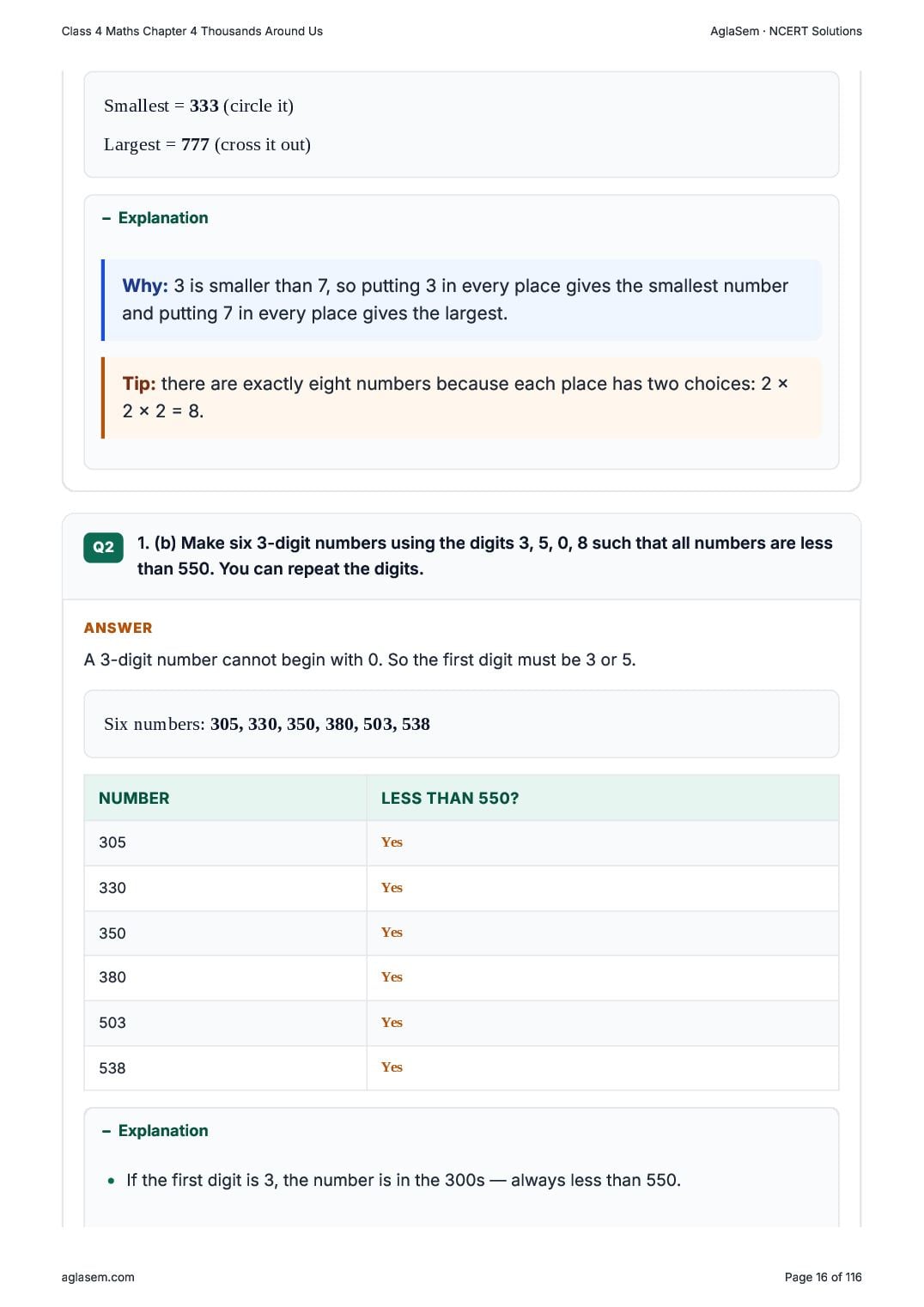
- 1. (b) Make six 3-digit numbers using the digits 3, 5, 0, 8 such that all numbers are less than 550. You can repeat the digits.
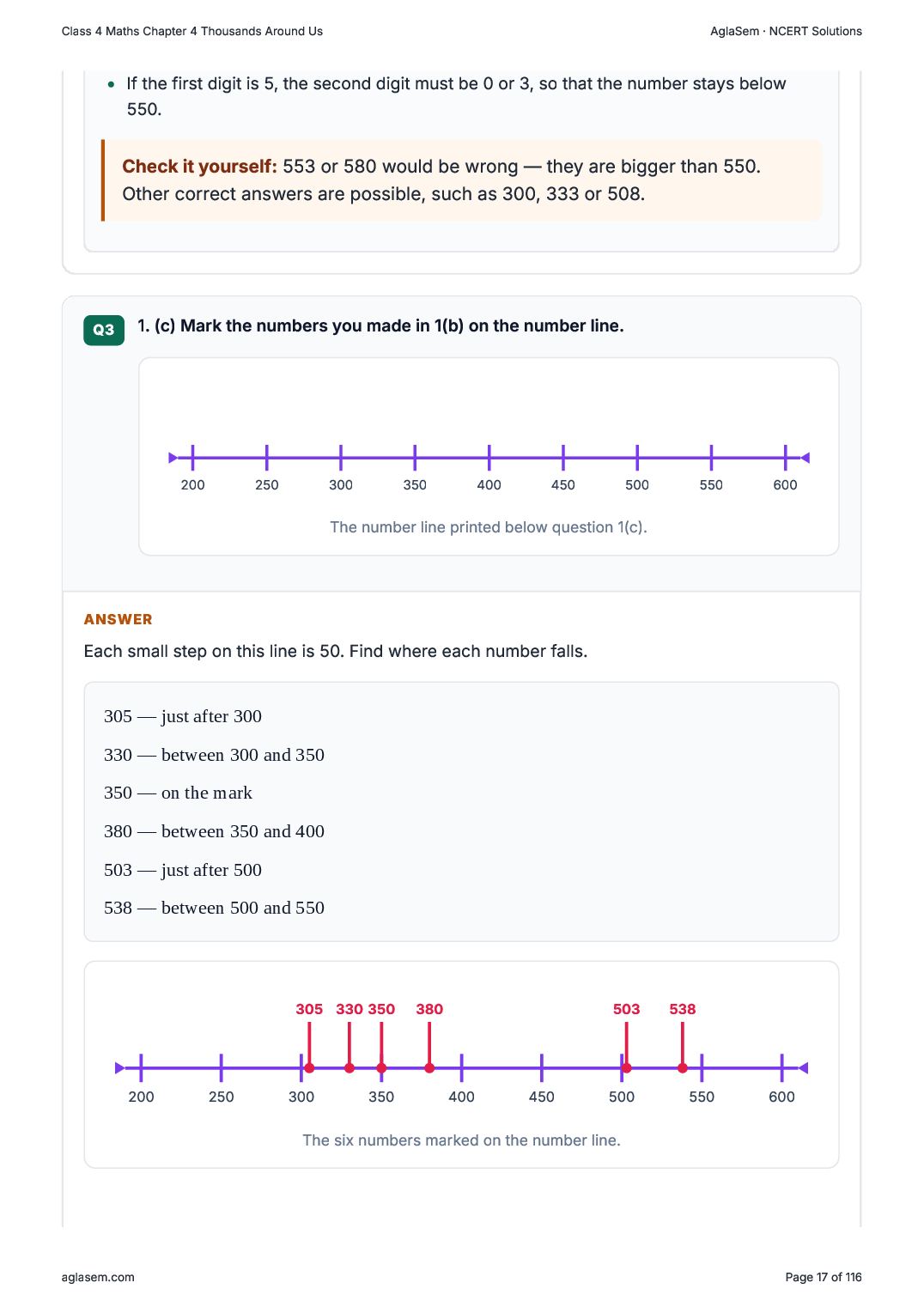
- 1. (c) Mark the numbers you made in 1(b) on the number line.200250300350400450500550600The number line printed below question 1(c).
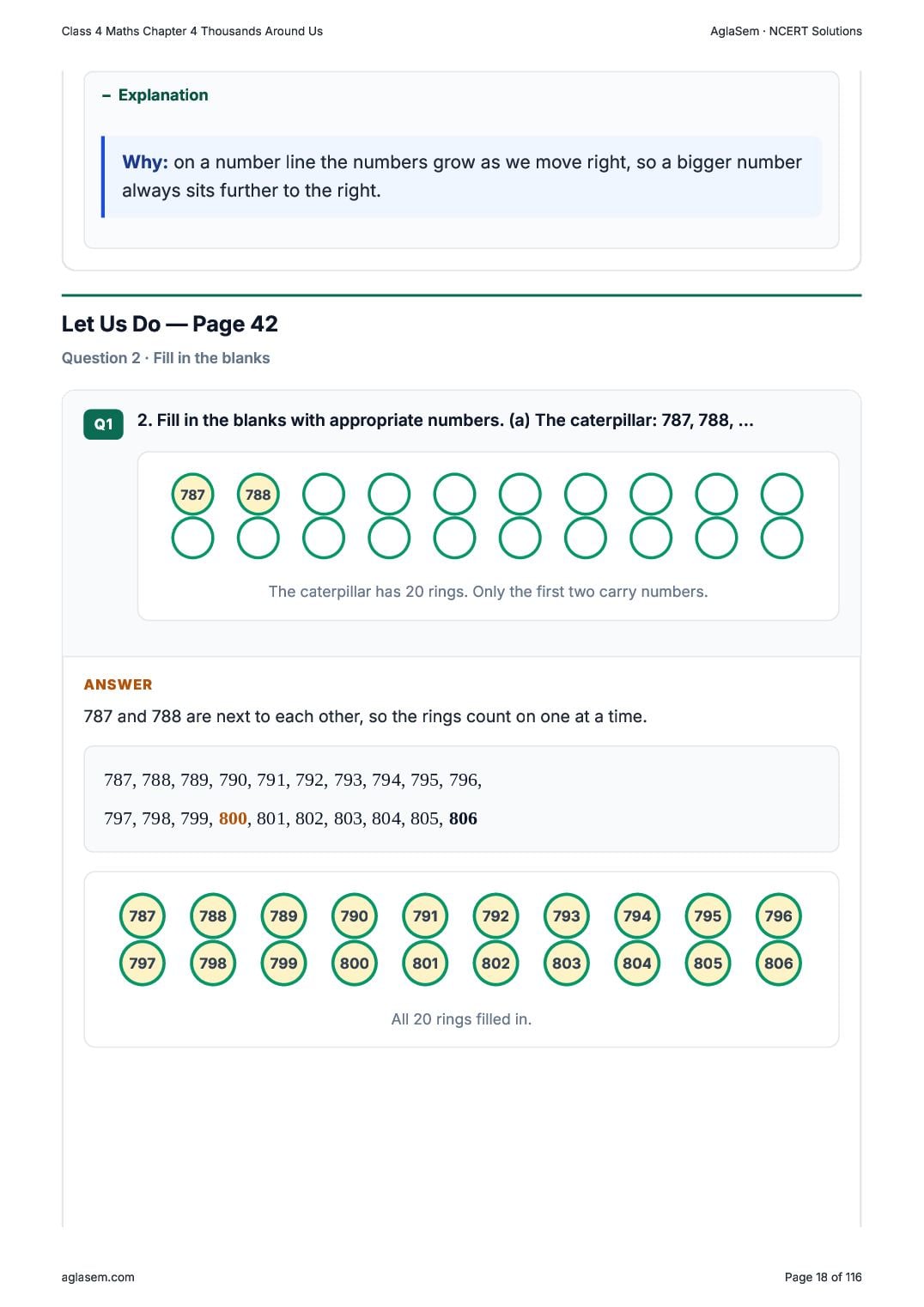
- 2. Fill in the blanks with appropriate numbers. (a) The caterpillar: 787, 788, …
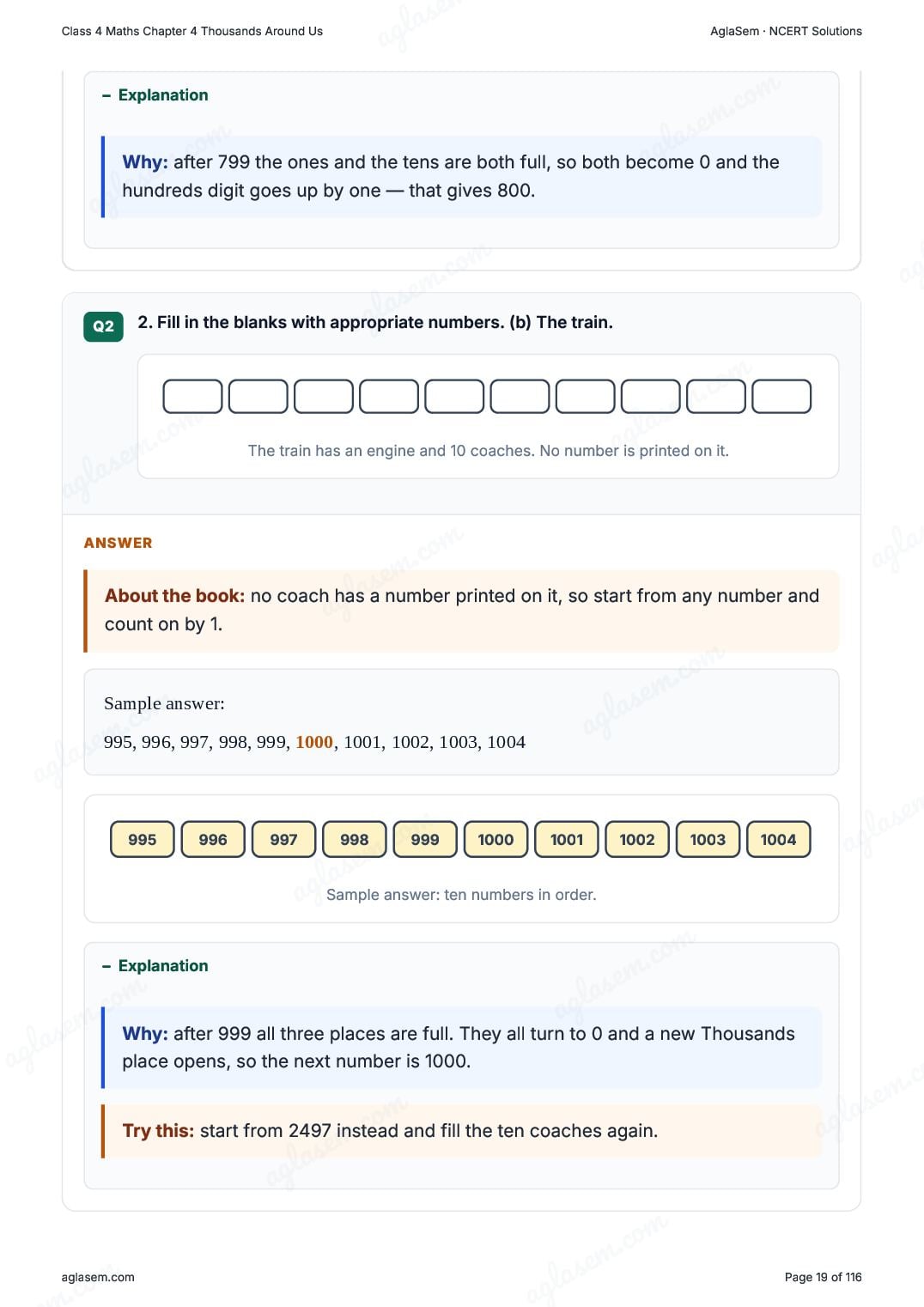
- 2. Fill in the blanks with appropriate numbers. (b) The train.
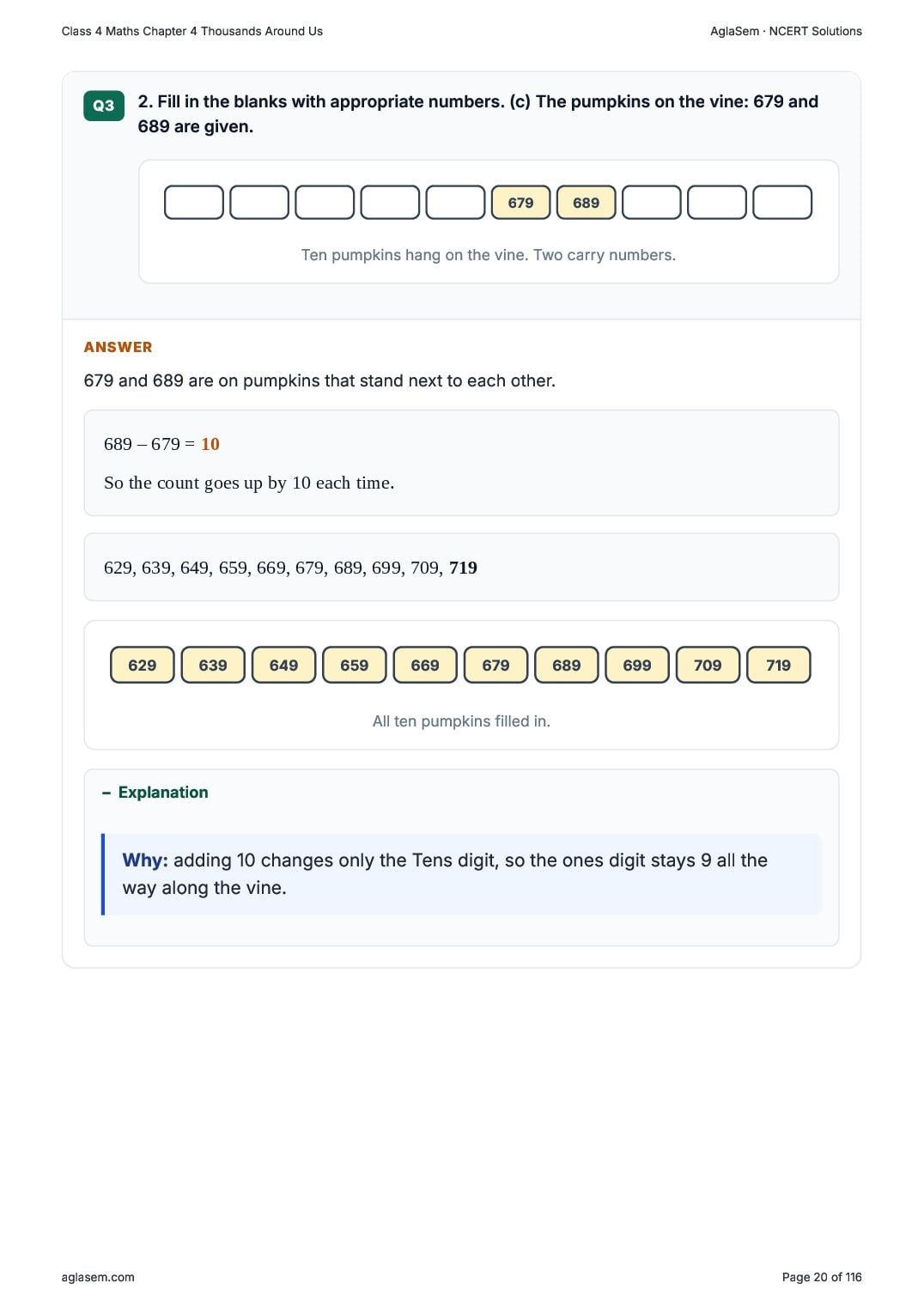
- 2. Fill in the blanks with appropriate numbers. (c) The pumpkins on the vine: 679 and 689 are given.
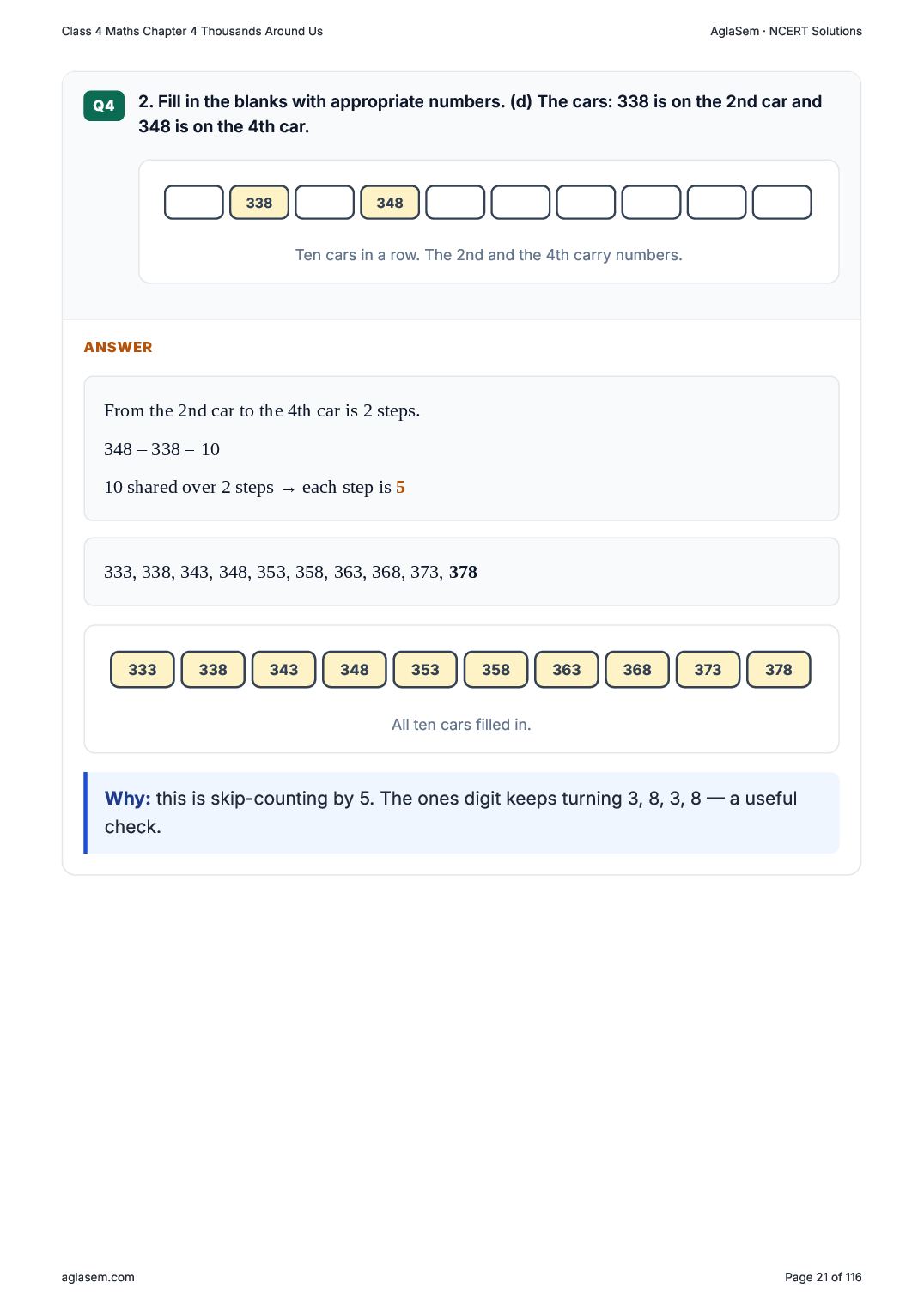
- 2. Fill in the blanks with appropriate numbers. (d) The cars: 338 is on the 2nd car and 348 is on the 4th car.
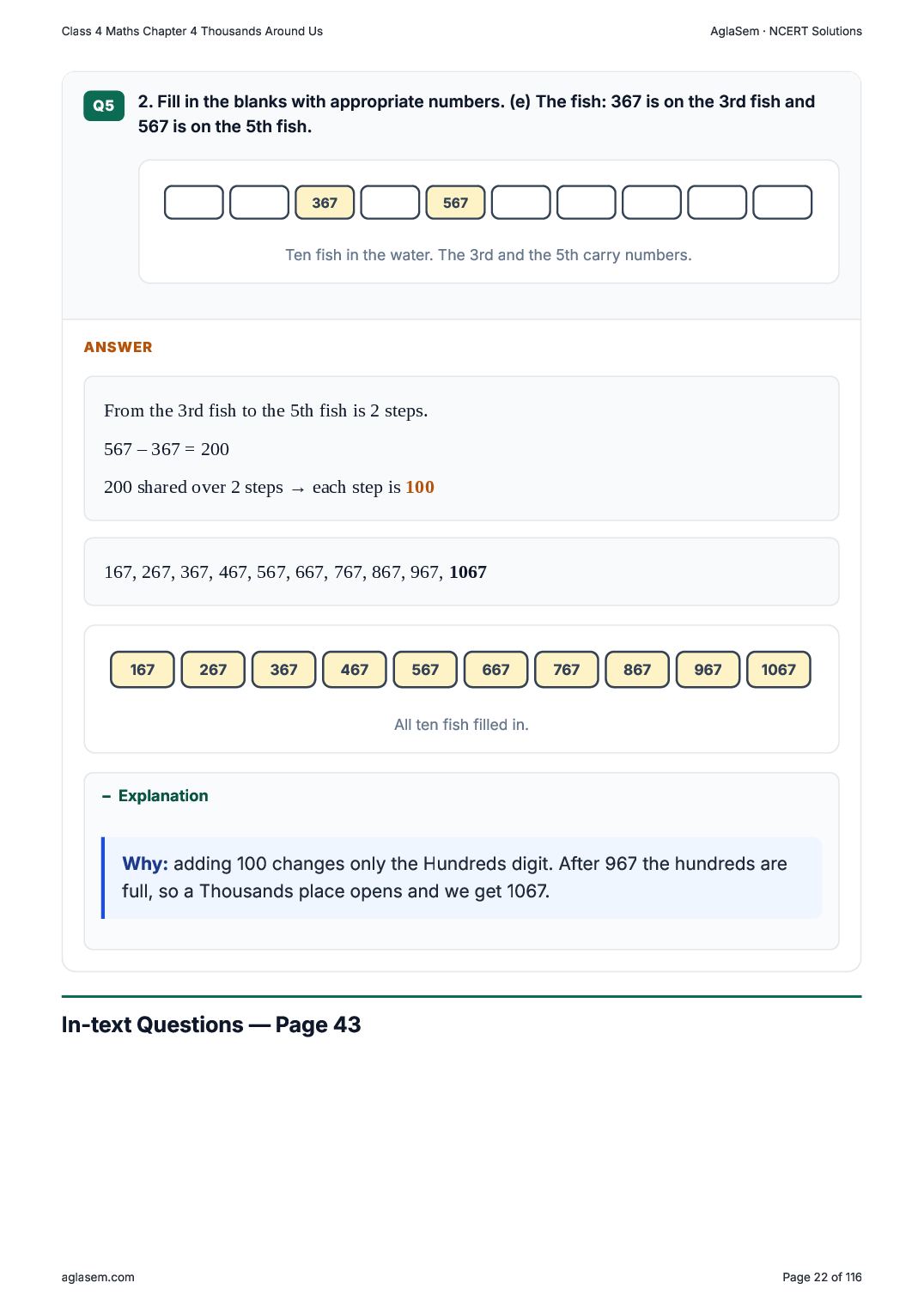
- 2. Fill in the blanks with appropriate numbers. (e) The fish: 367 is on the 3rd fish and 567 is on the 5th fish.
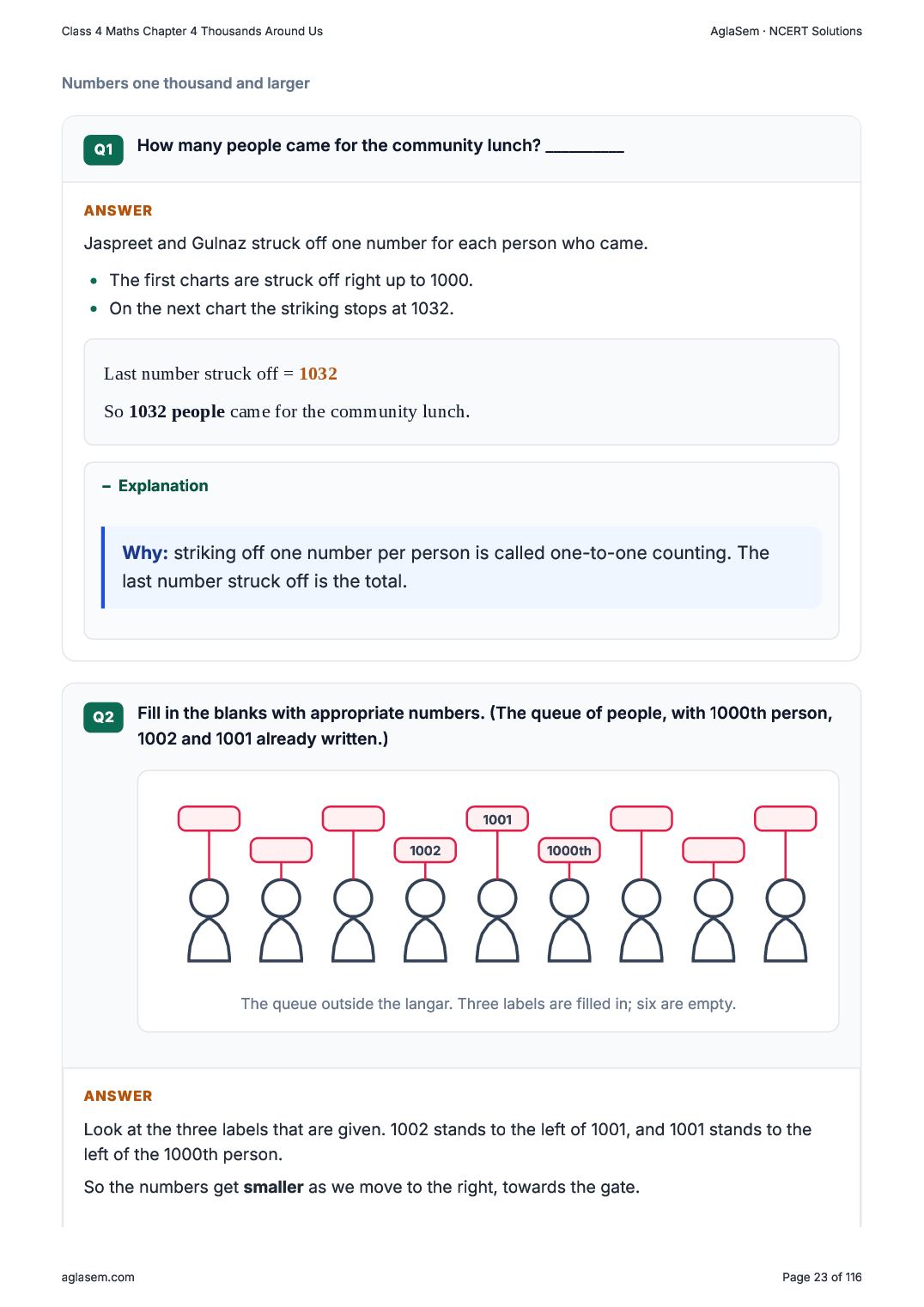
- How many people came for the community lunch? __________
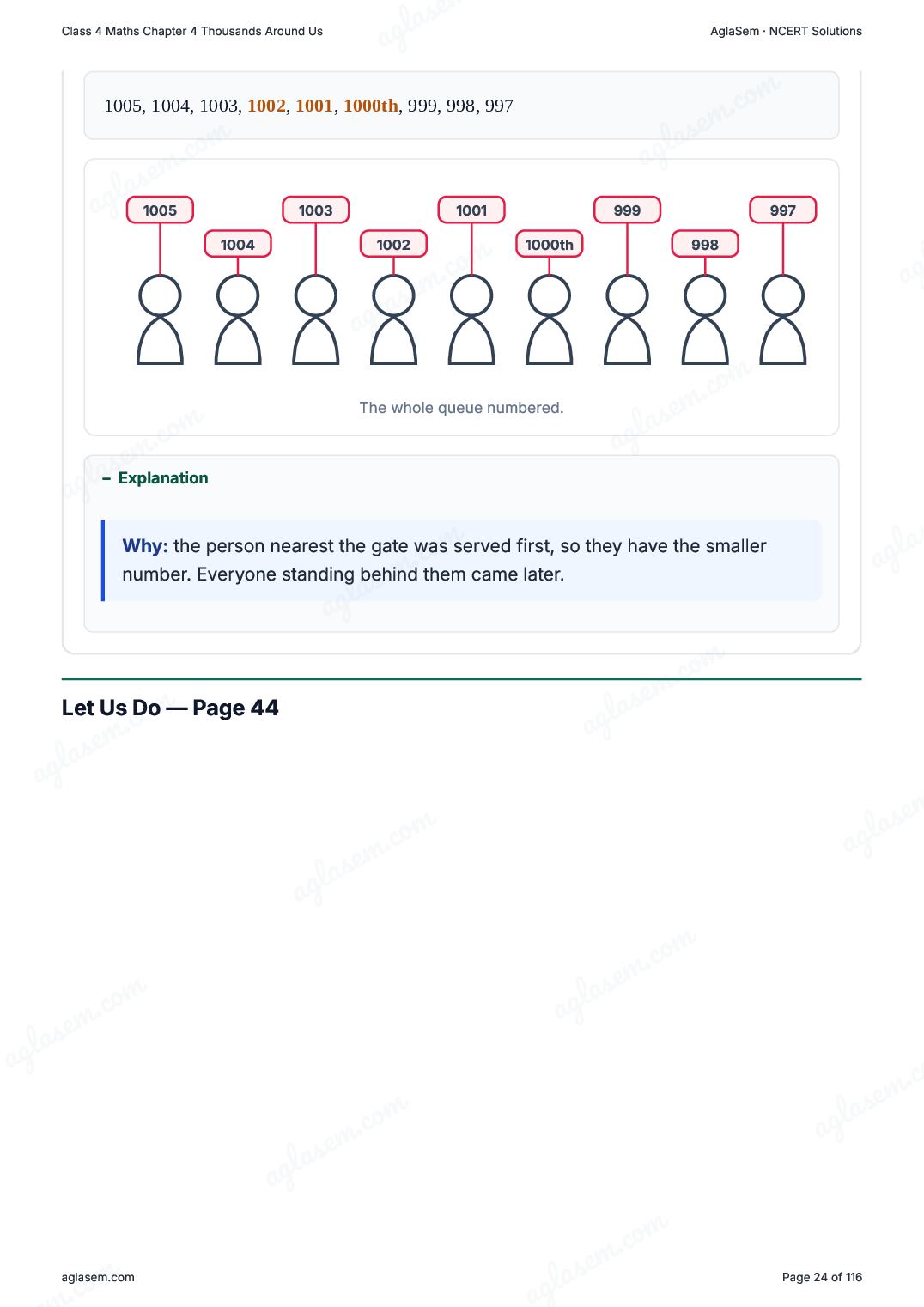
- Fill in the blanks with appropriate numbers. (The queue of people, with 1000th person, 1002 and 1001 already written.)
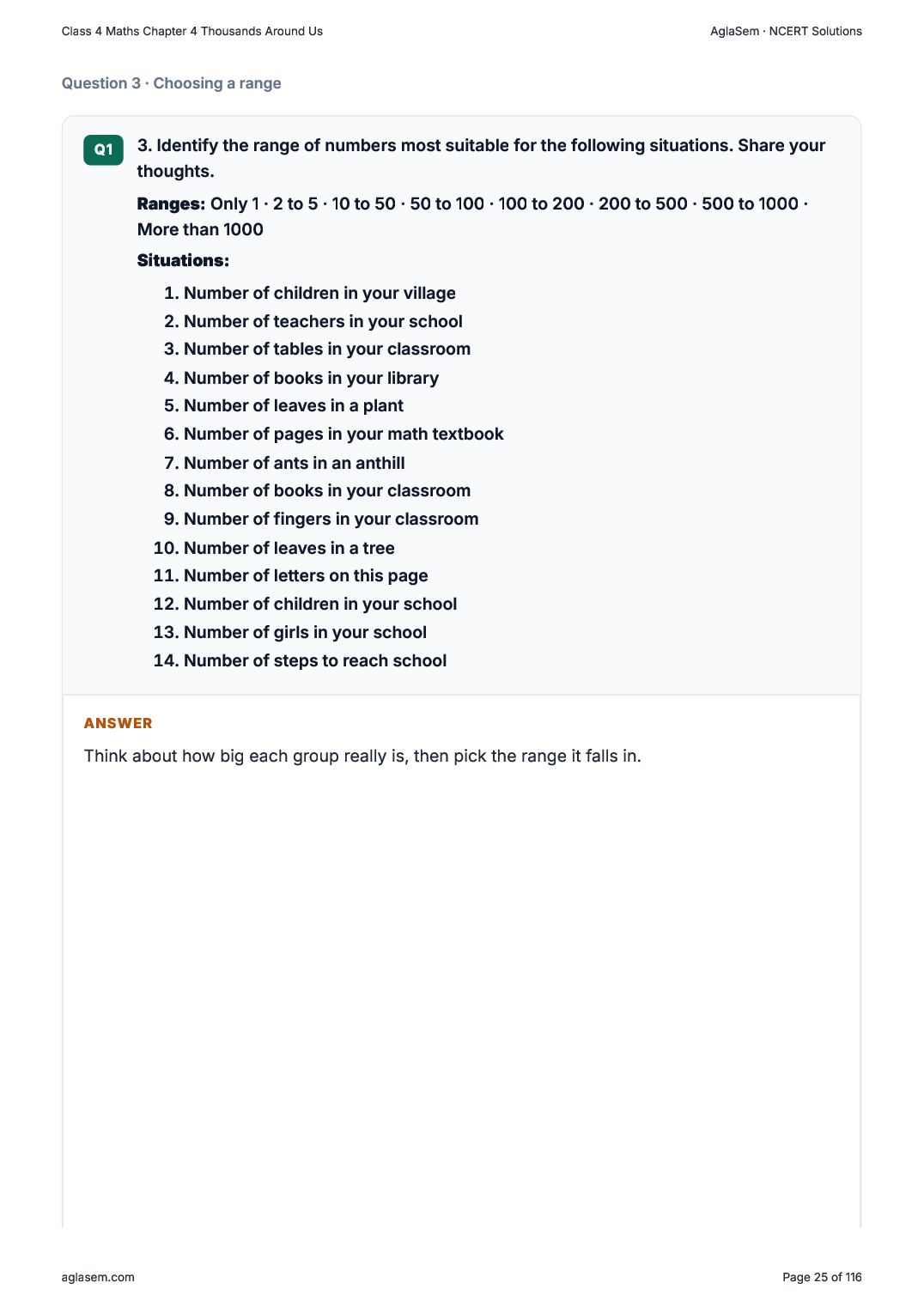
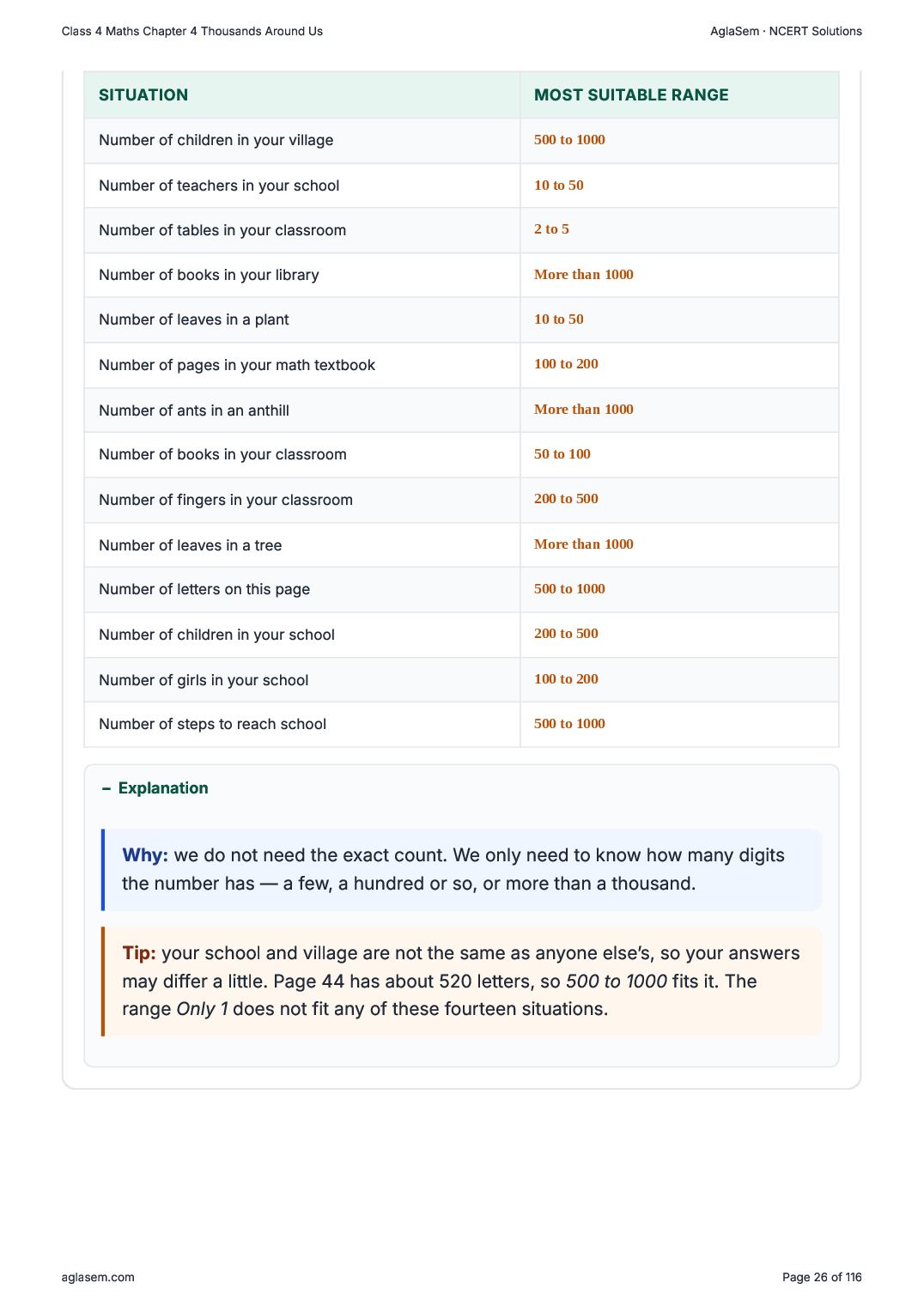
- 3. Identify the range of numbers most suitable for the following situations. Share your thoughts.
- Identify things around you that are more than 1000 in number.
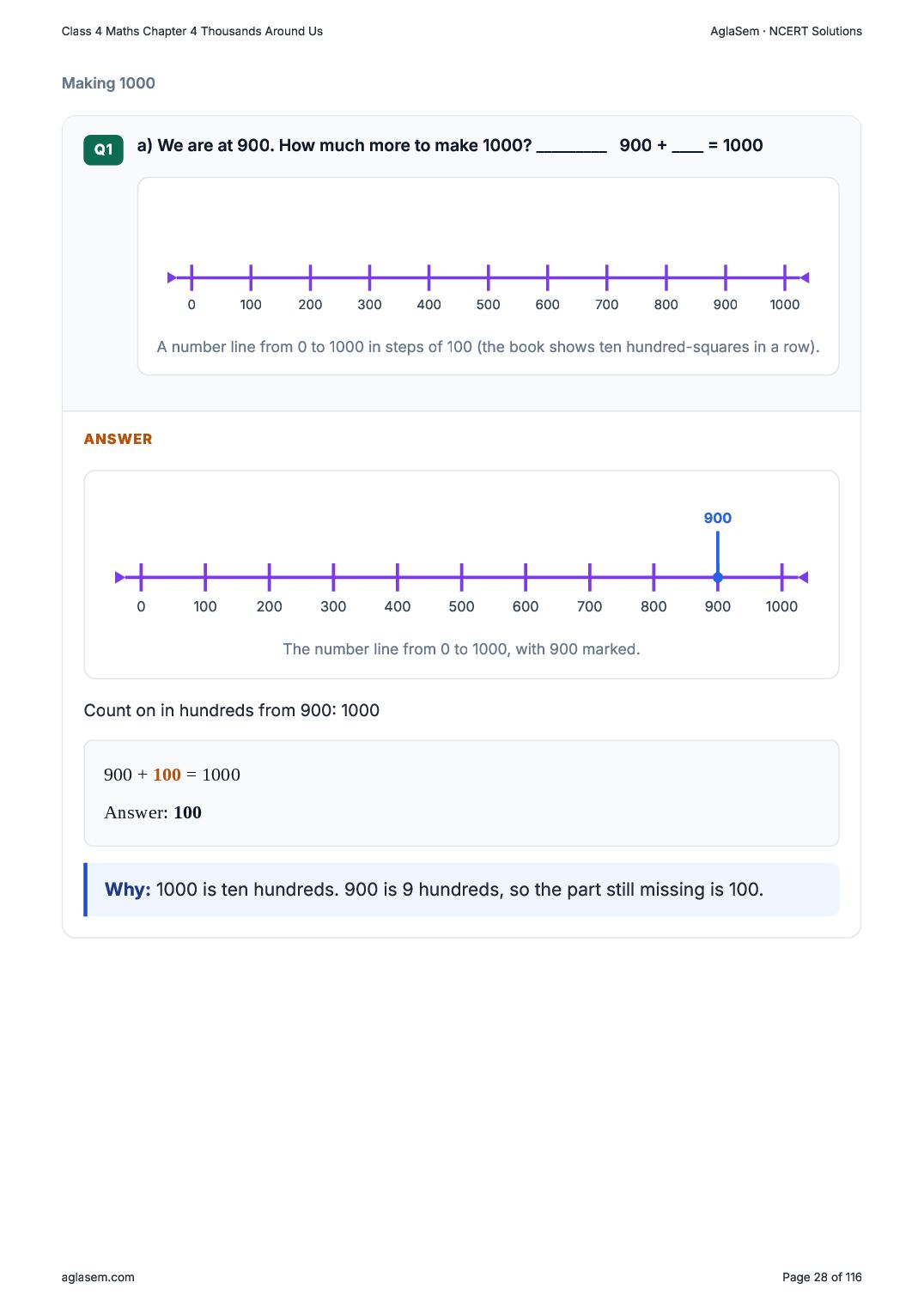
- a) We are at 900. How much more to make 1000? _________ 900 + ____ = 1000
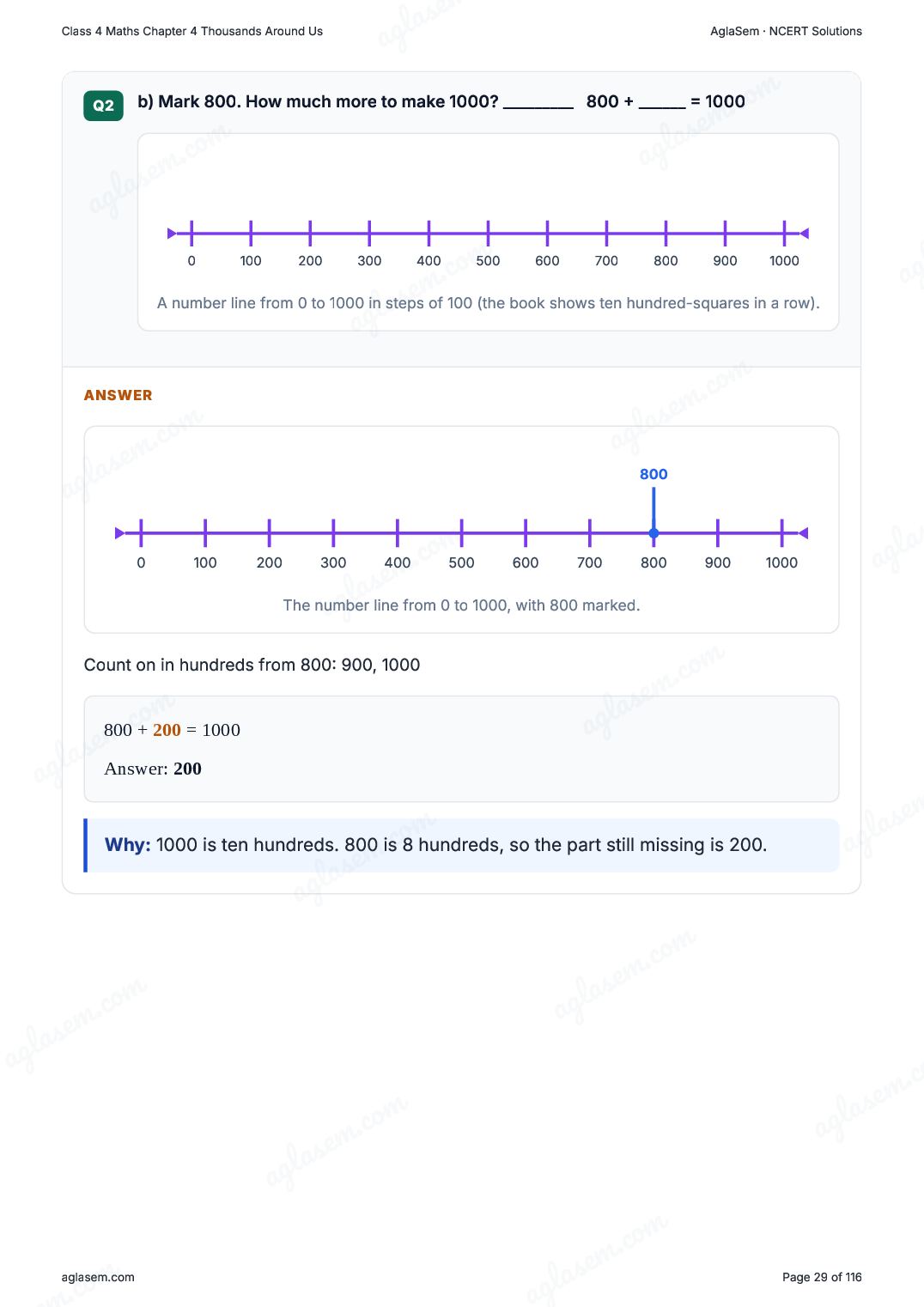
- b) Mark 800. How much more to make 1000? _________ 800 + ______ = 1000
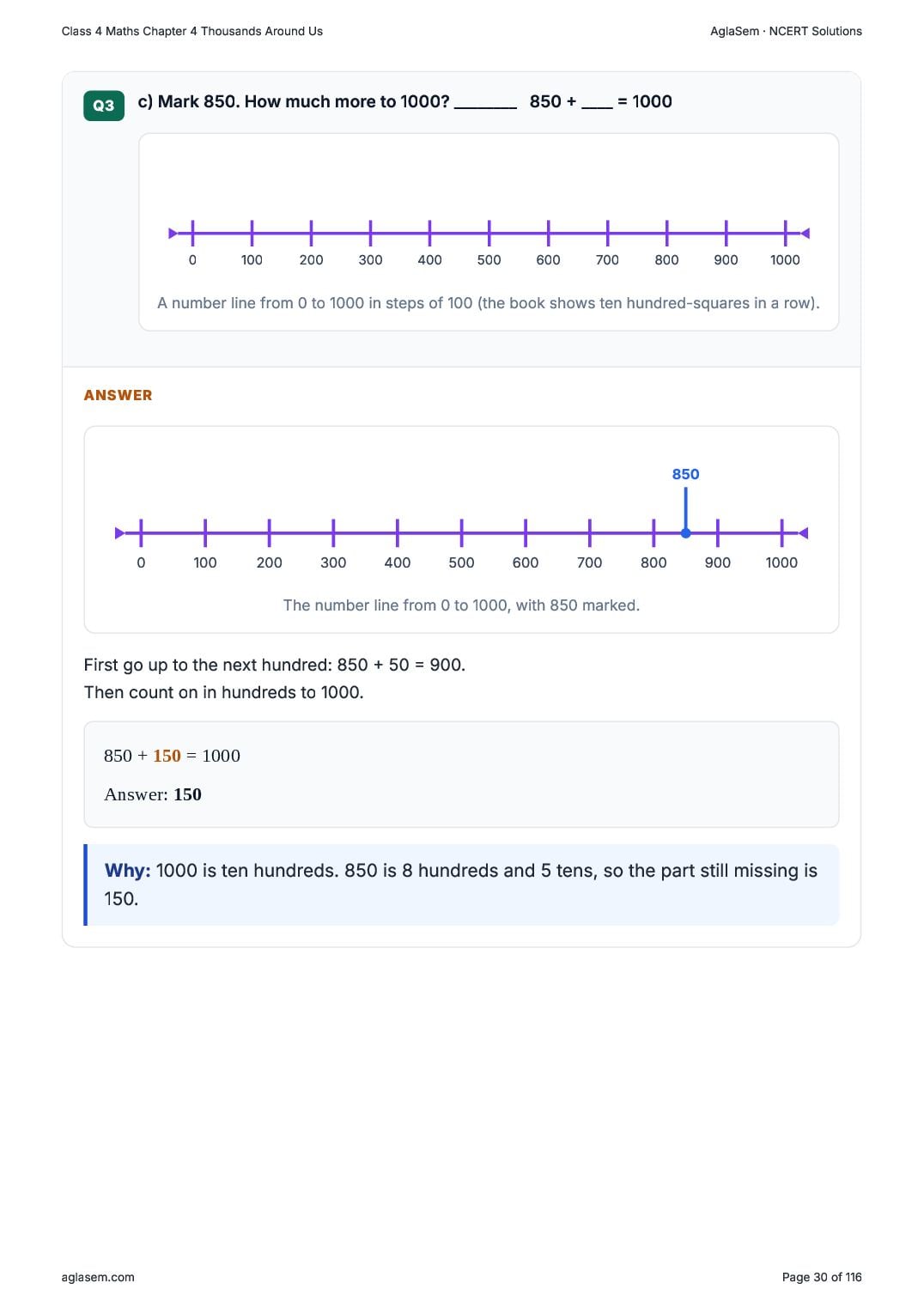
- c) Mark 850. How much more to 1000? ________ 850 + ____ = 1000
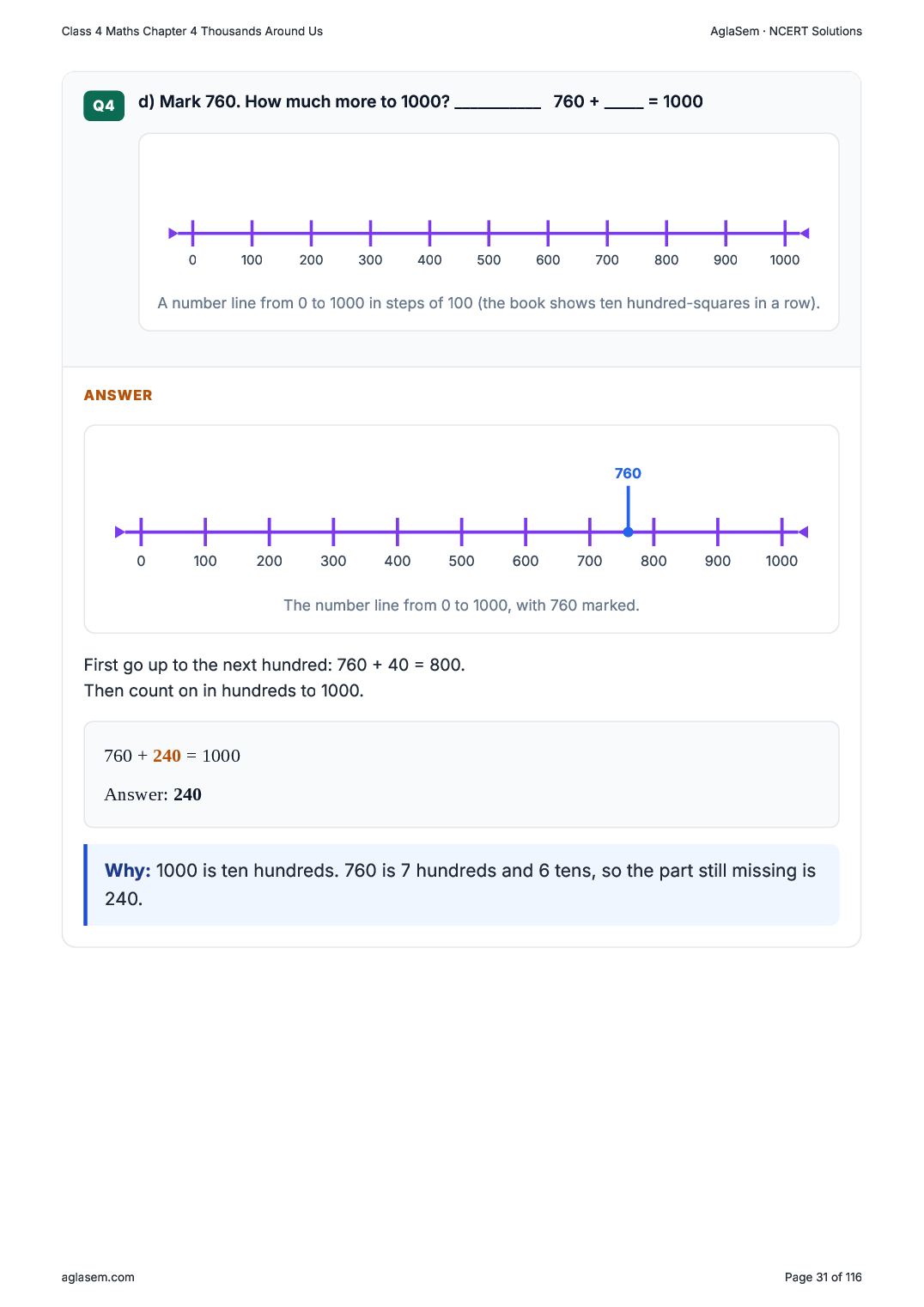
- d) Mark 760. How much more to 1000? ___________ 760 + _____ = 1000
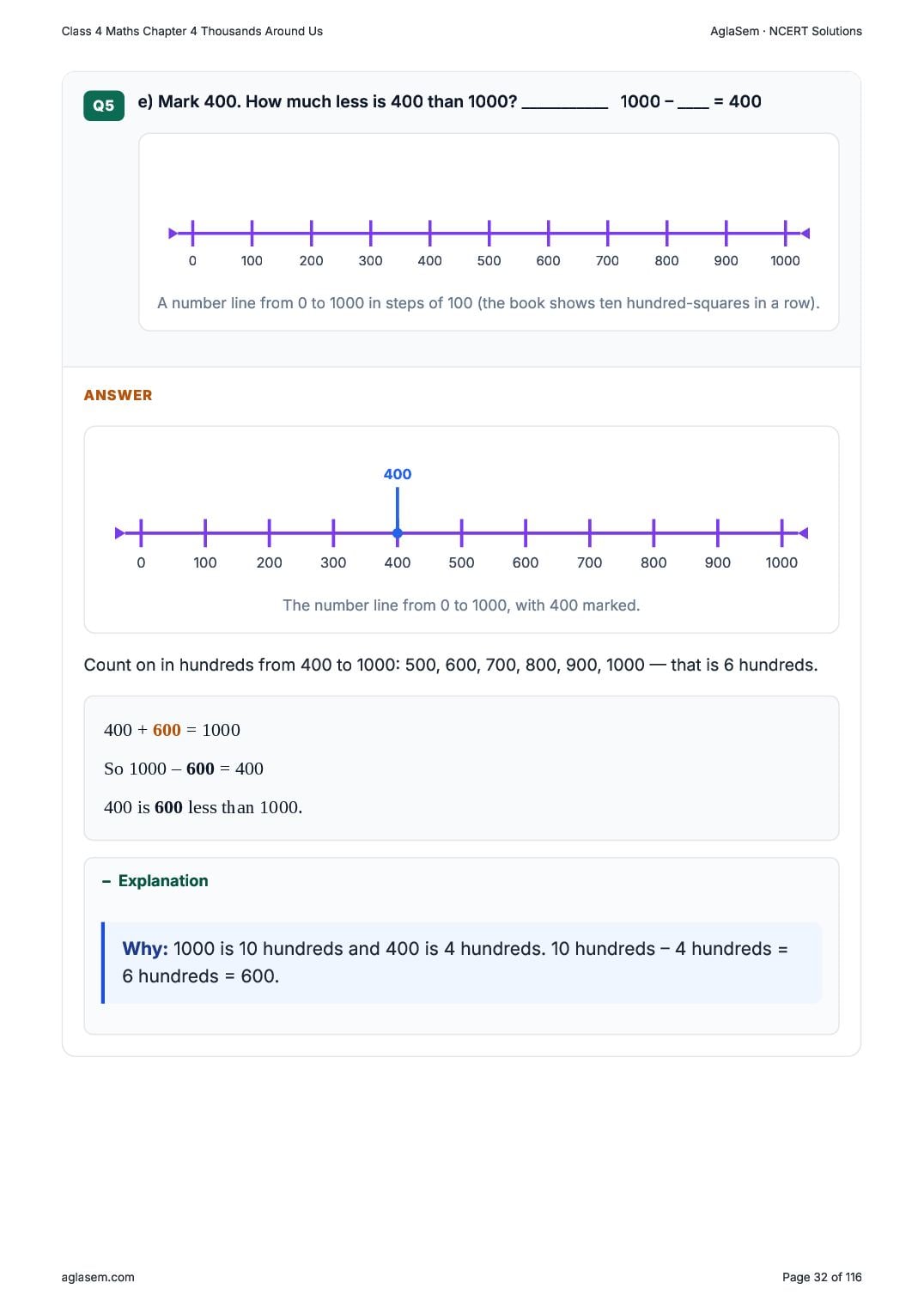
- e) Mark 400. How much less is 400 than 1000? ___________ 1000 – ____ = 400
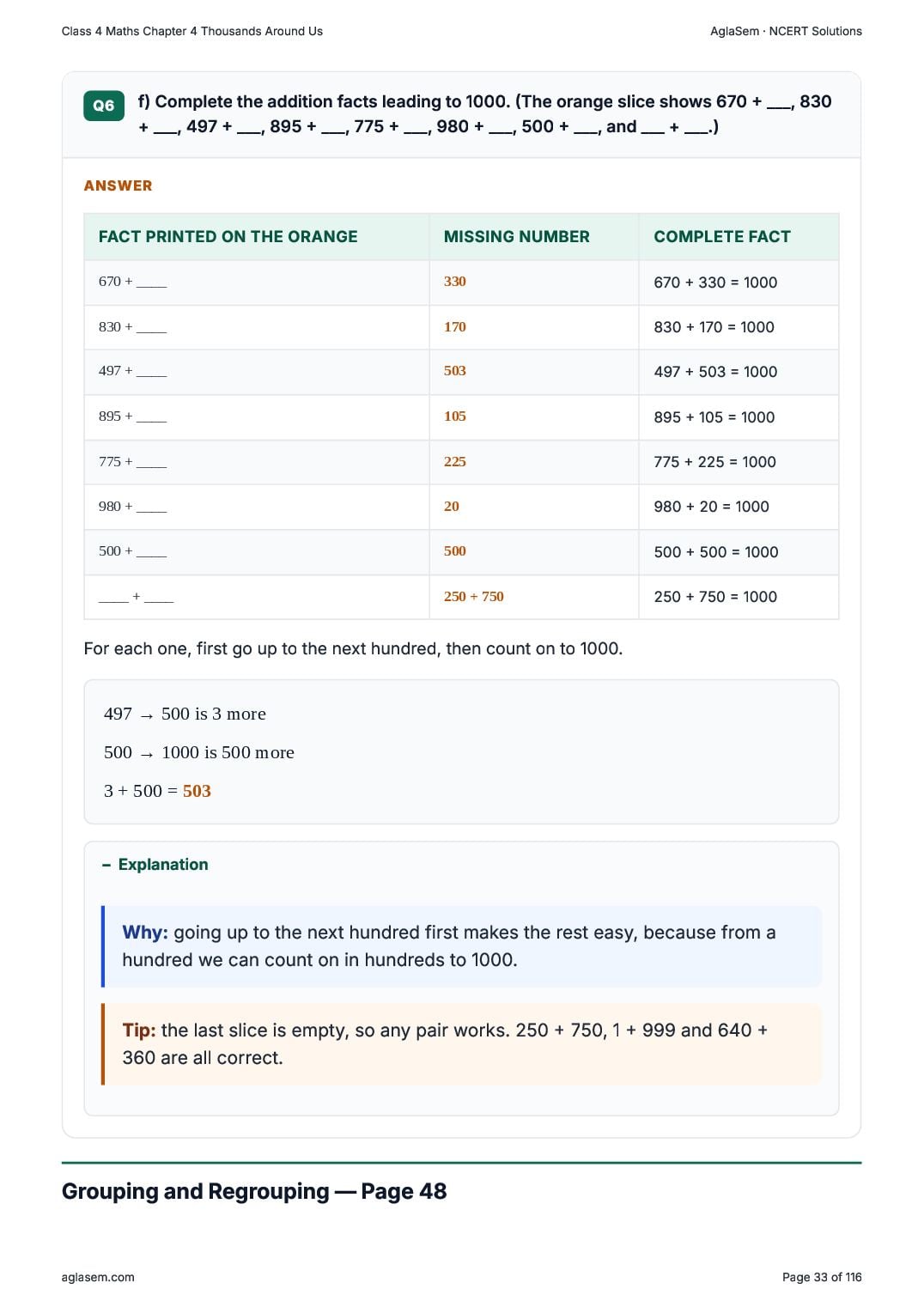
- f) Complete the addition facts leading to 1000. (The orange slice shows 670 + ___, 830 + ___, 497 + ___, 895 + ___, 775 + ___, 980 + ___, 500 + ___, and ___ + ___.)
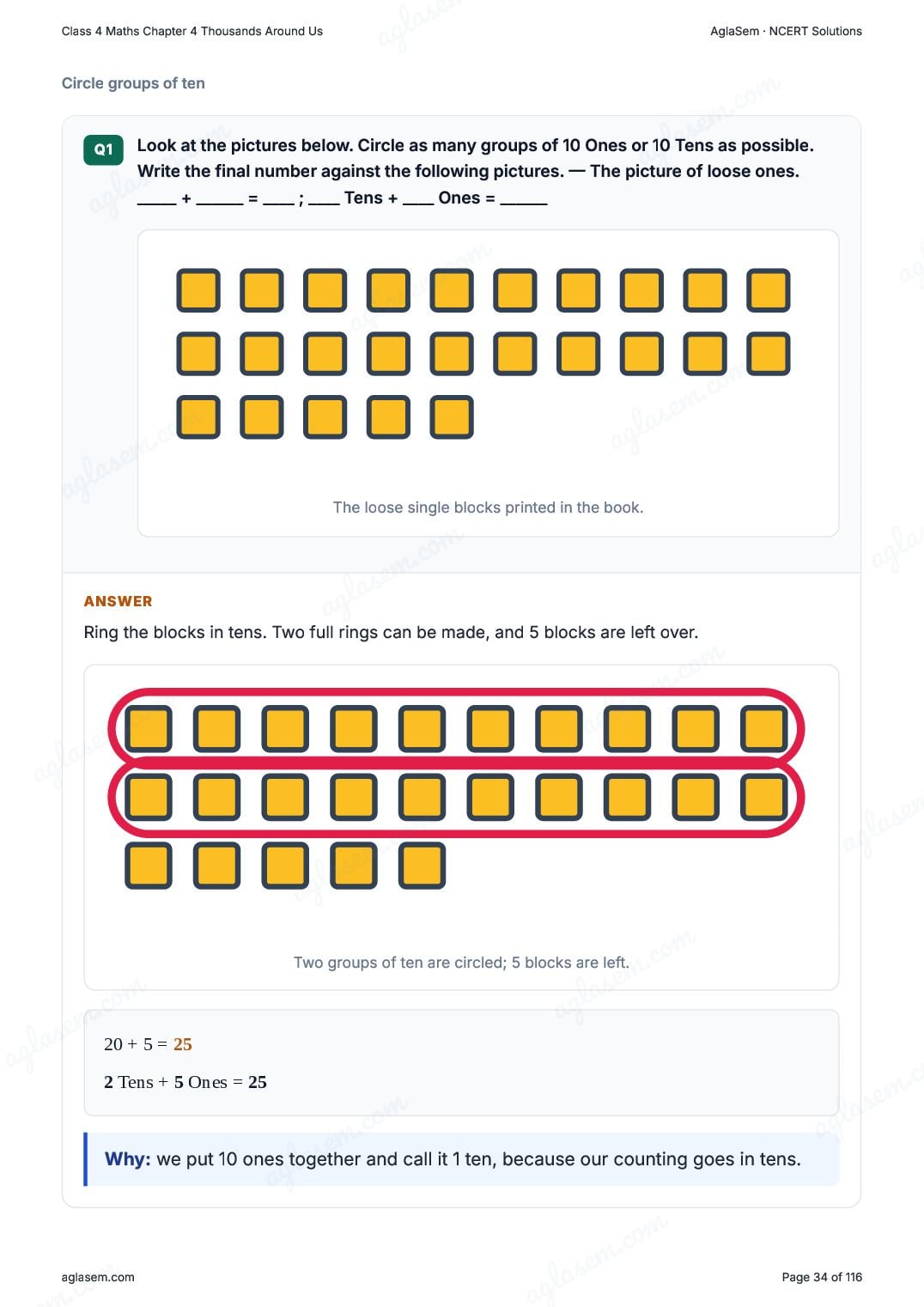
- Look at the pictures below. Circle as many groups of 10 Ones or 10 Tens as possible. Write the final number against the following pictures. — The picture of loose ones. _____ + ______ = ____ ; ____ Tens + ____ Ones = ______The loose single blocks printed in the book.
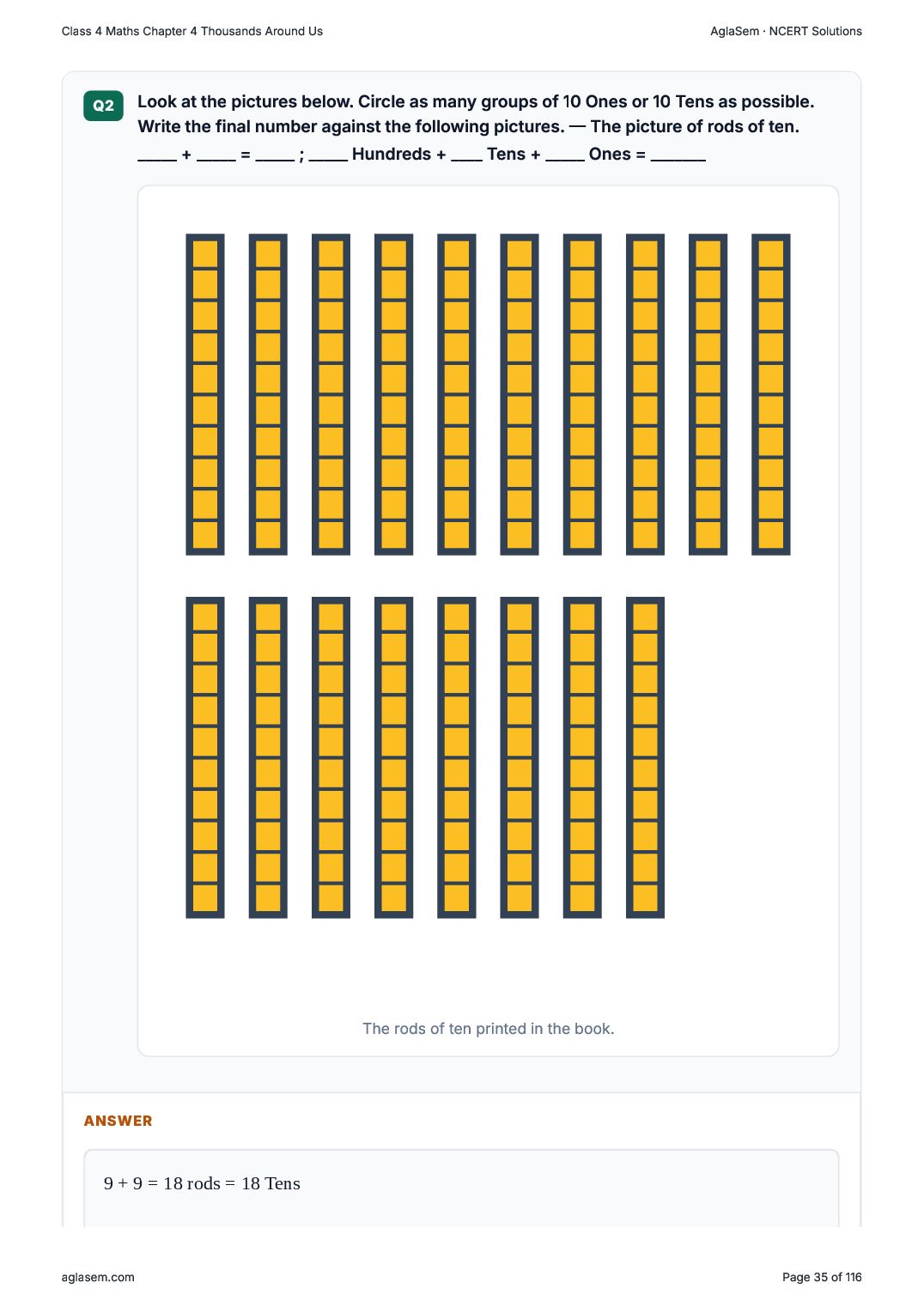
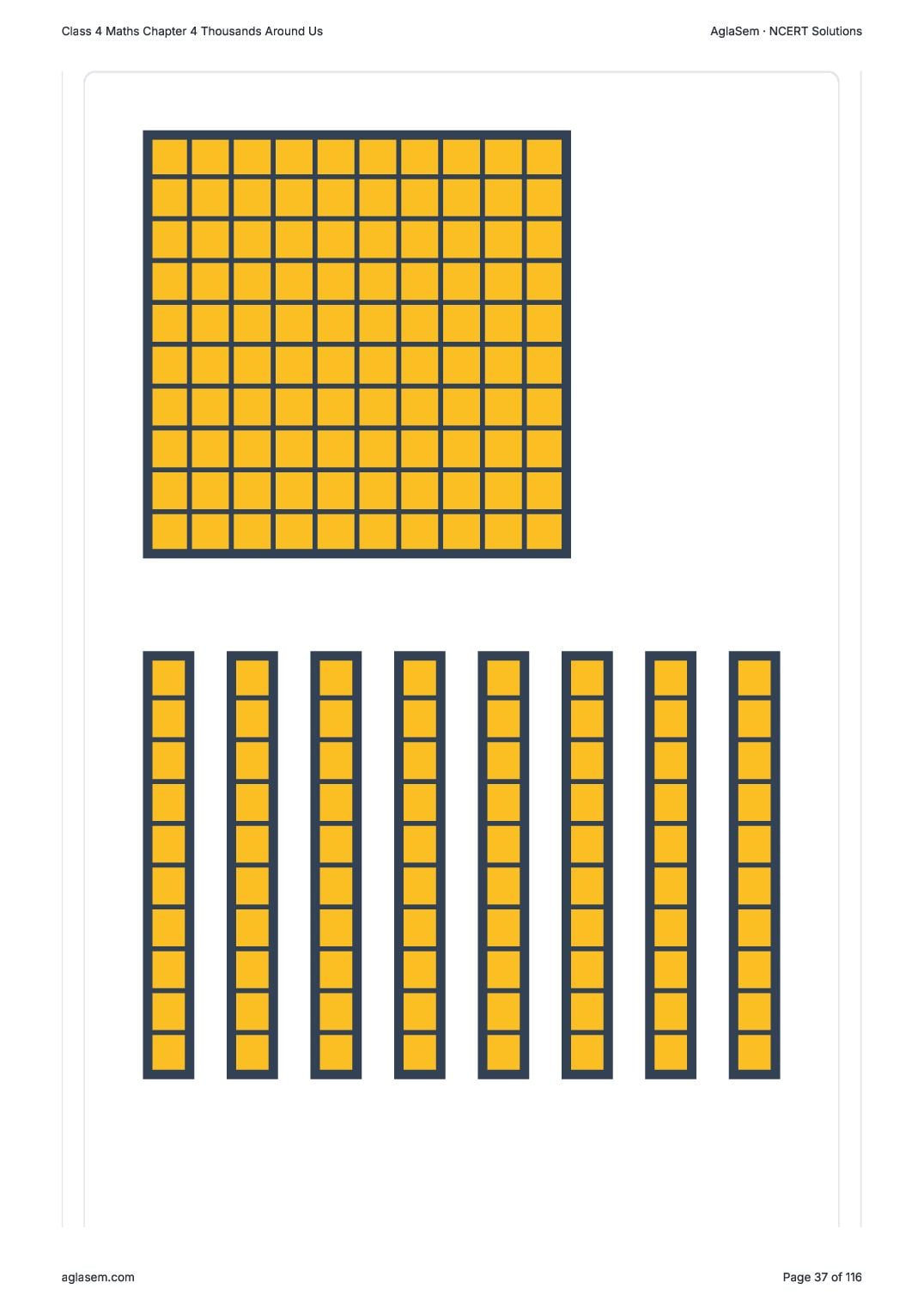
- Look at the pictures below. Circle as many groups of 10 Ones or 10 Tens as possible. Write the final number against the following pictures. — The picture of rods of ten. _____ + _____ = _____ ; _____ Hundreds + ____ Tens + _____ Ones = _______The rods of ten printed in the book.
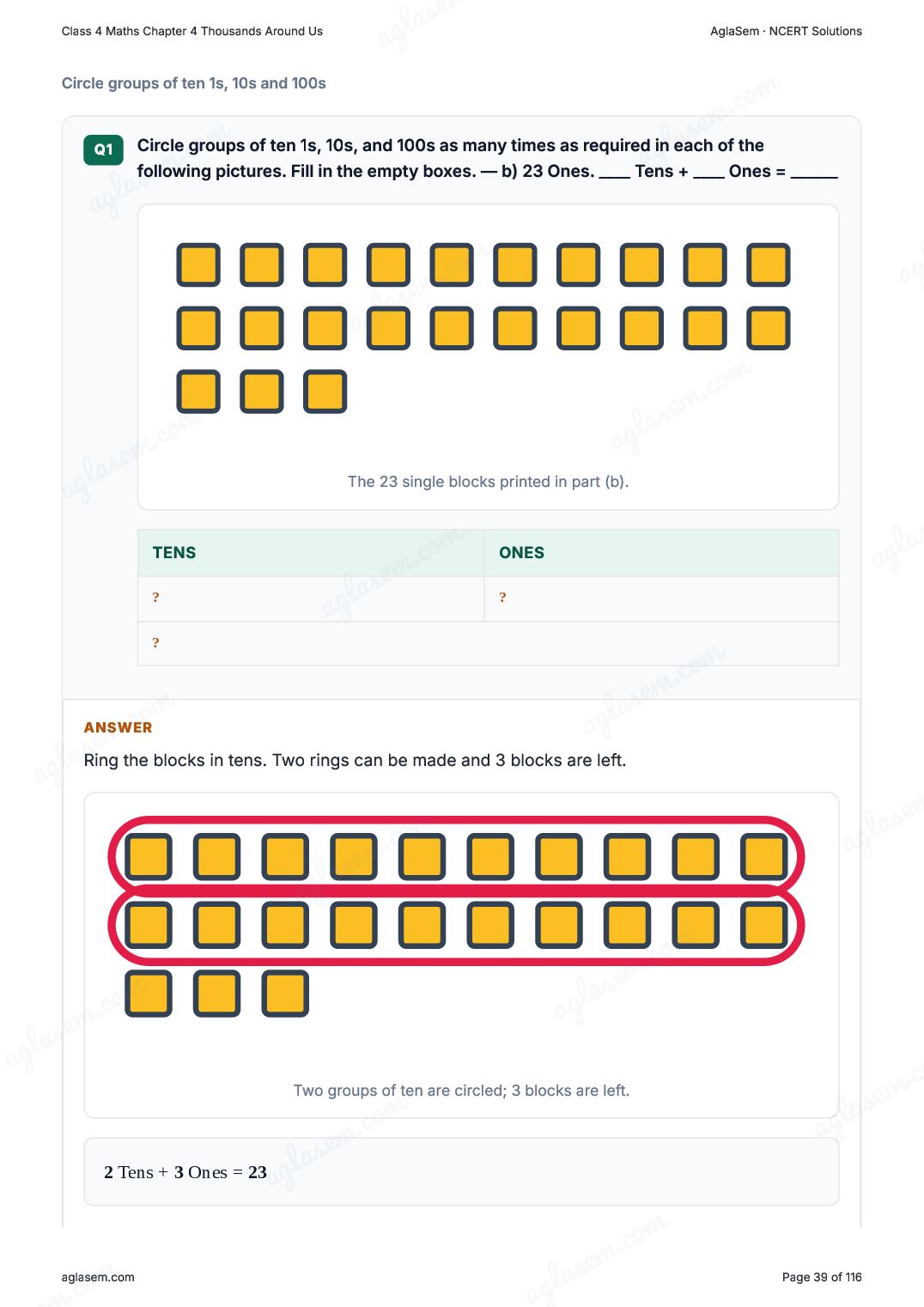
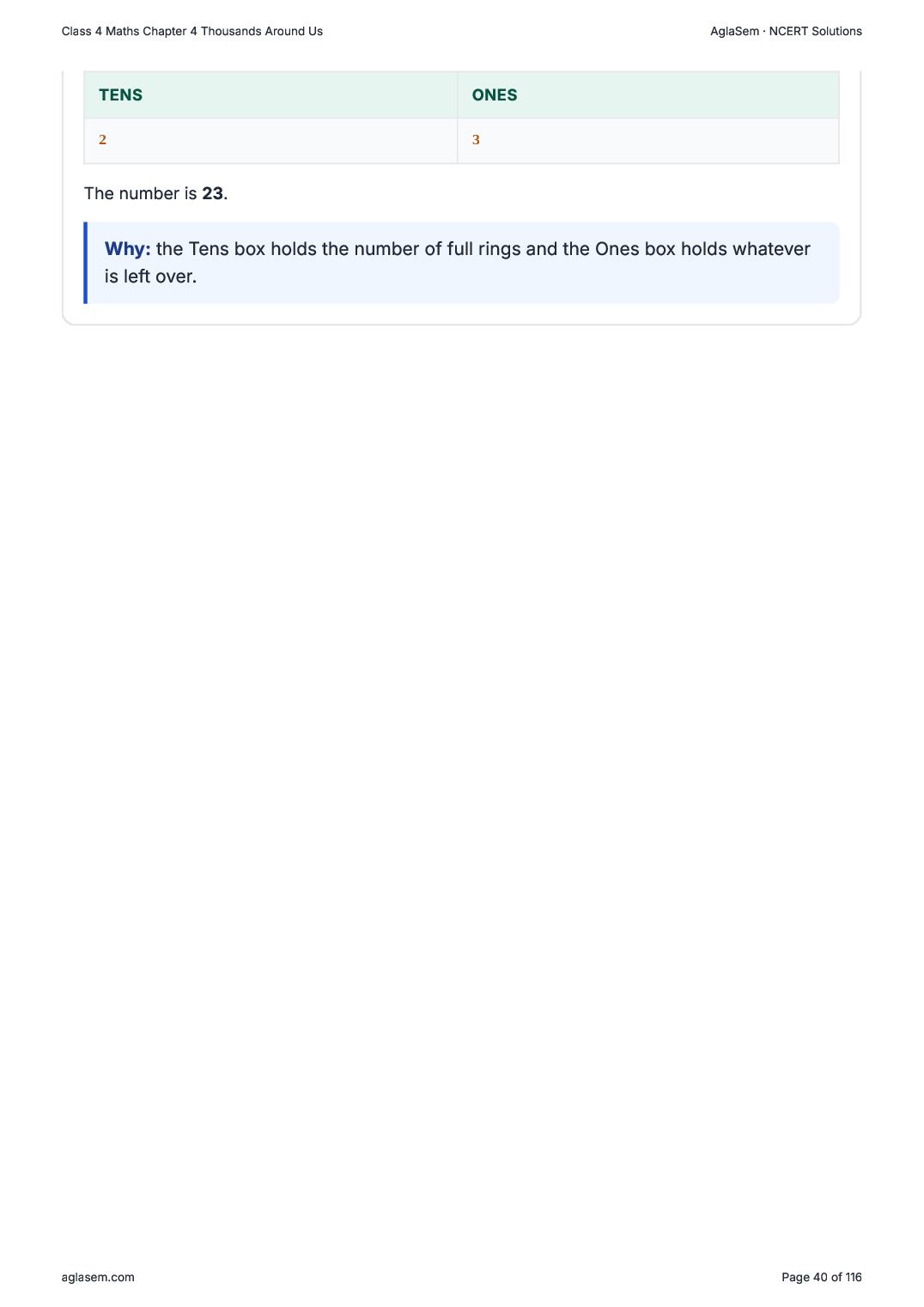
- Circle groups of ten 1s, 10s, and 100s as many times as required in each of the following pictures. Fill in the empty boxes. — b) 23 Ones. ____ Tens + ____ Ones = ______The 23 single blocks printed in part (b).TensOnes???
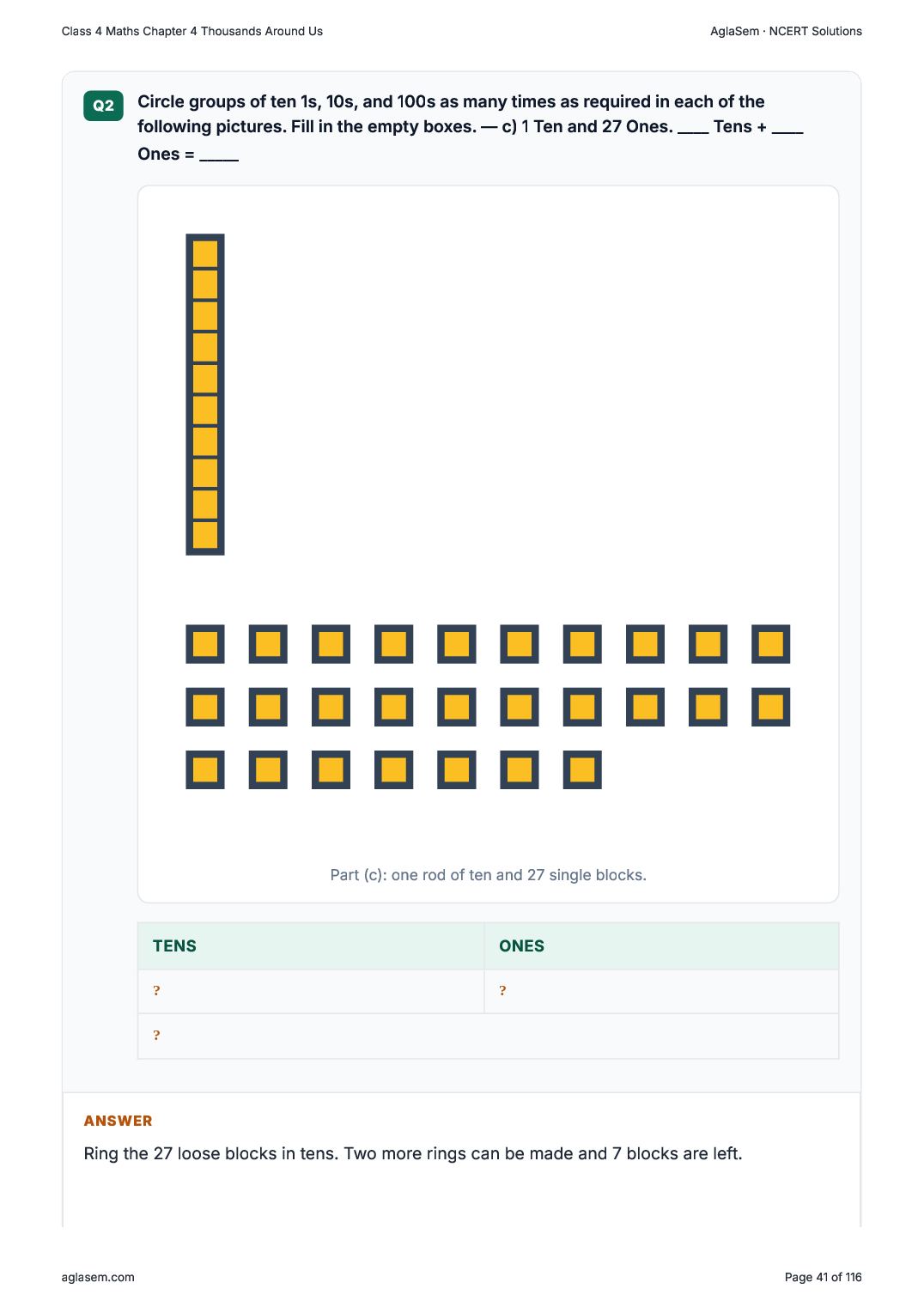
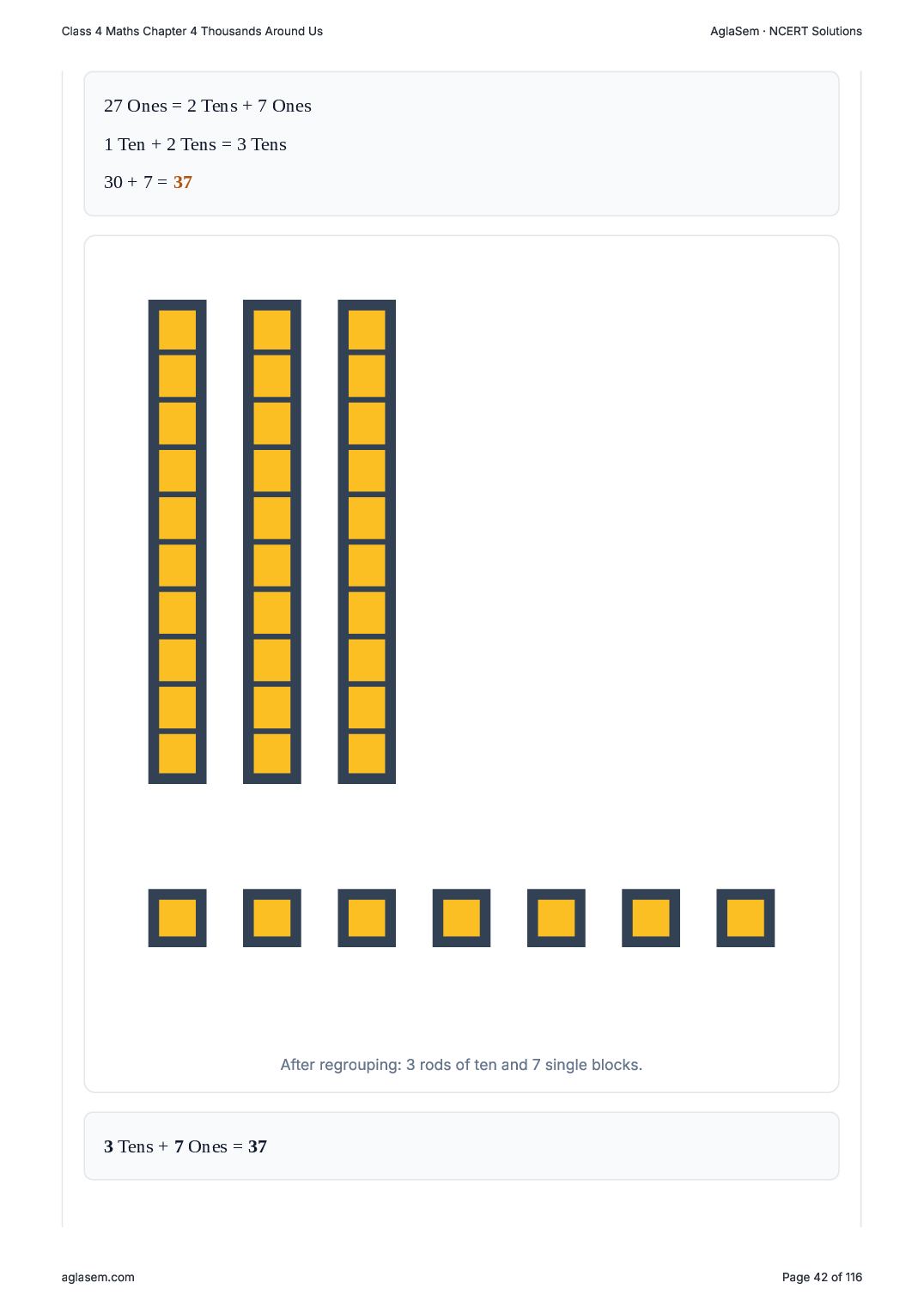
- Circle groups of ten 1s, 10s, and 100s as many times as required in each of the following pictures. Fill in the empty boxes. — c) 1 Ten and 27 Ones. ____ Tens + ____ Ones = _____Part (c): one rod of ten and 27 single blocks.TensOnes???
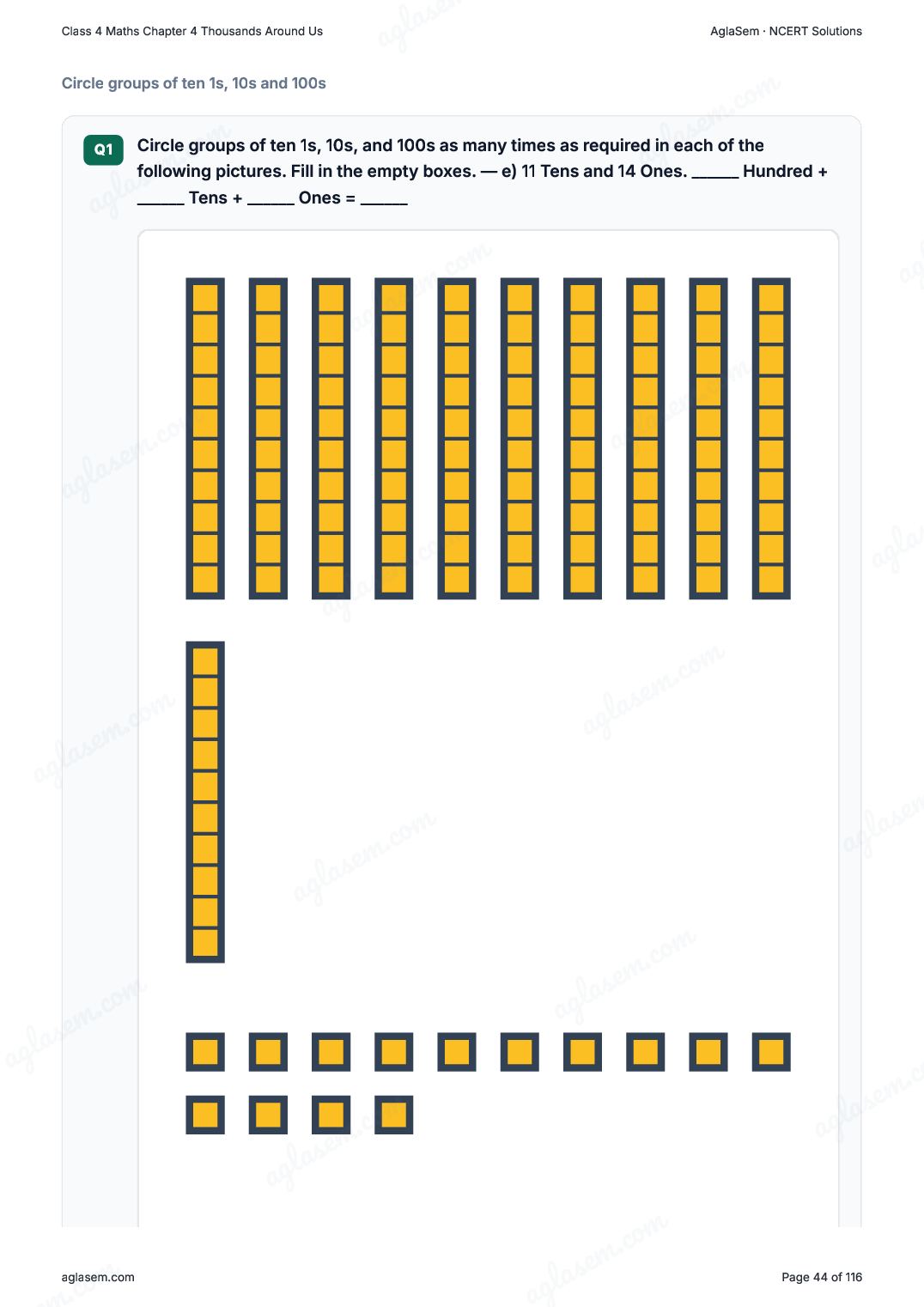
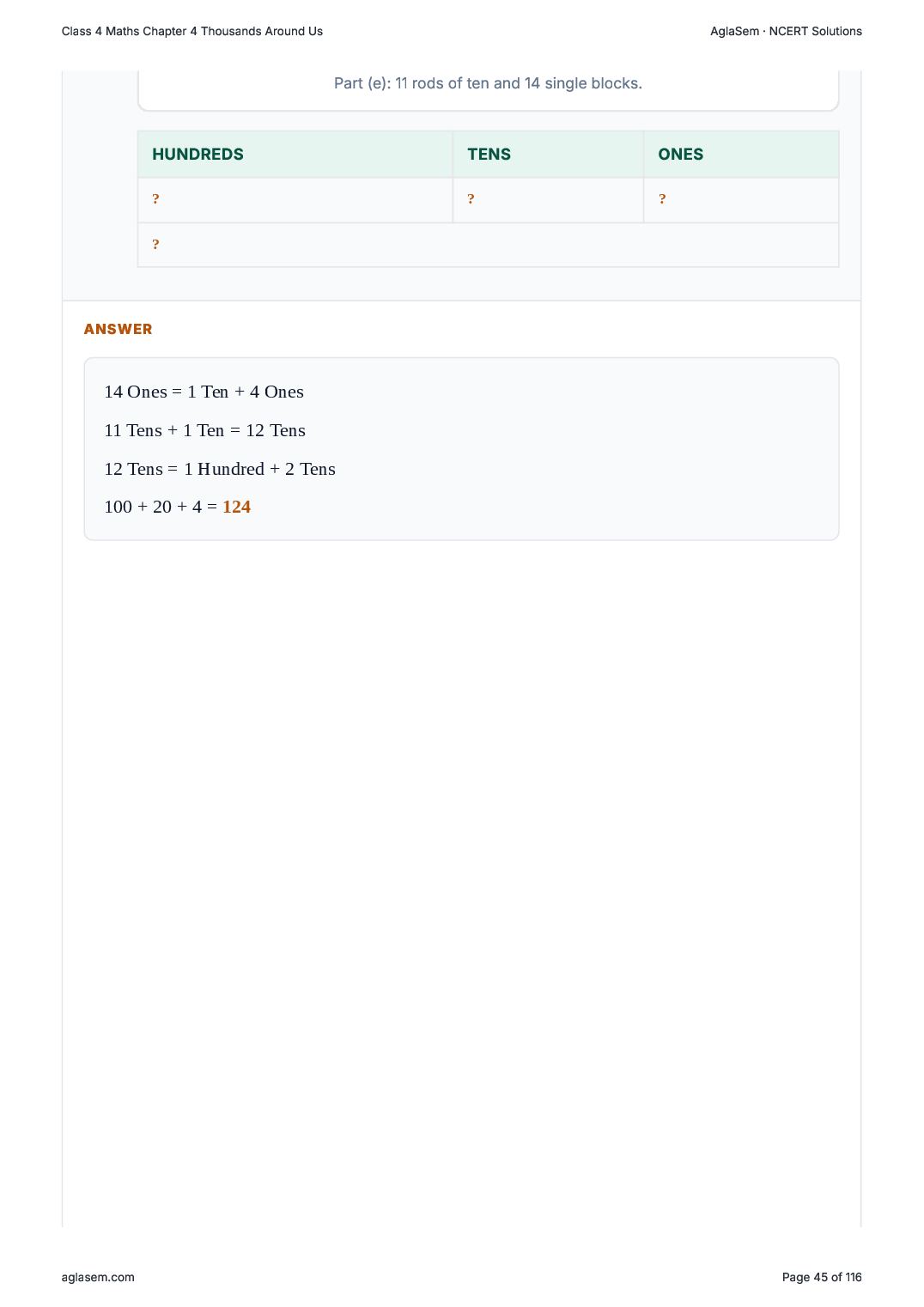
- Circle groups of ten 1s, 10s, and 100s as many times as required in each of the following pictures. Fill in the empty boxes. — e) 11 Tens and 14 Ones. ______ Hundred + ______ Tens + ______ Ones = ______Part (e): 11 rods of ten and 14 single blocks.HundredsTensOnes????
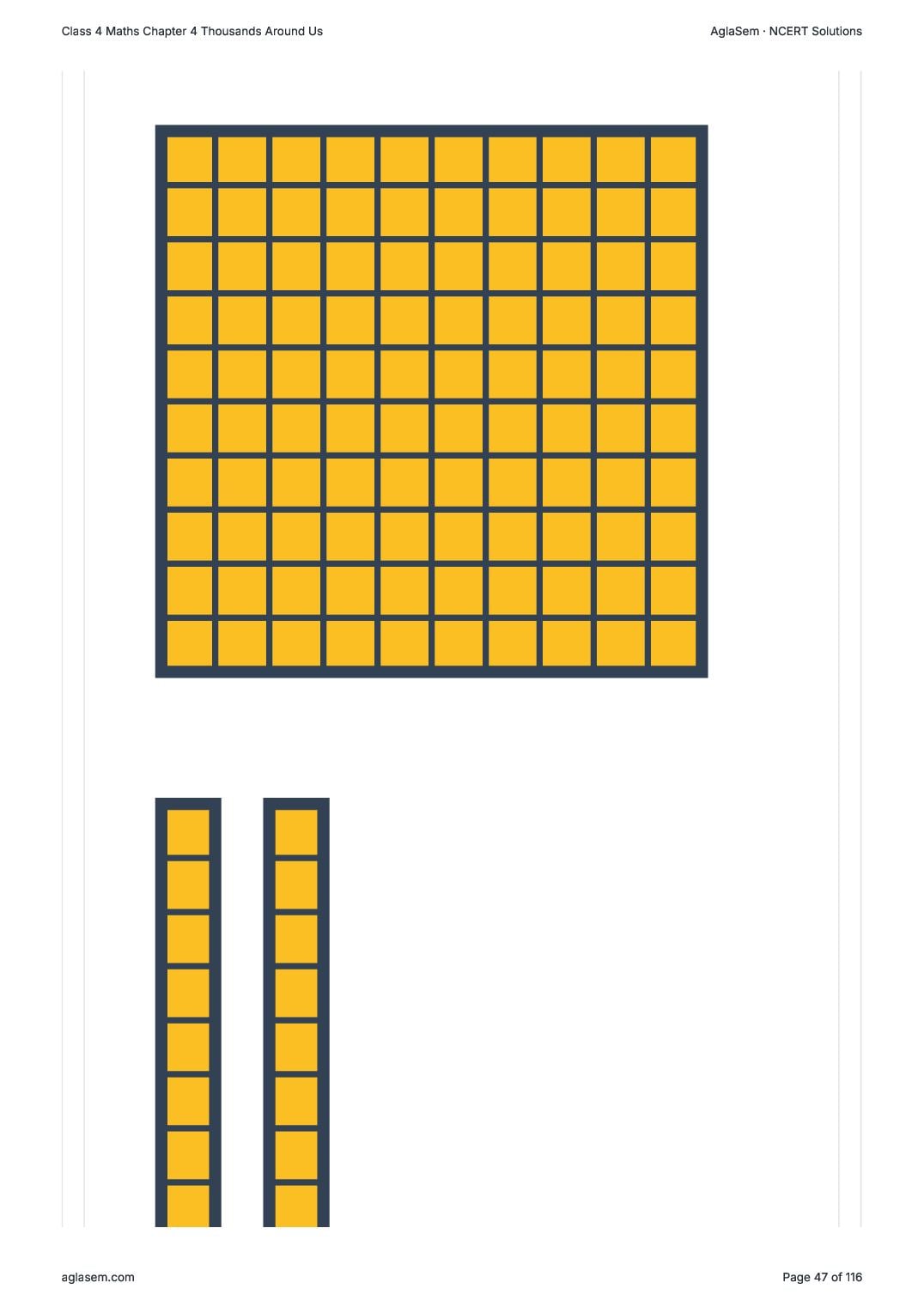
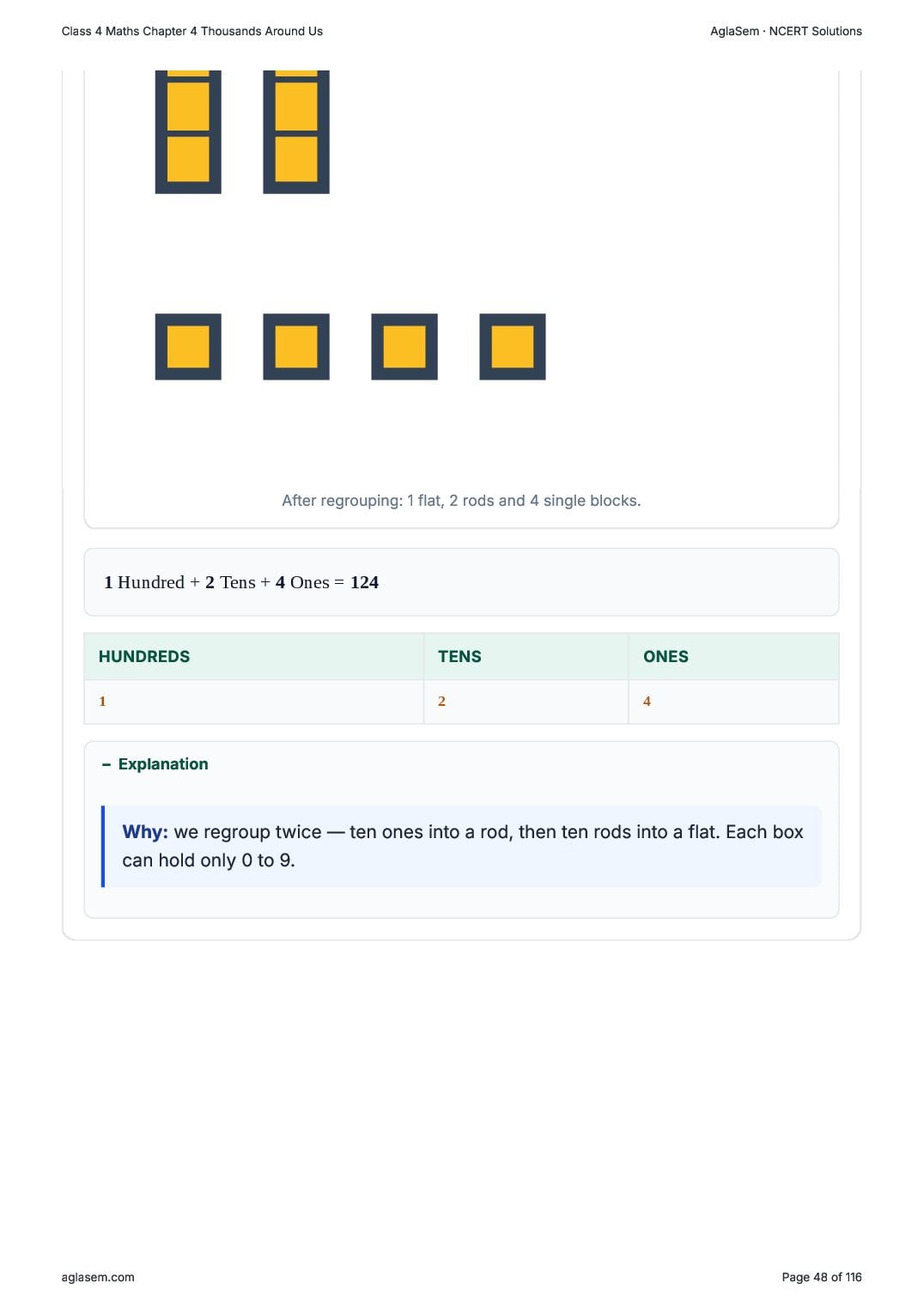
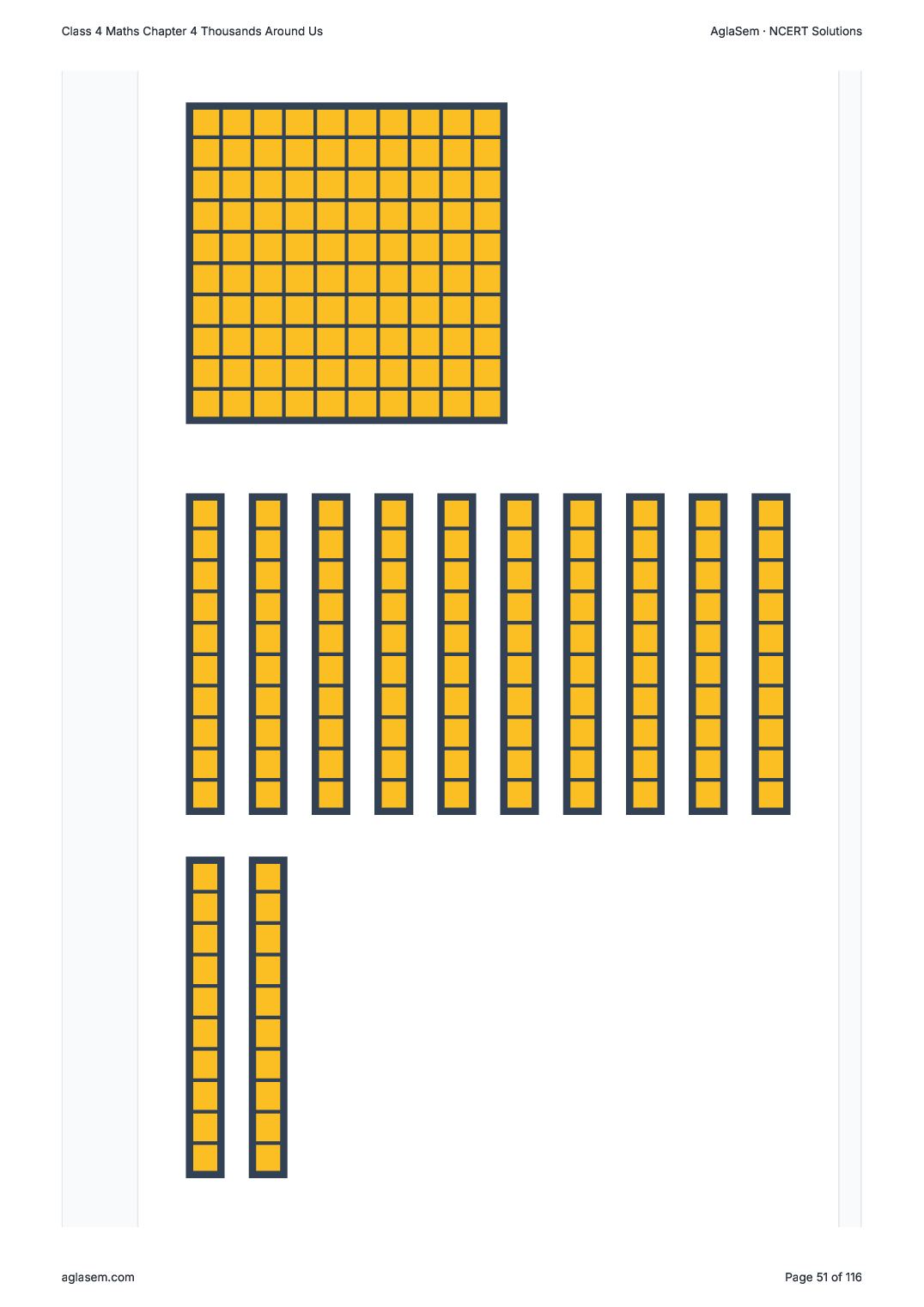
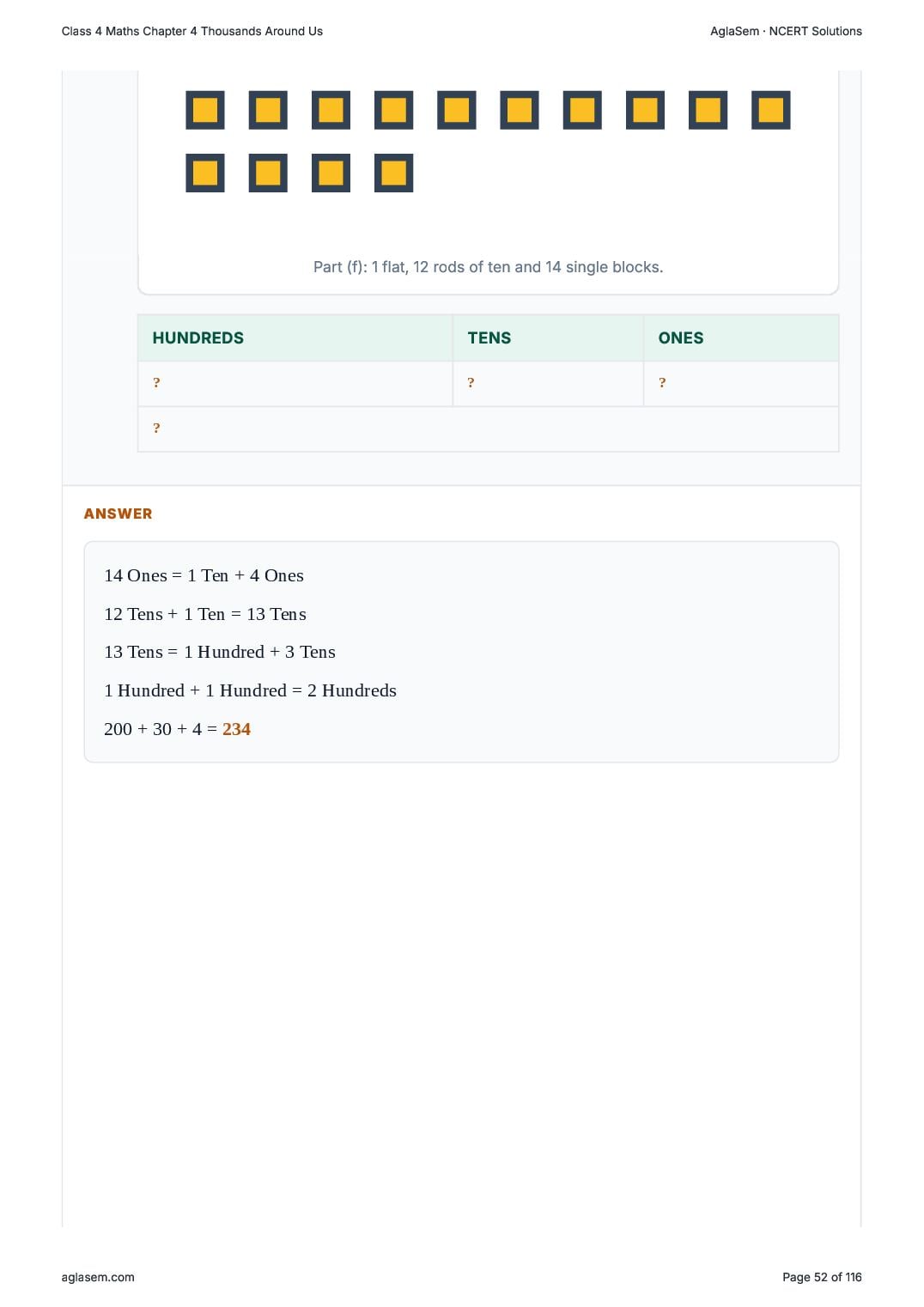
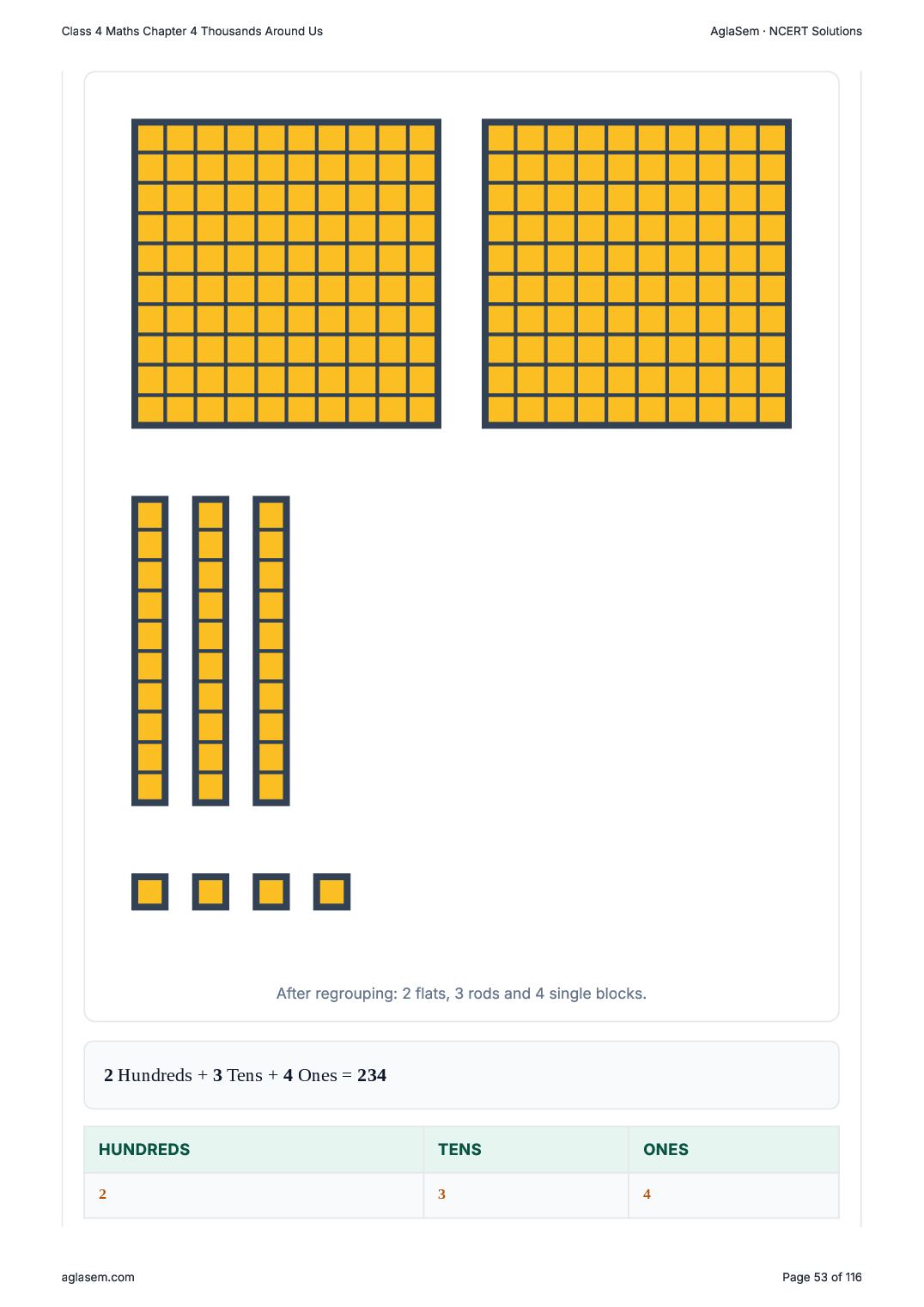
- Circle groups of ten 1s, 10s, and 100s as many times as required in each of the following pictures. Fill in the empty boxes. — f) 1 Hundred, 12 Tens and 14 Ones. ______ Hundreds + ______ Tens + ______ Ones = ______Part (f): 1 flat, 12 rods of ten and 14 single blocks.HundredsTensOnes????
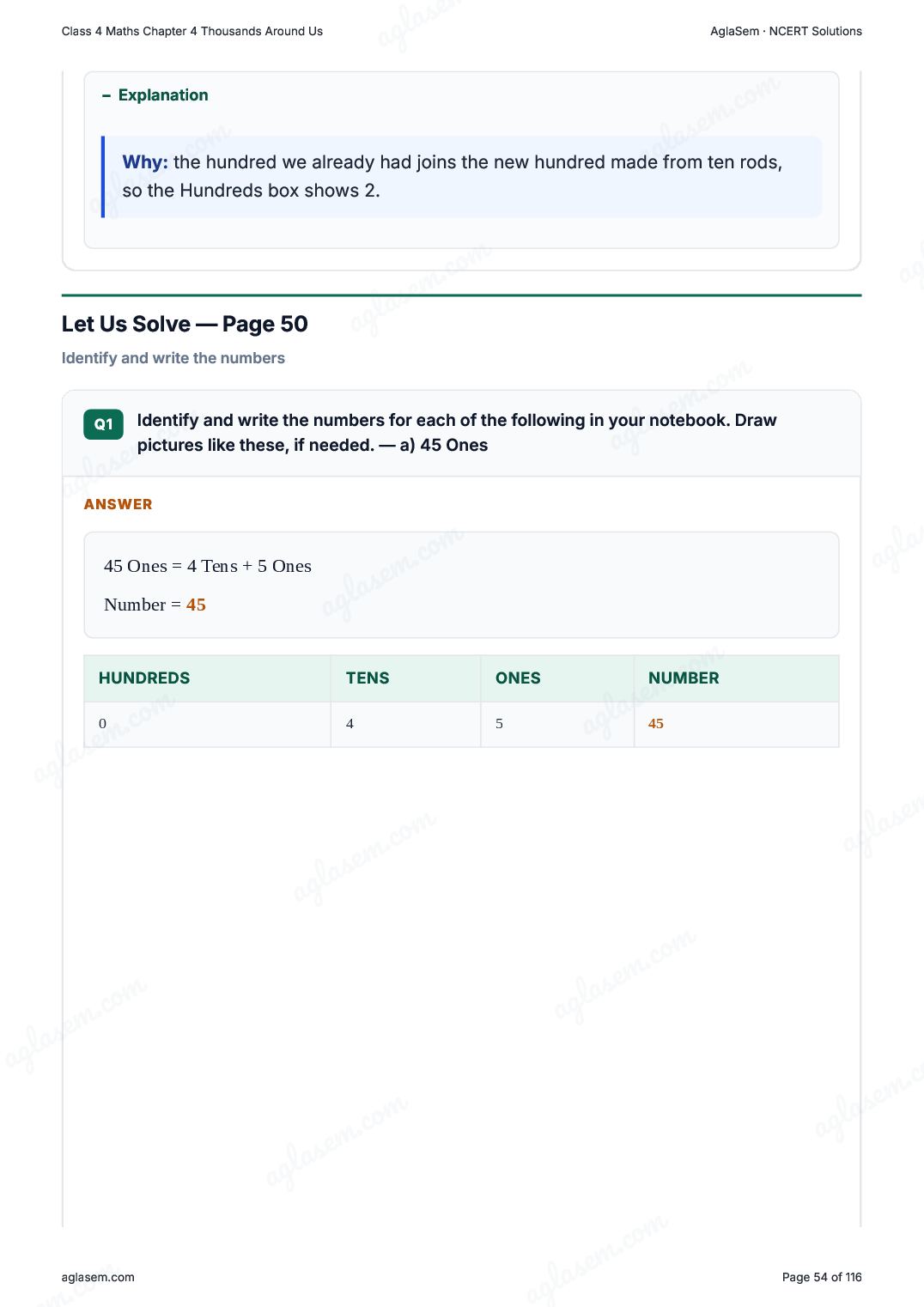
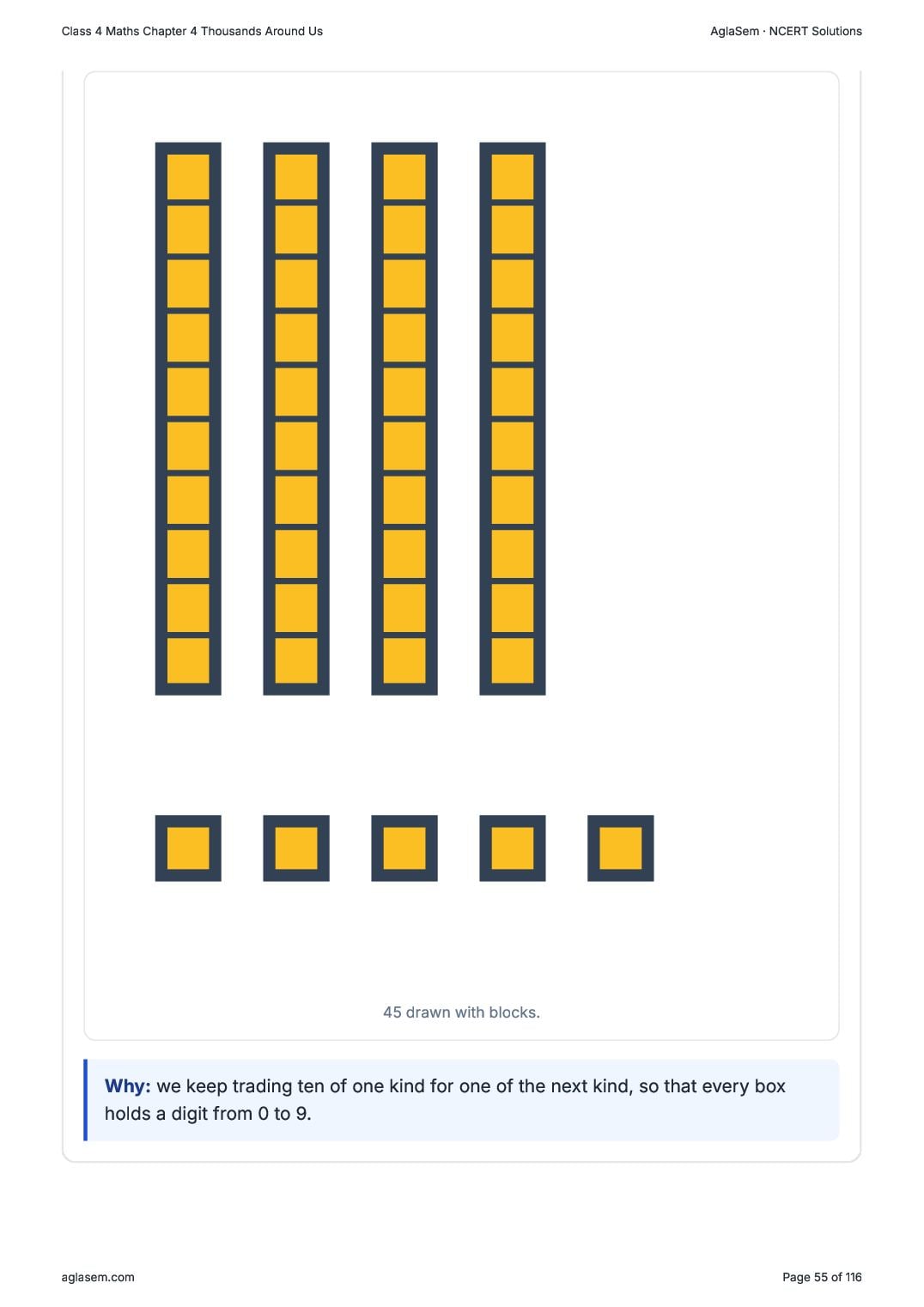
- Identify and write the numbers for each of the following in your notebook. Draw pictures like these, if needed. — a) 45 Ones
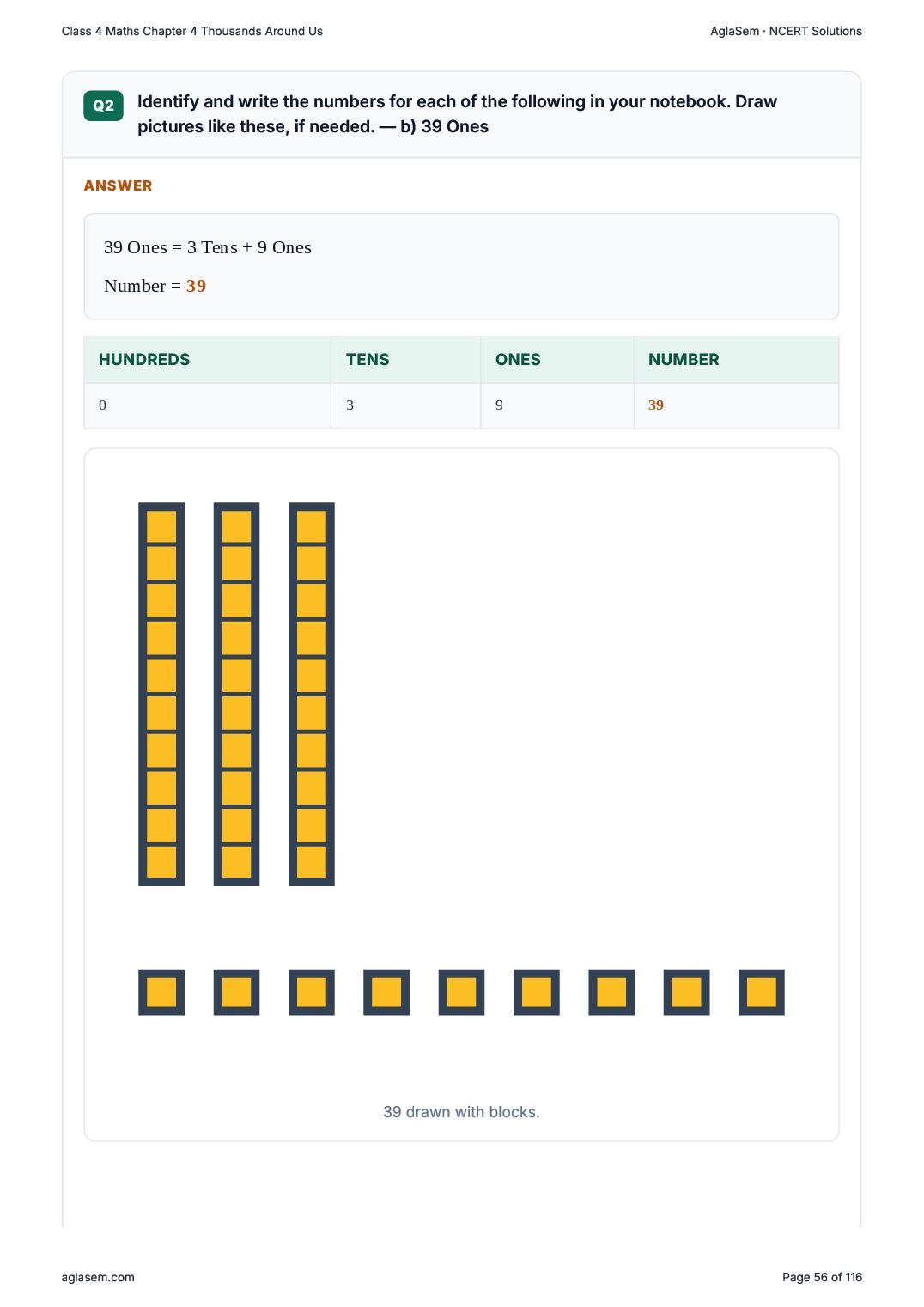
- Identify and write the numbers for each of the following in your notebook. Draw pictures like these, if needed. — b) 39 Ones
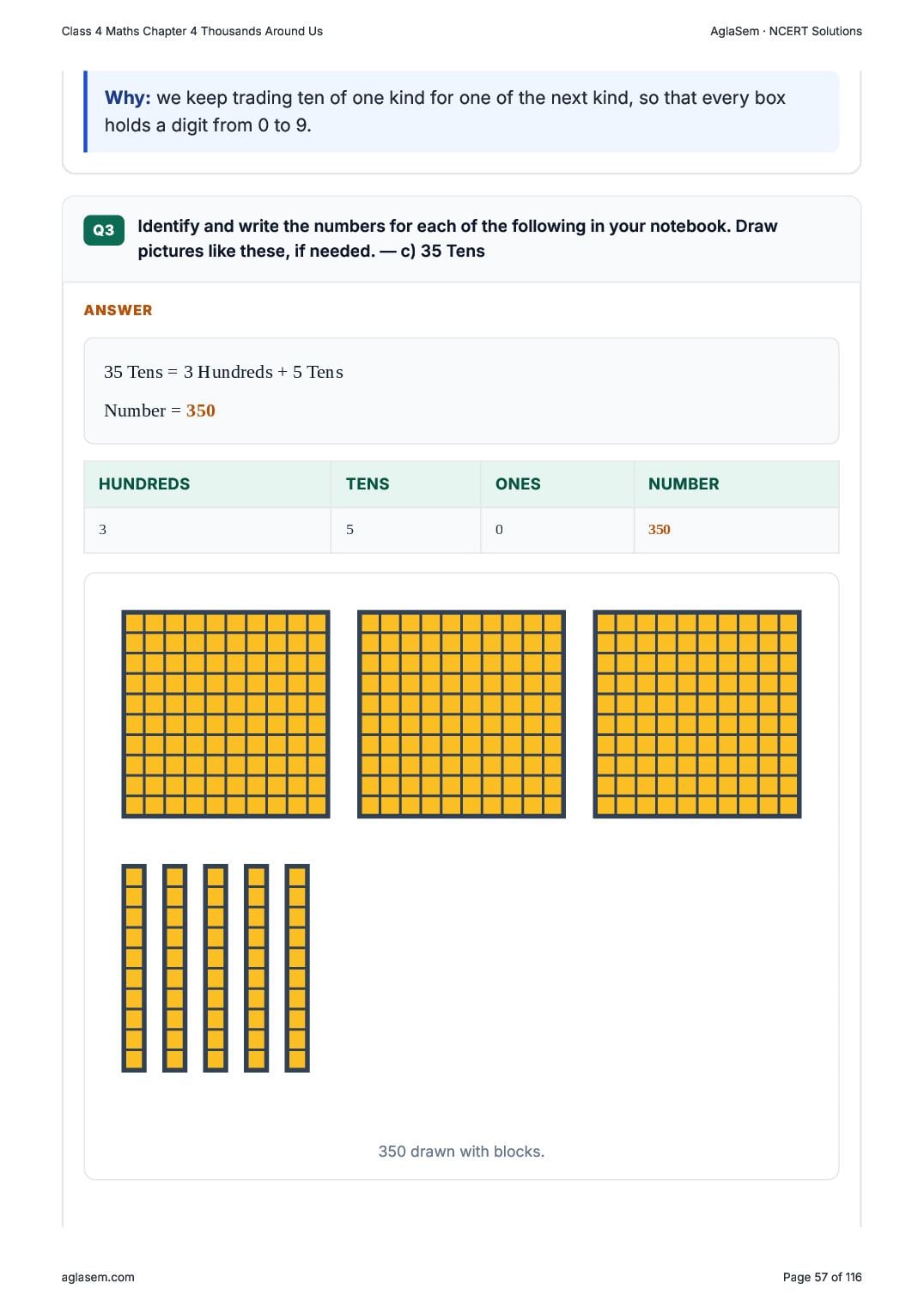
- Identify and write the numbers for each of the following in your notebook. Draw pictures like these, if needed. — c) 35 Tens
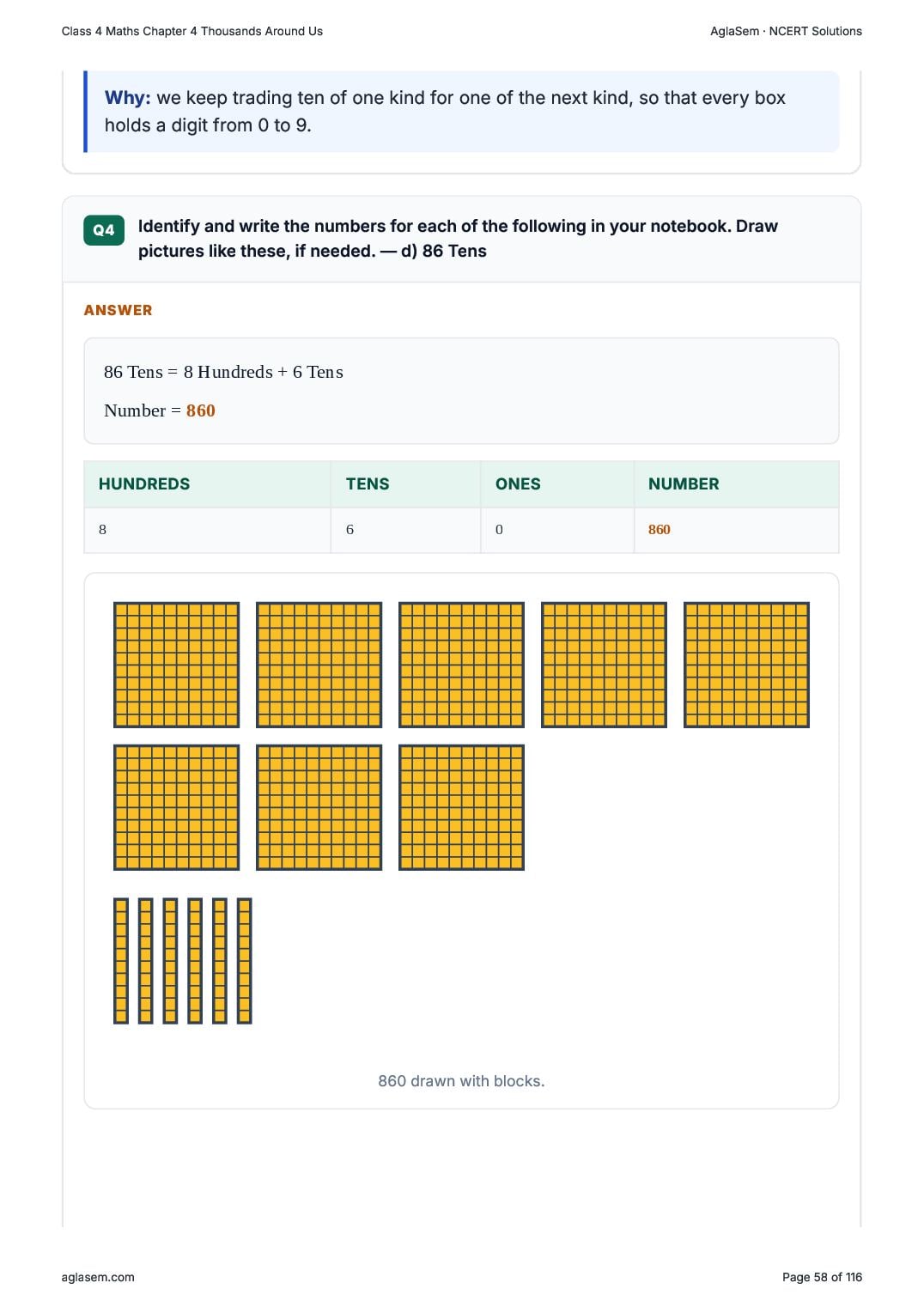
- Identify and write the numbers for each of the following in your notebook. Draw pictures like these, if needed. — d) 86 Tens
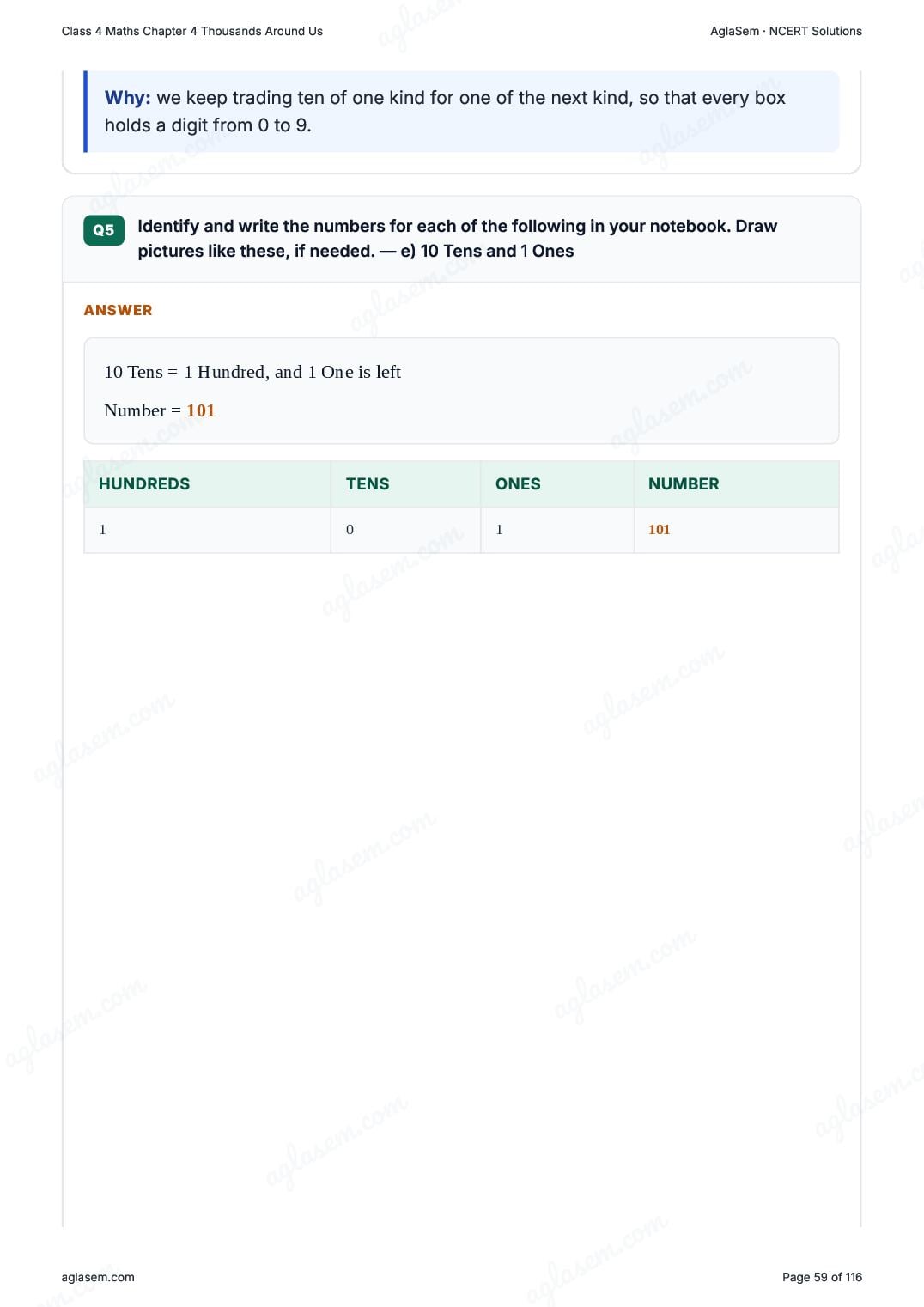
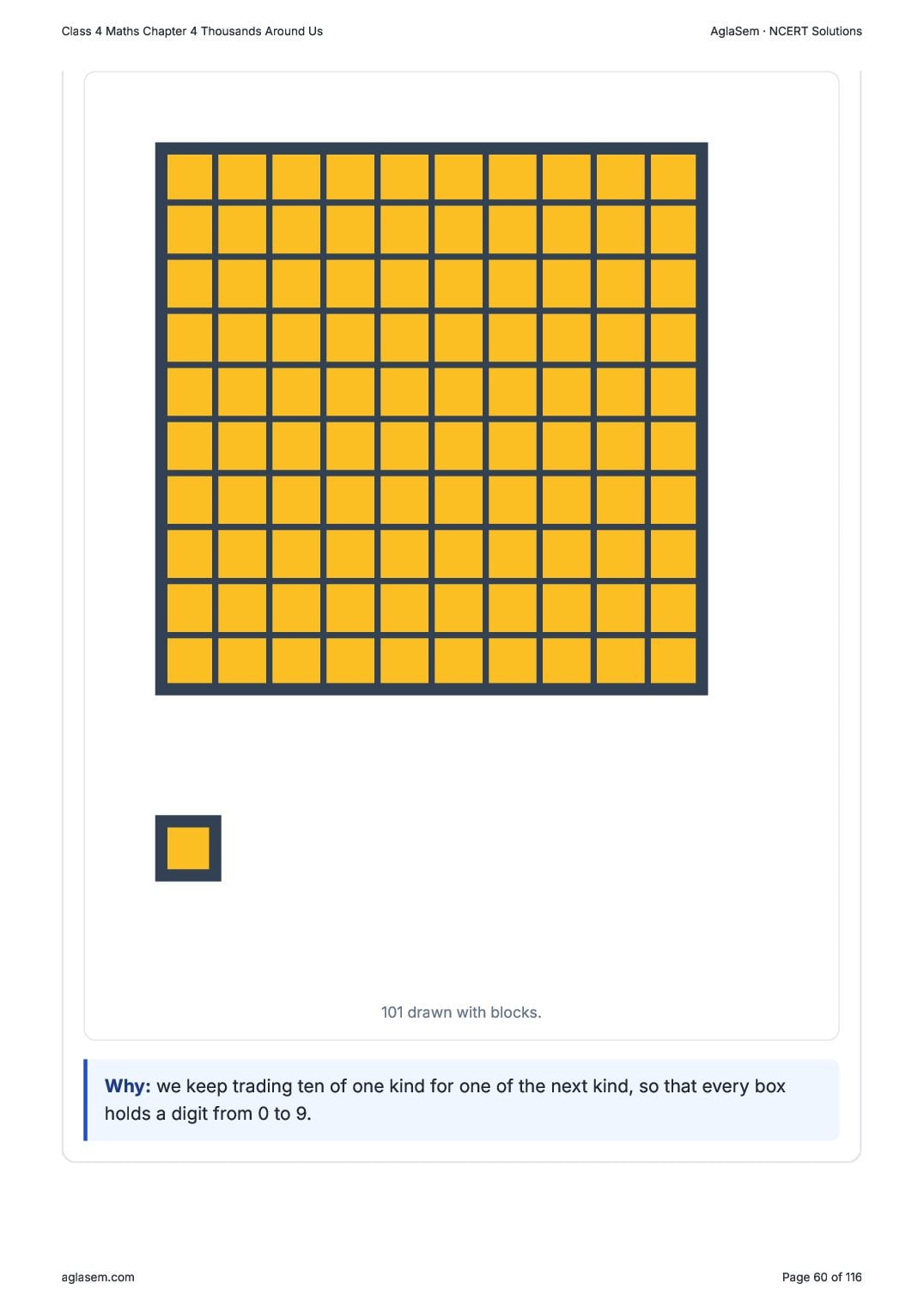
- Identify and write the numbers for each of the following in your notebook. Draw pictures like these, if needed. — e) 10 Tens and 1 Ones
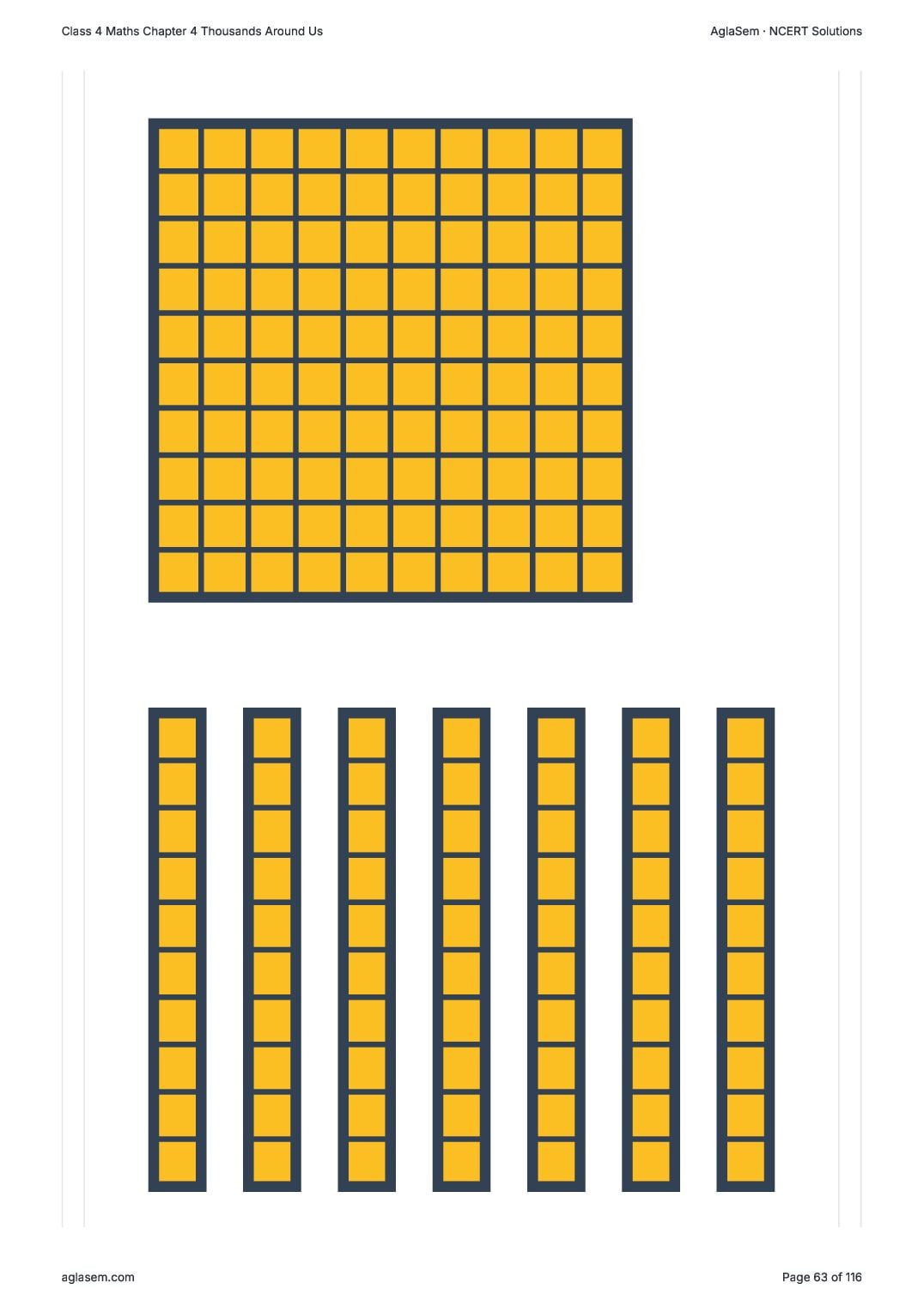
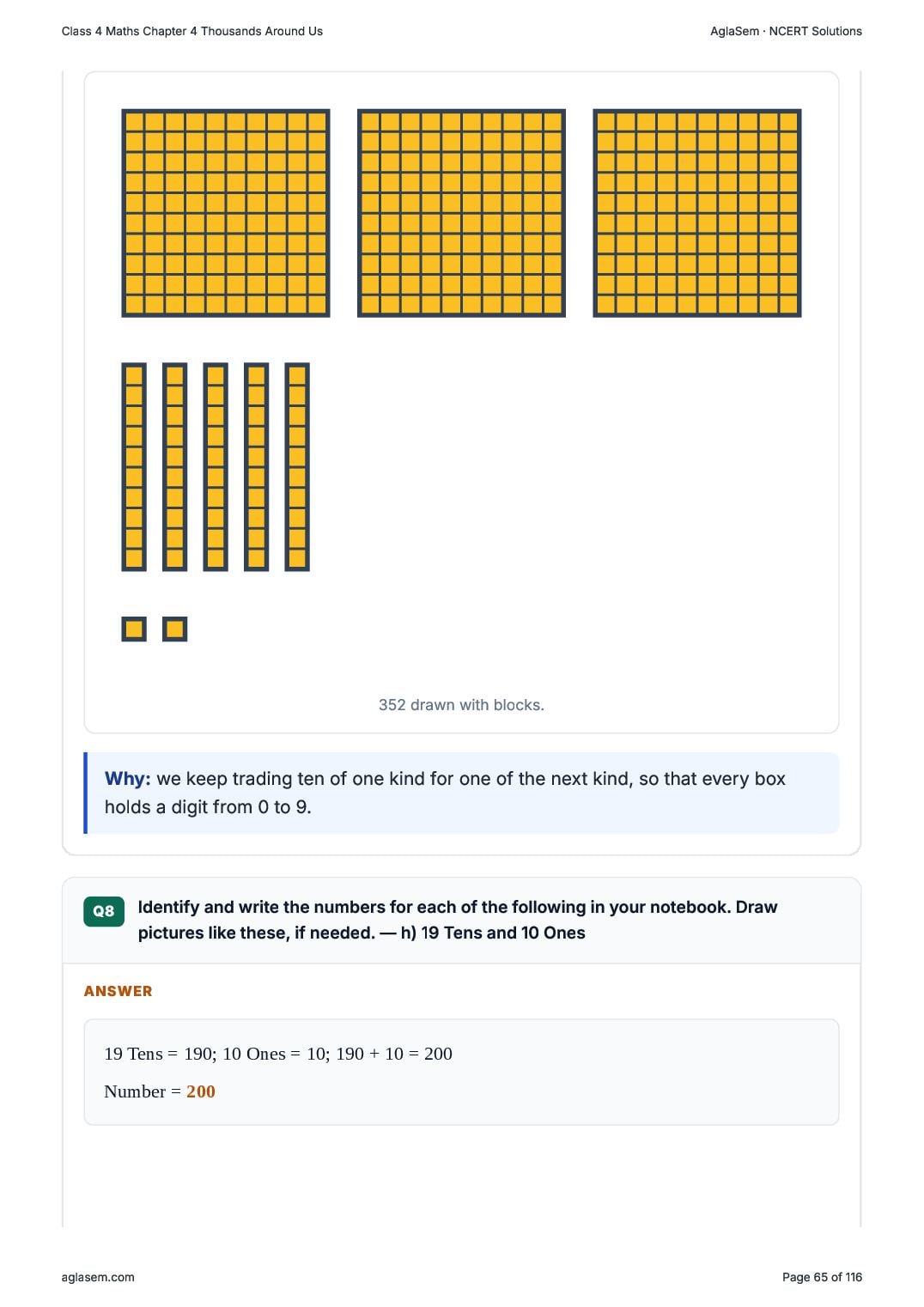
- Identify and write the numbers for each of the following in your notebook. Draw pictures like these, if needed. — f) 15 Tens and 23 Ones
- Identify and write the numbers for each of the following in your notebook. Draw pictures like these, if needed. — g) 34 Tens and 12 Ones
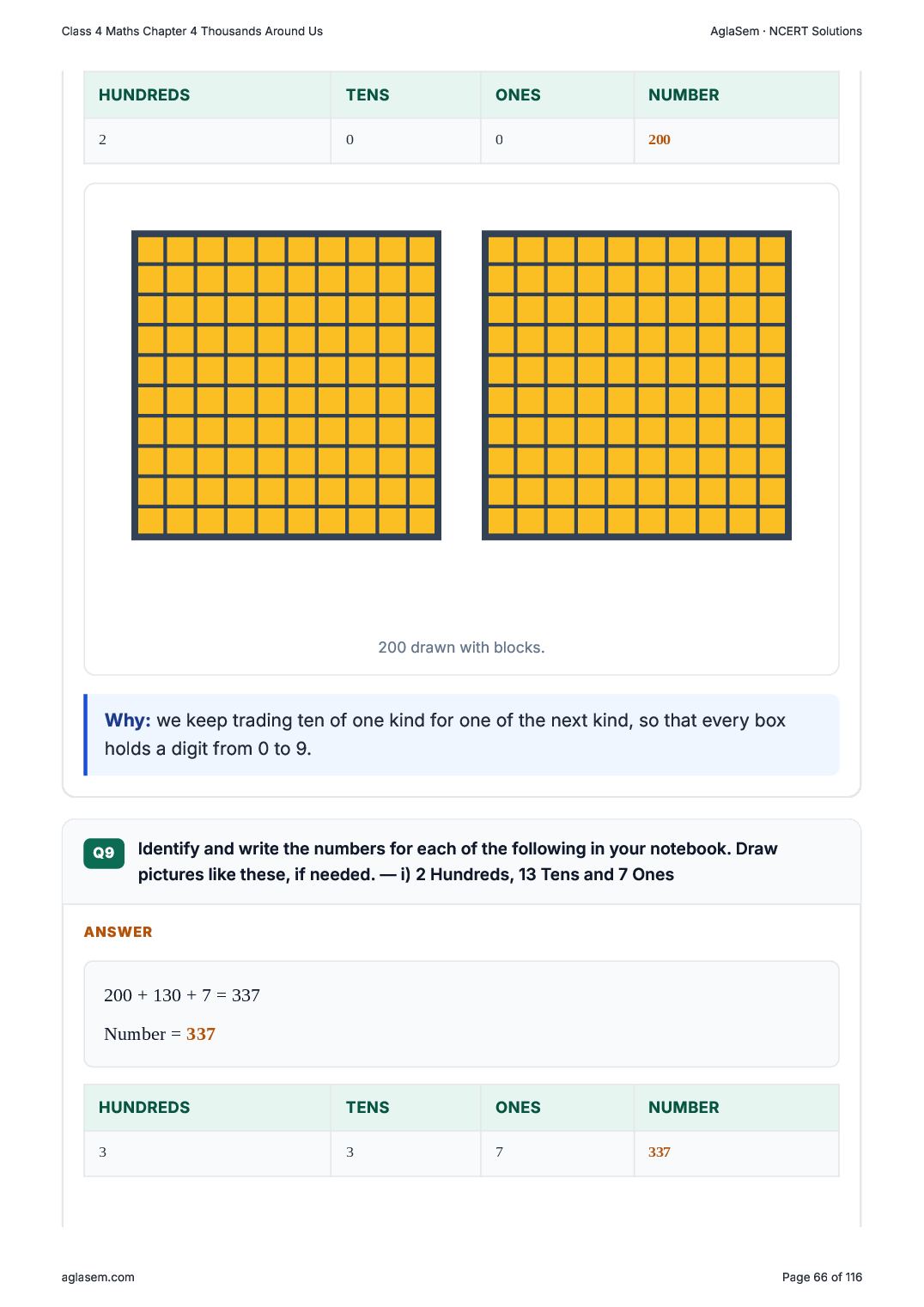
- Identify and write the numbers for each of the following in your notebook. Draw pictures like these, if needed. — h) 19 Tens and 10 Ones
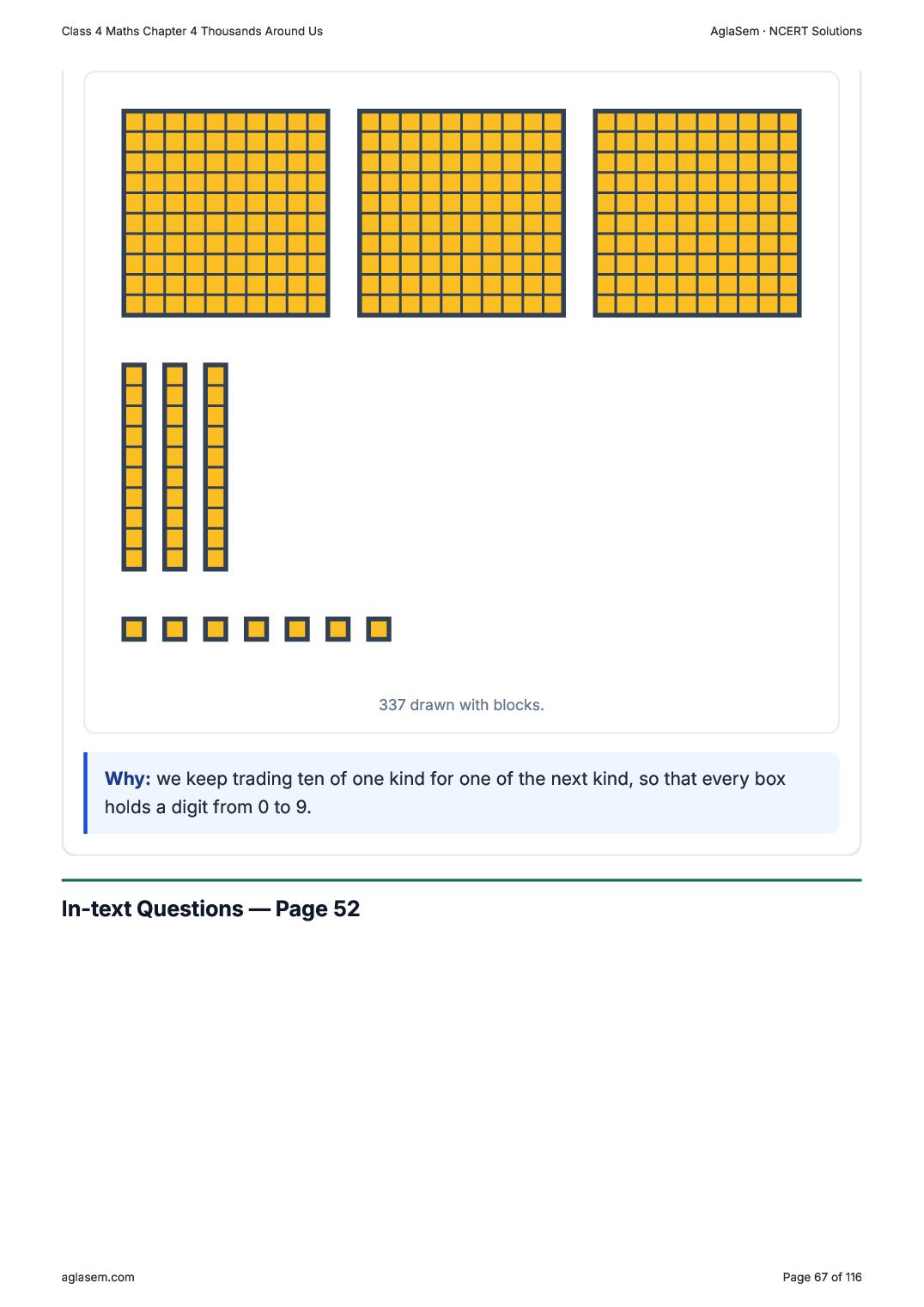
- Identify and write the numbers for each of the following in your notebook. Draw pictures like these, if needed. — i) 2 Hundreds, 13 Tens and 7 Ones
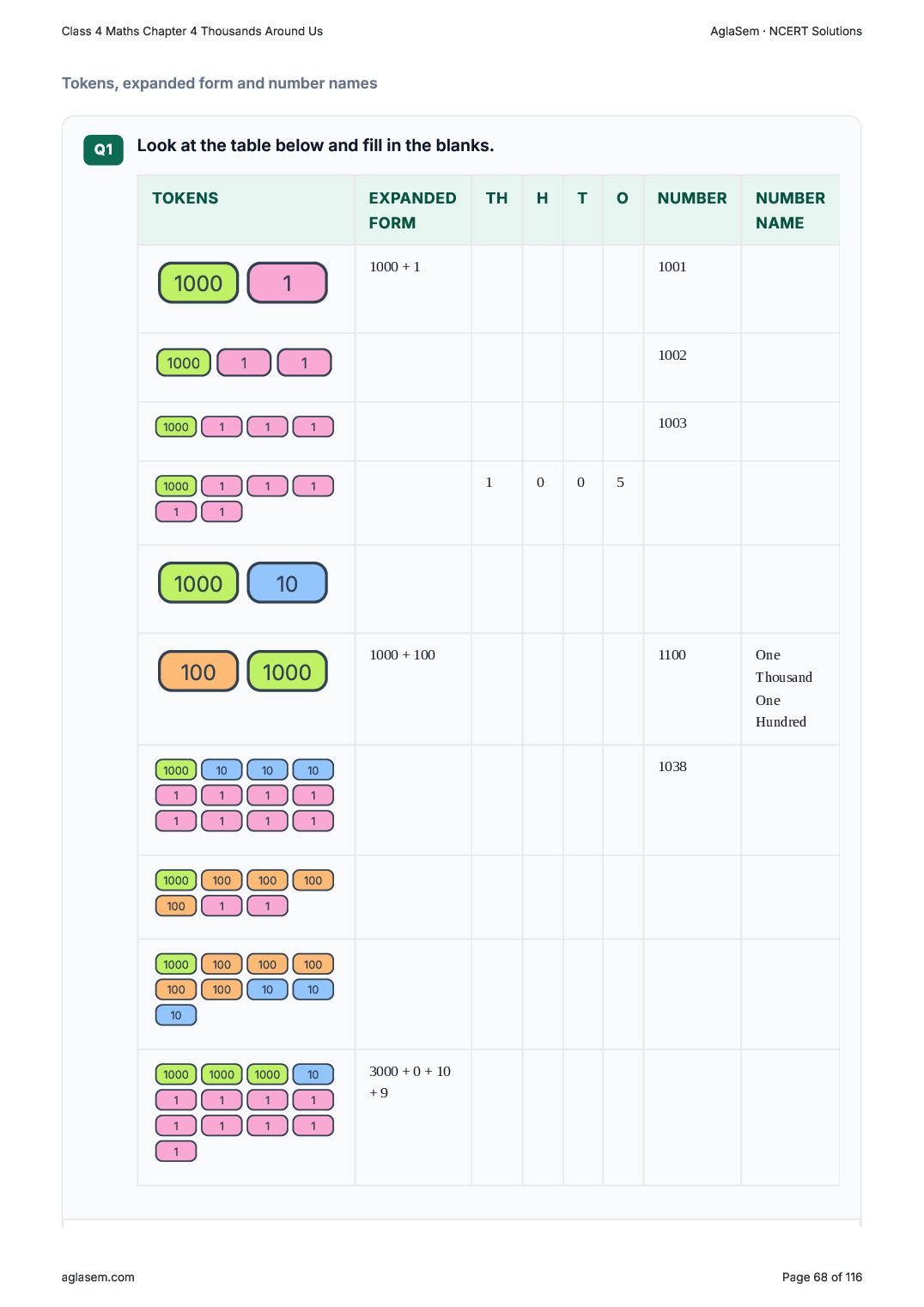
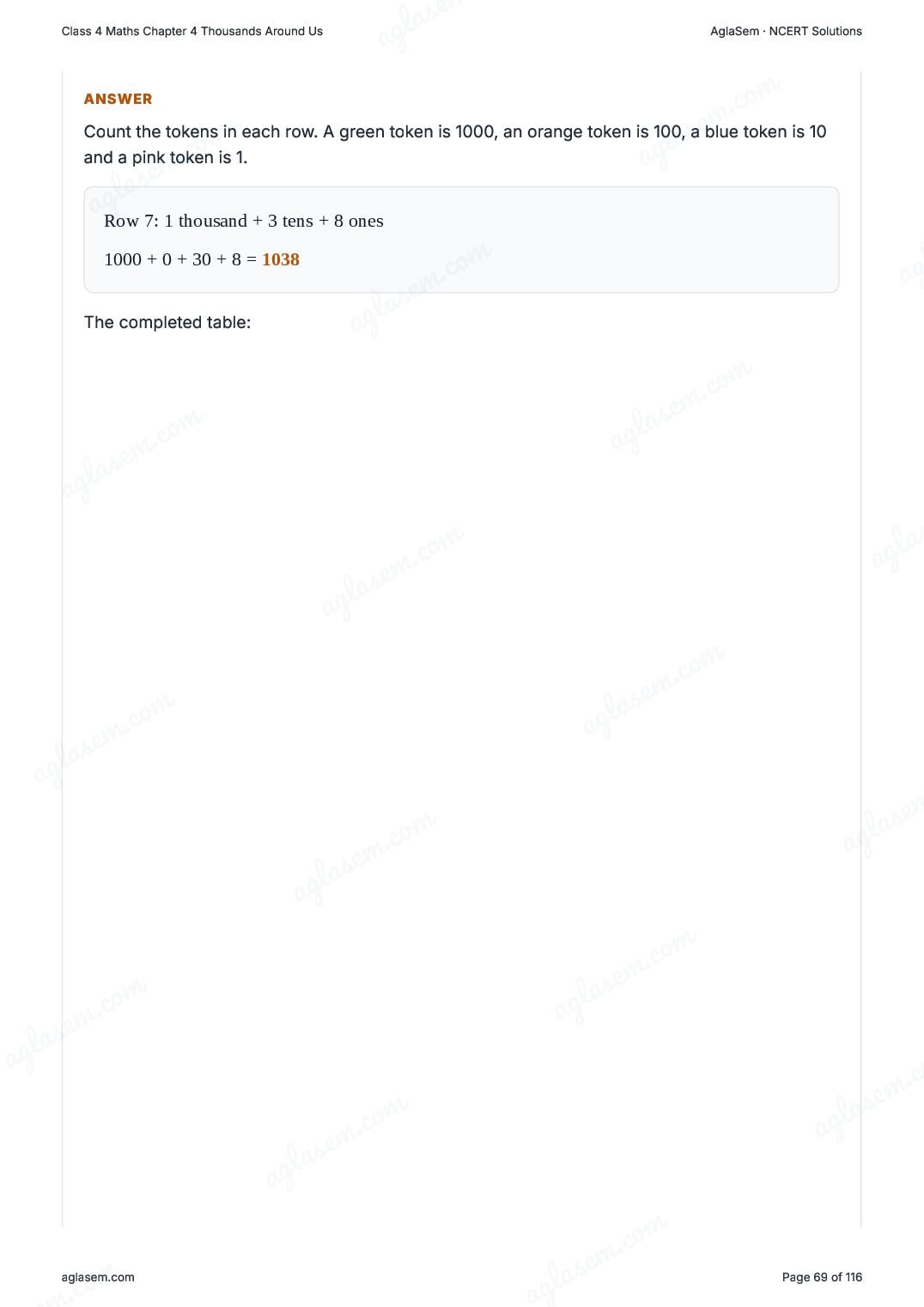
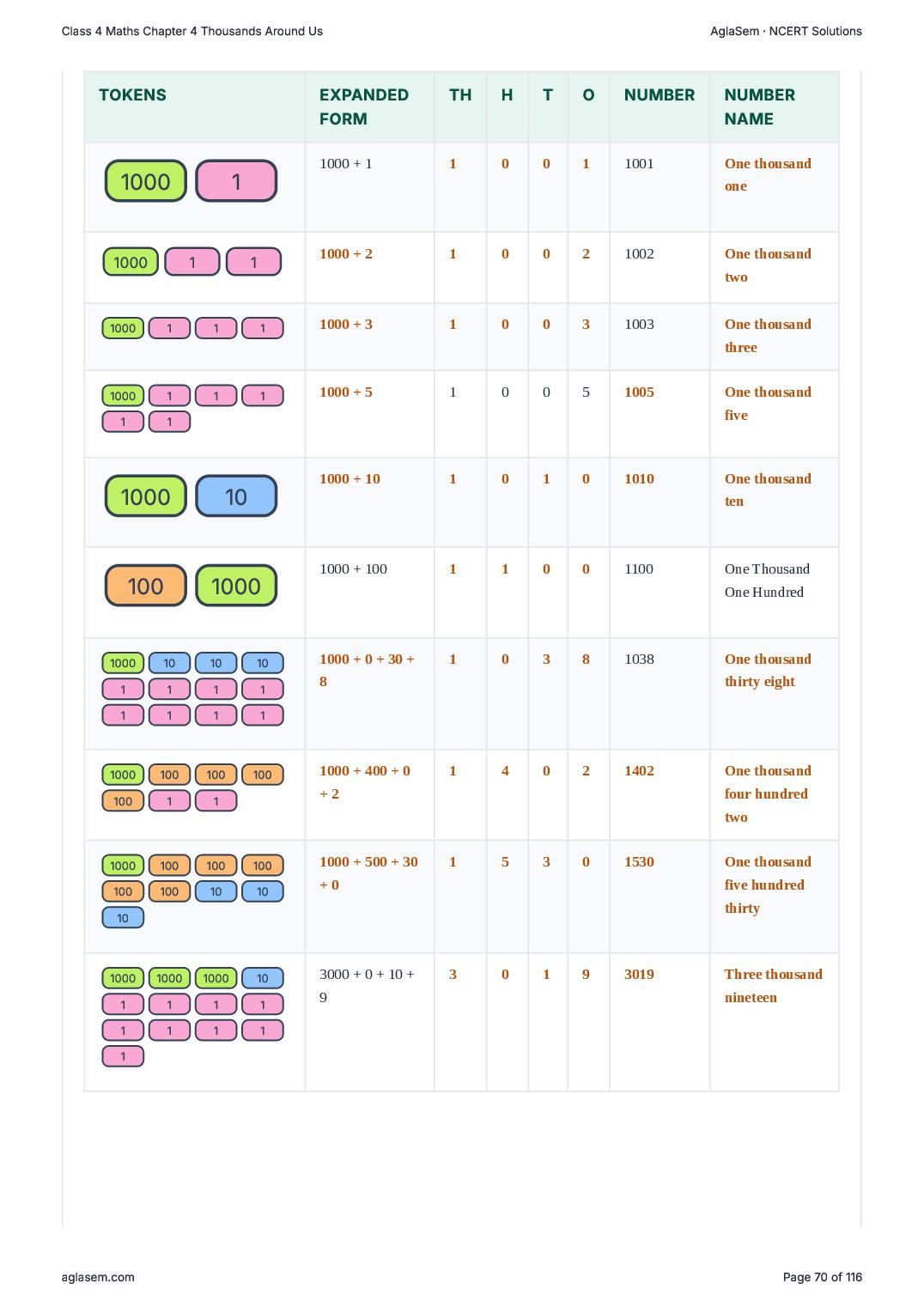
- Look at the table below and fill in the blanks.TokensExpanded FormThHTONumberNumber Name100011000 + 11001100011100210001111003100011111100510001010010001000 + 1001100One Thousand One Hundred10001010101111111110381000100100100100111000100100100100100101010100010001000101111111113000 + 0 + 10 + 9
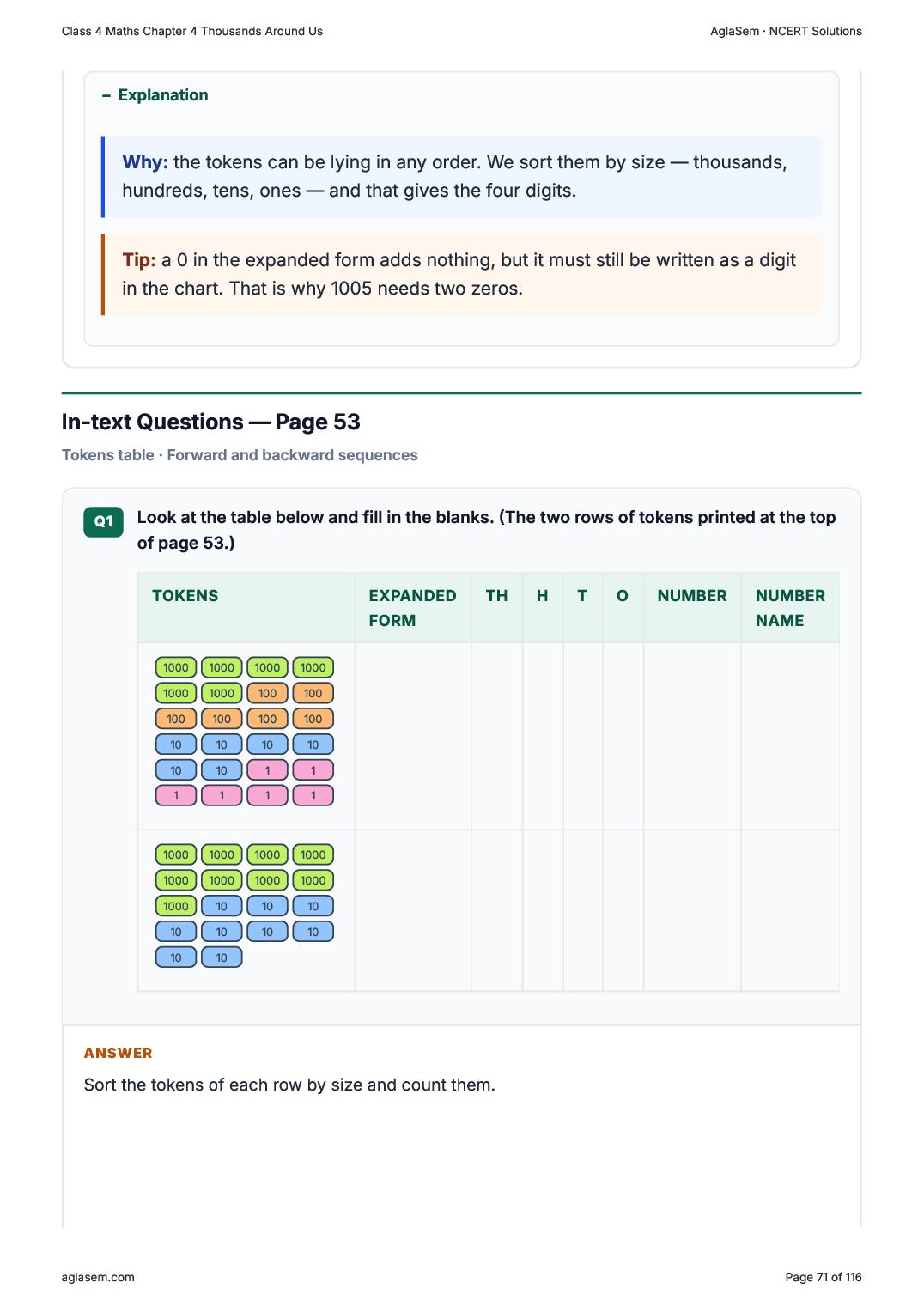
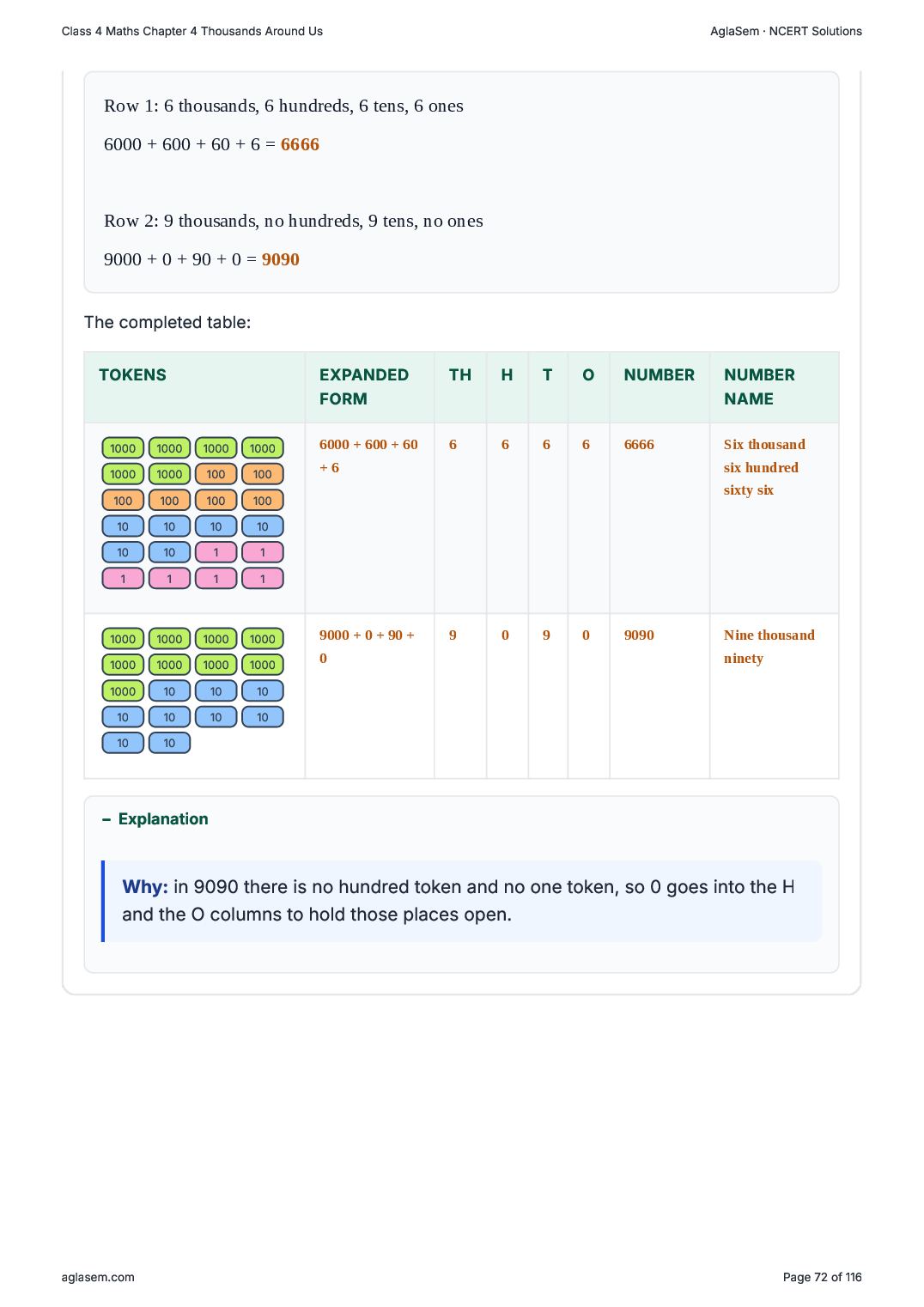
- Look at the table below and fill in the blanks. (The two rows of tokens printed at the top of page 53.)TokensExpanded FormThHTONumberNumber Name100010001000100010001000100100100100100100101010101010111111100010001000100010001000100010001000101010101010101010
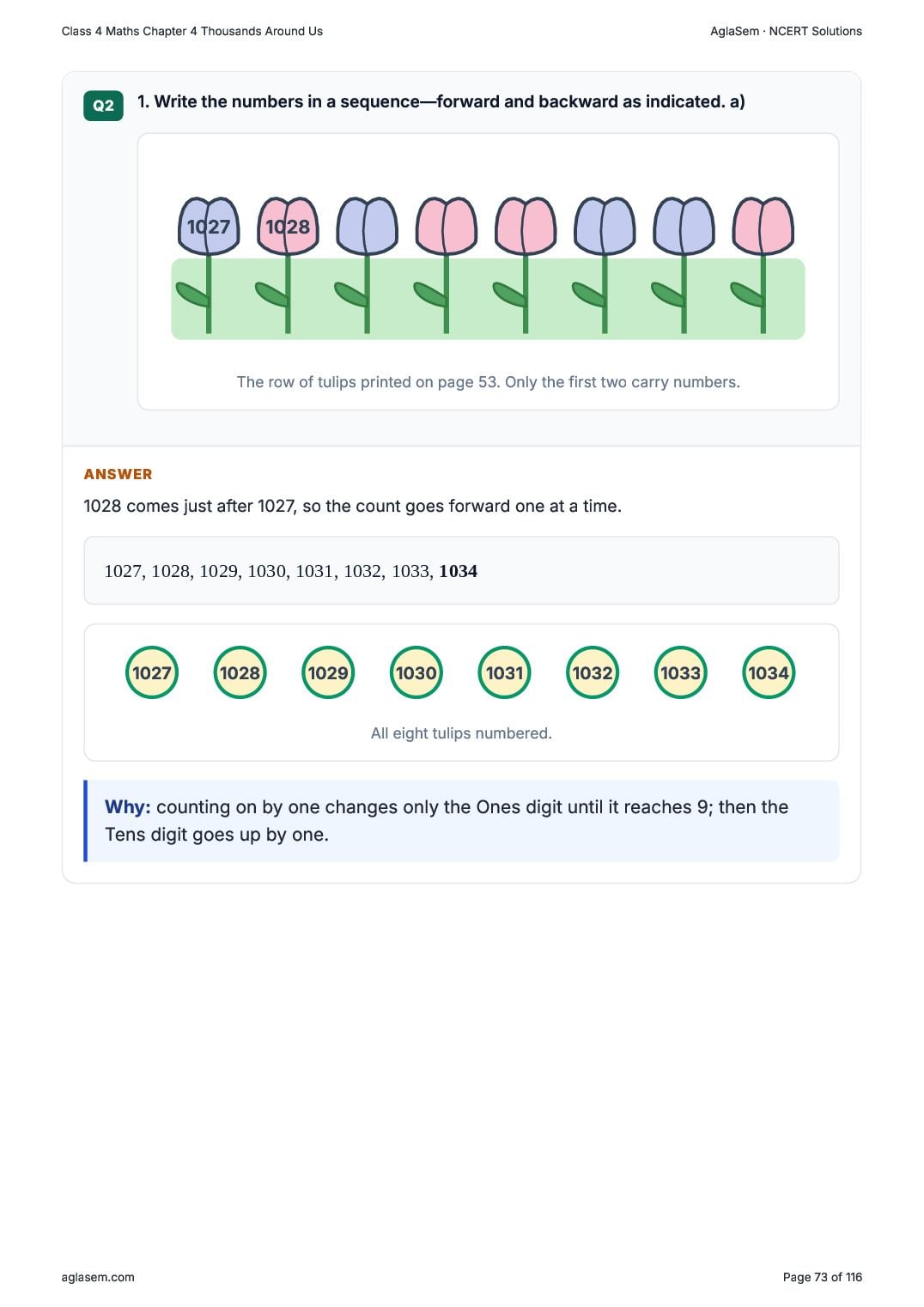
- 1. Write the numbers in a sequence—forward and backward as indicated. a)10271028The row of tulips printed on page 53. Only the first two carry numbers.
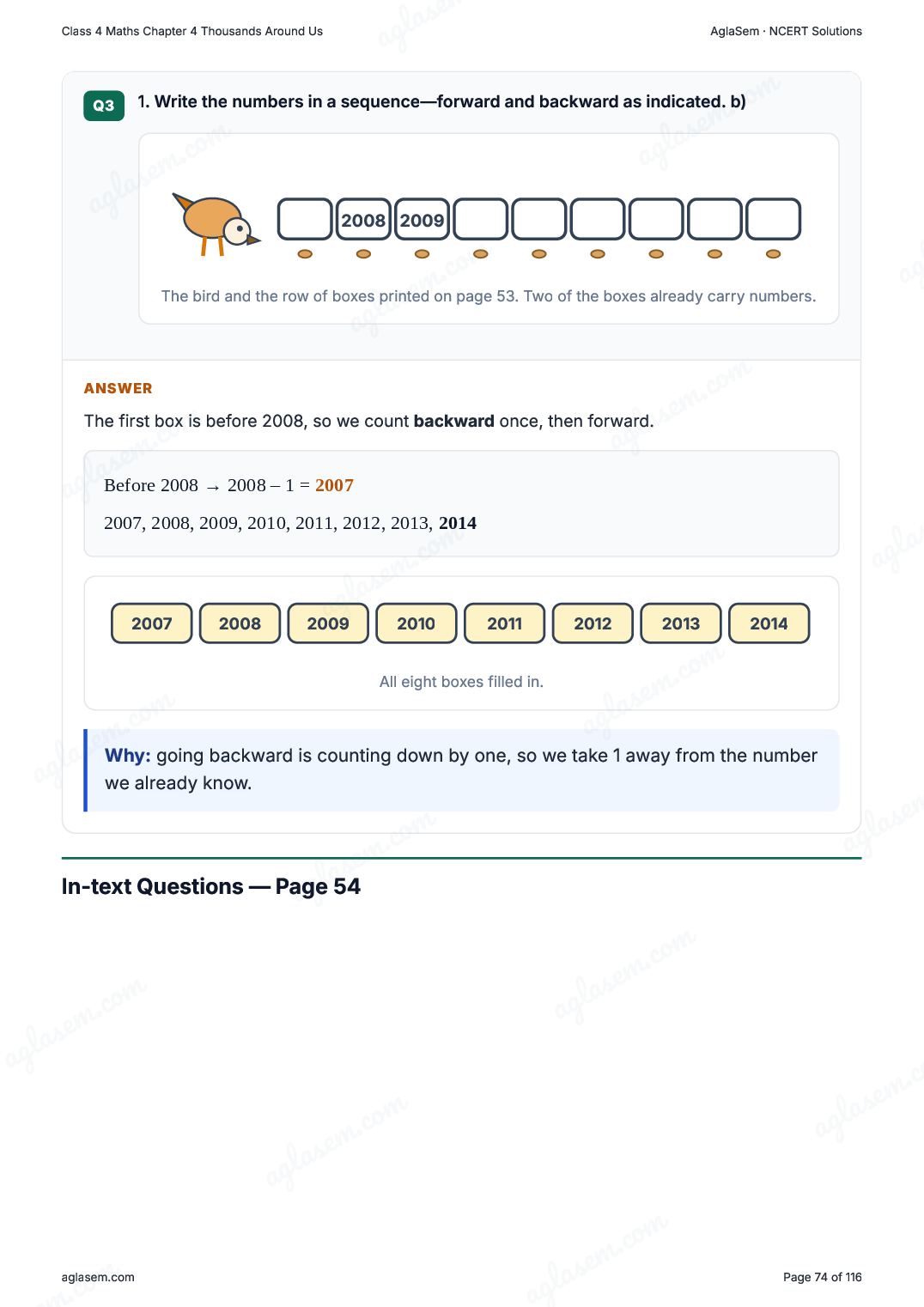
- 1. Write the numbers in a sequence—forward and backward as indicated. b)20082009The bird and the row of boxes printed on page 53. Two of the boxes already carry numbers.
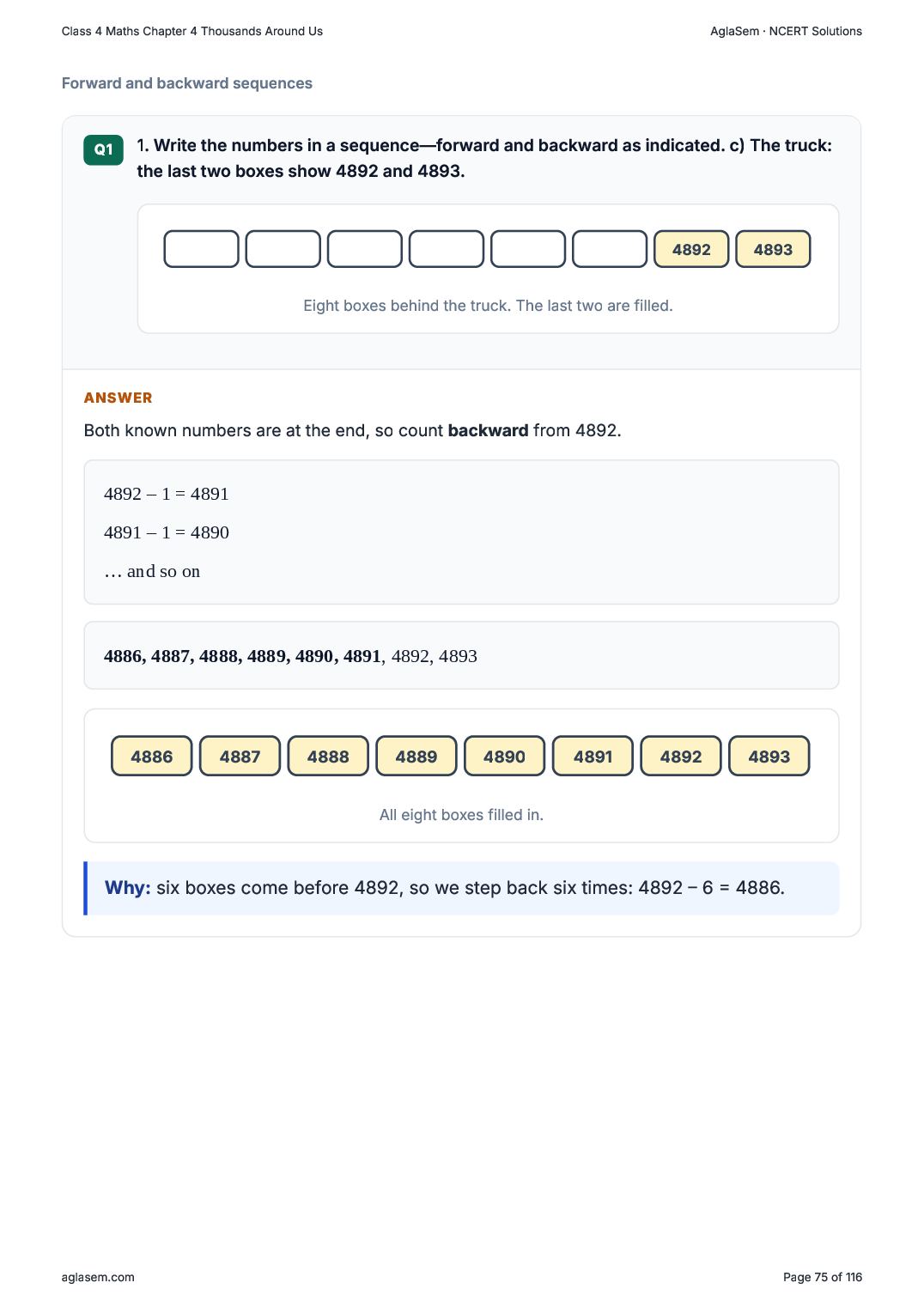
- 1. Write the numbers in a sequence—forward and backward as indicated. c) The truck: the last two boxes show 4892 and 4893.
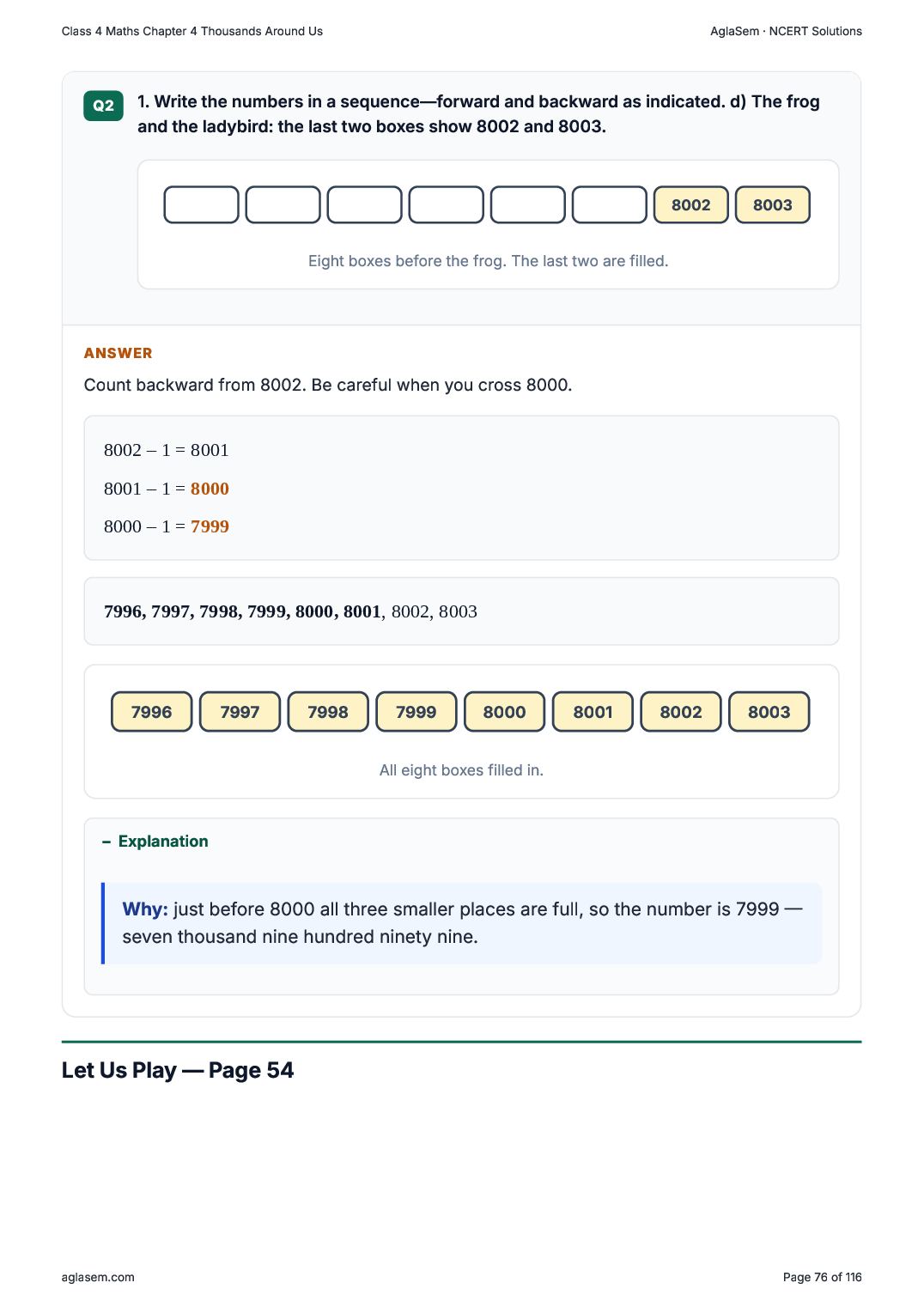
- 1. Write the numbers in a sequence—forward and backward as indicated. d) The frog and the ladybird: the last two boxes show 8002 and 8003.
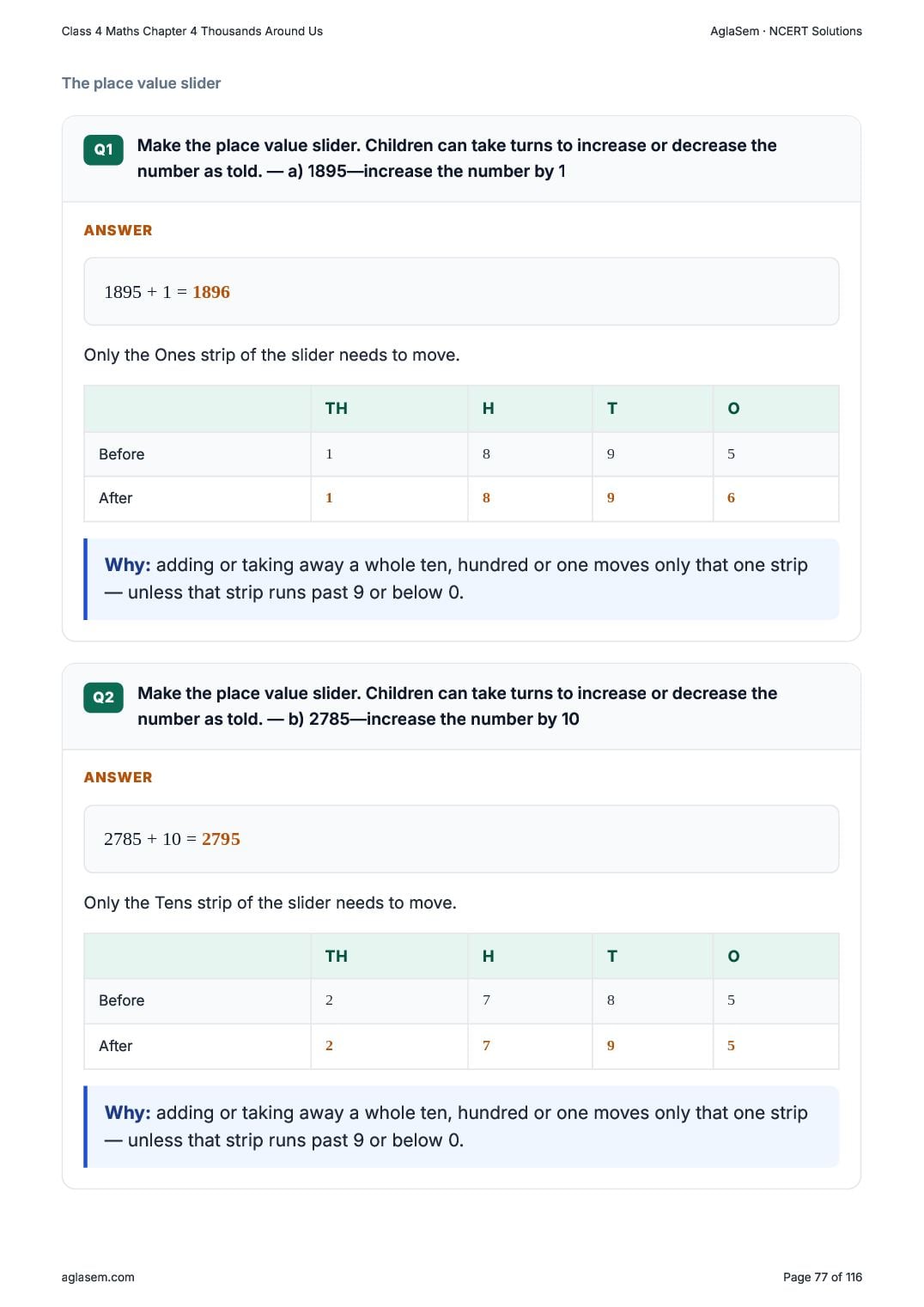
- Make the place value slider. Children can take turns to increase or decrease the number as told. — a) 1895—increase the number by 1
- Make the place value slider. Children can take turns to increase or decrease the number as told. — b) 2785—increase the number by 10
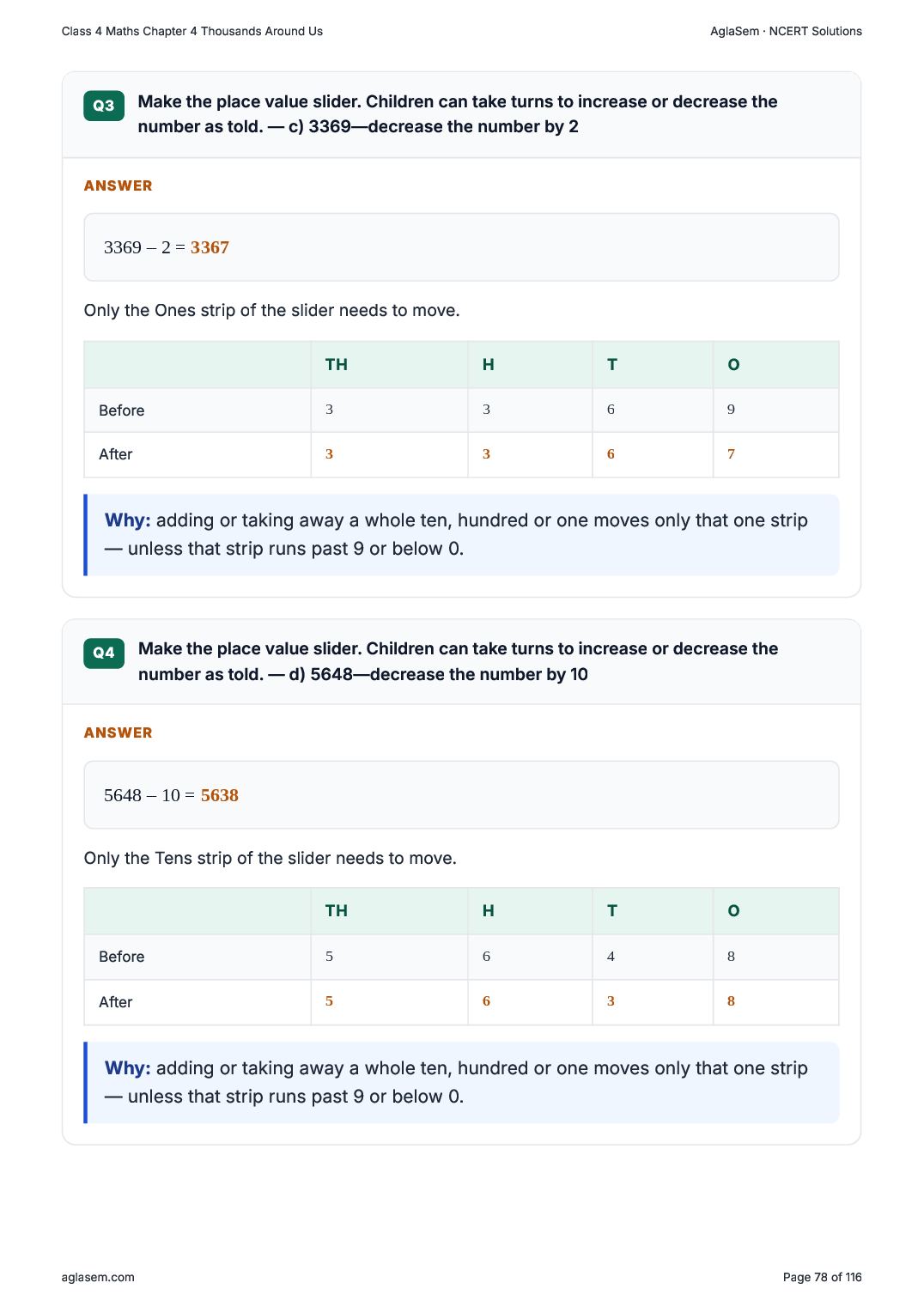
- Make the place value slider. Children can take turns to increase or decrease the number as told. — c) 3369—decrease the number by 2
- Make the place value slider. Children can take turns to increase or decrease the number as told. — d) 5648—decrease the number by 10
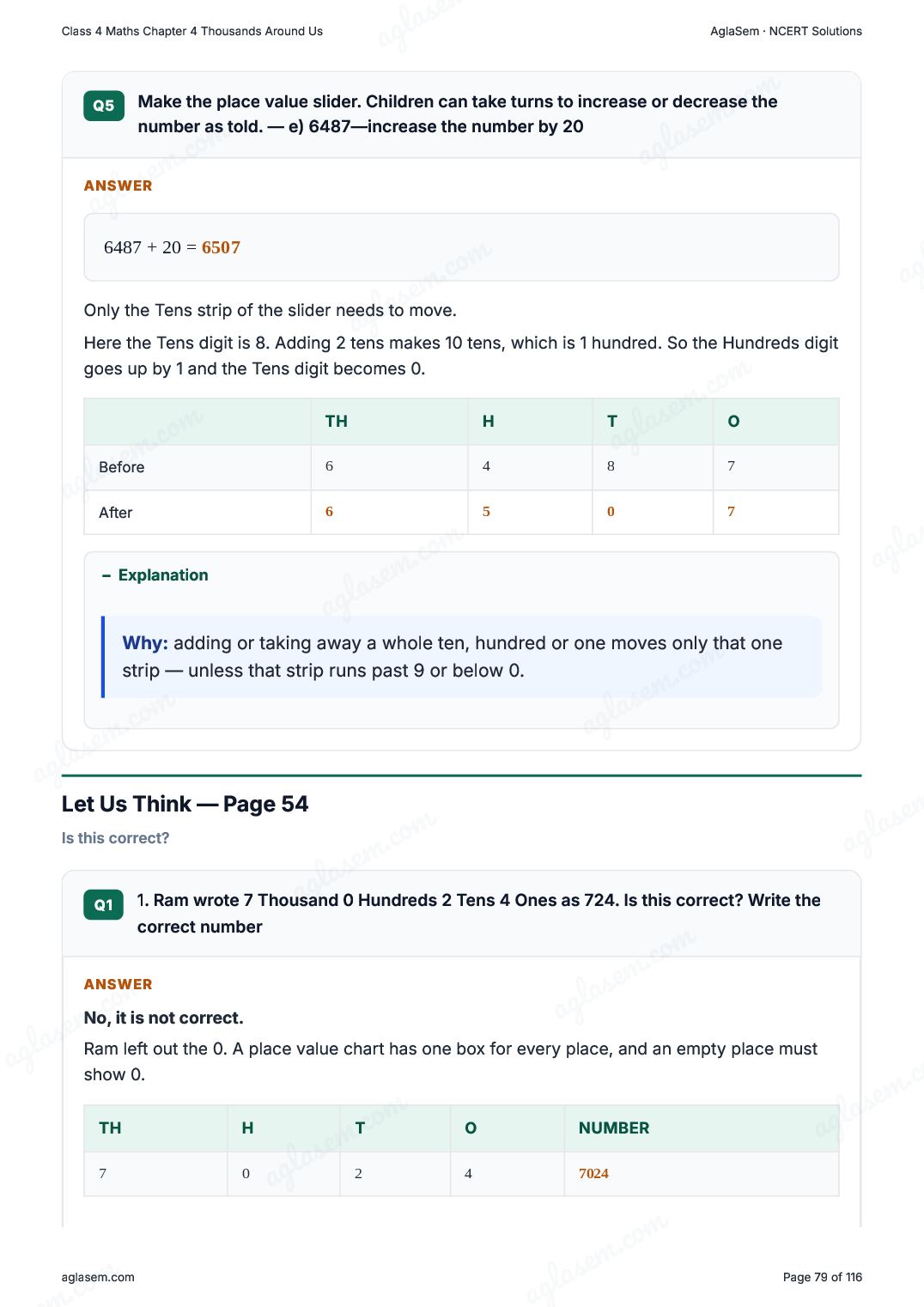
- Make the place value slider. Children can take turns to increase or decrease the number as told. — e) 6487—increase the number by 20
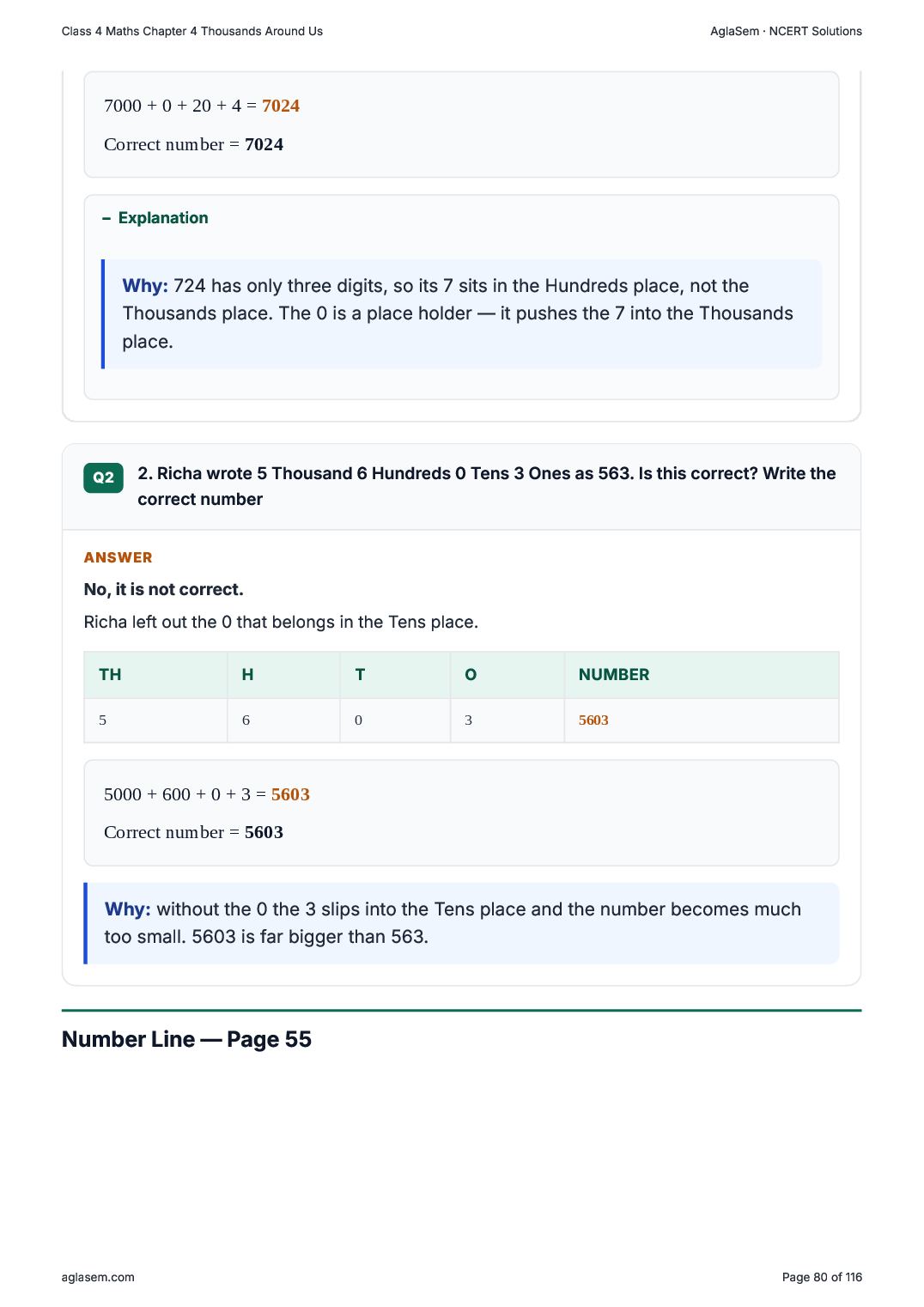
- 1. Ram wrote 7 Thousand 0 Hundreds 2 Tens 4 Ones as 724. Is this correct? Write the correct number
- 2. Richa wrote 5 Thousand 6 Hundreds 0 Tens 3 Ones as 563. Is this correct? Write the correct number
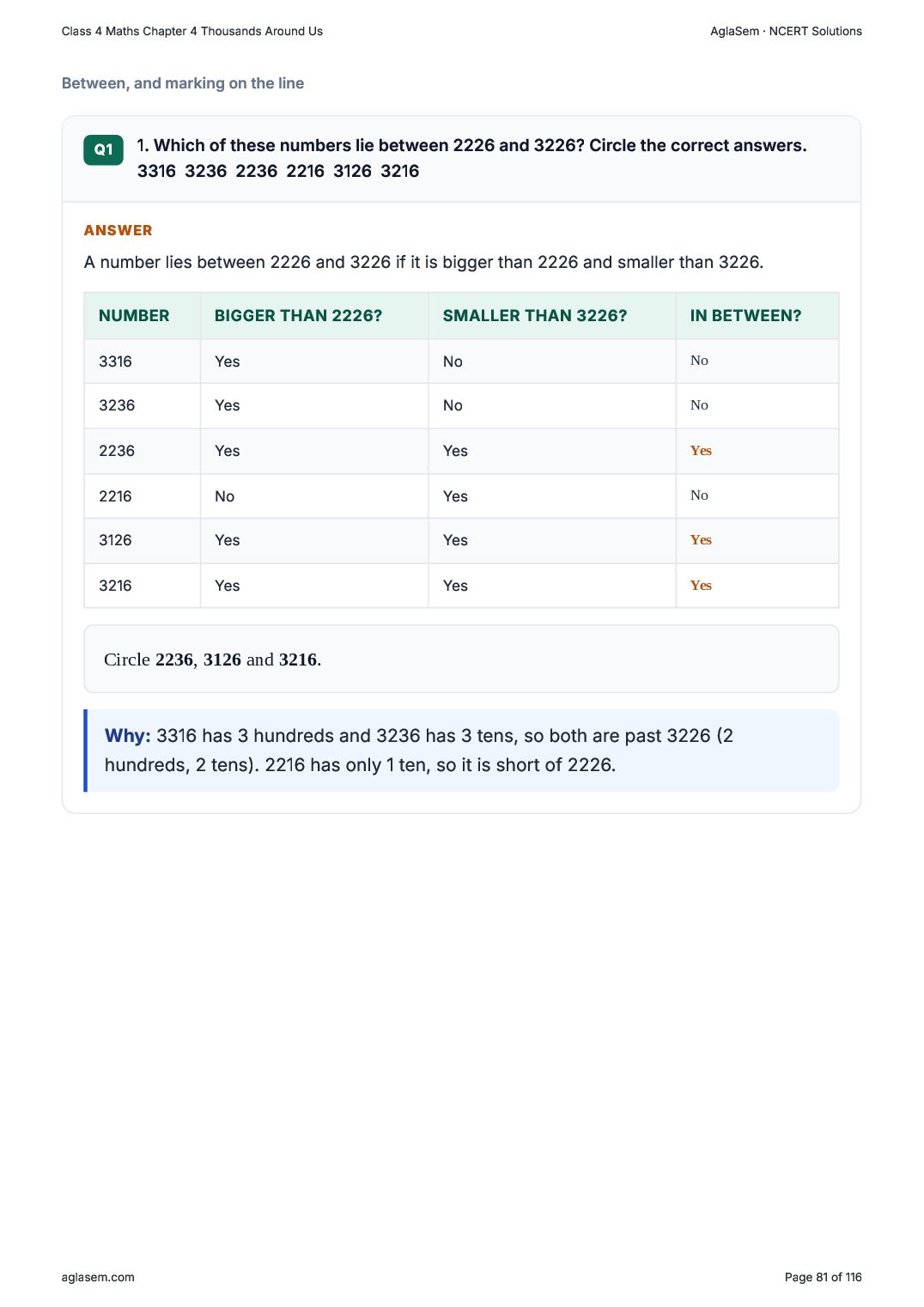
- 1. Which of these numbers lie between 2226 and 3226? Circle the correct answers. 3316 3236 2236 2216 3126 3216
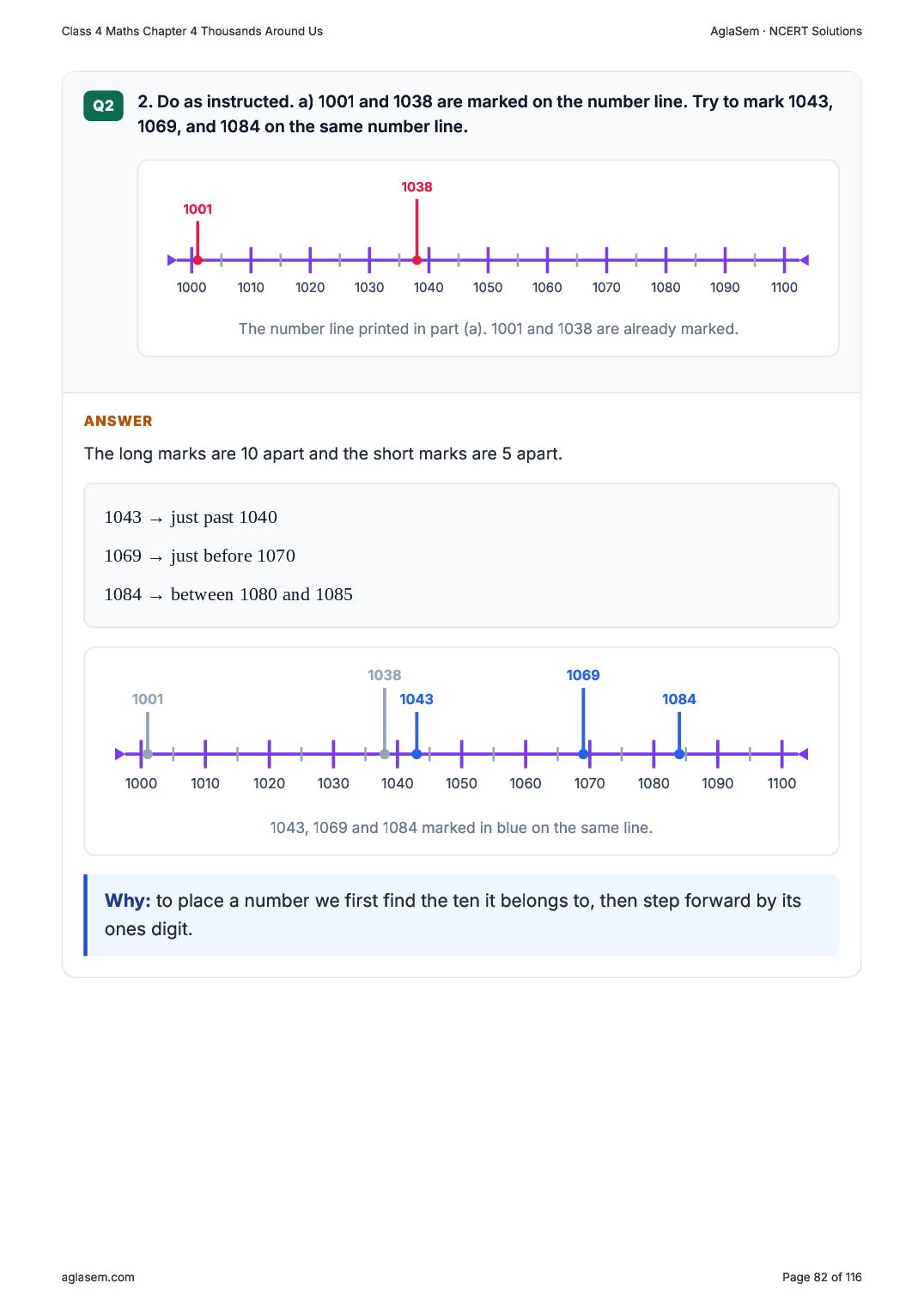
- 2. Do as instructed. a) 1001 and 1038 are marked on the number line. Try to mark 1043, 1069, and 1084 on the same number line.1000101010201030104010501060107010801090110010011038The number line printed in part (a). 1001 and 1038 are already marked.
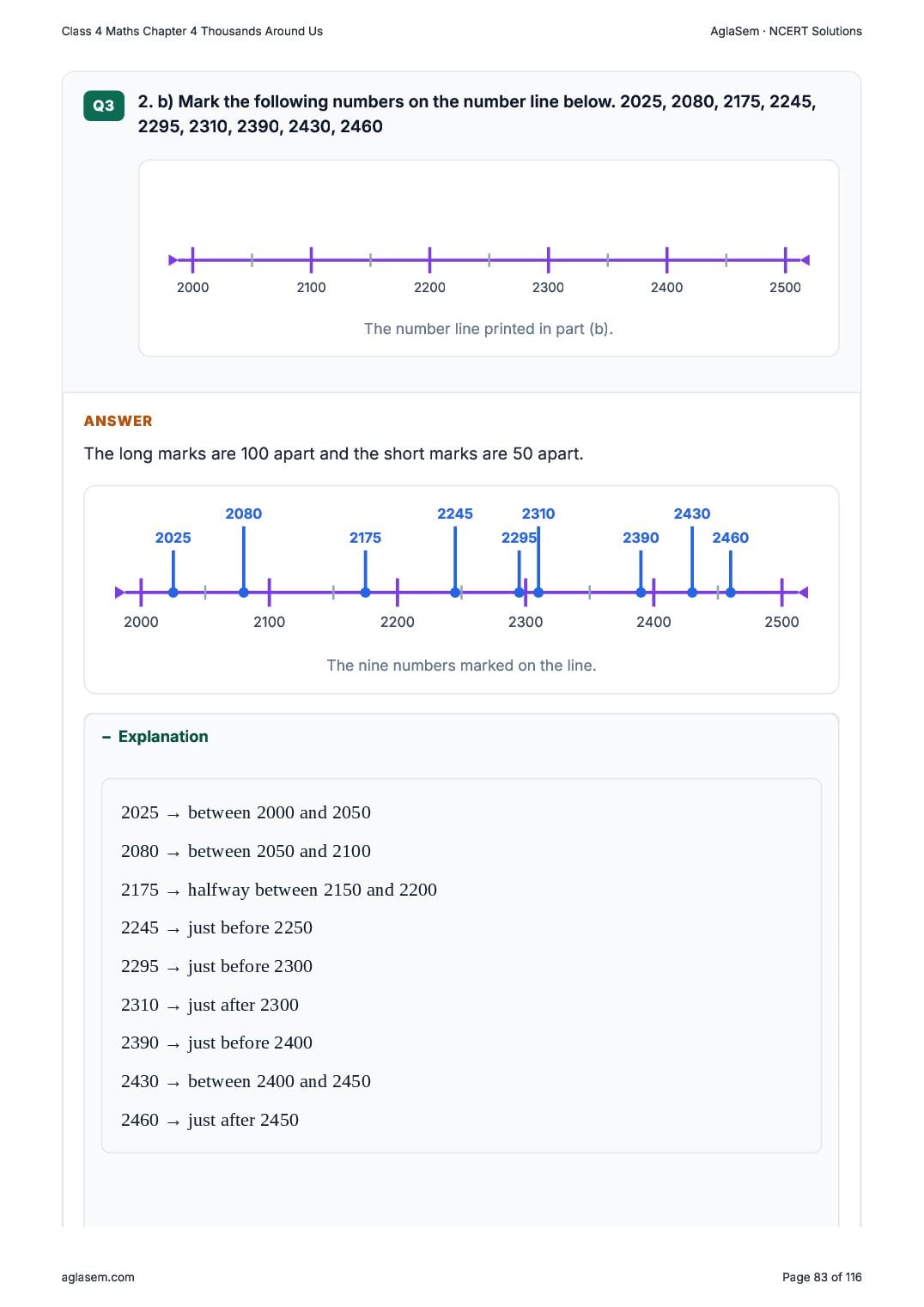
- 2. b) Mark the following numbers on the number line below. 2025, 2080, 2175, 2245, 2295, 2310, 2390, 2430, 2460200021002200230024002500The number line printed in part (b).
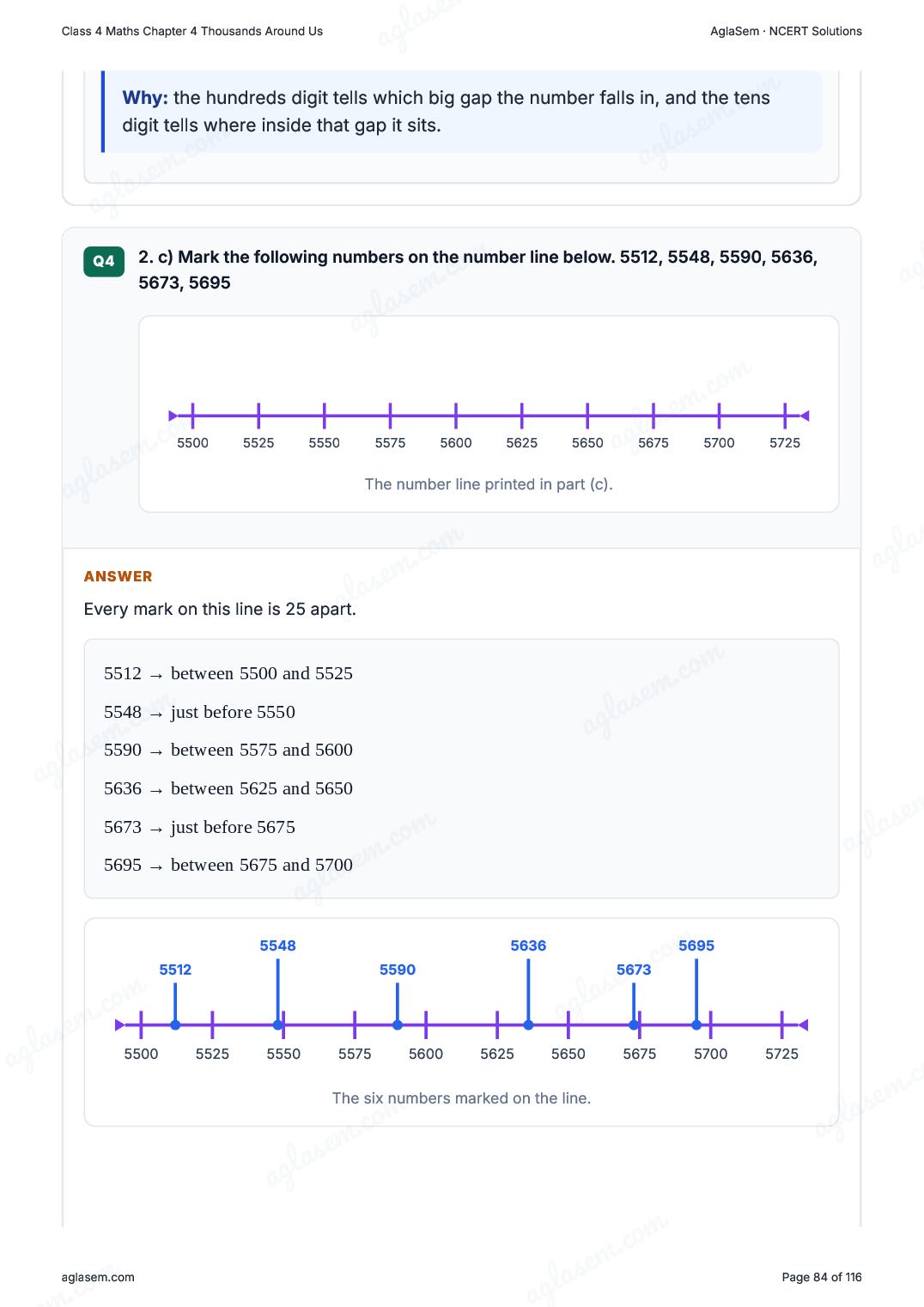
- 2. c) Mark the following numbers on the number line below. 5512, 5548, 5590, 5636, 5673, 56955500552555505575560056255650567557005725The number line printed in part (c).
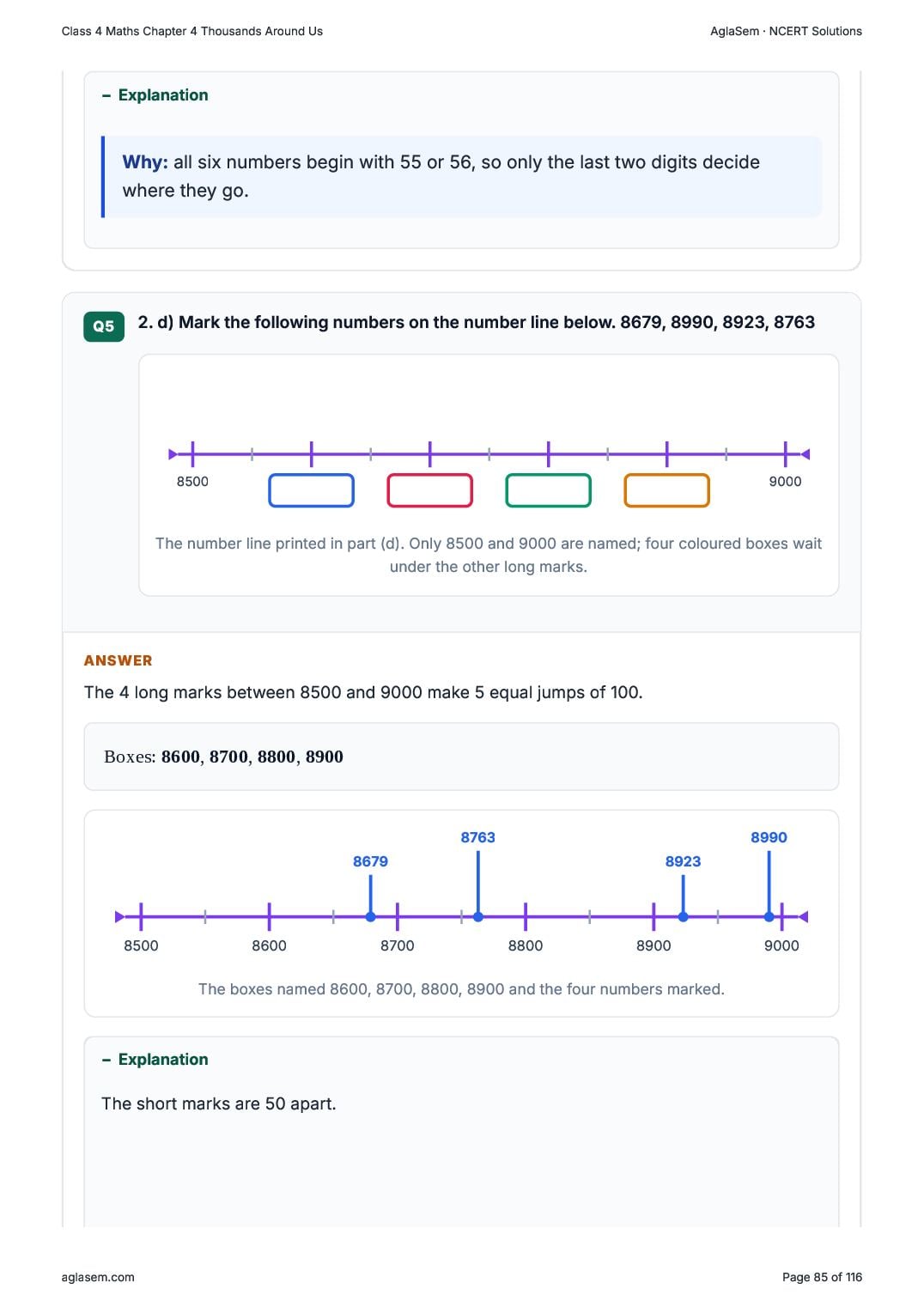
- 2. d) Mark the following numbers on the number line below. 8679, 8990, 8923, 876385009000The number line printed in part (d). Only 8500 and 9000 are named; four coloured boxes wait under the other long marks.
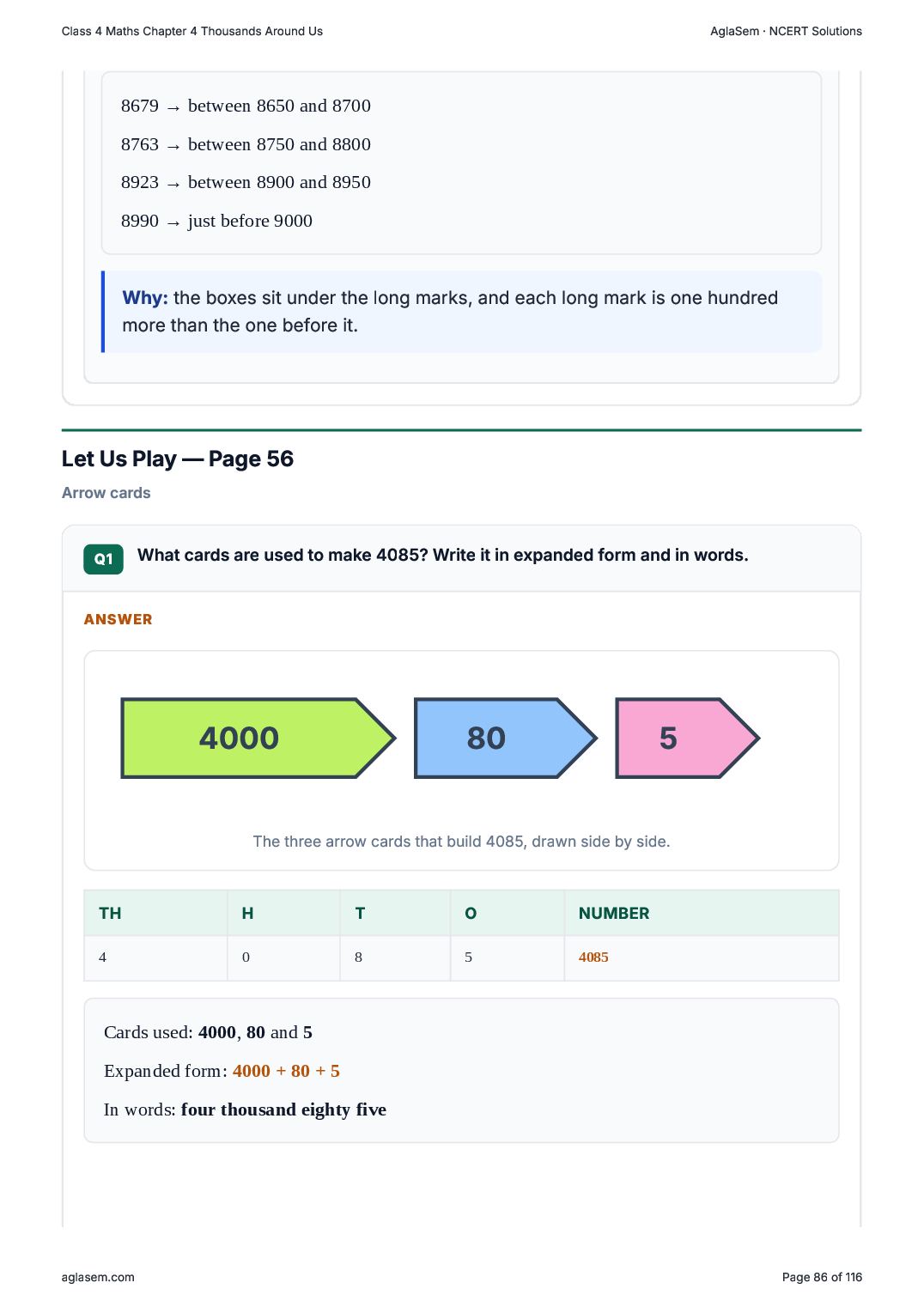
- What cards are used to make 4085? Write it in expanded form and in words.
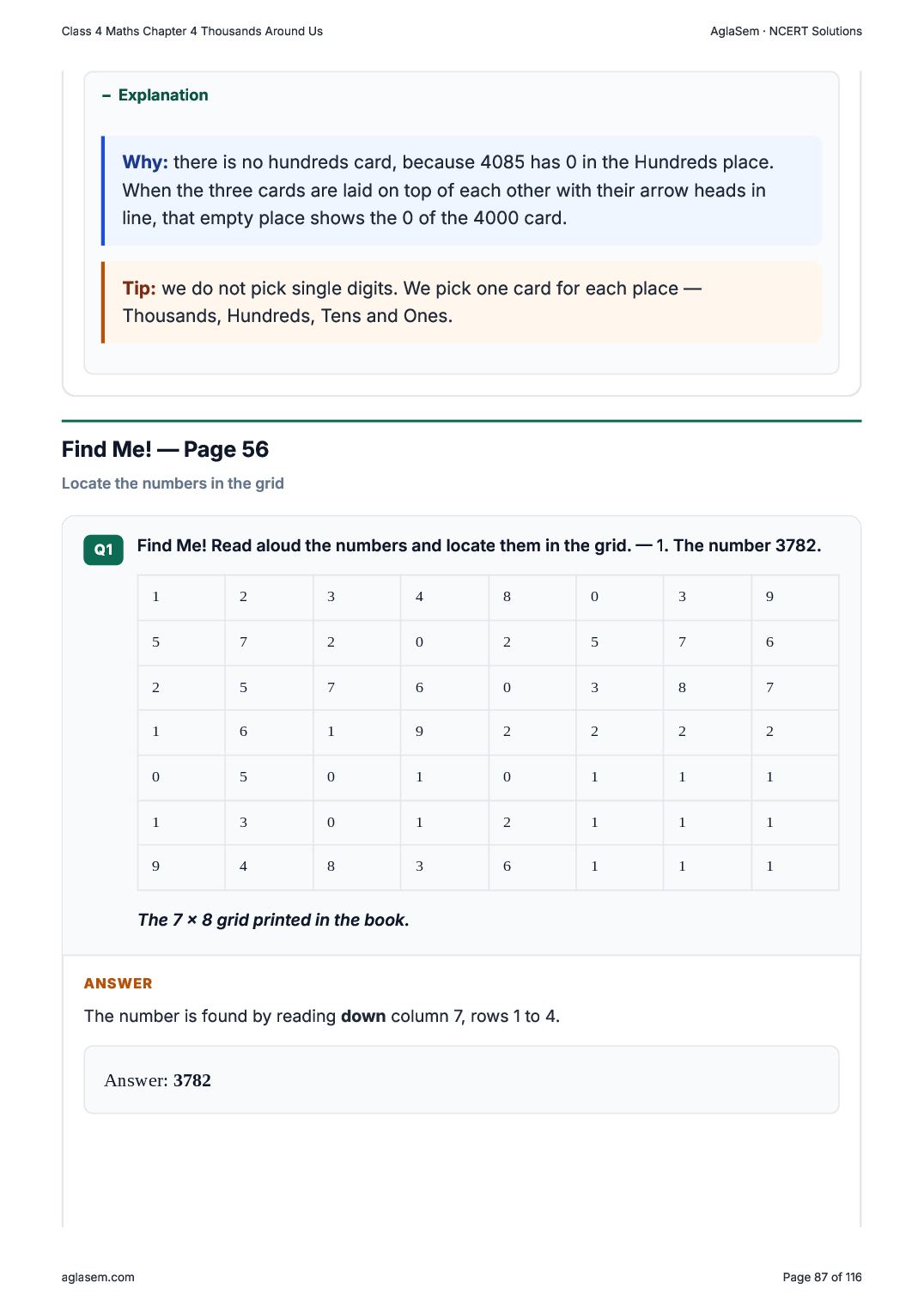
- Find Me! Read aloud the numbers and locate them in the grid. — 1. The number 3782.12348039572025762576038716192222050101111301211194836111The 7 × 8 grid printed in the book.
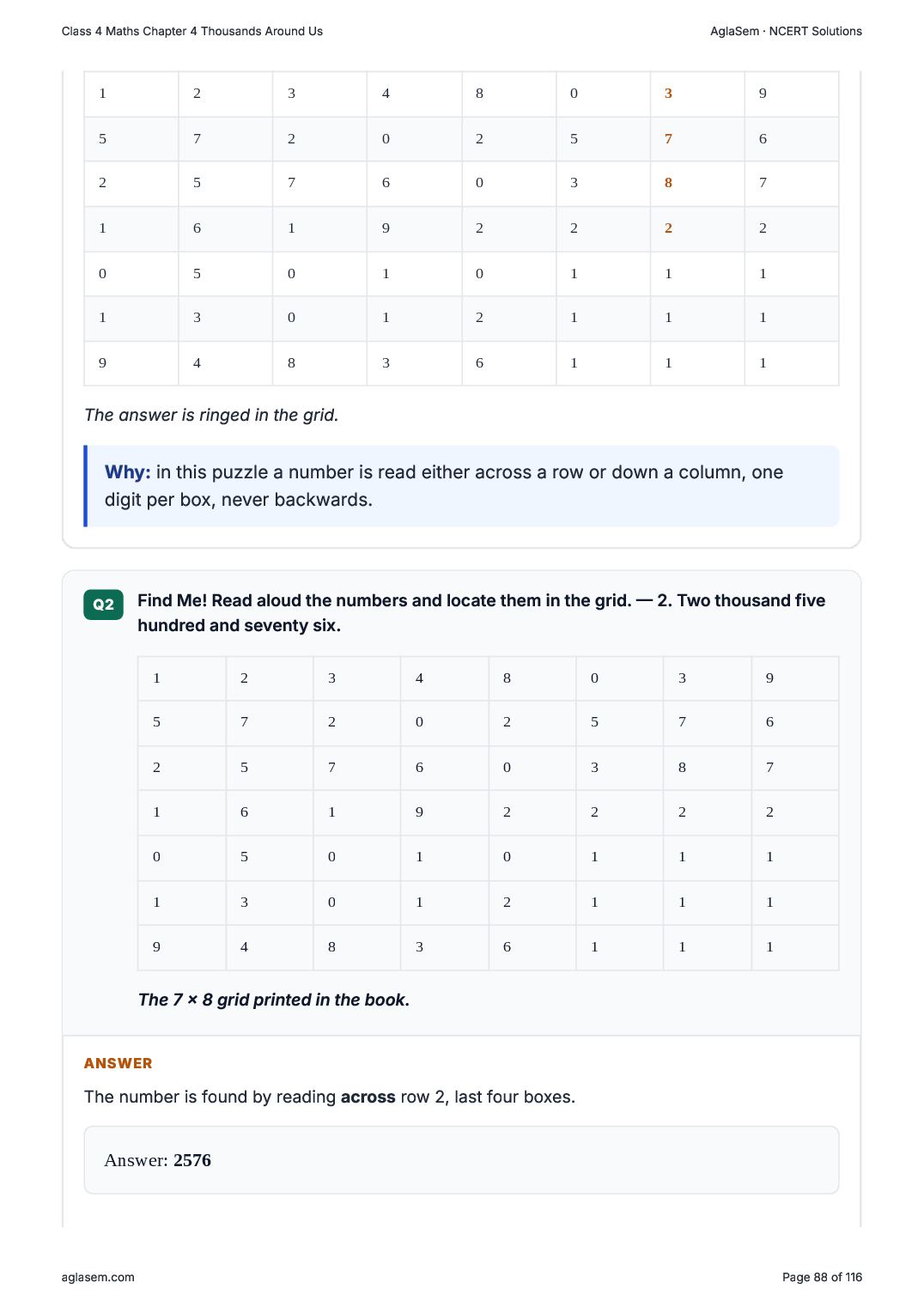
- Find Me! Read aloud the numbers and locate them in the grid. — 2. Two thousand five hundred and seventy six.12348039572025762576038716192222050101111301211194836111The 7 × 8 grid printed in the book.
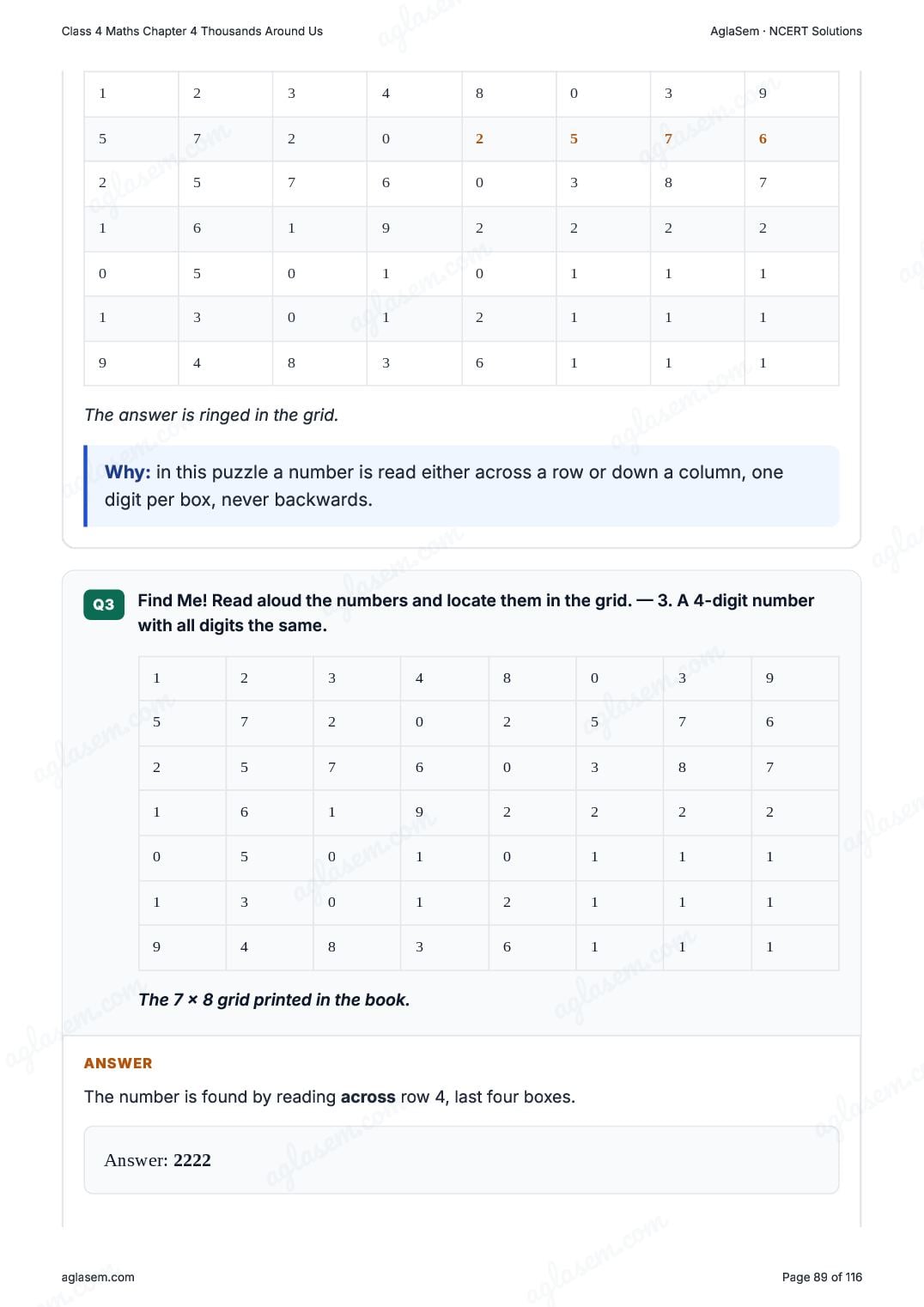
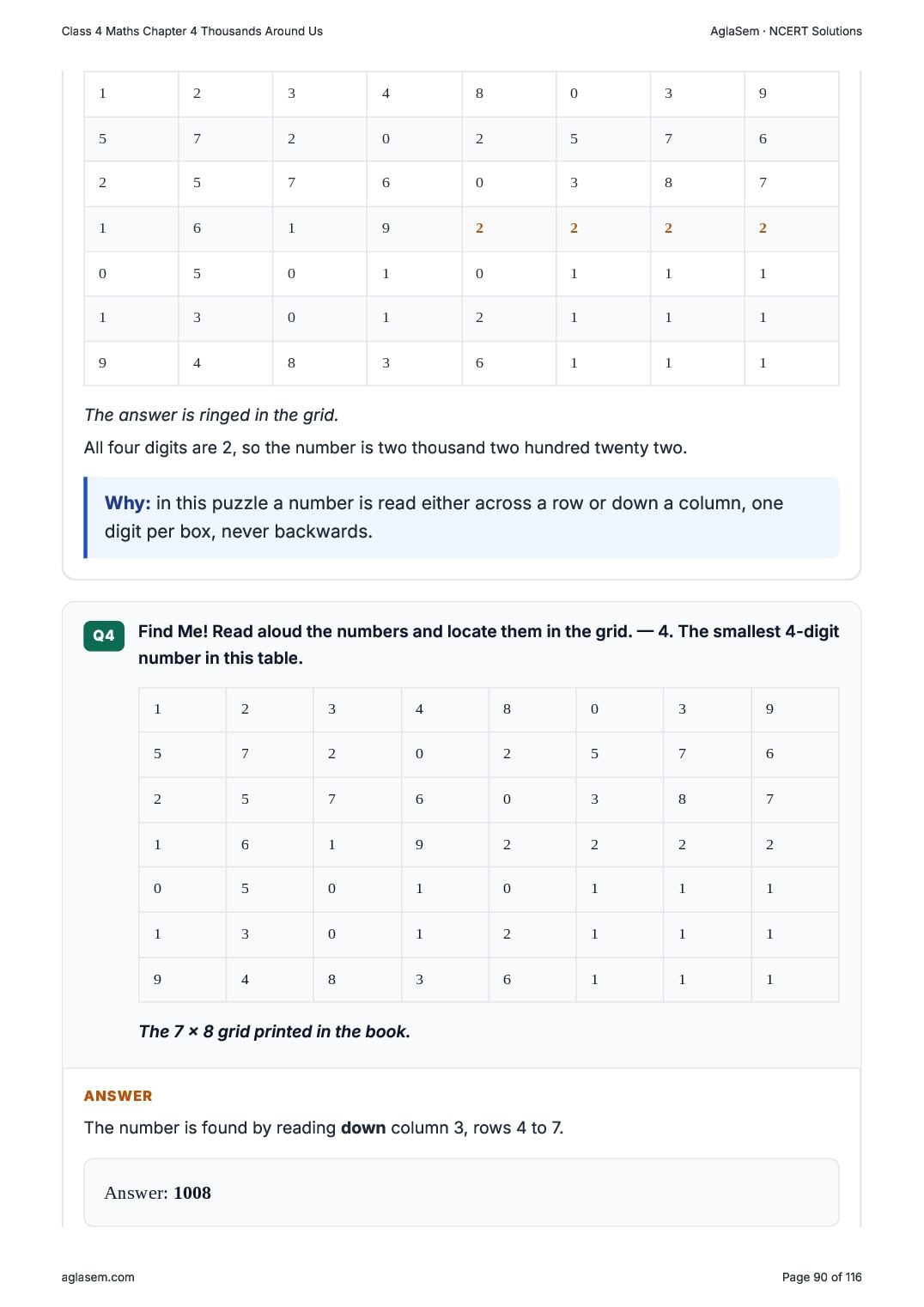
- Find Me! Read aloud the numbers and locate them in the grid. — 3. A 4-digit number with all digits the same.12348039572025762576038716192222050101111301211194836111The 7 × 8 grid printed in the book.
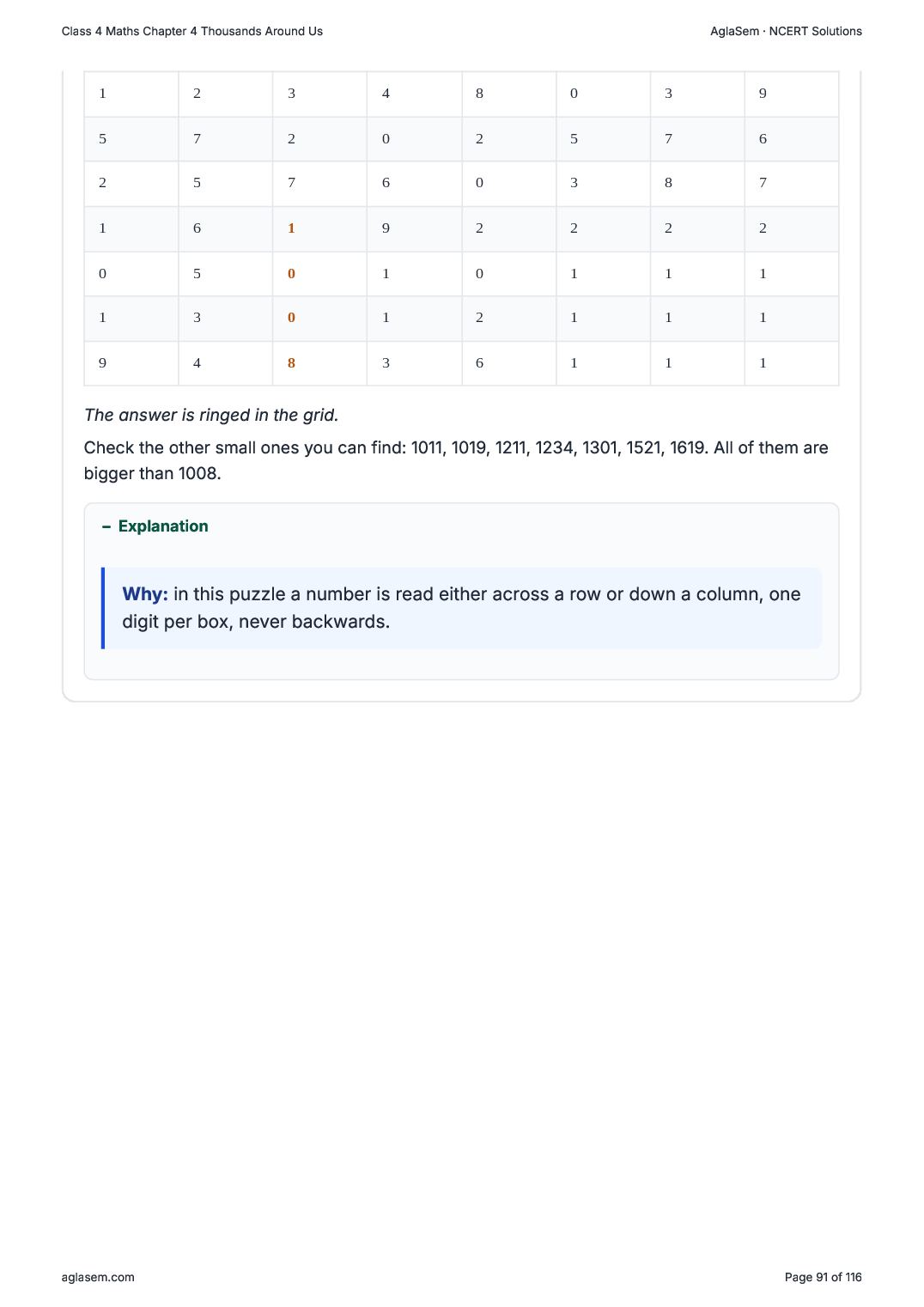
- Find Me! Read aloud the numbers and locate them in the grid. — 4. The smallest 4-digit number in this table.12348039572025762576038716192222050101111301211194836111The 7 × 8 grid printed in the book.
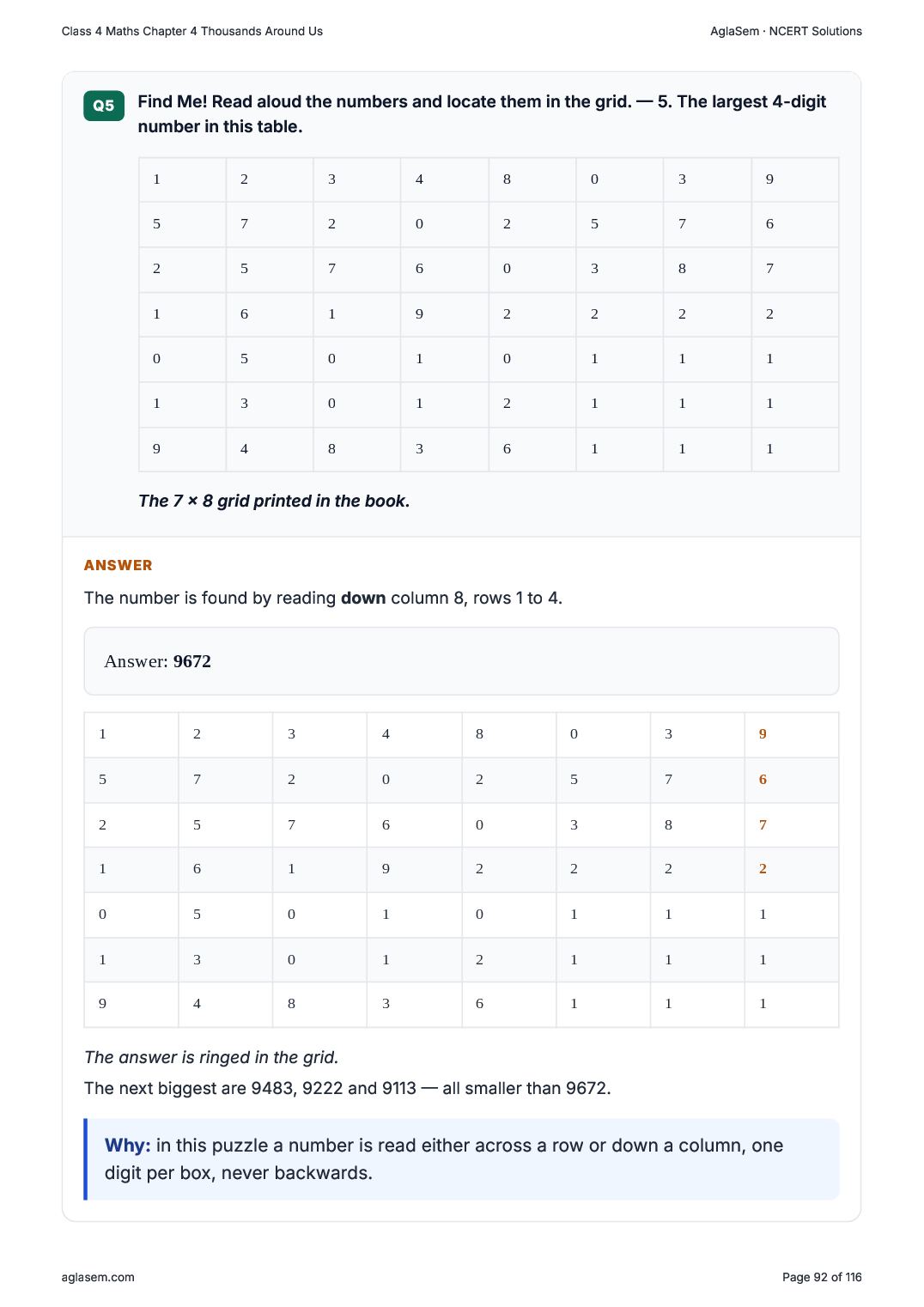
- Find Me! Read aloud the numbers and locate them in the grid. — 5. The largest 4-digit number in this table.12348039572025762576038716192222050101111301211194836111The 7 × 8 grid printed in the book.
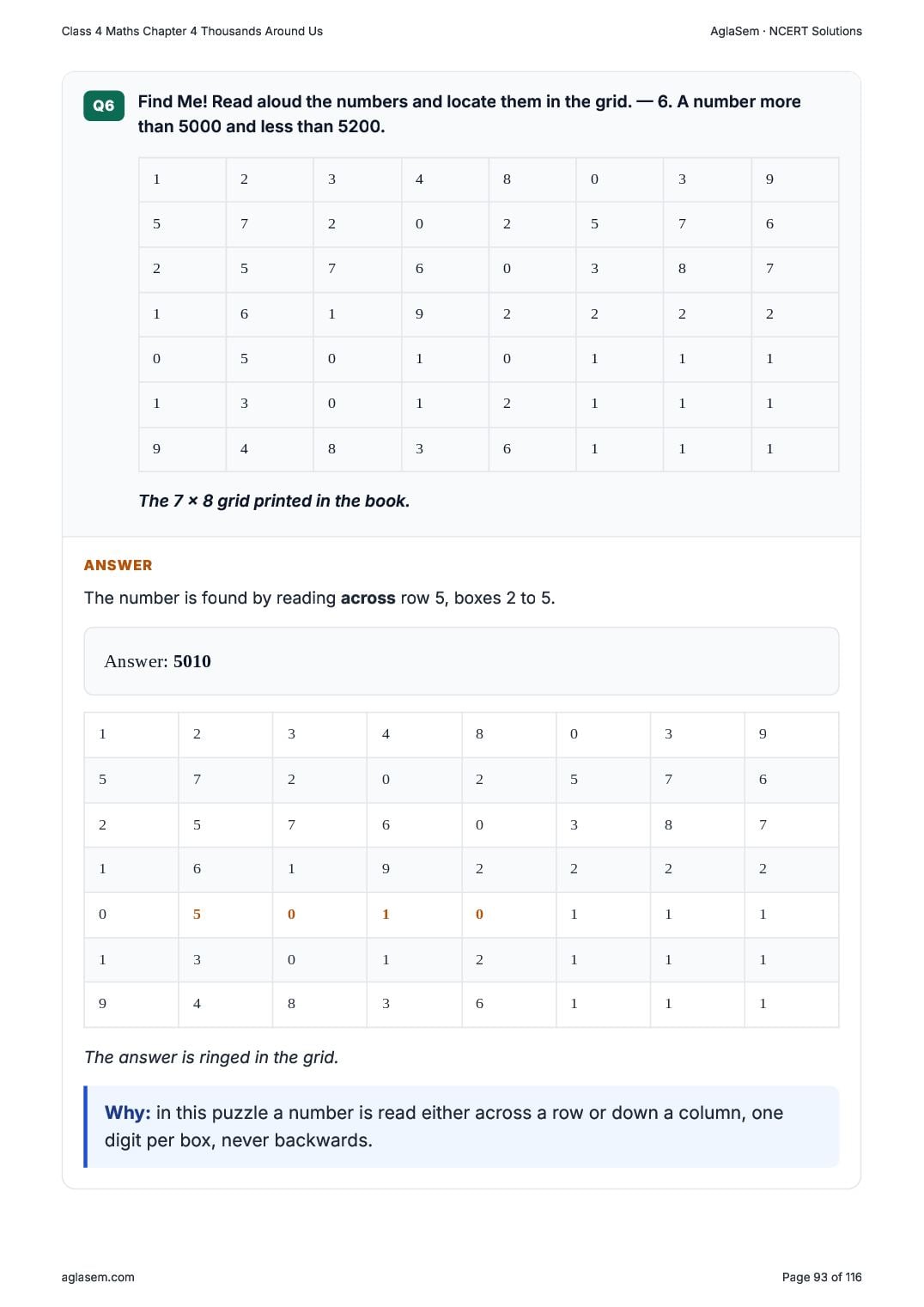
- Find Me! Read aloud the numbers and locate them in the grid. — 6. A number more than 5000 and less than 5200.12348039572025762576038716192222050101111301211194836111The 7 × 8 grid printed in the book.
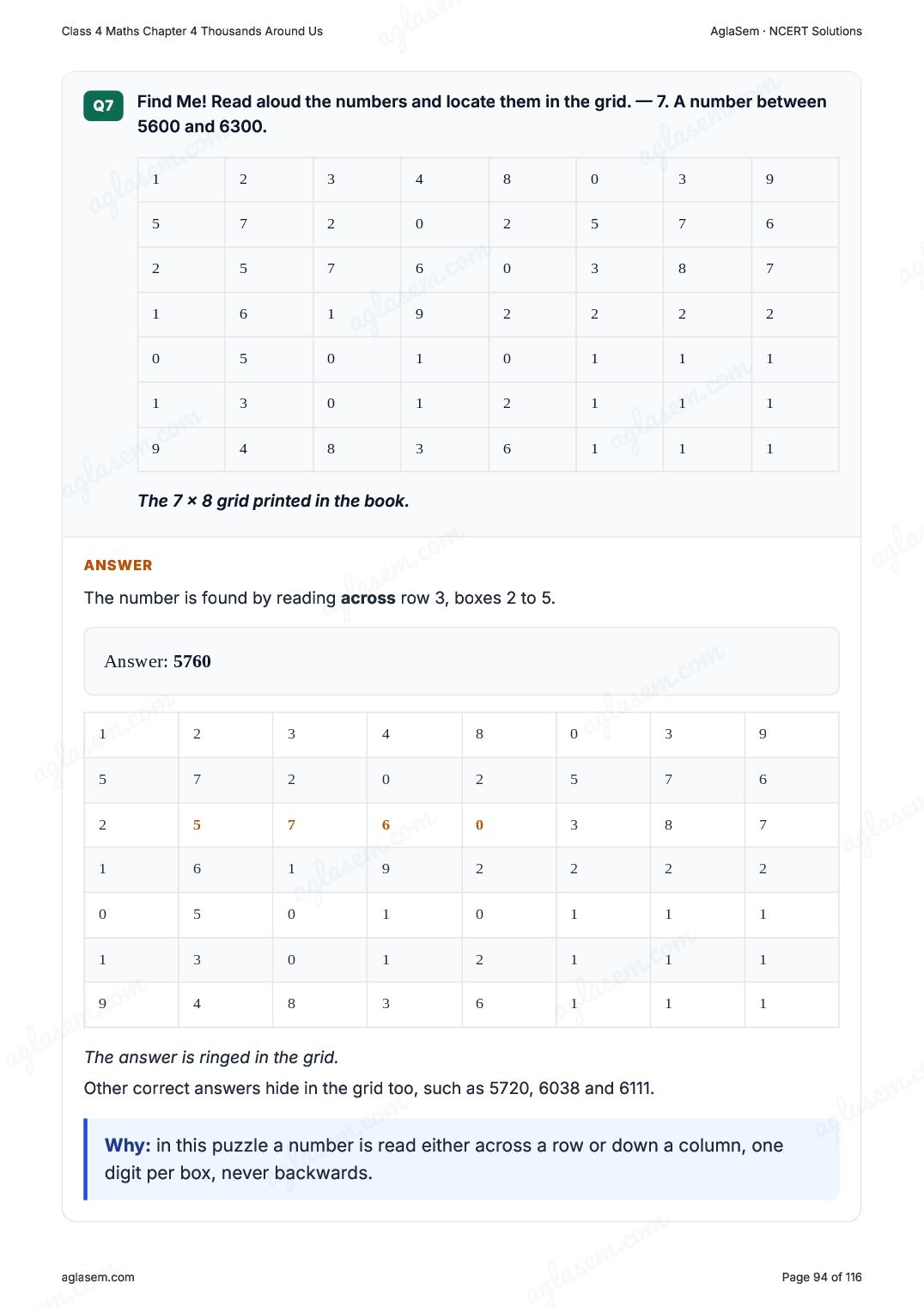
- Find Me! Read aloud the numbers and locate them in the grid. — 7. A number between 5600 and 6300.12348039572025762576038716192222050101111301211194836111The 7 × 8 grid printed in the book.
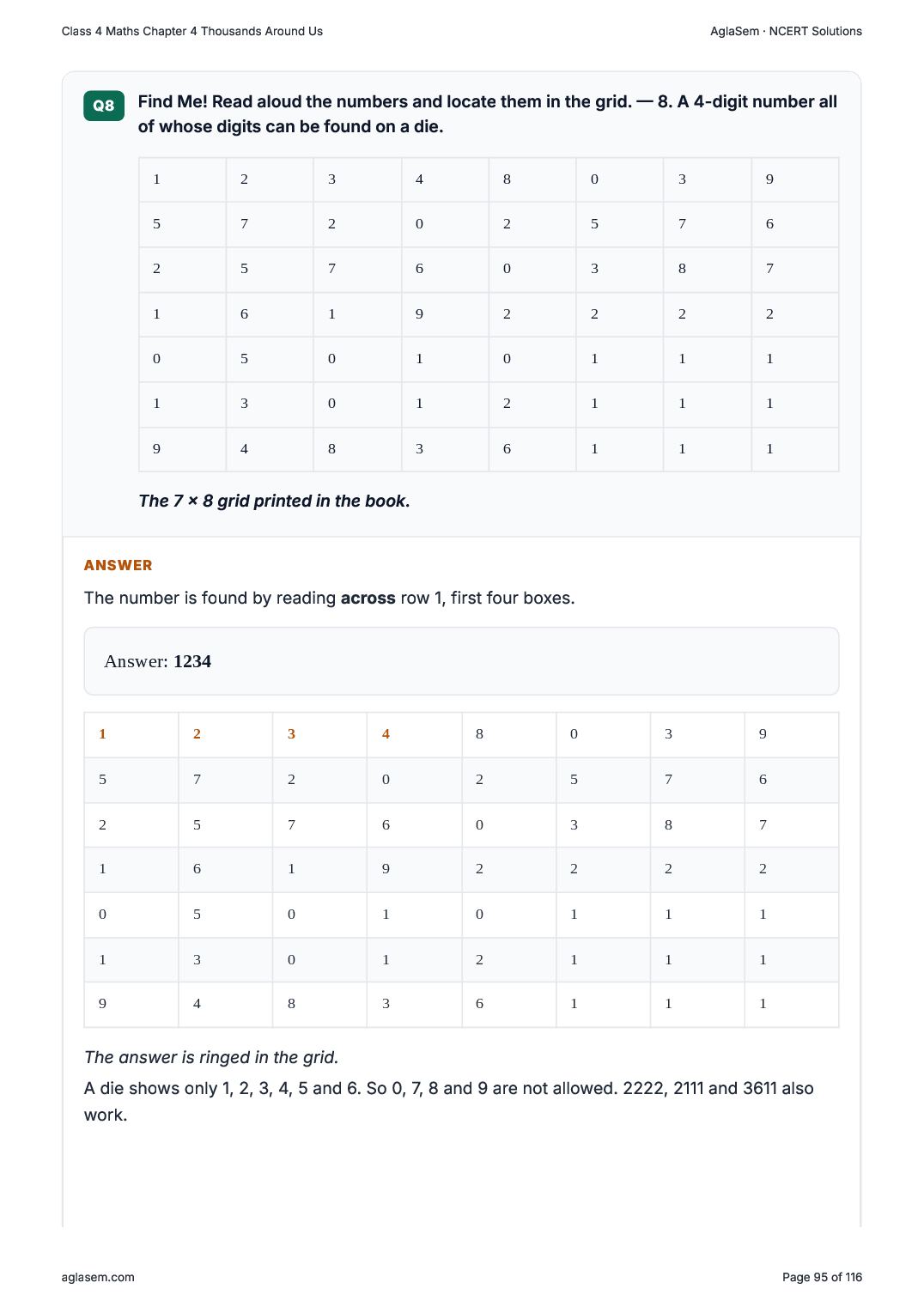
- Find Me! Read aloud the numbers and locate them in the grid. — 8. A 4-digit number all of whose digits can be found on a die.12348039572025762576038716192222050101111301211194836111The 7 × 8 grid printed in the book.
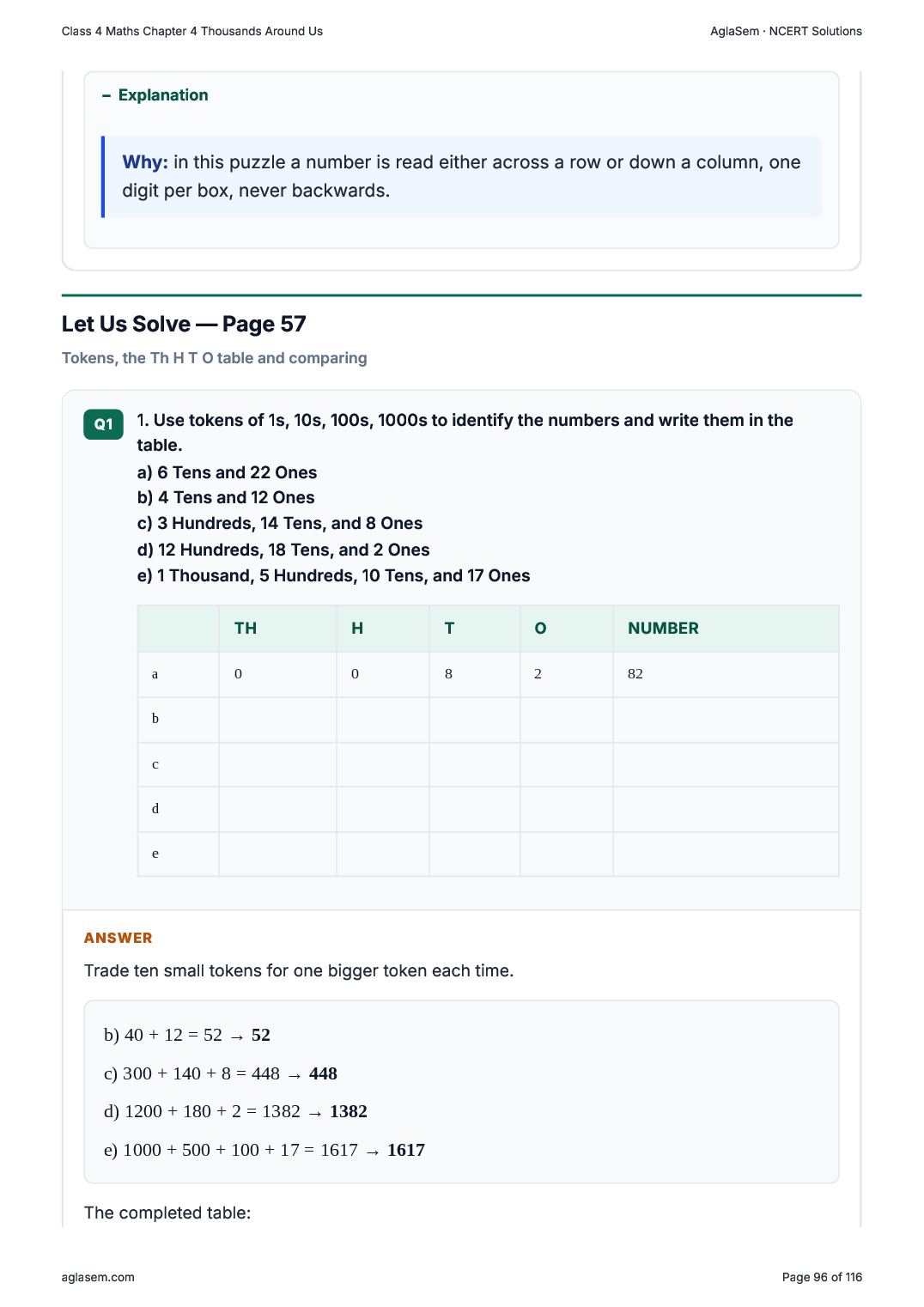
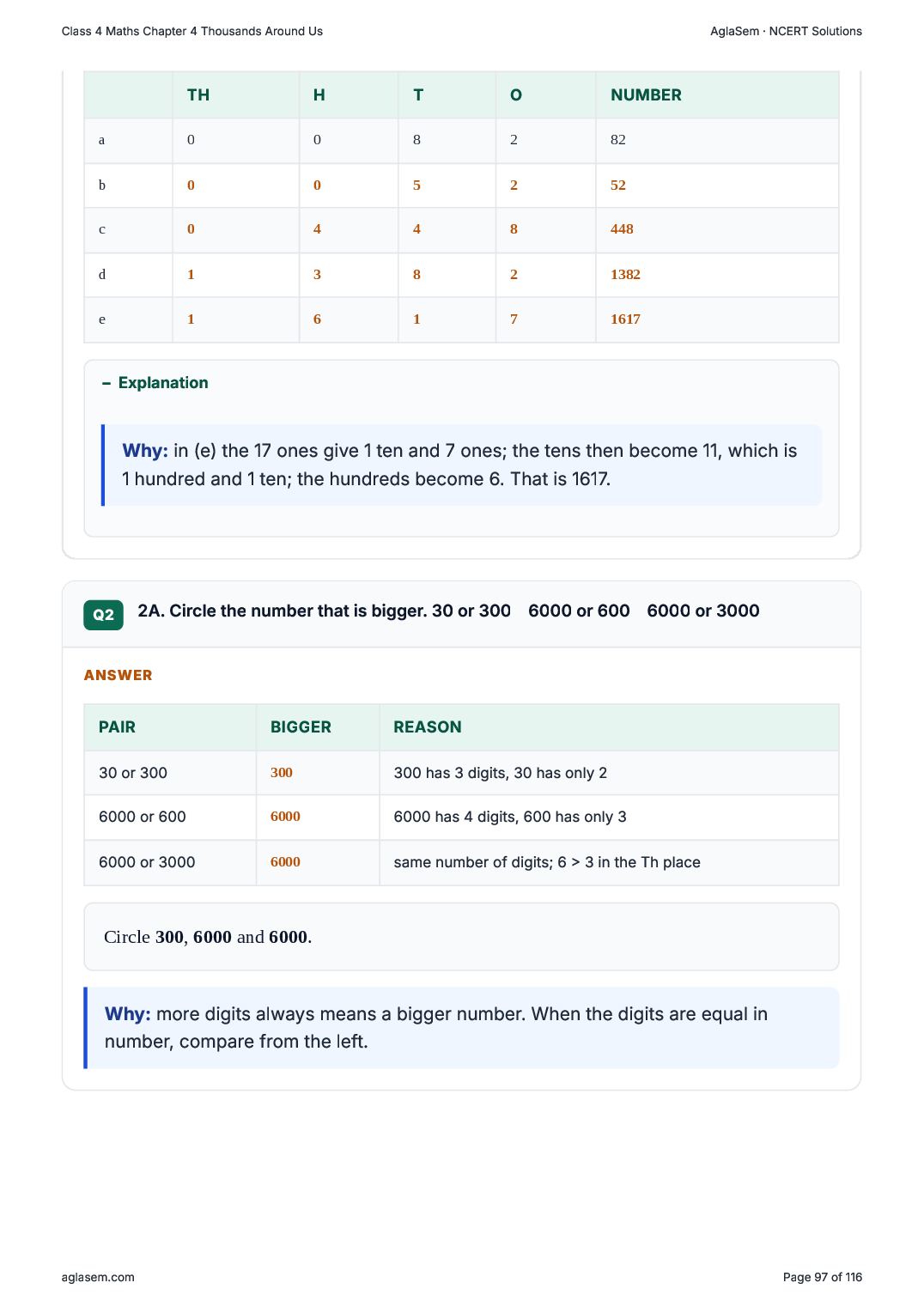
- 1. Use tokens of 1s, 10s, 100s, 1000s to identify the numbers and write them in the table. a) 6 Tens and 22 Ones b) 4 Tens and 12 Ones c) 3 Hundreds, 14 Tens, and 8 Ones d) 12 Hundreds, 18 Tens, and 2 Ones e) 1 Thousand, 5 Hundreds, 10 Tens, and 17 OnesThHTONumbera008282bcde
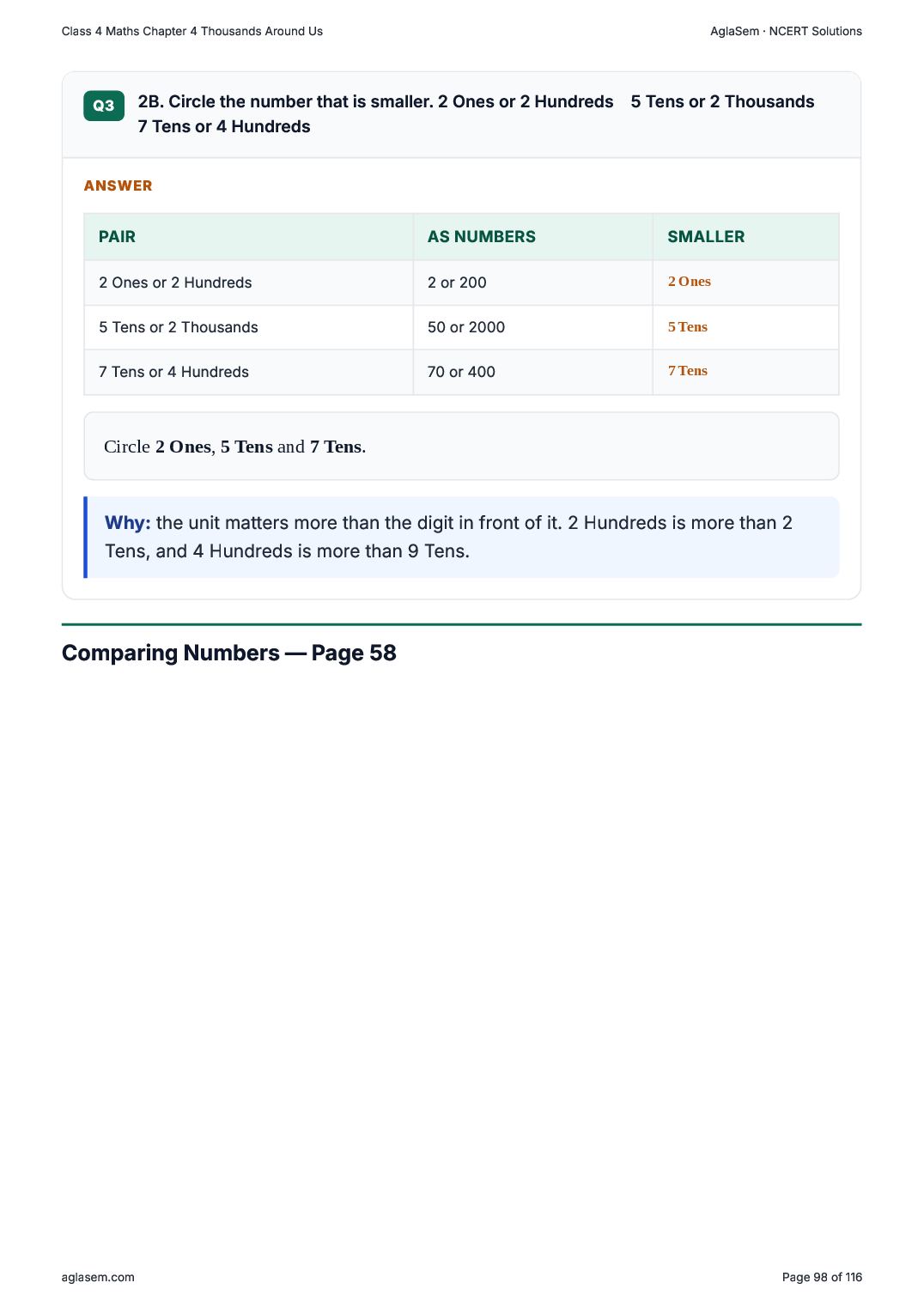
- 2A. Circle the number that is bigger. 30 or 300 6000 or 600 6000 or 3000
- 2B. Circle the number that is smaller. 2 Ones or 2 Hundreds 5 Tens or 2 Thousands 7 Tens or 4 Hundreds
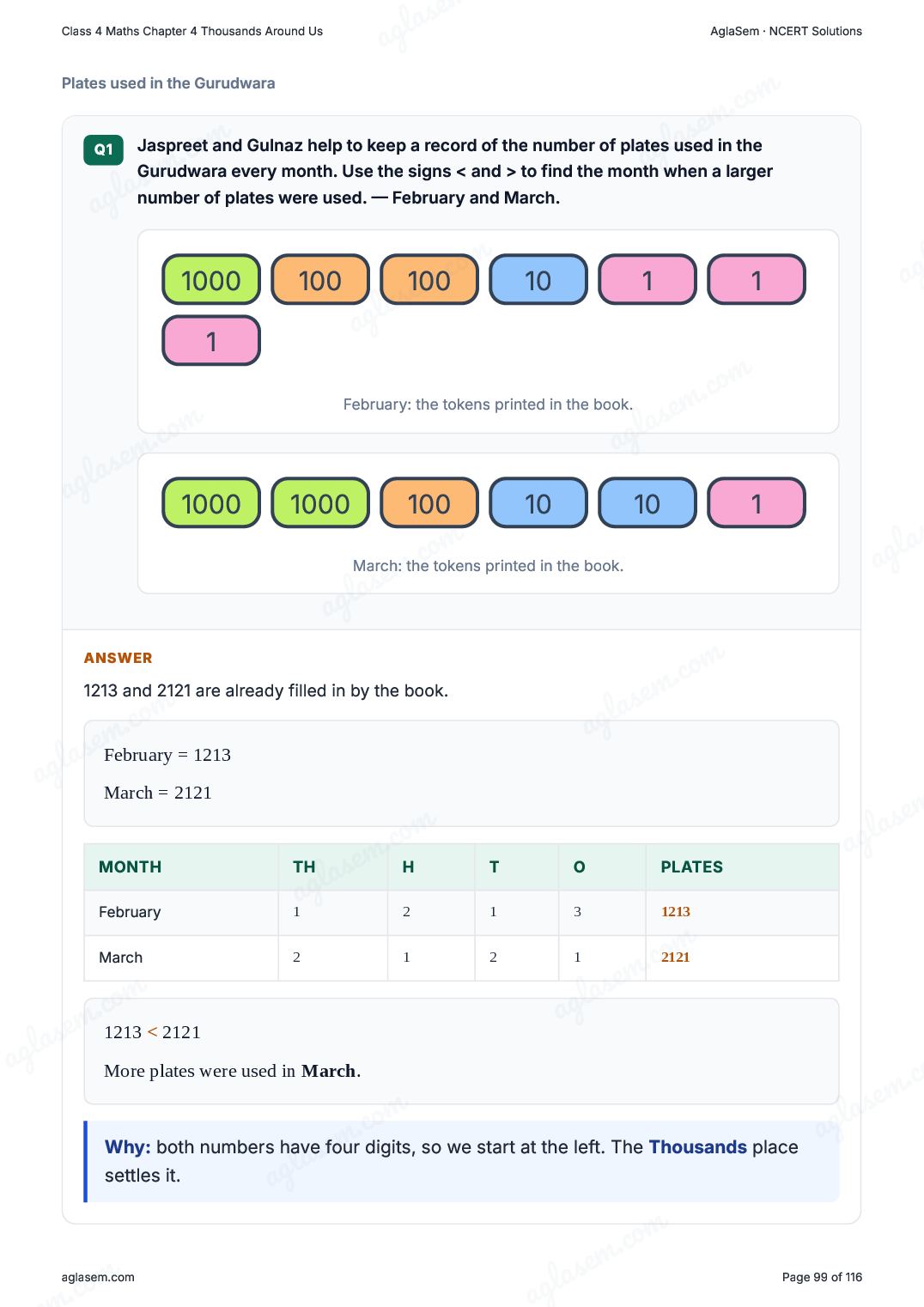
- Jaspreet and Gulnaz help to keep a record of the number of plates used in the Gurudwara every month. Use the signs < and > to find the month when a larger number of plates were used. — February and March.
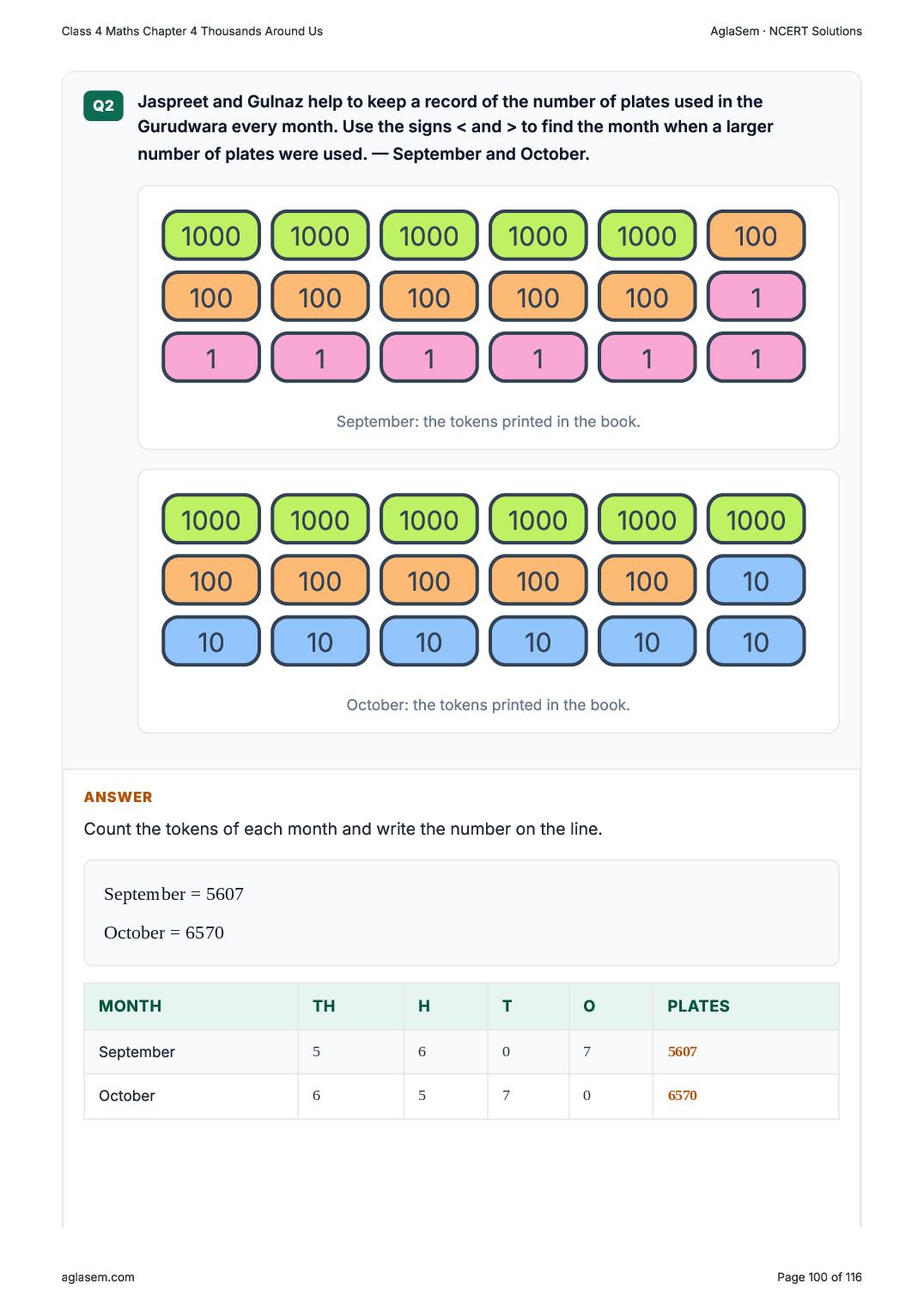
- Jaspreet and Gulnaz help to keep a record of the number of plates used in the Gurudwara every month. Use the signs < and > to find the month when a larger number of plates were used. — September and October.
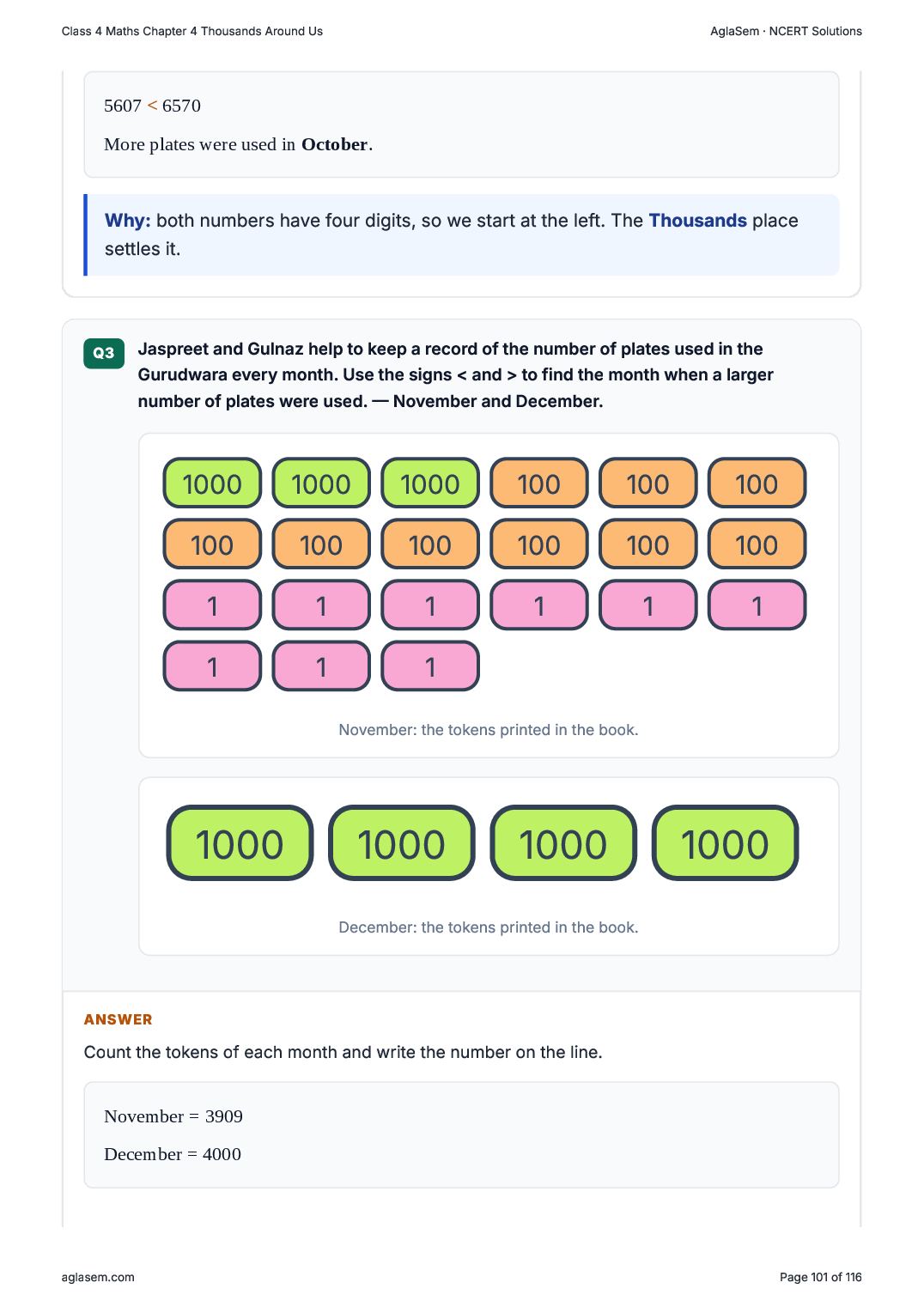
- Jaspreet and Gulnaz help to keep a record of the number of plates used in the Gurudwara every month. Use the signs < and > to find the month when a larger number of plates were used. — November and December.
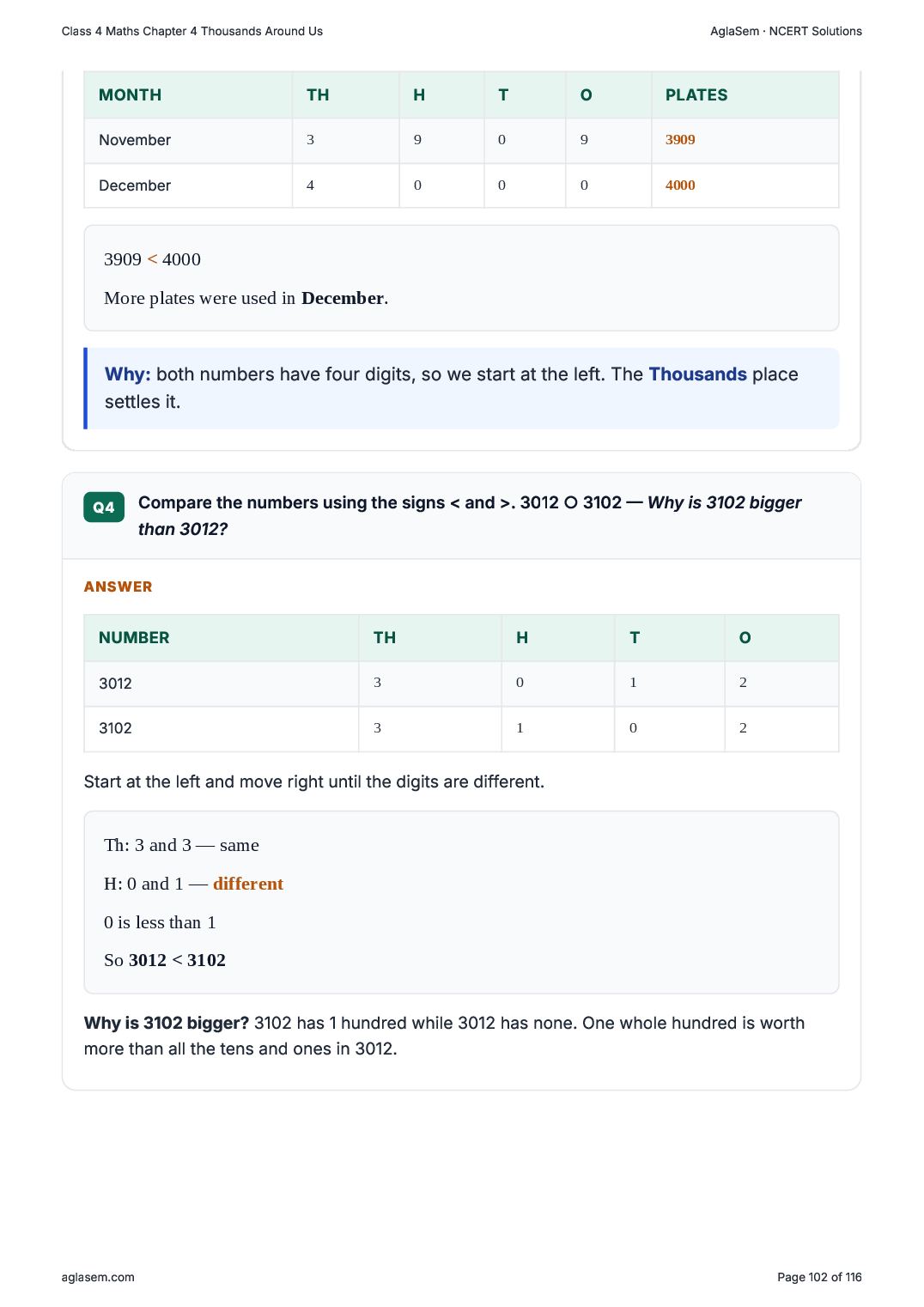
- Compare the numbers using the signs < and >. 3012 ○ 3102
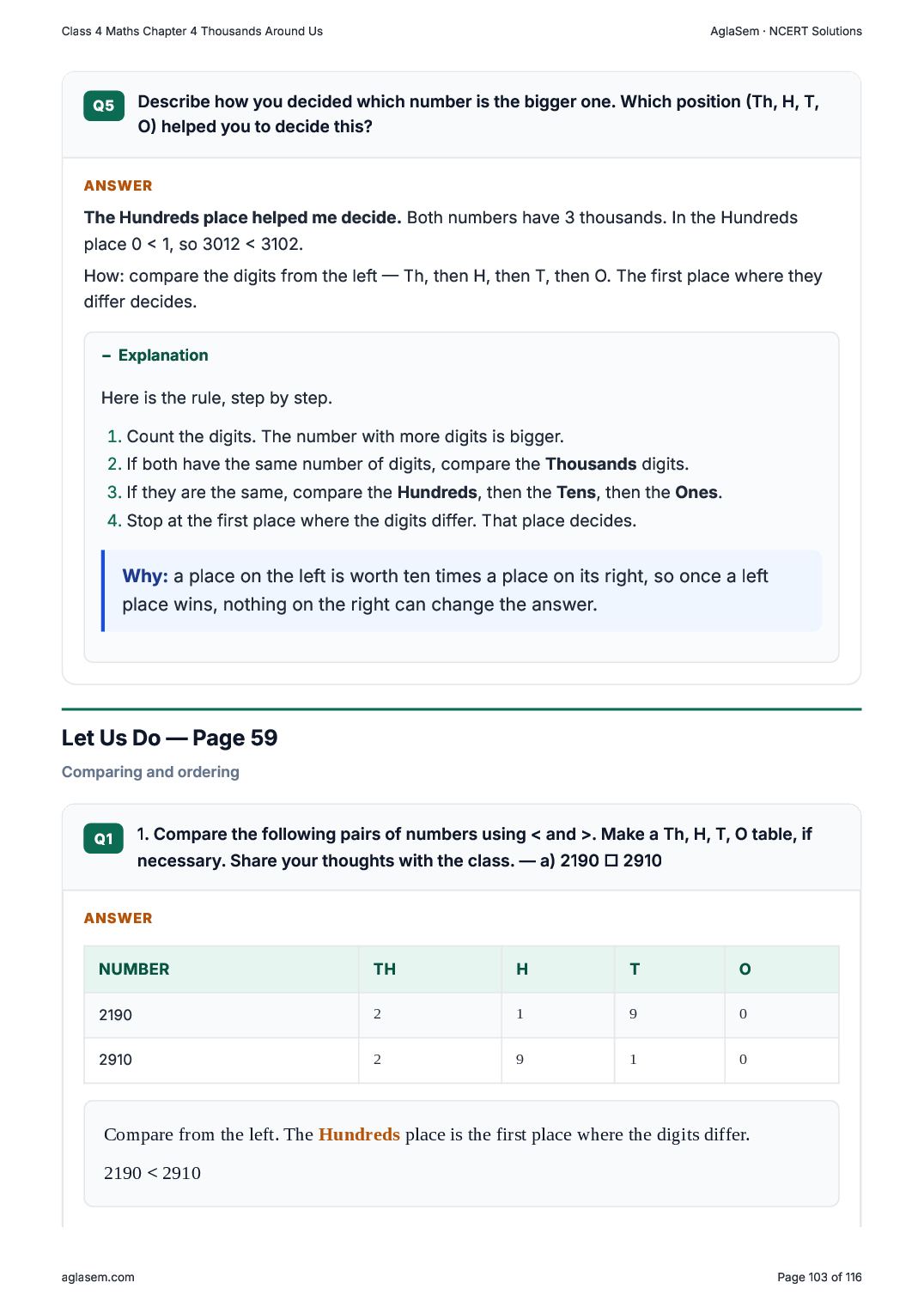
- Describe how you decided which number is the bigger one. Which position (Th, H, T, O) helped you to decide this?
- 1. Compare the following pairs of numbers using < and >. Make a Th, H, T, O table, if necessary. Share your thoughts with the class. — a) 2190 □ 2910
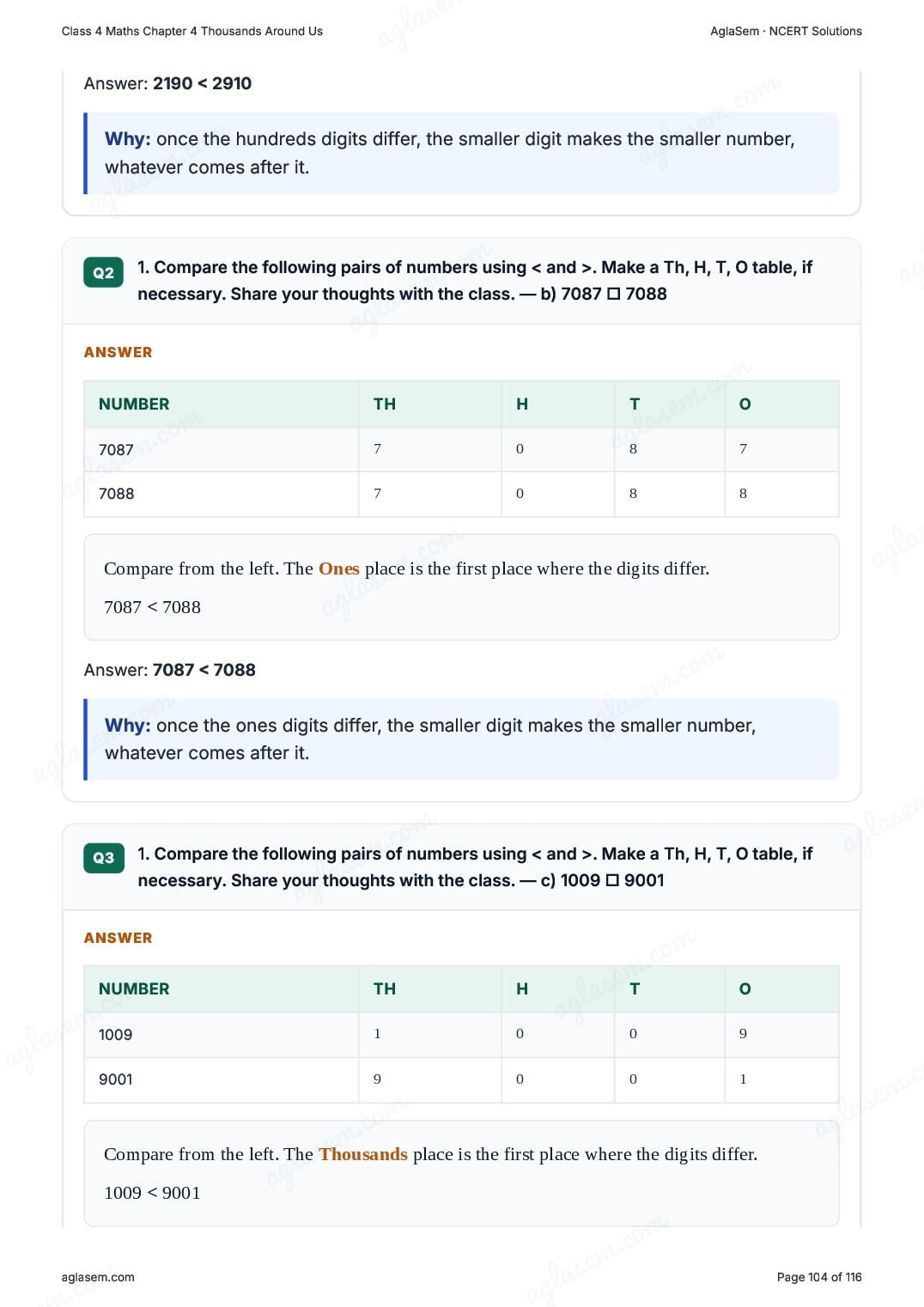
- 1. Compare the following pairs of numbers using < and >. Make a Th, H, T, O table, if necessary. Share your thoughts with the class. — b) 7087 □ 7088
- 1. Compare the following pairs of numbers using < and >. Make a Th, H, T, O table, if necessary. Share your thoughts with the class. — c) 1009 □ 9001
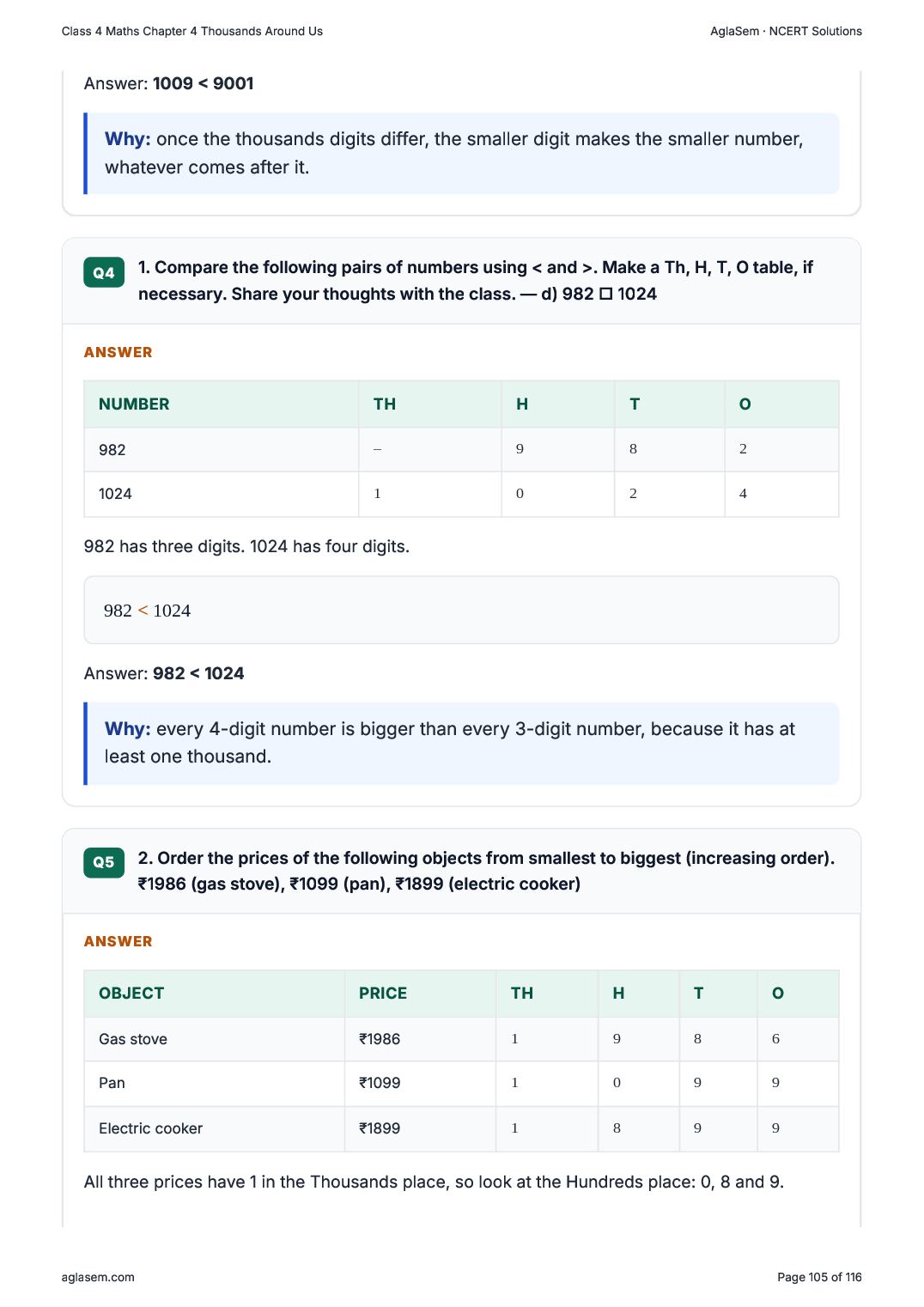
- 1. Compare the following pairs of numbers using < and >. Make a Th, H, T, O table, if necessary. Share your thoughts with the class. — d) 982 □ 1024
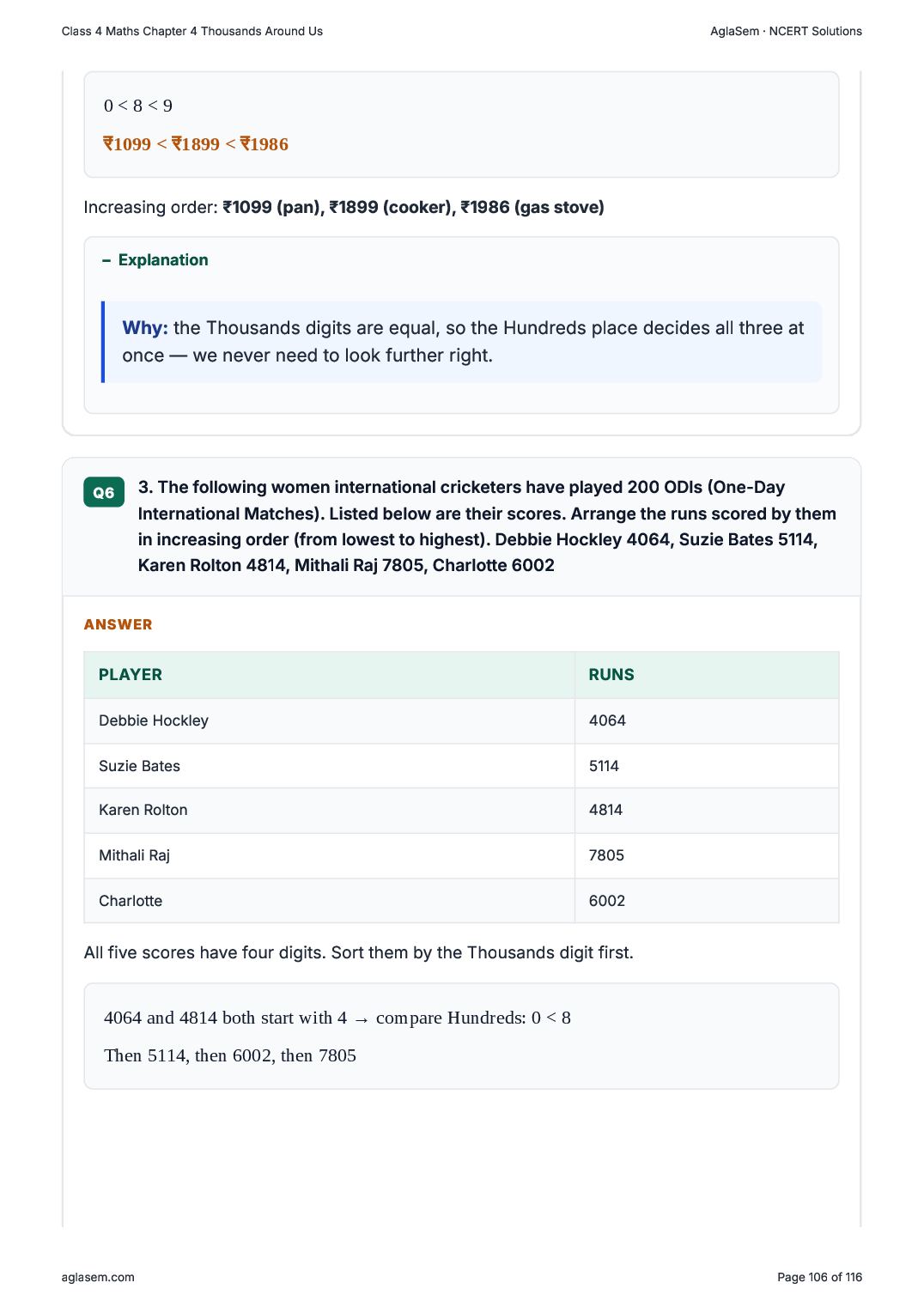
- 2. Order the prices of the following objects from smallest to biggest (increasing order). ₹1986 (gas stove), ₹1099 (pan), ₹1899 (electric cooker)
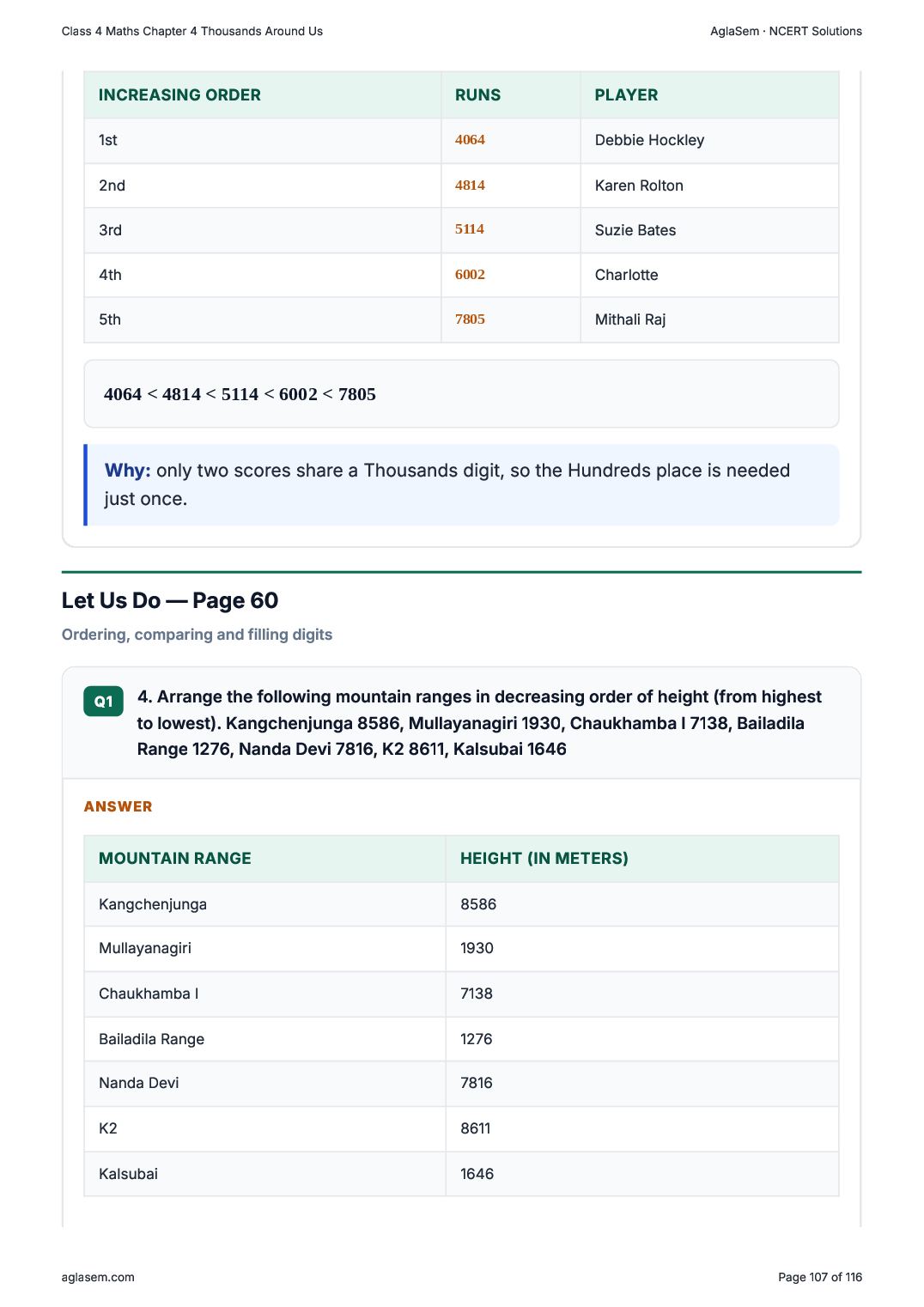
- 3. The following women international cricketers have played 200 ODIs (One-Day International Matches). Listed below are their scores. Arrange the runs scored by them in increasing order (from lowest to highest). Debbie Hockley 4064, Suzie Bates 5114, Karen Rolton 4814, Mithali Raj 7805, Charlotte 6002
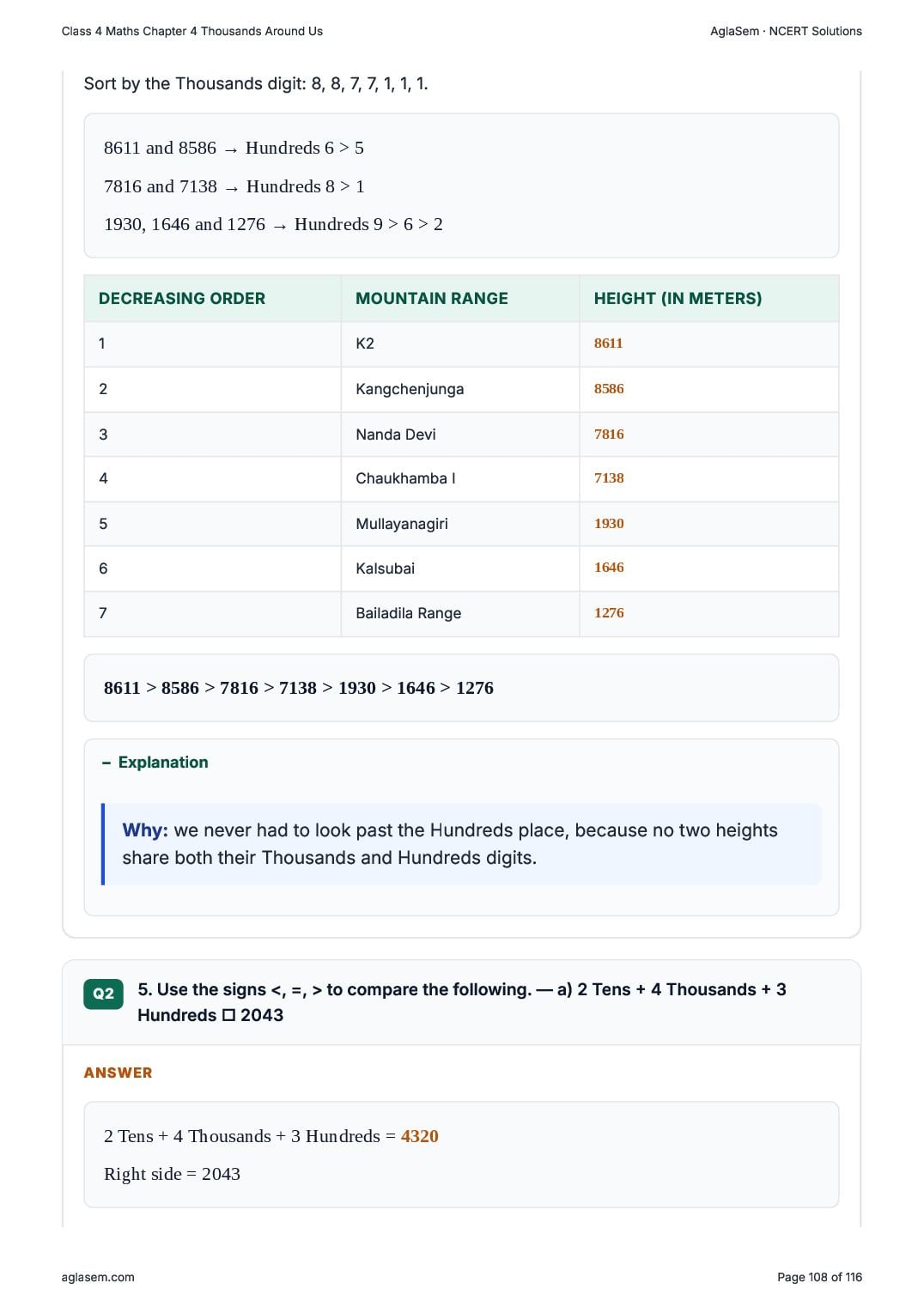
- 4. Arrange the following mountain ranges in decreasing order of height (from highest to lowest). Kangchenjunga 8586, Mullayanagiri 1930, Chaukhamba I 7138, Bailadila Range 1276, Nanda Devi 7816, K2 8611, Kalsubai 1646
- 5. Use the signs <, =, > to compare the following. — a) 2 Tens + 4 Thousands + 3 Hundreds □ 2043
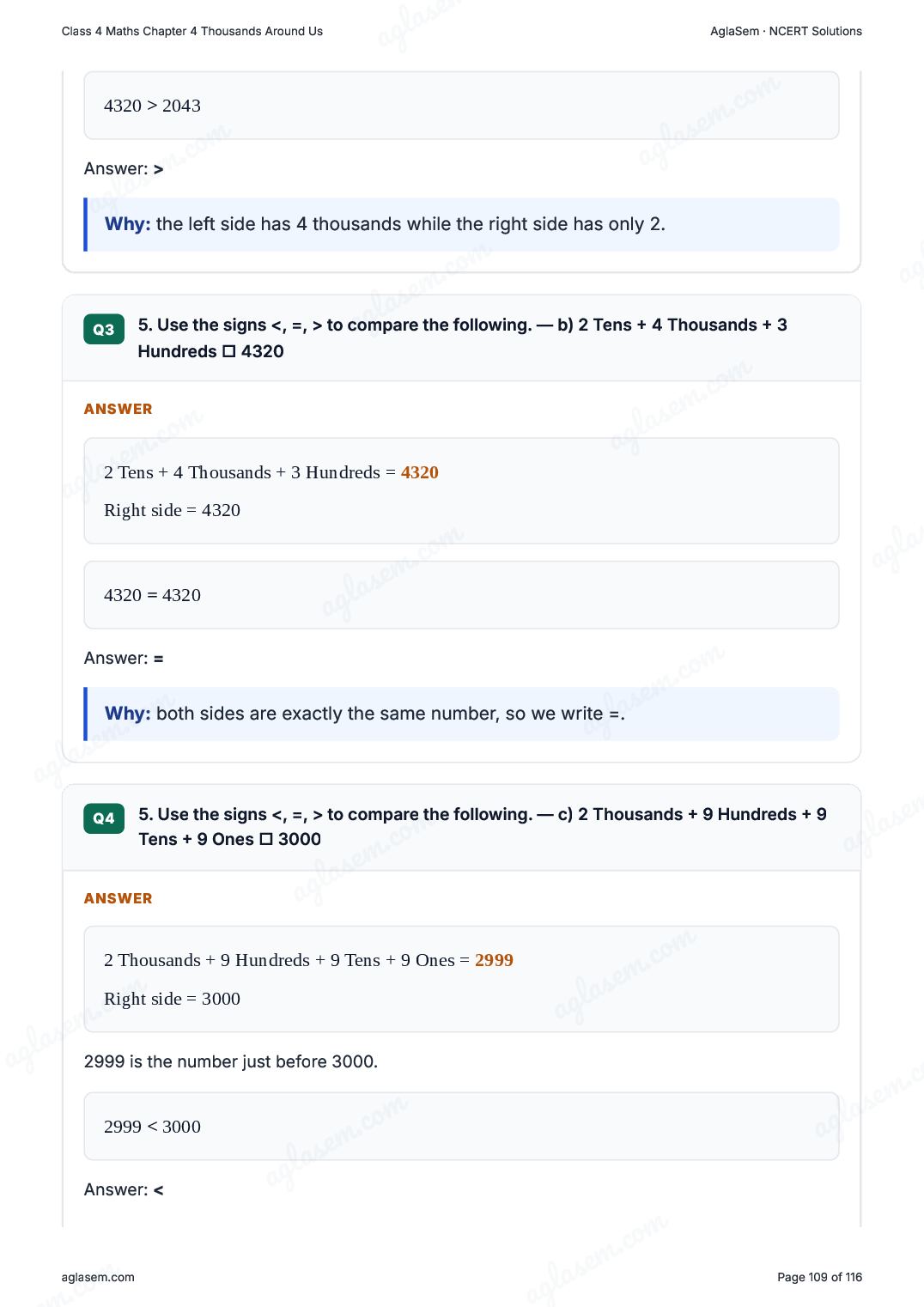
- 5. Use the signs <, =, > to compare the following. — b) 2 Tens + 4 Thousands + 3 Hundreds □ 4320
- 5. Use the signs <, =, > to compare the following. — c) 2 Thousands + 9 Hundreds + 9 Tens + 9 Ones □ 3000
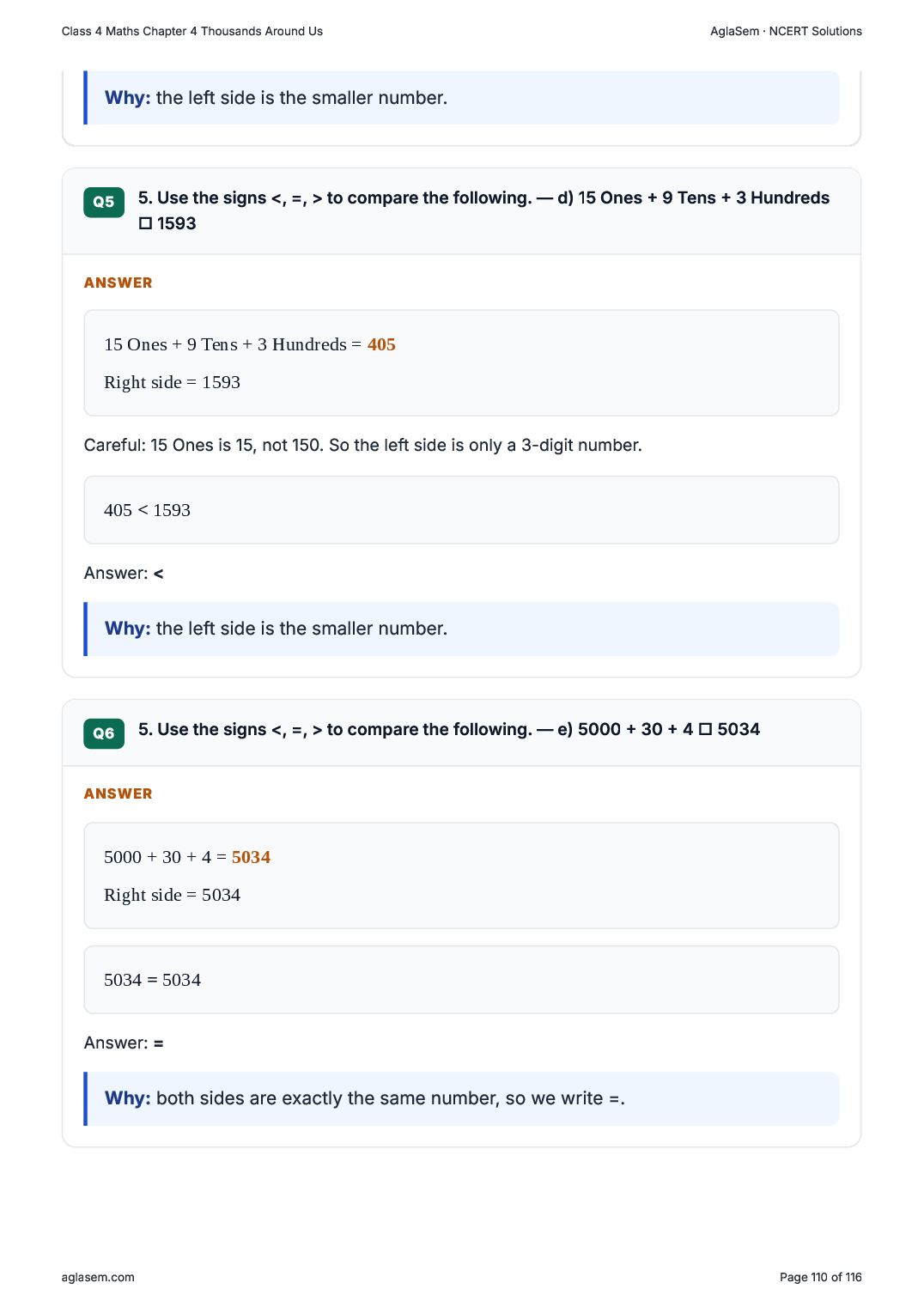
- 5. Use the signs <, =, > to compare the following. — d) 15 Ones + 9 Tens + 3 Hundreds □ 1593
- 5. Use the signs <, =, > to compare the following. — e) 5000 + 30 + 4 □ 5034
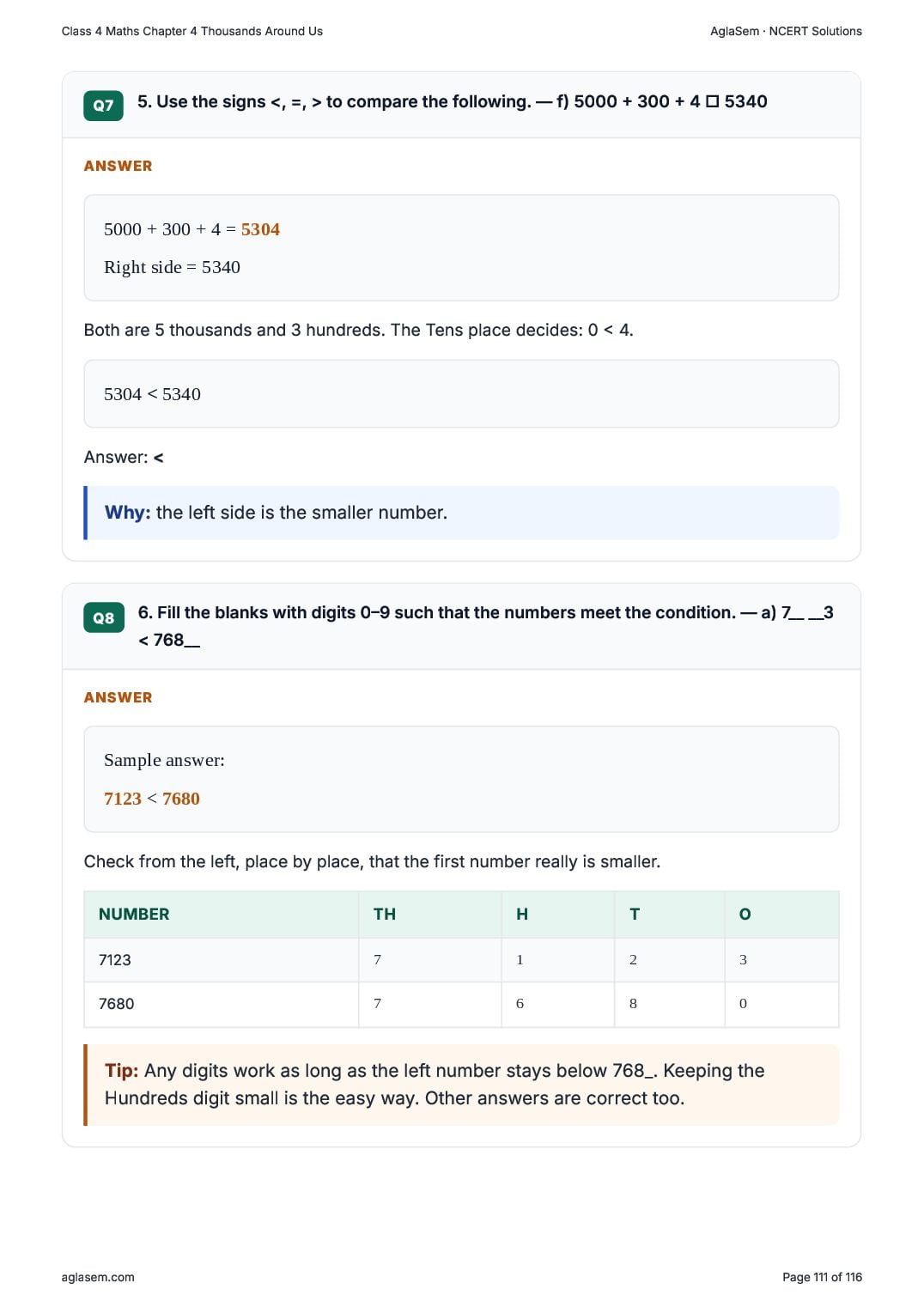
- 5. Use the signs <, =, > to compare the following. — f) 5000 + 300 + 4 □ 5340
- 6. Fill the blanks with digits 0–9 such that the numbers meet the condition. — a) 7__ __3 < 768__
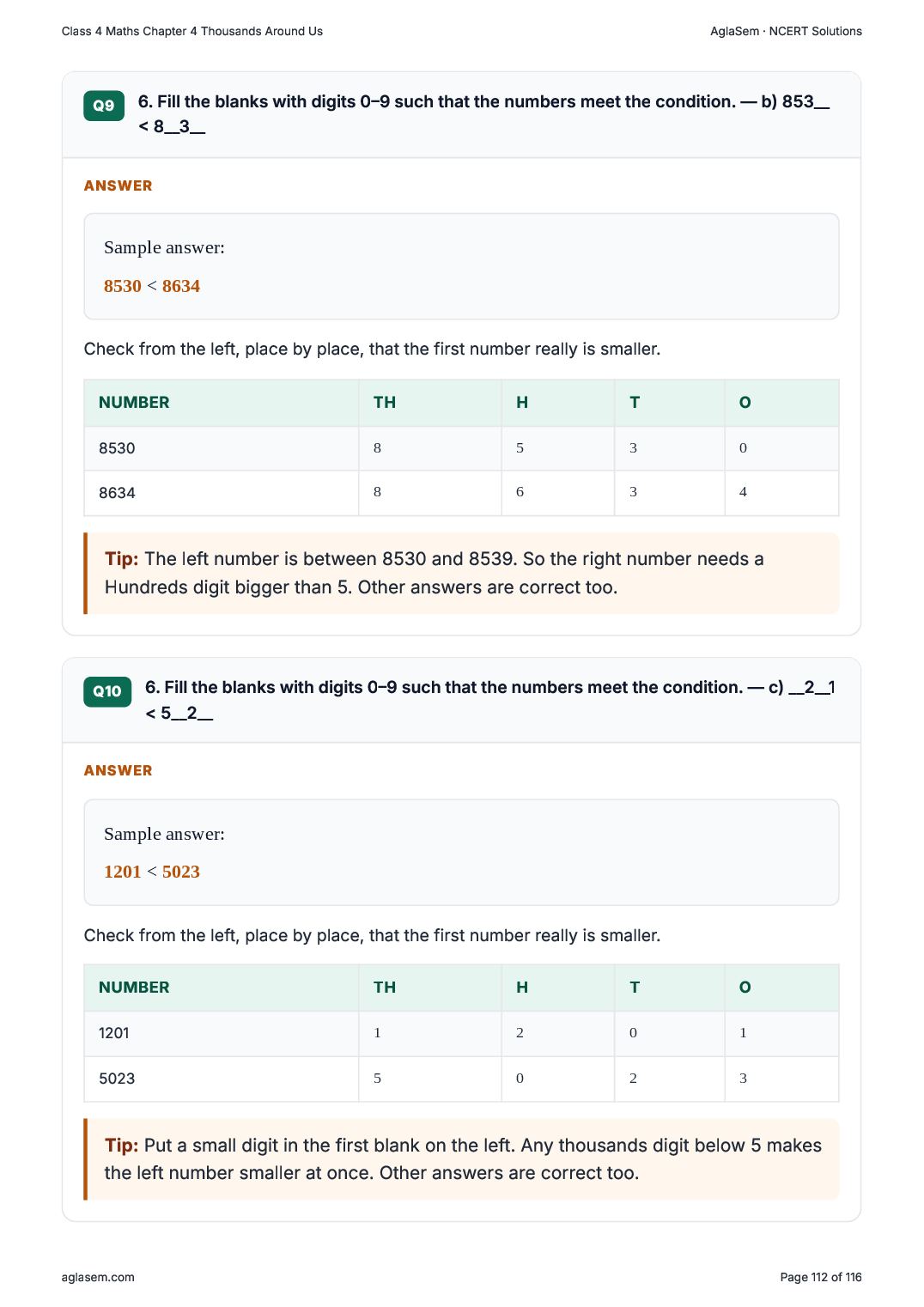
- 6. Fill the blanks with digits 0–9 such that the numbers meet the condition. — b) 853__ < 8__3__
- 6. Fill the blanks with digits 0–9 such that the numbers meet the condition. — c) __2__1 < 5__2__
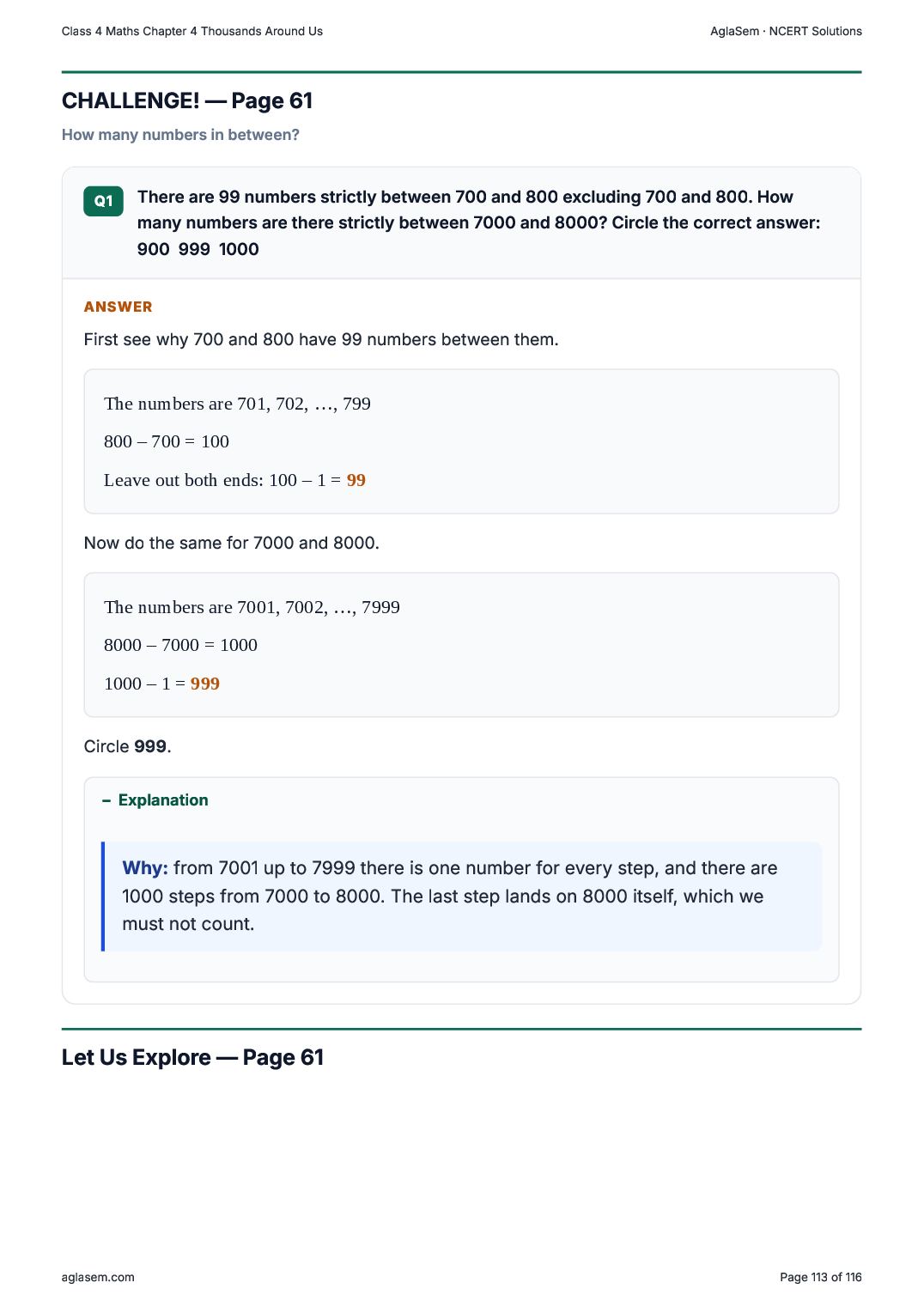
- There are 99 numbers strictly between 700 and 800 excluding 700 and 800. How many numbers are there strictly between 7000 and 8000? Circle the correct answer: 900 999 1000
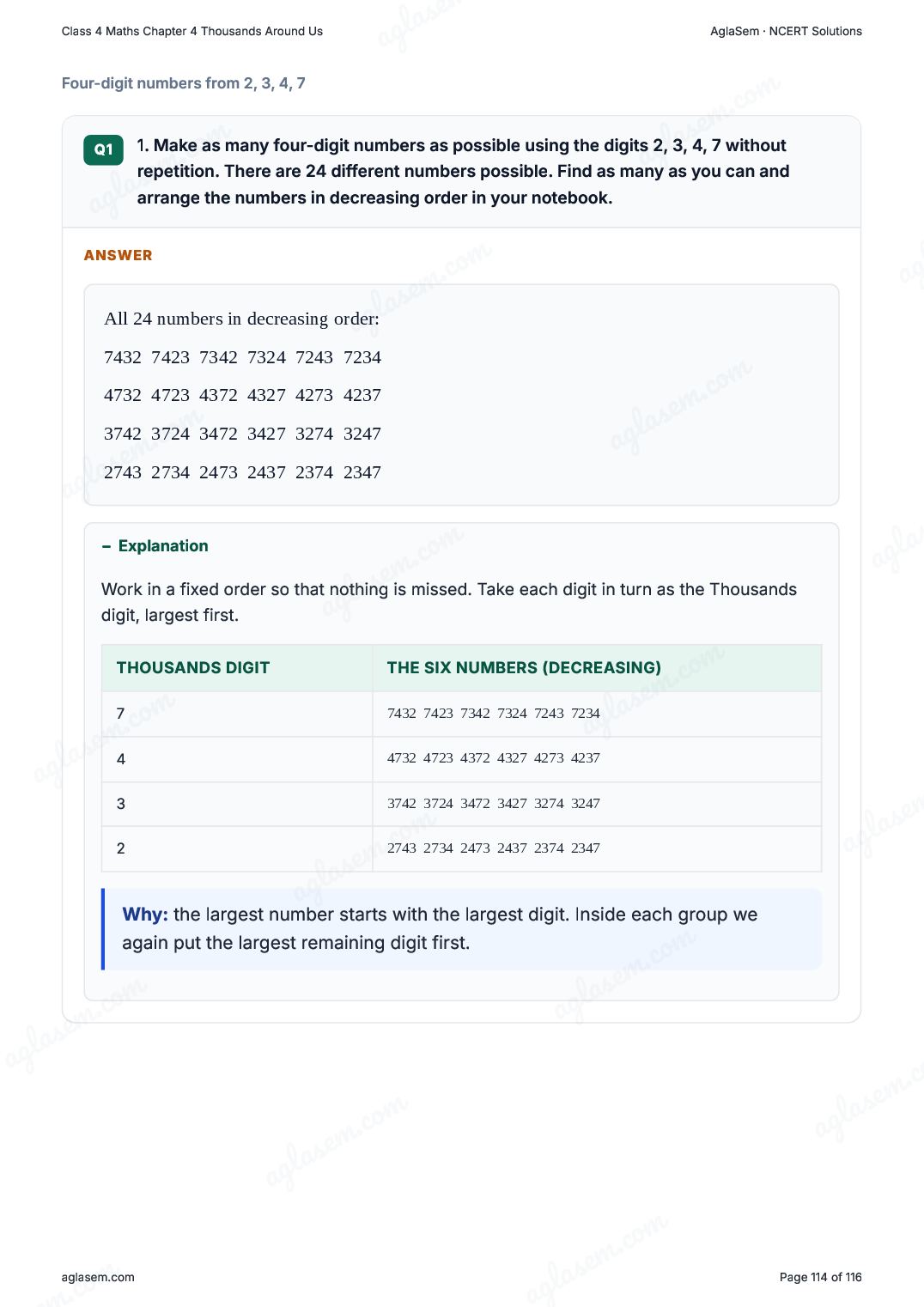
- 1. Make as many four-digit numbers as possible using the digits 2, 3, 4, 7 without repetition. There are 24 different numbers possible. Find as many as you can and arrange the numbers in decreasing order in your notebook.
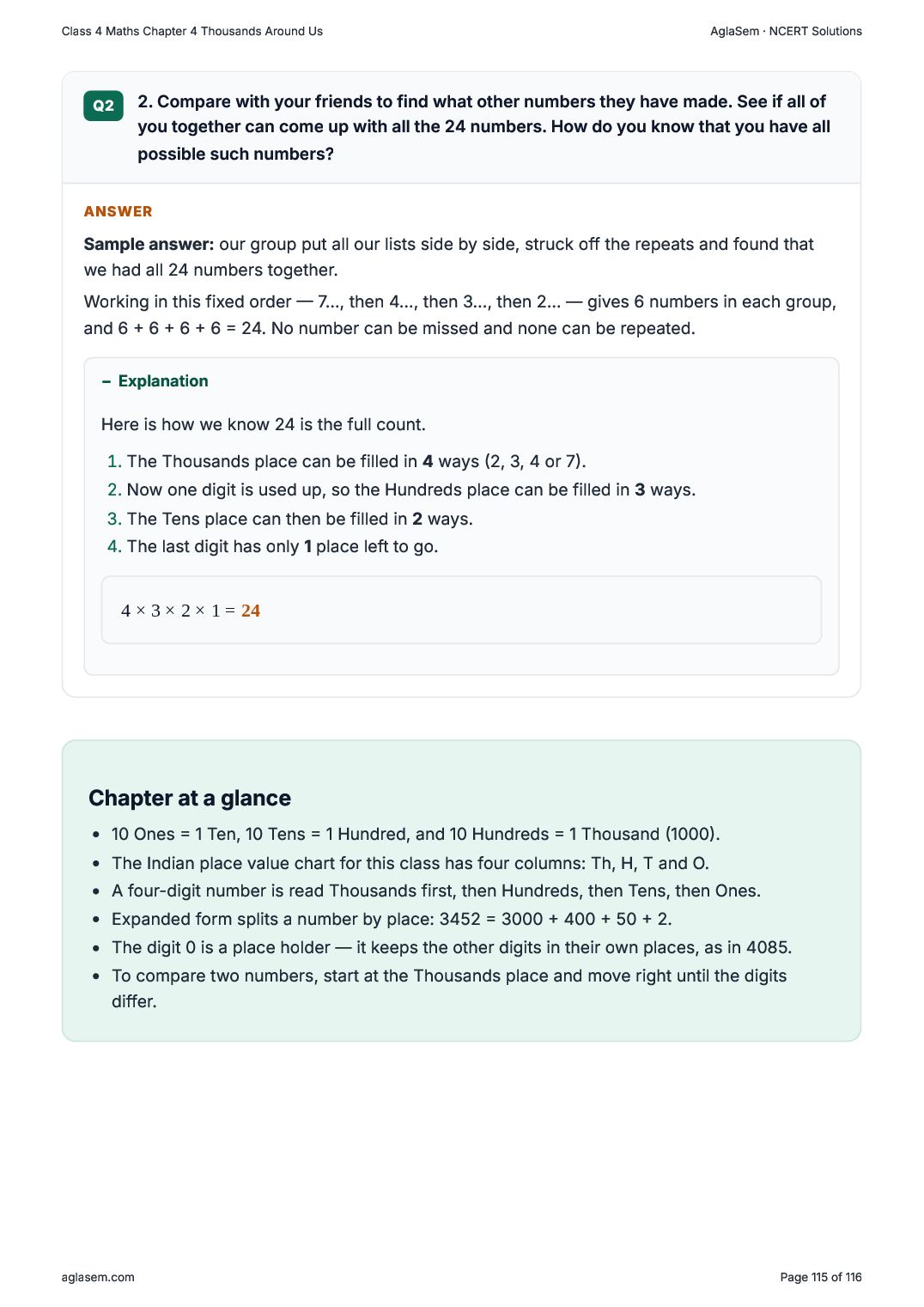
- 2. Compare with your friends to find what other numbers they have made. See if all of you together can come up with all the 24 numbers. How do you know that you have all possible such numbers?
Chapter at a Glance
- 10 Ones = 1 Ten, 10 Tens = 1 Hundred, and 10 Hundreds = 1 Thousand (1000).
- The Indian place value chart for this class has four columns: Th, H, T and O.
- A four-digit number is read Thousands first, then Hundreds, then Tens, then Ones.
- Expanded form splits a number by place: 3452 = 3000 + 400 + 50 + 2.
- The digit 0 is a place holder — it keeps the other digits in their own places, as in 4085.
- To compare two numbers, start at the Thousands place and move right until the digits differ.
How to Download NCERT Solutions for Class 4 Maths Chapter 4 PDF
Follow these simple steps to get the Thousands Around Us questions-and-answers PDF from Math Mela.
- Search NCERT Solutions for Class 4 Maths Chapter 4 aglasem and open this page.
- Read the exercise questions with answers for Thousands Around Us shown above.
- Click the Download PDF link to save the Thousands Around Us solutions to your device.
NCERT Solutions for Class 4 Maths – All Chapters
There are more chapters to study besides Thousands Around Us in Maths. Here are the NCERT Solutions for all chapters of Class 4 Maths.
- Chapter 1 Shapes Around Us
- Chapter 2 Hide and Seek
- Chapter 3 Patterns Around Us
- Chapter 4 Thousands Around Us
- Chapter 5 Sharing and Measuring
- Chapter 6 Measuring Length
- Chapter 7 the Cleanest Village
- Chapter 8 Weigh It Pour It
- Chapter 9 Equal Groups
- Chapter 10 Elephants Tigers and Leopards
- Chapter 11 Fun with Symmetry
- Chapter 12 Ticking Clocks and Turning Calendar
- Chapter 13 the Transport Museum
- Chapter 14 Data Handling
NCERT Solutions for Class 4 – All Subjects
Just like Chapter 4 of Maths, you can get the exercise questions with answers for every other subject of Class 4. Here are the NCERT Solutions for all subjects of Class 4.
NCERT Solutions for Class 4 Maths Chapter 4 – An Overview
The key highlights of this study material are as follows.
| Aspects | Details |
|---|---|
| Class | Class 4 |
| Subject | Maths |
| Chapter Number | Chapter 4 |
| Chapter Name | Thousands Around Us |
| Book Name | Math Mela |
| Book By | NCERT (National Council of Educational Research and Training) |
| Educational Resource Here | NCERT Solutions of Class 4 Maths Chapter 4 for all exercises |
| More Questions Answers of This Subject | NCERT Solutions for Class 4 Maths |
| Download Book Chapter | NCERT Book Class 4 Maths |
| All Questions Answers For This Class | NCERT Solutions for Class 4 |
| Complete Solutions | NCERT Solutions |
NCERT Solutions for Class 4 Maths Chapter 4 Thousands Around Us – FAQs
What are the NCERT Solutions for Class 4 Maths Chapter 4 Thousands Around Us?
They are the complete, step-by-step answers to all the exercise and in-text questions of Chapter 4 Thousands Around Us from the NCERT Class 4 Maths textbook Math Mela, written by experts as per the latest NCERT syllabus.
How can I download the Class 4 Maths Chapter 4 solutions PDF for free?
Open this page on aglasem, read the Thousands Around Us questions with answers, and click the “Download Solutions PDF” link. The Class 4 Maths Chapter 4 NCERT Solutions PDF is completely free to download.
Are these NCERT Solutions as per the latest 2026-27 syllabus?
Yes. The NCERT Solutions for Class 4 Maths Chapter 4 are based on the latest NCERT textbook Math Mela and the current 2026-27 CBSE syllabus, so the questions and answers match what you study in class.
Where can I get NCERT Solutions for the other chapters of Class 4 Maths?
You can find the answers to every chapter on the NCERT Solutions for Class 4 Maths page, and solutions for every subject on the NCERT Solutions for Class 4 page.
How do NCERT Solutions help in exam preparation?
They show the correct method to solve each question, help you write answers the way they are expected in exams, let you check and correct your own work, and save revision time — which together improve your marks in Class 4 Maths.
If you have any queries on NCERT Solutions for Class 4 Maths Chapter 4 Thousands Around Us, then please ask in the comments below.