NCERT Solutions for Class 4 Maths Chapter 10 Elephants Tigers and Leopards – step-by-step answers to every exercise and in-text question of the chapter, as per the latest NCERT syllabus for 2027. Read them online or download the free question-answer PDF.
This chapter counts India’s wild animals. We play the NIM game, read an addition chart, and then add and subtract four-digit numbers using the real numbers of elephants, tigers and leopards in our states.
NCERT Solutions for Class 4 Maths Chapter 10 Elephants Tigers and Leopards PDF
All the answers are on this page below. The PDF also explains every answer – why it is right and how to check it – so download it for revision.
| Chapter | Download | |
|---|---|---|
| Solutions PDF (English medium) | Elephants Tigers and Leopards | View PDF |
| Solutions PDF (Hindi medium) | हाथी, बाघ और तेंदुए | View PDF |
NCERT Solutions for Class 4 Maths Chapter 10 Elephants Tigers and Leopards – Questions and Answers
All 60 questions of the chapter (textbook pages 149 – 163) are answered below, in the order of the book – in-text questions, activities and the end-of-chapter exercises. Each answer is written the way you would write it in the exam.
NIM Game (2 Player Game) — Page 149How to play and who wins
Yes, you can win. Add 1 to make the total 7.
From 8, you add 2 → 10. From 9, you add 1 → 10.
You reach 10 first, so you win.
No — not if the other player plays well.
You make 8 → the other player adds 2 → 10
You make 9 → the other player adds 1 → 10
The other player reaches 10 first and wins.
Yes, you win in one move.
Add 2 and you reach 10 first.
Yes. Count back from the target in 3s. These are the safe numbers:
| Target | Safe numbers to say |
|---|---|
| 10 | 1, 4, 7 |
| 11 | 2, 5, 8 |
| 12 | 3, 6, 9 |
If you say a safe number (like 7 when the target is 10), you are sure to win.
Addition Chart — Page 150Reading patterns in the addition table
| + | 0 | 1 | 2 | 3 | 4 | 5 | 6 | 7 | 8 | 9 | 10 | 11 | 12 |
|---|---|---|---|---|---|---|---|---|---|---|---|---|---|
| 0 | 0 | 1 | 2 | 3 | 4 | 5 | 6 | 7 | 8 | 9 | 10 | 11 | 12 |
| 1 | 1 | 2 | 3 | 4 | 5 | 6 | 7 | 8 | 9 | 10 | 11 | 12 | 13 |
| 2 | 2 | 3 | 4 | 5 | 6 | 7 | 8 | 9 | 10 | 11 | 12 | 13 | 14 |
| 3 | 3 | 4 | 5 | 6 | 7 | 8 | 9 | 10 | 11 | 12 | 13 | 14 | 15 |
| 4 | 4 | 5 | 6 | 7 | 8 | 9 | 10 | 11 | 12 | 13 | 14 | 15 | 16 |
| 5 | 5 | 6 | 7 | 8 | 9 | 10 | 11 | 12 | 13 | 14 | 15 | 16 | 17 |
| 6 | 6 | 7 | 8 | 9 | 10 | 11 | 12 | 13 | 14 | 15 | 16 | 17 | 18 |
| 7 | 7 | 8 | 9 | 10 | 11 | 12 | 13 | 14 | 15 | 16 | 17 | 18 | 19 |
| 8 | 8 | 9 | 10 | 11 | 12 | 13 | 14 | 15 | 16 | 17 | 18 | 19 | 20 |
| 9 | 9 | 10 | 11 | 12 | 13 | 14 | 15 | 16 | 17 | 18 | 19 | 20 | 21 |
| 10 | 10 | 11 | 12 | 13 | 14 | 15 | 16 | 17 | 18 | 19 | 20 | 21 | 22 |
| 11 | 11 | 12 | 13 | 14 | 15 | 16 | 17 | 18 | 19 | 20 | 21 | 22 | 23 |
| 12 | 12 | 13 | 14 | 15 | 16 | 17 | 18 | 19 | 20 | 21 | 22 | 23 | 24 |
Each box = row number + column number.
= 6 + 5 = 11
The number on the left of a row and the number on top of a column are added. The + sign in the corner tells us this.
| + | 0 | 1 | 2 | 3 | 4 | 5 | 6 | 7 | 8 | 9 | 10 | 11 | 12 |
|---|---|---|---|---|---|---|---|---|---|---|---|---|---|
| 0 | 0 | 1 | 2 | 3 | 4 | 5 | 6 | 7 | 8 | 9 | 10 | 11 | 12 |
| 1 | 1 | 2 | 3 | 4 | 5 | 6 | 7 | 8 | 9 | 10 | 11 | 12 | 13 |
| 2 | 2 | 3 | 4 | 5 | 6 | 7 | 8 | 9 | 10 | 11 | 12 | 13 | 14 |
| 3 | 3 | 4 | 5 | 6 | 7 | 8 | 9 | 10 | 11 | 12 | 13 | 14 | 15 |
| 4 | 4 | 5 | 6 | 7 | 8 | 9 | 10 | 11 | 12 | 13 | 14 | 15 | 16 |
| 5 | 5 | 6 | 7 | 8 | 9 | 10 | 11 | 12 | 13 | 14 | 15 | 16 | 17 |
| 6 | 6 | 7 | 8 | 9 | 10 | 11 | 12 | 13 | 14 | 15 | 16 | 17 | 18 |
| 7 | 7 | 8 | 9 | 10 | 11 | 12 | 13 | 14 | 15 | 16 | 17 | 18 | 19 |
| 8 | 8 | 9 | 10 | 11 | 12 | 13 | 14 | 15 | 16 | 17 | 18 | 19 | 20 |
| 9 | 9 | 10 | 11 | 12 | 13 | 14 | 15 | 16 | 17 | 18 | 19 | 20 | 21 |
| 10 | 10 | 11 | 12 | 13 | 14 | 15 | 16 | 17 | 18 | 19 | 20 | 21 | 22 |
| 11 | 11 | 12 | 13 | 14 | 15 | 16 | 17 | 18 | 19 | 20 | 21 | 22 | 23 |
| 12 | 12 | 13 | 14 | 15 | 16 | 17 | 18 | 19 | 20 | 21 | 22 | 23 | 24 |
Some patterns:
- Going right, the numbers go up by 1.
- Going down, the numbers go up by 1.
- Along each slanting line (↙) the number stays the same.
- The chart is the same on both sides of the diagonal from 0 to 24 (6 + 5 = 5 + 6).
| + | 0 | 1 | 2 | 3 | 4 | 5 | 6 | 7 | 8 | 9 | 10 | 11 | 12 |
|---|---|---|---|---|---|---|---|---|---|---|---|---|---|
| 0 | 0 | 1 | 2 | 3 | 4 | 5 | 6 | 7 | 8 | 9 | 10 | 11 | 12 |
| 1 | 1 | 2 | 3 | 4 | 5 | 6 | 7 | 8 | 9 | 10 | 11 | 12 | 13 |
| 2 | 2 | 3 | 4 | 5 | 6 | 7 | 8 | 9 | 10 | 11 | 12 | 13 | 14 |
| 3 | 3 | 4 | 5 | 6 | 7 | 8 | 9 | 10 | 11 | 12 | 13 | 14 | 15 |
| 4 | 4 | 5 | 6 | 7 | 8 | 9 | 10 | 11 | 12 | 13 | 14 | 15 | 16 |
| 5 | 5 | 6 | 7 | 8 | 9 | 10 | 11 | 12 | 13 | 14 | 15 | 16 | 17 |
| 6 | 6 | 7 | 8 | 9 | 10 | 11 | 12 | 13 | 14 | 15 | 16 | 17 | 18 |
| 7 | 7 | 8 | 9 | 10 | 11 | 12 | 13 | 14 | 15 | 16 | 17 | 18 | 19 |
| 8 | 8 | 9 | 10 | 11 | 12 | 13 | 14 | 15 | 16 | 17 | 18 | 19 | 20 |
| 9 | 9 | 10 | 11 | 12 | 13 | 14 | 15 | 16 | 17 | 18 | 19 | 20 | 21 |
| 10 | 10 | 11 | 12 | 13 | 14 | 15 | 16 | 17 | 18 | 19 | 20 | 21 | 22 |
| 11 | 11 | 12 | 13 | 14 | 15 | 16 | 17 | 18 | 19 | 20 | 21 | 22 | 23 |
| 12 | 12 | 13 | 14 | 15 | 16 | 17 | 18 | 19 | 20 | 21 | 22 | 23 | 24 |
9 appears 10 times.
Other numbers:
| Number | How many times |
|---|---|
| 0 | 1 |
| 5 | 6 |
| 9 | 10 |
| 12 | 13 (the most) |
| 18 | 7 |
| 24 | 1 |
| + | 0 | 1 | 2 | 3 | 4 | 5 | 6 | 7 | 8 | 9 | 10 | 11 | 12 |
|---|---|---|---|---|---|---|---|---|---|---|---|---|---|
| 0 | 0 | 1 | 2 | 3 | 4 | 5 | 6 | 7 | 8 | 9 | 10 | 11 | 12 |
| 1 | 1 | 2 | 3 | 4 | 5 | 6 | 7 | 8 | 9 | 10 | 11 | 12 | 13 |
| 2 | 2 | 3 | 4 | 5 | 6 | 7 | 8 | 9 | 10 | 11 | 12 | 13 | 14 |
| 3 | 3 | 4 | 5 | 6 | 7 | 8 | 9 | 10 | 11 | 12 | 13 | 14 | 15 |
| 4 | 4 | 5 | 6 | 7 | 8 | 9 | 10 | 11 | 12 | 13 | 14 | 15 | 16 |
| 5 | 5 | 6 | 7 | 8 | 9 | 10 | 11 | 12 | 13 | 14 | 15 | 16 | 17 |
| 6 | 6 | 7 | 8 | 9 | 10 | 11 | 12 | 13 | 14 | 15 | 16 | 17 | 18 |
| 7 | 7 | 8 | 9 | 10 | 11 | 12 | 13 | 14 | 15 | 16 | 17 | 18 | 19 |
| 8 | 8 | 9 | 10 | 11 | 12 | 13 | 14 | 15 | 16 | 17 | 18 | 19 | 20 |
| 9 | 9 | 10 | 11 | 12 | 13 | 14 | 15 | 16 | 17 | 18 | 19 | 20 | 21 |
| 10 | 10 | 11 | 12 | 13 | 14 | 15 | 16 | 17 | 18 | 19 | 20 | 21 | 22 |
| 11 | 11 | 12 | 13 | 14 | 15 | 16 | 17 | 18 | 19 | 20 | 21 | 22 | 23 |
| 12 | 12 | 13 | 14 | 15 | 16 | 17 | 18 | 19 | 20 | 21 | 22 | 23 | 24 |
No. No row or column has only even or only odd numbers.
odd, even, odd, even, … one after the other
Every row and every column goes up by 1, so odd and even numbers take turns.
| + | 0 | 1 | 2 | 3 | 4 | 5 | 6 | 7 | 8 | 9 | 10 | 11 | 12 |
|---|---|---|---|---|---|---|---|---|---|---|---|---|---|
| 0 | 0 | 1 | 2 | 3 | 4 | 5 | 6 | 7 | 8 | 9 | 10 | 11 | 12 |
| 1 | 1 | 2 | 3 | 4 | 5 | 6 | 7 | 8 | 9 | 10 | 11 | 12 | 13 |
| 2 | 2 | 3 | 4 | 5 | 6 | 7 | 8 | 9 | 10 | 11 | 12 | 13 | 14 |
| 3 | 3 | 4 | 5 | 6 | 7 | 8 | 9 | 10 | 11 | 12 | 13 | 14 | 15 |
| 4 | 4 | 5 | 6 | 7 | 8 | 9 | 10 | 11 | 12 | 13 | 14 | 15 | 16 |
| 5 | 5 | 6 | 7 | 8 | 9 | 10 | 11 | 12 | 13 | 14 | 15 | 16 | 17 |
| 6 | 6 | 7 | 8 | 9 | 10 | 11 | 12 | 13 | 14 | 15 | 16 | 17 | 18 |
| 7 | 7 | 8 | 9 | 10 | 11 | 12 | 13 | 14 | 15 | 16 | 17 | 18 | 19 |
| 8 | 8 | 9 | 10 | 11 | 12 | 13 | 14 | 15 | 16 | 17 | 18 | 19 | 20 |
| 9 | 9 | 10 | 11 | 12 | 13 | 14 | 15 | 16 | 17 | 18 | 19 | 20 | 21 |
| 10 | 10 | 11 | 12 | 13 | 14 | 15 | 16 | 17 | 18 | 19 | 20 | 21 | 22 |
| 11 | 11 | 12 | 13 | 14 | 15 | 16 | 17 | 18 | 19 | 20 | 21 | 22 | 23 |
| 12 | 12 | 13 | 14 | 15 | 16 | 17 | 18 | 19 | 20 | 21 | 22 | 23 | 24 |
The red window holds four numbers.
11 12
Bottom row: 11 + 12 = 23
| + | 0 | 1 | 2 | 3 | 4 | 5 | 6 | 7 | 8 | 9 | 10 | 11 | 12 |
|---|---|---|---|---|---|---|---|---|---|---|---|---|---|
| 0 | 0 | 1 | 2 | 3 | 4 | 5 | 6 | 7 | 8 | 9 | 10 | 11 | 12 |
| 1 | 1 | 2 | 3 | 4 | 5 | 6 | 7 | 8 | 9 | 10 | 11 | 12 | 13 |
| 2 | 2 | 3 | 4 | 5 | 6 | 7 | 8 | 9 | 10 | 11 | 12 | 13 | 14 |
| 3 | 3 | 4 | 5 | 6 | 7 | 8 | 9 | 10 | 11 | 12 | 13 | 14 | 15 |
| 4 | 4 | 5 | 6 | 7 | 8 | 9 | 10 | 11 | 12 | 13 | 14 | 15 | 16 |
| 5 | 5 | 6 | 7 | 8 | 9 | 10 | 11 | 12 | 13 | 14 | 15 | 16 | 17 |
| 6 | 6 | 7 | 8 | 9 | 10 | 11 | 12 | 13 | 14 | 15 | 16 | 17 | 18 |
| 7 | 7 | 8 | 9 | 10 | 11 | 12 | 13 | 14 | 15 | 16 | 17 | 18 | 19 |
| 8 | 8 | 9 | 10 | 11 | 12 | 13 | 14 | 15 | 16 | 17 | 18 | 19 | 20 |
| 9 | 9 | 10 | 11 | 12 | 13 | 14 | 15 | 16 | 17 | 18 | 19 | 20 | 21 |
| 10 | 10 | 11 | 12 | 13 | 14 | 15 | 16 | 17 | 18 | 19 | 20 | 21 | 22 |
| 11 | 11 | 12 | 13 | 14 | 15 | 16 | 17 | 18 | 19 | 20 | 21 | 22 | 23 |
| 12 | 12 | 13 | 14 | 15 | 16 | 17 | 18 | 19 | 20 | 21 | 22 | 23 | 24 |
Right column: 11 + 12 = 23
They are the same two sums as the rows — 21 and 23.
| + | 0 | 1 | 2 | 3 | 4 | 5 | 6 | 7 | 8 | 9 | 10 | 11 | 12 |
|---|---|---|---|---|---|---|---|---|---|---|---|---|---|
| 0 | 0 | 1 | 2 | 3 | 4 | 5 | 6 | 7 | 8 | 9 | 10 | 11 | 12 |
| 1 | 1 | 2 | 3 | 4 | 5 | 6 | 7 | 8 | 9 | 10 | 11 | 12 | 13 |
| 2 | 2 | 3 | 4 | 5 | 6 | 7 | 8 | 9 | 10 | 11 | 12 | 13 | 14 |
| 3 | 3 | 4 | 5 | 6 | 7 | 8 | 9 | 10 | 11 | 12 | 13 | 14 | 15 |
| 4 | 4 | 5 | 6 | 7 | 8 | 9 | 10 | 11 | 12 | 13 | 14 | 15 | 16 |
| 5 | 5 | 6 | 7 | 8 | 9 | 10 | 11 | 12 | 13 | 14 | 15 | 16 | 17 |
| 6 | 6 | 7 | 8 | 9 | 10 | 11 | 12 | 13 | 14 | 15 | 16 | 17 | 18 |
| 7 | 7 | 8 | 9 | 10 | 11 | 12 | 13 | 14 | 15 | 16 | 17 | 18 | 19 |
| 8 | 8 | 9 | 10 | 11 | 12 | 13 | 14 | 15 | 16 | 17 | 18 | 19 | 20 |
| 9 | 9 | 10 | 11 | 12 | 13 | 14 | 15 | 16 | 17 | 18 | 19 | 20 | 21 |
| 10 | 10 | 11 | 12 | 13 | 14 | 15 | 16 | 17 | 18 | 19 | 20 | 21 | 22 |
| 11 | 11 | 12 | 13 | 14 | 15 | 16 | 17 | 18 | 19 | 20 | 21 | 22 | 23 |
| 12 | 12 | 13 | 14 | 15 | 16 | 17 | 18 | 19 | 20 | 21 | 22 | 23 | 24 |
Other slant: 11 + 11 = 22
Both slants give the same sum, 22.
| + | 0 | 1 | 2 | 3 | 4 | 5 | 6 | 7 | 8 | 9 | 10 | 11 | 12 |
|---|---|---|---|---|---|---|---|---|---|---|---|---|---|
| 0 | 0 | 1 | 2 | 3 | 4 | 5 | 6 | 7 | 8 | 9 | 10 | 11 | 12 |
| 1 | 1 | 2 | 3 | 4 | 5 | 6 | 7 | 8 | 9 | 10 | 11 | 12 | 13 |
| 2 | 2 | 3 | 4 | 5 | 6 | 7 | 8 | 9 | 10 | 11 | 12 | 13 | 14 |
| 3 | 3 | 4 | 5 | 6 | 7 | 8 | 9 | 10 | 11 | 12 | 13 | 14 | 15 |
| 4 | 4 | 5 | 6 | 7 | 8 | 9 | 10 | 11 | 12 | 13 | 14 | 15 | 16 |
| 5 | 5 | 6 | 7 | 8 | 9 | 10 | 11 | 12 | 13 | 14 | 15 | 16 | 17 |
| 6 | 6 | 7 | 8 | 9 | 10 | 11 | 12 | 13 | 14 | 15 | 16 | 17 | 18 |
| 7 | 7 | 8 | 9 | 10 | 11 | 12 | 13 | 14 | 15 | 16 | 17 | 18 | 19 |
| 8 | 8 | 9 | 10 | 11 | 12 | 13 | 14 | 15 | 16 | 17 | 18 | 19 | 20 |
| 9 | 9 | 10 | 11 | 12 | 13 | 14 | 15 | 16 | 17 | 18 | 19 | 20 | 21 |
| 10 | 10 | 11 | 12 | 13 | 14 | 15 | 16 | 17 | 18 | 19 | 20 | 21 | 22 |
| 11 | 11 | 12 | 13 | 14 | 15 | 16 | 17 | 18 | 19 | 20 | 21 | 22 | 23 |
| 12 | 12 | 13 | 14 | 15 | 16 | 17 | 18 | 19 | 20 | 21 | 22 | 23 | 24 |
Put the window on rows 3–4 and columns 8–9:
12 13
Rows: 11 + 12 = 23, 12 + 13 = 25
Columns: 11 + 12 = 23, 12 + 13 = 25
Diagonals: 11 + 13 = 24, 12 + 12 = 24
I notice: wherever the window is placed, the row sums are the same as the column sums, and the two diagonals always have equal sums.
| + | 0 | 1 | 2 | 3 | 4 | 5 | 6 | 7 | 8 | 9 | 10 | 11 | 12 |
|---|---|---|---|---|---|---|---|---|---|---|---|---|---|
| 0 | 0 | 1 | 2 | 3 | 4 | 5 | 6 | 7 | 8 | 9 | 10 | 11 | 12 |
| 1 | 1 | 2 | 3 | 4 | 5 | 6 | 7 | 8 | 9 | 10 | 11 | 12 | 13 |
| 2 | 2 | 3 | 4 | 5 | 6 | 7 | 8 | 9 | 10 | 11 | 12 | 13 | 14 |
| 3 | 3 | 4 | 5 | 6 | 7 | 8 | 9 | 10 | 11 | 12 | 13 | 14 | 15 |
| 4 | 4 | 5 | 6 | 7 | 8 | 9 | 10 | 11 | 12 | 13 | 14 | 15 | 16 |
| 5 | 5 | 6 | 7 | 8 | 9 | 10 | 11 | 12 | 13 | 14 | 15 | 16 | 17 |
| 6 | 6 | 7 | 8 | 9 | 10 | 11 | 12 | 13 | 14 | 15 | 16 | 17 | 18 |
| 7 | 7 | 8 | 9 | 10 | 11 | 12 | 13 | 14 | 15 | 16 | 17 | 18 | 19 |
| 8 | 8 | 9 | 10 | 11 | 12 | 13 | 14 | 15 | 16 | 17 | 18 | 19 | 20 |
| 9 | 9 | 10 | 11 | 12 | 13 | 14 | 15 | 16 | 17 | 18 | 19 | 20 | 21 |
| 10 | 10 | 11 | 12 | 13 | 14 | 15 | 16 | 17 | 18 | 19 | 20 | 21 | 22 |
| 11 | 11 | 12 | 13 | 14 | 15 | 16 | 17 | 18 | 19 | 20 | 21 | 22 | 23 |
| 12 | 12 | 13 | 14 | 15 | 16 | 17 | 18 | 19 | 20 | 21 | 22 | 23 | 24 |
8 9 10
9 10 11
- Each row and each column goes up by 1.
- The slanting line from bottom-left to top-right is 9, 9, 9 — all the same.
- Opposite corners add up to the same: 7 + 11 = 18 and 9 + 9 = 18.
Reverse and Add — Page 151Adding a 2-digit number to its reverse
| Number | Reverse | Sum |
|---|---|---|
| 27 | 72 | 99 |
| 13 | 31 | 44 |
| 45 | 54 | 99 |
| 62 | 26 | 88 |
| 38 | 83 | 121 |
| 70 | 7 | 77 |
The sum is always a number in the table of 11: 11, 22, 33, …, 99, 110, 121, … up to 198.
13 + 31 = 44 = 11 × 4 (1 + 3 = 4)
62 + 26 = 88 = 11 × 8 (6 + 2 = 8)
i) 55
ii) 88
The two digits must add up to 5 for 55 (55 = 11 × 5) and to 8 for 88 (88 = 11 × 8).
i) 55: 14, 23, 32, 41, 50
ii) 88: 17, 26, 35, 44, 53, 62, 71, 80
Yes, we can. The smallest 3-digit sum is 110.
Digits that add up to 9 give 99 (2 digits). Digits that add up to 10 give 110, the first 3-digit sum.
Fill in the Blanks with Appropriate Numbers — Page 151Number patterns on trees, gates and a number line
2540, 2590, 2640, 2690, 2740, 2790
The numbers go up by 50 each time (2590 − 2540 = 50).
354, 1354, 2354, 3354, 4354, 5354, 6354
The numbers go up by 1000 each time (1354 − 354 = 1000).
7645, 7670, 7695, 7720, 7745, 7770, 7795, 7820
The numbers go up by 25 each time (7670 − 7645 = 25). Check: 7720 + 25 = 7745, the printed number.
How Many Animals? — Page 152Adding four-digit numbers with carrying
Estimate: 6000 + 3000 = about 9000 elephants.
| Th | H | T | O |
|---|---|---|---|
| 1 | 1 | ||
| 6 | 0 | 4 | 9 |
| + 3 | 0 | 5 | 4 |
| 9 | 1 | 0 | 3 |
There are 9103 elephants in Karnataka and Kerala.
Estimate: 1400 + 1100 + 1800 = about 4300 leopards.
| Th | H | T | O |
|---|---|---|---|
| 1 | 1 | 1 | |
| 1 | 3 | 5 | 5 |
| 1 | 1 | 3 | 1 |
| + 1 | 8 | 1 | 7 |
| 4 | 3 | 0 | 3 |
There are 4303 leopards in these three states.
| H | T | O |
|---|---|---|
| 4 | 4 | 4 |
‘More than’ means we add: 444 + 341.
| H | T | O |
|---|---|---|
| 4 | 4 | 4 |
| + 3 | 4 | 1 |
| 7 | 8 | 5 |
Madhya Pradesh has 785 tigers.
| H | T | O |
|---|---|---|
| 4 | 4 | 4 |
Uttarakhand has 116 more than Maharashtra, so add: 444 + 116.
| H | T | O |
|---|---|---|
| 1 | ||
| 4 | 4 | 4 |
| + 1 | 1 | 6 |
| 5 | 6 | 0 |
Uttarakhand has 560 tigers.
| Th | H | T | O |
|---|---|---|---|
Madhya Pradesh (785) + Uttarakhand (560):
| Th | H | T | O |
|---|---|---|---|
| 1 | 1 | ||
| 7 | 8 | 5 | |
| + | 5 | 6 | 0 |
| 1 | 3 | 4 | 5 |
Madhya Pradesh and Uttarakhand have 1345 tigers together.
| Th | H | T | O |
|---|---|---|---|
Add all three states: Maharashtra 444, Madhya Pradesh 785, Uttarakhand 560.
| Th | H | T | O |
|---|---|---|---|
| 1 | 1 | ||
| 4 | 4 | 4 | |
| 7 | 8 | 5 | |
| + | 5 | 6 | 0 |
| 1 | 7 | 8 | 9 |
There are 1789 tigers in the three states together.
More or Less? — Page 155Finding the smaller number by subtracting
Estimate: 5700 − 4000 = about 1700 elephants.
Assam has more, so we subtract: 5719 − 3965.
| Th | H | T | O |
|---|---|---|---|
| 4 | 16 | 11 | |
| 5 | 7 | 1 | 9 |
| − 3 | 9 | 6 | 5 |
| 1 | 7 | 5 | 4 |
There are 1754 elephants in Meghalaya.
Estimate: 8800 − 700 = about 8100 leopards.
The number went up by 749, so we go back: 8820 − 749.
| Th | H | T | O |
|---|---|---|---|
| 7 | 11 | 10 | |
| 8 | 8 | 2 | 0 |
| − | 7 | 4 | 9 |
| 8 | 0 | 7 | 1 |
8071 leopards were there in 2018.
In-text Questions — Page 156Writing the animal numbers on the map of India
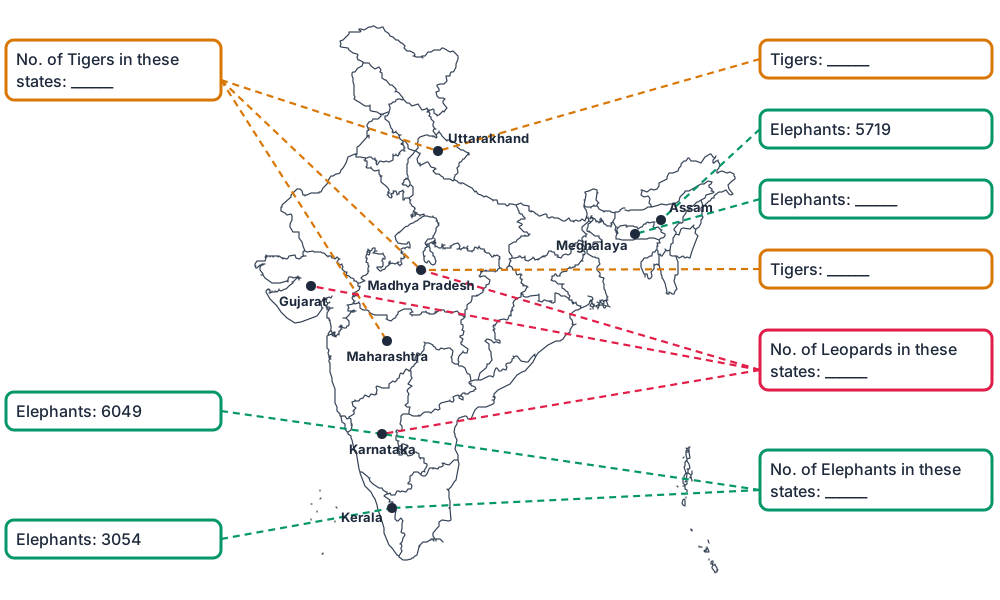
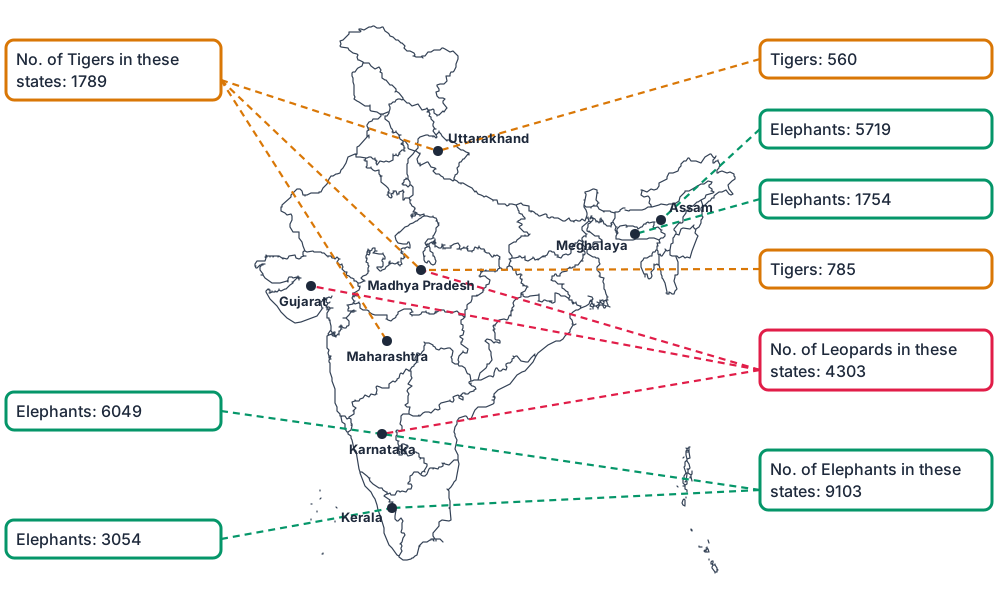
All the numbers come from pages 152 to 155.
| Box on the map | Where it comes from | Number |
|---|---|---|
| Tigers — Uttarakhand | 444 + 116 | 560 |
| Tigers — Madhya Pradesh | 444 + 341 | 785 |
| No. of Tigers in these states (Maharashtra, Madhya Pradesh, Uttarakhand) |
444 + 785 + 560 | 1789 |
| Elephants — Meghalaya | 5719 − 3965 | 1754 |
| No. of Elephants in these states (Karnataka and Kerala) |
6049 + 3054 | 9103 |
| No. of Leopards in these states (Gujarat, Karnataka, Madhya Pradesh) |
1355 + 1131 + 1817 | 4303 |
Let Us Do — Page 157Visitors, juice bottles, vehicles and deposit slips
| Month | Number of visitors |
|---|---|
| December | 8591 |
| November | 6415 |
| October | ? |
‘How many more’ means we subtract: 8591 − 6415.
| Th | H | T | O |
|---|---|---|---|
| 8 | 11 | ||
| 8 | 5 | 9 | 1 |
| − 6 | 4 | 1 | 5 |
| 2 | 1 | 7 | 6 |
2176 more visitors came in December than in November.
| Month | Number of visitors |
|---|---|
| December | 8591 |
| November | 6415 |
| October | ? |
November had 1587 more than October, so October = 6415 − 1587.
| Th | H | T | O |
|---|---|---|---|
| 5 | 13 | 10 | 15 |
| 6 | 4 | 1 | 5 |
| − 1 | 5 | 8 | 7 |
| 4 | 8 | 2 | 8 |
4828 visitors came in October.
| Type of juice | Number of bottles packed in a month |
|---|---|
| Pineapple | 1348 |
| Guava | |
| Orange | |
| Passion Fruit | 4781 |
Guava has 759 more than pineapple (1348), so add: 1348 + 759.
| Th | H | T | O |
|---|---|---|---|
| 1 | 1 | 1 | |
| 1 | 3 | 4 | 8 |
| + | 7 | 5 | 9 |
| 2 | 1 | 0 | 7 |
2107 bottles of guava juice are packed in a month.
| Type of juice | Number of bottles packed in a month |
|---|---|
| Pineapple | 1348 |
| Guava | |
| Orange | |
| Passion Fruit | 4781 |
Orange has 1257 more than guava (2107), so add: 2107 + 1257.
| Th | H | T | O |
|---|---|---|---|
| 1 | |||
| 2 | 1 | 0 | 7 |
| + 1 | 2 | 5 | 7 |
| 3 | 3 | 6 | 4 |
3364 bottles of orange juice are made in a month.
| Type of juice | Number of bottles packed in a month |
|---|---|
| Pineapple | 1348 |
| Guava | 2107 |
| Orange | 3364 |
| Passion Fruit | 4781 |
| Type of juice | Number of bottles packed in a month |
|---|---|
| Pineapple | 1348 |
| Guava | |
| Orange | |
| Passion Fruit | 4781 |
Guava + orange = 2107 + 3364:
| Th | H | T | O |
|---|---|---|---|
| 1 | |||
| 2 | 1 | 0 | 7 |
| + 3 | 3 | 6 | 4 |
| 5 | 4 | 7 | 1 |
5471 is more than 4781. How much more: 5471 − 4781.
| Th | H | T | O |
|---|---|---|---|
| 4 | 13 | 17 | |
| 5 | 4 | 7 | 1 |
| − 4 | 7 | 8 | 1 |
| 6 | 9 | 0 |
Guava and orange together are more — 690 bottles more than passion fruit.
Buses are 253 more than jeeps (6304), so add: 6304 + 253.
| Th | H | T | O |
|---|---|---|---|
| 6 | 3 | 0 | 4 |
| + | 2 | 5 | 3 |
| 6 | 5 | 5 | 7 |
There are 6557 buses in the town.
Tractors are 5247 less than buses (6557), so subtract: 6557 − 5247.
| Th | H | T | O |
|---|---|---|---|
| 6 | 5 | 5 | 7 |
| − 5 | 2 | 4 | 7 |
| 1 | 3 | 1 | 0 |
There are 1310 tractors in the town.
Taxis are 1579 more than tractors (1310), so add: 1310 + 1579.
| Th | H | T | O |
|---|---|---|---|
| 1 | 3 | 1 | 0 |
| + 1 | 5 | 7 | 9 |
| 2 | 8 | 8 | 9 |
There are 2889 taxis in the town.
| Order | Vehicle | Number |
|---|---|---|
| Lowest | Tractors | 1310 |
| 2nd | Taxis | 2889 |
| 3rd | Jeeps | 6304 |
| Highest | Buses | 6557 |
a) 1459 + 476
b) 3863 + 4188
c) 5017 + 899
d) 4285 + 2132
e) 3158 + 1052
f) 7293 – 2819
g) 3105 – 1223
h) 8006 – 5567
i) 5000 – 4124
j) 9018 – 487
| Sum | How the places work out | Answer | |
|---|---|---|---|
| a) | 1459 + 476 | 9+6=15 carry 1; 5+7+1=13 carry 1; 4+4+1=9; 1 | 1935 |
| b) | 3863 + 4188 | 3+8=11 carry 1; 6+8+1=15 carry 1; 8+1+1=10 carry 1; 3+4+1=8 | 8051 |
| c) | 5017 + 899 | 7+9=16 carry 1; 1+9+1=11 carry 1; 0+8+1=9; 5 | 5916 |
| d) | 4285 + 2132 | 5+2=7; 8+3=11 carry 1; 2+1+1=4; 4+2=6 | 6417 |
| e) | 3158 + 1052 | 8+2=10 carry 1; 5+5+1=11 carry 1; 1+0+1=2; 3+1=4 | 4210 |
| f) | 7293 − 2819 | 13−9=4; 8−1=7; 12−8=4 after borrowing; 6−2=4 | 4474 |
| g) | 3105 − 1223 | 5−3=2; 10−2=8 after borrowing; 10−2=8; 2−1=1 | 1882 |
| h) | 8006 − 5567 | 16−7=9; 9−6=3; 9−5=4; 7−5=2 | 2439 |
| i) | 5000 − 4124 | 10−4=6; 9−2=7; 9−1=8; 4−4=0 | 876 |
| j) | 9018 − 487 | 8−7=1; 11−8=3; 9−4=5; 8 | 8531 |
| SPB — Deposit Slip | ||
|---|---|---|
| Name: Raju Amount (in numbers): ₹2045 | ||
| Total Amount (in words): ______ | ||
| Type of Note/ coin | No. of Notes/ coins | Amount |
| 500 | 3 | 1500 |
| 100 | 3 | 300 |
| 50 | 2 | |
| 10 | 14 | |
| 5 | 1 | |
| 2 | 0 | |
| 1 | 0 | |
| Total | ||
Amount = number of notes (or coins) × value of each.
| SPB — Deposit Slip | ||
|---|---|---|
| Name: Raju Amount (in numbers): ₹2045 | ||
| Total Amount (in words): Two thousand forty-five rupees | ||
| Type of Note/ coin | No. of Notes/ coins | Amount |
| 500 | 3 | 1500 |
| 100 | 3 | 300 |
| 50 | 2 | 100 |
| 10 | 14 | 140 |
| 5 | 1 | 5 |
| 2 | 0 | 0 |
| 1 | 0 | 0 |
| Total | 23 | ₹2045 |
Total Amount (in words): Two thousand forty-five rupees.
| SPB — Deposit Slip | ||
|---|---|---|
| Name: Rani Amount (in numbers): ______ | ||
| Total Amount (in words): ______ | ||
| Type of Note/ coin | No. of Notes/ coins | Amount |
| 500 | ||
| 100 | ||
| 50 | ||
| 10 | ||
| 5 | ||
| 2 | ||
| 1 | ||
| Total | ||
(other combinations can also be correct):
| SPB — Deposit Slip | ||
|---|---|---|
| Name: Rani Amount (in numbers): ₹3578 | ||
| Total Amount (in words): Three thousand five hundred seventy-eight rupees | ||
| Type of Note/ coin | No. of Notes/ coins | Amount |
| 500 | 7 | 3500 |
| 100 | 0 | 0 |
| 50 | 1 | 50 |
| 10 | 2 | 20 |
| 5 | 1 | 5 |
| 2 | 1 | 2 |
| 1 | 1 | 1 |
| Total | 13 | ₹3578 |
Total Amount (in words): Three thousand five hundred seventy-eight rupees.
| SPB — Deposit Slip | ||
|---|---|---|
| Name: Roja Amount (in numbers): ______ | ||
| Total Amount (in words): ______ | ||
| Type of Note/ coin | No. of Notes/ coins | Amount |
| 500 | ||
| 100 | ||
| 50 | ||
| 10 | ||
| 5 | ||
| 2 | ||
| 1 | ||
| Total | ||
(other combinations can also be correct):
| SPB — Deposit Slip | ||
|---|---|---|
| Name: Roja Amount (in numbers): ₹1240 | ||
| Total Amount (in words): One thousand two hundred forty rupees | ||
| Type of Note/ coin | No. of Notes/ coins | Amount |
| 500 | 2 | 1000 |
| 100 | 2 | 200 |
| 50 | 0 | 0 |
| 10 | 4 | 40 |
| 5 | 0 | 0 |
| 2 | 0 | 0 |
| 1 | 0 | 0 |
| Total | 8 | ₹1240 |
Total Amount (in words): One thousand two hundred forty rupees.
Let Us Solve — Page 161Working in the place-value columns
| Th | H | T | O |
|---|---|---|---|
| 3 | 6 | 9 | 5 |
| + 4 | 2 | 0 | 8 |
| Th | H | T | O |
|---|---|---|---|
| 1 | 1 | ||
| 3 | 6 | 9 | 5 |
| + 4 | 2 | 0 | 8 |
| 7 | 9 | 0 | 3 |
3695 + 4208 = 7903
| Th | H | T | O |
|---|---|---|---|
| 2 | 5 | 0 | 7 |
| + 6 | 8 | 4 | 7 |
| Th | H | T | O |
|---|---|---|---|
| 1 | 1 | ||
| 2 | 5 | 0 | 7 |
| + 6 | 8 | 4 | 7 |
| 9 | 3 | 5 | 4 |
2507 + 6847 = 9354
| Th | H | T | O |
|---|---|---|---|
| 6 | 3 | 5 | 2 |
| − 3 | 5 | 2 | 1 |
| Th | H | T | O |
|---|---|---|---|
| 5 | 13 | ||
| 6 | 3 | 5 | 2 |
| − 3 | 5 | 2 | 1 |
| 2 | 8 | 3 | 1 |
6352 − 3521 = 2831
| Th | H | T | O |
|---|---|---|---|
| 8 | 8 | 0 | 3 |
| − 5 | 7 | 2 | 6 |
| Th | H | T | O |
|---|---|---|---|
| 7 | 9 | 13 | |
| 8 | 8 | 0 | 3 |
| − 5 | 7 | 2 | 6 |
| 3 | 0 | 7 | 7 |
8803 − 5726 = 3077
a) 3683 – 971
b) 8432 – 46
c) 4011 – 3666
d) 5203 – 2745
e) 1465 + 632
f) 3567 + 77
g) 8263 + 3737
h) 5429 + 3287
Write ones under ones, tens under tens, and so on. Then work from the right.
| Sum | What to watch for | Answer | |
|---|---|---|---|
| a) | 3683 − 971 | 971 has no thousands digit; put 0 there | 2712 |
| b) | 8432 − 46 | 46 is only tens and ones; line it up on the right | 8386 |
| c) | 4011 − 3666 | borrow three times | 345 |
| d) | 5203 − 2745 | borrow across the 0 in the tens | 2458 |
| e) | 1465 + 632 | one carry only, from the hundreds (4 + 6 = 10) | 2097 |
| f) | 3567 + 77 | 77 sits in the tens and ones | 3644 |
| g) | 8263 + 3737 | carries all the way across | 12000 |
| h) | 5429 + 3287 | carry from the ones and from the tens | 8716 |
Let Us Solve — Page 162Easy ways, comparing without calculating, and using a given answer
a) 8787 – 99
b) 4596 + 104
c) 3459 + 21
d) 5010 + 95
e) 4990 + 310
f) 7844 – 15
g) 260 + 240
h) 1575 – 125
i) 3999 + 290
The trick is to make one number a round number first.
| Sum | Easy way | Answer | |
|---|---|---|---|
| a) | 8787 − 99 | Take away 100, then put 1 back: 8687 + 1 | 8688 |
| b) | 4596 + 104 | 4596 + 4 = 4600, then + 100 | 4700 |
| c) | 3459 + 21 | 3459 + 1 = 3460, then + 20 | 3480 |
| d) | 5010 + 95 | 5010 + 100 = 5110, then − 5 | 5105 |
| e) | 4990 + 310 | 4990 + 10 = 5000, then + 300 | 5300 |
| f) | 7844 − 15 | 7844 − 4 = 7840, then − 11 | 7829 |
| g) | 260 + 240 | 26 tens + 24 tens = 50 tens | 500 |
| h) | 1575 − 125 | 1575 − 75 = 1500, then − 50 | 1450 |
| i) | 3999 + 290 | 3999 + 1 = 4000, then + 289 | 4289 |
54 + 97 > 54 + 90
84 − 68 < 90 − 68
76 + 85 < 80 + 86
73 − 54 > 73 − 56
314 − 175 = 139
Take 175 back out, and 139 is what is left.
845 − 395 = 450
Now we take away 1 more than before (395 instead of 394).
So 1 less is left: 451 − 1 = 450
354 + 168 = 522
168 is 1 more than 167.
So the answer is 1 more: 521 + 1 = 522
446 + 219 = 665 — the same answer.
219 is 10 more than 209.
The 10 that left one number joined the other, so the total does not change.
In-text Questions — Page 163Practice sums and the number-square puzzle
a) 2783 + 378
b) 8948 + 97
c) 7006 + 367
d) 8009 + 485
e) 6062 + 3809
f) 3792 + 2688
g) 4999 + 3888
h) 5005 + 4895
i) 5768 + 4053
j) 3480 + 479
| Sum | Carry from | Answer | |
|---|---|---|---|
| a) | 2783 + 378 | ones, tens and hundreds | 3161 |
| b) | 8948 + 97 | ones, tens and hundreds | 9045 |
| c) | 7006 + 367 | ones | 7373 |
| d) | 8009 + 485 | ones | 8494 |
| e) | 6062 + 3809 | ones | 9871 |
| f) | 3792 + 2688 | ones, tens and hundreds | 6480 |
| g) | 4999 + 3888 | ones, tens and hundreds | 8887 |
| h) | 5005 + 4895 | ones and tens | 9900 |
| i) | 5768 + 4053 | ones and tens | 9821 |
| j) | 3480 + 479 | tens | 3959 |
a) 4456 – 2768
b) 5300 – 467
c) 8067 – 4546
d) 5302 – 1034
e) 8004 – 3107
f) 3400 – 897
g) 9382 – 4857
h) 7561 – 2933
i) 6478 – 5986
j) 3444 – 2555
| Sum | Borrowing needed in | Answer | |
|---|---|---|---|
| a) | 4456 − 2768 | ones, tens and hundreds | 1688 |
| b) | 5300 − 467 | ones and hundreds | 4833 |
| c) | 8067 − 4546 | hundreds | 3521 |
| d) | 5302 − 1034 | ones | 4268 |
| e) | 8004 − 3107 | ones | 4897 |
| f) | 3400 − 897 | ones and hundreds | 2503 |
| g) | 9382 − 4857 | ones and hundreds | 4525 |
| h) | 7561 − 2933 | ones and hundreds | 4628 |
| i) | 6478 − 5986 | tens and hundreds | 492 |
| j) | 3444 − 2555 | ones, tens and hundreds | 889 |
Rule: an odd difference needs one odd and one even number side by side.
Yes, there are other ways. Keep the 5 odd numbers (1, 3, 5, 7, 9) on the 4 corners and the centre, and the 4 even numbers on the other squares, in any order.
No, it cannot be done.
An even difference needs two odd or two even numbers side by side. All nine squares are joined, so all nine numbers would have to be odd (or all even). But 1 to 9 has only 5 odd and 4 even numbers.
Chapter 10 of 14 – Maths
- Previous: Chapter 9 Equal Groups
- Next: Chapter 11 Fun with Symmetry
- All chapters: NCERT Solutions Class 4 Maths
Also for This Chapter
NCERT Solutions Class 4 Maths Chapter 10 Elephants Tigers and Leopards – Overview
| Class | Class 4 |
| Subject | Maths |
| Chapter | 10 – Elephants Tigers and Leopards |
| Textbook pages | 149 – 163 |
| Questions solved | 60 |
| Session | 2027 |
| Format | Full answers on this page + PDF |
NCERT Solutions Class 4 Maths Chapter 10 – FAQs
Where can I download NCERT Solutions Class 4 Maths Chapter 10 Elephants Tigers and Leopards PDF?
Read every answer on this page, or download the free PDF from the table at the top.
Is this for the 2027 session?
Yes, it follows the latest NCERT Class 4 Maths book for 2027.
How many questions are solved in NCERT Class 4 Maths Chapter 10?
All 60 questions of the chapter (textbook pages 149 – 163) – the in-text questions, activities and the end-of-chapter exercises.
How should I use these solutions?
Read the chapter in the NCERT book first, attempt the questions yourself, then check your answers here.