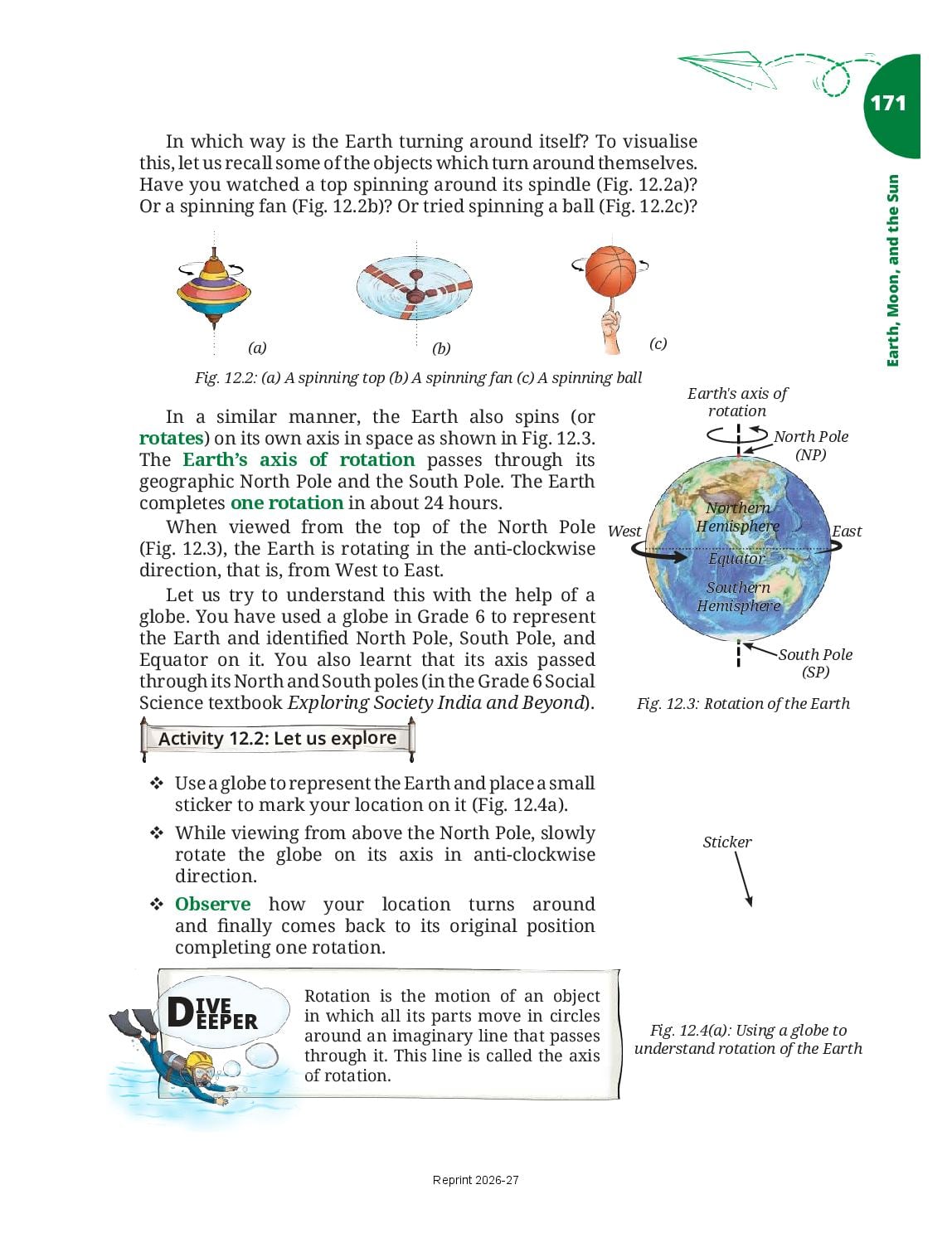
Download Earth, Moon, and the Sun – NCERT Class 7 Science Chapter 12 PDF from the new NCERT Class 7 Science book Curiosity (2026-27). Read the chapter online or download the free PDF. The Earth rotates on its own axis — an imaginary line through the geographic North Pole and South Pole — once in about 24 hours. Seen from above the North Pole, this rotation is anti-clockwise, that is, from West to East.
Earth, Moon, and the Sun PDF – Chapter 12 of Curiosity
Read the chapter online or download the PDF.
| Chapter | Download | |
|---|---|---|
| Chapter 12 PDF | Earth, Moon, and the Sun | View PDF |
| Full book | NCERT Class 7 Science – Curiosity | View Book |
Read Online
What Is in Earth, Moon, and the Sun? (Class 7 Science Chapter 12)
- The Earth rotates on its own axis — an imaginary line through the geographic North Pole and South Pole — once in about 24 hours. Seen from above the North Pole, this rotation is anti-clockwise, that is, from West to East.
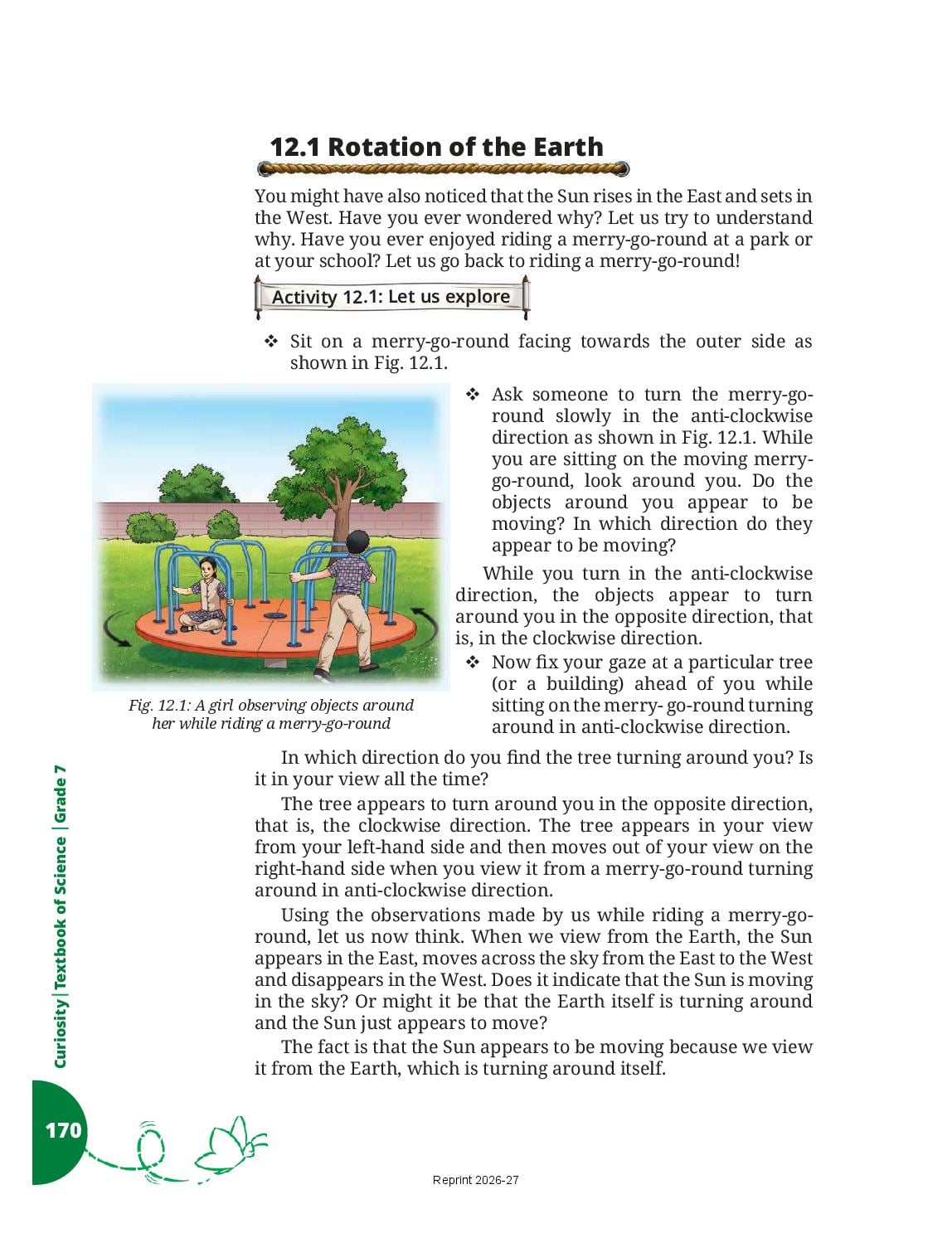
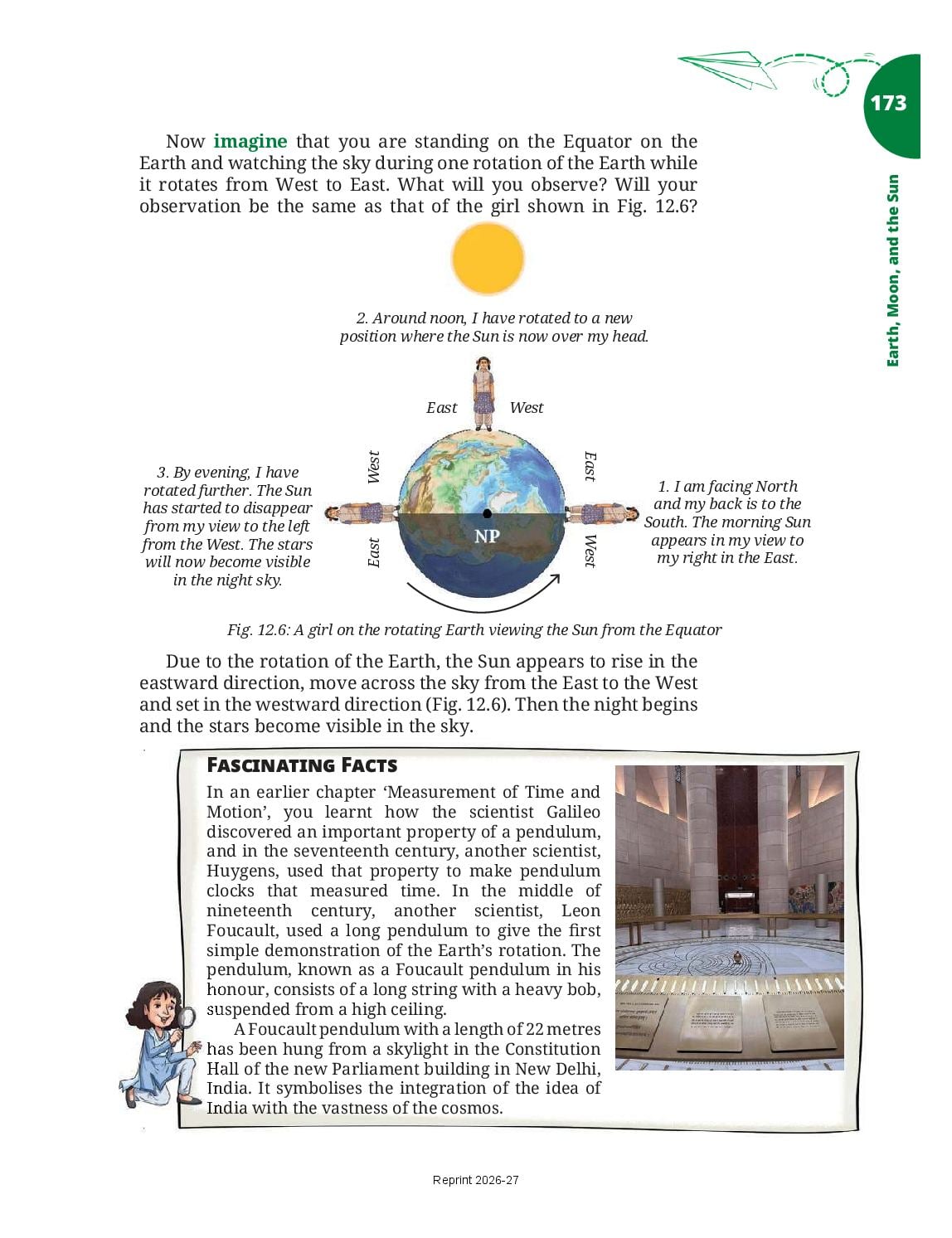
- Because we watch the sky from a rotating Earth, the Sun, the Moon and the stars only appear to move. They seem to rise in the East and set in the West. This is exactly like the trees appearing to turn the other way when you ride a merry-go-round.
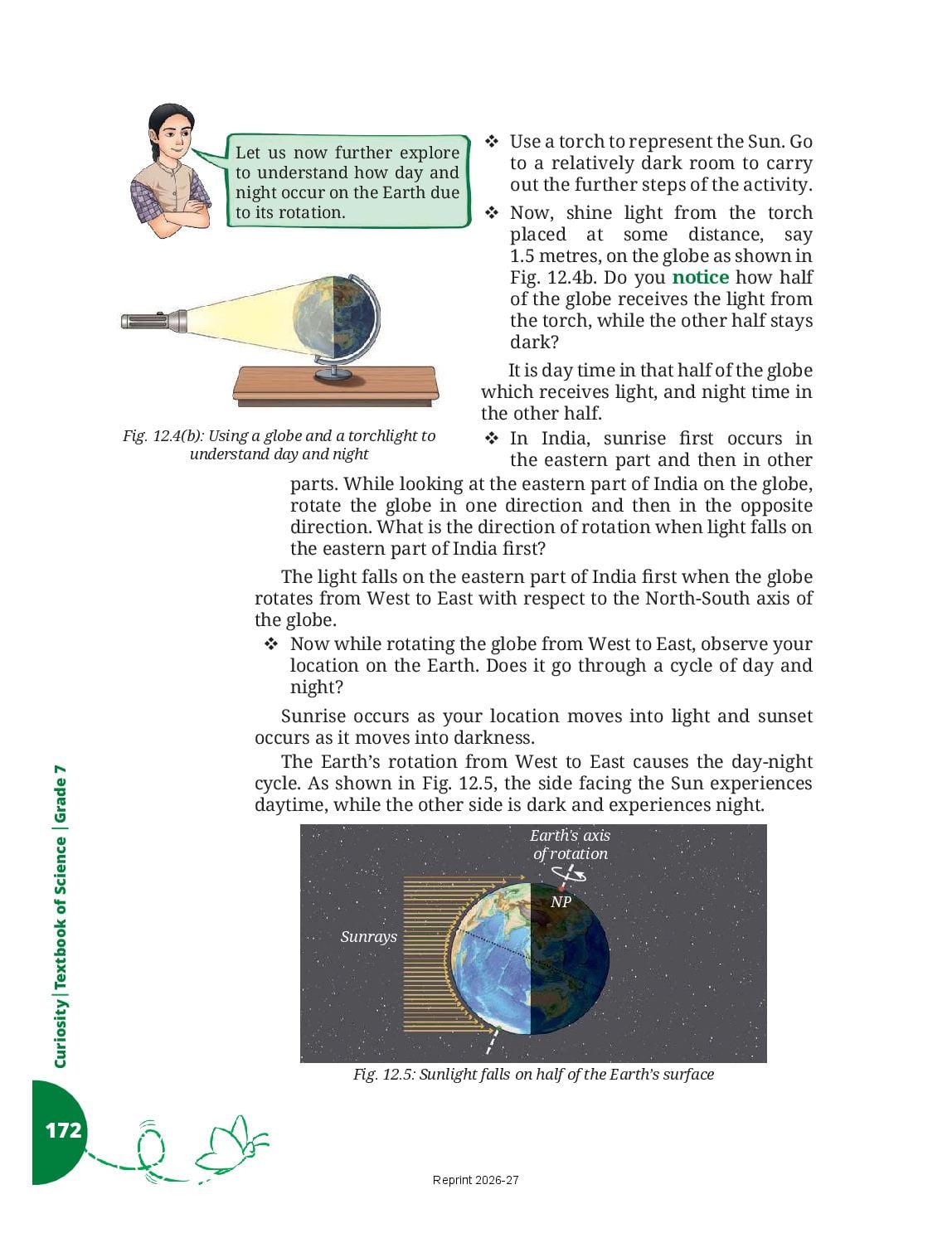
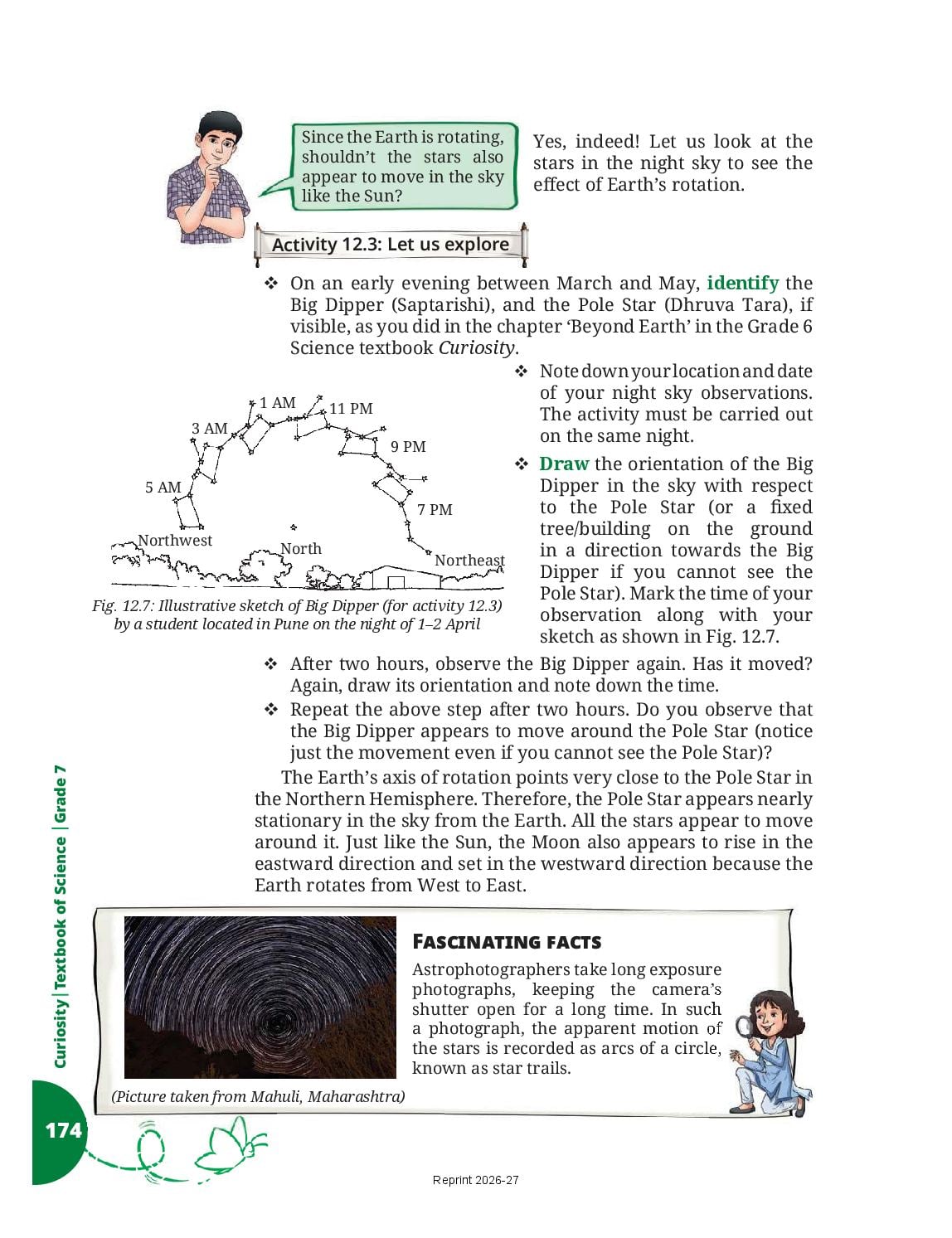
- The Earth’s rotation causes the day–night cycle: the half facing the Sun has day, the other half has night. The Earth’s axis points very close to the Pole Star (Dhruva Tara), so that star appears almost fixed while all other stars, such as the Big Dipper (Saptarishi), appear to swing around it.
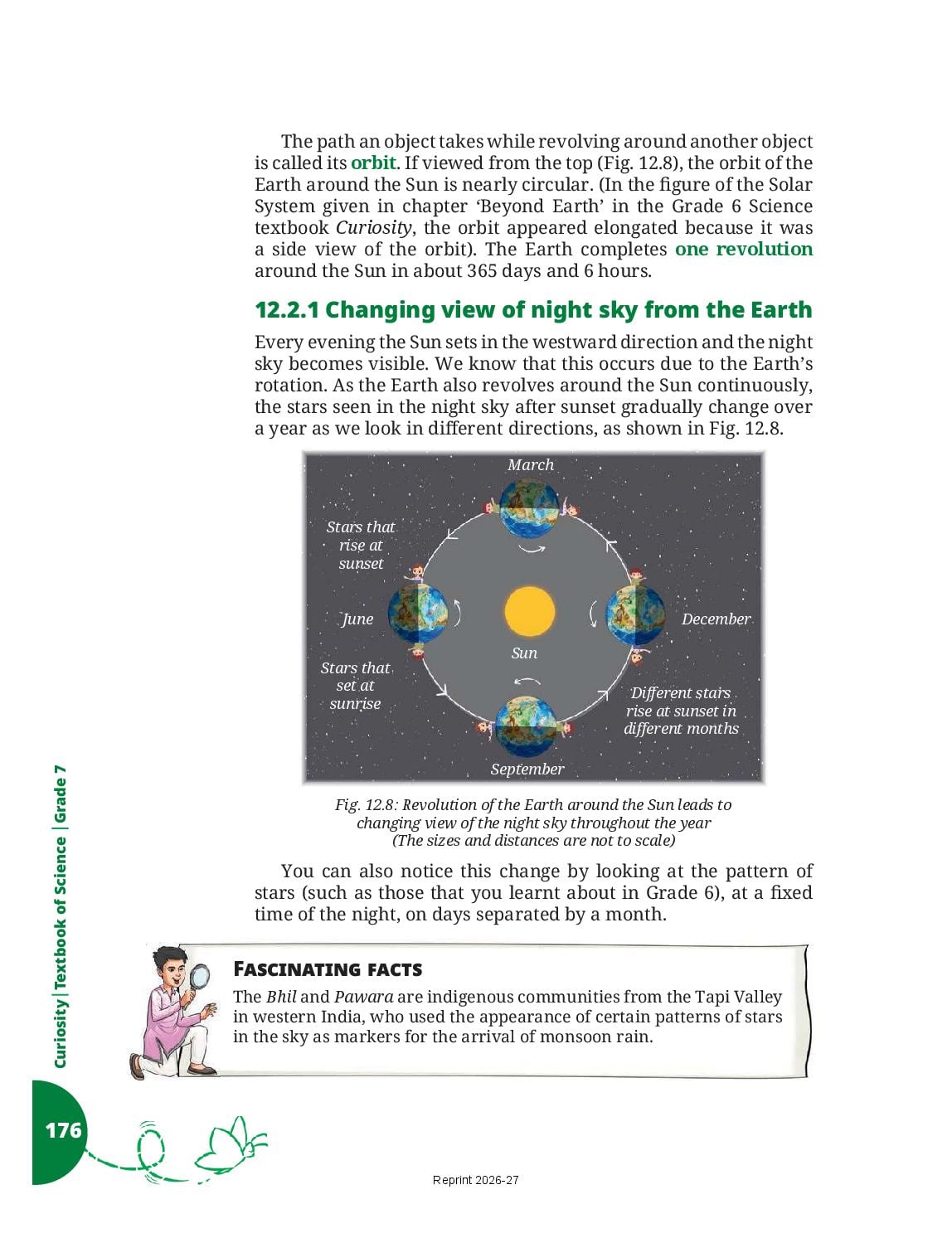
- The Earth also revolves around the Sun along a nearly circular orbit, completing one revolution in about 365 days and 6 hours. Because of this, the stars seen just after sunset change gradually through the year.
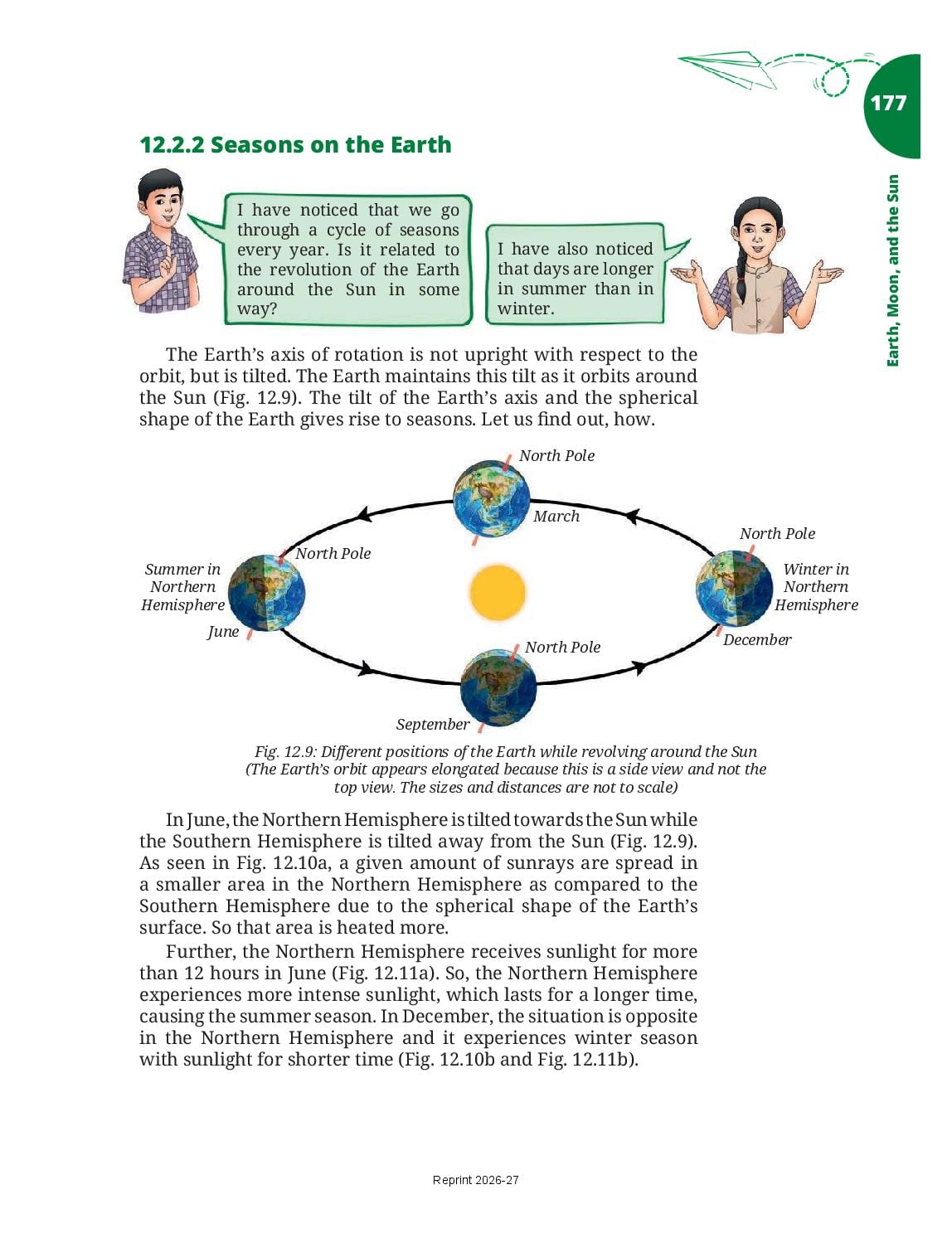
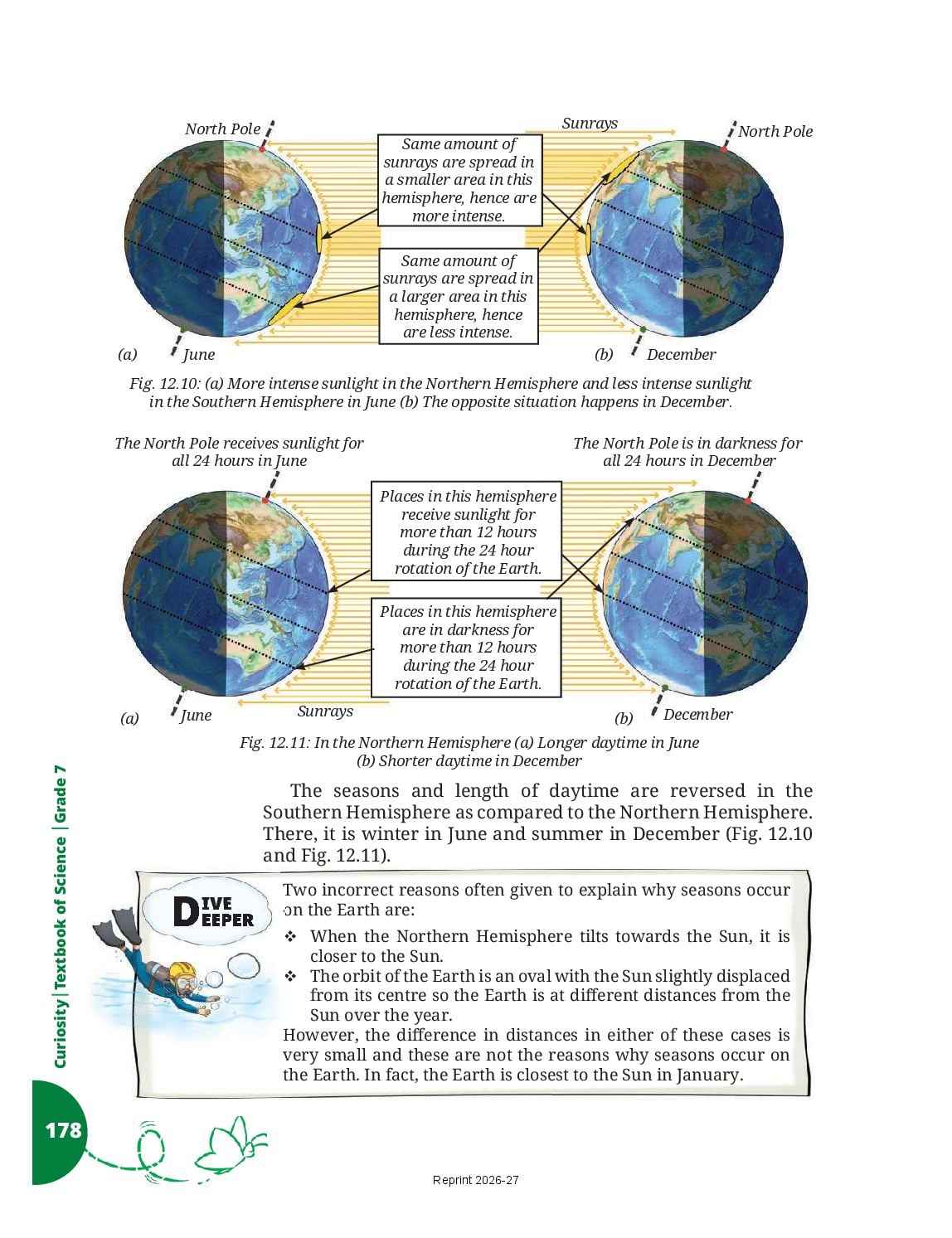
- Seasons occur because the Earth’s axis of rotation is tilted with respect to its orbit and because the Earth is spherical — not because the Earth comes closer to the Sun. (In fact the Earth is closest to the Sun in January.) The tilted, spherical Earth gives one hemisphere more intense sunlight for more hours — that hemisphere has summer.
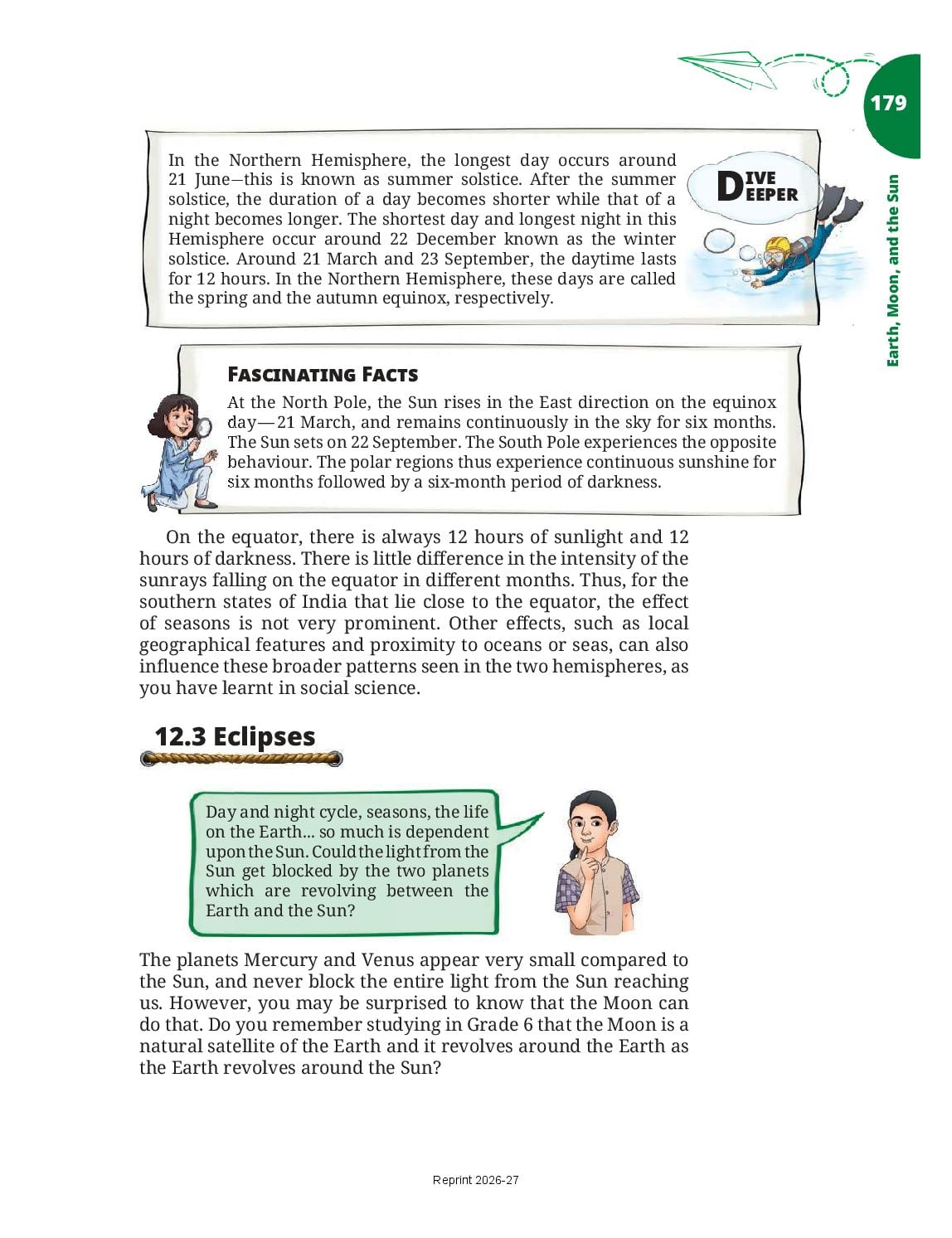
- In the Northern Hemisphere the longest day is around 21 June (summer solstice) and the shortest around 22 December (winter solstice); day and night are equal near 21 March and 23 September (spring and autumn equinox). The Southern Hemisphere has the opposite seasons.
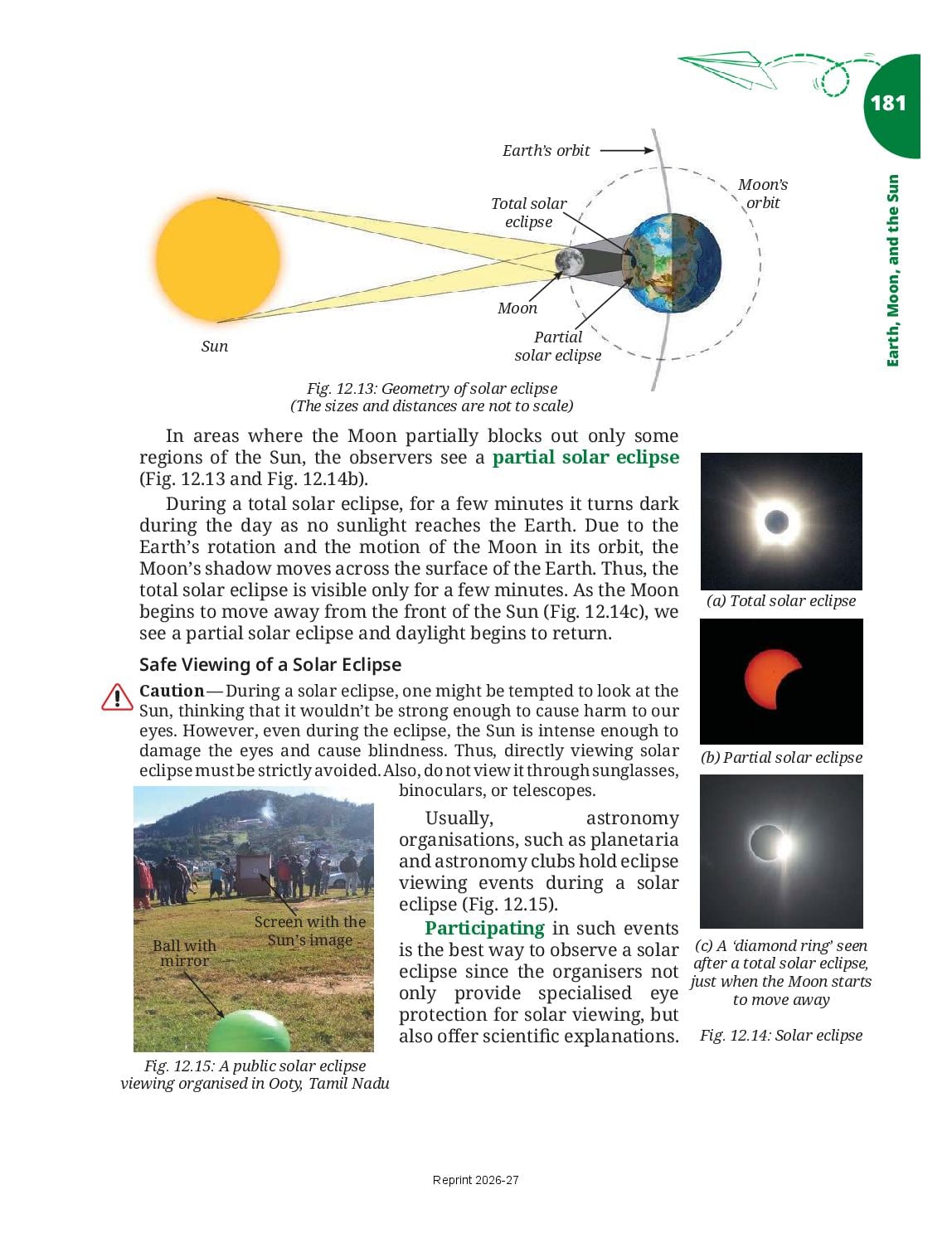
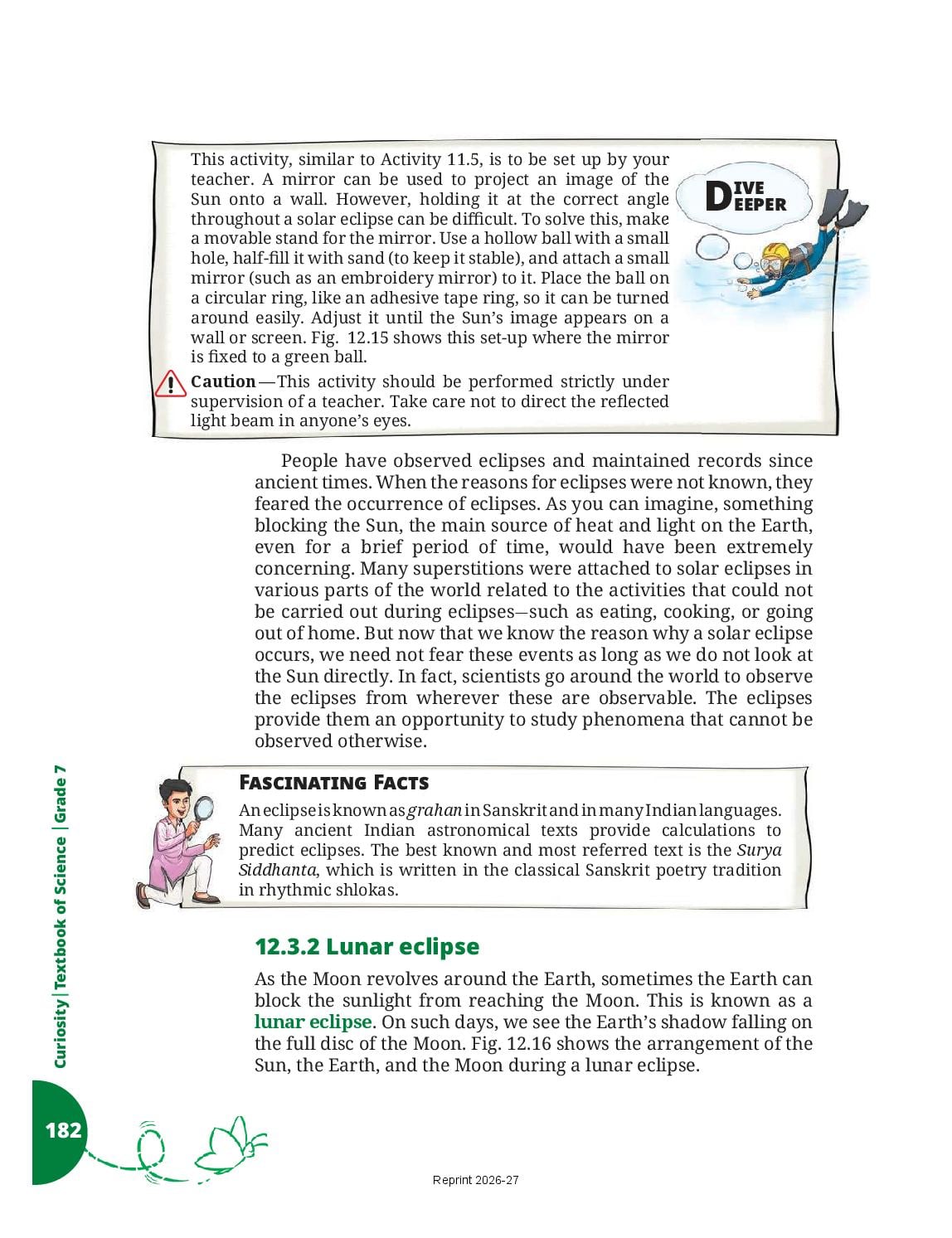
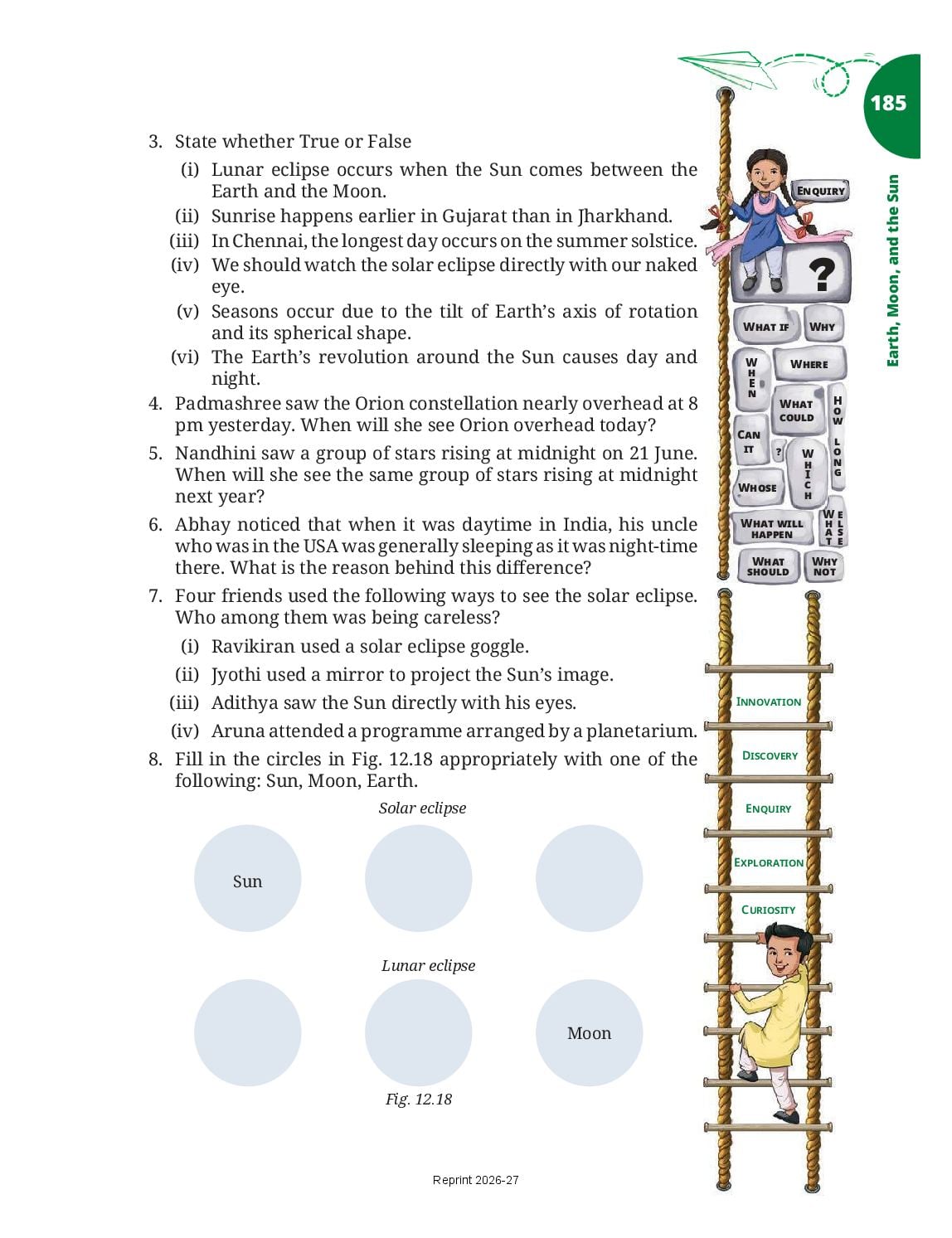
- A solar eclipse happens when the Moon comes between the Sun and the Earth and its shadow falls on the Earth. It is total in a small region and partial around it. Never look at the Sun directly during an eclipse — not even through sunglasses, binoculars or a telescope.
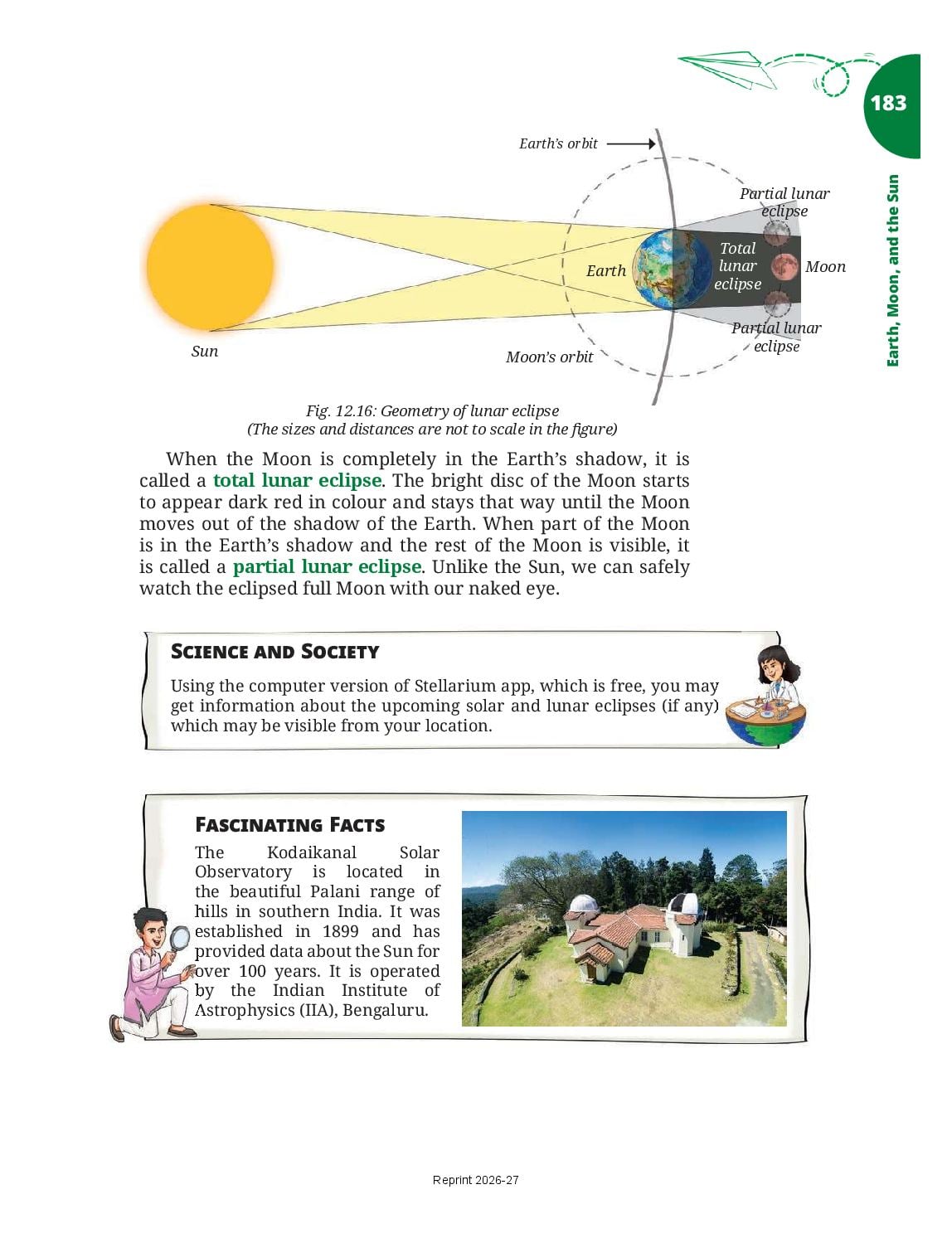
- A lunar eclipse happens when the Earth comes between the Sun and the Moon and the Earth’s shadow falls on the Moon. In a total lunar eclipse the Moon looks dark red. A lunar eclipse is completely safe to watch with the naked eye.
Quick revision – Earth, Moon, and the Sun
| Term | What it means | Example / detail from the chapter | Point to remember |
|---|---|---|---|
| Rotation | The motion of an object in which all its parts move in circles around an imaginary line passing through it | A spinning top, a ceiling fan, a ball spun on a finger — and the Earth, once in about 24 hours | The imaginary line is called the axis of rotation |
| Earth’s axis of rotation | The line through the geographic North Pole and the South Pole about which the Earth spins | Viewed from above the North Pole the Earth turns anti-clockwise, West to East | It is tilted with respect to the orbit, and it points very close to the Pole Star |
| Revolution | The motion of an object around another object | The Earth around the Sun in about 365 days and 6 hours; the Moon around the Earth | Rotation is spinning on its own axis; revolution is going around something else |
| Orbit | The path an object takes while revolving around another object | Seen from the top, the Earth’s orbit around the Sun is nearly circular | It looks elongated in books only because that picture is a side view |
| Day and night | The lit half of the Earth has day, the dark half has night | Sunrise as your place turns into the light, sunset as it turns into the dark (Fig. 12.5) | Caused by rotation — not by revolution |
| Pole Star (Dhruva Tara) | The star lying almost exactly along the Earth’s axis in the Northern Hemisphere | The Big Dipper (Saptarishi) appears to circle around it through the night (Fig. 12.7) | It appears nearly stationary because the axis points at it |
| Seasons | The yearly cycle of summer, winter and the rest | June: Northern Hemisphere tilted towards the Sun — summer; December — winter | Caused by the tilt of the axis plus the spherical shape of the Earth |
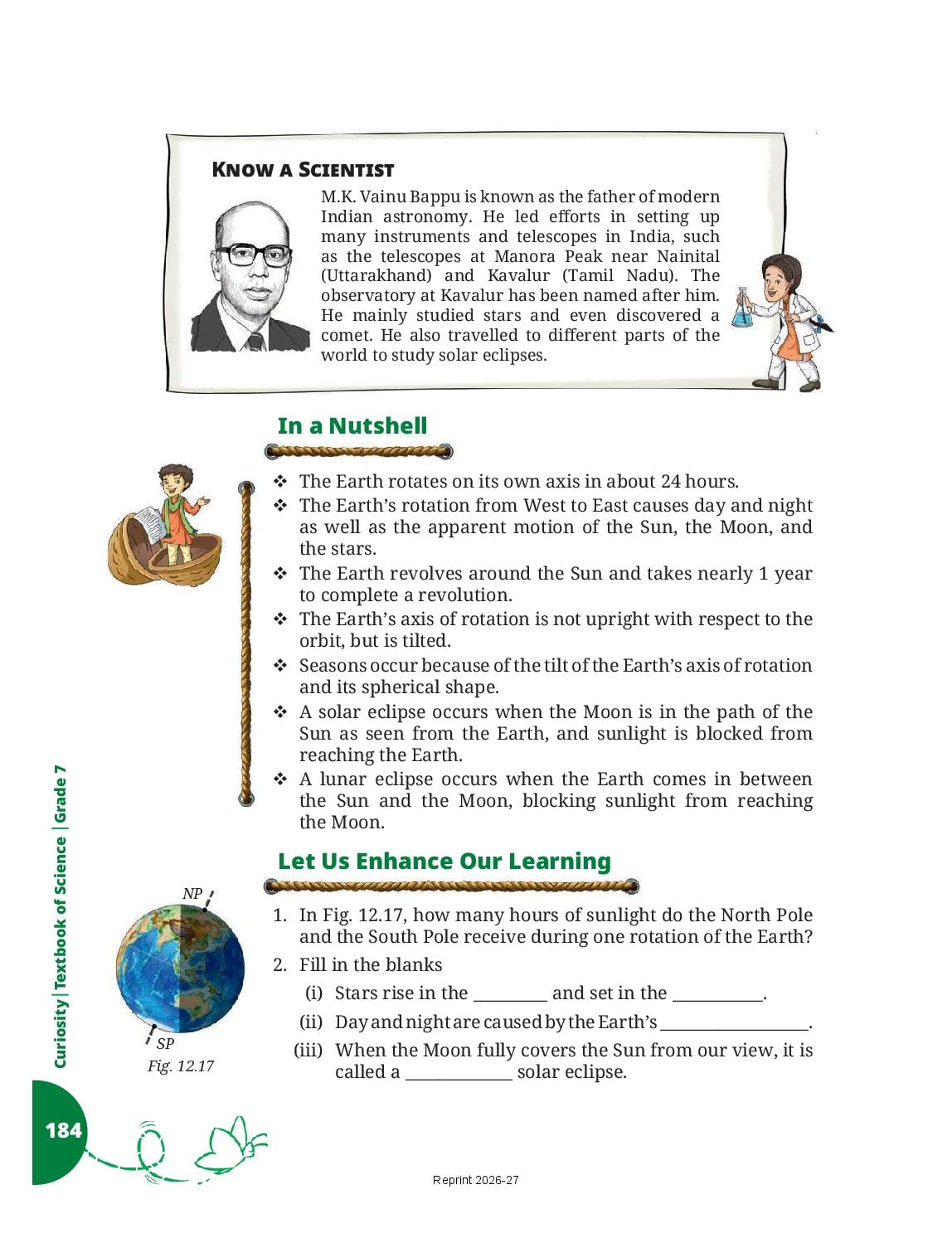
| Solstice | The day with the longest or the shortest daytime | About 21 June (summer solstice) and 22 December (winter solstice) in the Northern Hemisphere | On 21 June the North Pole gets sunlight for all 24 hours |
| Equinox | A day on which daytime lasts about 12 hours everywhere | Around 21 March (spring) and 23 September (autumn) in the Northern Hemisphere | The equator has nearly 12 hours of daylight on every day of the year |
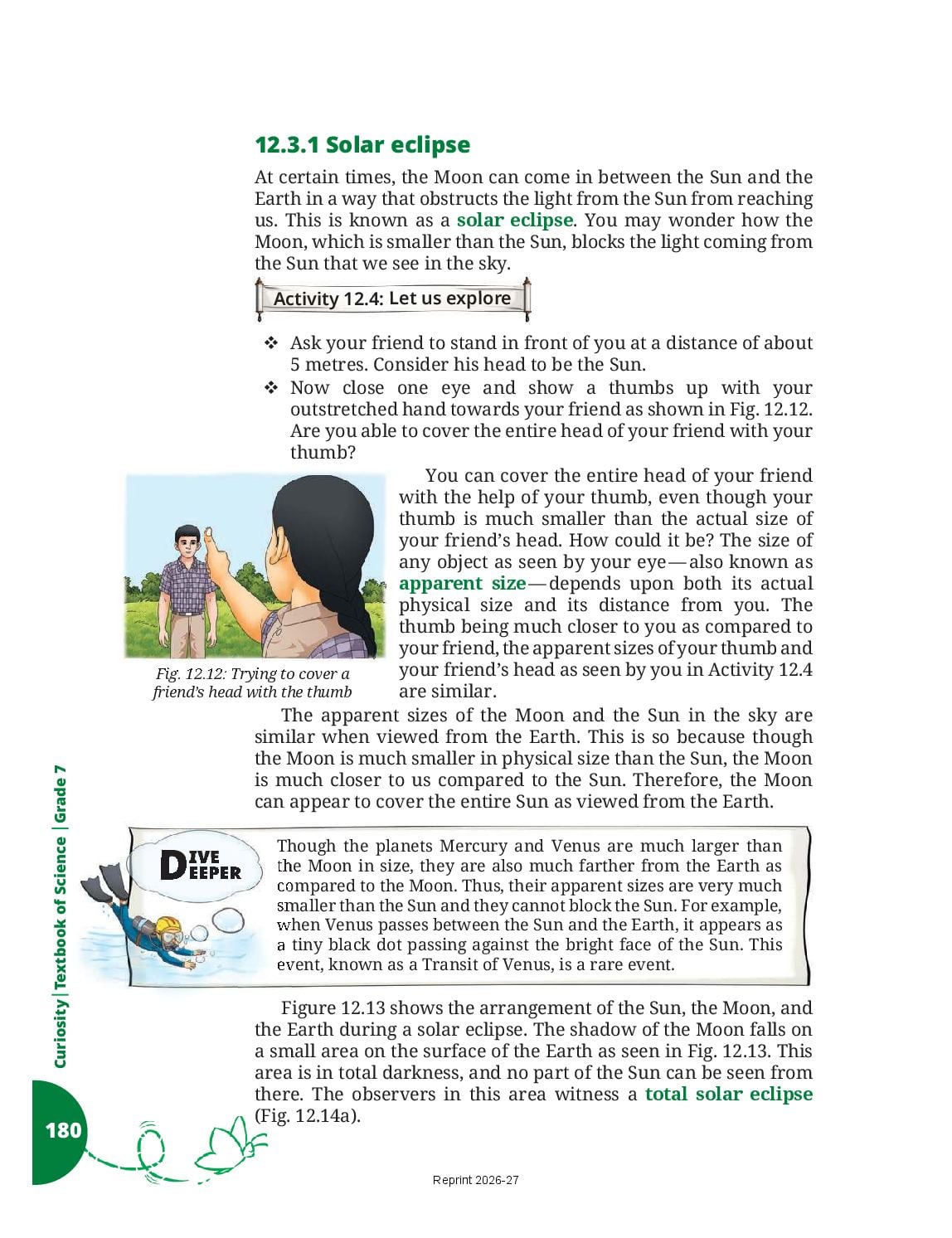
| Apparent size | The size of an object as seen by the eye | A thumb can cover a friend’s head 5 m away (Activity 12.4) | It depends on the actual size and the distance from the observer |
| Solar eclipse | The Moon comes between the Sun and the Earth and blocks sunlight from reaching us | Total in the small dark region, partial around it (Fig. 12.13) | Never view it directly — use only a projected image or approved eclipse goggles |
| Lunar eclipse | The Earth comes between the Sun and the Moon so the Earth’s shadow falls on the Moon | Total lunar eclipse — the Moon turns dark red (Fig. 12.16) | Perfectly safe to watch with the naked eye |
Old NCERT vs New – Class 7 Science
This chapter is from Curiosity, the new NCERT Class 7 Science book (NCF-SE 2023, used from 2025-26). It replaced the old book “Science”, so chapter numbers and names differ from older PDFs.
Solutions and All Chapters
Answers to the exercises and the full chapter list of Curiosity:
Earth, Moon, and the Sun – Overview
| Class | Class 7 |
| Subject | Science |
| Book | Curiosity – new NCERT book |
| Chapter | 12 of 12 – Earth, Moon, and the Sun |
| Book pages | 169 – 186 |
| Edition | NCERT Reprint 2026-27 |
| Session | 2026-27 |
| Free – read online or download |
Class 7 Science Chapter 12 – FAQs
Where can I download Earth, Moon, and the Sun Class 7 PDF?
From the download table on this page – the chapter PDF is free, and the full book is linked too.
What is Class 7 Science Chapter 12 about?
The Earth rotates on its own axis — an imaginary line through the geographic North Pole and South Pole — once in about 24 hours. Seen from above the North Pole, this rotation is anti-clockwise, that is, from West to East.
Is Earth, Moon, and the Sun from the new NCERT Class 7 Science book?
Yes. It is chapter 12 of curiosity, the new NCERT Class 7 Science book for 2026-27.
Is this the latest NCERT edition for 2026-27?
Yes – the PDF is NCERT’s latest edition for the 2026-27 session.
Where are the NCERT Solutions for Class 7 Science Chapter 12?
Open the NCERT Solutions link above for answers to the exercise questions.