Download Changes Around Us: Physical and Chemical – NCERT Class 7 Science Chapter 5 PDF from the new NCERT Class 7 Science book Curiosity (2026-27). Read the chapter online or download the free PDF. A physical change alters only physical properties such as shape, size or state. No new substance is formed — folding paper, crushing chalk, melting ice.
Changes Around Us: Physical and Chemical PDF – Chapter 5 of Curiosity
Read the chapter online or download the PDF.
| Chapter | Download | |
|---|---|---|
| Chapter 5 PDF | Changes Around Us: Physical and Chemical | View PDF |
| Full book | NCERT Class 7 Science – Curiosity | View Book |
Read Online
What Is in Changes Around Us: Physical and Chemical? (Class 7 Science Chapter 5)
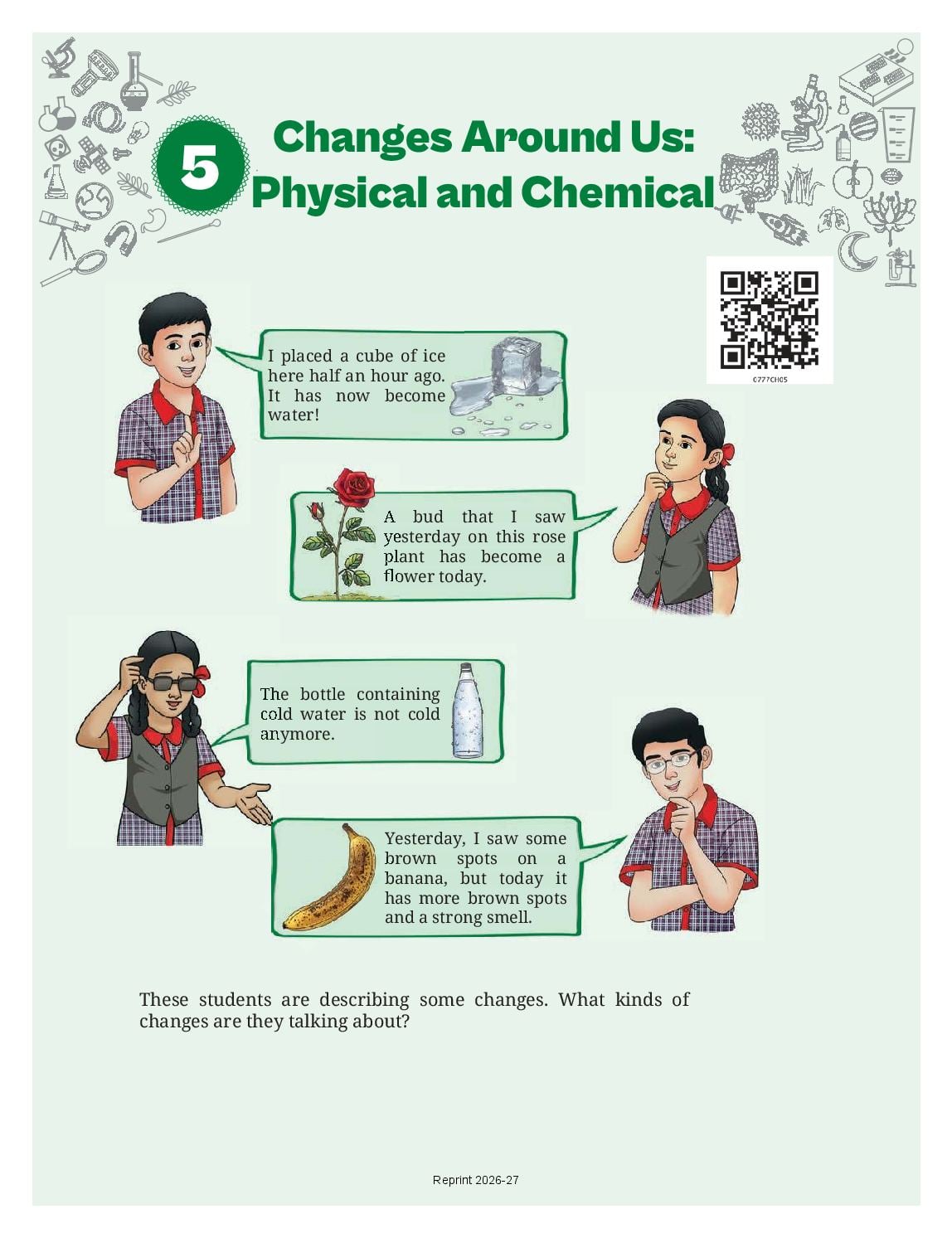
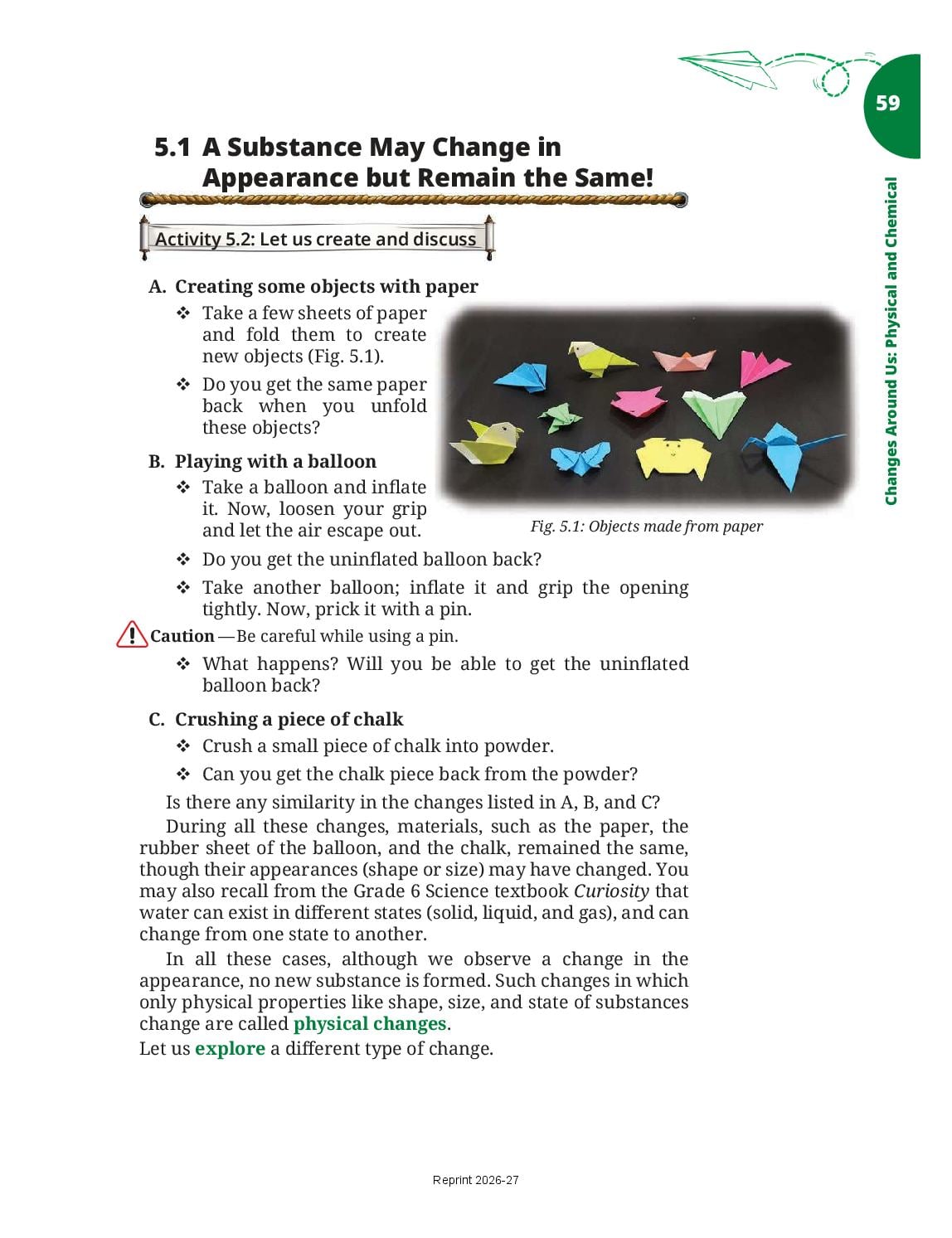
- A physical change alters only physical properties such as shape, size or state. No new substance is formed — folding paper, crushing chalk, melting ice.
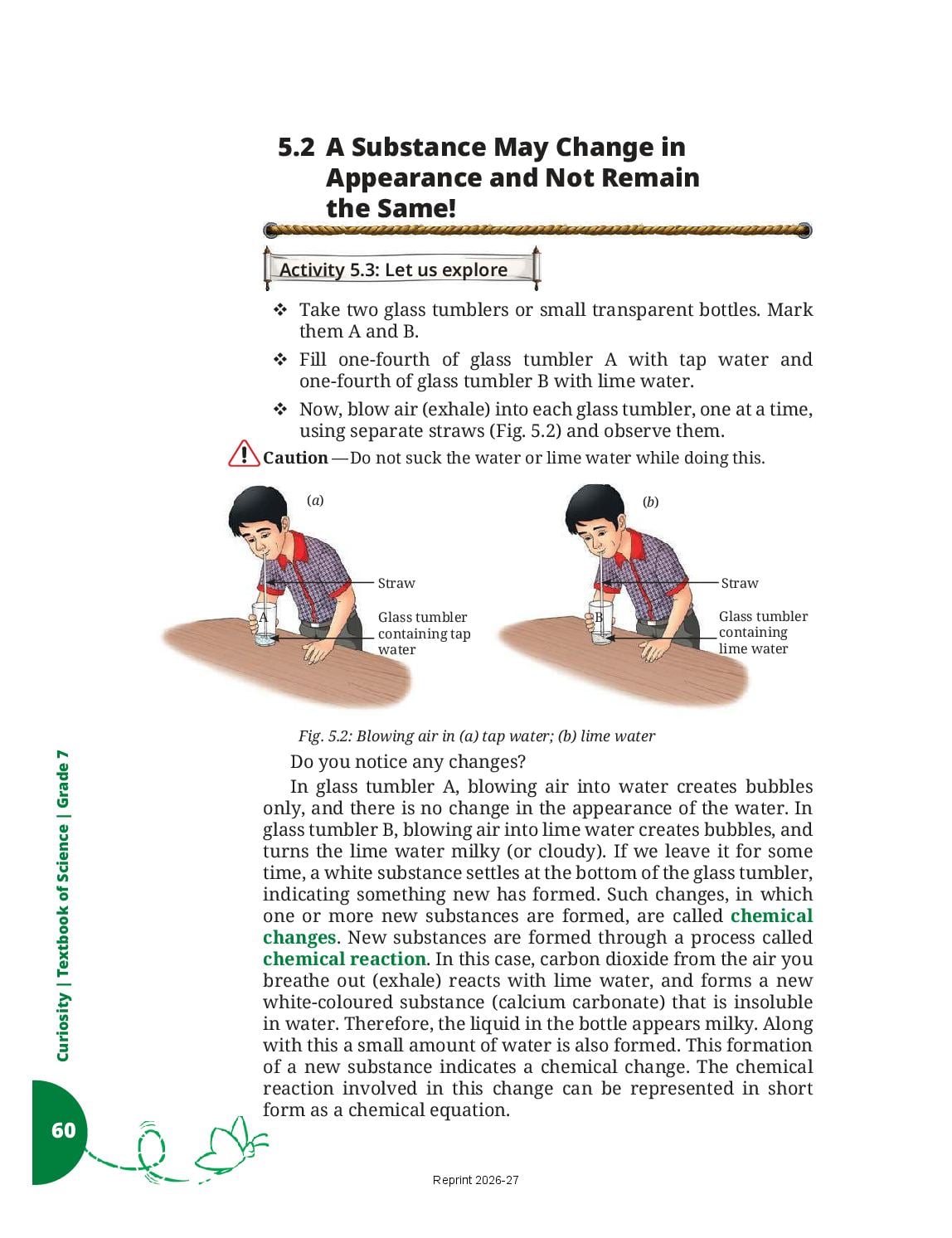
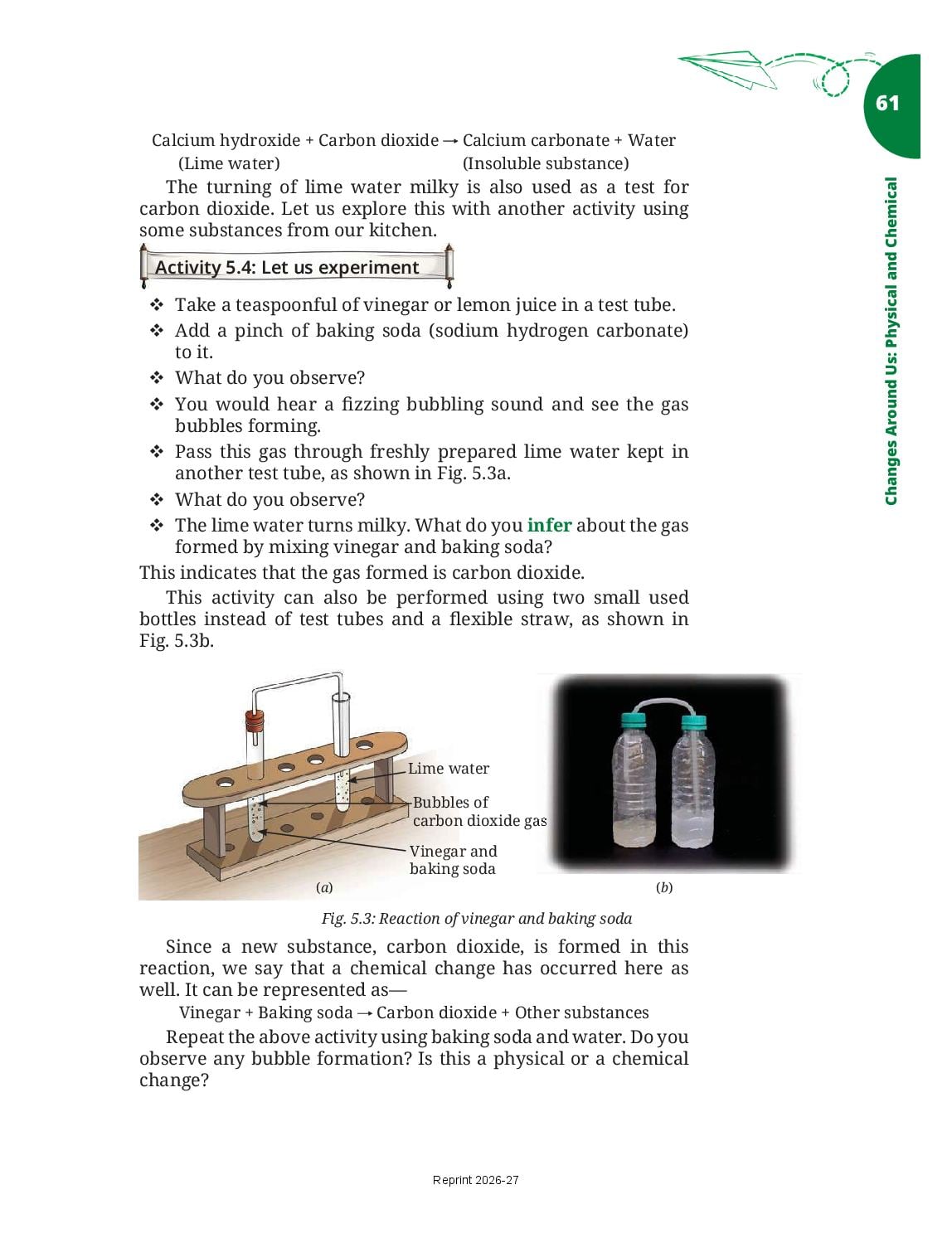
- A chemical change forms one or more new substances through a chemical reaction, which can be written in short as a chemical equation. Blowing air into lime water, vinegar + baking soda, rusting and burning are chemical changes.
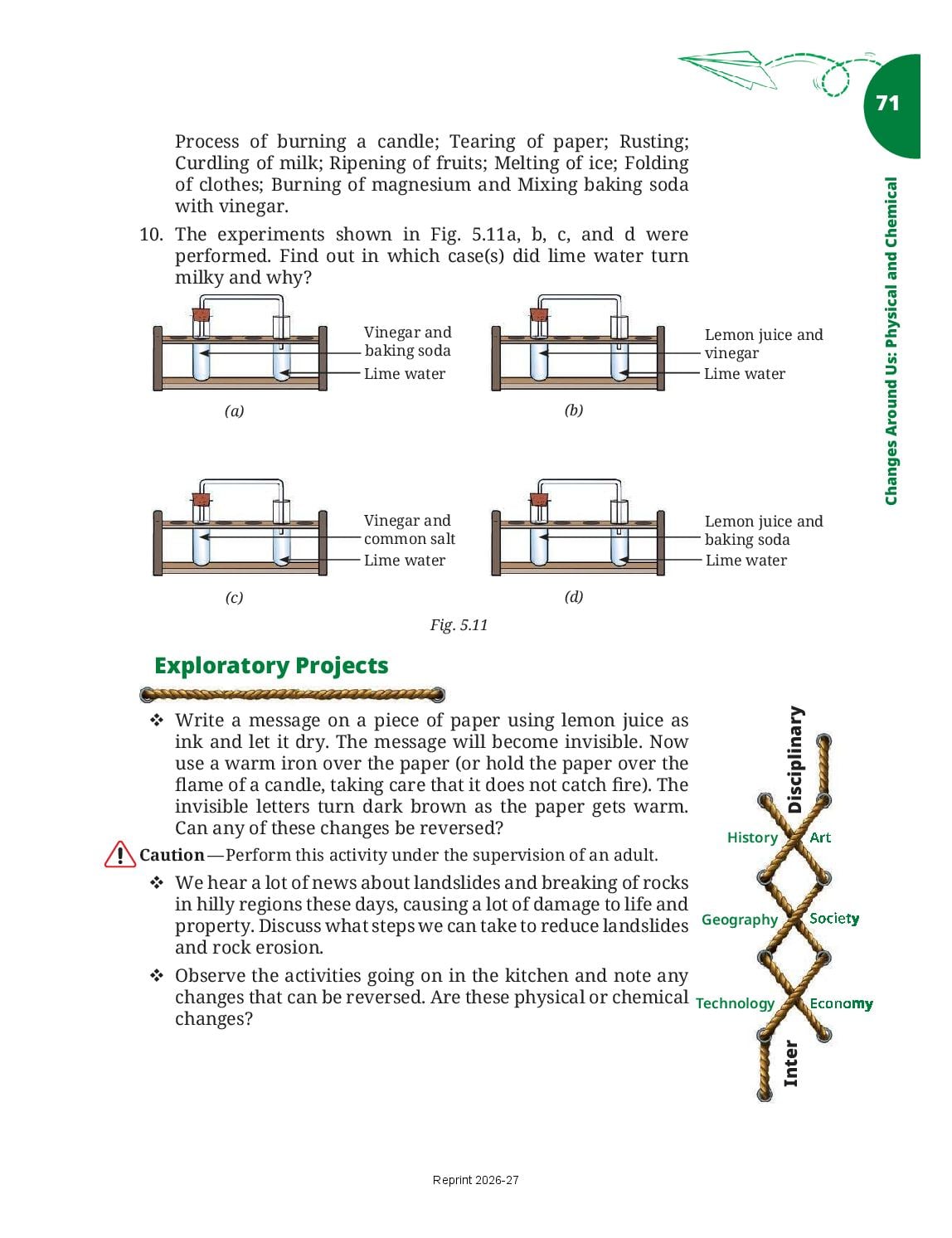
- Lime water turning milky is the standard test for carbon dioxide. Calcium hydroxide + Carbon dioxide → Calcium carbonate (insoluble, white) + Water.
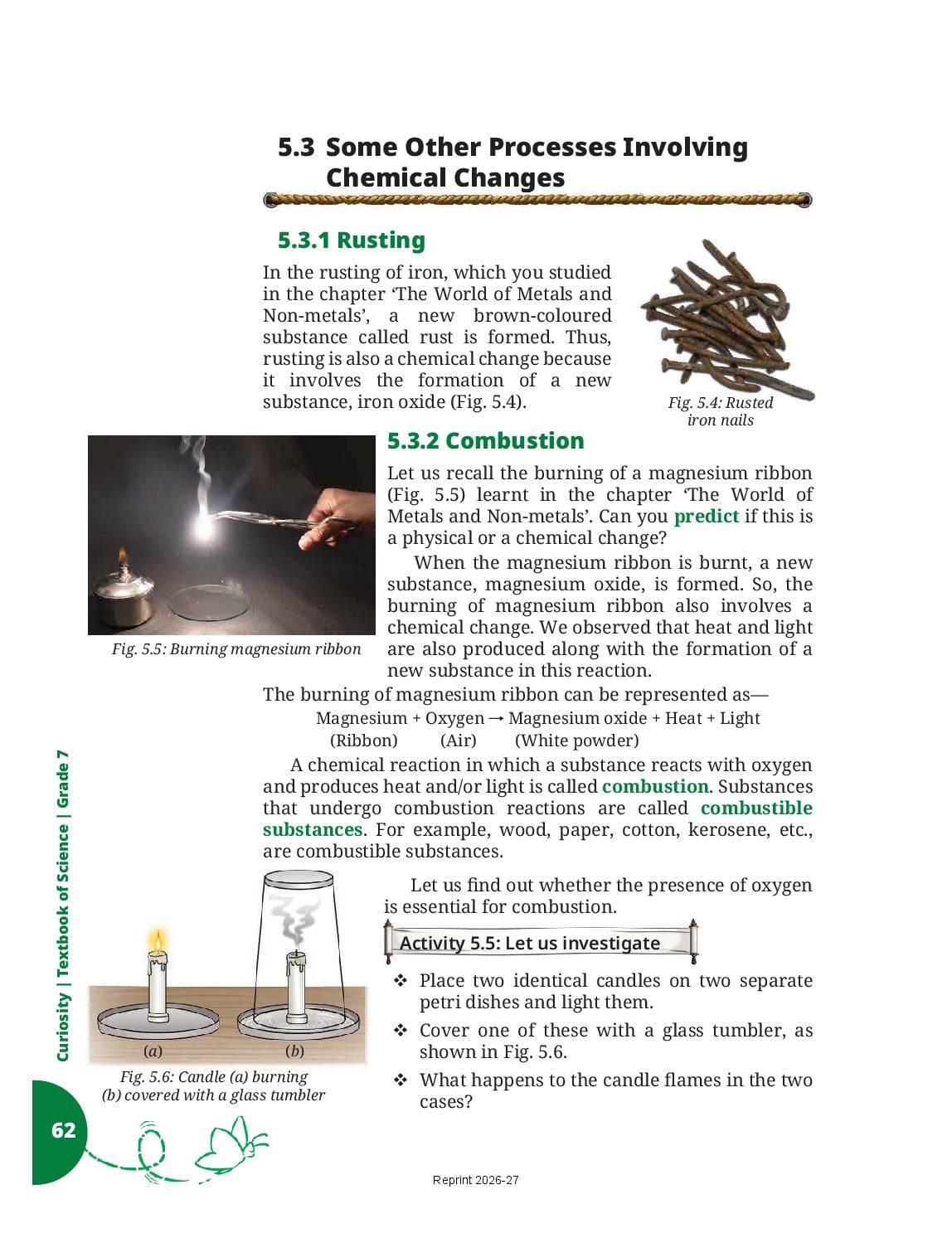
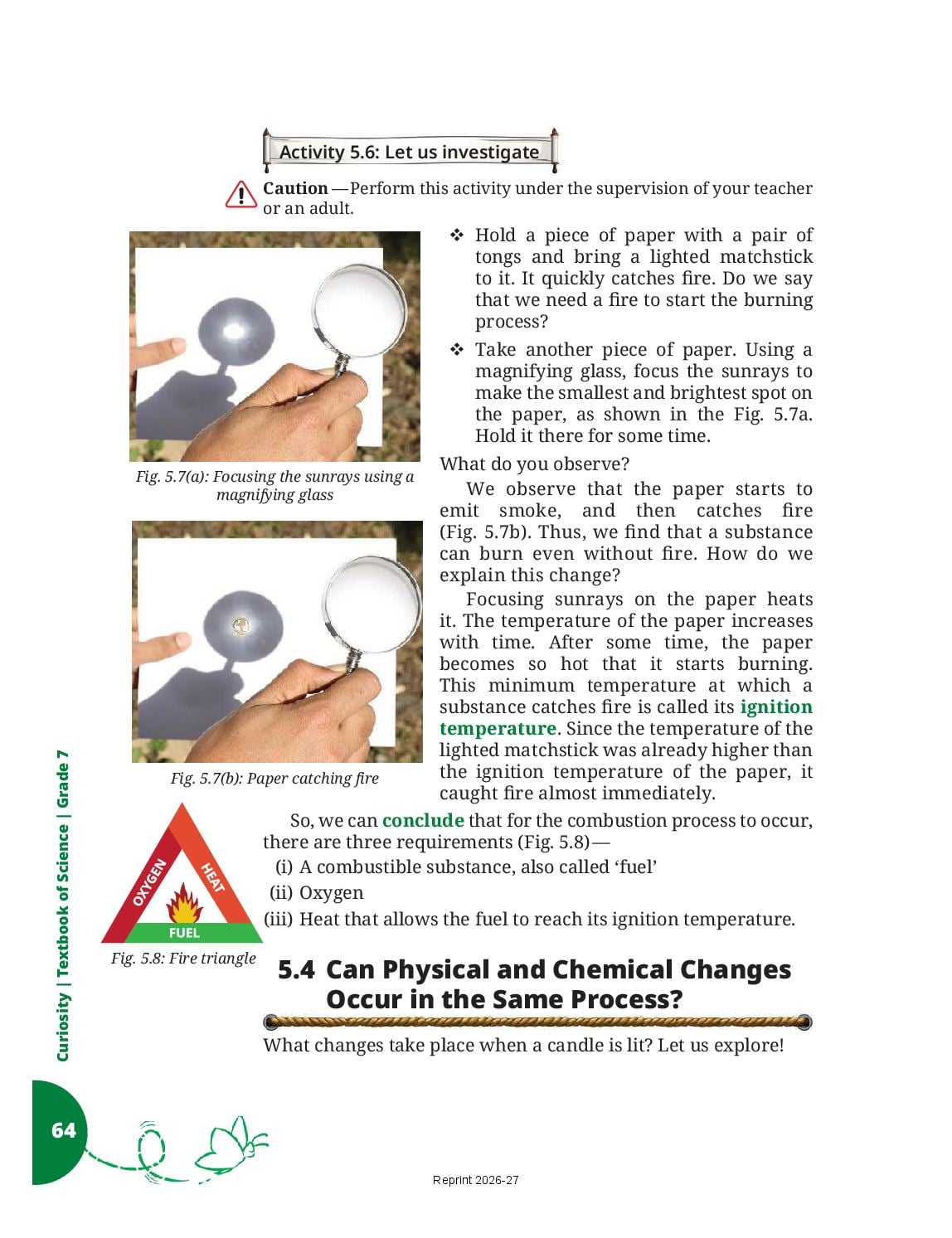
- Combustion is a reaction with oxygen that gives out heat and/or light. It needs three things — the fire triangle: a combustible substance (fuel), oxygen, and enough heat to reach the ignition temperature.
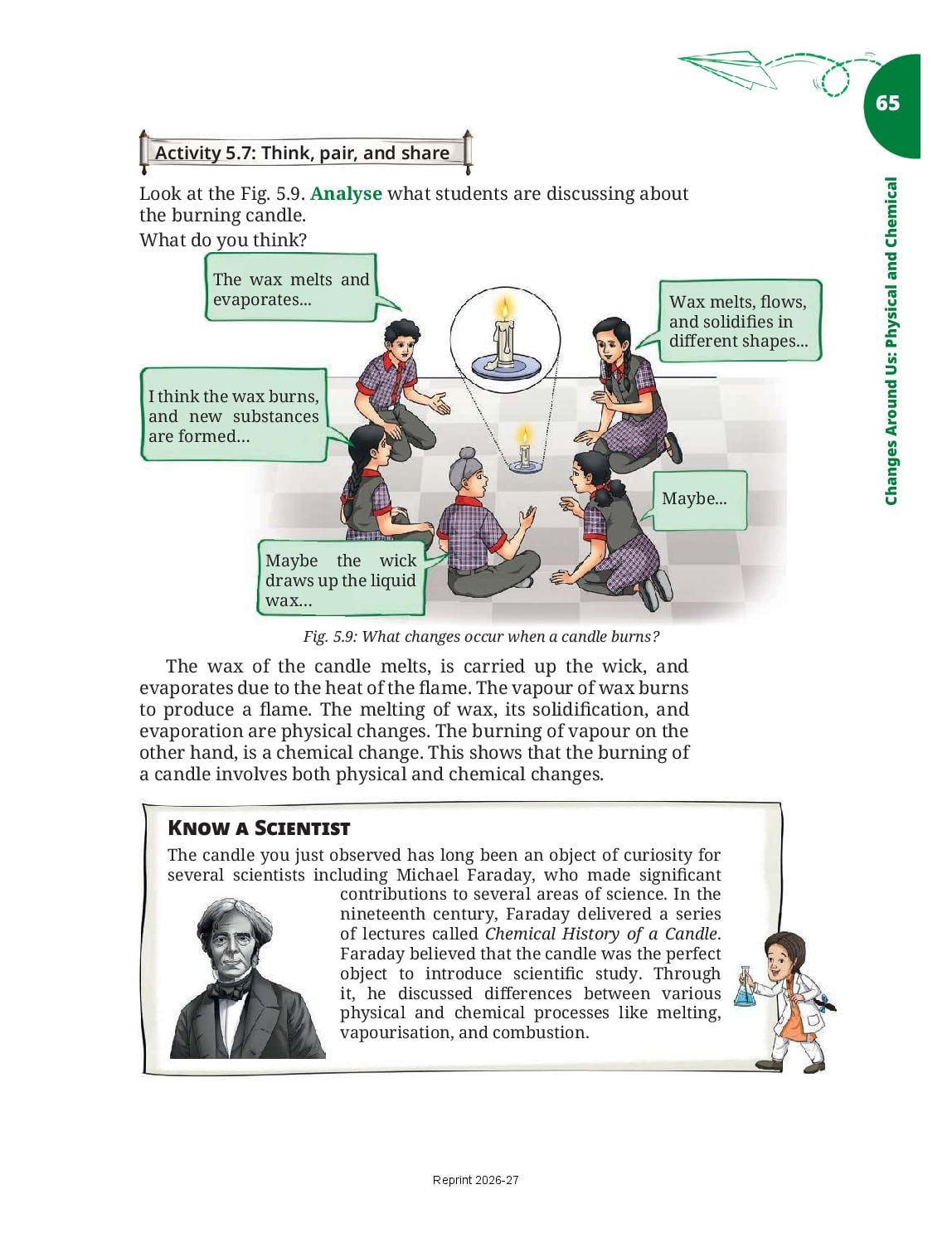
- One process can involve both kinds of change. In a burning candle, melting, flowing, solidifying and evaporating of wax are physical; the burning of wax vapour is chemical.
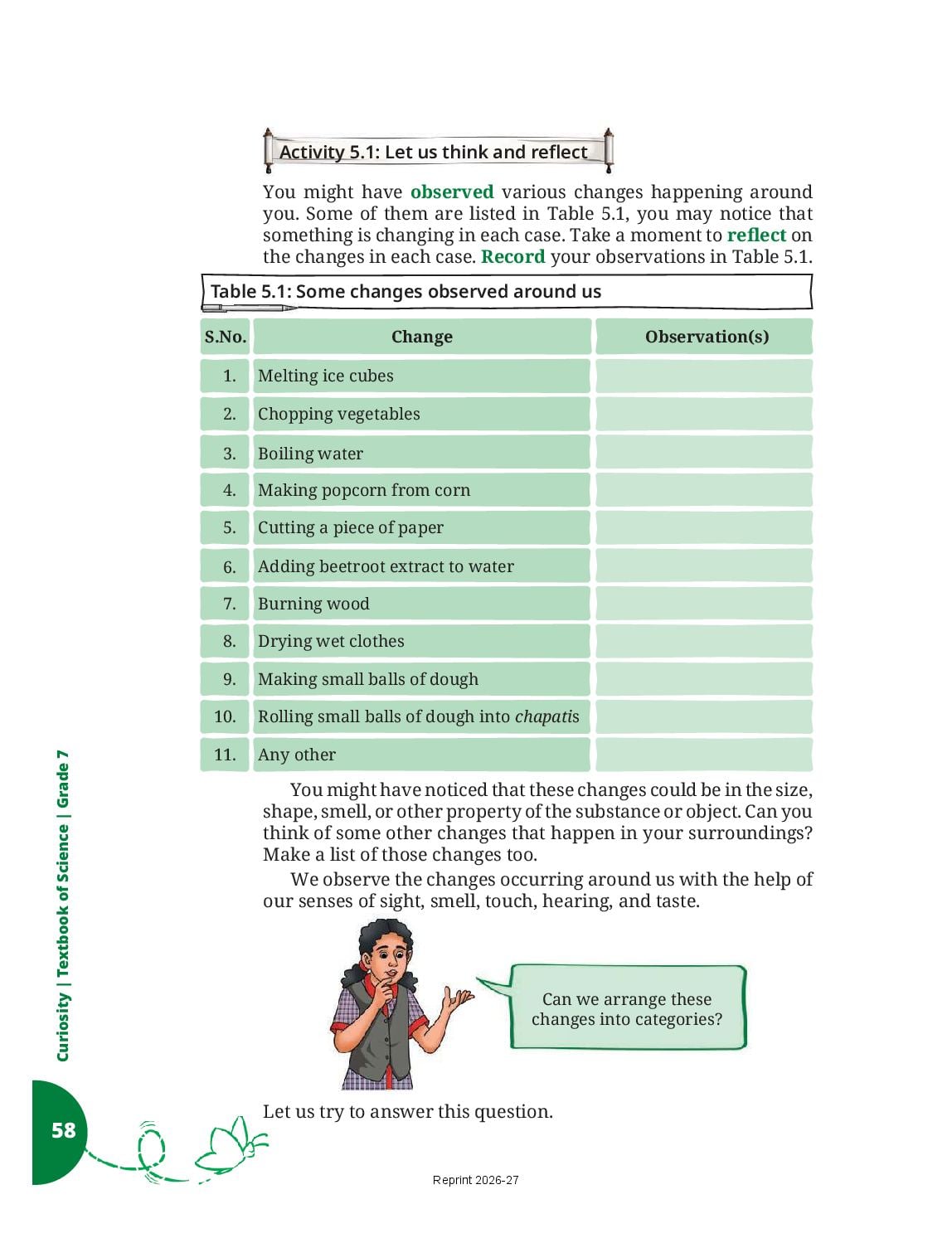
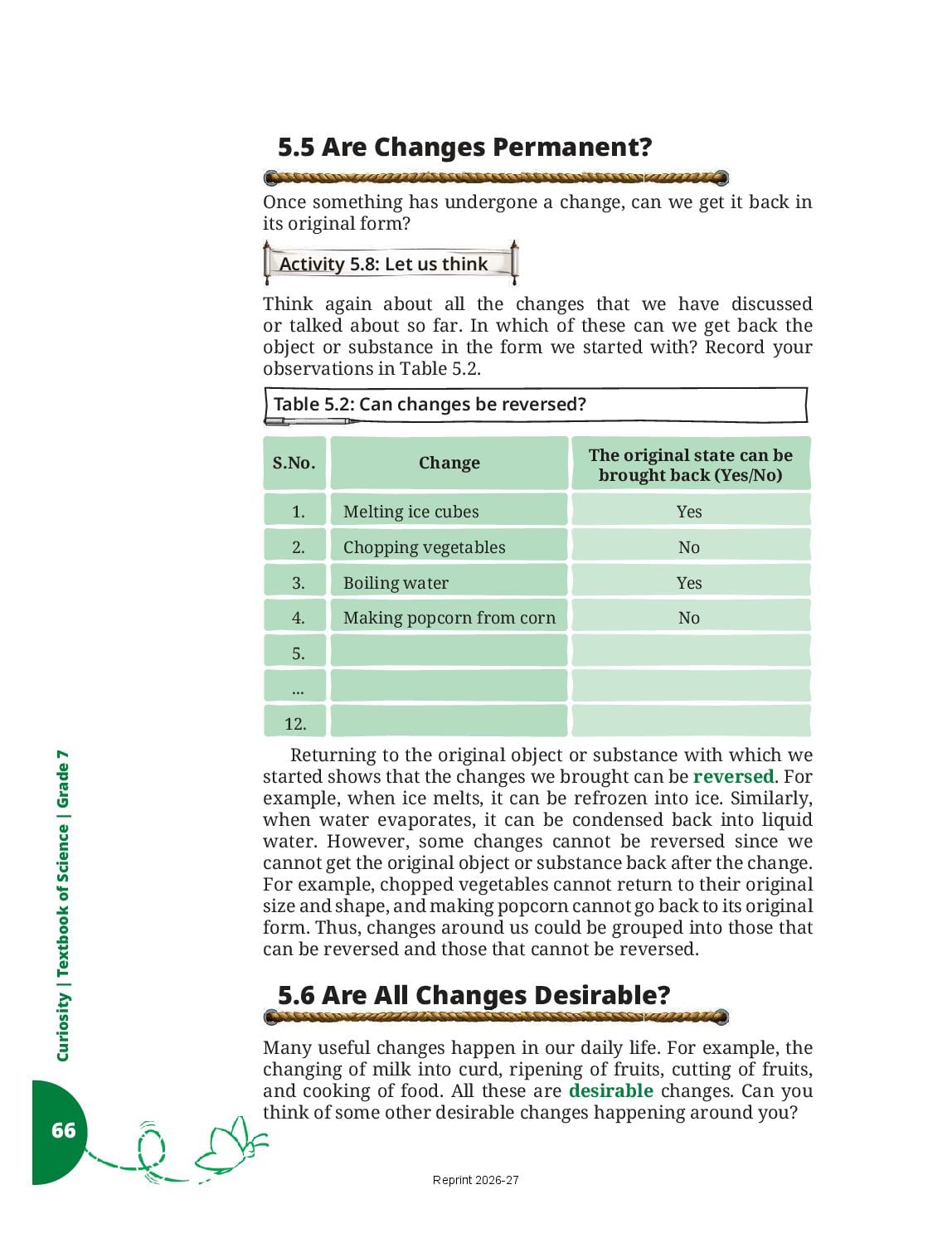
- Some changes can be reversed (melting ice, boiling water) and some cannot (chopping vegetables, making popcorn). Some are desirable (milk to curd, cooking) and some undesirable (rusting, food decay) — and the same change can be either, depending on the situation.
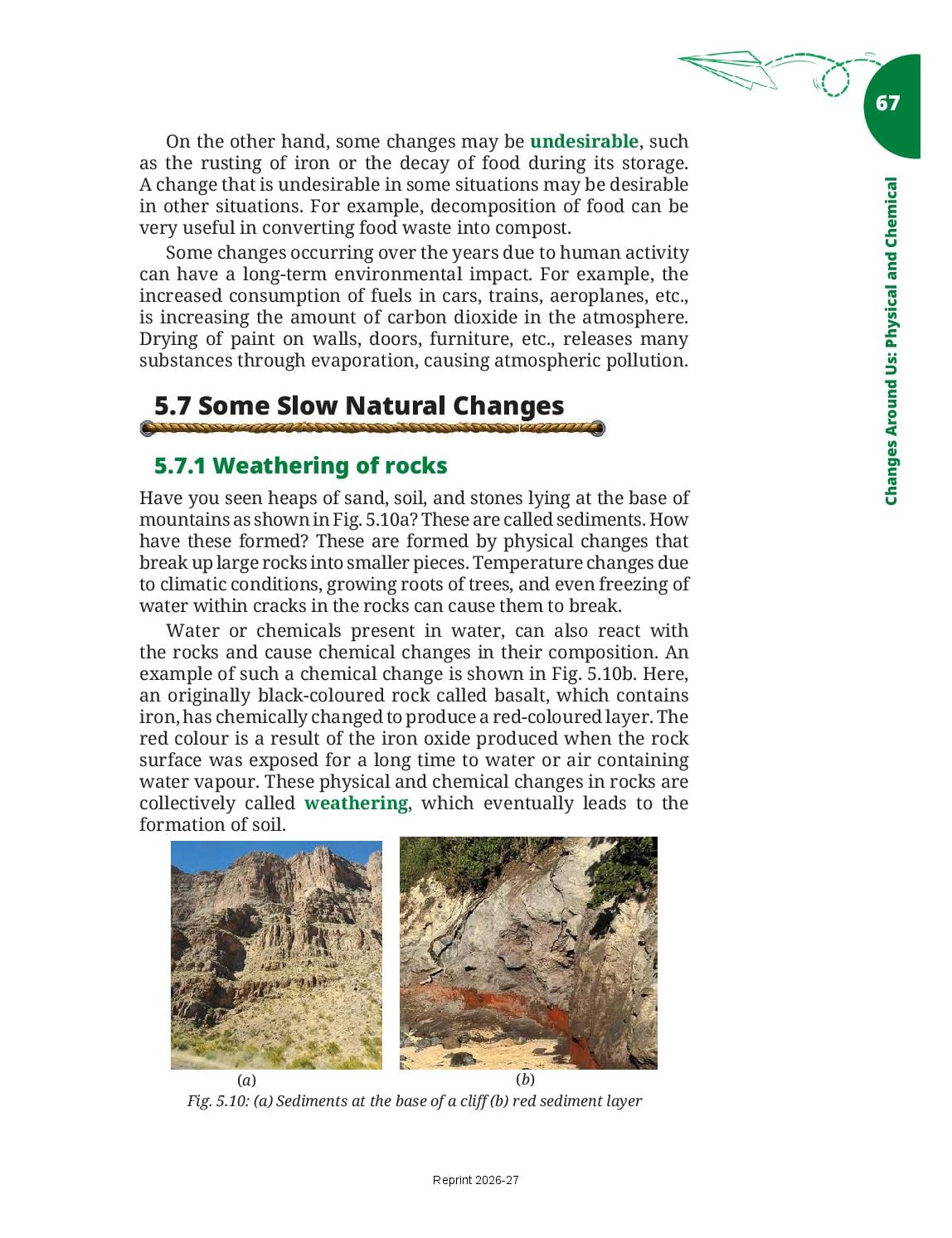
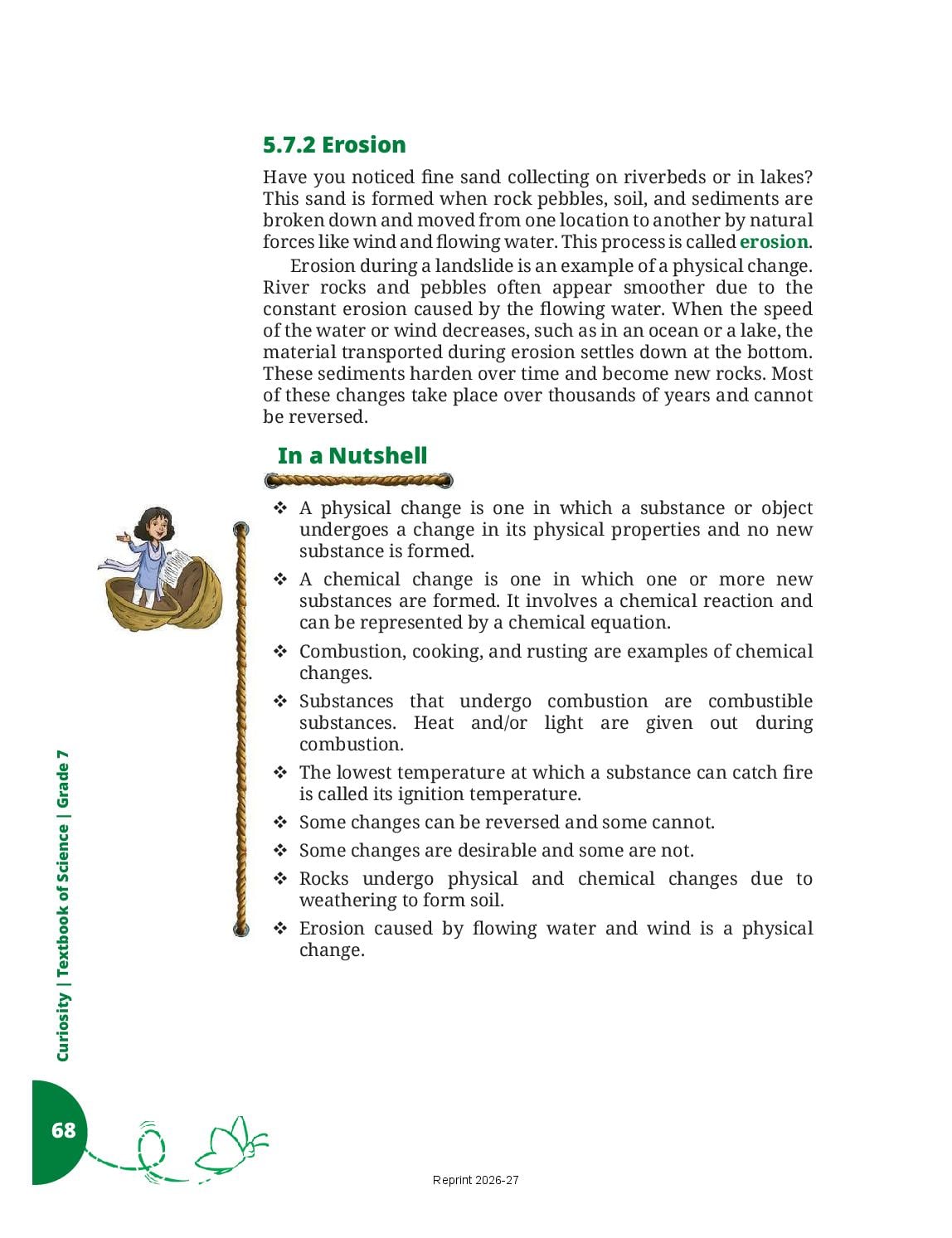
- Slow natural changes shape the Earth: weathering (physical breaking plus chemical attack on rocks) forms soil, and erosion by flowing water and wind is a physical change that carries the pieces away.
Quick revision – Changes Around Us: Physical and Chemical
| Term | What it means | Where it comes in the chapter | Example from the book |
|---|---|---|---|
| Physical change | A change in which only physical properties (shape, size, state) change and no new substance is formed | Section 5.1, page 59 | Folding paper into objects; crushing chalk into powder; melting ice |
| Chemical change | A change in which one or more new substances are formed | Section 5.2, page 60 | Blowing air into lime water — a white insoluble substance settles |
| Chemical reaction | The process by which new substances are formed in a chemical change | Page 60 | Calcium hydroxide reacting with carbon dioxide |
| Chemical equation | The short form in which a chemical reaction is written | Page 61 | Vinegar + Baking soda → Carbon dioxide + Other substances |
| Lime water test | Lime water turns milky (cloudy) when carbon dioxide is passed through it | Activity 5.3 and 5.4, pages 60–61 | Used to identify the gas from vinegar and baking soda |
| Rusting | Formation of a new brown substance, iron oxide, on iron | Section 5.3.1, page 62 | Rusted iron nails, Fig. 5.4 |
| Combustion | A chemical reaction in which a substance reacts with oxygen and produces heat and/or light | Section 5.3.2, page 62 | Magnesium + Oxygen → Magnesium oxide + Heat + Light |
| Combustible substance | A substance that undergoes combustion; also called a fuel | Page 62 | Wood, paper, cotton, kerosene |
| Ignition temperature | The minimum temperature at which a substance catches fire | Activity 5.6, page 64 | Paper reaches it when sunrays are focused on it with a lens |
| Fire triangle | The three requirements for combustion — fuel, oxygen and heat | Fig. 5.8, page 64 | Covering a candle with a tumbler removes oxygen, so it goes out |
| Reversible / irreversible change | A change in which the original substance can / cannot be brought back | Section 5.5, page 66 | Melting ice — yes; making popcorn — no |
| Weathering | The physical and chemical changes that break down rocks and finally form soil | Section 5.7.1, page 67 | Black basalt turning red from iron oxide, Fig. 5.10b |
| Erosion | Carrying away of broken rock, soil and sediment by wind and flowing water — a physical change | Section 5.7.2, page 68 | Smooth river pebbles; fine sand on riverbeds |
Old NCERT vs New – Class 7 Science
This chapter is from Curiosity, the new NCERT Class 7 Science book (NCF-SE 2023, used from 2025-26). It replaced the old book “Science”, so chapter numbers and names differ from older PDFs.
Solutions and All Chapters
Answers to the exercises and the full chapter list of Curiosity:
Changes Around Us: Physical and Chemical – Overview
| Class | Class 7 |
| Subject | Science |
| Book | Curiosity – new NCERT book |
| Chapter | 5 of 12 – Changes Around Us: Physical and Chemical |
| Book pages | 57 – 72 |
| Edition | NCERT Reprint 2026-27 |
| Session | 2026-27 |
| Free – read online or download |
Class 7 Science Chapter 5 – FAQs
Where can I download Changes Around Us: Physical and Chemical Class 7 PDF?
From the download table on this page – the chapter PDF is free, and the full book is linked too.
What is Class 7 Science Chapter 5 about?
A physical change alters only physical properties such as shape, size or state. No new substance is formed — folding paper, crushing chalk, melting ice.
Is Changes Around Us: Physical and Chemical from the new NCERT Class 7 Science book?
Yes. It is chapter 5 of curiosity, the new NCERT Class 7 Science book for 2026-27.
Is this the latest NCERT edition for 2026-27?
Yes – the PDF is NCERT’s latest edition for the 2026-27 session.
Where are the NCERT Solutions for Class 7 Science Chapter 5?
Open the NCERT Solutions link above for answers to the exercise questions.