NCERT Solutions for Class 6 Maths Chapter 1 Patterns in Mathematics – step-by-step answers to every exercise and in-text question of the chapter, as per the latest NCERT syllabus for 2027. Read them online or download the free question-answer PDF.
Solutions to all questions of Chapter 1 Patterns in Mathematics of Ganita Prakash: the Figure it Out questions on pages 2, 3, 5, 8–9 and 11–12 and the in-text questions on pages 6 and 7, with pictures that explain each pattern.
NCERT Solutions for Class 6 Maths Chapter 1 Patterns in Mathematics PDF
All the answers are on this page below. The PDF also explains every answer – why it is right and how to check it – so download it for revision.
| Chapter | Download | |
|---|---|---|
| Solutions PDF (English medium) | Patterns in Mathematics | View PDF |
| Solutions PDF (Hindi medium) | गणित में पैटर्न | View PDF |
NCERT Solutions for Class 6 Maths Chapter 1 Patterns in Mathematics – Questions and Answers
All 29 questions of the chapter (textbook pages 1 – 12) are answered below, in the order of the book – in-text questions, activities and the end-of-chapter exercises. Each answer is written the way you would write it in the exam.
Figure it Out — Page 2Section 1.1 What is Mathematics?
Mathematics helps us every day, for example:
- Shopping — adding up a bill and checking the change we get back.
- Cooking — measuring flour and water; doubling a recipe for more guests.
- Travel — reading a bus or train timetable; working out how long a journey takes.
- At home — counting tiles for a floor; planning how to spend pocket money.
Mathematics explains patterns, and these explanations become tools that move humanity forward:
- Science and space — patterns in the motion of planets led to the theory of gravitation, which lets us launch satellites and send rockets to the Moon and Mars.
- Economy and democracy — budgets, banking, the census and counting votes all use arithmetic.
- Buildings and machines — bridges, houses, phones, computers, trains and planes are designed using calculation and geometry.
- Time — calendars and clocks come from patterns in the motion of the Sun and Moon.
Figure it Out — Page 3Section 1.2 Patterns in Numbers
| 1, 1, 1, 1, 1, 1, 1, … | (All 1’s) |
| 1, 2, 3, 4, 5, 6, 7, … | (Counting numbers) |
| 1, 3, 5, 7, 9, 11, 13, … | (Odd numbers) |
| 2, 4, 6, 8, 10, 12, 14, … | (Even numbers) |
| 1, 3, 6, 10, 15, 21, 28, … | (Triangular numbers) |
| 1, 4, 9, 16, 25, 36, 49, … | (Squares) |
| 1, 8, 27, 64, 125, 216, … | (Cubes) |
| 1, 2, 3, 5, 8, 13, 21, … | (Virahānka numbers) |
| 1, 2, 4, 8, 16, 32, 64, … | (Powers of 2) |
| 1, 3, 9, 27, 81, 243, 729, … | (Powers of 3) |
Yes. Each sequence is made by repeating one simple rule:
| Sequence | Pattern |
|---|---|
| All 1’s | Every number is 1. |
| Counting numbers | Add 1 each time. |
| Odd numbers | Start at 1 and add 2 each time. |
| Even numbers | Start at 2 and add 2 each time. |
| Triangular numbers | Add 2, then 3, then 4, then 5, … |
| Squares | A number multiplied by itself: 1 × 1, 2 × 2, 3 × 3, … |
| Cubes | A number multiplied by itself three times: 1 × 1 × 1, 2 × 2 × 2, … |
| Virahānka numbers | Each number is the sum of the two before it (5 + 8 = 13). |
| Powers of 2 | Double the previous number. |
| Powers of 3 | Multiply the previous number by 3. |
| 1, 1, 1, 1, 1, 1, 1, … | (All 1’s) |
| 1, 2, 3, 4, 5, 6, 7, … | (Counting numbers) |
| 1, 3, 5, 7, 9, 11, 13, … | (Odd numbers) |
| 2, 4, 6, 8, 10, 12, 14, … | (Even numbers) |
| 1, 3, 6, 10, 15, 21, 28, … | (Triangular numbers) |
| 1, 4, 9, 16, 25, 36, 49, … | (Squares) |
| 1, 8, 27, 64, 125, 216, … | (Cubes) |
| 1, 2, 3, 5, 8, 13, 21, … | (Virahānka numbers) |
| 1, 2, 4, 8, 16, 32, 64, … | (Powers of 2) |
| 1, 3, 9, 27, 81, 243, 729, … | (Powers of 3) |
The next three numbers of every sequence are shown in orange, and the rule is written beside it.
| Number sequence | Sequence given in Table 1 | Next three numbers | Rule in your own words |
|---|---|---|---|
| All 1’s | 1, 1, 1, 1, 1, 1, 1, … | 1, 1, 1 | Every number is 1. Nothing ever changes. |
| Counting numbers | 1, 2, 3, 4, 5, 6, 7, … | 8, 9, 10 | Add 1 to the previous number. |
| Odd numbers | 1, 3, 5, 7, 9, 11, 13, … | 15, 17, 19 | Start at 1 and keep adding 2. These are the numbers not divisible by 2. |
| Even numbers | 2, 4, 6, 8, 10, 12, 14, … | 16, 18, 20 | Start at 2 and keep adding 2. These are the multiples of 2. |
| Triangular numbers | 1, 3, 6, 10, 15, 21, 28, … | 36, 45, 55 | Add 2, then 3, then 4, … each time (28 + 8 = 36). |
| Squares | 1, 4, 9, 16, 25, 36, 49, … | 64, 81, 100 | Multiply a counting number by itself (8 × 8 = 64). |
| Cubes | 1, 8, 27, 64, 125, 216, … | 343, 512, 729 | Multiply a counting number by itself three times (7 × 7 × 7 = 343). |
| Virahānka numbers | 1, 2, 3, 5, 8, 13, 21, … | 34, 55, 89 | Each number is the sum of the two numbers just before it. |
| Powers of 2 | 1, 2, 4, 8, 16, 32, 64, … | 128, 256, 512 | Double the previous number. |
| Powers of 3 | 1, 3, 9, 27, 81, 243, 729, … | 2,187; 6,561; 19,683 | Multiply the previous number by 3. |
Figure it Out — Page 5Section 1.3 Visualising Number Sequences
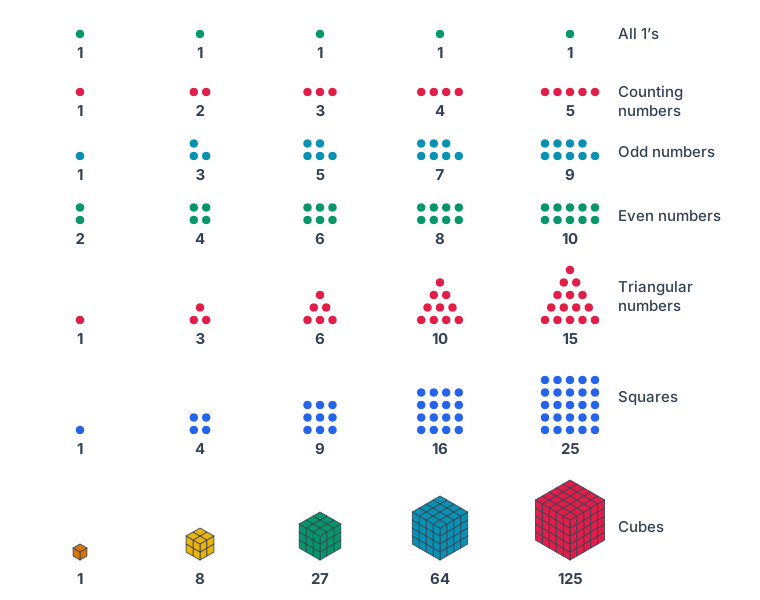
The next (sixth) picture of each sequence:
| Sequence | Next picture to draw | Number |
|---|---|---|
| All 1’s | one more single dot | 1 |
| Counting numbers | a line of 6 dots | 6 |
| Odd numbers | two rows: 5 dots on top of 6 dots | 11 |
| Even numbers | two rows of 6 dots | 12 |
| Triangular numbers | a triangle with rows of 1, 2, 3, 4, 5, 6 dots | 21 |
| Squares | a 6 × 6 square of dots | 36 |
| Cubes | a 6 × 6 × 6 cube of small cubes | 216 |
They are named after the shape their dots (or small cubes) can be arranged in:
- Triangular numbers — the dots fit exactly in a triangle, with rows of 1, 2, 3, … dots (6 = 1 + 2 + 3).
- Square numbers — the dots fit exactly in a square with equal rows and columns (9 = 3 × 3).
- Cubes — that many small cubes fit exactly into a solid cube with equal length, breadth and height (27 = 3 × 3 × 3).
This shows that the same number can be represented differently, and play different roles, depending on the context. Try representing some other numbers pictorially in different ways!
As a square: 6 × 6 = 36 (6 rows of 6)
Other numbers: 64 is a square (8 × 8) and also a cube (4 × 4 × 4); 12 dots can be drawn as 2 rows of 6 or as 3 rows of 4.
That’s right, they are called hexagonal numbers! Draw these in your notebook. What is the next number in the sequence?
They are hexagonal numbers. The next number is 61.
Each picture adds a ring of dots around the last one: 6, 12, 18, … dots (multiples of 6). The next ring has 24 dots, so 37 + 24 = 61.
Yes. Make each picture out of copies of the picture before it.
Powers of 2 — each picture is two copies of the previous one: 1, 2, 4, 8, 16, …
Powers of 3 — each picture is three copies of the previous one: 1, 3, 9, 27, …
In-text Questions — Page 6Section 1.4 Relations among Number Sequences
1 = 1
1 + 3 = 4
1 + 3 + 5 = 9
1 + 3 + 5 + 7 = 16
1 + 3 + 5 + 7 + 9 = 25
1 + 3 + 5 + 7 + 9 + 11 = 36
…
This is a really beautiful pattern! Why does this happen? Do you think it will happen forever?
Yes, it happens forever: adding the odd numbers starting from 1 always gives a square number.
Why: the next odd number is exactly what is needed to turn one square of dots into the next bigger square — one more row, one more column and the corner dot. For example, 16 (4 × 4) + 9 = 25 (5 × 5). This works for a square of any size.
Cut the square into L-shaped layers, starting from one corner. In a 6 × 6 grid the layers have 1, 3, 5, 7, 9 and 11 dots:
In-text Questions — Page 7Section 1.4 Relations among Number Sequences
The first 10 odd numbers are the L-shaped layers of a 10 × 10 square of dots, so their sum is 10 × 10:
Answer: 100
Imagine a 100 × 100 square of dots split into 100 L-shaped layers. The layers hold the first 100 odd numbers, 1, 3, 5, …, 199:
Answer: 10,000
Figure it Out — Pages 8 & 9Section 1.4 Relations among Number Sequences
Yes. Split a square grid of dots along its slanting lines (diagonals). In a 6 × 6 square the slanting lines hold 1, 2, 3, 4, 5, 6, 5, 4, 3, 2, 1 dots:
The middle (largest) number is the side of the square. Here it is 100, so imagine a 100 × 100 square of dots:
Answer: 10,000
(a) Adding the All 1’s sequence up:
1 + 1 = 2
1 + 1 + 1 = 3
1 + 1 + 1 + 1 = 4 …
We get 1, 2, 3, 4, 5, … — the counting numbers.
(b) Adding the All 1’s sequence up and down:
1 + 1 + 1 = 3
1 + 1 + 1 + 1 + 1 = 5
1 + 1 + 1 + 1 + 1 + 1 + 1 = 7 …
We get 1, 3, 5, 7, 9, … — the odd numbers.
1 + 2 = 3
1 + 2 + 3 = 6
1 + 2 + 3 + 4 = 10
1 + 2 + 3 + 4 + 5 = 15 …
We get 1, 3, 6, 10, 15, … — the triangular numbers.
We get 4, 9, 16, 25, 36, … — the square numbers.
Why: a square of dots cut along its diagonal splits into two triangles, one just smaller than the other — like 15 and 10 dots in a 5 × 5 square.
Adding up:
1 + 2 = 3
1 + 2 + 4 = 7
1 + 2 + 4 + 8 = 15
1 + 2 + 4 + 8 + 16 = 31 …
Adding 1 to each:
We get 2, 4, 8, 16, 32, … — the powers of 2 again!
Why: each sum is one less than the next power of 2. The extra 1 joins the first 1 to make 2, that joins the next 2 to make 4, then 8, 16, …
(3 × 6) + 1 = 19
(6 × 6) + 1 = 37
(10 × 6) + 1 = 61
(15 × 6) + 1 = 91
We get 7, 19, 37, 61, 91, … — the hexagonal numbers (from question 4 of page 5).
Why: remove the centre dot of a hexagonal number; the other dots split into 6 equal triangles. So hexagonal number = 6 × triangular number + 1 (37 = 6 × 6 + 1).
1 + 7 = 8
1 + 7 + 19 = 27
1 + 7 + 19 + 37 = 64
1 + 7 + 19 + 37 + 61 = 125
We get 1, 8, 27, 64, 125, … — the cube numbers.
Why (cube picture): build a 4 × 4 × 4 cube from small cubes: start with 1 cube; add 7 cubes to make 2 × 2 × 2, then 19 to make 3 × 3 × 3, then 37 to make 4 × 4 × 4. Seen from a corner, each added shell looks like a hexagon of dots.
| 1, 1, 1, 1, 1, 1, 1, … | (All 1’s) |
| 1, 2, 3, 4, 5, 6, 7, … | (Counting numbers) |
| 1, 3, 5, 7, 9, 11, 13, … | (Odd numbers) |
| 2, 4, 6, 8, 10, 12, 14, … | (Even numbers) |
| 1, 3, 6, 10, 15, 21, 28, … | (Triangular numbers) |
| 1, 4, 9, 16, 25, 36, 49, … | (Squares) |
| 1, 8, 27, 64, 125, 216, … | (Cubes) |
| 1, 2, 3, 5, 8, 13, 21, … | (Virahānka numbers) |
| 1, 2, 4, 8, 16, 32, 64, … | (Powers of 2) |
| 1, 3, 9, 27, 81, 243, 729, … | (Powers of 3) |
(you can find others):
- Adding even numbers: 2, 2 + 4 = 6, 2 + 4 + 6 = 12, 2 + 4 + 6 + 8 = 20 → 2, 6, 12, 20, …, double the triangular numbers. Two equal triangles of dots make a rectangle (1 × 2, 2 × 3, 3 × 4, …).
- Differences of squares: 4 − 1 = 3, 9 − 4 = 5, 16 − 9 = 7 → the odd numbers (the L-shaped layers of page 7).
Figure it Out — Page 11Section 1.5 Patterns in Shapes

Yes. Each shape sequence follows one clear rule:
| Shape sequence | Rule for going to the next shape | Related number sequence |
|---|---|---|
| Regular Polygons | Add one more side (and one more corner) each time — triangle, quadrilateral, pentagon, hexagon, … | 3, 4, 5, 6, 7, 8, 9, 10 … |
| Complete Graphs Kn | Add one more dot, then join it to every dot already there. | 1, 3, 6, 10, 15 … (triangular) |
| Stacked Squares | Add one more row and one more column of small squares. | 1, 4, 9, 16, 25 … (squares) |
| Stacked Triangles | Add one more row of small triangles at the bottom. | 1, 4, 9, 16, 25 … (squares) |
| Koch Snowflake | Replace every straight line segment by a “speed bump” of 4 smaller segments. | 3, 12, 48, 192 … (3 × powers of 4) |
Yes, the next shape can be drawn for all of them, but the Koch Snowflake soon becomes too tiny to draw by hand.
| Sequence | Next shape | Rule in own words |
|---|---|---|
| Regular Polygons | a regular polygon with 11 sides | add one more side (and corner); keep all sides and corners equal |
| Complete Graphs | K7: 7 dots, each joined to all the others (21 lines) | add one dot and join it to every dot |
| Stacked Squares | 6 rows of 6 = 36 little squares | add one row and one column |
| Stacked Triangles | 6 rows, 36 little triangles | add one row of triangles at the bottom |
| Koch Snowflake | 768 × 4 = 3,072 tiny segments — very hard to draw by hand | replace every segment by a ‘speed bump’ of 4 smaller segments |
Figure it Out — Pages 11 & 12Section 1.6 Relation to Number Sequences
| Shape | Triangle | Quadrilateral | Pentagon | Hexagon | Heptagon | Octagon | Nonagon | Decagon |
|---|---|---|---|---|---|---|---|---|
| Sides | 3 | 4 | 5 | 6 | 7 | 8 | 9 | 10 |
| Corners | 3 | 4 | 5 | 6 | 7 | 8 | 9 | 10 |
Both rows give the same sequence — the counting numbers starting from 3: 3, 4, 5, 6, 7, 8, 9, 10, …
Why: going round a closed shape, each side ends at a corner and each corner joins two sides, so a closed shape has as many corners as sides.
| Complete graph | K2 | K3 | K4 | K5 | K6 | K7 |
|---|---|---|---|---|---|---|
| Dots | 2 | 3 | 4 | 5 | 6 | 7 |
| Lines | 1 | 3 | 6 | 10 | 15 | 21 |
We get 1, 3, 6, 10, 15, 21, … — the triangular numbers.
Why: each new dot is joined to all the dots already there, so the new lines are 2, then 3, then 4, …: 1, 1 + 2 = 3, 3 + 3 = 6, 6 + 4 = 10, 10 + 5 = 15.
We get the square numbers.
Why: each shape is a big square with as many rows as columns. The 4th shape has 4 rows of 4 little squares = 4 × 4 = 16; the 5th has 5 × 5 = 25.
Again we get the square numbers.
Why (using the hint): the rows hold 1, 3, 5, 7, … little triangles (row 3 has 3 pointing up and 2 pointing down). Adding odd numbers gives squares: 1 + 3 + 5 + 7 = 16 = 4 × 4.
The starting shape is an equilateral triangle with 3 line segments. Each step replaces every single segment by a speed bump made of 4 smaller segments, so the count is multiplied by 4 every time.
| Stage | 1st | 2nd | 3rd | 4th | 5th |
|---|---|---|---|---|---|
| Line segments | 3 | 12 | 48 | 192 | 768 |
| As a product | 3 | 3 × 4 | 3 × 4 × 4 | 3 × 4 × 4 × 4 | 3 × 4 × 4 × 4 × 4 |
The number sequence is 3, 12, 48, 192, 768, …, that is 3 × the powers of 4. (This sequence is not in Table 1.)
Chapter 1 of 10 – Maths
- Next: Chapter 2 Lines and Angles
- All chapters: NCERT Solutions Class 6 Maths
Also for This Chapter
NCERT Solutions Class 6 Maths Chapter 1 Patterns in Mathematics – Overview
| Class | Class 6 |
| Subject | Maths |
| Chapter | 1 – Patterns in Mathematics |
| Textbook pages | 1 – 12 |
| Questions solved | 29 |
| Session | 2027 |
| Format | Full answers on this page + PDF |
NCERT Solutions Class 6 Maths Chapter 1 – FAQs
Where can I download NCERT Solutions Class 6 Maths Chapter 1 Patterns in Mathematics PDF?
Read every answer on this page, or download the free PDF from the table at the top.
Is this for the 2027 session?
Yes, it follows the latest NCERT Class 6 Maths book for 2027.
How many questions are solved in NCERT Class 6 Maths Chapter 1?
All 29 questions of the chapter (textbook pages 1 – 12) – the in-text questions, activities and the end-of-chapter exercises.
How should I use these solutions?
Read the chapter in the NCERT book first, attempt the questions yourself, then check your answers here.