Download Water-The Essence of Life – NCERT Class 5 EVS Chapter 1 PDF from the new NCERT Class 5 EVS book Our Wondrous World (2026-27). Read the chapter online or download the free PDF. Most of Earth’s water is salty. Look at the picture on page 4. A glass holds 200 ml of water. A teaspoon holds 5 ml. If all the water on Earth were that full glass, all the freshwater would be only that one teaspoon. Freshwater is water without…
Water-The Essence of Life PDF – Chapter 1 of Our Wondrous World
Read the chapter online or download the PDF.
| Chapter | Download | |
|---|---|---|
| Chapter 1 PDF | Water-The Essence of Life | View PDF |
| Full book | NCERT Class 5 EVS – Our Wondrous World | View Book |
Read Online
What Is in Water-The Essence of Life? (Class 5 EVS Chapter 1)
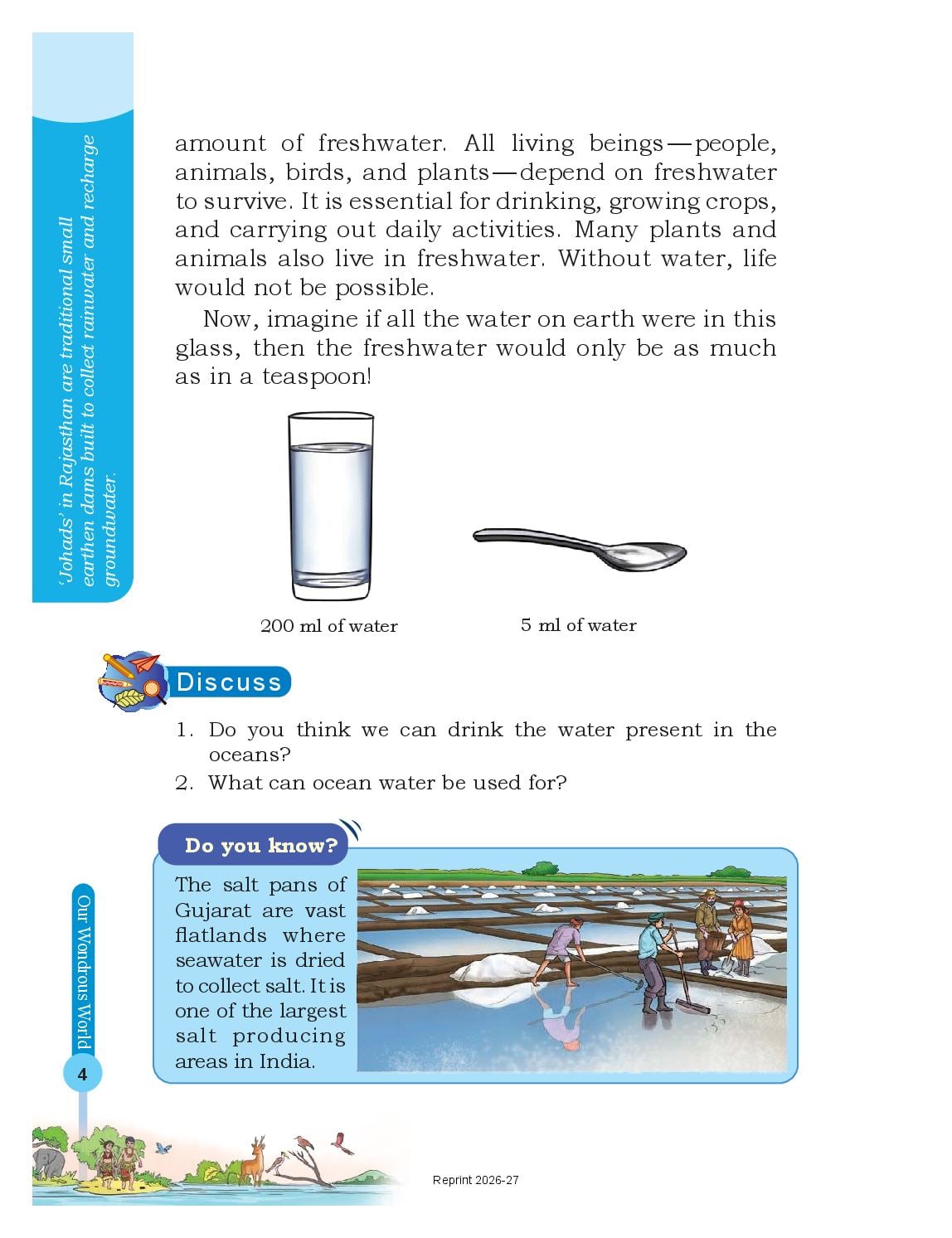
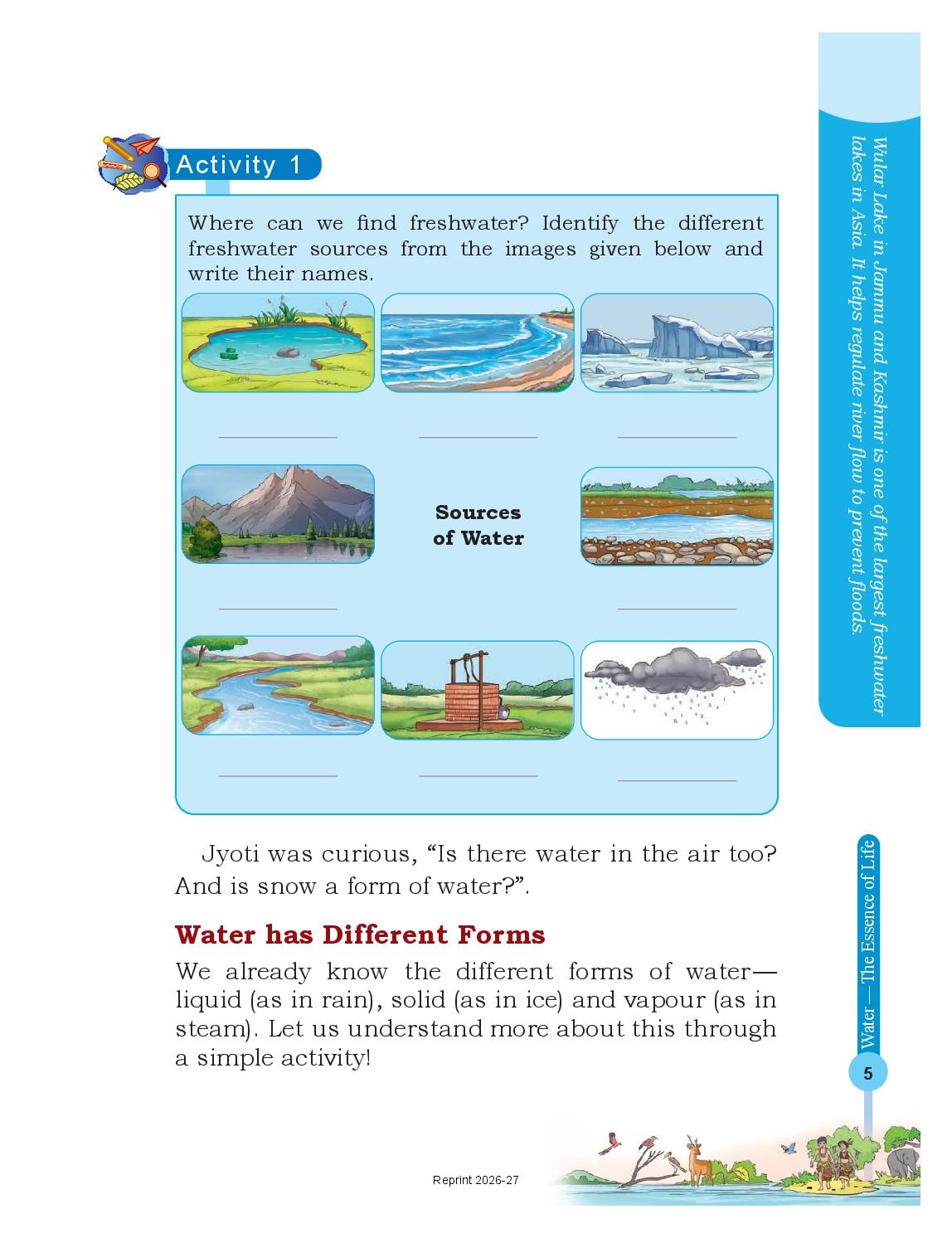
- Most of Earth’s water is salty. Look at the picture on page 4. A glass holds 200 ml of water. A teaspoon holds 5 ml. If all the water on Earth were that full glass, all the freshwater would be only that one teaspoon. Freshwater is water without salt. We can drink it, cook with it and water crops with it. Sea water is salty, so we cannot use it that way.
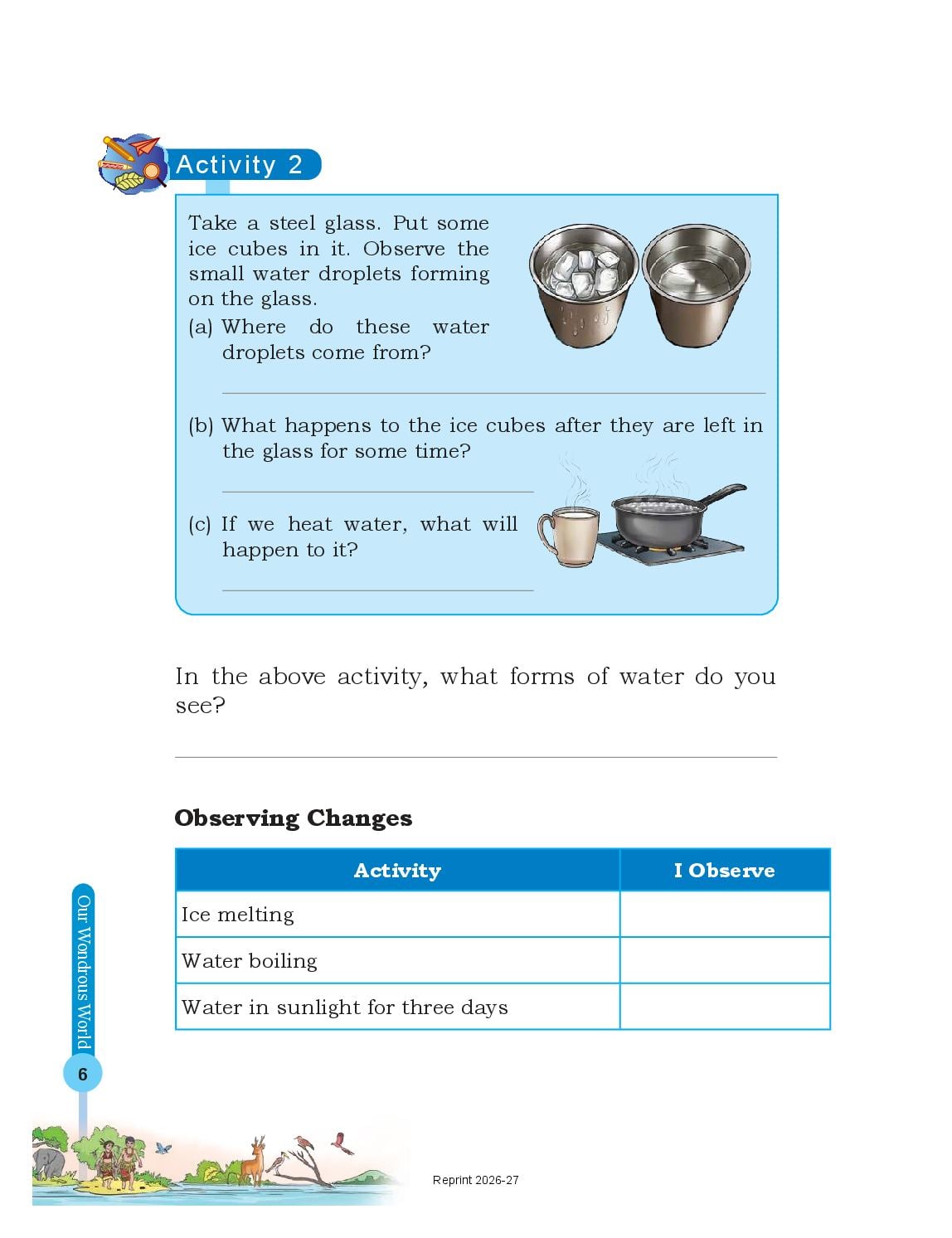
- Water has three forms. Solid — ice and snow. Liquid — the water we drink, rain, river water. Vapour — the invisible water that floats in the air, and the steam above a boiling pan. It is the same water each time. Only its form changes. Heat changes water into vapour. Cooling changes vapour back into water. Very strong cooling makes ice.
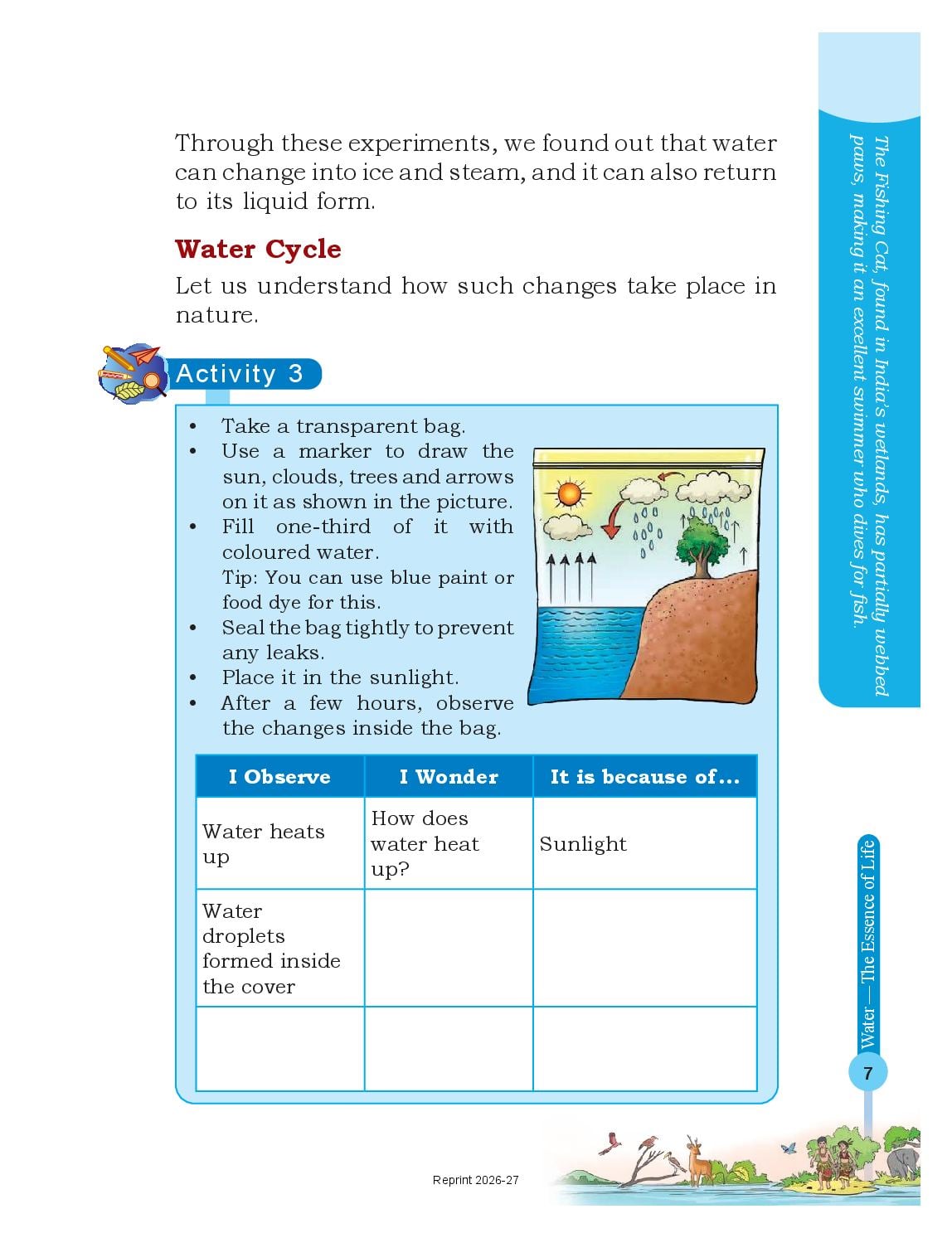
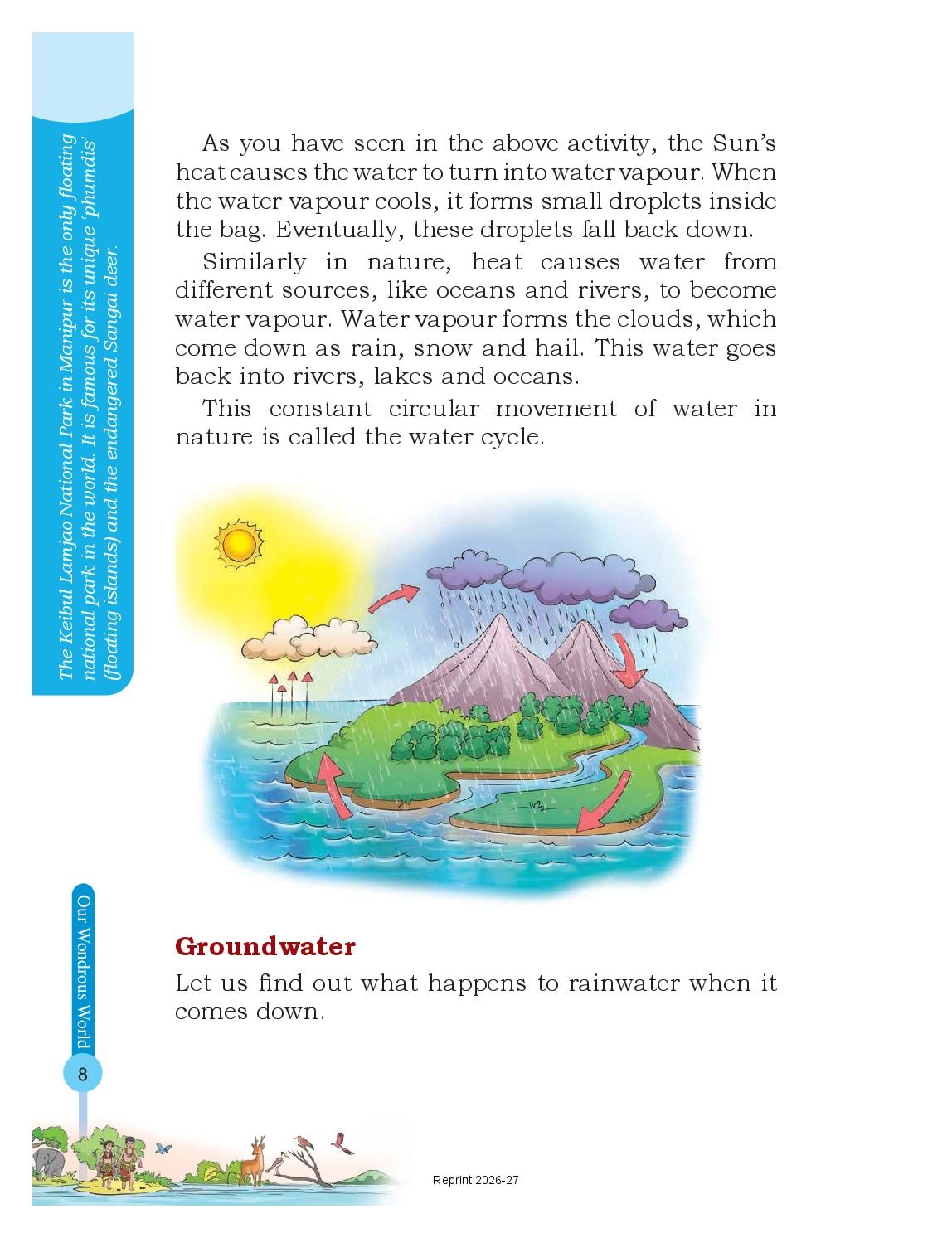
- The water cycle is water going round and round. The Sun heats water in oceans, rivers and lakes. The water turns into water vapour and rises. High up the air is cold, so the vapour cools and makes tiny drops — these drops make clouds. When the drops grow heavy they fall as rain, snow or hail. That water runs into rivers, lakes and oceans, and the round trip starts again. This never-ending movement is called the water cycle.
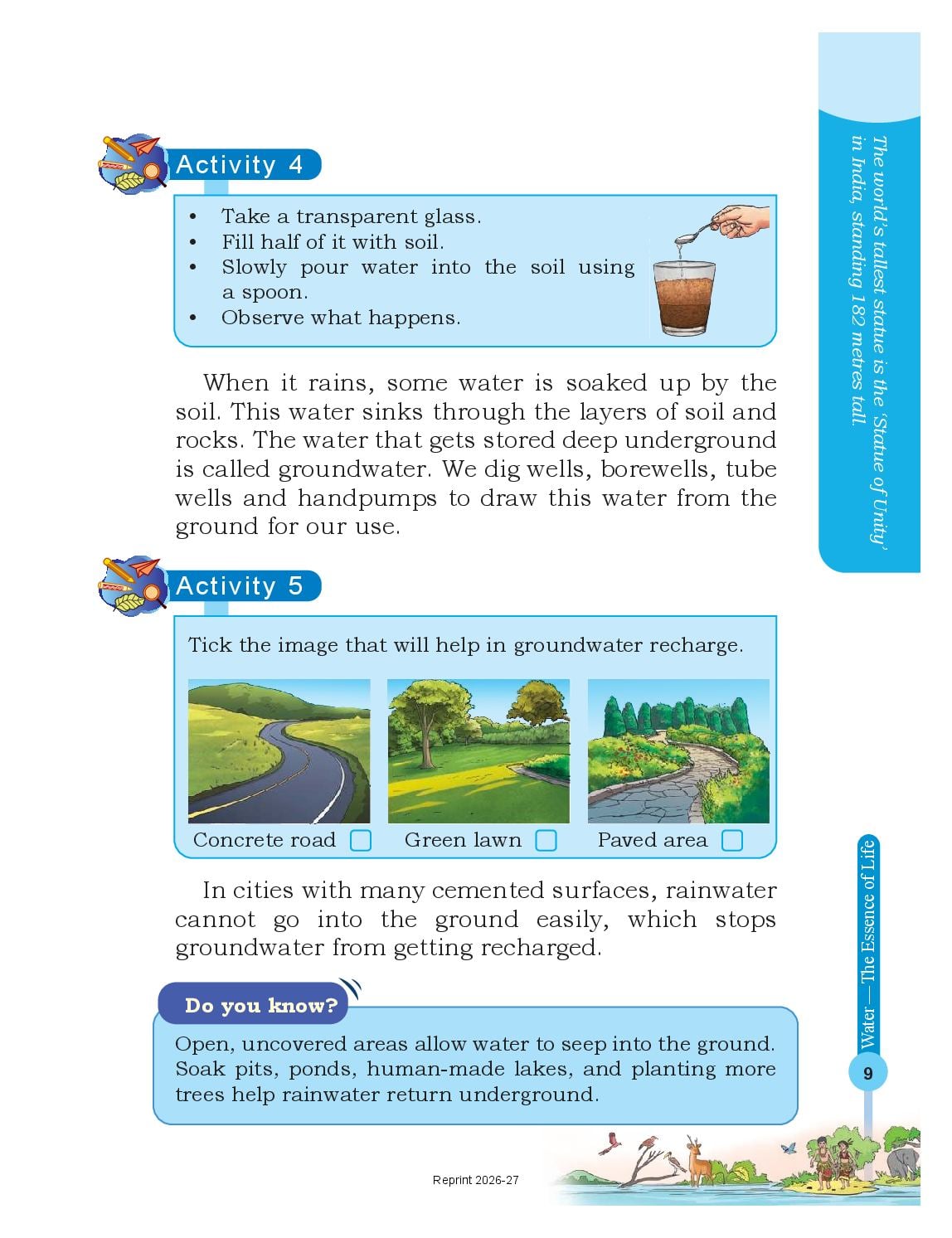
- Some rainwater goes underground. Soil is not solid all through. There are tiny gaps between soil grains. Rainwater soaks into these gaps and sinks down through layers of soil and rock. Water stored deep below the ground is called groundwater. We reach it with wells, borewells, tube wells and handpumps.
- Open ground recharges groundwater; hard surfaces do not. Rain that falls on grass, soil, a field or a forest soaks in. Rain that falls on a cement road, a paved courtyard or a roof runs away into drains. That is why cities with lots of concrete lose their groundwater. Soak pits, ponds, human-made lakes and more trees help rainwater get back underground. In Rajasthan, small earthen dams called johads have done this job for hundreds of years.
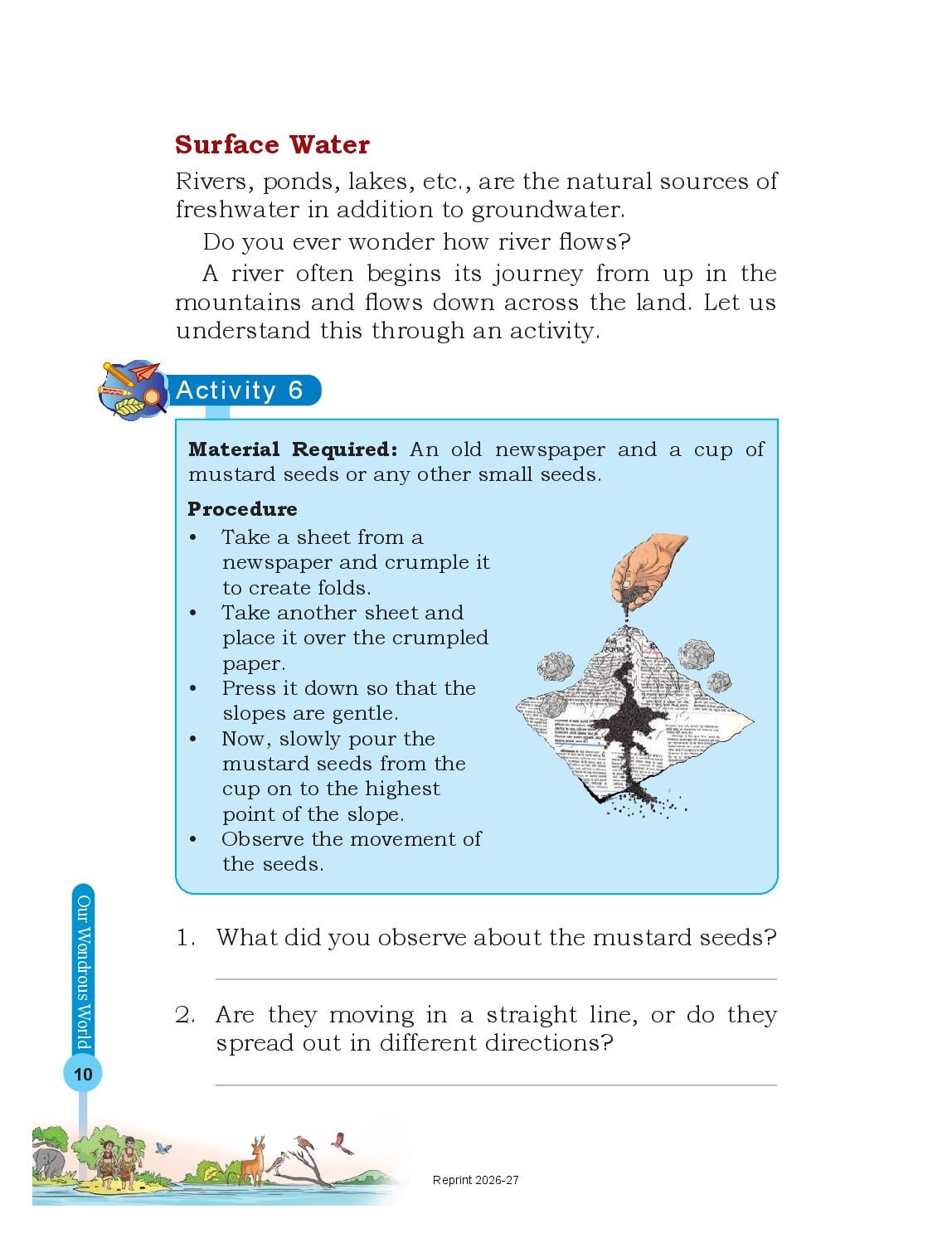
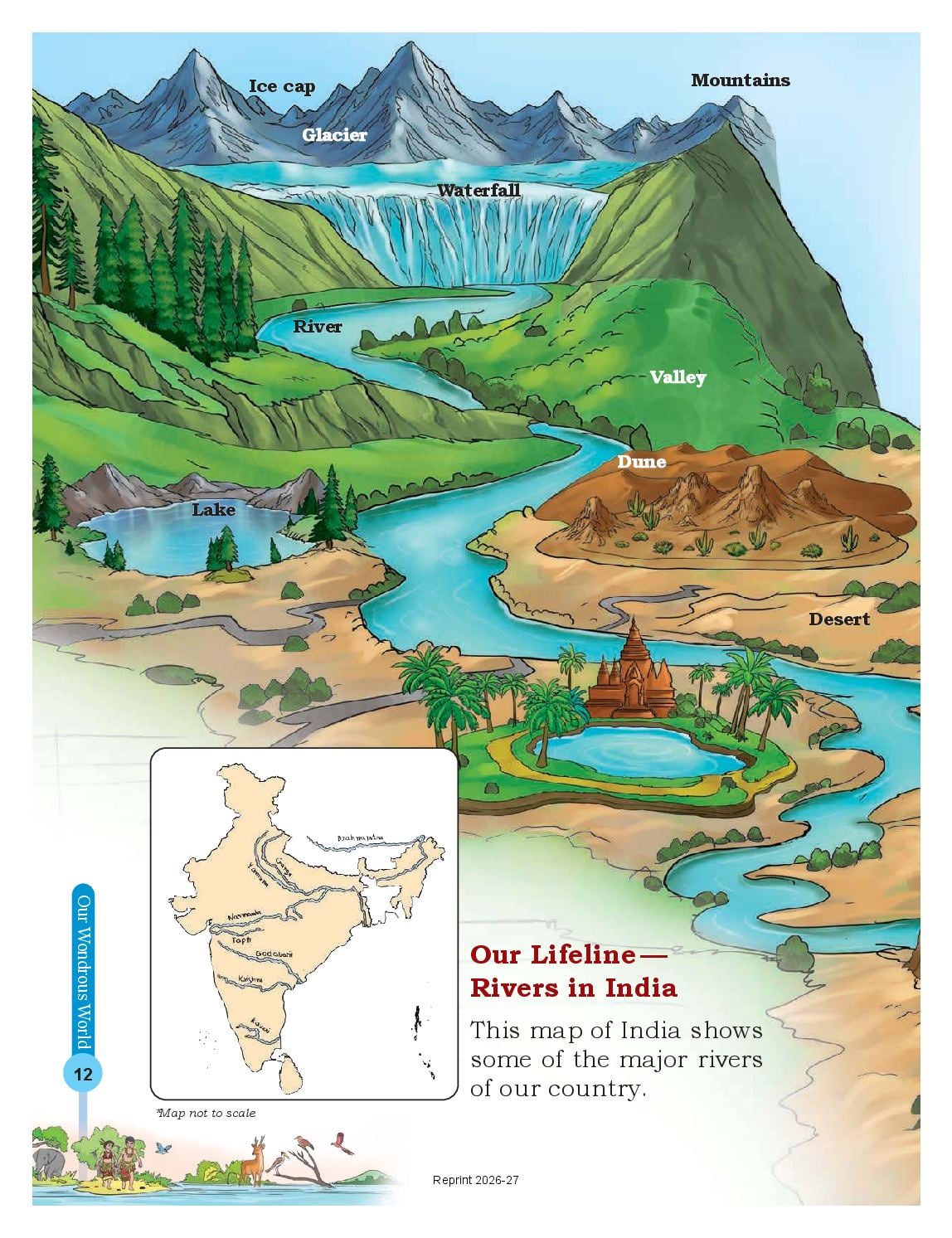
- Rivers, ponds and lakes are surface water. A river usually begins high up in the mountains and flows down across the land. Water always moves from higher ground to lower ground. It bends, stops and spreads according to the shape of the land in its path. Over a long time the flowing water also changes the shape of the land itself.
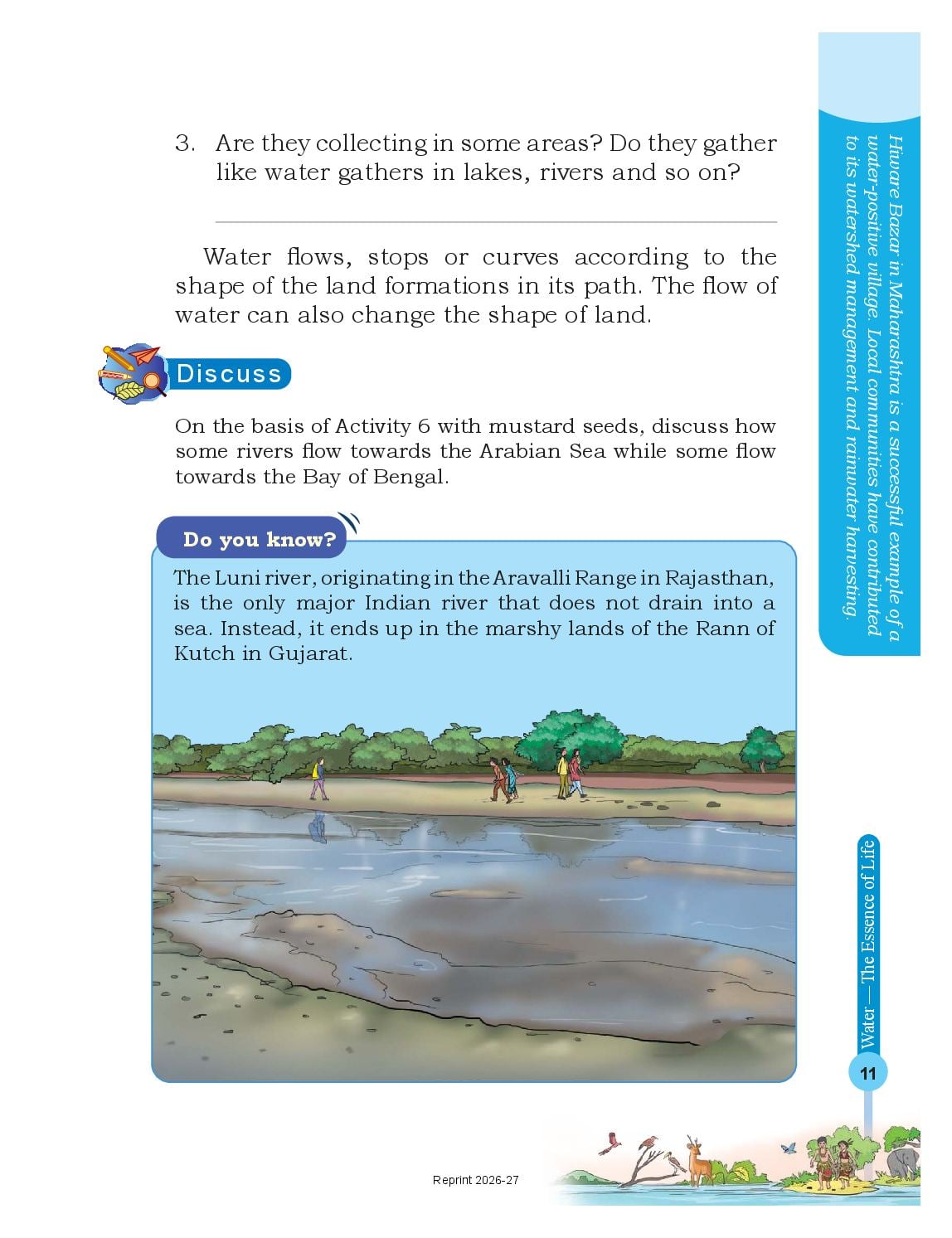
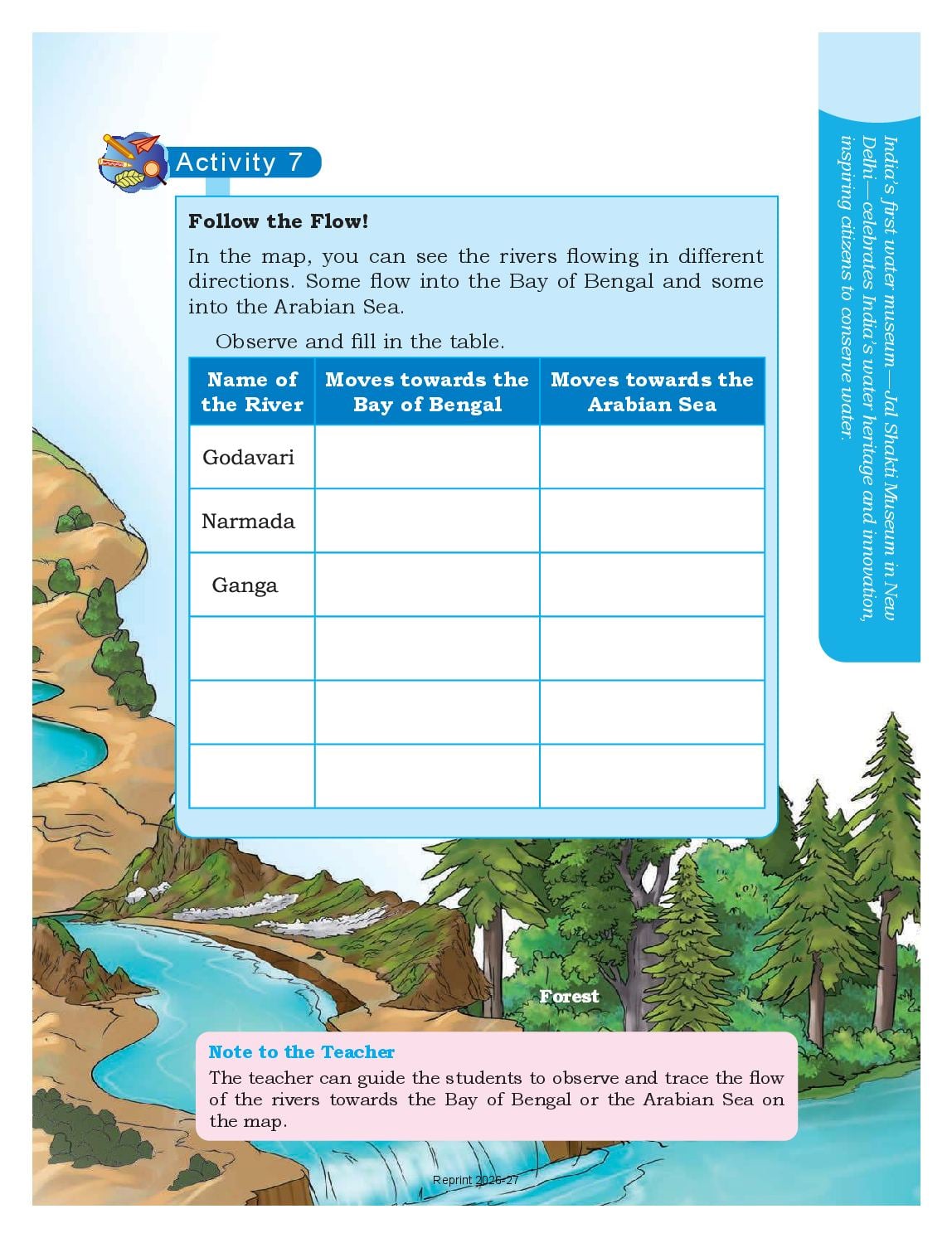
- India’s rivers flow to two seas. The map on page 12 shows the Brahmaputra, Ganga, Yamuna, Narmada, Tapti, Godavari, Krishna and Kaveri. Most of them — Ganga, Yamuna, Brahmaputra, Godavari, Krishna, Kaveri — flow east into the Bay of Bengal. The Narmada and the Tapti flow west into the Arabian Sea. The Luni river of Rajasthan is special: it never reaches a sea at all. It ends in the marshy Rann of Kutch in Gujarat.
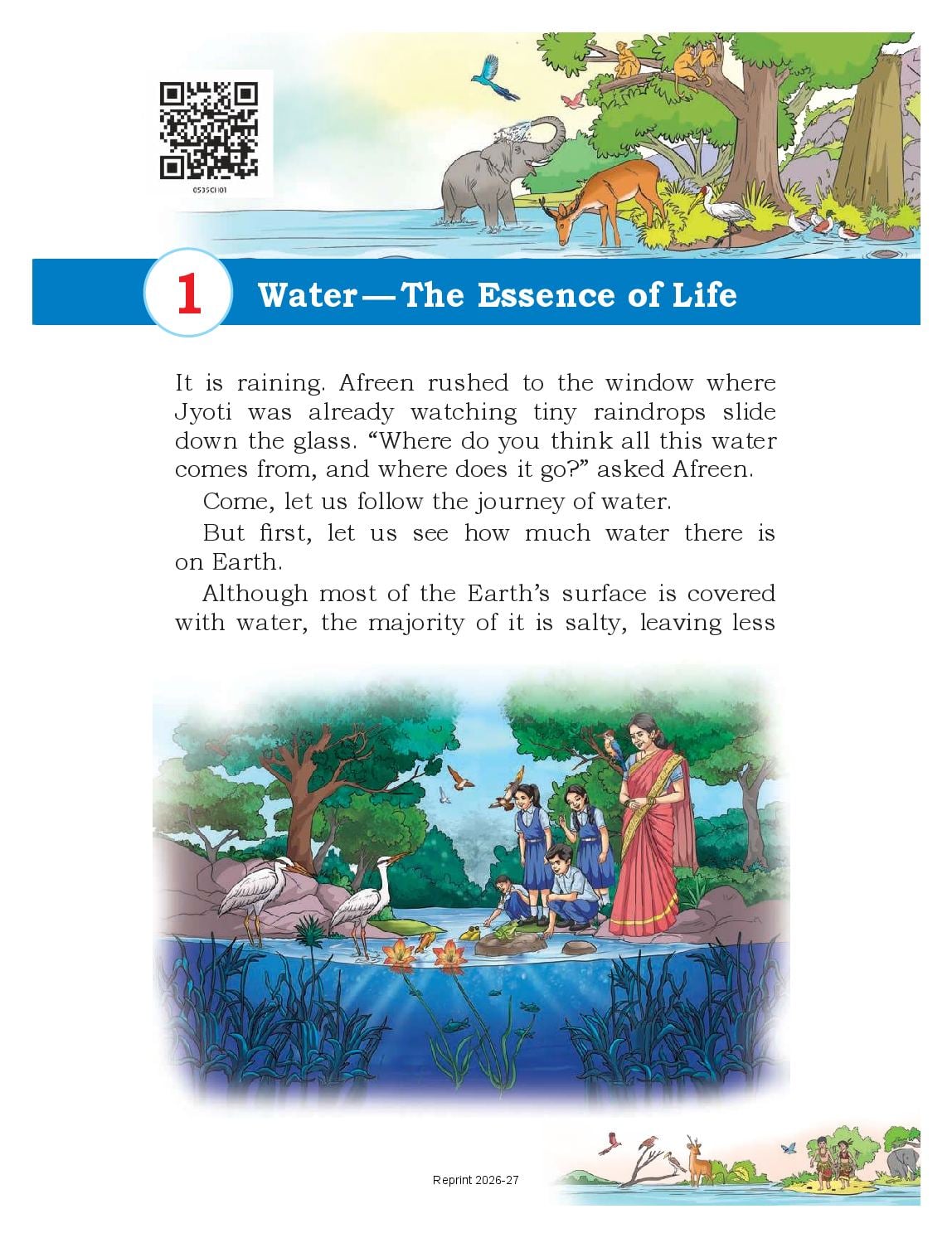
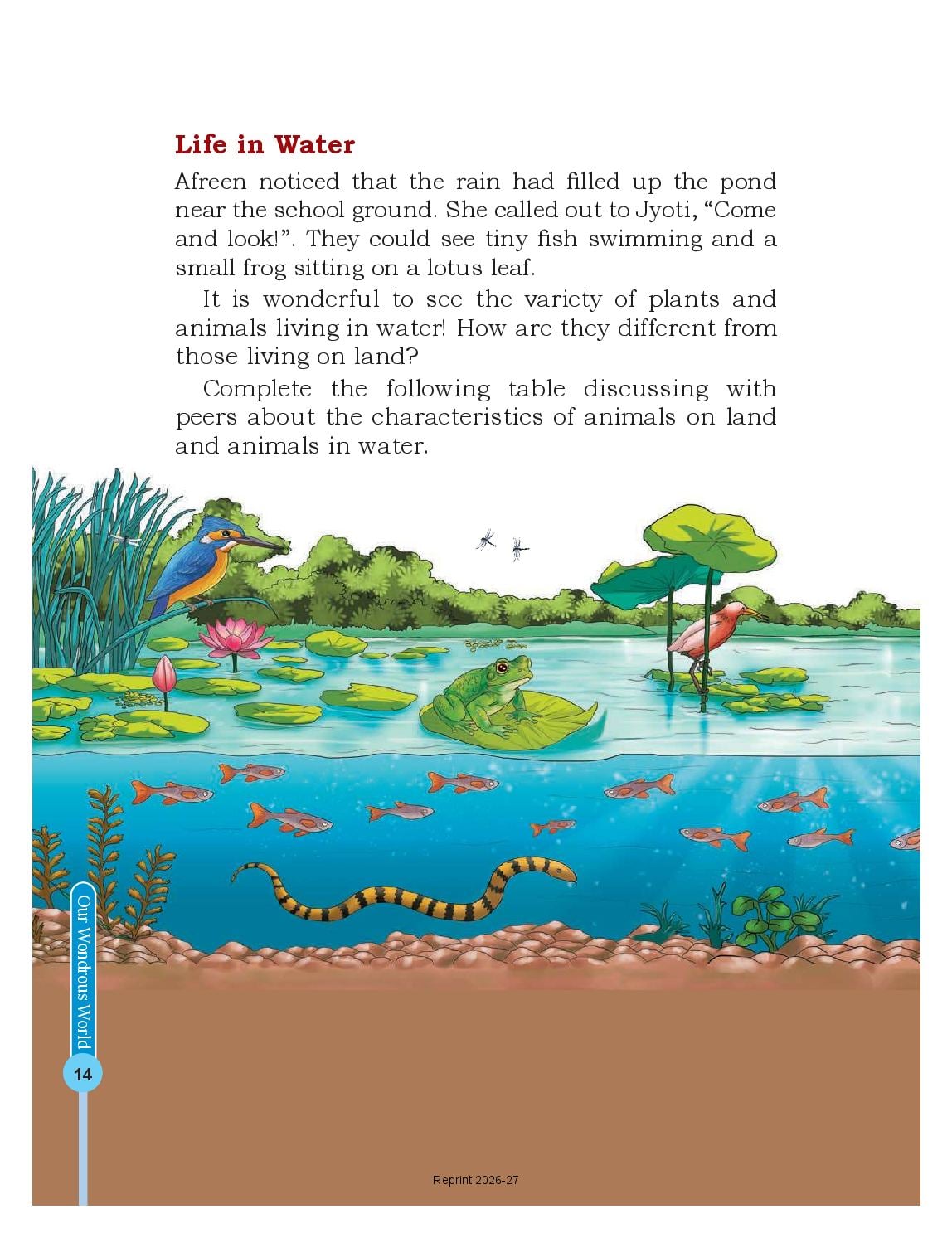
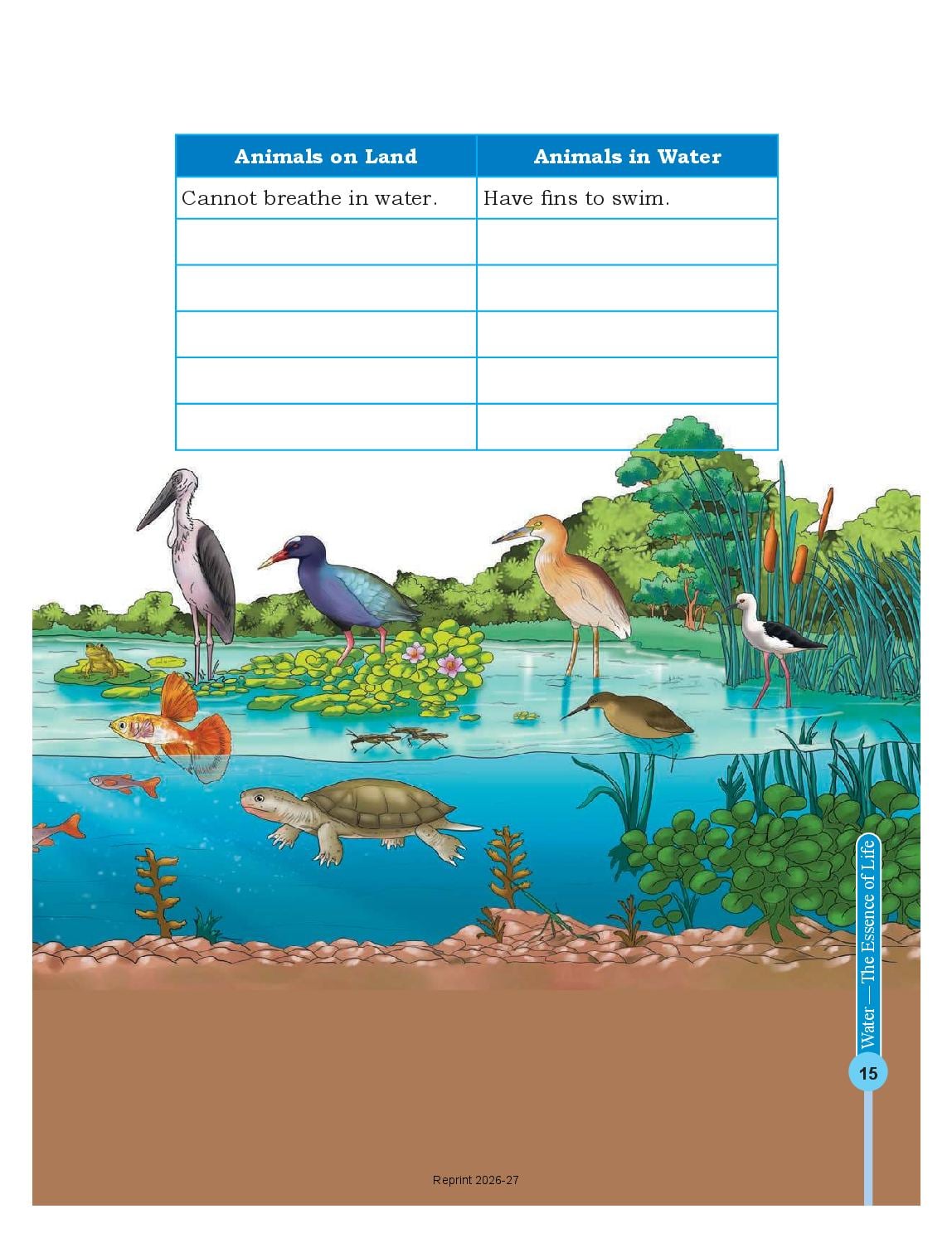
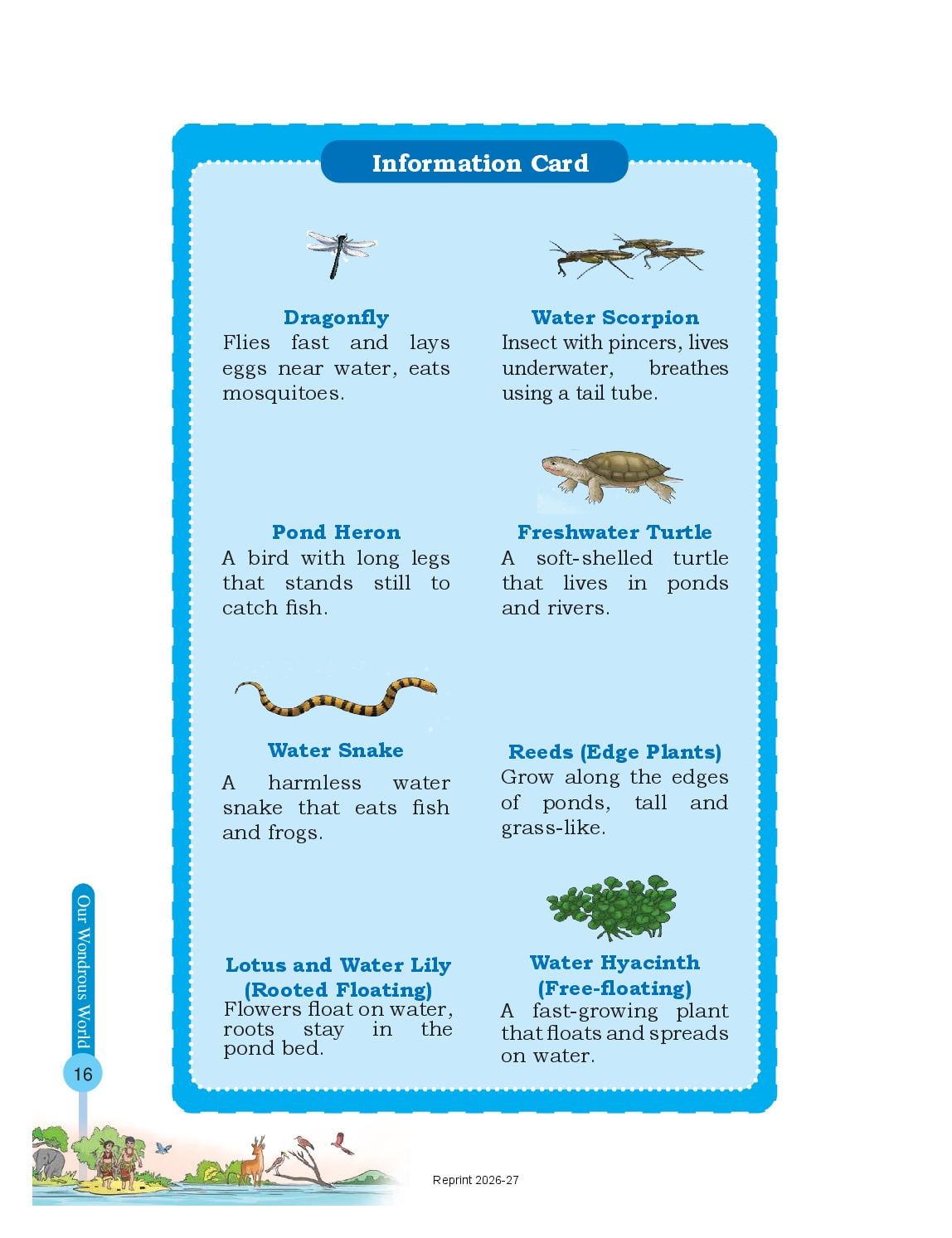
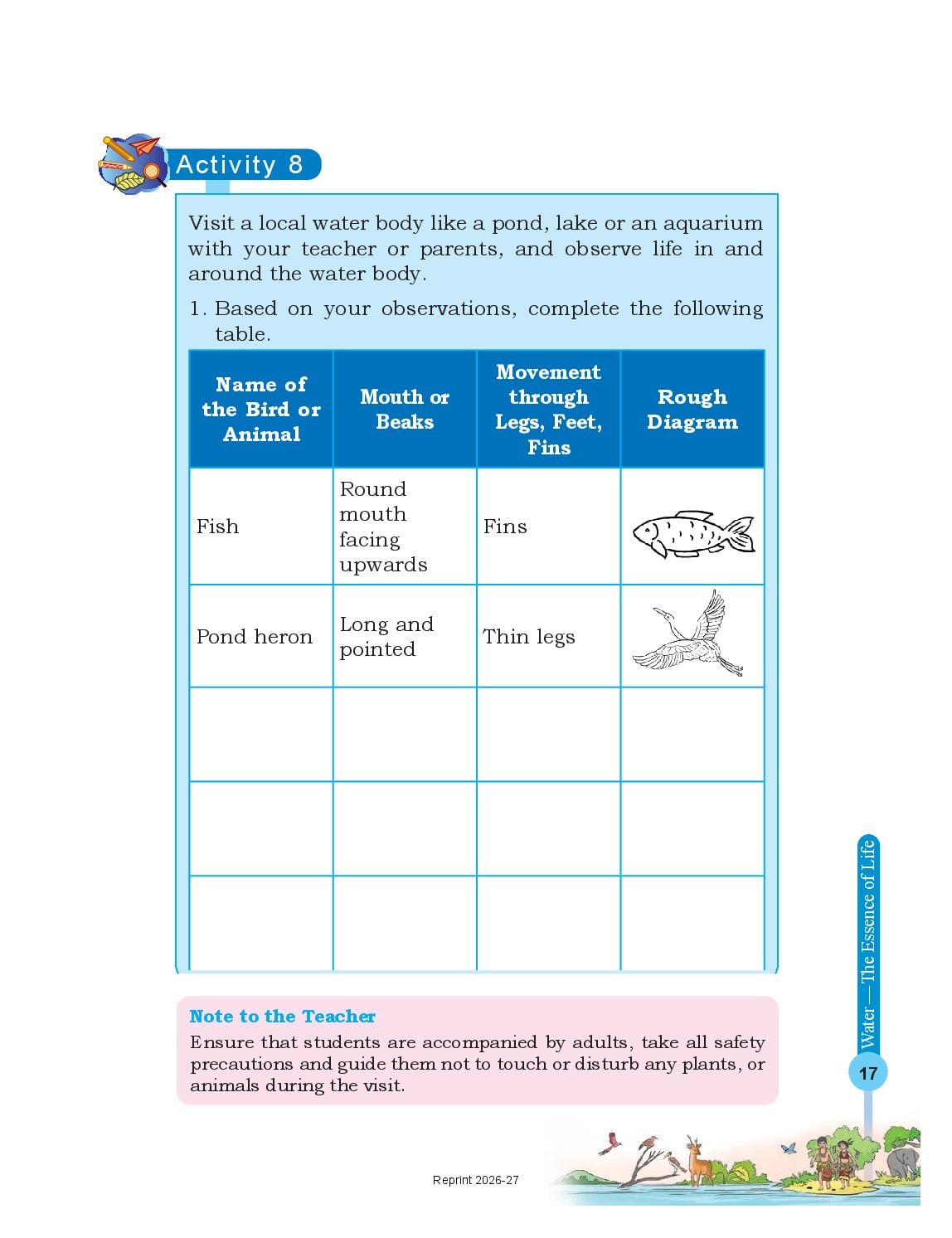
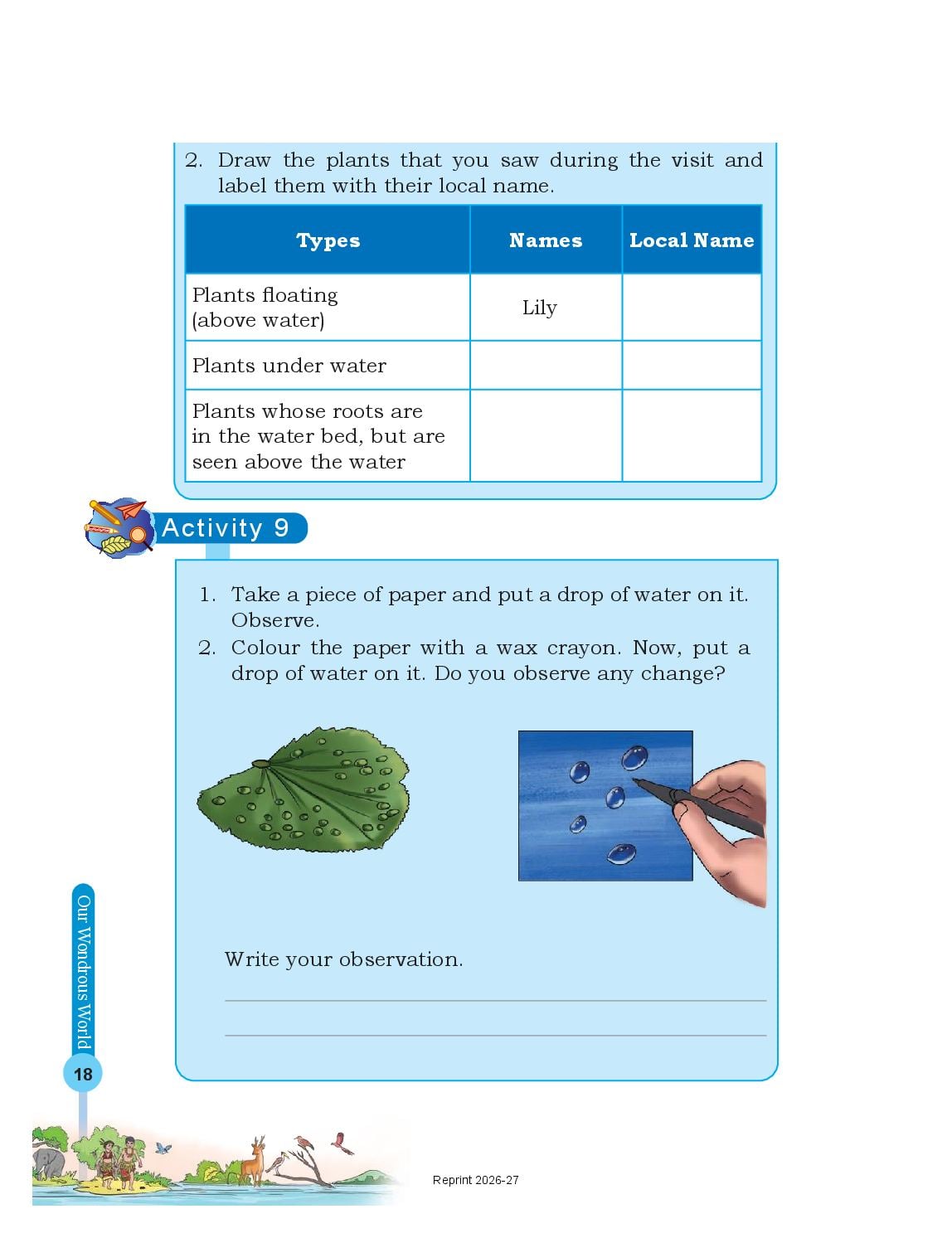
- Freshwater is full of life. A pond has plants that float on top (water hyacinth, lily), plants that stay under the water, and plants whose roots are in the pond bed while their leaves and flowers stand above the water (lotus, reeds). It has fish with fins, frogs, turtles, water snakes, dragonflies, water scorpions, and birds like the pond heron and the kingfisher that come to catch fish. Each one has a special body part that suits life in or near water.
Quick revision – Water-The Essence of Life
| Word | What it means | Where it appears | An everyday example |
|---|---|---|---|
| Freshwater | Water without salt, which living things can drink and use | Page 4, the glass and the teaspoon | Water from a handpump or a river |
| Saltwater | Water with a lot of salt dissolved in it | Discuss, page 4 | Sea water at a beach |
| Water vapour | Water in the form of an invisible gas, floating in the air | Water has Different Forms, page 5 | The steam that rises from hot dal |
| Condensation | Water vapour cooling down and turning back into tiny drops | Extra word, not printed in the chapter — see Activity 2, page 6 | Drops on the outside of a cold steel glass |
| Evaporation | Liquid water turning into water vapour, usually because of heat | Extra word, not printed in the chapter — see Activity 3, page 7 | Wet clothes drying in the sun |
| Water cycle | The never-ending round trip of water: sea to sky to land to sea | Water Cycle, page 8 | Rain today, river water tomorrow |
| Groundwater | Water stored deep under the ground in the gaps in soil and rock | Groundwater, page 9 | The water a borewell pulls up |
| Recharge | Rainwater going back into the ground to fill up groundwater | Activity 5, page 9 | Rain soaking into a school lawn |
| Soak pit | A pit dug to let rainwater sink into the ground instead of running off | Do you know?, page 9 | A pit at the corner of a courtyard |
| Johad | A small earthen dam of Rajasthan that catches rain and recharges groundwater | Do you know?, page 4 | A village johad filling up in the monsoon |
| Surface water | Freshwater we can see on the land — rivers, ponds, lakes | Surface Water, page 10 | The village pond after rain |
| Mouth (of a river) | The place where a river finally meets the sea | Extra word, not printed in the chapter — see the rivers on the map, page 12 | The Ganga meeting the Bay of Bengal |
| Waterproof | Something water cannot pass through or wet | Page 19, the waxy leaf | A lotus leaf, or a raincoat |
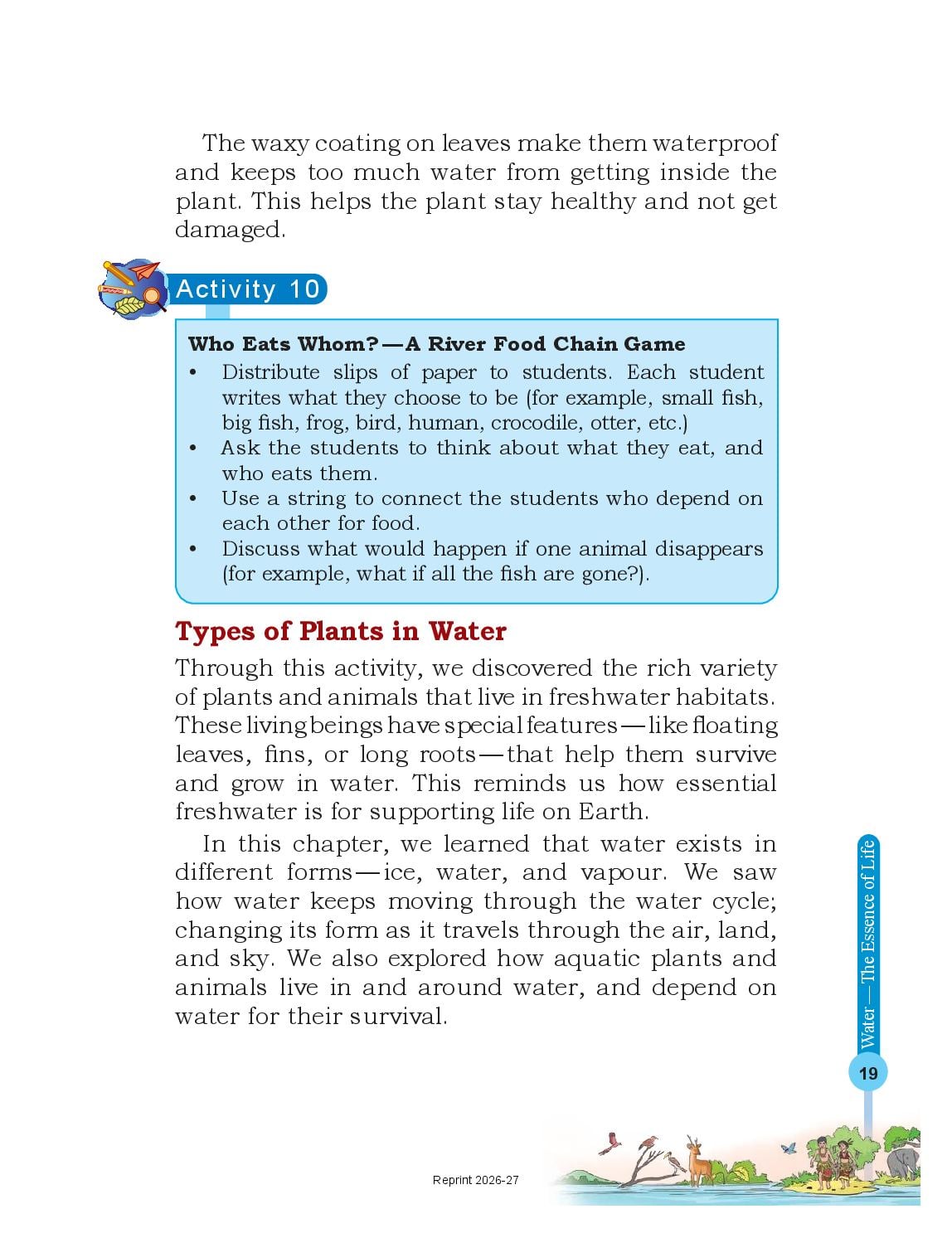
| Food chain | The chain of who eats whom in a place | Activity 10, page 19 | Water plant → small fish → big fish → heron |
Old NCERT vs New – Class 5 EVS
This chapter is from Our Wondrous World, the new NCERT Class 5 EVS book (NCF-SE 2023, used from 2025-26). It replaced the old book “Looking Around”, so chapter numbers and names differ from older PDFs.
Solutions and All Chapters
Answers to the exercises and the full chapter list of Our Wondrous World:
Water-The Essence of Life – Overview
| Class | Class 5 |
| Subject | EVS |
| Book | Our Wondrous World – new NCERT book |
| Chapter | 1 of 10 – Water-The Essence of Life |
| Book pages | 3 – 20 |
| Edition | NCERT Reprint 2026-27 |
| Session | 2026-27 |
| Free – read online or download |
Class 5 EVS Chapter 1 – FAQs
Where can I download Water-The Essence of Life Class 5 PDF?
From the download table on this page – the chapter PDF is free, and the full book is linked too.
What is Class 5 EVS Chapter 1 about?
Most of Earth’s water is salty. Look at the picture on page 4. A glass holds 200 ml of water. A teaspoon holds 5 ml. If all the water on Earth were that full glass, all the freshwater would be only that one teaspoon. Freshwater is water without salt. We can drink it, cook with it and water crops with it. Sea water is salty, so we cannot use it that way.
Is Water-The Essence of Life from the new NCERT Class 5 EVS book?
Yes. It is chapter 1 of our wondrous world, the new NCERT Class 5 EVS book for 2026-27.
Is this the latest NCERT edition for 2026-27?
Yes – the PDF is NCERT’s latest edition for the 2026-27 session.
Where are the NCERT Solutions for Class 5 EVS Chapter 1?
Open the NCERT Solutions link above for answers to the exercise questions.