Download Our School-A Happy Place – NCERT Class 5 EVS Chapter 4 PDF from the new NCERT Class 5 EVS book Our Wondrous World (2026-27). Read the chapter online or download the free PDF. A school is a happy place when it is safe, clean and kind. Mohit says he loves school because he meets his friends, plays games and learns something new every day. A school is where we feel safe and cared for. This chapter asks one simple question:…
Our School-A Happy Place PDF – Chapter 4 of Our Wondrous World
Read the chapter online or download the PDF.
| Chapter | Download | |
|---|---|---|
| Chapter 4 PDF | Our School-A Happy Place | View PDF |
| Full book | NCERT Class 5 EVS – Our Wondrous World | View Book |
Read Online
What Is in Our School-A Happy Place? (Class 5 EVS Chapter 4)
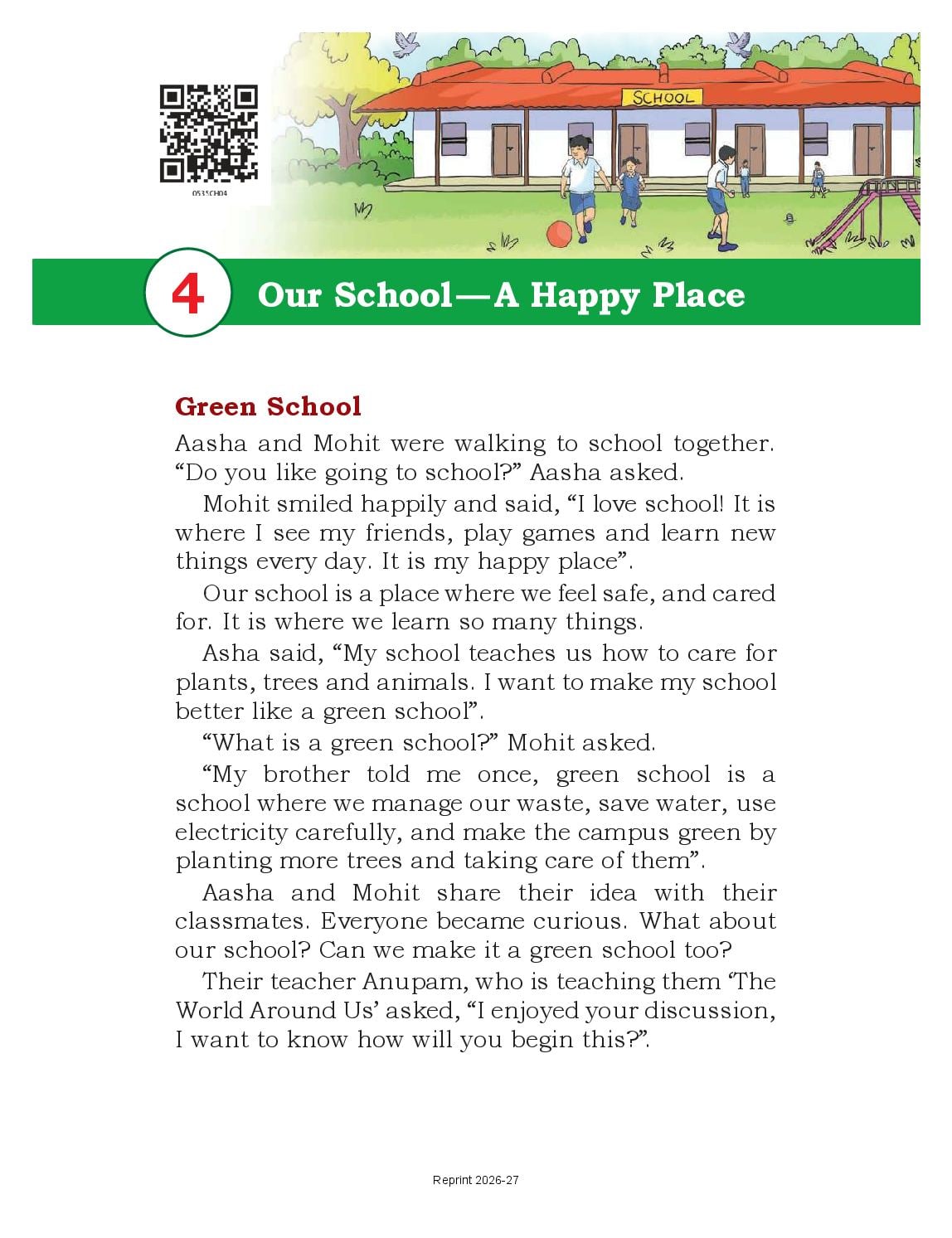
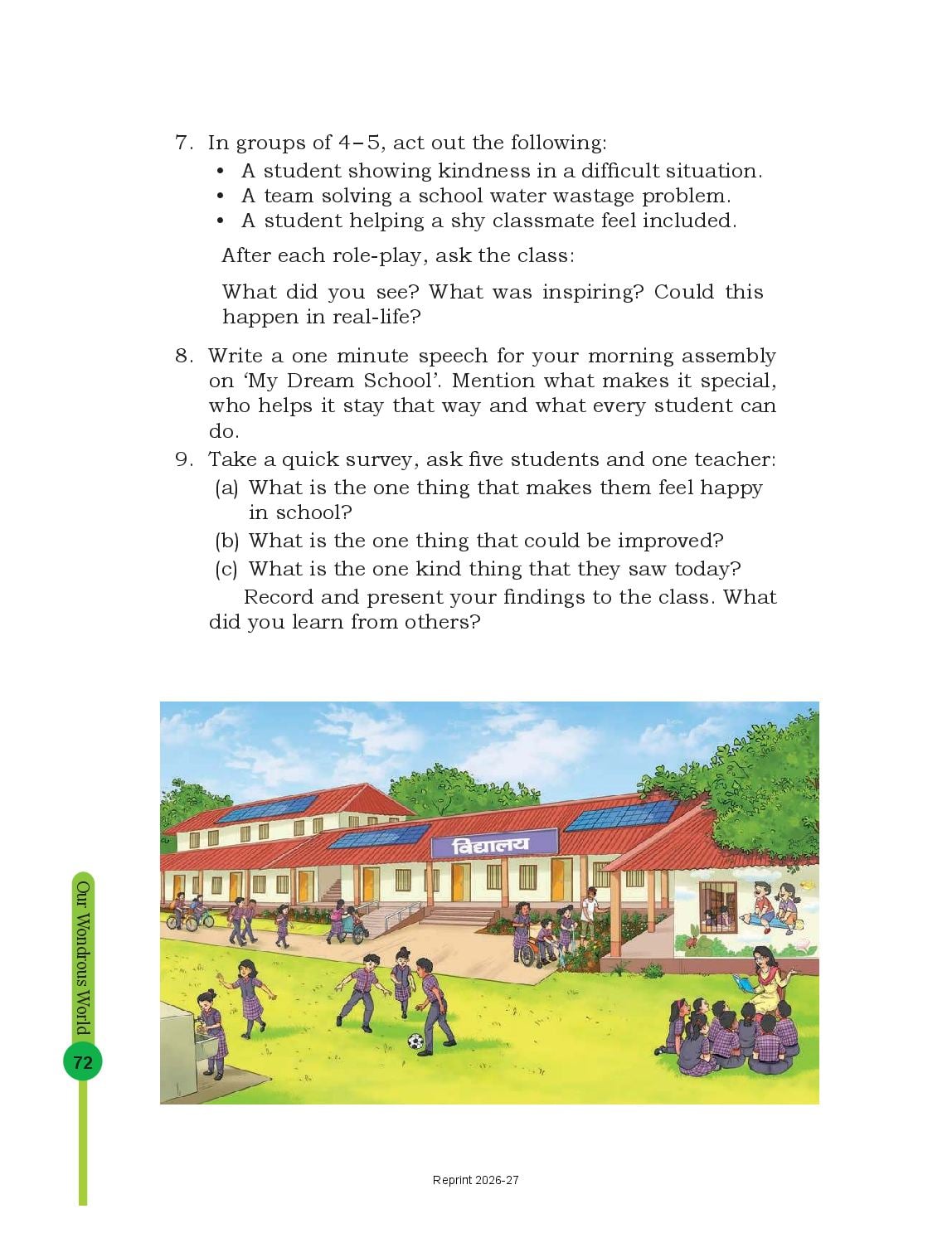
- A school is a happy place when it is safe, clean and kind. Mohit says he loves school because he meets his friends, plays games and learns something new every day. A school is where we feel safe and cared for. This chapter asks one simple question: what can we, the students, do to make our school better?
- A green school looks after four things. Aasha’s brother told her what a green school is. It manages its waste. It saves water. It uses electricity carefully. And it keeps the campus green by planting more trees and taking care of them. Any school can become a green school. It does not need money — it needs students who notice things and act.
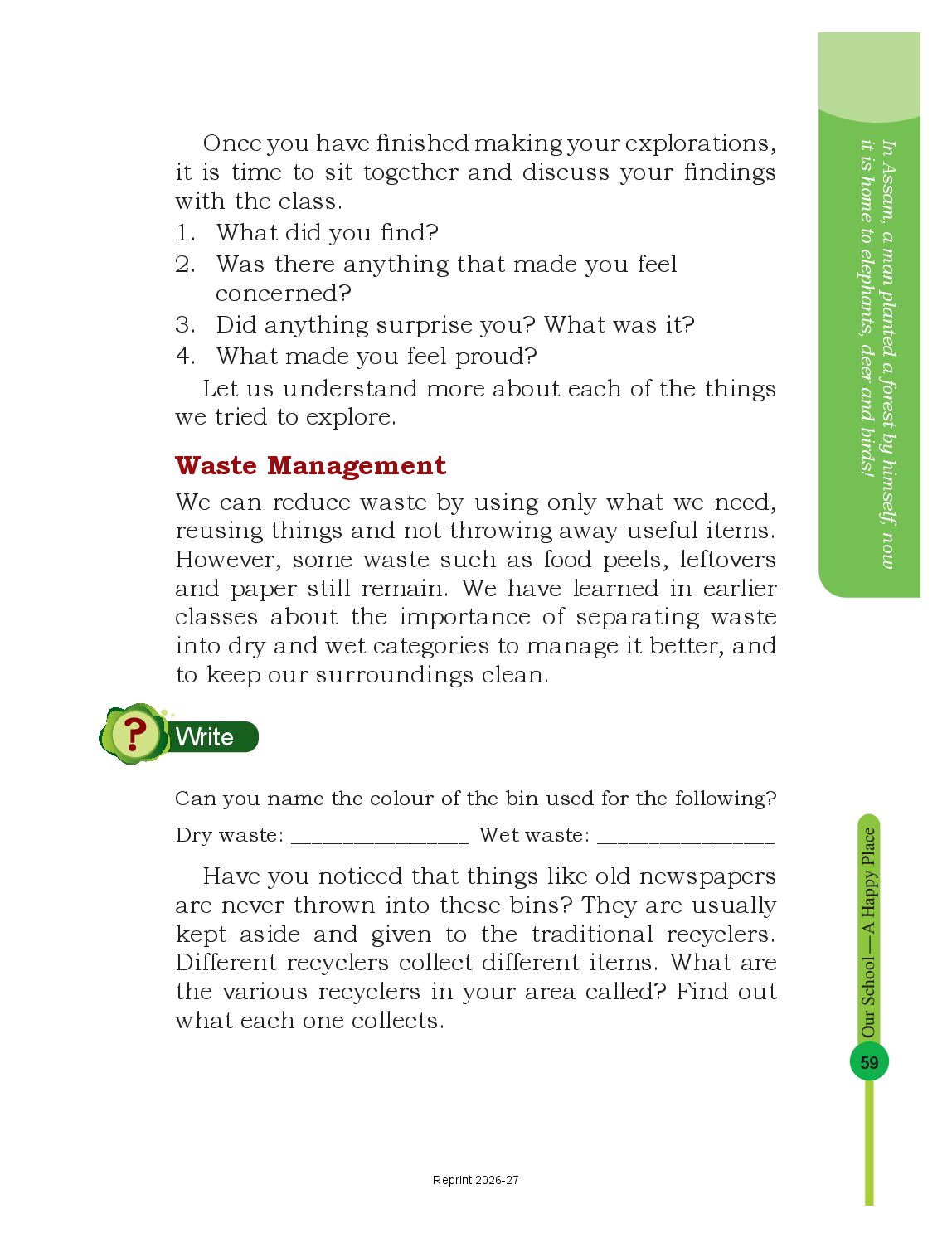
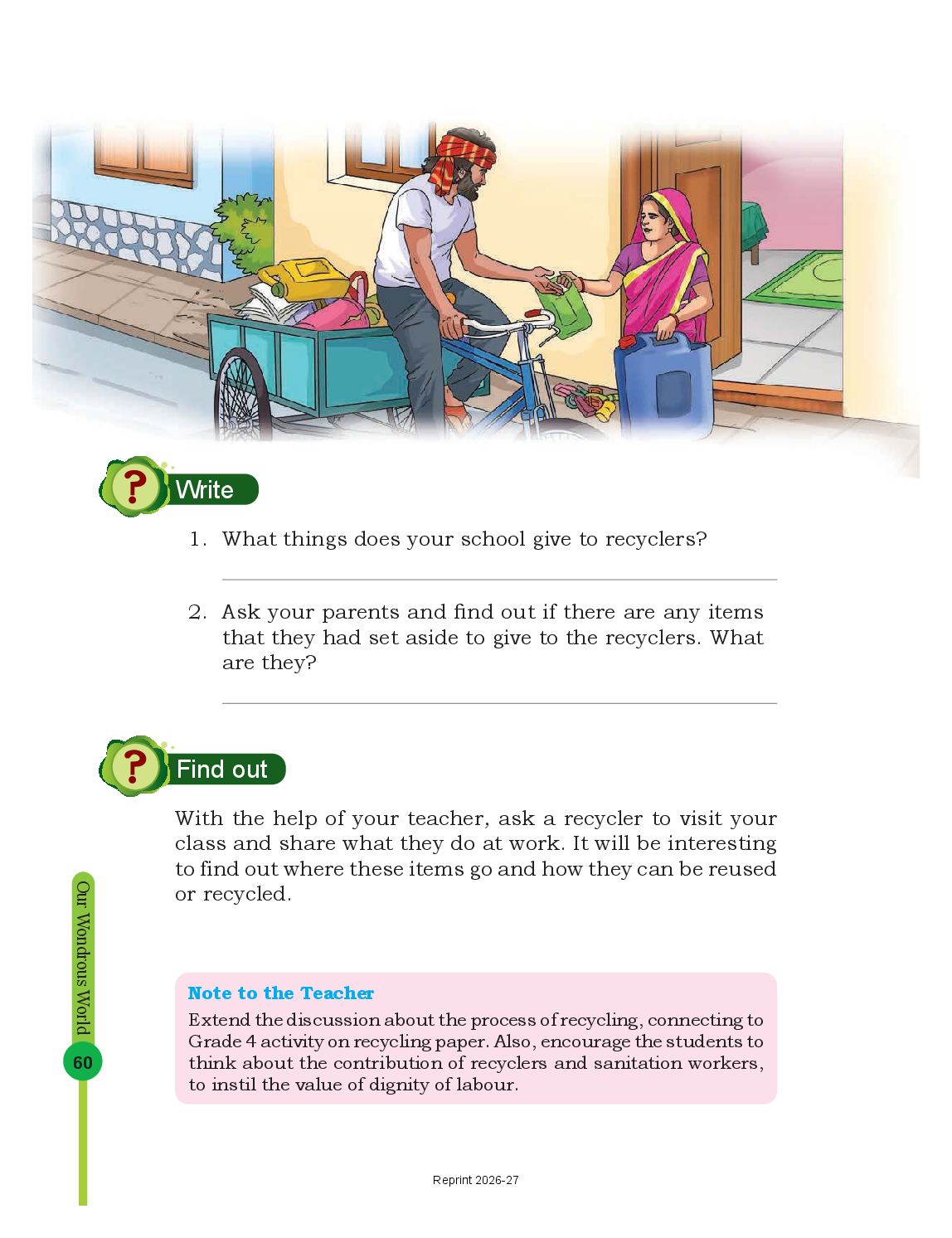
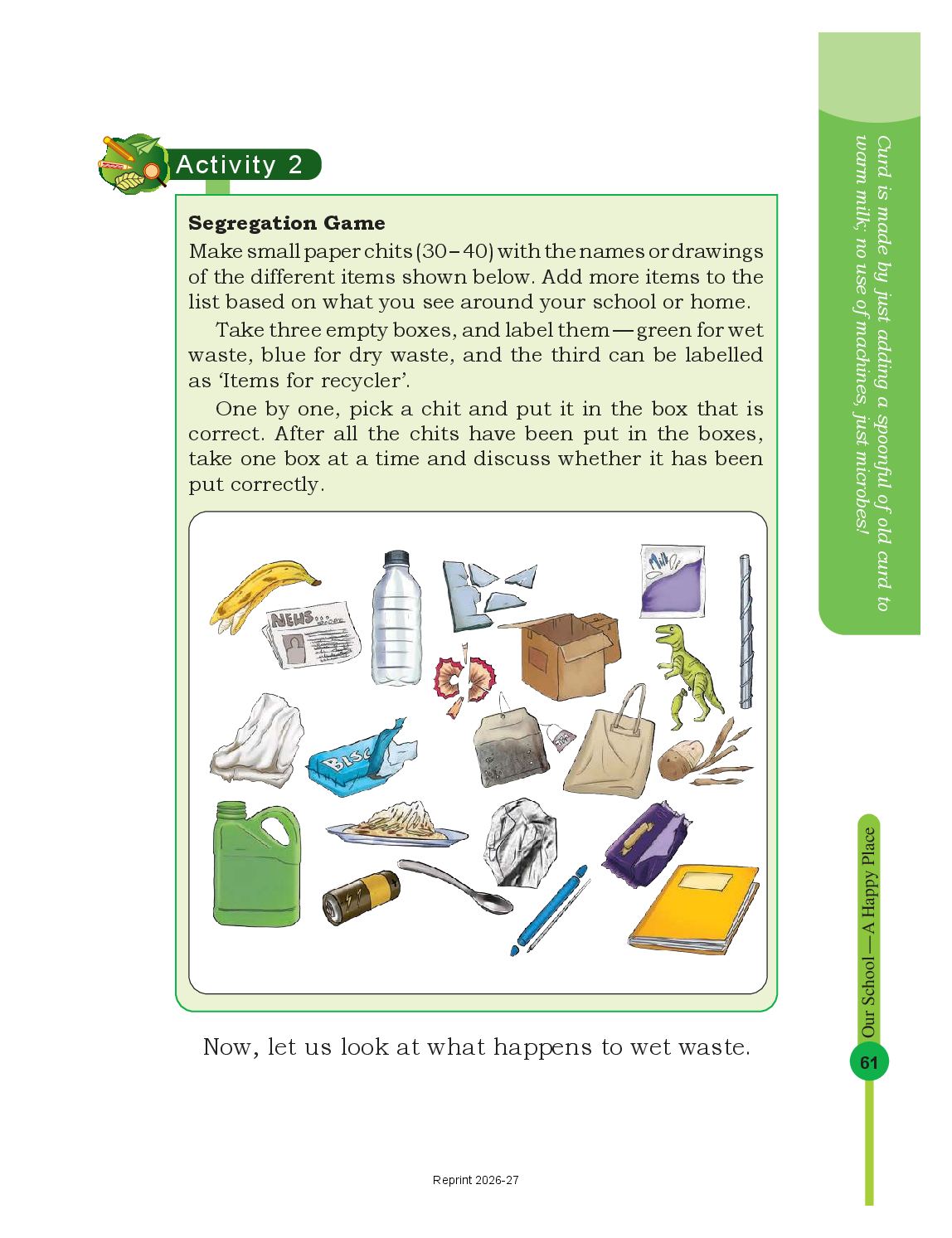
- Waste has to be separated before it can be managed. First we reduce — use only what we need. Then we reuse — do not throw away useful things. What is left is real waste, and it goes into two bins: green for wet waste (food peels, leftovers, tea leaves, garden waste) and blue for dry waste (wrappers, plastic, glass, paper). Wet waste can be turned into compost — good black soil for the school garden. Some things go into neither bin: old newspapers, bottles, cardboard and metal are kept aside for the recycler, the person who collects them so they can be made into something new.
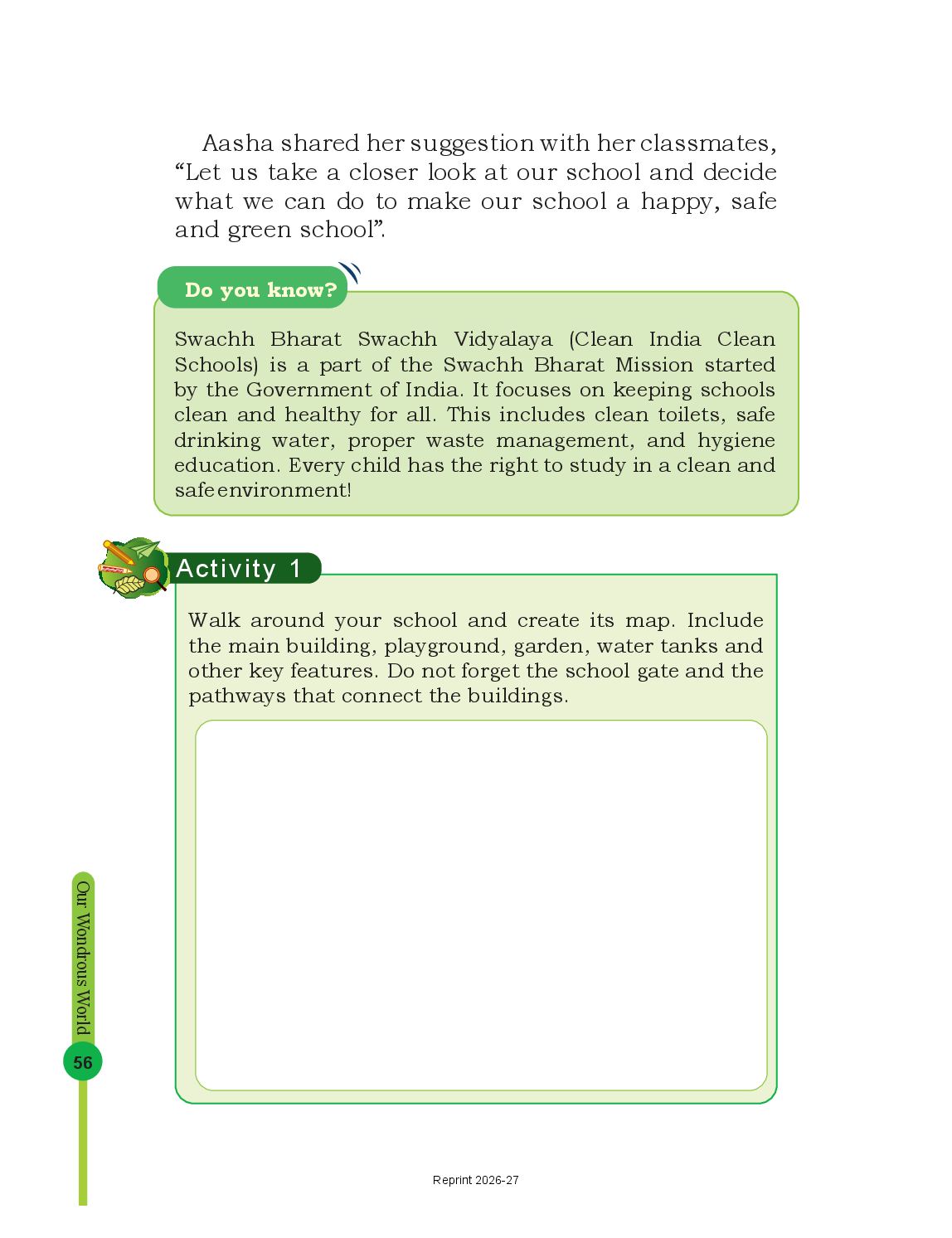
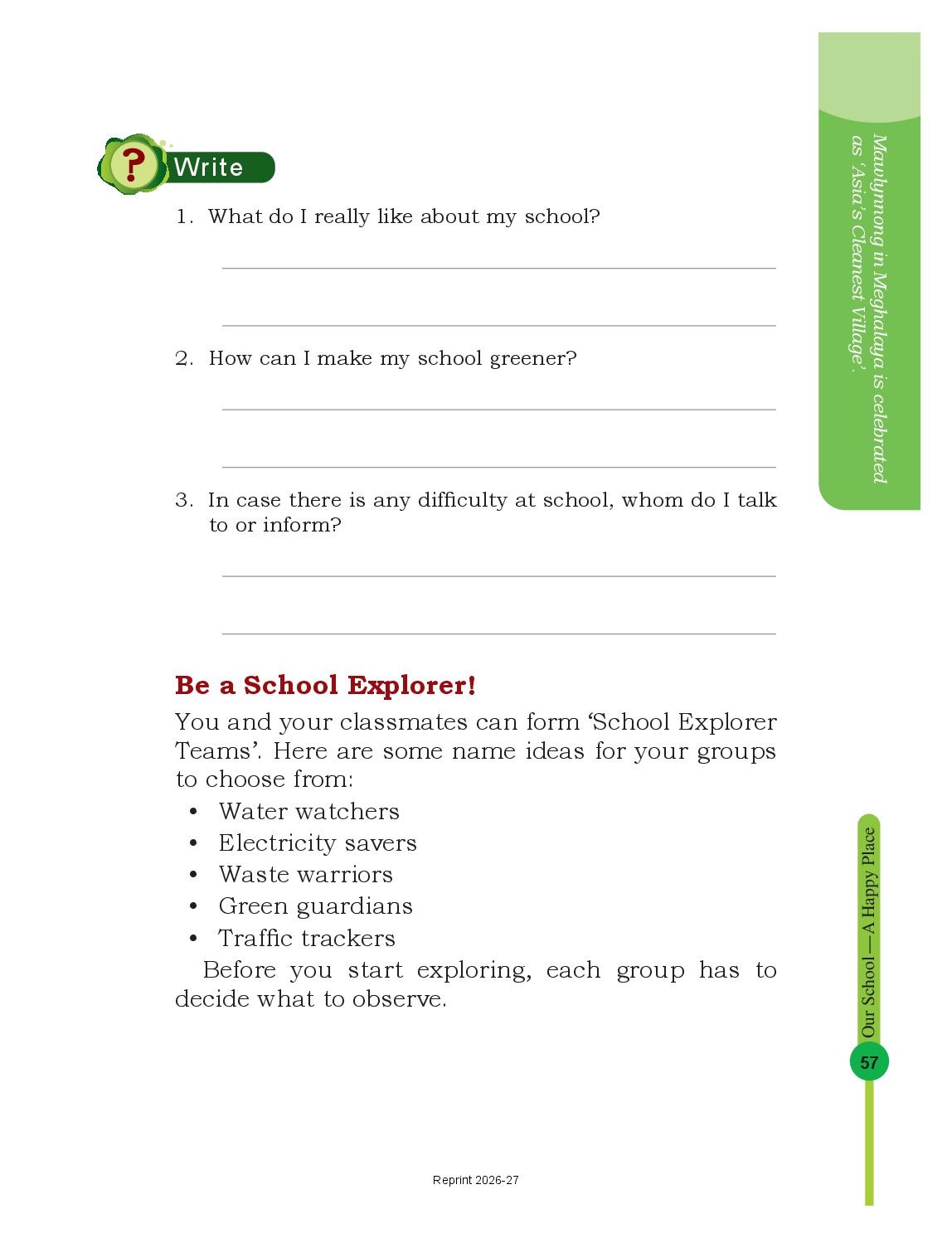
- Sanitation workers and recyclers do work that keeps us all safe. Mixed waste is dangerous for them — a piece of broken glass hidden inside a bag of wet leftovers can cut a hand. Separating our waste properly is not a small thing. It is how we show respect for the people who handle it. Swachh Bharat Swachh Vidyalaya, a part of the Swachh Bharat Mission, works for exactly this: clean toilets, safe drinking water, proper waste management and hygiene education in every school. Mawlynnong in Meghalaya is celebrated as ‘Asia’s Cleanest Village’.
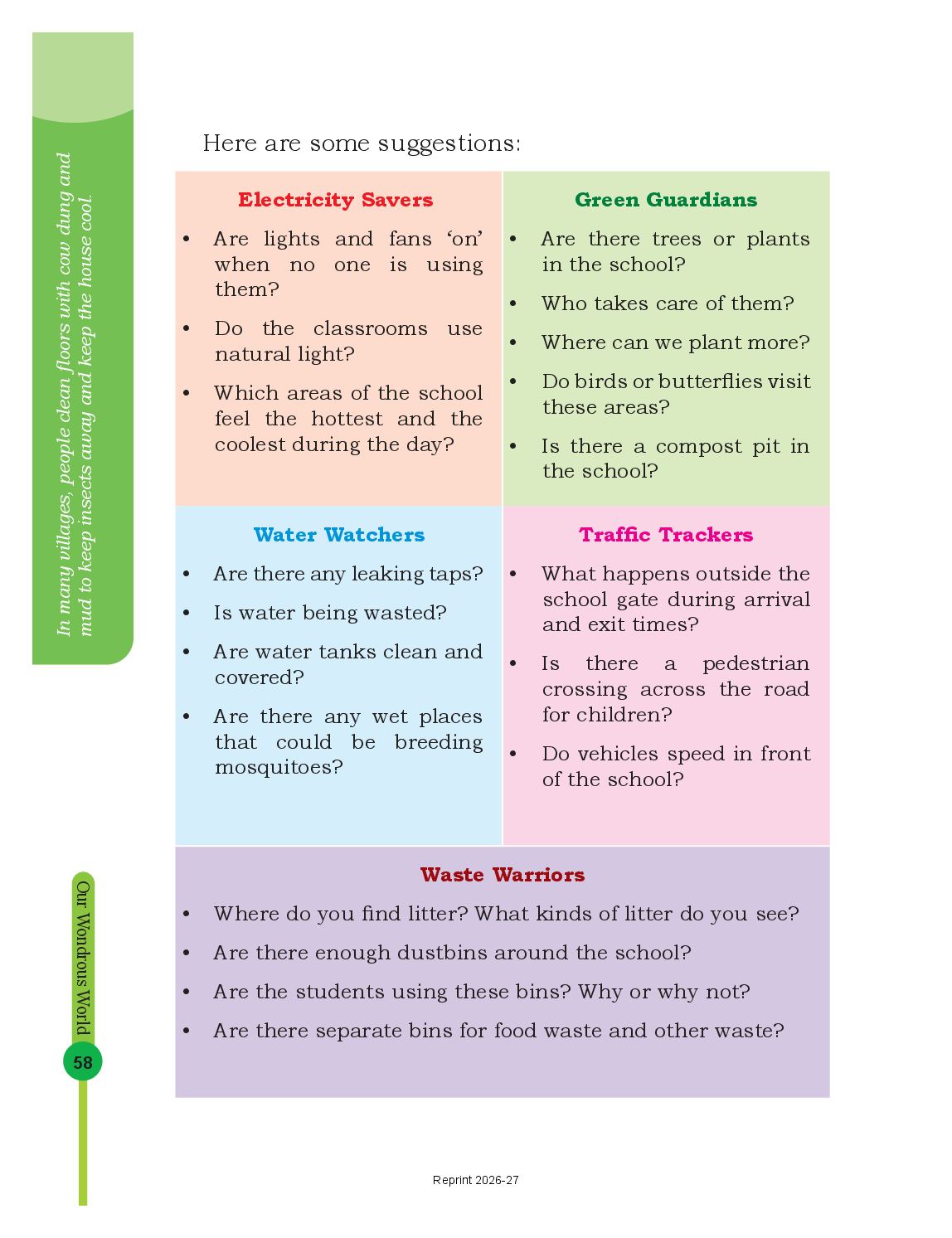
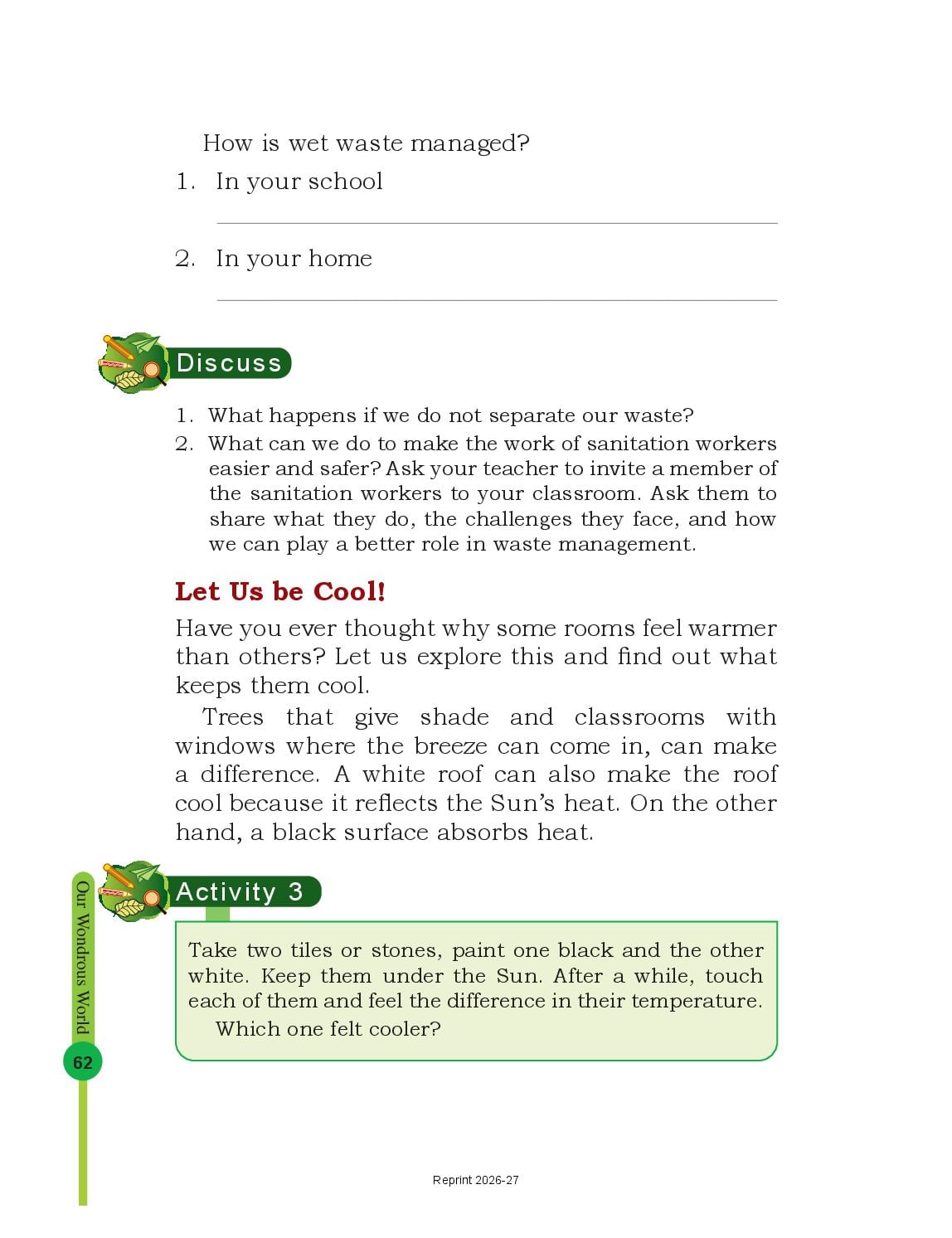
- Colour decides how hot a surface gets. A black surface absorbs the Sun’s heat — it takes the heat in and gets hot. A white surface reflects the heat — it throws the heat back and stays cooler. That is why painting a roof white keeps the room below it cooler. Shade trees and windows that let the breeze through do the same job. In many villages people smear the floor with cow dung and mud to keep the house cool and keep insects away; and a clay matka cools drinking water without using any electricity at all.
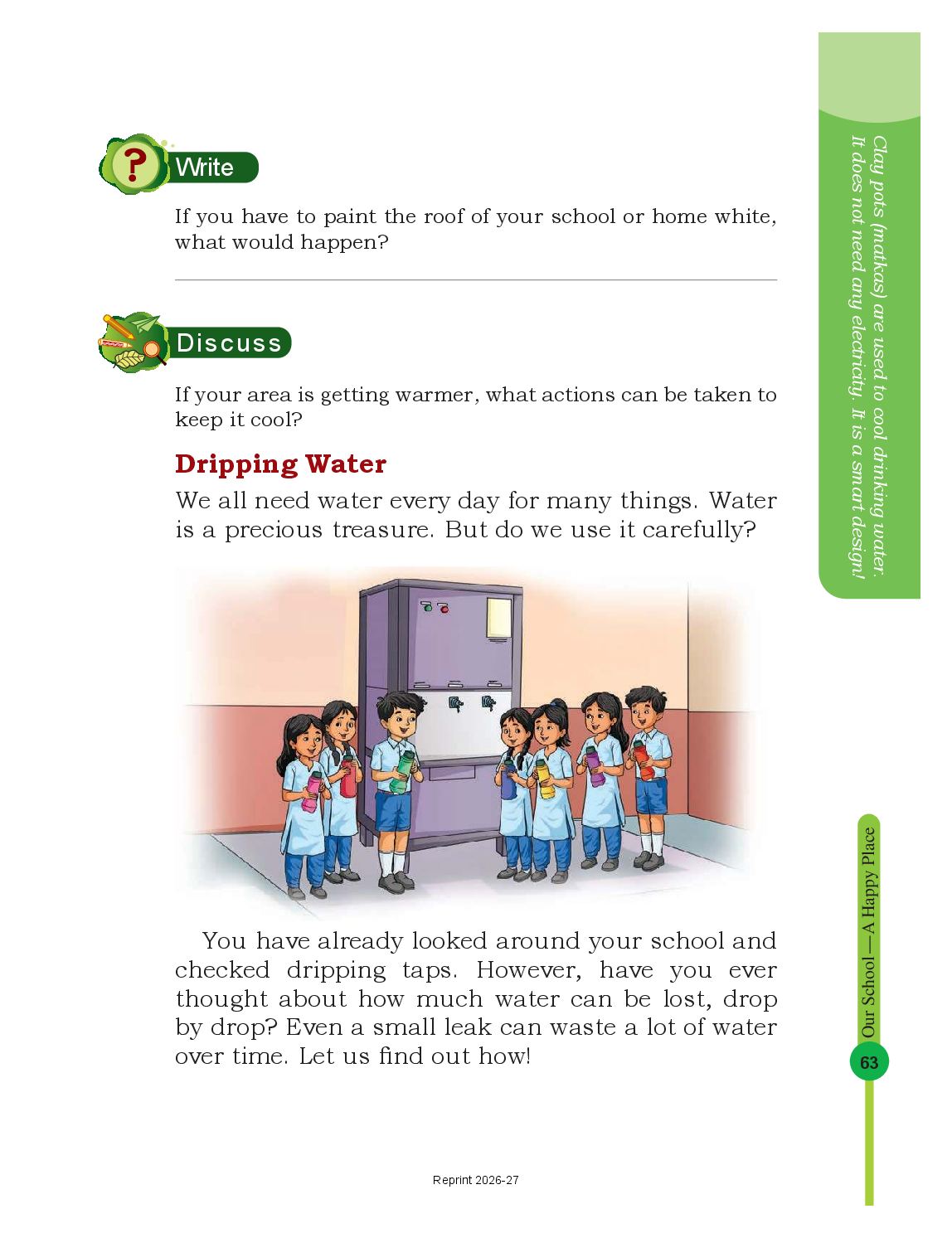
- A slow drip wastes a shocking amount of water. One drop is nothing. But a tap that drips all day and all night can fill glass after glass. Measure how long one glass takes to fill, and then count how many glasses that makes in 24 hours — the number is always a surprise. Fixing one washer costs almost nothing. The Jal Shakti Abhiyan is a national campaign that asks everyone to plant trees, catch rainwater and use water wisely.
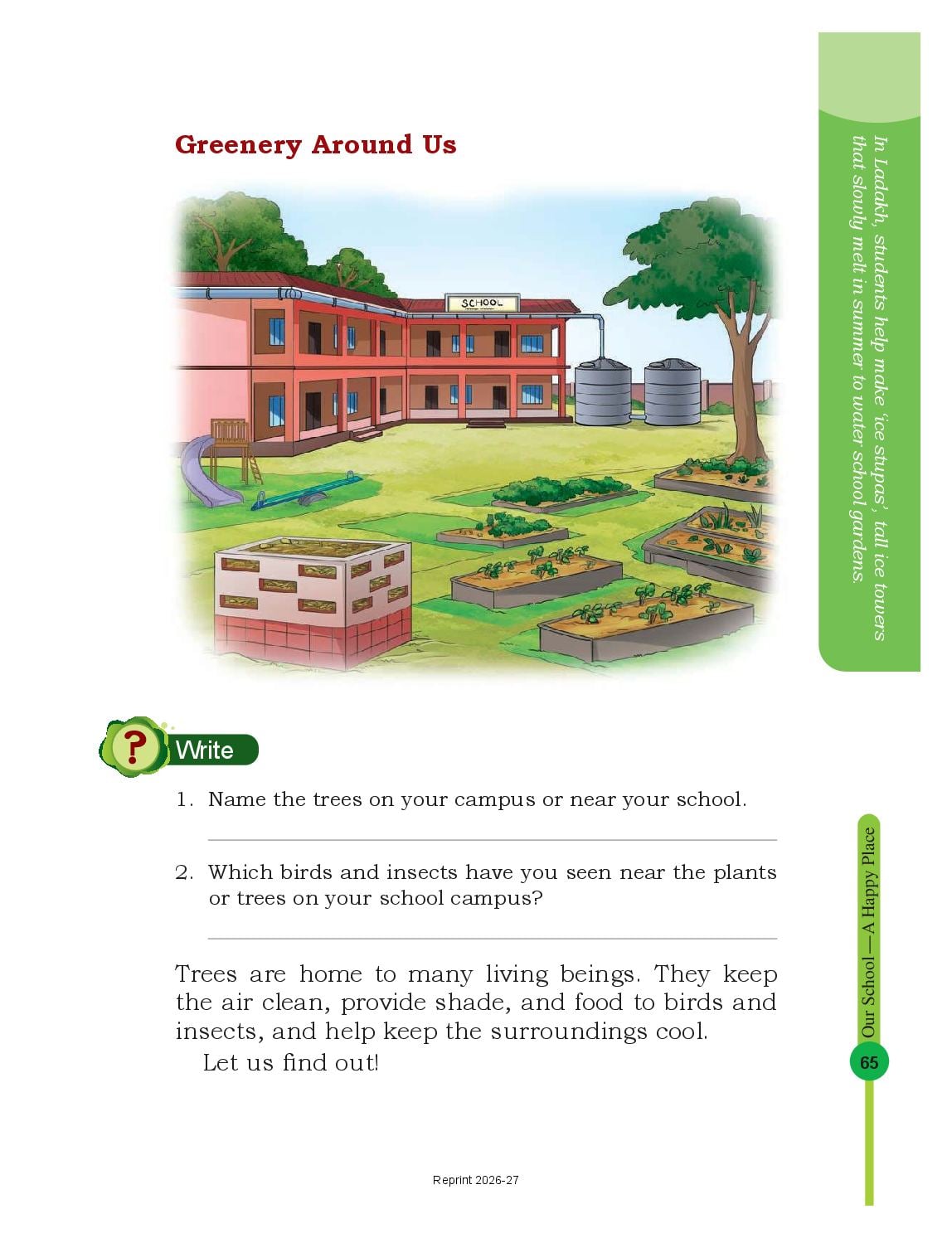
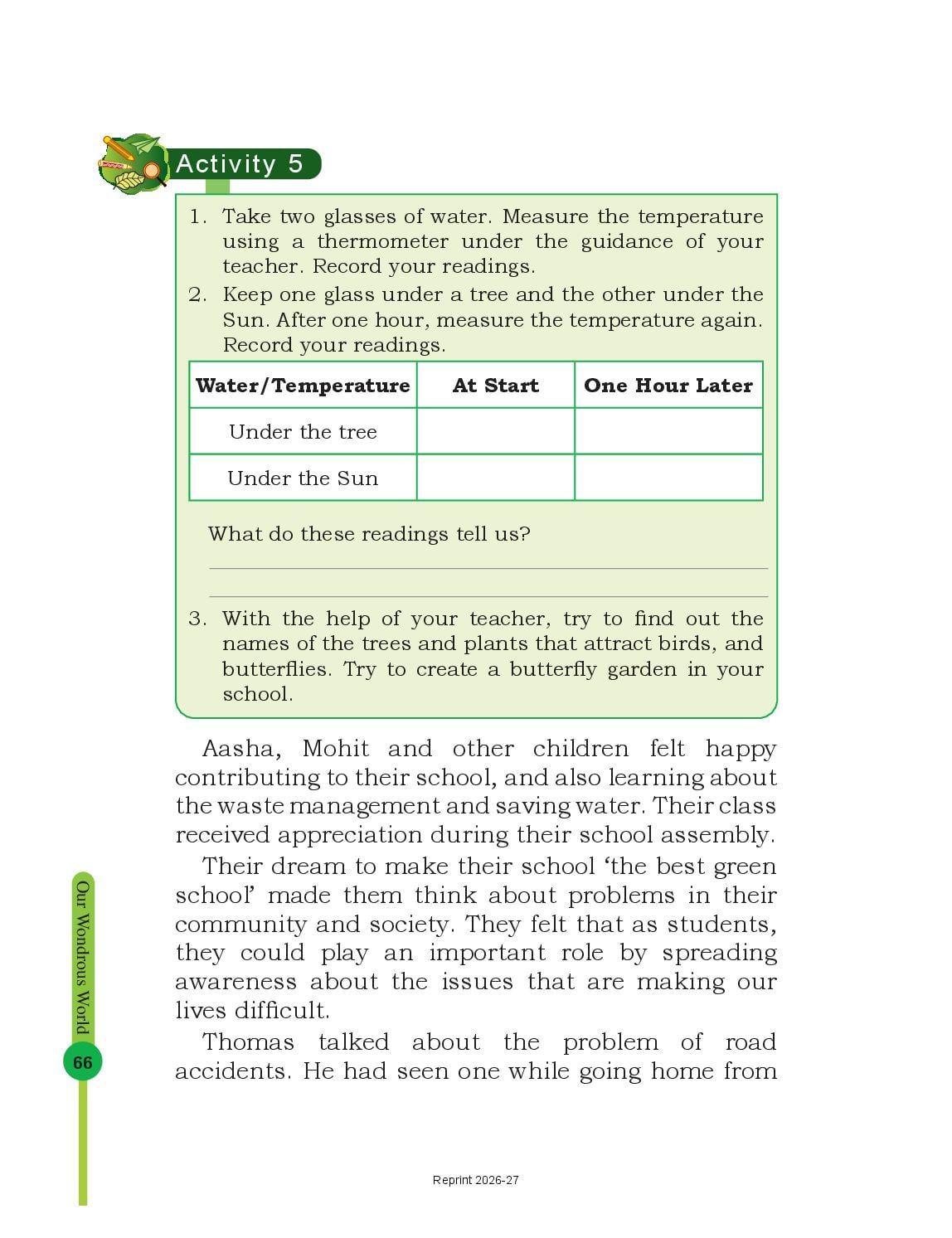
- Trees make a place cooler and fuller of life. Trees clean the air, give shade, and give food and homes to birds and insects. Put two glasses of water outside for an hour, one under a tree and one in the Sun, and the thermometer proves it: the glass in the shade stays several degrees cooler. Certain plants — curry leaf, lemon, marigold, ixora, milkweed — bring butterflies, and a corner of the school ground planted with them becomes a butterfly garden. In Ladakh, students help build ‘ice stupas’, tall ice towers that melt slowly in summer and water the school garden.
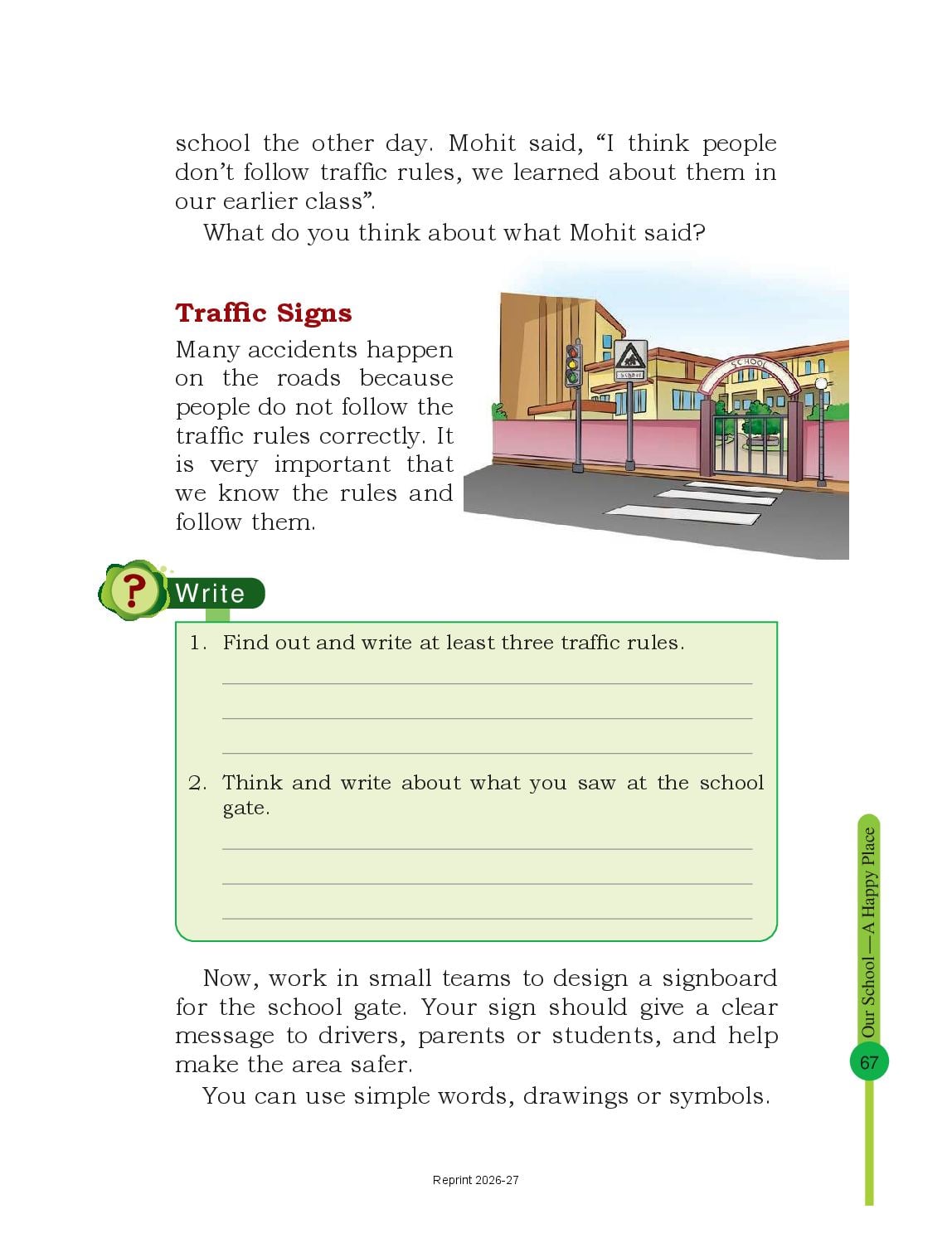
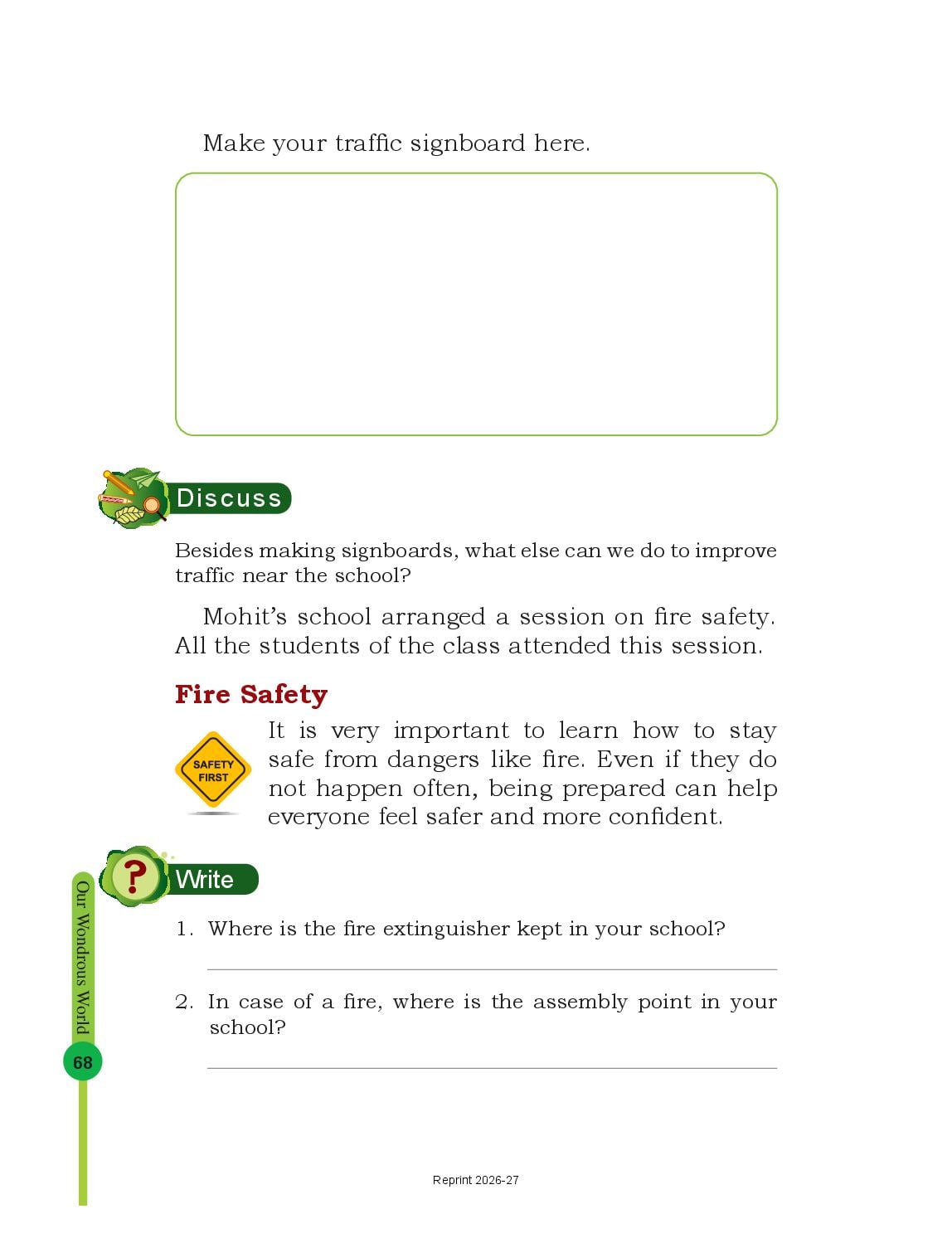
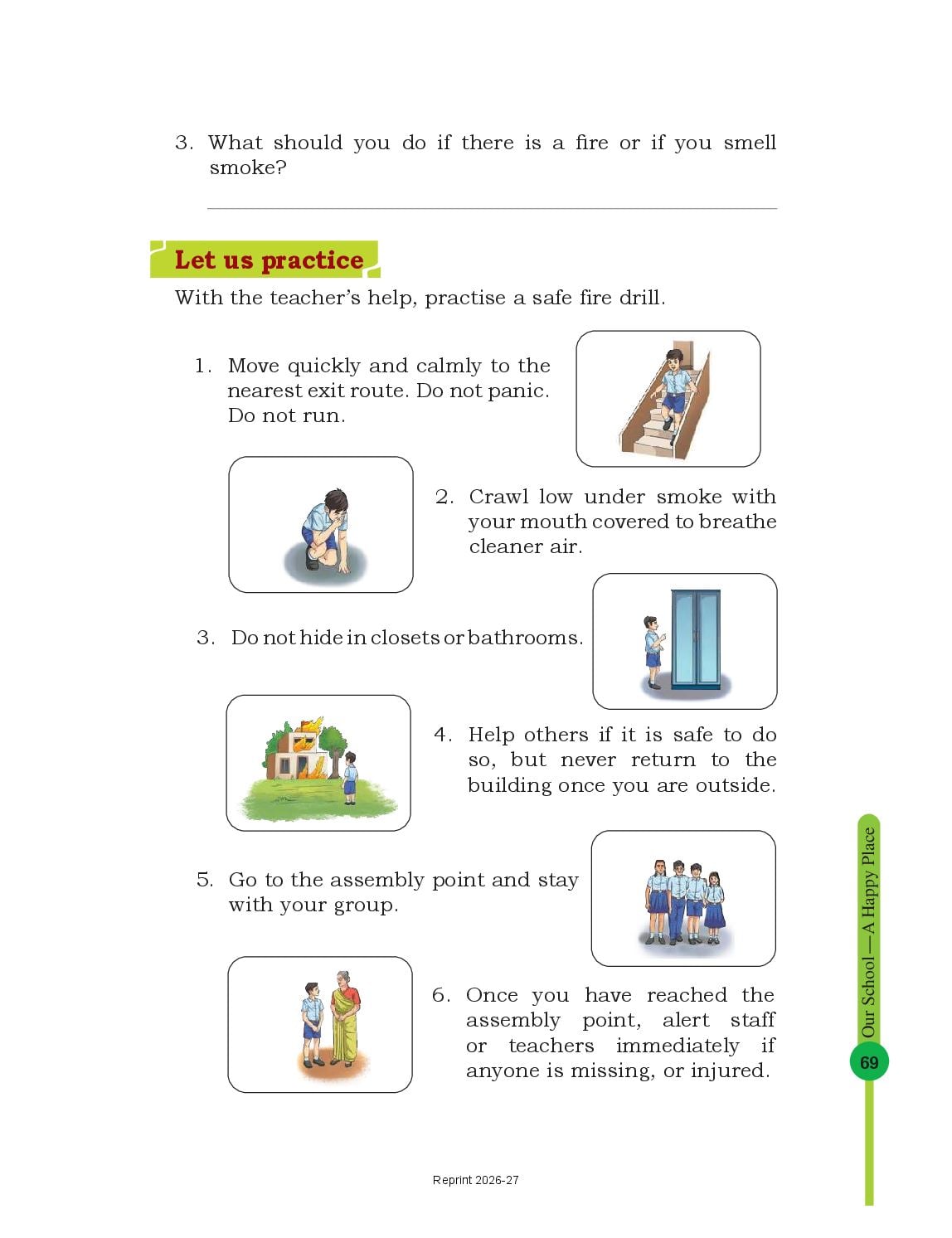
- Safety on the road and safety from fire can be practised. Most road accidents happen because people do not follow the rules. Knowing three rules — cross at the zebra crossing, wear a helmet, never lean out of a moving vehicle — and a clear signboard at the school gate make the gate safer at the busiest ten minutes of the day. For fire, the drill is fixed: move fast but calmly, do not run, crawl low under smoke with your mouth covered, never hide, never go back in, go to the assembly point, and report anyone missing.
Quick revision – Our School-A Happy Place
| Word | What it means | Where it appears | An everyday example |
|---|---|---|---|
| Green school | A school that manages its waste, saves water and electricity, and keeps its campus green | Green School, page 55 | Your school with a compost pit and full water tanks |
| Segregation | Separating waste into groups before throwing it away | Activity 2, page 61 | Peels in the green bin, wrapper in the blue bin |
| Wet waste | Waste that rots — food peels, leftovers, tea leaves, garden waste | Waste Management, page 59 | Banana peel from your tiffin |
| Dry waste | Waste that does not rot — wrappers, plastic, glass, foil | Waste Management, page 59 | An empty biscuit wrapper |
| Compost | Wet waste turned into rich black soil by tiny living things | Green Guardians, page 58 | Compost from the pit used in the school garden |
| Recycler | A person who collects old paper, plastic, glass and metal so they can be made into something new | Page 59 | The kabadiwala who buys old newspapers |
| Sanitation worker | A person whose work keeps our school and streets clean | Discuss, page 62 | The person who sweeps the school corridor |
| Absorb | To take heat in, so the thing becomes hot | Let Us be Cool!, page 62 | A black tile in the Sun |
| Reflect | To throw heat or light back, so the thing stays cooler | Let Us be Cool!, page 62 | A white-painted roof |
| Leak (drip) | Water escaping slowly, drop by drop | Dripping Water, page 63 | A tap that will not close fully |
| Rainwater harvesting | Catching rainwater and storing it or letting it go into the ground | Discuss, page 64 | Roof pipes leading into a school tank |
| Zebra crossing | The white stripes on a road where people may cross safely | Traffic Trackers, page 58 | The crossing outside your school gate |
| Assembly point | The safe open spot where everyone gathers after leaving a building in an emergency | Fire Safety, page 68 | The far end of the playground |
| Fire drill | Practising how to leave a building safely, before a real fire ever happens | Let us practice, page 69 | The whole school walking out in a line |
Old NCERT vs New – Class 5 EVS
This chapter is from Our Wondrous World, the new NCERT Class 5 EVS book (NCF-SE 2023, used from 2025-26). It replaced the old book “Looking Around”, so chapter numbers and names differ from older PDFs.
Solutions and All Chapters
Answers to the exercises and the full chapter list of Our Wondrous World:
Our School-A Happy Place – Overview
| Class | Class 5 |
| Subject | EVS |
| Book | Our Wondrous World – new NCERT book |
| Chapter | 4 of 10 – Our School-A Happy Place |
| Book pages | 55 – 72 |
| Edition | NCERT Reprint 2026-27 |
| Session | 2026-27 |
| Free – read online or download |
Class 5 EVS Chapter 4 – FAQs
Where can I download Our School-A Happy Place Class 5 PDF?
From the download table on this page – the chapter PDF is free, and the full book is linked too.
What is Class 5 EVS Chapter 4 about?
A school is a happy place when it is safe, clean and kind. Mohit says he loves school because he meets his friends, plays games and learns something new every day. A school is where we feel safe and cared for. This chapter asks one simple question: what can we, the students, do to make our school better?
Is Our School-A Happy Place from the new NCERT Class 5 EVS book?
Yes. It is chapter 4 of our wondrous world, the new NCERT Class 5 EVS book for 2026-27.
Is this the latest NCERT edition for 2026-27?
Yes – the PDF is NCERT’s latest edition for the 2026-27 session.
Where are the NCERT Solutions for Class 5 EVS Chapter 4?
Open the NCERT Solutions link above for answers to the exercise questions.