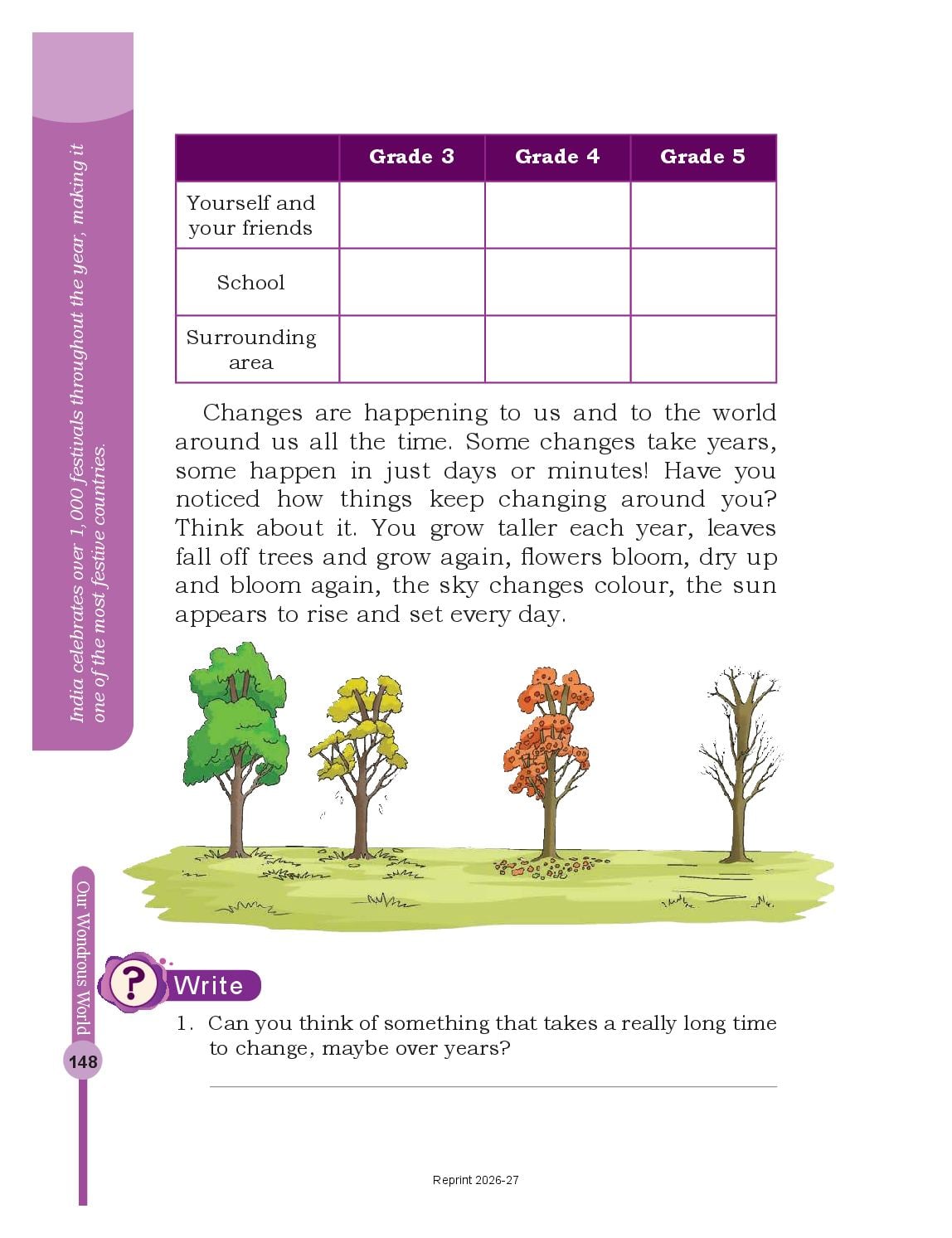
Download Rhythms of Nature – NCERT Class 5 EVS Chapter 9 PDF from the new NCERT Class 5 EVS book Our Wondrous World (2026-27). Read the chapter online or download the free PDF. Everything around us keeps changing. Look at the four trees on page 148. They are the same tree drawn four times — full green, then yellow with leaves falling, then covered in orange-red leaves, then bare. Some changes are slow, like a tree growing…
Rhythms of Nature PDF – Chapter 9 of Our Wondrous World
Read the chapter online or download the PDF.
| Chapter | Download | |
|---|---|---|
| Chapter 9 PDF | Rhythms of Nature | View PDF |
| Full book | NCERT Class 5 EVS – Our Wondrous World | View Book |
Read Online
What Is in Rhythms of Nature? (Class 5 EVS Chapter 9)
- Everything around us keeps changing. Look at the four trees on page 148. They are the same tree drawn four times — full green, then yellow with leaves falling, then covered in orange-red leaves, then bare. Some changes are slow, like a tree growing tall or a hill wearing down. Some are quick, like a cloud crossing the sun or a soap bubble bursting. You yourself changed between Grade 3 and Grade 5 — you grew taller, your handwriting improved, you made new friends.
- Some changes come back again and again. Day turns into night, and night turns back into day. Leaves fall and grow again. Flowers bloom, dry up and bloom again. A change that repeats in the same order, over and over, is called a rhythm — a pattern in nature. This chapter is about two such rhythms: the rhythm of a day and the rhythm of a year.
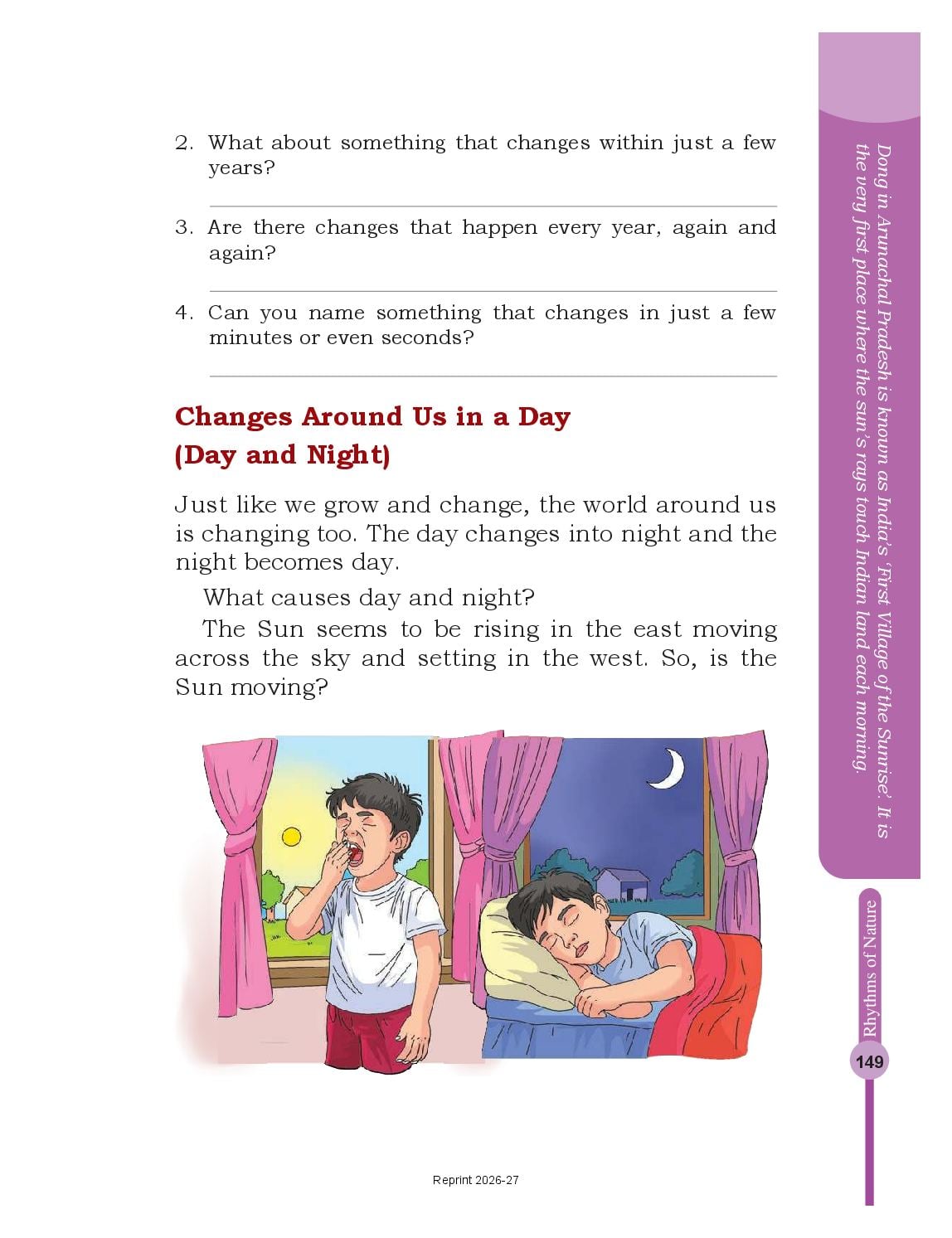
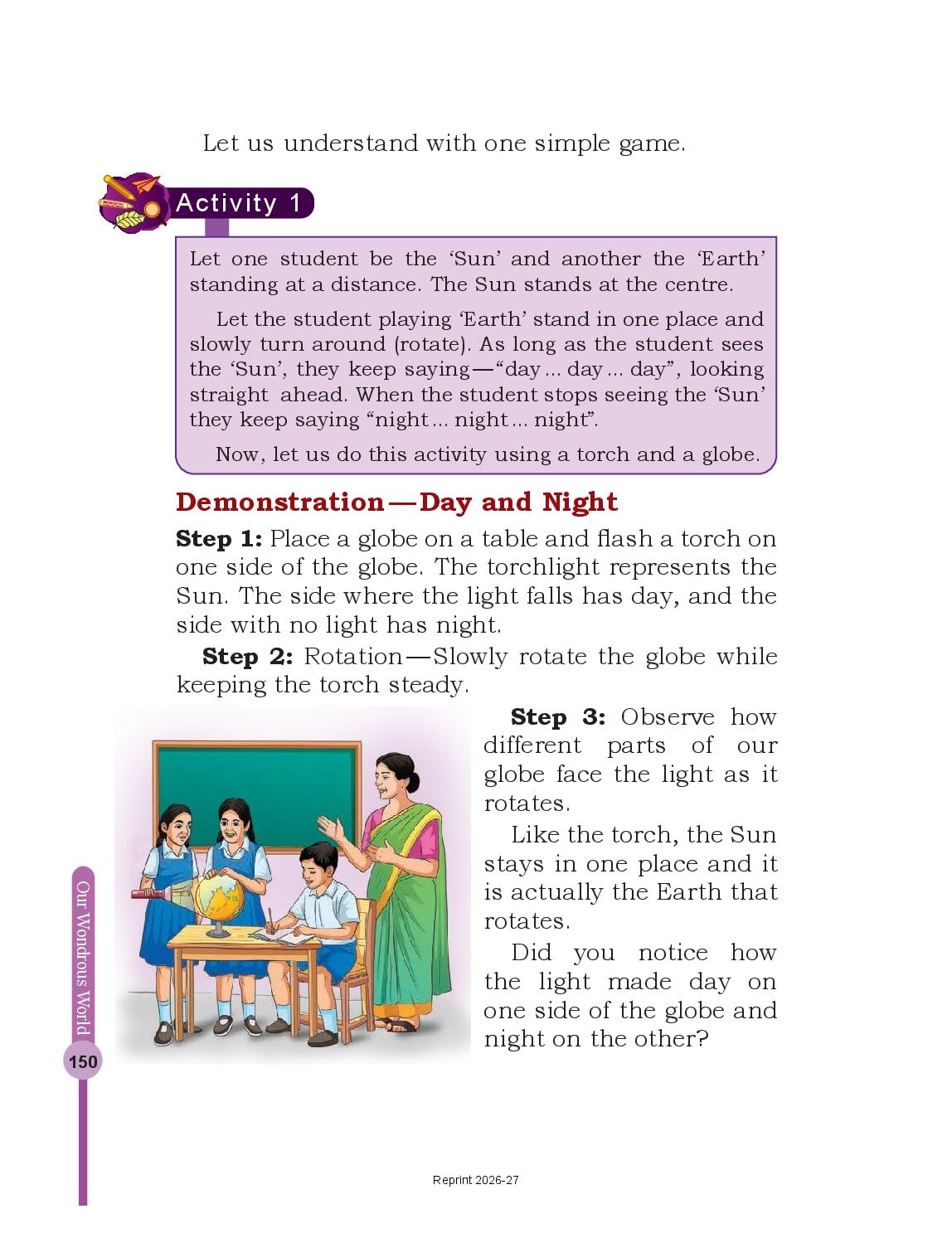
- Day and night happen because the Earth turns. The Sun looks as if it rises in the east, crosses the sky and sets in the west. But the Sun is not going round us. The Earth is turning round on itself, like a top. This turning is called rotation. The Earth spins around an imaginary line through its middle called its axis, and one full turn takes about 24 hours. The half of the Earth facing the Sun has day. The half turned away is in the dark, and has night. As the Earth keeps turning, every place gets its turn in the light.
- A globe is a small model of the Earth. It is shaped like a ball, just as the Earth is. Its blue parts are the seas and oceans, which cover about three-fourths of the Earth. Oceans are huge and open; seas are smaller and are partly closed in by land. The rest of the globe is land, where all the countries are. Shine a torch on one side of a globe and turn the globe slowly — you have made day and night on a table.
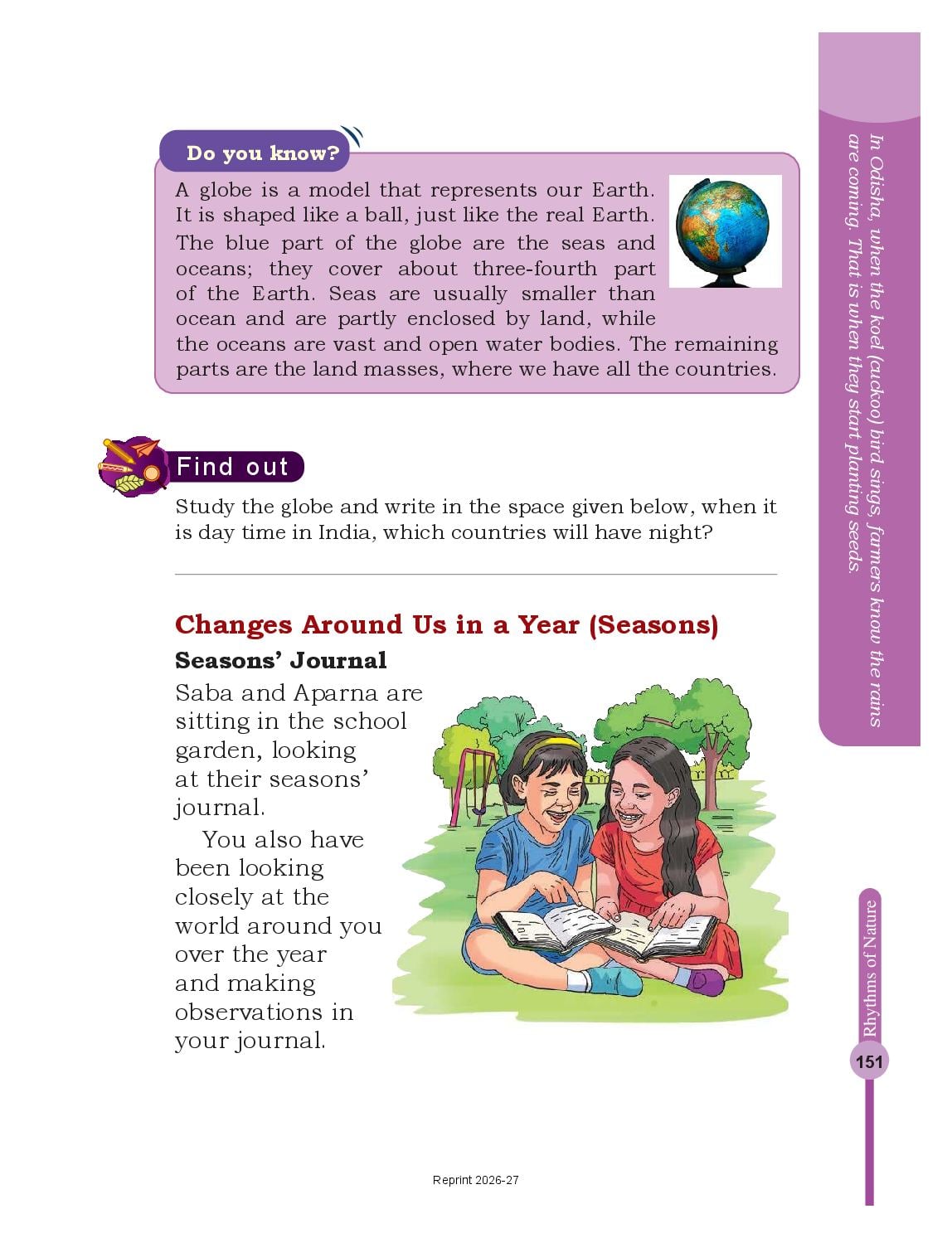
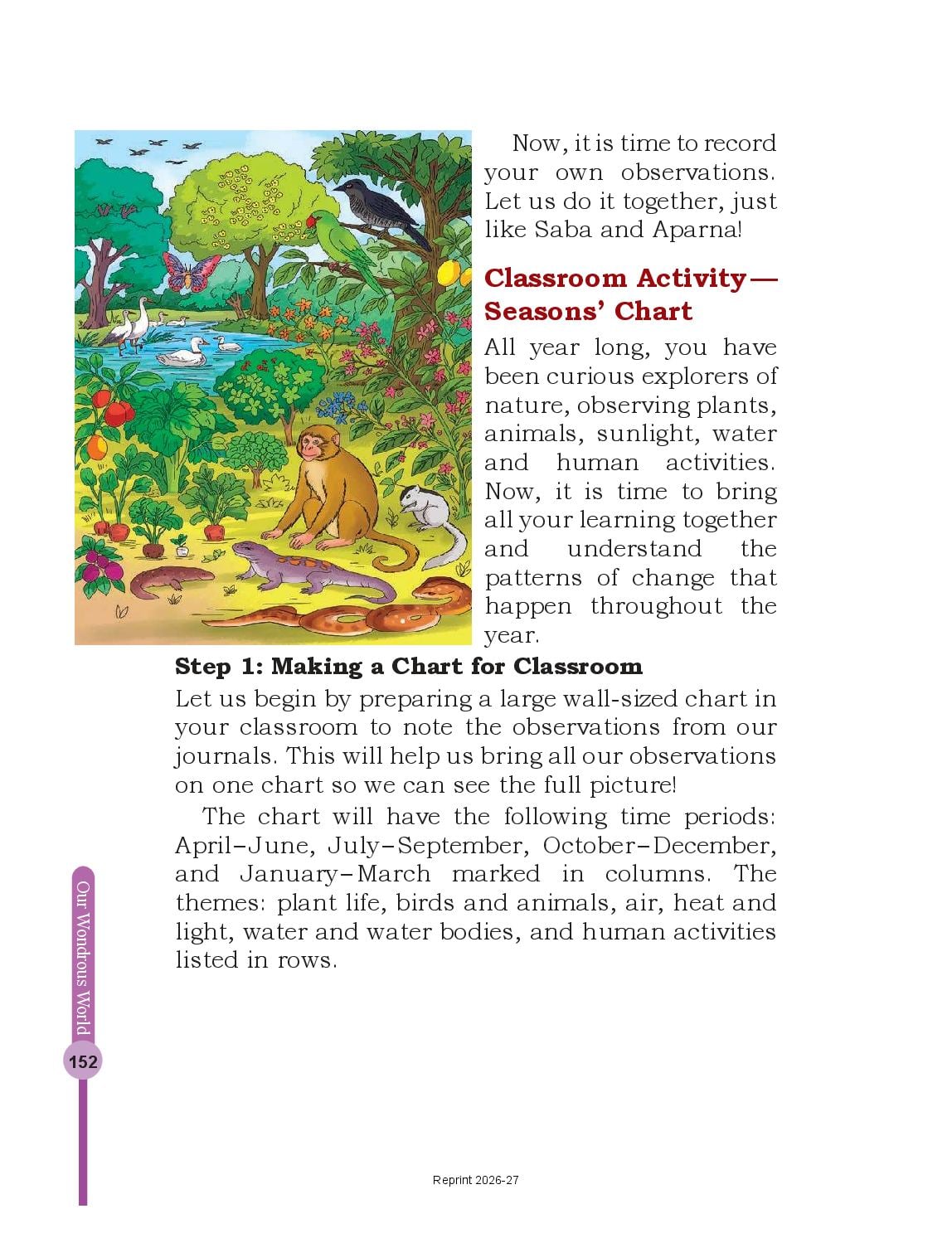
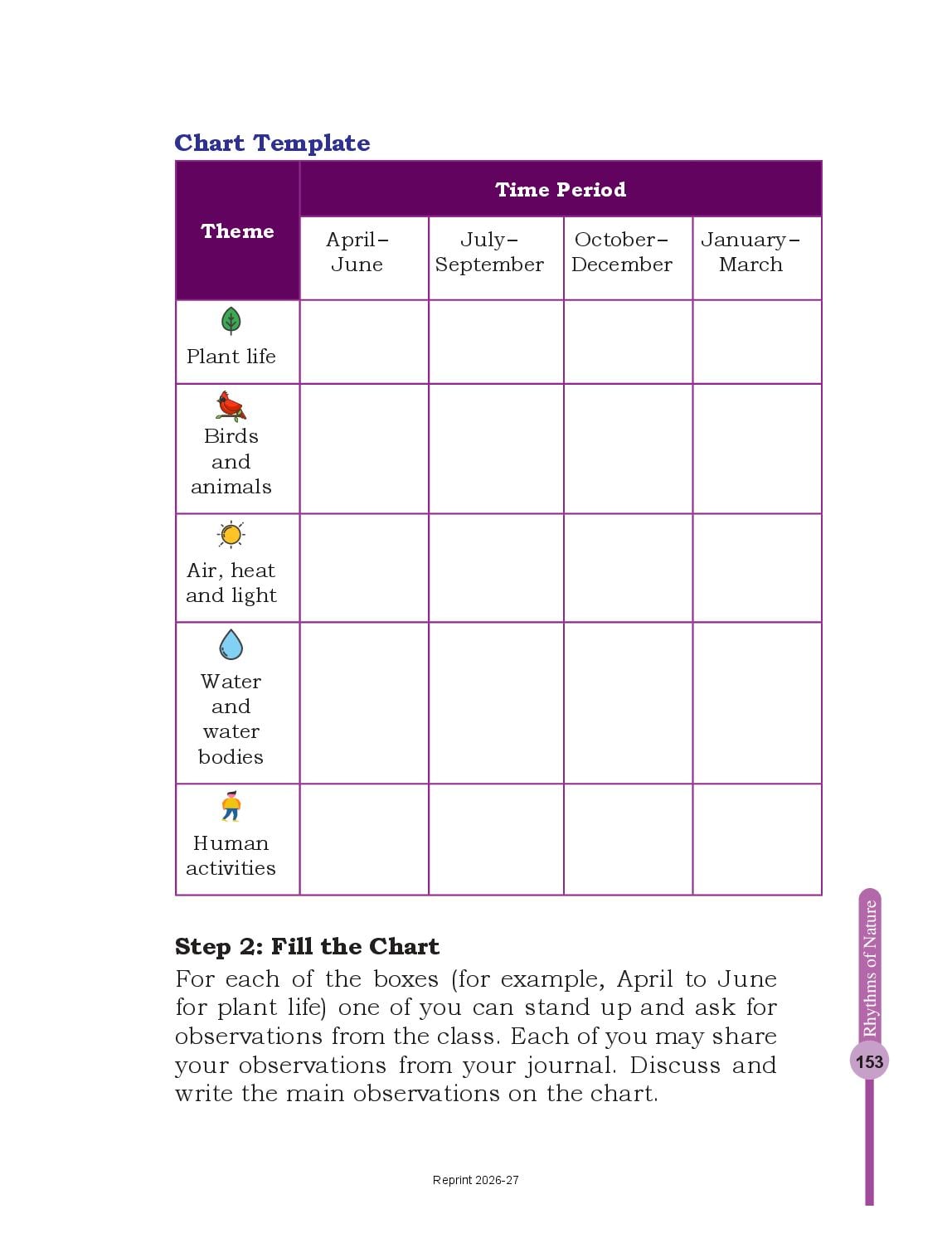
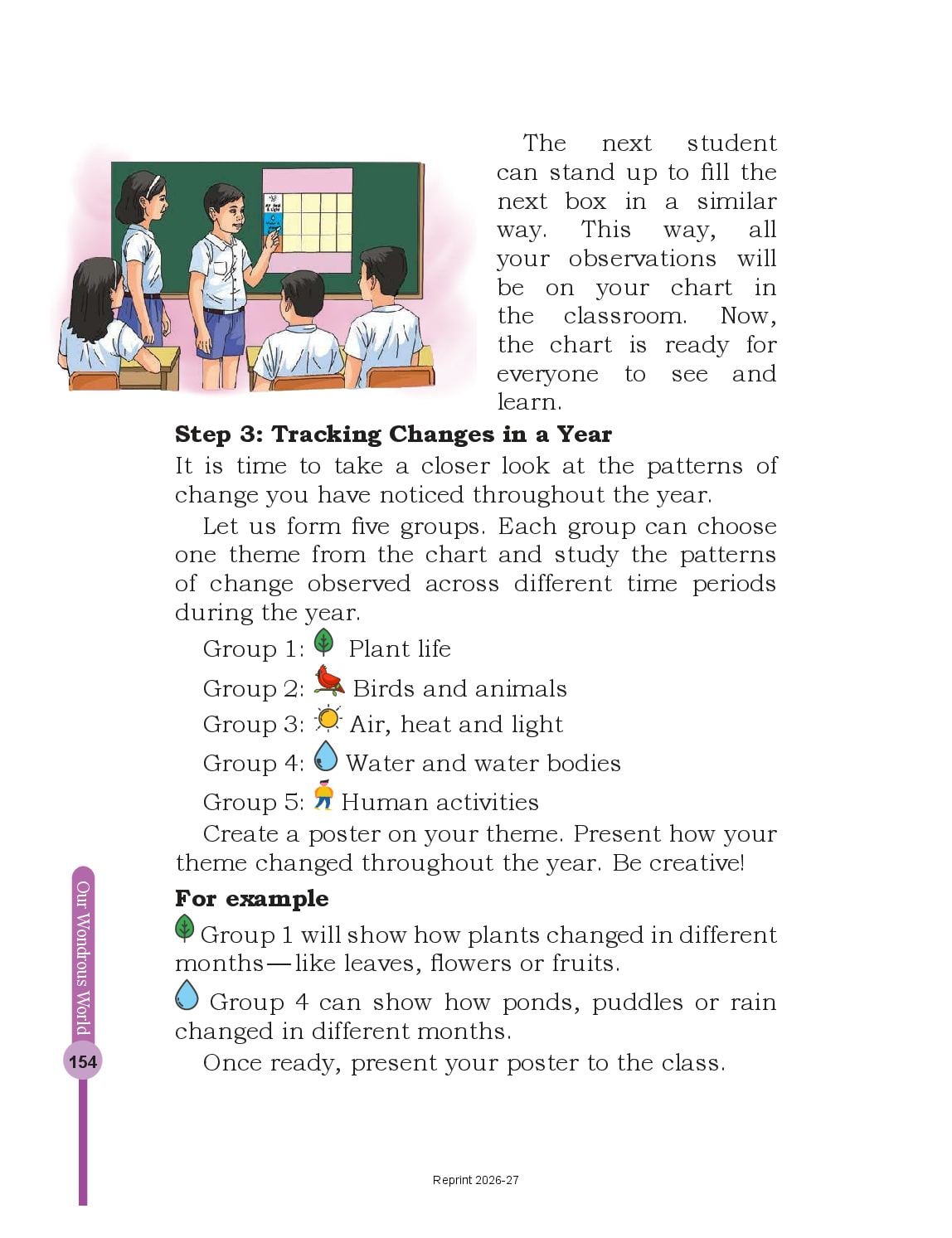
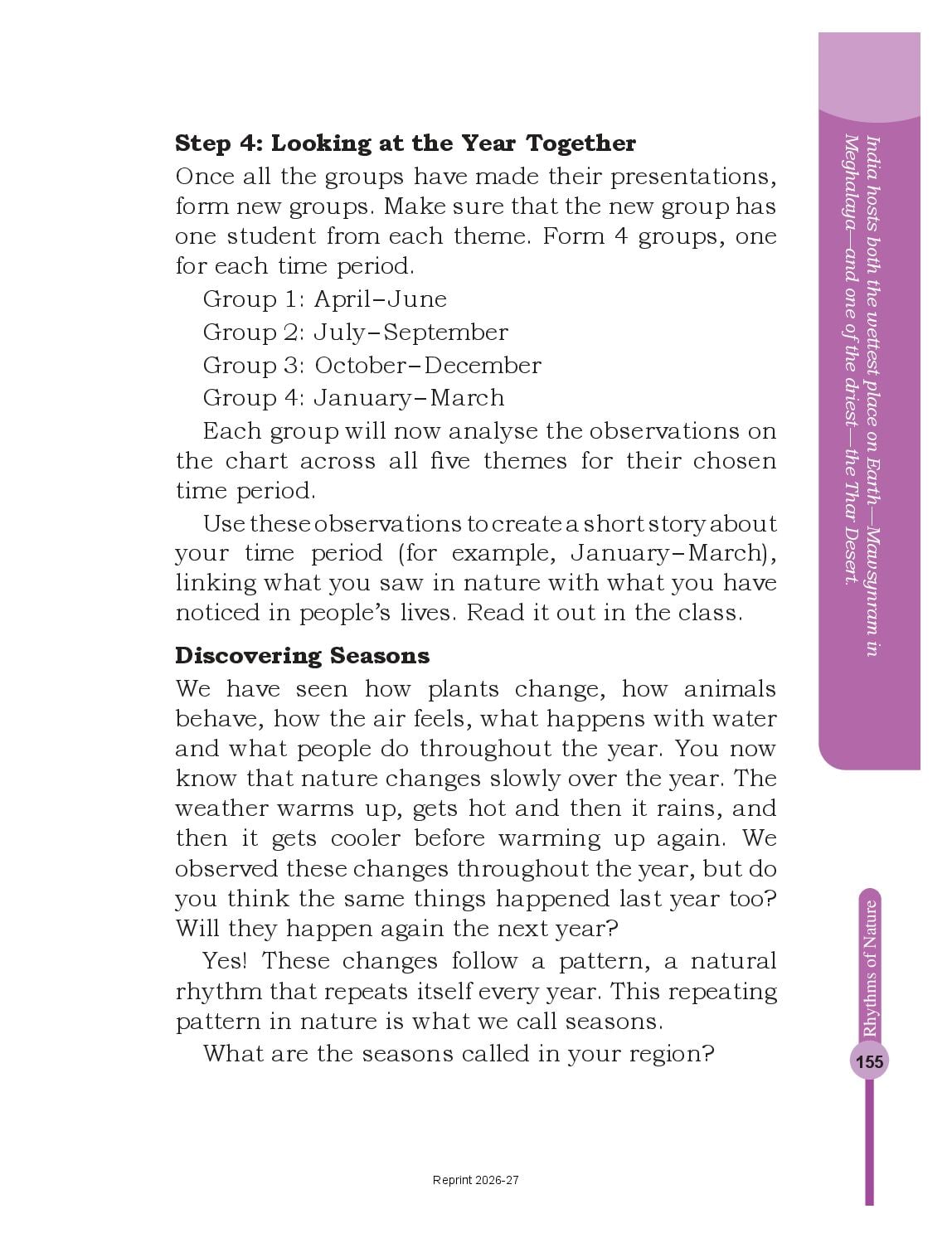
- The year has its own rhythm, and we call it the seasons. Through the year the weather warms up, gets very hot, then it rains, then it turns cool, then cold, and then warms up again. The same thing happened last year. The same thing will happen next year. This repeating pattern is what we call a season. Keeping a seasons’ journal — a notebook where you write down what you see in nature each month — is how you notice the pattern for yourself.
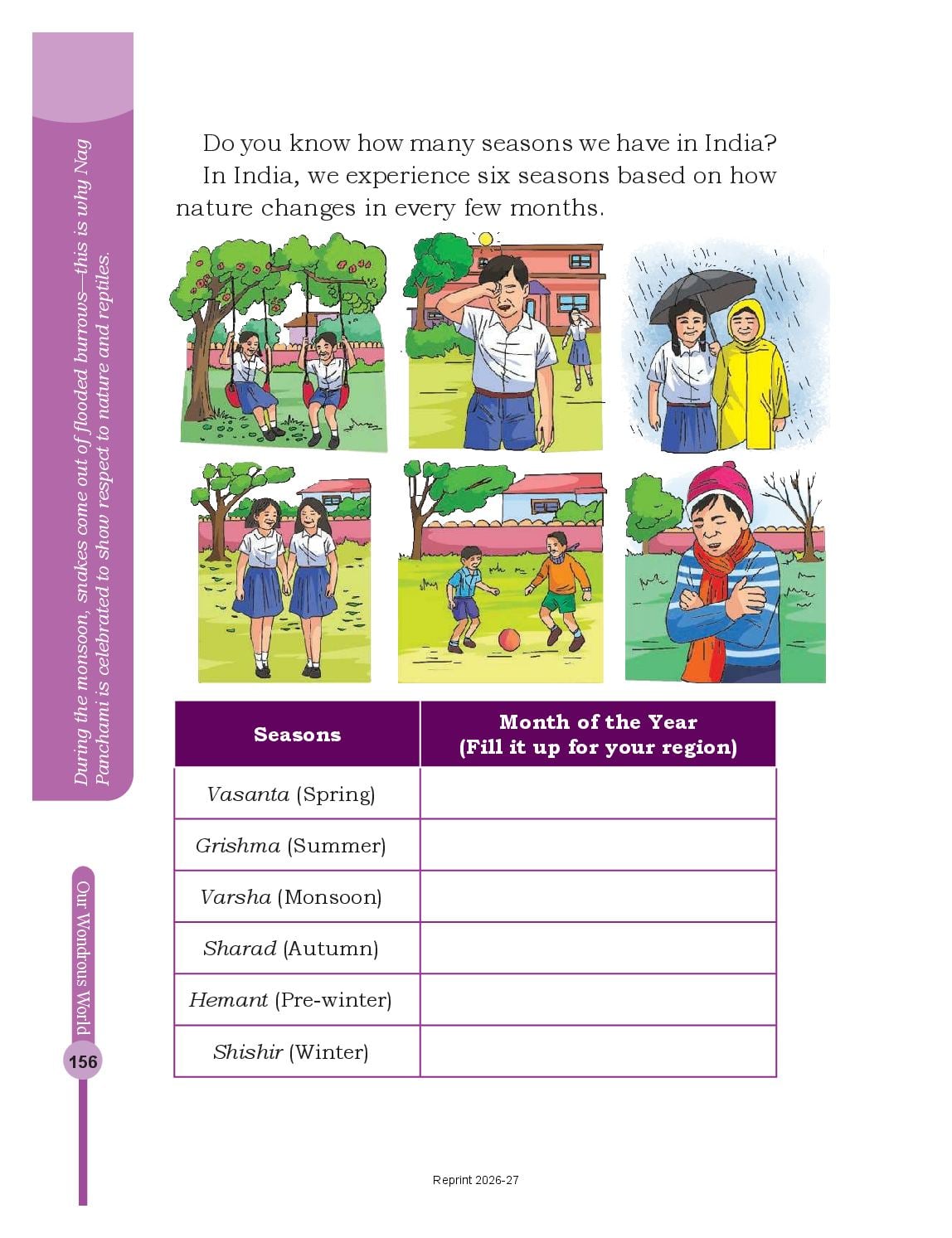
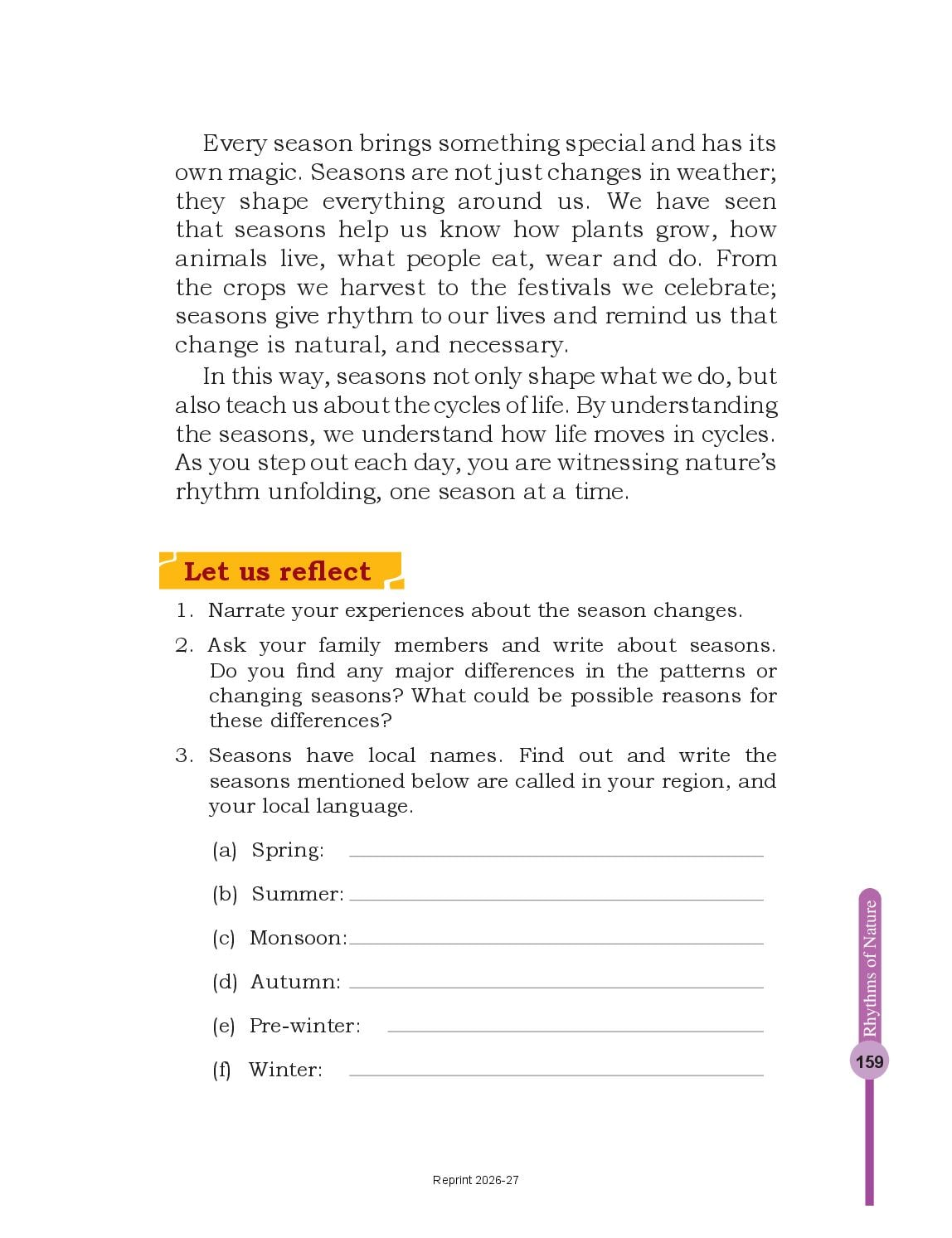
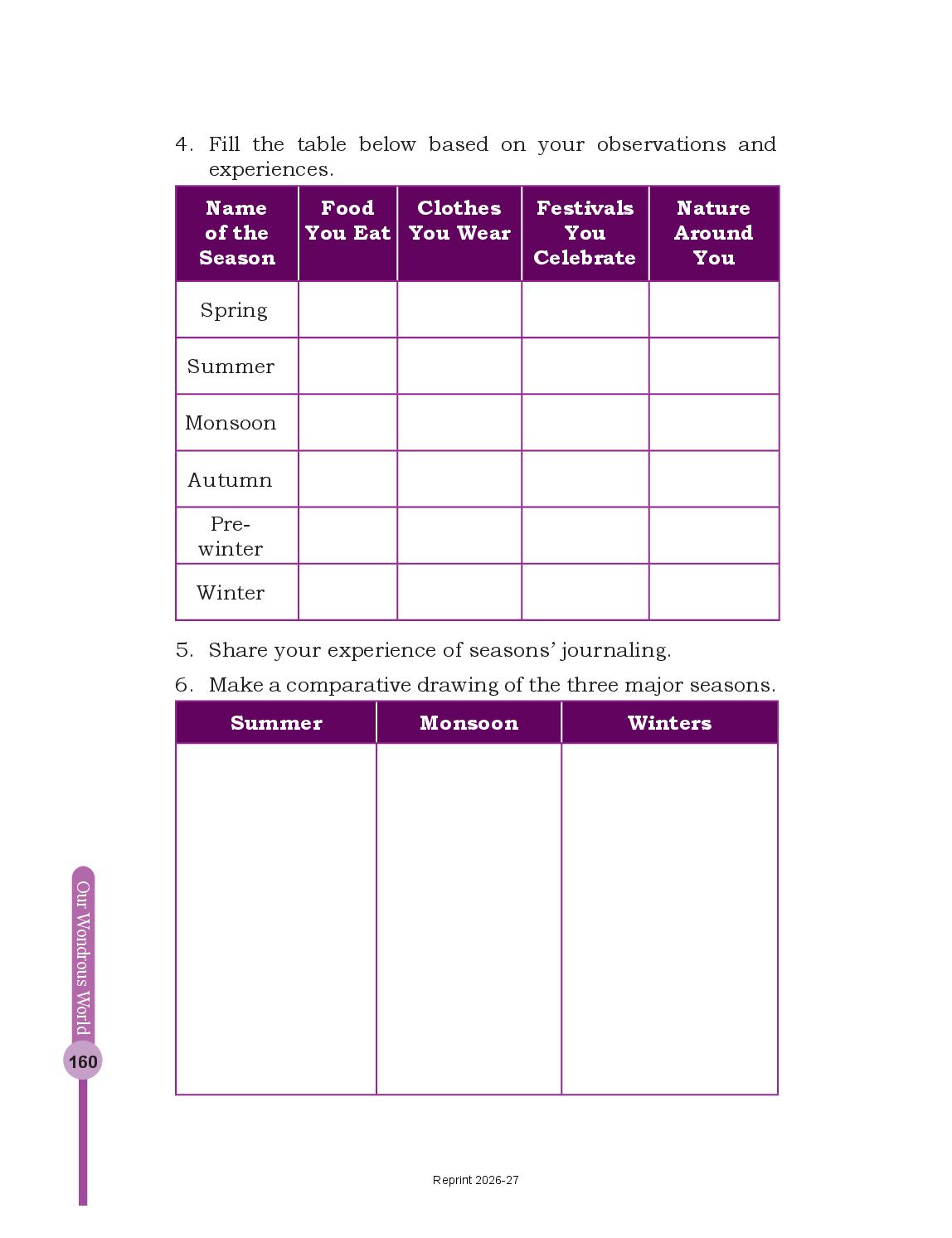
- India has six seasons. They are Vasanta (Spring), Grishma (Summer), Varsha (Monsoon), Sharad (Autumn), Hemant (Pre-winter) and Shishir (Winter). Each one lasts about two months, and each brings its own weather, its own flowers, its own birds, its own food and its own festivals.
- Extra, beyond the book — why do the seasons change? Besides spinning on its axis every day, the Earth also travels once round the Sun every year. And the Earth’s axis is not straight up — it leans a little to one side, like a spinning top that tips over slightly. The lean always points the same way. So for part of the year our half of the Earth leans towards the Sun and gets strong, straight sunlight — that is summer. Six months later the same half leans away, the sunlight comes slanting, and it is winter. Seasons are not caused by the Earth coming nearer to or going farther from the Sun.
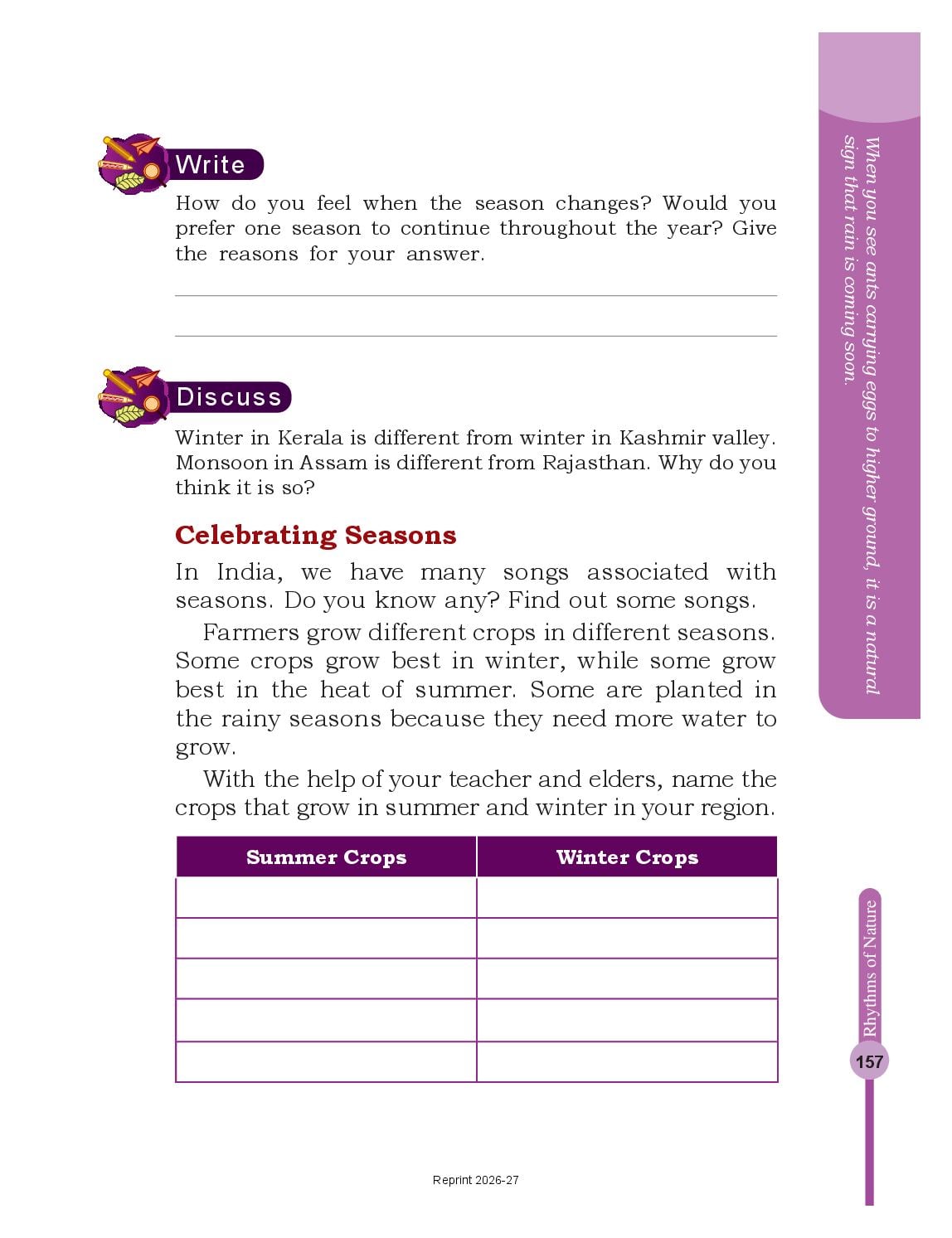
- The same season is not the same everywhere in India. Winter in the Kashmir valley brings snow; winter in Kerala only means slightly cooler days. Places far from the equator, and places high up in the mountains, are colder. Places near the sea stay even — neither very hot nor very cold. Mountains also decide the rain: the hills of the north-east force the wet monsoon winds to rise and drop their rain, so Assam and Meghalaya are soaked, while Rajasthan, far inland with no hills to stop the winds, stays dry.
Quick revision – Rhythms of Nature
| Word | What it means | Where it appears | An everyday example |
|---|---|---|---|
| Change | Something becoming different from what it was before | Page 148, the four trees | You are taller now than in Grade 3 |
| Rhythm (pattern) | Something that happens again and again in the same order | Discovering Seasons, page 155 | Day, night, day, night… |
| Rotation | The Earth turning round on itself, once in about 24 hours | Activity 1, page 150 | A spinning top, or a merry-go-round |
| Axis | The imaginary line through the middle of the Earth that it turns around | Not printed in the chapter — extra | The metal rod through the middle of a school globe |
| Day | The time when your side of the Earth is facing the Sun and getting its light | Page 150 | From sunrise to sunset |
| Night | The time when your side of the Earth has turned away from the Sun | Page 150 | From sunset to sunrise |
| Globe | A small round model of the Earth | Do you know?, page 151 | The globe kept in the classroom |
| Ocean | A very large, open body of salty water; a sea is smaller and partly closed in by land | Do you know?, page 151 | The blue parts of the globe |
| Season | A part of the year with its own kind of weather, which comes back every year | Discovering Seasons, page 155 | The monsoon, which returns every June–July |
| Seasons’ journal | A notebook in which you write what you notice in nature through the year | Seasons’ Journal, page 151 | Saba and Aparna’s journals |
| Migratory birds | Birds that fly a long way to another country for one season and go back later | Not printed in the chapter — extra | Cranes and ducks at a lake in winter |
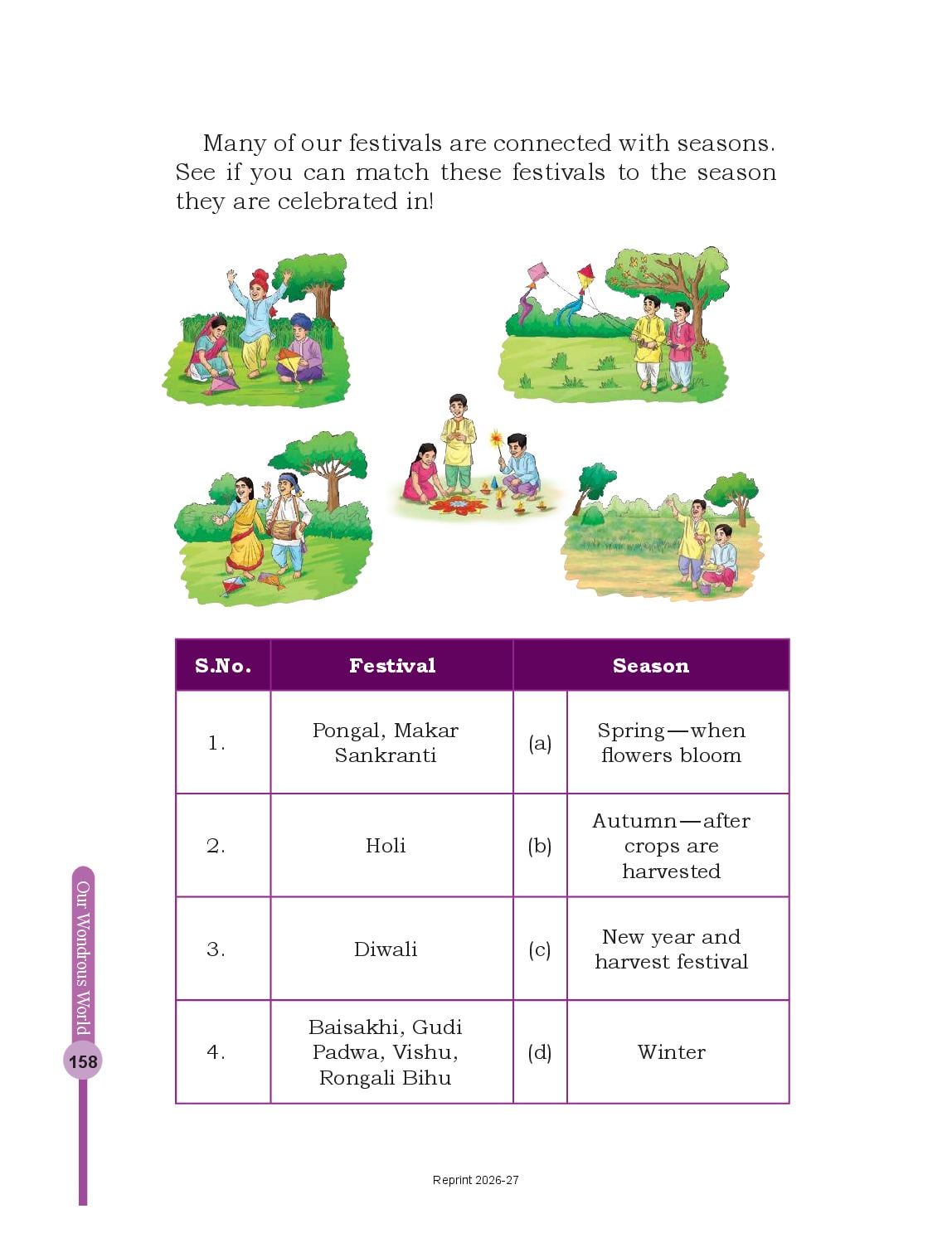
| Harvest | Cutting and gathering a crop when it is ripe and ready | Festival table, page 158 | Pongal, after the rice is harvested |
| Revolution | The Earth’s one full round trip around the Sun, which takes one year | Not printed in the chapter — extra (it is why the seasons come back) | Your birthday comes once every round trip |
Old NCERT vs New – Class 5 EVS
This chapter is from Our Wondrous World, the new NCERT Class 5 EVS book (NCF-SE 2023, used from 2025-26). It replaced the old book “Looking Around”, so chapter numbers and names differ from older PDFs.
Solutions and All Chapters
Answers to the exercises and the full chapter list of Our Wondrous World:
Rhythms of Nature – Overview
| Class | Class 5 |
| Subject | EVS |
| Book | Our Wondrous World – new NCERT book |
| Chapter | 9 of 10 – Rhythms of Nature |
| Book pages | 147 – 160 |
| Edition | NCERT Reprint 2026-27 |
| Session | 2026-27 |
| Free – read online or download |
Class 5 EVS Chapter 9 – FAQs
Where can I download Rhythms of Nature Class 5 PDF?
From the download table on this page – the chapter PDF is free, and the full book is linked too.
What is Class 5 EVS Chapter 9 about?
Everything around us keeps changing. Look at the four trees on page 148. They are the same tree drawn four times — full green, then yellow with leaves falling, then covered in orange-red leaves, then bare. Some changes are slow, like a tree growing tall or a hill wearing down. Some are quick, like a cloud crossing the sun or a soap bubble bursting. You yourself changed between Grade 3 and Grade 5 — you grew taller, your handwriting improved, you made new friends.
Is Rhythms of Nature from the new NCERT Class 5 EVS book?
Yes. It is chapter 9 of our wondrous world, the new NCERT Class 5 EVS book for 2026-27.
Is this the latest NCERT edition for 2026-27?
Yes – the PDF is NCERT’s latest edition for the 2026-27 session.
Where are the NCERT Solutions for Class 5 EVS Chapter 9?
Open the NCERT Solutions link above for answers to the exercise questions.