Download Clothes-How Things are Made – NCERT Class 5 EVS Chapter 8 PDF from the new NCERT Class 5 EVS book Our Wondrous World (2026-27). Read the chapter online or download the free PDF. Weaving means crossing two sets of threads over and under each other. One set is placed one way. The other set goes across it. Each strip goes over, then under, then over, then under. When you keep doing this, the strips lock together and become one…
Clothes-How Things are Made PDF – Chapter 8 of Our Wondrous World
Read the chapter online or download the PDF.
| Chapter | Download | |
|---|---|---|
| Chapter 8 PDF | Clothes-How Things are Made | View PDF |
| Full book | NCERT Class 5 EVS – Our Wondrous World | View Book |
Read Online
What Is in Clothes-How Things are Made? (Class 5 EVS Chapter 8)
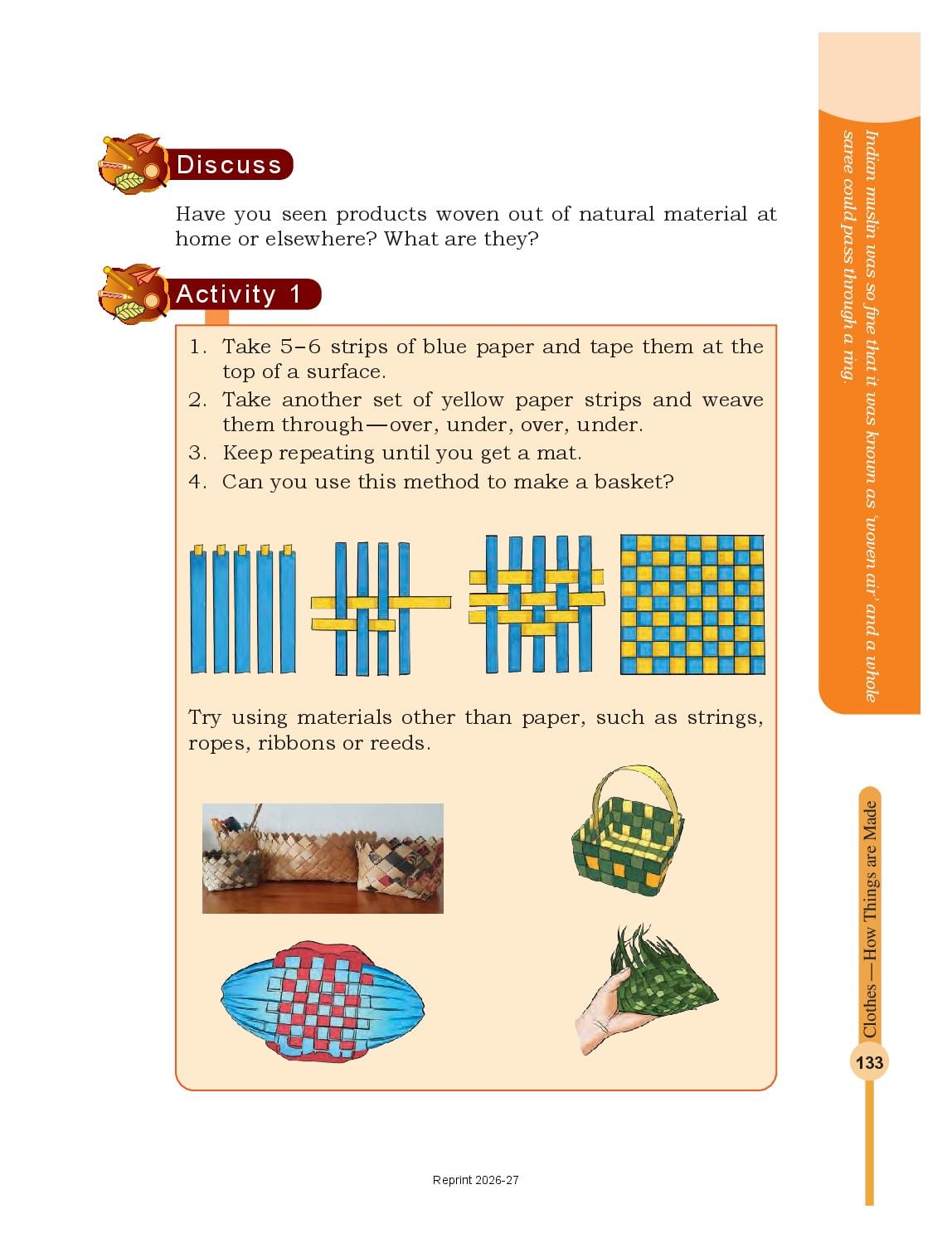
- Weaving means crossing two sets of threads over and under each other. One set is placed one way. The other set goes across it. Each strip goes over, then under, then over, then under. When you keep doing this, the strips lock together and become one sheet. That sheet may be a mat, a basket or a piece of cloth. Look at the picture on page 133 — five blue paper strips and some yellow strips make a mat in exactly this way.
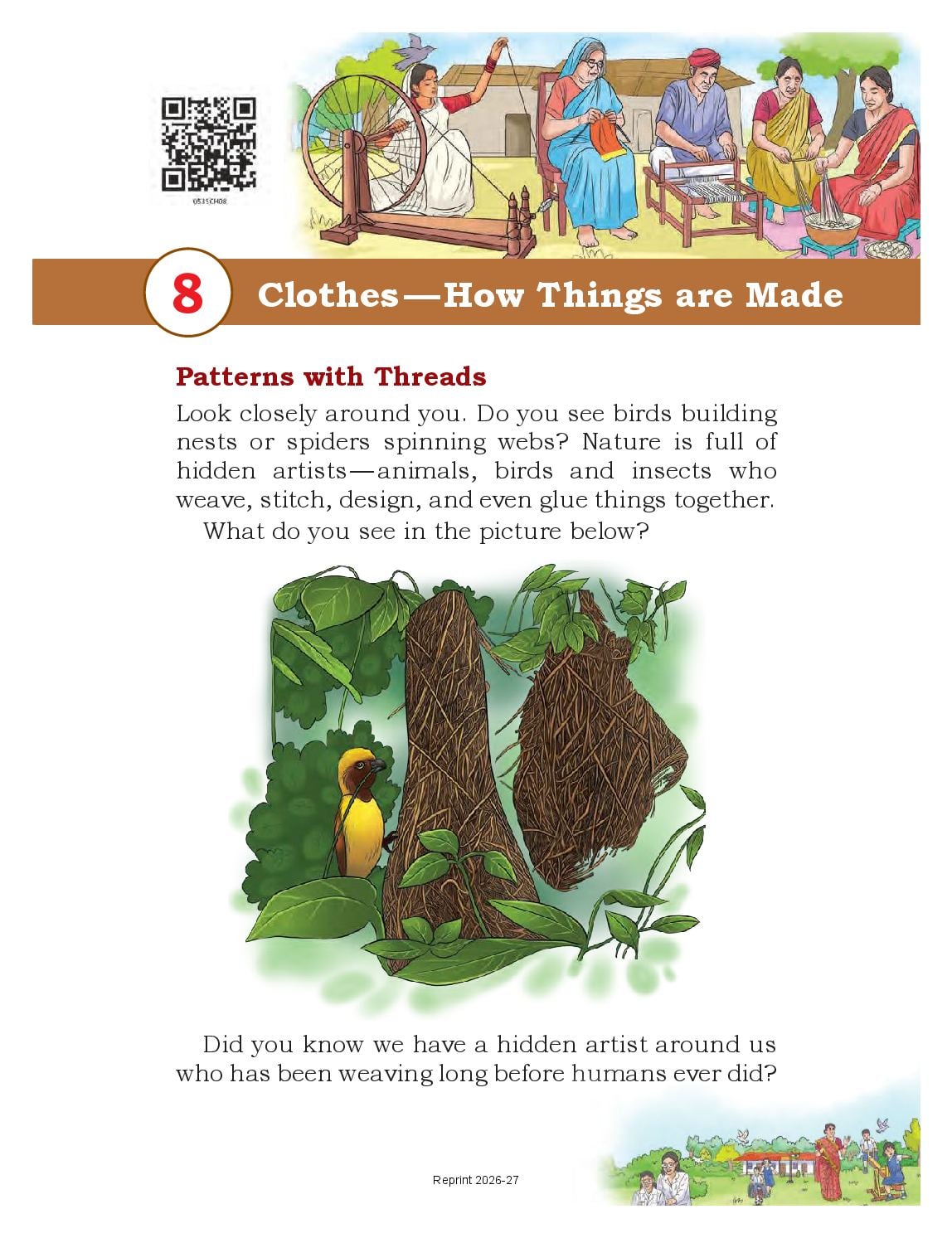
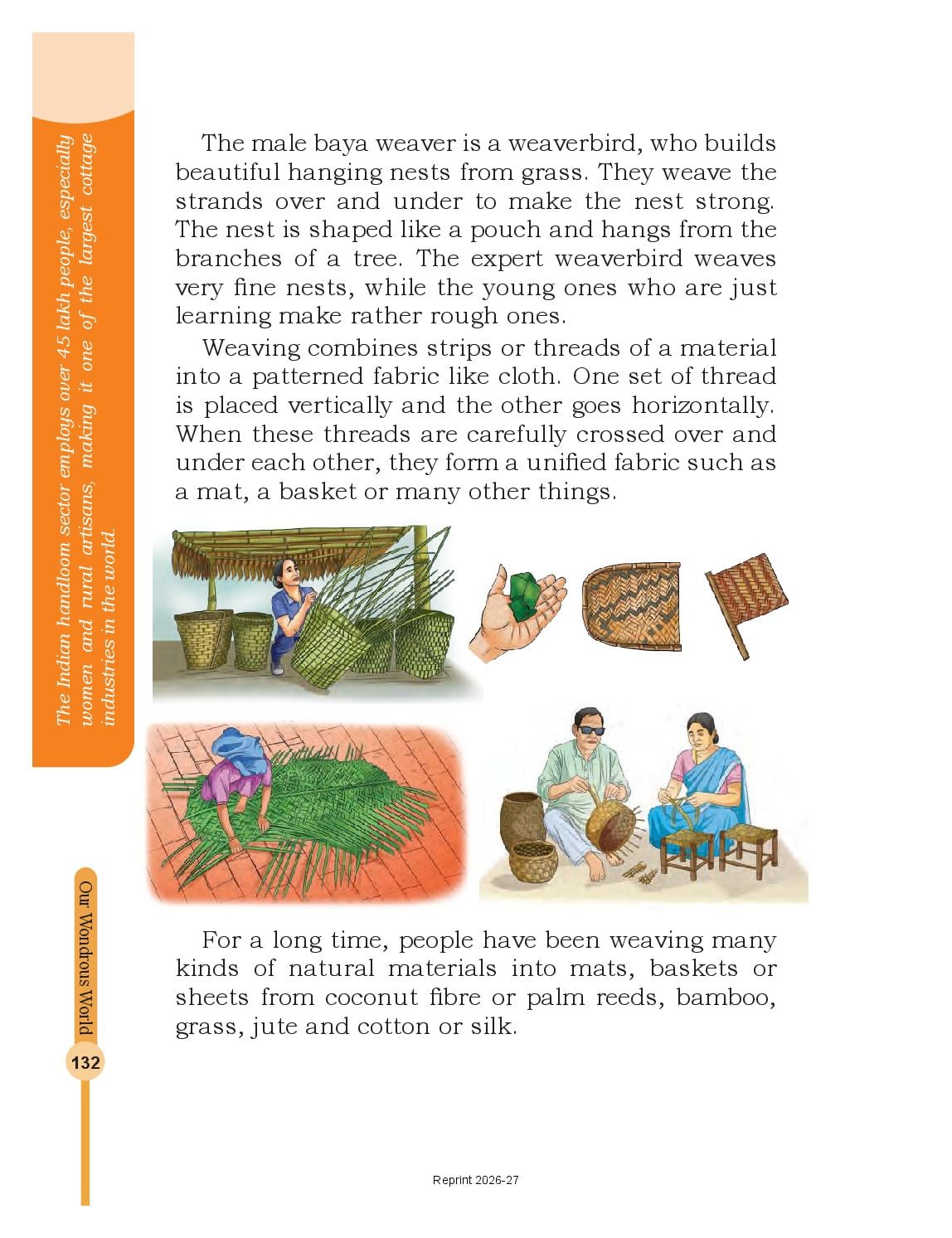
- A bird was weaving before people were. The male baya, a weaverbird, builds a hanging nest out of grass. He weaves the strands over and under so the nest is strong. The nest hangs from a branch and is shaped like a pouch. An expert baya makes a very fine nest. A young bird, still learning, makes a rough one. So even for a bird, weaving is a skill that has to be practised.
- People have woven natural materials for a very long time. Coconut fibre, palm reeds, bamboo, grass, jute, cotton and silk are all woven into mats, baskets and sheets. If you weave with threads instead of paper strips, you get cloth. Look at your shirt through a magnifying glass and you will see the tiny criss-cross pattern.
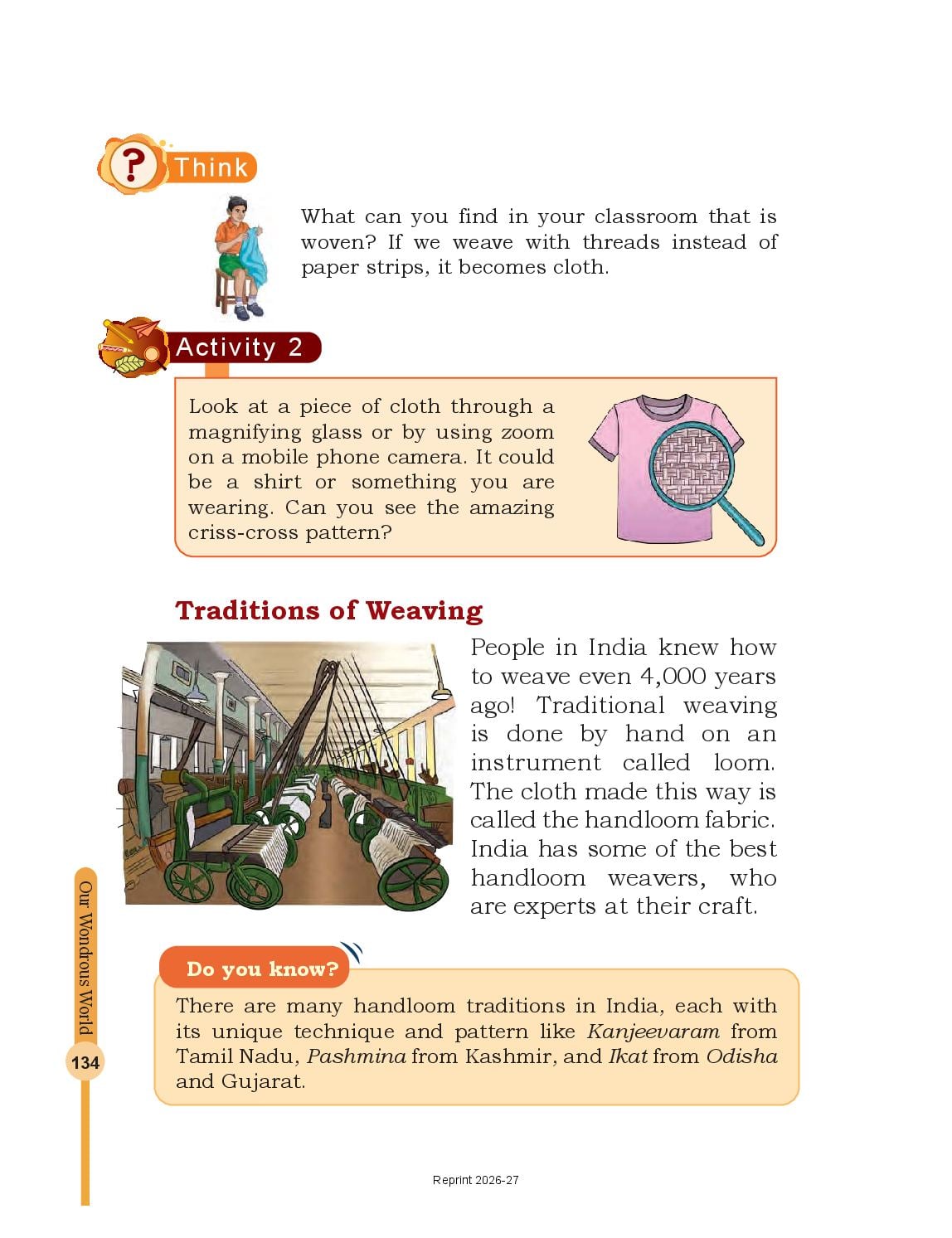
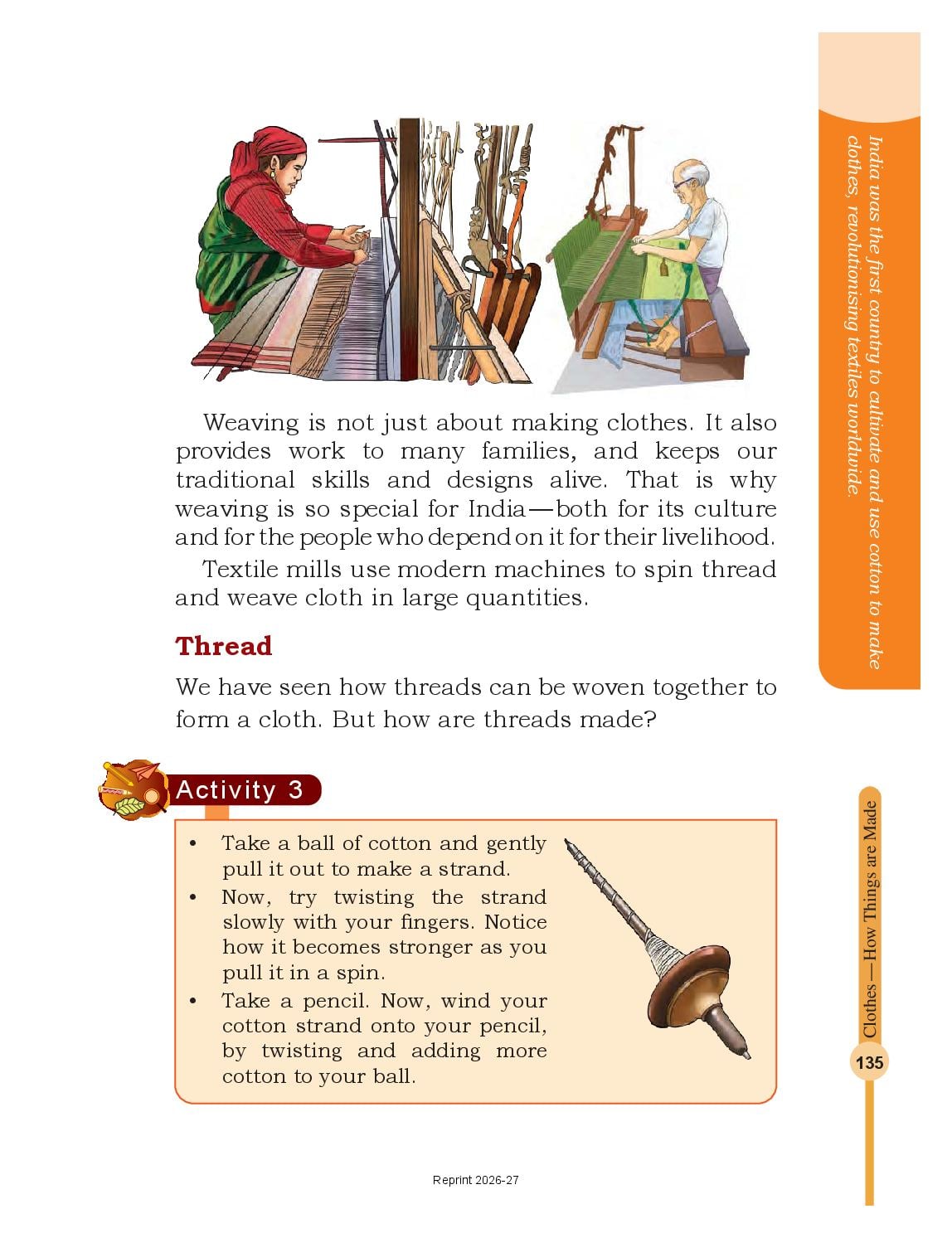
- Cloth is woven on a loom. A loom is the frame that holds one set of threads tight while the weaver passes the other set across. People in India knew how to weave even 4,000 years ago. Cloth woven by hand on a loom is called handloom fabric. India has some of the best handloom weavers in the world. Every region has its own tradition — Kanjeevaram from Tamil Nadu, Pashmina from Kashmir, Ikat from Odisha and Gujarat. Textile mills do the same two jobs — spinning and weaving — but with big machines, and they make cloth in very large quantities.
- Weaving is work, not only art. The Indian handloom sector gives work to over 45 lakh people, most of them women and artisans in villages. That makes it one of the largest cottage industries in the world. Handloom weaving uses no electricity, so it is eco-friendly. It also keeps old designs and skills alive. Indian muslin was once so fine that it was called woven air — a whole saree could be pulled through a ring.
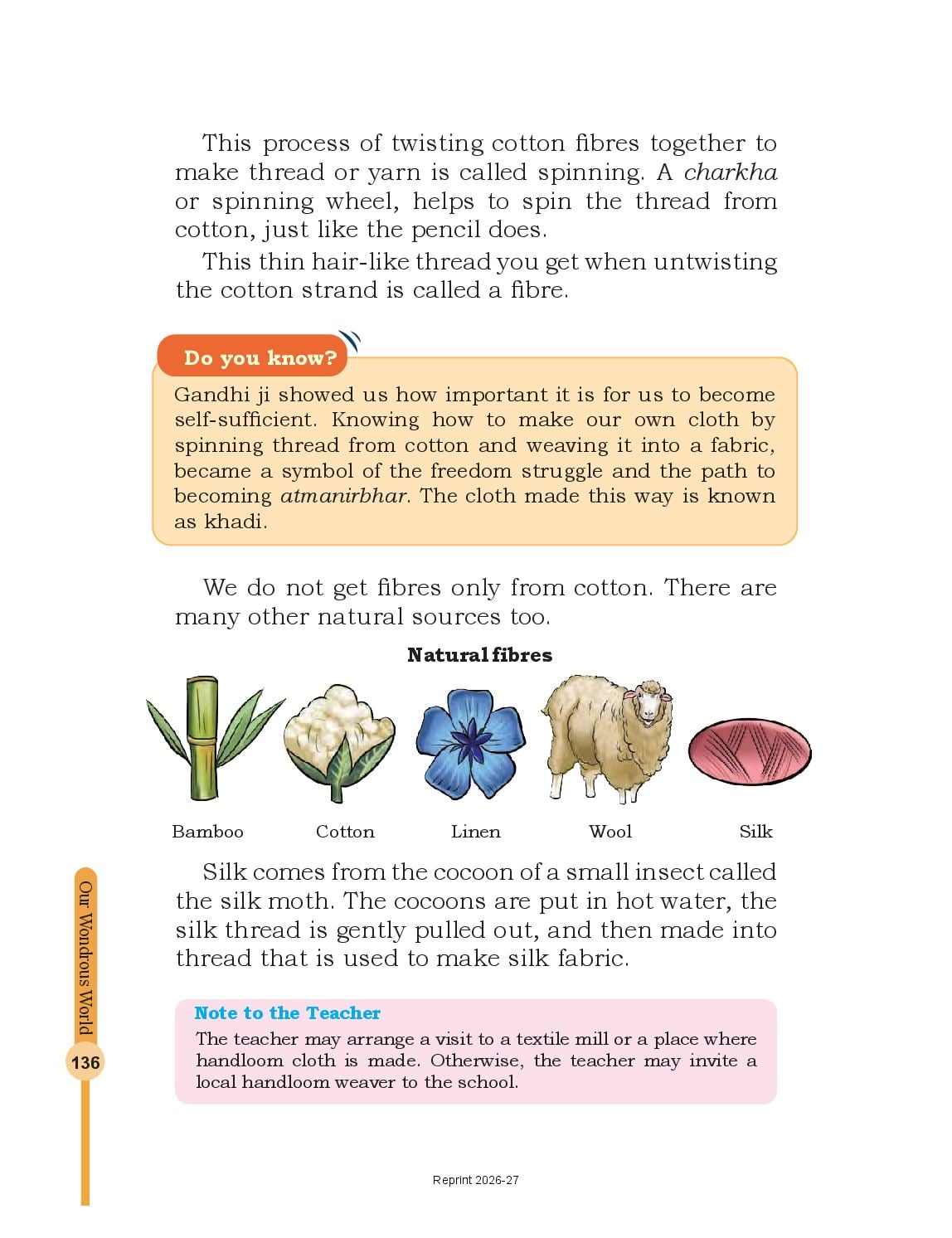
- Thread is made by twisting fibres together. That is called spinning. A fibre is the thin, hair-like thread you get if you untwist a cotton strand. On its own a fibre is weak and short. Twist many of them together and you get a long, strong thread, also called yarn. A charkha or spinning wheel does this job — and so does a pencil, in Activity 3. Gandhi ji spun his own thread and wove his own cloth. That cloth is called khadi, and it became a symbol of the freedom struggle and of becoming atmanirbhar — able to look after ourselves.
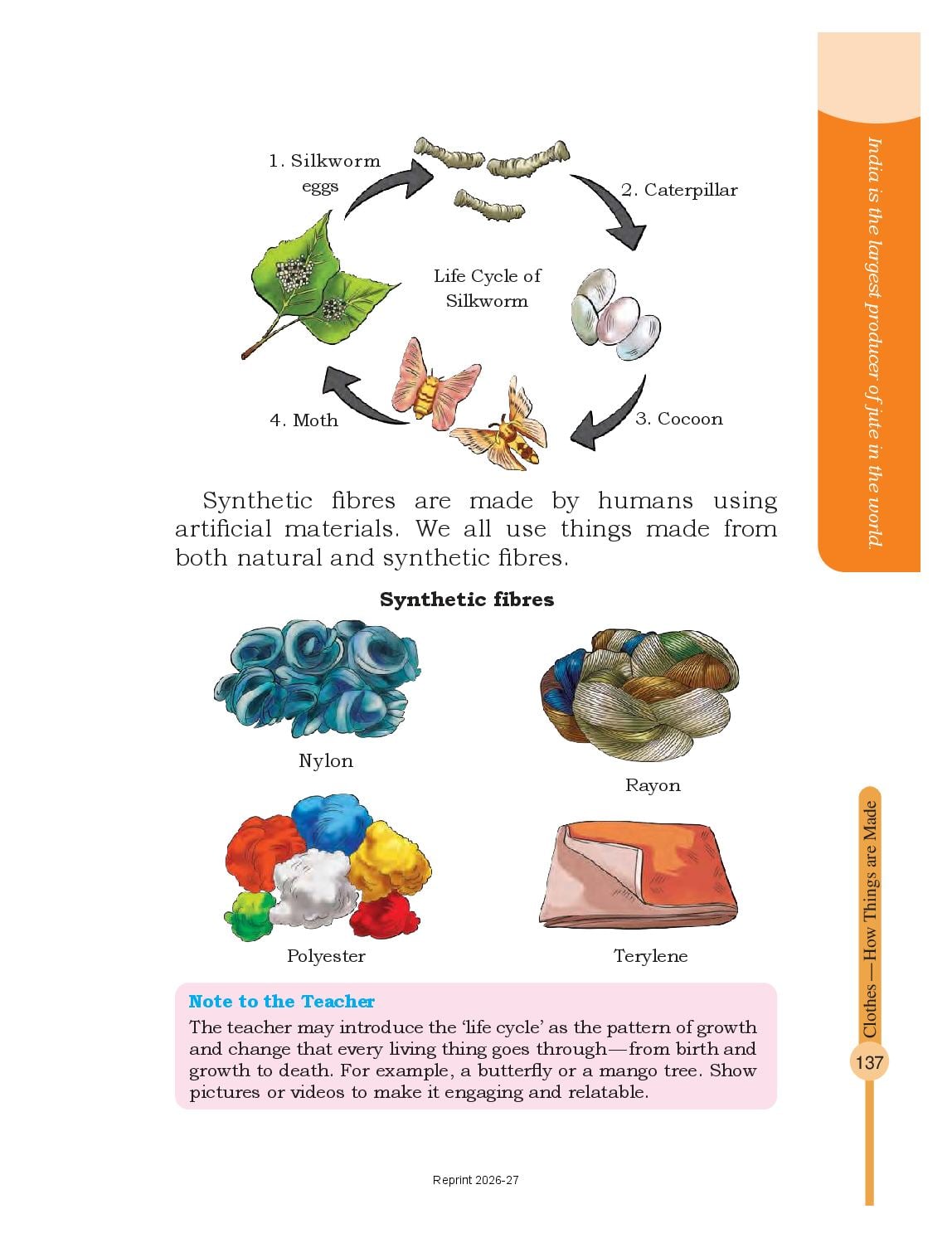
- Fibres are of two kinds — natural and synthetic. Natural fibres come from plants and animals: bamboo, cotton, linen, wool and silk. Synthetic fibres are made by people from artificial materials: rayon, nylon, polyester and terylene. We use both every day. India was the first country in the world to grow cotton and make cloth from it, and India is the largest producer of jute in the world.
- Silk comes from an insect. The silk moth lays eggs. The eggs hatch into caterpillars, which eat mulberry leaves and grow. Each caterpillar then spins a cocoon of silk thread all around itself. The cocoons are put in hot water, the silk thread is gently pulled out, and it is made into thread for silk cloth. An adult moth comes out of the cocoon, lays eggs, and the whole cycle starts again. That repeating pattern is called a life cycle.
Quick revision – Clothes-How Things are Made
| Word | What it means | Where it appears | An everyday example |
|---|---|---|---|
| Weaving | Crossing two sets of strips or threads over and under each other to make one sheet | Patterns with Threads, page 132 | A chatai (mat), a cane basket, your shirt |
| Fabric / cloth | The sheet you get when threads are woven together | Patterns with Threads, page 132 | A saree, a bedsheet, a school uniform |
| Loom | The frame that holds the threads while the weaver crosses them | Traditions of Weaving, page 134 | A weaver’s loom in a village workshop |
| Handloom | Cloth woven by hand on a loom, not by machine | Traditions of Weaving, page 134 | A khadi kurta, a Kanjeevaram saree |
| Textile mill | A factory that spins thread and weaves cloth with big machines | Page 135 | Mill-made cloth sold by the metre in a shop |
| Thread or yarn | A long strong strand made by twisting fibres together | Thread, page 135 | The reel of thread in a tailor’s shop |
| Fibre | The thin, hair-like thread you get on untwisting a strand | Page 136 | A single hair pulled off a piece of cotton wool |
| Spinning | Twisting fibres together to make thread | Page 136 | Grandmother twisting cotton on a charkha |
| Charkha | The spinning wheel that spins thread from cotton | Page 136 | The charkha in the picture on page 131 |
| Khadi | Hand-spun, hand-woven cloth; a symbol of the freedom struggle | Do you know?, page 136 | A khadi jhola or kurta |
| Natural fibre | A fibre that comes from a plant or an animal | Natural fibres, page 136 | Cotton, wool, silk, linen, bamboo, jute |
| Synthetic fibre | A fibre made by people from artificial materials | Synthetic fibres, page 137 | Nylon rope, a polyester shirt, a rayon dupatta |
| Cocoon | The silk case a caterpillar spins around itself | Page 136 | Silk cocoons boiled to draw out the thread |
| Life cycle | The pattern of growth and change every living thing goes through | Life Cycle of Silkworm, page 137 | Egg → caterpillar → cocoon → moth |
Old NCERT vs New – Class 5 EVS
This chapter is from Our Wondrous World, the new NCERT Class 5 EVS book (NCF-SE 2023, used from 2025-26). It replaced the old book “Looking Around”, so chapter numbers and names differ from older PDFs.
Solutions and All Chapters
Answers to the exercises and the full chapter list of Our Wondrous World:
Clothes-How Things are Made – Overview
| Class | Class 5 |
| Subject | EVS |
| Book | Our Wondrous World – new NCERT book |
| Chapter | 8 of 10 – Clothes-How Things are Made |
| Book pages | 131 – 144 |
| Edition | NCERT Reprint 2026-27 |
| Session | 2026-27 |
| Free – read online or download |
Class 5 EVS Chapter 8 – FAQs
Where can I download Clothes-How Things are Made Class 5 PDF?
From the download table on this page – the chapter PDF is free, and the full book is linked too.
What is Class 5 EVS Chapter 8 about?
Weaving means crossing two sets of threads over and under each other. One set is placed one way. The other set goes across it. Each strip goes over, then under, then over, then under. When you keep doing this, the strips lock together and become one sheet. That sheet may be a mat, a basket or a piece of cloth. Look at the picture on page 133 — five blue paper strips and some yellow strips make a mat in exactly this way.
Is Clothes-How Things are Made from the new NCERT Class 5 EVS book?
Yes. It is chapter 8 of our wondrous world, the new NCERT Class 5 EVS book for 2026-27.
Is this the latest NCERT edition for 2026-27?
Yes – the PDF is NCERT’s latest edition for the 2026-27 session.
Where are the NCERT Solutions for Class 5 EVS Chapter 8?
Open the NCERT Solutions link above for answers to the exercise questions.